Chapter IV · THE INDUSTRIAL ARTS.
Walter Armstrong translation
§ 1.—Ceramics.
Of all the materials put in use by the inhabitants of Mesopotamia, clay was the first and by far the most important. Clay furnished the sun-dried bricks of which the great buildings were constructed, the burnt bricks with which the artificial mounds on which those buildings stood were cased, and the enamelled bricks that enabled certain parts to be covered with a rich polychromatic decoration. The figures of the gods and demons they worshipped and the tombs into which they were thrust after death were both made of this same material. It was upon clay that they learnt to write; it was to slabs of terra-cotta that their kings confided the memory of their victories and acts of devotion, and the private population their engagements and the contracts into which they entered. For thousands of years tablets of clay thus received not only long texts, but those impressions from seals, each one of which represents a signature. While wet and soft, clay readily accepted any symbol that man chose to place upon it; once it was burnt, those symbols became practically indestructible.
Accustomed to employ the unrivalled docility of kneaded earth in so many ways, the Chaldæans must, at a very early date, have used it for domestic purposes, for cooking, for holding grain, fruits, and liquids. Like every one else they must have begun by shaping such utensils with their fingers and drying them in the sun. Few remains of these early attempts have been preserved. The invention of the potter’s wheel and firing-oven must have taken place at a very remote period both in Egypt and Chaldæa. The oldest vases found in the country, those taken from tombs at Warka and Mugheir, have been burnt in the oven. Some, however, do not seem to have been ‘thrown’ on the wheel. The thickness of their walls and their irregular shape suggest that the potter fashioned them with the back and palm of his hand (Figs. 163–165). The paste is coarse; it is mixed with chopped straw, which shows here and there on the surface; there is neither ornament nor glaze, and the curves are without grace.[361]
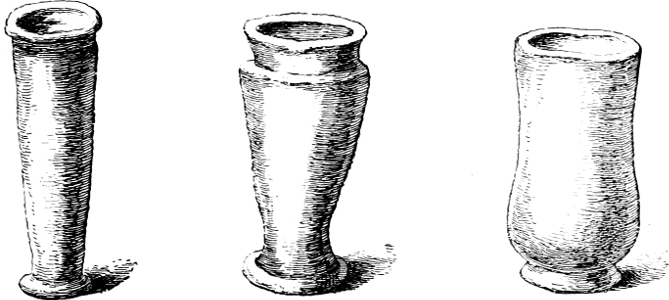
Figs. 163–165.—Chaldæan vases of the first period. British Museum.
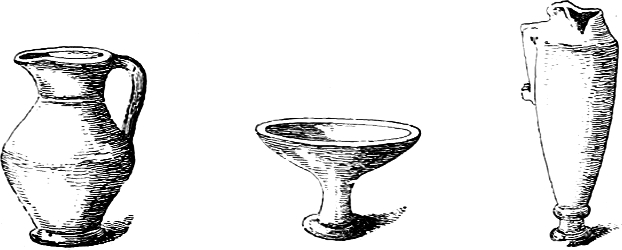
Figs. 166–168.—Chaldæan vases of the second period. British Museum.
Some other vases found in the same cemeteries are ascribed to a later epoch. They give evidence of a real progress in art. We have already figured two examples in our first volume (Figs. 159 and 160); three more are given in Figs. 166–168. The body is finer, and sometimes covered with a slight glaze; there is still no decoration, but the forms are obviously meant, and not without distinction. These objects have been thrown on the wheel, and the dexterity of their maker is further shown by the skill with which their handles are attached.
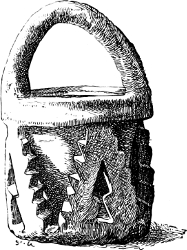
Fig. 169.—Chaldæan vase, about 4 inches high. British Museum.
We have no means of assigning even an approximate date to the vases found in other parts of Chaldæa. A curious vase from Hillah may be ascribed to a much later period, however, on the evidence of its shape alone (Fig. 169). It has the general form of a bucket. The body is decorated with indented triangles cut in its thickness and detached from the background. In all this there is a striving after effect that suggests the decadence. Nothing like it has been found in Assyria dating from the ninth, eighth, or seventh centuries. Sir H. Layard brought from Nimroud a certain number of vases showing a real progress even when compared with the remains from the second period of Chaldæan ceramics. Among these were some quaintly shaped pieces, such as the hexagonal vase with slightly concave sides reproduced in Fig. 170. To the same class belongs the very common form, with a pointed base, that could be thrust into the sand (Fig. 171), and the large bottles shown in Figs. 172 and 173. By the side of these not very graceful pieces we find some with shapes at once simple and happy, and comparable, in more than one instance, to those that the Greeks were to adopt in later years. Goblets with feet and without (Figs. 174–176), a well-shaped ewer (Fig. 177) and some variously contoured amphoræ, should be noticed. One of the latter has a long neck and two very small handles (Fig. 178), the handles of the other two are larger and more boldly salient, while in one they are twisted to look like ropes.
The vase last figured, like many others from the same place, is glazed, and glazed in two colours, a bluish-green round the neck and a decided yellow upon the body. At the line where they meet the two colours run one into the other, producing a far from disagreeable effect.
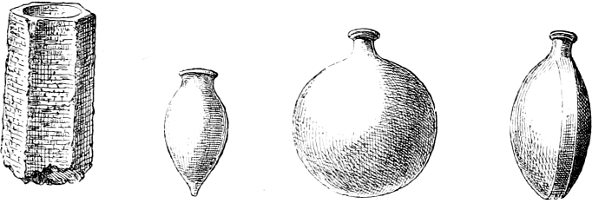
Figs. 170–173.—Assyrian vases; from Layard.
It will be noticed that the decoration upon all these objects is very slight. We can point to little beyond the double row of chevrons on one of the amphoræ (Fig. 178), and the collar of reversed leaves round a kind of alabastron found at the same place (Fig. 181).
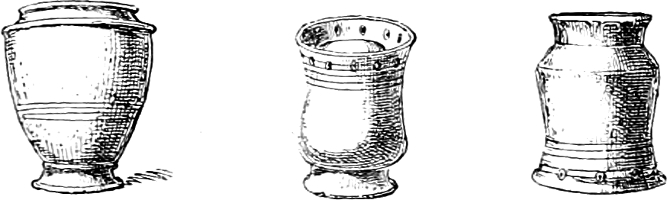
Figs. 174–176.—Goblets; from Layard.
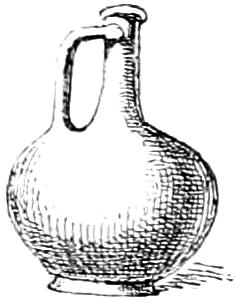
Fig. 177.—Ewer; from Layard.
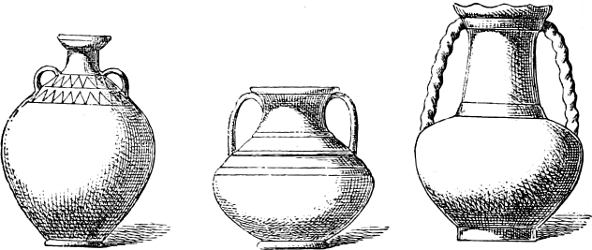
Figs. 178–180.—Amphoræ; from Layard.
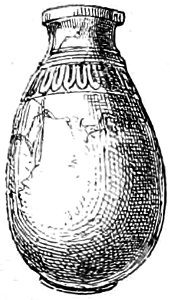
Fig. 181.—Alabastron; from Layard.
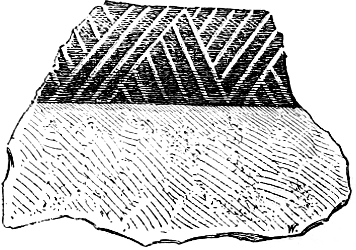
Fig. 182.—Fragment of a vase. British Museum.
The taste for decorating their works seems to have spread among the Assyrian potters between the ninth and seventh centuries B.C. At least many traces of it have been found among the remains at Kouyundjik. The date is fixed for us by a fragment on which the name of Esarhaddon occurs, the letters of which it is composed standing out in light against a dull black background. There is no further ornament than a line of zig-zags traced with some brown pigment. The fragment we reproduce (Fig. 182) formed part of another vase decorated in the same way. We cannot point to a single complete specimen of this work, but by comparing many pieces all from the same place, we may gain some idea of the taste in pottery that prevailed under the Sargonids. A vase upon which certain Aramaic characters were traced with the brush was decorated with bands of a reddish-brown pigment turning round the neck and body at irregular intervals (Fig. 183).[362] Elsewhere we find a more complicated form of the same ornament. The horizontal bands are separated by a kind of trellis-work, in which the lines cross each other, sometimes at right angles and sometimes obliquely, while in the blank spaces we find a motive often repeated, which might be taken at first sight for a Greek sigma. The resemblance, we need hardly say, is purely accidental (Fig. 184). We may also mention a fragment where the surface is sprinkled with reddish-brown spots on a light yellow ground (Fig. 185). So far as we know the only complete example of this decoration is the fine goblet dug up by Place in the Jigan mound (Fig. 186).[363]
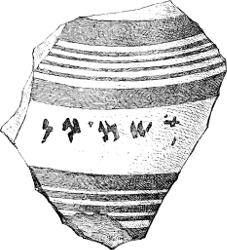
Fig. 183.—Fragment of a vase. British Museum.
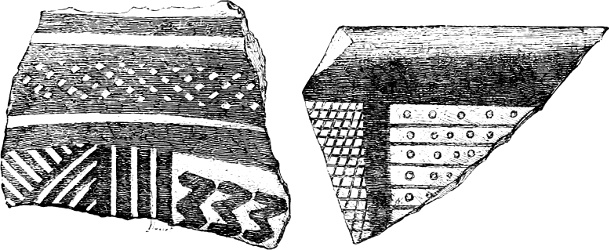
Figs. 184, 185.—Fragments of vases. British Museum.
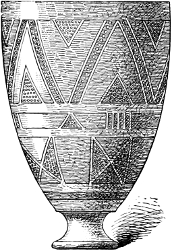
Fig. 186.—Goblet. Height, 5 inches. Louvre.
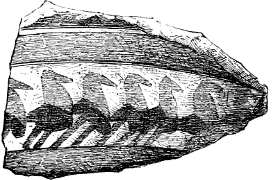
Fig. 187.—Fragment of a vase. Actual size. British Museum.
In all these fragments the decoration is purely geometrical; it is composed of lines, spots, and other motives having no relation to the organic world. A step in advance of this seems, however, to have been taken. On some other fragments from the same districts, files of roughly-suggested birds appear upon the bands and between opposed triangles (Figs. 187 and 188). We shall find the same motive in Cyprus, at Mycenæ, and at Athens, in the pottery forming the transition between the purely geometrical period and that in which imitation of life begins. In a fragment which is tantalizingly small we catch a glimpse of three lion’s paws playing with a chess-board ornament. A row of cuneiform characters runs along the lower part (Fig. 189).
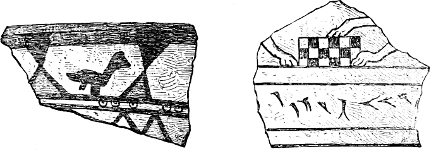
Figs. 188, 189.—Fragments of vases. Actual sizes. British Museum.
These fragments, taken altogether, show that a certain effort was made to produce decorated pottery towards the end of the Assyrian period. Why was the attempt not carried farther? Why were earthenware vases not covered with ornamental designs that might be compared for richness and variety with those chiselled in or beaten out of stone or wood, ivory or metal? The reason may, we think, be guessed. Clay appeared such a common material that they never thought of using it for objects of luxury, for anything that required great skill in the making, or in which its proprietor could take any pride. When they wanted fine vases they turned to bronze; bronze could be gilded, it could be damascened with gold and silver, and when so treated was more pleasing to the eye and more provocative of thought and ingenuity on the part of the artist than mere clay. It was reserved for Greece to erect the painted vase into a work of art. Her taste alone was able to make us forget the poverty of the material in the nobility of the form and the beauty of the decoration; we shall see that her artists were the first to give to an earthenware jar or cup a value greater, for the true connoisseur, than if they were of massive gold or silver.
During the period on which we are now engaged, the Mesopotamians sometimes attempted to cover their vases with enamel. The British Museum has several specimens of a pottery covered with a blue glaze like that of the Egyptian faïence.[364] Here and there the blue has turned green under the action of time. One of the vases reproduced above (Fig. 180) belongs to this class. Vases of the same kind, covered with a rather thick layer of blue and yellow enamel, have been found among the rubbish in the Birs-Nimroud at Babylon,[365] but it is difficult to fix an exact date for them with any confidence. On the other hand, it is generally agreed that the large earthenware coffins brought from the funerary mounds of Lower Chaldæa are very much later. In style the small figures with which they are decorated resemble the medals and rock sculptures of the Parthians and Sassanids.[366]
The art of making glass, which dates in Egypt at least as far back as the first Theban dynasty,[367] was invented in Mesopotamia, or imported into it, at a very early period. No glass objects have been found in the oldest Chaldæan tombs, but they abound in the ruins of the Assyrian palaces. A great number of small glass bottles, resembling the Greek alabastron or aryballos in shape,[368] have been dug up; many of them have been made brilliantly iridescent by their long sojourn in the earth.[369] A vase found by Layard at Nimroud, and engraved with Sargon’s name just below the neck, is generally quoted as the oldest known example of transparent glass (see Fig. 190).[370] It has been blown solid, and then the inside cut out by means of an instrument which has left easily-visible traces of its passage; this instrument was no doubt mounted on a lathe. Sir H. Layard believes, however, that many of the glass objects he found are much older, and date from the very beginning of the Assyrian monarchy, but their material is opaque and coloured.[371] Some bracelets of black glass, which were dug up at Kouyundjik, prove that common jewelry was sometimes made of that material; glass beads, sometimes round, sometimes flat, have also been found.[372] A glass cylinder or tube, of unknown use, was found by Layard at Kouyundjik; it is covered with a decoration made up of lozenges with a concave surface (Fig. 191).
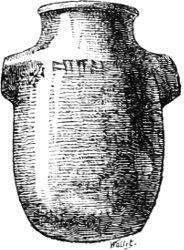
Fig. 190.—Glass vase or bottle. Height 3½ inches. British Museum.
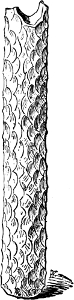
Fig. 191.—Glass tube. Height 8¾ inches. British Museum.
It is curious that no cylinders or cones of terra-cotta or glass have come down to us from the Assyro-Chaldæan period. Clay was doubtless thought too common a material for such uses, and as for glass, they had not yet learnt how to make it a worthy substitute for pietra dura, as the Greeks and Romans did in later years.
Before we quit the subject of glass we must not forget to mention a very curious object found by Layard at Nimroud, in the palace of Assurnazirpal, and in the neighbourhood of the glass bottle and the two alabaster vases on which the name of Sargon appears. It is a lens of rock-crystal; its convex face seems to have been set up, with some clumsiness, opposite to the lapidary on his wheel. In spite of the imperfect cutting, it may have been used either as a magnifying, or, with a very strong sun, as a burning, glass.[373] The fineness of the work on some of the cylinders, and the minuteness of the wedges on some of the terra-cotta tubs, had already excited attention, and it was asked whether the Assyrians might not have been acquainted with some aid to eyesight like our magnifying glass. It is difficult, however, to come to any certain conclusion from a single find like this; but if any more lenses come to light we may fairly suppose that the scribes and lapidaries of Mesopotamia understood how thus to reinforce their eyesight. In any case it is pretty certain that this is the oldest object of the kind transmitted to us by antiquity.
§ 2.—Metallurgy.
Even at the time to which we are carried back by the oldest of the graves at Warka and Mugheir, metallurgy was already far advanced in Chaldæa. Tools and weapons of stone are still found in those tombs in great numbers;[374] but side by side with them we find copper, bronze, lead, iron, and gold. Silver alone is absent.
Copper seems to have been the first of all the metals to attract the notice of man, and to be manufactured by him. This is to be accounted for partly by the frequency of its occurrence in its native state, partly by the fact that it can be smelted at a comparatively low temperature. Soft and ductile, copper has rendered many services to man from a very early period, and, both in Chaldæa and the Nile valley, he very soon learnt to add greatly to its hardness by mixing a certain quantity of tin with it. Where did the latter material come from? This question we can no more answer in the case of Mesopotamia than in that of Egypt; no deposits of tin have yet been discovered in the mountain chains of Kurdistan or Armenia.[375] However this may be, the use of tin, and the knowledge of its properties as an alloy with copper, dates from a very remote period in the history of civilization. In its natural state, tin is always found in combination, but the ore which contains it in the form of an oxide does not look like ordinary rock; it is black and very dense; as soon as attention was turned to such things it must have been noticed, and no great heat was required to make it yield the metal it contained. We do not know where the first experiments were made. The uses of pure tin are very limited, and we cannot even guess how the remarkable discovery was made that its addition in very small quantities to copper would give the precious metal that we call bronze. In the sepulchral furniture with which the oldest of the Chaldæan tombs were filled we already find more bronze than pure copper.[376]
Lead is rare. A jar of that metal, and the fragment of a pipe dug up by Loftus at Mugheir may be mentioned.[377] It is curious that iron though still far from common, was not unknown. Iron nowhere exists in its native state on the surface of our planet, except in aerolites. Its discovery and elimination from the ore requires more time and effort and a far higher temperature than copper or tin. Those difficulties had already been surmounted, but the smelting of iron ore was still such a tedious operation that bronze was in much more common use. Iron was looked upon as a precious metal; neither arms, nor utensils, nor tools of any kind were made of it; it was employed almost exclusively for personal ornaments, such as rings and bracelets.[378]
Gold, which is found pure in the veins of certain rocks and in the beds of mountain torrents, and in pieces of a size varying from that of a grain of dust to nuggets of many pounds, must very soon have attracted the attention of man, and excited his curiosity, by its colour and brilliancy. We find it in the tombs mixed with objects of stone and bronze. Round beads for necklaces, earrings and finger rings of not inelegant design were made of it.
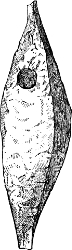
Fig. 192.—Iron mattock; from Place.
If, when the Chaldæans built their first cities, they already knew how to put metals to such varied uses, they could hardly have failed to take farther strides in the same direction. In order to measure the progress made, we have only to establish ourselves among the Assyrian ruins and to cast an eye over the plunder taken from them by Botta, Layard, and Place. Metal is there found in every form, and worked with a skill that laughs at difficulties. Silver and antimony are found by the side of the metals already mentioned,[379] and, stranger than all, iron is abundant. The excavations at Warka seem to prove that the Chaldæans made use of iron sooner than the Egyptians;[380] in any case it was manufactured and employed in far greater quantities in Mesopotamia than in the Nile valley. Nowhere in Egypt has any find been made that can be compared to the room full of instruments found at Khorsabad, to the surprise and delight of M. Place.[381] There were hooks and grappling irons fastened by heavy rings to chain-cables, similar to those now in use for ships’ anchors; there were picks, mattocks, hammers, ploughshares. The iron was excellent. The smith employed upon the excavations made some of it into sickles, into tires for the wheels of a cart, into screws and screw-nuts. Except the Persian iron, which enjoys a well-merited reputation, he had never, he said, handled any better than this. Its resonance was remarkable. When the hammer fell upon it it rang like a bell. All these instruments were symmetrically arranged along one side of the chamber, forming a wall of iron that it took three days to dig out. After measurement, Place estimated the total weight at one hundred and sixty thousand kilogrammes (about 157 tons).[382]
According to the same explorer some of these implements, resembling the sculptor’s sharp mallet in shape, were armed with steel points (Fig. 192).[383] Until his assertion is confirmed, we may ask whether Place may not, in this instance, have been deceived by appearances. Before we can allow that the Assyrians knew how to increase the hardness of iron by treating it with a dose of carbon, we must have the evidence of some competent and careful analyst.
It is certain, however, that in the ninth and eighth centuries this people used iron more freely than any other nation of the time. Thus several objects which appear at the first glance to be of solid bronze have an iron core within a more or less thin sheath of the other metal. Dr. Birch called my attention to numerous examples of this manufacture at the British Museum, in fragments of handles, of tires and various implements and utensils, from Kouyundjik and Nimroud. The iron could be distinctly seen at the fractures. The Assyrians clung to the bronze envelope because that metal was more agreeable to the eye and more easily decorated than iron, but it was upon the latter substance that they counted to give the necessary hardness and resistance. The contact and adhesion between the two metals was complete. From this, experts have concluded that the bronze was run upon the iron in a liquid state.[384]
It is easy enough to understand how the inhabitants of Mesopotamia came to make such an extensive use of iron in the instruments of their industry; it was because they were nearer than any other nation to what we may call the sources of iron. By this we mean the country in which all the traditions collected and preserved by the Greeks agreed in placing the cradle of metallurgy—the region bounded by the Euxine, the Caucasus, the Caspian, the western edge of the tableland of Iran, the plains of Mesopotamia, the Taurus, and the high lands of Cappadocia. To find the deposits from which Nineveh and Babylon drew inexhaustible supplies, it is unnecessary to go as far as the northern slopes of Armenia, to the country of the Chalybes, the legendary ancestors of our mining engineers. The mountains of the Tidjaris, a few days’ journey from Mossoul, contain mineral wealth that would be worked with the greatest profit in any country but Turkey.[385]
Bronze was reserved for such objects as we should make of some precious metal. Botta and Place found numerous fragments of bronze, but it is to Layard that we owe the richest and most varied collection of bronze utensils. It was found by him in one room of Assurnazirpal’s palace at Nimroud.[386] The metal has been analysed and found to contain ten per cent. of tin, on the average.[387] These proportions we may call normal and calculated to give the best results. In one of the small bells that were hung to the horses’ necks the proportion was rather different; there was about fifteen per cent. of tin. By this means it was hoped to obtain a clearer toned and more resonant alloy.
Pure copper seems to have been restricted to kitchen utensils, such as the large cauldrons that were often used as coffers in which to keep small objects of metal, like the little bells of which we have spoken, rosettes, buttons and the feet of tables and chairs not yet mounted, etc.[388] It is probable that these vessels were also used for heating water and cooking food.
All these metals, and especially iron and copper, were dearer perhaps in Chaldæa than in Assyria, because Babylon was farther from the mineral region than Nineveh; but the southern artizans were no less skilful than their northern rivals. In our review of the metal industries we shall borrow more frequently from the north than from the south, but the only reason for the inequality is that Chaldæa has never been the scene of exhaustive and prolific excavations like those of Assyria.
§ 3. Furniture.
Cursing Nineveh and exulting in the prospect of her fall, the prophet Nahum calls to all those who had been crushed by the Assyrian hosts; he summons all the nations of the east to take their part in the work of revenge and their share in the spoil to be won. “Take ye the spoil of silver,” he cries, “take ye the spoil of gold; for there is none end of the store and glory out of all the pleasant furniture.”[389] We shall find all this among our spoils of Nineveh. The princes and nobles of Assyria seem to have had a peculiar love for luxurious furniture. To see this we have only to look at the bas-reliefs, where the artist took the greatest care to imitate every detail of the thrones on which he placed his gods and kings; and many fragments of these richly decorated chairs have been recovered in the course of the excavations; with the help of the sculptures they could be put together and the missing parts supplied. The elements of many such restorations exist in the British Museum, and we may well ask why no attempt has been made to reconstitute an Assyrian throne with their help, so as to give an exact idea of the kind of state chair used by a Shalmaneser or a Sennacherib.
In order to carry out such a restoration successfully we should have to begin by renewing all the wooden parts of the piece, the legs, back and cross-bars. Wood alone could be used for such purposes. Metal would be too heavy if solid, and not stiff and firm enough if hollow. We have, besides, direct proof that the Assyrian joiner so understood his work. “I found among the ruins,” says one explorer, “small bulls’ heads of copper, repoussé and carefully chased, inside of which a few fragments of dried wood still remained. These pieces had certainly belonged to chairs exactly similar to those figured in the reliefs.”[390]
At Nimroud, in the room in Assurnazirpal’s palace in which so many precious objects were discovered, Layard found the royal throne, and close beside it, the stool upon which the royal feet were placed, an arrangement of which we may gain an exact idea from the reliefs (Figs. 47 and 127). The sides of this chair were ornamented with bronze plaques nailed on to wooden panels, and representing winged genii fighting with monsters. The arms were ornamented at the end with rams’ heads, and their points of junction with the uprights of the back were strengthened with metal tubes.[391] All the wood had disappeared, but it was impossible to look at the remains for a moment without seeing how they were originally put together and what office they had to fill in the complete piece. Most of the fragments are now in the British Museum.
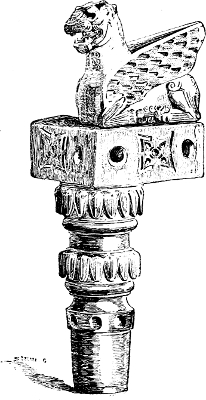
Fig. 193.—Fragment of a throne. Height 18 inches. Drawn by Saint-Elme Gautier.
The same collection has been recently enriched by the fragments of another throne, from Van.[392] A claw foot, uprights ending in several rows of dentations, and two winged bulls that once in all probability formed part of the arms, are among the parts preserved. The bulls are without faces, which may have been carried out in some other materials, gold perhaps, or ivory. The wings also are covered with hollows in which inlays of ivory or lapis may have been fixed. From Van also came the remains of another throne which now belongs to M. de Vogué, who has been good enough to allow us to reproduce the more important fragments. The best of these is one of the front feet which ends at the top in a rectangular tablet on which a winged lion is crouched (Fig. 193). Another piece seems to have been one of the cross pieces of the back;[393] the round sockets with which one face of it is nearly covered must once have been filled with precious stones. This lion, like that on the London chair, also has its wings covered with incisions, and its eyeballs represented by gaping hollows. The effect of the whole was heightened by threads of gold inlaid on its leading lines, such as round the grinning jaws of the lion. The largest piece is a hollow casting, but very heavy. The various members were connected by tenons and mortices; some of the latter are shown in our illustrations. The large rectangular openings on the upper surface of the cross-bar received a metal stem to which some small figures were attached; their bases have left marks on the cross-bar which may still be distinguished. Their feet were surrounded by a line of gilding.
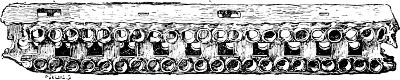
Fig. 194.—Fragment of a throne. Length 18 inches. Drawn by Saint-Elme Gautier.
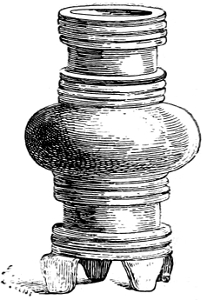
Fig. 195.—Bronze foot of a piece of furniture. Louvre.
These pieces of furniture show great variety in their forms and decorative motives. Sometimes the ornament is purely geometrical, like that of the foot shown in our Fig. 195, where it is composed of several rings placed one above the other with a bold torus-like swell in the middle. More frequently, however, the bronze uprights end in capitals resembling a bunch of leaves in shape. We have already encountered this type in the ivories, where it occurs in the balustrade of a small window (Vol. I., Fig. 129); we also find it strongly marked in the throne from Van, where the drooping leaves are chiselled with much care. We find the same motive in a small sandstone capital in the British Museum. It is in one piece with its shaft. We are inclined to think it a part of some stone chair in which the forms of wooden and bronze furniture were copied (Fig. 196).[394]
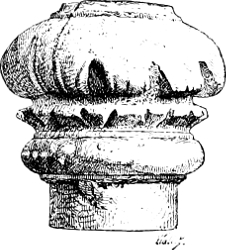
Fig. 196.—Capital and upper part of a small column. Height 2 feet. British Museum.
Two pieces of the same kind found at Nimroud are more complex in design. In one we have a bouquet of leaves reminding us of the Corinthian capital (Fig. 197), while, in the other, a band seems to hold two lance heads, opposed to each other at their base, and two bean-shaped fruits, against the shaft (198). As for the feet of all kinds of furniture, the favourite shapes are pine cones (Figs. 47 and 127) and lions’ paws (Figs. 47 and 199).
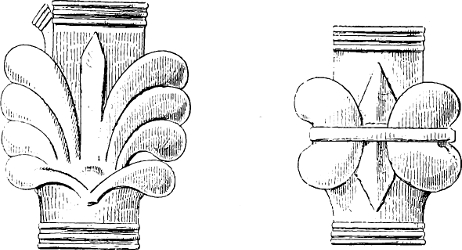
Figs. 197, 198.—Fragments of bronze furniture; from Layard.
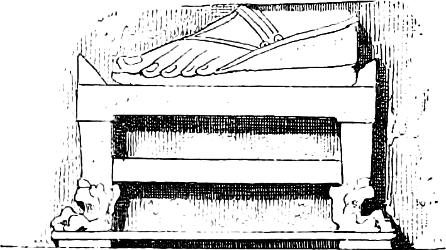
Fig. 199.—Footstool, from a bas-relief; from Layard.
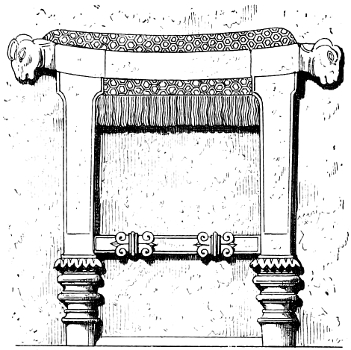
Fig. 200.—Stool; from Layard.
These elaborate decorations are found not only on the royal thrones but also on the footstools which are their necessary complement (Fig. 199), and on the seats without backs which were used, perhaps, instead of the more unwieldy throne when the king was away from his capital (Fig. 200). The footstool has lions’-claw feet, the more important object has rams’ heads at each end of the upper cross-bar;[395] the leg shows the capital with drooping leaves noticed above; volutes, opposed to each other as in the capital from Persepolis, ornament the cross-bar which holds the uprights together. In this piece of furniture, where the sculptor has confined himself to the scrupulous reproduction of his model, we may see how these objects were upholstered. A cushion of some woven material with long bright-coloured woollen fringes, was fitted to the seat. The whole is characterized by happy proportions and severe simplicity of design. We know from the Sippara tablet that even the gods were sometimes content with such a seat (Vol. I., Fig. 71). The figures of Izdubar and Hea-bani are there introduced between the uprights of Samas’s stool.
One of the most complex and effective of all these examples of decorative art is the throne upon which Sennacherib is seated before the captured city of Lachish (Fig. 47). The space between the uprights is occupied by three rows of small male figures, who with their uplifted arms and heads gently thrown back, seem to bear the weight of the cross pieces. This naïve device is also to be met with in the sculptures of Persia; it is suggestive of the absolute power which places the king so far above his subjects that nothing is left for them but to support and add to the edifice of his grandeur.[396]
Bronze and wood were not the only materials used in these objects of regal luxury. As in the throne of Solomon,[397] the glory of gold and the creamy whiteness of ivory were mingled with the sombre tones of bronze. This is proved by the thrones from Van, and it was noticed by the explorers of the Assyrian ruins; small fragments of ivory were mixed with the pieces of bronze that have been recognized as the débris of furniture.[398] Some pieces of rock-crystal, found in the palace of Sennacherib, appear also to have helped to ornament a chair.[399]
It is easy to guess how ivory was used on these objects. Look at the throne of Sennacherib (Fig. 47), the couch of Assurnazirpal, the table on which his cup is placed and the high chair of his queen (Fig. 127). The cross-bars and uprights are divided into numerous small panels or divisions; each panel may have inframed a plaque of carved ivory.
Were all these plaques made in Mesopotamia? or were they imported from Phœnicia and Egypt? The frankly Egyptian character of some among the tablets we have reproduced (see Vol. I. Figs. 129 and 130; and above, Figs. 57, 58 and 59) forbid us to deny that some of the ivories were imported;[400] but we believe that to have been the exception rather than the rule. We know both from the sculptured reliefs and from actual finds that ivory was brought into Assyria in its rough state. Layard found some elephant’s tusks in the royal houses at Nimroud,[401] and we see others brought by tributaries as presents to the king, both in the reliefs of Assurnazirpal’s palace,[402] and in those of Shalmaneser’s obelisk.[403]
Hence it appears probable that ivory was worked at Nineveh and Babylon, and that probability is changed into a certainty when we examine the other ivories in the same collection. Although not a few of the ivories chiselled in relief offer motives that are strange to Mesopotamian art, it is not so with a series of tablets on which the designs are carried out in pure line and with extreme refinement (Fig. 201). Figures and ornaments are purely Assyrian; winged genii wearing the horned tiara, dressed as in the reliefs, and surrounded with the rosettes and cable pattern to which we have so often referred, and other motives of the same kind. Among the latter may be noticed the variety of knop and flower border that we find so often in the painted and enamelled decoration, in which the knop is replaced by a disk (see Vol. I., Figs. 117 and 118).
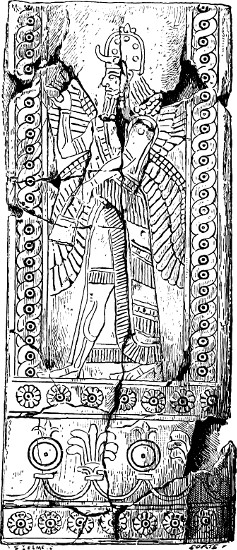
Fig. 201.—Ivory panel. Actual size. British Museum. Drawn by Saint-Elme Gautier.
We believe the truth to be as follows. A considerable quantity of Indian ivory entered Mesopotamia by the Persian Gulf and the caravan routes. It was there carved by native artists into the various shapes required, but, especially during the heyday of the Assyrian monarchy, it was far from supplying the whole demand. Africa, through Phœnicia, was called upon to make up the deficiency. But the African ivory was not imported in its raw state, it came in in the form of skilfully chiselled plaques that only required mounting; the merchants, through whom the trade was carried on, delivered sets of these plaques for beds, or chairs, or what not. We thus get at some reason for the difference in style between the tablets in relief and those engraved by the point. The latter represent native art; in the former, where we so often see the characteristic gods, sphinxes, costumes, head-dresses, and even cartouches of the Egyptian monuments, we may recognize the product of the Nile delta, or even of Tyre and Sidon. The inscriptions on several fragments seem to confirm this hypothesis. I have seen no ivory tablets with cuneiform characters, but plenty with those of the Phœnician alphabet.[404]
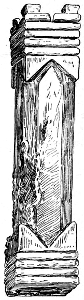
Fig. 202.—Dagger hilt. Ivory. Actual size. Louvre.
Ivory was used for many purposes; we have described how it was employed upon ceilings and doors;[405] we have just seen how it helped to ornament articles of furniture; it also supplied the material for many useful and ornamental objects, such as sceptres, boxes, cups, knife-handles, etc. (Fig. 202). Did the Assyrians understand how to give still greater variety to the appearance of these things by staining the ivory? At first sight it might appear that they did. Among the specimens in the British Museum some have the fine yellow colour of the Renaissance ivories; others are white, grey, brown or even quite black. These tints, as I myself ascertained, are not superficial; they extend entirely through the pieces. But we do not believe they were produced by any artificial process. If the Assyrians had understood how to dye ivory, would they not have dyed it red and blue as well as the colours above mentioned? But they did nothing of the sort. The tints in question are, then, to be otherwise explained. They are not the direct result of fire. Wherever the flame has touched the ivory it has calcined it, and left nothing but a whitish friable substance. They may, however, have been caused by the long continued impregnation with smoke and carbon received from a soil filled with ashes and washed by the rain. An effect of the same kind is produced upon objects buried in a peaty soil. In any case several of the fragments that have come down to us are of a fine, glossy black, like that of ebony.[406]
In beds, tables, chairs, and footstools the framework was of wood and the decoration of metal, an important rôle being assigned to incrustations of ivory, of lapis lazuli, of crystals, and other materials of the kind. But there were also pieces of furniture whose purpose made them well fitted to be carried out entirely in bronze; such, for example, were the tripods on which the braziers or censers, used in sacrifices, were placed. We have seen these figured in the reliefs (Vol. I., Figs. 68 and 155); the Louvre possesses one that was found at Babylon (Fig. 203). It is formed of three stems very slightly inclined inwards, and bound together at the top by a circle decorated with incised ornaments and four rams’ heads in relief. Towards the bottom they are held together by three straight cross-bars, the points of junction with the legs being masked by three human faces. The feet are shaped after those of oxen. Cords are twisted round the point of junction of foot and leg, then crossed in front of the fetlock and knotted at the back.[407]
The chafing-dishes placed upon these bronze tripods were of the same material. Chaldæans and Assyrians, although they neglected to give their earthen vessels any great beauty of form or richness of decoration, attached great importance to their metal vases. The bronze vessel seems to have been one of the chief objects of luxury both in the temple and the palace. The peculiarities offered by certain of these objects and the interest of the problems they suggest, make it necessary that they should be studied separately and in some detail.
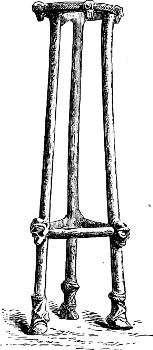
Fig. 203.—Bronze tripod. 13 inches high. Louvre.
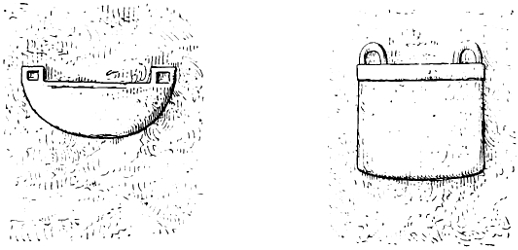
Figs. 204, 205.—Metal vases. From Layard.
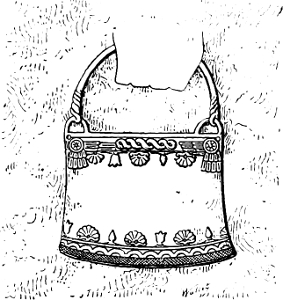
Fig. 206.—Metal bucket. From Layard.
§ 4. Metal Dishes and Utensils.
Metal vases are often represented in the bas-reliefs, where we find them sometimes of very simple form, like the bowl (Fig. 204) and bucket (Fig. 205) here figured, which may have been of copper. They are provided on the upper edge with small loops through which a cord might be passed. As for the buckets that were used in the ritual of public worship, and that the sculptor put in the hands of the winged genii adoring the sacred tree (Vol. I., Figs. 4 and 8), they were certainly of bronze, both body and handle. Their forms are very elegant, and their walls are ornamented at the top and bottom with twisted and wavy lines, with palmettes and flowers both open and closed. In the example we figure (Fig. 206) the winged globe, which is introduced just below the upper edge, attests the religious character of the object.[408]
The bas-reliefs tell us nothing about those large vessels, analogous, no doubt, to the λέβης and κρατὴρ of the Greeks, upon the sides of which the human-headed birds with extended wings, one of which we have already figured, were fixed (Fig. 91). Neither has any complete specimen of the class yet been discovered in the excavations. The frequent employment of this motive is proved, however, by the number of these detached pieces that we possess. They all come from Van, but they belonged to different vases. We here engrave a second example (Fig. 207). The ring on the back by which the handle was attached will be noticed. As in the throne described above the bronze was relieved with inlaid ornament; there is a hollow in the breast in which it was set. In the originals the rivet-holes which afforded a means of fixing them may be seen; in one or two the heads of the rivets are still in place. This specimen differs from one figured on page 172, in that it has two heads.
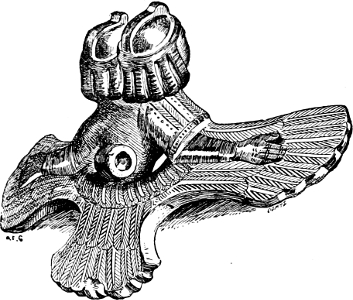
Fig. 207.—Applied piece. Height 9 inches; width 14 inches. From the collection of M. de Vogüé.
We do not multiply examples of the vessels used to transport liquids, because their decorative forms were found pretty equally distributed all over Chaldæa and Assyria. We have every reason to believe that they were produced in great numbers in all the towns of Mesopotamia. On the other hand, there is a whole class of vessels that perplex and embarrass archæologists almost as much as they delight them—the class of metal cups. This name is to some extent a misnomer. We shall employ it for the sake of simplicity, but most of the objects in question are rather what we should call dishes or platters than cups. They belong to the same class as the Greek φιύλη and the Roman patera. Their vertical section is shown at the bottom of our Fig. 208. The slight ridge underneath, caused by the gentle elevation of the flat bottom, enabled the dish to be more firmly grasped than would otherwise have been possible.
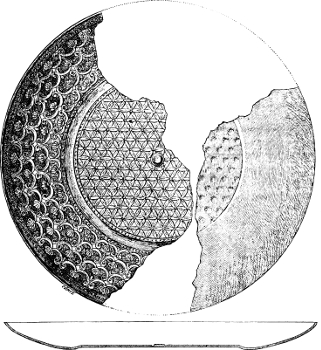
Fig. 208.—Bronze platter. From Layard.
Such things must have been comparatively rare and costly. In a store-room of the North-Western Palace at Nimroud, Layard found a great number of them, packed one within another in cauldrons like those mentioned above; others, of less value no doubt, were stacked against the wall. At first the explorers were inclined to think that they all dated from the reign of Assurnazirpal, the founder of the building; but many things combined to suggest that the palace was repaired by Sargon and even inhabited by him.[409] He may have lived there until his own house at Khorsabad was finished. It is possible, therefore, that some or all of these cups date from the eighth century B.C.
In many instances oxydization had gone so far that the cups could not be lifted without falling to pieces; others, however, though covered with a thick coat of oxide, were brought away and successfully cleaned.[410] At the British Museum I compiled a catalogue of forty-four plates or cups of this kind, nearly all from the same treasure, while in the store rooms of the same institution there are many more waiting to be cleaned and rendered fit for exhibition. All these, with a few exceptions, are ornamented, the simplest among them having a star or rosette in the centre. Wherever the bronze has not been completely eaten away the decoration may be recovered, and often it is still singularly clear and sharp. A few cups that had been protected by those placed above them showed, when discovered, such brilliant copper tones that the workmen at first thought they were of gold. The mistake was soon recognized, but we may well believe that the conquerors of half Asia numbered gold and silver vessels among the treasures stored in their palaces; as yet, however, none have been found. All these cups, like the deeper vessels recovered at the same time, were of bronze; the precious metals only appear in the form of small inlays and incrustations in the alloy. In the centre of the rosettes with which some of the bands are decorated a small silver stud, slightly raised above the rest of the surface, is sometimes placed, and in a few cases the points of the great rosette that occupies the centre of the plate radiate from a centre of gold, silver being banished to the small rosettes at the edge. Again, the middle is sometimes a kind of boss, over the whole of which traces of gold may still be distinguished.
The decoration of these pateræ is always inside: on the outside nothing is to be seen but the confused reverse of the pattern, such as may be seen on the left of our Fig. 208. I have found but one exception to this rule in a much deeper cup on the outside of which a lion hunt is represented.[411] In that case figures engraved within the vase would have been invisible, for it is very deep.
In most cases the ruling principle of the decoration is the division of the disk into three, four, or five concentric circles, but in some instances the whole field, with the exception of a simple border, is occupied by one subject. In those cups upon which the greatest care and thought seem to have been lavished, the figures are beaten up into relief with the hammer and then finished with the burin. In the others the whole design is carried out with the latter tool, which is sometimes used with a degree of refinement that is amazing. As an example of this we may quote a patera that has been cleaned and put on view quite recently. Stags march in file around its five concentric zones, which are all of the same width. It is difficult to explain either the fineness of the lines or the regularity of the design, each animal being an accurate reproduction of his neighbour and the intervening spaces being exactly equal. One is almost tempted to believe that the work must have been done by machinery.
We know, however, that such mechanical helps were unknown to the ancients, and, although there are many cups and vases at the museum bearing a strong mutual resemblance, we cannot point to any two that are exactly similar. To give a fair idea of the variety of their designs we should have to reproduce not only all the cups figured by Sir H. Layard, but several more that have only been prepared for exhibition quite lately. Among the latter are some very curious ones. We cannot afford the space for all this, and must be content to give a few examples chosen from those on which the ornament is most definite and clearly marked.
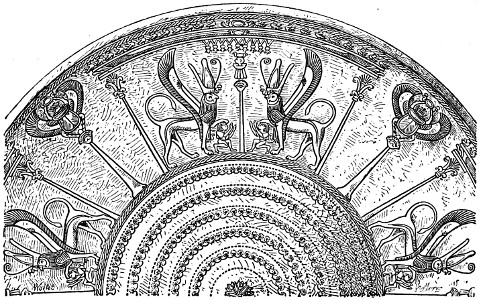
Fig. 209.—Bronze platter. Diameter about 9 inches. British Museum. Drawn by Wallet.
It was noticed by those who saw the veil of oxide drawn away from the ornamentation of these bronze vessels that a large proportion of them were Egyptian rather than Assyrian in their general physiognomy. Some of them displayed motives familiar to all those who have travelled in the Nile valley. Take, for instance, the fragment we have borrowed from one of the best preserved of them all (Fig. 209).[412] Neither the minute lines of palmettes in the centre, nor the birds that occur in the outer border, have, perhaps, any great significance, but nothing could be more thoroughly Egyptian than the zone of figures between the two. The same group is there four times repeated. Two griffins crowned with the pschent, or double tiara of upper and lower Egypt, have each a foot resting upon the head of a kneeling child, but their movement is protective rather than menacing. Instead of struggling, the child raises its hands in a gesture of adoration. Between the griffins and behind them occur slender columns, quite similar to those we have so often encountered in the open architecture of Egypt.[413] Between the groups thus constituted are thicker shafts bearing winged scarabs on their campaniform capitals. These same columns and capitals occur on another cup from which we detach them in order to show their details more clearly.[414] In one instance the terminal of the shaft is unlike anything hitherto found elsewhere; it is a sphere (Fig. 210); but the contour of the next is thoroughly Egyptian (Fig. 211), and the symbols on the last three, a scarab and two uræi, proclaim their origin no less clearly (Figs. 212 to 214).
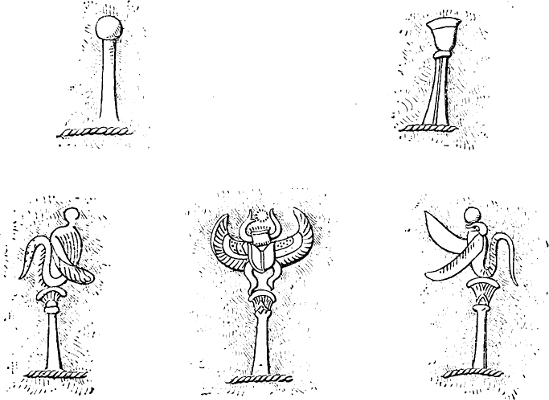
Figs. 210–214.—Columns or standards figured upon a bronze cup; from Layard.
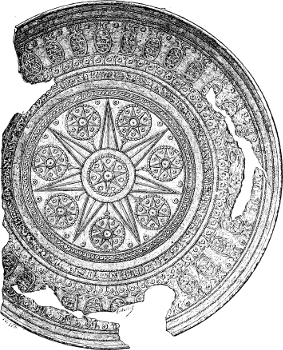
Fig. 215.—Bronze platter. Diameter 8 inches. British Museum. Drawn by Wallet.
We gather the same impression from a platter only cleaned quite lately and consequently not to be found in Sir H. Layard’s works; it is now reproduced for the first time (Fig. 215). The whole decoration is finely carried out in line with the burin. The middle is occupied by a seven pointed star or rosette, nine times repeated. Around this elegant and complex motive there are concentric circles, the third of which, counting from the centre, is filled up with small figures hardly to be distinguished by the naked eye. We divine rather than see lions, birds, seated men, and certain groups of symbols, such as three lines broken and placed one above the other, which are continually recurring in the hieroglyphic writing of Egypt. The fifth zone has conventional papyrus stems alternating with rosettes. The sixth, much larger, is filled with ovals surmounted by two plumes and the uræus, that is by the royal cartouch of Egypt in its usual form. The interior of each oval contains very small groups of figures separated from one another by four horizontal lines.
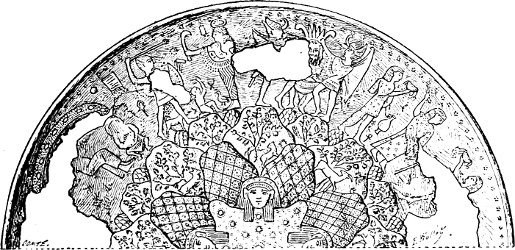
Fig. 216.—Part of a bronze cup or platter. Diameter about 9 inches. British Museum.
We may quote a cup figured by Layard as a last example of this exotic style of decoration. In the centre there are four full-face heads with Egyptian wigs (Fig. 216). Around them a mountainous country is figured in relief, and sprinkled with trees and stags engraved with the point. The wide border, which is unfortunately very much mutilated, is covered with groups of figures apparently copied from some Egyptian monument, if we may judge from the attitudes and costume. One figure, whose torso has entirely disappeared, wears the pschent and brandishes a mace over his head; the movement is almost identical with that of the victorious Pharaoh with whom we are so familiar. A goddess, who might be Isis, stands opposite to him. In another part of the border there is a misshapen monster crowned with feathers and resembling the Egyptian Bes.[415]
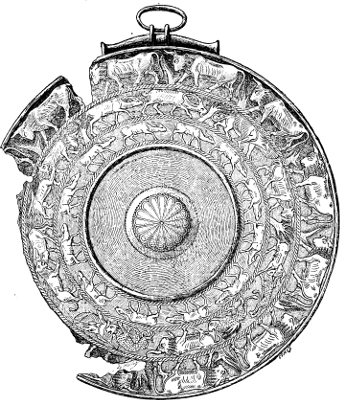
Fig. 217.—Bronze cup. Diameter 11 inches; from Layard.
Side by side with these platters we find others on which nothing occurs to suggest foreign influence. Take, for instance, the example reproduced in Fig. 208. In the centre there is a small silver boss, while the rest of the flat surface is occupied by the fine diaper pattern made up of six-petalled flowers that we have already met with on the carved thresholds (Vol. I. Fig. 96). The hollow border is ornamented with four lines of palmettes united by an undulating line, a motive which is no less Assyrian than the first (Vol. I., Figs. 128, 138, 139, etc.). In Fig. 217 we reproduce a cup on which its original mounting, or ring by which it was suspended, is still in place. The whole of the decoration is pure Assyrian. The rosette is exactly similar to many of those found on the enamelled bricks (see Vol. I., Figs. 122, 123). In the first of the three zones, gazelles march in file; in the second, a bull, a gazelle, an ibex, and a winged griffin, followed by the same animals attacked by lions and making fourteen figures in all; in the third zone fourteen heavy-crested bulls follow one another round the dish. All these animals are among those most constantly treated by the Assyrian sculptor; their shapes and motions are as well understood and as well rendered as in the bas-reliefs. The bulls especially are grandly designed. Moreover, the idea of employing all these animals for the adornment of such a surface is entirely in the spirit of Assyrian decoration. We shall meet with it again in the shields from Van; we figure the best preserved of the latter on page 347.
It would be easy to give more examples, either from Layard or from our own catalogue of these objects, of the purely Assyrian style on the one hand, or of that in which the influence of Egyptian models is so clearly shown, on the other. It is enough, however, that we have proved that these little monuments may be divided into two clearly marked classes. Did the two groups thus constituted share the same origin? Did they both come from the same birth-place? Further discoveries may enable us to answer this question with certainty, and even now we may try to pave the way to its solution.
There would be no difficulty if these bronze vessels bore cuneiform inscriptions, especially if the latter formed a part of the decorative composition, as in the palace reliefs, and were cut by the same hand. But this, so far as we know at present, was never the case. In some fragments of pottery we have found cuneiform characters (Fig. 185), and the name of Sargon has even been read on a glass phial (Fig. 190), but—and we cannot help feeling some surprise at the fact—none of these objects of a material far more precious bear a trace of the Mesopotamian form of writing. I do not know that a single wedge has been discovered upon them. A certain number of them are inscribed, but inscribed without exception with those letters which Phœnicia is supposed to have evolved out of the cursive writing of Egypt.[416] They were not introduced with any idea of enriching the design, as they always occur on the blank side of the vessel. They are close to the edge, and their lines are very slender, suggesting that they were meant to attract as little attention as possible. They consist of but a single name, that of the maker, or, more probably, the proprietor of the cup.[417]
May we take it that these inscriptions afford a key to the mystery? that they prove the vases upon which they occur at least to have been made in Phœnicia? We could only answer such a question in the affirmative if peculiarities of writing and language belonging only to Phœnicia properly speaking were to be recognized on them; but the texts are too short to enable us to decide to which of the Semitic idioms they should be referred, while the forms of the letters do not differ from those on some of the intaglios (Figs. 156 and 157) and earthenware vases (Fig. 183), and upon the series of weights bearing the name of Sennacherib.[418] The characters belong to that ancient Aramæan form of writing which seems to have been practised in Mesopotamia in very early times as a cursive and popular alphabet.
The inscriptions, then, do little to help us out of our embarrassment, and we are obliged to turn to the style of the vessels and their decoration for a solution to our doubts. The conviction at which we soon arrive after a careful study of their peculiarities is that even those on which Egyptian motives are most numerous and most frankly employed were not made in Egypt. In the first place we remember that the Egyptians do not seem to have made any extensive use of such platters; their libations were poured from vases of a different shape, and the cups sometimes shown in the hands of a Pharaoh always have a foot.[419] Moreover, in the paintings and bas-reliefs of Egypt, where so many cups and vases of every kind are figured, and especially the rich golden vessel that must have occupied such an important place in the royal treasure, we only find the shape in question in a few rare instances.[420]
After this general statement we may go into the details. In these the hand of the imitator is everywhere visible; he borrows motives and adapts them to his own habits and tastes. Take as an example the platter to which a double frieze of hieroglyphs gives a peculiarly Egyptian physiognomy (Fig. 215). An Egyptian artist would never employ hieroglyphs in such a position without giving them some real significance, such as the name of a king or deity. Here, on the other hand, an Egyptologist has only to glance at the cartouches to see that their hieroglyphs are brought together at haphazard and that no sense is to be got out of them. This is obvious even by the arrangement of the several characters in the oval without troubling to examine them one by one. They are divided into groups by straight lines, like those of a copy book. The Egyptian scribe never made use of such divisions; he distributed his characters over the field of the oval according to their sense and shape. The arrangement here followed is only to be explained by habits formed in the use of a writing that goes in horizontal lines from left to right or right to left. There is, in fact, nothing Egyptian but the shape of the ovals, and the motive with which they are crowned. The pretended hieroglyphs are nothing but rather clumsily executed pasticcios. And it must be noticed that even this superficial Egyptianism is absent from the centre of the dish. In those Theban ceilings which display such a wealth of various decoration we may find a simple rosette here and there, or rather a flower with four or eight petals, but these petals are always rounded at the end; nowhere do we find anything that can be compared to the great seven-pointed star which is here combined so ingeniously with eight more of the same pattern but of smaller size. On the other hand this motive is to be found on a great number of cups where no reminiscence of Egypt can be traced. The ruling idea is the same as that of the diaper-work in the thresholds from Khorsabad and Nimroud (see Vol. I., Fig. 135).
After such an example we might look upon the demonstration as made, but it may be useful to complete it by analyzing the other cups we have placed in the same class. That on which the scarabs on standards and the opposed sphinxes appear (Fig. 209) seems pure Egyptian at first sight; but if we take each motive by itself we find variations that are not insignificant. In Egyptian paintings, when the scarab is represented with extended wings they are spread out horizontally, and not crescent-wise over its head.[421] We may say the same of the sphinx. The griffin crowned with the pschent is to be found in Egypt as well as the winged sphinx,[422] but the Egyptian griffins had no wings,[423] and those of the sphinxes were folded so as to have their points directed to the ground. In the whole series of Egyptian monuments I cannot point to a fictitious animal like this griffin. It is in the fanciful creations of the Assyrians alone that these wings, standing up and describing a curve with its points close to the head of the beast that wears them (see Fig. 87), is to be seen. It is an Assyrian griffin masquerading under the double crown of Egypt, but a trained eye soon penetrates the disguise.
The arrangement, too, of the group is Assyrian. When the Egyptians decorated a jewel, a vessel, or a piece of furniture by combining two figures in a symmetrical fashion, they put them back to back rather than face to face.[424] Very few examples can be quoted of the employment in Egypt of an arrangement that is almost universal in Assyria. In the latter country this opposition of two figures is so common as to be common-place; they are usually separated from each other by a palmette, a rosette, a column or even a human figure (see Vol. I., Figs. 8, 124, 138, 139; and above, Figs. 75, 90, 141, 152, 153, 158, etc.), and it was certainly from Mesopotamia that Asia Minor borrowed the same motive, which is so often found in the tombs of Phrygia and in Greece as far as Mycenæ, whither it was carried from Lydia by the Tantalides.[425]
The same remarks will apply to the cup partially reproduced in our Fig. 216. The ornament of the centre and of the outer band is Egyptian in its origin, but the mountainous country with its stags and its trees, that lies between—have we found anything like it in Egypt? The mountains are suggested in much the same fashion as in the palace reliefs, and we know how much fonder the sculptors of Mesopotamia were of introducing the ibex, the stag, the gazelle, etc., into their work than those of Egypt. The rocky hills and sterile deserts that bounded the Nile valley were far less rich in the wilder ruminants than the wooded hills of Kurdistan and the grassy plains of the double valley.
There is one last fact to be mentioned which will, we believe, put the question beyond a doubt. Of all antique civilization, that which has handed down to us the most complete material remains is the civilization of Egypt. Thanks to the tomb there is but little of it lost. Granting that these cups were made in Egypt, how are we to explain the fact that not a single specimen has been found in the country? About sixty in all have been recovered; their decoration is distinguished by much variety, but when we compare them one with another we find an appreciable likeness between any two examples. The forms, the execution, the ornamental motives are often similar, or, at least, are often treated in the same spirit. The majority come from Assyria, but some have been found in Cyprus, in Greece, in Campania, Latium, and Etruria. Over the whole area of the ancient world there is but one country from which they are totally absent, and that country is Egypt.
We may, then, consider it certain that it was not Egyptian industry that scattered these vessels so widely, from the banks of the Euphrates to those of the Arno and the Tiber, not even excepting from this statement those examples on which Egyptian taste has left the strongest mark. Egypt thus put out of the question, we cannot hesitate between Mesopotamia and Phœnicia. If the cups of Nimroud were not made where they were found, it was from Phœnicia that they were imported. The composite character of the ornamentation with which many of them were covered is consistent with all we know of the taste and habits of Phœnician industry, as we shall have occasion to show in the sequel. On the other hand we must not forget at how early a date work in metal was developed in the workshops of Mesopotamia. Exquisite as it is, the decoration of the best of these vases would be child’s play to the master workmen who hammered and chiselled such pictures in bronze as those that have migrated from Balawat to the British Museum.
We are inclined to believe that the fabrication of these cups began in Mesopotamia; that the first models were issued from the workshops of Babylon and Nineveh, and exported thence into Syria; and that the Phœnicians, who imitated everything—everything, at least, that had a ready sale—acclimatized the industry among themselves and even carried it to perfection. In order to give variety to the decoration of the vases sent by them to every country of Western Asia and Southern Europe, they drew more than once from that storehouse of Egyptian ideas into which they were accustomed to dive with such free hands; and this would account for the combination of motives of different origin that we find on some of the cups. Vases thus decorated must have become very popular, and both as a result of commerce and of successful wars, must have entered the royal treasures of Assyria in great numbers. We know how often, after the tenth century, the sovereigns of Calah and Nineveh overran Palestine, as well as Upper and Lower Syria. After each campaign long convoys of plunder wended their way through the defiles of the Amanus and Anti-Lebanon, and the fords of the Euphrates, to the right bank of the Tigris. The Assyrian conquerors were not content with crowding the store-rooms of their palaces with the treasures thus won, they often transported the whole population of a town or district into their own country. Among the Syrians thus transplanted there must have been artizans, some of whom endeavoured to live by the exercise of their calling and by opening shops in the bazaars of Babylon, Calah, and Nineveh. Clients could be easily gained by selling carved ivories and these engraved cups at prices much smaller than those demanded when the cost of transport from the Phœnician coast had to be defrayed.
In one of these two ways it is, then, easy to explain the introduction of these foreign motives into Assyria, where they would give renewed life to a system of ornament whose resources were showing signs of exhaustion. This tendency must have become especially pronounced about the time of the Sargonids, when Assyria was the mistress of Phœnicia and invaded the Nile valley more than once. To this period I should be most ready to ascribe the majority of the bronze cups; the landscapes, hunts and processions of wild animals with which many of them are engraved, seem to recall the style and taste of the bas-reliefs of Sennacherib and Assurbanipal rather than the more ancient schools of sculpture.
In any case it would be difficult, if not impossible, to distinguish between the vases engraved in Mesopotamia by native workmen and those imported from Phœnicia, or made at Nineveh by workmen who had received their training at Tyre or Byblos. The resemblances between the two are too many and too great. At most we may unite all the platters found in Mesopotamia into a single group, and point out a general distinction between them and those that have been discovered in the Mediterranean basin. The ornament on the Nimroud cups is, on the whole, simpler than on those found in Cyprus and Italy; the figure plays a less important part in the former, and the compositions are more simple. The Assyrian cups, or, to be more accurate, those found in Assyria, represent the earliest phase of this art, or industry, whichever it should be called. In later years, after the fall of Nineveh, when Phœnicia had the monopoly of the manufacture, she was no longer content with purely decorative designs and small separate pictures. Her bronze-workers multiplied their figures and covered the concentric zones with real subjects, with scenes whose meaning and intention can often be readily grasped. This we shall see when the principal examples of this kind of art come under review in our chapters upon Phœnicia.[426]
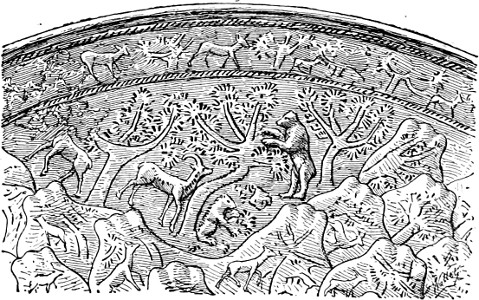
Fig. 218.—Bronze cup. British Museum.
Meanwhile, we shall not attempt to establish distinctions that are nearly always open to contest; they would, besides, require an amount of minute detail which would here be quite out of place. To give but one example of the evidence which might lead to at least plausible conclusions, we might see pure Assyrian workmanship in the cup figured below (Fig. 218),[427] where mountains, trees, and animals stand up in slight relief, both hammer and burin having been used to produce the desired result. Among these animals we find a bear, which must have been a much more familiar object to the Assyrians living below the mountain-chains of Armenia and Kurdistan than to the dwellers upon the Syrian coast. In the inscribed records of their great hunts, the kings of Assyria often mention the bear.[428] Nothing that can be compared to these wooded hills peopled by wild beasts is to be found on the cups from Cyprus or Italy. I may say the same of another cup on which animals of various species are packed so closely together that they recall the engravings on some of the cylinders (see Fig. 149).[429]
On the other hand, there are plenty of motives which may just as easily have had their origin in one country as the other. The two vultures, for instance, preparing to devour a hare stretched upon its back, which we figure below (Fig. 219).[430]
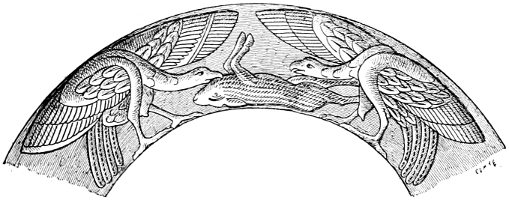
Fig. 219.—Border of a cup; from Layard.
It may be thought that we have dwelt too long upon these cups; but the sequel of our history will show why we have examined them with an attention that, perhaps, neither their number nor their beauty may appear to justify. They are first met with in Assyria, but they must have existed in thousands among the Greeks and Italiots. Light, solid, and easy to carry, they must have furnished western artists with some of their first models. As we shall see, they not only afforded types and motives for plastic reproduction, but, by inciting them to find a meaning for the scenes figured upon them, they suggested myths to the foreign populations to whom they came.
§ 5. Arms.
We shall not, of course, study Assyrian arms from the military point of view. That question has been treated with all the care it deserves by Rawlinson and Layard.[431] From the stone axes and arrow-heads that have been found in the oldest Chaldæan tombs, to the fine weapons and defensive armour in iron and bronze, used by the soldiers of Nineveh in its greatest years, by the cavalry, the infantry, and the chariot-men of Sargon and Sennacherib, the progress is great and must have required many long centuries of patient industry. In Assyria no trade can have occupied more hands or given rise to more invention than that of the armourer. For two centuries the Assyrian legions found no worthy rivals on the battlefields of Asia; and, although their superiority was mainly due, of course, to qualities of physical vigour and moral energy developed by discipline, their unvarying success was in some degree the result of their better arms. Without dwelling upon this point we may just observe that when war is the chief occupation of a race, its arms are sure to be carried to an extreme degree of luxury and perfection. Some idea of their elaboration in the case of Assyria may be gained from the reliefs and from the original fragments that have come down to us.
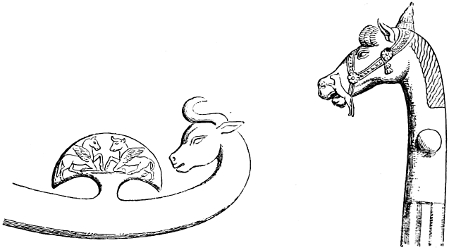
Figs. 220, 221.—Chariot poles; from a bas-relief.
It was from the animal kingdom that the Assyrian armourer borrowed most of the forms with which he embellished the weapons and other military implements he made. Thus we find the chariot poles ending in the head of a bull, a horse, or a swan (Figs. 220 and 221).[432] Elsewhere we find a bow no less gracefully contrived; its two extremities are shaped into the form of a swan’s head bent into the neck.[433]
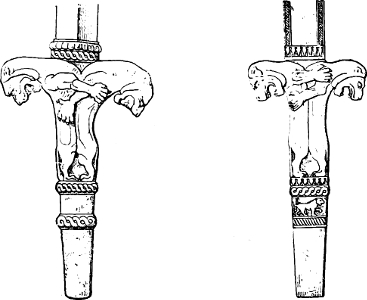
Figs. 222, 223.—Sword scabbards, from the reliefs; from Layard.
The sword is the king of weapons. By a kind of instinctive metaphor every language makes it the symbol of the valour and prowess of him who wears it. It was, therefore, only natural that the Assyrian scabbard, especially when worn by the king, should be adorned with lions (Figs. 82, 222, 223). These were of bronze, no doubt, and applied. In the last of our three examples a small lion is introduced below the larger couple. The sword-blade itself may have been decorated in the same fashion. The Assyrians understood damascening, an art that in after ages was to render famous the blades forged in the same part of the world, at Damascus and Bagdad. The Arab armourers did no more, perhaps, than practise an art handed down to them from immemorial times, and brought to perfection many centuries before in the workshops of Mesopotamia. At any rate we know that two small bronze cubes found at Nimroud were each ornamented on one face with the figure in outline of a scarab with extended wings, and that the scarab in question was carried out by inlaying a thread of gold into the bronze (Fig. 224). Meanwhile we may point to an Assyrian scimitar, the blade of which is inscribed with cuneiform characters.[434]
In the reliefs we find a large number of shields with their round or elliptical surfaces divided into concentric zones.[435] A recent discovery enables us to say how these zones were filled, at least in the case of shields belonging to kings or chiefs. In 1880 Captain Clayton found, on the site of an ancient building at Toprak-Kilissa, in the neighbourhood of Van, four shields, or rather their remains, among a number of other objects. These shields are now in the British Museum. Upon one fragment we may read an inscription of Rushas, king of Urardha, or Armenia, in the time of Assurbanipal.[436]
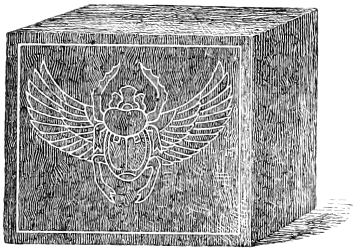
Fig. 224.—Bronze cube damascened with gold; from Layard.
This inscription, which is votive in its tenor, combines with the examination of the objects themselves, to prove that these shields are not real arms, made for the uses of war. The bronze is so thin—not more than a millimetre and a half in thickness—that even if nailed upon wood or backed with leather it could have afforded no serious protection, and its reliefs must have been disfigured and flattened with the least shock. The edge alone is strengthened by a hoop of iron. The shields are votive, and must have been hung on the walls of a temple, like those we see thus suspended in a bas-relief of Sargon (Vol. I. Fig. 190), a relief in which a temple of this same Armenia is represented.[437] But although they were made for purposes of decoration, these arms were none the less copies of those used in actual war, except in the matter of weight and solidity; thus they were furnished with loops for the arms, but these were too narrow to allow the limb of a man of average size to pass through them with any freedom.
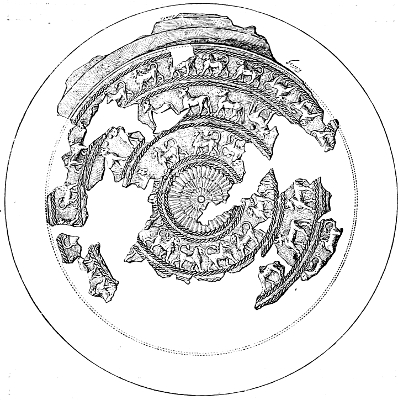
Fig. 225.—Votive shield. Diameter about 34½ inches. Drawn by R. Elson.
For us the most interesting point about them is their decoration, which is identical in principle with several of the bronze platters lately discussed (see Fig. 217). This may be clearly seen in our reproduction of the shield which has suffered least from rust (Fig. 225).[438] In the centre there is a rosette with many radiations; next come three circular bands separated from each other and from the central boss by a double cable ornament. The innermost and outermost zones are filled with lions passant, the one between with bulls in the same attitude. And here we find a curious arrangement of which we can point to no other example: both lions and bulls have their feet turned sometimes to the centre of the shield, sometimes to its outer edge. The general character of the form is well grasped in both cases; but the design has neither the breadth nor firmness of that upon the cup to which we have already compared this shield (Fig. 217). The armourers were inferior in skill to the gold and silversmiths—we can think of no more appropriate name for them—by whom the metal cups were beaten and chased, although they made use of the same models and motives. No one would attribute a Phœnician origin to these bucklers; they were found in Armenia and were covered with cuneiform inscriptions. They must have been made either in Assyria, or in a neighbouring country that borrowed all from Assyria, its arts and industries as well as its written characters. The Assyrians attached too much importance to their arms and made too great a consumption of them to be content with importing them from a foreign country.
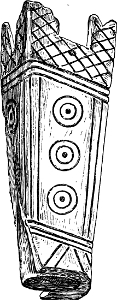
Fig. 226.—Knife-handle. Bone. Louvre.
When we turn to objects of less importance, such as daggers and knives, we find their handles also often modelled after animals’ heads. We have already figured more than one example (Vol. I., tail-piece to chapter II., and Vol. II., tail-piece to chapter I.). But sometimes they were content with a more simple form of decoration belonging to the class of ornament we call geometrical, which they combined with those battlement shapes that, as we have seen, the enameller also borrowed from the architect (Vol. I. Fig. 118). A by no means ungraceful result was obtained by such simple means (Figs. 202 and 226). These knife-handles are interesting not so much on account of their workmanship as for their tendency and the taste they display. They were objects of daily use and manufacture. Cut from ivory and bone, they were sold in hundreds in the bazaars. But in every detail we can perceive a desire to make the work please the eye. The evidence of this desire has already struck us in Egypt; it will be no less conspicuous in Greece. In these days, how many useful objects turned out by our machines have no such character. Those who design them think only of their use. They are afraid of causing complications by any attempt to make one different from the other or to give varied shapes to tools all meant for the same service. They renounce in advance the effort of personal invention and the love for ornament that gives an interest of its own to the slightest fragments from an ancient industry, and raises it almost to the dignity of a work of art.
§ 6. Instruments of the Toilet and Jewelry.
The preoccupation to which we have just alluded, the love for an agreeable effect, is strongly marked in several things which are now always left without ornament. A single example will be enough to show the difference. Nowadays all that we ask of a comb is to do its duty without hurting the head or pulling out the hair; that its teeth shall be conveniently spaced and neither too hard nor too pliant. These conditions fulfilled, it would not be out of place in the most luxurious dressing-room. The ancients were more exacting, as a series of ebony combs in the Louvre is sufficient to show (Figs. 227–229).[439] They have two rows of teeth, one coarse, the other fine, and each is ornamented in the middle with a figure in open-work (Figs. 228–229) or raised in relief on a flat bed (Fig. 227). Only a part of the latter comb is preserved. The frame round the figures is cut into the shape of a cable above and below, and into rosettes at the ends. On one side of the comb there is a walking lion, on the other the winged sphinx shown in our engraving. Its body is that of a lion, it is mitred and wears a pointed beard. In the second example we have a lion with lowered head within a frame with a kind of egg moulding. The forms are so heavy that at first we have some difficulty in recognizing the species. In our last specimen both design and execution are much better. A lion is carved in the round within a frame ornamented with a double row of zig-zag lines. The modelling has been carried out by a skilful artist and is not unworthy of a place beside the Ninevite reliefs.
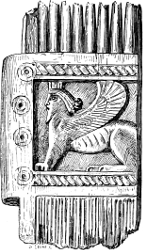
Fig. 227.—Comb. Actual size. Louvre.
We know of nothing among the spoils of Assyria that can be compared to those wooden spoons that the Egyptian workman carved with so light a hand;[440] but two objects found at Kouyundjik prove that the Assyrians knew how to give forms elegant and graceful enough, though less original, to objects of the same kind. One of these is a bronze fork, the other a spoon of the same material. Cables, zig-zags, and beads are used to ornament them, and the whole is a good example of Assyrian taste in little things.
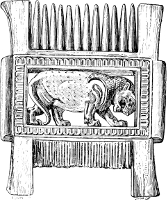
Fig. 228.—Comb. Actual size. Louvre.
So far we have treated Assyrian metal-work of the ornamental kind only as it is seen in bronze. Hardly any objects of gold or silver have, in fact, been discovered in Mesopotamia. And yet it is impossible that those two metals can have been very rare in the Nineveh of the Sargonids or the Babylon of Nebuchadnezzar; war and industry certainly led to considerable accumulations of both. We must find a reason for their absence in the success with which the Assyrian tomb has so far avoided discovery. The tomb alone could offer a safe asylum to such treasures, and preserve them in its shadows for the inquisitive eyes of modern archæologists. Before being abandoned to the slow effects of time, the temples and palaces were pillaged. Here and there, however, in some well contrived hiding-place or forgotten corner, a few trinkets may have escaped the eyes of greedy conquerors, or of the later marauders who sounded the ruins in every direction for the sake of the precious metals they might contain.
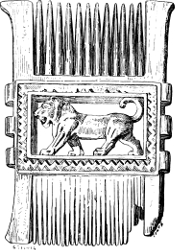
Fig. 229.—Comb. Actual size. Louvre.
The oldest jewels left to us by these peoples are those found in the most ancient tombs at Warka. Their forms are simple enough—bronze bracelets made of a bar tapering rapidly to each end and beaten with a hammer into a slight oval (Figs. 232, 233). These bars are sometimes very thick, as our first example shows. The golden ear-drops from the same tombs (Fig. 234) are made in the same way.
At Nineveh the art is more advanced. We may form our ideas of it from the bas-reliefs, where people are shown with jewels about their arms, their necks, and hanging on their cheeks; and also from a few original specimens that have escaped the general wreck. In the foundations of Sargon’s palace, under the massive threshold, were found too, together with a large number of cylinders, the remains of necklaces made up of pierced stones, such as carnelian, red and yellow jasper, brown sardonyx, amethyst, &c., cut into cylinders, polygons, medallions, and into the shapes of a pear and of an olive or date-stone (Fig. 235). This use of precious stones was a survival from the days when pebbles were turned to the same purpose. Earrings were made in the same fashion (Figs. 236, 237). In one of the reliefs we see a eunuch wearing a necklace in which double cones alternate with disks (Fig. 238). The same elements could of course be used for bracelets or armlets, by shortening the wire on which they were strung. From an art point of view such a jewel was quite primitive; all its beauty lay in the rich colours of its separate stones, among which beads of glass and enamelled earthenware have also been found.
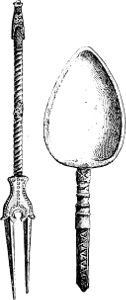
Figs. 230, 231.—Bronze fork and spoon; from Smith’s Assyrian Discoveries.
Kings and other high personages were not content with such simple adornments. It would seem that princes wore necklaces made up of separate pieces each of which had an emblematic signification of its own (Fig. 239), because we find them constantly reappearing in the reliefs, sometimes around the sovereign’s neck, sometimes distributed over the field of a stele. In the stele of Samas-Vul, the king only wears a single ornament on his breast; it is exactly similar to what we call a Maltese cross (Fig. 116).
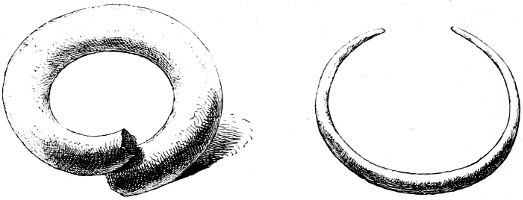
Figs. 232, 233.—Bracelets; from Rawlinson.
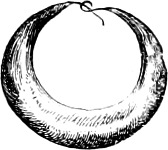
Fig. 234.—Ear-drop. British Museum.
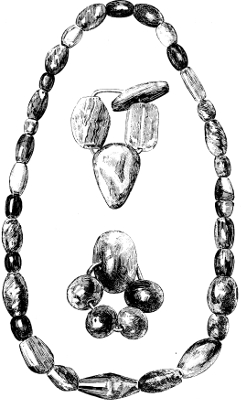
Figs. 235–237.—Necklace and ear-drops. Louvre. Drawn by Saint-Elme Gautier.
These ornaments must have been of gold and of some considerable size. The grand vizier, and the king when his tiara is absent, wear a diadem about their foreheads in which the rosette is the chief element of the decoration (Vol. I. Figs. 25 and 29). The queen’s diadem, in the “Feast of Assurbanipal,” is crenellated (Fig. 117), reminding us of that worn by the Greek Cybele. In the same monuments the wrists of kings and genii are surrounded with massive bracelets (Vol. I. Figs. 4, 8, 9, 15, 23, 24, 29, &c.). In the Louvre there is a bronze bracelet of exactly the same type (Fig. 24C).[441] We may see them figured among the objects offered in tribute in a bas-relief at Nimroud (Fig. 241). From the same reliefs we gather several examples of ear-pendents (Figs. 242–244). It is probable that the same models were carried out in gold, silver, or bronze, according to the rank and fortune of the people for whom they were made.[442] The forms were not altogether happy.
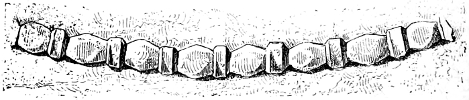
Fig. 238.—Necklace; from Layard.
And yet the Assyrian workmen could sometimes turn out lighter and more graceful objects than these. It was, no doubt, when they laboured for the softer sex that they modified their methods of work. The figure of a winged genius in which we ventured to recognise a goddess wears several necklaces, and one of them looks like a chain with alternately thin and stout members (Fig. 162). Now, at Kouyundjik, a necklace has been found (Fig. 245) bearing no little resemblance to the one here copied by the sculptor. It is composed of slender gold tubes, separated from each other by beads of the same metal. These beads are alternately ribbed and smooth. The workmanship is good and very careful.
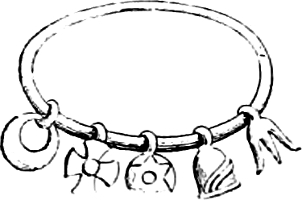
Fig. 239.—Royal necklace; from Rawlinson.
That these articles of personal jewelry were made in the country is proved by the fact that not a few of the moulds used by the jewellers for the patterns most in favour have been found. They are small slabs of serpentine or very hard limestone, in one face of which the desired pattern is cut in intaglio (Figs. 246 and 247). Wherever the pattern communicates with the outer edge by a small opening, it may have been used to receive the liquid metal; where no such gutter exists, the design must have been stamped, the leaves of metal being placed over the hollow and beaten into it with a mallet.[443]
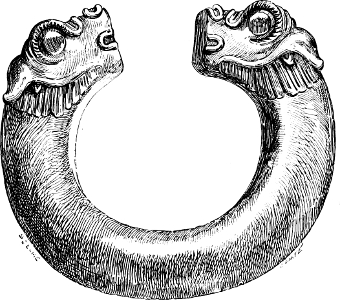
Fig. 240.—Bracelet. Diameter 5 inches. Louvre. Drawn by Saint-Elme Gautier.
It was by this latter process, no doubt, that those buttons which have been found in such quantities by every one who has explored the Assyrian palaces, were made. They are sometimes small disks ornamented with concentric bands (Fig. 248), sometimes lozenges with beaded edges (Fig. 249). These buttons have sometimes staples for attachment like ours, but more often they are pierced with a small hole for the passage of a metal thread. They were thus fixed on the king’s robes and the harness of his horses. Our Fig. 250, which is copied from a bas-relief at Kouyundjik, shows how the leather bands that encircled the necks of the chariot-horses and supported bells, metal rosettes and coloured tassels, were decorated.[444]
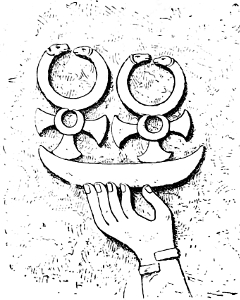
Fig. 241.—Bracelets; from Layard.
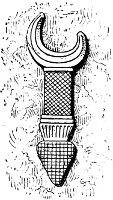
Fig. 242.—Ear-drop; from Layard.
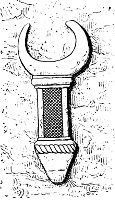
Figs. 243, 244.—Ear-drops; from Layard.
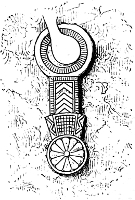
Figs. 248, 249.—Gold buttons. British Museum.
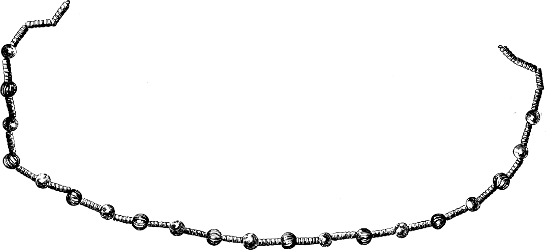
Fig. 245.—Necklace. British Museum.
The habits and tastes of the Oriental saddler have not changed since the days of antiquity. We cannot get a better idea of Assyrian harness than by examining the sets exposed for sale in the present day in the bazaars of Turkey, Persia, and India. More than once, when some Kurdish bey rode past him on his Arab, Sir H. Layard felt as if he had seen a vision from one of the Ninevite reliefs. The leather stitched with bright coloured threads, the housings of gaudy wool, the hawk’s bells tinkling round the horse’s neck, were all survivals from the past. The equipment of a Spanish mule, or the harness that used to be worn by the waggon teams of Eastern France within the memory of men not yet old, gives some idea of the effect produced.
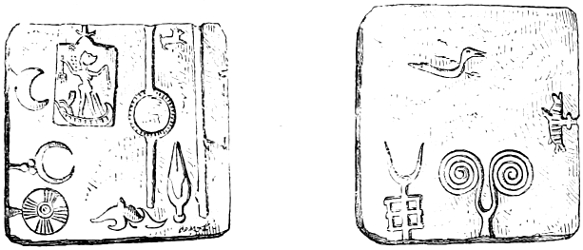
Figs. 246, 247.—Moulds for trinkets; from Layard.
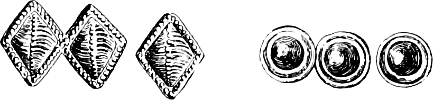
Figs. 248, 249.—Gold buttons. British Museum.
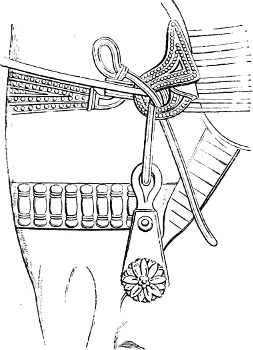
Fig. 250.—Part of the harness of a chariot-horse.
Personal jewelry and the apparatus of the toilet seem to have been no less elaborate in the Babylon of Nebuchadnezzar than in the Nineveh of Sennacherib, but we possess very few objects that can be surely referred to that period. To the very last years of the Chaldæan empire, if not to a still later date, must be ascribed two golden earrings now in the British Museum (Figs. 251 and 252). They represent a naked child, with long hair and a head much too large for its body. We are told that they were found in a tomb at Niffer, with other objects whose Chaldæan character was very strongly marked. Without this assurance we should be tempted to think their date no more remote than that of the Seleucidæ.
Among the knobs, or buttons, used so largely by joiners, tailors, and saddlers, some have been found of ivory and of mother-of-pearl. The jewellers, too, must have used these substances, which would give them an opportunity for effective colour harmonies. Thus Layard mentions an ear-pendent that he found at Kouyundjik, which had two pearls let into a roll of gold.[445]
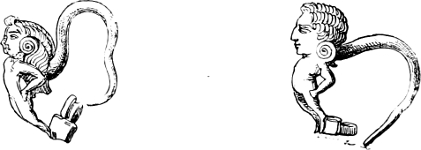
Figs. 251, 252.—Ear-pendents. British Museum.
On the other hand no amber has been found in Mesopotamia. That substance was widely used by the Mediterranean nations as early as the tenth century before our era, but it does not seem to have been carried into the interior of Asia. It has been asserted that one of the cuneiform texts mentions it;[446] that assertion we cannot dispute, but it is certain that neither in the British Museum nor in the Louvre, among the countless objects that have been brought from the Chaldæan and Assyrian ruins to those great store-houses of ancient art, has the smallest fragment of amber been discovered. If it ever entered Mesopotamia, how could it have been more fitly used than in necklaces, to the making of which glass, enamelled earthenware, and every attractive stone within reach, contributed?[447]
§ 7. Textiles.
Among people who looked upon nudity as shameful, the robe and its decorations were of no little importance. Both in Chaldæa and Assyria it was carried to a great pitch of luxury by the noble and wealthy. They were not content with fine tissues, with those delicate and snowy muslins for which the kings of Persia and their wives were, in later years, to ransack the bazaars of Babylon.[448] They required their stuffs to be embroidered with rich and graceful ornament, in which brilliant colour and elegant design should go hand in hand.[449] The Chaldæans were the first to set this example, as we know from the most ancient cylinders, from the Tello monuments and from the stele of Merodach-idin-akhi (Fig. 233). But it would seem that the Assyrians soon left their teachers behind, and in any case the bas-reliefs enable us to become far better acquainted with the costume of the northern people than with that of their southern neighbours. Helped and tempted by the facilities of a material that offered but a very slight resistance to his chisel, the Assyrian sculptor amused himself now by producing a faithful copy of the royal robes in every detail of their patient embroidery, now by imitating in the broad thresholds, the intersecting lines, the stars and garlands woven by the nimble shuttle in the soft substance of the carpets with which the floors of every divan were covered.
The images on the royal robes must have been entirely embroidered (Figs. 253 and 254). They cannot have been metal cuirasses engraved with the point, as we might at the first glance be tempted to think. In the relief there is no salience suggesting the attachment of any foreign substance. Neither have we any reason to believe that work of such intricate delicacy could be carried out in metal. It was by the needle and on a woollen surface that these graceful images were built up.
The skill of the Babylonian embroiderers was famous until the last days of antiquity.[450] During the Roman period their works were paid for by their weight in gold.[451] Even now the women of every eastern village cover materials often coarse enough in themselves with charming works of the same kind. They decorate thus their long hempen chemises, their aprons and jackets, their scarves, and the small napkins that are used sometimes as towels and sometimes to lay on the floor about the low tables on which their food is served.
It is likely that the Assyrian process was embroidery in its strictest sense. In the modern bazaars of Turkey and Persia table-covers of applied work may be bought, in which hundreds of little pieces of cloth have been used to make up a pattern of many colours; but in the sculptured embroideries the surfaces are cut up by numerous lines which could hardly have been produced, in the original, otherwise than by the needle. This, however, is a minor question. Our attention must be directed to the composition of the pictures and to the taste which inspired and regulated their arrangement.
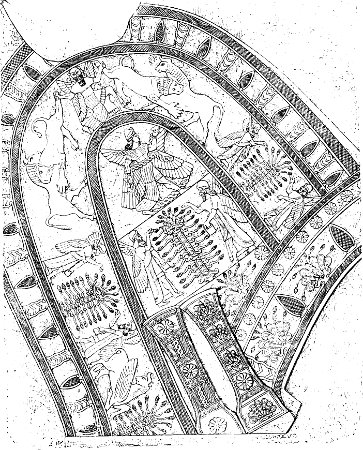
Fig. 253.—Embroidery on the upper part of the king’s mantle; from Layard.
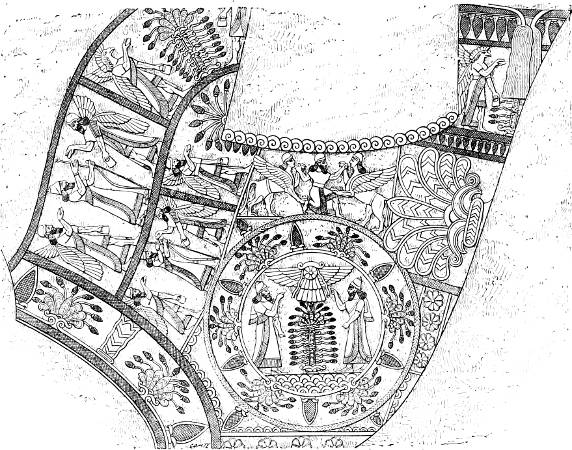
Fig. 254.—Embroidery upon a royal mantle; from Layard.
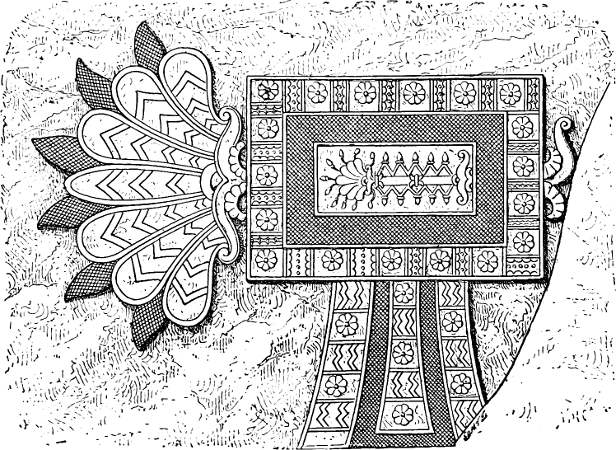
Fig. 255.—Embroidered pectoral; from Layard.
The principle of the decoration as a whole is almost identical with that of the bronze platters. A central motive is surrounded by parallel bands of ornaments in which groups of figures are symmetrically disposed. Outside this again are narrow borders composed of forms borrowed chiefly from the vegetable kingdom, such as conventional flowers and buds, palmettes, and rosettes. The figures are strongly religious in character; here we find winged genii, like those about the palace doors, adoring the sacred tree, floating in space, or playing with lions (see Fig. 253); in another corner the king himself is introduced, standing between two monitory genii, or in act of homage to the winged disk and mystic palm.
All these images are skilfully arranged, in compartments bounded by gracefully curving lines. The designer has understood how to cover his surface without crowding or confusion, and has shown a power of invention and a delicate taste that can hardly be surpassed by any other product of Mesopotamian art. There is no trace of the heaviness to which we alluded in our section on jewelry.
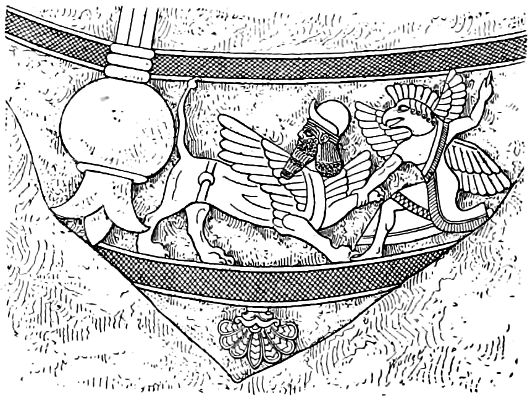
Fig. 256.—Detail of embroidery; from Layard.
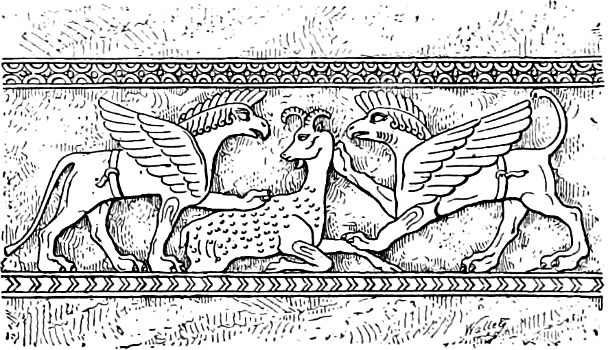
Fig. 257.—Detail of embroidery; from Layard.
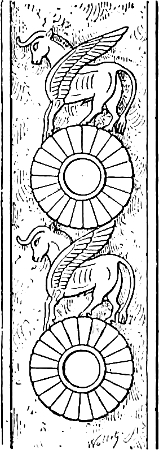
Fig. 258.—Detail of embroidery; from Layard.
The impression made by these compositions as a whole is intensified when we examine their separate details. The variety of the combinations employed is very striking. Sometimes the ornament is entirely linear and vegetable in its origin. Look, for instance, at the kind of square brooch worn on his breast by one of the winged genii at Nimroud (Fig. 255). The sacred tree surrounded by a square frame of rosettes and wavy lines occupies the centre, the palmette throws out its wide fronds at one end. In another example we find a human-headed lion, mitred and bearded, struggling with an eagle-headed genius. On the right of our woodcut (Fig. 256) a bud or flower like that of the silene inflata, hangs over the band of embroidery; it is a pendent from the necklace. Sometimes we find real combined with fictitious animals. In Fig. 257 two griffins have brought down a spotted deer. Elsewhere we see a winged bull perched upon a large rosette in an attitude that is at once unexpected and not ungraceful (Fig. 258). Finally the king himself or a personage resembling him is often represented struggling with fictitious monsters (Fig. 259). In this figure notice the rosettes that are scattered promiscuously over the field. We shall encounter the same prodigality of ornament in the oldest Greek vases, whose decorators seem to have been afraid to leave a corner of their surface unoccupied.
In his way the weaver was no less skilful than the embroiderer, but he could not give quite so much rein to his fancy as his fellow workmen. The shuttle was less free than the needle. In its passage through the threads of the warp it could hardly do more than trace symmetrical designs and repeat them at regular intervals. We must seek for the patterns of Chaldæo-Assyrian carpets in the sculptured thresholds of the palaces. In these the general principle never varied, but the composition changed just as it does to-day in the carpets and rugs imported from Turkey and Persia. In any case there was a border into which the softest and most delicate colours were introduced. As a rule it must have been decorated with one of those “knop and flower” ornaments originally invented by the Egyptians.[452] The space so inclosed was sometimes divided into coffer-like compartments or panels, sometimes it was filled with a single diaper pattern, as in the threshold from Khorsabad (Vol. I. Fig. 96). No figures of men or animals are to be found here. The simple and perhaps monotonous forms borrowed from the vegetable kingdom, were thoroughly well suited for stuffs destined to be stepped upon by countless feet. If, in our fancy, we clothe the patterns of the carved sills in all the charm of varied colour, we obtain a glowing surface that may be compared, at a respectful distance, with the gorgeous colour harmonies of the Mesopotamian plains, when the spring showers have clothed them in a robe of brilliant green, studded with the pure white of the marguerite, the gold of the ranunculus, and the rich satin of the purple tulip.