Chapter II · SCULPTURE. (continued 3)
Walter Armstrong translation
This active desire to imitate reality as faithfully as possible had another consequence. It led to the multiplication of figures, and therefore to the diminution of their scale. No figures like those that occupy the whole heights of the slabs at Nimroud and Khorsabad have been found in the palace of Sennacherib. In the latter a slab is sometimes cut up into seven or eight horizontal divisions.[255] The same landscape, the same people, the same action is continued from one division to another over the whole side of a room. The subjects were not apportioned by slabs, but by horizontal bands; whence we may conclude that the limestone or alabaster was chiselled in place and not in the sculptor’s studio.
We have not engraved one of these reliefs in its entirety; with its half-dozen compartments one above another and its hundred or hundred and fifty figures, it would have been necessary to reduce the latter to such a degree that they could only be seen properly with a magnifying glass. The originals themselves, or the large plates given by Layard in his Monuments, must be consulted before the dangers of this mode of proceeding can be appreciated. The confusion to which we have pointed as one of the cardinal defects of Assyrian sculpture, is nowhere more conspicuous than in the battle pictures from Sennacherib’s palace. It is, however, only to be found in the historical subjects. When the sculptor has to deal with religious scenes he returns to the simplicity of composition and the dignity of pose that we noticed in the reliefs of Assurnazirpal.
This may be seen in the figures carved on the rock of Bavian by the orders of Sennacherib. The village which has given its name to this monument lies about five and thirty miles north-north-east of Mossoul, at the foot of the first Kurdistan hills and at the mouth of a narrow and picturesque valley, through which flows the rapid and noisy Gomel on its way to the ancient Bumados, the modern Ghazir, which in its turn flows southwards into the Zab.
The sculptures consist of several separate groups cut on one of the lofty walls of the ravine. Some are accompanied by inscriptions, but the latter speak of canals cut by the king for the irrigation of his country and of military expeditions, and do not explain why such elaborate sculptures should have been carried out in a solitary gorge, through which no important road can ever have passed.[256]
The valley, which is very narrow, is a cul-de-sac. May we suppose that during the summer heats the king set up his tent in it and passed his time in hunting? According to Layard’s description the scene is charming and picturesque. “The place, from its picturesque beauty and its cool refreshing shade even in the hottest day of summer, is a grateful retreat, well suited to devotion and to holy rites. The brawling stream almost fills the bed of the narrow ravine with its clear and limpid waters. The beetling cliffs rise abruptly on each side and above them tower the wooded declivities of the Kurdish hills. As the valley opens into the plain the sides of the limestone mountains are broken into a series of distinct strata, and resemble a vast flight of steps leading up to the high lands of central Asia. The banks of the torrent are clothed with shrubs and dwarf trees, among which are the green myrtle and the gay oleander bending under the weight of its rosy blossoms.”[257] Such a gorge left no room for a palace and its mound,[258] but a subterranean temple may have been cut in the limestone rock for one of the great Assyrian deities, and its entrance may now be hidden, or even its chambers filled up and obliterated, by landslips and falling rocks, and two huge masses of stone that now obstruct the flow of the torrent may be fragments from its decoration. They bear the figures of two winged bulls, standing back to back and separated by the genius who is called the lion-strangler.[259]
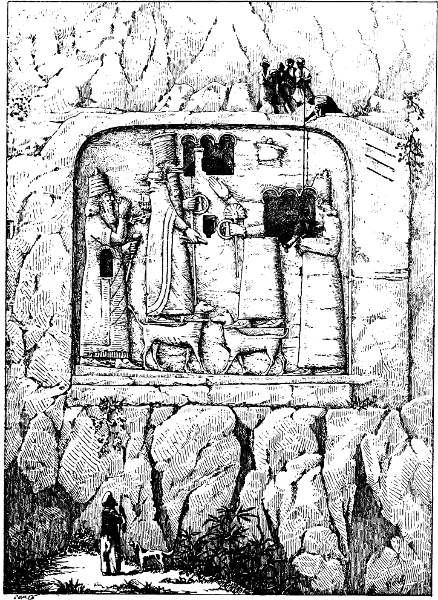
Fig. 120.—The great bas-relief at Bavian; from Layard.
The principal relief fills up a frame 30 feet 4 inches wide and 29 feet high (see Fig. 120). The bed has been cut away by the chisel to a depth of about 8 inches. Sheltered by the raised edge thus left standing the figures would have been in excellent condition but for the unhappy idea that struck some one in later years, of opening chambers in the rock at the back and cutting entrances to them actually through the figures. These hypogea do not seem to have been tombs. They contain no receptacles for bodies, but only benches. They were, in all probability, cells for Christian hermits, cut at the time when monastic life was first developed and placed where we see them with the idea of at once desecrating pagan idols and sanctifying a site which they had polluted. In Phrygia and Cappadocia we found many rock-cut chambers in which evidence of the presence of these pious hermits was still to be gathered. In some, for instance, we found the remains of religious paintings. As examples we may mention the royal tombs of Amasia, which were thus converted into oratories.[260]
The composition contains four figures. Two in the middle face each other and seem to be supported by animals resembling dogs in their general outlines. They are crowned with tiaras, cylindrical in shape and surrounded with horns. One of these figures has its right hand raised and its left lowered; his companion’s gesture is the same, but reversed. The general attitudes, too, are similar, but the head of one figure has disappeared, so that we can not tell whether it was bearded like its companion or not. They each carry a sceptre ending in a palmette and with a ring attached to it at about the middle of the staff. In the centre of this ring a small standing figure may be distinguished. Behind each of these two chief personages, and near the frame of the relief, two subordinate figures appear. In attitude and costume they are the repetition of each other. Their right hands are raised in worship, while in their left they hold short, ball-headed sceptres.
The two figures in the centre must represent gods. The king is never placed on the backs of living animals in this singular fashion; but we can understand how, by an easily-followed sequence of ideas, such a method of suggesting the omnipotence of the deity was arrived at. Neither did the kings of the period we are considering wear this cylindrical tiara. In the palaces of the Sargonids it is reserved for the winged bulls. It is larger than the royal tiara, from which it is also distinguished by its embracing horns. Finally, the ringed sceptre is identical with the one held by Samas, in the Sippara tablet (Vol. I. Fig. 71). No one will hesitate as to the real character of these two personages; the only point doubtful is as to whether the one on the left is a god or a goddess. The mantle worn by the right hand figure is wanting; but the question cannot be decided, because the head has been completely destroyed. In any case, the difference of costume proves that two separate deities, between whom there was some relation that escapes our grasp, were here represented.
As for the two figures placed behind the gods, they would have been quite similar had they been in equally good condition. They represent Sennacherib himself, with the head-dress and robes that he wears in the sculptures of his palace at Nineveh. He caused his image to be carved on both sides of the relief, not for the sake of symmetry, but in order to show that his worship was addressed no less to one than the other of the two deities.
This rock-cut picture is not the only evidence of Sennacherib’s desire to leave a tangible witness of his piety and glory in this narrow valley. In another frame we find some more colossal figures, only one of which is fairly well preserved; it is that of a cavalier who, with his lance at rest, seems to be in act to charge an enemy. His attitude and movement recall those of a mediæval knight at a tournament.[261]
Layard counted eleven smaller reliefs sprinkled over the face of the rock. Some are easily accessible, while others are situated so high up that they can hardly be distinguished from below. Each of these has an arched top like that of the royal steles (see Fig. 116) and incloses a figure of the king about five feet six inches high. Above his head symbols like those on the Babylonian landmarks (see Figs. 43 and 111) and the Assyrian steles (Fig. 116) are introduced.[262] Three of these reliefs had inscriptions, and to copy them Layard caused himself to be let down by ropes from the top of the cliff, the ropes being held by Kurds who could hardly have had much experience of such employment. The illustration we have borrowed from his pages shows the adventurous explorer swinging between sky and earth (Fig. 120).
As a last example of these works cut in the rock, we may here mention a fountain that was cleared and for the moment restored to its original state by Mr. Layard (Fig. 121). By means of conduits cut in the living rock, they had managed to lead the water of the stream to a series of basins cut one below the other. The sketch we reproduce shows the lowest basin, which is close to the path. The face of the rock above it is smoothed and carved into a not inelegant relief. The water seems to pour from the neck of a large vase, seen in greatly foreshortened perspective. Two lions, symmetrically arranged, lean with their fore-feet upon the edge of the vase.[263] The work is interesting, as it is the only thing left to show how the Assyrians decorated a fountain.
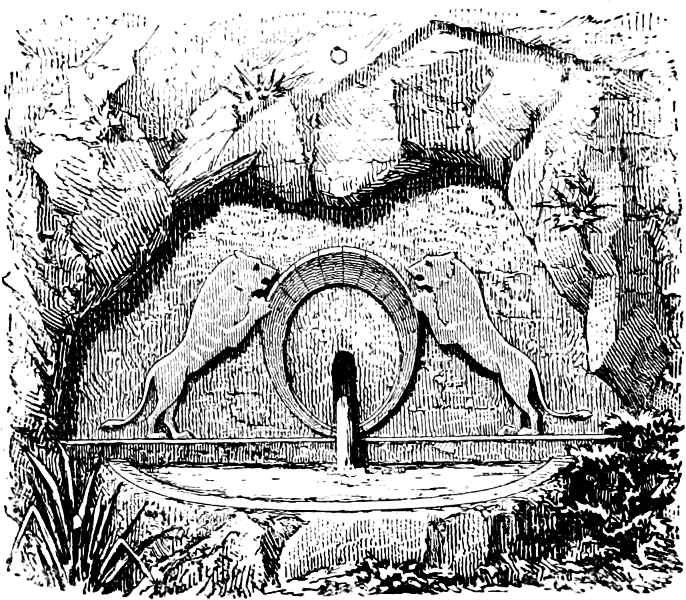
Fig. 121.—Fountain; from Layard.
The Assyrians thus found, in the very neighbourhood of their capital, great surfaces of rock almost smooth and irresistibly inviting to the chisel. Their unceasing expeditions led them into countries where, on every hand, they were tempted by similar facilities for wedding the likenesses of their princes to the very substance of the soil, for confiding the record of their victories to those walls of living rock that would seem, to them, unassailable by time or weather. Their confidence was often misplaced. In some places the water has poured down the face of the rock and worn away the figures; in others, landslips have carried the cliff and its sculptures bodily into the valley. In some instances, no doubt, the accumulations cover figures still in excellent condition, but several of these fallen sculptures have already been cleared.
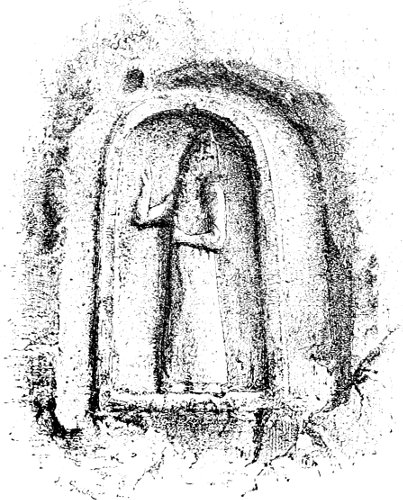
Fig. 122.—Assyrian bas-relief in the Nahr-el-Kelb. Drawn by P. Sellier.
We have already spoken of the bas-relief of Korkhar;[264] it is about three hundred miles from Nineveh, but the Assyrian conquerors left traces of their passage even farther from the capital than that, in the famous pass of the Lycos, for instance, near modern Beyrout, and now called Nahr-el-Kelb, or river of the dog. A rock-cut road passes through it, which has been followed from the remotest times by armies advancing from the north upon Egypt, or from the latter country towards Damascus and the fords of the Euphrates. Following the Pharaohs of the nineteenth dynasty, Esarhaddon caused his own image and royal titles to be cut in this defile; they may still be seen there, on rocks whose feet stand in the bed of the torrent (Fig. 122).[265]
Without going so far as northern Syria we might find, if we may believe the natives of the country, plenty of sculptures in the valleys that open upon the Assyrian plain if they were carefully explored. Near Ghunduk, a village about forty-five miles north-west of Mossoul, Layard noticed two reliefs of the kind, one representing a hunt, the other a religious sacrifice.[266] But after Bavian the most important of all these remains yet discovered is that at Malthaï. This village is about seventy-five miles north of Mossoul, in a valley forming one of the natural gateways of Kurdistan. The road by which the traveller reaches Armenia and Lake Van runs through the valley.[267] There, in the fertile stretch of country that lies between two spurs standing out from the main chain, stands a tell, or mound, which seems to have been raised by the hand of man. Place opened trenches in it without result, but he himself confesses that his explorations were not carried far enough, and, the beauty of the site and other things being considered, he persists in believing that the kings of Assyria must have had a palace, or at least a country lodge, in the valley. However this may be, the bas-reliefs, of which Place was the first to make an exact copy, suffice to prove that this site attracted particular attention from the Assyrians (see Fig. 123). They are to be found on the mountain side, at about two-thirds of its total height, or some thousand feet above the level of the valley. In former days they must have been inaccessible without artificial aids. It is only by successive falls of rock that the rough zig-zag path by which we can now approach them has been formed. The figures, larger than nature, are arranged in a long row and in a single plane. Place was obliged, by the size and shape of his page, to give them in two instalments in the plate of which our Fig. 123 is a copy. In the absence of a protecting edge they have suffered more than the figures at Bavian. They have, indeed, a slight projection or cornice above, but its salience is hardly greater than that of the figures themselves.
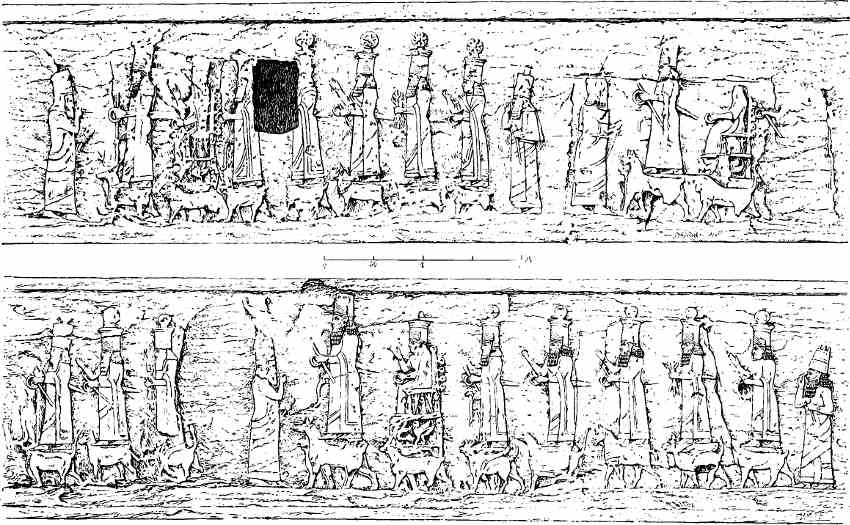
Fig. 123.—The bas-reliefs of Malthaï; from Place. About one forty-fifth of actual size.
The composition contains three groups, or rather one group repeated three times without sensible differences. The middle group, which is divided between the upper and lower parts in our woodcut, has been more seriously injured by the weather than those on each side of it; three of its figures have almost disappeared. The first group to the right in the upper division has part of its surface cut away by a door giving access to a rock-cut chamber behind the relief, like those at Bavian. It is, then, in the left-hand group that the subject and treatment can now be most clearly grasped.
In the first place, we may see at a glance that the theme is practically the same as at Bavian; it is a king adoring the great national gods. But the latter are now seven in number instead of two; instead of being face to face they are all turned in one direction, towards the king; but the latter is none the less repeated behind each group. There are some other differences. Among the animals who serve to raise the gods above the level of mere humanity we may distinguish the dog, the lion, the horse, and the winged bull. The gods are in the same attitude as at Bavian; their insignia are the same, those sceptres with a ring in the middle, which we never find except in the hands of deities. The sixth in the row also grasps the triple-pointed object that we have already recognised as the prototype of the Greek thunderbolt.[268] Finally, each god has the short Assyrian sword upon his thigh. To this there is one exception, in the second figure of each group. This figure is seated upon a richly-decorated throne, and has no beard, so that we may look upon it as representing a goddess. The last of the seven deities is also beardless, and, in spite of the sword and the standing attitude, may also be taken to represent a goddess. The tiaras, which are like those of Bavian in shape, each bear a star, the Assyrian ideogram for God.[269]
There is no inscription, but both Place and Layard agree that the proportions of the figures, and their execution, and the costume of the king, declare the work to have been carried out in the time of the Sargonids, probably under Sennacherib, but if not, during the reign either of his father, his son, or his grandson.
We have been led to give a reproduction and detailed description of these reliefs, chiefly because they acted as a school for the people about them. We find this habit of cutting great sculpturesque compositions on cliff-faces followed, on the one hand by the natives of Iran, on the other by those of Cappadocia, and in the works they produced there are points of likeness to the Assyrian reliefs that can by no means be accidental. When the proper time comes we shall, we believe, be able to show that there was direct and deliberate imitation.
It was not only on these rock-cut sculptures that the gods appeared thus perched on the backs of animals; the motive was carried far afield by small and easily-portable objects, on which it very often occurs. It is to be found on many of the cylinders; we reproduce two as examples. Each of these shows us an individual in an attitude of worship before a god standing on a bull’s back. The main difference between the two is one of style. The cylinder engraved in Fig. 124 dates from the early Chaldæan monarchy, while its companion (Fig. 125) is ascribed by M. Ménant to the Assyrian dynasty of Calah.[270]
By their simplicity of arrangement and the nudity of their field, the sculptures of Bavian and Malthaï belong in some sense to the archaic period, but their figures are designed with that finer sense of proportion that distinguished Assyrian art from the reign of Sennacherib onwards. It was, however, in the palaces that the new tendency towards grace and slenderness chiefly made itself felt. We have no sculptures to speak of from the time of Esarhaddon, but no monarch has left us monuments more numerous or in better preservation than his son Assurbanipal. A visit to London is necessary, however, for their proper examination, as they have not yet been made the subject of any such publication as that devoted by Mr. Layard to remains from the time of Sennacherib and Assurnazirpal. Some idea of them may be formed, however, from the numerous fragments figured in these pages (Vol. I., Figs. 5, 27, 28; below, Figs. 162, 172, 174, 177–180, 188).
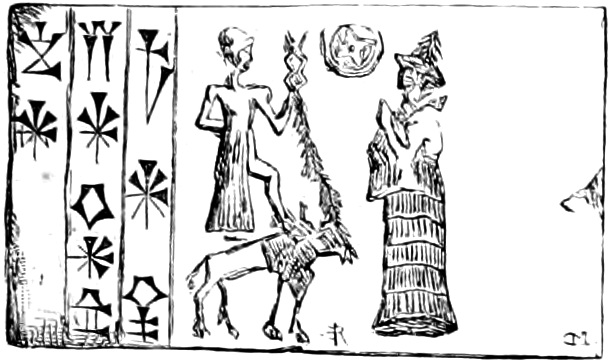
Fig. 124.—Chaldæan Cylinder. Hematite.[271]
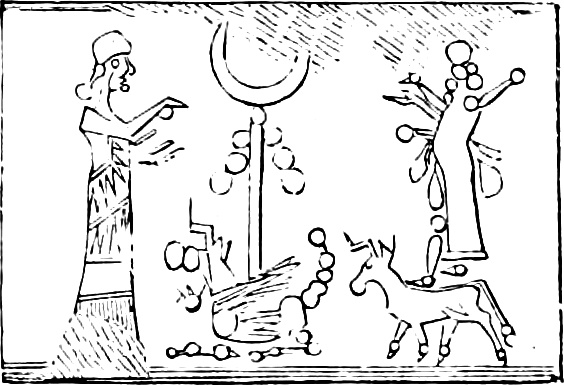
Fig. 125.—Assyrian Cylinder.[272]
Speaking generally, the sculptors of Assurbanipal were the pupils of those of Sennacherib, with, perhaps, a larger endowment of taste and skill. Under them Assyrian art aimed higher than ever before. It was fascinated by movement, and endeavoured to render its accidents and unforeseen turns. From this point of view we must draw particular attention to the pictures representing the campaign of Assurbanipal against the Elamites. In these the figures are more numerous and more closely packed than anywhere else, and the chisel has attacked episodes more complicated and more difficult to treat. Here, for instance, is a chariot upset upon the battle-field; it is turned completely over, while the struggling horses pull different ways, and the occupants are thrown out head foremost. There are many technical defects and mistakes of drawing, but the attempt is none the less interesting.
Some of the reliefs show the same confused accumulation of figures as in the time of Sennacherib. Now and then we find as many as six horizontal divisions, each from ten to fourteen inches high. But their height obeys no regular or constant rule. The central division, with the king in his chariot, is two feet high. No attempt is made to distinguish planes by varying the size of the figures, to mark the successive moments of the action by dividing the groups, or to give prominence to the main incidents; the confusion is unbroken. Here, as in all the battle pieces, a very singular convention may be noticed. There are no dead or beaten Assyrians. If we may believe the artist, the kings of Nineveh won all their battles without losing a man!
The hunting scenes are arranged with more judgment. In certain respects we might place them in the same class as the great reliefs from Nimroud. By right of their dignity and breadth, the latter must be considered the masterpieces of Assyrian sculpture, but these later works can boast an amount of energy and vitality and a truthfulness of handling that are worthy of no stinted praise. The master by whom the conception was thought out abandoned the overloaded backgrounds that his immediate predecessors had brought into vogue. He concentrated his attention on the figures, to which he gave all the value he could. They stand out with singular force against a field whose unbroken surfaces happily suggest the immensity of the naked plains on which the hunts took place. We have already shown how well the distinctive features and movements of the dog, the lion, and the wild ass are rendered; in our Fig. 126 we give another example of the same kind. A sentiment of real interest is stirred in us on behalf of these wild goats with their young, who run and feed on the steppe while horsemen and beaters prepare to drive them into the treacherous nets.
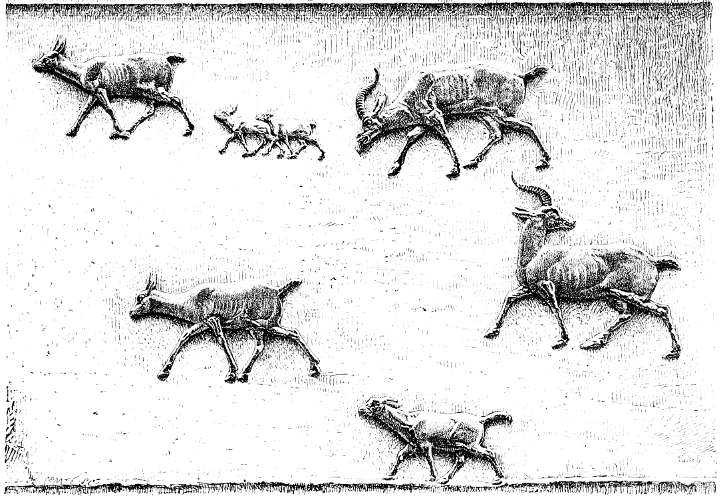
Fig. 126.—Wild goats. British Museum. Drawn by Wallet.
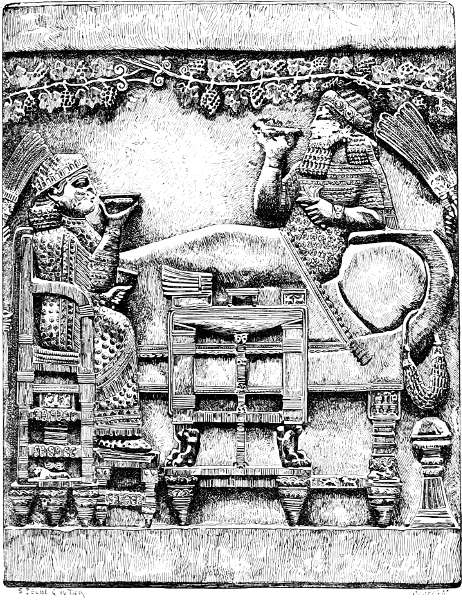
Fig. 127.—The feast of Assurbanipal. British Museum. Drawn by Saint-Elme Gautier.
Elsewhere, on the other hand, the sculptor has furnished the beds of his reliefs with certain vegetable and floral forms chiselled with the greatest care. We may give, as an example, the kind of royal park or garden in which we saw a pair of tame lions (see above, Fig. 77). Behind the animals, to the right, there is a tree round which a vine clings and mounts. It is heavy with clusters of ripe fruit, and even the curling tendrils with which its branches end are not forgotten. On the left there is a palm tree, or, at least, its trunk. Between the vine and the palm tall flowering stems rear their heads. The artist has wished us to understand that fruits, sweet-smelling flowers, and umbrageous leafage, combined to make these gardens the most agreeable of retreats for a king fatigued with war against human enemies or the beasts of the desert. The same intention is traceable on the famous slab already figured (Vol. I. Figs. 27 and 28), which shows the king and queen at table in one of these royal gardens. We reproduce the chief group on a larger scale in order that the beauty of the execution may have a chance of making itself felt (Fig. 127). Notice the treatment of the vine that bends over the heads of the royal couple. The heads themselves have suffered, but all the rest of the plaque is in excellent condition. Notice the pattern on the royal robes, and the details of the furniture. The latter may be recognized as truthful renderings of the magnificent chairs and tables of bronze, inlaid with ivory and lapis-lazuli, of which so many fragments have been found in the Assyrian palaces. Every detail that the chisel could render has been faithfully copied. Except in colour and material, the objects themselves are before us. The fringed coverlet thrown over the king’s knees, the cushion on which he leans, the garland thrown over the arm of his couch, the system of metal uprights and cross pieces of which the queen’s throne, the king’s bed, and the small table placed between them consist, might all be restored without difficulty. The chiselled feet of all these objects resemble fir-cones in shape. In the case of the table they are connected with its body by lion’s paws. On the lower bar of the queen’s chair there is a small couchant lion.
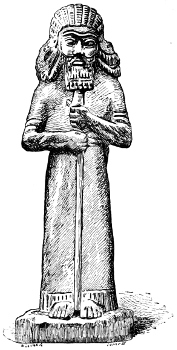
Fig. 128.—Terra-cotta statuette. Actual size. British Museum. Drawn by Saint-Elme Gautier.
It may be thought, perhaps with truth, that the sculptor has overdone these details, and that his figures are, in some degree, sacrificed to the decorations about them. Other examples from the same series, give a higher idea of the sculpture of this time; we may cite especially a fragment possessed by the Louvre, in which the treatment is of the skilfullest (Plate X). It represents Assurbanipal in his war-chariot at the head of his army. The chariot itself, and all the accessories, such as the umbrella and the robes of the king and his attendants, are treated with great care but they do not unduly attract the eye of the spectator. We can enjoy, as a whole, the group formed by the figures in the chariot, and those who march beside and behind it. Its arrangement is clear and well balanced; there is no crowding, the spacing of the figures is well judged and the movement natural and suggestive. The king dominates the composition as he should, and his umbrella happily gathers the lines of the whole into a pyramid. In all this there is both knowledge and taste.
The best of the Assyrian terra-cottas also belong to this period. The merit of their execution may be gathered from the annexed statuette, which comes from the palace of Assurbanipal (Fig. 128). From the staff in its hands it has been supposed to represent a king, but we know that every Assyrian was in the habit of carrying a stick with a more or less richly ornamented head, and here we find neither a tiara nor the kind of necklace which the sovereign generally wore (see Fig. 116). I am inclined to think it is the image of a priest.
In conclusion we may say that, in some respects, Assyrian sculpture was in a state of progression when the fall of Nineveh came to arrest its development and to destroy the hopes it inspired.
§ 7.—Polychromy.
We have now studied Mesopotamian sculpture in its favourite themes, in its principal conventions, and in the fluctuations of its taste and methods of work; we have yet to ask whether this sculpture, which differed in so many ways from the plastic art of Egypt, differed from it also in absence of colour. We have put off this question until now, because we had first to determine what materials the architect and sculptor employed, how they employed them, and what part was played by figures in relief and in the round in the architectonic creations of Chaldæa and Assyria.
In speaking of Egypt we have explained how a brilliant light destroys the apparent modelling of objects, how, by the reflections it casts into the shadows, it interferes with our power to distinguish one distant plane from another.[273] In every country where a vertical sun shines in an unclouded sky, the decorator has had to invoke the help of colour against the violence of the light, has had to accept its aid in strengthening his contours, and in making his figures and ornaments stand out against their ground. In describing Egyptian polychromy we said that we should find the same tendency among other nations, different in character and origin, but subjected to the influence of similar surroundings. We also allowed it to be seen that we should have to notice many changes of fashion in this employment of colour. Colour played a different and more important part in one place or period than in another, and it is not always easy to specify the causes of the difference. In the Egyptian monuments hardly a square inch of surface can be found over which the painter has not drawn his brush; elsewhere, in Greece for instance, we shall find him more discreet, and his artificial tints restricted to certain well-defined parts of a figure or building.
Did Assyria follow the teaching of Egypt, or did she strike out a line of her own, and set an example of the reserve that was afterwards to find favour in Greece? That is the question to be answered. Before we can do so we must produce and compare the evidence brought forward by Botta, Layard, Place and others, who saw the Assyrian sculptures reappear in the light of day. Ever since those sculptures were recovered they have been exposed to the air; they have undergone all the handling and rubbing involved in a voyage to Europe; and for the last twenty or thirty years they have been subjected to the dampness of our climate. We need, then, feel no surprise that traces of colour still visible when the pick-axe of the explorer freed the alabaster slabs from their envelope of earth have now disappeared.
Before examining our chief witnesses, the men who dug up Khorsabad, and Nimroud, and Kouyundjik, we may, to some extent, foretell their answers. We have already explained how the Mesopotamian architect made use of colour to mask the poverty of his construction and to furnish the great bare walls of his clay buildings. Both inside and outside, the Assyrian palaces had the upper parts of their walls and the archivolts of their doors decorated with enamelled bricks or paintings in distemper. Is it to be supposed that where the reliefs began all artificial tinting left off, and that the eye had nothing but the dull grey of gypsum and limestone to wander to from the rich dyes of the carpets with which the floors were strewn? Nothing could well be more disagreeable than such a contrast. In our own day, and over the whole of the vast continent that stretches from China to Asia Minor, there is not a stuff, however humble, that is woven on the loom or embroidered by the needle, but betrays an instinctive feeling for harmony so true and subtle that every artist wonders at it, and the most tasteful of our art workmen despair of reaching its perfection, and yet many of these faultless harmonies were conceived and realized in the tent of the nomad shepherd. We can hardly believe that in the palace where official art lavished all its resources in honour of its master, there could be any part from which the gaiety that colour gives was entirely excluded, especially if it was exactly the part to which the eye of every visitor would be most surely attracted.
Before going into the question of evidence one might, therefore, make up our minds that the Assyrian architect never allowed any such element of failure to be introduced into his work; and the excavations have made that conclusion certain. The Assyrian reliefs were coloured, but they were not coloured all over like those of Egypt; the grain of the stone did not disappear, from one end of the frieze to the other, under a layer of painted stucco. Flandin, the draughtsman attached to the expedition of M. Botta, alone speaks of a coat of ochre spread over the bed of the relief and over the nude portions of the figures;[274] he confesses, however, that the traces were very slight and that they occurred only on a slab here and there. Botta, who saw the same slabs, thought his colleague mistaken.[275] Place is no less decided: “None of us,” he says, “could find any traces of paint upon the undraped portions of the figures, and it would be very extraordinary if among so many bare arms and bare legs, to say nothing of faces, not one should have retained any vestige of colour if they had all once been painted.”[276] We might be inclined to ask whether the traces of pigment that have been noticed here and there upon the alabaster might not have been the remains of a more widespread coloration, the rest of which had disappeared. Strong in his experience, Place thus answers any doubts that might be expressed on this point: “We never found an ornament, a weapon, a shoe or sandal, partially coloured; they were either coloured all over or left bare, while objects in close proximity were without any hue but their own. Sometimes eyes and eyebrows were painted, while hair and beard were left untouched; sometimes the tiara with which a figure was crowned or the fan it carried in its hand was painted while the hand itself and the hair that curled about the head showed not the slightest trace of such an operation; elsewhere colour was only to be found on a baldrick, on sandals, or the fringes of a robe.” Wherever these colours existed at all they were so fresh and brilliant at the time of discovery that no one thought of explaining their absence from certain parts of the work by the destruction of the pigment. “How is it,” continues Place, “that, if robes were painted all over, we only found colour on certain accessories, on fringes and embroideries? How is it that if the winged bulls were coated in paint from head to foot, not one of the deep grooves in their curled beards and hair has preserved the slightest vestige of colour, while the white and black of their eyes, which are salient rather than hollowed, remain intact? Finally, we may mention the following purely accidental, and therefore all the more significant, fact: a smudge of black paint, some two feet long, was still clearly visible on the breast of one of the colossi in the doorway of room 19.[277] How can we account for the persistence of this smudge, which must have fallen upon the monster’s breast while they were painting its hair, if we are to suppose that the whole of its body was covered with a tint which has disappeared and left no sign?”
Such evidence is decisive. The colouring of the Assyrian reliefs must always have been partial. The sculptor employed the painter merely to give a few strokes of the brush which, by the frankness and vivacity of their accent, should bring the frieze into harmony with the wall that enframed it. Nothing more was required to destroy the dull monotony of the long band of stone. At the same time these touches of colour helped to draw attention to certain details upon which the sculptor wished to insist.
For all this, four colours were enough. Observers agree in saying that black, white, red and blue made up the whole palette.[278] These tints were everywhere employed pretty much in the same fashion.[279]
In those figures in which drapery covered all but the head, the latter was, of course, more important than ever. The artist therefore set himself to work to increase its effect as much as he could. He painted the eyeball white, the pupil and iris, the eyebrows, the hair and the beard, black; sometimes the edges of the eyelids were defined with the same colour. The band about the head of the king or vizier is often coloured red, as well as the rosettes which in other figures sometimes decorate the royal tiara. The same tint is used upon fringes, baldricks, sandals, earrings, parasols and fly-flappers, sceptres, the harness of horses and the ornamental studs or bosses with which it was covered, and the points of weapons.[280] In some instances blue is substituted for red in these details. Place speaks of a fragment lost in the Tigris on which the colours were more brilliant than usual; upon it the king held a fan of peacock’s feathers coloured with the brightest mineral blue.[281]
When figures held a flower in their hands it was blue, and at Khorsabad a bird on the wing was covered with the same tint.[282] In some bas-reliefs red and blue alternate in the sandals of the figures and harness of the horses.[283] We find a red bow with a blue quiver.[284] The flames of towns taken and set on fire by the Assyrians were coloured red in many of the Khorsabad reliefs.[285]
A few traces of colour may still be discovered upon some of Sargon’s sculptures in the Louvre and upon those of Assurnazirpal in the British Museum.[286] I could find no remains of colour either upon the reliefs of Assurbanipal or upon those of Sennacherib, where, moreover, Layard tells us he could discover none.[287]
It would be very strange however, if in these palaces of the last of the Sargonids the decorator had deliberately renounced the beauties of that discreet system of polychromy of which the traces are to be found in all the earlier palaces. It is possible that these touches of colour were reserved for the last when the palaces were erected, and that something may have happened to prevent them from being placed on the sculptures of these two sovereigns.
So far as we can discover, no trace of colour has been found on any of the arched steles or isolated statues left to us by Chaldæa and Assyria. This abstention is to be explained by the nature of the materials at the disposal of the sculptor in Chaldæa, the cradle of his art. These were chiefly igneous rocks, very hard, very close in grain and dark in colour, and susceptible of a very high polish. The existence of such a polish disposes of any idea that the figures to which it was given were ever painted. The pigment would not have stayed long on such a surface, and besides, the reds and blues known to the Ninevite artists would have had a very poor effect on a blue-black ground.
On the other hand, when they set to work to model in clay the Assyrians could give free rein to their love for colour. Most of the statuettes found in the ruins of their palaces had been covered with a single uniform tint, which, thanks to the porous nature of the material, is still in fair preservation. The tint varies between one figure and another, and, as they are mostly figures of gods or demons, the idea has been suggested that their colours are emblematic.[288] Thus the Louvre possesses a statuette from Khorsabad representing a god crowned with a double-horned tiara, and covered all over, flesh and drapery alike, with an azure blue.[289] A demon with the head of a carnivorous animal, from the same place, is painted black, a colour that seems to suggest a malevolent being walking in the night and dwelling in subterranean regions.[290]
The Assyrians also made use of what has been sometimes called natural polychromy, that is to say they introduced different materials into the composition of a single figure, each having a colour of its own and being used to suggest a similar tint in the object represented. Several fragments of this kind may be seen in the cases of the British Museum.[291] We may give as examples some eyes in black marble; the ball itself is ivory while the pupil and iris are of blue paste, a sandy frit in which the colour sank deeply before firing. Beards and hair were also made of this material; they have been found in several instances, without the heads to which they belonged. In the ruins from which he took these objects, Layard saw arms, legs and torsos of wood. They were so completely carbonized by fire that they could not be removed; at the least touch they crumbled into powder.
With wood, with enamel and coloured earths, with stones, both soft and hard, and metals both common, like bronze, and precious, like gold and silver, the sculptor built up statues and statuettes in which the peculiar beauty to be attained by the juxtaposition of such heterogeneous materials, was steadily kept in view. With inferior taste and less feeling for purity of form than the Greeks, this art was identical in principal with the chryselephantine sculpture that created the Olympian Zeus and the Athene of the Parthenon.
The idea that sculpture is the art in which form is treated to the exclusion of colour is quite a modern one.[292] The sculptor of Assyria was as ready to mix colour with his contours as his confrère of Egypt, but he made use of it in more sober and reserved fashion. How are we to explain the difference? It is easier to prove the fact than to give a reason for it. It may be said that the sunlight is less constant and less blinding in Mesopotamia than in the Nile valley, and that the artist was not called upon to struggle with such determination, by the profusion and brightness of his colours, against the devouring illumination that impoverishes outlines and obliterates modelling. We must also bear in mind the habits formed by work in such materials as basalt and diorite, which did not lend themselves kindly to the use of bright colours.
In any case the fact itself seems incontestable. We cannot say of the Ninevite reliefs as we said of those of Thebes, that they resembled a brilliant tapestry stretched over the flat wall-surfaces. If, in most of the buildings, touches of paint freely placed upon the accessories and even upon the figures and faces, lightened and varied the general appearance of the sculptures, still the naked stone was left to show all over the bed and over the greater part of the figures. From this we must not conclude, however, that the Assyrians and Chaldæans did not possess, and possess in a very high degree, the love for bold and brilliant colour-schemes which even now distinguishes their degenerate posterity, the races inhabiting the Euphrates valley and the plateau of Iran. But they gratified their innate and hereditary taste in a different way. It was to their woven stuffs, to their paintings in distemper and their enamelled faïence that the buildings of Mesopotamia owed that gaiety of appearance which has led us to compare them with the mosques of Turkey and Persia.
§ 8.—Gems.
“Every Babylonian had a seal,” says Herodotus;[293] this fact seems to have struck him directly he began to explore the streets and bazaars of the great oriental city. These seals, which appear to have attracted the eye of the historian by the open manner in which they were carried and the continual use made of them in every transaction of life, public or private, are now in our museums. They are to be found in hundreds in all the galleries and private collections of Europe.[294]
When Chaldæan civilization became sufficiently advanced for writing to be in widespread use and for every man to provide himself with his own personal seal, no great search for convenient materials was necessary. The rounded pebbles of the river beds gave all that was wanted. The instinct for personal adornment is one of the earliest felt by mankind, and just as the children of to-day search in the shingle of a beach for stones more attractive than the rest, either by their bright colours, or vivid markings or transparency of paste, so also did the fathers of civilization. And when they had found such stones they drilled holes through them and made them into earrings, necklaces and bracelets. More than one set of pebble ornaments has been preserved for us in the Chaldæan tombs. In many instances forms sketched out by the accidents of nature have been carried to completion by the hand of man (Fig. 129). They were not long contented with thus turning a pebble into a jewel. The fancy took them to engrave designs or figures upon them so as to give a peculiar value to the single stone or to sets strung into a necklace, which thus became a kind of amulet (Fig. 130).
In the first instance this engraving was nothing more than an ornament. But one day it occurred to some possessor of such a stone to take an impression upon plastic clay. Those who saw the image thus obtained were struck by its precision, and were soon led to make use of it for authenticating acts and transactions of every kind. The presence of such an impression upon a document would perpetuate the memory of the man who put it there, and would be equivalent to what we call a sign manual.
But even when it developed into a seal the engraved stone did not lose its talismanic value. In order to preserve its quasi-magic character, nothing more was required than the presence of a god among the figures engraved upon it. By carrying upon his person the image of the deity in which he placed his confidence, the Chaldæan covered himself with his protection as with a shield, and something of the same virtue passed into the impressions which the seal could produce in such infinite numbers.
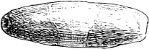
Fig. 129.—River pebble which has formed part of a necklace.
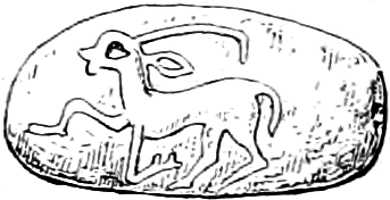
Fig. 130.—River pebble engraved; from De Gobineau.
No subject occurs more often on the cylinders than the celestial gods triumphing over demons. Such an image when impressed upon the soft clay would preserve sealed-up treasures from attempts inspired by the infernal powers, and would interest the gods in the maintenance of any contract to which it might be appended.[295]
To all this we must add that superstitions, of which traces subsist in the East to this day, ascribed magic power to certain stones. Hematite, for instance, as its name suggests, was supposed to stop bleeding, while even the Greeks believed that a carnelian gave courage to any one who wore it on his finger.
When engraving on hard stone was first attempted, it was, then, less for the love of art than for the profit to be won by the magic virtues and mysterious affinities, both of the material itself, and of the image cut in its substance. Then, with the increase of material comfort, and the development of social relations, came the desire of every Chaldæan to possess a seal of his own, a signet that should distinguish him from his contemporaries and be his own peculiar property, the permanent symbol of his own person and will. So far as we can tell, none but the lowest classes were without their seals; these latter when they were parties or witnesses to a contract, were contented with impressing their fingernails on the soft clay. Such marks may be found on more than one terra-cotta document; they answer to the cross with which our own uneducated classes supply the place of a signature.
When the use of the seal became general, efforts were made to add to its convenience. In order to get a good impression it was necessary that the design should be cut on a fairly even and regular surface. The river pebbles were mostly ovoid in form and could easily be made cylindrical by friction, and the latter shape at last became so universal that these little objects are always known as cylinders. These cylinders were long neglected, but within the last few years they have been the subject of some curious researches.[296] They may be studied from two different points of view. We may either give our attention to the inscriptions cut upon them and to their general historical significance, or we may endeavour to learn what they may have to teach as to the religious myths and beliefs of Chaldæa. As for us we are interested in them chiefly as works of art. It will be our duty to give some idea of the artistic value of the figures they bear, and to describe the process by which the engraving was carried out.
The cylinders are, as a rule, from two to three-fifths of an inch in diameter, and from three quarters of an inch to an inch and a half in length. Some are as much as an inch and three quarters, or even two inches long, but they are quite exceptional.[297] The two ends are always quite plain—the engraving is confined to the convex surface. As a rule the latter is parallel to the axis, but in some cases it is hollowed in such a fashion that the diameter of the cylinder is greater at the ends than in the middle (Fig. 131).
Nearly every cylinder is pierced lengthwise, a narrow hole going right through it. Those that have been found without this hole are so very few in number that we may look upon them as unfinished. In some cases the hole has been commenced at both ends, but the drill has stopped short of the centre, which still remains solid.
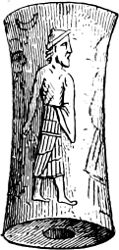
Fig. 131.—Concave-faced cylinder; from Soldi.
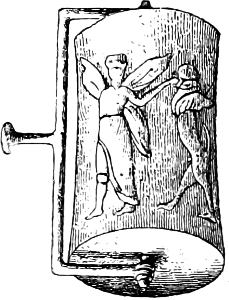
Fig. 132.—Cylinder with modern mount; from Rawlinson.
The cylinders were suspended by these holes, but how? In casting about for an answer to this question, the idea that the Babylonian attached the greatest importance to the clear reproduction, in the clay, of every detail of the design engraved upon his seal, has been taken as a starting point, and a system of mounting invented for him which would leave nothing to be desired in that respect (see Fig. 132). It is a reproduction, in small, of a garden roller; as a restoration, however, it can hardly be justified by the evidence of the monuments. Examine the terra-cotta tablets on which these seals were used, and you will see that their ancient possessors did not, as a rule, attempt to impress the whole of the scenes cut in them upon the soft clay. It is rare to find an impression as sharp and complete as that on the tablet from Kouyundjik, which we borrow from Layard (Fig. 133). In the great majority of cases signatories were content with using only one side of their seals, usually the side on which their names were engraved. Sometimes when they wished to transfer the whole of their cylinder to the clay, they did so by several partial and successive pressures.[298]
The imperfect stamp with which the Chaldæans were satisfied could easily be produced without the help of such a complicated contrivance as that shown in our Fig. 132. Nothing more was necessary than to lay the cylinder upon the soft clay and press it with the thumb and fore-finger. The hole through its centre was used not to receive an armature upon which it might turn, but merely for suspending it to some part of the dress or person. In most cases it must have been hung by a simple cord passed round the neck. Now and then, however, the remains of a metal mount have been found in place, but this is never shaped like that shown above. It is a bronze stem solidly attached to the cylinder, and with a ring at its upper extremity (Fig. 134).[299] Cylinders are also found with a kind of ring at one end cut in the material itself (Fig. 135).
How were these cylinders carried? They must have been attached to the person or dress, both for the sake of the protecting the image with which most of them were engraved, and for convenience and readiness in use as seals. In Chaldæa the fashion seems to have been, at one time, to fasten them to the wrist. In those tombs at Warka and Mugheir that we have described, the cylinders were found on the floors of the tomb-chambers, close to the wrist-bones of the skeletons; and the latter had not been moved since the bodies to which they had belonged were laid in the grave.[300] This fashion was apparently abandoned by the Assyrians, for in those reliefs which reproduce the smallest details of dress and ornament with such elaboration, we can never find any trace of the seal beside the bracelets. It is probable that it was hung round the neck and put inside the dress, in front, for greater security. It never occurs among the emblematic objects of which the necklace that spreads over the chest outside the robe, is made up. To this day traders in the East keep their seals in a little bag which they carry in an inside pocket.
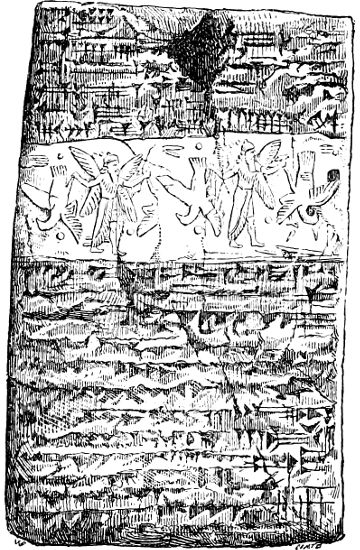
Fig. 133.—Tablet with impression from a cylinder; from Layard.
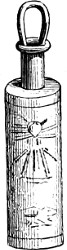
Fig. 134.—Cylinder with ancient bronze mount; from Soldi.
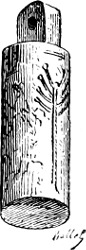
Fig. 135.—Cylinder and attachment in one; from Soldi.
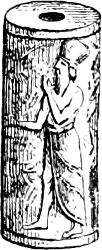
Fig. 136.—Chaldæan cylinder; from Ménant.
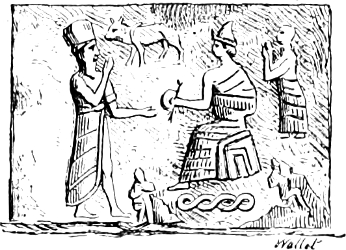
Fig. 137.—Impression from the same cylinder.
The practical requirements of the Mesopotamians were satisfied with a hasty impression from their seals, but we must be more difficult to please. Before we can study the cylinder with any completeness we must have an impression in which no detail of the intaglio is omitted; such a proof is to be obtained by a complete turn of the cylinder upon some very plastic material, such as modelling-wax, or fine and carefully mixed plaster-of-Paris. The operation requires considerable skill. When it is well performed it results in a minute bas-relief, a flat projection, in reverse, of the whole intaglio. The subject represented and its execution can be much better seen in a proof like this than on the original object, it is therefore by the help of such impressions that cylinders are always studied; we make use of them throughout this work. Our Figs. 136 and 137 give some idea of the change in appearance between a cylinder and its impression.
The cutting on the cylinders, or rather on all the engraved stones of western Asia, is in intaglio. This is the earliest form of engraving upon pietra-dura in every country; the cameo is always a much later production; it is only to be found in the last stage of development, when tools and processes have been carried to perfection. It is much easier to scratch the stone and then to add with the point some definition to the figure thus obtained, than to cut away the greater part of the surface and leave the design in relief. The latter process would have been especially difficult when the inscriptions borne by many of the seals came to be dealt with. What long and painful labour it would have required to thus detach the slender lines of the cuneiform characters from the ground! And why should any attempt of the kind be made? As soon as these engraved stones began to be used as seals, there was every reason why the ancient process should be retained. The designs and characters impressed upon deeds and other writings were clearer and more legible in relief than in intaglio. And it must be remembered that with the exception of some late bricks on which letters are raised by wooden stamps, the wedges were always hollowed out. We find but one period in the history of Chaldæa when, as under the early dynasties of Egypt, her written characters were chiselled in relief. It is, then, apparent that the artists of Chaldæa would have done violence to their own convictions and departed from long established habits, had they deserted intaglio for work in relief. That they did not do so, even when their skill was at its highest point, need cause us no surprise.
The Chaldæans naturally began with the softest materials, such as wood, bone, and the shells picked up on the shores of the Persian Gulf. Fragments of some large pearl oysters and of the Tridacna squamosa, on which flowers, leaves, and horses have been engraved with the point, have been brought from lower Chaldæa to London (see Fig. 138).[301] Limestone, black, white, and veined marble, and the steatite of which most of the cylinders are made, were not much more difficult. These substances may easily be cut with a sharp flint, or with metal tools either pointed or chisel-shaped. With a little more effort and patience still harder materials, such as porphyry and basalt; or the ferruginous marbles—serpentine, syenite, hematite—could be overcome. The oldest cylinders of all, those that are attributed to the first Chaldæan monarchy, are mostly of these stubborn materials; their execution was easy enough to the men who produced the statues of Gudea.[302] All that such men required to pass from the carving of life-size figures to the cutting of gems was good eyesight and smaller tools.
It was only towards the end of this period that more unkindly stones began to be used, such as jasper and the different kinds of agate, onyx, chalcedony, rock-crystal, garnets, &c. The employment of such materials implies that of the characteristic processes of gem-cutting, whose peculiarity consists in the substitution of friction for cutting, in the supercession of a pointed or edged tool by a powder taken from a substance harder, or at least as hard, as the one to be operated upon. “The modern engraver upon precious stones,” says M. Soldi, “sets about his work in this fashion. He begins by building up a wax model of his proposed design upon slate. He then takes the stone to be engraved, and fixes it in the end of a small wooden staff. This done he makes use, for the actual engraving, of a kind of lathe, consisting of a small steel wheel which is set in motion by a large cast-iron flywheel turned by the foot. To the little wheel are attached small tools of soft iron, some ending in a rounded button, others in a cutting edge. The craftsman holds the staff with the stone in his left hand; he brings it into contact with the instrument in the lathe, while, from time to time, he drops a mixture of olive oil and diamond dust upon it with his right hand; with the help of this powder the instrument grinds out all the required hollows one after the other.”[303]
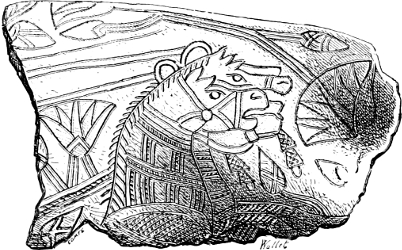
Fig. 138.—Engraved shell. British Museum.
The first engravers who attacked precious stones had no diamond dust. They supplied its place with emery powder, which was to be found in unlimited quantities in the islands of the Archipelago, whence it was imported by the Phœnicians at a very early date. Moreover there was nothing to prevent them crushing the precious stones belonging to the class called corundum, such as sapphires, rubies, amethysts, emeralds, and the oriental topaz. No doubt the lathe or wheel was a comparatively late invention. M. Soldi thinks it hardly came into use in Mesopotamia till about the eighth century B.C. Before that the continuous rotary movement that was so necessary for the satisfactory conduct of the operation was obtained by other means. According to M. Soldi they must have employed for many centuries a hand-drill turned by a bow, like that of a modern centre-bit or wimble.[304]
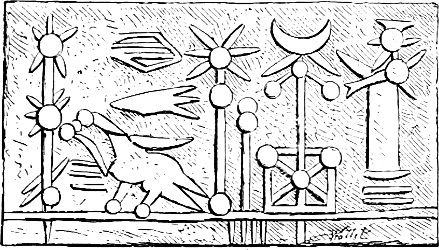
Fig. 139.—Chalcedony cylinder. British Museum.
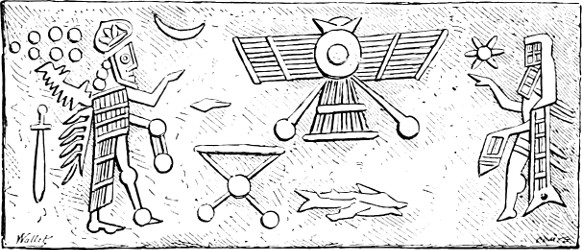
Fig. 140.—Cylinder of black jasper. British Museum.
On examining the oldest Mesopotamian engravings on precious stones a skilled craftsman would see at once that nearly all the work had been done with only two instruments—one for the round hollows and another for the straight lines. In the designs cut with these tools we find curiously complete likenesses of the small lay figures with ball-and-socket joints used by painters. Some idea of the strange results produced by these first attempts at gem-engraving may be formed from our reproductions of two cylinders in the collection at the British Museum. The influence of the process, the tyranny of the implement, if we may use such a phrase, is conspicuous in both. Note, for instance, in the first design, which is, apparently, a scene of sacrifice (Fig. 139), how the head and shoulder of the figure on the left are each indicated by a circular hollow. The same primitive system has been used in the cylinder where the god Anou is separated from another deity by the winged globe (Fig. 140). The design is here more complex. The bodies of the two divinities and the wings of the globe are indicated by numerous vertical and horizontal grooves set close together; but the circular hollows appear not only in the globe and in the piece of furniture that occupies the foreground, but also in the knees, calves, ankles, and other parts of the two figures.
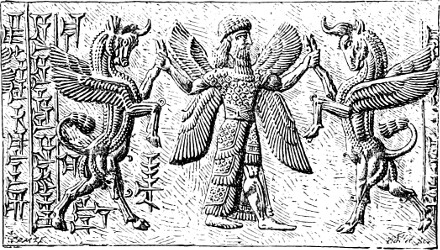
Fig. 141.—Assyrian cylinder. British Museum. Drawn by Wallet.
As time went on they learnt to use their tools with more freedom and more varied skill. We shall not attempt to follow M. Soldi in tracing the art through all its successive stages.[305] As an example of the skill to which the Mesopotamian artist had attained towards the seventh century B.C. we may quote a splendid cornelian cylinder belonging to the British Museum (Fig. 141).[306] The subject is extremely simple. In its general lines it continually recurs on the bas-reliefs and gems of the Sargonid period. A winged personage, with his arms extended, stands between two fantastic winged quadrupeds and grasps each by a fore-paw. The chief actor in the scene is very like the winged genius whom we encounter so often on the walls of the palaces (see above, Fig. 36), while both in the exaggerated modelling of the legs and in the care with which the smallest details of the costume are carried out, the special features that distinguished the sculpture of the time may be recognized. The execution is firm and significant, though a little dry and hard. It is made up of short cuts, close together; the engraver did not understand how to give his work that high polish and finish that enabled the Greeks to express the subtlest contours of the living form.
From this period onwards the artists of Mesopotamia and, in later years, those who worked for the Medes and Persians, put into use all the precious stones that were afterwards engraved by the Greeks and Romans. Their tools and processes cannot have greatly differed from those handed down by antiquity to the gem-cutters of the middle ages and the Italian renaissance. If their results were inferior to those obtained by Pyrgoteles and Dioscorides,[307] it was because oriental art never had the knowledge of the nude or the passion for beauty of form which made Greek art so original. Intaglio is only a bas-relief reversed and greatly diminished in size; the style and spirit of contemporary sculpture are reflected in it as the objects of nature are reflected in the mirror of the human eye. For want of proper tools it may lag behind sculpture, but it will never outstrip it.
The close connection between the two arts is nowhere more strongly marked than in some of the cylinders belonging to the first monarchy. Although the artist was content in most cases with mere outlines, he now and then lavished more time and trouble on his work, and gave to his modelling something of the breadth and truth that we find in the statues from Tello. These merits are seen at their best in a fine cylinder belonging to the New York Museum (Fig. 142). It represents Izdubar and his companion Hea-bani, the Hercules and Theseus of Chaldæan mythology, engaged in a hand-to-hand struggle with a wild bull and a lion, a scene which may be taken as personifying the struggle between the divine protectors of mankind on the one hand, and the blind forces of nature assisted by all the supernatural powers of evil on the other.[308] We have already had occasion to speak of Izdubar, who is always represented nude and very muscular. As for his companion, he combines the head and bust of a man with the hind quarters of a bull.[309] There is a certain conventionality in the attitude of the lion and in the way his claws are represented, and the movement of Hea-bani’s left arm is ungraceful; but the antelope under the inscription and the bull overpowered by Izdubar are rendered with a truth of judgment and touch that all connoisseurs will appreciate. We may say the same of the two heroes; their muscular development is given with frankness but without exaggeration; the treatment generally is free and broad.
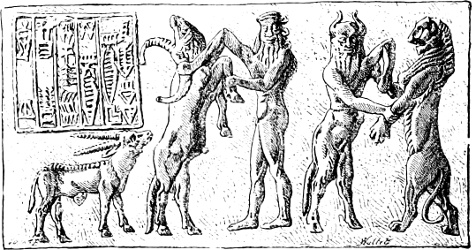
Fig. 142.—Chaldæan cylinder. Marble or porphyry. New York Museum.
Between this cylinder and the one quoted on the last page as among the masterpieces of Ninevite art, there is the same difference as between the statues of Tello and the bas-reliefs of Nimroud and Khorsabad. The engraver, who some fifteen centuries before our era, cut upon marble this episode from one of the favourite myths of Chaldæa, may not have been able to manipulate precious stones with such ease and dexterity as the artist of Sargon or Sennacherib who made the cylinder in the British Museum, but he had the true feeling for life and form in a far higher degree.
So far we have studied the cylinders from the standpoint of their use and the material of which they are composed; we have described the processes employed in cutting them and the changes undergone in the course of centuries in the style of art they display. We have yet to speak of the principal types and scenes to be found upon them. We cannot pretend, however, to give the details in any complete fashion. For that a whole book would be necessary, such as the one promised by M. Ménant.
This is not because the themes treated show any great variety; they have, in fact, far less originality than might at first be thought. Compare the impressions from different cabinets and attempt to classify them in order of subject; you will find the same types and scenes repeated, with but slight changes, on a great number of specimens, and you will soon discover that hundreds of cylinders may be divided into a very small number of groups. In each group, too, many individual specimens will only be distinguishable from each other by their inscriptions. All this is to be easily accounted for.
The finest cylinders, whether in design or material, must have been commissioned by kings, nobles, and priests, while the common people bought theirs ready-made. When any one of the latter wished to buy a seal he went to the merchant and chose it from his stock, which was composed of the patron gods and religious scenes which happened to be most in fashion at the time. As soon as the purchaser had made his selection he caused his own name to be engraved in the space left for the purpose, and it was this inscription, rather than the scene beside it, that gave its personal character to the seal. The production of these objects was a real industry, carried on all over the country and for many centuries, and continually reproducing the same traditional and consecrated types.
M. Ménant believes himself able to determine where most if not all the cylinders of the early monarchy were produced. He talks of the schools of Ur, of Erech, of Arade, and in many cases the signs on which he relies appear to have a serious value. But we shall not attempt even to give a résumé of the arguments he uses to justify the classification he was the first to sketch out; we could not do so without multiplying our illustrations and extending our letterpress to an extravagant degree. Judging from the examples quoted by M. Ménant himself in support of his own theory, the workshops of different towns in the course of a single period were distinguished rather by their predilection for particular themes than by anything peculiar in their styles of execution; the same processes and the same way of looking at living forms may be recognised in all. We may, then, treat all these early works of the Chaldæan gem-engravers as the productions of a single school; and in this history we only propose to note and discuss the general direction of the great art currents. We cannot follow all the arms and side streams into which the main river is subdivided.
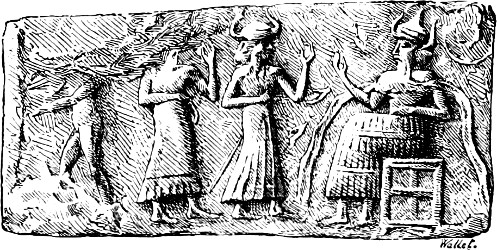
Fig. 143.—Chaldæan cylinder. Green serpentine. Louvre. Drawn by Wallet.
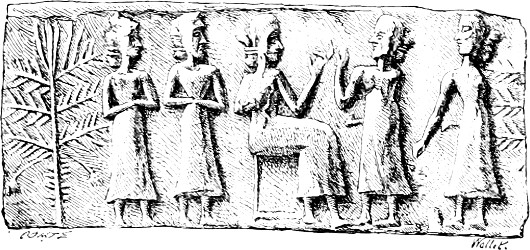
Fig. 144.—Chaldæan cylinder. Basalt. Louvre. Drawn by Wallet.
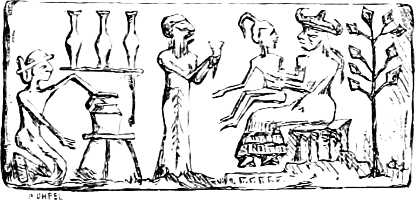
Fig. 145.—Chaldæan cylinder. Basalt. Louvre.
One of the favourite subjects at this time was the scene of worship we have already encountered on the Sippara tablet (Vol. I., Fig. 71.); in the cylinders as well as on the larger tablet the worshipper is led by a priest into the presence of an enthroned divinity. The temple, indicated in the tablet, is suppressed in the seals, where the space is so much less, but otherwise the composition is the same. It would be difficult to imagine anything better fitted for objects of a talismanic character, which were also to be used for the special purpose of these cylinders. Whenever the Chaldæan put his seal upon clay he renewed the act of prayer and faith which the engraver had figured upon it; he took all men to witness his faith in the protection of Anou, of Samas, or of some other god. We need therefore feel no surprise at encountering this subject upon the cylinders of Ourkam, (Vol. I., Fig. 3), and his son Dungi,[310] princes in whom the oldest Chaldæan royalty was embodied. Both of these seals seem to have been engraved in Ur, the home of that dynasty. We have given several other variants of the same theme (Vol. I., Figs. 17–20, and above, Figs. 40 and 124);[311] here are two more found by M. de Sarzec at Tello (Figs. 143, 144). In the first of these two streams seem to flow from the shoulders of the seated deity; they may have some connection with that worship of the two great rivers whose traces appear elsewhere.[312] In the second example, which is not a little rough and summary in its execution, the figures are believed to be those of women, on account of the way in which the hair is arranged. It is clubbed with ribbons at the back of the neck. The artist seems also to have tried to suggest the amplitude of the female bosom. On the whole we may believe the scene to represent a goddess—Istar perhaps—surrounded by worshippers of her own sex. In the Louvre there is a cylinder with a scene of the same kind, but more complex and, for us, more obscure (Fig. 145). A seated figure, apparently female from the long hair flowing over the shoulders, sits upon a low stool and holds a child upon her knees. In front of the group thus formed stands a man who seems to be offering some beverage in a horn-shaped cup. Behind him there are three not inelegant vases upon a bracket, and a man kneeling beside a large jar upon a tripod. The latter holds in his hand the spoon with which he has filled the goblet presented by his companion. We may, perhaps, take the whole scene as a preparation for a feast offered to one of those goddesses of maternity whom we find on the terra-cottas (see above Fig. 107). We shall not here go into the question whether we may see in all this an episode in the legend of the ancient Sargon, the royal infant whom his mother exposed upon the water after his clandestine birth; after commencing like Moses, the hero of this adventure was found and brought up by a boatman, and became the founder of an empire when he grew to manhood, like Cyrus and Romulus.[313]
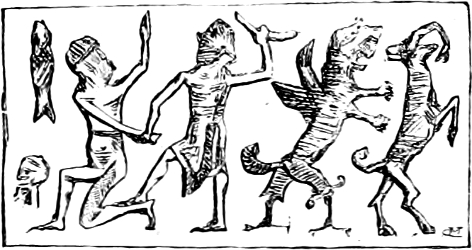
Fig. 146.—Chaldæan cylinder. Montigny collection.
If we may believe M. Ménant some of the cylinders belonging to this period represent human sacrifices. Such he supposes to be the theme of the example reproduced in Fig. 146. The figure with arm uplifted would be the priest brandishing his mace over the kneeling victim, who turns and begs in vain for mercy. The issue of the unequal struggle is hinted at by the dissevered head introduced in the lower left-hand corner. To make our description complete we must notice the subordinate passage, a rampant leopard, winged, preparing to devour a gazelle.[314] The conjecture is specious, but until confirmatory texts are discovered, it will remain a conjecture. Those texts that have been quoted in support of it are vague in the first place, and, in the second, they appear to refer less to the sacrifice of human victims than to holocausts of infants, who must have been thrown into the flames as they were in Phœnicia. Why should we not look upon it as an emblem of the royal victories, an emblem similar in kind to the group that recurs so persistently in Egyptian sculpture, from the time of the ancient Empire to that of the Ptolemies?[315] The gesture in each case is almost exactly the same; the weapon raised over the vanquished both in the Theban relief and the Chaldæan cylinder is well fitted to suggest the power of the conqueror and his cruel revenges. We have reproduced this example less for its subject than for the character of its execution. The figures are modelled in a very rough-and-ready fashion; we might almost call it a sketch upon stone. The movement, however, of the two chief figures is well understood and expressive.
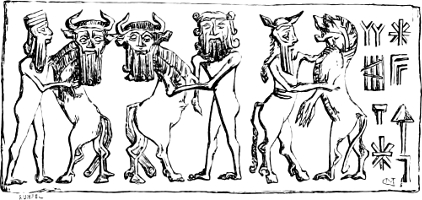
Fig. 147.—Chaldæan cylinder. Basalt.
Another and perhaps still richer series is composed of stones on which the war waged by Izdubar and his faithful Hea-bani against the monsters is figured.[316] We have already shown Izdubar carrying off a lion he has killed (see above, Fig. 35). Another task of the Mesopotamian Hercules is shown in Fig. 147, where he is engaged in a struggle with the celestial human-headed bull, who has been roused to attack the hero by Istar, whose love the hero has refused.[317]
In this cylinder it will be noticed that Izdubar is repeated twice, once in profile and once full face. Close to him Hea-bani is wrestling with a lion, the bull’s companion and assistant. In another example we find Izdubar alone (Fig. 148) and maintaining a vigorous struggle against a bull with long straight horns, and at the same time turning his head so as to follow a combat between a lion and ibex that is going on behind him.[318] The action of both these latter animals is rendered with great freedom and truth. We have already had to draw attention to the merit that distinguishes not a few of the animals in these cylinders.[319] This merit is to be found in almost every composition in which the artist has been content to make use of natural types. It is only when he compiles impossible monsters that the forms become awkward and confused. An instance of this may be found in a cylinder found by M. de Sarzec at Tello, on which winged quadrupeds seizing and devouring gazelles are portrayed (Fig. 149). Too many figures are brought together in the narrow space and the result is confusion. We are not, however, disposed to accept this cylinder as belonging to the first years of Chaldæan art. It is of veined agate, a material that was not among the earliest employed; but there are many more on which similar scenes are engraved, and which, by their execution, may be safely placed among the most ancient products of art.[320]
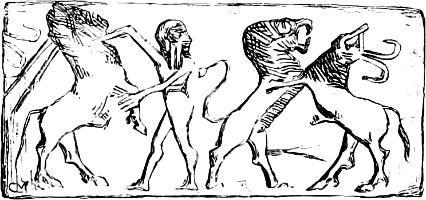
Fig. 148.—Chaldæan cylinder. Black marble. French National Library.
One of the earliest types invented by the imaginations of these people was that of the strange and chaotic beings who, according to the traditions collected by Berosus, lived upon the earth before the creation of man, creatures in which the forms and limbs afterwards separated and distinguished by nature, were mixed up as if by accident. The text in question is of the very greatest interest and value. It proves that the composite figures of which Chaldæan art was so fond were not a simple caprice of the artists who made them, but were suggested by a cosmic theory of which they formed, as it were, a plastic embodiment and illustration.
“There was a time,” says Berosus, “when all was water and darkness, in which monstrous animals were spontaneously engendered: men with two wings, and some with four; with two faces, and two heads, the one male and the other female, and with the other features of both sexes united in their single bodies; men with the legs and horns of a goat and the feet of a horse; others with the hind quarters of a horse and the upper part of a man, like the hippocentaurs. There were also bulls with human heads, dogs with four bodies and fishes’ tails, and other quadrupeds in which various animal forms were blended, fishes, reptiles, serpents, and all kinds of monsters with the greatest variety in their forms, monsters whose images we see in the paintings of the temple of Bel at Babylon.”[321] Of all these fantastic creatures there are hardly any but may be found on some cylinder, and if there be one or two still missing, it is very probable that future discoveries will fill up the gap.
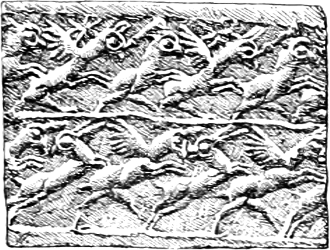
Fig. 149.—Chaldæan cylinder of veined agate. Louvre.
Before quitting these remains from the earliest school of gem engraving, we must draw attention for a moment to the way in which it treats costume. In most cases the folds of the stuff are imitated by very fine parallel strokes. Sometimes, as, for instance, in the figure on the right of Ourkam’s seal (Vol. I., Fig. 3), these close and slightly sinuous lines extend without interruption from the top to the bottom of the dress, but in most cases they are crossed by several transverse bands, probably coloured, either woven into the material or sewn upon it (see Vol. I., Figs. 3, 17, and 20, and above, Figs. 39 and 41). We have already encountered this method of treating drapery in certain statuettes from the same place and time (Figs. 99 and 100), but we never find it in Assyria or in Chaldæa after the fall of Nineveh, either in statues or on engraved stones.
There is another characteristic detail that should not be forgotten, namely, the caps turned up at the side in the shape of horns (Vol. I., Fig. 17 and above, Fig. 143). By this head-dress and the plaited robes a Chaldæan cylinder may be at once recognised as dating from these remote ages. Fashions and methods of execution changed as soon as the preponderance of Assyrian royalty was assured. Artists of merit must then have migrated northwards and opened workshops in the cities of the Tigris; but production was never so great as in the south. Every traveller in those regions notices that there are far more cylinders to be purchased in the bazaars of Bagdad and Bassorah than in those of Mossoul.[322] The glyptic art of Assyria was an exotic, like her sculpture and her architecture.
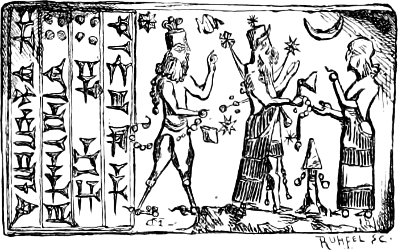
Fig. 150.—Archaic Assyrian cylinder. In the Uffizi, Florence.
In attempting to define the characteristics of the Assyrian cylinders, and to distinguish them from those of Chaldæa, we may take as points of departure and as types of the new class, a few seals bearing legends that enable us to give them a positive date. Thus we may learn from a signet that once belonged to the governor of Calah what the execution of the artists employed by the princes of Elassar and Nimroud was like (Fig. 150). We need not hesitate to assign this cylinder to the first Assyrian monarchy. The workmanship, at once careful and awkward, belongs to a time when all the difficulties of gem engraving had not yet been overcome. In the wings of the genius and the legs of the personage who follows him the management of the instrument used is that of an art still in its infancy. In this seal then we have a valuable example of what we may call The Archaic Assyrian Cylinder. We have already figured several in which the same characteristics appear (Figs. 124, 139, and 140). In the same class we may put a number of cylinders on which scenes of worship are represented with slight variations (Figs. 151 and 152).[323] The figure of the king standing before the altar with his right hand upon his bow resembles the Assurnazirpal in several of the Nimroud reliefs (see above, Fig. 140). The Balawat gates and other remains from the same time have already made us acquainted with the accessories of the act of worship figured in the last of these two cylinders, especially with the short column surmounted by a cone (Plate XII).
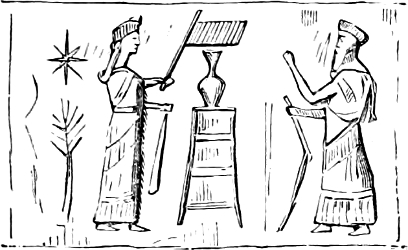
Fig. 151.—Assyrian cylinder. Serpentine. National Library, Paris.
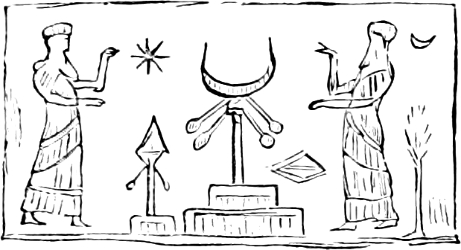
Fig. 152.—Assyrian cylinder. Serpentine. National Library, Paris.
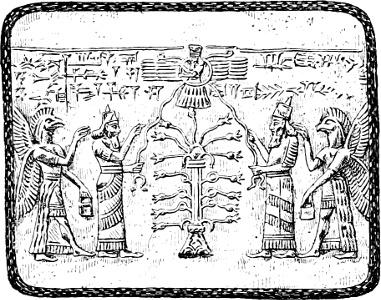
Fig. 153.—Assyrian cylinder. British Museum. Drawn by Wallet.
We now come to the epoch of the Sargonids with its still more refined and skilful art, of which an exquisite cylinder in the British Museum may be taken as an example (Fig. 153). The name of a personage called Musesinip has been read upon it, and it is believed to be a reduction from a contemporary bas-relief. In the centre appears the holy tree with the supreme deity floating over it in the winged disk. On each side of the tree is the figure of a king with a winged eagle-headed genius behind him. These last-named creatures have their right hands raised, while in their left they hold the bronze buckets we have already encountered at Nimroud (Vol. I., Fig. 8). There is one detail which is not to be found, so far as I know, in the bas-reliefs, namely, the double cord that descends from the winged disk into the hands of the king. The artist, no doubt, meant to symbolize by this the communication established by prayer between the prince and his divine protector.
Among the dated and authenticated examples from this epoch the cylinder inscribed with the name of Ursana, king of Musasir and adversary of Sargon, may be quoted.[324] We do not reproduce it because it differs so little from the example of Assyrian gem engraving given in our Fig. 141. The same genius appears in the middle, but instead of two winged monsters he holds two ostriches by the neck. We have already encountered this fight between a man and an ostrich on a stone dating from the same century (Fig. 75). We may name as a last example the stone found by Layard at Kouyundjik, which may be the very signet of Sennacherib himself (Vol. I., Fig. 70).
If we place all these impressions side by side we shall find they have a certain number of common characteristics which will enable us to recognize those of Assyrian parentage even when they bear no lettering, or when their inscriptions tell us nothing as to their origin. In the first place they are mostly of fine materials, such as chalcedony or onyx. Secondly, they contain sacred emblems and types that are not to be found in the primitive arts of Chaldæa, such as the mystic tree, the winged globe, the eagle-headed genius, &c. Thirdly, the fantastic animals of Assyria are different in general appearance from those of the southern kingdom; and, finally, the costume of the two countries is not the same. In the cylinders from Calah and Nineveh we find neither the flounced robes nor the cap with turned-up borders. As in the palace reliefs, the mantle-fringes cross the figure slanting-wise—an obliquity which affords a ready means of distinguishing between a native of Assyria and one of Chaldæa.
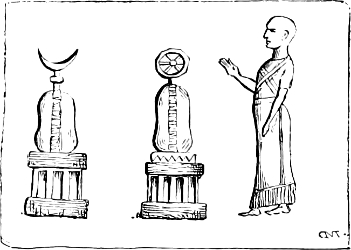
Fig. 154.—Chaldæan cylinder dating from the second monarchy. Black jasper. British Museum.
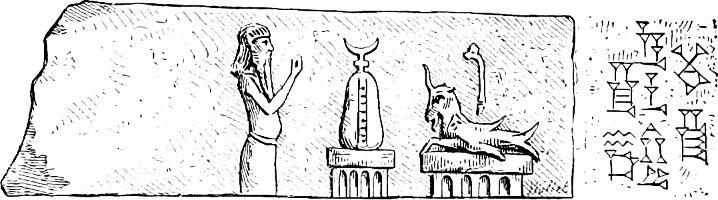
Fig. 155.—Impression of a cylinder on a contract; from Ménant.[2]
The use of the cylinder persisted after the fall of Nineveh and throughout the second Chaldæan monarchy, but the types from this late epoch display very little invention or variety. The most common of all shows a personage standing bare-headed before two altars, one bearing the disk of the sun, the other that of the moon (Fig. 154).[325] This individual is sometimes bearded, sometimes shaven. His costume is neither that of early Chaldæa nor the twisted robe of Assyria. Sometimes one of the altars or the field is occupied by a monster with a goat’s head and a fish’s body and tail, as in the impression left by a cylinder on a contract dated “the twelfth year of Darius, king of Babylon, king of the nations” (Fig. 155).[326] The use of these types lasted in the valley of the Euphrates all through the Achæmenid supremacy. No inscriptions were used. Names and dates were engraved by hand on the clay after the seal had been placed upon it. We can see clearly from the monotony of the images, which are repeated almost unchanged on hundreds of tablets, that the art of gem-engraving was in full decadence. The people were enslaved, they lived upon the memory of their past, creating neither new forms nor new ideas. They no longer attempted to make their seals works of art; they looked upon them as mere utensils.
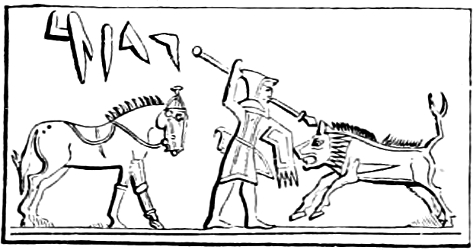
Fig. 156.—Cylinder with Aramaic characters. Vienna Museum.
Cylinders are sometimes found in this region inscribed with Aramaic characters, like the weights from Nimroud. Such, for instance, is one representing a dismounted hunter meeting the charge of a lion,[327] while his horse stands behind him and awaits the issue of the struggle (Fig. 156). The costume of the hunter is neither Assyrian nor Chaldæan. He has been supposed to represent a Scythian. The Scythian figured at Bisitun has the same pointed bonnet or cowl. Cylinders of this kind will long be a difficulty for the classifier.[328]
The cylindrical form was not the only one used by the inhabitants of Mesopotamia for their seals. Small objects in pietra dura of a different shape are now often found in the country, and are beginning to hold their own in our museums; these are pyramids, spheroids, and especially cones. Every cone, except one or two which may never, perhaps, have been finished, is pierced near its summit with a hole for suspension. There has never been any doubt from the first that they were signets. Their bases, which are generally flat, but sometimes convex or concave, are always engraved in intaglio. The impression was thus obtained at one stroke, at one pressure of the hand, and it was in all probability the greater ease with which that operation could be carried out that in time led to the supercession of the cylinder by the cone. The use of the latter became almost universal in the time of the Seleucidæ and Parthians.
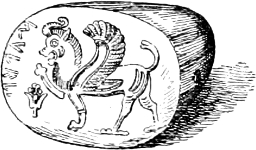
Fig. 157.—Cone. Sapphirine chalcedony.[329]
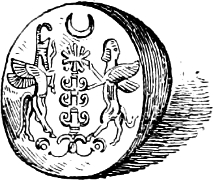
Fig. 158.—Cone. Sapphirine chalcedony.[330]
It is when they grow old that both nations and individuals turn their attention to ease and comfort. The Chaldees were long contented with the cylinder, although, as a seal, it was a very imperfect contrivance. The ancient monarchy never seems to have made use of flat signets. The impression of one has been sought for in vain on those contracts of the time of Hammourabi, where so many cylinders have left their mark. The oldest document on which the trace of a circular seal has been recognized belongs to the northern kingdom, and dates from the reign of Bin-Nirari, who occupied the throne of Assyria towards the end of the ninth century B.C. From this moment the use of the cone becomes rapidly common. Under the Sargonids, and still more during the second Chaldee monarchy and under the Achæmenids, it superseded the cylinder. The dates inscribed on the tablets prove their age; the space on the cones themselves was too narrow, as a rule, for a legend. On a few specimens we find one or two characters engraved, generally a divine monogram or the traditional emblems of the sidereal powers. A few cones have inscriptions in Aramaic characters (see Fig. 157); on the example figured we again encounter the strange composite beast we have already seen upon a stone tablet and a cylinder (Figs. 87 and 141). In spite of the alphabet employed, this cone must have been engraved either in Nineveh or its neighbourhood.
The narrowness of the field explains the want of variety in the subjects. In a small circle like this there was no room for more than a single figure with a few accessories, or, at most, for two figures. We cannot expect to find scenes as varied and complicated as those upon the cylinders. A very small number of the simplest themes formed the stock-in-trade of the engraver.
There are about four hundred specimens in the British Museum, and as many more in Paris, in the Louvre and the Cabinet des Antiques. In the presence of them all we can only confess to a feeling of embarrassment. They are never arranged in chronological order; Assyrian intaglios are mixed up with those from Chaldæa, from Phœnicia and Persia. Certain types were reproduced and copied in this region even as late as the Arsacids and Sassanids. We shall choose a few, however, which we may with some certainty attribute to Assyria. There is in the first place one on which two winged figures seem to be adorning the sacred tree (Fig. 158). We find the impression of an almost exactly similar cone on a contract dated 650 B.C. The only differences lie in the more careful execution of the latter seal and in the substitution of the radiant disk of the sun for the crescent moon.[331] In another impression we find the radiant disk changed into the winged globe.[332] The shape and fringe of the Assyrian robe may be recognized in the intaglio in which a man with long hair and beard does homage to a winged genius (Fig. 159). The worshipper is standing, but behind him appears a kneeling figure. This posture is rare, but it is met with in a few instances on monuments from this period, and is always used to suggest the profound respect with which a man does obeisance either to his god or his king.[333]
We need not hesitate to ascribe to the second Chaldæan monarchy a cone with a bearded individual standing before an altar on which lies a fantastic animal (Fig. 160); above his head appear the sun, the moon, and a star. We have already mentioned two examples of this theme, which begins to appear in the time of Nebuchadnezzar and remains in fashion until the Macedonian conquest.[334]
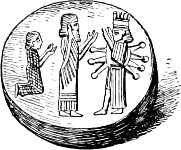
Fig. 159.—Amethyst cone. National Library, Paris.[335]
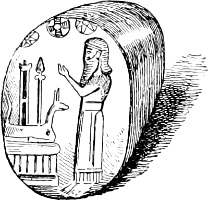
Fig. 160.—Agate cone. National Library, Paris.[336]
Among the themes in most frequent use under the Sargonids we might have quoted the single combat of the king with a lion, the god standing upon a lion’s back, the king over whose head a servant holds an umbrella, the heads and bodies of different animals, and others.[337] We cannot pretend, however, to enumerate them all. It is sufficient to show, as we have done, that after the ninth century at latest both cylinders and cones were produced in the same workshops, and that the differences in their figuration are to be explained by the dimensions and form of the new surface. Those who have supposed that the use of flat seals only commenced under the Achæmenids are mistaken. All that we can say with truth is that intaglios cut upon sections of cones, spheres and pyramids are less ancient than the cylinders of Ur, Erech, Accad and Sippara.
This is proved by the dated contracts to which we have already so often had to refer; but supposing no such contracts to have been in existence we could have arrived at the same conclusion by another path. Cones in calcareous stone, in marble, or even in pietra dura are either wanting altogether, or very few and far between; they are almost all in precious stones, most of them in carnelian and chalcedony. Sapphirine chalcedony, with its fine bluish tint, seems to have been most in favour.
In Egypt we found intaglios upon metal as well as upon lapidary substances.[338] This use of metal was a result of mounting seals in circles of gold or silver. Precious stones were rare and difficult to cut; what could be more natural than to substitute metal for them and to make the bezel of a ring of the same material as its hoop. For its engraving neither lathe nor diamond dust was wanted; the burin alone was necessary, and the figures cut by it gave a result no less satisfactory than those obtained by the slower process and in the more stubborn material. The temptation was great for the Egyptian artist, and we are not surprised that he succumbed to it, but it did not exist for the Chaldæan engraver. The latter had only to deliver a stone which his client could wear fastened to his wrist, or hung round his neck by a cord. He had no direct and intimate relations with the worker in metal; he was not compelled to call in the latter to mount his creation. Sometimes, under the influence perhaps of foreign models, he may have attempted to substitute metal for stone, but isolated attempts did not make a school. We can point to only one example of such work. The British Museum possesses a silver cylinder, but the only interesting thing about it is its material.[339] The composition of the type is naive and its execution rough. All this allows us to believe that metal seals were very rare and never came into general use.
Oriental artists, at least during the period of which we are now speaking, hardly ever practised any kind of gem-cutting but intaglio, but there are two stones in existence in which first attempts at a process that must have led in time to the production of cameos, may be traced. “In one of these gems, an onyx, the upper layer is cut away from the one below it and an inscription left. In the other the eyes and neck of a serpent are rendered with the aid of three different tints in the stone.”[340]
§ 9. The General Characteristics of Chaldæo-Assyrian Sculpture.
We have now reached the end of our inquiry into the history of Mesopotamian sculpture—an inquiry that we have endeavoured to make as complete as the existing remains would allow. So far as Chaldæa is concerned, these are very few in number. On the other hand, the three centuries over which the Assyrian power extended are pictured in such a vast number of reliefs that we are embarrassed by their number as much as by their want of variety. Our difficulty in the case of Assyria has been to make a selection from a vast quantity of objects that tell us the same thing again and again, while, in the case of Chaldæa, it has been to insure that none of the scanty salvage from so great a wreck should be lost. We have more than once had to make induction and conjecture take the place of examination and assertion before we could complete even a rough sketch of the development of Chaldæan art.
There is one question that must have been asked by many of our readers before these pages came in their way, but is now, we venture to hope, fully answered, and that is, whether the Semites of Chaldæa drew their first inspiration from a foreign source, or whether it was an original result from the natural aptitudes of the race. Ancient as civilization may have been in the Euphrates valley, it was still more ancient, to all appearance, in the valley of the Nile. And yet all who have examined the figures we have placed before them must acknowledge the originality and independence of Chaldæan art. No; the sculptors of Memphis and Thebes were not the masters of those of Babylon and Nineveh; they preceded them indeed, but they left them no teaching and no models to copy.
This is proved in the first place by the difference, we might say the opposition, between the two styles. The Egyptian sculptor simplifies, abridges, and summarizes form; the Assyrian amplifies it and accents its details. The former seems to see the human body through a veil of gauze, which hides the accidents of the surface and the secondary forms, allowing nothing to be clearly grasped but the contour and the great leading lines. One would say that the second studied nature through a magnifying-glass; he insists upon what the first slurs over.