Chapter II · SCULPTURE. (continued 2)
Walter Armstrong translation
The horses we meet with in the Assyrian sculptures are of a heavier breed than Arabs; they are generally shorter and more thickly set. Travellers believe the breed to still exist in the horses of Kurdistan, a country which was bordered by ancient Assyria and dependent upon it.[177] The head is small, well-formed, and well-carried (Fig. 73), the shoulders sloping, the neck and limbs well set on, and the muscles strongly marked. We have already had occasion to figure horses at full speed (Vol. I. Fig. 5), standing still (Vol. I. Figs. 67 and 115), and proceeding at a slow pace (Figs. 21 and 31).[178] No observer can avoid being struck by the truth of attitude, and movement given by the Assyrian sculptor to horses both driven and mounted. Nowhere is this merit more conspicuous than in one of those bas-reliefs of Assurbanipal that figure the episodes of a chase of wild asses (Fig. 74).
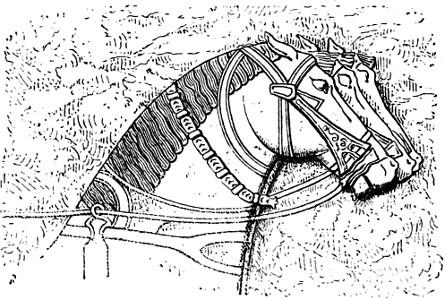
Fig. 73.—Chariot horses; from Layard.
Contrary to their usual habits the herd have allowed themselves to be surprised. One of those armies of beaters who are yet employed by eastern sovereigns on such occasions, has driven them upon the hunters. The latter, preceded by their dogs, throw themselves upon the herd, which breaks up in all directions. They pierce those that are within reach with their arrows; those that do not fall at once are pursued and brought down by the hounds. We cannot reproduce the whole scene,[179] but we doubt whether there is any school of animal painters that has produced anything more true to nature than the action of this poor beast stopping in the middle of his flight to launch futile kicks at his pursuers.
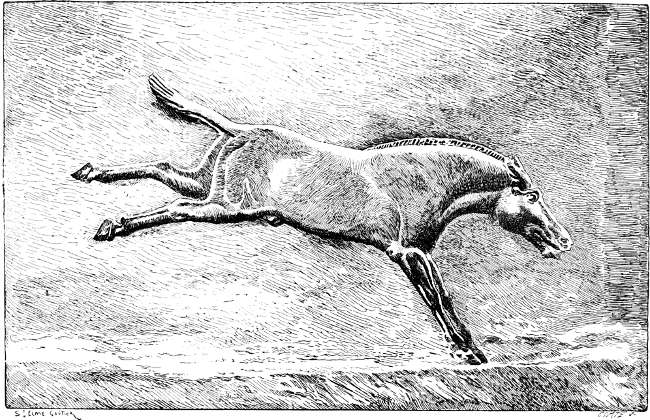
Fig. 74.—Wild ass. From the hunt of Assurbanipal, in the British Museum. Drawn by Saint-Elme Gautier.
The ibex and the wild goat figure in the same sculptured pictures. One marching in front of the herd turns and anxiously sniffs the wind, while her companion quietly browses by her side; farther off, two kids trot by the side of their mother. The alarm has not yet been given, but upon the next slab the artist shows the headlong flight that follows the discovery of the enemy. Naturally it is the wild and domestic animals of Mesopotamia and the districts about that are most commonly figured in these reliefs, but the sculptor also took advantage of every opportunity and pretext for introducing into his repertory those rare and curious animals which were only seen in Nineveh on rare occasions. Thus the camel that we find in so many pictures is the same as that which now occupies the same region and marches in its slow caravans;[180] but on the obelisk of Shalmaneser we find the double-humped Bactrian camel (Fig. 49).[181] The clumsy tribe of the pachyderms is not only represented by the wild boars that still have their lairs in the marshes of the lower Euphrates;[182] the rhinoceros and the Indian elephant also occur on the obelisk (Vol. I. Fig. 111).[183] The apes shown in our Fig. 64 also seem to belong to an Indian species.[184]
The sculptor was not always as happily inspired by these exotic animals as by those of his own country, and in that there is nothing surprising. He only caught a passing glimpse of them as they defiled, perhaps, before the people in some triumphal procession. On the other hand, the fauna of his native land were known to him through long habit, and yet his reproductions of the elephant and the dromedary are very good, much better than those of the semi-human ape. His idea of the rhinoceros is very faulty; the single horn planted on the nose leaves no doubt as to his meaning, but the lion’s mane with which the animal’s back is clothed has never belonged to the rhinoceros. The artist may have worked from a description.
In these pictures birds hold a very secondary place; Assyrian sculpture was hardly light enough of hand to render their forms and feathers. For such a task, indeed, painting with its varied handling, its delicate lines and brilliant colours is required. It was with the brush that the Egyptians succeeded, in the frescoes of their tombs, in figuring the principal birds of the Nile Valley with all their elegance of form and brilliant variety of plumage. In Assyria, among a nation of soldiers and in an art whose chief inspiration had to do with war, the only bird we find often reproduced is the eagle, the symbol of victory, who floats over the chariot of the king, and the vulture who devoured where they fell the bodies of the enemies of Assyria; and even these images are rather careless and conventional, which may perhaps be accounted for by their partially symbolic character and their frequent repetition.[185] A group of partridges rising and, in those sculptures of the later Sargonids in which the artists show a love for picturesque detail, birds hopping in the trees or watching over their nestlings, have been mentioned as showing technical excellence of the same kind as the hunting scenes.[186] The ostrich appears on the elaborate decorations of the royal robes (Fig. 75) and upon the cylinders (Fig. 76). Perhaps it was considered sacred.
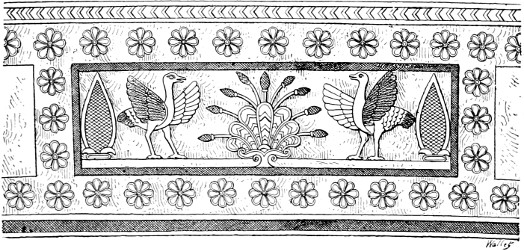
Fig. 75.—Embroidery on the king’s robe; from Layard.
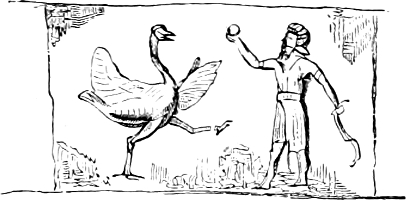
Fig. 76.—Fight between a man and an ostrich. Chalcedony. National Library, Paris.
As for fishes, crabs, and shells, these were scattered broadcast over the watercourses in the reliefs, but they are never studied with any great care (see Vol. I., Figs. 34 and 157), nor is any attempt made to distinguish their species. They seem to have been introduced merely as hints to the spectator, to dispel any doubt he may entertain as to the meaning of those sinuous lines by which the sculptor suggested rivers and the sea. Where these indications are not given we might indeed very easily mistake the artist’s intention (see Vol. I., Figs. 38 and 71).
Some of the animals in the Assyrian reliefs are then nothing but determinative signs, a kind of pictorial gloss. Of these it will suffice to mention the existence. Their forms are so much generalized that they offer no matter for study. On the other hand, our best attention should be given to those figures whose modelling has strongly interested the artist, who has taken a lively pleasure in reproducing their various aspects and in making them live again in all the originality of their powerful and exceptional natures. In this respect the lion deserves particular notice. He interested the Assyrian sculptors more profoundly than any other animal and they devoted extraordinary attention to illustrating his various attitudes and characteristics. One is inclined to believe that the more skilful among them chose a lion for treatment when they wished to display all the talent they possessed and to gain a reputation for complete mastery of their art.[187]
Here we find the great beast stretched carelessly upon the ground, full of confidence in his strength and careless of danger (Plate XI.); there he rises to his feet and advances ready to collect himself and spring upon any threatening enemy or passing prey (Plate VIII.). We sometimes find both these motives united, as in a bas-relief of Assurbanipal, which is unfortunately mutilated (Fig. 77). Here a lioness is stretched upon the ground, her head upon her forepaws and her tail outstretched behind her, in a favourite attitude of very young cats. The lion stands upright before her in a proud, extended attitude like that of the colossal lion from Nimroud (Plate VIII.); his head and the hind parts of his body are unfortunately missing.
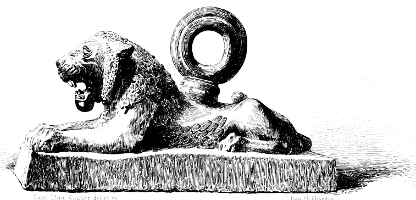
BRONZE LION
FROM KHORSABAD
Louvre
Elsewhere we find the lion cautiously emerging from a stoutly-built timber cage (Fig. 78). He has been captured in a net or snare and shut up in this narrow prison until the day of some great hunt.[188] When that arrives the door is raised at a given signal by a man perched on the top of the cage and protected by a timber grating. In spite of this defence the service would hardly be free from danger but that the lion is too pleased to find himself at liberty to look behind him.[189]
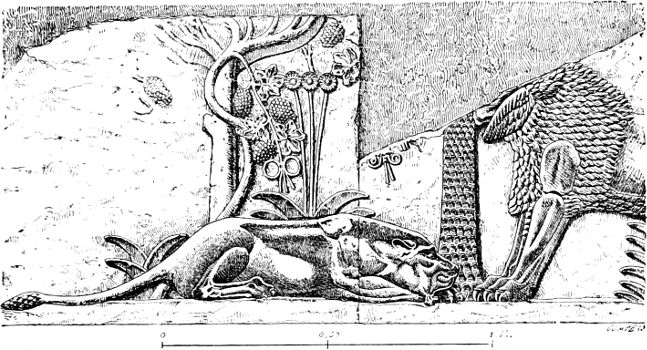
Fig. 77.—Lion and lioness in a park. British Museum.
The lion finds himself confronted by the Royal huntsman who fights, as a rule, from his chariot, where two or three companions, chosen from his bravest and most skilful servants, are ready to lend him help if necessary. The British Museum possesses a great number of sculptured pictures in which every incident of the hunt is figured up to its inevitable end. We reproduce two figures from the slabs representing the great hunt of Assurbanipal. The first shows a huge lion mortally wounded by an arrow which still stands in his body. It has transfixed some great vessel, and the blood gushes in a wide torrent from his open mouth. Already the chills of death are upon him and yet with his back arched, and his feet brought together and grasping the soil, he collects his energies in a last effort to prevent himself rolling over helplessly on the sand.
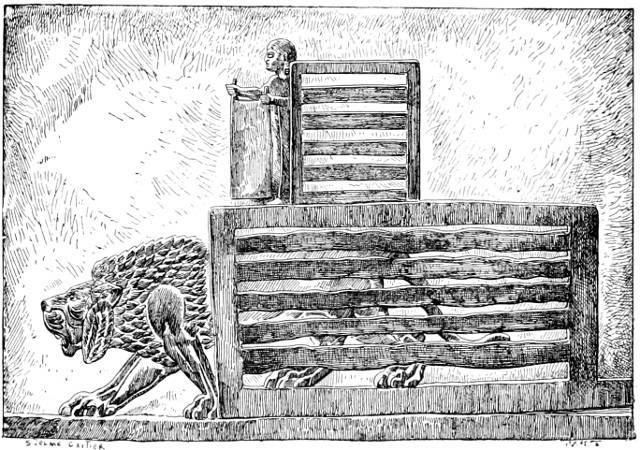
Fig. 78.—Lion coming out of his cage. Height of relief about 22 inches. British Museum.
Drawn by Saint-Elme Gautier.
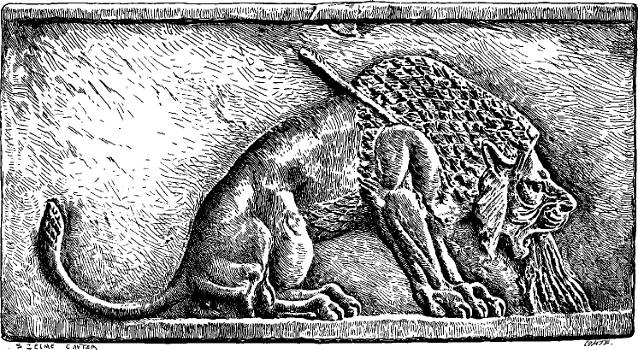
Fig. 79.—Wounded lion. Height of slab about 22 inches. British Museum. Drawn by Saint-Elme Gautier.
Still more expressive, perhaps, and more pathetic, is the picture of a lioness struck down by the same hand, but in a different fashion (Fig. 80). One of three arrows that have reached her has transfixed the spinal column at the loins. All the hinder part of the body is paralysed. The hind feet drag helplessly on the ground, while the poor animal still manages for a moment to support herself on her fore paws. She still faces the enemy, her half opened jaws are at once agonised and menacing, and, as we gaze upon her, we can almost fancy that we hear her last groan issue from her dying lips.
We might multiply these examples if we chose, but the two fragments we have reproduced will, we hope, send our readers to the British Museum to see the Hunt of Assurbanipal for themselves. In any case they are enough to prove that the Assyrian sculptor studied the lion from nature. He was not without opportunities. He was, no doubt, allowed to assist at those great hunts of which he was to be the official chronicler. He there saw the king of beasts throw himself on the spears of the footmen or fly before the arrows of the charioteers, and break the converging line of beaters; he saw him fall under his repeated wounds and struggle in his last convulsions. Later on he could supplement his recollections, he could complete and correct his sketches by the examination of the victims.[190] At the end of the day the “bag” was displayed as it is now at the end of a modern battue, when the keepers bring pheasants, hares and rabbits, and lay them in long rows in some clearing or corner of the covert. In one of the Kouyundjik reliefs we see the king standing before an altar and doing his homage to the gods after the emotions and dangers of a hunt that was almost a battle.[191] He seems to pour the wine of the libation upon four dead lions, which his attendants have arranged in line upon the ground.
There must also have been tame lions in the palaces and royal parks. Even now they are often to be met with in that country, under the tent of the Arab chief or in the house of the bey or pacha.[192] When captured quite young the lion is easily educated, and, provided that his appetite is never allowed to go unsatisfied, he may be an inoffensive and almost a docile companion until he is nearly full grown. We are ready to believe that the lion and lioness shown in our Fig. 77 were tame ones. The background of the relief suggests a park attached to the royal residence, rather than a marsh, jungle or desert. Vines heavy with fruit and bending flowers rise above the dozing lioness; we can hardly suppose that wild animals could intrude into such a garden. It follows, then, that the artist could study his models as they moved at freedom among the trees of the royal demesne, basking idly in the sun or stretching themselves when they rose, or burying their gleaming teeth on the living prey thrown to them by their keepers.
Thanks to such facilities as these the Ninevite sculptors have handed down to us more faithful reproductions of the lion than their more skilful successors of Greece or Rome. For the latter the lion was little more than a conventional type from which ornamental motives might be drawn. Sometimes no doubt they obtained very fine effects from it, but they always considered themselves free to modify and amplify, according to the requirements of the moment. Thus they were often led to give him full and rounded forms, which had a beauty of their own but were hardly true to nature. The Assyrian never committed that fault. He knew that the great flesh-eating beasts never grew fat, that they were all nerve and muscle, without any of those adipose tissues which reach so great a development in herbivorous animals, like the sheep or ox, or those that eat anything that comes, like the pig. Look at the bronze lion from Khorsabad figured in our Plate XI., and see how lean he is at the croup in spite of the power in his limbs, and how the bones of his shoulder and thigh stand out beneath the skin.
This characteristic is less strongly marked in the bas-reliefs, which hardly enjoy the same facilities for emphasising structure as work in the round. On the other hand the other features of the leonine physiognomy are rendered with singular energy. Anything finer in its way than the head of the colossal lion from Nimroud figured in our Plate VIII. can hardly be imagined.
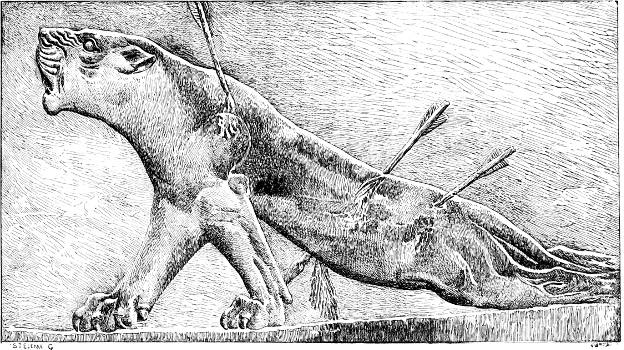
Fig. 80.—Wounded lioness. Height of slab about 15 inches. British Museum. Drawn by Saint-Elme Gautier.
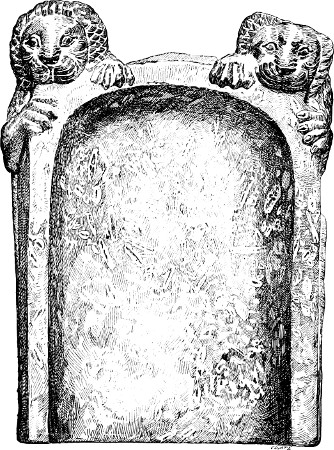
Fig. 81.—Niche decorated with two lions. Height 6½ inches. British Museum.
Drawn by Saint-Elme Gautier.
Seeing how familiar they were with this animal, the artists of Mesopotamia could hardly have failed to employ him as a motive in ornament. In such a case, of course, they did not insist so strongly upon fidelity to fact as in the historical bas-reliefs, but whether they made use of his figure as a whole or confined themselves to the head or paws, they always preserved the true character and originality of the forms. This may be clearly seen in an object belonging to the British Museum (Fig. 81). We do not exactly know where it was found and we cannot say what may have been its use. It is a kind of shallow niche cut from a fossiliferous rock.[193] It is hardly deep enough to have sheltered an idol or statuette of any kind. But whatever it may have been nothing could be more natural than the action of the two lions that show themselves at the two upper angles. They hang tightly to the edge of the stone with their extended claws, giving rise to a happy, piquant, and unstudied effect. The scabbard in our next illustration is no less happily conceived; the lions at its foot who seem about to climb up the sheath with the playfulness of kittens, should be noticed (Fig. 82). Again, we find the lion introduced into those embroideries on the royal robes of which we have already had occasion to speak. In the example figured here (Fig. 83) he is fighting an animal whose feet and legs are those of a bull, although its stature is greater and its form more slender than those of the antelope. It appears to be a unicorn, a fantastic animal that has always played a great part in oriental fables.
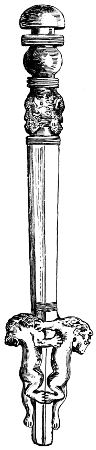
Fig. 82.—Sword and scabbard. From a Khorsabad bas-relief. Louvre.
The lion’s head with its powerful muscular development, its fine mouth, and picturesque masses of floating hair, has often furnished ceramists, gold and silversmiths, and art workmen of every kind with motives for use upon their creations. A fine example of this is reproduced on the title-pages of these volumes. It belongs to the Luynes collection in the French National Library. The material is gold, and a small staple attached to the neck shows that it once belonged to some object now lost. Our reproduction is of the same size as the original. In spite of its small dimensions its workmanship is no less remarkable for freedom and nobility of style than the colossal head from Nimroud. Something of the same qualities but with more finish in the details is to be found in a terra-cotta fragment covered with a green glaze which now belongs to the collection in the Louvre. These objects, which have come down to us in considerable numbers, must have been used as applied work, in the decoration of vases, utensils, and other small pieces of furniture (Fig. 84). The object figured at the end of the last chapter belongs to the same class. There is a hollow or mortice in its base by which it was attached to some knife or poignard to form its handle.
The lion’s paw was used in the same fashion and no less often. Its expressive form and the elegant curves of its claws are found on numerous altars, tables, and thrones (Vol. I., Fig. 168; and above, Fig. 47).[194]
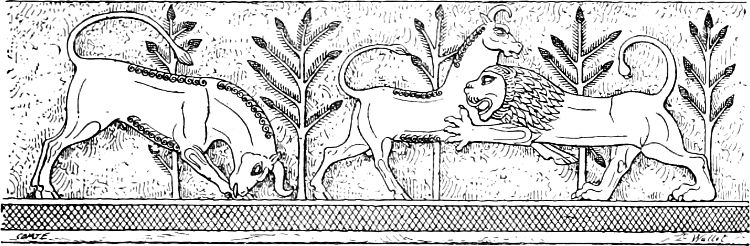
Fig. 83.—Combat between a lion and a unicorn. From Layard.
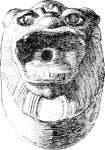
Fig. 84.—Lion’s head in enamelled earthenware. Louvre. Actual size.
Drawn by Saint-Elme Gautier.
We find the same truth of design in many small earthenware articles, even when they reproduce a type less interesting and less majestic than that of the lion. A good instance of this is afforded by the goat of white earthenware covered with a blue glaze which was found at Khorsabad by Place (Fig. 85). It is but a sketch. The modeller has not entered into any details of the form, but he has thoroughly grasped its general character. The terra-cottas properly speaking, those that have received no glaze or enamel, are, as a rule, less carefully executed, but even in them we can perceive, though in a less degree, the certainty of eye, the same promptitude in seizing and rendering the special physiognomy of an animal. We feel this very strongly in what is by no means the work of a skilful modeller, the dog figured below (Fig. 86). The head and fore quarters of one of the mastiffs of the bas-reliefs may here be recognized (see Fig. 72).
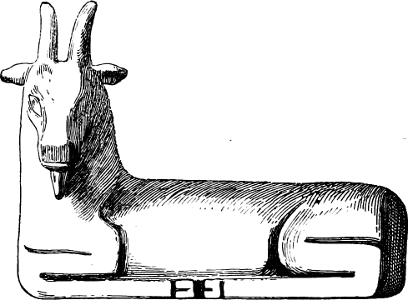
Fig. 85.—Recumbent goat. Enamelled earthenware. Actual size.
Drawn by Saint-Elme Gautier.
The same desire for precision, or rather comprehension, of form, is to be found even in those imaginary beings which the artists of Chaldæa and Assyria took such pleasure in multiplying. Although in their fantastic creations they brought together features belonging to animals of totally different classes, they made a point of drawing those features with the greatest precision. This is well illustrated by an object in the Luynes collection (Fig. 87). Nowhere is the arbitrary combination of forms having nothing in common pushed farther than here. A ram’s horns grow on a bull’s head, which, again, has a bird’s beak; the body, the tail, the fore paws are those of a lion, while the hind legs and feet and the wings that spring from the shoulders are borrowed from the eagle.[195]
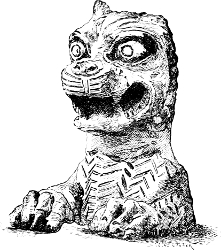
Fig. 86.—Dog. Terra-cotta. British Museum. Height about 5 inches.
Drawn by Saint-Elme Gautier.
We have already described the most remarkable of all these composite types, the man-headed bull and lion; we have attempted to explain the intellectual idea which gave them birth; we have yet to point out a variety which is not without importance. The lion has sometimes been given, not only the head, but also the arms and bust of a man. In one of the entrances to the palace of Assurbanipal there was a colossus of this kind (Vol. I., Fig. 114).[196] With one arm this man-lion presses against his body what seems to be a goat or a deer, while the other, hanging at his side, holds a flowering branch. This figure, like almost all of those found in the doorways, is winged. Another example of the same type is to be found in a bas-relief of Assurbanipal; it is, however, simplified, and it looks, on the whole, more probable (Fig. 88). The wings have disappeared; there are but two natures to be joined, and the junction seems to be made without effort; the lion furnishes strength and rapidity, the man the various powers of the arm and hand, and the beauty of the thinking and speaking head. The divine character of the personage thus figured is indicated by the three pairs of horns bent round the dome-like tiara, and also by the place he occupies in the inferior compartment of a relief on which, at the top, appear those lion-headed genii we have already figured (Vol. I., Fig. 6).
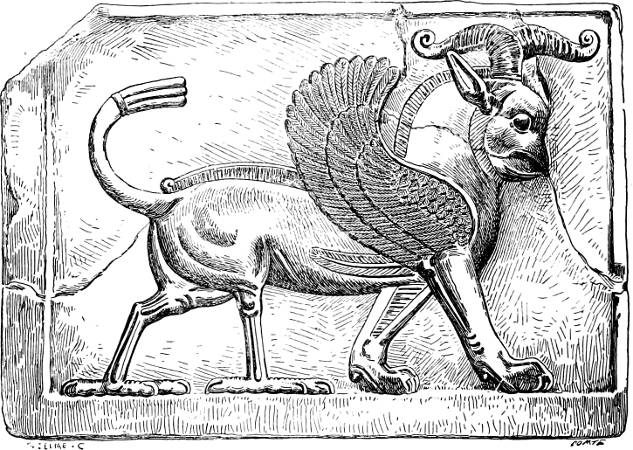
Fig. 87.—Fantastic animal. National Library, Paris. Height 5¼ inches.
Drawn by Saint-Elme Gautier.
In this last composition we have a foretaste of the centaur. Replace the lion by a horse and the likeness is complete. Even now it is very great. At the first moment, before we have time to notice the claws and divided toes, we seem to recognize the fabulous animal of the Greeks upon the walls of an Assyrian palace.
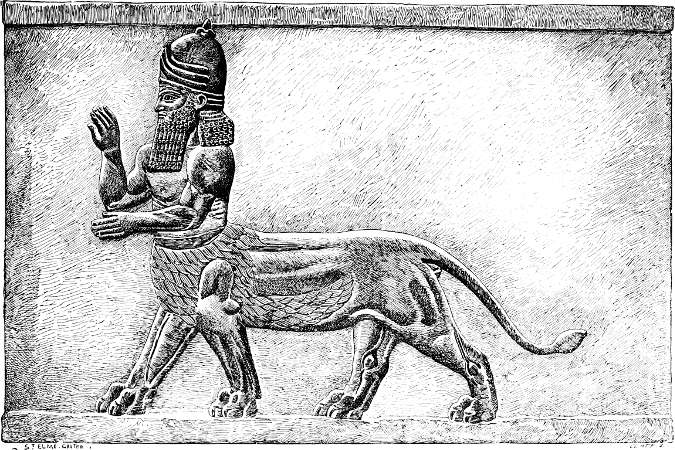
Fig. 88.—Man-lion. British Museum. Height about 27 inches. Drawn by Saint-Elme Gautier.
Another composite animal familiar to the imaginations both of Greeks and Mesopotamians was the winged horse, the Hellenic Pegasus (Fig. 89). The example we have chosen is full of grace and nobility. We feel that the wings have given additional lightness and almost a real capacity for leaving the ground.
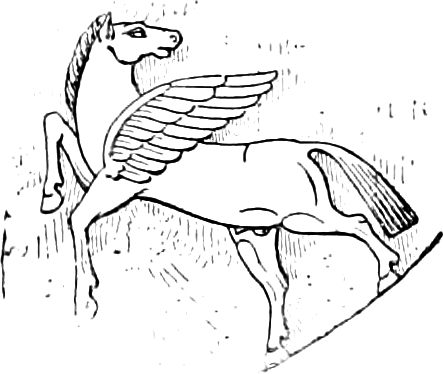
Fig. 89.—Winged horse. From Layard.
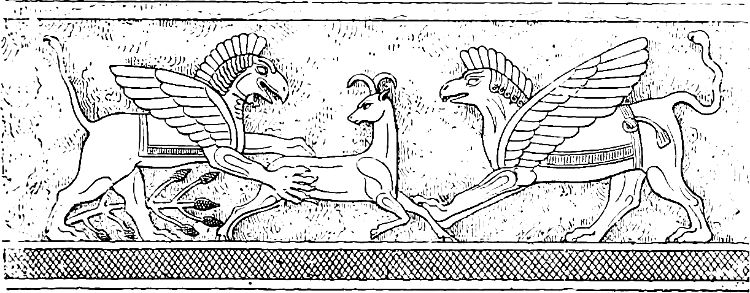
Fig. 90.—Griffins seizing a goat. From Layard.
The whole of the fabulous tribe of griffins, by which we mean an animal with the body of a lion or panther and the wings and head of a bird of prey, is richly represented in Assyrian art. The griffin recurs continually in the embroidery of the royal robes of Assurnazirpal (Fig. 90). The bird with a human head, the prototype of the Greek harpies and sirens, is also to be frequently met with. We find it introduced in those applied pieces which, after being cast and finished with the burin, were used by bronze workers in the decoration of vases of beaten metal. The diameters of the vases may easily be calculated from the inner curve of the applied plaques;[197] the latter were used to strengthen the vessels at the points where the movable handles, like those of a modern bucket, were attached. These handles were hooked to a ring or fastened to the back of the figure on the plaque.[198] The head of the figure gave something to catch hold of when the vessel was upon the table, with its handle down. The form in question (see Fig. 91) was chosen by the artist on account of its fitness for the work to be done; the tail and wings embrace the swelling sides very happily; but yet it would never have been so employed had it not belonged to the ordinary repertory of the ornamentist.
Of all these types the only one that does not seem to have been invented by those who made use of it is that of the winged sphinxes used as supports in the palace of Esarhaddon (Vol. I., Fig. 85). The human-headed lion is certainly found long before, but it is not until the later reigns that he takes the couchant attitude and something of the physiognomy of the Egyptian sphinx.
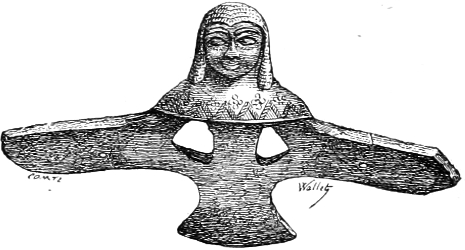
Fig. 91.—Human-headed bird. From De Longperier. One-third of the actual size.
Under the Sargonids communication with Egypt became so frequent that certain motives from the Nile valley were introduced into the Assyrian system of ornament, but the part they played was always a subordinate one. In creations such as those we have just been studying Chaldæa and Assyria certainly displayed more inventive power than was ever shown by Egypt. Speaking broadly, there was no possible combination they did not attempt. It was from Chaldæo-Assyrian artists that Syria, Judæa, and Phœnicia, as well as Asia Minor, borrowed their imaginary animals; and, thanks to these middle-men, it was also to the artists of the double valley that the early ceramists and modellers of Greece owed not a few of the motives they transmitted to the great periods of classic art, and, through the latter, to the art of the Renaissance and of our own day.
§ 5. Chaldæan Sculpture.
So far we have made no distinction between Chaldæan and Assyrian sculpture. They made, in fact, but one art. In both countries we find the same themes and the same treatment—the same way of looking at nature and the same conventional methods of interpreting it. The common characteristics are numerous enough to justify us in attributing to one and the same school the works produced both in the southern and northern provinces. If we take them en bloc, and put them side by side with the productions of any other great nation of antiquity, we shall be at once struck by the close resemblance between all the monuments from the valley of the Tigris and Euphrates, whether they come from Sirtella or Babylon, Calah or Nineveh. The connoisseur can point out a Mesopotamian creation at a glance, mingled with works from Egypt, Phœnicia, or Greece though it may be. In order to define the Chaldæo-Assyrian style, he may take the first object that comes to hand, without caring much whether it come from the upper country or the neighbourhood of the Persian Gulf.
And yet between those cities of primitive Chaldæa that almost rivalled Memphis in age, and the towns of Assyria which only commenced to flourish in centuries that we may almost call modern, it is impossible that the spirit of the plastic arts and their executive processes can have remained without change. Between the earliest and the latest monuments, between the images of Gudea and those of Assurbanipal, there are, at least, shades of difference. It is certain that the old Chaldæan art and the art of Assyria were not two different arts, but they were two successive movements of the same art—two phases in its development. We have still to distinguish between these two phases by studying, one after the other, the history of Chaldæan and that of Assyrian sculpture.
In the course of this study, and especially in the case of the older civilization, we shall encounter many gaps. The monuments are few, and, even of those that we have, many are not a little embarrassing. They are often uninscribed and we are then without even the help afforded by the language and the style of the character in fixing a date. Fortunately this is not always the case; there are often indications that enable us to form certain groups, and, if not to assign absolute dates, at least to determine their relative places in a chronological series.
Of all these groups the best established and almost the only ones that can be used as the heads of series are those whose elements have been furnished by the explorations undertaken by M. de Sarzec, French vice-consul at Bassorah, at Tello, upon the site of a town which we shall follow the majority of Assyriologists in calling Sirtella. We have written the history of these excavations elsewhere; we have explained how greatly they do honour to the artistic spirit, the perseverance, and the energy of M. de Sarzec;[199] we have given the history of the negotiations and of the vote in Parliament which led to the acquisition by the Louvre of all the objects discovered. It will be sufficient to say here that the works began in the winter of 1876 and came to an end in 1881, and that the purchase of M. de Sarzec’s collection took place in the latter year, under the administration of M. Jules Ferry.
The name of Tello, which has become famous so suddenly, is to be found on no map of Asia to which we have access. The place thus designated by the Arabs in consequence of the numerous mounds, or tells, that are sprinkled about, is situated quite in the desert, on the left bank of the Shat-el-Haï, above Chatra and below Saïd-Hassan, which are on the other side of the channel, and about an hour and a quarter’s march to the east.[200]
This site seems to have been inhabited down to the very last days of antiquity, so that monuments have been found there of all ages; for the moment, however, we are only concerned with those that belong to the early Chaldæan monarchy. Among these there are some that date from the very beginning of Chaldæan civilization. This we know not only from their style; arguments based on such evidence alone might leave room for doubt; some might even contend that the development of art did not proceed equally over the whole of that extensive country; it might be asserted that here and there it was in a far less advanced state than at other centres. The age of these monuments is fixed by much less debateable signs, namely, by the character of the symbols of which their inscribed texts are composed (see Vol I., Fig. 2, and below, Fig. 92).
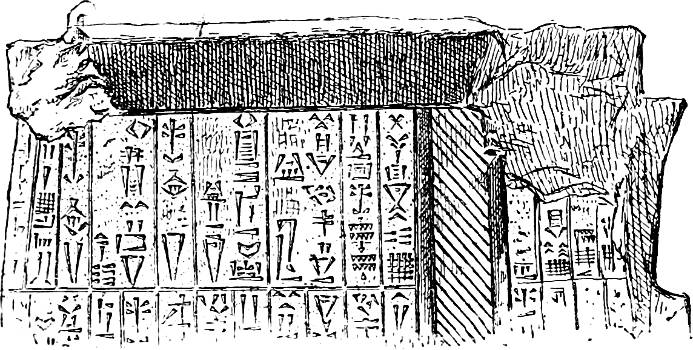
Fig. 92.—Inscription engraved on one of the seated Chaldæan statues. Louvre.
We have already explained[201] that in the monuments from Sirtella these symbols were not all wedges, or arrow-heads, whose exclusive use did not commence until afterwards; we have shown how their original ideographic nature is still to be traced in many characters. Compare the inscription here figured with those on our Assyrian monuments. Put it side by side with the narrative that runs across all the reliefs of Assurnazirpal at Nimroud (Vol. I., Fig. 4, and, above, Fig. 64): you will see at once what a profound change has taken place and how many centuries must have intervened between such different ways of employing the same alphabet. At Tello the material was less kindly; it was not, as in Assyria, limestone or gypsum; it was a diorite or dolerite as stubborn as the hardest rocks of Egypt.[202] The widely-spaced characters are none the less distinct; their cutting is, in fact, marvellous in its decision and clearness. We feel that the scribe traced each letter with much the same care and respect as he would have shown in performing a religious rite. In the eyes of the people who saw these complicated symbols grow under the chisel, writing still had a beauty of its own as well as a mysterious prestige; it was only legible by the initiated, and they were few in number; it was admired for itself, for the power it possessed of representing the facts of nature and the thoughts of mankind; it was a precious, almost a magic, secret. By the time that the palaces of the Assyrian monarchs began to be raised on the banks of the Tigris it was no longer so; writing had gone on for so many centuries that people had become thoroughly accustomed to it and to its merits; all that one desired, when he took the chisel in hand, was to be understood. The text in which Assurnazirpal celebrates the erection of his palace and claims for it the protection of the great gods of Assyria, is written in very small, closely-set characters, engraved by a skilful and rapid hand in the soft and kindly stone; the inequalities of the surface, the details of the sculptures and the shadows they cast, make a letter difficult to read here and there. Nowhere, neither here nor in any other of the great Assyrian inscriptions, do we find the signs of care, the look of simple and serious sincerity, that distinguishes the ancient writing of Chaldæa. At Calah and Nineveh we have before us the work of a society already far advanced, a society which lives in the past and makes use, with mere mechanical skill, of the processes created and brought to a first perfection many centuries before.
Of all the monuments found at Tello, the oldest, apparently, is a great stele of white stone, both sides of which are covered with bas-reliefs and inscriptions. Unfortunately it had been broken into numerous pieces, and, as these have not all been recovered, it is impossible to restore it entirely. The style of its writing seems the farthest removed from the form into which it finally developed, and its symbols seem to be nearer their original imitativeness than anywhere else. “Inexperience is everywhere to be recognized in the drawing of the figures; eyes are almost triangular and ears roughly blocked out; the aquiline type of nose is but a continuation of the line of the forehead, into which it blends; the Semitic profile is more strongly marked than in the monuments of the following age.”[203]
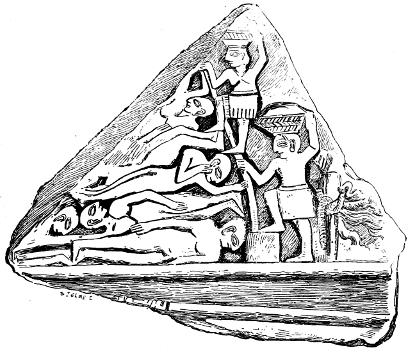
Fig. 93.—Fragment of a stele; from Tello. Height 1 foot. Louvre.
Drawn by Saint-Elme Gautier.
The bas-reliefs represent strange scenes of war, of carnage, of burial. Here we find corpses arranged in line so that the head of one is touching the feet of his neighbour (Fig. 93); they look as if they were piled one above another, but this, we believe, is an illusion due to want of skill on the part of the artist. He puts objects one above another on the field of his relief which, in reality, were laid side by side. We must imagine these corpses spread over the surface of the ground and covered with earth. If the sculptor had introduced the soil above them, the corpses would have been invisible; so he has left it out. The two figures on the left, who mount an inclined plane[204] with baskets on their heads, what are they carrying? Offerings to be placed on the summit of the sepulchre? or earth to raise the tumulus to a greater height? We prefer the latter suggestion. When earth or rubbish has to be removed in the modern East, when excavations are made, for instance, the work is set about in the fashion here commemorated; the action of these two figures seems, moreover, to indicate that the weight they are carrying is greater than a basket full of cakes, fruits, and other things of that kind would account for.
If on this fragment we have a representation of the honours paid by the people of Sirtella to companions slain in battle, another compartment of the same relief shows us the lot reserved by the hate and vengeance of the victor for the corpses of his enemies (Fig. 94). Birds of prey are tearing them limb from limb on the place where they fell. In their beaks and claws they held the heads, hands, and arms of dismembered bodies. The savagery of all this suggests a remote epoch, when civilization had done little to soften original brutality.
A last fragment belongs to another composition (Fig. 95). It comes from a relief showing either the departure of an army for the field or its triumphal return. Very little is left, but that little is significant;—a hand holding one of those military standards whose use by the Assyrians we have already noticed (see above, Fig. 46), and the head of a personage, perhaps the king, walking in the procession; and that is all. The head-covering of the latter individual seems to be a kind of feather crown with a metal or ivory aigrette or cockade in the centre of one side, reminding us in its shape of the head of one of the great Assyrian bulls; it would seem to be a symbol of strength and victory.
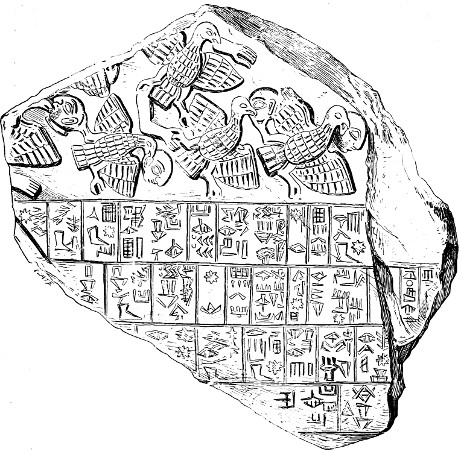
Fig. 94.—Fragment of a stele; from Tello. Height 9¾ inches. Louvre.
Drawn by Saint-Elme Gautier.
In the monograph now under preparation by MM. de Sarzec and Heuzey a description of several smaller and still more fragmentary pieces of the same monument will be found. There is one of which the subject may still be traced. We have been prevented from reproducing it by its bad condition. It again shows a battle field. Two rows of corpses are stretched upon the ground; behind them are several standing figures. We may thus re-establish with but little room for mistake the whole economy of the composition. It was made to commemorate some military expedition in which the prince who reigned at Sirtella was successful. We do not know whether the fight itself was represented or not, but we have before our eyes the consequences of victory. One picture shows the insults inflicted upon the lifeless bodies of the hated enemy; two more celebrate the care taken by the victors of their dead and the honours rendered to their memory; finally the march of the successful army is portrayed. We have here, then, a well thought-out combination, a serious effort to seize and figure the different moments in a complicated action. The execution is, however, of singular awkwardness. The first halting experiments of the Chaldæan chisel, what we may call the primitive art of Chaldæa, is preserved for us in the fragments of this great stele.[205]
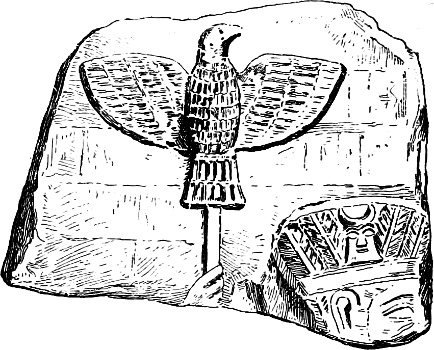
Fig. 95.—Fragment of a stele; from Tello. About one-third of the original size. Louvre.
Drawn by Saint-Elme Gautier.
A second and still more curious group of monuments is composed of eight statues of different sizes with inscriptions of Gudea, and of a ninth on which occurs a name read Ourbaou by some and Likbagas by others.[206] It is the smallest of all those exhibited at the Louvre. All these figures are broken at the junction of the neck with the body.[207] We may put beside them two heads whose proportions are about the same as theirs, which were found, one among the mutilated statues, the other in the ruins of a neighbouring building. The material is similar, a very hard and dark igneous rock. The execution corresponds exactly with that of the torsos, to one of which the first named head may perhaps have belonged.
M. de Sarzec tells us that these statues were found in the great edifice at Tello, almost all on the soil of the central court.[208] Some are standing, others seated;[209] we give an example of each type (Plate VI., Figs. 96 and 98). In these effigies we may notice an arrangement that we have more than once encountered in Assyrian reliefs, but which has never, so far as we know, been employed in the arts of any other people. “All these statues, without exception, have their hands folded within each other and placed against their chests, an attitude still used in the East to mark the respectful attention of the servant awaiting his master’s orders. If, as we have every reason to believe, these figures were placed in a sacred inclosure, in front of the images of the gods or of the symbols that recalled their power, this attitude of submission and respect became one of religious veneration (Fig. 97).”[210]
At Nimroud and Khorsabad this expressive gesture is sometimes given to eunuchs in the presence of their masters, sometimes to kings when standing before the effigies of their gods. It is thoroughly well-fitted for those votive statues that proclaim themselves in their inscriptions to be offerings to the deity. In consecrating an image of himself on the threshold of the sanctuary, the king assured the perpetuity of his prayers and acts of homage; he remained for ever in an attitude of worship before his god—in an attitude whose calm gravity was well calculated to suggest the idea of a divine repose to which death was the passport.
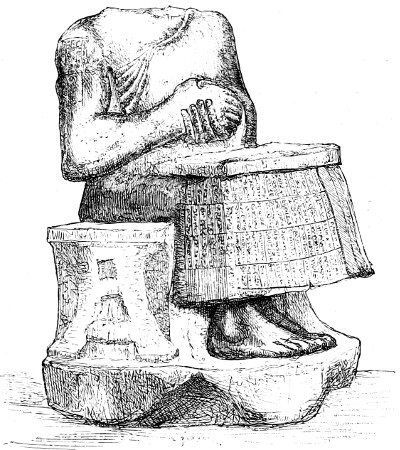
Fig. 96.—Statue; from Tello. Height 37 inches. Louvre. Drawn by Bourgoin.
The chief point of interest for us lies in the execution of these statues. They embody a very sensible progress. Art has thrown off the hesitations of its first youth and attacks the stubborn material with much certainty and no little science; and yet the most striking quality is less the successful grappling with a mechanical difficulty, than the feeling for nature and the general striving for truth; a striving which has not been discouraged by the resistance of the material. This resistance has resulted in a method that makes use of wide, smooth surfaces; and yet the workmanship has a freedom that a too great fondness for superficial polish too often took away from the diorite monuments of Egypt. The bare right arm and shoulder are remarkable passages. The strongly-marked muscles of the back and the freedom with which the bony framework is shown under the flesh and skin should also be noticed. All these parts are treated with a breadth that gives a fine look of power to the otherwise short and thickset figure. And yet the vigour of the handling never goes beyond what is sober and discreet (Fig. 98). The same character is to be found in the hands, where joints, bones, and nails are studied with minute care, and in the feet, where power of foothold and the shapes of the toes are thoroughly well indicated.
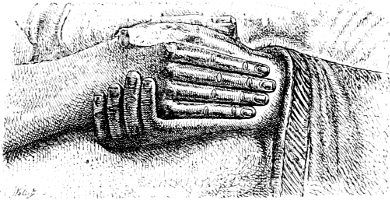
Fig. 97.—The hands of a statue; from Tello. Louvre. Drawn by Bourgoin.
The treatment of the two heads is no less excellent (Plate VII). The eyes are straight and widely opened; the heavy brows join in the middle; the strong and salient chin, as well as the crown of the head, is shaved in the fragment in which it is left bare.[211] Under the kind of hat or turban in the other there would be a head no less bald. In our own day the small cap of cotton or linen covered by the twisted scarf or shawl of the Turk or Hindoo, conceals little but the smooth skin of the skull.[212] The custom had yet to be introduced of wearing the long and closely-curled hair and beard that we find reproduced in the sculptures of Nineveh. The nose is broken in both heads, but if we may judge from the statuettes and bas-reliefs of the same epoch, especially from a curious fragment recovered in the course of the same excavations, it must have been arched—but not so much as the Assyrian noses—and a little thick at the end. Taking the face as a whole it is square in structure, like the body; in the few examples of Assyrian heads in the round that we possess the oval of the face seems longer, but the beard by which the whole of its lower part is concealed renders any comparison difficult. We do not think, however, that there is any necessity to raise a question of race. “It is only subject to the greatest reserve that we can venture to say anything as to the ethnography of the types created by sculpture, especially when those types are archaic, and therefore exposed more than all others to the influence of school conventions.[213] It is a common habit with antique sculptors to allow traces of their work in its rough shape to subsist in the finished creation. In all countries the march of art has been from square and angular to round and flowing shapes, from short and thickset to graceful and slender proportions.”[214]
The tendencies shown in the rendering of the face and the uncovered parts of the body are also to be recognized in the treatment of the drapery. “The sculptor has attempted with much truth and simplicity to suggest the relief of the drapery and the direction of its folds. This early and timid attempt at studying folds is all the more remarkable as nothing like it is to be found either in Egyptian sculpture or in the later works of Assyria. It bears witness to a sculpturesque instinct that does not reappear until we arrive at the art of the Greeks and the magnificent development of draperies and their significance which we then encounter.”[215]
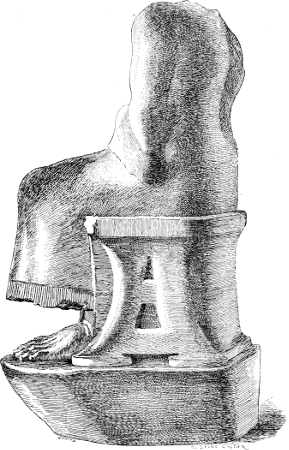
Fig. 98.—The large statue from Tello. Height 5 feet 3 inches. Louvre. Drawn by Saint-Elme Gautier.
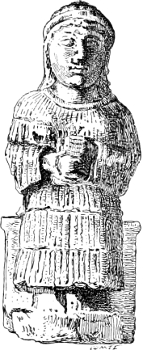
Fig. 99.—Female statuette. Alabaster. Height about 8 inches.
The figures we have been describing seem to us to represent The Archaic age of Chaldæan art. The characteristics to which the name of archaism has been given are easier to feel than to define. The proportions, especially in the seated figures, are here very short and broad, so much so that they seem to want length even when compared to the thickset forms in the Nimroud bas-reliefs. There is some evidence that the neck was very short and thick and the head large for the body, as we see it indeed in the statuette of a woman sitting, in which our lamented colleague de Longpérier was the first to recognize the work of some ancient Chaldæan artist (Fig. 99).[216] In the figures from Tello the elbow and the lower edge of the robe make those sharp angles which Assyrian sculptors set themselves to round off in later days. There is no attempt at grace; directness and truth of expression are all that the artist has cared about.
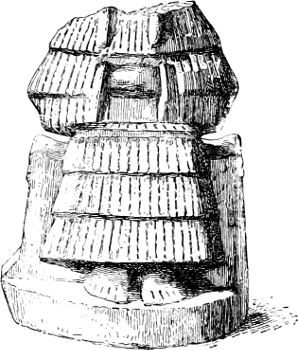
Fig. 100.—Statuette; from Tello. Actual size. Louvre. Drawn by Bourgoin.
We should ascribe several other objects found at Tello to the same period. These are in the first place the votive bronzes inscribed with the name of Gudea, which M. de Sarzec drew from their hiding places (Vol. I., Figs. 146–148); secondly, a statuette carved from a rather soft, fine-grained stone (Fig. 100). By its attitude it reminds us of the statues of Gudea, while the treatment of its drapery is more like the alabaster figure that we have chosen for reproduction from the old Louvre collections. Those symmetrical folds that appear to have been obtained with an iron, and that we have already seen imitated on the oldest Chaldæan cylinders (Vol. I., Figs. 3, 17, and 20; and above, Figs. 39 and 40), may be observed in its draperies. Thirdly, a bas-relief in soft stone, of which two compartments still remain, would date from the same period (Fig. 101). In its original condition it may have comprised some further divisions, for the subject as we see it in the fragment preserved is by no means clear. In the upper compartment there are four figures diminishing in size from left to right. The male figure on the left bears what seems to be an instrument of music, a kind of cymbal upon which he would beat with the hammer-shaped object in his right hand. The three individuals behind him are all in attitudes of submission and respect. In the lower division a seated individual twangs the cords of a harp. In front his instrument is decorated with the image of a bull, recalling the richly ornamented harps that we find so often figured in the Egyptian tombs.[217] Another figure, again in the attitude of respect, stands before the harpist. It seems to be that of a woman, but the relief is in such a condition that nothing but the general contours can be made out.
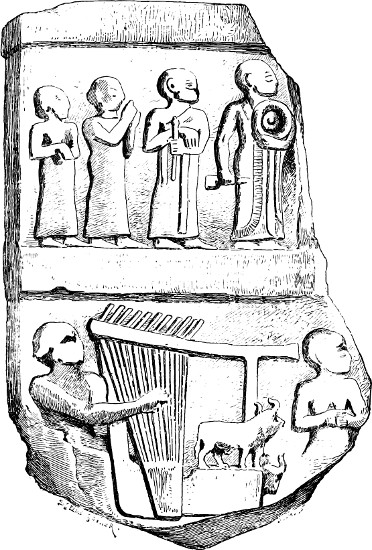
Fig. 101.—Fragment of a relief; from Tello. Height 44 inches. Louvre.
Chaldæan art did not stop here. Once arrived at the degree of mastery shown by the statues of Gudea, it made progress of which, indeed, we are unable to measure the rapidity; but whose results are now before our eyes. We can hardly doubt that it reached a pitch of executive skill which often gave quite remarkable delicacy and finesse to the most insignificant details of sculpture and ornament. This had already suggested itself to M. Heuzey in the course of his study of the small Chaldæo-Babylonian figures belonging to the collection of terra-cottas in the Louvre;[218] he found the same merits in several of the fragments collected by M. de Sarzec.[219] We have been unable to reproduce all the pieces to which he alludes; some are too small to be rendered in a fashion that would do justice to the excellence of their treatment;[220] but that we may give some idea of the third group we are thus led to form, we shall figure two or three small objects, which the visitor will find without difficulty in the cases of the Louvre. One of these is a fragment from a bas-relief on which nothing remains but a foot, charmingly modelled, and a piece of ornament representing a vase from which two streams of water, each supporting a fish, are flowing (Fig. 102). The hardly sensible relief and the extreme finesse of this motive, remind us of the marvels of Japanese workmanship.[221] Still more striking is a small, a very small, head in steatite, reproducing the same type as the large statues with a grace and precision that make it a veritable gem (Fig. 103). The eyes have the oblique inclination that was afterwards to become so conspicuous in the Assyrian reliefs, but in a very slight degree. We may apply almost the same remarks to another but less well preserved head in diorite. Unlike all those we have as yet encountered, it is not shaven. In spite of the stubborn material the twists and turns of the hair and beard are sculptured in relief with admirable skill and precision.
It was during this period that the custom was introduced of allowing the hair and beard to grow, so that their crisp curls should form a close frame for the face. This fashion was in the ascendant when a bas-relief, of which, to our great regret, we only possess a small fragment greatly damaged by fire (Fig. 67), was chiselled. It is remarkable both for the fineness of its workmanship and its curious subject. It shows the upper parts of two figures, entwined. That on the right, from the long hair flowing over the shoulders, must be a woman. The tall horned caps worn by both figures proclaim them to be a royal or divine couple.
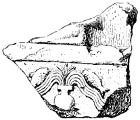
Fig. 102.—Fragment of a relief; from Tello. Actual size. Louvre.
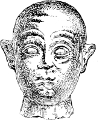
Fig. 103.—Head; from Tello. Actual size. Louvre.
We find the same characteristics in a fifth monument from the same place, whose composition at least is not wanting in originality. This is a support of some kind, perhaps the foot of a vase, cut in rock so hard, dark, and metal-like in its reflections, that at the first glance it might almost be taken for bronze. Its general form is circular. Above a plinth decorated with roughly chiselled squares and around a central cylinder, sit a number of individuals with long beards and hair. Their hands are placed upon their knees; the attitudes of the limbs and the modelling of the feet remind us of the statues of Gudea; but these figures are nude and their arrangement has more ease and variety. The general motive is especially interesting; it is both singular and happy, and proves that art was sufficiently advanced to understand how to decorate common objects by the addition of figures skilfully grouped and placed in natural and picturesque attitudes (Fig. 104).
It can never be sufficiently deplored that none of these monuments are either of a fair size or in a good state of preservation. We can only judge of the school by the small fragments we have been describing. What name are we to give to the art of which we thus catch a glimpse? Is it not better to employ some expression that has been sanctified by custom, and one to which the critic and historian instinctively turns? When he seeks for a special term to denote the different phases of an organic development, what does he call the phase in which execution is at once free and informed with knowledge, when the hand of the artist, having won complete mastery over itself and over the material on which it is employed, allows him to reproduce those aspects of nature by which he has been charmed and interested? He calls it the classic period, or the period in which works fit to be placed, as models, before the artists of future ages, were produced. If we adopt this nomenclature, the third of the periods we have just been discussing will be for us the Classic age of Chaldæa.
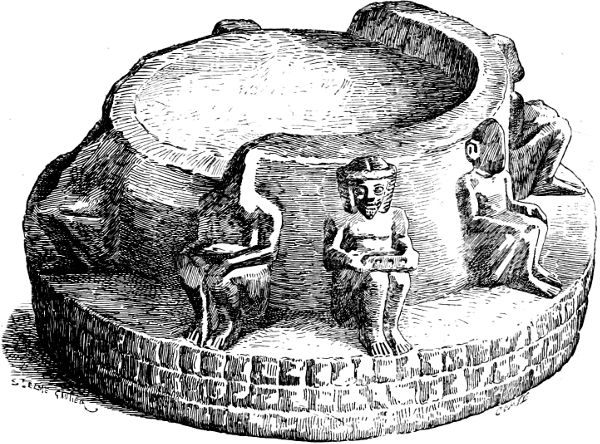
Fig. 104.—Stone pedestal; from Tello. Greatest diameter 6 inches. Louvre.
Although the remains from Sirtella give an opportunity for the study of Chaldæan art that is to be equalled nowhere else in Europe, still the British Museum and the old collections of the Louvre contain more than one object calculated to enrich, if not to complete, the series we have established.
A bronze in the former gallery (Fig. 105) seems to date from the earliest period of Chaldæan art. It has been thought to represent a goddess, Istar perhaps, although there is nothing in the modelling of the bosom to suggest the female sex. The whole work is, however, so rough and barbarous that the author may very well have left out all details of the kind through sheer inability to render them. Like the bronzes of Tello, this figure—which is without legs—ends in a cylindrical stem. It was in all probability meant to be placed in one of those hiding places we have already described.
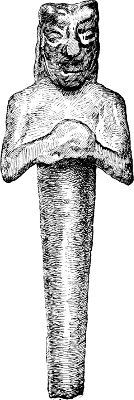
Fig. 105.—Chaldæan statuette. Height 6½ inches. British Museum. Drawn by Saint-Elme Gautier.
Monuments from the Archaic age are less rare. We have already had occasion to notice some of them, the tablet from Sippara with the god Shamas (Vol. I. Fig. 71), for instance, the canephorus inscribed with the name of the king Kourdourmapouk (Fig. 53), and the stele of Merodach-Idin-Akhi (Fig. 63). The canephorus must have been the oldest of these objects. Its head is entirely shaven and in its attitude it resembles the bronzes of Gudea (Vol. I. Fig. 147). We are induced to bring down the tablet nearer to our own day because the individuals shown in it wear both beard and long hair. These are not confined to the god himself and the two divine personages who support the disk placed on the altar and representing the sun; they are common to the three figures advancing in an attitude of worship. The first appears to be a priest. Among other interesting details we may point out, under the throne of Shamas, the two strong-limbed deities whom Assyriologists call Izdubar and Hea-bani, and, in Shamas’s right hand, the staff with a ring attached that is found elsewhere than in Mesopotamia. The draperies of the god and those of the third worshipper are arranged in the crimped folds of which we have spoken above. Here art is fairly advanced. Putting on one side the convention which allows the deity to be made much taller than mortals, the proportions of the figures are good, their attitudes well understood and expressive. The workmanship of the stele of Merodach-Idin-Akhi is far inferior to that of the Sippara tablet. It belongs to a series of monuments in which, as we shall explain farther on, the workmanship is, as a rule, very mediocre. We shall also mention a few fragmentary statues of very hard stone which have been seen by travellers in Chaldæa,[222] and a few remains of the same kind that are now in the British Museum; but of the first we have only short and vague descriptions, while, among the second, there is not a piece that can be compared to the statues of Gudea in the Louvre. During all this period the volcanic rocks appear to have been extensively employed; we still think they were obtained either from the borders of the Arabian desert, or by way of the two rivers from the mountains at the head of the double valley.
To the same school we may attribute a bronze from Hillah, now in the Louvre (Fig. 106). It represents a priest robed in a long tunic with five flounces of crimped work. His hair is brought together at the back of his head, and he wears a low tiara with the usual horns folded about it. His beard is short and broad. With his two hands—which are broken—he holds a small ibex against his chest. We have already encountered this motive in Assyria (see Vol. I. Fig. 114).
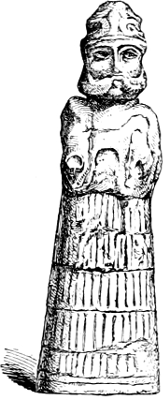
Fig. 106.—Statuette of a priest. Height 5¼ inches. Louvre.
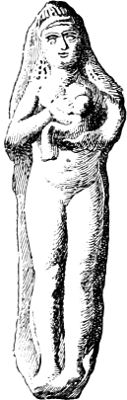
Fig. 107.—Statuette of a woman. Terra-cotta. Louvre. Height 5¾ inches.
It is chiefly, however, among the terra-cotta statuettes that we find good examples of that more elegant and refined form of art of which we catch certain glimpses in some of the Tello fragments. The figure of a priest happily draped in a mantle that covers his head and shoulders from behind, has already been given (Fig. 50). We may here add two more specimens of the same kind. Their merits, however, can only be fairly appreciated in the originals, on account of their small size. One of the very best things produced by Chaldæan art is the statuette of a nude woman, standing and suckling her infant (Fig. 107);[223] her large, and perhaps slightly empty forms are modelled with ease and artistic feeling. She is, in all probability, a goddess of maternity.[224] In the statuette reproduced in our Fig. 108, the treatment is less free, its precision is a little dry and hard. The personage represented employs the gesture proper to the nursing goddesses (see Vol. I. Fig. 16), although robed from head to foot. Her garment ends below in a deep fringe. On her head there is a Persian tiara.[225]
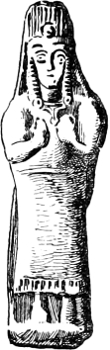
Fig. 108.—Terra-cotta statuette. Height 4¼ inches. Louvre.
This latter figure, in spite of certain qualities to which we are by no means blind, belongs to a period of decadence which lasted, perhaps, throughout the Persian domination, and even as late as the Seleucidæ and Parthians. The types consecrated by religious tradition were repeated, but repeated with a hesitating and indifferent hand, and with little reference to nature. The faults inherent in this kind of workmanship are still more conspicuous in the example, given in Fig. 16 of the first volume, of a type which was very common both in Chaldæa and Susiana.[226] Whether we call her Istar or Anahit this goddess seems to have enjoyed a very lasting popularity in the whole region of which Mesopotamia forms the centre. The art of Chaldæa survived itself, so to speak, and reappeared after the fall of the national independence, just as the art of Egypt had a renewal of life under the Ptolemies and the Roman emperors. It is to these centuries that we should ascribe a limestone head found by M. de Sarzec at Tello (Fig. 109). In its execution there is none of the firmness and feeling for nature that is so conspicuous in the monuments from the three periods that we have endeavoured to establish.
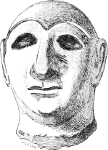
Fig. 109.—Head; from Tello. Actual size. Louvre.
It is mainly to the second Chaldee empire that a whole series of monuments belongs whose characteristics constitute them a class apart;[227] we mean those tablets, generally of some very hard stone, which are inscribed with what we should call title-deeds. Two-thirds of their surface is occupied by several columns of close and fine writing, in which the stipulations of the contract securing the rights of the proprietor are recited. On the upper part, and dominated by several stars and by a great serpent stretching across the upper edge, some emblems are grouped, and these are almost exactly the same in all known examples. There are altars upon which the wedge or arrow-head, the primordial element of that writing without which the preservation of the contract would have been impossible, is either laid upon its side or set up on end. Other altars support horned tiaras, a horse-shoe, and another object which has been made unrecognizable by an unlucky fracture. With these things are mingled several animals, real and fantastic, and many symbols, no doubt of a sacred character, for we find them hung round the necks of Assyrian kings or placed in front of them on the field of their steles.
On one of these monuments, the one we have chosen as the type of the whole series, a double river seems to flow round the stone, and to embrace in its windings the mystic scene we have described. This is the Caillou Michaux, now in the French National Library. In Fig. 110 we give a reproduction of it as a whole, and in Figs. 111 and 112 the upper parts of its two faces on a larger scale.[228] The particular value of each symbol here engraved, is still, and perhaps will always remain, an enigma, but the general significance of their introduction into these documents is easily understood. They give a religious character, a sort of divine sanction, to the titles inscribed upon the stone; they act as witnesses and guarantees. The landmark thus prepared, was set, no doubt, like the Athenian ὅροι, at the limits of the field whose ownership it declared. It became a kind of talisman.[229]
The workmanship of the upper division is very dry and hard; it is not art. These images were not intended to charm the eye; they were only placed on the stone on account of their supposed power of interesting the gods in the preservation of the rights and titles thereon set out. Their execution was therefore left to mere workmen, who sculptured the symbols and animal forms in the most mechanical and perfunctory fashion. They never dreamt of referring to nature and so giving some variety to the traditional forms. This art, if we may call it so, was hieratic in the fullest sense of the term.
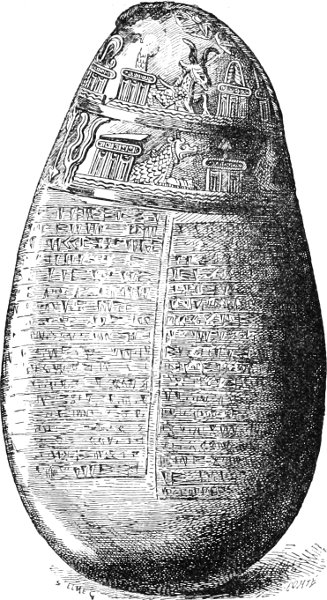
Fig. 110.—The Caillou Michaux. Height 19¾ inches. Drawn by Saint-Elme Gautier.
From our point of view, then, we should gain nothing by multiplying the number of these monuments. They are chiefly interesting to the historian of law and religious beliefs in Chaldæa. The remains for whose recovery we look with the most anxious hope are those of what we have called the classic age of Chaldæan art, an art that must have reached its apogee in the days of Nabopolassar and Nebuchadnezzar. Speaking broadly, we can show nothing produced by the sculptors, painters, and ornamentists who were employed on the decoration of those great buildings which even the Jewish prophets could not help admiring, while they abused the princes who built them and the gods to whom they were consecrated. The earliest Greek travellers, such as Herodotus and Ctesias, only saw the ruins of these magnificent structures and of their rich adornment of enamels, frescoes, and sculptured figures; and yet how great was their wonder! We can hardly reflect without emotion upon what we have lost in great works in stone and metal carried out in the style of which certain fragments from Tello and a few terra-cotta statuettes give us some faint idea.[230]
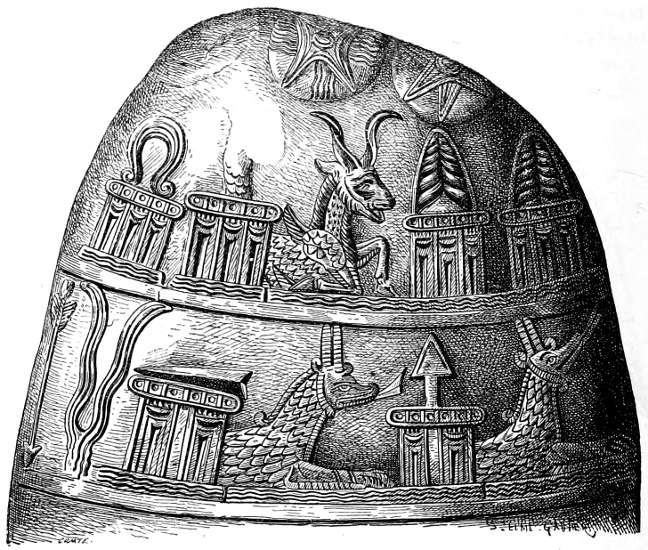
Fig. 111.—The Caillou Michaux, obverse. Drawn by Saint-Elme Gautier.
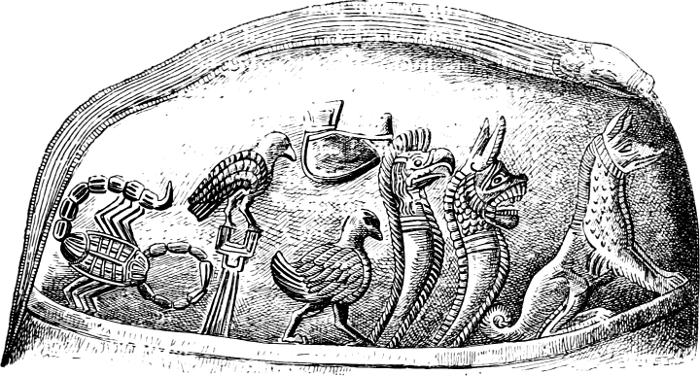
Fig. 112.—The Caillou Michaux, reverse. Drawn by Saint-Elme Gautier.
That such works did once exist we are told by the Greek historians. Herodotus, after having described the temple of Bel and the sanctuary on its summit in which no image of the deity was set up, goes on, “In this temple at Babylon there is another sanctuary lower down, where a great seated statue of Zeus may be seen.[231] Near this statue there is a large table of gold, the throne and its steps are of the same material. The whole, according to the Chaldæans, is worth eight hundred talents of gold ... at one time the sacred inclosure also contained a statue of massive gold twelve cubits high. I did not see it. I content myself with repeating what the Chaldæans told me about it. Darius, the son of Hystaspes, formed a project to carry it off, but he did not dare to execute it. Xerxes, the son of Darius, caused the priest to be put to death by whom the enterprise was opposed, and took possession of the statue.” We here have the evidence of an eye-witness. The seated statue of Bel, without being of the colossal size ascribed by the Chaldæans to the image destroyed by Darius, must yet, if we may judge from the expression of Herodotus, have been larger than nature. We may gather some notion as to its pose and general appearance from certain figures carved upon the cylinders (Fig. 40), just as, in Greece, the more famous and venerable of her religious statues were reproduced upon coins and gems. As to this Babylonian statue, the one doubt we have relates to the value put upon it by the Chaldæans. Had the statue and its surroundings really been of massive gold, would the Persians have spared it when the other was overthrown and broken up? It is possible that in spite of the historian’s assertion the work he describes was only gilded bronze.
And as for the image twelve cubits high, we may express the same doubts. Ctesias seems to have received better information as to how these figures were made than Herodotus, and, through Diodorus, he tells us that they consisted of metal plates beaten into shape with the hammer.[232] Whether Ctesias or his informants did or did not exaggerate their true dimensions (Diodorus speaks of a Bel forty feet high), or whether these figures were of gold or gilded brass, is of comparatively slight importance; we are interested chiefly in the information he gives as to the method of fabrication. Ever since the discovery of the Balawat gates proved to what a height the student art of Assyria carried the manipulation of metal by the repoussé process, we have had no difficulty in believing that the sculptors of Babylon in the time of Nebuchadnezzar could build up images of colossal size and fine decorative effect by means of plaques united with rivets. If we may believe the rest of Diodorus’s description, the Chaldæan artists combined the glory of gold and silver with the purity of ivory and the bright and varied colours of precious stones. And all this we see good reason to admit when we have examined at the British Museum those ivories in which lapis lazuli and other substances of the same kind even now fill up the hollows of the design, while the field still glitters here and there with some last fragments of the gold with which it was once incrusted. The skilful workmen who discovered the secret of this kind of mosaic, may very well have learnt to combine these beautiful materials so well that the statues upon which they were used would even have rivalled the chryselephantine masterpieces of Phidias; in richness and harmony of tones, at least, if not in nobility and purity of form.
§ 6. Assyrian Sculpture.
Assyrian sculpture is far from leading us into the remote centuries from which some of the Chaldæan works must date. It had no period of infancy or childish effort. The Semites of the north were the pupils of their southern brothers, from whom they obtained an art already mature. The oldest known Assyrian monument dates from the reign of Tiglath-Pileser I., or about the end of the twelfth century B.C.; it is a bas-relief chiselled upon a rock near the sources of the Tigris, about fifty miles north of Diarbekir and near the village of Korkhar. It represents the king standing upright, his right hand extended and his left holding a sceptre; at present, however, we only know it by the very poor sketch given by Professor Rawlinson.[233] It is almost the only monument extant from the time when the capital of the monarchy was on the site now known as Kaleh-Shergat. One other may be named, the female torso in the British Museum, to which we have already referred;[234] on it the name of Assurbilkala, who succeeded Tiglath-Pileser I., may be read.
The monumental history of Assyria really begins two centuries later, with the great buildings erected by Assurnazirpal at Calah (Nimroud), his favourite residence. Assyrian art then reached a level that, speaking generally, it never surpassed. In the following centuries it innovated, it became more complex and certainly more refined, but it produced nothing essentially nobler than certain Nimroud bas-reliefs, in which the king is seated among his great officers or before his gods, and always in the attitude of prayer and sacrifice. We have already given several examples of these reliefs (Vol. I. Fig. 4, and above, Figs. 15 and 64); we may here add one more (Fig. 113). Leaning on his bow with his left hand, the king, richly dressed, lifts in his right the patera whose contents he is about to pour as a libation to the deity. Facing him stands a gigantic eunuch, who waves over his master’s head one of those fly-flappers that, with the parasol, have always been among the insignia of Oriental royalty (see Plate X.).
These figures are rather short in their proportions, and the muscular development of their arms, which alone are bare, is violently exaggerated, but yet as a whole the work has a certain grandeur and nobility. The lines are well balanced. Both the king and his attendant seem fully impressed with the gravity of the rite over which they are busy. There is dignity in their attitudes, but no stiffness; their gestures are easy and expressive without being too much accented. In our engraving we have only been able to include the two isolated figures, in the original there are several more all occupied over the same rite. Even the British Museum has only a few fragments from these vast compositions. For those who saw them in their original completeness, well lighted and distributed in their right order along the walls of spacious saloons, they must have seemed majestic enough.
In his palace decorations the Assyrian artist set himself to free his figures from all unnecessary surroundings and to simplify his theme as much as he could. But we must make a distinction between those reliefs that may be called historical, such as the pictures of battles and sieges, and those in which the king is shown in the accomplishment of some duty belonging to his position, and part of his daily or periodical routine. It is to the latter class that the most carefully-executed works belong. In these no particular locality is specified; like that of the Panathenaic procession, it is left undetermined, and the mind of the spectator is silently invited to fill it in for himself. Those who frequented the palace were accustomed to see the king upon his throne, or traversing the wide quadrangle, or pouring libations on the altar that stood in front of the temple; so that they had no difficulty in imagining all that the sculptor had left unsaid. In the hunting pictures the same method was followed with but little modification. A flat surface suggesting the unbroken expanse of the desert, was the only indication of a locus in quo.
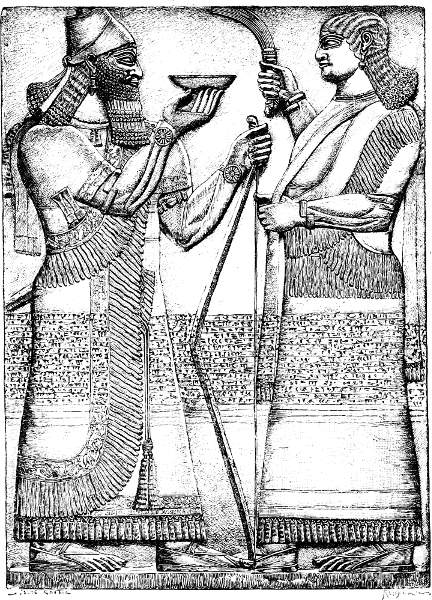
Fig. 113.—Assurnazirpal offering a libation. Height 7 feet 8 inches. British Museum.
Drawn by Saint-Elme Gautier.
It would have been difficult, or rather impossible, to adhere to such a rule in those reliefs in which the actual incidents of military expeditions were retraced. In them the sculptor thought it necessary to insert such details as would permit the various episodes commemorated to be identified. One of the simplest means of insuring the desired result was to render not only buildings, such as castles and fortified towns, but also the natural features of the scene, with the greatest possible truth. This the Assyrian artist did, as a rule, with excellent judgment. Thus, if an action or campaign had been fought in a mountainous country, he made use of a kind of lattice-work or reticulation, which every spectator thoroughly understood (see Vol. I. Figs. 39 and 43); if among forests, he introduced numerous trees among his figures. He made little attempt to distinguish between one kind of tree and another, but in most cases employed forms as conventional as that by which he indicated hills (Fig. 114).
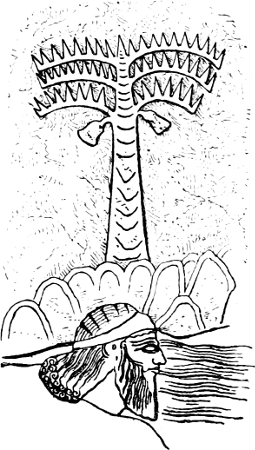
Fig. 114.—Tree on a river bank; from Layard.
One of the chief merits and most striking features of Assyrian sculpture is, then, its power of selection, its rejection of all that is superfluous, its comprehension, in fact, of the true spirit and special conditions of the art. The field has none of those encumbering accessories which, under the pretext of furnishing and defining, only serve, so to speak, to take away air and elbow-room from the figures. When certain complementary features are required to make the subject clear, the sculptor introduces them, but he never gives more than is strictly necessary. He never gives way to the temptation to exaggerate such details, or treats them as if they had an interest and importance of their own. Such sobriety found its reward. His work no doubt remained faulty in many respects and inferior to that of his Egyptian forerunner, still more to that of his Greek successor; but yet it had an air of frankness, of pride and dignity, to which the more complex and superficially more skilful compositions of the following epoch too seldom attained.
The good qualities of this early Assyrian school are no less conspicuous in the colossal figures with which the doorways of palaces and temples were decorated. The head of the winged bull has nowhere a more lofty expression or one more full of dignity than at Nimroud (see below, Fig. 133). The chisels of these northern artists never created anything more bold, energetic, and lifelike than the figures from the small temple built by Assurnazirpal (Vol. I. Fig. 188); we need only mention the colossal lion in the British Museum (Plate VIII.) and the grimacing demon whom a beneficent god seems to be expelling from the sanctuary in spite of his threats and grinning teeth.[235]
And yet this art which is so masterly in some respects is very primitive and naïve in others. We cannot help being amazed, for instance, at the wide band of wedges that the scribe has been allowed to cut across all the lines and contours left by the sculptor. This proceeding is to be explained, of course, by the essentially historical and anecdotic character of Assyrian art, but nevertheless it betrays the contempt for æsthetic effect which is one of the characteristics of archaic art in Assyria. This feature is by no means without importance, and Sir Henry Layard seems to us to have been ill advised in deliberately suppressing it. In his otherwise faithful reproductions of the best preserved among the bas-reliefs of Assurnazirpal he has everywhere left out the continuous band of inscription which runs across them at about two-thirds of their height. By such a proceeding he has sensibly modified their decorative value.[236]
We must be on our guard against attributing such primitive simplicity to inexperience in the use of the chisel. In the finest works of later years that instrument was never wielded with more assured skill than in the delicate carvings in which the embroidery on the royal robes are reproduced. We have already put several of these motives before our readers; in Fig. 115 we give a last exquisite morsel. It shows a winged lion with the head of a woman, and a king or priest who holds one of her paws in his left hand, while with his right he seems to threaten her with a mace.
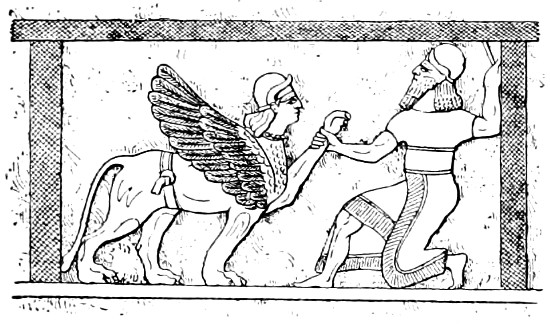
Fig. 115.—Detail from the royal robe of Assurnazirpal; from Layard.
Such dexterity as this is not to be seen in works in the round (see Fig. 60). But with the reign of Assurnazirpal commences another series of royal monuments in which the artist, not being compelled to quit work in relief, felt himself more at home. We refer to those round-headed steles on which the standing figure of the king is relieved against a flat ground bordered by a raised edge. An inscription is engraved sometimes upon the bed of the relief, sometimes on the reverse of the stele. An effigy of Assurnazirpal belonging to this class is now in the British Museum. It was discovered still standing in the entrance to one of the temples built by that sovereign on the platform of Calah. Before the stele there was an altar similar to that shown on page 256 of our first volume. This altar is also in the British Museum.[237] From the existence of these steles it has been concluded, with no little probability, that the Assyrian kings, or at least some of them, received divine honours after their deaths. We have chosen that of Samas-vul II. for reproduction, on account of its good condition (Fig. 116). It differs but little from the stele of Assurnazirpal. High up in the field and in front of the head may be noticed symbols like those on the land marks (see Figs. 111, 112, and 143). The king’s right hand is raised in the attitude of adoration. In his left he holds a sceptre, with a ball of ivory or metal at one end and a tassel at the other. These steles must have been set up in great numbers. We find them represented in the reliefs (Vol. I. Figs. 42 and 112, and Plate XII.) and upon cylinders (ib. Fig. 69). They were raised as a sign of annexation in conquered countries, and an invocation engraved upon the stone put them under the protection of the Assyrian gods, who were charged with the punishment of any who might lay hands upon them.[238]
In the British Museum there are fragments of a sculptured obelisk on which the wars and hunts of Assurnazirpal are figured. It is taller than that of his son Shalmaneser II., being nearly ten feet high, but as the material is a soft limestone, it is in far worse preservation; we only mention it to show that Assyrian art was in possession of all its resources in the time of this king.
Under none of the princes who reigned at Calah did sculpture show any sensible change of style; but yet, perhaps, in certain passages of the Balawat gates we may recognize the first signs of a tendency that was to become strongly marked under the Sargonids. The field of the relief there contains a far greater number of picturesque and explanatory details than the great bas-reliefs of Nimroud. The campaigns and victories of Shalmaneser II. was the theme put before the sculptor. In order to do it justice he had to carry the spectator into countries of various aspects, and to give their true character to military struggles whose conditions were incessantly changing. He did not think success was to be attained by confining himself to figuring the cities and fortresses besieged and taken by the Assyrian army; he introduced features for the purpose of determining the seat of war. Such accessories were better placed among figures on a small scale than among those surpassing or even approaching life size; and without knowing exactly why, the artist seems to have been warned of this by a secret and delicate instinct. These strips of bronze are ten inches high; each is divided into two horizontal divisions by a narrow band of rosettes, which is also repeated at the top and bottom of each strip. The figures are on an average about three and a half inches high (see Fig. 117 and Plate XII.).
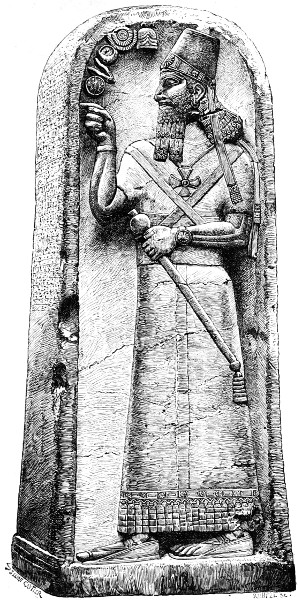
Fig. 116.—Stele of Samas-vul II. Height 7 feet 2 inches. British Museum.
Drawn by Saint-Elme Gautier.
PLATE XII
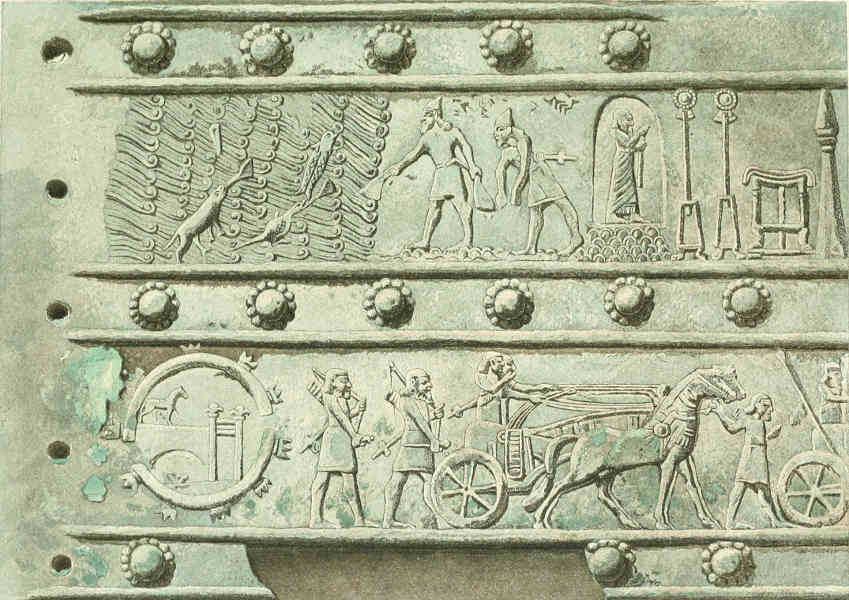
FROM THE BALAWAT GATES
British Museum
Our Plate XII. is an exact copy from a part of the band marked B in the provisional numeration adopted by Dr. Birch.[239] According to the inscription upon it this part of the work commemorates a sacrifice offered by Shalmaneser on the borders of the Lake Van, in Armenia. The figure of the king is not included in our plate, but it contains all the sacred vessels of which he made use for the ceremony. Beginning on the left we find a sort of great candelabrum, a three-legged altar, and two standards upon tripods. Must these be accepted as military ensigns of the same class as that shown in Fig. 46 or as religious emblems of the sun and moon? The question is hardly one for us to discuss. Next comes a stele raised upon a rock, or perhaps carved upon its surface. Other reliefs of the same series show us that Shalmaneser erected these steles in every country he conquered. Further to the right we see soldiers throwing into the lake the limbs of the animals sacrificed. This must be an offering to the deity of its waters, perhaps to Anou, who was believed to reside in rivers and lakes as well as in the sea. The denizens of the lake seize upon the morsels thus put in their way; among them we may recognize a large fish, a tortoise, and a quadruped, that may perhaps be an otter.[240]
In the lower division we see the Assyrian army on the march. On the right Mr. Pinches recognizes a fortified camp in which horses were left for flight in case of defeat. There is, indeed, one of these fortified walls shown in projection, of which we have already spoken, but the horse is placed upon a clearly indicated arch. What is this arch doing in the middle of the camp? We ask ourselves whether this circular structure may not be intended to represent a fortified tête-de-pont. It is abundantly proved that the Assyrians and Chaldæans made great use of the vault. Why should they not have employed it for bridges elsewhere than at Babylon? and wherever there were bridges on the great roads and near their own frontiers what could be more natural than to defend them by works flanked, like this, with towers? The horse would then be about to cross the bridge, and his introduction would be explained simply by the sculptor’s desire to give all possible clearness to a representation which could never be complete. He seems to advance with some precaution as if the floor of the bridge, which is indicated merely by a straight line, was made of tree trunks or roughly squared planks badly joined. We offer this hypothesis for what it may be worth. Next come two archers, and then chariots. The ground must be difficult, for not only does the driver support his horses with a tightened rein, but a man on foot walks in front and holds them by the head.
We find a scene entirely similar but still better treated in the upper division of another plaque (see Fig. 117).[241] Here we may see that the chariots are progressing not without difficulty and even danger, in the very bed of a torrent. The movement of the men who lead the horses is well understood and skilfully rendered; we feel how carefully they have to conduct their advance among the blocks of stone that encumber the bed of the stream and the tumbling water that conceals the nature of the ground. In the lower division we are presented with one of those scenes that are so common in Assyrian reliefs. The king in his royal robes appears on the left; a line of prisoners guarded by archers approach him and beg for mercy, while the foremost among them “kiss the dust beneath his feet,” to use an oriental expression in its most literal sense.
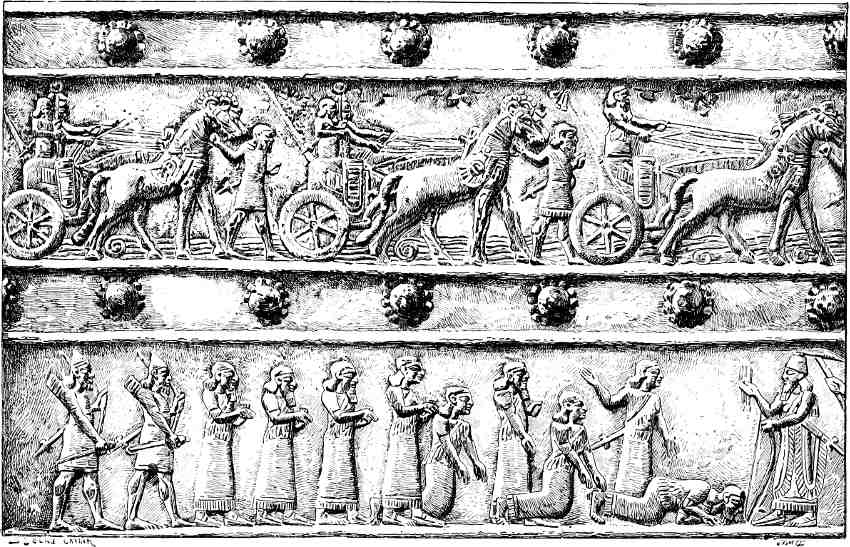
Fig. 117.—Two fragments from the Balawat gates. British Museum. Drawn by Saint-Elme Gautier.
We should have been willing, had it been possible, to make further extracts from this curious series of reliefs; to have shown, here naked prisoners defiling under the eyes of the conqueror, there Assyrian archers shooting at the heaped-up heads of their slain enemies. But we have perforce been content with giving, by a few carefully chosen examples, a fair idea of the work that intervened between the sculptors of Assurnazirpal and those of the Sargonids.
It is probable that the scheme of this vast composition was due to a single mind; from one end to the other there is an obvious similarity of thought and style. But several different hands must have been employed upon its execution, which is far from being of equal merit throughout. It is on examining the original that we are struck by these inequalities. Thus, in some of the long rows of captives the handling is timid and without meaning, while in others it has all the firmness and decision of the best among the alabaster or limestone reliefs; the muscular forms, the action of the calf and knee, are well understood and frankly reproduced. The passages we have chosen for illustration are among the best in this respect. Taking them all in all these bronze reliefs are among the works that do most honour to Assyrian art.
The only monument that has come down to us from the reign of Vulush III., the successor of Samas-vul, is a statue, or rather a pair of statues, of Nebo; the better of the two is reproduced in Fig. 15 of our first volume. These sacred images are of very slight merit from an art point of view; we should hardly have referred to them but for their votive inscriptions. From these we learn that they were consecrated in the Temple of Nebo by the prefect of Calah in order to bespeak the protection of that god for the king. But the latter is not named alone; the faithful subject says that he offers these idols “for his master Vulush and his mistress Sammouramit.”
In this latter name it is difficult not to recognize the Semiramis of the Greeks, and we are led to ask ourselves whether the queen of Vulush may not have afforded a prototype for that legendary princess. This association of a female name with that of the king is almost without parallel either in Chaldæa or Assyria. In royal documents, as well as in those of a more private character, there is no more mention of the royal wives than if they did not exist. Only one explanation can be given of the apparent anomaly, and that is that Sammouramit, for reasons that may be easily guessed, enjoyed a quite exceptional position. It was in those days that, from one reign to another, the princes of Calah attempted to complete the subjugation of Chaldæa. It may have happened that in order to put an end to a state of never-ending rebellion, Vulush married the heiress of some powerful and popular family of the lower country, and, that he might be looked upon as the legitimate ruler of Babylon, joined her name with his in the royal style and title. This hypothesis finds some confirmation in what Herodotus tells us about Semiramis. She was, he says, queen of Babylon five generations before Nitocris, which would be about a century and a half. He adds that she caused the quays of the Euphrates to be built.[242] This takes us back to rather beyond the middle of the eighth century B.C., that is very near to the date which Assyrian chronology would fix for the reign of Vulush (810–781). As the last representative of the old national dynasty, this Semiramis, associated as she was in the exercise, or at least in the show, of sovereign power both in Assyria and Chaldæa, would not be forgotten by her countrymen, and the population of Babylon would be especially likely to magnify the part she had played. There is nothing fabulous in the tradition as Herodotus gives it, although it may, perhaps, go beyond the truth here and there. Ctesias, however, goes much farther. He brings together and amplifies tales which had already received many additions in the half century that separated him from Herodotus, and he thus creates the type of that Semiramis, the wife of Ninus and the conqueror of all Asia, who so long held an undeserved place in ancient history.[243]
The last Calah prince who has left us anything is Tiglath-Pileser II. (745–727). We have already described how his palace was destroyed by Esarhaddon, who employed its materials for his own purposes.[244] At the British Museum there are a few fragments which have been recognized by their inscriptions as belonging to his work (Vol. I. Fig. 26)[245]; they are quite similar to those of his immediate predecessors.
With the new dynasty founded by Sargon at the end of the eighth century taste changed fast enough. In those bas-reliefs in the Khorsabad palace which represent that king’s campaigns, many details are treated in a spirit very different from that of former days. Trees, for instance, are no longer abstract signs standing for no one kind of vegetation more than another; the sculptor begins to notice their distinguishing features and to give their proper physiognomy to the different countries overrun by the Assyrians. But these landscape backgrounds are not to be found in all the bas-reliefs of Khorsabad.[246]
The art of Sargon was an art of transition. While on the one hand it endeavoured to open up new ground, on the other it travelled on the old ways and followed many of the ancient errors; it had a marked predilection for figures larger than nature, and bas-reliefs treating of royal pageants and processions remind us by the simplicity of their conception of those of Assurnazirpal. We have already given many fragments (Vol I. Figs. 22–24, and 29), and now we give another, a vizier and a eunuch standing before the king in the characteristic attitude of respect (Fig. 118). The inscription which cut the figures of Assurnazirpal so awkwardly in two has disappeared; the proportions have gained in slenderness, and the muscular development, though still strongly marked, has lost some of its exaggeration. All this shows progress, and yet on the whole the Louvre relief is less happy in its effect than the best of the Nimroud sculptures in the British Museum. The execution is neither so firm nor so frank; the relief is much higher and the modelling a little heavy and bulbous in consequence. This result may also be caused to some extent by the nature of the material, which is a softer alabaster than was employed, so far as we know, in any other part of Assyria. At Nimroud a fine limestone was chiefly used.
We shall be contented with mentioning the stele of Sargon, found near Larnaca, in Cyprus, in 1845. It is most important as an historical monument; it proves that, as a sequel to his Syrian conquests, the terror of Sargon’s name was so widespread that even the inhabitants of the islands thought it prudent to declare themselves his vassals, and to set up his image as a sign of homage rendered and allegiance sworn. But the stone is now too much broken to be of any great interest as a work of art.[247]
The artistic masterpiece of this epoch is the bronze lion figured in our Plate XI. It had been suggested that its use was to hold down the cords of a tent or the lower edge of tapestries, a purpose for which the weight of the bronze and the ring fixed in its back make it well suited. This idea had to be abandoned, however, when a whole series of similar figures marked with the name of Sennacherib was found. Their execution was hardly equal to that of the lion we have figured, but their general characteristics were the same, and they had rings on their backs.[248]
These lions are sixteen in number; they form a series in which the size of the animal becomes steadily smaller with each example; the largest is a foot long, the smallest hardly more than an inch. The decrease seems to follow a certain rule, but rust has affected them too greatly for it to be easy to base any metrological calculation upon their weight. But all doubt as to their use is removed by the inscriptions in cuneiform and in ancient Aramaic characters with which several of them are engraved. The Aramaic inscriptions all begin with the word mine; then comes a figure indicating the number of mines, or of subdivisions of the mine that the weight represents; finally, there is the name of some personage, who may perhaps have been a magistrate charged with the regulation and verification of weights.
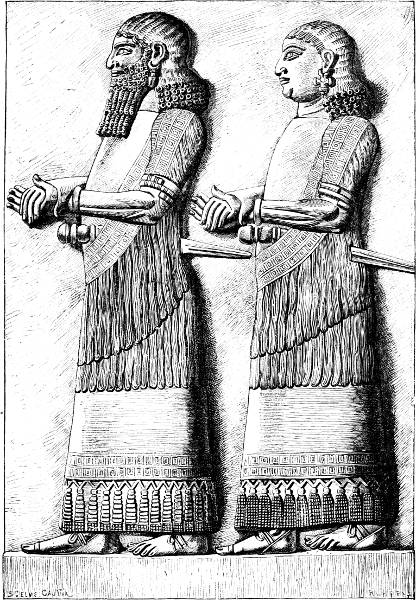
Fig. 118.—Bas-relief from Khorsabad. Height 9 feet 5 inches. Louvre.
With the accession of Sennacherib, a sensible change comes over the aspect of the reliefs. What until now has been the exception becomes the rule. On almost every slab we find a complex and carefully treated landscape background. The artist is not satisfied with indicating the differences between conifers, cypresses, and pines (Vol. I. Figs, 41–43), palms (ib. Figs. 30 and 34; and above, Fig. 21), the vine (Fig. 47), and the tall reeds and grasses of the marsh (Fig. 119) are also imitated.[249]
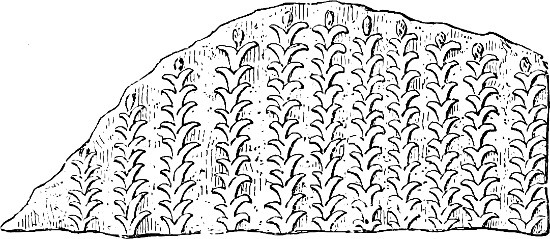
Fig. 119.—Marsh vegetation; from Layard.
We feel that the sculptor wished to reproduce all those subordinate features of nature by which his eye was amused on the Assyrian plains; he seems almost to have taken photographs from nature, and then to have transferred them to the palace walls by the aid of his patient chisel. Look, for instance, at the reliefs in which the process of building Sennacherib’s palace is narrated. The sculptor is not content with retracing, in a spirit of uncompromising reality, all the operations implied by so great an undertaking; he gives backgrounds to his pictures in which he introduces, on a smaller scale, many details that have nothing to do with the main subject of the relief. Thus we find a passage in which men are shown carting timber, and another in which they are dragging a winged bull, both surmounted by a grove of cypresses, while still higher on the slab, and, therefore, in the intention of the sculptor, on a more distant horizon, we see a river, upon which boatmen propel their clumsy vessels, and fishermen, astride on inflated skins, drift with the stream, while fishes nibble at their baited lines.[250]
Neither boatmen nor fishermen have anything to do with the building of the great edifice that occupies so many minds and arms within a stone’s throw of where they labour. They are introduced merely to amuse the eye of the spectator by the faithful representation of life; a passage of what we call genre has crept into an historical picture. Elsewhere it is landscape proper that is thus introduced. One of the slabs of this same series ends in a row of precipitous heights covered with cypresses, vines, fig and pomegranate trees, and a sort of dwarf palm or chamærops.[251]
They thought no doubt that the spectators of such pictures would be delighted to have the shadowy freshness of the orchards that bordered the Tigris, the variety of their foliage and the abundant fruit under which their branches bent to the ground, thus recalled to their minds. The group of houses that we have figured for the sake of their domed roofs, forms a part of one of these landscape backgrounds (Vol. I. Fig. 43).[252]
We might multiply examples if we chose. There is hardly a relief from Sennacherib’s palace in which some of those details which excite curiosity by their anecdotic and picturesque character are not introduced.[253] We find evidence of the same propensity in the decoration of the long, inclined passage that led from the summit of the mound down to the banks of the Tigris. There the sculptor has represented what must have actually taken place in the passage every day; on the one hand grooms leading their horses to water, on the other servants carrying up meat, fruit, and drink for the service of the royal table and for the army of officers and dependants of every kind that found lodging in the palace.[254]