A CIVIC BIOLOGY (continued 7)
Reading edition
Alcohol unites more easily with oxygen than most other food materials, hence it takes away oxygen that would otherwise be used in oxidizing these foods. Imperfect oxidation of foods causes the development and retention of poisons in the blood which it becomes the work of the kidneys to remove. If the kidneys become overworked, disease will occur. Such disease is likely to make itself felt as rheumatism or gout, both of which are believed to be due to waste products (poisons) in the blood.
Poisons produced by Alcohol.—When too little oxygen enters the draft of the stove, the wood is burned imperfectly, and there are clouds of smoke and irritating gases. So, if oxygen unites with the alcohol and too little reaches the cells, instead of carbon dioxide, water, and urea being formed, there are other products, some of which are exceedingly poisonous and which the kidneys handle with difficulty. The poisons retained in the circulation never fail to produce their poisonous effects, as shown by headaches, clouded brain, pain, and weakness of the body. The word "intoxication" means "in a state of poisoning." These poisons gradually accumulate as the alcohol takes oxygen from the cells. The worst effects come last, when the brain is too benumbed to judge fairly of their harm.
Reference Books
elementary
Hunter, Laboratory Problems in Civic Biology. American Book Company.
Davison, Human Body and Health. American Book Company.
Gulick, Hygiene Series, Emergencies, Good Health. Ginn and Company.
Hough and Sedgwick, The Human Mechanism. Ginn and Company.
Macy, General Physiology. American Book Company.
Ritchie, Human Physiology. World Book Company.
XXIII. BODY CONTROL AND HABIT FORMATION
Problems.—How is body control maintained?
(a) What is the mechanism of direction and control?
(b) What is the method of direction and control?
(c) What are habits? How are they formed and how broken?
(d) What are the organs of sense? What are their uses?
(e) How does alcohol affect the nervous system?
Laboratory Suggestions
Demonstration.—Sensory motor reactions.
Demonstration.—Nervous system. Models and frog dissections.
Demonstration.—Neurones under compound microscope (optional).
Demonstration.—Reflex acts are unconscious acts: show how conscious acts may become habitual.
Home exercise in habit forming.
The senses.—Home exercises.—(1) To determine areas most sensitive to touch. (2) To determine or map out hot and cold spots on an area on the wrist. (3) To determine functions of different areas on tongue.
Demonstration.—Show how eye defects are tested.
Laboratory summary.—The effects of alcohol on the nervous system.
The Body a Self-directed Machine.—Throughout the preceding chapters the body has been likened to an engine, which, while burning its fuel, food, has done work. If we were to carry our comparison further, however, the simile ceases. For the engineer runs the engine, while the bodily machine is self-directive.
Moreover, most of the acts we perform during a day's work are results of the automatic working of this bodily machine. The heart pumps; the blood circulates its load of food, oxygen, and wastes; the movements of breathing are performed; the thousand and one complicated acts that go on every day within the body are seemingly undirected.
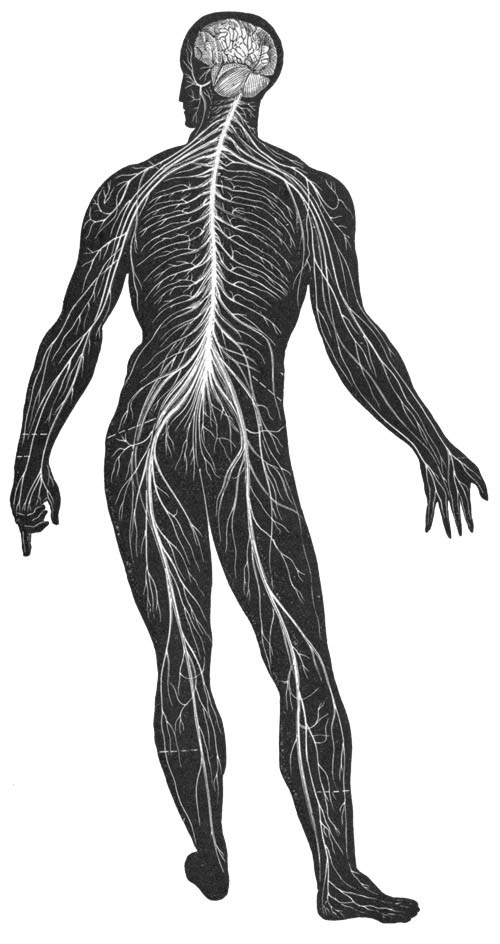
The central nervous system.
Automatic Activity.—In addition to this, numbers of other of our daily acts are not thought about. If we are well-regulated body machines, we get up in the morning, automatically wash, clean our teeth, dress, go to the toilet, get our breakfast, walk to school, even perform such complicated processes as that of writing, without thinking about or directing the machine. In these respects we have become creatures of habit. Certain acts which once we might have learned consciously, have become automatic.
But once at school, if we are really making good in our work in the classroom, we begin a higher control of our bodily functions. Automatic control acts no longer, and sensation is not the only guide—for we now begin to make conscious choice; we weigh this matter against another,—in short, we think.
Parts of the Nervous System.—This wonderful self-directive apparatus placed within us, which is in part under control of our will, is known as the nervous system. In the vertebrate animals, including man, it consists of two divisions. One includes the brain, spinal cord, the cranial and spinal nerves, which together make up the cerebro-spinal nervous system. The other division is called the sympathetic nervous system and has to do with those bodily functions which are beyond our control. Every group of cells in the body that has work to do (excepting the floating cells of the blood) is directly influenced by these nerves. Our bodily comfort is dependent upon their directive work. The organs which put us in touch with our surroundings are naturally at the surface of the body. Small collections of nerve cells, called ganglia, are found in all parts of the body. These nerve centers are connected, to a greater or less degree, with the surface of the body by the nerves, which serve as pathways between the end organs of touch, sight, taste, etc., and the centers in the brain or spinal cord. Thus sensation is obtained.
Sensations and Reactions.—We have already seen that simpler forms of life perform certain acts because certain outside forces acting upon them cause them to react to the stimulus from without. The one-celled animal responds to the presence of food, to heat, to oxygen, to other conditions in its surroundings. An earthworm is repelled by light, is attracted by food. All animals, including man, are put in touch with their surroundings by what we call the organs of sensation. The senses of man, besides those we commonly know as those of sight, hearing, taste, smell, and touch, are those of temperature, pressure, and pain. It is obvious that such organs, if they are to be of use to an animal, must be at the outside of the body. Thus we find eyes and ears in the head, and taste cells in the mouth, while other cells in the nose perceive odors, and still others in the skin are sensitive to heat or cold, pressure or pain.
But this is not all. Strangely enough, we do not see with our eyes or taste with our taste cells. These organs receive the sensations, and by means of a complicated system of greatly elongated cell structures, the message is sent inward, relayed by other elongated cells until the sensory message reaches an inner station, in the central nervous system. We see and hear and smell in our brain. Let us next examine the structure of the nerve cells or neurons part of which serve as pathways for these messages.
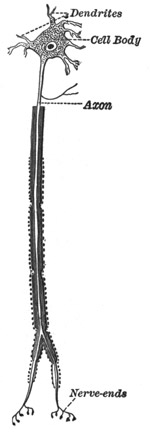
Diagram of a neuron or nerve unit.
Neurones.—A nerve cell, like other cells in the body, is a mass of protoplasm containing a nucleus. But the body of the nerve cell is usually rather irregular in shape, and distinguished from most other cells by possessing several delicate, branched protoplasmic projections called dendrites. One of these processes, the axon, is much longer than the others and ends in a muscle or organ of sensation. The axon forms the pathway over which nervous impulses travel to and from the nerve centers.
A nerve consists of a bundle of such tiny axons, bound together by connective tissue. As a nerve ganglia is a center of activity in the nervous system, so a cell body is a center of activity which may send an impulse over this thin strand of protoplasm (the axon) prolonged many hundreds of thousands of times the length of the cell. Some neurones in the human body, although visible only under the compound microscope, give rise to axons several feet in length.
Because some bundles of axons originate in organs that receive sensations and send those sensations to the central nervous system, they are called sensory nerves. Other axons originate in the central nervous system and pass outward as nerves producing movement of muscles. These are called motor nerves.
The Brain of Man.—In man, the central nervous system consists of a brain and spinal cord inclosed in a bony case. From the brain, twelve pairs of nerves are given off; thirty-one pairs more leave the spinal cord. The brain has three divisions. The cerebrum makes up the largest part. In this respect it differs from the cerebrum of the frog and other vertebrates. It is divided into two lobes, the hemispheres, which are connected with each other by a broad band of nerve fibers. The outer surface of the cerebrum is thrown into folds or convolutions which give a large surface, the cell bodies of the neurons being found in this part of the cerebrum. Holding the cell bodies and fibers in place is a kind of connective tissue. The inner part (white in color) is composed largely of fibers which pass to other parts of the brain and down into the spinal cord. Under the cerebrum, and dorsal to it, lies the little brain, or cerebellum. The two sides of the cerebellum are connected by a band of nerve fibers which run around into the lower hindbrain or medulla. This band of fibers is called the pons. The medulla is, in structure, part of the spinal cord, and is made up largely of fibers running longitudinally.
The Sympathetic Nervous System.—Connected with the central nervous system is that part of the nervous apparatus that controls the muscles of the digestive tract and blood vessels, the secretions of gland cells, and all functions which have to do with life processes in the body. This is called the sympathetic nervous system.
Functions of the Parts of the Central Nervous System of the Frog.—From careful study of living frogs, birds, and some mammals we have learned much of what we know of the functions of the parts of the central nervous system in man.
It has been found that if the entire brain of a frog is destroyed and separated from the spinal cord, "the frog will continue to live, but with a very peculiarly modified activity." It does not appear to breathe, nor does it swallow. It will not move or croak, but if acid is placed upon the skin so as to irritate it, the legs make movements to push away and to clean off the irritating substance. The spinal cord is thus shown to be a center for defensive movements. If the cerebrum is separated from the rest of the nervous system, the frog seems to act a little differently from the normal animal. It jumps when touched, and swims when placed in water. It will croak when stroked, or swallow if food be placed in its mouth. But it manifests no hunger or fear, and is in every sense a machine which will perform certain actions after certain stimulations. Its movements are automatic. If now we watch the movements of a frog which has the brain uninjured in any way, we find that it acts spontaneously. It tries to escape when caught. It feels hungry and seeks food. It is capable of voluntary action. It acts like a normal individual.
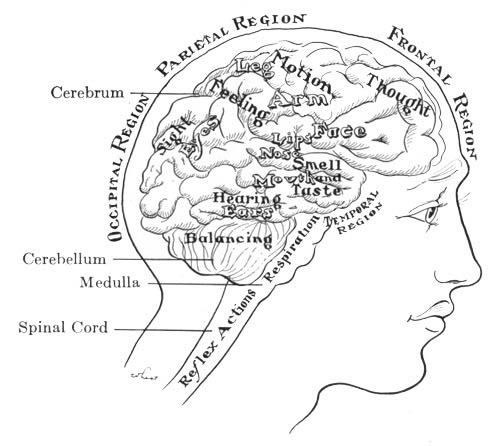
Diagram to show the parts of the brain and action of the different parts of the brain.
Functions of the Cerebrum.—In general, the functions of the different parts of the brain in man agree with those functions we have already observed in the frog. The cerebrum has to do with conscious activity; that is, thought. It presides over what we call our thoughts, our will, and our sensations. A large part of the area of the outer layer of the cerebrum seems to be given over to some one of the different functions of speech, hearing, sight, touch, movements of bodily parts. The movement of the smallest part of the body appears to have its definite localized center in the cerebrum. Experiments have been performed on monkeys, and these, together with observations made on persons who had lost the power of movement of certain parts of the body, and who, after death, were found to have had diseases localized in certain parts of the cerebrum, have given to us our knowledge on this subject.
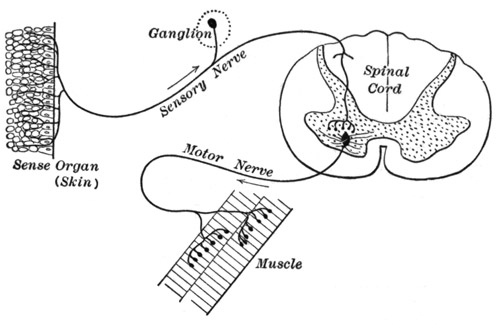
Diagram of the nerve path of a simple reflex action.
Reflex Actions; their Meaning.—If through disease or for other reasons the cerebrum does not function, no will power is exerted, nor are intelligent acts performed. All acts performed in such a state are known as reflex actions. The involuntary brushing of a fly from the face, or the attempt to move away from the source of annoyance when tickled with a feather, are examples of reflexes. In a reflex act, a person does not think before acting. The nervous impulse comes from the outside to cells that are not in the cerebrum. The message is short-circuited back to the surface by motor nerves, without ever having reached the thinking centers. The nerve cells which take charge of such acts are located in the cerebellum or spinal cord.
Automatic Acts.—Some acts, however, are learned by conscious thought, as writing, walking, running, or swimming. Later in life, however, these activities become automatic. The actual performance of the action is then taken up by the cerebellum, medulla, and spinal ganglia. Thus the thinking portion of the brain is relieved of part of its work.
Bundles of Habits.—It is surprising how little real thinking we do during a day, for most of our acts are habitual. Habit takes care of our dressing, our bathing, our care of the body organs, our methods of eating; even our movements in walking and the kind of hand we write are matters of habit forming. We are bundles of habits, be they good ones or bad ones.
Habit Formation.—The training of the different areas in the cerebrum to do their work well is the object of education. When we learned to write, we exerted conscious effort in order to make the letters. Now the act of forming the letters is done without thought. By training, the act has become automatic. In the beginning, a process may take much thought and many trials before we are able to complete it. After a little practice, the same process may become almost automatic. We have formed a habit. Habits are really acquired reflex actions. They are the result of nature's method of training. The conscious part of the brain has trained the cerebellum or spinal cord to do certain things that, at first, were taken charge of by the cerebrum.
Importance of Forming Right Habits.—Among the habits early to be acquired are the habits of studying properly, of concentrating the mind, of learning self-control, and, above all, of contentment. Get the most out of the world about you. Remember that the immediate effect in the study of some subjects in school may not be great, but the cultivation of correct methods of thinking may be of the greatest importance later in life. The man or woman who has learned how to concentrate on a problem, how to weigh all sides with an unbiased mind, and then to decide on what they believe to be best and right are the efficient and happy ones of their generation.
"The hell to be endured hereafter, of which theology tells, is no worse than the hell we make for ourselves in this world by habitually fashioning our characters in the wrong way. Could the young but realize how soon they will become mere walking bundles of habits, they would give more heed to their conduct while in the plastic state. We are spinning our own fates, good or evil, and never to be undone. Every smallest stroke of virtue or of vice leaves its never-so-little scar. The drunken Rip Van Winkle, in Jefferson's play, excuses himself for every fresh dereliction by saying, 'I won't count this time!' Well! he may not count it, and a kind Heaven may not count it; but it is being counted none the less. Down among his nerve cells and fibers the molecules are counting it, registering and storing it up to be used against him when the next temptation comes. Nothing we ever do is, in strict scientific literalness, wiped out. Of course this has its good side as well as its bad one. As we become permanent drunkards by so many separate drinks, so we become saints in the moral, and authorities in the practical and scientific, spheres by so many separate acts and hours of work. Let no youth have any anxiety about the upshot of his education, whatever the line of it may be. If he keep faithfully busy each hour of the working day, he may safely leave the final result to itself. He can with perfect certainty count on waking up some fine morning, to find himself one of the competent ones of his generation, in whatever pursuit he may have singled out."—James, Psychology.
Some Rules for Forming Good Habits.—Professor Horne gives several rules for making good or breaking bad habits. They are: "First, act on every opportunity. Second, make a strong start. Third, allow no exception. Fourth, for the bad habit establish a good one. Fifth, summoning all the man within, use effort of will." Why not try these out in forming some good habit? You will find them effective.
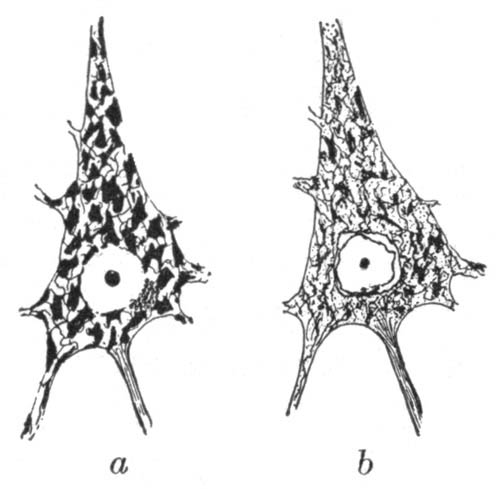
The effect of fatigue on nerve cells. a, healthy brain cell; b, fatigued brain cell.
Necessity of Food, Fresh Air, and Rest.—The nerve cells, like all other cells in the body, are continually wasting away and being rebuilt. Oxidation of food material is more rapid when we do mental work. The cells of the brain, like muscle cells, are not only capable of fatigue, but show this in changes of form and of contents. Food brought to them in the blood, plenty of fresh air, especially when engaged in active brain work, and rest at proper times, are essential in keeping the nervous system in condition. One of the best methods of resting the brain cells is a change of occupation. Tennis, golf, baseball, and other outdoor sports combine muscular exercise with brain activity of a different sort from that of business or school work. But change of occupation will not rest exhausted neurones. For this, sleep is necessary. Especially is sleep an important factor in the health of the nervous system of growing children.
Necessity of Sleep.—Most brain cells attain their growth early in life. Changes occur, however, until some time after the school age. Ten hours of sleep should be allowed for a child, and at least eight hours for an adult. At this time, only, do the brain cells have opportunity to rest and store food and energy for their working period.
Sleep is one way in which all cells in the body, and particularly those of the nervous system, get their rest. The nervous system, by far the most delicate and hardest-worked set of tissues in the body, needs rest more than do other tissues, for its work directing the body only ends with sleep or unconsciousness. The afternoon nap, snatched by the brain worker, gives him renewed energy for his evening's work. It is not hard application to a task that wearies the brain; it is continuous work without rest.
the senses
Touch.—In animals having a hard outside covering, such as certain worms, insects, and crustaceans, minute hairs, which are sensitive to touch, are found growing out from the body covering. At the base of these hairs are found neurones which send axons inward to the central nervous system.
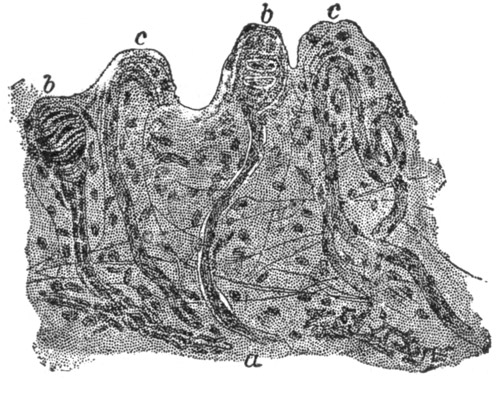
Nerves in the skin: a, nerve fiber; b, tactile papillæ, containing a tactile corpuscle; c, papillæ containing blood vessels. (After Benda.)
Organs of Touch.—In man, the nervous mechanism which governs touch is located in the folds of the dermis or in the skin. Special nerve endings, called the tactile corpuscles, are found there, each inclosed in a sheath or capsule of connective tissue. Inside is a complicated nerve ending, and axons pass inward to the central nervous system. The number of tactile corpuscles present in a given area of the skin determines the accuracy and ease with which objects may be known by touch.
If you test the different parts of the body, as the back of the hand, the neck, the skin of the arm, of the back, or the tip of the tongue, with a pair of open dividers, a vast difference in the accuracy with which the two points may be distinguished is noticed. On the tip of the tongue, the two points need only be separated by 1/24 of an inch to be so distinguished. In the small of the back, a distance of 2 inches may be reached before the dividers feel like two points.
Temperature, Pressure, Pain.—The feeling of temperature, pressure, and pain is determined by different end organs in the skin. Two kinds of nerve fibers exist in the skin, which give distinct sensations of heat and cold. These nerve endings can be located by careful experimentation. There are also areas of nerve endings which are sensitive to pressure, and still others, most numerous of all, sensitive to pain.
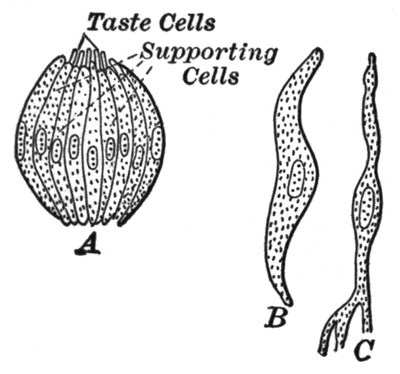
A, isolated taste bud, from whose upper free end project the ends of the taste cells; B, supporting or protecting cell; C, sensory cell.
Taste Organs.—The surface of the tongue is folded into a number of little projections known as papillæ. These may be more easily found on your own tongue if a drop of vinegar is placed on its broad surface. In the folds, between these projections on the top and back part of the tongue, are located the organs of taste. These organs are called taste buds.
Each taste bud consists of a collection of spindle-shaped neurones, each cell tipped at its outer end with a hairlike projection. These cells send inward fibers to other cells, the fibers from which ultimately reach the brain. The sensory cells are surrounded by a number of projecting cells which are arranged in layers about them. Thus the organ in longitudinal section looks somewhat like an onion cut lengthwise.
How we Taste.—Four kinds of substances may be distinguished by the sense of taste. These are sweet, sour, bitter, and salt. Certain taste cells located near the back of the tongue are stimulated only by a bitter taste. Sweet substances are perceived by cells near the tip of the tongue, sour substances along the sides, and salt about equally all over the surface. A substance must be dissolved in fluid in order to be tasted. Many things which we believe we taste are in reality perceived by the sense of smell. Such are spicy sauces and flavors of meats and vegetables. This may easily be proved by holding the nose and chewing, with closed eyes, several different substances, such as an apple, an onion, and a raw potato.
Smell.—The sense of smell is located in the membrane lining the upper part of the nose. Here are found a large number of rod-shaped cells which are connected with the brain by means of the olfactory nerve. In order to perceive odors, it is necessary to have them diffused in the air; hence we sniff so as to draw in more air over the olfactory cells.
The Organ of Hearing.—The organ of hearing is the ear. The outer ear consists of a funnel-like organ composed largely of cartilage which is of use in collecting sound waves. This part of the ear incloses the auditory canal, which is closed at the inner end by a tightly stretched membrane, the tympanic membrane or ear drum. The function of the tympanic membrane is to receive sound waves, for all sound is caused by vibrations in the air, these vibrations being transmitted, by the means of a complicated apparatus found in the middle ear, to the real organ of hearing located in the inner ear.
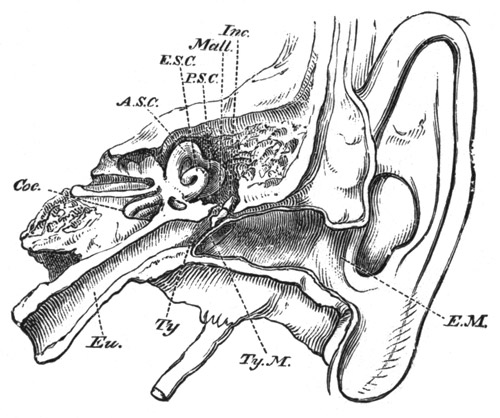
Section of ear: E.M., auditory canal; Ty.M., tympanic membrane; Eu., Eustachian tube; Ty, middle ear; Coc., A.S.C., E.S.C., etc., internal ear.
Middle Ear.—The middle ear in man is a cavity inclosed by the temporal bone, and separated from the outer ear by the tympanic membrane. A little tube called the Eustachian tube connects the inner ear with the mouth cavity. By allowing air to enter from the mouth, the air pressure is equalized on the ear drum. For this reason, we open the mouth at the time of a heavy concussion and thus prevent the rupture of the delicate tympanic membrane. Placed directly against the tympanic membrane and connecting it with the inner ear is a chain of three tiny bones, the smallest bones of the body. The outermost is called the hammer; the next the anvil; the third the stirrup. All three bones are so called from their resemblances in shape to the articles for which they are named. These bones are held in place by very small muscles which are delicately adjusted so as to tighten or relax the membranes guarding the middle and inner ear.
The Inner Ear.—The inner ear is one of the most complicated, as well as one of the most delicate, organs of the body. Deep within the temporal bone there are found two parts, one of which is called, collectively, the semicircular canal region, the other the cochlea, or organ of hearing.
It has been discovered by experimenting with fish, in which the semicircular canal region forms the chief part of the ear, that this region has to do with the equilibrium or balancing of the body. We gain in part our knowledge of our position and movements in space by means of the semicircular canals.
That part of the ear which receives sound waves is known as the cochlea, or snail shell, because of its shape. This very complicated organ is lined with sensory cells provided with cilia. The cavity of the cochlea is filled with a fluid. It is believed that somewhat as a stone thrown into water causes ripples to emanate from the spot where it strikes, so sound waves are transmitted by means of the fluid filling the cavity to the sensory cells of the cochlea (collectively known as the organ of Corti) and thence to the brain by means of the auditory nerve.
The Character of Sound.—When vibrations which are received by the ear follow each other at regular intervals, the sound is said to be musical. If the vibrations come irregularly, we call the sound a noise. If the vibrations come slowly, the pitch of the sound is low; if they come rapidly, the pitch is high. The ear is able to perceive as low as thirty vibrations per second and as high as almost thirty thousand. The ear can be trained to recognize sounds which are unnoticed in untrained ears.
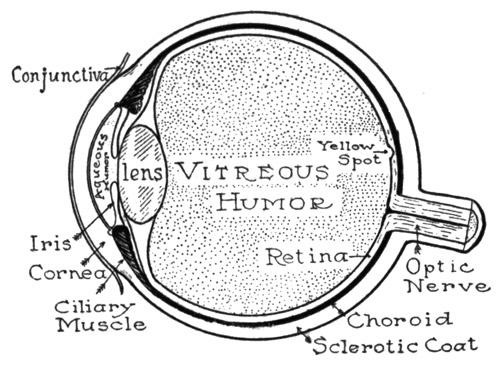
Longitudinal section through the eye.
The Eye.—The eye or organ of vision is an almost spherical body which fits into a socket of bone, the orbit. A stalklike structure, the optic nerve, connects the eye with the brain. Free movement is obtained by means of six little muscles which are attached to the outer coat, the eyeball, and to the bony socket around the eye.
The wall of the eyeball is made up of three coats. An outer tough white coat, of connective tissue, is called the sclerotic coat. Under the sclerotic coat, in front, the eye bulges outward a little. Here the outer coat is continuous with a transparent tough layer called the cornea. A second coat, the choroid, is supplied with blood vessels and cells which bear pigments. It is a part of this coat which we see through the cornea as the colored part of the eye (the iris). In the center of the iris is a small circular hole (the pupil). The iris is under the control of muscles, and may be adjusted to varying amounts of light, the hole becoming larger in dim light, and smaller in bright light. The inmost layer of the eye is called the retina. This is, perhaps, the most delicate layer in the entire body. Despite the fact that the retina is less than 1/80 of an inch in thickness, there are several layers of cells in its composition. The optic nerve enters the eye from behind and spreads out to form the surface of the retina. Its finest fibers are ultimately connected with numerous elongated cells which are stimulated by light. The retina is dark purple in color, this color being caused by a layer of cells next to the choroid coat. This accounts for the black appearance of the pupil of the eye, when we look through the pupil into the darkened space within the eyeball. The retina acts as the sensitized plate in the camera, for on it are received the impressions which are transformed and sent to the brain as sensations of sight. The eye, like the camera, has a lens. This lens is formed of transparent, elastic material. It is found directly behind the iris and is attached to the choroid coat by means of delicate ligaments. In front of the lens is a small cavity filled with a watery fluid, the aqueous humor, while behind it is the main cavity of the eye, filled with a transparent, almost jellylike, vitreous humor. The lens itself is elastic. This circumstance permits of a change of form and, in consequence, a change of focus upon the retina of the lens. By means of this change in form, or accommodation, we are able to distinguish between near and distant objects.

How far away can you read these letters? Measure the distance. Twenty feet is a test for the normal eye.
Defects in the Eye.—In some eyes, the lens is in focus for near objects, but is not easily focused upon distant objects; such an eye is said to be nearsighted. Other eyes which do not focus clearly on objects near at hand are said to be farsighted. Still another eye defect is astigmatism, which causes images of lines in a certain direction to be indistinct, while images of lines transverse to the former are distinct. Many nervous troubles, especially headaches, may be due to eye strain. We should have our eyes examined from time to time, especially if we are subject to headaches.
The Alcohol Question.—It is agreed by investigators that in large or continued amounts alcohol has a narcotic effect; that it first dulls or paralyzes the nerve centers which control our judgment, and later acts upon the so-called motor centers, those which control our muscular activities.
The reason, then, that a man in the first stages of intoxication talks rapidly and sometimes wittily, is because the centers of judgment are paralyzed. This frees the speech centers from control exercised by our judgment, with the resultant rapid and free flow of speech.
In small amounts alcohol is believed by some physiologists to have always this same narcotic effect, while other physiologists think that alcohol does stimulate the brain centers, especially the higher centers, to increased activity. Some scientific and professional men use alcohol in small amounts for this stimulation and report no seeming harm from the indulgence. Others, and by far the larger number, agree that this stimulation from alcohol is only apparent and that even in the smallest amounts alcohol has a narcotic effect.
The Paralyzing Effects of Alcohol on the Nervous System.—Alcohol has the effect of temporarily paralyzing the nerve centers. The first effect is that of exhilaration. A man may do more work for a time under the stimulation of alcohol. This stimulation, however, is of short duration and is invariably followed by a period of depression and inertia. In this latter state, a man will do less work than before. In larger quantities, alcohol has the effect of completely paralyzing the nerve centers. This is seen in the case of a man "dead drunk." He falls in a stupor because all of the centers governing speech, sight, locomotion, etc., have been temporarily paralyzed. If a man takes a very large amount of alcohol, even the nerve centers governing respiration and circulation may become poisoned, and the victim will die.
Effect on the Organs of Special Sense.—Professor Forel, one of the foremost European experts on the question of the effect of alcohol on the nervous system, says: "Through all parts of nervous activity from the innervation of the muscles and the simplest sensation to the highest activity of the soul the paralyzing effect of alcohol can be demonstrated." Several experimenters of undoubted ability have noted the paralyzing effect of alcohol even in small doses. By the use of delicate instruments of precision, Ridge tested the effect of alcohol on the senses of smell, vision, and muscular sense of weight. He found that two drams of absolute alcohol produced a positive decrease in the sensitiveness of the nerves of feeling, that so small a quantity as one half dram of absolute alcohol diminished the power of vision and the muscular sense of weight. Kraepelin and Kurz by experiment determined that the acuteness of the special senses of sight, hearing, touch, taste, and smell was diminished by an ounce of alcohol, the power of vision being lost to one third of its extent and a similar effect being produced on the other special senses. Other investigators have reached like conclusions. There is no doubt but that alcohol, even in small quantities, renders the organs of sense less sensitive and therefore less accurate.
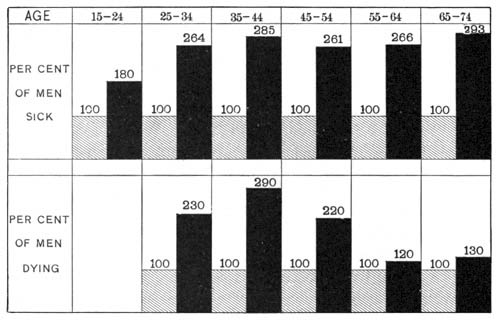
Table to show a comparison of chances of illness and death in drinkers and non-drinkers. Solid black, drinkers. (From German sources.)
Effect of Alcohol on the Ability to Resist Disease.—Among certain classes of people the belief exists that alcohol in the form of brandy or some other drink or in patent medicines, malt tonics, and the like is of great importance in building up the body so as to resist disease or to cure it after disease has attacked it. Nothing is further from the truth. In experiments on a large number of animals, including dogs, rabbits, guinea pigs, fowls, and pigeons, Laitenen, of the University of Helsingsfors, found that alcohol, without exception, made these animals more susceptible to disease than were the controls.
One of the most serious effects of alcohol is the lowered resistance of the body to disease. It has been proved that a much larger proportion of hard drinkers die from infectious or contagious diseases than from special diseased conditions due to the direct action of alcohol on the organs of the body. This lowered resistance is shown in increased liability to contract disease and increased severity of the disease. We have already alluded to the findings of insurance companies with reference to the length of life—the abstainers from alcohol have a much better chance of a longer life and much less likelihood of infection by disease germs.
Use of Alcohol in the Treatment of Disease.—In the London Temperance Hospital alcohol was prescribed seventy-five times in thirty-three years. The death rate in this hospital has been lower than that of most general hospitals. Sir William Collins, after serving nineteen years as surgeon in this hospital, said:—
"In my experience, speaking as a surgeon, the use of alcohol is not essential for successful surgery.... At the London Temperance Hospital, where alcohol is very rarely prescribed, the mortality in amputation cases and in operation cases generally is remarkably low. Total abstainers are better subjects for operation, and recover more rapidly from accidents, than those who habitually take stimulants."
In a paper read at the International Congress on Tuberculosis, in New York, 1906, Dr. Crothers remarked that alcohol as a remedy or a preventive medicine in the treatment of tuberculosis is a most dangerous drug, and that all preparations of sirups containing spirits increase, rather than diminish, the disease.
Dr. Kellogg says: "The paralyzing influence of alcohol upon the white cells of the blood—a fact which is attested by all investigators—is alone sufficient to condemn the use of this drug in acute or chronic infections of any sort."
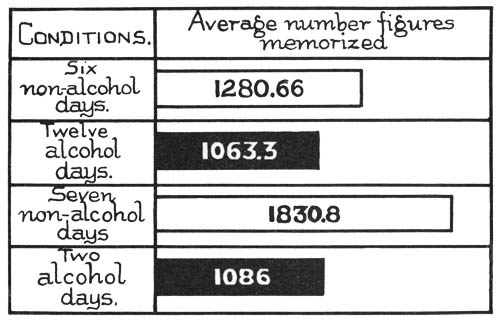
Effect of use of alcohol on memory.
The Effect of Alcohol upon Intellectual Ability.—With regard to the supposed quickening of the mental processes Horsley and Sturge, in their recent book, Alcohol and the Human Body, say:
"Kraepelin found that the simple reaction period, by which is meant the time occupied in making a mere response to a signal, as, for instance, to the sudden appearance of a flag, was, after the ingestion of a small quantity of alcohol (¼ to ½ ounce), slightly accelerated; that there was, in fact, a slight shortening of the time, as though the brain were enabled to operate more quickly than before. But he found that after a few minutes, in most cases, a slowing of mental action began, becoming more and more marked, and enduring as long as the alcohol was in active operation in the body, i.e. four to five hours.... Kraepelin found that it was only more or less automatic work, such as reading aloud, which was quickened by alcohol, though even this was rendered less trustworthy and accurate." Again: "Kraepelin had always shared the popular belief that a small quantity of alcohol (one to two teaspoonfuls) had an accelerating effect on the activity of his mind, enabling him to perform test operations, as the adding and subtracting and learning of figures more quickly. But when he came to measure with his instruments the exact period and time occupied, he found, to his astonishment, that he had accomplished these mental operations, not more, but less, quickly than before.... Numerous further experiments were carried out in order to test this matter, and these proved that alcohol lengthens the time taken to perform complex mental processes, while by a singular illusion the person experimented upon imagines that his psychical actions are rendered more rapid."
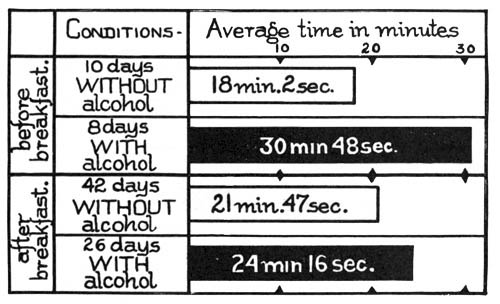
The effect of alcohol upon ability to do mental work.
Attention—that is, the power of the mind to grasp and consider impressions obtained through the senses—is weakened by drink. The ability of the mind to associate or combine ideas, the faculty involved in sound judgment, showed that when the persons had taken the amounts of alcohol mentioned, the combinations of ideas or judgments expressed by them were confused, foggy, sentimental, and general. When the persons had taken no alcohol, their judgments were rational, specific, keen, showing closer observation.
"The words of Professor Helmholtz at the celebration of his seventieth birthday are very interesting in this connection. He spoke of the ideas flashing up from the depths of the unknown soul, that lies at the foundation of every truly creative intellectual production, and closed his account of their origin with these words: 'The smallest quantity of an alcoholic beverage seemed to frighten these ideas away.'"—Dr. G. Sims Woodhead, Professor of Pathology, Cambridge University, England.
Professor Von Bunge (Textbook of Physiological and Pathological Chemistry) of Switzerland says that:
"The stimulating action which alcohol appears to exert on the brain functions is only a paralytic action. The cerebral functions which are first interfered with are the power of clear judgment and reason. No man ever became witty by aid of spirituous drinks. The lively gesticulations and useless exertions of intoxicated people are due to paralysis,—the restraining influences, which prevent a sober man from uselessly expending his strength, being removed."
The Drink Habit.—The harmful effects of alcohol (aside from the purely physiological effect upon the tissues and organs of the body) are most terribly seen in the formation of the alcohol habit. The first effect of drinking alcoholic liquors is that of exhilaration. After the feeling of exhilaration is gone, for this is a temporary state, the subject feels depressed and less able to work than before he took the drink. To overcome this feeling, he takes another drink. The result is that before long he finds a habit formed from which he cannot escape. With body and mind weakened, he attempts to break off the habit. But meanwhile his will, too, has suffered from overindulgence. He has become a victim of the drink habit!
"The capital argument against alcohol, that which must eventually condemn its use, is this, that it takes away all the reserved control, the power of mastership, and therefore offends against the splendid pride in himself or herself, which is fundamental in every man or woman worth anything."—Dr. John Johnson, quoting Walt Whitman.
Self-indulgence, be it in gratification of such a simple desire as that for candy or the more harmful indulgence in tobacco or alcoholic beverages, is dangerous—not only in its immediate effects on the tissues and organs, but in its more far-reaching effects on habit formation. Each one of us is a bundle of appetites. If we gratify appetites of the wrong kind, we are surely laying the foundation for the habit of excess. Self-denial is a good thing for each of us to practice at one time or another, if for no other purpose than to be ready to fight temptation when it comes.
The Economic Effect of Alcoholic Poisoning.—In the struggle for existence, it is evident that the man whose intellect is the quickest and keenest, whose judgment is most sound, is the man who is most likely to succeed. The paralyzing effect of alcohol upon the nerve centers must place the drinker at a disadvantage. In a hundred ways, the drinker sooner or later feels the handicap that the habit of drink has imposed upon him. Many corporations, notably several of our greatest railroads (the Pennsylvania and the New York Central Railroad among them), refuse to employ any but abstainers in positions of trust. Few persons know the number of railway accidents due to the uncertain eye of some engineer who mistook his signal, or the hazy inactivity of the brain of some train dispatcher who, because of drink, forgot to send the telegram that was to hold the train from wreck. In business and in the professions, the story is the same. The abstainer wins out over the drinking man.
Effect of Alcohol on Ability to do Work.—In Physiological Aspects of the Liquor Problem, Professor Hodge, formerly of Clark University, describes many of his own experiments showing the effect of alcohol on animals. He trained four selected puppies to recover a ball thrown across a gymnasium. To two of the dogs he gave food mixed with doses of alcohol, while the others were fed normally. The ball was thrown 100 feet as rapidly as recovered. This was repeated 100 times each day for fourteen successive days. Out of 1400 times the dogs to which alcohol had been given brought back the ball only 478 times, while the others secured it 922 times.
Dr. Parkes experimented with two gangs of men, selected to be as nearly similar as possible, in mowing. He found that with one gang abstaining from alcoholic drinks and the other not, the abstaining gang could accomplish more. On transposing the gangs, the same results were repeatedly obtained. Similar results were obtained by Professor Aschaffenburg of Heidelberg University, who found experimentally that men "were able to do 15 per cent less work after taking alcohol."
Recently many experiments along the same lines have been made. In typewriting, in typesetting, in bricklaying, or in the highest type of mental work the result is the same. The quality and quantity of work done on days when alcohol is taken is less than on days when no alcohol is taken.
The Relation of Alcohol to Efficiency.—We have already seen that work is neither so well done nor is as much accomplished by drinkers as by non-drinkers.
A Massachusetts shoe manufacturer told a recent writer on temperance that in one year his firm lost over $5000 in shoes spoiled by drinking men, and that he had himself traced these spoiled shoes to the workmen who, through their use of alcoholic liquors, had thus rendered themselves incapable. This is a serious handicap to our modern factory system, and explains why so many factory towns and cities are strongly favoring a policy of "No license" in opposition to the saloons.
"It is believed that the largest number of accidents in shops and mills takes place on Monday, because the alcohol that is drunk on Sunday takes away the skill and attentive care of the workman. To prove the truth of this opinion, the accidents of the building trades in Zurich were studied during a period of six years, with the result shown by this table":—

Shaded, non-alcoholic; black, alcoholic, accidents. (From Tolman, Hygiene for the Worker.)
Another relation to efficiency is shown by the following chart. During the week the curve of working efficiency is highest on Friday and lowest on Monday. The number of accidents were also least on Friday and greatest on Monday. Lastly the assaults were fewest in number on Friday and greatest on Sunday and Monday. The moral is plain. Workingmen are apt to spend their week's wages freely on Saturday. Much of this goes into drink, and as a result comes crime on Sunday because of the deadened moral and mental condition of the drinker, and loss of efficiency on Monday, because of the poisonous effects of the drug.
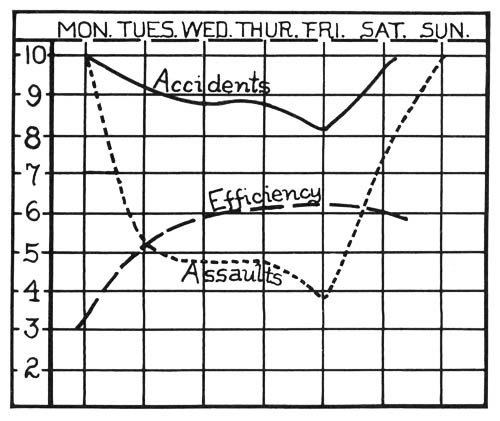
Notice that the curve of efficiency is lowest on Monday and that crimes and accidents are most frequent on Sunday and Monday. Account for this.
Effect of Alcohol upon Duration of Life.—Still more serious is the relation of alcohol as a direct cause of disease (see table).
It is as yet quite impossible, in the United States at least, to tell just how many deaths are brought about, directly or indirectly, by alcohol. Especially is this true in trying to determine the number of cases of deaths from disease promoted by alcohol. In Switzerland provision is made for learning these facts, and the records of that country throw some light on the subject.
Dr. Rudolph Pfister made a study of the records of the city of Basle for the years 1892-1906, finding the percentage of deaths in which alcohol had been reported by the attending physician as one cause of death. He found that 18.1 per cent of all deaths of men between 40 and 50 years of age were caused, in part at least, by alcohol, and this at what should be the most active period in a man's life, the time when he is most needed by his family and community. Taking all ages between 20 and 80, he found that alcohol was one cause of death in one man in every ten who died.
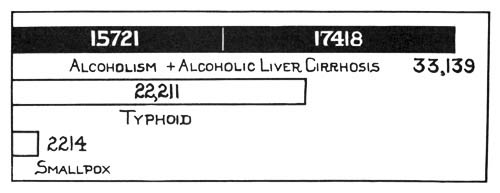
Another study was made by a certain doctor in Sweden, from records of 1082 deaths occurring in his own practice and the local hospital. No case was counted as alcoholic of which there was the slightest doubt. Of deaths of adult men, 18 in every 100 were due, directly or indirectly, to alcoholism. In middle life, between the ages of 40 and 50, 29; and between 50 and 60 years of age, 25.6 out of every 100 deaths had alcohol as one cause, thus agreeing with other statistics we have been quoting.—From the Metropolitan, Vol. XXV, Number 11.

The proportion of crime due to alcohol is shown in black.
The Relation of Alcohol to Crime.—A recent study of more than 2500 habitual users of alcohol showed that over 66 per cent had committed crime. Usually the crimes had been done in saloons or as a result of quarrels after drinking. Of another lot of 23,581 criminals questioned, 20,070 said that alcohol had led them to commit crime.
The Relation of Alcohol to Pauperism.—We have already spoken of the Jukes family. These and many other families of a similar sort are more or less directly a burden upon the state. Alcohol is in part at least responsible for the condition of such families. Alcohol weakens the efficiency and moral courage, and thus leads to begging, pauperism, petty stealing or worse, and ultimately to life in some public institution. In Massachusetts, of 3230 inmates of such institutions, 66 per cent were alcoholics.
The Relation of Alcohol to Heredity.—Perhaps the gravest side of the alcohol question lies here. If each one of us had only himself to think of, the question of alcohol might not be so serious. But drinkers may hand down to their unfortunate children tendencies toward drink as well as nervous diseases of various sorts; an alcoholic parent may beget children who are epileptic, neurotic, or even insane.
In the State of New York there are at the present time some 30,000 insane persons in public and private hospitals. It is believed that about one fifth of them, or 6000 patients, owe their insanity to alcohol used either by themselves or by their parents. In the asylums of the United States there are 150,000 insane people. Taking the same proportions as before, there are 30,000 persons in this country whom alcohol has made or has helped to make insane. This is the most terrible side of the alcohol problem.
Reference Reading
elementary
Hunter, Laboratory Problems in Civic Biology. American Book Company.
Overton, General Hygiene. American Book Company.
The Gulick Hygiene Series, Emergencies, Good Health, The Body at Work, Control of Body and Mind. Ginn and Company.
Ritchie, Human Physiology. World Book Company.
Hough and Sedgwick, The Human Mechanism. Ginn and Company.
XXIV. MAN'S IMPROVEMENT OF HIS ENVIRONMENT
Problems.—How may we improve our home conditions of living?
How may we help improve our conditions at school?
How does the city care for the improvement of our environment?
(a) In inspection of buildings, etc.
(b) In inspection of food supplies.
(c) In inspection of milk.
(d) In care of water supplies.
(e) In disposal of wastes.
(f) In care of public health.
Laboratory Suggestions
Home exercise.—How to ventilate my bedroom.
Demonstration.—Effect of use of duster and damp cloth upon bacteria in schoolroom.
Home exercise.—Luncheon dietaries.
Home exercise.—Sanitary map of my own block.
Demonstration.—The bacterial content of milk of various grades and from different sources.
Demonstration.—Bacterial content of distilled water, rain water, tap water, dilute sewage.
Laboratory exercise.—Study of board of health tables to plot curves of mortality from certain diseases during certain times of year.
The Purpose of this Chapter.—In the preceding chapters we have traced the lives of both plants and animals within their own environment. We have seen that man, as well as plants and other animals, needs a favorable environment in order to live in comfort and health. It will be the purpose of the following pages first to show how we as individuals may better our home environment, and secondly, to see how we may aid the civic authorities in the betterment of conditions in the city in which we live.
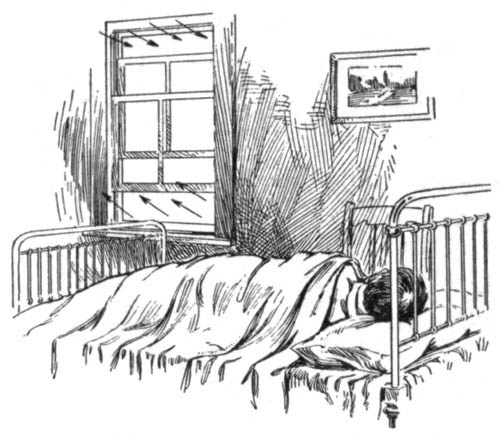
How I should ventilate my bedroom.
Home Conditions.—The Bedroom.—We spend about one third of our total time in our bedroom. This room, therefore, deserves more than passing attention. First of all, it should have good ventilation. Two windows make an ideal condition, especially if the windows receive some sun. Such a condition as this is manifestly impossible in a crowded city, where too often the apartment bedrooms open upon narrow and ill-ventilated courts. Until comparatively recent time, tenement houses were built so that the bedrooms had practically no light or air; now, thanks to good tenement-house laws, wide airshafts and larger windows are required by statute.
Care of the Bedroom.—Since sunlight cannot always be obtained for a bedroom, we must so care for and furnish the room that it will be difficult for germs to grow there. Bedroom furniture should be light and easy to clean, the bedstead of iron, the floors painted or of hardwood. No hangings should be allowed at the windows to collect dust, nor should carpets be allowed for the same reason. Rugs on the floor may easily be removed when cleaning is done. The furniture and woodwork should be wiped with a damp cloth every day. Why a damp cloth? In certain tenements in New York City, tuberculosis is believed to have been spread by people occupying rooms in which a previous tenant has had tuberculosis. A new tenant should insist on a thorough cleaning of the bedrooms and removal of old wall paper before occupancy.
Sunlight Important.—In choosing a house in the country we would take a location in which the sunlight was abundant. A shaded location might be too damp for health. Sunlight should enter at least some of the rooms. In choosing an apartment we should have this matter in mind, for, as we know, germs cannot long exist in sunlight.
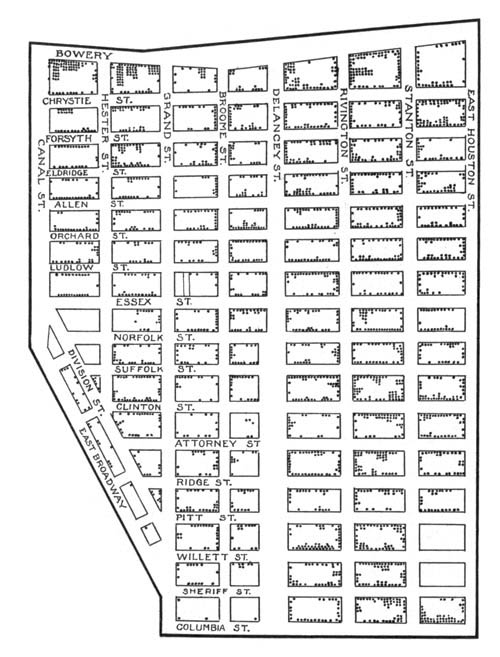
This map shows how cases of tuberculosis are found recurring in the same locality and in the same houses year after year. Each black dot is one case of tuberculosis.
Heating.—Houses in the country are often heated by open fires, stoves or hot-air furnaces, all of which make use of heated currents of air to warm the rooms. But in the city apartments, usually pipes conduct steam or hot water from a central plant to our rooms. The difficulty with this system is that it does not give us fresh air, but warms over the stale air in a room. Steam causes our rooms to be too warm part of the time, and not warm enough part of the time. Thus we become overheated and then take cold by becoming chilled. Steam heat is thus responsible for much sickness.
Lighting.—Lighting our rooms is a matter of much importance. A student lamp, or shaded incandescent light, should be used for reading. Shades must be provided so that the eyes are protected from direct light. Gas is a dangerous servant, because it contains a very poisonous substance, carbon monoxide. "It is estimated that 14 per cent of the total product of the gas plant leaks into the streets and houses of the cities supplied." This forms an unseen menace to the health in cities. Gas pipes, and especially gas cocks, should be watched carefully for escaping gas. Rubber tubing should not be used to conduct gas to movable gas lamps, because it becomes worn and allows gas to escape.
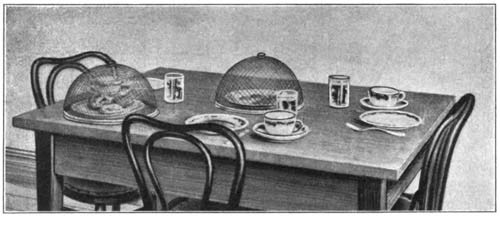
During the summer all food should be protected from flies. Why?
Insects and Foods.—In the summer our houses should be provided with screens. All food should be carefully protected from flies. Dirty dishes, scraps of food, and such garbage should be quickly cleaned up and disposed of after a meal. Insect powder (pyrethrum) will help keep out "croton bugs" and other undesirable household pests, but cleanliness will do far more. Most kitchen pests, as the roach, simply stay with us because they find dirt and food abundant.
Use of Ice.—Food should be properly cared for at all times, but especially during the summer. Iceboxes are a necessity, especially where children live, in order to keep milk fresh. A dirty icebox is almost as bad as none at all, because food will decay or take on unpleasant odors from other foods.
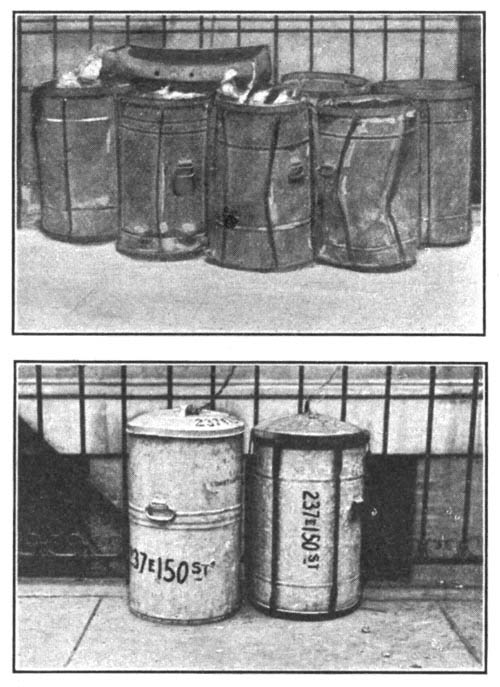
The wrong and the right kind of garbage cans.
Disposal of Wastes.—In city houses the disposal of human wastes is provided for by a city system of sewers. The wastes from the kitchen, the garbage, should be disposed of each day. The garbage pail should be frequently sterilized by rinsing it with boiling water. Plenty of lye or soap should be used. Remember that flies frequent the uncovered garbage pail, and that they may next walk on your food. Collection and disposal of garbage is the work of the municipality.
School Surroundings.—How to Improve Them.—From five to six hours a day for forty weeks is spent by the average boy or girl in the schoolroom. It is part of our environment and should therefore be considered as worthy of our care. Not only should a schoolroom be attractive, but it should be clean and sanitary. City schools, because of their locations, of the sometimes poor janitorial service, and especially because of the selfishness and carelessness of children who use them, may be very dirty and unsanitary. Dirt and dust breed and carry bacteria. Plate cultures show greatly increased numbers of bacteria to be in the air when pupils are moving about, for then dust, bearing bacteria, is stirred up and circulated through the air. Sweeping and dusting with dry brooms or feather dusters only stirs up the dust, leaving it to settle in some other place with its load of bacteria. Professor Hodge tells of an experience in a school in Worcester, Mass. A health brigade was formed among the children, whose duty was to clean the rooms every morning by wiping all exposed surface with a damp cloth. In a school of 425 pupils not a single case of contagious diseases appeared during the entire year. Why not try this in your own school?
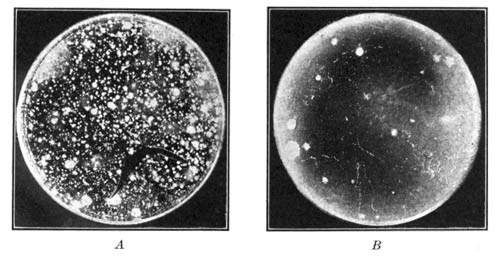
The culture (A) was exposed to the air of a dirty street in the crowded part of Manhattan. (B) was exposed to the air of a well-cleaned and watered street in the uptown residence portion. Which culture has the more colonies of bacteria? How do you account for this?
Unselfishness the Motto.—Pupils should be unselfish in the care of a school building. Papers and scraps dropped by some careless boy or girl make unpleasant the surroundings for hundreds of others. Chalk thrown by some mischievous boy and then tramped underfoot may irritate the lungs of a hundred innocent schoolmates. Colds or worse diseases may be spread through the filthy habits of some boys who spit in the halls or on the stairways.
Lunch Time and Lunches.—If you bring your own lunch to school, it should be clean, tasty, and well balanced as a ration. In most large schools well-managed lunch rooms are part of the school equipment, and balanced lunches can be obtained at low cost. Do not make a lunch entirely from cold food, if hot can be obtained. Do not eat only sweets. Ice cream is a good food, if taken with something else, but be sure of your ice cream. "Hokey pokey" cream, tested in a New York school laboratory, showed the presence of many more colonies of bacteria than good milk would show. Above all, be sure the food you buy is clean. Stands on the street, exposed to dust and germs, often sell food far from fit for human consumption.
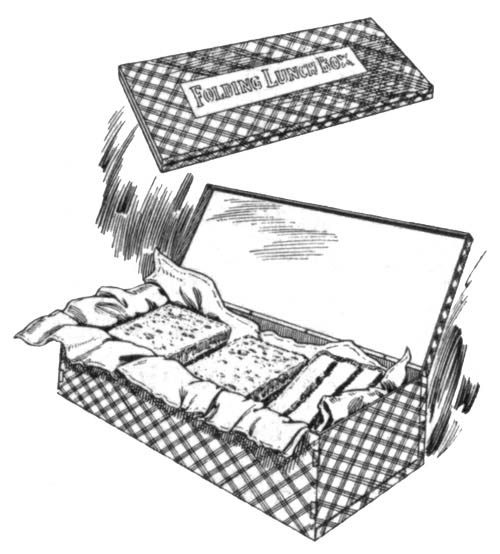
A sensible lunch box, sanitary and compact.
If you eat your lunch on the street near your school, remember not to scatter refuse. Paper, bits of lunch, and the like scattered on the streets around your school show lack of school spirit and lack of civic pride. Let us learn above all other things to be good citizens.
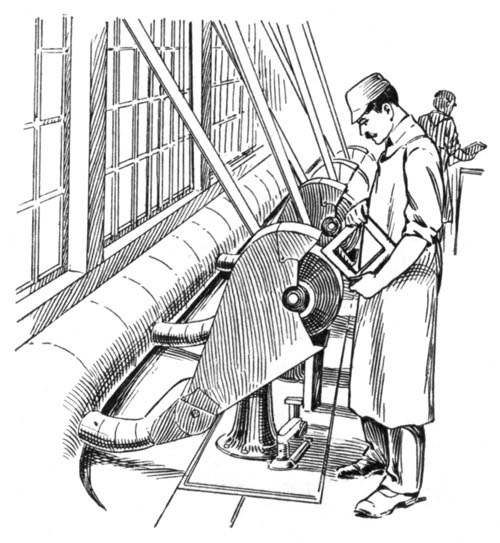
Dust exhausts on grinding wheels protect lungs of the workmen.
Inspection of Factories, Public Buildings, etc.—It is the duty of a city to inspect the condition of all public buildings and especially of factories. Inspection should include, first, the supervision of the work undertaken. Certain trades where grit, dirt, or poison fumes are given off are dangerous to human health, hence care for the workers becomes a necessity. Factories should also be inspected as to cleanliness, the amount of air space per person employed, ventilation, toilet facilities, and proper fire protection. Tenement inspection should be thorough and should aim to provide safe and sanitary homes.
Inspection of Food Supplies.—In a city certain regulations for the care of public supplies are necessary. Foods, both fresh and preserved, must be inspected and rendered safe for the thousands of people who are to use them. All raw foods exposed on stands should be covered so as to prevent insects or dust laden with bacteria from coming in contact with them. Meats must be inspected for diseases, such as tuberculosis in beef, or trichinosis in pork. Cold storage plants must be inspected to prevent the keeping of food until it becomes unfit for use. Inspection of sanitary conditions of factories where products are canned, or bakeries where foods are prepared, must be part of the work of a city in caring for its citizens.
Care of Raw Foods.—Each one of us may coöperate with the city government by remembering that fruits and vegetables can be carriers of disease, especially if they are sold from exposed stalls or carts and handled by the passers-by. All vegetables, fruits, or raw foods should be carefully washed before using. Spoiled or overripe fruit, as well as meat which is decayed, is swarming with bacteria and should not be used.
An interesting exercise would be the inspection of conditions in your own home block. Make a map showing the houses on the block. Locate all stores, saloons, factories, etc. Notice any cases of contagious disease, marking this fact on the map. Mark all heaps of refuse in the street, all uncovered garbage pails, any street stands that sell uncovered fruit, and any stores with an excessive number of flies.
In addition to food inspection, two very important supplies must be rendered safe by a city for its citizens. These are milk and water.
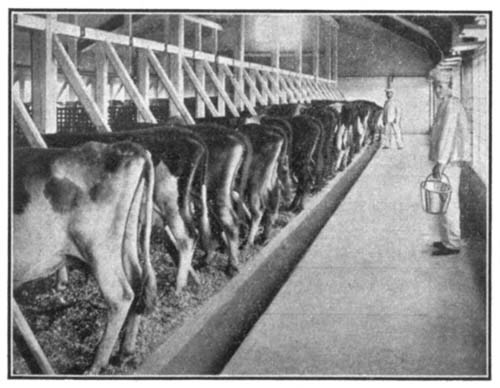
Clean cows in clean barns with clean milkers and clean milk pails means clean milk in the city.
Care in Production of Milk.—Milk when drawn from a healthy cow should be free from bacteria. But immediately on reaching the air it may receive bacteria from the air, from the hands of the person who milks the cows, from the pail, or from the cow herself. Cows should, therefore, be milked in surroundings that are sanitary, the milkers should wear clean garments, put on over their ordinary clothes at milking time, while pails and all utensils used should be kept clean. Especially the surface exposed on the udder from which the milk is drawn should be cleansed before milking.
Most large cities now send inspectors to the farms from which milk is supplied. Farms that do not accept certain standards of cleanliness are not allowed to have their milk become part of the city supply.
Tuberculosis and Milk.—It is recognized that in some European countries from 30 to 40 per cent of all cattle have tuberculosis. Many dairy herds in this country are also infected. It is also known that the tubercle bacillus of cattle and man are much alike in form and action and that probably the germ from cattle would cause tuberculosis in man. Fortunately, the tuberculosis germ does not grow in milk, so that even if milk from tubercular cattle should get into our supply, it would be diluted with the milk of healthy cattle. In order to protect our milk supply from these germs it would be necessary to kill all tubercular cattle (almost an impossibility) or to pasteurize our milk so as to kill the germs in it.
Other Disease Germs in Milk.—We have already shown how typhoid may be spread through milk. Usually such outbreaks may be traced to a single case of typhoid, often a person who is a "typhoid carrier," i.e. one who may not suffer from the effects of the disease, but who carries the germs in his body, spreading them by contact. A recent epidemic of typhoid in New York City was traced to a single typhoid carrier on a farm far from the city. Sometimes the milk cans may be washed in contaminated water or the cows may even get the germs on their udders by wading in a polluted stream. Diphtheria, scarlet fever, and Asiatic cholera are also undoubtedly spread through milk supplies. Milk also plays a very important part in the high death rate from diarrhœal diseases among young children in warm weather. Why?
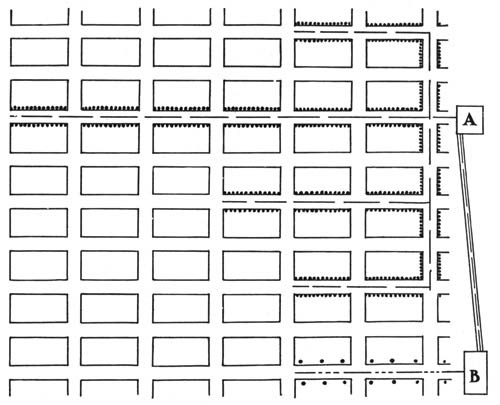
A diagram to show how typhoid may be spread in a city through an infected milk supply. The black spots in the blocks mean cases of typhoid. A, a farm where typhoid exists; the dashes in the streets represent the milk route. B is a second farm which sends part of its milk to A; the milk cans from B are washed at farm A and sent back to B. A few cases of typhoid appear along B's milk route. How do you account for that?
Grades of Milk in a City Supply.—Milk which comes to a city may be roughly placed in three different classes. The best milk, coming from farms where the highest sanitary standards exist, where the cows are all tubercular tested, where modern appliances for handling and cooling the milk exist, is known as certified or, in New York City, grade A milk. Most of the milk sold, however, is not so pure nor is so much care taken in handling it. Such milk, known in New York as grade B milk, is pasteurized before delivery, and is sold only in bottles. A still lower grade of milk (dipped milk) is sold direct from cans. It is evident that such milk, often exposed to dust and other dirt, is unfit for any purpose except for cooking. It should under no circumstances be used for children. A regulation recently made by the New York City Department of Health states that milk sold "loose" in restaurants, lunch-rooms, soda fountains, and hotels must be pasteurized.
Care of a City Milk Supply.—Besides caring for milk in its production on the farm, proper transportation facilities must be provided. Much of the milk used in New York City is forty-eight hours old before it reaches the consumer. During shipment it must be kept in refrigerator cars, and during transit to customers it should be iced. Why? All but the highest grade milk should be pasteurized. Why? Milk should be bottled by machinery if possible so as to insure no personal contact; it should be kept in clean, cool places; and no milk should be sold by dipping from cans. Why is this a method of dispensing impure milk?
Care of Milk in the Home.—Finally, milk at home should receive the best of care. It should be kept on ice and in covered bottles, because it readily takes up the odors of other foods. If we are not certain of its purity or keeping qualities, it should be pasteurized at home. Why?
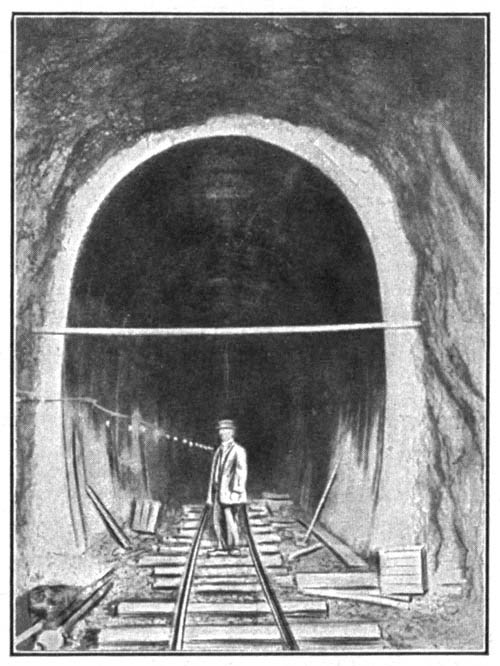
New York City is spending $350,000,000 to have a pure and abundant water supply. This is the tunnel which will bring the water from the Catskill Mountains to New York City.
Water Supplies.—One of the greatest assets to the health of a large city is pure water. By pure water we mean water free from all organic impurities, including germs. Water from springs and deep driven wells is the safest water, that from large reservoirs next best, while water that has drainage in it, river water for example, is very unsafe.
The waters from deep wells or springs if properly protected will contain no bacteria. Water taken from protected streams into which no sewage flows will have but few bacteria, and these will be destroyed if exposed to the action of the sun and the constant aëration (mixing with oxygen) which the surface water receives in a large lake or reservoir. But water taken from a river into which the sewage of other towns and cities flows must be filtered before it is fit for use.
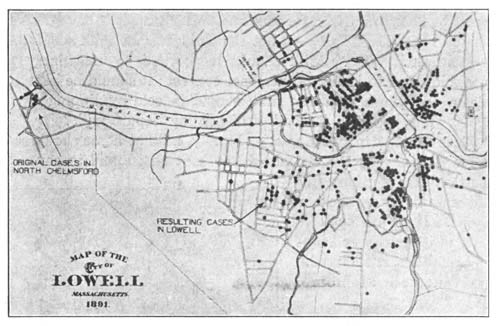
The city of Lowell in 1891 took its water without filtering, i.e. from the Merrimack River at the point shown on the map.
Typhoid fever broke out in North Chelmsford and about two weeks later cases began to appear in Lowell until a great epidemic occurred. Explain this outbreak. Each black dot is a case of typhoid.
Typhoid fever germs live in the food tube, hence the excreta of a typhoid patient will contain large numbers of germs. In a city with a system of sewage such germs might eventually pass from the sewers into a river. Many cities take their water supply directly from rivers, sometimes not far below another large town. Such cities must take many germs into their water supply. Many cities, as Cleveland and Buffalo, take their water from lakes into which their sewage flows. Others, as Albany, Pittsburgh, and Philadelphia, take their drinking water directly from rivers into which sewage from cities above them on the river has flowed. Filtering such water by means of passing the water through settling basins and sand filters removes about 98 per cent of the germs. The result of drinking unfiltered and filtered water in certain large cities is shown graphically at right. In cities which drain their sewage into rivers and lakes, the question of sewage disposal is a large one, and many cities now have means of disposing of their sewage in some manner as to render it harmless to their neighbors.
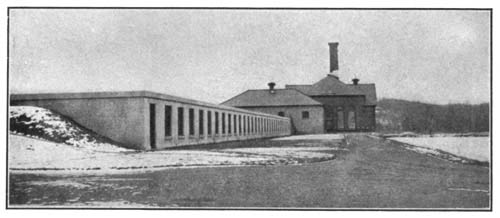
Filter beds at Albany, N. Y.
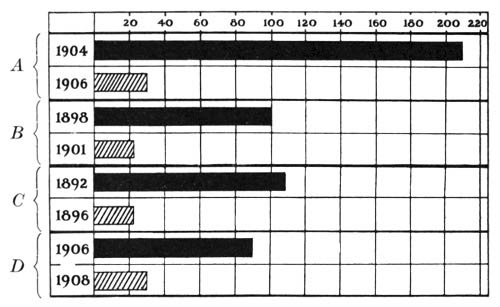
Cases of typhoid per 100,000 inhabitants before filtering water supply (solid) and after (shaded) in A, Watertown, N. Y.; B, Albany, N. Y.; C, Lawrence, Mass.; D, Cincinnati, Ohio. What is the effect of filtering the water supply?
Railroads are often responsible for carrying typhoid and spreading it. It is said that a recent outbreak of typhoid in Scranton, Pa., was due to the fact that the excreta from a typhoid patient traveling in a sleeping car was washed by rain into a reservoir near which the train was passing. Railroads are thus seen to be great open sewers. A sanitary car toilet is the only remedy.
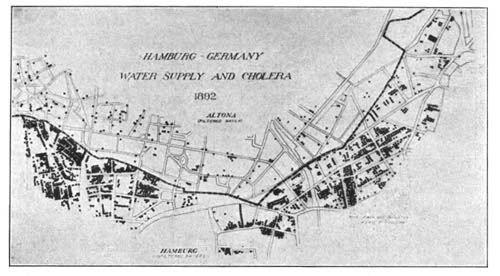
This chart shows that during a cholera epidemic in 1892 there were hundreds of cases of cholera in Hamburg, which used unfiltered water from the Elbe, but in adjoining Altona, where filtered water was used, the cases were very few.
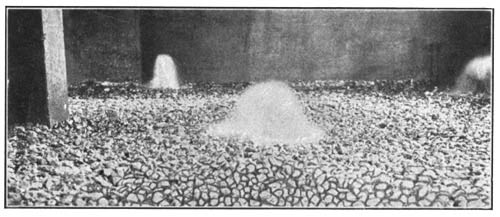
Stone filter beds in a sewage disposal plant.
Sewage Disposal.—Sewage disposal is an important sanitary problem for any city. Some cities, like New York, pour their sewage directly into rivers which flow into the ocean. Consequently much of the liquid which bathes the shores of Manhattan Island is dilute sewage. Other cities, like Buffalo or Cleveland, send their sewage into the lakes from which they obtain their supply of drinking water. Still other cities which are on rivers are forced to dispose of their sewage in various ways. Some have a system of filter beds in which the solid wastes are acted upon by the bacteria of decay, so that they can be collected and used as fertilizer. Others precipitate or condense the solid materials in the sewage and then dispose of it. Another method is to flow the sewage over large areas of land, later using this land for the cultivation of crops. This method is used by many small European cities.
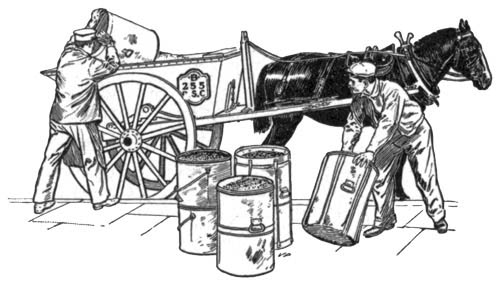
Collecting ashes.
The Work of the Department of Street Cleaning.—In any city a menace to the health of its citizens exists in the refuse and garbage. The city streets, when dirty, contain countless millions of germs which have come from decaying material, or from people ill with disease. In most large cities a department of street cleaning not only cares for the removal of dust from the streets, but also has the removal of garbage, ashes, and other waste as a part of its work. The disposal of solid wastes is a tremendous task. In Manhattan the dry wastes are estimated to be 1,000,000 tons a year in addition to about 175,000 tons of garbage. Prior to 1895 in the city of New York garbage was not separated from ashes; now the law requires that garbage be placed in separate receptacles from ashes. Do you see why? The street-cleaning department should be aided by every citizen; rules for the separation of garbage, papers, and ashes should be kept. Garbage and ash cans should be covered. The practice of upsetting ash or garbage cans is one which no young citizen should allow in his neighborhood, for sanitary reasons. The best results in summer street cleaning are obtained by washing or flushing the streets, for thus the dirt containing germs is prevented from getting into the air. The garbage is removed in carts, and part of it is burned in huge furnaces. The animal and plant refuse is cooked in great tanks; from this material the fats are extracted, and the solid matter is sold for fertilizer. Ashes are used for filling marsh land. Thus the removal of waste matter may pay for itself in a large city.
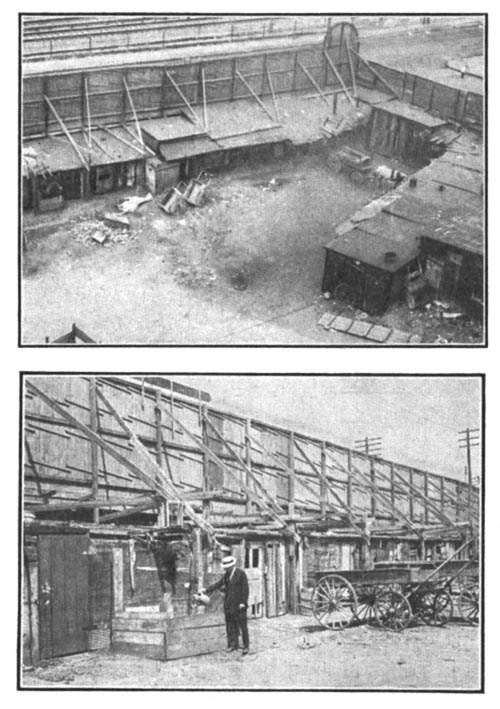
The upper picture shows the stables where millions of flies were bred; the lower picture, the disinfection of manure so as to prevent the breeding of flies.
An Experiment in Civic Hygiene.—During the summer of 1913 an interesting experiment on the relation of flies and filth to disease was carried on in New York City by the Bureau of Public Health and Hygiene of the New York Association for improving the condition of the poor. Two adjoining blocks were chosen in a thickly populated part of the Bronx near a number of stables which were the sources of great numbers of flies. In one block all houses were screened, garbage pails were furnished with covers, refuse was removed and the surroundings made as sanitary as possible. In the adjoining block conditions were left unchanged. During the summer as flies began to breed in the manure heaps near the stables all manure was disinfected. Thus the breeding of flies was checked. The campaign of education was continued during the summer by means of moving pictures, nurses, boy scouts, and school children who became interested.
At the end of the summer it was found that there had been a considerable decrease in the number of cases of fly-carried diseases and a still greater decrease in the total days of sickness (especially of children) in the screened and sanitary block. The table and pictures speak for themselves. If such a small experiment shows results like this, then what might a general clean-up of a city show?
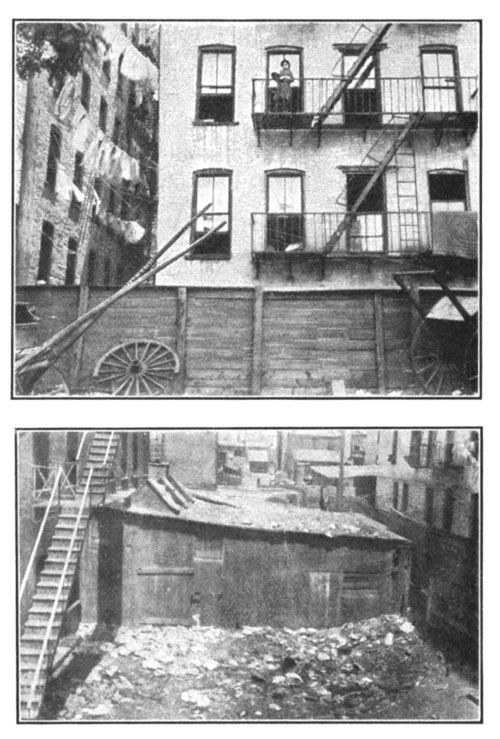
In the upper picture a little girl can be seen dumping garbage from the fire escape. She was a foreigner and knew no better. The picture below shows the result of such garbage disposal.
Public Hygiene.—Although it is absolutely necessary for each individual to obey the laws of health if he or she wishes to keep well, it has also become necessary, especially in large cities, to have general supervision over the health of people living in a community. This is done by means of a department or board of health. It is the function of this department to care for public health. In addition to such a body in cities, supervision over the health of its citizens is also exercised by state boards of health. But as yet the government of the United States has not established a Bureau of Health, important as such a bureau would be.
The Functions of a City Board of Health.—The administration of the Board of Health in New York City includes a number of divisions, each of which has a different work to do. Each is in itself important, and, working together, the entire machine provides ways and means for making the great city a safe and sanitary place in which to live. Let us take up the work of each division of the health board in order to find out how we may coöperate with them.
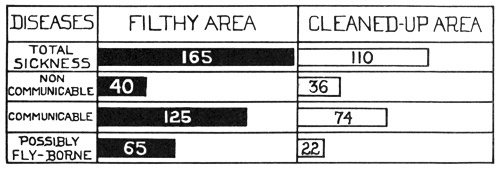
Comparison of cases of illness during the summer of 1913 in two city blocks, one clean and the other dirty. What are your conclusions?
The Division of Infectious Diseases.—Infectious diseases are chiefly spread through personal contact. It is the duty of a government to prevent a person having such a disease from spreading it broadcast among his neighbors. This can be done by quarantine or isolation of the person having the disease. So the board of health at once isolates any case of disease which may be communicated from one person to another. No one save the doctor or nurse should enter the room of the person quarantined. After the disease has run its course, the clothing, bedding, etc., in the sick room is fumigated. This is usually done by the board of health. Formaldehyde in the form of candles for burning or in a liquid form is a good disinfectant. In disinfecting the room should be tightly closed to prevent the escape of the gas used, as the object of the disinfection is to kill all the disease germs left in the room. In some cases of infectious disease, as scarlet fever, it is found best to isolate the patients in a hospital used for that purpose. Examples of the most infectious diseases are measles, scarlet fever, whooping cough, and diphtheria.
Immunity.—In the prevention of germ diseases we must fight the germ by attacking the parasites directly with poisons that will kill them (such poisons are called germicides or disinfectants), and we must strive to make the persons coming in contact with the disease unlikely to take it. This insusceptibility or immunity may be either natural or acquired. Natural immunity seems to be in the constitution of a person, and may be inherited. Immunity may be acquired by means of such treatment as the antitoxin treatment for diphtheria. This treatment, as the name denotes, is a method of neutralizing the poison (toxin) caused by the bacteria in the system. It was discovered a few years ago by a German, Von Behring, that the serum of the blood of an animal immune to diphtheria is capable of neutralizing the poison produced by the diphtheria-causing bacteria. Horses are rendered immune by giving them the diphtheria toxin in gradually increasing doses. The serum of the blood of these horses is then used to inoculate the patient suffering from or exposed to diphtheria, and thus the disease is checked or prevented altogether by the antitoxin injected into the blood. The laboratories of the board of health prepare this antitoxin and supply it fresh for public use.
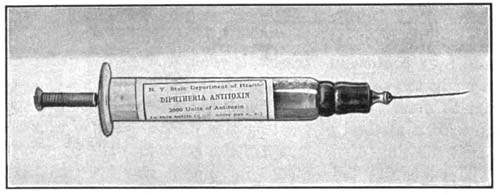
Antitoxin for diphtheria prepared by the New York Board of Health.
It has been found from experience in hospitals that deaths from diphtheria are largely preventable by early use of antitoxin. When antitoxin was used on the first day of the disease no deaths took place. If not used until the second day, 5 deaths occurred in every hundred cases, on the third day 11 deaths, on the 4th day 19 deaths, and on the 5th day 20 deaths out of every hundred cases. It is therefore advisable, in a suspected case of diphtheria, to have antitoxin used at once to prevent serious results.
Vaccination.—Smallpox was once the most feared disease in this country; 95 per cent of all people suffered from it. As late as 1898, over 50,000 persons lost their lives annually in Russia from this disease. It is probably not caused by bacteria, but by a tiny animal parasite. Smallpox has been brought under absolute control by vaccination,—the inoculation of man with the substance (called virus) which causes cowpox in a cow. Cowpox is like a mild form of smallpox, and the introduction of this virus gives complete immunity to smallpox for several years after vaccination. This immunity is caused by the formation of a germicidal substance in the blood, due to the introduction of the virus. Another function of the board of health is the preparation and distribution of vaccine (material containing the virus of cowpox).
Rabies (Hydrophobia).—This disease, which is believed to be caused by a protozoan parasite, is communicated from one dog to another in the saliva by biting. In a similar manner it is transferred to man. The great French bacteriologist, Louis Pasteur, discovered a method of treating this disease so that when taken early at the time of the entry of the germ into the body of man, the disease can be prevented. In some large cities (among them New York) the board of health has established a laboratory where free treatment is given to all persons bitten by dogs suspected of having rabies.
Vaccination against Typhoid.—Typhoid fever has within the past five years received a new check from vaccination which has been introduced into our army and which is being used with good effect by the health departments of several large cities.
The following figures show the differences between number of cases and mortality in the army in 1898 during the war with Spain and in 1911 during the concentration of certain of our troops at San Antonio, Texas.
1898—2nd Division, 7th Army Corps, Jacksonville, Florida. June-October, 1898
Mean strength, 10,759.
Cases of typhoid certain and probable, 2693.
Death from typhoid, 258.
Death from all diseases, 281.
Manœuver Division, San Antonio, Texas. March 10-July 11, 1911.
Mean strength, 12,801.
Cases of typhoid, 1.
Death from typhoid, 0.
Deaths all diseases, 11.
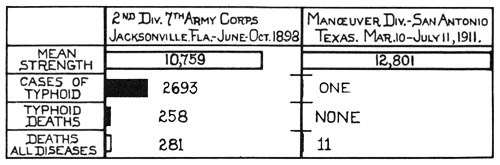
Comparison of cases of and death from typhoid in 1898 and 1911. What have we learned about combating typhoid since 1898?
During this period there were 49 cases of typhoid and 19 deaths in the near-by city of San Antonio. But in camp, where vaccination for typhoid was required, all were practically immune. In the army at large, since typhoid vaccination has been practiced, 1908-1909, the death rate from typhoid has dropped from 2.9 per 1000 to .03 per 1000, a wonderful record when we remember that during the Spanish-American War 86 per cent of the deaths in the army were from typhoid fever.
How the Board of Health fights Tuberculosis.—Tuberculosis, which a few years ago killed fully one seventh of the people who died from disease in this country, now kills less than one tenth. This decrease has been largely brought about because of the treatment of the disease. Since it has been proved that tuberculosis if taken early enough is curable, by quiet living, good food, and plenty of fresh air and light, we find that numerous sanitaria have come into existence which are supported by private or public means. At these sanitaria the patients live out of doors, especially sleep in the air, while they have plenty of nourishing food and little exercise. The department of health of New York City maintains a sanitarium at Otisville in the Catskill Mountains. Here people who are unable to provide means for getting away from the city are cared for at the city's expense and a large percentage of them are cured. In this way and by tenement house laws which require proper air shafts and window ventilation in dwellings, by laws against spitting in public places, and in other ways, the boards of health in our towns and cities are waging war on tuberculosis.
The best cures for tuberculosis are rest, plenty of fresh out-of-door air, and wholesome food.
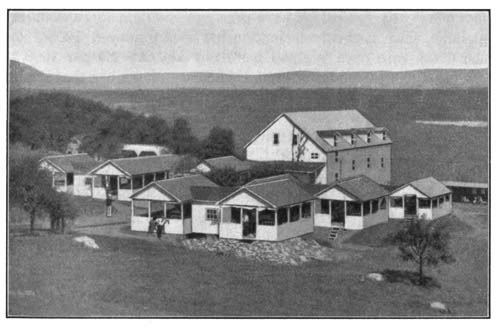
A sanitarium for tuberculosis. Notice the outdoor sleeping rooms.
Ex-President Roosevelt said, in one of his latest messages to Congress:—
"There are about 3,000,000 people seriously ill in the United States, of whom 500,000 are consumptives. More than half of this illness is preventable. If we count the value of each life lost at only $1700 and reckon the average earning lost by illness at $700 a year for grown men, we find that the economic gain from mitigation of preventable disease in the United States would exceed $1,500,000,000 a year. This gain can be had through medical investigation and practice, school and factory hygiene, restriction of labor by women and children, the education of the people in both public and private hygiene, and through improving the efficiency of our health service, municipal, state, and national."
Work of the Division of School and Infant Hygiene.—Besides the work of the division of infectious disease, the division of sanitation, which regulates the general sanitary conditions of houses and their surroundings and the division of inspection, which looks after the purity and conditions of sale and delivery of milk and foods, there is another department which most vitally concerns school children. This is the division of school and infant hygiene. The work of this department is that of the care of the children of the city. During the year 1912, 279,776 visits were made to the homes of school children of the city of New York by inspectors and nurses. Besides this, thousands of children in school were cared for and aided by the city.
Adenoids.—Many children suffer needlessly from adenoids,—growths in the back of the nose or mouth which prevent sufficient oxygen being admitted to the lungs. A child suffering from these growths is known as a "mouth breather" because the mouth is opened in order to get more air. The result to the child may be a handicap of deafness, chronic running of the nose, nervousness, and lack of power to think. His body cells are starving for oxygen. A very simple operation removes this growth. Coöperation on the part of the children and parents with the doctors or nurses of the board of health will do much in removing this handicap from many young lives.
Eyestrain.—Another handicap to a boy or girl is eyestrain. Twenty-two per cent of the school children of Massachusetts were recently found to have defects in vision. Tests for defective eyesight may be made at school easily by competent doctors, and if the child or parent takes the advice given to correct this by procuring proper glasses, a handicap on future success will be removed.
Decayed Teeth.—Decayed teeth are another handicap, cared for by this division. Free dental clinics have been established in many cities, and if children will do their share, the chances of their success in later life will be greatly aided. Boys and girls, if handicapped with poor eyes or teeth, do not have a fair chance in life's competition. In a certain school in New York City there were 236 pupils marked "C" in their school work. These children were examined, and 126 were found to have bad teeth, 54 defective vision, and 56 other defects, as poor hearing, adenoids, enlarged tonsils, etc. Of these children 185 were treated for these various difficulties, and 51 did not take treatment. During the following year's work 176 of these pupils improved from "C" to "B" or "A", while 60 did not improve. If defects are such a handicap in school, then what would be the chances of success in life outside.
In conclusion: this department of school hygiene deserves the earnest aid of every young citizen, girl or boy. If each of us would honestly help by maintaining quarantine in the case of contagious disease, by observing the rules of the health department in fumigation, by acting upon advice given in case of eyestrain, bad teeth, or adenoids, and most of all by observing the rules of personal hygiene as laid down in this book, the city in which we live would, a generation hence, contain stronger, more prosperous, and more efficient citizens than it does to-day.
Reference Books
elementary
Hunter, Laboratory Problems in Civic Biology. American Book Company.
Davison, The Human Body and Health. American Book Company.
Gulick Hygiene Series, Town and City. Ginn and Company.
Hough and Sedgwick, The Human Mechanism, Part II. Ginn and Company.
Overton, General Hygiene. American Book Company.
Richards, Sanitation in Daily Life. Whitcomb and Barrows.
Richmond and Wallach, Good Citizenship. American Book Company.
Ritchie, Primer of Sanitation. World Book Company.
Sharpe, Laboratory Manual of Biology, pages 320-334. American Book Company.
advanced
Allen, Civics and Health. Ginn and Company.
Chapin, Municipal Sanitation in the United States. Snow and Farnham.
Chapin, Sources and Modes of Infection. Wiley and Sons.
Conn, Practical Dairy Bacteriology. Orange Judd Company.
Hough and Sedgwick, The Human Mechanism. Part II. Ginn and Company.
Hutchinson, Preventable Diseases. The Houghton, Mifflin Company.
Morse, The Collection and Disposal of Municipal Waste. Municipal Journal and Engineer.
Overlock, The Working People, Their Health and How to Protect It. Mass. Health Book Publishing Co.
Price, Handbook of Sanitation. Wiley and Sons.
Tolman, Hygiene for the Worker. American Book Company.
reports, etc.
American Health Magazine.
Annual Report of Department of Health, City of New York (and other cities).
Bulletins and Publications of Committee of One Hundred on National Health.
School Hygiene, American School Hygiene Association.
Grinnell, Our Army versus a Bacillus. National Geographic Magazine.
XXV. SOME GREAT NAMES IN BIOLOGY
If we were to attempt to group the names associated with the study of biology, we would find that in a general way they were connected either with discoveries of a purely scientific nature or with the benefiting of man's condition by the application of the purely scientific discoveries. The first group are necessary in a science in order that the second group may apply their work. It was necessary for men like Charles Darwin or Gregor Mendel to prove their theories before men like Luther Burbank or any of the men now working in the Department of Agriculture could benefit mankind by growing new varieties of plants. The discovery of scientific truths must be achieved before the men of modern medicine can apply these great truths to the cure or prevention of disease. Since we are most interested in discoveries which touch directly upon human life, the men of whom this chapter treats will be those who, directly or indirectly, have benefited mankind.
The Discoverers of Living Matter.—The names of a number of men living at different periods are associated with our first knowledge of cells. About the middle of the seventeenth century microscopes came into use. Through their use plant cells were first described and pictured as hollow boxes or "cells." But it was not until 1838 that two German friends, Schleiden and Schwann by name, working on plants and animals, discovered that both of these forms of life contained a jellylike substance that later came to be called protoplasm. Another German named Max Schultz in 1861 gave the name protoplasm to all living matter, and a little later still Professor Huxley, a famous Englishman, friend and champion of Charles Darwin, called attention to the physical and chemical qualities of protoplasm so that it came to be known as the chemical and physical basis of life.
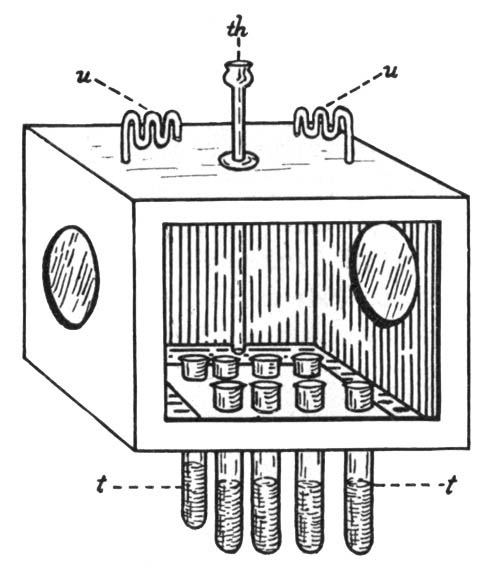
Prof. Tyndall's experiment to show that if air containing germs is kept from organic substances, such substances will not decay. The box is sterilized; likewise the tubes (t) containing nutrients. Air is allowed to enter by the tubes (u), which are so made that dust is prevented from entering. A thermometer (th) records the temperature. The substances in the tubes do not decay, no matter how favorable the temperature.
Life comes from Life.—Another group of men, after years of patient experimentation, worked out the fact that life comes from other life. In ancient times it was thought that life arose spontaneously; for example, that fish or frogs arose out of the mud of the river bottoms, and that insects came from the dew or rotting meat. It was believed that bacteria arose spontaneously in water, even as late as 1876, when Professor Tyndall proved by experiment the contrary to be true.
As early as 1651 William Harvey, the court physician of Charles I of England, showed that all life came from the egg. It was much later, however, that the part played by the sperm and egg cell in fertilization was carefully worked out. It is to Harvey, too, that we owe the beginnings of our knowledge of the circulation of the blood. He showed that blood moved through tubes in the body and that the heart pumped it. He might be called the father of modern physiology as well as the father of embryology. A long list of names might be added to that of Harvey to show how gradually our knowledge of the working of the human body has been added to. At the present time we are far from knowing all the functions of the various parts of the human engine, as is shown by the number of investigators in physiology at the present time. Present-day problems have much to do with the care of the human mechanism and with its surroundings. The solution of these problems will come from applying the sciences of hygiene, preventive medicine, and sanitation.
In the preceding chapters of this book we have learned something about our bodies and their care. We have found that man is able within limitations to control his environment so as to make it better to live in. All of the scientific facts that have been of use to man in the control of disease have been found out by men who have devoted their lives in the hope that their experiments and their sacrifices of time, energy, and sometimes life itself might make for the betterment of the human race. Such men were Harvey, Jenner, Lister, Koch, and Pasteur.
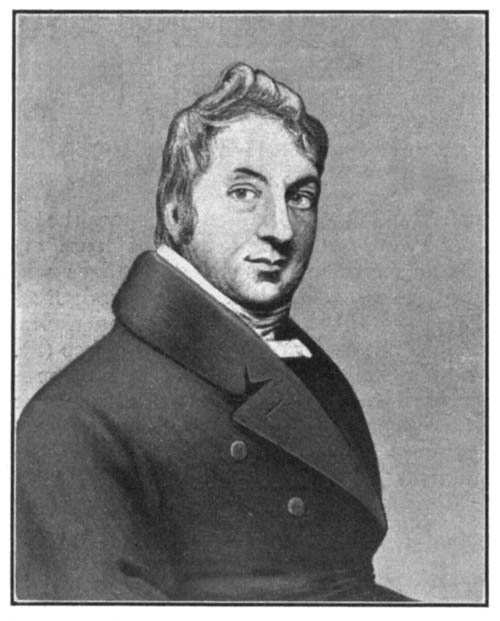
Edward Jenner, the discoverer of vaccination.
Edward Jenner and Vaccination.—The civilized world owes much to Edward Jenner, the discoverer of vaccination against smallpox. Born in Berkeley, a little town of Gloucestershire, England, in 1749, as a boy he showed a strong liking for natural history. He studied medicine and also gave much time to the working out of biological problems. As early as 1775 he began to associate the disease called cowpox with that of smallpox, and gradually the idea of inoculation against this terrible scourge, which killed or disfigured hundreds of thousands every year in England alone, was worked out and applied. He believed that if the two diseases were similar, a person inoculated with the mild disease (cowpox) would after a slight attack of this disease be immune against the more deadly and loathsome smallpox. It was not until 1796 that he was able to prove his theory, as at first few people would submit to vaccination. War at this time was being waged between France and England, so that the former country, usually so quick to appreciate the value of scientific discoveries, was slow to give this method a trial. In spite of much opposition, however, by the year 1802, vaccination was practiced in most of the civilized countries of the world. At the present time the death rate in Great Britain, the home of vaccination, is less than .3 to every 1,000,000 living persons. This shows that the disease is practically wiped out in England. An interesting comparison with these figures might be made from the history of the disease in parts of Russia where vaccination is not practiced. There, thousands of deaths from smallpox occur annually. During the winter of 1913-1914 an epidemic of smallpox with more than 250 cases broke out in the city of Niagara Falls. This epidemic appears to be due to a campaign conducted by people who do not believe in vaccination. In cities and towns near by, where vaccination was practiced, no cases of smallpox occurred. Naturally if opposition to vaccination is found nowadays, Jenner had a much harder battle to fight in his day. He also had many failures, due to the imperfect methods of his time. The full worth of his discovery was not fully appreciated until long after his death, which occurred in 1823.
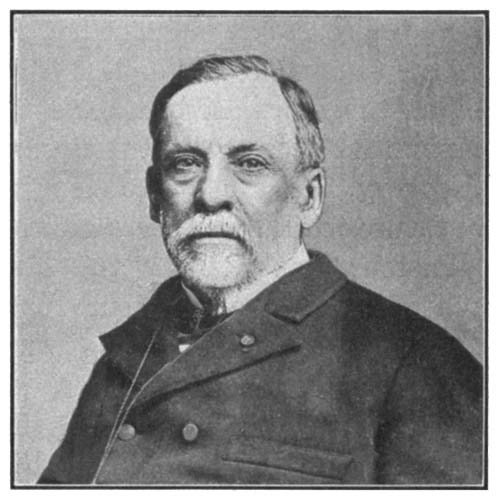
Louis Pasteur.
Louis Pasteur.—The one man who, in biological science, did more than any other to directly benefit mankind was Louis Pasteur. Born in 1822, in the mountains near the border of northeastern France, he spent the early part of his life as a normal boy, fond of fishing and not very partial to study. He inherited from his father, however, a fine character and grim determination, so that when he became interested in scientific pursuits he settled down to work with enthusiasm and energy.
At the age of twenty-five he became well known throughout France as a physicist. Shortly after this he became interested in the tiny plants we call bacteria, and it was in the field of bacteriology that he became most famous. First as professor at Strassburg and at Lille, later as director of scientific studies in the École Normale at Paris, he showed his interest in the application of his discoveries to human welfare.
In 1857 Pasteur showed that fermentation was due to the presence of bacteria, it having been thought up to this time that it was a purely chemical process. This discovery led to very practical ends, for France was a great wine-producing country, and with a knowledge of the cause of fermentation many of the diseases which spoiled wine were checked.