A CIVIC BIOLOGY (continued 4)
Reading edition
VII. Mollusca.—Another large group is the Mollusca. This phylum gets its name from the soft, unsegmented body (mollis = soft). Mollusks usually have a shell, which may be of one piece, as a snail, or two pieces or valves, as the clam or oyster.
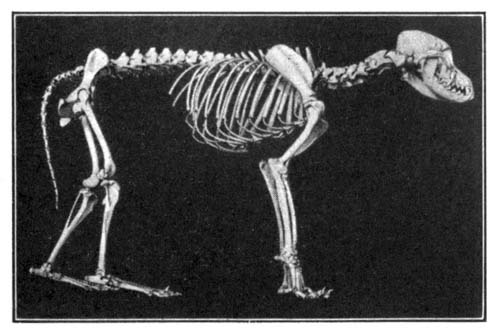
The skeleton of a dog; a typical vertebrate.
VIII. The Vertebrates.—All of the animals we have studied thus far agree in having whatever skeleton or hard parts they possess on the outside of the body. Collectively, they are called Invertebrates. This exoskeleton differs from the main or axial skeleton of the higher animals, the latter being inside of the body. The exoskeleton is dead, being secreted by the cells lining the body, while the endoskeleton is, in part at least, alive and is capable of growth, e.g. a broken arm or leg bone will grow together. But a man has certain parts of the skeleton, as nails or hair, formed by the skin and in addition possesses inside bones to which the muscles are attached. Some of the bones are arranged in a flexible column in the dorsal (the back) side of the body. This vertebral column, as it is called, is distinctive of all vertebrates. Within its bony protection lies the delicate central nervous system, and to this column are attached the big bones of the legs and arms. The vertebrate animals deserve more of our attention than other forms of life because man himself is a vertebrate.
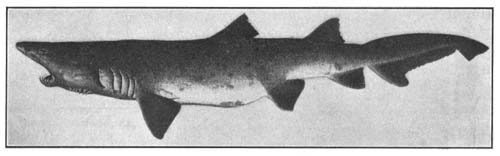
The sand shark, an elasmobranch. Note the slits leading from the gills. (From a photograph loaned by the American Museum of Natural History.)
Five groups or classes of vertebrates exist. Fishes, Amphibians, Reptiles, Birds, and Mammals. Let us see how to distinguish one class from another.
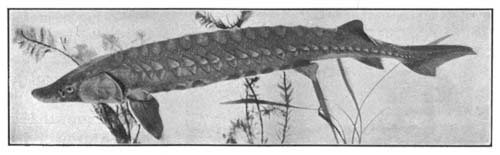
The sturgeon, a ganoid fish.
Fishes.—Fishes are familiar animals to most of us. We know that they live in the water, have a backbone, and that they have fins. They breathe by means of gills, delicate organs fitted for taking oxygen out of the water. The heart has two chambers, an auricle and a ventricle. They have a skin in which are glands secreting mucus, a slimy substance which helps them go through the water easily. They usually lay very many eggs.
Classification of Fishes
Order I. The Elasmobranchs. Fishes which have a soft skeleton made of cartilage and exposed gill slits. Examples: sharks, skates, and rays.
Order II. The Ganoids. Fishes which once were very numerous on the earth, but which are now almost extinct. They are protected by platelike scales. Examples: gars, sturgeon, and bowfin.
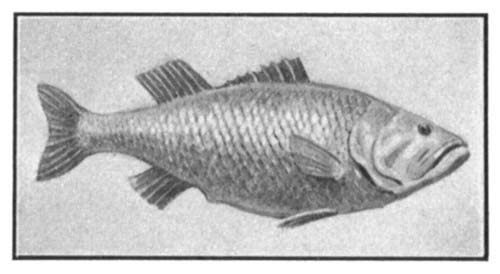
A bony fish.
Order III. The Teleosts, or Bony Fishes. They compose 95 per cent of all living fishes. In this group the skeleton is bony, the gills are protected by an operculum, and the eggs are numerous. Most of our common food fishes belong to this class.
Order IV. The Dipnoi, or Lung Fishes. This is a very small group. In many respects they are more like amphibians than fishes, the swim bladder being used as a lung. They live in tropical Africa, South America, and Australia, inhabiting the rivers and lakes there.
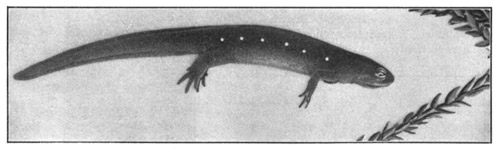
Newt. (From a photograph loaned by the American Museum of Natural History.) About natural size.
Characteristics of Amphibia.—The frog belongs to the class of vertebrates known as Amphibia. As the name indicates (amphi, both, and bia, life), members of this group live both in water and on land. In the earlier stages of their development they take oxygen into the blood by means of gills. When adult, however, they breathe by means of lungs. At all times, but especially during the winter, the skin serves as a breathing organ. The skin is soft and unprotected by bony plates or scales. The heart has three chambers, two auricles and one ventricle. Most amphibians undergo a complete metamorphosis, or change of form, the young being unlike the adults.
Classification of Amphibia
Order I. Urodela. Amphibia having usually poorly developed appendages. Tail persistent through life. Examples: mud puppy, newt, salamander.
Order II. Anura. Tailless Amphibia, which undergo a metamorphosis, breathing by gills in larval state, by lungs in adult state. Examples: toad and frog.
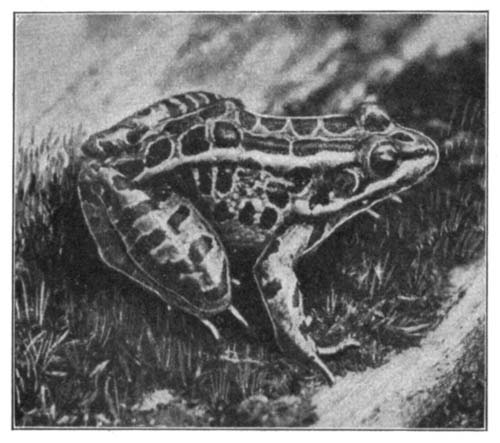
The leopard frog, an amphibian.
Characteristics of Reptilia.—These animals are characterized by having scales developed from the skin. In the turtle they have become bony and are connected with the internal skeleton. Reptiles always breathe by means of lungs, differing in this respect from the amphibians. They show their distant relationship to birds in that their large eggs are incased in a leathery, limy shell.
Classification of Reptiles
Order I. Chelonia (turtles and tortoises). Flattened reptiles with body inclosed in bony case. No teeth or sternum (breastbone). Examples: snapping turtle, box tortoise.
Order II. Lacertilia (lizards). Body covered with scales, usually having two-paired appendages. Breathe by lungs. Examples: fence lizard, horned toad.
Order III. Ophidia (snakes). Body elongated, covered with scales. No limbs present. Examples: garter snake, rattlesnake.
Order IV. Crocodilia. Fresh-water reptiles with elongated body and bony scales on skin. Two-paired limbs. Examples: alligator, crocodile.
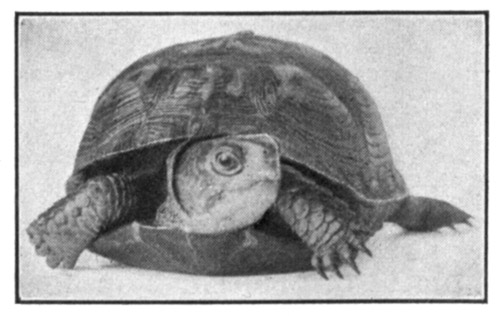
Box tortoise, a land reptile. (From photograph loaned by the American Museum of Natural History.) About one fourth natural size.
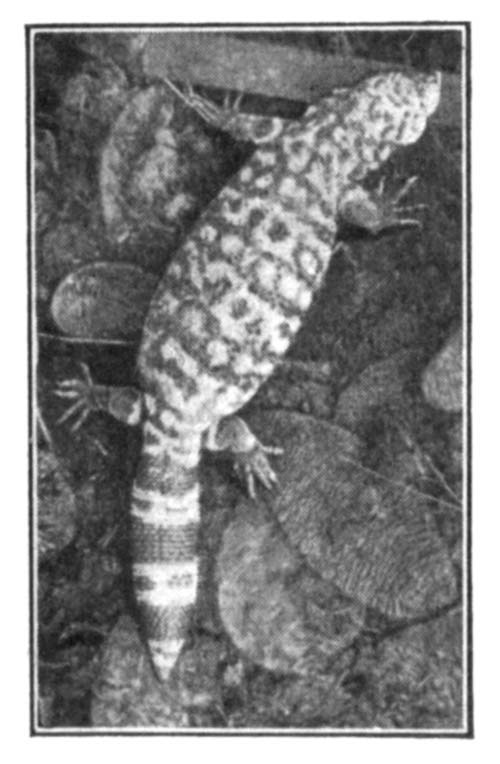
The gila monster, a poisonous lizard. About one twelfth natural size.
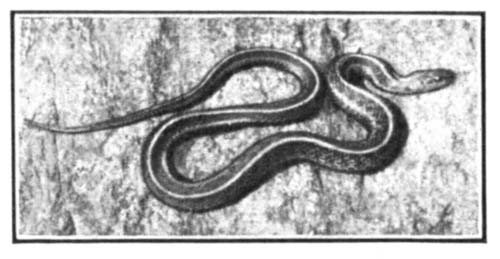
The common garter snake. Reduced to about one tenth natural size.
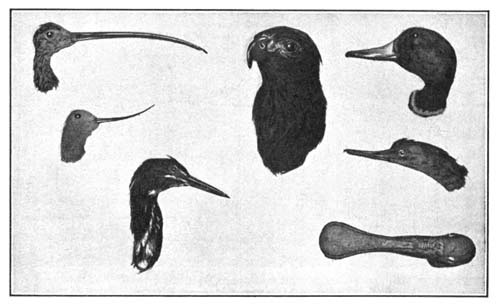
Adaptations in the bills of birds. Could we tell anything about the food of a bird from its bill? Do these birds all get their food in the same manner? Do they all eat the same kind of food?
Birds.—Birds among all other animals are known by their covering of feathers and the presence of wings. The feathers are developed from the skin. These aid in flight, and protect the body from the cold.
The form of the bill in particular shows adaptation to a wonderful degree. A duck has a flat bill for pushing through the mud and straining out the food; a bird of prey has a curved or hooked beak for tearing; the woodpecker has a sharp, straight bill for piercing the bark of trees in search of the insect larvæ which are hidden underneath. Birds do not have teeth.
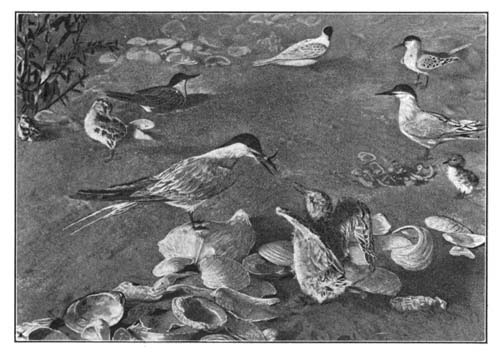
Common tern and young, showing nesting and feeding habits. (From group at American Museum of Natural History.)
The rate of respiration, of heartbeat, and the body temperature are all higher in the bird than in man. Man breathes from twelve to fourteen times per minute. Birds breathe from twenty to sixty times a minute. Because of the increased activity of a bird, there comes a necessity for a greater and more rapid supply of oxygen, an increased blood supply to carry the material to be used up in the release of energy, and a means of rapid excretion of the wastes resulting from the process of oxidation. Birds are large eaters, and the digestive tract is fitted to digest the food quickly, by having a large crop in which food may be stored in a much softened condition. As soon as the food is part of the blood, it may be sent rapidly to the places where it is needed, by means of the large four-chambered heart and large blood vessels.
The high temperature of the bird is a direct result of this rapid oxidation; furthermore, the feathers and the oily skin form an insulation which does not readily permit of the escape of heat. This insulating cover is of much use to the bird in its flights at high altitudes, where the temperature is often very low. Birds lay eggs and usually care for their young.
Classification of Birds
Order I. Cursores. Running birds with no keeled breastbone. Examples: ostrich, cassowary.
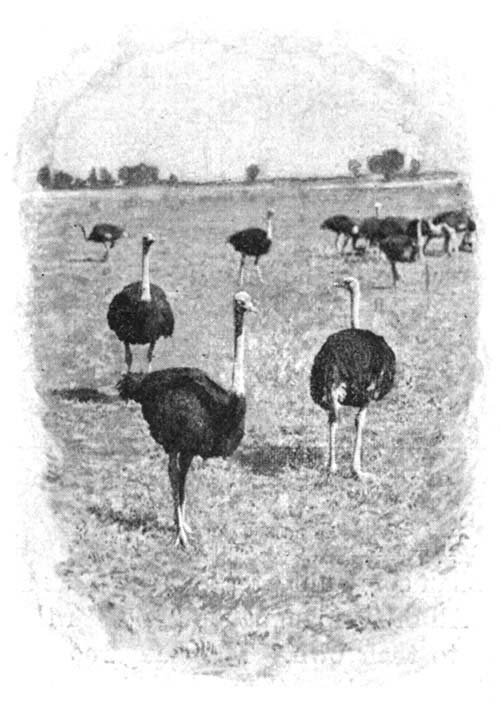
African ostrich, one of the largest living birds.
Order II. Passeres. Perching birds; three toes in front, one behind. Over one half of all species of birds are included in this order. Examples: sparrow, thrush, swallow.
Order III. Gallinæ. Strong legs; feet adapted to scratching. Beak stout. Examples: jungle fowl, grouse, quail, domestic fowl.
Order IV. Raptores. Birds of prey. Hooked beak. Strong claws. Examples: eagle, hawk, owl.
Order V. Grallatores. Waders. Long neck, beak, and legs. Examples: snipe, crane, heron.
Order VI. Natatores. Divers and swimmers. Legs short, toes webbed. Examples: gull, duck, albatross.
Order VII. Columbinæ. Like Gallinæ, but with weaker legs. Examples: dove, pigeon.
Order VIII. Pici. Woodpeckers. Two toes point forward, two backward, and adaptation for climbing. Long, strong bill.
Order IX. Psittaci. Parrots, hooked beak and fleshy tongue.
Order X. Coccyges. Climbing birds, with powerful beak. Examples: kingfisher, toucan, and cuckoo.
Order XI. Macrochires. Birds having long-pointed wings, without scales on metatarsus. Examples: swift, humming bird, and goatsucker.
Mammals.—Dogs and cats, sheep and pigs, horses and cows, all of our domestic animals (and man himself) have characters of structure which cause them to be classed as mammals. They, like some other vertebrates, have lungs and warm blood. They also have a hairy covering and bear young developed to a form similar to their own,[28] and nurse them with milk secreted by glands known as the mammary glands; hence the term "mammal."
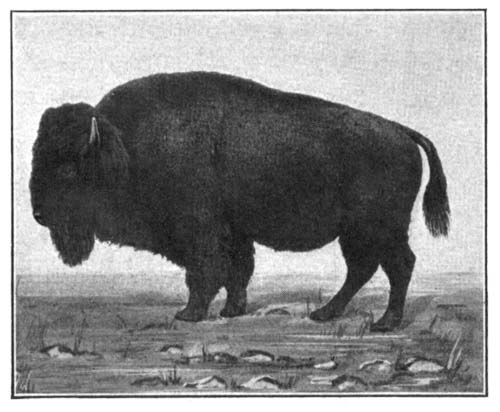
The bison, an almost extinct mammal.
Adaptations in Mammalia.—Of the thirty-five hundred species, most inhabit continents; a few species are found on different islands, and some, as the whale, inhabit the ocean. They vary in size from the whale and the elephant to tiny shrew mice and moles. Adaptations to different habitat and methods of life abound; the seal and whale have the limbs modified into flippers, the sloth and squirrel have limbs peculiarly adapted to climbing, while the bats have the fore limbs modeled for flight.
Lowest Mammals.—The lowest are the monotremes, animals which lay eggs like the birds, although they are provided with hairy covering like other mammals. Such are the Australian spiny anteater and the duck mole.
All other mammals bring forth their young developed to a form similar to their own. The kangaroo and opossum, however, are provided with a pouch on the under side of the body in which the very immature, blind, and helpless young are nourished until they are able to care for themselves. These pouched animals are called marsupials.
The other mammals may be briefly classified as follows:—
Classification of Higher Mammals
Order I. Edentata. Toothless or with very simple teeth. Examples: anteater, sloth, armadillo.
Order II. Rodentia. Incisor teeth chisel-shaped, usually two above and two below. Examples: beaver, rat, porcupine, rabbit, squirrel.
Order III. Cetacea. Adapted to marine life. Examples: whale, porpoise.
Order IV. Ungulata. Hoofs, teeth adapted for grinding. Examples: (a) odd-toed, horse, rhinoceros, tapir; (b) even-toed, ox, pig, sheep, deer.
Order V. Carnivora. Long canine teeth, sharp and long claws. Examples: dog, cat, lion, bear, seal, and sea lion.
Order VI. Insectivora. Example: mole.
Order VII. Cheiroptera. Fore limbs adapted to flight, teeth pointed. Example: bat.
Order VIII. Primates. Erect or nearly so, fore appendage provided with hand. Examples: monkey, ape, man.
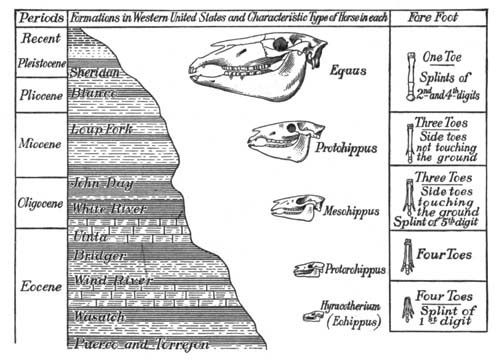
The geological history of the horse. (After Mathews, in the American Museum of Natural History.) Ask your teacher to explain this diagram.
Increasing Complexity of Structure and of Habits in Plants and Animals.—In our study of biology so far we have attempted to get some notion of the various factors which act upon living things. We have seen how plants and animals interact upon each other. We have learned something about the various physiological processes of plants and animals, and have found them to be in many respects identical. We have found grades of complexity in plants from the one-celled plant, bacterium or pleurococcus, to the complicated flowering plants of considerable size and with many organs. So in animal life, from the Protozoa upward, there is constant change, and the change is toward greater complexity of structure and functions. An insect is a higher type of life than a protozoan, because its structure is more complex and it can perform its work with more ease and accuracy. A fish is a higher type of animal than the insect for these same reasons, and also for another. The fish has an internal skeleton which forms a pointed column of bones on the dorsal side (the back) of the animal. It is a vertebrate animal.
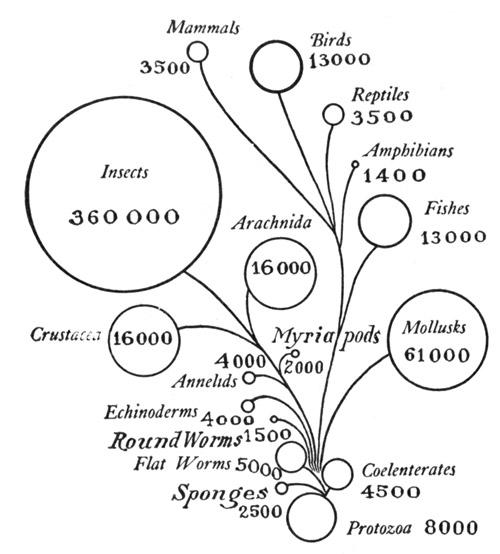
The evolutionary tree. Modified from Galloway. Copy this diagram in your notebook. Explain it as well as you can.
The Doctrine of Evolution.—We have now learned that animal forms may be arranged so as to begin with very simple one-celled forms and culminate with a group which contains man himself. This arrangement is called the evolutionary series. Evolution means change, and these groups are believed by scientists to represent stages in complexity of development of life on the earth. Geology teaches that millions of years ago, life upon the earth was very simple, and that gradually more and more complex forms of life appeared, as the rocks formed latest in time show the most highly developed forms of animal life. The great English scientist, Charles Darwin, from this and other evidence, explained the theory of evolution. This is the belief that simple forms of life on the earth slowly and gradually gave rise to those more complex and that thus ultimately the most complex forms came into existence.
The Number of Animal Species.—Over 500,000 species of animals are known to exist to-day, as the following table shows.
Protozoa 8,000 Arachnids 16,000
Sponges 2,500 Crustaceans 16,000
Cœlenterates 4,500 Mollusks 61,000
Echinoderms 4,000 Fishes 13,000
Flat-worms 5,000 Amphibians 1,400
Roundworms 1,500 Reptiles 3,500
Annelids 4,000 Birds 13,000
Insects 360,000 Mammals 3,500
Myriapods 2,000 Total 518,900
Man's Place in Nature.—Although we know that man is separated mentally by a wide gap from all other animals, in our study of physiology we must ask where we are to place man. If we attempt to classify man, we see at once he must be placed with the vertebrate animals because of his possession of a vertebral column. Evidently, too, he is a mammal, because the young are nourished by milk secreted by the mother and because his body has at least a partial covering of hair. Anatomically we find that we must place man with the apelike mammals, because of these numerous points of structural likeness. The group of mammals which includes the monkeys, apes, and man we call the primates.
Although anatomically there is a greater difference between the lowest type of monkey and the highest type of ape than there is between the highest type of ape and the lowest savage, yet there is an immense mental gap between monkey and man.
Instincts.—Mammals are considered the highest of vertebrate animals, not only because of their complicated structure, but because their instincts are so well developed. Monkeys certainly seem to have many of the mental attributes of man.
Professor Thorndike of Columbia University sums up their habits of learning as follows:—
"In their method of learning, although monkeys do not reach the human stage of a rich life of ideas, yet they carry the animal method of learning, by the selection of impulses and association of them with different sense-impressions, to a point beyond that reached by any other of the lower animals. In this, too, they resemble man; for he differs from the lower animals not only in the possession of a new sort of intelligence, but also in the tremendous extension of that sort which he has in common with them. A fish learns slowly a few simple habits. Man learns quickly an infinitude of habits that may be highly complex. Dogs and cats learn more than the fish, while monkeys learn more than they. In the number of things he learns, the complex habits he can form, the variety of lines along which he can learn them, and in their permanence when once formed, the monkey justifies his inclusion with man in a separate mental genus."
Evolution of Man.—Undoubtedly there once lived upon the earth races of men who were much lower in their mental organization than the present inhabitants. If we follow the early history of man upon the earth, we find that at first he must have been little better than one of the lower animals. He was a nomad, wandering from place to place, feeding upon whatever living things he could kill with his hands. Gradually he must have learned to use weapons, and thus kill his prey, first using rough stone implements for this purpose. As man became more civilized, implements of bronze and of iron were used. About this time the subjugation and domestication of animals began to take place. Man then began to cultivate the fields, and to have a fixed place of abode other than a cave. The beginnings of civilization were long ago, but even to-day the earth is not entirely civilized.
The Races of Man.—At the present time there exist upon the earth five races or varieties of man, each very different from the other in instincts, social customs, and, to an extent, in structure. These are the Ethiopian or negro type, originating in Africa; the Malay or brown race, from the islands of the Pacific; the American Indian; the Mongolian or yellow race, including the natives of China, Japan, and the Eskimos; and finally, the highest type of all, the Caucasians, represented by the civilized white inhabitants of Europe and America.
Reference Books
elementary
Hunter, Laboratory Problems in Civic Biology, American Book Company.
Bulletin of U. S. Department of Agriculture, Division of Biological Survey, Nos. 1, 6, 13, 17.
Davison, Practical Zoölogy. American Book Company.
Ditmars, The Reptiles of New York. Guide Leaflet 20. Amer. Mus. of Nat. History.
Sharpe,[TN2] A Laboratory Manual in Biology, pp. 140-150, American Book Company.
Walker, Our Birds and Their Nestlings. American Book Company.
Walter, H. E. and H. A., Wild Birds in City Parks. Published by authors.
advanced
Apgar, Birds of the United States. American Book Company.
Beebe, The Bird. Henry Holt and Company.
Ditmars, The Reptile Book. Doubleday, Page and Company.
Hegner, Zoölogy. The Macmillan Company.
Hornaday, American Natural History.
Jordan and Evermann, Food and Game Fishes. Doubleday, Page and Company.
Parker and Haswell, Textbook of Zoölogy. The Macmillan Company.
Riverside Natural History. Houghton, Mifflin and Company.
Weed and Dearborn, Relation of Birds to Man. Lippincott.
XV. THE ECONOMIC IMPORTANCE OF ANIMALS
Problems.—I. To determine the uses of animals.
(a) Indirectly as food.
(b) Directly as food.
(c) As domesticated animals.
(d) For clothing.
(e) Other direct economic uses.
(f) Destruction of harmful plants and animals.
II. To determine the harm done by animals.
(a) Animals destructive to those used for food.
(b) Animals harmful to crops and gardens.
(c) Animals harmful to fruit and forest trees.
(d) Animals destructive to stored food or clothing.
(e) Animals indirectly or directly responsible for disease.
Laboratory Suggestions
Inasmuch as this work is planned for the winter months the laboratory side must be largely museum and reference work. It is to be expected that the teacher will wish to refer to much of this work at the time work is done on a given group. But it is pedagogically desirable that the work as planned should be varied. Interest is thus held. Outlines prepared by the teacher to be filled in by the student are desirable because they lead the pupil to individual selection of what seems to him as important material. Opportunity should be given for laboratory exercises based on original sources. The pupils should be made to use reports of the U. S. Department of Agriculture, the Biological Survey, various States Reports, and others.
Special home laboratory reports may be well made at this time, for example: determination at a local fish market of the fish that are cheap and fresh at a given time. Have the students give reasons for this. Study conditions in the meat market in a similar manner. Other local food conditions may also be studied first hand.
uses of animals
Indirect Use as Food.—Just as plants form the food of animals, so some animals are food for others. Man may make use of such food directly or indirectly. Many mollusks, as the barnacle and mussel, are eaten by fishes. Other fish live upon tiny organisms, water fleas and other small crustaceans. These in turn feed upon still smaller animals, and we may go back and back until finally we come to the Protozoa and one-celled water plants as an ultimate source of food.
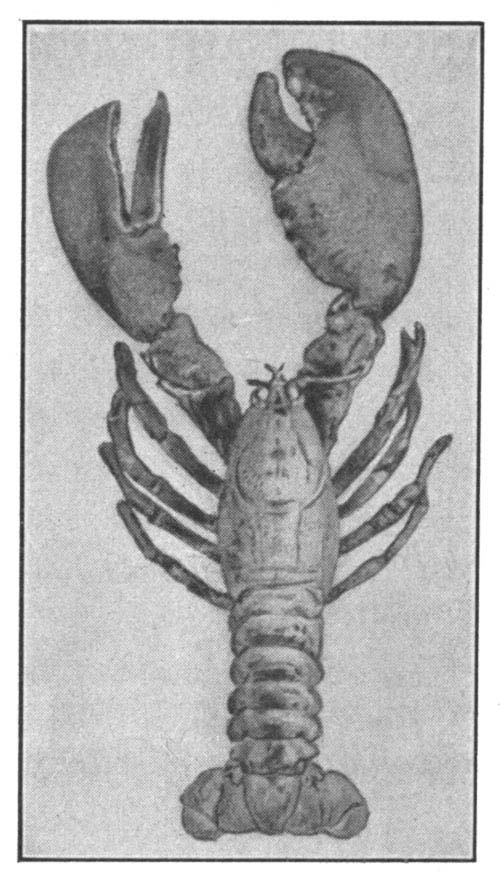
North American lobster. This specimen, preserved at the U. S. Fish Commission at Woods Hole, was of unusual size and weighed over twenty pounds.
Direct Use as Food. Lower Forms.—The forms of life lower than the Crustacea are of little use directly as food, although the Chinese are very fond of one of the Echinoderms, a holothurian.
Crustacea as Food.—Crustaceans, however, are of considerable value for food, the lobster fisheries in particular being of importance. The lobster is highly esteemed as food, and is rapidly disappearing from our coasts as the result of overfishing. Between twenty and thirty million are yearly taken on the North Atlantic coast. This means a value at present prices of about $15,000,000. Laws have been enacted in New York and other states against overfishing. Egg-carrying lobsters must be returned to the water; all smaller than six to nine inches in length (the law varies in different states) must be put back; other restrictions are placed upon the taking of the animals, in hope of saving the race from extinction. Some states now hatch and care for the young for a period of time; the United States Bureau of Fisheries is also doing much good work, in the hope of restocking to some extent the now almost depleted waters.
Several other common crustaceans are near relatives of the crayfish. Among them are the shrimp and prawn, thin-shelled, active crustaceans common along our eastern coast. In spite of the fact that they form a large part of the food supply of many marine animals, especially fish, they do not appear to be decreasing in numbers. They are also used as food by man, the shrimp fisheries in this country aggregating over $1,000,000 yearly.
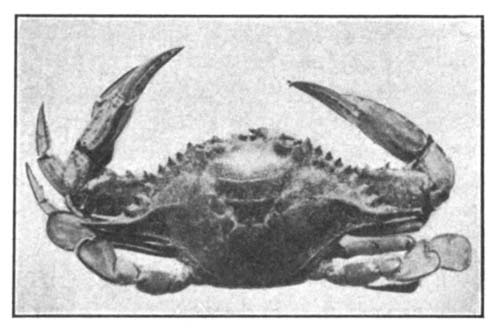
The edible blue crab. (From a photograph loaned by the American Museum of Natural History.)
Another edible crustacean of considerable economic importance is the blue crab. Crabs are found inhabiting muddy bottoms; in such localities they are caught in great numbers in nets or traps baited with decaying meat. They are, indeed, among our most valuable sea scavengers, although they are carnivorous hunters as well. The young crabs differ considerably in form from the adult. They undergo a complete metamorphosis (change of form). Immediately after molting or shedding of the outer shell in order to grow larger, crabs are greatly desired by man as an article of food. They are then known as "shedders," or soft-shelled crabs.
Mollusks as Food.—Oysters are never found in muddy localities, for in such places they would be quickly smothered by the sediment in the water. They are found in nature clinging to stones or on shells or other objects which project a little above the bottom. Here food is abundant and oxygen is obtained from the water surrounding them. Hence oyster raisers throw oyster shells into the water and the young oysters attach themselves.
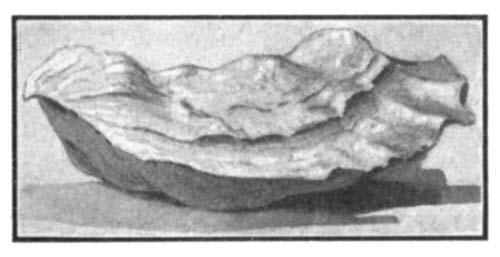
The oyster.
In some parts of Europe and this country where oysters are raised artificially, stakes or brush are sunk in shallow water so that the young oyster, which is at first free-swimming, may escape the danger of smothering on the bottom. After the oysters are a year or two old, they are taken up and put down in deeper water as seed oysters. At the age of three and four years they are ready for the market.
The oyster industry is one of the most profitable of our fisheries. Nearly $15,000,000 a year has been derived during the last decade from such sources. Hundreds of boats and thousands of men are engaged in dredging for oysters. Three of the most important of our oyster grounds are Long Island Sound, Narragansett Bay, and Chesapeake Bay.
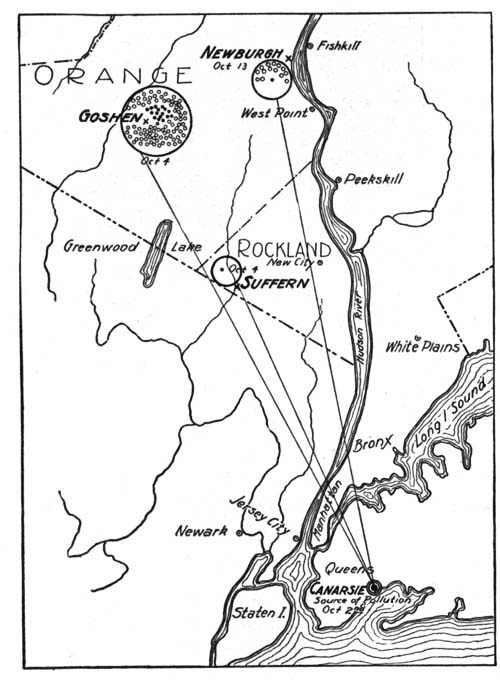
This diagram shows how cases of intestinal disease (typhoid and diarrhœa) have been traced to oysters from a locality where they were"fattened" in water contaminated with sewage. (Loaned by American Museum of Natural History.)
Sometimes oysters are artificially "fattened" by placing them on beds near the mouths of fresh-water streams. Too often these streams are the bearers of much sewage, and the oyster, which lives on microscopic organisms, takes in a number of bacteria with other food. Thus a person might become infected with the typhoid bacillus by eating raw oysters. State and city supervision of the oyster industry makes this possibility very much less than it was a few years ago, as careful bacteriological analysis of the surrounding water is constantly made by competent experts.
Clams.—Other bivalve mollusks used for food are clams and scallops. Two species of the former are known to New Yorkers, one as the "round," another as the "long" or "soft-shelled" clams. The former (Venus mercenaria) was called by the Indians "quahog," and is still so called in the Eastern states. The blue area of its shell was used by the Indians to make wampum, or money. The quahog is now extensively used as food. The "long" clam (Mya arenaria) is considered better eating by the inhabitants of Massachusetts and Rhode Island. This clam was highly prized as food by the Indians. The clam industries of the eastern coast aggregate nearly $1,000,000 a year. The dredging for scallops, another molluscan delicacy, forms an important industry along certain parts of the eastern coast.
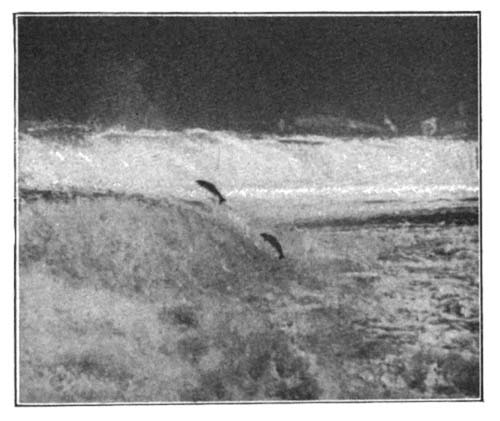
Salmon leaping a fall on their way to their spawning beds. (Photographed by Dr. John A. Sampson.)
Fish as Food.—Fish are used as food the world over. From very early times the herring were pursued by the Norsemen. Fresh-water fish, such as whitefish, perch, pickerel, pike, and the various members of the trout family, are esteemed food and, especially in the Great Lake region, form important fisheries. But by far the most important food fishes are those which are taken in salt water. Here we have two types of fisheries, those where the fish comes up a river to spawn, as the salmon, sturgeon, or shad, and those in which fishes are taken on their feeding grounds in the open ocean. Herring are the world's most important catch, though not in this country. Here the salmon of the western coast is taken to the value of over $13,000,000 a year. Cod fishing also forms an important industry; over 7000 men being employed and over $2,000,000 of codfish being taken each year in this country.
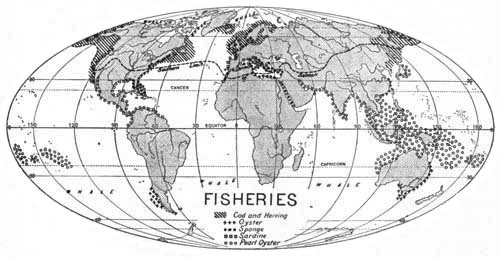
Globe Fisheries.
Hundreds of other species of fish are used as food, the fish that is nearest at hand being often the cheapest and best. Why, for example, is the flounder so cheap in the New York markets? In what waters are the cod and herring fisheries, sardine, oyster, sponge, pearl oyster? (See chart[TN3] on page 201.)
Amphibia and Reptiles as Food.—Frogs' legs are esteemed a delicacy. Certain reptiles are used as food by people of other nationalities, the Iguana, a Mexican lizard, being an example. Many of the sea-water turtles are of large size, the leatherback and the green turtle often weighing six hundred to seven hundred pounds each. The flesh of the green turtle and especially of the diamond-back terrapin, an animal found in the salt marshes along our southeastern coast, is highly esteemed as food. Unfortunately for the preservation of the species, these animals are usually taken during the breeding season when they go to sandy beaches to lay their eggs.
Birds as Food.—Birds, both wild and domesticated, form part of our food supply. Unfortunately our wild game birds are disappearing so fast that we should not consider them as a source of food. Our domestic fowls, turkey, ducks, etc., form an important food supply and poultry farms give lucrative employment to many people. Eggs of domesticated birds are of great importance as food, and egg albumin is used for other purposes,—clarifying sugars, coating photographic papers, etc.
Mammals as Food.—When we consider the amount of wealth invested in cattle and other domesticated animals bred and used for food in the United States, we see the great economic importance of mammals. The United States, Argentina, and Australia are the greatest producers of cattle. In this country hogs are largely raised for food. They are used fresh, salted, smoked as ham and bacon, and pickled. Sheep, which are raised in great quantities in Australia, Argentina, Russia, Uruguay, and this country, are one of the world's greatest meat supplies.
Goats, deer, many larger game animals, seals, walruses, etc., give food to people who live in parts of the earth that are less densely populated.
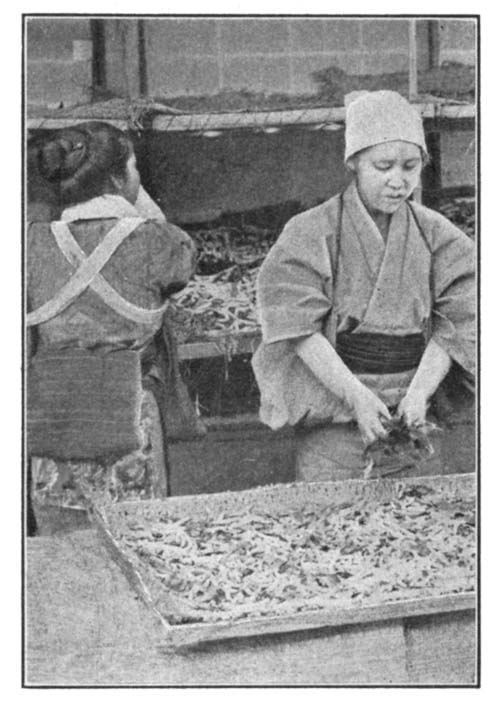
Feeding silkworms. The caterpillars are the white objects in the trays.
Domesticated Animals.— When man emerged from his savage state on the earth, one of the first signs of the beginning of civilization was the domestication of animals. The dog, the cow, sheep, and especially the horse, mark epochs in the advance of civilization. Beasts of burden are used the world over, horses almost all over the world, certain cattle, as the water buffalo, in tropical Malaysia; camels, goats, and the llama are also used as draft animals in some other countries.
Man's wealth in many parts of the world is estimated in terms of his cattle or herds of sheep. So many products come from these sources that a long list might be given, such as meats, milk, butter, cheese, wool, or other body coverings, leather, skins, and hides used for other purposes. Great industries are directly dependent upon our domesticated animals, as the making of shoes, the manufacture of woolen cloth, the tanning industry, and many others.
Uses for Clothing.—The manufacture of silk is due to the production of raw silk by the silkworm, the caterpillar of a moth. It lives upon the mulberry and makes a cocoon from which the silk is wound. The Chinese silkworm is now raised to a slight extent in southern California. China, Japan, Italy, and France, because of cheaper labor, are the most successful silk-raising countries.
The use of wool gives rise to many great industries. After the wool is cut from the sheep, it has to be washed and scoured to get out the dirt and grease. This wool fat or lanoline is used in making soap and ointments. The wool is next "carded," the fibers being interwoven by the fine teeth of the carding machine or "combed," the fibers here being pulled out parallel to each other. Carded wool becomes woolen goods; combed wool, worsted goods. The wastes are also utilized, being mixed with "shoddy" (wool from cloth cuttings or rags) to make woolen goods of a cheap grade.
Goat hair, especially that of the Angora and the Cashmere goat, has much use in the clothing industries. Camel's hair and alpaca are also used.
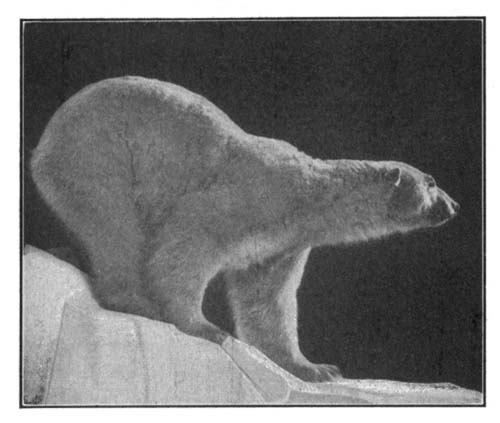
Polar bear, a fur-bearing mammal which is rapidly being exterminated. Why?
Fur.—The furs of many domesticated and wild animals are of importance. The Carnivora as a group are of much economic importance as the source of most of our fur. The fur seal fisheries alone amount to many millions of dollars annually. Otters, skunks, sables, weasels, foxes, and minks are of considerable importance as fur producers. Even cats are now used for fur, usually masquerading under some other name. The fur of the beaver, one of the largest of the rodents or gnawing mammals, is of considerable value, as are the coats of the chinchilla, muskrats, squirrels, and other rodents. The fur of the rabbit and nutria are used in the manufacture of felt hats. The quills of the porcupines (greatly developed and stiffened hairs) have a slight commercial value.
Conservation of Fur-bearing Animals Needed.—As time goes on and the furs of wild animals become scarcer and scarcer through overkilling, we find the need for protection and conservation of many of these fast-vanishing wild forms more and more imperative. Already breeding of some fur-bearing animals has been tried with success, and cheap substitutes for wild animal skins are coming more and more into the markets. Black-fox breeding has been tried successfully in Prince Edward Island, Canada, $2500 to $3000 being given for a single skin. Skunk, marten, and mink are also being bred for the market. Game preserves in this country and Canada are also helping to preserve our wild fur-bearing animals.
Animal Oils.—Whale oil, obtained from the fat or "blubber" of whales, is used extensively for lubricating. Neat's-foot oil comes from the feet of cattle and is also used in lubrication. Tallow and lard, two fats from cattle, sheep, and pigs, have so many well-known uses that comment is unnecessary. Cod-liver oil is used medically and is well known. But it is not so widely known that a fish called the menhaden or "moss bunkers" of the Atlantic coast produces over 3,000,000 gallons of oil every year and is being rapidly exterminated in consequence.
Hides, Horns, Hoofs, etc.—Leathers, from cattle, horses, sheep, and goats, are used everywhere. Leather manufacture is one of the great industries of the Eastern states, hundreds of millions of dollars being invested in its manufacturing plants. Horns and bones are utilized for making combs, buttons, handles for brushes, etc. Glue is made from the animal matter in bones. Ivory, obtained from elephant, walrus, and other tusks, forms a valuable commercial product. It is largely used for knife handles, piano keys, combs, etc.
Perfumes.—The musk deer, musk ox, and muskrat furnish a valuable perfume called musk. Civet cats also give us a somewhat similar perfume. Ambergris, a basis for delicate perfumes, comes from the intestines of the sperm whale.
Protozoa.—The Protozoa have played an important part in rock building. The chalk beds of Kansas and other chalk formations are made up to a large extent of the tiny skeletons of Protozoa, called Foraminifera. Some limestone rocks are also composed in large part of such skeletons. The skeletons of some species are used to make a polishing powder.
Sponges.—The sponges of commerce have the skeleton composed of tough fibers of material somewhat like that of cow's horn. This fiber is elastic and has the power of absorbing water. In a living state, the horny fiber sponge is a dark-colored fleshy mass, usually found attached to rocks. The warm waters of the Mediterranean Sea and the West Indies furnish most of our sponges. The sponges are pulled up from their resting place on the bottom, by means of long-handled rakes operated by men in boats or are secured by divers. They are then spread out on the shore in the sun, and the living tissues allowed to decay; then after treatment consisting of beating, bleaching, and trimming, the bath sponge is ready for the market. Some forms of coral are of commercial value. The red coral of the Mediterranean Sea is the best example.
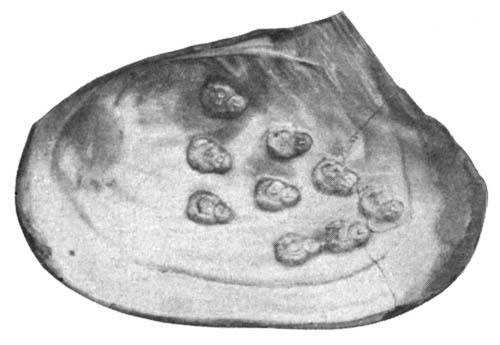
In some countries little metal images of Buddha are placed within the shells of living pearl oysters or clams. Over these the mantle of the animal secretes a layer of mother of pearl as is shown in the picture.
Pearls and Mother of Pearl.—Pearls are prized the world over. It is a well-known fact that even in this country pearls of some value are sometimes found within the shells of the fresh-water mussel and the oyster. Most of the finest, however, come from the waters around Ceylon. If a pearl is cut open and examined carefully, it is found to be a deposit of the mother-of-pearl layer of the shell around some central structure. It has been believed that any foreign substance, as a grain of sand, might irritate the mantle at a given point, thus stimulating it to secrete around the substance. It now seems likely that most perfect pearls are due to the growth within the mantle of the clam or oyster of certain parasites, stages in the development of a flukeworm. The irritation thus set up in the tissue causes mother of pearl to be deposited around the source of irritation, with the subsequent formation of a pearl.
The pearl-button industry in this country is largely dependent upon the fresh-water mussel, the shells of which are used. This mussel is being so rapidly depleted that the national government is working out a means of artificial propagation of these animals.
Honey and Wax.—Honeybees[29] are kept in hives. A colony consists of a queen, a female who lays the eggs for the colony, the drones, whose duty it is to fertilize the eggs, and the workers.
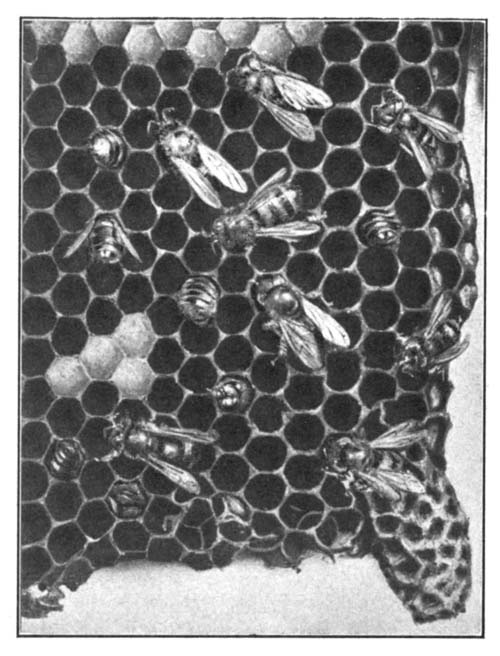
Cells of honeycomb, queen cell on right at bottom.
The cells of the comb are built by the workers out of wax secreted from the under surface of their bodies. The wax is cut off in thin plates by means of the wax shears between the two last joints of the hind legs. These cells are used to place the eggs of the queen in, one egg to each cell, and the young are hatched after three days, to begin life as footless white grubs.
The young are fed for several days, then shut up in the cells and allowed to form pupæ. Eventually they break their cells and take their place as workers in the hive, first as nurses for the young and later as pollen gatherers and honey makers.
We have already seen (pages 37 to 39) that the honeybee gathers nectar, which she swallows, keeping the fluid in her crop until her return to the hive. Here it is forced out into cells of the comb. It is now thinner than what we call honey. To thicken it, the bees swarm over the open cells, moving their wings very rapidly, thus evaporating some of the water. A hive of bees have been known to make over thirty-one pounds of honey in a single day, although the average is very much less than this. It is estimated from twenty to thirty millions of dollars' worth of honey and wax are produced each year in this country.
Cochineal and Lac.—Among other products of insect origin is cochineal, a red coloring matter, which consists of the dried bodies of a tiny insect, one of the plant lice which lives on the cactus plants in Mexico and Central America. The lac insect, another one of the plant lice, feeds on the juices of certain trees in India and pours out a substance from its body which after treatment forms shellac. Shellac is of much use as a basis for varnish.
Gall Insects.—Oak galls, growths caused by the sting of wasp-like insects, give us products used in ink making, in tanning, and in making pyrogallic acid which is much used in developing photographs.
Insects destroy Harmful Plants or Animals.—Some forms of animal life are of great importance because of their destruction of harmful plants or animals.
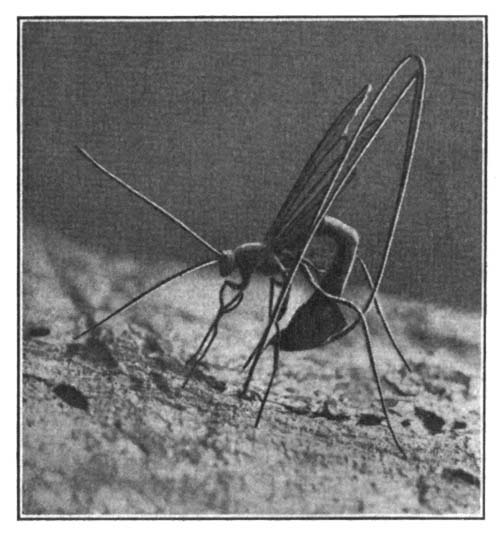
An insect friend of man. An ichneumon fly boring in a tree to lay its eggs in the burrow of a boring insect harmful to that tree.
A near relative of the bee, called the ichneumon fly, does man indirectly considerable good because of its habit of laying its eggs and rearing the young in the bodies of caterpillars which are harmful to vegetation. Some of the ichneumons even bore into trees in order to deposit their eggs in the larvæ of wood-boring insects. It is safe to say that the ichneumons save millions of dollars yearly to this country.
Several beetles are of value to man. Most important of these is the natural enemy of the orange-tree scale, the ladybug, or ladybird beetle. In New York state it may often be found feeding upon the plant lice, or aphids, which live on rosebushes. The carrion beetles and many water beetles act as scavengers. The sexton beetles bury dead carcasses of animals. Ants in tropical countries are particularly useful as scavengers.
Insects, besides pollinating flowers, often do a service by eating harmful weeds. Thus many harmful plants are kept in check. We have noted that they spin silk, thus forming clothing; that in many cases they are preyed upon, and that they supply an enormous multitude of birds, fishes, and other animals with food.
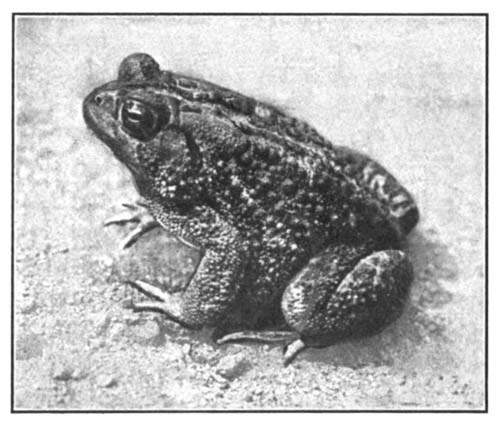
The common toad, an insect eater.
Use of the Toad.—The toad is of great economic importance to man because of its diet. No less than eighty-three species of insects, mostly injurious, have been proved to enter into the dietary. A toad has been observed to snap up one hundred and twenty-eight flies in half an hour. Thus at a low estimate it could easily destroy one hundred insects during a day and do an immense service to the garden during the summer. It has been estimated by Kirkland that a single toad may, on account of the cutworms which it kills, be worth $19.88 each season it lives, if the damage done by each cutworm be estimated at only one cent. Toads also feed upon slugs and other garden pests.
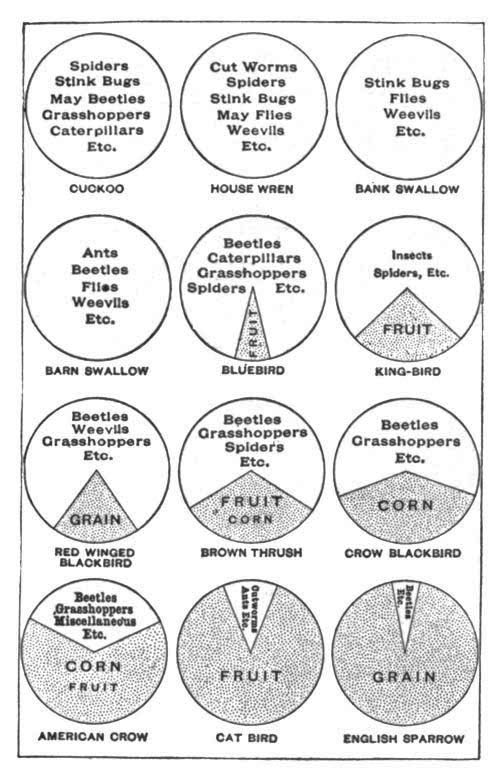
Food of some common birds. Which of the above birds should be protected by man and why?
Birds eat Insects.—The food of birds makes them of the greatest economic importance to our country. This is because of the relation of insects to agriculture. A large part of the diet of most of our native birds includes insects harmful to vegetation. Investigations undertaken by the United States Department of Agriculture (Division of Biological Survey) show that a surprisingly large number of birds once believed to harm crops really perform a service by killing injurious insects. Even the much maligned crow lives to some extent upon insects. Swallows in the Southern states kill the cotton-boll weevil, one of our worst insect pests. Our earliest visitor, the bluebird, subsists largely on injurious insects, as do woodpeckers, cuckoos, kingbirds, and many others. The robin, whose presence in the cherry tree we resent, during the rest of the summer does much good by feeding upon noxious insects. Birds use the food substances which are most abundant around them at the time.[30]
Birds eat Weed Seeds.—Not only do birds aid man in his battles with destructive insects, but seed-eating birds eat the seeds of weeds. Our native sparrows (not the English sparrow), the mourning dove, bobwhite, and other birds feed largely upon the seeds of many of our common weeds. This fact alone is sufficient to make birds of vast economic importance.
Not all birds are seed or insect feeders. Some, as the cormorants, ospreys, gulls, and terns, are active fishers. Near large cities gulls especially act as scavengers, destroying much floating garbage that otherwise might be washed ashore to become a menace to health. The vultures of India and semitropical countries are of immense value as scavengers. Birds of prey (owls) eat living mammals, including many rodents; for example, field mice, rats, and other pests.
Extermination of our Native Birds.—Within our own times we have witnessed the almost total extermination of some species of our native birds. The American passenger pigeon, once very abundant in the Middle West, is now extinct. Audubon, the greatest of all American bird lovers, gives a graphic account of the migration of a flock of these birds. So numerous were they that when the flock rose in the air the sun was darkened, and at night the weight of the roosting birds broke down large branches of the trees in which they rested. To-day not a single wild specimen of this pigeon can be found, because they were slaughtered by the hundreds of thousands during the breeding season. The wholesale killing of the snowy egret to furnish ornaments for ladies' headwear is another example of the improvidence of our fellow-countrymen. Charles Dudley Warner said, "Feathers do not improve the appearance of an ugly woman, and a pretty woman needs no such aid." Wholesale killing for plumage, eggs, and food, and, alas, often for mere sport, has reduced the number of our birds more than one half in thirty states and territories within the past fifteen years. Every crusade against indiscriminate killing of our native birds should be welcomed by all thinking Americans. The recent McLane bill which aims at the protection of migrating birds and the bird-protecting clause of the recently passed tariff bill shows that this country is awaking to the value of her bird life. Without the birds the farmer would have a hopeless fight against insect pests. The effect of killing native birds is now well seen in Italy and Japan, where insects are increasing and do greater damage each year to crops and trees.
Of the eight hundred or more species of birds in the United States, only six species of hawks (Cooper's and the sharp-shinned hawk in particular), and the great horned owl, which prey upon useful birds; the sapsucker, which kills or injures many trees because of its fondness for the growing layer of the tree; the bobolink, which destroys yearly $2,000,000 worth of rice in the South; the crow, which feeds on crops as well as insects; and the English sparrow, may be considered as enemies of man.
The English Sparrow.—The English sparrow is an example of a bird introduced for the purpose of insect destruction, that has done great harm because of its relation to our native birds. Introduced at Brooklyn in 1850 for the purpose of exterminating the cankerworm, it soon abandoned an insect diet and has driven out most of our native insect feeders. Investigations by the United States Department of Agriculture have shown that in the country these birds and their young feed to a large extent upon grain, thus showing them to be injurious to agriculture. Dirty and very prolific, it already has worked its way from the East as far as the Pacific coast. In this area the bluebird, song sparrow, and yellowbird have all been forced to give way, as well as many larger birds of great economic value and beauty. The English sparrow has become a pest especially in our cities, and should be exterminated in order to save our native birds. It is feared in some quarters that the English starling which has recently been introduced into this country may in time prove a pest as formidable as the English sparrow.
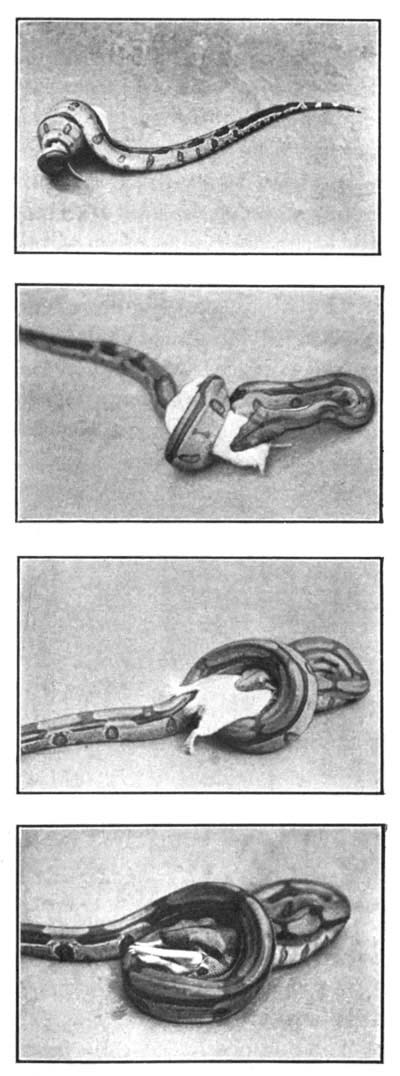
This shows how some snakes (constrictors) kill and eat their prey. (Series photographed by C. W. Beebe and Clarence Halter.)
Food of Snakes.—Probably the most disliked and feared of all animals are the snakes. This feeling, however, is rarely deserved, for, on the whole, our common snakes are beneficial to man. The black snake and the milk snake feed largely on injurious rodents (rats, mice, etc.), the pretty green snake eats injurious insects, and the little DeKay snake feeds partially on slugs. If it were not that the rattlesnake and the copperhead are venomous, they also could be said to be useful, for they live on English sparrows, rats, mice, moles, and rabbits.
Food of Herbivorous Animals.—We must not forget that other animals besides insects and birds help to keep down the rapidly growing weeds. Herbivorous animals the world over destroy, besides the grass which they eat, untold multitudes of weeds, which, if unchecked, would drive out the useful occupants of the pasture, the grasses and grains.
harm done by animals
Economic Loss from Insects.—The money value of crops, forest trees, stored foods, and other material destroyed annually by insects is beyond belief. It is estimated that they get one tenth of the country's crops, at the lowest estimate a matter of some $300,000,000 yearly. "The common schools of the country cost in 1902 the sum of $235,000,000, and all higher institutions of learning cost less than $50,000,000, making the total cost of education in the United States considerably less than the farmers lost from insect ravages.
"Furthermore, the yearly losses from insect ravages aggregate nearly twice as much as it costs to maintain our army and navy; more than twice the loss by fire; twice the capital invested in manufacturing agricultural implements; and nearly three times the estimated value of the products of all the fruit orchards, vineyards, and small fruit farms in the country."—Slingerland.
The total yearly value of all farm and forest products in New York is perhaps $150,000,000, and the one tenth that the insects get is worth $15,000,000.
Insects which damage Garden and Other Crops.—The grasshoppers and the larvæ of various moths do considerable harm here, especially the "cabbage worm," the cutworm, a feeder on all kinds of garden truck, and the corn worm, a pest on corn, cotton, tomatoes, peas, and beans.
Among the beetles which are found in gardens is the potato beetle, which destroys the potato plant. This beetle formerly lived in Mexico upon a wild plant of the same family as the potato, and came north upon the introduction of the potato into Colorado, evidently preferring cultivated forms to wild forms of this family.
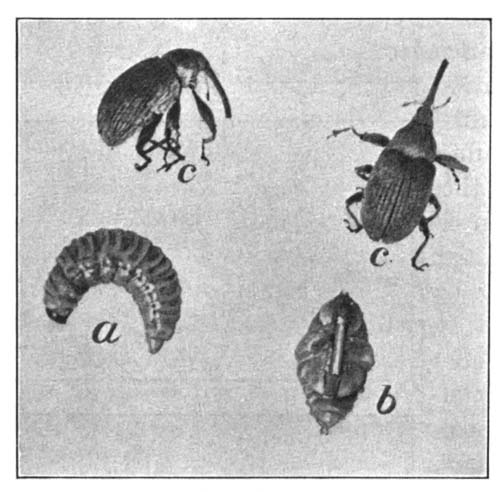
Cotton-boll weevil. a, larva; b, pupa; c, adult. Enlarged about four times. (Photographed by Davison.)
The one beetle doing by far the greatest harm in this country is the cotton-boll weevil. Imported from Mexico, since 1892 it has spread over eastern Texas and into Louisiana. The beetle lays its eggs in the young cotton fruit or boll, and the larvæ feed upon the substance within the boll. It is estimated that if unchecked this pest would destroy yearly one half of the cotton crop, causing a loss of $250,000,000. Fortunately, the United States Department of Agriculture is at work on the problem, and, while it has not found any way of exterminating the beetle as yet, it has been found that, by planting more hardy varieties of cotton, the crop matures earlier and ripens before the weevils have increased in sufficient numbers to destroy the crop (see page 126).
The bugs are among our most destructive insects. The most familiar examples of our garden pests are the squash bug; the chinch bug, which yearly does damage estimated at $20,000,000, by sucking the juice from the leaves of grain; and the plant lice, or aphids. One, living on the grape, yearly destroys immense numbers of vines in the vineyards of France, Germany, and California.
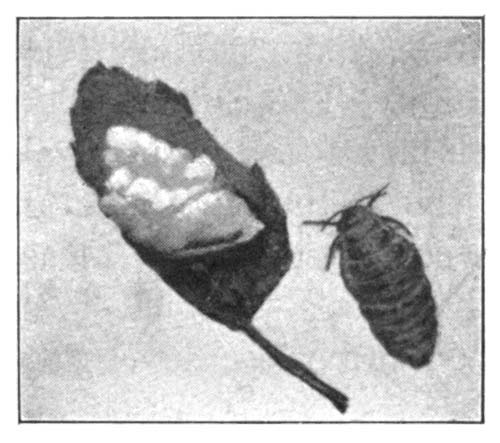
Female tussock moth which has just emerged from the cocoon at the left, upon which it has deposited over two hundred eggs. (Photograph by Davison.)
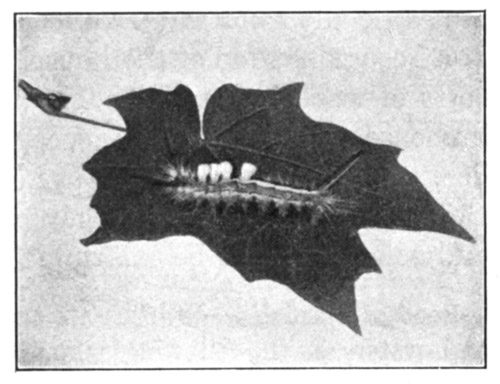
Caterpillar of tussock moth. (Photograph by Davison.)
Insects which harm Fruit and Forest Trees.—Great damage is annually done trees by the larvæ of moths. Massachusetts has already spent over $3,000,000 in trying to exterminate the imported gypsy moth. The codling moth, which bores into apples and pears, is estimated to ruin yearly $3,000,000 worth of fruit in New York alone, which is by no means the most important apple region of the United States. Among these pests, the most important to the dweller in a large city is the tussock moth, which destroys our shade trees. The caterpillar may easily be recognized by its hairy, tufted red head. The eggs are laid on the bark of shade trees in what look like masses of foam. (See figure on page 215.) By collecting and burning the egg masses in the fall, we may save many shade trees the following year.
The larvæ of some moths damage the trees by boring into the wood of the tree on which they live. Such are the peach, apple, and other fruit-tree borers common in our orchards. Many beetle larvæ also live in trees and kill annually thousands of forest and shade trees. The hickory borer threatens to kill all the hickory trees in the Eastern states.
Among the bugs most destructive to trees are the scale insect and the plant lice. The San José scale, a native of China, was introduced into the fruit groves of California about 1870 and has spread all over the country. A ladybird beetle, which has also been imported, is the most effective agent in keeping this pest in check.
Insects of the House or Storehouse.—Weevils are the greatest pests, frequently ruining tons of stored corn, wheat, and other cereals. Roaches will eat almost anything, even clothing; they are especially fond of all kinds of breadstuffs. The carpet beetle is a recognized foe of the housekeeper, the larvæ feeding upon all sorts of woolen material. The larvæ of the clothes moth do an immense amount of damage, especially to stored clothing. Fleas, lice, and particularly bedbugs are among man's personal foes. Besides being unpleasant they are believed to be disease carriers and as such should be exterminated.[31]
Food of Starfish.—Starfish are enormously destructive to young clams and oysters, as the following evidence, collected by Professor A. D. Mead, of Brown University, shows. A single starfish was confined in an aquarium with fifty-six young clams. The largest clam was about the length of one arm of the starfish, the smallest about ten millimeters in length. In six days every clam in the aquarium was devoured. Hundreds of thousands of dollars' damage is done annually to the oysters in Connecticut alone by the ravages of starfish. During the breeding season of the clam and oyster the boats dredge up tons of starfish which are thrown on shore to die or to be used as fertilizer.
the relations of animals to disease
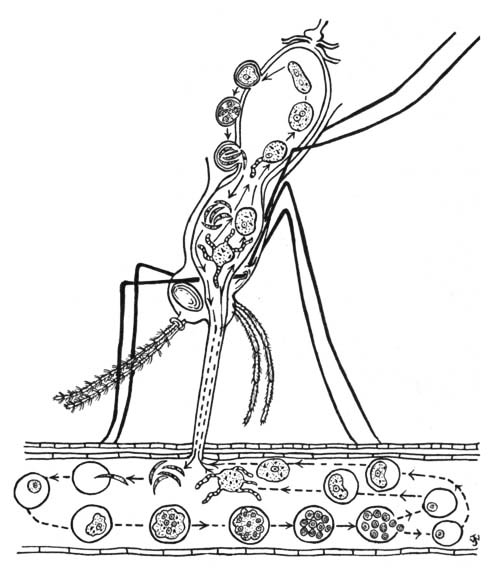
The life history of the malarial parasite. This cut of the malarial parasite shows parts of the body of the mosquito and of man. To understand the life history begin at the point where the mosquito injects the crescent-shaped bodies into the blood of man. Notice that after the spores are released from the corpuscles of man two kinds of cells may be formed. These are probably a sexual stage. Development within the body of the mosquito will only take place when the parasite is taken into its body at this sexual stage.
The Cause of Malaria.—The study of the life history and habits of the Protozoa has resulted in the finding of many parasitic forms, and the consequent explanation of some kinds of disease. One parasitic protozoan like an amœba is called Plasmodium malariæ. It causes the disease known as malaria. When a mosquito (the anopheles) sucks the blood from a person having malaria this parasite passes into the stomach of the mosquito. After completing a part of its life history within the mosquito's body the parasite establishes itself within the glands which secrete the saliva of the mosquito. After about eight days, if the infected mosquito bites a person, some of the parasites are introduced into the blood along with the saliva. These parasites enter the corpuscles of the blood, increase in size, and then form spores. The rapid process of spore formation results in the breaking down of the blood corpuscles and the release of the spores, and the poisons they manufacture, into the blood. This causes the chill followed by the fever so characteristic of malaria. The spores may again enter the blood corpuscles and in forty-eight or seventy-two hours repeat the process thus described, depending on the kind of malaria they cause. The only cure for the disease is quinine in rather large doses. This kills the parasites in the blood. But quinine should not be taken except under a physician's directions.
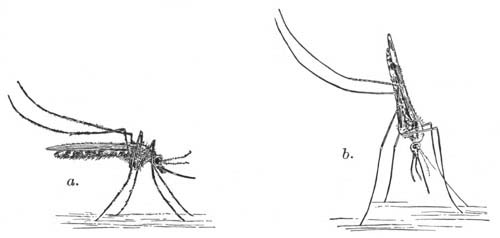
How to distinguish the harmless mosquito (culex), a, from the malarial mosquito (anopheles), b, when at rest. Notice the position of legs and body.
The Malarial Mosquito.—Fortunately for mankind, not all mosquitoes harbor the parasite which causes malaria. The harmless mosquito (culex) may be usually distinguished from the mosquito which carries malaria (anopheles) by the position taken when at rest. Culex lays eggs in tiny rafts of one hundred or more eggs in any standing water; thus the eggs are distinguished from those of anopheles, which are not in rafts. Rain barrels, gutters, or old cans may breed in a short time enough mosquitoes to stock a neighborhood. The larvæ are known as wigglers. They breathe through a tube in the posterior end of the body, and may be recognized by their peculiar movement when on their way to the surface to breathe. The pupa, distinguished by a large thoracic region, breathes through a pair of tubes on the thorax. The fact that both larvæ and pupæ take air from the surface of the water makes it possible to kill the mosquito during these stages by pouring oil on the surface of the water where they breed. The introduction of minnows, gold fish, or other small fish which feed upon the larvæ in the water where the mosquitoes breed will do much to free a neighborhood from this pest. Draining swamps or low land which holds water after a rain is another method of extermination. Some of the mosquito-infested districts around New York City have been almost freed from mosquitoes by draining the salt marshes where they breed. Long shallow trenches are so built as to tap and drain off any standing water in which the eggs might be laid. In this way the mosquito has been almost exterminated along some parts of our New England coast.
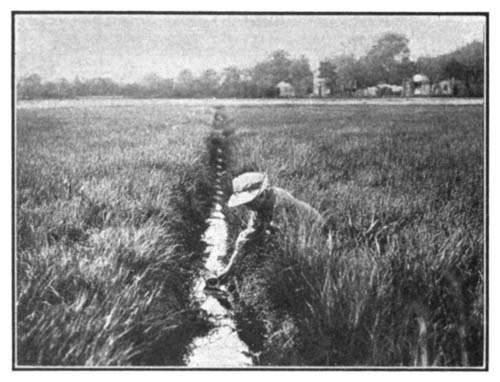
Swamps are drained and all standing water covered with a film of oil in order to exterminate mosquitoes. Why is the oil placed on the surface of the water?
Since the beginning of historical times, malaria has been prevalent in regions infested by mosquitoes. The ancient city of Rome was so greatly troubled by periodic outbreaks of malarial fever that a goddess of fever came to be worshiped in order to lessen the severity of what the inhabitants believed to be a divine visitation. At the present time the malaria of Italy is being successfully fought and conquered by the draining of the mosquito-breeding marshes. By a little carefully directed oiling of water a few boys may make an almost uninhabitable region absolutely safe to live in. Why not try it if there are mosquitoes in your neighborhood?
Yellow Fever and Mosquitoes.—Another disease carried by mosquitoes is yellow fever. In the year 1878 there were 125,000 cases and 12,000 deaths in the United States, mostly in Alabama, Louisiana, and Mississippi. During the French occupation of the Panama Canal zone the work was at a standstill part of the time because of the ravages of yellow fever. Before the war with Spain thousands of people were ill in Cuba. But to-day this is changed, and yellow fever is under almost complete control, both here and in the Canal zone, where the mosquito (stegomyia) which carries yellow fever exists.
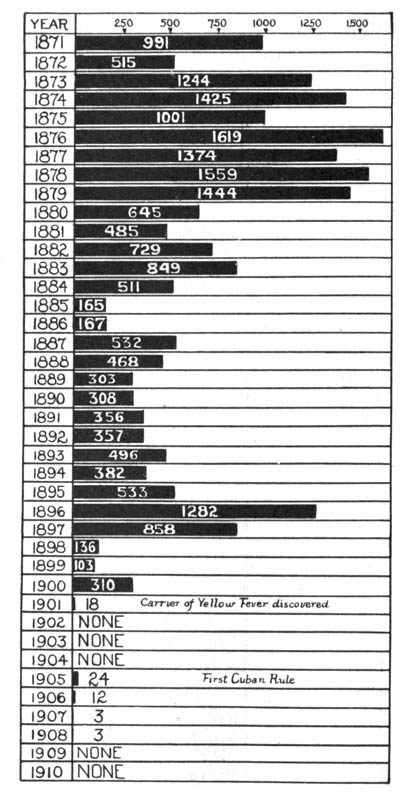
Notice the difference in the number of yearly deaths from yellow fever before and after the American occupation of Havana.
This is due to the experiments during the summer of 1900 of a Commission of United States army officers, headed by Dr. Walter Reed. Of these men one, Dr. Jesse Lazear, gave up his life to prove experimentally that yellow fever was caused by mosquitoes. He allowed himself to be bitten by a mosquito that was known to have bitten a yellow fever patient, contracted the disease, and died a martyr to science. Others, soldiers, volunteered to further test by experiment how the disease was spread, so that in the end Dr. Reed was able to prove to the world that if mosquitoes could be prevented from biting people who had yellow fever the disease could not be spread. The accompanying illustration shows the result of this knowledge for the city of Havana. For years Havana was considered one of the pest spots of the West Indies. Visitors shunned this port and commerce was much affected by the constant menace of yellow fever. At the time of the American occupation after the war with Spain, the experiments referred to above were undertaken. The city was cleaned up, proper sanitation introduced, screens placed in most buildings, and the breeding places of the mosquitoes were so nearly destroyed that the city was practically free from mosquitoes. The result, so far as yellow fever was concerned, was startling, as you can see by reference to the chart. Notice also the rise in the death rate when the young Cuban Republic took control. How do you account for that? We all know what American scientific medicine and sanitation is doing in Panama and in the Philippines.
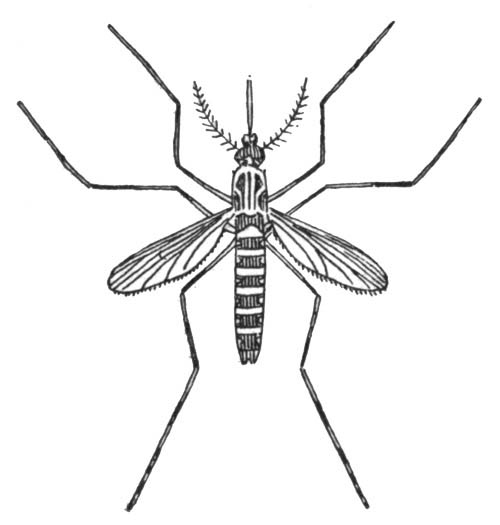
Stegomyia, the carrier of yellow fever. (After Howard.)
Other Protozoan Diseases.—Many other diseases of man are probably caused by parasitic protozoans. Dysentery of one kind appears to be caused by the presence of an amœba-like animal in the digestive tract which comes usually through an impure water supply. Smallpox, rabies, and possibly other diseases are caused by protozoans. Smallpox, which was once the most dreaded disease known to man, because of its spread in epidemics, has been conquered by vaccination, of which we shall learn more later. The death rate from rabies or hydrophobia has in a like manner been greatly reduced by a treatment founded on the same principles as vaccination and invented by Louis Pasteur.
Another group of protozoan parasites are called trypanosomes. These are parasitic in insects, fish, reptiles, birds, and mammals in various parts of the world. They cause various diseases of cattle and other domestic animals, being carried to the animal in most cases by flies. One of this family is believed to live in the blood of native African zebras and antelopes; seemingly it does them no harm. But if one of these parasites is transferred by the dreaded tsetse fly to one of the domesticated horses or cattle of the colonist of that region, death of the animal results.
Another fly carries a species of trypanosome to the natives of Central Africa, which causes "the dreaded and incurable sleeping sickness." This disease carries off more than fifty thousand natives yearly, and many Europeans have succumbed to it. Its ravages are now largely confined to an area near the large Central African lakes and the Upper Nile, for the fly which carries the disease lives near water, seldom going more than 150 feet from the banks of streams or lakes. The British government is now trying to control the disease in Uganda by moving all the villages at least two miles from the lakes and rivers. Among other diseases that may be due to protozoans is kala-agar, a fever in hot Asiatic countries which is probably carried by the bedbug, and African tick fever, probably carried by a small insect called the tick. Bubonic plague, one of the most dreaded of all infectious diseases, is carried to man by fleas from rats. In this country many fatal diseases of cattle, as "tick," or Texas cattle fever, are probably caused by protozoans.
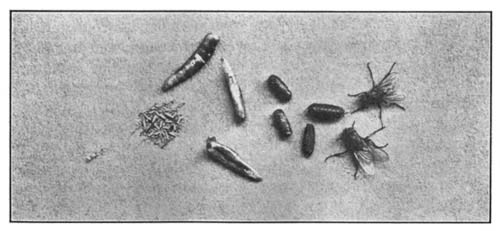
Life history of house flies, showing from left to right the eggs, larvæ, pupæ, and adult flies. (Photograph, about natural size, by Overton.)
The Fly a Disease Carrier.—We have already seen that mosquitoes of different species carry malaria and yellow fever. Another rather recent addition to the black list is the house fly or typhoid fly. We shall see later with what reason this name is given. The development of the typhoid fly is extremely rapid. A female may lay from one hundred to two hundred eggs. These are usually deposited in filth or manure. Dung heaps about stables, privy vaults, ash heaps, uncared-for garbage cans, and fermenting vegetable refuse form the best breeding places for flies. In warm weather, the eggs hatch a day or so after they are laid and become larvæ, called maggots. After about one week of active feeding, these wormlike maggots become quiet and go into the pupal stage, whence under favorable conditions they emerge within less than another week as adult flies. The adults breed at once, and in a short summer there may be over ten generations of flies. This accounts for the great number. Fortunately relatively few flies survive the winter. The membranous wings of the adult fly appear to be two in number, a second pair being reduced to tiny knobbed hairs called balancers. The head is freely movable, with large compound eyes. The mouth parts form a proboscis, which is tonguelike, the animal obtaining its food by lapping and sucking. The foot shows a wonderful adaptation for clinging to smooth surfaces. Two or three pads, each of which bears tubelike hairs that secrete a sticky fluid, are found on its under surface. It is by this means that the fly is able to walk upside down, and carry bacteria on its feet.
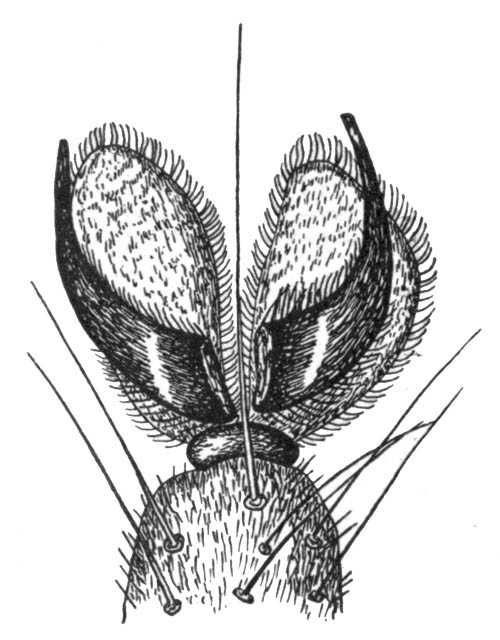
The foot of a fly, showing the hooks, hairs, and pads which collect and carry bacteria. The fly doesn't wipe his feet.
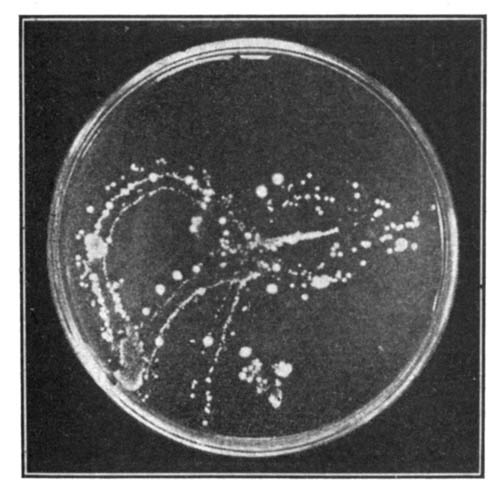
Colonies of bacteria which have developed in a culture medium upon which a fly was allowed to walk.
The Typhoid Fly a Pest.—The common fly is recognized as a pest the world over. Flies have long been known to spoil food through their filthy habits, but it is more recently that the very serious charge of spread of diseases, caused by bacteria, has been laid at their door. In a recent experiment two young men from the Connecticut Agricultural Station found that a single fly might carry on its feet anywhere from 500 to 6,600,000 bacteria, the average number being over 1,200,000. Not all of these germs are harmful, but they might easily include those of typhoid fever, tuberculosis, summer complaint, and possibly other diseases. A recent pamphlet published by the Merchants' Association in New York City shows that the rapid increase of flies during the summer months has a definite correlation with the increase in the number of cases of summer complaint. Observations in other cities seem to show the increase in number of typhoid cases in the early fall is due, in part at least, to the same cause. A terrible toll of disease and death may be laid at the door of the typhoid fly.
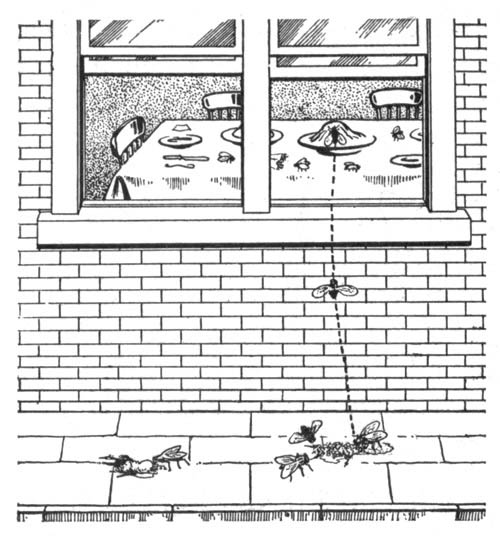
Showing how flies may spread disease by means of contaminating food.
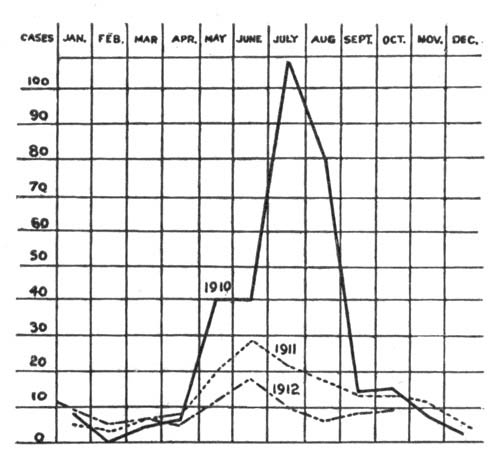
There were 329 typhoid cases in Jacksonville, Florida, in 1910, 158 in 1911, 87 in first 10 months of 1912. 80 to 85 per cent of outdoor toilets were made fly proof during winter of 1910. Account for the decrease in typhoid after the flies were kept out of the toilets.
Recently the stable fly has been found to carry the dread disease known as infantile paralysis.
Remedies.—Cleanliness which destroys the breeding place of flies, the frequent removal and destruction of garbage, rubbish, and manure, covering of all food when not in use and especially the careful screening of windows and doors during the breeding season, will all play a part in the reduction of flies. To the motto "swat the fly" should be added, "remove their breeding places!"
Other Insect Disease Carriers.—Fleas and bedbugs have been recently added to those insects proven to carry disease to man. Bubonic plague, which is primarily a disease of rats, is undoubtedly transmitted from the infected rats to man by the fleas. Fleas are also believed to transmit leprosy although this is not proven.
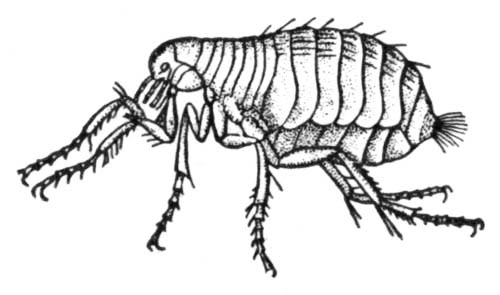
Flea which transmits Bubonic plague from rat to man.
To rid a house of fleas we must first find their breeding places. Old carpets, the sleeping places of cats or dogs or any dirty unswept corner may hold the eggs of the flea. The young breed in cracks and crevices, feeding upon organic matter there. Eventually they come to live as adults on their warm-blooded hosts, cats, dogs, or man. Evidently destruction of the breeding places, careful washing of all infected areas, the use of benzine or gasoline in crevices where the larvæ may be hid are the most effective methods of extermination. Pets which might harbor fleas should be washed frequently with a weak (two to three per cent) solution of creolin.
Bedbugs are difficult to prove as an agent in the transmission of disease but their disgusting habits are sufficient reason for their extermination. It has been proven by experiment that they may spread typhoid and relapsing fevers. They prefer human blood to other food and have come to live in bedrooms and beds because this food can be obtained there. They are extremely difficult to exterminate because their flat body allows them to hide in cracks out of sight. Wooden beds are thus better protection for them than iron or brass beds. Boiling water poured over the cracks when they breed or a mixture of strong corrosive sublimate four parts, alcohol four parts and spirits of turpentine one part, are effective remedies.
How the Harm done by Insects is Controlled.—The combating of insects is directed by several bodies of men, all of which have the same end in view. These are the Bureau of Entomology of the United States Department of Agriculture, the various state experiment stations, and medical and civic organizations.
The Bureau of Entomology works in harmony with the other divisions of the Department of Agriculture, giving the time of its experts to the problems of controlling insects which, for good or ill, influence man's welfare in this country. The destruction of the malarial mosquito and control of the typhoid fly; the destruction of harmful insects by the introduction of their natural enemies, plant or animal; the perfecting of the honeybee (see Hodge, Nature Study and Life, page 240), and the introduction of new species of insects to pollinate flowers not native to this country (see Blastophaga, page 43), are some of the problems to which these men are now devoting their time.
All the states and territories have, since 1888, established state experiment stations, which work in coöperation with the government in the war upon injurious insects. These stations are often connected with colleges, so that young men who are interested in this kind of natural science may have opportunity to learn and to help.
The good done by these means directly and indirectly is very great. Bulletins are published by the various state stations and by the Department of Agriculture, most of which may be obtained free. The most interesting of these from the high school standpoint are the Farmers' Bulletins, issued by the Department of Agriculture, and the Nature Study pamphlets issued by the Cornell University in New York state.
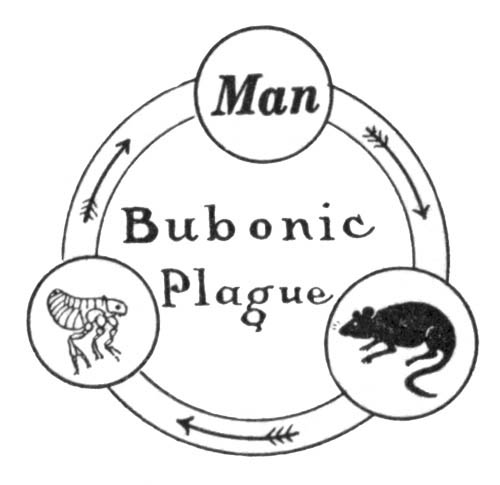
This diagram shows how bubonic plague is carried to man. Explain the diagram.
Animals Other than Insects may be Disease Carriers.—The common brown rat is an example of a mammal, harmful to civilized man, which has followed in his footsteps all over the world. Starting from China, it spread to eastern Europe, thence to western Europe, and in 1775 it had obtained a lodgment in this country. In seventy-five years it reached the Pacific coast, and is now fairly common all over the United States, being one of the most prolific of all mammals. Rats are believed to carry bubonic plague, the "Black Death" of the Middle Ages, a disease estimated to have killed 25,000,000 people during the fourteenth century. The rat, like man, is susceptible to plague; fleas bite the rat and then biting man transmit the disease to him. A determined effort is now being made to exterminate the rat because of its connection with bubonic plague.
Other Parasitic Animals cause Disease.—Besides parasitic protozoans other forms of animals have been found that cause disease. Chief among these are certain round and flat worms, which have come to live as parasites on man and other animals. A one-sided relationship has thus come into existence where the worm receives its living from the host, as the animal is called on which the parasite lives. Consequently the parasite frequently becomes fastened to its host during adult life and often is reduced to a mere bag through which the fluid food prepared by its host is absorbed. Sometimes a complicated life history has arisen from their parasitic habits. Such is seen in the life history of the liver fluke, a flatworm which kills sheep, and in the tapeworm.
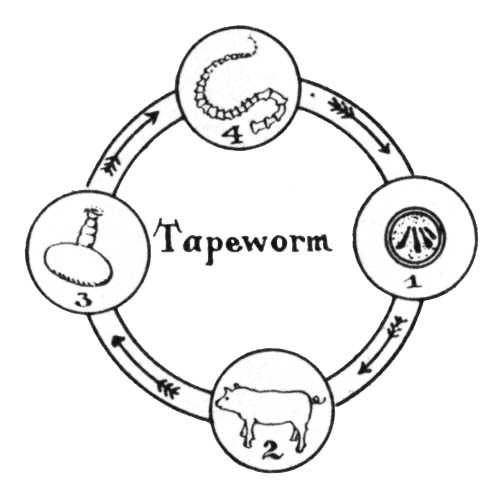
The life cycle of a tapeworm. (1) The eggs are taken in with filthy food by the pig; (2) man eats undercooked pork by means of which the bladder worm (3) is transferred to his own intestine (4).
Cestodes or Tapeworms.—These parasites infest man and many other vertebrate animals. The tapeworm (Tænia solium) passes through two stages in its life history, the first within a pig, the second within the intestine of man. The developing eggs are passed off with wastes from the intestine of man. The pig, an animal with dirty habits, may take in the worm embryos with its food. The worm develops within the intestine of the pig, but soon makes its way into the muscle or other tissues. It is here known as a bladderworm. If man eats raw or undercooked pork containing these worms, he may become a host for the tapeworm. Thus during its complete life history it has two hosts. Another common tapeworm parasitic on man lives part of its life as an embryo within the muscles of cattle. The adult worm consists of a round headlike part provided with hooks, by means of which it fastens itself to the wall of the intestine. This head now buds off a series of segmentlike structures, which are practically bags full of sperms and eggs. These structures, called proglottids, break off from time to time, thus allowing the developing eggs to escape. The proglottids have no separate digestive systems, but the whole body surface, bathed in digested food, absorbs it and is thus enabled to grow rapidly.
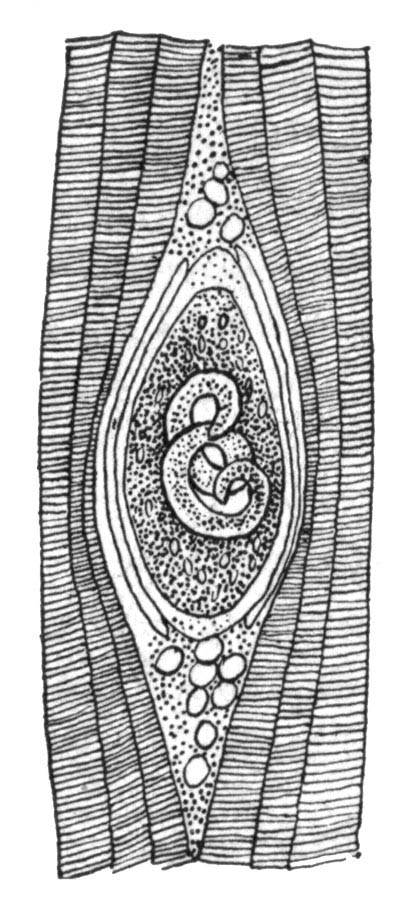
Trichinella spiralis imbedded in human muscle. (After Leuckart.)
Roundworms.—Still other wormlike creatures called roundworms are of importance to man. Some, as the vinegar eel found in vinegar, or the pinworms parasitic in the lower intestine, particularly of children, do little or no harm. The pork worm or trichina, however, is a parasite which may cause serious injury. It passes through the first part of its existence as a parasite in a pig or other vertebrate (cat, rat, or rabbit), where it lies, covered within a tiny sac or cyst, in the muscles of its hosts. If raw pork containing these worms is eaten by man, the cyst is dissolved off by the action of the digestive fluids, and the living trichina becomes free in the intestine of man. Here it reproduces and the young bore their way through the intestine walls and enter the muscles, causing inflammation there. This causes a painful and often fatal disease known as trichinosis.
The Hookworm.—The discovery by Dr. C. W. Stiles of the Bureau of Animal Industry, that the laziness and shiftlessness of the "poor whites" of the South is partly due to a parasite called the hookworm, reads like a fairy tale.
The people, largely farmers, become infected with a larval stage of the hookworm, which develops in moist earth. It enters the body usually through the skin of the feet, for children and adults alike, in certain localities where the disease is common, go barefoot to a considerable extent.
A complicated journey from the skin to the intestine now follows, the larvæ passing through the veins to the heart, from there to the lungs; here they bore into the air passages and eventually work their way by way of the windpipe into the intestine. One result of the injury of the lungs is that many thus infected are subject to tuberculosis. The adult worms, once in the food tube, fasten themselves and feed upon the blood of their host by puncturing the intestine wall. The loss of blood from this cause is not sufficient to account for the bloodlessness of the person infected, but it has been discovered that the hookworm pours out a poison into the wound which prevents the blood from clotting rapidly (see page 315); hence a considerable loss of blood occurs from the wound after the worm has finished its meal and gone to another part of the intestine.
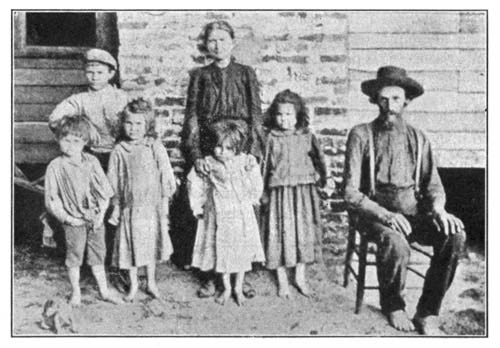
A family suffering from hookworm.
The cure of the disease is very easy; thymol is given, which weakens the hold of the worm, this being followed by Epsom salts. For years a large area in the South undoubtedly has been retarded in its development by this parasite; hundreds of millions of dollars and thousands of lives have been needlessly sacrificed.
"The hookworm is not a bit spectacular: it doesn't get itself discussed in legislative halls or furiously debated in political campaigns. Modest and unassuming, it does not aspire to such dignity. It is satisfied simply with (1) lowering the working efficiency and the pleasure of living in something like two hundred thousand persons in Georgia and all other Southern states in proportion; with (2) amassing a death rate higher than tuberculosis, pneumonia, or typhoid fever; with (3) stubbornly and quite effectually retarding the agricultural and industrial development of the section; with (4) nullifying the benefit of thousands of dollars spent upon education; with (5) costing the South, in the course of a few decades, several hundred millions of dollars. More serious and closer at hand than the tariff; more costly, threatening, and tangible than the Negro problem; making the menace of the boll weevil laughable in comparison—it is preëminently the problem of the South."—Atlanta Constitution.
Animals that prey upon Man.—The toll of death from animals which prey upon or harm man directly is relatively small. Snakes in tropical countries kill many cattle and not a few people.
The bite of the rattlesnake of our own country, although dangerous, seldom kills. The dreaded cobra of India has a record of over two hundred and fifty thousand persons killed in the last thirty-five years. The Indian government yearly pays out large sums for the extermination of venomous snakes, over two hundred thousand of which have been killed during a single year.
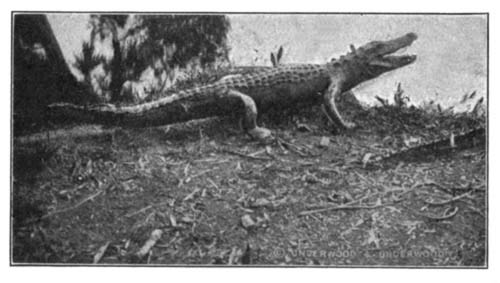
A flesh-eating reptile, the alligator.
Alligators and Crocodiles.—These feed on fishes, but often attack large animals, as horses, cows, and even man. They seek their prey chiefly at night, and spend the day basking in the sun. The crocodiles of the Ganges River in India levy a yearly tribute of many hundred lives from the natives.
Carnivorous animals such as lions and tigers still inflict damage in certain parts of the world, but as the tide of civilization advances, their numbers are slowly but surely decreasing so that as important factors in man's welfare they may be considered almost negligible.
Reference Books
elementary
Hunter, Laboratory Problems in Civic Biology. American Book Company.
Beebe, The Bird. Henry Holt and Company.
Bigelow, Applied Biology. Macmillan and Company.
Davison, Practical Zoölogy. American Book Company.
Herrick, Household Insects and Methods of Control. Cornell Reading Courses.
Hornaday, Our Vanishing Wild Life. New York Zoölogical Society.
Hodge, Nature Study and Life. Ginn and Company.
Kipling, Captains Courageous. Charles Scribner's Sons.
Sharpe, Laboratory Manual, pp. 157-158, 182-203, 320-341. American Book Company.
Stone and Cram, American Animals. Doubleday, Page and Company.
Toothaker, Commercial Raw Materials. Ginn and Company.
advanced
Flower, The Horse. D. Appleton and Company.
Hornaday, The American Natural History. Macmillan and Company.
Jordan, Fishes. Henry Holt and Company.
Jordan and Evermann, American Food and Game Fishes. Doubleday, Page and Company.
Schaler, Domesticated Animals, their Relations to Man and to His Advancement in Civilization. Charles Scribner's Sons.
XVI. THE FISH AND FROG, AN INTRODUCTORY STUDY OF VERTEBRATES
Problems.—To determine how a fish and a frog are fitted for the life they lead.
To determine some methods of development in vertebrate animals.
(a) Fishes.
(b) Frogs.
(c) Other animals.
Laboratory Suggestions
Laboratory exercise.—Study of a living fish—adaptations for protection, locomotion, food getting, etc.
Laboratory demonstration.—The development of the fish or frog egg.
Visit to the aquarium.—Study of adaptations, economic uses of fishes, artificial propagation of fishes.
Two Methods of Breathing in Vertebrates.—Vertebrate animals have at least two methods of getting their oxygen. In other respects their life processes are nearly similar. Of all vertebrates fishes are the only ones fitted to breathe all their lives under water. Other vertebrates are provided with lungs and take their oxygen directly from the air.[32] We will next take up the study of a fish to see how it is fitted for its life in the water.
study of a fish
The Body.—One of our common fresh-water fish is the bream, or golden shiner. The body of the bream runs insensibly into the head, the neck being absent. The long, narrow body with its smooth surface fits the fish admirably for its life in the water. Certain cells in the skin secrete mucus or slime, another adaptation. The position of the scales, overlapping in a backward direction, is yet another adaptation which aids in passing through the water. Its color, olive above and bright silver and gold below, is protective. Can you see how?
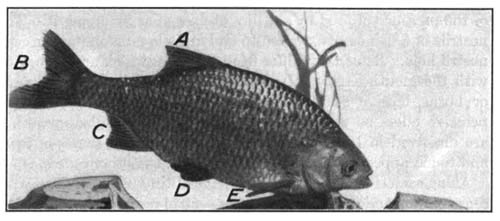
The bream. A, dorsal fin; B, caudal fin; C, anal fin; D, pelvic fin; E, pectoral fin.
The Appendages and their Uses.—The appendages of the fish consist of paired and unpaired fins. The paired fins are four in number, and are believed to correspond in position and structure with the paired limbs of a man. Note the illustration above and locate the paired pectoral and pelvic fins. (These are so called because they are attached to the bones forming the pectoral and pelvic girdles. See page 268.) Find, by comparison with the Figure, the dorsal, anal, and caudal fins. How many unpaired fins are there?
The flattened, muscular body of the fish, tapering toward the caudal fin, is moved from side to side with an undulating motion which results in the forward movement of the fish. This movement is almost identical with that of an oar in sculling a boat. Turning movements are brought about by use of the lateral fins in much the same way as a boat is turned. We notice the dorsal and other single fins are evidently useful in balancing and steering.
The Senses.—The position of the eyes at the side of the head is an evident advantage to the fish. Why? The eye is globular in shape. Such an eye has been found to be very nearsighted. Thus it is unlikely that a fish is able to perceive objects at any great distance from it. The eyes are unprotected by eyelids, but the tough outer covering and their position afford some protection.
Feeding experiments with fishes show that a fish becomes aware of the presence of food by smelling it as well as by seeing it. The nostrils of a fish can be proved to end in little pits, one under each nostril hole. Thus they differ from our own, which are connected with the mouth cavity. In the catfish, for example, the barbels, or horns, receive sensations of smell and taste. They do not perceive odors as we do for a fish perceives only substances that are dissolved in the water in which it lives. The senses of taste and touch appear to be less developed than the other senses.
Along each side of most fishes is a line of tiny pits, provided with sense organs and connected with the central nervous system of the fish. This area, called the lateral line, is believed to be sensitive to mechanical stimuli of certain sorts. The "ear" of the fish is under the skin and serves partly as a balancing organ.
Food Getting.—A fish must go after its food and seize it, but has no structures for grasping except the teeth. Consequently we find the teeth small, sharp, and numerous, well adapted for holding living prey. The tongue in most fishes is wanting or very slightly developed.
Breathing.—A fish, when swimming quietly or when at rest, seems to be biting when no food is present. A reason for this act is to be seen when we introduce a little finely powdered carmine into the water near the head of the fish. It will be found that a current of water enters the mouth at each of these biting movements and passes out through two slits found on each side of the head of the fish. Investigation shows us that under the broad, flat plate, or operculum, forming each side of the head, lie several long, feathery, red structures, the gills.
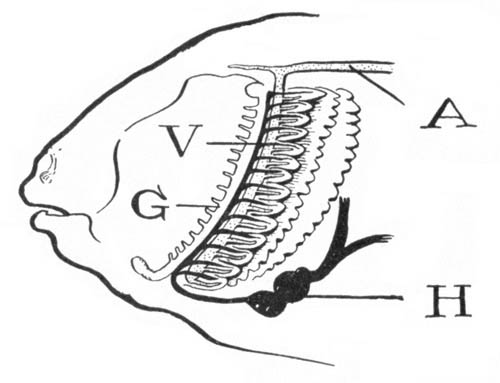
Diagram of the gills of a fish. (H), the heart which forces the blood into the tubes (V), which run out into the gill filaments. A gill bar (G) supports each gill. The blood after exchanging its carbon dioxide for oxygen is sent out to the cells of the body through the artery (A).
Gills.—If we examine the gills of any large fish, we find that a single gill is held in place by a bony arch, made of several pieces of bone which are hinged in such a way as to give great flexibility to the gill arch, as the support is called. Covering the bony framework, and extending from it, are numerous delicate filaments covered with a very thin membrane or skin. Into each of these filaments pass two blood vessels; in one blood flows downward and in the other upward. Blood reaches the gills and is carried away from these organs by means of two large vessels which pass along the bony arch previously mentioned. In the gill filament the blood comes into contact with the free oxygen of the water bathing the gills. An exchange of gases through the walls of the gill filaments results in the loss of carbon dioxide and a gain of oxygen by the blood. The blood carries oxygen to the cells of the body and (as work is done by the cells as a result of the oxidation of food) brings carbon dioxide back to the gills.
Gill Rakers.—If we open wide the mouth of any large fish and look inward, we find that the mouth cavity leads to a funnel-like opening, the gullet. On each side of the gullet we can see the gill arches, guarded on the inner side by a series of sharp-pointed structures, the gill rakers. In some fishes in which the teeth are not well developed, there seems to be a greater development of the gill rakers, which in this case are used to strain out small organisms from the water which passes over the gills. Many fishes make such use of the gill rakers. Such are the shad and menhaden, which feed almost entirely on plankton, a name given to the small plants and animals found by millions in the water.
Digestive System.—The gullet leads directly into a baglike stomach. There are no salivary glands in the fishes. There is, however, a large liver, which appears to be used as a digestive gland. This organ, because of the oil it contains, is in some fishes, as the cod, of considerable economic importance. Many fishes have outgrowths like a series of pockets from the intestine. These structures, called the pyloric cæca, are believed to secrete a digestive fluid. The intestine ends at the vent, which is usually located on the under side of the fish, immediately in front of the anal fin.
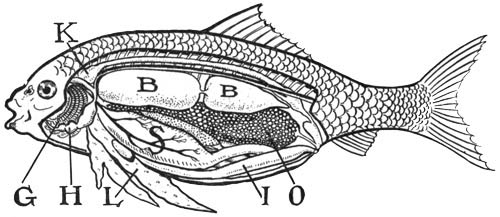
A fish opened to show H, the heart; G, the gills; L, the liver; S, the stomach; I, the intestine; O, the ovary; K, the kidney, and B, the air bladder.
Swim Bladder.—An organ of unusual significance, called the swim bladder, occupies the region just dorsal to the food tube. In young fishes of many species this is connected by a tube with the anterior end of the digestive tract. In some forms this tube persists throughout life, but in other fishes it becomes closed, a thin, fibrous cord taking its place. The swim bladder aids in giving the fish nearly the same weight as the water it displaces, thus buoying it up. The walls of the organ are richly supplied with blood vessels, and it thus undoubtedly serves as an organ for supplying oxygen to the blood when all other sources fail. In some fishes (the dipnoi, page 187) it has come to be used as a lung.
Circulation of the Blood.—In the vertebrate animals the blood is said to circulate in the body, because it passes through a more or less closed system of tubes in its course around the body. In the fishes the heart is a two-chambered muscular organ, a thin-walled auricle, the receiving chamber, leading into a thick-walled muscular ventricle from which the blood is forced out. The blood is pumped from the heart to the gills; there it loses some of its carbon dioxide; it then passes on to other parts of the body, eventually breaking up into very tiny tubes called capillaries. From the capillaries the blood returns, in tubes of gradually increasing diameter, toward the heart again. The body cells lie between the smallest branches of the capillaries. Thus they get from the blood food and oxygen and return to the blood the wastes resulting from oxidation within the cell body. During its course some of the blood passes through the kidneys and is there relieved of part of its nitrogenous waste. Circulation of blood in the body of the fish is rather slow. The temperature of the blood being nearly that of the surrounding media in which the fish lives, the animal has incorrectly been given the term "cold-blooded."
Nervous System.—As in all other vertebrate animals, the brain and spinal cord of the fish are partially inclosed in bone. The central nervous system consists of a brain, with nerves connecting the organs of sight, taste, smell, and hearing, and such parts of the body as possess the sense of touch; a spinal cord; and spinal nerves. Nerve cells located near the outside of the body send in messages to the central system, which are there received as sensations. Cells of the central nervous system, in turn, send out messages which result in the movement of muscles.
Skeleton.—In the vertebrates, of which the bony fish is an example, the skeleton is under the skin, and is hence called an endoskeleton. It consists of a bony framework, the vertebral column which protects the spinal cord and certain attached bones, the ribs, with other spiny bones to which the unpaired fins are attached. The paired fins are attached to the spinal column by two collections of bones, known respectively as the pectoral and pelvic girdles. The bones in the main skeleton serve in the fish for the attachment of powerful muscles, by means of which locomotion is accomplished. In most fishes, the exoskeleton, too, is well developed, consisting usually of scales, but sometimes of bony plates.
Food of Fishes.—We have already seen that in a balanced aquarium the balance of food was preserved by the plants, which furnished food for the tiny animals or were eaten by larger ones,—for example, snails or fish. The smaller animals in turn became food of larger ones. The nitrogen balance was maintained through the excretions of the animals and their death and decay.
The marine world is a great balanced aquarium. The upper layer of water is crowded with all kinds of little organisms, both plant and animal. Some of these are microscopic in size; others, as the tiny crustaceans, are visible to the eye. On these little organisms some fish feed entirely, others in part. Such are the menhaden[33] (bony, bunker, mossbunker of our coast), the shad, and others. Other fishes are bottom feeders, as the blackfish and the sea bass, living almost entirely upon mollusks and crustaceans. Still others are hunters, feeding upon smaller species of fish, or even upon their weaker brothers. Such are the bluefish, squeteague or weakfish, and others.
What is true of salt-water fish is equally true of those inhabiting our fresh-water streams and lakes. It is one of the greatest problems of our Bureau of Fisheries to discover this relation of various fishes to their food supplies so as to aid in the conservation and balance of life in our lakes, rivers, and seas.
Migration of Fishes.—Some fishes change their habitat at different times during the year, moving in vast schools northward in summer and southward in the winter. In a general way such migrations follow the coast lines. Examples of such migratory fish are the cod, menhaden, herring, and bluefish. The migrations are due to temperature changes, to the seeking after food, and to the spawning instinct. Some fish migrate to shallower water in the summer and to deeper water in the winter; here the reason for the migration is doubtless the change in temperature.
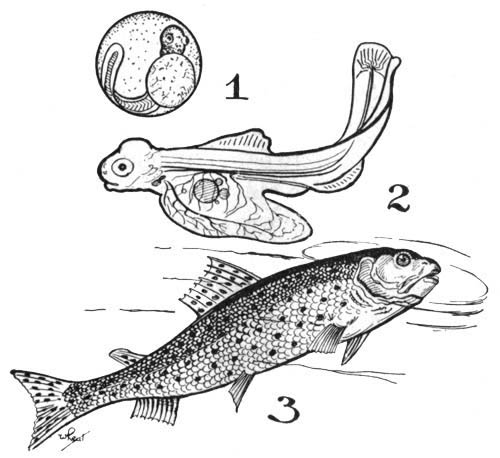
Development of a trout. 1, the embryo within the egg; 2, the young fish just hatched with the yoke sac still attached; 3, the young fish.
The Egg-laying Habits of the Bony Fishes.—The eggs of most bony fishes are laid in great numbers, varying from a few thousand in the trout to many hundreds of thousands in the shad and several millions in the cod. The time of egg-laying is usually spring or early summer. At the time of spawning the male usually deposits milt, consisting of millions of sperm cells, in the water just over the eggs, thus accomplishing fertilization. Some fishes, as sticklebacks, sunfish, toadfish, etc., make nests, but usually the eggs are left to develop by themselves, sometimes attached to some submerged object, but more frequently free in the water. In some eggs a tiny oil drop buoys up the egg to the surface, where the heat of the sun aids development. They are exposed to many dangers, and both eggs and developing fish are eaten, not only by birds, fish of other species, and other water inhabitants, but also by their own relatives, and even parents. Consequently a very small percentage of eggs ever produce mature fish.
The Relation of the Spawning Habits to Economic Importance of Fish.—The spawning habits of fish are of great importance to us because of the economic value of fish to mankind, not only directly as a food, but indirectly as food for other animals in turn valuable to man. Many of our most desirable food fishes, notably the salmon, shad, sturgeon, and smelt, pass up rivers from the ocean to deposit their eggs, swimming against strong currents much of the way, some species leaping rapids and falls, in order to deposit their eggs in localities where the conditions of water and food are suitable, and the water shallow enough to allow the sun's rays to warm it sufficiently to cause the eggs to develop. The Chinook salmon of the Pacific coast, the salmon used in the Western canning industry, travels over a thousand miles up the Columbia and other rivers, where it spawns. The salmon begin to pass up the rivers in early spring, and reach the spawning beds, shallow deposits of gravel in cool mountain streams, before late summer. Here the fish, both males and females, remain until the temperature of the water falls to about 54° Fahrenheit. The eggs and milt are then deposited, and the old fish die, leaving the eggs to be hatched out later by the heat of the sun's rays.
Need of Conservation.—The instinct of this and other species of fish to go into shallow rivers to deposit their eggs has been made use of by man. At the time of the spawning migration the salmon are taken in vast numbers, for the salmon fisheries net over $16,000,000 annually.
But the need for conservation of this important national asset is great. The shad have within recent time abandoned their breeding places in the Connecticut River, and the salmon have been exterminated along our eastern coast within the past few decades. It is only a matter of a few years when the Western salmon will be extinct if fishing is continued at the present rate. More fish must be allowed to reach their breeding places. To do this a closed season on the rivers of two or three days out of each seven while the shad or the salmon run would do much good.
The sturgeon, the eggs of which are used in the manufacture of the delicacy known as caviar, is an example of a fish that is almost extinct in this part of the world. Other food fish taken at the breeding season are also in danger.