A CIVIC BIOLOGY (continued 5)
Reading edition
Artificial Propagation of Fishes.—Fortunately, the government through the Bureau of Fisheries, and various states by wise protective laws and by artificial propagation of fishes, are beginning to turn the tide. Certain days of the week the salmon are allowed to pass up the Columbia unmolested. Closed breeding seasons protect our trout, bass, and other game fish, also the catching of fish under a certain size is prohibited.
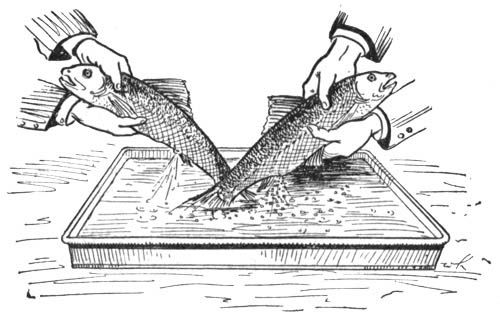
Artificial fertilization of fish eggs.
Many fish hatcheries, both government and state, are engaged in artificially fertilizing millions of fish eggs of various species and protecting the young fry until they are of such size that they can take care of themselves, when they are placed in ponds or streams. This artificial fertilization is usually accomplished by first squeezing out the ripe eggs from a female into a pan of water; in a similar manner the milt or sperm cells are obtained, and poured over the eggs. The eggs are thus fertilized. They are then placed in receptacles supplied with running water and left to develop under favorable conditions. Shortly after the egg has segmented (divided into many cells) the embryo may be seen developing on one side of the egg. The rest of the egg is made up of food or yolk, and when the baby fish hatches it has for some time the yolk attached to its ventral surface. Eventually the food is absorbed into the body of the fish. The development of the fish is direct, the young fish becoming an adult without any great change in form. The young fry are kept under ideal conditions until later, when they are shipped, sometimes thousands of miles, to their new homes.

Early development of salmon. Natural size.
Note To Teacher.—It is suggested that in the spring term the frog be studied, but if animal biology be taken up during the fall term the fish only might be used.
the frog
Adaptations for Life.—The most common frog in the eastern part of the United States is the leopard frog. It is recognized by its greenish brown body with dark spots, each spot being outlined in a lighter-colored background. In spite of the apparent lack of harmony with their surroundings, their color appears to give almost perfect protection. In some species of frogs the color of the skin changes with the surroundings of the frog, another means of protection.
Adaptations for life in the water are numerous. The ovoid body, the head merging into the trunk, the slimy covering (for the frog is provided, like the fish, with mucus cells in the skin), and the powerful legs with webbed feet, are all evidences of the life which the frog leads.
Locomotion.—You will notice that the appendages have the same general position on the body and same number of parts as do your own (upper arm, forearm, and hand; thigh, shank, and foot, the latter much longer relatively than your own). Note that while the hand has four fingers, the foot has five toes, the latter connected by a web. In swimming the frog uses the stroke we all aim to make when we are learning to swim. Most of the energy is liberated from the powerful backward push of the hind legs, which in a resting position are held doubled up close to the body. On land, locomotion may be by hopping or crawling.
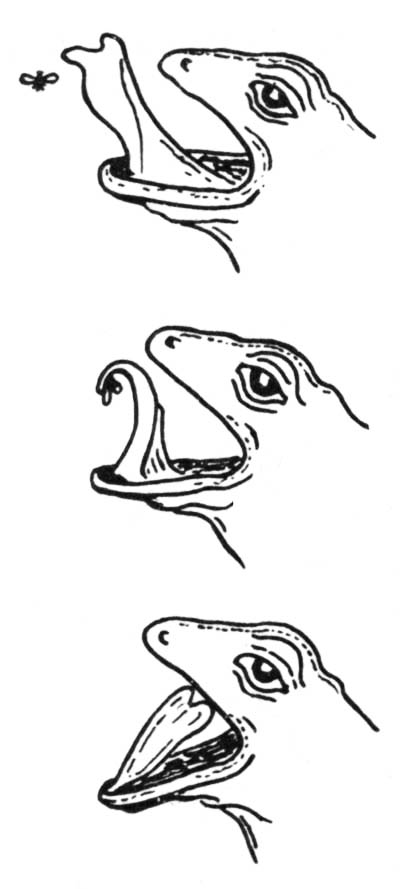
This diagram shows how the frog uses its tongue to catch insects.
Sense Organs.—The frog is well provided with sense organs. The eyes are large, globular, and placed at the side of the head. When they are closed, a delicate fold, or third eyelid, called the nictitating membrane, is drawn over each eye. Frogs probably see best moving objects at a few feet from them. Their vision is much keener than that of the fish. The external ear (tympanum) is located just behind the eye on the side of the body. Frogs hear sounds and distinguish various calls of their own kind, as is proved by the fact that frogs recognize the warning notes of their mates when any one is approaching. The inner ear also has to do with balancing the body as it has in fishes and other vertebrates. Taste and smell are probably not strong sensations in a frog or toad. They bite at moving objects of almost any kind when hungry. The long flexible tongue, which is fastened at the front, is used to catch insects. Experience has taught these animals that moving things, insects, worms, and the like, make good food. These they swallow whole, the tiny teeth being used to hold the food. Touch is a well-developed sense. They also respond to changes in temperature under water, remaining there in a dormant state for the winter when the temperature of the air becomes colder than that of the water.
Breathing.—The frog breathes by raising and lowering the floor of the mouth, pulling in air through the two nostril holes. Then the little flaps over the holes are closed, and the frog swallows this air, forcing it down into the baglike lungs. The skin is provided with many tiny blood vessels, and in winter, while the frogs are dormant at the bottom of the ponds, it serves as the only organ of respiration.
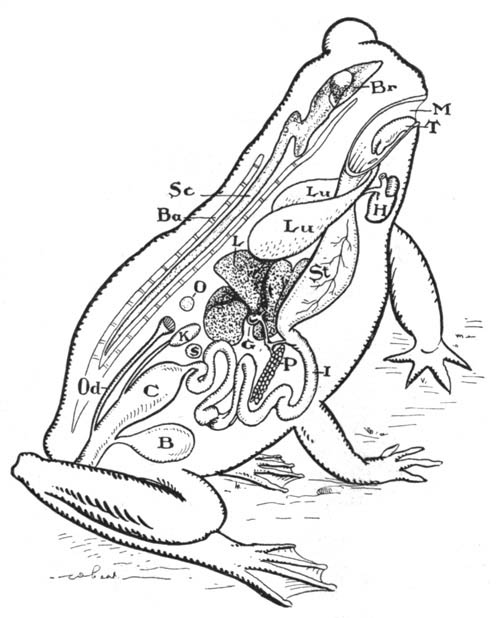
Internal organs of a frog: M, mouth; T, tongue; Lu, lungs; H, heart; St, stomach; I, small intestine; L, liver; G, gall bladder; P, pancreas; C, cloaca; B, urinary bladder; S, spleen; K, kidney; Od, oviduct; O, ovary; Br, brain; Sc, spinal cord; Ba, back bone.
The Food Tube and its Glands.—The mouth leads like a funnel into a short tube, the gullet. On the lower floor of the mouth can be seen the slitlike glottis leading to the lungs. The gullet widens almost at once into a long stomach, which in turn leads into a much coiled intestine. This widens abruptly at the lower end to form the large intestine. The latter leads into the cloaca (Latin, sewer), into which open the kidneys, urinary bladder, and reproductive organs (ovaries or spermaries). Several glands, the function of which is to produce digestive fluids, open into the food tube. These digestive fluids, by means of the ferments or enzymes contained in them, change insoluble food materials into a soluble form. This allows of the absorption of food material through the walls of the food tube into the blood. The glands (having the same names and uses as those in man) are the salivary glands, which pour their juices into the mouth, the gastric glands in the walls of the stomach, and the liver and pancreas, which open into the intestine.
Circulation.—The frog has a well-developed heart, composed of a thick-walled muscular ventricle and two thin-walled auricles. The heart pumps the blood through a system of closed tubes to all parts of the body. Blood enters the right auricle from all parts of the body; it then contains considerable carbon dioxide; the blood entering the left auricle comes from the lungs, hence it contains a considerable amount of oxygen. Blood leaves the heart through the ventricle, which thus pumps some blood containing much and some containing little oxygen. Before the blood from the tissues and lungs has time to mix, however, it leaves the ventricle and by a delicate adjustment in the vessels leaving the heart most of the blood containing much oxygen is passed to all the various organs of the body, while the blood deficient in oxygen, but containing a large amount of carbon dioxide, is pumped to the lungs, where an exchange of oxygen and carbon dioxide takes place by osmosis.
In the tissues of the body wherever work is done the process of burning or oxidation must take place, for by such means only is the energy necessary to do the work released. Food in the blood is taken to the muscle cells or other cells of the body and there oxidized. The products of the burning—carbon dioxide—and any other organic wastes given off from the tissues must be eliminated from the body. As we know, the carbon dioxide passes off through the lungs and to some extent through the skin of the frog, while the nitrogenous wastes, poisons which must be taken from the blood, are eliminated from it in the kidneys.
Change of Form in Development of the Frog.—Not all vertebrates develop directly into an adult. The frog, for example, changes its form completely before it becomes an adult. This change in form is known as a metamorphosis. Let us examine the development of the common leopard frog.
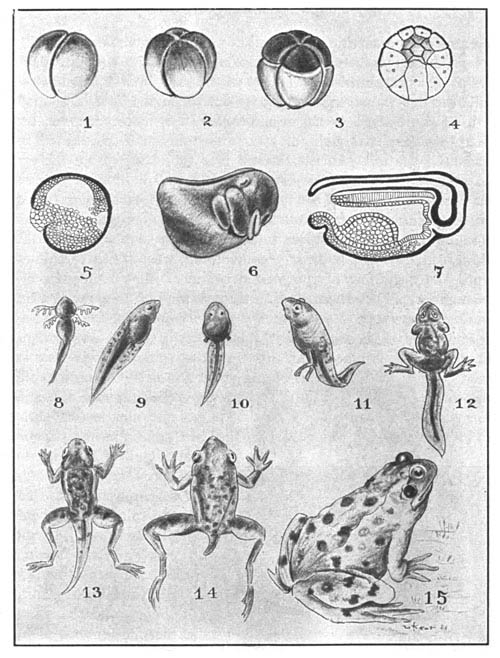
Development of a frog. 1, two cell stage; 2, four cell stage; 3, 8 cells are formed, notice the upper cells are smaller; in (4) the lower cells are seen to be much larger because of the yolk; 5, the egg has continued to divide and has formed a gastrula; 6, 7, the body is lengthening, head is seen at the right hand end; 8, the young tadpole with external gills; 9, 10, the gills are internal, hind legs beginning to form; 11, the hind legs show plainly; 12, 13, 14, later stages in development; 15, the adult frog. Figures 1, 2, 3, 4, 5, 6, and 7 are very much enlarged. (Drawn after Leukart and Kny by Frank M. Wheat.)
The eggs of this frog are laid in shallow water in the early spring. Masses of several hundred, which may be found attached to twigs or other supports under water, are deposited at a single laying. Immediately before leaving the body of the female they receive a coating of jellylike material, which swells up after the eggs are laid. Thus they are protected from the attack of fish or other animals which might use them as food. The upper side of the egg is dark, the light-colored side being weighted down with a supply of yolk (food). The fertilized egg soon segments (divides into many cells), and in a few days, if the weather is warm, these eggs have each grown into an oblong body which shows the form of a tadpole. Shortly after the tadpole wriggles out of the jellylike case and begins life outside the egg. At first it remains attached to some water weed by means of a pair of suckerlike projections; later a mouth is formed, and the tadpole begins to feed upon algæ or other tiny water plants. At this time, about two weeks after the eggs were laid, gills are present on the outside of the body. Soon after, the external gills are replaced by gills which grow out under a fold of the skin which forms an operculum somewhat as in the fish. Water reaches the gills through the mouth and passes out through a hole on the left side of the body. As the tadpole grows larger, legs appear, the hind legs first, although for a time locomotion is performed by means of the tail. In the leopard frog the change from the egg to adult is completed in one summer. In late July or early August, the tadpole begins to eat less, the tail becomes smaller (being absorbed into other parts of the body), and before long the transformation from the tadpole to the young frog is complete. In the green frog and bullfrog the metamorphosis is not completed until the beginning of the second summer. The large tadpoles of such forms bury themselves in the soft mud of the pond bottom during the winter.
Shortly after the legs appear, the gills begin to be absorbed, and lungs take their place. At this time the young animal may be seen coming to the surface of the water for air. Changes in the diet of the animal also occur; the long, coiled intestine is transformed into a much shorter one. The animal, now insectivorous in its diet, becomes provided with tiny teeth and a mobile tongue, instead of keeping the horny jaws used in scraping off algæ. After the tail has been completely absorbed and the legs have become full grown, there is no further structural change, and the metamorphosis is complete.
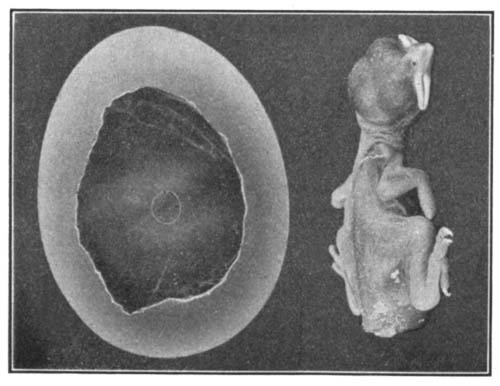
At the left is a hen's egg, opened to show the embryo at the center (the spot surrounded by a lighter area). At the right is an English sparrow one day after hatching.
Development of Birds.—The white of the hen's egg is put on during the passage of the real egg (which is in the yolk[TN4] or yellow portion) to the outside of the body. Before the egg is laid a shell is secreted over its surface. If the fertilized egg of a hen be broken and carefully examined, on the surface of the yolk will be found a little circular disk. This is the beginning of the growth of an embryo chick. If a series of eggs taken from an incubator at periods of twenty-four hours or less apart were examined, this spot would be found at first to increase in size; later the little embryo would be found lying on the surface. Still later small blood vessels could be made out reaching into the yolk for food, the tiny heart beating as early as the second day of incubation. After about three weeks of incubation the little chick hatches; that is, breaks the shell, and emerges in almost the same form as the adult.
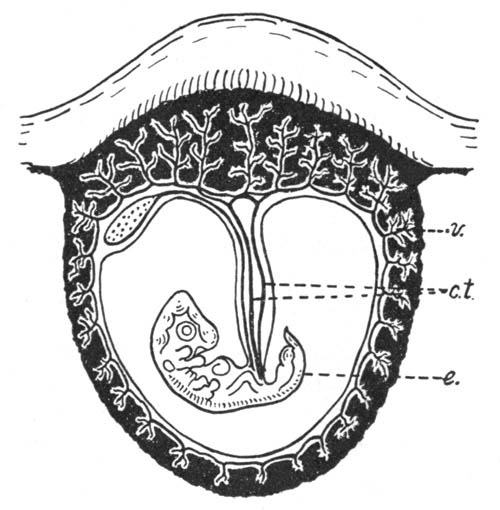
The embryo (e) of a mammal, showing the absorbing organ in black, the branch-like processes which absorb blood from the mother being shown at (v); ct, the tube connecting the embryo with the absorbing organ or placenta.
Development of a Mammal.—In mammals after fertilization the egg undergoes development within the body of the mother. Instead of blood vessels connecting the embryo with the yolk as in the chick, here the blood vessels are attached to an absorbing organ, known as the placenta. This structure sends branch-like processes into the wall of the uterus (the organ which holds the embryo) and absorbs nourishment and oxygen by osmosis from the blood of the mother. After a length of time which varies in different species of mammals (from about three weeks in a guinea pig to twenty-two months in an elephant), the young animal is expelled by muscular contraction of the uterus, or is born. The young, usually, are born in a helpless condition, then nourished by milk furnished by the mother until they are able to take other food. Thus we see as we go higher in the scale of life fewer eggs formed, but those few eggs are more carefully protected and cared for by the parents. The chances of their growth into adults are much greater than in the cases when many eggs are produced.
Reference Books
elementary
Hunter, Laboratory Problems in Civic Biology. American Book Company.
Bigelow, Introduction to Biology. The Macmillan Company.
Cornell Nature Study Leaflets. Bulletins XVI, XVII.
Davison, Practical Zoölogy, pages 185-199. American Book Company.
Hodge, Nature Study and Life, Chaps. XVI, XVII. Ginn and Company.
Sharpe, Laboratory Manual, pp. 195, 204-209. American Book Company.
advanced
Dickerson, The Frog Book. Doubleday, Page and Company.
Holmes, The Biology of the Frog. The Macmillan Company.
Jordan, Fishes. Henry Holt and Company.
Morgan, The Development of the Frog's Egg. The Macmillan Company.
Needham, General Biology. Comstock Publishing Company.
XVII. HEREDITY, VARIATION, PLANT AND ANIMAL BREEDING
Problems.—To determine what makes the offspring of animals or plants tend to be like their parents.
To determine what makes the offspring of animals and plants differ from their parents.
To learn about some methods of plant and animal breeding.
(a) By selection.
(b) By hybridizing.
(c) By other methods.
To learn about some methods of improving the human race.
(a) By eugenics.
(b) By euthenics.
Suggestions for Laboratory Work
Laboratory exercise.—On variation and heredity among members of a class in the schoolroom.
Laboratory exercise.—On construction of curve of variation in measurements from given plants or animals.
Laboratory demonstration.—Stained egg cells (ascaris) to show chromosomes.
Laboratory demonstrations.—To illustrate the part played in plant or animal breeding by
(a) selection.
(b) hybridizing.
(c) budding and grafting.
Laboratory demonstration.—From charts to illustrate how human characteristics may be inherited.
heredity and eugenics
Heredity and what it Means.—As I look over the faces of the boys in my class I notice that each boy seems to be more or less like each other boy in the class; he has a head, body, arms, and legs, and even in minor ways he resembles each of the other boys in the room. Moreover, if I should ask him I have no doubt but that he would tell me that he resembled in many respects his mother or father. Likewise if I should ask his parents whom he resembled, they would say, "I can see his grandmother or his grandfather in him."
This wonderful force which causes the likeness of the child to its parents and to their parents we call heredity. Heredity causes the plants as well as animals to be like their parents. If we trace the workings of heredity in our own individual case, we will probably find that we are molded like our ancestors not only in physical characteristics but in mental qualities as well. The ability to play the piano or to paint is probably as much a case of inheritance as the color of our eyes or the shape of our nose. We are a complex of physical and mental characters, received in part from all our ancestors.
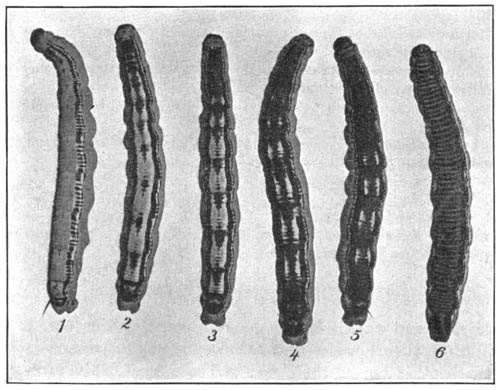
Variations in the Catalpa caterpillar. (Photographed, natural size, by Davison.)
Variation.—But I notice another thing; no boy in the class before me is exactly like any other boy, even twins having minute differences. In this wonderful mold of nature each one of us tends to be slightly different from his or her parents. Each plant, each animal, varies to a greater or lesser degree from its immediate ancestors and may vary to a very great degree. This factor in the lives of plants and animals is called variation. Heredity and variation are the cornerstones on which all the work in the improvement of plants and animals, including man himself, are built.
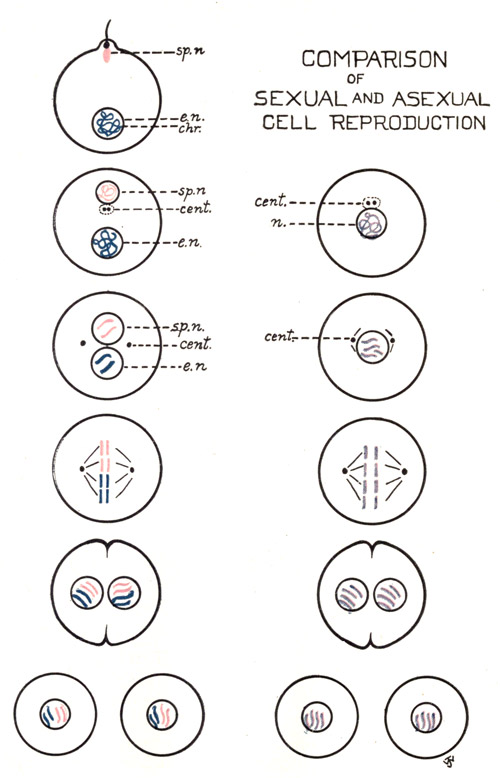
The Bearers of Heredity.—We have seen that somewhere in every living cell is a structure known as a nucleus. In this nucleus, which is a part of the living matter of the cell, are certain very minute structures always present, known as chromosomes. These chromosomes (so called because they take up color when stained) are believed to be the structures which contain the determiners of the qualities which may be passed from parent plant to offspring or from animal to animal; in other words, the qualities that are inheritable (see page 252).
The Germ Cells.—But it has been found that certain cells of the body, the egg and the sperm cells, before uniting contain only half as many chromosomes as do the body cells. In preparing for the process of fertilization, half of these elements have been eliminated, so that when the egg and sperm cell are united they will have the full number of chromosomes that the other cells have.
If the chromosomes carry the determiners of the characters which are inheritable, then it is easy to see that a fertilized egg must contain an equal number of chromosomes from the bodies of each parent. Consequently characteristics from each parent are handed down to the new individual. This seems to be the way in which nature succeeds in obtaining variation, by providing cell material from two different individuals.
Offspring are Part of their Ancestors.—We can see that if you or I receive characteristics from our parents and they received characteristics from their parents, then we too must have some of the characteristics of the grandparents, and it is a matter of common knowledge that each of us does have some trait or lineament which can be traced back to our grandfather or grandmother. Indeed, as far back as we are able to go, ancestors have added something.
Charles Darwin and Natural Selection.—The great Englishman Charles Darwin was one of the first scientists to realize how this great force of heredity applied to the development or evolution of plants and animals. He knew that although animals and plants were like their ancestors, they also tended to vary. In nature, the variations which best fitted a plant or animal for life in its own environment were the ones which were handed down because those having variations which were not fitted for life in that particular environment would die. Thus nature seized upon favorable variations and after a time, as the descendants of each of these individuals also tended to vary, a new species of plant or animal, fitted for the place it had to live in, would be gradually evolved.
Mutations.—Recently a new method of variation has been discovered by a Dutch naturalist, named Hugo de Vries. He found that new species of plants and animals arise suddenly by "mutations" or steps. This means that new species instead of arising from very slight variations, continuing during long periods of years (as Darwin believed), might arise very suddenly as a very great variation which would at once breed true. It is easily seen that such a condition would be of immense value to breeders, as new plants or animals quite unlike their parents might thus be formed and perpetuated. It will be one of the future problems of plant and animal breeders to isolate and breed "mutants," as such organisms are called.
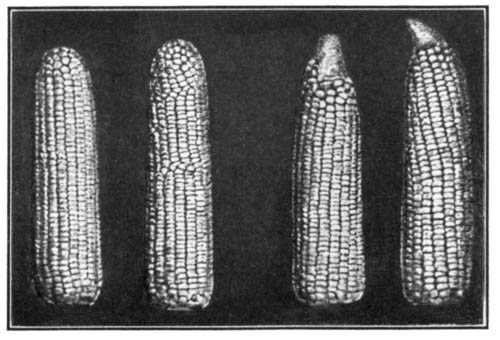
Improvement in corn by selection. To the left, the corn improved by selection from the original type at the right.
Artificial Selection.—Darwin reasoned that if nature seized upon favorable variants, then man, by selecting the variations he wanted, could form new varieties of plants or animals much more quickly than nature. And so to-day plant or animal breeders select the forms having the characters they wish to perpetuate and breed them together. This method used by plant and animal breeders is known as selection.
Selective Planting.—By selective planting we mean choosing the best plants and planting the seed from these plants with a view of improving the yield. In doing this we must not necessarily select the most perfect fruits or grains, but must select seeds from the best plants. A wheat plant should be selected not from its yield alone, but from its ability to stand disease and other unfavorable conditions. In 1862 a Mr. Fultz, of Pennsylvania, found three heads of beardless or bald wheat while passing through a large field of bearded wheat. These were probably mutants which had lost the chaff surrounding the kernel. Mr. Fultz picked them out, sowed them by themselves, and produced a quantity of wheat now known favorably all over the world as the Fultz wheat. In selecting wheat, for example, we might breed for a number of different characters, such as more starch, or more protein in the grain, a larger yield per acre, ability to stand cold or drought or to resist plant disease. Each of these characters would have to be sought for separately and could only be obtained after long and careful breeding. The work of Mendel (see page 257) when applied to plant breeding will greatly shorten the time required to produce better plants of a given kind. By careful seed selection, some Western farmers have increased their wheat production by 25 per cent. This, if kept up all over the United States, would mean over $100,000,000 a year in the pockets of the farmers.
Hybridizing.—We have already seen that pollen from one flower may be carried to another of the same species, thus producing seeds. If pollen from one plant be placed on the pistil of another of an allied species or variety, fertilization may take place and new plants be eventually produced from the seeds. This process is known as hybridizing, and the plants produced by this process known as hybrids.
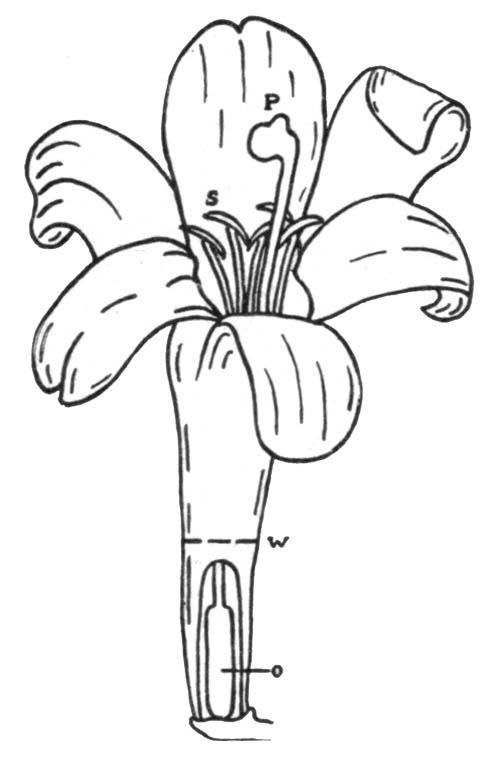
In hybridizing, all of the flower is removed at the line (W) except the pistil (P). Then pollen from another flower of a nearly related kind is placed on the pistil and the pollinated flower covered up with a paper bag. Can you explain why?
Hybrids are extremely variable, rarely breed from seeds, and often are apparently quite unlike either parent plant. They must be grown for several years, and all plants that do not resemble the desired variety must be killed off, if we expect to produce a hybrid that will breed more plants like itself. Luther Burbank, the great hybridizer of California, destroys tens of thousands of plants in order to get one or two with the characters which he wishes to preserve. Thus he is yearly adding to the wealth of this country by producing new plants or fruits of commercial value. A number of years ago he succeeded in growing a new variety of potato, which has already enriched the farmers of this country about $20,000,000. One of his varieties of black walnut trees, a very valuable hard wood, grows ten to twelve times as rapidly as ordinary black walnuts. With lumber yearly increasing in price, a quick growing tree becomes a very valuable commercial product. Among his famous hybrids are the plumcot, a cross between an apricot and a plum, his numerous varieties of berries and his splendid "Climax" plum, the result of a cross between a bitter Chinese plum and an edible Japanese plum. But none of Burbank's products grow from seeds; they are all produced asexually, from hybrids by some of the processes described in the next paragraph.
The Department of Agriculture and its Methods.—The Department of Agriculture is also doing splendid work in producing new varieties of oranges and lemons, of grain and various garden vegetables. The greatest possibilities have been shown by department workers to be open to the farmer or fruit grower through hybridizing, and by budding, grafting, or slipping.
Budding.—If a given tree, for example, produces a kind of fruit which is of excellent quality, it is possible sometimes to attach parts of the tree to another strong tree of the same species that may not bear good fruit. This is done by budding. A T-shaped incision is cut in the bark; a bud from the tree bearing the desired fruit is placed in the cut and bound in place. When a shoot from the embedded bud grows out the following spring, it is found to have all the characters of the tree from which it was taken.
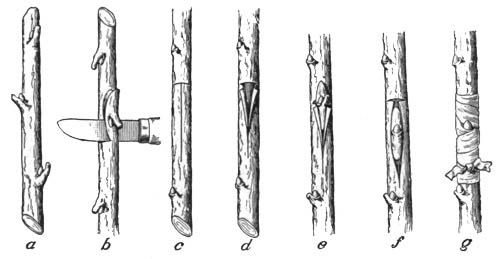
Steps in budding. a, twig having suitable buds to use; b, method of cutting out bud; c, how the bark is cut; d, how the bark is opened; e, inserting the bud; f, the bud in place; g, the bud properly bound in place.
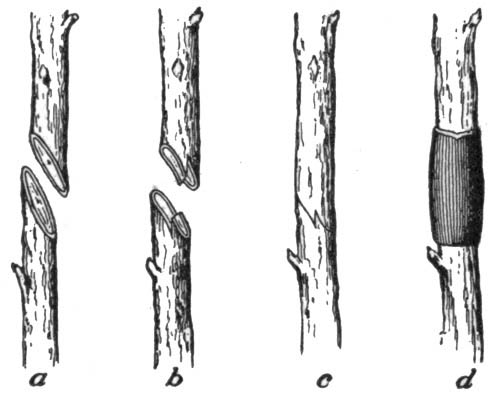
Steps in tongue grafting. a, the two branches to be formed; b, a tongue cut in each; c, fitted together; d, method of wrapping.
Grafting.—Of much the same nature is grafting. Here, however, a small portion of the stem of the closely allied tree is fastened into the trunk of the growing tree in such a manner that the two cut layers just under the bark will coincide. This will allow of the passage of food into the grafted part and insure the ultimate growth of the twig. Grafting and budding are of considerable economic value to the fruit grower, as it enables him to produce at will, trees bearing choice varieties of fruit.[34]
Other Methods.—Other methods of plant propagation are by means of runners, as when strawberry plants strike root from long stems that run along the ground; layering, where roots may develop on covered up branches of blackberry or raspberry plants; slips, roots developing from stems which are cut off and placed in moist sand; from tubers, as in planting potatoes; and by means of bulbs, as the tulip or hyacinth. All of the above means of propagation are asexual and are of importance in our problem of plant breeding.
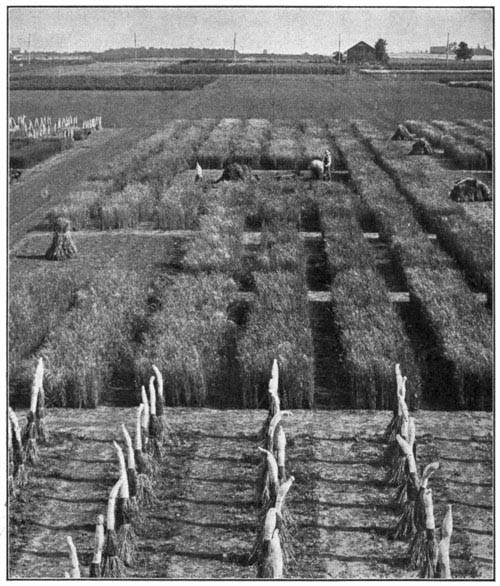
Plant breeding plots. (Minnesota Experiment Station.)
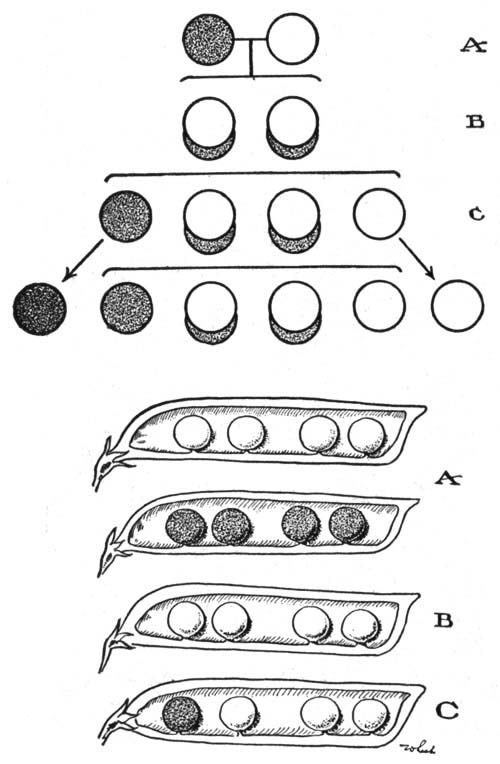
Illustration of Mendel's Law.
The Work of Gregor Mendel.—Fifty years ago, an Austrian monk, Gregor Mendel, found in breeding garden peas that these plants passed on certain fixed characters, as the shape of the seed, the color of the pod when ripe, and others, and that when two pea plants of different characters were crossed, one of these characters would be likely to appear in the offspring of the second generation in the ratio of three to one. Such characters as would appear to the exclusion of others in the first crossing of the plants were called dominant, the ones not appearing, recessive characteristics. When these seeds were again sown the ones bearing a recessive characteristic would produce only peas with this recessive characteristic, but the ones with a dominant characteristic might give rise to a pure dominant or to offspring having partly a dominant and partly a recessive character; pure dominants being to the mixed offspring in the ratio of 1 to 2. The pure dominants if bred with others like themselves would produce only pure dominants, but the cross breeds would again produce mixed offspring of three kinds in the ratio of one dominant to two cross breeds and one recessive. The feature of this work that interests us is that unit characters are passed along by heredity in the germ cells pure, that is, unchanged, from one generation to another, and independently of each other.
Determiners of Character.—A child then resembles his parents in some definite particulars because certain determiners of characters have been present in the germ cells of one of the parents. If the determiner of a certain character is absent from the germ cells of both parents, it will be absent in all of their offspring.
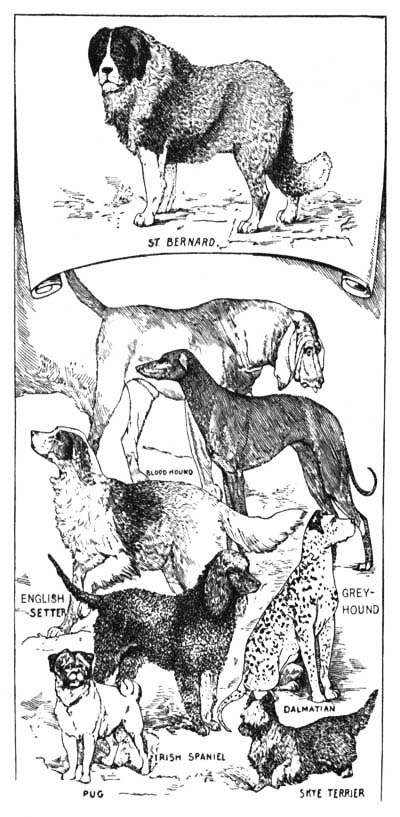
What has resulted from artificial selection among dogs. (After Romanes.)
These discoveries of Mendel are of the greatest importance in plant and animal breeding because they enable the breeder to isolate certain characters and by proper selection to breed varieties which have these desired characters, instead of waiting for a chance union of the desired characters by nature.
Animal Breeding.—It has been pointed out that the domestication of wild animals, the horse, cattle, sheep, goats, and the dog, marked a great advance in civilization in the history of the earth's peoples. As the young of these animals came to be bred in captivity the peoples owning them would undoubtedly pick out the strongest and best of the offspring, killing off the others for food. Thus they came unconsciously to select and aid nature in producing a stronger and better stock. Later man began to recognize certain characters that he wished to have in horses, dogs, or cattle, and so by slow processes of breeding and "crossing" or hybridizing one nearly allied form with another the numerous groups of domesticated animals began to appear.
In Darwin's time animal breeding was so far advanced that he got his ideas of selection by nature in evolution from the artificial selection practiced by animal breeders. A glance at the pictures will give some idea of the changes that have taken place in the form of some animals since man began to breed them a few thousand years ago.
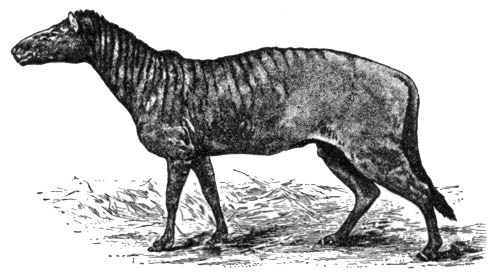
The four-toed ancestor of the present horse, restored from a study of its fossil skeleton. (After Knight in American Museum of Natural History.)
Some Domesticated Animals.—Our domesticated dogs are descended from a number of wolflike forms in various parts of the world. All the present races of cats, on the other hand, seem to be traced back to Egypt. Modern horses are first noted in Europe and Asia, but far older forms flourished on the earth in former geologic periods. It is interesting to note that America was the original home of the horse, although at the time of the earliest explorers the horse was unknown here, the wild horse of the Western plains having arisen from horses introduced by the Spaniards. Long ages ago, the first ancestors of the horse were probably little animals about the size of a fox. The earliest horse we have knowledge of had four toes on the fore and three toes on the hind foot. Thousands of years later we find a larger horse, the size of a sheep, with a three-toed foot. By gradual changes, caused by the tendency of the animals to vary and by the action of the surroundings upon the animal in preserving these variations, there was eventually produced our present horse, an animal with legs adapted for rapid locomotion, with feet particularly fitted for the life in open fields, and with teeth which serve well to seize and grind herbage. Knowledge of this sort was also used by Darwin to show that constant changes in the form of animals have been taking place since life began on the earth.
The horse, which for some reason disappeared in this country, continued to exist in Europe, and man, emerging from his early savage condition, began to make use of the animal. We know the horse was domesticated in early Biblical times, and that he soon became one of man's most valued servants. In more recent times, man has begun to change the horse by breeding for certain desired characteristics. In this manner have been established and improved the various types of horses familiar to us as draft horses, coach horses, hackneys, and the trotters.
It is needless to say that all the various domesticated animals have been tremendously changed in a similar manner since civilized man has come to live on the earth. When we realize the very great amount of money invested in domesticated animals; that there are over 60,000,000 each of sheep, cattle, and swine and over 20,000,000 horses owned in this country, then we may see how very important a part the domestic animals play in our lives.
Improvement of Man.—If the stock of domesticated animals can be improved, it is not unfair to ask if the health and vigor of the future generations of men and women on the earth might not be improved by applying to them the laws of selection. This improvement of the future race has a number of factors in which we as individuals may play a part. These are personal hygiene, selection of healthy mates, and the betterment of the environment.
Personal Hygiene.—In the first place, good health is the one greatest asset in life. We may be born with a poor bodily machine, but if we learn to recognize its defects and care for it properly, we may make it do its required work effectively. If certain muscles are poorly developed, then by proper exercise we may make them stronger. If our eyes have some defect, we can have it remedied by wearing glasses. If certain drugs or alcohol lower the efficiency of the machine, we can avoid their use. With proper care a poorly developed body may be improved and do effective work.
Eugenics.—When people marry there are certain things that the individual as well as the race should demand. The most important of these is freedom from germ diseases which might be handed down to the offspring. Tuberculosis, syphilis, that dread disease which cripples and kills hundreds of thousands of innocent children, epilepsy, and feeble-mindedness are handicaps which it is not only unfair but criminal to hand down to posterity. The science of being well born is called eugenics.
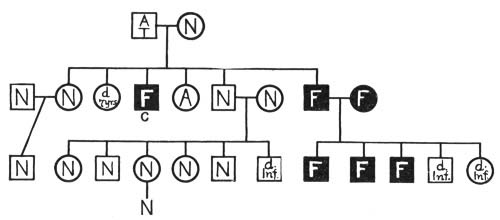
In this and the following diagrams the circle represents a female, the square a male. N means normal; F means feeble-minded; A, alcoholic; T, tubercular; Sx, sexually immoral; Sy, having syphilis. This chart shows the record of a certain family for three generations. A normal woman married an alcoholic and tubercular man. He must have been feeble-minded also as two of his children were born feeble-minded. One of these children married another feeble-minded woman, and of their five children two died in infancy and three were feeble-minded. (After Davenport.)
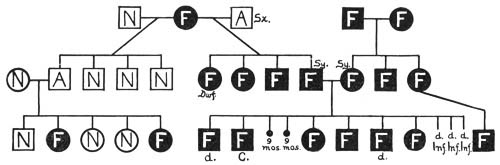
This chart shows that feeble-mindedness is a characteristic sure to be handed down in a family where it exists. The feeble-minded woman at the top left of the chart married twice. The first children from a normal father are all normal, but the other children from an alcoholic father are all feeble-minded. The right-hand side of the chart shows a terrible record of feeble-mindedness. Should feeble-minded people be allowed to marry? (After Davenport.)
The Jukes.—Studies have been made on a number of different families in this country, in which mental and moral defects were present in one or both of the original parents. The "Jukes" family is a notorious example. The first mother is known as "Margaret, the mother of criminals." In seventy-five years the progeny of the original generation has cost the state of New York over a million and a quarter of dollars, besides giving over to the care of prisons and asylums considerably over a hundred feeble-minded, alcoholic, immoral, or criminal persons. Another case recently studied is the "Kallikak" family.[35] This family has been traced back to the War of the Revolution, when a young soldier named Martin Kallikak seduced a feeble-minded girl. She had a feeble-minded son from whom there have been to the present time 480 descendants. Of these 33 were sexually immoral, 24 confirmed drunkards, 3 epileptics, and 143 feeble-minded. The man who started this terrible line of immorality and feeble-mindedness later married a normal Quaker girl. From this couple a line of 496 descendants have come, with no cases of feeble-mindedness. The evidence and the moral speak for themselves!
Parasitism and its Cost to Society.—Hundreds of families such as those described above exist to-day, spreading disease, immorality, and crime to all parts of this country. The cost to society of such families is very severe. Just as certain animals or plants become parasitic on other plants or animals, these families have become parasitic on society. They not only do harm to others by corrupting, stealing, or spreading disease, but they are actually protected and cared for by the state out of public money. Largely for them the poorhouse and the asylum exist. They take from society, but they give nothing in return. They are true parasites.
The Remedy.—If such people were lower animals, we would probably kill them off to prevent them from spreading. Humanity will not allow this, but we do have the remedy of separating the sexes in asylums or other places and in various ways preventing intermarriage and the possibilities of perpetuating such a low and degenerate race. Remedies of this sort have been tried successfully in Europe and are now meeting with success in this country.
Blood Tells.—Eugenics show us, on the other hand, in a study of the families in which are brilliant men and women, the fact that the descendants have received the good inheritance from their ancestors. The following, taken from Davenport's Heredity in Relation to Eugenics, illustrates how one family has been famous in American History.
In 1667 Elizabeth Tuttle, "of strong will, and of extreme intellectual vigor, married Richard Edwards of Hartford, Conn., a man of high repute and great erudition. From their one son descended another son, Jonathan Edwards, a noted divine, and president of Princeton College. Of the descendants of Jonathan Edwards much has been written; a brief catalogue must suffice: Jonathan Edwards, Jr., president of Union College; Timothy Dwight, president of Yale; Sereno Edwards Dwight, president of Hamilton College; Theodore Dwight Woolsey, for twenty-five years president of Yale College; Sarah, wife of Tapping Reeve, founder of Litchfield Law School, herself no mean lawyer; Daniel Tyler, a general in the Civil War and founder of the iron industries of North Alabama; Timothy Dwight, second, president of Yale University from 1886 to 1898; Theodore William Dwight, founder and for thirty-three years warden of Columbia Law School; Henrietta Frances, wife of Eli Whitney, inventor of the cotton gin, who, burning the midnight oil by the side of her ingenious husband, helped him to his enduring fame; Merrill Edwards Gates, president of Amherst College; Catherine Maria Sedgwick of graceful pen; Charles Sedgwick Minot, authority on biology and embryology in the Harvard Medical School; Edith Kermit Carow, wife of Theodore Roosevelt; and Winston Churchill, the author of Coniston and other well-known novels."
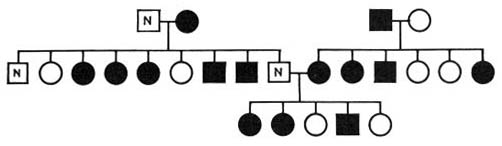
This record shows the inheritance of artistic ability (black circles and squares). (After Davenport.)
Of the daughters of Elizabeth Tuttle distinguished descendants also came. Robert Treat Paine, signer of the Declaration of Independence; Chief Justice of the United States Morrison R. Waite; Ulysses S. Grant and Grover Cleveland, presidents of the United States. These and many other prominent men and women can trace the characters which enabled them to occupy the positions of culture and learning they held back to Elizabeth Tuttle.
Euthenics.—Euthenics, the betterment of the environment, is another important factor in the production of a stronger race. The strongest physical characteristics may be ruined if the surroundings are unwholesome and unsanitary. The slums of a city are "at once symptom, effect, and cause of evil." A city which allows foul tenements, narrow streets, and crowded slums to exist will spend too much for police protection, for charity, and for hospitals.
Every improvement in surroundings means improvement of the chances of survival of the race. In the spring of 1913 the health department and street-cleaning department of the city of New York coöperated to bring about a "clean up" of all filth, dirt, and rubbish from the houses, streets, and vacant lots in that city. During the summer of 1913 the health department reported a smaller percentage of deaths of babies than ever before. We must draw our own conclusions. Clean streets and houses, clean milk and pure water, sanitary housing, and careful medical inspection all do their part in maintaining a low rate of illness and death, thus reacting upon the health of the citizens of the future. It will be the purpose of the following pages to show how we may best care for our own bodies and how we may better the environment in which we are placed.
Reference Books
elementary
Hunter, Laboratory Problems in Civic Biology. American Book Company.
Bailey, Plant Breeding. Macmillan and Company.
Harwood, New Creations in Plant Life. The Macmillan Company.
Jordan, The Heredity of Richard Roe. American Unitarian Association.
Sharpe, Laboratory Manual, pp. 64-72, 345-347. American Book Company.
advanced
Allen, Civics and Health. Ginn and Company.
Coulter, Castle, East, Tower, and Davenport, Heredity and Eugenics. University of Chicago Press.
Davenport, Heredity in Relation to Eugenics. Henry Holt and Company.
De Vries, Plant Breeding. Open Court Publishing Company.
Goddard, The Kallikak Family. The Macmillan Company.
Kellicott, The Social Direction of Human Evolution. Appleton Company.
Punnet, Mendelism. The Macmillan Company.
Richards, Helen M., Euthenics, the Science of Controllable Environment.
Walter, Genetics. The Macmillan Company.
XVIII. THE HUMAN MACHINE AND ITS NEEDS
Problem.—To obtain a general understanding of the parts and uses of the bodily machine.
Laboratory Suggestions
Demonstration.—Review to show that the human body is a complex of cells.
Laboratory demonstration by means of (a) human skeleton and (b) manikin to show the position and gross structure of the chief organs of man.
Man and his Environment.—In the last chapter we saw that one factor in the improvement of man lies in giving him better surroundings. It will be the purpose of the following chapters to show how man is fitted to live in the environment in which he is placed. He comes in contact with air, light, water, soil, food, and shelter which make his somewhat artificial environment; he must adapt himself to get the best he can out of this environment.
The Needs of Living Things.—We have already found that the primary needs of plants and animals are the same. They both need food, they both need to digest their food and to have it circulate in a fluid form to the cells where it will be used. They both need oxygen so as to release the energy locked up in their food. And they both need to reproduce so that their kind may be continued on the earth. What is true of plants and other animals is true of man.
The Needs of Simple and Complex Animals the Same.—The simplest animal, a single cell, has the same needs as the most complex. The cell paramœcium feeds, digests, oxidizes its food, and releases energy. The cells of the human body built up into tissues have the same needs and perform the same functions as the paramœcium. It is the cells of the body working together in groups as tissues and organs that make the complicated actions of man possible. Division of labor has arisen because of the complex needs and work of the organism.
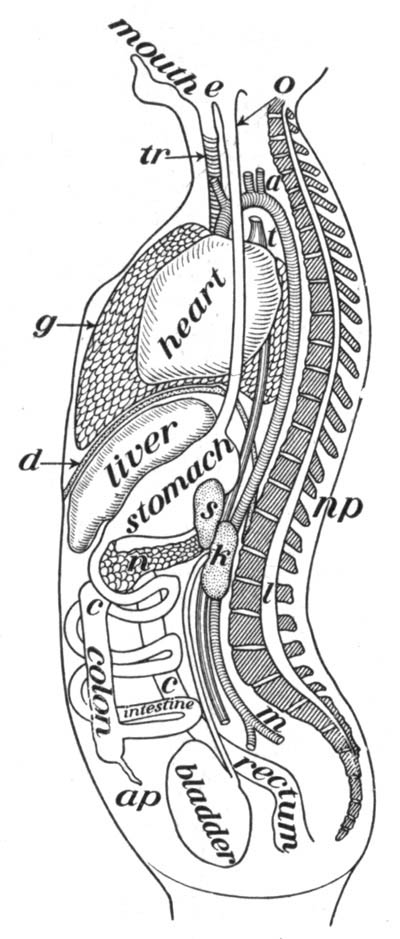
The human body seen from the side in longitudinal section.
The Human Body a Machine.—In all animals, and the human animal is no exception, the body has been likened to a machine in that it turns over the latent or potential energy stored up in food into kinetic energy (mechanical work and heat), which is manifested when we perform work. One great difference exists between an engine and the human body. The engine uses fuel unlike the substance out of which it is made. The human body, on the other hand, uses for fuel the same substances out of which it is formed; it may, indeed, use part of its own substance for food. It must as well do more than purely mechanical work. The human organism must be so delicately adjusted to its surroundings that it will react in a ready manner to stimuli from without; it must be able to utilize its fuel (food) in the most economical manner; it must be fitted with machinery for transforming the energy received from food into various kinds of work; it must properly provide the machine with oxygen so that the fuel will be oxidized, and the products of oxidation must be carried away, as well as other waste materials which might harm the effectiveness of the machine. Most important of all, the human machine must be able to repair itself.
In order to understand better this complicated machine, the human body, let us briefly examine the structure of its parts and thus get a better idea of the interrelation of these parts and of their functions.
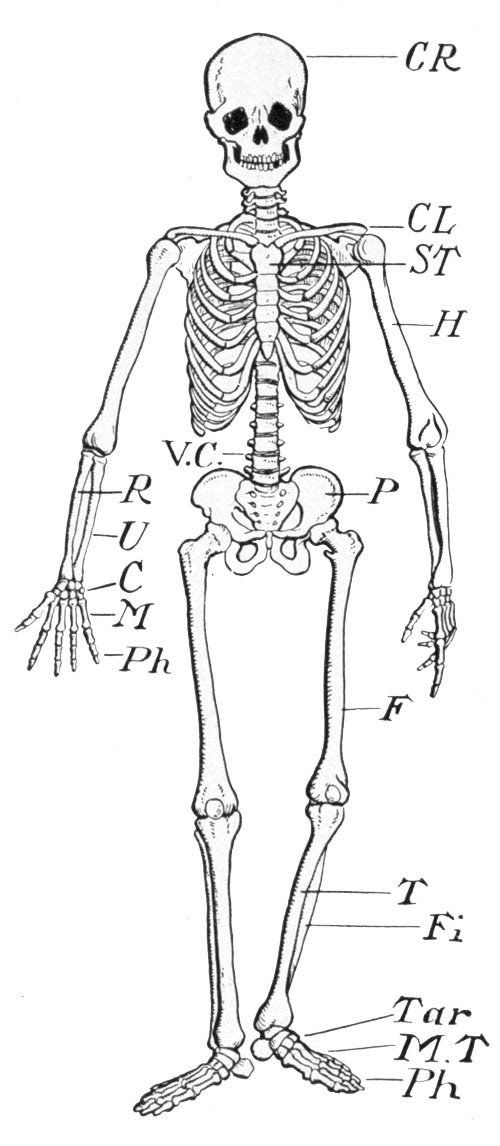
Skeleton of a man. CR., cranium; CL., clavicle; ST., sternum; H., humerus; V.C., vertebral column; R., radius; U., ulna; P., pelvic girdle; C., carpals; M., metacarpals; Ph., phalanges; F., femur; Fi., fibula; T., tibia; Tar., tarsals; MT., metatarsals.
The Skin.—Covering the body is a protective structure called the skin. Covered on the outside with dead cells, yet it is provided with delicate sense organs, which give us perception of touch, taste, smell, pressure, and temperature. It also aids in getting wastes out of the body by means of its sweat glands and plays an important part in equalizing the temperature of the body.
Bones and Muscles.—The body is built around a framework of bones. These bones, which are bound together by tough ligaments, fall naturally into two great groups, the bones of the body proper, vertebral column, ribs, breast bone, and skull, which form the axial skeleton, and the appendages, two sets of bones which form the framework of the arms and legs, which with the bones which attach them to the axial skeleton form the appendicular skeleton.
To the bones are attached the muscles of the body. Movement is accomplished by contraction of muscles, which are attached so as to cause the bones to act as levers. Bones also protect the nervous system and other delicate organs. They also help to give form and rigidity to the body.
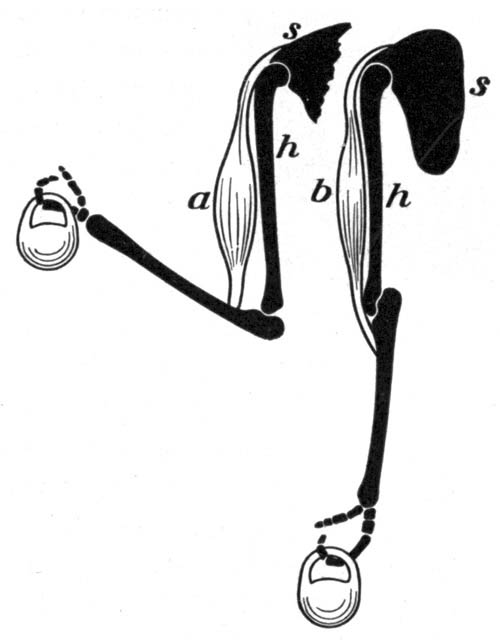
Diagram showing action of biceps muscle. a, contracted; b, extended; h, humerus; s, scapula.
Hygiene of Muscles and Bones.—Young people especially need to know how to prevent certain defects which are largely the result of bad habits of posture. Standing erect is an example of a good habit, round shoulders a bad habit of this sort. The habit of a wrong position of bones and muscles once formed is very hard to correct. This can best be done by certain corrective exercises at home or in the gymnasium.
Round shoulders is most common among people whose occupation causes them to stoop. Drawing, writing, and a wrong position when at one's desk are among the causes. Exercises which strengthen the back muscles and cause the head to be kept erect are helpful in forming the habit of erect carriage.
Slight curvature of the spine either backward or forward is helped most by exercises which tend to straighten the body, such as stretching up with the hands above the head. Lateral curvature of the spine, too often caused by a "hunched-up" position at the school desk, may also be corrected by exercises which tend to lengthen the spinal column.
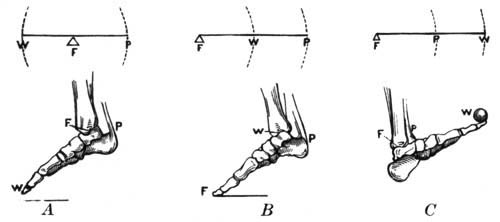
Three classes of levers in the human body; bones and muscles act together. A, a lever of the first class; B, a lever of the second class; C, a lever of the third class.
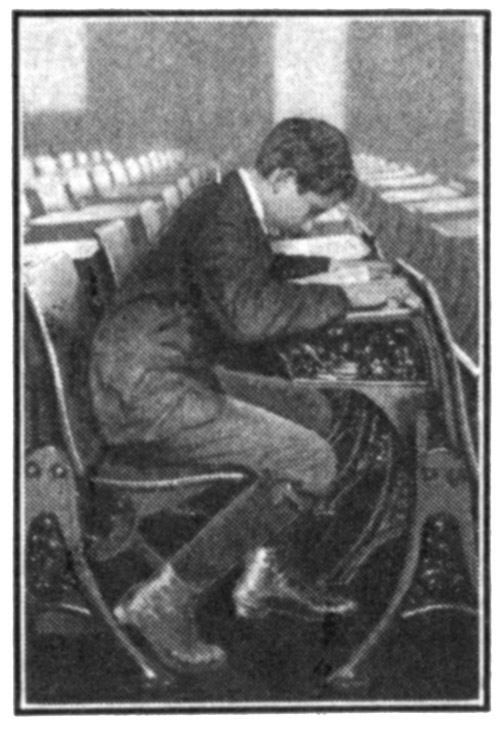
Bad posture in the schoolroom may cause permanent injury to the spine.
It is the duty of every girl and boy to have good posture and erect carriage, not only because of the better state of health which comes with it, but also because one's self-respect demands that each one of us makes the best of the gifts that nature has given us. An erect head, straight shoulders, and elastic carriage go far toward making their owner both liked and respected.
Other Body Structures.—In spaces between the muscles are found various other structures,—blood vessels, which carry blood to and from the great pumping station, the heart, and thence to all parts of the body; connective tissue, which holds groups of muscle or other cells together; fat cells, scattered in various parts of the body; various gland cells, which manufacture enzymes; and the cells of the nervous system, which aid in directing the body parts.
Body Cavity.—Within the body is a cavity, which in life is almost completely filled with various organs. A thin wall of muscle called the diaphragm divides the body cavity into two unequal spaces. In the upper space are found the heart and lungs, in the lower, the digestive tract with its glands, the liver, kidneys, and other structures (see page 267).
Digestion, Absorption, and Excretion.—Running through the body is a food tube in which undigested food is placed and from which digested or liquid food is absorbed into the blood so that the cells of the various organs which do the work may receive food. Emptying into this food tube are various groups of gland cells, which pour digestive fluids over the solid foods, thus aiding in changing them to liquids. Solid wastes are passed out through the posterior end of the food tube, while liquid wastes are excreted by means of glands called kidneys.
Work done by Cells.—Food, prepared in the digestive tract, and oxygen from the lungs are taken by the blood to the cells. Bathed in liquid food, the cells do their work; they promote the oxidization of food and the exchange of carbon dioxide for oxygen in the blood, while other wastes of the cells are given off, to pass eventually through the kidneys and out of the body.
The Nervous System.—The smooth working of the bodily machine is due to another set of structures which direct the working of the parts so that they will act in unison. This director is the nervous system. We have seen that, in the simplest of animals, one cell performs the functions necessary to its existence. In the more complex animals, where groups of cells form tissues, each having a different function, a nervous system is developed. The functions of the human nervous system are: (1) the providing of man with sensation, by means of which he gets in touch with the world about him; (2) the connecting of organs in different parts of the body so that they act as a united and harmonious whole; (3) the giving to the human being a will, a provision for thought. Coöperation in word and deed is the end attained. We are all familiar with examples of the coöperation of organs. You see food; the thought comes that it is good to eat; you reach out, take it, raise it to the mouth; the jaws move in response to your will; the food is chewed and swallowed. While digestion and absorption of the food are taking place, the nervous system is still in control. The nervous system also regulates pumping of blood over the body, respiration, secretion of glands, and, indeed, every bodily function. Man is the highest of all animals because of the extreme development of the nervous system. Man is the thinking animal, and as such is master of the earth.
Reference Reading for This and Succeeding Chapters on Human Biology
elementary
Hunter, Laboratory Problems in Civic Biology. American Book Company.
Davison, The Human Body and Health. American Book Company.
Gulick, The Gulick Hygiene Series. Ginn and Company.
Overton, General Hygiene. American Book Company.
Ritchie, Human Physiology. World Book Company.
Sharpe, Laboratory Manual in Botany, pages 218-225. American Book Company.
advanced
Halliburton, Kirk's Handbook of Physiology. P. Blakiston's Son and Company.
Hough and Sedgwick, The Human Mechanism. Ginn and Company.
Howell, Physiology, 3d edition. W. B. Saunders Company.
Schafer, Textbook of Physiology. The Macmillan Company.
Stiles, Nutritional Physiology. W. B. Saunders Company.
Verworn, General Physiology. The Macmillan Company.
XIX. FOODS AND DIETARIES
Problems.—A study of foods to determine:—
(a) Their nutritive value.
(b) The relation of work, environment, age, sex, and digestibility of foods to diet.
(c) Their relative cheapness.
(d) The daily Calorie requirement.
(e) Food adulteration.
(f) The relation of alcohol to the human system.
Laboratory Suggestions
Laboratory exercise.—Composition of common foods. The series of food charts supplied by the United States Department of Agriculture makes an excellent basis for a laboratory exercise to determine common foods rich in (a) water, (b) starch, (c) sugar, (d) fats or oils, (e) protein, (f) salts, (g) refuse.
Demonstration.—Method of using bomb calorimeter.
Laboratory and home exercise.—To determine the best individual balanced dietary (using standard of Atwater, Chittenden, or Voit) as determined by the use of the 100-Calorie portion.
Demonstration.—Tests for some common adulterants.
Demonstration.—Effect of alcohol on protein, e.g. white of egg.
Demonstration.—Alcohol in some patent medicines.
Demonstration.—Patent medicines containing acetanilid. Determination of acetanilid.
Why we Need Food.—A locomotive engine takes coal, water, oxygen, from its environment. A living plant or animal takes organic food, water, and oxygen from its environment. Both the living and nonliving machine do[TN5] the same thing with this fuel or food. They oxidize it and release the energy in it. But the living organism in addition may use the food to repair parts that have broken down or even build new parts. Thus food may be defined as something that releases energy or that forms material for the growth or repair of the body of a plant or animal. The millions of cells of which the body is composed must be given material which will form more living matter or material which can be oxidized to release energy when muscle cells move, or gland cells secrete, or brain cells think.
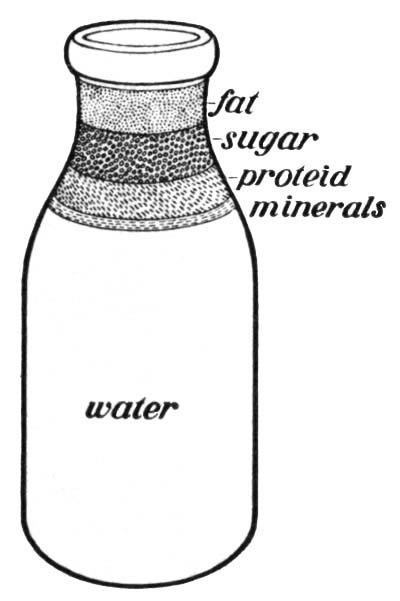
The composition of milk. Why is it considered a good food?
Nutrients.—Certain nutrient materials form the basis of food of both plants and animals. These have been stated to be proteins (such as lean meat, eggs, the gluten of bread), carbohydrates (starches, sugars, gums, etc.), fats and oils (both animal and vegetable), mineral matter and water.
Proteins.—Protein substances contain the element nitrogen. Hence such foods are called nitrogenous foods. Man must form the protoplasm of his body (that is, the muscles, tendons, nervous system, blood corpuscles, the living parts of the bone and the skin, etc.) in part at least from nitrogenous food. Some of this he obtains by eating the flesh of animals, and some he obtains directly from plants (for example, peas and beans). Proteins are the only foods available for tissue building. They may be oxidized to release energy if occasion requires it.
Fats and Oils.—Fats and oils, both animal and vegetable, are the materials from which the body derives part of its energy. The chemical formula of a fat shows that, compared with other food substances, there is very little oxygen present; hence the greater capacity of this substance for uniting with oxygen. The rapid burning of fat compared with the slower combustion of a piece of meat or a piece of bread illustrates this. A pound of butter releases over twice as much energy to the body as does a pound of sugar or a pound of steak. Human fatty tissue is formed in part from fat eaten, but carbohydrate or even protein food may be changed and stored in the body as fat.
Carbohydrates.—We see that the carbohydrates, like the fats, contain carbon, hydrogen, and oxygen. Carbohydrates are essentially energy-producing foods. They are, however, of use in building up or repairing tissue. It is certainly true that in both plants and animals such foods pass directly, together with foods containing nitrogen, to repair waste in tissues, thus giving the needed proportion of carbon, oxygen, and hydrogen to unite with the nitrogen in forming the protoplasm of the body.
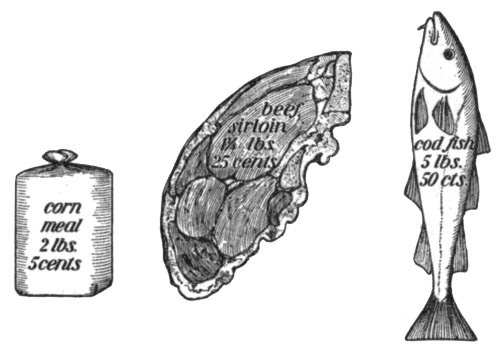
Three portions of foods, each of which furnishes about the same amount of nourishment.
Inorganic Foods.—Water forms a large part of almost every food substance. It forms about five sixths of a normal daily diet. The human body, by weight, is about two thirds water. About 90 per cent of the blood is water. Water is absolutely essential in passing off waste of the body. When we drink water, we take with it some of the inorganic salts used by the body in the making of bone and in the formation of protoplasm. Sodium chloride (table salt), an important part of the blood, is taken in as a flavoring upon our meats and vegetables. Phosphate of lime and potash are important factors in the formation of bone.
Phosphorus is a necessary substance for the making of living matter, milk, eggs, meat, whole wheat, and dried peas and beans containing small amounts of it. Iron also is an extremely important mineral, for it is used in the building of red blood cells. Meats, eggs, peas and beans, spinach, and prunes, are foods containing some iron.
Some other salts, compounds of calcium, magnesium, potassium, and phosphorus, have been recently found to aid the body in many of its most important functions. The beating of the heart, the contraction of muscles, and the ability of the nerves to do their work appear to be due to the presence of minute quantities of these salts in the body.
Uses of Nutrients.—The following table sums up the uses of nutrients to man:[36]—
Protein Forms tissue
White of eggs (albumen), curd of milk (casein), lean meat, gluten of wheat, etc. (muscles, tendon, and probably fat)
Fats Form fatty tissue.
Fat of meat, butter, olive oil, oils of corn and wheat, etc. All serve as fuel and yield energy in form of heat and muscular strength.
Carbohydrates Transformed into fat.
Sugar, starch, etc.
Mineral matters (ash) Aid in forming bone,
Phosphates of lime, potash, soda, etc. assist in digestion, aid in absorption and in other ways help the body parts do their work.
Water used as a vehicle to carry nutrients, and enters into the composition of living matter.
Common Foods contain the Nutrients.—We have already found in our plant study that various plant foods are rich in different nutrients, carbohydrates forming the chief nutrient in the foods we call cereals, breads, cake, fleshy fruits, sugars, jellies, and the like. Fats and oils are most largely found in nuts and some grains. Animal foods are our chief supply of protein. White of egg and lean meat are almost pure protein and water. Proteins are most abundant, as we should expect, in those plants which are richly supplied with nitrogen; peas and beans, and in grains and nuts. Fats, which are melted into oils at the temperature of the body, are represented by the fat in meats, bacon, pork, lard, butter, and vegetable oils.
Water.—Water is, as we have seen, a valuable part of food. It makes up a very high percentage of fresh fruits and vegetables; it is also present in milk and eggs, less abundant in meats and fish, and is lowest in dried foods and nuts. The amount of water in a given food is often a decided factor in the cost of the given food, as can easily be seen by reference to the chart on page 283.
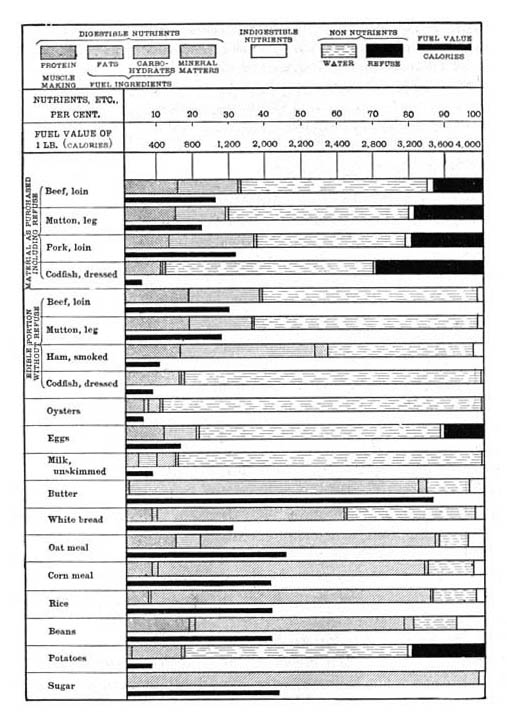
Table of food values. Determine the percentage of water in codfish, loin of beef, milk, potatoes. Percentage of refuse in leg of mutton, codfish, eggs, and potatoes. What is the refuse in each case? Find three foods containing a high percentage of protein; of fat; of carbohydrate. Find some food in which the proportions of protein, fat, and carbohydrate are combined in a good proportion.
Refuse.—Some foods bought in the market may contain a certain unusable portion. This we call refuse. Examples of refuse are bones in meat, shells of eggs or of shellfish, the covering of plant cells which form the skins of potatoes or other vegetables. The amount of refuse present also plays an important part in the values of foods for the table. The table[37] on page 276 gives the percentages of organic nutrients, water, and refuse present in some common foods.
Fuel Values of Nutrients.—In experiments performed by Professor Atwater and others, and in the appended tables, the value of food as a source of energy is stated in heat units called Calories. A Calorie is the amount of heat required to raise the temperature of one kilogram of water from zero to one degree Centigrade. This is about equivalent to raising one pound four degrees Fahrenheit. The fuel value of different foods may be computed in a definite manner. This is done by burning a given portion of a food (say one gram) in the apparatus known as a calorimeter. By this means may be determined the number of degrees the temperature of a given amount of water is raised during the process of burning. It has thus been found that a gram of fat will liberate 9.3 Calories of heat, while a gram of starch or sugar only about 4 Calories. The burning value of fat is, therefore, over twice that of carbohydrates. In a similar manner protein has been shown to have about the same fuel value as carbohydrates, i.e. 4 Calories to a gram.[38]
The Relation of Work to Diet.—It has been shown experimentally that a man doing hard, muscular work needs more food than a person doing light work. The mere exercise gives the individual a hearty appetite; he eats more and needs more of all kinds of food than a man or boy doing light work. Especially is it true that the person of sedentary habits, who does brain work, should be careful to eat less food and food that will digest easily. His protein food should also be reduced. Rich or hearty foods may be left for the man who is doing hard manual labor out of doors, for any extra work put on the digestive organs takes away just so much from the ability of the brain to do its work.
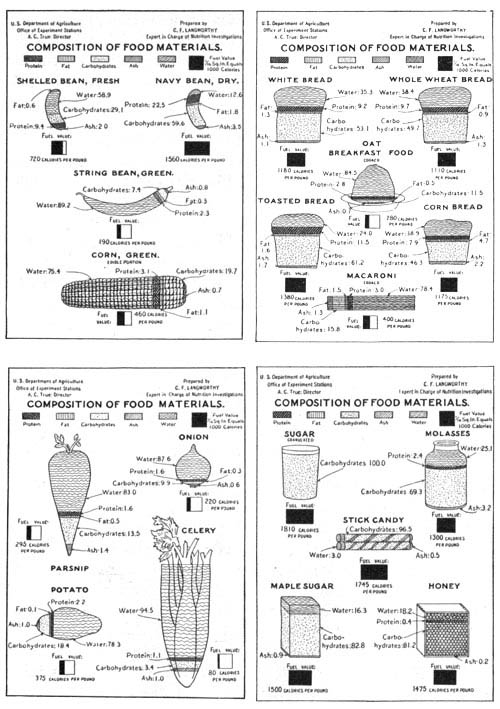
Foods of plant origin. Select 5 foods containing a high percentage of protein, 5 with a high percentage of carbohydrates, 5 with a high percentage of water. Do vegetable foods contain much fat? Which of the above-mentioned foods have the highest burning value?
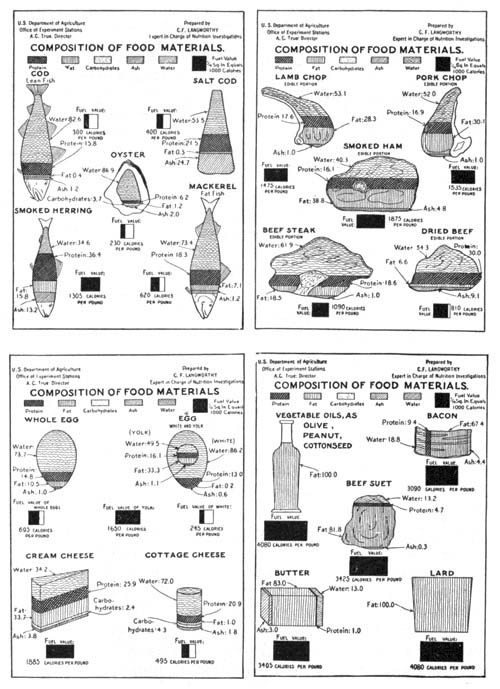
Foods largely of animal origin. Compare with the previous chart with reference to amount of protein, carbohydrate, and fat in foods. Compare the burning value of plant and animal foods. Compare the relative percentage of water in both kinds of foods.
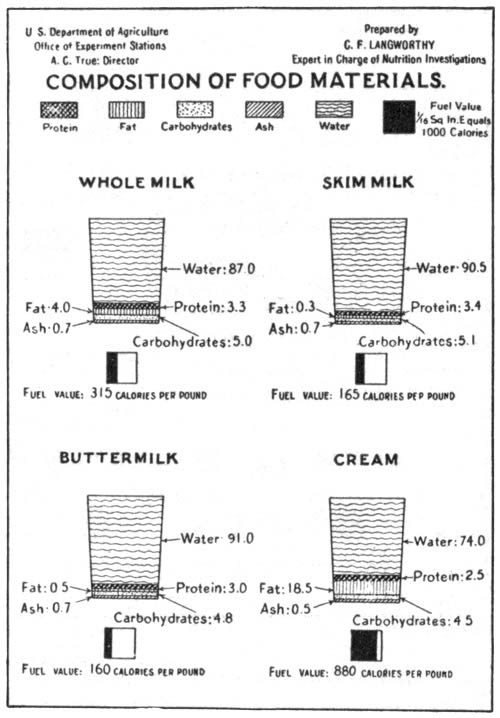
The composition of milk.
The Relation of Environment to Diet.—We are all aware of the fact that the body seems to crave more food in winter than in summer. The temperature of the body is maintained at 98.6° in winter as in summer, but much more heat is lost from the body in cold weather. Hence feeding in winter should be for the purpose of maintaining our fuel supply. We need heat-producing food, and we need more food in winter than in summer. We may use carbohydrates for this purpose, as they are economical and digestible. The inhabitants of cold countries get their heat-releasing foods largely from fats. In tropical countries and in hot weather little protein should be eaten and a considerable amount of fresh fruit used.
The Relation of Age to Diet.—As we will see a little later, age is a factor not only in determining the kind but the amount of food to be used. Young children require far less food than do those of older growth or adults. The body constantly increases in weight until young manhood, or womanhood, then its weight remains nearly stationary, varying with health or illness. It is evident that food in adults simply repairs the waste of cells and is used to supply energy. Elderly people need much less protein than do younger persons. But inasmuch as the amount of food to be taken into the body should be in proportion to the body weight, it is also evident that growing children do not, as is popularly supposed, need as much food as grown-ups.
The Relation of Sex to Diet.—As a rule boys need more food than girls, and men than women. This seems to be due to, first, the more active muscular life of the man and, secondly, to the greater amount of fat in the tissues of the woman, making loss of heat less. Larger bodies, because of greater surface, give off more heat than smaller ones. Men are usually larger in bulk than are women,—another reason for more food in their case.
The Relation of Digestibility to Diet.—Animal foods in general may be said to be more completely digested within the body than plant foods. This is largely due to the fact that plant cells have woody walls that the digestive juices cannot act upon. Cereals and legumes are less digestible foods than are dairy products, meat, or fish. This does not mean necessarily that these foods would not agree with you or me but that in general the body would get less nourishment out of the total amount available.
The agreement or disagreement of food with an individual is largely a personal matter. I, for example, cannot eat raw tomatoes without suffering from indigestion, while some one else can digest tomatoes but not strawberries. Each individual should learn early in life the foods that disagree with him personally and leave such foods out of his dietary. For "what is one man's meat may be another man's poison."
The Relation of Cost of Food to Diet.—It is a mistaken notion that the best foods are always the most expensive. A glance at the table (page 283) will show us that both fuel value and tissue-building value is present in some foods from vegetable sources, as well as in those from animal sources, and that the vegetable foods are much cheaper. The American people are far less economical in their purchase of food than most other nations. Nearly one half of the total income of the average workingman is spent on food. Not only does he spend a large amount on food, but he wastes money in purchasing the wrong kinds of food. A comparison of the daily diets of persons in various occupations in this and other countries shows that as a rule we eat more than is necessary to supply the necessary fuel and repair, and that our workingmen eat more than those of other countries. Another waste of money by the American is in the false notion that a large proportion of the daily dietary should be meat. Many people think that the most expensive cuts of meat are the most nutritious. The falsity of this idea may be seen by a careful study of the tables on pages 283 and 286.
The Best Dietary.—Inasmuch as all living substance contains nitrogen, it is evident that protein food must form a part of the dietary; but protein alone is not usable. If more protein is eaten than the body requires, then immediately the liver and kidneys have to work overtime to get rid of the excess of protein which forms a poisonous waste harmful to the body. We must take foods that will give us, as nearly as possible, the proportion of the different chemical elements as they are contained in protoplasm. It has been found, as a result of studies of Atwater and others, that a man who does muscular work requires a little less than one quarter of a pound of protein, the same amount of fat, and about one pound of carbohydrate to provide for the growth, waste, and repair of the body and the energy used up in one day.
The Daily Calorie Requirement.—Put in another way, Atwater's standard for a man at light exercise is food enough to yield 2816 Calories; of these, 410 Calories are from protein, 930 Calories from fat, and 1476 Calories from carbohydrate. That is, for every 100 Calories furnished by the food, 14 are from protein, 32 from fat, and 54 from carbohydrate. In exact numbers, the day's ration as advocated by Atwater would contain about 100 grams or 3.7 ounces protein, 100 grams or 3.7 ounces fat, and 360 grams or 13 ounces carbohydrate. Professor Chittenden of Yale University, another food expert, thinks we need proteins, fats, and carbohydrates in about the proportion of 1 to 3 to 6, thus differing from Atwater in giving less protein in proportion. Chittenden's standard for the same man is food to yield a total of 2360 Calories, of which protein furnishes 236 Calories, fat 708 Calories, and carbohydrates 1416 Calories. For every 100 Calories furnished by the food, 10 are from protein, 30 from fat, 60 from carbohydrate. In actual amount the Chittenden diet would contain 2.16 ounces protein, 2.83 ounces fat, and 13 ounces carbohydrate. A German named Voit gives as ideal 25 Calories from proteins, 20 from fat, and 55 from carbohydrate, out of every 100 Calories; this is nearer our actual daily ration. In addition, an ounce of salt and nearly one hundred ounces of water are used in a day.
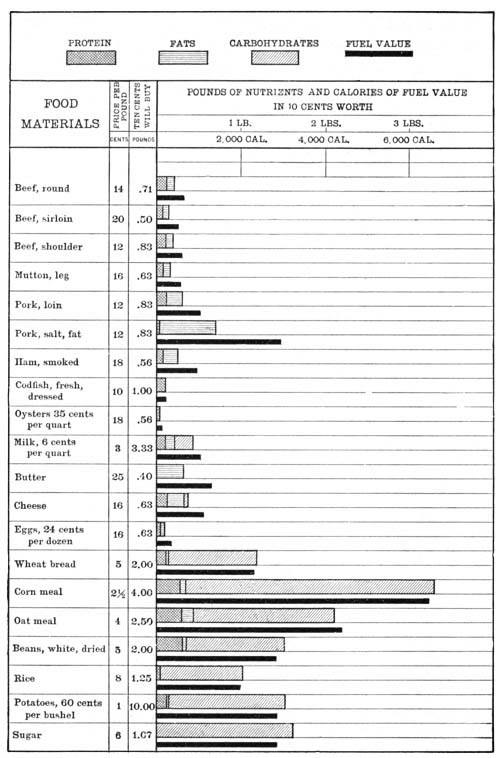
Table showing the cost of various foods. Using this table, make up an economical dietary for one day, three meals, for a man doing moderate work. Give reasons for the amount of food used and for your choice of foods. Make up another dietary in the same manner, using expensive foods. What is the difference in your bill for the day?
A Mixed Diet Best.—Knowing the proportion of the different food substances required by man, it will be an easy matter to determine from the tables and charts shown you the best foods for use in a mixed diet. Meats contain too much nitrogen in proportion to the other substances. In milk, the proportion of proteins, carbohydrates, and fats is nearly right to make protoplasm; a considerable amount of mineral matter being also present. For these reasons, milk is extensively used as a food for children, as it combines food material for the forming of protoplasm with mineral matter for the building of bone. Some vegetables (for example, peas and beans) contain a large amount of nitrogenous material but in a less digestible form than is found in some other foods. Vegetarians, then, are correct in theory when they state that a diet of vegetables may contain everything necessary to sustain life. But a mixed diet containing meat is healthier. A purely vegetable diet contains much waste material, such as the cellulose forming the walls of plant cells, which is indigestible. It has been recently discovered that the outer coats of some grains, as rice, contain certain substances (enzymes) which aid in digestion. In the case of polished rice, when this outer coat is removed the grain has much less food value.
Daily Fuel Needs of the Body.—It has been pointed out that the daily diet should differ widely according to age, occupation, time of year, etc. The following table shows the daily fuel needs for several ages and occupations:—
Daily Calorie Needs (Approximately)
1. For child under 2 years 900 Calories
2. For child from 2-5 years 1200 Calories
3. For child from 6-9 years 1500 Calories
4. For child from 10-12 years 1800 Calories
5. For child from 12-14 (woman, light work, also) 2100 Calories
6. For boy (12-14), girl (15-16), man, sedentary 2400 Calories
7. For boy (15-16) (man, light muscular work) 2700 Calories
8. For man, moderately active muscular work 3000 Calories
9. For farmer (busy season) 3200 to 4000 Calories
10. For ditchers, excavators, etc. 4000 to 5000 Calories
11. For lumbermen, etc. 5000 and more Calories
Normal Heat Output.—The following table gives the result of some experiments made to determine the hourly and daily expenditure of energy of the average normal grown person when asleep and awake, at work or at rest:—
Average Normal Output of Heat from the Body
Conditions of Muscular Activity Average Calories per Hour
Man at rest, sleeping 65 Calories
Man at rest, awake, sitting up 100 Calories
Man at light muscular exercise 170 Calories
Man at moderately active muscular exercise 290 Calories
Man at severe muscular exercise 450 Calories
Man at very severe muscular exercise 600 Calories
It is very simple to use such a table in calculating the number of Calories which are spent in twenty-four hours under different bodily conditions. For example, suppose the case of a clerk or school teacher leading a relatively inactive life, who
sleeps for 9 hours × 65 Calories = 585
works at desk 9 hours × 100 Calories = 900
reads, writes, or studies 4 hours × 100 Calories = 400
walks or does light exercise 2 hours × 170 Calories = 340
2225
This comes out, as we see, very close to example 6 of the table[39] on page 284.
How we may Find whether we are Eating a properly Balanced Diet.—We already know approximately our daily Calorie needs and about the proportion of protein, fat, and carbohydrate needed. Dr. Irving Fisher of Yale University has worked out a very easy method of determining whether one is living on a proper diet. He has made up a number of tables, in which he has designated portions of food, each of which furnishes 100 Calories of energy. The tables show the proportion of protein, fat, and carbohydrate in each food, so that it is a simple matter by using such a table to estimate the proportions of the various nutrients in our dietary. We may depend upon taking somewhere near the proper amount of food if we take a diet based upon either Atwater's, Chittenden's, or Voit's standard. One of the most interesting and useful pieces of home work that you can do is to estimate your own personal dietary, using the tables giving the 100-Calorie portion to see if you have a properly balanced diet. From the table on page 286 make out a simple dietary for yourself for one day, estimating your own needs in Calories and then picking out 100-Calorie portions of food which will give you the proper proportions of protein, fat, and carbohydrate.
Table of 100 Calorie Portions—Modified from Fisher
Calories Furnished Price
Food Portion Containing 100 Calories Wt. Pro- tein Fat Carbs. 1 Lb. Por.
Oysters 1 doz. 6.8.0 49 22.0 29 .175 .07
Bean soup ½ small serving 2.60 24 12.0 64 .007
Cream of corn 2/3 ordin. serv. 3.10 11 58.0 31 .02
Vegetable soup ½ ordin. serv. 2.40 8 89.0 3 .01
Cod fish (fresh) ordin. serv. 5.00 95 5.0 0 .12 .04
Salmon (canned) small serv. 1.75 45 55.0 0 .22 .03
Chicken ½ large serv. 1.75 39 56.0 5 .22 .05
Veal cutlet 2/3 large serv. 2.40 54 46.0 0 .28 .045
Beef, corned ½ large serv. 1.00 15 85.0 0 .16 .01
Beef, sirloin small serv. 1.60 33 67.0 0 .34 .04
Beef, round small serv. 1.80 39 61.0 0 .24 .025
Ham, lean ordin. serv. 1.10 28 72.0 0 .22 .015
Lamb chops ½ ordin. serv. 1.00 24 76.0 0 .20 .013
Mutton, leg ordin. serv. 1.20 35 65.0 0 .20 .015
Eggs, boiled 1 large egg 2.10 32 68.0 0 .30 doz. .025
Eggs, scrambled 1-1/3 ordin. serv. 2.50 37 58.0 5 .30 doz. .03
Beans, baked side dish 2.66 21 18.0 61 .08 .013
Potatoes, mashed ordin. serv. 3.20 10 25.0 65 .02 .005
Macaroni 1/3 large serv. .95 15 3.0 82 .10 .01
Potato salad ordin. serv. 2.25 10 57,0 33 .20 .025
Tomatoes, sliced 4 large serv. 15.00 15 16.0 69 .10 .10
Rolls, plain 1 large roll 1.20 12 7.0 81 .10 doz. .01
Butter ordin. pat .44 5 99.5 .35 .01
Wheat bread 1 small slice .96 15 5.0 80 .07 .005
Chocolate cake ½ ord. sq. piece .98 7 22.0 71 .32 .02
Gingerbread ½ ord. sq. piece .96 6 23.0 71 .16 .01
Custard pudding ordin. serv. 3.25 18 42.0 40 .15 .03
Rice pudding very small serv. 2.65 8 13.0 79 .13 .02
Apple pie 1/3 piece 1.30 5 32.0 63 .013
Cheese, American 1-½ cu. in. .77 25 73.0 2 .19 .01
Crackers (soda) 2 crackers .90 10 20.0 70 .10 .007
Currant jelly 2 heap. spoons 1.10 2 0.0 98 .40 .025
Sugar 3 teaspoons .86 0 0.0 100 .06 .003
Milk as bought small glass 4.90 19 52.0 29 .05 .015
Milk, cond., sweet 4 teaspoons 1.06 10 23.0 67 .01
Oranges 1 large one 9.40 6 3.0 91 .025
Peanuts 13 double ones .62 20 63.0 17 .004
Almonds, shelled 8-15 .53 13 77.0 10 .025
From the preceding table plan a well-balanced and cheap dietary for one day for a family of five, two adults and three children. Make a second dietary for the same time and same number of people which shall give approximately the same amount of tissue and energy producing food from more expensive materials.
Food Waste in the Kitchen.—Much loss occurs in the improper cooking of foods. Meats especially, when overdone, lose much of their flavor and are far less easily digested than when they are cooked rare. The chief reasons for cooking meats are that the muscle fibers may be loosened and softened, and that the bacteria or other parasites in the meat may be killed by the heat. The common method of frying makes foods less digestible. Stewing is an economical as well as healthful method. A good way to prepare meat, either for stew or soup, is to place the meat, cut in small pieces, in cold water, and allow it to simmer for several hours. Rapid boiling toughens the muscle fibers by the too rapid coagulation of the albuminous matter in them, just as the white of egg becomes tough when boiled too long. Boiling and roasting are excellent methods of cooking meat. In order to prevent the loss of the nutrients in roasting, it is well to baste the meat frequently; thus a crust is formed on the outer surface of the meat, which prevents the escape of the juices from the inside.
Vegetables are cooked in order that the cells containing starch grains may be burst open, thus allowing the starch to be more easily attacked by the digestive fluids. Inasmuch as water may dissolve out nutrients from vegetable tissues, it is best to boil them rapidly in a small amount of water. This gives less time for the solvent action to take place. Vegetables should be cooked with the outer skin left on when it is possible.
Adulterations in Foods.—The addition of some cheaper substance to a food, or the subtraction of some valuable substance from a food, with the view to cheating the purchaser, is known as adulteration. Many foods which are artificially manufactured have been adulterated to such an extent as to be almost unfit for food, or even harmful. One of the commonest adulterations is the substitution of grape sugar (glucose) for cane sugar. Glucose, however, is not a harmful adulterant. It is used largely in candy making. Flour and other cereal foods are sometimes adulterated with some cheap substitutes, as bran or sawdust. Alum is sometimes added to make flour whiter. Probably the food which suffers most from adulteration is milk, as water can be added without the average person being the wiser. By means of an inexpensive instrument known as a lactometer, this cheat may easily be detected. In most cities, the milk supply is carefully safeguarded, because of the danger of spreading typhoid fever from impure milk (see Chapter XX). Before the pure food law was passed in 1906, milk was frequently adulterated with substances like formalin to make it keep sweet longer. Such preservatives are harmful, and it is now against the law to add anything whatever to milk.
Coffee, cocoa, and spices are subject to great adulteration; cottonseed oil is often substituted for olive oil; butter is too frequently artificial; while honey, sirups of various kinds, cider and vinegar, have all been found to be either artificially made from cheaper substitutes or to contain such substitutes.
Pure Food Laws.—Thanks to the National Pure Food and Drug Law passed by Congress in 1906, and to the activity of various city and state boards of health, the opportunity to pass adulterated foods on the public is greatly lessened. This law compels manufacturers of foods or medicines to state the composition of their products on the labels placed on the jars or bottles. So if a person reads the label he can determine exactly what he is getting for his money.
Impure Water.—Great danger comes from drinking impure water. This subject has already been discussed under Bacteria, where it was seen that the spread of typhoid fever in particular is due to a contaminated water supply. As citizens, we must aid all legislation that will safeguard the water used by our towns and cities. Boiling water for ten minutes or longer will render it safe from all organic impurities.
Stimulants.—We have learned that food is anything that supplies building material or releases energy in the body; but some materials used by man, presumably as food, do not come under this head. Such are tea and coffee. When taken in moderate quantities, they produce a temporary increase in the vital activities of the person taking them. This is said to be a stimulation; and material taken into the digestive tract, producing this, is called a stimulant. In moderation, tea and coffee appear to be harmless. Some people, however, cannot use either without ill effects, even in small quantity. It is the habit formed of relying upon the stimulus given by tea or coffee that makes them a danger to man. Cocoa and chocolate, although both contain a stimulant, are in addition good foods, having from 12 per cent to 21 per cent of protein, from 29 per cent to 48 per cent fat, and over 30 per cent carbohydrate in their composition.
Is Alcohol a Food?—The question of the use of alcohol has been of late years a matter of absorbing interest and importance among physiologists. A few years ago Dr. Atwater performed a series of very careful experiments by means of the respiration calorimeter, to ascertain whether alcohol is of use to the body as food.[40] In these experiments the subjects were given, instead of their daily allotment of carbohydrates and fats, enough alcohol to supply the same amount of energy that these foods would have given. The amount was calculated to be about two and one half ounces per day, about as much as would be contained in a bottle of light wine.[41] This alcohol was administered in small doses six times during the day. Professor Atwater's results may be summed up briefly as follows:—
1. The alcohol administered was almost all oxidized in the body.
2. The potential energy in the alcohol was transformed into heat or muscular work.
3. The body did about as well with the rations including alcohol as it did without it.
The committee of fifty eminent men appointed to report on the physiological aspects of the drink problem reported that a large number of scientific men state that they are in the habit of taking alcoholic liquor in small quantities, and many report that they do not feel harm thereby. A number of scientists seem to agree that within limits alcohol may be a kind of food, although a very poor food.
On the other hand, we know that although alcohol may technically be considered as a food, it is a very unsatisfactory food and, as the following statements show, it has an effect on the body tissues which foods do not have.
Professor Chittenden of Yale College, in discussing the food problem of alcohol, writes as follows:
"It is true that alcohol in moderate quantities may serve as a food, i.e. it can be oxidized with the liberation of heat. It may to some extent take the place of fat and carbohydrates, but it is not a perfect substitute for them, and for this reason alcohol has an action that cannot be ignored. It reduces liver oxidation. It therefore presents a dangerous side wholly wanting in carbohydrates and fat. The latter are simply burned up to carbonic acid and water or are transformed to glycogen and fat, but alcohol, although more easily oxidized, is at all times liable to obstruct, in a measure at least, the oxidative processes of the liver and probably of other tissues also, thereby throwing into the circulation bodies, such as uric acid, which are harmful to health, a fact which at once tends to draw a distinct line of demarcation between alcohol and the two non-nitrogenous foods, fat and carbohydrates. Another matter must be emphasized, and it is that the form in which alcohol is taken is of importance. Port wine, for instance, has more influence on the amount of uric acid secreted than an equivalent amount of alcohol has in some other form. To conclude: as an adjunct to the ordinary daily diet of the healthy man alcohol cannot be considered as playing the part of a true non-nitrogenous food."—Quoted in American Journal of Inebriety, Winter, 1906.
Effect of Alcohol on Living Matter.—If we examine raw white of egg, we find a protein which closely resembles protoplasm in its chemical composition; it is called albumen. Add to a little albumen in a test tube some 95 per cent alcohol and notice what happens. As soon as the alcohol touches the albumen the latter coagulates and becomes hard like boiled white of egg. Shake the alcohol with the albumen and the entire mass soon becomes a solid. This is because the alcohol draws the water out of the albumen. It has been shown that albumen is somewhat like protoplasm in structure and chemical composition. Strong alcohol acts in a similar manner on living matter when it is absorbed by the living body cells. It draws water from them and hardens them. It has a chemical and physical action upon living matter.
Alcohol a Poison.—But alcohol is also in certain quantities a poison. A commonly accepted definition of a poison is that it is any substance which, when taken into the body, tends to cause serious detriment to health, or the death of the organism. That alcohol may do this is well known by scientists.
It is a matter of common knowledge that alcohol taken in small quantities does not do any apparent harm. But if we examine the vital records of life insurance companies, we find a large number of deaths directly due to alcohol and a still greater number due in part to its use. In the United States every year there are a third more deaths from alcoholism and cirrhosis of the liver (a disease directly caused by alcohol) than there are from typhoid fever. The poisonous effect is not found in small doses, but it ultimately shows its harmful effect. Hardening of the arteries, an old-age disease, is rapidly becoming in this country a disease of the middle aged. From it there is no escape. It is chiefly caused by the cumulative effect of alcohol. The diagram following, compiled by two English life insurance companies that insure moderate drinkers and abstainers, shows the death rate to be considerably higher among those who use alcohol.
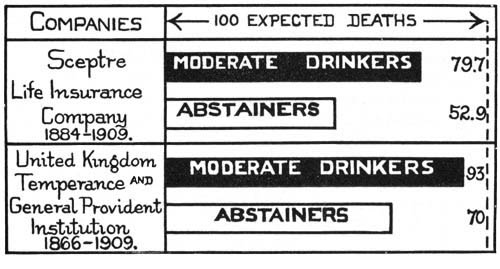
Abstainers live longer than moderate drinkers.
Dr. Kellogg, the founder of the famous Battle Creek Sanitarium, points out that strychnine, quinine, and many other drugs are oxidized in the body but surely cannot be called foods. The following reasons for not considering alcohol a food are taken from his writings:—
"1. A habitual user of alcohol has an intense craving for his accustomed dram. Without it he is entirely unfitted for business. One never experiences such an insane craving for bread, potatoes, or any other particular article of food.
"2. By continuous use the body acquires a tolerance for alcohol. That is, the amount which may be imbibed and the amount required to produce the characteristic effects first experienced gradually increase until very great quantities are sometimes required to satisfy the craving which its habitual use often produces. This is never the case with true foods.... Alcohol behaves in this regard just as does opium or any other drug. It has no resemblance to a food.
"3. When alcohol is withdrawn from a person who has been accustomed to its daily use, most distressing effects are experienced.... Who ever saw a man's hand trembling or his nervous system unstrung because he could not get a potato or a piece of cornbread for breakfast? In this respect, also, alcohol behaves like opium, cocaine, or any other enslaving drug.
"4. Alcohol lessens the appreciation and the value of brain and nerve activity, while food reënforces nervous and mental energy.
"5. Alcohol as a protoplasmic poison lessens muscular power, whereas food increases energy and endurance.
"6. Alcohol lessens the power to endure cold. This is true to such a marked degree that its use by persons accompanying Arctic expeditions is absolutely prohibited. Food, on the other hand, increases ability to endure cold. The temperature after taking food is raised. After taking alcohol, the temperature, as shown by the thermometer, is lowered.
"7. Alcohol cannot be stored in the body for future use, whereas all food substances can be so stored.
"8. Food burns slowly in the body, as it is required to satisfy the body's needs. Alcohol is readily oxidized and eliminated, the same as any other oxidizable drug."
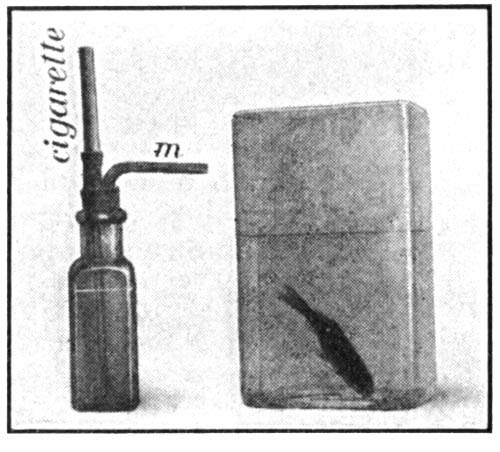
Experiment (by Davison) to show how the nicotine in six cigarettes was sufficient to kill this fish. The smoke from the cigarettes was passed through the water in which the fish is swimming.
The Use of Tobacco.—A well-known authority defines a narcotic as a substance "which directly induces sleep, blunts the senses, and, in large amounts, produces complete insensibility." Tobacco, opium, chloral, and cocaine are examples of narcotics. Tobacco owes its narcotic influence to a strong poison known as nicotine. Its use in killing insect parasites on plants is well known. In experiments with jellyfish and other lowly organized animals, the author has found as small a per cent as one part of nicotine to one hundred thousand parts of sea water to be sufficient to profoundly affect an animal placed within it. The illustration here given shows the effect of nicotine upon a fish, one of the vertebrate animals. Nicotine in a pure form is so powerful a poison that two or three drops would be sufficient to cause the death of a man by its action upon the nervous system, especially the nerves controlling the beating of the heart. This action is well known among boys training for athletic contests. The heart is affected; boys become "short-winded" as a result of the action on the heart. It has been demonstrated that tobacco has, too, an important effect on muscular development. The stunted appearance of the young smoker is well known.
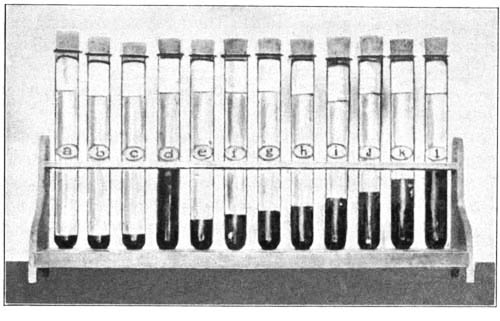
The amounts of alcohol in some liquors and in some patent medicines. a, beer, 5 %; b, claret, 8 %; c, champagne, 9 %; d, whisky, 50 %; e, well-known sarsaparilla, 18 %; f, g, h, much-advertised nerve tonics, 20 %, 21 %, 25 %; i, another much-advertised sarsaparilla, 27 %; j, a well-known tonic, 28 %; k, l, bitters, 37 %, 44 % alcohol.
Use and Abuse of Drugs.—The American people are addicted to the use of drugs, and especially patent medicines. A glance at the street-car advertisements shows this. Most of the medicines advertised contain alcohol in greater quantity than beer or wine, and many of them have opium, morphine, or cocaine in their composition. Paregoric and laudanum, medicines sometimes given to young children, are examples of dangerous drugs that contain opium. Dr. George D. Haggard of Minneapolis has shown by many analyses that a large number of the so-called "malts," "malt extracts," and "tonics," including several of the best known and most advertised on the market, are simply disguised beers and, frequently, very poor beers at that. These drugs, in addition to being harmful, affect the person using them in such a manner that he soon feels the need for the drug. Thus the drug habit is formed,—a condition which has wrecked thousands of lives. A number of articles on patent medicines recently appeared in a leading magazine and have been collected and published under the title of The Great American Fraud. In this booklet the author points out a number of different kinds of "cures" and patent medicines. The most dangerous are those headache or neuralgia cures containing acetanilid. This drug is a heart depresser and should not be used without medical advice. Another drug which is responsible for habit formation is cocaine. This is often found in catarrh or other cures. Alcohol is the basis of all tonics or "bracers." Every boy and girl should read this booklet so as to be forearmed against evils of the sort just described.
Reference Reading on Foods
Hunter, Laboratory Problems in Civic Biology. American Book Company.
Allen, Civics and Health. Ginn and Company.
Bulletin 13, American School of Home Economics, Chicago.
Cornell University Reading Course, Buls. 6 and 7, Human Nutrition.
Davison, The Human Body and Health. American Book Company.
Jordan, The Principles of Human Nutrition. The Macmillan Company.
Kehler, L. F., Habit-forming Agents. Farmers' Bulletin 393, U. S. Dept. of Agri.
Lusk, Science and Nutrition. W. B. Saunders Company.
Norton, Foods and Dietetics. American School of Home Economics.
Olsen, Pure Foods. Ginn and Company.
Sharpe, A Laboratory Manual for the Solution of Problems in Biology, pp. 226-240. American Book Company.
Stiles, Nutritional Physiology. W. B. Saunders Company.
The Great American Fraud. American Medical Association, Chicago.
The Propaganda for Reform in Proprietary Medicines. Am. Medical Association.
Farmers' Bulletin: numbers 23, 34, 42, 85, 93, 121, 128, 132, 142, 182, 249, 295, 298.
Reprint from Yearbook, 1901, Atwater, Dietaries in Public Institutions.
Reprint from Yearbook, 1902, Milner, Cost of Food related to its Nutritive Value.
Experiment Station, Circular 46, Langworthy, Functions and Uses of Food.
XX. DIGESTION AND ABSORPTION
Problems.—To determine where digestion takes place by examining:—
(a) The functions of glands.
(b) The work done in the mouth.
(c) The work done in the stomach.
(d) The work done in the small intestine.
(e) The function of the liver.
To discover the absorbing apparatus and how it is used.