A CIVIC BIOLOGY (continued 2)
Reading edition
To a little starch in half a cup of water we add a very little (1 gram) of diastase and put the vessel containing the mixture in a warm place, where the temperature will remain nearly constant at about 98° Fahrenheit. On testing part of the contents at the end of half an hour, and the remainder the next morning, for starch and for grape sugar, we find from the morning test that the starch has been almost completely changed to grape sugar. Starch and warm water alone under similar conditions will not react to the test for grape sugar.
Digestion has the Same Purpose in Plants and Animals.—In our own bodies we know that solid foods taken into the mouth are broken up by the teeth and moistened by saliva. If we could follow that food, we would find that eventually it became part of the blood. It was made soluble by digestion, and in a liquid form was able to reach the blood. Once a part of the body, the food is used either to release energy or to build up the body.
Summary.—We have seen: 1. That seeds, in order to grow, must possess a food supply either in or around their bodies.
2. That this food supply must be oxidized before energy is released.
3. That in cases where the food is not stored at the point where it is to be oxidized the food must be digested so that it may be transported from one part to another in the same plant.
The life processes of plants and animals, so far, may be considered as alike; they both feed, breathe (oxidize their food), do work, and grow.
Reference Books
elementary
Hunter, Laboratory Problems in Civic Biology. American Book Company.
Andrews, A Practical Course in Botany, pages 1-21. American Book Company.
Atkinson, First Studies of Plant Life, Chap. XXX. Ginn and Company.
Bailey, Botany, Chaps. XX, XXX. The Macmillan Company.
Beal, Seed Dispersal. Ginn and Company.
Bergen and Davis, Principles of Botany, Chaps. XX, XXX. Ginn and Company.
Coulter, Plant Life and Plant Uses. American Book Company.
Dana, Plants and their Children. American Book Company.
Mayne and Hatch, High School Agriculture. American Book Company.
Lubbock, Flowers, Fruits, and Leaves. The Macmillan Company.
Newell, Reader in Botany, pages 24-49. Ginn and Company.
Sharpe, A Laboratory Manual in Biology, pages 55-65. American Book Company.
advanced
Bailey, The Evolution of our Native Fruits. The Macmillan Company.
Bailey, Plant Breeding. The Macmillan Company.
Coulter, Barnes, and Cowles, A Textbook of Botany, Vol. I. American Book Company.
De Candolle, Origin of Cultivated Plants. D. Appleton and Company.
Duggar, Plant Physiology. The Macmillan Company.
Farmers' Bulletins, Nos. 78, 86, 225, 344. U. S. Department of Agriculture.
Hodge, Nature Study and Life, Chaps. X, XX. Ginn and Company.
Kerner (translated by Oliver), Natural History of Plants. Henry Holt and Company, 4 vols. Vol. II, Part 2.
Sargent, Corn Plants. Houghton, Mifflin, and Company.
VI. THE ORGANS OF NUTRITION IN PLANTS—THE SOIL AND ITS RELATION TO THE ROOTS
Problem.—What a plant takes from the soil and how it gets it.
(a) What determines the direction of growth of roots?
(b) How is the root built?
(c) How does a root absorb water?
(d) What is in the soil that a root might take out?
(e) Why is nitrogen necessary, and how is it obtained?
Laboratory Suggestions
Demonstration.—Roots of bean or pea.
Demonstration or home experiment.—Response of root to gravity and to water. What part of root is most responsive?
Laboratory work.—Root hairs, radish or corn, position on root, gross structure only. Drawing.
Demonstration.—Root hair under compound microscope.
Demonstration.—Apparatus illustrating osmosis.
Demonstration or a home experiment.—Organic matter present in soil.
Demonstration.—Root tubercles of legume.
Demonstration.—Nutrients present in some roots.
Uses of the Root.—If one of the seedlings of the bean spoken of in the last chapter is allowed to grow in sawdust and is given light, air, and water, sooner or later it will die. Soil is part of its natural environment, and the roots which come in contact with the soil are very important. It is the purpose of this chapter to find out just how the young plant is fitted to get what it needs from this part of its environment; namely, the soil.
The development of a bean seedling has shown us that the root grows first. One of the most important functions of the root to a young seed plant is that of a holdfast, an anchor to fasten it in the place where it is to develop. It has many other uses, as the taking in of water with the mineral and organic matter dissolved therein, the storage of food, climbing, etc. All functions other than the first one stated arise after the young plant has begun to develop.
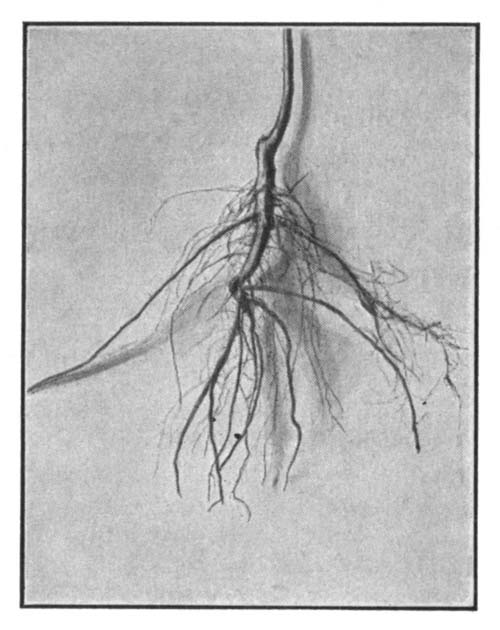
A root system, showing primary and secondary roots.
Root System.—If you dig up a young bean seedling and carefully wash the dirt from the roots, you will see that a long root is developed as a continuation of the hypocotyl. This root is called the primary root. Other smaller roots which grow from the primary root are called secondary, or tertiary, depending on their relation to the first root developed.
Downward Growth of Root. Influence of Gravity.—Most of the roots examined take a more or less downward direction. We are all familiar with the fact that the force we call gravity influences life upon this earth to a great degree. Does gravity act on the growing root? This question may be answered by a simple experiment.
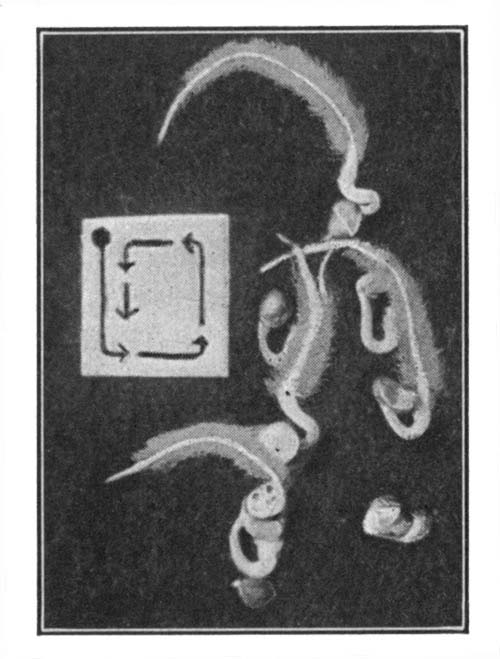
Revolve this figure in the direction of the arrows to see if the roots of the radish respond to gravity.
Plant mustard or radish seeds in a pocket garden, place it on one edge and allow the seeds to germinate until the root has grown to a length of about half an inch. Then turn it at right angles to the first position and allow it to remain for one day undisturbed. The roots now will be found to have turned in response to the change in position, that part of the root near the growing point being the most sensitive to the change. This experiment seems to indicate that the roots are influenced to grow downward by the force of gravity.
Experiments to determine the Influence of Moisture on a Growing Root.—The objection might well be interposed that possibly the roots in the pocket garden[8] grew downward after water. That moisture has an influence on the growing root is easily proved.
Plant bird seed, mustard or radish seed in the underside of a sponge, which should be kept wet, and may be suspended by a string under a bell jar in the schoolroom window. Note whether the roots leave the sponge to grow downward, or if the moisture in the sponge is sufficient to counterbalance the force of gravity.
Water a Factor which determines the Course taken by Roots.—Water, as well as the force of gravity, has much to do with the direction taken by roots. Water is always found below the surface of the ground, but sometimes at a great depth. Most trees, and all grasses, have a greater area of surface exposed by the roots than by the branches. The roots of alfalfa, a cloverlike plant used for hay in the Western states, often penetrate the soil after water for a distance of ten to twenty feet below the surface of the ground.
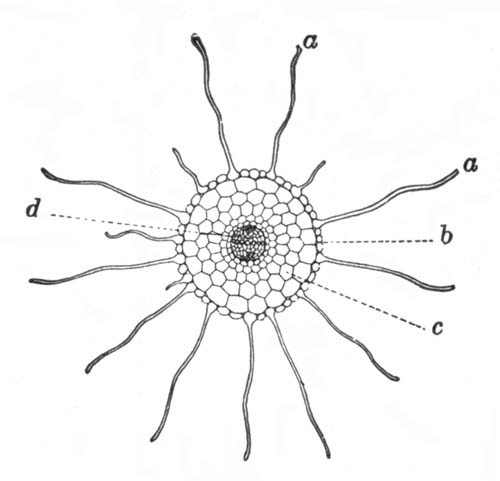
Cross section of a young taproot; a, a, root hairs; b, outer layer of bark; c, inner layer of bark; d, wood or central cylinder.
Fine Structure of a Root.[9]—When we examine a delicate root in thin longitudinal section under the compound microscope, we find the entire root to be made up of cells, the walls of which are uniformly rather thin. Over the lower end of the root is found a collection of cells, most of which are dead, loosely arranged so as to form a cap over the growing tip. This is evidently an adaptation which protects the young and actively growing cells just under the root cap. In the body of the root a central cylinder can easily be distinguished from the surrounding cells. In a longitudinal section a series of tubelike structures may be found within the central cylinder. These structures are cells which have grown together at the small end, the long axis of the cells running the length of the main root. In their development the cells mentioned have grown together in such a manner as to lose their small ends, and now form continuous hollow tubes with rather strong walls. Other cells have come to develop greatly thickened walls; these cells give mechanical support to the tubelike cells. Collections of such tubes and supporting woody cells together make up what are known as fibrovascular bundles.
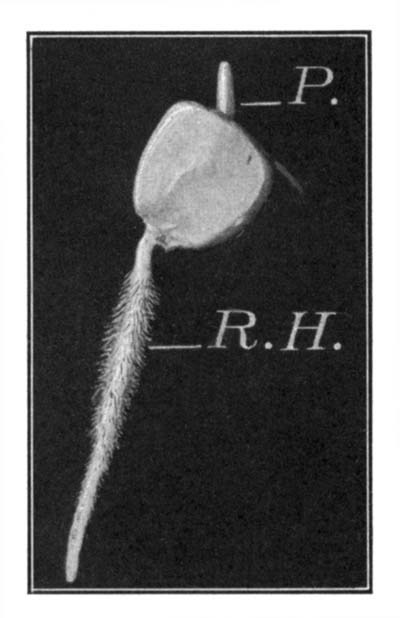
Young embryo of corn, showing root hairs (R. H.) and growing stem (P.).
Root Hairs.—Careful examination of the root of one of the seedlings of mustard, radish, or barley grown in the pocket germinator shows a covering of tiny fuzzy structures. These structures are very minute, at most 3 to 4 millimeters in length. They vary in length according to their position on the root, the most and the longest root hairs being found near the point marked R. H. in the figure. These structures are outgrowths of the outer layer of the root (the epidermis), and are of very great importance to the living plant.
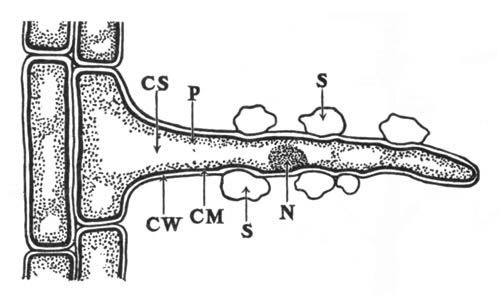
Diagram of a root hair; CS, cell sap; CW, cell wall; P, protoplasm; N, nucleus; S, particles of soil.
Structure of a Root Hair.—A single root hair examined under a compound microscope will be found to be a long, round structure, almost colorless in appearance. The wall, which is very flexible and thin, is made up of cellulose, a substance somewhat like wood in chemical composition, through which fluids may easily pass. Clinging close to the cell wall is the protoplasm of the cell. The interior of the root hair is more or less filled with a fluid called cell sap. Forming a part of the living protoplasm of the root hair, sometimes in the hairlike prolongation and sometimes in that part of the cell which forms the epidermis, is found a nucleus. The protoplasm and nucleus are alive; the cell wall formed by the living matter in the cell is dead. The root hair is a living plant cell with a wall so delicate that water and mineral substances from the soil can pass through it into the interior of the root.
How the Root absorbs Water.—The process by which the root hair takes up soil water can better be understood if we make an artificial root hair large enough to be easily seen. An egg with part of the outer shell removed so as to expose the soft skinlike membrane underneath is an example. Better, an artificial root hair may be made in the following way. Pour some soft celloidin into a test tube; carefully revolve the test tube so that an even film of celloidin dries on the inside. This membrane is removed, filled with white of egg, and tied over the end of a rubber cork in which a glass tube has previously been inserted. When placed in water, it gives a very accurate picture of the root hair at work. After a short time water begins to rise in the tube, having passed through the film of celloidin. If grape sugar, salt, or some other substance which will dissolve in water were placed in the water outside the artificial root hair, it could soon be proved by test to pass through the wall and into the liquid inside.
Osmosis.—To explain this process we must remember that gases and liquids of different densities, when separated by a membrane, tend to flow toward each other and mingle, the greater flow always being in the direction of the denser medium. The process by which two gases or fluids, separated by a membrane, tend to pass through the membrane and mingle with each other, is called osmosis. The method by which the root hairs take up soil water is exactly the same process. It is by osmosis. The white of the egg is the best possible substitute for living matter; the celloidin membrane separating the egg from the water is much like the delicate membrane-like wall which separates the protoplasm of the root hair from the water in the soil surrounding it. The fluid in the root hair is denser than the soil water; hence the greater flow is toward the interior of the root hair.[10]
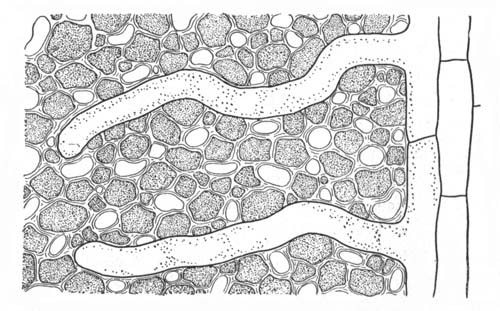
The soil particles are each surrounded with a delicate film of water. How might the root hairs take up this water?
Passage of Soil Water within the Root.—We have already seen that in an exchange of fluids by osmosis the greater flow is always toward the denser fluid. Thus it is that the root hairs take in more fluid than they give up. The cell sap, which partly fills the interior of the root hair, is a fluid of greater density than the water outside in the soil. When the root hairs become filled with water, the density of the cell sap is lessened, and the cells of the epidermis are thus in a position to pass along their supply of water to the cells next to them and nearer to the center of the root. These cells, in turn, become less dense than their inside neighbors, and so the transfer of water goes on until the water at last reaches the central cylinder. Here it is passed over to the tubes of the woody bundles and started up the stem. The pressure created by this process of osmosis is sufficient to send water up the stem to a distance, in some plants, of 25 to 30 feet. Cases are on record of water having been raised in the birch a distance of 85 feet.
Physiological Importance of Osmosis.—It is not an exaggeration to say that osmosis is a process not only of great importance to a plant, but to an animal as well. Foods are digested in the food tube of an animal; that is, they are changed into a soluble form so that they may pass through the walls of the food tube and become part of the blood. The inner lining of part of the food tube is thrown into millions of little fingerlike projections which look somewhat, in size at least, like root hairs. These fingerlike processes are (unlike a root hair) made up of many cells. But they serve the same purpose as the root hairs, for they absorb liquid food into the blood. This process of absorption is largely by osmosis. Without the process of osmosis we should be unable to use much of the food we eat.
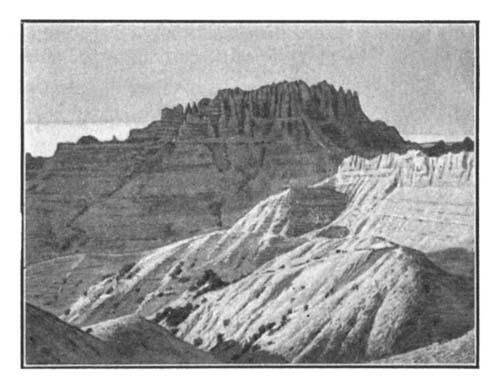
Inorganic soil is being formed by weathering.
Composition of Soil.—If we examine a mass of ordinary loam carefully, we find that it is composed of numerous particles of varying size and weight. Between these particles, if the soil is not caked and hard packed, we can find tiny spaces. In well-tilled soil these spaces are constantly being formed and enlarged. They allow air and water to penetrate the soil. If we examine soil under the microscope, we find considerable water clinging to the soil particles and forming a delicate film around each particle. In this manner most of the water is held in the soil.
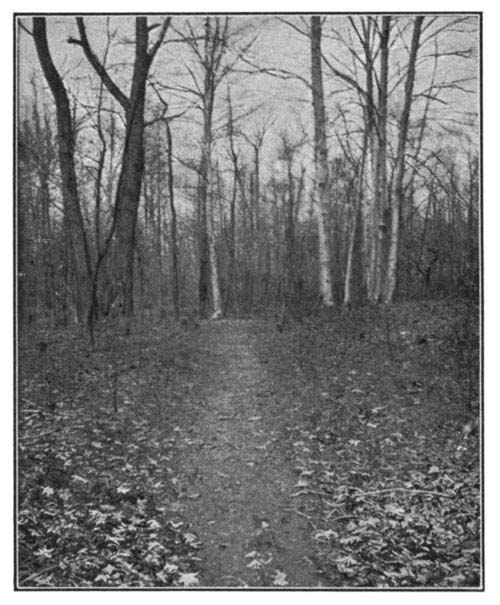
This picture shows how the forests help to cover the inorganic soil with an organic coating. Explain how.
How Water is held in Soil.—To understand what comes in with the soil water, it will be necessary to find out a little more about soil. Scientists who have made the subject of the composition of the earth a study, tell us that once upon a time at least a part of the earth was molten. Later, it cooled into solid rock. Soil making began when the ice and frost, working alternately with the heat, chipped off pieces of rock. These pieces in time became ground into fragments by action of ice, glaciers, running water, or the atmosphere. This process is called weathering. Weathering is aided by oxidation. A glance at almost any crumbling stones will convince you of this, because of the yellow oxide of iron (rust) disclosed. So by slow degrees this earth became covered with a coating of what we call inorganic soil. Later, generation after generation of tiny plants and animals which lived in the soil died, and their remains formed the first organic materials of the soil.
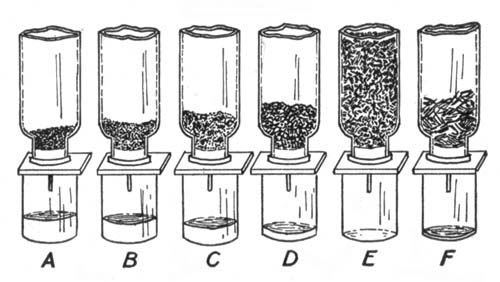
Apparatus for testing the capacity of soils to take in and retain moisture.
You are all familiar with the difference between the so-called rich soil and poor soil. The dark soil contains more dead plant and animal matter, which forms the portion called humus.
Humus contains Organic Matter.—It is an easy matter to prove that black soil contains organic matter, for if an equal weight of carefully dried humus and soil from a sandy road is heated red-hot for some time and then reweighed, the humus will be found to have lost considerably in weight, and the sandy soil to have lost very little. The material left after heating is inorganic material, the organic matter having been burned out.
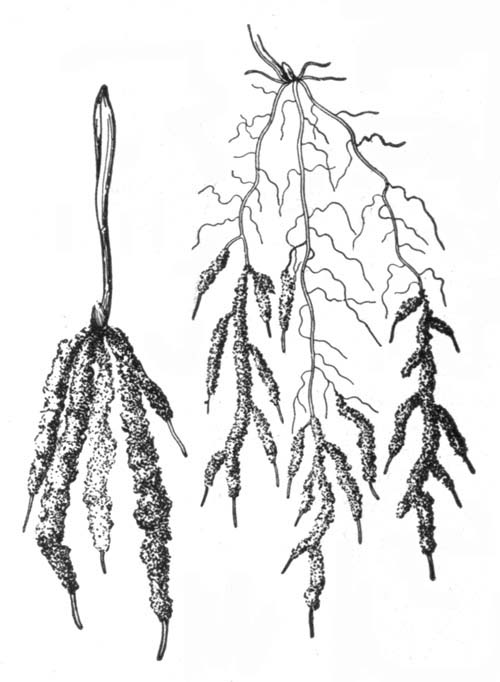
Soil particles cling to root hairs. Why?
Soil containing organic materials holds water much more readily than inorganic soil, as a glance at the accompanying figure shows. If we fill each of the vessels with a given weight (say 100 grams each) of gravel, sand, barren soil, rich loam, leaf mold, and 25 grams of dry, pulverized leaves, then pour equal amounts of water (100 c.c.) on each and measure all that runs through, the water that has been retained will represent the water supply that plants could draw on from such soil.
The Root Hairs take more than Water out of the Soil.—If a root containing a fringe of root hairs is washed carefully, it will be found to have little particles of soil still clinging to it. Examined under the microscope, these particles of soil seem to be cemented to the sticky surface of the root hair. The soil contains, besides a number of chemical compounds of various mineral substances,—lime, potash, iron, silica, and many others,—a considerable amount of organic material. Acids of various kinds are present in the soil. These acids so act upon certain of the mineral substances that they become dissolved in the water which is absorbed by the root hairs. Root hairs also give off small amounts of acid. An interesting experiment may be shown (see Figure on page 80) to prove this. A solution of phenolphthalein loses its color when an acid is added to it. If a growing pea be placed in a tube containing some of this solution the latter will quickly change from a rose pink to a colorless solution.
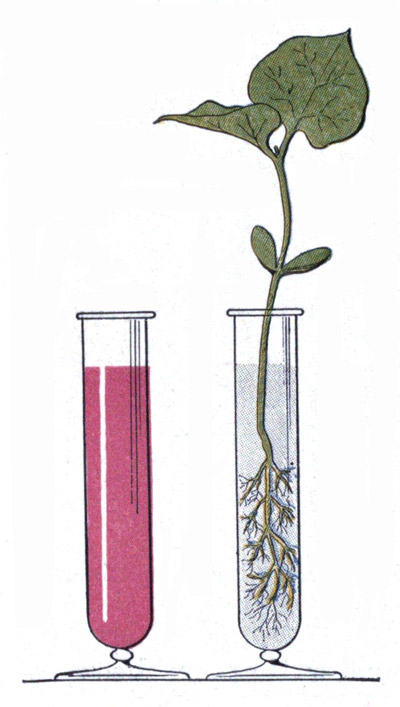
Effect of root hairs on phenolphthalein solution. The change of color indicates the presence of acid.
A Plant needs Mineral Matter to Make Living Matter.—Living matter (protoplasm), besides containing the chemical elements carbon, hydrogen, oxygen, and nitrogen, contains a very minute proportion of various elements which make up the basis of certain minerals. These are calcium (lime), sulphur, iron, potassium, magnesium, phosphorus, sodium, and chlorine.
That plants will not grow well without certain of these mineral substances can be proved by the growth of seedlings in a so-called nutrient solution.[11] Such a solution contains all the mineral matter that a plant uses for food. If certain ingredients are left out of this solution, the plants placed in it will not live.
Nitrogen in a Usable Form necessary for Growth of Plants.—A chemical element needed by the plant to make protoplasm is nitrogen. The air can be proven by experiment to be made up of about four fifths nitrogen, but this element cannot be taken from either soil, water, or air in a pure state, but is usually obtained from the organic matter in the soil, where it exists with other substances in the form of nitrates. Ammonia and other organic compounds which contain nitrogen are changed by two groups of little plants called bacteria, first into nitrites and then nitrates.[12]
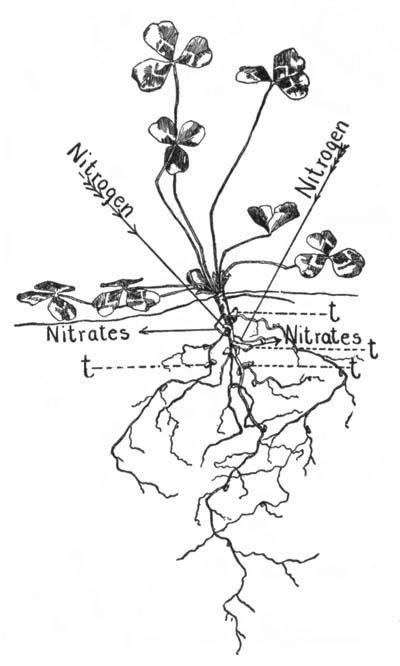
Diagram to show how the nitrogen-fixing bacteria prepare nitrogen for use by plants; t, tubercles.
Relation of Bacteria to Free Nitrogen.—It has been known since the time of the Romans that the growth of clover, peas, beans, and other legumes in soil causes it to become more favorable for growth of other plants. The reason for this has been discovered in late years. On the roots of the plants mentioned are found little swellings or nodules; in the nodules exist millions of bacteria, which take nitrogen from the atmosphere and fix it so that it can be used by the plant; that is, they assist in forming nitrates for the plants to use. Only these bacteria, of all the living plants, have the power to take the free nitrogen from the air and make it over into a form that can be used by the roots. As all the compounds of nitrogen are used over and over again, first by plants, then as food for animals, eventually returning to the soil again, or in part being turned into free nitrogen, it is evident that any new supply of usable nitrogen must come by means of these nitrogen-fixing bacteria.
Rotation of Crops.—The facts mentioned above are made use of by careful farmers who wish to make as much as possible from a given area of ground in a given time. Such plants as are hosts for the nitrogen-fixing bacteria are planted early in the season. Later these plants are plowed in and a second crop is planted. The latter grows quickly and luxuriantly because of the nitrates left in the soil by the bacteria which lived with the first crop. For this reason, clover is often grown on land in which it is proposed to plant corn, the nitrogen left in the soil thus giving nourishment to the young corn plants. In scientifically managed farms, different crops are planted in a given field on different years so that one crop may replace some of the elements taken from the soil by the previous crop. This is known as rotation of crops.[13] The annual yield of the average farm may thus be greatly increased.
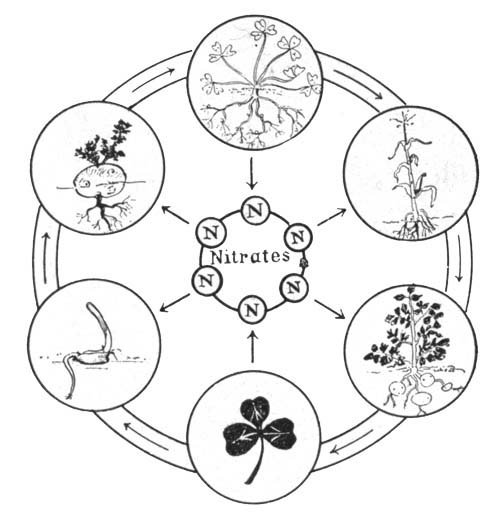
Nitrogen in the soil is necessary for plants. Explain from this diagram how nitrogen is put into the soil by some plants and taken out by others.
Five of the elements necessary to the life of the plant which may be taken out of the soil by constant use are calcium, nitrogen, phosphorus, potassium, and sulphur. Several methods are used by the farmer to prevent the exhaustion of these and other raw food materials from the soil. One method known as fallowing is to allow the soil to remain idle until bacteria and oxidation have renewed the chemical materials used by the plants. This is an expensive method, if land is dear. The most common method of enriching soil is by means of fertilizing material rich in plant food. Manure is most frequently used, but many artificial fertilizers, most of which contain nitrogen in the form of some nitrate, are used, because they can be more easily transported and sold. Such are ground bone, guano (bird manure), nitrate of soda, and many others. These also contain other important raw food materials for plants, especially potash and phosphoric acid. Both of these substances are made soluble so as to be taken into the roots by the action of the carbon dioxide in the soil.
The Indirect Relation of this to the City Dweller.—All of us living in the city are aware of the importance of fresh vegetables, brought in from the neighboring market gardens. But we sometimes forget that our great staple crops, wheat and other cereals, potatoes, fruits of all kinds, our cotton crop, and all plants we make use of grow directly in proportion to the amount of raw food materials they take in through the roots. When we also remember that many industries within the cities, as mills, bakeries, and the like, as well as the earnings of our railways and steamship lines, are largely dependent on the abundance of the crops, we may recognize the importance of what we have read in this chapter.
Food Storage in Roots of Commercial Importance.—Some plants, as the parsnip, carrot, and radish, produce no seed until the second year, storing food in the roots the first year and using it to get an early start the following spring, so as to be better able to produce seeds when the time comes. This food storage in roots is of much practical value to mankind. Many of our commonest garden vegetables, as those mentioned above, and the beet, turnip, oyster plant, sweet potato and many others, are of value because of the food stored. The sugar beet has, in Europe especially, become the basis of a great industry.
Reference Books
elementary
Hunter, Laboratory Problems in Civic Biology. American Book Company.
Bigelow, Applied Biology. The Macmillan Company.
Coulter, Plant Life and Plant Uses, Chaps. III, IV. American Book Company.
Mayne and Hatch, High School Agriculture. American Book Company.
Moore, The Physiology of Man and Other Animals. Henry Holt and Company.
Sharpe, Laboratory Manual in Biology, pp. 73-87. American Book Company.
advanced
Coulter, Barnes, and Cowles, A Textbook of Botany, Part II. Amer. Book Co.
Duggar, Plant Physiology. The Macmillan Company.
Goodale, Physiological Botany. American Book Company.
Green, Vegetable Physiology, Chaps. V, VI. J. and A. Churchill.
Kerner-Oliver, Natural History of Plants. Henry Holt and Company.
MacDougal, Plant Physiology. Longmans, Green, and Company.
VII. PLANT GROWTH AND NUTRITION—PLANTS MAKE FOOD
Problem.—Where, when, and how do green plants make food?
(a) How and why is moisture given off from leaves?
(b) What is the reaction of leaves to light?
(c) What is made in green leaves in the sunlight?
(d) What by-products are given off in the above process?
(e) Other functions of leaves.
Laboratory Suggestions
Demonstration.—Water given off by plant in sunlight. Loss of weight due to transpiration measured.
Laboratory exercise.—
(a) Gross structure of a leaf.
(b) Study of stoma and lower epidermis under microscope.
(c) Study of cross section to show cells and air spaces.
Demonstration.—Reaction of leaves to light.
Demonstration.—Light necessary to starch making.
Demonstration.—Air necessary to starch making.
Demonstration.—Oxygen a by-product of starch making.
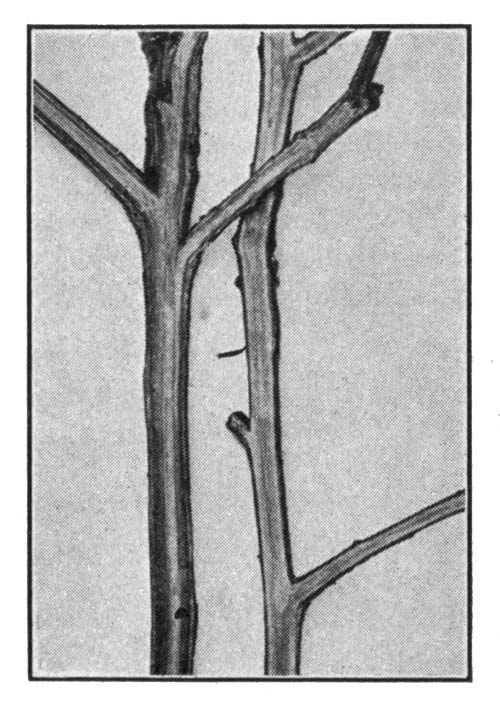
Apple twigs split to show the course of colored water up the stem.
What becomes of the Water taken in by the Roots?—We have seen that more than pure water has been absorbed through the root hairs into the roots. What becomes of this water and the other substances that have been absorbed? This question may be partly answered by the following experiments.
Passage of Fluids up the Stem.—If any young growing shoots (young seedlings of corn or pea, or the older stems of garden balsam, touch-me-not, or sunflower) are placed in red ink (eosin), and left in the sun for a few hours, the red ink will be found to have passed up the stem. If such stems were examined carefully, it would be seen that the colored fluid is confined to collections of woody tubes immediately under the inner bark. Water evidently rises in that part of the stem we call the wood.
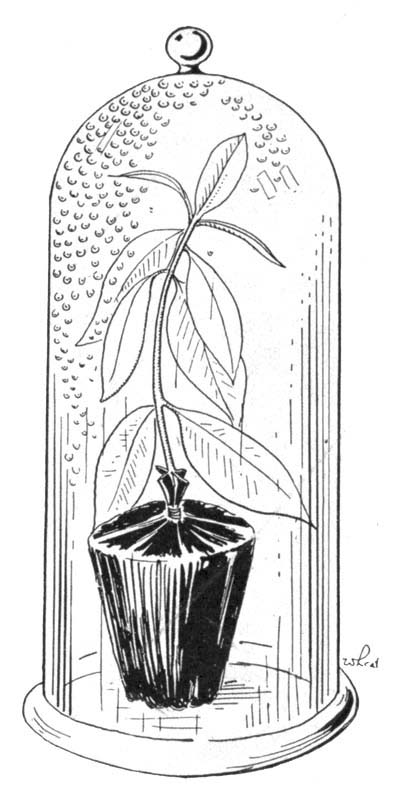
Experiment to prove that water is given off through the leaves of a green plant.
Water given off by Evaporation from Leaves.—Take some well-watered potted green plant, as a geranium or hydrangea, cover the pot with sheet rubber, fastening the rubber close to the stem of the plant. Next weigh the plant with the pot. Then cover it with a tall bell jar and place the apparatus in the sun. In a few minutes drops of moisture are seen to gather on the inside of the jar. If we now weigh the potted plant, we find it weighs less than before. Obviously the loss comes from the water lost, and evidently this water escapes as vapor from either the stem or leaves.
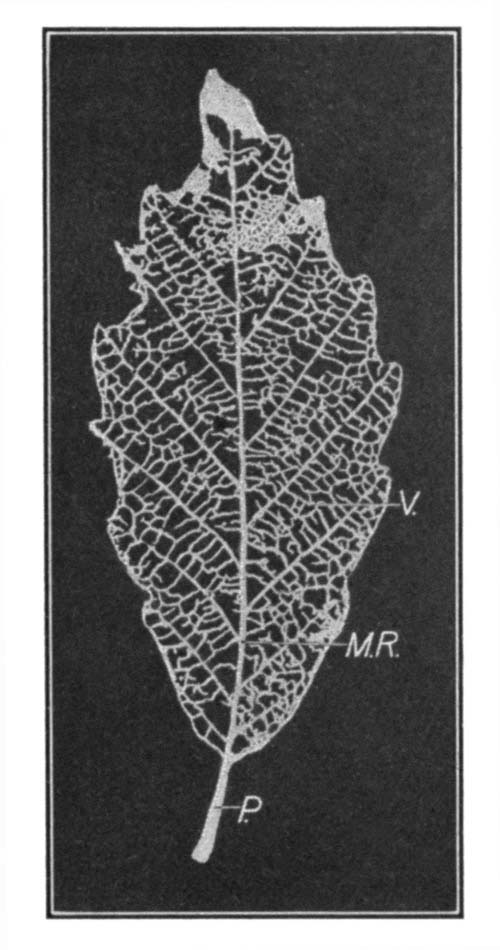
The skeleton of a leaf. M.R., the midrib; P., the leafstalk; V., the veins.
The Structure of a Leaf.—In the experiment with the red ink mentioned above we will find that the fluid has gone out into the skeleton or framework of the leaf. Let us now examine a leaf more carefully. It shows usually (1) a flat, broad blade, which may take almost any conceivable shape; (2) a stem which spreads out in the blade (3) in a number of veins.
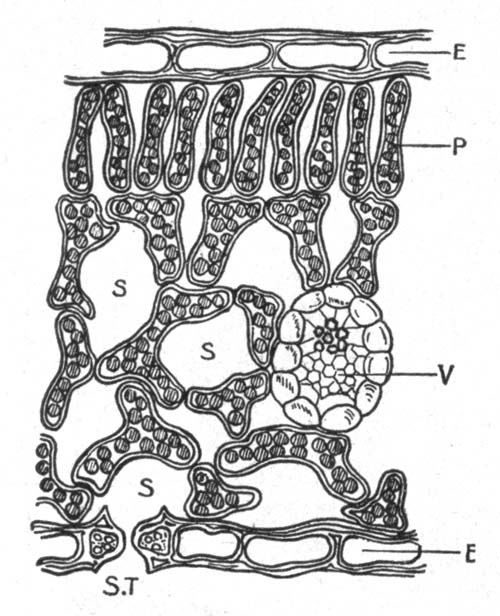
Section through the blade of a leaf as seen under the compound microscope. S, air spaces, which communicate with in the outside air; V, vein cross section; S.T., breathing hole (stoma); E, outer layer of cells; P, green cells.
The Cell Structure of a Leaf.—The under surface of a leaf seen under the microscope usually shows numbers of tiny oval openings. These are called stomata (singular stoma). Two cells, usually kidney-shaped, are found, one on each side of the opening. These are the guard cells. By change in shape of these cells the opening of the stoma is made larger or smaller. Larger irregular cells form the epidermis, or outer covering of the leaf. Study of the leaf in cross section shows that these stomata open directly into air chambers which penetrate between and around the loosely arranged cells composing the underpart of the leaf. The upper surface of leaves sometimes contains stomata, but more often they are lacking. The under surface of an oak leaf of ordinary size contains about 2,000,000 stomata. Under the upper epidermis is a layer of green cells closely packed together (called collectively the palisade layer). These cells are more or less columnar in shape. Under these are several rows of rather loosely placed cells just mentioned. These are called collectively the spongy tissue. If we happen to have a section cut through a vein, we find this composed of a number of tubes made up of, and strengthened by, thick-walled cells. The veins are evidently a continuation of the tubes of the stem out into the blade of the leaf.
Evaporation of Water.—During the day an enormous amount of water is taken up by the roots and passed out through the leaves. So great is this excess at times that a small grass plant on a summer's day evaporates more than its own weight in water. This would make nearly half a ton of water delivered to the air during twenty-four hours by a grass plot twenty-five by one hundred feet, the size of the average city lot. According to Ward, an oak tree may pass off two hundred and twenty-six times its own weight in water during the season from June to October.
From which Surface of the Leaf is Water Lost?—In order to find out whether water is passed out from any particular part of the leaf, we may remove two leaves of the same size and weight from some large-leaved plant[14]—a mullein was used for the illustrations given below—and cover the upper surface of one leaf and the lower surface of the other with vaseline. The leaf stalks of each should be covered with wax or vaseline, and the two leaves exactly balanced on the pans of a balance which has previously been placed in a warm and sunny place. Within an hour the leaf which has the upper surface covered with vaseline will show a loss of weight. Examination of the surface of a mullein leaf shows us that the lower surface of the leaf is provided with stomata. It is through these organs, then, that water is passed out from the tissues of the leaf.
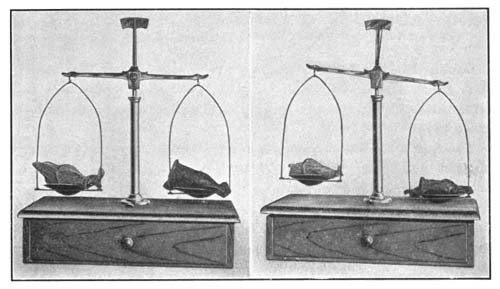
Experiment to show through which surface of a leaf water passes off.
Factors in Transpiration.—The amount of water lost from a plant varies greatly under different conditions. The humidity of the air, its temperature, and the temperature of the plant all affect the rate of transpiration. The stomata also tend to close under some conditions, thus helping to prevent evaporation. But there seems to be no certain regulation of this water loss. Consequently plants droop or wilt on hot dry days because they cannot obtain water rapidly enough from the soil to make up for the loss through the leaves.
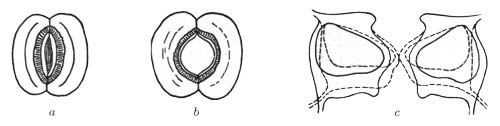
Diagrams of a stoma. a, surface view of a closed stoma; b, the same stoma opened. (After Hanson.) c, diagrams of a transverse section through a stoma, dotted lines indicate the closed position of the guard cells, the heavy lines the open condition. (After Schwendener.)
Green Plants Food Makers.—We have previously stated that green plants are the great food makers for themselves and for animals. We are now ready to attack the problem of how green plants make food.
The Sun a Source of Energy.—We all know the sun is a source of most of the energy that is released on this earth in the form of heat or light. Every boy knows the power of a "burning glass." Solar engines have not come into any great use as yet, because fuel is cheaper, but some day we undoubtedly will directly harness the energy of the sun in everyday work. Actual experiments have shown that vast amounts of energy are given to the earth. When the sun is highest in the sky, energy equivalent to one hundred horse power is received by a plot of land twenty-five by one hundred feet, the size of a city lot. Plants receive and use much of this energy by means of their leaves.
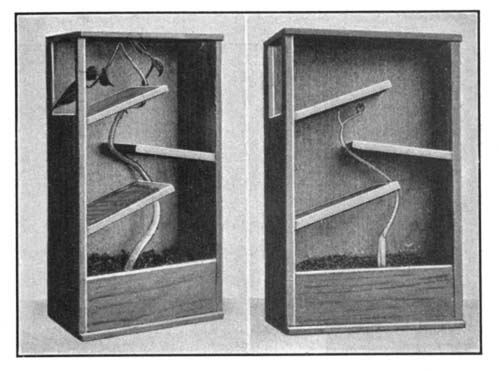
Two stages in an experiment to show that green plants grow toward the light.
Effect of Light on Plants.—In young plants which have been grown in total darkness, no green color is found in either stems or leaves, the latter often being reduced to mere scales. The stems are long and more or less reclining. We can explain the changed condition of the seedling grown in the dark only by assuming that light has some effect on the protoplasm of the seedling and induces the growth of the green part of the plant. If seedlings have been growing on a window sill, or where the light comes in from one side, you have doubtless noticed that the stem and leaves of the seedlings incline in the direction from which the light comes. The experiment pictured shows this effect of light very plainly. A hole was cut in one end of a cigar box and barriers were erected in the interior of the box so that the seeds planted in the sawdust received their light by an indirect course. The young seedling in this case responded to the influence of the stimulus of light so as to grow out finally through the hole in the box into the open air. This growth of the stem to the light is of very great importance to a growing plant, because, as we shall see later, food making depends largely on the amount of sunlight the leaves receive.
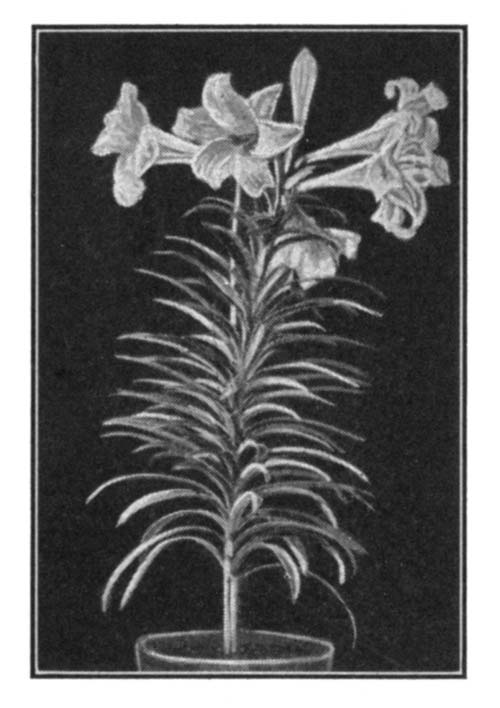
A lily, showing long narrow leaves.
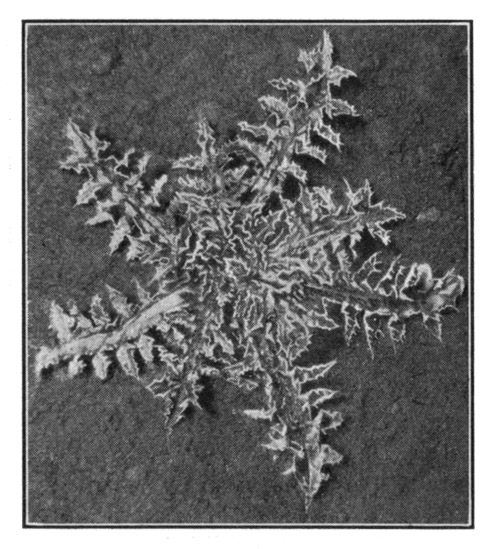
The dandelion, showing a whorled arrangement of long irregular leaves.
Effect of Light on Leaf Arrangement.—It is a matter of common knowledge that green leaves turn toward the light. Place growing pea seedlings, oxalis, or any other plants of rapid growth near a window which receives full sunlight. Within a short time the leaves are found to be in positions to receive the most sunlight possible. Careful observation of any plant growing outdoors shows us that in almost every case the leaves are so disposed as to get much sunlight. The ivy climbing up the wall, the morning-glory, the dandelion, and the burdock all show different arrangements of leaves, each presenting a large surface to the light. Leaves are often definitely arranged, fitting in between one another so as to present their upper surface to the sun. Such an arrangement is known as a leaf mosaic. In the case of the dandelion, a rosette or whorled cluster of leaves is found. In the horse-chestnut, where the leaves come out opposite each other, the older leaves have longer petioles than the young ones. In the mullein the entire plant forms a cone. The old leaves near the bottom have long stalks, and the little ones near the apex come out close to the main stalk. In every case each leaf receives a large amount of light. Other modifications of these forms may easily be found on any field trip.
Starch made by a Green Leaf.—If we examine the palisade layer of the leaf, we find cells which are almost cylindrical in form. In the protoplasm of such cells are found a number of little green-colored bodies, which are known as chloroplasts or chlorophyll bodies. If we place the leaf in wood alcohol, we find that the bodies still remain, but that the color is extracted, going into the alcohol and giving to it a beautiful green color. The chloroplasts are, indeed, simply part of the protoplasm of the cell colored green. These bodies are of the greatest importance directly to plants and indirectly to animals. The chloroplasts, by means of the energy received from the sun, manufacture starch out of certain raw materials. These raw materials are soil water, which is passed up through the bundles of tubes into the veins of the leaf from the roots, and carbon dioxide, which is taken in through the stomata or pores, which dot the under surface of the leaf. A plant with variegated leaves, as the coleus, makes starch only in the green part of the leaf, even though these raw materials reach all parts of the leaf.
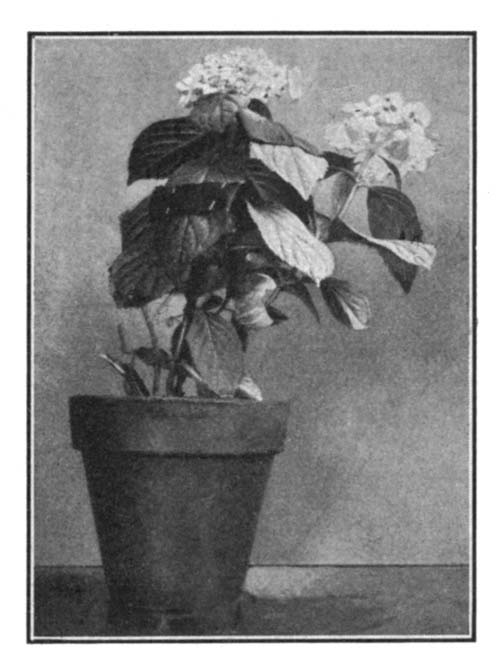
An experiment to show the effect of excluding light (but not air) from the leaves of a green plant. The result of this experiment is seen in the next picture. (Experiment performed by C. Dobbins and A. Schwartz.)
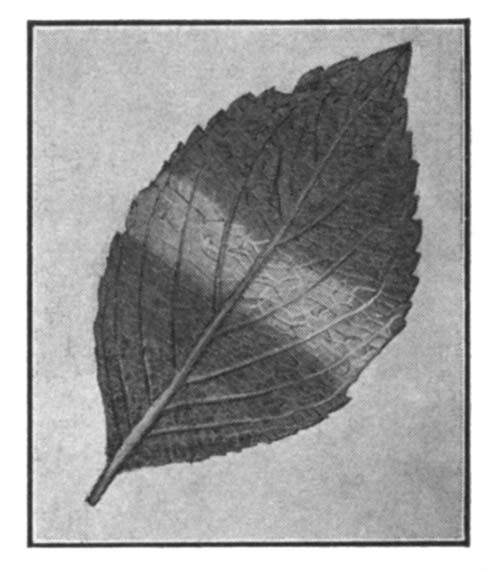
Starchless area in a leaf caused by excluding sunlight by means of a strip of black cloth.
Light and Air necessary for Starch Making.—If we pin strips of black cloth, such as alpaca, over some of the leaves of a growing hydrangea which has previously been placed in a dark room for a few hours, and then put the plant in direct sunlight for an hour or two, we are ready to test for starch. We then remove some of the covered leaves and extract the chlorophyll with wood alcohol (because the green color of the chlorophyll interferes with the blue color of the starch test). A test then shows that starch is present only in the portions of the leaves exposed to sunlight. From this experiment we infer that the sun has something to do with starch making in a leaf. The necessity of a part of the air (carbon dioxide) for starch making may also easily be proved, for the parts of leaves covered with vaseline will be found to contain no starch, while parts of the leaf without vaseline, but exposed to the sun and air, do contain starch.
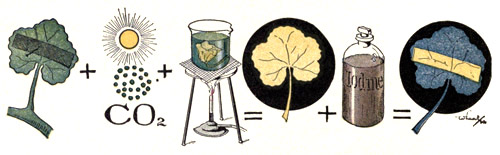
Diagram to show starch making. Read the text carefully and then explain this diagram.
Air is necessary for the process of starch making in a leaf, not only because carbon dioxide gas is absorbed (there are from three to four parts in ten thousand present in the atmosphere), but also because the leaf is alive and must have oxygen in order to do work. This oxygen it takes from the air around it.
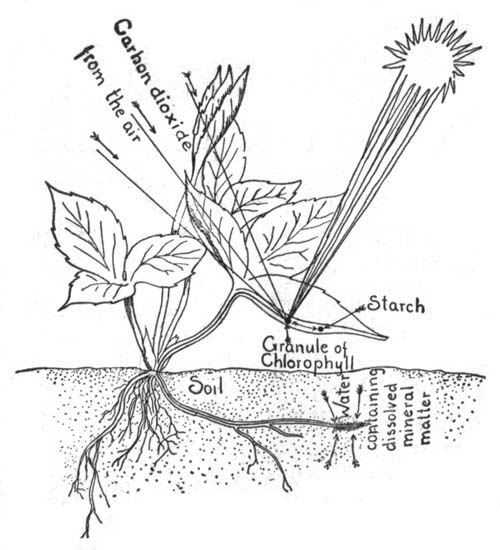
Diagram to illustrate the formation of starch in a leaf.
Comparison of Starch Making and Milling.—The manufacture of starch by the green leaf is not easily understood. The process has been compared to the milling of grain. In this case the mill is the green part of the leaf. The sun furnishes the motive power, the chloroplasts constitute the machinery, and soil water and carbon dioxide are the raw products taken into the mill. The manufactured product is starch, and a certain by-product (corresponding to the waste in a mill) is also given out. This by-product is oxygen. To understand the process fully, we must refer to a small portion of the leaf shown below. Here we find that the cells of the green layer of the leaf, under the upper epidermis, perform most of the work. The carbon dioxide is taken in through the stomata and reaches the green cells by way of the intercellular spaces and by osmosis from cell to cell. Water reaches the green cells through the veins. It then passes into the cells by osmosis, and there becomes part of the cell sap. The light of the sun easily penetrates to the cells of the palisade layer, giving the energy needed to make the starch. This whole process is a very delicate one, and will take place only when external conditions are favorable. For example, too much heat or too little heat stops starch making in the leaf. This building up of food and the release of oxygen by the plant in the presence of sunlight is called photosynthesis.
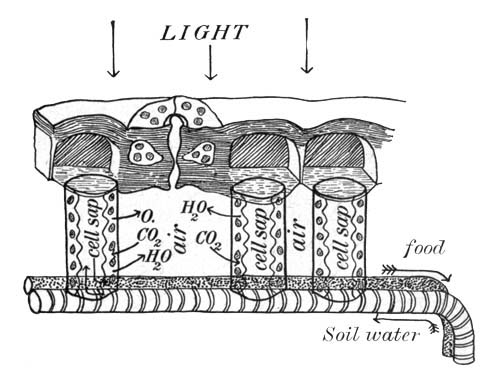
Diagram (after Stevens) to illustrate the processes of breathing and food making in the cells of a green leaf in the sunlight.
Manufacture of Fats.—Inasmuch as tiny droplets of oil are found inside the chlorophyll bodies in the leaf, we believe that fats, too, are made there, probably by a transformation of the starch already manufactured.
Protein Making and its Relation to the Making of Living Matter.—Protein material is a food which is necessary to form protoplasm. Protein food is present in the leaf, and is found in the stem or root as well. Proteins can apparently be manufactured in any of the cells of green plants, the presence of light not seeming to be a necessary factor. How it is manufactured is a matter of conjecture. The minerals brought up in the soil water form part of its composition, and starch or grape sugar give three elements (C, H, and O). The element nitrogen is taken up by the roots as a nitrate (nitrogen in combination with lime or potash). Proteins are probably not made directly into protoplasm in the leaf, but are stored by the cells of the plant and used when needed, either to form new cells in growth or to repair waste. While plants and animals obtain their food in different ways, they probably make it into living substance (assimilate it) in exactly the same manner.
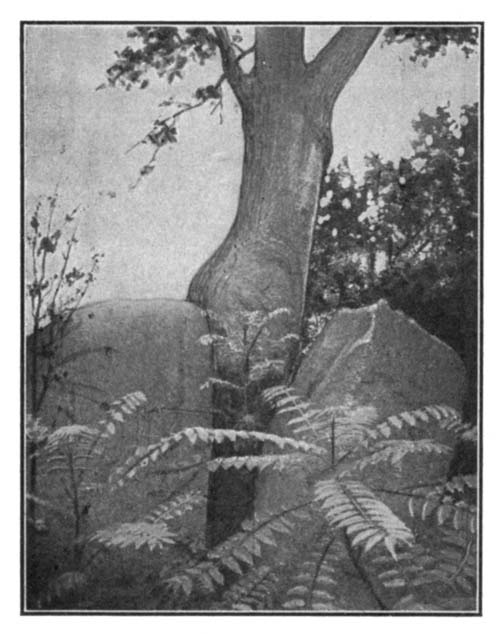
An example of how a tree may exert energy. This rock has been split by the growing tree.
Foods serve exactly the same purposes in plants and in animals; they either build living matter or they are burned (oxidized) to furnish energy (power to do work). If you doubt that a plant exerts energy, note how the roots of a tree bore their way through the hardest soil, and how stems or roots of trees often split open the hardest rocks, as illustrated in the figure above.
Starch-Making and its Relation to Human Welfare.—Leaves which have been in darkness show starch to be present soon after exposure to light. A corn plant sends 10 to 15 grams of reserve material into the ears in a single day. The formation of fruit, and especially the growth of the grain fields, show the economic importance of this fact. Not only do plants make their own food and store it away, but they make food for animals as well. And the food is stored in such a stable form that it may be sent to all parts of the world in the form of grain or other fruits. Animals, herbivorous and flesh-eating, man himself, all are dependent upon the starch-making processes of the green plant for the ultimate source of their food. When we remember that in 1913 in the United States the total value of all farm crops was over $6,000,000,000, and when we realize that these products came from the air and soil through the energy of the sun, we may begin to realize why as city boys and girls the study of plant biology is of importance to us.
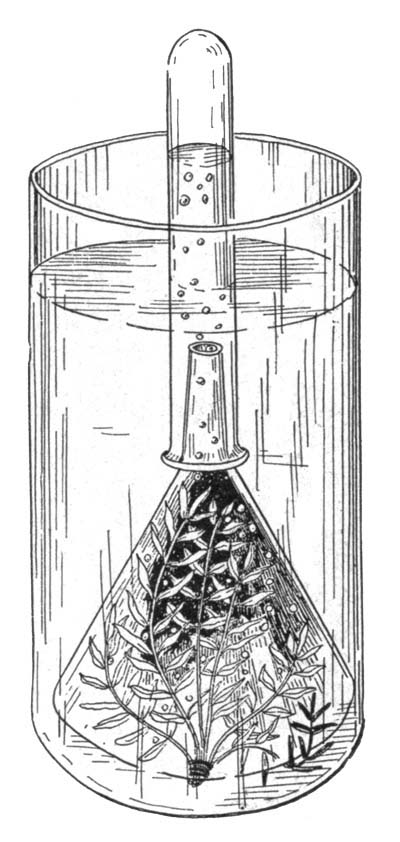
Experiment to show that oxygen is given off by green plants in the sunlight.
Green Plants give off Oxygen in Sunlight.—In still another way green plants are of direct use to us in the city. During this process of starch-making oxygen is given off as a by-product. This may easily be proven by the following experiment.[15] Place any green water plant in a battery jar partly filled with water, cover the plants with a glass funnel and mount a test tube full of water over the mouth of the funnel. Then place the apparatus in a warm sunny window. Bubbles of gas are seen to rise from the plant. After two or three hours of hot sun, enough of the gas can be obtained by displacement of the water to make the oxygen test.
That oxygen is given off as a by-product by green plants is a fact of far-reaching importance. City parks are true "breathing spaces." The green covering of the earth is giving to animals an element that they must have, while the animals in their turn are supplying to the plants carbon dioxide, a compound used in food-making. Thus a widespread relation of mutual helpfulness exists between plants and animals.
Respiration by Leaves.—All living things require oxygen. It is by means of the oxidation of food materials within the plant's body that the energy used in growth and movement is released. A plant takes in oxygen largely through the stomata of the leaves, to a less extent through the lenticels or breathing holes in the stem, and through the roots. Thus rapidly growing tissues receive the oxygen necessary for them to perform their work. The products of oxidation in the form of carbon dioxide are also passed off through these same organs. It can be shown by experiment that a plant uses up oxygen in the darkness; in the light the amount of oxygen given off as a by-product in the process of starch-making is, of course, much greater than the amount used by the plant.
Summary.—From the above paragraphs it is seen that a leaf performs the following functions: (1) breathing, or the taking in of oxygen and passing off of carbon dioxide; (2) starch-making, with the incidental passing out of oxygen; (3) formation of proteins, with their digestion and assimilation to form new tissues; and (4) the transpiration of water.
Reference Books
elementary
Hunter, Laboratory Problems in Civic Biology. American Book Company.
Andrews, A Practical Course in Botany, pages 160-177. American Book Company.
Coulter, A Textbook of Botany, pages 5-40. D. Appleton and Company.
Coulter, Plant Life and Plant Uses. American Book Company.
Dana, Plants and their Children, pages 135-185. American Book Company.
Sharpe, A Laboratory Manual in Biology, pages 90-102. American Book Company.
Stevens, Introduction to Botany, pages 81-99. D. C. Heath and Company.
advanced
Clement, Plant Physiology and Ecology. Henry Holt and Company.
Coulter, Barnes, and Cowles, A Textbook of Botany, Part II, and Vol. II. American Book Company.
Darwin, Insectivorous Plants. D. Appleton and Company.
Duggar, Plant Physiology. The Macmillan Company.
Goodale, Physiological Botany, pages 337-353 and 409-424. American Book Company.
Green, Vegetable Physiology. J. and A. Churchill.
Lubbock, Flowers, Fruits, and Leaves, last part. The Macmillan Company.
MacDougal, Practical Textbook of Plant Physiology. Longmans, Green, and Company.
Report of the Division of Forestry, U.S. Department of Agriculture, 1899.
Ward, The Oak. D. Appleton and Company.
VIII. PLANT GROWTH AND NUTRITION—THE CIRCULATION AND FINAL USES OF FOOD BY PLANTS
Problem.—How green plants store and use the food they make.
(a) What are the organs of circulation?
(b) How and where does food circulate?
(c) How does the plant assimilate its food?
Laboratory Suggestions
Laboratory exercise.—The structure (cross section) of a woody stem.
Demonstration.—To show that food passes downward in the bark.
Demonstration.—To show the condition of food passing through the stem.
Demonstration.—Plants with special digestive organs.
The Circulation and Final Uses of Foods in Green Plants.—We have seen that cells of green plants make food and that such cells are mostly in the leaves. But all parts of the bodies of plants grow. Roots, stems, leaves, flowers, and fruits grow. Seeds are storehouses of food. We must now examine the stem of some plant in order to see how food is distributed, stored, and finally used in the various parts of the plant.
The Structure of a Woody Stem.—If we cut a cross section through a young willow or apple stem, we find it shows three distinct regions. The center is occupied by the spongy, soft pith; surrounding this is found the rather tough wood, while the outermost area is bark. More careful study of the bark reveals the presence of three layers—an outer layer, a middle green layer, and an inner fibrous layer, the latter usually brown in color. This layer is made up largely of tough fiberlike cells known as bast fibers. The most important parts of this inner bark, so far as the plant is concerned, are many tubelike structures known as sieve tubes. These are long rows of living cells, having perforated sievelike ends. Through these cells food materials pass downward from the upper part of the plant, where they are manufactured.
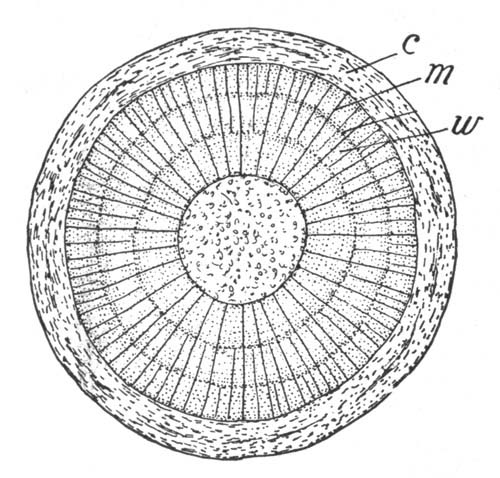
Section of a twig of box elder three years old, showing three annual growth rings. The radiating lines (m) which cross the wood (w) represent the pith rays, the principal ones extending from the pith in the center to the cortex or bark. (From Coulter's Plant Relations.)
In the wood will be noticed (see Figure) a number of lines radiating outward from the pith toward the bark. These are thin plates of pith which separate the wood into a number of wedge-shaped masses. These masses of wood are composed of many elongated cells, which, placed end to end, form thousands of little tubes connecting the leaves with the roots. In addition to these are many thick-walled cells, which give strength to the mass of wood. The bundles of tubes with their surrounding hard walled cells are the continuation of the bundles of tubes which are found in the root. In sections of wood which have taken several years to grow, we find so-called annual rings. The distance between one ring and the next (see Figure) usually represents the amount of growth in one year. Growth takes place from an actively dividing layer of cells, known as the cambium layer. This layer forms wood cells from its inner surface and bark from its outer surface. Thus new wood is formed as a distinct ring around the old wood.
Use of the Outer Bark.—The outer bark of a tree is protective. The cells are dead, the heavy woody skeletons serving to keep out cold and dryness, as well as prevent the evaporation of fluids from within. The bark also protects the tree from attack of other plants or animals which might harm it. Most trees are provided with a layer of corky cells. This layer in the cork oak is thick enough to be of commercial importance. The function of the corky layer in preventing evaporation is well seen in the case of the potato, which is a true stem, though found underground. If two potatoes of equal weight are balanced on the scales, the skin having been peeled from one, the peeled potato will be found to lose weight rapidly. This is due to loss of water, which is held in by the skin of the unpeeled potato (see right hand figure below).
There are also small breathing holes known as lenticels scattered through the surface of the bark. These can easily be seen in a young woody stem of apple, beech, or horse-chestnut.
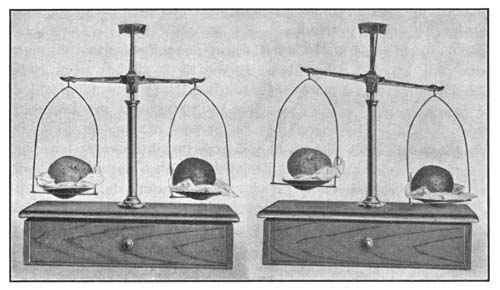
Experiment to show that the skin of the potato (a stem) retards evaporation.
Proof that Food passes down the Stem.—If freshly cut willow twigs are placed in water, roots soon begin to develop from that part of the stem which is under water. If now the stem is girdled by removing the bark in a ring just above where the roots are growing, the latter will eventually die, and new roots will appear above the girdled area. The food material necessary for the outgrowth of roots evidently comes from above, and the passage of food materials takes place in a downward direction just outside the wood in the layer of bark which contains the bast fibers and sieve tubes. This experiment with the willow explains why it is that trees die when girdled so as to cut the sieve tubes of the inner bark. The food supply is cut off from the protoplasm of the cells in the part of the tree below the cut area. Many of the canoe birches of our Adirondack forest are thus killed, girdled by thoughtless visitors. In the same manner mice and other gnawing animals kill fruit trees. Food substances are also conducted to a much less extent in the wood itself, and food passes from the inner bark to the center of the tree by way of the pith plates. This can be proved by testing for starch in the pith plates of young stems. It is found that much starch is stored in this part of the tree trunk.
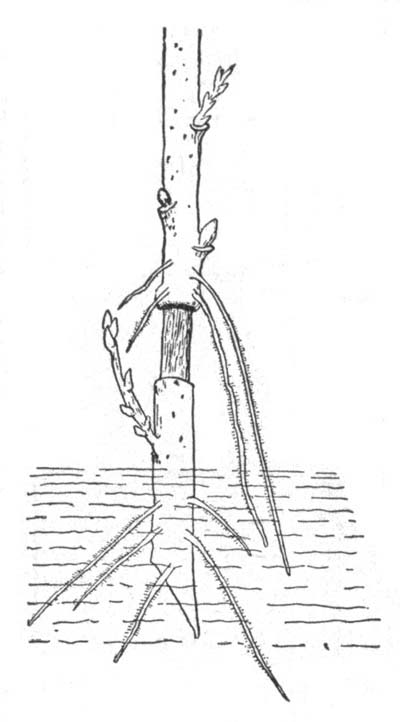
Experiment to show that food material passes down in the inner bark.
In what Form does Food pass through the Stem?—We have already seen that materials in solution (those substances which will dissolve in the water) will pass from cell to cell by the process of osmosis. This is shown in the experiment illustrated in the figure. Two thistle tubes are partly filled, one with starch and water, the other with sugar and water, and a piece of parchment paper is tied over the end of each. The lower ends of both tubes are placed in a glass dish under water. After twenty-four hours, the water in the dish is tested for starch, and then for sugar. We find that only the sugar, which has been dissolved by the water, can pass through the membrane.
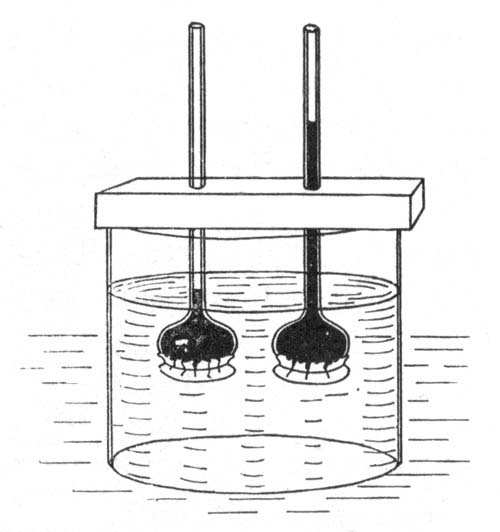
Experiment to show osmosis of sugar (right hand tube) and non-osmosis of starch (left hand tube).
Digestion.—Much of the food made in the leaves is stored in the form of starch. But starch, being insoluble, cannot be passed from cell to cell in a plant. It must be changed to a soluble form, for otherwise it could not pass through the delicate cell membranes. This is accomplished by the process of digestion. We have already seen that starch is changed to grape sugar in the corn by the action of a substance (an enzyme) called diastase. This process of digestion seemingly may take place in all living parts of the plant, although most of it is done in the leaves. In the bodies of all animals, including man, starchy foods are changed in a similar manner, but by other enzymes, into soluble grape sugar.
The food material may be passed in a soluble form until it comes to a place where food storage is to take place, then it can be transformed to an insoluble form (starch, for example); later, when needed by the plant in growth, it may again be transformed and sent in a soluble form through the stem to the place where it will be used.
In a similar manner, protein seems to be changed and transferred to various parts of the plant. Some forms of protein substance are soluble and others insoluble in water. White of egg, for example, is slightly soluble, but can be rendered insoluble by heating it so that it coagulates. Insoluble proteins are digested within the plant; how and where is but slightly understood. In a plant, soluble proteins pass down the sieve tubes in the bast and then may be stored in the bast or medullary rays of the wood in an insoluble form, or they may pass into the fruit or seeds of a plant, and be stored there.
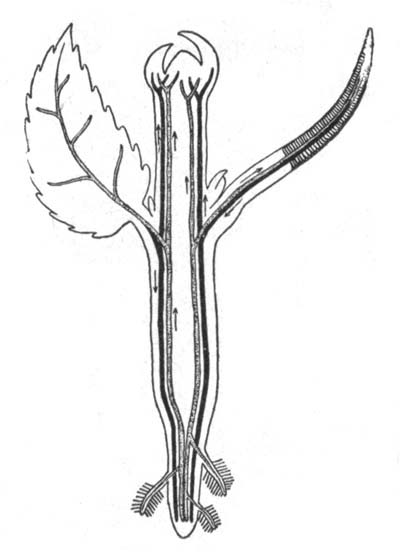
Diagram to show the areas in a plant through which the raw food materials pass up the stem and food materials pass down.
What forces Water up the Stem.—We have seen that the process of osmosis is responsible for taking in soil water, and that the enormous absorbing surface exposed by the root hairs makes possible the absorption of a large amount of water. Frequently this is more than the weight of the plant in every twenty-four hours.
Experiments have been made which show that at certain times in the year this water is in some way forced up the tiny tubes of the stem. During the spring season, in young and rapidly growing trees, water has been proved to rise to a height of nearly ninety feet. The force that causes this rise of water in stems is known as root pressure.
The greatest factor, however, is transpiration of water from leaves. This evaporation of water in the form of vapor seems to result in a kind of suction on the column of water in the stem. In the fall, after the leaves have gone, much less water is taken in by roots, showing that an intimate relation exists between the leaves and the root.
Summary of the Functions of Green Plants.—The processes which we have just described (with the exception of food making) are those which occur in the lives of any plant or animal. All plants and animals breathe, they oxidize their foods to release energy, carbon dioxide being given off as the result of the union of the carbon in the foods with the oxygen of the air. Both plants and animals digest their food; plants may do this in the cells of the root, stem, and leaf. Digestion must always occur so that food can be moved in a soluble condition from cell to cell in the plant's body.
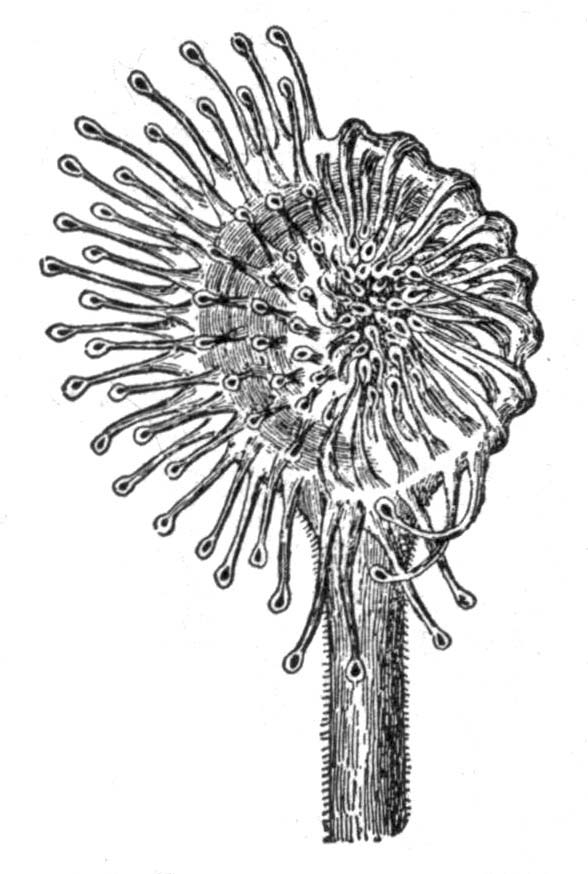
Leaf of sundew closing over a captured insect.
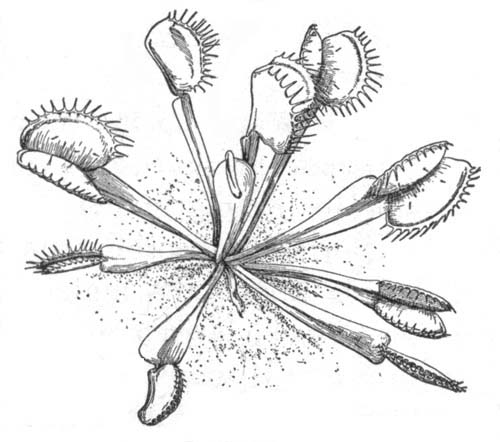
The Venus fly trap, showing open and closed leaves.
Plants with Special Digestive Organs.—Some plants have special organs of digestion. One of these, the sundew, has leaves which are covered on one side with tiny glandular hairs. These attract insects and later serve to catch and digest the nitrogenous matter of these insects by means of enzymes poured out by the same hairs. Another plant, the Venus fly trap, catches insects in a sensitive leaf which folds up and holds the insect fast until enzymes poured out by the leaf slowly digest it. Still others, called pitcher plants, use as food the decayed bodies of insects which fall into their cuplike leaves and die there. In this respect plants are like those animals which have certain organs in the body set apart for the digestion of food.
Assimilation.—The assimilation of foods, or making of foods into living matter, is a process we know very little about. We know it takes place in the living cells of plants and animals. But how foods are changed into living matter is one of the mysteries of life which we have not yet solved.
Excretion.—The waste and repair of living matter seems to take place in both plants and animals. When living plants breathe, they give off carbon dioxide. In the process of starch-making, oxygen might be considered the waste product. Water is evaporated from leaves and stems. The leaves fall and carry away waste mineral substances which they contain.
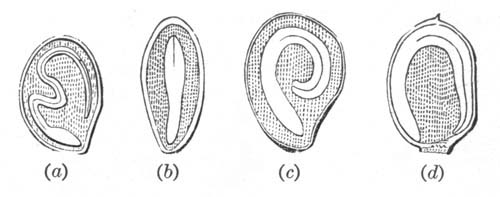
The embryos of (a) the morning glory, (b) the barberry, (c) the potato, (d) the four o'clock, showing the position of their food supply. (After Gray.)
Reproduction.—Finally, both plants and animals have organs of reproduction. We have seen that the flower gives rise, after pollination, to a fruit which holds the seeds. These seeds hold the embryo. Thus the young plant is doubly protected for a time and is finally thrown off in the seed with enough food to give it a start in life. In much the same way we will find that animals reproduce, either by laying eggs which contain an embryo and food to start it in life or, as in the higher animals, by holding and protecting the embryo within the body of the mother until it is born, a helpless little creature, to be tenderly nourished by the mother until able to care for itself.
The Life Cycle.—Ultimately both plants and animals grow old and die. Some plants, for example the pea or bean, live but a season; others, such as the big trees of California, live for hundreds of years. Some insects exist as adults but a day, while the elephant is said to live almost two hundred years. The span of life from the time the plant or animal begins to grow until it dies is known as the life cycle.
Reference Books
elementary
Hunter, Laboratory Problems in Civic Biology. American Book Company.
Andrews, A Practical Course in Botany, pages 112-127. American Book Company.
Atkinson, First Studies of Plant Life, Chaps. IV, V, VI, VIII, XXI. Ginn.
Coulter, Plant Life and Plant Uses, Chap. V. American Book Company.
Dana, Plants and their Children, pages 99-129. American Book Company.
Mayne and Hatch, High School Agriculture. American Book Company.
Hodge, Nature Study and Life, Chaps. IX, X, XI. Ginn and Company.
MacDougal, The Nature and Work of Plants. The Macmillan Company.
advanced
Apgar, Trees of the United States, Chaps. II, V, VI. American Book Company.
Coulter, Barnes, and Cowles, A Textbook of Botany, Vol. I. American Book Company.
Duggar, Plant Physiology. The Macmillan Company.
Ganong, The Teaching Botanist. The Macmillan Company.
Goebel, Organography of Plants, Part V. Clarendon Press.
Goodale, Physiological Botany. American Book Company.
Gray, Structural Botany, Chap. V. American Book Company.
Kerner-Oliver, Natural History of Plants. Henry Holt and Company.
Strasburger, Noll, Schenck, and Karston, A Textbook of Botany. The Macmillan Company.
Ward, The Oak. D. Appleton and Company.
Yearbook, U. S. Department of Agriculture, 1894, 1895, 1898-1910.
IX. OUR FORESTS, THEIR USES AND THE NECESSITY FOR THEIR PROTECTION
Problem.—Man's relations to forests.
(a) What is the value of forests to man?
(b) What can man do to prevent forest destruction?
Laboratory Suggestions
Demonstration of some uses of wood. Optional exercise on structure of wood. Method of cutting determined by examination. Home work on study of furniture trim, etc.
Visit to Museum to study some economic uses of wood.
Visit to Museum or field trip to learn some common trees.
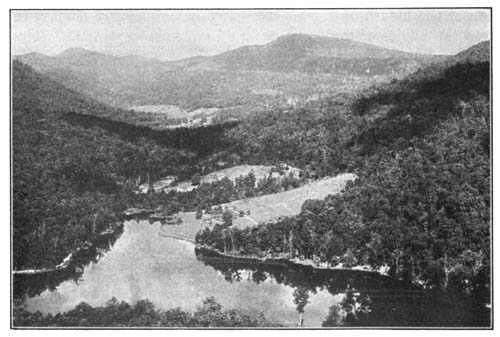
A forest in North Carolina. (U. S. G. S.)
The Economic Value of Trees. Protection and Regulation of Water Supply.—Trees form a protective covering for parts of the earth's surface. They prevent soil from being washed away, and they hold moisture in the ground. The devastation of immense areas in China and considerable damage by floods in parts of Switzerland, France, and in Pennsylvania has resulted where the forest covering has been removed. No one who has tramped through our Adirondack forest can escape noticing the differences in the condition of streams surrounded by forest and those which flow through areas from which trees have been cut. The latter streams often dry up entirely in hot weather, while the forest-shaded stream has a never failing supply of crystal water.
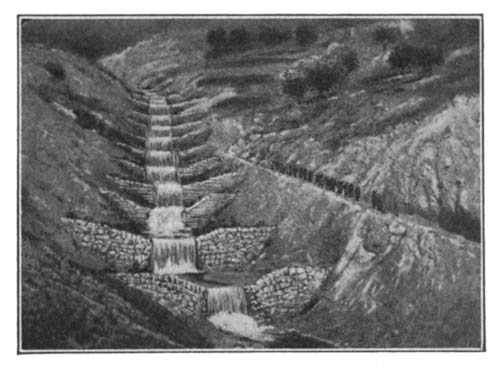
Working to prevent erosion after the removal of the forest in the French Alps.
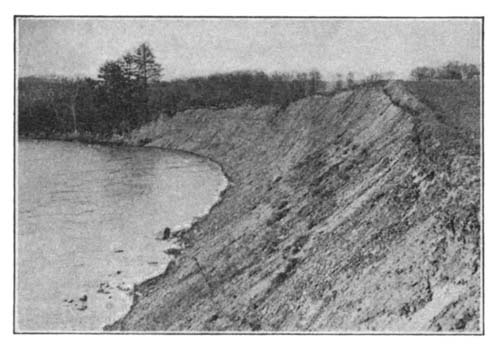
Erosion at Sayre, Pennsylvania, by the Chemung River. (Photograph by W. C. Barbour.)
The city of New York owes much of its importance to its position at the mouth of a great river with a harbor large enough to float the navies of the world. This river is supplied with water largely from the Adirondack and Catskill forests. Should these forests be destroyed, it is not impossible that the frequent freshets which would follow would so fill the Hudson River with silt and débris that the ship channels in the bay, already costing the government hundreds of thousands of dollars a year to keep dredged, would become too shallow for ships. If this should occur, the greatest city in this country would soon lose its place and become of second-rate importance.
The story of how this very thing happened to the old Greek city of Poseidonia is graphically told in the following lines:—
"It was such a strange, tremendous story, that of the Greek Poseidonia, later the Roman Pæstum. Long ago those adventuring mariners from Greece had seized the fertile plain, which at that time was covered with forests of great oak and watered by two clear and shining rivers. They drove the Italian natives back into the distant hills, for the white man's burden even then included the taking of all the desirable things that were being wasted by incompetent natives, and they brought over colonists—whom the philosophers and moralists at home maligned, no doubt, in the same pleasant fashion of our own day. And the colonists cut down the oaks, and plowed the land, and built cities, and made harbors, and finally dusted their busy hands and busy souls of the grime of labor and wrought splendid temples in honor of the benign gods who had given them the possessions of the Italians and filled them with power and fatness.
"Every once in so often the natives looked lustfully down from the hills upon this fatness, made an armed snatch at it, were driven back with bloody contumely, and the heaping of riches upon riches went on. And more and more the oaks were cut down—mark that! for the stories of nations are so inextricably bound up with the stories of trees—until all the plain was cleared and tilled; and then the foothills were denuded, and the wave of destruction crept up the mountain sides, and they, too, were left naked to the sun and the rains.
"At first these rains, sweeping down torrentially, unhindered by the lost forests, only enriched the plain with the long-hoarded sweetness of the trees; but by and by the living rivers grew heavy and thick, vomiting mud into the ever shallowing harbors, and the land soured with the undrained stagnant water. Commerce turned more and more to deeper ports, and mosquitoes began to breed in the brackish soil that was making fast between the city and the sea.
"Who of all those powerful landowners and rich merchants could ever have dreamed that little buzzing insects could sting a great city to death? But they did. Fevers grew more and more prevalent. The malaria haunted population went more and more languidly about their business. The natives, hardy and vigorous in the hills, were but feebly repulsed. Carthage demanded tribute, and Rome took it, and changed the city's name from Poseidonia to Pæstum. After Rome grew weak, Saracen corsairs came in by sea and grasped the slackly defended riches, and the little winged poisoners of the night struck again and again, until grass grew in the streets, and the wharves crumbled where they stood. Finally, the wretched remnant of a great people wandered away into the more wholesome hills, the marshes rotted in the heat and grew up in coarse reeds where corn and vine had flourished, and the city melted back into the wasted earth."[16]
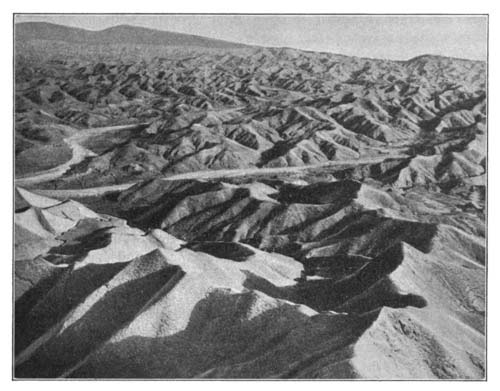
Result of deforestation in China. This land has been ruined by erosion. (Carnegie Institution Research in China.)
Prevention of Erosion by Covering of Organic Soil.—We have shown how ungoverned streams might dig out soil and carry it far from its original source. Examples of what streams have done may be seen in the deltas formed at the mouths of great rivers. The forest prevents this by holding the water supply and letting it out gradually. This it does by covering the inorganic soil with humus or decayed organic material. In this way the forest floor becomes like a sponge, holding water through long periods of drought. The roots of the trees, too, help hold the soil in place. The gradual evaporation of water through the stomata of the leaves cools the atmosphere, and this tends to precipitate the moisture in the air. Eventually the dead bodies of the trees themselves are added to the organic covering, and new trees take their place.
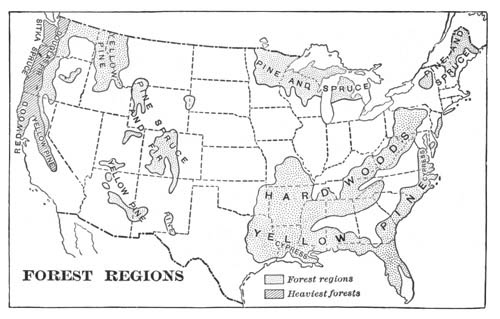
The forest regions of the United States.
Other Uses of the Forest.—In some localities forests are used as windbreaks and to protect mountain towns against avalanches. In winter they moderate the cold, and in summer reduce the heat and lessen the danger from storms. Birds nesting in the woods protect many valuable plants which otherwise might be destroyed by insects.
Forests have great commercial importance. Pyrogallic and other acids are obtained from trees, as are tar, creosote, resin, turpentine, and many useful oils. The making of maple sirup and sugar forms a profitable industry in several states.
The Forest Regions of the United States.—The combined area of all the forests in the United States, exclusive of Alaska, is about 500,000,000 acres. This seemingly immense area is rapidly decreasing in acreage and in quality, thanks to the demands of an increasing population, a woeful ignorance on the part of the owners of the land, and wastefulness on the part of cutters and users alike.
A glance at the map on page 109 shows the distribution of our principal forests. Washington ranks first in the production of lumber. Here the great Douglas fir, one of the "evergreens," forms the chief source of supply. In the Southern states, especially Louisiana and Mississippi, yellow pine and cypress are the trees most lumbered.
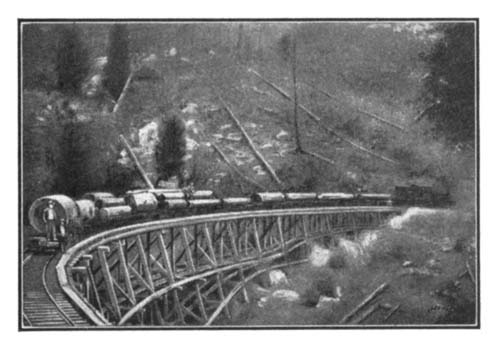
Transportation of lumber in the West. A logging train.
Which states produce the most hardwoods? From which states do we get most of our yellow pine, spruce, red fir, redwood? Where are the heaviest forests of the United States?
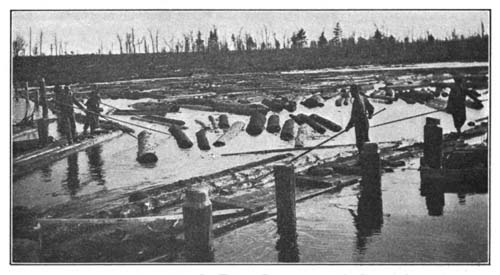
Transportation of lumber in the East. Logs are mostly floated down rivers to the mills.
Uses of Wood.—Even in this day of coal, wood is still by far the most used fuel. It is useful in building. It outlasts iron under water, in addition to being durable and light. It is cheap and, with care of the forests, inexhaustible, while our mineral wealth may some day be used up. Distilled wood gives wood alcohol. Partially burned wood is charcoal. In our forests much of the soft wood (the cone-bearing trees, spruce, balsam, hemlock, and pine), and poplars, aspens, basswood, with some other species, make paper pulp. The daily newspaper and cheap books are responsible for inroads on our forests which cannot well be repaired. It is not necessary to take the largest trees to make pulp wood. Hence many young trees of not more than six inches in diameter are sacrificed. Of the hundreds of species of trees in our forests, the conifers are probably most sought after for lumber. Pine, especially, is probably used more extensively than any other wood. It is used in all heavy construction work, frames of houses, bridges, masts, spars and timber of ships, floors, railway ties, and many other purposes. Cedar is used for shingles, cabinetwork, lead pencils, etc.; hemlock and spruce for heavy timbers and, as we have seen, for paper pulp. Another use for our lumber, especially odds and ends of all kinds, is in the packing-box industry. It is estimated that nearly 50 per cent of all lumber cut ultimately finds its way into the construction of boxes. Hemlock bark is used for tanning.
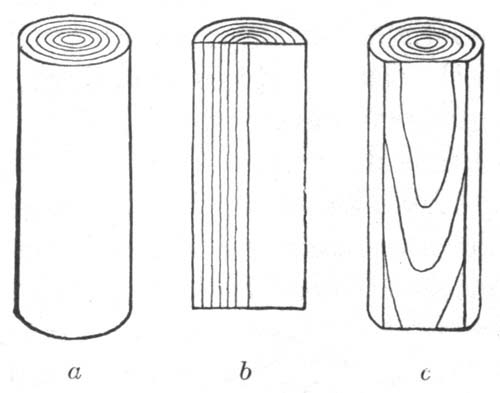
Diagrams of sections of timber. a, cross section; b, radial; c, tangential. (From Pinchot, U. S. Dept. of Agriculture.)
The hard woods—ash, basswood, beech, birch, cherry, chestnut, elm, maple, oak, and walnut—are used largely for the "trim" of our houses, for manufacture of furniture, wagon or car work, and endless other purposes.
Methods of cutting Timber.—A glance at the diagram of the sections of timber shows us that a tree may be cut radially through the middle of the trunk or tangentially to the middle portion. Most lumber is cut tangentially. In wood cut in this manner the yearly rings take a more or less irregular course. The grain in wood is caused by the fibers not taking straight lines in their course in the tree trunk. In many cases the fibers of the wood take a spiral course up the trunk, or they may wave outward to form little projections. Boards cut out of such a piece of wood will show the effect seen in many of the school desks, where the annual rings appear to form elliptical markings. Quite a difference in color and structure is often seen between the heartwood, composed of the dead walls of cells occupying the central part of the tree trunk, and the sapwood, the living part of the stem.
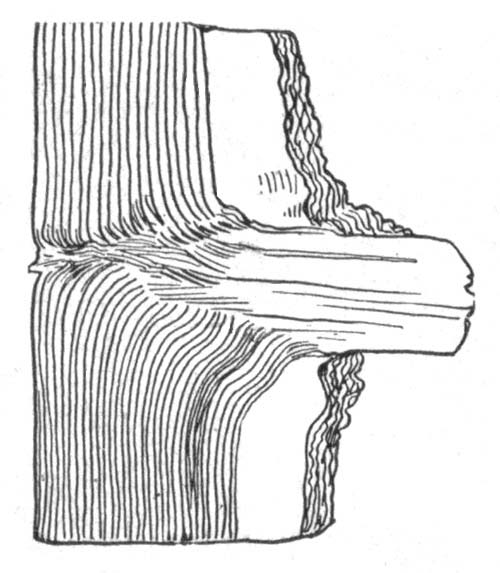
Section of a tree trunk showing knot.
Knots.—Knots, as can be seen from the diagram, are branches which at one time started in their outward growth and were for some reason killed. Later, the tree, continuing in its outward growth, surrounded them and covered them up. A dead limb should be pruned before such growth occurs. The markings in bird's-eye maple are caused by buds which have not developed, and have been overgrown with the wood of the tree.
Destruction of the Forest.—By Waste in Cutting.—Man is responsible for the destruction of one of this nation's most valuable assets. This is primarily due to wrong and wasteful lumbering. Hundreds of thousands of dollars' worth of lumber is left to rot annually because the lumbermen do not cut the trees close enough to the ground, or because through careless felling of trees many other smaller trees are injured. There is great waste in the mills. In fact, man wastes in every step from the forest to the finished product.
By Fire.—Indirectly, man is responsible for fire, one of the greatest enemies of the forest. Most of the great forest fires of recent years, the losses from which total in the hundreds of millions, have been due either to railroads or to carelessness in making fires in the woods. It is estimated that in forest lands traversed by railroads from 25 per cent to 90 per cent of the fires are caused by coal-burning locomotives. For this reason laws have been made in New York State requiring locomotives passing through the Adirondack forest preserve to burn oil instead of coal. This has resulted in a considerable reduction in the number of fires. In addition to the loss in timber, the fires often burn out the organic matter in the soil (the "duff") forming the forest floor, thus preventing the growth of forest there for many years to come. In New York and other states fires are fought by an organized corps of fire wardens, whose duty it is to watch the forest and to fight forest fires.
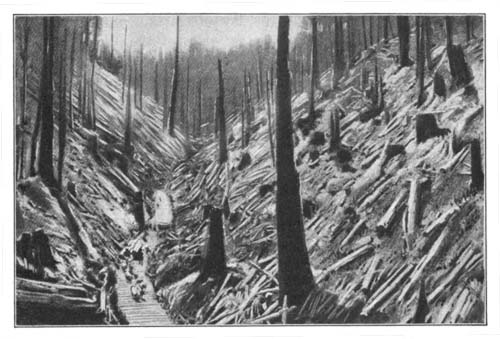
A forest in the far west totally destroyed by fire and wasteful lumbering.
Other Enemies.—Other enemies of the forest are numerous fungus plants, insect parasites which bore into the wood or destroy the leaves, and grazing animals, particularly sheep. Wind and snow also annually kill many trees.
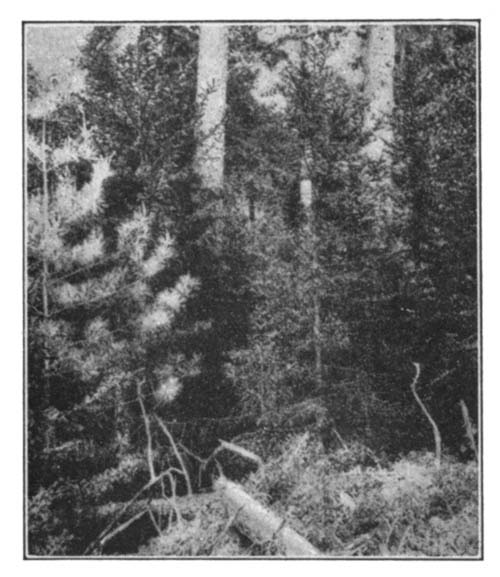
The forest primeval. Trees are killing each other in the struggle for light and air.
Forestry.—In some parts of central Europe, the value of the forests was seen as early as the year 1300 A.D., and many towns consequently bought up the surrounding forests. The city of Zurich has owned forests in its vicinity for at least 600 years and has found them a profitable investment. In this country only recently has the importance of preserving and caring for our forests been noted by our government. Now, however, we have a Forest Survey of the Department of Agriculture and numerous state and university schools of forestry which are rapidly teaching the people of this country the best methods for the preservation of our forests. The Federal government has set aside a number of tracts of mountain forest in some of the Western states, making a total area of over 167,000,000 acres. New York has established for the same purpose the Adirondack Park, with nearly 1,500,000 acres of timberland. Pennsylvania has one of 700,000 acres, and many other states have followed their example.
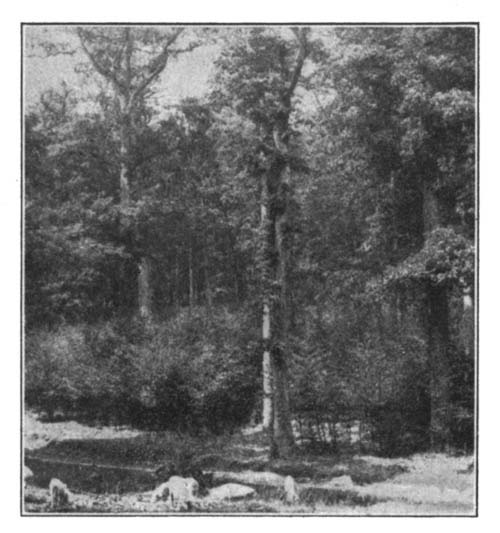
A German beech forest. The trees are kept thinned out so as to allow the young trees to get a start. Contrast this with the picture above.
Methods for Keeping and Protecting the Forests.—Forests should be kept thinned. Too many trees are as bad as too few. They struggle with one another for foothold and light, which only a few can enjoy. In cutting the forest, it should be considered as a harvest. The oldest trees are the "ripe grain," the younger trees being left to grow to maturity. Several methods of renewing the forest are in use in this country. (1) Trees may be cut down and young ones allowed to sprout from cut stumps. This is called coppice growth. This growth is well seen in parts of New Jersey. (2) Areas or strips may be cut out so that seeds from neighboring trees are carried there to start new growth. (3) Forests may be artificially planted. Two seedlings planted for every tree cut is a rule followed in Europe. (4) The most economical method is that shown in the lower picture on page 114, where the largest trees are thinned out over a large area so as to make room for the younger ones to grow up. The greatest dangers to the forests are from fire and from careless cutting, and these dangers may be kept in check by the efficient work of our national and state foresters.
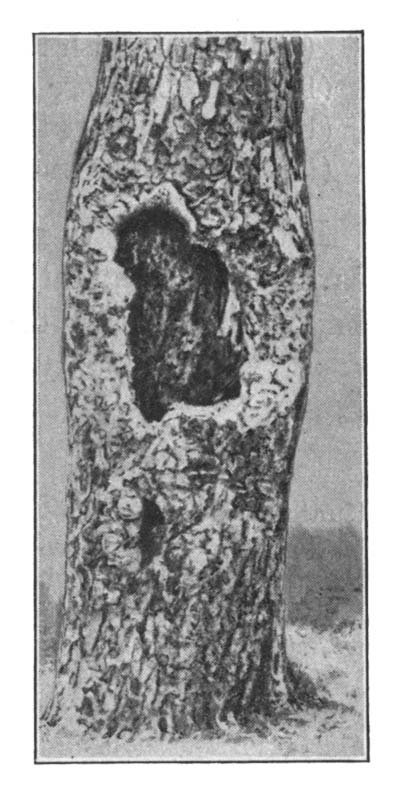
We must protect our city trees. This tree was badly wounded by being gnawed by a horse.
A City's Need for Trees.—The city of Paris, well known as one of the most beautiful of European capitals, spends over $100,000 annually in caring for and replacing some of the 90,000 trees owned by the city. All over the United States the city governments are beginning to realize what European cities have long known, that trees are of great value to a city. They are now following the example of European cities by planting trees and by protecting the trees after they are planted. Thousands of city trees are annually killed by horses which gnaw the bark. This may be prevented by proper protection of the trunk by means of screens or wire guards. Chicago has appointed a city forester, who has given the following excellent reasons why trees should be planted in the city:—
(1) Trees are beautiful in form and color, inspiring a constant appreciation of nature.
(2) Trees enhance the beauty of architecture.
(3) Trees create sentiment, love of country, state, city, and home.
(4) Trees have an educational influence upon citizens of all ages, especially children.
(5) Trees encourage outdoor life.
(6) Trees purify the air.
(7) Trees cool the air in summer and radiate warmth in winter.
(8) Trees improve climate and conserve soil and moisture.
(9) Trees furnish resting places and shelter for birds.
(10) Trees increase the value of real estate.
(11) Trees protect the pavement from the heat of the sun.
(12) Trees counteract adverse conditions of city life.
Let us all try to make Arbor Day what it should be, a day for caring for and planting trees, for thus we may preserve this most important heritage of our nation.
Reference Books
elementary
Hunter, Laboratory Problems in Civic Biology. American Book Company.
Mayne and Hatch, High School Agriculture. American Book Company.
Murrill, Shade Trees, Bul. 205, Cornell University Agricultural Experiment Station.
Pinchot, A Primer of Forestry, Division of Forestry, U. S. Department of Agriculture.
advanced
Apgar, Trees of the United States, Chaps. II, V, VI. American Book Company.
Coulter, Barnes, and Cowles, A Textbook of Botany, Part I and Vol. II. American Book Company.
Goebel, Organography of Plants, Part V. Clarendon Press.
Strasburger, Noll, Schenck, and Karston, A Textbook of Botany. The Macmillan Company.
Ward, Timber and Some of its Diseases. The Macmillan Company.
Yearbook, U. S. Department of Agriculture, Division of Forestry, Buls. 7, 10, 13, 16, 17, 18, 20, 26, 27.
X. THE ECONOMIC RELATION OF GREEN PLANTS TO MAN
Problems.—How green plants are useful to man.
(a) As food.
(b) For clothing.
(c) Other uses.
—How green plants are harmful to man.
Suggested Laboratory Work
If a commercial museum is available, a trip should be planned to work over the topics in this chapter. The school collection may well include most of the examples mentioned, both of useful and harmful plants.
A study of weeds and poisonous plants should be taken up in actual laboratory work, either by collection and identification or by demonstration.
Green Plants have a "Dollar and Cents" Value.—To the girl or boy living in the city green plants seem to have little direct value. Although we see vegetables for sale in stores and we know that fruits have a money value, we are apt to forget that the wealth of our nation depends more upon its crops than it does on its manufactories and business houses. The economic or "dollars and cents" value of plants is enormous and far too great for us to comprehend in terms of figures.
We have already seen some of the uses to mankind of the products of the forest; let us now consider some other plant products.
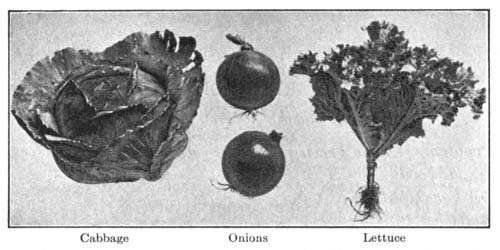
Leaves used as food.
Leaves as Food.—Grazing animals feed almost entirely on tender shoots or leaves, blades of grass, and other herbage. Certain leaves and buds are used by man as food. Lettuce, beet tops, kale, spinach, broccoli, are examples. A cabbage head is nothing but a big bud which has been cultivated by man. An onion is a compact budlike mass of thickened leaves which contain stored food.
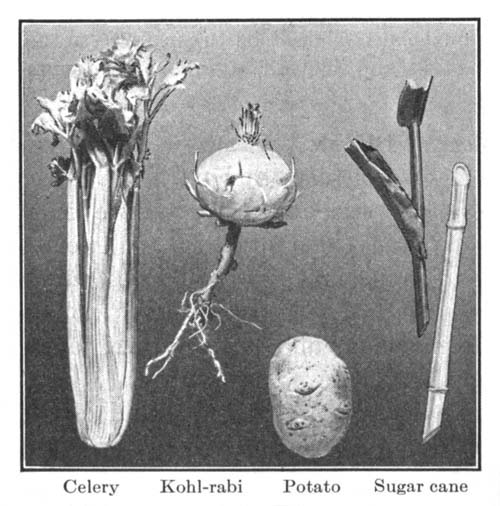
Stems used as food.
Stems as Food.—A city child would, if asked to name some stem used as food, probably mention asparagus. We sometimes forget that one of our greatest necessities, cane sugar, comes from the stem of sugar cane. Over seventy pounds of sugar is used each year by every person in the United States. To supply the growing demand beets are now being raised for their sugar in many parts of the world, so that nearly half the total supply of sugar comes from this source. Maple sugar is a well-known commodity which is obtained by boiling the sap of sugar maple until it crystallizes. Over 16,000 tons of maple sugar is obtained every spring, Vermont producing about 40 per cent of the total output. The sago palm is another stem which supports the life of many natives in Africa. Another stem, living underground, forms one of man's staple articles of diet. This is the potato.
Roots as Food.—Roots which store food for plants form important parts of man's vegetable diet. Beets, radishes, carrots, parsnips, sweet potatoes, and many others might be mentioned.
The following table shows the proportion of foods in some of the commoner roots and stems:—
Water Proteins Carbohydrates Fat Mineral Matter
Potato 75.0 1.2 18.0 0.3 1.0
Carrot 89.0 0.5 5.0 0.2 1.0
Parsnip 81.0 1.2 8.7 1.5 1.0
Turnip 92.8 0.5 4.0 0.1 0.8
Onion 91.0 1.5 4.8 0.2 0.5
Sweet potato 74.0 1.5 20.2 0.1 1.5
Beet 82.2 0.4 13.4 0.1 0.9
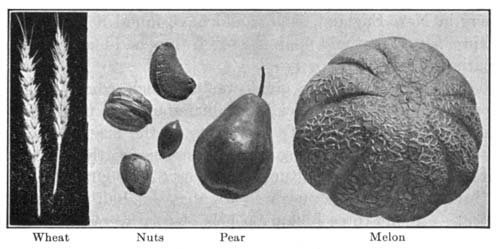
Seeds and fruits used for food.
Fruits and Seeds as Foods.—Our cereal crops, corn, wheat, etc., have played a very great part in the civilization of man and are now of so much importance to him as food products that bread made from flour from the wheat has been called the "staff of life." Our grains are the cultivated progeny of wild grasses. Domestication of plants and animals marks epochs in the advance of civilization. The man of the stone age hunted wild beasts for food, and lived like one of them in a cave or wherever he happened to be; he was a nomad, a wanderer, with no fixed home. He may have discovered that wild roots or grains were good to eat; perhaps he stored some away for future use. Then came the idea of growing things at home instead of digging or gathering the wild fruits from the forest and plain. The tribes which first cultivated the soil made a great step in advance, for they had as a result a fixed place for habitation. The cultivation of grains and cereals gave them a store of food which could be used at times when other food was scarce. The word "cereal" (derived from Ceres, the Roman Goddess of Agriculture) shows the importance of this crop to Roman civilization. From earliest times the growing of grain and the progress of civilization have gone hand in hand. As nations have advanced in power, their dependence upon the cereal crops has been greater and greater.
"Indian corn," says John Fiske, in The Discovery of America, "has played a most important part in the history of the New World. It could be planted without clearing or plowing the soil. There was no need of threshing or winnowing. Sown in tilled land, it yields more than twice as much food per acre as any other kind of grain. This was of incalculable advantage to the English settlers in New England, who would have found it much harder to gain a secure foothold upon the soil if they had had to begin by preparing it for wheat or rye."
To-day, in spite of the great wealth which comes from our mineral resources, live stock, and manufactured products, the surest index of our country's prosperity is the size of the corn and wheat crop. According to the last census, the amount of capital invested in agriculture was over $20,000,000,000, while that invested in manufacture was less than one half that amount.
Corn.—About three billion bushels of corn were raised in the United States during the year 1910. This figure is so enormous that it has but little meaning to us. In the past half century our corn crop has increased over 350 per cent. Illinois and Iowa are the greatest corn-producing states, each having a yearly record of over four hundred million bushels. The figure on this page shows the principal corn-producing areas in the United States.
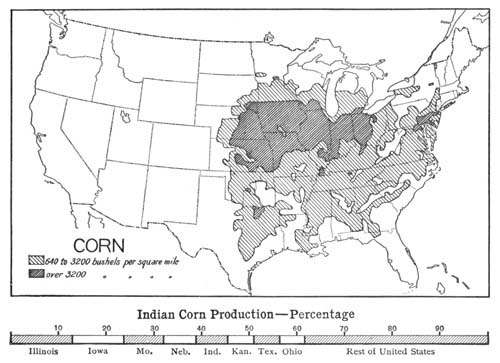
Indian corn is put to many uses. It is a valuable food. It contains a large proportion of starch, from which glucose (grape sugar) and alcohol are made. Machine oil and soap are made from it. The leaves and stalk are an excellent fodder; they can be made into paper and packing material. Mattresses can be stuffed with the husks. The pith is used as a protective belt placed below the water line of our huge battleships. Corn cobs are used for fuel, one hundred bushels having the fuel value of a ton of coal.
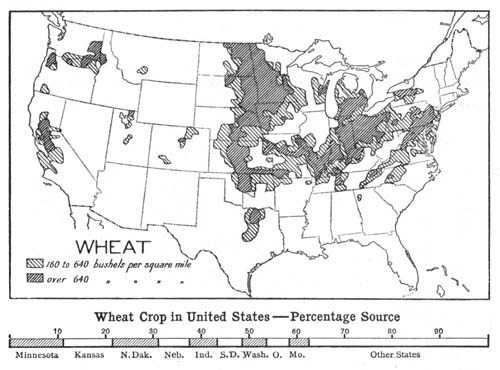
Wheat.—Wheat is the crop of next greatest importance in size. Nearly seven hundred millions of bushels were raised in this country in 1910, representing a total money value of over $700,000,000. Seventy-two per cent of all the wheat raised comes from the North Central states and California. About three fourths of the wheat crop is exported, nearly one half of it to Great Britain, thus indirectly giving employment to thousands of people on railways and steamships. Wheat has its chief use in its manufacture into flour. The germ, or young wheat plant, is sifted out during this process and made into breakfast foods. Flour making forms the chief industry of Minneapolis, Minnesota, and of several other large and wealthy cities in this country.
Other Grains.—Of the other grain and cereals raised in this country, oats are the most important crop, over one billion bushels having been produced in 1910. Barley is another grain, a staple of some of the northern countries of Europe and Asia. In this country, it is largely used in making malt for the manufacture of beer. Rye is the most important cereal crop of northern Europe, Russia, Germany, and Austro-Hungary producing over 50 per cent of the world's supply. One of the most important grain crops for the world (although relatively unimportant in the United States) is rice. The fruit of this grasslike plant, after thrashing, screening, and milling, forms the principal food of one third of the human race. Moreover, its stems furnish straw, its husks make a bran used as food for cattle, and the grain, when fermented and distilled, yields alcohol.
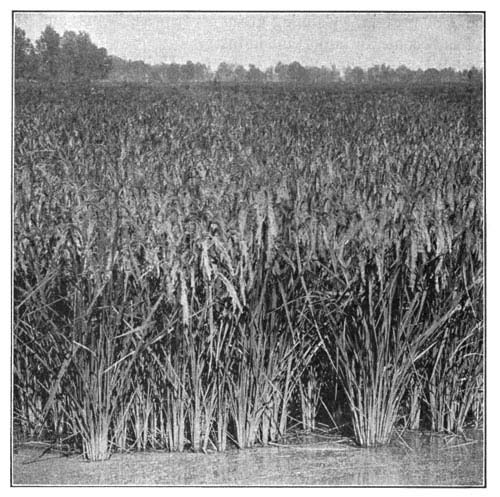
A field of rice, showing the conditions of culture.
Garden Fruits.—Green plants and especially vegetables have come to play an important part in the dietary of man. The diseases known as scurvy and beri-beri, the latter the curse of the far Eastern navies, have been largely prevented by adding vegetables and fruit juices to the dietary of the sailors. People in this country are beginning to find that more vegetables and less meat are better than the meat diet so often used. Market gardening forms the lucrative business of many thousands of people near our great cities. Some of the more important fruits are squash, cucumbers, pumpkins, melons, tomatoes, peppers, strawberries, raspberries, and blackberries. The latter fruits bring in an annual income of $25,000,000 to our market gardeners. Beans and peas are important as foods because of their relatively large amount of protein. Canning green corn, peas, beans, and tomatoes has become an important industry.
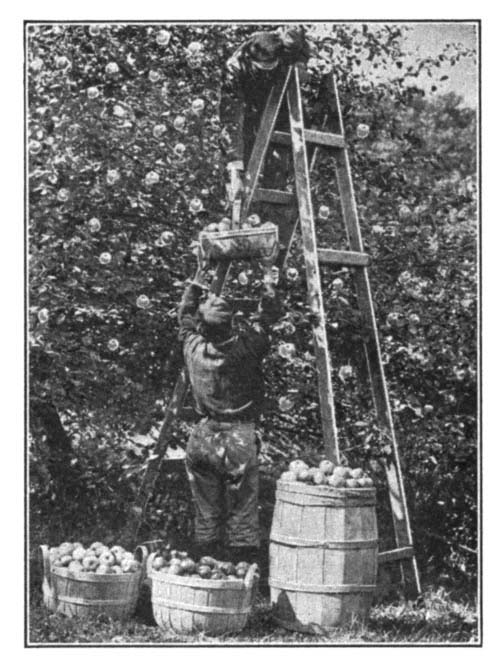
Picking apples, an important crop in some parts of the United States.
Orchard and Other Fruits.—In the United States over one hundred and seventy-five million bushels of apples are grown every year. Pears, plums, apricots, peaches, and nectarines also form large orchards, especially in California. Nuts form one of our important articles of food, largely because of the large amount of protein contained in them.
The grape crop of the world is commercially valuable, because of the raisins and wine produced. The culture of lemons, oranges, and grapefruit has come in recent years to give a living to many people in this country as well as in other parts of the world. Figs, olives, and dates are staple foods in the Mediterranean countries and are sources of wealth to the people there, as are coconuts, bananas, and many other fruits in tropical countries.
Beverages and Condiments.—The coffee and cacao beans, and leaves of the tea plant, products of tropical regions, form the basis of very important beverages of civilized man. Pepper, black and red, mustard, allspice, nutmegs, cloves, and vanilla are all products manufactured from various fruits or seeds of tropical plants.
Alcoholic liquors are produced from various plants in different parts of the world, the dried fruit of the hop vine being an important product of New York State used in the making of beer.
Raw Materials.—Besides use as food, green plants have many other uses. Many of our city industries would not be in existence, were it not for certain plant products which furnish the raw materials for many manufacturing industries. Many cities of the east and south, for example, depend upon cotton to give employment to thousands of factory hands.
Cotton.—Of our native plant products cotton is probably of the most importance to the outside world. Over eleven million bales of five hundred pounds each are raised annually.
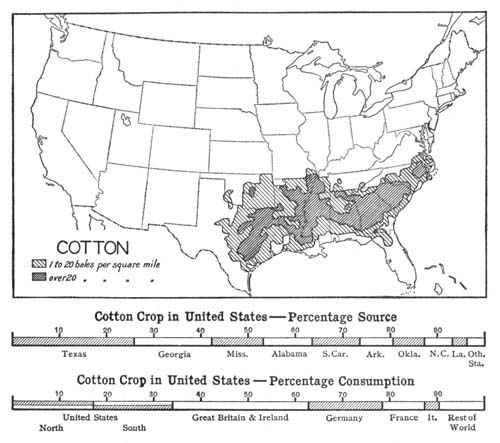
The cotton plant thrives in warm regions. Its commercial importance is gained because the seeds of the fruit have long filaments attached to them. Bunches of these filaments, after treatment, are easily twisted into threads from which are manufactured cotton cloth, muslin, calico, and cambric. In addition to the fiber, cottonseed oil, a substitute for olive oil, is made from the seeds, and the refuse remaining makes an excellent cattle fodder.
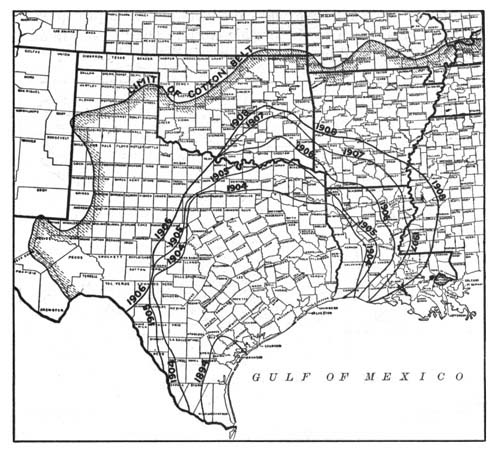
Map showing the spread of the cotton boll weevil. It was introduced from Mexico about 1894. What proportion of the cotton raising belt was infected in 1908?
Cotton Boll Weevil.—The cotton crop of the United States has rather recently been threatened with destruction by a beetle called the cotton boll weevil. This insect, which bores into the young pod of the cotton, develops there, stunting the growth of the fruit to such an extent that seeds are not produced. The loss in Texas alone is estimated at over $10,000,000 a year. The boll weevil, because of the protection offered by the cotton boll, is very difficult to exterminate. The weevils are destroyed by birds, the infected bolls and stalks are burnt, millions are killed each winter by cold, other insects prey on them, but at the present time they are one of the greatest pests the south knows.
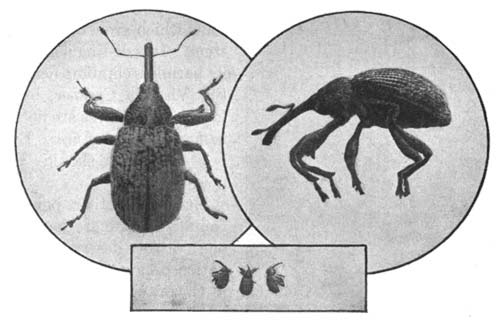
Mexican cotton boll weevil. Much enlarged, above; natural size, below. (Herrick.)
The control of this pest seems to depend upon early planting so that the crop has an opportunity to ripen before the insects in the boll grow large enough to do harm. Ultimately the boll weevil may do more good than harm by bringing into the market a type of cotton plant that ripens very early.
Vegetable Fibers.—Among the most important are Manila hemp, which comes from the leaf-stalks of a plant of the banana family and true hemp, which is the bast or woody fiber of a plant cultivated in most warm parts of the earth. Flax is also an important fiber plant, grown largely in Russia and other parts of Europe (see picture on next page). From the bast fibers of the stem of this herb linen cloth is made.
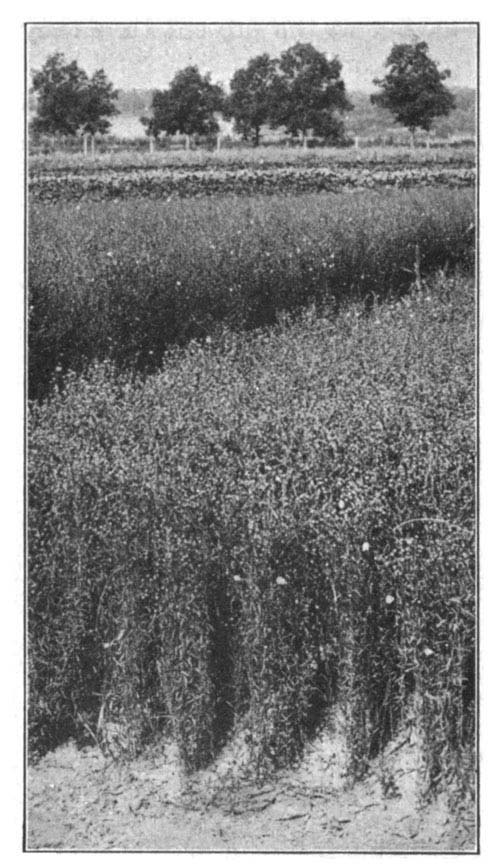
Flax grown for fiber.
Vegetable Oils.—Some of the same plants which give fiber also produce oil. Cotton seed oil pressed from the seeds, linseed oil from the seeds of the flax plant, and coconut oil (the covering of the nut here producing the fiber) are examples.
Some Harmful Green Plants.—We have seen that on the whole green plants are useful to man. There are, however, some that are harmful. For example, the poison ivy is extremely poisonous to touch. The poison ivy is a climbing plant which attaches itself to the trees or walls by means of tiny air roots which grow out from the stem. It is distinguished from its harmless climbing neighbor, the Virginia Creeper, by the fact that its leaves are notched in threes instead of fives. Every boy and girl should know poison ivy.
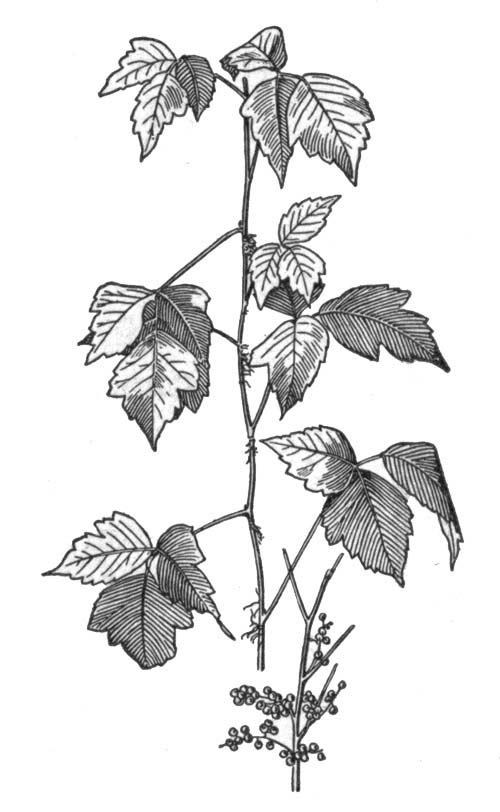
Poison ivy, a climbing plant which is poisonous to touch. Notice the leaves in threes.
Numerous other poisonous common plants are found, but one other deserves special notice because of its presence in vacant city lots. The Jimson Weed (Datura) is a bushy plant, from two to five feet high, bearing large leaves. It has white or purplish flowers, and later bears a four-valved seed pod containing several hundred seeds. These plants contain a powerful poison, and people are often made seriously ill by eating the roots or other parts by mistake.
Weeds.—From the economic standpoint the green plants which do the greatest damage are weeds. Those plants which provide best for their young are usually the most successful in life's race. Plants which combine with the ability to scatter many seeds over a wide territory the additional characteristics of rapid growth, resistance to dangers of extreme cold or heat, attacks of enemies, inedibility, and peculiar adaptations to cross-pollination or self-pollination, are usually spoken of as weeds. They flourish in the sterile soil of the roadside and in the fertile soil of the garden. By means of rapid growth they kill other plants of slower growth by usurping their territory. Slow-growing plants are thus actually exterminated. Many of our common weeds have been introduced from other countries and have, through their numerous adaptations, driven out other plants which stood in their way. Such is the Russian Thistle. A single plant of this kind will give rise to over 20,000 seeds. First introduced from Russia in 1873, it spread so rapidly that in twenty years it had appeared as a common weed over an area of some twenty-five thousand square miles. It is now one of the greatest pests in our Northwest.