A CIVIC BIOLOGY (continued 3)
Reading edition
Reference Books
elementary
Hunter, Laboratory Problems in Civic Biology. American Book Company.
Gannet, Commercial Geography. American Book Company.
Sargent, Plants and their Uses. Henry Holt and Company.
Toothaker, Commercial Raw Materials. Ginn and Company.
U. S. Dept. of Agriculture, Farmers' Bulletin 86, Thirty Poisonous Plants of the United States, V. K. Chestnut. Bulletin 17. Two Hundred Weeds, How to Know Them and How to Kill Them, L. H. Dewey.
advanced
Bailey, Cyclopedia of American Agriculture. The Macmillan Company.
XI. PLANTS WITHOUT CHLOROPHYLL IN THEIR RELATION TO MAN
Problems.—(a) How molds and other saprophytic fungi do harm to man.
(b) What yeasts do for mankind.
(c) A study of bacteria with reference to
(1) Conditions favorable and unfavorable to growth.
(2) Their relations to mankind.
(3) Some methods of fighting harmful bacteria and diseases caused by them.
Laboratory Suggestions
Field work.—Presence of bracket fungi and chestnut canker.
Home experiment.—Conditions favorable to growth of mold.
Laboratory demonstration.—Growth of mold, structure, drawing.
Home experiment or laboratory demonstration.—Conditions unfavorable for growth of molds.
Demonstration.—Process of fermentation.
Microscopic demonstration.—Growing yeast cells. Drawing.
Home experiment.—Conditions favorable for growth of yeast.
Home experiment.—Conditions favorable for growth of yeast in bread.
Demonstration and experiment.—Where bacteria may be found.
Demonstration.—Methods of growth of bacteria, pure cultures and colonies shown.
Demonstration.—Foods preferred by bacteria.
Demonstration.—Conditions favorable for growth of bacteria.
Demonstration.—Conditions unfavorable for growth of bacteria.
Demonstration by charts, diagrams, etc.—The relation of bacteria to disease in a large city.
colorless plants are useful and harmful to man
The Fungi.—We have found that green plants on the whole are useful to mankind. But not all plants are green. Most of us are familiar with the edible mushroom sold in the markets or the so-called "toadstools" found in parks or lawns. These plants contain no chlorophyll and hence do not make their own food. They are members of the plant group called fungi. Such plants are almost as much dependent upon the green plants for food as are animals. But the fungi require for the most part dead organic matter for their food. This may be obtained from decayed vegetable or animal material in soil, from the bodies of dead plants and animals, or even from foods prepared for man. Fungi which feed upon dead organic material are known as saprophytes. Examples are the mushrooms, the yeasts, molds, and some bacteria, of which more will be learned later.
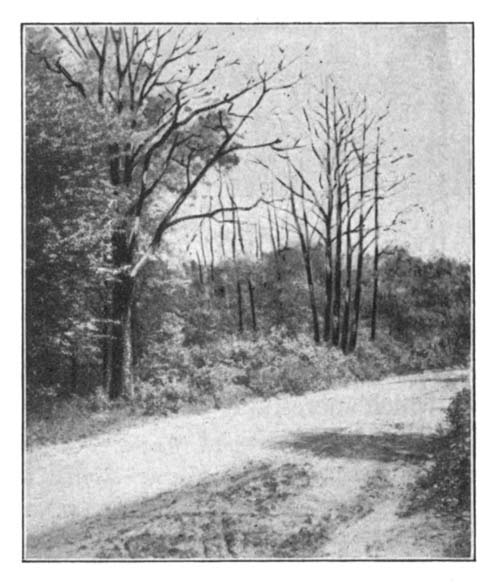
Chestnut trees in a New York City park; killed by a parasite, the chestnut canker.
Some Parasitic Fungi.—Other fungi (and we will find this applies to some animals as well) prefer living plants or animals for their food. Thus a tiny plant, recently introduced into this country, known as the chestnut canker, is killing our chestnut trees by the thousands in the eastern part of the United States. It produces millions of tiny reproductive cells known as spores; these spores, blown about by the wind, light on the trees, sprout, and send in under the bark a threadlike structure which sucks in the food circulating in the living cells, eventually causing the death of the tree. A plant or animal which lives at the expense of another living plant or animal is called a parasite. The chestnut canker is a dangerous parasite. Later we shall see that animal and plant parasites destroy yearly crops and trees valued at hundreds of millions of dollars and cause untold misery and suffering to humanity.
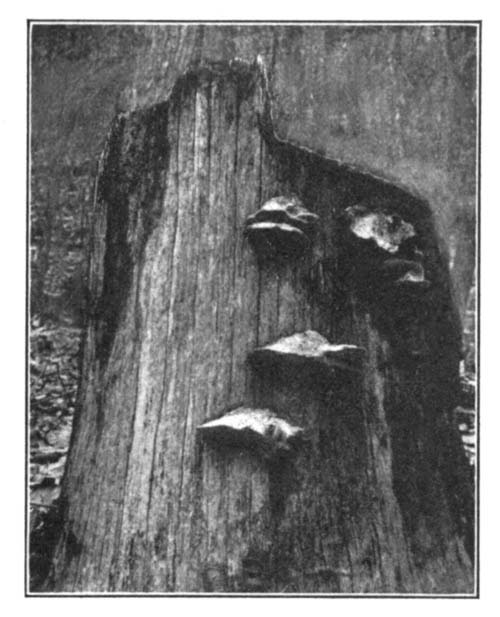
Shelf fungi. (Photographed by W. C. Barbour.)
Another fungus which does much harm to the few trees found in large towns and cities is the shelf or bracket fungus. The part of the body visible on the tree looks like a shelf or bracket, hence the name. This bracket is in reality the reproductive part of the plant; on its lower surface are formed millions of little bodies called spores. These spores are capable, under favorable conditions, of reproducing new plants. The true body of the plant, a network of threads, is found under the bark. This fungus begins its life as a spore in some part of the tree which has become diseased or broken. Once established, it spreads rapidly. There is no remedy except to kill the tree and burn it, so as to destroy the spores. Many fine trees, sound except for a slight bruise or other injury, are annually infected and eventually killed. In cities thousands of trees become infected through careless hitching of horses so that the horse may gnaw the tree, thus exposing a fresh surface on which spores may obtain lodgment and grow (see page 115).
Suggestions for Field Work.—A field trip to a park or grove near home may show the great destruction of timber by this means. Count the number of perfect trees in a given area. Compare it with the number of trees attacked by the fungus. Does the fungus appear to be transmitted from one tree to another near at hand? In how many instances can you discover the point where the fungus first attacked the tree?
Fungi of our Homes.—But not all fungi are wild. Some have become introduced into our homes and these live on food or other materials. These plants are very important because of their relation to life in a town or crowded city.[17]
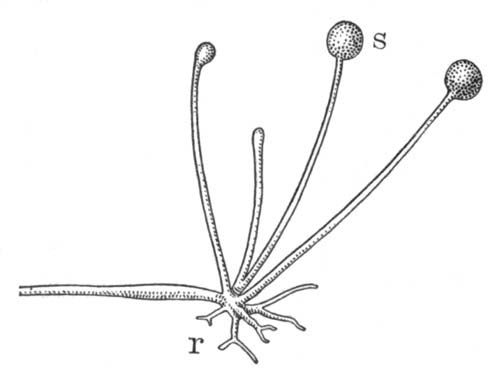
Bread mold; r, rhizoids; s, fruiting bodies containing spores.
The Growth of Bread Mold.—If a piece of moist bread is exposed to the air of the schoolroom, or in your own kitchen for a few minutes and then covered with a glass tumbler and kept in a warm place, in a day or two a fuzzy whitish growth will appear on the surface of the bread. This growth shortly turns black. If we now examine a little piece of the bread with a lens or low-powered microscope, we find a tangled mass of threads (the mycelium) covering the surface of the bread. From this mass of threads project tiny upright stalks bearing round black bodies, the fruit. Little rootlike structures known as rhizoids dip down into the bread, and absorb food for its threadlike body. The upright threads with the balls at the end contain many tiny bodies called spores. These spores have been formed by the division of the protoplasm making up the fruiting bodies into many separate cells. When grown under favorable conditions, the spores will produce more mycelia, which in turn bear fruiting bodies.
Physiology of the Growth of Mold.—Molds, in order to grow rapidly, need oxygen, moisture, and moderate heat. They seem to prefer dark, damp places where there is not a free circulation of air, for if the bell jar is removed from growing mold for even a short time, the mold wilts. Too great or very little heat will prevent growth and kill everything except the spores. They obtain their food from the material on which they live. This they are able to do by means of digestive enzymes given out by the rootlike parts, by means of which the molds cling to the bread. These digestive enzymes change the starch of the bread to sugar and the protein to a soluble form which will pass by osmosis into cells of the mold. Thus the mold is able to absorb food material. These foods are then used to supply energy and make protoplasm. This seems to be the usual method by which saprophytes make use of the materials on which they live.
What can Molds live On?—We have seen that black mold lives upon bread. We would find that it or some other mold (e.g. green or blue mold) live upon decaying or overripe fruit,—apples, peaches, and plums being especially susceptible to their growth. Molds feed upon all cakes or breads, upon meat, cheese, and many raw vegetables. They are almost sure to grow upon flour if it is allowed to get damp. Moisture seems necessary for their growth. Jelly is a substance particularly favorable to molds for this reason. Shoes, leather, cloth, paper, or even moist wood will give food enough to support their growth. At least one troublesome disease, ringworm, is due to the growth of molds in the skin.
What Mold does to Foods.—Mold usually changes the taste of the material it grows upon, rendering it "musty" and sometimes unfit to eat. Eventually it will spoil food completely because decay sets in. Decay, as we will see later, is not entirely due to mold growth, but is usually caused by another group of organisms, the bacteria. Molds, however, in feeding do cause chemical changes which result in decay or putrefaction. Some molds are useful. They give the flavor to Roquefort, Gorgonzola, Camembert, and Brie cheeses. But on the whole molds are pests which the housekeeper wishes to get rid of.
How to prevent Molds.[18]—As we have seen, moisture is favorable for mold growth; conversely, dryness is unfavorable. Inasmuch as the spores of mold abound in the air, materials which cannot be kept dry should be covered. Jelly after it is made should at once be tightly covered with a thin layer of paraffin, which excludes the air and possible mold spores. Or waxed paper may be fastened over the surface of the jelly so as to exclude the spores. To prevent molds from attacking fresh fruit, the surface of the fruit should be kept dry and, if possible, each piece of fruit should be wrapped in paper. Why? Heating with dry heat to 212° for a few moments will kill any mold spores that happen to be in food. Moldy food, if heated after removing surface on which the mold grew, is perfectly good to eat.
Dry dusting or sweeping will raise dust, which usually contains mold spores. Use a dampened broom or dust cloth frequently in the kitchen if you wish to preserve foods from molds.
Other Moldlike Fungi.—Mildews are near relatives of the molds found in our homes. They may attack leather, cloth, etc., in a damp house. Other allied forms may do damage to living plants. Some of these live upon the lilac, rose, or willow. These fungi do not penetrate the host plant to any depth, for they obtain their food from the outer layer of cells in the leaf of their host and cover the leaves with the whitish threads of the mycelium. Hence they may be killed by means of applications of some fungus-killing fluid, as Bordeaux mixture.[19] Among the useful plants preyed upon by mildews are the plum, cherry, and peach trees. (The diseases known as black knot and peach curl are thus caused.) Another important member of this group is the tiny parasite found on rye and other grains, which gives us the drug ergot.
Among other parasitic fungi are rusts and smuts. Wheat rust is probably the most destructive parasitic fungus. Indirectly this parasite is of considerable importance to the citizen of a great city because of its effect upon the price of wheat.
Yeasts in their Relation to Man
Fermentation.—It is of common knowledge to country boys or girls that the juice of fresh apples, grapes, and some other fruits, if allowed to stand exposed to the air for a short time will ferment. That is, the sweet juice will begin to taste sour and to have a peculiar odor, which we recognize as that of alcohol. The fermenting juice appears to be full of bubbles which rise to the surface. If we collect enough of these bubbles of gas to make a test, we find it to be carbon dioxide.
Evidently something changed some part of the apple or grape, the sugar, (C6H12O6), into alcohol, 2(C2H6O), and carbon dioxide, 2(CO2). This chemical process is known as fermentation.
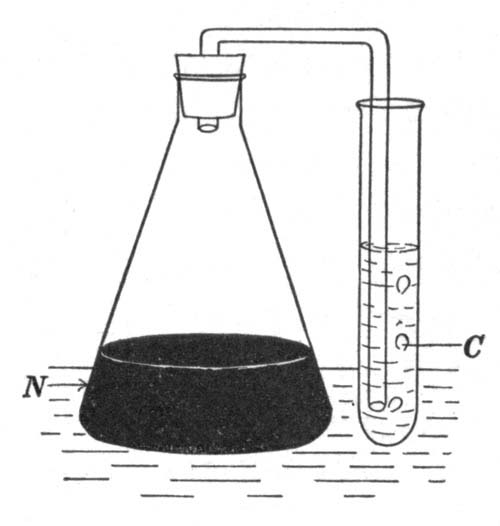
Apparatus to show effect of fermentation. N, molasses, water and yeast plants; C, bubbles of carbon dioxide.
Yeast causes Fermentation.—Let us now take a compressed yeast cake, shake up a small portion of it in a solution of molasses and water, and fill a fermentation tube with the mixture. Leave the tube in a warm place overnight. In the morning a gas will be found to have been collected in the closed end of the tube (see Figure on page 138). The taste and odor of the liquid shows alcohol to be present, and the gas, if tested, is proven carbon dioxide. Evidently yeast causes fermentation.
What are Yeasts?—If now part of the liquid from the fermentation tube which contains the settlings be drawn off, a drop placed on a slide and a little weak iodine added and the mixture examined under the compound microscope, two kinds of structures will be found (see Figure below), starch grains which are stained deep blue, and other smaller ovoid structures of a brownish yellow color. The latter are yeast plants.
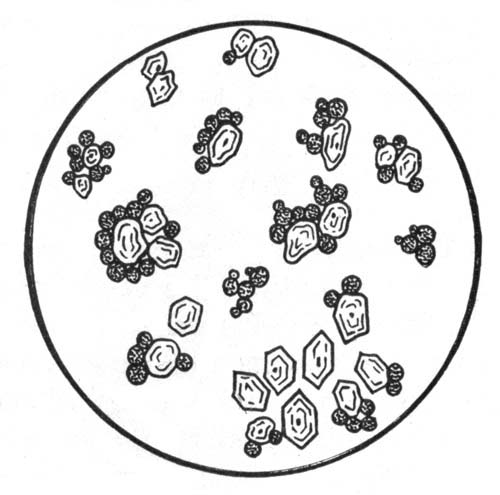
Yeast and starch grains. Notice that the starch grains around which are clustered yeast cells have been rounded off by the yeast plants. How do you account for this?
Size and Shape, Manner of Growth, etc.—The common compressed yeast cake contains millions of these tiny plants. In its simplest form a yeast plant is a single cell. The shape of such a plant is ovoid, each cell showing under the microscope the granular appearance of the protoplasm of which it is formed. Look for tiny clear areas in the cells; these are vacuoles, or spaces filled with fluid. The nucleus is hard to find in a yeast cell. Many of the cells seem to have others attached to them, sometimes there being several in a row. Yeast cells reproduce very rapidly by a process of budding, a part of the parent cell forming one or more smaller daughter cells which eventually become free from the parent.
Conditions favorable to growth of Yeast.—Experiment.—Label three pint fruit jars A, B, and C. Add one fourth of a compressed yeast cake to two cups of water containing two tablespoonfuls of molasses or sugar. Stir the mixture well and divide it into three equal parts and pour them into the jars. Place covers on the jars. Put jar A in the ice box on the ice, and jar B over the kitchen stove or near a radiator; pour the contents of jar C into a small pan and boil for a few minutes. Pour back into C, cover and place it next to B. After forty-eight hours, look to see if any bubbles have made their appearance in any of the jars. If the experiment has been successful, only jar B will show bubbles. After bubbles have begun to appear at the surface, the fluid in jar B will be found to have a sour taste and will smell unpleasantly. The gas which rises to the surface, if collected and tested, will be found to be carbon dioxide. The contents of jar B have fermented. Evidently, the growth of yeast will take place only under conditions of moderate warmth and moisture.
Carbohydrates necessary to Fermentation.—Sugar must be present in order for fermentation to take place. The wild yeasts cause fermentation of the apple or grape juice because they live on the skin of the apple or grape. Various peoples recognize this when they collect the juice of certain fruits and, exposing it to the air, allow it to ferment. Such is the saki or rice wine of the Japanese, the tuba or sap of the coconut palm of the Filipinos and the pulqué of the Mexicans.
Beer and Wine Making.—Brewers' yeasts are cultivated with the greatest care; for the different flavors of beer seem to depend largely upon the condition of the yeast plants. Beer is made in the following manner. Sprouted barley, called malt, in which the starch of the grain has been changed to grape sugar by digestion, is killed by drying in a hot kiln. The malt is dissolved in water, and hops are added to give the mixture a bitter taste. Now comes the addition of the yeast plants, which multiply rapidly under the favorable conditions of food and heat. Fermentation results on a large scale from the breaking down of the grape sugar, the alcohol remaining in the fluid, and the carbon dioxide passing off into the air. At the right time the beer is stored either in bottles or casks, but fermentation slowly continues, forming carbon dioxide in the bottles. This gives the sparkle to beer when it is poured from the bottle.
In wine making the wild yeasts growing on the skin of the grapes set up a slow fermentation. It takes several weeks before the wine is ready to bottle. In sparkling wines a second fermentation in the bottles gives rise to carbon dioxide in such quantity as to cause a decided frothing when the bottle is opened.
Commercial Yeast.—Cultivated yeasts are now supplied in the home as compressed or dried yeast cakes. In both cases the yeast plants are mixed with starch and other substances and pressed into a cake. But the compressed yeast cake must be used fresh, as the yeast plants begin to die rapidly after two or three days. The dried yeast cake, while it contains a much smaller number of yeast plants, is nevertheless probably more reliable if the yeast cannot be obtained fresh.
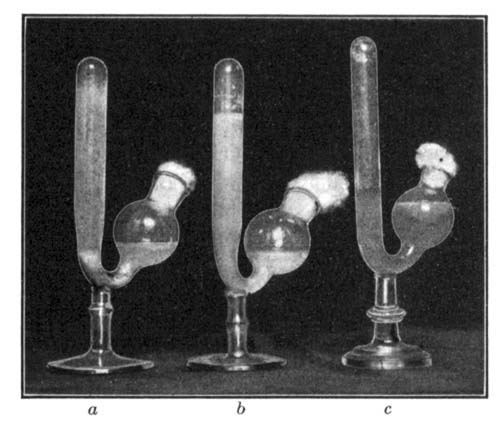
The cut illustrates an experiment that shows how yeast plants depend upon food in order to grow. In each of three fermentation tubes were placed an equal amount of a compressed yeast cake. Then tube a was filled with distilled water, tube b with a solution of glucose and water, and tube c with a nutrient solution containing nitrogenous matter as well as glucose. The quantity of gas (CO2) in each tube is an index of the amount of growth of the yeast cells. In which tube did the greatest growth take place?
Bread Making.—Most of us are familiar with the process of bread making. The materials used are flour, milk or water or both, salt, a little sugar to hasten the process of fermentation, or "rising," as it is called, some butter or lard, and yeast.
After mixing the materials thoroughly by a process called "kneading," the bread is put aside in a warm place (about 75° Fahrenheit) to "rise." If we examine the dough at this time, we find it filled with holes, which give the mass a spongy appearance. The yeast plants, owing to favorable conditions, have grown rapidly and filled the cavities with carbon dioxide. Alcohol is present, too, but this is evaporated when the dough is baked. The baking cooks the starch of the bread, drives off the carbon dioxide and alcohol, and kills the yeast plants, besides forming a protective crust on the loaf.
Sour Bread.—If yeast cakes are not fresh, sour bread may result from their use. In such yeast cakes there are apt to be present other tiny one-celled plants, known as bacteria. Certain of these plants form acids after fermentation takes place. The sour taste of the bread is usually due to this cause. The remedy would be to have fresh yeast, to have good and fresh flour, and to have clean vessels with which to work.
Importance of Yeasts.—Yeasts in their relation to man are thus seen to be for the most part useful. They may get into canned substances put up in sugar and cause them to "work," giving them a peculiar flavor. But they can be easily killed by heating to the temperature of boiling. On the other hand, yeast plants are necessary for the existence of all the great industries which depend upon fermentation. And best of all they give us leavened bread, which has become a necessity to most of mankind.
Bacteria in their Relation to Man
What Bacteria do and Where They May be Found.—A walk through a crowded city street on any warm day makes one fully alive to odors which pervade the atmosphere. Some of these unpleasant odors, if traced, are found to come from garbage pails, from piles of decaying fruit or vegetables, or from some butcher shop in which decayed meat is allowed to stand. This characteristic phenomena of decay is one of the numerous ways in which we can detect the presence of bacteria. These tiny plants, "man's invisible friends and foes," are to be found "anywhere, but not everywhere," in nature. They swarm in stale milk, in impure water, in soil, in the living bodies of plants and animals and in their dead bodies as well. Most "catching" diseases we know to be caused directly by them; the processes of decay, souring of milk, acid fermentation, the manufacture of nitrogen for plants are directly or indirectly due to their presence. It will be the purpose of the next paragraphs to find some of the places where bacteria may be found and how we may know of their presence.
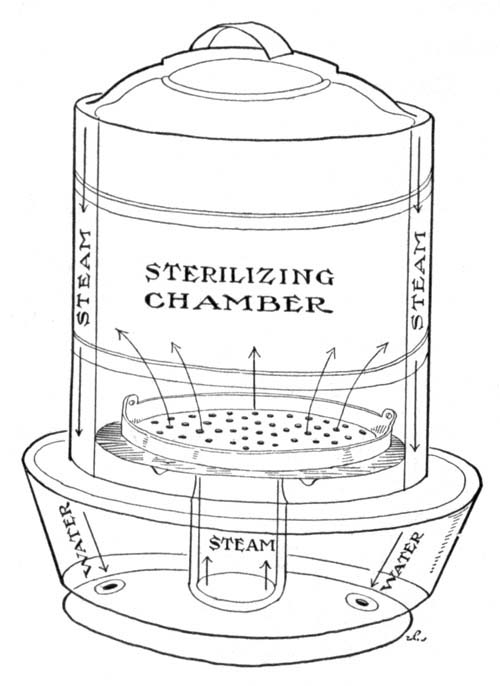
A steam sterilizer.
How we catch Bacteria to Study Them.—To study bacteria it is first necessary to find some material in which they will grow, then kill all living matter in this food material by heating to boiling point (212°) for half an hour or more (this is called sterilization), and finally protect the culture medium, as this food is called, from other living things that might grow upon it.
One material in which bacteria seem to thrive is a mixture of beef extract, digested protein and gelatine or agar-agar, the latter a preparation derived from seaweed. This mixture, after sterilization, is poured into flat dishes with loose-fitting covers. These petri dishes, so called after their inventor, are the traps in which we collect and study bacteria.
Where Bacteria might Grow.—Expose a number of these sterilized dishes, each for the same length of time, to some of the following conditions:
(a) exposed to the air of the schoolroom.
(b) exposed in the halls of the school while pupils are passing.
(c) exposed in the halls of the school when pupils are not moving.
(d) exposed at the level of a dirty and much-used city street.
(e) exposed at the level of a well-swept and little-used city street.
(f) exposed in a city park.
(g) exposed in a factory building.
(h) dirt from hands placed in dish.
(i) rub interior of mouth with finger and touch surface of dish.
(j) touch surface of dish with decayed vegetable or meat.
(k) touch surface of dish with dirty coin or bill.
(l) place in dish two or three hairs from boy's head.
This list might be prolonged indefinitely.
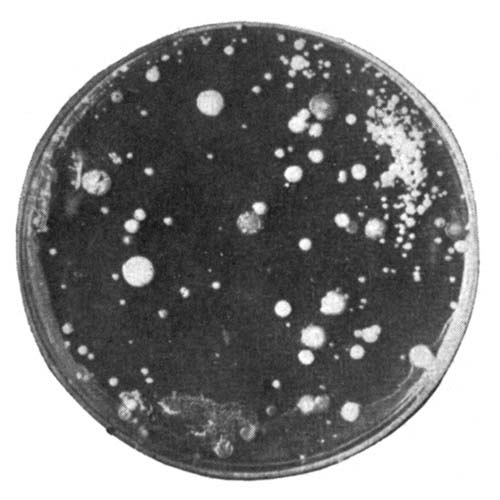
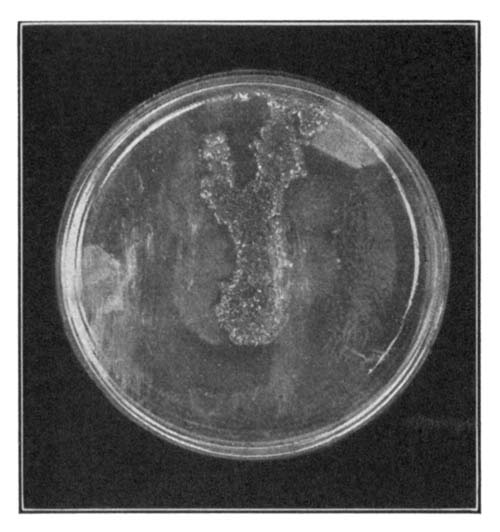
Colonies of bacteria growing in a petri dish.
Now let us place all of the dishes together in a moderately warm place (a closet in the schoolroom will do) and watch for results. After a day or two little spots, brown, yellow, white, or red, will begin to appear. These spots, which grow larger day by day, are colonies made up of millions of bacteria. But probably each colony arose from a single bacterium which got into the dish when it was exposed to the air.
How we may isolate Bacteria of Certain Kinds from Others.—In order to get a number of bacteria of a given kind to study, it becomes necessary to grow them in what is known as a pure culture. This is done by first growing the bacteria in some medium such as beef broth, gelatin, or on potato.[20] Then as growth follows the colonies of bacteria appear in the culture media or the beef broth becomes cloudy. If now we wish to study one given form, it becomes necessary to isolate them from the others. This is done by the following process: a platinum needle is first passed through a flame to sterilize it; that is, to kill all living things that may be on the needle point. Then the needle, which cools very quickly, is dipped in a colony containing the bacteria we wish to study. This mass of bacteria is quickly transferred to another sterilized plate, and this plate is immediately covered to prevent any other forms of bacteria from entering. When we have succeeded in isolating a certain kind of bacterium in a given dish, we are said to have a pure culture. Having obtained a pure culture of bacteria, they may easily be studied under the compound microscope.
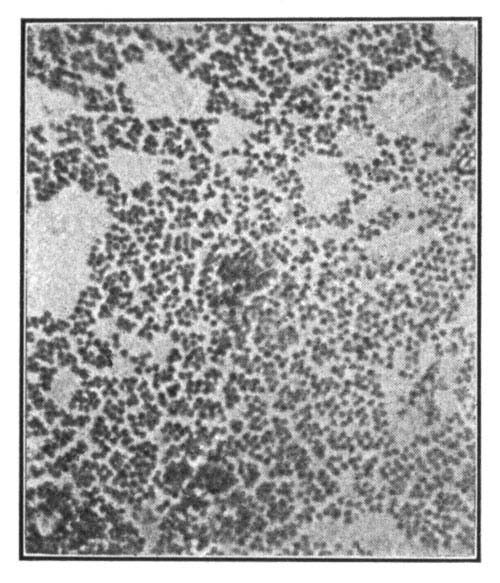
A pure culture of bacteria. Notice that the bacteria are all the same size and shape.
Size and Form.—In size, bacteria are the most minute plants known. A bacterium of average size is about 1/10000 of an inch in length, and perhaps 1/50000 of an inch in diameter. Some species are much larger, others smaller. A common spherical form is 1/50000 of an inch in diameter. They are so small that several million are often found in a single drop of impure water or sour milk. Three well-defined forms of bacteria are recognized: a spherical form called a coccus, a rod-shaped bacterium, the bacillus, and a spiral form, the spirillum. Some bacteria are capable of movement when living in a fluid. Such movement is caused by tiny lashlike threads of protoplasm called flagella. The flagella project from the body, and by a rapid movement cause locomotion to take place. Bacteria reproduce with almost incredible rapidity. It is estimated that a single bacterium, by a process of division called fission, will give rise to over 16,700,000 others in twenty-four hours. Under unfavorable conditions they stop dividing and form rounded bodies called spores. This spore is usually protected by a wall and may withstand very unfavorable conditions of dryness or heat; even boiling for several minutes will not kill some forms.
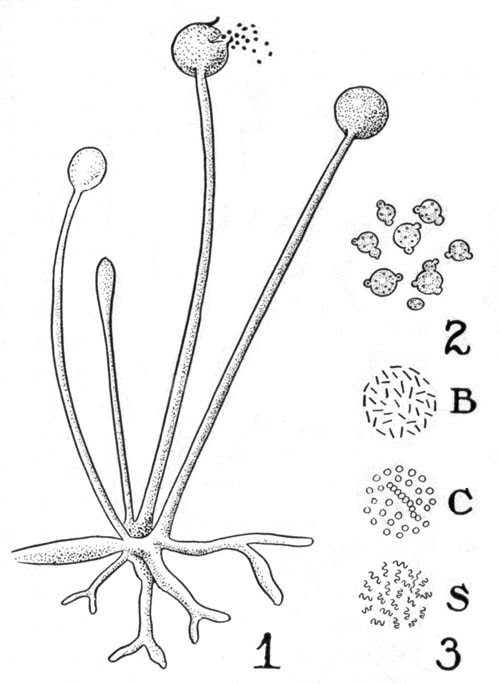
A figure to show the relative size and shape of (1) a green mold, (2) yeast cells, and (3) different forms of bacteria; B, bacillus; C, coccus; S, spirillum forms. The yeast and bacteria are drawn to scale, they are much enlarged in proportion to the green mold, being actually much smaller than the mold spores seen at the top of the picture.
Where Bacteria are most Numerous.—As the result of our experiments, we can make some generalizations concerning the presence of bacteria in our own environment. They are evidently present in the air, and in greater quantity in air that is moving than quiet air. Why? That they stick to particles of dust can be proven by placing a little dust from the schoolroom in a culture dish. Bacteria are present in greater numbers where crowds of people live and move, the air from dusty streets of a populous city contains many more bacteria than does the air of a village street. The air of a city park contains relatively few bacteria as compared with the near-by street. The air of the woods or high mountains fewer still. Why? Our previous experiment has shown that dirt on our hands, the mouth and teeth, decayed meat and vegetables, dirty money, the very hairs of our head are all carriers of bacteria.
Fluids the Favorite Home of Bacteria.—Tap water, standing water, milk, vinegar, wine, cider all can be proven to contain bacteria by experiments similar to those quoted above. Spring or artesian well water would have very few, if any, bacteria, while the same quantity of river water, if it held any sewage, might contain untold millions of these little organisms.
Foods preferred by Bacteria.—If bacteria are living and contain no chlorophyll, we should expect them to obtain protein food in order to grow. Such is not always the case, for some bacteria seem to be able to build up protein out of simple inorganic nitrogenous substances. If, however, we take several food substances, some containing much protein and others not so much, we will find that the bacteria cause decay in the proteins almost at once, while other food substances are not always attacked by them.
Growth of bacteria in a drop of impure water allowed to run down a sterilized culture in a dish.
What Bacteria do to Foods.—When bacteria feed upon a protein they use part of the materials in the food so that it falls to pieces and eventually rots. The material left behind after the bacteria have finished their meal is quite different from its original form. It is broken down by the action of the bacteria into gases, fluids, and some solids. It has a characteristic "rotten" odor and it has in it poisons which come as a result of the work of the bacteria. These poisonous wastes, called ptomaines, we shall learn more about later.
Conditions Favorable and Unfavorable to the Growth of Bacteria.—Moisture and Dryness.—Experiment.—Take two beans, remove the skins, crush one, soak the second bean overnight and then crush it. Place in test tubes, one dry, the second with water. Leave in a warm place two or three days, then smell each tube. In which is decay taking place? In which tube are bacteria at work? How do you know?
Moisture.—Moisture is an absolute need for bacterial growth, consequently keeping material dry will prevent the growth of germs upon its surface. Foods, in order to decay, must contain enough water to make them moist. Bacteria grow most freely in fluids.
Light.—If we cover one half of a petri dish in which bacteria are growing with black paper and then place the dish in a light warm place for a few days, the growth of bacteria in the light part of the dish will be found to be checked, while growth continues in the covered part. It is a matter of common knowledge that disease germs thrive where dirt and darkness exist and are killed by any long exposure to sunlight. This shows us the need of light in our homes, especially in our bedrooms.
Air.—We have seen that plants need oxygen in order to perform the work that they do. This is equally true of all animals. But not all bacteria need air to live; in fact, some are killed by the presence of air. Just how these organisms get the oxygen necessary to oxidize their food is not well understood. The fact that some bacteria grow without air makes it necessary for us to use the one sure weapon we have for their extermination, and that is heat.
Heat.—Experiment.—Take four cultures containing bouillon, inoculate each tube with bacteria and plug each tube with absorbent cotton. Place one tube in the ice box, a second tube in a dark closet at a moderate temperature, a third in a warm place (about 100° Fahrenheit), and boil the contents of the fourth tube for ten minutes, then place it with tube number two. In which tubes does growth take place most rapidly? Why?
Bacteria grow very slowly if at all in the temperature of an ice box, very rapidly at the room temperature of from 70° to 90° and much less rapidly at a higher temperature. All bacteria except those which have formed spores can be instantly killed as soon as boiling point is reached, and most spores are killed by a few minutes boiling.
Sterilization.—The practical lessons drawn from sterilization are many. We know enough now to boil our drinking water if we are uncertain of its purity; we sterilize any foods that we believe might harbor bacteria, and thus keep them from spoiling. The industry of canning is built upon the principle of sterilization.
Canning.—Canning is simply a method by which first the bacteria in a substance are killed by heating and then the substance is put into vessels into which no more bacteria may gain entrance. This is usually done at home by boiling the fruit or vegetable to be canned either in salt and water or with sugar and water, either of which substances aids in preventing the growth of bacteria. The time of boiling will be long or short, depending upon the materials to be canned. Some vegetables, as peas, beans, and corn, are very difficult to can, probably because of spores of bacteria which may be attached to them. Fruits, on the other hand, are usually much easier to preserve. After boiling for the proper time, the food, now free from all bacteria, must be put into jars or cans that are themselves absolutely sterile or free from germs. This is done by first boiling the jars, then pouring the boiling hot material into the hot jars and sealing them so as to prevent the entrance of bacteria later.
Uses of Canning.—Canning as an industry is of immense importance to mankind. Not only does it provide him with fruits and vegetables at times when he could not otherwise get them, but it also cheapens the cost of such things. It prevents the waste of nature's products at a time when she is most lavish with them, enabling man to store them and utilize them later. Canning has completely changed the life of the sailor and the soldier, who in former times used to suffer from various diseases caused by lack of a proper balance of food.
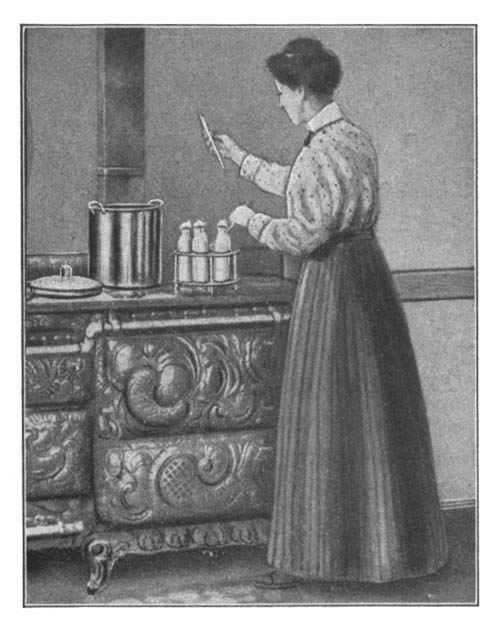
Pasteurizing milk. Why should this be done?
Pasteurization.—Milk is one of the most important food supplies of a great city. It is also one of the most difficult supplies to get in good condition. This is in part due to the fact that milk is produced at long distances from the city and must be brought first from farms to the railroads, then shipped by train, again taken to the milk supply depot by wagon, there bottled, and again shipped by delivery wagons to the consumers. When we remember that much of the milk used in New York City is forty-eight hours old and when we realize that bacteria grow very rapidly in milk, we see the need of finding some way to protect the supply so as to make it safe, particularly for babies and young children.
This is done by pasteurization, a method named after the French bacteriologist Louis Pasteur. To pasteurize milk we heat it to a temperature of not over 170° Fahrenheit for from ten minutes to half an hour. By such a process all harmful germs will be killed and the keeping qualities of the milk greatly lengthened. Most large milk companies pasteurize their city supply by a rapid pasteurization at a much higher temperature, but this method slightly changes the flavor of the milk.
Cold Storage.—Man has also come to use cold to keep bacteria from growing in foods. The ice box at home and cold storage on a larger scale enables one to keep foods for a more or less lengthy period. If food is frozen, as in cold storage, it might keep without growth of bacteria for years. But fruits and vegetables cannot be frozen without spoiling their flavor. And all foods after freezing seem particularly susceptible to the bacteria of decay. For that reason products taken from cold storage must be used at once.
Ptomaines.—Many foods get their flavor from the growth of molds or bacteria in them. Cheese, butter, the gamey taste of certain meats, the flavor of sauerkraut, are all due to the work of bacteria. But if bacteria are allowed to grow so as to become very numerous, the ptomaines which result from their growth in foods may poison the person eating such foods. Frequently ptomaine poisoning occurs in the summer time because of the rapid growth of bacteria. Much of the indigestion and diarrhœa which attack people during the summer is doubtless due to this kind of poisoning.
Preservatives.[21]—This leads us to ask if we may not preserve food in ways other than those mentioned so as to protect ourselves from danger of ptomaine poisoning. Many substances check the development of bacteria and in this way they preserve the food. Preservatives are of two kinds, those harmless to man and those that are poisonous. Of the former, salt and sugar are examples; of the latter, formaldehyde and possibly benzoic acid.
Sugar.—We have noted the use of sugar in canning. Small amounts of sugar will be readily attacked by yeasts, molds, and bacteria, but a 40 to 50 per cent solution will effectually keep out bacteria. Preserves are fruits boiled in about their own weight of sugar. Condensed milk is preserved by the sugar added to it; so are candied and, in part, dried fruits.
Salt.—Salt has been used for centuries to keep foods. Meats are smoked, dried, and salted; some are put down in strong salt solutions. Fish, especially cod and herring, are dried and salted. The keeping of butter is also due to the salt mixed with it. Vinegar is another preservative. It, like salt, changes the flavor of materials kept in it and so cannot come into wide use. Spices are also used as preservatives.
Harmful Preservatives.—Certain chemicals and drugs, used as preservatives, seem to be on the border line of harmfulness. Such are benzoic acid, borax, or boracic acid. Such drugs may be harmless in small quantities, but unfortunately in canned goods we do not always know the amount used. The national government in 1906 passed what is known as the Pure Food Law, which makes it illegal to use any of these preservatives (excepting benzoic acid in very small amounts). Food which contains this preservative will be so labeled and should not be given to children or people with weak digestion. Unfortunately people do not always read the labels and thus the pure food law is ineffective in its working. Infrequently formaldehyde or other preservatives are used in milk. Such treatment renders milk unfit for ordinary use and is an illegal process.
Disinfectants.[22]—Frequently it becomes necessary to destroy bacteria which cause diseases of various kinds. This process is called disinfecting. The substances commonly used are carbolic acid, formalin or formaldehyde, lysol, and bichloride of mercury. Of these, the last named is the most powerful as well as the most dangerous to use. As it attacks metal, it should not be used in a metal pail or dish. It is commonly put up in tablets which are mixed to form a 1 to 1000 solution. Such tablets should be carefully safeguarded because of possible accidental poisoning.
Formaldehyde used in liquid form is an excellent disinfectant. When burned in a formalin candle, it sets free an intensely pungent gas which is often used for disinfecting sick rooms after the patient has been removed.
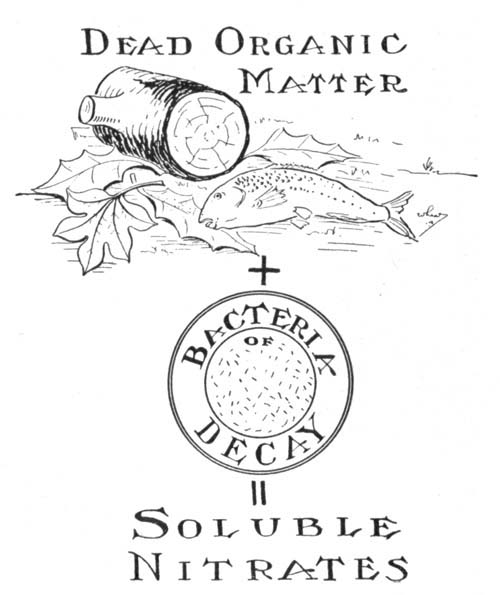
This shows how organic matter is broken down by bacteria so it may be used again by green plants.
Carbolic acid is perhaps the best disinfectant of all. If used in a solution of about 1 part to 25 of water, it will not burn the skin. It is of particular value to disinfect skin wounds, as it heals as well as cleanses when used in a weak solution. Its rather pleasant odor makes it useful to cover up unpleasant smells of the sick room.
The fumes of burning sulphur, which are so often used for disinfecting, are of little real value.
Bacteria cause Decay.—Let us next see in what ways the bacteria directly influence man upon the earth. Have you ever stopped to consider what life would be like on the earth if things did not decay? The sea would soon be filled and the land covered with dead bodies of plants and animals. Conditions of life would become impossible and living things on the earth would cease to exist.
Fortunately, bacteria cause decay. All organic matter, in whatever form, is sooner or later decomposed by the action of untold millions of bacteria which live in the air, water, and soil. These soil bacteria are most numerous in rich damp soils containing large amounts of organic material. They are very numerous around and in the dead bodies of plants and animals. To a considerable degree, then, these bacteria are useful in feeding upon these dead bodies, which otherwise would soon cover the surface of the earth to the exclusion of everything else. Bacteria may thus be scavengers. They oxidize organic materials, changing them to compounds that can be absorbed by plants and used in building protoplasm. Without bacteria and fungi it would be impossible for life to exist on the earth, for green plants would be unable to get the raw food materials in forms that could be used in making food and living matter. In this respect bacteria are of the greatest service to mankind.
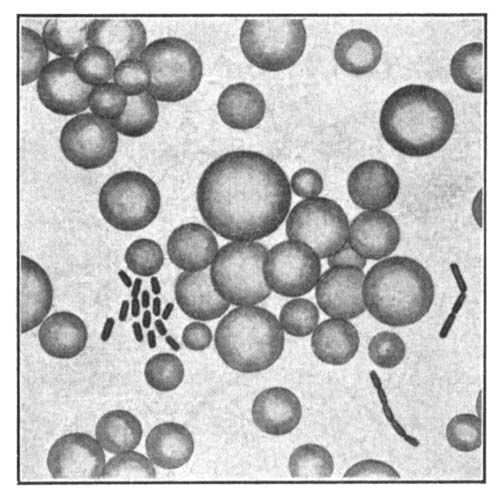
Microscopic appearance of ordinary milk, showing fat globules and bacteria which cause the souring of milk.
Relation to Fermentation.—They may incidentally, as a result of this process of decay, continue the process of fermentation begun by the yeasts. In making vinegar the yeasts first make alcohol (see page 135) which the bacteria change to acetic acid. The lactic acid bacteria, which sour milk, changing the milk sugar to an acid, grow very rapidly in a warm temperature; hence milk which is cooled immediately and kept cool or which is pasteurized and kept in a cool place will not sour readily. Why? These same lactic acid bacteria may be useful when they sour the milk for the cheese maker.
Other Useful Bacteria.—Certain bacteria give flavor to cheese and butter, while still other bacteria aid in the "curing" of tobacco, in the production of the dye indigo, in the preparation of certain fibers of plants for the market, as hemp, flax, etc., in the rotting of animal matter from the skeletons of sponges, and in the process of tanning hides to make leather.
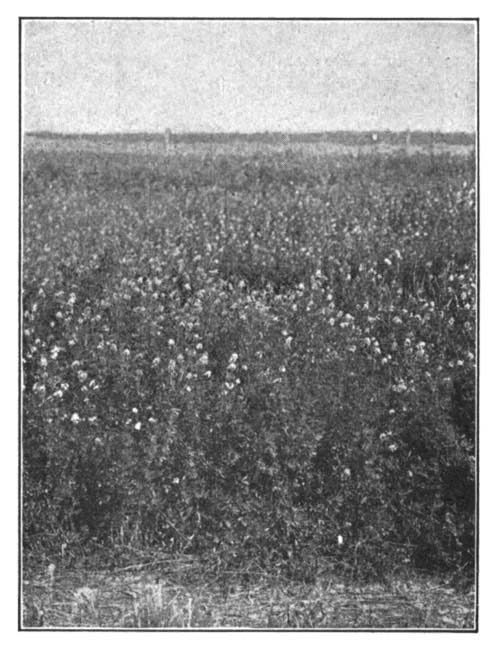
A field of alfalfa, a plant which harbors the nitrogen-fixing bacteria.
Nitrogen-fixing Bacteria.—Still other bacteria, as we have seen before, "change over" nitrogen in organic material in the soil and even the free nitrogen of the air so that it can be used by plants in the form of a compound of nitrogen. The bacteria living in tubercles on the roots of clover, beans, peas, etc., have the power of thus "fixing" the free nitrogen in the air found between particles of soil. This fact is made use of by farmers who rotate their crops, growing first a crop of clover or other plants having root tubercles, which produce the bacteria, then plowing these in and planting another crop, as wheat or corn, on the same area. The latter plants, making use of the nitrogen compounds there, produce a larger crop than when grown in ground containing less nitrogenous material.
Bacteria cause Disease.—The most harmful bacteria are those which cause diseases of plants and animals. Certain diseases of plants—blights, rots, and wilts—are of bacterial nature. These do much annual damage to fruits and other parts of growing plants useful to man as food. But by far the most important are the bacteria which cause disease in man. They accomplish this by becoming parasites in the human body. Millions upon millions of bacteria exist in the human body at all times—in the mouth, on the teeth, in the blood, and especially in the lower part of the food tube. Some in the food tube are believed to be useful, some harmless, and some harmful; others in the mouth cause decay of the teeth, while a few kinds, if present in the body, may cause disease.
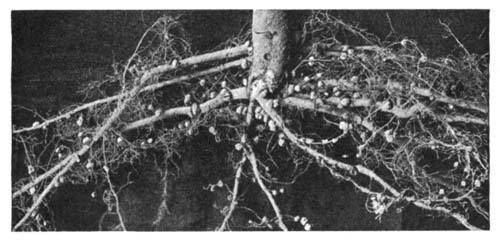
Tubercles on the roots of the soy bean. They contain the nitrogen-fixing bacteria. (Fletcher's Soils.) Copyright by Doubleday, Page and Company.
It is known that bacteria, like other living things, feed and give off organic waste from their own bodies. This waste, called a toxin, is poison to the host on which the bacteria live, and it is usually the production of this toxin that causes the symptoms of disease. Some forms, however, break down tissues and plug up the small blood vessels, thus causing disease.
Diseases caused by Bacteria.—It is estimated that bacteria cause annually over 50 per cent of the deaths of the human race. As we will later see, a very large proportion of these diseases might be prevented if people were educated sufficiently to take the proper precautions to prevent their spread. These precautions might save the lives of some 3,000,000 of people yearly in Europe and America. Tuberculosis, typhoid fever, diphtheria, pneumonia, blood poisoning, syphilis, and a score of other germ diseases ought not to exist. A good deal more than half of the present misery of this world might be prevented and this earth made cleaner and better by the coöperation of the young people now growing up to be our future home makers.
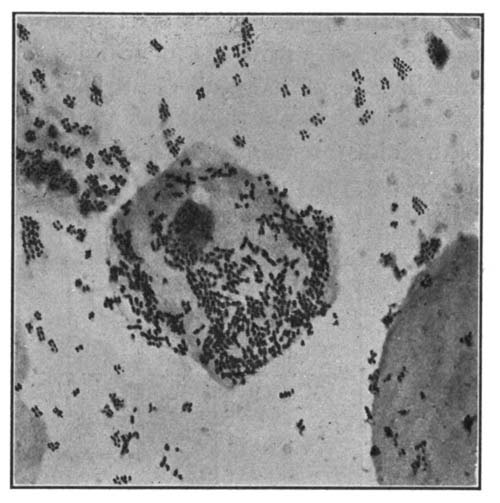
A single cell scraped from the roof of the mouth and highly magnified. The little dots are bacteria, most of which are harmless. Notice the comparative size of bacteria and cell.
How we take Germ Diseases.—Germ or contagious diseases either enter the body by way of the mouth, nose, or other body openings, or through a break in the skin. They may be carried by means of air, food, or water, but are usually transmitted directly from the person who has the disease to a well person. This may be done through personal contact or by handling articles used by the sick person or by drinking or eating foods which have received some of the germs. From this it follows that if we know the methods by which a given disease is communicated, we may protect ourselves from it and aid the civic authorities in preventing its spread.
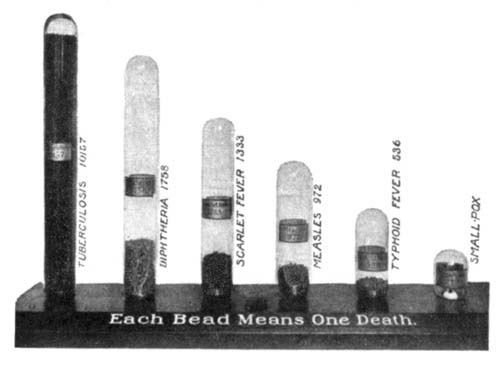
Deaths from tuberculosis compared with other contagious diseases in the city of New York in 1908.
Tuberculosis.—The one disease responsible for the greatest number of deaths—perhaps one seventh of the total on the globe—is tuberculosis. It is estimated that of all people alive in the United States to-day, 5,000,000 will die of this disease. But this disease is slowly but surely being overcome. It is believed that within perhaps one hundred years, with the aid of good laws and sanitary living, it will be almost extinct.
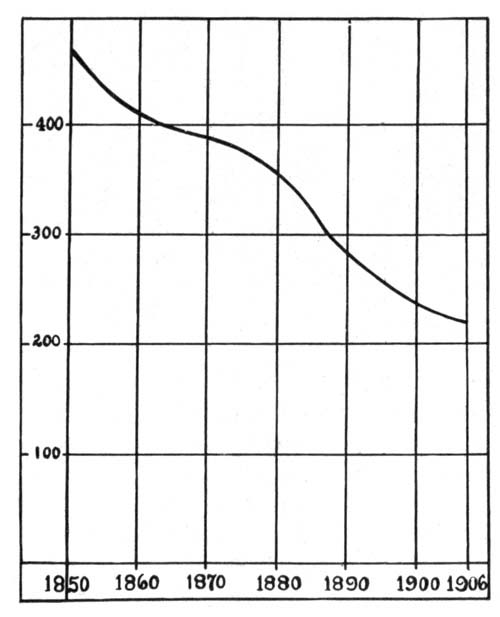
This curve shows a decreasing death rate from tuberculosis. Explain.
Tuberculosis is caused by the growth of bacteria, called the tubercle bacilli, within the lungs or other tissues of the human body. Here they form little tubers full of germs, which close up the delicate air passages in the lungs, while in other tissues they give rise to hip-joint disease, scrofula, lupus, and other diseases, depending on the part of the body they attack. Tuberculosis may be contracted by taking the bacteria into the throat or lungs or possibly by eating meat or drinking milk from tubercular cattle. Especially is it communicated from a consumptive to a well person by kissing, by drinking or eating from the same cup or plate, using the same towels, or in coming in direct contact with the person having the germs in his body. Although there are always some of the germs in the air of an ordinary city street, and though we may take some of these germs into our bodies at any time, yet the bacteria seem able to gain a foothold only under certain conditions. It is only when the tissues are in a worn-out condition, when we are "run down," as we say, that the parasite may obtain a foothold in the lungs. Even if the disease gets a foothold, it is quite possible to cure it if it is taken in time. The germ of tuberculosis is killed by exposure to bright sunlight and fresh air. Thus the course of the disease may be arrested, and a permanent cure brought about, by a life in the open air, the patient sleeping out of doors, taking plenty of nourishing food and very little exercise. See also Chapter XXIV.
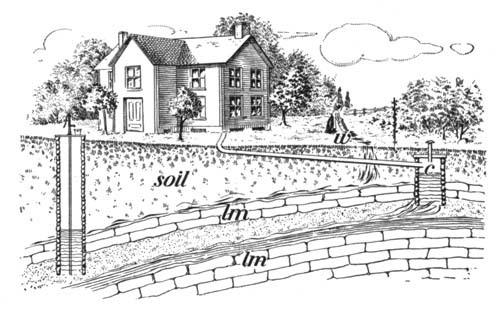
This figure shows how sewage from a cesspool (c) might get into the water supply: lm, layer of rock; w, wash water.
Typhoid Fever.—One of the most common germ diseases in this country and Europe is typhoid fever. This is a disease which is conveyed by means of water and food, especially milk, oysters, and uncooked vegetables. Typhoid fever germs live in the intestine and from there get into the blood and are carried to all parts of the body. A poison which they give off causes the fever so characteristic of the disease. The germs multiply very rapidly in the intestine and are passed off from the body with the excreta from the food tube. If these germs get into the water supply of a town, an epidemic of typhoid will result. Among the recent epidemics caused by the use of water containing typhoid germs have been those in Butler, Pa., where 1364 persons were made ill; Ithaca, N. Y., with 1350 cases; and Watertown, N. Y., where over 5000 cases occurred. Another source of infection is milk. Frequently epidemics have occurred which were confined to users of milk from a certain dairy. Upon investigation it was found that a case of typhoid had occurred on the farm where the milk came from, that the germs had washed into the well, and that this water was used to wash the milk cans. Once in the milk, the bacteria multiplied rapidly, so that the milkman gave out cultures of typhoid in his milk bottles. Proper safeguarding of our water and milk supply is necessary if we are to keep typhoid away.
Blood Poisoning.—The bacterium causing blood poisoning is another toxin-forming germ. It lives in dust and dirt and is often found on the skin. It enters the body through cuts or bruises. It seems to thrive best in less oxygen than is found in the air. It is therefore important not to close up with court-plaster wounds which such germs may have entered. It, with typhoid, is responsible for four times as many deaths as bullets and shells in time of battle. The wonderfully small death rate of the Japanese army in their war with Russia was due to the fact that the Japanese soldiers always boiled their drinking water before using it, and their surgeons always dressed all wounds on the battlefield, using powerful antiseptics in order to kill any bacteria that might have lodged in the exposed wounds.
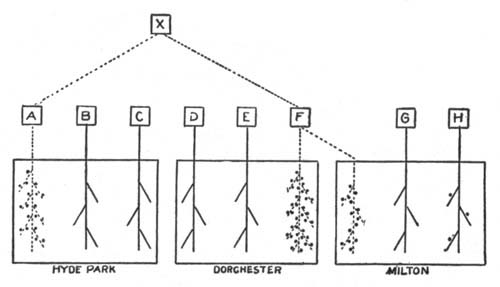
This figure shows how a milk route might be instrumental in spreading diphtheria. X is a farm on which a case of diphtheria occurred that was responsible for all the cases along milk routes A and F in Hyde Park, Dorchester, and Milton. How would you explain this?
Other Diseases.—Many other diseases have been traced to bacteria. Diphtheria is one of the best known. As it is a throat disease, it may easily be conveyed from one person to another by kissing, putting into the mouth objects which have come in contact with the mouth of the patient, or by food into which the germs have been carried. Another disease which probably causes more misery in the world than any other germ disease is syphilis. Hundreds of thousands of new-born babies die annually or grow up handicapped by deformities from this dread scourge. Syphilis and gonorrhea, both diseases of the same sort and contracted in the same manner, hand down to innocent wives and still more innocent children a heritage of disease "even unto the third and fourth generation." Grippe, pneumonia, whooping cough, and colds are believed to be caused by bacteria. Other diseases, as malaria, yellow fever, sleeping sickness, and probably smallpox, scarlet fever, and measles, are due to the attack of one-celled animal parasites. Of these we shall learn later in Chapter XV.
Immunity.—It has been found that after an attack of a germ disease the body will not soon be again attacked by the same disease. This immunity, of which we will learn more later, seems to be due to a manufacture in the blood of substances which fight the bacteria or their poisons. If a person keeps his body in good physical condition and lives carefully, he will do much toward acquiring this natural immunity.
Acquired Immunity.—Modern medicine has discovered means of protecting the body from some contagious diseases. Vaccination as protection against smallpox, the use of antitoxins (of which more later) against diphtheria, and inoculation against typhoid are all ways in which we may be protected against diseases.
Methods of fighting Germ Diseases.—As we have seen, diseases produced by bacteria may be caused by the bacteria being directly transferred from one person to another, or the disease may obtain a foothold in the body from food, water, or by taking them into the blood through a cut or a wound or a body opening.
It is evident that as individuals we may each do something to prevent the spread of germ diseases, especially in our homes. We may keep our bodies, especially our hands and faces, clean. Sweeping and dusting may be done with damp cloths so as not to raise a dust; our milk and water, when from a suspicious supply, may be sterilized or pasteurized. Wounds through which bacteria might obtain foothold in the body should be washed with some antiseptic such as carbolic acid (1 part to 25 water), which kills the germs. In a later chapter we shall learn more of how we may coöperate with the authorities to combat disease and make our city or town a better place in which to live.[23]
Reference Books
elementary
Hunter, Laboratory Problems in Civic Biology. American Book Company.
Bigelow, Introduction to Biology. The Macmillan Company.
Conn, Bacteria, Yeasts, and Molds in the Home. Ginn and Company.
Conn, Story of Germ Life. D. Appleton and Company.
Davison, The Human Body and Health. American Book Company.
Frankland, Bacteria in Daily Life. Longmans, Green, and Company.
Overton, General Hygiene. American Book Company.
Prudden, Dust and its Dangers. G. P. Putnam's Sons.
Prudden, The Story of the Bacteria. G. P. Putnam's Sons.
Ritchie, Primer of Sanitation. World Book Company.
Sharpe, Laboratory Manual in Biology, pages 123-132. American Book Company.
advanced
Conn, Agricultural Bacteriology. P. Blakiston's Sons and Company.
Coulter, Barnes, and Cowles, A Textbook of Botany, Vol. I. American Book Company.
De Bary, Comparative Morphology and Biology of the Fungi, Mycetozoa, and Bacteria. Clarendon Press.
Duggar, Fungous Diseases of Plants. Ginn and Company.
Hough and Sedgwick, The Human Mechanism. Ginn and Company.
Hutchinson, Preventable Diseases. Houghton, Mifflin and Company.
Lee, Scientific Features of Modern Medicine. Columbia University Press.
Muir and Ritchie, Manual of Bacteriology. The Macmillan Company.
Newman, The Bacteria. G. P. Putnam's Sons.
Sedgwick, Principles of Sanitary Science and Public Health. The Macmillan Company.
XII. THE RELATIONS OF PLANTS TO ANIMALS
Problems.—To determine the general biological relations existing between plants and animals.
(a) As shown in a balanced aquarium.
(b) As shown in hay infusion.
Suggestions for Laboratory Work
Demonstration of life in a "balanced" and "unbalanced" aquarium.—Determination of factors causing balance.
Demonstration of hay infusion.—Examination to show forms of animal and plant life.
Tabular comparison between balanced aquarium and hay infusion.
Some Ways in which Plants affect Animals.—We have been studying the life of plants in order better to understand the life of animals and men. We have seen first that green plants play indirectly a tremendous part in man's welfare by supplying him with food. We have found that the colorless plants directly affected his welfare by causing disease, and by causing decay, thus making usable the nitrogen locked up in dead bodies of plants and animals, and by some even supplying nitrogen from the atmosphere. The dependence of animals upon plants has been shown and the interdependence of plants on animals has also been seen in cross-pollination and in the supply of raw food materials to plants by animals.
Study of a Balanced Aquarium.—Perhaps the best way for us to understand the interrelation between plants and animals is to study an aquarium in which plants and animals live and in which a balance has been established between the plant life on one side and animal life on the other. Aquaria containing green pond weeds, either floating or rooted, a few snails, some tiny animals known as water fleas, and a fish or two will, if kept near a light window, show this relation.
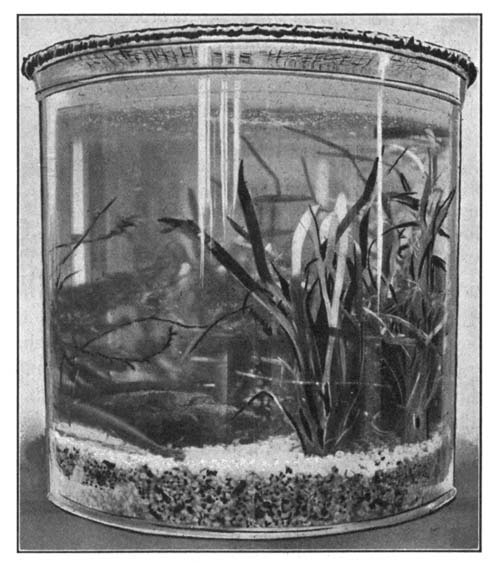
A balanced aquarium. Explain the term "balanced."
We have seen that green plants under favorable conditions of sunlight, heat, moisture, and with a supply of raw food materials, give off oxygen as a by-product while manufacturing food in their green cells. We know the necessary raw materials for starch manufacture are carbon dioxide and water, while nitrogenous material is necessary for the making of proteins within the plant. In previous experiments we have proved that carbon dioxide is given off by any living thing when oxidation occurs in the body. The crawling snails and the swimming fish give off carbon dioxide, which is dissolved in the water; the plants themselves, at all times, oxidize food within their bodies, and so must pass off some carbon dioxide. The green plants in the daytime use up the carbon dioxide obtained from the various sources and, with the water taken in, manufacture starch. While this process is going on, oxygen is given off to the water of the aquarium, and this free oxygen is used by the animals there.
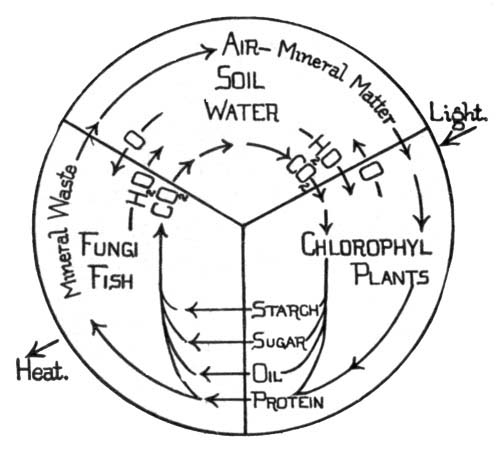
This diagram shows that plants and animals on the earth hold the same relation to each other as plants and animals in a balanced aquarium. Explain the diagram in your notebook.
But the plants are continually growing larger. The snails and fish, too, eat parts of the plants. Thus the plant life gives food to the animals within the aquarium. The animals give off certain nitrogenous wastes of which we shall learn more later. These materials, with other nitrogenous matter from the dead parts of the plants or animals, form part of the raw material used for protein manufacture in the plant. This nitrogenous matter is prepared for use by several different kinds of bacteria which first break the dead bodies down and then give it to the plants in the form of soluble nitrates. The green plants manufacture food, the animals eat the plants and give off organic waste, from which the plants in turn make their food and living matter. The plants give off oxygen to the animals, and the animals give carbon dioxide to the plants. Thus a balance exists between the plants and animals in the aquarium. Make a table to show this balance.
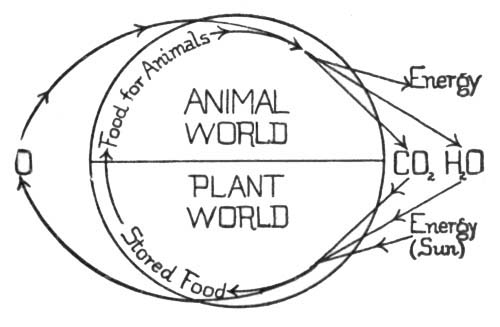
The carbon and oxygen cycle in the balanced aquarium. Trace by means of the arrows the carbon from the time plants take it in as CO2 until animals give it off. Show what happens to the oxygen.
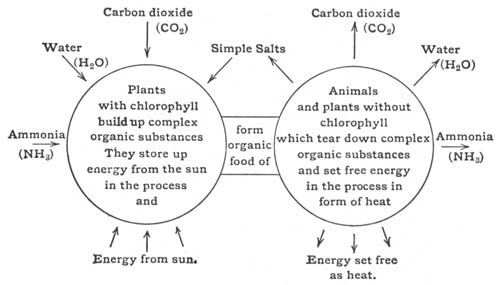
The relations between green plants and animals.
Relations between Green Plants and Animals.—What goes on in the aquarium is an example of the relation existing between all green plants and all animals. Everywhere in the world green plants are making food which becomes, sooner or later, the food of animals. Man does not feed to a great extent upon leaves, but he eats roots, stems, fruits, and seeds. When he does not feed directly upon plants, he eats the flesh of plant eating animals, which in turn feed directly upon plants. And so it is the world over; the plants are the food makers and supply the animals. Green plants also give a very considerable amount of oxygen to the atmosphere every day, which the animals may use.
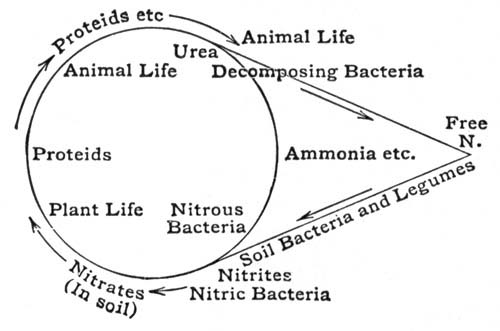
The nitrogen cycle. Trace the nitrogen from its source in the air until it gets back again into the air.
The Nitrogen Cycle.—The animals in their turn supply much of the carbon dioxide that the plant uses in starch making. They also supply some of the nitrogenous matter used by the plants, part being given the plants from the dead bodies of their own relatives and part being prepared from the nitrogen of the air through the agency of bacteria, which live upon the roots of certain plants. These bacteria are the only organisms that can take nitrogen from the air. Thus, in spite of all the nitrogen of the atmosphere, plants and animals are limited in the amount available. And the available supply is used over and over again, perhaps in nitrogenous food by an animal, then it may be given off as organic waste, get into the soil, and be taken up by a plant through the roots. Eventually the nitrogen forms part of the food supply in the body of the plant, and then may become part of its living matter. When the plant dies, the nitrogen is returned to the soil. Thus the usable nitrogen is kept in circulation.[24]
Symbiosis.—We have seen that in the balanced aquarium the animals and plants, in a wide sense, form a sort of unconscious partnership. This process of living together for mutual advantage is called symbiosis. Some animals thus combine with plants; for example, the tiny animal known as the hydra with certain of the one-celled algæ, and, if we accept the term in a wide sense, all green plants and animals live in this relation of mutual give and take. Animals also frequently live in this relation to each other, as the crab, which lives within the shell of the oyster; the sea anemones, which are carried around on the backs of some hermit crabs, aiding the crab in protecting it from its enemies, and being carried about by the crab to places where food is plentiful.
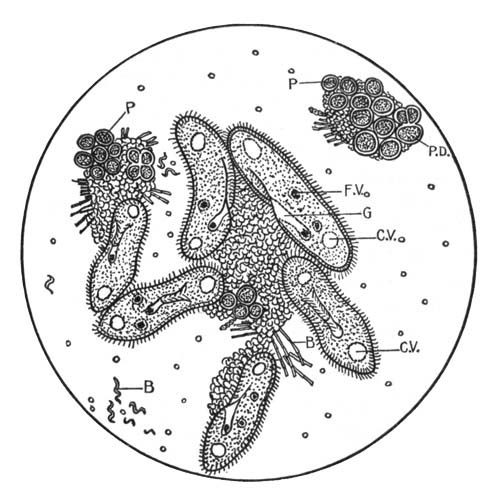
Life in the late stage of a hay infusion. B, bacteria, swimming or forming masses of food upon which the one-celled animals, the paramœcia, are feeding; G, gullet; F.V., food vacuole; C.V., contractile vacuole; P, pleurococcus; P.D., pleurococcus dividing. (Drawn from nature by J. W. Teitz.)
A Hay Infusion.—Still another example of the close relation between plants and animals may be seen in the study of a hay infusion. If we place a wisp of hay or straw in a small glass jar nearly full of water, and leave it for a few days in a warm room, certain changes are seen to take place in the contents of the jar; after a little while the water gets cloudy and darker in color, and a scum appears on the surface. If some of this scum is examined under the compound microscope, it will be found to consist almost entirely of bacteria. These bacteria evidently aid in the decay which (as the unpleasant odor from the jar testifies) is beginning to take place. As we have learned, bacteria flourish wherever the food supply is abundant. The water within the jar has come to contain much of the food material which was once within the leaves of the grass,—organic nutrients, starch, sugar, and proteins, formed in the leaf by the action of the sun on the chlorophyll of the leaf, and now released into the water by the breaking down of the walls of the cells of the leaves. The bacteria themselves release this food from the hay by causing it to decay. After a few days small one-celled animals appear; these multiply with wonderful rapidity, so that in some cases the surface of the water seems to be almost white with active one-celled forms of life. If we ask ourselves where these animals come from, we are forced to the conclusion that they must have been in the water, in the air, or on the hay. Hay is dried grass and may have been cut in a field near a pool containing these creatures. When the pool dried up, the wind may have scattered some of these little organisms in the dried mud or dust. Some may have existed in a dormant state on the hay and the water awakened them to active life. In the water, too, there may have been some living cells, plants and animals.
At first the multiplication of the tiny animals within the hay infusion is extremely rapid; there is food in abundance and near at hand. After a few days more, however, several kinds of one-celled animals may appear, some of which prey upon others. Consequently a struggle for life takes place, which becomes more and more intense as the food from the hay is used up. Eventually the end comes for all the animals unless some green plants obtain a foothold within the jar. If such a thing happens, food will be manufactured within their bodies, a new food supply arises for the animals within the jar, and a balance of life may result.
Reference Books
elementary
Hunter, Laboratory Problems in Civic Biology. American Book Company.
Sharpe, A Laboratory Manual for the Solution of Problems in Biology, pp. 133-138. American Book Company.
advanced
Eggerlin and Ehrenberg, The Fresh Water Aquarium and its Inhabitants. Henry Holt and Company.
Furneaux, Life in Ponds and Streams. Longmans, Green, and Company.
Parker, Biology. The Macmillan Company.
Sedgwick and Wilson, Biology. Henry Holt and Company.
XIII. SINGLE-CELLED ANIMALS CONSIDERED AS ORGANISMS
Problems.—To determine:
(a) How a one-celled animal is influenced by its environment.
(b) How a single cell performs its functions.
(c) The structure of a single-celled animal.
Laboratory Suggestions
Laboratory study.—Study of paramœcium under compound microscope in its relation to food, oxygen, etc. Determination of method of movement, turning, avoiding obstructions, sensitiveness to stimuli. Drawings to illustrate above points.
Laboratory demonstration.—Living paramœcium to show structure of cell. Demonstration with carmine to show food vacuoles, and action of cilia. Use of charts and stained specimens to show other points of cell structure. Laboratory demonstration of fission.
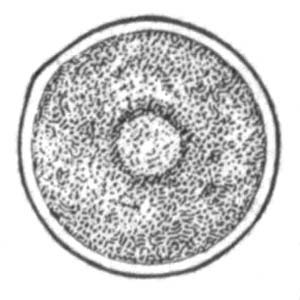
Pleurococcus. A very simple plant cell.
The Simplest Plants.—We have seen that perhaps the simplest plant would be exemplified by one of the tiny bacteria we have just read about. A typical one-celled plant, however, would contain green coloring matter or chlorophyll, and would have the power to manufacture its own food under conditions giving it a moderate temperature, a supply of water, oxygen, carbon dioxide, and sunlight. Such a simple plant is the pleurococcus, the "green slime" seen on the shady sides of trees, stones, or city houses. This plant would meet one definition of a cell, as it is a minute mass of protoplasm containing a nucleus. It is surrounded by a wall of a woody material formed by the activity of the living matter within the cell. It also contains a little mass of protoplasm colored green. Of the work of the chlorophyll in the manufacture of organic food we have already learned. Such is a simple plant cell. Let us now examine a simple animal cell in order to compare it with that of a plant.
Where to find Paramœcium.—If we examine very carefully the surface of a hay infusion, we are likely to notice in addition to the scum formed of bacteria, a mass of whitish tiny dots collected along the edge of the jar close to the surface of the water. More attentive observation shows us that these objects move, and that they are never found far from the surface.
The Life Habits of Paramœcium.—If we place on a slide a drop of water containing some of these moving objects and examine it under the compound microscope, we find each minute whitish dot is a cell, elongated, oval, or elliptical in outline and somewhat flattened. This is a one-celled animal known as the paramœcium or the slipper animalcule (because of its shape).
Seen under the low power of the microscope, it appears to be extremely active, rushing about now rapidly, now more slowly, but seemingly always taking a definite course. The narrower end of the body (the anterior) usually goes first. If it pushes its way past any dense substance in the water, the cell body is seen to change its shape temporarily as it squeezes through.
Response to Stimuli.—Many of these little creatures may be found collected around masses of food, showing that they are attracted by it. In another part of the slide we may find a number of the paramœcia lying close to the edge of an air bubble with the greatest possible amount of their surface exposed to its surface. These animals are evidently taking in oxygen by osmosis. They are breathing. A careful inspection of the jar containing paramœcia shows thousands of tiny whitish bodies collected near the surface of the jar. In the paramœcium, as in the one-celled plants, the protoplasm composing the cell responds to certain agencies acting upon it, coming from without; these agencies we call stimuli. Such stimuli may be light, differences of temperature, presence of food, electricity, or other factors of its surroundings. Plant and animal cells may react differently to the same stimulus. In general, however, we know that protoplasm is irritable to some of these factors. To severe stimuli, protoplasm usually responds by contracting, another power which it possesses. We know, too, that plant and animal cells take in food and change the food to protoplasm, that is, that they assimilate food; and that they may waste away and repair themselves. Finally, we know that new plant and animal cells are reproduced from the original bit of protoplasm, a single cell.
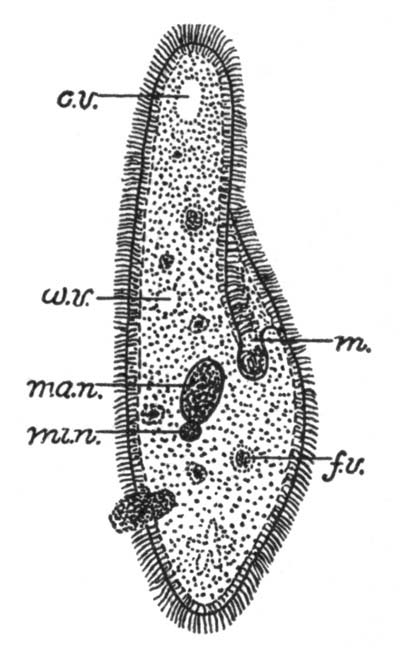
A paramœcium. c.v., contractile vacuole; f.v., food vacuole;m, mouth; ma.n., macronucleus; mi.n., micronucleus; w.v., water vacuole.
The Structure of Paramœcium.—The cell body is almost transparent, and consists of semifluid protoplasm which has a granular grayish appearance under the microscope. This protoplasm appears to be bounded by a very delicate membrane through which project numerous delicate threads of protoplasm called cilia. (These are usually invisible under the microscope).
The locomotion of the paramœcium is caused by the movement of these cilia, which lash the water like a multitude of tiny oars. The cilia also send particles of food into a funnel-like opening, the gullet, on one side of the cell. Once inside the cell body, the particles of food materials are gathered into little balls within the almost transparent protoplasm. These masses of food seem to be inclosed within a little area containing fluid, called a vacuole. Other vacuoles appear to be clear; these are spaces in which food has been digested. One or two larger vacuoles may be found; these are the contractile vacuoles; their purpose seems to be to pass off waste material from the cell body. This is done by pulsation of the vacuole, which ultimately bursts, passing fluid waste to the outside. Solid wastes are passed out of the cell in somewhat the same manner. No breathing organs are seen, because osmosis of oxygen and carbon dioxide may take place anywhere through the cell membrane. The nucleus of the cell is not easily visible in living specimens. In a cell that has been stained it has been found to be a double structure, consisting of one large and one small portion, called, respectively, the macronucleus and the micronucleus.
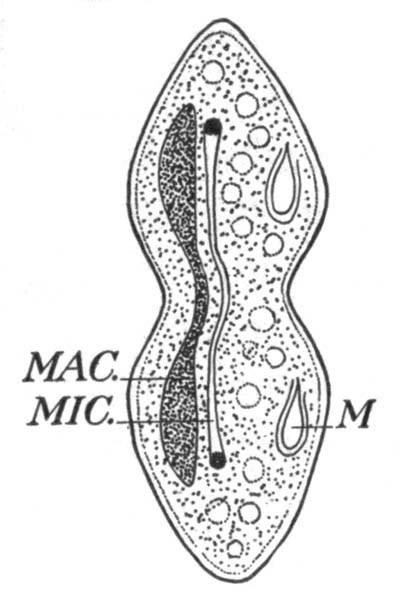
Paramœcium dividing by fission. M, mouth; MAC., macronucleus; MIC., micronucleus. (After Sedgwick and Wilson.)
Reproduction of Paramœcium.—Sometimes a paramœcium may be found in the act of dividing by the process known as fission, to form two new cells, each of which contains half of the original cell. This is a method of asexual reproduction. The original cell may thus form in succession many hundreds of cells in every respect like the original parent cell.
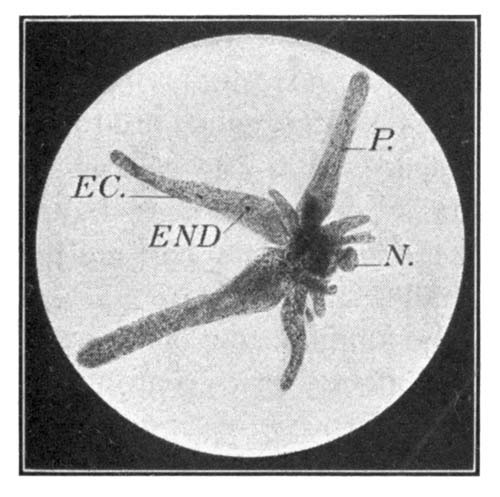
Amœba, with pseudopodia (P.) extended; EC, ectoplasm; END, endoplasm; the dark area (N.) is the nucleus. (From a photograph loaned by Professor G. N. Calkins.)
Amœba.[25]—In order to understand more fully the life of a simple bit of protoplasm, let us take up the study of the amœba, a type of the simplest form of animal life. Unlike the plant and animal cells we have examined, the amœba has no fixed form. Viewed under the compound microscope, it has the appearance of an irregular mass of granular protoplasm. Its form is constantly changing as it moves about. This is due to the pushing out of tiny projections of the protoplasm of the cell, called pseudopodia (false feet). The locomotion is accomplished by a streaming or flowing of the semifluid protoplasm. The pseudopodia are pushed forward in the direction which the animal is to go, the rest of the body following. In the central part of the cell is the nucleus. This important organ is difficult to see except in cells that have been stained.
Although but a single cell, still the amœba appears to be aware of the existence of food when it is near at hand. Food may be taken into the body at any point, the semifluid protoplasm simply rolling over and engulfing the food material. Within the body, as in the paramœcium, the food becomes inclosed within a fluid space or vacuole. The protoplasm has the power to take out such material as it can use to form new protoplasm or give energy. Circulation of food material is accomplished by the constant streaming of the protoplasm within the cell.
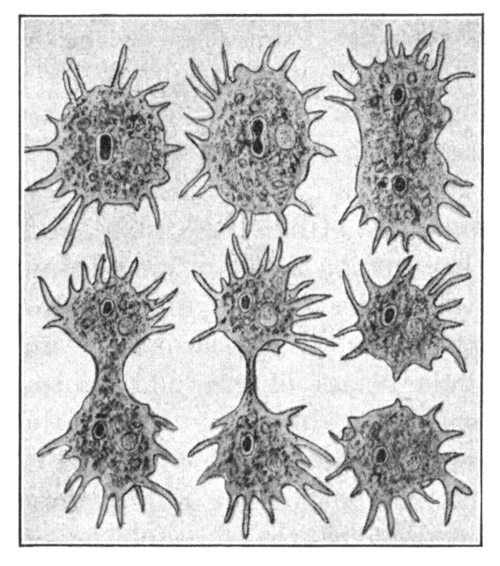
Amœba, showing the changes which take place during division of the cell. The dark body in each figure is the nucleus; the transparent circle, the contractile vacuole; the large granular masses, the food vacuoles. Much magnified.
The cell absorbs oxygen from the water by osmosis through its delicate membrane, giving up carbon dioxide in return. Thus the cell "breathes" through any part of its body covering.
Waste nitrogenous products formed within the cell when work is done are passed out by means of the contractile vacuole.
The amœba, like other one-celled organisms, reproduces by the process of fission. A single cell divides by splitting into two others, each of which resembles the parent cell, except that they are of less bulk. When these become the size of the parent amœba, they each in turn divide. This is a kind of asexual reproduction.
When conditions unfavorable for life come, the amœba, like some one-celled plants, encysts itself within a membranous wall. In this condition it may become dried and be blown through the air. Upon return to a favorable environment, it begins life again, as before. In this respect it resembles the spore of a plant.
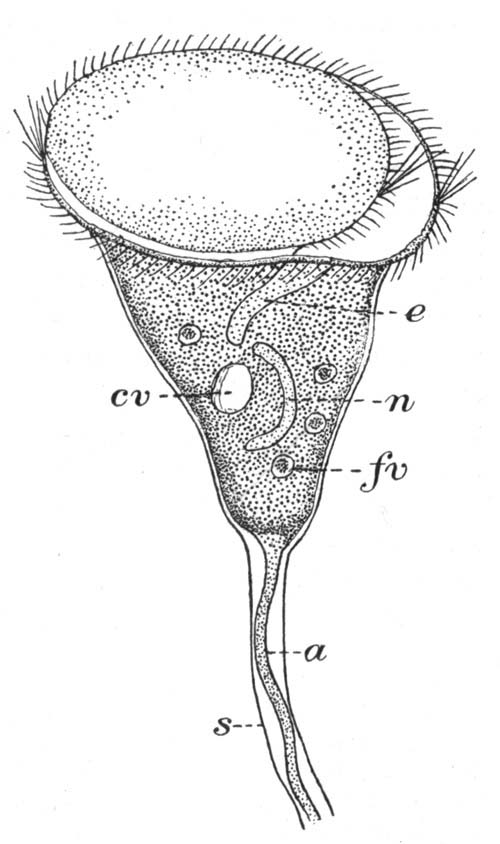
Vorticella. e, gullet; n, nucleus; cv, contractile vacuole; a, axis; s, sheath; fv, food vacuole. (From Herrick's General Zoölogy.)
The Cell as a Unit.—In the daily life of a one-celled animal we find the single cell performing all the general activities which we shall later find the many-celled animal is able to perform. In the amœba no definite parts of the cell appear to be set off to perform certain functions; but any part of the cell can take in food, can absorb oxygen, can change the food into protoplasm, and excrete the waste material. The single cell is, in fact, an organism able to carry on the business of living almost as effectually as a very complex animal.
Complex One-celled Animals.—In the paramœcium we find a single cell, but we find certain parts of the cell having certain definite functions: the cilia are used for locomotion; a definite part of the cell takes in food, while the waste passes out at another definite spot. In another one-celled animal called vorticella, part of the cell has become elongated and is contractile. By this stalk the little animal is fastened to a water plant or other object. The stalk may be said to act like a muscle fiber, as its sole function seems to be movement; the cilia are located at one end of the cell and serve to create a current of water which will bring food particles to the mouth. Here we have several parts of the cell, each doing a different kind of work. This is known as physiological division of labor.
Habitat of Protozoa.—Protozoa are found almost everywhere in shallow water, especially close to the surface. They appear to be attracted near to the surface by the supply of oxygen. Every fresh-water lake swarms with them; the ocean contains countless myriads of many different forms.
Use as Food.—They are so numerous in lakes, rivers, and the ocean as to form the food for many animals higher in the scale of life. Almost all fish that do not take the hook and that travel in schools, or companies, migrating from one place to another, live partly on such food. Many feed on slightly larger animals, which in turn eat the Protozoa. Such fish have on each side of the mouth attached to the gills a series of small structures looking like tiny rakes. These are called the gill rakers, and aid in collecting tiny organisms from the water as it passes over the gills. The whale, the largest of all mammals, strains protozoans and other small animals and plants out of the water by means of hanging plates of whalebone or baleen, the slender filaments of which form a sieve from the top to the bottom of the mouth.
Protozoa cause Disease.—Protozoa of certain kinds play an important part in causing malaria, yellow fever, and other diseases, as we shall see later.[26] (See page 217.)
Reference Books
elementary
Hunter, Laboratory Problems in Civic Biology. American Book Company.
Davison, Human Body and Health. American Book Company.
Jordan, Kellogg and Heath, Animal Studies. D. Appleton and Company.
Sharpe, Laboratory Manual, pp. 140-143. American Book Company.
advanced
Calkins, The Protozoa. Macmillan Company.
Jennings, Study of the Lower Organisms. Carnegie Institution Report.
Parker, Lessons in Elementary Biology. The Macmillan Company.
Wilson, The Cell in Development and Inheritance. The Macmillan Company.
XIV. DIVISION OF LABOR. THE VARIOUS FORMS OF PLANTS AND ANIMALS
Problems.—The development and forms of plants.
The development of a simple animal.
What is division of labor? In what does it result?
How to know the chief characters of some great animal groups.
Laboratory Suggestions
A visit to a botanical garden or laboratory demonstration.—Some of the forms of plant life. Review of essential facts in development of bean or corn embryo.
Demonstration.—Charts or models showing the development of a many-celled animal from egg through gastrula stage.
Demonstration.—Types which illustrate increasing complexity of body form and division of labor.
Museum trip.—To afford pupil a means of identification of examples of principal phyla. This should be preceded by objective demonstration work in school laboratory.
Reproduction in Plants.—Although there are very many plants and animals so small and so simple as to be composed of but a single cell, by far the greater part of the animal and plant world is made up of individuals which are collections of cells living together.
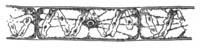
A cell of pond scum. How might it divide to form a long thread made up of cells?
In a simple plant like the pond scum, a string or filament of cells is formed by a single cell dividing crosswise, the two cells formed each dividing into two more. Eventually a long thread of cells is thus formed. At times, however, a cell is formed by the union of two cells, one from each of two adjoining filaments of the plant. At length a hard coat forms around this cell, which has now become a spore. The tough covering protects it from unfavorable changes in the surroundings. Later, when conditions become favorable for its germination, the spore may form a new filament of pond scum. In molds, in yeasts, and in the bacteria we also found spores could be formed by the protoplasm of the plant cutting up into a number of tiny spores. These spores are called asexual (without sex) because they are not formed by the union of two cells, and may give rise to other tiny plants like themselves. Still other plants, mosses and ferns, give rise to two kinds of spores, sexual and asexual. All of these collectively are called spore plants.
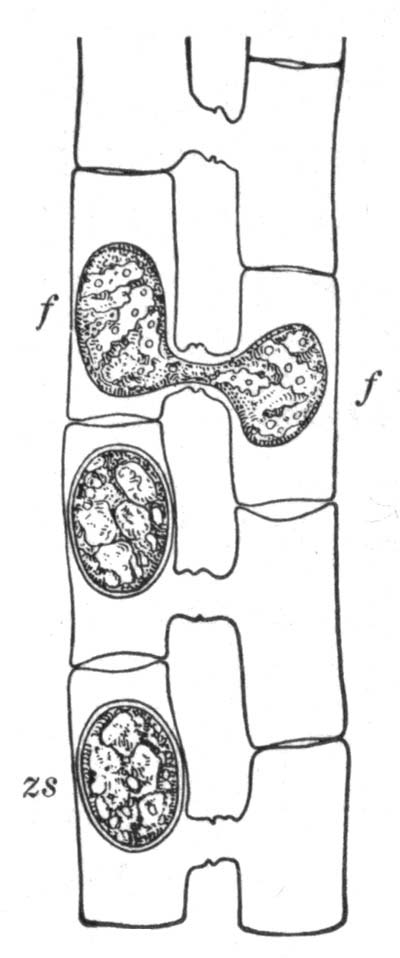
The formation of spores in pond scum. zs, zygospore; f, fusion in progress.
Reproduction in Seed Plants.—Another great group of plants we have studied, plants of varied shapes and sizes, produce seeds. They bear flowers and fruits.
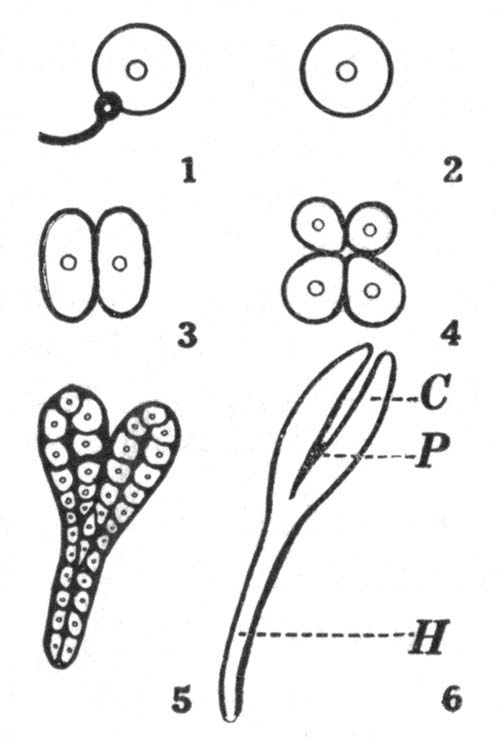
The formation and growth of a plant embryo. 1, the sperm and egg cell uniting; 2, a fertilized egg; 3, two cells formed by division; 4, four cells formed from two; 5, a many-celled embryo; 6, young plant; H, hypocotyl; P, plumule; C, cotyledons.
The embryo develops from a single fertilized "egg," growing by cell division into two, four, eight, and a constantly increasing number of cells until after a time a baby plant is formed, which as in the bean, either contains some stored food to give it a start in life, or, as in the corn, is surrounded with food which it can digest and absorb into its own tiny body. We have seen that these young plants in the seed are able to develop when conditions are favorable. Furthermore, the young of each kind of plant will eventually develop into the kind of plant its parent was and into no other kind. Thus the plant world is divided into many tribes or groups.
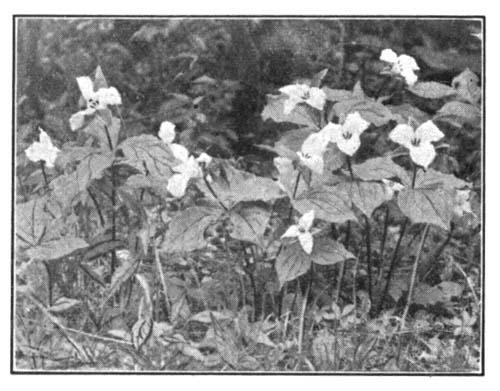
A colony of trilliums, a flowering plant. (Photograph by W. C. Barbour.)
Plants are placed in Groups.—If we plant a number of peas so that they will all germinate under the same conditions of soil, temperature, and sunlight, the seedlings that develop will each differ one from another in a slight degree.[27] But in a general way they will have many characters in common, as the shape of the leaves, the possession of tendrils, form of the flower and fruit. A species of plants or animals is a group of individuals so much alike in their characters that they might have had the same parents. Individuals of such species differ slightly; for no two individuals are exactly alike.
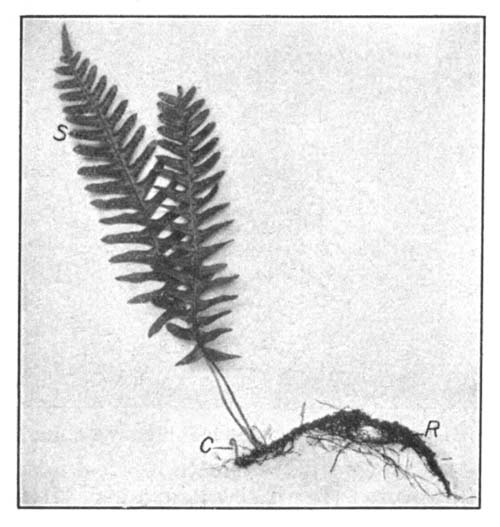
Rock fern, polypody. Notice the underground stem giving off roots from its lower surface, and leaves (C), (S), from its upper surface.
Species are grouped together in a larger group called a genus. For example, many kinds of peas—the wild beach peas, the sweet peas, and many others—are all grouped in one genus (called Lathyrus, or vetchling) because they have certain structural characteristics in common.
Plant and animal genera are brought together in still larger groups, the classification based on general likenesses in structure. Such groups are called, as they become successively larger, Family, Order, and Class. Thus both the plant and animal kingdoms are grouped into divisions, the smallest of which contains individuals very much alike; and the largest of which contains very many groups of individuals, the groups having some characters in common. This is called a system of classification.
Classification of the Plant Kingdom.—The entire plant kingdom has been divided into four sub-kingdoms by botanists:—
1. Spermatophytes. Angiosperms, true flowering plants. Gymnosperms, the pines and their allies.
2. Pteridophytes. The fern plants and their allies.
3. Bryophytes. The moss plants and their allies.
4. Thallophytes. The Thallophytes form two groups: the Algæ and the Fungi; the algæ being green, while the fungi have no chlorophyll.
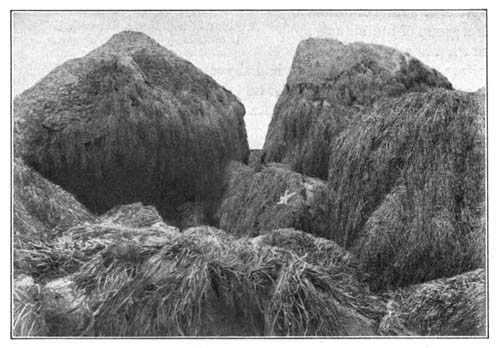
Rockweed, a brown algæ, showing its distribution on rocks below highwater mark.
The extent of the plant kingdom can only be hinted at; each year new species are added to the lists. There are about 110,000 species of flowering plants and nearly as many flowerless plants. The latter consist of over 3500 species of fernlike plants, some 16,500 species of mosses, over 5600 lichens (plants consisting of a partnership between algæ and fungi), approximately 55,000 species of fungi, and about 16,000 species of algæ.
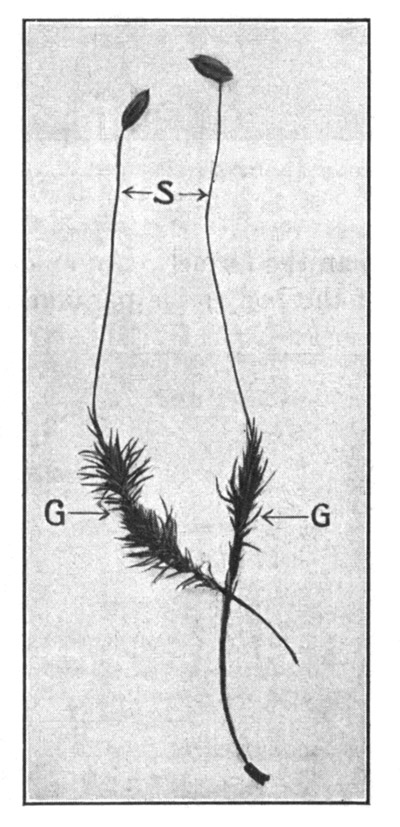
A moss plant. G, the moss body; S, the spore-bearing stalk (fruiting body).
Development of a Simple Animal.—Many-celled animals are formed in much the same way as are many-celled seed plants. A common bath sponge, an earthworm, a fish, or a dog,—each and all of them begin life in the same manner. In a many-celled animal the life history begins with a single cell, the fertilized egg. As in the flowering plant, this cell has been formed by the union of two other cells, a tiny (usually motile) cell; the sperm, and a large cell, the egg. After the egg is fertilized by a sperm cell, it splits into two, four, eight, and sixteen cells; as the number of cells increases, a hollow ball of cells called the blastula is formed; later this ball sinks in on one side, and a double-walled cup of cells, now called a gastrula, results. Practically all animals pass through the above stages in their development from the egg, although these stages are often not plain to see because of the presence of food material (yolk) in the egg.
In animals the body consists of three layers of cells: those of the outside, developed from the outer layer of the gastrula, are called ectoderm, which later gives rise to the skin, nervous system, etc.; an inner layer, developed from the inner layer of the gastrula, the endoderm, which forms the lining of the digestive organs, etc.; a middle layer, called the mesoderm, lying between the ectoderm and the endoderm, is also found. In higher animals this layer gives rise to muscles, the skeleton, and parts of other internal structures.
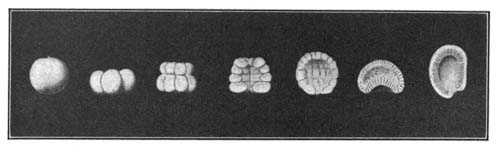
Stages in the development of a fertilized egg into the gastrula stage. Read your text, then draw these stages and name each stage.
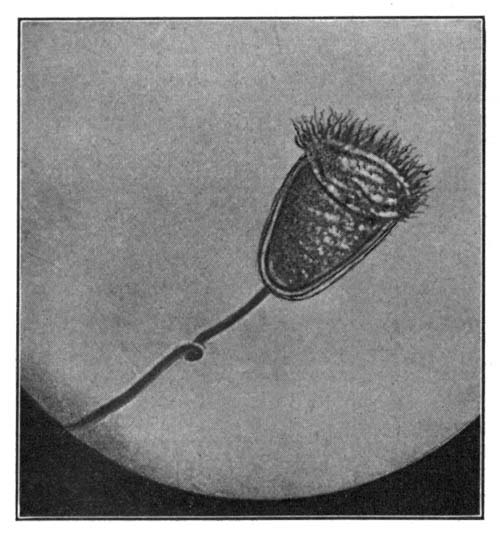
Photograph of a living vorticella, showing the contractile stalk and the cilia around the mouth. Compare this figure with that of the paramœcium. Which cell shows greater division of labor?
Physiological Division of Labor.—If we compare the amœba and the paramœcium, we find the latter a more complex organism than the former. An amœba may take in food through any part of the body; the paramœcium has a definite gullet; the amœba may use any part of the body for locomotion; the paramœcium has definite parts of the cell, the cilia, fitted for this work. Since the structure of the paramœcium is more complex, we say that it is a "higher" animal. In the vorticella, a still more complex cell, part of the cell has grown out like a stalk, has become contractile, and acts like muscle.
As we look higher in the scale of life, we invariably find that certain parts of a plant or animal are set apart to do certain work, and only that work. Just as in a community of people, there are some men who do rough manual work, others who are skilled workmen, some who are shopkeepers, and still others who are professional men, so among plants and animals, wherever collections of cells live together to form an organism, there is division of labor, some cells being fitted to do one kind of work, while others are fitted to do work of another sort. This is called physiological division of labor.
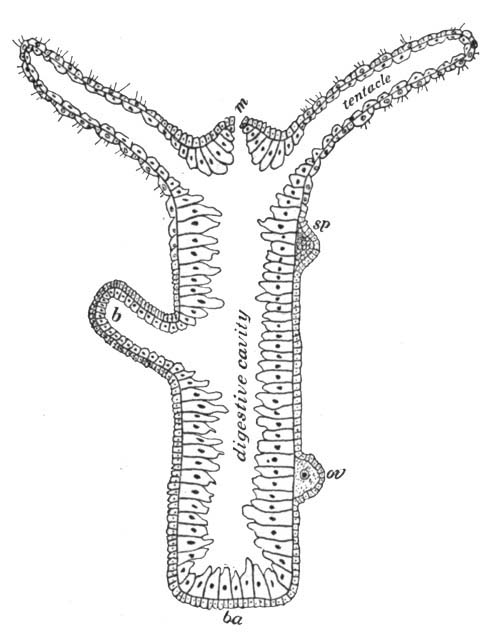
Enlarged lengthwise section of the hydra, a very simple animal which shows slight division of labor. ba, base; b, bud; m, mouth; ov, ovary; sp, spermary.
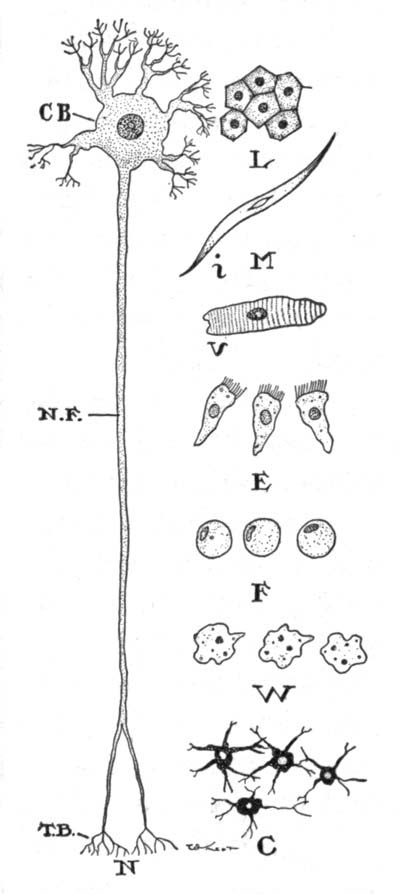
Different forms of tissue cells. C, bone making cells; E, epithelial cells; F, fat cells; L, liver cells;M, muscle cell; i, involuntary; v, voluntary; N, nerve cell; C B, cell body; N.F., nerve fiber; T.B., nerve endings; W, colorless blood cells.
As we have seen, the higher plants are made up of a vast number of cells of many kinds. Collections of cells alike in structure and performing the same function we have called a tissue. Examples of animal tissues are the highly contractile cells set apart for movement, muscles; those which cover the body or line the inner parts of organs, the skin, or epithelium; the cells which form secretions or glands and the sensitive cells forming the nervous tissues.
Frequently several tissues have certain functions to perform in conjunction with one another. The arm of the human body performs movement. To do this, several tissues, as muscles, nerves, and bones, must act together. A collection of tissues performing certain work we call an organ.
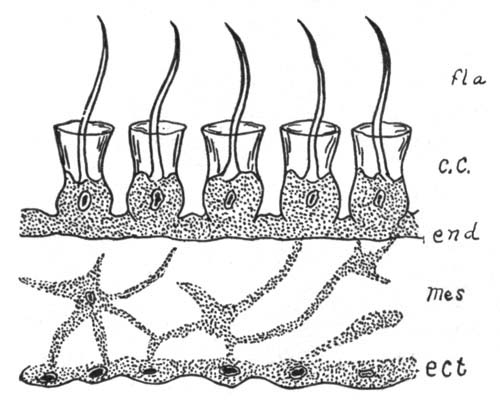
Part of a sponge, showing how cells perform division of labor. ect, ectoderm; mes, mesoderm; end, endoderm; c.c., ciliated cells, which take in food by means of their flagellæ or large cilia (fla).
In a simple animal like a sponge, division of labor occurs between the cells; some cells which line the pores leading inward create a current of water, and feed upon the minute organisms which come within reach, other cells build the skeleton of the sponge, and still others become eggs or sperms. In higher animals more complicated in structure and in which the tissues are found working together to form organs, division of labor is much more highly specialized. In the human arm, an organ fitted for certain movements, think of the number of tissues and the complicated actions which are possible. The most extreme division of labor is seen in the organism which has the most complex actions to perform and whose organs are fitted for such work, for there the cells or tissues which do the particular work do it quickly and very well.
In our daily life in a town or city we see division of labor between individuals. Such division of labor may occur among other animals, as, for example, bees or ants. But it is seen at its highest in a great city or in a large business or industry. In the stockyards of Chicago, division of labor has resulted in certain men performing but a single movement during their entire day's work, but this movement repeated so many times in a day has resulted in wonderful accuracy and speed. Thus division of labor obtains its end.
Organs and Functions Common to All Animals.—The same general functions performed by a single cell are performed by a many-celled animal. But in the many-celled animals the various functions of the single cell are taken up by the organs. In a complex organism, like man, the organs and the functions they perform may be briefly given as follows:—
(1) The organs of food taking: food may be taken in by individual cells, as those lining the pores of the sponge, or definite parts of a food tube may be set apart for this purpose, as the mouth and parts which place food in the mouth.
(2) The organs of digestion: the food tube and collections of cells which form the glands connected with it. The enzymes in the fluids secreted by the latter change the foods from a solid form (usually insoluble) to that of a fluid. Such fluid may then pass by osmosis, through the walls of the food tube into the blood.
(3) The organs of circulation: the tubes through which the blood, bearing its organic foods and oxygen, reaches the tissues of the body. In simple animals, as the sponge and hydra, no such organs are needed, the fluid food passing from cell to cell by osmosis.
(4) The organs of respiration: the organs in which the blood receives oxygen and gives up carbon dioxide. The outer layer of the body serves this purpose in very simple animals; gills or lungs are developed in more complex animals.
(5) The organs of excretion: such as the kidneys and skin, which pass off nitrogenous and other waste matters from the body.
(6) The organs of locomotion: muscles and their attachments and connectives; namely, tendons, ligaments, and bones.
(7) The organs of nervous control: the central nervous system, which has control of coördinated movement. This consists of scattered cells in low forms of life; such cells are collected into groups and connected with each other in higher animals.
(8) The organs of sense: collections of cells having to do with the reception and transmission of sight, hearing, smell, taste, touch, pressure, and temperature sensations.
(9) The organs of reproduction: the sperm and egg-forming organs.
Almost all animals have the functions mentioned above. In most, the various organs mentioned are more or less developed, although in the simpler forms of animal life some of the organs mentioned above are either very poorly developed or entirely lacking. But in the so-called "higher" animals each of the above-named functions is assigned to a certain organ or group of organs. The work is done better and more quickly than in the "lower" animals. Division of labor is thus a guide in helping us to determine the place of animals in the groups that exist on the earth.
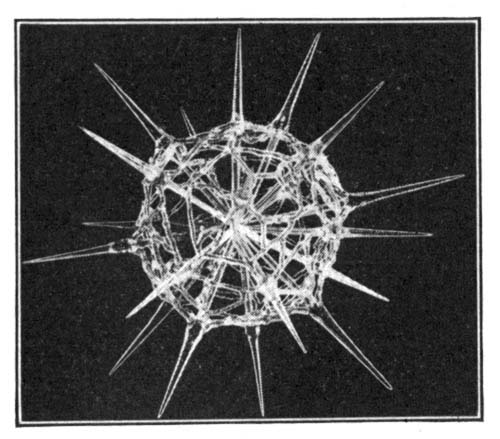
The glasslike skeleton of a radiolarian, a protozoan. (From model at American Museum of Natural History.)
The Animal Series.—We have found that a one-celled animal can perform certain functions in a rather crude manner. Man can perform these same functions in an extremely efficient manner. Division of labor is well worked out, extreme complexity of structure is seen. Between these two extremes are a great many groups of animals which can be arranged more or less as a series, showing the gradual evolution or development of life on the earth. It will be the purpose of the following pages to show the chief characteristics of the great groups of the animal kingdom.
I. Protozoa.—Animals composed of a single cell, reproducing by cell division.
The following are the principal classes of Protozoa, examples of which we may have seen or read about:—
Class I. Rhizopoda (Greek for root-footed). Having no fixed form, with pseudopodia. Either naked as Amœba or building limy (Foraminifera) or glasslike skeletons (Radiolaria).
Class II. Infusoria (in infusions). Usually active ciliated Protozoa. Examples, Paramœcium, Vorticella.
Class III. Sporozoa (spore animals). Parasitic and usually nonactive. Example, Plasmodium malariæ.
II. Sponges.—Because the body contains many pores through which water bearing food particles enters, these animals are called Porifera. They are classed according to the skeleton they possess into limy, glasslike, and horny fiber sponges. The latter are the sponges of commerce. With but few exceptions sponges live in salt water and are never free swimming.
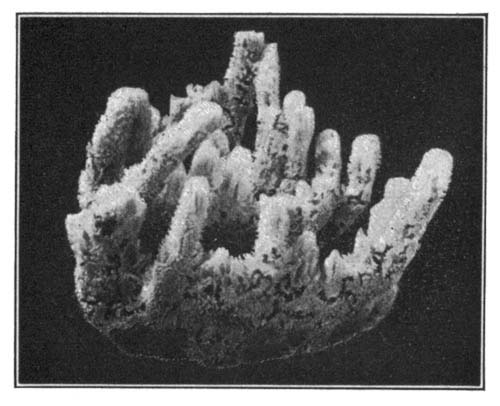
A horny fiber sponge. Notice that it is a colony. One fourth natural size.
III. Cœlenterates.—The hydra and its salt-water allies, the jellyfish, hydroids, and corals, belong to a group of animals known as the Cœlenterata. The word "cœlenterate" (cœlom = body cavity, enteron = food tube) explains the structure of the group. They are animals in which the real body cavity is lacking, the animal in its simplest form being little more than a bag. Some examples are the hydra, shown on page 179, salt-water forms known as hydroids, colonial forms which have part of their life free swimming as jellyfish; sea anemones and coral polyps, tiny colonial hydra like forms which build a living or secreted covering.
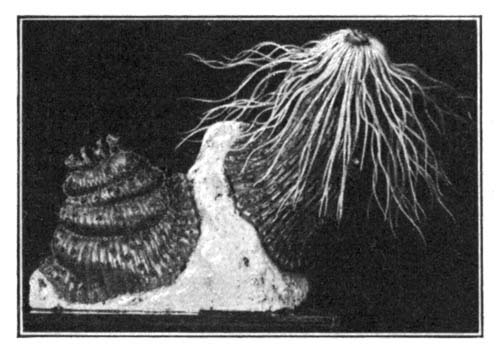
Sea anemones. One half natural size. The right hand specimen is expanded and shows the mouth surrounded by the tentacles. The left hand specimen is contracted. (From model at the American Museum of Natural History.)
IV. Worms.—The wormlike animals are grouped into flatworms, roundworms, and segmented or jointed worms.
(a) Flatworms are sometimes parasitic, examples being the tapeworm and liver fluke. They are usually small, ribbon- or leaf-like and flat and live in water.
(b) Roundworms, minute threadlike creatures, are not often seen by the city girl or boy. Vinegar eels, the horsehair worm, the pork worm or trichina and the dread hookworm are examples.
(c) Segmented worms are long, jointed creatures composed of body rings or segments. Examples are the earthworm, the sandworm (known to New York boys as the fishworm), and the leeches or bloodsuckers.
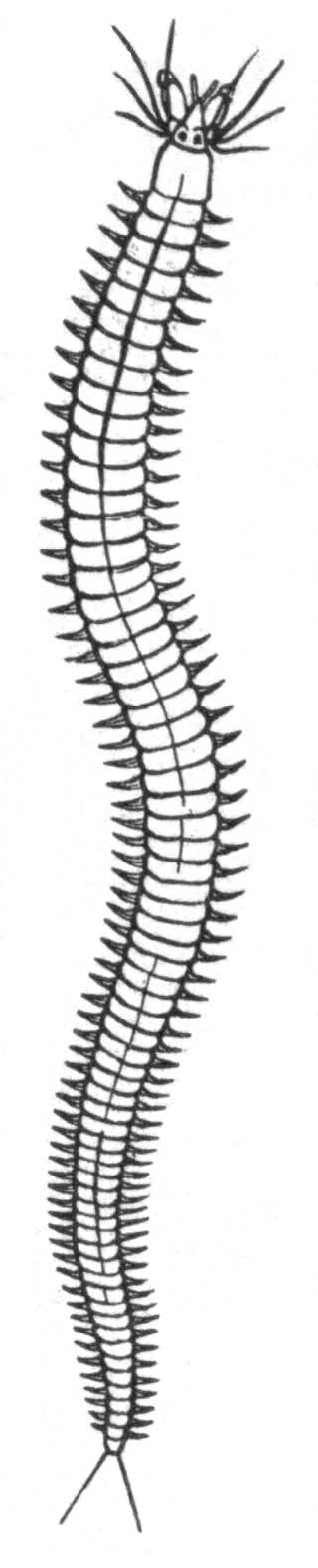
A jointed worm. The sandworm. Slightly reduced.
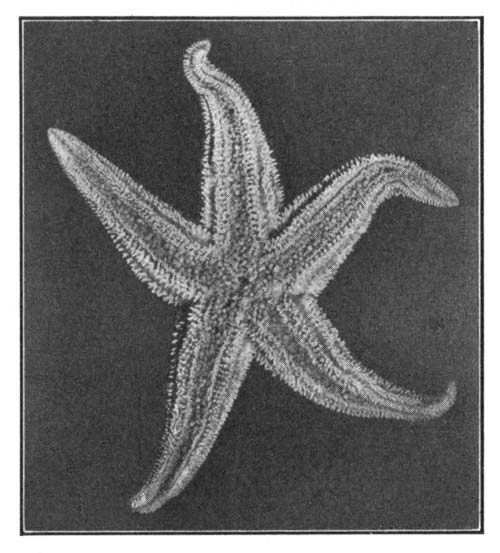
The common starfish seen from below to show the tube feet. About one half natural size.
V. Echinoderms.—These are spiny-skinned animals, which live in salt water. They are still more complicated in structure than the worms and may be known by the spines in their skin. They show radial symmetry. Starfish or sea urchins are examples.
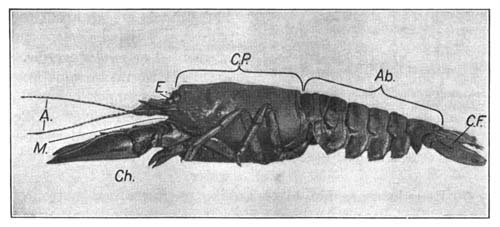
The crayfish, a crustacean. A, antenna; M, mouth; E, compound stalked eye; Ch, pincher claw; C.P., cephalothorax; Ab, abdomen; C.F., caudal fin. A little reduced.
VI. Arthropods.—These animals are distinguished by having jointed body and legs. They form two great groups. The higher forms of the Crustacea have only two regions in the body, a fused head and thorax, called the cephalothorax, and an abdominal region. A second group is the Insecta, of which we know something already. Crustacea breathe by means of gills, which are structures for taking oxygen out of the water, while adult insects breathe through air tubes called trachea.
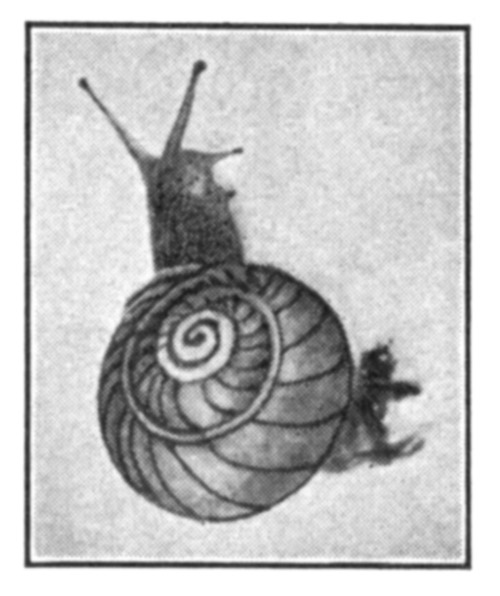
A common snail, a mollusk. (From a photograph by Davison.)
Two smaller groups of arthropods also exist, the Arachnida, consisting of spiders, scorpions, ticks, and mites, and the Myriapoda, examples being the "thousand leggers" found in some city houses.