Chapter XX · —HISTORY. (continued 6)
Reading edition
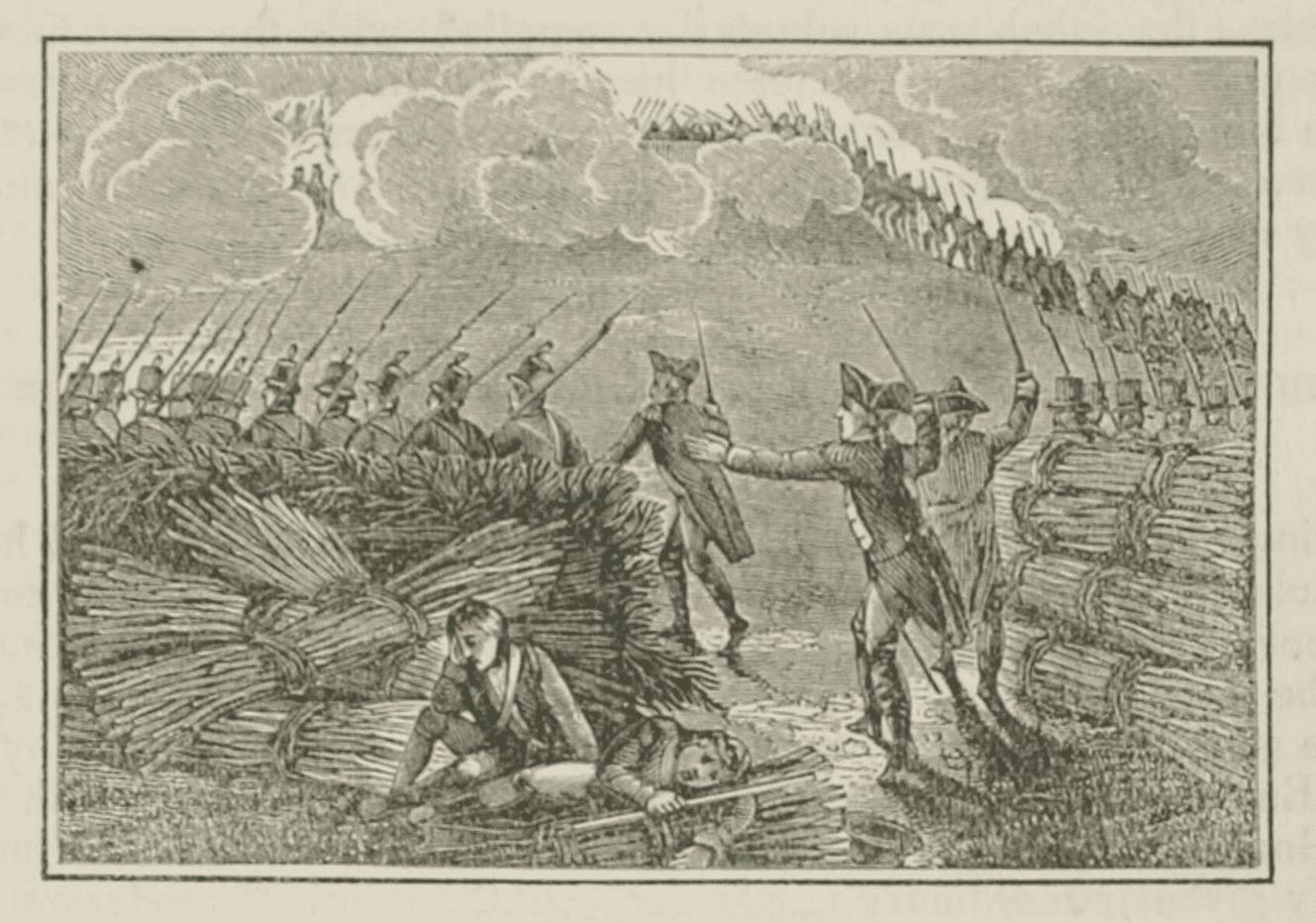
Capture of Stony Point.
On the approach of the inclement season, the American army built themselves huts for winter quarters. Positions were chosen most favorable for the defence of the most important posts, and for covering the country. The army was formed into two divisions; one of these erected huts near West Point, and the other at Morristown, in New Jersey. The head-quarters of the commander-in-chief were with the last division. Great distress was felt this winter on account of the deranged state of the American finances. General Green and colonel Wadsworth, gentlemen in every respect qualified for the duties of their respective stations, were yet at the head of the quarter-master and commissary departments, but the credit of the country was fallen, they had not the means to make prompt payment for articles of supply; and they found it impossible to lay up large magazines of provisions, and extremely difficult to obtain supplies to satisfy the temporary wants of the army. Large sums had been annually raised and expended, and the ability of the people to pay taxes had progressively decreased. To supply deficiencies, paper money, to the amount of about a hundred and fifty millions of dollars, had been issued; but this was depreciated, and at the close of 1779 thirty dollars in paper were of no more value than one in specie. To purchase provisions with this money was therefore first difficult and then impossible, and congress now found their funds and their credit exhausted. Before the month of January expired, the soldiers were put upon allowance, and before its close the whole stock of provision in store was exhausted, and there was neither meat nor flour to be distributed to the troops. To prevent the dissolution of the army, the commander-in-chief was reluctantly driven to very vigorous measures: he apportioned to each county in the state of New Jersey a quantity of meat and flour, according to the ability of each, to be brought into camp in the course of six days. At the same time he wrote to the magistrates, stating the absolute necessity of the measure, and informing them, that unless the inhabitants voluntarily complied with the requisition, the exigency of the case would force him to obtain it by military exaction. To the honor of the inhabitants of New Jersey, harassed as their country had been, the full quantity of provisions required was cheerfully and seasonably afforded.
FROM THE CAMPAIGN OF 1780 TO THE TERMINATION OF THE WAR OF THE REVOLUTION.
During the year 1780, the contest between Great Britain and her ancient colonies was carried on chiefly in the southern states. As soon as Sir Henry Clinton ascertained that count D’Estaing had left the American coast, he hastened to despatch an expedition against South Carolina, leaving the garrison at New York under the command of general Knyphausen. Early in February the troops landed within thirty miles of the capital. Governor Rutledge, to whom the assembly of South Carolina had recently given extraordinary powers, ordered the militia to rendezvous; but the repulse at Savannah, at the close of the preceding campaign, had produced such a dispiriting effect, that but few complied. The defences of Charleston consisted of a chain of redoubts, lines, and batteries, extending from Ashley to Cooper river, on which were mounted upwards of eighty pieces of artillery; and on all sides of the town where a landing was practicable, batteries were erected and covered with artillery. General Lincoln, trusting to these defences and expecting large reinforcements, remained in Charleston at the earnest request of the inhabitants, and, with the force under his command, resolved to defend the place.
On the 21st of March the British fleet crossed the bar, and anchored in Five Fathom Hole. Commodore Whipple, who commanded the American vessels, finding it impracticable to prevent the enemy from passing over the bar, fell back to fort Moultrie, and afterwards to Charleston. In a few days the town was invested by sea and land, and the British commanders summoned general Lincoln to surrender; the demand was, however, met with a firm refusal. The batteries of the first parallel were now opened upon the town, and soon made a visible impression; and to prevent the reception of the reinforcements which general Lincoln expected, Sir Henry Clinton detached lieutenant-colonel Webster with fourteen hundred men by the advanced guard of which detachment the American cavalry, with the militia attached to them, were surprised in the night of the 14th of April, and completely routed and dispersed. The British now extended themselves to the eastward of Cooper river; and about this time Sir Henry Clinton received a reinforcement of three thousand men from New York. The garrison having no reasonable hope of effecting a retreat, an offer was made of surrendering the town; but the proposed conditions were rejected by the British commanders.
The besiegers in the mean time were daily advancing their works, and had now completed their third parallel; the garrison of fort Moultrie surrendered; and the broken remains of the American cavalry under colonel White were again surprised by colonel Tarleton, and the whole either killed, taken, or dispersed. Sir Henry Clinton, thus successful in every operation, renewed his former offers to the garrison in case of their surrender, but the terms, so far as they respected the citizens, not being satisfactory, hostilities recommenced. The batteries of the third parallel now opened on the town, and did great execution; several houses were burned; numbers of the besieged were killed at their guns; and the British prepared to make a general assault by land and water. At length a great number of citizens of Charleston addressed general Lincoln in a petition, requesting his acceptance of the terms which had been previously offered. A capitulation was consequently signed on the 12th of May, and the next day major-general Leslie took possession of the town.135
The capital having surrendered, measures were adopted to overawe the inhabitants of the country, and induce them to return to their allegiance to the king. Garrisons were placed in different parts of the state, and two thousand men were despatched towards North Carolina, to repel several parties of militia, who were hastening to the relief of Charleston. Colonel Tarleton, making a rapid march of a hundred and five miles in fifty-four hours, met, at the Waxhaws, and attacked one of these parties, commanded by colonel Buford. The Americans, being defeated by his superior forces, implored quarter; but nearly the whole of them were either killed or too badly wounded to be removed from the field. This sanguinary conduct spread dismay throughout the country, and imparted a similar character to future conflicts.
Indignant at the treatment they received, great numbers of the inhabitants seized their arms, and resolved on a vindictive war with their invaders. A party who had taken refuge in North Carolina, chose colonel Sumpter their leader. At the head of these he returned to his own state, attacked and defeated several scattered detachments from the British army; and by a succession of gallant enterprises he kept alive a spirit of determined hostility to Great Britain in every part of the state. His exertions were rendered the more effective by the approach of four thousand men, principally continentals, under the command of general Gates. Lord Cornwallis, whom Sir Henry Clinton, on his return to New York, had left chief in command, hastened to oppose the conqueror of Burgoyne. On the night of the 15th of August he marched, with his whole force, to attack the Americans in their camp at Clermont. They at the same hour began to move towards Camden, where lord Cornwallis had his head-quarters. As the two armies were marching on the same road, in opposite directions, their advanced guards met and fired on each other about half-past two in the morning. From some prisoners made on both sides, the commanders learned each other’s movements.
Both armies halted, and were formed, and the firing soon ceased, as if by mutual consent. The ground on which the two armies thus accidentally met, was exceedingly favorable to lord Cornwallis. A swamp on each side secured his flanks, and narrowed the ground in front, so as to render the superiority of the Americans in numbers of less consequence. In the morning a severe and general action was fought. The charge of the British was made with such vigor, that the Virginia militia threw down their arms, and fled with the utmost precipitation; and the greatest part of the North Carolina militia soon followed their example. The American reserve was now brought into action, and general Gates, in conjunction with general Caswell, endeavored to rally the militia at advantageous passes in the rear of the field of action, but in vain. On the left and in the centre the contest was more obstinately maintained by the Americans, whose artillery did considerable execution; but by the flight of the militia their left flank was exposed, and the continentals, after a brave resistance of nearly three-quarters of an hour, were thrown into confusion, and forced to give way. The Americans lost the whole of their artillery, the greatest part of their baggage, several hundred men, and some very valuable officers; the loss of the British was also severe.
Sumpter, who had lately been victorious in a skirmish, retreated precipitately on hearing of the defeat of Gates; but supposing he was beyond danger, he halted at the Catawba ford to refresh his troops. Here his sentinels unhappily slept at their posts, and Tarleton’s legion rode into his camp before preparations could be made for defence. Between three and four hundred were killed or wounded. The remainder were dispersed in the woods, three hundred British prisoners were released, and all the baggage and stores fell into the power of the victors.
Apprehending the state to be subdued, Cornwallis adopted measures of extreme severity to suppress every latent inclination to revolt. He directed that all who, having once submitted, had lately given aid to the armies of congress, should be deprived of their property and imprisoned; and that all who had once borne arms with the British, and afterwards joined the Americans, should suffer death. In consequence of these orders several were executed, and many were reduced to poverty and wretchedness. In these times of confusion and distress, the mischievous effects of slavery in facilitating the conquest of the country became apparent. As the slaves had no interest at stake, the subjugation of the state was a matter of no consequence to them. Instead of aiding in its defence, they, by a variety of means, threw the weight of their influence into the opposite scale.
Although his corps had been dispersed, general Sumpter speedily recollected a band of volunteers, and kept the field in South Carolina for three months, when there was no continental army in the state. Varying his position along the Evoree, Broad, and Tyger rivers, he had frequent skirmishes with the enemy, whom he incessantly harassed. In November, he was attacked at Broad river by major Wemys, commanding a corps of infantry and dragoons, but the British were defeated, and their commanding officer taken prisoner; and in a few days afterward he was attacked near Tyger river by colonel Tarleton, who, finding himself unable to dislodge the Americans, retreated with considerable loss, and left Sumpter in possession of the field. The zeal, activity, and bravery of this officer, at that trying period, procured him the thanks of congress and the applause of his country.
While the affairs of the south were in a state by no means encouraging to the cause of independence, the general army under the command of Washington was in a state of insufferable destitution, and of consequent mutiny. Two hundred millions of dollars in paper currency were at this time in circulation upon the credit of the United States. Congress had the preceding year solemnly pledged the faith of government not to issue more than this sum, and the national treasury was now empty. Congress, the head of the nation, had, therefore, no further command of the resources of the country. The power of taxation, and of every coercive measure of government, was vested in the state sovereignties, and a system which in its execution required the conjoint agency of thirteen sovereignties, was too complex for the prompt operations of a military body. In the course of the winter, forage had failed, and many of the horses attached to the army had died, or were rendered unfit for use. General Washington therefore struggled with almost insuperable difficulties in supplying the army. The pay of the officers also had now scarcely more than a nominal value; and the officers of whole lines belonging to some of the states, in a body, gave notice, that on a certain day they should resign their commissions, unless provision was made for their honorable support.
Congress possessed not the means to apply adequate remedies to these threatening evils. They passed a resolution, indeed, “That congress will make good to the line of the army, and to the independent corps thereof, the deficiencies of their original pay, which had been occasioned by the depreciation of the continental currency;” but the promise of future compensation from a country whose neglect was conceived to be the source of all their sufferings, they deemed a feeble basis of dependence, at the moment they were severely pressed by privations of every kind. Murmurs at length broke out into actual mutiny. Two of the Connecticut regiments paraded under arms, announcing their intention to return home, or by their arms to obtain subsistence; but by the spirited and prudent exertions of the officers, the ringleaders were secured, and the regiments brought back to their duty.
This disaffection was reported to New York, with the customary exaggerations of rumor. General Knyphausen, the commanding officer at that post, supposing the American citizens and soldiers ripe for revolt, passed over into New Jersey with five thousand men, to avail himself of favorable events; but the behavior of the Americans soon convinced him he had been deceived in the report of their disaffected disposition. The troops detached from the army to oppose his progress fought with obstinate bravery; and the inhabitants, seizing their arms with alacrity, emulated the spirit and persevering courage of the regular soldier. The general, finding he must encounter serious opposition, retreated to Elizabeth Point, opposite to Staten island. In the mean time, Sir Henry Clinton, returning with his victorious troops from Charleston, ordered a reinforcement to Knyphausen, who, with the whole body, advanced a second time towards Springfield. The British were now opposed by general Green with a considerable body of continental troops, and a severe action was fought, but the Americans were forced, by superior numbers, to retire. General Green took post with his troops on a range of hills, in the hope of being attacked; but the British, having burned the town, retreated, and the next day set out on their return to New York.
Late in the spring the marquis la Fayette returned from France with the pleasing intelligence that his government had resolved to assist the United States, by employing this year a respectable land and naval force in America. This grateful information reanimated the public mind, and gave a new stimulus to the activity of congress, and of the governments of the several states, that preparation might be made to co-operate with the French armament on its arrival. Vigorous measures were in consequence adopted by congress and by the states to recruit the army, to lay up magazines, and to enable the general to comply with the reasonable expectations of their allies; but the agency of different bodies was necessary to carry these public measures into effect, and their operation was dilatory.
Early in July the first division of French troops reached the American shore, consisting of between five and six thousand men, with a large train of battering and field artillery. These forces were commanded by count de Rochambeau, whose government had placed him under the command of general Washington. The count brought information that a second division would follow him as soon as transports could be fitted out to bring them. The principal French and American officers assiduously cultivated a mutual affection between the two armies; and the commander-in-chief recommended to the officers of the United States to ingraft on the American cockade a white relief, as an emblem of the alliance of the two powers. On the arrival of the French, the Americans were unprepared to act with them, nor did the American general know what force would ultimately be brought into the field; and before any thing could be effected, information was brought that the second armament destined for America was blocked up in the harbor of Brest, and would not this season reach the American continent. The flattering prospect of terminating the war by the conquest of the British posts in a moment vanished, and elevated views of brilliant success were succeeded by grievous disappointment.
In this season of difficulty, of embarrassment, and of gloom, a circumstance occurred which excited the deepest interest throughout both armies, and indeed in the breast of the inhabitants of all the states. The American army was stationed in the strong-holds of the high lands on both sides of the North river; and for the defence of this position, and to keep command of the river, a fortress had been built at West Point, which was deemed impregnable, and had acquired the appellation of the Gibraltar of America. Of this post general Arnold solicited the command, and general Washington, far from suspecting any sinister views in an officer who had been so zealous and active in the cause of his country, complied with the solicitation. Arnold had, however, no sooner become invested with the command, than he carried on a negotiation with Sir Henry Clinton, by which it was agreed, that he should make such a disposition of his forces, as would enable the British general effectually to surprise West Point. The agent employed in this negotiation was major André, adjutant-general of the British army; and to favor the communications, the Vulture, a British sloop of war, had been previously stationed in North river, as near Arnold’s posts as could be without exciting suspicion. On the night of the 21st of September a boat was sent from the shore to fetch major André, and Arnold met him at the beach, without the posts of both armies. Their business not being finished until it was too near morning for André to return to the Vulture, Arnold, telling him he must be concealed until the next night, conducted him within one of the American posts, where he continued with him the following day. The Vulture having in the mean time been compelled to alter her position, André could return to New York in no other way than by land; changing his uniform, therefore, which he had worn under a surtout, for a plain dress, he set out on horseback, under the name of John Anderson, with a passport, signed by Arnold, ‘to go to the lines of White Plains, or lower if he thought proper, he being on public business.’ When advanced a great part of the way, he was stopped by three of the New York militia, and several papers, containing exact returns of the state of the forces, ordnance, and defences at West Point, were found in his boots. The captors, disdaining a proffered bribe of a purse of gold and permanent provision and promotion, on condition of their conveying and accompanying him to New York, delivered him a prisoner to lieutenant-colonel Jameson, who commanded the outposts. André, with the incautious permission of Jameson, procured a letter to be sent to Arnold, informing him of his detention, which gave the traitor opportunity to escape on board the Vulture,136 in which he reached New York in safety. At this very hour Washington arrived on his return from a conference with the French general at Hartford. He repaired, without delay, to the fort of West Point, where, however, he could learn nothing of a decisive import. But some orders, issued by Arnold the day before, redoubled his suspicions; he returned to the quarters of the general, and at this instant Jameson’s messenger presented himself, and delivered the packet with which he was charged. Washington seemed for the moment overwhelmed by the discovery of a crime which ruined the fame of an American general, and wounded the honor of the American army. Those who were near him anxiously interrogated his looks in silence, which he broke by saying, ‘I thought that an officer of courage and ability, who had often shed his blood for his country, was entitled to confidence, and I gave him mine. I am convinced now, and for the rest of my life, that we should never trust those who are wanting in probity, whatever abilities they may possess. Arnold has betrayed us.’ Meanwhile, the precautions required by the occasion were everywhere taken. General Heath, a faithful and vigilant officer, was substituted for Arnold at West Point; the commanders of the other posts were admonished to be on their guard; Green, who had been invested with the command of the army during the absence of Washington, recalled within the forts the garrisons which the traitor had dispersed, and marched a strong division near to the lines. General Washington referred the case of André to the examination and decision of a board, consisting of fourteen officers, who founded their report on his own statements; they reported it as their unanimous opinion, ‘that major André ought to be considered as a spy, and that, agreeably to the laws and usages of nations, he should suffer death;’ and he was, in accordance with their sentence, hung as a spy.137
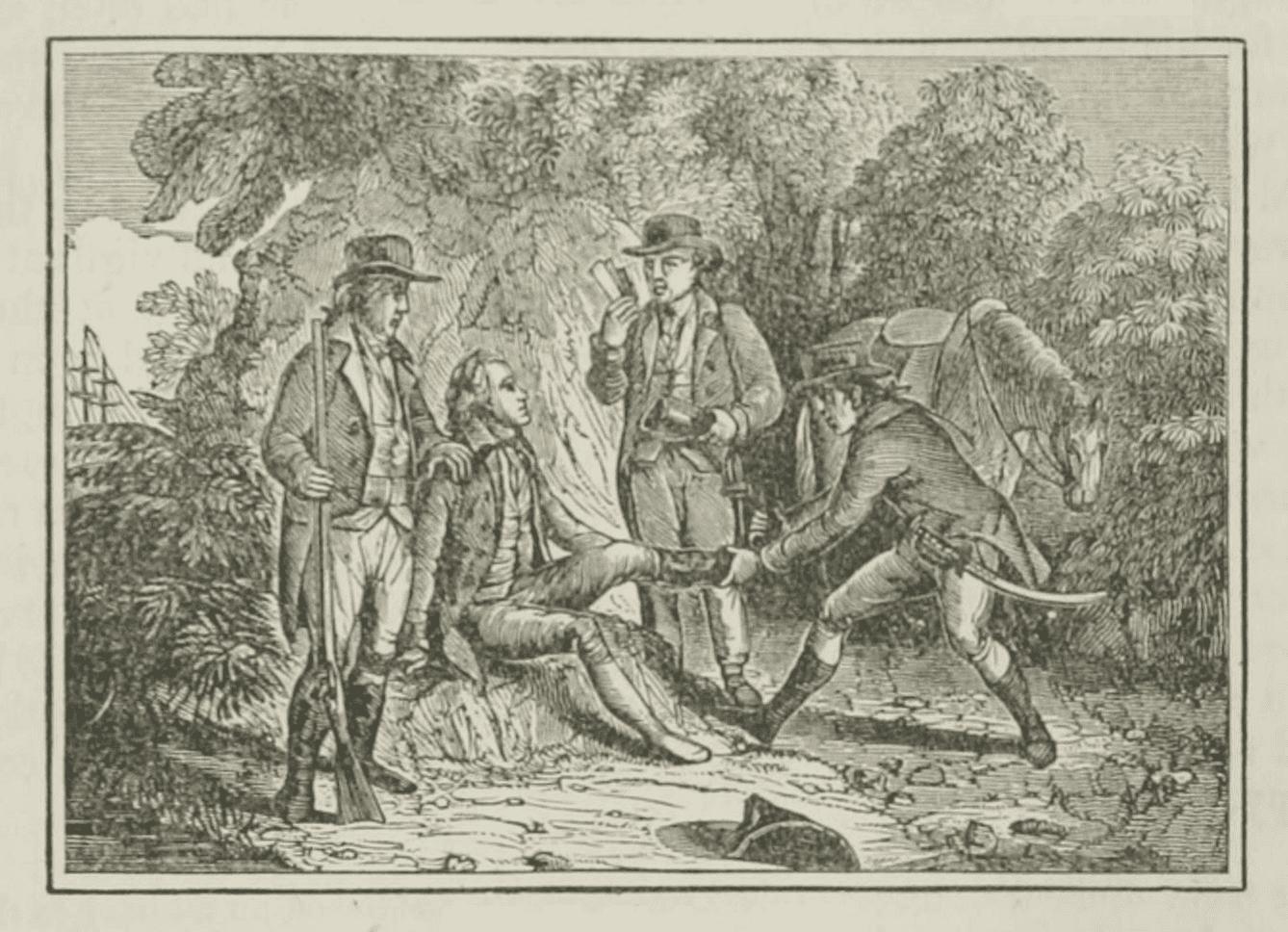
Capture of Major André.
When the winter of 1780 commenced, the troops of the northern army retired to the quarters which they had last occupied. Again they endured distress at which patriotism feels indignant and humanity weeps. The harvest had been abundant; plenty reigned in the land, while want was still felt in the camp of its defenders. Lassitude had succeeded enthusiasm in the breasts of the people, and congress exerted its powers with too little vigor to draw forth the resources of the country. The soldiers of the Pennsylvania line stationed at Morristown, New Jersey, complained that, in addition to sustaining sufferings common to all, they were retained in service contrary to the terms of their enlistments. In the night of the 1st of January, thirteen hundred, on a concerted signal, paraded under arms, and declared their intention of marching to Philadelphia, and demanding of congress a redress of their grievances. The officers strove to compel them to relinquish their purpose. In the attempt, one was killed and several were wounded. General Wayne presented his pistols, as if intending to fire. They held their bayonets to his breast; ‘We love and respect you,’ said they; ‘but if you fire you are a dead man. We are not going to the enemy. On the contrary, if they were now to come out, you should see us fight under your orders with as much alacrity as ever. But we will be amused no longer; we are determined to obtain what is our just due.’ They elected temporary officers, and moved off in a body towards Princeton. General Wayne, to prevent them from plundering the inhabitants, forwarded provisions for their use. The next day he followed, and requested them to appoint a man from each regiment, to state to him their complaints; a conference was accordingly held, but he refused to comply with their demands. They then proceeded in good order to Princeton, where three emissaries from Sir Henry Clinton met them, and made liberal offers to entice them from the service of congress. The offers were indignantly rejected, and the emissaries seized and executed as spies. Here they were also met by a committee of congress, and a deputation from the state of Pennsylvania; and the latter, granting a part of their demands, succeeded in persuading them to return to their duty. This mutiny, and another in the Jersey line, which was instantly suppressed, aroused the attention of the states to the miserable condition of their troops. The amount of three months’ pay was raised and forwarded to them in specie; it was received with joy, as affording an evidence that their country was not unmindful of their sufferings.
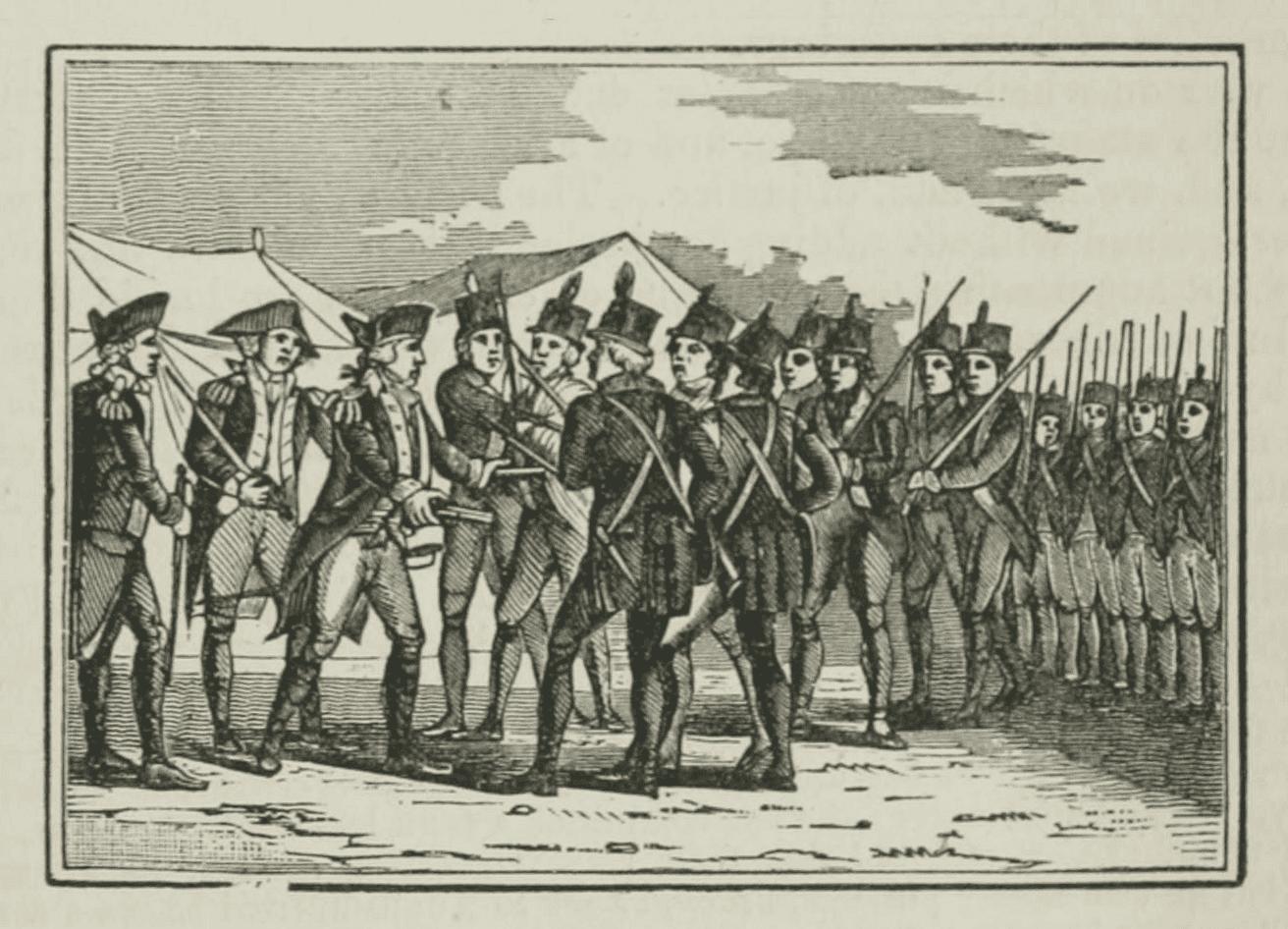
Mutiny.
The year on which we now enter decided the important contest which engaged the attention of Europe, and of all the civilized world, in favor of liberty, and, we must add, of justice. The boon of independence was not, however, gained without adding to the long list of widows and orphans, nor without augmenting the catalogue of cruelties more horrid than those of the Indian tribes, because perpetrated by those who had no accumulated antipathy of ages to palliate their hostility, but who only yesterday were friends and brothers. The inhabitants of the Carolinas endured calamity and distress from which humanity revolts. About equally divided in political sentiments, village was opposed to village, and neighbor to neighbor, and their hostility became embittered by attack and reprisal, until pillage, burning, and murder, became familiar to all.138 Each party aimed at the extirpation of the other, and the whole country presented a scene of slaughter and of blood. The American generals seized every occasion to discountenance such vindictive and barbarous conduct, while, with few exceptions, the British permitted and even accelerated their perpetration.
The reduction of Savannah and Charleston encouraged the British to a vigorous invasion of North Carolina. The whole army of general Green, which had at the close of last year advanced from Hillsborough to Charlottetown, consisted of about two thousand men, more than half of whom were militia. With this inconsiderable body of troops, miserably provided, general Green took the field against a superior regular force, which had already marched in triumph two hundred miles from the point of its debarkation. Soon after Green took the command, he divided his force, and sent general Morgan with a respectable detachment to the western extremity of South Carolina, where the tories were destroying the whigs without mercy and without restraint, and marched with the main body to Hick’s creek, on the north side of the Pedee. On the entrance of general Morgan into the district of Ninety-six, lord Cornwallis, who was preparing for the invasion of North Carolina, that he might not leave an enemy in his rear, ordered colonel Tarleton to proceed with about eleven hundred men, and drive him from his position. Tarleton had two field-pieces, and a superiority both of infantry and cavalry. With these advantages, he engaged Morgan at the Cowpens, near Pacolet river, on the 17th of January. The British, led to the attack by Tarleton himself, advanced with a shout, and poured in an incessant fire of musketry. The American militia, though they received the charge with firmness, were soon compelled to fall back in the rear of their second line; and this line, in its turn, after an obstinate conflict, was compelled to retreat to the cavalry. At this juncture lieutenant-colonel Washington made a successful charge on captain Ogilvie, who, with about forty dragoons, was cutting down the retreating militia; lieutenant-colonel Howard almost at the same moment rallied the continental troops, and charged with fixed bayonets, and the militia instantly followed the example. By these sudden and unexpected charges, the British, who had considered the fate of the day decided, were thrown into confusion, and driven from the ground with great slaughter. Howard and Washington pressed the advantage which they had respectively gained, until the artillery and a great part of the infantry had surrendered.139 Seldom has a victory, achieved by so small a number, been so important in its consequences. It deprived Cornwallis of one-fifth of his force, and disconcerted his plans for the reduction of North Carolina. He sought, however, to repair, by active exertions, the loss which he had suffered, and determined, if possible, to intercept Morgan, and compel him to restore the trophies of his victory. This resolution led to a military race, which maybe, without exaggeration, termed one of the most celebrated in history. Each army strove to precede the other at the fords of the Catawba, from which both were equally distant. The American troops endured almost incredible hardships, being sometimes without meat, often without flour, and entirely destitute of spirituous liquors. A large portion of the troops were without shoes, and, marching over frozen ground, marked with blood every step of their progress. On the twelfth day after the engagement, Morgan reached the fords and crossed the Catawba; and two hours afterwards Cornwallis arrived, and, it being then dark, encamped on the bank. During the night, a heavy fall of rain made the river impassable, which gave Morgan an opportunity to remove the prisoners beyond the reach of his pursuer.
The movements of the royal army induced general Green immediately to retreat from Hick’s creek; and, leaving the main army under the command of general Huger, he rode a hundred and fifty miles through the country to join the detachment under general Morgan, that he might be in front of lord Cornwallis, and so direct both divisions of his army as to form a speedy junction between them. Lord Cornwallis, after three days’ delay, effected the passage of the Catawba, and recommenced the pursuit. The Americans, continuing their expeditious movements, crossed the Yadkin on the 3d of February, and secured their boats on the north side; but the British, though close in their rear, were incapable of crossing it through the rapid rising of the river from preceding rains, and the want of boats. This second remarkable escape confirmed the impression on the minds of the Americans, that their cause was favored by Divine Providence. After a junction of the two divisions of the American army at Guildford court-house, it was concluded, in a council of officers called by general Green, that he ought to retire over the Dan, and to avoid an engagement until he should be reinforced.
Lord Cornwallis kept the upper countries, where only the rivers are fordable, and attempted to get between general Green and Virginia, to cut off his retreat, and oblige him to fight under many disadvantages; but the American general completely eluded him. So urgent was the pursuit of the British, that, on the 14th of February, the American light troops were compelled to retire above forty miles; and on that day general Green, by indefatigable exertions, transported his army over the Dan into Virginia. Here again the pursuit was so close, that the van of the British just arrived as the rear of the Americans had crossed. The continental army being now driven out of North Carolina, earl Cornwallis left the Dan, and proceeded to Hillsborough, where he set up the royal standard. Green, perceiving the necessity of some spirited measure to counteract his lordship’s influence on the inhabitants of the country, concluded, at every hazard, to recross the Dan. After manœuvring in a very masterly manner to avoid an action with Cornwallis three weeks, his army was joined by two brigades of militia from North Carolina, and one from Virginia, and also by four hundred regulars.
This reinforcement giving him a superiority of numbers, he determined no longer to avoid an engagement, and, on the 15th of March, he accepted battle; but at the first fire the North Carolina militia, who were in the front line, fled; the second line was also routed. The continentals, who composed the third, fought with their usual bravery, and for an hour and half maintained the conflict with great firmness. They at length gave way, but retreated in good order, the slaughter they had made in the enemy’s ranks preventing pursuit. The victory, won by a far inferior force, was more glorious than advantageous to the British army. Soon after the action, lord Cornwallis began a march toward Wilmington. General Green, on receiving intelligence of this movement, put his army in motion to follow him, and continued the pursuit to Ramsay’s mill, on Deep river. Cornwallis, having halted and refreshed his men about three weeks at Wilmington, marched across the country to Petersburg, in Virginia.
Before general Green was aware that lord Cornwallis intended to enter Virginia, he had formed the bold resolution of returning into South Carolina. Marching towards Camden, where nine hundred men, under the command of lord Rawdon, were posted, he took a position on Hobkirk’s hill, about a mile from the British intrenchments. Here the Americans were attacked on the 25th of April. In the beginning of the action their bravery gained advantages, which, in its progress, were lost by the premature retreat of two companies, occasioned by the death of their officers. At this reverse of fortune, Green retired a few miles from the field, both armies having sustained nearly an equal loss.
Several British posts in South Carolina speedily fell into the power of the brave and active partisans, who, with small bodies of troops, were ever present where oppression was to be resisted or glory won. Lee joined Marion; and, on the 15th of April, they unexpectedly presented themselves before fort Watson, a British post on the Santee. It was an Indian mound, rising thirty or forty feet above the level of the plain. Neither the garrison nor the assailants had artillery; but in a few days the Americans constructed a work on an unusual plan, which overlooked the fort, and from the top of which the riflemen fired with such unerring aim that not a man of the garrison could show himself without certain destruction. On the 23d, the garrison, consisting of one hundred and fourteen men, capitulated.
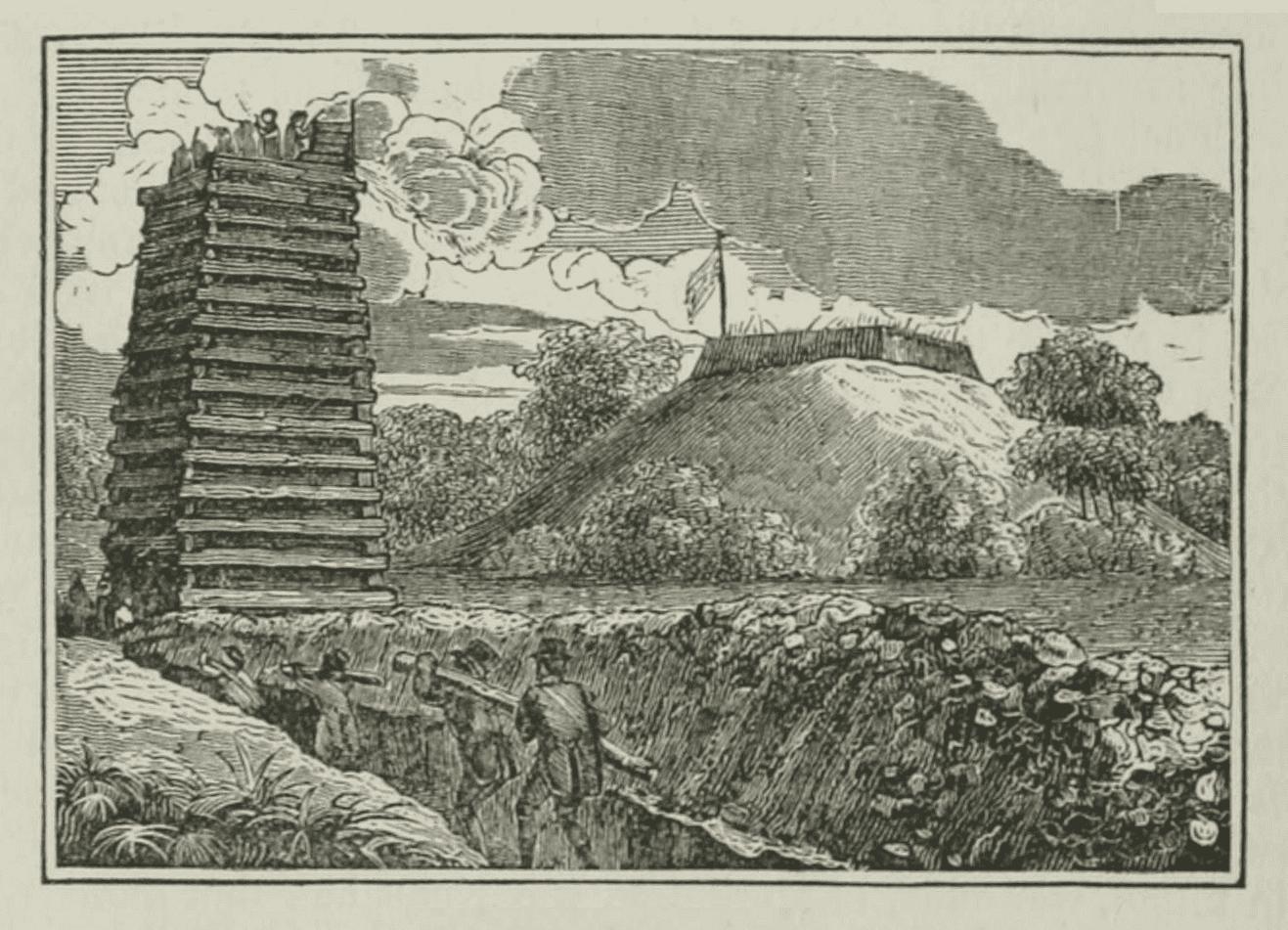
Attack on Fort Watson.
Orangeburg and fort Motte surrendered to Sumpter. Lee captured fort Granby, and Marion drove from Georgetown the troops stationed to defend it. Immediately after the surrender of fort Granby, lieutenant-colonel Lee marched to Augusta, and joined brigadier-general Pickens, who, with a body of militia, had some time before taken post in the vicinity; and these two able officers jointly carried on their approaches against fort Cornwallis. Two batteries were erected within thirty yards of the parapet which overlooked the fort; and from them the American riflemen shot into the inside of the works with effect. The garrison, almost entirely burying themselves underground, obstinately refused to capitulate until resistance became useless, and then the fort, with about three hundred men, surrendered on honorable terms of capitulation. The Americans, during the siege, had about forty men killed and wounded. On the 22d of May, general Green laid siege to Ninety-six, which was defended by lieutenant-colonel Cruger, with upwards of five hundred men. The works of the besiegers were carried forward with indefatigable industry and success until the 18th of June, when, on intelligence of the approach of lord Rawdon for the relief of the place, it was concluded to attempt its reduction by assault. The assailants displayed great resolution; but, failing of success, general Green raised the siege, and retreated over the Saluda.
Lord Rawdon having returned to England, the command of the British troops in South Carolina devolved upon lieutenant-colonel Stewart; who, in the beginning of September, took post at Eutaw Springs. General Green marched against him from the hills of Santee. The rival forces were equal, amounting on each side to two thousand men. On the 8th an attack was made by the Americans; a part of the British line, consisting of new troops, broke and fled; but the veteran corps received the charge of the assailants on the points of their bayonets. The hostile ranks were for a time intermingled, and the officers fought hand to hand; but lieutenant-colonel Lee, who had turned the British left flank, charging them at this instant in the rear, their line was soon completely broken, and driven off the field. They were vigorously pursued by the Americans, who took upwards of five hundred of them prisoners. The British, on their retreat, took post in a large three-story brick house, and in a picketed garden; and from these advantageous positions renewed the action. Four six-pounders were ordered up before the house; but the Americans were compelled to leave these pieces and retire. They formed again at a small distance in the woods; but general Green, thinking it inexpedient to renew the desperate attempt, left a strong picket on the field of battle, and retired with his prisoners to the ground from which he had marched in the morning. In the evening of the next day, lieutenant-colonel Stewart, leaving seventy of his wounded men and one thousand stand of arms, moved from Eutaw towards Charleston. The loss of the British, inclusive of prisoners, was supposed to be not less than eleven hundred men. The loss of the Americans, in killed, wounded, and missing, was about half that number. This battle was attended by consequences very advantageous to the Americans, and maybe considered as closing the revolutionary war in South Carolina.
Brilliant as were the successes of general Green in the Carolinas it was in Virginia that the last great stroke in favor of American independence was to be effected. The army under the commander-in-chief had passed another distressing winter, and symptoms of mutiny had again manifested themselves, but were happily suppressed. Deplorably deficient of provisions and supplies, and promised reinforcements being grievously delayed, Washington still remained undiscouraged, and determined, in conjunction with the French fleet, to resume vigorous operations. New York was the destined point of the combined attack; but the large reinforcements which had recently arrived there, and other unfavorable circumstances, induced the commander-in-chief, so late as August, entirely to change the plan of the campaign, and to resolve to attempt the capture of the army of lord Cornwallis, which had now taken up a position at Yorktown, in Virginia. The defence of West Point, and of the other posts on the Hudson, was committed to general Heath, and a large portion of the troops raised in the northern states was for this service left under his command.
General Washington resolved in person to conduct the Virginia expedition. The troops under count Rochambeau, and strong detachments from the American army, amounting to more than two thousand men, and consisting of the light infantry, Lamb’s artillery, and several other corps, were destined for it. By the 25th of August the whole body, American and French, had crossed the North river. An intercepted letter of general Washington’s, in which he communicated, as the result of a consultation with the French commanders, the design to attack New York, had excited the apprehensions of the British general for the safety of that city. This apprehension was kept alive, and the real object of the Americans concealed, by preparations for an encampment in New Jersey, opposite to Staten island, by the route of the American army, and other appearances, indicating an intention to besiege New York; and the troops had passed the Delaware, out of reach of annoyance, before Sir Henry suspected their destination. General Washington pressed forward with the utmost expedition, and at Chester he received the important intelligence that count de Grasse had arrived with his fleet in the Chesapeake, and that the marquis St. Simon had, with a body of three thousand land forces, joined the marquis de la Fayette. Having directed the route of his army from the head of the Elk, he, accompanied by Rochambeau, Chatelleux, Du Portail, and Knox, proceeded to Virginia. They reached Williamsburg on the 14th of September, and immediately repaired on board the Ville de Paris, to settle with count de Grasse the plan of operations. The whole body of American and French troops reached Williamsburg by the 25th of September. At this place the allied forces were joined by a detachment of the militia of Virginia, under the command of governor Nelson, and preparations were soon made to attack the intrenchments of lord Cornwallis.
Yorktown, the head-quarters of lord Cornwallis, is a village on the south side of York river, the southern banks of which are high, and where ships of the line may ride in safety. Gloucester point is a piece of land on the opposite shore, projecting considerably into the river. Both these posts were occupied by the British; and a communication between them was commanded by their batteries, and by several ships of war. The main body of lord Cornwallis’ army was encamped on the open grounds about Yorktown, within a range of outer redoubts and field-works; and lieutenant-colonel Tarleton, with a detachment of six or seven hundred men, held the post at Gloucester point.
The legion of the duke de Lauzun, and a brigade of militia under general Weedon, the whole commanded by the French general De Choisé, were directed to watch and restrain the enemy on the side of Gloucester; and the grand combined army, on the 30th of September, moved down to the investiture of Yorktown. On the night of the 6th of October, advancing to within six hundred yards of the English lines, they began their first parallel, and labored with such silence and diligence, that they were not discovered until morning, when the works they had raised were sufficient to protect them. On the 9th, several batteries being completed, a heavy cannonade was begun. Many of the British guns were dismounted, and portions of their fortifications laid level with the ground. On the night of the 11th, the besiegers commenced their second parallel, three hundred yards in advance of the first. This approach was made so much sooner than was expected, that the men were not discovered at their labor until they had rendered themselves secure from all molestation in front. The fire from the new batteries was still more furious and destructive. From two British redoubts, in advance of their main works, and flanking those of the besiegers, the men in the trenches were so severely annoyed, that Washington resolved to storm them.
The enterprise against one was committed to an American force under the marquis de la Fayette, that against the other to a French detachment. Colonel Hamilton, who led the van of the former, made such an impetuous attack that possession was soon obtained, with little slaughter. The French detachment was equally brave and successful, but sustained greater loss. On the 16th, a sortie was made from the garrison by a party of three hundred and fifty, commanded by lieutenant-colonel Abercrombie, who forced two batteries, and spiked eleven pieces of cannon; but the guards from the trenches immediately advancing on them, they retreated, and the pieces which they had hastily spiked were soon rendered fit for service. In the afternoon of the same day the besiegers opened several batteries in their second parallel; and in the whole line of batteries nearly one hundred pieces of heavy ordnance were now mounted. The works of the besieged were so universally in ruins as to be in no condition to sustain the fire which might be expected the next day. In this extremity, lord Cornwallis boldly resolved to attempt an escape by land with the greater part of his army. His plan was to cross over, in the night, to Gloucester point, and forcing his way through the troops under De Choisé, to pass through Maryland, Pennsylvania, and Jersey, and form a junction with the royal army at New York. In prosecution of this desperate design, one embarkation of his troops crossed over to the opposite point; but a violent storm of wind and rain dispersed the boats, and frustrated the scheme.
On the morning of the 17th the fire of the American batteries rendered the British post untenable. Lord Cornwallis, perceiving further resistance to be unavailing, about ten o’clock beat a parley, and proposed a cessation of hostilities for twenty-four hours, that commissioners might meet to settle the terms on which the posts of York and Gloucester should be surrendered. General Washington, in his answer, declared his ‘ardent desire to spare the effusion of blood, and his readiness to listen to such terms as were admissible;’ but to prevent loss of time, he desired ‘that, previous to the meeting of the commissioners, the proposals of his lordship might be transmitted in writing, for which purpose a suspension of hostilities for two hours should be granted.’ The terms proposed by his lordship were such as led the general to suppose that articles of capitulation might easily be adjusted, and he continued the cessation of hostilities until the next day. To expedite the business, he summarily stated the terms he was willing to grant, and informed earl Cornwallis, that if he admitted these as the basis of a treaty, commissioners might meet to put them into form. Accordingly, viscount de Noailles and lieutenant-colonel Laurens, on the part of the allies, and colonel Dundas and major Ross, on the part of the English, met the next day, and adjusted articles of capitulation, which were to be submitted to the consideration of the British general.
Resolving not to expose himself to any accident that might be the consequence of unnecessary delay, general Washington ordered the rough draft of the commissioners to be fairly transcribed, and sent to lord Cornwallis early next morning, with a letter expressing his expectation that the garrison would march out by two o’clock in the afternoon. Hopeless of more favorable terms, his lordship signed the capitulation, and surrendered the posts of York and Gloucester, with their garrisons, to general Washington; and the shipping in the harbor, with the seamen, to count de Grasse. The prisoners, exclusive of seamen, amounted to more than seven thousand, of which between four and five thousand only were fit for duty. The garrison lost, during the siege, six officers and five hundred and forty-eight privates, in killed and wounded. The privates, with a competent number of officers, were to remain in Virginia, Maryland, or Pennsylvania. The officers not required for this service were permitted on parole to return to Europe, or to any of the maritime posts of the English on the American continent. The terms granted to earl Cornwallis were, in general, the terms which had been granted to the Americans at the surrender of Charleston; and general Lincoln, who on that occasion resigned his sword to lord Cornwallis, was appointed to receive the submission of the royal army. The allied army, to which lord Cornwallis surrendered, amounted to sixteen thousand;—seven thousand French, five thousand five hundred continental troops, and three thousand five hundred militia. In the course of the siege they lost, in killed and wounded, about three hundred. The siege was prosecuted with so much military judgment and ardor, that the treaty was opened on the eleventh, and the capitulation signed on the thirteenth day after ground was broken before the British lines.
The capture of so large a British army excited universal joy, and on no occasion during the war did the Americans manifest greater exultation. From the nature and duration of the contest, the affections of many had been so concentrated upon their country, and so intense was their interest in its fate, that the news of this brilliant success produced the most rapturous emotions, under the operations of which, it is said, some were even deprived of their reason, and one aged patriot in Philadelphia expired.
The day after the capitulation general Washington ordered, ‘that those who were under arrest should be pardoned and set at liberty;’ and announced, that ‘divine service shall be performed to-morrow in the different brigades and divisions. The commander-in-chief recommends, that all the troops that are not upon duty do assist at it with a serious deportment, and that sensibility of heart which the recollection of the surprising and particular interposition of Providence in our favor claims.’ Congress, as soon as they received general Washington’s official letter giving information of the event, resolved to go in procession to the Dutch Lutheran church, and return thanks to Almighty God for the signal success of the American arms; and they issued a proclamation, recommending to the citizens of the United States to observe the 13th of December as a day of public thanksgiving and prayer.
While these successful operations had been carrying on in Virginia, Sir Henry Clinton endeavored, if possible, to recall Washington, or at least to divert his attention, by some daring enterprise in the north. Giving to the traitor Arnold, who had just returned from his destructive expedition to Virginia, the command of a strong detachment, he sent him against New London, a flourishing city situated upon the river Thames, in his native state. Nearly opposite, on a hill in Groton, stood fort Griswold, which was then garrisoned by militia, hastily summoned from their labors in the field. Against this fort Arnold despatched a part of his troops. It was assaulted on three sides at the same moment. The garrison, fighting in view of their property and their homes, made a brave and obstinate resistance. By their steady and well-directed fire many of the assailants were killed. Pressing forward with persevering ardor, the British entered the fort through the embrasures. Immediately all resistance ceased. Irritated by gallantry which should have caused admiration, a British officer inquired who commanded the fort. ‘I did,’ said colonel Ledyard, ‘but you do now;’ and presented him his sword. He seized it, and, with savage cruelty, plunged it into his bosom. This was the signal for an indiscriminate massacre. Of a hundred and sixty men, composing the garrison, all but forty were killed or wounded, and most of them after resistance had ceased. Seldom has the glory of victory been tarnished by such detestable barbarity. The British then entered New London, which was set on fire and consumed. The property destroyed was of immense value. Perceiving no other object within the reach of his force, Arnold led back his troops to New York.
A circumstance which evidently exercised a very favorable influence on American affairs during this period should not be omitted—the institution of a national bank. The plan of it was projected by Robert Morris, one of the delegates of Pennsylvania, a man of high reputation, and well versed in affairs of commerce and finance, whom congress had appointed treasurer. He assigned to this bank a capital of four hundred thousand dollars, divided in shares of four hundred dollars each, in money of gold or silver, to be procured by subscriptions. Twelve directors were to manage the bank, which was denominated by congress, ‘The President, Directors, and Company of the Bank of North America.’ To the financial skill and indefatigable efforts of Mr. Morris in the treasury department, it has been thought our country was scarcely less indebted, than to the valor of her soldiers and the wisdom of her statesmen. Under his auspices, public credit revived; the army was pacified; and a new impulse given to every operation in the field and the cabinet.
During this fortunate year also the compact of the confederation was rendered complete. Much difficulty had been experienced in obtaining its ratification. Various and sometimes conflicting amendments had been proposed by the states respectively; but they had successively yielded to the opinion that a federal compact would be of vast importance in the prosecution of the war. One of the greatest impediments had hitherto been, that within the chartered limits of several states there were immense tracts of vacant territory, which, it was supposed, would constitute a large fund of future wealth; and the states not possessed of this advantage insisted on considering this territory as a joint acquisition, to be applied to the common benefit. The cession made by Virginia, the preceding year, of its north-west territory, was now accepted by congress, and, to the great joy of America, the confederation was completed.140
The result of the last campaign convinced the British nation that America could not be subdued by force; and led to a change of administration and pacific overtures. Parliament met on the 27th of November, 1781; and though the speech from the throne still breathed a spirit of hostility, and answers from both houses were procured in accordance with it, yet not long after the recess, the ministers found themselves in a minority in the house of commons. On the 22d of February, 1782, general Conway moved an address to the king, praying, ‘that the war on the continent of North America might no longer be pursued for the impracticable purpose of reducing that country to obedience by force; and expressing their hope, that the earnest desire and diligent exertion to restore the public tranquillity, of which they had received his majesty’s most gracious assurances, might, by a happy reconciliation with the revolted colonies, be forwarded and made effectual; to which great end his majesty’s faithful commons would be ready to give their utmost assistance.’ This motion being lost by a single vote only, was, five days after, renewed, by the same gentleman, in a form somewhat different, and was carried; and an address in pursuance of it presented to the king. Not yet satisfied with the triumph obtained over the ministry, and considering the answer of the king not sufficiently explicit, the house of commons, on the 4th of March, on the motion of general Conway, declared, that all those who should advise, or by any means attempt, the farther prosecution of offensive war in America, should be considered as enemies to their king and country. In this state of things it was impossible for the ministry longer to continue in power, and on the 19th they relinquished their places. A new administration was soon after formed—the marquis of Rockingham was placed at the head of the treasury, and the earl of Shelburne and Mr. Fox held the important places of secretaries of state.
Soon after their appointment, the new ministers sent a Mr. Oswald to France, to sound the French court, as well as Dr. Franklin, on the subject of peace. In a conference with the count de Vergennes, Mr. Oswald was informed that the French court were disposed to treat for peace, but could do nothing without the consent of their allies; and the count expressed a wish that Paris might be the place of meeting for entering upon this important business. About the 18th of April the British agent went back to London, and on the 4th of May returned to France with the assent of the British cabinet to treat of a general peace, and for that purpose to meet at Paris.
One of the first measures of the new administration was to appoint Sir Guy Carleton commander-in-chief in America, in the room of Sir Henry Clinton, and to authorize admiral Digby and himself to treat for peace. One object of conferring this power was to induce congress to agree to a separate treaty. Sir Guy Carleton arrived in America on the 5th of May, and two days afterwards informed general Washington that he and admiral Digby were authorized to treat for peace, and requested a passport for their secretary as the bearer of despatches to congress on the subject. A copy of this letter was forwarded by the general to that body; but the members being determined not to negotiate without their allies, refused the passport. The same commissioners, on the 2d of August following, sent a second letter to the American commander, informing him that negotiations for a general peace had commenced at Paris, and that Mr. Grenville had full powers to treat with all the parties at war, and that, by his instructions, ‘the independency of the thirteen provinces was to be proposed by him, in the first instance, instead of being made a condition of a general treaty.’
A majority of the new British cabinet very early determined to offer America unlimited unconditional independence, as the basis of a negotiation for peace, and so instructed their minister, Mr. Grenville. This was a favorite measure with the marquis of Rockingham; on this point, however, the cabinet was divided. The earl of Shelburne, though he acquiesced, was still opposed, and it was one of the last measures to which the king would assent. The illness of the marquis of Rockingham, and his death, which happened on the 1st of July, produced no little delay and difficulty in the negotiations. The appointment of lord Shelburne as first lord of the treasury produced an open rupture in the cabinet. Lord John Cavendish, Mr. Fox, and some others, resigned their places. In consequence of this, William Pitt was made chancellor of the exchequer, and Thomas Townshend and lord Grantham secretaries of state. There can be little doubt that the king, as well as lord Shelburne, still entertained a distant hope that some arrangement might be made with the Americans short of an open and express acknowledgment of their independence; and the views of the latter on this point, probably, had no little influence in placing him at the head of the administration.141 Parliament adjourned on the 11th of July, having passed an act at the close of the session, authorizing the king to conclude a peace or truce with the Americans.
The instructions of congress to the American commissioners not to conclude peace without the consent of France, rendered their situation complicated and embarrassing. There were several questions which the Americans deemed of the first importance, in which the French court either felt no interest, or were opposed to the American claims. The principal of these points referred to the right of fishery on the Grand bank, and the western boundary of the United States. On the latter point, Spain, who was also a party to the negotiations, was extremely desirous of limiting as much as possible the extent of the American territory. These circumstances occasioned much difficulty and considerable delay. At length the American commissioners determined to agree to a provisional treaty without the concurrence of the French court. Mr. Oswald, who had succeeded Mr. Grenville, on the part of the British government, strongly urged the propriety of the American loyalists being compensated for the losses they had incurred during the struggle for independence; but this proposition was met by a counter one from Dr. Franklin, that a similar arrangement should be made by Great Britain in favor of the Americans who had suffered in their property from the destruction carried on by the British troops. This point was therefore ultimately waved, and other difficulties being overcome, a provisional treaty was agreed to on the 30th of November; and after great delay, occasioned by the strenuous endeavors of the court of Madrid to procure the cession of Gibraltar by Great Britain, preliminary treaties of peace were signed on the 20th of January, 1783, between France, Spain, and Great Britain.
On the 24th of March, intelligence of a general peace reached America by a letter from the marquis de la Fayette; and orders were immediately issued, recalling all armed vessels cruising under the authority of the United States. Congress soon after received official information of the agreement between the ministers of the United States and Great Britain, and of the exchange of ratifications of the preliminary articles between Great Britain and France; and, on the 11th of April, they issued a proclamation, declaring the cessation of arms, as well by sea as by land, agreed upon between the United States and his Britannic majesty, and enjoining its strict observance. On the 19th of April, peace was proclaimed in the American army by the commander-in-chief, precisely eight years from the day of the first effusion of blood at Lexington.
The independence of the United States was acknowledged by Sweden on the 5th of February; by Denmark, on the 25th of February; by Spain, on the 24th of March; and by Russia, in July; treaties of amity and commerce were also concluded with each of those powers. On the 8th of June, general Washington addressed a letter to each of the governors of the several states in the Union, on the present situation, and what appeared to him the wisest policy, of the United States. In this paternal and affectionate letter he stated four things which he conceived to be essential to their well-being, and even to their existence, as an independent power: ‘An indissoluble union of the states under one general head; a sacred regard to public justice; the adoption of a proper peace establishment; and the prevalence of that pacific and friendly disposition, among the people of the United States, which will induce them to forget their local prejudices and politics, to make those mutual concessions which are requisite to the general prosperity, and, in some instances, to sacrifice their individual advantages to the interest of the community.’
The definitive treaty of peace between Great Britain and the United States of America was signed at Paris on the 3d of September, by David Hartley, Esq., on the part of his Britannic majesty, and by John Adams, Benjamin Franklin, and John Jay, on the part of the United States. The provisions of the treaty attest the zeal and ability of the American negotiators, as well as the liberal feelings which actuated the British ministry. The independence of the United States was fully acknowledged. The right of fishing on the banks of Newfoundland, and certain facilities in the enjoyment of that right, were secured to them forever; and territory was ceded to them more extensive than the most sanguine had dared to anticipate or to hope.
In December, 1782, the officers of the American army, still retained in service but unemployed, forwarded to congress a petition, praying that all arrears which were due to them might be discharged, and that, instead of half-pay for life, a sum equal to five years’ full pay should be paid or secured to them when disbanded. The delay of congress to comply with this request produced an alarming agitation in that portion of the army stationed at Newburgh. An address to the officers was privately circulated, written with great ability, and admirably well fitted to work upon those passions which recent sufferings and gloomy forebodings had excited in every bosom. The writer boldly recommended that, as all the applications to the sympathy and justice of congress had failed of success, an appeal should be made to their fears. Fortunately, the commander-in-chief was in the camp. Though conscious that the officers had just cause of complaint, he was aware that duty to his country, and even friendship for them, required that he should prevent the adoption of rash and disorderly expedients to obtain redress. Calling them together, he, by a calm and sensible address, persuaded them to rely still longer upon the disposition of congress to perform for them whatever the limited means of the nation would permit. In a letter to that body, giving an account of these occurrences, he maintained and enforced the claims of the officers with such pathos and strength of reasoning, that their request was granted.
On the 18th of October, congress issued a proclamation for disbanding the army. New York was evacuated by the British on the 25th of November, and the Americans took possession of the city the same day; and a short time after the army was disbanded, and again mingled with their fellow-citizens.142
General Washington, taking an affectionate leave of his officers, repaired to Annapolis, where congress was sitting, and there, at a public audience, with dignity and sensibility, resigned his commission as commander-in-chief of the American armies. Then, with a character illustrious throughout the world, he returned to his residence at Mount Vernon, possessing the sincere love and profound veneration of his countrymen.
WASHINGTON’S ADMINISTRATION.
The exhausting effect of their exertions was felt by the people of the United States for a considerable period after peace, as well as independence, had been secured. The enthusiasm of a popular contest terminating in victory began to subside, and the sacrifices of the revolution soon became known and felt. The claims of those who toiled, and fought, and suffered in the arduous struggle, were strongly urged, and the government had neither resources nor power to satisfy or to silence them. The federal head had no separate or exclusive fund. The members of congress depended on the states which they respectively represented, even for their own maintenance, and money for national purposes could only be obtained by requisitions on the different members of the confederacy. On them it became necessary immediately to call for funds to discharge the arrears of pay due to the soldiers of the revolution, and the interest on the debt which the government had been compelled to contract. The legislatures of the different states received these requisitions with respect, listened to the monitory warnings of congress with deference, and with silent and inactive acquiescence. Their own situation, indeed, was full of embarrassment. The wealth of the country had been totally exhausted during the revolution. Taxes could not be collected, because there was no money to represent the value of the little personal property which had not been, and the land which could not be, destroyed; and commerce, though preparing to burst from its thraldom, had not yet had time to restore to the annual produce of the country its exchangeable value. The states owed each a heavy debt for local services rendered during the revolution, for which it was bound to provide, and each had its own domestic government to support.
Under these circumstances, it is not surprising that each state was anxious to retain for its own benefit the small but rising revenue derived from foreign commerce; and that the custom-houses in each commercial city were considered as the most valuable sources of income which the states possessed. Each state, therefore, made its own regulations, its tariff, and tonnage duties, and, as a natural consequence, the different states clashed with each other; one nation became more favored than another under the same circumstances; and one state pursued a system injurious to the interests of another. Hence the confidence of foreign countries was destroyed; and they would not enter into treaties of commerce with the confederated government, while they were not likely to be carried into effect. A general decay of trade, the rise of imported merchandise, the fall of produce, and an uncommon decrease of the value of lands, ensued.
The distress of the inhabitants was continually on the increase; and in Massachusetts, where it was most felt, an insurrection of a serious character was the consequence. Near the close of the year 1786, the populace assembled to the number of two thousand, in the north-western part of the state, and, choosing Daniel Shays their leader, demanded that the collection of debts should be suspended, and that the legislature should authorize the emission of paper money for general circulation. Two bodies of militia, drawn from those parts of the state where disaffection did not prevail, were immediately despatched against them, one under the command of general Lincoln, the other of general Shepard. The disaffected were dispersed with less difficulty than had been apprehended, and, abandoning their seditious purposes, accepted the proffered indemnity of the government.
The time at length came when the public mind gave tokens of being prepared for a change in the constitution of the general government—an occurrence the necessity of which had long been foreseen by Washington and most of the distinguished patriots of that period. Evil had accumulated upon evil, till the mass became too oppressive to be endured, and the voice of the nation cried out for relief. The first decisive measures proceeded from the merchants, who came forward almost simultaneously in all parts of the country, with representations of the utter prostration of the mercantile interests, and petitions for a speedy and efficient remedy. It was shown, that the advantages of this most important source of national prosperity were flowing into the hands of foreigners, and that the native merchants were suffering for the want of a just protection and a uniform system of trade. The wise and reflecting were convinced that some decided efforts were necessary to strengthen the general government, or that a dissolution of the Union, and perhaps a devastating anarchy, would be inevitable. The first step towards a general reformation was rather accidental than premeditated. Certain citizens of Virginia and Maryland had formed a scheme for promoting the navigation of the Potomac and Chesapeake bay, and commissioners were appointed by those two states to meet at Alexandria, and devise some plan of operation. These persons made a visit to Mount Vernon, and, while there, it was proposed among themselves that more important objects should be connected with the purpose at first in view, and that the state governments should be solicited to appoint other commissioners, with enlarged powers, instructed to form a plan for maintaining a naval force in the Chesapeake, and also to fix upon some system of duties on exports and imports in which both states should agree, and that in the end congress should be petitioned to allow these privileges. This project was approved by the legislature of Virginia, and commissioners were accordingly appointed. The same legislature passed a resolution recommending the design to other states, and inviting them to unite, by their commissioners, in an attempt to establish such a system of commercial relations as would promote general harmony and prosperity. Five states only, in addition to Virginia, acceded to this proposition, namely, Maryland, Delaware, Pennsylvania, New Jersey, and New York. From these states commissioners assembled at Annapolis, but they had hardly entered into a discussion of the topics which naturally forced themselves into view, before they discovered the powers with which they were intrusted to be so limited, as to tie up their hands from effecting any purpose that could be of essential utility. On this account, as well as from the circumstance that so few states were represented, they wisely declined deciding on any important measures in reference to the particular subjects for which they had come together.
This convention is memorable, however, as having been the prelude to the one which followed. Before the commissioners adjourned, a report was agreed upon, in which the necessity of a revision and reform of the articles of the old federal compact was strongly urged, and which contained a recommendation to all the state legislatures for the appointment of deputies, to meet at Philadelphia, with more ample powers and instructions. This proposal was eventually carried into effect, and, in conformity with it, a convention of delegates from the several states met at Philadelphia in May, 1787. Of this body of eminent statesmen, George Washington was unanimously elected president. They deliberated with closed doors during a period of four months. One party in the convention was anxious to enlarge, another to abridge the authority delegated to the general government. This was the first germ of parties in the United States; not that materials were wanting, for the dissensions of the revolution had left behind some bitterness of spirit, and feelings that only awaited an opportunity for their disclosure. The divisions in the convention proved the foundation of many a subsequent struggle. At length a constitution was agreed on, which, after being reported to congress, was submitted for ratification to conventions held in the respective states. This constitution differs, in many important particulars, from the articles of confederation; and, by its regulations, connects the states more closely together, under a general and supreme government, composed of three departments, legislative, executive, and judicial; and invested with powers essential to its being respected, both by foreign nations and the states whose interest it was designed to secure. The provisions and characteristics of this interesting and important political code, will receive the consideration to which they are so justly entitled in another department of our work.
As that party which was desirous to extend the powers of the constitution had been the most anxious for the formation of this system, and the most zealous advocates for its adoption, it almost naturally followed that the administration of it was committed to their hands. This party, which might, from their opinions, have been denominated nationalists, or, in more modern phraseology, centralists, acquired the name of federalists, while the appellation of anti-federalists was given to their antagonists. The latter, ardently attached to freedom, imagined that rulers, possessing such extensive sway, such abundant patronage, and such independent tenure of office, would become fond of the exercise of power, and in the end arrogant and tyrannical. The former, equally devoted to the cause of national liberty, contended that to preserve it an energetic government was necessary. They described, with powerful effect, the evils actually endured from the inefficiency of the confederation, and demanded that a trial at least should be made of the remedy proposed.
In eleven states, a majority, though in some instances a small one, decided in favor of the ratification of the constitution. Provision was then made for the election of the officers to compose the executive and legislative departments. In the highest station, the electors, by a unanimous vote, placed the illustrious Washington; and to the office of vice-president, by a vote nearly unanimous, they elevated John Adams, who, in stations less conspicuous, had, with equal patriotism, rendered important services to his country. On the 23d of April the president elect arrived at New York, where he was received by the governor of the state, and conducted with military honors, through an immense concourse of people, to the apartments provided for him. Here he received the salutations of foreign ministers, public bodies, political characters, and private citizens of distinction, who pressed around him to offer their congratulations, and to express their joy at seeing the man who had the confidence of all, at the head of the American republic. On the 30th of April the president was inaugurated. Having taken the oath of office in an open gallery adjoining the senate chamber, in the view of an immense concourse of people, who attested their joy by loud and repeated acclamations, he returned to the senate chamber, where he delivered an appropriate address.
The same disinterested spirit which had appeared in the general, was shown in the president. Having, at his entrance on the military service, renounced every pecuniary compensation, he now ‘declined any share in the personal emoluments which may be indispensably included in a permanent provision for the executive department;’ and requested that the pecuniary estimates for the station in which he was placed, might, during his continuance in it, ‘be limited to such actual expenditures as the public good may be thought to require.’
The government being now completely organized, and a system of revenue established, the president proceeded to make appointments of suitable persons to fill the offices which had been created.143 After a laborious and important session, in which perfect harmony subsisted between the executive and the legislature, congress adjourned on the 29th of September to the first Monday in the succeeding January.
At the next session of congress, which commenced in January, 1790, Mr. Hamilton, the secretary of the treasury, made his celebrated report upon the public debts contracted during the revolutionary war. Taking an able and enlarged view of the advantages of public credit, he recommended that not only the debts of the continental congress, but those of the states arising from their exertions in the common cause, should be funded or assumed by the general government; and that provision should be made for paying the interest, by imposing taxes on certain articles of luxury, and on spirits distilled within the country. The report of the secretary was largely discussed, and with great force of argument and eloquence. In conclusion, congress passed an act for the assumption of the state debts, and for funding the national debt. By the provisions of this act, twenty-one millions five hundred thousand dollars of the state debts were assumed in specific proportions; and it was particularly enacted, that no certificate should be received from a state creditor which could be ‘ascertained to have been issued for any purpose other than compensations and expenditures for services or supplies towards the prosecution of the late war, and the defence of the United States, or of some part thereof, during the same.’
Thus was the national debt funded upon principles which considerably lessened the weight of the public burdens, and gave much satisfaction to the public creditors. The produce of the sales of the lands lying in the western territory, and the surplus product of the revenue, after satisfying the appropriations which were charged upon it, with the addition of two millions which the president was authorized to borrow at five per cent., constituted a sinking fund to be applied to the reduction of the debt. The effect of these measures was great and rapid. The permanent value thus given to the debt produced a result equal to the most favorable anticipations. The sudden increase of monied capital derived from it invigorated commerce, and consequently gave a new stimulus to agriculture.
It has already been stated, that when the new government was first organized, but eleven states had ratified the constitution. Afterwards North Carolina and Rhode Island, the two dissenting states, adopted it; the former in November, 1789, the latter in May, 1790. In 1791, Vermont adopted it, and applied to congress to be admitted into the Union. An act was also passed, declaring that the district of Kentucky, then part of Virginia, should be admitted into the Union on the 1st day of June in the succeeding year.
During the year 1790, a termination was put to the war which, for several years, had raged between the Creek Indians and the state of Georgia. Pacific overtures were also made to the hostile tribes inhabiting the banks of the Scioto and the Wabash. These being rejected, an army of fourteen hundred men, commanded by general Harmer, was despatched against them. Two battles were fought near Chillicothe, in Ohio, between successive detachments from this army and the Indians, in which the latter were victorious. Emboldened by these successes, they continued to make more vigorous attacks upon the frontier settlements, which suffered all the distressing calamities of an Indian war.
In the course of this year was completed the first census or enumeration of the inhabitants of the United States. They amounted to three millions nine hundred twenty-one thousand three hundred and twenty-six, of which number six hundred ninety-five thousand six hundred and fifty-five were slaves. The revenue, according to the report of the secretary of the treasury, amounted to four millions seven hundred and seventy-one thousand dollars; the exports to about nineteen, and the imports to about twenty millions. A great improvement in the circumstances of the people began at this period to be visible. The establishment of a firm and regular government, and confidence in the men whom they had chosen to administer it, gave an impulse to their exertions which bore them rapidly forward in the career of prosperity.
Pursuant to the authority contained in the several acts on the subject of a permanent seat of the government of the United States, a district of ten miles square for this purpose was fixed on, comprehending lands on both sides of the river Potomac, and the towns of Alexandria and Georgetown. A city was laid out, and the sales which took place produced funds for carrying on the necessary public buildings.
The war in Europe had embraced those powers with whom the United States had the most extensive relations. The French people regarded the Americans as their brethren, bound to them by the ties of gratitude; and when the kings of Europe, dreading the establishment of republicanism in her borders, assembled in arms to restore monarchy to France, they looked across the Atlantic for sympathy and assistance. The new government, recalling the minister whom the king had appointed, despatched the citizen Genet, of ardent temper and a zealous republican, to supply his place. In April, 1793, he arrived at Charleston, in South Carolina, where he was received by the governor and the citizens, in a manner expressive of their warm attachment to his country, and their cordial approbation of the change of her institutions. Flattered by his reception, and presuming that the nation and the government were actuated by similar feelings, he undertook to authorize the fitting and arming of vessels in that port, enlisting men, and giving commissions to cruise and commit hostilities on nations with whom the United States were at peace; captured vessels were brought into port, and the consuls of France assumed, under the authority of M. Genet, to hold courts of admiralty on them, to try, condemn, and authorize their sale. The declaration of war made by France against Great Britain and Holland reached the United States early in the same month. The president, regarding the situation of these states, issued his proclamation of neutrality on the 9th of May. In July, he requested the recall of M. Genet, who was soon afterwards recalled, and succeeded by M. Fauchet.
After the defeat of St. Clair by the Indians, in 1791, general Wayne was appointed to command the American forces. Taking post near the country of the enemy, he made assiduous endeavors to negotiate a peace. Failing in these, he marched against them at the head of three thousand men. On the 20th of August, 1794, an action took place in the vicinity of one of the British garrisons, on the banks of the Miami. A vigorous charge roused the savages from their coverts, and they were driven more than two miles at the point of the bayonet. Broken and dismayed, they fled without renewing the combat. In this decisive battle, the loss of the Americans in killed and wounded, including officers, was one hundred and seven. After remaining on the banks of the Miami three days, general Wayne returned with the army to Au Glaize, having destroyed all the villages and corn within fifty miles of the river. The Indians still continuing hostilities, their whole country was laid waste, and forts were erected in the heart of their settlements. The effect of the battle of the 20th of August was instantly and extensively felt. To the victory gained by the Americans is ascribed the rescue of the United States from a general war with the Indians north-west of the Ohio.
The year 1794 is distinguished by an insurrection in Pennsylvania. In 1791, congress had enacted laws laying duties upon spirits distilled within the United States, and upon stills. From the commencement of the operation of these laws, combinations were formed in the four western counties of Pennsylvania to defeat them, and violence was repeatedly committed. In July of the present year, about one hundred persons, armed with guns and other weapons, attacked the house of an inspector of the revenue, and wounded some persons within it. They seized the marshal of the district of Pennsylvania, and compelled him to enter into stipulations to forbear the execution of his office. Both the inspector and the marshal were obliged to fly. These and many other outrages induced president Washington, on the 7th of August, to issue a proclamation, commanding the insurgents to disperse, and warning all persons against aiding, abetting, or comforting the perpetrators of these treasonable acts. On the 25th of September the president issued a second proclamation, admonishing the insurgents, and declaring his fixed determination, in obedience to the duty assigned to him by the constitution, ‘to take care that the laws be faithfully executed.’ Fifteen thousand men, placed under the command of governor Lee, of Virginia, were marched into the disaffected counties. A few of the most active leaders were seized and detained for legal prosecution. The great body of the insurgents, on submission, were pardoned, as were also the leaders, after trial and conviction of treason.
Great Britain and the United States had each been incessantly complaining that the other had violated the stipulations contained in the treaty of peace. For the purpose of adjusting these mutual complaints, and also for concluding a commercial treaty, Mr. Adams had been appointed, in 1785, minister to the court of St. James’; the British ministry then declined negotiating on the subject; but after the constitution of 1789 was ratified, ministers were interchanged, and the discussion was prosecuted with no little zeal. In 1794, Mr. Jay being then minister from the United States, a treaty was concluded, which, in the spring of the next year, was laid before the senate. That body advised the president to ratify it, on condition that an alteration should be made in one of the articles. The democratic party, however, exclaimed in intemperate language against most of the stipulations it contained; and the partisans of France swelled the cry of condemnation.
Public meetings were held in various parts of the Union, at which resolutions were passed, expressing warm disapprobation of the treaty, and an earnest wish that the president would withhold his ratification. General Washington, believing that an adjustment of differences would conduce to the prosperity of the republic, and that the treaty before him was the best that could, at that time, be obtained, gave it his assent, in defiance of popular clamor, and issued his proclamation stating its ratification, and declaring it to be the law of the land.
A resolution moved in the house to make the necessary appropriations to carry the British treaty into effect, excited among the members the strongest emotions, and gave rise to speeches highly argumentative, eloquent, and animated. The debate was protracted until the people took up the subject. In their respective corporations meetings were held, the strength of parties was fully tried, and it clearly appeared that the great majority were disposed to rally around the executive. Innumerable petitions were presented to congress, praying them to make the requisite appropriations. Unwilling to take upon themselves the consequences of resisting the public will, they yielded to this call.
During the year 1795, a satisfactory treaty was concluded with Spain and with the regency of Algiers.
The last two or three years had witnessed several changes in the important offices of the nation. On the first day of the year 1794, Mr. Jefferson resigned the office of secretary of state, and was succeeded by Mr. Randolph. On the last day of January, 1795, Mr. Hamilton retired from the office of secretary of the treasury. He was succeeded by Oliver Wolcott. At the close of the year 1794, general Knox resigned the office of secretary of war, and colonel Pickering, of Massachusetts, was appointed in his place. In August, Mr. Randolph having lost the confidence of the president, and having in consequence retired from the administration, Mr. Pickering was appointed his successor in the department of state, and James McHenry, of Maryland, was made secretary of war. No one of the republican party being now at the head of any of the departments, many of the leaders of that party withdrew their support from the administration; but the confidence of the people in the integrity and patriotism of the president experienced not the slightest abatement.
The conduct adopted by France towards the American republic continued to be a source of vexation. M. Fauchet charged the administration with sentiments of hostility to the allies of the United States, with partiality for their former foes, and urged the adoption of a course more favorable to the cause of liberty. Mr. Morris, the minister to Paris, having incurred the displeasure of those in power, was recalled at their request, and his place supplied by Mr. Monroe. Being an ardent republican, he was received in the most respectful manner by the convention, who decreed that the flags of the two republics, entwined together, should be suspended in the legislative hall, as a mark of their eternal union and friendship. M. Adet was appointed soon after to succeed M. Fauchet. He brought with him the colors of France, which he was instructed by the convention to present to the congress of the United States. But France required more than professions and hopes, and more than by treaty she was entitled to claim. She wished to make the states a party in the war she was waging with the despots of Europe. Failing in this, she adopted regulations highly injurious to American commerce, directing her cruisers to capture in certain cases the vessels of the United States. In consequence of these regulations, several hundred vessels, loaded with valuable cargoes, were taken while prosecuting a lawful trade, and the whole confiscated. Believing that the rights of the nation were not asserted and vindicated with sufficient spirit by Mr. Monroe, the president recalled him, and Charles C. Pinckney, of South Carolina, was appointed in his stead. In the summer of 1796, he left the United States, instructed to use every effort compatible with national honor, to restore the amicable relations which had once subsisted between the sister republics.
As the period for a new election of a president of the United States approached, after plain indications that the public voice would be in his favor, and when he probably would have been chosen for the third time unanimously, Washington determined irrevocably to withdraw to the seclusion of private life. He published, in September, 1796, a farewell address to the people of the United States, which ought to be engraven upon the hearts of all his countrymen.
On the 7th of December, 1796, the president for the last time met the national legislature. On the 4th of March, 1797, he attended the inauguration of his successor in office. Having paid his affectionate compliments to Mr. Adams, as president of the United States, he bade adieu to the seat of government, and hastened to the delights of domestic life. He intended that his journey should have been private, but the attempt was vain; the same affectionate and respectful attentions were on this occasion paid him which he had received during his presidency.
THE ADMINISTRATIONS OF JOHN ADAMS AND JEFFERSON.
When the determination of Washington not again to accept of the presidentship left open the high office to the competition of the leaders of the great political parties, no exertion was spared throughout the Union to give success to their respective claims. The federalists, desiring that the system of measures adopted by Washington should be pursued, and dreading the influence of French sentiments and principles, made the most active efforts to elect John Adams. The republicans, believing their opponents less friendly than themselves to the maxims of liberty, and too much devoted to the British nation and to British institutions, made equal exertions to elect Thomas Jefferson. The result was the choice of Mr. Adams to be president, and Mr. Jefferson to be vice-president.
Mr. Pinckney had been appointed minister plenipotentiary to the French republic in 1796. The object of his mission was stated, in his letter of credence, to be, ‘to maintain that good understanding which, from the commencement of the alliance, had subsisted between the two nations; and to efface unfavorable impressions, banish suspicions, and restore that cordiality which was at once the evidence and pledge of a friendly union.’ On inspecting his letter of credence, the directory announced to him their determination ‘not to receive another minister plenipotentiary from the United States until after the redress of grievances demanded of the American government, which the French republic had a right to expect from it.’ The American minister was afterwards obliged, by a written mandate, to quit the territories of the French republic. Besides other hostile indications, American vessels were captured wherever found; and, under the pretext of their wanting a document, with which the treaty of commerce had been uniformly understood to dispense, they were condemned as prizes.
In consequence of this serious state of the relations with France, the president, by proclamation, summoned congress to meet on the 15th of June; when, in a firm and dignified speech, he stated the great and unprovoked outrages of the French government. Having mentioned a disposition indicated in the executive directory to separate the people of America from their government, ‘such attempts,’ he added, ‘ought to be repelled with a decision which shall convince France and all the world that we are not a degraded people, humiliated under a colonial spirit of fear and sense of inferiority, fitted to be the miserable instruments of foreign influence, and regardless of national honor, character, and interest.’ He expressed, however, his wish for an accommodation, and his purpose of attempting it. In the mean time, he earnestly recommended it to congress to provide effectual measures of defence.
To make a last effort to obtain reparation and security, three envoys extraordinary were appointed, at the head of whom was general Pinckney. These ambassadors also the directory refused to receive. They were, however, addressed by persons verbally instructed by Talleyrand, the minister of foreign relations, to make proposals. In explicit terms, these unofficial agents demanded a large sum of money before any negotiation could be opened. To this insulting demand a decided negative was given.
When these events were known in the United States they excited general indignation. The spirit of party appeared to be extinct. The treaty of alliance with France was declared by congress to be no longer in force; and authority was given for capturing armed French vessels. Provision was made for raising immediately a small regular army, and, in case events should render it expedient, for augmenting it. A direct tax and additional internal duties were laid. To command the armies of the United States, president Adams, with the unanimous advice of the senate, appointed George Washington. He consented, but with great reluctance, to accept the office, declaring, however, that he cordially approved the measures of the government.
The first act of hostility between the two nations appears to have been committed by the Insurgente, which was in a short period after so signally beaten by an American frigate. The schooner Retaliation, lieutenant-commandant Bainbridge, being deluded into the power of this vessel, was captured and carried into Guadaloupe. Several other United States armed vessels were in company with the Retaliation, and pursued by the French squadron, but were probably saved from capture by the address of lieutenant Bainbridge, who, being asked by the French commodore what was the force of the vessels chased, exaggerated it with so much adroitness as to induce him to recall his ships. The Constellation went to sea under the command of captain Truxton. In February, 1799, he encountered the Insurgente, and, after a close action of about an hour and a half, compelled her to strike. The rate of the Constellation was thirty-two guns, that of the Insurgente forty. The former had three men wounded, one of whom shortly after died, and none killed; the latter had forty-one wounded, and twenty-nine killed. This victory, which was so brilliant and decisive, with such a wonderful disparity of loss, gave great eclat to the victor and to the navy. Commodore Truxton again put to sea in the Constellation, being destined to renew his triumphs, and the humiliation of the foe. In February, 1800, he fell in with the Vengeance, a French ship of fifty-four guns, with which he began an engagement that lasted, with great obstinacy and spirit on both sides, from eight o’clock in the evening till one in the morning, when the Vengeance was completely silenced, and sheered off. The Constellation, having lost her main-mast, was too much injured to pursue her. The captain of the Vengeance is said to have twice surrendered during the contest, but his signals were not understood amidst the darkness of night and the confusion of battle.