Chapter XVI · —ANIMALS. (continued 2)
Reading edition
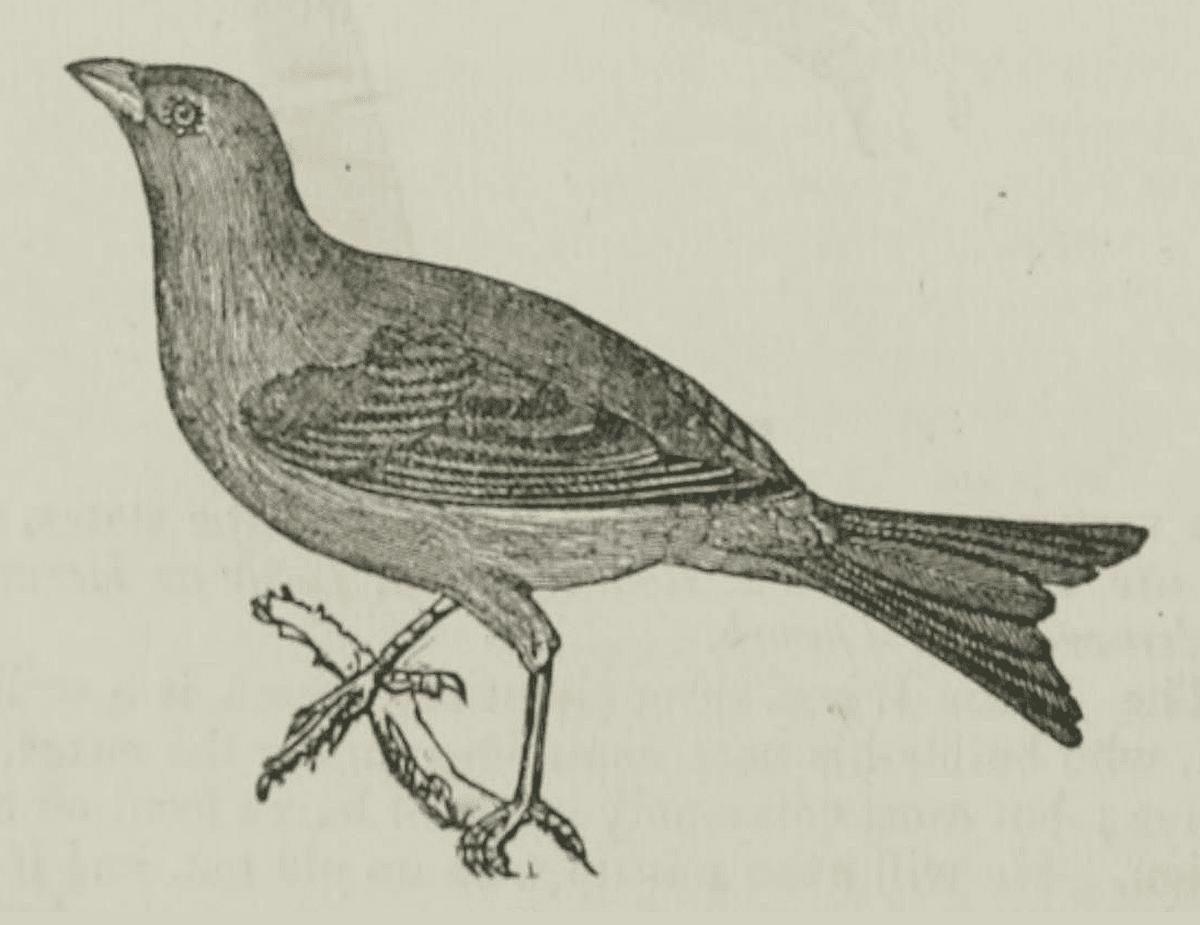
Tanager.
Finches.—The Song Sparrow is the most generally diffused over the United States, and is the most numerous of all our sparrows; and it is far the earliest, sweetest, and most lasting songster. Many of them remain during the whole winter in close-sheltered meadows and swamps. It is the first singing bird in spring. Its song continues through the summer and fall, and is sometimes heard even in the depths of winter. The notes or chant are short but very sweet, and frequently repeated, from a small bush or tree, where it sits chanting for an hour together. It is fond of frequenting the borders of rivers, meadows and swamps; and, if wounded and unable to fly, will readily take to the water, and swim with considerable rapidity. There are other familiar species of sparrows, as the Chipping, Field, and Tree, Yellow-winged, and White-throated sparrows.
The Indigo Bird is numerous in the middle and eastern states, and in the Carolinas and Georgia. Its favorite haunts are about gardens, fields of clover, borders of woods, and road sides, where it is frequently seen perched on fences. In its manners it is extremely neat and active, and a vigorous and pretty good songster. It mounts to the tops of the highest trees, and chants for half an hour at a time. Its song is not one continued strain, but a repetition of short notes, commencing loud and rapid, and falling by slow gradations till they seem hardly articulate, as if the little minstrel were quite exhausted; but after a pause of half a minute, it commences again as before. Notwithstanding the beauty of his plumage, and the vivacity of his song, the indigo bird is seldom seen domesticated. Its nest is built in a low bush among rank grass, grain, or clover, suspended by two twigs, one passing up each side, and is composed of flax, and lined with grass. This bird is five inches long, the whole body of a rich sky-blue, deepening in color toward the head, and sometimes varying to green.
The Yellow Bird, or Goldfinch, bears a great resemblance to the canary, and in song is like the goldfinch of Britain, but it is in general weak. In the spring, they associate in flocks, to bask and dress themselves in the morning sun, singing in concert for half an hour together; the confused mingling of their notes forming a kind of harmony not at all unpleasant. Their flight is not direct, but in alternate risings and sinkings, twittering as they fly at each successive impulse of the wings. They search the gardens in numbers, in quest of seeds, and pass by various names, such as lettuce-bird, sallad-bird, thistle-bird, yellow-bird. They are very easily tamed.
The goldfinch is four inches and a half in length: the male is of a rich lemon color. The wings and tail are black, edged with white. In the fall, this color changes to a brown olive, which is the constant color of the female. They build a nest in the twigs of an apple tree, neatly formed of lichen and soft downy substances.
The Cardinal Grosbeak is one of our most common cage birds, and is very generally known both in this country and in Europe. Numbers of them have been carried to England and France, in which last country they are called Virginia nightingales. They have great clearness and variety of tones; many of which resemble the clear notes of the fife, and are nearly as loud. They begin in the spring at daybreak, and repeat a favorite passage twenty or thirty times. The sprightly figure and gaudy plumage of this bird, with his vivacity and strength of voice, must always make him a favorite.
The Crossbill is an inhabitant of almost all the pine forests situated north of forty degrees, from the beginning of September to the middle of April. The great pine swamp in Pennsylvania appears to be their favorite rendezvous. They then appear in large flocks, feeding on the seeds of the hemlock and white pine; have a loud, sharp, and not unmusical note; chatter as they fly; alight during the prevalence of the deep snows before the door of the hunter, and around the house, picking off the clay with which the logs are plastered, and searching in corners where any substance of a saline nature had been thrown. At such times, they are so tame as only to settle on the roof of the cabin when disturbed, and a moment after, descend to feed as before. They are then easily caught in traps. When kept in a cage, they have many of the habits of the parrot, often climbing along the wires, and using their feet to grasp the cones in, while taking out the seeds.
Carolina Parrot.—This is the only species of parrot found native within the territory of the United States. The vast luxuriant tracts lying within the torrid zone seem to be the favorite residence of those noisy, numerous and richly plumaged tribes. The Carolina parrot inhabits the interior of Louisiana and the shores of the Mississippi and Ohio, east of the Alleghanies. It is seldom seen north of Maryland. Their private places of resort are low, rich, alluvial bottoms along the borders of creeks; deep and almost impenetrable swamps filled with sycamore and cypress trees, and the salines or licks interspersed over the western country. Here too is a great abundance of their favorite fruits. The seeds of the cypress tree and beech nuts are eagerly sought after by these birds.
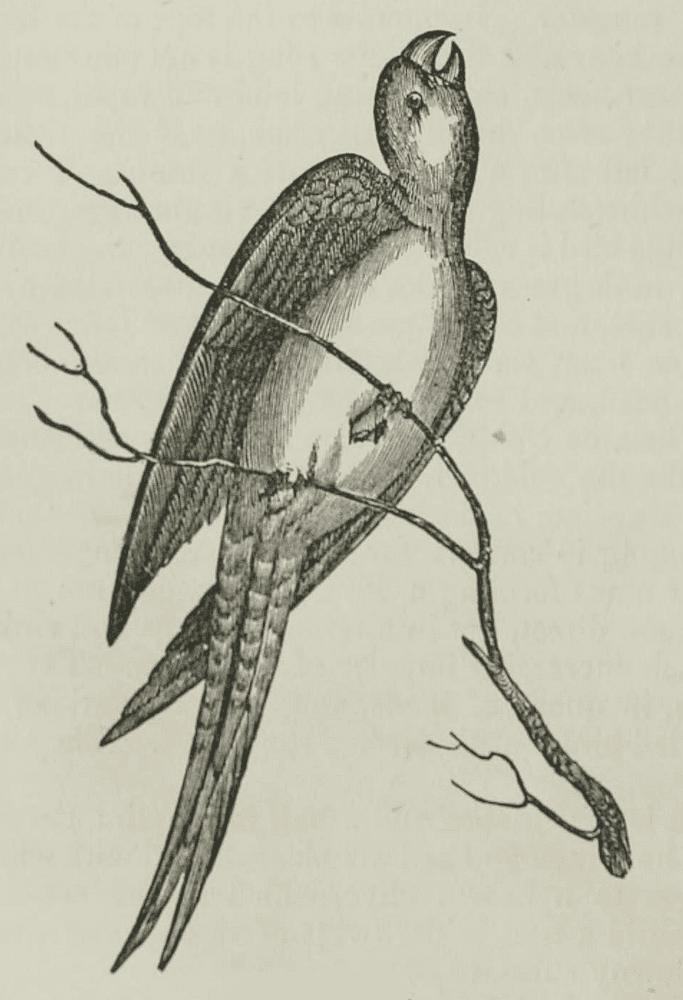
Carolina Parrot.
The flight of the Carolina parrot is very much like that of the wild pigeon, in close compact bodies, moving with great rapidity, making a loud and outrageous screaming, like that of the red-headed woodpecker. Their flight is sometimes in a direct line, but most usually circuitous, making a great variety of elegant and easy serpentine meanders, as if for pleasure. They generally roost in the hollow trunks of old sycamores, in parties of thirty or forty together. Here they cling fast to the sides of the tree, holding by their claws and bills. They appear to be fond of sleep, and often retire to their holes during the day, probably to take their regular siesta. They are extremely social and friendly towards each other.
The Yellow-billed Cuckoo is not abundant any where; but it is found far north, though preferring a residence in the southern states. It feeds on berries and insects of various kinds. ‘In autumn,’ says Mr. Audubon, ‘they eat many grapes, and I have seen them supporting themselves by a momentary motion of their wings opposite a bunch, as if selecting the ripest, when they would seize it and return to a branch, repeating their visits in this manner, until satiated. They now and then descend to the ground, to pick up a wood-snail or a beetle. They are extremely awkward at walking, and move in an ambling manner, or leap along sidewise, for which the shortness of their legs is an ample excuse. They are seldom seen perched conspicuously on a twig, but on the contrary are generally to be found amongst the thickest boughs and foliage, where they emit their notes until late in autumn, at which time they discontinue them.’ It is shy and cowardly, robbing small birds of their eggs.
Woodpeckers.—The Red-headed Woodpecker is universally known from his striking and characteristic plumage, and the frequency of his depredations in the orchards and corn-fields. Towards the mountains, particularly in the vicinity of creeks and rivers, these birds are extremely abundant, especially in the latter part of the summer. Wherever you travel in the interior at that season, you hear them screaming from the adjoining woods, rattling on the dead limbs of trees, or on the fences, where they are perpetually seen flitting from stake to stake on the roadside before you. Wherever there are trees of the wild cherry, covered with ripe fruit, there you see them busy among the branches; and in passing orchards, you may easily know where to find the sweetest apples, by observing those trees on or near which this bird is skulking; for he is so excellent a connoisseur in fruit, that wherever an apple or pear is found broached by him, it is sure to be among the ripest and best flavored. When alarmed, he seizes a capital one by sticking his open bill deep into it, and bears it off to the woods. When the Indian corn is in its ripe, succulent, and milky state, he attacks it with great eagerness, opening a passage through the numerous folds of the husk, and feeding on it with voracity. The girdled or leadened timber, so common among the corn-fields in the back settlements, are his favorite retreats, whence he sallies out to make his depredations. He is fond of the ripe berries of the sour gum, and pays regular visits to the cherry trees, when loaded with fruit. Towards fall, he often approaches the barn or farm house, and raps on the shingles and weather-boards. He is of a gay and frolicsome disposition; and half a dozen of the fraternity are frequently seen diving and vociferating round the high dead limbs of some tree, pursuing and playing with each other, amusing the passenger with their gambols. Their note or cry is shrill and lively, and so much resembles that of a species of tree-frog, which frequents the same tree, that it is sometimes difficult to distinguish the one from the other.
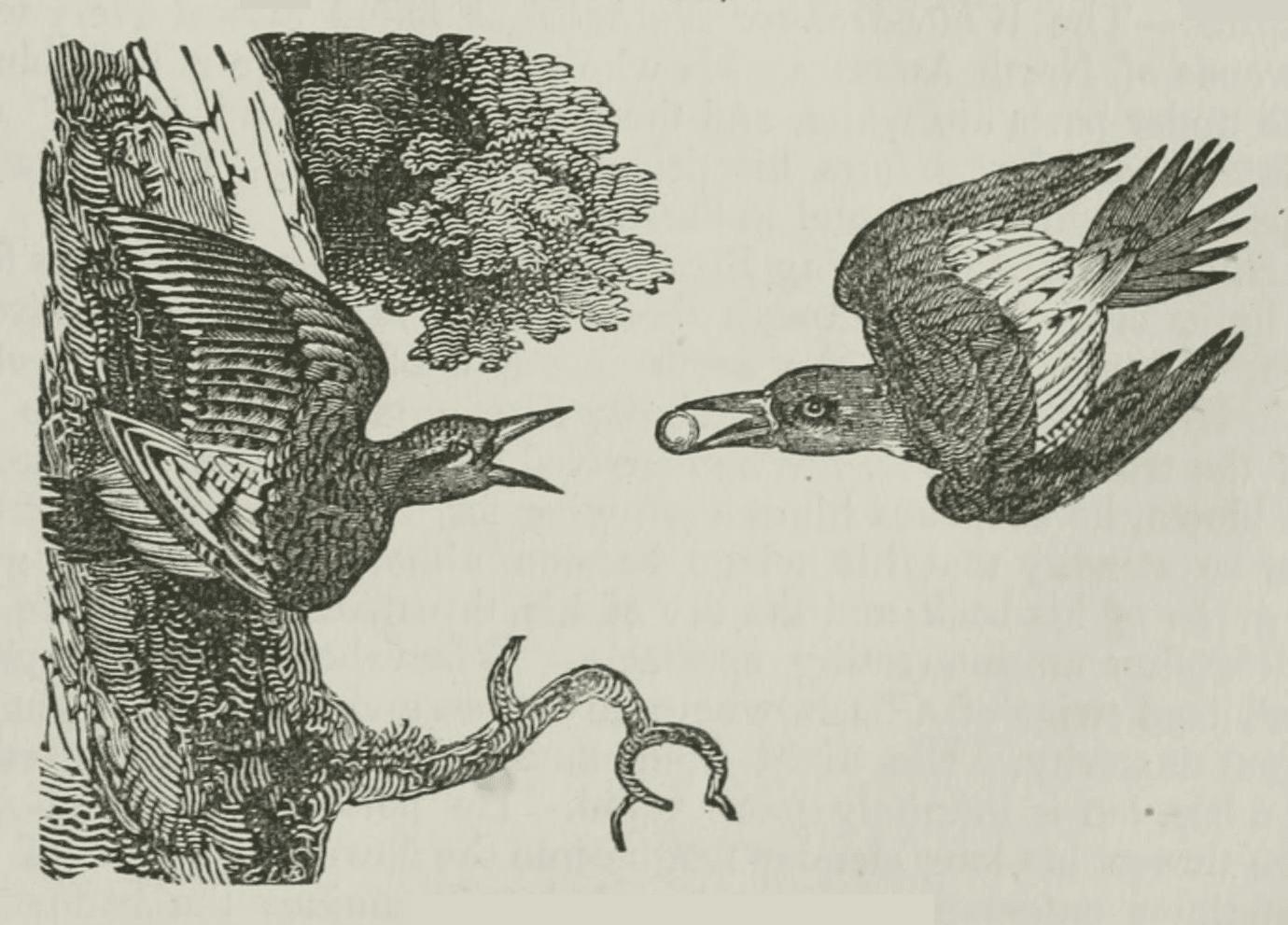
Red-headed Woodpecker.
The Ivory-billed Woodpecker breeds in the Carolinas, and in strength and magnitude stands at the head of the tribe. He lives in the cypress swamps, seeking the tops of the most towering trees; his bill is like polished ivory, and his crest a superb carmine. His eye is brilliant and daring, and his manners are said to be dignified and noble. Among the other American birds of this tribe are the Pileated, Yellow-bellied, Golden-winged, and Red-bellied Woodpeckers.
Nuthatch.—The White-breasted Nuthatch is found almost every where in the woods of North America; his whole upper plumage is light-blue or lead, the under parts are white, and the crown of the head, black. Ants, seeds, insects, and larvæ, form his principal subsistence. There are two other species of this bird found in the United States.
The Ruby-throated Humming Bird is the only species of the genus found in the limits of the states, though there are upwards of one hundred in America. Its approach to the north is regulated by the advance of the season. He is extremely fond of tubular flowers, particularly of the blossoms of the trumpet flower. When arrived before a thicket of these, that are full blown, he suspends himself on wing for the space of two or three seconds, so steadily that his wings become almost invisible; the glossy golden green of his back, and the fire of his throat, dazzling in the sun, form altogether an interesting spectacle. When he alights, he prefers the small dead twigs of a bush, where he dresses and arranges his plumage with great dexterity. His flight from flower to flower greatly resembles that of a bee, but is infinitely more rapid. He poises himself on wing, while he thrusts his long slender tongue into the flowers in search of food. He sometimes enters a room by the window, examines the bouquets of flowers, and passes out by the opposite door or window. He feeds on the honey extracted from flowers, and on insects.
‘The old and young,’ says Mr. Nuttall, ‘are soon reconciled to confinement. In an hour after the loss of liberty, the little cheerful captive will often come and suck diluted honey, or sugar and water, from the flowers held out to it; and in a few hours more, it becomes tame enough to sip its favorite beverage from a saucer, in the interval flying backwards and forwards in the room for mere exercise, and then resting on some neighboring elevated object. In dark or rainy weather, they seem to pass the time chiefly dozing or on the perch. They are also soon so familiar as to come to the hand that feeds them. In cold nights, or at the approach of frost, the pulsation of this little dweller in the sunbeam becomes nearly as low as in the torpid state of the dormouse; but on applying warmth, the almost stagnant circulation revives, and slowly increases to the usual state.’
Belted Kingfisher.—This is the only species of its tribe found within the United States, where it frequents the banks of all the fresh water rivers from Maine to Florida. His voice is loud, rattling, and sudden. His flight is rapid, and is sometimes prolonged to very considerable distances. He follows up the course of the rivers to their very fountains, and his presence is a sign of abundant fish. Mill-ponds, where the water is calm, are favorite resorts of this bird, and its eggs are generally found in places not far from a mill worked by water. The kingfisher, for many successive years, returns to the same hole to breed and roost. Its flesh is oily and disagreeable.
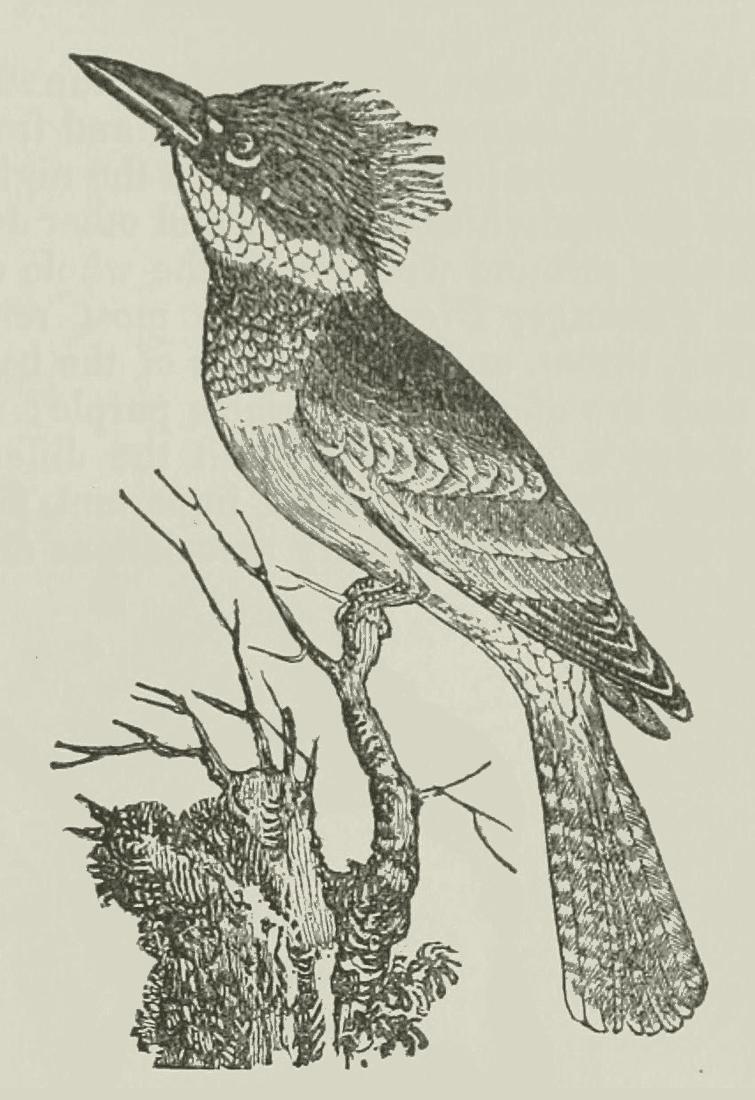
Belted Kingfisher.
Swallows.—The beautiful Purple Martin is a great favorite of man in all parts of the country. The farmer prepares a little house for him, the Indian hollows a calabash, and as either mansion is to him indifferent, so is he equally acceptable to the husbandman and the hunter. Year after year he returns to the same mansion. In the middle states, the martins prepare their nest about the third week in April, and they rear two broods in the season. There are several other species, such as the Barn, Cliff, White-bellied, and Chimney.
Night-Hawks.—The Whip-poor-will is a remarkable nocturnal bird migratory through nearly the extent of the states. It is well known for its sad and peculiar song. The Chuck-will’s Widow is seldom found north of Virginia, and is particularly numerous in the vast forests of the Mississippi. Its note is strikingly different from that of the whip-poor-will. In sound and articulation it seems plainly to express the words which have been applied to it, pronouncing every syllable leisurely, and distinctly, putting the principal emphasis on the last word. In a still evening it may be heard at the distance of nearly a mile; the tones of its voice being strong and full.
The flight of this bird is slow, skimming about the surface of the ground, frequently settling on old logs or on the fences, and from thence sweeping around in pursuit of various insects that fly in the night. Like the whip-poor-will, it prefers the declivities of glens, and other deeply shaded places, making the mountains resound with echoes the whole evening.
Pigeons.—The Passenger Pigeon is the most remarkable American species. The head, throat, and upper parts of the body are ash colored; the sides of the neck are of a glossy variable purple; and there is a crimson mark round the eyes. These birds visit the different parts of North America in immense flocks. The most important facts connected with their habits relate to their extraordinary associations and migrations. No other species known to naturalists is more calculated to attract the attention of either the citizen or the stranger, as he has opportunity of viewing both of these characteristic habits while they are passing from north to south, east and west, and, vice versa, over and across the whole extent of the United States of America. These migrations are owing entirely to the dire necessity of providing food, and not merely to escape the severity of a northern latitude, or seek a southern one for the purpose of breeding. They consequently do not take place at any fixed period or season of the year. Indeed, it happens sometimes that a continuance of a sufficient supply of food in one district will keep these birds absent from another for years.
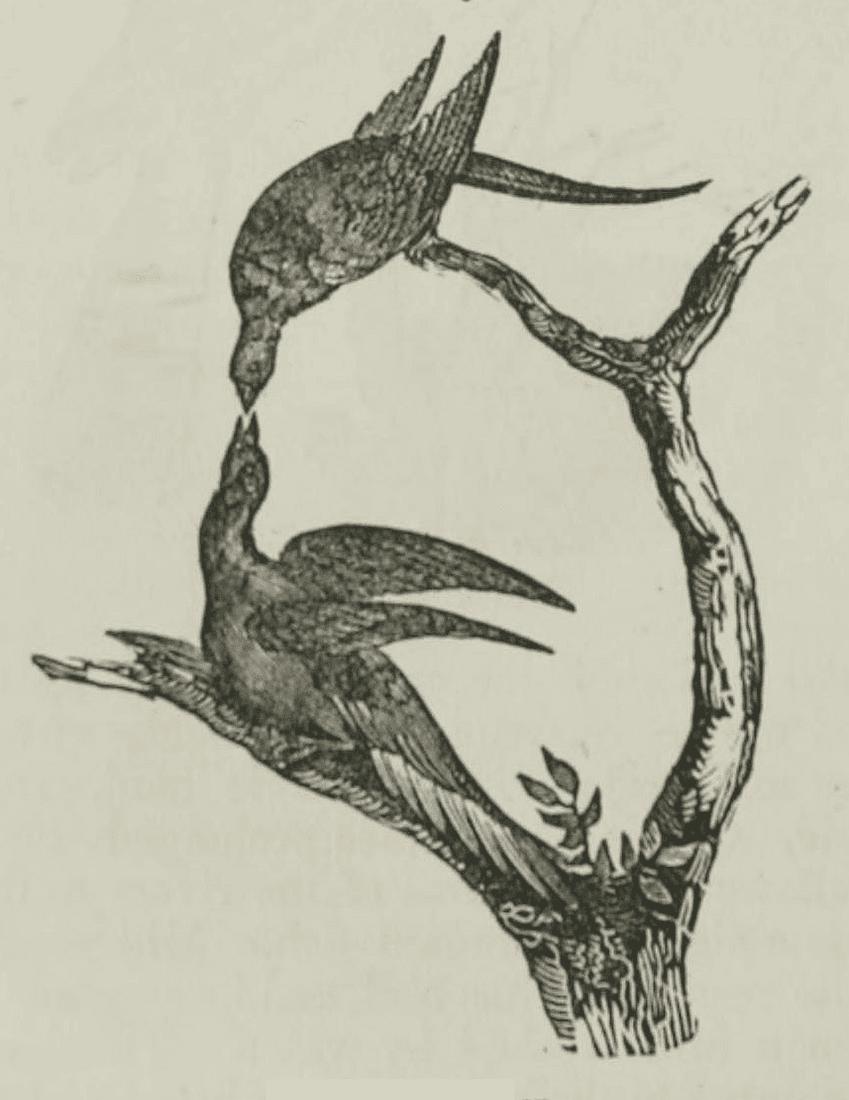
Passenger Pigeon.
Their rapidity of flight is wonderful. Pigeons have been killed in the neighborhood of New York, with their crops full of the rice they must have collected in the plantations of the Carolinas, or Georgia, and the flight necessary to account for this circumstance has been estimated at a mile a minute. Another well-known bird of this tribe is the Carolina Pigeon.
Wild Turkey.—This splendid bird is found from the North-West territory to the isthmus of Panama. They abound in the forests and unsettled parts of the Union, but are very rare in the northern and eastern parts. They were formerly abundant in Canada; but as their places of resort become settled and thickly peopled, they retire and seek refuge in the remotest recesses of the interior. In New England, it appears to have been destroyed many years ago; but it is still found in the eastern parts of Pennsylvania and New Jersey.
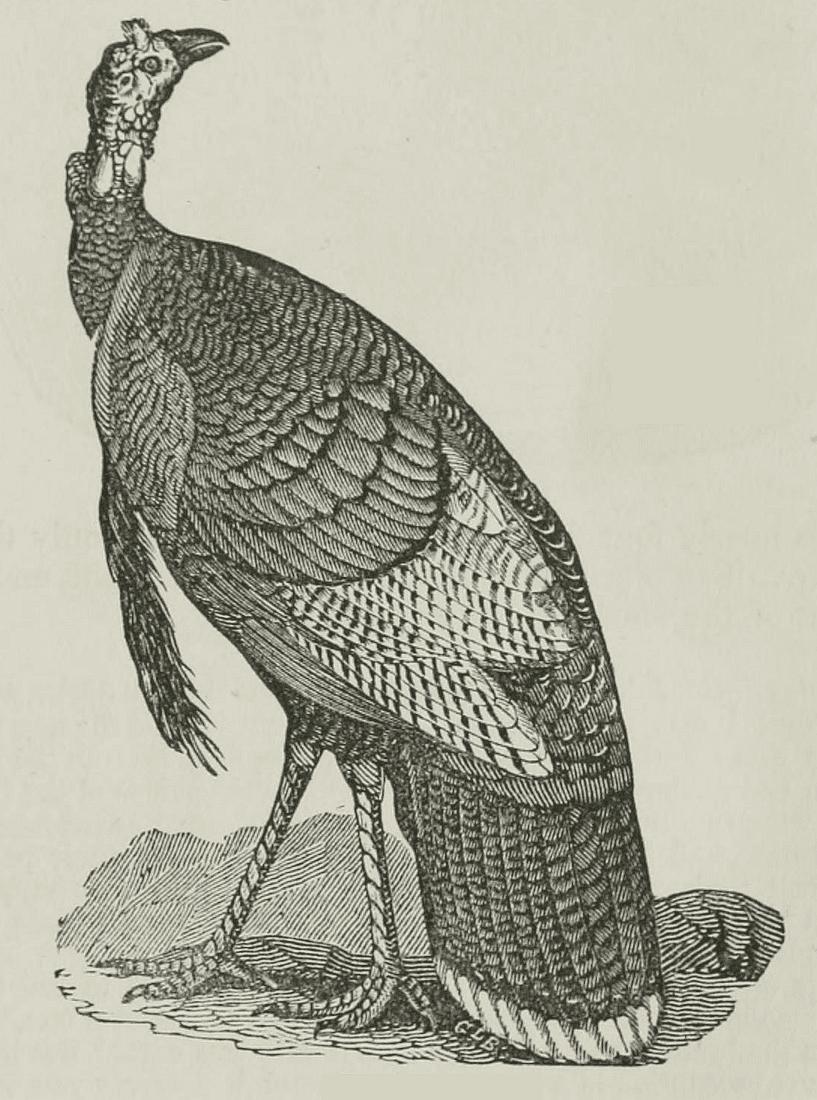
Wild Turkey.
These birds do not confine themselves to any particular food, but eat corn, berries, grapes, barley, tadpoles, young frogs and lizards. Their favorite food, however, is the pecan nut and acorn. Where there is an abundant crop of acorns, numerous flocks of turkeys may be expected. In the fall, they direct their courses in vast numbers to the rich lands on the borders of the Ohio and Mississippi. Before crossing a river, they assemble on the highest eminences, and remain there as if in consultation for a day or two. At length, after due preparation, the leader gives a signal note, and they all wing their way to the opposite shore. Some of the young and weak fall into the water, and many perish. It is observed that after these journeys, the turkeys are so familiar, that they fearlessly enter the plantations, in search of food. Great numbers are killed at this time, and kept in a frozen state to be sent to distant markets.
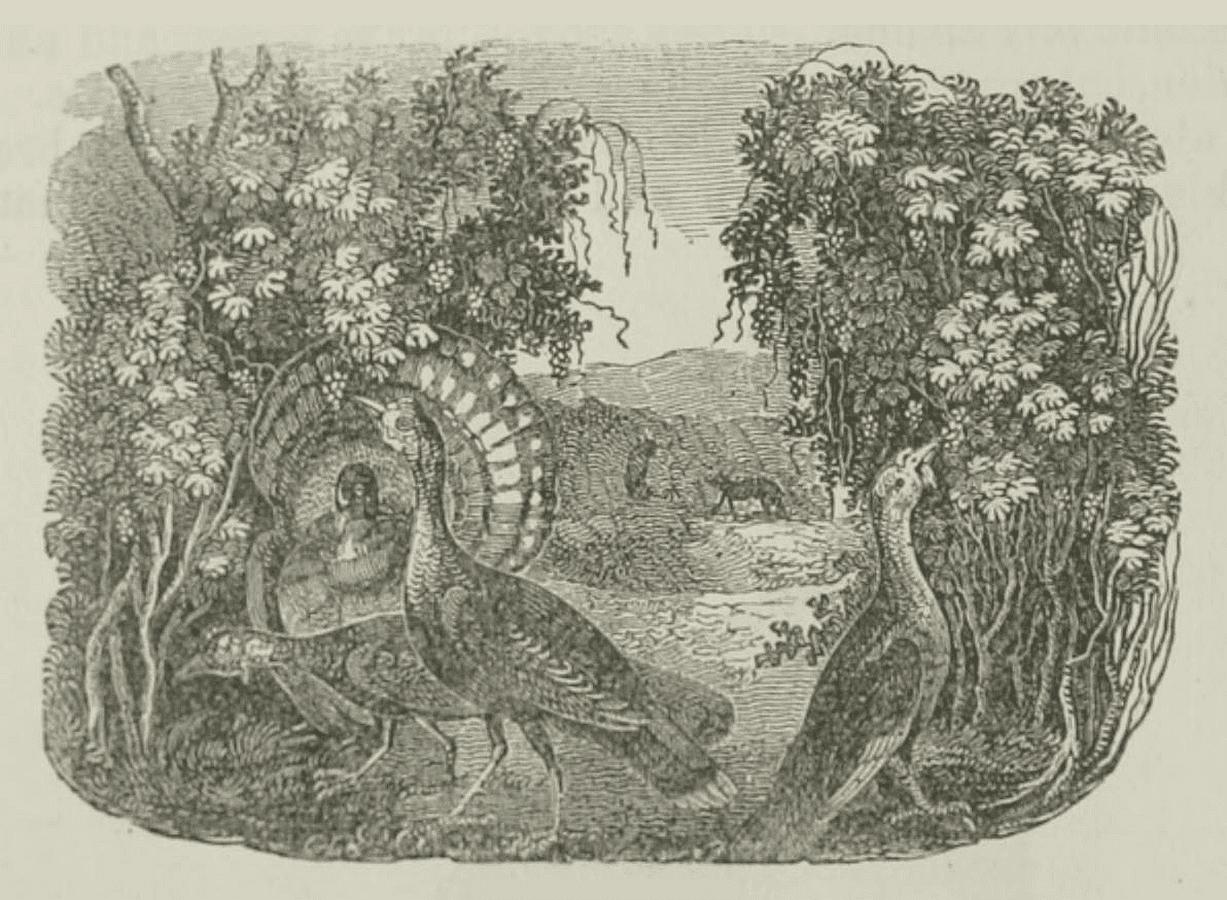
Wild Turkeys.
The flesh of the wild turkey is of excellent flavor, being more delicate and juicy than that of the domestic turkey; the Indians value it so highly, that they term it, when roasted, ‘the white man’s dish.’ The male of the wild turkey is nearly four feet in length; the female is only three feet and a quarter long. The plumage of the male is very brilliant, and of a variety of hues; that of the female is not so beautiful.53
The Quail.—The American quail is found throughout the union; and though in form and general appearance it somewhat resembles the European quail, the two birds differ very widely in their habits. The food of the quail consists of grain, seed and insects, but buckwheat and Indian corn are its favorites. The flight of this bird is accompanied with a loud whizzing sound, occasioned by the shortness of their wings and the rapidity with which they move. During winter, they often suffer severely from the inclemency of the weather, and whole coveys are found frozen in spots where they had endeavored to shelter themselves.
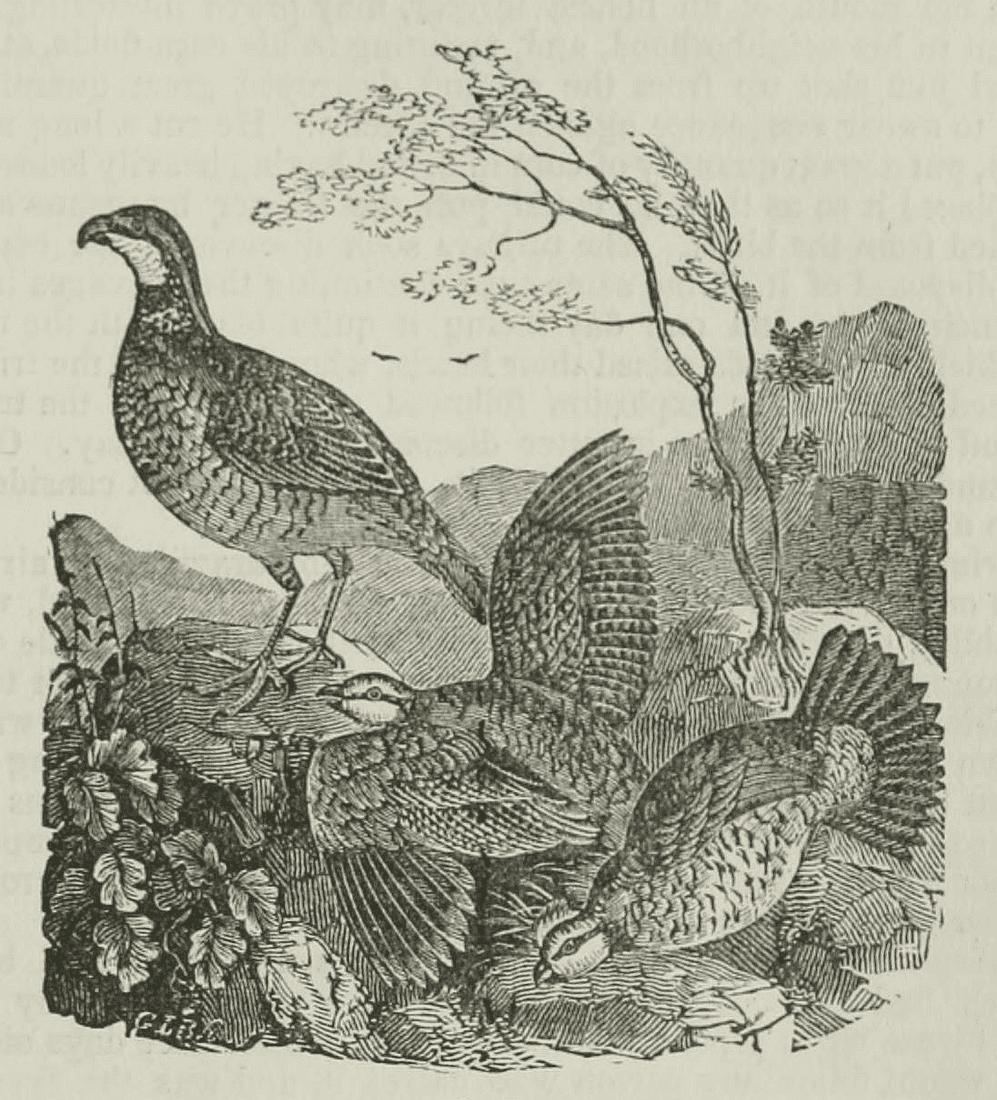
Quail.
Grouse.—The Ruffed Grouse is the partridge of the eastern states, and the pheasant of Pennsylvania and the southern districts. It is known in almost every quarter of the United States, and appears to inhabit a very extensive range of country. Its favorite places of resort are high mountains covered with the balsam, pine, hemlock, and such like evergreens. Unlike the pinnated grouse, it always prefers the woods; is seldom or never found in open plains, but loves the pine-sheltered declivities of mountains near streams of water. In the lower parts of Georgia, Carolina, and Florida, they are very seldom observed; but as we advance inland to the mountains, they again make their appearance. The Sharp-tailed Grouse, the Dusky Grouse, and the Cock of the Plains, are other species of this tribe.
The Woodcock, in its general figure and habits, greatly resembles the woodcock of Europe, but is considerably less, and very differently marked. This bird is universally known to our sportsmen. During the day they keep to the woods and thickets, and at the approach of evening seek the springs and open watery places to feed in. In hot weather, they descend to the marshy shores of our rivers, their favorite springs and watery recesses inland being dried up. To the former of these retreats they are pursued by sportsmen, flushed by dogs, and shot down in great numbers. The woodcock is properly a nocturnal bird, feeding chiefly at night, and seldom stirring about till after sunset; at such times he rises by a kind of spiral course to a considerable height in the air, uttering at times a sudden quack, till having gained his utmost height, he hovers round in a wild irregular manner, making a sort of murmuring sound, then descends with rapidity as he rose.
Ducks.—The Canvass-back Duck is peculiar to this country, and a witty gourmand of England, who made the tour of the states, thinks it the only production of nature or art of which America can with reason be proud. It was known to the epicure, long before it was described by the naturalist. Arriving in the United States from the north, about the middle of October, its chief place of resort is about the waters which flow into Chesapeak bay. On its first arrival it is lean, but from the abundance of its favorite food, it soon becomes fat. This bird is sometimes found in numbers so great as to cover acres.54
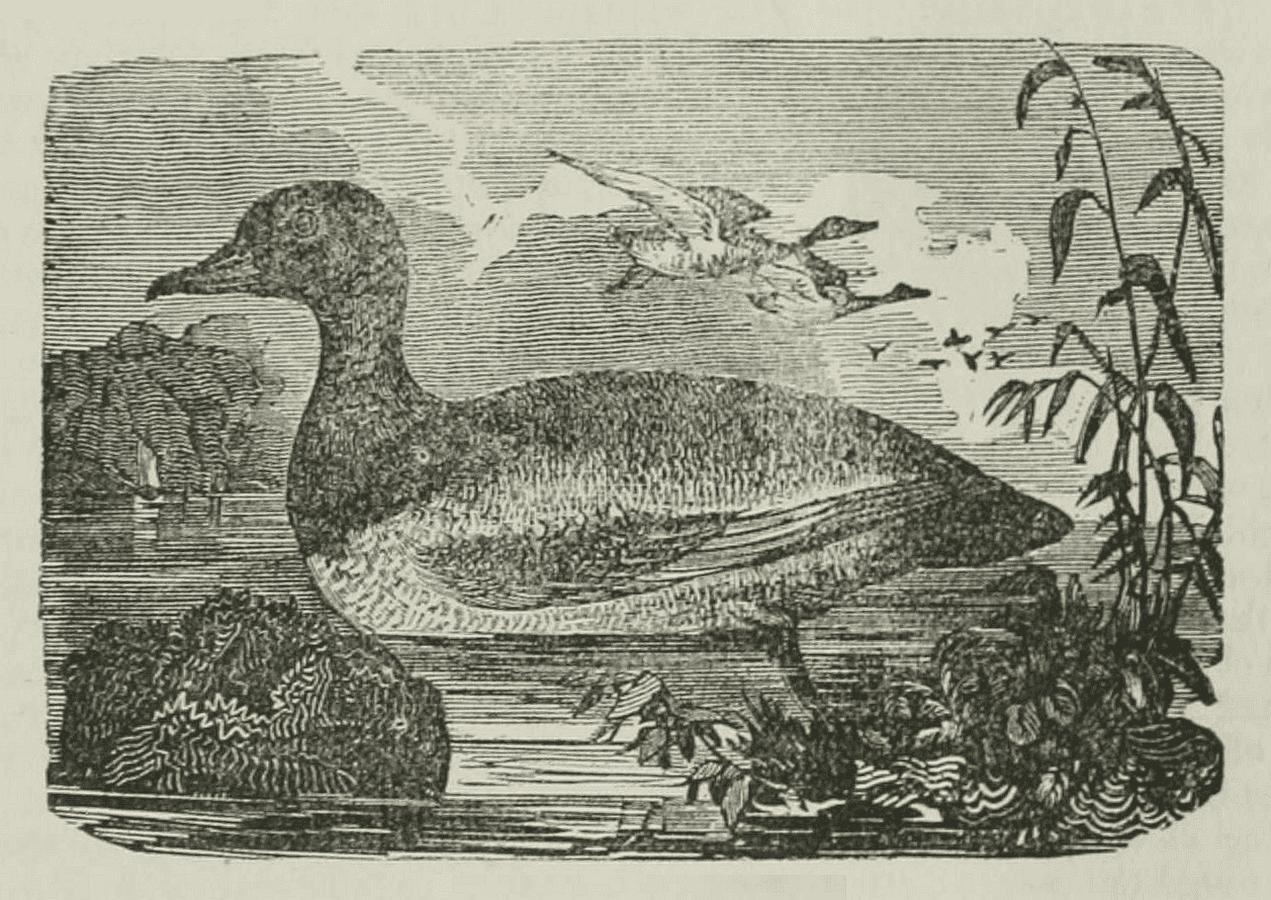
Canvass-Back Duck.
Among the American birds of this tribe are the Eider Duck, Black or Surf Duck, Ruddy Duck, Golden-eye, Buffel-headed Duck, Tufted Duck, Teal and some others. The Wood or Summer Duck, is the most beautiful bird of its kind in the world. Its head is adorned with a beautiful crest, and its plumage is most beautifully variegated. Its favorite places of resort are the border of ponds and lakes; but it passes the summer in the woods. It nestles in hollow trees, and when taken may be easily tamed.
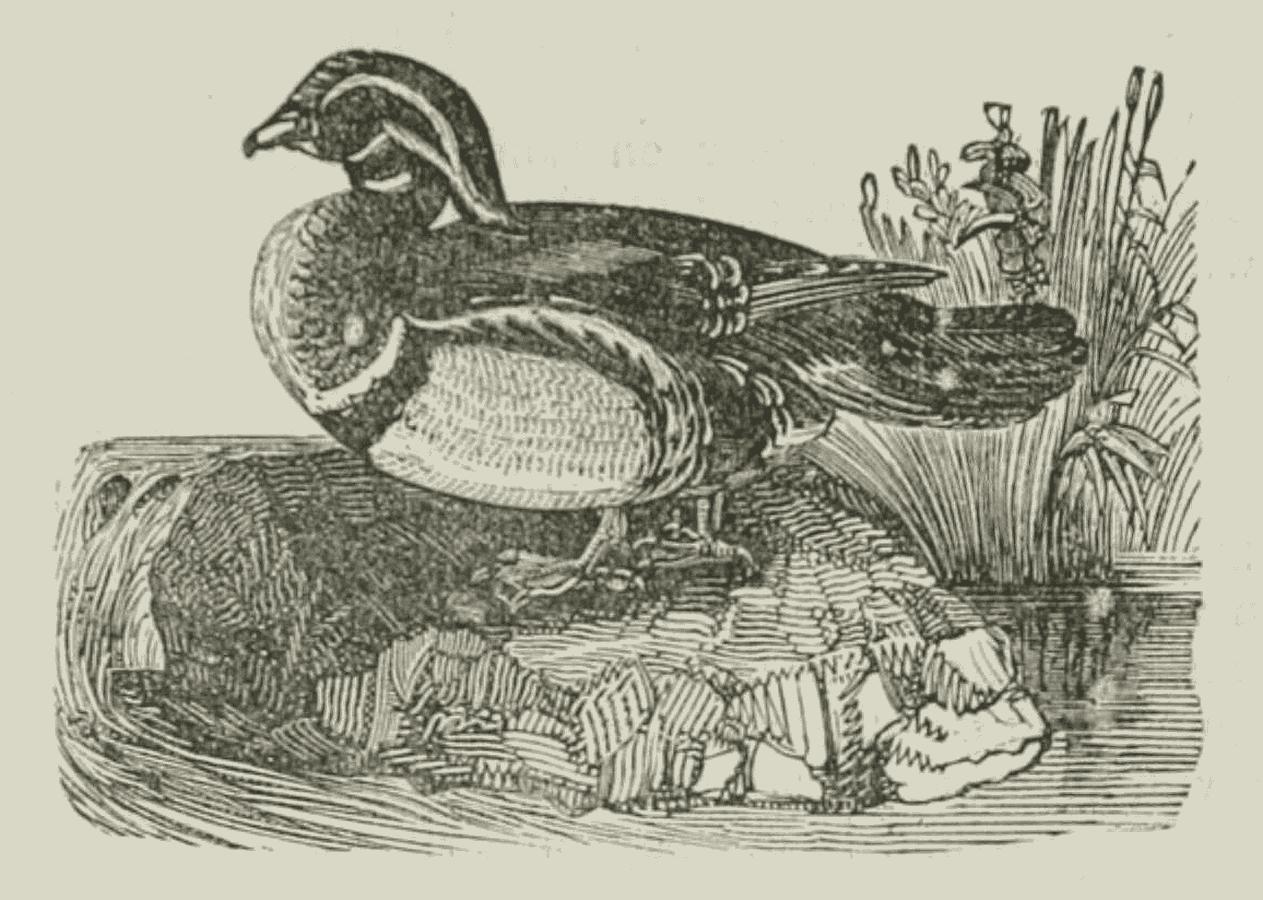
Summer Duck.
Wild Goose.—The common wild goose is well known over the whole of the United States, and its periodical migrations are sure signs of returning spring or approaching winter. Its flight is heavy and laborious. When in good order this bird weighs from ten to fourteen pounds, and yields about half a pound of feathers. Mr. Wilson relates the following interesting anecdote.
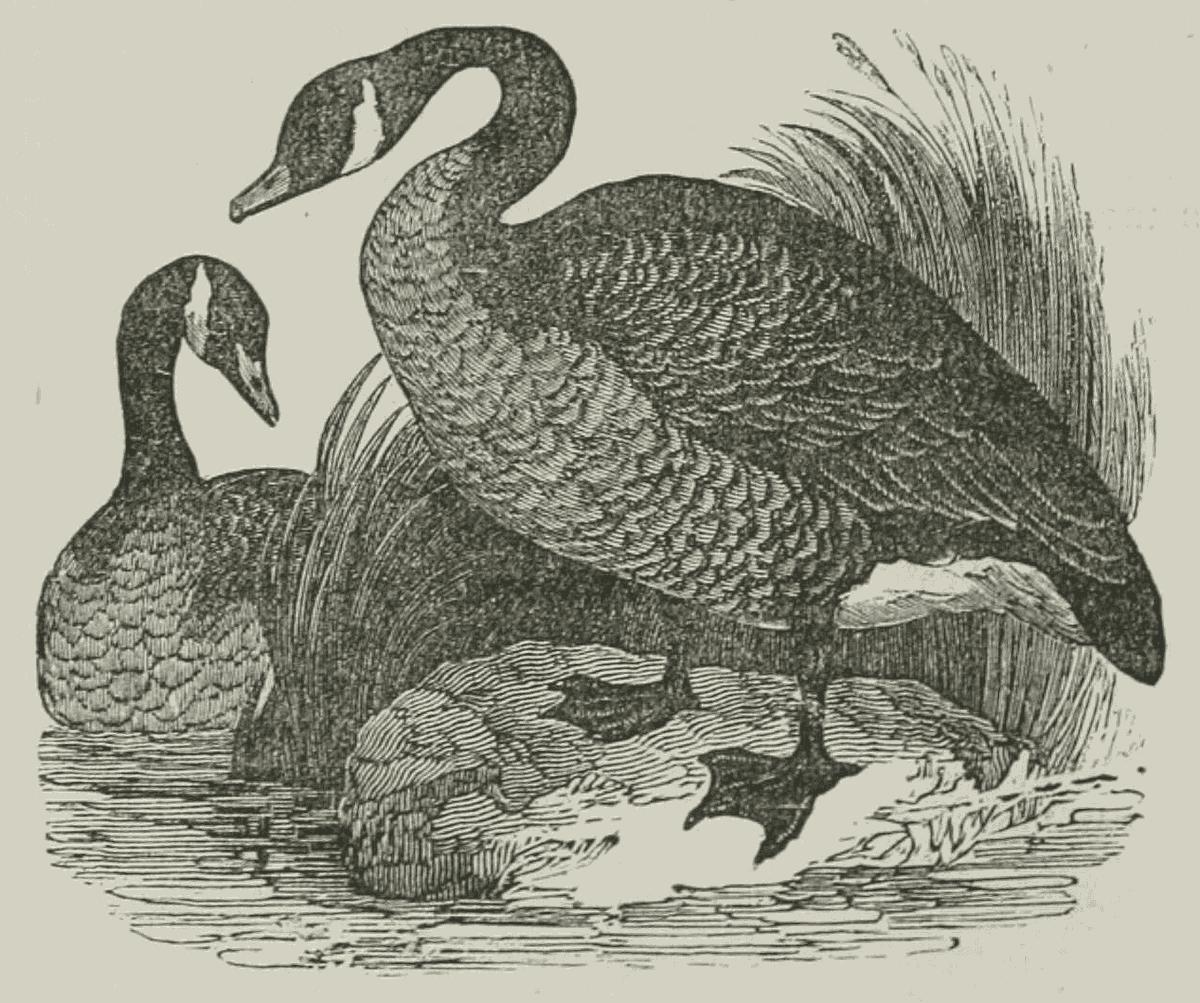
Wild Geese.
‘Mr. Platt, a respectable farmer on Long Island, being out shooting in one of the bays which in that part of the country abound in water-fowl, wounded a wild goose. Being unable to fly, he caught it, and brought it home alive. It proved to be a female, and turning it into the yard with a flock of tame geese, it soon became quite familiar, and in a little time its wounded wing entirely healed. In the following spring, when the wild geese migrate to the northward, a flock passed over Mr. Platt’s barn yard, and just at that moment, their leader, happening to sound his bugle note, our goose, in whom its new habits had not quite extinguished the love of liberty, and remembering the well-known sound, spread its wings, mounted into the air, joined the travellers, and soon disappeared. In the succeeding autumn, the wild geese, as usual, returned from the northward, in great numbers, to pass the winter in our bays and rivers. Mr. Platt happened to be standing in his yard, when a flock passed directly over his barn. At that instant, he observed three geese detach themselves from the rest, and after wheeling round several times, alight in the middle of the yard. Imagine his surprise and pleasure, when, by certain well-remembered signs, he recognised in one of the three his long-lost fugitive. It was she indeed! She had travelled many hundred miles to the lakes; had there hatched and reared her offspring; and had now returned with her little family, to share with them the sweets of civilized life.’
Wild Swan.—This bird is found widely spread over the whole of the northern continent. During the winter, great numbers of them resort to the Chesapeak bay, and whilst there, form collections of from one to five hundred on the flats near the western shore. These birds are so exceedingly vigilant, that if but three of them are feeding together, one will generally be on guard, and when danger approaches, the alarm is given. While feeding and dressing, they make much noise, and through the night their vociferations can be heard for several miles. Their notes are extremely varied; some resembling the deepest base of the common tin horn, others running through the various modulations of the clarionet. The swan is five or six years in reaching its perfect growth. The aborigines employ the skin of this bird in making dresses for their women of rank, and the feathers as ornaments for the head.55
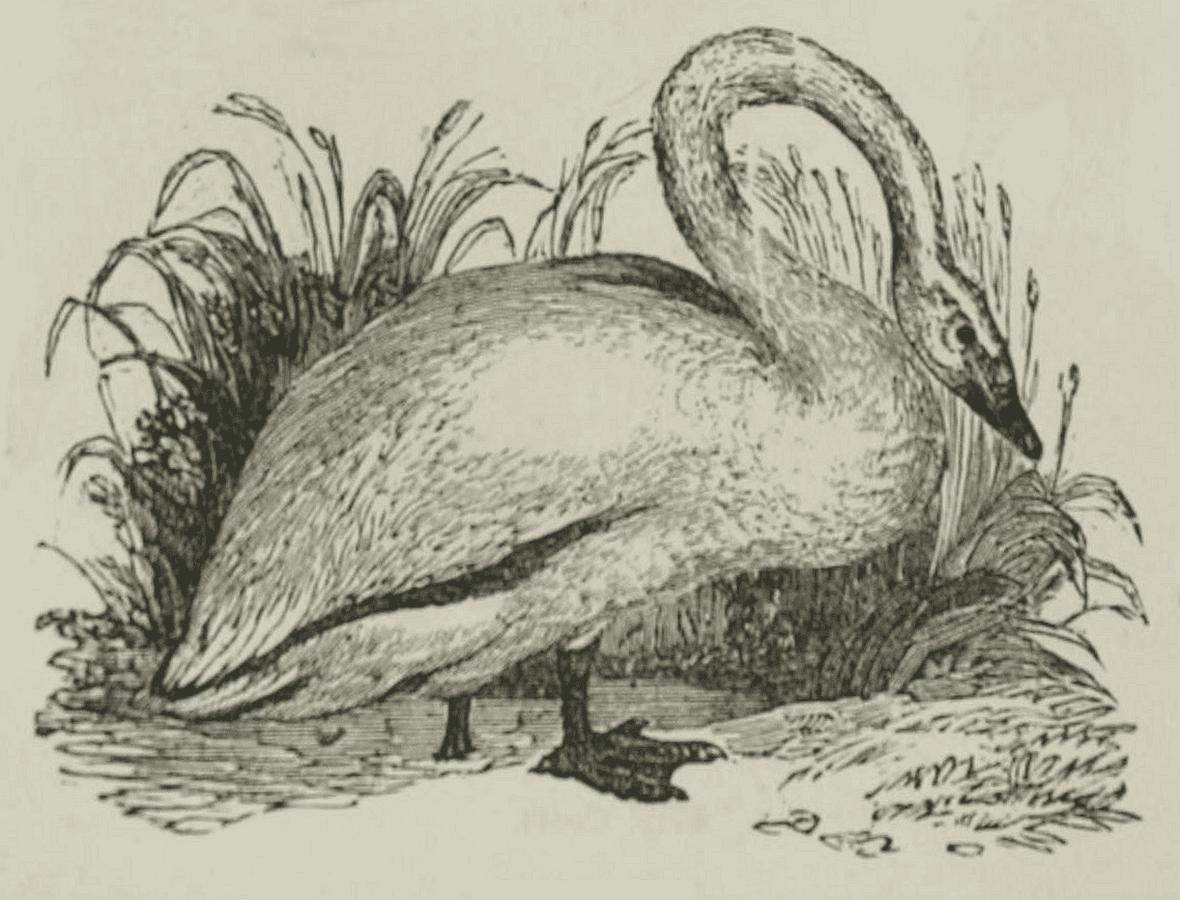
Wild Swan.
Rail.—This bird belongs to a genus of which naturalists enumerate about thirty species, distributed over almost every region of the earth. Their general character is every where the same. They run swiftly, fly slowly, and usually with the legs hanging down, are fond of concealment, and become at seasons extremely fat. The common American rail is migratory. It is feeble and delicate in every thing but the legs, which are strong and vigorous; their bodies are so remarkably thin that they are enabled to pass between the reeds like rats. They disappear on the first severe frost, from their usual residence along the reedy shores of the Delaware, and so sudden is their departure that no one knows how or when it is made.
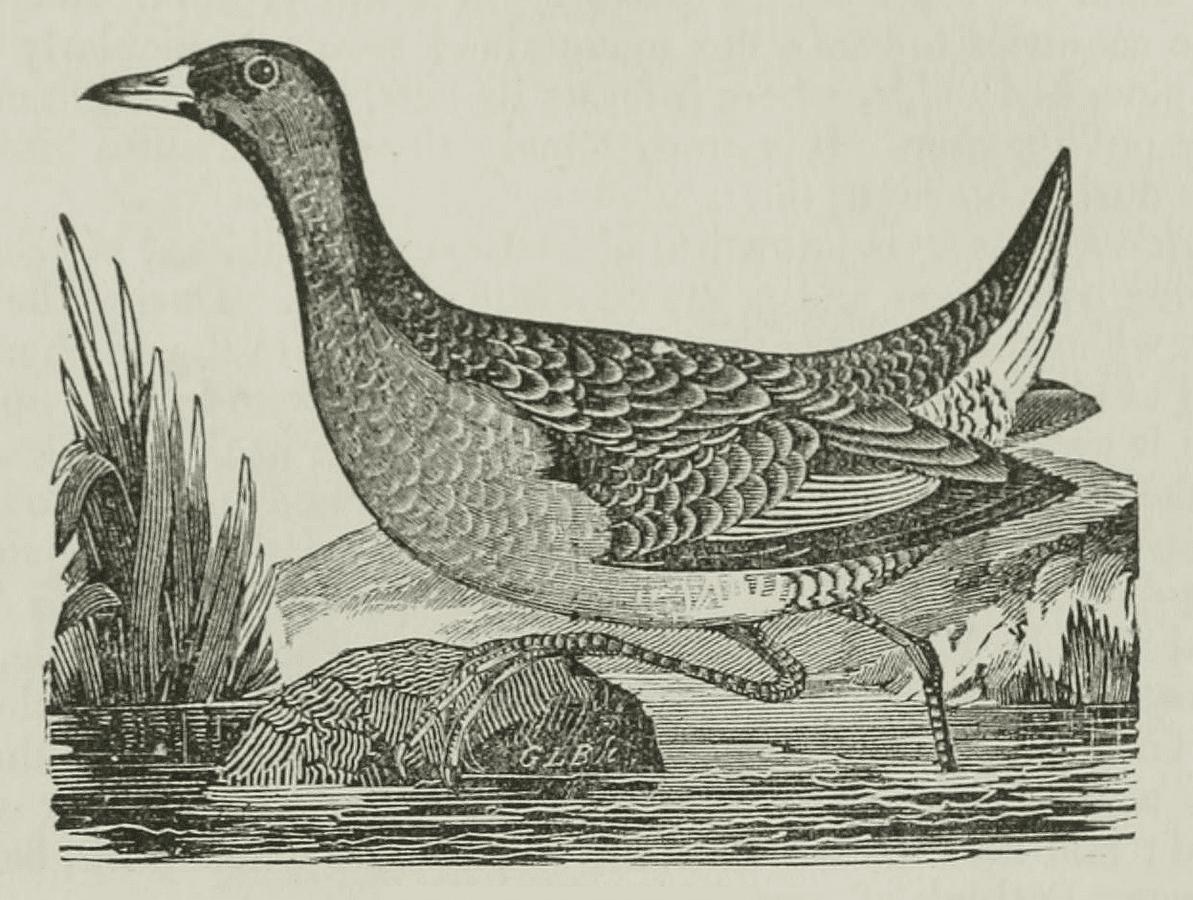
American Rail.
Plovers.—The Black-bellied Plover is known in some parts of this country by the name of the large whistling field plover; the gunners along the coast call them the black-bellied plover. In Pennsylvania, this bird frequents the countries towards the mountains; seems particularly attached to newly ploughed fields, where it forms its nest, of a few slight materials, as slightly put together. It is an extremely shy and watchful bird, though clamorous during breeding time.
The Kildeer Plover is known to almost every inhabitant of the United States, being a common and pretty constant resident. During the severity of winter, when snow covers the ground, it retreats to the seashore, where it is found at all seasons; but no sooner have the rivers broken up than its shrill note is again heard, either soaring about high in the air, tracing the shore of the river, or running amidst the watery flats and meadows.
Flamingo.—This bird is common on the south frontiers of the states, and the peninsula of East Florida. When the Europeans first came to America, they found this bird on several shores on either continent gentle, and no way distrustful of mankind. When the fowler had killed one, the rest of the flock, far from attempting to fly, only regarded the fall of their companion in a kind of fixed astonishment: another and another shot was discharged; and thus the fowler often levelled the whole flock, before one of them began to think of escaping.
But at present it is very different in that part of the world; and the flamingo is not only one of the scarcest, but one of the shyest birds in the world, and the most difficult of approach. They chiefly keep near the most deserted and inhospitable shores; near salt water lakes and swampy islands. When seen by mariners in the day, they always appear drawn up in a long close line, of two or three hundred together; and present, at the distance of half a mile, the exact representation of a long brick wall. This line, however, is broken when they seek for food; but they always appoint one of the number as a watch, whose only employment is to observe and give notice of danger while the rest are feeding. As soon as this trusty sentinel perceives the remotest appearance of danger, he gives a loud scream, with a voice as shrill as a trumpet, and instantly the whole cohort are upon the wing.
Their time of breeding is according to the climate in which they reside: in North America, they breed in summer; on the other side of the line, they take the most favorable season of the year. They build their nests in extensive marshes, and where they are in no danger of a surprise.
Herons.—The Great Egret Heron is often seen in summer in our low marshes and inundated meadows; yet on account of its extreme vigilance, it is very difficult to be procured. It is found in Guiana, and probably beyond the line, to New York. It enters the territories of the United States late in February. The high inland parts of the country it rarely or never visits. Its favorite haunts are vast inundated swamps, rice fields, the low marshy shores of rivers, and such like places; where from its size and color it is very conspicuous even at a distance. The plumage of this elegant bird is of a snowy whiteness; the bill of a rich orange yellow; and the legs black.
The Great Heron is a constant inhabitant of the Atlantic coast from New York to Florida. They breed in the Carolinas and New Jersey, in the gloomy solitudes of the cedar swamps. Their nests are constructed of sticks and placed on the tallest trees.
The Louisiana Heron is a rare and delicately formed species, occasionally found on the swampy river shores of South Carolina, but more frequently along the borders of the Mississippi, particularly below New Orleans. In each of these places it is migratory, and in the latter builds its nests on trees amidst the inundated woods. Among the species of this tribe, are the Green Heron, Blue Heron, Night Heron, Yellow-crowned Heron, the Bittern, and several others.
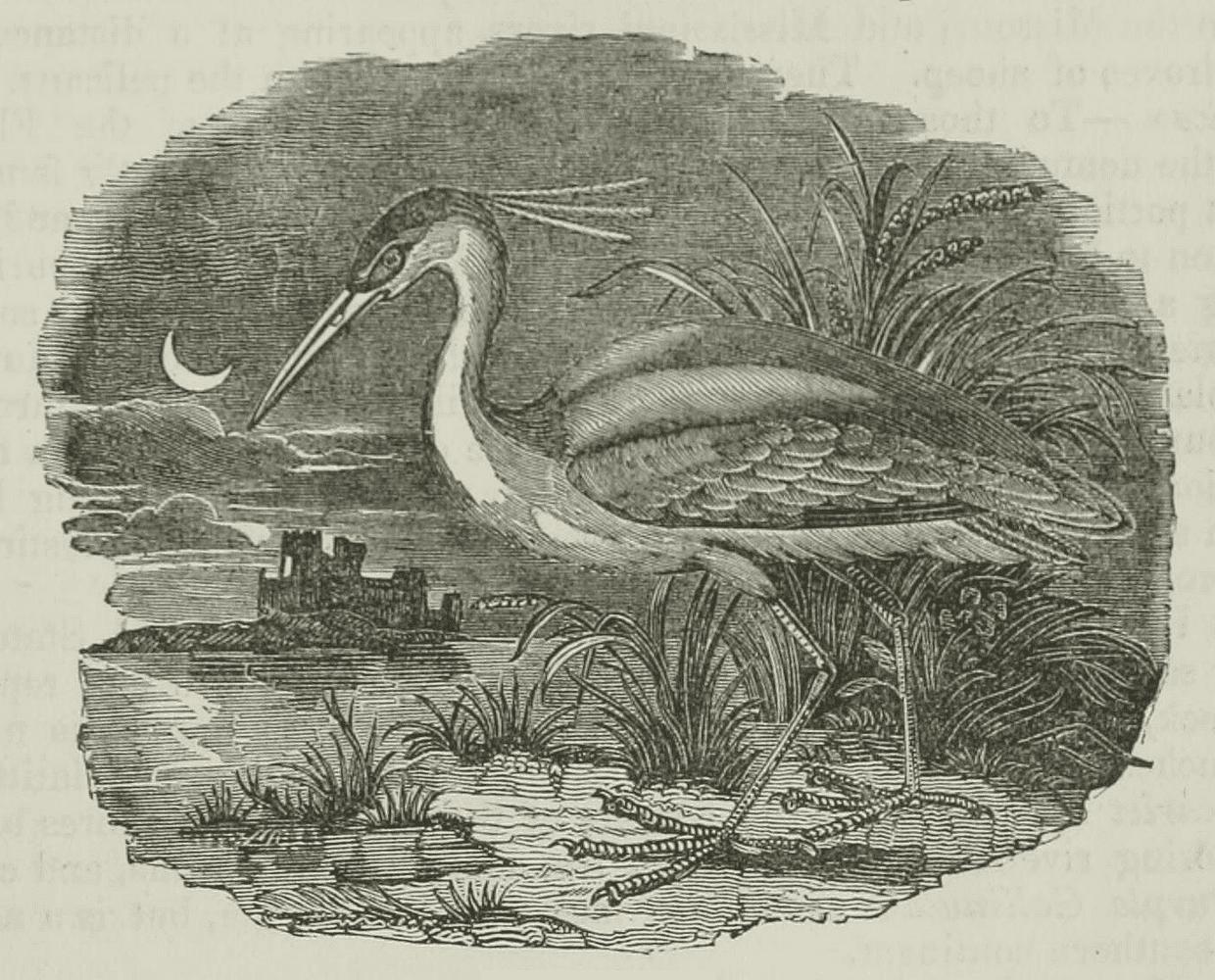
Night Heron.
The Whooping Crane is the tallest and most stately species of all the feathered tribes of the United States; the watchful inhabitant of extensive salt marshes, desolate swamps, and open morasses, in the neighborhood of the sea. Its migrations are regular, and of the most extensive kind, reaching from the inundated shores and tracts of South America to the arctic circle. In these periodical journeys, they pass at such a prodigious height in the air as to be rarely observed. They wander along the marshes and muddy flats of the seashore, in search of marine worms; sailing occasionally from place to place with a loud and heavy flight. At times they utter a loud and piercing cry, which may be heard at a great distance. They have various modulations of this singular note, from the peculiarity of which they derive their name.
The Sand-hill Crane is a fine stately bird, taller than a swan, and in the water, said to be quite as majestic. They abound in countless numbers on the Missouri and Mississippi rivers, appearing at a distance like great droves of sheep. They migrate in company with the pelicans.
Pelican.—To those who have visited the estuaries of the Florida coast, the demure and awkward attitude of this bird is perfectly familiar. In that portion of our country, this species occurs in large flocks, and they are often to be seen along the shores of the Mississippi and Missouri, imparting a peculiar character to the otherwise solitary scene; their solemn and quiet demeanor being in strict unison with the stillness of the uninhabited plains which surround them. They build in societies, and are seldom found except in flocks. When they are disturbed, they rise in much confusion, but soon form in regular order, usually flying in long lines, though sometimes in a triangle, like geese, with their long bills resting on their breasts.
The Wood Ibis is found in the southern parts of the United States, in watery savannas and inland swamps, where it feeds on fish and reptiles. The neck, body, and lower parts of this bird are white; the bill is nearly nine inches long. The White Ibis is numerous in the same latitudes. The Scarlet Ibis frequents the borders of the sea, and the shores of the neighboring rivers, feeding on small fry, shell-fish, sea-worms, and crabs. The Purple Gallinule is sometimes met with in Georgia, but is a native of the southern continent.
The Roseate Spoonbill is an inhabitant of our southern seashore, and is sometimes found in the Mississippi in the summer. It wades about in search of shell-fish, marine insects, small crabs and fish, in pursuit of which it occasionally swims and dives. The Black-bellied Darter, or Snake Bird, is common in the Carolinas. Its head, neck, and breast are light brown; the belly and tail deep black. It sits on the shrubs that overhang the water, and often terrifies the passengers by darting out its long and slender neck, which bears strong resemblance to that of a serpent.
III. FISHES.
The natural history of American fishes is yet to be written, as very little progress has yet been made in the scientific observation of this interesting order of animals. The fishes which fill the bays and coasts of the United States are generally of the same species with those on the coasts of the opposite continent. Along the shores of New England they are particularly abundant, though there is no other bank that equals that of Newfoundland in extreme richness. Shad and salmon are fine fish abounding in the Atlantic rivers, and beautiful trout are taken in the mountain streams of the northern states. Among the fish of the western waters, probably in a great measure common to them and other rivers, are noticed several varieties of perch, one of which, the buffalo perch, derives its name from the singular grunting noise which it makes, and which is familiar to every one who has been much on the Ohio. It is a fine table fish, weighing from ten to thirty pounds. There are, also, varieties of the bass, the hog-fish, and the sun-fish, and sixteen species of minny found in these waters, besides trout, false herring, and shad. Of all the inhabitants of the western rivers, the brown buffalo-fish is, perhaps, as much esteemed as any; it is quite abundant, and is found from two to three feet in length. In the lower waters of the Ohio and Mississippi, we meet with the black buffalo-fish, sometimes weighing half a hundred. A larger buffalo, resembling the shad of the Atlantic states, is taken in immense numbers in the lakes and meadows of the Mississippi.
The trout of Florida and Louisiana is not identical with the beautiful fish of that name that is a tenant of the cold and swift streams of the northern Atlantic country; it is of the perch class, and takes the bait with a spring like the trout, and is beautifully marked with golden stripes. It is a sound, hard fish, with a pleasant flavor, and weighs from one to four pounds. ‘We have never witnessed angling,’ says Mr. Flint, ‘that could compare with that of this fish, in the clear pine-wood streams of the southern divisions of this country. With fresh bait a barrel may be taken in a few hours.’ Twelve species of cat-fish have been observed in the Ohio, and it is indeed the most common fish in the western waters. They are of all colors and sizes, without scales, and easily taken with a hook. Their English name is derived from the noise which they make when at rest, which is very similar to the purring of a cat. In the Mississippi, this fish is found of the weight of an hundred pounds.
The Ohio ‘toter’ is two or three inches in length; its name is derived from the barbarism ‘tote,’ meaning to ‘carry,’ because this fish makes itself a cell by surrounding a place with pebbles. Pike, pickerel, and jack-fish, weighing from six ounces to twenty pounds, are found in the western rivers. Of the gar-fish there are also numerous varieties. The alligator-gar is sometimes eight feet long, and is voracious, fierce and formidable, even to the human species. Its dart in rapidity equals the flight of a bird. Its mouth is long, round, and pointed, thickset with sharp teeth; its body is covered with scales so hard as to be impenetrable by a rifle-bullet, and, when dry, answer the purposes of a flint in striking fire from steel. Its weight is from fifty to two hundred pounds, and its appearance is hideous. It is, in fact, the shark of rivers, and is considered far more formidable than the alligator himself. The devil-jack-diamond fish is another monster of the rivers. One has been caught that weighed four hundred pounds; its usual length is from four to ten feet.
Eels vary in length from two to four feet. The best species for the table is the yellow eel. Of sturgeon there are six species in these rivers, some of them four feet in length; some of them are said to form a palatable food. The Mississippi saw-fish varies in length from three feet to six; it has twenty-six long teeth on either side, in the form of a saw. There is also a spotted horn-fish from two to three feet long, the horn being one quarter the length of the body. The beautifully striped bar-fish go in shoals in the southern streams; they weigh from one to three pounds, and are taken with a hook. The shovel-fish is found in the muddy lakes of the middle region of the valley; it weighs from ten to fifty pounds, is without scales, and has in front of the mouth a bony substance between six and twelve inches long, and two or three inches wide, with which it turns up the mud in search of its food. It is exceedingly fat, and is taken for its oil.
‘We have never remarked this fish in any museum,’ says Mr. Flint, ‘although to us the most strange and whimsical-looking fish we have seen. We have seen one instance of a horribly deformed animal, apparently intermediate between the class testudo and fishes. We saw it in a water of the Washita, and had not a fair opportunity to examine it. It is called toad-fish, has a shell like a tortoise, but in every thing else resembles a fish. It is said to be sufficiently strong to bear a man on its back; and, from the account of those who have examined it, this animal must be a lusus naturæ.’
The rock fish,56 drum and sheep’s-head are large fish, taken in saline lakes in the neighborhood of the gulf of Mexico. In size they correspond to the cod and haddock of the Atlantic, and are among the most common fish in the market of New Orleans. The fish of the gulf shore partake of the character both of salt and fresh water fish; this arises from their being taken in shallow lakes principally composed of fresh water, but having outlets in the gulf, through which in strong south winds the sea-water is forced in such quantities that they become salt. There are a vast number of craw-fish every where in the marshy grounds and shallow waters. By penetrating the bank of the Mississippi, they have more than once made perforations which have imperceptibly enlarged to crevices, by which the inundation of the river has been let in upon the country.
The fish of the western rivers are generally less esteemed than those of the Atlantic waters; and in truth, fresh-water fish generally will not vie with those of the sea. The fishes of the Mississippi and its tributary rivers are for the most part coarse, tough, large and unpleasant in their flavor. ‘Except the trout, the small yellow cat-fish, the pike, the bar-fish and the perch,’ says Mr. Flint, ‘we do not much admire the fish of the western waters.’
Dr. Mitchell gives the following account of a gigantic fish of the ray kind, which he calls the oceanic vampire. It had been taken near the entrance of the Delaware Bay, by the crew of a smack which had been fitted out for the express purpose of capturing some sea-monster. After an absence of about three weeks, the adventurers returned with the animal to which we refer. It was killed after a long and dangerous encounter. The weight was so considerable, that after it had been towed to the shore, three pair of oxen aided by a horse and twenty-two men could not drag it to the dry land; the weight was supposed to be between four and five tons. Its length was seventeen feet and three inches, from the tip of the head to the tip of the tail. The breadth from the extremity of one pectoral fin or wing to the other, measuring along the line of the belly, was sixteen feet; when measured over the convexity of the back, eighteen feet.
On each side of the mouth there was a vertical fin two feet and six inches long, twelve inches deep, and two inches and a half thick in the middle, whence it tapered towards the edges, which were fringed before with a radiated margin. The fin or organ thus constituted was so flexible as to bend in all directions, and be made in many respects to perform the function of a hand. The wings, flaps, or pectoral fins, were of very curious organization; they bore more resemblance to the wings of a bird than to any thing else, and were yet so different as to manifest a remarkable variety of mechanism, in organs intended substantially for the same use. Fish of the kind now under consideration may be aptly denominated submarine birds; for they fly through the water, as birds fly through the air.
IV. REPTILES.
Reptiles, or animals of the serpent, turtle, and lizard class, are found in various parts of the United States; and in some in pernicious abundance. All varieties of the rattlesnake57 are seen; of these, the largest is the yellow rattlesnake. This is sometimes seen from six to nine feet in length, and as large as a man’s leg. A species of small rattlesnake is numerous on the prairies; in the far west, they are said to live in the same burrows with the prairie dogs. The snapper, or ground rattlesnake, is very troublesome; it travels by night, and frequents house paths and roads. The copper head is a snake supposed to be more venomous even than the preceding, but is less frequently found. It is of a dirty brown color; but when it has recently shed its skin, some parts of its body resemble burnished copper.
There are three or four varieties of the moccasin snake inhabiting the southern country. The upland moccasin somewhat resembles the rattlesnake, but is still more disgusting in its appearance. The largest variety of the moccasin snake is similar to the water snake of the Atlantic country. It is a serpent of the largest size, exceedingly venomous, with a very large flat head, lazy, and unobservant of man. There is another species of the moccasin seldom seen on shore, of a brilliant copper color, striped with gray rings. The brown viper, or hissing snake, is from six to eight inches long, terminating in a sharp tail; when angry, the color of its back changes, its head flattens and dilates to twice its usual extent, and its hiss resembles that of a goose. It is extremely venomous, and of a very repulsive aspect. One that was confined by a stick across its back, instantly bit itself in two or three places; and when released, it soon become swollen and died.
Mr. Flint expresses his conviction that the Mississippi valley presents a greater number of serpents, and is more infested by them than the Atlantic shore, excepting perhaps its southern border. Wherever the population becomes dense, the swine prey upon them, and they quickly disappear. Their most permanent and dangerous resorts are near the bases of precipitous and rocky hills, about ledges and flint knobs, and in the southern countries along vast swamps and stagnant waters. The bite of these serpents is venomous, and the person that is bitten often becomes blind. During the latter part of the summer, the serpents themselves become blind; the popular belief on this subject is, that this blindness arises from the absorption of their own poison into the system. During this period, though their aim is less certain, their bite is most dangerous. Death seldom occurs, however, from this cause.
The country has the usual varieties of harmless serpents, such as the green garter, chicken, and coach-whip snakes. The glass snake is often seen with a body of the utmost brilliancy. A stroke across the back separates the body into several pieces, each of which continues for some time to exercise the powers of locomotion. The bull or prairie snakes are of hideous appearance and of large size; they inhabit holes in the ground, and run at the traveller with a loud hiss, but instantly retreat if he stands and faces them. They are believed to be perfectly harmless, but their aspect is such as to excite great horror.
Ugly animals of the lizard kind are seen in all the climates in a greater or less number; they are found under rotten logs, and are dug out of alluvions, the last description being lazy and disgusting. They appear to be harmless. Common small lizards are frequent in the southern districts, and also varieties of small chameleons. These will change in half an hour to all the colors of the rainbow. ‘We have placed them on a handkerchief,’ says Mr. Flint, ‘and they have gradually assumed all its colors. Placed on a black surface, they become brown; but they evidently suffer while under this color, as is manifested by uneasy movements, and by strong and quick palpitation, visible to the eye. They are very active and nimble animals, three or four inches in length.’ Some lizards of a larger class and with flatter heads, are called scorpions; they are ugly animals, and are considered poisonous. When attacked, they show the angry manner of the serpent, vibrating a fiery and forked tongue, and biting with great fury at the stick which arrests them.
Of this class, the most terrible is the alligator. The description of this animal by Mr. Audubon is so interesting, and so strongly marked by the agreeable peculiarities of his attractive and original style, that we shall transfer it to our pages with but slight abridgment. This distinguished naturalist, by his eminent services in the cause to which he has been so zealously devoted, has erected an eternal monument; and posterity will read the name which it records for ages, after every trace of the great warriors and ambitious politicians of our time has faded from the pages of history.
‘In Louisiana, all our lagoons, bayous, creeks, ponds, lakes and rivers, are well stocked with alligators; they are found wherever there is a sufficient quantity of water to hide them, or to furnish them with food; and they continue thus, in great numbers, as high as the mouth of the Arkansas river, extending east to North Carolina, and as far west as I have penetrated. On the Red river, before it was navigated by steam vessels, they were so extremely abundant that, to see hundreds at a sight along the shores, or on the immense rafts of floating or stranded timber, was quite a common occurrence, the smaller on the backs of the larger, groaning and uttering their bellowing noise, like thousands of irritated bulls about to meet in fight, but all so careless of man that, unless shot at, or positively disturbed, they remained motionless, suffering boats or canoes to pass within a few yards of them, without noticing them in the least. The shores are yet trampled by them in such a manner, that their large tracts are seen as plentiful as those of sheep in a fold. It was on that river particularly, thousands of the largest size were killed, when the mania of having shoes, boots, or saddle-seats, made of their hides, lasted. It had become an article of trade, and many of the squatters and strolling Indians followed for a time no other business. The discovery that their skins are not sufficiently firm and close-grained to prevent water or dampness long, put a stop to their general destruction, which had already become very apparent. The leather prepared from these skins was handsome and very pliant, exhibiting all the regular lozenges of the scales, and able to receive the highest degree of polish and finishing.
‘The usual motion of the alligator, when on land, is slow and sluggish; it is a kind of labored crawling, performed by moving alternately each leg, in the manner of a quadruped when walking, scarce able to keep up their weighty bodies from dragging on the earth, and leaving the track of their long tail on the mud, as if that of the keel of a small vessel. Thus they emerge from the water, and go about the shores and the woods, or the fields in search of food, or of a different place of abode, or one of safety to deposit their eggs. If, at such times, when at all distant from the water, an enemy is perceived by them, they droop and lie flat, with the nose on the ground, watching the intruder’s movements with their eyes, which are able to move considerably round, without affecting the position of the head. Should a man then approach them, they do not attempt either to make away or attack, but merely raise their body from the ground for an instant, swelling themselves and issuing a dull blowing, not unlike that of a blacksmith’s bellows. Not the least danger need be apprehended: then you either kill them with ease, or leave them. But to give you a better idea of the slowness of their movements and progress of travels on land, when arrived at a large size, say twelve or fifteen feet, believe me when I tell you, that having found one in the morning, fifty yards from a lake, going to another in sight, I have left him unmolested, hunted through the surrounding swamps all the day, and met the same alligator within five hundred yards of the spot when returning to my camp at dusk. On this account they usually travel during the night, they being then less likely to be disturbed, and having a better chance to surprise a litter of pigs or of land tortoises, for prey.
‘The power of the alligator is in his great strength; and the chief means of his attack or defence is his large tail, so well contrived by nature to supply his wants, or guard him from danger, that it reaches, when curved into half a circle, his enormous mouth. Woe be to him who goes within the reach of this tremendous thrashing instrument; for no matter how strong or muscular, if human, he must suffer greatly, if he escapes with life. The monster, as he strikes with this, forces all objects within the circle towards his jaws, which, as the tail makes a motion, are opened to their full stretch, thrown a little sideways, to receive the object, and, like battering-rams, to bruise it shockingly in a moment.
‘The alligator, when after prey in the water, or at its edge, swims so slowly towards it as not to ruffle the water. It approaches the object sideways, body and head all concealed, till sure of his stroke; then, with a tremendous blow, as quick as thought, the object is secured, as I described before.
‘When alligators are fishing, the flapping of their tails about the water may be heard at half a mile; but to describe this in a more graphic way, suffer me to take you along with me, in one of my hunting excursions, accompanied by friends and negroes. In the immediate neighborhood of Bayou-Sarah, on the Mississippi, are extensive shallow lakes and morasses; they are yearly overflowed by the dreadful floods of that river, and supplied with myriads of fishes of many kinds, amongst which trouts are most abundant, white perch, cat fish, and alligator-gars, or devil fish. Thither, in the early part of autumn, when the heat of a southern sun has exhaled much of the water, the squatter, the planter, the hunter, all go in search of sport. The lakes are then about two feet deep, having a fine sandy bottom; frequently much grass grows in them, bearing crops of seed, for which multitudes of water-fowl resort to those places. The edges of these lakes are deep swamps, muddy for some distance, overgrown with heavy large timber, principally cypress, hung with Spanish beard, and tangled with different vines, creeping plants, and cane, so as to render them almost dark during the day, and very difficult to the hunter’s progress. Here and there in the lakes are small islands, with clusters of the same trees, on which flocks of snake-birds, wood-ducks, and different species of herons, build their nests. Fishing-lines, guns, and rifles, some salt, and some water, are all the hunters take.
‘At last, the opening of the lake is seen: it has now become necessary to drag one’s self along through the deep mud, making the best of the way, with the head bent, through the small brushy growth, caring about nought but the lock of your gun. The long narrow Indian canoe kept to hunt those lakes, and taken into them during the fresh, is soon launched, and the party seated in the bottom, is paddled or poled in search of water game. There, at a sight, hundreds of alligators are seen dispersed over all the lake; their head, and all the upper part of the body, floating like a log, and in many instances, so resembling one that it requires to be accustomed to see them to know the distinction. Millions of the large wood-ibis are seen wading through the water, mudding it up, and striking deadly blows with their bills on the fish within. Here are a hoard of blue herons—the sand-hill crane rises with hoarse note—the snake-birds are perched here and there on the dead timber of the trees—the cormorants are fishing—buzzards and carrion-crows exhibit a mourning train, patiently waiting for the water to dry and leave food for them—and far in the horizon, the eagle overtakes a devoted wood-duck, singled from the clouded flocks that have been bred there.
‘It is then that you see and hear the alligator at his work,—each lake has a spot deeper than the rest, rendered so by those animals who work at it, and always situate at the lower end of the lake, near the connecting bayous, that, as drainers, pass through all those lakes, and discharge sometimes many miles below where the water had made its entrance above, thereby insuring to themselves water as long as any will remain. This is called by the hunters the alligators’ hole. You see them there lying close together. The fish that are already dying by thousands, through the insufferable heat and stench of the water, and the wounds of the different winged enemies constantly in pursuit of them, resort to the alligators’ hole to receive refreshment, with a hope of finding security also, and follow down the little currents flowing through the connecting sluices: but no! for, as the water recedes in the lake, they are here confined. The alligators thrash them and devour them whenever they feel hungry, while the ibis destroys all that make towards the shore. By looking attentively on this spot, you plainly see the tails of the alligators moving to and fro, splashing, and now and then, when missing a fish, throwing it up in the air. The hunter, anxious to prove the value of his rifle, marks one of the eyes of the largest alligator, and, as the hair trigger is touched, the alligator dies. Should the ball strike one inch astray from the eye, the animal flounces, rolls over and over, beating furiously about him with his tail, frightening all his companions, who sink immediately, whilst the fishes, like blades of burnished metal, leap in all directions out of the water, so terrified are they at this uproar. Another and another receives the shot in the eye, and expires; yet those that do not feel the fatal bullet, pay no attention to the death of their companions till the hunter approaches very close, when they hide themselves for a few moments by sinking backwards.
‘So truly gentle are the alligators at this season, that I have waded through such lakes in company of my friend Augustin Bourgeat, Esq. to whom I owe much information, merely holding a stick in one hand to drive them off, had they attempted to attack me. When first I saw this way of travelling through the lakes, waist-deep, sometimes with hundreds of these animals about me, I acknowledge to you that I felt great uneasiness, and thought it fool-hardiness to do so: but my friend, who is a most experienced hunter in that country, removed my fears by leading the way, and, after a few days, I thought nothing of it. If you go towards the head of the alligator, there is no danger, and you may safely strike it with a club, four feet long, until you drive it away, merely watching the operations of the point of the tail, that, at each blow you give, thrashes to the right and left most furiously.
‘The drivers of cattle from the Appelousas, and those of mules from Mexico, on reaching a lagoon or creek, send several of their party into the water, armed merely each with a club, for the purpose of driving away the alligators from the cattle; and you may then see men, mules, and those monsters, all swimming together, the men striking the alligators, that would otherwise attack the cattle, of which they are very fond, and those latter hurrying towards the opposite shores, to escape those powerful enemies. They will swim swiftly after a dog, or a deer, or a horse, before attempting the destruction of man, of which I have always remarked they were afraid, if the man feared not them.
‘Although I have told you how easily an alligator may be killed with a single rifle-ball, if well aimed, that is to say, if it strike either in the eye or very immediately above it, yet they are quite as difficult to be destroyed if not shot properly; and, to give you an idea of this, I shall mention two striking facts.
‘My good friend Richard Harlan, M.D. of Philadelphia, having intimated a wish to have the heart of one of these animals to study its comparative anatomy, I one afternoon went out about half a mile from the plantation and, seeing an alligator that I thought I could put whole into a hogshead of spirits, I shot it immediately on the skull bone. It tumbled over from the log on which it had been basking, into the water, and, with the assistance of two negroes, I had it out in a few minutes, apparently dead. A strong rope was fastened round its neck, and, in this condition, I had it dragged home across logs, thrown over fences, and handled without the least fear. Some young ladies there, anxious to see the inside of his mouth, requested that the mouth should be propped open with a stick put vertically; this was attempted, but at this instant the first stunning effect of the wound was over, and the animal thrashed and snapped its jaws furiously, although it did not advance a foot. The rope being still round the neck, I had it thrown over a strong branch of a tree in the yard, and hauled the poor creature up swinging, free from all about it, and left it twisting itself, and scratching with its fore feet to disengage the rope. It remained in this condition until the next morning, when finding it still alive, though very weak, the hogshead of spirits was put under it, and the alligator fairly lowered into it with a surge. It twisted about a little; but the cooper secured the cask, and it was shipped to Philadelphia, where it arrived in course.
‘Again, being in company with Augustin Bourgeat, Esq., we met an extraordinary large alligator in the woods whilst hunting; and, for the sake of destruction I may say, we alighted from our horses, and approached with full intention to kill it. The alligator was put between us, each of us provided with a long stick to irritate it; and, by making it turn its head partly on one side, afford us the means of shooting it immediately behind the fore leg and through the heart. We both discharged five heavy loads of duck-shot into its body, and almost all into the same hole, without any other effect than that of exciting regular strokes of the tail, and snapping of the jaws at each discharge, and the flow of a great quantity of blood out of the wound, and mouth, and nostrils of the animal; but it was still full of life and vigor, and to have touched it with the hand would have been madness; but as we were anxious to measure it, and to knock off some of its larger teeth to make powder charges, it was shot with a single ball just above the eye, when it bounded a few inches off the ground, and was dead when it reached it again. Its length was seventeen feet; it was apparently centuries old; many of its teeth measured three inches. The shot taken were without a foot only of the circle that we knew the tail could form, and our shots went en masse.
‘As the lakes become dry, and even the deeper connecting bayous empty themselves into the rivers, the alligators congregate into the deepest hole in vast numbers; and, to this day, in such places, are shot for the sake of their oil, now used for greasing the machinery of steam-engines and cotton mills, though formerly, when indigo was made in Louisiana, the oil was used to assuage the overflowing of the boiling juice, by throwing a ladleful into the kettle whenever this was about to take place. The alligators are caught frequently in nets by fishermen; they then come without struggling to the shore, and are killed by blows on the head given with axes.
‘When autumn has heightened the coloring of the foliage of our woods, and the air feels more rarefied during the nights and earlier part of the day, the alligators leave the lakes to seek for winter quarters, by burrowing under the roots of trees, or covering themselves simply with earth along their edges. They become then very languid and inactive, and, at this period, to sit or ride on one would not be more difficult than for a child to mount his wooden rocking-horse. The negroes, who now kill them, put all danger aside, by separating, at one blow with an axe, the tail from the body. They are afterwards cut up in large pieces, and boiled whole in a good quantity of water, from the surface of which the fat is collected with large ladles. One single man kills oftentimes a dozen or more of large alligators in the evening, prepares his fire in the woods, where he has erected a camp for the purpose, and by morning has the oil rendered.
‘I have frequently been very much amused when fishing in a bayou, where alligators were numerous, by throwing a blown bladder on the water towards the nearest to me. The alligator makes for it, flaps it towards its mouth, or attempts seizing it at once, but all in vain. The light bladder slides off; in a few minutes many alligators are trying to seize this, and their evolutions are quite interesting. They then put one in mind of a crowd of boys running after a football. A black bottle is sometimes thrown also, tightly corked; but the alligator seizes this easily, and you hear the glass give way under its teeth as if ground in a coarse mill. They are easily caught by negroes, who most expertly throw a rope over their heads when swimming close to shore, and haul them out instantly.’
The Tortoise is found in considerable numbers and variety. In the lakes west of the Mississippi, and near New Orleans, a soft shelled mud-tortoise is found, which epicures declare to be not much inferior to the sea-turtle of the West Indies. The gouffre is an animal apparently of the tortoise class, and is abundant in the pine barrens of the south-western states. Its shell is large and thick, and it burrows to a great depth in the ground; its strength and power are wonderful, and in many respects it is similar to the logger-head turtle. The siren is nearly two feet in length, and a very singular animal; it somewhat resembles the lamprey. It is amphibious, penetrates the mud easily, and seems to be of an order between fish and lizards. The whole of the republic is prolific in toads, frogs, and reptiles of that class; but they are found in the greatest number and variety in the regions of the warmest temperature.
V. INSECTS.
The insects of the United States are numerous, and many of them beautiful; many of the species are entirely new, and science has been much indebted to Mr. Say for additions of no inconsiderable importance to entomology. The moths and butterflies are exceedingly splendid, and one of them, the atlas moth, is the largest hitherto known. Among the spiders, is a huge species called the tarantula, supposed to inflict a dangerous bite. The annoyance inflicted by moschetos in hot weather is well known; by these and other stinging insects, damp and low situations are rendered very disagreeable during the summer. The fire flies, which glitter especially in the southern forests, are very interesting. The copper colored centiped, a creature of cylindrical form, and as long as a man’s finger, is dreaded as noxious; a family is said to have been poisoned by taking tea in which one of them had been accidentally boiled.
One insect, the ægeria exitiosa, has committed great ravages among the peach trees. The larva begins the work of destruction about the beginning of October, by entering the tree, probably through the tender bark under the surface of the soil; thence it proceeds downwards, within the tree, into the root, and then turns its course upwards towards the surface, where it arrives about the commencement of the succeeding July. They voraciously devour both the alburnum and the liber, the new wood and the inner bark. The insects deposit from one to three hundred eggs within the bark of the tree, according to its capacity to support their progeny.
The United States are not free from the scourge of the locust. The males have under each wing a ribbed membrane as thin as a gossamer’s web, which, when inflated, constitutes their musical organ. The female has a sting or drill, the size of a pin, and near half an inch in length, of a hard and brittle substance, which lies on the under surface of the body; with this the insect drills a hole into the small limbs of trees, quite to the pith; there it deposits through this hollow sting or drill some dozen or two of small white eggs. The time required to drill the hole and deposit the egg is from two to five minutes. When undisturbed, they make some half dozen or more insertions of their drill in the same limb, perhaps an inch apart, and these punctures usually produce speedy death to the end of the limb. They sometimes swarm about the forests in countless multitudes, making ‘melancholy music,’ and causing no less melancholy desolation.
GENERAL REMARKS ON ZOOLOGY.
The zoology of the United States opens a wide and interesting field of observation: it is more peculiar and striking than either the mineralogy or botany. The following general view of the mammiferous animals inhabiting North America is given by Dr. Harman. The number of species now ascertained is one hundred and forty-six, in which we do not include man; of these twenty-eight are cetacea, and one hundred and eighteen are quadrupeds. Among the quadrupeds, Dr. Harman reckons eleven species, of which no living trace is found in any part of the world; which cannot of course be considered as forming a part of our present zoology. The number of living species of quadrupeds is therefore one hundred and seven. The comparative numbers of the several orders are stated as follows, omitting man:
Carnivora 60
Glires 37
Edentata 6
Pachydermata 2
Ruminantia 13
Cetacea 28
We may here introduce from Dr. Harman a statement of the number of North American quadrupeds, which he conceives to be common both to the new and old world.
Species.
1 Mole.
2 Shrew.
1 Bear.
1 Glutton.
1 Otter.
2 Wolf.
2 Fox.
2 Seal.
2 Weasel.
1 Beaver.
1 Field-mouse.
1 Campagnol (rat.)
1 Squirrel.
2 Deer.
1 Sheep.
The whole number of common species is twenty one; leaving eighty-six species as peculiar to North America, though not all of them to the United States.
Charles Lucien Bonaparte has arranged the birds of the United States in twenty-eight families, eighty-one genera, and three hundred and sixty-two species, viz.: two hundred and nine land, and one hundred and fifty-three water-birds. Of the eighty-one genera, sixty-three are common to Europe and America, while eighteen have no representatives in Europe.