Chapter II · —CITIES AND TOWNS.
Reading edition
Albany is the seat of government for the state of New York, and is situated on the west side of Hudson’s river, one hundred and forty-four miles from the city of New York, to which it is next in rank. This city is unrivalled for situation, being nearly at the head of sloop navigation, on one of the noblest rivers in the world. It enjoys a pure air, and is the natural emporium of the increasing trade of a large extent of country west and north. In the old part of the town, the streets are very narrow, and the houses mean, being all built in the Dutch taste, with the gable end towards the street, and ornamented, or rather disfigured, on the top with large iron weathercocks; but in that part which has been more recently erected, the streets are commodious, and many of the houses are handsome.
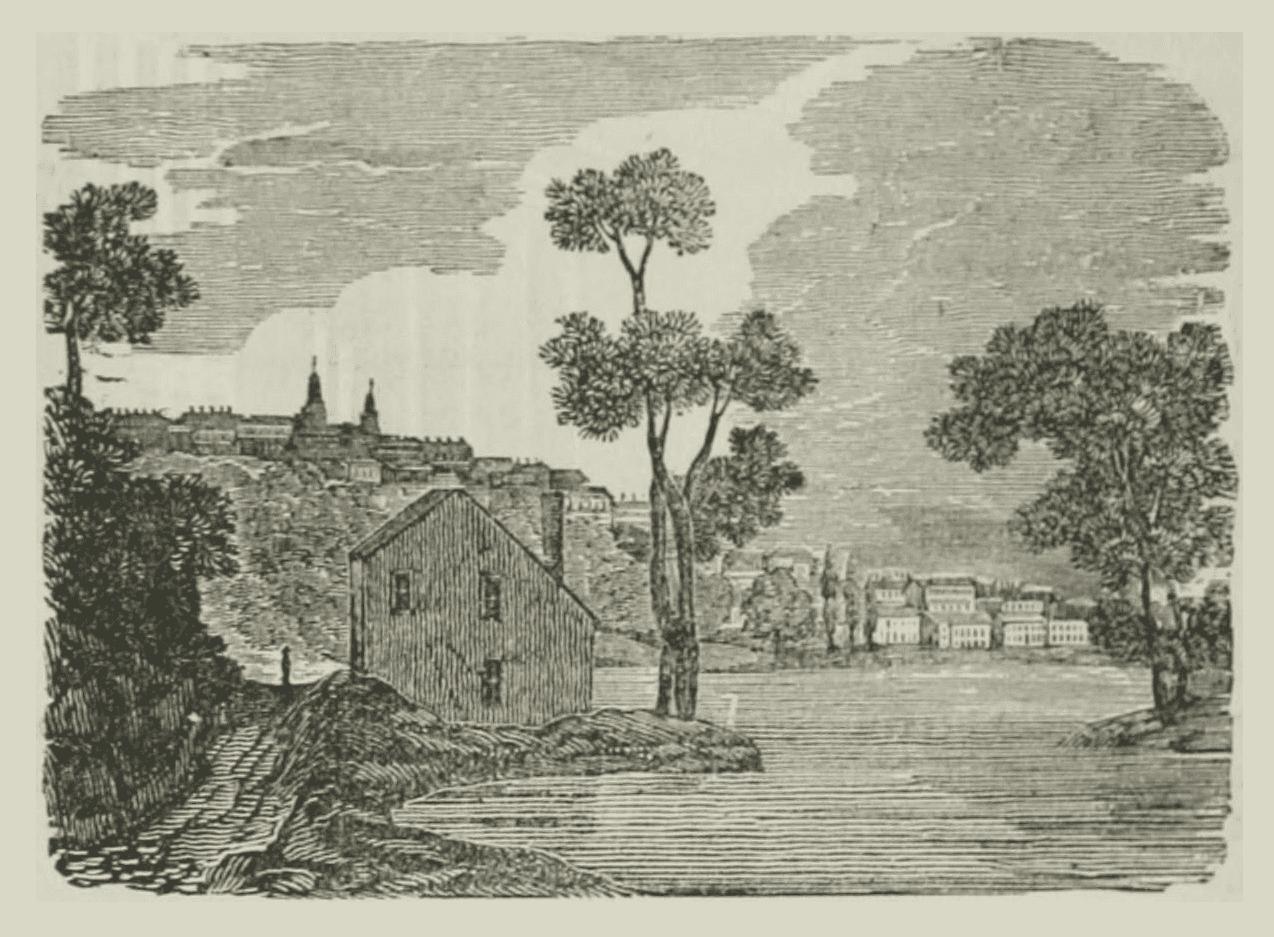
Albany.
The Capitol stands on an elevation at the end of the main street, and presents a fine appearance. It is a fine stone edifice, with an Ionic portico in front, supported by columns thirty-three feet in height. The public square adjacent is adorned with beautiful walks and avenues.
The Farmers’ and Mechanics’ bank and the Albany bank, both at the foot of State street, are both of white marble, and are handsome buildings. There are about sixteen churches in this city. Albany has received more permanent and evident advantages from the canals than any other place in the state. Since 1825, the population has increased from fifteen thousand nine hundred and seventy-one to 33,627. The first settlement at Albany was made about 1614, when a stockade was built on a spot just below the steam-boat dock. The charter of the city was granted in 1686, a few months before that of New York. The city and township are a mile in breadth, and extend thirteen miles along the river. The neighborhood of Albany abounds in pleasant villages.
Alexandria is a city and port of entry in the district of Columbia, on the west bank of the Potomac, six miles below Washington. It is a place of some business and resort during the session of Congress, and contains some fine buildings. Of late, Alexandria has not much increased, notwithstanding it enjoys good commercial advantages. This city is regularly built, and has good streets, well paved and clean. The trade is chiefly in flour. Population about eight thousand four hundred and sixty-two.
Amherst is a town of Hampshire county, Massachusetts, ninety-one miles west of Boston. It is the seat of a college which was incorporated in 1821, with the title of Amherst College. This seminary has professors and tutors. Amherst is the seat also of an academy, and a school called the Mount Pleasant Institution. Population, two thousand four hundred and fifteen.
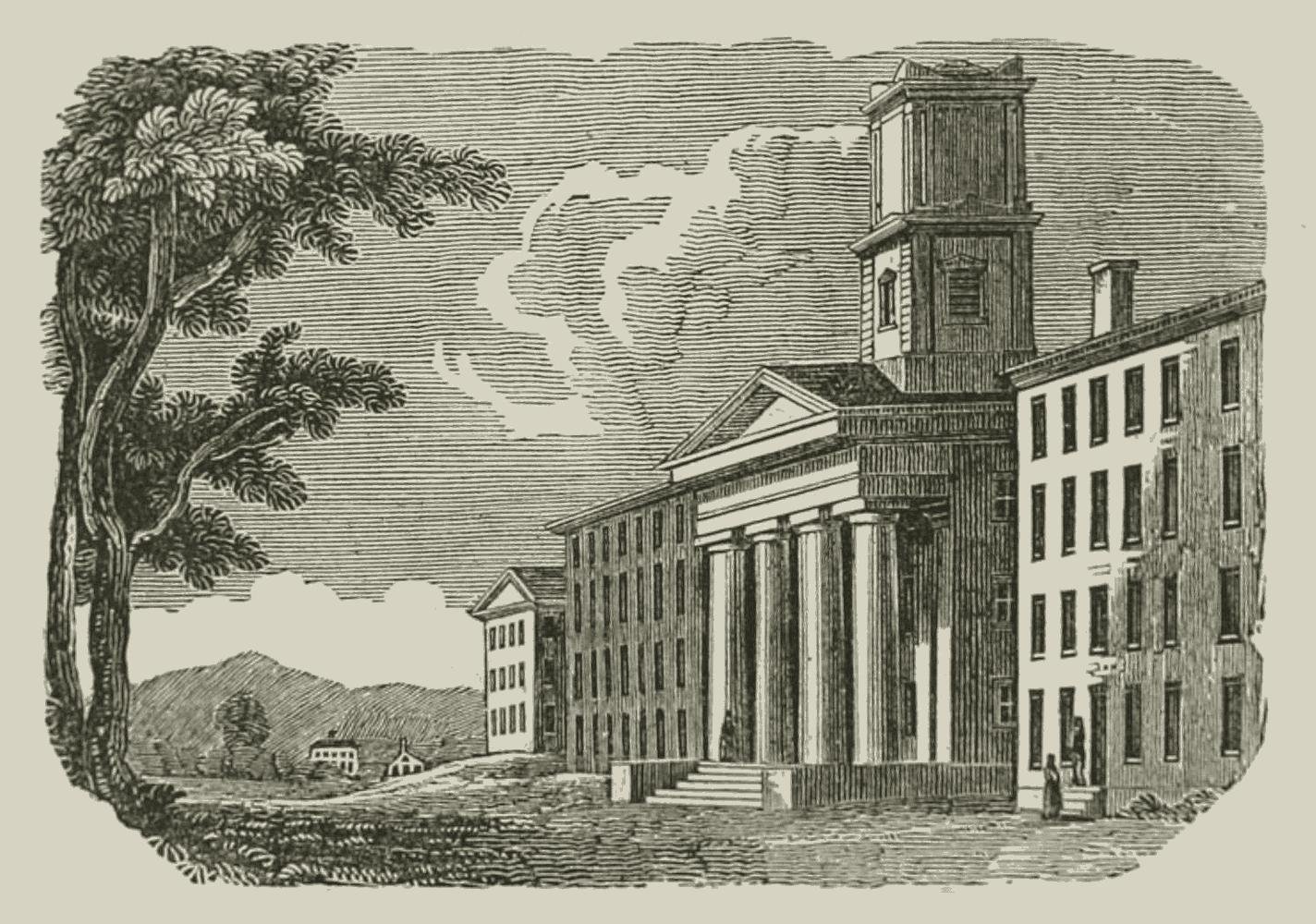
Amherst College.
Annapolis, the capital of Anne Arundel county, and the seat of the government of Maryland, is situated at the mouth of the Severn river, about two miles from its entrance into Chesapeak bay, thirty miles south of Baltimore, and forty north-east of the city of Washington. It is a place of little note in the commercial world; but being in a pleasant situation, and commanding a beautiful prospect of the Chesapeak, and the shore on the other side of the bay, it is a very pleasant residence. The houses are built of brick, and for the most part large and elegant, denoting great wealth. The state house is one of the most superb structures in the United States. Here is the seat of the University of Maryland. Population two thousand six hundred and twenty-three.
Augusta, capital of Maine, stands on the west branch of the Kennebec river, two miles above Hallowell. It is a pleasant town, and contains some neat public buildings. The new state house is built of granite, and is a very handsome edifice. It contains a spacious hall for the house of representatives, and two smaller ones for the senate and the council. On the side of the river opposite to the state house is the United States Arsenal, consisting of about a dozen buildings of stone, some of which are large and handsome. This place has considerable trade, and the river below is navigable for vessels of one hundred tons. Population 5,314.
Augusta, capital of the state of Georgia, stands on the south-west bank of the river Savannah, about one hundred and forty miles from the sea. It is regularly built of brick upon a level spot, and surrounded by a fertile country. It has a good trade in cotton, and other productions of the interior. Population, six thousand three hundred and forty-one.
Baltimore is a large city, standing on the north side of the river Patapsco, in Maryland. The basin on which it stands has only five or six feet water at high tide, so that the city can be approached only by small vessels. For large ships, the harbor is at some distance, at a place called Fell’s point, where wharves have been built, along side which vessels of six hundred tons burden can lie with perfect safety. Numbers of persons have been induced to settle on this point on account of the shipping; and regular streets have been laid out, with a large market-place. But though these buildings, generally speaking, are considered as part of Baltimore, yet they are a mile distant from the other part of the town.
The city is the chief commercial mart for the country upon Chesapeak bay and its waters. It is finely situated, and regularly built, in great part of brick; the public buildings and monuments indicate great enterprise and opulence.
Baltimore was laid out in 1729, on an area of sixty acres, purchased at forty shillings per acre, and partly paid for in tobacco at a penny a pound. Its progress was slow and unpromising; and in 1752 it contained but twenty-five houses. With its population of more than eighty thousand, it may now be considered the third or fourth city in the union. According to its re-charter in 1816, Baltimore now includes ten thousand acres, and contains a lunatic asylum, three theatres, an exchange, a public library, and forty-five churches.
The Cathedral is built after the Ionic order, on a plan drawn by the celebrated architect Latrobe. Its width is one hundred and seventy-seven, its length one hundred and ninety, and its height to the summit of the cross surmounting the dome, is one hundred and twenty-seven feet. It contains several fine paintings, and the largest organ in the United States. The Merchants’ Exchange, built by private subscription for the accommodation of the citizens, is a spacious and splendid edifice.
The Battle Monument is an elegant marble structure, fifty-five feet high, erected in memory of those who fell in defence of the city on the twelfth and thirteenth of September, 1814. The Washington Monument is built of white marble, on an elevation in the north part of the city; it is one hundred and sixty-three feet high, and on its summit is placed a colossal statue of Washington. This monument is embellished with bas-reliefs, and other decorations.
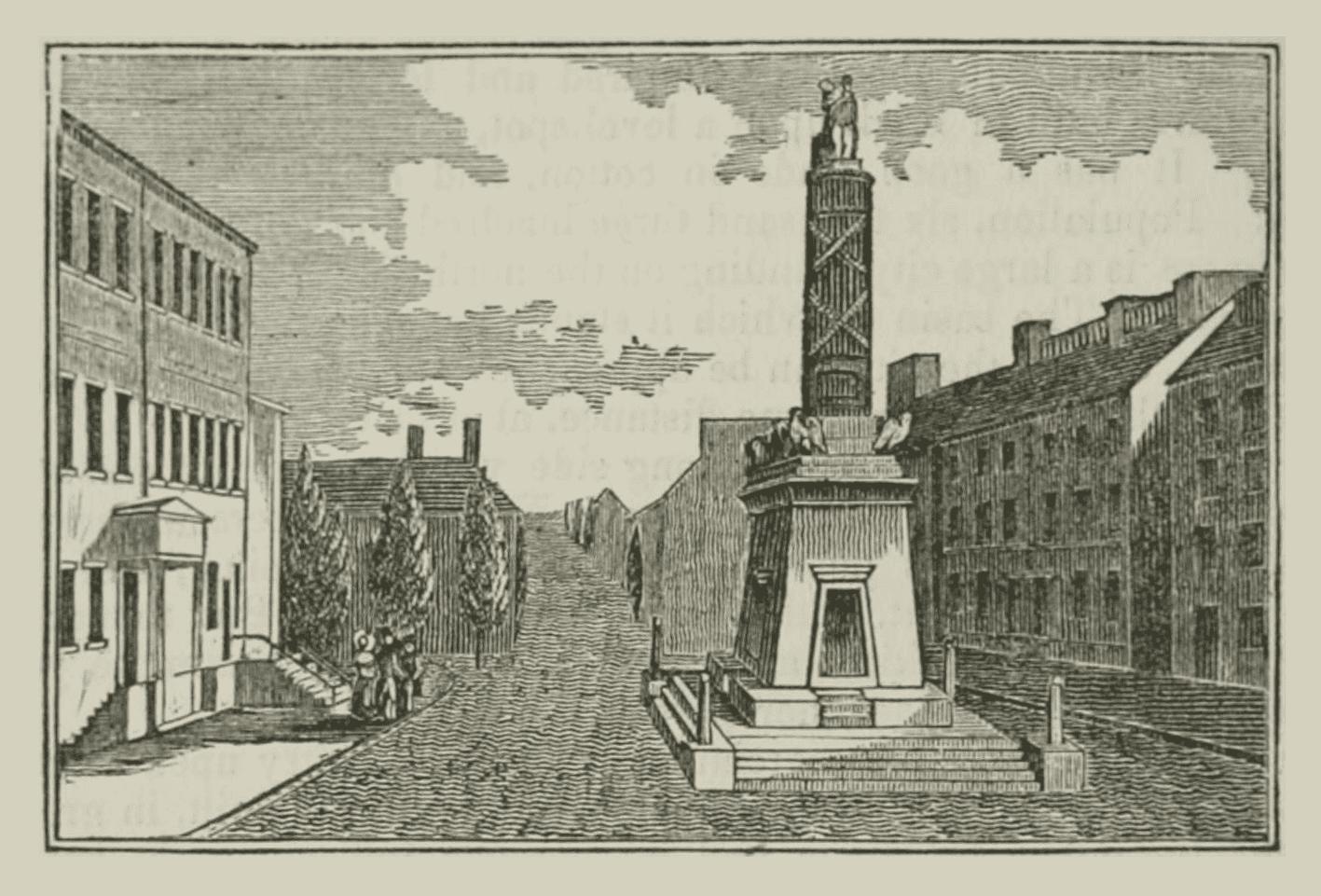
Battle Monument, Baltimore.
Baltimore is the greatest flour market in the United States. In its immediate neighborhood, are above sixty flour mills, a single one of which has produced thirty-two thousand barrels in a year. Within the same compass are numerous manufactories of cotton, cloth, powder, paper, iron, glass, steam engines, and other articles. The Baltimore and Ohio rail-road extends a distance of three hundred miles, from this city to the Ohio river at Pittsburgh. The Baltimore and Susquehanna rail-road is to extend seventy-six miles to York in Pennsylvania. The Chesapeak and Ohio canal, of the proposed length of three hundred and forty-one miles was commenced in 1828. The population of Baltimore is one hundred and two thousand three hundred and thirteen.60
Bangor is a flourishing town of Penobscot county, Maine, situated thirty-five miles above Castine. It is built upon the banks of the rivers Kenduskeag and Penobscot. The increase of this town within a few years has been very surprising. Building-lots near the centre of the town, that in 1832 were held at three hundred dollars, are now valued at eight hundred or a thousand. Woodlands at three, four, or five miles distance, that were then sold at five, seven, or ten dollars the acre, are now selling from twenty to fifty. Rents and all marketable commodities are proportionably high.
‘Bangor,’ says a correspondent of the Portland Advertiser, ‘has much the appearance of a hundred villages springing up on the non-slave-holding side of the Ohio, with this difference, that the buildings there are chiefly of wood, cheaply built, and hastily thrown up; and here they are fine blocks of brick with granite fronts, or handsome white houses that would do credit to any estate in Virginia or Carolina. I do not remember seeing what can be called a miserable house in Bangor. The Exchange is a building that would do credit to many of our large cities. The churches are numerous, and often elegantly built. Already they are numerous enough for a city; and it is such a spectacle that distinguishes New England; for no where, not even in the middle states, are such churches, and so numerous to be seen, as any village in New England of any size can exhibit.’
The water power in this vicinity is said to be superior to that of any town in the United States. Its present great source of wealth is the lumber business, which has been carried on to a very great extent. Thirty years ago, Bangor was a wilderness; according to the last census, its population was eight thousand six hundred and twenty-seven.
Bath, a town of Maine, on the west side of the Kennebec, twelve miles from the sea, is at the head of the winter navigation; is pleasantly situated, and has great advantages for commerce. Ship-building is carried on here to a large extent; and in 1827 the value of the shipping of Bath was a million of dollars. This town is almost isolated by some of the numerous arms of the sea which penetrate that part of the coast. Population, five thousand one hundred and forty-one.
Baton Rouge, a beautiful village on the eastern bank of the Mississippi, one hundred and fifty miles above New Orleans, is the capital of a parish of the same name in the eastern district of Louisiana. It is a small town, situated on the last bluff that is seen on descending the river, and about thirty or forty feet above its highest overflow. The village is tolerably compact, and the United States’ barracks are built in a very handsome style. ‘The town itself,’ says Mr. Flint, ‘especially in the months when the greatest verdure prevails, when seen from a steam-boat in the river, rising with such a fine swell from the banks, and with its singularly shaped French and Spanish houses, and its green square, looks like a finely painted landscape.’ Population, two thousand eight hundred and sixty.
Beaufort, principal town of Beaufort district, South Carolina, situated on the western bank of Port Royal river, is a pleasant and healthy place, containing a college, three churches, and seven thousand six hundred and eighty-seven inhabitants. Its harbour is spacious.
Belfast, the capital of Waldo county, Maine, has a fine situation and good harbor, and is a flourishing town. It is twelve miles north-west of Castine, from which it is separated by Penobscot river. Its coasting trade is very considerable. Population, four thousand one hundred and ninety four.
Bennington is the chief town of the county of the same name in Vermont. It is situated at the foot of the Green mountains, near the south-west corner of the state. It has several manufactories, and a marble quarry, and is celebrated for two victories of General Stark, over the British, in 1777. It is the largest and oldest town in the state, having been chartered by Governor Wentworth in 1749, and first settled by the Separatists under Robinson in 1761. Population, two thousand six hundred and seventy-one.
Bethlehem, in Albany county, New York, includes much rich alluvial land near Hudson river, inhabited by descendants of early Dutch settlers. It contains several caverns. Population, 3209.
Bethlehem, in Northampton county, Pennsylvania, is situated on a fine acclivity rising from the Lehigh river. It was founded in 1741 by the United Brethren, or Moravians, under Count Zinzendorf. The same order still retain the ownership, and have established here a seminary of considerable note for female education. The houses are neat and substantial. There is but one place of public worship, in which service is performed in English and German. The situation of this village is remarkably picturesque and romantic. There are ten other towns of this name in the United States. Population, two thousand nine hundred and eighty-nine.
Beverly, town in Essex county, Massachusetts, is a seaport, and connected with Salem by a bridge. It was formerly a part of Salem. It is pleasantly situated, and is largely engaged in the fisheries and in commerce. Population, four thousand six hundred and eighty-six.
Blakely is a seaport of Baldwin county, Alabama, on the Tensa, a branch of the Mobile. It was founded in 1816, and is a flourishing place. Its situation is healthy, and it has a commodious harbor.
Boston, the capital of Massachusetts, and the chief city of New England, is situated at the head of Massachusetts bay, on a peninsula of an uneven surface, about a mile in width, and nearly three miles long. Its original Indian name was Shawmut, and it was afterwards called Trimountain; its present name was given in honor of the Rev. John Cotton, one of its earliest pastors, who emigrated from Boston in Lincolnshire, England. In the older parts of the city, the streets are crooked, narrow, and intricate; laid out with no reference to beauty or order. The more recent streets are wider, straight, and regular; with edifices of great elegance and large dimensions. The avenues leading into the adjacent country are the natural isthmus which connects the city with Roxbury, the mill dam, six bridges and three rail-roads. There is also a ferry between Boston and Chelsea, with steamboats for the conveyance of foot passengers and carriages. Of the bridges, four are thrown over Charles river, connecting the capital with Cambridge and Charlestown, and two unite it with South Boston.
The harbor has been before described. It is dotted with numerous islands, and affords ample accommodation for a fleet of five hundred sail. The approach to the city from the sea is highly picturesque and beautiful. The wharves and piers are ample, covered with spacious stores of brick and granite, and presenting as great conveniences for the transaction of business as are to be found in the world.
The local divisions of Boston are into North Boston, West Boston, South End, and South Boston. To these we may now add East Boston, comprehending what was formerly called Noddle’s Island, a tract of about six hundred acres, purchased by a company in 1832 for the purpose of extending the city in that direction. The Common is a beautiful promenade at the west end of the city, containing an extent of nearly fifty acres, agreeably varied by small eminences, the most prominent of which still exhibits the vestiges of a fortification thrown up by the British soldiers during the revolution. A little north of this mound is a small sheet of fresh water. This spacious green is surrounded by malls, lined with magnificent elms. On three sides are rows of fine private dwelling-houses, including some of the most elegant mansions in the city.
On an eminence overlooking the common stands the State House; a conspicuous and striking edifice, the view from whose dome is most interesting and extensive. The broad harbor with its green and picturesque islands, the adjacent country covered by pleasant villages, and with a pleasing alternation of hill and valley, interspersed with orchards and woodland—and at its base, the avenues of a crowded and busy city, form a combination of beauty that cannot fail to delight every beholder. Beyond the islands of the bay, the eye stretches eastward to the waters of the ocean; and to the north lies Charlestown with the navy-yard, and the monument erecting and soon to be completed on Bunker hill. To the west is a view of Cambridge, with the various edifices attached to the university. The state house was erected about thirty-eight years since. It is of an oblong form, one hundred and seventy-three feet front, and sixty-one deep; a dome thirty-five feet in height and fifty-two feet diameter, surmounts the edifice, and the whole terminates with a circular lantern twenty-five feet high. The basement story is ornamented with rows of Doric pillars; in an open chamber projected from the north centre of this story is placed Chantry’s noble statue of Washington. This building contains the usual accommodation for the various offices of state, besides the senate chamber, council chamber and representatives’ hall.
Faneuil Hall is famous in American annals. It is a building of good proportions, and convenient size, though of no great architectural pretensions; its history is sacred to the spirit of eloquence, courage and patriotism. The building has a cupola which presents a good view of the harbor; the great hall is nearly eighty feet square, and about twenty-eight feet high. It is decorated with an original full length painting of Washington, by Stuart, and another of the same size by Colonel Sargent, representing Mr. Faneuil, the noble donor of the edifice. Faneuil Hall Market is situated to the east of Faneuil hall. It is a splendid building of granite, five hundred and thirty-five feet and nine inches in length. The basement story is occupied by market stalls; on the second floor is a spacious hall, used for public assemblies and caucuses, called Quincy Hall, in honor of the distinguished gentleman in whose mayoralty the edifice was projected and built.
The City Hall, formerly known as the old state house, was built in nearly its present form in the year 1747. It stands at the head of State street, and on the line of Washington street, the principal avenue of the city. In this building are the post office, the marine news room, and the merchants’ exchange; from this there is a winding stair-case leading to the hall of the common council, and that of the mayor and aldermen together with various public offices connected with the city administration. Other public buildings, of great beauty to the city, are the old U. S. Branch Bank, and the Masonic Temple. The latter building fronts on the common; it is of the Gothic order.
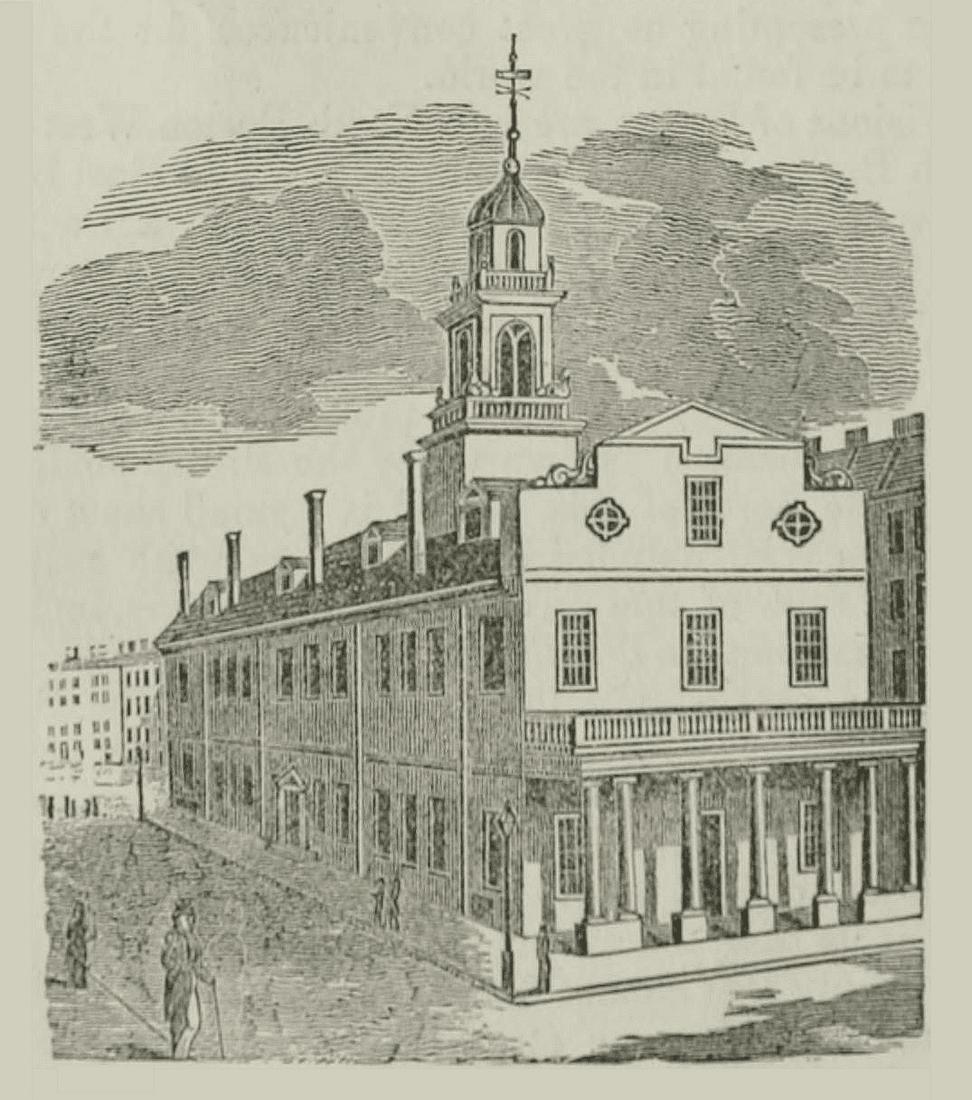
City Hall.
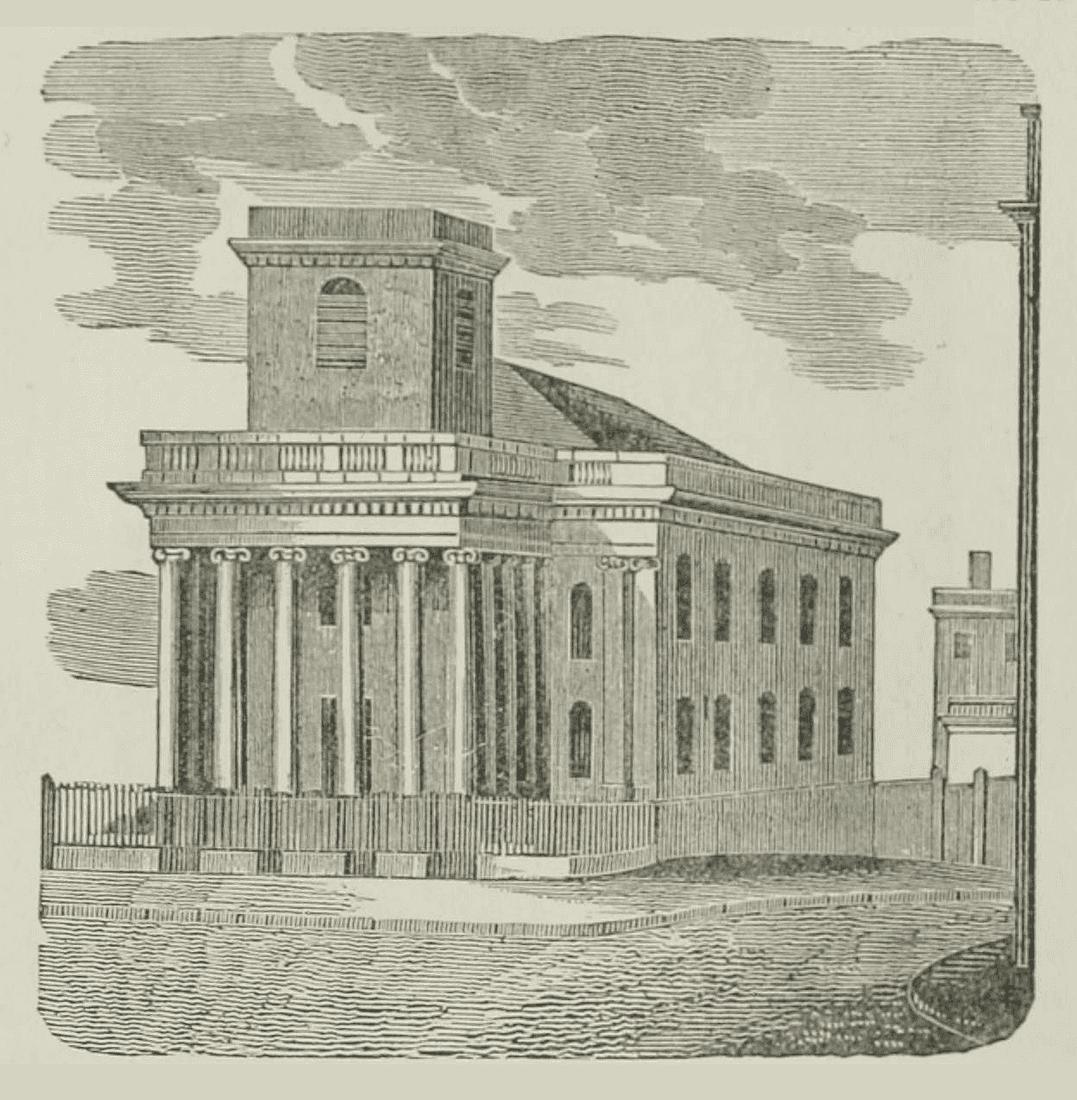
King’s Chapel.
One of the most interesting of the churches of the city is that known as the King’s Chapel. Its exterior is plain, and in appearance it is unfinished being built entirely of unhammered stone. It was first opened for divine service in 1754. The tower is ornamented by a colonnade of large wooden pillars, and the whole presents the appearance of massy grandeur suited to distinguish in former days the place of worship for the public functionaries. In the interior, the governor’s pew was formerly distinguished above the rest, but was taken down a few years since. The style of architecture is of the Corinthian order. There are several monumental marbles, which add to the interest with which the church is visited. It is now the only house in which the old fashion of square pews is retained. Brattle street church is interesting from historical associations. Governors Hancock and Bowdoin were liberal benefactors of this society. The name of the former was inscribed on one of the rustic quoins at the south-west corner of the building. The British soldiery defaced it, and the stone remains in the condition in which they left it. A similar inscription, unmutilated, appears on one of the rustic quoins at the south-west corner of the tower; and on one in the north-west corner, the name of Dr. John Greenleaf appears, who, with Gov. Bowdoin, advanced the money for refitting the church, it having been improved as a barrack, during the siege. A shot, which was sent from the American army at Cambridge, struck the tower on the night preceding the evacuation of the town. It was picked up and preserved, and is now fastened in the spot where it struck. General Gage’s head quarters were in the house opposite. Trinity church in Summer street is a beautiful granite edifice, built in 1829. It is one of the chief architectural ornaments of the city; and for beauty of proportion, strength and solidity, is perhaps unsurpassed in this country. The number of worshipping assemblies in this city is between fifty and sixty.
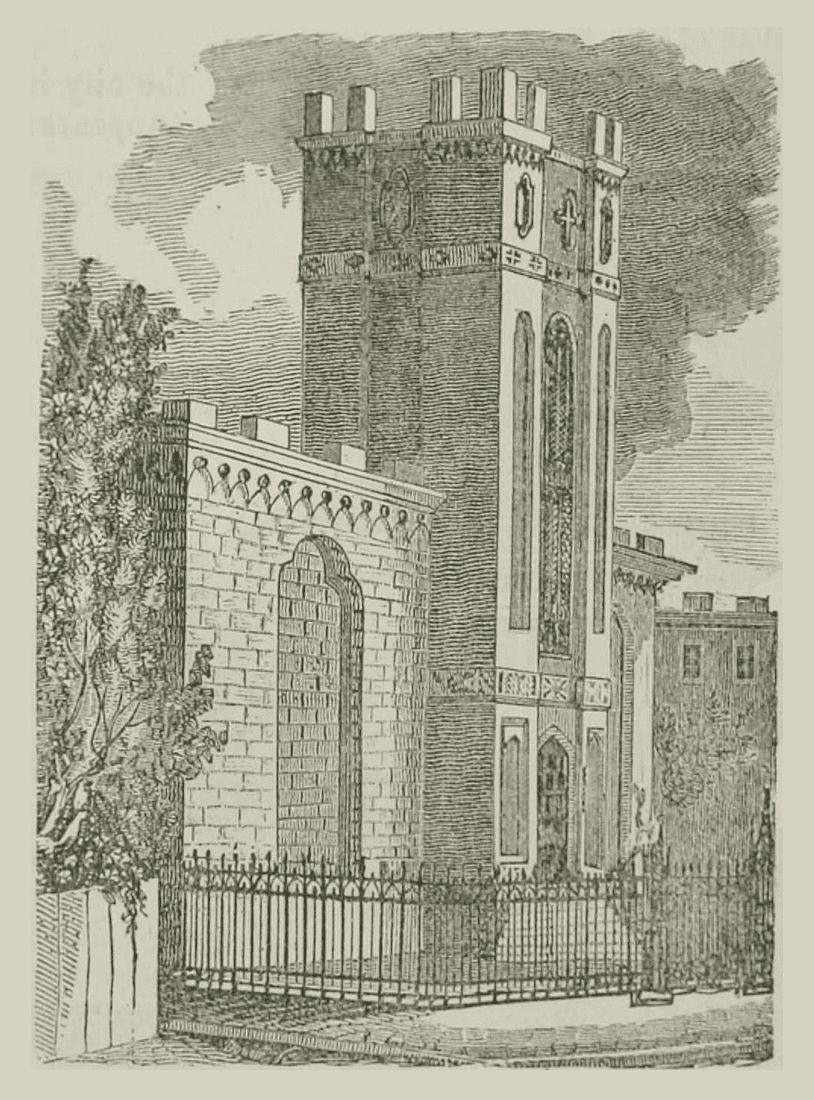
Trinity Church.
The places of public amusement in Boston are not numerous, nor remarkably well patronized. The Tremont theatre affords the only dramatic entertainment that is much resorted to by strangers and people of fashion. It is a handsome building, with a front of Quincy and Hallowell granite. This front is in imitation of the Ionic order, with four pilasters and two antœs, one on each angle, supporting an entablature and pediment, and elevated on a basement seventeen feet. The Warren theatre is a minor establishment, and is much frequented. The New England Museum attracts numerous visitors.
Of the hotels of Boston, we can only particularly mention the Tremont House, a splendid building, in the pleasantest quarter of the city, and esteemed the best house in the country. ‘Most gratifying is it to a traveller in the United States,’ says a recent tourist, ‘when, sick to death of the discomforts of the road, he finds himself fairly housed in the Tremont hotel. The establishment is on a large scale, and admirably conducted.’ This stinted approbation is one of the few tokens of satisfaction that Mr. Hamilton gives in his unsparing though witty and entertaining volumes; it is not the less acceptable, because it is extorted.
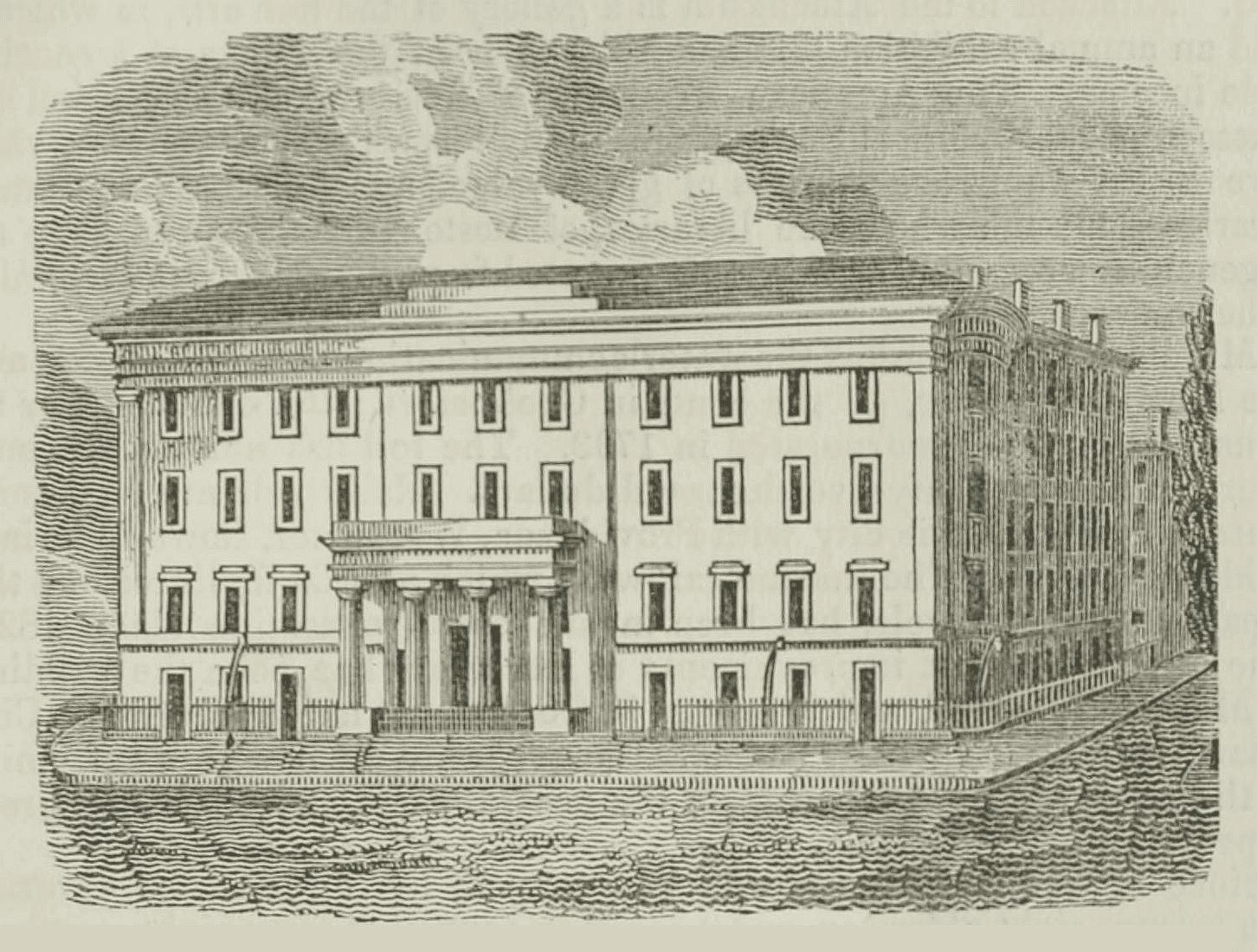
Tremont House.
In the year 1841, there were thirty-one banks in the city, which employed a capital of twenty millions one hundred thousand dollars. The increase, of course, has been in proportion to the increasing enterprise and prosperity of the city. The oldest is the Massachusetts’ bank, which was incorporated in 1785. There are twenty-four insurance companies, with an aggregate capital of seven millions and a quarter. The charitable institutions of the city are numerous. Of these, one of the most important is the Institution for the Education of the Blind, recently established under very favorable circumstances. Besides this are the Asylum for Indigent Boys, the Female Asylum, Charitable Mechanic Association, Prison Discipline Society, and many others. The Massachusetts General Hospital is situated in the west part of the town; it has been pronounced the finest building in the state. The Quarantine Hospital is situated on Rainsford island, in the harbor, and about six miles from the city.
The number of periodicals issued in this city is above seventy, inclusive of dailies and annuals. The first paper published in the country was the Boston News Letter, commenced in 1704, and continued for nearly seventy-two years. The oldest surviving journal established since the revolution is the Columbian Centinel, which was commenced in 1784.
Boston is celebrated for her public schools, and the great efforts which have been made by her citizens in the cause of education. The expenditures for these institutions, during the year ending August, 1833, amounted to over seventy thousand dollars. Social libraries are numerous. The Boston Athenæum was established in 1806, and contains above twenty-eight thousand volumes. Though accessible only to men of fortune, as the price of a share is three hundred dollars, it is still a useful institution. Annual subscribers are admitted at ten dollars. This noble establishment is situated in Pearl street, in a fine building, for the half of which the proprietors were indebted to the munificence of the late James Perkins, Esq. Attached to the Athenæum is a gallery of the fine arts, in which is held an annual exhibition that has hitherto been the source of a considerable income. The American Academy of Arts and Sciences, and the Massachusetts Historical Society, are highly respectable institutions which have issued numerous volumes of great value, and possess considerable libraries. On the whole, the libraries of Boston are neither so large nor so generally accessible as might be expected from the wealth and liberality of her citizens.
Middlesex canal unites the water communication between Boston and the Merrimack river, at the bend in Chelmsford; the company for its construction was incorporated in 1793. The toll has amounted some years to about twenty-five thousand dollars. Rail-roads are now complete, connecting this city with Providence, Worcester, Lowell, Springfield and Salem. The marine rail-way, which affords facilities for the repair of large vessels, has been in successful operation since 1826. One of the greatest improvements of late years has been the building of Mercantile wharf, which ranges in front of the harbor, between City wharf and Lewis’s wharf. It has made access to the northern extremity of the city very convenient from the central parts, and has led to great improvements.
Since 1822, when the city was incorporated, Boston has been governed by a mayor, eight aldermen, and a common council of forty-eight members, chosen annually. With the town of Chelsea, it constitutes the county of Suffolk, and sends one representative to Congress. As a commercial city, it holds a second rank among the seaports of the United States. There are many manufactures in the city, and much wealth of the citizens is invested in the manufactories of Waltham, Lowell, and other towns. Population, ninety-three thousand three hundred and eighty-three.61
Bordentown, a town of New Jersey, in Burlington county, standing on a steep sand bank on the west side of the Delaware, is chiefly remarkable for the villa of Joseph Bonaparte, ex-king of Spain. This is a long white building, with two low square towers at the ends, and a shot-tower near it by the river. Pop. three thousand four hundred and thirty-four.
Brattleboro is a pleasant village, in Windham county, Vermont, on the Connecticut. It is situated on an elevated plain above the river; at the bridge over the stream are several manufactories, the chief of which are of paper and machinery, which are made here in large quantities. The situation of the village is quite romantic and picturesque. Population, two thousand and six hundred and twenty-four.
Bridgeport, in Fairfield county on Long Island sound, maintains an active intercourse with New York by means of sloops and steamboats, and furnishes that city with a great amount of produce. The harbor is shoal, but with a good channel; the town is pleasant and thriving. Population four thousand five hundred and seventy.
Brighton, a town of Middlesex county, Massachusetts, is celebrated for its annual cattle show and fair which has been held here ever since the revolution. Vast numbers of cattle for the Boston market are brought here from all quarters of the country. The soil is good, and well cultivated. Population, one thousand four hundred and five.
Bristol, a thriving town, situated on Narragansett bay, about half way between Providence and Newport, is distinguished for its pleasant situation, healthful climate, rich soil, and a commodious, safe harbor. This town suffered greatly during the revolutionary war, a great part of it having been destroyed by the British; but it is now in a very flourishing state, and has a good shipping trade: onions in great quantities, and a variety of provisions and garden roots, are raised here for exportation. Mount Hope, celebrated in the early history of New England as the residence of king Philip, is within the limits of Bristol; it is a cone-shaped hill, with a pointed summit, and exhibits a charming prospect. Population, three thousand four hundred and ninety.
Brooklyn, a large town on Long Island, separated from the city of New York by the narrow channel of East river. It is properly a suburb of that city, and is a place of great business. It is regularly built, and contains many fine houses, the residence of merchants from the city. The United States navy yard is in the east quarter, upon a bay called the Wallabout. Near this town a bloody and disastrous battle was fought with the British in 1776. The town stands on an eminence, and commands fine views of the city and bay. A constant intercourse is kept up with New York by steamboats. It is the third town in the state in regard to its population, which amounts to 36,221.
Brookville is pleasantly situated in the forks of Whitewater, and is the seat of justice of Franklin county, Illinois. It was laid out in the year 1811; but no improvements were made until the succeeding year, and then but partially, owing to the unsettled state of the frontiers; its vicinity to the Indian boundary being about fifteen miles. The late war completely checked the emigration to this country, and consequently the town ceased to improve; since that period, it has improved and been noted for the enterprise of its citizens. It is now, however, decaying. It contains about a hundred houses.
Brunswick is a town of Cumberland county, Maine, situated on the south side of Androscoggin river, twenty-six miles north-east of Portland. The river has many falls at this place, on which are situated numerous mills, and manufactories of cotton and woollen. It is chiefly distinguished as the seat of Bowdoin college, which was established here in 1794. This institution is partly supported by funds bequeathed by governor Bowdoin, of Massachusetts, from whom the college takes its name. Population of Brunswick, four thousand two hundred and fifty-nine.
Buffalo, delightfully situated near the margin of lake Erie, three hundred and twenty-seven miles from Albany, and twenty-two from the falls of Niagara, is a place of considerable importance, and the emporium of the lake commerce. The principal streets are from sixty-six to one hundred feet wide; these are intersected by others of equal width, and as many of the houses are of brick, two and three stories high, they make a neat and handsome appearance. Buffalo, standing on the great road leading from Albany to Ohio, possesses natural advantages for trade, equal to any internal place in the United States.
Its harbor is singularly fitted for the two kinds of navigation that are here brought together, the entrance from the lake being sheltered by the point on which the light-house is erected, and the two small rivers which here unite their waters affording every convenience for landing and re-shipping goods; a number of basins and lateral canals communicate with the great canal. This harbor is thronged with steamboats and every kind of water craft; it is one of the most busy and bustling places in the country.
‘In Buffalo,’ says a recent writer, ‘the miserable descendants of the Iroquois or Six Nations may constantly be seen in the streets. The Senecas have three villages within nine miles. If any man wishes to observe the effect of an intercourse between whites and Indians, let him go to Buffalo. There he may see red men, reeling drunk in the streets, begging in the most abject manner for liquor, and the women in the lowest stage of moral and physical degradation. They are in some measure civilized, some of them having adopted the costume of the whites, and living by the cultivation of the soil. Should they continue to reside in their present dwelling-place, it is to be hoped that the change will be complete. When the chase will no longer afford them a subsistence; when they are completely hemmed in by the whites, they must of necessity have recourse to agriculture for the means of living, and knowledge must be the attendant of industry—but as long as they are able to live, no matter how wretchedly, in idleness, they will not work, and will continue to retrograde.’ Population, eighteen thousand three hundred and fifty-six.
Burlington, in Chittenden county, Vermont, on lake Champlain, is a flourishing and commercial town. It is situated on the declivity of a hill, commanding an extensive view of the lake, and a beautiful prospect of the town. It is the seat of the university of Vermont, and of several manufactories. Its commerce is considerable. Population, four thousand two hundred and seventy-one.
Burlington City stands on the banks of the Delaware, eighteen miles north-east from Philadelphia. The main streets are conveniently spacious, and mostly ornamented with rows of trees in the fronts of the houses, which are regularly arranged. The river opposite the town is about a mile wide, and under shelter of two islands, affords a safe and convenient harbor; but, though well situated for trade, Burlington is too near the opulent city of Philadelphia to admit of any considerable increase of foreign commerce. Population, two thousand six hundred and seventy.
Cahokia, in St. Clair county, Illinois, is situated on a small stream, about one mile east of the Mississippi, and five miles below St. Louis. It is pleasantly situated, and is inhabited chiefly by French people. This town contains a post-office and a Roman catholic chapel, and is the seat of justice for the county.
Cambridge, a town of Middlesex county, Massachusetts, lies west of Boston, was settled in 1631. It is a fine village, containing many very pleasant residences, and is divided into three distinct portions. East Cambridge is a suburb of Boston, with which it is connected by Cragie’s bridge; it is flourishing, and has some glass and iron manufactories. Old Cambridge is about three miles from the city, and is the seat of Harvard college, the oldest and richest university in the United States; this institution is fully described in another portion of the volume. In the western part lies Fresh Pond, a fine sheet of water, much resorted to in summer by citizens of the neighboring towns. In the south-westerly part is a beautiful hilly grove called Mount Auburn, recently devoted to the purposes of a cemetery, and forming one of the most beautiful burial places in the world.62 The first printing-press in America was set up here, and was used by Stephen Day, who printed the Freeman’s Oath. During the siege of Boston, in 1776, the American army encamped here, and vestiges of some of their intrenchments still remain in the neighborhood. Population, eight thousand one hundred and twenty-seven.
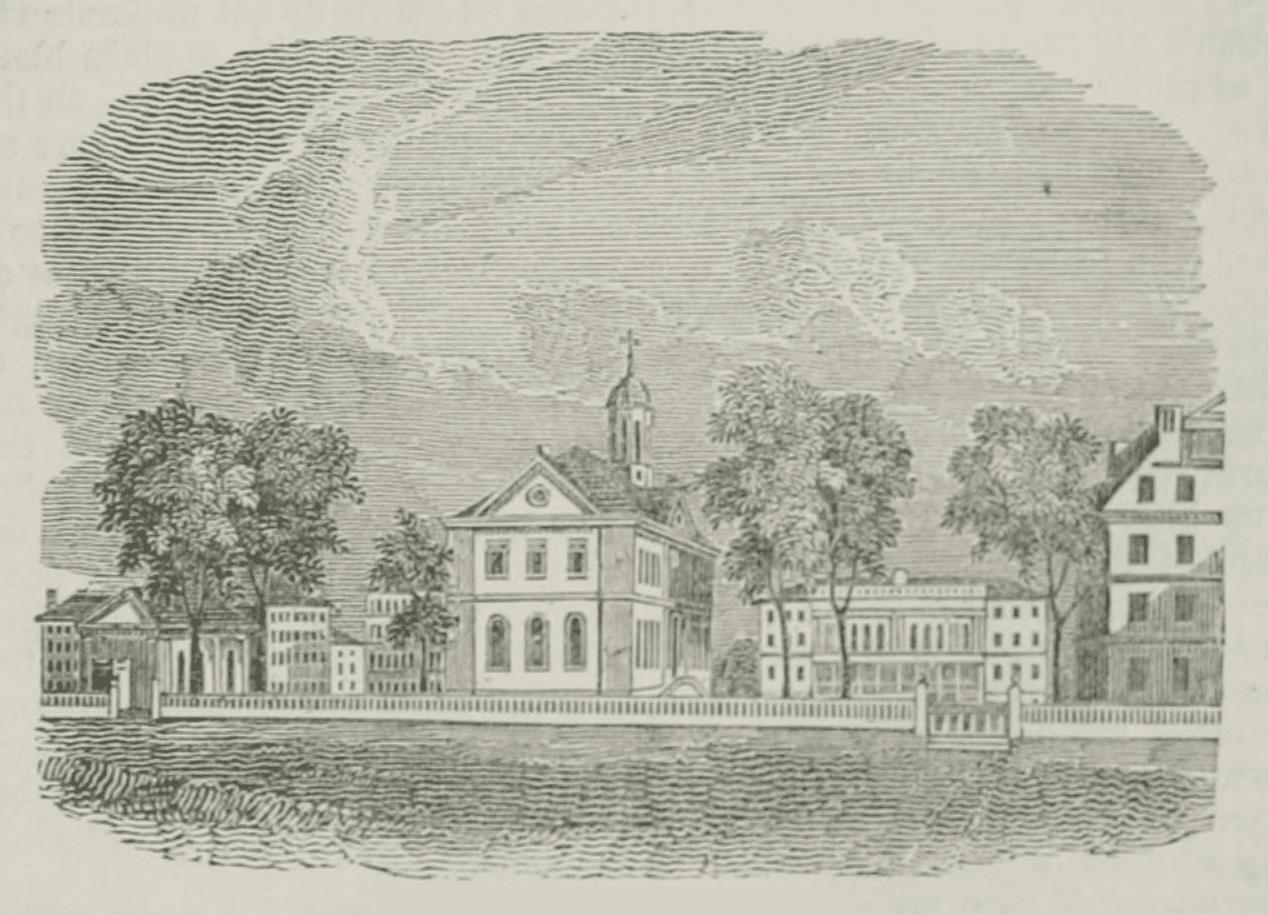
Harvard University.
Camden, in Kershaw district, South Carolina, on the Wateree, is the seat of justice for the district. It is chiefly celebrated for the battles fought in its vicinity during the revolutionary war. Population, one thousand. A flourishing town of the same name in Oneida county, New York, has a population of about two thousand.
Canandaigua, capital of Ontario county, New York, on the outlet of the lake of the same name, is one of the pleasantest towns in the country. The principal street runs along the ridge of a hill, which rises from the north end of the lake, for the distance of a mile; it is handsomely planted with trees, and the houses, which are generally painted white with green blinds, present a very neat appearance. In the centre of the town is a large square; the neighborhood abounds with pleasant gardens. Population, five thousand six hundred and fifty-two.
Castine, a town of Maine, built on a promontory at the head of Penobscot bay, is placed in a commanding situation, and has an excellent harbor. It was taken by the British during the last war, but was restored in 1815. Population one thousand one hundred and eighty-eight.
Catskill, principal town of Greene county, New York, is situated on the west bank of the Hudson river, nearly opposite the city of Hudson, and thirty-one miles south of Albany. It exhibits gentle elevations in the neighborhood, and the soil is generally good; it is well watered, has fine meadows, and good mill sites. Population, 5,339.
Charleston, the chief city of South Carolina, stands upon a piece of land projecting into the bay, at the confluence of the Ashley and Cooper rivers, and has a deep and safe harbor. Ships drawing twenty feet of water pass the bar. The city is regularly built; the fine houses are very large, many of them inclosed like the great hotels in Paris, and all of them covered with verandas, and situated in gardens neatly dressed, and in summer and fall, not only adorned with the finest evergreen shrubs, but with a great variety of beautiful roses, jonquils, and other flowers. On the other hand, many of the streets are dirty and unpaved, and the houses in some parts of the town have a filthy appearance. The churches and public buildings are handsome, especially St. Michael’s church, with its steeple one hundred and sixty-eight feet high. The post office is a large, handsome building. Most of the finest buildings here were erected previously to the revolution. There are many charitable institutions, among which the Orphan Asylum stands in the first rank.
The society of Charleston is refined, intelligent and hospitable. The commerce of the place consists chiefly in the export of rice and cotton. On account of its level character, the city is liable to occasional inundation; but it is, nevertheless, a fine commercial mart, and highly prosperous, exhibiting most of the institutions which mark a liberal and opulent community. This city is celebrated in the history of the revolution. Population, twenty-nine thousand two hundred and sixty-one.
Charlestown, in Middlesex county, Massachusetts, is an irregular town, containing some fine situations. Here are the United States navy yard, and the finest dry-dock in the country; the Massachusetts state prison, an insane hospital, and the Ursuline convent. This town was burnt in 1775, by the British troops. On the eminence of Bunker Hill, a splendid monument of granite has been for some time in an unfinished state; but there is every hope of its immediate completion. Population ten thousand eight hundred and seventy-two.
Chilicothe, in Ross county, Ohio, formerly the seat of the state government, is situated on the west bank of the Scioto, on a beautiful and extensive plain. It is laid out on a large scale, with a great number of out-lots attached to it. The plan is regular; the streets cross each other at right angles, and every square is divided into four parts. In the vicinity are several mills and manufactories, and the Grand canal is cut through the town. The town was laid out in 1796, on the site of an old Indian village. Population, three thousand nine hundred and seventy-seven.
Cincinnati, the largest town in Ohio, is handsomely built, and surrounded by a range of fine wooded hills, which command a beautiful prospect. The plain on which it is situated occupies about four square miles; the height of the rising ground above the alluvial plain is about fifty feet. The population is much mixed, being composed of emigrants from all parts of the union, and most of the countries of Europe. Its progressive increase has been most wonderful. In 1813, Cincinnati numbered about four thousand inhabitants; in 1820, ten thousand; in 1840, forty-six thousand three hundred and eighty-two.
It has extensive flour and sawmills, worked by steam, and various manufactures. The public buildings are twenty-four churches, the College Athenæum, Medical College, Mechanics’ Institute, four market houses, a theatre, two museums, a famous and tasteless bazaar, a bank for the United States branch, court house, and other edifices. The charitable and religious associations are numerous. There are sixteen periodical publications. There are three city insurance companies, and two branches of companies at Hartford, Connecticut. Water is furnished for the inhabitants from the Ohio river, and is distributed over town at an average expense of eight dollars for a family.
Vast remains of ancient fortifications, embankments, stone walls, earthen mounds, the latter containing rude stone coffins filled with human bones, have been discovered within the precincts of this town; and many curious articles dug up, composed of jasper, rock crystal, cannel-coal, copper, sculptural representations on different substances, altogether tending to prove that this country was formerly inhabited by a race of men very different from the present American Indians.
Circleville, the seat of justice of Pickaway county, Ohio, is situated on the Pickaway bottom, about half a mile east of the Scioto. Its site is two mounds of earth, one circular, and the other square, containing about twenty acres. In the centre of the town is a small vacant circle. From this focus the streets diverge in regular radii. The growth of this town has been owing to the wealth of the surrounding plantations. Population, two thousand three hundred and twenty-nine.
Columbia, the capital city of South Carolina, is situated on the Congaree, one hundred and ten miles north-north-west of Charleston. It is the seat of the college of the state. The town is regularly built, and occupies an elevated plain gently sloping on every side. Population, four thousand two hundred ninety-five. There are eleven other towns called Columbia in the United States.
Columbus, the metropolis of the state of Ohio, is situated on the east bank of the Scioto, on an elevated plain of several hundred acres. It is situated near the middle of Franklin county, and within twenty miles of the centre of the state, in a fine fertile country. It was founded in 1812, in the midst of a thick forest. It contains a state house, court house, penitentiary, a classical seminary, three churches, and an asylum for the deaf and dumb. Population, six thousand and forty-eight.
Concord, a town of Merrimack county, New Hampshire, is the capital of the state. It is pleasantly situated on both sides of the Merrimack, along which spread some rich intervals. The chief village is on the west side, and forms a street two miles in length. It contains a state house and a state prison, both of granite. It was first settled in 1724, and twenty years afterwards suffered severely from the Indians. By the river and Middlesex canal, Concord has a boat navigation to Boston; and it is a place of considerable trade. Population, four thousand eight hundred and ninety-eight.
Concord, a village of Middlesex county, Massachusetts, is celebrated as the place of meeting of the first provincial congress in 1774, and the first opposition to the British arms. Population, one thousand eight hundred.63
Covington, a town of Genesee county, New York, has a soil of ordinary quality, well watered. Population, two thousand four hundred and thirty-eight.
Dayton, chief town of Montgomery county, Ohio, is situated on the left bank of Great Miami river, near the point where it is met by the canal. It is a flourishing place, with many mills and factories. Population six thousand and sixty-seven.
Detroit, the capital of Michigan territory, is situated on the bank of the river of the same name. During the French jurisdiction, it was the farthest post on the lakes except Macinac. Since 1815, this town has rapidly improved; before, it was small and of no importance except in a military view. It is famous for the siege here sustained by Major Gladwyn against the united tribes of Indians under Pontiac, and for its surrender to the British forces in the year 1812, by General Hull. The ground plan of the city of Detroit is laid out like that of Washington, and the buildings are very much scattered. The jail, state house, and two churches, constitute the chief public buildings. The Erie canal has done much to increase the prosperity of this town, and the Ohio canal will give it an additional impulse. Population nine thousand one hundred and two.
The streets of Detroit are generally crowded with Indians of one tribe or other, who collect here to sell their skins; at night, all those who are not admitted into private houses, and remain there quietly, are turned out of the town, and the gates shut upon them. The French inhabitants employed upon the lakes and rivers are very dexterous watermen, and will navigate a small bark in a rough sea with incredible skill. They have nothing like enterprise in business, and are very fond of music, dancing, and smoking tobacco; the women have generally lively and expressive countenances.
The fort stands on a low ridge, in the rear of the town, at the distance of about two hundred yards. From the summit of this ridge, the country gradually subsides to a low swampy plain, from five to nine miles across, covered with thick groves of young timber. Beyond this plain commences a surface moderately hilly.
Dover, a town of Kent county, Delaware, and capital of the state. It is handsomely laid out and built on a small stream that runs into the Delaware. The houses are mostly of brick, and in the centre of the town is a spacious square surrounded by the public buildings. Population, 3790.
Dover, a town of Strafford county, New Hampshire, is situated on the falls of the Cocheco, a stream running into the Piscataqua. The falls have several pitches, one of which is forty feet perpendicular, affording a vast water power, which has been applied to manufacturing purposes. This town was settled in 1623, and is the oldest in the state. The greater part of the timber exported from New Hampshire is brought to Dover. Population, five thousand four hundred and fifty-eight.
Easton, a town of Northampton county, Pennsylvania, situated on the Delaware, at the mouth of the Lehigh, is a handsome town, regularly laid out with a large square in the centre. The union of three canals at this point, gives it vast facilities for trade. The scenery of the neighborhood is remarkably picturesque. The town is laid out at right angles. Population, five thousand five hundred and ten.
Eastport, a town of Washington county, Maine, and the most eastern point of the United States. It is situated on Moose island in Passamaquoddy bay, and is favorably situated for an extensive traffic up the Passamaquoddy and the other rivers falling into the bay of Fundy. The principal business is afforded by the fisheries and the lumber trade. Population, two thousand eight hundred and seventy-six.
Economy, a beautiful village of Beaver county, Pennsylvania, on the Ohio, a few miles below Pittsburg. It is inhabited solely by the sect of Harmonists, under the celebrated Rapp. The village is regularly built, and the streets are laid out at right angles. Industry is the characteristic of the inhabitants, who are of German origin. The property purports to be held in common, though it has been stated that the legal tenure of it is in the hands of the principal. The grape is extensively cultivated here; a thriving trade is carried on with the neighboring country, and the establishment is in a thriving condition. Population, 1283.
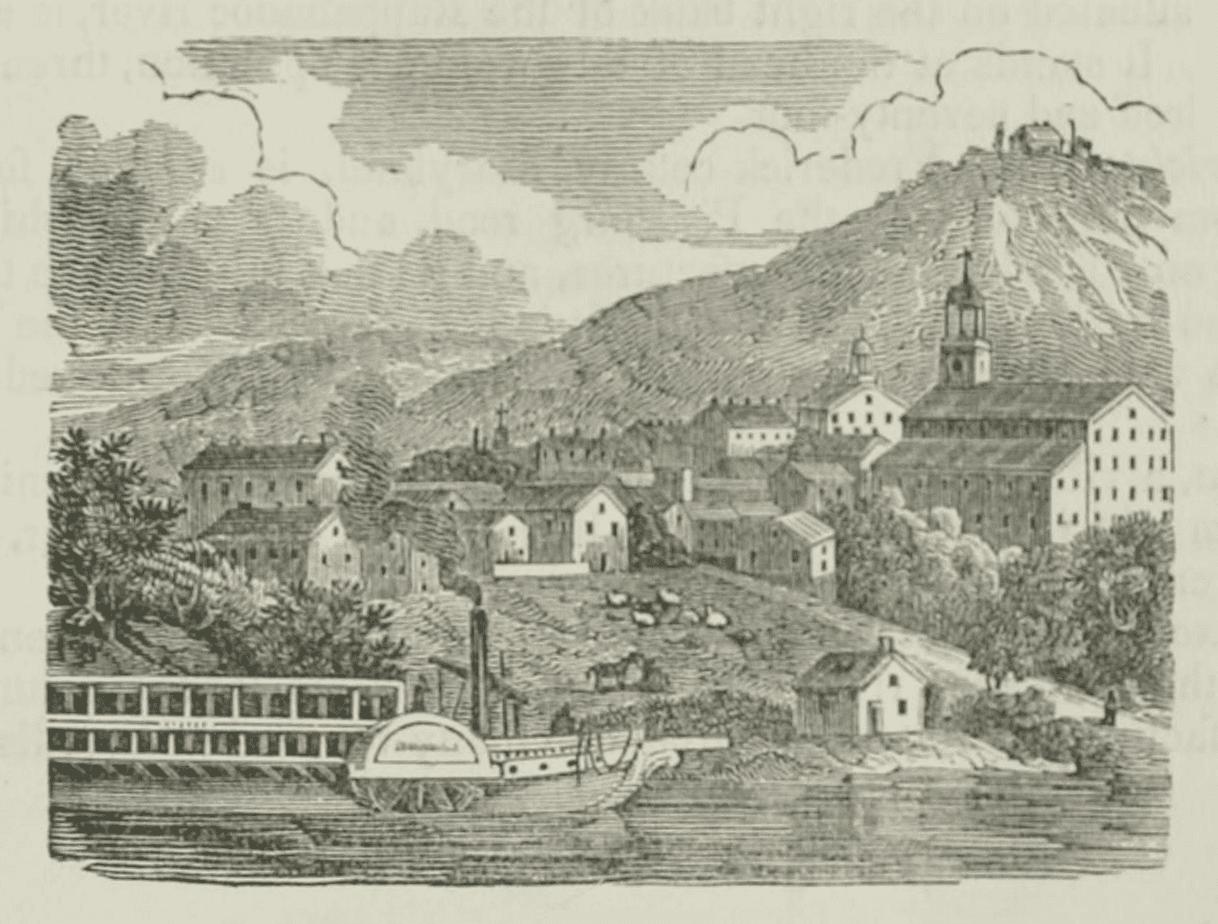
Economy.
Elizabethtown, a town of Essex county, New Jersey, situated on a creek of Newark bay, was originally settled by emigrants from Connecticut. It has some good gardens, and supplies many agricultural products for the New York market. Population, four thousand one hundred and eighty-four.
Exeter, a town of Rockingham county, New Hampshire, fourteen miles south-west from Portsmouth, is situated at the head of the navigation on Swamscot river, a branch of the Piscataqua. Formerly, ship-building was carried on here to a great extent, and the vessels were employed in the West Indian trade; at present, this business is much decreased, but several manufactories have been established. Here is a celebrated academy, incorporated in 1781. Population, two thousand nine hundred and eighty-five.
Fayetteville, a village of Cumberland county, North Carolina, is situated at the head of uninterrupted boat navigation on Cape Fear river. In 1831, it was desolated by a destructive fire; but it is rapidly regaining its former flourishing condition. Population, four thousand two hundred and eighty-five.
Frankfort, the metropolis of Kentucky, and chief town of Franklin county, stands on the east bank of Kentucky river, sixty miles above its entrance into the Ohio. The river, which is here about one hundred yards wide, with bold limestone banks, forms a handsome curve, and waters the southern and western parts of the town. The bottoms on both sides of the river are very broad, but subject to inundation. Frankfort is about sixty-two miles from Louisville. Population, 1,917.
Fredericksburg, a port of entry, and chief town of Spottsylvania county, Virginia, situated on the right bank of the Rappahanoc river, is a flourishing place. It stands at the head of tide water. Population, three thousand nine hundred and seventy-four.
Fredericktown, in Frederick county, Maryland, is situated forty-seven miles from Baltimore, on the Pittsburg road, and is a flourishing place, carrying on considerable manufactures, and a brisk inland trade through a fertile and well-cultivated country. It is the second town in the state, and increases with rapidity. Population, five thousand eight hundred and fifty-eight.
Galena, a village in Illinois, the centre of a celebrated lead-mining district, from which it takes its name. It is situated on Fever river, five miles before it empties into the Mississippi.
Gardiner, a flourishing town in Kennebec county, Maine, on the west bank of the Kennebec river. It has a considerable trade in lumber, and in manufactures of cotton and iron, and many very valuable mills. In this town is a Gothic church, built of granite, and considered the finest specimen of architecture in the state. Population, five thousand six hundred and forty-four.
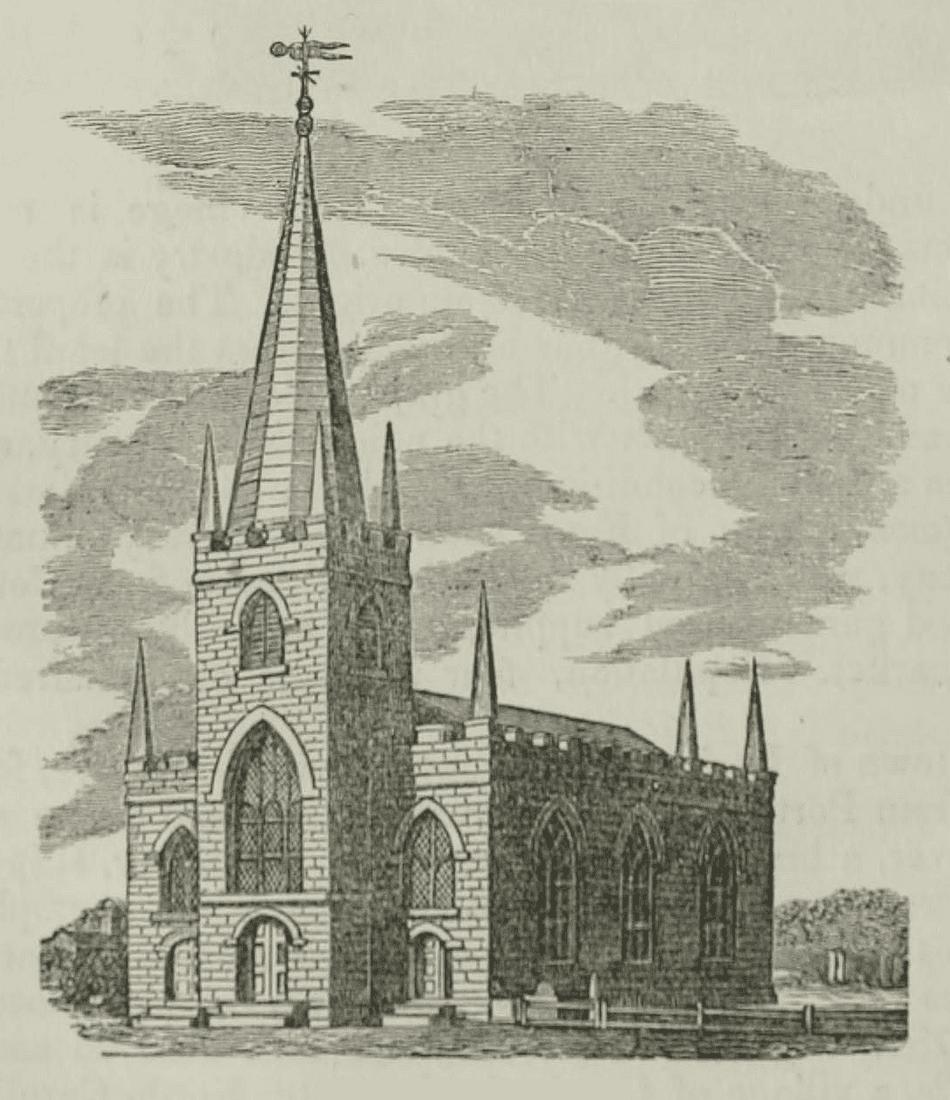
Church in Gardiner.
Georgetown, city of the district of Columbia, and separated from Washington only by a small creek, is finely situated on a series of heights at a bend of the Potomac. It is well laid out, and contains some good private residences. The Catholic college is an ancient pile of building, with a large library, and some good paintings. The Chesapeak and Ohio canal passes through this town. Tobacco and flour are exported in considerable quantities. Population, seven thousand three hundred and thirteen.
Gloucester, a seaport of Massachusetts, in Essex county, and on the peninsula of cape Ann, is one of the most considerable fishing towns in the country. The harbor, which is defended by a battery and forts, is accessible for large ships. This town suffered severely from fire a few years ago; but the damage has been nearly repaired. Population, six thousand three hundred and ninety-four.
Hagerstown, in Washington county, Maryland, is a well-built and flourishing place, surrounded by a fertile country. It is a handsome town, and the houses are generally of stone or brick. Population, three thousand four hundred.
Hallowell, in Kennebec county, Maine, is one of the most flourishing and wealthy towns in the state. The river is navigable to this place for vessels of one hundred and fifty tons. Hallowell granite is extensively quarried and wrought, and is much esteemed. The commerce of the place is considerable, confined chiefly to the lumber trade. Population, four thousand six hundred and fifty-five.
Hanover, in Grafton county, New Hampshire, situated on the Connecticut, is a pleasant village, and the seat of Dartmouth college, which was established in 1771. It received its name from one of its principal benefactors, the earl of Dartmouth. This town is crossed from north to south by Moose mountain. Population, two thousand six hundred and thirteen.
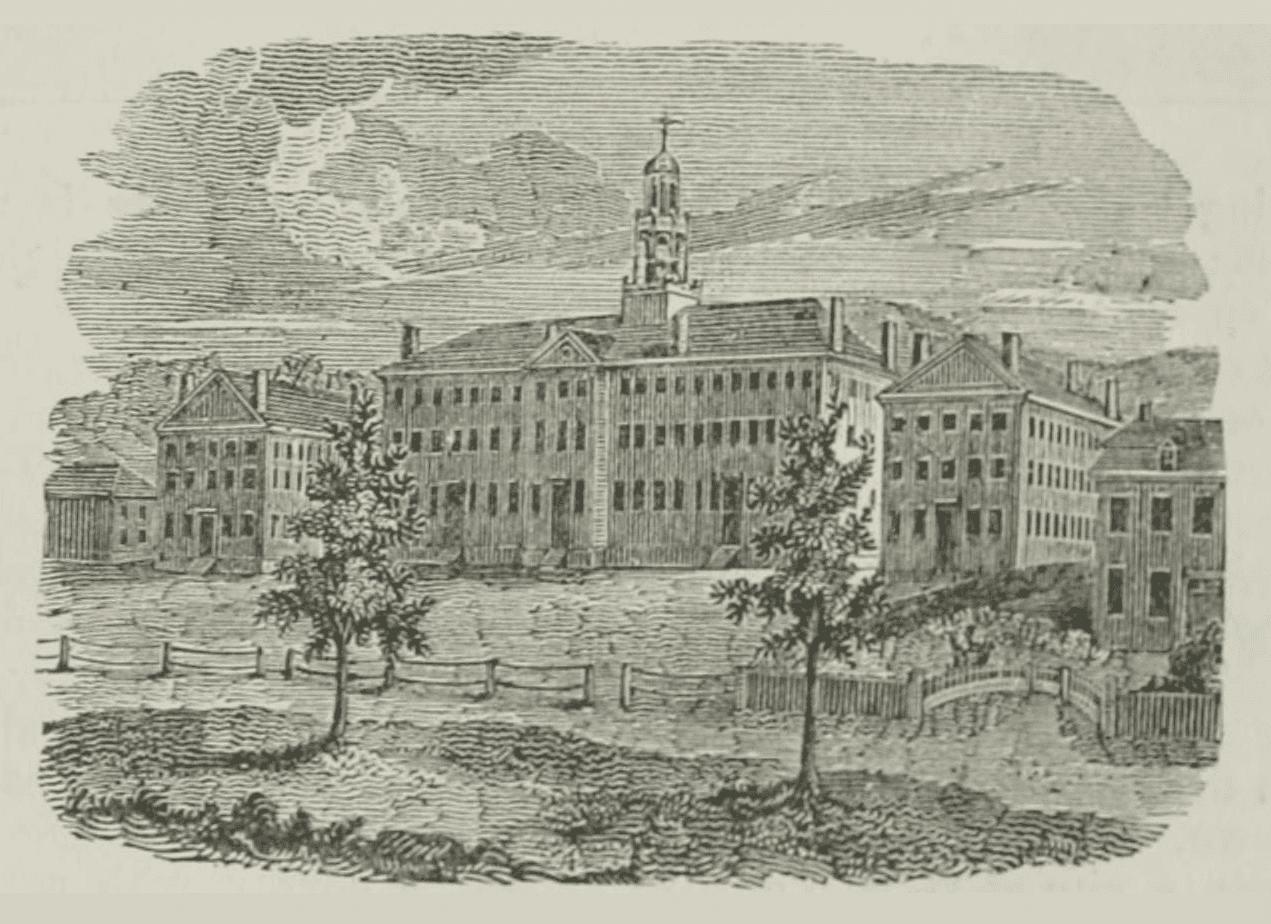
Dartmouth College.
Harrisburg, the seat of government of the state of Pennsylvania, is in Dauphin county, and situated on the eastern bank of the Susquehanna, ninety-six miles from Philadelphia. It is regularly built, and has a handsome state house, and other public edifices. A bridge here crosses the Susquehanna. Population, six thousand and twenty.
Hartford, city, the capital of Hartford county, and, jointly with New-Haven, the seat of government of Connecticut. It stands on the western bank of the Connecticut, at the head of sloop navigation. It is handsomely built, and contains many fine public edifices, among which are a Gothic church, much admired for its architecture; a state house, a deaf and dumb asylum, a retreat for the insane, and a seminary called Washington college. This institution was founded in 1826. Hartford enjoys a considerable commerce with Boston, New York, and the southern cities. The bookselling trade is carried on here extensively, and there is much inland traffic with the towns on the Connecticut, and in the neighborhood. On the opposite bank of the river is East Hartford, which is connected with the city by a bridge. The inhabitants point out to the stranger an ancient oak tree in the southern part of the city, which bears the name of the Charter Oak, and is interesting on account of its connection with our early history. Pop. twelve thousand seven hundred and ninety-three.
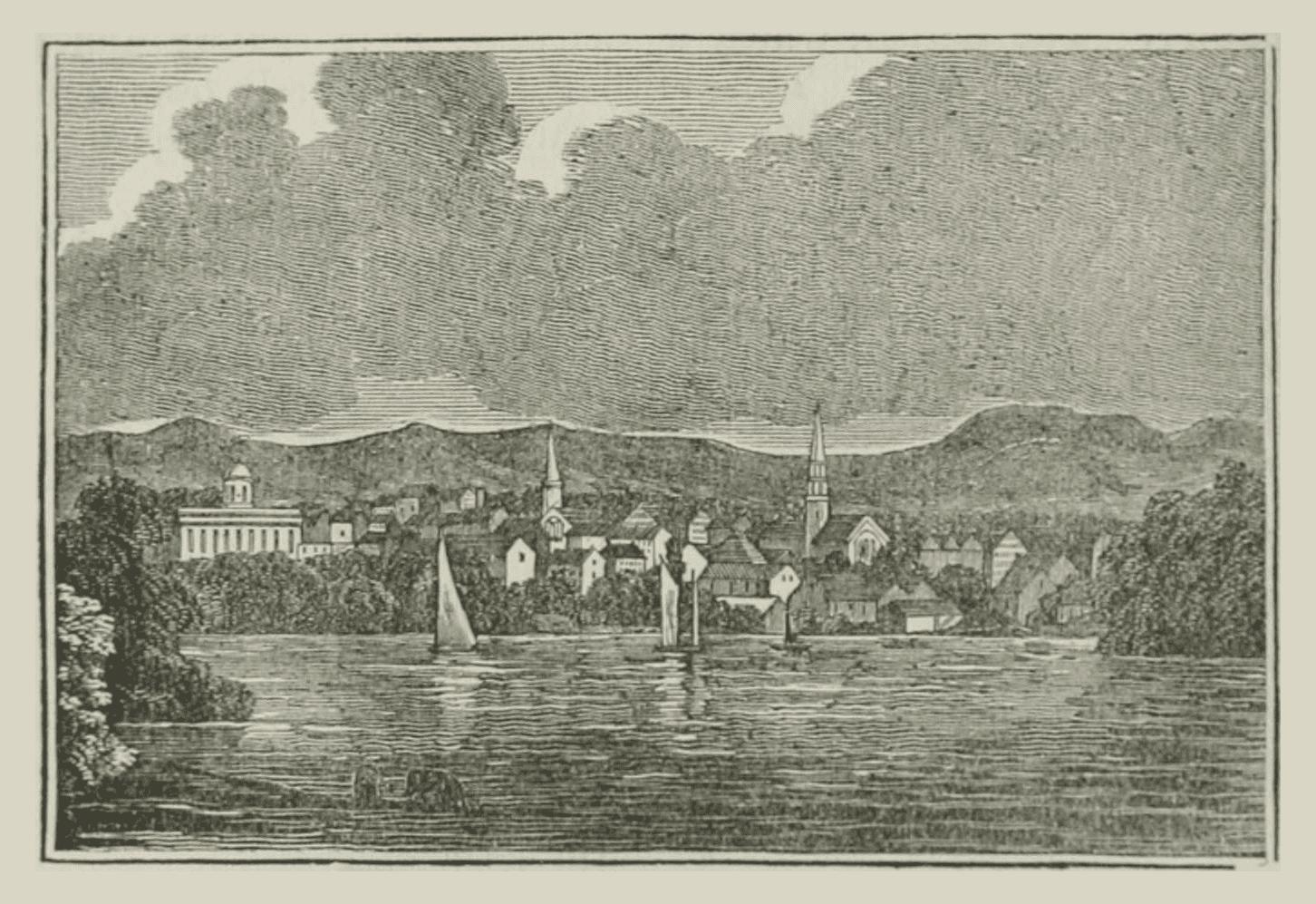
Hartford, Conn.
Haverhill, in Essex county, Massachusetts, on the Merrimack, twelve miles above Newburyport. Pop. four thousand three hundred and seventy-three. This is a pleasantly situated town, and has considerable ship-building and trade by the river. It was settled in 1640, and suffered much in the early Indian wars. In 1698, the Indians attacked and set fire to the town.
Hudson, a city of New York, in Columbia county, with considerable manufacturing business. The streets are spacious, and cross each other at right angles, and the houses are supplied with water brought in pipes from a spring two miles distant. The trade is considerable, and vessels of the largest size can unload here. It is seated on an eminence, on the east side of Hudson river. It is twenty-eight miles south of Albany. Population, five thousand six hundred and seventy.
Indianapolis, capital of Indiana, situated in Marion county, on the west bank of White river, in the centre of one of the most extensive and fertile bodies of land in the world, though recently settled, promises to be one of the largest towns between Cincinnati and the Mississippi. The country about it is said by Mr. Flint to be settling with unexampled rapidity. Population, two thousand six hundred and ninety-two.
Jameston, an ancient town in James City county, Virginia, the first English settlement in the states, was established in 1608. It stands on an island in James river, thirty-two miles above its mouth. It is now in ruins, and almost desolate. Two or three old houses, the ruins of an old steeple, a church-yard, and faint traces of rude fortifications, are the only memorials of its former importance.
Jefferson City, seat of justice for Cole county, Missouri, and capital of the state, is situated on the right bank of Missouri river, about nine miles above the mouth of the Osage. It is a new town, containing two hundred houses and twelve hundred inhabitants, and, after Little Rock in Arkansas, is the most western state capital of the United States.
Kaskaskia, an ancient village of Illinois, and seat of justice for Randolph county, is situated on Kaskaskia river, eleven miles from its mouth. It was one of the earliest French settlements in the Mississippi, and once contained seven thousand inhabitants; it is now very much reduced, numbering only one thousand. The situation of this town is represented as very beautiful.
Kennebunk, a town of York county, Maine, at the mouth of a river of the same name, has considerable lumber trade. The principal harbor is obstructed by a sandbar, and in 1820 an appropriation was made by Congress to build a pier at the mouth of the river. Population, two thousand three hundred and twenty-three.
Knoxville, the chief town of East Tennessee, is situated one hundred and eighty miles from Nashville, on the north side of Holston river, where it is three hundred yards wide; on a beautiful spot of ground, twenty-two miles above the junction of the Holston with the Tennessee. The college of this town is one of the oldest seminaries in the state. Population, three thousand.
Lancaster, a handsome town of Pennsylvania, and capital of a county of the same name. It is a pleasant and flourishing place, situate in a fertile and well-cultivated country, and contains a court house, a jail, two banks, and nine places of worship. A college was founded here in 1787; but the buildings are now appropriated to schools. Here are manufactures of guns and other hardware; and about a mile distant is a large cotton manufactory. The town has considerable trade, which increases with the surrounding country. It is seated near Conestoga creek, which runs into the Susquehanna, sixty-one miles west by north of Philadelphia. Population, eight thousand four hundred and nineteen.
Lancaster, oldest town in Worcester county, Massachusetts, finely situated on both sides of the Nashua, has manufactories of combs and cotton, and an extensive engraving and stereotyping establishment. In beauty of scenery the neighborhood is surpassed by that of few towns in New England. Population, two thousand and thirteen.
Lansinburg, a town of Rensselaer county, New York, is principally built on a single street parallel with the river. A high hill rises abruptly behind the town, on which is seen the celebrated diamond rock, emitting a brilliant lustre in the rays of the sun. Population, three thousand three hundred and thirty.
Lexington, a town of Middlesex county, Massachusetts, will ever be memorable in American history, for the early revolutionary struggles. The first battle was fought here between the British troops and the Americans on the nineteenth of April, 1775. A monument has been erected on the green at Lexington in commemoration of this event. Pop. 1559.
Lexington, capital of Fayette county, Kentucky, is the oldest town in the state, and was for many years the seat of government. It stands in a beautiful spot, on a branch of the Elkhorn river, in the centre of the richest tract in the state. The principal street is a mile and a quarter in length, spacious and well paved. The buildings are much superior in size and elegance to those of the other towns in the state, and may be compared to those of the Atlantic country. The Transylvania university is established here. The public inns are large and convenient. The town has manufactories of woolen, cotton, and paper. The general appearance of the town is neat, and the neighborhood is adorned with many handsome villas, and finely ornamented rural mansions. Population, six thousand nine hundred and ninety-seven.
Litchfield, capital of Litchfield county, Connecticut, is situated on an elevated plain, in the midst of a fertile and hilly country. It contains numerous mills and manufactories. A law school was established here in 1782, by Judge Reeve, which has been for many years highly celebrated. Population, four thousand and thirty-eight.
Little Rock, the seat of government of Arkansas territory, is situated on a high bluff on the south bank of the river Arkansas, and derives its name from the high masses of rock above it. It was laid out in 1820.
Lockport, a town of Niagara county, New York, on the Erie canal. Here are the most remarkable works on the canal, consisting of ten locks, overcoming an ascent of sixty feet. Besides these, there is an excavation through the mountain ridge, for three miles, cut in the rock. The town is a place of considerable trade. Population, five thousand eight hundred and seventy-three.
Louisville, a city of Jefferson county, Kentucky, on a plain elevated about seventy feet above the level of the Ohio, opposite to the rapids or falls, is a handsome town, and the largest in the state. Eight broad and straight streets run parallel with the river, and command a pleasant view of the opposite shore. They are paved with blocks of limestone; the houses are built chiefly of brick. This is the most commercial city of the west, commanding the trade of a great extent of country. Manufactures are yet in their infancy. The Louisville and Portland canal passes through this town, round the falls; it is about two miles in length, and cut through a limestone rock. It admits the passage of the largest steamboats, and thus opens a line of free navigation from Pittsburg to the sea. This canal was finished in 1831. It has been estimated that seventy-five thousand travellers pass through Louisville annually. The resident population is twenty-one thousand two hundred and ten.
Lowell, a town of Middlesex county, Massachusetts, situated at the junction of the Concord and Merrimack rivers, is celebrated for its extensive manufacturing establishments, and for its rapid increase. It was incorporated in 1826. In 1831, the quantity of cotton manufactured here was estimated at five million one hundred thousand pounds. The water power is held and managed by a company possessing a great amount of real estate, and a capital of six hundred thousand dollars. A rail-road from Boston to Lowell is in rapid progress. The two largest companies are the Merrimack, with a capital of a million and a half; and the Lawrence, with a capital of one million two hundred thousand dollars. Population twenty thousand nine hundred and eighty-one.
Lynchburg, a town of Columbia county, Virginia, is one of the most flourishing and commercial towns in the state. It has several tobacco warehouses and factories, cotton and woolen manufactories, and in the vicinity are extensive flour mills. The surrounding country is rugged and mountainous. Lynchburg was established in 1786. Population, four thousand six hundred and twenty-six.
Lynn, a town of Essex county, Massachusetts, is noted for its extensive manufacture of shoes. About a million and a half pair of women’s shoes are made here every year. There is a mineral spring in this town, with a hotel in its neighborhood. Population, nine thousand and seventy five.
Machias, on the bay of that name, in Washington county, Maine, consists of two villages, one at the falls at the east branch of Machias river, and the other at the falls of the west branch, six and a half miles apart, each containing a post office. The village at the east falls is at the head of the tide, two miles above the junction of the branches, and contains various mills. The village at the west falls, contains the court house, jail, and various mills; there are many saw mills in this town, which cut upwards of ten million feet of boards in a year. The tonnage of the shipping in 1827 amounted to five thousand two hundred and thirty-six; much of this is employed in the transportation of plaster from the British territory adjacent to Passamaquoddy bay. Population, one thousand three hundred and fifty-one.
Marblehead, a town of Essex county, Massachusetts, situated on a peninsula projecting into Massachusetts bay. It is compactly, though irregularly built; it was settled soon after Salem, and has been very flourishing and opulent. It suffered severely during the revolution and the last war. In the fishing business it has greatly excelled all other towns in the United States. Population in 1810, five thousand eight hundred; in 1840, five thousand five hundred and thirty-nine.
Marietta, in Washington county, Ohio, is finely situated near the mouth of Muskingum river, in the centre of a fertile neighborhood. It was one of the earliest settlements of the state; but it has suffered severely from sickness and inundations of the river. Ship-building was formerly carried on here, but has been discontinued. The inhabitants are noted for industry and sobriety. Population, one thousand eight hundred and fourteen.
Maysville, in Mason county, Kentucky, on the Ohio, stands on a narrow bottom below the mouth of Limestone creek, and has considerable trade and manufactures. It is the principal commercial depot for the north-east portions of the state. It is a very busy and flourishing town. Population, two thousand seven hundred and forty.
Middlebury, in Addison county, Vermont, situated on Otter creek, has a college, two academies, several churches, and manufactures of cotton, iron, and marble. A quarry of fine marble was discovered here in 1804, and is now wrought for a variety of purposes. Population, three thousand one hundred and sixty-two.
Middletown, a city of Middlesex county, Connecticut, on the west bank of the Connecticut river, and thirty-four miles from its mouth, is a pleasant place, and has considerable trade and manufactures. In 1816, it owned a larger shipping than any other town in the state. In the neighborhood is a lead mine, which was wrought during the war. A college, under the name of the Wesleyan University, was opened in this city in 1831. Population, seven thousand two hundred and ten.
Milledgeville, capital of Baldwin county, Georgia, and metropolis of the state, is situated on the west bank of the Oconee, eighty-seven miles south-west of Augusta. It is a depot of cotton for the Savannah and Darien markets. It contains several public buildings, and has four weekly papers. Population two thousand and ninety-five.
Mobile, a city of Mobile county, Alabama, on the west side of Mobile river, at its entrance into the bay. When this town came into the possession of the United States, in 1813, it contained about three hundred inhabitants; it now numbers twelve thousand seven hundred. It is pleasantly situated on a spot elevated above the overflow of the river; but the adjacent country is a marsh or a forest. Fire and the yellow fever have committed great ravages here; but trade has increased rapidly, and in the cotton business Mobile is inferior only to Charleston and New Orleans.
Montpelier, shire town of Washington county, Vermont, and seat of government, is situated on the north bank of Onion river, about ten miles north-east of the centre of the state, and is a great thoroughfare for travellers. It was incorporated in 1818, contains a number of public buildings and good seats for manufactories. Population, 3,725.
Nantucket, a town of Massachusetts, of the same extent with the island and county of that name, contains seven houses of public worship, two banks, and two insurance offices. It was formerly called Sherburne. The trade suffered greatly during the late war and the revolution, but has since been more flourishing. There are extensive spermaceti works here. Education is well attended to, and the people, who are chiefly Friends or Quakers, are generally moral and industrious. Population, nine thousand five hundred and twelve.
Nashville, capital of Davidson county, and seat of government of Tennessee, is regularly built, pleasantly situated on the south side of Cumberland river, and is much the largest town in the state. It is a rich and flourishing place. Steamboats from New Orleans ascend the river to this point. The state penitentiary, a fine stone building, is here erected. The University of Nashville was incorporated in 1806, and is now in a very prosperous condition. Pop. eight thousand one hundred and thirty-three.
Natchez, a city of Mississippi, and much the largest town of the state, stands on a bluff, upwards of one hundred and fifty feet above the surface of the river. The houses have an air of neatness, though few are distinguished for elegance or size. To enable the inhabitants to enjoy the evening air, almost every house has a piazza and balcony. The soil of the adjoining country is rich, and vegetation of most kinds attains to uncommon luxuriance; the gardens are ornamented with orange trees, figs plums, peaches, and grape-vines. Natchez is the principal town in this region for the shipment of cotton to New Orleans, and at the business seasons the streets are almost barricadoed with bales. In this place is the Planters’ bank, with a capital of three millions.
The reputation of Natchez in regard to morals seems to be rather at a discount. The lower town is said to have a worse character than any place on the river; and, particularly in the spring, to present a congregation of the most abandoned and desperate. The following picture by a recent traveller is probably overcharged: ‘In the evening, a steamer stops at Natchez to land or take in goods, the passengers observe several houses lighted up, and hear the sounds of fiddles and merriment, and they run up to see what is going on; they find men and women dancing, gambling and drinking; the bell of the steamboat rings to announce that she is about to continue her voyage, the lights in the houses of entertainment are immediately extinguished, and the passengers run out, afraid of being too late for the boat, and run down toward the landing; ropes are drawn across the road, the passengers fall heels over head, a number of stout ruffians throw themselves upon them, and strip them of their money and watches, and they get on board in doleful plight, and of course never see or hear more of their plunderers!’ Population, 4,826.
Natchitoches, commonly pronounced Nackitosh, a town of Louisiana, is beautifully situated on the south-west bank of Red river, at the head of steamboat navigation. The trade between Louisiana and the Mexican states centres here, and it must eventually become a place of great size and importance. This town was established more than a hundred years ago, and its population is a mixture of Americans, French, Spaniards, and Indians.
New Albany, in Floyd county, Indiana, is an industrious and flourishing village, with a ship-yard for building steamboats. During the summer, many steamboats are laid up here to be repaired. Population, four thousand two hundred and twenty-six.
Newark, capital of Essex county, New Jersey, is handsomely built, and finely situated on the west side of Passaic river. It is one of the most beautiful towns in the country. It has extensive manufactures of shoes, leather, coaches, and cabinet work. Morris canal passes through this town. Population, seventeen thousand two hundred and ninety-two.
New Bedford, port of entry in Bristol county, Massachusetts, stands on an arm of Buzzard’s bay, about fifty-two miles south of Boston. ‘We entered New Bedford,’ says a recent tourist, ‘through Fairhaven, by way of the ferry. From Fairhaven the town shows to better effect than from any other point. A stranger, perhaps, might be surprised at the great apparent extent of New Bedford as seen from this place. Passing through the villa of Fairhaven (a place of no inconsiderable size by the by,) it opens before him, with its spires, its shipping and buildings, like a beautiful panoramic painting of some great city. It appears much larger, however, than it is. Its population is 12,585. Its commerce is principally in the whale fishery, employing one hundred and fifty whale ships. The “county road” displays many elegant mansions, the dwellings of some of the more wealthy inhabitants. New Bedford is considered a very wealthy place, and the inhabitants active and enterprising. A large proportion of them are Quakers.’
Newbern, in Craven county, North Carolina, was once the capital, and is still the largest town of the state. It is situated on the Neuse, thirty miles above its entrance into Pamlico sound. The river is navigable to this place, and its commerce is considerable. Population, three thousand six hundred and ninety.
New Brunswick, a city of New Jersey, partly in Middlesex and partly in Somerset county, on the south-west side of Raritan river, is built on a low but healthy situation, and has considerable trade. Besides the other public institutions usually found in towns of similar size, this has a theological seminary, and a college; both established by the Dutch Reformed Church. Population, eight thousand seven hundred and eight.
Newburgh, a port of entry in Orange county, New York, is a well-built village, pleasantly situated on the west bank of the Hudson, commanding a delightful view of the river and the highlands. The principal streets are paved. A considerable amount of shipping is owned in this village; agriculture and manufactures are also extremely flourishing. Population, five thousand six hundred and sixty-two.
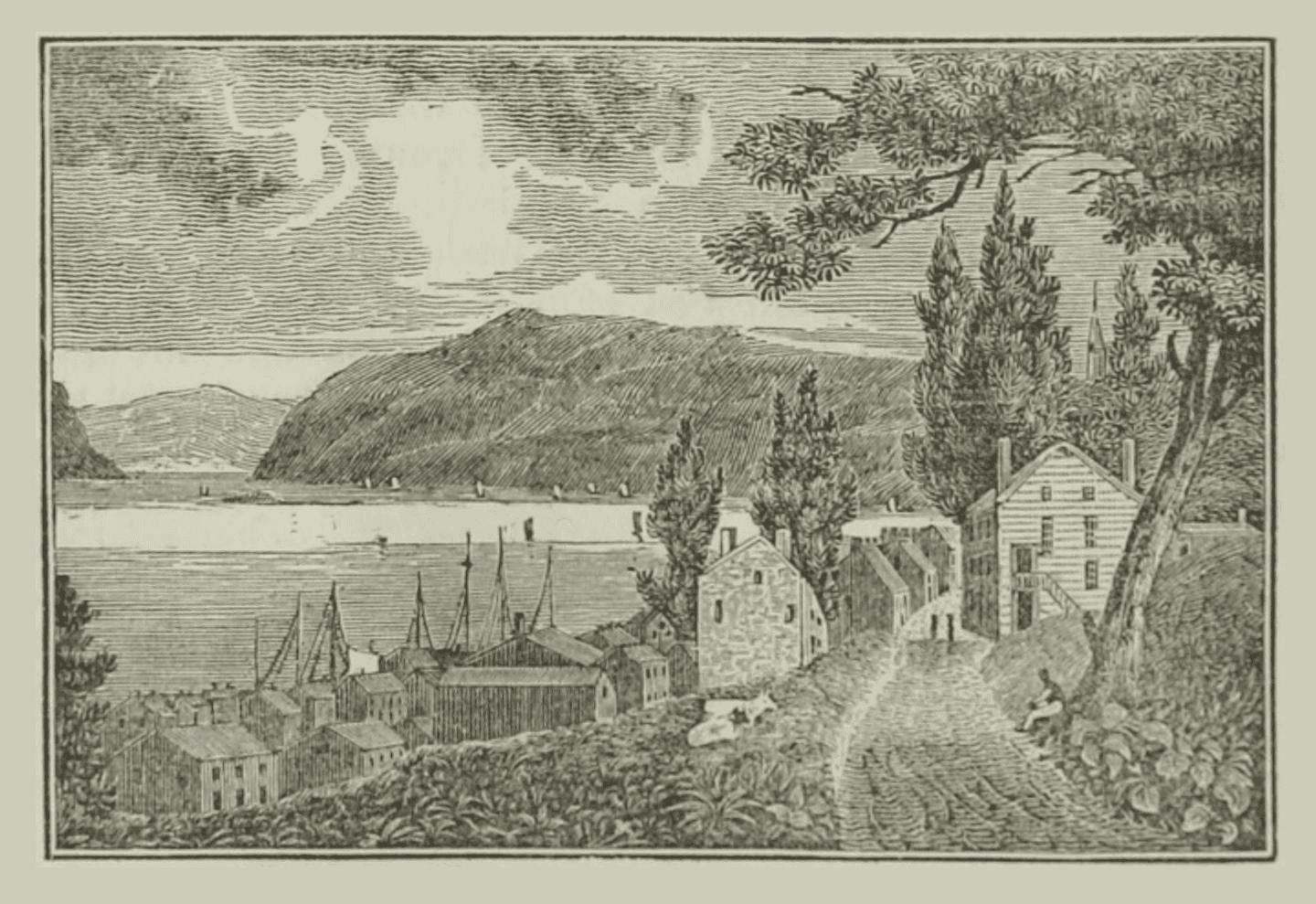
Newburgh.
Newburyport, in Essex county, Massachusetts, at the mouth of the Merrimack, is remarkable for the beauty of its situation, and the regularity of its streets. It stands upon a gentle declivity sloping down to the river, the streets are generally straight and at right angles, and the town lies along the bank of the river for about a mile. The principal streets pass through the whole width of the town, from the summit of the declivity to the river. The buildings are generally handsome, and the streets clean. Few towns in the United States surpass Newburyport in beauty. It was desolated by a fire, which broke out on the night of May 31, 1811, and destroyed nearly three hundred buildings. The place has never recovered from the effects of this calamity; at the present day, the traveller is struck with the view of a wide heap of grass-grown ruins, in the heart of a populous town.
The harbor of this place is good, but obstructed at the entrance by a dangerous bar; attempts are now making to improve it by a break-water on the south side of the channel. The mercantile enterprise of the place has latterly been diverted from commerce to the fisheries. Ship-building is carried on to a considerable extent, and a manufactory of hosiery has been established in the place. This town has seven churches, two banks, two insurance offices, and two newspapers. A handsome chain bridge crosses the river from the centre of the town. The celebrated preacher, George Whitefield, died in this town in 1760, and is now entombed in the Presbyterian church in Federal street, where an elegant monument has been erected recently to his memory. Population, seven thousand one hundred and twenty-four.
New Castle, seat of justice of the county of the same name, in Delaware, and formerly capital of the state. The village extends lengthwise along the Delaware river, on a rising plain, and is tolerably compact and well built. It once enjoyed considerable trade. Population two thousand seven hundred and thirty-seven.
New Harmony, or Harmony, a town in Posey county, in the south-western part of Indiana, on the Wabash, formerly the seat of the Harmonists, under the German, Rapp, and more recently of the followers of Owen, of Lanark. The former establishment was removed to Economy, and the latter abandoned.
New Haven, a city and seaport of Connecticut, in New Haven county, lies at the head of a bay that runs out of Long Island Sound, and is situated on a beautiful plain, bordered on the north by bold and perpendicular eminences. It is regularly laid out and consists of two parts, the old and new town. The old town is divided into squares of different extents. The public buildings of the city are handsome and well situated. The state house is a fine edifice, on the model of the Parthenon. Several of the churches have a commanding appearance; two of them are of Gothic architecture, and built of stone. Private dwelling-houses are mostly of wood, handsome and convenient. The public square and principal streets are finely ornamented with trees; and beautiful gardens attached to many of the residences, give the town a rural and delightful appearance.
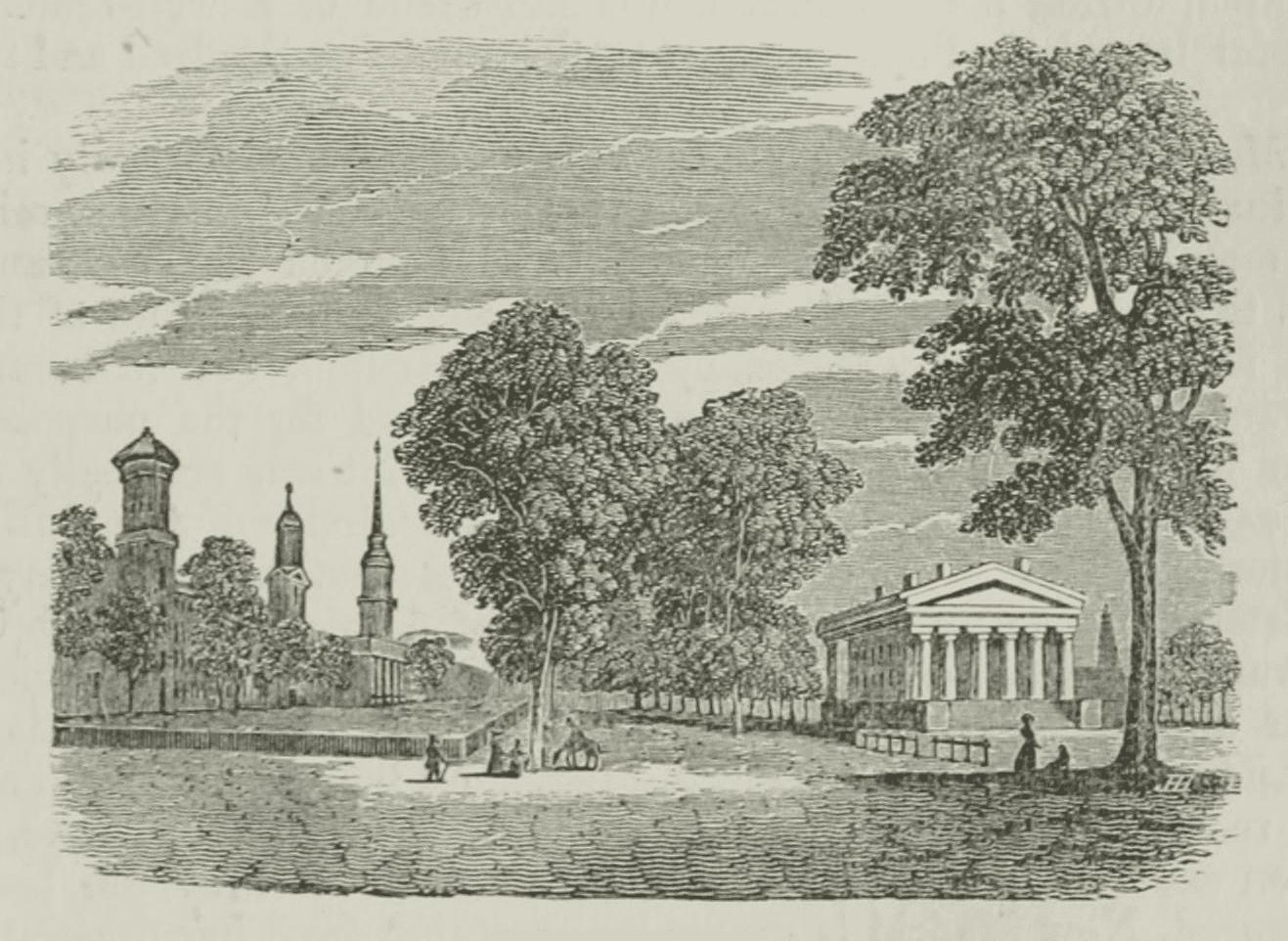
New Haven.
The harbor of New Haven is shallow, and gradually filling with mud, but it is well defended from winds, and the maritime commerce of the port is greater than that of any other town in Connecticut. Its interior trade is assisted by the Farmington canal. Packets and steamboats ply regularly and frequently between this port and New York. The Indian name of this town was Quinipiack. It was first settled by the English in 1638, and was the capital of the colony of New Haven, which remained distinct from that of Connecticut till 1665. The state legislature meets here and at Hartford alternately. Yale College, one of the most distinguished literary institutions in America, is established in this city; connected with this are a theological, a medical, and a law school. Many academies and smaller seminaries are also established here. Population, fourteen thousand three hundred and ninety.
New London, a city of New London county, Connecticut, in the south-eastern part of the state, has a fine harbor near the mouth of the Thames. It is irregularly built, principally at the foot of a hill facing the east. There are many pleasant sites in the higher parts of the town, and several of the buildings are handsome; but the general appearance of the place is not flourishing. The neighboring region is rocky and sterile, and there are no great channels of communication with the interior. The recent attention of the merchants to the whale fisheries has given a considerable impulse to the place, and promises to restore it to its former importance as a commercial city. Fort Trumbull is situated at the south of the town, and to the east, on the opposite side of the river, are the remains of Fort Griswold, which, during the revolution, was the scene of a well-remembered and fearful tragedy. Population, five thousand five hundred and twenty-eight.
New Madrid, now an insignificant village, though historically interesting, is situated on the west bank of the Mississippi, eighty-one miles below the mouth of the Ohio. This town was founded in 1787, and was intended to become a great commercial city, and the emporium of the vast tract of fertile country watered by the Mississippi, the Missouri, and their branches. It was indeed happily situated for the purpose; but the river has swept away the ground on which it was originally placed, and the earthquakes of 1812 have sunk the remainder of the bluff below high-water mark. It is impossible to visit this spot, knowing any thing of its history, and not be struck with the air of desolation it now breathes. There was a fine lake in the rear of the town, on the banks of which public walks and plantations of trees were planned for the accommodation of its inhabitants; this is now a heap of sand. As the earthquakes are occasionally recurring in this neighborhood, even to the present time, people have been cautious in respect to settling here; but as they are becoming more assured, New Madrid is gradually emerging from her prostration.
New Orleans, the capital of the state of Louisiana, is situated directly on the east bank of the Mississippi, one hundred and five miles from the mouth of the river. In the year 1717, this city was founded; and at that period, there were not, perhaps, five hundred white inhabitants in the whole valley of the Mississippi. In the beginning of 1788, the town contained one thousand one hundred houses, built of wood; in March of that year, by a fire, the number of houses was reduced in five hours to two hundred. It has been rebuilt principally of brick, which is of so soft a nature, that the buildings are plastered on the outside with a thick coat of mortar, and then painted or whitewashed. Several warehouses with stone fronts have been recently erected. The city is regularly laid out, and the streets are generally forty feet wide, crossing each other at right angles. The public buildings are generally elegant, commodious and expensive. There are few churches. The Catholic cathedral is a noble edifice, ninety feet by one hundred and twenty, with four towers. The Place des armes is a beautiful green, which serves as a parade. Most of the houses in the suburbs have fine gardens, ornamented with orange groves. The general style of living is luxurious, and the private dwellings are elegantly furnished. The markets are plentifully supplied with the necessaries of life, and the luxuries of every country; but provisions are dear.
New Orleans will become to the United States the great emporium of commerce and wealth, if, by the draining of the marshy country in the neighborhood, it ever becomes a healthy city. The more we contemplate the present and prospective resourses of New Orleans, the more must we be convinced of its future greatness. Being built in the form of a crescent, the curve of the river constitutes a safe and commodious harbor. Defended on one side by the river, and on the other by a swamp that no effort can penetrate, the city can only be approached through a defile three quarters of a mile wide.
New Orleans is gradually becoming more purely American in all its characteristics; but many of its inhabitants are of French and Spanish descent, and the French language is more commonly spoken than the English. The charitable institutions of the city are highly creditable. Education is not so much attended to as in other parts of the country; but great improvements have been made in this respect within a few years. The police is efficient, and scenes of disorder rarely occur.
This city is the grand commercial metropolis of the Mississippi valley. The tributaries of the great river on which it stands afford an extent of more than twenty thousand miles, already navigated by steamboats, and passing through the richest soil and the pleasantest climates. Steamboats are departing and arriving every hour, and fifty or sixty are often seen in the harbor at one time; while many hundreds of flat boats are seen at the levee, laden with the various productions of the great valley. Measures have been adopted by the state legislature to have the neighboring country well explored, for the purpose of draining, raising, and improving it.64 The streets of the city have been paved, and gutters are washed by water from the river. Pop. one hundred and two thousand one hundred and ninety three. New Orleans will probably become the largest city of America.
Newport, a seaport and semi-metropolis of Rhode Island, is pleasantly situated on the south-west end of the island of Rhode Island, thirty miles south of Providence. During the summer months it is a place of fashionable resort, being celebrated for the salubrity of its climate. It formerly possessed considerable commerce, and contained more than nine thousand inhabitants; but during the revolution, it was a long time occupied by the enemy, and suffered severely. The principal street is a mile in length; the houses have an antique appearance. The harbor is very safe, sufficiently spacious for a whole fleet, and defended by three forts. Newport was first settled in 1638. A large stone mill is still standing here, which was erected before the date of the earliest records. Population, eight thousand three hundred and thirty-three.
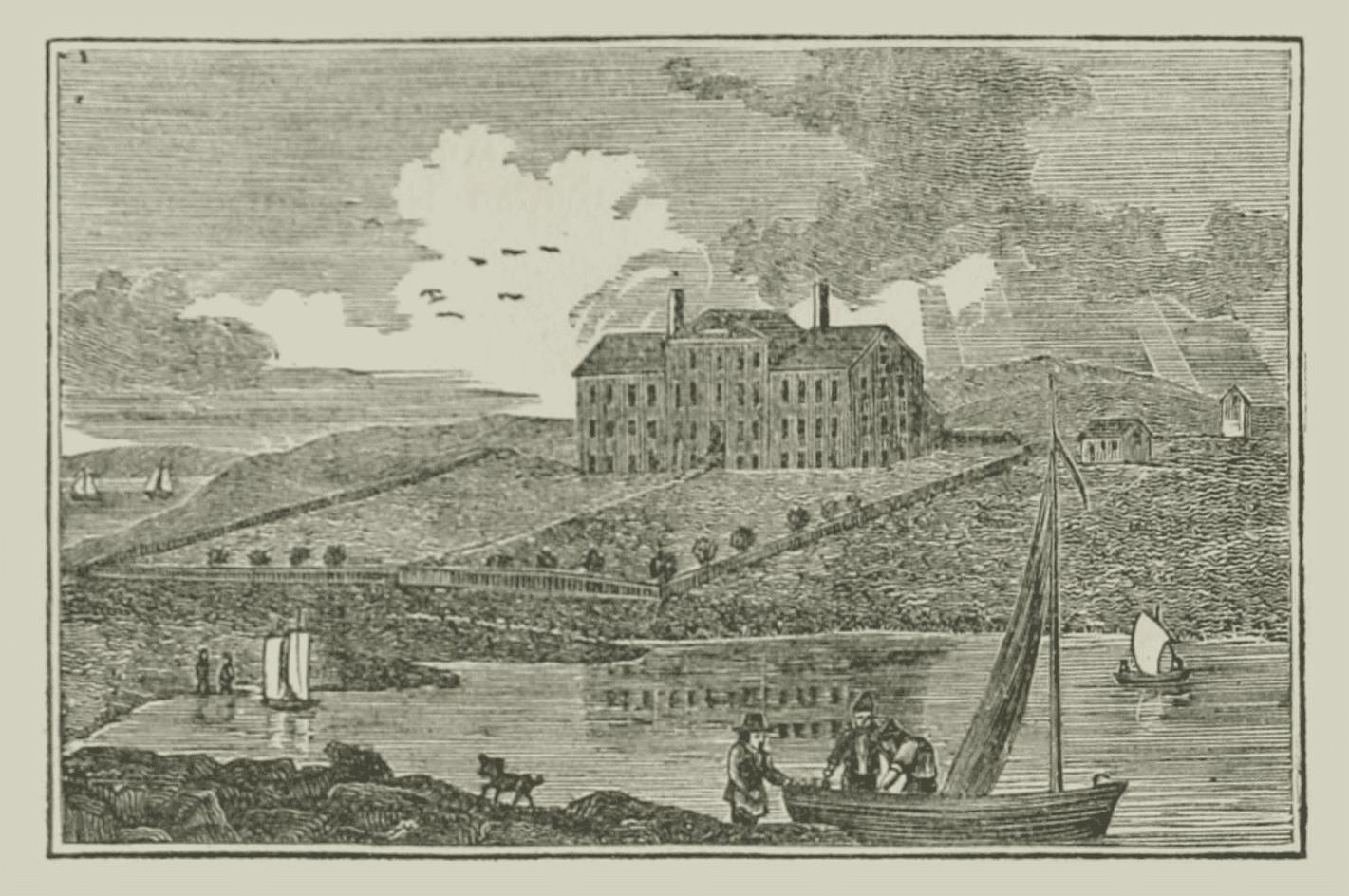
Asylum at Newport.
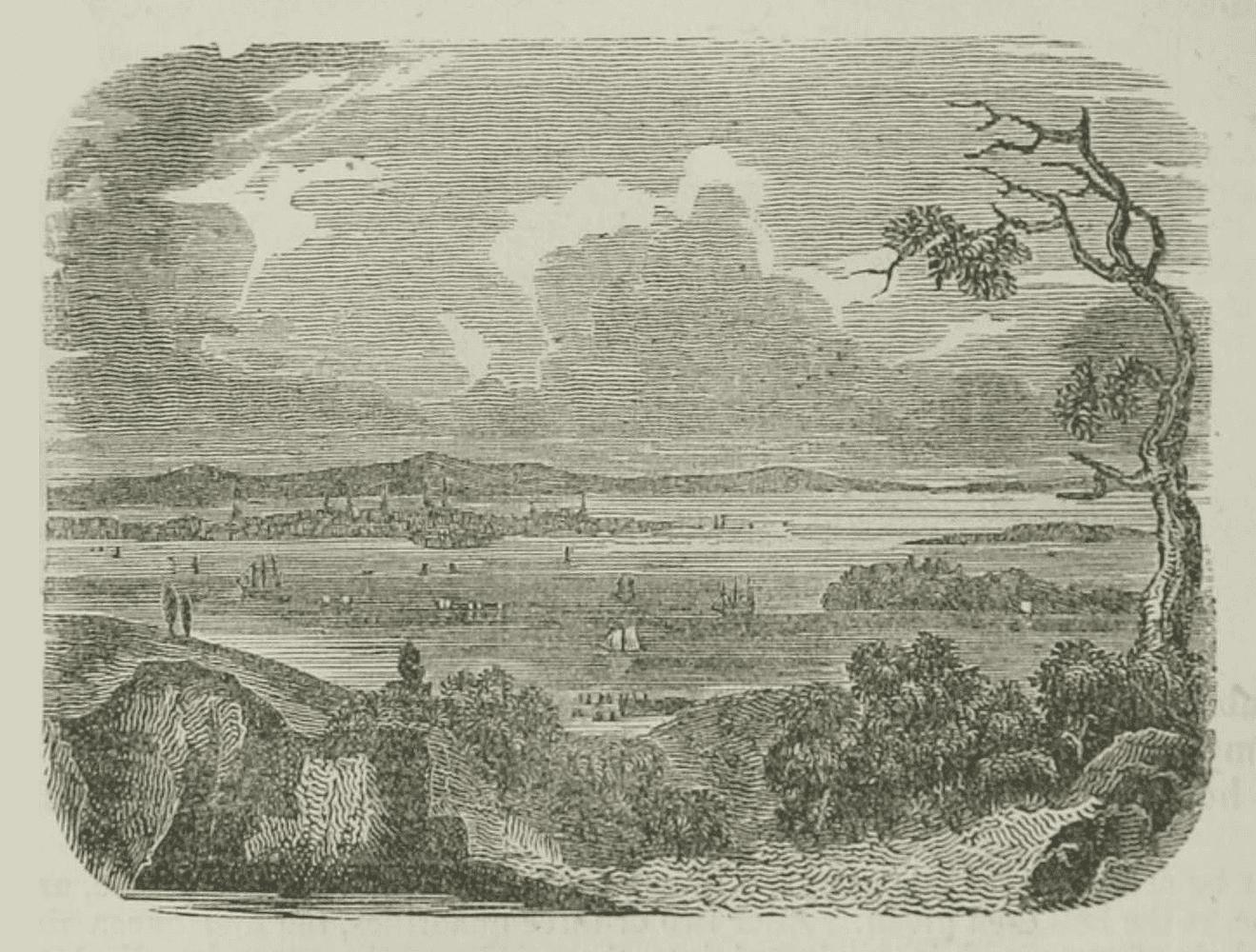
New York.
New York, the largest and most populous city in the United States, lies in the state of that name, at the head of New York bay, about sixteen miles from the Atlantic ocean. Manhattan island, on which the city stands, and which is formed by the Hudson, the Hærlem, and East rivers, with the bay on the south, is fifteen miles in length, and from two to three in breadth. On the south-west point of the island, overlooking the bay, is a fine public promenade, of from five to six hundred yards in length, and one hundred and fifty in breadth, prettily laid out in walks, and planted with trees. In the evenings it is generally crowded with citizens, who assemble to derive the benefit from a pleasant breeze off the water, or listen to a band that frequently plays in the Castle garden, which is connected with the walk by a wooden bridge. The former promenade is called the Battery, from having, in the olden times of the Dutch settlers, or during the revolutionary war, mounted a few guns; and the Castle garden, in a similar manner, possessed no garden, nor could it ever have possessed one, being a modern stone fort, with twenty-eight embrasures, built upon a solid rock, which appeared but a short distance above the water. This being an unprofitable kind of investment of funds, has been let by the corporation to a publican, who has converted it to a much more profitable use charging sixpence for admission, and giving a ticket, so that the visitor may enjoy a stroll upon the upper platform of the fort, admire the view, and then call for a glass of liquor at the bar. The battery, nevertheless, is the most pleasant promenade in New York, and excels any thing else of the kind in America. Governor’s island, about three quarters of a mile distant in the bay, has a large stone circular fort, with three tiers of embrasures, and is calculated for more than one hundred guns at its western extremity.
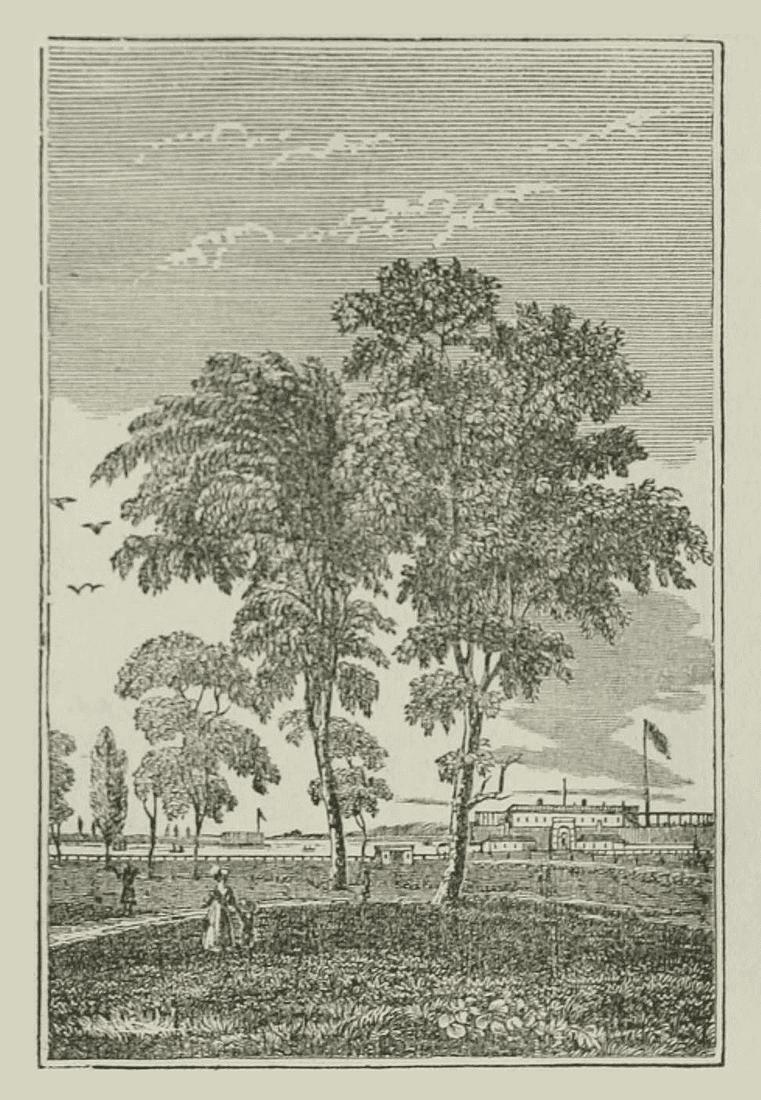
Castle Garden and Battery.
Of the public buildings of New York, the City Hall, containing the supreme court, mayor’s court, and various public offices, situated in the park, a fine and handsome square, is the most remarkable; and being fronted with white marble, has a beautiful effect when seen through the trees in the park. The building is upwards of two hundred feet in length, with a dome and tower surmounted by a statue of justice. The Merchants’ Exchange, in Wall street, is a fine edifice, of the same material as the front of the City Hall. The basement story is occupied by the post-office, and above it the Exchange, eighty-five feet in length, fifty-five in width, and forty-five in height to the dome, from which it is lighted. The greater proportion of the other buildings in the street, are insurance offices, banks, and exchange offices.
‘The churches in New York,’ says Lieutenant Coke, ‘are handsomer edifices than those in the southern cities I visited, and contain some interesting monuments. St. Paul’s, in the park, is one of the finest in the states. In the interior, there is a tablet in the chancel to Sir Robert Temple, baronet, the first consul general to the United States from England, who died in the city; and one to the wife of the British governor of New Jersey, who died during the revolution, from distress of mind; being separated from her husband by the events of the time. In the yard, also, there is a large Egyptian obelisk of a single block of white marble, thirty-two feet in height, erected to Thomas A. Emmett, an eminent counsellor at law and brother of the Irish orator who suffered during the rebellion. When I visited New York again, some months afterwards, one front of it was embellished with an emblematical representation of his fortunes. Though it was in an unfinished state, and the canvass had not been removed from before the scaffolding, I could catch a glimpse of the representation of a hand, with a wreath or bracelet of shamrock round the wrist, clasping one with a similar ornament of stars, and the eagle of America sheltering the unstrung harp of Ireland. Mr. Emmett had emigrated to the states, and settled in New York, where he had acquired considerable reputation many years previous to his death. There is also another monument near it, under the portico of the church, to General Montgomery, who fell in the unsuccessful attack upon Quebec in 1775. This monument was erected previously to the declaration of independence by the congress; and in 1818, when his remains were removed from Quebec to New York, and interred at St. Paul’s, another tablet was added, recording the event; though at the time, great doubts were entertained whether they actually were the general’s remains which were exhumed. The matter was, however, subsequently set at rest beyond a doubt, by the publication of a certificate drawn up by the person who had actually buried the general in the first instance, and who was then living in Quebec, at a very advanced age, being the only survivor of the army which served under Wolfe.
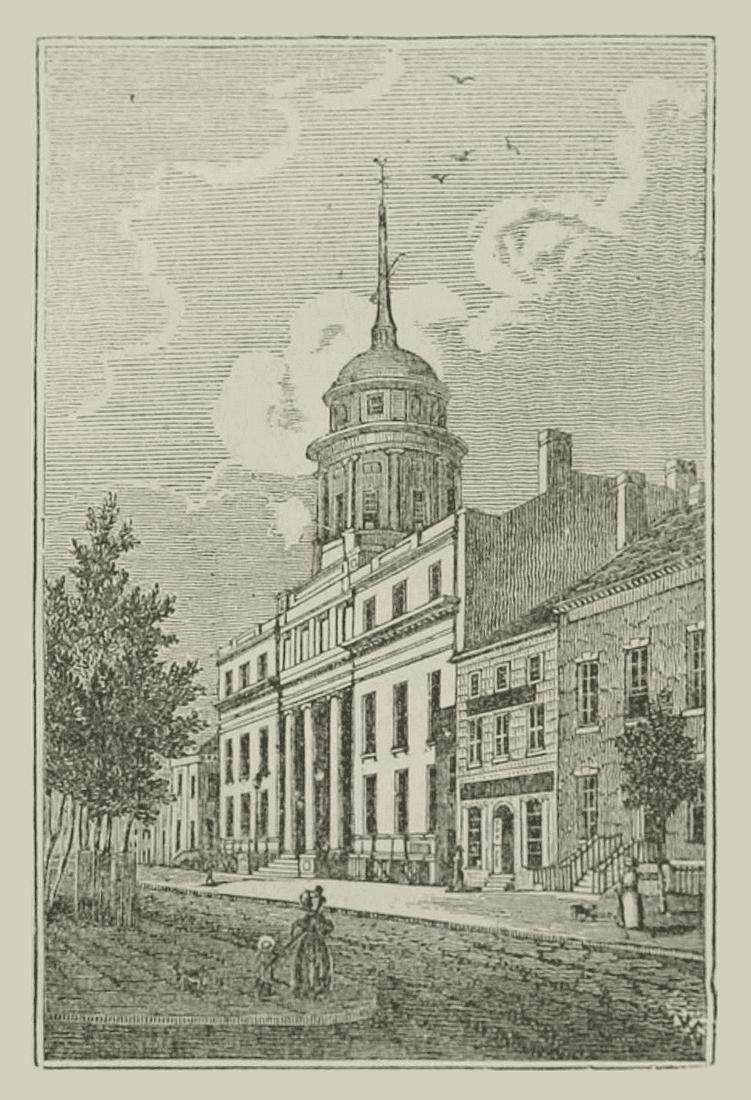
Merchants’ Exchange.
‘There is a very handsome monument, near the centre of the church-yard, erected by Kean, of Drury Lane theatre, to Cooke, the actor. Trinity church, which is also in Broadway, was the oldest in the city, having been originally built in 1696, but destroyed by fire eighty years afterwards, although from the circumstance of a monument in the church-yard, of 1691, it appears it was used as a burial-ground some time previously. Though not containing much above an acre of ground, by a moderate calculation, not fewer than two hundred thousand bodies have been buried in it. Of late years there have been no burials, and weeping willows with various trees have been planted, which in time will make it ornamental to the city. In one corner are the ruins of a monument, erected but sixteen years since to Captain Lawrence, of the American navy, who fell defending his ship, the Chesapeak, against Sir P. Broke, in the Shannon. His body was taken to Halifax, in Nova Scotia, and buried there with all the honors of war, the pall being the American ensign supported by six of the senior captains in the royal navy, then in the harbor. But the Americans immediately after sent a vessel with a flag of truce to apply for the removal of the body, which being granted, it was re-buried in Trinity church-yard, and the present monument, no lasting memorial of his country’s grief, erected upon the spot. It is a most shabby economical structure, built of brick, and faced with white marble. The column, of the Corinthian order, is broken short, with part of the capital lying at the base of the pedestal, emblematic of his premature death. Owing to the summit being exposed to the weather, the rain has gained admittance into the interior of the brick work, and has given the column a considerable inclination to one side. Some of the marble front also, with two sides of that of the pedestal, have fallen down and exposed the shabby interior. Surely, such a man deserved a monument of more durable materials.’65
Among the most splendid public buildings is the Masonic hall, a Gothic edifice, in Broadway, fifty feet wide, and seventy feet high; it is composed of the eastern gray granite. Of collegiate institutions, Columbia college is the oldest in New York. It is finely situated on a square ornamented with majestic trees; and the standard of classical education here is very high. This institution possesses an estate valued at four hundred thousand dollars. In 1831, the University of New York was chartered; it is projected on the broad and liberal plan of the continental universities, and promises to be of great utility. Schools of all kinds are numerous; bible and missionary societies are numerous and well endowed. Literary and scientific institutions flourish. The most ancient of these is the Society Library, founded in 1754, and containing upwards of twenty-three thousand volumes. The Historical society was incorporated in 1809, and has collected a vast number of important documents in relation to the country in general, and particularly to New York. The Lyceum for Natural History, the Clinton Hall association, and the Mercantile Library association, are flourishing and useful institutions.
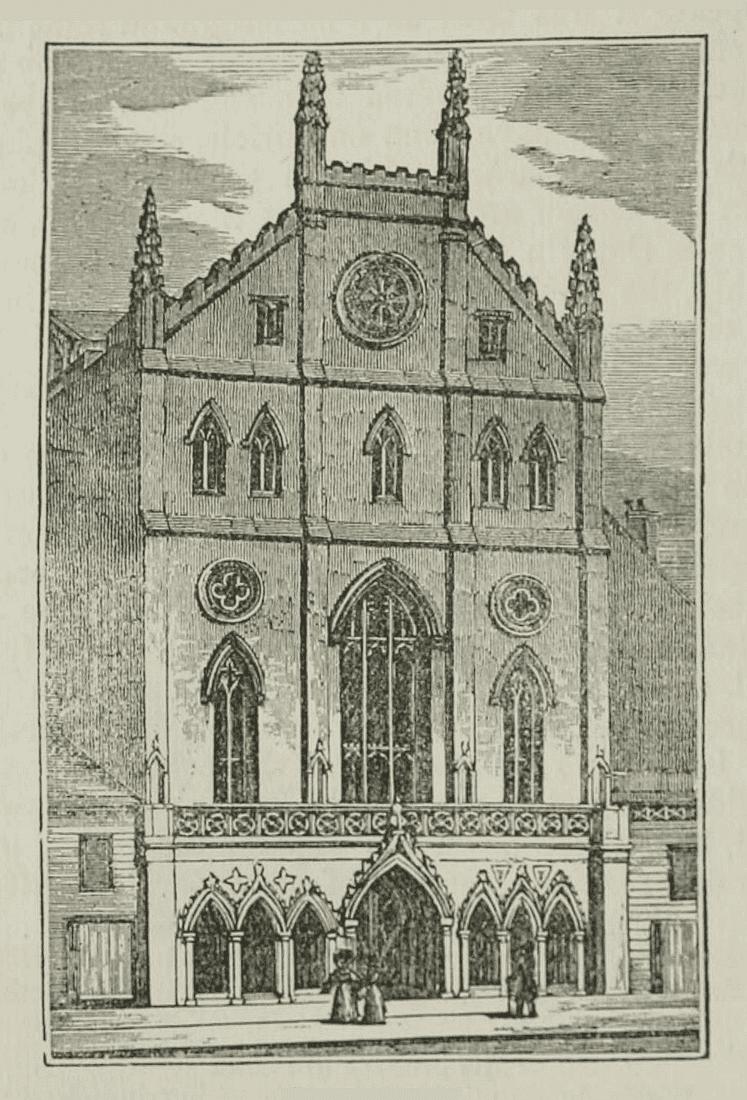
Masonic Hall.
The Academy of Arts was chartered in 1808. It has two exhibitions annually. The library consists of books of views, designs and drawings, relating chiefly to antique subjects. Among the presidents of this institution have been Edward Livingston, De Witt Clinton, and John Trumbull. The National Academy was founded in 1826, and, with a few exceptions, is altogether composed of artists. Of the dramatic entertainments of the city, we can say but little. The Park theatre is the place of most fashionable resort; it is a spacious edifice, adjoining the park. It is eighty feet long, and one hundred and sixty-five feet deep. The Bowery theatre is well attended. An opera house has been recently built.
The number of insurance offices in this city is upwards of forty. In 1827, the total of banking capital amounted to about sixteen millions of dollars. Several new banks have been since chartered, and this amount has been much increased. For its advantage of inland and external commerce, no city in the United States can be compared with New York. The number of vessels that arrived here from foreign parts during the first eight months of the year 1833, was thirteen hundred and forty-five, and the number of passengers was over thirty-two thousand. In 1832, the number of arrivals from foreign parts during the whole year, was one thousand eight hundred and ten; in 1829, it was thirteen hundred and four, being forty-one less in the whole year than during the first eight months of 1833.
The population of New York in 1697, was four thousand three hundred and two; in 1756, thirteen thousand and forty; in 1790, thirty-three thousand and thirty-one; in 1800, sixty thousand four hundred and eighty-nine; in 1810, ninety-six thousand three hundred and seventy-three; in 1820, one hundred and twenty-three thousand seven hundred and six; in 1825, one hundred and sixty-six thousand and eighty-six; and in 1830, two hundred and seven thousand and twenty-one. Its present population is three hundred and thirteen thousand six hundred and twenty-nine.
Norfolk, the commercial capital of Virginia, is situated on the east side of Elizabeth river, immediately below the junction of its two main branches, and eight miles above Hampton roads. The town lies low, and is in some places marshy, though the principal streets are well paved. Among the public buildings are a theatre, three banks, an academy, marine hospital, athenæum, and six churches. The harbor, which is capacious and safe, is defended by several forts. One is on Craney island, near the mouth of Elizabeth river. There are also fortifications at Hampton roads; the principal of which, Fort Calhoun, is not yet completed. Population, ten thousand five hundred and seventy-three.
Northampton is a post and shire town of Hampshire county, Massachusetts, on the west bank of Connecticut river, and ninety-five miles from Boston. Its population in 1840 was three thousand six hundred and seventy-two. It is built chiefly on two broad streets, in which are situated the churches and county buildings. This town is very beautiful, consisting of a number of villas of various sizes, and of pleasing, though irregular architecture, seeming to vie with each other in the taste and elegance of their external decorations. There is primitive white limestone in the vicinity, and much of the pavement and steps are of white marble. The trees in the neighborhood of the town are single spreading trees, principally elms, and of considerable age; the roads are wide, and the footpaths are excellent everywhere. Northampton is surrounded by rising grounds; but mount Holyoke, situated on the opposite side of the Connecticut river, is the hill which all strangers ascend, for the sake of the extensive and beautiful prospect from its summit. The valley that lies at its base, contains the most extensive and beautiful plain in New England, well cultivated and populous. The spires of thirty churches are seen from the top of mount Holyoke, and in a clear day the hills of New Haven are distinctly visible. Round Hill school, in this town, is an institution of some note, somewhat on the plan of a German gymnasium. There are two banks here, woolen manufactories, an insurance office, and a printing office; the public houses are good, and the town is somewhat a place of summer resort.
Norwich, a city of New London county, Connecticut, situated at the head of navigation on Thames river, contains three compact settlements; of which Chelsea Landing, situate at the point of land between the Shetucket and Yantic rivers, is the principal. Its location is peculiarly romantic; and it is a place of much enterprise and business. What is called the town is two miles north-west of Chelsea, containing the court house, and some other public buildings; and the third settlement is Bean Hill, in the western part of Norwich. The city contains a bank, four or five churches, and several manufacturing establishments. The Yantic falls, one mile from Chelsea, are beautiful, and afford facilities for mills and manufactories. From a rock seventy or eighty feet in height, which overhangs the stream, tradition says a number of Narragansetts once precipitated themselves when pursued by the Mohegans.