Chapter XX · —HISTORY. (continued 2)
Reading edition
From Indian hostilities, this colony suffered more severely than her neighbors. The surprise of Dover, in 1689, was effected with the most shocking barbarity; though the natives having been ill-treated by one of the principal inhabitants may account for, if not palliate, their ferocious revenge. Having determined upon their plan of attack, the Indians employed their usual art to lull the suspicions of the inhabitants. So civil and respectful was their behavior, that they occasionally obtained permission to sleep in the fortified houses in the town. On the evening of the fatal night, they assembled in the neighborhood, and sent their women to apply for lodgings at the houses devoted to destruction. When all was quiet the doors were opened and the signal given. The Indians rushed into Waldron’s house, and hastened to his apartment. Awakened by the noise, he seized his sword, and drove them back, but when returning for his other arms was stunned with a hatchet, and fell. They then dragged him into his hall, seated him in an elbow chair upon a long table, and insultingly asked him, ‘Who shall judge Indians now?’ After feasting upon provisions, which they compelled the rest of the family to procure, each one with his knife cut gashes across his breast, saying, ‘I cross out my account.’ When, weakened with the loss of blood, he was about to fall from the table, his own sword was held under him, which put an end to his tortures. At other houses, similar acts of cruelty were perpetrated; in the whole, twenty-three persons were killed, and twenty-nine carried prisoners to Canada, who were mostly sold to the French. Many houses were burned, and much property was plundered; but so expeditious were the Indians, that they had fled beyond reach before the neighboring people could be collected. The war thus commenced, was not easily terminated. The French, by giving premiums for scalps, and by purchasing the English prisoners, animated the Indians to exert all their activity and address, and the frontier inhabitants endured the most aggravated sufferings. The peace of Ryswick, in 1697, closed the distressing scene till 1703, when another war began, which continued ten years.
A few years only transpired before the inhabitants again suffered the afflictions of an Indian war. Following the example of the French, the government offered premiums for scalps, which induced several volunteer companies to undertake expeditions against the enemy. One of these, commanded by captain Lovewell, was greatly distinguished. In April, 1725, with thirty-four men, he fought a famous Indian chief, named Paugus, at the head of about eighty savages, near the shores of a pond in Pequackett. Lovewell’s men were determined either to conquer or die, although outnumbered by the Indians more than twice. They fought till Lovewell and Paugus were killed, and all Lovewell’s men but nine were either killed or dangerously wounded. The savages having lost, as was supposed, sixty of their number out of eighty, and being convinced of the fierce and determined resolution of their foes, at length retreated, and left them masters of the ground. The scene of this desperate and bloody action, which took place in the town that is now called Fryburgh, is often visited with interest to this day, and the names both of those who fell, and those who survived, are yet repeated with exultation.
CONNECTICUT.
The Connecticut colony consisted of people who first emigrated from England to Massachusetts, and, in the years 1630 and 1632, settled and formed themselves into churches at Dorchester, Watertown, and Cambridge, where they resided several years. But either because the number of emigrants to Massachusetts did not allow them all such a choice as they wished of good lands, or because some jealousies had arisen between their pastors and leaders, and the leading men of the colony, they took the resolution of seating themselves again in the wilderness; and in the years 1635 and 1636 they removed their families to Windsor, Weathersfield, and Hartford, on the Connecticut river.
From the commencement of the Connecticut colony, the natives discovered a hostile disposition. Their principal enemy was the Pequods, the most numerous and warlike nation within the limits of the state, and perhaps in New England. They inhabited the country which environs the towns of New London, Groton, and Stonington. Sassacus, the great prince of the Pequods, had under him six-and-twenty sachems, and could bring into the field seven hundred or a thousand warriors, who had been long accustomed to victory. The royal residence was at a large fort situated on a beautiful eminence in the town of Groton, which commands an extensive prospect of the sea and of the surrounding country. There was also another fortress, called Mystic fort, situated in the town of Stonington. After suffering repeated injuries, and the murder of about thirty of their people, principally by the Pequods, the general court, which had been convened for the purpose, resolved on active hostilities, and immediately raised an army of ninety men, half the effective force of the colony. These were to be joined by two hundred men from Massachusetts, and forty from Plymouth.
The court which declared war was holden on the 1st of May; the men were raised and embarked on the river, under the command of captain Mason, on the 10th; and, after being wind-bound several days, sailed from the mouth of the river for Narraganset bay on the 19th. They were accompanied by sixty Mohegan and River Indians, under Uncas, a Mohegan sachem. On reaching Narraganset bay, they landed to the number of seventy-seven Englishmen, marched into the country of the Narragansets, and communicated their design to Miantonimoh, the sachem of the country, who offered to join them. Information was here received that captain Patrick had reached Providence, with a company of Massachusetts troops, but it was resolved not to wait for this reinforcement. On the next day, they marched twenty miles through the west part of Rhode Island, and reached Nihantick, which bordered on the Pequods’ country.99 The army wheeled directly to Mystic fort, which was immediately attacked; the contest, though tremendously severe, terminated in favor of the English, and in the destruction of the Indians. Although this victory was complete, the situation of the army was extremely dangerous and destressing. Several were killed, and one-fourth of their number were wounded; the remainder were exhausted with fatigue, and destitute of provisions; they were in the midst of an enemy’s country, many miles from their vessels, and their ammunition was nearly exhausted; they were but a few miles distant from the principal fortress of their foe, where there was a fresh army, which they knew would be exasperated in the highest degree on learning the fate of their brethren. In the midst of their perplexity, while they were consulting on the course to be pursued, their vessels appeared in sight, steering with a fair wind directly into the harbor. The army was received on board with great mutual joy and congratulation.
The troops employed on this successful expedition reached their homes before the expiration of a month from the day that the war was resolved upon. The Pequods, on the departure of captain Mason, burnt their wigwams, destroyed their principal fort, and scattered themselves throughout the country. Sassacus, with a party of his chief warriors, abandoned his country, and moved by slow marches towards the Hudson river. They were followed by a party of Massachusetts and Connecticut troops; and, in a great swamp in Fairfield, near the western part of Connecticut, they were overtaken, and a battle ensued. Sassacus, and about twenty of his most hardy men, escaped, and fled to the Mohawk country; but there he found no safety; he was surprised by the Mohawks, and killed, with all his party, except Mononotto, who, after being wounded, made his escape. The Pequods who remained were divided between the Mohegans and Narragansets, and the nation became extinct. The vigor and boldness with which this war was prosecuted on both sides, give it the air of romance. Its decisive termination, which was so fatal to one party, was productive of the most happy consequences to the other. It struck the Indians throughout New England with such a salutary terror, that they were contented, in general, to remain at peace for nearly forty years.
In the year 1637, Mr. John Davenport, a celebrated London minister, accompanied by several eminent merchants, made overtures to the native proprietors for the purchase of all the lands between the rivers Hudson and Connecticut. This purchase they in part effected, and from this originated the colony of New Haven. At first they recognised the authority of Massachusetts, but it being evident that they were not within the limits of the Massachusetts colony, they convened an assembly at Hartford, and formed a constitution of government of the most popular kind. The people of New Haven followed their example, and framed a similar government; and these continued the constitutions of the two colonies, till their union in 1661. On the completion of the union among the several colonies of New England, several Indian sachems came in and submitted themselves to the English government, among whom were Miantonomoh, the Narraganset, and Uncas, the Mohegan, chief.
After the restoration, the Connecticut colony sent out Mr. Winthrop of Massachusetts to England, with a petition for a charter with the royal signature. This charter he obtained, and it was one of the most liberal description. It established a government of a highly popular kind, and continued the fundamental law of Connecticut for one hundred and fifty-eight years. ‘It is remarkable,’ says a writer in the North American Review, ‘that although it was granted at a period of the world when the rights of the people were little understood and little regarded, and by a sovereign who governed England with a more arbitrary sway than any of his successors, the form of government established by this charter was of a more popular description, and placed all power within the more immediate reach of the people, than the constitution for which it has been deliberately exchanged, in these modern days of popular jealousy and republican freedom.’ In this new charter was included the colony of New Haven; though it was not for some years that the union was finally adopted.
Connecticut was destined to suffer, with the rest of the colonies, from the violent acts committed in the last years of the reign of the Stuarts. Massachusetts had been deprived of her charter, and Rhode Island had been induced to surrender hers, when, in July, 1685, a writ of quo warranto was issued against the governor and company of Connecticut. The colonial government was strongly advised by Vane to comply with the requisition, and surrender the charter; but it was determined neither to appear to defend the charter, nor voluntarily to surrender it. Sir Edmund Andros made repeated applications for its surrender, but without success.
The singular mode of its escape from his demand in person is thus recorded by Trumbull: ‘The assembly met as usual, in October, 1687, and the government continued, according to charter, until the last of the month. About this time, Sir Edmund, with his suite, and more than sixty regular troops, came to Hartford, where the assembly were sitting, demanded the charter, and declared the government under it to be dissolved. The assembly were extremely reluctant and slow with respect to any resolve to surrender the charter, or with respect to any motion to bring it forth. The tradition is, that governor Treat strongly represented the great expense and hardships of the colonists in planting the country; the blood and treasure which they had expended in defending it, both against the savages and foreigners; to what hardships and dangers he himself had been exposed for that purpose; and that it was like giving up his life now to surrender the patent and privileges so dearly bought, and so long enjoyed. The important affair was debated and kept in suspense until the evening, when the charter was brought and laid upon the table where the assembly were sitting.
‘By this time, great numbers of people were assembled, and men sufficiently bold to enterprise whatever might be necessary or expedient. The lights were instantly extinguished, and one captain Wadsworth, of Hartford, in the most silent and secret manner, carried off the charter, and secreted it in a large hollow tree, fronting the house of the honorable Samuel Wyllys, then one of the magistrates of the colony. The people appeared all peaceable and orderly. The candles were officiously relighted, but the patent was gone, and no discovery could be made of it, or of the person who had conveyed it away.’ Though Sir Edmund was thus foiled in his attempt to obtain possession of the charter, he did not hesitate to assume the reins of government, which he administered in a manner as oppressive in this as in the other colonies. When, on the arrival of the declaration of the prince of Orange at Boston, Andros was deposed and imprisoned, the people of Connecticut resumed their previous form of government, having been interrupted little more than a year and a half.
In the Indian war, in which Philip acted so conspicuous a part, Connecticut had her share of suffering, though it was not so great as that of some of her sister colonies. Hostilities were commenced by the aborigines, on the Connecticut river, in the summer of 1675; and, on the first of September, the inhabitants of Hadley were alarmed by the Indians during the time of public worship, and the people thrown into the utmost confusion; but the enemy were repulsed by the valor and good conduct of an aged, venerable man, who, suddenly appearing in the midst of the affrighted inhabitants, put himself at their head, led them to the onset, and, after the dispersion of the enemy, instantly disappeared. This deliverer of Hadley, then imagined to be an angel, was general Goffe, (one of the judges of Charles I.,) who was at that time concealed in the town.
But a short time elapsed, before the colonists were again called on to defend their privileges from what they deemed an unjust encroachment. Colonel Fletcher, governor of New York, had been vested with plenary powers to command the militia of Connecticut, and insisted on the exercise of that command. The legislature of Connecticut, deeming that authority to be expressly given to the colony by charter, would not submit to his requisition; but, desirous of maintaining a good understanding with governor Fletcher, endeavored to make terms with him, until his majesty’s pleasure should be further known. All their negotiations were, however, unsuccessful; and, on the 26th of October, he came to Hartford, while the assembly was sitting, and, in his majesty’s name, demanded submission; but the refusal was resolutely persisted in. After the requisition had been repeatedly made, with plausible explanations and serious menaces, Fletcher ordered his commission and instructions to be read in audience of the trainbands of Hartford, which had been assembled upon his order.
Captain Wadsworth, the senior officer, who was exercising his soldiers, instantly called out, ‘Beat the drums!’ which, in a moment, overwhelmed every voice. Fletcher commanded silence. No sooner was a second attempt made to read, than Wadsworth vociferated, ‘Drum, drum! I say.’ The drummers instantly beat up again, with the greatest possible spirit. ‘Silence, silence,’ exclaimed the governor. At the first moment of a pause, Wadsworth called out earnestly, ‘Drum, drum, I say;’ and, turning to his excellency, said, ‘If I am interrupted again, I will make the sun shine through you in a moment.’ Colonel Fletcher declined putting Wadsworth to the test, and, abandoning the contest, returned with his suite to New York.
RHODE ISLAND.
The settlement of PROVIDENCE AND RHODE ISLAND was made by Roger Williams, in 1636. This man was far in advance of his age. He set the first example of perfect religious equality and toleration; and extended his humane labors to enlighten, improve and conciliate the savages. When the New England colonies, in 1643, formed the celebrated confederacy, Rhode Island applied to be admitted to the union; but Plymouth objected, on the ground that the settlements were within her boundaries.
Upon the application of the inhabitants, in 1663, a charter was granted by Charles II. to the Rhode Island and Providence plantations. On the accession of James II., the assembly of Rhode Island immediately transmitted an address, acknowledging themselves his loyal subjects, and begging protection for their chartered rights. But reformation of abuses in New England was then the order of the day, and articles of high misdemeanor were exhibited against them before the lords of the committee of colonies, accusing them of breaches of their charter, and of opposition to the acts of navigation. This committee ordered that Sir Edmund Andros, the governor of Massachusetts, should demand the surrender of their charter, and govern them as other colonies of New England. In December, 1686, Andros accordingly dissolved the government of Rhode Island, broke its seal, and assumed the administration of affairs. When the revolution put an end to his power, Rhode Island and Providence resumed their charter, on the ground that an act which was extorted by terror might justly be recalled when restraint no longer remained.
The wise, peaceful and beneficent counsels of Williams, had preserved the colonists from the dangers of Indian incursions. Their prosperity was proportionate to their moderation. The population increased with great rapidity, and in 1761 amounted to forty thousand. Brown university was founded at Warren, in 1764. Six years afterwards it was removed to Providence, where a large and elegant building was erected for the students.
NEW YORK.
NEW YORK was first settled by the Dutch, who erected a fort near Albany, which they called fort Orange, and a few trading-houses on the island of New York, then called by the Indians Manhattan. The claims of the Dutch to the property of the soil were disputed by the king of Great Britain, who founded an adverse claim on the discovery of the Cabots in the previous century. In the first year of their settlement, they were visited by captain Argal, who claimed the country for his sovereign, and warned them to acknowledge his authority. The colony was small, and prudently acquiesced in the demand: but within a twelvemonth their number was increased, and the demands of the English were promptly resisted. For a series of years they continued in undisturbed quiet, and by toil, perseverance and unwearied activity, surmounted the dangers and troubles of an infant colony.
In 1621, the Dutch republic granted to their West India company an extensive territory on both sides of the Hudson, and called it New Netherlands. Under the management of this company, the settlement was soon both consolidated and extended; and the foundations were laid of the cities of New Amsterdam, afterwards New York, and of Albany. In 1623, they erected a fort on the Delaware, which they called Nassau; and, ten years afterwards, another on the Connecticut, which they called Good Hope. Near the former the Swedes had a settlement; and from the interfering claims of the two nations, quarrels arose between the settlers, which, in a few years, terminated in the subjugation of the Swedes.
The policy of the Dutch, in extending their settlements so far eastward as Connecticut, soon brought them into collision with more powerful neighbors. Numberless causes of dispute arose between New Netherlands and the colonies of Connecticut and New Haven; but neither party allowed itself to forget the substantial claims of humanity, or the forms of ordinary courtesy. In the Indian wars, the English never delayed to render due assistance to their Dutch neighbors, who were so unwarlike that they found it necessary to invite captain Underhill, who had been banished from Boston for his eccentricities in religion, to take command of their troops. Collecting a flying party of one hundred and fifty men, he was enabled to preserve the Dutch settlements from destruction. The number of Indians whom he killed in the course of the war, was supposed to exceed four hundred. In 1646, a severe battle was fought on that part of Horse-Neck called Strickland’s Plain. The Dutch were victorious; on both sides great numbers were slain; and for a century afterwards the graves of the dead were distinctly visible.
When Charles II. ascended the British throne, he did not hesitate to assert his claim to the province of New Netherlands; and without any attempt at negotiation with the states, he executed a charter, conveying to the duke of York the whole territory from the eastern shore of the Delaware to the western bank of the Connecticut. This grant took no notice of the existing possession of the Dutch, or of the recent Connecticut charter, which it entirely superseded. No sooner did the duke of York obtain this grant, than he conveyed to lord Berkeley and Sir George Carteret all that portion now constituting the province of New Jersey. To carry such a grant into effect, it was necessary to call in the aid of the military, and an armament was despatched from England under the command of colonel Nichols; who was also appointed governor of the province he was about to conquer. After touching at Boston, the fleet sailed to the Hudson and took a position before the capital of New Netherlands. The Dutch governor, Stuyvesant, had determined on a resolute resistance, but his followers were of a less gallant temperament, and compelled him to agree to a treaty of capitulation.
Immediately after its subjugation, New Amsterdam, and the whole conquered province, received the name of New York. Few of the inhabitants thought proper to remove from the country; even governor Stuyvesant lived and died there. Nichols at once assumed command of the conquered territory, and proceeded to reduce the affairs of the state to one uniform constitution and policy. Many of the Dutch forms of government were retained, but English influence gradually brought about a change; and on the twelfth of June, 1665, the inhabitants of New York were incorporated under a mayor, five aldermen, and a sheriff. At the peace of Breda, New York was regularly ceded to England in exchange for Surinam, by a general stipulation that each of the belligerents should retain what its arms had acquired since the commencement of hostilities.
The interior of New York was originally inhabited by a confederacy, which consisted at first of five, and afterwards of six, nations of Indians. This confederacy was formed for mutual defence against the Algonquins, a powerful Canadian nation, and displayed much of the wisdom and sagacity which mark the institutions of a civilized people. By their union they had become formidable to the surrounding tribes. Being the allies of the English, the French were alarmed at their successes, and became jealous of their power. In the year 1684, De la Barre, the governor of Canada, marched to attack them, with an army of seventeen hundred men. His troops suffered so much from hardships, famine, and sickness, that he was compelled to ask peace of those whom he had come to exterminate. He invited the chiefs of the Five Nations to meet him at his camp, and those of three of them accepted the invitation. Standing in a circle, formed by the chiefs and his own officers, he addressed a speech to Garrangula, of the Onondago tribe, in which he accused the confederates of conducting the English to the trading grounds of the French, and threatened them with war and extermination if they did not alter their behavior. Garrangula, knowing the distresses of the French troops, heard these threats with contempt. After walking five or six times round the circle, he addressed De la Barre in the following bold language, calling him Yonnondio, and the English governor, Corlear:—
‘Hear, Yonnondio, I do not sleep; I have my eyes open, and the sun which enlightens me, discovers to me a great captain at the head of a company of soldiers, who speaks as if he was dreaming. He says that he only came to smoke the great pipe of peace with the Onondagas. But Garrangula says, that he sees the contrary; that it was to knock them on the head, if sickness had not weakened the arms of the French. We carried the English to our lakes, to trade there with the Utawawas, and Quatoghies, as the Adirondacs brought the French to our castles, to carry on a trade which the English say is theirs. We are born free; we neither depend on Yonnondio nor Corlear. We may go where we please, and buy and sell what we please. If your allies are your slaves, use them as such; command them to receive no other but your people. Hear, Yonnondio! what I say is the voice of all the Five Nations. When they buried the hatchet at Cadaracui, in the middle of the fort, they planted the tree of peace in the same place, to be there carefully preserved, that instead of a retreat for soldiers, the fort might be a rendezvous for merchants. Take care that the many soldiers who appear there do not choke the tree of peace, and prevent it from covering your country and ours with its branches. I assure you that our warriors shall dance under its leaves, and will never dig up the hatchet to cut it down, till their brother Yonnondio or Corlear shall invade the country which the Great Spirit has given to our ancestors.’
De la Barre was mortified and enraged at this bold reply; but, submitting to necessity, he concluded a treaty of peace, and returned to Montreal. His successor, De Nonville, led a larger army against the confederates; but fell into an ambuscade, and was defeated. These wars within the limits of the colony served to perpetuate the enmity of the Indians against the French, and their attachment to the English.
When James II. ascended the throne, it was determined to superadd New York and the Jerseys to the jurisdiction of the four colonies of New England; and a new commission was issued, appointing Sir Edmund Andros captain-general and vice-admiral over the whole. His authority, however, was a brief one. In the following year, intelligence was received of the accession of William and Mary to the British throne; and while the principal officers and magistrates were assembled to consult for the general good, Jacob Leisler, a captain of militia, seized the fort and held it for the prince of Orange. The province was for some time subsequently ruled by a committee of safety, with Leisler at their head. In a few months, a letter arrived from the ministry in England, directed ‘to such as, for the time being, take care of administering the laws of the province,’ and conferring authority to perform all the duties of lieutenant governor. This letter Leisler understood as addressed to himself, and assumed the authority conferred by it, without ceremony.
The people of Albany acknowledged king William, but refused to submit to Leisler. Force was resorted to, with the view of compelling obedience; and the estates of the rebellious were confiscated. In this disturbed state, the colonists of New York remained nearly two years; when the miseries of foreign aggression were added to those of internal discord.
War had been declared between France and England; and De Nonville had been replaced in the governorship of Canada by count Frontignac, a veteran officer, whose skilful and energetic measures, aided by a large reinforcement, soon raised the affairs of the French from the brink of ruin, and enabled them to act on the offensive. Frontignac was indefatigable in his efforts to gain over the Five Nations, who had made two attacks upon Montreal, and murdered a great number of inhabitants. He held a great council with them at Onondaga; and, as they seemed to be somewhat inclined to peace, he resolved to give their favorable disposition no time for change, and, at the same time, to inspirit his own drooping countrymen, by finding them immediate employment against the English colonies. On the 19th of January, a party of about two hundred French, and some Cahnuaga Indians, set out, in a deep snow, for Schenectady; they arrived on the 8th of February, at eleven o’clock at night; and the first intimation the inhabitants had of their design, was conveyed in the noise of their own bursting doors. The village was burnt, sixty persons were butchered, twenty-seven suffered the worse fate of captivity, the rest made their way naked through the snow towards Albany, where some arrived in extreme distress, while many perished in the attempt. A party of young men, and some Mohawk Indians, set out from the latter place, pursued the enemy, and killed or captured twenty-five.
To avenge these barbarities, and others perpetrated in New England, a combined expedition against Canada was projected. An army, raised in New York and Connecticut, proceeded as far as the head of lake Champlain, whence, finding no boats prepared, they were obliged to return. Sir William Phipps, with a fleet of more than thirty vessels, sailed from Boston into the St. Lawrence, and, landing a body of troops, made an attack by land and water upon Quebec; but the return of the army to New York allowing the whole force of the enemy to repair to the assistance of the garrison, he was obliged to abandon the enterprise. Leisler, transported with rage when he was informed of the retreat, caused Winthrop, who commanded the New England forces, to be arrested, but was instantly compelled, by universal indignation, to release him. It was to the misconduct or incapacity of Leisler and Milborne, (the latter of whom, as commissary-general, had made no adequate provision for the enterprise,) that the failure of this expedition was attributed.
Leisler was afterwards superseded by colonel Sloughter, and, together with Milborne, was executed for refusing to surrender his authority to the officer legally appointed to receive it. Sloughter’s administration was inefficient and turbulent. He was succeeded by colonel Fletcher, a man of great energy of character, but violent in his disposition and mean. His administration was signalized by no occurrence worthy of particular record. The war between the French and the Five Indian Nations raged with great fury, and both parties seemed inspired with a mutual emulation of cruelty in victory, no less than of prowess in battle. Prisoners were tortured, and put to death, without the least regard to the rights of humanity, or the laws of war.
In 1697, the peace of Ryswick, which was concluded between Great Britain and France, gave security and repose to the colonies. The next year, the earl of Bellamont was appointed governor. He was particularly desirous of clearing the American seas of the pirates with which they had for some time been grievously infested. The government, however, declining to furnish an adequate naval force, the earl engaged with others in a private undertaking against them. Among the associates were lord chancellor Summers and the duke of Shrewsbury; the king himself, too, held a tenth share. The company, having procured a vessel of war, gave the command to captain Kid, and despatched him on a cruise against the pirates. He had been but a short time at sea, when he made a new contract with his crew, and, on the Atlantic and Indian oceans, became himself a daring and successful pirate. Three years afterwards he returned, burned his ship, and, with a strange infatuation, appeared in public at Boston.
The earl of Bellamont wrote to the secretary of state, desiring that Kid might be sent for, and a man-of-war was despatched upon this service; but being driven back by a storm, a general suspicion prevailed in England, that there was collusion between the ministry and the adventurers, who were thought unwilling to produce Kid, lest he might discover that the chancellor and the other associates were confederates in the piracy. So powerful was this feeling, that a motion was made in the house of commons, that all who were concerned in the adventure might be deprived of their employments; but it was rejected by a great majority, and all subsequent attempts to implicate the unfortunate shareholders, only proved more satisfactorily their entire innocence of any participation either in the designs or the profits of captain Kid; although their imprudence in selecting a person whose previous character was very indifferent, was evident and undeniable. Ultimately Kid was conveyed to England, where he was tried and executed.
Lord Bellamont found affairs in great confusion, and the colony divided into two bitter factions, contending with increased animosity. His administration was prudent, and promised to be highly beneficial; but was early terminated by his death, in March, 1701. Lord Cornbury was appointed his successor, a man eminent only for his meanness and profligacy: dismissed by his friends to place him out of the reach of his creditors. His rule was oppressive and extravagant; and the infamy of his private character exposed him to universal odium. He was finally removed, and was succeeded by lord Lovelace. His lordship died soon after his arrival, and general Hunter was appointed to the vacant chair. He brought with him nearly three thousand Germans, who were dispersed through New York and Pennsylvania.
In the year 1709, extensive preparations were made for an attack on the French settlements in Canada; the plan was afterwards abandoned, but in 1711 resumed. It was unsuccessful, and nothing was accomplished by it. To defray its expenses, the newly-elected assembly passed several bills, which the council persisted in amending. A contest ensued between these two bodies, in which the governor took side with the council, and finally dissolved the assembly. At the ensuing election, most of the members chosen were opposed to the governor. This assembly was dissolved by the death of the queen. The next met a similar fate from the governor soon after it met, a majority being known to be unfriendly to his views. At length, however, the people became weary of contending, and sent representatives who were not disposed to differ from the governor.
General Hunter quitted the province in 1719, and his authority devolved on Peter Schuyler, the oldest member of the council. William Burnet succeeded him in the following year. He was a man of good sense, and kind feelings, and he entertained just views of policy. His most vigilant attention was directed to Indian affairs, and to the danger to be apprehended from the vicinity of the French.
Turning his views towards the wilderness, he perceived that the French, in order to connect their settlements in Canada and Louisiana, to secure to themselves the Indian trade, and to confine the English to the sea-coast, were busily employed in erecting a chain of forts from the St. Lawrence to the Mississippi. He endeavored to defeat their design, by building a trading-house, and afterwards a fort, at Oswego, on lake Ontario. But the French had the command of more abundant resources, and applied them to the accomplishment of their object with great activity and zeal. They launched two vessels upon that lake; and, going farther into the wilderness, erected a fort at Niagara, commanding the entrance into it; they had previously erected fort Frontignac, commanding the outlet. The Jesuit Charlevoix does no more than justice to Mr. Burnet, in declaring that he left no stone unturned to defeat the French at Niagara. Besides supplanting his favorite trade at Oswego, these operations tended to the defection of the Five Nations; and, in case of a rupture, exposed the frontiers of the southern colonies to the ravages of the French and their allies. Mr. Burnet, upon whom these considerations made the deepest impression, laid the matter before the house, remonstrated against the proceedings to Longuiel, in Canada, wrote to the ministry in England, who complained of them to the French court, and met the confederates at Albany, endeavoring to convince them of the danger they themselves would be in from an aspiring, ambitious neighbor.
He spoke first about the affair privately to the sachems, and afterwards, in the public conference, informed them of all the encroachments which the French had made upon their fathers, and the ill-usage they had met with, according to La Potherie’s account, published with the privilege of the French king, at Paris, in 1722. He then reminded them of the kind treatment they had received from the English, who constantly fed and clothed them, and never attempted any act of hostility to their prejudice. This speech was extremely well drawn, the thoughts being conceived in strong figures, particularly expressive and agreeable to the Indians. The governor required an explicit declaration of their sentiments concerning the French transactions at Niagara, and their answer was truly categorical. ‘We speak now in the name of all the Six Nations, and come to you howling. This is the reason why we howl, that the governor of Canada encroaches on our land, and builds thereon.’ After which they entreated him to write to the king for succor. Mr. Burnet embraced this favorable opportunity to procure from them a deed, surrendering their country to his majesty, to be protected for their use, and confirming their grant in 1701, concerning which there was only an entry in the books of the secretary for Indian affairs.
It was an unfortunate circumstance, which tended to prevent the execution of Mr. Burnet’s vigorous designs, that the electors of the colony had become dissatisfied at the length of time which had elapsed since they had been called on to exercise their functions. The assembly elected in 1716 had been on such good terms with the governor, that he continued its existence during the long period of eleven years. In the year 1727, however, the clamors of the people induced him to dissolve it; and, as might be expected, that which next met, was composed almost exclusively of his opponents. The court of chancery, in which he presided, had become exceedingly unpopular. It had been instituted by an ordinance of the governor and council, without the concurrence of the assembly, and some of the decisions had given great offence to powerful individuals. The house passed resolutions, declaring it ‘a manifest oppression and grievance,’ and intimating that its decrees were void. Mr. Burnet no sooner heard of these votes, than he called the members before him, and dissolved the assembly. They occasioned, however, an ordinance in the spring following, as well to remedy sundry abuses in the practice in chancery, as to reduce the fees of that court, ‘which, on account of the popular clamors, were so much diminished,’ says Smith, ‘that the wheels of the chancery have ever since rusted upon their axles, the practice being contemned by all gentlemen of eminence in the profession.’
Mr. Burnet was soon after appointed governor of Massachusetts, and was succeeded at New York by colonel Montgomery, who devoted himself so much to his ease that he has left nothing else to distinguish his brief rule. Upon his death, in 1731, the supreme authority devolved upon Rip Van Dam, the senior member of the council. Under his inefficient administration, the French were permitted to erect a fort at Crown Point, within the acknowledged boundaries of New York, from which parties of savages were often secretly despatched to destroy the English settlements.
In August, 1732, Van Dam was superseded by William Crosby. Having been the advocate in parliament of the American colonies, he was at first popular, but he soon lost the affection and confidence of the people. One of his most unpopular acts was the prosecution of Zenger, the printer of a newspaper, for publishing an article derogatory to the dignity of his majesty’s government, bringing him to trial, after a severe imprisonment of thirty-five weeks from the printing of the offensive articles. Andrew Hamilton, an eminent lawyer of Philadelphia, though aged and infirm, learning the distress of the prisoner and the importance of the trial, went to New York to plead Zenger’s cause, which he did so effectually that the jury brought in the prisoner not guilty. The common council of the city of New York, for this noble and successful service, presented Mr. Hamilton the freedom of their corporation in a gold box.
Governor Crosby was succeeded, in 1736, by George Clark. During his administration, the contest which had ended, twenty years before, in the victory gained by governor Hunter over the house of representatives, was revived. The colony being in debt, the house voted to raise the sum of six thousand pounds; but, in order to prevent its misapplication, declared that it should be applied to the payment of certain specified debts. Offended by this vote, Clark immediately dissolved the assembly. At the election which ensued, the popular party was triumphant. In their second session the house voted an address to the lieutenant governor, in which, after stating some of the vital principles of free government, and referring to recent misapplications of money, they say, ‘We therefore beg leave to be plain with your honor, and hope you will not take it amiss when we tell you, that you are not to expect that we will either raise sums unfit to be raised, or put what we shall raise into the power of a governor to misapply, if we can prevent it; nor shall we make up any other deficiencies than what we conceive are fit and just to be paid; nor continue what support or revenue we shall raise for any longer time than one year; nor do we think it convenient to do even that, until such laws are passed as we conceive necessary for the safety of the inhabitants of this colony, who have reposed a trust in us for that only purpose, and which we are sure you will think it reasonable we should act agreeable to; and, by the grace of God, we shall endeavor not to deceive them.’
With men so resolute in maintaining their rights, Clark wisely declined to contend; and promised his cordial co-operation in all measures calculated to promote the prosperity of the colony. Harmony did not, however, long continue. Clark, in his speech at the opening of the next session, declared that unless the revenue was granted for as long a time as it had been granted by former assemblies, his duty to his majesty forbade him from assenting to any act for continuing the excise, or for paying the colonial bills of credit. The house unanimously resolved, that it would not pass any bill for the grant of money, unless assurance should be given that the excise should be continued and the bills of credit redeemed. The lieutenant governor immediately ordered the members to attend him. He told them that ‘their proceedings were presumptuous, daring, and unprecedented; that he could not look upon them without astonishment, nor with honor suffer the house to sit any longer;’ and he accordingly dissolved it. In April, 1740, the assembly again met. It had now risen to importance in the colony; and the adherence of the representatives to their determination, not to grant the revenue for more than one year, made annual meetings of the assembly necessary. Their attachment to liberty was construed by the lieutenant governor into a desire for independence: in a speech delivered, in 1741, he alludes to ‘a jealousy which for some years had obtained in England, that the plantations were not without thoughts of throwing off their dependence on the crown.’
George Clinton superseded Clark in the government of the colony in 1743. Like most of his predecessors he was welcomed with joy; and one of his earliest measures confirmed the favorable accounts which had preceded him, of his talents and liberality. To manifest his confidence in the people, he assented to a bill limiting the duration of the present and all succeeding assemblies. The house evinced its gratitude by adopting the measures he recommended for the defence of the province against the French, who were then at war with England. In 1745, the savages in alliance with France made frequent invasions of the English territories; and their hostilities were continued, with little intermission, till the war which terminated the French dominion in Canada.
In the middle of the seventeenth century, the whole colony of New York contained scarcely one hundred thousand inhabitants,100 not half the number which the city of New York alone can now boast. That the population would have been much more numerous at this time, had not the inhabitants been so continually exposed to the irruptions of the French and their Indian allies, is evident from its rapid increase when those unfavorable circumstances ceased to exist. The consideration of this period belongs, however, to another department of the work.
NEW JERSEY.
It was not till the year 1640 that any attempt was made by the English to colonize that portion of the continent now known as New Jersey, and then they were resisted and expelled by the Swedes. This nation remained in possession of the country on both sides of the Delaware until 1655, when the governor of New Netherlands conquered all their posts, and transported most of the Swedes to Europe. The Dutch consequently possessed themselves of the whole territory of New Jersey, New York, and Delaware; but their settlements in New Jersey shared the fate of those on the Hudson, when in the year 1664 they were captured by the English under colonel Nichols. In the same year the duke of York conveyed that portion of his grant lying between Hudson and Delaware rivers to lord Berkeley and Sir George Carteret. This tract was called NEW JERSEY, in compliment to Sir George, who had been governor of the island of Jersey, and had held it for the king in his contest with the parliament.
The early history of this province is a history of disputes between the inhabitants and the proprietaries. It would not be interesting to go into their details, as they are mere claims and adjudications of title. Suffice it to say, that in the course of the disputes it became partitioned into East and West Jersey, and fell into the hands of different proprietors. The former was released, in July, 1676, by William Penn and his three associates, assignees of lord Berkeley, to Philip Carteret; and he in return conveyed to them the latter, the government of which the duke retained as a dependency of New York, while that of the first was resigned to Carteret.
Philip Carteret, a natural son of Sir George, returned to East Jersey in the beginning of 1675, and was now kindly received by the inhabitants, because they had felt the rigors of conquest, which had not been softened by Andros, who had been appointed by the duke of York lieutenant over all his territories, from the western bank of the Connecticut to the farther shore of the Delaware. Having postponed the payment of quit-rents to a future day, and published new concessions with regard to the tenure of lands, tranquillity was perfectly restored. Desirous to promote the commercial interests of the colony, because he perceived its neighbor growing great and rich by trade, Carteret began, in 1676, to clear out vessels from East Jersey; but he was steadily opposed by Andros, who claimed jurisdiction over the Jersies, insisting that conquest by the Dutch divested the proprietors of all their rights. He forcibly seized, transported to New York, and there imprisoned, those magistrates why refused to acknowledge his authority. He imposed a duty upon all goods imported, and upon the property of all who came to settle in the country.
The inhabitants made repeated and energetic complaints of this injustice to the duke of York; and at length, wearied with their continual importunity, this prince consented to refer the matter to commissioners, who ultimately agreed to adhere to the opinion of Sir William Jones.
The commissioners pronounced their judgment, in conformity with the opinion of Sir W. Jones, ‘that as the grant to Berkeley and Carteret had reserved no profit or jurisdiction, the legality of the taxes could not be defended.’ In consequence of this adjudication, the duke resigned all his claims on West Jersey, and confirmed the province itself in the amplest terms to its new proprietaries; and soon after granted a similar release in favor of the representatives of Sir George Carteret in East Jersey. The whole of New Jersey thus rose to the rank of an almost independent state, maintaining only a federal connection with the British crown.
The accession of numerous companies of settlers now rapidly promoted the population and prosperity of West Jersey. In the year 1681, the first representative assembly was held; and during its session were enacted the ‘Fundamental Constitutions,’ and other laws for the preservation of property, and the punishment of criminals.
Frequent disputes arising between the proprietary government of East Jersey and the colonists, the trustees of Sir George Carteret, apprehending they should derive little emolument from retaining the government under their control, offered their rights in the province for sale, and accepted the proposals of William Penn, to whom, and his associates, East Jersey was conveyed. Among the new proprietors was the author of the well-known ‘Apology;’ and his colleagues, by a unanimous vote, conferred on him the office of governor for life, with the extraordinary permission to appoint a deputy, instead of his residing at the scene of his authority.
The number of proprietors, and the frequent transfers and subdivisions of shares, introduced such confusion into titles to land, and such uncertainty as to the rights of government, that, for twenty years afterwards, both Jerseys were frequently in a state of disturbance and disorder. In 1702, the proprietors, weary of contending with each other, and with the people, surrendered the right of government to the crown. Queen Anne reunited the two divisions, and appointed lord Cornbury governor over the provinces of New Jersey and New York. From the period of his appointment till his deprivation of office, the history of New Jersey consists of little else than a detail of his contests with the colonial assemblies; and exhibits the resolution with which they opposed his arbitrary conduct, his partial distribution of justice, and his fraudulent misapplication of the public money. After repeated complaints, the queen yielded to the universal indignation; and he was superseded, in 1709, by lord Lovelace.
These provinces continued, for several years, to be ruled by the same governor, but each chose a separate assembly. In 1738, the inhabitants, by a petition to the king, desired that they might, in future, have a separate governor; and their request was granted.
The distance of New Jersey from Canada, the source of most of the Indian wars which afflicted the northern colonies, gave it a complete exemption from those direful calamities, while the Indian tribes in the neighborhood, which were far from numerous, were almost always willing to cultivate a friendly relation with the Europeans. The gravity, simplicity, and courtesy of Quaker manners seem to have been particularly acceptable to these savages; and, added to the careful observation of the principles of equity in the proceedings of the colonists, established an amicable intercourse, to the manifest advantage both of themselves and of the natives.
PENNSYLVANIA AND DELAWARE.
During a considerable period, the colony of Delaware was attached to that of Pennsylvania, without even a separate assembly; and after it acquired that privilege, it remained for some time longer under the same governor: its history requires, therefore, to be blended with that of Pennsylvania, although it was settled at a much earlier period. It does not appear that the date of the first European plantation on South river, or the Delaware, can now be ascertained with any precision; some authorities, however, assert that a Swedish colony settled at cape Henlopen as early as the year 1627; although Chalmers is of opinion that, ‘though various Europeans may have trafficked in Delaware, their plantations had not yet embellished her margin, probably in the year 1632.’
The colony which forms the chief subject of this division was founded in the year 1681, by the celebrated William Penn. His attention was attracted to colonization by his connection with New Jersey. While he was engaged in the government of that territory, he received information of the country situate to the westward of the Delaware, which induced in his mind the desire of acquiring an estate in that quarter. He therefore presented a petition to Charles II., urging his claim for a debt incurred by the crown to his father, and soliciting a grant of land to the northward of Maryland, and westward of the Delaware. After a conference with the duke of York and lord Baltimore, to ascertain that the grant would not interfere with any prior claims of theirs, a charter, making conveyance of that territory, was signed and sealed by the king. It constituted William Penn and his heirs true and absolute proprietaries of the province of Pennsylvania, saving to the crown their allegiance and the sovereignty. It gave him, his heirs, and their deputies, power to make laws, by advice of the freemen, and to erect courts of justice for the execution of those laws, provided they be not repugnant to the laws of England.101
The charter being thus obtained, Penn invited purchasers by public advertisement. Many single persons, and some families, chiefly of the denomination of Quakers, were induced to think of a removal; and a number of merchants and others, forming themselves into a company, purchased twenty thousand acres of this land, which was sold at the rate of twenty pounds for every thousand acres. In May he despatched Markham, a relative, with a few associates, to take possession of the newly granted territory; and in the autumn three ships, with a considerable number of emigrants, sailed for the same destination. The philanthropic proprietor sent a letter to the Indians, informing them that ‘the great God had been pleased to make him concerned in their part of the world, and that the king of the country where he lived, had given him a great province therein; but that he did not desire to enjoy it without their consent; that he was a man of peace, and that the people whom he sent were of the same disposition; and if any difference should happen between them, it might be adjusted by an equal number of men chosen on both sides.’ The position selected by these emigrants for their abode, was immediately above the confluence of the Schuylkill and Delaware. In the following April, Penn published ‘the frame of government for Pennsylvania.’ The chief intention of this famous charter was declared to be, ‘for the support of power in reverence with the people, and to secure the people from the abuse of power. For, liberty without obedience is confusion, and obedience without liberty is slavery.’
The first page in the annals of Pennsylvania is one of the brightest in the history of mankind, recording an event not more to the credit of the wise and benevolent legislator through whose agency it happened, than honorable to humanity itself. At a spot which is now the site of one of the suburbs of Philadelphia, the Indian sachems, at the head of their assembled warriors, awaited in arms the approach of the Quaker deputation. Penn, distinguished from his followers only by a sash of blue silk, and holding in his hand a roll of parchment that contained the confirmation of the treaty, arrived, at the head of an unarmed train, carrying various articles of merchandise, which, on their approach to the sachems, were spread on the ground. He addressed the natives through an interpreter, assuring them of his friendly and peaceable intentions; and certainly the absence of all warlike weapons was a better attestation of his sincerity than a thousand oaths. The conditions of the proposed purchase were then read; and he delivered to the sachems not only the stipulated price, but a handsome present of the merchandise which he had spread before them. He concluded by presenting the parchment to the sachems, and requesting that they would carefully preserve it for three generations. The Indians cordially acceded to his propositions, and solemnly pledged themselves to live in love with William Penn and his children as long as the sun and moon should endure.
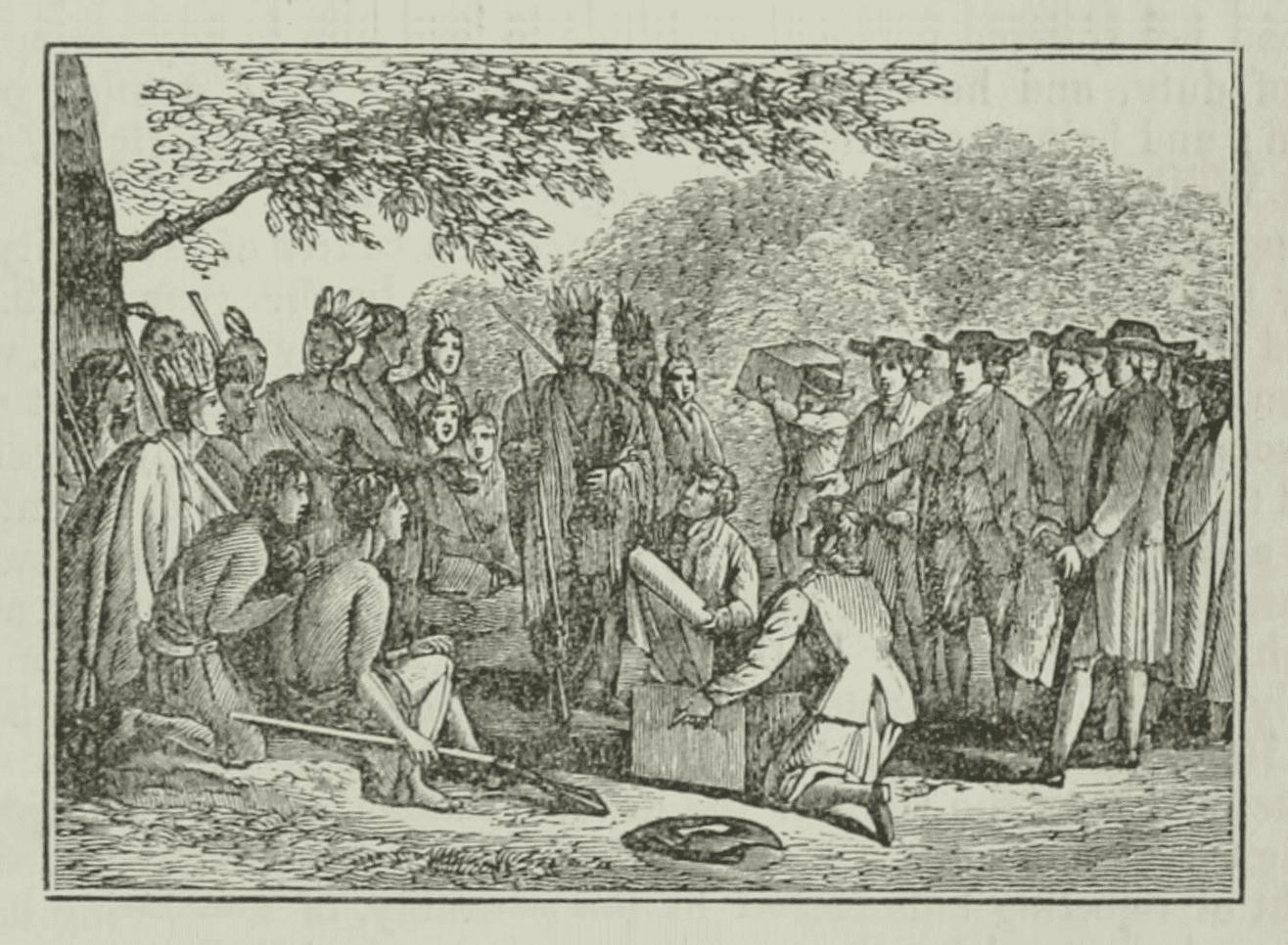
Penn’s Treaty.
Having received information from his agent that his presence was necessary in England, Penn departed from America, in August, 1684, leaving his province in profound peace, under the administration of five commissioners chosen from the provincial council. The unfortunate James II. ascended the throne soon after Penn’s arrival. ‘As he has,’ said Penn, ‘been my friend, and my father’s friend, I feel bound in justice to be a friend to him.’ He adhered to him while seated on the throne; and for two years after he was expelled from his kingdom, the government of the province was administered in his name. By this display of attachment to the exiled monarch, he incurred the displeasure of William III. On vague suspicion and unfounded charges, he was four times imprisoned. The king took the government of Pennsylvania into his own hands; and colonel Fletcher was appointed governor of this province, as well as of New York. On the arrival of colonel Fletcher at Philadelphia, the persons in the administration appear to have surrendered the government to him, without any notice or order to them, either from the crown or the proprietary. By the severest scrutiny, however, it was rendered apparent, that Penn had not suffered personal gratitude to lead him to any serious dereliction of duty, and he consequently regained the good opinion of king William; and being permitted to resume and exercise his rights, he appointed William Markham to be his deputy governor.
During several years the colony continued in a course of prosperity, without any occurrence requiring historical record. In the year 1699, Penn revisited his Pennsylvanian associates, accompanied by his family, with an intention of spending the remainder of his life amongst them. But several points soon came up, on which a difference of opinion existed between himself and the legislature, and disappointed him in his hopes of obtaining influence as a lawgiver. He consequently determined to return to England, and he naturally desired to have some frame of government finally adopted before his departure. In 1701, he prepared and presented one to the assembly, which was accepted. It confirmed to them, in conformity with that of 1696, the right of originating bills, which, by the charters preceding that date, had been the right of the governor alone, and of amending or rejecting those which might be laid before them. To the governor it gave the right of rejecting bills passed by the assembly, of appointing his own council, and of exercising the whole executive power.
Immediately after his fourth frame was accepted, Penn returned to England; but he had scarcely arrived there, when the disputes between the province and the territories broke forth with greater bitterness than ever; and in the following year, the separate legislature of Delaware was permanently established at Newcastle. In addition to the tidings of these prolonged disagreements, and of the final rupture between the two settlements, Penn was harassed by complaints against the administration of governor Evans; and having ascertained, by a deliberate examination of them, that they were too well founded, he appointed in his place Charles Gookin, a gentleman of ancient Irish family, who seemed qualified to give satisfaction to the people over whom he was sent to preside. Finding his people still in a discontented state, Penn, now in his sixty-sixth year, for the last time addressed the assembly, in a letter replete with calm solemnity and dignified concern. This letter is said to have produced a deep and powerful impression on the more considerate part of the assembly, who now began to feel for the father of his country, and to regard with tenderness his venerable age; to remember his long labors, and to appreciate their own interest in his distinguished fame: but it is very doubtful if this change of sentiment was ever known to its illustrious object, who was attacked shortly afterwards by a succession of apoplectic fits, which impeded, in a great degree, the exercise of his memory and understanding, and ultimately terminated his life.
The legislatures and governors continuing to act on the noble principles and example which their founder left for their imitation, the colony acquired, by well-conducted purchases from the Indians, a most extensive and unembarrassed territory, and proceeded rapidly in its prosperous course. The only circumstance which appears to have created any internal disunion worthy of notice, was a dispute between the governors and the assembly, on the question of exempting the land of the proprietaries from the general taxation; a claim which the inhabitants deemed very inequitable. In January, 1757, the assembly of Pennsylvania voted a bill for granting to his majesty the sum of one hundred thousand pounds by tax on all the estates, real and personal, and taxables, within the province. On submitting it to governor Denny for his sanction, he refused it. ‘The proprietaries,’ he observed in his message, ‘are willing their estates should be taxed in the manner that appears to them to be reasonable, and agreeable to the land-tax acts of parliament in our mother country.’ The governors of Pennsylvania still refusing their assent to any tax bill that did not exempt the estates of the proprietaries, the assembly of that province deputed the celebrated Benjamin Franklin as an agent to London, to petition the king for redress. The subject was discussed before the privy council; and Mr. Franklin acceding to a proposal to enter into engagements that the assessments should be fair and equitable, a bill for levying a general tax, which had previously received the governor’s assent, though after the agent’s departure from the province, was stamped with the royal approbation. These disputes, by calling the energetic mind of Benjamin Franklin into a new field of exertion, enlarged the sphere of his observation, and fitted him for those extraordinary services in which he acquired his greatest glory by contributing to that of his country.
MARYLAND.
The founder of the state of Maryland was lord Baltimore. Before the date of his charter, it was a portion of the territory of Virginia; but by that instrument it was separated, and declared subject only to the crown of England. Lord Baltimore was created the absolute proprietary of it, and was empowered, with the assent of delegates, whom he was to assemble for that purpose, to make laws for the province, and to administer them. Having thus obtained a most favorable charter, he proceeded to carry its provisions into execution.
He appointed his brother, Leonard Calvert, governor of the new province, and concurred with him in the equipment of vessels, which conveyed a numerous body of emigrants, chiefly Roman Catholics, and many of them gentlemen of rank and fortune. After a circuitous voyage the governor arrived, accompanied by his brother George, at Point Comfort, in Virginia, in February, 1634. Early in March, he proceeded up the bay of Chesapeake to the northward, and entered the Potomack, up which he sailed twelve leagues, and came to an anchor under an island, which he named St. Clement. Here he erected a cross, and took possession ‘in the name of the Savior of the world, and of the king of England.’ Thence he went fifteen leagues higher to the Indian town of Potowmack, on the Virginia side of the river, now called New Marlborough, where he was received in a friendly manner. Arriving at the town of Piscatawa, on the Maryland side, he found Henry Fleet, an Englishman, who had resided several years among the natives, and was held by them in great esteem, who was very serviceable as an interpreter.
An interview having been procured with the werowance, or prince, Calvert asked him, whether he was willing that a settlement should be made in his country; he replied, ‘I will not bid you go, neither will I bid you stay; but you may use your own discretion.’ Having convinced the natives that his designs were honorable and pacific, the governor now sought a suitable station for commencing his colony. He visited a creek on the northern side of the Potomack, on which he found an Indian village. Here he acquainted the prince of the place with his intentions, and by presents to him and his principal men, conciliated his friendship so much as to obtain permission to reside in one part of the town until next harvest, when it was agreed that the natives should entirely quit the place. Both parties entered into a contract to live together in a friendly manner. After Calvert had given a satisfactory consideration, the Indians readily yielded a number of their houses, and retired to the others. Thus, on the 27th of March, 1634, the governor took peaceable possession of the country of Maryland, and gave to the town the name of St. Mary, and to the creek on which it was situate, the name of St. George. The desire of rendering justice to the natives by giving them a reasonable compensation for their lands, is a trait in the character of the first planters, which will always do honor to their memory.
Circumstances favored the rapid population of the colony. The charter granted more ample privileges than had ever been conceded to a subject; the country was inviting; the natives were friendly; from the south Churchmen drove Puritans, from the north Puritans drove Churchmen, into her borders, where all were freely received, protected, and cherished. The colony was soon able to export Indian corn and other products to New England and Newfoundland, for which they received in return dried fish and other provisions. The Indians also killed many deer and turkeys, which they sold to the English for knives, beads, and other small articles of traffic, while cattle, swine, and poultry, were procured from Virginia.
It is a fact, which reflects the greatest credit on these early colonists, that fifteen years after they first landed, the general assembly of the people passed an act, entitled ‘An Act concerning Religion,’ in which the great principles of religious toleration and liberty are extensively recognised. This law was passed by an assembly composed entirely of Roman Catholics, and is the more remarkable, as being the first legislative act which is recorded to have been passed by any government, administered by members of the Romish hierarchy, in favor of the unlimited toleration of all Christian sects.
In 1676, Cecil, lord Baltimore, the father of the province, died. For more than forty years he had directed its affairs as proprietor, and displayed in all his conduct a benevolent heart and enlightened understanding. Although he lived in an age of bigotry, he was liberal in his opinions; and for all his exertions to contribute to the happiness of his fellow-beings, he desired no reward but their gratitude. This reward he received. The records of the Maryland assembly contain frequent memorials of the respect and affection of the people. He was succeeded, as proprietor, by his eldest son, Charles, who had for several years been governor of the colony, and displayed the same amiable qualities which had rendered his father respected and beloved.
The closing years of the proprietary government were embittered by a circumstance similar to that which the institution of the colony of Maryland had inflicted on Virginia. The grant which had been made by Charles II. to the celebrated Penn included the territory of Delaware, which lord Baltimore had always considered within the limits of his patent. On the arrival of William Penn in America, a meeting took place between him and lord Baltimore, in the hope of effecting an amicable adjustment of the boundaries of their respective territorial grants. But the pretensions of the parties were so completely incompatible, that it proved impossible at the time to adjust them in a manner satisfactory to both. Penn ultimately complained to the English government, and by his interest at court, procured it to be adjudged that the debatable territory should be divided into two equal parts, one of which was appropriated to himself, and the other to lord Baltimore. This adjudication was carried into effect; and the territory which now composes the state of Delaware was thus dismembered from the provincial limits of Maryland.
In the year following the revolution of 1688, the repose of Maryland was again disturbed. A rumor was artfully circulated that the Catholics had leagued with the Indians to destroy all the Protestants in the province. An armed association was immediately formed, for the defence of the Protestant religion, and for asserting the rights of king William and queen Mary. The magistrates attempted to oppose this association by force; but, meeting with few supporters, they were compelled to abdicate the government. King William directed those who had assumed the supreme authority to exercise it in his name; and for twenty-seven years the crown retained the entire control of the province. In 1716, the proprietor was restored to his rights; and he and his descendants continued to enjoy them until the commencement of the revolution. The people then assumed the government, adopted a constitution, and refused to admit the claims of the representatives of lord Baltimore either to jurisdiction or to property.
NORTH AND SOUTH CAROLINA.
The final settlement of this country originated with the earl of Clarendon and other courtiers of Charles II., who were presented with a grant of all the lands lying between the thirty-first and thirty-sixth degrees of north latitude, and received in their charter ample powers of administration and judicature. Some previous efforts had been unsuccessfully made to colonize this portion of the North American continent, and grants had been given to different individuals, which were now all pronounced void by the privy council. A few settlers were scattered in different parts, and those on Albemarle sound were on certain conditions allowed to retain their lands. A government was organized over them, at the head of which Mr. Drummond was placed.
Having taken the command of the infant settlement at Albemarle, the proprietaries directed a survey of the coast to the southward, and projected the establishment of a new colony in Clarendon country, which had been recently abandoned by the emigrants from New England. In furtherance of this object, they conferred on John Yeamans, a respectable planter of Barbadoes, the appointment of commander-in-chief of Clarendon country. In the autumn, he conducted from Barbadoes a body of emigrants, who landed on the southern bank of cape Fear. He cultivated the good will of the natives, and insured a seven years’ peace. The planters, in opening the forest to make room for the operations of tillage, ‘necessarily prepared timber for the uses of the cooper and builder, which they transmitted to the island whence they had emigrated, as the first subject of a feeble commerce, that kindled the spark of industry which soon gave animation to the whole.’ Another settlement was also projected to the southward of cape Remain, which received the name of Carteret, and was placed under a separate governor.
In pursuance of the authority with which the proprietors were invested by their charter, they began to frame a system of laws for the government of their colony; in which they availed themselves of the assistance of the illustrious John Locke. The form of government proposed by this eminent man proved utterly impracticable and useless. It received no favor from the people, and never attained the force of fundamental laws.
Notwithstanding these constitutions and legal preparations, several years elapsed before the proprietors of Carolina made any serious efforts towards its settlement. In 1667, they fitted out a ship, gave the command of it to captain William Sayle, and sent him out to bring them some account of the coast. His report to his employers, as might naturally be expected, was favorable. He praised their possessions, and encouraged them to engage with vigor in the execution of their project. His observations respecting the Bahama islands, which he had visited, induced them to apply to the king for a grant of them, and Charles bestowed on them by patent all those islands lying between the twenty-second and twenty-seventh degrees of north latitude. Nothing then remained but to make preparations for sending a colony to Carolina. Two ships were procured, on board of which a number of adventurers embarked, with provisions, arms, and utensils requisite for building and cultivation.
Sayle was appointed the first governor, and received a commission, bearing date July 26, 1669. The expenses of this first embarkation amounted to twelve thousand pounds; a proof that the proprietors entertained no small hopes with respect to their palatinate. The number of men, however, must have been by no means adequate to the undertaking, especially considering the multitude of savages that ranged through that extensive wilderness. In what place governor Sayle first landed is uncertain; but he was dissatisfied with his first situation, and, moving to the southward, took possession of a neck of land between Ashley and Cooper rivers, where he laid out a town, which, in honor of the king then reigning, he called Charleston; but dying soon after, Sir John Yeamans, who had for several years been governor at Clarendon, was appointed to succeed him. This new settlement attracted many inhabitants from that at Clarendon, and ultimately entirely exhausted it. Being at a great distance from Albemarle, the proprietors established a separate government over it, and hence arose the distinctive appellations of North and South Carolina.
The affairs of the northern colony must now occupy a portion of our attention. The fundamental constitutions, which have already been described, were received by the colonists with disgust and disunion. Their promulgation produced no other effect than to excite the most inveterate jealousy of the designs of the proprietaries; till, in process of time, a refractory spirit took possession of the minds of the people, and was at length exasperated into sentiments as hostile to subordination, as the policy of the proprietaries was repugnant to liberty. From this period the history of the northern province, for a series of years, is involved in such confusion and contradiction, that it is impossible to render it interesting, and difficult to make it even intelligible. It is a record of insurrection and revolt, not easily understood, and not sufficiently interesting to demand more than this slight allusion.
To return to the affairs of the southern colony, now under the administration of Joseph West. The situation of Old Charleston being found inconvenient, the inhabitants, in 1680, removed to Oyster Point, where a new city was laid out, to which the name of the other was given. In the same year commenced a war with the Westoes, a powerful tribe of Indians, which threatened great injury to the colony; peace, however, was soon restored. Governor West was superseded by Sir Richard Kirle, an Irish gentleman, who died six months after his arrival in the country. After his decease, colonel Robert Quarry was chosen his successor. During the time of his government, a number of pirates put into Charleston, and purchased provisions with their Spanish gold and silver. Those public robbers, instead of being taken and tried by the laws of England, were treated with great civility and friendship, in violation of the laws of nations.
Whether the governor was ignorant of the treaty made with Spain, by which England had withdrawn her former toleration from these plunderers of the Spanish dominions, or whether he was afraid to bring them to trial from the notorious courage of their companions in the West Indies, we have not sufficient authority to affirm; but one thing is certain, that Charles II., for several years after the restoration, winked at their depredations, and many of them performed such valiant actions, as, in a good cause, would have justly merited honors and rewards; he even knighted Henry Morgan, a Welshman, who had plundered Porto Bello and Panama, and carried off large treasures from them. For several years so formidable was this body of plunderers in the West Indies, that they struck a terror into every quarter of the Spanish dominions. Their gold and silver, which they lavishly spent in the colony, insured to them a kind reception among the Carolinians, who opened their ports to them freely, and furnished them with necessaries. They could purchase the favor of the governor, and the friendship of the people, for what they deemed a trifling consideration. Leaving their gold and silver behind them for clothes, arms, ammunition, and provisions, they embarked in quest of more. However, the proprietors, having intelligence of the encouragement given to pirates by governor Quarry, dismissed him from the office he held; and, in 1685, landgrave Joseph Morton was appointed to the government of the colony.
It is not now of importance to recur to the difficulties between the proprietary government and the people: they led to extreme irritation, and in the year 1690, at a meeting of the representatives, a bill was brought in and passed, for disabling James Colleton, then governor of the province, from holding any office, or exercising any authority, civil or military, in the colony, and he was informed that in a limited time he must depart from the colony.
During these public commotions, Seth Sothel, one of the proprietors, who had been driven from North Carolina, appeared suddenly at Charleston, and, aided by a powerful faction, assumed the reins of government. At first the people gladly acknowledged his authority, while the current of their enmity ran against Colleton; especially as he stood forth as an active and leading man in opposition to that governor, and ratified the law for his exclusion and banishment; but they afterwards found him void of every principle of honor, and even of honesty. Such was the insatiable avarice of this man, that every restraint of common justice and equity was trampled upon by him; and oppression, such as usually attends the exaltation of vulgar and ambitious scramblers for power, extended her rod of iron over the distracted colony. The fair traders from Barbadoes and Bermuda were seized as pirates by order of this popular governor, and confined until such fees as he was pleased to exact were paid him; bribes from felons and traitors were accepted to favor their escape from the hands of justice; and plantations were forcibly taken possession of, upon pretences the most frivolous and unjust. At length, the people, weary of his grievous impositions and extortions, agreed to take him by force, and ship him off for England. He then evinced the meanness of spirit generally associated with a disposition to tyranny, and humbly begged liberty to remain in the country, promising to submit his conduct to the trial of the assembly at their first meeting. When the assembly met, thirteen different charges were brought against him, and all supported by the strongest evidence; upon which, being found guilty, they compelled him to abjure the government and country forever.
The next important incident that attracts our attention is the unsuccessful expedition against St. Augustine, planned by governor Moore, in the year 1702, at the time of a rupture in Europe between England and Spain. It failed utterly, and entailed a debt on the colony of six thousand pounds sterling; which led to many severe reflections against the governor, and brought him sadly into disrepute. To redeem his character, the governor resolved upon an expedition against the Apalachian Indians; in consequence of the insults and injuries which they had been instigated by the Spaniards to commit. To make his conquest permanent, he transplanted fourteen hundred of these Indians to the territory now included in Georgia; a measure which seems to have led to the settlement of the English in that part of the country.
The northern colony continued to receive accessions to its strength from several of the European states. In 1707, a company of French Protestants arrived and seated themselves on the river Trent, a branch of the Neuse; and three years afterwards a large number of palatines, fleeing from religious persecution in Germany, sought refuge in the same part of the province. To each of these bodies of emigrants the proprietors granted a hundred acres of land. On their newly acquired possessions they were living in peace, in the enjoyment of liberty of conscience, and in the prospect of competence and ease, when suddenly a terrible calamity fell upon them. The Tuscarora and Coree Indians, smarting under recent aggressions, and dreading total extinction from the encroachment of these strangers, with characteristic secrecy, plotted their entire destruction. Sending their families to one of their fortified towns, twelve hundred bowmen sallied forth, and in the same night attacked, in separate parties, the nearest settlements of the palatines. Men, women, and children were indiscriminately butchered. The savages, with the swiftness and ferocity of wolves, ran from village to village. Before them was the repose of innocence; behind, the sleep of death. A few escaping alarmed the settlements more remote, and hastened to South Carolina for assistance. Governor Craven immediately despatched to the aid of the sister colony nearly a thousand men, under the command of colonel Barnwell. Hideous was the wilderness through which colonel Barnwell had to march, and the utmost expedition was requisite. There was no road through the woods upon which either horses or carriages could pass; and his army had all manner of hardships and dangers to encounter, from the climate, the wilderness, and the enemy.
In spite of every difficulty, however, Barnwell advanced against them, and being much better supplied with arms and ammunition than his enemy, he did great execution among them, killing in the first battle three hundred Indians, and taking about one hundred prisoners. The Tuscaroras then retreated to their town, fortified within a wooden breastwork; but there Barnwell surrounded them, and forced them to sue for peace; and some of his men being wounded, and others having suffered greatly by constant watching, and much hunger and fatigue, the savages the more easily obtained their request. After having killed, wounded, or captured nearly a thousand Tuscaroras, Barnwell returned to South Carolina. The peace was, however, of short duration, and upon the recommencement of hostilities, assistance was again solicited from the southern colony. Colonel James Moore, an active young officer, was immediately despatched, with forty white men and eight hundred friendly Indians. He found the enemy in a fort near Cotechny river; and after a siege, which continued more than a week, the fort was taken, and eight hundred Indians made prisoners. The Tuscaroras, disheartened by this defeat, migrated, in 1713, to the north, and joined the celebrated confederacy, denominated the Five Nations. The others sued for peace, and afterwards continued friendly.
The northern colony had scarcely recovered from the scourge of Indian war, when the southern was exposed to the same calamity. All the tribes from Florida to cape Fear, had been for some time engaged in a conspiracy to extirpate the whites. On the day before the Yamassees began their bloody operations, captain Nairn and some of the traders observing an uncommon gloom on their savage countenances, and apparently great agitations of spirit, which to them prognosticated approaching mischief, went to their chief men, begging to know the cause of their uneasiness, and promising, if any injury had been done them, to give them satisfaction. The chiefs replied, they had no complaints to make against any one, but intended to go a-hunting early the next morning. Captain Nairn accordingly went to sleep, and the traders retired to their huts, and passed the night in seeming friendship and tranquillity. But next morning at daybreak, the 15th day of April, all were alarmed with the cries of war. The leaders were all out under arms, calling up their followers, and proclaiming aloud designs of vengeance. The young men, burning with fury and passion, flew to their arms, and, in a few hours, massacred above ninety persons in Pocotaligo town and the neighboring plantations; and many more must have fallen a sacrifice on Port Royal island, had they not providentially been warned of their danger. Mr. Burrows, a captain of the militia, after receiving two wounds, by swimming one mile and running ten escaped to Port Royal, and alarmed the town. A vessel happening fortunately to be in the harbor, the inhabitants in great hurry repaired on board, and sailed for Charleston; a few families of planters on that island, not having timely notice, fell into the barbarous hands of the Indians, and of them some were murdered, and others made prisoners of war.
While the Yamassees, with whom the Creeks and Apalachians had joined, were advancing against the southern frontiers, and spreading desolation and slaughter through the province, the colonists on the northern borders also found the Indians among their settlements in formidable parties. The Carolinians had foolishly entertained hopes of the friendship of the Congarees, the Catawbas, and Cherokees; but they soon found that they had also joined in the conspiracy, and declared for war. It was computed that the southern division of the enemy consisted of above six thousand bowmen, and the northern of between six hundred and a thousand. In the muster-roll at Charleston there were no more than one thousand two hundred men fit to bear arms, but as the town had several forts into which the inhabitants might retreat, governor Craven resolved to march with this small force into the woods against the enemy. He proclaimed martial law, and laid an embargo on all ships, to prevent either men or provisions from leaving the country. He obtained an act of assembly, empowering him to impress men, and seize arms, ammunition, and stores, wherever they were to be found, to arm such trusty negroes as might be serviceable at a juncture so critical, and to prosecute the war with the utmost vigor.
Being no stranger to the ferocious temper of his enemies, and their horrid cruelty to prisoners, the governor advanced against them by slow and cautious steps, always keeping the strictest guard round his army. He knew well under what advantages they fought among their native thickets, and the various wiles and stratagems they made use of in conducting their wars; and therefore he was watchful above all things against surprises, which might throw his followers into disorder, and defeat the end of his enterprise. The fate of the whole province depended on the success of his arms, and his men had no other alternative but to conquer or die a painful death. As he advanced, the straggling parties fled before him, until he reached Saltcatchers, where they had pitched their great camp. Here a sharp and bloody battle ensued from behind trees and bushes, the Indians whooping, hallooing, and giving way one while, and then again and again returning with double fury to the charge. But the governor, notwithstanding their superior number, and their terrible shrieks, kept the provincials close at their heels, and drove them before him like a flock of wolves. He expelled them from their settlement at Indian river, pursued them over the Savannah, and entirely freed the province of this formidable tribe of savages. What number of the army was killed does not appear; but in the whole war nearly four hundred unfortunate inhabitants of Carolina fell a prey to Indian cruelty, property of great value was destroyed, and a large debt contracted.
Of this debt the proprietors refused to pay any portion, and by their harsh and arbitrary conduct in regard to this matter and its consequences, a bitter hostility grew up between them and the people. It was resolved to throw off their yoke. A favorable opportunity presented itself at a general review of the militia at Charleston, in 1719; the officers and soldiers binding themselves by a solemn compact to resist the tyranny of the proprietors. The assembly was dissolved by the governor, but it immediately met in convention, and assumed the direction of public affairs. In spite of all opposition they established themselves in the full possession of the government, both in its legislative and executive relations.
The agent for Carolina at length procured a hearing from the lords of the regency and council in England, the king being at that time in Hanover; who gave it as their opinion, that the proprietors had forfeited their charter, and ordered the attorney-general to take out a scire facias against it. In consequence of this decision, in September, 1720, they appointed general Francis Nicholson provisional governor of the province, with a commission from the king. Several years afterwards, seven of the proprietors sold to the king their claim to the soil and rents, and all of them assigned to him their right of jurisdiction. The government of both Carolinas was subsequently administered in each colony by a governor and council appointed by the crown, and by assemblies chosen by the people. They soon attracted general attention, and their population was increased by accessions from several of the states of Europe.
In 1738, an alarming insurrection of the negroes occurred in the southern colony. A number of them assembled at Stono, and surprised and killed two men who had charge of a warehouse, from which they took guns and ammunition. They then chose a captain, and, with drums beating and colors flying, marched south-westward. They burned every house on their way, killed all the whites they could find, and compelled other negroes to join them. Governor Bull, who was returning to Charleston from the southward, accidentally met them, hastened out of their way, and spread an alarm. The news soon reached Wiltown, where, fortunately, a large congregation were attending divine service. The men having, according to a law of the province, brought their arms to the place of worship, marched instantly in quest of the negroes, who, by this time, had become formidable, and spread terror and desolation around them, having killed about twenty of the whites. While, in an open field, they were carousing and dancing, with frantic exultation at their late success, they were suddenly attacked; some were killed, and the remainder took to flight, but most of them were taken and tried. Those who had been compelled to join the conspirators were pardoned; but the leaders and principal instigators suffered death. Under apprehensions resulting, probably, from this rebellion, the legislature of South Carolina passed an act, that whoever shall teach, or cause any slave or slaves to be taught to write, or shall use or employ any slave as a scribe in any manner of writing whatsoever, shall, for every such offence, forfeit the sum of one hundred pounds.
The Carolinas were frequently exposed to the injurious effects of war from the French and Spaniards, as well as from some of the Indian tribes; but after the treaty of Paris, the progress of these colonies was no longer retarded from that cause. The assembly of South Carolina, taking advantage of the peaceful state of the colony to encourage emigration, appropriated a large fund for bounties to foreign Protestants, and such industrious poor people of Great Britain and Ireland as should resort to the province within three years, and settle on the inland parts. Two townships, each containing forty-eight thousand acres, were laid out; one on the river Savannah, called Mecklenburgh, and the other on the waters of Santee, at Long Cane, called Londonderry. Not long after, the colony received a considerable accession from Germany.
Beside foreign Protestants, several persons emigrated from England and Scotland, and great multitudes from Ireland, and settled in Carolina. An accession was also derived from the northern colonies, from which, in the space of one year, above a thousand families removed thither. To these adventurers lands in small tracts were allotted on the frontiers, by which means the back settlements soon became the most populous part of the province, while the whole felt the important benefits resulting from such accessions to its population.
GEORGIA.
The last of the colonies established previous to the war of independence was Georgia. A company of wealthy and influential individuals obtained a patent from George III., conferring the necessary powers, and lost no time in the prosecution of their design. In November, 1733, James Oglethorpe embarked at Gravesend for Georgia, with one hundred and sixteen persons, destined for settlement in that country. In the following January he arrived at Charleston, where he was kindly received, and whence he started to explore the territory granted by the patent. He selected the present site of Savannah as the most desirable point for the new settlement. Having completed a fort at this place, and put the colony in a state of defence, he next sought to cultivate friendly relations with the Indians, and to treat with them for a share of their possessions. Having made such arrangements as seemed to insure safety, Oglethorpe returned to England, carrying with him several Indians, among whom was Tomochichi, a chief of the Creeks, and his queen. Here they remained on a visit of about four months.
In the year 1740, the trustees rendered an account of their administration. At that time nearly two thousand five hundred emigrants had arrived in the colony; of whom more than fifteen hundred were indigent Englishmen, or persecuted Protestants. The benefactions from government and from individuals had been nearly half a million of dollars; and it was computed that, for every person transported and maintained by the trustees, more than three hundred dollars had been expended. The hopes which the trustees had cherished, that the colony would be prosperous and the objects of their benevolence happy, were far from realized. Such was the character of the greater part of the settlers and the nature of the restrictions imposed, that the plantations languished, and continued to require the contributions of the charitable. In the mean time events were preparing a rupture in Europe, and a war between England and Spain appeared inevitable. The plenipotentiaries, appointed for settling the boundaries between Georgia and Florida, and other differences and misunderstandings subsisting between the two crowns, had met at Pardo in convention, where preliminary articles were drawn up; but the conference ended to the satisfaction of neither party. The merchants had lost all patience under their sufferings, and became clamorous for letters of reprisal, which at length they obtained; all officers of the navy and army were ordered to their stations, and, with the unanimous voice of the nation, war was declared against Spain on the 23d of October, 1739.
As soon as intelligence of the declaration of war reached Georgia, general Oglethorpe passed over to Florida with four hundred select men of his regiment, and a considerable party of Indians; and a few days after, he marched with his whole force, consisting of above two thousand men, regulars, provincials, and Indians, to fort Moosa, within two miles of St. Augustine. The Spanish garrison evacuating the fort on his approach, and retiring into the town, put themselves in a posture of defence; and the general soon discovering that an attempt to take the castle by storm would be presumptuous, changed his plan of operations, and resolved, with the assistance of the ships of war which were lying at anchor off Augustine bar, to turn the siege into a blockade. Having made the necessary dispositions, he summoned the Spanish governor to surrender; but, secure in his strong-hold, he sent him for an answer that he would be glad to shake hands with him in his castle.