Chapter XVI · —ANIMALS.
Reading edition
I. QUADRUPEDS.
The Black Bear (ursus Americanus) is found in considerable numbers in the northern districts of America. In size and form he approaches nearest to the Brown Bear; but his color is a uniform shining jet black, except on the muzzle, where it is fawn colored; on the lips and sides of the mouth it is almost gray. The hair, except on the muzzle, is long and straight, and is less shaggy than in most other species. The forehead has a slight elevation, and the muzzle is elongated, and somewhat flattened above. The young ones, however, are first of a bright ash color, which gradually changes into a deep brown, and ends by becoming a deep black.
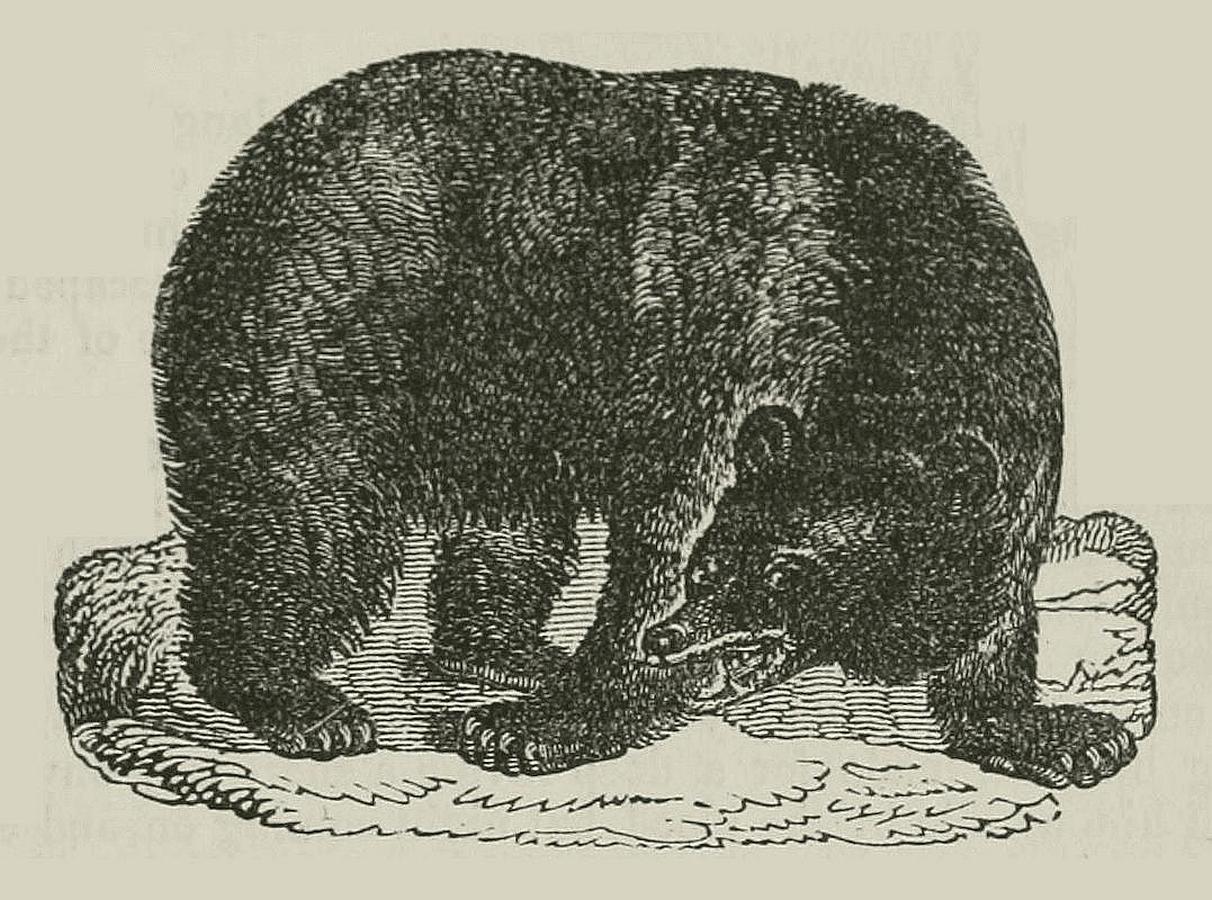
Black Bear.
The American Black Bear lives a solitary life in forests and uncultivated deserts, and subsists on fruits, and on the young shoots and roots of vegetables. Of honey he is exceedingly fond, and as he is a most expert climber, he scales the loftiest trees in search of it. Fish, too, he delights in, and is often found in quest of it on the borders of lakes and on the seashore. When these resources fail, he will attack small quadrupeds, and even animals of some magnitude. As, indeed, is usual in such cases, the love of flesh in him grows with the use of it.
As the fur is of some value, the Indians are assiduous in the chase of the creature which produces it. ‘About the end of December, from the abundance of fruits they find in Louisiana and the neighboring countries, the bears become so fat and lazy that they can scarcely run. At this time they are hunted by the American Indians. The nature of the chase is generally this: the bear chiefly adopts for his retreat the hollow trunk of an old cypress tree, which he climbs, and then descends into the cavity from above. The hunter, whose business it is to watch him into this retreat, climbs a neighboring tree, and seats himself opposite to the hole. In one hand he holds his gun, and in the other a torch, which he darts into the cavity. Frantic with rage and terror, the bear makes a spring from his station; but the hunter seizes the instant of his appearance, and shoots him.’
The black bear, says Godman, like all the species of this genus, is very tenacious of life, and seldom falls unless shot through the brain or heart. An experienced hunter never advances on a bear that has fallen, without first stopping to load his rifle, as the beast frequently recovers to a considerable degree, and would then be a most dangerous adversary. The skull of the bear appears actually to be almost impenetrable, and a rifle ball, fired at a distance of ninety-six yards, has been flattened against it, without appearing to do any material injury to the bone. The best place to direct blows against the bear is upon his snout; when struck elsewhere, his dense woolly coat, thick hide, and robust muscles, render manual violence almost entirely unavailing.
When the bear is merely wounded, it is very dangerous to attempt to kill him with such a weapon as a knife or tomahawk, or indeed any thing which may bring one within his reach. In this way hunters and others have paid very dearly for their rashness, and barely escaped with their lives; the following instance may serve as an example of the danger of such an enterprise:
‘Mr. Mayborne, who resides in Ovid township, Cayuga county, between the Seneca and Cayuga lakes, in the state of New-York, went one afternoon through the woods in search of his horses, taking with him his rifle and the only load of ammunition he had in the house. On his return home, about an hour before dusk, he perceived a very large bear crossing his path, on which he instantly fired, and the bear fell, but immediately recovering his legs, made for a deep ravine a short way onwards. Here he tracked him awhile by the blood, but night coming on, and expecting to find him dead in the morning, he returned home. A little before daybreak the next morning, taking a pitchfork and hatchet, and his son, a boy of ten or eleven years of age, with him, he proceeded to the place in quest of the animal. The glen or ravine into which he had disappeared the evening before, was eighty or ninety feet from the top of the bank to the brook below; down this precipice a stream of three or four yards in breadth is pitched in one unbroken sheet, and, forming a circular basin or pool, winds away among the thick underwood.
‘After reconnoitering every probable place of retreat, he at length discovered the bear, who had made his way up the other side of the ravine, as far us the rocks would admit, and sat under a projecting cliff, steadfastly eyeing the motions of his enemy. Mayborne, desiring his boy to remain where he was, took the pitchfork, and, descending to the bottom, determined from necessity to attack him from below. The bear kept his position until the man approached within six or seven feet, when on the instant, instead of being able to make a stab with the pitchfork, he found himself grappled by the bear, and both together rolled towards the pond, at least twenty or twenty-five feet, the bear biting on his left arm, and hugging him almost to suffocation. By great exertion he thrust his right arm partly down his throat, and in that manner endeavored to strangle him, but was once more hurled headlong down through the bushes, a greater distance than before, into the water. Here, finding the bear gaining on him, he made one desperate effort, and drew the animal’s head partly under water, and repeating his exertions, at last weakened him so much, that calling to his boy, who stood on the other side, in a state little short of distraction for the fate of his father, to bring him the hatchet, he sunk the edge of it by repeated blows into the brain of the bear. This man, although robust and muscular, was scarcely able to crawl home, where he lay for nearly three weeks, the flesh of his arm being much crushed, and his breast severely mangled. The bear weighed upwards of four hundred pounds.’
Grisly Bear.—This animal, like the species just described, inhabits the northern part of America; but, unlike him, he is, perhaps, the most formidable of all bears in magnitude and ferocity. He averages twice the bulk of the black bear, to which, however, he bears some resemblance in his slightly elevated forehead, and narrow, flattened, elongated muzzle. His canine teeth are of great size and power. The feet are enormously large; the breadth of the fore foot exceeding nine inches, and the length of the hind foot exclusive of the talons, being eleven inches and three quarters, and its breadth seven inches. The talons sometimes measure more than six inches. He is, accordingly, admirably adapted for digging up the ground, but is unable to climb trees, in which latter respect he differs wholly from every other species. The color of his hair varies to almost an indefinite extent, between all the intermediate shades of a light gray and a black brown; the latter tinge, however, being that which predominates. It is always, in some degree, grizzled, by intermixture of grayish hairs, only the brown hairs being tipped with gray. The hair itself is, in general, longer, finer, and more exuberant than that of the black bear.
The neighborhood of the Rocky Mountains is one of the principal haunts of this animal. There, amidst wooded plains, and tangled copses of bough and underwood, he reigns as much the monarch as the lion is of the sandy wastes of Africa. Even the bison cannot withstand his attack. Such is his muscular strength, that he will drag the ponderous carcass of the animal to a convenient spot, where he digs a pit for its reception. The Indians regard him with the utmost terror. His extreme tenacity of life renders him still more dangerous; for he can endure repeated wounds which would be instantaneously mortal to other beasts, and, in that state, can rapidly pursue his enemy. So that the hunter who fails to shoot him through the brain, is placed in a most perilous situation.
One evening, the men in the hindmost of one of Lewis and Clark’s canoes, perceived one of these bears lying in the open ground about three hundred paces from the river; and six of them, who were all good hunters, went to attack him. Concealing themselves by a small eminence, they were able to approach within forty paces unperceived; four of the hunters now fired, and each lodged a ball in his body, two of which passed directly through the lungs. The bear sprang up and ran furiously with open mouth upon them; two of the hunters, who had reserved their fire, gave him two additional wounds, and one breaking his shoulder-blade, somewhat retarded his motions. Before they could again load their guns, he came so close on them, that they were obliged to run towards the river, and before they had gained it, the bear had almost overtaken them. Two men jumped into the canoe; the other four separated, and concealing themselves among the willows, fired as fast as they could load their pieces. Several times the bear was struck, but each shot seemed only to direct his fury towards the hunter; at last he pursued them so closely, that they threw aside their guns and pouches, and jumped from a perpendicular bank twenty feet high into the river. The bear sprang after them, and was very near the hindmost man, when one of the hunters on the shore shot him through the head and finally killed him. When they dragged him on shore, they found that eight balls had passed through his body in different directions.
On another occasion, the same enterprising travellers met with the largest bear of this species they had ever seen; when they fired he did not attempt to attack, but fled with a tremendous roar, and such was his tenacity of life, that although five balls had passed through the lungs, and five other wounds were inflicted, he swam more than half across the river to a sand-bar, and survived more than twenty minutes.
Mr. John Dougherty, a very experienced and respectable hunter, who accompanied Major Long’s party during their expedition to the Rocky Mountains, several times very narrowly escaped from the grizzly bear. Once, while hunting with another person on one of the upper tributaries of the Missouri, he heard the report of his companion’s rifle, and when he looked round, beheld him at a short distance endeavoring to escape from one of these bears, which he had wounded as it was coming towards him. Dougherty, forgetful of every thing but the preservation of his friend, hastened to call off the attention of the bear, and arrived in rifle shot distance just in time to effect his generous purpose. He discharged his ball at the animal, and was obliged in his turn to fly; his friend relieved from immediate danger, prepared for another attack by charging his rifle, with which he again wounded the bear, and saved Mr. D. from further peril. Neither received any injury from this encounter, in which the bear was at length killed.
The Raccoon.—This animal continues to be frequently found even in the populous parts of the United States. Occasionally their numbers are so much increased, as to render them very troublesome to the farmers in the low and wooded parts of Maryland, bordering on the Chesapeak Bay. Being peculiarly fond of sweet substances, they are sometimes destructive to plantations of sugar-cane, and of Indian corn. While the ear of this corn is still young and tender, it is very sweet, and at that time troops of raccoons frequently enter fields of maize, and in a single night commit the most extensive depredations.
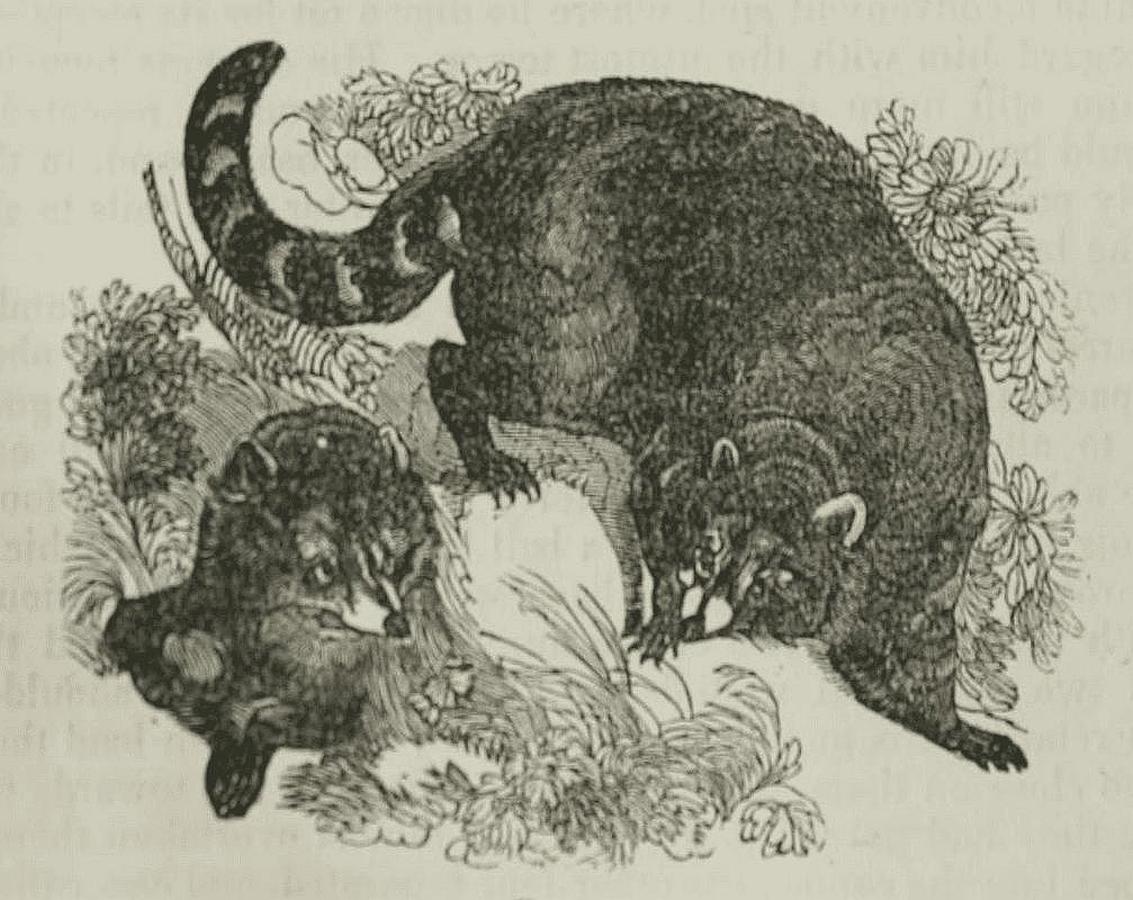
Raccoon.
The size of the raccoon varies with the age and sex of the individual. When full grown, the male is about a foot in length, or a few inches longer; the highest part of the back is about a foot from the ground, whilst the highest part of the shoulder is ten inches. The head is about five inches, and the tail rather more than eight. The general color of the body is a blackish gray, which is paler on the under part. The feet have five toes each, terminated by strong curved and pointed claws; and each foot is furnished with five thick and very elastic tubercles beneath. The fur of the raccoon forms an article of considerable value in commerce, as it is extensively used in the manufacture of hats.
‘The raccoon,’ says Godman, ‘is an excellent climber, and his strong sharp claws effectually secure him from being shaken off the branches of trees. In fact, so tenaciously does this animal hold to any surface upon which it can make an impression with its claws, that it requires a considerable exertion of a man’s strength to drag him off; and as long as even a single foot remains attached, he continues to cling with great force. I have had frequent occasion to pull a raccoon from the top of a board fence, where there was no projection which he could seize by; yet, such was the power and obstinacy with which the points of his claws were stuck into the board, as repeatedly to oblige me to desist for fear of tearing his skin, or otherwise doing him an injury by the violence necessary to detach his hold.’
‘Water seems to be essential to their comfort, if not of absolute necessity for the preparation of their food. I have had for some time, and at the moment of writing this have yet, a male and female raccoon in the yard. Their greatest delight appears to be dabbling in water, of which a large tub is always kept for their use. They are frequently seen sitting on the edge of this tub, very busily engaged in playing with a piece of broken china, glass, or a small cake of ice. When they have any substance which sinks, they both paddle with their fore feet with great eagerness, until it is caught, and then it is held by one, with both paws, and rubbed between them; or a struggle ensues for the possession of it, and when it is dropped the same sport is renewed. The coldest weather in winter does not in the least deter them from thus dabbling in the water for amusement; nor has this action much reference to their feeding, as it is performed at any time, even directly after feeding till satiated. I have frequently broken the ice on the surface of their tub, late at night, in the very coldest winter weather, and they have both left their sleeping place with much alacrity, to stand paddling the fragments of ice about, with their fore legs in the water nearly up to the breast. Indeed, these animals have never evinced the slightest dislike to cold, or suffered in any degree therefrom; they have in all weathers slept in a flour-barrel thrown on its side, with one end entirely open, and without any material of which to make a bed. They show no repugnance to being sprinkled or dashed with water, and voluntarily remain exposed to the rain or snow, which wets them thoroughly, notwithstanding their long hair, which, being almost erect, is not well suited to turn the rain. These raccoons are very fond of each other, and express the greatest delight on meeting, after having been separated for a short time, by various movements, and by hugging and rolling one another about on the ground.’
‘My raccoons are, at the time of writing this, more than a year old, and have been in captivity for six or eight months. They are very frolicsome and amusing, and show no disposition to bite or injure any one, except when accidentally trodden on. They are equally free from any disposition to injure children, as has been observed of other individuals. We frequently turn them loose in the parlor, and they appear to be highly delighted, romping with each other and the children, without doing any injury even to the youngest. Their alleged disposition to hurt children especially, may probably be fairly explained by the fact above mentioned, that they always attempt to bite when suddenly hurt, and few children touch animals without pinching or hurting them. They exhibit this spirit of retaliation, not only to man, but when they accidentally hurt themselves against an inanimate body; I have many times been amused to observe the expression of spite with which one of them has sprung at and bit the leg of a chair or table, after knocking himself against it so as to hurt some part of his body.
‘These animals may be tamed while young, but as they grow to maturity, most generally become fierce and even dangerous. I have had one so tame as to follow a servant about through the house or streets, though entirely at liberty; this was quite young when obtained, and grew so fond of human society as to complain very loudly, by a sort of chirping or whining noise, when left alone. Nothing can possibly exceed the domesticated raccoon in restless and mischievous curiosity, if suffered to go about the house. Every chink is ransacked, every article of furniture explored, and the neglect of servants to secure closet doors, is sure to be followed by extensive mischief, the evil being almost uniformly augmented by the alarm caused to the author of it, whose ill-directed efforts to escape from supposed peril, increase at the same time the noise and the destruction.’
The Puma, or American Lion was once spread over the new world, from Canada to Patagonia, but it is not now common in any part of the United States, except the unsettled districts. It is usually called the panther, or painter by the common people. It is also called the catamount. The progress of civilization has, however, circumscribed his range, and has rooted him out in many places. Notwithstanding his size and strength, he is cowardly; and, like almost all cowards, he is sanguinary. If he find a flock of sheep unprotected, he will destroy the whole, merely that he may enjoy the luxury of sucking their blood. He has a small rounded head, a broad and rather obtuse muzzle, and a body which, in proportion, is slenderer and less elevated than that of his more dignified namesake. ‘The upper parts of his body,’ says Mr. Bennett, ‘are of a bright silvery fawn, the tawny hairs being terminated by whitish tips: beneath and on the inside of the limbs he is nearly white, and more completely so on the throat, chin, and upper lip. The head has an irregular mixture of black and gray; the outside of the ears, especially at the base, the sides of the muzzle from which the whiskers take their origin, and the extremity of the tail, are black.’ The fur of the cubs has spots of a darker hue, which are visible only in certain lights, and disappear when the animal is full grown. Both the sexes are of the same color.42
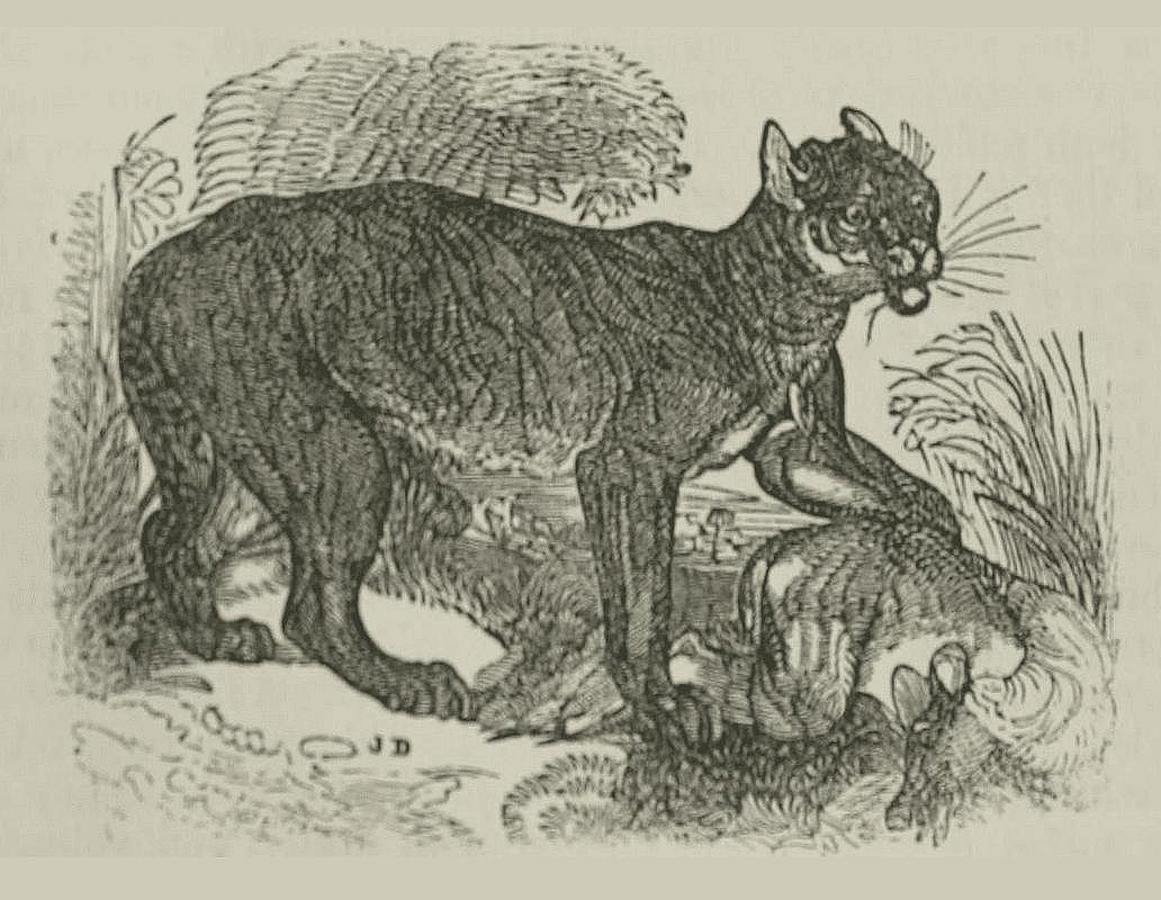
The Puma, or Cougar.
American Wild Cat. This animal bears a strong resemblance to the domestic cat, and its motions are very similar. It stands high upon its legs, and has a short curved tail. Its principal food consists of birds, squirrels, and other small animals which abound in the woody districts it inhabits. Though common in the western states, the wild cat is seldom found in New England.
The Moose.—This animal, which in Europe is called the elk, is an inhabitant of the northern parts of America, but is found in no part of the United States excepting Maine, where it is now met with but seldom. Its figure is ungraceful and clumsy. During summer, the moose frequents swampy or low grounds, on the borders of lakes, in which it is fond of bathing, and whose plants form a favorite article of its food. In winter, the moose seeks the depths of the forest for shelter, and a herd of fifteen or twenty take possession of a tract of about five hundred acres, where they subsist on the tender twigs and the mosses of the trees. To these places the Indians give the name of ‘moose-yards.’ Like other northern animals, the moose is much vexed by insects, which deposit their eggs in different parts of his body, and at certain seasons of the year render his skin worthless to the hunter. At other times, the skin is very valuable, and serves the Indians for clothing and tent covers. This species is much hunted, and has so rapidly diminished within a few years, that there are fears it will become extinct.
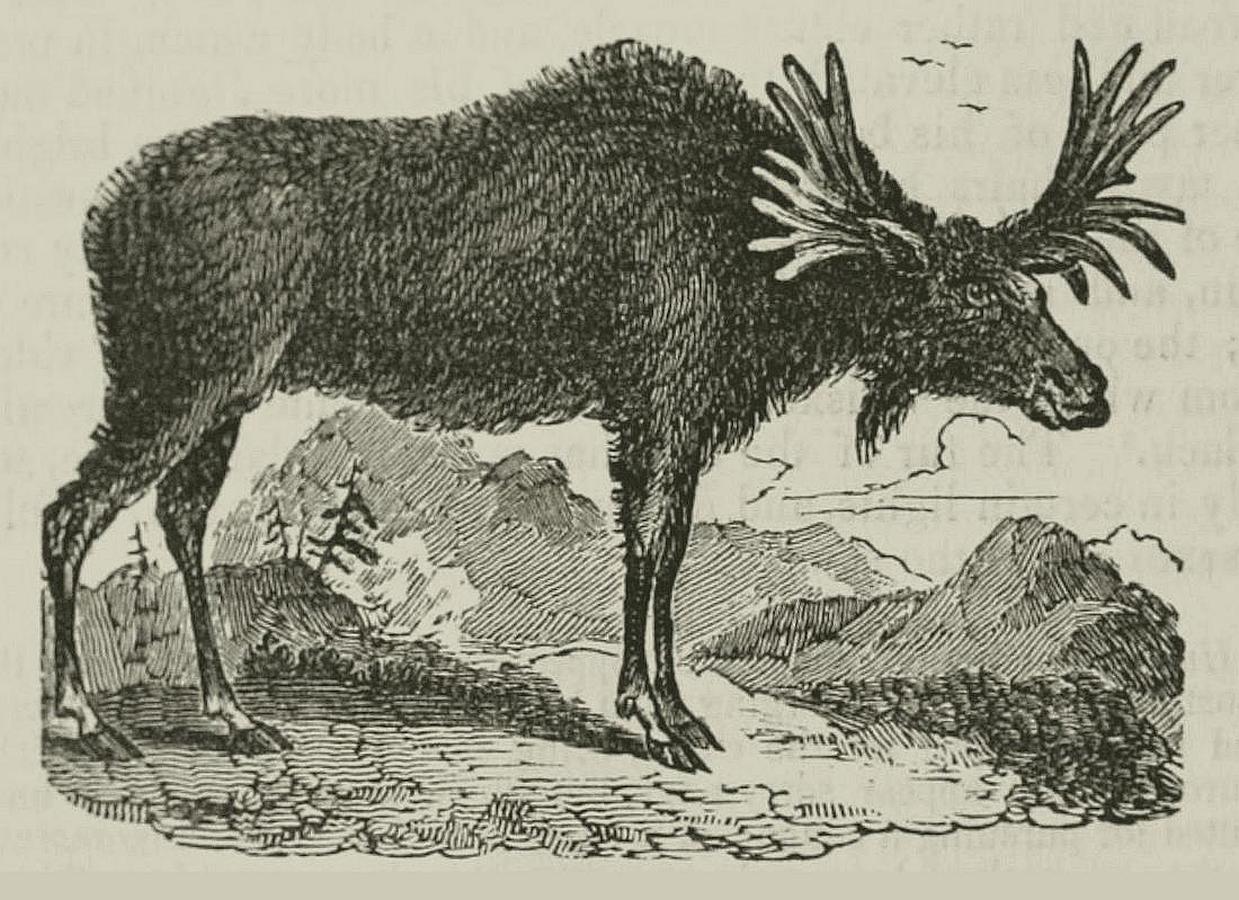
Moose.
The moose is hunted generally in March, when the snow is of sufficient depth and hardness to sustain the weight of a dog. Five or six hunters generally join in the pursuit and carry provisions to last them nearly a week. The chase is commenced at daybreak, when the dogs are set on, and the hunters who wear snow-shoes follow as closely as possible. When started and attacked by the dogs, the moose attempts to escape by flight. The crust of ice covering the snow breaks at every step, and the poor creature cuts his legs so severely that he is obliged to stand at bay, and endeavors to defend himself against his assailants by means of his fore feet. In this situation he is despatched by the rifle ball of the hunter.
The Elk.—The elk is still occasionally found in the remote and thinly settled parts of Pennsylvania, but the number is small; it is only in the western wilds that they are seen in considerable herds. They are fond of the great forests, where a luxuriant vegetation affords them an abundant supply of buds and tender twigs; or of the great plains, where the solitude is seldom interrupted, and all bounteous nature spreads an immense field of verdure for their support.
The elk is shy and retiring; having acute senses, he receives early warning of the approach of any human intruder. The moment the air is tainted by the odor of his enemy, his head is erected with spirit, his ears rapidly thrown in every direction to catch the sounds, and his large dark glistening eye expresses the most eager attention. Soon as the approaching hunter is fairly discovered, the elk bounds along for a few paces, as if trying his strength for flight, stops, turns half round, and scans his pursuer with a steady gaze, then, throwing back his lofty horns upon his neck, and projecting his taper nose forwards, he springs from the ground and advances with a velocity which soon leaves the object of his dread far out of sight.43
This animal appears to be more ready to attack with his horns than any other species of deer. When at bay, and especially if slightly wounded, he fights with great eagerness, as if resolved to be revenged. The following instance from Long’s Expedition to the Rocky Mountains, will, in some degree, illustrate this statement.
A herd of twenty or thirty elk were seen at no great distance from the party, standing in the water or lying upon the sand beach. One of the finest bucks was singled out by a hunter, who fired upon him, whereupon the whole herd plunged into the thicket and disappeared. Relying upon the skill of the hunter, and confident that his shot was fatal, several of the party dismounted and pursued the elk into the woods, where the wounded buck was soon overtaken. Finding his pursuers close upon him, the elk turned furiously upon the foremost, who only saved himself by springing into a thicket, which was impassable to the elk, whose enormous antlers becoming so entangled in the vines as to be covered to their tips, he was held fast and blindfolded, and was despatched by repeated bullets and stabs.
Black-tailed Deer.—The habits of this animal are similar to those of its kindred species, except that it has a manner of bounding along, instead of running at full speed. It is found in prairies and open grounds, west of the Rocky Mountains, and but seldom in the woodlands. It is larger than the common deer, and its flesh is considered inferior; its eye is larger, and the hair coarse. The ears are very long, being half the length of the whole antler. It was first observed by the members of Lewis and Clarke’s expedition, and was described by Say.
Common Deer.—This species, sometimes called the Virginia Deer, is found throughout the United States, with such varieties in its size and coloring, as naturally arise from variety of climate. Its form is slender and delicate, and its whole appearance indicates a degree of feebleness, which is counteracted only by the agility of its movements, and the animation of its eye. Its sense of hearing and seeing is wonderfully acute; and the hunter must approach his intended victim with the utmost caution, for he is discovered by the slightest noise. The resort of this species is in the forests and plains adjacent to rivers, where they feed chiefly on buds and twigs, and sometimes on grass. They are headed by one of the largest and strongest bucks, who appears to be the guardian of the general safety and directs his followers to combat or retreat. Though generally shy and timid, the males are much disposed to battle during the season of the sexual passion, and are almost always inclined to fight when wounded or brought to bay. At this time they fight with their fore feet, as well as their horns, and inflict severe wounds by leaping forward and striking with the edges of their hoofs. If a hunter misses his aim when attempting to despatch a wounded deer with his knife, he is placed in great peril. To serpents, of every description, the deer is particularly hostile, and it seems to have an instinctive horror of the rattlesnake. To destroy this enemy, the deer leaps into the air, and comes down on him with its four feet closed in a square, repeating its violent blows until the reptile is killed.
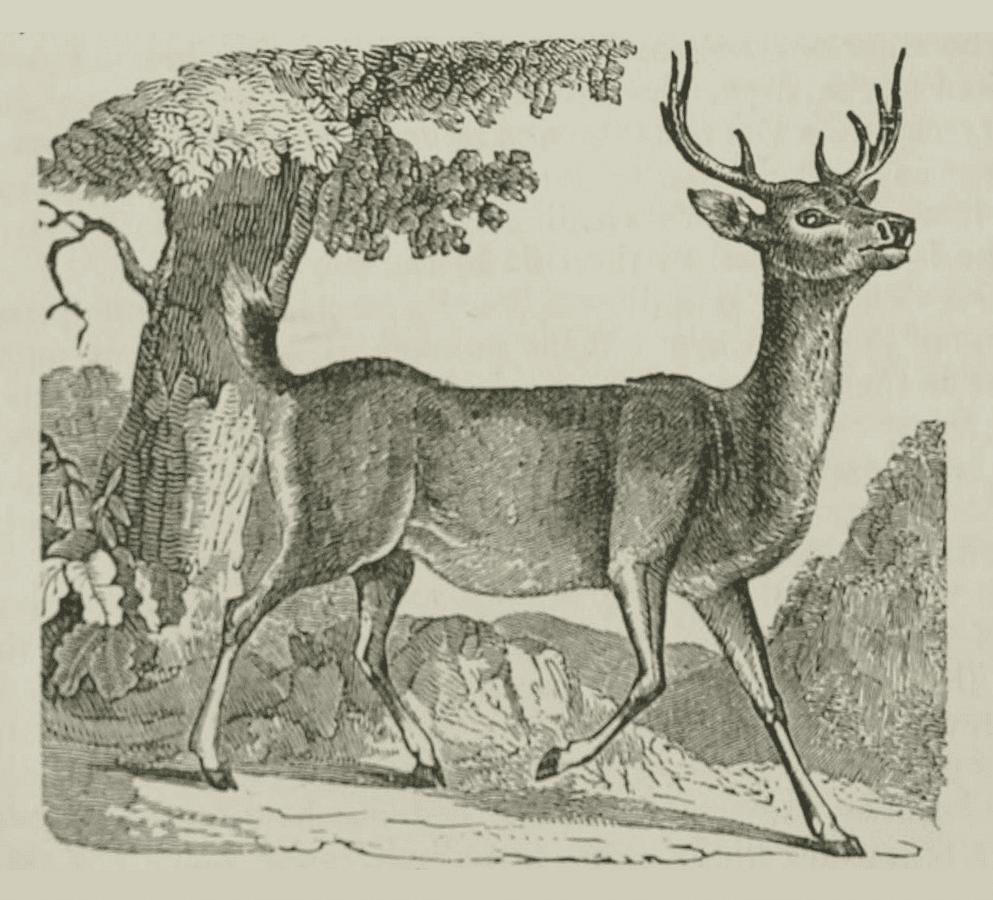
Virginia Deer.
The males frequently engage in combats, in which their horns sometimes become so interlocked that neither can escape, and they then remain engaged in fruitless struggles till they perish of famine, or become the prey of the wolf or the hunter. Heads of deer which have thus perished are frequently found, and there is scarcely a museum in this country which has not one or more specimens. The following instance is given by Say in Long’s Expedition to the Rocky Mountains. ‘As the party were descending a ridge, their attention was called to an unusual noise proceeding from a copse of low bushes, a few rods from the path. On arriving at the spot, they found two buck deer, their horns fast interlocked with each other, and both much spent with fatigue, one in particular being so much exhausted as to be unable to stand. Perceiving that it would be impossible that they should extricate themselves, and must either linger in their present situations or die of hunger, or be destroyed by the wolves, they despatched them with their knives, after having made an unavailing attempt to disentangle them. Beyond doubt, many of these animals must annually thus perish.’
Prong-horned Antelope.—This species was first described by the leaders of the first American expedition to the west of the Rocky Mountains. It is shy and timorous, wonderfully fleet, and with great acuteness of sight and smell. When once startled, they fly with the rapidity of the wind, and baffle all pursuit. In one instance, captain Lewis, after various fruitless attempts, by winding around the ridges, succeeded in approaching a party of seven that stood upon an eminence towards which the wind was unfortunately blowing. The only male of the party frequently encircled the summit of the hill, as if to announce any danger to the group of females which stood upon the top. Before they saw captain Lewis, they became alarmed by the scent, and fled while he was at the distance of two hundred yards. He immediately ran to the spot where they had stood; a ravine concealed them from him, but at the next moment they appeared on a second ridge, at the distance of three miles. He could not but doubt whether these were the same he had alarmed, but their number and continued speed convinced him they were so, and he justly infers that they must have run with a rapidity equal to that of the most celebrated race horse.
‘The chief game of the Shoshonees,’ say Lewis and Clarke, ‘is the antelope, which when pursued retreats to the open plains, where the horses have full room for the chase. But such is its extraordinary fleetness and wind, that a single horse has no possible chance of outrunning it, or tiring it down; and the hunters are therefore obliged to resort to stratagem. About twenty Indians, mounted on fine horses, armed with bows and arrows, left the camp; in a short time they descried a herd of ten antelopes; they immediately separated into squads of two or three, and formed a scattered circle round the herd for five or six miles, keeping at a wary distance, so as not to alarm them till they were perfectly inclosed, and usually selecting some commanding eminence as a stand. Having gained their positions, a small party rode towards the herd, and with wonderful dexterity the huntsman preserved his seat, and the horse his footing, as he ran at full speed over the hills and down the steep ravines, and along the borders of the precipices.
‘They were soon outstripped by the antelopes, which, on gaining the other extremity of the circle, were driven back and pursued by the fresh hunters. They turned and flew, rather than ran, in another direction; but there too they found new enemies. In this way they were alternately pursued backwards and forwards, till at length, notwithstanding the skill of the hunters, (who were merely armed with bows and arrows) they all escaped; and the party, after running for two hours, returned without having caught any thing, and their horses foaming with sweat. This chase, the greater part of which was seen from the camp, formed a beautiful scene, but to the hunters is exceedingly laborious, and so unproductive, even when they are able to worry the animal down and shoot him, that forty or fifty hunters will sometimes be engaged for more than half a day, without obtaining more than two or three antelopes.’
Rocky Mountain Goat.—This species is nearly the size of a common sheep, and has a shaggy appearance. Its hoofs and horns are black; the latter project but little, and are slightly curved. Great numbers of this goat are found about the head-waters of the north fork of Columbia river, where they are much hunted by the natives, and form an abundant though somewhat unsavory article of food. They are seldom seen far from the mountains, and are more numerous on their western than on their eastern slopes. The skin is thick and spongy, and is used for moccasins. The fleece is said to be as fine as that of which the celebrated cashmere shawls are manufactured.
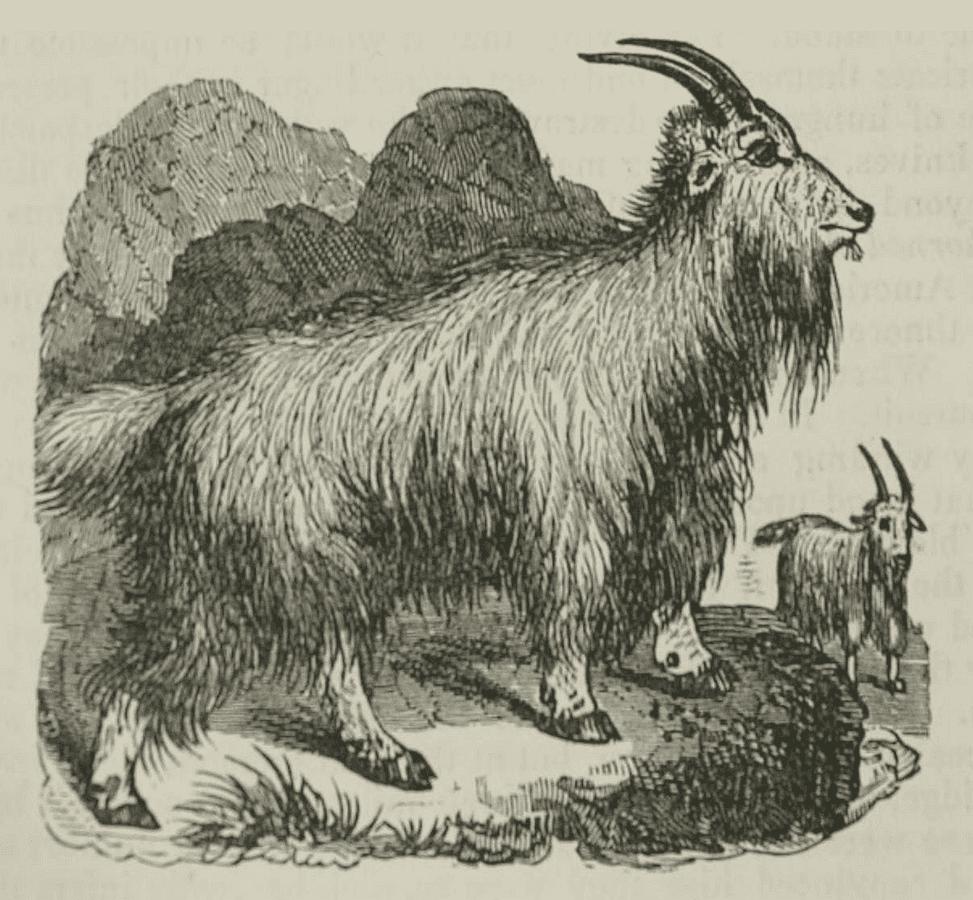
Rocky Mountain Goat.
Argali.—The argali is found in the Rocky Mountains, from about the fiftieth degree of north latitude to California. Here troops of twenty or thirty are seen together, feeding on the most precipitous tracts, and bounding with wonderful agility from rock to rock. During the summer months, the color of this animal is a grayish fawn, with a reddish line across the back. The male has very large twisted horns, fixed near the eyes; its ears are straight, broad and pointed, and its tail quite short. This is said to be the species from which all the varieties of our domestic sheep are descended.
Bison.—This animal is found in herds in the prairies in the neighborhood of the Rocky Mountains: it is continually receding before the advance of man, and will soon be entirely banished to the far west. Schoolcraft says that the species is confined to the regions situated between the thirty-first and forty-ninth degrees of north latitude, and west of the Mississippi river. The only part of the country east of this river, where the bison now remains, is that included between the falls of St. Anthony and Sandy Lake, a range of about six hundred miles.
‘Being now in the region of buffalo,’ says Mr. Schoolcraft, ‘we concluded to land, in the course of the day, at some convenient place for hunting them. This we were soon invited to do by seeing one of these animals along the shore of the river, and on ascending the bank, we observed, upon a boundless prairie, two droves of them, feeding upon the grass. All who had guns adapted for the purpose, sallied forth in separate parties upon the prairie, while those who felt less ambition to signalize themselves upon the occasion, or were more illy accoutred for the activities of the chase, remained upon an eminence which overlooked the plain, to observe the movements of this animal while under an attack of musketry, and to enjoy the novel spectacle of a buffalo-hunt. The grass was so tall as to allow an unobserved approach towards the spot where they remained feeding, but the first fire proved unsuccessful, at the same time that it scattered the herd, which were now seen running in all directions across the prairie, and an incessant fire of random shots was kept up for about two hours; during which three buffaloes were killed, and a great number wounded, which made their escape.
‘While thus harrassed, they often passed within a few yards of us, and we enjoyed a fine opportunity of witnessing their form, size, color, and speed. The buffalo has a clumsy gait, like the domestic ox, which it also resembles in size and general appearance. Unlike the ox, however, this animal exhibits no diversity of color, being a uniform dark brown, inclining to dun. It is never spotted, with black, red, or white. It has short black horns growing nearly straight from the head, and set at a considerable distance apart. The male has a hunch upon its shoulders, covered with long flocks of shaggy hair, extending to the top of the head, from which it falls over the eyes and horns, giving the animal a very formidable appearance. The hoofs are cloven like those of the cow, but the legs are much stouter, and altogether, it is more clumsy and ill-proportioned. The tail is naked till towards the end, where it is tufted, in the manner of the lion.
‘The general weight of this animal is from eight hundred to a thousand pounds; but they sometimes attain an enormous size, and have been killed upon the Mississippi prairies weighing two thousand pounds. The skin of a buffalo bull, when first taken off, is three fourths of an inch in thickness, and cannot be lifted by the strongest man. A hundred and fifty pounds of tallow have been taken from one animal, and it is highly esteemed by the Indians in preparing their hommony. Instances of excessive fatness are, however, rare, and such over-fed animals become so unwieldy that they often fall a prey to wolves; particularly if they happen to stray a distance from the herd. The buffalo is a timid animal, and flies at the approach of man. It is however asserted by the hunters, that when painfully wounded, it becomes furious, and will turn upon its pursuers.
‘There is a particular art in killing the buffalo with a rifle, only known to experienced hunters, and when they do not drop down, which is often the case, it requires a person intimately acquainted with their habits, to pursue them with success. This has been fully instanced in the futile exertions of our party, upon the present occasion; for out of a great number of shots, few have reached the object, and very few proved effectual, and the little success we met with is chiefly attributable to the superior skill of the Indians who accompanied us. Unless a vital part is touched, the shot proves useless. It also requires a larger ball than the deer and elk. Lieutenant Pike thinks that in the open prairies, the bow and arrow could be used to better advantage than the gun, particularly on horseback, for you might ride immediately along side the animal and strike it where you pleased. The Indians employ both the rifle and arrow, and in the prairies of Missouri and Arkansas, pursue the herds on horseback; but on the upper Mississippi, where they are destitute of horses, they make amends for this deficiency by several ingenious stratagems.
‘One of the most common of these is the method of hunting with fire. For this purpose, a great number of hunters disperse themselves around a large prairie where herds of buffalo happen to be feeding, and setting fire to the grass encompass them on all sides. The buffalo, having a great dread of fire, retire towards the centre of the prairie as they see it approach, and here being pressed together in great numbers, many are trampled under foot, and the Indians rushing in with their arrows and musketry, slaughter immense numbers in a short period. It is asserted that a thousand animals have been killed by this stratagem in one day. They have another method of hunting by driving them over precipices, which is chiefly practised by the bands inhabiting the Missouri. To decoy the herds, several Indians disguise themselves in the skins of the buffalo, taken off entire, and by counterfeiting the lowing of this animal in distress, they attract the herds in a certain direction, and when they are at full speed, suddenly disappear behind a cleft in the top of a precipice, when those animals which are in front on reaching the brink, are pushed over by those pressing behind, and in this manner great numbers are crushed to death. These practices are less common now than formerly, the introduction of fire arms, among most of the tribes, putting it into the power of almost every individual to kill sufficient for the support of his family.
‘By a very bad policy, however, they prefer the flesh of the cows, which will in time destroy the species. Few of the native animals of the American forest contribute more to the comforts of savage society than the buffalo. Its skin, when dressed by a process peculiar to them, forms one of the principal articles of clothing. The Sioux tribes particularly excel in the method of dressing it, and are very much in the habit of ornamenting their dresses with porcupine quills, and paints. The skin, dressed with the hair on, supplies them with blankets, and constitutes those durable and often beautiful sleigh-robes which are now in such universal use in the United States and the Canadas. The tallow of this animal, as well as the beef, has also become an article of commerce, particularly in the south-western states and territories, and its horns are exported for the manufacture of powder-flasks. The tongue is considered superior in flavor to that of the domestic cow, and the animal is often hunted for no other purpose. I have seen stockings and hats manufactured from its wool, with a little addition of common wool, or of cotton. This practice is very common among the white hunters of Missouri and Arkansas. The flesh of the buffalo is not equal, in its fresh state, to that of the cow or ox, but is superior when dried, which is the Indian mode of preserving it.
‘The attempts which have been made to domesticate this animal, have not been attended with success. Calves which have been taken in the woods and brought up with the tame breed, have afterwards discovered a wild and ungovernable temper, and manifested their savage nature by breaking down the strongest enclosures, and enticing the tame cattle into the woods. The mixed breed is said to be barren, like the mule. The period of gestation is ascertained to be twelve months, whereas that of the cow is nine. A remarkable proof of the little affinity existing between it, and the domestic breed of cattle, was exhibited a few years ago in Canada, where the connexion resulted in the death of the cows submitted to the experiment.’
American Wolf.—The common wolf of America is considered as the same species with the wolf of Europe. Richardson remarks that he has travelled over thirty degrees of latitude in America, and has never seen there any wolves which had the gaunt appearance, the comparatively long jaw and tapering nose, the high ears, long legs, slender loins, and narrow feet of the Pyrenean wolf. He adds, that the American animal has a more robust form than the European wolf. Its muzzle is thicker and more obtuse, its head larger and rounder, and there is a sensible depression at the union of the nose and forehead. He notices six varieties of the wolf in North America: common gray wolf, white, pied, dusky, black, and prairie. There is little reason to doubt that all the wolves of America are of one species; and the variations of size, color, and habits, are to be referred to diversities of climate which have been gradually impressed upon these animals.
Prairie Wolf.—This species is found in large numbers in the prairies to the west of the Missouri, and also occurs in the vicinity of the Columbia river. Its general color is gray, mixed with black; the ears are erect, rounded at the tip, and lined with gray hair. It is about three feet and a half in length, and bears a very strong resemblance to the domestic dog, so common in the Indian villages. Its bark is also similar to that of the dog. It resembles the other species of wolves in rapacity and cunning, being very suspicious and mistrustful and shunning pitfalls and snares with intuitive sagacity.44
Horses.—The number of horses among the various tribes on the Columbia, and its tributary streams, differs with the circumstances of the country. Among the Flat-heads, Cootonais, and Spokans, whose lands are rather thickly wooded, there are not more than sufficient for their actual use, and every colt, on arriving at the proper age, is broken in for the saddle. But in the countries inhabited by the Wallah Wallahs, Nez Percés, and Shoshonés, which chiefly consist of open plains, well watered and thinly wooded, they are far more numerous, and thousands are allowed to go wild. Their general height is about fifteen hands, which they seldom exceed; and ponies are very scarce. Those reared in the plains are excellent hunters, and the swiftest racers; but are not capable of enduring the same hardships as those bred in the vicinity of the high and woody districts. Seven hundred or a thousand wild horses are sometimes seen in a band; and it is said that in parts of the country belonging to the Snake Indians, bands varying from three to four thousand are frequently seen; and further to the southward, they are far more numerous.
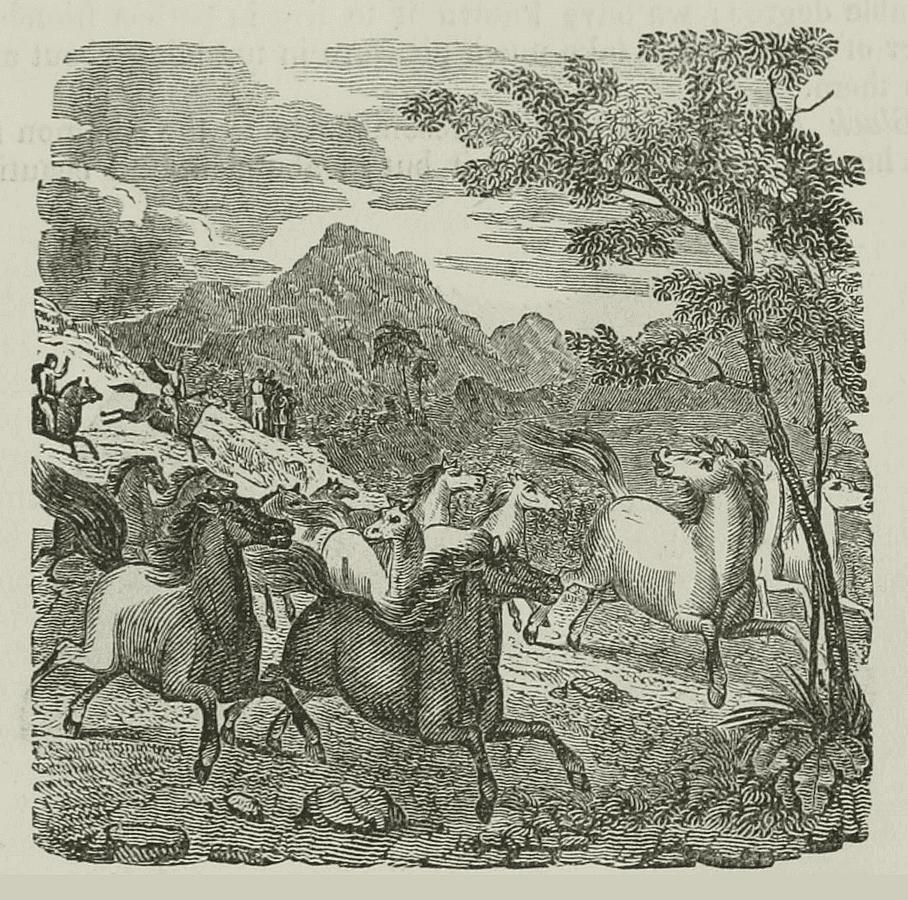
Wild Horses.
The Indian horses are never shod; and owing to this circumstance, their hoofs, particularly of such as are in constant work, are nearly worn away before they are ten or eleven years old, after which they are unfit for any labor except carrying children. They are easily managed, and are seldom vicious. An Indian horse is never taught to trot. The natives dislike this pace, and prefer to it the canter or light gallop. They are hard taskmasters; and the hair-rope bridles, with the padded deer-skin saddles which they use, lacerate the mouths and backs of the unfortunate animals in such a manner as to render them objects of commiseration. In summer they have no shelter from the heat, in winter no retreat from the cold; and their only provender throughout the year is the wild loose grass of the prairies, which, in the latter season, is generally covered with snow, and in the former is brown and arid, from the intense heat of the sun.
Foxes.—The Gray Fox is found in great numbers throughout the country, and ventures more boldly than any other species into the neighborhood of human habitations. It exhibits different colors at different seasons and ages; its general color is grizzly, growing gradually darker from the fore shoulders to the hinder part of the back. The inferior parts of the body are white, tinged slightly with faint reddish brown. The tail is thick and bushy. The Red Fox is a very beautiful species, and abounds in the middle and southern states, where it proves very troublesome to poultry-yards. In summer, its fur is long, fine, and brilliant; in winter, it becomes longer and more thick. The length of this species is about two feet, and of its tail, nearly a foot and a half. Its fur is valuable, and much used. When caught young, the red fox is very playful, and may be domesticated to a considerable degree; we have known it to live in perfect friendship with a number of dogs, and to take much pleasure in tumbling about and sporting with them.45
The Black Fox bears a striking resemblance to the common fox, from which it has nothing to distinguish it but its abundant and beautiful black fur. Its color is rich and lustrous, having a small quantity of white mingled with the prevailing black on different parts of its body. It is found throughout the northern parts of America, but no where in great numbers. The Swift Fox is a very interesting species, inhabiting the open plains which stretch from the base of the Rocky Mountains towards the Mississippi.
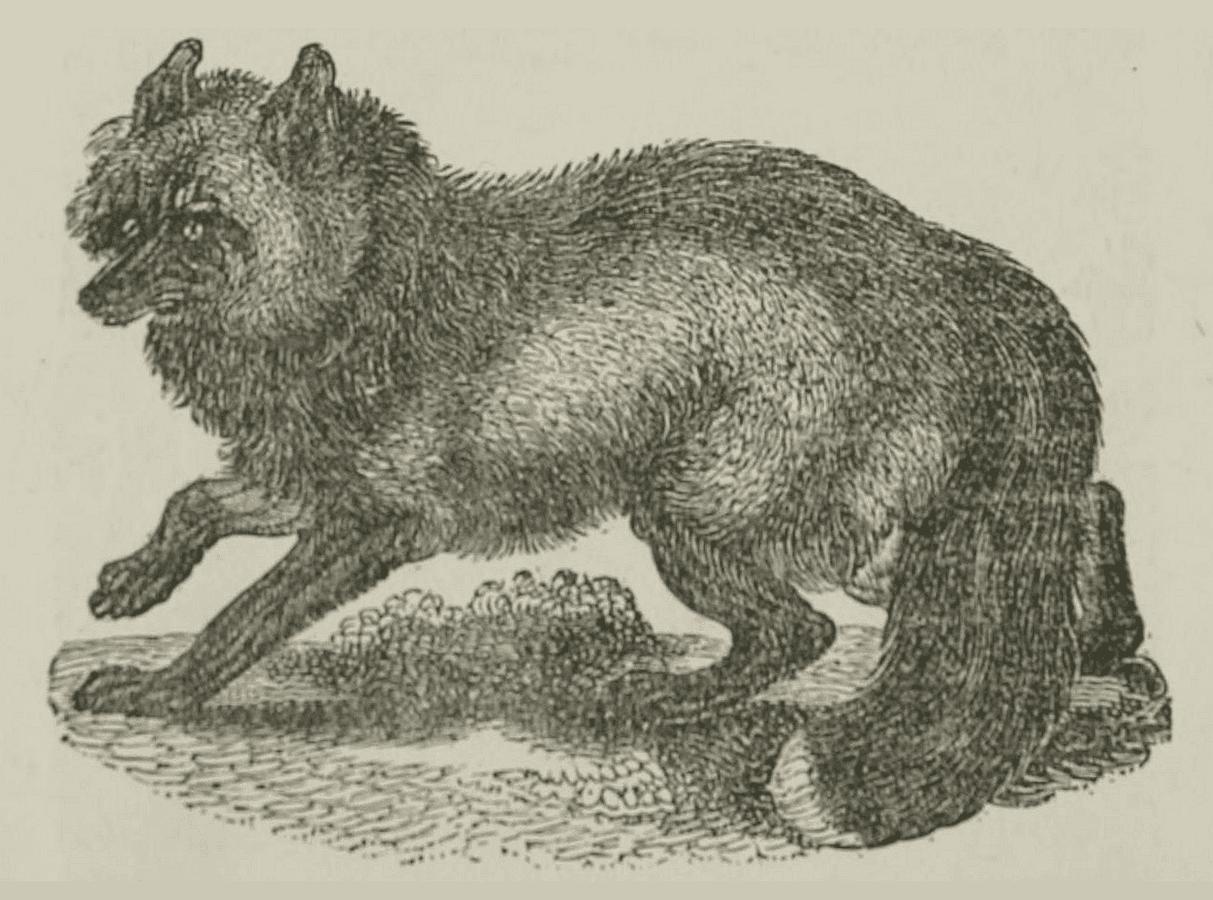
Black Fox.
Opossum.—This animal is found in the southern parts of the United States, and is easily distinguished from all others by two peculiarities: the first is that the female has a cavity under the belly in which she receives and suckles her young; the second is, that the male and the female have no claws on the great toe of the hind feet, which is separated from the others as a man’s thumb is separated from his fingers. The opossum produces often, and a great number of young at a time. It walks awkwardly, and seldom runs; but it climbs trees with great facility, and hangs from the branches by means of a very flexible and muscular tail. Though voracious and greedy of blood, it also feeds on reptiles, insects, sugar-canes, potatoes, and even leaves and bark of trees. It may be easily domesticated; but its smell is strong and offensive, though its flesh is eatable, and much liked by the Indians. So tenacious is it of life, that it has given rise to a saying in North Carolina, that if a cat has nine lives, an opossum has nineteen. The general color of the opossum is a whitish gray; the tail is thick and black, for upwards of three inches at its base, and is covered by small scales, interspersed with white, short, rigid hairs. It is a timid and nocturnal animal, depending for its safety more on cunning than strength.
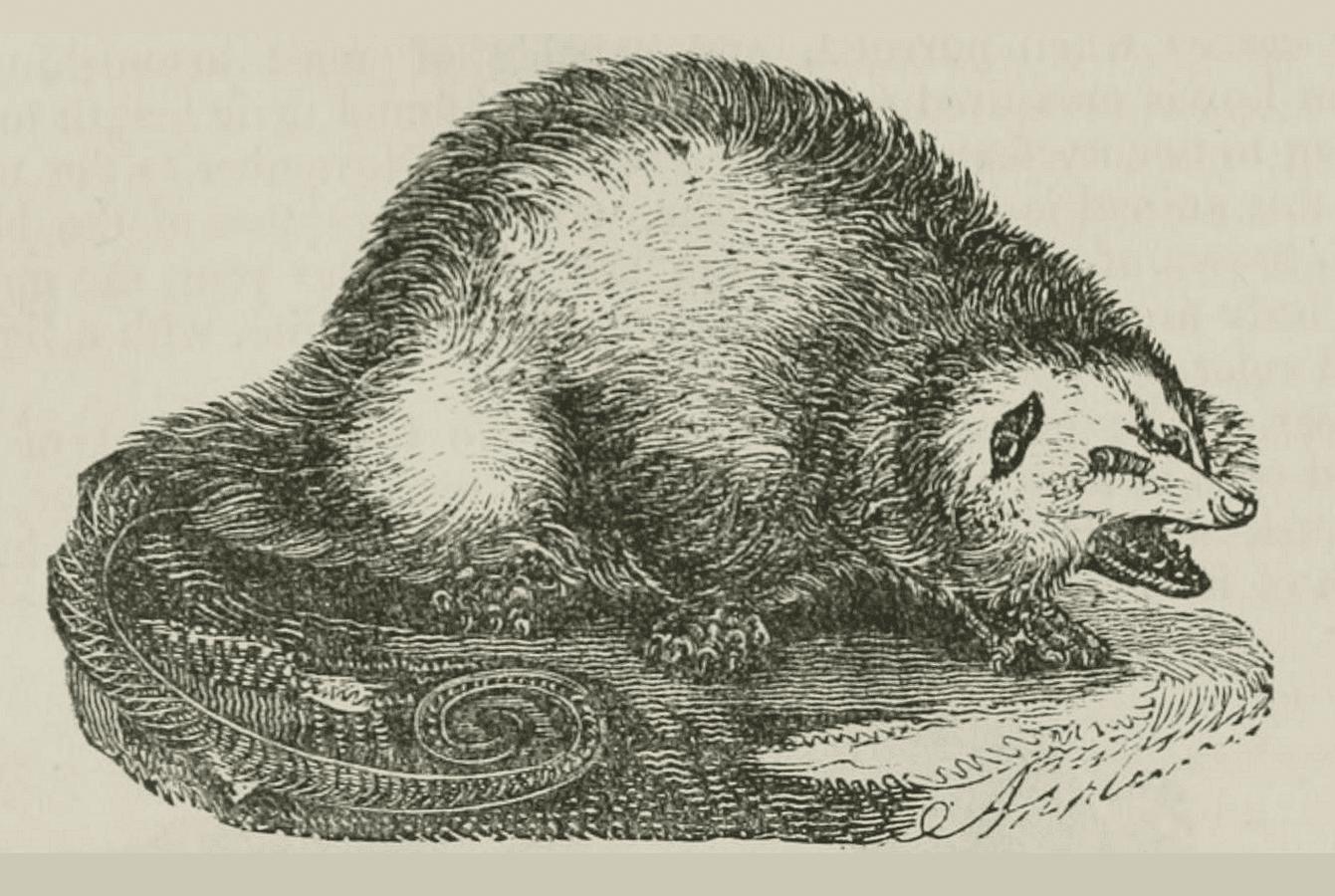
Virginia Opossum.
American Hare.—This species, improperly called rabbit, is found throughout the states, and in some parts is exceedingly common. Its flesh is much esteemed as an article of food. During the summer it is tough, but after the first frosts of autumn, it is fat and delicate. In the north, during winter the hare feeds on the twigs of pine and fir, and is fit for the table during the season. It never burrows in the ground, but in the day time remains crouched, within its form, which is a mere spot of ground cleared of grass and sheltered by an overhanging plant. Sometimes it lives in the trunk of a hollow tree, or under a pile of stones. It wanders out at night, and makes sad havoc among the turnip and cabbage fields, and the young trees in nurseries. It is not hunted in this country as in Europe, but is caught in a trap, or roused by a dog and shot.
Varying Hare.—This animal appears to inhabit a great portion of North America, as it has been found in Virginia, and as far north as fifty-five degrees, whilst eastward it is found on the great plains of the Columbia. It appears generally to frequent plains and low grounds, where it lives like the common hare, never burrowing, but not resorting to the thick woods. The variabilis of Europe, on the contrary, is described as always inhabiting the highest mountains, and never descending into the plains, except when forced to seek for food, when the mountains are covered with snow. The American species is remarkably swift, never taking shelter when pursued, and capable of most astonishing leaps; Captain Lewis measured some of these, and found their length to be from eighteen to twenty feet. From the middle of November to the middle of April, this animal is of a pure white, with the exception of the black and reddish brown of the ears. During the rest of the year, the upper parts of the body are of a lead color; the under parts white, with a light shade of lead color.
Beaver.—The general appearance of the beaver is that of a large rat, and seen at a little distance, it might be readily mistaken for the common musk-rat. But the greater size of the beaver, the thickness and breadth of its head, and its horizontally flattened, broad, and scaly tail, render it impossible to mistake it for any other creature when closely examined. In its movements, both on shore and in the water, it also closely resembles the musk-rat, having the same quick step, and swimming with great vigor and celerity, either on the surface or in the depths of the water.46
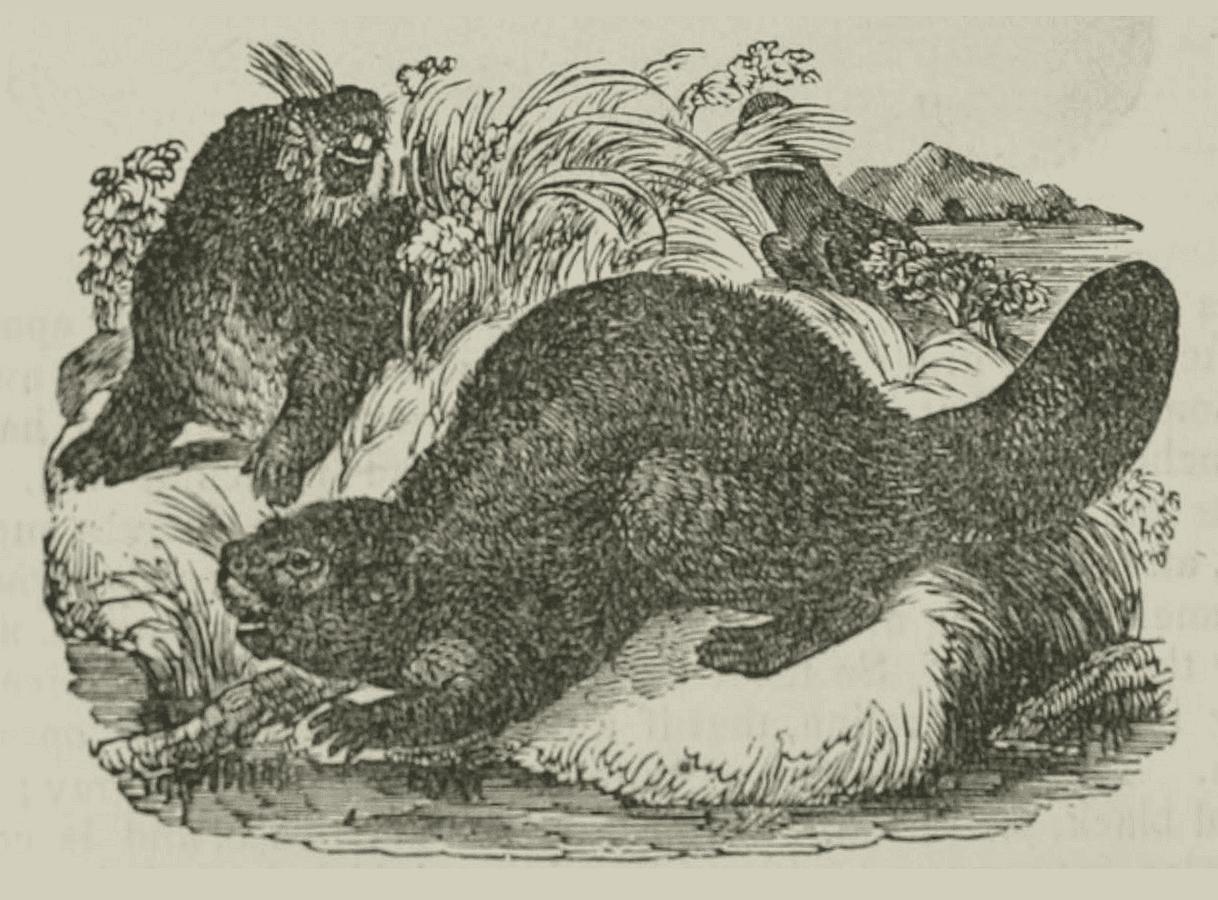
Beaver.
Musk-Rat.—This animal is closely allied in form and habits to the beaver, and is found in the same parts of America as that animal, from thirty to sixty-nine or seventy degrees of latitude. But it is more familiar in its habits, as it is to be found only a short distance from large towns. The musk-rat is a watchful, but not a very shy animal. It may be frequently seen sitting on the shores of small muddy islands, not easily to be distinguished from a piece of earth, till, on the approach of danger, it suddenly plunges into the water. It forms burrows on the banks of streams and ponds, the entrance to which is in deep water. These burrows extend to great distances, and do extensive injury to the farms, by letting in the water upon the land. In some situations, these animals build houses of a conical form, resembling those of the beaver, formed of mud, grass and reeds, plastered together. They feed upon the roots and tender shoots of aquatic plants and on the leaves of grasses. They are excellent swimmers, dive well, and can remain for a long time under water. It is rare to have an opportunity of seeing the animal during the day, as it then lies concealed in its burrow, and it is not till night, that it issues forth for food or recreation. It does not, like the beaver, lay up a store of provision for the winter; but it builds a new habitation every season.
This animal is common in the Atlantic states, and its fur being valuable for hats, it is much hunted. The Indians kill them by spearing them through the walls of their houses. Between four and five thousand skins are annually imported into Great Britain from North America.
The American Badger, as compared with the European, is smaller and lighter, with different markings on its fur, and with a head less sharp towards the nose. It frequents the prairies and sand plains at the base of the Rocky Mountains, as far north as latitude fifty-eight degrees. It abounds on the plains watered by the Missouri. Timid and slow, the badger, on being pursued, takes to the earth like a mole, and makes his way with great rapidity. It is caught in spring, when the ground is frozen, by filling its hole with water, when the tenant is obliged to come out.
The Ermine Weasel is known in the middle and eastern states, by the name of weasel: farther north, it is called stoat in summer, and ermine in its winter dress. In its habits it resembles the common weasel of Europe. It is courageous, active, and graceful. His long and slender body, bright and piercing eye, sharp claws and teeth, and great strength, indicate that he is dangerous and destructive to the smaller animals, which he can follow into their smallest hiding places, from his peculiar flexibility of body. This animal frequents barns and out-houses, and is the particular enemy of mice, and other depredators upon the granary. To compensate for the service he thus renders the farmer, he helps himself without ceremony to a number of his fowls, and the henroost sometimes exhibits a sad proof of the value he sets upon his labors, in exterminating the mice. In winter, the fur of the weasel is much longer, thicker and finer, than in summer.
Pennant’s Marten is found in various parts of North America, from the state of Pennsylvania, to as far north as the Great Slave Lake, where it was seen by captain Franklin. It is easily domesticated, becomes fond of tea leaves, is very playful, and has a pleasant musky smell. This species is not very scarce, as Pennant says that five hundred and eighty skins were sent in one year from the states of New York and Pennsylvania; and Sabine remarks that the Hudson’s Bay Company sent eighteen hundred skins to England in one year.
The length of this marten is from twenty-four to thirty inches without the tail, which is from thirteen to seventeen inches long. The feet are very broad, and covered with hair, which conceals the sharp, strong, white claws. The fur on the head is short, but gradually increases in length towards the tail, and its color changes, losing much of the yellowish, and assuming a chestnut hue. The tail is full, bushy, black and lustrous, being smallest at the end.
The Maryland Marmot, or Woodchuck, is common in all the temperate parts of America. It does great injury to the farmers, as the quantity of herbage it consumes is really surprising. It burrows in the ground on the sides of hills, and these extend to great distances under ground, and terminate in various chambers. Here the marmot makes himself a comfortable bed of dry leaves, grass, and any soft rubbish, where he sleeps from the close of day, till the next morning is far advanced.
The Maryland marmot eats with great greediness, and in large quantities. It is fond of cabbage, lettuce, and other garden vegetables. When in captivity, it is exceedingly fond of bread and milk.
At the commencement of cold weather, the marmot goes into winter quarters, blocks up the door within, and remains torpid till the warm season. It is about the size of a rabbit, and of a dark brown color.
The Prairie Marmot, commonly called Prairie Dog, builds his dwelling in the barren tracts of the western country, and may often be seen sitting by the small mounds of earth, which indicate his abode, in an attitude of profound attention. Whole acres of land are occupied by these little tenants, and villages are found, containing thousands of inhabitants. Near the Rocky Mountains, these villages are found to reach several miles. The burrow extends under ground, but to what distance has not been determined.
This marmot, like the rest of the species, remains torpid during the winter. It is very much annoyed in its habitation by owls, rattlesnakes, lizards, and land tortoises, who appropriate these comfortable dwellings for their own use, and frequently destroy the young marmots.
The Fox Squirrel is found throughout the southern states, where it frequents the pine forests in considerable numbers, and derives its principal subsistence from the seed of the pine. Its color varies from white to pale gray and black, and is sometimes mottled, with various shades of red. The Cat Squirrel is one of the largest species, and is found in great abundance in the oak and chesnut forests of this country. It is a very heavy animal, and is slow in its movements, seldom leaping from tree to tree, unless it is alarmed or closely pursued. It is found of almost every variety of color. The Black Squirrel is very common, but is often confounded with the black varieties of the squirrels before described. In the winter, this animal is of a pure black; in the summer, it is of a grayish black, intermingled with a dark reddish brown. It is found in the United States, and inhabits the northern shores of Lakes Huron and Superior.
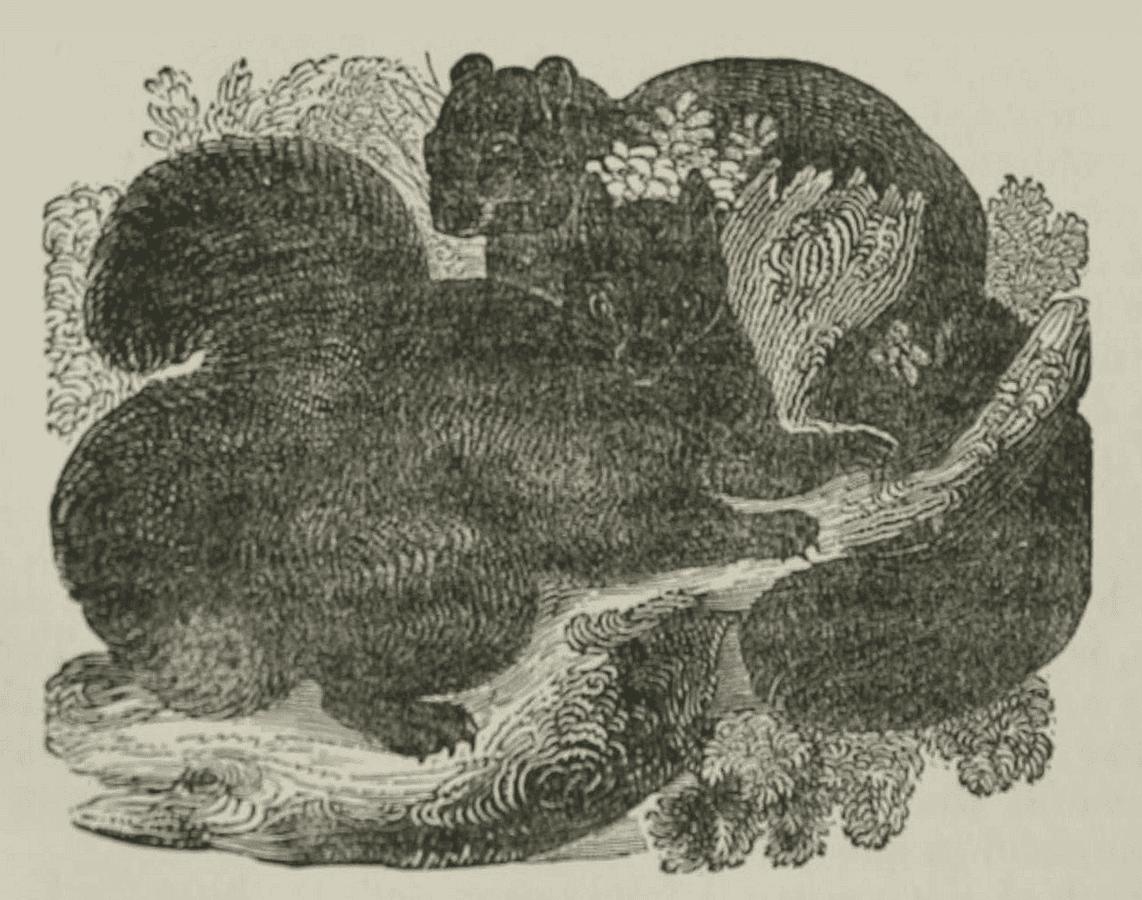
Black Squirrel.
The Common Gray Squirrel is remarkable for its beauty and activity, and is common throughout the United States. It is generally found in hickory and chesnut woods, where it feeds on nuts, and lays up a hoard for the winter. It is very easily domesticated, and in captivity is very playful and mischievous. The Great-tailed Squirrel, so called from the length of its tail, is common on the Missouri. It is of a grayish black color, and is very graceful and active. The Line-tail Squirrel inhabits the Missouri country, where it builds its nest in the holes and crevices of rocks. It is fond of the naked cliffs, where there are but few bushes, and very rarely ascends a tree. It feeds on the buds, leaves, and fruits of plants. It is of an ash color, intermixed with white hairs. Its fur is coarse, and the tail, which is very long, is marked with three black lines on each side. The Four-lined Squirrel is found on the Rocky Mountains. Its nest is composed of a great quantity of the branches of different kinds of trees, and of other vegetable productions. It does not ascend trees by choice.
The Columbian Pine Squirrel was seen by Lewis and Clarke on the banks of the Columbia river, but is supposed by Richardson to be a variety of the Hudson’s Bay Squirrel, its habits being similar.
The Common Red Squirrel is abundant in most parts of North America. It is one of the most lively and nimble of the squirrel race. It digs burrows at the roots of large trees, to which it forms four or five entrances. It does not leave its tree in cold and stormy weather, but when it is sporting in the sunshine, if any one approaches, it conceals itself, and makes a loud noise, similar to a watchman’s rattle. From this circumstance it has received the name of Chickaree. When pursued, it makes long leaps from tree to tree, and seeks for shelter as soon as possible in its burrow. The skin of this animal is of no value. It is of a reddish brown color, shaded with black. The tail is long and beautiful.
The Ground or Striped Squirrel is abundant in all our woods. It is sometimes called Harkee, and, in New England, is usually denominated the Chip Squirrel. It differs very much from other squirrels in its habits. It never makes its nest in the branches of trees, but burrows in the ground near the roots. These burrows extend a considerable distance under ground, and are always provided with two openings. The general color of this animal is of a reddish brown. The Common Flying Squirrel47 is very abundant in the United States, and is much admired for the softness of its fur, and the gentleness of its disposition. The skin of the sides is extended from the fore to the hind limbs, so as to form a sort of sail, which enables it to descend swiftly from a great height, in the easiest and most pleasant manner, often passing over a considerable space. This squirrel is small, of an ash color above, and white beneath, with large, prominent black eyes. It builds its nest in hollow trees. The Rocky Mountain Flying Squirrel lives in thick pine forests, and seldom leaves its retreats except at night.
The Urson, or Canada Porcupine, exhibits none of the long and large quills which are so conspicuous and formidable in the European species, and the short spines or prickles which are thickly set over all the superior parts of its body, are covered by a long coarse hair, which almost entirely conceals them. These spines are not more than two inches and a half in length, yet form a very efficient protection against every other enemy but man. This animal dislikes water, sleeps very much, and chiefly feeds upon the bark of the juniper. His flesh is eaten by the savages and American traders. He is still found in the remote and unsettled parts of Pennsylvania, but south of this state is almost unknown. It was formerly found, but very rarely, in Virginia. The porcupine is much prized by the aborigines, both for its flesh, and quills, which are used as ornaments to their pipes, weapons, and dresses. A large collection of dresses, thus ornamented, is exhibited in the Philadelphia Museum.
The Mink is found throughout the country, from Carolina to Hudson’s Bay, and in its habits and appearance strongly resembles the otter. It lives in the neighborhood of mill-seats, or farm-houses, frequenting holes near the water, or in the ruins of old walls. It feeds upon frogs and fish, and, like the weasel, sometimes pays an unwelcome visit to the poultry-yard. The length of this animal is about twenty inches; its feet are broad, webbed, and covered with hair. Hats are made of its fur.
The Skunk is of a brown color, marked sometimes with two white stripes. The faculty this animal possesses, of annoying its enemies by the discharge of a noisome fluid, causes it to be rather shunned than hunted, which the value of its skin would otherwise be sure to occasion. The smallest drop of this fluid is sufficient to render a garment detestable for a great length of time. Washing, smoking, baking, or burying articles of dress, seems to be equally inefficient for its removal. The skunk is generally found in the forests, having its den either in the stump of an old tree, or in an excavation in the ground. It feeds on the young of birds, and upon small quadrupeds, eggs, and wild fruits. It also does much mischief in the poultry-yard.
The American Otter is about five feet in length, including the tail, the length of which is eighteen inches. The color of the whole of the body, (except the chin and throat, which are dusky white) is a glossy brown. The fur throughout is dense and fine. The differences between this species and the European otter, are thus pointed out by Captain Sabine: ‘The neck of the American otter is elongated, not short, and the head narrow and long in comparison with the short, broad visage of the European species; the ears are consequently much closer together than in the latter animal. The tail is more pointed and shorter, being considerably less than one half of the length of the body, whilst the tail of the European otter is more than half the length of its body.’ The fur of the otter is much valued by the hatters and other consumers of peltries, and this animal must ultimately become as rare in North America as the kindred species has long since become in Europe.
II. BIRDS.
The Ornithology of the United States is exceedingly rich and interesting. For their beauty of plumage, variety and melody of song, diversity of form, habits, disposition and faculties, our birds well merit the industrious observation which has been bestowed upon them. They have been highly fortunate in their historians, for no department of our animal kingdom has been so thoroughly investigated as this; and the indefatigable labor, science and genius of such men as Wilson, Audubon, Bonaparte, and Nuttall, have left us but little to expect from future researches.
The vulture called Turkey Buzzard, is found in large numbers in the southern states, where he is protected by law, on account of his services in the removal of carrion. This bird has never been known to breed in any of the Atlantic states north of New Jersey. In the southern cities, during the winter, they pass the night on the roofs of houses, and are fond of warming themselves in the smoke that issues from the chimneys. This bird is about two and a half feet in length, and six in breadth; the upper plumage is glossed with green and bronze, the fore part of the neck is bare. The Black Vulture is smaller, and flies in flocks; the range of this bird is confined by very narrow limits to the southern states. The Condor is not uncommon in the Rocky Mountains; but his peculiar residence is among the precipitous cliffs of the majestic Andes.
The Common or Wandering Falcon lives along the seacoast of the country, and is said to breed in the cedar swamps of New Jersey. The American Sparrow Hawk is found principally in the warmer parts of the states, and builds its nest in a hollow or decayed tree, on some elevated place. In the winter it becomes familiar, and approaches to the neighborhood of man; at this time it lives on such small game as it can find in the way of mice or lizards. The flight of this bird is irregular. It perches on the top of a dead tree or pole in the middle of a field, and sits there in an almost perpendicular position for an hour together, reconnoitering the ground below in every direction for the favorite articles of its food. The bluejays have a particular antipathy to this bird, who punishes their enmity by occasionally making a meal of one of them.
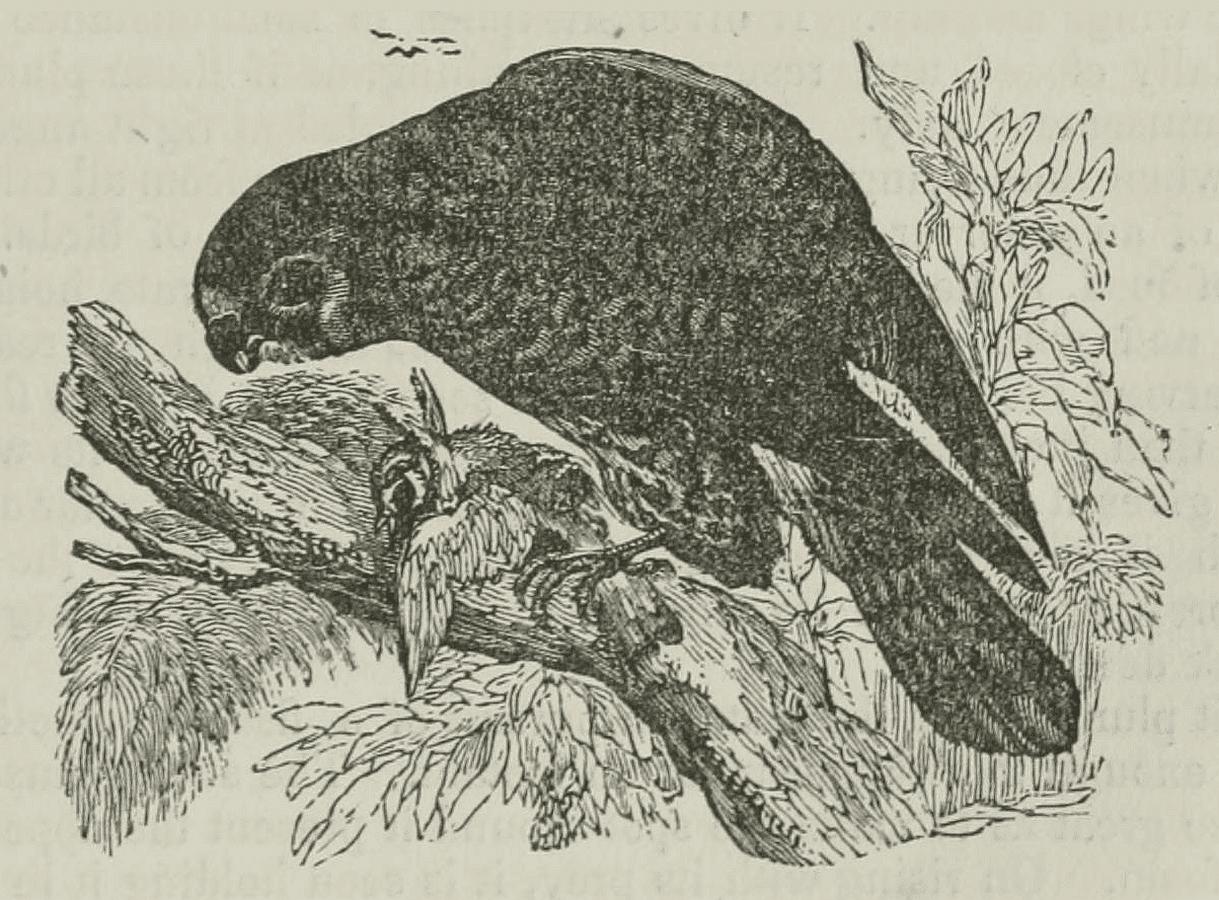
American Sparrow Hawk.
The American Fish Hawk is a formidable, vigorous-winged, and well-known bird, which subsists altogether on the fishes that swarm in our bays rivers, and creeks. It is doubtless the most numerous of its genus in the United States, and besides lining our seacoast from Georgia to Canada, it penetrates far into the interior.
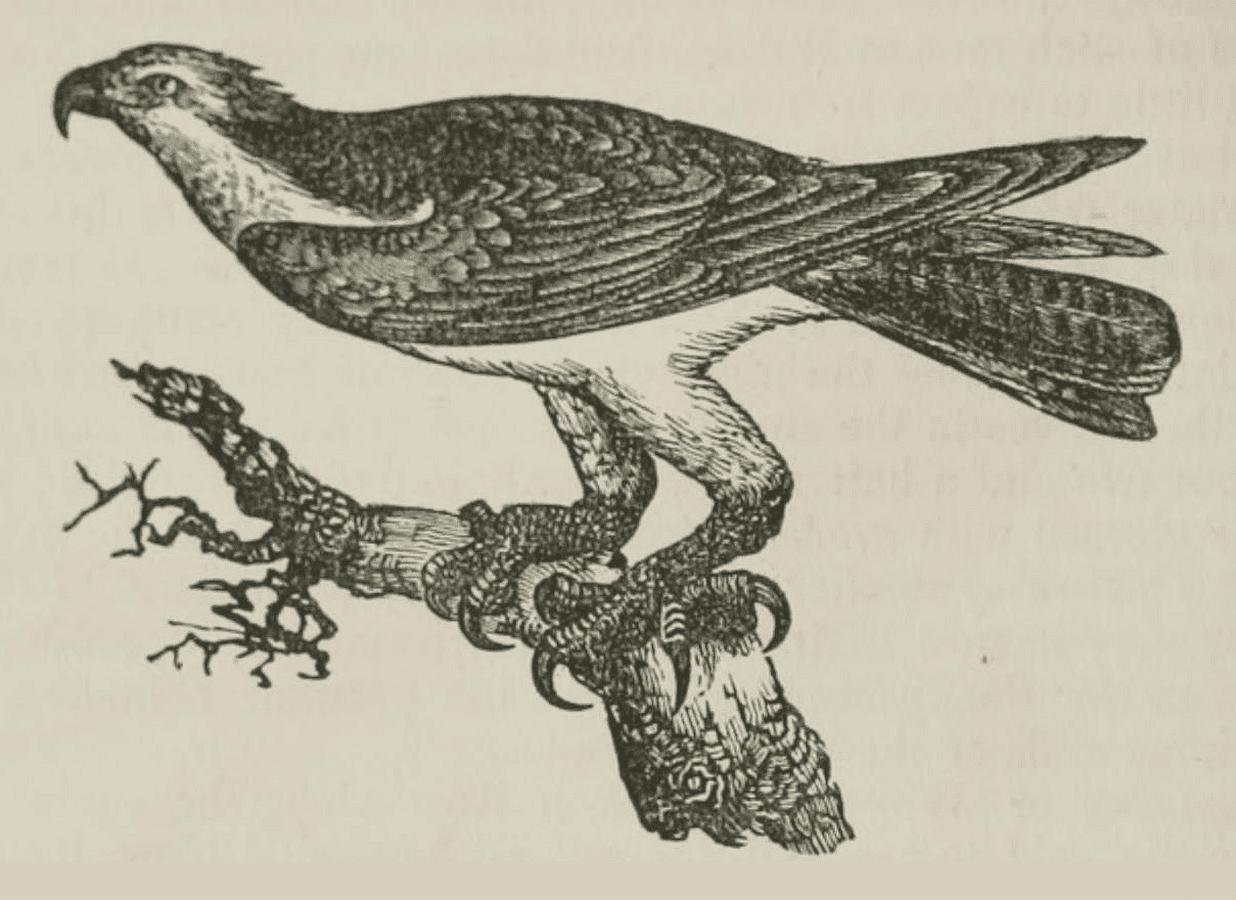
Fish Hawk.
‘The motions of the fish hawk,’ says Mr. Audubon, ‘in the air are graceful, and as majestic as those of the eagle. It rises with ease to a great height by extensive circlings, performed apparently by mere inclinations of the wings and tail. It dives at times to some distance with the wings partially closed, and resumes its sailing, as if these plunges were made for amusement only. Its wings are extended at right angles to the body, and when thus flying, it is easily distinguishable from all other hawks by the eye of an observer, accustomed to note the flight of birds. Whilst in search of food, it flies with easy flappings at a moderate height above the water, and with an apparent listlessness, although in reality it is keenly observing the objects beneath. No sooner does it spy a fish suited to its taste, than it checks its course with a sudden shake of its wings and tail, which gives it the appearance of being poised in the air for a moment, after which it plunges headlong with great rapidity into the water, to secure its prey, or continue its flight, if disappointed by having observed the fish sink deeper.
‘When it plunges into the water in pursuit of a fish, it sometimes proceeds deep enough to disappear for an instant. The surge caused by its descent is so great as to make the spot around it present the appearance of a mass of foam. On rising with its prey, it is seen holding it in the manner represented in the plate. It mounts a few yards into the air, shakes the water from its plumage, squeezes the fish with its talons, and immediately proceeds towards its nest, to feed its young, or to a tree, to devour the fruit of its industry in peace. When it has satisfied its hunger, it does not, like other hawks, stay perched until hunger again urges it forth, but usually sails about at a great height over the neighboring waters.
‘The fish hawk has a great attachment to the tree to which it carries its prey, and will not abandon it, unless frequently disturbed, or shot at whilst feeding there. It shows the same attachment to the tree on which it has built its first nest, and returns to it year after year.’
The Swallow-tailed Hawk.—This beautiful kite breeds and passes the summer in the warmer parts of the United States, and is also probably resident in all tropical and temperate America, migrating into the southern as well as the northern hemisphere. In the former, according to Viellot, it is found in Peru, and as far as Buenos Ayres; and though it is extremely rare to meet with this species as far as the latitude of forty degrees in the Atlantic states, yet, tempted by the abundance of the fruitful valley of the Mississippi, individuals have been seen along that river as far as the Falls of St. Anthony, in the forty-fourth degree of north latitude. Indeed, according to Fleming, two stragglers have even found their devious way to the strange climate of Great Britain.
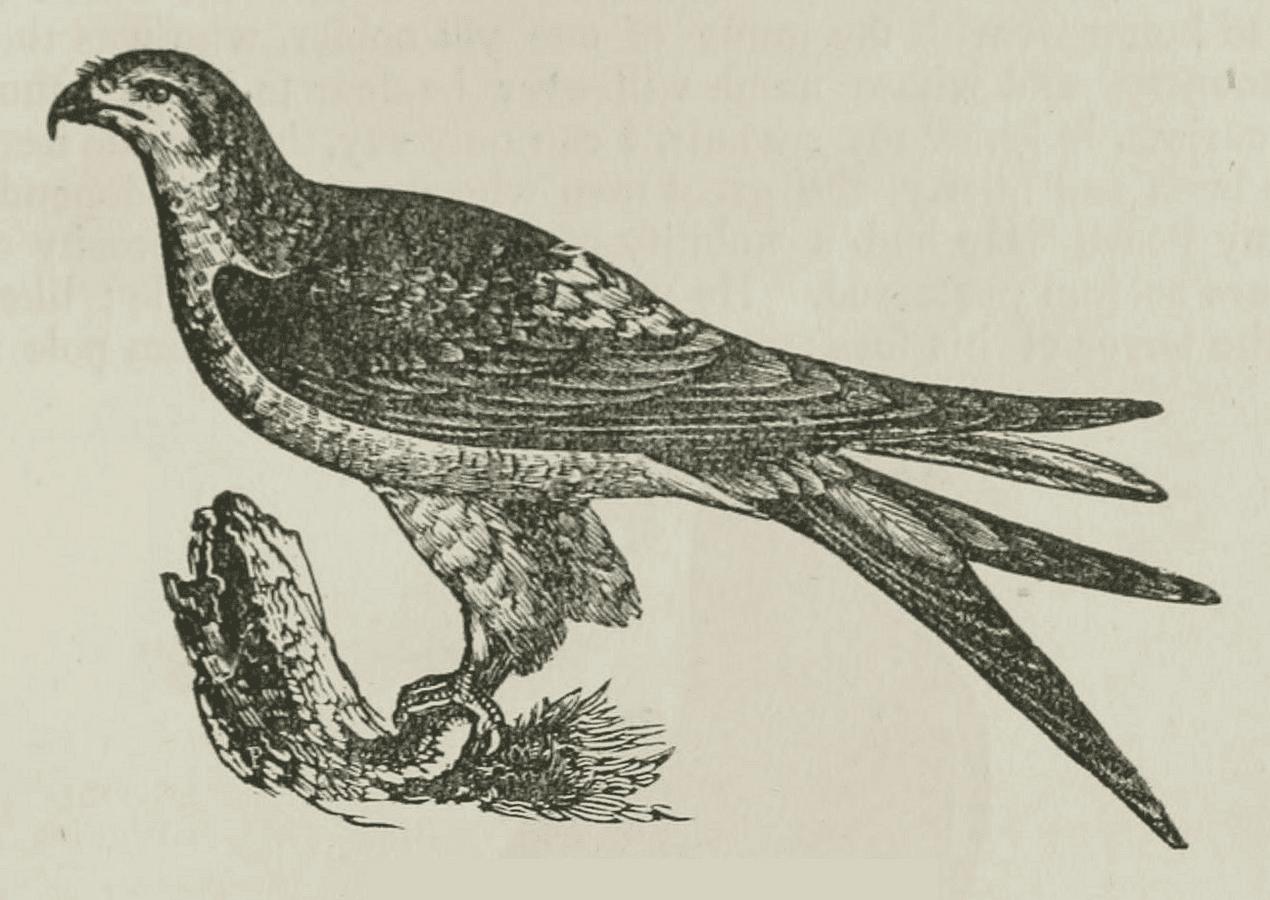
Swallow-tailed Hawk.
They appear in the United States about the close of April or beginning of May, and are very numerous in the Mississippi territory, twenty or thirty being sometimes visible at the same time, often collecting locusts and other large insects, which they are said to feed on from their claws while flying; at times also seizing upon the nests of locusts and wasps, and like the honey-buzzard, devouring both the insects and their larvæ. Snakes and lizards are their common food in all parts of America. In the month of October they begin to retire to the south, at which season Mr. Bartram observed them in great numbers assembled in Florida, soaring steadily at great elevations for several days in succession, and slowly passing towards their winter quarters along the Gulf of Mexico.48
Other hawks in the United States are the Sharp-shinned, the Great-footed or Duck, the Pigeon, Cooper’s White-tailed, Red-tailed, Broad-winged, Mississippi Kite, Black, Marsh, Stanley’s, Red-shouldered, Ash-colored, and Slate-colored Hawks.
Washington Eagle.—For the first accurate observation of this bird, we have been indebted to the untiring study and genius of Audubon, who first noticed it in the year 1814. He is three feet and seven inches long; the extent of his wings is ten feet two inches. His plumage is compact and glossy, the upper parts being of a dark, shining coppery brown; the throat, breast and belly of a bright rich cinnamon color. He lives in the neighborhood of the seashore, lakes and rivers, and subsists chiefly on fish. ‘The name which I have chosen for this new species of eagle,’ says its great discoverer, ‘the “Bird of Washington,” may, by some, be considered as preposterous and unfit; but as it is indisputably the noblest bird of its genus that has yet been discovered in the United States, I trust I shall be allowed to honor it with the name of one yet nobler, who was the savior of his country, and whose name will ever be dear to it. To those who may be curious to know my reasons, I can only say, that, as the new world gave me birth and liberty, the great man who insured its independence is next to my heart. He had a nobility of mind and a generosity of soul, such as are seldom possessed. He was brave, so is the eagle; like it, too, he was the terror of his foes; and his fame, extending from pole to pole, resembles the majestic soarings of the mightiest of the feathered tribe. If America has reason to be proud of her Washington, so has she to be proud of her great eagle.’
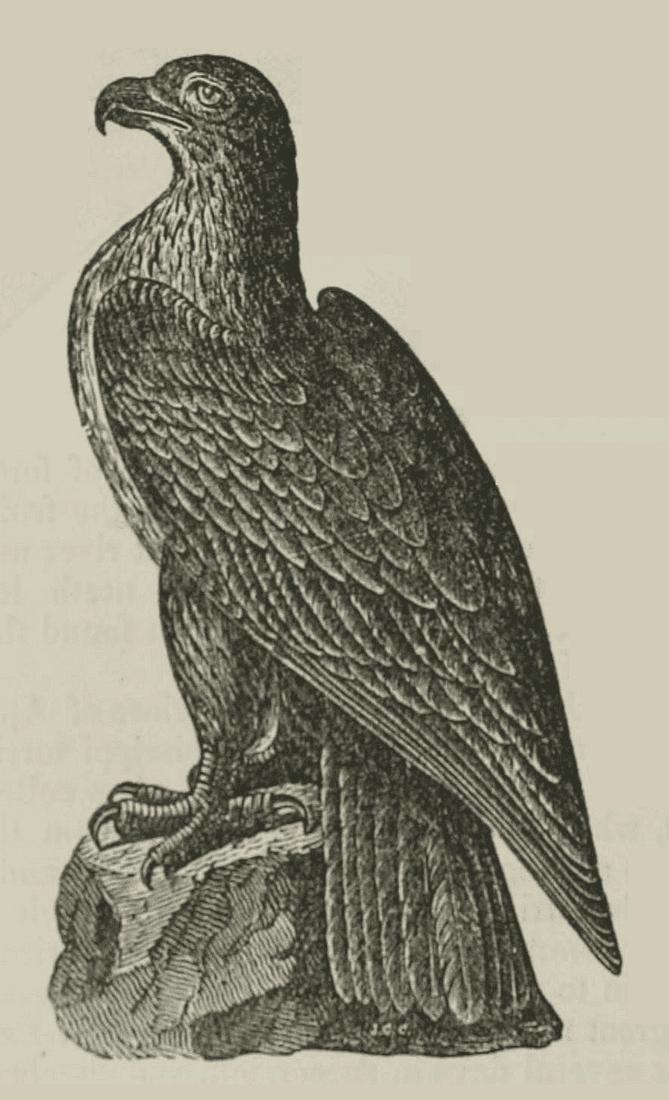
Washington Eagle.
White-headed or Bald Eagle.—This bird is abundant in all the latitudes of the United States, but shows a predilection for the warmer climates. He lives near the seacoast, where he usually selects some lofty pine or cypress for his eyry, which he builds of large sticks, sods, moss, reeds, pine tops and other coarse materials, arranged in a sort of level bed. This breeding place is never deserted as long us the tree lasts. Fish constitutes the chief article of food of this bird, and he usually obtains it by cunning and rapine, seldom by the exercise of honest industry. His principal occupation is to rob the osprey of the fruits of his labor, and he has sometimes been known to attack the vulture, and oblige him to disgorge his carrion.49
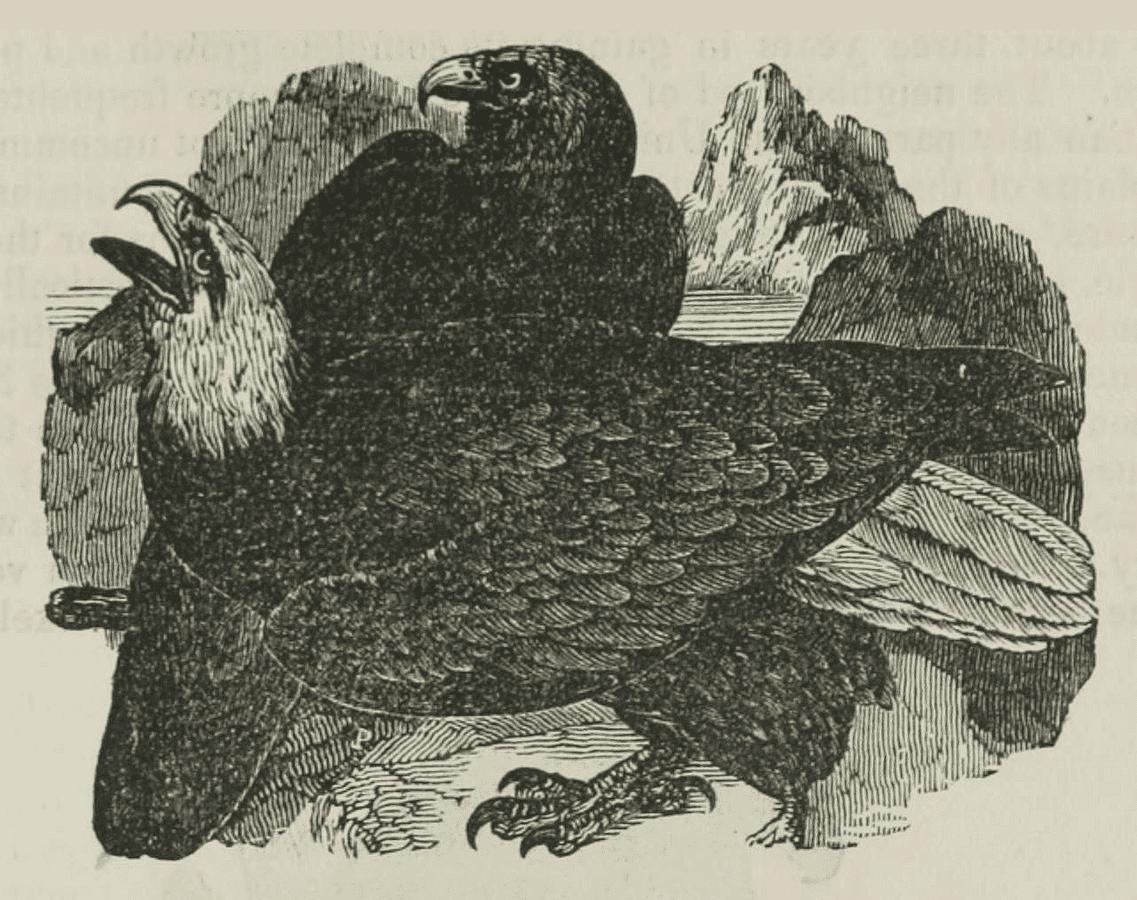
White-headed or Bald Eagle.
Royal or Golden Eagle.—This bird is found in all the cold and temperate regions of the northern hemisphere. It is supposed to live for a century, and is about three years in gaining its complete growth and permanent plumage. The neighborhood of Hudson’s Bay is more frequented by this eagle than any part of the United States, but it is not uncommon in the great plains of the larger western rivers. ‘The lofty mountains of New Hampshire,’ says Mr. Nuttall, ‘afford suitable situations for the eyry of this eagle, over whose snow-clad summits he is seen majestically soaring in solitude and grandeur. A young bird from this region, which I have in a state of domestication, showed considerable docility. He had, however, been brought up from the nest, in which he was found in the month of August; he appeared even playful, turning his head about in a very antic manner, as if desirous to attract attention; still his glance was quick and fiery. When birds were given to him, he plumed them very clean before he began his meal, and picked the subject to a perfect skeleton.’
The Ring-tailed Eagle is now found to be the young of this bird, as has been long supposed. Its tail feathers are highly valued by the aborigines as they serve for ornamenting their calumets.
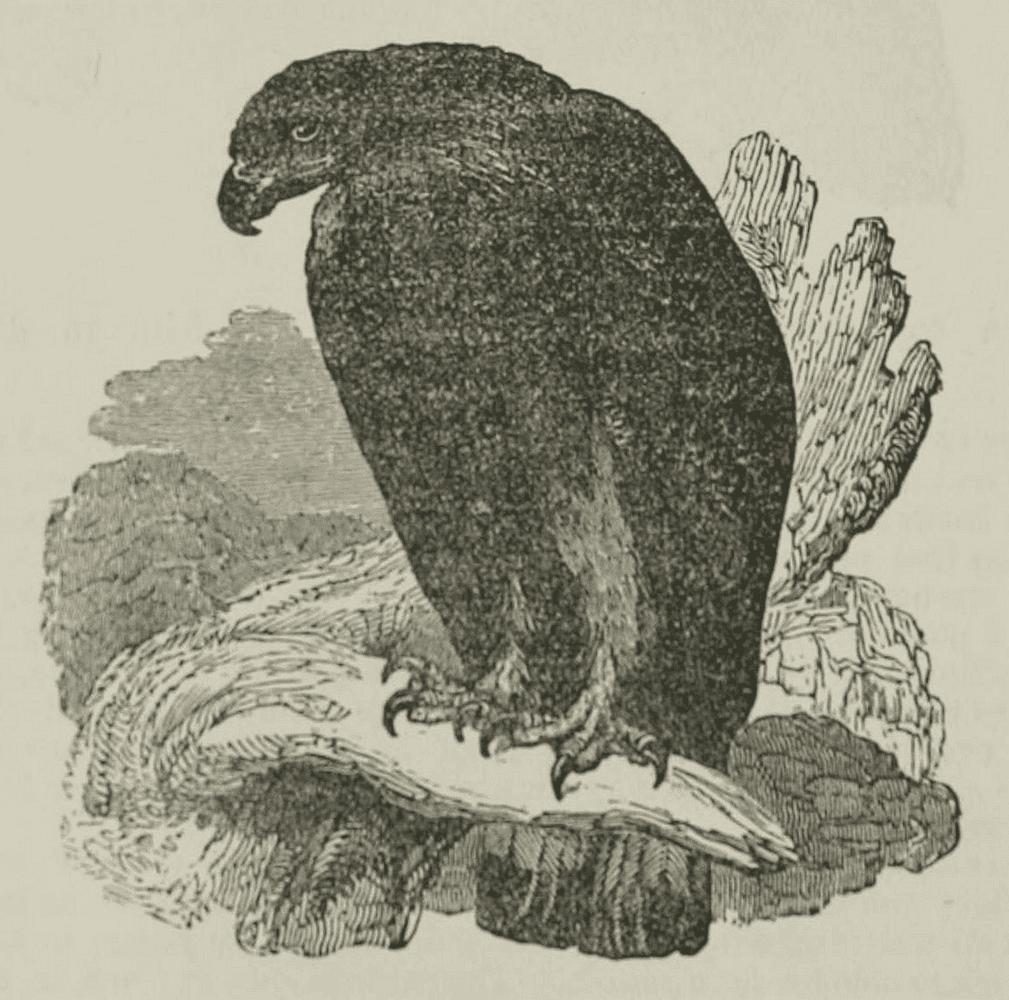
Ring-tailed Eagle.
Owls.—One of the most common species of this bird in the United States is the Little Screech Owl, which is found throughout the country. It is noted for the melancholy wailing, which is heard in the evenings in autumn and the latter part of summer. On clear moonlight nights, they answer each other from the various parts of the fields or orchards, roost during the day in thick evergreens, and are rarely seen abroad during the sunshine. They construct their nests in the hollow of a tree, frequently in an orchard.
The Great-horned Owl is also an inhabitant of every part of the country. ‘All climates are alike,’ says Mr. Nuttall, ‘to this eagle of the night, the king of the nocturnal tribe of American birds. The aboriginal inhabitants of the country dread his boding howl, dedicating his effigies to their solemnities, and, as if he were their sacred bird of Minerva, forbid the mockery of his ominous, dismal, and almost supernatural cries. His favorite resort, in the dark and impenetrable swampy forests, where he dwells in chosen solitude secure from the approach of every enemy, agrees with the melancholy and sinister traits of his character. To the surrounding feathered race he is the Pluto of the gloomy wilderness, and would scarcely be known out of the dismal shades where he hides, but to his victims, were he as silent as he is solitary. Among the choaking, loud, guttural sounds which he sometimes utters, in the dead of night, and with a suddenness which always alarms, because of his noiseless approach, is the ’waugh ho! ’waugh ho! which, Wilson remarks, was often uttered at the instant of sweeping down round his camp fire. Many kinds of owls are similarly dazzled and attracted by fire-lights, and occasionally finding, no doubt, some offal or flesh, thrown out by those who encamp in the wilderness, they come round the nocturnal blaze with other motives than barely those of curiosity.’
The Burrowing Owl differs essentially from all others in his habits and manners. Instead of hiding his head in the daylight, he fearlessly flies abroad in search of prey, in the broadest glare of the sun; and far from seeking abodes of solitude and silence, he lives in company with animals in the recesses of the earth, where they all enjoy the pleasures of fellowship and good harmony. The mounds of the prairie dog or marmot, which are thrown up in such numbers near the Rocky Mountains, are about eighteen inches in height. The entrance is by a passage two feet in length, which terminates in a comfortable cell composed of dry grass, where the marmot takes up his winter abode. Around these villages, the burrowing owls may be seen moving briskly about, singly or in small flocks. They seem to have very little fear of man; either soaring to a distance when alarmed, or descending into the burrows, where it is very difficult to come at them. In countries where the marmot is not found, this owl is said to dig a hole for himself. Their food appears to consist entirely of insects. Its note is similar to the cry of the marmot, which sounds like cheh, cheh, pronounced in rapid succession.
The burrowing owl is nine inches and a half long. The general color of the plumage is a light burnt umber, spotted with whitish. The under parts are white, banded with brown.50
Other birds of this species found in the limits of the states are the Great Gray or Cinereous Owl, the Long-eared Owl, the Short-eared Owl, the Acadian Owl, and the White or Barn Owl.
The Baltimore Oriole is a gay, lively, and beautiful bird, which passes its summers among us, but retreats for the winter to South America. The most remarkable instinct of this bird is the ingenuity exhibited in building its nest, which is a pendulous cylindric pouch, from five to seven inches in depth, and usually suspended from the extremities of high and drooping branches of a tree. The leaves, as they grow out over the top, form a protection from the sun and rain for the young. Though naturally shy and suspicious, this bird usually selects his building place in the neighborhood of farm-houses, and along frequented roads. He is easily domesticated, becomes playful and attached, and sings in confinement.
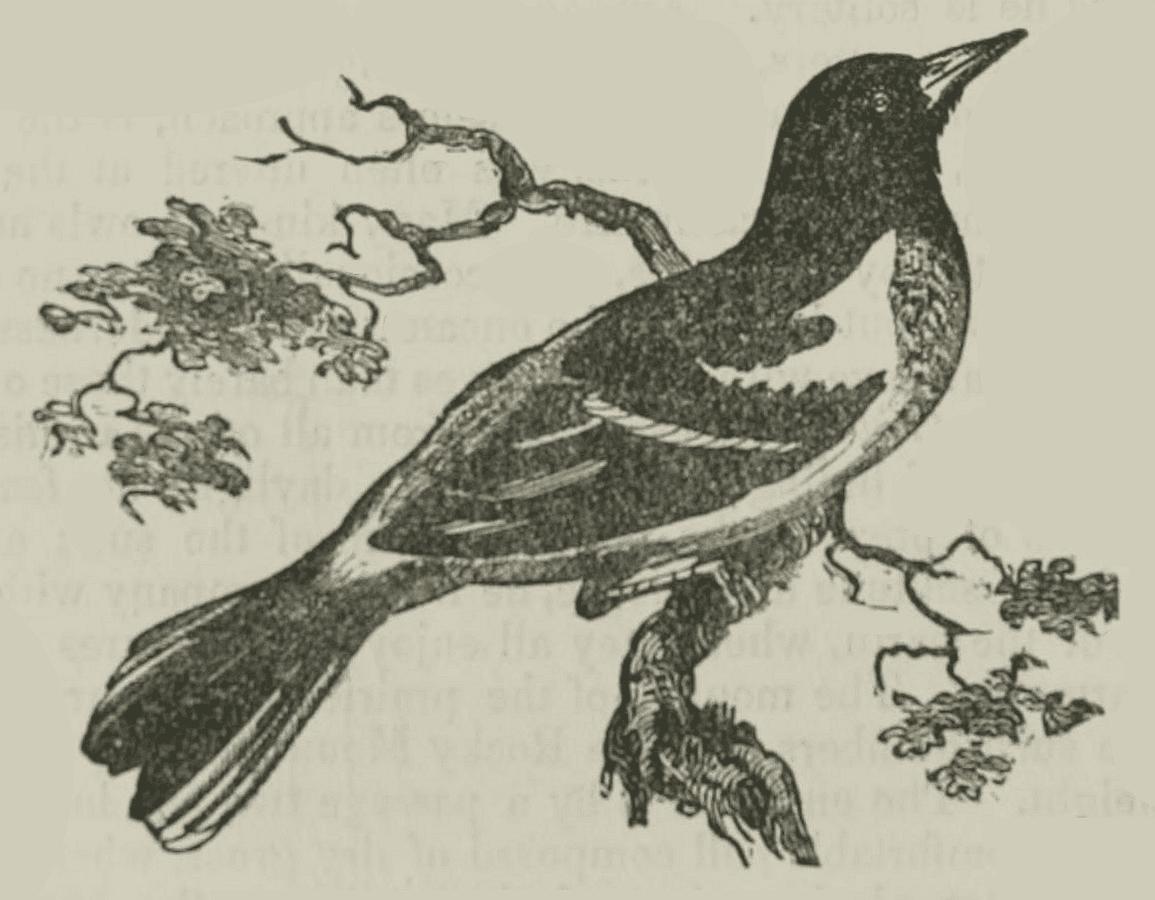
The Baltimore Oriole.
The Orchard Oriole is a smaller and plainer species, of similar habits. The Red-winged Blackbird is an inhabitant of all North America, but is migratory in the northern states. This bird commits great depredations on the unripe corn, and on the rice fields. He is known by a variety of names. His flesh is tough, and but little esteemed. The Cow Blackbird is passing from one part of the states to another, and lives in winter in the warmer parts. In the latter part of March, he appears in Pennsylvania, and as the weather becomes milder, he gradually advances into Canada.51 The Rice Bunting is a small bird of beautiful plumage and musical song, and as much of a favorite with the sportsman and gourmand, as of an enemy to the farmer and planter. They are found in immense numbers in the middle states, where they do great damage to the barley, Indian corn, and early wheat.
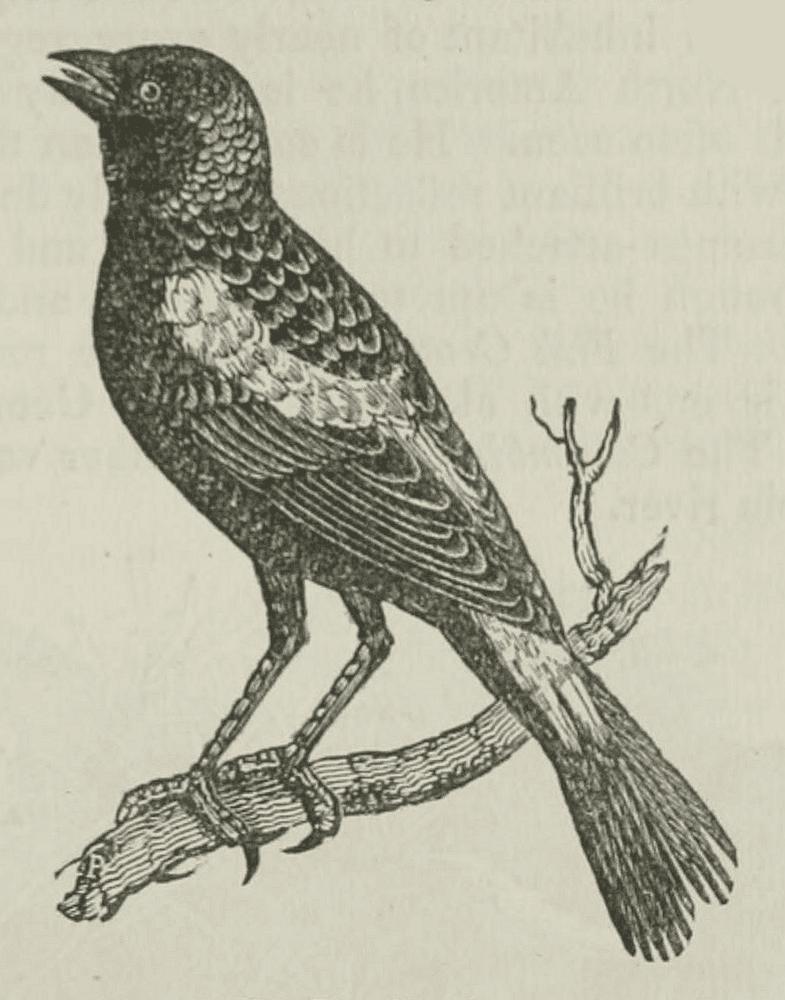
The Rice Bunting.
Blackbirds.—The Great Crow Blackbird is found only in the southern parts of the union, where it appears early in February. It is gregarious, omnivorous, and its note is said sometimes to resemble a watchman’s rattle. The Common Crow Blackbird appears in every part of the country, at different seasons, and commits great havoc among the fields of maize. It is easily domesticated, and may be taught to articulate a few words. The numbers in which this species are found are almost beyond belief; and the damage they do to the crops is astonishing. Other birds of this genus are the Slender-billed and the Rusty Blackbird.
The Raven is found in greater numbers in the western than in the eastern part of the union; it is a resident, however, in almost every country in the world. He has been too often described to require extended notice. The Crow is also an inhabitant of nearly every region. In most of the settled districts of North America, he is frequently met with, and is as little liked as he is often seen. He is smaller than the raven, and is of a deep black color, with brilliant reflections. Easily domesticated, and quite intelligent, he becomes attached to his master, and learns a variety of amusing tricks, though he is apt to be thievish, and is sometimes noisy and disagreeable. The Fish Crow resembles the rook; it is peculiar to this country, and is met with along the coast of Georgia, and as far north as New Jersey. The Columbian Crow is another variety frequenting the shores of Columbia river.
The Magpie is found in the western parts of America, and is very numerous to the west of the Rocky Mountains. He is a restless, active, and impudent bird, bold, and easily domesticated. Like the crow, he is artful and thievish. His nest is built with great ingenuity and labor, in a place inaccessible to man. The body of it is composed of hawthorn branches, the thorns sticking outwards; it is lined with fibrous roots, wool, and long grass, and then nicely plastered with mud and clay. A canopy of sharp thorns is then built over the nest, so woven together as to deny all entrance except at the door. Here the male and female bring up their young brood in perfect security.
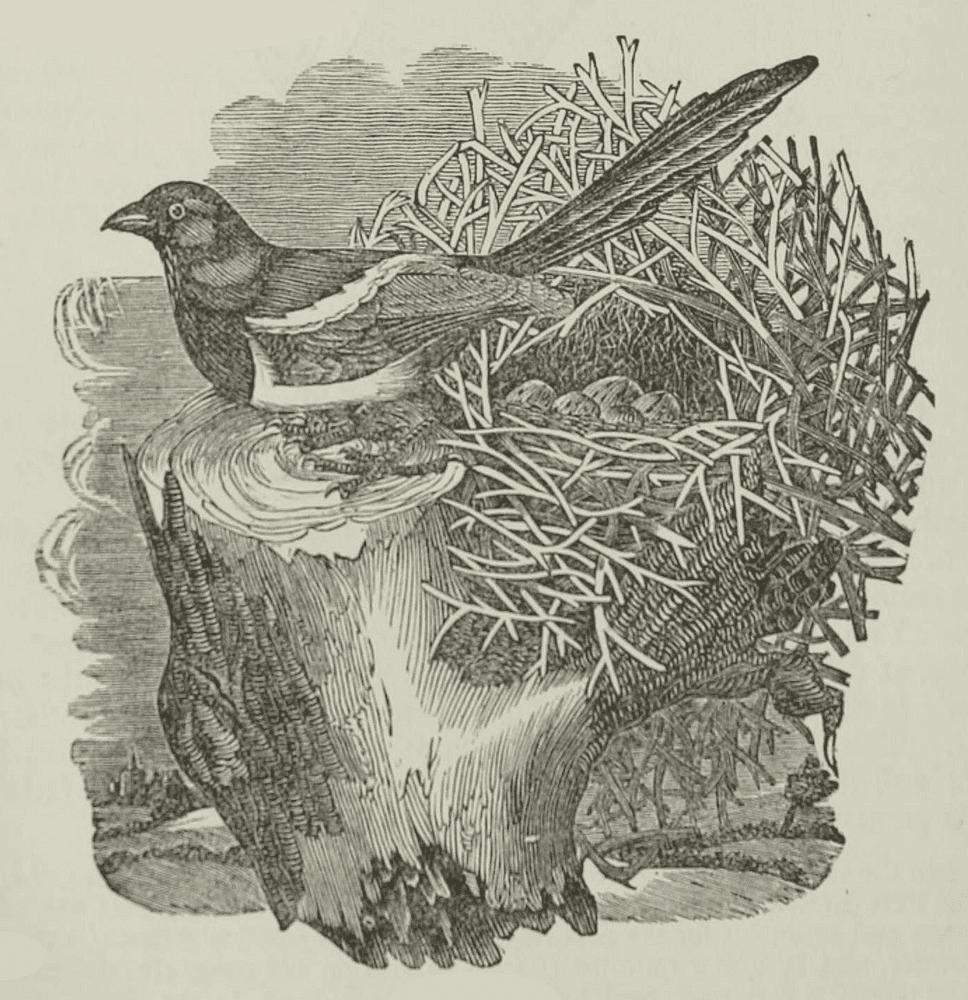
Magpie.
The Blue Jay is peculiar to North America, and is distinguished as a kind of beau among the feathered tenants of our woods, by the brilliancy of his dress, and, like most other coxcombs, makes himself still more conspicuous by his loquacity and the oddness of his tones and gestures. He is an almost universal inhabitant of the woods, frequenting the thickest settlements as well as the deepest recesses of the forest, where his squalling voice often alarms the deer, to the great disappointment of the hunter. He appears to be among his fellow musicians, what the trumpeter is in a band, some of his notes bearing no distant resemblance to the tones of that instrument. These he has the faculty of changing through a great variety of modulations. When disposed for ridicule, there is scarcely a bird to whose peculiarities of song he cannot tune his notes. When engaged in the blandishments of love, they resemble the soft chatterings of a duck, and are scarce heard at some paces distant; but no sooner does he discover your approach, than he sets up a sudden and vehement outcry, flying off and screaming with all his might. His notes a stranger might readily mistake for the repeated creakings of an ungreased wheelbarrow. All these he accompanies with various nods, jerks, and other gesticulations, for which the whole tribe of jays are so remarkable.52 Other jays are the Columbia, Canada, and Florida.
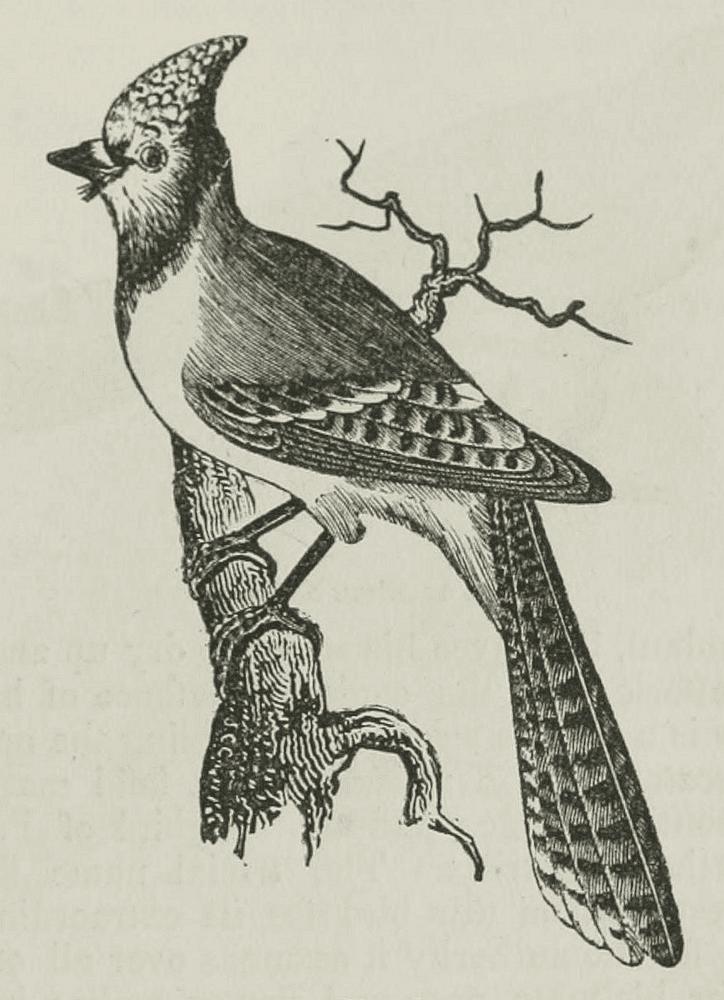
Blue Jay.
The Meadow Lark is a well-known agreeable bird, living in meadows, and is found throughout the states. There are two species of titmouse, the Tufted, and the Black-capt Titmouse. The Cedar Bird is a small and very beautiful creature, with a soft silky plumage, and crest of a bright brownish gray; it feeds on cherries, and whortle-berries, and late in the season on persimmons, small winter grapes, and other fruits.
The Great American Shrike is common in the northern parts of the continent, but sometimes summers in New England and Pennsylvania. He feeds on grasshoppers, spiders, and small birds, and after satisfying hunger, impales his remaining victims on thorns. When his supply of fresh game is abundant, he leaves his stores to dry up and decay. He is fearless, and will attack even the eagle in defence of his young. The Loggerhead Shrike is a species strongly resembling the one described.
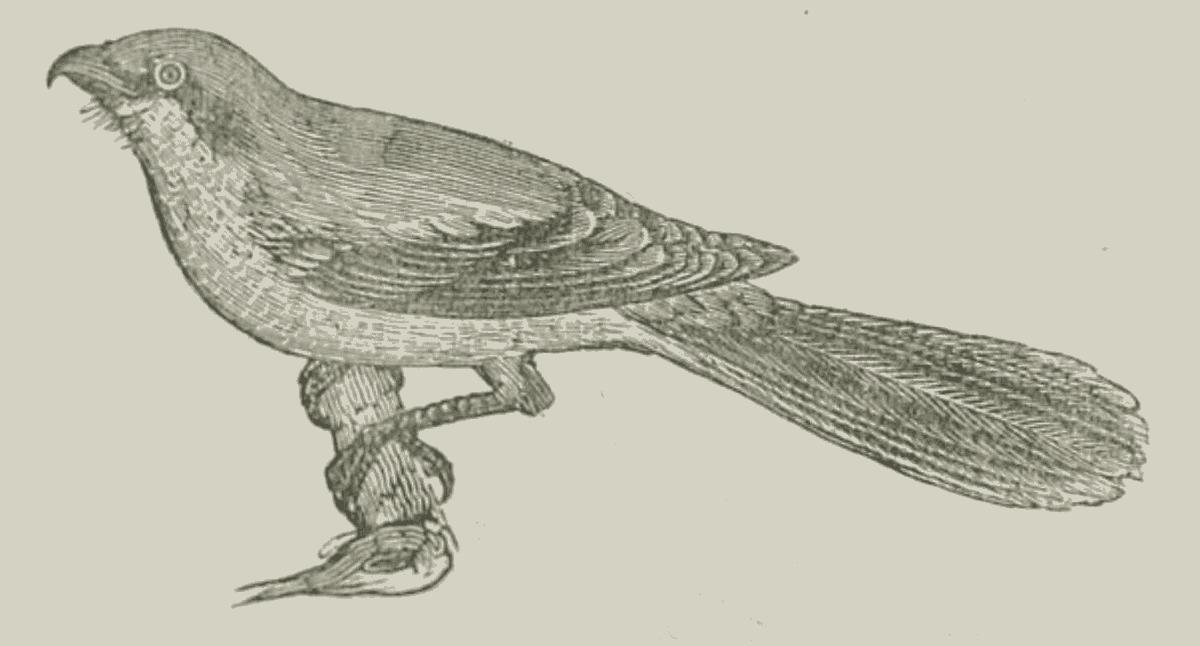
Great American Shrike.
The Tyrant Flycatcher, or Kingbird, is the field martin of Maryland and some of the southern states, and the kingbird of Pennsylvania and several of the northern districts. The trivial name king, as well as tyrant, has been bestowed on this bird for its extraordinary behavior in breeding time, and for the authority it assumes over all other birds. His extreme affection for his mate, nest, and young, makes him suspicious of every bird that comes near his residence, so that he attacks every intruder without discrimination; his life at this season is one continued scene of broils and battles; in which, however, he generally comes off conqueror. Hawks and crows, the bald eagle, and the great black eagle, all equally dread a rencontre with this merciless champion, who, as soon as he perceives one of these last approaching, launches into the air to meet him, mounts to a considerable height above him, and darts down on his back, sometimes fixing there to the great annoyance of his sovereign, who, if no convenient retreat be near, endeavors by various evolutions to rid himself of his merciless adversary; but the kingbird is not so easily dismounted. He teazes the eagle incessantly, sweeps upon him and remounts that he may descend on his back with greater violence; all the while keeping up a shrill and rapid twittering. The purple martin, however, is sometimes more than a match for him. The general color of this bird is a dark slaty ash, the throat and lower parts are pure white; the plumage on the head, though not forming a crest, is frequently erected, and discovers a rich bed of orange color, called by the country people his crown; when the feathers lie close, this is concealed.
The other principal Flycatchers are, the Great-crested, Arkansas, Fork-tailed, Swallow-tailed, Says, Pewit, and Olive-sided; the last first described by Mr. Nuttall in his valuable work, from a specimen obtained at Mount Auburn, now the celebrated cemetery in the neighborhood of Boston.
The Mocking Bird is peculiar to the new world, and is found in much larger numbers in the southern than the northern states of the Union. A warm climate and low country seem to be most congenial to its nature. It feeds on berries and insects. ‘The mocking bird,’ says Wilson, whose description has never been surpassed, ‘builds his nest in different places, according to the latitude in which he resides. A solitary thorn bush; an almost impenetrable thicket; an orange tree, cedar, or holly bush, are favorite spots. Always ready to defend, but never over anxious to conceal his nest, he very often builds within a small distance of a house; and not unfrequently in a pear or apple tree, rarely higher than six or seven feet from the ground. The nest is composed of dry twigs, weeds, straw, wool and tow, ingeniously put together, and lined with fine fibrous roots. During the time when the female is sitting, neither cat, dog, man, or any animal can approach the nest without being attacked. But the whole vengeance of the bird is directed against his mortal enemy the black snake. Whenever this reptile is discovered, the male darts upon it with the rapidity of an arrow, dextrously eluding its bite, and striking it violently and incessantly against the head, where it is very vulnerable. The snake soon becomes sensible of his danger, and seeks to escape; but the intrepid bird redoubles his exertions, and as the snake’s strength begins to flag, he seizes and lifts it up from the ground, beating it with his wings, and when the business is completed, he returns to his nest, mounts the summit of the bush, and pours out a torrent of song in token of victory.
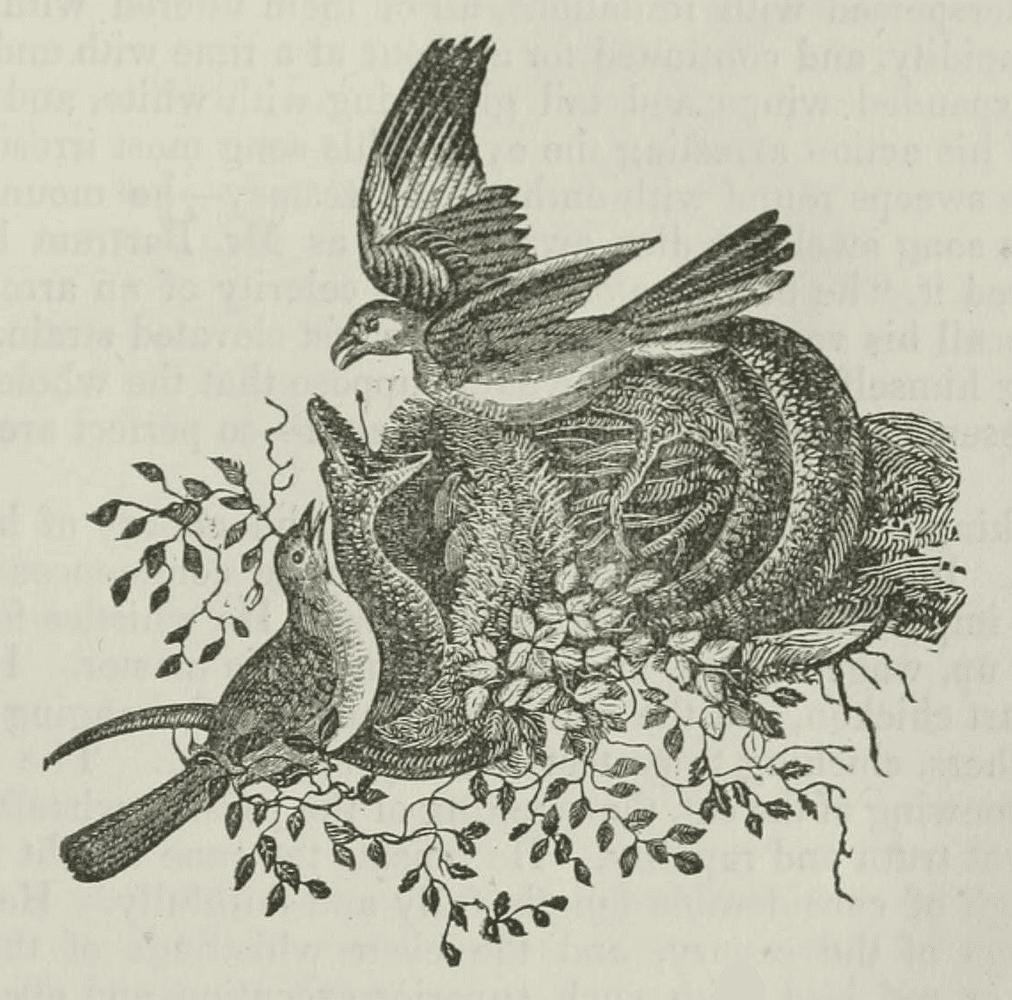
Mocking Birds.
‘The plumage of the mocking bird has nothing gaudy or brilliant in it, but that which so strongly recommends him, is his full, strong and musical voice, capable of almost every modulation, from the mellow tones of the woodthrush, to the savage screams of the bald eagle. In his native groves, mounted on the top of a tall bush, in the dawn of a dewy morning, while the woods are already vocal with a multitude of warblers, his admirable song rises pre-eminent over every competitor. The ear can listen to his music alone. Nor is the strain altogether imitative. His own native notes are bold and full, and varied seemingly beyond all limits. They consist of short expressions of two, three, or five and six syllables, generally interspersed with imitations, all of them uttered with great emphasis and rapidity, and continued for an hour at a time with undiminished ardor; his expanded wings and tail glistening with white, and the buoyant gaiety of his action arresting the eye, as his song most irresistibly does the ear. He sweeps round with enthusiastic ecstasy—he mounts and descends as his song swells or dies away—and, as Mr. Bartram has beautifully expressed it, “he bounds aloft with the celerity of an arrow, as if to recover or recall his very soul, expired in the last elevated strain.” While thus exerting himself, a bystander would suppose that the whole feathered tribes had assembled together on a trial for skill—so perfect are his imitations.
‘The mocking bird loses little of the power and energy of his song by confinement. In his domesticated state, when he commences his career of song, it is impossible to stand by uninterested. He whistles for the dog; Cæsar starts up, wags his tail, and runs to meet his master. He squeaks out like a hurt chicken, and the hen hurries about with hanging wings and bristling feathers, clucking to protect her injured brood. The barking of the dog, the mewing of the cat, the creaking of the passing wheelbarrow, follow with great truth and rapidity. He repeats the tune taught him by his master, though of considerable length, fully and faithfully. He runs over the quiverings of the canary, and the clear whistlings of the Virginia nightingale, or red bird, with such superior execution and effect, that the mortified songsters feel their own inferiority, and become silent, while he seems to triumph in their defeat by redoubling his exertions.’
Warblers.—The Summer Yellow Bird, or Warbler, is a brilliant and common species, found in every part of the American continent; he is about five inches in length, with an upper plumage of greenish yellow, and wings and tail deep brown, edged with yellow. He is a lively and familiar bird, and a great ornament to the gardens and orchards. His nest is built with great neatness in the fork of a small shrub. It is composed of flax or tow, strongly twisted round the twigs, and lined with hair and the down of fern. This interesting little bird will feign lameness to draw one from his nest, fluttering feebly along, and looking back to see if he is followed. His notes are few and shrill, hardly deserving the name of a song. There is a very great variety belonging to the family of warblers, of which we can only allude to the Prairie, Hemlock, Pine-swamp, Blue-mountain, Chesnut-sided, Mourning, and Blue-winged Warbler.
Ferruginous Thrush.—This is the Brown Thrush or Thrasher of the middle and eastern states, and the French Mocking-Bird of Maryland, Virginia, and the Carolinas. It is the largest of all our thrushes, and is a well-known and distinguished songster, and from the tops of hedge rows, apple or cherry trees, he salutes the opening morning with his charming song, which is loud, emphatical and full of variety. These notes are not imitative, but solely his own. He is an active and vigorous bird, flying generally low from one thicket to another, with his long broad tail spread out like a fan; he has a single note or chuck when you approach his nest.
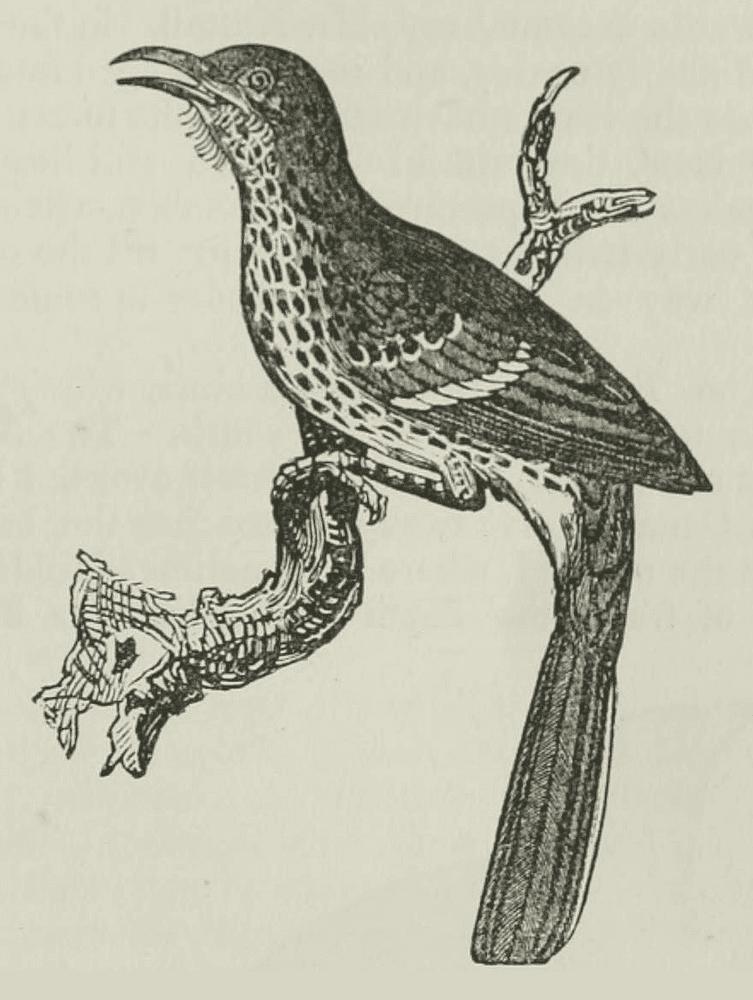
Ferruginous Thrush.
There is a very numerous variety of thrushes in the states, of which the best known are the Cat Bird, Robin, Wood, Little or Hermit, Wilson’s, and the Golden-crowned Thrush.
Wren.—The House Wren, throughout the states, is a well-known and familiar bird, who builds his nest sometimes under the eaves, or in a hollow cherry tree; but most commonly in small boxes fixed on a pole, for his accommodation. He will even put up with an old hat, and if this also is denied him, he will find some hole or crevice, about the house or barn, rather than abandon the dwellings of man. A mower once hung up his coat, under a shed near a barn; two or three days elapsed before he had occasion to put it on; thrusting his arm up the sleeve, he found it completely filled with some rubbish as he expressed it, and on extracting the whole mass, found it to be the nest of a wren, completely finished and lined with a large quantity of feathers. In his retreat he was followed by the forlorn little proprietors, who scolded him with great vehemence, for thus ruining the whole economy of their domestic affairs.
The immense number of insects which this sociable little bird removes from the garden and fruit trees ought to endear him to every cultivator; and his notes, loud, sprightly and tremulous, are extremely agreeable. Its food is insects and caterpillars, and while supplying the wants of its young it destroys, on an average, many hundreds a day. It is a bold and insolent bird against those that venture to build within its jurisdiction; attacking them without hesitation, though twice its size, and compelling them to decamp. Even the blue bird, when attacked by this little impertinent, soon relinquishes the contest: with those of his own species, also, he has frequent squabbles. The varieties of the wren are very numerous.
The Blue Bird, is a familiar favorite throughout the continent. It is migratory, and his return is hailed in the northern states as the first presage of spring. ‘Towards autumn,’ says Mr. Nuttall, ‘in the month of October, his cheerful song nearly ceases, and is now changed into a single plaintive note. Even when the leaves have fallen, and the forest no longer affords a shelter from the blast, the faithful blue bird still lingers over his native fields, and only takes his departure in November, when, at a considerable elevation, in the early twilight of the morning, till the opening of the day, they wing their way in small roving troops to some milder regions in the south.’
Tanagers.—The Tanagers are gaudy birds, which annually visit the republic from the torrid regions of the south. The Scarlet Tanager is perhaps the most showy. He spreads himself over the United States, and is found even in Canada. He rarely approaches the habitations of man, unless perhaps in the orchard, where he sometimes builds; or in the cherry trees in search of fruit; the depth of the wood is his favorite abode. Among all the birds that inhabit our woods, there is none that strikes the eye of a stranger, or even a native, with so much brilliancy as this. Seen among the green leaves, with the light falling strongly on his plumage, he is really beautiful. Another species, the summer red bird, delights in a flat sandy country, covered with wood, and interspersed with pine trees; and is, consequently, more numerous towards the shores of the Atlantic than in the interior.