Chapter XX · —HISTORY. (continued 3)
Reading edition
Indignant at this reply, the general opened his batteries against the castle, and at the same time threw a number of shells in the town. The fire was returned with equal spirit from the Spanish fort, and from six half-galleys in the harbor; but the distance was so great that the cannonade, though it continued several days, did little execution on either side. It appears that, notwithstanding the blockade, the Spanish garrison contrived to admit a reinforcement of seven hundred men, and a large supply of provisions. All prospect of starving the enemy being lost, the army began to despair of forcing the place to surrender. The Carolina troops, enfeebled by the heat of the climate, dispirited by sickness, and fatigued by fruitless efforts, marched away in large bodies. The naval commander, in consideration of the shortness of his provisions, and of the near approach of the usual season of hurricanes, judged it imprudent to hazard his fleet longer on that coast. The general himself was sick of a fever, and his regiment was worn out with fatigue, and disabled by sickness. These combined disasters rendered it necessary to abandon the enterprise; and Oglethorpe, with extreme sorrow and regret, returned to Frederica.
After a lapse of two years the Spaniards prepared to retaliate by the invasion of Georgia, intending, if successful, to subjugate the Carolinas and Virginia. On receiving information of their approach, general Oglethorpe solicited assistance from South Carolina: but the inhabitants of that colony, entertaining a strong prejudice against him, and terrified by the danger which threatened themselves, determined to provide only for their own safety, though without avowing their intention. General Oglethorpe, however, made preparations for a vigorous defence. He assembled seven hundred men, exclusive of a body of Indians, fixed his head-quarters at Frederica, on the island of St. Simon, and, with this small band, determined to encounter whatever force might be brought against him. It was his utmost hope that he might be able to resist the enemy until a reinforcement should arrive from Carolina, which he daily and anxiously expected. On the last day of June, the Spanish fleet, consisting of thirty-two sail, and having on board more than three thousand men, came to anchor off St. Simon’s bay. Notwithstanding all the resistance which general Oglethorpe could oppose, they sailed up the river Altamaha, landed upon the island, and there erected fortifications. Convinced that his small force, if divided, must be entirely inefficient, Oglethorpe assembled the whole of it at Frederica. One portion he employed in strengthening his fortifications; the Highlanders and Indians, ranging night and day through the woods, often attacked the outposts of the enemy. The toil of the troops was incessant; and the long delay of the expected succors, still unexpectedly withheld by South Carolina, caused the most gloomy and depressing apprehensions.
Oglethorpe, at length, learning by an English prisoner who escaped from the Spanish camp, that a difference subsisted between the troops from Cuba and those from St. Augustine, so as to occasion a separate encampment, resolved to attack the enemy while thus divided. Taking advantage of his knowledge of the woods, he marched out in the night with three hundred chosen men, the Highland company and some rangers, with the intention of surprising the enemy. Having advanced within two miles of the Spanish camp, he halted his troops, and went forward himself with a select corps to reconnoitre the enemy’s situation. While he was endeavoring cautiously to conceal his approach, a French soldier of his party discharged his musket, and ran into the Spanish lines. Thus betrayed, he hastened his return to Frederica, and endeavored to effect by stratagem what could not be achieved by surprise. Apprehensive that the deserter would discover to the enemy his weakness, he wrote him a letter, desiring him to acquaint the Spaniards with the defenceless state of Frederica, and the ease with which his small garrison might be cut to pieces. He pressed him to bring forward the Spaniards to an attack; but, if he could not prevail thus far, to use all his art and influence to persuade them to stay at least three days more at fort Simon; for within that time, according to advices he had just received from Carolina, he should have a reinforcement of two thousand land forces, with six British ships of war. The letter concluded with a caution to the deserter against dropping the least hint of admiral Vernon’s meditated attack upon St. Augustine, and with an assurance that for his service he should be amply rewarded by the British king.
Oglethorpe gave it to a Spanish prisoner, who, for a small reward together with his liberty, promised to deliver it to the French deserter. On his arrival at the Spanish camp, however, he gave the letter, as Oglethorpe expected, to the commander-in-chief, who instantly put the deserter in irons. This letter perplexed and confounded the Spaniards; some suspecting it to be a stratagem to prevent an attack on Frederica, and others believing it to contain serious instructions to direct the conduct of a spy. While the Spanish officers wore deliberating what measures to adopt, an incident, not within the calculation of military skill, or the control of human power, decided their counsels. Three ships of force, which the governor of South Carolina had sent out to Oglethorpe’s aid, appeared at this juncture off the coast. The agreement of this discovery with the contents of the letter convinced the Spanish commander of its real intention. The whole army, seized with an instant panic, set fire to the fort, and precipitately embarked, leaving several cannon, with a quantity of provisions and military stores; and thus, in the moment of threatened conquest, was the infant colony providentially saved.
Thus was Georgia, with trifling loss, delivered from the most imminent danger. General Oglethorpe not only retrieved, but established his reputation. From the Carolinians, grateful for their preservation, and from the governors of most of the northern colonies, he received cordial congratulations upon his address and good fortune. But on an impeachment brought forward before this invasion, Oglethorpe still felt himself bound in honor to return to England, where, on trial, the charge was adjudged to be false, malicious and groundless, and its author dismissed his majesty’s service. The character of this able general now appeared in its true light; and his contemporaries acknowledged what impartial history records, that to him Carolina was indebted for her safety and repose, as well as Georgia for her existence and protection. After this period general Oglethorpe never returned to the province of Georgia, but upon all occasions discovered in England an uncommon zeal for its prosperity and improvement.
In the year 1749, the colony was exposed to great danger from a quarter as unexpected as it was singular. During the whole of his administration, general Oglethorpe had, from motives of policy, treated an Indian, or rather half-breed woman, called Mary Musgrove, afterwards Mary Bosomworth, with particular kindness and generosity. Finding that she had great influence amongst the Creeks, and understood their language, he made use of her as an interpreter, in order the more easily to form treaties of alliance with them; allowing her for her services one hundred pounds sterling a year. Thomas Bosomworth, who was chaplain to Oglethorpe’s regiment, had married this woman, accepted a tract of land from the crown, and settled in the province. Being unsuccessful in most of his speculations, he had recourse to one of an extraordinary kind. He persuaded his wife to assert herself to be the elder sister of Malatche, the Indian chief, and to have descended, by a maternal line, from an Indian king, who held from nature the whole territory of the Creeks; and therefore to possess a right to them, superior not only to that of the trustees, but also to that of the king. Accordingly, Mary assumed the title of an independent empress, disavowing all subjection or allegiance to the king of Great Britain, otherwise than by way of treaty or alliance, such as one independent sovereign might voluntarily enter into with another; a meeting of all the Creeks was summoned, to whom Mary made a long speech, in which she set forth the justice of her claim, and the great injury she and her beloved subjects had sustained by the loss of their territories, and urged them to a defence of their rights by force of arms. The Indians were fired with rage at the idea of such indignity, and to a man pledged themselves to stand by her to the last drop of their blood in defence of her royal person and their lands; in consequence of which, queen Mary, escorted by a large body of her savage subjects, set out for Savannah, to demand from the president and council a formal acknowledgment of her rights in the province.
Several interviews between the magistrates and the Indian chiefs took place on this strange occurrence, and the president and council were flattering themselves with the idea of an amicable compromise of all the existing difficulties, and rejoicing in the re-establishment of friendly intercourse with the Creeks, when Mary, excited with liquor, and disappointed in her royal views, rushed in amongst them like a fury, told the president that these were her people, that he had no business with them, and that he should soon be convinced of it to his cost. The president calmly advised her to retire to her lodgings, and forbear to poison the minds of the Indians, adding that he would otherwise order her into close confinement; upon which, turning about to Malatche, in great rage, she repeated, with some ill-natured comments, what the president had said; Malatche started from his seat, laid hold of his arms, calling upon the rest to follow his example, and dared any man to touch the queen. The whole house was filled in a moment with tumult and uproar; every Indian having his tomahawk in his hand, the president and council expected nothing but instant death. During this confusion, captain Jones, who commanded the guard, very seasonably interposed, and ordered the Indians immediately to surrender their arms, endeavoring, however, not merely to overawe them, but using prudence to avoid coming to extremities: with reluctance the Indians submitted, and Mary was conveyed to a private room, where a guard was placed over her, and all further communication with the Indians denied her during their stay in Savannah. Ultimately the soi-disant queen was compelled to abandon her pretensions, and the Indians were induced to depart, to the great joy of the inhabitants, who had been so long harassed by their turbulent visit.
The wars to which it had been subject had much retarded the progress of the colony, and in 1752 the trustees surrendered their charter to the king. Georgia thus became a royal government. At this time the whole exports of Georgia did not amount to ten thousand pounds a year.
FRENCH AND INDIAN WARS.
The formation and progress of all the colonies which constituted the North American republic at the era of its independence, have now been traced up to the middle of the eighteenth century. From that period circumstances tended rapidly to promote that federation which eventually effected the independence of the colonies, and laid the basis of their future prosperity; indeed, in the prosecution of the French war, which commenced in 1756, the energies of the colonies were so united in the attainment of one common object, that the generalization of their political history from that period is not only rendered preferable, but almost inevitable.
Not to enter into a detail of the progress of French discovery, it is sufficient to say that France had established settlements on the St. Lawrence and at the mouth of the Mississippi, and formed the bold plan of uniting these points by a chain of forts, stretching across the continent, and intended to confine the English colonists to the eastern side of the Alleghanies. In their northern colonies, the military strength of the French was considerable; Quebec and Montreal were strongly fortified; and at other points, Louisbourg, Cape Breton, and the forts of lake Champlain, Niagara, Crown Point, Frontignac, Ticonderoga, and several others, defended the frontiers. They had also erected a considerable fort at the junction of the Alleghany with the Monongahela, then called Du Quesne, but now forming the site of Pittsburg.
The proceedings of the French in America excited a strong interest in the minds of the British government; and deeming war inevitable, orders were sent to the governors of the several colonies to repel force by force, and to dislodge the French from their posts on the Ohio. These orders were accompanied with a recommendation to form a union of the colonies for more effective defence. Delegates had already been appointed to meet at Albany, for the purpose of conferring with the Five Nations; and governor Shirley recommended that the subject of union should also be discussed at the convention. The commissioners from Massachusetts had ample powers to co-operate in the formation of a plan; those from Maryland were instructed to observe what others did; and those from New Hampshire, Rhode Island, Connecticut, Pennsylvania, and New York, had no instructions at all on the subject. As soon, however, as the friendship of the Indians was thought to be secured by a distribution of presents, the delegates appointed a committee to devise some scheme for the proposed confederation; and the committee recommended the adoption of a government analogous to that of the individual colonies. There was to be a grand council, composed of deputies from the several provinces, and a president-general, appointed by the crown, with the power of negativing the acts of the council. The Connecticut delegates, however, dissented from this plan, because it placed too preponderating a power in the hands of the crown.
It was rejected by the British ministry for the very opposite reason; they suggested, however, that the several governors, with one or two of their counsellors, should meet and adopt such measures as the common safety might demand. But this scheme was defeated by a provision, that they might draw upon the British treasury for all necessary sums, which parliament would undertake to repay by imposing a general tax upon the colonies. The Massachusetts assembly sent special instructions to its agent in London to oppose most strenuously any measure which had for its object the establishment of taxes on the colonies, under whatever plea of utility; and Franklin, to whom the governor of Virginia had sent the proposition of the British minister, states most distinctly in his letter in reply, the reasons which would ever prevent the Americans from consenting to such a proposal. He observes that it would inspire universal discontent among the Americans to attempt the imposition of taxes by a parliament where they were not represented; a point of which neither the colonies nor the British government ever lost sight, from this period till the contest it originated terminated in the entire separation of the former from its dependence on the British crown.
Early in the spring of 1755, the British government despatched general Braddock to America, with a respectable force, to expel the French, and keep possession of the territory; and preparations having been made by France to despatch a reinforcement to her armies in Canada, admiral Boscawen was ordered to endeavor to intercept the French fleet before it should enter the gulf of St. Lawrence. In April, general Braddock met the governors of the several provinces to confer upon the plan of the ensuing campaign. Three expeditions were resolved upon; one against Du Quesne, to be commanded by general Braddock; one against forts Niagara and Frontignac, to be commanded by governor Shirley; and one against Crown Point, to be commanded by general Johnston. This last originated with Massachusetts, and was to be executed by colonial troops raised in New England and New York.
While preparations were making for these expeditions, another, which had been previously concerted, was carried on against the French forts in Nova Scotia. This province was settled by the French, but was ceded to the English by the treaty of Utrecht. Its boundaries not having been defined, the French continued to occupy a portion of the territory claimed by the English, and had built forts for their defence. To gain possession of these was the object of the expedition. About two thousand militia, commanded by colonel Winslow, embarked at Boston; and being joined on their passage by three hundred regulars, arrived in April at the place of their destination. The forts were invested, the resistance made was trifling and ineffectual, and in a short time the English gained entire possession of the province according to their own definition of its boundaries. Three only of their men were killed.
As soon as the convention of governors was dissolved, general Braddock proceeded to the post at Wells’ Creek, whence the army commenced its march about the middle of June. Their progress was very much retarded by the necessity of cutting a road; and, lest the enemy should have time to collect in great force, the general concluded to set forward with twelve hundred select men, while colonel Dunbar should follow slowly in the rear, with the main body and the heavy baggage. Colonel Washington’s regiment had been split into separate companies, and he had only joined the army as aid to the general. The roughness of the country prevented the advanced corps from reaching the Monongahela till the 8th of July. It was resolved to attack Du Quesne the very next day; and lieutenant-colonel Gage was sent in front with three hundred British regulars, while the general himself followed at some distance with the main body. He had been strongly cautioned by colonel Washington to provide against an ambuscade, by sending forward some provincial companies to scour the woods; but he held the provincials and the enemy in equal contempt. The Monongahela was crossed the second time, about seven miles from Du Quesne; and the army was pressing forward in an open wood, through high and thick grass, when the front was suddenly thrown into disorder by a volley from small arms. The main body was formed three deep, and brought to its support: the commander-in-chief of the enemy fell; and a cessation of the fire led general Braddock to suppose that the assailants had fled; but he was soon attacked with redoubled fury.
Concealed behind trees, logs, and rocks, the Indians poured upon the troops a deadly and incessant fire; officers and men fell thickly around, and the survivors knew not where to direct their aim to revenge their slaughtered comrades. The whole body was again thrown into confusion; but the general, obstinate and courageous, refused to retreat; and instead of withdrawing them beyond the reach of the enemy’s muskets, where their ranks might easily have been formed anew, undertook to rally them on the very ground of attack, and in the midst of a most incessant and deadly fire. He persisted in these efforts until five horses had been shot under him, and every one of his officers on horseback, except colonel Washington, was either killed or wounded. The general at length fell, and the rout became universal. The troops fled precipitately until they met the division under Dunbar, then sixty miles in the rear. Sixty-four officers out of eighty-five, and about half of the privates, were killed or wounded. General Braddock died in Dunbar’s camp; and the whole army, which appears to have been panic struck, marched back to Philadelphia. The provincial troops, whom Braddock had so lightly esteemed, displayed during the battle the utmost calmness and courage. Though placed in the rear, they alone, led on by Washington, advanced against the Indians, and covered the retreat; and had they at first been permitted to engage the enemy in their own way, they would easily have defeated them.
The two northern expeditions, though not so disastrous, failed in attaining their proposed objects. The campaign of 1755 was thus utterly unsuccessful. Immense preparations had been made, but no desired result was obtained. By the failure of the three expeditions, the whole frontier was left open to the ravages of the Indians. The second campaign was almost as pregnant with evil. Montcalm had marched against Oswego, and by destroying it had thrown the English and American army on the defensive. No successful measures were put in operation to carry out the plans of the colonists, and it was necessary to wait till the following year.
At the commencement of the following year a council was held at Boston, composed of lord Loudoun, and the governors of the New England provinces and of Nova Scotia. At this council his lordship proposed that New England should raise four thousand men for the ensuing campaign; and that a proportionate number should be raised by New York and New Jersey. These requisitions were complied with; and in the spring his lordship found himself at the head of a very considerable army. Admiral Holbourn arriving in the beginning of July at Halifax with a powerful squadron, and a reinforcement of five thousand British troops, under George viscount Howe, lord Loudoun sailed from New York with six thousand regulars, to join those troops at the place of their arrival. Instead of the complex operations undertaken in previous campaigns, his lordship limited his plan to a single object. Leaving the posts on the lakes strongly garrisoned, he resolved to direct his whole disposable force against Louisbourg; Halifax having been determined on as the place of rendezvous for the fleet and army destined for the expedition. Information was, however, soon received, that a French fleet had lately sailed from Brest; that Louisbourg was garrisoned by six thousand regulars, exclusive of provincials; and that it was also defended by seventeen line-of-battle ships, which were moored in the harbor. There being no hope of success against so formidable a force, the enterprise was deferred to the next year; the general and admiral on the last of August proceeded to New York; and the provincials were dismissed.
The marquis De Montcalm, availing himself of the absence of the principal part of the British force, advanced with an army of nine thousand men, and laid siege to fort William Henry. The garrison at this fort consisted of between two and three thousand regulars, and its fortifications were strong and in very good order; and for the additional security of this important post, general Webb was stationed at fort Edward with an army of four thousand men. The French commander, however, urged his approaches with such vigor, that, within six days after the investment of the fort, colonel Monro, the commandant, having in vain solicited succor from general Webb, found it necessary to surrender by capitulation. The garrison was to be allowed the honors of war, and to be protected against the Indians until within the reach of fort Edward; but the next morning, a great number of Indians, having been permitted to enter the lines, began to plunder; and meeting with no opposition, they fell upon the sick and wounded, whom they immediately massacred. Their appetite for carnage being excited, the defenceless troops were attacked with fiend-like fury. Monro in vain implored Montcalm to provide the stipulated guard, and the massacre proceeded. All was turbulence and horror. On every side savages were butchering and scalping their wretched victims. Their hideous yells, the groans of the dying, and the frantic shrieks of others shrinking from the uplifted tomahawk, were heard by the French unmoved. The fury of the savages was permitted to rage without restraint until fifteen hundred were killed, or hurried captives into the wilderness. The day after this awful tragedy, major Putnam was sent with his rangers to watch the motions of the enemy. When he came to the shore of the lake, their rear was hardly beyond the reach of musket-shot. The prospect was horrible in the extreme; the fort demolished; the barracks and buildings yet burning; innumerable fragments of human carcasses still broiled in the decaying fires; and dead bodies, mangled with tomahawks and scalping knives, in all the wantonness of Indian barbarity, were everywhere scattered around. Thus ended the third campaign in America; happily forming the last of a series of disasters, resulting from folly and mismanagement, rather than from want of means and military strength.
The British nation was alarmed and indignant, and the king found it necessary to change his councils. At the head of the new ministry he placed the celebrated William Pitt, afterwards earl of Chatham, under whose administration public confidence revived, and the nation seemed inspired with new life and vigor. He was equally popular in both hemispheres. Lord Loudoun was replaced by general Abercrombie, who, early in the spring of 1758, was ready to enter upon the campaign at the head of fifty thousand men, the most powerful army ever seen in America.
Three points of attack were marked out for this campaign; the first Louisbourg; the second Ticonderoga and Crown Point; and the third, fort Du Quesne. Its result was highly honorable to the British arms. Of the three expeditions, two completely succeeded, and the leader of the third had made an important conquest. Fort Du Quesne was reduced, supplied with a new garrison, and its name changed to Pittsburg. As usual, the Indians joined the strongest side. A peace was concluded with all the tribes between the Ohio and the lakes; and the frontier inhabitants of Pennsylvania, Maryland, and Virginia, were once more relieved from the terrors of fire and scalping knives.
To the commanding talents of Pitt, and the confidence which they inspired, this change of fortune must be chiefly attributed; and in no respect were these talents more strikingly displayed than in the choice of men to execute his plans. The advantages of this campaign had, however, been purchased by an expensive effort and corresponding exhaustion of provincial strength; and, when a circular letter from Mr. Pitt to the several governors induced the colonies to resolve upon making the most vigorous preparation for the next, they soon discovered that their resources were by no means commensurate with their zeal.
Notwithstanding these difficulties, it was resolved to signalize the year 1759 by the complete conquest of Canada. The plan of the campaign was, that three powerful armies should enter the French possessions by three different routes, and attack all their strong-holds at nearly the same time. At the head of one division of the army, brigadier-general Wolfe, a young officer who had signalized himself at the siege of Louisbourg, was to ascend the St. Lawrence and lay siege to Quebec, escorted by a strong fleet to co-operate with his troops. The central and main army, composed of British and provincials, was to be conducted against Ticonderoga and Crown Point by general Amherst, the new commander-in-chief, who, after making himself master of these places, was to proceed over lake Champlain and by the way of Richelieu river to the St. Lawrence, and, descending that river, form a junction with general Wolfe before the walls of Quebec. The third army, to be composed principally of provincials, reinforced by a strong body of friendly Indians, was to be commanded by general Prideaux, who was to lead this division first against Niagara, and, after the reduction of that place, to embark on lake Ontario, and proceed down the St. Lawrence against Montreal. It has been observed by a recent author, ‘Had the elements been laid, and the enemy spell-bound, the whole of this brilliant plan could not have helped succeeding.’ This sentence, however, betrays a very limited view of a plan that was well worthy of the mind of Pitt. In this arrangement immediate advantage was not sacrificed; while the more remote results exhibited a prospect highly calculated to excite the ambition of the leaders, and to arouse all the energies of the troops. It is in thus affording motives which tend to bring physical force into most effective and persevering action, that intellectual superiority becomes manifest, confounding the calculations of ordinary minds.
Early in the winter, general Amherst commenced preparations for his part of the enterprise; but it was not till the last of May that his troops were assembled at Albany; and it was as late as the 22d of July, when he appeared before Ticonderoga. As the naval superiority of Great Britain had prevented France from sending out reinforcements, none of the posts in this quarter were able to withstand so great a force as that of general Amherst. Ticonderoga was immediately abandoned; the example was followed at Crown Point; and the only way in which the enemy seemed to think of preserving their province was by retarding the English army with shows of resistance till the season of operation should be past, or till, by the gradual concentration of their forces, they should become numerous enough to make an effectual stand. From Crown Point they retreated to Isle-aux-Noix, where general Amherst understood there was a body of between three and four thousand men, and a fleet of several armed vessels. The English made great exertions to secure a naval superiority; and had it not been for a succession of adverse storms upon the lake, they would most probably have accomplished the original design of forming a junction at Quebec, instead of being obliged to go into winter quarters at Crown Point.
In prosecution of the enterprise against Niagara, general Prideaux had embarked with an army on lake Ontario; and on the 6th of July landed without opposition within about three miles of the fort, which he invested in form. While directing the operations of the siege he was killed by the bursting of a cohorn, and the command devolved on Sir William Johnson. That general, prosecuting with judgment and vigor the plan of his predecessor, pushed the attack of Niagara with an intrepidity that soon brought the besiegers within a hundred yards of the covered way. Meanwhile, the French, alarmed at the danger of losing a post which was a key to their interior empire in America, had collected a large body of regular troops from the neighboring garrisons of Detroit, Venango, and Presqu’ Isle, with which, and a party of Indians, they resolved, if possible, to raise the siege. Apprised of their intention to hazard a battle, general Johnson ordered his light infantry, supported by some grenadiers and regular foot, to take post between the cataract of Niagara and the fortress; placed the auxiliary Indians on his flanks; and, together with this preparation for an engagement, took effectual measures for securing his lines, and bridling the garrison. About nine in the morning of the 24th of July, the enemy appeared, and the horrible sound of the war-whoop from the hostile Indians was the signal of battle. The French charged with great impetuosity, but were received with firmness; and in less than an hour were completely routed. This battle decided the fate of Niagara. Sir William Johnson the next morning opened negotiations with the French commandant; and in a few hours a capitulation was signed. The garrison, consisting of six hundred and seven men, were to march out with the honors of war, to be embarked on the lake, and carried to New York; and the women and children were to be carried to Montreal. The reduction of Niagara effectually cut off the communication between Canada and Louisiana.
The expedition against the capital of Canada was the most daring and important. Strong by nature, and still stronger by art, Quebec had obtained the appellation of the Gibraltar of America; and every attempt against it had failed. It was now commanded by Montcalm, an officer of distinguished reputation; and its capture must have appeared chimerical to any one but Pitt. He judged rightly, however, that the boldest and most dangerous enterprises are often the most successful, especially when committed to ardent minds glowing with enthusiasm, and emulous of glory. Such a mind he had discovered in general Wolfe, whose conduct at Louisbourg had attracted his attention. He appointed him to conduct the expedition, and gave him for assistants brigadier-generals Monckton, Townshend, and Murray; all, like himself, young and ardent. Early in the season he sailed from Halifax with eight thousand troops, and, near the last of June, landed the whole army on the island of Orleans, a few miles below Quebec. From this position he could take a near and distinct view of the obstacles to be overcome. These were so great, that even the bold and sanguine Wolfe perceived more to fear than to hope. In a letter to Mr. Pitt, written before commencing operations, he declared that he saw but little prospect of reducing the place.
Quebec stands on the north side of the St. Lawrence, and consists of an upper and lower town. The lower town lies between the river and a bold and lofty eminence, which runs parallel to it far to the westward. At the top of this eminence is a plain, upon which the upper town is situated. Below, or east of the city, is the river St. Charles, whose channel is rough, and whose banks are steep and broken. At a short distance farther down is the Montmorency; and between these two rivers, and reaching from one to the other, was encamped the French army, strongly entrenched, and at least equal in number to that of the English. General Wolfe took possession of Point Levi, on the southern bank of the St. Lawrence, and there erected batteries against the town. The cannonade which was kept up, though it destroyed many houses, made but little impression on the works, which were too strong and too remote to be materially affected; their elevation, at the same time, placing them beyond the reach of the fleet.
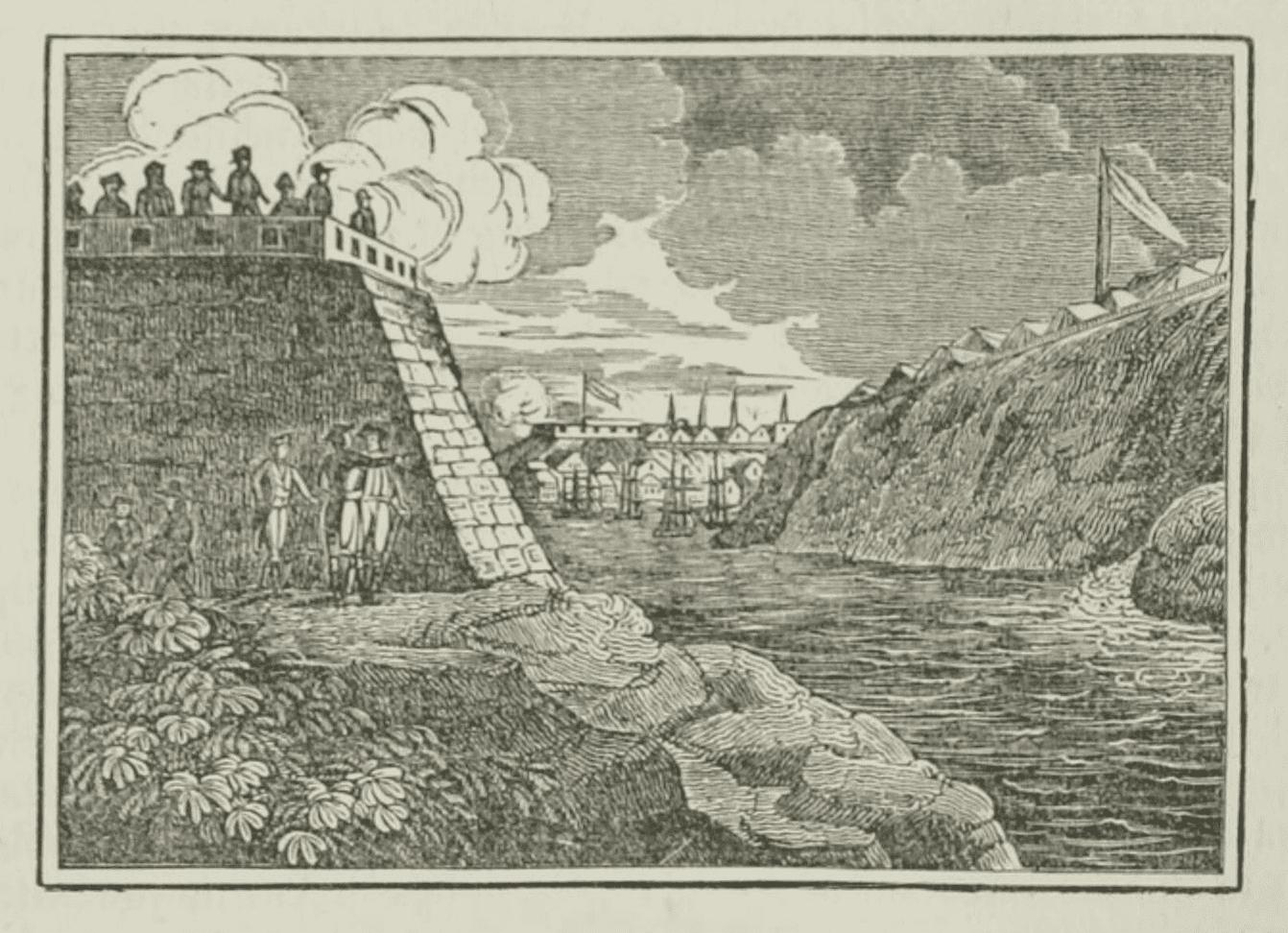
Siege of Quebec.
Convinced of the impossibility of reducing the place, unless he could erect batteries on the north side of the St. Lawrence, Wolfe soon decided on more daring measures. The northern shore of the St. Lawrence, to a considerable distance above Quebec, is so bold and rocky as to render a landing in the face of an enemy impracticable. If an attempt were made below the town, the river Montmorency passed, and the French driven from their entrenchments, the St. Charles would present a new, and perhaps an insuperable barrier. With every obstacle fully in view, Wolfe, heroically observing that ‘a victorious army finds no difficulties,’ resolved to pass the Montmorency, and bring Montcalm to an engagement. In pursuance of this resolution, thirteen companies of English grenadiers, and part of the second battalion of royal Americans, were landed at the mouth of that river, while two divisions, under generals Townshend and Murray, prepared to cross it higher up. Wolfe’s plan was to attack first a redoubt, close to the water’s edge, apparently beyond reach of the fire from the enemy’s entrenchments, in the belief that the French, by attempting to support that fortification, would put it in his power to bring on a general engagement; or, if they should submit to the loss of the redoubt, that he could afterwards examine their situation with coolness, and advantageously regulate his future operations.
On the approach of the British troops the redoubt was evacuated; and the general, observing some confusion in the French camp, changed his original plan, and determined not to delay an attack. Orders were immediately despatched to the generals Townshend and Murray to keep their divisions in readiness for fording the river; and the grenadiers and royal Americans were directed to form on the beach until they could be properly sustained. These troops, however, not waiting for support, rushed impetuously toward the enemy’s entrenchments; but they were received with so strong and steady a fire from the French musketry, that they were instantly thrown into disorder, and obliged to seek shelter at the redoubt which the enemy had abandoned. Detained here awhile by a dreadful thunder storm, they were still within reach of a severe fire from the French; and many gallant officers, exposing their persons in attempting to form the troops, were killed, the whole loss amounting to nearly five hundred men. The plan of attack being effectually disconcerted, the English general gave orders for repassing the river, and returning to the isle of Orleans.
Compelled to abandon the attack on that side, Wolfe deemed that advantage might result from attempting to destroy the French fleet, and by distracting the attention of Montcalm with continual descents upon the northern shore. General Murray, with twelve hundred men in transports, made two vigorous but abortive attempts to land; and though more successful in the third, he did nothing more than burn a magazine of warlike stores. The enemy’s fleet was effectually secured against attacks, either by land or by water, and the commander-in-chief was again obliged to submit to the mortification of recalling his troops. At this juncture, intelligence arrived that Niagara was taken, that Ticonderoga and Crown Point had been abandoned, but that general Amherst, instead of pressing forward to their assistance, was preparing to attack the Isle-aux-Noix.
While Wolfe rejoiced at the triumph of his brethren in arms, he could not avoid contrasting their success with his own disastrous efforts. His mind, alike lofty and susceptible, was deeply impressed by the disasters at Montmorency; and his extreme anxiety, preying upon his delicate frame, sensibly affected his health. He was observed frequently to sigh; and, as if life was only valuable while it added to his glory, he declared to his intimate friends, that he would not survive the disgrace which he imagined would attend the failure of his enterprise. Nothing, however, could shake the resolution of this valiant commander, or induce him to abandon the attempt. In a council of his principal officers, called on this critical occasion, it was resolved, that all the future operations should be above the town. The camp at the isle of Orleans was accordingly abandoned; and the whole army having embarked on board the fleet, a part of it was landed at point Levi, and a part higher up the river. Montcalm, apprehending from this movement that the invaders might make a distant descent and come on the back of the city of Quebec, detached M. de Bougainville with fifteen hundred men, to watch their motions, and prevent their landing.
Baffled and harassed in all his previous assaults, general Wolfe seems to have determined to finish the enterprise by a single bold and desperate effort. The admiral sailed several leagues up the river, making occasional demonstrations of a design to land troops; and, during the night, a strong detachment in flat-bottomed boats fell silently down with the stream, to a point about a mile above the city. The beach was shelving, the bank high and precipitous, and the only path by which it could be scaled, was now defended by a captain’s guard and a battery of four guns. Colonel Howe, with the van, soon clambered up the rocks, drove away the guard, and seized upon the battery. The army landed about an hour before day, and by daybreak was marshalled on the heights of Abraham.
Montcalm could not at first believe the intelligence; but, as soon as he was assured of its truth, he made all prudent haste to decide a battle which it was no longer possible to avoid. Leaving his camp at Montmorency, he crossed the river St. Charles with the intention of attacking the English army. No sooner did Wolfe observe this movement, than he began to form his order of battle. His troops consisted of six battalions, and the Louisbourg grenadiers. The right wing was commanded by general Monckton, and the left by general Murray. The right flank was covered by the Louisbourg grenadiers, and the rear and left by Howe’s light infantry. The form in which the French advanced indicating an intention to outflank the left of the English army, general Townshend was sent with the battalion of Amherst, and the two battalions of royal Americans, to that part of the line, and they were formed en potence, so as to present a double front to the enemy. The body of reserve consisted of one regiment, drawn up in eight divisions, with large intervals. The dispositions made by the French general were not less masterly. The right and left wings were composed about equally of European and colonial troops. The centre consisted of a column, formed of two battalions of regulars. Fifteen hundred Indians and Canadians, excellent marksmen, advancing in front, screened by surrounding thickets, began the battle. Their irregular fire proved fatal to many British officers, but it was soon silenced by the steady fire of the English.
About nine in the morning the main body of the French advanced briskly to the charge, and the action soon became general. Montcalm having taken post on the left of the French army, and Wolfe on the right of the English, the two generals met each other where the battle was most severe. The English troops reserved their fire until the French had advanced within forty yards of their line, and then, by a general discharge, made terrible havoc among their ranks. The fire of the English was vigorously maintained, and the enemy everywhere yielded to it. General Wolfe, who, exposed in the front of his battalions, had been wounded in the wrist, betraying no symptom of pain, wrapped a handkerchief round his arm, and continued to encourage his men. Soon after, he received a shot in the groin; but, concealing the wound, he was pressing on at the head of his grenadiers with fixed bayonets, when a third ball pierced his breast.102 The army, not disconcerted by his fall, continued the action under Monckton, on whom the command now devolved, but who, receiving a ball through his body, soon yielded the command to general Townshend. Montcalm, fighting in front of his battalions, received a mortal wound about the same time; and general Senezergus, the second in command also fell.
The British grenadiers pressed on with their bayonets. General Murray, briskly advancing with the troops under his direction, broke the centre of the French army. The Highlanders, drawing their broadswords, completed the confusion of the enemy; and after having lost their first and second in command, the right and centre of the French were entirely driven from the field; and the left was following the example, when Bougainville appeared in the rear, with the fifteen hundred men who had been sent to oppose the landing of the English. Two battalions and two pieces of artillery were detached to meet him; but he retired, and the British troops were left the undisputed masters of the field. The loss of the French was much greater than that of the English. The corps of French regulars was almost entirely annihilated. The killed and wounded of the English army did not amount to six hundred men. Although Quebec was still strongly defended by its fortifications, and might possibly be relieved by Bougainville, or from Montreal, yet general Townshend had scarcely finished a road in the bank to get up his heavy artillery for a siege, when the inhabitants capitulated, on condition that during the war they might still enjoy their own civil and religious rights. A garrison of five thousand men was left under general Murray, and the fleet sailed out of the St. Lawrence.
The fall of Quebec did not immediately produce the submission of Canada. The main body of the French army, which, after the battle on the plains of Abraham, retired to Montreal, and which still consisted of ten battalions of regulars, had been reinforced by six thousand Canadian militia, and a body of Indians. With these forces M. de Levi, who had succeeded the marquis de Montcalm in the chief command, resolved to attempt the recovery of Quebec. He had hoped to carry the place by a coup de main during the winter; but, on reconnoitring, he found the outposts so well secured, and the governor so vigilant and active, that he postponed the enterprise until spring. In the month of April, when the upper part of the St. Lawrence was so open as to admit a transportation by water, his artillery, military stores, and heavy baggage, were embarked at Montreal, and fell down the river under convoy of six frigates; and M. de Levi, after a march of ten days, arrived with his army at Point au Tremble, within a few miles of Quebec.
General Murray, to whom the care of maintaining the English conquest had been intrusted, had taken every precaution to preserve it; but his troops had suffered so much by the extreme cold of the winter, and by the want of vegetables and fresh provisions, that instead of five thousand, the original number of his garrison, there were not at this time above three thousand men fit for service. With this small but valiant body he resolved to meet the enemy in the field; and on the 28th of April marched out to the heights of Abraham, where, near Sillery, he attacked the French under M. de Levi with great impetuosity. He was received with firmness; and, after a fierce encounter, finding himself outflanked, and in danger of being surrounded by superior numbers, he called off his troops, and retired into the city. In this action the loss of the English was near a thousand men, and that of the French still greater. The French general lost no time in improving his victory. On the very evening of the battle he opened trenches before the town, but it was the 11th of May before he could mount his batteries, and bring his guns to bear on the fortifications. By that time general Murray, who had been indefatigable in his exertions, had completed some outworks, and planted so numerous an artillery on his ramparts, that his fire was very superior to that of the besiegers, and in a manner silenced their batteries. A British fleet most opportunely arriving a few days after, M. de Levi immediately raised the siege, and precipitately retired to Montreal. Here the marquis de Vaudreuil, governor-general of Canada, had fixed his head-quarters, and determined to make his last stand. For this purpose he called in all his detachments, and collected around him the whole force of the colony.
The English, on the other hand, were resolved upon the utter annihilation of the French power in Canada; and general Amherst prepared to overwhelm it with an irresistible superiority of numbers. Almost on the same day, the armies from Quebec, from lake Ontario, and from lake Champlain, were concentrated before Montreal; a capitulation was immediately signed; Detroit, Michilimackinac, and, indeed, all New France, surrendered to the English. The French troops were to be carried home; and the Canadians to retain their civil and religious privileges.
The history of modern Europe, with whose destiny that of the colonies was closely interwoven, may be designated as the annals of an interminable war. Her sovereigns, ever having the oily words of peace on their lips, have seldom had recourse to the olive branch but as the signal of a truce, the duration of which should be coeval with the reinvigoration of military strength. It was thus with France on the present occasion. Equally unsuccessful on both continents, and exhausted by her strenuous and continued efforts, she was at length induced to make overtures of peace; and every thing seemed to be in a fair train for adjustment, when the treaty was suddenly broken off by an attempt of the court of Versailles to mingle the politics of Spain and of Germany with the disputes between France and Great Britain. A secret family compact between the Bourbons to support each other through evil and good, in peace and in war, had rendered Spain desirous of war, and induced France once more to try her fortune. As the interests of the two nations were now identified, it only remained for England to make a formal declaration of hostility against Spain. The colonies of New England, being chiefly interested in the reduction of the West India islands, furnished a considerable body of troops to carry on the war. A large fleet was despatched from England; the land forces amounted to sixteen thousand; and before the end of the second year, Great Britain had taken the important city of Havannah, the key of the Mexican gulf, together with the French provinces of Martinique Grenada, St. Lucia, St. Vincent, and the Caribbee islands.
The progress of the British conquests, which threatened all the remaining colonial possessions of their opponents, was arrested by preliminary articles of peace, which, towards the close of 1762, were interchanged at Fontainbleau between the ministers of Great Britain, France, and Spain. On the 10th of February in the following year, a definitive treaty of peace was signed at Paris, and soon after ratified. France ceded to Great Britain all the conquests which the latter had made in North America; and it was stipulated between the two crowns, that the boundary line of their respective dominions in the new hemisphere should run along the middle of the Mississippi, from its source as far as the Iberville, and along the middle of that river, and of lakes Maurepas and Pontchartrain.
Thus terminated a war, which originated in an attempt on the part of the French to surround the English colonists, and chain them to a narrow strip of country along the coast of the Atlantic; and ended with their giving up the whole of what was then their only valuable territory in North America. The immediate advantage the colonies derived from the successful issue of the contest was great and apparent. Although, for a short period after the conquest of Canada had been effected, they were subject to attacks from the Indian tribes attached to the French, and also from the Cherokees on their south-western borders, they were soon enabled to visit their cruelties with severe retribution, and to procure a lasting repose, as the Indians had no forts to which to repair for protection or aid. But the indirect results, though almost unperceived at first, were far more important, and prepared the way for those momentous efforts which issued in the loss to Great Britain of the fairest portion of her colonies, and the establishment of her vassal as a rival. The colonists became inured to the habits and hardships of a military life, and skilled in the arts of European warfare; while the desire of revenge for the loss of Canada, which France did not fail to harbor, was preparing for them a most efficient friend, and making way for the anomalous exhibition of a despotic sovereign exerting all his power in the cause of liberty and independence.
COMMENCEMENT OF THE REVOLUTION.
Our limits will not permit us to enter into any speculations as to the remote origin of the American revolution. The immediate and exciting causes of the spirit of opposition to the government were twofold; the rigorous execution of the navigation laws, which destroyed a most important and profitable, though contraband and illegal trade; and the assertion by the British parliament of its right to tax the colonies. The latter so speedily followed the former, and afforded so preferable a ground on which to make a stand, that the navigation laws were seldom exhibited as one of the chief grievances; although, had not the stamp act and other similar measures been brought forward, the laws affecting the trade of the colonies would inevitably have excited the same opposition.
The attempt to hold a people, circumstanced as were the American colonists, under the legislation of Great Britain, was as irrational as it was unjust. Financial embarrassments called forth the erroneous policy into action, which, as often happens in private life, deeply aggravated the evil it was designed to remedy; and the attempt to wring a few thousands per annum from the colonists, terminated in plunging Great Britain into debt, and in depriving her of an immense territory, which, under a just and liberal management, might still have continued one of the most illustrious appendages of the British crown.
Plans of laying internal taxes, and of drawing a revenue from the colonies, had been at various times suggested to the ministry, and particularly to Sir Robert Walpole. This statesman, however, was too wise and sagacious to adopt them. ‘I will leave the taxation of the Americans,’ Walpole answered, ‘for some of my successors, who may have more courage than I have, and be less friendly to commerce than I am. It has been a maxim with me,’ he added, ‘during my administration, to encourage the trade of the American colonies to the utmost latitude; nay, it has been necessary to pass over some irregularities in their trade with Europe; for, by encouraging them to an extensive and growing foreign commerce, if they gain five hundred thousand pounds, I am convinced that, in two years afterwards, full two hundred and fifty thousand of this gain will be in his majesty’s exchequer by the labor and product of this kingdom, as immense quantities of every kind of our manufactures go thither; and as they increase in the foreign American trade, more of our produce will be wanted. This is taxing them more agreeably to their own constitution and laws.’ The first Pitt, also, in his celebrated speech on the repeal of the stamp act, referring to the conduct of the several preceding administrations, says, ‘None of these thought, or even dreamed, of robbing the colonies of their constitutional rights. That was reserved to mark an era of the late administration; not that there were wanting some, when I had the honor to serve his majesty, to propose to me to burn my fingers with an American stamp act. With the enemy at their back, with our bayonets at their breasts, in the day of their distress, perhaps the Americans would have submitted to the imposition; but it would have been taking an ungenerous and unjust advantage.’
Whatever might have been the views or wishes of any individual of the British cabinet, at any period, relative to drawing a revenue directly from the colonies, no one had been bold enough to make the attempt until after the reduction of the French power in America. This was deemed a favorable moment to call upon the Americans for taxes, to assist in the payment of a debt, incurred, as was alleged, in a great measure, for their protection against a powerful enemy, now no longer an object of their dread.103 A British statesman should have reflected, that, if the Americans were relieved from the dread of their ancient enemy, they no longer required the protection of the parent country against that enemy; and that the strongest hold on their dependence was gone when Canada was gained.
The conquest of Canada had scarcely been effected, when rumors were extensively prevalent that a different system of government was about to be adopted by the parent state; that the charters would be taken away, and the colonies reduced to royal governments. The officers of the customs began to enforce with strictness all the acts of parliament regulating the trade of the colonies, several of which had been suspended, or had become obsolete. Governor Bernard, of Massachusetts, who was always a supporter of the royal prerogative, appears to have entered fully into these views, and to have indicated, by his appointment of confidential advisers, that his object would be to extend the power of the government to any limits which the ministry might require. The first demonstration of the new course intended to be pursued, was the arrival of an order in council to carry into effect the acts of trade, and to apply to the supreme judicature of the province for writs of assistance, to be granted to the officers of the customs. According to the ordinary course of law, no searches or seizures can be made without a special warrant, issued upon probable cause, supported by oath or affirmation, particularly designating the place to be searched and the goods to be seized. But the writ of assistance was to command all sheriffs and other civil officers to assist the person to whom it was granted in breaking open and searching every place where he might suspect any prohibited or uncustomed goods to be concealed. It was a sort of commission, during pleasure, to ransack the dwellings of the citizens, for it was never to be returned, nor any account of the proceedings under it rendered to the court whence it issued. Such a weapon of oppression in the hands of the inferior officers of the customs might well alarm even innocence, and confound the violators of the law.
The mercantile part of the community united in opposing the petition, and was in a state of great anxiety as to the result of the question. The officers of the customs called upon Mr. Otis for his official assistance, as advocate-general, to argue their cause: but as he believed these writs to be illegal and tyrannical, he resigned the situation, though very lucrative, and if filled by a compliant spirit, leading to the highest favors of government. The merchants of Salem and Boston applied to Otis and Thacher, who engaged to make their defence. The trial took place in the council chamber of the old town-house, in Boston. The judges were five in number, including lieutenant governor Hutchinson, who presided as chief justice; and the room was filled with all the officers of government and the principal citizens, to hear the arguments in a cause that inspired the deepest solicitude. The case was opened by Mr. Gridley, who argued it with much learning, ingenuity, and dignity, urging every point and authority that could be found, after the most diligent search, in favor of the custom-house petition; making all his reasoning depend on this consideration,—‘if the parliament of Great Britain is the sovereign legislator of the British empire.’ He was followed by Mr. Thacher on the opposite side, whose reasoning was ingenious and able, delivered in a tone of great mildness and moderation. ‘But,’ in the language of president Adams, ‘Otis was a flame of fire; with a promptitude of classical allusion, a depth of research, a rapid summary of historical events and dates, a profusion of legal authorities, a prophetic glance into futurity, and a rapid torrent of impetuous eloquence, he hurried away all before him. American independence was then and there born. The seeds of patriots and heroes to defend the Non sine Diis animosus infans, to defend the vigorous youth, were then and there sown. Every man of an immense crowded audience appeared to me to go away as I did, ready to take arms against writs of assistance. Then and there was the first scene of the first act of opposition to the arbitrary claims of Great Britain. Then and there the child Independence was born. In fifteen years, i. e. in 1776, he grew up to manhood and declared himself free.’104
In consequence of this argument, the popularity of Otis was without bounds, and at the next election he was for the first time chosen a member of the house of representatives, by an almost unanimous vote. Some idea of the state of public sentiment at that period may be derived from the following remarkable language of the governor, in his speech at the commencement of the session. ‘Let me recommend to you to give no attention to declamations tending to promote a suspicion of the civil rights of the people being in danger. Such harangues might suit well in the times of Charles and James, but in the times of the Georges they are groundless and unjust. Since the accession of the first George, there has been no instance of the legal privileges of any corporate body being attacked by any of the king’s ministers or servants, without public censure ensuing. His present majesty has given uncommon assurances how much he has at heart the preservation of the liberty, rights, and privileges of all his subjects. Can it be supposed that he can forfeit his word; or that he will suffer it to be forfeited by the acts of any servant of his with impunity? An insinuation so unreasonable and injurious I am sure will never be well received among you.’
In the following session governor Bernard informed the house of representatives, that, during the recess of the legislature, he had appropriated a small sum towards fitting out the sloop Massachusetts to protect the fishery. The committee appointed to prepare an answer reported to the house a message, in which, after desiring his excellency to restore the sloop to her former condition, they add, ‘Justice to ourselves and to our constituents obliges us to remonstrate against the method of making or increasing establishments by the governor and council. It is in effect taking from the house their most darling privilege, the right of originating all taxes. It is, in short, annihilating one branch of the legislature. And when once the representatives of a people give up this privilege, the government will very soon become arbitrary. No necessity, therefore, can be sufficient to justify a house of representatives in giving up such a privilege; for it would be of little consequence to the people whether they were subject to George or Louis, the king of Great Britain or the French king, if both were arbitrary, as both would be if both could levy taxes without parliament.’ ‘Treason, treason!’ cried one of the members when these words were read; but the report was accepted, and the message sent unaltered to the governor. The same day he returned it, accompanied by a letter requesting that a part of it might be expunged, as disrespectful to the king. It was then proposed to insert an amendment in the message, expressive of loyalty; but a certain member crying ‘Rase them, rase them,’ the obnoxious words, which had been underlined by the governor, were erased; ‘it being obvious that the remonstrance would be the same in effect with or without them.’ The governor sent a vindication of his conduct to the house, and prorogued the assembly before there was time to answer it.
The year 1764 was prolific in measures calculated to agitate and arouse the spirit of the Americans. Early in March an act was passed, which declared that the bills which had been issued by the several colonial governments, should no longer be regarded as legal currency; an enactment which, although in some cases it might have the beneficial effect of preventing an injurious excess of paper, was very prejudicial to the interests, as well as galling to the feelings, of the colonists. On the 10th of March the house of commons passed eighteen resolutions for imposing taxes and duties on the colonies. The execution of that which declared that it might be proper to impose certain stamp duties on them, was deferred to the next session; but the others were immediately enforced by ‘An Act for granting certain Duties in America;’ which, after stating that it was just and expedient to raise a revenue there, imposed duties on silks and colored calicoes from Persia, India, or China, and on sugar, wines, coffee, and pimento, made the sugar and molasses act perpetual, reducing the duty on molasses from six-pence to three-pence per gallon; and this for the express and sole purpose of raising a revenue. The same act increased the number of enumerated commodities, laid new and harsh restrictions on commerce, re-enacted many of the obsolete laws of trade, and provided that all penalties and forfeitures, accruing under any of them, might be sued for, at the election of the informer, in any court of record or of admiralty, or in that of vice-admiralty to be established over all America. The declaration which was made, that all these duties should be devoted to the maintenance of an army for the defence of the colonies, was by no means satisfactory: it was indeed urged by the ministry, to prove to Americans that the money which was raised from them would ultimately be spent again among their own inhabitants; but the colonists sagaciously conjectured, that now they had no other enemy than a few exhausted tribes of Indians, there must be some other design than that of defence in maintaining a standing army among them; and they could attribute the plan to no other source than a desire on the part of the ministry to secure the destruction of their liberties by military force.
The direct assertion by the British parliament of its right to tax the colonies, accompanied, as it evidently was, by a determination to carry the principle into almost immediate effect, excited the most extensive clamor and agitation, not only among individuals, but in the minds of the constituted authorities. ‘Taxation without representation is tyranny,’ was the universal watchword; the proposed exaction was everywhere the topic of conversation, and the subject of the severest animadversion. Every day beheld the affection of the Americans for the parent country sensibly diminish, while the disposition to resist by force was silently but effectually fostered. Several of the provincial assemblies sent instructions to their agents in London to employ every means to prevent the obnoxious measure being carried into effect.
The people of Boston, at their meeting in May, instructed their representatives to the general court on this important subject. In these instructions, (which were drawn up by Samuel Adams, one of the committee appointed for that purpose,) after commenting on the sugar and molasses act, they proceed to observe: ‘But our greatest apprehension is, that these proceedings may be preparatory to new taxes; for if our trade may be taxed, why not our lands? why not the products of our lands, and every thing we possess or use? This, we conceive, annihilates our charter rights to govern and tax ourselves. It strikes at our British privileges which, as we have never forfeited, we hold in common with our fellow-subjects who are natives of Britain. If taxes are laid upon us, in any shape, without our having a legal representation where they are laid, we are reduced from the character of free subjects, to the state of tributary slaves. We, therefore, earnestly recommend it to you to use your utmost endeavors to obtain from the general court all necessary advice and instruction to our agent, at this most critical juncture. We also desire you to use your endeavors that the other colonies, having the same interests and rights with us, may add their weight to that of this province; that by united application of all who are aggrieved, all may obtain redress.’
This was the first act in the colonies, in opposition to the ministerial plans of drawing a revenue directly from America; and it contained the first suggestion of the propriety of that mutual understanding and correspondence among the colonies, which laid the foundation of their future confederacy. The house of representatives of Massachusetts, in June following, declared, ‘That the sole right of giving and granting the money of the people of that province, was vested in them, or their representatives, and that the imposition of duties and taxes by the parliament of Great Britain upon a people not represented in the house of commons, is absolutely irreconcilable with their rights; that no man can justly take the property of another, without his consent; upon which original principles, the power of making laws for levying taxes, one of the main pillars of the British constitution, is evidently founded.’ The same sentiments are expressed, though in stronger language, in their letter of instructions to their agent. ‘If the colonists are to be taxed at pleasure,’ they say, ‘without any representatives in parliament, what will there be to distinguish them, in point of liberty, from the subjects of the most absolute prince? If we are to be taxed at pleasure, without our consent, will it be any consolation to us, that we are to be assessed by a hundred instead of one? If we are not represented, we are slaves.’ The house, also, at the same time, appointed a committee, to sit during the recess of the court, to write to the other colonies, requesting them to join in applying for a repeal of the sugar act, and in endeavoring to prevent the passage of the act laying stamp duties, or any other act imposing taxes on the American provinces.
In addition to the acts and declarations of the colonial legislatures, various individuals enlightened and animated the colonists by numerous publications both in the newspapers and by separate pamphlets. Among the latter, ‘The Rights of the Colonists asserted and proved,’ by Mr. Otis, and ‘The Sentiments of a British American,’ by Oxenbridge Thacher, were particularly distinguished. Mr. Otis, among other things, declared, ‘That the imposition of taxes, whether on trade or on land, on houses or ships, on real or personal, fixed or floating property in the colonies, is absolutely irreconcilable with the rights of the colonists, as British subjects and as men.’ On the subject of the sugar and molasses act, Mr. Thacher stated his objections, the first of which was, ‘That a tax was thereby laid on several commodities, to be raised and levied in the plantations, and to be remitted home to England. This is esteemed,’ he said ‘a grievance, inasmuch as the same are laid without the consent of the representatives of the colonists. It is esteemed an essential British right, that no man shall be subject to any tax but what, in person or by his representative, he hath a voice in laying.’
In the winter of 1765, at the request of the other agents of the colonies Dr. Franklin, Jared Ingersoll, Mr. Jackson, and Mr. Garth, had a conference with Mr. Grenville, on the subject of the stamp duty. Mr. Ingersoll was from Connecticut, and had been requested to assist Mr. Jackson in any matters relating to that colony; Mr. Garth was agent for South Carolina, and he and Mr. Jackson were members of parliament. These gentlemen, and particularly Dr. Franklin and Mr. Ingersoll, informed the minister of the great opposition to the proposed tax in America, and most earnestly entreated him, that if money must be drawn from the colonies by taxes, to leave it with the colonists to raise it among themselves in such manner as they should think proper, and best adapted to their circumstances and abilities. Dr. Franklin informed the minister, that the legislature of Pennsylvania had by a resolution declared, ‘That as they always had, so they always should, think it their duty to grant aids to the crown, according to their abilities, whenever required of them in the usual constitutional way.’
Neither the remonstrances of the colonists, however, nor the entreaties of their agents, were of any avail with the ministry or parliament. The bill for laying the stamp and other duties was soon brought before the house, and petitions from the colonies of Virginia, Connecticut, and South Carolina, were offered in opposition to it. The house, however, refused to receive them; in the first place, because they questioned or denied the right of parliament to pass the bill; and in the second place, because it was contrary to an old standing rule of the house,—‘that no petition should be received against a money bill.’ The majority against receiving the petitions was very large, and those from the other colonies were not offered. The petition from New York was expressed in such strong language, that no member of the house could be prevailed upon to present it. The admirable speech of colonel Barré in reply to Charles Townshend, so familiar to all of us, although it produced a profound impression, did not of course defeat the measure; and the colonial petitions and remonstrances, with the petition of the London merchants trading to America, were equally unavailing. In the house of commons there were about two hundred and fifty for, and only fifty against it. In the lords it passed without debate, with entire unanimity; and on the 22d of March it obtained the royal assent.
This enactment, which was to come into operation on the 1st of November, excited the most serious alarm throughout the colonies. It was viewed as a violation of the British constitution, and as destructive of the first principles of liberty; and combinations against its execution were everywhere formed. The house of burgesses in Virginia, which was in session when intelligence of the act was received, passed several spirited resolutions, asserting the colonial rights, and denying the claim of parliamentary taxation. The resolutions were introduced into the Virginia assembly by the eloquent Patrick Henry, who, on the envelope of a copy of them in his own hand-writing, has given the following interesting particulars: ‘They formed,’ says Mr. Henry, ‘the first opposition to the stamp act, and the scheme of taxing America by the British parliament. All the colonies, either through fear, or want of opportunity to form an opposition, or from influence of some kind or other, had remained silent. I had been for the first time elected a burgess a few days before, was young inexperienced, unacquainted with the forms of the house, and the members that composed it. Finding the men of weight averse to opposition, and the commencement of the tax at hand, and that no person was likely to step forth, I determined to venture; and alone, unadvised, and unassisted on a blank leaf of an old law book wrote the within. Upon offering them to the house, violent debates ensued. Many threats were uttered, and much abuse cast on me, by the party for submission. After a long and warm contest, the resolutions passed by a very small majority, perhaps of one or two only. The alarm spread throughout America with astonishing quickness, and the ministerial party were overwhelmed. The great point of resistance to British taxation was universally established in the colonies. This brought on the war, which finally separated the two countries, and gave independence to ours. Whether this will prove a blessing or a curse, will depend upon the use our people make of the blessings which a gracious God hath bestowed on us. If they are wise, they will be great and happy. If they are of a contrary character, they will be miserable. Righteousness alone can exalt them as a nation.’
‘It was in the midst of this magnificent debate,’ says his biographer, Mr. Wirt, ‘while he was descanting on the tyranny of the obnoxious act, that he exclaimed in a voice of thunder, “Cæsar had his Brutus—Charles the First his Cromwell—and George the Third”—(“Treason,” cried the speaker; “Treason, treason,” echoed from every part of the house: it was one of those trying moments which are decisive of character. Henry faltered not for an instant; but rising to a loftier attitude, and fixing on the speaker an eye of the most determined fire, he finished his sentence with the firmest emphasis,)—“may profit by their example. If this be treason, make the most of it.”’
In the province of Massachusetts the dissatisfaction at the passing the stamp act was strong, and was strongly manifested. On the meeting of the legislature in May, it was recommended that there should be an early meeting of committees from the houses of representatives or burgesses in the several colonies, to consult together on their grievances and devise some plan for their relief. In accordance with the views of the Massachusetts legislature, the proposed convention was held at New York in October, and consisted of twenty-eight delegates from the assemblies of the colonies, excepting the assemblies of Virginia, North Carolina, and Georgia, which were either not in session, or were otherwise prevented from sending representatives. Timothy Ruggles of Massachusetts was chosen president. A declaration of rights and grievances was adopted. A petition to the king, and a memorial to each house of parliament were also agreed on; and it was recommended to the several colonies to appoint special agents, who should unite their utmost endeavors in soliciting redress.
The populace in various parts of the colonies were unwilling to wait for the effect of the constitutional measures their representatives were adopting. One day in the month of August the effigy of Andrew Oliver, the proposed distributor of stamps in Massachusetts, was found hanging on a tree, afterwards well known by the name of Liberty tree, in the main street of Boston. At night it was taken down, and carried on a bier, amidst the acclamations of an immense collection of people, through the court-house, down King street, to a small brick building, supposed to have been erected for the reception of the detested stamps. This building being soon levelled with the ground, the rioters next attacked Mr. Oliver’s house, and having broken the windows, entered it, and destroyed part of the furniture. The next day, however, Mr. Oliver authorized several gentlemen to announce on the exchange, that he had declined having any concern with the office of stamp master; but in the evening a bonfire was made, and a repetition of this declaration exacted of him. On the 26th the tumults were renewed. The rioters assembled in King street, and proceeded to the house of the deputy register of the court of admiralty, whose private papers, as well as the records and files of the court, were destroyed. The house of Benjamin Hallowell, jun., comptroller of the customs, was next entered; and elevated and emboldened by liquors found in his cellar, the mob, with inflamed rage, directed their course to the house of lieutenant-governor Hutchinson, who, after vainly attempting resistance, was constrained to depart to save his life. By four in the morning one of the best houses in the province was completely in ruins, nothing remaining but the bare walls and floors. The plate, family pictures, most of the furniture, the wearing apparel, about nine hundred pounds sterling, and the manuscripts and books which Mr. Hutchinson had been thirty years collecting, besides many public papers in his custody, were either carried off or destroyed. The whole damage was estimated at two thousand five hundred pounds.105
The town of Boston the next day voted unanimously, that the selectmen and magistrates be desired to use their utmost endeavors, agreeably to law, to suppress the like disorders for the future, and that the freeholders and other inhabitants would do every thing in their power to assist them. The officer appointed to receive the stamped paper, which was daily expected, having resigned his commission, the governor determined to receive the paper into his own charge at the castle; and, by advice of council, he ordered the enlistment of a number of men to strengthen the garrison. This caused great murmur among the people. To pacify them he made a declaration in council, that he had no authority to open any of the packages, or to appoint a distributor of stamps; that his views in depositing the stamped paper in the castle, and in strengthening the garrison there, were to prevent imprudent people from offering an insult to the king; and to save the town, or province, as it might happen, from being held to answer for the value of the stamps, as they certainly would be if the papers should be taken away. This declaration the council desired him to publish, but it did not stop the clamor. He was forced to stop the enlistment, and to discharge such men as had been enlisted. The first day of November, on which the stamp act was to begin its operation, was ushered in at Boston by the tolling of bells; many shops and stores were shut; and effigies of the authors and friends of that act were carried about the streets, and afterwards torn in pieces by the populace.
Nor was Massachusetts alone;—the obnoxious act received similar treatment in the other colonies. On the 24th of August a gazette extraordinary was published at Providence, with Vox Populi vox Dei, for a motto; effigies were exhibited, and in the evening cut down and burnt. Three days afterwards, the people of Newport conducted effigies of three obnoxious persons in a cart, with halters about their necks, to a gallows near the town-house, where they were hung, and after a while cut down and burnt amidst the acclamations of thousands. On the last day of October, a body of people from the country approached the town of Portsmouth, (New Hampshire,) in the apprehension that the stamps would be distributed; but on receiving assurance that there was no such intention, they quietly returned. All the bells in Portsmouth, Newcastle, and Greenland, were tolled, to denote the decease of Liberty; and in the course of the day, notice was given to her friends to attend her funeral. A coffin, neatly ornamented, and inscribed with ‘LIBERTY, aged CXLV. years,’ was prepared for the funeral procession, which began from the state-house, attended with two unbraced drums; minute guns were fired until the corpse arrived at the grave, when an oration was pronounced in honor of the deceased: but scarcely was the oration concluded, when, some remains of life having been discovered, the corpse was taken up; and the inscription on the lid of the coffin was immediately altered to ‘LIBERTY REVIVED;’ the bells suddenly struck a cheerful sound, and joy appeared again in every countenance. In Connecticut, Mr. Ingersoll, the constituted distributor of stamps, was exhibited and burnt in effigy in the month of August; and the resentment at length became so general and alarming, that he resigned his office.
The spirit manifested by the citizens of New York produced a similar resignation; and the obnoxious act was contemptuously cried about the streets, labelled, ‘The Folly of England and Ruin of America.’ The stamp papers arriving toward the end of October, lieutenant-governor Colden took every precaution to secure them. On the first of November, many of the inhabitants of New York, offended at the conduct and disliking the political sentiments of the governor, having assembled in the evening, broke open his stable, and took out his coach; and after carrying it through the principal streets of the city, marched to the common, where a gallows was erected, on one end of which they suspended his effigy, with a stamped bill of lading in one hand, and a figure of the devil in the other. When the effigy had hung a considerable time, they carried it in procession suspended to the gallows to the gate of the fort, whence it was removed to the bowling green, under the muzzle of the guns, and a bonfire made, in which the whole pageantry, including the coach, was consumed, amidst the acclamations of several thousand spectators. The next day, the people insisting upon having the stamps, it was agreed that they should be delivered to the corporation, and they were deposited in the city hall. Ten boxes of stamps, which arrived subsequently, were committed to the flames.
At Philadelphia, on the appearance of the ships having the stamps on board, all the vessels in the harbor hoisted their colors half-mast high, the bells were muffled, and continued to toll until evening. The body of Quakers, with a part of the church of England and of the Baptists, seemed inclined to submit to the stamp act; but great pains were taken to engage the Dutch and the lower class of people in the opposition, and Mr. Huges, the stamp master, found it necessary at length to resign. In Maryland, Mr. Hood, the stamp distributor for that colony, to avoid resigning his office, fled to New York; but he was constrained by a number of freemen to sign a paper, declaring his absolute and final resignation. In Virginia, when the gentleman who had been appointed distributor of stamps arrived at Williamsburg, he was immediately urged to resign: and the next day he so handsomely declined acting in his office, that he received the acclamations of the people; at night the town was illuminated, the bells were rung, and festivity expressed the universal joy.
Associations had already been formed in the colonies, under the title of the Sons of Liberty, and were composed of some of the most respectable of their citizens. The association in New York held a meeting on the 7th of November, at which it was determined that they would risk their lives and fortunes to resist the stamp act. Notice of this being sent to the Sons of Liberty in Connecticut, an union of the two associations was soon after agreed upon, and a formal instrument drawn and signed; in which, after denouncing the stamp act as a flagrant outrage on the British constitution, they most solemnly pledged themselves to march with their whole force whenever required, at their own proper cost and expense, to the relief of all who should be in danger from the stamp act or its abettors; to be vigilant in watching for the introduction of stamped paper, to consider all who are caught in introducing it as betrayers of their country, and to bring them if possible to condign punishment, whatever may be their rank; to defend the liberty of the press in their respective colonies from all violations or impediments on account of the said act; to save all judges, attorneys, clerks, and others from fines, penalties, or any molestation whatever, who shall proceed in their respective duties without regard to the stamp act; and lastly, to use their utmost endeavors to bring about a similar union with all the colonies on the continent. In pursuance of this plan, circular letters were addressed to the Sons of Liberty in Boston, New Hampshire, and as far as South Carolina, and the proposal was received with almost universal enthusiasm.
Societies were formed also in most of the colonies, including females, and those of the highest rank and fashion, of persons who resolved to forego all the luxuries of life, sooner than be indebted for them to the commerce of England under the restrictions imposed upon it by parliament. These societies denied themselves the use of all foreign articles of clothing; carding, spinning, and weaving became the daily employment of ladies of fashion; sheep were forbidden to be used as food, lest there should not be found a sufficient supply of wool; and to be dressed in a suit of homespun was to possess the surest means of popular distinction. So true were these patriotic societies to their mutual compact, that the British merchants and manufacturers soon began to feel the necessity of uniting with the colonies in petitioning parliament for the repeal of the obnoxious law; and the table of the minister was loaded with petitions and remonstrances from most of the manufacturing and mercantile towns in the kingdom.
PROGRESS OF THE REVOLUTION.
While the colonies were thus brought into a state bordering on insurrection by the injudicious and unjust measures of the Grenville administration, the administration itself was rapidly hastening to its dissolution. George III. had ascended the throne not long after the capture of Quebec and in the following October, the patriot Pitt, who had devised and executed the grand scheme of expelling the French from North America, resigned the seals of office. Lord Bute, who appears to have been a personal friend of the new king, was appointed Mr. Pitt’s successor; and under his brief administration the peace of Paris was concluded. He was succeeded by Mr. Grenville, whose name will always bear an unhappy notoriety as the author of the stamp act; and whose measures have formed the subject of the preceding division. However the king might approve his political sentiments, and the king was a decided tory, Grenville was not personally in favor with his majesty; and the result was, (after some unsuccessful negotiation with Mr. Pitt, who expressed his unwillingness to go to St. James’ ‘without he could carry the constitution along with him,’) the formation of the Rockingham administration.
On the twenty-second of February, 1766, a bill was introduced in the house of commons for a repeal of the stamp act. The mover of the bill was general Conway, the same individual who in the first instance had denied the authority of parliament to impose it. On the proposed repeal a warm and interesting debate ensued, and it was finally carried by a large majority. In the upper house it was carried by a vote of one hundred and five to seventy-one.
On the 19th of March, his majesty went to the house of peers, and passed the bill for repealing the American stamp act, as also that for securing the dependency of the colonies on the British crown. On this occasion the American merchants made a most numerous appearance to express their gratitude and joy; ships in the river displayed their colors; the city was illuminated; and every method was adopted to demonstrate the sense entertained of the wisdom of parliament in conciliating the minds of the people on this critical occasion. In America, the intelligence was received with acclamations of the most sincere and heart-felt gratitude by all classes of people. Public thanksgivings were offered up in all the churches. The resolutions which had been passed on the subject of importations were rescinded, and their trade with the mother country was immediately renewed with increased vigor. The homespun dresses were given to the poor, and once more the colonists appeared clad in the produce of British looms.
The administration of the marquis of Rockingham terminated in July, 1766, and a new ministry was formed, under the direction of Mr. Pitt, composed of men of different political principles and parties. The duke of Grafton was placed at the head of the treasury; lord Shelburne was joined with general Conway, as one of the secretaries of state; Charles Townshend was made chancellor of the exchequer; Camden lord chancellor; Pitt had the privy seal, and was made a peer, with the title of the earl of Chatham; and lord North and George Cooke were joint paymasters. Under this chequered administration, the scheme of taxing America was revived. In May, 1767, the new chancellor of the exchequer submitted a plan of this kind to parliament. Charles Townshend was a man of genius and talents, but of high passions, eccentric, and versatile. He had warmly supported Grenville in the passage of the stamp act, and had voted with the marquis of Rockingham in its repeal. The ex-minister Grenville may indeed be considered the real author of the second plan for taxing the colonies, for he was ever urging the subject on the new ministers.106
The measure proposed by Townshend to the house was for imposing duties on glass, paper, pasteboard, white and red lead, painters’ colors, and tea, imported into the colonies. The preamble declared, ‘that it was expedient to raise a revenue in America, and to make a more certain and adequate provision for defraying the charge of the administration of justice and the support of the civil government in the provinces, and for defraying the expenses of defending, protecting, and securing them.’ The earl of Chatham was then confined by sickness in the country; the bill passed both houses without much opposition, and on the 29th of June received the royal assent.
The conduct of the assemblies of Massachusetts and New York had given great dissatisfaction in Great Britain. The refusal of the assembly of the latter to comply with the requisitions of the mutiny act, in particular, had excited the indignation of the ministry and parliament to such a degree, that three days after the passage of the new tax bill an act was passed restraining the legislature of that province from passing any act whatever, until they had furnished the king’s troops with all the articles required by the mutiny act. The ministry at the same time determined to establish a new board of custom-house officers in America. An act was therefore passed, enabling the king to put the customs and other duties in America, and the execution of the laws relating to trade there, under the management of commissioners to be appointed for that purpose, and to reside in the colonies. This, as the preamble declares, would ‘tend to the encouragement of commerce, and to better securing the rates and duties, and the more speedy and effectual collection thereof.’ These three acts arrived in America about the same time.
The appropriation of the new duties to the support of crown officers and to the maintenance of troops in America, was a subject of serious complaint. It had long been a favorite object of the British cabinet to establish in the colonies a fund, from which the salaries of the governors, judges, and other officers of the crown, should be paid, independent of the annual grants of the colonial legislatures. As these officers held their places during the pleasure of the king, the people of Massachusetts, it will be remembered, had uniformly resisted such establishment, though repeatedly urged on the part of the crown. On this subject the house of representatives maintained, in resolutions indicative of great firmness, their former purpose. The house also, during this session, addressed a circular letter to the other colonies, stating the difficulties to be apprehended by the operation of the late acts of parliament, and requesting their co-operation for redress. When the question of addressing a circular to the colonies was first presented to the house it was opposed, as seeming to countenance the meeting of another congress, heretofore so offensive to the British government; and the motion was negatived. The subject was afterwards reconsidered, and the letter so worded as to satisfy a large majority of the house. The other colonies approved of the proceedings of Massachusetts, and joined in applying to the king for relief.
The circular letter of Massachusetts created no little alarm in the British cabinet. Directions were issued by the secretary of state to the governor of this colony, requiring him to demand of the house of representatives a recantation of that offensive measure. This the house peremptorily refused. They viewed the letter of lord Hillsborough as an unwarrantable attempt on their rights; and in their answer to the communication of the governor on this subject, express themselves with no little warmth. ‘If the votes of the house were to be controlled by the direction of a minister,’ they say, ‘we have left us but a shadow of liberty!’ On the question to rescind, Mr. Otis, one of the representatives from Boston, said—‘When lord Hillsborough knows that we will not rescind our acts, let him apply to parliament to rescind theirs. Let Britain rescind their measures, or they are lost forever.’ On receiving information of the decision of the house, the governor immediately dissolved the assembly. This ministerial mandate to the other colonies was equally disregarded.
Americans looked with astonishment at such a system of policy proceeding from a ministry of which lord Chatham constituted a part. They found it impossible to reconcile the conduct now adopted towards them with their ideas of his lordship’s character. They had heretofore regarded him as a friend, in whose honest and liberal principles they might securely trust the management of all that concerned the colonies; but here was a melancholy evidence before their eyes of the insincerity of ministerial professions. In justice to the character of lord Chatham, however, it must be observed, that he was not in parliament during any part of the time that these measures of Mr. Townshend were under discussion. The state of his health was such as not only to detain him from his seat in the house, but to render him incapable of attending to any of the duties of his high station; and it appears that his opinion weighed but little with the men whom he had raised to power.