Chapter XX · —HISTORY. (continued 4)
Reading edition
Charles Townshend, from whom all the troubles and commotions that were now rapidly spreading through the colonies in a great measure originated, did not live to witness their effects. He died in September, 1767, and was succeeded as chancellor of the exchequer by Frederick lord North, a young nobleman, then but little known in the political world, but who will be found to make a conspicuous figure in the sequel of this history. Very soon afterwards, lord Chatham, disgusted at the corrupt influence which manifested itself in every act of the court, and sick of the political world, resigned the privy seal.
The colonists meanwhile were adopting all the peaceable means in their power to show their sense of the wrongs heaped upon them. Petitions, memorials, and remonstrances to the king and parliament, and letters to the individual friends of America, were addressed from all the legislatures; but the most favorable reply which any of them received was an exhortation to suffer with patience and in silence. To suffer tamely, and without seeking redress, however, was not the character of the sturdy sons of freedom who inhabited the colonies. They entered into the same kind of resolutions of non-importation, the effects of which had been so severely felt by the traders in England under the stamp act. Boston, as before, took the lead. At a town meeting held in October, it was voted that measures should be immediately taken to promote the establishment of domestic manufactures, by encouraging the consumption of all articles of American manufacture. They also agreed to purchase no articles of foreign growth or manufacture, but such as were absolutely indispensable. New York and Philadelphia soon followed the example of Boston; and in a short time the merchants themselves entered into associations to import nothing from Great Britain but articles that necessity required.
The new board of commissioners of the customs established at Boston had now entered on the duties of their office. From the great excitement at that place, a collision between the new custom-house officers and the people was by no means improbable. The indignation of the people of Boston was at length excited to open opposition by the seizure of Mr. Hancock’s sloop Liberty, for a violation of the revenue laws. Under the idea that the sloop would not be safe at the wharf in their custody, the custom-house officers had solicited aid from a ship of war which lay in the harbor, the commander of which ordered the sloop to be cut from her fastenings and brought under the guns of his ship. It was to prevent this removal that the mob collected; many of the officers were severely wounded in the scuffle, and the mob, being baffled in their attempts to retain the sloop at the wharf, repaired to the houses of the collector, comptroller, and other officers of the customs, where they committed many acts of violence and injury to their property. This riotous disposition continued for several days, during which the commissioners applied to the governor for assistance, but his excellency not being able to protect them, advised them to remove from Boston; they consequently retired, first on board the Romney man-of-war, and then to castle William. The excitement at Boston was greatly increased about this time by the impressment of some seamen belonging to that town by order of the officers of the Romney. The inhabitants of Boston were assembled on this occasion, and their petition to the governor, praying his interference to prevent such outrages for the future, shows to what a state of alarm, anxiety, and even despair, they were then reduced. ‘To contend,’ they said, ‘against our parent state, is, in our idea, the most shocking and dreadful extremity; but tamely to relinquish the only security we and our posterity retain for the enjoyment of our lives and properties without one struggle, is so humiliating and base, that we cannot support the reflection.’
The general court of Massachusetts having been dissolved by governor Bernard, who refused to convene it again without his majesty’s command, on the proposal of the selectmen of Boston to the several towns in the colony, a convention met in that town on the 22d of September, to deliberate on constitutional measures to obtain redress of their grievances. The convention, disclaiming legislative authority, petitioned the governor; made loyal professions; expressed its aversion to standing armies, to tumults and disorders, its readiness to assist in suppressing riots, and preserving the peace; recommended patience and good order; and, after a short session, dissolved itself.
The day before the convention rose, advice was received that a man-of-war and some transports from Halifax, with about nine hundred troops, had arrived at Nantasket harbor. On the day after their arrival, the fleet was brought to anchor near castle William. Having taken a station which commanded the town, the troops, under cover of the cannon of the ships, landed without molestation, and, to the number of upwards of seven hundred men, marched, with muskets charged, bayonets fixed, martial music, and the usual military parade, into the common. In the evening, the selectmen of Boston were required to quarter the two regiments in the town; but they absolutely refused. A temporary shelter, however, in Faneuil hall, was permitted to one regiment that was without its camp equipage. The next day, the state-house, by order of the governor, was opened for the reception of the soldiers; and, after the quarters were settled, two field-pieces, with the main guard, were stationed just in its front. Every thing was calculated to excite the indignation of the inhabitants. The lower floor of the state-house, which had been used by gentlemen and merchants as an exchange, the representatives-chamber, the court-house, Faneuil hall—places with which were intimately associated ideas of justice and freedom, as well as of convenience and utility—were now filled with troops of the line.
Guards were placed at the doors of the state-house, through which the council must pass in going to their own chamber. The common was covered with tents. Soldiers were constantly marching and countermarching to relieve the guards. The sentinels challenged the inhabitants as they passed. The Sabbath was profaned, and the devotion of the sanctuary disturbed, by the sound of drums and other military music. There was every appearance of a garrisoned town. The colonists felt disgusted and injured, but not overawed, by the presence of such a body of soldiery. After the troops had obtained quarters, the council were required to provide barracks for them, agreeably to act of parliament; but they resolutely declined any measure which might be construed into a submission to that act. In a few weeks several more transports arrived at Boston from Cork, having on board part of the sixty-fourth and sixty-fifth British regiments, under colonels Mackey and Pomeroy.
The general court of Massachusetts was at length convened, on the 31st of May, and their first act was to send a committee to the governor, assuring him of their intention to make a thorough inquiry into the grievances of the people, and to have them redressed; and demanding of his excellency to order the removal of the forces from the harbor, and from the gates of the capital, during the sitting of the assembly. To this message the governor replied, ‘that he had no control of the king’s troops stationed in the town or province, and that he had received no orders for their removal.’
The assembly proved to be independent and resolute, and came to an open breach with governor Bernard. This body was accordingly removed to Cambridge, and the troops retained possession of the capital. On the 6th of July, the assembly received a message from the governor, desiring funds for the expenditures of his majesty’s troops, and provision for their further quartering in Boston and Castle island, according to act of parliament. This measure was strenuously resisted, and all provision of the kind was peremptorily refused. The prorogation of the assembly to the 10th of January following immediately ensued.
In August, 1769, Sir Francis Bernard was recalled, and left the administration to lieutenant-governor Hutchinson. The occasion of his taking leave was one of great joy to Boston. The bells were rung, guns were fired from Mr. Hancock’s wharf, Liberty tree was covered with flags, and in the evening a great bonfire was made upon Fort hill.
In 1770, lord North was elevated to the premiership; and his administration will ever be celebrated by the fact, that it cost the country more money, and lost it more territory, than that of any other man. His first measure was for the repeal of the port duties of 1767, with the exception of the duty on tea; this was to be retained in token of the supremacy of parliament. This single reservation was of course sufficient to frustrate all hopes of making this bill a peace-offering to the Americans.
The public mind in the colonies was still farther agitated by the continuance of the troops of the line in Boston. The inhabitants felt that their presence was designed to overawe and control the expression of their sentiments, and the military appear to have viewed their residence in the town in the same light. Under the excitement that was thus occasioned, affrays were frequently occurring between the populace and the soldiers; and it would appear that, as might be expected, neither party conducted themselves with prudence or forbearance. On the one hand, the soldiers are represented as parading the town, armed with heavy clubs, insulting and seeking occasion to quarrel with the people;107 while, on the other, the populace are declared to be the aggressors, and the military to have acted on the defensive.108 Early in the evening of the 5th of March, the inhabitants were observed to assemble in different quarters of the town; parties of soldiers were also driving about the streets, as if both the one and the other had something more than ordinary upon their minds.
About eight o’clock, one of the bells of the town was rung in such manner as is usual in case of fire. This called people into the streets. A large number assembled in the market-place, not far from King street, armed with bludgeons, or clubs. A small fray between some of the inhabitants arose at or near the barracks at the west part of the town, but it was of little importance, and was soon over. A sentinel who was posted at the custom-house, not far from the main guard, was next insulted, and pelted with pieces of ice and other missiles, which caused him to call to the main guard to protect him. Notice was soon given to captain Preston, whose company was then on guard, and a sergeant with six men was sent to protect the sentinel; but the captain, to prevent any precipitate action, followed them himself. There seem to have been but few people collected when the assault was first made on the sentinel; but the sergeant’s guard drew a greater number together, and they were more insulted than the sentinel had been, and received frequent blows from snowballs and lumps of ice. Captain Preston thereupon ordered them to charge; but this was no discouragement to the assailants, who continued to pelt the guard, daring them to fire. Some of the people who were behind the soldiers, and observed the abuse of them, called on them to do so. At length one received a blow with a club, which brought him to the ground; but, rising again, he immediately fired, and all the rest, except one, followed the example.
This seems, from the evidence on the trials and the observation of persons present, to have been the course of the material facts. Three men were killed, two mortally wounded, who died soon after, and several slightly wounded. The soldiers immediately withdrew to the main guard, which was strengthened by additional companies. Two or three of the persons who had seen the action ran to the lieutenant-governor’s house, which was about half a mile distant, and begged he would go to King street, where they feared a general action would come on between the troops and the inhabitants. He went immediately, and, to satisfy the people, called for captain Preston, and inquired why he had fired upon the inhabitants without the direction of a civil magistrate. The noise was so great that his answer could not be understood; and some persons, who were apprehensive of the lieutenant-governor’s danger from the general confusion, called out, ‘The town-house, the town-house!’ when, with irresistible violence, he was forced up by the crowd into the council chamber.
There demand was immediately made of him, to order the troops to withdraw from the town-house to their barracks. He refused; but calling from the balcony to the great body of people who remained in the street, he expressed his great concern at the unhappy event; assured them he would do every thing in his power to obtain a full and impartial inquiry, that the law might have its course; and advised them to go peaceably to their homes. Upon this there was a cry—‘Home, home!’ and a great part separated, and went home. He then signified his opinion to lieutenant-colonel Carr, that if the companies in arms were ordered to their barracks, the streets would be cleared and the town in quiet for that night. Upon their retiring, the rest of the inhabitants, except those in the council chamber, retired also.
Lieutenant-colonel Dalrymple, at the desire of the lieutenant-governor, came to the council chamber, while several justices were examining persons who were present at the transactions of the evening. From the evidence it was apparent that the justices would commit captain Preston, if taken. Several hours passed before he could be found, and the people suspected that he would not run the hazard of a trial; but at length he surrendered himself to a warrant for apprehending him, and, having been examined, was committed to prison. The next morning the soldiers who were upon guard surrendered also, and were committed. This was not sufficient to satisfy the people, and early in the forenoon they were in motion again. The lieutenant-governor caused his council to be summoned, and desired the two lieutenant-colonels of the regiments to be present. The selectmen of Boston were waiting the lieutenant-governor’s coming to council, and, being admitted, made their representation, that, from the contentions arising from the troops quartered in Boston, and, above all, from the tragedy of the last night, the minds of the inhabitants were exceedingly disturbed; that they would presently be assembled in a town meeting; and that, unless the troops should be removed, the most terrible consequences were to be expected.
The justices also of Boston and several of the neighboring towns had assembled, and desired to signify their opinion, that it would not be possible to keep the people under restraint, if the troops remained in town. The lieutenant-governor acquainted both the selectmen and the justices, that he had no authority to alter the place of destination of the king’s troops; but that he expected the commanding officers of the two regiments, and would let them know the applications which had been made. Presently after their coming, a large committee from the town meeting presented an address to the lieutenant-governor, declaring it to be the unanimous opinion of the meeting that nothing could rationally be expected to restore the peace of the town, ‘and prevent blood and carnage,’ but the immediate removal of the troops. The committee withdrew into another room to wait for an answer. Some of the council urged the necessity of complying with the people’s demand; but the lieutenant-governor declared that he would, upon no consideration whatever, give orders for their removal. Lieutenant-colonel Dalrymple then signified, that, as the twenty-ninth regiment had originally been designed to be placed at the castle, and was now peculiarly obnoxious to the town, he was content that it should be removed to the castle, until the general’s pleasure should be known. The committee was informed of this offer, and the lieutenant-governor rose from council, intending to receive no further application upon the subject; but the council prayed that he would meet them again in the afternoon, and colonel Dalrymple desiring it also, he complied.
Before the council met again, it had been intimated to them that the ‘desire’ of the governor and council to the commanding officer to remove the troops, would cause him to do it, though he should receive no authoritative ‘order.’ As soon as they met, a committee from the town meeting attended with a second message, to acquaint the lieutenant-governor that it was the unanimous voice of the people assembled, consisting, as they said, of near three thousand persons, that nothing less than a total and immediate removal of the troops would satisfy them. Ultimately the scruples of the lieutenant-governor were overcome, and he expressed his desire that the troops should be wholly withdrawn from the town to the castle, which was accordingly done. The funeral of the victims was attended with extraordinary pomp. Most of the shops were closed, all the bells of the town tolled on the occasion, and the corpses were followed to the grave by an immense concourse of people arranged six abreast, the procession being closed by a long train of carriages belonging to the principal gentry of the town. Captain Preston and the party of soldiers were afterwards tried. The captain and six of the men were acquitted, and two were brought in guilty of manslaughter; a result which reflected great honor on John Adams and Josiah Quincy, the council for the prisoners, and on the jury.
During the year 1771, nothing of moment occurred either in Boston or the colonies. The encouragement given by the agreement of the merchants to smuggling, occasioned continual contests with revenue officers; and it appears that the magistrates, when appealed to, refused to interfere. One circumstance, however, transpired, which must not be omitted. Early in this year, Mr. Hutchinson received his appointment to the office of governor of Massachusetts, an office which his political opponents allege to have always been the darling object of his ambition; while he maintains, that, however in ordinary times he might have desired it, he now ‘determined, not only to desire to be excused from the honor intended for him, but to be superseded in his place of lieutenant-governor; and he wrote to the secretary of state accordingly.’
The occurrences of the year 1772, afforded new sources of mutual animosity. The destruction of his majesty’s revenue schooner Gaspee, was one of those popular excesses which highly incensed the British ministry. Lieutenant Doddington, who commanded that vessel, had become very obnoxious to the inhabitants of Rhode Island, by his extraordinary zeal in the execution of the revenue laws. On the 9th of June, the Providence packet was sailing into the harbor of Newport, and lieutenant Doddington thought proper to require the captain to lower his colors. This the captain of the packet deemed repugnant to his patriotic feelings, and the Gaspee fired at the packet to bring her to: the American, however, still persisted in holding on her course, and by keeping in shoal water, dexterously contrived to run the schooner aground in the chase.
As the tide was upon the ebb, the Gaspee was set fast for the night, and afforded a tempting opportunity for retaliation; and a number of fishermen, aided and encouraged by some of the most respectable inhabitants of Providence, being determined to rid themselves of so uncivil an inspector, in the middle of the night manned several boats, and boarded the Gaspee. The lieutenant was wounded in the affray; but, with every thing belonging to him, he was carefully conveyed on shore, as were all his crew. The vessel, with her stores, was then burnt; and the party returned unmolested to their homes. When the governor became acquainted with this event, he offered a reward of five hundred pounds for the discovery of the offenders, and the royal pardon to those who would confess their guilt. Commissioners were appointed also to investigate the offence, and bring the perpetrators to justice; but, after remaining some time in session, they reported that they could obtain no evidence, and thus the affair terminated; a circumstance which forcibly illustrates the inviolable brotherhood which then united the people against the government.
Active resistance to the measures of the British government in relation to the colonies, had for some time been principally confined to Massachusetts. The other colonists, however, had not been idle or indifferent spectators of the scenes that had passed in Massachusetts. To remain long in their present state seemed impossible; and in the event of an opposition by force, unity of action, as well as of sentiment, was all important. To promote this object, the house of burgesses in Virginia originated what ultimately proved a powerful engine of resistance—a committee for corresponding with the legislatures of the several colonies; and by this means a confidential communication and interchange of opinions was kept up between them.
The British government determined to carry the duty on tea into effect, and the East India company were authorized to export their tea free of duties to all places whatever; by which means it could be furnished more cheaply in America than before it had been made a source of revenue.
Confident of finding a market at their reduced prices, the company freighted several ships with that article, and appointed agents for the disposal of it. Cargoes were sent to New York, Philadelphia, Charleston, and Boston. The inhabitants of the two former cities sent the ships back to London; and in the latter the tea was unloaded and stored in cellars, where it finally perished.
At Boston, before the vessels arrived with it, a town meeting was called to devise measures to prevent the landing and sale within the province. The agreement not to use tea while a duty was imposed was now solemnly renewed; and a committee was chosen to request the consignees of the East India company neither to sell nor unlade the tea which should be brought into the harbor. They communicated the wishes of the town to the merchants, who were to have the custody and sale of the tea; but they declined making any such promise, as they had received no orders or directions on the subject. On the arrival of the vessels with the tea in the harbor of Boston, another meeting of the citizens was immediately called. ‘The hour of destruction,’ it was said, ‘or of manly opposition, had now come;’ and all who were friends to the country were invited to attend, ‘to make an united and successful resistance to this last and worst measure of the administration.’ A great number of the people assembled from the adjoining towns, as well as from the capital, in the celebrated Faneuil hall, the usual place of meeting on such occasions, but the meeting was soon adjourned to one of the largest churches in the town. Here it was voted, as it had been at a meeting before the tea arrived, that they would use all lawful means to prevent its being landed, and to have it returned immediately to England.
After several days spent in negotiations, the consignees still refused to return the tea, and, fearing the vengeance of an injured people, they retired to the castle. The owner of the ship which brought the tea was unable to obtain a pass for her sailing, as the officer was in the interest of the British ministers. Application was then made to the governor, to order that a pass be given for the vessel; but he declined interfering in the affair. When it was found no satisfactory arrangement could be effected, the meeting broke up; but, late in the evening, a number of men, disguised as Mohawk Indians, proceeded to the vessels, then lying at the wharf, which had the tea on board, and in a short time every chest was taken out, and the contents thrown into the sea; but no injury was done to any other part of their cargoes. The inhabitants of the town, generally, had no knowledge of the event until the next day. It is supposed, the number of those concerned in the affair was about fifty; but who they were has been only a matter of conjecture to the present day.
PROGRESS OF THE REVOLUTION.
The British ministry appear to have been highly gratified that the town of Boston, which they ever regarded as the focus of sedition in America, had rendered itself, by the violent destruction of the property of the East India company, obnoxious to their severest vengeance. On the 7th of March lord North presented a message from his majesty to both houses of parliament, commenting on the outrageous proceedings at the town and port of Boston. In a few days a bill was introduced ‘for the immediate removal of the officers concerned in the collection of customs from Boston, and to discontinue the landing and discharging, lading and shipping, of goods, wares, and merchandise, at Boston, or within the harbor thereof.’ The bill also levied a fine upon the town, as a compensation to the East India company for the destruction of their teas, and was to continue in force during the pleasure of the king. The opposition to this measure was very slight, and it was finally carried in both houses without a division.
This, however, was only a part of lord North’s scheme of coercion. He proposed two other bills, which were intended to strike terror into the province of Massachusetts, and to deter the other colonies from following her example. By one of these, the constitution and charter of the province were completely subverted, all power taken out of the hands of the people, and placed in those of the servants of the crown. The third scheme of lord North was the introduction of ‘a bill for the impartial administration of justice in Massachusetts.’ By this act, persons informed against or indicted for any act done for the support of the laws of the revenue, or for the suppression of riots in Massachusetts, might by the governor, with the advice of the council, be sent for trial to any other colony, or to Great Britain; an enactment which, in effect, conferred impunity on the officers of the crown, however odious might be their violations of the law.
These plans of the administration were opposed by Burke, lord Chatham, Barré, and others, in language of the highest indignation. They originated in mistaken views of the opinion and temper of the people. The government, too, maintained that any measures were justifiable for supporting the authority of the king and parliament, and calculated on bringing the refractory and disaffected to submission by severity and force.
As a measure indicative of a determination to conduct the proceedings against the refractory colonists with the utmost vigor, general Gage was appointed, with powers of the most unlimited extent, to supersede governor Hutchinson. The offices of governor of the province of Massachusetts and commander of his majesty’s forces in America were united in his person. The intelligence of the passing of the Boston port bill had preceded general Gage a few days. On the day after his arrival, the general court having been dissolved by the late governor, a town meeting was convened and very numerously attended. They declared and resolved, ‘that the impolicy, injustice, inhumanity, and cruelty of the act, exceed all their powers of expression; and therefore,’ they say, ‘we leave it to the censure of others, and appeal to God and the world.’ They also declared it as their opinion, that, ‘if the other colonies come into a joint resolution to stop all importation from, and exportation to, Great Britain, and every part of the West Indies, till the act be repealed, the same would prove the salvation of North America and her liberties.’
The idea was probably entertained by the British ministry, that the other colonies would be inclined rather to avail themselves of the commercial advantages which the closing of one of the chief sea-ports would open to them, than to make common cause with Boston, at the hazard of incurring a similar penalty. In this instance, as in most others, the government made a great miscalculation of American character. The several colonies lost no time in expressing the deepest sympathy for the sufferings of the inhabitants of Boston, and in contributing to their pecuniary necessities, as well as in affording them moral countenance. In this patriotic course Virginia took the lead.
The convention of Virginia recommended to the committee of correspondence, that they should communicate with their several corresponding committees, on the expediency of appointing deputies from the several colonies of British America, to meet in general congress at such place annually as might be deemed most convenient; there to deliberate on those general measures which the united interests of America might from time to time require.
Similar expressions of determined opposition to the port bill, and assurances of support to the disfranchised citizens of Boston, were made wherever the act became known. In some places it was printed upon mourning paper, and hawked about the streets; in others it was publicly burned, with every demonstration of abhorrence. At New York there was a considerable struggle between the friends of administration and the friends of liberty, but the latter at length prevailed, by the influence and management of two individuals, who had on several occasions manifested great activity and zeal in their opposition to the obnoxious measures of the ministry. Addresses were also sent from Pennsylvania, the Carolinas, and some other provinces, to the committee of Boston, assuring them of support, and declaring that they considered the cause of Boston as the common cause of the country.
The two last of the coercive enactments of the British legislature did not reach Boston till July. By one, the governor alone was authorized to appoint all civil officers; and by the other, the counsellors were to be selected by the king and his ministers in England. A list of those appointed was soon made known, and gave great dissatisfaction, as they were the most unpopular characters in the province. To add to the anxiety which now pervaded every breast, a large military force was ordered into the province, an act of parliament having been passed, which directed the governor to provide quarters for them in any town he might choose.
It had been agreed by the delegates which had now been appointed by most of the colonies, that they should meet in general congress in September; and the desire to await the result of its determinations prevented any violent proceedings during the interim; while, however, great attention was given by the inhabitants to military discipline. Independent companies were formed, who elected their own officers, many of whom had served during the French war, and were well able to instruct their pupils in military tactics. On the other hand, general Gage was no less active in adopting measures calculated, in his estimation, to overawe the inhabitants, and to deter them from having recourse to force. With this view, although ostensibly for the purpose of preventing desertion, he fortified the isthmus which connects Boston with the main land, called Boston neck, the only entrance by land into the town of Boston, and therefore the only route by which, according to the port bill, the merchants and traders could carry on their business. This measure, however, served only the more to exasperate the people, and the subsequent seizure of the gunpowder at Charlestown added to their alarm.
Before daybreak, on the 1st of September, general Gage despatched a party of soldiers to bring into his own custody a quantity of provincial powder from the arsenal at Charlestown. Immediately this transaction became generally known, the inhabitants of the neighboring towns flew to arms, and agreed on Cambridge as a general rendezvous; and it was with great difficulty that they were dissuaded, by their more prudent leaders, from marching at once to Boston to require the restoration of the powder, or, in case of refusal, to attack the garrison.
It was under the excitement of these circumstances that, in defiance of the act of parliament, and the governor’s proclamation founded upon it prohibiting public assemblies, the county of Suffolk, of which Boston was the capital, elected delegates to meet for the purpose of taking into consideration the most proper course to be adopted in the present state of affairs. With a boldness and decision surpassing that of any former assembly, they passed resolutions declaring themselves constitutionally exempt from all obedience to the late measures of the British parliament, that the government of the province was in fact dissolved, and that they should consider all persons who dared to act in any official capacity under the new regulations as open enemies of their country. They sent a copy of their resolutions, and of their letter to the governor, with his answer, to the general congress, upon whose judgment they rested the decision of their future conduct.
This congress, which will ever be celebrated in the page of history, and held sacred in the annals of liberty, met at Philadelphia, on the 5th of September. Representatives from eleven of the colonies were present at the opening, and those from North Carolina arrived shortly after; Georgia alone having demurred to send delegates. Peyton Randolph, of Virginia, was elected president, and Charles Thompson, of Philadelphia, secretary; and after a brief controversy on the mode of voting, which resulted in the determination that each province should have only one vote, whatever number of delegates might be present, the assembly proceeded to business with all the solemnity of an organized legislature.
‘The most eminent men of the various colonies were now, for the first time, brought together. They were known to each other by fame, but they were personally strangers. The meeting was awfully solemn. The object which had called them together was of incalculable magnitude. The liberties of no less than three millions of people, with that of all their posterity, were staked on the wisdom and energy of their councils. No wonder, then, at the long and deep silence which is said to have followed upon their organization; at the anxiety with which the members looked round upon each other, and the reluctance which every individual felt to open a business so fearfully momentous. In the midst of this deep and death-like silence, and just when it was beginning to become painfully embarrassing, Mr. Henry arose slowly, as if borne down by the weight of the subject. After faltering, according to his habit, through a most impressive exordium, in which he merely echoed back the consciousness of every other heart, in deploring his inability to do justice to the occasion, he launched gradually into a recital of the colonial wrongs. Rising, as he advanced, with the grandeur of his subject, and glowing at length with all the majesty of the occasion, his speech seemed more than that of mortal man.’109 Mr. Henry was followed by Mr. Richard Henry Lee, in a speech scarcely less powerful, and still more replete with classic eloquence. One spirit of ardent love of liberty pervaded every breast, and produced a unanimity as advantageous to the cause they advocated, as it was unexpected and appalling to their adversaries.
One of the first acts of this assembly was the appointment of a committee, consisting of two from each colony, to state the rights of the colonists in general, the several instances in which those rights had been violated, and the means most proper to be pursued for obtaining a restoration of them. The congress proceeded with great deliberation; its debates were held with closed doors, and it was not till the 14th of October that they published a series of resolutions, embodying in spirited language their opinions on the chief subjects of difference between the colonies and the mother country. An agreement was also signed by all the members to abstain from commercial intercourse with Great Britain.
Upon the principles and in the spirit of the preceding resolutions, was composed an address to the people of Great Britain, as also one to the king; a statement to the aggrieved colonies, and an address to the inhabitants of Canada. These documents were drawn up with great ability. The gentlemen selected from the several colonies for this memorable congress were no less distinguished for their talents than their patriotism; and when perusing these state papers, no one can fail to regret that the speeches delivered on that occasion by such distinguished statesmen and orators as John Adams, John Jay, Richard Henry Lee, Patrick Henry, John Dickinson, Samuel Chase, John Rutledge, and many others of that illustrious band of patriots, are lost to the world.
During the session of the congress most of the colonies had adopted the plan of instituting provincial assemblies, regardless of their old form of government. In Massachusetts, general Gage had convoked a general court, to assemble at Salem, on the 5th of October; but events which subsequently transpired, induced him to issue a proclamation dissolving the assembly. The members, however, regarded that proclamation as illegal, and met at Salem on the day appointed. After waiting in vain the whole day for the governor’s appearance to administer the oaths, they resolved themselves into a provincial congress, and adjourned to Concord. After appointing John Hancock president, and addressing a communication to the governor, they again adjourned, to meet at Cambridge on the 17th. Here they appointed a committee of safety, and a committee of supplies. They also voted to enlist one-fourth of the militia as minute men, to be frequently drilled, and held in readiness for service at a minute’s warning; and after appointing three general officers, they adjourned to the 23d of November.
Before the close of the year the busy note of preparation resounded through almost every colony. The Massachusetts committees were indefatigable in providing for the most vigorous defence in the spring. They had procured all sorts of military supplies for the service of twelve thousand men, and had engaged the assistance of the three neighboring provinces of New Hampshire, Rhode Island, and Connecticut.
While these hostile preparations were proceeding in America, the British monarch was meeting a new parliament. The king informed his parliament, that a most daring resistance and disobedience to the law still prevailed in Massachusetts, and had broken out in fresh violences; that these proceedings had been countenanced and encouraged in the other colonies, and that unwarrantable attempts had been made to obstruct the commerce of the kingdom, by unlawful combinations; and he expressed his firm determination to withstand every attempt to weaken or impair the supreme authority of parliament over all the dominions of the crown. Addresses in answer to the speech, concurring in the sentiments expressed by the king, were carried in both houses, by large majorities.
After the recess, parliament met on the 20th of January, and on the same day lord Chatham moved, ‘That an humble address be presented to his majesty, most humbly to advise and beseech his majesty, that, in order to open the way towards our happy settlement of the dangerous troubles in America, by beginning to allay ferments and soften animosities there; and, above all, for preventing in the mean time any sudden and fatal catastrophe at Boston, now suffering under daily irritation of an army before their eyes, posted in their town; it may graciously please his majesty that immediate orders may be despatched to general Gage for removing his majesty’s forces from the town of Boston, as soon as the rigor of the season and other circumstances, indispensable to the safety and accommodation of the said troops, may render the same practicable.’ This motion was supported by one of the most eloquent and impressive speeches ever delivered by that distinguished statesman and orator.
Lord Chatham’s motion was seconded by lord Camden, who affirmed that ‘whenever oppression begins, resistance becomes lawful and right;’ and it was ably supported by the marquis of Rockingham and lord Shelburne; but, like all other motions opposed to the views of the ministry, it was lost by a large majority. The administration declared their determination never to relax in their measures of coercion, until America was forced into obedience. This, however, did not prevent lord Chatham from presenting to the house, soon afterwards, a bill, containing his favorite plan ‘for settling the troubles, and for asserting the supreme legislative authority and superintending power of Great Britain over the colonies.’ Though this bill, as it contained a direct avowal of the supreme authority of parliament over the colonies, in all cases except that of taxation, could never have received the assent of the Americans, yet, as it expressly denied the parliamentary power of taxing the colonies, without the consent of their assemblies, and made other concessions, it was rejected by a large majority on its first reading.110
On the 20th of February, lord North astonished both his friends and opponents, by introducing into the house of commons a proposition of a conciliatory nature. This was at first opposed from all quarters, but those who usually acted with the minister were finally persuaded to join him in this measure. But it did not prevent Mr. Burke and Mr. Hartley from presenting to the house their respective plans of reconciliation. They were of course rejected by the ministerial majority.
While most of the colonies afforded sufficient occupation for the watchfulness of the British government, those of New England called forth the most vigorous efforts of the royalists, both by sea and land. The naval forces were frequently engaged in destroying armed American vessels, congress having fitted out several, which were very successful in capturing store ships sent with supplies of provisions and ammunition for the royal army. At Gloucester, the Falcon sloop of war, having chased an American vessel into the harbor, despatched three boats, with about forty men, to bring her off, when the party were so warmly received by the militia who had collected on the shore, that the captain thought it necessary to send a reinforcement, and to commence cannonading the town. A very smart action ensued, which was kept up for several hours, but resulted in the complete defeat of the assailants, leaving upwards of thirty prisoners in the hands of the Americans. This repulse excited the British to deeds of revenge upon several of the defenceless towns on the coast, and to declare that many of them should be reduced to ashes, unless the inhabitants consented to an unconditional compliance with all their demands.
Another occurrence also tended to mutual exasperation. In compliance with a resolution of the provincial congress to prevent tories from conveying out their effects, the inhabitants of Falmouth, in the north-eastern part of Massachusetts, had obstructed the loading of a mast ship. The destruction of the town was therefore determined on, as an example of vindictive punishment. Captain Mowat, detached for that purpose with armed vessels by admiral Greaves, arrived off the place on the evening of the 17th of October, and gave notice to the inhabitants that he would allow them two hours ‘to remove the human species.’ The next day, captain Mowat commenced a furious cannonade and bombardment; and a great number of people, standing on the heights, were spectators of the conflagration, which reduced many of them to penury and despair. More than four hundred houses and stores were burnt. Newport, Rhode Island, being threatened with a similar attack, was compelled to stipulate for a weekly supply to avert it.
Warlike operations were not confined to the sea-ports. Their success in the reduction of Ticonderoga and Crown Point stimulated the Americans to more extensive operations in the north; and the movements of Sir G. Carleton, the governor of Canada, appeared to call for them, congress having reason to believe that a formidable invasion was intended from that quarter. The management of military affairs in this department had been committed to the generals Schuyler and Montgomery. On the 10th of September, about one thousand American troops effected a landing at St. John’s, the first British port in Canada, lying one hundred and fifteen miles only to the northward of Ticonderoga, but found it advisable to retreat to Isle aux Noix, twelve miles south of St. John’s. An extremely bad state of health soon after inducing general Schuyler to retire to Ticonderoga, the command devolved on general Montgomery. That enterprising officer in a few days returned to the vicinity of St. John’s, and opened a battery against it; and the reduction of fort Chamblee, by a small detachment, giving him possession of six tons of gunpowder, enabled him to prosecute the siege of St. John’s with vigor. General Carleton advanced against him with about eight hundred men; but, in attempting to cross the St. Lawrence, with the intention of landing at Langueil, he was attacked by colonel Warner, at the head of three hundred Green Mountain boys, and compelled to retire with precipitancy. This repulse induced the garrison of St. John’s to surrender, on honorable terms of capitulation.
While Montgomery was prosecuting the siege of St. John’s, colonel Ethan Allen, who had been despatched on a service necessary to that object, hearing that Montreal was in a defenceless state, attempted its capture without the knowledge of his superior in command; he was, however, with a part of his detachment, taken prisoner, and, to the disgrace of general Carleton, loaded with irons, and in that state sent to England. After the capture of St. John’s, Montgomery directed his attention to Montreal, with different success. On his approach, the few British troops there repaired on board the shipping, in hopes of escaping down the river; but general Prescot, and several officers, with about one hundred and twenty privates, were intercepted, and made prisoners on capitulation; eleven sail of vessels, with all their contents, fell into the hands of the provincials. Governor Carleton was secretly conveyed away in a boat with muffled paddles, and arrived safely at Quebec. General Montgomery, leaving some troops in Montreal, and sending detachments into different parts of the province to encourage the Canadians and to forward provisions, advanced with his little army to Quebec, where he found, to his surprise, that a body of American troops had arrived before.
General Washington, foreseeing that the whole force of Canada would be concentrated about Montreal, had projected an expedition against Quebec in a different direction from that of Montgomery. His plan was to send out a detachment from his camp before Boston, to march by way of Kennebec river; and, passing through the dreary wilderness lying between the settled parts of the province of Maine and the St. Lawrence, to penetrate into Canada about ninety miles below Montreal. This extraordinary and most arduous enterprise was committed to colonel Arnold, who, with one thousand one hundred men, consisting of New England infantry, some volunteers, a company of artillery, and three companies of riflemen, commenced his march on the 13th of September. It is almost impossible to conceive the labor, hardships, and difficulties which this detachment had to encounter in their progress up the rapid stream of the Kennebec, frequently interrupted by falls, where they were obliged to land and carry the boats upon their shoulders, until they surmounted them, through a country wholly uninhabited, with a scanty supply of provisions, the season cold and rainy, and the men daily dropping down with fatigue, sickness and hunger.
Arnold was indefatigable in his endeavors to alleviate the distresses of his men, but to procure provisions for them was not in his power. They were at one time reduced to so great an extremity of hunger, that the dogs belonging to the army were killed and eaten, and many of the soldiers devoured their leather cartouch boxes. Arnold and his party at length arrived at Point Levi, opposite the town of Quebec: but in consequence of information the British had received, by the treachery of the Indian to whom Arnold had intrusted a letter to general Schuyler, the boats which he expected to find there to transport his troops across the river had been removed, and the enemy were no longer in a state to be surprised. Arnold, however, was not to be deterred from attempting something against the town; he calculated strongly upon the defection of the inhabitants: and having supplied himself with canoes, he crossed the river in the night, and gained possession of the heights of Abraham. Here, though he had no artillery, and scarcely half the number of men that composed the garrison of the town, he made a bold experiment to try the loyalty of the enemy’s troops, by sending a flag to summon them to surrender. But no message would be admitted, and Arnold found himself compelled to retire to more comfortable quarters, where he awaited the arrival of general Montgomery.
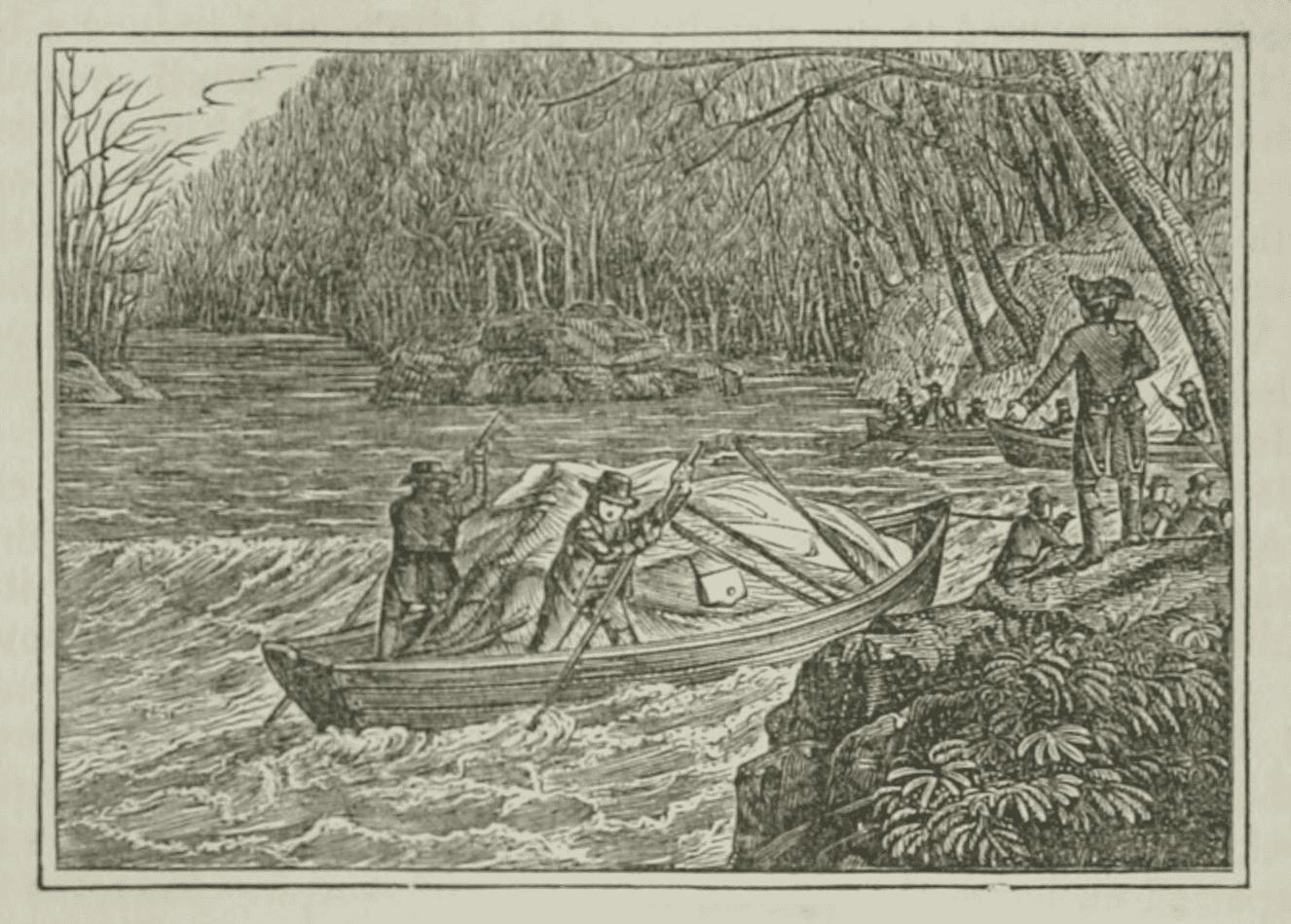
Voyage up the Kennebec.
General Carleton, who, as we have already stated, had arrived at Quebec, had taken the best measures for its defence, and was prepared to receive him. In a few days the American general opened a six-gun battery within about seven hundred yards of the walls; but his artillery was too light to make a breach, and he could do nothing more than amuse the enemy, and conceal his real purpose. After continuing a siege nearly a month, he resolved on a desperate attempt to carry the place by escalade. To distract the garrison, two feigned attacks were made on the upper town by two divisions of the army under majors Brown and Livingston, while two real attacks on opposite sides of the lower town were made by two other divisions under Montgomery and Arnold. Early in the morning of the last day in the year, the signal was given, and the several divisions moved to the assault in the midst of a heavy fall of snow, which covered the assailants from the sight of the enemy. Montgomery, at the head of the New York troops, advanced along the St. Lawrence, by Aunce de Mere, under cape Diamond.
The first barrier to be surmounted on that side was defended by a battery, in which were mounted a few pieces of artillery, in front of which were a blockhouse and picket. The guard at the blockhouse, after giving a random fire, threw away their arms and fled to the barrier, and for a time the battery itself was deserted. Enormous piles of ice impeded the progress of the Americans, who, pressing forward in a narrow defile, reached at length the blockhouse and picket. Montgomery, who was in front, assisted in cutting down or pulling up the pickets, and advanced boldly and rapidly at the head of about two hundred men, to force the barrier. By this time one or two persons had ventured to return to the battery, and, seizing a slow match, discharged one of the guns. Casual as this fire appeared, it was fatal to general Montgomery and to two valuable young officers near his person, who, together with his orderly sergeant and a private, were killed on the spot. Colonel Campbell, on whom the command devolved, precipitately retired with the remainder of the division.
In the mean time, colonel Arnold, at the head of about three hundred and fifty men, made a desperate attack on the opposite side. Advancing with the utmost intrepidity along the St. Charles, through a narrow path, exposed to an incessant fire of grape-shot and musketry, as he approached the first barrier at the Saut des Matelots, he received a musket ball in the leg, which shattered the bone, and he was carried off to the camp. Captain Morgan, who commanded a company of Virginia riflemen, rushed forward to the batteries at their head, and received a discharge of grape-shot, which killed one man only. A few rifles were immediately fired into the embrasures, and the barricade was mounted; the battery was instantly deserted, but the captain of the guard, with the greater part of his men, fell into the hands of the Americans. Morgan formed his men, but from the darkness of the night and total ignorance of the situation of the town, it was judged unadvisable to proceed. He was soon joined by lieutenant-colonel Green and majors Bigelow and Meigs, with several fragments of companies, amounting collectively to about two hundred men. At daylight this gallant party was again formed; but after a bloody and desperate engagement, in which they sustained the force of the whole garrison three hours, they were compelled to surrender themselves prisoners of war.111
After this brave but disastrous assault, the commander of the American troops did not muster more than four hundred effective men: in the hope, however, of receiving reinforcements, they maintained a position at a short distance from Quebec; and, although the garrison was very superior in numbers, the bravery the colonists had evinced, and the mixed character of his own troops, disinclined general Carleton from leaving his ramparts to attack the Americans.
In the end of May and beginning of June, generals Howe, Burgoyne, and Clinton, with reinforcements from Britain, arrived at Boston. The British general, in common with his troops, resolved on active operations; but every movement which they made was watched with an attentive eye by zealous Americans in Boston, who found means to penetrate every design before it was carried into execution, and to transmit secret intelligence to the American head-quarters. About the middle of June, it was suspected that general Gage intended to cross the river Charles, on the north side of Boston, and take possession of Breed’s or Bunker’s hill, in the vicinity of Charlestown.
On the night of the 16th of June, upwards of one thousand Americans, under colonel William Prescot, were ordered to proceed to this eminence, and to intrench themselves upon it. The movement was not without difficulty and danger; for British vessels of war were lying both in the Medford and Charles, on each side of the narrow peninsula. But the provincials marched to the place in profound silence; and, about midnight, began their operations. They labored with such assiduity, that before the dawn of day they had thrown up a breastwork, nearly across the peninsula, and constructed a small redoubt on their right.
About four in the morning of the 17th of June, the American works were observed by the captain of the Lively sloop of war, lying in the river Charles, who instantly began a heavy fire upon them, and was soon joined by the other ships, and by the battery on Copp’s hill at Boston. The Americans steadily continued their labors under a furious cannonade and an incessant shower of balls and bombs; but so harmless was this fearful noise that they lost only one man in the course of the morning. As in this post the Americans overlooked Boston, it was necessary to dislodge them; and, for this purpose, soon after mid-day, a detachment of British troops, under the command of generals Howe and Pigot, crossed the river in boats, and landed near the point of the peninsula; but, on observing the formidable position of the Americans, they waited for a reinforcement, which soon arrived. Meanwhile the steeples and the roofs of the houses in Boston, the eminences in the adjacent country, and the ships in the rivers, were crowded with anxious spectators, agitated by different hopes and fears according to their different attachments and interests. The main body of the American army encamped beyond Charlestown neck were looking on; and generals Clinton and Burgoyne, and other British officers of high rank, took their station in the battery on Copp’s hill to view the approaching conflict.
While general Howe waited for this reinforcement, the Americans received an accession of strength, under generals Warren and Pomeroy, who crossed Charlestown neck under a brisk cannonade from the shipping in the rivers, to join their countrymen and take part in the battle. By their arrival the provincial force was increased to fifteen hundred at least. The Americans also took advantage of general Howe’s halt to strengthen part of their position, by pulling down some rail-fences, forming the stakes into two parallel lines at a short distance from each other, and filling the interval with hay.
The British detachment, consisting of upwards of two thousand men, advanced towards the American line. The light infantry, commanded by general Howe, was on the right; the grenadiers, under general Pigot, on the left. They began the attack by a brisk cannonade from some field-pieces and howitzers, the troops proceeding slowly, and sometimes halting, to give time to the artillery to produce some effect. On advancing, the left set fire to Charlestown, a thriving town, containing about three hundred wooden houses, besides other buildings, and entirely consumed it. The rising flames added not a little to the grandeur and solemnity of the scene.
Secure behind their intrenchments, the Americans reserved their fire, and silently waited the approach of the British, till within fifty or sixty yards, when they poured upon them an incessant and well directed discharge of musketry. The British returned the fire for some time, without attempting to advance; but the discharge from the American line was so close and so destructive, that the troops at length gave way, and fell back towards the landing place. By the vigorous exertions of their officers, however, they were again brought to the charge; and the Americans, again reserving their fire till the troops were very near, directed it against them with the same deadly aim as before. Many fell: at one time, general Howe, for a few seconds, was left alone, every officer and soldier near him having been killed or wounded. The troops gave way a second time; but at that critical moment Sir Henry Clinton arrived from Boston, and was very active in leading them back to a third and more successful attack, in which they entered the American lines with fixed bayonets. The colonists had nearly exhausted their powder, and hence their fire had slackened. Being mostly armed with old rusty muskets, and ill provided with bayonets, they were unprepared for a close encounter. They therefore retreated; and, in passing Charlestown neck, were exposed to the fire of the Glasgow sloop of war, and two floating batteries, from which they sustained their greatest loss.
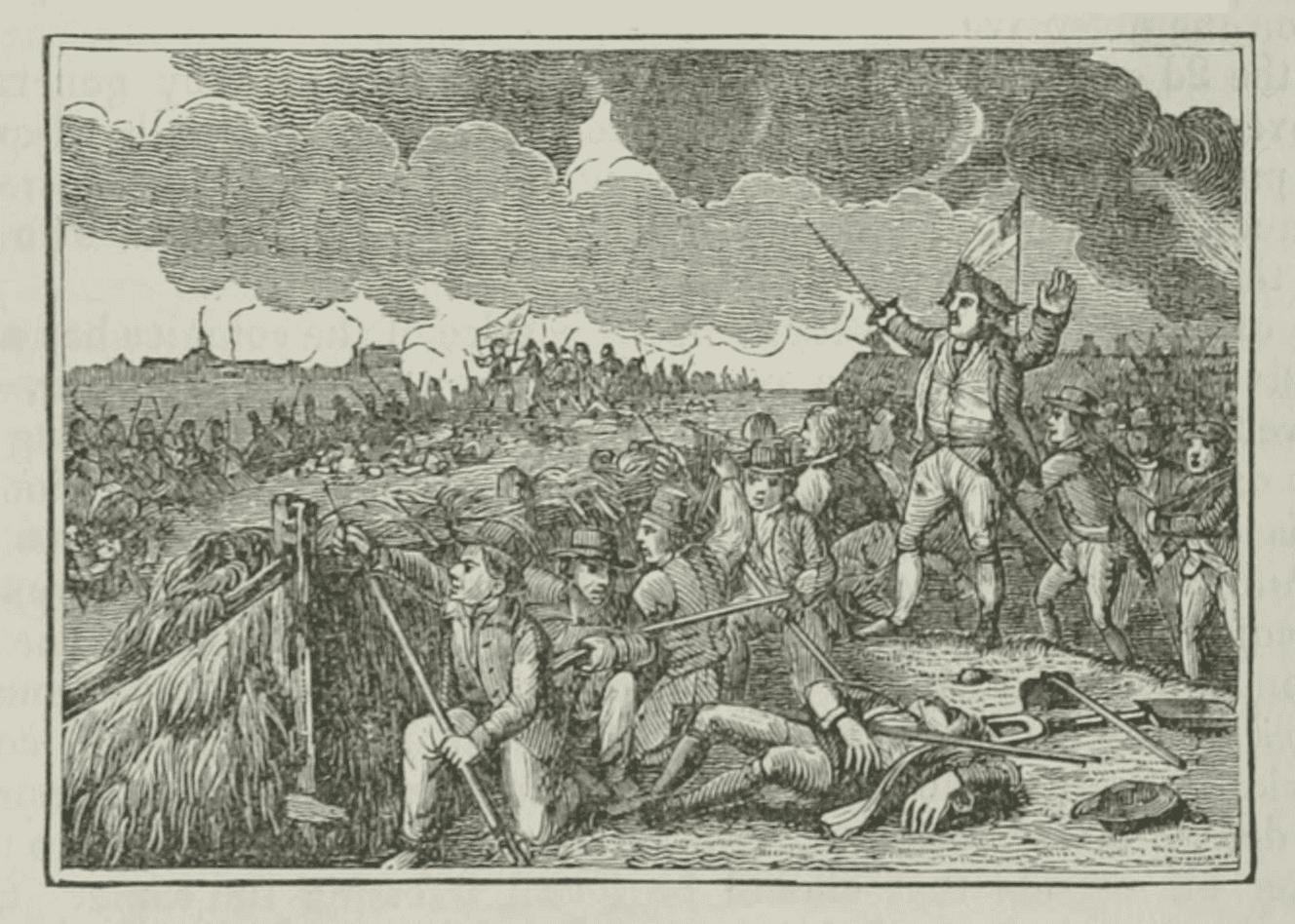
Battle of Bunker’s Hill.
The British troops had suffered so severely in the engagement, that no pursuit was ordered; and, indeed, a pursuit could have served no good purpose, as the main body of the American army was at a small distance beyond the neck, and the royal troops were in no condition to encounter it. They were protected merely by the ships of war and floating batteries in the rivers Charles and Medford. The battle lasted about an hour, during the greater part of which time there was an incessant blaze of musketry from the American line.
This was a severe battle; and, considering the numbers engaged, extremely destructive to the British; for nearly one half of the detachment fell. According to the return made by general Gage, they lost one thousand and fifty-four men; two hundred and twenty-six of whom were slain on the field, and eight hundred and twenty-eight wounded. Nineteen commissioned officers were killed, and seventy wounded; among the former was major Pitcairn, whose inconsiderate conduct at Lexington had occasioned the first shedding of blood.
Among the killed on the side of the Americans were several lamented officers; but the death of general Warren was particularly regretted. By profession this gentleman was a physician of unsullied reputation. He did every thing in his power to prevent a rupture; but when an appeal to arms became unavoidable he joined the colonial standard.
After the engagement the British intrenched themselves on Bunker’s hill, the scene of action; and the Americans on Prospect hill, at a small distance in front of them. The colonists had been driven from their intrenchments; the royal troops had suffered severely in the battle, and neither party was forward to renew the conflict. Each fortified his post, and stood on the defensive.
On the 2d of July, general Washington, accompanied by general Lee and several other officers of rank, arrived at Cambridge, the head-quarters of the provincial army. On his journey he had everywhere been received with much respect, and escorted by companies of gentlemen, who volunteered their services on the occasion.
The existence of armed vessels in the service of the colonies has already been adverted to. From the peculiar situation of Massachusetts, it was perceived that important advantages might be gained by employing armed vessels on the coasts, to prevent the British from collecting provisions from any places accessible to them, and to capture the enemy’s ships loaded with military stores. Before the subject of a naval armament was taken up by congress, it appears that not only Massachusetts, but Rhode Island and Connecticut had each of them two vessels, at least, fitted, armed, and equipped by the colonial authorities. Subsequently, the general court of Massachusetts passed an act for encouraging the fitting out of armed vessels to defend the sea-coast of America, and for erecting a court to try and condemn all vessels that should be found infesting the same. Shortly afterwards, a committee of congress, appointed to devise ways and means for fitting out a naval armament, brought in their report, which was adopted. It was resolved to fit out for sea thirteen ships, five of thirty-two guns, five of twenty-eight, and three of twenty-four guns; a committee was nominated, with full powers to carry the report into execution with all possible expedition, and Ezekiel Hopkins was appointed commander. Thus commenced the American navy. The advantages that had been anticipated from armed vessels were soon experienced. Captain Manly, of Marblehead, one of the first who put to sea, on the 29th of November took an ordnance brig from Woolwich, containing, besides a large brass mortar, several pieces of fine brass cannon, a large quantity of small arms and ammunition, with all kinds of tools, utensils, and machines, necessary for camps and artillery; and, nine days after, three ships, from London, Glasgow, and Liverpool, with various stores for the British army. A brig, with fifteen thousand pounds of powder, was captured by a vessel fitted out by the council of safety of South Carolina. The supplies obtained by these means were of vast importance to the American army, which was in very great want of ammunition and military stores.
Among other measures tending to promote the general welfare, congress resolved that a line of posts should be appointed from Falmouth, in New England, to Savannah, in Georgia; and Benjamin Franklin was unanimously chosen postmaster-general. They also directed the establishment of an hospital, adequate to the necessities of an army consisting of twenty thousand men; and Dr. Church was appointed director and physician of the establishment.112
General Washington, on his first arrival in camp, found the materials for a good army; but they were in the crudest state. The troops having been raised by different colonial governments, no uniformity existed among the regiments; and imbued with the spirit of that very liberty for which they were preparing to fight, and unaccustomed to discipline, they neither felt an inclination to be subject to military rules, nor realized the importance of being so. The difficulty of establishing subordination was greatly increased by the shortness of the terms of enlistment, some of which were to expire in November, and none to continue longer than December. Various causes operated to lead congress to the almost fatal plan of temporary military establishments. Among the most important of these were a prospect of accommodation with the parent state, and the want of experience in the management of war upon an extensive scale.
The fear of accumulating expenses which the resources of the country could not discharge, had a further influence to deter the American government from the adoption of permanent military establishments; for, although the recommendations of congress, and the regulations of state conventions, had, in the day of enthusiasm, the force of law, yet the ruling power thought it inexpedient to attempt to raise large sums by direct taxes, at a time when the commerce of the country was annihilated, and the cultivators of the ground were subjected to heavy services in the field of war. The only recourse was to a paper medium, without funds for its redemption, or for the support of its credit, and therefore of necessity subject to depreciation, and, in its nature, capable of only a temporary currency; congress, therefore, was justly afraid of the expense of a permanent army. Jealousy of a standing army had also a powerful influence upon the military arrangements of America. Indeed this spirit early insinuated itself into the legislative bodies of the colonies, and was displayed in many of their measures: an indication of this feeling appears in the address presented by the provincial assembly of New York to general Washington, while on his journey to the American camp. ‘We have the fullest assurance,’ say they, ‘that whenever this important contest shall be decided, by that fondest wish of each American soul, an accommodation with our mother country, you will cheerfully resign the important deposit committed to your hands, and reassume the character of our worthiest citizen.’
The want of subordination was by no means the only difficulty with which the commander-in-chief had to contend; he soon made the alarming discovery, that there was no more powder than would furnish each man with nine cartridges. Although this dangerous deficiency was carefully concealed from the enemy, yet the want of bayonets, which was very considerable, could not be kept secret. The army was also so destitute of tents as to be unavoidably lodged in barracks, a circumstance extremely unfavorable to sudden movements, to health, and to discipline. There was no commissary-general, and therefore no systematic arrangement for obtaining provisions; and a supply of clothes was rendered peculiarly difficult by the non-importation agreements. Added to this there was a total want of engineers, and a great deficiency of working tools.
The general, happily qualified at once to meet difficulties and to remove them, took immediate care to organize the troops, to fit them for actual service, and to make arrangements for the necessary supplies. Next to these objects, he considered the re-enlistment of the army the most interesting. To this essential point he had early solicited the attention of congress, assuring that body that he must despair of the liberties of his country, unless he were furnished with an army that should stand by him until the conclusion of their enterprise. Congress at length resolved to raise a standing army, to consist of about seventy-five thousand men, to serve for the term of three years, or during the war; and that it should be composed of eighty-eight battalions, to be raised in the colonies, according to their respective abilities. Recruiting orders were accordingly issued; but the progress in raising recruits was by no means proportioned to the public exigencies. On the last day of December, when all the old troops not engaged on the new establishments were disbanded, there had been enlisted for the army of 1776 no more than nine thousand six hundred and fifty men. An earnest recommendation of general Washington to congress to try the influence of a bounty was not acceded to until late in January; but during the winter the number of recruits was considerably augmented. ‘The history of the winter campaign,’ says the biographer of Washington, ‘is a history of continued and successive struggles on the part of the American general, under the vexations and difficulties imposed by the want of arms, ammunition, and permanent troops, on a person in an uncommon degree solicitous to prove himself, by some grand and useful achievement, worthy of the high station to which the voice of his country had called him.’
In the space of time between the disbanding the old army and the constitution of an effective force from the new recruits, the lines were often in a defenceless state; the English must have known the fact, and no adequate reason can be assigned why an attack was not made. ‘It is not,’ says general Washington in his communications to congress, ‘in the pages of history to furnish a case like ours. To maintain a post within musket shot of the enemy, for six months together, without ammunition, and, at the same time, to disband one army and recruit another, within that distance of twenty odd British regiments, is more, probably, than ever was attempted. But if we succeed as well in the last as we have heretofore in the first, I shall think it the most fortunate event of my whole life.’ Such a measure, with the organization and discipline of the men, will be supposed to have employed every active power of the general; yet this did not satisfy his mind. He knew that congress anxiously contemplated more decisive steps, and that the country looked for events of greater magnitude. The public was ignorant of his actual situation, and conceived his means for offensive operations to be much greater than they were and they expected from him the capture or expulsion of the British army in Boston. He felt the importance of securing the confidence of his countrymen by some brilliant action, and was fully sensible that his own reputation was liable to suffer if he confined himself solely to measures of defence.
To publish to his anxious country the state of his army, would be to acquaint the enemy with his weakness, and to hazard his destruction. The firmness and patriotism of general Washington were displayed, in making the good of his country an object of higher consideration than the applause of those who were incapable of forming a correct opinion of the propriety of his measures. While he resolutely rejected every measure which in his calm and deliberate judgment he did not approve, he daily pondered the practicability of a successful attack upon Boston. As a preparatory step, he took possession of Plowed hill, Cobble hill, and Lechmere’s point, and erected fortifications upon them. These posts brought him within half a mile of the enemy’s works on Bunker’s hill; and, by his artillery, he drove the British floating batteries from their stations in Charles river. He erected floating batteries to watch the movements of his enemy, and to aid in any offensive operations that circumstances might warrant. He took the opinion of his general officers a second time respecting the meditated attack; they again unanimously gave their opinion in opposition to the measure, and this opinion was immediately communicated to congress. Congress appeared still to favor the attempt, and, that an apprehension of danger to the town of Boston might not have an undue influence upon the operations of the army, resolved, ‘That if general Washington and his council of war should be of opinion that a successful attack might be made on the troops in Boston, he should make it in any manner he might think expedient, notwithstanding the town, and property therein, might thereby be destroyed.’
General Howe had, in October, succeeded general Gage in the command of the British army, and through the winter confined himself to measures of defence. The inability of the American general to accomplish the great object of the campaign, repeatedly pointed out by congress, was doubtless a source of extreme mortification to him; but he indulged the hope of success in some military operations during the winter that would correspond with the high expectations of his country, and procure him honor in his exalted station of commander-in-chief of the American army. Early in January he summoned a council of war, in which it was resolved, ‘That a vigorous attempt ought to be made on the ministerial troops in Boston, before they can be reinforced in the spring, if the means can be provided, and a favorable opportunity shall offer.’
It was not, however, till the middle of February, that the ice became sufficiently strong for general Washington to march his forces upon it into Boston; he was then inclined to risk a general assault upon the British posts, although he had not powder to make any extensive use of his artillery; but his general officers in council voted against the attempt, and in their decision he reluctantly acquiesced. By the end of the month the stock of powder was considerably increased, and the regular army amounted to fourteen thousand men, which was reinforced by six thousand of the militia of Massachusetts. General Washington now resolved to take possession of the heights of Dorchester, in the prospect that this movement would bring on a general engagement with the enemy under favorable circumstances; or, should this expectation fail, that from this position he would be enabled to annoy the ships in the harbor, and the troops in the town. To mask the design, a severe cannonade and bombardment were opened on the British works and lines for several nights in succession. As soon as the firing began on the night of the 4th of March, a strong detachment marched from Roxbury over the neck of land connecting Roxbury with Dorchester heights, and, without discovery, took possession of the heights. General Ward, who commanded the division of the army in Roxbury, had fortunately provided fascines before the resolution passed to fortify the place; these were of great use, as the ground was deeply frozen; and, in the course of the night, the party, by uncommon exertions, erected works sufficient for their defence.
When the British discovered these works, nothing could exceed their astonishment. Their only alternative was either to abandon the town, or to dislodge the provincials. General Howe, with his usual spirit, chose the latter part of the alternative, and took measures for the embarkation on that very evening of five regiments, with the light infantry and grenadiers, on the important but most hazardous service. The transports fell down in the evening towards the castle with the troops, amounting to about two thousand men; but a tremendous storm at night rendered the execution of the design absolutely impracticable. A council of war was called the next morning, which agreed to evacuate the town as soon as possible. A fortnight elapsed before that measure was effected. Meanwhile, the Americans strengthened and extended their works; and on the morning of the 17th of March the king’s troops, with those Americans who were attached to the royal cause, began to embark; before ten, all of them were under sail. As the rear embarked, general Washington marched triumphantly into Boston, where he was joyfully received as a deliverer.
The issue of the campaign was highly gratifying to all classes; and the gratulation of his fellow-citizens upon the repossession of the metropolis of Massachusetts, was more pleasing to the commander-in-chief than would have been the honors of a triumph. Congress, to express the public approbation of the military achievements of their general, resolved, ‘That the thanks of congress, in their own name, and in the name of the thirteen united colonies, be presented to his excellency general Washington, and the officers and soldiers under his command, for their wise and spirited conduct in the siege and acquisition of Boston; and that a medal of gold be struck, in commemoration of this great event, and presented to his excellency.’ In his letter, informing congress that he had executed their order, and communicated to the army the vote of thanks, he says, ‘They were, indeed, at first, a band of undisciplined husbandmen; but it is, under God, to their bravery and attention to their duty, that I am indebted for that success which has procured me the only reward I wish to receive—the affection and esteem of my countrymen.’
Although Halifax was mentioned as the destined place of the British armament, general Washington apprehended that New York was their object. On this supposition, he detached several brigades of his army to that city, before the evacuation of Boston; and as soon as the necessary arrangements were made in the latter city, he followed with the main body of his army to New York, where he arrived on the 14th of April. The situation of New York was highly favorable for an invading army, supported by a superior naval force; and general Washington doubted the practicability of a successful defence; but the importance of the place, the wishes of congress, the opinion of his general officers, and the expectation of his country, induced him to make the attempt; and the resolution being formed, he called into action all the resources in his power to effect it, and, with unremitted diligence, pushed on his works. Hulks were sunk in the North and East rivers; forts were erected on the most commanding situations on their banks; and works were raised to defend the narrow passage between Long and York islands. The passes in the Highlands, bordering on the Hudson, became an object of early and solicitous attention. The command of this river was equally important to the American and the British general. By its possession, the Americans easily conveyed supplies of provision and ammunition to the northern army, and secured an intercourse between the southern and northern colonies essential to the success of the war. If the river were in the hands of the British, this necessary communication would be interrupted, and an intercourse between the Atlantic and Canada opened to them. General Washington ordered the passes to be fortified, and made their security an object of primary importance through every period of his command.
While these operations were carrying on in New England, general Arnold, under all his discouragements, continued the blockade of Quebec; but, in the month of May, in a council of war, it was unanimously determined, that the troops were in no condition to risk an assault, and the army was removed to a more defensible position. The Canadians at this juncture receiving considerable reinforcements, the Americans were compelled to relinquish one post after another, and by the 18th of June they had evacuated Canada.
In Virginia, the zeal and activity which had been excited by the spirited enterprise of Patrick Henry still continued to manifest themselves in various parts of the colony. The governor’s family, alarmed by the threatening march of Mr. Henry towards Williamsburgh, had already taken refuge on board the Fowey man-of-war; and only a few weeks elapsed before lord Dunmore himself adopted the same means of personal safety. Soon after fixing his residence on board the Fowey, his lordship required the house of burgesses to attend him there; but instead of obeying the requisition, they passed sundry resolutions, in which they declared that his lordship’s message was ‘a high breach of the rights and privileges of the house,’ and that his conduct gave them reason to fear ‘that a dangerous attack was meditated against the unhappy people of the colony.’ On the 24th of July the colonial convention met; they appointed a committee of safety, passed an ordinance for regulating the militia, and for raising a regular force of two regiments, the command of which was given to Patrick Henry, who was also made the commander of all the forces raised, and to be raised, for the defence of the colony. The ships of war belonging to his majesty, which had been cruising in James and York rivers during the whole summer, had committed many petty acts of depredation and plunder along the shores, which the people now eagerly desired to resent, and an opportunity of gratification soon offered.
The captain of the Otter sloop of war, on the 2d of September, ventured upon one of his plundering expeditions in a tender, and was driven on shore near Hampton by a violent tempest. The crew left the vessel on the shore, and made their escape in the night, and next morning the people boarded and set fire to her. This naturally roused captain Squire’s resentment, and he threatened instant destruction to the town; but the committee of safety at Williamsburgh, having heard of the affair, detached colonel Woodford with three companies to repel the attack, which was so effectually done, that the assailants were soon glad to make a precipitate flight, with considerable loss. This affair produced a proclamation from his lordship, (who continued to hold his head-quarters on board one of the ships,) in which he not only declared martial law, but freedom to all the slaves who would join his standard. By this means he soon collected a crew well suited to his designs; and having fortified himself at the great bridge, near Norfolk, continued for some time to commit such acts of wanton barbarity and contemptible depredations, as to disgust even those who had until now continued friendly to the cause of the king.
The committee of safety finding themselves called upon to put a stop to his lordship’s savage warfare, despatched colonel Woodford to drive him from his hold. Having arrived within cannon shot of lord Dunmore’s position, the Americans halted, and threw up some hasty intrenchments. His lordship, hearing that the provincials amounted only to three hundred men, badly armed, conceived the design of surprising them; and for this purpose captain Leslie, with the regulars and slaves, crossed the bridge before daylight, and entered the camp of the provincials, just as they were parading under arms. Captain Fordyce advanced to the attack of the grenadiers, and was among the first that fell. The whole number of grenadiers were either killed, wounded, or made prisoners, and the rest of the royal party were obliged to make a rapid retreat. Disappointed in their hopes, the governor’s party abandoned their works the following night, and retired to their shipping, leaving Woodford, who was now joined by colonel Howe from North Carolina, the complete command of Norfolk. After continuing to assail the coasts of Virginia for a considerable time, but almost everywhere unsuccessfully,113 lord Dunmore was at length compelled to abandon his hostile designs against the colonists. Some of his ships were driven upon that coast, where the wretched fugitives were made prisoners by their own fellow-citizens, and immured in dungeons. To escape a similar fate, Dunmore burnt the ships of least value; and the miserable remains of soldiers and loyalists, assailed at once by tempests, famine, and disease, sought refuge in Florida, Bermudas, and the West Indies.
Notwithstanding the extent to which hostilities had been carried, a large portion of the colonists had hitherto continued to entertain some hope of an amicable termination of the dispute; and it is evident, from the transactions we are about to record, that many felt sincerely desirous not to frustrate such a result. The want of more regular and stable governments had for some time been felt in those colonies where royal governments had hitherto existed; and in the autumn of 1775, New Hampshire applied to congress for their advice and direction on this subject. In November, congress advised the convention of that colony to call a full and free representation of the people; when the representatives, if they thought it necessary, should establish such a form of government as, in their judgment, would best promote the happiness of the people, and most effectually secure peace and good order during the continuance of the dispute between Great Britain and the colonies. On this question the members of congress were not unanimous. It was viewed by some as a step necessarily leading to independence; and by some of its advocates it was probably intended as such. To render the resolution less exceptionable, the duration of the government was limited to the continuance of the dispute with the parent country. Soon afterwards similar directions and advice were given to South Carolina and Virginia.
The last hopes of the colonists for reconciliation rested on the success of their second petition to the king; and the answer of their sovereign to this application was expected with extreme solicitude. Information, however, was soon received from Mr. Penn, who was intrusted with the petition, that no answer would be given. This intelligence was followed by that of great additional preparations to subdue the ‘American rebels.’ The king, in his speech at the opening of parliament in October, not only accused the colonists of revolt, hostility, and rebellion, but stated that the rebellious war carried on by them was for the purpose of establishing an independent empire. To prevent this he declared that the most decisive and vigorous measures were necessary; that he had consequently increased his naval establishment, had augmented his land forces, and had also taken measures to procure the aid of foreign troops. He at the same time stated his intention of appointing certain persons with authority to grant pardons to individuals, and to receive the submission of whole colonies disposed to return to their allegiance. Large majorities in both houses assured the king of their firm support in his measures for reducing the colonists to obedience. The addresses, however, in answer to the speech, were opposed with great ability. The project of employing foreign troops to destroy American subjects was reprobated by the minority in the strongest terms. The plans of the ministry, however, were not only approved by parliament, but by a majority of the nation.
The idea of making the colonists share their burdens could not easily be relinquished by the people of Great Britain; and national pride would not permit them to yield the point of supremacy. War was now therefore to be waged against the colonies, and a force sent out sufficiently powerful to compel submission, even without a struggle. For these purposes the aid of parliament was requisite; and about the last of December an act was passed, prohibiting all trade and commerce with the colonies, and authorizing the capture and condemnation, not only of all American vessels with their cargoes, but all other vessels found trading in any port or place in the colonies, as if the same were the vessels and effects of open enemies; and the vessels and property thus taken were vested in the captors, and the crews were to be treated, not as prisoners, but as slaves.
The passing of this act shut the door against the application of the colonies for a reconciliation. The last petition of congress to the king had, indeed, been laid before parliament, but both houses refused to hear it, or even to treat upon any proposition coming from such an unlawful assembly, or from those who were then in arms against their lawful sovereign. In the house of lords, on the motion of the duke of Richmond, Mr. Penn was examined on American affairs. He stated, among other things, that the colonists were desirous of reconciliation, and did not aim at independence; that they were disposed to conform to the acts regulating their trade, but not to taxation; and that on this point a spirit of resistance was universal. After this examination the duke of Richmond moved a resolution, declaring that the petition of congress to the king was a ground for a reconciliation of the differences between the two countries. This motion was negatived, after a warm debate, by eighty-six to thirty-three. These proceedings of the king and parliament, with the employment of sixteen thousand foreign mercenaries, convinced the leading men in each colony that the sword alone must decide the contest, and that the colonists must now declare themselves totally independent of Great Britain.
Time, however, was still requisite, to convince the great mass of the American people of the necessity of a complete separation from their parent country, and the establishment of independent governments. The ablest pens were employed throughout America, in the winter of 1775–6, on this momentous subject. The propriety and necessity of the measure was enforced in the numerous gazettes, and in pamphlets. Among the latter, ‘Common Sense,’ from the popular pen of Thomas Paine, produced a wonderful effect in the different colonies in favor of independence. Influential individuals in every colony urged it as a step absolutely necessary to preserve the rights and liberties, as well as to secure the happiness and prosperity of America.114
When the prohibitory act reached America, congress, justly viewing it as a declaration of war, directed reprisals to be made, both by public and private armed vessels, against the ships and goods of the inhabitants of Great Britain, found on the high seas, or between high and low water mark. They also burst the shackles of commercial monopoly, which had so long kept them in bondage, and opened their ports to all the world, except the dominions of Great Britain. In this state of things, it was preposterous for the colonists any longer to consider themselves as holding or exercising the powers of government under the authority of Great Britain. Congress, therefore, on the 10th of May, recommended to the assemblies and conventions of the colonies where no sufficient government had been established, ‘to adopt such government as should, in the opinion of the representatives of the people, best conduce to the happiness and safety of their constituents in particular, and America in general.’ They also declared it necessary, that the exercise of every kind of authority under the crown should be suppressed, and that all the powers of government should be exercised ‘under the authority of the people of the colonies, for the preservation of internal peace, virtue, and good order, as well as for the defence of their lives, liberties, and properties, against the hostile invasions and cruel depredations of their enemies.’ This was a preliminary step to a general declaration of independence. Some of the colonial assemblies and conventions about the same time began to express their opinions on this great question. On the 22d of April, the convention of North Carolina empowered their delegates in congress ‘to concur with those in the other colonies in declaring independency.’ This, it is believed, was the first direct public act of any colonial assembly or convention in favor of the measure.115 The convention of Virginia soon afterwards expressed itself still more decidedly. After full deliberation, the following resolutions were passed unanimously:—
‘That the delegates appointed to represent this colony in general congress be instructed to propose to that respectable body, to declare the United Colonies free and independent states, absolved from all allegiance to or dependence upon the crown or parliament of Great Britain; and that they give the assent of this colony to such declaration, and to whatever measures may be thought proper and necessary by the congress for forming foreign alliances, and a confederation of the colonies, at such time and in the manner as to them shall seem best: provided that the power of forming governments for, and the regulations of, the internal concerns of each colony, be left to the respective colonial legislatures.
‘That a committee be appointed to prepare a declaration of rights, and such a plan of government as will be most likely to maintain peace and order in this colony, and secure substantial and equal liberty to the people.’116
Early in the year the British government had prepared a considerable expedition to reduce the southern colonies to obedience. The command was intrusted to Sir Peter Parker and earl Cornwallis. On the 3d of May, admiral Parker, with twenty sail, arrived at cape Fear. They found general Clinton ready to co-operate with them. He had left New York, and proceeded to Virginia, where he had an interview with lord Dunmore; but finding nothing could be effected in that colony, he repaired to cape Fear, to await the arrival of the armament from England. Meanwhile, the Carolinians had been making great exertions. In Charleston the utmost energy and activity was evinced. The citizens pulled down the valuable storehouses on the wharves, barricadoed the streets, and constructed lines of defence along the shore. Abandoning their commercial pursuits, they engaged in incessant labor, and prepared for bloody conflicts. The troops, amounting to between five and six thousand men, were stationed in the most advantageous positions. Amidst all this bustle and preparation, lead was so extremely scarce, that the windows of Charleston were stripped of their weights, in order to procure a small supply of that necessary article for bullets.
Early in June, the armament, consisting of between forty and fifty vessels, appeared off Charleston bay, and thirty-six of the transports passed the bar, and anchored about three miles from Sullivan’s island. Some hundreds of the troops landed on Long island, which lies on the west of Sullivan’s island, and which is separated from it by a narrow channel, often fordable. On the 10th of the month, the Bristol, a fifty-gun ship, having taken out her guns, got safely over the bar; and on the 25th, the Experiment, a ship of equal force, arrived, and next day passed in the same way. On the part of the British every thing was now ready for action. Sir Henry Clinton had nearly three thousand men under his command. The naval force, under Sir Peter Parker, consisted of the Bristol and Experiment, of fifty guns; the Active, Acteon, Solebay, and Syren frigates; the Friendship, of twenty-two, and the Sphinx, of twenty guns; the Ranger sloop, and Thunder bomb. On the forenoon of the 28th of June, this fleet advanced against the fort on Sullivan’s island, which was defended by colonel Moultrie, with about three hundred and fifty regular troops, and some militia. The Thunder bomb began the battle. The Active, Bristol, Experiment, and Solebay, followed boldly to the attack, and a terrible cannonade ensued. The fort returned the fire of the ships slowly, but with deliberate and deadly aim; and the contest was carried on during the whole day with unabating fury. The Sphinx, Acteon, and Syren were ordered to attack the western extremity of the fort, which was in a very unfinished state; but, as they proceeded for that purpose, they got entangled with a shoal, called the Middle-ground. Two of them ran foul of each other: the Acteon stuck fast; the Sphinx and Syren got off; but, fortunately for the Americans, that part of the attack completely failed.
It was designed that Sir Henry Clinton, with his corps, should co-operate with the naval operations by passing the narrow channel which separates Long island from Sullivan’s island, and assail the fort by land; but this the general found impracticable, for the channel, though commonly fordable, was at that time, by a long prevalence of easterly winds, deeper than usual; and even had the channel been fordable, the British troops would have found the passage an arduous enterprise; for colonel Thomson, with a strong detachment of riflemen, regulars, and militia, was posted on the east end of Sullivan’s island to oppose any attack made in that quarter. The engagement, which began about eleven o’clock in the forenoon, continued with unabated fury till seven in the evening, when the fire slackened, and about nine entirely ceased on both sides. During the night all the ships, except the Acteon, which was aground, removed about two miles from the island. Next morning the fort fired a few shots at the Acteon, and she at first returned them; but, in a short time, her crew set her on fire and abandoned her. She blew up shortly afterwards. In this obstinate engagement both parties fought with great gallantry. The loss of the British was very considerable, upwards of sixty being killed, and one hundred and sixty wounded; while the garrison lost only ten men killed, and twenty-two wounded.