Volume 2 — THE COUNTRY OF THE CLIFF-DWELLERS.
Reading edition
ALFRED TERRY BACON.
[Ruskin, among his reasons for not visiting the United States, declared that it would be impossible for him to exist, even for a short interval, in a country that had no old castles. Had he known it, he might have found here old castles in abundance, older perhaps, and grander in situation, than any to be found in his own land. These are the ruined dwellings of the ancient inhabitants of the western cañons and of the pueblo-builders of Arizona and New Mexico. We give a traveller’s account of the Cliff-dwellers’ habitations.]
The attraction which drew the conquerors of Mexico forty-five days’ journey away into the North was the fame which had reached them of the Seven Cities of Cibola (the buffalo), great in wealth and population, lying in the valley of the Rio de Zuñi. To the grief of the invaders, they found not cities, but rather villages of peaceful agricultural people dwelling in great pueblos three and four stories high, and they searched in vain for the rumored stores of gold. At that time the pueblos held a large population skilled in many arts of civilization. They cultivated large tracts of ground, wove fabrics of cotton, and produced ornate pottery. Their stone-masonry was admirable. But even three hundred years ago it seems that the people were but a remnant of what they had once been. Even then the conquerors wondered at the many ruins which indicated a decline from former greatness. The people have not now the same degree of skill in their native arts which the race once had, and it is probable that when the Spaniards came and found them declining in numbers the old handicrafts were already on the wane.
In a remote age the ancestors of these Pueblo tribes, or a race of kindred habits, filled most of that vast region which is drained by the Colorado River and its affluents, and spread beyond into the valley of the Rio Grande. The explorers of a great extent of country in Utah, Arizona, New Mexico, and Colorado have found everywhere evidences of the wide distribution and wonderful industry of that ancient people. On the low land which they used to till lie the remains of their villages,—rectangular buildings of enormous dimensions and large circular estufas, or halls for council and worship. On the sides of the savage cliffs that wall in or overarch the cañons are scattered in every crevice and wrinkle those strange and picturesque ruins which give us the name “Cliff-dwellers” to distinguish this long-forgotten people. And on commanding points, seen far away down the cañons or across the mesas, stand the solitary watch-towers where sentinels might signal to the villagers below on the approach of Northern barbarians....
There is no other district which embraces in so small a compass so great a number and variety of the Cliff-dwellers’ ruined works as the cañon of the Little Rio Mancos in Southwestern Colorado. The stream rises in a spur of the San Juan Mountains, near the remote mining-camp called Parrott City. Flowing southward for a few miles through an open valley, it is soon enclosed between the walls of a profound cañon which cuts for nearly thirty miles through a table-land called the Mesa Verde. The cañon is wide enough to have permitted the old inhabitants to plant their crops along the stream, and the cliffs rising on either side to a height of two thousand feet are so curiously broken and grooved and shelving, from the decay of the soft horizontal strata and the projection of the harder, as to offer remarkable facilities for building fortified houses hard of approach and easy of defence. Therefore the whole length of the cañon is filled with ruins, and for fifteen miles beyond it to the borders of New Mexico, where the river meets the Rio San Juan, the valley bears many traces of the ancient occupation.
The scenery of the cañon is wild and imposing in the highest degree. In the dry Colorado air there are few lichens or weather-stains to dull the brightness of the strata to the universal hoariness of moister climates: the vertical cliffs, standing above long slopes of débris, are colored with the brilliant tints of freshly-quarried stone. A gay ribbon of green follows the course of the rivulet winding down through the cañon till it is lost to sight in the vista of crags. The utter silence and solitude of the wilderness reigns through the valley. It is not occupied by any savage tribe, and only a few white men within the last few years have passed through it and told of its wonders; and yet its whole length is but one series of houses and temples that were forsaken centuries ago. I can hardly imagine a more exciting tour of exploration than that which Mr. Jackson’s party made on first entering this cañon in 1874.
Above the entrance of the cañon the evidences of prehistoric life begin. On the bottom-land, concealed by shrubbery, are the half-obliterated outlines of square and circular buildings. The houses were of large size, and were plainly no temporary dwelling-places, for an accumulation of decorated pottery fills the ground about them, indicating long occupation. No doubt they were built of adobe,—masses of hard clay dried in the sun,—which the wear of ages has reduced to smoothly-rounded mounds. For some miles down the cañon remains of this sort occur at short intervals, and at one point there stands a wall built of squared sandstone blocks. Along the ledges of the cliffs on the right bits of ruinous masonry are detected here and there, but for a time there is nothing to excite close attention. At last a watchful eye is arrested by a more interesting object perched at a tremendous height on the western wall of the cañon. It is a house built upon a shelf of rock between the precipices, but, standing seven hundred feet above the stream and differing not at all in color from the crags about it, only the sharpest eyesight can detect the unusual form of the building and the windows marking the two stories.
The climb up to the house-platform is slow and fatiguing, but the trouble is repaid by a sight of one of the most curious ruins on this continent. Before the door of the house, part of the ledge has been reserved for a little esplanade, and to make it broader three small abutments of stone, which once supported a floor, are built on the sloping edge of the rock. Beyond this the house is entered by a small aperture which served as a door. It is the best specimen of a Cliff-dweller’s house that remains to our time. The walls are admirably built of squared stones laid in a hard white mortar. The house is divided into two stories of three rooms each. Behind it a semicircular cistern nearly as high as the house is built against the side of it, and a ladder is arranged for descending from an upper window to the water-level. The floor of the second story was supported by substantial cedar timbers, but only fragments of them remain. The roof, too, has entirely disappeared, but the canopy of natural rock overhanging serves to keep out the weather. The front rooms in both stories are the largest and are most carefully finished. Perhaps they were the parlor and “best bedroom” of some prehistoric housewife. They are plastered throughout with fine smooth mortar, and even in that remote age the mania for household decoration had a beginning: floor, walls, and ceiling were colored a deep red, surrounded by a broad border of white.
The same cliff on which this house stands has on its side many other ruins; some half destroyed by gradual decay, some crushed by falling rocks, none so perfect as the one described; but all are crowded into the strangest unapproachable crevices of the cañon-wall, like the crannies which swallows choose to hold their nests, far removed from the possibility of depredation. Some are so utterly inaccessible that the explorers, with all their enthusiasm and activity, have never been able to reach them. How any beings not endowed with wings could live at such points it is hard to conceive: it makes one suspicious that the Cliff-dwellers had not quite outgrown the habits of monkey ancestors.
As the cañon widens with the descent of the stream, the ruins in the western wall increase in number. One fearful cliff a thousand feet in height is chinked all over its face with tiny houses of one room each, but only a few of them can be detected with the naked eye. One, which was reached by an explorer at the peril of his life, stands intact: ceiling and floor are of the natural rock, and the wall is built in a neat curve conforming to the shape of the ledge.
A mile farther down the stream there is a most interesting group of houses. Eight hundred feet above the valley there is a shelf in the cliff sixty feet in length that is quite covered by a house. The building contains four large rooms, a circular sacred apartment and smaller rooms of irregular shape. It was called by its discoverers “The House of the Sixteen Windows.” Behind this house the cliff-side rises smooth and perpendicular thirty feet, but it can be scaled by an ancient stairway cut into it which ascends to a still higher ledge. The stairs lead to the very door of another house filling a niche a hundred and twenty feet long. A great canopy of solid rock overarches the little fortress, reaching far forward beyond the front wall, while from below it is absolutely unapproachable except by the one difficult stairway of niches cut in the rock. In time of war it must have been impregnable. These dwellings have given more ideas about their interior furnishing than any of the others. Among the accumulated rubbish were found corn and beans stored away. In the lower house were two large water-jars of corrugated pottery standing on a floor covered with neatly-woven rush matting. In a house not far above were found a bin of charred corn, and a polished hatchet of stone made with remarkable skill.
From this point onward both the valley and the cliffs are filled with the traces of a numerous population, every mile of travel bringing many fresh ones into sight. Among the cliff-houses there is of necessity a variety in form and size as great as the differences of the caves and crevices that hold them; but among the buildings of the low ground there is more uniformity, not only in this cañon, but in all the valleys of the region. Most of them may be classed as aggregated dwellings or pueblos with rectangular rooms, round watch-towers and large circular buildings. To these must be added a few which seem to have been built only for defence. The straight walls have generally fallen, except the parts supported by an angle of a building; but, as usual in old masonry, the circular walls have much better resisted decay.
About midway down the cañon the curved wall of a large ruin rises above the thicket. It is a building of very curious design. The outer wall was an exact circle of heavy masonry a hundred and thirty feet in circumference. Within, there is another circular wall, concentric with the outer, enclosing one round room with a diameter of twenty feet. The annular space between the two walls was divided by partitions into ten small apartments. Other buildings of the same type occur in this region, some of much larger size and with triple walls. Even in this one, which is comparatively well preserved, the original height is uncertain, though the ruin still stands about fifteen feet high.
The vast quantity of débris about some of them indicates that they were of no insignificant height, and their perfect symmetry of form, the careful finish of the masonry, the large dimensions and great solidity, made them the most imposing architectural works of that ancient people. I find no reason to doubt that they were their temples, and the presumption is very strong that they were temples for sun-worship. The occurrence of a circular room in connection with nearly every group of buildings is of special interest, as seeming to link the Cliff-dwellers to the modern Pueblo tribes in their religious customs.
Most striking and picturesque of all the ruins are the round watch-towers. On commanding points in the valley, and on the highest pinnacles of the cliffs overlooking the surface of the mesa, they occur with a frequency which is almost pathetic as an indication of the life of eternal vigilance which was led by that old race through the years, perhaps centuries, of exterminating warfare which the savage red men from the North waged upon them. To us the suffering of frontier families at the hands of the same blood-thirsty savages is heart-rending. What was it to those who saw year by year their whole race’s life withering away, crushed by those wild tribes?
Near the lower end of the cañon stands one of the most perfect of these towers, rising sixteen feet above the mound on which it is built. It was once attached to an oblong stone building which seems to have been a strongly-fortified house. The rectangular walls, as usual, are prostrate, and have left the tower standing as solitary and picturesque and as full of mystery as the round towers of Ireland....
In the Montezuma Cañon, just beyond the Colorado State border, there are some remains built after an unusual manner with stones of great size. One building of many rooms, nearly covering a little solitary mesa, is constructed of huge stone blocks not unlike the prehistoric masonry of Southern Europe. In the same district there is a ruined line of fortification from which the smaller stones have fallen away and are crumbling to dust, leaving only certain enormous upright stones standing. They rise to a height of seven feet above the soil, and the lower part is buried to a considerable depth. Their resemblance to the hoary Druidical stones of Carnac and Stonehenge is striking, and there is nothing in their appearance to indicate that they belong to a much later age than those primeval monuments of Europe.
All the certain knowledge that we have of the history and manners of the Cliff-dwellers may be very briefly told, for there is no written record of their existence, except their own rude picture-writing, cut or painted on the cañon walls, and it is not likely that those hieroglyphics will ever be deciphered. But much may be inferred from their evident kinship to the Moquis of our time; and the resemblance of the ancient architecture and ceramics to the arts as they are still practised in the degenerate pueblos of Arizona gives us many intimations in regard to the habits of the Cliff-dwellers.
GRAND CAÑON, ARIZONA In the Country of the Cliff-Dwellers
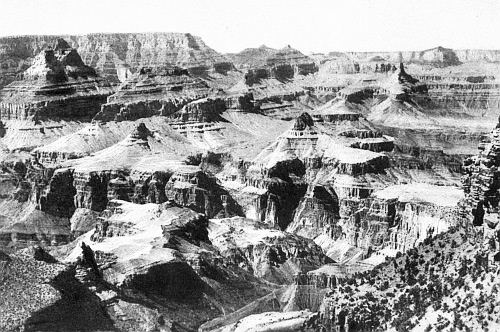
It was centuries ago—how long a time no one will ever know—when that old race was strong and numerous, filling the great region from the Rio Grande to the Colorado of the West, and from the San Juan Mountains far down into Northern Mexico. They must have numbered many hundreds of thousands, perhaps millions. It is not probable that they were combined under one government, or that they were even closely leagued together, but that they were essentially one in blood and language is strongly indicated by the similarity of their remains. That they were sympathetic in a common hostility to the dangerous savage tribes about them can hardly be doubted. They were of peaceful habits and lived by agriculture, having under cultivation many thousands of acres in the rich river-bottoms, which they knew well how to irrigate from streams swollen in summer by the melting snows of the high mountain-ranges. We read of their dry canals in Arizona, so deep that a mounted horseman can hide in them. We know that they raised crops of corn and beans, and in the south cotton, which they skilfully wove. That they had commercial dealing across their whole country is shown by the quantity of shell-ornaments brought from the Pacific coast, which are found in their Colorado dwellings. They did not understand the working of metals, but their implements of stone are of most excellent workmanship. Their weapons indicate the practice of hunting, and while the race was still numerous their forts and their sharp obsidian arrows made easy their resistance to the wandering savage hordes.
I believe that no instance can be cited of a people still in their Stone Age who have surpassed that old race in the mason’s art: indeed, I doubt if any such people has even approached their skill in that respect. The difficulty of constructing a great work of well-squared, hammer-dressed stones is enormously increased if the masons must work only with stone implements. Imagine the infinite, toilsome patience of a people who in such a way could rear the ancient Pueblo Bonito of New Mexico, five hundred and forty feet long, three hundred and fourteen feet wide, and four stories high! In one wall of a neighboring building of stone less carefully dressed it is estimated that there were originally no less than thirty million pieces, which were transported, fashioned, and laid by men without a beast of burden or a trowel, chisel, or hammer of metal....
At the time of the Spanish conquest the Pueblo tribes were worshippers of the sun and fire, like all the races of this continent which were above barbarism. To-day, even in those pueblos where a corrupted form of the Roman faith is accepted, there are traces of the old sun-worship mingled with it, and in all pueblos there are large circular rooms, called estufas, reserved for councils and for worship. The invariable appearance of estufas among the ruined towns, and even on the ledges of the cliffs, shows what sacredness was attached to the circular room, which, perhaps, was symbolic of the sun’s orb: it indicates a unity of religious faith between the ancients and moderns.