Volume 2 — MARIPOSA GROVE AND YOSEMITE VALLEY.
Reading edition
CHARLES LORING BRACE.
[Our sketches of travel in America will not be complete without descriptive narratives relating to its great natural wonders, of which the United States possesses more examples than any other country on the globe. The present selection, therefore, from Brace’s “The New West, or California in 1867-68,” is devoted to a brief account of the monster trees of that State and the scenic marvels of the Yosemite Valley.]
The great pleasure of the American continent will hereafter be the journey to the Yosemite. There is no one object of nature in the world, except Niagara, to equal it in attraction. Whenever the Pacific road brings the two coasts within a fortnight of each other, innumerable parties will be made up to visit it. I have been tolerably familiar, by foot-journeys, with Switzerland, Tyrol, and Norway, and I can truly say that no one scene in those grand regions can compare equally, in all its combinations, with the wonderful Cañon of the Yosemite. It is a matter of congratulation, also, to me, that I saw it before any road, or coach, or rail-car had approached it. It ought not to be visited otherwise than as our party journeyed to it,—on horses winding in picturesque train over velvety trails, beneath the gigantic pines of the Sierras....
Among all my many travelling experiences in various countries, I do not think I can ever forget the romance and the delicious beauty of that first night’s ride towards the Yosemite. The trail was barely wide enough for two to ride abreast, winding under majestic pines, over mountains, and down wide, deep dells, each step of the horses springing elastic from soft pine-leaves. The sun soon set, and a magnificent moon arose, giving us at one time a broad belt of light over the path, and then leaving us to descend into a mysterious gulf of darkness, and then casting strange shadows and half-lights through the pine-branches over our procession of riders. As we penetrated farther into the forest we began to wind about beneath trees such as few of us had ever seen,—the superb sugar-pine, perhaps the most perfect tree in nature, here starting with a diameter of from seven to twelve feet, and mounting up with most symmetrical branches to the height say of Trinity Church spire (two hundred and fifty to two hundred and sixty feet); on the ends of its branches cones hanging a foot long. Sometimes we came forth from the forest for a few moments, and had grand glimpses of great mountain valleys, only partly revealed in the glorious moonlight. Most of the party were old travellers, and were rather impervious to sensations, but we all agreed that this was a new one, and gave a most promising augury of the Yosemite excursion. After fourteen miles—an easy ride—we all reached Clark’s Ranch at a late hour, ready for supper and bed.
[The next morning] we started at not too early an hour for a forest-ride to the Trees, Mr. Clark kindly guiding us. What may be called the avenue to these hoary monuments of antiquity lies through a gigantic forest of sugar-pines, themselves some two hundred to two hundred and fifty feet high; so that when you reach the mighty towers of vegetation you lose a little the sense of their vast height. I searched curiously as we rode through the forest for the conditions which should produce such monsters of growth. It must be remembered that the Sequoia gigantea is not found merely here, or at Calaveras and its neighborhood. There appears to be a belt of them running along the slope of the Sierras, about four thousand and five thousand feet above the sea-level, and as far south as Visalia. They are so plentiful near that place as to be sawed for lumber, though what so light a wood could be used for I can hardly think. In the neighborhood of the latter place the Indians report a tree, far in the forest, surpassing in grandeur anything ever seen; but thus far no white man has ever cast eyes on it. It is a mistake, too, to suppose the race wearing out. I saw, both here and in Calaveras, young giant Sequoiæ, beginning patiently their thousand years of growth with all the vigor of their grand ancestors; some of but four hundred years, mere youths, were growing splendidly. There are fewer young trees here than in Calaveras, because fire or some other cause has swept among the underbrush of all trees, and must have destroyed many of these burly saplings.
The Sequoia grows on mountain-slopes, where the slow wash of water, through ages, brings down minute particles of fertilizing rocks, and the decayed vegetation of countless centuries, with the moisture of eternal springs, water and feed its roots. It enjoys a sun of the tropics without a cloud for six months, and has the balmy air of the Pacific, with incessant and gentle moisture, and a warm covering of snow for its winter. Beneath its roots, the ground never freezes. As has been well said, “It has nothing to do but grow;” and so with all the favorable conditions that nature can offer—air and sun and moisture—it pumps up its food from the everlasting hills, and builds up its slow, vegetable-like substance during century after century into a gigantic, symmetrical, and venerable pile, while nations begin and pass away beneath its shadow.
Think of lying under a tree beneath which the contemporary of Attila or Constantine might have rested, and which shall defy the storm, perhaps, when the present political divisions of the world are utterly passed away, and the names of Washington and Lincoln are among the heroes of a vague past.
But how to give an impression of its size! If my readers will imagine a Sequoia placed beside Trinity Church, he must conceive it filling up one of our largest dwelling-houses, say a diameter of thirty feet, with a circumference of ninety feet; the bark of this gigantic trunk will be light, porous, and reddish in color, with many scars upon it of fire (its great enemy); then, perhaps, at the height of the Trinity belfry (say one hundred feet), two opposing huge branches will protrude, it may be, themselves, of the size of large trees (say eight feet in diameter); these will be twisted and much broken; above them will come forth other heavy branches, which show the marks and blows of the storms of a thousand years or more, for the giant, so far above his fellows, meets a continual battering from the gales of the mountains.
There is no symmetry in his top, or delicacy and grace in his outline; he has battled and struggled with the storm for too many centuries to preserve an artistic appearance. He looks the giant of the forest, broad-rooted and strong-limbed, rough and weather-beaten, but defying snow and frost and hurricane for thousands of years, and still sheltering bird and beast and cattle beneath his grand shadow....
We visited one big tree in Calaveras which had been blown over two years before. The enormous weight which each tree carries makes it more difficult to bear the gales, as it overtops the forest. Perhaps any ordinary wood, such as oak or maple, would increase the specific gravity, so that at three hundred feet high the leverage on the roots would be too great to bear any strain of a gale; but this wood is almost like cork,—lighter than any wood on the Eastern coast. The fall of this mighty tower, they say, was heard for miles around, and made the earth tremble. Where it fell it has buried its top deep in the ground, so that there is quite a ravine made by the blow in the earth. You strike the trunk where it is still a large tree, and then walk upon it some two hundred feet towards the roots. When you reach the roots you are upon a height equal to the roof of a moderate-sized house, and a fall from the trunk would be dangerous. You descend by a ladder.
If I recollect rightly, there were three hundred and sixty-five trees in this Mariposa Grove. I measured one trunk, broken off at the top, where it was a foot in diameter, which was about two hundred and ninety feet in length, and estimating thirty feet as the length of the part broken off, it must have been some three hundred and twenty feet high. We lunched near a “camp” of the Geological Survey, in the heart of the grove, lying on our backs beneath the gigantic canopies, and feeling like pigmies at the feet of these giants. The younger trees were often wreathed with a strange, yellow, hanging moss. Our ladies were deeply interested in a remarkable flower which grew beneath the snow, a few patches of which still remained here in June. It was a blood-red flower of a fleshy-like substance, like the Pyrola, or “Dutchman’s pipe,” growing somewhat like a garden hyacinth. Its stems were clustered, from six to ten inches high, with long, erect scales, broader below and gradually narrower, and finally becoming bracts. The flowers were numerous, and occupied the upper half of the stem. It is the Sarcodes sanguinea.
[Leaving the Big Tree grove, the travellers made a farther ride of twenty-five miles through the Sierras to the Yosemite, the first view of which impressed them deeply.]
No aspect of nature I have ever looked upon, no sight of the desolate ocean, heaving and lashing in mighty surges beneath wintry storm, or sudden view of Alpine snow-peaks through rifts of black thunder-clouds, or glimpses of Norwegian coast-glaciers through the lulls of an Arctic gale, or even Niagara itself, was so full of the inspiration of awe as this first opening view of the Yosemite Cañon. All other scenes of grandeur and beauty must fade away in my memory when this vision is forgotten. Before the mighty powers which had shaped this tremendous gorge, and in presence of this scene of unspeakable and indescribable beauty and majesty, man and his works seemed to sink away to nothingness.... I almost felt as if I had known nothing of the cañon before, so surprising were the effects of coloring and shadow. It must be remembered we had struck the gorge on one of its lateral walls, say about four miles from its western end. There is no approach to it from below up the stream. As we lay on the edge of the cliff we gazed up a narrow green valley perfectly flat, from a mile to half a mile wide, and winding, some six miles above, between enormous cliffs and precipices, a small, bright, sparkling stream in the middle, fringed with green grass or forest-trees. The wall, over the edge of which we were looking, was nearly three-quarters of a mile high, and far below, the oaks and willows and poplars and pines in the green intervale looked like little shrubs. On the other side, a short distance beyond, was the grand bluff of El Capitan, a sheer precipice of nearly four thousand feet, its light granite pile, in the evening light, the most majestic cliff that human eye has looked upon, beyond were other bluffs and precipices, pearly gray and purplish-white, with green fringes below, and dark archways or fantastic figures traced by shadows on their surface. There were buttresses, as of gigantic cathedrals, and archways such as might support hills of granite, and domes where a mountain was the substructure, and half domes, and peaks whose regular succession has given them the name of “Brothers,”—all varying in color and shadow, incessantly, with the receding light; some with the delicious cool gray of the rock color, some white, with a reddish shade; others faint purple; others resplendent in pink and brilliant purple; while over their edges, giving a joyous life to the scene, rushed sparkling silver streams, in innumerable waterfalls, dashing into the green valley below.... But the scene was changing. Over the valley, the heavy shadow of El Capitan continually increased its gigantic breadth of shade; beyond him the “Arches,” which, to be seen at that distance, must be a thousand feet in height, grew each instant more strongly marked, but still farther beyond to the east the North Dome and the Half Dome were golden and purple in the evening light, and yet beyond the still white peaks of the Sierras towered above in the pale blue.
On our side of the vast gorge the foot of the various precipices and cliffs was covered with detritus, making, near the bottom, a considerable slope, on which grew many evergreen trees.
On the other side there was one line of massive rock, which fell apparently plumb, without a break or curve, for nearly four thousand feet, and at its base, so hard was the material, there seemed no recent detritus at all. One could evidently touch the very bottom of the immense fall of rock....
The form of the cañon is unique, nothing in Europe resembling it: the immense vertical walls rising so abruptly from the green vale; the peaks, too, which surround it, being original, even in the Sierras; the immense, inaccessible, concentric masses of granite,—domes, or half-domes, as if melted in some gigantic mould, and then, when cooled, left standing in the air.
One of the grandest and most beautiful objects in the valley was directly opposite our hotel, and its music never ceased, day or night,—the Yosemite Fall. The stream which bears this name heads about ten miles away, and then flows down, almost directly over the mighty precipice, into the valley below,—a depth of two thousand five hundred and fifty feet. At this time it is about thirty-five feet wide by two or three deep. The fall has almost the appearance of one grand shoot of water, but it has, in reality, three divisions: the first is a descent of fifteen hundred feet on a ledge (as it seems), though it is, in fact, a shelf of rock, a third of a mile broad; then follow a series of cascades for six hundred and twenty-five feet, and a final leap of four hundred. There is water enough now to give a bright, foaming, grand sweep of the whole cataract. It is certainly one of the most beautiful objects the human eye can ever gaze upon! We never wearied of riding out over the green meadows and gay, wild flowers to get some new aspect of it.
The only fall to compare it with, that I have ever seen, is the Vöring Foss, in Norway. This is a fall of nine hundred and fifty feet, but the water is so scanty that it is all resolved into wreaths of mist before it reaches the bottom; and it makes but little impression on the mind, compared with the Yosemite Fall. It is, moreover, confined in a narrow, dark gorge, and must be seen usually from above. In seeing the Californian fall, I did not even think of the Norwegian.
The amount of water, at this season, adds immensely to the cheerfulness and life of the valley; but it also occasioned us a great deal of trouble in getting round. We were mired several times, and twice one of our ladies was thrown on the soft greensward.
But the scampering gallops through the groves under these grand scenes, and the quiet amblings amid such beauty and sublimity, were pleasures which nothing marred. In our rides down the cañon, we were struck by the grand mass of the Sentinel Dome, four thousand one hundred and fifty feet above the valley, and said to give the finest point of view in the whole region round; the valley itself, it must be remembered, being over four thousand feet above the sea-level. Then three-quarters of a mile beyond is the majestic buttress of the Sentinel Rock, three thousand feet high, of which a thousand feet is a smooth obelisk; opposite to this are the Three Brothers, the highest three thousand eight hundred and thirty feet, and each regularly lower than the next.
RED WOOD TREE, CALIFORNIA
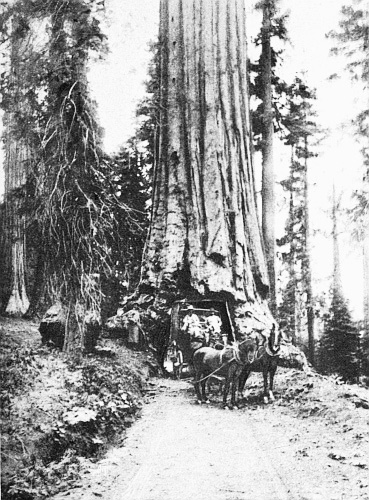
Then comes the Cathedral Rock, two thousand six hundred and sixty feet, with two perfect spires, the most picturesque object in the valley; then the exquisite Pohono, or Bridal Veil, a flashing fall of a thousand feet swaying like a silvery plume in the mountain breezes, and the grand feature of the gorge, of which I have so often spoken, El Capitan, three thousand six hundred feet.
To the east of the hotel, about two miles above the falls, the valley ends and divides into three cañons, each containing scenery as remarkable as those of the main gorge. The northwest cañon is the Tinaya Fork; here we have the Half Dome, a majestic inaccessible crest of concentric granite, four thousand seven hundred and thirty-seven feet above the valley, with a vertical face where the half sphere split off of two thousand feet in height; the North Dome, a rounded mass, three thousand five hundred and sixty-eight feet, and easy to ascend from the north. In this fork is the exquisite Tisayic Lake, on which the morning reflections are so beautifully given.
The middle cañon, that of the Merced River, is the most important one of the three. No ravine scenery in Europe equals this wild and extraordinary gorge. The river, which at this season has a tremendous body of water, descends through a wild ravine of two miles, nineteen hundred and eighty feet. The path winds along over a series of wild falls and rapids, till a cloud and gale of mist and wet cover it, through which we reach a dry place at the foot of a magnificent fall, four hundred and seventy-five feet high,—the Vernal. Then ladders are ascended up the face of the cliff, and we rest on the dry, sunny ledge over the boiling and whirling cataract. Still another scramble for a mile, and we find ourselves blinded, gasping, in the breath of the furious cataract above. We are all clad in India-rubber coats (furnished by a guide), and drip with water, and work up, inch by inch, stooping, as against a violent current. The gale takes away our breaths, and we have every now and then to catch a breath; there is nothing visible ahead but clouds of mist and driving swirls of rain, with a roar filling the air, which prevents all voices from being heard. We are helping the ladies on with the utmost difficulty, but at last all reluctantly give out and turn back; but I cannot bear to give up the view; and after groping in the furious storm and mist, I at length find a side path through the chaparral, and soon reach a dry ledge beneath the superb Nevada Fall,—a majestic sweep of thundering water, six hundred and thirty-nine feet in height, more grand than any waterfall in the valley, because of the volume of water. There is a peculiar twist in the upper portion of it, which adds to its picturesque effect. On the other side rises a most remarkable peak of granite, solitary and inaccessible,—Mount Broderick, some two thousand feet. The scene as I stood there alone beneath this sublime sweep of waters, and amid those mighty mountain-cliffs, can never be forgotten.
The South Fork I did not visit, but the photographs show that it possesses scenery as romantic as the other branches of the cañon. It is interesting to notice that these enormous waterfalls in the Merced Cañon have scarcely an indentation on this most hard rock,—a fact probably indicating that they have not existed a great length of time. The comparative absence of detritus in the upper part of the main valley would seem to show the action of water and ice, pressing the débris into the lower portion, where more of it is found. There are, too (as was discovered by Mr. King), something which may be called lateral moraines, and perhaps a terminal moraine in the middle of the cañon, so that it seems not improbable, though there is no absolute evidence, that in a comparatively recent period glaciers existed in the upper part, and a lake in the body of the Yosemite Cañon, the descent of the whole valley, it must be remembered, being only fifty feet during some eight miles.