Volume 2 — IN THE YELLOWSTONE PARK.
Reading edition
FERDINAND V. HAYDEN.
[About the middle of this century reports began to be heard of a veritable wonderland in the far West, as yet seen only by trappers and other adventurers, whose stories of the marvels they had beheld whetted the appetite of scientific explorers. The first attempt to reach the region of the Yellowstone was made in 1856, but failed, and it was not until 1869 that an exploring party entered this marvellous valley. A second party reached the Yellowstone region in 1870, and Mr. N. P. Langford wrote a glowing account of the wonders observed. The first detailed description of the locality was made by Dr. Hayden, chief of the Geological Survey of the Territories, in 1871. From this extended and highly interesting account we can only quote a few passages, selecting those which relate to the hot springs and geysers of the wonderful Fire-Hole River region.]
Early in the morning of August 30 the valley was literally filled with columns of steam, ascending from more than a thousand vents. I can compare the view to nothing but that of some manufacturing city like Pittsburg, as seen from a high point, except that instead of the black coal smoke there are here the white delicate clouds of steam. Small groups or solitary springs that are scattered everywhere in the woods upon the mountain-sides, and which would otherwise have escaped observation, are detected by the columns of steam. It is evident that some of these groups of springs have changed their base of operations within a comparatively recent period; for about midway on the east side of the lower basin there is a large area covered with a thick, apparently modern, deposit of the silica, as white as snow, while standing quite thickly all around are the dead pines, which appear to have been destroyed by the excessive overflow of the water and the increased deposition. These dry trees have a most desolate look; many of them have fallen down and are incrusted with the silica, while portions that have fallen into the boiling springs have been reduced to a pulp.
This seems to be one of the conditions of silicification, for when these pulpy masses of wood are permitted to dry by the cessation of the springs, the most perfect specimens of petrified wood are the result. In one instance a green pine-tree had fallen so as to immerse its thick top in a large hot basin, and leaves, twigs, and cones had become completely incrusted with the white silica, and a portion had entered into the cellular structure, so that when removed from the water and dried in the sun, very fair specimens were obtained. Members of my party obtained specimens of pine-cones that were sufficiently silicified to be packed away among the collections.
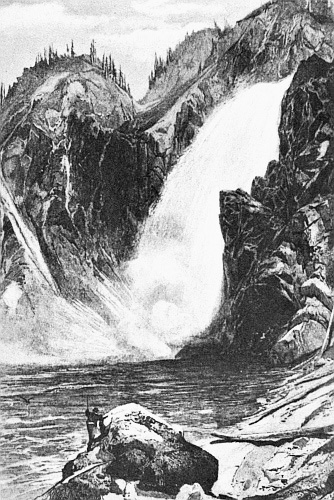
THE UPPER YELLOWSTONE FALLS From a Painting by Thomas Moran
In order that we might get a complete view of the Lower Geyser Basin from some high point, we made a trip to the summit of Twin Buttes, on the west side of the basin. From the top of one of these buttes, which is six hundred and thirty feet above the Fire-Hole River, we obtained a bird’s-eye view of the entire lower portion of the valley, which was estimated to be about twenty miles long and five miles wide. To the westward, among the mountains, were a number of little lakes, which were covered with a huge species of water-lily, Nuphar advena. The little streams precipitated their waters in the most picturesque cascades or falls. One of them was named by Colonel Barlow the “Fairy Fall,” from the graceful beauty with which the little stream dropped down a clear descent of two hundred and fifty feet. It is only from a high point that it can be seen, for the water falls gently down from the lofty overhanging cliff into a basin at the foot, which is surrounded by a line of tall pines one hundred to one hundred and fifty feet in height. The continual flow of the waters of this little fountain has worn a deep channel or furrow into the vertical sides of the mountain. As far as the eye can reach can be seen the peculiar plateau mountain ranges, black with the dense forests of pine, averaging from nine thousand to ten thousand feet above sea-level....
A spring on a level with the river has an enormous square basin thirty feet across, of unknown depth. We called this the “Bath Spring.” A little below is another singular form of wonderful beauty. The water issues from beneath the crust near the margin of the river from several apertures. The basin itself is fifteen by twenty feet and twenty feet deep. It seemed to me that nothing could exceed the transparent clearness of the water. The slightest object was reflected in its clear depths, and the bright blue tints were indescribable. We called this the “Cavern.” The mud springs are also numerous and important in this group. As usual, they are of all sizes, from an inch or two to twenty or thirty feet in diameter, with contents varying from mere turbid water to stiff mud. They seldom have any visible outlet, but are in a constant state of agitation, with a sound that varies with the consistency of the contents. There are several of the mud-pots that give off a suppressed thud as the gases burst their way through the stiff mortar. Sometimes the mortar is as white as snow, or brown, or tinged with a variety of vivid colors....
On the west side of the Fire-Hole, and along the little branch that flows into it from the west, are numbers of springs of all grades, and the broad bottom is covered with a snow-white silicious crust. Near the base of the mountains there is a massive first-class boiling spring, in a constant state of violent agitation, sending forth great columns of steam, with a singular toadstool rim.... About three miles up the Fire-Hole we meet with a small but quite interesting group of springs on both sides of the stream. There is a vast accumulation of silica, forming a hill fifty feet along the level of the river; upon the summit one of the largest springs yet seen, nearly circular, one hundred and fifty feet in diameter, boils up in the centre, but overflows with such uniformity on all sides as to admit of the formation of no real rim, but forming a succession of little ornamental steps, from one to three inches in height, just as water would congeal from cold in flowing down a gentle declivity. There was the same transparent clearness, the same brilliancy of coloring to the waters, but the hot steam and the thinness of the rim prevented me from approaching it near enough to ascertain its temperature or observe its depth. It is certainly one of the grandest hot springs ever seen by human eye.
But the most formidable one of all is near the margin of the river. It seems to have broken out close by the river, and to have continually enlarged its orifice by the breaking down of its sides. It evidently commenced on the east side, and the continual wear of the under side of the crust on the west side has caused the margin to fall in, until an aperture at least two hundred and fifty feet in diameter has been formed, with walls or sides twenty to thirty feet high, showing the laminæ of deposition perfectly. The water is intensely agitated all the time, boiling like a caldron, from which a vast column of steam is ever rising, filling the orifice. As the passing breeze sweeps it away for a moment, one looks down into this terrible seething pit with terror. All around the sides are large masses of the silicious crust that have fallen from the rim. An immense column of water flows out of this caldron into the river. As it pours over the marginal slope it descends by numerous small channels, with a large number of smaller ones spreading over a broad surface, and the marvellous beauty of the strikingly vivid coloring far surpasses anything of the kind we have seen in this land of wondrous beauty,—every possible shade of color, from vivid scarlet to a bright rose, and every shade of yellow to a delicate cream, mingled with vivid green from minute vegetation. Some of the channels were lined with a very fine, delicate yellow, silky material, which vibrates at every movement of the waters. There was one most beautiful funnel-shaped spring, twenty feet in diameter at the top, but tapering down, lined inside and outside with the most delicate decorations. Indeed, to one looking down into its clear depths, it seemed like a fairy palace. The same jelly-like substance or pulp to which I have before alluded covers a large area with the various shades of light red and green. The surface yields to the tread like a cushion. It is about two inches in thickness, and although seldom so tenacious as to hold together, yet it may be taken up in quite large masses, and when it becomes dry it is blown about by the wind, like fragments of variegated lichens.
[From this description of the hot springs of the region we proceed to an account of its marvellous geyser phenomena.]
We camped the evening of August 5 in the middle of the Upper Geyser Basin, in the midst of some of the grandest geysers in the world. Colonel Barlow and Captain Heap, of the United States Engineers, were camped on the opposite side of the Fire-Hole. Soon after reaching camp a tremendous rumbling was heard, shaking the ground in every direction, and soon a column of steam burst forth from a crater near the edge of the east side of the river. Following the steam, arose, by a succession of impulses, a volume of water, apparently six feet in diameter, to the height of two hundred feet, while the steam ascended a thousand feet or more. It would be difficult to describe the excitement which attended such a display. It is probable that if we could have remained in the valley several days, and become accustomed to all the preliminary warnings, the excitement would have ceased, and we could have admired calmly the marvellous ease and beauty with which this column of hot water was held up to that great height for the space of twenty minutes. After the display is over the water settles down in the basin several inches, and the temperature slowly falls to 150°. We called this the “Grand Geyser,” for its power seemed greater than any other of which we obtained any knowledge in the valley.
[After describing more particularly the peculiarities of the Grand Geyser and the smaller neighboring geysers, Dr. Hayden gives us an enthusiastic pen-picture of a beautiful type of springs.]
On the summit of the great mound is one of a class I have called central springs; it is located on the highest point of the mound on which this great group belongs; has a crater twenty feet in diameter, very nearly quiescent, slightly bubbling, or boils near the centre, with a thin, elegant rim projecting over the spring, with the water rising within a few inches of the top. The continual but very moderate overflow of this spring, uniformly on every side, builds up slowly a broad-based mound, layer by layer, one-eighth to one-sixteenth of an inch thick. Looking down into these springs, you seem to be gazing into fathomless depths, while the bright blue of the water is unequalled even by the sea. There are a number of these marvellous central springs, with projecting rims carved with an intricate delicacy which of itself is a marvel; and as one ascends the mound and looks down into the wonderfully clear depths, the vision is unique. The great beauty of the prismatic colors depends much on the sunlight, but about the middle of the day, when the bright rays descend nearly vertically, and a slight breeze just makes a ripple on the surface, the colors exceed comparison; when the surface is calm there is one vast chaos of colors, dancing, as it were, like the colors of a kaleidoscope.
As seen through this marvellous play of colors, the decorations on the sides of the basin are lighted up with a wild, weird beauty which wafts one at once into the land of enchantment; all the brilliant feats of fairies and genii in the “Arabian Nights” entertainments are forgotten in the actual presence of such marvellous beauty; life becomes a privilege and a blessing after one has seen and thoroughly felt these incomparable types of nature’s cunning skill....
Our search for new wonders leading us across the Fire-Hole River, we ascended a gently incrusted slope, and came suddenly upon a large oval aperture with scalloped edges, the diameters of which were eighteen and twenty-five feet, the sides corrugated and covered with a grayish-white silicious deposit, which was distinctly visible at the depth of a hundred feet below the surface. No water could be discovered, but we could distinctly hear it gurgling and boiling at a great distance below. Suddenly it began to rise, boiling and spluttering, and sending out huge masses of steam, causing a general stampede of our company, driving us to some distance from our point of observation. When within about forty feet of the surface it became stationary, and we returned to look down upon it. It was foaming and surging at a terrible rate, occasionally emitting small jets of hot water nearly to the mouth of the orifice.
All at once it seemed seized with a fearful spasm, and rose with incredible rapidity, hardly affording us time to withdraw to a safe distance, when it burst from the orifice with terrific momentum, rising in a column the full size of this immense aperture to the height of sixty feet; and through and out of the apex of this vast aqueous mass five or six lesser jets or round columns of water, varying in size from six to fifteen inches in diameter, were projected to the marvellous height of two hundred and fifty feet. These lesser jets, so much higher than the main column, and shooting through it, doubtless proceed from auxiliary pipes leading into the principal orifice near the bottom, where the explosive force is greater. If the theory that water by constant boiling becomes explosive when freed from air be true, this theory rationally accounts for all irregularities in the eruptions of the geysers.
This grand eruption continued for twenty minutes, and was the most magnificent sight we ever witnessed. We were standing on the side of the geyser nearest the sun, the gleams of which filled the sparkling column of water and spray with myriads of rainbows, whose arches were constantly changing, dipping and fluttering hither and thither, and disappearing only to be succeeded by others, again and again, amid the aqueous columns, while the minute globules into which the spent jets were diffused when falling sparkled like a shower of diamonds, and around every shadow which the denser clouds of vapor, interrupting the sun’s rays, cast upon the column, could be seen a luminous circle, radiant with all the colors of the prism, and resembling the halo of glory represented in paintings as encircling the head of Divinity. All that we had previously witnessed seemed tame in comparison with the perfect grandeur and beauty of this display. Two of these wonderful eruptions occurred during the twenty-two hours we remained in the valley. This geyser we named the “Giantess.”
A hundred yards distant from the Giantess was a silicious cone, very symmetrical, but slightly corrugated upon its exterior surface, three feet in height and five feet in diameter at its base, and having an oval orifice twenty-four by thirty-six and a half inches in diameter, with scalloped edges. Not one of our company supposed that it was a geyser; and among so many wonders it had almost escaped notice. While we were at breakfast upon the morning of our departure, a column of water, entirely filling the crater, shot from it, which, by accurate triangular measurement, we found to be two hundred and nineteen feet in height. The stream did not deflect more than four or five degrees from a vertical line, and the eruption lasted eighteen minutes. We named it the “Beehive.”...
On our return to the lake from this basin we passed up the Fire-Hole River to its source in the divide. Early in the morning, as we were leaving the valley, the grand old geyser which stands sentinel at the head of the valley gave us a magnificent parting display, and with little or no preliminary warning it shot up a column of water about six feet in diameter to the height of a hundred to a hundred and fifty feet, and by a succession of impulses seemed to hold it up steadily for the space of fifteen minutes, the great mass of water falling directly back into the basin, and flowing over the edges and down the sides in large streams. When the action ceases, the water recedes beyond sight, and nothing is heard but the occasional escape of steam until another exhibition occurs. This is one of the most accommodating geysers in the basin, and during our stay played once an hour quite regularly. On account of its apparent regularity, and its position overlooking the valley, it was called by Messrs. Langford and Doane “Old Faithful.” It has built up a crater about twenty feet high around its base, and all about it are decorations similar to those previously described.
On the morning of August 6 we ascended the mountains at the head of the Fire-Hole River, on our return to the hot-spring camp on the Yellowstone Lake. We had merely caught a glimpse of the wonderful physical phenomena of this remarkable valley. We had just barely gleaned a few of the surface observations, which only sharpened our desire for a larger knowledge. There is no doubt in my mind that these geysers are more active at certain seasons of the year than at others. We saw them in midsummer, when the surface waters are greatly diminished. In the spring, at the time of the melting of the snows, the display of the first-class geysers must be more frequent and powerful. We left this valley, with its beautiful scenery, its hot springs and geysers, with great regret.