Volume 2 — A FINE SCENIC ROUTE.
Reading edition
HENRY T. FINCK.
[From Henry T. Finck’s “The Pacific Coast Scenic Tour” we select the following description of the Canadian Pacific Railway route, which is acknowledged to possess a long succession of grand and beautiful scenery, unequalled by any other railroad route in America. The description is too long a one to be given in full, and for further acquaintance with it the reader must be referred to the book itself.]
After leaving Vancouver, and before reaching Westminster, the train for some time runs along Burrard Inlet, on which is situated Fort Moody, another town which had hoped to be chosen as terminus, and actually did enjoy that privilege for a short time. The shores of the inlet are beautifully wooded, and some of the trees are of enormous size. At the crossing of Stave River a fine view is obtained of Mount Baker, looking forward to the right; and the bridge over the Harrison River, where it meets the Frazer, also affords a picturesque view. For the next fifteen or sixteen hours the train follows the banks of the Frazer River and its tributaries, and this is one of the grandest sections of the route.
At the first the Frazer is a muddy, yellow river, about the size of the Willamette above Oregon City, but more rapid and winding, and an occasional steamer may be seen floating along with the current, or slowly making headway against it. In some places the railway runs so close to the precipitous bank of the river that a handkerchief might be dropped from a car window into the swirling eddies, fifty feet below. At other places it leaves room—and just room enough—for the old wagon-road between the track and the river; but it would take a cool driver, with much confidence in his horses, to remain on his wagon here when a train passes. At last the road itself becomes frightened and crosses the river on a bridge, whereupon it winds along the hill-side above the opposite bank, at a safe distance.
This road was made during the Frazer River gold excitement in 1858, when twenty-five thousand miners flocked into this region, and wages for any kind of work were ten to eighteen dollars a day. To-day the metal no longer exists in what white men consider paying quantity; but Chinamen may still be seen along the river, washing for remnants, their earnings being about fifty cents a day. There is also a “Ruby Creek” in this neighborhood, and some Indian habitations and salmon-fishing places. Shortly before reaching Yale, which for a long time was the western end of the road, there is a slight intermission in the scenic drama, represented by some rich, level, agricultural lands, as if to give the passengers a moment’s rest before the wonders of the Frazer Cañon begin to monopolize their bewildered attention, till darkness sets in and drops the curtain on the superb panorama.
Yale, which is so completely shut in by high, frowning mountain walls on every side that the sun touches the village only during part of the day, has lost its importance since it ceased to be a terminus, and seems at present to be inhabited chiefly by Indians and half-breeds. The train is invaded by a bevy of half-breed girls with baskets of splendid apples and pears, which could not be beaten for size and flavor in any of our States, and indicate a possible use for these mountain regions in the future. And now the train plunges into the midst of the series of terrific gorges which constitute the Frazer Cañon, and which make this railway literally the most gorge-ous in the world. Here were appalling engineering difficulties to overcome, which no private corporation without the most liberal government support could have undertaken. Yet the builders had to be thankful even for this wild and rugged cañon dug out by the Frazer River, without which the Cascade range would have been impassable.
The palace cars of the Canadian Pacific, which contain all the best features of the Pullman cars, with home improvements, have a special observatory, with large windows, at the end of the train, whence the cañon should be viewed; but to see it at its best one must sit on the rear platform, so as to see at the same time both of the wild and precipitous cañon walls, between which the river rushes along as if pursued by demons. At every curve you think the gorge must come to an end, but it only grows more stupendous, and the river, lashed into foam and fury, dashes blindly against the rocks which try to arrest its course. These rocks, ten to thirty feet wide and sometimes twice as long, form many pretty little stone islands in the middle of the torrent, and are a characteristic feature of the cañon scenery. Numerous tunnels, resembling those on the Columbia River, are built through arches seemingly projecting over the river. The train plunges into them recklessly, but always comes out fresh and smiling on the other side, although it seems that if the bottom of the tunnel should by any chance drop out, the train would be precipitated into the river below.
Once in a while the river takes a short rest, and in these comparatively calm stretches hundreds of beautiful large red fish can be seen from the train, in the clear water, struggling up-stream. With their dark backs and bright red sides they form a sight which is none the less interesting when you are told that they are “only dog salmon,” which are not relished by whites, though the Indians eat them.
[A night now passes, during which much fine scenery is missed. But the best is reserved for the next day.]
Scenic wonders now succeed one another with bewildering rapidity throughout the day. This second day, in fact, represents the climax of the trip, and the attention is not allowed to flag for a second. However much such a confession may go against the grain of patriotism, every candid traveller must admit that there is nothing in the United States in the way of massive mountain scenery (except, perhaps, in Alaska) to compare with the glorious panorama which is unfolded on this route. Within thirty-six hours after leaving Vancouver we traverse three of the grandest mountain ranges in America,—the Cascades, Selkirks, and Rockies,—all of them the abode of eternal snow and glaciers, and all of them traversed through by cañons which vie with each other in terrific grandeur.
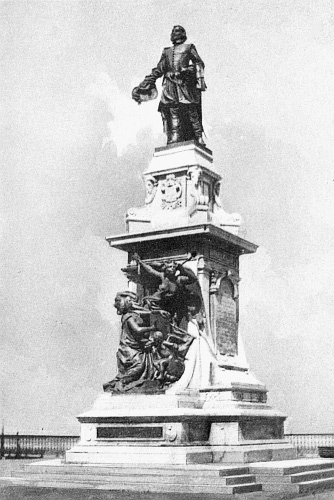
MEMORIAL MONUMENT TO SAMUEL DE CHAMPLAIN, FOUNDER OF QUEBEC
Before the Selkirks are reached the train passes the Columbia or Gold range, through the Eagle Pass, so called because it was discovered by watching an eagle’s flight. Eagle’s Pass is a poetic and appropriate name, and yet I think it would be well to re-name this mountain pass and call it Mirror Lake Cañon, because that would call the attention of tourists to what is its most characteristic feature, which may otherwise be overlooked. There are four lakes and many smaller bodies of water in this valley, in whose placid surface the finely-sloped mountain ridges and summits of the pass are reflected with marvellous distinctness, so that here, as in the Yosemite Mirror Lake, the copy is more lovely than the original. Some of the mountain-sides reflected in these mirrors are naked rocks, others are covered with living evergreen trees, and others still with dead trees. In the mirror these dead forests look hardly less beautiful than the living ones; but in the original the eye dwells with more pleasure on the green forests which here, and almost everywhere in British Columbia, grow with the rank luxuriance of a Ceylon jungle. The soil under these dense tree-masses, consisting of decayed pine- and fir-needles, a foot deep, and always moist, makes a paradise for lovely mosses and ferns. Here, also, is the home of the bear, and one would not have to walk far in this thicket to encounter a grizzly, black, or cinnamon bruin.
On emerging from the Mirror Lake Cañon, a great surprise awaits the passengers. The Columbia River—to which they had fancied they had said a final farewell when they were ferried across it on the way from Portland to Tacoma—suddenly comes upon the scene again, as clear and as picturesque as ever; and even at this immense distance from its mouth still large enough to require a bridge half a mile long to cross it. A few hours later the train again crosses the Columbia, at Donald, where the river has become much smaller than it seems that it should in such a short distance.
To get an explanation of this circumstance, it is interesting to glance at the map and notice what an immense curve northward the Columbia has made in this interval in order to find a passage through the Selkirk range; and in thus encircling the snowy Selkirks it has, of course, added to its volume the contents of innumerable glacier streams and mountain brooks. Its real sources are southeast of Donald, on the summit of the Rockies, separated by but a short distance from springs which run down on the eastern side and find their way through the Mississippi into the Gulf of Mexico. Thus do extremes meet. It would be difficult to find anything so curious in the course of any other river as this immense, irregular parallelogram which the Columbia here describes from its sources to Arrow Lake....
The snow-peaks of the Selkirks are now looming up on all sides, and the atmosphere becomes more bracing and Alpine as the train slowly creeps up the mountain-side, doubling up on itself in a loop. The Glacier House is reached before long, and here every tourist who has time to spare should get off and spend a day or two, since next to Banff, in the National Park, this is the finest point along the whole route, scenically speaking, while the air is even more salubrious, cool, and intoxicating than at Banff, owing to the nearness of the glacier. It would be difficult, even in Switzerland, to find a more romantic spot for a hotel than the location of the Glacier House. High peaks rise up on every side, so finely moulded, so deeply mantled with snow, and presenting such various aspects from different points of view, that we forget our disgust at the fact that, as usual in the West, these grand eternal peaks have been named after ephemeral mortals,—Browns, Smiths, and Joneses. The Grizzly and Cougar Mountains are more aptly named, as these animals will long continue to abound in the impenetrable forests which adorn these peaks below the snow-line. Looking from the hotel towards the glacier, to the left is a peak which looks like the Matterhorn, the most unique mountain in Switzerland, and, what is still more striking, at its side is another smaller peak, which is an exact copy of the Little Matterhorn....
The principal difference between the Swiss Alps and the Selkirk range lies in the aspect of the mountain-sides below the snow-line. These, in Switzerland, are green meadows dotted with browsing cows, and presenting one unbroken mass of dark green, except where an avalanche has tobogganed down and opened what seems at a distance like a roadway, but is found to be a battle-field strewn with the corpses of cedars three and four feet in diameter.
The most imposing view of such a mountain forest unbroken by a single avalanche path is obtained from the snow-sheds just above the hotel. Sitting outside these sheds and looking towards the left, you see a vast mountain slope covered with literally millions of dark-green trees. Why has none of the world’s greatest poets ever been permitted to gaze on such a Selkirk forest, that he might have aroused in his unfortunate readers who are not privileged to see one emotions similar to those inspired by it? But I fear that neither verse nor photographs, nor even the painter’s brush, can ever more than suggest the real grandeur of such a forest scene. This mountain is not snow-crowned in September, but its wooded summit makes a sharp green line against the snow-peaks beyond and above. From this summit down to the foot stand the giant cedars, as crowded as the yellow stalks in a Minnesota wheatfield. But in place of the flat monochrome of a wheatfield, our sloping forest presents a most fascinating color spectacle. The slanting rays of the sun tinge the waving tree-tops with a deeply saturated yellowish-green, curiously interspersed with a mosaic of dark, almost black streaks and patches of shade, due to clouds and other causes, and the whole edged by the dazzling snow.
If we descend and enter this forest, a cathedral-like awe thrills the nerves. Daylight has not the power to penetrate to the ground hidden by this dense mass of tree-tops rising two hundred to three hundred feet into the air,—except that an occasional ray of sunlight may steal in for a second, like a flash of lightning. And the carpet on which this forest stands! In America we rarely see a house, even of a day-laborer, without a carpet; why, then, should these royal trees do without one? The carpet is itself a miniature forest of ferns and mosses, luxuriating in riotous profusion on an ever-moist soil, the product of thousands of generations of pine-needles. Nor is this carpet a monochrome, for the green is varied by numerous berries of various kinds, most of which are red, as they should be,—the complementary color of green. But there are also acres of blueberries as large as cherries; and if you will tear off a few branches of these and bring them to the young bear chained up near the Glacier Hotel, he will be very grateful, and you will find it amusing to watch him eating them.
There is music, too, in this Forest Cathedral, which is heard to best advantage from the elevated gallery occupied by the snow-sheds. It takes a trained ear to distinguish the steady, rippling staccato sound of a snow-fed mountain brook from the prolonged legato sigh of a pine forest, swelling to fortissimo, and dying away by turns. In the romantic spot we have chosen these sounds are blended, the music of the torrents being caught up by the sloping forest as by a huge sounding-board, and increased in loudness by being mingled with the mournful strains of the tree-tops, as orchestral colors are blended by modern masters. Those err who say there is no music in nature. It is not in “Siegfried” alone that the Waldweben is musical, that leaves sing as well as birds, while the thunder occasionally adds its loud basso profundo. The æsthetic exhilaration which we owe to these poetic sights and sounds is intensified by the salubrious breezes which waft this music to our ears. Born among the clouds and glaciers, they are perfumed in passing across the forests, warmed by the sun’s rays in passing over the valley; and every breath of this elixir adds a day to one’s life. It is not surprising that mountains should make the best health-resorts; for do they not themselves understand and obey the laws of health? They keep their heads cool under a snow-cap, their feet warm in a mossy blanket, and their sides covered with a dense fir overcoat....
For the greater part of the two hours which the train requires to go from Donald to Golden City it passes along the bank of the Columbia River; and there is, perhaps, no part of the whole route where grandeur and beauty are so admirably united as here, especially in the autumn. The grandeur lies in the snowy summits which frame in this Columbia valley—the Selkirks on one side, the Rockies on the other. The beauty lies in the river itself and in the young trees and bushes along its banks, dressed in fall styles and colors, some as richly yellow as a golden-rod, others as deeply purple or crimson as fuchsias or begonias, the yellow predominating. These colored trees occur in groups and streaks along the river, and in isolated patches on the mountain-sides, where they might be mistaken for brown mosses or lichen-colored rocks. There may be as beautifully colored trees in our Eastern forests, but they are not mixed, as here, with young evergreen pines, nor have they a framework of snow mountains, like these, to enhance their beauty.
High up on the ridges there is another variety of trees of a beautiful russet color set off by a deep-blue sky. Talk of color symphonies. Here they are—miles of them—long as a Wagner trilogy, and as richly orchestrated. Even the masses of blackened logs and stumps—if one can set aside for the moment all thought of pity for the poor charred trees, so happy before the fire in their green luxuriance, and of the sad waste of useful timber—enhance the charm of this scene by contrast.
I have said that the time-table of the Canadian Pacific Railway is so arranged that the finest scenery is passed in daylight, in both directions; but of course there must be exceptions, and, as a matter of fact, as long as the road crosses the three great mountain ranges of the Cascades, Selkirks, and Rockies, there is hardly a mile that does not offer something worth seeing. Consequently, as darkness again closes in soon after leaving Golden, east-bound passengers must resign themselves to lose sight of the Kicking Horse Cañon, the Beaverfoot and Ottertail Mountains, the large glacier on Mount Stephen, etc.,—which is all the more provoking as they have to sit up anyway till midnight, when Banff is reached; for, of course, every tourist who is in his right senses and not a slave to duty gets off here to spend a few days in the Canadian National Park.
[The description of this park we can give only in summary.]
Summing up on the Canadian National Park, we may say it has not so many natural wonders as the Yellowstone Park,—no geysers, steam-holes, gold-bottomed rivulets, paint-pots, nor anything to place beside the Yellowstone Cañon and Falls. But the Minnewonka Lake may fairly challenge comparison with the Yellowstone Lake, and the mountain scenery is grander in the Canadian Park, and the snow and glaciers are nearer, though not so near as at the Glacier House, where the air is in consequence cooler and more bracing in summer than even at Banff. As the Canadian Park is only twenty-six miles long and ten wide, while the Yellowstone Park is about sixty-two by fifty-four miles, the former can be seen in much less time than it takes to do justice to the latter.
When we get ready to leave Banff we have to take the midnight train, so there is no chance to say good-by to the mountains. But we have seen so much of them since leaving Vancouver, that we have felt almost tempted to cry out to Nature, “Hold, enough; less would be more!” Now we get ample opportunity to ruminate in peace over our crowded impressions. When we get up we are on the prairie; we go to bed on the prairie, after traversing a territory larger than a European kingdom; again we rise on the prairie, and again go to bed on it; and not till Lake Superior is approached does the scenery once more become interesting....
As a general thing, it is no doubt wiser to take the Canadian Pacific Railway westward than eastward, as the scenic climax is on the western side. However, it is quite possible to avoid the feeling of anti-climax on going east, if we conclude the trip with the Thousand Islands and the Rapids of the St. Lawrence, together with Montreal; or with Niagara Falls and the Hudson River. The Pacific slope, no doubt, is scenically far more attractive than the Atlantic; still, there are some things in the East which even California would be proud to add to her attractions.