Volume 2 — LIFE AND SCENERY IN VENEZUELA.
Reading edition
ALEXANDER VON HUMBOLDT.
[The illustrious traveller and scientist from whose picturesque descriptions of life and scenery in South America we here quote was born in Berlin, September 14, 1769. After a careful university education and scientific labors in Europe, he set sail for America in 1799, and during the succeeding five years explored a great extent of territory within the areas of the present states of Venezuela, Colombia, Ecuador, Peru, and Mexico. For twenty-five years succeeding his return he was employed in arranging his collections, publishing the results of his observations, and in other scientific labors. In 1829 he again became a traveller, and explored a wide district in Asia. He died, in his ninetieth year, May 6, 1859. Few men have ever done so much for the advancement of science, while his published works of travel contain much that is of value from a literary point of view. We extract a series of interesting passages relating to scenery and incidents in the Orinoco region. The first is descriptive of the remarkable “cow-tree.”]
When incisions are made in the trunk of this tree, it yields abundance of a glutinous milk, tolerably thick, devoid of all acridity, and of an agreeable and balmy smell. It was offered to us in the shell of a calabash. We drank considerable quantities of it in the evening before we went to bed, and very early in the morning, without feeling the least injurious effect. The glutinous character of this milk alone renders it a little disagreeable. The negroes and the free people who work in the plantations drink it, dipping into it their bread of maize or cassava. The overseer of the farm told us that the negroes grow sensibly fatter during the season when the palo de vaca furnishes them with most milk. The juice, exposed to the air, presents at its surface membranes of a strongly animalized substance, yellowish, stringy, and resembling cheese.
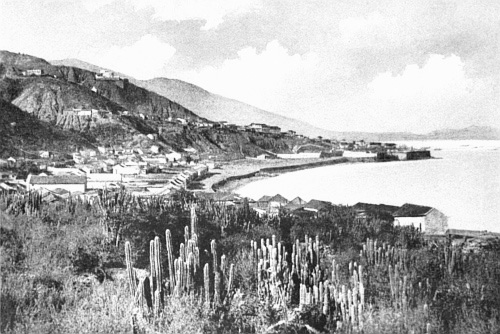
LA GUAYRA, VENEZUELA
Amidst the great number of curious phenomena which I have observed in the course of my travels, I confess there are few that have made so powerful an impression on me as the aspect of the cow-tree. Whatever relates to milk or to corn inspires an interest which is not merely that of the physical knowledge of things, but is connected with another order of ideas and sentiments. We can scarcely conceive how the human race could exist without farinaceous substances, and without that nourishing juice which the breast of the mother contains, and which is appropriated to the long feebleness of the infant. The amylaceous matter of corn, the object of religious veneration among so many nations, ancient and modern, is diffused in the seeds and deposited in the roots of vegetables; milk, which serves as an aliment, appears to us exclusively the produce of animal organization. Such are the impressions we have received in our earliest infancy; such is also the source of that astonishment created by the aspect of the tree just described. It is not here the solemn shades of forests, the majestic course of rivers, the mountains wrapped in eternal snow, that excite our emotion. A few drops of vegetable juice recall to our minds all the powerfulness and the fecundity of nature. On the barren flank of a rock grows a tree with coriaceous and dry leaves. Its large woody roots can scarcely penetrate into the stone. For several months of the year not a single shower moistens its foliage. Its branches appear dead and dried; but when the trunk is pierced there flows from it a sweet and nourishing milk. It is at the rising of the sun that this vegetable fountain is most abundant. The negroes and natives are then seen hastening from all quarters, furnished with large bowls to receive the milk, which grows yellow and thickens at its surface. Some empty their bowls under the tree itself, others carry the juice home to their children.
[The great plains of Venezuela are thus described:]
The sun was almost at its zenith; the earth, wherever it appeared sterile and destitute of vegetation, was at the temperature of 120°. Not a breath of air was felt at the height at which we were on our mules; yet, in the midst of this apparent calm, whirls of dust incessantly arose, driven on by those small currents of air which glide only over the surface of the ground, and are occasioned by the difference of temperature between the naked sand and the spots covered with grass. All around us the plains seemed to ascend to the sky, and the vast and profound solitude appeared like an ocean covered with sea-weed. On the horizon the earth was confounded with the sky. Through the dry mist and strata of vapor the trunks of palm-trees were seen from afar, stripped of their foliage and their verdant summits, and looking like the masts of a ship descried upon the horizon. There is something awful, as well as sad and gloomy, in the uniform aspect of these steppes. Everything seems motionless; scarcely does a small cloud, passing across the zenith, and denoting the approach of the rainy season, cast its shadow on the earth. I know not whether the first aspect of the llanos excites less astonishment than that of the chain of the Andes.
When, beneath the vertical rays of the bright and cloudless sun of the tropics, the parched sward crumbles into dust, then the indurated soil cracks and bursts as if rent asunder by some mighty earthquake. And if, at such a time, two opposite currents of air, by conflict moving in rapid gyrations, come in contact with the earth, a singular spectacle presents itself. Like funnel-shaped clouds, their apexes touching the earth, the sand rises in vapory form through the rarefied air in the electrically-charged centre of the whirling current, sweeping on like the rushing waterspout, which strikes such terror into the heart of the mariner. A dim and sallow light gleams from the lowering sky over the dreary plain. The horizon suddenly contracts, and the heart of the traveller sinks with dismay as the wide steppe seems to close upon him on all sides. The hot and dusty earth forms a cloudy veil which shrouds the heavens from view, and increases the stifling oppression of the atmosphere, while the east wind, when it blows over the long-heated soil, instead of cooling, adds to the burning glow. Gradually, too, the pools of water, which had been protected from evaporation by the now seared foliage of the fan-palm, disappear. As in the icy north animals become torpid from cold, so here the crocodile and the boa-constrictor lie wrapt in unbroken sleep, deeply buried in the dried soil. Everywhere the drought announces death, yet everywhere the thirsty wanderer is deluded by the phantom of a moving, undulating, watery surface, created by the deceptive play of the mirage. A narrow stratum separates the ground from the distant palm-trees, which seem to hover aloft, owing to the contact of currents of air having different degrees of heat, and therefore of density. Shrouded in dark clouds of dust, and tortured by hunger and burning thirst, oxen and horses scour the plain, the one bellowing dismally, the other with outstretched necks snuffing the wind, in the endeavor to detect, by the moisture of the air, the vicinity of some pool of water not yet wholly evaporated.
The mule, more cautious and cunning, adopts another method of allaying his thirst. There is a globular and articulated plant, the Melo-cactus, which encloses under its prickly integument an aqueous pulp. After carefully striking away the prickles with its forefeet, the mule cautiously ventures to apply his lips to imbibe the cooling thistle juice. But the draught from this living vegetable spring is not always unattended by danger, and these animals are often observed to have been lamed by the puncture of the cactus thorn. Even if the burning heat of day be succeeded by the cool freshness of the night, here always of equal length, the wearied ox and horse enjoy no repose. Huge bats now attack the animals during sleep, and vampire-like suck their blood; or, fastening on their backs, raise festering wounds, in which mosquitoes, hippobosces, and a host of other stinging insects burrow and nestle.
When, after a long drought, the genial season of rain arrives, the scene suddenly changes. The deep azure of the hitherto cloudless sky assumes a lighter hue. Scarcely can the dark space in the constellation of the Southern Cross be distinguished at night. The mild phosphorescence of the Magellanic clouds fades away. Like some distant mountain, a single cloud is seen rising perpendicularly on the southern horizon. Misty vapors collect and gradually overspread the heavens, while distant thunder proclaims the approach of the vivifying rain. Scarcely is the surface of the earth moistened before the teeming steppe becomes covered with a variety of grasses. Excited by the power of light, the herbaceous mimosa unfolds its dormant, drooping leaves, hailing, as it were, the rising sun in chorus with the matin song of the birds and the opening flowers of aquatic plants. Horses and oxen, buoyant with life and enjoyment, roam over and crop the plains. The luxuriant grass hides the beautifully spotted jaguar, who, lurking in safe concealment, and carefully measuring the extent of his leap, darts, like the Asiatic tiger, with a cat-like bound upon his passing prey. At times, according to the accounts of the natives, the humid clay on the banks of the morasses is seen to rise slowly in broad flakes. Accompanied with a violent noise, as on the eruption of a small mud-volcano, the upheaved earth is hurled high into the air. Those who are familiar with the phenomenon fly from it; for a colossal water-snake, or a mailed and scaly crocodile, awakened from its trance by the first fall of rain, is about to burst from its tomb.
When the rivers bounding the plain to the south, as the Arauca, the Apure, and the Payara, gradually overflow their banks, nature compels those creatures to live as amphibious animals, which, during the first half of the year, were perishing with thirst on the waterless and dusty plain. A part of the steppe now presents the appearance of a vast inland sea. The mares retreat with their foals to the higher banks, which project, like islands, above the spreading waters. Day by day the dry surface diminishes in extent. The cattle, crowded together, and deprived of pasturage, swim for hours about the inundated plain, seeking a scanty nourishment from the flowing panicles of the grasses which rise above the lurid and bubbling waters. Many foals are drowned, many are seized by crocodiles, crushed by their serrated tails, and devoured. Horses and oxen may not unfrequently be seen which have escaped from the fury of this blood-thirsty and gigantic lizard, bearing on their legs the marks of its pointed teeth.
[A widely different scene is that of the forest region, the nocturnal noises of whose animal inhabitants are thus picturesquely described.]
Below the mission of Santa Barbara de Arichuna we passed the night as usual in the open air, on a sandy flat, on the bank of the Apure, skirted by the impenetrable forest. We had some difficulty in finding dry wood to kindle the fires with which it is here customary to surround the bivouac, as a safeguard against the attacks of the jaguar. The air was bland and soft and the moon shone brightly. Several crocodiles approached the bank; and I have observed that fire attracts these creatures as it does our crabs and many other aquatic animals. The oars of our boats were fixed upright in the ground, to support our hammocks. Deep stillness prevailed, only broken at intervals by the blowing of the fresh-water dolphins, which are peculiar to the river net-work of the Orinoco.
After eleven o’clock such a noise began in the contiguous forest, that for the remainder of the night all sleep was impossible. The wild cries of animals rung through the woods. Among the many voices which resounded together, the Indians could only recognize those which, after short pauses, were heard singly. There was the monotonous, plaintive cry of the howling monkeys, the whining, flute-like notes of the small sapajous, the grunting murmur of the striped nocturnal ape, the fitful roar of the great tiger, the cougar, or maneless American lion, the peccary, the sloth, and a host of parrots, parraquas, and other pheasant-like birds. Whenever the tigers approached the edge of the forest, our dog, who before had barked incessantly, came howling to seek protection under the hammocks. Sometimes the cry of the tiger resounded from the branches of a tree, and was always then accompanied by the plaintive, piping tones of the apes, who were endeavoring to escape from the unwonted pursuit.
If one asks the Indians why such a continuous noise is heard on certain nights, they answer, with a smile, that “the animals are rejoicing in the beautiful moonlight, and celebrating the return of the full moon.” To me the scene appeared rather to be owing to an accidental, long-continued, and gradually increasing conflict among the animals. Thus, for instance, the jaguar will pursue the peccaries and the tapirs, which, densely crowded together, burst through the barrier of tree-like shrubs which opposes their flight. Terrified at the confusion, the monkeys on the tops of the trees join their cries with those of the larger animals. This arouses the tribes of birds who build their nests in communities, and suddenly the whole animal world is in a state of commotion. Further experience taught us that it was by no means always the festival of moonlight that disturbed the stillness of the forest; for we observed that the voices were loudest during violent storms of rain, or when the thunder echoed and the lightning flashed through the depths of the wood. The good-natured Franciscan monk who accompanied us through the cataracts of Apures and Maypures to San Carlos, on the Rio Negro, and to the Brazilian frontier, used to say, when apprehensive of a storm at night, “May heaven grant a quiet night both to us and to the wild beasts of the forest!”
[The unpleasant conditions of a canoe voyage on the Orinoco are thus described:]
The new canoe intended for us was, like all Indian boats, a trunk of a tree hollowed out partly by the hatchet and partly by fire. It was forty feet long and three broad. Three persons could not sit in it side by side. These canoes are so crank, and they require, from their instability, a cargo so equally distributed, that when you want to rise for an instant, you must warn the rowers to lean to the opposite side. Without this precaution the water would necessarily enter the side pressed down. It is difficult to form an idea of the inconveniences that are suffered in such wretched vessels. To gain something in breadth, a sort of lattice-work had been constructed on the stern with branches of trees, that extended on each side beyond the gunwale. Unfortunately, the toldo, or roof of leaves, that covered this lattice-work, was so low that we were obliged to lie down, without seeing anything, or, if seated, to sit nearly double. The necessity of carrying the canoe across the rapids, and even from one river to another, and the fear of giving too much hold to the wind, by making the toldo higher, render this construction necessary for vessels that go up towards the Rio Negro. The toldo was intended to cover four persons, lying on the deck or lattice-work of brushwood; but our legs reached far beyond it, and when it rained half our bodies were wet. Our couches consisted of ox-hides or tiger-skins spread upon branches of trees, which were painfully felt through so thin a covering. The fore part of the boat was filled with Indian rowers, furnished with paddles, three feet long, in the form of spoons. They were all naked, seated two by two, and they kept time in rowing with a surprising uniformity, singing songs of a sad and monotonous character. The small cages containing our birds and our monkeys—the number of which augmented as we advanced—were hung some to the toldo and others to the bow of the boat. This was our travelling menagerie. Every night, when we established our watch, our collection of animals and our instruments occupied the centre; around these were placed, first, our hammocks, then the hammocks of the Indians; and on the outside were the fires, which are thought indispensable against the attacks of the jaguar. About sunrise the monkeys in our cages answered the cries of the monkeys of the forest.
In a canoe not three feet wide, and so encumbered, there remained no other place for the dried plants, trunks, sextant, a dipping needle, and the meteorological instruments, than the space below the lattice-work of branches, on which we were compelled to remain stretched the greater part of the day. If we wished to take the least object out of a trunk, or to use an instrument, it was necessary to row ashore and land. To these inconveniences were joined the torment of the mosquitoes which swarmed under the toldo, and the heat radiated from the leaves of the palm-trees, the upper surface of which was continually exposed to the solar rays. We attempted every instant, but always without success, to amend our situation. While one of us hid himself under a sheet to ward off the insects, the other insisted on having green wood lighted beneath the toldo, in the hope of driving away the mosquitoes by the smoke. The painful sensations of the eyes, and the increase of heat, already stifling, rendered both these contrivances alike impracticable. With some gayety of temper, with feelings of mutual good-will, and with a vivid taste for the majestic grandeur of these vast valleys of rivers, travellers easily support evils that become habitual.
[The torment of insects—mosquitoes and venomous flies by day, and the zancudos (large gnats) by night—became almost insupportable as they advanced. On the upper Orinoco the mosquitoes form the principal topic of conversation, the usual salutation being, “How did you find the gnats during the night?” or, “How are you off for mosquitoes to-day?” Humboldt thus describes the situation:]
The lower strata of air, from the surface of the ground to the height of fifteen or twenty feet, are absolutely filled with venomous insects. If in an obscure spot, for instance, in the grottos of the cataracts formed by superincumbent blocks of granite, you direct your eyes towards the opening enlightened by the sun, you see clouds of mosquitoes more or less thick. I doubt whether there be a country upon earth where man is exposed to more cruel torments in the rainy season. Having passed the fifth degree of latitude you are somewhat less stung; but on the upper Orinoco the stings are more painful, because the heat and the absolute want of wind render the air more burning and more irritating in its contact with the skin. “How comfortable people must be in the moon!” said a Salivo Indian to Father Gumilla. “She looks so beautiful and so clear, that she must be free from mosquitoes.” These words, which denote the infancy of a people, are very remarkable. The satellite of the earth appears to all savage nations the abode of the blessed, the country of abundance. The Esquimaux, who counts among his riches a plank or the trunk of a tree, thrown by the currents on a coast destitute of vegetation, sees in the moon plains covered with forests; the Indian of the forest of Orinoco there beholds open savannas, where the inhabitants are never stung by mosquitoes.
[The story of the voyage closes as follows:]
It would be difficult for me to express the satisfaction we felt on landing at Angostura [the capital of Spanish Guiana.] The inconveniences endured at sea in small vessels are trivial in comparison with those that are suffered under a burning sky, surrounded by swarms of mosquitoes, and lying stretched in a canoe, without the possibility of taking the least bodily exercise. In seventy-five days we had performed a passage of five hundred leagues—twenty to a degree—on the five great rivers, Apure, Orinoco, Atabapo, Rio Negro, and Cassiquiare; and in this vast extent we had found but a very small number of inhabited places. Coming from an almost desert country, we were struck with the bustle of the town, though it contained only six thousand inhabitants. We admired the conveniences which industry and commerce furnish to civilized man. Humble dwellings appeared to us magnificent; and every person with whom we conversed seemed to be endowed with superior intelligence. Long privations give a value to the smallest enjoyments; and I cannot express the pleasure we felt when we saw for the first time wheaten bread on the governor’s table.