Volume 2 — CANOE- AND CAMP-LIFE ON THE MADEIRA.
Reading edition
FRANZ KELLER.
[To the extract just made from Keller’s “Amazon and Madeira Rivers,” we add the following, in which an interesting account of camp-life in the forest and river regions of Brazil is given.]
The lower course of the Madeira presents, for more than four hundred and sixty miles, a picture of grand simplicity, and, it must be owned, monotony, which, magnificent as it appears at first, wearies the eye and sickens the heart at last,—a dead calm on an unruffled, mirror-like sheet of water glaring in the sun, and, as far as the eye can reach, two walls of dark green forest, with the dark-blue firmament above them; in the foreground, slender palms and gigantic orchid-covered trunks, with blooming creepers hanging from the wave-worn shore, with its red earthslips, down into the turbid floods. No hill breaks the finely-indented line of the foliage, which everywhere bounds the horizon, only here and there a few palm-covered sheds peep out of the green; and still more rarely do we sight one of their quiet dark inmates. Stately kingfishers looking thoughtfully into the river, white herons standing for hours on one leg, and alligators lying so motionless at the mouth of some rivulet that their jaggy tails and scarcely protruding skulls might easily be taken for some half-sunken trunks, are the only animals to be seen, and certainly they do not increase the liveliness of the scene. Dreary and monotonous as the landscape, the days, too, pass in unvaried succession.
With the first dawn of day, before the white mist that hides the smooth surface of the river has disappeared with the rays of the rising sun, the day’s work begins. The boatswains call their respective crews; the tents are broken up as quickly as possible; the cooking apparatus, the hammocks and hides that served as beds, are taken on board, together with our arms and mathematical instruments, and every one betakes himself to his post. The pagaias (paddles) are dipped into the water, and the prows of our heavy boats turn slowly from the shore to the middle of the stream. Without the loss of a minute, the oars are plied for three or four hours at a steady but rather quick rate, until a spot on shore is discovered easy of access and offering a dry fire-place and some fuel for the preparation of breakfast. If it be on one of the long sand-banks, a roof is made of one of the sails, that rarely serve for anything else; if in the wood, the undergrowth, in the shade of some large tree, is cleared for the reception of our little table and tent-chairs.
The functions of the culinary chef for the white faces, limited to the preparation of a dish of black beans, with some fish or turtle, are simple enough, but, to be appreciated, certainly require the hearty appetite acquired by active life in the open air. The Indians have to cook by turns for their respective boats’ crews; their unalterable bill of fare being a pap of flour of Indian corn or mandioca, with fresh or dried fish, or a piece of jacaré (alligator).
Most of those who are not busy cooking spend their time preparing new bast shirts, the material for which is found almost everywhere in the neighborhood of our halting-places. Soon the wood is alive with the sound of hatchets and the crack of falling trees; and, even before they are summoned to breakfast, they return with pieces of a silky bast of about four and a half yards long and somewhat less than one and a quarter yard wide. Their implements for shirt-making are of primitive simplicity,—a heavy wooden hammer with notches, called maceta, and a round piece of wood to work upon. Continuously beaten with the maceta, the fibres of the bast become loosened, until the originally hard piece of wood gets soft and flexible, and about double its former breadth. After it has been washed, wrung out to remove the sap, and dried in the sun, it has the appearance of a coarse woollen stuff of a bright whitish-yellow or light brown, disclosing two main layers of wavy fibres held together by smaller filaments. A more easily prepared and better working-garment for a tropical climate is hardly to be found than this, called cáscara by the Indians of Bolivia, and turury by those of the Amazon. Its cut is as simple and classical as its material. A hole is cut in the middle of a piece about ten feet long, to pass the head through, and the depending skirt is sewn together on both sides, from below up to the height of the girdle, which usually is a piece of cotton string or liana.
Another branch of industry our Indians were busy at, in their hours of leisure, was the fabrication of straw hats, with the young leaves of a kind of little palm, the same which supplies the excellent hats imported from Ecuador and Peru, and known in Europe under the name of Chile or Panama hats. Dexterity at all sorts of wicker-work seems to be innate to this race; and the prettiest little baskets and the finest mats of colored palm-leaves are to be bought on the Missions of the Mamoré at the lowest prices.
A SOUTH SEA ISLAND
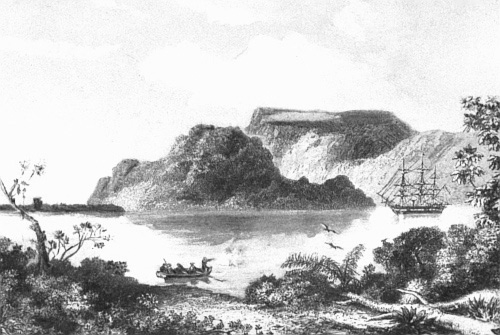
But all these occupations are left at the call of the first mate, who has the proud title of Capitano. The boats’ crews crowd round their pots, each one receives his allotted portion in a calabash or a basin of horn, and their spoons of the same material are soon in full activity. If a jacaré has lately been shot, or caught in a laço (sling), every one, after roasting his own piece of it on the spit, proceeds to cut at the large slices of the white meat (which, though in appearance like fish, is as tough as india-rubber) with the satisfaction usually produced by three or four hours of hard rowing on view of anything eatable. One tribe especially, the Canichanas, from the former Mission of San Pedro at the Mamoré, think roast caiman the finest eating in the world; while others, the Cayuabas from Exaltacion, and the Mojos from Trinidad, whose palates are somewhat more refined, prefer beef, fish, or turtle to the musk-exhaling saurian. Notably the turtles, which are not found on the Guaporé and Mamoré (they are not met with above the rapids of the Madeira), are prized by them, though we grew rather tired of them, and no wonder. On the lower Madeira, at our fires, there was almost daily going on the cooking of turtles, of all sizes, from the full-grown one of a yard in length to the smallest of the size of a hand; and in every variety of preparation, too,—whole, and chopped up as for soup; stewed; and roasted in their own shell or on the spit.
Bathing in the river, immediately after meals, is a luxury invariably indulged in by all the Indians; and I never remarked that it was attended by any evil consequences to them.
After a rest of two hours’ duration, the cooking utensils, the hammocks, and improvised tents were carried on board again, and the voyage continued. A second halt was made after rowing for two or three hours, when we came in sight of a good place for fishing, such as the mouth of some smaller river, or an extensive mud-bank. Such places were usually recognizable from afar, by the multitude of snow-white herons and of long caimans, which, finding it out before us, crowded there in peaceful unity, and with similar intentions. The vicinity of the scaly monsters is scarcely heeded by the Indians, who fish and take their bath, laughing and jesting, though somewhat hugging the shore, just as if there were no such thing as the tail or the tooth of the jacaré in the world; and, indeed, these creatures are themselves in much greater danger than the red-skins. When the last steak of alligator has been consumed, one of the Canichanas is sure to ask leave to have some fun, and to provide at the same time for their next dinner. Of course the permission is always granted, as the sport keeps up their spirits and spares our provisions. Without loss of time, then, one of them, having carefully fastened a strong loop of raw hide at the end of a long pole, and having dexterously slipped off his bast shirt, creeps slowly through the shallow water, pole and sling in hand, as near as possible to the alligator, which looks on at these preparations with perfect apathy, only now and then betraying a sign of life by a lazy movement of its powerful tail. But it does not take its eyes off the Indian as he crawls nearer and nearer. The fatal sling is at arm’s length from its muzzle, and yet it does not see it. As if under the influence of witchcraft, it continues to stare with its large protruding eyes at the bold hunter, who in the next moment has thrown the loop over its head, and suddenly drawn it to with a strong pull. The other Indians, who the while have been cowering motionless on shore, now rush into the water to the help of their companion, and four or five of them land the ugly creature that with all its might struggles to get back into the water, lashing the sand with its tail and showing its long teeth; but a few vigorous blows with an axe on the tail and skull soon render it tame enough. If, instead of dragging back, the alligator were only to rush forward boldly to the attack of the Indians, they would, of a certainty, leave pole and sling and run for their lives; but this bright idea never seems to occur to the uncouth animal, and the strife always ends with its death. Though there were more than a dozen of them killed during the voyage, I never thought of sending a rifle-bullet through the thick skull of one, except on one occasion, when I was afraid that one of our Canichanas was about to make too close an acquaintance with the hard, jagged tail of an extraordinarily strong monster, which measured full sixteen and a half feet.
Even before the huge spoil is cut up, four musk-glands, placed by twos under its jaw, and on its belly, near the beginning of the tail, must be carefully taken out, to prevent the diffusion, over the whole body, of the penetrating odor of the greasy, brown liquid they contain. These glands, which are about an inch and a half long and as thick as a finger, are carefully tied up and suspended in the sun to dry. Mixed with a little rose-water, their contents serve, as we were told, to perfume the raven-black tresses of the elegant Bolivian ladies at Santa Cruz de la Sierra and Cochabamba, in spite of, or rather by reason of, their strong scent, which gives the headache to all save these strong-nerved señoritas, who love a bull-fight above everything, who know how to roll the cigarrito, and to dance the fandango with matchless grace, but who scarcely are able to write their own names.
After such a pleasant interlude of fishing or hunting, the paddles are plied with renewed vigor until the evening, when sleeping quarters are selected, either on a sand-bank or in the forest. The canoes are moored by strong piassaba ropes in some recess of the bank, where they are protected against drifting trunks; the tents are erected, and preparations ensue for the principal meal. Meanwhile, after the very short interval of twilight usual in the tropics, night almost suddenly throws her dark veil over the valley, and the bright constellations of the southern sky in quiet majesty adorn the firmament.
While we prepare to take astronomical observations, half a dozen large fires are lighted round about, in whose fitful blaze the neighboring forest-trees appear like huge phantoms, looking contemptuously down on us, poor tiny mortals. Our Indians warm themselves in the cheerful glow, smoking, and chatting of the day’s adventures, or rather of what are regarded as such,—unusual good or ill luck at fishing and hunting; the casual meeting of some canoe; or the sight of a seringueiro’s poor cottage. Work over, they take off the rough cáscara, and put on the camiseta, a cotton garment without sleeves, resembling a wide poncho sewn together at the sides, and whose dazzling whiteness is set off by two scarlet stripes along the seams. The ample folds and the simple cut of the garment, which is made by the Indian women of the Missions on very primitive looms, give quite a stately, classical appearance to the numerous groups round the fires. Such must have been the aspect presented by the halting-places of those daring seafarers, the Phœnicians, who were the first to call into life an international commerce, and whose light-rigged barques first ventured to distant shores, to bring home the precious amber and the useful tin. Only the dense swarms of mosquitoes, which set in immediately after sunset, remind us rather unpleasantly that we are far off from those happy northern regions, where such a nuisance can hardly be well imagined. Especially in the dense forest beneath cacao-bushes, or under the close leafage of the large figueiras, where no breath of air incommodes those light-winged tormentors, it is quite impossible, for the European at least, to close an eye without the shelter of a mosquiteiro (mosquito-net); and we could but wonder at our Indians, most of whom did without it. After supper they simply spread a hide on the ground, on which, with no covering other than the starry firmament above them, they slept undisturbed till the dawn, only occasionally brushing away, as if by way of diversion, the most obtrusive of the little fiends. The capitanos only, and one or other of the older rowers, allow themselves the luxury of good cotton hammocks, which are also made by their wives in the Missions.
Such, with few variations, was the course of our daily life, until we reached the regions of the rapids, when, of course, the hundred little incidents connected with the dragging of the canoes through narrow, foaming channels, and with carrying the goods and the vessels themselves overland, disturbed the monotony of this rude forest life.