The Larger North American Mammals (continued 3)
Reading edition
Ordinarily moose are extremely shy, but during the mating season the males become so bold that when encountered at close range they have been known furiously to charge a hunter. They strike vicious blows with their front feet, as well as with their heavy antlers, and make dangerous foes for man or beast.
Moose have disappeared from the Adirondacks and have become scarce in many districts where once plentiful. Through wise protection they are still numerous about the head of Yellowstone Lake, and are still among the available game animals of Maine and the eastern provinces of Canada. Indeed, during the last few years they have steadily extended their range in northern Ontario and British Columbia. They occupy great areas of little-visited wilderness, which are becoming more and more accessible; as a result the future existence of these superb animals depends upon their receiving proper protection.
AMERICAN BISON (Bison bison and its subspecies)
The American bison, or buffalo, is a close relative of the larger bison which once inhabited Europe and survives in limited numbers in certain game preserves of Poland and the Caucasus. The size, dark shaggy coat, great head, and high arched shoulders of our bison give them a unique individuality among American big game. They once roamed in vast numbers over a broad territory, extending from Great Slave Lake, Canada, south to southern New Mexico, and from Pennsylvania and eastern Georgia to Arizona and northern Nevada. It is thus evident that they were at home in the forested country east of the Mississippi River, as well as on the treeless plains of the West. In the northern part of their range they are larger and darker than elsewhere and form a local geographic race called the wood buffalo.
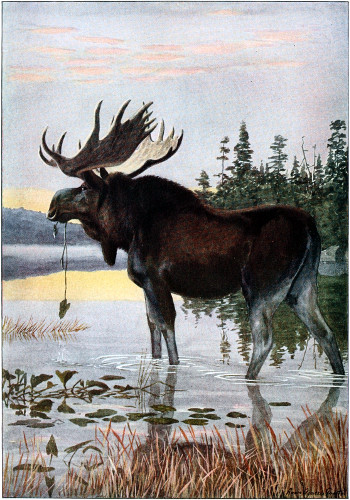
MOOSE
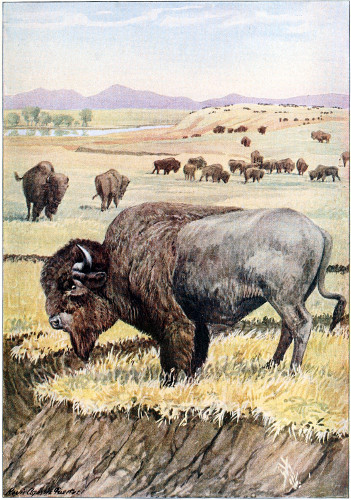
AMERICAN BISON, OR BUFFALO
Originally buffalo were enormously abundant in America, and it has been variously estimated that when the continent was first discovered their numbers were from 30,000,000 to 60,000,000. With the settlement of eastern America, they gradually retreated across the Mississippi River, but continued to exist in great but rapidly diminishing numbers on the Great Plains up to within the last fifty years.
The crossing of their range by the first transcontinental railroad quickly brought the remaining herds to an end. In 1870 there were still about 5,500,000 head on the plains, but these were so wastefully slaughtered for their hides that in 1895 only about 800 remained. The depletion of the herds was so startling that sportsmen and nature lovers awoke to the danger of the immediate extermination of these splendid animals; the American Bison Society was organized and the surviving buffalo were saved.
Although the bison usually has but a single calf a year, these are so hardy and do so well in fenced preserves, and even in the closer confinement of small parks, that their number has now increased to approximately 4,000, about equally divided between the United States and Canada. In the district south of Artillery Lake, northern Canada, a few hundred individuals, remnants of the wild stock of that region, survive and are increasing under the wise protection of the Canadian Government. The only other herd still existing on its original ground is that in Yellowstone National Park.
Experiments have been made in crossing buffalo with certain breeds of domestic cattle for the purpose of establishing a new and hardier variety of stock for the Western ranges. These have not proved successful, largely owing to the lack of fertility in the hybrid, which has been called the “cattalo.”
Under primitive conditions, buffalo herds numbering millions of animals regularly migrated in spring and fall from one feeding ground to another, often traveling hundreds of miles for this purpose. The herds followed the same routes year after year and made lasting trails, often from two to three feet in depth. Investigation has shown that many of our highways, and even some of our main railway lines, seeking the most convenient grades, follow trails laid down by these early pathfinders. When a great migrating herd was stampeded, the thunder of its countless hoofs shook the earth, and in its flight it rushed like a huge black torrent over the landscape.
The buffalo was the most important game animal to the Indians over a great area. Several tribes were mainly dependent upon these animals for food and clothing and the entire tribal economy was built about them. The mode of life, customs, and folk-lore of the Indians all centered about these animals. Their clothing and tepee covers were made of the skins. The tanned skins also served as individual and tribal records of the warrior-hunters, the chronicles being drawn in picture-writing on the smooth surfaces. The passing of the buffalo on the free sweep of the western plains ended forever one of the most picturesque phases of aboriginal life in America.
MUSK-OX (Ovibos moschatus and its subspecies)
The musk-ox is one of the unique and most interesting of American game animals. In general appearance it suggests a small, odd kind of buffalo, and is, in fact, related to both cattle and sheep. It is a heavily built, round-bodied animal, with short, strong legs and long fringelike hair which hangs so low on the sides that it sometimes trails on the snow. The horns—broad, flat, and massive at the base—curve down and out to a sharp point on each side of the head and form very effective weapons for defense.
Fossil remains prove that musk-oxen lived in northern Europe and Asia during Pleistocene times, but they have long been confined to Arctic America. Up to within a century they have occupied nearly all of the cheerless wilds north of the limit of trees, from the coast of northern Alaska to that of east Greenland. They appear to have become extinct in northern Alaska within the last 75 years, and their present range east of the Mackenzie River is becoming more and more restricted.
They are now limited to that part of the barren grounds of Canada lying north and northwest of Hudson Bay and from the Arctic islands northward and eastward to the northern coast of Greenland. Their range extends to beyond 83 degrees of latitude and covers some of the bleakest and most inhospitable lands of the globe. There a short summer, with weeks of continuous sunshine, permits the growth of a dwarfed and scanty Arctic vegetation; but winter brings a long period of night, continuous, in the northernmost parts, through several months.
Under such rigorous conditions musk-oxen thrive unless hunted by civilized man. They are strongly gregarious, usually traveling in herds of from six to twenty, but herds containing about 100 have been recorded. Their eyesight is not strong, but their sense of smell is good, and when danger is suspected they dash away with great celerity for such heavily formed animals. If rocky ground is near, they seek refuge in it and ascend steep, broken slopes with astonishing agility.
When brought to bay, the herd forms a circle about the calves and, with heads out, presents to the enemy an unbroken front of sharp horns. So long as the circle remains unbroken such a defense is extremely effective against both dogs and wolves. The only natural enemies of musk-oxen are wolves, and against these and the primitive weapons of the Eskimos they hold their own very well.
When the Greely Expedition landed at Lady Franklin Bay in 1881, musk-oxen were encountered and killed practically on the site where winter quarters were established. Since then several exploring and hunting parties have taken heavy toll from the herds of that region. Some accounts of the wholesale killings do not make pleasant reading for one who desires the perpetuation of our native species. Fortunately for the musk-oxen, the adventurers of these northern quests are few and far between, so that on departing they leave the game animals in their vast solitudes to recuperate from these onslaughts.
Musk-oxen have but a single young, so that between depredations of wolves and overkilling by white and native hunters these animals face the very real danger of extermination threatening so many other game animals in the far North. For this reason, it is hoped that sportsmen who visit these remote game fields will restrain a desire for making large bags.
FLORIDA MANATI (Trichechus latirostris)
The manatis, or manatees, are strange aquatic mammals, with seal-like heads and whalelike bodies. Compared with whales, their flippers are more flexible at the joints, and thus can be used much more freely. They have very small eyes and a heavy upper lip, deeply cleft in the middle and forming a thick lobe on each side. The skin is hairless and covered with fine wrinkles.
These animals inhabit the rivers entering the sea and shallow coastal lagoons on both sides of the Atlantic, in tropical parts of West Africa and of eastern North and South America. The South American species ascends the Amazon and its tributaries well up toward their headwaters.
The Florida manati regularly frequents the coast from eastern Florida to Mexico, Central America, and the West Indies; in summer it sometimes strays as far north as the coast of Virginia.
This species attains an extreme length of more than 15 feet and a weight of more than 1,500 pounds, but the average size is much less. A large specimen exhibited alive at New Orleans the winter of 1912 weighed 1,310 pounds and is reported to have eaten daily from 60 to 100 pounds of grass. One captured near Point Isabel, Texas, measured a few inches more than 15 feet in length.
Manatis were formerly plentiful in the Indian River and elsewhere along the Florida coast, but were shot and netted to the verge of extermination. They were killed not only for amusement by thoughtless sportsmen, but many were killed by residents for their flesh, which was salted down like beef for future use. The flesh is said to be well flavored and not unlike beef.
The imminent danger of the extermination of these curious animals and their evident value for the interest they lend the coastal waters of the State led to the passage of protective laws with a penalty of $500. As a result of this, manatis have increased rapidly. A correspondent, writing on June 20, 1916, from Ponce Park, on Indian River, says that at this season scarcely an hour in the day passes but that from one to half a dozen may be seen in front of his house. He adds that one with a “calf” about 3 feet long keeps about his dock all the time. In this vicinity manatis appear to be migratory, leaving about the first of December and returning in early spring, the first one noted in 1916 appearing on March 26. They are extremely susceptible to cold, as was demonstrated by the number which perished in Indian River near Micco, February 12, 1895, when the temperature fell to 20° Fahrenheit. They are known to winter in Biscayne Bay and elsewhere in southern Florida.
Within a few weeks after the manatis return to the vicinity of Ponce Park the young are born. Just before this the females are said to seek the protection of a dock, crib, or bridge, possibly in order that the new-born young may be safe from the sharks and sawfish which abound in these waters. Usually there is only one calf, which is about 30 inches long, but sometimes the mother is seen accompanied by two. During this season the females are scattered and, with their young, keep in comparatively shoal water near the shore, and not infrequently lie in shallow pools with half their bodies exposed. Later in the season they gather in herds and often 15 to 20 may be seen close together. At such times they roll about and make a great turmoil in the water. The Mexicans on the coast of southern Vera Cruz described to me similar summer gatherings of manatis in small lagoons and claimed they were there for the purpose of mating.
In fall, near Ponce Park, the larger animals, probably the old males, separate from the herds and roam about singly. At this time they often make a peculiar noise like a loud snort, which may be heard for half a mile or more.
The Florida manatis are extremely mild and inoffensive animals, seeming never to fight one another, nor to show aggressiveness of any kind. When not molested they are very gentle and will feed close about a boat or dock regardless of the presence of people, but they become alarmed by any sudden noise. In captivity they soon learn to eat from their captor’s hands.
Manatis are sluggish, stupid animals, without other defense than their size. They are not rapid swimmers and are among the extremely few herbivorous aquatic mammals. Unlike seals, whales, and their allies, which feed upon some form of animal life, manatis feed on the lush grasses and other vegetation springing from the oozy bottom of the waters they frequent. When feeding on the bottom they use their flippers to help move slowly about. In places along the Indian River they are reported to approach the shore and, with head and shoulders out of water, to feed on heavy grasslike plants hanging from the banks.
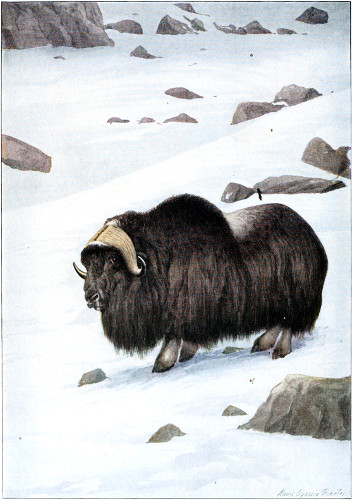
MUSK-OX
While they are feeding the heavy bi-lobed upper lips work freely and are sufficiently prehensile to seize the grass, or other plant food, between the lobes and thrust it back into the mouth. The ends of the flippers are sometimes used to help convey food to the mouth, like huge hands in thumbless mittens.
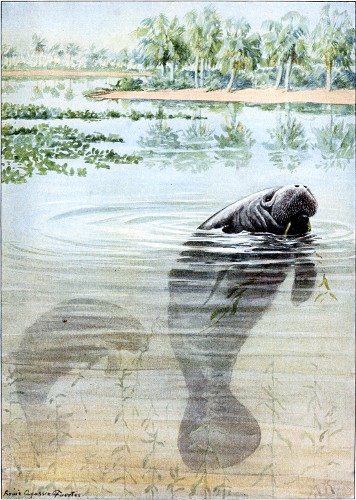
FLORIDA MANATI
When suckling her young the manati rises to the surface, her head and shoulders out of the water, and with her flippers holds the nursling partly clasped to her breast. This semi-human attitude, together with the rounded head and fishlike tail, may have furnished the basis on which the ancients built their legends of the mermaids.
KILLER WHALE (Orcinus orca)
The killer whale is a habitant of all oceans from the border of the Arctic ice fields to the stormy glacial margin of the Antarctic continent. So far as definitely known, there appears to be but a single species. It attains an extreme length of approximately 30 feet and is mainly black with well-defined white areas on the sides and underparts of the body. Its most striking and picturesque characteristic is the large black fin, several feet long, standing upright on the middle of the back.
The killer usually travels and hunts in “schools” or packs of from three to a dozen or more individuals. Unlike most whales, the members of these schools do not travel in a straggling party, but swim side by side, their movements as regularly timed as those of soldiers. A regularly spaced row of advancing long black fins swiftly cutting the undulating surface of the sea produces a singularly sinister effect. The evil impression is well justified, since killers are the most savage and remorseless of whales. The jaws are armed with rows of effective teeth, with which the animals attack and devour seals and porpoises, and even destroy some of the larger whales.
Killers are like giant wolves of the sea, and their ferocity strikes terror to the other warmblooded inhabitants of the deep. The Eskimos of the Alaskan coast of Bering Sea consider killers as actual wolves in sea form. They believe that in the early days, when the world was young and men and animals could change their forms at will, land wolves often went to the edge of the shore ice and changed to killer whales, and the killers returned to the edge of the ice and climbed out as wolves, to go ravening over the land. Some of the natives assured me that even today certain wolves and killers are still endowed with this power and, on account of their malignant character, are much feared by hunters.
Killers are known to swallow small seals and porpoises entire and attack large whales by tearing away their fleshy lips and tongues. When attacking large prey they work in packs, with all the unity and fierceness of so many wolves. The natives of the Aleutian Islands told me that large skin boats are sometimes lost in the passes between the islands by sea-lions leaping upon them in their frenzied efforts to escape the pursuit of killer whales.
The killers are specially detrimental to the fur-seal industry, owing to their habit of preying upon seals during their migrations in the North Pacific and during the summer in Bering Sea. They also haunt the waters about the Fur Seal Islands to continue their depredations during the summer. It would be a wise conservation measure for the Federal Government to have these destructive beasts persistently hunted and destroyed each spring and summer when they congregate on the north side of the Aleutian passes. Their destruction would not only save large numbers of fur seals, but would undoubtedly protect the few sea otters still remaining in those waters.
WHITE WHALE, OR BELUGA (Delphinapterus leucas)
The white whale, or beluga of the Russians, is a circumpolar species, limited to the extreme northern coasts of the Old and the New Worlds. The adult is entirely of a milk-white color, is very conspicuous, and as it comes up to “blow” presents an interesting sight. The young beluga is dark slate color, becoming gradually paler for several years until it attains its growth. The beluga usually lives in the shallow waters along shore, and not only frequents sheltered bays and tidal streams, but ascends rivers for considerable distances. Plentiful along the coast of Alaska, especially in Bering Sea and the Arctic Ocean, this whale also ascends the Yukon for a long distance. It also comes down the Atlantic coast and enters the lower St. Lawrence River.
The white whale is said at times to attain a length of 20 feet, but its ordinary length is nearer 10 or 12 feet. It travels in irregular “schools” of from three to ten or fifteen individuals and usually rolls high out of water when it comes up to breathe. It enters sheltered bays and the lower courses of streams, mainly at night, in pursuit of fish, which furnish its main food supply. During the twilight hours of the Arctic summer night, glowing with beautiful colors, the ghostly white forms of these whales breaking the smooth blue-black surface of a far northern bay add the crowning effect of strange unworldly mystery to the scene.
When on hunting trips in early autumn, I camped many times on the banks of narrow tide channels leading through the coastal tundra, and for hours during the darkness of night, as the tide was rising, heard the deep-sighing sound of their blowing, as schools of belugas fished up and down the current, often only 15 or 20 feet from where I lay.
The oil and flesh of the white whale is highly prized by the Eskimos, and they not only pursue it in kyaks with harpoon and float, but set large-meshed nets of strong seal-skin cords off projecting points near entrances to bays. Young or medium-sized animals are often caught in this manner, but powerful adults often tear the nets to fragments.
The beluga frequents broken pack ice along shore, and one trapped alive by the closing ice north of the Yukon early one winter was reported by the Eskimos to have uttered curious squeaking noises when they attacked and killed it—an interesting fact, as the beluga is said to be the only member of the whale family to make vocal sounds of any kind.
When a school has its curiosity aroused by the approach of a boat or for any other cause, the members often raise their heads well out of water, one after the other, and take a deliberate look, then dive and swim to a safe distance before coming up again.
The small size of the beluga has long saved it from organized pursuit. Recently it has been announced that its skin has become valuable for commercial purposes, and that many are being killed. If this continues, these harmless and interesting animals are likely soon to disappear from most of their present haunts, unless proper measures can be taken to protect them from undue killing.
GREENLAND RIGHT WHALE, OR BOWHEAD (Balæna mysticetus)
The Greenland right whale is one of the largest of sea mammals, reaching a length of from 50 to 60 feet, and has a marvelously specialized development. Its enormous head comprises about one-third of the total length, with a gigantic mouth provided with about 400 long, narrow plates of baleen, or whalebone, attached at one end and hanging in overlapping series from the roof of the mouth. These thin plates of baleen rarely exceed a foot in width and are from 2 to over 10 feet long. One edge and the free end of each plate is bordered with a stiff hairlike fringe.
The northern seas frequented by these whales swarm with small, almost microscopic, crustaceans and other minute pelagic life, which is commonly so abundant that great areas of the ocean are tinged by them to a deep brown. These gatherings of small animal life are called “brit” by the whalers and furnish the food supply of the bowhead. The whale swims slowly through the sea with its mouth open, straining the water through the fringed whalebone plates on each side of its mouth, thus retaining on its enormous fleshy tongue a mass of “brit,” which is swallowed through a gullet extraordinarily small in comparison with the size of the mouth. Among all the animal life on the earth there is not a more perfectly developed apparatus provided for feeding on highly specialized food than that possessed by the right whale—one of the hugest of beasts and feeding on some of the smallest of animals, untold numbers of which are required for a single mouthful.
The bowhead is a circumpolar species, which in summer frequents the Arctic ice pack and its borders, and on the approach of winter migrates to a more-southerly latitude. For centuries this huge mammal has formed the main basis for the whaling industry in far northern waters, first in the Greenland seas and later through Bering Straits into the Arctic basin north of the shores of Siberia and Alaska.
Each large whale is a prize worth winning, since it may yield as much as 200 barrels of oil and several thousand pounds of whalebone. All know of the rise and fall of the whaling business, on which many fortunes were built and on which depended the prosperity of several New England towns.
Whaling served to train a hardy and courageous generation of sailors the like of which can nowhere be found today. They braved the perils of icy seas in scurvy-ridden ships, and when fortune favored brought to port full cargoes of “bone” and oil, which well repaid the hardships endured in their capture. Many a ship and crew sailed into the North in pursuit of these habitants of the icy sea never to return.
Interest in the brave and romantic life of the whalers still exists, though the most picturesque quality of their calling passed with the advent of steam whalers and the “bomb gun,” which shoots an explosive charge into the whale and kills it without the exciting struggle which once attended such a capture by open boats.
It has been well said that no people ever advanced in the scale of civilization without the use of some artificial illuminant at night. The world owes a great debt to the right whale and its relatives for their contribution to the “midnight oil,” which encouraged learning through the centuries preceding the discovery of mineral oil. It also furnished the whalebone which built up the “stays” so dear to the hearts of our great-grandmothers.
The female right whale has a single young, which she suckles and keeps with her for about a year. She shows much maternal affection, and a number of cases are recorded in which the mother persisted in trying to release her young after it had been harpooned and killed.
Every year, as the pack ice breaks up for the season, the bowheads move north through Bering Straits. As late as 1881 Eskimos along the Arctic coast of Alaska put to sea in walrus-hide umiaks, armed with primitive bone-pointed spears, seal-skin floats, and flint-pointed lances for the capture of these huge beasts. These fearless sea hunters, with their equipment handed down from the Stone Age, were sufficiently successful in their chase to cause trading schooners to make a practice of visiting the villages along the coast to buy their whalebone.
From one of the whaling ships encountered north of Bering Straits the summer of 1881 we secured a harpoon, taken from a bowhead in those waters, bearing a private mark which proved that it came from a whaling ship on the Greenland coast, thus showing conclusively that these whales in their wanderings make the “Northwest Passage.”
Persistent hunting through the centuries has vastly decreased whales of all valued species, and the modern steam whaler is hastening their end. Their only hope of survival lies in wise international action, and it is urgent that this be secured in time.
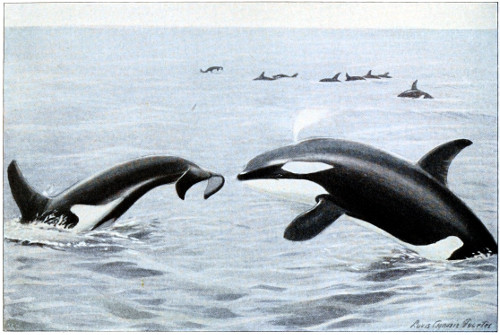
KILLER WHALE
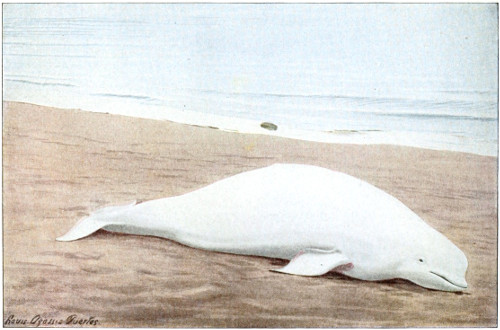
WHITE WHALE, OR BELUGA
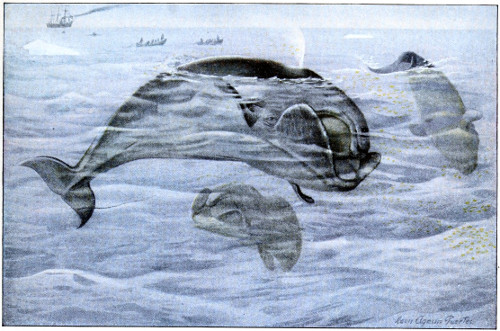
GREENLAND RIGHT WHALE, OR BOWHEAD
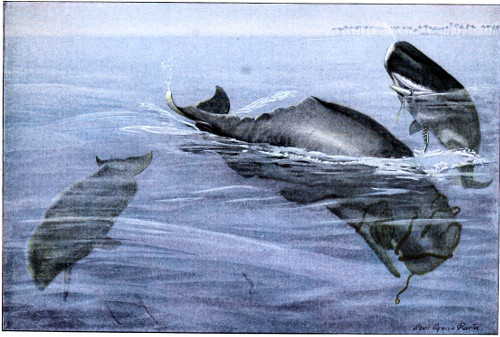
SPERM WHALE, OR CACHALOT
SPERM WHALE, OR CACHALOT (Physeter macrocephalus)
The cachalot is from 40 to 60 feet long, about equaling the Greenland bowhead whale in size. It has a huge blunt head, which comprises about one-third of the entire animal. The mouth is large and the under jaw is provided with a row of heavy teeth, consisting of ivory finer in grain than that from an elephant’s tusk.
The great whaling industry of the last two centuries was based mainly on the sperm and the bowhead whales. The largest of the bowheads is limited to the cold northern waters, but the sperm whale frequents the tropic and subtropic seas around the globe. The main hunting area for them lies in the South Pacific, but they frequently visit more temperate coasts, especially when seeking sheltered bays, where their young may be born. The young are suckled and guarded carefully until old enough to be left to their own devices. Sperm whales sometimes occur off both coasts of the United States, especially off southern California.
The feeding grounds of these whales are mainly in the deepest parts of the ocean, where they cruise about in irregular schools containing a number of individuals. Their food consists almost entirely of large octopuses and giant squids, which are swallowed in large sections.
As befits a gigantic mammal possessing huge jaws armed with rows of fighting teeth, the sperm whale is a much more pugnacious animal than the bowhead. There are many records of whale-boats being smashed by them, and several well-authenticated cases of enraged bull cachalots having charged and crushed in the sides of whaling ships, causing them speedily to founder.
The sperm whale yields oil of a better quality than the bowhead. Its huge head always contains a considerable number of barrels of specially fine-grade oil, which produces the spermaceti of commerce. Ambergris, having an excessively high value for use in the manufacture of certain perfumes, is a product occasionally formed in the digestive tract of the sperm whale.
The name cachalot is one to conjure with. It brings up visions of three-year voyages to the famed South Seas, palm-bedecked coral islands, and idyllic days with dusky islanders. As in the case of the Greenland bowhead, however, this animal has been hunted until only a small fraction of its former numbers survives and the romantic days of its pursuit are gone, never to return.