SMALLER MAMMALS OF NORTH AMERICA By Edward W. Nelson Chief, U. S. Biological Survey With illustrations in color from paintings by Louis Agassiz Fuertes
Reading edition
In that part of North America lying north of Mexico more than 1,300 species and geographic races of mammals are known to exist. Of these by far the greater number, both of species and individuals, fall into the class of smaller mammals.
Some of the most characteristic types which appear to have originated in North America are the mountain-beavers, pocket-gophers, kangaroo-rats, pocket-mice, wood-rats, white-footed mice, muskrats, skunks, and ring-tailed cats.
In Siberia and Europe live close counterparts of our northern weasels, minks, martens, field-mice, lemmings, northern hares, conies, marmots, moles, and others; and on our southern border the armadillo and the hog-nosed skunk introduce a faint tinge of a strange fauna from South America.
FURRY FRIENDS AND ENEMIES
The muskrats, minks, martens, and skunks for many years have yielded an enormous annual return from their furs; the squirrels and rabbits afford sport and a large supply of excellent flesh for food; the prairie-dogs and some of the ground-squirrels existing in enormous numbers have been excessively destructive to crops; and others, like the porcupine and the armadillo, have attracted particular attention because of their strange characteristics.
ANIMALS THAT LEARNED TO “DIG IN”
The smaller mammals live everywhere, from the tropical end of Florida to the uttermost lands of the frozen North, and from the seashore to the limit of vegetation on the high mountains. The heaviest forests, open meadows, rugged mountain slopes, arctic barrens, and sun-scorched desert plains all have their small four-footed habitants. Many modifications of parts and organs of the various species have been necessary to adapt the small mammals to specialized modes of life.
This is strikingly illustrated in the case of those true rodents, the pocket-gophers, which apparently found competition on the surface of the ground so acute that they took the unoccupied territory below the surface, where they live as miners and tunnel from place to place in search of edible roots, with an occasional stealthy excursion above ground to seize some of the food available there.
Another excellent illustration is furnished by the moles, which, leaving the numerous closely related species—the shrews—to feed upon insects above ground, have descended and, like the pocket-gophers, live in tunnels which they make in the pursuit of earthworms and insects below the surface; like the gophers, they, too, make occasional excursions above ground in search of food.
The mink and the muskrat, representing the carnivores and rodents, have rivals for their food supply on land and have become amphibious, being as much at home in the water as on shore, one feeding on fish and flesh and the other on aquatic vegetation. Certain forms of the squirrel tribe are heavy-bodied and live in underground burrows, while other more slender and graceful species make their homes in the tree-tops.
A DEPARTURE FOR EVERY NEED
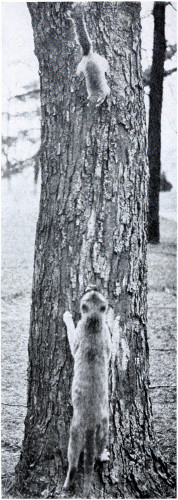
Photograph by Howard Taylor Middleton
HEREDITARY ENEMIES: A CAT WATCHING A GRAY SQUIRREL
At one time the gray squirrel was so abundant as to make ruinous inroads on the corn and wheat crops of our pioneers. In Ohio, a hundred years ago, there was a law requiring each free white man to deliver 100 squirrel scalps every year or pay a penalty of $3. Today the gray squirrel needs legal protection to prevent its extermination.
Another member of this group, the flying-squirrel, has developed an extension of the skin uniting the front and hind legs, so it may glide freely from tree to tree. The bats have gone still further, and the skin uniting their lengthened front and hind limbs and long finger bones forms broad wings which lend them powers of flight scarcely equaled by those of birds.
The gophers, pocket-mice, chipmunks, and others are provided with little cheek pouches in the skin on each side of the mouth, in which they may carry food home to their store-rooms and other hiding places.
The hares have developed long legs for running on open plains, and the weasels have long, slender bodies and an exceeding quickness which enables them to follow and capture their elusive prey in its burrows and among crevices in the rocks.
The hairy coat of the mole is short and equal to the finest velvet, while that of the porcupine stands out in strong, sharp spines; the skin of the armadillo is practically hairless, but forms a bony armor covering its upper parts.
The front feet of squirrels and most other rodents are slender and used with deftness as hands in manipulating food, while those of the badger and skunk are heavily clawed and strongly muscled for the purpose of digging up their prey.
The tails of many species are varied in form to serve special purposes. The long-haired tails of tree-squirrels have a plume-like character, which adds much to the beauty of these attractive animals. The long tails of the kangaroo-rats and the jumping-mice serve as balances for their bodies during long leaps. The vertically flattened tail of the muskrat and the broad horizontally flattened tail of the beaver are useful as rudders. Perhaps the oddest of all is the naked prehensile tail of the opossum, which coils about branches or other support and thus is a safeguard against a possible fall, and even permits the animal to hang suspended by it alone.
STRANGE ADAPTATIONS TO MEET CONDITIONS OF ENVIRONMENT AND COMPETITION
In such ways, by thousands of adaptations and modifications of the typical four-footed mammal, are they fitted to their varied modes of life, each so far as possible in some special place of its own.
The effect of the pressure of environment and competition upon the various species of mammals in any region could not be better shown than by the kangaroos of Australia. That continent is occupied by many species of these peculiar mammals, some of which inhabit the open plains like our jack-rabbits in the West; others have learned to climb and live arboreal lives in the tree-tops; and still other members of this group have become burrowers and live in dens underground like some of our native rats and mice.
From the instances mentioned above it is evident that the mammalian organism is very plastic and has been molded by the environment to which it has been subjected during the ages. The larger effects evidenced by profound modifications in the anatomy are the result of continued pressure extending far back in time. The far more numerous, modern, and superficial changes known to naturalists as geographic variations are everywhere in evidence.
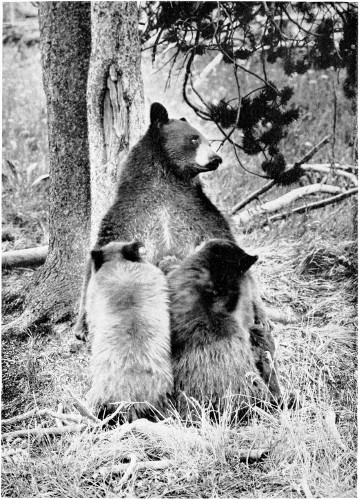
© F. J. Haynes
“BABES IN THE WOOD”
The American black bear, of which the brown bear is a color phase, is not aggressive and will attack man only when wounded or in defense of its young. The hungry twins were born in mid-winter and came into the world entirely devoid of fur overcoats. Their coats soon developed, however; in a month their eyes were open, and in two months they were following their mother about the great forests of the Yellowstone.
By the collection of great series of specimens in North America and elsewhere in the world it has been proved that it is common for a single species of mammal to occupy a great area, including such diverse climatic conditions as humid forested districts near the sea-level, sections of arid desert plains in the interior, and high rugged mountain slopes. In each area of differing conditions it is ordinarily found that representatives of a species, under certain conditions, vary from those in other areas mainly in shades of color and in proportions.
GEOGRAPHY AND COLOR
In arid areas the colors are usually distinctly paler and grayer, in the humid districts they are darker and browner. Other conditions also effect these changes among members of the same species, as is shown in some of the most arid and desert plains of the southwestern United States, where mammals living among dark-colored lava beds are darker than those found, sometimes within a few rods, on paler adjoining soil. Complete isolation under the same climatic and other conditions sometimes produces marked changes, as is well illustrated by the difference between the Abert and Kaibab squirrels on the two sides of the Grand Canyon in Arizona (see page 448).
The different forms of a species occupying areas under varying conditions are commonly termed geographic races. They grade imperceptibly into one another along the border between their ranges, step by step with the gradations of the climatic and other conditions which have produced their differences.
ANIMAL CHEMISTS CHANGE STARCH INTO WATER
One of the most striking modifications of mammalian economy by environment is that shown in many small mammals of our southwestern desert region and adjacent parts of Mexico, in which such species as the kangaroo-rats, pocket-mice, prairie-dogs, and others are able to exist under the most arid conditions without drinking. The liquid necessary for supplying their bodily needs is obtained through chemical action in their digestive tracts, whereby some of the starchy parts of their food are changed into water.
Over considerable areas in the waterless deserts on the peninsula of Lower California periods of from three to five years sometimes pass without a drop of rain falling. In these areas the small desert mammals named above, as well as wood-rats, white-footed mice, cottontails, and jack-rabbits, are numerous and successfully pass these dry periods without inconvenience. The absolute independence of water of these animals has been demonstrated in southern California in the case of pocket-mice kept for months in captivity in a box and fed solely upon thoroughly dried seeds without their showing the slightest sign of discomfort.
Our small mammals may be roughly classified by their food habits into three main groups: Rodents, or gnawing animals; carnivores, or flesh eaters, and insectivores, or insect eaters.
GNAWERS MOST NUMEROUS OF MAMMALS
The rodents vastly outnumber all other mammals and are typified by the squirrels, rats, and mice; their food is mainly vegetable matter, but many of them eat insects and meat whenever available. The carnivores, including such species as the weasel, mink, and marten, are mainly flesh eaters, preying largely upon rodents, but they also eat insects and fruits of many kinds. The insectivores include the moles and shrews, which, with all the bats found within our limits, are almost exclusively eaters of worms and insects.
While rodents primarily feed on vegetable matter, it is surprising to note the large number of species among them which commonly feed on insects and have strong carnivorous propensities. This is not so much the case with such larger rodents as the beaver, porcupine, and woodchuck, but most of the smaller kinds, from squirrels to mice, have been found to be confirmed flesh eaters.
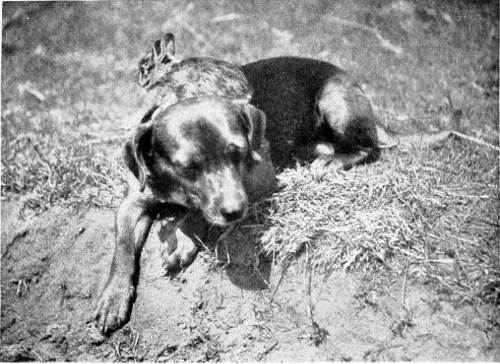
Photograph by Howard Taylor Middleton
A MILLENNIAL SCENE: A RABBIT-HOUND AND A YOUNG RABBIT ENJOYING EACH OTHER’S SOCIETY
Here the camera records a friendship almost as remarkable as that which is to mark the association of the lion and the lamb in the final days of the world’s history.
The destruction of the eggs and young of birds, both on the ground and in the trees, by these animals must have a far-reaching effect in reducing the number of insectivorous and other small birds. Some small rodents, as the grasshopper-mice, subsist mainly upon insects and flesh.
The naturalist who sets traps for small rodents in field or forest is constantly annoyed by finding trapped animals partly devoured by their fellows. When mice or rats are confined together in cages and provided with an abundance of vegetable food, it is a common experience to find that the stronger kill and eat the weaker ones, until in a short time only a single survivor remains. These cannibalistic traits are strongly developed in the common house rat, which is notorious for its savagery toward others of its kind.
CASES OF CONCENTRATED FEROCITY
To a certain extent the ferocity of mammals appears to increase in proportion to a decrease in their size. The smaller members of the weasel family—the weasels—are relatively far more active and bloodthirsty than the minks, martens, and other larger members of the group.
If the common weasel should be increased to the bulk of a mountain-lion and retain its nature and physical prowess, it would be many times more dangerous than any existing carnivore and the devastations it would commit would be appalling. Even the tiny insect-eating shrews are endowed with a fierce and aggressive spirit scarcely equaled among larger animals.
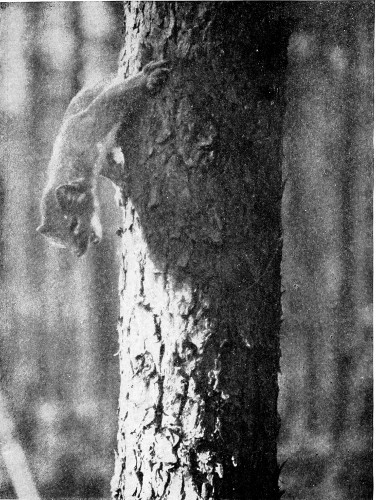
Photograph by Howard Taylor Middleton
A WEASEL AT BAY ON A TREE-TRUNK
Wolves, coyotes, and foxes are the natural enemies of this ferocious little creature. In spite of its diminutive size, it is a foe to be respected, for its attack is always aimed at a vital point—commonly the brain, the back of the neck, or the jugular vein of its adversary.
Rodents and insectivorous mammals are without effective weapons of offense or defense against the birds and beasts of prey which beset them. Many, however, are surprisingly courageous when brought to bay, and, using their front teeth, will fight to the death with vigor and spirit. This is especially notable of the muskrats and their cousins, the field-mice. Carnivores, both great and small, have teeth and claws with which to defend themselves against attack.
WHY THE SKUNK NEVER HURRIES
In addition, skunks have an even more potent weapon in the secretion of a vile-smelling liquid which is sprayed on a dangerous enemy. So confident are skunks in the efficacy of this weapon that they are extremely calm and unhurried in their manners and take little trouble to avoid an encounter with man or beast. Their odorous weapon is not used among themselves and appears to be held for service against more dangerous enemies.
Scent glands are common among rodents, carnivores, and insectivores, but are ordinarily used for purposes of communication with others of their kind, sometimes to attract the opposite sex and sometimes merely to give notice of their presence in a locality.
The hard school of experience holding through the ages has taught many of our rodents the necessity of lying up stores of food to meet periods of scarcity. Many species store food in a desultory way whenever a surplus is available, but when harvest time comes, at the close of summer, the work is taken up as a serious occupation during many busy hours each day or night by the species living where the severe northern winters make the stores a necessity.
The storage instinct is possessed as well by many of the southern desert species, where climatic conditions permit activity throughout the year. In such regions the supplies serve during storms and in periods of drought, when the yield of plant food is limited.
Photograph by Howard Taylor Middleton.
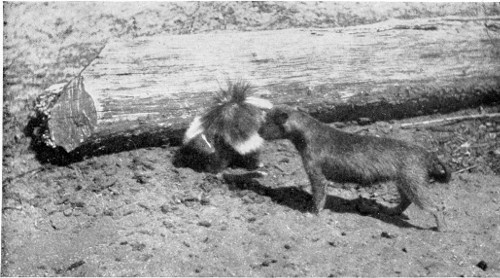
ARMED NEUTRALITY: A DOG AND A SKUNK PREPARE FOR COMBAT
Once in a lifetime the photographer of wild life gets an opportunity such as is recorded here. Luck was with the camera man, but not with the terrier, as a moment after this picture was made the dog was a very nauseated and embarrassed animal, the skunk having employed its natural weapon with overpowering odoriferous effect.
GOOD HOUSEKEEPING IN RODENT LAND
One can but marvel at the wise prescience with which northern rodents gather their winter stores and hide them away safe from the weather in secret places in hollow trees, old logs, crevices among the rocks, or in neat storage chambers dug for the purpose adjoining underground burrows. The size of the stores and the tireless industry of these little husbandmen in gathering them might well serve as examples worthy of emulation by some of their human neighbors. The seeds gathered are freed from chaff, the grasses and herbs are dried as “hay,” and roots are carefully cleaned before being stored.
The storing habit appears to be nearly always for purely individual benefit. The food is usually stored in bulk, but squirrels and chipmunks often bury here and there single nuts, which they are able to recover long afterward through their extraordinary powers of smell.
Stores are laid by for a single season, and a single failure of a nut or seed crop will cause the starvation of many small animals, and the failure of the crops for two or more seasons is so disastrous that the rodents may nearly or quite all die of famine over great areas. The reverse of this occurs during successive years of bountiful nut and seed crops.
An abundant food supply appears to be a powerful stimulant to the fecundity of mammals, and the number of young at a birth, as well as the number of litters born during a season, are greatly increased by it, until their haunts fairly swarm with them.
THE EBB AND FLOW OF ANTAGONISTIC SPECIES
With this stimulated increase of rodent life goes a related increase in the number of birds and mammals which prey upon them. The close relationship between the numbers of rodents and of the carnivores which prey upon them is shown by the records of the Hudson Bay Company, in which with the increase or decrease in the abundance of varying-hare skins secured by the fur traders goes a corresponding increase or decrease in the number of lynx skins taken.
Photograph by Howard Taylor Middleton
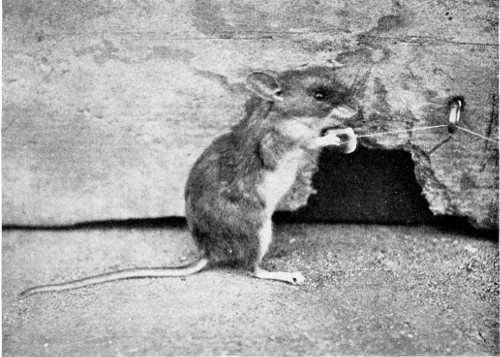
IT IS NOT VANITY WHICH PROMPTS THIS MOUSE TO TAKE ITS OWN PICTURE
The bait is a grain of corn attached to one end of a thread; the other end operates the camera shutter; but the pose is almost “studied”.
After rodents become enormously abundant, if food becomes scarce they sometimes make extended migrations, during which vast numbers swarm across the country, like the lemmings of the North or the gray squirrels during their historic migrations of early days in the eastern United States. At such times vast numbers of the wandering hordes perish; epidemic disease also plays its part in reducing their numbers. Nature thus is self-limiting in restraining the permanent increase of any species beyond the numbers needed to preserve its balance.
The advent of man in new regions with his clearing of forests, cultivation of the soil, and destruction of animal life for food or other purposes, quickly upsets the balance of nature, and some species are much reduced in numbers or disappear, while others, especially among the smaller kinds of mammals, may greatly benefit through added food supplies, and then increase until they become a pest, to be destroyed by the farmer as a measure of self-protection.
ANIMALS THAT SEEK SAFETY IN DARKNESS
For some reason, perhaps owing to their small size and defenselessness against birds and beasts of prey, the great majority of small mammals, including hundreds of species and untold millions of individuals, are nocturnal or live such obscure and hidden lives they are unknown except to the comparatively few people who go much afield, with all their powers of observation alert by day and by night. Many of the mainly nocturnal species pursue minor activities by day, where shelter of one kind or another gives them a reasonable feeling of security.
Under the revealing light of day most small mammals, especially the rodents, are extremely watchful and timid, leading lives filled with alarms which commonly end in tragic deaths. By night they appear to have far greater confidence; yet this also is a time of imminent danger from the owls and many beasts of prey then prowling about.
Photograph by Howard Taylor Middleton
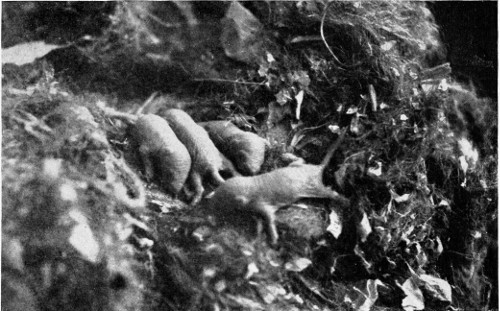
A NEST OF YOUNG WHITE-FOOTED MICE
One form of this small animal has been found living at an elevation of from 15,000 to 16,000 feet on Mt. Orizaba, Mexico, the highest record of any North American mammal.
That the small rodents have good cause for their timorous ways is plain when we consider the array of enemies which encompass them, including owls, herons, gulls, bears, foxes, bobcats, weasels and their cousins, with snakes, and on occasion fishes, which take endless toll from their numbers. Fortunately for them, these small folk live wholly in the present and quickly forget the shadow of death cast by the passage of a hawk or the skulking form of a four-footed enemy.
COUNTLESS BEASTS THAT ROAM THE NIGHT
By day the squirrels, chipmunks, woodchucks, and spermophiles are abroad and unite with the birds to lend an air of pleasant animation to forest and plain. With the falling shades of night, near the abodes of mankind as well as in the remote wilderness, everywhere a countless multitude of small beasts come forth and form a little, bright-eyed furry world, clad in delicate shades of gray and brown and characterized by remarkable grace and agility.
These small folk of the night swarm out from snug nests hidden in burrows in the earth, in crevices among the rocks, in hollow trees, under logs or other cover, and even from the shelter afforded by buildings. In number and variety of forms they far exceed anything seen by day. The air is filled with the flitting forms of bats, while among the trees or on the ground, varying with the locality, are multitudes of rabbits, flying-squirrels, rats and mice of many kinds, lemmings, pocket-mice, kangaroo-rats, pocket-gophers, shrews, and even moles.
This abundance of night life brings forth the prowling powers of darkness in the form of velvet-winged owls, weasels, skunks, minks, martens, and other carnivores, which by scent and by keen vision find abundant harvest. The small carnivores, in turn, are subject to the predatory law of might and are at times hunted by the larger carnivores, as the great-horned owls, the wolves, foxes, fishers, bobcats, and mountain-lions.
Photograph by George Shiras, 3rd
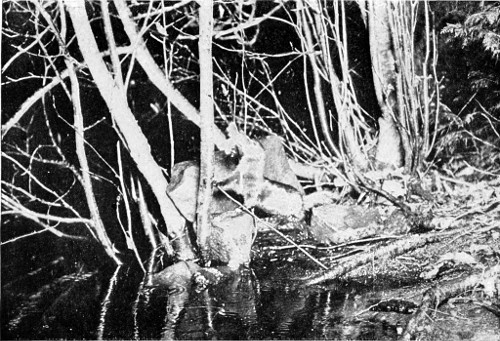
A MINK TAKING ITS OWN PICTURE BY FLASHLIGHT
This is one of many remarkable nature studies which have been made possible by Dr. George Shiras 3rd’s invention and development of animal flashlight photography, with the animals themselves as the photographers. The naturalist may have to spend hours, sometimes days, waiting in swamp or desert to study his quarry, but by means of flashlight photographs the inhabitants of the wild are revealed in their native haunts to all who read a story told in pictures. Dr. Shiras’s notable contributions to this magazine have always won hearty appreciation from members of the National Geographic Society.
To most people the majority of small rodents are classed as “rats” or “mice” and are viewed with the prejudice born of long familiarity with those omnipresent pests, the house rats and mice. The small beasts of field and forest are commonly of remotest kinship to these repulsive household parasites and are of entirely different lineage, having nothing in common but their size.
ANIMAL INTELLIGENCE AKIN TO MAN’S
When viewed with unbiased attention, these little animals of the wilds are certain to charm the observer either by their beauty and grace or by their varied and interesting habits. No one can long study mammals, large or small, without observing many traits of intelligence so akin to his own that they awaken feelings of friendly fellowship.
The modes of life of small mammals are much more varied than those of the larger species. At times radical differences in habits may be noted among different individuals of the same species, as instanced by the wood-rats of Santa Margarita Island, some of which live in burrows dug by themselves in the ground and others in nests built of sticks in the tops of mangroves rising amid the waters of a lagoon.
An even more extraordinary variation is shown among the heavy-bodied meadow-mice of the genus Phenacomys, most of which live in underground burrows; but one member of the group in Oregon builds its nests in the tops of tall conifers, sometimes at an altitude of 80 feet, and rarely or never descends to the ground.
PEEPS INTO FUR-FOLK HOMES
The homes of small mammals vary greatly. The species living in underground burrows usually excavate an oval chamber which is filled with fine vegetable material to form a snug retreat. The muskrat places a conical lodge on the border of a marshy stream or lake. The wood-rat lives in an underground burrow, in a nest of sticks and trash heaped above the ground or in a stick nest placed among the branches of low trees. Harvest mice build a little hollow ball of grass blades, lined with finer material, among the branches of bushes several feet above the ground. White-footed mice may lodge in a knot-hole 50 feet or more above ground in the trunk of a tree.
As a rule, small mammals are of inconspicuous colors which harmonize so well with their surroundings that when not in motion, especially if lying close to the ground, they are difficult to distinguish. Exceptions to this rule are obvious in the case of jack-rabbits when standing on bare plains, or other mammals which are apart from the usual partly concealing growth of vegetation or other surroundings.
In contrast to the protective coloration are certain markings, like the cottony white underside of the tail of the cottontail rabbit, which renders the flight of this animal conspicuous in the gloomiest shades of the forest, or even on the approach of night, when it is impossible to distinguish the animal itself. The white underside of the tail of the antelope chipmunk is another well-defined instance of this kind.
NEW COATS FOR BOREAS’ COURT
The most marked of all examples of “directive” coloration among the small mammals appears to be that of certain white-sided jack-rabbits, in which the white areas on the sides and rump are drawn up and down as the animal runs across the plains, giving a flashing effect, which attracts attention to them exactly as does the white rump-patch of the antelope.
In the northern part of the continent, where snow lies for many months, several species of hares are dusky or buffy gray in summer and change to a pure white coat in winter. This change is of enormous protective value to these animals. In Greenland, where the summer is short and snow exists throughout the year, the highest northern representative of the hares remains permanently white, while near the southern border of snow in the United States the varying hares and white-tailed jack-rabbits, which become pure white in the northern parts of their range, make only a partial change.
Weasels are the only carnivores which change from the brown of summer to a white winter coat. Owing to their small size and the need for activity in the snowy northern regions, where they would be peculiarly susceptible to danger from birds of prey and larger predatory animals, their protective white coats serve them well.
It was formerly considered that the change of mammals from the brown of summer to the white winter coat in the fall, and from the white to the brown in spring, was due to a change in the color of the hairs, but it is now known that it is entirely due to molt. The time of these changes depends on the season, and this varies several weeks, according to whether the fall or spring is early or late.
The general shades of mammals are of delicate tints, and the spots, stripes, and other markings, as in the case of chipmunks and the little spotted skunk, are often of great beauty.
ANIMALS THAT HAVE TO SING
Small mammals vary greatly in their vocal powers, but the changes in intonation and character of the notes and calls indicate plainly that they are used to convey a variety of meanings.
Some are practically voiceless, as in the case of rabbits and hares, except when in an extremity of fear they utter loud shrieks of terror. Squirrels, prairie-dogs, and some other small mammals bark and chatter, while mice and bats have a variety of curious squeaking notes. Marmots and ground-squirrels have chattering notes and sharp, whistling calls.
In addition, some of the squirrels and many mice are known to have continuous series of notes which are as evidently songs as the utterances of birds. Some of these notes, as in the case of singing mice, have a remarkably musical character, similar to the warblings of canaries. Various unrelated species of mice have been observed singing, and a closer study of the life habits of these small animals may develop the fact that all are songsters to some degree.
House rats and mice have, undoubtedly, been parasitic about the haunts of man from early times. From Asia they have accompanied him through his advance in civilization. With the growth of commerce they have traveled around the world, becoming transplanted to all lands and thriving in all climates. In various parts of America they have not only become pests about human habitations, but where climatic conditions were favorable have reverted to the wild state and are competing with the native species in the fields.
Of all the small mammals none have become modified to such an extent as the bats. As a group these mammals are of world-wide distribution except in the inhospitable polar regions. They are true mammals and present an extraordinary variation in size, from tiny little creatures, almost as small and fragile as butterflies, to the huge fruit-bats, with a spread of wings like that of a wild goose.
BATS WITH BULLDOG FACES
The heads of bats are strangely sculptured, some being smoothly contoured and shaped like those of little foxes; others appear like miniature bulldogs; and still others have curious cartilaginous nose-leaves upright on the muzzle. Some have the entire face molded into a hideous mask repulsive to look upon.
Their habits are equally varied to meet special conditions: Some are eaters of fruit alone; others feed solely upon insects, while others bite other mammals, including man, for the purpose of drinking the oozing blood, upon which they subsist. All are nocturnal, but some appear late in the afternoon, before the sun sets; most species, however, wait until the shades of night have covered the earth.
Throughout the world the majority of the species of bats feed upon insects, but there are many fruit-eaters. The teeming insects and plant life of the tropics afford a never-failing food supply, and the center of abundance of these animals is found there. In some localities between twenty and thirty kinds of bats exist, with such vast numbers of individuals that the bat population far outnumbers all other kinds of mammals combined.
ANIMALS THAT PUT THEMSELVES IN COLD STORAGE
In the northern parts of the Old and New Worlds many mammals, including bears, marmots, prairie-dogs, ground-squirrels, and jumping mice, pass a large part of the winter months in a lethargic sleep called hibernation. While hibernating these animals have extremely slow and slight heart action and their bodily temperature falls far below the normal of their active periods. During the most profound hibernation an animal may be awakened if brought into a warm temperature, but when again put into the cold at once returns to sleep.
Preparatory to this sleep, during the summer and in the autumn, the hibernating mammals become exceedingly fat.
It has long been generally accepted that the fat thus accumulated was for the purpose of being gradually absorbed to nourish the animals during their long fast. As a matter of fact, during this period the bodily functions appear to be practically suspended and the animals may be said to be in cold storage. This is evident from the fact that observations have been made of ground-squirrels, and even bears, emerging in spring, after their long winter sleep, practically as fat as when they retired in fall. Hibernating animals become extremely active as soon as they come out in spring and quickly lose the fat which should be of special service to them, owing to the temporary shortage of food they experience at this season.
Most hibernating species do not retire for the winter until cold weather is at hand, in September or October, at times remaining out until after the first snow has fallen. The animals which retire latest, like chipmunks and prairie-dogs, sometimes appear temporarily during certain warm periods in winter.
Recent observations have established the fact that the adults of both sexes of the Richardson ground-squirrel living in the Northwestern States and adjacent parts of Canada become excessively fat by the first of July, and before the first of August practically disappear for the season, not appearing again until they emerge the following March or April. The retirement of these squirrels for a part of the summer is a case of imperfect estivation, as it is termed, followed by complete hibernation. The young of the year enter hibernation at a considerably later date.
DEFENSIVE AND OFFENSIVE ANIMAL ALLIANCES
A great number of both large and small mammals live solitary lives except for brief periods during the mating season or the association of the young with the mother. Some species, however, like the wolves and coyotes, may mate permanently and show great mutual affection and constancy. Many species have well-developed social instincts, which appear in some cases to combine two purposes, self-defense and the desire for companionship.
Herds of large herbivorous mammals, such as musk-oxen and buffalo, frequently present a solid array of bristling horns to the attacking wolves, and thus protect the weaker members of the herd and give an example of the usefulness to them of the social instinct. Wolves and some other predatory animals hunt in couples or in packs and succeed in pulling down prey which singly they could not successfully attack.
Prairie-dogs living in colonies have the advantage of community intercourse as well as added safety through the chance that some member of the colony will espy an approaching enemy and by its warning cry allow a safe retreat. In other cases, such as the flying-squirrels, which gather in considerable numbers in hollow trees or other shelter, and the bats, which gather in caves, the congregation appears to be purely from a desire for close companionship.
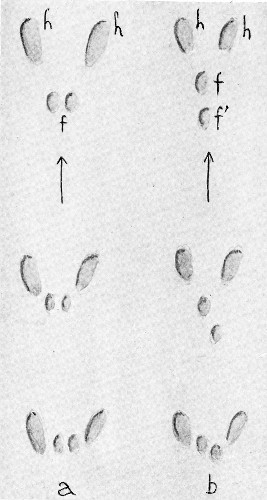
FOOTPRINTS OF NATURE’S WILD FOLK
BY ERNEST THOMPSON SETON
In the drawings accompanying Mr. Nelson’s article I usually give the track of a normal adult animal in about one inch of snow, that being ideal for tracking. Some of the smaller kinds are shown in fine dust. The trail goes up or across the page at the ordinary gait of the animal. The scale is indicated, but when possible the topmost set is given of life size. While there are endless variants in each kind, I aim to give the reader at least one typical set of each.
In all animals which bound, the hind feet track ahead of the front ones. This is very plainly seen in the rabbits. There are two arrangements of the fore feet when bounding: That of the rabbit (b), in which the fore feet are usually one behind the other, and that of the tree-squirrel (a), in which the fore feet are side by side. The latter arrangement is associated with power to climb a tree. The former means that the animal is purely terrestrial. These, however, are true only as generalizations. There are exceptions in all species. The ground-squirrels conform to the rabbit type. The tracks are, of course, ideal, giving far more detail than is usually to be seen.
THE ANTELOPE JACK RABBIT (Lepus alleni and its relatives)
(For illustration, see page 506)
The antelope, or Allen, jack rabbit is one of the most picturesque of American mammals. It is larger than the common western jack rabbit and is strongly characterized by enormous ears, long, slender legs, short tail, and contrasting colors. It is a member of the white-sided group of jack rabbits, which are distinguished by the extension of the white of the underparts well up on the sides of the body.
This group is represented in limited areas on our southern border by two species. One of these, the Gailliard jack rabbit (Lepus gailliardi), occurs on the grassy plains of extreme southwestern New Mexico and is succeeded by other white-sided species southward across the Mexican tableland and through interior Oaxaca to the Pacific coast, on the Isthmus of Tehuantepec. The other species, the antelope jack rabbit, occupies a considerable area in southwestern Arizona, and with its geographic races ranges southward through the coastal plains of Sonora and Sinaloa to northern Tepic.
All jack rabbits are more or less closely related to the Old World hares, the term “rabbit” having been so generally misapplied to them by the early settlers in the western United States that the name is now fixed by current usage. In Mexico and among the Mexicans of our southwestern border the proper distinction is made and the jack rabbit is termed liebre, or hare, and cottontail is called conejo, or rabbit.
The white-sided species are more widely differentiated from their Old World relatives than the other jack rabbits and are the southernmost representatives of the true hares in America, reaching their limit in the tropics a little beyond the Isthmus of Tehuantepec.
The extension of the white on the sides of these species assists in producing one of the most extraordinary examples of directive coloration known among mammals. I had the pleasure of discovering this one day in May, 1895, when hunting on horseback over the grassy plain bordering the Pacific coast of the Isthmus of Tehuantepec. As I rode slowly along, a big jack rabbit hopped deliberately from its form in the grass a few yards away, and by the contraction of a special set of muscles along the back drew the dark-colored dorsal area forward and together so that it formed only a narrow band on the middle of the back, with a corresponding extension of the white area on the rump and sides until, as the animal moved diagonally away, it looked almost entirely white.
At a distance of fifty or sixty yards it came to a stop, and expanded and contracted the dark dorsal area, thus producing a “flashing” effect with the changing area of white on the sides and rump. This solved the riddle of the mirror-like white flashes I had often seen as jack rabbits on the tableland had dashed away in the brilliant sunshine. The same habit of “flashing” the white was afterwards observed in the species of southwestern New Mexico and southwestern Arizona, demonstrating the appropriateness of the name, “antelope jack rabbit,” given them by the ranchmen.
Formerly the antelope jack rabbit of Arizona was common on the plains about Tucson, where many were shot for rifle practice. They are now comparatively scarce in that district, and are never so excessively abundant as the common species of the West now and then becomes. They have an extraordinary appearance as, with their great ears erect, they stand poised on their long, thin legs. When alarmed, they leap away with amazing celerity in long, high bounds. They are usually much more shy and alert than the common jack rabbits and at times are far more difficult to stalk than antelope. A peculiarly appropriate setting to this remarkable species is found in the strange and wonderful growth of giant cactuses, yuccas, creosote bushes, fouquerias, palo verde, and other desert vegetation of the plains in Arizona and Sonora.
Like other hares, the antelope jack rabbits occupy forms under bushes or in the shelter of little patches of coarse vegetation. The only exception to this rule I have seen was west of the city of Guadalajara, on the Mexican tableland. There one summer day, in the midst of a lovely open valley covered with short, velvety green grass and dotted with scattered acacia bushes, a caracara eagle suddenly swooped down upon a young white-sided jack rabbit. In mortal terror the little beast dashed away at great speed, the caracara casting at it repeatedly from a height of fifteen or twenty feet and each time striking the ground just behind. The young animal ran not less than five hundred yards, straight for a little bush on a small bank, where it vanished as by magic.
The caracara was close behind and, alighting, ran round and round the trunk of the bush, craning its neck and apparently as surprised as myself at this sudden disappearance. Riding over to investigate, I found, partly concealed by coarse grass, the entrance of a burrow large enough to admit an adult jack rabbit. It extended almost horizontally into the bank for about eighteen inches, and then, turning abruptly to the left, ended in a rounded chamber some fifteen inches in diameter, in which the young jack rabbit lay snugly ensconced. It appeared altogether probable that this burrow had been made by the old jack rabbit as a shelter for her young, one of which in its extreme need had again sought asylum there.
White-sided jack rabbits are frequently found in pairs, occupying forms in close proximity to one another. More rarely several may be found in a small area. When driven from the forms, they often run in a wide circle, and in the course of half an hour or more may be detected returning slyly and watchfully from a direction nearly opposite to that in which they departed.
THE CALIFORNIA JACK RABBIT
(Lepus californicus and its subspecies)
(For illustration, see page 507)
The common hares, or gray-sided “jack rabbits” of the Western States, are among our best known and most interesting mammals. They are characterized by long, thin necks, long ears tipped with black, long legs, grayish sides differing but little from the color of the back, and a rather long tail, black on its upper side and dingy gray below.
They are abundant and generally distributed over a vast and mainly treeless area in middle North America extending from western Missouri and eastern Texas to the Pacific coast, and from the border of South Dakota and the Columbia River Valley of Washington south over the tableland of Mexico and throughout the peninsula of Lower California. Within this region they range from sea level up to an altitude of over 9,000 feet. In the North they experience severe winters with much snow, but never show any winter whitening of their furry coat, as do more northern hares.
The gray-sided hares over all this extended range belong to a single species, typified by the California jack rabbit. The area thus occupied includes many different climatic and other physical conditions, from the sweeping grassy plains of Kansas to the juniper and pine dotted plateaus of the Rocky Mountain region, the foggy coast of California, the hot cactus-grown deserts of the Southwest, and the cool elevations of the Mexican tableland.
This varying environment has worked on the plastic organization of the species and modified it into a considerable number of well-marked geographic races which together make up the gray-sided group of jack rabbits, in contrast with the white-sided group already described. Some of the races are very dissimilar in color, but each merges imperceptibly into its neighboring races, and the group thus forms an unbroken chain of subspecies.
Like other hares, the jack rabbits are both diurnal and nocturnal in habits. They do not burrow, but make forms among dense growths of grass or weeds, or under bushes, where they lie hidden. It is a question whether they have more than one litter a season, although it is known that in some parts of their range young are born at all times throughout the spring and summer. From one to six are produced at a time, fully clothed in fur and with their eyes open. Within a few days they leave the “form” and run about like little furry balls. Even at this early period they are amazingly alert and skillful in evading capture by quickly doubling and zigzagging when pursued.
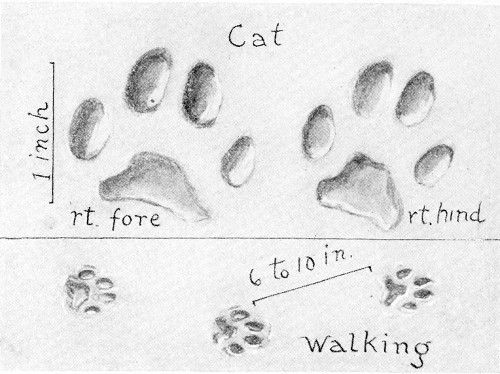
A QUADRUPED WITH BIPED TRACK: THE COMMON CAT
The cat does not show its claws in the track. In walking, the hind foot is set exactly in the track of the front foot; this perfect register offers many advantages and makes for a silent tread. The track of the cat will probably be noticed more than that of any other animal, owing to the large numbers of them in every locality.
Throughout its range the gray-sided jack rabbit is preyed upon by a host of enemies, including wolves, coyotes, wildcats, eagles, and several species of hawks and owls. As a result it has become extremely cunning and watchful. It is a beautiful sight to observe the cautious grace with which one that suspects danger but thinks itself unobserved will quietly move out of its form, pause like a statue for a few seconds, then raise its body into a sitting posture and look keenly about, its great upstanding ears turning sensitively to one side and the other, delicately testing the air for sound waves, which may spell approaching peril.
If not alarmed it may then move slowly along by a series of easy little hops, occasionally varied by the single-footed gait of most other mammals. At such times the ears are often raised and lowered as though worked by some mechanism. If the rabbit becomes alarmed, however, it leaps away in quick, springy and graceful bounds, now and then making a high soaring leap as if to command a better view.
These occasional high leaps mark the first stages of alarm. In greater stress, when pursued by a coyote or other swift-footed enemy, the jack rabbit indulges in no such showy performances, but gets down to serious work, and developing marvelous action in a continuous series of rapid, low stretching leaps, with ears lying flat along the shoulders, it skims over the ground almost as swiftly as a bird. Coursing jack rabbits with greyhounds was for many years a favorite sport in different parts of the West. No other dog has much chance for success in the open pursuit of these animals.
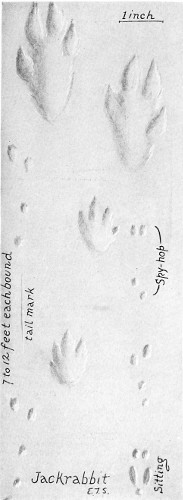
THE TRACKS OF THE JACK RABBIT
The tracks of the western jack rabbit resemble those of the cottontail (see page 492), but the feet are seldom paired; a typical set is seen in the lower left-hand corner. The bounds cover 10, 12, or even 15 feet each. The tail is held down, so that it leaves a mark in the snow between each bound. Sometimes the animal makes a spy-hop—that is, hops up high to look around. This is seen in the track.
Ordinarily jack rabbits are mute, but when wounded and caught they not infrequently utter a series of long-drawn wailing shrieks which are movingly expressive of terror and pain.
Since the settlement of the Western States numberless predatory animals have been killed and at the same time the cultivation of the soil has produced a dependable increase in the food supply. These changes have resulted in the sporadic increase of jack rabbits in many parts of their range, from Texas to Oregon, until at times they have become a serious menace to agriculture.
During such periods of abundance they invade fields and devastate grain, forage crops, vineyards, and young orchards. In places they sometimes actually destroy entire crops and force settlers to abandon their locations. In winter they swarm about haystacks and destroy many tons of hay. Depredations of this character were committed by them on a considerable scale during 1916 in parts of Oregon, Idaho, and Utah.
During the early development of the San Joaquin Valley, California, jack rabbits became such an intolerable pest that great community drives were organized. Large woven wire corrals with wing fences leading away several miles from the entrance were built on the open plains. The occasions of the drives were made public holidays through all the surrounding region, and people gathered sometimes to the number of from 5,000 to 8,000. A great line of beaters was formed, miles in length, and the jack rabbits were driven between wing fences into corrals. Four such drives in Fresno County in the spring of 1892 resulted in the destruction of 40,000 jack rabbits, one drive netting more than 20,000 animals.
At this time the level floor of the San Joaquin Valley was crossed by numberless well-worn rabbit trails six or eight inches broad and one or two inches deep, extending in long straight lines sometimes for miles. On approaching a patch of large weeds one often saw twenty or thirty jack rabbits dash out and, after hopping away a short distance, sit with upstanding ears to look curiously at the intruder.
It is a general rule that when any species of animal becomes extremely numerous it loses its ordinary wariness and, conversely, when its numbers are materially reduced its wariness is greatly increased. The periods of abundance of jack rabbits usually extend through several years until, at the height of their increase, a contagious malady suddenly sweeps them away almost to the point of extinction, as in the case of the varying hare. A period of years follows during which their numbers are slowly recovered.
Jack rabbits are specially adapted for life on great plains, where speed and the ability to subsist on almost any form of vegetation are prime qualities. They are as grotesquely characteristic of the Western States as the kangaroos were of Australia, and have entered largely into the literature of the region they occupy.
THE VARYING HARES (Lepus americanus and its relatives)
(For illustration, see page 507)
The varying hares, white rabbits, or snowshoe rabbits, as they are known, form a small group of closely related species and geographic races of hares peculiar to northern North America. They sometimes attain a weight of five pounds and are about half the size of the arctic hares, which they resemble in form, except that they are more heavily built and have proportionately shorter legs and larger hind feet.
With a single exception they become white in winter and change to dusky or brownish in summer. The molt from the brown summer coat to the white winter one occurs with the arrival of winter snows, the exact time varying according to the season, the reverse change in spring being governed in a similar way by the disappearance of the snow. In the southern part of their range the change to the white winter coat is less complete than in the North. There has been much controversy over the manner of this change in color, some maintaining that on the approach of winter the hairs turn white with the first snow. It has been definitely proved, however, that both seasonal changes are due to molt.
The Washington hare (Lepus washingtoni), which remains brown throughout the year, is the exception to the rule of white winter coats in this group of hares. It lives in the cool, dense forests of the humid coast belt of Washington and adjacent part of British Columbia, where the snowfall does not affect its pelage.
In winter the large hind feet of the varying hares and their long, spreading toes are entirely covered with a heavy coat of hair, forming broad snowshoe-like pads, which enable their possessors to move about freely over the soft snow, a peculiarity that has given rise to one of the names in common use.
In cool, forested regions varying hares range from Maine and extreme eastern Canada, including Newfoundland, to the Pacific coast, and from the stunted bushes bordering the northern limit of trees south to the northern border of the United States and beyond, following the higher Alleghenies to West Virginia, the Rocky Mountains to New Mexico, and well down the Sierra Nevada in California.
As in the case of other species, these hares make “forms” in which they lie by day, for they are mainly nocturnal in habits. The mating season occurs in early spring, when the males become very restless, several sometimes congregating in the same vicinity and occasionally fighting and chasing one another about. At this time, as well as at other seasons, snowshoe rabbits have a habit of thumping rapidly on the ground, making a dull sound audible for some distance. This is probably done with the hind feet, as is known to be the case with the European rabbit.
The thumping is apparently a signal and may be a part of the mating display, but is also used for warning purposes. Hunters in northern Canada call these rabbits by making a harsh squeaking noise with their lips. Sometimes they become so eager and excited on hearing this call that with odd little grunting sounds they come bounding close up to the hunter.
The young, varying from two to seven, are born in nests made of dry leaves, grasses, and other suitable vegetation, warmly lined with hair from the mother’s body, and usually hidden under brush or in dense vegetation. The young, which have their eyes open and are fully furred at birth, within a few days leave the nest and move freely about. Although the mother snowshoe rabbit will defend her young at first even at the risk of her life, when they are half grown she leaves them to shift for themselves. Young hares of various ages when caught often utter shrill squealing cries of fright and the older animals when wounded and caught sometimes do the same.
Perhaps through living so constantly in low ground, among swamps and along streams, varying hares become less averse to entering water than most of their kind. In the delta of the Yukon River I saw many places where they had crossed small streams in spring, their wet tracks entering and leaving the water, thus furnishing unmistakable evidence. Curiously enough, when caught by a flood they will take refuge on stumps or other support and often remain to starve rather than swim ashore.
In summer, owing to their nocturnal habits and the dense thickets they inhabit, varying hares are rarely seen unless they are unusually plentiful. In winter their presence is known by their conspicuous tracks, leading in every direction through their haunts. A single animal will in one night so thoroughly track the snow in a patch of woods it gives the impression that several must have been there.
In river bottoms, among densely wooded swamps, these rabbits frequently make definite beaten runways in the snow; runways are also made through thickets in their summer haunts. This habit renders it easy to snare them, and enormous numbers are thus captured every winter.
They feed on a variety of small herbage in summer and in winter depend on buds, twigs, and the bark of shrubs and small trees. They are specially fond of willows, and their winter distribution in many districts is governed by the abundance of willow thickets.
Varying hares are one of the most important mammals of the northern fur country. They are generally distributed and exist in such numbers that they are an important source of food supply both to the Indians and to such predatory birds and mammals as the great horned and snowy owls, the goshawk, gyrfalcon, lynx, fox, ermine, fisher, and others. The skins are also used by the Indians for robes.
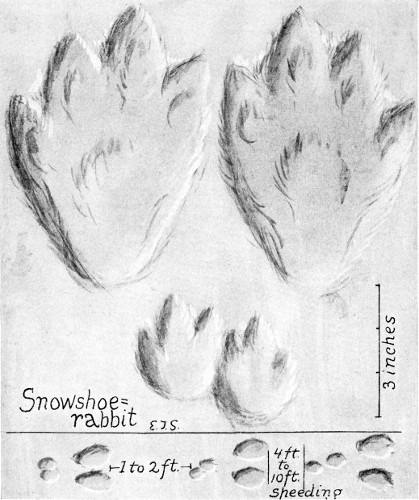
FOOTPRINTS OF THE VARYING HARE, OR SNOWSHOE RABBIT
The great size of the feet from which the creature is named is a strong feature of the track, distinguishing it from that of the cottontail and others (see pages 489 and 507).
Under favorable conditions they steadily increase until they become enormously plentiful over great areas. After this swarming abundance continues for several seasons it reaches a maximum, and then, as in the case of many other mammals when similarly overabundant, a mysterious malady suddenly attacks and sweeps them off, until within a year or two they become rare over the entire area. The people of the fur country believe these changes in numbers run in cycles of about seven years each.
As the hares increase in numbers some of the birds and mammals which prey upon them increase proportionately. This is specially marked with the big northern lynxes. The skins of varying hares are gathered and sent to the London fur market with other furs, including those of lynxes. In the records of sales of the Hudson’s Bay Company there are direct increases of the numbers of Canada lynx skins sold corresponding with the increases in the sales of varying hare skins. As the number of hare skins abruptly decreases following the outbreak of epidemics among them, there are correspondingly abrupt decreases in the numbers of lynx skins sold.
This correlation is shown in the records extending back many years and illustrates the interdependence in nature between the various forms of animal life. The far-reaching tragic effect of the sudden disappearance of the snowshoe rabbits is not confined to the wild habitants of the forest, as it has not infrequently brought starvation and death into many lonely Indian lodges in the great northern wilderness.
THE ARCTIC HARE (Lepus arcticus and its relatives)
(For illustration, see page 510)
Many parts of the northernmost circumpolar lands are occupied by large hares, which attain a weight of more than ten pounds. They are about the size of large jack rabbits, but are more heavily proportioned, with much shorter ears and shorter, stronger legs. There are several species and geographic races of these animals, all of which are snowy white in winter except for a small black tip on each ear. In summer the southern arctic hares change to a nearly uniform dull iron gray or grayish brown. The northernmost animals of Ellesmere Land and north Greenland, where the summer is brief and severe arctic conditions prevail, retain their white coat throughout the year.
In keeping with the cold climate of their territory, the furry coat of the arctic hares is long and thick, especially in winter, when the ears, legs, and even the soles of +he feet, as well as the body, are heavily furred. The coats of the hares of north Greenland and adjacent region are so heavy and fleecelike that during the spring molt they come off in felted patches as the new coat is assumed, giving the hares a curiously ragged appearance.
In the region between the areas in which the summer coat remains wholly white and where it is completely changed to grayish, there is a gradual transition, with the lessening severity of the climate, through every intermediate degree between the two. As in the case of the snowshoe rabbit, the large hind feet and long spreading toes of its big northern relative are so heavily covered with hair that they form broad fluffy pads, which enable the hares to travel lightly over the arctic snowfields.
The distribution of arctic hares is confined to the barrens or tundras beyond the limit of trees. They range practically to the land’s end of northern Greenland and Ellesmere Land. To the southward in North America they range down the coast of Labrador and across to Newfoundland, where they are limited to the open barrens. They also occur along the shores of Hudson Bay and follow the tundras bordering Bering Sea to the peninsula of Alaska.
In Ellesmere Land they are reported to be extraordinarily numerous at times in certain little valleys, and the fur traders on the coast south of the Yukon Delta informed me of similar gatherings in spring on gently sloping hillsides in that region. Photographs taken in Ellesmere Land show many of these hares scattered over a small area, each crouched in a compact form and all heading in the same direction to face the wind. Such gatherings, at least those in Alaska, occur during the mating period, after which the animals scatter over the area they occupy.
An account of the big northern hares would be incomplete without reference to the white-tailed jack rabbit, the largest of all American hares and a near relative of the arctic species. It attains a weight of twelve pounds or more and appears like a giant of its kind. It has longer legs than the arctic hare and a longer tail. In summer it is grayish or buffy, with a conspicuous pure white tail. Throughout most of its range in winter it becomes pure white except the black tips to the ears, but near the southern border the change to white is not so complete as in the North. The distribution of the white-tailed jack rabbit extends from Minnesota to the Cascade Mountains and from the Saskatchewan River, in Alberta, south to southern Colorado.
Arctic hares have from one to seven young in a litter each spring. Owing to the climatic conditions under which they exist, it is doubtful if more than a single litter is born each year.
The manner in which animal life adapts itself to its environment is beautifully illustrated by the arctic hares of north Greenland and Ellesmere Land. There the conditions are rigorously arctic and continuous winter night extends through a period of several months. In all this region the scanty and dwarfed vegetation is covered with snow and ice the larger part of the year. The hares living there are, with little question, a geographic race of those living farther south, but have developed into larger and stronger animals, with heavier fur, to meet the sterner conditions of life.
Their claws are much larger and heavier, so that they may dig the snow from the hidden herbage. Most marvelous of all, the anterior ends of both jaws are lengthened and the incisors set so that they project and meet at an acute angle, thus serving, tweezerlike, more readily to pick out the lowly vegetation imbedded in the snow.
In most parts of their range arctic hares are scarce and rarely encountered. Each winter during my residence on the coast of Bering Sea the Eskimos killed only a few individuals. They were shy and watchful and the hunters sometimes followed one on snowshoes all day over the tundra without securing it. In the high North they appear to be more numerous in places, judging from the number killed for food by members of polar expeditions. Their flesh is excellent, but a little dry. Their natural enemies include wolves, foxes, weasels, gyrfalcons, and snowy owls, all of which share their desolate haunts and join in destroying them.
The winter skins of arctic hares have a beautiful snowy white pelage, which make warm garments and sleeping robes for the North, but are too delicate to withstand much service.
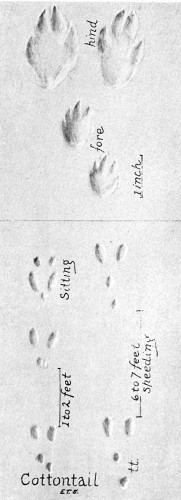
THE COTTONTAIL RABBIT’S TRACK
The large set of four tracks at the top gives the maximum possible of detail, which is very rarely seen. The lower figure at the right-hand corner is a typical track (tt). At the set marked “sitting” the tail mark is seen, and in this only are the fore-feet tracks ahead of the hind tracks. The cottontail has five toes on the front feet, but only four ever show in the track (see page 510).
THE COTTONTAIL RABBITS (Sylvilagus floridanus and its relatives)
(For illustration, see page 510)
North America has several species of hares, but no typical representative of the European rabbit. The American cottontails and their near relatives, the brush rabbits and others, combine characteristics of both the hares and rabbits, but are most like the rabbits, of which they appear to form aberrant groups.
The cottontails are distinctly smaller than most of the American hares and average from two to three pounds in weight. They are otherwise contrasted with the hares by their short ears, proportionately shorter and smaller legs and feet, and by the fluffy snow-white underside of the tail, which shows so conspicuously as they run that it has given them their distinctive name.
The American mammals to which the term “rabbit” may be properly applied include not only the cottontails, but numerous other species closely similar in form and general appearance, but lacking the cottony white tail. As a group, these rabbits have a far greater distribution in America than the hares. They range from the Atlantic coast to the Pacific and from the southern border of Canada south through Central and South America to Argentina. Their vertical distribution extends from sea level to above timberline, attaining an altitude of more than 14,000 feet on Mount Orizaba, Mexico.
In the United States cottontails are so numerous and generally distributed that they are well known to nearly every one. They inhabit all kinds of country, from the deciduous forests of the Eastern States to the grassy or brush-grown plains and pine-clad mountain slopes of the West and the sun-scorched deserts of the Southwest. As a result of this extended distribution and the variety of conditions in the areas occupied, these rabbits include numerous species and geographic races, which in some instances differ greatly in appearance.
Cottontails are especially common about the brushy borders of cultivated lands throughout the country, and in fertile brush-grown areas of foothills, valleys, and river bottoms of the West. They are mainly nocturnal, and in areas where there is an abundance of natural cover in the way of brushy thickets and dense grass commonly make concealed “forms” in which they lie safely hidden.
In areas where shelter is represented by scattered bushes and a comparatively thin growth of other vegetation they generally occupy burrows in the ground. These may be holes deserted by badgers or prairie-dogs or dug by themselves under a rock or other object. Hollow logs or natural cavities and crevices among the rocks are also frequented. When pursued by dogs, hares as a rule rely solely on their speed for safety, while the cottontails take refuge in the first hole they can reach.
Everywhere in their territory, as the shades of night approach, the cottontails come forth from their hiding places and skip merrily about in open ground on the borders of thickets and similar shelter, where they search for the tender green vegetation on which they love to feed. After it becomes too dark to distinguish their forms, the white tail may be seen twinkling about in the dusk. During the night they are often revealed in country roads by the head lights of automobiles.
Several litters of from two to six young usually appear during the spring and summer. These are born blind and practically naked, their unclad helplessness strongly contrasting with the open-eyed, fully furred, and alert young of the hares at the same age. This is a conclusive indication of the close relationship between cottontails and European rabbits, the young of the latter being similarly, but even more, undeveloped at birth.
The young of the cottontails are born in nests made of dead grasses warmly lined with fur from the mother’s body. If above ground the nest is placed in a little depression and so artfully concealed by a covering of dead grasses that it can be discovered only by accident. When caught, young cottontails utter little cries of alarm; the wounded adults sometimes shriek in terror.
From the early settlement of the United States to the present day cottontails have been so abundant that they have served as a valuable source of our game food supply. They are hunted with guns and with dogs, as well as being snared and trapped. Enormous numbers, running into the millions, are killed in this country yearly, but they are so prolific that they hold their own in a surprising degree.
Their abundance in many places, however, has made them a serious pest to agriculture. They eat growing alfalfa and other forage plants, many kinds of cultivated vegetables, young grape vines, and nursery stock and even kill orchard trees by gnawing the bark from the base of the trunks. As a result those who suffer from their depredations consider them pests to be destroyed, while others look upon them as desirable game animals to be protected by law.
As game animals the cottontails furnish some of the most delightful and interesting sport available to American hunters. The scurrying zigzag rush of a cottontail for the nearest shelter is so full of energetic motion that it always excites a pleasurable thrill in the observer, and even the keenest sportsman has so friendly a feeling for these little animals that the escape of one of them from an unsuccessful shot nearly always leaves a feeling of humorous amusement.
The cottontails have a secure place in American literature and folklore. Who has not read the wonder stories of the adventures of “Brer Rabbit” and ever after had a warmer feeling of fellowship for his kind? The presence of cottontails is a source of pleasure to children of all ages, and their disappearance from the wild life of a locality creates a more deeply felt blank than would the passing of many a nobler animal.
THE MARSH RABBIT (Sylvilagus palustris and its relatives)
(For illustration, see page 511)
The marsh rabbit, or “pontoon,” as it is known in Georgia, is a distinctively American species allied to the cottontails, but distinguished from them by its more heavily proportioned body, smaller ears, shorter and slenderer legs and feet, and shorter, nearly unicolored tail. Its only close relative in the United States is the swamp rabbit, known in Alabama as the “cane-cutter.”
These two species appear to be members of a Tropical American group of which other members are the wood rabbits of Mexico, Central and South America. The distribution of the group was probably at one time continuous, but a change to arid conditions in northeastern Mexico and Texas isolated the two species remaining in this country.
The distribution of the marsh rabbit is limited to the southeastern coastal States from Dismal Swamp, Virginia, to Mobile Bay, Alabama. It is common in suitable places in Florida. Its larger relative, the swamp rabbit, ranges west from this area to Texas and up the Mississippi Valley to Illinois and southeastern Kansas. Swamp rabbits are numerous in the low, wooded coastal region of Louisiana. They are larger and longer-legged than marsh rabbits and fleeter of foot.
Among all the rabbits of the world the marsh and swamp rabbits are the only species which have aquatic habits. Both live mainly in marshes, wooded swamps, and along the low wooded courses of streams. Other rabbits and hares are occasionally known to cross water by swimming, but the marsh and swamp rabbits live about the water and take to it with all the freedom of a muskrat or mink. The marsh rabbit appears to be the more aquatic of the two, as the swamp rabbit sometimes lives in the forest, farther back from the water.
The Tropical wood rabbits are habitants of the dense forests, where they are well hidden under the rank undergrowth. They are not known to enter the water, but, like their northern relatives, make runways through the dense vegetation they frequent. The marsh rabbits live in cypress or other fresh-water swamps, heavily wooded bottoms, and fresh water, as well as brackish marshes. They feed on a variety of vegetation growing in such places and dig up such edible roots as the wild potato and amaryllis.
Both marsh and swamp rabbits have several litters of from two to six young each season, beginning in April. The young are born in large, well-made covered nests, which are built of rushes, grasses, and leaves and lined with hair from the parents. The nests, which have an entrance on one side, are usually located in the midst of dense growths of vegetation or on tussocks, in low, swampy places, and are sometimes surrounded by water. In the most frequented parts of marsh and swamp these rabbits make well-trodden trails through the dense vegetation.
When alarmed, marsh rabbits run for the nearest water, into which they plunge and swim quickly to the shelter of aquatic plants or other cover. When cut off from escape by water they try to avoid capture by doubling and turning, but are so short-legged that they are readily overtaken by a dog. The tracks of these rabbits in the mud differ from those of the cottontails in showing imprints of the spreading toes.
In South Carolina Bachman once found numerous marsh rabbits in the thickets about recently flooded rice fields and swamps. When he beat the bushes the rabbits plunged into the water and swam away so rapidly that some escaped from a Newfoundland dog which accompanied him. Several, apparently thinking themselves unnoticed, stopped and remained motionless about fifteen yards from the shore, with only their eyes and noses showing above water. Thus concealed in the muddy water, with ears laid flat on their necks, they were difficult to see. When touched with a stick they appeared unwilling to move until they saw that they were discovered, when they quickly swam away.
Later, when the water subsided to its regular channels, where it was about eight feet deep, many of the rabbits were seen swimming about, meeting and pursuing one another as if in sport. One which Bachman had in captivity during warm weather would lie for hours in a trough partly filled with water, with which the cage was furnished.
THE PIKA, OR CONY (Ochotona princeps and its relatives)
(For illustration, see page 511)
The pika, little chief hare, or cony, as it is variously named, is among the most attractive and interesting of our mountain animals. It is about the size and shape of a small guinea-pig, with a short, blunt head, broad, rounded ears, short legs, practically no tail, and a long, fluffy coat of fur. While most nearly related to the hares and rabbits, it has very different habits.
The pikas form a group comprising many species, much alike in general appearance and distributed among the high mountains, from the Urals of Russia through Asia and northern North America. In Asia they occur mainly in the mountains through the middle of the continent south to the Himalayas. In Pleistocene time they ranged across Europe to England. In North America they are limited to the western side of the continent, from the Mount McKinley region of Alaska down the Rocky Mountains to New Mexico and along the Cascades and Sierra Nevada to the Mount Whitney region, in California.
Giving to these North American animals the appellation “cony” is one of many instances in which the name of an Old World animal is brought to America to designate a totally unrelated species. Once fixed in current use, the misapplied term is certain to persist.
Pikas are among the few mammals which live permanently along the high crests of the mountains, mainly above timberline, but they also descend in rock slides among the upper spruces, firs, and pines. The altitude of their haunts varies with the latitude, being between 8,000 and 13,500 feet in the United States, but in Alaska much lower.
In these cool, alpine regions the little animals live wholly within the shelter of rock slides and among the crevices of shattered rock masses. Their distribution is unaccountably broken, and although abundant in many places, they are absent from many others equally suitable. Their homes are in the midst of the flower-bedecked glacial valleys and basins, the haunts of the big marmots and mountain sheep.
They are mainly diurnal in habits, and throughout the day may be heard their odd little barking, or bleating note, like the syllables “eh-eh” repeated at intervals in a nasal tone, resembling the sound made by squeezing a toy dog. Occasionally they may be heard barking at night, perhaps when disturbed by some prowling enemy. Their notes have a curiously ventriloquial quality, which renders it difficult to locate the animals uttering them.
Owing to their dull gray or brownish colors, the pikas blend with their background so completely that when quietly sitting on a rock they are extremely difficult to see. Even when running about at a little distance they are not easily noted. Their movements are quick and they scamper over the rough surface of a rock slide with surprising agility.
Little is known of their more intimate life history. Their young, three or four in number, are born usually during the first half of summer and are out foraging when less than half-grown.
Small, bright eyes and big, rounded ears give pikas an odd and attractive appearance, unlike that of any other mountain animal. They are extremely watchful and at the first alarm disappear in the shelter of their rocky fortresses. Their little bark, however, continues to come up from their hiding places with constant iteration. If the observer will sit quietly at some good vantage point his patience will eventually be rewarded by the appearance of the pika on the top of a stone near the mouth of its retreat.
After a time, if everything is quiet, it resumes its scampering about over the rocks or may come to the border of the slide and make little excursions across the open ground after some of its forage plants. Skipping nimbly from the border of the slides to neighboring patches of vegetation, sometimes fifty or more feet away, the pika nips off the stems of short grasses or other plants and taking them up, like small bundles, crosswise in its mouth, runs back to add them to its “stacks.” These sallies are quick little runs, made as though in fear of being long away from the safety of the rocks. Caution is needful, however, in a world where lurk such enemies as coyotes, lynxes, foxes, weasels, hawks, and owls.
During late summer the pikas have the extraordinary habit of gathering stores of small herbage in piles containing sometimes a bushel each, usually well sheltered in dry places under the rocks where they live. Pikas are active all winter, and these little stacks of well-cured hay, containing a great variety of small plants, serve them as food during the severe cold season, when at these high altitudes they are buried under many feet of snow.
In pleasant weather, near the end of summer, visitors to the mountains of Colorado, Glacier National Park, the high slopes of Mount Shasta, or of the Sierra Nevada may have the pleasure of watching the pikas hard at work doing their “haying.” One of their “stacks” in the mountains of New Mexico contained thirty-four kinds of plants, including many flowers. No one who once becomes acquainted with these unique and gentle little animals will ever cease to remember them with friendly interest.
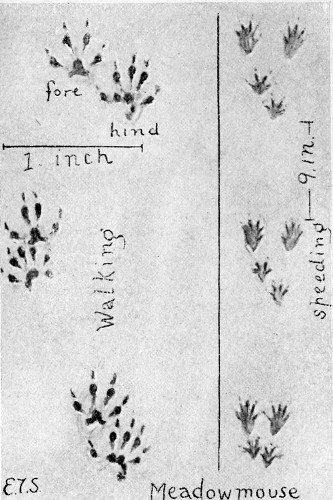
THE TRAIL OF A FIELD OR MEADOW MOUSE
When compared with that of the deermouse, one notes the absence of the tail mark and the rarity of the fore feet being paired (see pages 505 and 522).
THE PORCUPINE (Erethizon dorsatum and its relatives)
(For illustration, see page 514)
The porcupine is one of the most grotesque of the smaller North American mammals. With a weight of from fifteen to twenty pounds, its heavy body is supported on short legs, the feet resting flat on the ground like those of the raccoon, instead of on the toes, as in most small animals.
Its strongest peculiarity is the specialized development of most of the fur into rigid, sharp-pointed spines or “quills” from half an inch to over three inches in length. That the spines represent the underfur of ordinary mammals is evident from the fact that they are overlaid by long, coarse guard hairs, sometimes several times their length.
The spiny armament usually lies flat on the body, but when the animal is excited or alarmed it may be raised, by special muscles on the underside of the skin, into a bristling array of barbed points. The spines are so slightly attached that when their points enter the skin of an enemy they at once become free at the base. The points firmly set in the skin of another animal, the spines can be withdrawn only with considerable effort, and if left will gradually work deeper and may traverse a considerable part of the victim’s body before finally becoming encysted.
When assailed the porcupine turns down its head, arches its back, and, on firmly planted feet with all its spines erected into a bristling cover, awaits the enemy. The instant its body is touched the club-shaped tail, armed with a multitude of spines, is swung vigorously around and the animal so incautious as to receive the blow is pierced by a host of stinging darts which, freed from the porcupine, remain to torment the aggressor. This swift and effective sweep of the tail has probably given rise to the idea that the porcupine can “shoot” its quills when defending itself.
Despite its defensive powers, however, the porcupine is, on occasion, successfully attacked by various enemies, including the mountain lion, bobcat, fisher, and even the eagle and great horned owl. The fisher is said habitually to kill and feed upon them, and the encysted quills are commonly found under its skin.
The frightful effect of an ill-judged attack on a porcupine is shown by inexperienced dogs after their first encounter with this strange beast. That such an attack is a dangerous venture, even by the craftiest and most powerful of its enemies, is well demonstrated by occasional fatalities among large carnivores which result from the great mass of spines imbedded in their heads and bodies.
The North American porcupine is a northern animal belonging mainly to coniferous forests, and ranges from sea level to timberline. It originally occupied nearly all the forested parts of the continent south to West Virginia, southern Illinois, the Davis Mountains of western Texas, and the southern end of the Sierra Nevada in California, but was absent from the Southeastern States and the lower Mississippi Valley.
While characteristically a woodland animal, at times it wanders from forest shelters and has been found prowling about above timberline on high mountains, and among alder thickets beyond the limit of trees in the far North. They are usually silent, but at times utter a curious squealing cry, and in addition have a variety of snuffing, growling, and chattering noises.
In the forests of tropical America, from Mexico to Brazil, other and shorter-quilled porcupines occur, characterized by smaller size and slenderer bodies with a long tail, the terminal half of which is naked and prehensile like that of an opossum. These animals inhabit forests where no conifers grow, and are much more arboreal in habits than their northern relatives. Still other and even more strikingly different porcupines occur in Europe, Asia, and Africa, some of the African animals having heavy spines more than twelve inches long.
All porcupines are true rodents, and the name hedgehog is erroneously used when applied to any of them. Hedgehogs are small Old World insect-eating mammals, which have their backs covered with porcupine-like spines, but are in no way related to the porcupines.
The American porcupines are mainly nocturnal, although they sometimes wander about by day. While largely arboreal in habits, they pass much of their time on the ground and commonly have their dens in caves at the bases of cliffs, under the shelter of large rocks, logs, piles of brush, or in hollows at the bases of trees. They are sluggish, stupid animals, with poor sight, and are unable to move rapidly, either in a tree or on the ground.
Although on the ground they are extremely deliberate, in the treetops they are even more sluggish and can be compared only with the sloth. In consequence they are practically helpless in the presence of an enemy except for the defense afforded by their spiny armor. That in most cases this is effective is evidenced by their continued presence throughout a large part of their original range where forests still exist.
Porcupines are solitary animals, totally devoid of any qualities of good fellowship with their kind, but the attraction of woodland camps often brings a number together. They are exceedingly fond of salt and persistently return to camps to gnaw logs, boards, or any other object having a salty flavor.
They appear to be practically omnivorous so far as vegetable matter is concerned and feed upon the bark and twigs of spruces, hemlocks, several species of pines, cottonwoods, alders, and other trees and bushes. In orchards and gardens near their haunts they eat apples, turnips, and other fruits and vegetables and visit the shores of ponds for waterlily pads and other aquatic plants growing within reach.
Ordinarily they eat patches of bark from the tree trunks, but sometimes girdle the tree or at times denude the entire trunk. They often remain for weeks in the top of a single tree, even in the severest winter weather. I had a practical illustration of this on one occasion when stormbound in a fur trader’s cabin at the head of Norton Bay, on the north coast of Bering Sea, where a belt of spruces reached down from the interior. We were short of meat, and when one of the Eskimos reported that some time before he had seen a porcupine in a spruce tree he was sent to look for it. A few hours later he returned bringing the game, having found it in the very same tree where he had seen it many days before, although we had just experienced a period of severe weather, with temperatures well under 40 degrees Fahrenheit below zero. It was on this occasion that I first learned the palatable qualities of porcupine flesh.
Little is known definitely concerning the family life of these animals. The young, from one to four in number, are amazingly large at birth and appear fully armed with spines. Even before they are half grown they adopt the solitary habit of the adults and wander forth to care for themselves.
Porcupine’s have an intimate connection with the romantic side of early Indian life in eastern America. Their white quills were colored in bright hues by vegetable dyes known to the Indians and served to make beautiful embroidery on belts, moccasins, and other articles of aboriginal clothing until primitive art gave way to the more tawdry effects of trade goods.
THE JUMPING MOUSE (Zapus hudsonius and its relatives)
(For illustration, see page 514)
In several ways the jumping mouse is unique among American mammals. Its strongest characteristics are a dull, rusty yellowish color, a slender body about three inches long, a remarkably slender tail about five inches in length, and long hind legs and feet, which are specially developed for jumping, like those of a little kangaroo. In addition it is provided with cheek pouches, one on each side of the mouth, in which it gathers food to be carried to its hidden stores.
The long tail serves as a balance during its extraordinary leaps, some of which in a single bound cover a distance of about ten feet. If by accident one of these animals loses its tail, whenever it jumps it is thrown into a series of somersaults, turning helplessly over and over in the air.
The jumping mice form a small group of species and geographic races closely similar in general appearance. They are the sole representatives in North America of the Old World jerboas and are themselves represented elsewhere by a single species occurring in the interior of China. The jerboa family contains in addition many larger and curiously diverse species distributed over a large part of Asia, Africa, and southern Europe. Many Old World jerboas are desert animals, some of them exact reproductions in shape and color of the kangaroo rats of arid regions in the Western and Southwestern States and Mexico, although they are in no way related to those animals.
Jumping mice are distributed over most of the northern parts of North America from the Atlantic coast of Labrador to the Bering Sea coast of Alaska, and southward to North Carolina, Illinois, New Mexico, and California. They are nocturnal in habits and live in or near the borders of forests, in thickets of weeds or brushwood, and in meadows adjoining woodland areas or forest lakes. In prairie country they occupy belts of woody growth bordering streams. In congenial locations they range from sea level up to an altitude of 8,000 feet or more.
For winter homes they dig burrows two or three feet deep, in the lower parts of which they excavate oval chambers and fill them with fine grass and other soft material to make a warm nest. Other chambers opening from these burrows serve as store-rooms for berries, seeds, and nuts of various kinds, among which beechnuts are a favorite.
The nests occupied as summer homes are placed in shallow burrows a few inches below the surface of the ground, or they may be in a hollow tree, under a piece of bark, in a dense tussock of grass, or in other makeshift shelter. In these nests the young, varying from two to eight in number, are born at varying times between May and September, indicating the probability that more than one litter is produced each season.
When suddenly startled from her nest the female often flees with several of the young clinging to her teats. She runs swiftly through the grass, and if hard pressed will take a long leap, still carrying the pendant young. It is surprising that such delicately formed animals can make long leaps in thickly grown places and apparently land safely, especially when carrying their young. In the flights of the mother some of the young must be jarred loose, but when the alarm is over no doubt she returns to find and rescue any that may be missing.
In the northeastern States jumping mice are common habitants of meadows. They are equally at home in the rocky meadows of New England, on the flower-spangled borders of rushing trout streams in the Sierra Nevada of California, and the boggy glades of subarctic Alaska.
My first acquaintance with them was made many years ago, during haying time, in northern New York. Hidden under a haycock, as the last forkful was raised one of them was often revealed, and its startling leaps always resulted in an exciting chase, which usually ended in the escape of the strange little beast.
Unlike most of their small fellows of meadow and thicket, jumping mice regularly hibernate, occupying the nests near the bottoms of the winter burrows. They usually become fat on the abundance of food at the end of summer, and in September or October, with the approach of cool weather, enter their winter quarters and sink into the long, hibernating lethargy. Sometimes two of them are found hibernating in the same nest.
During hibernation they are coiled up in little furry balls, the nose resting on the abdomen, the hind feet on each side of the head, and the tail wound around the body. The winter sleep usually lasts until spring, but may be broken at any time by mild weather.
When hibernating the mice appear cold and lifeless, but if one is carried into a warm house or even held a long time in the captor’s hands it will slowly awaken and may become as lively as in summer. When returned to a low temperature, however, it soon resumes its mysterious seasonal sleep.
THE SILKY POCKET MICE (Perognathus flavus and its relatives)
(For illustration, see page 515)
Soft, shining fur, delicate coloring, and graceful form distinguish the silky pocket mice from others of their kind. The family of which they are members consists of rodents peculiar to America and includes many other species of pocket mice and kangaroo rats. All are provided with little pouches on each side of the mouth for gathering and carrying food, have proportionately long tails, and hind legs and feet more or less developed for jumping. Only in the most remote way, however, are they related to the jumping mice of the jerboa family.
The silky pocket mice vary in size from the tiny yellow species pictured on the accompanying plate, which weighs much less than an ounce, to forms considerably larger than the common house mouse. The little yellow pocket mouse is one of the smallest mammals in the world, and in addition is one of the most beautiful of our small species. Its bright eyes and the delicacy of its form and color, combined with the readiness with which, in most instances, it appears to lose all fear when caught and gently handled, render it extremely attractive.
As with the majority of other pocket mice, the silky-haired species are limited to the more arid parts of North America, and range from the Great Plains west of the Mississippi Valley to the eastern base of the Cascades, to the Sierra Nevada, and farther southward to the Pacific coast, and from the Canadian border to the Valley of Mexico. Vertically, the range of these mice extends from sea level to an altitude of more than 7,000 feet.
As with the majority of our wild mammals, little accurate information is available concerning their life history. They are habitants mainly of desert regions, where they prefer the areas of sandy loam, which produce an abundance of scattered desert vegetation. They are nocturnal and by day are seen only when driven from their nests. Their rather shallow burrows are made in soft soil, the situation varying a little with the species. Some species burrow only under the shelter of bushes or other vegetation; others out in the bare ground.
Each burrow commonly has grouped in a small area several entrance holes, which lead through tunnels to the central passageway, the nest, and the storage chambers. Usually there is a little pile of loose dirt thrown out on one side of a hole, or a group of holes may be in a little mound of earth. The entrances are usually stopped from within by loose earth, and if a person quietly thrusts in a short stick so as to remove the earthy plug and let in the light he may see the dirt suddenly returned to its place in little jets, as the occupant promptly kicks the door closed again.
The young, varying from two to six in a litter, are born in these little dens in warm nests of dried grasses. They have been found at all times between April and September, thus making it apparent that several litters are produced each season.
The silky, as well as the other kinds of desert pocket mice, do not drink water, and, as has been shown by experiments, they may be kept for months in thoroughly dry sand and fed on dried seeds without any resulting discomfort. Through the long pressure of desert environment they have developed the power to produce sufficient water for their physiological processes by chemical changes in the starch in their food, which are effected in the digestive tract.
Representatives of this group of mice are almost everywhere in the arid parts of their range, and in many sandy localities are extremely numerous and active at night, as shown by the multitude of little tracks in the dust at sunrise each morning. Their presence in the desert is indicated also by the many little conical pits half an inch or an inch deep, where they have located small seeds and dug them up.
They lie close in their burrows during cold or stormy weather, depending on their stores for food, but are not known to hibernate, although in the northern part of their range they are confined to their burrows for long periods.
At one of my camps in the desert of Lower California I found the silky and other pocket mice excessively numerous and so short of food that they swarmed about us at night with amazing lack of fear. My experiences with them are given in the accompanying account of the spiny pocket mice.
The silky and other pocket mice have many enemies, among the worst of which are the handsome little desert fox and the coyote. Others which continually prey upon them are the badger, skunk, and bobcat, as well as many owls.
THE SPINY POCKET MICE (Perognathus hispidus and its relatives)
(For illustration, see page 515)
Pocket mice are divided into several natural groups of species, all having certain characters in common, as a pointed head, lengthened hind feet and legs, and external cheek pouches for carrying food. The spiny group contains numerous species, the smallest of which is about the size of a house mouse and the largest nearly twice that size.