SMALLER MAMMALS OF NORTH AMERICA By Edward W. Nelson Chief, U. S. Biological Survey With illustrations in color from paintings by Louis Agassiz Fuertes (continued 4)
Reading edition
Although usually not quite so noisy and self-assertive as the irrepressible little red blusterer of eastern forests, the Douglas squirrel is also notable for its rollicking, chattering character and sometimes cannot be outdone in its amusing displays of aggressive impudence. When the animals are numerous the air at times resounds with their call notes or songs, one answering the other, now near and now far, until the somber depths of the mighty forest seems peopled with a multitude of these joyous furry sprites. Their song, resembling that of the red squirrel, is a rapid trilling or bubbling series of notes, long drawn out and sometimes varied by cadences. It is so musical that it seems more like the song of some strange bird than of a mammal. When these squirrels are not common they are much less given to song and seem subdued and shy, as though impressed by the vast loneliness of their deep forest haunts.
At mating time, early in spring, they are especially noisy, and again in summer when the first litter of young are out trying their youthful pipes in expression of their cheerful well being. They frequently come down on a low branch or on the trunk of a tree and chatter, bark, and scold at man, dog, or other intruder, now rushing up and down, or making little dashes around the tree trunk, their necks outstretched and tails flirting with a great show of anger and contempt highly entertaining to see. They are restlessly active at all seasons of the year and habitually chase one another through the forest with an appearance of rollicking fun which may many times be in more deadly earnest than appears to the casual observer.
In winter their tracks in the snow lead from tree to tree, along the tops of logs and fences, and in all directions to hidden stores of food, which they appear to be able to locate with unerring certainty under the snow. An adventurous spirit leads them to race away from the forest, along fence-tops, to pay visits to ranch buildings and even to villages and small towns. Like their eastern relative, the Douglas squirrels are omnivorous, feeding on the seeds of all the conifers in their range, including spruces, firs, pines, and redwoods, and also upon acorns, and a great variety of other seeds, fruits, and mushrooms, insects, birds’ eggs, young birds, and any other meat they can find. Owing to their habit of interfering with meat-baited traps, they are a nuisance to trappers. They frequently visit orchards and carry off apples and pears, from which they extract the seeds. They have been seen also to visit the wounds made on a willow trunk by sapsuckers to drink the flowing sap. Their feet and the fur about their mouths are often much gummed with pitch from working on pine cones.
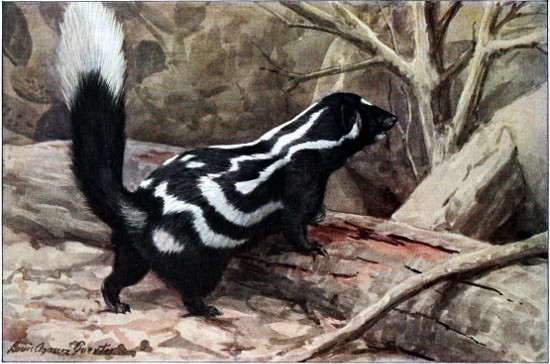
LITTLE SPOTTED SKUNK
Spilogale putorius
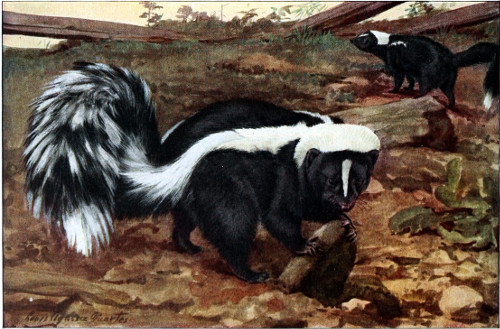
COMMON SKUNK
Mephitis mephitis
In many places the soft, moist earth in the woods is riddled with little pits dug by these squirrels apparently when they are after larvæ or perhaps edible roots. Throughout the summer, but especially during the last half of the season, and in autumn Douglas squirrels work with persistent energy to amass great stores of seed-bearing cones, which they heap, sometimes bushels of them, about the bases of trees, stumps, and the upturned roots of fallen trees or under other shelter. Cones are also buried here and there in the loose leaves and humus. In winter many holes in the snow with piles of cone scales at the entrances show where the owners have dug down to their stores.
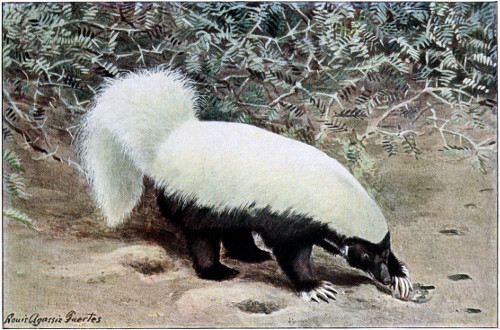
HOG-NOSED SKUNK
Conepatus mesoleucus
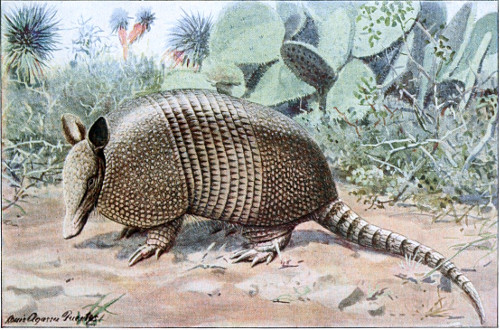
NINE-BANDED ARMADILLO
Dasypus novemcincta
Some of their nests are constructed in hollow trees, many others on branches near their junction with the trunks, and still others in underground dens under roots, logs, or stumps. In winter when alarmed these squirrels sometimes race down the tree trunks and take refuge in holes leading through the snow to their food caches and underground burrows. The nests built in tree-tops are usually rather bulky, measuring a foot or more in diameter, and are made of small twigs, dry leaves, moss, grass, and fibrous bark. They are commonly lined with such soft material as feathers and fur. The young, numbering three to seven at a litter, are born at any time between April and October.
The extraordinary intelligence and sense of prevision possessed by squirrels of this group is well illustrated by certain local food migrations. These have been observed in eastern Oregon in years when the cone crop has failed and nothing was available to lay up for winter. Under such conditions to remain in the mountain forests would mean death by starvation before winter had fairly begun. In 1910 and 1913 failure of the cone crop occurred in eastern Oregon and these squirrels promptly left the mountain forests in September and descended along creek courses to the open sagebrush plains as much as seven or more miles from the border of their ordinary haunts. In this open country they wintered successfully, raiding the farmers’ grain bins, root cellars, and other stores, and otherwise showing their supreme fitness to survive in the struggle for existence. With the coming again of summer they promptly returned to their abandoned homes in the pines. It appears to be one of the marvels of animal intelligence that under such circumstances as those named above the entire body of the squirrels on the mountains should have known what to do, especially as a great percentage of their number could never have had any previous experience as a guide.
THE GRAY SQUIRREL (Sciurus carolinensis and its relatives)
(For illustration, see page 547)
The gray squirrel is so well known to everyone in the Eastern States that it scarcely needs an introduction. Many who have not seen it in its native haunts are familiar with it as a graceful and charming resident of parks in many cities. It is about twice as large as the red squirrel and intermediate in size between that species and the fox squirrel. Although sharing some of the range of both the species named, the color of the gray squirrel at once distinguishes it.
The gray squirrel is a North American species with no near relative in the Old World; on the Pacific coast, in the mountains of the Southwest, and in Mexico are other squirrels having much the same gray-colored body, but with no close relationship to it. Its range covers the deciduous forests of the Eastern States and southern Canada from Nova Scotia to Florida, and westward to the border of the treeless Great Plains. Wherever they occur these squirrels are an attractive element in the woodland life, their barking and chattering, their graceful forms, and their activity adding greatly to the cheerful animation of the forest. They are far less vociferous than red squirrels, but their notes are varied and serve to express a variety of meanings.
During the early settlement of the country west of the States bordering the coast, gray squirrels existed in great numbers and often made ruinous inroads on the pioneer corn and wheat fields. In 1749 they invaded Pennsylvania in such hosts that a bounty of three pence each was put on their scalps. Eight thousand pounds sterling was paid on this account, which involved the killing of 640,000 squirrels. In 1808 a law in force in Ohio required that each free white male deliver 100 squirrel scalps a year or pay $3 in cash. Records of the ravages of these squirrels in corn fields are extant also from Kentucky, Missouri, and other States.
Enormous migrations of gray squirrels from one part of the country to another occurred in those days, caused apparently by the failure of food supplies in the deserted areas. Some impulse to move in one general direction at the same time appeared to affect the squirrels and they swarmed across country in amazing numbers, carrying devastation to any farms crossed on the way. When engaged in such movements they appeared indifferent to obstacles and without hesitation swam lakes and streams even as large as the Hudson and the Ohio. Amusing legends grew up concerning these migrations, one of which avers that when the squirrels arrived on a river bank each dragged a large chip or piece of bark into the water and mounting it raised its bushy tail in the breeze and was wafted safely to the other shore! As a fact, many were drowned in crossing large streams and others arrived exhausted from their exertions.
The gray and fox squirrels were favorite targets for pioneer marksmen. The early chronicles tell of the ability of Daniel Boone and other riflemen to “bark” a squirrel, which meant so to cut the bark of the branch on which the squirrel sat as to bring it to the ground stunned without hitting the animal. With the clearing away of the forests, the general occupation of the country, and the decrease of larger animals, gray squirrels have been deprived of most of their haunts and have become such desirable game that they have decreased to a point requiring stringent legal protection to save them from extermination.
Gray squirrels are more thoroughly arboreal than red squirrels and make their nests either in hollow trunks or build them in the tops of trees. These outside nests are common and much like a crow’s nest in appearance except that they are generally more bulky and show more dead leaves. They are built on a foundation of small sticks with a rounded top of leaves, and are lined with shreds of bark, moss, and similar soft material. In the extreme northern part of their range they live mainly in hollow trees, but farther south many winter in outside nests. During severe cold and in stormy weather they remain hidden, sometimes for days at a time.
They have two litters of four to six young a year, the first usually being born in March or April. The old squirrel is a devoted mother and if the nest is disturbed she will at once carry the young to some safer retreat.
In many parts of their range black, or melanistic, individuals are born in litters otherwise of the ordinary gray color. In some districts the number of the black squirrels equals or exceeds the gray ones.
Gray squirrels range through such a variety of climatic conditions that their food varies greatly. They eat practically all available nuts, including acorns, chestnuts, beechnuts, hickory-nuts, and pecans, besides numberless seeds, many small fruits, and mushrooms. They raid fields for corn and wheat, and steal apples, pears, and quinces from orchards to eat the seeds. Like most other small rodents, they are fond of larvæ and insects and also destroy many birds’ eggs and young birds. They are far less serious offenders, however, in destroying birds than the red squirrel.
On the approach of winter they lay up stores of seeds and nuts in holes in trees and in little hiding places on the ground. Many nuts are hidden away singly. In the public parks of Washington, where many gray squirrels exist, I have repeatedly seen them dig a little pit two or three inches deep, then push a nut well down it cover it with earth, which they press firmly in place with the front feet, and then pull loose grass over the spot. One squirrel will have many such hidden nuts, and with nothing to mark the location it appears impossible that they could be recovered. That the squirrels knew what they were doing I have had repeated evidence in winter, even with several inches of snow on the ground, when they have been seen sniffing along the top of the snow, suddenly stop, dig down and unearth a nut with a precision that demonstrates the marvelous delicacy of their sense of smell. Although mainly diurnal, they are sometimes abroad on moonlight nights, especially when gathering stores of food for winter.
Wherever they are, these squirrels are extremely graceful, moving along the ground by curving bounds, the long fluffy tail undulating as they go, or running through the tree-tops, leaping from branch to branch with an ease and certainty beautiful to see. When pressed they make amazing leaps from tree to tree or even from a high tree-top to the ground without injury. They are extremely cunning at concealing themselves by lying flat on top of branches or by gliding around tree trunks, keeping them interposed between themselves and the pursuer.
Gray squirrels are so responsive to protection that they may continue to grace our remaining forests if we properly guard them. In addition to their beauty, they are interesting game animals which should continue to afford a moderate amount of sport—sufficient to prevent them from becoming overabundant and destructive. Now introduced in many city parks throughout the United States and in parts of England, including London, their ready acceptance of people as friends renders them charming animals in such places; but natural food is so scarce under these artificial conditions that care must be taken to feed them at all seasons, especially in winter.
THE FOX SQUIRREL (Sciurus niger and its relatives)
(For illustration, see page 547)
THE RUSTY FOX SQUIRREL (Sciurus niger rufiventer)
(For illustration, see page 547)
Three species of tree squirrels inhabit the varied forests of eastern North America, each having its marked individuality expressed in color, size, and habits. All occupy a wide territory with varying climatic conditions, to which each species has responded by becoming modified into a series of geographic races, or subspecies. The red and the gray squirrels have already been described and it remains to give an account of the largest and in some respects the most remarkable of the three, the fox squirrel.
No other species of North American mammal can show such an extraordinary contrast in color among its subspecies as that between the rusty yellowish animal of the Ohio and upper Mississippi Valleys, and the handsome blackish one of the Southeastern States, both of which are pictured in the accompanying illustration.
The distribution of the fox squirrel is limited to the forested parts of the Eastern States. There it ranges from the Atlantic coast to the border of the Great Plains, and from southern New York and the upper Mississippi Valley southward to Florida, the Gulf coast, and across the lower Rio Grande into extreme northeastern Mexico.
Variations in the character of the haunts of the different subspecies of this squirrel almost equal their differences in color. In the upper Mississippi and Ohio Valleys the rusty-colored race frequents the upland woods, where the nut-bearing hickory trees characterize the forests. In the South the dark-colored squirrels have more varied homes, either amid the live oaks draped in long Spanish moss, in the mysterious cypress forests of the swamps, or out in the uplands among the southern pines.
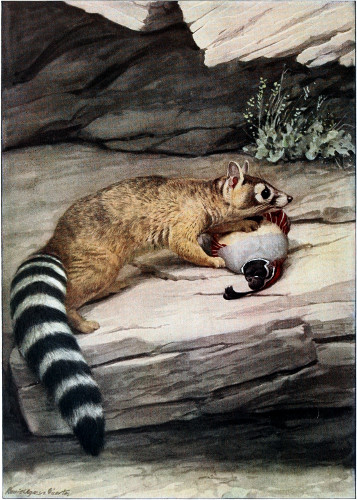
RING-TAILED CAT
Bassariscus astutus
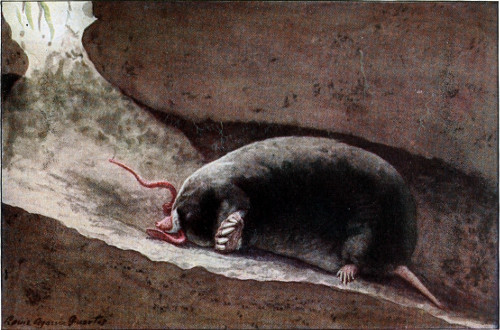
OREGON MOLE
Scapanus townsendi
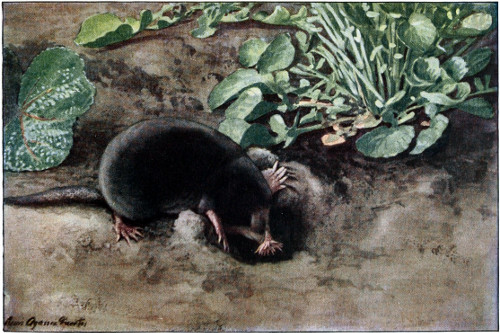
STAR-NOSED MOLE
Condylura cristata
In early days fox squirrels were plentiful, but never equaled the numbers of the gray squirrel. They appear always to have been more closely attached to their own district, for we have no records of the great migrations so notable in the other species.
Fox squirrels are not only distinguished from gray squirrels by their color, but are also nearly twice their size, commonly attaining a weight of two and sometimes nearly three pounds. They are the strongest and most heavily proportioned of all American squirrels. A deliberation of movement going with heaviness of body is in marked contrast to the graceful agility of most other tree squirrels. On the ground they walk with a curiously awkward, waddling gait, and even when hard pressed climb trees with none of the dashing quickness shown by other species. They often move about on the ground by a series of bounds, and at such times, with broad, feathery tails undulating in the air, present a most graceful and attractive sight.
Fox and gray squirrels occupy the same districts throughout most of their ranges, but often become so segregated locally that the grays may be found almost exclusively along bottom-lands and the fox squirrels on the higher ridges, but there is no hard and fast separation of haunts and the two forms usually share the same woodlands.
Much time is spent by fox squirrels on the ground searching for food. When danger approaches, in place of promptly taking refuge in a tree, as is a common habit with most tree squirrels, they retreat along the ground, mounting a stump or log now and then, to look back at a suspected intruder, whose footsteps they can hear at a long distance. If the hunter is without a dog they may run away and be lost. A dog soon forces them up a tree and if a knot-hole or other hollow is available they at once take refuge in it. Otherwise they hide skillfully in bunches of leaves high in the top or lie flat on a limb or against the trunk, slyly moving to keep on the opposite side as the hunter draws near. In the Mississippi Valley during the crisp days when the hickory nuts are falling and the trees are decked in all the glories of autumn foliage, few sports afield yield more pleasurable sensations than fox-squirrel hunting.
The fox squirrels become fatter than most of their kind and their flesh is not so dry, although all furnish appetizing meat. Owing to their size and the quality of their flesh, they have been such desirable game animals that with the constantly growing number of hunters and the destruction of forests they have already disappeared from large areas where formerly abundant and are in real danger of extermination in the not-distant future. They are among the most notable and attractive of the forest animals in the Eastern States, and before it is too late every effort should be made to protect them from overshooting. With reasonable conservation they will continue to thrive and keep some of the old-time primitive spirit in our woods. Formerly they had the same predilection as the gray squirrel for the farmers’ corn fields and were under the ban, but their numbers are now so reduced that they give little trouble in this way. In some city parks where they have been introduced, they soon become tame and do well, except that in losing their fear of man they become subject to many accidents.
Fox squirrels, like many others of their kind, have homes both in knot-holes or other hollows in tree trunks, and in bulky nests of sticks and leaves high up among the branches. Both kinds of nesting places are often located in the same tree, the owner living in the outside nest in warm weather and retiring to the shelter of the hollow trunk in severe weather or to escape an enemy. The young, two to four in number, are usually born in March or April, and it is not definitely known whether there is a second litter. These squirrels have a barking call as well as several other rather deep-toned chucking notes.
They are as omnivorous as any of their kind, eating many kinds of nuts, seeds, fruits, mushrooms, insects, birds, birds’ eggs, and other flesh food when available. The principal nuts in their haunts are hickory-nuts, beechnuts, walnuts, pecan nuts, and the seeds of pines and cypresses. Toward the end of summer and in fall they work busily gathering and storing food for winter in hollow trees, in old logs, about the roots of trees, and in any other snug place where it may be kept safely until needed. Many single nuts are buried here and there in little pits three or four inches deep dug in the soft surface of the earth under the trees. These scattered stores are located when needed by the acute sense of smell which the owners possess.
THE ABERT SQUIRREL (Sciurus aberti and its subspecies)
(For illustration, see page 550)
THE KAIBAB SQUIRREL (Sciurus kaibabensis)
(For illustration, see page 550)
Among the many kinds of squirrels which lend animation and charm to the forests of North and South America, none equal in beauty the subjects of this sketch—the Abert and the Kaibab squirrels. These are the only American squirrels endowed with conspicuous ear tufts, which character they share with the squirrels occupying the forests in the northern parts of the Old World from England to Japan. In weight they about equal a large gray squirrel, but are shorter and distinctly more heavily proportioned, with broader and more feathery tails.
Their range covers the pine-forested region of the southern Rocky Mountains in the United States and the Sierra Madre of western Mexico. The Abert squirrel and its several subspecies is the more widely distributed, being found from northern Colorado, south through New Mexico, Arizona, Chihuahua, and Durango. The Kaibab squirrel, which is even more beautiful than its relative, shows marked differences in appearance and yet is evidently derived from the same species.
The typical Abert squirrel lives in the pine forests along the southern rim of the Grand Canyon in northern Arizona, and the Kaibab squirrel lives in the pines visible on the northern rim of the canyon less than 15 miles away. It is confined to an islandlike area of pine forest above 70 miles long by 35 miles wide, on the north side of the canyon, on the Kaibab and Powell plateaus, directly across from the end of the railroad at the Grand Canyon Hotel. The two species live under practically identical conditions as to vegetation and climate.
In these sketches of our mammal life I have repeatedly noted the effect of changing environment in modifying the animals subject to it. In the present case the change in the squirrels on the north side of the Grand Canyon has evidently been brought about by that powerful factor in evolution known as isolation. Cut off from their fellows by the deepening canyon of the Colorado, Kaibab squirrels have occupied a forest island ever since, with the resulting change in characters we now have in evidence.
The home of both the Abert and the Kaibab squirrels is almost entirely between 6,000 and 9,500 feet altitude, on the mountain slopes and high plateaus overgrown with a splendid open forest of yellow pine mixed in many places with firs and aspens. Occasionally, as food becomes scarce in their ordinary haunts, they range up into the firs or down into the oaks and piñon pines. In winter their haunts are buried in snow, but in summer on every hand present lovely vistas among the massive tree trunks, varied here and there by gemlike parks. Everywhere the ground is covered with grasses and multitudes of flowering plants. In the wilder parts of this fascinating wilderness roam bears, mountain lions, wolves, deer, and wild turkeys, and only a few decades ago still wilder men, belonging to some of our most dreaded Indian tribes.
Although these squirrels commonly make use of large knot-holes or other hollows in trees, they regularly build high up in the branches bulky nests of leaves, pine needles, and twigs and line them with soft grass and shredded bark. Sometimes several full-grown squirrels may be found occupying one of these outside nests, probably members of one family. They are active throughout the year, but remain in their nests during storms and severe winter weather. In northern Arizona I have known them to stay under cover for a week or two at a time in midwinter.
The young appear to be born at varying times between April and September. Although not definitely known, it seems probable that they have two litters of from three to four young each season.
The seeds and the tender bark from the terminal twigs of the yellow pine (Pinus ponderosa) furnish their principal food supply. During periods when pine seeds are not available the squirrels cut the ends of pine twigs, letting the terminal part bearing the leaves fall to the ground, while the stem, several inches in length, is stripped of bark. Often at times of food scarcity the bark will be eaten for a considerable distance along the outer branches, almost like the work of porcupines. The ground under the pines where the squirrels are at work is sometimes almost covered with the freshly dropped tips of branches.
The Abert squirrels also eat the seeds of Douglas spruce, of the piñon pine, acorns, many seeds, roots, green vegetation, mushrooms, birds’ eggs, and young birds. Now and then they rob cornfields planted in clearings, but they do little damage to crops. Some years they are extremely numerous and are in evidence everywhere; again they become scarce and so wary that it is difficult to see one, even where its fresh workings are in evidence.
Both these squirrels have a deep churring or chucking call, sometimes becoming a barking note resembling that of the fox squirrel. They also have a variety of chattering and scolding notes when excited or angry. At times they become almost as aggressive as the red squirrel and come down the tree trunk or to a lower branch, whence they scold and berate the object of their disapproval.
When much alarmed they are expert at hiding among tufts of leaves near the ends of branches, on tops of large limbs, or behind trunks. They will remain hidden in this way for an hour or more, patiently waiting for the danger to disappear, but one is often betrayed by the wind blowing the feathery tip of its tail into view.
On the ground the tail is usually carried upraised in graceful curves. Here these squirrels spend much time among fallen cones and in digging for roots and other food. When they walk they have an awkward waddling gait, but when they are alarmed, or desire to move more rapidly for any cause, they progress in a series of extremely graceful bounds, which show the plumelike tail to good advantage. When the Kaibab squirrel is moving about on the ground its great white tail is extraordinarily conspicuous in the sunshine. This repeatedly drew my attention to these squirrels, even at such long distances that they would otherwise have been overlooked.
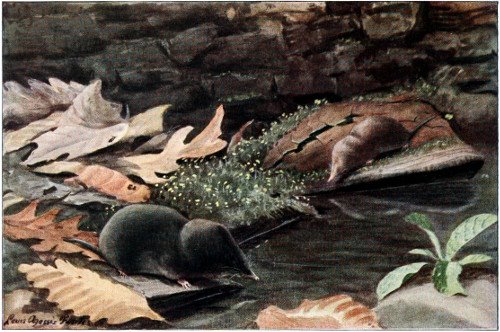
SHORT-TAILED SHREW Blarina brevicauda COMMON SHREW Sorex personatus
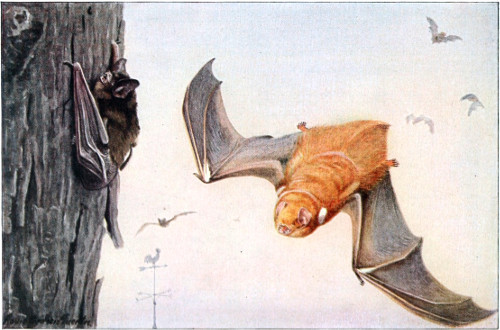
HOARY BAT Nycteris cinereus RED BAT Nycteris borealis
Although so heavily built, these squirrels are adept in leaping from branch to branch and from tree to tree. On one occasion a branch on which an Abert squirrel was standing near the top of a pine tree was struck by a rifle ball; the squirrel promptly ran to the end of a large branch about fifty feet from the ground, and although no tree was anywhere near on that side, leaped straight out into the air, with its legs outspread just as in a flying squirrel. It came down in a horizontal position and struck the ground flat on its under side and the rebound raised it several inches. Without an instant’s delay it was running at full speed across a little open park and disappeared in the forest on the other side. I was standing only a few yards to one side of the falling squirrel and the widely spread feet and legs were perfectly outlined against the sky. It was evident that this squirrel and probably all of its kind appreciate that such an attitude will help break the force of the descent. This suggested the possibility of a similar habit having influenced the origin of the flying squirrel’s membranes.
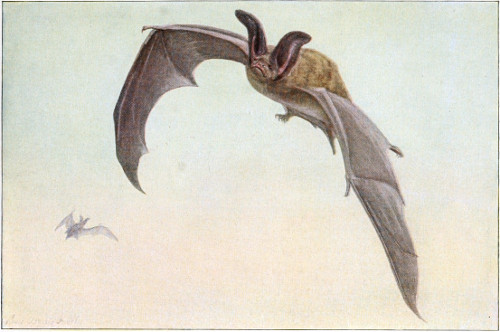
BIG-EARED DESERT BAT
Antrozous pallidus
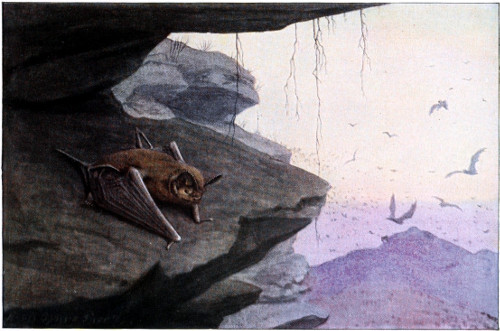
MEXICAN BAT
Nyctinomus mexicanus
One summer day in the Sierra Madre of western Durango I sat on a mountain slope watching for game. Below me stood the hollow-topped stub of an oak, the top being on a level with my eyes and about twenty yards away. Soon after I arrived the heads of four half-grown squirrels of the Abert family appeared in a row at the upper border of the opening, their bright eyes turning on all sides. Suddenly a hawk glided by, one of its wing tips almost brushing the noses of the squirrels. Instantly they vanished from sight and a noise of scratching and frightened chattering continued for several minutes, as though they were burying themselves under the nest. About twenty minutes later the boldest of the family showed the tip of his nose at an opening in a hollow branch near the top of the stub, but it required another ten minutes for him to venture forth his head. Finally, becoming confident that no danger threatened, he came out on the limb and deliberately stretched himself, yawning as widely as his little mouth would permit, after which he flirted his tail and frisked over to the trunk of the stub, where he began frolicking about with all the abandon of a kitten at play. When I departed his more timorous companions were still peering fearfully out of the hole, anticipating the return of the dreaded hawk.
THE FLYING SQUIRREL (Glaucomys volans and its relatives)
(For illustration, see page 551)
No one can see one of our small flying squirrels in life without being charmed by its delicate grace of form and velvety fur, nor fail to note the large black eyes which give it a pleasing air of lively intelligence. Flying squirrels are distinguished from all other members of the squirrel family by extensions of the skin along the sides, which unite the front and hind legs, so that when the animal leaps from some elevated point with legs outspread the membrane and the underside of the body present a broad, flat surface to the air. This enables it to glide swiftly down in a diagonal course toward a tree trunk or other vertical surface on which it desires to alight. It is able to control its movements and to turn with ease to one side or the other, or upward before alighting. When gliding down a wooded hillside or through thick growths of timber, it is thus able to avoid obstacles and alight on the desired place.
Flying squirrels are circumpolar in distribution. In the Old World they occupy forested areas in eastern Europe, and nearly all of Asia. In the New World they are peculiar to North America, where they frequent nearly all the wooded parts from the Arctic Circle to the Mexican border, and in forests in Mexico along the eastern border of the highlands as well as through Chiapas and Guatemala. In Asia, the center of development of these interesting rodents, many extraordinary forms occur. Some are giants of their kind, measuring nearly four feet in total length. In America there are two groups of species, the smaller and better known of which, the subject of this sketch, occupies the eastern United States and southward. The northern and western animals are larger, some of them more than twice the weight of the eastern species.
In many parts of the United States flying squirrels are common and even abundant, but their habits are so strictly nocturnal that they are infrequently seen. They make their homes in woodpecker holes, knot-holes, and hollows in limbs, and trunks of trees and stubs. In addition they take possession of many odd places for residence, among which may be mentioned bird-boxes, dove-cotes, attics, cupboards, boxes, and other nooks in occupied or unoccupied houses that are located within or at the borders of woods.
They also make nests of leaves, lining them with fine fibrous bark, grass, moss, fur, or other soft material placed securely in the branches or in forks in trees. They often remodel old bird or squirrel nests into snug homes for themselves. The size and construction of these outside nests vary according to the locality and the material available.
As a rule, the nests are small and accommodate only a single pair with their young, and sometimes hold only a single individual, but numerous exceptions to this have been observed. In southern Illinois fifty flying squirrels were discovered in one nest in a tree; in Indiana fifteen were found in a hollow stump; and near Philadelphia thirty were evicted from a martin box they had usurped.
In the southern part of their range flying squirrels are active throughout the year, but in the North they become more or less sluggish if they do not actually reach the stage of real hibernation during the severest weather.
Their food is extremely varied and includes whatever nuts grow in their haunts, as beechnuts, pecans, acorns, and others, with many kinds of seeds, including corn gathered in the field, and buds, and fruits of many kinds. They also eat many insects, larvæ, birds and their eggs, and meat. Taking advantage of their known liking for bird flesh, they may frequently be caught by concealing a trap on top of a log in the woods and scattering bird feathers over and about it. Trappers for marten and other forest fur-bearers are much annoyed in winter by the persistence with which the flying squirrels search out their traps and become caught in them, thus forestalling a more valued capture. Trappers in Montana who run long lines of traps for marten through the mountain forests capture hundreds of these squirrels in a single season.
Flying squirrels have several notes, one of which is an ordinary chuck, chuck, much like that of other squirrels. They also utter sharp squeaks and squeals when angry or much alarmed, and a clear musical chirping note, birdlike in character, which is frequently repeated for several minutes in succession and is undoubtedly a song.
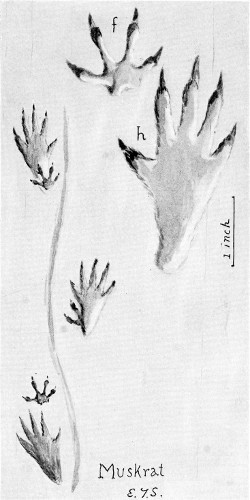
THE TRAIL OF THE MUSKRAT
The usual gait of the muskrat on land is a slow walk. The tail mark is always very strongly shown (see pages 513 and 526).
These beautiful little animals become the most delightful of pets, as they are notable for extraordinary playfulness and a readiness to accept man as a friend. Many interesting accounts have been published concerning the affectionate attachment they form for their human hosts and the amusing and tireless activity they show at night. By day they remain sound asleep, rolled up in a furry ball in some dark corner.
They are known to have a litter of from two to six young in April, and young are born at various times throughout the summer, but it is still unsettled whether there is more than one litter a year. The mother is devoted to the young, and if driven from them will keep close by at the risk of her life, showing much anxiety and readiness to do what she can to protect them. One instance well illustrates this maternal care. From a nest in a hollow stub the helpless young were taken and placed on the ground at its base, while the despoiler of the home stood by to observe the result. The mother soon returned and not finding her family in the nest promptly located them on the ground. Quickly descending, she took one in her mouth, carried it to the top of the stub and, launching into the air, sailed to a tree thirty feet away, up which she carried her baby and placed it safely in a knot-hole. The trip was quickly repeated until the family was reunited in its new location.
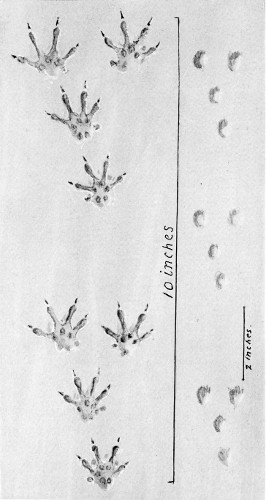
THE TRACKS OF A GRASSHOPPER MOUSE
The anatomy of the foot is fairly well shown in the track—the insignificant thumb and the tubercles on the soles. The placing of the fore feet, one behind the other, indicates that the creature cannot climb a tree. The tail seldom or never shows. The original of this was in fine dust. The small tracks to the right show the style usually seen. There are many species of grasshopper mouse, but the tracks are not distinguishable from each other. The exact species is determined by locality, size, etc. (see pages 520 and 527).
At night the curiosity of flying squirrels about strange things and their mischievous activities are often most entertaining, and sometimes exasperating. Whatever is accessible within their territory is certain to be thoroughly explored. A large apartment building, seven stories high, in Washington stands on the border of the woods of the Zoological Park. During one summer night a friend occupying an apartment on the seventh floor of this building, fronting the park, observed some movement on one of his window sills and by later observation and by inquiry among the other residents learned that flying squirrels were habitually climbing all about the high walls to the top of this building, using it and some of the rooms as a nightly playground. Several occupants of apartments in different parts of the building regularly placed nuts of various kinds on the window ledges for them, and now and then were amused to find that during the night the squirrels had carried away some of their nuts, but had replaced them with other kinds, sometimes brought from a window at a considerable distance on another side of the building. The presence of these squirrels was warmly welcomed and furnished much interest to their hosts.
The constant activity of these little animals at night enables owls and cats to capture many, but their small size and the shelter of their homes by day will prevent their serious decrease in numbers so long as suitable forests remain to supply their needs.
THE BLACK-FOOTED FERRET (Mustela nigripes and its relatives)
(For illustration, see page 551)
Of all the varied forms of mammalian life in America, the black-footed ferret has always impressed me as one of the strangest and most like a stranded exotic. It is about the size of a mink, but, as the illustration shows, is entirely different in appearance and has the general form of a giant weasel. It has no close relative in America, but bears an extraordinarily close resemblance in size, form, and color to the Siberian ferret (Mustela eversmanni).
The black-footed ferret occurs only in the interior of the United States, closely restricted to the area inhabited by prairie-dogs, from the Rocky Mountains eastward and from Montana and the Dakotas to western Texas. It is known also west of the mountains in Colorado. Like others of the weasel tribe, it must have a wandering disposition, since one was captured at 9,800 feet altitude, and another was found drowned at 10,250 feet in Lake Moraine, Colorado.
These ferrets exist as parasites in the prairie-dog colonies, making their homes in deserted burrows and feeding on the hapless colonists. In Kansas their presence in certain localities appears to have been effective in exterminating prairie-dogs, and similar activities may account for the deserted “dog towns” which are not infrequently observed on the plains with no apparent reason for the absence of the habitants.
They do not appear to be numerous in any part of their range and little is known concerning their habits. Now and then they are seen moving about prairie-dog “towns,” passing in and out of the burrows at all hours of the day, but it is probable that they are mainly nocturnal. This probability is strengthened by the extreme restlessness shown at night by captive animals. With the occupation of the country and the inevitable extinction of the prairie-dog over nearly or quite all of its range, the black-footed ferret is practically certain to disappear with its host species.
It has the same bold, inquisitive character shown by the weasel, and when its interest is excited will stand up on its hind legs and stretch its long neck to one side and another in an effort to satisfy its curiosity. When surprised in a “dog town” it commonly retreats to a burrow, but promptly turns and raises its head high out of the hole to observe the visitor. As a result ferrets are readily killed by hunters. When one is captured it will at first hiss and spit like a cat and fight viciously, but is not difficult to tame.
Although mainly dependent upon prairie-dogs for food, there is little doubt that ferrets, after the manner of their kind, also kill rabbits and other rodents in addition to taking whatever birds and birds’ eggs may be secured. In one instance a black-footed ferret lived for several days under a wooden sidewalk in the border town of Hays, Kansas, where it killed the rats harboring there.
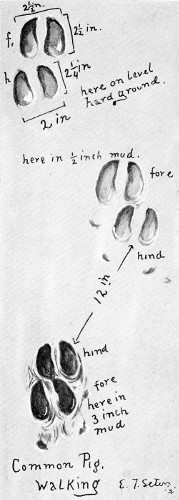
TRACK OF A COMMON PIG
Pig and deer tracks are often found in the same places and to a casual glance may be mistaken for each other, but the bluntness of the pig track distinguishes it and the clouts or hind hoofs do not show on level ground, but do in one or two inches of snow or mud.
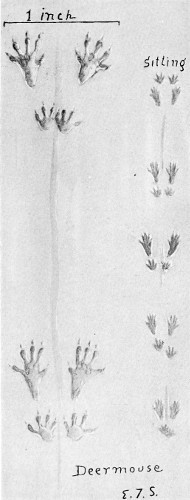
FOOTPRINTS OF A WHITE-FOOTED MOUSE
When reduced to scale, the large tracks on the left side are life size, showing the animal making the ordinary bounds of about 3 inches between each set of tracks. In speeding, the space may increase to 12 inches. The tail usually shows in the deermouse track, and this, with the pairing of the fore paws, is a strong characteristic (see pages 521 and 530).
THE LARGE WEASELS, OR STOATS (Mustela arcticus and its relatives)
(For illustration, see page 554)
The weasel family includes not only the true weasels, but numerous other carnivores, as the sable or marten, mink, ferret, skunk, and land and sea otters, all of which rank among our highly valued fur-bearers. The large weasel may be distinguished from others of its family by the small size and the snakelike proportions of the flattened and pointed head, combined with a long, extremely slender neck and body and a comparatively long tail. The best known of these animals are the stoat of the northern parts of the Old World (Mustela erminea) and its close relative in northern North America (Mustela arcticus), the winter skins of which furnish the famed ermine, once sacred to the trappings of royalty.
The northern weasels are strongly marked by their habit of changing their brown coat to one of snowy white at the beginning of winter. To the south the change becomes less complete as the winter snows decrease, and south of the limit of snow the brown coat is retained throughout the year. The time of change depends on the coming of the snow and varies with the year, and the time of resumption of the brown coat in spring depends in the same way on the season. The white winter coat of the larger and medium-sized species is accompanied by a strongly contrasting jet black tip to the tail.
Weasels are circumpolar in distribution and occupy nearly all parts of Europe, Asia, and North and South America, the greatest number and variety of species occurring in North America. Surprisingly enough, the largest of these eminently northern animals is found in the forests of the American tropics. The Arctic weasel ranges to the northernmost polar lands of North America, where its presence has been recorded many times by ice-bound explorers. Other species are more or less generally distributed over the remainder of the continent. In Mexico I have found them from sea level to above timberline, at more that 13,000 feet altitude on the high volcanoes.
The strong personality of the weasels as a group is based mainly on their extraordinary celerity of movement, their courage, and their insatiable desire to kill. They are not satisfied with supplying the call for food, but whenever opportunity arises kill from sheer lust of slaughter.
Their slender forms enable them to follow their prey to the remotest depths of their retreats, and that all rodents have an abiding horror of them is shown by the effect of a weasel’s appearance. Rabbits, although many times their size, become easy victims, and in one instance when a large rat, which had fought its human captor viciously, was put in a cage with a weasel, it at once lost all its courage and permitted itself to be killed without an effort at defense.
Weasels are wonderfully endowed for their predatory work and are undoubtedly the most perfectly organized machines for killing that have been developed among mammals. Their keen eyes are constantly alert to observe everything about them, their ears are attuned to catch the faintest squeak of a mouse or cry of any other small animal, and their powers of scent are very great. When hunting they dart in and out of the holes of rodents, among crevices in the rocks, or through brush piles, pausing now and then to stand upright on their hind feet, the head swaying to and fro as they peer about. The squeak of a mouse starts them instantly in search of it, and like a dog they trail rabbits and other rodents by scent.
As a rule, weasels are terrestrial, but in wooded country they climb trees and leap from branch to branch with all the ease of squirrels. In most localities they are not common, but now and then, where conditions are peculiarly favorable, they become numerous. At one naturalist’s camp in the upper Yukon they were surprisingly abundant, so much so that more than forty were caught in a few days in traps set among broken rocks. There they were extremely bold, hunting for their prey among the rocks within a few feet of the trappers.
The prey of weasels includes almost every kind of small rodent and bird living within their territory. They feed especially upon northern hares, cottontails, conies, ground squirrels, chipmunks, tree squirrels, wood rats, mice, lemmings, quail, ptarmigan, spruce and ruffed grouse, ducks, and numberless other small species. They are also very destructive to domestic fowl, often killing thirty or forty in a night. They unhesitatingly attack rodents many times their own weight.
Once when hunting on the open plain near the southern end of the Mexican table-land, I saw at some distance what appeared to be a brown ball rolling about on the ground. This was soon determined to be a weasel fastened to one of the large and powerful pocket gophers of that region. The weasel had its teeth set in the back of the neck of the gopher, while the latter was blindly trying to tear itself loose. I fired an ineffectual shot at the weasel and it vanished like a flash in the open tunnel of the gopher. As I drew near, the gopher, still in fighting mood, faced me with bared teeth. Later, when I removed its skin, I found that the weasel had torn loose the attachment of the heavy neck muscles to the back of the skull until only a thin layer remained to protect the spinal column. This had been accomplished without breaking the thin, but extremely tough, skin of the gopher.
When a weasel is attacking an animal which resists, like a large ground squirrel, it raises its head and sways its long neck back and forth, its eyes glittering with excitement as it watches for an opening to spring forward and seize its prey. Its attack is always aimed at a vital point, commonly the brain, the back of the neck, or the jugular vein on the side.
Weasels dig their own burrows under the shelter of slide rock, ledges, stone walls, stumps, and outbuildings, or they occupy hollow trees and the deserted burrows of other animals. In nests thus safely located they have one litter containing an average of from four to six, but sometimes numbering up to twelve, young a year. They are born at any time from April to June, according to the latitude. The number of young in a litter is enough to render weasels very abundant, but this is rarely the case, and raises the question as to the influence which holds their number in check.
They are both nocturnal and diurnal, apparently in almost equal degree, since they are frequently observed hunting in the middle of the day, while their nocturnal raids on poultry houses testify to their activities at night. When hunting they appear like sinister shadows and are persistent in pursuit. The young commonly remain with the female until nearly or quite grown and follow her closely on hunting-trips. It is interesting to see a pack of these deadly carnivores working, the mother leading and the young skirmishing on all sides, now spreading out, now closing in, like a pack of miniature hounds. On these family hunting parties, however, they usually keep close to the rocks, logs, brush, or other cover.
Themselves subject to the law of fang and claw, weasels are killed and eaten by wolves, coyotes, foxes, and various birds of prey. Their very lack of fear perhaps in many cases leads to their destruction.
These representatives of the primitive woodland life continue to occupy practically all of their original range. They visit farms in all parts of the country and I have seen them near the outskirts of Washington.
It is well that weasels are not abundant, for beasts with such innate ferocity and love of killing would otherwise be a menace to the existence of many useful species of birds and mammals, especially the game birds. In many places they live almost entirely on mice, and there they should be left unmolested; but whenever they locate in the vicinity of a chicken yard the owner will do well to take proper measures for protection.
THE LEAST WEASEL (Mustela rixosus and its relatives)
(For illustration, see page 554)
In addition to the larger members of the tribe briefly described in the foregoing sketch, the true weasels include another group of species, so small they may appropriately be termed the dwarfs of their kind. They vary from a half to less than a fourth the size of the larger weasels, but have the same characteristic form and proportions, except that the tail is very short and never tipped with black. Like the larger species, they change their brown summer coat for white at the beginning of winter and back again in spring.
The least weasels are also circumpolar in distribution, but are limited to the northern parts of Europe, Asia, and North America. In England and other parts of the Old World the group is represented by the well-known species Mustela vulgaris. In North America several species are known which, between them, share all the continent from the Arctic coast south to Nebraska and Pennsylvania. On the desolate islands extending from the mainland far toward the Pole their place seems to be taken by the ermine.
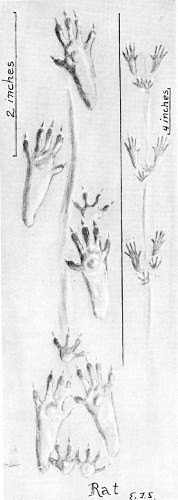
THE COMMON BROWN RAT
The large series shows the ordinary foraging gait; the smaller one, to the right, shows the travel at low speed. In all, the tail mark is a strong feature (see pages 525 and 531).
The dwarf weasels appear to be less numerous and, as a consequence, less known in most parts of America than in England and northern Europe. Our most northern species, Mustela rixosa, sometimes called the “mouse weasel,” occupies Alaska and northern Canada and has the distinction of being the smallest known species of carnivore in the world. In this connection it is interesting to note that in Alaska we have associated on the same ground the least weasel and the great brown bear, the smallest and the largest living carnivores.
Least weasels are characterized by the same swift alertness and boldness so marked in the larger species. In fact they are, if possible, even quicker in their movements. Once when camping in spring among scattered snowbanks on the coast of Bering Sea, I had an excellent opportunity to witness their almost incredible quickness. Early in the morning one suddenly appeared on the margin of a snowbank within a few feet, and after craning its neck one way and the other, as though to get a better view of me, it vanished, and then appeared so abruptly on a snowbank three or four yards away that it was almost impossible to follow it with the eye. It was beginning to take on its summer coat of brown and was extremely difficult to locate amid the scattered patches of snow and bare moss of the tundra. Certainly no other mammal can have such flash-like powers of movement.
They feed mainly on mice, lemmings, shrews, small birds, their eggs and young, and insects. Mice furnish a large proportion of their prey and weasels have often been seen following the runways of field mice. Their small size enables them to pursue mice into their underground workings as readily as a ferret enters a rabbit burrow. They also climb trees and bushes with great agility, although nearly always seeking their victims on the ground. The mice upon which they prey are often so much larger than the weasels that they cannot be dragged into the dens. The weasels continue in full activity throughout the winter and constantly burrow into the snow in search of their prey. In the snow or in the ground the holes of this animal are about the diameter of one’s finger.
In the Old World the small weasels are reported to have several litters in a season, each containing five or six young. At Point Barrow, Alaska, a female captured on June 12 still contained twelve embryos. This indicates that only one litter a year would be born there, and that Mustela rixosa is more prolific than its European representative.
In the more southern latitude least weasels live in forests and about farms, sheltering themselves under logs, brush piles, stone walls, and similar cover. They are always restless and filled with curiosity regarding anything of unusual appearance. When one encounters a man it shows no fear, but slyly moving from one shelter to another, now advancing and now retreating, examines the stranger carefully before going on its way. As they devote practically their entire lives to the destruction of field mice, they are valuable friends of the farmer and should have his good will and protection. Unfortunately for these weasels, no discrimination is shown between them and their larger relatives of more injurious habits.
Among the natives of Alaska all weasels are looked upon with great respect on account of their prowess as hunters. I found this feeling peculiarly strong among the Eskimos, whose existence for ages has depended so largely on the products of the chase. Among them the capture of a weasel meant good luck to the hunter, and to take the rarer least weasel was considered a happy omen. The head and entire skin of the least weasel was highly prized for wearing as an amulet or fetich. Young men eagerly purchased them, paying the full value of a prime marten skin in order to wear them as a personal adornment, that they might thus become endowed with the hunting prowess of this fierce little carnivore. Fathers often bought them to attach to the belts of their small sons, so that the youthful hunters might become imbued with the spirit of this “little chief” among mammals.
THE AMERICAN MINK (Mustela vison and its relatives)
(For illustration, see page 555)
In the American mink we have one of the most widely known and valuable fur-bearers of the weasel family. It is a long-bodied animal, but more heavily proportioned than the weasel, and attains a weight of from one and one-half to more than two pounds. It has short legs and walks slowly and rather clumsily with the back arched. When desiring to travel rapidly it moves in a series of rapid easy bounds which it appears able to continue tirelessly.
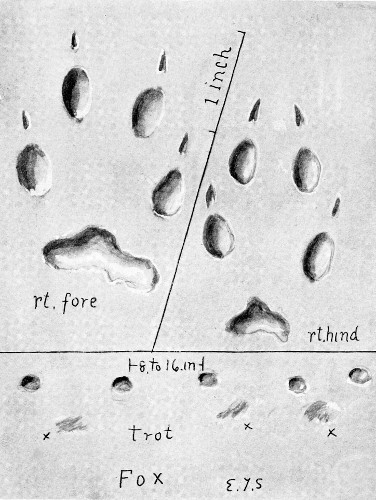
THE TRACK OF A FOX
The size, the small pads, and the set of all feet nearly in one line are strong features, as also is the tail touch.
The minks form a small group of species circumpolar in distribution, and well known in Europe, northern Asia, and in North America. The European animal is closely similar to the North American species and all have the same amphibious habits. The American minks include several different geographic races, which are distributed over all the northern part of the continent from the Atlantic to the Pacific and from the mouths of the Yukon and Mackenzie Rivers to the Gulf coast in the United States. They are absent from the arid Southwestern States.
Few species are more perfectly adapted to a double mode of life than the mink. It is equally at home slyly searching thickets and bottom-land forests for prey or seeking it with otter-like prowess beneath the water. It is a restless animal, active both by day and by night, although mainly nocturnal.
While usually having definite dens to which they return, minks wander widely and for so small an animal hunt over a large territory and pass from one body of water to another. Their wanderings are most pronounced in fall and again during the mating in spring. They are solitary, their companionship with one another not outliving the mating period.
Mink dens are located wherever a safe and convenient shelter is available, and may be a hole in a bank, made by a muskrat or other animal, a cavity under the roots of a tree, a hollow log, a hollow stump, or other place. The nest is made of grass and leaves lined with feathers, hair, and other soft material. A single litter of from four to twelve small and naked young is born during April or May.
The young remain with the mother throughout the summer, and do not leave her to establish themselves until fall, when they are nearly grown. When captured at an early age they are playful and become attached to the person who cares for them. When caught in a trap they become fiercely aggressive, often uttering squalling shrieks, baring their teeth, and fronting their captor with a truculent air of savage rage. The adults have scent sacs located under the tail like those of a skunk. When angry or much excited they can emit from these an exceedingly acrid and offensive odor, but have no power to eject it forcibly at an enemy.
Minks are bold and courageous in their attitude toward other animals, and attack and kill for food species heavier than themselves, like the varying hare and the muskrat. On land they are persistent hunters, trailing their prey skillfully by scent. They eat mice, rats, chipmunks, squirrels, and birds and birds’ eggs of many kinds, including waterfowl, oven-birds, and other ground-frequenting species. About the waterside they vary this diet by capturing fish of many kinds, which they pursue in the water, snakes, frogs, salamanders, insects, crustaceans, and mussels.
Their prowess is shown by their raids on chicken-houses, where they often kill many grown fowls in a night, and sometimes drag birds heavier than themselves long distances to their dens. A remarkable indication of the varied menu of the mink was exhibited in a nest found by Dr. C. H. Merriam, where the owner had gathered the bodies of a muskrat, a red squirrel, and a downy woodpecker.
The value of the mink’s furry coat has led to its steady pursuit by trappers in all climes, from the coast of Florida to the borders of sluggish streams on Arctic tundras. Millions of them have fallen victims to this warfare and their skins have gone to adorn mankind. In spite of this the mink today occupies all its original territory, and each year yields a fresh harvest of furs.
The mink by preference is a forest animal, living along the wooded bottom-lands of rivers or the thicket-grown borders of small streams, where the rich vegetation gives abundance of shelter and at the same time attracts a wealth of small mammals and birds on which it may prey. From these secure coverts it wanders through the surrounding country at night, visiting many chicken-houses on farms and leaving devastation behind. It is persistent and bold in such forays and in locations near its haunts great care must be exercised to guard against it. Minks have repeatedly raided the enclosures of the National Zoological Park in Washington.
Now and then, on the banks of some wild stream, one will try to appropriate the catch lying at the very feet of a lone fisherman. A naturalist fishing on a stream in northern Canada, seeing a mink making free with his catch, set a small steel trap on the bare ground, and holding the attached chain in one hand raised and slowly drew toward him the fish upon which the mink was feeding. The mink, without hesitation, followed the fish and was caught in the trap.
An abundance of food may modify the preference of the mink for wooded or partly wooded country. The marshy and treeless tundra lying near sea-level in the triangle between the coast of Bering Sea, and the lower parts of the Yukon and Kuskokwim rivers offers such an attractive situation differing from their usual haunts. The sluggish streams and numberless ponds abound with small fish four to five inches long. Minks swarm in this area to such an extent that the Eskimos who inhabit the district are known among the natives of the surrounding region as the “mink people.” Steel traps are used there, but a primitive method is even more successful. A wicker fence is built across a narrow stream and a small fyke fish-trap placed in it. In swimming along the stream minks pass into the trap like fish, and I knew of from 10 to 15 being thus taken in one day.
During my residence in that region from 10,000 to 15,000 mink skins were caught in this tundra district annually, and the supply appeared to be inexhaustible. With the growing occupation of the continent and the increasing demand for furs, however, the numbers of the mink must surely decrease. To forestall the shortage of furs that seems imminent, efforts are now being made to establish fur farming to replace the declining supply of wild furs with those grown under domestication. The mink appears to be well adapted to successful breeding in captivity. The main question to solve is the relation of the cost of caring for the animals to the value of its pelt in the market.
THE MARTEN, OR AMERICAN SABLE (Martes americana and its relatives)
(For illustration, see page 555)
Wild animals possess an endless variety of mental traits which endow them in many instances with marked individualities. Few are more strongly characterized in this respect than the marten. One of the most graceful and beautiful of our forest animals, it frequents the more inaccessible parts of the wilderness and retires shyly before the inroads of the settler’s ax. Its rich brown coat, so highly prized that the pursuit of it goes on winter after winter in all the remote forests of the North, is a source of danger threatening the existence of the species. The full-grown animal weighs five or six pounds and measures nearly three feet in length.
The martens are circumpolar in distribution, and the several species occupy northern lands from England, Europe, and northern Asia to North America. Of the Old World species, the Siberian sable is best known on account of the beauty of its fine, rich fur, which renders it the most valued of all in the fur markets of the world.
The North American marten is a close relative of the Siberian species, and occupies all the wooded parts of North America from the northern limit of trees southward in the forested mountains to Pennsylvania, New Mexico, and the southern part of the Sierra Nevada in California.
Like other members of the weasel tribe, the marten is a fierce and merciless creature of rapine, but unlike the mink and weasel, it avoids the abodes of man and loves the remotest depths of the wilderness.
Martens are endowed with an exceedingly nervous and excitable temperament, combined with all the flashing quickness of weasels. They are more restless than any other among the larger species of their notably restless tribe, and couple with this extraordinary and tireless vigor. This is admirably shown in captivity, when by the hour they dart back and forth, up and down and around their cages with almost incredible speed.
In the forest they climb trees and jump from branch to branch with all the agility of a squirrel—in fact, they pursue and capture red squirrels in fair chase, and have been seen in pursuit of the big California gray squirrel (Sciurus griseus). On the ground they move about quickly, hunting weasel-like, under brush piles and other cover.
Practically every living thing within their power falls victim to their rapacity. They eat minks, weasels, squirrels, chipmunks, wood rats, mice of many kinds, conies, snowshoe hares, ruffed and spruce grouse, and smaller birds of all kinds and their eggs, as well as frogs, fish, beetles, crickets, beechnuts, and a variety of small wild fruits. Unlike minks and weasels, they are not known to kill wantonly more than they need for food.
They make nests of grass, moss, and leaves in hollow trees, under logs, among rocks, and in holes in the ground. Sometimes they have been found in possession of a red squirrel’s nest, probably after having slain and devoured the owner.
The young, varying from one to eight in number, are born in April or May. At first they are naked and helpless, but when large enough accompany the mother on her search for food. This period of schooling lasts until they are forced to take up their separate lives with the approach of winter. Thenceforth they are among the most solitary of animals, showing fierce antagonism toward one another whenever they meet, and associating only during a brief period in the mating season in February or March. Martens show a cold-blooded ferocity toward one another that often renders it dangerous to put two or more in the same cage. When placed in a cage together the male very commonly kills the female by biting her through the skull. At times they utter a loud, shrill squall or shriek, and in traps hiss, growl, and sometimes bark.
Among the dense forests of spruce and lodge-pole pine high up in the mountains of Colorado, martens are sometimes hunted on skis in midwinter, an exciting and often, on these rugged slopes, a dangerous sport. They are not wary about traps and are readily caught by deadfalls and other rude contrivances as well as by steel traps. In Colorado and Montana hundreds of their skins are taken by trappers every winter.
In Siberia the sable has been exterminated by hunting in many districts, and before the present war began had become so scarce in others that the Russian Government closed the season for them for a period of years over nearly all of their range. The same reduction in the numbers of our marten has occurred in most parts of Alaska and elsewhere in its range, and its only hope against extermination lies in stringent protection. Protective regulations are already in force in Alaska.
During the early fur-trading days in northern Canada the number of martens varied between comparative abundance and rarity. These variations were said to occur about every ten years. Some claimed the decrease was due to a migration which the martens were believed to make from one region to another, just as was believed of the lynx. The lack of a corresponding increase in surrounding districts, where trading posts were located, effectually disproved the migration theory. There is little doubt that the increase of martens was due to a reproductive response to a plentiful food supply during years when mice or snowshoe hares were abundant and their decrease was due to a lessening of the numbers of these food animals.
Efforts are being made to domesticate martens and raise them for their skins on fur farms. The main difficulty so far encountered lies in the fiendish manner in which the old males kill the females and the younger males. Although always nervous, they are not difficult to tame, and will be most entertaining and attractive animals to rear if their savage natures can be sufficiently overcome.
THE LITTLE SPOTTED SKUNK (Spilogale putorius and its relatives)
(For illustration, see page 558)
The skunks form a distinct section of the weasel family, limited to North and South America. The group is divided into three well-marked sections. One of these, the little spotted skunks, is distinguished from all other mammals by the curious and pleasing symmetry of the black and white markings of the animals. Few more beautiful fur garments are made than those from the skins of these animals in their natural colors. These skunks are smaller than any members of the other groups, varying from a little larger than a large chipmunk to the size of a fox squirrel.
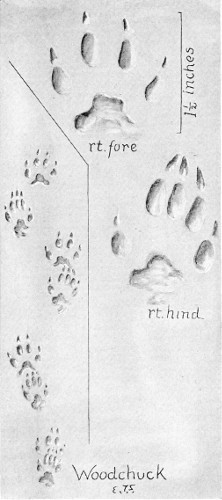
THE COMMON WOODCHUCK, OR AMERICAN MARMOT (SEE PAGES 533-534)
Its track shows this animal’s kinship with the squirrels. The small series, to the left, show the ordinary ambling pace. When speeding, it sets its feet much like the little, or eastern, chipmunk (see page 580).
Little spotted skunks include several species and geographic races. All are limited to North America and are rather irregularly distributed from the Atlantic coast to the Pacific and from Virginia, Minnesota, Wyoming, and southern British Columbia southward to the Gulf coast, to the end of Lower California, and through Mexico and Central America to Costa Rica. They inhabit a variety of climatic conditions, from the rocky ledges high up on the slopes of the western mountains to the hot desert plains of the Southwest, and to partly forested regions in both temperate and tropical lands. In different parts of the United States they have several other names, including “civet,” “civet cat,” and “hydrophobia skunk.”
The spotted skunks make their homes in whatever shelter is most convenient, whether it be clefts in rocky ledges, slide rock, hollows in logs or stumps, holes dug by themselves in banks or under the shelter of cactuses or other thorny vegetation, the deserted holes of burrowing owls in Florida, or the old dens of various kinds of mammals elsewhere. Thickets, open woods, ocean beaches, and the vicinity of deserted or even occupied buildings on ranches are equally welcome haunts. On the plains of Arizona they have been known to live inside the mummified carcass of a cow, the sun-dried hide of which made an impregnable cover. They have a single litter of from two to six young each year.
Their diet is fully as varied as that of others of the weasel kind, but is made up mainly of insects and other forms injurious to agriculture, including grasshoppers, crickets, beetles, and larvæ of many kinds. They feed also on flesh whenever possible and prey on wood rats, mice of many kinds, small ground squirrels, small birds and their eggs, young chickens, lizards, salamanders, and crawfish. This carnivorous diet is further varied with mushrooms, peanuts, persimmons, cactus fruit, and other small fruits. Sometimes the animals locate about occupied habitations in primitive communities, where they give good service by killing the house rats, mice, and cockroaches on the premises. On one occasion a spotted skunk was detected cunningly removing the downy chicks from under a brooding hen without disturbing her.
In comparison with the other skunks these little animals are extremely agile. They are strictly nocturnal and when pursued at night by dogs will climb to safety in a tree like a squirrel. When caught in a trap they struggle and fight far more vigorously than their big relatives. They usually carry the tail in a somewhat elevated position, but when danger threatens hold it upright like a warning signal. If the enemy fails to take heed they shoot two little spraylike jets of liquid bearing the usual offensive skunk odor, and the victim retires without honor.
In writing of these skunks about the Valley of Mexico, in 1628, Dr. Hernandez tells us that “the powerful arm which they use when in peril is the insupportable gas they throw out behind which condenses the surrounding atmosphere so that, as one grave missionary says, it appears as though one could feel it.”
That the little spotted skunk is subject to rabies and has communicated it to many men in the West is unquestionable. It usually bites men who are sleeping on the ground in its haunts, as they commonly do on the western stock ranges.
I have personally known of several instances in northern Arizona of men being bitten by them. The head, face, and hands, being uncovered, are the points attacked. One man in the mountains south of Winslow, Arizona, was bitten on the top of his head in April, 1910, but paid no attention to the slight wound until two months later when he began to have spasms. He then hurried to town and died in great agony the next day. The year following a man in the same district was bitten in the face, and seizing the animal threw it from him in such a manner that it fell on his brother and bit him before he awakened. Both men were given the Pasteur treatment and had no further trouble.
On New Year’s night of 1906, while I was at the village of Cape San Lucas, at the extreme southern end of the Peninsula of Lower California, a large-sized old male spotted skunk entered the open door of a neighboring house and bit through the upper lip of a little girl sleeping on the floor. Her screams brought her father to the rescue, and with a well-aimed blow he killed the offender. The next morning the skunk was brought to me and added to my collection. As I left a few days later I never learned the result of this bite, but while there was informed that a man had died the previous year from a similar bite. The occasional instances of this kind are remembered and appear more numerous than they are in fact. For years many men have slept in the open where these animals abound, without being molested. It is interesting to find that when the voyager Duhaut-Cilly visited the Cape in 1826, the natives feared these skunks because they entered houses at night, biting people and infecting them with hydrophobia.
The little spotted skunks have extremely animated, playful natures, as I have had several occasions to observe. Two instances serve to illustrate this. Once at the mouth of a canyon at the southern end of the San Joaquin Valley, California, I camped several days at a deserted ranch. At night I spread my blankets on the bare floor of the house, from which the doors were gone. Under it led several burrows of some animal which I at first supposed to be a ground squirrel. Each night while there I was awakened by the sound of little footfalls padding rapidly about over the floor on which I was sleeping, and in the dim light from the moon could see two or three little spotted skunks pursuing one another around me like playful kittens. At the slightest movement on my part they dashed out the door and into their dens under the house. As there was no food of any kind in this room, it was evident that the little fellows were there for a frolic on the smooth board floor.
On another occasion in the mountains of San Luis Potosi, on the Mexican table-land, I found a spring to which bears were coming for water at night. As the bears here appeared to be strictly nocturnal. I ensconced myself in the evening with a dark lantern, amid some small bushes, against a large pine log which sloped downward to the bottom of the gulch near the spring, with the plan to welcome any bears which might come in. An hour or more after dark the clinking rattle of small stones on the far side of the gulch indicated the presence of some animal. The light from the lantern was flashed on the spot and the rifle lowered with exasperation as, running back and forth, turning over stones in search of insects, a spotted skunk was revealed. The movements of this unwelcome visitor were extremely light and graceful, and in my interest in watching them, for a time I forgot the bear. Two or three hours passed and the skunk tired of the hillside and came down to the spring, where he found the offal from a deer which I had placed there for bait. This gave him more to do, and after I had listened to him worry the meat for awhile, I turned on the light and was entertained by the sight thus revealed. The skunk appeared to have a persistent desire to drag away the offal many times his weight. He would seize the edge of one of the lungs and after a hard struggle would get it up on one edge, when the burden would turn over with a flap, whirling the skunk flat on his back each time. Immediately scrambling to his feet, he would give the meat a fierce shake of resentment and repeat the performance.
After a long time the moon arose and the skunk could be plainly seen running back and forth playfully, now biting at the meat and now turning over stones apparently in sheer exuberance of spirit. Then he suddenly mounted the lower end of the log and came galloping up it until he was close to my shoulder. There he stopped and, coming as near as possible, extended his nose within a few inches of my face, and for minute or more stood trying to satisfy himself about this strange object. Satisfied at last, he turned and galloped back down the log and resumed his antics in the gulch, finally working close to the bank three or four yards below me. There he found many small stones and had a fine time rattling them about until I decided that with this disturbing presence I should have little chance for other game. Finding a convenient stone, and locating the skunk as well as possible from the sounds, I tossed it over to try and frighten him away. My aim was too true, for the characteristic skunk retort filled the air with suffocating fumes and I immediately lost interest in further bear hunting.
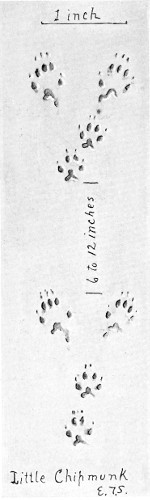
THE TRAIL OF THE EASTERN CHIPMUNK
The track is much like that of the fox squirrel, but usually the fore feet are a little, or quite, one behind the other and, of course, much smaller. No tail mark is ever seen (see pages 542 and 549).
THE COMMON SKUNK (Mephitis mephitis and its relatives)
(For illustration, see page 558)
Probably no American mammal is more generally known and less popular than the skunk. This current odium is due wholly to its possession of a scent sac of malodorous fluid, which it distributes with prompt accuracy when annoyed. The possession of this method of defense is common to all skunks. The term “pole-cat,” sometimes given to all kinds of skunks, is the misuse of a name given Old World martens of several species and to the Cape pole-cat, a South African animal which in form and markings, including the plumelike tail, is remarkably like some of our smaller skunks.
In the preceding article an account was given of the spotted skunks, smallest of the three groups into which these animals are divided. The common skunk and its relatives form another group, which contains some of the larger species of their kind, some of them weighing up to ten pounds or more. These are the typical skunks, so familiar in most parts of the United States, and distinguished by the disproportionately large size of the posterior half of the body and the long, plumelike tail.
The common skunk, with its closely related species, is generally distributed in all varieties of country, except in deep forests and on waterless desert plains. It ranges from the Atlantic coast to the Pacific and from Hudson Bay and Great Slave Lake southward to the highlands of Guatemala. The vertical range extends from sea-level up to above timberline in Mexico, where I found one living in a burrow it had dug under a rock at 13,800 feet altitude on the Cofre de Perote, Vera Cruz.
Skunks are most common in areas of mixed woodland and fields, in valley bottoms, and along the brushy borders of creeks and rocky canyons. One of their marked characteristics is a fondness for the vicinity of man. They frequently visit his premises, taking up quarters beneath outbuildings or even under the house itself.
Any convenient shelter appears to satisfy them for a home, and they will occupy the deserted burrows of other animals, small cavities among the rocks, a hollow log, or a hole dug by themselves. A warm nest of grass and leaves is made at the end of the den, where the single litter of young, containing from four to ten, is born in April or May. As soon as the young are old enough they follow the mother, keeping close behind her, often in a long single file along a trail. They are mainly nocturnal, but in summer the mother frequently starts out on an excursion with her young an hour or two before sunset and they may remain abroad all night.
The young family remains united through the following winter, which accounts for finding at times from eight to a dozen in a den. In all the northern parts of their range they hibernate during the two to four months of severest cold weather, coming out sometimes during mild periods. When the season of hibernation ends the family scatters and mating begins. One solitary skunk was found in Canada hibernating in the same burrow, but in a separate chamber, with a woodchuck, evidently an unbidden guest.
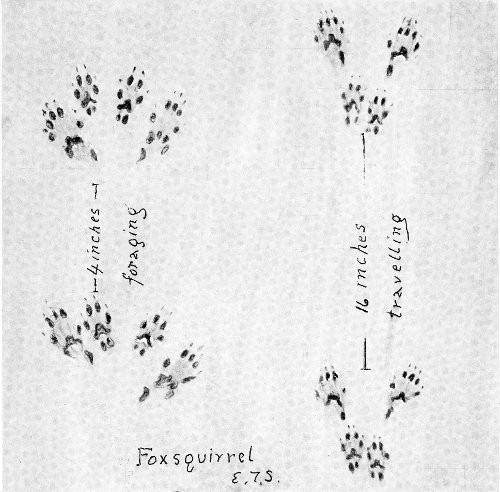
THE TRACKS OF A RUSTY FOX SQUIRREL AND FOX SQUIRREL
The exaggerated pads of the squirrel foot are a strong feature of this track. It is typical in the pairing of the fore feet, much more so than that of the gray squirrel. There is never a tail mark in this track (see pages 547 and 561).
As in the case of their relatives, the common skunks are omnivorous, but feed mainly upon insects and rodents injurious to agriculture. They are known to eat great quantities of grasshoppers, besides crickets, cicadas, May beetles, wasps, and larvæ of many kinds. One killed in New Mexico had its stomach crammed with honey bees. Wherever possible they prey upon small rodents, as mice, wood rats, and small spermophiles. To these may be added ground-nesting birds and their eggs, lizards, turtle eggs, snakes, frogs, salamanders, fish, crustaceans, and numerous small fruits. Now and then they visit the farmers’ chicken yards with such disastrous consequences that in many country districts the animals are killed at sight.
It is pleasing to record that a more intelligent view of their real value to farmers, through their destruction of farm pests, is rapidly gaining ground, and they are now being protected in many States. One of their worst traits is their destructiveness to breeding game birds, both upland species, and especially the waterfowl.
Skunks walk on the soles of their feet instead of on their toes, as do so many mammals. The common skunks are wholly terrestrial and move with the deliberation of one without fear of personal violence or of having his dignity assailed. Long experience has taught them that the right of way is theirs. As they amble slowly along, the tail is carried slightly elevated, and when the owner is suspicious of attack, it is raised and the hairs hang drooping like a great plume, conspicuous and unmistakable. If the disturber still refuses to take the hint, a rear view is promptly presented and a discharge made that puts most enemies to flight. Some have thought that the odorous liquid is scattered by the long hairs of the tail, but in fact it is ejected in fine jets from two little tubes connected with the scent sacs on each side of the vent.
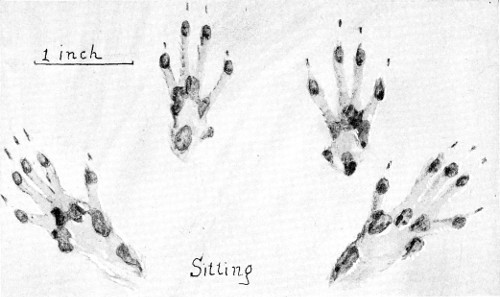
A FULL SIZE RENDERING OF A FOX SQUIRREL TRACK
Illustrations of the arrangement of this track when the animal is foraging and traveling are shown on page 581.
When mildly annoyed the big skunks stamp their front feet on the ground and utter little growls of displeasure. By some effort they can be urged into a retreat which may take the form of a clumsy gallop. They are known occasionally to swim streams voluntarily, and even to cross rivers, probably urged by the instinct that so often forces animals of all kinds to move to new feeding grounds.
Although usually safe from annoyance through the protective armament, many skunks, especially the young, each year fall victim to natural enemies, including wolves, coyotes, foxes, badgers, and great horned owls.
The flesh of the skunk is a favorite food among certain tribes of Canadian Indians, and many white men have pronounced it exceedingly palatable, even claiming its superiority over the flesh of domestic fowls. In the narrative of his expedition through the Canadian wilderness many years ago, the naturalist Drummond recorded that when the party was about a day’s journey from Carleton House it had the good fortune to kill a skunk, “which afforded us a comfortable meal.” In the Valley of Mexico I found the natives prize the flesh of these animals as a cure for a certain loathsome disease.
It is well known that large skunks are often extremely fat. The oil produced from them is clear and is said to have unusually penetrating qualities. For many years there was a demand for this oil for various medicinal purposes.
During recent years the fur of skunks has come into great demand, and good prices are paid for prime skins. The animals are so numerous and the catch is so large that they now rank among the most valuable of our fur-bearers. They are gentle animals which readily become domesticated and breed freely in confinement, and many efforts are being made to establish skunk farms. Success in such farming depends wholly on the outlay for upkeep. Skunk farming will probably pay better as a side line, like chickens on the ordinary farm, than to establish regular fur farms. The scent sac may be removed by a slight surgical operation, so there need be no trouble from that source. Common skunks when taken young make affectionate and entertaining pets. They become as tame and playful as kittens, and are vastly more intelligent and interesting.
THE HOG-NOSED SKUNK (Conepatus mesoleucus and its relatives)
(For illustration, see page 559)
The third and last group of skunks contains a number of species showing well-marked differences from the two groups already described. The species vary in size, but among them is included the largest of all skunks. All are characterized by comparatively short hair, especially on the tail, and this appendage lacks the plumelike appearance observed in other skunks. The nose is prolonged into a distinct “snout,” naked on the top and sides and evidently used for rooting in the earth after the manner of a pig. In addition, the front feet are armed with long, heavy claws, and the front legs and shoulders are provided with a strong muscular development for digging, as in a badger. This likeness has led to the use in some places of the appropriate name “badger skunk” for these animals. The single white stripe along the back, and including the tail, is a common pattern with these skunks, but this marking is considerably varied, as in the common species.
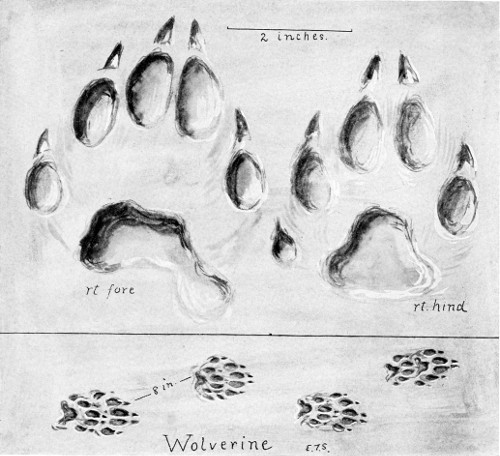
WOLVERINE
Its weasel kinship is seen in the wolverine track. Occasionally, not always, its fifth toe shows. The track is not plantigrade, and a single track is easily mistaken for that of a wolf.
The hog-nosed skunks are the only representatives of the skunk tribe in South America, where various species occupy a large part of the continent. They appear to form a South American group of mammals which has extended its range northward through Central America, Mexico, and across the border of the United States to central Texas, New Mexico, and Arizona. In Mexico they range from sea-level to above 10,000 feet altitude on the mountains of the interior.
The hair on these skunks is coarse and harsh, lacking the qualities which render the coats of their northern relatives so valuable. Where their range coincides with that of the common skunks, the local distribution of the two is practically the same. They live along the bottom-lands of watercourses, where vegetation is abundant and the supply of food most plentiful, or in canyons and on rocky mountain slopes.
For shelter they dig their own burrows, usually in a bank, or under a rock, or the roots of a tree, but do not hesitate to take possession of the deserted burrows of other animals, or of natural cavities among the rocks. Owing to their strictly nocturnal habits, they are much less frequently seen than the common skunks, even in localities where they are numerous. In fact it is only within the last few years that their presence in many parts of the southwestern border has become known.
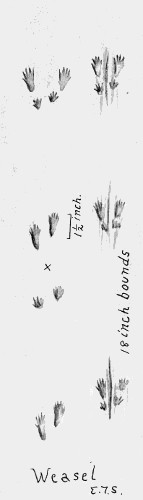
THE TRACK OF THE WEASEL
The unusual space between the fore and hind feet in the middle of the left series is often seen. Sometimes the tail mark is there and sometimes not. Sometimes the trail is like that of a small mink. The toes seldom show (see pages 554 and 572).
Although both the little spotted and common skunks live mainly on insects, the hog-nosed skunks are even more insectivorous in their feeding habits. The bare snout appears to be used constantly for the purpose of rooting out beetles, grubs, and larvæ of various kinds from the ground.
On the highlands of Mexico I have many times camped in localities where patches of ground were rooted up nightly by these skunks to a depth of two or three inches as thoroughly as might have been done by small pigs. In such places I repeatedly failed to capture them by traps baited with meat, the insects and grubs they were finding apparently being more attractive food. I have had similar failures in trapping for coyotes with meat bait in localities where they were feeding fat on swarms of large beetles and crickets. The persistence with which the hog-nosed skunks hunt insects renders them a valuable aid to farmers.
In addition to grasshoppers, crickets, beetles, flies, grubs, and other larvæ, and many other insects, they are known to eat wood rats, mice, and the small fruit of cactuses and other plants. The stomach of one of these skunks examined in Texas contained about 400 beetles.
One Texas naturalist writes that he has lost a number of young kids which had their noses bitten off, and in one instance caught one of these skunks mutilating a kid in this manner. He also states that they pull down and eat corn when it is in the “roasting-ear” stage.
Far less is known concerning the habits of hog-nosed skunks than of the other species of these animals. The number of young appears to be small, judging from the record of a single embryo found in one animal and in another instance of two young found in a nest located in a hollow stump. They have a curiously stupid, sluggish manner and have even less vivacity than the somewhat sedate common skunk. No use is made of their skins in this country or in Mexico, but the gigantic natives of Patagonia make robes of them which are worn like great cloaks.
THE NINE-BANDED ARMADILLO (Dasypus novemcincta and its relatives)
(For illustration, see page 559)
Armadillos are distinguished from other mammals by having the nearly, or quite, hairless skin developed into a bony armor covering the upperparts of the head and body and all of the tail. They lack teeth in the front of both upper and lower jaws, and are members of the group of toothless animals which includes the ant-eaters. The insects they feed on are licked up by the sticky surface of their extensile tongues.
In the remote past many species of armadillos, some of gigantic size, roamed the plains of South America, and a number of small species still exist there. These animals are peculiar to America and have their center of abundance in the southern continent.
The nine-banded species ranges over an enormous territory and is subdivided into a number of geographic races, living from southern Texas through Mexico and Central America to Argentina. In Mexico its vertical distribution extends from sea-level up to an altitude of about 10,000 feet on the mountains of the interior. Like the hog-nosed skunk, it no doubt originated as a member of the South American fauna and has spread northward to its present limits. It is one of the larger of the living representatives of this curious group of animals and reaches a weight of from twelve to fifteen pounds.
As might be surmised from its appearance, the armadillo is a stupid animal, living a monotonous life of restricted activities. Its sight and hearing are poor, and the armored skin gives it a stiff-legged gait and immobile body. From these characteristics, combined with the small head hung low on a short neck, it has in life an odd resemblance in both form and motion to a small pig; it jogs along in its trails or from one feeding place to another with the same little stiff trotting gait and self-centered air. If alarmed it will break into a clumsy gallop, but moves so slowly that it may be overtaken by a man on foot. So poor is its eyesight that a person may approach openly within about thirty yards before being noticed.
When alarmed the armadillo immediately runs to the shelter of its burrow, but may easily be caught in one’s hands, especially if intercepted on the way to its den. When caught it will struggle to escape, and while it may coil up in a ball in the presence of a dog or other mammal foe, I never saw one try to protect itself in this way. While presumably serving for protective purposes, the armor is flexible on the sides of the body, and I have found the remains of many armadillos where they had been killed and eaten by coyotes or other predatory beasts. The armor would no doubt be sufficient protection to enable them to escape to cover from the attack of birds of prey. They are mainly nocturnal animals, but are frequently seen abroad by day and in some places appear to be out equally by day or night.
This armadillo lives by preference amid the cover afforded by forests, brushy jungle, tall grass, or other vegetation. In the midst of such shelter it usually digs its own burrow a few yards deep in a bank or hill slope, beneath a stump, under the roots of a tree, or a rock, or even on level ground. It will also occupy small caves in limestone rock. At times it shows a piglike fondness for a mud bath, and the prints of its armor may be found where it has wallowed in miry spots.
Well-beaten and conspicuous trails lead from the burrows often for half a mile or more, frequently branching through the thickets in various directions. Armadillo burrows sometimes accommodate strange neighbors, as was shown by one in Texas which was dug out, and in addition to containing the owner in his den at the end, was found to be occupied by a four-foot rattlesnake and a half-grown cottontail rabbit, each in a side chamber of its own.
The food of the armadillo consists almost entirely of many species of insects, among which ants appear to predominate. When searching for food the animals become so intent that they may be cautiously approached and closely observed or captured by hand. They root about among fallen leaves and other loose vegetation and soft earth, now and then digging up some hidden grub or beetle. At night they visit newly plowed fields in their haunts, rooting in the mellow earth. They are accused of digging up plants in gardens during their nocturnal wanderings, and in Texas have been charged with robbing hens’ nests of eggs, and of reducing the supply of wild turkeys and quail by breaking up the nests, all of which needs confirmation. Their method of feeding appears to vary considerably, as they have been seen rising on their hind legs to secure small caterpillars infesting large weeds.