SMALLER MAMMALS OF NORTH AMERICA By Edward W. Nelson Chief, U. S. Biological Survey With illustrations in color from paintings by Louis Agassiz Fuertes (continued 5)
Reading edition
The insect food eaten by the nine-banded armadillo in Texas, as known from examination of stomach contents, covers a wide range of insect and other small life, including many species of grasshoppers, crickets, roaches, caterpillars, beetles, ants, spiders, centipedes, and earthworms. As the list includes also wireworms and other noxious species, these inoffensive animals deserve thorough protection as a most useful aid to the farmer.
Some time from February to April each year, litters of from four to eight young are born. They have their eyes open at birth, and the armor is soft and flexible like fine leather. The hardening of the skin into a bony armor is progressive, continuing until after the animal fully completes its growth. As soon as the young are able to travel they trot along with the old one during her foraging trips.
Early one afternoon, when riding along a trail in the heavy forest of southern Oaxaca, accompanied by an Indian boy and a pack of dogs, I suddenly came upon an old armadillo and eight young about two-thirds grown. They had heard our approach and stood motionless in a compact little group half hidden in the grass. I had barely time to stop my horse when the dogs spied them and made a rush. The armadillos darted into the undergrowth in every direction like a litter of pigs, and with the exception of two caught by the dogs gained safe refuge in their burrow. This we found dug in the level ground about fifty yards from where we encountered them.
The Maya Indians of the Peninsula of Yucatan have a legend that the black-headed vulture (Catharista atrata) in old age changes into an armadillo. The tale runs, that when a vulture becomes very, very old it notifies its companions that the time has come and alights before a hole in the ground that resembles the den of an armadillo. The other vultures bring food and the old one remains there for a long time. Its wings disappear, the feathers are lost, and when the change is complete the newly created armadillo enters the hole and begins its new life. If skepticism is expressed as to this metamorphosis, the Indians point out as proof of the legend the similarity between the appearance of the bald pate of the vulture and that of the armadillo.
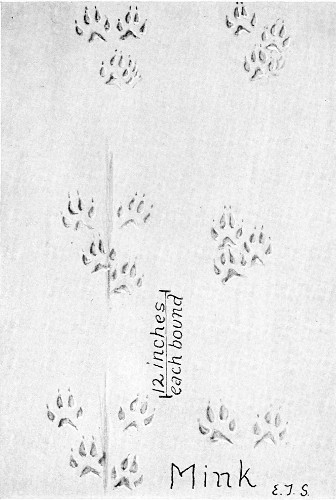
AMERICAN MINK TRACKS, SHOWING VARIOUS ARRANGEMENTS AND TAIL MARKS
The typical track of a mink is as in the bottom set at the left, which also illustrates the tail mark. Twelve to twenty-four inches are usually cleared at each bound. This illustration is greatly reduced from natural size (see opposite page and pages 555 and 575).
THE RING-TAILED CAT (Bassariscus astutus and its relatives)
(For illustration, see page 562)
The mild climate and the proximity of the Southwestern States to Mexico and the tropics brings within our borders numerous strange types of wild life. Of these the ring-tailed cat is one of the most strikingly marked and interesting. In the United States it is known by several other names, including “civet cat,” “coon cat,” and “band-tailed cat.” In Mexico it still bears the old Aztec name cacomixtle, except in Lower California, where it is the “babisuri.” It is about the size of a large cat but with proportionately longer and slenderer body, shorter legs, and longer tail. The alternating bands of black and white on the tail proclaim its relationship, not to the cat, to which it has no kinship, but to the raccoon, which has a tail similarly marked. Few mammals possess such a beautifully formed head and face, and its large, mild eyes give it a vivid expression of intelligence.
The ring-tailed cat occupies areas under such differing climates as to produce geographic races, but none of them vary strikingly from the typical animal here illustrated. They range from Oregon, Nevada, southern Utah, Colorado, and Texas south to Costa Rica. In Mexico they occur from near sealevel up to an altitude of about 10,000 feet. While chiefly rock-inhabiting species, they sometimes live in the forests and as a rule make their dens in caves and deep crevices, but sometimes in hollow trees or about houses. Their young, from three to four in number, are born in May or June.
In the Southwest they frequent some of the ruined cliff dwellings, and I have found them haunting many of the ancient ruins of Mexico. Their presence in little caves and other sheltered spots along cliffs and rock walls bordering canyons or on mountain slopes may usually be known by an examination of the fine dust which accumulates in sheltered places. Whenever present their delicate cat-like tracks will be found where they have been hunting mice or other small game.
Strictly nocturnal, they do not sally forth from their dens until darkness is complete. During the night they are restless and frequently wander far and wide in search of food, and apparently at times merely to satisfy a spirit of inquiry. Their inquisitive nature frequently leads them to explore the streets of towns and cities on the Mexican table-land, filled though these places are with dogs. At daybreak, tracks left in the dusty streets tell the story of their wanderings, as they often do also in the case of opossums.
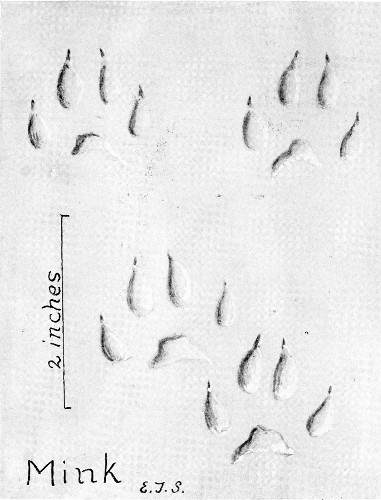
AMERICAN MINK TRACK NEARLY NATURAL SIZE
Although this animal has five toes on each foot, only four appear in each track. This illustration, which is practically natural size, shows the usual arrangement of the track. The hind feet are, of course, in advance. Variations of arrangement are shown on the opposite page (see also pages 555 and 575).
One morning in February, 1893, soon after sunrise, I chanced to pass through a little wooded square in the City of Mexico and saw a lot of boys pursue and capture one of these animals which, having overstayed his time, had been surprised by daybreak. This wanderer might have had its den in some house in the neighborhood, since one of its known habits is to take up its abode about houses, even in the midst of towns. A friend living in the City of Mexico informed me that after having been annoyed for some time by noises on the roof at night, he investigated and discovered a female cacomixtle with partly grown young snugly located in a nest placed in a narrow space between the tile roof and the ceiling. In southern Texas the animals live on the brush-grown plains under conditions very different from those usually chosen.
Like its relative the raccoon, the cacomixtle, with a taste for a varied fare, takes whatever edibles come its way. It stalks wood rats, mice, and even bats amid their rocky haunts and birds in bushes and low trees. About the southern end of the Mexican table-land it is much disliked for its robberies of chicken roosts, especially when these are located in trees. Insects of many kinds, larvæ, and centipedes are eaten, as well as a great variety of fruits, including that of the pear-leaved cactus, and dates, figs, and green corn.
Ring-tailed cats regularly locate among rocky ledges, neighboring orchards, or other cultivated areas where they may gather some of the bounty provided by man. I found them more plentiful among the broken lava cliffs bordering date palm orchards in Lower California than in any other place. When the dates were ripening they prowled about under the palms after dark with gray foxes and spotted skunks to pick up the fallen fruit. They sometimes uttered a complaining cry and when caught in a trap would bark almost like a little dog, or occasionally utter a vicious scream of mixed fear and rage.
Being an intelligent animal, the cacomixtle is readily tamed and makes a most interesting pet. During the early years of gold mining in California, when many men were living in rude cabins in the mountains, the prevalence of mice often attracted these “cats” to take up their residence there. Often the owner of the premises and the mouser struck up a friendly relationship and the cacomixtle, becoming as free and friendly about the place as a real cat, kept it entirely clear from mice. I have had first-hand accounts of these tame individuals from miners who had harbored them in this way for months. These accounts always gave the impression that the animal was somewhat playful and mischievous and most attractive to have about the premises. All agreed that it was extremely fond of sugar.
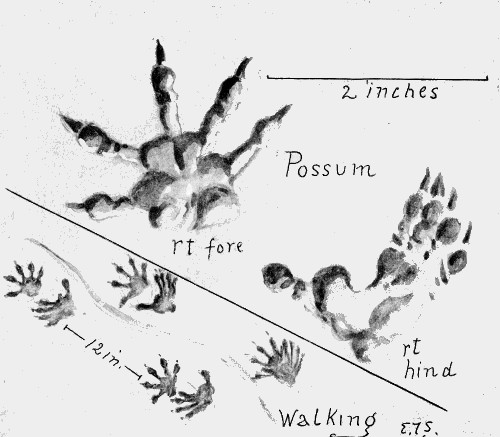
TRACK OF THE OPOSSUM
The hand-like paws are unmistakable. The tail mark appears. The absence of claw on the thumb of the hind foot is usually seen.
THE OREGON MOLE (Scapanus townsendi and its relatives)
(For illustration, see page 563)
The effect on mammals of a narrowly specialized mode of life is well illustrated in the mole. It is an expertly constructed living mechanism for tunneling through the earth. The pointed nose, short neck, compactly and powerfully built cylindrical body, with ribs strongly braced to withstand pressure, and the short, paddlelike hands armed with strong claws for digging are all fitted for a single purpose. Eyes and ears are of little service in an underground life, so they have become practically obsolete; the fur has been modified to a compact velvety coat which will lie either front or back with equal facility and thus relieve any friction from the walls of the tunneled roads, no matter which way the animal travels.
Moles are circumpolar in distribution, being found from England to Japan in the Old World and on both the Atlantic and Pacific coasts of the New World, where they occur only in North America. On this continent they are limited mainly to the United States and southern Canada, extending across the Mexican border only in two limited areas at the extreme east and west. Their distribution is not continuous across the continent, but is broken by a broad unoccupied belt formed by the arid interior, including the Great Basin. The home of the Oregon mole lies in the humid area west of the Cascade Mountains in Washington, Oregon, and extreme northwestern California. Closely related forms range from eastern Oregon southward through California to the San Pedro Martir Mountains in Lower California, and others north into British Columbia.
The Oregon mole is the largest and handsomest member of the group in America and perhaps in the world. Its skin, a velvety coat of nearly black fur, often with a purplish sheen, now brings a higher price in the market than that of any other species. Its size and the beauty of its dark coat distinguish it from any other mole.
Where the soil is loose the mole practically swims through it, urged forward by powerful impulses of its “hands” and feet. This is the common mode of travel near the top of the ground, where the course is marked by the lightly upheaved and broken surface. When working at a greater depth and in more compact soil the mole must dig its way and dispose of the loose earth by pushing it along the tunnel to an outlet at the surface through which it is thrust to form a mound similar to the “dumps” of that other great miner, the pocket gopher.
On account of this similarity in mode of life, moles and pocket gophers are sometimes confused by persons not familiar with the two animals. The resemblance ends in this apparent likeness, for the pocket gophers belong to the great order Rodentia, or gnawing animals, while the moles are of the Insectivora, or insect-eaters.
The superbly forested region inhabited by Oregon moles is so well watered that few places, even on high mountain slopes, are too dry for them to occupy. These animals are generally distributed, and their hills may be seen in the midst of the great coniferous forests as well as in the open valleys.
They are most abundant in open grassy areas, especially in meadows and in the bottoms of canyons and similar places, where the damp rich soil affords a plentiful supply of earthworms, grubs, and insects on which to feed. Like other moles, they lead lives of great activity and almost constant hard labor. During damp weather they work near the surface, but in dry periods as the upper soil hardens they follow their prey to lower levels. A hard shower, however, always brings an outburst of activity as they reoccupy the upper soil and throw up a multitude of new mounds. They have the habit of regularly coming to the surface to hunt food during the night. This is no doubt coincident with the swarming up to the surface of earthworms on which the moles feed. At such times many are captured by owls, cats, and other beasts of prey.
The runways of moles close along the surface, shown by well-marked ridges, are for hunting purposes, and the lower tunnels, from which the earth in the mounds is brought, are for traveling and lead to the nest chamber. The deep tunnels of the Oregon mole sometimes extend considerable distances along fences, or other surface cover, which afford more or less protection. Such tunnels are a kind of highway often used by several moles and also by shrews and field mice. The system of tunnels of the moles over a considerable area often intersect and are used more or less in common. As a result more than twenty moles have been trapped at a single point in one of these underground roads.
They make an intricate system of many-branched tunnels, the courses of which are usually marked by series of mounds varying from four to ten inches high and five to twenty inches wide and often scattered over meadows or other fields from two to six feet apart. Owing to the persistence with which the moles raise their mounds everywhere in the occupied parts of their territory, they have become a serious and costly pest. In meadows the knives of mowing machines are dulled by them, and in towns lawns are disfigured by their undesirable activities. As a consequence they have now fallen under the ban and are classed with other mammals which have shown their lack of ability to fit in satisfactorily with the changed conditions brought to their ancient territory by civilized man. Under natural conditions their activities were undoubtedly entirely beneficial.
They appear to have but a single litter of young, numbering from one to four, each year. These are born in March and grow so rapidly that by the last of May they are working in the tunnels and are scarcely distinguishable from the adults.
The recent discovery that the Oregon moleskin is valuable for its fur will give such an incentive to trapping that there is little doubt the boys of the State within a few years will reduce the numbers of the animal and thus control its injury to agriculture. The market for the skins appears practically unlimited, judging by trade reports, one dealer in Brooklyn stating that he dressed 4,000,000 imported European moleskins in 1916.
THE STAR-NOSED MOLE (Condylura cristata)
(For illustration, see page 563 )
The star-nosed mole, known in parts of Maine as the “gopher,” is peculiar among the moles in having a fringe around the end of its nose formed by twenty-two short fleshy tentacles. A less-marked character is in the proportionately long tail, which becomes greatly enlarged in fall and remains in this condition during the winter months. Otherwise the external appearance of this species is much like that of the common moles of America and the Old World.
The star-nosed mole is found from southern Labrador, the southern end of Hudson Bay, and southeastern Manitoba south along the Atlantic coast to Georgia and in the interior down the Alleghenies to North Carolina and to Ohio, Indiana, Illinois, Wisconsin, and Minnesota. Throughout this area it ranges irregularly and much yet remains to be learned about the details of its distribution and habits.
Ordinarily solitary, these moles at times are so numerous in limited areas that they appear to form colonies. Such gatherings probably mean an unusually rich feeding ground, which makes it unnecessary for the young to disperse to outlying locations, as is the habit of moles and most other mammals.
The star-nosed mole has a strong preference for damp and even marshy or swampy locations. It frequents low-lying meadows, the borders of streams, and grassy swamps, where its underground burrows alternate with open surface runways among grass roots and other matted vegetation. It spends far more time above ground than the other moles, and not infrequently swims among flooded cat-tails and other vegetation and in winter has been seen swimming under the ice.
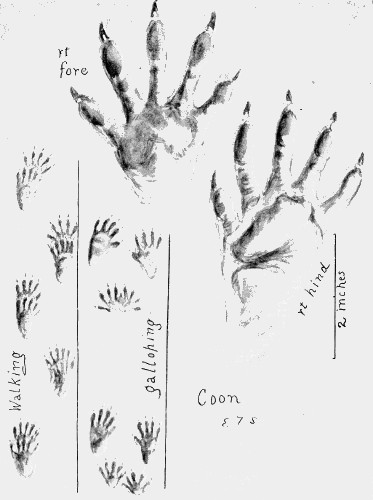
A RACCOON’S TRACK
The track of the raccoon is very distinctive and usually easy to find, because it frequents the mud by the water side. Sometimes, to a casual glance, the track of a small coon is taken for that of a large muskrat, but their differences are very obvious.
Like others of its kind, this mole is amazingly powerful in proportion to its size. It persistently adds to its surface ridges, and in constantly extending its deeper tunnels must dig loose earth and dispose of it by forcing it up through an outlet to form the mounds which mark the course of its travels. Where the soil is loose it readily forces it aside with its compact body and paddle-shaped hands. In pushing up the little piles of earth and in the ridges raised when burrowing close to the surface it sometimes injures meadows and other cultivated land. Occasionally it wanders away from the fields and invades lawns and gardens, where the only injury it does is in the disturbance of the soil.
Its nests are compact little balls of fine grass, weeds, or leaves in dry underground chambers excavated in its burrows. The nests are a foot or two underground, but above the level of the water, sometimes under a stump and again in a knoll or bank. One nest containing five young was found in Maryland in an old woodshed under several inches of chips. This location and its choice of a site for its nest under a stump in a field or in a dry knoll are clear indications of a kind of intelligence which even the lowliest animals appear to have in caring for their young.
The star-nosed mole is full of the restless energy so necessary in a mammal which must come across its food by more or less haphazard tunneling through the soil. It is active both summer and winter. In dry weather as the moisture near the surface decreases the soil hardens and earthworms and other subterranean life seek deeper levels. The mole follows them, only to return with them nearer the surface with a renewal of the moisture. In winter it sometimes comes out and travels slowly about on top of the snow, ready to burrow out of sight at once, however, at the sound of approaching footsteps.
The food of the star-nose, like that of most other moles, is made up mainly of earthworms, white grubs, cutworms, wireworms, and other underground insects. In captivity, before eating a worm or other flesh food offered, it first feels of it with the little raylike organs of touch on its nose. It is difficult to surmise the real value of these “feelers,” for it would seem that the acute sense of smell so common to mammals should do better service.
Aside from its disturbance of the surface soil by its ridges and mounds, the star-nosed mole does no direct injury, and its life is largely passed in the useful task of searching out and destroying insects. Indirectly it causes some injury to root crops, plants of various kinds, and fruit trees, by providing tunnels along which meadow and pine mice travel to commit the ravages which on circumstantial evidence are charged to the mole.
THE COMMON SHREW (Sorex personatus and its relatives)
(For illustration, see page 566)
Many interesting small mammals are nocturnal or lead such obscure and hidden lives that they are rarely observed except by naturalists. Of these are the numerous species of shrews, which include the smallest mammals in the world. These tiny beasts all live among the vegetation and debris on the surface of the ground or in little burrows below. With the moles they are members of the order Insectivora and depend mainly on insects and meat for food. Despite their minute size, they are possessed of an indomitable courage and ferocity, which leads them without hesitation to attack and kill mice many times their own weight.
The genus Sorex, of which the common shrew is a member, is circumpolar in distribution, the various species ranging through England, the European mainland, Asia, and North America as far south as Guatemala.
The common shrew is a purely North American animal, occupying all the northern part of the continent from the Arctic shores of Alaska and Canada south to northern Nevada, South Dakota, Illinois, and Pennsylvania, and along the Allegheny and high Rocky Mountains to North Carolina and New Mexico. Its vertical range extends from the seacoast up to timberline in the Rocky Mountains.
The common shrew is the smallest of the mammals in all the northern parts of this continent, and one marvels at the possibility of such a tiny morsel of flesh and blood withstanding the rigors of the arctic winters. It measures about four inches in total length and weighs about forty-five grains; the body and tail are slender, the nose long and sharp, and the rim of the ears shows a little above the dense velvety fur. By these characters it may be distinguished from the larger, more heavily proportioned (and darker-colored) short-tailed shrews which abound with it in certain parts of its range. Its smaller size and grayish brown color are the main superficial differences between it and other American members of the same genus. The climatic differences in its wide range have developed several geographic races, none of which, however, show strongly marked characters.
This shrew appears to have a most catholic taste, so far as its surroundings are concerned, for it appears to frequent every type of situation where shelter and food can be found. It abounds among the peat beds and sphagnum mosses of the desolate barrens bordering on the Arctic coast, as well as amid the rotten stumps, old logs, fallen leaves, and other vegetable debris on the floor of the forests farther south. It will be found also in the rank matted vegetation about marshes, in old fields and occasional sphagnum swamps in the southern parts of its range.
The little tunneled runways of these shrews form a network in the beds of moss in a sphagnum swamp near Washington. In the forest the animals always seek the cover afforded by fallen logs, slabs of bark, or anything else that will give protection. On the coast of New Jersey they live so near the sea that an extra high tide forces them to mount the drift logs on the salt meadows for safety. They often make little burrows in the soft earth under the roots of a tree, a stump, or a log.
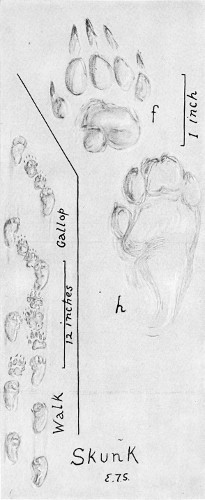
THE TRAIL OF THE COMMON SKUNK
The hind foot of the skunk rarely shows the claws in the track. The diagonal set during the gallop is characteristic (see pages 558 and 580).
Their nests are small balls of dry leaves, grasses, or other soft vegetable material placed snugly under a log or in a hollow stump, burrow, or other good retreat, where they appear to have two or more litters of from six to ten young during the summer and fall.
As in the other shrews, the food of the common species consists mainly of insects, larvæ, worms, and obtainable flesh; but in winter and possibly at other seasons many kinds of food are eaten, including insects, meat, fat, flour, and seeds. During the years I passed at St. Michael, on the coast of Bering Sea, the beginning of winter always brought into the storehouses and dwellings a swarm of field mice, lemmings, and these shrews. The food requirements of all appeared to be the same, and all fed freely on the flour and other accessible stores. Dozen of the shrews were killed in the houses every winter.
Occasionally I caught and kept one captive for a time to observe its habits. It would be extremely restless and equally active by day or night. The small eyes appeared of little service, but the long, flexible snout was used constantly and served as the main reliance of the little beast for information as to the outside world.
Wherever they travel these shrews utilize the runways of the field mice or other small animals and make little runs of their own only where necessary. Aside from a faint squeak, I have never heard them utter a sound, but other observers credit them with series of fine twittering notes apparently uttered as a song.
The common shrew is a solitary animal of so morose a disposition that if two are placed in a cage together they almost immediately fall upon one another with tooth and nail, and the victor devours the body of its companion at a single meal. The digestion of shrews is so rapid and the call for food so incessant that it requires constant activity to keep the demand satisfied.
After the winter snow arrived in the North I found many tunnels of these shrews running just under its surface and raising it a little in a slight but distinctly rounded ridge. Such tunnels wandered widely and on the ice of the Yukon River I traced one of them more than a mile and repeatedly saw them crossing the river from bank to bank. It was surprising to note the ability of the little travelers under the surface to keep in so nearly a direct line for long distances.
At times these little adventurers make similar tunnels in the snow far out on the sea ice. The mythology of the Eskimos contains accounts of many supernatural animals which a lone hunter may meet and which have the power to do him deadly harm. Among these the “sea shrew” is one of the most malignant. Its appearance is described as exactly like that of the common land shrew, but it is said to live on the ice at sea, and if it sees a hunter to dart at him through the air, pierce the skin, and, after running all through the body with incredible rapidity, to enter the man’s heart and kill him. In consequence of this belief the Eskimo hunters were in mortal terror if they chanced to encounter a stray shrew on the sea ice. I knew one hunter who suddenly meeting one on the ice stood motionless for hours until the shrew wandered out of sight. He then hastened home and all the other hunters agreed he had had a lucky escape.
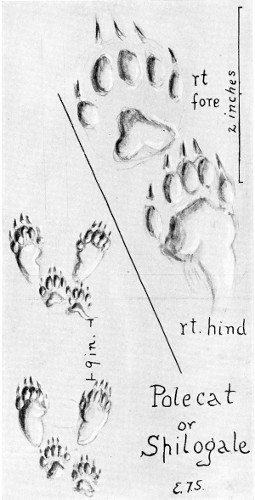
LITTLE SKUNK, POLECAT, OR SPILOGALE
This trail combines the characteristics of the skunk with those of a squirrel. At first it looks like the track of a stubby-toed squirrel, but the five-inch toe on the front foot is plainly seen. The frequent pairing of the fore paws is important. There is no tail mark (see pages 558 and 576).
THE SHORT-TAILED SHREW (Blarina brevicauda and its relatives)
(For illustration, see page 566)
Several groups of species or genera of the little mouselike animals known as shrews are peculiar to North America. Of these one of the most numerous and best known is the short-tailed shrew. It is a dark-colored animal much more heavily proportioned, larger, and with a shorter tail than the common shrew. Its fur is so thick and velvety that it is confused by many people with the mole, despite its smaller size.
The short-tailed shrews, sometimes called mole shrews, of the genus Blarina belong to a single species with several geographic races occupying eastern Canada and the United States, from Nova Scotia, southern Quebec, Ontario, Minnesota, and North Dakota southward to Florida and the Gulf coast as far as eastern Texas. Vertically they range from sea-level up to the tops of the Alleghenies. Another group of American shrews, containing numerous species belonging to the genus Cryptotis, occupies the mountains of the Western States, and ranges south to northern South America. In external form it is indistinguishable from the short-tailed species.
Probably no mammal is more numerous in the eastern United States than the short-tailed shrew. It occurs everywhere—in forests, in brushy areas, in old fields, and along grassy banks. Within the city of Washington it is common in Rock Creek Park, where it lives in covered runs which it makes among the grass and fallen leaves. These shrews drink frequently, and this may in part account for their abundance near streams or other water, although it may be the desirable moist soil conditions which draw them to such situations.
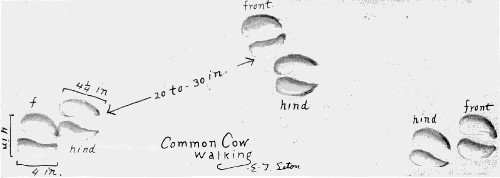
THE TRACK OF A COMMON COW (A SMALL ONE)
It is well to take the tracks of domestic animals as standards in identifying tracks of wild big game. The roundness of the front foot and the narrowness of the hind are general characteristics, though not always so pronounced as here. But note that the hind foot is set ahead, beside, or behind the trail of the front foot, but rarely exactly on it. This peculiarity is commonly seen in animals that are accustomed to walk on bogs. Note also the toes are set pointing a little outward, not straight forward. The clouts, or accessory hoofs, rarely show; only in deep, soft ground.
The runways of these shrews are scarcely half an inch wide, usually partly sunken in the mold or rotting surface vegetation. These are not made by digging, but by pushing aside the loose mold, and they cross and re-cross in an irregular network. They lead to the entrances to burrows which generally drop nearly straight down. The burrows are sometimes amid the leaves, but usually under the shelter of a root, stump, old log, or other cover. In addition to their own runways, the shrews make free use of the runs of meadow mice and even traverse the tunnels of the pine mice and moles in their restless search for prey.
Small rounded chambers opening off their underground runways are filled with fine grass, pieces of leaves, and other soft matter for a nest. One nest examined was made entirely from the hair of meadow mice, probably the spoils of war from the bodies of victims. As a rule, shrews are extremely unsocial, but a pair of this species is sometimes found occupying the same nest, no doubt a temporary arrangement. Several litters, containing from four to six each, appear to be born through the summer and fall, usually beginning in June.
While equally active by day and by night, the eyes of these shrews seem to be of little use except to distinguish between light and dark, but their senses of hearing and smell are highly developed, as is also the sense of touch in their long hairs, or “whiskers,” about the nose. In captivity an extreme sensitiveness is exhibited to sudden sounds, especially such as those of a bird’s wings, indicating an instinctive fear born of age-long persecution by birds of prey. Food is located by smell, and as the flexible end of the snout is moved continually from side to side, odors are caught which may register conceptions as definite in the minds of these small animals as sight does in more favored beasts. All shrews are provided with musk glands and on account of these are apparently nauseous to most other animals, as they are rarely eaten by beasts of prey. These musky secretions must be of great service to facilitate them in locating one another.
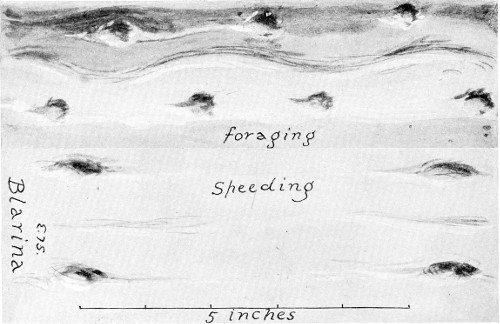
THE SHORT-TAILED SHREW, OR BLARINA
The curious grooved track in the snow with the tail mark is seen on the left (see pages 566 and 593).
Like other shrews and the moles, their digestion appears to be very rapid and they will eat two or three times their own weight in a day. This necessitates great activity on their part during much of the time in order to find the required food. They prefer insects and meat, but are practically omnivorous, feeding not only upon many kinds of insects, but on earthworms, slow-worms, sow-bugs, snails, slugs, mice, shrews, and the young of ground-nesting birds, as well as such vegetable food as beechnuts, seeds, bread, and oatmeal.
The instinct of prevision against the season of winter scarcity appears to be developed in them, as one in captivity buried beechnuts in the earth, and they are known to store living snails in small piles and to gather disabled beetles in store-rooms in their tunnels.
The courage and blind ferocity of the short-tailed shrews when they are placed near captive mice far larger than themselves, is amazing to all who witness their encounters. They attack instantly, spreading their front feet to gain a firmer footing and moving forward in little rushes. Mice larger and much more powerful than the shrew are persistently attacked and, finally giving out, are pounced upon and the flesh torn from their heads and necks with ravening eagerness. One day a passing observer heard a loud squealing on a railroad bank where an examination revealed a short-tailed shrew dragging away a nearly dead pine mouse, though the mouse was much the heavier. The notes of shrews are a fine tremulous squeak which becomes a longer, harsher, and more twittering or chattering cry when they are angry.
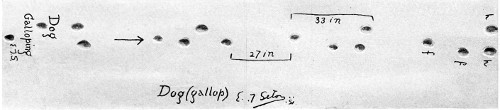
DOG GALLOPING IN SNOW
Showing the curious change whereby the right front ceases to take first place; no doubt this rests the muscles a little. This is typical of many animals (see page 597).
No cessation of their activity occurs in winter. When the cold weather begins many gather about barns and houses located near woods or old fields, and thus with the field mice take advantage of the garnered food supplies and shelter. Others remain in their regular haunts, where they frequently burrow long distances in the snow, making networks of tunnels and traveling long distances just below the surface, leaving little raised ridges like the track of a mole on the ground. Their journeys upon and under the surface of the snow appear to be in search of food, as they burrow down to old logs and stumps which make good feeding grounds. Their movements are very active, as they go about either at a walk or quick trot.
These fierce and truculent little hunters are wholly beneficial in their habits and should be encouraged in place of being killed on sight indiscriminately, as one of the ordinary mouse tribe.
THE RED BAT (Nycteris borealis)
(For illustration, see page 566)
Bats reach their greatest development in the tropics, where a marvelous variety of these curious mammals exist. To the northward the number of species gradually decreases, until eventually, in northern Canada and Alaska, a single species represents the group. The United States, occupying the middle latitudes, has a considerable number of different kinds. Some of these remain throughout the year, hibernating in caves during the period of cold, when insects are not to be had; others wing their way southward like birds on the approach of winter and return in spring.
All bats are nocturnal, although individuals of some species occasionally fly about for a time by day and many come out just before or soon after sunset. In this country practically all species are insectivorous, but in Mexico and the West Indies many are fruit-eaters and a few true vampires or blood-suckers.
As a rule, bats are clothed in dull colors, but richly tinted coats give a few a more attractive appearance. Of these none has a more striking adornment than that presented by the soft covering of glossy orange-red fur of the red bat. Its large size, about four inches in total length, with a spread of wings amounting to twelve inches, combined with its color, suffices to distinguish it at once from any other northern species.
The range of the red bat extends from the Atlantic coast to the Pacific and from Ontario and Alberta in southern Canada south throughout most of the United States to the Gulf coast and southern California; also beyond our limits to Lower California and Costa Rica. The genus to which this bat belongs ranges more widely in other parts of North America; also to South America and across the eastern Pacific to the Galapagos and Hawaiian Islands.
The red bat rarely or never seeks shelter in gloomy caves and crevices, but hangs to the small twigs or leaf stems on trees and bushes in the full light of the sun. One observer in Texas on July 4 found four of them hanging in a cluster from a twig on a peach tree, with the sun shining full on them, although the temperature in the shade was 82 degrees Fahrenheit. I have found them in northern Illinois in the glaring sunlight of May, hanging from leaves in the tops of oak trees. This unusual tolerance of light in a member of the bat tribe is further shown by its habit of beginning to hunt through the air for insects earlier in the afternoon than other species in its range.
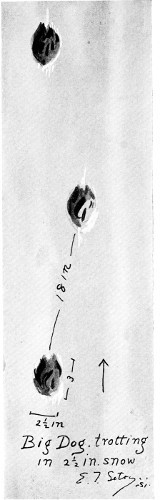
BIG DOG TROTTING
This track of a big dog trotting in about two and a half inches of snow is singular in the perfect register it shows. The hind foot drops each time into the track of the front foot. This correct style is more usual with wild than with tame animals. Compare with track of dog galloping, page 596.
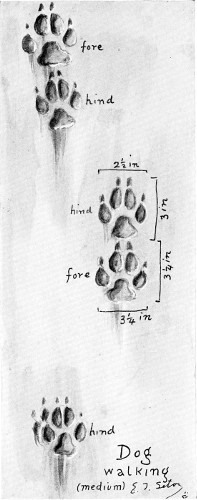
A COMMON DOG
The hind feet are, as usual, narrower, though nearly as long as the front. The dog is a loose walker. Sometimes the hind foot is on the track of the front, sometimes ahead, and often behind. The claws show. The dragging of the front feet is another slovenly habit, an evidence of overdomestication.
Long, narrow wings and swift, powerful flight characterize the red bats in the air. They have marvelous control in darting and turning here and there, and no birds, except possibly the chimney swifts, can equal them in their extraordinary gyrations.
Red bats are known to migrate from the northern part of their range in September or October and to return in May. They have been seen going south at Cape Cod the last of August and in September; and late in October Dr. E. A. Mearns has recorded great flights of them down the Hudson Valley, lasting throughout the day. That they share the vicissitudes of migrating birds is indicated by observation on the New Jersey coast of stray individuals coming in from the sea exhausted early on September mornings.
They are among the most solitary of their kind, usually being found hanging singly on a tree or bush, sometimes within a few feet of the ground. On occasion they gather in clusters as mentioned above, and in one instance in Maryland more than a dozen were hanging in a compact ball, which suddenly exploded into its winged parts when disturbed.
One of the most unusual characteristics of the red bat is found in the number of young it bears. Usually other species, except the hoary bat, have one or two young, but at varying dates between May and July each year the red bat produces from two to four, the average being three or four. The young when very small are carried clinging to the body of the mother in her flights. She continues to take them from place to place in this manner until their combined weight exceeds her own. The strength of the maternal feeling in this species is well illustrated by an instance in Philadelphia where a boy caught a half-grown red bat in a city square and carried it home. In the evening, three hours later, he crossed the same square, carrying the young bat in his hand, when the old one came circling about him and finally in her deep anxiety alighted on his breast. Both were brought in, the young one clinging to its mother’s teat. The devoted mother received injuries when she was captured, from which she died two days later.
In the contact between mankind and bats, man, the invariable aggressor, finds the bats baring their teeth, biting viciously, squeaking, and behaving altogether like little fiends. A gentler side is sometimes exhibited, however, and one observer who caught a partly grown red bat found that it became tame, showed intelligence, and developed a friendly feeling for its captor.
THE HOARY BAT (Nycteris cinereus)
The hoary bat is a close relative of the red bat described above, but is larger, about five inches long, and, as its name implies, is of a different color. It is widely distributed over a large part of North America, where it is known to breed from Nova Scotia, Manitoba, and the southern shore of Great Slave Lake south practically throughout the United States. It is one of our larger species and is remarkable for its power and skill on the wing. The wings are long and narrow and carry their owner through the air in a bewildering series of swoops, curves, and zigzag turns remarkable even in a group of animals so notable for their powers of flight.
With the approach of cold weather the hoary bat migrates from the northern parts of its range to the milder southern districts. It is a late migrant, not leaving its northern home until the last of September or October and returning in May. Some individuals appear to remain in the North all winter, as one has been taken in Connecticut in December. In its southern flight it wanders as far as Jalisco, near the southern end of the Mexican table-land, to Lower California, and to the Bermuda Islands. To reach the Bermudas it is evident the bat must make a continuous flight from the nearest point on our shores of at least 580 miles—a good tribute to its wing power.
Like the red bat, it lives in the open, hanging from twigs and leaves in the tops of trees or bushes in the broad light of day rather than in the dark, stifling crevices where so many of its kind pass their lives. It appears to hang up indifferently on any convenient tree or bush, including conifers, aspens, or willows. During the day it has a curious lack of alertness, and as it is not rarely attached to low branches or bushes within a few feet of the ground it may be readily approached and taken in the hand. I once captured a fine specimen the middle of May, in southern California, hanging on a bush about four feet from the ground. It appeared to be sound asleep until taken by the skin on the back of the neck, when it became very much alive and, struggling in a fury, uttered grating shrieks of rage, baring its sharp, white teeth and trying desperately to bite.
Its food is made up entirely of insects, which it appears to hunt higher up than most bats, sweeping over the tops of the forest and in and out about the trees. It appears to be of even more solitary habits than the red bat and is nowhere so common. Another reason for our lack of information concerning it is found in its strictly nocturnal habits, for it rarely appears until shortly before the approaching night hides it from view.
The hoary bat shares with the red species the distinction of bearing from two to four young each year. The young are born in June and are carried attached to the underside of the mother’s body until they become too heavy a burden. They hang to the teats with the greatest tenacity and apparently rely mainly on this hold to prevent being dropped as they are carried on the wild aërial hunting excursions. With the unusual fecundity indicated by the number of young, it is difficult to account for the scarcity of these bats unless their habit of hanging in the open, exposed to the elements and to other dangers, may cause a heavy mortality among them.
Note.—The attention of the reader is called to an error on page 566, where the Little Brown Bat, Myotis lucifugus, on the tree trunk, a common species throughout most of North America, is labeled “Hoary Bat, Nycteris cinereus,” which is a much larger and very different animal.
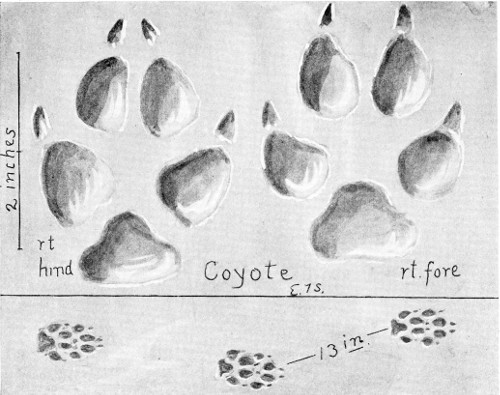
THE TRACK OF A COYOTE
This track cannot be distinguished with certainty from that of a small dog (see pages 596 and 597). The greater size of the side toes in the hind track I have often noticed, but there is no corresponding disproportion in the animal’s foot.
THE MEXICAN BAT (Nyctinomus mexicanus and its subspecies)
(For illustration, see page 567)
Reference has been made in several preceding sketches of this series to the mammals of tropical origin which have invaded our southern border. The Mexican bat is a notable member of this class. It differs in many curious ways from the bats with which it associates in temperate regions. It is smaller than any of the other three bats treated here and is strongly characterized by a flattening of the head and body which enables it to creep into a surprisingly narrow crevice in the rocks or elsewhere. The ears are broad and flaring and extend forward over the eyes like the visor of a cap, and the end of the tail is not confined within the membrane extending between the hind legs, but projects from it. Another pronounced characteristic of this bat and one highly disagreeable is the rank musky odor which it gives out. This pollutes the air about its harboring places, rendering it a most unwelcome guest.
Whoever has visited the Southern and Southwestern States or Mexico must have noted the offensive odor in many places about the verandas of houses and especially about old churches and other public buildings. This is the sign of occupancy placed on the premises by the Mexican bats, which, to the number of a few dozens or actually by thousands, as conditions permit, may lie snugly hidden in cracks and dark openings of all kinds about the roof and walls. No other bat in Mexico or the United States is provided with so strong an odor.
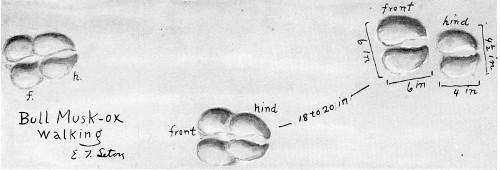
MUSK-OX
Drawn from the tracks of a big bull in the barren grounds of Canada. Much like the track of a common cow (see page 594), but more rounded and less deeply cloven; also, I think, less often sprawling—in other words, more often hind foot on front track; for the musk-ox is more of an upland creature.
The Mexican bat is extremely abundant, probably exceeding in numbers any other species within its territory. It ranges throughout the tropical and lower temperate parts of Guatemala, Mexico, and across our border, throughout most of Texas, and east as far as Florida and South Carolina; in the West it also abounds both in town and country in the warmer parts of New Mexico, Arizona, and California.
Closely allied relatives of the Mexican bat abound throughout the warmer parts of Central and South America to beyond Brazil. The genus to which this species belongs is represented in the warmer parts of both hemispheres. It extends north in the Old World to southern Europe and also is found in the Philippines.
The abundance of the Mexican bat in some favorable places is almost incredible. At Tucson, Arizona, I once saw them, a short time before dark, issuing from a small window in the gable of a church in such numbers that in the half light they gave the appearance of smoke pouring out of the opening. At times they occupy houses in such numbers that their presence and accompanying offensive odor render the places uninhabitable. At the town of Patzcuaro, near the southern end of the Mexican table-land, I saw two rooms in an old adobe house occupied by as many of them as could possibly hang from the rough ceiling. The owner considered their presence a valuable asset, as he collected and sold the guano for more than the rooms would have brought in rent. The bats congregate in even greater numbers in large caves. So numerous are they in certain caves in Texas that the owner reports an annual income of about $7,000 from the guano.
They are very plentiful by day in the thin crevices about the roof and walls of caves in the celebrated Ixtapalapa, or “Hill of the Star,” beyond the floating gardens at the City of Mexico, and I also found them living in many of the marvelous ruins of Mexico, including Chichen-Itza, in Yucatan. Wherever they occur in numbers they may be heard frequently by day shuffling uneasily about and squeaking shrilly at one another.
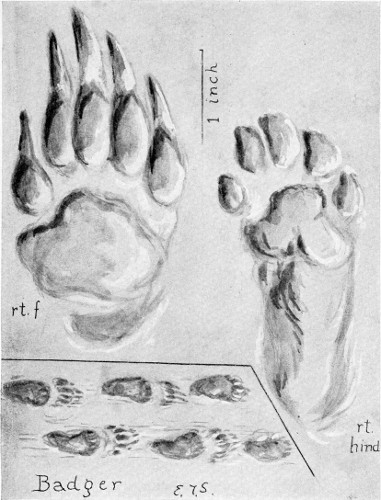
BADGER
The huge fore claws are a strong feature. The hind claws rarely show in the track. The broad spread of the tracks in the lower trail corresponds with the low, thick form of the animal.
When they first come out after sunset they usually fly away in a great stream, nearly all in the same direction, as though migrating. This course will probably be found leading to water, where they scoop up a drink from the surface before beginning their wonderfully erratic zigzags through the air in pursuit of insects.
From the colder northern parts of their range they migrate southward to milder climatic conditions or descend to lower altitudes. In Mexico, where they live up to above 8,000 feet altitude, they move down from one to two thousand feet. Their young, one at a birth, are born from April to May.
It has been claimed that the Mexican bat brings bedbugs to infest houses. This is untrue of this or any other bat. These animals have certain small parasites, some of which, resembling small bedbugs, have probably given rise to the belief mentioned. These parasites live only on the bats.
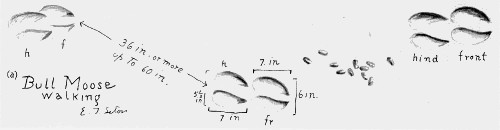
THE TRACK OF A BIG BULL MOOSE WALKING ON HARD GROUND
The great size, the pointed shape, and the long stride usually distinguish it from the track of a domestic cow. Ordinarily, the clouts do not show. The dung pellets, however, are very important diagnostics. They are cylindrical, about ⅝ inch through and 1¼ inches long. Probabilities of time and place must always be considered. Oftentimes the hind foot is set far ahead of the front-foot track. The excessive spreading of the hoofs is a strong character of moose tracks.
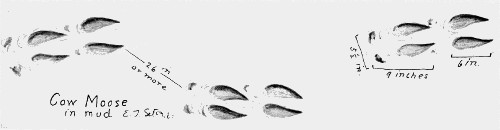
TRACK OF A COW MOOSE WALKING IN THREE OR FOUR INCHES OF MUD
In this the clouts show clearly. The excessive pointedness of the cow’s track is not a fixed character. The hoofs of a moose in swamp country are larger and more pointed than those in a rocky country, because less worn. The cow track, in this case, was sketched in a land of swamps, so that it is longer and sharper than the average.
Within a few years considerable publicity has been given to the supposed possibility of utilizing bats to destroy mosquitoes and thus eliminate malaria from infested areas. One or more bat houses have been built at San Antonio, Texas, for the purpose of assembling bats in large numbers, and many untenable claims have been put forth concerning the benefit to be derived from their services. The Mexican bat is the species which abounds above all others at San Antonio and is the principal species which has occupied the bat houses near town. It is definitely known that bats often fly miles from their roosts when feeding and do not concentrate on any one kind of insect. Examination of the contents of the stomachs of Mexican bats shows that they feed on beetles and numerous other insects, but rarely upon mosquitoes. I have visited many Mexican towns and villages in which every house was haunted by numbers of these bats and where malaria was perennial. The evidence against these animals serving any useful purpose in checking malaria is conclusive.
It may be repeated here, however, that all of our bats are of high utility as insect-destroyers and should be protected. Among the many species of varying habits which exist in the United States, a few make their homes about houses in annoying numbers. In place of killing them to abate the nuisance, it would be better to exclude them from buildings by closing the entrance ways promptly after all have left in the evening, and thus by quiet eviction cause them to find abiding places elsewhere. The destruction of forests, and the consequent absence of the hollow trees where they formerly lived, is mainly responsible for bats and chimney swifts coming to houses for harbor.
THE BIG-EARED DESERT BAT (Antrozous pallidus and its relatives)
(For illustration, see page 567)
The marvelous variations in structure of the ears and other organs about the heads of insect-eating bats serve probably as microphones by which the flight of their prey may be detected and its direction located with instantaneous certainty. The beautiful accuracy with which this hearing mechanism works must be evident to any one who will take a position where he may have the evening glow of the western sky as a background for flights of bats. It is certain that the small and ineffective eyes these animals possess could never locate their minute flying game and enable them to secure it in the whirling, zigzag courses they pursue, often at a speed and under a control which few, if any, birds could rival.
The great ears of the big-eared desert bats illustrate one form of a highly developed hearing apparatus and give these animals a handsome and strikingly picturesque appearance. This character at once distinguishes them from others of their kind in the United States.
The distribution of this species lies mainly in the arid parts of the Southwestern States and Mexico. It extends from western Texas, southern Colorado, Nevada, and Oregon, south to Queretaro, on the Mexican table-land, and to the southern end of the peninsula of Lower California. The vertical distribution extends from sea-level up to at least 5,000 feet altitude.
By day these desert bats live in crevices and caves in cliffs, in old mining tunnels, hollows in trees, and in sheltered places about the roofs and walls of houses, barns, or other buildings. Their presence in dark hiding places may sometimes be detected by occasional grating squeaks. They appear to lack any musky odor which characterizes so many bats. About the 1st of June each year either one or two young are born, and for a time these cling to the mother’s breast and are carried during her swift flights in pursuit of insect prey.
Often when camping at desert waterholes, I have seen them come in just before dark to drink, scooping up water from the surface while in flight, and then circling back and forth over the damp ground at an elevation of a few yards for the capture of some of the insects common in such places. At such times, with the distant hills mantled with a deepening purple haze and the pulsating heat of the day replaced by the milder temperature of approaching night, these bats could often be seen sharply outlined against the rich orange afterglow of the departed sun. Here and there in the still air flickered and zigzagged multitudes of tiny bats, like black butterflies, and among them the occasional big-eared bats on broad wings appeared huge in contrast. Their wing strokes were slower and shorter than those of the smaller species and impelled them forward in a swift, gliding movement which gave their evolutions a sweeping grace beautiful to see.
In August several years ago, during a visit to the Indian School at Tuba, in the Painted Desert of northern Arizona, I found these bats living in considerable numbers about the buildings. Just before dark they swarmed out and hunted about the surrounding orchards and small fields. One evening my collector shot at one as it circled over a potato field in a small orchard. It continued its flight, circling low among the apple trees as though unhurt, when suddenly it dropped to the ground. Supposing the bat to be wounded, it was cautiously approached and covered with a hat, when, without a struggle, it permitted itself to be picked up by the nape. It then became evident that the bat was unhurt from the shot. The reason for its sudden descent was revealed in the person of a large, fat mole cricket (Stenopalmatus fuscus) which it was holding firmly in its jaws, and so ferociously intent was it in biting and worrying its luscious prey that it paid not the slightest attention to its captor. Finally it was killed by having its chest compressed and died with its bull-dog grip on its prey unbroken.
These bats, like the other members of the tribe in the United States, are fully as beneficial to the farmer as the best of our insect-eating birds and deserve equal protection in place of the general persecution from which they now suffer.
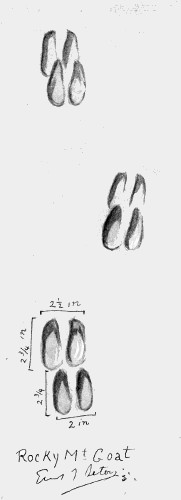
ROCKY MOUNTAIN GOAT
Kinship with sheep and antelope is reflected in the track of the goat. Its heel-pads are so large and rubber-like that the track is rarely so sharp as here shown. “Although marvelously surefooted and fearless in traversing the faces of high precipitous slopes, goats lack the springy grace and vivacity of mountain sheep and move with comparative deliberation.”
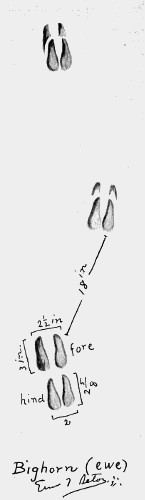
BIGHORN
The general style of a bighorn track is like that of deer, but the toes are finished off more squarely and the hollow in the outer edge of each hoof is a strong characteristic. Sometimes the tracks are in correct register. The clouts rarely show. The dung pellets are like those of the deer, but rounder. The track is that of a ewe; the ram’s is similar, but larger.
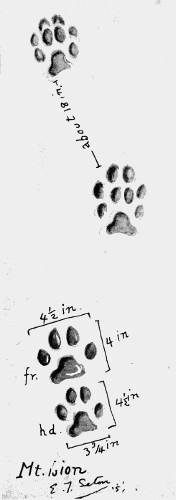
MOUNTAIN LION, OR COUGAR
The track of a mountain lion is much like that of a house cat, differing only in size. Sometimes, as in the cat, the hind foot is set exactly on the track of the front foot.
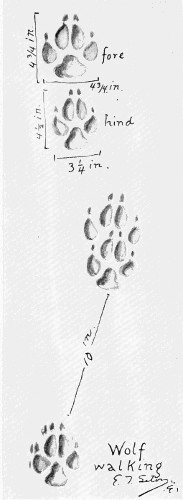
GRAY WOLF
The track is that of a large wolf. There is no certain way of distinguishing it from that of a dog (see page 597). Size and probabilities must be considered.
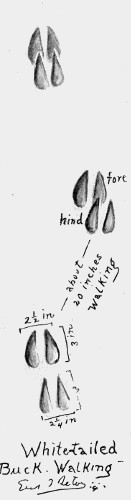
WHITE-TAILED DEER WALKING
The track of the white-tail is ideal—a starting point to study all the tracks. Sometimes the hind foot fits on the front track, but sometimes not.
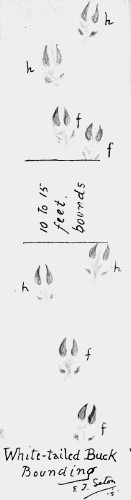
WHITE-TAILED DEER BOUNDING
In these the clouts are clearly shown. Note the resemblance to the tracks of the moose (see page 602), which differ chiefly in their greater size.
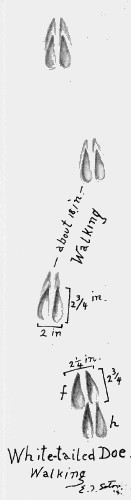
WHITE-TAILED DOE WALKING
This track differs from that of the buck in being smaller, slimmer, and in having the toes pointing forward or inward—rarely outward.
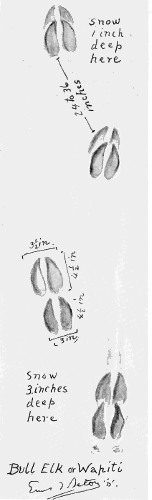
ELK
This shows the track of a large male walking. Each hoof-mark is about 4½ inches long. Had it been five inches it would have meant a very large bull. The track is strictly deer-like in type, but has a little of the roundness of point that is so marked in the domestic cow. At the upper end of the drawing is snow one inch deep. Here no clouts show; at the lower end it is three inches deep, so the clout-marks are clear. Size is essential in distinguishing the track. The dung pellets, about ⅝ × ⅛ inch, are also important.
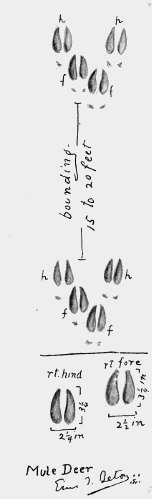
MULE DEER
The mule deer tread cannot be distinguished with certainty from that of white-tailed or coast deer; yet it averages larger than either of these, and the curious close set together of all four feet while it does its peculiar bounding is quite unlike what we see in the white-tail track. “These deer are not good runners in the open. On level country in Arizona I have ridden after and readily overtaken parties of them within a mile. The moment rough country was reached, however, with amazing celerity a series of mighty leaps carries them away” (see page 456).
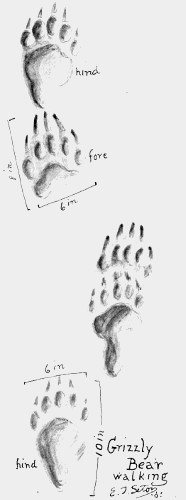
GRIZZLY BEAR
The great size and the immense claws are the chief characteristics of the grizzly’s track. All five toes usually show in each track. “The strongest and most distinctive characteristic of the grizzlies is the long, proportionately slender and slightly curved claws of the front feet, sometimes more than three inches long” (see pages 440 and 442).
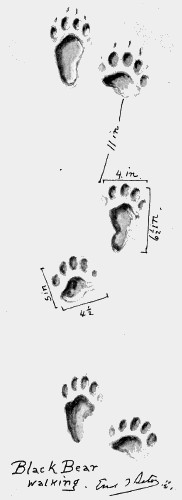
BLACK BEAR
The plantigrade foot is clearly shown in the bear track. That of a black bear differs from that of a grizzly, first in size, second in the shortness of the claws. Usually no claws show, and the fifth toe, which is well developed on both front and hind paws, leaves little sign and often none at all. Frequently the hind foot is set on the track of the front foot in correct register.
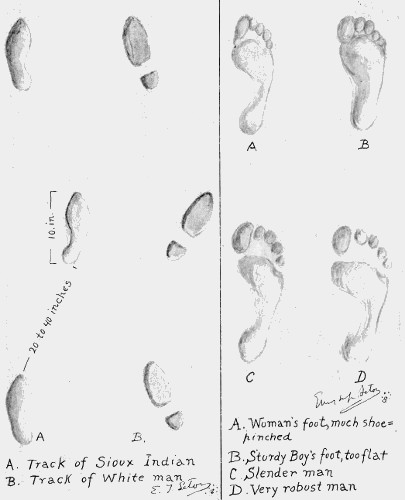
THE HUMAN FOOTPRINTS
The footprints of the human animal are included in this series of sketches for the purpose of comparison. Especially interesting is the similarity to be noted between the tracks made by man and those of the grizzly and the black bear (see page 608). The tracks shown on the left half of this page present the moccasin-shod footprints of a Sioux Indian compared with the shoe tracks of a white man. On the right are shown: (A) a woman’s foot which has been much pinched by tight shoes; (B) a sturdy boy’s foot, somewhat too flat to be normal; (C) the footprint of a slender man, and (D) the imprint of a robust man’s foot.
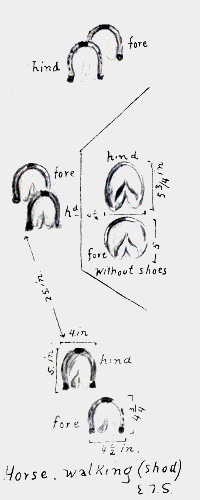
THE HORSE
A hunter needs to know horse tracks as much as those of wild game. The greater size and roundness of horse tracks distinguish them from those of mules and asses. When shod the toe calks are a strong feature; when without shoes the unbroken front edge is distinctive. Some horses walk in correct register; some do not. Mules are more exact than horses. When trotting the arrangement is much as in walking, but the spaces are longer and the hind-feet track farther ahead of the front feet. In galloping the arrangement is much as in the white-tailed deer.
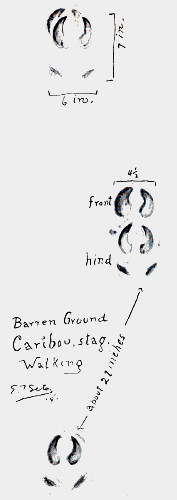
BARREN GROUND CARIBOU
The caribou track is distinguished by its great spread and the fact that the clouts or hind hoofs touch the ground, even on a hard surface. I know of no difference but size between the tracks of the various caribou and reindeer. The probabilities of time and locality help in determining the species, but it need never be mistaken for that of any other type of deer. In winter the caribou’s tracks in the snow show that its feet, instead of being raised high at each step, like those of a Virginia or mule deer, drag through the snow like those of domestic cattle.
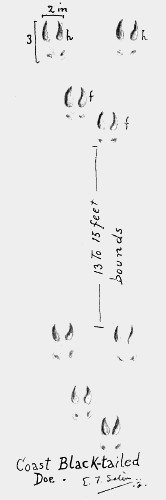
COAST BLACK-TAILED DOE
I know of nothing but probabilities to distinguish the walking tracks of the coast deer from those of nearly related species. This track of a bounding female shows a peculiar grouping that corresponds fairly with the bounding action characteristic of the species.
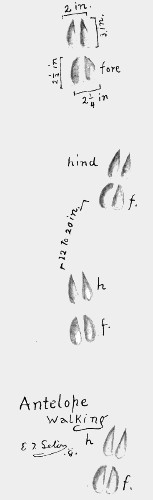
ANTELOPE
The different styles of front and back feet is a marked character of the antelope’s track and is best seen in the walk. In galloping all of these animals leave the hind tracks ahead of the fore tracks, but disturb the ground, so that almost no characteristic marks are to be seen.
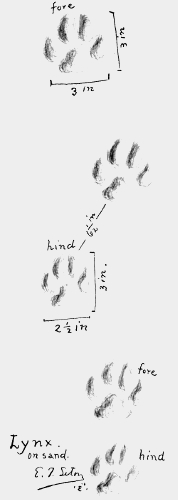
CANADA LYNX
This track I sketched on the Athabasca River. In summer the track of a lynx shows the toe-pads faintly; in winter all are muffled in hair and the track is much larger. “The feet in winter are so broad that they serve admirably for support in deep snow” (see page 409).
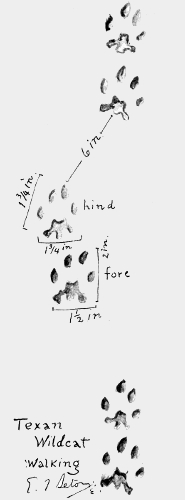
TEXAN WILDCAT
This track, while akin to that of a cat (see page 487), has some very well-marked characteristics. The complicated outline of the heel-pads is striking. This, with its large size, will distinguish it from the track of a house cat. The claws do not show.
[Reprinted from Science, N. S., Vol. XLVIII., No. 1248, Pages 547-549, November 29, 1918
Wild Animals of North America: Intimate Studies of Big and Little Creatures of the Mammal Kingdom. By Edward W. Nelson. Natural-Color Portraits from Paintings by Louis Agassiz Fuertes. Track Sketches by Ernest Thompson Seton. Published by the National Geographic Society, Washington, D. C., U. S. A.; 8vo, pp. + 385-612, folded frontispiece, 108 colored illustrations on text paper (not plates), 85 halftone illustrations. [This is essentially a reprint of two articles which appeared in the National Geographic Magazine, for November, 1916, and May, 1918. The changes comprise repaging beyond page 472, the readjustment of the matter on pages 473-475, the replacement of a half-tone on page 475, the rectification of page references to illustrations to accord with the new paging where needed, and readjustment of the matter from page 571 on, so as to admit 32 new illustrations of footprints and the captions to these.
This is a work which meets to a gratifying degree the need for an essentially non-technical treatise upon the natural history of the mammals of North America. No living person is better equipped to carry to a successful conclusion such an undertaking than is its author. Nelson has contributed in the field of vertebrate zoology now for over forty years, to be explicit, beginning in July, 1876 (Bulletin Nuttall Ornithological Club, Vol. 1, p. 39). With a background of long experience in the field, and with further years of official connection with the United States Biological Survey and its unique resources in mammalogy, he has made available a brochure of pleasing amplitude and satisfying authoritativeness.
Between the colored pictures and the written sketches the public can gain from this contribution a better idea of our principal mammals than from any other available publication. It should awaken a generally greater interest in our native mammals, and this will help build up a desire for the conservation of the harmless and useful species such as has resulted from the public education in relation to our bird life. On the other hand it is important to be able to distinguish those mammals, chiefly of the order Rodentia, which are thoroughly inimical to human interests. People at large must know how to cope with these enemies. It would seem that a full knowledge of the natural history of such animals is essential to determining the most successful means of controlling them and to applying these means properly to the varying conditions throughout the country. Nelson’s accounts of our injurious mammals are full of stimulative suggestions along these lines, and while the work as a whole can not be considered as an “economic” publication, its influence will go far to secure adequate popular consideration of these matters.
The species are taken up in groups, in so far as this can be done safely. Each biography, of which there are 119, is, as a rule, a composite applying to a number of near-related forms, thus simplifying matters of presentation, and avoiding repetition. A marked feature of the book is the degree of concentration attained; there is no trace of padding, and no room for baseless speculation, sentimentalizing or humanizing, such as characterize many current “nature” books. At the same time the style is animated and thoroughly entertaining, a gift of composition which Nelson has exercised in many preceding contributions. Here is an instance, unfortunately a rare one, in which a man who really knows the field has put out a popular book on a natural history subject.
Many are the portrayals which are evidently based on Nelson’s own personal field knowledge, some of them involving facts here for the first time made known to science. His account of the behavior of kangaroo rats in Lower California is particularly apt in illustration of the above statement.
During several nights I passed hours watching at close range the habits of these curious animals. As I sat quietly on a mess box in their midst ... [they] would forage all about with swift gliding movements, repeatedly running across my bare feet. Any sudden movement startled them and all would dart away for a moment, but quickly return.... They were so intent on the food [grains of rice put out for them] that at times I had no difficulty in reaching slowly down and closing my hand over their backs. I did this dozens of times, and after a slight struggle they always became quiet until again placed on the ground, when they at once renewed their search for food as though no interruption had occurred.... While occupied in this rivalry for food they became surprisingly pugnacious. If one was working at the rice pile and another rat or a pocket mouse approached, it immediately darted at the intruder and drove it away. The mode of attack was to rush at an intruder and, leaping upon its back, give a vigorous downward kick with its strong hind feet.... Sometimes an intruder, bolder than the others, would run only two or three yards and then suddenly turn and face the pursuer, sitting up on its hind feet like a little kangaroo. The pursuer at once assumed the same nearly upright position, with its fore feet close to its breast. Both would then begin to hop about watching for an opening. Suddenly one would leap at the other, striking with its hind feet, ... [producing] a distinct little thump and the victim rolled over on the ground. After receiving two or three kicks the weaker of the combatants would run away. The thump made by the kick when they were fighting solved the mystery which had covered this sound heard repeatedly during my nights at this camp.
The brilliantly coated paper used throughout this book although hard on sensitive eyes, is necessary to the handling of the halftone illustrations. The printing of both the colored and uncolored pictures in all the copies we have seen has been done with pronounced success. The color drawings by Fuertes are admirable and we are astonished at the success with which this noted bird artist was able to turn to mammals, the drawings of which in this contribution mark as far as we know his first efforts in the new field.
A critical reviewer might succeed in finding a number of small points to elaborate upon and of which to complain. For instance: It is trite to say that an Alaska brown bear is no more an animal than is a house fly. Yet here we have the title, “Wild Animals of North America,” though there is an evident effort made in the subtitle to remedy the matter by using the expression, “mammal kingdom.” But here a taxonomic blunder is tumbled into! We can hardly believe that Nelson himself had anything final to say with regard to the title page of this book, but that the editor of the National Geographic Magazine got in his work here in the belief so characteristic of editors of popular magazines that their public must be talked down to.
But to pin the attention of the reader of this review upon such really minute defects would do violence to the facts in the case, which are that, according to the convictions of the reviewer, Nelson’s “Wild Animals of North America” is more uniformly accurate and at the same time replete with information along many lines than any preceding book on American mammals. And even more, it may be declared with confidence that this book is by far the most important contribution of a non-systematic nature that has appeared in its field in America.
Joseph Grinnell
Museum of Vertebrate Zoology, University of California