The Larger North American Mammals (continued 2)
Reading edition
The Alaska fur seal is a migratory species, wintering down the Pacific coast as far as northern California. The migrations of these seals are of remarkable interest. In spring they leave the northwest coast and many of them travel steadily across more than two thousand miles of the North Pacific. For days at a time they swim through a roaring gale-swept sea, under dense, low-hanging clouds, and with unerring certainty strike certain passages in the Aleutian Islands, through which they press to their breeding grounds, more than 100 miles beyond, on the small, fog-hidden Pribilof Islands.
Fur seals are extremely polygamous and the old males, which weigh from 400 to 500 pounds, “haul up” first on the breeding beaches. Each bull holds a certain area, and as the females, only one-fifth his size, come ashore they are appropriated by the nearest bulls until each “beach master” gathers a harem, sometimes containing more than 100 members.
Here the young are born, and after the mating season the seals, which have remained ashore without food from four to six weeks, return to the water. The mothers go and come, and each is able to find her young with certainty among thousands of apparently identical woolly black “pups.”
From the ages of one to four years fur seals are extremely playful. They are marvelous swimmers and frolic about in pursuit of one another, now diving deep and then, one after the other, suddenly leaping high above the surface in graceful curves, like porpoises. Squids and fish of various species are their main food. Their chief natural enemy is the killer whale, which follows their migrations and haunts the sea about their breeding grounds, taking heavy toll among them.
Since the discovery of the Pribilof Islands by the Russians the fur seal herds there have yielded more than five million recorded skins. A census of the herds in 1914 gave these islands nearly three hundred thousand seals. Now that pelagic sealing has been suppressed and the herds are being protected, there is every reason to expect that the seals will increase rapidly to something like their former numbers.
STELLER SEA-LION (Eumetopias jubata)
Sea-lions are near relatives of the fur seals and have a nearly similar distribution, both in far southern and northern seas. The males of the several species are more than twice the size of the females and are characterized by an enormous development of neck and shoulders. The Steller sea-lion is the largest member of the group, the old bulls weighing from 1,200 to 1,500 pounds. All are extremely gregarious and polygamous.
The Steller sea-lions belong to the North Pacific, whence they range in winter as far south as the coasts of California and Japan. In spring they migrate northward to their breeding grounds among the Aleutian, Pribilof, and other rocky islands of the North Pacific. The early histories of this region record their great abundance, including several hundred thousand which were reported to have congregated to breed each season on the Pribilof Islands. Although less valuable than the fur-seal, persistent hunting has gradually reduced their numbers on these islands until in 1914 only a few hundred remained.
In summer range they are less limited than the fur seals, occurring in herds about the shores of many rocky islands along the mainland coast of the North Pacific and the Aleutian chain.
Since the primitive days before the arrival of civilized men in their haunts, sea-lions were of the greatest economic importance to the Aleutian Islanders and other coast natives. Food and fuel were obtained from their flesh and blubber; coverings for boats were made of their skins; water-proof overshirts of their intestines; boot soles from the tanned skin of their flippers; trimmings of fancy garments from their tanned gullets and bristles, and thread from their sinews.
They are preëminently animals of the most rugged of shorelines and the stormiest of seas, being superbly powerful beasts with extraordinary vitality. The ease with which they pass through a smother of pounding seas to mount their rugged resting places is an admirable exhibition of skill and strength. The males have a bellowing roar, which rises continually from the herds on the rocks in savage unison with the booming of the sea against the base of their refuge.
The harems of the bulls on Pribilof Islands rarely exceed a dozen members, which are under less strict discipline than the harems of the fur seals. The old bulls, especially during the mating season, are aggressive and savage fighters, inflicting severe wounds on one another. At all times they are more courageous and belligerent than fur seals, and hunters driving parties of them back from the beach on the Pribilofs approach them with extreme caution, to avoid the dangerous charges of angry bulls. It is reported that an umbrella opened and closed suddenly in the faces of the old sea-lions appears to terrify them more than any other weapon and is used successfully in drives. At sea they have only a single known enemy to fear—the fierce killer whale.
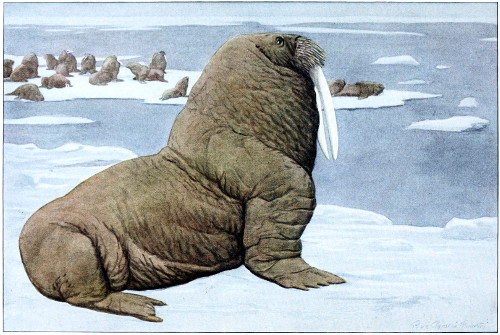
PACIFIC WALRUS
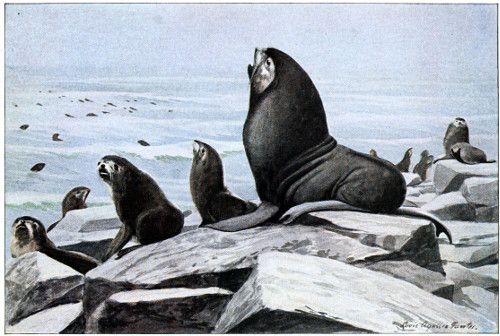
ALASKA FUR SEAL
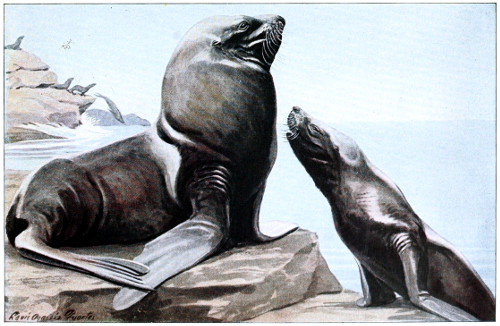
STELLER SEA-LION
SEA OTTER (Latax lutris and its subspecies)
Sea otters, distant relatives of land otters, are heavy-bodied animals, about 4 feet long, with broad webbed hind feet. When in the water they have a general resemblance to seals, whose mode of life is similar to theirs. Their fur is extremely dense and on the skins of adult males is almost black, closely sprinkled with long white-tipped hairs. The fur of prime skins has a silky luster, equaled in beauty by only the finest silver-tipped fox skins. For centuries sea-otter fur has been highly prized and single skins have brought more than $1,000 in the London market.
Otters are limited to the coasts of the North Pacific, where formerly they were incredibly abundant all the way from the shores and islands of Lower California to the Aleutians, and thence along the Asiatic coast to the Kuriles. Through excessive hunting, they are now extinct along most of this extended coast-line.
In the days of the Russian occupation of Alaska the discovery of the abundance of sea otters led to intense activity in their pursuit. Otter-hunting expeditions were organized by the Russians along the storm-swept coast from Unalaska to Sitka, sailing vessels being used as convoys for hundreds of Aleut hunters in their skin-covered boats. The loss of life among the hunters under their brutal taskmasters was appalling and resulted in seriously and permanently reducing the native population of the Aleutian Islands. At the same time enormous numbers of sea-otter skins were taken. Afterward both English and American ships engaged in the pursuit of otters farther down the coast.
The first year after the discovery of the Pribilof Islands the records show that 5,000 sea otters were taken there. Many expeditions in other directions secured from one to several thousand skins. When sea otters were most abundant they were found all down the coast, even in San Francisco Bay, and one American trading vessel obtained 7,000 skins in a few weeks from the natives of the northern coast of Lower California.
The otters formerly frequented the shores of rocky islands and outlying reefs, but constant persecution has driven the few survivors to remain almost constantly at sea, where they seek resting places among kelp beds. They are now excessively shy and, aided by keen eyes and an acute sense of smell, are difficult to approach. When anything excites their curiosity they commonly raise the body upright, the head high above water, and gaze steadily at the object. If alarmed, they dive and reappear at a long distance.
Otter hunters report the animals very playful in pleasant weather, and sometimes floating on their backs and playing with pieces of kelp. The mother is devoted to her young and is said to play with it in the water for hours at a time.
All efforts to rear the young in captivity have failed. The food of the sea otter is mainly of shellfish of various kinds, secured by them from the bottom of the sea.
Practically the only sea otters left among the hordes which once frequented the American shores of the North Pacific are now scattered along the Aleutian Islands. Government regulations prohibit their being hunted and it is hoped that enough still remain to restock the wild and stormy sea where they have their home.
NORTHERN SEA-ELEPHANT, OR ELEPHANT SEAL (Mirounga augustirostris)
Sea-elephants are the largest and among the most remarkable of the seals. Two species are known—one from islands on the borders of the Antarctic Ocean and the other from the Pacific coast of Upper and Lower California. The northern species formerly existed in vast numbers along the coast and among outlying islands from Point Reyes, north of San Francisco, south to Cedros Island, but is now reduced to a single small herd living about Guadalupe Island, off Lower California.
The old males attain a length of 22 feet or more and are huge, ungainly beasts, moving with difficulty on land, but with ease and grace in the water. The name sea-elephant is obviously derived from the broad flexible snout of the males, which, when relaxed, hangs 6 or 8 inches below the muzzle. This curious proboscis can be moved about and raised vertically, giving the animal a strange appearance. The males have a loud roar like the bellowing of an ox.
The breeding season extends from February to June, and during this period these seals are far more numerous on shore than at any other time. They are gregarious in habits and formerly hauled up in herds on the islands or on remote and inaccessible beaches of the mainland. On shore they are sluggish, having none of the alertness shown by many other seals. They lie supine on the sand and permit a man to walk quietly up and touch them without showing signs of fear. When attacked by sealers or otherwise alarmed, however, they become panic-stricken and make ungainly efforts to escape, but quickly become exhausted by the exertion necessary to move their great bodies. Their only natural enemy appears to be the killer whale.
Between 1855 and 1870 the great numbers of northern sea-elephants, combined with their helplessness on shore and the value of their oil, attracted numerous sealing and whaling ships to the coast of Lower California. The resulting slaughter reduced these animals from swarming abundance to a few scattered herds. Since then their numbers have steadily decreased, and there is a serious probability that these strange and interesting habitants of the sea will soon disappear forever.
The small remaining herd on Guadalupe Island is without protection and lies at the mercy of wanton hunters. The people of the coastal towns of California should exert themselves to discourage hunters from killing these seals, since the only hope for the preservation of this noteworthy species lies in an awakened public sentiment in its favor. Even within recent years they have occasionally visited the Santa Barbara Islands, California, and if the existing survivors can be saved they may again become resident there.
HARBOR SEAL, OR LEOPARD SEAL (Phoca vitulina)
The harbor seal, one of the smallest of the hair seals, attaining a length of only 5 or 6 feet, is one of the most widely distributed and best known of its kind. It is a circumpolar species, formerly ranging well south on the European coast and to the Carolinas on the American side of the Atlantic, though now more restricted in its southern extension. On the North Pacific it ranges south to the coast of Japan on the Asiatic side and to Lower California on the American side.
Throughout its range the harbor seal haunts the coast-line, frequenting rocky points, islets, bays, harbors, and the lower courses of rivers. It commonly frequents the sandy bars exposed at low tide about the mouths of rivers, and has been known to ascend the St. Lawrence to Lake Champlain and Lake Ontario, and the Yukon to several hundred miles above its mouth. It is still a common and well-known animal on the coast of Maine and eastern Canada and about many harbors on the Pacific coast. It appears to be a non-migratory species and in northern waters frequents the pack ice along shore in winter. Where the pack is unbroken, the seal makes breathing holes through the ice, which it visits at intervals, and where it is hunted by the Eskimos.
It is not polygamous and is not so strongly gregarious as some of the other seals. That it has some social instinct is evident, however, since it commonly gathers in small herds on the same sand spits, rocky points, and islets. The young are born in early spring and at first are entirely covered with a woolly white coat. The mother is devoted to the “pup” and shows the deepest anxiety if danger threatens.
The flesh and blubber of this seal are highly prized by the Eskimos as the most palatable of all the seals, and the skin is valued for clothing and for making strong rawhide lines used for nets and other purposes. On the Alaskan coast of Bering Sea in fall the Eskimos capture many seals in nets set off rocky points, just as gill nets are set in the same places in spring for salmon.
Owing to the presence of this seal along so many inhabited coasts, much has been written concerning its habits, especially as observed about the shores of the British Isles. Where not disturbed it shows little fear and will swim about boats or ships, raising its head high out of water and gazing steadily with large intelligent eyes at the object of its curiosity; but when hunted it becomes exceedingly shy and wary. All who have held the harbor seal in captivity agree in praising its intelligence. It becomes very docile, often learning a variety of amusing tricks, and develops great affection for its keeper.
The small size of this seal and its limited numbers are elements which save it from extensive commercial hunting and may preserve it far into the future to add life and interest to many a rocky coast.
HARP SEAL, SADDLE-BACK, OR GREENLAND SEAL (Phoca grœnlandica)
The black head, gray body, and large dorsal ring of the male harp seal are strongly distinctive markings in a group generally characterized by plain dull colors. The harp seal is a large species, the old males weighing from 600 to 800 pounds.
It is nearly circumpolar in distribution, but its area of greatest abundance extends from the Gulf of St. Lawrence to Greenland, and thence eastward in that part of the Arctic Ocean lying north of Europe and western Siberia. Its reported presence in the Arctic basin north of Bering Straits or along the coasts to the southward is yet to be confirmed. It is an offshore species, migrating southward with the ice pack in fall to the coast of Newfoundland and returning northward with the pack after the breeding season in spring. For a day or two during the fall migration, when these seals are passing certain points on the coast of Labrador, the sea is said to be thickly dotted with their heads as far as the eye can reach, all moving steadily southward.
The harp seal is extremely gregarious and gathers on the pack ice well offshore during March and April to breed. The main breeding grounds are off Newfoundland and off Jan Mayen Land in the Arctic. During the breeding season, in the days of their abundance, they gathered in enormous closely packed herds, sometimes containing several hundred thousand animals and covering the ice for miles.
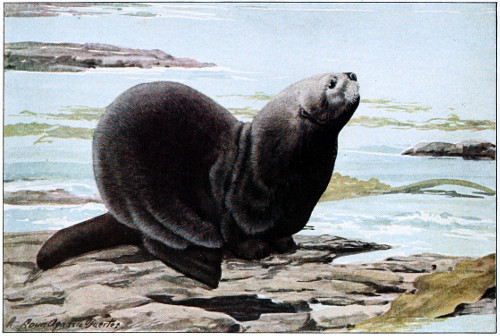
SEA OTTER
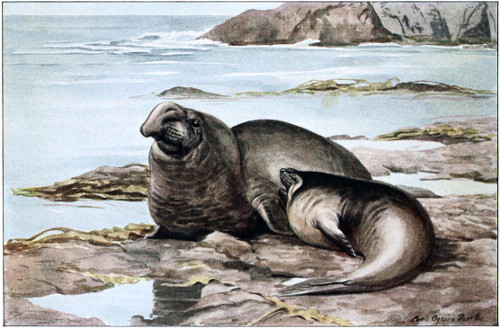
NORTHERN SEA-ELEPHANT, OR ELEPHANT SEAL
From all accounts it is evident that originally there were millions of these animals in the North Atlantic and Arctic Oceans. Their gregarious habits made them an easy prey, and the value of their skins and blubber formed the basis for a great industry. Hundreds of vessels were sent out from north European and American ports and nearly 1,000,000 harp seals were killed during each breeding season. This tremendous slaughter and its attendant waste has resulted in the disappearance of these seals from many of their former haunts and has alarmingly reduced their numbers everywhere. Some are still killed off the coast of Newfoundland, but the sealing industry, now insignificant as compared with its former estate, is practically dead.
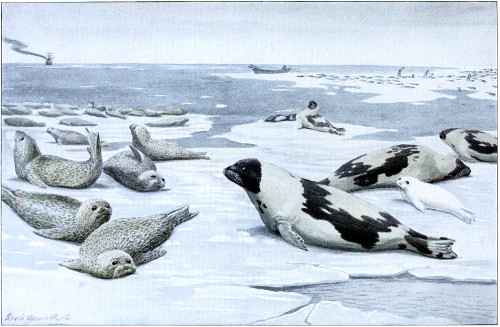
HARBOR SEAL, OR LEOPARD SEAL HARP SEAL, SADDLE-BACK, OR GREENLAND SEAL
The hunting of harp and other seals on the pack ice is an occupation calling for such splendid qualities of virile hardihood in the face of constant danger to life that its brutality has been little considered. In this perilous work great numbers of hunters have been cast away and frozen miserably on the drifting ice and many a sealing ship has been lost with all hands.
Off Newfoundland the young harp seal is born early in March, wearing a woolly white coat. At first it is tenderly cared for by its mother, but before the end of April it has learned to swim and is left to care for itself. The young do not enter the water until they are nearly two weeks old and require several days of practice before they learn to swim well. The adults are notable for their swiftness in the water. In the tremendous herds of these seals the continual cries uttered by old and young is said to produce a steady roar which may be heard for several miles. Their food is mainly fish. Man is their worst enemy, but they are also preyed upon by sharks and killer whales.
RIBBON SEAL (Phoca fasciata) (see polar bear group, page 438)
The broad-banded markings of the male ribbon seal render it the handsomest and most strongly characterized of the group of hair seals to which it belongs. Its size is about that of the harbor seal. Its range extends from the Aleutian Islands, on the coast of Alaska, and from the Kuriles, on the Asiatic shore of the Pacific, north to Bering Straits.
This seal is so scarce and its home is in such remote and little-frequented waters that its habits are almost unknown. Apparently it is even less gregarious than the harbor seal and usually occurs singly, although a few may be seen together, where individuals chance to meet. There are records of its capture at various places along the Asiatic coast, especially about Kamchatka and the shores of Okhotsk Sea. In Alaska it is a scarce visitant to the Aleutian Islands and appears to be most common on the coast south of the Yukon Delta and from Cape Nome to Bering Straits.
The few individuals taken by the Alaskan Eskimos are captured while they are hunting other seals on the pack ice in winter, and while at sea in kyaks in spring and fall. Owing to its attractive markings, the skin of the male ribbon seal is greatly prized by the Eskimos, as it was formerly by the fur traders, for use as clothes-bags. The skin is removed entire and then tanned, the only opening left being a long slit in the abdomen, which is provided with eyelet holes and a lacing string, thus making a convenient water-proof bag to use in boat or dog-sledge trips.
The scarcity of the ribbon seal and its solitary habits will serve to safeguard it from the destructive pursuit which endangers the existence of some of its relatives.
POLAR BEAR (Thalarctos maritimus)
Both summer and winter the great ice bear of the frozen north is appropriately clothed in white. It is also distinguished from all other bears by its long neck, slender pointed head, and the quantity of fur on the soles of its feet. It is a circumpolar species, the limits of whose range nearly everywhere coincide with the southern border of the pack ice. The great majority live permanently on the ice, often hundreds of miles from the nearest land.
During summer the polar bear rarely visits shore, but in winter commonly extends its wanderings to the Arctic islands and the bordering mainland coasts. In winter it ranges southward with the extension of the ice pack. In spring, by an unexpectedly sudden retreat of the ice, individual bears are often left south of their usual summer haunts, sometimes being found swimming in the open sea far off the coast of Labrador. Occasionally some of those which migrate southward with the ice through Bering Straits fail to turn north early enough and are stranded on islands in Bering Sea.
That a carnivore requiring so much food as the polar bear can maintain itself on the frozen polar sea is one of the marvels of adaptation to environment. The activity of these bears through the long black night of the far north is proved by records of Arctic explorers, whose caches have been destroyed and ships visited by them during that season. In this period of privation they range far over land and ice in search of food, and when in desperate need do not hesitate to attack men. I have seen several Eskimos who had been seriously injured in such encounters, and learned of other instances along the Arctic coast of Alaska in which hunters had been killed on the sea ice in winter. During the summer season of plenty, polar bears are mild and inoffensive, so far as men are concerned. At that time they wander over the pack ice, swimming in open leads, and, when hungry, killing a seal or young walrus.
When spring opens, many polar bears are near the Arctic coast. At that time the natives along the northeast coast of Siberia kill many of them on the ice with dogs and short-hafted, long-bladed lances. The dogs bring the bear to bay, and the hunter, watching his opportunity, runs in and thrusts the lance through its heart.
During the cruise of the Corwin we saw many of these bears on the broken ice off Herald and Wrangel Islands. One large old male climbed to the top of an uptilted ice-pan and, after looking about, lay down on one side and, giving a push with one hind foot, slid down head foremost 30 or 40 feet, striking the water with a great splash. He then climbed out and walked sedately away.
Another bear saw a seal basking on the ice by a large patch of open water and, swimming across, suddenly raised himself half out of the water to the edge of the ice, and by a blow of his paw crushed the seal’s skull. He then climbed out and made a feast within 500 yards of where the Corwin was anchored to the ice pack.
Once while we were anchored in a dense fog several miles off the pack a bear came swimming out to us, stopping every now and then to raise its head high out of water to sniff the attractive odors from the ship. Although strong and tireless swimmers, these bears lack the necessary speed to capture their prey in the water.
The female retires in winter to a snug den among the hummocks on the sea ice, where one or two naked cubs are born, which by the time the ice begins to break up are ready to follow the mother. Until the cubs are well grown the mother cares for and defends them with the most reckless disregard for her own safety. On one occasion I saw a wounded mother bear shield her cub, twice the size of a Newfoundland dog, when bullets began to strike the water about them, by swimming straight away with the cub safely sheltered between her forelegs.
The inaccessible character of so large a part of the home of the polar bear will long preserve it from the extermination that is overtaking some of the land bears.
BLACK BEAR (Ursus americanus and its subspecies)
Numerous species of black bears varying in size occur in North and South America and in Asia. In North America a black bear, remarkably uniform in general appearance, but representing various geographic races and possibly species, is generally distributed throughout the forested areas from the borders of the Arctic barrens, at the northern limit of trees, south throughout the United States and down the wooded Sierra Madre to Jalisco, Mexico, and from Newfoundland on the east to Queen Charlotte Island on the west.
These bears are usually entirely black except for a brown patch covering the muzzle and an occasional white spot on the breast. Their weight is variable, the largest ones exceeding 500 pounds, but they average much less.
The cinnamon bear, so common in the West and Northwest, long supposed to be a distinct species, has proved to be merely a color phase of the black bear—cinnamon cubs being born in the same litters with black ones.
Since the days of primitive man and the great cave bear, the ways of bears have had a fearsome interest to mankind. Childhood revels in the delicious thrills of bear stories and dwells with wonder on the habit bears have of standing upright like droll caricatures of man, on the manlike tracks of their hind feet, and on their fondness for sweets and other palatable food.
From the landing of the first colonists on our shores, hunters and settlers have encountered black bears so frequently that these are among the best-known large forest animals of the continent. During winter they hibernate for months, seeking a hollow tree, a low cave, the half shelter of fallen tree trunks and brush, or else digging a den for themselves. The female chooses a specially snug den, where in midwinter from one to four cubs are born. At birth the young, only 8 or 9 inches long, are practically naked and have their eyes closed. They are so undeveloped at this time that it is more than a month before their eyes open and more than two months before they can follow their mother.
Although powerful beasts, black bears are so shy and timid that to approach them requires the greatest skill on the part of a still hunter. They only attack people when wounded or so cornered that they must defend themselves or their young. To safeguard themselves from danger they rely mainly on a fine sense of hearing and an exquisite delicacy of smell. They have poor eyesight, and where a suspicious object is seen, but no sound or scent can be noted, they sometimes rise on their hind feet and look long and carefully before retreating.
To bears in the forest everything is game. They often spend the entire day turning over stones to lick up the ants and other insects sheltered there, and at night may visit settlers’ cabins and carry off pigs. They raid the settlers’ cornfields for green corn and are passionately fond of honey, robbing bee trees whenever possible. In season they delight in wild cherries, blueberries, and other fruits, as well as beechnuts, acorns, and pinyon nuts. They are mainly nocturnal, but in districts where not much disturbed wander widely by day.
The success of black bears in caring for themselves is well demonstrated by the numbers which still survive in the woods of Maine, New York, and other long-settled States. Their harmlessness and their exceeding interest to all render them worthy of careful protection. They should be classed as game and thoroughly protected as such except for certain open seasons. If this is done throughout the country, as is now the case in certain States, the survival of one of our most characteristic large wild animals will be assured.
GLACIER BEAR (Ursus emmonsi)
When first discovered the glacier bear was supposed to be a distinct and well-marked species. Recently cubs representing the glacier bear and the typical black bear have been found in the same litter, thus proving it to be merely a color phase of the black bear. Its color varies exceedingly, from a light smoky, almost bluish, gray to a dark iron gray, becoming almost black. Some individuals are extraordinary appearing beasts, quite unlike any other bear. The interest in this curious color development is increased by its restricted distribution.
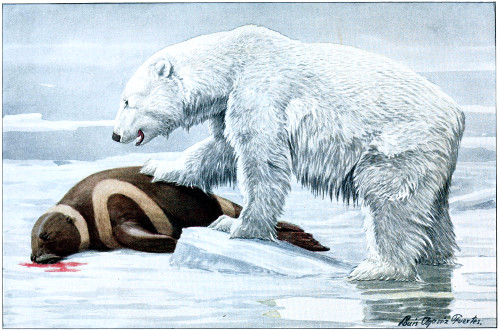
RIBBON SEAL POLAR BEAR
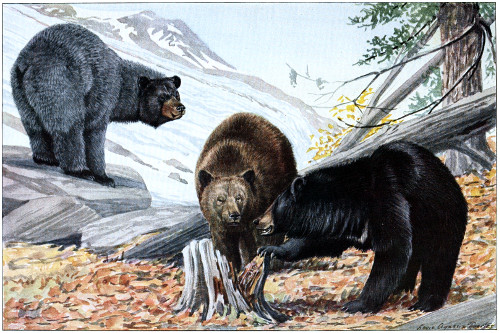
GLACIER BEAR CINNAMON BEAR BLACK BEAR
The cinnamon bear is merely a color phase of the black bear.
The glacier bear is an Alaskan animal, which occupies the seaward front of the Mount St. Elias Range, about Yakutat Bay, and thence southeast to Glacier Bay and a short distance beyond toward the interior. The popular name of this bear was well chosen, as its home is in the midst of innumerable stupendous glaciers. Here, where the contours of gigantic mountain ranges are being steadily remade by glaciers, Nature appears to have begun the evolution of a new kind of bear. That the task is in progress is evidenced by the excessive variation in color, scarcely two individuals being the same.
The food of this bear consists largely of mice, ground squirrels, and marmots, which it digs from their burrows on the high mountain slopes. Its food is varied by salmon during the spawning season and by various herbs and berries during the summer. The winters in the home of the glacier bear are less severe than across the range in the interior, but are so long and stormy that the bear must spend more than six months each year in hibernation.
Owing to the remote and little-frequented region occupied by this bear, little is known of its life history. For this reason it is important that all sportsmen visiting its country bring back careful and detailed records of their observations. Up to the present time so few white men have killed glacier bears that a skin of one taken by fair stalking is a highly prized trophy. As the glacier bear country becomes more accessible, more stringent protection will be needed to prevent the extermination of these unique animals.
GRIZZLY BEAR (Ursus horribilis and its relatives)
Recent research has shown that the popular terms grizzly or silver-tip cover a group containing numerous species of large bears peculiar to North America, some of which, especially in California, have become extinct within the last 25 years. These bears vary much in size, some about equaling the black bear and others attaining a weight of more than 1,000 pounds. They vary in color from pale dull buffy to nearly black, usually with lighter tips to the hairs, which produce the characteristic grizzled or silver-tipped appearance upon which the common names are based.
The strongest and most distinctive external character of the grizzlies is the long, proportionately slender, and slightly curved claws on the front feet, sometimes more than 3 inches long.
Grizzly bears have a wide range—from the Arctic coast of Alaska southward, in a belt extending from the Rocky Mountains to the Pacific, through western Canada and the United States, and thence along the Sierra Madre of Mexico to southern Durango. They also occupy the barren grounds of northern Canada, and vague reports of a large brown bear in the interior of the Peninsula of Labrador indicate the possibility of the existence there of an unknown species of grizzly.
From the days of the earliest explorers of the Rocky Mountain region grizzly bears have borne the undisputed title of America’s fiercest and most dangerous big game. In early days, having little fear of the primitive weapons of the Indians, they were bold and indifferent to the presence of man, and no higher badge of supreme courage and prowess could be gained by a warrior than a necklace of grizzly claws.
Since the advent of white men with guns, conditions have changed so adversely to the grizzlies that they have become extremely shy, and the slightest unusual noise or other alarm causes them to dash away at a lumbering, but surprisingly rapid, gallop. The deadly modern gun has produced this instinctive reaction for self-preservation. It does not mean, however, that grizzlies have lost their claim to the respect of even the best of hunters. They are still considered dangerous, and even in recent years experienced hunters have been killed or severely mauled by them. They are much more intelligent than the black bear, and thus, when wounded, are a more dangerous foe.
Like the black bear, the grizzlies are commonly nocturnal, but in remote districts often wander about in search of food by day. They roll over stones and tear open rotten wood in search of grubs and insects. They also dig out ground squirrels and other rodents and eat a variety of acorns and other wild nuts and fruits. As an offset to this lowly diet, many powerful old grizzlies, from the Rocky Mountains to California, have become notorious cattle-killers. They stalk cattle at night, and, seizing their prey by the head, usually break its neck, but sometimes hold and kill it by biting. These cattle-killing grizzlies still occur on the Western ranges. One or more wily marauders of this kind have run for years with a bounty of $1,000 on their heads.
Like other bears, grizzlies hibernate in winter, seeking small caves, or other shelter, and sometimes digging a den in the ground. The young, from one to four in number, are born in midwinter and are very small, naked, and but partly developed at birth. They go about with the mother throughout the summer and commonly den up with her the following winter. Although full-grown grizzlies are ordinarily solitary in habits, parties of from four to eight are sometimes seen. The object of these curious but probably brief companion-ships is not known.
Grizzlies are disappearing so rapidly that it is very desirable that they be placed on the list of game protected during part of the year, except in the case of the few individuals which become stock-killers. They are among the finest of native animals and their absence from the rugged slopes of the western mountains would leave a serious gap in our wild life.
ALASKAN BROWN BEAR (Ursus gyas and its relatives)
(See frontispiece of this Magazine for the illustration of this remarkable animal)
The Alaskan brown bears form a group of gigantic animals peculiar to North America and limited to the coast and islands of Alaska, from the head of Norton Sound to the Sitka Islands. The group includes a number of species, individuals of two of which, Ursus gyas, of the Alaska Peninsula, and Ursus middendorffi, of Kodiak Island, sometimes attain a weight of 1,500 pounds or more, and are not only the largest existing bears, but are the largest living carnivores in the world. They can be likened only to the great cave bears, which were the haunting terror of primitive mankind during the “Old Stone Age” in Europe. Brown bears still exist in Europe and Asia, but they form a distinct group of much smaller animals than the American species.
The Alaskan brown bears vary much in color, from a dull golden yellowish to a dusky brown, becoming almost black in some species. In color some of the darker species are indistinguishable from the great grizzlies, with which in places they share their range; but the relatively shorter, thicker, and more strongly curved claws on the front feet of the brown bears are distinctive.
As a rule they are inoffensive giants and take flight at the first sign of man. The taint left by a man’s recent track or the faintest odor on the passing breeze, indicating the proximity of their dreaded enemy, is enough to start the largest of them in instant flight. Instances are reported of their having attacked people wantonly, but such cases are extremely rare. When wounded or suddenly surprised at close quarters, the instinct of self-defense not infrequently incites them to attack their enemy with furious energy. Many Indian and white hunters have been killed or terribly mauled by them in such encounters. At close quarters their great size, strength, and activity—astonishing for such apparently clumsy beasts—render them terrific antagonists.
Some of the species occupy open, rolling, or hilly tundras, and others live on the steepest and most rugged mountain slopes amid glaciers, rock slides, and perpetual snow-banks. On the approach of winter all retreat to dry locations, usually in the hills, where they dig dens in the earth or seek other cover to which they retire to hibernate, and here the young, usually two or three in number, are born. They usually emerge from hibernation in April or early May and wander about over the snow-covered hills and mountains. At this time their dark forms and their great tracks in the snow are so conspicuous that hunters have little difficulty in finding them.
Despite their size, brown bears devote much of their time to hunting such game as mice, ground squirrels, and marmots, which they dig from their burrows with extraordinary rapidity. During the salmon season, when the streams swarm with fish, bears frequent the lowlands and make trails along the watercourses, where they feed fat on this easy prey. During the summer and fall these great carnivores have the strange habit of grazing like cattle on the heavy grasslike growth of sedge in the lowland flats and benches, and also of eating many other plants.
Although Alaska was long occupied by the Russians and has been a part of our territory since 1867, not until 1898 was there any definite public knowledge concerning the existence of these bears, notwithstanding their size and abundance. Since that time they have become well known to sportsmen and others as one of the wonders of the remarkable region they occupy. Their comparatively limited and easily accessible territory renders their future precarious unless proper measures for their reasonable protection are continued. They are certain to be exterminated near settlements; but there are ample wild and inhospitable areas where they may range in all their original freedom for centuries to come, provided man permits.
AMERICAN BEAVER (Castor canadensis and its subspecies)
When North America was first colonized, beavers existed in great numbers from coast to coast, in almost every locality where trees and bushes bordered streams and lakes, from near the Yukon Delta, in Alaska, and the Mackenzie Delta, on the Arctic coast, south to the mouths of the Colorado and the Rio Grande. Although now exterminated from most of their former range in the eastern United States, they still occur in diminished numbers over nearly all the remainder of their original territory, even in the lower Rio Grande and the delta of the Colorado. Their vertical distribution extends from sea-level to above an altitude of 9,000 feet.
Beavers are heavily built, round-bodied animals, with powerful chisel-shaped front teeth, short legs, fully webbed hind feet, and a flat, scaly tail. They are covered with long, coarse hairs overlying the short, dense, and silky underfur to which beaver skins owe their value. Their range covers the northern forested parts of both Old and New Worlds. The American species closely resembles in general appearance its Old World relative, but is distinctly larger, averaging 30 to 40 pounds in weight, but sometimes attaining a weight of more than 60 pounds. Owing to the different physical conditions in its wide range, the American animal has developed a number of geographic races.
Beavers mate permanently and have from two to five young each year. Their abundance and the high value of their fur exercised an unparalleled influence on the early exploration and development of North America. Beaver skins were the one ready product of the New World which the merchants of Europe were eager to purchase. As a consequence competition in the trade for these skins was the source of strong and bitter antagonisms between individuals and companies, and even caused jealous rivalries among the Dutch, English, and French colonies.
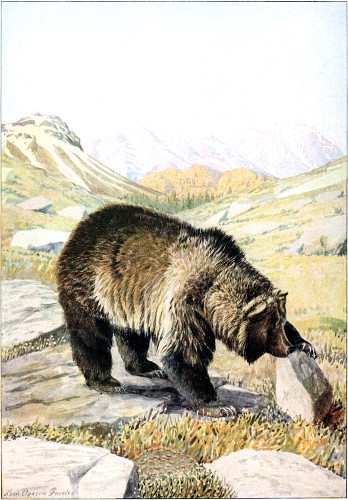
GRIZZLY BEAR
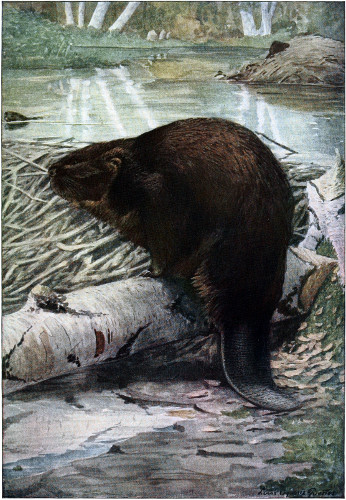
AMERICAN BEAVER
Disputes over the right to trade in certain districts often led to bloodshed, and even to long wars, over great areas, where powerful rival companies fought for the control of a new empire. This eager competition among daring adventurers resulted in the constant extension of trading posts through the North and West, until the vanguard of civilization reached the far borders of the continent on the shores of the Arctic and Pacific Oceans.
Among the fur traders the beaver skin became the unit of value by which barter was conducted for all sorts of commodities. This usage extended even throughout northern Alaska, where it was current among the American fur traders until the discovery of gold there upset old standards.
Beavers belong to the rodent family—a group of animals notable for their weak mental powers. The beaver is the striking exception to the rule, and its extraordinary intelligence, industry, and skill have long excited admiration. It is scarcely entitled to the almost superhuman intelligence many endow it with, yet it certainly possesses surprising ability along certain lines. Furthermore, it can alter its habits promptly when a change in environment renders this advantageous.
In wild places, where rarely disturbed, beavers are unsuspicious, but where they are much trapped they become amazingly alert and can be taken only by the most skillful trapping. They are very proficient in building narrow dams of sticks, mud, and small stones across small streams for the purpose of backing up water and making “beaver ponds.” In the border of these ponds a conical lodge is usually constructed of sticks and mud. It is several feet high and about 8 or 10 feet across at the base.
The entrance is usually under water, and a passageway leads to an interior chamber large enough to accommodate the pair and their well-grown young. From the ponds the animals sometimes dig narrow canals several hundred feet long back through the flats among the trees. Having short legs and heavy bodies, and consequently being awkward on land, beavers save themselves much labor by constructing canals for transporting the sticks and branches needed for food and for repairing their houses and dams.
Along the Colorado, lower Rio Grande, and other streams with high banks and variable water level, beavers usually dig tunnels leading from an entrance well under water to a snug chamber in the bank above water level. Under the varying conditions in different areas they make homes showing every degree of intergradation between the two types described.
Beavers live almost entirely on twigs and bark, and their gnawing powers are surprising. Where small trees less than a foot in diameter abound they are usually chosen, but the animals do not hesitate to attack large trees. On the headwaters of the San Francisco River, in western New Mexico. I saw a cottonwood nearly 30 inches in diameter that had been felled so skillfully that it had fallen with the top in the middle of a small beaver pond, thus assuring an abundance of food for the animals at their very door.
In the cold northern parts of their range, where streams and ponds remain frozen for months at a time, beavers gather freshly cut green twigs, sticks, and poles, which they weight down with mud and stones on the bottoms of ponds or streams near their houses, to be used for food during the shut-in period.
The mud used by beavers in building dams and houses is scooped up and carried against the breast, the front feet being used like hands. The flat tail serves as a rudder when the animal is swimming or diving, and to strike the surface of the water a resounding slap as a danger signal.
Beavers are usually nocturnal, but in districts where not disturbed they sometimes come out to work by day, especially late in the afternoon. Among the myriads of small streams and lakes in the great forested area north of Quebec they are very plentiful; their dams and houses are everywhere, sometimes four or five houses about one small lake. Their well-worn trails lead through the woods near the lake shores and frequently cross portages between lakes several hundred yards apart.
Where beavers continue to occupy streams in settled districts, they often make regular trails from a slide on the river bank back to neighboring cornfields, where they feast on the succulent stalks and green ears. They also injure orchards planted near their haunts, by girdling or felling the trees. Within recent years laws for their protection have been passed in many States, and beavers have been reintroduced in a number of localities. They should not be colonized in streams flowing through lands used for orchards or cornfields, nor where the available trees are too few to afford a continuous food supply.
FISHER, OR PEKAN (Mustela pennanti)
The fisher is one of the largest and handsomest members of the weasel family. Like others of this group, it is a long-bodied, short-legged animal. It attains an extreme length of from 3 to 3½ feet and a weight of 18 or 20 pounds, but the average is decidedly lower than these figures. In general, it is like a gigantic marten, and from its size and dark color is sometimes known locally as the “black cat” or “black fox.”
It lives in the forested parts of Canada and the United States, where it originally occurred from the southern shores of Hudson Bay and Great Slave Lake south throughout most of eastern Canada and New England and along the Alleghanies to Tennessee; also in the Great Lakes region, south to the southern end of Lake Michigan; along the Rocky Mountains to Wyoming, down the Cascades to northern California, and from the Atlantic coast of Nova Scotia and Maine to the Pacific coast of southeastern Alaska and British Columbia. They still occur regularly in the Adirondacks of New York and the Green Mountains of Vermont and in Maine, but are gone from most of the southern border of their former range.
Fishers are powerful and agile animals, probably for their size by far the swiftest and most deadly of all our forest carnivores. So swift and dextrous are they in the tree-tops that they not only capture squirrels without difficulty, but are able to overtake and kill the marten, almost an incredible feat. When in pursuit of their prey or when alarmed, they make astonishing leaps from tree to tree. While not so speedy on the ground as some other animals, they have the tireless persistence of their kind and capture snowshoe hares in fair chase.
Among the habitants of the forest the fisher is a fearless and savage marauder, which feeds on frogs, fish, and nearly every bird and mammal its domain affords, except species so large that their size protects them. Porcupines are among its favorite victims and are killed by being turned over and attacked on their underparts. As a consequence of such captures, the fisher often has many quills imbedded in its head and the foreparts of its body.
The fisher, like many other predatory animals, has more or less regular “beats” along which they make their rounds over the territory each occupies. These rounds commonly require several days to accomplish. In winter they keep mainly along wooded ridges, where they are trapped.
It follows trap lines like the wolverine and eats the bait or the captured animal, but, unlike the wolverine, appears to have no propensity for further mischief. When overtaken by dogs or when at war with any of its forest rivals, it is so active and ferocious that it is worthy all due respect from antagonists several times its size.
Although essentially a tree animal, much of the fisher’s time is spent on the ground. In summer it appears to be fond of heavy forests in low-lying situations and the vicinity of water. Its dens are usually located in a hollow high up in a large tree, but sometimes in the shelter of fallen tree trunks or crevices in the rocks, where, the last of April or early in May, the young are born. These may number from one to five, but are usually two or three. The young begin to follow the mother in her wanderings when quite small and do not leave her guardianship until nearly grown.
The fisher is not a common animal and only about 8,000 of its skins are marketed each year. Owing to its size, it is conspicuous, and its very fearlessness tends to jeopardize its existence. It is gone from most of the southern part of its former range and will no doubt continue steadily to lose ground with the increasing occupation of its haunts.
OTTER (Lutra canadensis and its relatives)
Land otters are common throughout a large part of the Old World, and when America was explored the animals were found generally distributed, and sometimes common, from the northern limit of trees in North America to southern South America. Within this great area a considerable number of species and geographic races of otters occur, all having a close general resemblance in appearance and habits.
The Canadian otter is the well-known type throughout the United States, Canada, and Alaska. It is a slender, dusky brown animal, from 4 to 5 feet in length, frequenting streams and lakes which contain a good supply of fish. Otters are too short-legged to move easily on land, but are remarkable for their admirable grace, agility, and swiftness in the water. Although so poorly adapted to land travel, they are restless animals, constantly moving up and down the streams in which they live and often crossing from one stream to another. In the far north in midwinter they travel surprising distances across snow-clad country, following the banks of streams or passing between them searching for an entrance to water, whether through the ice or in open rapids.
In Alaska I saw many otter trails in the snow crossing the Yukon and through the adjacent forest. In such journeys it was evident that the animals progressed by a series of long bounds, each leaving a well-marked, full-length impression in the snow, so characteristic that it could not be mistaken. These trails, often leading for miles across country, always excited my deepest interest and wonder as to how these animals could succeed in finding holes through the ice in this vast snow-bound waste. Nevertheless they seemed to know full well, for the trails always appeared to be leading straight away for some known objective.
Although never very abundant, otters are so shy and solitary in their habits that they have managed to retain almost all of their original range. They occur now and then in the Potomac, near Washington, and in other rivers throughout the country, where their tracks may occasionally be detected on sand-bars and in the muddy shallows along the banks. A sight of the animals themselves is rare. Their dens are usually in the banks of streams or lakes above or below the surface of the water, under the roots of large trees, or beneath rocky ledges.
Otters are extremely playful and amuse themselves by sliding down steep banks into the water, repeatedly using the same place until a smooth chute or “slide” is defined. They usually have two to five young, which remain with the mother until nearly grown.
While close relatives of the weasel, they are much more intelligent, have a gentler disposition, and make playful and most interesting pets. Their fur is highly prized and always brings a good price in the market. As a result, they have been persistently hunted and trapped since our pioneer days. That the species should continue to exist, though in much diminished numbers, throughout most of its original range is a striking evidence of its retiring habits and mental acuteness.
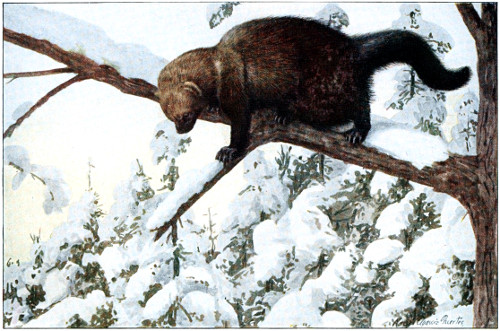
FISHER, OR PEKAN
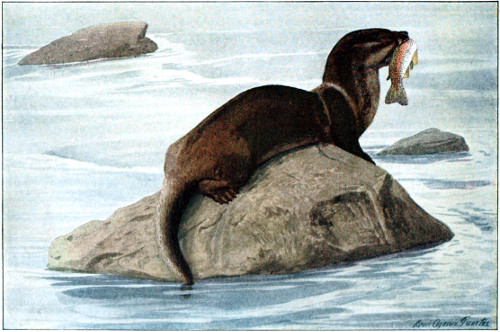
OTTER
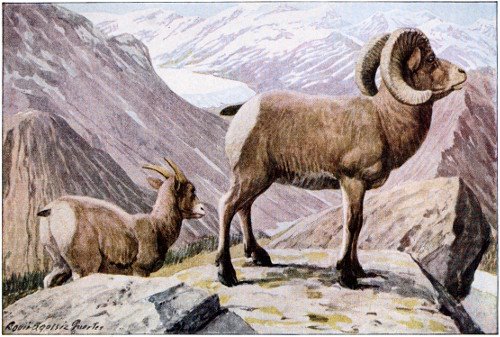
ROCKY MOUNTAIN SHEEP
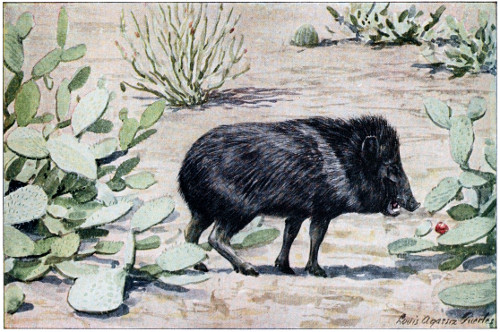
COLLARED PECCARY, OR MUSKHOG]
COLLARED PECCARY, OR MUSKHOG (Pecari angulatus)
The numerous and extraordinarily varied species of wild pigs of the Old World are represented in America by the peccaries, a specialized group containing two species of small pigs peculiar to North and South America. One of the many differences between them and their Old World relatives is their having but two young. The name muskhog, applied to them, is based on their possession of a large gland, located high up on the middle of the rump, which emits a powerful odor. The musky odor from this quickly permeates the flesh of a peccary unless it is cut out as soon as the animal is killed.
The collared peccary is the smaller of the two species, usually weighing less than 75 pounds. It ranges from the southwestern United States south to Patagonia. Within this range numerous geographic races have developed, varying from light grizzled gray to nearly black. It formerly occurred within our border north to the Red River of Arkansas, but is now limited to the southern half of Texas and the southern parts of New Mexico and Arizona.
In tropical America collared peccaries are found in dense forests or in low jungles, but in northern Mexico and the southwestern United States they are equally at home among scattered thickets of cactus and other thorny plants on plains and in the foothills. They are strictly gregarious and live in bands of from a few individuals up to thirty or more, usually led by the oldest and most powerful boar. They are omnivorous, feeding on everything edible, from roots, fruits, nuts, and other vegetable products to reptiles and any other available animals. They are specially numerous in many tropical forests where wild figs, nut palms, and other fruit-bearing trees provide abundant food. In the arid northern part of their range dense thickets of cactus and mesquite afford both food and shelter. Their presence in a locality is often indicated by the rooted-up soil where they have been feeding.
Young peccaries become very tame and make most intelligent and amusing pets. One moonlight night on the coast of Guerrero two of us, after a bath in the sea by a small Indian village, strolled along the hard white sand to enjoy the cool breeze. Suddenly a little peccary, not weighing over eight or ten pounds, came running to meet us and, after stopping at our feet to have its head scratched, suddenly circled about us, away and back again in whirling zigzags, with all the joyous frenzy of a playful puppy. Continuing this performance, it accompanied us for several hundred yards, until we returned to the village.
Tales of the ferocity of bands of the collared peccaries and of their treeing hunters who have disturbed them read well to the novice, but have little foundation in fact. In reality the animals are shy and retiring and fight only when forced to do so for self-protection. When brought to bay by dogs or other animals, they fight viciously, and with their sharp, knife-edged tusks can inflict serious wounds. Their natural enemies are mainly the jaguar in the south and bobcats and coyotes, which prey upon their young, in the north.
The increasing occupation of our Southwest has already resulted in the extermination of peccaries from most of their former range within our border, and unless active steps are taken to protect the survivors their days will be few in the land. They are such unique and harmless animals that it is hoped interest in their behalf may be awakened in time to retain them as a part of our wild life.
ROCKY MOUNTAIN SHEEP (Ovis canadensis and its relatives)
Wild sheep inhabit mountain ranges in both Old and New Worlds. Northern Africa and southern Europe have representative species, but Asia appears to be the true home of the group. There the greatest variety of species is found, including such giants as Ovis poli.
In the New World they occur only in North America, where there are two or three species, with numerous geographic races. Among these the sheep inhabiting the main Rocky Mountain region is best known. It is a heavier animal than its northern relatives of the Stikine country and Alaska, with larger and more massively proportioned horns. It occupies the main range from south of Peace River and Lake Babine, in British Columbia, to Colorado, and possibly northern New Mexico. Closely related geographic races occur elsewhere in the mountains of the western United States and northern Mexico.
The usual conception of wild sheep as habitants of the cold, clear upper world at timberline and above is justified in the case of the Rocky Mountain sheep. In early spring its one or two young are born amid these rugged elevations, where it remains until the heavy winter snows drive it down, sometimes through the open timber to the foothills. That wild sheep thrive equally well under very different conditions, however, is shown by their abundance on the treeless mountains of our southwestern deserts, among cactuses, yuccas, and other thorny vegetation, where water is extremely scarce and summer temperatures rise high above 100° Fahrenheit in the shade.
The Rocky Mountain sheep, like other species, appears to feed on nearly every plant growing within its domain. In spring many lambs are killed by bald and golden eagles, and in winter, when driven down to lower levels by snow, it becomes easy prey for mountain lions, wolves, and coyotes. Owing to continuous hunting, this sheep has disappeared from many of its former haunts and is decreasing in most of its range. When effective protection is undertaken in time, however, as in Colorado, the range is readily restocked.
The sure-footedness with which a band of these sheep will dash in full flight up or down seemingly impossible slopes, where a misstep would mean death, is amazing. Even the old rams, with massive sets of horns, bound from point to point up a steep rock slope with marvelous grace and agility. Mountain sheep living among the rugged summits of high ranges possess the courage and prowess of skillful mountaineers, so admired by all, and the mere sight of one of these animals in its native haunts is an adventure achieved by few.
No other big-game animal carries with it the romantic glamour which surrounds this habitant of the cold, clear upper world. Big-game hunters prize above all others their mountain-sheep trophies, which form vivid reminders of glorious days amid the most inspiring surroundings and evidence their supreme prowess in the chase.
STONE MOUNTAIN SHEEP (Ovis stonei)
Owing to its dark, iron gray color, Ovis stonei is often called the “black” mountain sheep. Despite its dark color, the Stone sheep is probably a geographic race of the pure white Dall sheep of Alaska. It has the same slender, gracefully coiled horns, frequently amber colored and extended in a widely spread spiral.
Its range lies in northern British Columbia, especially about the upper Stikine River and its tributaries; thence it extends easterly to Laurier Pass in the Rocky Mountains, north of Peace River, and south perhaps to Babine Lake. Unfortunately it appears to have become extinct in the southern border of its range, so that its real relationship with the Rocky Mountain sheep farther south may never be determined.
The sheep occupying the mountains between the home of typical stonei and that of dalli in northwestern British Columbia and southeastern Yukon Territory are characterized by having white heads, with bodies of a varying shade of iron gray, thus showing evident intergradation on a great scale between the white northern sheep and the “black” sheep of the Stikine. These intermediate animals have been called the Fannin, or saddle-backed, sheep (Ovis fannini). Hunters report a considerable mingling of entirely white animals among flocks of these intergrading animals, and occasionally white individuals are seen even in flocks of the typical dark sheep of the Stikine country.
Like the white Alaskan sheep, the Stone sheep exists in great abundance in many parts of its range, especially east of Dease Lake. It usually ranges in flocks, those made up of ewes and young rams often containing a considerable number. The old bucks, except in fall, keep by themselves in smaller bands in separate parts of the range. The Stone sheep lives in one of the most notable big-game fields of the continent. Its home above timberline is shared with the mountain goat and in the lower open slopes with the caribou, while within the adjacent forests wander the moose and two or more species of bear.
Owing to its frequenting remote and sparsely inhabited country, it continues to exist in large numbers; but if its range becomes more accessible, only the most stringent protection can save this splendid animal from the extermination already accomplished on the southern border of its range.
DALL MOUNTAIN SHEEP (Ovis dalli)
The only variation in the pure white coat of the Dall sheep is a mixture of a few black hairs on the rump, sometimes becoming plentiful enough to form a blackish spot on the tail and a light brownish stain over the entire body, due to the slight discoloration at the tips of the hairs from contact with the earth in their bedding-down places. Their horns are usually dull amber yellow and are notable for their slender proportions and the grace of their sweeping coils, which sometimes curve close to the head and again spread in a wide, open spiral.
As their white coats indicate, the Dall sheep are the northernmost of their kind in America. Their home lies mainly in Alaska, where they were formerly abundant in many mountain ranges, from those bordering the Arctic coast south through the interior to the cliffs on Kenai Peninsula, but are now scarce or gone from some mountains. To the eastward they are numerous across the border in much of Yukon territory, nearly to the Mackenzie River. Their haunts lie amid a wilderness of peaks and ridges, marked in summer with scattered glaciers and banks of perpetual snow and in winter exposed to all the rigors of a severe Arctic climate. They are extraordinarily numerous in some districts, as among the outlying ranges about the base of Mount McKinley.
In their high, bleak homes these sheep have little to fear from natural enemies, although the great Canada lynx, the wolf, the wolverine, and the golden eagle, as overlords of the range, take occasional toll from their numbers. Their one devastating enemy is man, with his modern high-power rifle. Even so long ago as the summer of 1881, I saw hundreds of their skins among the Eskimos at Point Barrow, taken that spring with the use of Winchester rifles among the mountains lying inland from the Arctic coast. Of late years the advent of miners and the establishment of mining camps and towns have greatly increased the demand for meat, and this has resulted in the killing of thousands of these sheep. Large numbers of these splendid animals have also been killed to serve as winter dog food.
The advent of thousands of men engaged in the construction of the government railroad which, when completed, will pass through the Mount McKinley region, makes imminent the danger of extermination that threatens the mountain sheep, as well as the moose and caribou, in a great area of the finest big-game country left under our control.
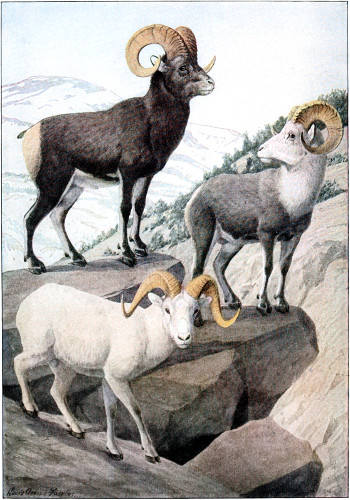
STONE’S, FANNIN’S, AND DALL’S MOUNTAIN SHEEP
Properly conserved, the game animals of Alaska will continue indefinitely as one of its richest resources, but heedless wastefulness may destroy them forever. All sportsmen and other lovers of wild life should interest themselves in an effort to safeguard the future of Alaskan game animals before it is too late; for, under the severe climatic conditions prevailing, the restocking of exhausted game fields in that region will be extremely difficult, if not practically impossible.
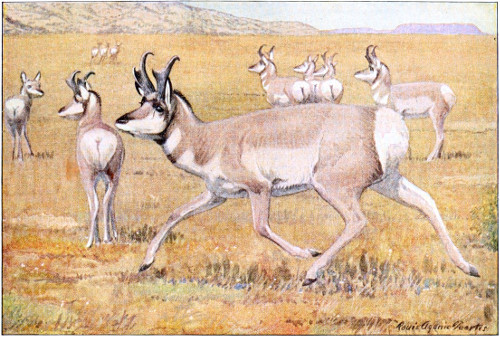
PRONG-HORN ANTELOPE
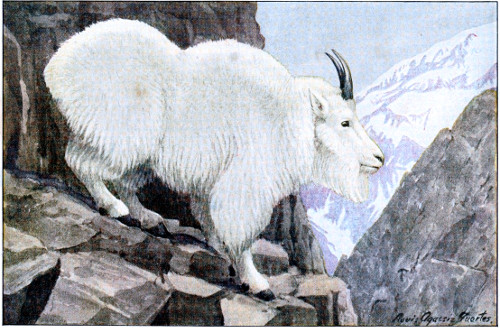
ROCKY MOUNTAIN GOAT
ROCKY MOUNTAIN GOAT (Oreamnos montanus and its subspecies)
The numerous wild goats of the Himalayas and other mountains of Asia are represented in America solely by the Rocky Mountain goat. This is one of the most characteristic, but least graceful in form and action, of our big-game animals. It is distinguished by a long ungainly head, ornamented with small black horns; a heavy body, humped at the shoulders like a buffalo, and a coat of long shaggy white hair.
The range of these habitants of the cliffs extends from the head of Cook Inlet, Alaska, easterly and southerly through the mountains to Montana and Washington. Unlike mountain sheep, the goats do not appear to dislike the fogs and saline winds from the sea, and at various points along the coast of British Columbia and Alaska they range down precipitous slopes nearly to the shore.
They are much more closely confined to rugged slopes and rocky ledges than the mountain sheep, which in winter commonly descend through the foothills to the border of the plains. Through summer and winter, goats find sufficient food in the scanty vegetation growing among the rocks, and their heavy coats of hair protect them from the fiercest winter storms.
Owing to their small horns and unpalatable flesh they are less sought after by hunters than mountain sheep, and thus continue to exist in many accessible places where otherwise they would long since have become exterminated. They are frequently visible on the high ledges of a mountain across the bay from the city of Vancouver and are not difficult to find in many other coastal localities.
Although marvelously surefooted and fearless in traversing the faces of high precipitous slopes, goats lack the springy grace and vivacity of mountain sheep and move with comparative deliberation. They are reputed to show at times a stupid obstinacy when encountered on a narrow ledge, even to the point of disputing the right of way with the hunter.
Their presence lends interest to many otherwise grim and forbidding ranges where, amid a wilderness of glacier-carved escarpments, they endure the winter gales which for days at a time roar about their cliffs and send snow banners streaming from the jagged summits overhead.
Owing to the character of their haunts, mountain goats have few natural enemies. The golden and bald eagles now and then take toll among their kids, but the lynx and mountain lion, their four-footed foes, are not known to prey upon them to any considerable extent. Through overhunting they have vanished from some of their former haunts, but still hold their own in many places, and with effective protection will long continue to occupy their peculiar place in our fauna.
PRONG-HORN ANTELOPE (Antilocapra americana and its geographic races)
Unique among the antelope of the world, among which it has no near relatives, the prong-horn, because of its beauty of coloration, its grace, and fleetness, claims the attention of sportsmen and nature lovers alike. It is a smaller and slenderer animal than the larger forms of the Virginia deer. Its hair is coarse and brittle, and the spongy skin lacks the tough fiber needed to make good buckskin. Both sexes have horns, those of the doe being smaller and slenderer. One of the extraordinary peculiarities of this antelope is its habit of shedding the horns every fall and the developing new horns over the remaining bony core.
The rump patch of the prong-horn is formed of long pure white hairs, which in moments of excitement or alarm are raised on end to form two great chrysanthemum-like white rosettes that produce an astonishingly conspicuous directive color mark. The power to raise these hairs is exercised by the fawns when only a few days old. Even when the hairs are not erected the rump patch is conspicuous as a flashing white signal to a distance of from one to two miles as the antelope gallops away. When the animal whose rump signal has been plainly visible at a distance suddenly halts and faces about to look back, as is a common custom, its general color blends with that of the background and it vanishes from sight as by magic.
Early explorers discovered antelope in great abundance over a vast territory extending from near the present location of Edmonton, Alberta, south to near the Valley of Mexico, and from central Iowa west to the Pacific coast in California. They were specially numerous on the limitless plains of the “Great American Desert,” where our pioneers found them in great bands, containing thousands, among the vast herds of buffalo. So abundant were they that it has been estimated that on the Great Plains they equaled the buffalo in numbers. Now reduced to a pitiful remnant of their former numbers, they exist only in widely scattered areas, where they are constantly decreasing. Fortunately they are strictly protected by law in most of their remaining territory.
The great herds containing thousands of antelope were usually formed late in fall and remained together throughout the winter, separating into numerous smaller parties during the summer. For years following the completion of the transcontinental railroads they were commonly seen from the car windows as trains crossed the Great Plains. At such times their bright colors and graceful evolutions, as they swept here and there in erratic flight or wheeled in curiosity to gaze at the passing train, never failed to excite the deepest interest.
In early days prong-horns were noted for their curiosity and were frequently lured within gun-shot by waving a red flag or by other devices. I have repeatedly seen them circle or race a team, or a horseman, crossing their range. In racing a horseman traveling along an open road or trail they gradually draw nearer until finally every member of the band dashes madly by only a few yards in front and then straight away across the plains in full flight.
The prong-horns appear to possess a highly nervous temperament, which requires for their welfare the wide free sweep of the open plains. They do not thrive and increase in inclosures, even in large game preserves, as do deer, elk, and buffalo. For this reason, it will require the greatest care to protect and foster these attractive members of our fauna to save them from soon being numbered among the many wild species which have been destroyed by the coming of civilized man.
WAPITI, OR AMERICAN ELK (Cervus canadensis and its relatives)
By a curious transposition of names the early settlers applied to the American wapiti the term elk, which belongs to the European representative of our moose. Our elk is a close relative of the European stag. It is the handsomest and, next to the moose, the largest member of the deer family in America. The old bulls, weighing more than 800 pounds, bear superb widely branched antlers, which give them a picturesque and noble mien. This is the only American deer which has a well-marked light rump-patch. The young, numbering from one to three, are white spotted, like the fawns of other deer.
Originally the elk was the most wide ranging of our hoofed game animals. It occupied all the continent from north of Peace River, Canada, south to southern New Mexico, and from central Massachusetts and North Carolina to the Pacific coast of California. Like the buffalo, it appeared to be equally at home in the forested region east of the Mississippi River and on the open plains flanking the Rocky Mountains. Its range also extended from sea-level to above timberline on lofty mountain ranges.
Exterminated throughout most of their original range, elk still occupy some of their early haunts in western Canada, Montana, Wyoming, Colorado, and the Pacific Coast States. The last elk was killed in Pennsylvania about 60 years ago, and in Michigan and Minnesota some 20 years later. The main body of the survivors are now in the Yellowstone Park region. Their size and the readiness with which they thrive in captivity has led to serious consideration of elk farming as an industry.
In the West, before the settlement of their range crowded the elk back, large numbers lived throughout the year on the plains and among the foothills. They have now become mountain animals, spending the spring and summer largely in the timberline forests and alpine meadows, where many bands linger until the heavy snows of early winter force them down to the foothills and valleys. During the last days of their abundance in the Rocky Mountains winter herds numbering thousands gathered in Estes Park and other foothill valleys.
Elk are the most polygamous of all our deer, each bull gathering a small herd of cows during the fall. At the beginning of the mating season the bulls wander widely through the high forest glades, their musical bugling piercing the silence with some of the most stirring notes of the wilderness. Amid the wild grandeur of these remote mountain fastnesses the appearance of a full-antlered buck on the skyline of some bare ridge presents a noble picture of wild life.
There are probably over 40,000 elk still left in the United States, and of these more than 30,000 are located in Wyoming, mainly in and about Yellowstone National Park.
During the last few years great interest has been shown in the reintroduction of elk in parts of their former range, where they had been exterminated and where conditions are still suitable for their perpetuation. Such efforts are meeting with much success. Not only do the animals thrive and increase rapidly, but local sentiment is almost unanimous in their favor. This is well shown by the active interest taken by both cattle and sheep owners in northern Arizona in regard to a band of elk introduced a few years ago on their mountain stock ranges. The stockmen exercise a virtual wardenship over these animals that insures them against molestation, and the herd is rapidly increasing.
As against this, we have the despicable work of poachers, who are shooting elk for their two canine teeth and leaving the body to the coyotes. Information has been received that more than 500 elk were ruthlessly slaughtered for this purpose about the border of Yellowstone National Park during the winter of 1915-1916.
MULE DEER (Odocoileus hemionus and its subspecies)
Mule deer are larger than the common white-tails, with a heavier, stockier form. Their strongest characteristics lie in the large doubly branching antlers, large broad ears, and rounded whitish tail with a brushlike black tip. Their common name in this country and the name “venado burro” in Mexico are derived from the great, donkeylike ears. Their antlers vary much in size, but in some examples are almost intermediate between those of the white-tail and of the elk. Antlers of the mule deer and of the black-tail agree in having the tines all pronged, in contrast with the single spikes of the white-tails. In summer these deer have a rich, rusty red coat which is exchanged in winter for one of grayish brown.
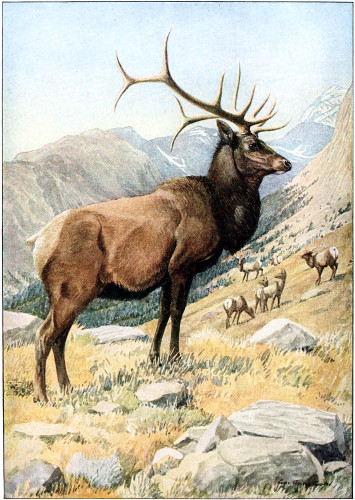
WAPITI, OR AMERICAN ELK
The range of mule deer extends from northern Alberta, Manitoba, and western Iowa to the State of San Luis Potosi, on the Mexican table-land, and west to Lower California and the coast of California. Within these limits they inhabit different types of country, from the deciduous forests along streams on the eastern border of the Great Plains to the open pine forests of the high western mountains, the chaparral-covered hillsides of southern California, and the thickets of mesquites, acacias, and cactuses on the hot and arid plains of Sonora. Several geographic races of this deer have resulted from these varied conditions.
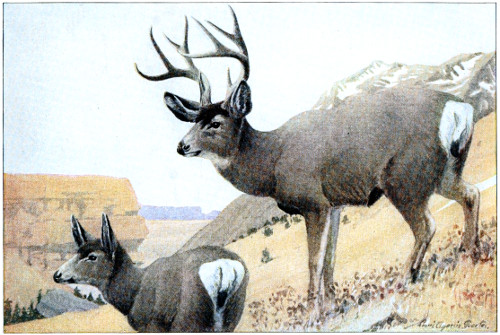
MULE DEER
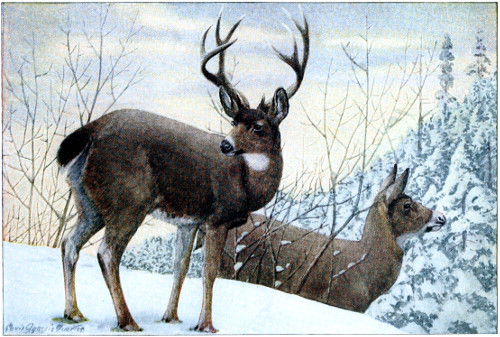
BLACK-TAILED DEER
In spring in the Rocky Mountains the does leave the bands with which they have passed the winter and seek undisturbed retreats among forest glades or along scantily wooded slopes of canyons, where they have two or three handsomely spotted fawns with which they remain apart throughout the summer.
The bucks usually keep by themselves during the summer, in parties rarely exceeding ten. As their horns lose the velvet and the mating season draws near, the old bucks gather in bands of from six to ten.
At this time they are in perfect physical condition, and a band of them in the open forest, their antlers held proudly aloft and their glossy coats shining in the sun, presents a superb picture. They have little of the protective caution so characteristic of the white-tails, and when a shot is fired at a band they often begin a series of extraordinary “buck jumps,” bounding high in the air, facing this way and that, sometimes not taking fight until after several additional shots have been fired. These high, bounding leaps are characteristic of mule deer and are commonly made when the animals are suddenly alarmed and often when they are in full flight through brushy thickets.
After the mating season, bucks and does join in bands, sometimes of fifteen or twenty, and descend to the foothills and sometimes even to the adjacent plains. Their preference, however, is for rough and broken country, such as that of canyon-cut mountains or the deeply scored badlands of the upper Missouri River.
These deer are not good runners in the open. On several occasions, on level country in Arizona, I have ridden after and readily overtaken parties of them within a mile, their heaving flanks and open mouths showing their distress. The moment rough country was reached, however, with amazing celerity a series of mighty leaps carried them away from me over declivities impossible for a horse.
The sight of a party of these splendid deer bounding away through the aisles of a mountain forest always quickens one’s pulse and gives the finishing touch of wildness to the scene. Mule deer are characteristic animals of the beautiful open forests and forest parks of the Rocky Mountains and the high Sierras, where they may be perpetuated if given reasonable protection.
BLACK-TAILED DEER (Odocoileus columbianus and its subspecies)
In general appearance the black-tails have a close resemblance to the mule deer, but average smaller. They have the same large ears, forked tines to the antlers, and rather “stocky” body; but the brushy all-black tail distinguishes them from any other American deer. In color they have much the same shade of brown as the Virginia deer. They have the usual cycle of annual changes common to most American deer—assuming a dull coat in fall and losing their horns in winter, followed by the resumption of a brighter coat in spring and the renewal of their horns in summer.
The black-tails have one of the most restricted ranges among our deer. They are limited to the humid heavily forested belt along the Pacific coast from Juneau, Alaska, southward to the Coast range in central California. This coastal belt is characterized by superb growths of cedars, spruces, and firs in the north and by redwoods and firs in the south, uniting to make one of the most magnificent forest areas in the world. Here the deer live in the midst of rank undergrowths of gigantic ferns and other vegetation, as luxuriant in many places as that of the humid tropics.
Their home on the abruptly rising slopes of the islands in the Alaskan Archipelago is so restricted that both in summer and winter they fall an easy prey to native and white hunters. It has been reported that there has been much wasteful killing of the deer on these islands for commercial purposes. When the heavy snows of winter on the islands force the deer down to the shore, great numbers of them are also killed by wolves.
Black-tails commonly have two or three young, and this fecundity, combined with the effective protection given by the dense forest where many of them live, will aid in their perpetuation. At the same time they have not developed the mental alertness of the Virginia deer, and there is imminent need for prompt and effective action in safeguarding the deer in the Alaskan part of their range if their extermination on some of the islands is to be prevented. In this northern region the black-tails share their range with strange tribes of coastal Indians, whose huge sea-going canoes, totem poles, and artistic carvings are unique among native Americans.
VIRGINIA, OR WHITE-TAILED, DEER (Odocoileus virginianus and its subspecies)
The aptness of the name “white-tail” for the Virginia deer is obvious to any one who has startled one in the forest and seen it dash away with the tail upright and flashing vivid white signals at every leap. The adults have two strongly contrasted coats each year: brownish gray in winter and rusty red in summer. The fawns, usually two in number, are dull rusty brown, marked with a series of large white spots, which remain until the gray winter coat is assumed in the fall. Large bucks sometimes attain a weight of more than 300 pounds.
The white-tail is the well-known deer of all the forest areas in eastern North America. With its close relatives, it ranges from northern Ontario to Florida and from the Atlantic coast to the Great Plains; also in the Rocky Mountains south to New Mexico, and in the Cascades and Sierra Nevada to northern California.
The supreme importance of this deer to the early settlers of the Eastern States is made plain in all the literature covering the occupation of that region. Its flesh was one of the most reliable staples in the food supply, and not infrequently was the only resource against starvation. In addition, the tanned skins served for clothing and the sinews for thread. Many of the most striking and romantic characters in our early history appear clad in buckskin, from fringed hunting shirt to beaded moccasins.
As no other American game animal equaled the white-tail in economic value to the settlers, so even to-day it remains the greatest game asset in many of the Eastern States. Partly through protective laws and partly through its acute intelligence and adaptability, the Virginia deer continues to hold its own in suitable woodland areas throughout most of its former range, and in recent years has pushed hundreds of miles northward into new territory in Ontario and Quebec.
Even in the oldest and most densely populated States, as New York and Massachusetts, white-tails still exist in surprising numbers. Over 7,000 were killed during the hunting season of 1915 in Maine, and an average of about 2,800 are killed yearly in Vermont. The great recreational value of the white-tail to a host of sportsmen is obvious. To the growing multitude of nature lovers the knowledge that a forest is inhabited by deer immediately endows it with a delightful and mysterious charm.
In summer white-tails are usually solitary or wander through the forest in parties of two or three. In winter, where the snowfall is heavy, they gather in parties, sometimes of considerable size, in dense deciduous growth, where food is plentiful. There they remain throughout the season, forming a “yard” by keeping a network of hard-beaten paths open through the snow in order to reach the browse afforded by the bushes and trees.
Ordinarily Virginia deer are shy and elusive habitants of dense forests, where they evade the unpracticed intruder like noiseless shadows. Where they are strictly protected for a period of years under State laws, they become surprisingly confident and often damage young orchards and crops on farms near their haunts. Several States pay for the damage thus done. Happily this attractive species thrives so well under protective laws that its continued future in our forests appears to be assured.
ARIZONA WHITE-TAILED DEER (Odocoileus couesi)
The Arizona white-tails are slight and graceful animals, like pigmy Virginia deer, so small that hunters often ride into camp with a full-grown buck tied back of the saddle. They have two seasonal pelages—gray in winter and more rusty brown in summer. The antlers, very small, but in form similar to those of the Virginia deer, are shed in winter and renewed before the end of summer.
These handsome little deer, the smallest of our white-tails, are common in many of the wooded mountains of middle and southern Arizona, southern New Mexico, western Texas, and in the Sierra Madre of Chihuahua and Sonora, Mexico. By a curious coincidence this area was the ancient home of the Apache Indians and has had one of the most tragic histories of our western frontier.
During summer and early fall in the higher ranges small bands of Arizona white-tails occupy the lower parts of the yellow-pine forests, between 6,000 and 9,000 feet altitude, where they frequent thickets of small deciduous growth about the heads of canyons and gulches. As winter approaches and heavy snowstorms begin, they descend to warm canyon slopes to pass the season among an abundant growth of pinyons, junipers, oaks, and a variety of brushwood.
In the White Mountains of Arizona, between the years 1883 and 1890, when wild life was more abundant than at present, I often saw, on their wintering grounds, large herds of these graceful deer, numbering from 20 to more than 100 individuals. Such gatherings presented the most interesting and exciting sight, whether the animals were feeding in unconscious security or streaming in full flight along the numberless little trails that lined the steep slopes. Where these deer live on the more barren and brush-grown tops of some of the desert mountains in southwestern Arizona and Sonora, the snowfall is so light that their summer and winter range is practically the same.
Although far more gregarious than our other white-tails, the herds of Arizona deer break up in early spring. At this time one or two fawns are born, amid early flowers in the charming vistas of the open forest. Very young fawns are hidden in rank vegetation and sometimes left temporarily by their mothers. If a horseman chances by the fawns may rise and follow innocently at the horse’s heels. On such occasions I have had difficulty in driving them back to prevent their becoming lost.
In the Sierra Madre of Chihuahua one summer I found these little white-tails occupying “forms,” like rabbits, located in the sheltering matted tops of fallen pine trees which had been overthrown by spring storms. In these shelters they rested during the middle of the day, secure from the wolves and mountain lions which prowled about the canyon slopes in search of prey.
With the growing occupation of their territory by cattle and sheep and the increase in the number of hunters, these once abundant deer are rapidly diminishing. It is high time more careful measures be taken for their conservation, else extermination awaits them throughout most of their original haunts.
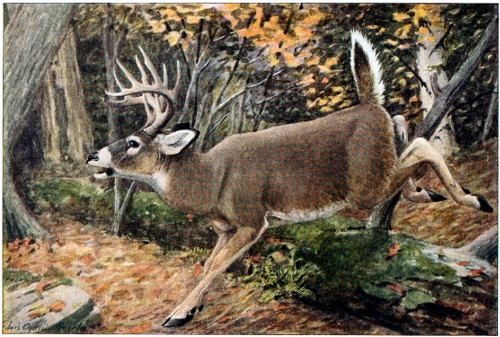
VIRGINIA, OR WHITE-TAILED, DEER
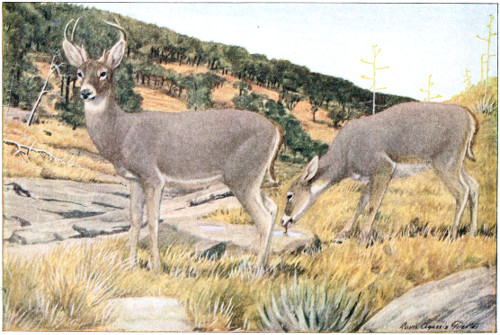
ARIZONA WHITE-TAILED DEER
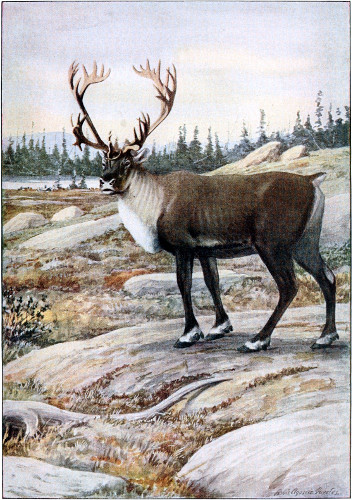
WOODLAND CARIBOU
WOODLAND CARIBOU (Rangifer caribou and its subspecies)
The caribou lacks the symmetry and grace of the true deer. Its large head topped with irregular antlers, heavy body, and thick, sturdy legs, ending in large, broad-spreading hoofs, produce a distinctly ungainly animal. It is the only member of the deer family in which both sexes have antlers, those of the female being smaller and slenderer than those of the male. It varies in size in different parts of its range, but large old bulls usually weigh from 300 to 400 pounds. A single calf is the rule, but occasionally there are two.
The woodland caribou, the southern representative of the barren ground caribou, inhabits almost the same northern forest of spruce, tamarack, birch, and alder as those sheltering the moose. It ranges from the northern border of the forests in Alaska and Canada south to Maine, northern Minnesota, northern Idaho, and British Columbia. It is far less gregarious than the barren ground caribou, during summer only small parties of cows, calves, and partly grown young keeping together, while the bulls are solitary or in still smaller separate parties. In winter all unite in larger herds.
The curiously ungraceful appearance of the caribou, so different from other deer, gives it a strong individuality, which seems to belong with its remote haunts in the wilderness. This great animal has an added appeal to our interest, owing to its close relationship to that other woodland caribou which was such an important resource to the cave-men of France and other parts of Europe, as shown by bone and horn implements, carvings, and other records discovered in their homes.
During summer and fall in eastern Canada, where this caribou is distributed through much of the wilder forests, it has a habit of coming out of the woods to sun itself and bathe on the borders of shallow lakes. Here the old bulls wallow in the water, and on rising shake themselves like a dog, filling the air with a halo of sparkling water drops. In such places the bulls frequently stand basking in the sun for hours. To a canoeman gliding silently around a jutting point, this rugged habitant of the wilds, discovered across the shining waters, standing outlined against the dark green forest, represents a wonderfully picturesque sight. When alarmed at such times the caribou dashes shoreward through the water amid clouds of flying spray struck up by its broad feet and vanishes in the sheltering forest, accompanied by a loud crashing of dry branches.
The woodland caribou is neither so swift nor so astute in avoiding danger as the Virginia deer or the moose. It falls an easy prey to hunters and to wolves, and when not properly safeguarded is readily exterminated. This is shown by its complete disappearance from the Adirondacks, in northern New York, and by its threatened disappearance from the forests of Maine, Minnesota, and Idaho; in fact, the woodland caribou is in more imminent danger of complete and early extermination within the United States than any other game animal and can be saved only by stringent laws and careful guardianship.
BARREN GROUND CARIBOU (Rangifer arcticus and its subspecies) (see illustration, page 422).
The typical barren ground caribou is smaller and paler colored than the woodland species. Several geographic races have been distinguished, among which the most notable is the Peary caribou, the palest of all and the subject of the accompanying drawing. Like other members of the group, this species is a heavily built animal, with thick legs and large feet.
The barren ground caribou is characteristic of the desolate Arctic barrens and tundras beyond the limit of trees, ranging to the northernmost limit of land beyond 83 degrees of latitude. When explorers first visited these northern wilds, including the treeless coastal belt from the Peninsula of Alaska to Bering Straits, they found these animals almost everywhere in extraordinary abundance. Over great areas of this territory straggling herds of caribou, sometimes numbering hundreds of thousands, drifted with the season from one feeding ground to another.
The advent of white men with guns has resulted in their rapid decrease everywhere and in their extermination over great areas. In many of their old haunts the only trace of their former abundance is in well-marked trails winding by easy grades to the bare tops of the low mountains. They are still numerous on the Peninsula of Alaska and in much greater numbers in parts of the barren grounds of Canada. There, on the shores of Artillery Lake, during the summer of 1907 a small migrating herd of about 2,000 was seen.
When alarmed these caribou often break into a clumsy gallop, which soon changes to a steady shambling trot, their characteristic gait, carrying them rapidly across country. In winter their tracks in the snow show that their feet, instead of being raised high at each step, like those of a Virginia or mule deer, drag through the snow like those of domestic cattle. Their large, broad-spreading hoofs, with sharp, cup-shaped edges, are admirably adapted to secure a firm footing in the yielding and hummocky surface of their haunts in summer and on the snow and ice in winter.
The barren ground caribou, living under severe climatic conditions, has developed an extraordinary method of storing up fat to carry it through winter stresses. Early in fall a layer of pure tallow, called “backfat,” is formed over the entire top of the back from between the shoulders to the rump. This is a solid slab of tallow lying between the superficial muscles and the skin. It is almost as thin as a knife-blade at the shoulders, but thickens gradually to a depth of from 4 to 6 inches at the rump. This slab of tallow is gradually absorbed during the winter and has totally disappeared by spring. In early winter the “backfat” is easily removed and transported in its original form. It is highly prized for food and as an article of trade among the Eskimo and Indian hunters, and figures as one of the chief delicacies at their winter feasts.
The Peary caribou lives in Ellesmere, Grinnell, and other of the northernmost Arctic lands to beyond 83 degrees of north latitude, where in places it is common. It appears to thrive on moss, lichens, and other dwarf and scanty Arctic vegetation, and holds its own against the depredations of packs of the white Arctic wolves. In these northern wilds, amid the most intense cold, the caribou passes from three to five months of continuous night, its wanderings lighted only by the moon, stars, and the marvelous displays of waving northern lights.
Tame reindeer, which are kept by the people of the Arctic border of the Old World from Lapland to Bering Straits, are domesticated descendants of the barren ground caribou of that region. They are used by their owners to pack burdens and haul sledges as well as to supply them with food and clothing. These animals have been successfully introduced in Alaska, and both natives and white men are developing this new and promising stock industry. The herds of tame reindeer are extremely gentle and easily handled. Their progenitors were like other wild caribou—of a dull and nearly uniform color—but domestication has resulted, as with cattle, in producing endless color variations, from white to black, with every imaginable piebald variation.
The changed conditions of life in Alaska, due to the recent development of that territory, have seriously affected the welfare of the natives. Fortunately the introduction of reindeer herds appears to open a promising future for both Eskimos and Indians.
MOOSE (Alces americanus and its subspecies)
The American moose is a large cousin of the elk of the northern forests of Europe and Siberia. The Old World animal is characterized not only by its smaller size, but also by smaller antlers. The moose is a large, grotesquely formed animal, with the most impressive individuality of any of our large game. Its great head, with oddly formed nose, huge palmated antlers, pendulous bell under the neck, short body, and disproportionately long legs unite to lend the impression that it may be a strange survivor from some remote geologic period.
The moose inhabits our northern forests, where it wanders among thickets of spruce, tamarack, birch, aspen, and alder, from the mouth of the Yukon and the lower Mackenzie southward to Maine, northern Minnesota, and down the Rocky Mountains to Wyoming. It varies in size in different parts of its range. The bulls of the Kenai Peninsula and adjacent region in Alaska are the largest of their kind in the world, sometimes weighing more than 1,400 pounds. The enormous antlers of these great northern beasts attain a spread of more than six feet and make the most impressive trophy the big-game hunter can secure in America.
Although taller than an ordinary horse, weighing more than half a ton, and adorned with wide-spreading antlers, the bull moose stalks with ghostly silence through thickset forests, where man can scarcely move without being betrayed by the loud crackling of dry twigs. In summer it loves low-lying, swampy forests interspersed with shallow lakes and sluggish streams. In such places it often wades up to its neck in a lake to feed on succulent water plants, and when reaching to the bottom becomes entirely submerged. These visits to the water are sometimes by day, but usually by night, especially during the season when the calves are young and the horns of the bulls are but partly grown.
Late in the fall, with full-grown antlers, the bulls wander through the forest looking for their mates, at times uttering far-reaching calls of defiance to all rivals, and occasionally clashing their horns against the saplings in exuberance of masterful vigor. Other bulls at times accept the challenge and hasten to meet the rival for a battle royal. At this season the call of the cow moose also brings the nearest bulls quickly to her side. Hunters take advantage of this, and by imitating the call through a birch-bark trumpet bring the most aggressive bulls to their doom.