SMALLER MAMMALS OF NORTH AMERICA By Edward W. Nelson Chief, U. S. Biological Survey With illustrations in color from paintings by Louis Agassiz Fuertes (continued 2)
Reading edition
They are more slenderly built than the silky species and have longer tails, with the hairs lengthened along the terminal half, thus giving a slightly brushy or tufted appearance. Their most striking character is the distinctly coarser hair with long scattered guard hairs, like small bristles, which conspicuously overlie the fur on the hinder parts of the body and from which the common name is derived.
The distribution of the spiny forms, although nearly the same as that of the silky ones, is a little more restricted. All belong to the arid or desert parts of the West and Southwest, from South Dakota and middle California southward to Michoacan, near the southern end of the Mexican tableland, and throughout Lower California.
Some species inhabit the scattered growth of plants in sandy areas, but they are more generally characteristic of harder and more rock-strewn soil, rocky mesas, and foothill slopes. There a few species make burrows in open ground, sometimes with a single hole, but most of them make their nests under rocks, in crevices, or in burrows sheltered by such desert bushes as Covillea, Bursera, Olneya, Cercidium, and mesquites.
In these shelters pocket mice make little mounds a few inches high and ten or fifteen inches across. The mounds have several entrances on different sides, one of which generally shows signs of recent use, although by day it is kept closed from within by loose earth. Each of the many-entranced dens is occupied by a single animal. Early in the morning, before the wind fills them with dust, tiny trails are to be seen leading from these doorways toward the nearest feeding grounds and all about their haunts.
The spiny and the silky pocket mice, sharing much the same arid region, have the same food plants and are preyed upon by the same enemies. The food of these mice consists mainly of small seeds, including the wild morning glory, wild sunflowers, wild parsnips, and a multitude of others characteristic of the various areas they occupy.
Pocket mice are strictly nocturnal or crepuscular in habits and appear by day only when disturbed. If the plugged entrance to a burrow is opened, however, it will probably be quickly stopped up again from within by the annoyed householder.
The young, in litters of from two to eight, are born at irregular times according to the latitude and general weather conditions. In the south at least several litters appear to be born each year, the young being noted almost every month.
When camping alone for a few days in the desert near San Ignacio, in the middle of the peninsula of Lower California, I had a unique opportunity to learn something of the peculiarities of the various pocket mice. Three species were abundantly represented, including both the silky and the spiny kinds. They quickly learned that good hunting could be found in and about the tents for the rice grains and other scattered food and promptly took advantage of it.
As soon as approaching darkness began to render objects indistinct, from their burrows among the surrounding bushes they swarmed into camp and were busy throughout the night minutely searching the ground under the shelter tent for every particle of food. In order to see these interesting visitors to better advantage I placed a candle on a small box in the middle of the tent.
Five or six individuals, representing three species, often came within the circle of light at the same time. At first all were shy and when I made any sudden movement would leap in every direction, like grasshoppers, and quickly vanish. The smallest of the species, a member of the silky group, was the shyest of all and remained timid and reserved.
The two larger species, representing both the spiny and the silky groups, were much more bold and quickly became confiding and delightfully friendly. Their attention was promptly attracted to rolled oats which I scattered on the ground in a spot well lighted by the candle.
Sitting quietly close by the bait where the visitors congregated I soon had evidence that among themselves these little beasts are extremely pugnacious. The first to reach the food would fiercely charge the next comer and always try to leap upon its back, at the same time delivering a vicious downward kick with its strong hind feet. Occasionally the newcomer would charge the one already at the food.
When five or six were trying to secure sole possession of the small food pile there was lively skirmishing about the premises, as they alternately attacked and pursued one another over the sand and among the boxes and other camp gear scattered about. Amazingly quick in movements, they would leap now forward, now sidewise, now straight up a foot or more in the air, with almost equal celerity; and the direction of their movements when attacked was often unexpected. When running about on the level sand they had a steady, swiftly gliding motion, which their tracks showed was the result of a series of little jumps.
Both the spiny and the silky pocket mice became so confiding the first night that when I put my hand on the ground palm up with a little rolled oats in it the nearest pocket mouse would run to it, stop for an instant to smell the finger-tips, and then mount and sit quietly on the palm and fill its cheek pouches.
At such times the mice showed no uneasiness, even when raised in my hand to within a few inches of my eyes in order that I might observe their movements more closely. The motions of their front feet when putting food into the pouches were so rapid that it was impossible to follow them. The nose was held just over the food pile, and the cheek pouches would slowly but visibly swell as they were filled until they stood out like little bladders on each side of the head.
As soon as they were full the mice became uneasy to get away and would run from one side of my hand to the other peering down the abysmal depth of three feet to the ground without daring to leap. As soon as my hand was lowered to the ground the mouse darted away to carry the food to its store in the bushes twenty to thirty yards away, quickly to return with empty pouches.
The mice soon became so tame that while they were on my hand or on the ground I could with one finger of the other hand stroke gently the tops of their heads and backs and even pick them up by their tails and suspend them head down. When thus held they remained motionless, their tiny front feet like little closed hands held against their breasts. When lowered and released they would immediately resume the filling of their pouches as though nothing had happened. Several individuals of the dozen or more which made free of the tent had lost part of their tails, so that they could be readily distinguished.
One of these little bobtails was so gentle and confiding that I became much attached to it. It would permit all manner of familiar treatment, such as being picked up by one foot or by the tail, or being turned on its back. With this confidence came a sense of proprietorship in the good things here so suddenly and mysteriously plentiful, as was shown by his attitude toward his fellows.
Again and again when he was filling his pouches from a pile of rolled oats in my hand I lowered it in a gently sloping position within ten or fifteen inches of another mouse gathering food on the ground. Thereupon the little bobtail in my hand would invariably leave the task of filling his pouches and without hesitation leap down on the back of the one on the ground. The surprised animal thus assailed from an unexpected quarter always fled in terror.
After a short pursuit the bobtailed one would come running back and instead of going to the equally inviting pile of food on the ground would come straight to my hand and complete his task. The industry of the little animals appeared to be tireless, as working swiftly they made trip after trip with pouchloads of food to their stores and quickly returned. One night I watched this strenuous work for two hours until I retired.
The abundance and boldness of pocket mice and kangaroo rats at this place led me to believe that there had been a former abundance of their food here, resulting in a large increase in the rodent population, but that it was then becoming scarce through a failure of rain to renew the seed harvest. The invariable outcome in such cases is for the small rodents dependent on seeds and fruits to be reduced by famine until they become rare, where previously they existed in great numbers. This is one of Nature’s processes whereby the danger of the overwhelming increase of any species is automatically prevented.
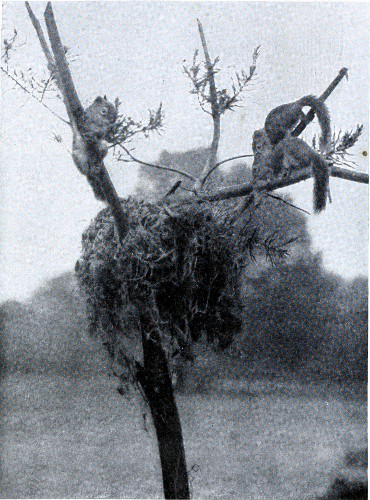
Photograph by Howard Taylor Middleton
YOUNG RED SQUIRRELS AND THEIR NEST
These cute little chaps were found cozily at rest in their nest in a pine. They were routed out, however, long enough to have their portraits taken. An effort was made to include the mother, but without success (see page 556).
THE POCKET GOPHERS (Geomys bursarius and its relatives)
(For illustration, see page 515)
With the exception of the moles no other extensive group of American land mammals is so highly specialized for a peculiarly restricted mode of life as the pocket gophers. They form a strongly marked family, the Geomyidæ, which includes various genera and many species, all very similar in external form, but varying from the size of a large mouse to a massively formed animal equalling a large house rat in weight.
Without exception they are powerfully built for their size, the head and front half of the body being extraordinarily muscled to meet the demands of their mode of life. The broad blunt head is joined almost directly on the body. The eyes are small and have the restricted vision to be expected from animals living underground. The ears are reduced to little fleshy rims about the openings, and the short naked tail is provided with nerves, which render it useful as an organ of touch.
The front teeth are broad, cutting chisels, and on each side of the mouth is a large pocket in the skin used for gathering and carrying food. On the front feet are long claws, which, when not being used to dig or handle earth, are doubled under, against the soles of the feet, so that the gopher walks on the back of them much as the ant-eater walks on its folded claws.
Peculiar to North America, pocket gophers occupy a great area extending from Illinois, Florida, and the Gulf of Mexico to the Pacific coast, and from the plains of the Saskatchewan, in Canada, southward to Panama. Their vertical range within these limits extends from sea level to timber-line, at above 13,000 feet on some of the high volcanoes of Mexico. The family attains its greatest development in that wonderful region of plains and volcanoes lying about the southern end of the Mexican table-land.
In the United States these animals are best known as “gophers,” but in the range they occupy in the Southeastern States they are called “salamanders” and in Mexico are widely known as “tuzas.” As a rule they frequent treeless areas, but are found also in many types of forests from among the palms and other trees of the tropical lowlands to the oaks, pines, and firs on the mountain sides.
All members of the family live wholly underground, in many-branched horizontal tunnels, which they are continually extending in winding and erratic courses about their haunts. The tunnels are from two to about five inches in diameter, according to the size of the animal, and while usually less than six inches below the surface, the approaches to the nest and storage chambers sometimes drop abruptly two or three feet below the regular working tunnels to the level of the living quarters. At intervals along the tunnels short side branches are used as sanitary conveniences, thus enabling the occupant to keep the main passageways in a habitable condition.
The courses of the underground workings are roughly indicated on the surface by series of piles of loose earth brought up through short side passages as the tunnels are extended. These little miners’ dumps of earth vary with the size of the animal, sometimes containing more than two bushels. The outlets of the passages leading to the surface are kept plugged with loose earth. When these animals are numerous the ground is thickly dotted in all directions with earth piles, and the caving caused by the network of tunnels just below the surface renders walking difficult. The perpetual industry of these rodent miners outclasses that of the proverbial beaver.
Gophers are both diurnal and nocturnal, the gloom of their tunnels scarcely varying except when one of the outlets is temporarily opened. They are averse to light, and if the plug to a freshly made opening is removed the observer may soon catch a glimpse of the owner as he suddenly thrusts his head into view for a moment before again plugging the door with earth.
Gophers dig their tunnels by using their teeth and the strong claws on the front feet. The loose earth is pushed along the tunnel by the head, the palms of the front feet, and the breast in little jerky movements until it is ejected on the surface dump.
Owing to their poor sight, heavy bodies, and short legs, gophers are clumsy and deliberate in their movements and peculiarly helpless in the open. Apparently appreciating this, they rarely venture from their underground shelter by day except when in grain fields or similar sheltering vegetation. Here they sometimes run out two or three feet to cut down a succulent stalk and drag it hastily within the entrance of the tunnel, where it is cut into short sections and placed in the cheek pouches if to be used as food or left on the dump if the object of the cutting is finally to secure the seeds or head of ripening grain.
During the mating season in spring pocket gophers run about clumsily from one burrow to another and may often be seen on the surface by the light of the rising sun. Most of their short trips above ground are made at night, when they sometimes swarm out and wander over a limited territory. Their night wanderings are proved in California by the many bodies which the morning light often reveals in the sticky crude oil on newly oiled roads which the gophers have tried to cross.
From one to seven young are born in a litter, but whether there is more than one litter in a season or not is unknown. The young when about half grown migrate to unoccupied ground sometimes one or two hundred yards from the home location and make tunnels of their own.
The food of pocket gophers consists mainly of tubers, bulbs, and other roots, including many of a more woody fiber. Whole rows of potatoes or other root crops are cleaned up by the extension of tunnels along them. Sometimes the animals follow a row of fruit trees, cutting the roots and killing tree after tree. In grain and alfalfa fields they are great pests, and in irrigated country their burrows in ditch banks often cause disastrous breaks.
The big tropical species sometimes exist in such numbers as to render successful agriculture very difficult. Sugar-cane planters in many parts of Mexico and Central America are compelled to wage unremitting war on them to avoid ruin. I know of an instance on a plantation in Vera Cruz in which thousands were killed during a single season without stopping the damage from these pests, which swarmed in from the adjacent area.
The large external cheek pouches of pocket gophers are used solely for gathering such food supplies as seeds, small bulbs, and sections of edible roots or plant stems and transporting them to storage chambers located along the sides of the tunnels. Food is placed in the pouches by deft sidewise movements of the front feet used like hands, and so quick are they that the motions of the feet can scarcely be detected. The pockets are emptied by placing the front feet on the back ends of the pouches and pushing forward, thus forcing out the contents. In their tunnels gophers run backward and forward with almost equal facility, the sensitive naked tail serving to guide their backward movements.
Pocket gophers are stupid solitary little beasts, with surly dispositions, and fight viciously when captured or brought to bay. This attitude toward the world is justified by the host of enemies ever ready to destroy them. Among their more active foes are snakes and weasels, which pursue them into their tunnels; and badgers, which dig them out of their runways.
They are also persistently hunted day and night by foxes and coyotes. Moreover, by day various kinds of hawks watch for them to appear at the entrances of their dens, and by night the owls, ever alert, capture many.
When one gopher intrudes into the tunnel of another the owner at once fiercely attacks it. In some places I have seen Mexicans take advantage of this characteristic pugnacity by fastening the end of a long string about the body of a captured gopher and then turning it into an occupied tunnel, through a recently made opening. The owner, scenting the intruder, would immediately attack him, the combatants locking their great incisors in a bulldog grip.
The movements of the string would give notice of the encounter, and by pulling it out steadily both animals could be drawn forth and the enraged owner of the burrow dispatched. In this manner I have known an Indian to catch more than a dozen gophers in a few hours.
Pocket gophers are active throughout the winter even in the coldest parts of their range, but in many places must rely largely on food accumulated in their storage chambers.
Melting snow in the mountains and in the North reveals the remains of many tunnels made through it along the surface of the ground. These snow tunnels are often filled for long distances with loose earth brought up from underground, and after the snow disappears in spring the curious branching earth forms left, winding snakelike through the meadows, are a great puzzle to those who do not know their origin.
In a state of nature pocket gophers are constantly bringing the subsoil to the surface and burying humus. Over an enormous area they exist in such countless thousands that their work, like that of angleworms, is often of the most beneficial character. On bare slopes, however, their work is highly injurious, as it greatly increases erosion of the fertile surface soil and thus has its direct influence in changing world contours.
When civilized man arrives in their haunts and upsets natural conditions with cultivated crops the new food supply stimulates an increase in the gopher population and their activities immediately become excessively destructive and necessitate unremitting warfare against them.
THE KANGAROO RATS (Dipodomys spectabilis and its relatives)
(For illustration, see page 518)
The desert regions of western North America have developed several peculiar types of mammals, and among them are none handsomer or more interesting than the kangaroo rats. These rodents, despite their name, are neither kangaroos nor rats, but are near relatives of the pocket mice, which share their desert haunts.
All are characterized by a kangaroo-like form, including small fore legs and feet, long hind legs and feet for jumping, and a tail longer than the body to serve as a balance. In addition, they have large, prominent eyes and are provided with skin pouches on each side of the mouth for use in holding food to be carried to their store chambers.
The color pattern, like the form, of the kangaroo rats is practically uniform throughout the group. Both are well shown in the accompanying plate of Dipodomys spectabilis, the largest and most strongly marked species. Its total length is from 12 to 14 inches; most of the other species are much smaller.
Kangaroo rats of many species are distributed over most of the arid and semiarid regions of the United States and Mexico, from Nebraska, Oklahoma, and the Gulf Coast of Texas west to the Pacific coast, and from Montana and Washington southward to the Valley of Mexico and throughout Lower California. They are especially numerous in the southwestern deserts, where they are the oddest and most picturesque of animals.
Although they have no near relatives in the Old World, some of the African and Asiatic jerboas are externally almost perfect replicas of the kangaroo rats in every detail of form, color, and color pattern, even to the tail markings. This extraordinary likeness in appearance of two widely separated and unrelated animals is made doubly significant by the fact that both live in deserts and have similar habits.
Peculiarly desert animals, kangaroo rats live like the pocket mice, without drinking, but obtain the necessary water through their digestive processes. They are most numerous in sandy areas, and there the earth is sometimes so riddled by their burrows as to render horseback riding difficult.
Kangaroo rats are nocturnal and always live in burrows dug by themselves. As a rule they prefer soft or sandy ground, but some species occupy areas where the earth is hard and rocky. The burrows of some species have only one or two entrances with a small amount of earth thrown out, but others make little mounds with several openings, entering usually nearly on a level or at a slight incline. These openings are nearly always conspicuous, and while frequently near bushes, no effort appears ever to be made to conceal them, and a little trail often leads away through the soft earth.
The large Dipodomys spectabilis, which lives mainly in New Mexico and Arizona, constructs the most notable of all the dwelling places of these animals. From its underground workings it throws up large mounds of earth, which gradually increase in size with the length of time they are occupied until they are sometimes more than 3 feet high and 15 feet or more in diameter. From three to a dozen burrows enter these mounds, usually at the surface level of the ground, but some are on the slopes of the mound. The mounds, usually located in open ground, with their round entrance holes from four to five inches in diameter, are extremely conspicuous.
Although generally scattered at varying distances from one another, the mounds are sometimes grouped in colonies. Well-worn trails three or four inches broad lead away from the entrances, some to other mounds showing neighborly intercourse and others far away to the feeding grounds, sometimes 200 or 300 yards distant. One of the openings at the side of the mound is usually the main entrance, and by day this is ordinarily kept stopped with fresh earth. Within the mound and farther under ground are dug a series of ramifying passages, among which are located roomy nest chambers and store-rooms for food.
Kangaroo rats are not known to hibernate in any part of their range. They lay up food for temporary purposes at least and do not go abroad in stormy or cold weather. The northern species and those on the colder mountain slopes must make large store against the winter needs. Their food consists mainly of seeds, leaves of several plants, and of little plants just appearing above ground. Tiny cactus plants and the saline fleshy leaves of Sarcobatus are often among the kinds gathered for food.
The big Dipodomys spectabilis appears to be more social than most of its kind, as several may be caught in a single mound, and, as already said, well-worn trails lead from mound to mound. A little noise made just outside one of these mounds usually brings a reply or challenge in the form of a low drumming or thudding noise, no doubt made by the animal rapidly striking the ground with its hind feet like a rabbit or wood rat.
When caught they at first struggle to escape, but, like a rabbit, do not offer to bite, and soon become quiet. They have from two to six young, which may be born at any season. Nothing appears to be known concerning the number of litters in a year.
When in camp at San Ignacio, in the middle of the desert peninsula of Lower California, I had an unusual opportunity to learn something of the habits of one of the smaller species of kangaroo rat abundant there. The moon was at its full, and in the clear desert air its radiance rendered objects near at hand almost as distinct as by day. Scattered grains of rice and fragments of food on the ground about the cook tent attracted many kangaroo rats and pocket mice.
During several nights I passed hours watching at close range the habits of these curious animals. As I sat quietly on a mess box in their midst both the kangaroo rats and the mice would forage all about with swift gliding movements, repeatedly running across my bare feet. Any sudden movement startled them and all would dart away for a moment, but quickly return.
Although the kangaroo rats did not become so fearless and friendly as the pocket mice, they were so intent on the food that at times I had no difficulty in reaching slowly down and closing my hand over their backs. I did this dozens of times, and after a slight struggle they always became quiet until again placed on the ground, when they at once renewed their search for food as though no interruption had occurred.
One night, to observe them better, I spilled a small heap of rice on the sand between my feet. Within two or three minutes half a dozen kangaroo rats had discovered it and were busily at work filling their cheek pouches with the grains and carrying them away to their store chambers.
While occupied in this rivalry for food they became surprisingly pugnacious. If one was working at the rice pile and another rat or a pocket mouse approached, it immediately darted at the intruder and drove it away. The mode of attack was to rush at an intruder and, leaping upon its back, give a vigorous downward kick with its strong hind feet. Once I saw a pocket mouse kicked in this way. It was knocked over and for a minute or more afterwards ran about in an erratic course, squeaking loudly as though in much pain.
Sometimes the pursuit of one kangaroo rat by another continued for twenty yards or more. By the time the pursuer returned another would be at the rice pile and it would immediately dash at the victor of the former fray and drive him away. In this way there was a constant succession of amusing skirmishes.
Sometimes an intruder, bolder than the others, would run only two or three yards and then suddenly turn and face the pursuer, sitting up on its hind feet like a little kangaroo. The pursuer at once assumed the same nearly upright position, with its fore feet close to its breast. Both would then begin to hop about watching for an opening. Suddenly one would leap at the other, striking with its hind feet exactly like a game cock. When the kick landed fairly on the opponent there was a distinct little thump and the victim rolled over on the ground. After receiving two or three kicks the weaker of the combatants would run away.
The thump made by the kick when they were fighting solved the mystery which had covered this sound heard repeatedly during my nights at this camp. The morning light revealed a multitude of little paired tracks made by the combatants in these battles. Such tracks in the sand have been referred to as the “fairy dances” of these beautiful little animals, but the truth revealed proves them to be really “war dances.”
THE BANDED LEMMING (Dicrostonyx nelsoni and its relatives)
(For illustration, see page 519)
Banded lemmings are unique among the mouse tribe in their change from the rufous brown, or gray summer coat to pure white in winter. With the assumption of the white winter fur a thick, horny, padlike growth develops on the underside of the two middle claws of the front feet, which is molted in spring when the winter coat is lost. For an animal living in the far North the usefulness of a white coat in winter is evident, but no good reason is apparent for these curious claw-pads.
The summer coat varies remarkably in color and color pattern, and many of the lemmings in their beautiful shades of chestnut, browns, or grays are very handsome. They are more heavily proportioned than field mice and the very long fluffy fur, which completely conceals the rudimentary ears and tail, tends to exaggerate their size.
The banded lemmings form a strongly marked group, containing a number of species inhabiting circumpolar regions. In North America they occur nearly everywhere in the arctic and subarctic parts, including Greenland, most of northern Canada, including the Arctic islands, and a large part of Alaska, including some of the Aleutian Islands.
They range as far northward as vegetation affords them a proper food supply and have been well known to many of the explorers of those stern northern wilds. To the southward they extend into the subarctic northern forests, where they usually keep to the open barren areas.
Not much is known of their life histories on this continent. They are mainly nocturnal and live in burrows from two to three feet long, ending with a nest chamber four or five inches in diameter, warmly lined with grass and moss. Near the nest there is usually a branch burrow a foot or more long which is used for sanitary purposes and as a place of refuge when the main burrow is invaded.
In the nests during early summer litters generally containing about three young are brought forth. Ordinarily the burrows open in unsheltered places, but in wooded regions may be under a log or beneath a bush or the roots of a tree. No runways lead out from the burrows as is customary with many of their relatives. They are active throughout the winter, making many tunnels along the surface of the ground under the snow, which are revealed when it melts in spring.
These surface tunnels are their foraging roads, safe from most of the fierce storms which rage overhead. At times, however, the snowy shelter is blown away or some other cause brings the lemmings to the surface, where they blunder aimlessly about, soon to be captured by some enemy or to perish from the cold. As their infrequent appearance on top of the snow is usually during storms, the Alaskan Eskimos have a legend that these white lemmings live in the land above the stars and descend in a spiral course to the earth during snowstorms.
Although banded lemmings never become so extraordinarily numerous over great areas as the brown species, they become very abundant at times in the barren grounds of Canada and the Arctic islands and migrate from one part of their range to another. The best observation in regard to this was made by Rae in June at the mouth of the Coppermine River. On the west bank of the river north of the Arctic Circle he encountered thousands of them speeding northward.
The ice on some of the smaller streams had broken up and he was amused to see the little animals running back and forth along the banks looking for a smooth place in the stream, indicating a slow current, where they could swim across. Having found such a place, they at once jumped in and swam quickly to the opposite side, where they climbed out and, after shaking themselves like dogs, continued their journey as though nothing had happened.
During the years I lived in northern Alaska the advent of winter was marked by invasion of the storehouses by many brown lemmings and other mice, but banded lemmings rarely appeared. When occasionally captured alive, the old ones fought viciously, but the young were gentle and quickly became tame and interesting pets. Their skins were highly prized by the little Eskimo girls to make garments and robes for their walrus ivory dolls.
THE BROWN LEMMING (Lemmus alascensis and its relatives)
(For illustration, see page 579)
Few small mammals are so well known in far northern lands as the brown lemmings. They form a small group of species having a close general resemblance to some of the field mice, from which, however, they may at once be distinguished by their much heavier proportions, extremely short tails, and the remarkable length of the hair on their backs and rumps.
They inhabit most of the arctic and subarctic lands of both Old and New Worlds. In North America they are known from the northernmost lands, beyond 83° north latitude, to the southern end of Hudson Bay, and throughout most of northern Canada and all of Alaska, including the islands of Bering Sea.
The extraordinary migrations of these lemmings have attracted attention far back in the early history of northern Europe. At intervals, through favorable conditions, they become superabundant over a large area, and then a sudden resistless desire to migrate in a certain direction appears to seize the entire lemming population. The little beasts start in a swarming horde, sometimes containing millions, and traverse the country.
In their travels they appear indifferent to all obstacles and with dogged and unwavering persistence swim the streams and lakes encountered on their way. Similar migrations have been observed at various points in Arctic America, several of them in Alaska, where the lemmings abound on the open tundras.
These migrations sometimes continue for more than one season, the animals meanwhile being killed in countless numbers by disease, by accident in field and flood, and, in addition, through the heavy toll taken from their numbers by their winged and four-footed foes, which always gather in numbers to accompany them.
The migrations sometimes wear out through the diminution in numbers, and sometimes when they reach the sea, as in Norway, they are said to enter the water and swim offshore until they perish. When one of these swarms of rodents passes through a farming district it cleans up the crops and other surface vegetation like a visitation of locusts.
These lemmings do not hibernate, but, active throughout the severest winters, are abroad almost equally by day and by night. Their burrows consist of winding tunnels, often many-branched and with more than one opening. A dry bed of peat or a dense growth of moss is often pierced by a network of them. Well-defined runways often lead away from the burrows or from the entrance of one burrow to that of another.
Their tunnels run everywhere under the snow, with occasional passages leading to the surface. When fierce gales blow away the snow or a winter rain melts it, many lemmings lose touch with their burrows and wander about until they perish from cold or are caught by some enemy. They are sometimes found several miles from shore, where they have strayed out on the sea ice.
In winter in the fur countries, in company with field mice, they invade storehouses and habitations in search of food. Among their enemies are ravens and all northern hawks and owls, as well as foxes, weasels, lynxes, bears, and other beasts of prey of all degree.
Within their underground tunnels and often in dense vegetation on the surface lemmings make warmly lined nests of grass and moss in which their young, from two to eight in number, are born. The young appear at varying times, thus indicating several litters each year.
When taken alive, the old ones are fierce and courageous, growling and fighting savagely; but several half-grown young brought me during my residence in Alaska proved to be most amusing and inoffensive little creatures. From the first they permitted me to handle them without offering to bite and showed no signs of fear.
They were kept in a deep tin box, from which they made continual efforts to escape. When I extended one finger near the bottom of the box they would stand erect on their hind feet and reach up toward it, using their forepaws like little hands. If my finger was lowered sufficiently they would climb up into my hand and thence to my shoulder, showing no sign of haste, but much curiosity, continually sniffing with their noses and peering at everything with their bright beadlike eyes.
They were curiously expert in walking on their hind feet, holding the body in an upright position and taking short steps. If anything was held just out of reach above their heads, as the point of my finger, they would continue in an erect position for a considerable time. At such times they would reach up with their front paws and often spring up on their hind feet for half an inch above the floor trying to touch it. When eating they sat upright on their haunches, like little marmots, and held the food in their front paws.
THE COMMON FIELD MOUSE, OR MEADOW MOUSE (Microtus pennsylvanicus and its relatives)
(For illustration, see page 522)
The Pennsylvania meadow mouse is a small species about as long in body as the house mouse, but much more heavily proportioned. Its head is rounded, the eyes small and beadlike, the legs and tail are short, and the comparatively coarse fur is so long that it almost conceals the short, rounded ears.
It is a typical representative of a group of small mammals commonly known as field mice, or “bear mice,” which includes a great number of species closely similar in general appearance, but varying much in size. In England they are termed voles, and large species living about the water in England and northern Europe are known as “water rats.”
Field mice are circumpolar in distribution and abound from the Arctic barrens, beyond the limit of trees, to southern Europe and the Himalayas, in the Old World, and to the southern United States and along high mountains through Mexico and Guatemala, in Central America. They occur in most parts of the United States except in some of the hotter and more arid sections.
As a rule field mice prefer low-lying fertile land, as grassy meadows, but the banks of streams, the rank growths of swamps and marshes, the borders of damp woodlands, the grassy places on Arctic tundras, or the dwarfed vegetation of glacial slopes and valleys above timber-line on high mountains furnish homes for one species or another.
Two, and even three, species of field mice are sometimes found in the same locality, but each kind usually occupies a situation differing in some way from that chosen by the others. Some occupy comparatively dry ground and others, like the European water rat, live in marshes and are almost as aquatic as the muskrat. Most species living about the water are expert in diving and in swimming, even under water. In streams inhabited by large trout they are often caught and eaten by the fish.
The presence of field mice is nearly always indicated by smoothly worn little roads or runways about an inch in width, which form a network among the vegetation in their haunts. These runways lead away from the entrances of their burrows and wind through the vegetation to their feeding grounds. They are kept clean and free from straws and other small obstructions, so that the owners when alarmed may run swiftly to the shelter of their burrows. Fully conscious of their helplessness, meadow mice are as cautious as the necessities of existence will permit.
Their burrows are often in the midst of grassy meadows, as well as under the shelter of logs, rocks, tussocks of grass, or roots of trees, and lead to underground chambers filled with large nests of dry grass, which shelter the owner in winter and often in summer. The summer nests in many places, especially in damp meadows or marshes, are made in little hollows in the surface or in tussocks of grass. In these nests several litters containing from four to eleven young are born each year.
It is rarely that an observer is located where he can study the every-day lives of little animals like the meadow mice and at the same time go on with his regular occupation. At one of my mountain camps in Mexico I fortunately pitched my tent on a patch of lawn-like grass in front of the ruins of an abandoned hut. Runways of field mice formed a network everywhere in the surrounding growth of grass and weeds.
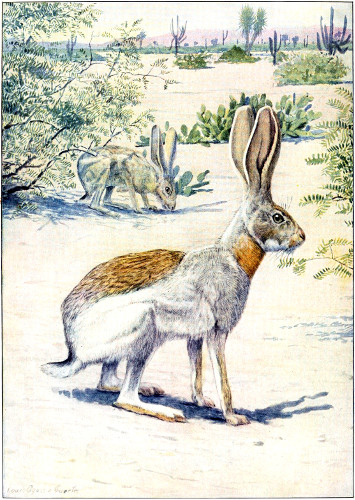
ANTELOPE JACK RABBIT
Lepus alleni
For hours at a time as I worked quietly in the tent the many mice, unconscious of my presence, came silently along their little roads through the tall vegetation to the border of the short grass. Just within the shelter of the tall growth they would each time stop and remain watchfully immovable for a half minute, and then, if everything was quiet, make a swift run two or three feet into the open, bite off a tender little grass blade and dash back to the sheltered road. There they would sit up squirrel-like, holding the grass blades in their forepaws and eating them rapidly, or would sometimes carry the food back to the burrows.
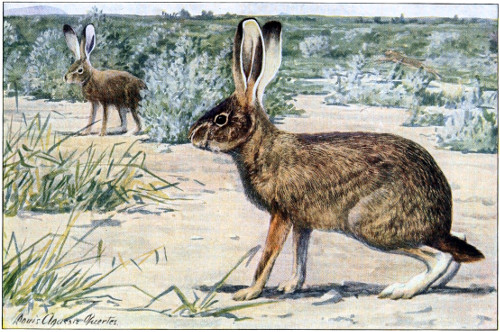
CALIFORNIA JACK RABBIT
Lepus californicus
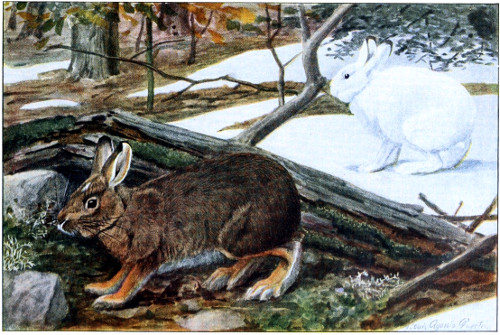
VARYING HARE, or SNOWSHOE RABBIT
Lepus americanus
Occasionally as the mice darted into the open I made a slight squeaking noise and perhaps two or three in sight at the time would instantly turn and dash back into the sheltered road, sometimes not reappearing for a long time. Again and again I saw them come into the open for food, and before securing it suddenly scamper back in a panic without apparent cause for alarm.
Eternal vigilance is the only defense such animals have, and despite their watchfulness myriads of them are devoured daily by a large number of rapacious birds and mammals, including even such huge beasts as the great Alaskan brown and grizzly bears, which dig them from their burrows on grassy northern mountain sides.
Despite their numerous natural enemies field mice are so prolific they continue among the most destructive of agricultural pests. They are so obscure and the damage by a single mouse appears so insignificant, that it requires a knowledge of their habits, their wide distribution, and their enormous numbers to appreciate what a serious drain they are on the farmer’s income, even when in their normal numbers.
In summer they feed on growing grass, clover, alfalfa, and grain, seeds, bulbs, root crops, and garden vegetables. In fall they congregate under shocks to feed on the grain, and in winter often do enormous injury to young or even well-grown fruit and other trees by gnawing off the bark on the base of the trunk and roots, sometimes in this way destroying entire orchards and nurseries.
One species in California destroys large quantities of raisins drying in the field by carrying them off to some shelter, where they cut out the seeds and leave the rest of the fruit. I have seen half a pound of raisins under a piece of board, the result of the night’s work of a single mouse.
While field mice are always destructive, at intervals they have sudden and mysterious accelerations of increase and become so excessively abundant that they are a veritable plague. Many instances of this are on record in the Old World, where they have become so numerous as to call forth governmental intervention.
The most notable recent outbreak of this kind in the United States took place in the Humboldt Valley, Nevada, where, during the winters from 1906 to 1908, they swarmed over the cultivated parts of the valley and completely destroyed 18,000 acres of alfalfa, even devouring the roots of the plants. During this outbreak the mice in the alfalfa fields were estimated to number as high as 12,000 to the acre.
Whenever field mice become over-abundant notice appears to go out among their natural enemies, and in extraordinary numbers hawks, owls, crows, ravens, sea gulls, coyotes, foxes, bobcats, weasels, and other animals appear to prey upon them.
At no season of the year are they free from their foes, for they remain active throughout the winter, and most species apparently lay up no winter store of food. They travel to winter feeding places through series of tunnels under the snow, and it is mainly at this season that they do the most serious damage to orchards and shrubbery.
In the far North at the beginning of winter they gather in large numbers about the fur-trading stations and other habitations, where they persistently invade the food supplies.
Some of the northern mice, however, gather stores of food for winter. A species living along the coast of the Bering Sea and elsewhere on the Arctic tundra of Alaska accumulates a quart or more of little bulbous grass roots, which are delicious when boiled. They are hidden in nests of grass and moss among the surface vegetation, and before the first snowfall I have seen the Eskimo women searching for them by prodding likely places with a long stick. The roots thus taken from the mice are kept to be served as a delicacy to guests during winter festivals.
THE PINE MOUSE (Pitymys pinetorum and its relatives)
(For illustration, see page 522)
The pine mice form a small group of species peculiar to North America and closely related to the field mice. They are similar in form to the common field mice of the Eastern States, but are usually smaller, with much shorter tails and shorter, finer, and more glossy fur.
Most of the pine mice are limited to the wooded region of the States between the Atlantic coast and the eastern border of the Great Plains, and from the Hudson River valley and the border of the Great Lakes south to the Gulf coast. Strangely enough, one species lives in a restricted belt covered with tropical forest along the middle eastern slope of the Cordillera, which forms the eastern wall of the Mexican tableland, on the border between the States of Vera Cruz and Puebla.
Pine mice occupy the borders of thin forests and brushy areas, from which they work out into the open borderlands, especially in orchards or other places where there are scattered trees amid a rank growth of weeds. Instead of making their runways among growing vegetation on the surface of the ground like field mice, they live in little underground tunnels or burrows which extend in all directions through their haunts. These tunnels are closely like those of the common mole except that they are smaller and have frequent openings to the surface, through which the owners make short excursions for food. They often utilize the tunnels of moles when conveniently located for their purposes.
The tunnels are often so near the surface that the ground is slightly uplifted or broken as by a mole, or they are made under the fallen leaves and other small decaying vegetable matter covering the ground under the trees. Occasionally, when the surface soil becomes dry and hard, the burrows are deeper, so that no surface indications can be discovered. On account of the similarity of their burrows the depredations of pine mice are commonly attributed to moles.
Several inches below the surface pine mice excavate oval chambers to be used for nests or for storage purposes. The nest chambers have several entrances from ramifying tunnels and are filled with short fine pieces of grass, making a warm nest-ball. Here the several litters of young are born each year. Pine mice are less prolific than field mice, however, and the litters contain only from one to four young.
The food chambers are larger than the nest chambers, and when full of stores are kept closed with earth. In these are stored short sections of green or dry grasses, bulbous grass roots, and short sections of other edible roots. One such store contained about three quarts of the fleshy roots of a morning glory cut into short sections.
Pine mice obtain much of their food from the bark about the bases and roots of trees, including both coniferous and deciduous species. They kill many small trees and shrubs by girdling, or by cutting the roots below the surface, and in this way frequently inflict severe damage in orchards and nurseries. Owing to their underground habits they are much more dangerous to orchards than field mice. They also do much damage by burrowing along rows of potatoes and other root crops, upon which they feed.
Both pine mice and field mice are serious pests to agriculture and only by vigilant care can they be prevented from steadily reducing the returns from farm and orchard. A mouse appears so insignificant an enemy that the general inclination among farmers is to ignore it, but both field and pine mice exist in such enormous numbers and are so generally distributed that the aggregate annual losses from them are great.
Clean cultivation in orchards, especially for some distance immediately about the trees, is an excellent protective measure against both of these mice. The shrubbery and fruit trees of orchards, lawns, and gardens may be protected by the use of poisoned baits and traps as soon as signs of pine mice or field mice are observed.
THE RED-BACKED MOUSE (Evotomys gapperi and its relatives)
(For illustration, see page 523)
With the exception of the banded lemmings the red-backed mice are the most brightly colored of the smaller northern rodents. They are close relatives of the common field mice, which they about equal in size, but from which they are distinguished externally by rufous coloration, finer and more glossy pelage, larger ears, and proportionately longer tails.
The red-backed mice form a group containing a considerable number of species distributed throughout the northern circumpolar lands, except on the barren islands of the Arctic Sea. In North America they occur from the Arctic tundras north of the limit of trees southward throughout Alaska and Canada to the northern United States. With other northern species of mammals, birds, and plants they follow the high mountain ranges still farther southward to North Carolina, New Mexico, and middle California.
It is true that in the far North they are numerous on the moss-grown tundras, and in the South range above timber-line on high mountains. As a general rule, however, they are woodland animals, whether among the spruces, birches, and aspens of the North or farther south in the United States in the cool fir and aspen-clad slopes of mountains. They also frequent old, half-cleared fields, brush-grown or rocky areas, and similar places where cover is abundant.
Although so closely related to the field mice, the red-backed species are not known to become excessively abundant nor seriously to injure crops. One reason for their harmlessness in this respect may be their strong preference for forest haunts.
I once found them numerous in the grass-grown streets and yards of an abandoned mining camp in the forest at the head of Owens River, in the Sierra Nevada, of California. The mice were making free use of the congenial shelter afforded by the old log cabins, and their runways and entrances to burrows were all about under scattered boards and similar cover.
They are abroad equally by day and by night, and for this reason are better known to woodsmen than most of the small woodland animals. When foraging by day among the fallen leaves and deep green vegetation they present a most graceful and attractive sight, now moving about with quick and pretty ways, now pausing to sit up squirrel-like to eat some tid-bit held in the front paws and then on the alert to detect a suspected danger and poised in quivering readiness for instant flight.
Red-backed mice usually live in underground burrows similar to those of field mice, but generally located with more care in dry situations, the entrances sheltered by a stump, old log, root of a tree, rock, or other object. Ordinarily they do not make such well-defined runways as do many field mice, and sometimes no trace of a trail can be found leading away from their burrows. But where they travel about through small dense vegetation, under logs and about stumps and rocks they often make well-marked trails.
Their nests are bulky and formed of a mass of fine dry grass, moss, and other soft material, which is sometimes located in an underground chamber opening off the burrow and sometimes in hollow stumps and logs or under other surface shelters. But little is known about the home life of these mice except that they are prolific, and between April and October have several litters containing from three to eight young in each.
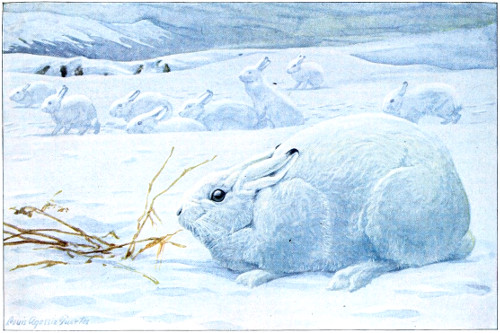
ARCTIC HARE
Lepus arcticus
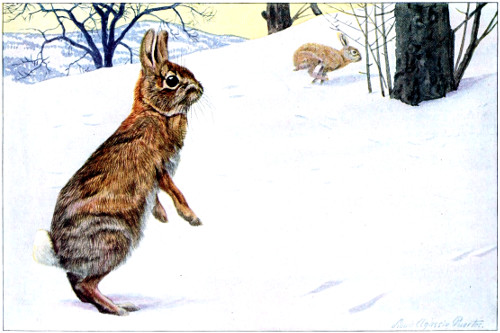
COTTONTAIL RABBIT
Sylvilagus floridanus
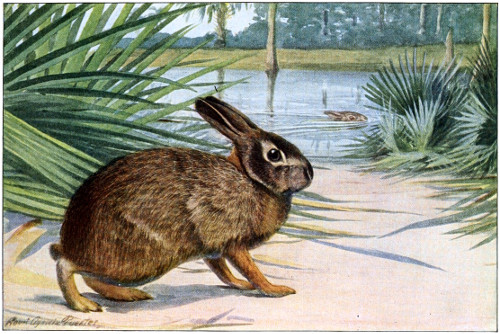
MARSH RABBIT
Sylvilagus palustris
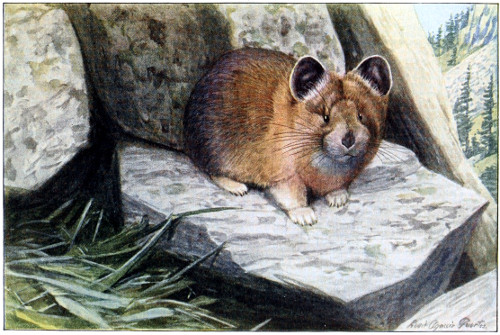
PIKA, LITTLE CHIEF HARE, or CONY
Ochotona princeps
They feed upon a great variety of seeds, fruits, roots, and succulent vegetable matter and lay up stores for winter in underground chambers or in hollow logs and similar places above ground.
With the coming of winter they gather about cabins and other habitations in their territory and become as persistent as house mice in searching out and raiding food supplies of all kinds. When the more appreciated kinds of food fail they resort to gnawing the bark from roots and bases of trunks of small deciduous trees of various kinds.
During my sledge journeys in the region about Bering Strait I found the skins of many red-backed mice among the Eskimo children. The small boys kept them with lemming skins as evidences of their prowess with miniature dead-fall traps and blunt-pointed arrows, and the little girls kept them as prized robes for the dolls carved by their fathers from wood or walrus ivory.
THE RUFOUS TREE MOUSE (Phenacomys longicaudus and its relatives)
(For illustration, see page 523)
The genus Phenacomys, to which the rufous tree mouse belongs, includes a number of species closely similar in size and external appearance to some of the well-known field mice. The structure of their teeth, however, shows that they form a distinct group of animals.
So far as known, the living members of the genus are confined to the Boreal parts of North America, where they range from the Atlantic to the Pacific in Canada, and southward along the mountains to New Hampshire, New Mexico, and northern California. The discovery of fossil representatives of the genus in Hungary and England indicates that it was formerly circumpolar in distribution.
All but one species of the genus live on the ground, inhabit burrows, make runways through the small vegetation, and feed on grasses and other herbage—all in close conformity with the habits of the meadow mice.
The tree mouse, however, is a strongly aberrant member of the group. It differs from all the others, and from all field mice, not only in its rufous color and longer tail, but in its remarkable mode of life. It is restricted to the humid region of magnificent forests in western Oregon and northwestern California, where it often spends its life in the tops of such noble trees as the Sitka spruce, the Douglas fir, and the coast redwood. Such an amazing departure from the habits of its kind lends unusual interest to this little animal.
Its nests are generally located high up in the trees, sometimes 100 feet from the ground, in forests where the branches of neighboring trees interlace so that it can pass from one to another and inhabit a world of its own, free from the ordinary four-footed enemies which prowl below.
The nests vary in size, structure, and location. In Oregon they have been found only in large trees at elevations varying from 30 to 100 feet. On the seashore near Eureka, California, they are placed on the branches of small second-growth myrtle and redwood trees. Farther inland in the same region many are in small trees, within a few yards of the ground, on the border of heavy redwood forests.
The higher nests of the tree mice are often the deserted and remodeled homes of the big gray tree squirrel of that region (Sciurus griseus) and contain a foundation of coarser sticks than in the nests wholly built by the mice. The larger proportion of the nests are built by the mice and are usually composed of small twigs, fragments of a netlike lichen, skeletons of fir, spruce, or other coniferous leaves, and the droppings of the mice themselves. They vary from small oval structures a few inches in diameter, located well out on the branches, to great masses close against and sometimes entirely surrounding the tree trunks, supported on several branches, and measuring three feet long and two or three feet high.
The interior of these large structures is pierced with numerous passageways and sometimes as many as five separate nest chambers are scattered through one. Tunnels run out along each of the limbs on which the mass rests, and if it extends all the way round one main tunnel encircles the trunk from which these hallways branch.
Such great nests have evidently been used for a long period and have grown with the steady accumulation of material. This has gradually decayed and become a solid mass of earthy humus. The large nests are usually the abodes of a single female, the homes of the males having been found to be small and more often located away from the trunk of the tree. The food of the red tree mouse, so far as known, consists entirely of the fleshy parts of fir and spruce needles and the bark from coniferous twigs.
Tree mice appear to breed throughout most of the year and have from one to four young in a litter. They are mainly nocturnal, and when driven from their nests by day appear rather slow and uncertain in their movements. Those living in highly placed nests usually escape by running out on the limbs, and pass from one tree to another if necessary. Those in small trees usually drop quickly from limb to limb until they reach the ground, when they run to the nearest shelter.
That these mice sometimes descend to the ground of their own volition is probable, but the fact that the stomach of every individual so far examined has contained only the fleshy parts of coniferous leaves indicate that their food habits have become so fixed as to make arboreal life a necessity.
The modification of the habits of a member of a group of ground-frequenting animals, with a structure adapted to such an existence, to those of a strictly arboreal animal is so strange as to make the question of cause a puzzling one.
In the Hawaiian Islands the introduction of the mongoose has made the common house rat arboreal in habits, and possibly in the remote past the pressure of some ground-frequenting enemy thus affected the lives of the red tree mouse. An animal rarely makes an abrupt change in its habits without direct pressure from some source, and then only as a matter of self-preservation.
THE MUSKRAT (Fiber zibethicus and its relatives)
(For illustration, see page 526)
The muskrat, or “musquash,” as it is widely known in the northern fur country, is three or four times the size of the common house rat, to which it bears a superficial resemblance. It has a compactly formed body, short legs, and strong hind feet partly webbed and otherwise modified for swimming. The long, nearly naked, and scaly tail is strongly flattened vertically and in the water serves well as a rudder. The fur is nearly as fine and dense as that of the beaver and, as in that animal, protects its owner from the cold water in which so much of its life is spent.
Muskrats are peculiar to North America, where they exist in great numbers. Aquatic in habits, they have a wide distribution along streams of all sizes and among marshes, ponds, and lakes from the Atlantic to the Pacific, and from a little beyond the limit of trees on the Arctic barrens south throughout most of the United States. They reach our southern border at the delta of the Mississippi and the delta of the Colorado, at the head of the Gulf of California.
Within this vast area they have been modified by their environment into several species and geographic races, none of which differ much in appearance from the well-known animal of the Eastern States.
The nearest kin of the muskrats are the short-tailed field mice, so numerous in our damp meadows. Like the latter, the muskrat has several litters of young each season. The young are born blind, naked, and helpless, and number from three to thirteen to a litter. This great fecundity has enabled the muskrats to hold their own through years of persistent trapping.
They still occupy practically all their original range and yield a steady toll of valuable fur each season. In 1914 more than 10,000,000 of their skins were sold in London, and other millions were handled in America. The aggregate returns on muskrat skins are so great as to constitute it our most valuable fur-bearer. The furriers make its skins up in its natural color or dress and dye it and give it the trade names of “Hudson seal,” “river mink,” or “ondatra mink.”
In suitable marshes, as on the eastern shore of Maryland, muskrats become extremely abundant and render such areas valuable as natural “fur farms.” One Maryland marsh containing 1,300 acres has yielded from >,000 to $7,000 worth of skins a year. Not only are the skins of value, but the flesh is palatable, and is sold readily under the trade name of “marsh rabbit” in the markets of Baltimore, Philadelphia, and elsewhere.
There is little doubt that owners of favorably situated marshes could derive from them a steady revenue by keeping them stocked with proper food plants and protecting the muskrats from their enemies. The value of these fur-bearers is becoming more and more appreciated and many States have laws restricting the trapping season to a period in fall and winter when the fur is prime.
In marshes about shallow lakes or bordering sluggish rivers muskrats build roughly conical lodges or “houses,” three to four feet high, with bases, usually in shallow water, several feet broader. These houses are made of roots and stems of plants with a mixture of mud. An oval chamber is left in the interior, well above the water level, to which entrance is gained by one or more passageways opening under water. These shelters are mainly for winter use, but the young are sometimes born in them as well as in large grass nests among dense marsh vegetation.
The curious conical lodges are familiar objects about marshes in the Eastern and Northern States, and I remember seeing, a few years ago, a specially well-formed muskrat house close to the historic bridge, at Concord, and others along the Concord River. Within ten years muskrat houses were common in marshy ponds in Potomac Park, Washington, where the Lincoln Memorial Building now stands.
Where the banks of streams or lakes rise abruptly, the muskrats make their home in dry chambers in the banks above water level at the end of a tunnel opening either under water or close to the water level. Worn trails lead up the banks about such places and well-marked runways are made through the heavy reeds and marsh grasses in their haunts.
Muskrats are mainly nocturnal animals, but often move about during the day. I have seen them repeatedly swimming close to the bank of the Potomac a short distance above Washington. They like to carry their food to slightly elevated points where they can overlook the water along shore, such as the top of a projecting log, large stone, or earthen bank, from which they plunge headlong at the first alarm. Many a solitary canoeman gliding silently along the shore of stream or pond at night has been startled by the disproportionately loud splash made by a muskrat diving from its resting place.
Their food consists mainly of the roots and stems of succulent plants varied with fresh-water clams, an occasional fish, and even by cultivated vegetables grown in places readily accessible from their haunts. They store up roots and other vegetable matter for winter use and remain active throughout that season. The roots of which their “houses” are built are frequently those used for food and sometimes serve as winter supplies.
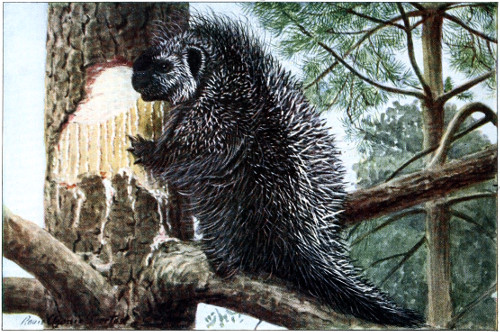
PORCUPINE
Erethizon dorsatum
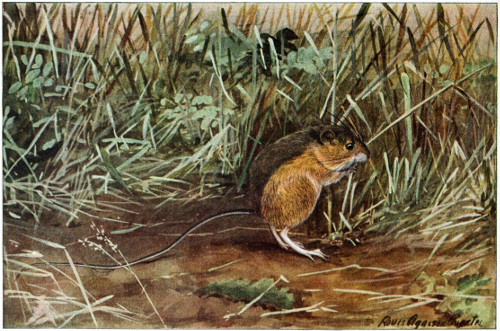
JUMPING MOUSE
Zapus hudsonius
As a rule, muskrats keep near their homes in winter, making excursions here and there beneath the ice. Sometimes the water rises and forces them out and they wander widely in search of new locations. When encountered at such times they show extraordinary courage and fiercely attack man or beast. The first muskrat I ever saw was one which a farmer met in midwinter in a snowy road in northern New York. As soon as the man drew near, the animal rushed at him with bared teeth and fought savagely until killed.
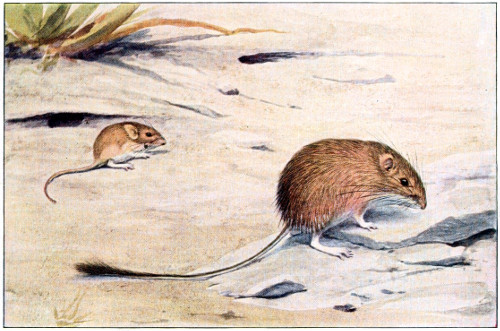
SILKY POCKET MOUSE Perognathus flavus SPINY POCKET MOUSE Perognathus hispidus
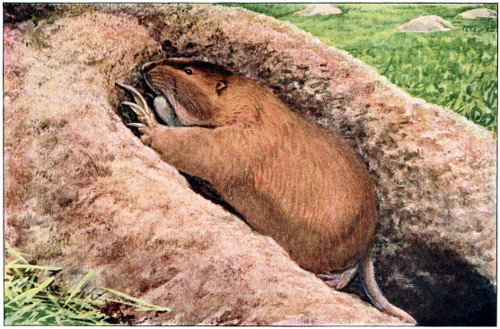
POCKET GOPHER
Geomys bursarius
Muskrats are usually harmless animals and their presence in marshes and along watercourses lends a pleasant touch of primitive wildness to the most commonplace situations. They appear to have so adapted their habits to the presence of men that they go on with their affairs with curious indifference to their human neighbors. In irrigated country or elsewhere where banked ditches are built their habits render them serious pests, as their burrows and tunnels drain ponds or cause destructive washouts.
An interesting chapter in the history of these animals began in 1905, when four Canadian muskrats were introduced on a nobleman’s estate in Bohemia. Since then they have increased rapidly and spread over a large area in Bohemia and beyond its borders. The streams in the region they occupy are controlled by grassy banks, and dams are built to form ponds for fish culture, which is a large industry there. The muskrats persistently tunnel into the banks and dams, causing them to give way, thus causing heavy losses to the owners.
They also work havoc among river crabs and mussels, which have great economic value, and interfere with the fish and their spawning beds. To cap the climax of their misdeeds, they are reported to feed on grain and vegetables and to destroy the eggs of domestic poultry and of wild-fowl. It is reported also that these expatriates in their foreign environment have become larger animals than their ancestors, and that their fur has greatly deteriorated in quality. The measures prescribed by the Agricultural Council of the Kingdom of Bohemia for their control are apparently without much success. This instance is a good illustration of the danger attending the introduction of an animal from its native habitat into a new region.
THE WOODRAT (Neotoma albigula and its relatives)
(For illustration, see page 526)
In the East known as woodrats, in the West, where much more numerous and better known, these animals are called “mountain rats” or “trade rats.” Despite a certain superficial resemblance in size and appearance, woodrats are not related to those exotic parasites, the house rats, with coarse hair and bare tails, but are far more attractive and handsome animals, clothed in fine soft fur, delicately colored above in soft shades of gray, buffy, or ferruginous, while below they are usually snowy white or buffy. The tail is fully haired and in some species almost as broad and bushy as that of a squirrel. Their prominent black eyes and large ears give them an air of vivacious intelligence which their habits appear to confirm.
Woodrats are peculiar to North America, where they occur from Pennsylvania and Illinois to the Gulf coast, spreading thence to the Pacific and as far north as the headwaters of the Yukon, and south through Mexico and Central America to Nicaragua. They are not plentiful in the southern Mississippi Valley and eastward, where they live among cliffs and broken ledges of rock in the deciduous forests, and well deserve their common name. In this region their presence is rarely suspected except by hunters or others familiar with woodland life.
Far more numerous and widely known in the Western States and throughout most of Mexico, they have adapted themselves to life under every climatic condition, from the most sun-scorched deserts of the southwest and the splendid redwood forests of the humid coastal region in northern California to the tropical lowlands farther south.
They live nearly everywhere on the mountain slopes, even to timber-line at 13,800 feet on Mount Orizaba. They thrive in an extraordinary variety of situations, not only where they may find shelter among rocks, but also where they must seek safety in nests made on the surface of the ground or in burrows dug by themselves. They are prolific animals and each year have several litters containing from two to five young.
The presence of woodrats is generally indicated by accumulations of odds and ends filling the crevices of the rocks about their retreats or piled about the entrances of their burrows, such accumulations including small sticks, pieces of bark, leaves, cactus burrs, bones, stones, and any other small objects which may be found in the vicinity.
Sometimes these piles of fragments seem to be made merely for amusement or to work off surplus energy, as they form useless gatherings, such as heaps of small stones, frequently containing a bushel or more, piled on the rounded tops of small protruding boulders in open desert areas, or small heaps of sticks and other material scattered aimlessly about their haunts.
In the desert where cactuses of many kinds abound woodrats’ nests are often made at the bases of these or other thorny plants and are covered with such a protective coating of cactus burrs as to deter the most insistent enemy. In the heavy forests of northern California woodrats build huge conical nests of sticks several feet in diameter on the ground, rising to a height of five feet or more.
In southern California and elsewhere some species make great nests of sticks eight to twenty feet from the ground in live oaks and other trees. The stick-pile nests on the ground usually have several entrances, with trails leading from them, and the underground burrows usually have two or more openings.
As may be surmised from their habits, woodrats are skillful climbers, both in trees and on the rough rock walls of the cliffs they inhabit. Their only notes appear to be shrill squeaks and squeals when quarreling among themselves at night. They also express annoyance or alarm by a rapid drumming on the ground with their hind feet, just as is done by some of the hares and rabbits.
On Santa Margarita Island, in Lower California, I found the most curiously located habitations of these animals I have seen, the bulky stick nests being placed well back in the midst of a mangrove thicket growing in a tidal lagoon. At high tide the mangroves were isolated from shore by several rods of water, so that only at low tide were the rats able to go ashore. In going back and forth they followed certain lines of nearly horizontal mangrove stems, the discoloration on the bark plainly indicating the routes which finally led to dry land by little trampled roads across the muddy ground bordering the shore.
Back a little way from shore others of the same species were living in burrows guarded by orthodox stick and trash-pile nests among the cactuses.
Woodrats, especially in northern localities, gather stores of pinyon or other nuts, potatoes, corn, and any other non-perishable food available to meet the season of storms and scarcity, concealing these supplies in cavities in the nests either above or below the ground. They eat many kinds of fruits, seeds, leaves, and other parts of plants, sometimes including bark of shrubs or small trees and even cactus pads.
As a rule each nest is occupied by a single rat, but sometimes several may be found in one, and the well-worn trails that so often connect the entrances of neighboring nests bear evidence that woodrats have a social disposition. In most localities woodrats are distributed sparingly, but occasionally become so abundant in favorable places on brushy plains that colonies containing hundreds of nests may be found in limited areas. They sometimes become so plentiful about ranches as to make serious inroads on grain and other crops. They also give the Forest Service much trouble by digging up the pine seeds planted in their great reforesting nurseries.
Woodrats are mainly nocturnal in habits and appear to be extremely active throughout the night. Each morning in the vicinity of their nests the light soil shows a multitude of tracks, and in places I have seen little roads in the sand several hundred yards long which they had made by repeated trips to a feeding ground.
No sooner is a cabin built in the mountains than they move in and establish themselves under the floor, or locate a nest near by and use the house as their nocturnal resort. Throughout the night the patter of their busy feet may be heard as they race about on the floor or rustle about the roof, and often over the sleeping forms of their unwilling hosts.
Their activities are sources of mingled amusement and vexation. Small, loose articles, including table knives, forks, and spoons, vanish and all manner of trash, including horse droppings, are brought in, thus establishing their title to the cognomen of “trade rats.” If the owner of a cabin leaves it for a few days, he may find on his return that the rats have taken possession and during his absence have tried to fill it with trash of all kinds, in order to make a comfortable home for themselves.
At one cabin in the mountains of New Mexico where I lived one summer several mountain rats made free of the place and at night persistently tried to add our shoes to their nest under the floor. An hour or so after retiring we would hear our shoes scrape slowly across the floor, and in the morning they would be found stuck toe down in the broad crack where the floor ended near the wall. In the woodrat country when small articles are missed from camp it is always worth the trouble to investigate the nearest rats’ nests.
Woodrats are plentiful on the Mexican table-land, making their nests under cactuses or thorny agaves, where they are persistently hunted as game by the natives, who prize them as a special delicacy. I saw them regularly sold in the markets of the cities of San Luis Potosi and Aguas Calientes, where the method of marketing them was unique. As soon as they were dug from their nests, their lower incisors were broken off close to the jaw to render them powerless to bite, and then the rats were placed alive in a strong sack and carried to town.
The vendor would sit on a curb at the market and either kill and dress them there or shout his wares by telling every one who passed that he had “country rats; very delicious; live ones; fat ones; very delicious; very cheap.” The natives all praised their delicate flavor and one I had served me as a special courtesy was really good, tasting like young rabbit.
THE HARVEST MOUSE (Reithrodontomys megalotis and its relatives)
(For illustration, see page 527)
In size, proportions, and color the harvest mice, of all our American species, most closely resembles the common house mouse. Many of them are decidedly smaller than that animal and they rarely, if ever, exceed it in size. They may be distinguished from the house mouse by their browner colors, more hairy tail and especially by a little groove which extends down the front of each upper incisor.
The mice of this group include many species and have a wide distribution ranging from Virginia, in the eastern United States, to the Pacific, and from North Dakota, Montana, and Washington southward through Mexico and Central America to northern South America.
They reach their greatest development in number and diversity of species in the region about the southern end of the Mexican table-land, where I have caught them from the tropical lowlands, near sea level, up to an altitude of 13,500 feet, at timber-line, on Mount Iztaccihuatl.
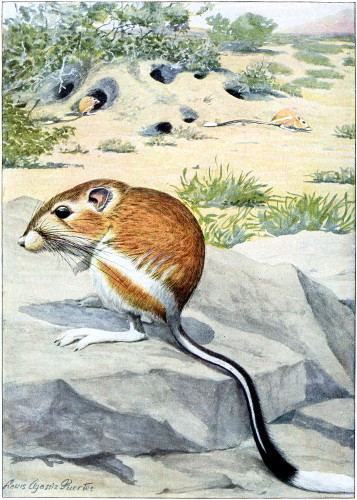
KANGAROO RAT
Dipodomys spectabilis
These delicately proportioned and graceful little beasts are habitants of grassy, weed-grown, and brushy locations, mainly in the open country. They are equally at home, however, in the beautiful grassy open forests of oak, pine, and firs which clothe the slopes of the great continental mountain system of Mexico and Central America.
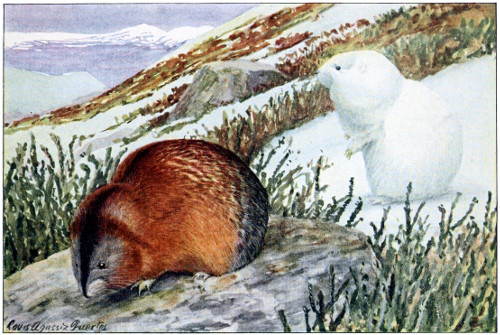
Summer Winter
BANDED LEMMING (Dicrostonyx nelsoni)
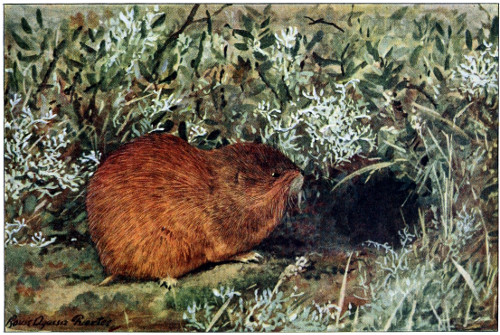
BROWN LEMMING
Lemmus alascensis
In general they prefer comparatively dry situations, if there is sufficient moisture to produce the needed vegetation, but some species inhabit swamps and even salt and fresh water marshes. Although as a rule not very numerous, at times they are very abundant and make well-worn trails through the small vegetation in their haunts. They are active throughout the year, and in the North, like some other mice, burrow through the winter snows along the surface of the ground in search of food.
So far as man is concerned, most of the harvest mice are among the least offensive of mammals. There are exceptions, however, and, although they rarely approach habitations and as a rule take but slight toll from grain fields and meadows, yet in some areas they become so numerous as to do considerable damage.
Their food includes a great variety of seeds, small fruits and succulent matter mainly from wild plants of no economic value. They lay up stores of seeds in their nests and in little special storage places for severe or inclement weather.
Some of the species dig burrows in the ground where their nests are hidden. Most of them, however, build globular nests of grass and other vegetable matter several inches in diameter in dense grass close to the ground, or up in the midst of rank growths of weeds, or even as high as eight or ten feet from the ground in bushes and low trees.
Sometimes they take possession of convenient sites already provided, such as old woodpecker holes, cavities in fence posts, knot holes, and deserted birds’ nests, including the nests of the cactus wren and orchard oriole, which they remodel to suit themselves. Their nests are lined with fine downy material such as the pappus of the milkweed or the cattail flag, and have from one to three small openings usually located on the underside. In these neat homes they have several litters of from one to seven young each year.
Some of their bush nests three or four feet from the ground were found when I was hunting on El Mirador coffee plantation in Vera Cruz. Often on approaching them, the single occupant would dive headlong into the grassy cover below and disappear. But sometimes when disturbed they would come out and run about through the tops of the bushes, leaping from branch to branch with all the agility and graceful abandon of pigmy squirrels. Several times they were seen to stop and sit crosswise on the branches with their tails hanging straight down. When they move about among the branches they sometimes coil the tail around the twig as an opossum might, to give them a more certain hold.
While harvest mice may be seen at their nests by day, they are mainly crepuscular and nocturnal, and so retiring in habits that their presence may be entirely overlooked unless special search is made to locate them. Where found their pretty ways well repay the observer who has the patience to spend a little time with them.
THE GRASSHOPPER MOUSE (Onychomys leucogaster and its relatives)
(For illustration, see page 527)
The grasshopper mice are notable for the delicate coloring and velvety quality of their fur. While closely resembling some of the white-footed mice, they may readily be distinguished from them by more robust form, short, thick tail, and the character of the fur.
Only two species, each with numerous geographic races, are known and both are peculiar to North America. Characteristic animals of the arid and semi-arid treeless plains, plateaus, and foothills of the West, their known range extends from Minnesota and Kansas west to the Cascades and to the Pacific coast of southern California, and in the North, from the plains of the Saskatchewan southward to San Luis Potosi, on the tableland of Mexico.
Some races live on the grassy plains west of the Mississippi, but the majority prefer the looser soil and sandy areas of the more arid Great Basin and the even more desert Southwest, where the vegetation is characterized by a scattered growth of woody plants, including many species of cactuses, yuccas, agaves, sagebrush, greasewood, mesquites, acacias, and other picturesque types.
Like other small mammals of the open plains, the grasshopper mice live in burrows. When opportunity offers they evade the labor of digging these for themselves by occupying the deserted holes of mice, kangaroo rats, ground squirrels, prairie dogs, badgers, and other animals. In these retreats they have nests of soft vegetable matter and each season bring forth several litters containing from two to six young.
They are active throughout the year, but nothing appears to be known as to the kind and amount of stores they lay up for winter use. As many live far enough north to experience a long period of cold, with snow covering the earth, there is little doubt that they exercise the same provision in providing stores to meet the need as do many other small mammals.
Many species of mice eat insects or meat and even on occasion devour one of their own kind. The grasshopper mice go far beyond this and are often not only as fierce flesh eaters as real carnivores, but make their diet, at least during the summer season, mainly of insects and other small invertebrates. Their bill of fare includes a miscellaneous assortment of several species of mice, including their own kind caught in traps, small dead birds, lizards, frogs, cutworms, scorpions, mole crickets, ordinary crickets, grasshoppers, moths, flies, and beetles, including the “potato bug.”
In addition they eat many kinds of seeds, fruit, and other vegetable matter. Where obtainable, grasshoppers are one of their favorite foods, and from this they receive their common name. In Colorado, from their fondness for scorpions, they are sometimes called “scorpion mice.”
Vernon Bailey’s observations of a grasshopper mouse he had in captivity are illuminating as to their habits, and indicate that their presence in numbers about cultivated land must be of distinct economic value. When undisturbed and well fed the captive was entirely nocturnal, sleeping all day and becoming very active at night. While usually quiet, sometimes jumping with all his force he tried furiously to escape from his small prison box. His favorite food consisted of crickets, grasshoppers ranking next. Among other things he ate were a black beetle, ladybirds, a potato beetle, spiders, bugs, and dragon flies.
In feeding he sat upright on his haunches and held the insects in his front paws, eating them head first. Large grasshoppers, their tails resting on the ground, were held head up by a paw on each shoulder. A grasshopper would sometimes kick so vigorously as to tip the mouse off its balance, but was never relinquished until decapitated.
The mouse promptly killed and ate a small frog placed in his box and was expert at catching flies. He ate many kinds of insects, including a live wasp, but appeared terror-stricken if a few ants were put in with him. When a dozen or more crickets and grasshoppers were put into his box at the same time he at once proceeded to bite off all their heads before beginning to feast upon them.
A dead white-footed mouse was dropped in and “he pounced upon it like a cat, caught it by the side of the head near the ear, and began biting it with all the ferocity of a coon dog.” The bones could be heard cracking and after the little beast appeared satisfied that his prey was really dead he ceased worrying it and an examination showed that he had bitten through its skull deep into the brain. Afterward he tore off and ate fragments of flesh from its head, neck, and shoulders. The ferocious certainty with which he seized the white-footed mouse by the head and bit through its skull indicated that in relation to small mammals he, probably like all his kind, had the predatory instincts and habits of the carnivores.
One morning he ate 12 crickets and a spider in seven minutes and during a single day devoured 53 insects—2 beetles, 8 grasshoppers, 28 crickets, and 15 flies—and appeared ready to take more.
Oddly enough, this grasshopper mouse, so fierce toward small game, never offered to bite when captured or when handled freely, but continued throughout his captivity to have the same friendly confidence in his captor. Others caught in various parts of their range have shown the same characteristics.
At night, especially early in the evening, grasshopper mice utter a fine shrill whistling call note. This habit appears peculiar to them among all the mice and may be likened to that of many of the large beasts of prey in uttering their hunting call as they sally forth for the night’s foray.
THE WHITE-FOOTED MOUSE (Peromyscus leucopus and its relatives)
(For illustration, see page 530)
Few of our smaller wild mammals are so generally known as the white-footed mice. Usually a little larger and proportionately shorter bodied than the house mice, they may at once be distinguished from them by the contrast between the delicate shades of fawn color, brown, or gray of the upper parts of the body, and the snowy white feet and under parts. Like other members of the genus, they have cheek pouches inside the mouth for gathering and carrying food to their stores.
Their exceedingly quick and graceful movements and their beauty of form and color would make them generally attractive were it not for the prejudice against all their kind resulting from the offensive ways of the house mouse.
Mice of the genus Peromyscus, to which the white-footed mice belong, are peculiar to North and South America and include more species and geographic races than any other American genus of mammals. The white-footed mice are limited to North America. Readily responsive to the influences of environment, they have developed numerous species and a large number of geographic races.
These are spread over most of the continent from the northern limit of trees to the tropical shores of Yucatan. One form has the distinction of living up to an altitude of from 15,000 to 16,000 feet on Mount Orizaba, Mexico, where I found its tracks in the volcanic ashes at the extreme limit of vegetation. This is the highest record for any North American mammal.
White-footed mice are active throughout the year and thrive in every variety of situation. In winter from the Northern States to the Arctic circle the snowshoer traversing the forest will note their lace-work patterns of tiny tracks leading across the snow from log to log or tree to tree. At sunrise on the southwestern deserts their tracks made during the night often form a fine network in the dust, but disappear with the first breath of the morning breeze.
They not only live everywhere in the wilderness, but are prompt to swarm about camps and other habitations, where they make free with the food supplies. Few frequenters of forest camps in the Northern States and Canada have failed to see the bright eyes of these pretty little animals peering at them from some crevice, or the mice scurrying along the log wall like little squirrels.
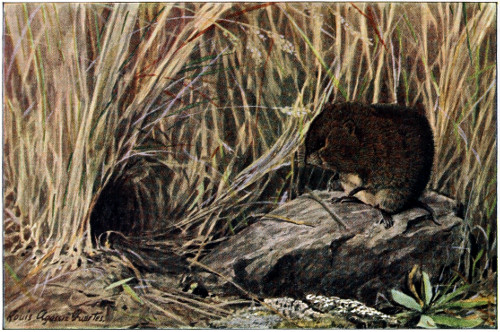
FIELD, or MEADOW, MOUSE
Microtus pennsylvanicus
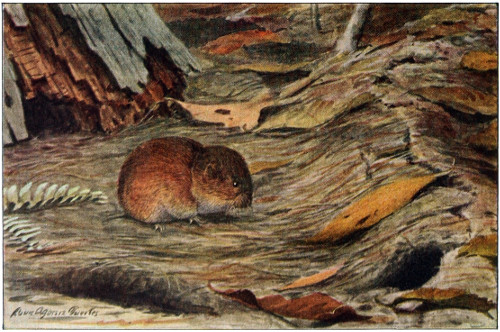
PINE MOUSE
Pitymys pinetorum
They are industrious workers and once in a cabin quickly locate some cozy nook in a box or other secluded place to construct a warm nest of any soft fibrous vegetable material available. This completed, they set busily at work nights to raid the food supply of the owner and hide it in suitable storage places, such as a crevice among boxes, an old shoe or a pocket in a garment hung on the wall. Their depredations usually cause so much exasperation that the camper overlooks the grace and beauty of his visitors and makes every effort to destroy them. If the occupants of such camps would keep their supplies in mouse-proof containers and would then feed their woodland friends, they would find them quickly responsive and most attractive guests.
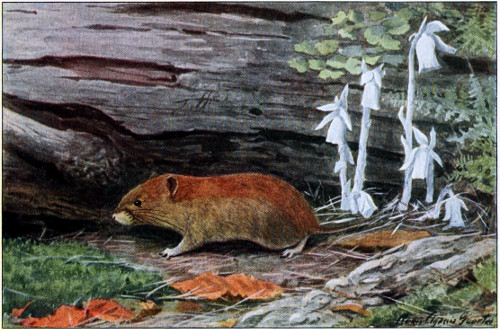
RED-BACKED MOUSE
Evotomys gapperi
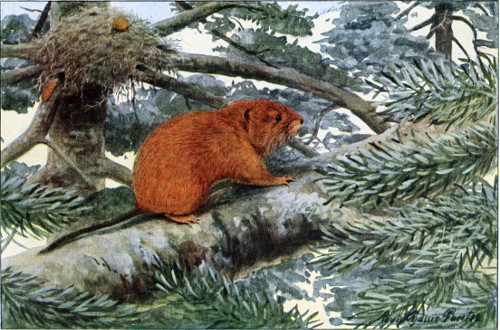
RUFOUS TREE MOUSE
Phenacomys longicaudus
In their native haunts these mice have habits varying with varying conditions. On brushy plains they burrow in the ground, while in the woods they sometimes burrow under rocks, stumps, and logs, or live in hollows in stumps and trees. As nimble in climbing as squirrels, many live in hollow trees sometimes more than fifty feet above the ground.
That our inability to see at night prevents more than an occasional glimpse at the doings of the small animals which often swarm all about us was impressed on me at one of my camps in the desert of Lower California. My blankets were spread under a small leafless tree growing near the base of a rocky ledge, in the crevices of which many relatives of the white-footed mice were living. The first morning in camp I awoke as the sky began to pale and color with the approach of day. The dry branches of the tree a few feet overhead became sharply silhouetted against the sky, revealing several of the mice running up and down them and leaping from twig to twig with all the active grace of tiny squirrels.
The mice appeared to be racing about in pure playful enjoyment of the exercise, and when the light had increased sufficiently to render objects on the ground distinct they suddenly ran down the tree trunk and vanished in a crevice in the rocks. This game was repeated on several succeeding mornings and is no doubt commonly indulged in where conditions are favorable.
White-footed mice feed mainly on many kinds of seeds and nuts and vary this diet with snails, insects, and sometimes with the flesh of dead birds or other mice. As they do not hibernate they lay up abundant stores of grain and seeds of many kinds in addition to a variety of nuts, as acorns, beech nuts, pine nuts, maple seeds, and others, according to the locality. The stores are hidden in hollows in logs, stumps, trees, or in the ground. When in captivity they have shown themselves expert in catching flies, sometimes capturing them with their teeth and again with their front paws used with all the dexterity of little hands.
Several litters of young containing from three to seven each are born, the first usually appearing in spring and the last in fall. The young are blind and helpless at birth, and in this condition cling so tenaciously to the mother’s teats that when she is frightened from the nest they are often carried off attached to her.
Some individuals at least of the white-footed mice, like others of the genus Peromyscus, are known to have a prolonged and musical song. It is a fine warbling ditty, a little like the song of a canary. A number of good observers have recorded these performances, but they appear to be so infrequent that most people with woodland experience have never heard them.
The lives of these mice are passed in constant fear of a host of enemies. Hawks and owls, bluejays, and shrikes in the bird world are ever on the alert to capture them, while skunks, weasels, minks, foxes, and snakes persistently seek them in their retreats.
THE BEACH MOUSE (Peromyscus polionotus niveiventris and its relatives)
(For illustration, see page 530)
The beach mouse is a beautiful, velvety-furred little creature about the size of a house mouse and one of the smallest species of the genus Peromyscus. Its back is colored with delicate shades of pale vinaceous-buffy and its underparts, including the feet, are snowy white.
The species Peromyscus polionotus, of which the beach mouse is one of several geographic races, or subspecies, occupies a comparatively restricted range in the lowland region of Alabama and Georgia and thence through a large part of Florida.
It presents an unusually convincing illustration of the influence of changing environment upon the physical characters of animals. Among the cotton fields of Alabama and Georgia Peromyscus polionotus is rather dark grayish brown, but on the lighter-colored soil of Florida the color responds and becomes paler in perfect correspondence with the change in soil until the white sand-dunes and beaches of the coast are reached. There, in strong contrast with the color of the northern members of the species, it is so modified that the pale representatives of this area are recognized under the name niveiventris, as a geographic race, or subspecies.
Changes in environment affect both great and small mammals in a variety of ways, sometimes in shades of color, sometimes in relative size, and sometimes in proportions. Exceptions to the rule are to be found, however, and some species of mammals have a wide range under a great variety of conditions, with scarcely an appreciable sign of variation.
The beach mouse is abundant on the sand-dunes and beaches of peninsular Florida, especially from Palm Beach to Mosquito Inlet, wherever there is a growth of sea oats (Uniola), which appears to be its principal food plant. It is a nocturnal animal and its nightly activities may be read, early in the morning, from the multitude of tiny tracks which lead in all directions and often form a network on the sand. A single track sometimes extends for a hundred yards or more from a burrow, and with all its windings may aggregate several hundred yards of travel, showing the activity of this small worker during many hours.
Tracks are most plentiful immediately about growths of sea oats, patches of saw palmetto, or scrubby bushes. The homes of these mice are usually in short burrows sheltered by growing vegetation or under fallen palm fronds.
As in the case of many of our mammals, we have scanty information concerning the life of these attractive little animals, and it is suggested that here lies a pleasant subject for investigation by some nature lover wintering in Florida.
THE BIG-EARED ROCK MOUSE (Peromyscus truei and its relatives)
(For illustration, see page 531)
The numerous species of mice of the genus Peromyscus in North America include a great variety of little beasts, many of which are distinguished by beauty of form and color. One of the most striking and picturesque individualities among these is found in the big-eared rock mouse, which is characterized by its great ears, a thick, soft coat of buffy brown fur, and a long, well-haired tail. In size it exceeds the common house mouse and even the white-footed mice which share its haunts.