Front matter (continued 7)
Reading edition
Two or three canoes of Winnebagoes had arrived at the same moment, and their owners immediately stepped forward with an offering of some sturgeon which they had caught in the lake. As this promised to be an agreeable variety to the noon-tide meal, (at least for the Frenchmen,) it was decided to stop and kindle a fire for the purpose of cooking it. We took advantage of this interval, to recommend to the boys to stroll to the opposite side of the island, where the clear, shallow water and pebbly beach offered temptation to a refreshing bath. While they availed themselves of this, under the supervision of Harry, the black boy, we amused ourselves with gathering the fine red raspberries with which the island abounded.
Our enjoyment was cut short, however, by discovering that the whole place, vines, shrubs, and even, apparently, the earth itself, was infested with myriads of the wood-tick, a little insect, that, having fastened to the skin, penetrates into the very flesh, causing a swelling and irritation exceedingly painful, and even dangerous. The alarm was sounded to bring the boys back in all haste, to the open and more frequented part of the island. But we soon found we had not left our tormentors behind. Throughout the day, we continued to be sensible of their proximity. From the effects of their attacks we were not relieved for several succeeding days; those which had succeeded in burying themselves in the flesh, having to be removed with the point of a penknife, or a large needle. After partaking of our dinner, we stepped on board our boat, and the wind having risen, we were carried by the breeze to the opposite verge of the lake, and into the entrance of the river, or, as it was called, the Winnebago rapids.
On the point of land to the right stood a collection of neat bark wigwams—this was Four-Legs' village.
It was an exciting and somewhat hazardous passage down the rapids and over the Grande Chûte, a fall of several feet; but it was safely passed, and at the approach of evening the boat reached the settlement of the Wau-bee-na-kees at the head of the Little Chûte. These are the Stockbridge or Brothertown Indians, the remains of the old Mohicans, who had, a few years before, emigrated from Oneida County in the State of New York, to a tract granted them by the United States, on the fertile banks of the Fox River.[106] They had already cleared extensive openings in the forest, and built some substantial and comfortable houses near the banks of the river, which were here quite high, and covered for the most part with gigantic trees.
It was determined to ask hospitality of these people, to the extent of borrowing a corner of their fire to boil our tea kettle, and bake the short-cake which had been now, for nearly two days, our substitute for bread. Its manufacture had been a subject of much merriment. The ingredients, consisting of Powell’s black flour, some salt and a little butter, were mixed in the tin box which had held our meat. This was then reversed, and having been properly cleansed, supplied the place of a dough-board. The vinegar bottle served the office of rolling-pin, and a shallow tin dish, set upon the coals at our previous encamping places, had formed the appliance for baking. The Wau-bee-na-kees were so good as to lend us an iron bake-kettle, and superintend the cooking of our cake after Harry had carried it up to their dwelling.
So kind and hospitable did they show themselves, that the crew of the boat took the resolution of asking a lodging on shore, by way of relief, after their crowded quarters in the boat for the last three nights. Arthur and Mâtâ soon adopted the same idea, and we were invited to follow their example, with the assurance that the houses were extremely neat and orderly.
We preferred, however, at it was a fine night, and all things were so comfortably arranged in the centre of the boat, to remain on board, keeping Edwin and Josette with us.
The boat was tightly moored, for the Little Chûte was just below, and if our craft should work loose in the rapid current, and drift down over the falls, it would be a very serious matter. As an additional precaution, one man was left on board to keep all things safe and in order, and these arrangements having been made, the others ascended the bank, and took up their night’s lodgings in the Wau-bee-na-kee cabins.
It was a beautiful, calm, moonlight night, the air just sufficiently warm to be agreeable, while the gentle murmur of the rapids and of the fall at no great distance, soon lulled our party to repose. How long we had slumbered we knew not, when we were aroused by a rushing wind. It bent the poles supporting the awning, snapped them, and another gust succeeding, tent and blanket were carried away on the blast down the stream. The moonlight was gone, but a flash of lightning showed them sailing away like a spectre in the distance.
The storm increased in violence. The rain began to pour in torrents, and the thunder and lightning to succeed each other in fearful rapidity. My sister sprang to waken the Frenchman. “Get up Vitelle, quick,” cried she, in French, “run up the bank for Mâtâ and Mr. Arthur—tell them to come and get us instantly.”
The man made her no reply, but fell upon his knees, invoking the Virgin most vociferously.
“Do not wait for the Virgin, but go as quickly as possible. Do you not see we shall all be killed?”
“Oh! not for the world, Madame, not for the world,” said Vitelle, burying his head in a pack of furs, “would I go up that bank in this storm.” And here he began crying most lustily to all the saints in the calendar.
It was indeed awful. The roaring of the thunder and the flashing of the lightning around us, were like the continued discharge of a park of artillery. I had with difficulty drawn forth my cloak, and enveloped myself and Josette—sister Margaret had done the same with Edwin.
“Oh! Madame,” said the poor little girl, her teeth chattering with cold and fright, “won’t we be drowned?”
“Very well,” said my sister to the Frenchman, “you see that Madame John is at the last agony—if you will not go for help I must, and Monsieur John must know that you left his wife to perish.”
This was too much for Vitelle. “If I must, I must,” said he, and with a desperate bound he leapt on shore and sped up the hill with might and main.
In a few minutes, though it seemed ages to us, a whole posse came flying down the hill. The incessant lightning made all things appear as in the glare of day. Mâtâ’s hair fairly stood on end, and his eyes rolled with ghastly astonishment at the spectacle.
“Oh! my God, Madame Johns! what would Monsieur Johns say, to see you nows?” exclaimed he, as he seized me in his arms and bore me up the hill. Arthur followed with sister Margaret, and two others with Edwin and Josette. Nobody carried Vitelle, for he had taken care not to risk his precious life by venturing again to the boat.
On arriving at the cabin where Arthur and Mâtâ had been lodged, a fire was, with some difficulty, kindled, and our trunks having been brought up from the boat, we were at length able to exchange our drenched garments, and those of the children, for others more comfortable, after which we laid ourselves upon the clean, but homely bed, and slept until daylight.
As it was necessary to ascertain what degree of damage the cargo of furs had sustained, an early start was proposed. Apparently, the inhabitants of the cottages had become weary in well doing, for they declined preparing breakfast for us, although we assured them they should be well compensated for their trouble. We, consequently, saw ourselves compelled to depart with very slender prospects of a morning meal.
When we reached the boat, what a scene presented itself! Bed-clothes, cloaks, trunks, mess-basket, packs of furs, all bearing the marks of a complete deluge! The boat ankle-deep in water—literally no place on board where we could either stand or sit. After some bailing out, and an attempt at disposing some of the packs of furs, which had suffered least from the flood, so as to form a sort of divan in the centre of the boat, nothing better seemed to offer than to re-embark, and endure what “could not be cured.”
Our position was not an enviable one. Wherever a foot or hand was placed, the water gushed up, with a bubbling sound, and, oh! the state of the bandboxes and work-baskets! Breakfast there was none, for on examining the mess-basket everything it contained was found mingled in one undistinguishable mass. Tea, pepper, salt, short-cake, all floating together—it was a hopeless case.
But this was not the worst. As the fervid July sun rose higher in the heavens, the steam which exhaled from every object on board was nearly suffocating. The boat was old—the packs of skins were old—their vicinity in a dry day had been anything but agreeable—now, it was intolerable. There was no retreating from it, however, so we encouraged the children to arm themselves with patience, for the short time that yet remained of our voyage.
Seated on our odoriferous couch, beneath the shade of a single umbrella, to protect our whole party from the scorching sun, we glided wearily down the stream, through that long, tedious day. As we passed successively the Kakalin, the Rapids, Dickinson’s, the Agency, with what longing eyes did we gaze at human habitations, where others were enjoying the shelter of a roof, and the comforts of food, and how eagerly did we count the hours which must elapse before we could reach Fort Howard.
There were no songs from the poor Frenchmen this day. Music and fasting do not go well together. At length we stopped at Shanteetown,[107] where the boat was to be unloaded. All hands fell to work to transfer the cargo to the warehouse of the Fur Company, which stood near the landing. It was not a long operation, for all worked heartily. This being accomplished, the voyageurs, one and all, prepared to take their leave. In vain Mâtâ stormed and raved, in vain Arthur remonstrated.
“No,” they said, “they had brought the boat and cargo to the warehouse—that was all of their job,” and they turned to go.
“Guardapie,” said I, “do you intend to leave us here?”
“Bien, Madame! it is the place we always stop at.”
“Does Monsieur John pay you for bringing his family down?”
“Oh, yes; Monsieur John has given us an order on the sutler, at the fort down below.”
“To be paid when you deliver us safe at the fort down below. It seems I shall be there before you, and I shall arrange that matter. Monsieur John never dreamed that this would be your conduct.”
The Frenchmen consulted together, and the result was that Guardapie and two others jumped into the boat, took their oars, and rather sulkily rowed us the remaining two miles to Fort Howard.
CHAPTER XXXIV
FORT HOWARD—OUR RETURN HOME
We soon learned that a great panic prevailed at Green Bay on account of the Sauks.[108] The people seemed to have possessed themselves with the idea that the enemy would visit this place on their way to Canada to put themselves under the protection of the British Government. How they were to get there from this point—whether they were to stop and fabricate themselves bark canoes for the purpose, or whether they were to charter one of Mr. Newberry’s schooners for the trip, the good people did not seem fully to have made up their minds. One thing is certain, a portion of the citizens were nearly frightened to death, and were fully convinced that there was no safety for them, but within the walls of the old dilapidated fort, from which nearly all the troops had been withdrawn and sent to Fort Winnebago, some time previous.
Their fears were greatly aggravated by a report, brought by some traveller, that he had slept at night on the very spot where the Sauks breakfasted the next morning. Now, as the Sauks were known to be reduced to very short commons, there was every reason to suppose that if the man had waited half an hour longer, they would have eaten him; so he was considered to have made a wonderful escape.
Our immediate friends and acquaintances were far from joining in these fears. The utter improbability of such a movement was obvious to all who considered the nature of the country to be traversed, and the efficient and numerous body of whites by whom they must be opposed on their entrance into that neighborhood. There were some, however, who could not be persuaded that there was even any security but in flight, and eagerly was the arrival of the “Mariner” looked for, as the anxiety grew more and more intense.
The “Mariner” appeared at last. It was early in the morning. In one hour from that time, the fearful news she brought had spread the whole length of “the bay.” The cholera was in this country! It was in Detroit—it was among the troops who were on their way to the seat of war! Whole companies had died of it in the river St. Clair, and the survivors had been put on shore at Fort Gratiot, to save their lives as best they might! We were shut in between the savage foe on one hand and the pestilence on the other![109]
To those who had friends “at the East,” the news was most appalling. It seemed to unman every one who heard it. A relative, an officer who had exhibited the most distinguished courage in the battle-field, and also in some private enterprises demanding unequalled courage and daring, was the first to bring us the news. When he had communicated it, he laid his head against the window sill and wept like a child.
Those who wished to rejoin friends near and dear, left “the bay” in the “Mariner”; all others considered their present home the safest, and so it proved, for the dreadful scourge did not visit Green Bay that season.
The weather was intensely hot, and the musquitoes so thick that we did not pretend to walk on the parade after sunset, unless armed with two fans, or green branches to keep constantly in motion, in order to disperse them. This, by the way, was the surest method of attracting them. We had somehow forgotten the apathetic indifference which had often excited our wonder in old Smoker, when we had observed him calmly sitting and allowing his naked arms and person to become literally gray with the tormenting insects. Then he would quietly wipe off a handful, the blood following the movement of the hand over his skin, and stoically wait for an occasion to repeat the movement. It is said that the mosquito, if undisturbed until he has taken his fill, leaves a much less inflamed bite than if brushed away in the midst of his feast.
By day, the air was at this season filled with what is called the Green Bay fly, a species of dragon-fly, with which the outer walls of the houses are at times so covered that their color is hardly distinguishable. Their existence is very ephemeral, scarcely lasting more than a day. Their dead bodies are seen adhering to the walls and windows within, and they fall without in such numbers that after a high wind has gathered them into rows along the sides of the quarters, one may walk through them and toss them up with their feet like the dry leaves in autumn.
As we walked across the parade, our attention was sometimes called to a tapping upon the bars of the dungeon in which a criminal was confined—it was the murderer of Lieutenant Foster.
It may be remembered that this amiable young officer had been our travelling companion in our journey from Chicago the preceding year. Some months after his arrival at Fort Howard, he had occasion to order a soldier of his company, named Doyle, into confinement for intoxication. The man, a few days afterward, prevailed on the Sergeant of the Guard to escort him to Lieutenant Foster’s quarters on the plea that he wished to speak to him. He ascended the stairs to the young officer’s room, while the sergeant and another soldier remained at the foot, near the door.
Doyle entered, and addressing Lieutenant Foster, said, “Will you please tell me. Lieutenant, what I am confined for?”
“No, sir,” replied the officer, “you know your offence well enough; return to your place of confinement.”
The man ran down stairs, wrenched the gun from the sergeant’s hand, and rushing back, discharged it at the heart of Lieutenant Foster.
He turned to go to his inner apartment, but exclaiming, “Ah! me,” he fell dead before the entrance.
Doyle, having been tried by a civil court, was now under sentence, awaiting his execution. He was a hardened villain, never exhibiting the slightest compunction for his crime.
The commanding officer. Major Clark,[110] sent to him one day to inquire if he wanted anything for his comfort.
“If the Major pleased,” he replied, “he should like to have a light and a copy of Byron’s Works.”
Some fears were entertained that he would contrive to make way with himself before the day of execution, and to guard against it, he was deprived of everything that could furnish him a weapon. His food was served to him in a wooden bowl, lest a bit of broken crockery might be used as a means of self-destruction.
One morning he sent a little package to the commanding officer as a present. It contained a strong rope, fabricated from strips of his blanket, that he had carefully separated, and with a large stout spike at the end of it. The message accompanying it was: "He wished Major Clark to see that if he chose to put an end to himself, he could find means to do it in spite of him."
And this hardened frame of mind continued to the last. When he was led out for execution, in passing beyond the gate, he observed a quantity of lumber recently collected for the construction of a new Company’s store.
“Ah! Captain, what are you going to build here?” inquired he of Captain Scott,[111] who attended him.
“Doyle,” replied his Captain, “you have but a few moments to live—you had better employ your thoughts about something else.”
“It is for that very reason, Captain,” said he, “that I am enquiring—as my time is short, I wish to gain all the information I can while it lasts.”
We were not suffered to remain long in suspense in regard to the friends we had left behind. In less than two weeks Old Smoker again made his appearance. He was the bearer of letters from my husband, informing me that Gen. Dodge was then with him at Fort Winnebago—that Generals Henry and Alexander[112] were likewise at the fort, and that as soon as they had recruited their men and horses, which were pretty well worn out with scouring the country after Black Hawk, they would march again in pursuit of him towards the head waters of the Rock river, where they had every reason, from information lately brought in by the Winnebagoes, to believe he would be found.
As he charged us to lay aside all uneasiness on his account, and moreover held forth the hope of soon coming or sending for us, our minds became more tranquil.
Not long after this, I was told one morning, that “a lady” wished to see me at the front door. I obeyed the summons, and, to my surprise, was greeted by my friend, Madame Four-Legs. After much demonstration of joy at seeing me, such as putting her two hands together over her forehead, and then parting them in a waving kind of gesture—laughing and patting me on my arms, she drew from her bosom a letter from my husband, of which she was the bearer, to this effect—"Generals Dodge and Henry left here a few days since, accompanied by Paquette; they met the Sauks near the Wisconsin, on the 21st. A battle ensued in which upwards of fifty of the enemy were killed—our loss was one killed, and eight wounded. The citizens are well pleased that all this has been accomplished without any aid from Old White Beaver.[BB] The war must be near its close, for the militia and regulars together will soon finish the remaining handful of fugitives."
The arrival of Lieut. Hunter, who had obtained leave of absence in order to escort us, soon put all things in train for our return to Fort Winnebago. No Mackinac boat was to be had, but in lieu of it a Durham boat was procured. This is of a description longer and shallower than the other, with no convenience for rigging up an awning, or shelter of any kind over the centre; but its size was better fitted to accommodate our party, which consisted of Mr. and Mrs. H., the wife of another officer now stationed at Fort Winnebago, and our cousin. Miss Forsyth, in addition to our own immediate family. We made up our minds, as will be supposed, to pretty close quarters.
Our crew was composed partly of Frenchmen, and partly of soldiers, and all things being in readiness, we set off one fine, bright morning, in the latter part of July.
Our second day’s rowing and poling brought us to the Grande Chûte[113] early in the afternoon.
Here, it is the custom to disembark at the foot of the rapids, and, ascending the high bank, walk around the fall, while the men pull the boat up, through the foaming waters.
Most of our party had already stepped on shore, when a sudden thought seized one of the ladies and myself.
“Let us stay in the boat,” said we, “and be pulled up the Chûte.” The rest of the company went on, while we sat and watched with great interest the preparations the men were making. They were soon overboard in the water, and attaching a strong rope to the bow of the boat, all lent their aid in pulling as they marched slowly along with their heavy load. The cargo, consisting only of our trunks and stores, which were of no very considerable weight, had not been removed.
We went on, now and then getting a tremendous bump against a hidden rock, and frequently splashed by a shower of foam as the waves roared and boiled around us.
The men kept as closely as possible to the high, precipitous bank, where the water was smoothest. At the head of the cordel was a merry simpleton of a Frenchman, who was constantly turning to grin with delight at our evident enjoyment and excitement.
We were indeed in high glee. “Is not this charming?” cried one—“I only wish—”
The wish, whatever it was, was cut short by a shout and a crash. “Have a care, Robineau! Mind where you are taking the boat!” was the cry, but it came too late. More occupied with the ladies than with his duty, the leader had guided us into the midst of a sharp, projecting tree that hung from the bank. The first tug ripped out the side of the boat, which immediately began to fill with water.
My companion and I jumped upon the nearest rocks that showed their heads above the foam. Our screams and the shouts of the men brought Lieut. Hunter and some Indians, who were above on the bank, dashing down to our rescue. They carried us in their arms to land, while the men worked lustily at fishing up the contents of the boat, now thoroughly saturated with water.
We scrambled up the high bank, in a miserable plight, to join in the general lamentation over the probable consequences of the accident.
“Oh! my husband’s new uniform!” cried one, and
“Oh! the miniatures in the bottom of my trunk!” sighed another—while, “Oh! the silk dresses, and the ribbons, and the finery,” formed the general chorus.
No one thought of the provisions, although we had observed in our progress to shore, the barrel of bread and the tub of ice, which Lieut. Hunter had providently brought for our refreshment, sailing away on the dancing waves. Among the boxes brought to land, and “toted” up the steep bank, was one containing some loaves of sugar and packages of tea, which I had bought for our winter’s supply, from the sutler at the post. The young Indian, who was the bearer of it, set it upon the ground, and soon called my attention to a thick, white stream that was oozing from the corners. I made signs for him to taste it. He dipped his finger in it, and exclaimed with delight to his companions, when he perceived what it was. I then pointed to his hatchet, and motioned him to open the box. He did not require a second invitation—it was soon hacked to pieces.
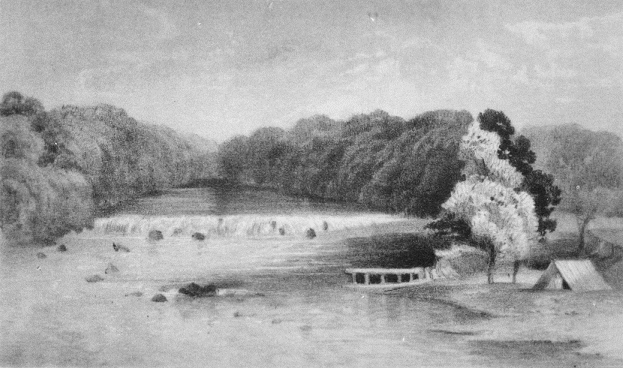
THE GRAND CHÛTE—FOX RIVER. From a sketch by Mrs. Kinzie, in original edition.
Then, as I beckoned up all the rest of the youngsters who were looking on, full of wonder, such a scrambling and shouting with delight succeeded as put us all, particularly the boys, into fits of laughter. Bowls, dippers, hands, everything that could contain even the smallest quantity were put in requisition. The squaws were most active. Those who could do no better, took the stoutest fragments of the blue paper in which the sugar had been enveloped, and in a trice, nothing remained but the wet, yellow bundles of tea, and the fragments of the splintered box which had contained it.
By this time, fires had been made, and the articles from the trunks were soon seen covering every shrub and bush in the vicinity. Fortunately, that containing the “new uniform,” had been piled high above the others, in the centre of the boat, and had received but little damage, but sad was the condition of the wardrobes in general.
Not a white article was to be seen. All was mottled, blue-green, red, and black, intermingling in streaks, and dripping from ends and corners.
To add to the trouble, the rain began to fall, as rain is apt to do, in a wild, unsheltered country, and soon the half-dried garments had to be gathered out of the smoke, and huddled away in a most discouraging condition.
The tent was pitched, wet as it was, and the blankets, wrung out of the water, and partially dried, were spread upon the ground for our accommodation at night.
A Hamburgh cheese which had been a part of my stores, was voted to me for a pillow, and, after a supper, the best part of which, was a portion of one of the wet loaves which had remained in a barrel too tightly wedged to drift away, we betook ourselves to our repose.
The next morning rose hot and sultry. The musquitoes, which the rain had kept at bay through the night, now began to make themselves amends, and to torment us unmercifully.
After our most uncomfortable and unpalatable breakfast, the first question for consideration was, what we were to do with ourselves. Our boat lay submerged at the foot of the hill, half way up the rapids. The nearest habitation among the Wabeenakees was some miles distant, and this there was no means of reaching, but by an Indian canoe, if some of our present friends and neighbors would be so obliging as to bring one for our use. Even then it was doubtful if boats could be found sufficient to convey all our numerous party back to Green Bay.
In the midst of these consultations a whoop was heard from beyond the hill, which here sloped away to the north, at the head of the rapids.
“There is John! that is certainly his voice!” cried more than one of the company.
It was, indeed, my husband, and in a moment he was amongst us. Never was arrival more opportune, more evidently providential.
Not having learned our plans, for the unsettled state of the country had prevented our sending him word, he had come provided with a boat, to take us to Fort Winnebago.
Our drying operations, which we had recommenced this morning, were soon cut short. Everything was shuffled away in the most expeditious manner possible, and in an incredibly short time we were transferred to the other boat, which lay quietly above the Chûte, and were pulling away towards Winnebago Lake.
We had resolved to go only so far as the vicinity of the lake, where the breeze would render the musquitoes less intolerable, and then to stop and make one more attempt at drying our clothing. Accordingly, when we reached a beautiful high bank near the Little Butte, we stopped for that purpose again, unpacked our trunks, and soon every bush and twig was fluttering with the spoils of the cruel waves.
Hardly had we thus disposed of the last rag, or ribbon, when the tramp of horses was heard, followed by loud shouts and cheers ringing through the forest.
A company of about twenty-five horsemen, with banners flying, veils fluttering from their hats, and arms glittering in the sun, rode into our midst, and amid greetings and roars of laughter, inquired into the nature and reasons of our singular state of confusion.
They were Colonel Stambaugh and Alexander Irwin of Green Bay, with a company of young volunteers, and followed by a whooping band of Menomonees, all bound for the seat of war.[114] We comforted them with the assurance that the victories were by this time all won, and the scalps taken; but, expressing the hope that there were yet a few laurels to be earned, they bade us adieu, and rapidly pursued their march.
We crossed Lake Winnebago by the clear beautiful light of a summer moon. The soft air was just enough to swell the sail, and thus save the men their labor at the oar.
The witchery of the hour was not, however, sufficient to induce us to forego our repose after the heat and annoyances of the day—we therefore disposed ourselves betimes to be packed away in the centre of the boat. How it was accomplished, no one of the numerous company could tell. If any accident had occurred to disturb our arrangement, I am sure it would have been a Chinese puzzle to put us back again in our places. The men on the outside had much the best of it, and we rather envied those who were off watch their ability to snore and change as the humor took them.
We reached Powell’s just in time to have gone ashore and prepare our breakfast, had we had wherewithal to prepare it. We had hoped to be able to procure some supplies here, for hitherto we had been living on the remains of my husband’s ample stock. That was now so nearly exhausted that when we found the mess-basket could not be replenished at this place, we began to talk of putting ourselves on allowance.
The wet bread, of which there had remained an ample store, had, as may be readily imagined, soon fermented under the influence of a July sun. The tea, too, notwithstanding our careful efforts at drying it on newspapers and pieces of board, ere long became musty and unfit for use. There was, literally, nothing left, except the sotted meat, and a few crackers, hardly sufficient for the present day.
The men were therefore urged to make all the speed possible, that we might reach Gleason’s at Lake Puckway in good season on the following day.
At evening, when we stopped to take our tea at a beautiful little opening among the trees, we found our old enemies the musquitoes worse than ever. It was necessary to put on our cloaks and gloves, and tie our veils close around our throats, only venturing to introduce a cracker or a cup of tea under this protection in the most stealthy manner.
The men rowed well, and brought us to Gleason’s about eleven o’clock the next day. We were greeted with the most enthusiastic demonstrations by my old friend La Grosse Americaine who had removed here from Bellefontaine.
“Oh! Mrs. Armstrong,” cried we, “get us some breakfast—we are famishing.”
At that instant who should appear but our faithful Mâtâ, driving the little old calash in which we were in the habit of making our little excursions in the neighborhood of the fort. He had ridden over, hoping to meet us, in the idea that some of us would prefer this method of reaching our home.
With provident thoughtfulness he had brought tea, roasted coffee, fresh butter, eggs, etc., lest we should be short of such luxuries in that advanced stage of our journey.
His “Good morning, Madame Johns! How do you dos?” was a pleasant and welcome sound.
We could not wait for our breakfast, but gathered round La Grosse Americaine like a parcel of children while she cut and spread slices of bread and butter for us.
After our regular meal was finished it was decided that sister Margaret should take Josette and return with Mats to open the house and make it ready for our reception. It had been the headquarters of militia, Indians, and stragglers of various descriptions during our absence, and we could easily imagine that a little “misrule and unreason” might have had sway for that period.
We had yet seventy-two miles, by the devious winding course of the river, over first the beautiful waters of Lac de Bœuf, and then through the low marshy lands that spread away to the Portage. An attempt was made on the part of one of the gentlemen to create a little excitement among the ladies as we approached the spot where it had been supposed the Sauks might pass on their way to the Chippewa country.
“Who knows,” said he gravely, “but they may be lurking in this neighborhood—yet if so, we shall probably have some signal—we must be on the alert!” Some of the ladies began to turn pale and look about them. After an interval of perfect silence, a low prolonged whistle was heard. There was so much agitation, and actual terror, that the mischievous author of the trick was obliged to confess at once, and receive a hearty scolding for the pain he had caused.
Just before sunset of the second day from Gleason’s we reached our home. Everything was radiant with neatness and good order. With the efficient aid of our good Manaigre and his wife the house had been white-washed from the roof to the door sill—a thorough scrubbing and cleansing effected—the carpets unpacked and spread upon the floors, the furniture arranged, and though last not least, a noble supper smoked upon the board by the time we had made, once more, a civilized toilette.
Many of our friends from the fort were there to greet us, and a more happy or thankful party has seldom been assembled.
CHAPTER XXXV
SURRENDER OF WINNEBAGO PRISONERS
The war was now considered at an end. The news of the battle of the Bad Axe, where the regulars, the militia, and the Steamboat Warrior combined, had made a final end of the remaining handful of Sauks,[115] had reached us and restored tranquillity to the hearts and homes of the frontier settlers.
It may seem wonderful that an enemy, so few in number, and so insignificant in resources, could have created such a panic, and required so vast an amount of opposing force to subdue them. The difficulty had been simply in never knowing where to find them, either to attack or guard against them. Probably at the outset every military man thought and felt like the noble old veteran General Brady,[116] “Give me two Infantry companies mounted,” said he, “and I will engage to whip the Sauks out of the country in one week!”
True, but to whip the enemy, you must first meet him; and in order to pursue effectually, and catch the Indians, a peculiar training is necessary—a training which, at that day, but few, even of the frontier militia, could boast.
In some portions of this campaign there was another difficulty. The want of concert between the two branches of the service. The regular troops looked with some contempt upon the unprofessional movements of the militia—the militia railed at the dilatory and useless formalities of the regulars. Each avowed the conviction that matters could be much better conducted without the other, and the militia being prompt to act, sometimes took matters into their own hands, and brought on defeat and disgrace, as in the affair of "Stillman’s Run."[117]
The feeling of contempt which some of the army officers entertained for the militia, extended itself to their subordinates and dependents. After the visit of the Ranger officers to Fort Winnebago, before the battle of the Wisconsin, the officer of the mess where they had been entertained, called up his servant one day to inquire into the Sutler’s accounts. He was the same little “Yellow David” who had formerly appertained to Captain Harney.
“David,” said the young gentleman, “I see three bottles of cologne-water charged in the month’s account of the mess at the Sutler’s. What does that mean?”
“If you please, Lieutenant,” said David respectfully, “it was to sweeten up the dining-room and quarters, after them milish officers were here visiting.”
Black Hawk and a few of his warriors had escaped to the north, where they were shortly after captured by the One-eyed Day-kay-ray and his party, and brought prisoners to General Street at Prairie du Chien.[118] The women and children of the band had been put in canoes and sent down the Mississippi, in hopes of being permitted to cross and reach the rest of their tribe.
The canoes had been tied together, and many of them had been upset, and the children drowned, their mothers being too weak and exhausted to rescue them. The survivors were taken prisoners, and starving and miserable, they were brought to Prairie du Chien. Our mother was at the fort at the time of their arrival. She described their condition as wretched and reduced, beyond anything she had ever witnessed. One woman who spoke a little Chippewa gave her an account of the sufferings and hardships they had endured—it was truly appalling.
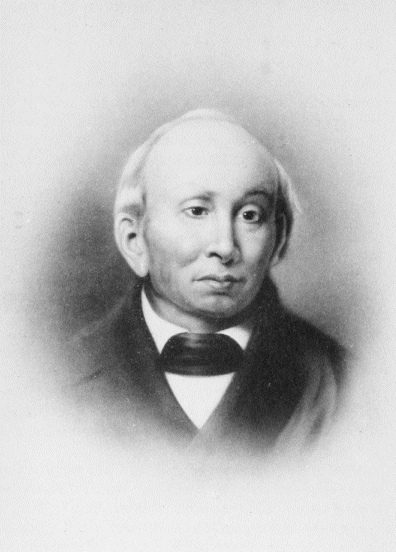
BLACK HAWK. (Head-man of the Rock River Sacs.) From oil portrait by R. M. Sully, in possession of Wisconsin Historical Society.
After having eaten such of the horses as could be spared they had subsisted on acorns, elm-bark, or even grass. Many had died of starvation, and their bodies had been found lying in their trail by the pursuing whites. This poor woman had lost her husband in battle, and all her children by the upsetting of the canoe in which they were, and her only wish now was, to go and join them. Poor Indians! who can wonder that they do not love the whites?
But a very short time had we been quietly at home, when a summons came to my husband to collect the principal chiefs of the Winnebagoes and meet Gen. Scott and Gov. Reynolds at Rock Island, where it was proposed to hold a treaty for the purchase of all the lands east and south of the Wisconsin. Messengers were accordingly sent to collect them, and, accompanied by as many as chose to report themselves, he set off on his journey.
He had been gone about two weeks, and I was beginning to count the days which must elapse before I could reasonably expect his return, when, one afternoon, I went over to pay a visit to my sister at the fort. As I passed into the large hall that ran through the quarters, Lieut. Lacy[119] came suddenly in, from the opposite direction, and almost without stopping, cried,
“Bad news, madam! Have you heard it?”
“No. What is it?”
“The cholera has broken out at Rock Island, and they are dying by five hundred a day. Dr. Finley has just arrived with the news.” So saying, he vanished without stopping to answer a question.
The cholera at Rock Island, and my husband there! I flew to the other door of the hall, which looked out upon the parade ground. A sentinel was walking near. “Soldier,” cried I, “will you run to the young officers' quarters and ask Dr. Finley to come here for a moment?”
The man shook his head—he was not allowed to leave his post.
Presently, Mrs. Lacy’s servant girl appeared from a door under the steps. She was a worthless creature, but where help was so scarce, ladies could not afford to keep a scrupulous tariff of moral qualification.
“Oh! Catherine,” said I, “will you run over and ask Dr. Finley to come here a moment? I must hear what news he has brought from Rock Island.” She put on a modest look and said,
“I do not like to go to the young officers' quarters.”
I was indignant at her hypocrisy, but I was also wild with impatience, when to my great joy Dr. Finley made his appearance.
“Where is my husband?” cried I.
“On his way home, madam, safe and sound. He will probably be here to-morrow.” He then gave me an account of the ravages the cholera was making among the troops, which were indeed severe, although less so than rumor had at first proclaimed.
Notwithstanding the Doctor’s assurance of his safety, my husband was seized with cholera on his journey. By the kind care of Paquette and the plentiful use of chicken-broth which the poor woman at whose cabin he stopped administered to him, he soon recovered, and reached his home in safety, having taken Prairie du Chien in his route and brought his mother with him again to her home.
The Indians had consented to the sale of their beautiful domain. Indeed, there is no alternative in such cases. If they persist in retaining them, and become surrounded and hemmed in by the white settlers, their situation is more deplorable than if they surrendered their homes altogether. This they are aware of, and therefore, as a general thing, they give up their lands at the proposal of Government, and only take care to make the best bargain they can for themselves. In this instance, they were to receive as an equivalent a tract of land[BC] extending to the interior of Iowa, and an additional sum of ten thousand dollars annually.
One of the stipulations of the treaty was, the surrender by the Winnebagoes of certain individuals of their tribe accused of having participated with the Sauks in some of the murders on the frontier, in order that they might be tried by our laws, and acquitted or punished as the case might be.
Wau-kaun-kau (the little Snake) voluntarily gave himself as a hostage until the delivery of the suspected persons. He was accordingly received by the Agent, and marched over and placed in confinement at the fort, until the other seven accused should appear to redeem him.
It was a work of some little time on the part of the nation to persuade these individuals to place themselves in the hands of the whites, that they might receive justice according to the laws of the latter. The trial of Red Bird, and his languishing death in prison,[120] were still fresh in their memories, and it needed a good deal of resolution, as well as a strong conviction of conscious innocence, to brace them up to such a step.
It had to be brought about by arguments and persuasions, for the nation would never have resorted to force to compel the fulfilment of their stipulation.
In the mean time a solemn talk was held with the principal chiefs assembled at the Agency. A great part of the nation were in the immediate neighborhood, in obedience to a notice sent by Governor Porter, who, in virtue of his office of Governor of Michigan Territory, was also Superintendent of the North West Division of the Indians.[121] Instead of calling upon the Agent to take charge of the annuity money, as had heretofore been the custom, he had announced his intention of bringing it himself to Fort Winnebago, and being present at the payment. The time appointed had now arrived, and with it, the main body of the Winnebagoes.
Such of the Indians as had not attended the treaty at Rock Island, and been instrumental in the cession of their country, were loud in their condemnation of the step, and their lamentations over it. Foremost among these was Wild-Cat, the Falstaff of Garlic Island and its vicinity. It was little wonder that he should shed bitter tears, as he did, over the loss of his beautiful home on the blue waters of Winnebago Lake.
“If he had not been accidentally stopped,” he said, “on his way to the treaty, and detained until it was too late, he would never, never have permitted the bargain.”
His “father,” who knew that a desperate frolic into which Wild-Cat had been enticed by the way was the cause of his failing to accompany his countrymen to Rock Island, replied gravely,
“That he had heard of the chief’s misfortune on this occasion. How that, in ascending the Fox River, a couple of kegs of whiskey had come floating down the stream, which, running foul of his canoe with great force, had injured it to such a degree that he had been obliged to stop several days at the Mee-kan to repair damages.”
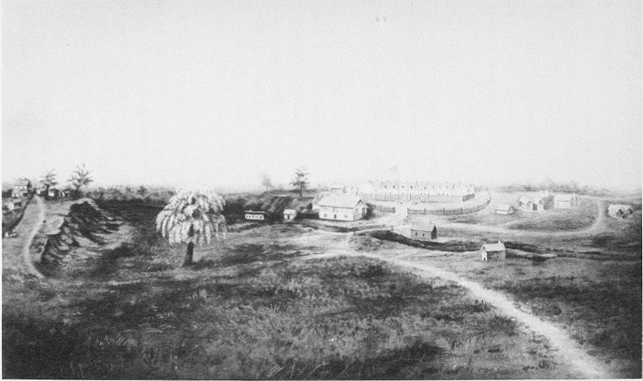
FORT WINNEBAGO IN 1834. (Indian agency buildings on hill to left.) From oil painting, based upon plans and local traditions, by Isaac A. Ridgway.
The shouts of laughter which greeted this explanation were so contagious that poor Wild-Cat himself was compelled to join in it, and treat his misfortune as a joke.
The suspected Indians, having engaged the services of Judge Doty[122] in their defence on their future trial, notice was at length given, that on a certain day they would be brought to the Portage and surrendered to their “father,” to be by him transferred to the keeping of the military officer appointed to receive them.
It was joyful news to poor Wau-kaun-kau, that the day of his release was at hand. Every time that we had been within the walls of the fort, we had been saluted by a call from him, as he kept his station at the guardroom Window:
“Do you hear anything of those Indians? When are they coming, that I may be let out?”
We had endeavored to lighten his confinement by seeing that he was well supplied with food, and his “father” and Paquette had paid him occasional visits, but notwithstanding this, and the kindness he had received at the fort, his confinement was inexpressibly irksome.
On the morning of a bright autumnal day, notice was given that the Chiefs of the Nation would present themselves at the Agency to deliver the suspected persons as prisoners to the Americans.
At the hour of ten o’clock, as we looked out over the Portage road, we could descry a moving concourse of people, in which brilliant color, glittering arms, and, as they approached still nearer, certain white objects of unusual appearance could be distinguished.
General Dodge, Major Plympton,[123] and one or two other officers took their seats with Mr. Kinzie on the platform in front of the door to receive them, while we stationed ourselves at the window where we could both see and hear.
The procession wound up the hill, and then came marching slowly toward us. It was a grand and solemn sight. First came some of the principal chiefs in their most brilliant array. Next, the prisoners all habited in white cotton, in token of their innocence, with girdles round their waists. The music of the drum and the Shee-shee-qua accompanied their death-song, which they were chanting. They wore no paint, no ornaments—their countenances were grave and thoughtful. It might well be a serious moment to them, for they knew but little of the custom of the whites, and that little was not such as to inspire cheerfulness. Only their “father’s” assurance that they should receive “strict justice,” would probably have induced them to comply with the engagements of the nation in this manner.
The remainder of the procession was made up of a long train of Winnebagoes, all decked out in their holiday garb.
The chiefs approached and shook hands with the gentlemen who stood ready to receive their greeting. Then the prisoners came forward, and went through the same salutation with the officers. When they offered their hands to their “father,” he declined.
“No,” said he. “You have come here accused of great crime—of having assisted in taking the lives of some of the defenceless settlers. When you have been tried by the laws of the land, and been proved innocent, then, your ‘father’ will give you his hand.”
They looked still more serious at this address, as if they thought it indicated that their father, too, believed them guilty, and stepping back a little, they seated themselves, without speaking, in a row upon the ground facing their “father” and the officers. The other Indians all took seats in a circle around them, except the one-eyed chief, Kau-ray-kau-say-kah, or the White Crow, who had been deputed to deliver the prisoners to the Agent.
He made a speech in which he set forth that, “although asserting their innocence of the charges preferred against them, his countrymen were quite willing to be tried by the laws of white men. He hoped they would not be detained long, but that the matter would be investigated soon, and that they would come out of it clear and white.”
In reply he was assured that all things would be conducted fairly and impartially, the same as if the accused were white men, and the hope was added that they would be found to have been good and true citizens, and peaceful children of their Great Father, the President.
When this was over, White Crow requested permission to transfer the medal he had received from the President, as a mark of friendship, to his son, who stood beside him, and who had been chosen by the nation to fill his place as chief, an office he was desirous of resigning. The speeches made upon this occasion, as interpreted by Paquette, the modest demeanor of the young man, and the dignified yet feeling manner of the father throughout, made the whole ceremony highly impressive, and when the latter took the medal from his neck and hung it around that of his son, addressing him a few appropriate words, I think no one could have witnessed the scene unmoved.
I had watched the countenances of the prisoners as they sat on the ground before me, while all these ceremonies were going forward. With one exception they were open, calm, and expressive of conscious innocence. Of that one I could not but admit there might be reasonable doubts. One was remarkably fine-looking—another was a boy of certainly not more than seventeen, and during the transfer of the medal he looked from one to the other, and listened to what was uttered by the speakers with an air and expression of even child-like interest and satisfaction.
Our hearts felt sad for them as, the ceremonies finished, they were conducted by a file of soldiers and committed to the dungeon of the guard-house, until such time as they should be summoned to attend the Court appointed to try their cause.
CHAPTER XXXVI
ESCAPE OF THE PRISONERS
The Indians did not disperse after the ceremonies of the surrender had been gone through. They continued still in the vicinity of the Portage, in the constant expectation of the arrival of the annuity money, which they had been summoned there to receive. But the time for setting out on his journey to bring it, was postponed by Gov. Porter from week to week. Had he foreseen all the evils this delay was to occasion, the Governor would, unquestionably, have been more prompt in fulfilling his appointment.
Many causes conspired to make an early payment desirable. In the first place, the Winnebagoes, having been driven from their homes by their anxiety to avoid all appearance of fraternizing with the Sacs, had made this year no gardens nor cornfields. They had, therefore, no provisions on hand, either for their present use, or for their winter’s consumption, except their scanty supplies of wild rice. While this was disappearing during their protracted detention at the Portage, they were running the risk of leaving themselves quite unprovided with food, in case of a bad hunting season during the winter and spring.
In the next place, the rations which the Agent had been accustomed, by the permission of Government, to deal out occasionally to them, were now cut off by a scarcity in the Commissary’s department. The frequent levies of the militia during the summer campaign, and the reinforcement of the garrison by the troops from Fort Howard had drawn so largely on the stores at this post, that there was every necessity for the most rigid economy in the issuing of supplies.
Foreseeing this state of things, Mr. Kinzie, as soon as the war was at an end, commissioned Mr. Kercheval, then sutler at Fort Howard, to procure him a couple of boat-loads of corn, to be distributed among the Indians. Unfortunately, there was no corn to be obtained from Michigan; it was necessary to bring it from Ohio, and by the time it at length reached Green Bay, (for in those days business was never done in a hurry,) the navigation of the Fox river had closed, and it was detained there, to be brought up the following spring.
As day after day wore on and “the silver” did not make its appearance, the Indians were advised by their father to disperse to their hunting grounds to procure food, with the promise that they should be summoned immediately on the arrival of Gov. Porter; and this advice they followed.
While they had been in our neighborhood, they had more than once asked permission to dance the scalp dance before our door. This is the most frightful, heart-curdling exhibition that can possibly be imagined. The scalps are stretched on little hoops, or frames, and carried on the end of a pole. These are brandished about in the course of the dance, with cries, shouts and furious gestures. The women who commence as spectators, becoming excited with the scene and the music which their own discordant notes help to make more deafening, rush in, seize the scalps from the hands of the owners, and toss them frantically about with the screams and yells of demons.
I have seen as many as forty or fifty scalps figuring in one dance. Upon one occasion one was borne by an Indian who approached quite near me, and I shuddered as I observed the long, fair hair, evidently that of a woman. Another Indian had the skin of a human hand, stretched and prepared with as much care as if it had been some costly jewel. When these dances occurred, as they sometimes did, by moonlight, they were peculiarly horrid and revolting.
Amid so many events of a painful character, there were not wanting occasionally some that bordered on the ludicrous.
One evening, while sitting at tea, we were alarmed by the sound of guns firing in the direction of the Wisconsin. All started up, and prepared, instinctively, for flight to the garrison. As we left the house, we found the whole bluff and the meadow below in commotion. Indians running with their guns and spears across their shoulders, to the scene of alarm; squaws and children standing in front of their lodges and looking anxiously in the direction of the unusual and unaccountable sounds—groups of French and half-breeds, all like ourselves, fleeing to gain the bridge and place themselves within the pickets so lately erected.
As one company of Indians passed us hurriedly, some weapon carelessly carried hit one of our party on the side of the head. “Oh!” shrieked she, “I am killed! an Indian has tomahawked me!” and she was only reassured by finding she could still run as fast as the best of us.
When we reached the parade-ground, within the fort, we could not help laughing at the grotesque appearance each presented. Some without hats or shawls—others with packages of valuables hastily secured at the moment—one with her piece of bread and butter in hand, which she had not the presence of mind to lay aside when she took to flight.
The alarm was, in the end, found to have proceeded from a party of Winnebagoes from one of the Barribault villages, who, being about to leave their home for a long period, were going through the ceremony of burying the scalps they and their fathers had taken.
Like the military funerals among civilized nations, their solemnities were closed on this occasion by the discharge of several volleys over the grave of their trophies.
At length, about the beginning of November, Governor Porter, accompanied by Major Forsyth and Mr. Kercheval, arrived with the annuity money. The Indians were again assembled—the payment was made, and having supplied themselves with a larger quantity of ammunition than usual, for they saw the necessity of a good hunt to remedy past and present deficiencies, they set off for their wintering grounds.
We were, ourselves, about changing our quarters, to our no small satisfaction. Notwithstanding the Indian disturbances, the new Agency House (permission to build which had at length been accorded by Government) had been going steadily on, and soon after the departure of the Governor and our other friends, we took possession of it.
We had been settled but a few weeks, when one morning Lieut. Davies[124] appeared just as we were sitting down to breakfast, with a face full of consternation. "The Indian prisoners had escaped from the black-hole! The commanding officer, Col. Cutler,[125] had sent for Mr. Kinzie to come over to the fort, and counsel with him what was to be done."
The prisoners had probably commenced their operations in planning escape very soon after being placed in the black-hole, a dungeon in the basement of the guard-house. They observed that their meals were brought regularly, three times a day, and that in the intervals they were left entirely to themselves. With their knives they commenced excavating an opening, the earth from which, as it was withdrawn, they spread about on the floor of their prison. A blanket was placed over this hole, and one of the company was always seated upon it, before the regular time for the soldier who had charge of them to make his appearance. When the periodical visit was made, the Indians were always observed to be seated, smoking in the most orderly and quiet manner. There was never anything to excite suspicion.
The prisoners had never read the memoirs of Baron Trenck, but they had watched the proceedings of the badgers; so, profiting by their example, they worked on, shaping the opening spirally, until, in about six weeks, they came out to the open air beyond the walls of the fort.
That they might be as little encumbered as possible in their flight, they left their blankets behind them, and although it was bitter cold December weather, they took to the woods and prairies with only their calico shirts and leggings for covering. We can readily believe that hope and exultation kept them comfortably warm, until they reached an asylum among their friends.
It would be compromising our own reputation as loyal and patriotic citizens, to tell all the secret rejoicings this news occasioned us.
The question now was, how to get the fugitives back again. The agent could promise no more than that he would communicate with the chiefs, and represent the wishes of the officers that the prisoners should once more surrender themselves, and thus free those who had had the charge of them from the imputation of carelessness, which the Government would be very likely to throw upon them.
When, according to their custom, many of the chiefs assembled at the Agency, on New Year’s day, their father laid the subject before them.
The Indians replied, that if they saw the young men, they would tell them what the officers would like to have them do. They could, themselves, do nothing in the matter. They had fulfilled their engagement by bringing them once and putting them in the hands of the officers. The Government had had them in its power once and could not keep them—it must now go and catch them itself.
“The Government” having had some experience the past summer in “catching Indians,” wisely concluded to drop the matter.
About this time another event occurred which occasioned no small excitement in our little community. Robineau, the striker from the blacksmith establishment at Sugar Creek, near the Four Lakes, arrived one very cold day at the Agency. He had come to procure medical aid for Mâtâ’s eldest daughter, Sophy, who, while sliding on the lake, had fallen on the ice and been badly hurt. Her father was absent, having gone to Prairie du Chien, to place his youngest daughter at school. Two or three days had elapsed since the accident had happened, but as a high fever had set in, and the poor girl was in a state of great suffering, it had been thought best to send Robineau to us for advice and aid, leaving Turcotte and a friendly Indian woman from a neighboring lodge to take charge of poor Sophy.
The commanding officer did not think it prudent, when the subject was laid before him, to permit the surgeon to leave the post, but he very cheerfully granted leave of absence to Currie, the hospital steward, a young man who possessed some knowledge of medicine and surgery.
As it was important that Sophy should have an experienced nurse, we procured the services of Madam Bellaire, the wife of the Frenchman who was generally employed as express to Chicago—and as an aid and companion, Agatha, daughter of Day-kau-ray, who lived in Paquette’s family, was added to the party.
Of Agatha I shall have more to say hereafter, but at present I must proceed with my story.
The weather was excessively cold when Robineau, Currie and the two women set out for Sugar Creek, a distance of about forty miles. We had taken care to provide them with a good store of rice, crackers, tea and sugar, for the invalid, all of which, with their provisions for the way, were packed on the horse Robineau had ridden to the Portage. It was expected they would reach their place of destination on the second day.
What, then, was our surprise, to see Turcotte make his appearance on the fourth day after their departure, to inquire why Robineau had not returned with aid for poor Sophy! There was but one solution of the mystery. Robineau had guided them as ill as he had guided the boat at the Grande Chûte the summer before, and although he could not shipwreck them, he had undoubtedly lost them in the woods or prairies. One comfort was, that they could not well starve, for the rice and crackers would furnish them with several days' provisions, and with Agatha, who must be accustomed to this kind of life, they could not fail in time of finding Indians, and being brought back to the Portage.
Still, day after day went on and we received no tidings of them. Turcotte returned to Sugar Creek with comforts and prescriptions for Sophy, and the commanding officer sent out a party to hunt for the missing ones, among whom poor Currie, from his delicate constitution, was the object of the greatest commiseration.
As the snow fell, and the winds howled, we could employ ourselves about nothing but walking from window to window watching, in hopes of seeing some one appear in the distance. No Indians were at hand whom we could despatch upon the search, and by the tenth day we had almost given up in despair.
It was then that the joyful news was suddenly brought us, “They are found! They are at the Fort!” A party of soldiers who had been exploring had encountered them at Hastings' Woods, twelve miles distant, slowly and feebly making their way back to the Portage. They knew they were on the right track, but had hardly strength to pursue it.
Exhausted with cold and hunger, for their provisions had given out two days before, they had thought seriously of killing the horse and eating him—nothing but Currie’s inability to proceed on foot, and the dread of being compelled to leave him in the woods to perish, had deterred them.
Agatha had from the first been convinced that they were on the wrong track, but Robineau, with his usual obstinacy, persevered in keeping it until it brought them to the Rock River, when he was obliged to acknowledge his error, and they commenced retracing their steps.
Agatha, according to the custom of her people, had carried her hatchet with her, and thus they had always had a fire at night, and boughs to shelter them from the storms, otherwise they must inevitably have perished.
There were two circumstances which aroused in us a stronger feeling even than that of sympathy. The first was, the miserable Robineau having demanded of Currie, first, all his money, and afterwards his watch, as a condition of his bringing the party back into the right path, which he averred he knew perfectly well.
The second was, Bellaire having given his kind, excellent wife a hearty flogging “for going off,” as he said, “on such a fool’s errand.”
The latter culprit was out of our jurisdiction, but Mons. Robineau was discharged on the spot, and warned that he might think himself happy to escape a legal process for swindling.
I am happy to say that Sophy Mâtâ, in whose behalf all these sufferings had been endured, was quite recovered by the time her father returned from “the Prairie.”
CHAPTER XXXVII
AGATHA—TOMAH
Agatha was the daughter of an Indian who was distinguished by the name of Rascal Day-kau-ray. Whether he merited the appellation must be determined hereafter. He was brother to the grand old chief of that name, but as unlike him as it is possible for those of the same blood to be.
The Day-kau-rays were a very handsome family, and this daughter was remarkable for her fine personal appearance. A tall, well-developed form, a round sweet face, and that peculiarly soft, melodious voice which belongs to the women of her people, would have attracted the attention of a stranger, while the pensive expression of her countenance irresistibly drew the hearts of all towards her, and prompted the wish to know more of her history. As I received it from her friend, Mrs. Paquette, it was indeed a touching one.
A young officer at the fort had seen her and had set, I will not say his heart—it may be doubted if he had one—but his mind upon her. He applied to Paquette to negotiate what he called a marriage with her. I am sorry to say that Paquette was induced to enter into this scheme. He knew full well the sin of making false representations to the family of Agatha, and he knew the misery he was about to bring upon her.
The poor girl was betrothed to a young man of her own people, and, as is generally the case, the attachment on both sides was very strong. Among these simple people, who have few subjects of thought or speculation beyond the interests of their daily life, their affections and their animosities form the warp and woof of their character. All their feelings are intense, from being concentrated on so few objects. Family relations, particularly with the women, engross the whole amount of their sensibilities.
The marriage connection is a sacred and indissoluble tie. I have read, in a recent report to the Historical Society of Wisconsin, that, in former times, a temporary marriage between a white man and a Menomonee woman was no uncommon occurrence, and that such an arrangement brought no scandal. I am afraid that if such cases were investigated, a good deal of deceit and misrepresentation would be found to have been added to the other sins of the transaction; and that the woman would be found to have been a victim, instead of a willing participant, in such a connexion.
At all events, no system of this kind exists among the Winnebagoes. The strictest sense of female propriety is a distinguishing trait among them. A woman who transgresses it, is said to have “forgotten herself,” and is sure to be cast off and “forgotten” by her friends.
The marriage proposed between the young officer and the daughter of Day-kau-ray, was understood as intended to be true and lasting. The father would not have exposed himself to the contempt of his whole nation by selling his daughter to become the mistress of any man. The Day-kau-rays, as I have elsewhere said, were not a little proud of a remote cross of French blood which mingled with the aboriginal stream in their veins, and probably in acceding to the proposed connection, the father of Agatha was as much influenced by what he considered the honor to be derived, as by the amount of valuable presents which accompanied the overtures made to him.
Be that as it may, the poor girl was torn from her lover, and transferred from her father’s lodge to the quarters of the young officer.
There were no ladies in the garrison at that time. Had there been, such a step would hardly have been ventured. Far away in the wilderness, shut out from the salutary influences of religious and social cultivation, what wonder that the moral sense sometimes becomes blinded, and that the choice is made, “Evil, be thou my good!”
The first step in wrong was followed by one still more aggravated in cruelty. The young officer left the post, as he said, on furlough, but he never returned. The news came that he was married, and when he again joined his regiment it was at another post.
There was a natural feeling in the strength of the “woe pronounced against him” by more tongues than one. “He will never,” said my informant, “dare show himself in this country again! Not an Indian who knows the Day-kau-rays but would take his life if he should meet him!”
Every tie was broken for poor Agatha but that which bound her to her infant. She never returned to her father’s lodge, for she felt that, being deserted, she was dishonored. Her sole ambition seemed to be to bring up her child like those of the whites. She attired it in the costume of the French children, with a dress of bright calico, and a cap of the same, trimmed with narrow black lace. It was a fine child, and the only time I ever saw a smile cross her face, was when it was commended and caressed by some member of our family.
Even this, her only source of happiness, poor Agatha was called upon to resign. During our absence at Green Bay, while the Sauks were in the neighborhood, the child was taken violently ill. The house at Paquette’s, which was the mother’s home, was thronged with Indians, and of course there was much noise and disturbance. A place was prepared for her under our roof, where she could be more quiet, and receive the attendance of the post physician. It was all in vain—nothing could save the little creature’s life. The bitter agony of the mother, as she hung over the only treasure she possessed on earth, was described to me as truly heart-rending. When compelled to part with it, it seemed almost more than nature could bear. There were friends, not of her own nation or color, who strove to comfort her. Did the father ever send a thought or inquiry after the fate of his child, or of the young being whose life he had rendered dark and desolate? We will hope that he did—that he repented and asked pardon from above for the evil he had wrought.
Agatha had been baptized by M. Mazzuchelli. Perhaps she may have acquired some religious knowledge which could bring her consolation in her sorrows, and compensate her for the hopes and joys so early blasted.
She came, some months after the death of her child, in company with several of the half-breed women of the neighborhood, to pay me a visit of respect and congratulation. When she looked at her “little brother,” as he was called, and took his soft tiny hand within her own, the tears stood in her eyes, and she spoke some little words of tenderness, which showed that her heart was full. I could scarcely refrain from mingling my tears with hers, as I thought on all the sorrow and desolation that one man’s selfishness had occasioned.
Early in February, 1833, my husband and Lieut. Hunter, in company with one or two others, sat off on a journey to Chicago. That place had become so much of a town, (it contained perhaps fifty inhabitants), that it was necessary for the proprietors of “Kinzie’s Addition” to lay out lots and open streets through their property. All this was accomplished during the present visit.
While they were upon the ground with a surveyor, the attention of my husband was drawn towards a very bright-looking boy in Indian costume, who went hopping along by the side of the assistant who carried the chain, mimicking him as in the course of his operations he cried, “stick!” “stuck!” He inquired who the lad was, and to his surprise learned that he was the brother of the old family servants, Victoire, Geneveive and Baptiste. Tomah, for that was his name, had never been arrayed in civilized costume; he was in blanket and leggins, and had always lived in a wigwam. My husband inquired if he would like to go to Fort Winnebago with him, and learn to be a white boy. The idea pleased him much, and his mother having given her sanction to the arrangement, he was packed in a wagon, with the two gentlemen and their travelling gear, and they set forth on their return journey.
Tomah had been equipped in a jacket and pants, with the other articles of apparel necessary to his new sphere and character. They were near the Aux Plains, and approaching the residence of Glode (Claude) Laframboise, where Tomah knew he should meet acquaintances. He asked leave to get out of the wagon and walk a little way. When they next saw him, he was in full Pottowattamic costume, and although it was bitter winter weather, he had put on his uncomfortable native garb rather than show himself to his old friends in a state of transformation.
On his arrival at Fort Winnebago, our first care was to furnish him with a complete wardrobe, which, having been placed in a box in his sleeping apartment, was put under his charge. Words cannot express his delight as the valuable possessions were confided to him. Every spare moment was devoted to their contemplation. Now and then Tomah would be missing. He was invariably found seated by the side of his little trunk, folding and refolding his clothes, laying them now lengthwise, now crosswise, the happiest of mortals.
The next step was, to teach him to be useful. Such little offices were assigned to him at first as might be supposed not altogether new to him, but we soon observed that when there was anything in the shape of work, Tomah slipt off to bed, even if it were before he had taken his supper. Some fish were given him one evening to scale; it was just at dark; but Tom, according to custom, retired at once to bed.
The cook came to inquire what was to be done. I was under the necessity of calling in my husband’s aid as interpreter. He sent for Tomah. When he came into the parlor, Mr. Kinzie said to him in Pottowattamic:—
“There are some fish, Tomah, in the kitchen, and we want you to scale them.”
“Now?” exclaimed Tom, with an expression of amazement, “it is very late.”
A young lady. Miss Rolette, who was visiting us, and who understood the language, could not refrain from bursting into a laugh at the simplicity with which the words were uttered, and we joined her for sympathy, at which Tom looked a little indignant, but when he understood that it was the white custom to scale the fish at night, and put salt and pepper on them, he was soon reconciled to do his duty in the matter.
His next office was to lay the table. There was a best service of china, which was to be used when we had company, and a best set of teaspoons, which I kept in the drawer of a bureau in my own room above stairs. I was in the habit of keeping this drawer locked, and putting the key under a small clock on the mantel-piece. The first time that I had shown Tomah how to arrange matters for visitors, I had brought the silver and put it on the table myself.
Soon after, we were to have company to tea again, and I explained to Tomah that the best china must be used. What was my surprise, on going through the dining-room a short time after, to see not only the new china, but the “company silver” also on the table. I requested my mother to inquire into the matter.
Tomah said, very coolly, “He got the silver where it was kept.”
“Did he find the drawer open?”
“No—he opened it with a key.”
“Was the key in the drawer?”
“No—it was under that thing on the shelf.”
“How did he know it was kept there.”
This was what Mr. Tomah declined telling. We could never ascertain whether he had watched my movements at any time. No one had ever seen him in that part of the house, and yet there could scarcely an article be mentioned of which Tomah did not know the whereabout. If any one was puzzled to find a thing it was always,
“Ask Tomah—he will tell you.” And so in fact he did. He was a subject of much amusement to the young officers. We were to have “a party” one evening—all the families and young officers at the fort. To make Tomah’s appearance as professional as possible, we had made him a white apron with long sleeves to put on while he was helping Mary and Josette to carry round tea—for I must acknowledge that Tomah’s clothes were not kept in as nice order out of the trunk as in it.
Tom was delighted with his new costume, as well as with the new employment. He acquitted himself to perfection, for he had never any difficulty in imitating what he saw another do. After tea we had some music. As I was standing by the piano at which one of the ladies was seated, Lt. Vancleve[126] said to me in a low tone,
“Look behind you a moment.”
I turned. There sat Tom between two of the company, as stately as possible, with his white apron smoothed down, and his hands clasped before him, listening to the music, and on the best possible terms with himself and all around him. Julian and Edwin were hardly able to restrain their merriment, but they were afraid to do or say anything that would cause him to move before the company had had a full enjoyment of the scene. It was voted unanimously that Tomah should be permitted to remain and enjoy the pleasures of society for one evening—but, with characteristic restlessness, he got tired as soon as the music was over, and unceremoniously took his leave of the company.
CHAPTER XXXVIII
CONCLUSION
What we had long anticipated of the sufferings of the Indians, began to manifest itself as the spring drew on. It first came under our observation by the accounts brought in, by those who came in little parties begging for food.
As long as it was possible to issue occasional rations their father continued to do so, but the supplies in the Commissary Department were now so much reduced that Col. Cutler did not feel justified in authorizing anything beyond a scanty relief, and this in extreme cases.
We had ourselves throughout the winter used the greatest economy with our own stores, that we might not exhaust our slender stock of flour and meal before it could be replenished from “below.” We had even purchased some sour flour which had been condemned by the commissary, and had contrived by a plentiful use of saleratus, and a due proportion of potatoes, to make of it a very palatable kind of bread. But as we had continued to give to party after party, as they would come to us to represent their famishing condition, the time at length arrived when we had nothing to give.
The half-breed families of the neighborhood, who had, like ourselves, continued to share with the needy as long as their own stock lasted, were now obliged, of necessity, to refuse further assistance. These women often came in to lament with us over the sad accounts that were brought from the wintering grounds. It had been a very open winter. The snow had scarcely been enough at any time to permit the Indians to track the deer, in fact, all the game had been driven off by the troops and war parties scouring the country through the preceding summer.
We heard of their dying by companies from mere destitution, and lying stretched in the road to the Portage, whither they were striving to drag their exhausted frames. Soup made of the bark of the slippery elm, or stewed acorns, were the only food that many had subsisted on for weeks.
We had for a long time received our food by daily rations from the garrison, for things had got to such a pass that there was no possibility of obtaining a barrel of flour at a time. After our meals were finished, I always went into the pantry, and collecting carefully every remaining particle of food set it aside to be given to some of the wretched applicants by whom we were constantly thronged.
One day as I was thus employed, a face appeared at the window with which I had once been familiar. It was the pretty daughter of the elder Day-kau-ray. She had formerly visited us often, watching with great interest our employments—our sewing, or weeding and cultivating the garden, or our reading. Of the latter, I had many times endeavored to give her some idea, showing her the plates in the Family Bible, and doing my best to explain them to her, but of late I had quite lost sight of her. Now, how changed, how wan she looked! As I addressed her with my ordinary phrase, “Tshah-ko-zhah?” (What is it?) she gave a sigh that was almost a sob. She did not beg, but her countenance spoke volumes.
I took my dish and handed it to her, expecting to see her devour the contents eagerly, but no—she took it, and making signs that she would soon return, walked away. When she brought it back, I was almost sure she had not tasted a morsel herself.
The boats—the boats with the corn! Why did they not come? We both wrote and sent to hasten them, but alas! everything and everybody moved so slowly in those unenterprising times! We could only feel sure that they would come when they were ready, and not a moment before.
We were soon obliged to keep both doors and windows fast, to shut out the sight of misery we could not relieve. If a door was opened for the admission of a member of the family, some wretched mother would rush in, grasp the hand of my infant, and placing that of her famishing child within it, tell us pleadingly, that he was imploring “his little brother” for food. The stoutest-hearted man could not have beheld with dry eyes the heart-rending spectacle which often presented itself. It was in vain that we screened the lower portion of our windows with curtains. They would climb up on the outside, and tier upon tier of gaunt, wretched faces would peer in above, to watch us, and see if, indeed, we were as ill-provided as we represented ourselves.
The noble old Day-kau-ray came one day, from the Barribault, to apprise us of the state of his village. More than forty of his people, he said, had now been for many days without food, save bark and roots. My husband accompanied him to the commanding officer to tell his story, and ascertain ii any amount of food could be obtained from that quarter. The result was, the promise of a small allowance of flour, sufficient to alleviate the cravings of his own family.
When this was explained to the chief, he turned away. “No,” he said, “if his people could not be relieved, he and his family would starve with them!” And he refused, for those nearest and dearest to him, the proffered succor, until all could share alike.
The announcement, at length, that “the boats were in sight,” was a thrilling and most joyful sound.
Hundreds of poor creatures were at once assembled on the bank, watching their arrival. Oh! how torturing was their slow approach, by the winding course of the river, through the extended prairie! As the first boat touched the bank, we, who were gazing on the scene with anxiety and impatience only equalled by that of the sufferers, could scarcely refrain from laughing, to see old Wild-Cat, who had somewhat fallen off in his huge amount of flesh, seize “the Washington Woman” in his arms, and hug and dance with her in the ecstasy of his delight.
Their father made a sign to them all to fall to work with their hatchets, which they had long held ready, and in an incredibly short time, barrel after barrel was broken open and emptied, while even the little children possessed themselves of pans and kettles full, and hastened to the fires that were blazing around to parch and cook that which they had seized.
From this time forward, there was no more destitution. The present abundance was followed by the arrival of supplies for the Commissary’s Department; and refreshed and invigorated, our poor children departed once more to their villages, to make ready their crops for the ensuing season.
In the course of the spring, we received a visit from the Rev. Mr. Kent, and Mrs. Kent, of Galena.[127] This event is memorable, as being the first occasion on which the Gospel, according to the Protestant faith, was preached at Fort Winnebago. The large parlor of the hospital was fitted up for the service, and gladly did we each say to the other, “Let us go to the house of the Lord!”
For nearly three years had we lived here without the blessing of a public service of praise and thanksgiving. We regarded this commencement as an omen of better times, and our little “sewing society” worked with renewed industry, to raise a fund which might be available hereafter, in securing the permanent services of a missionary.
Not long after this, on a fine spring morning, as we were seated at breakfast, a party of Indians entered the parlor, and came to the door of the room where we were. Two of them passed through, and went out upon a small portico—the third remained standing in the door-way at which he had at first appeared. He was nearly opposite me, and as I raised my eyes, spite of his change of dress, and the paint with which he was covered, I at once recognized him.
I continued to pour the coffee, and as I did so, I remarked to my husband, “The one behind you, with whom you are speaking, is one of the escaped prisoners.”
Without turning his head, he continued to listen to all the directions they were giving him about the repairing of their guns, traps, &c., which they wished to leave with the blacksmith. As they went on, he cautiously turned his head towards the parlor door, and replied to the one speaking to him from there. When he again addressed me, it was to say,
“You are right, but it is no affair of ours. We are none of us to look so as to give him notice that we suspect anything. They are undoubtedly innocent, and have suffered enough already.”
Contrary to his usual custom, their father did not ask their names, but wrote their directions, which he tied to their different implements, and then bade them go and deliver them themselves to M. Morrin.
The rest of our circle were greatly pleased at the young fellow’s audacity, and we quite longed to tell the officers that we could have caught one of their fugitives for them, if we had had a mind.
The time had now come when we began to think seriously of leaving our pleasant home, and taking up our residence at Detroit, while making arrangements for a permanent settlement at Chicago.
The intelligence, when communicated to our Winnebago children, brought forth great lamentations and demonstrations of regret. From the surrounding country they came flocking in, to inquire into the truth of the tidings they had heard, and to petition earnestly that we would continue to live and die among them.
Among them all no one seemed so overwhelmed with affliction as Elizabeth, our poor Cut-nose. When we first told her of our intention, she sat for hours in the same spot, wiping away the tears that would find their way down her cheeks, with the corner of the chintz shawl she wore pinned across her bosom.
“No! never, never, never shall I find such friends again,” she would exclaim. “You will go away, and I shall be left here all alone.”
Wild-Cat too, the fat, jolly Wild-Cat, gave way to the most audible lamentations.
“Oh! my little brother,” he said to the baby, on the morning of our departure, when he had insisted on taking him and seating him on his fat, dirty knee, “you will never come back to see your poor brother again!”
And having taken an extra glass on the occasion, he wept like an infant.
It was with sad hearts that on the morning of the 1st of July, 1833, we bade adieu to the long cortege which followed us to the boat, now waiting to convey us to Green Bay, where we were to meet Governor Porter and Mr. Brush, and proceed, under their escort, to Detroit.
When they had completed their tender farewells, they turned to accompany their father across the Portage, on his route to Chicago, and long after, we could see them winding along the road, and hear their loud lamentations at a parting which they foresaw would be forever.
APPENDIX
As I have given throughout the Narrative of the Sauk War, the impressions we received from our own observation, or from information furnished us at the time, I think it but justice to Black Hawk and his party to insert, by way of Appendix, the following account, preserved among the manuscript writings of the late Thomas Forsyth, Esq., of St. Louis, who, after residing among the Indians many years as a trader, was, until the year 1830, the Agent of the Sauks and Foxes.[128] The manuscript was written in 1832, while Black Hawk and his compatriots were in prison at Jefferson Barracks.
“The United States troops under the command of Major Stoddard arrived here,[BD] and took possession of this country in the month of February, 1804. In the spring of that year, a white person (a man or boy), was killed in Cuivre Settlement, by a Sauk Indian. Some time in the summer following, a party of United States troops were sent up to the Sauk village on Rocky river, and a demand made of the Sauk Chiefs for the murderer. The Sauk Chiefs did not hesitate a moment, but delivered him up to the commander of the troops, who brought him down and delivered him over to the civil authority in this place (St. Louis).
“Some time in the ensuing autumn some Sauk and Fox Indians came to this place, and had a conversation with General Harrison (then Governor of Indian Territory, and acting Governor of this State, then Territory of Louisiana), on the subject of liberating their relative, then in prison at this place for the above-mentioned murder.
“Quash-quame, a Sauk chief, who was the head man of this party, has repeatedly said, ‘Mr. Pierre Choteau, Sen., came several times to my camp, offering that if I would sell the lands on the east side of the Mississippi river, Governor Harrison would liberate my relation, (meaning the Sauk Indian then in prison as above related), to which I at last agreed, and sold the lands from the mouth of the Illinois river up the Mississippi river as high as the mouth of Rocky river (now Rock river), and east to the ridge that divides the waters of the Mississippi and Illinois rivers, but I never sold any more lands.’ Quash-quame also said to Governor Edwards, Governor Clark and Mr. Auguste Chouteau, Commissioners appointed to treat with the Chippewas, Ottowas, and Pottowattamies of Illinois river, in the summer of 1816, for lands on the west side of the Illinois river:
“‘Your white men may put on paper what you please, but again I tell you, I never sold any lands higher up the Mississippi than the mouth of Rocky river.’
“In the treaty first mentioned, the line commences opposite to the mouth of Gasconade river, and running in a direct line to the headwaters of Jefferson[BE] river, thence down that river to the Mississippi river—thence up the Mississippi river to the mouth of the Ouisconsin river—thence up that river thirty-six miles—thence in a direct line to a little lake in Fox river of Illinois, down Fox river to Illinois river, down Illinois river to its mouth, thence down the Mississippi river to the mouth of Missouri river, thence up that river to the place of beginning. See Treaty dated at St. Louis, 4th November, 1804.
“The Sauk and Fox nations were never consulted, nor had any hand in this Treaty, nor knew anything about it. It was made and signed by two Sauk chiefs, one Fox chief and one warrior.
“When the annuities were delivered to the Sauk and Fox nations of Indians, according to the treaty above referred to (amounting to $1,000 per annum), the Indians always thought they were presents, (as the annuity for the first twenty years was always paid in goods, sent on from Georgetown, District of Columbia, and poor articles of merchandize they were, very often damaged and not suitable for Indians), until I, as their Agent, convinced them of the contrary, in the summer of 1818. When the Indians heard that the goods delivered to them were annuities for land, sold by them to the United States, they were astonished, and refused to accept of the goods, denying that they ever sold the lands as stated by me, their Agent. The Black Hawk in particular, who was present at the time, made a great noise about this land, and would never receive any part of the annuities from that time forward. He always denied the authority of Quash-quame and others to sell any part of their lands, and told the Indians not to receive any presents or annuities from any American—otherwise their lands would be claimed at some future day.