Front matter (continued 2)
Reading edition
The old man was shrewd enough to see that it was wisest to make the best bargain he could. I have no doubt it cost a round sum to settle the matter to the satisfaction of the injured damsel, though I have never been able to ascertain how much. This, I know, that the young gentleman took care not to make his next bargain while in a fit of the ague. The lady up on the Mississippi is called, in derision, by his name to this day.
About midway of the lake we passed Garlic Island[34]—a lovely spot, deserving of a more attractive name. It belonged, together with the village on the opposite shore, to “Wild Cat,” a fat, jolly, good-natured fellow, by no means the formidable animal his name would imply.
He and his band were absent, like their neighbors of Four-Legs village, so there was nothing to vary the monotony of our sail. It was too wet to sing, and the men, although wrapped in their overcoats, looked like drowned chickens. They were obliged to ply their oars with unusual vigor to keep themselves warm and comfortable, and thus probably felt less than we, the dullness and listlessness of the cold, rainy, October day.
Towards evening the sun shone forth. We had passed into the Fox River, and were just entering that beautiful little expanse known as Butte des Morts Lake, at the further extremity of which we were to encamp for the night.
The water along its shores was green with the fields of wild rice, the gathering of which, just at this season, is an important occupation of the Indian women. They push their canoes into the thick masses of the rice, bend it forward over the side with their paddles, and then beat the ripe husks off the stalks into a cloth spread in the canoe. After this, it is rubbed to separate the grain from the husk, and fanned in the open air. It is then put in their cordage bags and packed away for winter use. The grain is longer and more slender than the Carolina rice—it is of a greenish, olive color, and, although it forms a pleasant article of food, it is far from being particularly nutritive. The Indians are fond of it in the form of soup, with the addition of birds or venison.[35]
CHAPTER VI
BREAKFAST AT BETTY MORE’S
The earth, the trees, and the shrubbery were all too much filled with the heavy rain which had fallen to allow us to think of encamping, so we made arrangements to bestow ourselves in our little saloon for the night. It was rather a difficult matter to light a fire, but among the underbrush, in a wild, undisturbed spot there will always be found some fragments of dried branches, and tufts of grass which the rain has not reached, and by the assistance of the spunk, or light-wood, with which travellers always go well provided, a comforting fire was at length blazing brightly.
After our chilling, tedious day, it was pleasant to gather round it, to sit on the end of the blazing logs, and watch the Frenchmen preparing our supper—the kettle, nestling in a little nook of bright glowing coals—the slices of ham browning and crisping on the forked sticks, or “broches,” which the voyageurs dexterously cut, and set around the burning brands—the savory messes of “pork and onions” hissing in the frying pan, always a tempting regale to the hungry Frenchmen. Truly, it needs a wet chilly journey, taken nearly fasting, as ours had been, to enable one to enjoy to its full extent that social meal—a supper.
The bright sun, setting amid brilliant masses of clouds, such as are seen only in our western skies, gave promise of a fine day on the morrow, with which comforting assurance we were glad to take our leave of him, and soon after of each other.
We had hardly roused up the following morning, in obedience to the call of the bourgeois, when our eyes were greeted with the sight of an addition to our company—a tall stalwart, fine-looking, young “mitiff,” or half-breed, accompanied by two or three Indians. Vociferous and joyous were the salutations of the latter to their “father” and their new “mother.” They were the first Winnebagoes I had seen, and they were decidedly not the finest specimens of their tribe. The mitiff, a scion of the wide-spreading tree of the Grignons, was the bearer of an invitation to us from Judge Law,[36] who, with one or two Green Bay friends, was encamped a few miles above, to come and breakfast with him in his tent. We had not dreamed of finding white neighbors here, but our vicinity could be no secret to them, as long as there was an Indian in the neighborhood. So, delaying only for the soldiers to finish their breakfast, we pushed on for the “Butte des Morts,” or, as old Mrs. Arndt always persisted in calling it, Betty More’s.
The white tent of the Judge gleamed in the morning sun as we approached the little rising ground on which it stood. The river was filled with canoes paddled principally by squaws. Many Indians were to be seen on the banks, all with their guns and hunting accoutrements, for the air was filled in every direction with flocks of teal, which at this season are most abundant and delicious. The immense fields of wild rice abounding here and in the little lake below, make this vicinity their favorite place of resort in the autumn months. The effect of this nourishing food is, to make the flesh of the birds so fat, so white, and so tender, that a caution is always given to a young sportsman to fire only at such as fly very low, for if shot high in the air they are bruised to pieces, and rendered unfit for eating by their fall to the ground.
We were hemmed in by a little fleet of canoes which surrounded us, the women chattering, laughing, and eagerly putting forward their little wooden bowls of fresh cranberries as an offering of welcome to me.
I amused myself with tossing crackers to them, some of which would reach them, others would fall into the water, and then such a scrambling and shouting! Hands and paddles were in requisition, and loud was the triumph of her who was successful in reaching a floating one.
Among the Indians with whom Shaw-nee-aw-kee was now engaged in shaking hands, and who all seemed old friends, were some fine, straight, well-formed figures, all of them exhibiting frames capable of enduring fatigue and the hardships of their mode of life. One was describing with much gesticulation the abundance of the game in the neighborhood, and he seemed greatly delighted at receiving a quantity of ammunition, with which he instantly departed to make good his boasts in the matter.
After walking a short distance we reached the tent, where I was introduced to Judge Law and a pleasant little gray-haired French gentleman of the name of Porlier.[37] Several voyageurs and half-breeds were near, the former busily at work, the latter lounging for the most part, and going through with what they had to do with a sort of listless indifference.
The contrast between the “all-alive” air of the one class and the apathetic manner of the other, was quite striking.
After a short conversation among the members of the party, breakfast was announced, and we entered the tent and took our seats on the ground around the Indian mat, which supplied the place of a table.
The post of honor, namely, the head of the table, was of course given to me, so that I could not only look around upon the circle of the company, but also enjoy a fine view out of the open door of the tent, and take an observation of all that was going on at the side-table outside. Judge Doty sat opposite me, with his back to the opening of the tent, and the other gentlemen on either hand. We had for our waiter the tall “mitiff” who had been the messenger of the morning. He was still in the same garb—calico shirt, bright colored scarf around his waist, and on his head a straw hat encircled with a band of black ostrich feathers, the usual dress of his class.
The tin cups which were to hold our coffee were duly set around, then breakfast plates of the same metal, with knives and forks, then followed the viands, among the most conspicuous of which was a large tin pan of boiled ducks.
The Judge, wishing to show, probably, that although we were in the vast wilderness, all fastidious nicety had not been left behind, took up the plate which had been set before him, and seeing something adhering to it which did not exactly please him, handed it over his shoulder to Grignon, requesting him to wipe it carefully. Grignon complied by pulling a black silk barcelona handkerchief out of his bosom, where it had been snugly tucked away to answer any occasion that might present itself, and giving the tin a furious polishing, handed it back again. The Judge looked at it with a smile of approbation, and giving a glance round the table as much as to say, “You see how I choose to have things done,” applied himself to his breakfast.
The trail for Fort Winnebago then led from the shore opposite Butte des Morts, through Ma-zhee-gaw-gaw swamp, and past Green Lake, and it was well for the Judge that his horses stood waiting for him to “mount and away” as early as possible after breakfast, or I am afraid the story I should have been tempted to tell, would have made his ride an uncomfortable one throughout the day.
We had hardly finished breakfast when our hunter, who had received the ammunition, returned, bringing with him about fifty fine ducks, which he had shot in little more than an hour. From that time until the close of our journey, our supply of these delicate birds was never wanting.
CHAPTER VII
BUTTE DES MORTS—LAKE PUCKAWAY
The Butte des Morts, or Hillock of the Dead, was the scene long since[K] of a most sanguinary battle between the French and the Mis-qua-kees, or Foxes. So great was the carnage in this engagement, that the memory of it has been perpetuated by the gloomy appellation given to the mound where the dead were buried. The Foxes up to this time had inhabited the shores of the river to which they had given their name, but being completely overwhelmed and beaten in this conflict, they retired to the neighborhood of the Mississippi, and sought an asylum among their allies, the Saukies, or as they are now called, the Sauks, with whom they became gradually incorporated, until the combined tribes came to be known, as at present, by the name of "Sauks and Foxes."[38]
Among the French inhabitants of the upper country, each tribe of Indians has a particular appellation, descriptive of some peculiarity of either their habits or their personal appearance. Thus the Chippewas from their agility are denominated “Sauteurs” or Jumpers; the Ottawas, the “Courtes-oreilles” or Short-ears. The Menomonees, from the wild rice so abundant in their country, are called the “Folles Avoines”—the Winnebagoes, from their custom of wearing the fur of a pole-cat on their legs when equipped for war, are termed "les Puans"'[39]—the Pottowattamies, from their uncleanly habits, “les Poux”—the Foxes, are “les Renards,” &c., &c.
Hence you will never hear a French or half-breed resident of the country mention an Indian in any other style. “Such a person is a ‘Court-oreille.’” “Is that woman a ‘Winnebago?’” “No, she is a ‘Folle Avoine.’” In this manner a stranger is somewhat puzzled at first to classify the acquaintances he forms.
All the native friends with whom we were here surrounded were “les Puans,” or to use their own euphonious application, the “Ho-tshung-rahs.”
Having with great regret said adieu to our friend Judge Doty, whose society had contributed so much to the pleasure of our trip, and whose example, moreover, had given us a valuable lesson to take things as we find them, we bade good-bye at an early hour after breakfast to our kind hosts, and set forward on our journey.
From Butte des Morts to the Portage, the distance by land is about seventy miles; by water, it is not less than a hundred and thirty, so serpentine is the course of the river through the low swampy prairies which stretch over a great portion of this part of the country.
About six miles above the Butte, a tolerably broad stream called Wolf River joins the Fox, and as it is much the more direct and promising of the two, strangers have sometimes mistaken it for the main stream, and journeyed up it a considerable distance before discovering to their great chagrin that they must retrace their steps.
Beyond this place, the river begins to play its pranks with the compass. As I was always looking out for pretty scenery to sketch, I was at one spot much attracted by a picturesque group on a bank quite close to the stream. There were broad overhanging trees, and two or three wigwams nestled under their shade. Bright-looking little children, quite unencumbered with clothing, were sporting about, and their two mothers were sitting on the ground, engaged in the manufacture of a mat for their lodge. It was a pretty scene, and I commenced a sketch. As usual, the whole party on the bank set up a shout when they recognized Shaw-nee-aw-kee—“Ee-awn-chee-wee-rah, Hee-nee-kar-ray-kay-noo,”[L] It was an occasion on which they became demonstrative. After a little time we proceeded, and I went on to complete my drawing. The sun kept coming more and more into the wrong place. He had been just behind me, presently he was on my left hand, now he was straight ahead. I moved from time to time; at length the sun was decidedly on my right hand. What could be the matter? I looked up. “Oh, here is a pretty scene, I must have this too! But how surprisingly like the one I have just finished, only in a different direction.” Again we were greeted with shouts and laughter; it was the same spot which we had passed not an hour before, and having taken a circuit of nearly four miles, we had returned to find that we had made an actual progress of only the width of the bank on which the trees and wigwams stood. Decidedly not very encouraging to an impatient traveller.
We reached Lake Puckaway late in the evening of our second day from Butte des Morts. Here lived a white man named Gleason, the same of whom, owing to his vast powers of exaggeration, poor Hooe[40] was fond of uttering his little pun, “All is not gold that Gleasons.” We did not seek shelter at his house, for late as the season was, we found the shore so infested with musquitoes that we were glad to choose a spot as far as possible from the bank, and make ourselves comfortable in our boat.
This lake has its name from the long flags or rushes which are found in its waters in great abundance, and of which the squaws manufacture the coarse matting used in covering their wigwams. Their mode of fabricating this is very primitive and simple. Seated on the ground, with the rushes laid side by side, and fastened at each extremity, they pass their shuttle, a long flat needle made of bone, to which is attached a piece of cordage, formed of the bark of a tree, through each rush, thus confining it very closely, and making a fine substantial mat. These mats are seldom more than five or six feet in length, as a greater size would be inconvenient in adjusting and preparing their lodges.
It is a species of labor usually assigned to the elder women of the family. When they become broken down and worn out with exposure and hardship, so that they cannot cut down trees, hoe corn, or carry heavy burdens, they are set to weaving mats, taking care of the children, and disciplining the dogs, with which every Indian lodge abounds.
Lac de Bœuf, or Buffalo Lake, into which our course next brought us, is a lovely sheet of water. In some places its banks are exceedingly picturesque, with beautiful headlands jutting out into the clear depths, where they and the magnificent groups of trees which crown them lie reflected as in a mirror. Now and then we would catch a glimpse of deer darting across the glades, which at intervals opened through the woodlands, or a pair of sand-hill cranes would rise, slowly flapping their wings, and seek a place of more undisturbed repose. The flocks of teal now skimming the surface of the water, now rising higher towards the shelter of the forests, tempted our sportsman sorely; but as there was little prospect of finding his game when it was brought down, he did not give way to the wanton pleasure of shooting merely to destroy life.
In quitting this charming lake, and again entering the narrow, tortuous course of the river, we bade adieu to everything like scenery, until we should reach our journey’s end.
We had now seventy miles to pass through a country perfectly monotonous and uninteresting, the distastefulness of which was aggravated by the knowledge that we could, had we been provided with horses or a carriage of any kind, have crossed over to the Portage from Gleason’s, through a pleasant country, in little more than three hours. Even our great resource, the cheering, animating songs of our voyageurs were out of the question; for the river, though deep, is so narrow that, in many places, there is no room for the regular play of the oars; and the voices of Frenchmen can never “keep tune” unless their oars can “keep time.” Lapierre, one of our men, did his best with a paddle, or, as he called it, the “little row,” but it was to no purpose—it would not go. Besides this, the wild rice abounds to that extent in many places, that it almost completely obstructs the progress of even a moderate-sized boat, so that a passage through its tangled masses is with difficulty forced by the oars. Tedious and monotonous as was the whole course of the two following days, the climax of impatience and discouragement was only reached when we arrived in sight of the white walls of Fort Winnebago, looking down from a rising ground upon the vast expanse of low land through which the river winds.
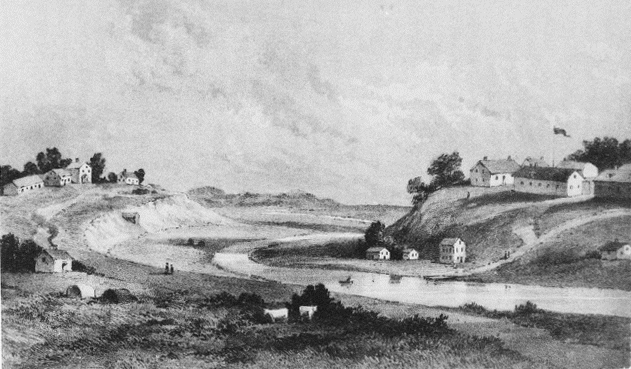
FORT WINNEBAGO IN 1831. From a sketch by Mrs. Kinzie, in original edition.
The Indians have a tradition that a vast serpent once lived in the waters of the Mississippi, and that taking a freak to visit the Great Lakes, he left his trail through the prairies, which, collecting the waters from the meadows and the rains of heaven as they fell, at length became the Fox River.
The little lakes along its course were probably the spots where he flourished about in his uneasy slumbers at night. He must have played all the antics of a kitten in the neighborhood of the Portage. When the Fort was first pointed out to me, I exclaimed with delight, “Oh, we shall be there in half an hour!”
“Not quite so soon,” said my husband, smiling. “Wait and see.” We sat and watched. We seemed approaching the very spot where we were to disembark. We could distinguish the officers and a lady on the bank waiting to receive us. Now we are turning our back on them, and shooting out into the prairie again. Anon we approach another bank, on which is a range of comfortable-looking log-houses. "That is the Agency,—the largest house belongs to Paquette, the interpreter,[41] and the others are the dwellings of our Frenchmen. The little building, just at the foot of the hill, is the blacksmith’s shop, kept there by the Government, that the Indians may have their guns and traps mended free of expense."
“But are we going to stop there?”
“No; do you not see we are going back to the fort?”
And, to be sure, our course was now turned, and we were setting in our first direction. In this manner, after tacking to the right and left, and putting backwards and forwards during the greater part of two hours, we at length reached the little landing, on which the assembled party stood ready to greet us.
CHAPTER VIII
FORT WINNEBAGO
Major and Mrs. Twiggs, and a few of the younger officers (for nearly all of the older ones were absent), with our brother Robert, or, as he is called throughout all the Indian tribes, “Bob,” gave us a cordial welcome—how cordial those alone can know who have come, like us, to a remote, isolated home in the wilderness. The Major insisted on our taking possession at once of vacant quarters in the fort, instead of at “the Agency,” as had been proposed.
“No—we must be under the same roof with them. Mrs. Twiggs had been without a companion of her own sex for more than four months, and would certainly not hear of a separation now. But we must be their guests until the arrival of the boats containing our furniture,” which, under the care of our old acquaintance, Hamilton Arndt, was making its way slowly up from Green Bay.
A dinner had been prepared for us. This is one of the advantages of the zig-zag approach by the Fox River—travellers never take their friends by surprise—and when the whole circle sat down to the hospitable board, we were indeed a merry company.
After dinner Mrs. Twiggs showed me the quarters assigned to us, on the opposite side of the spacious hall. They consisted of two large rooms on each of the three floors or stories of the building. On the ground floor the front room was vacant. The one in the rear was to be the sleeping apartment, as was evident from a huge, unwieldy bedstead, of proportions amply sufficient to have accommodated Og, the King of Bashan, with Mrs. Og and the children into the bargain. We could not repress our laughter, but the bedstead was nothing to another structure which occupied a second corner of the apartment.
This edifice had been built under the immediate superintendence of one of our young lieutenants, and it was plain to be seen that upon it both he and the soldiers who fabricated it had exhausted all their architectural skill. The timbers of which it was composed had been grooved and carved; the pillars that supported the front swelled in and out in a most fanciful manner; the doors were not only panelled, but radiated in a way to excite the admiration of all unsophisticated eyes. A similar piece of workmanship had been erected in each set of quarters to supply the deficiency of closets, an inconvenience which had never occurred, until too late, to the bachelors who planned them. The three apartments of which each structure was composed, were unquestionably designed for clothes-press, store-room, and china-closet; such, at least, were the uses to which Mrs. Twiggs had appropriated the one assigned to her. There was this slight difficulty, that in the latter the shelves were too close to admit of setting in even a gravy-boat, but they made up in number what was wanting in space. We christened the whole affair, in honor of its projector, a “Davis;” thus placing the first laurel on the brow of one who was afterwards to signalize himself at Buena Vista, and in the Cabinet of his country.[42]
The bold promontory on which Fort Winnebago was built looked down upon the extended prairie and the Fox River on one side, and on the other stretched away into the thickly wooded ridge that led off to Belle Fontaine and Lake Puckaway.
In front lay an extent of meadow, across which was the Portage road, of about two miles in length, leading between the Fox and the Wisconsin rivers. Teams of oxen and a driver were kept at the Agency by the Government, to transport the canoes of the Indians across this place, which at many seasons was wet, miry, and almost impassable.[43]
The woods were now brilliant with the many tints of autumn, and the scene around was further enlivened by groups of Indians, in all directions, and their lodges, which were scattered here and there, in the vicinity of the Agency buildings. On the low grounds might be seen the white tents of the traders, already prepared to furnish winter supplies to the Indians, in exchange for the annuity money they were about to receive.
A great concourse had been for many days assembling in anticipation of the payment, which was expected to take place as soon as Shaw-nee-aw-kee should arrive with the silver.
Preparatory to this event, the great chief of the nation, Four-Legs, whose village we had passed at the entrance to Winnebago Lake, had thought proper to take a little carouse, as is too apt to be the custom when the savages come into the neighborhood of a sutler’s establishment. In the present instance, the facilities for a season of intoxication had been augmented by the presence on the ground of some traders, too regardless of the very stringent laws prohibiting the sale of liquor to the Indians.
Poor Four-Legs could not stand this full tide of prosperity. Unchecked by the presence of his “father,” the agent, he carried his indulgence to such excess that he fell a victim in the course of a few days. His funeral had been celebrated with unusual pomp the day before our arrival, and great was my disappointment at finding myself too late to witness all the ceremonies.
His body, according to their custom, having been wrapped in a blanket, and placed in a rude coffin, along with his guns, tomahawk, pipes, and a quantity of tobacco, had been carried to the most elevated point of the hill opposite the fort, followed by an immense procession of his people, whooping, beating their drums, howling, and making altogether what is emphatically termed a “pow-wow.”
After the interment of the body a stake was planted at its head, on which was painted in vermilion a series of hieroglyphics, descriptive of the great deeds and events of his life. The whole was then surrounded with pickets of the trunks of the tamarack trees, and hither the friends would come for many successive days to renew the expression of their grief, and to throw over the grave tobacco and other offerings to the Great Spirit.
It was a consolation to find that, although delayed, we were yet in time to furnish a quantity of white cotton for a flag to wave over the grave, and also to pay a considerable bill at the sutler’s, for the different articles that had been found necessary for the funeral parade—it being a duty expected of their father to bury the dead suitably.
The funeral observances in honor of the chief had not yet ceased. Throughout the day, and all that night, the sound of instruments, mingled with doleful lamentations, and with the discordant whoops and yells of those in a partial state of intoxication, filled the air, and disturbed our repose. To these were added occasionally the plaintive sounds of the Indian flute, upon which the young savage plays when he is in love. Grief and whiskey had made their hearts tender, and the woods resounded to their melancholy strains.
Early the following morning, before I left my room, I was startled by the sounds of lamentation and woe proceeding from the adjoining apartment. On entering it, I found several squaws seated on the floor, with downcast looks expressive of condolence and sympathy, while in their midst sat a little ugly woman, in tattered garments, with blackened face and dishevelled hair, sobbing and wailing bitterly.
Not doubting they were the family of the deceased chief, I was quite troubled at my inability to express, otherwise than by gestures, my participation in their sorrows.
Unacquainted as I was with their customs, I took it for granted from their wretched appearance that poverty and destitution formed one of the sources of their affliction. One of the party, at least, seemed in the very depths of misery. “Can it be possible,” said I to myself, “that this poor creature has only these scanty rags to cover her?”
Stepping back to my own room, I brought out a pretty calico wrapper, which I presented to the little dirty, blackened object. She took it, and commenced a fresh series of sobbing and sighing. I made signs to her to put it on, opening it and explaining to her how it was to be worn, and recommending to her, by gestures, to lose no time in making herself more comfortable.
At this, the other women burst into a laugh.
“Very mal-à-propos,” thought I, “and somewhat unfeeling.” At that moment my husband entering, explained to me that the chief mourner was Madame Four-Legs, the widow; that she had undoubtedly a comfortable wardrobe at home, but that it was part of the etiquette of mourning to go for a season with neglected persons and blackened faces. All this was told me in the intervals of shaking hands, and offering and receiving condolences in the most uncouth, guttural language I had ever heard. Their “father” at length dismissed them, with a promise of some presents to help dry up their tears. It must not be inferred that the grief of the poor little widow was not sincere. On the contrary, she was greatly attached to her husband, and had had great influence not only with him but with the nation at large. She was a Fox woman, and spoke the Chippewa, which is the court language among all the tribes, so that she was often called upon to act as interpreter, and had, in fact, been in the habit of accompanying her husband, and assisting him by her counsels upon all occasions. She was a person of great shrewdness and judgment, and as I afterwards experienced, of strong and tenacious affections.
After breakfast I received a visit from the principal chiefs, who had put on their best of apparel and paint, to receive their new “mother.”
There was Naw-kaw, or Kar-ray-mau-nee, “the Walking Rain,” now the principal chief of the nation, a stalwart Indian, with a broad, pleasant countenance, the great peculiarity of which was an immense under lip, hanging nearly to his chin. There was the old Day-kau-ray,[44] the most noble, dignified, and venerable of his own, or indeed of any other, tribe. His fine Roman countenance, rendered still more striking by his bald head, with one solitary tuft of long silvery hair neatly tied and falling back on his shoulders; his perfectly neat, appropriate dress, almost without ornament, and his courteous demeanor, never laid aside, under any circumstances, all combined to give him the highest place in the consideration of all who knew him. It will hereafter be seen that his traits of character were not less grand and striking, than were his personal appearance and deportment.
There was Black-Wolf, whose lowering, surly face was well described by his name. The fierce expression of his countenance was greatly heightened by the masses of heavy black hair hanging round it, quite contrary to the usual fashion among the Winnebagoes. They, for the most part, remove a portion of their hair, the remainder of which is drawn to the back of the head, clubbed and ornamented with beads, ribbons, cock’s feathers, or, if they are so entitled, an eagle’s feather for every scalp taken from an enemy.
There was Talk-English, a remarkably handsome, powerful young Indian, who received his name in the following manner. He was one of a party of sixteen Winnebagoes, who had, by invitation accompanied their Agent and Major Forsyth[45] (or the Chippewa as he was called), on a visit to the President at Washington, the year previous.
On the journey, the question naturally addressed to them by people not familiar with Western Indians was,
“Do you talk English?”
The young fellow being very observant, came to his “father.” “What do they mean by this? Everybody says to me, talk English!”
The Agent interpreted the words to him. “Ah, very well.”
The next place they arrived at was Lockport, in the State of New York. Jumping off the canal-boat upon the lock, he ran up to the first man he met, and thrusting forward his face cried out, “Talk Eengeesh?”
“Yes,” said the man; “do you talk English?”
“Ya-as.”
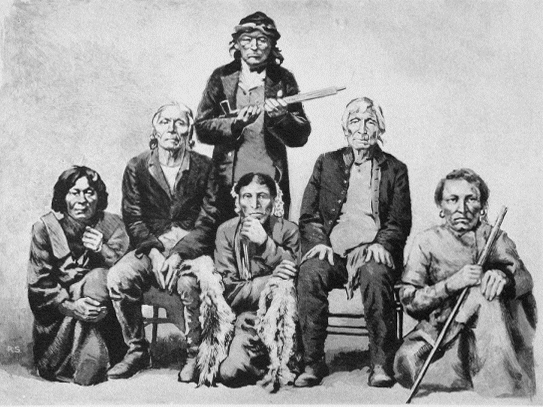
A TYPICAL GROUP OF WINNEBAGOES. From photograph in possession of Wisconsin Historical Society.
From that time forward, he always bore the name of Talk-English, and was registered on the pay-rolls by a title of which he was not a little proud.
Hoo-wau-ne-kah, “the Little Elk,” was another of the distinguished men of the tribe. He had likewise been at Washington. Henry Clay, when he visited them, after looking carefully at the countenances and bearing of all the members of the deputation, had indicated him as the one possessing the greatest talent; and he was greatly pleased when informed that he was the principal orator of the nation, and decidedly superior in abilities to any other individual of the tribe.
Wild-Cat, our Indian Falstaff, in all save the cowardice and falsehood, I have already mentioned.
Then there was Kau-ray-kaw-saw-kaw, “the White Crow,” or Rock River Indian, who afterwards distinguished himself as the friend of the whites during the Sauk war. He was called by the French “le Borgne,” from having lost an eye; and the black silk handkerchief, which he wore drooping over the left side of his face to disguise the blemish, taken with his native costume, gave him a very singular appearance.[46]
There was a nephew of the defunct chief Four-Legs, to whom was with justice given, by both whites and Indians, the appellation of "the Dandy."[47] When out of mourning his dress was of the most studied and fanciful character. A shirt (when he condescended to wear any) of the brightest colors, ornamented with innumerable rows of silver brooches, set thickly together; never less than two pairs of silver arm-bands; leggings and moccasins of the most elaborate embroidery in ribbons and porcupine quills; everything that he could devise in the shape of ornament hanging to his club of hair behind; a feather fan in one hand, and a mirror in the other, in which he contemplated himself every five minutes; these, with the variety and brilliancy of the colors upon his face, the suitable choice and application of which occupied no small portion of the hours allotted to his toilet; such made up the equipment of young Four-Legs.
This devotion to dress and appearance seemed not altogether out of place in a youthful dandy, but we had likewise an old one of the same stamp. Pawnee Blanc, or the White Pawnee, if possible surpassed his younger competitor in attention to his personal attractions.
Upon the present occasion he appeared in all his finery, and went through the customary salutations with an air of solemn dignity, then entered, as did the others, into the parlor (for I had received them in the hall), where they all seated themselves upon the floor. Fortunately, the room was now bare of furniture, but “alas!” thought I, “for my pretty carpet, if this is to be the way they pay their respects to me!” I watched the falling of the ashes from their long pipes, and the other inconveniences of the use of tobacco, or “kin-ni-kin-nick,” with absolute dismay.
The visit of the chiefs was succeeded by one from the interpreter and his wife, with all the Canadian and half-breed women, whose husbands found employment at the Agency, or at the American Fur Company’s establishment.
By this time my piano had been taken from its case and set up in our quarters. To our great joy, we found it entirely uninjured. Thanks to the skill of Nunns and Clark, not a note was out of tune.
The women, to whom it was an entire novelty, were loud in their exclamations of wonder and delight.
“Eh-h-h! regardez done! Quelles inventions! Quelles merveilles!”[M]
One, observing the play of my fingers reflected in the nameboard, called in great exultation to her companions. She had discovered, as she thought, the hidden machinery by which the sounds were produced, and was not a little mortified when she was undeceived.
CHAPTER IX
HOUSEKEEPING
As the boats might be expected in a few days, it was thought best to begin at once what preparations were in my power towards housekeeping. These were simply the fitting and sewing of my carpets, in which I was kindly assisted by Mrs. Twiggs; and the wife of one of our Frenchmen having come over from the Agency, and made everything tidy and comfortable, the carpets were soon tacked down, and ready for the reception of the rest of the furniture.
I had made many fruitless attempts, both in Detroit and Green Bay, to procure a servant-woman to accompany me to my new home. Sometimes one would present herself, but, before we could come to a final agreement, the thoughts of the distance, of the savages, the hardships of the journey, or, perhaps, the objections of friends, would interfere to break off the negotiation; so that I had at length been obliged to rest satisfied with the simple hope held out by my husband, that one or the other of his French employés, with his wife, would be contented to take up their abode with us.
In this state of things, all difficulties seemed to be obviated by the proposal of Major Twiggs, that we should take into our service a young colored girl, whom he had brought from Buffalo, in the spring, to wait on Mrs. T. until her own servants should arrive from the South.
Louisa was accordingly sent for, an uncommonly handsome young negress, with an intelligent but very demure countenance, who called herself fifteen years of age, but who, from the progress in vice and iniquity I afterwards discovered her to have made, must have been at least several years older. Be that as it may, she now seemed to have no fault but carelessness and inexperience, of both of which I had great hopes she would improve, under careful training.
My first week’s visit with Mrs. Twiggs had just expired when word was given that the boats were in sight—the boats that contained our furniture—and the expected arrival of Louis Philippe to visit Queen Victoria could scarcely have created a more universal sensation, than did this announcement in our little community. Although we knew that some hours must yet elapse before they could reach the spot for disembarkation, we were constantly on the watch, and at length all the young officers, followed by as many of the soldiers as were off duty, accompanied Mr. Kinzie down the bank to the landing, to witness, and if necessary, to assist in helping everything safe to land.
Sad was the plight in which matters were found. The water poured out of the corners of the boxes as they were successively hoisted on shore. Too impatient to wait until they could be carried up to the fort, the gentlemen soon furnished themselves with hammers and hatchets, and fell eagerly to work, opening the boxes to explore the extent of the damage. Alas for the mahogany! not a piece from which the edges and veneering were not starting. It had all the appearance of having lain under the Grande Chûte for days. Poor Hamilton was loud in his protestations and excuses.
It was the fault of the men, of the weather, of the way the things were packed. “Confound it! he had taken the best care of the things he possibly could—better than he had ever taken before—it would get done!”
There was nothing but to be patient and make the best of it. And when the pretty sideboard and work-table had been thoroughly rubbed and set up, and all the little knickknacks arranged on the mantel-piece—when the white curtains were hung at the windows, and the chairs and dining-table each in its proper place in relation to the piano, our parlor was pronounced “magnificent.” At least so seemed to think Hamilton, who came to give one admiring look, and to hear the music of the piano, which was a perfect novelty to him. His description of it to the young officers, after his return to the Bay, was expressive of his admiration and wonder—“There it stood on its four legs! Anybody might go up and touch it!”
In due time the dinner and tea sets were carefully bestowed in the “Davis,” together with sundry jars of sweetmeats that I had prepared in Detroit; the iron and tin utensils were placed in a neat cupboard in the kitchen, of which my piano-box supplied the frame; the barrel of eggs and tubs of butter, brought all the way from Ohio, were ranged in the store-room; a suitable quantity of salt pork and flour, purchased from the Commissary; and there being no lack of game of every description, the offering of our red children, we were ready to commence housekeeping.
The first dinner in her own home is an era in the life of a young housekeeper. I shall certainly never forget mine. While I was in the lower regions superintending my very inexpert little cook, my husband made his appearance to say that, as the payment (then the all-absorbing topic of interest) would not commence until afternoon, he had invited M. Rolette, Mr. Hempstead,[48] and four other gentlemen to dine with us.
“So unexpected—so unprepared for!”
“Never mind; give them anything you have. They have been living for some days in tents, and anything will taste well to them.”
My dinner had been intended to consist chiefly of a venison pasty, and fortunately the only dish among my store was of very large proportions, so that there was already smoking in the oven a pie of a size nearly equal to the famous Norwich pudding; thus, with some trifling additions to the bill of fare, we made out very well, and the master of the house had the satisfaction of hearing the impromptu dinner very much commended by his six guests.
CHAPTER X
INDIAN PAYMENT—MRS. WASHINGTON
There were two divisions of the Winnebago Indians, one of which was paid by the Agent, at the Portage, the other at Prairie du Chien, by Gen. Street.[49] The first, between four and five thousand in number, received, according to treaty stipulations, fifteen thousand dollars annually, besides a considerable amount of presents, and a certain number of rations of bread and pork, to be issued in times of emergency throughout the year.
The principal villages of this division of the tribe were at Lake Winnebago, Green and Fox Lakes, the Barribault, Mud Lake, the Four Lakes, Kosh-ko-nong, and Turtle Creek. Messengers were dispatched, at or before the arrival of the annuity-money, to all the different villages, to notify the heads of families or lodges to assemble at “the Portage.”
When arrived, the masters of families, under their different chiefs, give in their names, and the number in their lodges, to be registered. As in paying a certain sum of money is apportioned to each individual, it is, of course, an object to make the number registered as great as possible. Each one brings his little bundle of sticks, and presents it to the Agent to register. Sometimes a dialogue like the following occurs:
“How many have you in your lodge?”
The Indian carefully, and with great ceremony, counts his bundle of sticks. “Fifteen.”
“How many men?”
“Two.” The Agent lays aside two sticks.
“How many women?”
“Three.” Three more sticks are separated.
“How many children?”
“Eight.” Eight sticks are added to the heap.
“What is the meaning of these two sticks that remain?”
The culprit, whose arithmetic has not served him to carry out his deception, disappears amid the shouts and jeers of his companions, who are always well pleased at the detection of any roguery in which they have had no share.
The young officers generally assisted in counting out and delivering the money at these payments, and it was no unusual thing, as the last band came up, for the chiefs to take a quantity of silver out of the box, and request their “father” to pay his friends for their trouble, seeming really disturbed at his refusal. In this, as in almost every instance, we see the native courtesy and politeness, which are never lost sight of among them. If a party comes to their “father,” to beg for provisions, and food is offered them, however hungry they may be, each waits patiently until one of the company makes an equal distribution of the whole, and then, taking his share, eats it quietly, with the greatest moderation. I never saw this rule violated, save in one instance.
Our friend. Pawnee Blanc, the Old Dandy, once came with a party of Indians, requesting permission to dance for us, in the open space before the door. It was a warm, dusty afternoon, and as our friends grew heated and fatigued with the violent and long-continued exercise, a pitcher of raspberry negus was prepared and sent out to them. Pawnee received the pitcher and tumbler, and pouring the latter about half full, gave it to the first of the circle, then filled the same for the next, and so on, until it suddenly occurred to him to look into the pitcher. What he saw there determined his course of action, so, setting the tumbler upon the ground, he raised the pitcher with both hands to his lips and gave a hearty pull, after which he went on, giving less and less, until he was called to have the pitcher replenished. All present agreed it was the only instance they had ever witnessed, of an Indian’s appearing afraid of getting less of a thing than his share.
During the payment a good many kegs of whiskey find their way into the lodges of the Indians, notwithstanding the watchfulness of both officers and Agent. Where there is a demand there will always be a supply, let the legal prohibitions be what they may. The last day of the payment is, too often, one of general carousing.
When the men begin their frolic, the women carefully gather all the guns, knives, tomahawks, and weapons of every description, and secrete them, that as little mischief as possible may be done in the absence of all restraint and reason. I am sorry to record that our little friend, Pawnee Blanc, was greatly addicted to the pleasures of the bottle.
Among the presents for the chiefs, which Shaw-nee-aw-kee had brought from the east, was a trunk of blue cloth coats, trimmed with broad gold lace, and a box of round black hats, ornamented in a similar manner. All who are familiar with Indians, of whatever tribe, will have observed that their first step towards civilization, whether in man or woman, is mounting a man’s hat, decorated with tinsel, ribbons, or feathers. Pawnee was among the happy number remembered in the distribution, so donning at once his new costume, and tying a few additional bunches of gay-colored ribbons to a long spear, that was always his baton of ceremony, he came at once, followed by an admiring train, chiefly of women, to pay me a visit of state.
The solemn gravity of his countenance, as he motioned away those who would approach too near, and finger his newly-received finery—the dignity with which he strutted along, edging this way and that to avoid any possible contact from homely, e very-day wardrobes, augured well for a continuance of propriety and self-respect, and a due consideration of the good opinion of all around. But, alas, for Pawnee! Late in the day we saw him assisted towards his lodge by two stout young Indians, who had pulled him out of a ditch, his fine coat covered with mud, his hat battered and bruised, his spear shorn of its gay streamers, and poor Pawnee, himself, weeping and uttering all the doleful lamentations of a tipsy Indian.
Among the women with whom I early made acquaintance was the wife of Wau-kaun-zee-kah, the Yellow Thunder.[50] She had accompanied her husband, who was one of the deputation to visit the President, and from that time forth she had been known as “the Washington woman.” She had a pleasant, old-acquaintance sort of air in greeting me, as much as to say, “You and I have seen something of the world.” No expression of surprise or admiration escaped her lips, as her companions, with child-like, laughing simplicity, exclaimed and clapped their hands at the different wonderful objects I showed them. Her deportment said plainly, “Yes, yes, my children, I have seen all these things before.” It was not until I put to her ear some tropical shells, of which I had a little cabinet, and she heard it roaring in her ear, that she laid aside her apathy of manner. She poked her finger into the opening to get at the animal within, shook it violently, then put it to her ear again, and finally burst into a hearty laugh, and laid it down, acknowledging, by her looks, that this was beyond her comprehension.
I had one shell of peculiar beauty—my favorite in the whole collection—a small conch, covered with rich, dark veins. Each of the visitors successively took up this shell, and by words and gestures expressed her admiration, evidently showing that she had an eye for beauty—this was on the occasion of the parting visit of my red daughters.
Shortly after the payment had been completed, and the Indians had left, I discovered that my valued shell was missing from the collection. Could it be that one of the squaws had stolen it? It was possible—they would occasionally, though rarely, do such things under the influence of strong temptation. I tried to recollect which, among the party, looked most likely to have been the culprit. It could not have been the Washington woman—she was partly civilized, and knew better.
A few weeks afterwards Mrs. Yellow Thunder again made her appearance, and carefully unfolding a gay-colored chintz shawl, which she carried rolled up in her hand, she produced the shell, and laid it on the table before me. I did not know whether to show, by my countenance, displeasure at the trick she had played me, or joy at receiving my treasure back again, but at length decided that it was the best policy to manifest no emotion whatever.
She prolonged her visit until my husband’s return, and he then questioned her about the matter.
“She had taken the shell to her village, to show to some of her people, who did not come to the payment.”
“Why had she not asked her mother’s leave before carrying it away?”
“Because she saw that her mother liked the shell, and she was afraid she would say—No.”
This was not the first instance in which Madame Washington had displayed the shrewdness which was a predominant trait in her character. During the visit of the Indians to the eastern cities, they were taken to various exhibitions, museums, menageries, the theatre, &c. It did not escape their observation that some silver was always paid before entrance, and they inquired the reason. It was explained to them. The woman brightened up, as if struck with an idea.
“How much do you pay for each one?”
Her father told her.
“How do you say that in English?”
“Two shillings.”
“Two shinnin—humph” (good).
The next day, when as usual, visitors began to flock to the rooms where the Indians were sojourning, the woman and a young Indian, her confederate, took their station by the door, which they kept closed. When any one knocked, the door was cautiously opened, and the woman extending her hand, exclaimed—“Two shinnin.”
This was readily paid in each instance, and the game went on, until she had accumulated a considerable sum. But this did not satisfy her. At the first attempt of a visitor to leave the room, the door was held close, as before, the hand was extended, and “Two shinnin” again met his ear. He tried to explain that, having paid for his entrance, he must now go out free. With an inexorable shake of the head, “Two shinnin,” was all the English she could understand.
The Agent who had entered a short time before, and who, overhearing the dialogue, sat laughing behind his newspaper, waiting to see how it would all end, now came forward and interfered, and the guests were permitted to go forth without a further contribution.
The good woman was moreover admonished that it was far from the custom of white people to tax their friends and visitors in this manner, and that the practice must be laid aside in future.
Another instance of the disposition of the Indians to avail themselves of all the goods that fortune throws in their way, was the following:
Upon the same trip, while passing through Ohio, one of the party inquired of the Agent,
“Do you pay for all those provisions that are set before us at the hotels?”
“Yes, why do you ask?”
“Nothing: I thought you perhaps paid for just what we ate of them.”
At the next stopping place a fine breakfast was set upon the table, of which, as usual, they partook plentifully. Just as they had finished, the horn sounded for all to take their places in the stage-coaches. Each sprang to his feet. One seized the plates of biscuits and poured them into the corner of his blanket; another the remains of a pair of chickens; a third emptied the sugar-bowls; each laid hold of what was nearest him, and in a trice nothing was left upon the table but the empty plates and dishes. The landlord and waiters, meanwhile, stood laughing and enjoying the trick as much as any of the spectators.
Upon another occasion, their “father” had endeavored to impress upon them the unseemliness of throwing their refuse pieces, bones, and fragments of food about on the table-cloth, pointing out to them the orderly manner of the whites at table, and the propriety of keeping everything neat and nice around them.
At their next meal, they were served first with a chicken-pie, of which they ate very heartily, and the accumulation of bones on their plates was very abundant. Presently another and more favorite dish appeared. A fine large roasted turkey. A gentleman sat near, and was evidently preparing to carve it. No time was to be lost. What was to be done with the bones? They looked around in some perplexity. A large apple-pie was standing near. The most eager drew it towards him, and quick as thought all the bones were deposited upon it, while with a triumphant laugh at the happy idea, he coolly transferred the bird to his own dish, and proceeded to distribute it among his companions. The amazed stranger soon joined in the laugh at the unceremonious manner in which his share of the dinner had vanished.
CHAPTER XI
LOUISA—DAY-KAU-RAY ON EDUCATION
The payment was now over, and the Indians had dispersed and gone to their wintering grounds. The traders too, had departed, laden with a good share of the silver, in exchange for which each family had provided itself, as far as possible, with clothing, guns, traps, ammunition, and the other necessaries for their winter use. The Indians are good at a bargain. They are not easily overreached. On the contrary, they understand at once when a charge is exorbitant; and a trader who tries his shrewdness upon them is sure to receive an expressive sobriquet, which ever after clings to him.
For instance, M. Rolette was called by them “Ah-kay-zaup-ee-tah,” five more—because, as they said, let them offer what number of skins they might, in bartering for an article, his terms were invariably “five more.”
Upon one occasion a lady remarked to him, “Oh, M. Rolette, I would not be engaged in the Indian trade; it seems to me a system of cheating the poor Indians.”
“Let me tell you, madame,” replied he with great naiveté, “it is not so easy a thing to cheat the Indians as you imagine. I have tried it these twenty years, and have never succeeded!”
We were now settled down to a quiet, domestic life. The military system under which everything was conducted—the bugle-call, followed by the music of a very good band, at “réveille;” the light, animated strains for “sick-call,” and soon after for “breakfast;” the longer ceremony of guard-mounting; the “Old English Roast-beef,” to announce the dinner hour; the sweet, plaintive strains of “Lochaber no more,” followed most incongruously by “the Little Cock-Sparrow,” at “retreat;” and finally, the long, rolling tattoo, late in the evening, made pleasant divisions of our time, which, by the aid of books, music, and drawing, in addition to household occupations, seemed to fly more swiftly than ever before. It was on Sunday that I most missed my eastern home. I had planned beforehand what we should do on the first recurrence of this sacred day, under our own roof. “We shall have, at least,” said I to myself, “the Sabbath’s quiet and repose; and I can, among other things, benefit poor Louisa by giving her some additional lessons of a serious character.”
So, while she was removing the breakfast things, I said to her,
“Now, Louisa, get your work all finished, and everything put neatly aside, and then come here to me again.”
“Yes, ma’am.”
We sat down to our books, and read and waited; we waited and read another hour—no Louisa.
There was music and the sound of voices on the parade in front of our windows, but that did not disturb us: it was what we were daily accustomed to.
I must go at length, and see what could be keeping my damsel so. I descended to the kitchen. The breakfast things stood upon the table—the kettles and spider upon the hearth—the fire was out—the kitchen empty.
Passing back into the hall, which extended the whole length of the house, and opened in front upon the parade, I perceived a group collected in the area, of all shades and colors, and in the midst, one round, woolly head which I could not mistake, bobbing up and down, now on this side, now on that, while peals of laughter were issuing from the whole group.
“Louisa,” I called, “come here; what are you doing there?”
“Looking at inspection.”
“But why are not your breakfast tilings washed, and your kitchen swept? Did I not tell you I wished you to come up and learn your lessons?”
“Yes, ma’am; but I had to see inspection first. Everybody looks at ‘inspection’ on Sunday.”
I found it was in vain to expect to do more for Louisa than give her an afternoon’s lesson, and with that I was obliged to content myself.
I felt that it would be very pleasant, and perhaps profitable, for all the inmates of the garrison to assemble on this day; one of our number might be found who would read a portion of the church-service, and a sermon from one of our different selections.
I approached the subject cautiously, with an inquiry to this effect:
“Are there none among the officers who are religiously disposed?”
“Oh, yes,” replied the one whom I addressed, “there is S——; when he is half-tipsy, he takes his Bible and ‘Newton’s Works,’ and goes to bed and cries over them; he thinks in this way he is excessively pious.”
S—— was among the officers who had never called upon us; it was fair to infer that if his religious principles did not correct his own evil habits, they would not aid much in improving others; therefore, it seemed useless to call in his co-operation in any scheme for a better observance of the Lord’s Day.
We had to content ourselves with writing to our friends at the east to interest themselves in getting a missionary sent to us, who should officiate as chaplain in the garrison, a plan that seemed to find favor with the officers. The hope of any united religious services was, for the present, laid aside.
The post-surgeon having obtained a furlough, his place was supplied by Dr. Newhall, of Galena, and thus, by the addition of his gentle, quiet wife, our circle of ladies was now enlarged to three. Here we were, in a wilderness, but yet how contented and happy!
A gloom was soon to replace this envied tranquillity in our home. A Frenchman, named Letendre, one day suddenly presented himself. He had come from Chicago, with the distressing intelligence of the extreme, indeed hopeless illness of our dear relative. Dr. Wolcott. My husband immediately commenced his preparations for instant departure. I begged to be permitted to accompany him, but the rapidity with which he proposed to journey obliged him to refuse my entreaties. In a few hours his provisions, horses, and all other things necessary for the journey were in readiness, and he set off with Petaille Grignon, his usual attendant on such expeditions, leaving Letendre to follow as soon as recruited from his fatigue.
Sad and dreary were the hours of his absence, notwithstanding the kind efforts of our friends to cheer me. In a few days I received the news of the fatal termination of Dr. W.'s illness, brought by another messenger. That noble heart, so full of warm and kindly affections, had ceased to beat, and sad and desolate, indeed, were those who had so loved and honored him.
As soon as he could possibly leave his family, my husband returned, and it was fortunate that he had delayed no longer, for the winter now began to set in, and with severity.
Our quarters were spacious, but having been constructed of the green trees of the forest, cut down and sawed into boards by the hands of the soldiers, they were considerably given to shrinking and warping, thus leaving many a yawning crevice. Stuffing the cracks with cotton batting, and pasting strips of paper over them, formed the employment of many a leisure hour.
Then the chimneys, spite of all the currents of air, which might have been expected to create a draught, had a sad habit of smoking. To remedy this, a couple of gun-barrels had been sawed off and inserted in the hearth, one on each side of the fire place, in the hope that the air from the room below might help to carry the smoke into its proper place, the chimney.
The next morning after this had been done, Louisa was washing the hearth.
“Pray, ma’am,” said she, “what are these things put in here for?”
I explained their use.
“Oh, I am so glad it is only that. Uncle Ephraim (Major Twiggs' servant) said they were to be filled with powder and fired off Christmas Day, and he was terribly afraid they would blow the house up, and we in it.”
Ephraim, who was a most faithful and valuable servant, often amused himself with playing upon the credulity of the younger portions of the colored fraternity.
“Is it true,” asked Louisa, one day, “that Pill on and Plante were once prairie-wolves?”
“Prairie-wolves! what an idea! Why do you ask such a foolish question?”
“Because uncle Ephraim says they, and all the Frenchmen about here, were once prairie-wolves, and that, living so near the white people, they grew, after a time, to be like them, and learn to talk and dress like them. And then, when they get to be old, they turn back into prairie-wolves again, and that all the wolves that the officers bait with their dogs used to be Frenchmen, once.”
After a time, however, I ceased to straighten out these stories of uncle Ephraim, for I was gradually arriving at the conviction that my little colored damsel was by no means so simple and unsophisticated as she would have me believe, and that I was, after all, the one who was imposed upon.
The snow this winter was prodigious, and the cold intense. The water would freeze in our parlors at a very short distance from the fire, for, although the “fatigue parties” kept the hall filled with wood, almost up to the ceiling, that did not counterbalance the inconvenience of having the wide doors thrown open to the outer air for a great portion of the day, to allow of their bringing it in. We Northerners should have had wood-houses specially for the purpose, and not only have kept our great hall-doors closed, but have likewise protected them with a “hurricane house.” But the Florida frontier was not a station for our southern bachelors to have acquired the knowledge that would have been available when the thermometer was twenty-five degrees below zero—at a point that brandy congealed in the sideboard.
The arrival of Christmas and New Year’s brought us our Indian friends again. They had learned something of the observation of these holidays from their French neighbors, and I had been forewarned that I should see the squaws kissing every white man they met. Although not crediting this to its full extent, I could readily believe that they would each expect a present, as a “compliment of the season,” so I duly prepared myself with a supply of beads, ribbons, combs, and other trinkets. Knowing them to be fond of dainties, I had also a quantity of crullers and doughnuts made ready the day before, as a treat to them.
To my great surprise and annoyance, only a moderate share of the cakes, the frying of which had been entrusted to Louisa, were brought up to be placed in the “Davis.”
“Where are the rest of the cakes, Louisa?”
“That great fellow, Hancock, came in with the fatigue party to fill the water-barrels, and while I had just stepped into the store-room to get some more flour, he carried off all I had got cooked.”
And Louisa made a face and whined, as if she had not herself treated every soldier who had set his foot in the premises.
At an early hour the next morning I had quite a levee of the Ho-tshung-rah matrons. They seated themselves in a circle on the floor, and I was sorry to observe that the application of a little soap and water to their blankets had formed no part of their holiday preparations. There being no one to interpret, I thought I would begin the conversation in a way intelligible to themselves, so I brought out of the sideboard a china dish, filled with the nice brown crullers, over which I had grated, according to custom, a goodly quantity of white sugar. I handed it to the first of the circle. She took the dish from my hand, and deliberately pouring all the cakes into the corner of her blanket, returned it to me empty. “She must be a most voracious person,” thought I, “but I will manage better the next time.” I refilled the dish, and approached the next one, taking care to keep a fast hold of it as I offered the contents, of which I supposed she would modestly take one. Not so, however. She scooped out the whole with her two hands, and, like the former, bestowed them in her blanket. My sense of politeness revolted at handing them out one by one, as we do to children, so I sat down to deliberate what was to be done, for evidently the supply would not long answer such an ample demand, and there would be more visitors anon.
While I was thus perplexed those who had received the cakes commenced a distribution, and the whole number was equitably divided among the company. But I observed they did not eat them. They passed their fingers over the grated sugar, looked in each other’s faces, and muttered in low tones—there was evidently something they did not understand. Presently one more adventurous than the rest wet her fingers, and taking up a few grains of the sugar put it cautiously to her mouth.
“Tah-nee-zhoo-rah!” (Sugar!) was her delighted exclamation, and they all broke out into a hearty laugh; it is needless to say that the cakes disappeared with all the celerity they deemed compatible with good-breeding. Never having seen any sugar but the brown or yellow maple, they had supposed the white substance to be salt, and for that reason had hesitated to taste it.
Their visit was prolonged until Shaw-nee-aw-kee made his appearance, and then, having been made happy by their various gifts, they all took their departure.
About this time, Mr. Kinzie received a letter from Col. Richard M. Johnson, of Kentucky.[51] This gentleman had interested himself greatly in a school established in that State, for the education of Indian youths and children. The purport of his letter was to request the Agent to use every endeavor to induce the Winnebagoes not only to send their children to this institution for their education, but also (what was still more important) to set apart a portion of their annuity money, to assist in sustaining it.
There happened to be, at this holiday season, a number of the chiefs in the neighborhood of the Portage, and a messenger was sent to convene them all at the house of Paquette, the interpreter, that their “father” might hold a talk with them.
On the day appointed they all assembled. The subject matter of the letter was laid before them, and all the advantages of civilization and education duly set forth—the benefits which would arise to their nation, if even a small portion of the younger members could be well-taught by the whites, and then return to their tribe, to instruct them in the learning, the arts, manufactures, and habits of civilized life. To each paragraph, as it was uttered to them, they gave a unanimous “Humph!” (Good.)
When their “father’s” address was ended, Day-kau-ray, the oldest and most venerable among the chiefs, rose and spoke as follows:—
"Father,—The Great Spirit made the white man and the Indian. He did not make them alike. He gave the white man a heart to love peace, and the arts of a quiet life. He taught him to live in towns, to build houses, to make books, to learn all things that would make him happy and prosperous in the way of life appointed him. To the red man the Great Spirit gave a different character. He gave him a love of the woods, of a free life, of hunting and fishing, of making war with his enemies and taking scalps. The white man does not live like the Indian—it is not his nature. Neither does the Indian love to live like the white man—the Great Spirit did not make him so.
"Father,—We do not wish to do anything contrary to the will of the Great Spirit. If he had made us with white skins, and characters like the white men, then we would send our children to this school to be taught like the white children.
"Father,—We think that if the Great Spirit had wished us to be like the whites, he would have made us so. As he has not seen fit to do so, we believe he would be displeased with us, to try and make ourselves different from what he thought good.
“Father,—I have nothing more to say. This is what we think. If we change our minds, we will let you know.”
It will be seen from these remarks of Day-kau-ray, that the Indians entertain a conviction that the Great Spirit himself teaches the white man the arts and sciences, and since he has given the red man no instruction in these branches, it would be unbecoming in him to attempt to acquire them in an irregular manner.
With little incidents of this kind, and with an occasional dinner or tea-party to the young officers, sometimes given at the Major’s quarters, sometimes at our own, our course of life passed pleasantly on. At times I would amuse myself by making “something very nice” in the form of a fruit cake or pie, to send to the quarters of the young officers as a present, it being supposed that possibly, without a lady to preside over their mess, it might be sometimes deficient in these delicacies. Mrs. Twiggs was so fortunate as to have well-trained servants to do for her that which, thanks to my little dark handmaid, always fell to my share.
One day I had made some mince pies, which the Major and my husband greatly approved, and I thought I would send one to each of the young officers.
It happened that my husband, that day, in returning from superintending his men on the other side of the river, had occasion to call on some errand at Captain Harney’s quarters.
Dinner had just been placed upon the table, and the Captain insisted on his visitor’s sitting down and partaking Math him, and another gentleman who was present. The pork and beans were pronounced excellent, and being removed there followed a mince pie.
The Captain cut it, and helped his guests, then taking a piece himself, he commenced tasting it. Pushing back his plate with an exclamation and a sudden jerk, he called to his servant, a little thick-set mulatto who waited—“David, you yellow rascal, how dare you put such a pie on my table?” And turning to the company apologetically, he said—
“If there is anything on earth David does understand, it is how to make a mince pie, and here he has filled this with brandy, so we cannot eat a morsel of it!”
“Please, sir,” said David, modestly, “I did not make the pie—it is one Mrs. Kinzie sent as a present.”
The poor Captain was now in a predicament. He raved at himself, at the same time conjuring my husband most earnestly not to tell me what a mistake he had made—an injunction that was lost sight of as soon as he returned to his home. As for the unlucky Captain, he did not venture to call on me again until he felt sure I had forgotten the circumstance.
CHAPTER XII
PREPARATIONS FOR A JOURNEY
Early in January the snow fell in great abundance. We had an unusual quantity at the Portage, but in “the diggings,” as the lead-mining country was called, it was of an unheard-of depth—five or six feet upon a level.
An express had been dispatched to Chicago by the officers to take our letters, and bring back the mail from that place. A tough, hardy soldier, named Sulky, acted as messenger, and he had hitherto made light of his burden or the length of the way, notwithstanding that his task was performed on foot with his pack upon his shoulders. But now Sulky had been absent some weeks, and we had given him up entirely, persuaded that he must have perished with cold and starvation.
At length he appeared, nearly blind from travelling in the snow. He had lain by three weeks in an Indian lodge, the snow being too deep to permit him to journey. The account he gave put an end to the hopes I had begun to entertain of being able to visit our friends at Chicago in the course of this winter.
We had, before the last heavy fall of snow, been forming plans to that effect. Captain Harney had kindly commenced preparing some trains, or boxes placed on sledges, which it was thought would, when lined with buffalo skins, furnish a very comfortable kind of vehicle for the journey; and I was still inclined to think a good, deep bed of snow over the whole country no great obstacle to a sleigh-ride. The whole matter was, however, cut short by the commanding officer, who from the first had violently opposed the scheme, declaring that he would order the sentinels to fire on us if we attempted to leave the fort. So, finding the majority against us, we were obliged to yield.
The arrival of sweet, lovely, little Lizzie Twiggs, before January was quite past, was an event that shed light and joy in at least two dwellings. It seemed as if she belonged to all of us, and as she increased in size and beauty, it was hard to say who, among us all, was most proud of her. If we had ever felt any languid hours before, we could have none now—she was the pet, the darling, the joint-property of both households.
Whatever regret I might have had previous to this event, at the idea of leaving my friend for the three weeks to which we proposed to limit our visit to Chicago, I felt now that she would scarcely miss me, and that we might hold ourselves in readiness to take advantage of the first improvement in the weather, to put this favorite project in execution.
During the latter part of February the cold became less severe. The snows melted away, and by the beginning of March the weather was so warm and genial, that we were quite confident of being able to make the journey on horseback without any serious difficulty.
Our plans once settled upon, the first thing to be provided was warm and comfortable apparel. A riding-habit of stout broadcloth was pronounced indispensable to my equipment. But of such an article I was destitute. Nothing among my wedding travelling gear seemed in any way to offer a substitute. What was to be done? The requisite material was to be found in abundance at the sutler’s store (the shantee as it was technically termed), but how to get it manufactured into a suitable garment was the question.
The regimental tailor was summoned. He was cook to one of the companies, and there were at first some doubts whether he could be permitted to forsake the spit for the needle, during the time I should require his services. All his tailoring-work had, heretofore, been done at odd times on a bench in the company kitchen, and thither he now proposed to carry the riding-habit. I suggested that, in order to superintend the work, I should thus be driven to take up my abode for the time being in the barracks, which would be a decided inconvenience.
To remedy the difficulty, he was finally so happy as to find a soldier in “Company D,” who consented to officiate in his place as cook until his term of service to me should expire.
Behold, then, a little, solemn-looking man in his stocking feet, seated cross-legged on an Indian mat by my parlor window. He had made all his arrangements himself, and I deemed it wisest not to interfere with him. The cutting-out was the most difficult part, and as he had never made a lady’s riding-habit, that task fell to my share. I was as great a novice as himself, and I must admit that this, my first effort, was open to criticism. But the little tailor was of a different opinion. He was in an ecstasy with our joint performance.
“Upon my word, madam,” he would exclaim, surveying it with admiring eyes, “we shall have a very respectable garment!” I do not know how many times he repeated this during the three days that the work was in progress.
I believe he had not perfect confidence in the culinary powers of his comrade of “Company D,” for regularly a half-hour before beat of drum, his work was folded and laid aside, his snips gathered up, and all things being restored to order, he would slip out, resume his shoes, which, Turk-like, he had left outside the door, and speed over to the barrack-kitchen to see how matters were going on.
In the meantime, great preparations were making below, under the supervision of our tidy, active, little French servant, Mrs. Pillon, the wife of one of the engagés, by whom the irregular and unmanageable Louisa had been replaced.
Biscuits were baked, a ham, some tongues, and sundry pieces of salt-pork were boiled, coffee roasted and ground, sugar cracked, isinglass cut in pieces of the size requisite for a pot of coffee. For the reception of all these different articles cotton bags of different sizes had been previously prepared. Large sacks of skin, called by the Canadians porches, were also provided to hold the more bulky provisions, for our journey was to be a long one.
The distance from Fort Winnebago to Chicago was not very formidable, it is true, if the direct route were taken, but that we knew to be impossible at this season of the year. The route by Kosh-ko-nong was out of the question; all the Indians being absent from their villages in the winter, and the ice being now gone, we could have no means of crossing the Rock River at that place.
There remained therefore no alternative but to proceed south to Dixon, or, as it was then called, Ogie’s Ferry, the only certain means of crossing this broad and rapid stream. This route being so much out of our direct course that we could not hope to accomplish it in less than six days, it was necessary to prepare accordingly.
While the wardrobe and provisions were thus in preparation, arrangements were also to be made as to our retinue and mode of conveyance.
Mr. Kinzie decided to take with him but two men: Plante and Pierre Roy.[52] The former to act as guide, on the assurance that he knew every mile of the way, from the Portage to Ogie’s Ferry, and from Ogie’s Ferry to Chicago.
The claims of the different saddle-horses were discussed, and the most eligible one selected for my use. We hesitated for a time between “Le Gris” and “Souris,” two much-vaunted animals, belonging to Paquette, the interpreter. At length being determined, like most of my sex, by a regard for exterior, I chose “Le Gris,” and “Souris” was assigned to young Roy; my own little stumpy pony, “Brunêt,” being pronounced just the thing for a pack-saddle. My husband rode his own bay horse “Tom,” while Plante, the gayest and proudest of the party, bestrode a fine, large animal called “Jerry,” which had lately been purchased for my use, and thus was our cortège complete.
CHAPTER XIII
DEPARTURE FROM FORT WINNEBAGO
Having taken a tender leave of our friends, the morning of the 8th of March saw us mounted and equipped for our journey. The weather was fine—the streams, already fringed with green, were sparkling in the sun—everything gave promise of an early and genial season. In vain, when we reached the ferry at the foot of the hill on which the fort stood, did Major Twiggs repeat his endeavors to dissuade us from commencing a journey which he assured me would be perilous beyond what I could anticipate. I was resolute.
Our party was augmented by an escort of all the young officers, who politely insisted on accompanying us as far as Duck Creek, four miles distant. Indeed, there were some who would gladly have prosecuted the whole journey with us, and escaped the monotony of their solitary, uneventful life. In our rear followed an ox-cart, on which was perched a canoe, destined to transport us over the creek, and also an extensive marsh beyond it, which was invariably, at this season, overflowed with water to a considerable depth. We had much amusement in watching the progress of this vehicle as it bumped and thumped over the road, unconscious hitherto of the dignity of a wheeled carriage.
Our little shock-headed, sun-burnt, thick-lipped Canadian (who happened most miraculously to be the husband of my pretty servant, Mrs. Pillon), shouted vociferously as the animals lagged in their pace, or jolted against a stump, “Marchez, don-g,” “regardez,” “prenez-garde,” to our infinite diversion. I was in high spirits, foreseeing no hardships or dangers, but rather imagining myself embarked on a pleasure excursion across the prairies. It had not even suggested itself to me that a straw bonnet and kid gloves were no suitable equipment for such an expedition. Never having travelled at so inclement a season, I was heedlessly ignorant of the mode of preparing against it, and had resisted or laughed at my husband’s suggestions to provide myself with blanket socks, and a woollen capuchon for my head and shoulders. And now, although the wind occasionally lifted my headgear with a rude puff, and my hands ere long became swollen and stiffened with the cold, I persuaded myself that these were trifling evils, to which I should soon get accustomed. I was too well pleased with the novelty of my outfit, with my hunting-knife in a gay scabbard hanging from my neck, and my tin cup at my saddle-bow, to regard minor inconveniences.
On reaching Duck Creek, we took leave of our young friends, who remained on the bank long enough to witness our passage across—ourselves in the canoe, and the poor horses swimming the stream, now filled with cakes of floating ice.
Beyond the rising ground which formed the opposite bank of the stream, extended a marsh of perhaps three hundred yards across. To this the men carried the canoe which was to bear us over. The water was not deep, so our attendants merely took off the pack from Brunêt and my side-saddle from Le Gris, for fear of accidents, and then mounted their own steeds, leading the two extra ones. My husband placed the furniture of the pack-horse and my saddle in the centre of the canoe, which he was to paddle across.
“Now, wifie,” said he, “jump in, and seat yourself flat in the bottom of the canoe.”
“Oh, no,” said I; “I will sit on the little trunk in the centre; I shall be so much more comfortable, and I can balance the canoe exactly.”
“As you please, but I think you will find it is not the best way.”
A vigorous push sent us a few feet from the bank. At that instant two favorite greyhounds whom we had brought with us, and who had stood whining upon the bank, reluctant to take to the water as they were ordered, gave a sudden bound, and alighted full upon me. The canoe balanced a moment—then yielded—and quick as thought, dogs, furniture, and lady were in the deepest of the water.
My husband, who was just preparing to spring into the canoe when the dogs thus unceremoniously took precedence of him, was at my side in a moment, and seizing me by the collar of my cloak, begged me not to be frightened. I was not, in the least, and only laughed as he raised and placed me again upon the bank.
The unfortunate saddle and little trunk were then rescued, but not until they had received a pretty thorough wetting. Our merriment was still further increased by the sight of the maladroit Pillon, who was attempting to ride my spirited Jerry across the marsh. He was clinging to the neck of the animal, with a countenance distorted with terror, as he shouted forth all manner of French objurgations. Jerry pranced and curvetted, and finally shot forward his rider, or rather his burden, headforemost, a distance of several feet into the water.
A general outcry of mirth saluted the unfortunate Frenchman, which was redoubled as he raised himself puffing and snorting from his watery bed, and waddled back to his starting-place, the horse, meanwhile, very sensibly making his way to join his companions, who had already reached the further bank.
“Well, wifie,” said Mr. Kinzie, “I cannot trust you in the canoe again. There is no way but to carry you across the marsh like a pappoose. Will you take a ride on my shoulders?”
“With all my heart, if you will promise to take me safely”—and I was soon mounted.
I must confess that the gentleman staggered now and then under his burden, which was no slight one, and I was sadly afraid, more than once, that I should meet a similar fate to old Pillon, but happily we reached the other side in safety.
There my husband insisted on my putting on dry shoes and stockings, and (must I confess it) drinking a little brandy, to obviate the effects of my icy bath. He would fain have made a halt to kindle a fire and dry my apparel and wardrobe properly, but this I would not listen to. I endeavored to prove to him that the delay would expose me to more cold than riding in my wet habit and cloak, and so indeed it might have been, but along with my convictions upon the subject there was mingled a spice of reluctance that our friends at the fort should have an opportunity, as they certainly would have done, of laughing at our inauspicious commencement.
Soon our horses were put in order, and our march recommenced. The day was fine for the season. I felt no inconvenience from my wet garments, the exercise of riding taking away all feeling of chilliness. It was to me a new mode of travelling, and I enjoyed it the more from having been secluded for more than five months within the walls of the fort, scarcely varying the tenor of our lives by an occasional walk of half a mile into the surrounding woods.
We had still another detention upon the road, from meeting Lapierre, the blacksmith, from Sugar Creek, who with one of his associates was going into the Portage for supplies, so that we had not travelled more than twenty-three miles when we came to our proposed encamping ground. It was upon a beautiful, stream, a tributary of one of the Four Lakes,[N] that chain whose banks are unrivalled for romantic loveliness.
I could not but admire the sagacity of the horses, who seemed, with human intelligence, to divine our approach to the spot where their toils were to cease. While still remote from the “point of woods” which foretold a halt, they pricked up their ears, accelerated their pace, and finally arrived at the spot on a full gallop.
We alighted at an open space, just within the verge of the wood, or, as it is called by western travellers, “the timber.” My husband recommended to me to walk about until a fire should be made, which was soon accomplished by our active and experienced woodsmen, to whom the felling of a large tree was the work of a very few minutes. The dry grass around furnished an excellent tinder, which soon ignited by the sparks from the flint (there were no loco-focos in those days), and aided by the broken branches and bits of light-wood, soon produced a cheering flame. “The bourgeois,” in the meantime, busied himself in setting up the tent, taking care to place it opposite the fire, but in such a direction that the wind would carry the smoke and flame away from the opening or door. Within upon the ground were spread, first a bearskin, then two or three blankets (of which each equestrian had carried two, one under the saddle and one above it), after which, the remainder of the luggage being brought in, I was able to divest myself of all my wet clothing and replace it with dry. Some idea of the state of the thermometer may be formed from the fact that my riding-habit, being placed over the end of the huge log against which our fire was made, was, in a very few minutes, frozen so stiff as to stand upright, giving the appearance of a dress out of which a lady had vanished in some unaccountable manner.
It would be but a repetition of our experience upon the Fox River to describe the ham broiled upon the “broches,” the toasted bread, the steaming coffee—the primitive table furniture. There is, however, this difference, that of the latter we carry with us in our journeys on horseback only a coffeepot, a teakettle, and each rider his tin cup and hunting-knife. The deportment at table is marked by an absence of ceremony. The knife is drawn from the scabbard—those who remember to do so, vouchsafe it a wipe upon the napkin. Its first office is to stir the cup of coffee—next, to divide the piece of ham which is placed on the half of a travelling biscuit, which is held in the left hand, and fulfils the office of a plate. It is an art only to be acquired by long practice, to cut the meat so skilfully as not at the same time to destroy the dish.
We take our places around the mat to enjoy what, after our fatiguing ride, we find delicious food. The Frenchmen are seated at a little distance, receiving their supplies of coffee, meat, and bread, and occasionally passing jokes with “the bourgeois,” who is their demigod, and for whom their respect and devotion are never lessened by any affability or condescension.
The meal being finished, the table furniture is rinsed in hot water and set aside until morning. A wisp of dry prairie-grass is supposed, in most cases, to render the knife fit to be restored to the scabbard, and there being, at this season of the year, no amusement but that of watching the awkward movements of the spancelled horses, in their progress from spot to spot in search of pasturage, we are usually soon disposed to arrange our blankets and retire to rest.
At break of day we are aroused by the shout of “the bourgeois.”
“How! how! how!”
All start from their slumbers. The fire which has been occasionally replenished through the night, is soon kindled into a flame. The horses are caught and saddled, while a breakfast, similar in kind to the meal of the preceding evening is preparing—the tent is struck—the pack-horse loaded—“tout démanché,” as the Canadian says. The breakfast finished, we rinse our kettles and cups, tie them to our saddle-bows, and then mount and away, leaving our fire, or rather our smoke, to tell of our visit.
March 9th. Our journey this day led us past the first of the Four Lakes.[53] Scattered along its banks was an encampment of Winnebagoes. They greeted their “father” with vociferous joy—“Bon-jour, bon-jour, Shawnee-aw-kee.” “Hee-nee-karray-kay-noo?” (how do you do?) To this succeeded the usual announcement, “Wys-kap-rah thsoonsh-koo-nee-no!” (I have no bread.)
This is their form of begging, but we could not afford to be generous, for the uncertainty of obtaining a supply, should our own be exhausted, obliged us to observe the strictest economy.
How beautiful the encampment looked in the morning sun! The matted lodges, with the blue smoke curling from their tops—the trees and bushes powdered with a light snow which had fallen through the night—the lake, shining and sparkling, almost at our feet—even the Indians, in their peculiar costume, adding to the picturesque!
I was sorry to leave it, as we were compelled to do, in all haste, Souris, the pack-horse, having taken it into his head to decamp while we were in conversation with our red friends. As he had, very sensibly, concluded to pursue his journey in the right direction, we had the good fortune to overtake him after a short race, and having received much scolding and some blows from young Roy, whose charge he specially was, he was placed in the middle of the cavalcade, as a mark of disgrace for his breach of duty.