Front matter (continued 5)
Reading edition
Having placed his family in safety at Pittsburgh, Mr. Lytle, still assisted by the Commandant and the Indian Agent, undertook an expedition to the frontier to the residence of the British agent. Col. Johnson. His representation of the case warmly interested the feelings of that benevolent officer, who promised him to spare no exertions in his behalf. This promise he religiously performed. He went in person to the village of the Big-White-Man, as soon as the opening of the spring permitted, and offered him many splendid presents of guns and horses, but the chief was inexorable.
Time rolled on, and every year the hope of recovering the little captive became more faint. She, in the meantime, continued to wind herself more and more closely around the heart of her Indian brother. Nothing could exceed the consideration and affection with which she was treated, not only by himself, but by his mother, the Old Queen. All their stock of brooches and wampum was employed in the decoration of her person. The principal seat and the most delicate viands were invariably reserved for her, and no efforts were spared to promote her happiness, and to render her forgetful of her former home and kindred.
Thus, though she had beheld, with a feeling almost amounting to despair, the departure of her parents and dear little brother, and had for a long time resisted every attempt at consolation, preferring even death to a life of separation from all she loved, yet time, as it ever does, brought its soothing balm, and she at length grew contented and happy.
From her activity and the energy of her character, qualities for which she was remarkable to the latest period of her life, the name was given her of The Ship under full sail.
The only drawback to the happiness of the little prisoner, aside from her longings after her own dear home, was the enmity she encountered from the wife of the Big-White-Man. This woman, from the day of her arrival at the village, and adoption into the family as a sister, had conceived for her the greatest animosity, which, at first, she had the prudence to conceal from the observation of her husband.
It was perhaps natural that a wife should give way to some feelings of jealousy at seeing her own place in the heart of her husband usurped, as she imagined, by the child of their enemy, the American. But these feelings were aggravated by a bad and vindictive temper, and by the indifference with which her husband listened to her complaints and murmurings.
As she had no children of her own to engage her attention, her mind was the more engrossed and inflamed with her fancied wrongs, and with devising means for their redress. An opportunity of attempting the latter was not long wanting.
During the absence of the Big-White-Man upon some war-party, or hunting excursion, his little sister was taken ill with fever and ague. She was nursed with the utmost tenderness by the Old Queen, and the wife of the chief, to lull suspicion, and thereby accomplish her purpose, was likewise unwearied in her assiduities to the little favorite.
One afternoon, during the temporary absence of the Old Queen, her daughter-in-law entered the lodge with a bowl of something she had prepared, and stooping down to the mat on which the child lay, said, in an affectionate accent:
“Drink, my sister, I have brought you that which will drive this fever far from you.”
On raising her head to reply, the little girl perceived a pair of eyes peeping through a crevice in the lodge, and fixed upon her with a very peculiar and significant expression. With the quick perception acquired partly from nature, and partly from her intercourse with this people, she replied faintly:
“Set it down, my sister. When this fit of the fever has passed, I will drink your medicine.”
The squaw, too cautious to use importunity, busied herself about in the lodge for a short time, then withdrew to another, near at hand. Meantime, the bright eyes continued peering through the opening, until they had watched their object fairly out of sight, then a low voice, the voice of a young friend and play-fellow, spoke:
"Do not drink that which your brother’s wife has brought you. She hates you, and is only waiting an opportunity to rid herself of you. I have watched her all the morning, and have seen her gathering the most deadly herbs. I knew for whom they were intended, and came hither to warn you."
“Take the bowl,” said the little invalid, “and carry it to my mother’s lodge.”
This was accordingly done. The contents of the bowl were found to consist principally of a decoction of the root of the May-apple, the most deadly poison known among the Indians.
It is not in the power of language to describe the indignation that pervaded the little community when this discovery was made known. The squaws ran to and fro, as is their custom when excited, each vying with the other in heaping invectives upon the culprit. No further punishment was, however, for the present inflicted upon her, but the first burst of rage over, she was treated with silent abhorrence.
The little patient was removed to the lodge of the Old Queen, and strictly guarded, while her enemy was left to wander in silence and solitude about the fields and woods, until the return of her husband should determine her punishment.
In a few days, the excursion being over, the Big-White-Man and his party returned to the village. Contrary to the usual custom of savages, he did not, in his first transport at learning the attempt on the life of his little sister, take summary vengeance on the offender. He contented himself with banishing her from his lodge, never to return, and condemning her to hoe corn in a distant part of the large field or enclosure which served the whole community for a garden.
Although she would still show her vindictive disposition whenever, by chance, the little girl with her companions wandered into that vicinity by striking at her with her hoe, or by some other spiteful manifestation, yet she was either too well watched, or stood too much in awe of her former husband, to repeat the attempt upon his sister’s life.
Four years had now elapsed since the capture of little Nelly. Her heart was by nature warm and affectionate, so that the unbounded tenderness of those she dwelt among had called forth a corresponding feeling of affection in her heart. She regarded the Chief and his mother with love and reverence, and had so completely learned their language and customs as almost to have forgotten her own.
So identified had she become with the tribe, that the remembrance of her home and family had nearly faded from her memory; all but her mother—her mother whom she had loved with a strength of affection natural to her warm and ardent character, and to whom her heart still clung with a fondness that no time or change could destroy.
The peace of 1783 between Great Britain and the United States now took place. A general pacification of the Indian tribes was the consequence, and fresh hopes were renewed in the bosoms of Mr. and Mrs. Lytle.
They removed with their family to Fort Niagara, near which, on the American side, was the great Council Fire of the Senecas. Col. Johnson readily undertook a fresh negotiation with the Chief, but in order to ensure every chance of success, he again proceeded in person to the village of the Big-White-Man.
His visit was most opportune. It was the “Feast of the Green Corn,” when he arrived among them. This observance, which corresponds so strikingly with the Jewish feast of Tabernacles that, together with other customs, it has led many to believe the Indian nations the descendants of the lost ten tribes of Israel, made it a season of general joy and festivity. All other occupations were suspended to give place to social enjoyment in the open air, or in arbors formed of the green branches of the trees. Every one appeared in his gala dress. That of the little adopted child consisted of a petticoat of blue broadcloth, bordered with gay-colored ribbons; a sack or upper garment of black silk, ornamented with three rows of silver brooches, the centre ones from the throat to the hem being of large size, and those from the shoulders down being no larger than a shilling-piece, and set as closely as possible. Around her neck were innumerable strings of white and purple wampum, an Indian ornament manufactured from the inner surface of the muscle-shell. Her hair was clubbed behind, and loaded with beads of various colors. Leggings of scarlet cloth, and moccasins of deer-skin embroidered with porcupine quills, completed her costume.
Col. Johnson was received with all the consideration due to his position, and to the long friendship that had subsisted between him and the tribe.
Observing that the hilarity of the festival had warmed and opened all hearts, he took occasion in an interview with the chief to expatiate upon the parental affection which had led the father and mother of his little sister to give up their friends and home, and come hundreds of miles away, in the single hope of sometimes looking upon and embracing her. The heart of the chief softened as he listened to this representation, and he was induced to promise that at the Grand Council soon to be held at Fort Niagara he would attend, bringing his little sister with him.
He exacted a promise, however, from Col. Johnson, that not only no effort should be made to reclaim the child, but that even no proposition to part with her should be offered him.
The time at length arrived when, her heart bounding with joy, little Nelly was placed on horseback to accompany her Indian brother to the great Council of the Senecas. She had promised him that she would never leave him without his permission, and he relied confidently on her word thus given.
As the chiefs and warriors arrived in successive bands to meet their father, the agent, at the council-fire, how did the anxious hearts of the parents beat with alternate hope and fear! The officers of the fort had kindly given them quarters for the time being, and the ladies, whose sympathies were strongly excited, had accompanied the mother to the place of council, and joined in her longing watch for the first appearance of the band from the Alleghany river.
At length they were discerned, emerging from the forest on the opposite or American side. Boats were sent across by the Commanding Officer, to bring the chief and his party. The father and mother, attended by all the officers and ladies, stood upon the grassy bank awaiting their approach. They had seen at a glance that the little captive was with them.
When about to enter the boat, the chief said to some of his young men, “stand here with the horses, and wait until I return.”
He was told that the horses should be ferried across and taken care of.
“No,” said he, “let them wait.”
He held his darling by the hand until the river was passed—until the boat touched the bank—until the child sprang forward into the arms of the mother from whom she had been so long separated.
When the Chief witnessed that outburst of affection he could withstand no longer.
“She shall go,” said he. “The mother must have her child again. I will go back alone.”
With one silent gesture of farewell he turned and stepped on board the boat. No arguments or entreaties could induce him to remain at the council, but having gained the other side of the Niagara, he mounted his horse, and with his young men was soon lost in the depths of the forest.
After a sojourn of a few weeks at Niagara, Mr. Lytle, dreading lest the resolution of the Big-White-Man should give way, and measures be taken to deprive him once more of his child, came to the determination of again changing his place of abode. He therefore took the first opportunity of crossing Lake Erie with his family, and settled himself in the neighborhood of Detroit, where he continued afterward to reside.
Little Nelly saw her friend the Chief no more, but she never forgot him. To the day of her death she remembered with tenderness and gratitude her brother, the Big-White-Man, and her friends and playfellows among the Senecas.
CHAPTER XXIII
SECOND SIGHT—HICKORY CREEK
At the age of fourteen the heroine of the foregoing story married Captain McKillip, a British officer. This gentleman was killed near Fort Defiance, as it was afterward called, at the Miami Rapids, in 1794. A detachment of British troops had been sent down from Detroit, to take possession of this post. Gen. Wayne was then on a campaign against the Indians, and the British Government thought proper to make a few demonstrations in behalf of their allies. Having gone out with a party to reconnoitre, Captain McKillip was returning to his post after dark, when he was fired upon and killed by one of his own sentinels. Mrs. Helm was the daughter of this marriage.
During the widowhood of Mrs. McKillip she resided with her parents at Grosse Pointe, eight miles above Detroit, and it was during this period that an event occurred, which from the melancholy and mysterious circumstances attending it, was always dwelt upon by her with peculiar interest.
Her second brother, Thomas Lytle, was, from his amiable and affectionate character, the most dearly beloved by her of all the numerous family circle. He was paying his addresses to a young lady who resided at the river Trench,[AO] as it was then called, now the river Thames, a stream emptying into Lake St. Clair, about twenty miles above Detroit. In visiting this young lady, it was his custom to cross the Detroit river by the ferry with his horse, and then proceed by land to the river Trench, which was, at some seasons of the year, a fordable stream.
On a fine forenoon, late in the spring, he had taken leave of his mother and sister for one of these periodical visits, which were usually of two or three days' duration.
After dinner, as his sister was sitting at work by an open window which looked upon a little side enclosure filled with fruit-trees, she was startled by observing some object opposite the window, between her and the light. She raised her eyes and saw her brother Thomas. He was without his horse, and carried his saddle upon his shoulders.
Surprised that she had not heard the gate opening for his entrance, and also at his singular appearance, laden in that manner, she addressed him, and inquired what had happened, and why he had returned so soon. He made her no reply, but looked earnestly in her face, as he moved slowly along the paved walk that led to the stables.
She waited a few moments expecting he would reappear to give an account of himself and his adventures, but at length, growing impatient at his delay, she put down her work and went towards the rear of the house to find him.
The first person she met was her mother. “Have you seen Thomas?” she inquired.
“Thomas! He has gone to the river Trench.”
“No, he has returned—I saw him pass the window not fifteen minutes since.”
“Then he will be in presently.”
His sister, however, could not wait. She proceeded to the stables, she searched in all directions. No Thomas—no horse—no saddle. She made inquiry of the domestics. No one had seen him. She then returned and told her mother what had happened.
“You must have fallen asleep and dreamed it,” said her mother.
“No, indeed! I was wide awake—I spoke to him, and he gave me no answer, but such a look!”
All the afternoon she felt an uneasiness she could not reason herself out of.
The next morning came a messenger from the river Trench with dismal tidings.
The bodies of the young man and his horse had been found drowned a short distance below the ford of the river.
It appeared that on arriving at the bank of the river, he found it swollen beyond its usual depth by the recent rains. It being necessary to swim the stream with his horse, he had taken off his clothes and made them into a packet which he fastened upon his shoulders. It was supposed that the strength of the rapid torrent displaced the bundle, which thus served to draw his head under water and keep it there, without the power of raising it. All this was gathered from the position and appearance of the bodies when found.
From the time at which he had been seen passing a house which stood near the stream, on his way to the ford, it was evident that he must have met his fate at the very moment his sister saw, or thought she saw him, passing before her.
I could not but suggest the inquiry, when these sad particulars were narrated to me:
“Mother, is it not possible this might have been a dream?”
“A dream? No, indeed, my child. I was perfectly wide awake—as much so as I am at this moment. I am not superstitious. I have never believed in ghosts or witches, but nothing can ever persuade me that this was not a warning sent from God, to prepare me for my brother’s death.”
And those who knew her rational good sense—her freedom from fancies or fears, and the calm self-possession that never deserted her under the most trying circumstances, would almost be won to view the matter in the light she did.
The order for the evacuation of the post, and the removal of the troops to Fort Howard (Green Bay), had now been received.[75] The family circle was to be broken up. Our mother, our sister Mrs. Helm, and her little son, were to return with us to Fort Winnebago—the other members of the family, except Robert, were to move with the command to Green Bay.
Before the time for our departure, however. Colonel Owen, the new Indian Agent, arrived to take up his residence at the place. Col. R. J. Hamilton, also, on a visit of business, expressed his determination to make Chicago his future home. This may be considered the first impulse given to the place—the first step towards its subsequent unexampled growth and prosperity.
The schooner Napoleon was to be sent from Detroit to convey the troops with their goods and chattels to their destined post. Our immediate party was to make the journey by land—we were to choose, however, a shorter and pleasanter route than the one we had taken in coming hither. My husband with his Frenchmen, Petaille Grignon and Simon Lecuyer, had arrived, and all hands were now busily occupied with the necessary preparations for breaking up and removal.
I should be doing injustice to the hospitable settlers of Hickory Creek were I to pass by, without notice, an entertainment with which they honored our Chicago beaux about this time. The merry-making was to be a ball, and the five single gentlemen of Chicago were invited. Mr. Dole, who was a new-comer, declined—Lieut. Foster was on duty, but he did what was still better than accepting the invitation, he loaned his beautiful horse to Medard Beaubien, and he, with Robert Kinzie and Gholson Kercheval, promised themselves much fun in eclipsing the beaux and creating a sensation among the belles of Hickory Creek.
Chicago was then, as now, looked upon as the City par excellence. Its few inhabitants were supposed to have seen something of the world, and it is to be inferred that the arrival of the smart and dashing young men was an event looked forward to with more satisfaction by the fair of the little settlement than by the swains whose rivals they might become.
The day arrived and the gentlemen set off in high spirits. The took care to be in good season, for the dancing was to commence at two o’clock in the afternoon. They were well mounted, each priding himself upon the animal he rode, and they wore their best suits, as became city gallants who were bent on cutting out their less fashionable neighbors, and breaking the hearts of the admiring country damsels.
When they arrived at the place appointed, they were received with great politeness—their steeds were taken care of—a dinner provided them, after which they were ushered into the dancing-hall.
All the beauty of the neighboring precincts was assembled. The ladies were for the most part white, or what passed for such, with an occasional dash of copper color. There was no lack of bombazet gowns and large white pocket-handkerchiefs, perfumed with oil of cinnamon; and as they took their places in long rows on the puncheon floor, they were a merry and a happy company.
But the city gentlemen grew more and more gallant—the girls more and more delighted with their attentions—the country swains, alas! more and more scowling and jealous. In vain they pigeon-winged and double-shuffled—in vain they nearly dislocated hips and shoulders at “hoe corn and dig potatoes”—they had the mortification to perceive that the smart young sprigs from Chicago had their pick and choose among their very sweethearts, and that they themselves were fairly danced off the ground.
The revelry lasted until daylight, and it was now time to think of returning. There was no one ready with obliging politeness to bring them their horses from the stable.
“Poor fellows!” said one of the party, with a compassionate sort of laugh, “they could not stand it. They have gone home to bed!”
“Serves them right,” said another, “they’d better not ask us down among their girls again!”
They groped their way to the stable and went in. There were some animals standing at the manger, but evidently not their horses. What could they be? Had the rogues been trying to cheat them, by putting these strange nondescripts into their place?
They led them forth into the gray of the morning, and then, such a trio as met their gaze!
There were the original bodies, it is true, but where were their manes and tails? A scrubby, picketty ridge along the neck, and a bare stump projecting behind were all that remained of the flowing honors with which they had come gallivanting down to “bear away the bell” at Hickory Creek, or, in the emphatic language of the country, “to take the rag off the bush.”
Gholson sat down on a log and cried outright. Medard took the matter more philosophically—the horse was none of his—it was Lieut. Foster’s.
Robert characteristically looked around to see whom he could knock down on the occasion, but there was no one visible on whom to wreak their vengeance.
The bumpkins had stolen away, and in some safe, quiet nook, were snugly enjoying their triumph, and doubtless the deceitful fair ones were, by this time, sharing their mirth and exultation.
The unlucky gallants mounted their steeds, and set their faces homeward. Never was there a more crestfallen and sorry-looking cavalcade. The poor horses seemed to realize that they had met the same treatment as the messengers of King David at the hands of the evil-disposed Hanun. They hung their heads, and evidently wished that they could have “tarried at Jericho” for a season. Unfortunately there was in those days no back way by which they could steal in, unobserved. Across the prairie, in view of the whole community, must their approach be made, and to add to their confusion, in the rarity of stirring events, it was the custom of the whole settlement to turn out and welcome the arrival of any new-comer.
As hasty a retreat as possible was beaten, amid the shouts, the jeers, and the condolences of their acquaintances, and it is on record that these three young gentlemen were in no hurry to accept, at any future time, an invitation to partake of the festivities of Hickory Creek.
In due time the Napoleon made her appearance. (Alas! that this great name should be used in the feminine gender!) As there was at this period no harbor, vessels anchored outside the bar, or tongue of land which formed the left bank of the river, and the lading and unlading were carried on by boats, pulling in and out, through the mouth of the river, some distance below. Of course it always was a matter of great importance to get a vessel loaded as quickly as possible that she might be ready to take advantage of the first fair wind, and be off from such an exposed and hazardous anchoring ground.
For this reason we had lived packed up for many days, intending only to see our friends safe on board, and then commence our own journey.
Our heavy articles of furniture, trunks, &c., had been sent on board the Napoleon to be brought round to us by way of Fox River. We had retained only such few necessaries as could be conveniently carried on a pack-horse, and in a light dearborn wagon lately brought by Mr. Kercheval from Detroit (the first luxury of the kind ever seen on the prairies), and which my husband had purchased as an agreeable mode of conveyance for his mother and little nephew.
It was a matter requiring no small amount of time and labor to transport, in the slow method described, the effects of so many families of officers and soldiers—the company’s stores, and all the various et ceteras incident to a total change and removal. It was all, however, happily accomplished—everything, even the last article sent on board—nothing remaining on shore but the passengers, whose turn it was next.
It was a moment of great relief, for Capt. Hinckley had been in a fever and a fuss many hours, predicting a change of weather, and murmuring at what he thought the unnecessary amount of boat-loads to be taken on board.
Those who had leisure to be looking out toward the schooner which had continued anchored about half a mile out in the lake, had, at this crisis, the satisfaction to see her hoist sail and leave her station for the open lake—those who were a little later could just discern her bearing away to a distance, as if she had got all on board that she had any idea of taking. Here we were and here we might remain a week or more, if it pleased Capt. Hinckley and the schooner Napoleon, and the good east wind which was blowing with all its might.
There was plenty of provisions to be obtained, so the fear of starvation was not the trouble, but how were the cooking and the table to be provided for? Various expedients were resorted to. Mrs. Engle, in her quarters above stairs, ate her breakfast off a shingle with her husband’s jack-knife, and when she had finished, sent them down to Lieut. Foster for his accommodation.
We were at the old mansion on the north side, and the news soon flew up the river that the Napoleon had gone off with “the plunder,” and left the people behind. It was not long before we were supplied by Mrs. Portier (our kind Victoire), with dishes, knives, forks, and all the other conveniences which our mess-basket failed to supply.
This state of things lasted a couple of days, and then, early one fine morning the gratifying intelligence spread like wild-fire that the Napoleon was at anchor out beyond the bar.
There was no unnecessary delay this time, and at an early hour in the afternoon we had taken leave of our dear friends, and they were sailing away from Chicago.[AP]
CHAPTER XXIV
RETURN TO FORT WINNEBAGO
A great part of the command, with the cattle belonging to the officers and soldiers, had a day or two previous to the time of our departure, set out on their march by land to Green Bay, via Fort Winnebago. Lieut. Foster, under whose charge they were, had lingered behind that he might have the pleasure of joining our party, and we, in turn, had delayed in order to see the other members of our family safely on board the Napoleon. But now, all things being ready, we set our faces once more homeward.
We took with us a little bound-girl, Josette (a daughter of Ouilmette, a Frenchman who had lived here at the time of the Massacre, and of a Pottowattamie mother), a bright, pretty child of ten years of age. She had been at the St. Joseph’s mission-school, under Mr. McCoy, and she was now full of delight at the prospect of a journey all the way to the Portage with Monsieur and Madame Jolm.
We had also a negro boy, Harry, brought a year before from Kentucky, by Mr. Kercheval. In the transfer at that time from a slave State to a free one, Harry’s position became somewhat changed—he could be no more than an indentured servant. He was about to become a member of Dr. Wolcott’s household, and it was necessary for him to choose a guardian. All this was explained to him on his being brought into the parlor, where the family were assembled. My husband was then a young man, on a visit to his home. “Now, Harry,” it was said to him, "you must choose your guardian;" and the natural expectation was that Harry would select the person of his acquaintance of the greatest age and dignity. But, rolling round his great eyes, and hanging his head on one side, he said,
“I’ll have Master John for my guardian.”
From that day forward Harry felt as if he belonged, in a measure, to Master John, and at the breaking up of the family in Chicago he was, naturally, transferred to our establishment.
There were three ladies of our travelling party—our mother, our sister Mrs. Helm, and myself. To guard against the burning effect of the sun and the prairie winds upon our faces, I had, during some of the last days of my visit, prepared for each of us a mask of brown linen, with the eyes, nose, and mouth fitted to accommodate our features; and to enhance the hideousness of each, I had worked eye-brows, lashes, and a circle around the opening for the mouth in black silk. Gathered in plaits under the chin, and with strings to confine them above and below, they furnished a complete protection against the sun and wind, though nothing can be imagined more frightful than the appearance we presented when fully equipped. It was who should be called the ugliest.
We left amid the good wishes and laughter of our few remaining acquaintances, of whom we now took leave. Our wagon had been provided with a pair of excellent travelling horses, and sister Margaret and myself accommodated with the best pacers the country could afford, and we set off in high spirits toward the Aux Plaines—our old friend, Billy Caldwell (the Sau-ga-nash), with our brother Robert and Gholson Kercheval, accompanying us to that point of our journey.
There was no one at Barney Lawton’s when we reached there but a Frenchman and a small number of Indians. The latter in their eagerness to say “bonjour,” and shake hands with Shaw-nee-aw-kee, passed us by, apparently without observation, so my sister and I dismounted and entered the dwelling, the door of which stood open. Two Indians were seated on the floor smoking. They raised their eyes as we appeared, and never shall I forget the expression of wonder and horror depicted on the countenances of both. Their lips relaxed until the pipe of one fell upon the floor. Their eyes seemed starting from their heads, and raising their outspread hands, as if to wave us from them, they slowly ejaculated, “Manitou!” (a spirit).
As we raised our masks, and, smiling, came forward to shake hands with them, they sprang to their feet and fairly uttered a cry of delight at the sight of our familiar faces.
“Bonjour, bonjour, Maman!” was their salutation, and they instantly plunged out of doors to relate to their companions what had happened.
Our afternoon’s ride was over a prairie stretching away to the north-east. No living creature was to be seen upon its broad expanse, but flying and circling over our heads were innumerable flocks of curlews,
“Screaming their wild notes to the listening waste.”
Their peculiar shrill cry of “crack, crack, crack—rackety, rackety, rackety,” repeated from the throats of dozens as they sometimes stooped quite close to our ears, became at length almost unbearable. It seemed as if they had lost their senses in the excitement of so unusual and splendid a cortége in their hitherto desolate domain.
The accelerated pace of our horses as we approached a beautiful wooded knoll, warned us that this was to be our place of repose for the night. These animals seem to know by instinct a favorable encamping-ground, and this was one of the most lovely imaginable.
The trees, which near the lake had, owing to the coldness and tardiness of the season, presented the pale-yellow appearance of unfledged goslings, were here bursting into full leaf. The ground around was carpeted with flowers—we could not bear to have them crushed by the felling of a tree and the pitching of our tent among them. The birds sent forth their sweetest notes in the warm, lingering sunshine, and the opening buds of the young hickory and sassafras filled the air with perfume.
Nothing could be more perfect than our enjoyment of this sylvan and beautiful retreat[AQ] after our ride in the glowing sun. The children were in ecstasies. They delighted to find ways of making themselves useful—to pile up the saddles—to break boughs for the fire—to fill the little kettles with water for Petaille and Lecuyer, the Frenchmen who were preparing our supper.
Their amusement at the awkward movements of the horses after they were spancelled knew no bounds. To Edwin everything was new, and Josette, who had already made more than one horseback journey to St. Joseph’s, manifested all the pride of an old traveller in explaining to him whatever was novel or unaccountable.
They were not the last to spring up at the call “how! how!” on the following morning.
The fire was replenished, the preparations for breakfast commenced, and the Frenchmen dispatched to bring up the horses in readiness for an early start.
Harry and Josette played their parts, under our direction, in preparing the simple meal, and we soon seated ourselves, each with cup and knife, around the table-mat. The meal was over, but no men, no horses appeared. When another half-hour had passed, my husband took Harry and commenced exploring in search of the missing ones.
The day wore on, and first one of them and then another would make his appearance to report progress. Petaille and Lecuyer at length brought two of the horses, but the others could nowhere be found. In time, Mr. Kinzie and Harry returned, wet to their knees by the dew upon the long prairie grass, but with no tidings. Again the men were dispatched after having broken their fast, but returned as unsuccessful as before.
The morning had been occupied by our party at the encampment in speculating upon the missing animals.
Could they have been stolen by the Indians? Hardly—these people seldom committed robberies in time of peace—never upon our family, whom they regarded as their best friends. The horses would doubtless be found. They had probably been carelessly fastened the preceding evening, and therefore been able to stray further than was their wont.
A council was held, at which it was decided to send Grignon back to Chicago to get some fresh horses from Gholson Kercheval, and return as speedily as possible. If on his return our encampment were deserted, he might conclude we had found the horses and proceeded to Fox River, where he would doubtless overtake us.
Upon reflection, it was thought best to send him once more in the direction of Salt Creek, when, if still unsuccessful, the former alternative could be adopted.
He had not been gone more than an hour, before, slowly hopping out of a point of woods to the north of us (a spot which each of the seekers averred he had explored over and over again), and making directly for the place where we were, appeared the vexatious animals. They came up as demurely as if nothing had happened, and seemed rather surprised to be received with a hearty scolding, instead of being patted and caressed as usual.
It was the work of a very short half hour to strike and pack the tent, stow away the mats and kettles, saddle the horses and mount for our journey.
“Whoever pleases may take my place in the carriage,” said our mother. “I have travelled so many years on horseback, that I find any other mode of conveyance too fatiguing.”
So, spite of her sixty years, she mounted sister Margaret’s pacer with the activity of a girl of sixteen.
Lieut. Foster had left us early in the morning, feeling it necessary to rejoin his command, and now, having seen us ready to set off, with a serene sky above us, and all things “right and tight” for the journey, our friend the Sau-ga-nash took leave of us, and retraced his steps towards Chicago.
We pursued our way through a lovely country of alternate glade and forest, until we reached the Fox River.[76] The current ran clear and rippling along, and as we descended the steep bank to the water, the question, so natural to a traveller in an unknown region, presented itself, “Is it fordable?”
Petaille, to whom the ground was familiar, had not yet made his appearance. Lecuyer was quite ignorant upon the subject. The troops had evidently preceded us by this very trail. True, but they were on horseback—the difficulty was, could we get the carriage through? It must be remembered, that the doubt was not about the depth of the water, but about the hardness of the bottom of the stream.
It was agreed that two or three of the equestrians should make the trial first. My mother, Lecuyer and myself advanced cautiously across to the opposite bank, each choosing a different point for leaving the water, in order to find the firmest spot. The bottom was hard and firm until we came near the shore, then it yielded a little. With one step, however, we were each on dry ground.
“Est-il beau?” called my husband, who was driving.
“Oui, Monsieur.”
“Yes, John, come just here, it is perfectly good.”
“No, no—go a little further down. See the white gravel just there—it will be firmer still, there.”
Such were the contradictory directions given. He chose the latter, and when it wanted but one step more to the bank, down sunk both horses, until little more than their backs were visible.
The white gravel proved to be a bed of treacherous yellow clay, which gleaming through the water, had caused so unfortunate a deception.
With frantic struggles, for they were nearly suffocated with mud and water, the horses made desperate efforts to free themselves from the harness. My husband sprang out upon the pole. “Some one give me a knife,” he cried. I was back in the water in a moment, and approaching as near as I dared, handed him mine from the scabbard around my neck.
“Whatever you do, do not cut the traces,” cried his mother.
He severed some of the side-straps, when just as he had reached the extremity of the pole, and was stretching forward to separate the head-couplings, one of the horses gave a furious plunge, which caused his fellow to rear and throw himself nearly backwards. My husband was between them. For a moment we thought he was gone—trampled down by the excited animals, but he presently showed himself, nearly obscured by the mud and water. With the agility of a cat, Harry, who was near him, now sprung forward on the pole, and in an instant, with his sharp jack-knife which he had ready, divided the straps that confined their heads.
The horses were at this moment lying floating on the water—one apparently dead, the other as if gasping out his last breath. But hardly did they become sensible of the release of their heads from bondage than they made, simultaneously, another furious effort to free themselves from the pole to which they were still attached by the neck-strap.
Failing in this, they tried another expedient, and by a few judicious twists and turns, succeeded in wrenching the pole asunder, and finally carried it off in triumph across the river again, and up the bank, where they stood waiting to decide what were the next steps to be taken.
Here was a predicament! A few hours before we had thought ourselves uncomfortable enough, because some of our horses were missing. Now, a greater evil had befallen us. The wagon was in the river, the harness cut to pieces, and, what was worse, carried off in the most independent manner, by Tom and his companion; the pole was twisted to pieces, and there was not so much as a stick on that side of the river with which to replace it.
At this moment, a whoop from the opposite bank, echoed by two or three hearty ones from our party, announced the reappearance of Petaille Grignon. He dismounted and took charge of the horses, who were resting themselves after their fatigues under a shady tree, and by this time Lecuyer had crossed the river and now joined him in bringing back the delinquents.
In the meantime we had been doing our best to minister to our sister Margaret. Both she and her little son Edwin had been in the wagon at the time of the accident, and it had been a work of some difficulty to get them out and bring them on horseback to shore. The effect of the agitation and excitement was to throw her into a fit of the ague, and she now lay blue and trembling among the long grass of the little prairie, which extended along the bank. The tent, which had been packed in the rear of the wagon, was too much saturated with mud and water to admit of its being used as a shelter; it could only be stretched in the sun to dry. We opened an umbrella over our poor sister’s head, and now began a discussion of ways and means to repair damages. The first thing was to cut a new pole for the wagon, and for this, the master and men must recross the river and choose an iron-tree out of the forest.
Then, for the harness. With provident care, a little box had been placed under the seat of the wagon, containing an awl, waxed-ends, and various other little conveniences exactly suited to an emergency like the present.
It was question and answer, like Cock Robin:
“Who can mend the harness?”
“I can, for I learned when I was a young girl to make shoes as an accomplishment, and I can surely now, as a matter of usefulness and duty, put all those wet, dirty pieces of leather together.”
So, we all seated ourselves on the grass, under the shade of the only two umbrellas we could muster.
I stitched away diligently, blistering my hands, I must own, in no small degree.
A suitable young tree had been brought, and the hatchets, without which one never travels in the woods, were all busy, fashioning it into shape, when a peculiar hissing noise was heard, and instantly the cry,
“Un serpent sonnette! A rattlesnake!”
All sprang to their feet, even the poor shaking invalid, just in time to see the reptile glide past within three inches of my mother’s feet, while the men assailed the spot it had left with whips, missives, and whatever would help along the commotion.
This little incident proved an excellent remedy for the ague. One excitement drives away another, and by means of this, (upon the homœopathic principle), sister Margaret was so much improved that by the time all the mischiefs were repaired, she was ready to take her place in the cavalcade, as bright and cheerful as the rest of us.
So great had been the delay occasioned by all these untoward circumstances, that our afternoon’s ride was but a short one, bringing us no further than the shores of a beautiful sheet of water, now known as Crystal Lake. Its clear surface was covered with Loons, and Poules d’Eau, a species of Rail, with which, at certain seasons, this region abounds.
The Indians have, universally, the genius of Æsop for depicting animal life and character, and there is, among them, a fable illustrative of every peculiarity in the personal appearance, habits, or dispositions of each variety of the animal creation.
The back of the little Rail is very concave, or hollow. The Indians tell us it became so in the following manner:—
STORY OF THE LITTLE RAIL, OR POULE D’EAU.
There is supposed, by most of the North-western tribes, to exist an invisible being, corresponding to the “Genius” of oriental story. Without being exactly the father of evil, Nan-nee-bo-zho is a mischievous spirit, to whose office it seems to be assigned to punish what is amiss. For his own purposes too, he seems constantly occupied in entrapping and making examples of all the animals that come in his way.
One pleasant evening, as he walked along the banks of a lake, he saw a flock of ducks, sailing and enjoying themselves on the blue waters. He called to them:
“Ho! come with me into my lodge, and I will teach you to dance!” Some of the ducks said among themselves, “It is Nan-nee-bo-zho, let us not go.” Others were of a contrary opinion, and his words being fair, and his voice insinuating, a few turned their faces towards the land—all the rest soon followed, and with many pleasant quackings, trooped after him, and entered his lodge.
When there, he first took an Indian sack, with a wide mouth, which he tied by the strings around his neck, so that it would hang over his shoulders, having the mouth unclosed. Then placing himself in the centre of the lodge, he ranged the ducks in a circle around him.
“Now,” said he, “you must all shut your eyes tight, whoever opens his eyes at all, something dreadful will happen to him. I will take my Indian flute and play upon it, and you will, at the word I shall give, open your eyes, and commence dancing, as you see me do.”
The ducks obeyed, shutting their eyes tight, and keeping time to the music by stepping from one foot to the other, all impatient for the dancing to begin.
Presently a sound was heard like a smothered “quack,” but the ducks did not dare to open their eyes.
Again, and again, the sound of the flute would be interrupted, and a gurgling cry of “qu-a-a-ck” be heard. There was one little duck, much smaller than the rest, who, at this juncture, could not resist the temptation to open one eye, cautiously. She saw Nan-nee-bo-zho, as he played his flute, holding it with one hand, stoop a little at intervals and seize the duck nearest him, which he throttled and stuffed into the bag on his shoulders. So, edging a little out of the circle, and getting nearer the door which had been left partly open to admit the light, she cried out:
“Open your eyes—Nan-nee-bo-zho is choking you all and putting you into his bag!”
With that she flew, but the Nan-nee-bo-zho pounced upon her. His hand grasped her back, yet, with desperate force, she released herself and gained the open air. Her companions flew, quacking and screaming after her. Some escaped, and some fell victims to the sprite.
The little duck had saved her life, but she had lost her beauty. She ever after retained the attitude she had been forced into, in her moment of danger—her back pressed down in the centre, and her head and neck unnaturally stretched forward into the air.
CHAPTER XXV
RETURN JOURNEY CONTINUED
The third day of our journey rose brilliantly clear, like the two preceding ones, and we shaped our course more to the north than we had hitherto done, in the direction of Big-foot lake, now known by the somewhat hackneyed appellation. Lake of Geneva.
Our journey this day was without mishaps or disasters of any kind. The air was balmy, the foliage of the forests fresh and fragrant, the little brooks clear and sparkling—everything in nature spoke the praises of the beneficent Creator.
It is in scenes like this, far removed from the bustle, the strife, and the sin of civilized life, that we most fully realize the presence of the great Author of the Universe. Here can the mind most fully adore his majesty and goodness, for here only is the command obeyed, “Let all the earth keep silence before Him!”
It cannot escape observation that the deepest and most solemn devotion is in the hearts of those who, shut out from the worship of God in temples made with hands, are led to commune with him amid the boundless magnificence that his own power has framed.
This day was not wholly without incident. As we stopped for our noon-tide refreshment, and dismounting threw ourselves on the fresh herbage just at the verge of a pleasant thicket, we were startled by a tender bleating near us, and breaking its way through the low branches, there came upon us a sweet little dappled fawn, evidently in search of its mother. It did not seem in the least frightened at the sight of us. As poor Selkirk might have parodied,
It was so unacquainted with man, Its tameness was charming to us.
But the vociferous delight of the children soon drove it bounding again into the woods, and all hopes of catching it for a pet were at once at an end.
We had travelled well this day, and were beginning to feel somewhat fatigued when, just before sunset, we came upon a ridge, overlooking one of the loveliest little dells imaginable. It was an oak opening, and browsing under the shade of the tall trees which were scattered around, were the cattle and horses of the soldiers who had got thus far on their journey. Two or three white tents were pitched in the bottom of the valley, beside a clear stream. The camp-fires were already lighted, and the men, singly or in groups, were dispersed at their various preparations for their own comfort, or that of their animals.
Lieut. Foster came forward[77] with great delight to welcome our arrival, and accepted without hesitation an invitation to join our mess again, as long as we should be together.
We soon found a pleasant encamping-ground, far enough removed from the other party to secure us against all inconvenience, and our supper having received the addition of a kettle of fine fresh milk, kindly brought us by Mrs. Gardiner, the hospital matron, who with her little covered cart formed no unimportant feature in the military group, we partook of our evening meal with much hilarity and enjoyment.
If people are ever companionable, it is when thrown together under circumstances like the present. There has always been sufficient incident through the day to furnish a theme for discourse, and subject of merriment, as long as the company feel disposed for conversation, which is, truth to tell, not an unconscionable length of time after their supper is over.
The poor Lieutenant looked grave enough when we sat out in advance of him the next morning. None of his party were acquainted with the road, but after giving him directions both general and particular, Mr. Kinzie promised to blaze a tree, or set up a chip for a guide, at every place which appeared unusually doubtful.
We now found ourselves in a much more diversified country than any we had hitherto travelled. Gently swelling hills, and lovely valleys, and bright sparkling streams were the features of the landscape. But there was little animate life. Now and then, a shout from the leader of the party, (for, according to custom, we travelled Indian file), would call our attention to a herd of deer “loping,” as the westerners say, through the forest; or, an additional spur would be given to the horses on the appearance of some small dark object, far distant on the trail before us. But the game invariably contrived to disappear before we could reach it, and it was out of the question to leave the beaten track for a regular hunt.
Soon after mid-day, we descended a long, sloping knoll, and by a sudden turn came full in view of the beautiful sheet of water denominated Gros-pied by the French, Maunk-suck by the natives, and by ourselves Big-foot, from the chief, whose village overlooked its waters. Bold, swelling hills jutted forward into the clear blue expanse, or retreated slightly to afford a green, level nook, as a resting-place for the foot of man. On the nearer shore stretched a bright, gravelly beach, through which coursed here and there a pure, sparkling rivulet to join the larger sheet of water.
On a rising ground, at the foot of one of the bold bluffs in the middle distance, a collection of neat wigwams formed, with their surrounding gardens, no unpleasant feature in the picture.
A shout of delight burst involuntarily from the whole party, as this charming landscape met our view. “It was like the Hudson, only less bold—no, it was like the lake of the Forest Cantons, in the picture of the Chapel of William Tell! What could be imagined more enchanting? Oh! if our friends at the east could but enjoy it with us!”
We paused long to admire, and then spurred on, skirting the head of the lake, and were soon ascending the broad platform, on which stood the village of Maunk-suck, or Big-foot.
The inhabitants, who had witnessed our approach from a distance, were all assembled in front of their wigwams to greet us, if friends—if otherwise, whatever the occasion should demand. It was the first time such a spectacle had ever presented itself to their wondering eyes. Their salutations were not less cordial than we expected. “Shaw-nee-aw-kee” and his mother, who was known throughout the tribe by the touching appellation “Our friend’s wife,” were welcomed most kindly, and an animated conversation commenced, which I could understand only so far as it was conveyed by gestures—so I amused myself by taking a minute survey of all that met my view.
The chief was a large, raw-boned, ugly Indian, with a countenance bloated by intemperance, and with a sinister, unpleasant expression. He had a gay-colored handkerchief upon his head, and was otherwise attired in his best, in compliment to the strangers.
It was to this chief that Chambly, or as he is now called Shau-bee-nay, Billy Caldwell and Robinson were despatched, during the Winnebago war, in 1827, to use their earnest endeavors to prevent him and his band from joining the hostile Indians.[78] With some difficulty they succeeded, and were thus the means, doubtless, of saving the lives of all the settlers who lived exposed upon the frontier.
Among the various groups of his people, there was none attracted my attention so forcibly as a young man of handsome face, and a figure that was striking, even where all were fine and symmetrical. He too had a gay handkerchief on his head, a shirt of the brightest lemon-colored calico, an abundance of silver ornaments, and, what gave his dress a most fanciful appearance, one leggin of blue, and the other of bright scarlet. I was not ignorant that this peculiar feature in his toilette indicated a heart suffering from the tender passion. The flute, which he carried in his hand, added confirmation to the fact, while the joyous, animated expression of his countenance showed with equal plainness that he was not a despairing lover.
I could have imagined him to have recently returned from the chase, laden with booty, with which he had, as is the custom, entered the lodge of the fair one, and throwing his burden at the feet of her parents, with an indifferent, superb sort of air, as much as to say, “Here is some meat—it is a mere trifle, but it will show you what you might expect with me for a son-in-law.” I could not doubt that the damsel had stepped forward and gathered it up, in token that she accepted the offering, and the donor along with it. There was nothing in the appearance or manner of any of the maidens by whom we were surrounded to denote which was the happy fair, neither, although I peered anxiously into all their countenances, could I there detect any blush of consciousness, so I was obliged to content myself with selecting the youngest and prettiest of the group, and go on weaving my romance to my own satisfaction.
The village stood encircled by an amphitheatre of hills, so precipitous, and with gorges so steep and narrow, that it seemed almost impossible to scale them, even on horseback—how then could we hope to accomplish the ascent of the four-wheeled carriage? This was the point now under discussion between my husband and the Pottowattamies. There was no choice but to make the effort, selecting the pass that the inhabitants pointed out as the most practicable. Petaille went first, and I followed on my favorite Jerry. It was such a scramble as is not often taken. Almost perpendicularly, through what seemed the dry bed of a torrent, now filled with loose stones, and scarcely affording one secure foothold from the bottom to the summit! I clung fast to the mane, literally at times clasping Jerry around his neck, and amid the encouraging shouts and cheers of those below, we at length arrived safely, though nearly breathless, on the pinnacle, and sat looking down, to view the success of the next party.
The horses had been taken from the carriage, and the luggage it contained placed upon the shoulders of some of the young Indians, to be toted up the steep. Ropes were now attached to its sides, and a regular bevy of our red friends, headed by our two Frenchmen, placed to man them. Two or three more took their places in the rear, to hold the vehicle and keep it from slipping backwards—then the labor commenced. Such a pulling! such a shouting! such a clapping of hands by the spectators of both sexes! such a stentorian word of command or encouragement from the bourgeois! Now and then there would be a slight halt, a wavering, as if carriage and men were about to tumble backwards into the plain below—but no—they recovered themselves, and after incredible efforts they, too, safely gained the table land above. In process of time all were landed there, and having remunerated our friends to their satisfaction, the goods and chattels were collected, the wagon repacked, and we set off for our encampment at Turtle Creek.[79]
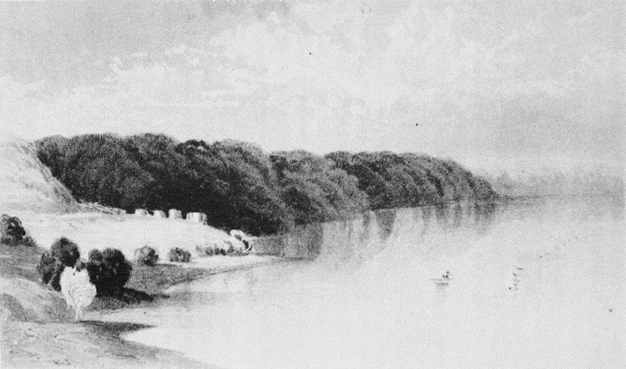
BIG FOOT’S VILLAGE AND LAKE. From sketch by Mrs. Kinzie, in original edition.
The exertions and excitement of our laborious ascent, together with the increasing heat of the sun, made this afternoon’s ride more uncomfortable than anything we had previously felt. We were truly rejoiced when the “whoop” of our guide, and the sight of a few scattered lodges, gave notice that we had reached our encamping ground. We chose a beautiful sequestered spot, by the side of a clear, sparkling stream, and having dismounted, and seen that our horses were made comfortable, my husband, after giving his directions to his men, led me to a retired spot where I could lay aside my hat and mask, and bathe my flushed face and aching head in the cool, refreshing waters. Never had I felt anything so grateful, so delicious. I sat down, and leaned my head against one of the tall, overshadowing trees, and was almost dreaming, when summoned to partake of our evening meal.
The Indians had brought us, as a present, some fine brook trout, which our Frenchmen had prepared in the most tempting fashion, and before the bright moon rose and we were ready for our rest, all headache and fatigue had alike disappeared.
One of the most charming features of this mode of travelling is the joyous, vocal life of the forest at early dawn, when all the feathered tribe come forth to pay their cheerful salutations to the opening day.
The rapid, chattering flourish of the bob-o'-link, the soft whistle of the thrush, the tender coo of the wood-dove, the deep warbling bass of the grouse, the drumming of the partridge, the melodious trill of the lark, the gay carol of the robin, the friendly, familiar call of the duck and the teal, resound from tree and knoll and lowland, prompting the expressive exclamation of the simple half-breed,
“Voila la fort qui parle!”[AR]
It seems as if man must involuntarily raise his voice, to take part in the general chorus—the matin song of praise.
Birds and flowers, and the soft balmy airs of morning! Must it not have been in a scene like this that Milton poured out his beautiful hymn of adoration,
“These are thy glorious works, Parent of Good.”
This day we were journeying in hopes to reach, at an early hour, that broad expanse of the Rock River which here forms the Kosh-ko-nong. The appellation of this water, rendered doubly affecting by the subsequent fate of its people, imports "the lake we live on."[80]
Our road for the early part of the day led through forests so thick and tangled, that Grignon and Lecuyer were often obliged to go in advance as pioneers with their axes, to cut away the obstructing shrubs and branches. It was slow work, and at times quite discouraging, but we were through with it, at last, and then we came into a country of altogether a different description. Low prairies, intersected with deep, narrow streams like canals, the passage of which, either by horses or carriage, was often a matter of delay and even difficulty.
Several times in the course of the forenoon the horses were to be taken from the carriage and the latter pulled and pushed across the deep, narrow channels as best it might.
The wooded banks of the Kosh-ko-nong were never welcomed with greater delight than by us, when they at length broke upon our sight. A ride of five or six miles through the beautiful oak openings, brought us to Man-eater’s village, a collection of neat bark wigwams, with extensive fields on each side of corn, beans, and squashes, recently planted, but already giving promise of a fine crop. In front was the broad blue lake, the shores of which, to the south, were open and marshy, but near the village, and stretching far away to the north, were bordered by fine lofty trees. The village was built but a short distance below the point where the Rock River opens into the lake, and during a conversation between our party and the Indians at the village, an arrangement was made with them to take us across at a spot about half a mile above.
After a short halt, we again took up our line of march through the woods, along the bank of the river.
A number of the Winnebagoes (for we had been among our own people since leaving Gros-pied Lake), set out for the appointed place by water, paddling their canoes, of which they had selected the largest and strongest.
Arrived at the spot indicated, we dismounted, and the men commenced the task of unsaddling and unloading. We were soon placed in the canoes, and paddled across to the opposite bank. Next, the horses were swum across—after them was to come the carriage. Two long wooden canoes were securely lashed together side by side, and being of sufficient width to admit of the carriage standing within them, the passage was commenced. Again and again the tottering barks would sway from side to side, and a cry or a shout would arise from our party on shore, as the whole mass seemed about to plunge sideways into the water, but it would presently recover itself, and at length, after various deviations from the perpendicular, it reached the shore in safety.
We now hoped that our troubles were at an end, and that we had nothing to do but to mount and trot on as fast as possible to Fort Winnebago. But no. Half a mile further on was a formidable swamp, of no great width it is true, but with a depth of from two to three feet of mud and water. It was a question whether, with the carriage, we could get through it at all. Several of the Indians accompanied us to this place, partly to give us their aid and counsel, and partly to enjoy the fun of the spectacle.
On reaching the swamp, we were disposed to laugh at the formidable representations which had been made to us. We saw only a strip of what seemed rather low land, covered with tall, dry rushes.
It is true the ground looked a little wet, but there seemed nothing to justify all the apprehensions that had been excited. Great was my surprise, then, to see my husband, who had been a few minutes absent, return to our circle attired in his duck trousers, and without shoes or stockings.
“What are you going to do?” inquired I.
“Carry you through the swamp on my shoulders. Come Petaille, you are the strongest—you are to carry Madame Kinzie, and To-shim-nuck there, (pointing to a tall stout Winnebago), he will take Madame Helm.”
“Wait a moment,” said I, and seating myself on the grass, I deliberately took off my own boots and stockings.
“What is that for?” they all asked.
“Because I do not wish to ride with wet feet all the rest of the day.”
“No danger of that,” said they, and no one followed my example.
By the time they were in the midst of the swamp, however, they found my precaution was by no means useless. The water through which our bearers had to pass was of such a depth that no efforts of the ladies were sufficient to keep their feet above the surface; and I had the satisfaction of feeling that my burden upon my husband’s shoulders was much less, from my being able to keep my first position instead of changing constantly to avoid a contact with the water.
The laugh was quite on my side when I resumed my equipment and mounted, dry-shod, into my saddle.
It will be perceived that journeying in the woods is, in some degree, a deranger of ceremony and formality; that it necessarily restricts us somewhat in our conventionalities. The only remedy is, to make ourselves amends by a double share when we return to the civilized walks of life.
By dint of much pulling, shouting, encouraging and threatening, the horses at length dragged the carriage through the difficult pass, and our red friends were left to return to their village, with, doubtless, a very exaggerated and amusing account of all that they had seen and assisted in.
We had not forgotten our promise to Lieut. Foster to put up a “guide-board” of some sort, for his accommodation in following us. We had therefore, upon several occasions, carried with us from the woods a few pieces, of three or four feet in length, which we had planted at certain points, with a transverse stick through a cleft in the top, thus marking the direction he and his party were to take.
We therefore felt sure that, although a few days later, he would probably find our trail, and avail himself of the same assistance as we had, in getting through the difficulties of the way.
Our encamping ground, this night, was to be not far distant from the Four Lakes.[81] We were greatly fatigued with the heat and exercise of the day, and most anxiously did we look out for the clumps of willows and alders, which were to mark the spot were the water would be found. We felt hardly equal to pushing on quite to the bank of the nearest lake. Indeed, it would have taken us too much off our direct course.
When we, at a late hour, came upon a spot fit for our purpose, we exchanged mutual congratulations that this was to be our last night upon the road. The next day we should be at Winnebago!
Our journey had been most delightful—a continued scene of exhilaration and enjoyment; for the various mishaps, although for the moment they had perplexed, had, in the end, but added to our amusement. Still, with the inconstancy of human nature, we were pleased to exchange its excitement for the quiet repose of home.
Our next morning’s ride was of a more tranquil character than any that had preceded it; for at an early hour we entered upon what was known as the “Twenty-mile Prairie,” although it is, in fact, said to be no more than sixteen or eighteen miles. I can only observe, that if this is the case, the miles are wonderfully long on the prairies. Our passage over this was, except the absence of the sand, like crossing the desert. Mile after mile of unbroken expanse—not a tree—not a living object except ourselves.
The sun, as if to make himself amends for his two months' seclusion, shone forth with redoubled brilliancy. There is no such thing as carrying an umbrella on horseback, though those in the wagon were able to avail themselves of such a shelter.
Our mother’s energies had sustained her in the saddle until this day, but she was now fairly obliged to give in, and yield her place on little Brunêt to Sister Margaret.
Thus we went on, one little knoll rising beyond another, from the summit of each of which, in succession, we hoped to descry the distant woods, which were to us as the promised land.
“Take courage,” were the cheering words, often repeated, “very soon you will begin to see the timber.”
Another hour would pass heavily by.
“Now, when we reach the rising ground just ahead, look sharp.”
We looked sharp—nothing but the same unvarying landscape.
There were not even streams to allay the feverish thirst occasioned by fatigue and impatience.
At length a whoop from Shaw-nee-aw-kee broke the silence in which we were pursuing our way.
“Le voila!” (“There it is!”)
Our less practised eye could not at first discern the faint blue strip edging the horizon, but it grew and grew upon our vision, and all fatigue and discomfort proportionably disappeared.
We were in fine spirits by the time we reached “Hastings' Woods,” a noble forest, watered by a clear, sparkling stream.
Grateful as was the refreshment of the green foliage and the cooling waters, we did not allow ourselves to forget that the day was wearing on, and that we must, if possible, complete our journey before sunset, so we soon braced up our minds to continue our route, although we would gladly have lingered another hour.
The marsh of Duck Creek was, thanks to the heat of the past week, in a very different state from what it had been a few months previous, when I had been so unfortunately submerged in its icy waters.
We passed it without difficulty, and soon found ourselves upon the banks of the creek.
The stream, at this point, was supposed to be always fordable; and even were it not so, that to the majority of our party would have been a matter of little moment. To the ladies, however, the subject seemed to demand consideration.
“This water looks very deep—are you sure we can cross it on horseback?”
“Oh, yes! Petaille, go before and let us see how the water is.”
Petaille obeyed. He was mounted on a horse like a giraffe, and, extending his feet horizontally, he certainly managed to pass through the stream without much of a wetting.
It seemed certain that the water would come into the wagon, but that was of the less consequence, as in case of the worst, the passengers could mount upon the seats.
My horse, Jerry, was above the medium height, so that I soon passed over, with no inconvenience but that of being obliged to disengage my feet from the stirrups, and tuck them up snugly against the mane of the horse.
Sister Margaret was still upon Brunêt. She was advised to change him for one of the taller horses, but while the matter was under debate, it was settled by the perverse little wretch taking to the water most unceremoniously, in obedience to the example of the other animals.
He was soon beyond his depth, and we were at once alarmed and diverted at seeing his rider, with surprising adroitness, draw herself from the stirrups, and perch herself upon the top of the saddle, where she held her position, and navigated her little refractory steed safely to land.
This was the last of our adventures. A pleasant ride of four miles brought us to the Fort, just as the sun was throwing his last beams over the glowing landscape; and on reaching the ferry, we were at once conducted, by the friends who were awaiting us, to the hospitable roof of Major Twiggs.[82]
CHAPTER XXVI
FOUR-LEGS, THE DANDY
The companies of the first regiment which had hitherto been stationed at Fort Winnebago,[83] had received orders to move on to the Mississippi as soon as relieved by a portion of the fifth, now at Fort Howard.
As many of the officers of the latter regiment were married, we had reason to expect that all the quarters at the post would be put in requisition. For this reason, although strongly pressed by Major Twiggs to take up our residence again in the Fort, until he should go on furlough, we thought it best to establish ourselves at once at “the Agency.”
It seemed laughable to give so grand a name to so very insignificant a concern. We had been promised, by the heads of department at Washington, a comfortable dwelling so soon as there should be an appropriation by Congress sufficient to cover any extra expense in the Indian Department. It was evident that Congress had a great spite at us, for it had delayed for two sessions attending to our accommodation. There was nothing to be done, therefore, but to make ourselves comfortable with the best means in our power.
Major Twiggs had given Mr. Kinzie the old log barracks, which had been built for the officers and soldiers on the first establishment of the post, two years previous, and his Frenchmen had removed and put them up again upon the little hill opposite the Fort. To these some additions were now made in the shape of a dairy, stables, smoke-house, etc., constructed of the tamarack logs brought from the neighboring swamp. The whole presented a very rough and primitive appearance.
The main building consisted of a succession of four rooms, no two of which communicated with each other, but each opened by a door into the outward air. A small window cut through the logs in front and rear, gave light to the apartment. An immense clay chimney for every two rooms, occupied one side of each, and the ceiling overhead was composed of a few rough boards laid upon the transverse logs that supported the roof.
It was surprising how soon a comfortable, homelike air was given to the old dilapidated rooms, by a few Indian mats spread upon the floor, the piano and other furniture ranged in their appropriate places, and even a few pictures hung against the logs. The latter, alas! had soon to be displaced, for with the first heavy shower the rain found entrance through sundry crevices, and we saw ourselves obliged to put aside, carefully, everything that could be injured by the moisture. We made light of these evils, however—packed away our carpets and superfluous furniture upon the boards above, which we dignified with the name of attic, and contentedly resolved to await the time when Government should condescend to remember us. The greatest inconvenience I experienced, was from the necessity of wearing my straw bonnet throughout the day, as I journeyed from bedroom to parlor, and from parlor to kitchen. I became so accustomed to it, that I even sometimes forgot to remove it when I sat down to table, or to my quiet occupations with my mother and sister.
Permission was however, in time, received to build a house for the blacksmith—that is, the person kept in pay by the Government at this station to mend the guns, traps, &c. of the Indians.
It happened most fortunately for us that Monsieur Isidore Morrin was a bachelor, and quite satisfied to continue boarding with his friend Louis Frum, dit Manaigre, so that when the new house was fairly commenced, we planned it and hurried it forward entirely on our own account.
It was not very magnificent, it is true, consisting of but a parlor and two bedrooms on the ground-floor, and two low chambers under the roof, with a kitchen in the rear; but compared with the rambling old stable-like building we now inhabited, it seemed quite a palace.
Before it was completed, Mr. Kinzie was notified that the money for the annual Indian payment was awaiting his arrival in Detroit to take charge of it, and superintend its transportation to the Portage, and he was obliged to set off at once to fulfil this part of his duty.
The workmen who had been brought from the Mississippi to erect the main building, were fully competent to carry on their work without an overseer, but the kitchen was to be the task of the Frenchmen, and the question was, how could it be executed in the absence of the bourgeois?
“You will have to content yourselves in the old quarters until my return,” said my husband, “and then we will soon have things in order.” It was to be a long and tedious journey, for the operations of Government were not carried on by railroad and telegraph in those days.
After his departure I said to the men, "Come, you have all your logs cut and hauled—the squaws have brought the bark for the roof—what is to prevent our finishing the house and getting all moved and settled to surprise Monsieur John on his return?"
“Ah! to be sure, Madame John,” said Plante, who was always the spokesman, “provided the one who plants a green bough on the chimney-top is to have a treat!”
“Certainly. All hands fall to work, and see who will win the treat.”
Upon the strength of such an inducement to the one who should put the finishing stroke to the building, Plante, Pillon and Manaigre, whom the waggish Plante persisted in calling “mon nègre,” whenever he felt himself out of the reach of the other’s arm, all went vigorously to work.
Building a log-house is a somewhat curious process. First, as will be conceived, the logs are laid one upon another and joined at the corners, until the walls have reached the required height. The chimney is formed by four poles of the proper length, interlaced with a wicker-work of small branches. A hole or pit is dug, near at hand, and with a mixture of clay and water, a sort of mortar is formed. Large wisps of hay are filled with this thick substance, and fashioned with the hands into what are technically called “clay cats,” and then are filled in among the framework of the chimney until not a chink is left. The whole is then covered with a smooth coating of the wet clay, which is denominated, “plastering.”
Between the logs which compose the walls of the building, small bits of wood are driven, quite near together; this is called “chinking,” and after it is done, clay cats are introduced, and smoothed over with the plaster. When all is dry, both walls and chimney are white-washed, and present a comfortable and tidy appearance.
The roof is formed by laying upon the transverse logs, thick sheets of bark, and around the chimney, for greater security against the rain, we took care to have placed a few layers of the palisades that had been left, when Mr. Peach, an odd little itinerant genius, had fenced in our garden, the pride and wonder of the surrounding settlement and wigwams.
While all these matters were in progress, we received frequent visits from our Indian friends. First and foremost among them was “the young Dandy,” Four-Legs.
One fine morning he made his appearance accompanied by two squaws, whom he introduced as his wives. He could speak a little Chippewa, and by this means he and our mother contrived to keep up something of a conversation. He was dressed in all his finery, brooches, wampum, fan, looking-glass and all. The paint upon his face and chest showed that he had devoted no small time to the labors of his toilet.
He took a chair, as he had seen done at Washington, and made signs to his women to sit down upon the floor.
The custom of taking two wives is not very general among the Indians. They seem to have the sagacity to perceive that the fewer they have to manage, the more complete is the peace and quiet of the wigwam.
Nevertheless, it sometimes happens that a husband takes a foolish fancy for a second squaw, and in that case he uses all his cunning and eloquence to reconcile the first to receiving a new inmate in the lodge. Of course it is a matter that must be managed adroitly, in order that harmony may be preserved.
"My dear, your health is not very good, it is time you should have some rest. You have worked very hard, and it grieves me that you should have to labor any longer. Let me get you some nice young squaw to wait upon you, that you may live at ease all the rest of your life."
The first wife consents—indeed, she has no option. If she is of a jealous, vindictive disposition, what a life the new-comer leads! The old one maintains all her rights of dowager and duenna, and the husband’s tenderness is hardly a compensation for all the evils the young rival is made to suffer.
It was on Sunday morning that this visit of the Dandy was made to us. We were all seated quietly, engaged in reading. Four-Legs inquired of my mother, why we were so occupied, and why everything around us was so still.
My mother explained to him our observance of the day of rest—that we devoted it to worshipping and serving the Great Spirit, as he had commanded in his Holy Word.
Four-Legs gave a nod of approbation. That was very right, he said—he was glad to see us doing our duty—he was very religious himself, and he liked to see others so. He always took care that his squaws attended to their duty, not reading perhaps, but such as the Great Spirit liked, and such as he thought proper and becoming.
He seemed to have no fancy for listening to any explanation of our points of difference. The impression among the Winnebagoes “that if the Great Spirit had wished them different from what they are, he would have made them so,” seems too strong to yield to either argument or persuasion.
Sometimes those who are desirous of appearing somewhat civilized will listen quietly to all that is advanced on the subject of Christianity, and coolly saying, “Yes, we believe that, too,” will change the conversation to other subjects.
As a general thing, they do not appear to perceive that there is anything to be gained, by adopting the religion and the customs of the whites. “Look at them,” they say, “always toiling and striving—always wearing a brow of care—shut up in houses—afraid of the wind and the rain—suffering when they are deprived of the comforts of life! We, on the contrary, live a life of freedom and happiness. We hunt and fish, and pass our time pleasantly in the open woods and prairies. If we are hungry, we take some game; or, if we do not find that, we can go without. If our enemies trouble us, we can kill them, and there is no more said about it. What should we gain by changing ourselves into white men?”[AS]
I have never heard that Christian missionaries, with all their efforts to convert them, have made much progress in enlightening their minds upon the doctrines of the Gospel. Mr. Mazzuchelli, a Roman Catholic priest, accompanied by Miss Elizabeth Grignon as interpreter, made a missionary visit to the Portage during our residence there, and, after some instruction to them, about forty consented to be baptized.[84] Christian names were given to them with which they seemed much pleased; and not less so, with the little plated crucifixes which each received, and which the women wore about their necks. These they seemed to regard with a devotional feeling; but I was not sufficiently acquainted with their language to gather from them whether they understood the doctrine the symbol was designed to convey. Certain it is, they expressed no wish to learn our language, in order that they might gain a fuller knowledge of the Saviour, nor any solicitude to be taught more about him than they had received during the missionary’s short visit.
One woman, to whom the name of Charlotte had been given, signified a desire to learn the domestic ways of the whites, and asked of me as a favor through Madame Paquette that she might be permitted to come on “washing-day,” and learn of my servants our way of managing the business. A tub was given her, and my woman instructed her, by signs and example, how she was to manage. As I was not a little curious to observe how tilings went on, I proceeded after a time to the kitchen where they all were. Charlotte was at her tub, scouring and rubbing with all her might at her little crucifix. Two other squaws sat upon the floor near her, watching the operation.
“That is the work she has been at for the last half hour,” said Josette, in a tone of great impatience. “She’ll never learn to wash.”
Charlotte, however, soon fell diligently to work, and really seemed as if she would tear her arms off, with her violent exertions.
After a time, supposing that she must feel a good deal fatigued and exhausted with unaccustomed labor, I did what it was at that day very much the fashion to do,—what, at home, I had always seen done on washing-day,—what, in short, I imagine was then a general custom among housekeepers. I went to the dining-room closet, intending to give Charlotte a glass of wine or brandy and water. My “cupboard” proved to be in the state of the luckless Mother Hubbard’s—nothing of the kind could I find but a bottle of orange shrub.
Of this I poured out a wine-glass full, and, carrying it out, offered it to the woman. She took it with an expression of great pleasure; but, in carrying it to her lips, she stopped short, and exclaiming “Whiskee!” immediately returned it to me. I would still have pressed it upon her; for, in my inexperience, I really believed it was a cordial she needed; but, pointing to her crucifix, she shook her head and returned to her work.
I received this as a lesson more powerful than twenty sermons. It was the first time in my life that I had ever seen spirituous liquors rejected upon a religious principle, and it made an impression upon me that I never forgot.
CHAPTER XXVII
THE CUT-NOSE
Among the women of the tribe with whom we early became acquainted, our greatest favorite was a daughter of one of the Day-kau-rays.[85] This family, as I have elsewhere said, boasted in some remote generation a cross of the French blood, and this fact may account for the fair complexion and soft curling hair which distinguished our friend. She had a noble forehead, full expressive eyes, and fine teeth. Unlike the women of her people, she had not grown brown and haggard with advancing years. Indeed, with the exception of one feature, she might be called beautiful.
She had many years before married a Mus-qua-kee, or Fox Indian, and, according to the custom among all the tribes, the husband came home to the wife’s family, and lived among the Winnebagoes.
It is this custom, so exactly the reverse of civilized ways, that makes the birth of a daughter a subject of peculiar rejoicing in an Indian family. “She will bring another hunter to our lodge,” is the style of mutual congratulation.
The Mus-qua-kee continued, for some few years, to live among his wife’s relations; but, as no children blessed their union, he at length became tired of his new friends, and longed to return to his own people. He tried, for a time, to persuade his wife to leave her home, and accompany him to the Mississippi, where the Sacs and Foxes live, but in vain. She could not resolve to make the sacrifice.
One day, after many fruitless efforts to persuade her, he flew into a violent passion.
“Then, if you will not go with me,” said he, “I will leave you; but you shall never be the wife of any other man—I will mark you!”
Saying this, he flew upon her, and bit off the end of her nose. This, the usual punishment for conjugal infidelity, is the greatest disgrace a woman can receive—it bars her forever from again entering the pale of matrimony. The wretch fled to his own people; but his revenge fell short of its aim. Day-kau-ray was too well known and too universally respected to suffer opprobium in any member of his family. This bright, loving creature in particular, won all hearts upon a first acquaintance—she certainly did ours from the outset.
She suffered much from rheumatism, and a remedy we gave her soon afforded her almost entire relief. Her gratitude knew no bounds. Notwithstanding, that from long suffering she had become partially crippled, she would walk all the way from the Barribault, a distance of ten miles, as often as once in two or three weeks, to visit us. Then, to sit and gaze at us, to laugh with childish glee at everything new or strange that we employed ourselves about—to pat and stroke us every time we came near her—sometimes to raise our hand or arms and kiss them—these were her demonstrations of affection. And we loved her in return. It was always a joyful announcement when, looking out over the Portage road, somebody called out, “the Cut-nose is coming!” In time, however, we learned to call her by her baptismal name of Elizabeth, for she, too, was one of Mr. Mazzuchelli’s converts.
She came one day, accompanied by a half-grown boy, carrying a young fawn, she had brought me as a present. I was delighted with the pretty creature—with its soft eyes and dappled coat; but having often heard the simile, “as wild as a fawn,” I did not anticipate much success in taming it. To my great surprise, it soon learned to follow me like a dog. Wherever I went, there Fan was sure to be. At breakfast, she would lie down at my feet, under the table. One of her first tokens of affection was to gnaw off all the trimming from my black silk apron, as she lay pretending to caress and fondle me. Nor was this her only style of mischief.
One day we heard a great rattling among the crockery in the kitchen. We ran to see what was the matter, and found that Miss Fan had made her way to a shelf of the dresser, about two feet from the ground, and was endeavoring to find a comfortable place to lie down, among the plates and dishes. I soon observed that it was the shelter of the shelf above her head that was the great attraction, and that she was in the habit of seeking out a place of repose under a chair, or something approaching to an “umbrageous bower.” So after this I took care, as the hour for her morning nap approached, to open a large green parasol, and set it on the matting in the corner—then when I called Fan, Fan, she would come and nestle under it, and soon fall fast asleep.
One morning Fan was missing. In vain we called and sought her in the garden—in the enclosure for the cattle—at the houses of the Frenchmen—along the hill towards Paquette’s—no Fan was to be found. We thought she had asserted her own wild nature and sped away to the woods.
It was a hot forenoon, and the doors were all open. About dinner time, in rushed Fan, panting violently, and threw herself upon her side, where she lay with her feet outstretched, her mouth foaming, and exhibiting all the signs of mortal agony. We tried to give her water, to soothe her, if perhaps it might be fright that so affected her; but in a few minutes, with a gasp and a spasm, she breathed her last. Whether she had been chased by the greyhounds, or whether she had eaten some poisonous weed, which, occasioning her suffering, had driven her to her best friends for aid, we never knew; but we lost our pretty pet, and many were the tears shed for her.
Very shortly after the departure of my husband, we received a visit from “the White Crow,” “the Little Priest,” and several others of the principal chiefs of the Rock River Indians. They seemed greatly disappointed at learning that their father was from home, even though his errand was to get “the silver.” We sent for Paquette,[86] who interpreted for us the object of their visit.
They had come to inform us that the Sac Chief, Black Hawk and his band, who, in compliance with a former treaty, had removed sometime previous to the west of the Mississippi, had now returned to their old homes and hunting grounds, and expressed a determination not to relinquish them, but to drive off the white settlers who had begun to occupy them.
The latter, in fact, he had already done, and having, as it was said, induced some of the Pottowattamies to join him, there was reason to fear that he might persuade some of the Winnebagoes to follow their example.
These chiefs had come to counsel with their father, and to assure him that they should do all in their power to keep their young men quiet. They had heard that troops were being raised down among the whites in Illinois, and they had hopes that their people would be wise enough to keep out of difficulty. Furthermore, they begged that their father, on his return, would see that the soldiers did not meddle with them, so long as they remained quiet and behaved in a friendly manner.