Front matter (continued 3)
Reading edition
Our road, after leaving the lake, lay over a “rolling prairie,” now bare and desolate enough. The hollows were filled with snow, which, being partly thawed, furnished an uncertain footing for the horses, and I could not but join in the ringing laughter of our Frenchmen, as occasionally Brunêt and Souris, the two ponies, would flounder, almost imbedded, through the yielding mass. Even the vain-glorious Plante, who piqued himself on his equestrian skill, was once or twice nearly unhorsed, from having chosen his road badly. Sometimes the elevations were covered with a thicket or copse, in which our dogs would generally rouse up one or more deer. Their first bound, or “lope,” was the signal for a chase. The horses seemed to enter into the spirit of it, as “halloo” answered “halloo;” but we were never so fortunate as to get a shot at one, for although the dogs once or twice caught, they were not strong enough to hold them. It was about the middle of the afternoon when we reached the "Blue Mound." I rejoiced much to have got so far, for I was sadly fatigued, and every mile now seemed two to me. In fact, the miles are unconscionably long in this country. When I was told that we had still seven miles to go, to “Morrison’s,” where we proposed stopping for the night, I was almost in despair. It was my first journey on horseback, and I had not yet become inured to the exercise.
When we reached Morrison’s[54] I was so much exhausted that, as my husband attempted to lift me from the saddle, I fell into his arms.
“This will never do,” said he. “To-morrow we must turn our faces towards Fort Winnebago again.”
The door opened hospitably to receive us. We were welcomed by a lady with a most sweet, benignant countenance, and by her companion, some years younger. The first was Mrs. Morrison—the other, Miss Elizabeth Dodge, daughter of General Dodge.
My husband laid me upon a small bed, in the room where the ladies had been sitting at work. They took off my bonnet and riding-dress, chafed my hands, and prepared me some warm wine and water, by which I was soon revived. A half hour’s repose so refreshed me that I was able to converse with the ladies, and to relieve my husband’s mind of all anxiety on my account. Tea was announced soon after, and we repaired to an adjoining building, for Morrison’s, like the establishment of all settlers of that period, consisted of a group of detached log-houses or cabins, each containing one or at most two apartments.
The table groaned with good cheer, and brought to mind some that I had seen among the old-fashioned Dutch residents on the banks of the Hudson.
I had recovered my spirits, and we were quite a cheerful party. Mrs. Morrison told us that during the first eighteen months she passed in this country she did not speak with a white woman, the only society she had being that of her husband and two black servant-women.
A Tennessee woman had called in with her little son just before tea, and we amused Mr. Kinzie with a description of the pair. The mother’s visit was simply one of courtesy. She was a little dumpy woman, with a complexion burned perfectly red by the sun—hair of an exact tow-color, braided up from her forehead in front and from her neck behind, then meeting on the top of her head, was fastened with a small tin comb. Her dress was of checkered homespun, a “very tight fit,” and as she wore no ruff or handkerchief around her neck, she looked as if just prepared for execution. She was evidently awe-struck at the sight of visitors, and seemed inclined to take her departure at once; but the boy, not so easily intimidated, would not understand her signs and pinches until he had sidled up to Mrs. Morrison, and drawing his old hat still farther over his eyes, begged for a whang, meaning a narrow strip of deer-skin. The lady very obligingly cut one from a large smoked skin, which she produced from its receptacle, and mother and son took their leave, with a smiling but rather a scared look.
After tea we returned to Mrs. Morrison’s parlor, where she kindly insisted on my again reposing myself on the little bed, to recruit me, as she said, for the ensuing day’s journey. My husband, in the meantime, went to look after the accommodation of his men and horses.
During the conversation that ensued, I learned that Mrs. Morrison had passed much time in the neighborhood of my recent home in Oneida county—that many of the friends I had loved and valued were likewise her friends, and that she had even proposed to visit me at Fort Winnebago on hearing of my arrival there, in order to commence an acquaintance which had thus been brought about by other and unexpected means.
Long and pleasant was the discourse we held together until a late hour, and mutual was the satisfaction with which we passed old friends and by-gone events in review, much to the edification of Miss Dodge, and of the gentlemen when they once more joined us.
CHAPTER XIV
WILLIAM S. HAMILTON—KELLOGG’S GROVE
The next morning, after a cheerful breakfast, at which we were joined by the Rev. Mr. Kent, of Galena,[55] we prepared for our journey. I had reconciled my husband to continuing our route towards Chicago, by assuring him that I felt as fresh and bright as when I first set out from home.
There seemed some apprehension, however, that we might have difficulty in “striking the trail” to Hamilton’s diggings, our next point of destination.
The directions we received were certainly obscure. We were to pursue a given trail for a certain number of miles, when we should come to a crossing into which we were to turn, taking an easterly direction—after a time, this would bring us to a deep trail leading straight to “Hamilton’s.” In this open country there are no landmarks. One elevation is so exactly like another, that if you lose your trail there is almost as little hope of regaining it as of finding a pathway in the midst of the ocean.[O]
The trail, it must be remembered, is not a broad highway, but a narrow path, deeply indented by the hoofs of the horses on which the Indians travel in single file. So deeply is it sunk in the sod which covers the prairies, that it is difficult, sometimes, to distinguish it at a distance of a few rods.[56]
It was new ground to Mr. Kinzie, whose journeys from the Portage to Chicago had hitherto been made in the direct route by Kosh-ko-nong. He therefore obliged Mr. Morrison to repeat the directions again and again, though Plante, our guide, swaggered and talked big, averring that “he knew every hill and stream, and point of woods from that spot to Chicago.”
We had not proceeded many miles on our journey, however, before we discovered that Monsieur Plante was profoundly ignorant of the country, so that Mr. Kinzie was obliged to take the lead himself, and make his way as he was best able, according to the directions he had received. Nothing, however, like the “cross trails” we had been promised met our view, and the path on which we had set out diverged so much from what we knew to be the right direction, that we were at length compelled to abandon it altogether.
We travelled the live-long day, barely making a halt at noon to bait our horses, and refresh ourselves with a luncheon. The ride was as gloomy and desolate as could well be imagined. A rolling prairie, unvaried by forest or stream—hillock rising after hillock, at every ascent of which we vainly hoped to see a distant fringe of “timber.” But the same cheerless, unbounded prospect everywhere met the eye, diversified only here and there by the oblong openings, like gigantic graves, which marked an unsuccessful search for indications of a lead mine.
So great was our anxiety to recover our trail, for the weather was growing more cold, and the wind more sharp and piercing, that we were not tempted to turn from our course even by the appearance, more than once, of a gaunt prairie-wolf, peering over the nearest rising ground, and seeming to dare us to an encounter. The Frenchmen, it is true, would instinctively give a shout and spur on their horses, while the hounds, Kelda and Cora, would rush to the chase, but the “bourgeois” soon called them back, with a warning that we must attend strictly to the prosecution of our journey. Just before sunset we crossed, with some difficulty, a muddy stream, which was bordered by a scanty belt of trees, making a tolerable encamping-ground; and of this we gladly availed ourselves, although we knew not whether it was near or remote from the place we were in search of.
We had ridden at least fifty miles since leaving “Morrison’s,” yet I was sensible of very little fatigue; but there was a vague feeling of discomfort at the idea of being lost in this wild, cold region, altogether different from anything I had ever before experienced. The encouraging tones of my husband’s voice, however, “Cheer up, wifie—we will find the trail to-morrow,” served to dissipate all uneasiness.
The exertions of the men soon made our “camp” comfortable, notwithstanding the difficulty of driving the tent-pins into the frozen ground, and the want of trees sufficiently large to make a rousing fire. The place was a stony side-hill, as it would be called in New England, where such things abound; but we were not disposed to be fastidious, so we ate our salt ham and toasted our bread, and lent a pleased ear to the chatter of our Frenchmen, who could not sufficiently admire the heroism of “Madame John,” amid the vicissitudes that befell her.
The wind, which at bed-time was sufficiently high to be uncomfortable, increased during the night. It snowed heavily, and we were every moment in dread that the tent would be carried away; but the matter was settled in the midst by the snapping of the poles, and the falling of the whole, with its superincumbent weight of snow, in a mass upon us.
Mr. Kinzie roused up his men, and at their head he sallied into the neighboring wood to cut a new set of poles, leaving me to bear the burden of the whole upon my shoulders, my only safety from the storm being to keep snugly housed beneath the canvas.
With some difficulty a sort of support was at length adjusted for the tent covering, which answered our purpose tolerably well until the break of day, when our damp and miserable condition made us very glad to rise and hang round the fire until breakfast was dispatched, and the horses once more saddled for our journey.
The prospect was not an encouraging one. Around us was an unbroken sheet of snow. We had no compass, and the air was so obscured by the driving sleet, that it was often impossible to tell in which direction the sun was. I tied my husband’s silk pocket handkerchief over my veil, to protect my face from the wind and icy particles with which the air was filled, and which cut like a razor; but although shielded in every way that circumstances rendered possible, I suffered intensely from the cold.
We pursued our way, mile after mile, entering every point of woods, in hopes of meeting with, at least, some Indian wigwam at which we could gain intelligence. Every spot was solitary and deserted, not even the trace of a recent fire, to cheer us with the hope of human beings within miles of us.
Suddenly, a shout from the foremost of the party made each heart bound with joy.
“Une cloture! une cloture!”—(a fence, a fence).
It was almost like life to the dead.
We spurred on, and indeed perceived a few straggling rails crowning a rising ground at no great distance.
Never did music sound so sweet as the crowing of a cock which at this moment saluted our ears.
Following the course of the inclosure down the opposite slope, we came upon a group of log-cabins, low, shabby, and unpromising in their appearance, but a most welcome shelter from the pelting storm.
“Whose cabins are these?” asked Mr. Kinzie, of a man who was cutting wood at the door of one.
“Hamilton’s,” was the reply; and he stepped forward at once to assist us to alight, hospitality being a matter of course in these wild regions.
We were shown into the most comfortable-looking of the buildings. A large fire was burning in the clay chimney, and the room was of a genial warmth, notwithstanding the apertures, many inches in width, beside the doors and windows. A woman in a tidy calico dress, and shabby black silk cap, trimmed with still shabbier lace, rose from her seat beside a sort of bread-trough, which fulfilled the office of cradle to a fine, fat baby. She made room for us at the fire, but was either too timid or too ignorant to relieve me of my wrappings and defences, now heavy with the snow.
I soon contrived, with my husband’s aid, to disembarrass myself of them; and having seen me comfortably disposed of, and in a fair way to be thawed after my freezing ride, he left me to see after his men and horses.
He was a long time absent, and I expected he would return accompanied by our host; but when he reappeared, it was to tell me, laughing, that Mr. Hamilton hesitated to present himself before me, being unwilling that one who had been acquainted with some of his family at the east, should see him in his present mode of life. However, this feeling apparently wore off, for before dinner he came in and was introduced to me, and was as agreeable and polite as the son of Alexander Hamilton would naturally be.[57]
The housekeeper, who was the wife of one of the miners, prepared us a plain, comfortable dinner, and a table as long as the dimensions of the cabin would admit was set out, the end nearest the fire being covered with somewhat nicer furniture and more delicate fare than the remaining portion.
The blowing of a horn was the signal for the entrance of ten or twelve miners, who took their places below us at the table. They were the roughest-looking set of men I ever beheld, and their language was as uncouth as their persons. They wore hunting-shirts, trowsers, and moccasins of deer-skin, the former being ornamented at the seams with a fringe of the same, while a colored belt around the waist, in which was stuck a large hunting-knife, gave each the appearance of a brigand.
Mr. Hamilton, although so much their superior, was addressed by them uniformly as “Uncle Billy;” and I could not but fancy there was something desperate about them, that it was necessary to propitiate by this familiarity. This feeling was further confirmed by the remarks of one of the company who lingered behind, after the rest of the gang had taken their departure. He had learned that we came from Fort Winnebago, and having informed us that “he was a discharged soldier, and would like to make some inquiries about his old station and comrades,” he unceremoniously seated himself and commenced questioning us.
The bitterness with which he spoke of his former officers made me quite sure he was a deserter, and I rather thought he had made his escape from the service in consequence of some punishment. His countenance was fairly distorted as he spoke of Captain H., to whose company he had belonged. “There is a man in the mines,” said he, “who has been in his hands, and if he ever gets a chance to come within shot of him, I guess the Captain will remember it. He knows well enough he darsn’t set his foot in the diggings. And there’s T. is not much better. Everybody thought it a great pity that fellow’s gun snapped when he so nearly had him at Green Bay.”
Having delivered himself of these sentiments, he marched out, to my great relief.
Mr. Hamilton passed most of the afternoon with us; for the storm raged so without that to proceed on our journey was out of the question. He gave us many pleasant anecdotes and reminiscences of his early life in New York, and of his adventures since he had come to the western wilderness. When obliged to leave us for a while, he furnished us with some books to entertain us, the most interesting of which was the biography of his father.
Could this illustrious man have foreseen in what a scene—the dwelling of his son—this book was to be one day perused, what would have been his sensations?
The most amusing part of our experience was yet to come. I had been speculating, as evening approached, on our prospects for the night’s accommodation. As our pale, melancholy-looking landlady and her fat baby were evidently the only specimens of the feminine gender about the establishment, it was hardly reasonable to suppose that any of the other cabins contained wherewithal to furnish us a comfortable lodging, and the one in which we were offered nothing of the sort to view, but two beds, uncurtained, extended against the farther wall. My doubts were after a time resolved, by observing the hostess stretch a cord between the two, on which she hung some petticoats and extra garments, by way of a partition, after which she invited us to occupy one of them.
My only preparation was, to wrap my cloak around me and lie down with my face to the wall; but the good people were less ceremonious, for at the distance of scarcely two feet, we could not be mistaken in the sound of their garments being, not “laid aside,” but whipped over the partition wall between us.
Our waking thoughts, however, were only those of thankfulness for so comfortable a lodging after the trials and fatigues we had undergone; and even these were of short duration, for our eyes were soon closed in slumber.
The next day’s sun rose clear and bright. Refreshed and invigorated, we looked forward with pleasure to a recommencement of our journey, confident of meeting no more mishaps by the way. Mr. Hamilton kindly offered to accompany us to his next neighbor’s, the trifling distance of twenty-five miles. From Kellogg’s to Ogie’s Ferry, on the Rock River, the road being much travelled, we should be in no danger, Mr. H. said, of again losing our way.
The miner who owned the wife and baby, and who, consequently, was somewhat more humanized than his comrades, in taking leave of us “wished us well out of the country, and that we might never have occasion to return to it!”
“I pity a body,” said he, “when I see them making such an awful mistake as to come out this way, for comfort never touched this western country.”
We found Mr. Hamilton as agreeable a companion as on the preceding day, but a most desperate rider. He galloped on at such a rate that had I not exchanged my pony for the fine, noble Jerry, I should have been in danger of being left behind.
Well mounted as we all were, he sometimes nearly distanced us. We were now among the branches of the Pickatonick,[58] and the country had lost its prairie character, and become more rough and broken. We went dashing on, sometimes down ravines, sometimes through narrow passes, where, as I followed, I left fragments of my veil upon the projecting and interwoven branches. Once my hat became entangled, and had not my husband sprung to my rescue, I must have shared the fate of Absalom, Jerry’s ambition to keep his place in the race making it probable he would do as did the mule who was under the unfortunate prince.
There was no halting upon the route, and as we kept the same pace until three o’clock in the afternoon, it was beyond a question that when we reached “Kellogg’s,” we had travelled at least thirty miles. One of my greatest annoyances during the ride had been the behavior of the little beast Brunêt. He had been hitherto used as a saddle-horse, and had been accustomed to a station in the file near the guide or leader. He did not relish being put in the background as a pack-horse, and accordingly, whenever we approached a stream, where the file broke up to permit each horseman to choose his own place of fording, it was invariably the case that just as I was reining Jerry into the water, Brunêt would come rushing past and throw himself into our very footsteps. Plunging, snorting, and splashing me with water, and sometimes even startling Jerry into a leap aside, he more than once brought me into imminent danger of being tossed into the stream. It was in vain that, after one or two such adventures, I learned to hold back and give the vexatious little animal the precedence. His passion seemed to be to go into the water precisely at the moment Jerry did, and I was obliged at last to make a bargain with young Roy to dismount and hold him at every stream until I had got safely across.
“Kellogg’s”[P] was a comfortable mansion, just within the verge of a pleasant “grove of timber,” as a small forest is called by western travellers. We found Mrs. Kellogg a very respectable-looking matron, who soon informed us she was from the city of New York. She appeared proud and delighted to entertain Mr. Hamilton, for whose family, she took occasion to tell us, she had, in former days, been in the habit of doing needlework.
The worthy woman provided us an excellent dinner, and afterwards installed me in a rocking-chair beside a large fire, with the “Life of Mrs. Fletcher” to entertain me, while the gentlemen explored the premises, visited Mr. Kellogg’s “stock,” and took a careful look at their own. We had intended to go to Dixon’s the same afternoon, but the snow beginning again to fall, obliged us to content ourselves where we were.
In the meantime, finding we were journeying to Chicago, Mr. Kellogg came to the determination to accompany us, having, as he said, some business to accomplish at that place, so Mrs. Kellogg busied herself in preparing him to set off with us the following morning. I pleaded hard to remain yet another day, as the following was Sunday, on which I objected to travel; but in view of the necessities of the case, the uncertainty of the weather, and the importance of getting as quickly as possible through this wild country, my objections were overruled, and I could only obtain a delay in starting until so late in the afternoon, as would give us just time to ride the sixteen miles to “Dixon’s” before sunset.
No great time was required for Mr. Kellogg’s preparations. He would take, he said, only two days' provisions, for at his brother-in-law Dixon’s we should get our supper and breakfast, and the route from there to Chicago could, he well knew, be accomplished in a day and a half.
Although, according to this calculation, we had sufficient remaining of our stores to carry us to the end of our journey, yet Mr. Kinzie took the precaution of begging Mrs. Kellogg to bake us another bag of biscuits, in case of accidents, and he likewise suggested to Mr. K. the prudence of furnishing himself with something more than his limited allowance; but the good man objected that he was unwilling to burden his horse more than was absolutely necessary, seeing that, at this season of the year, we were obliged to carry fodder for the animals, in addition to the rest of their load. It will be seen that we had reason to rejoice in our own foresight.
My experience of the previous night had rendered me somewhat less fastidious than when I commenced my journey, so that, when introduced to our sleeping apartment, which I found we were to share with six men, travellers like ourselves, my only feeling was one of thankfulness that each bed was furnished with a full suit of blue checked curtains, which formed a very tolerable substitute for a dressing-room.
CHAPTER XV
ROCK RIVER—HOURS OF TROUBLE
It was late on the following day (March 13th), when we took leave of our kind hostess. She loaded us with cakes, good wishes, and messages to her sister Dixon and the children. We journeyed pleasantly along through a country, beautiful, in spite of its wintry appearance.
There was a house at "Buffalo Grove,"[59] at which we stopped for half an hour, and where a nice-looking young girl presented us with some maple-sugar of her own making. She entertained us with the history of a contest between two rival claimants for the patronage of the stage wagon, the proprietors of which had not decided whether to send it by Buffalo Grove or by another route, which she pointed out to us, at no great distance. The driver, she took care to inform us, was in favor of the former; and the blush with which she replied in the affirmative to our inquiry, “Was he a young man?” explained the whole matter satisfactorily.
At length, just at sunset, we reached the dark, rapid waters of the Rock River. The “ferry” which we had travelled so far out of our way to take advantage of, proved to be merely a small boat or skiff, the larger one having been swept off into the stream, and carried down in the breaking up of the ice, the week previous.
My husband’s first care was to get me across. He placed me with the saddles, packs, &c., in the boat, and as, at that late hour, no time was to be lost, he ventured, at the same time, to hold the bridles of the two most docile horses, to guide them in swimming the river.
When we had proceeded a few rods from the shore, we were startled by a loud puffing and blowing near us, and looking around, to our great surprise, discovered little Brunêt just upon our “weather-bow.” Determined not to be outdone by his model, Jerry, he had taken to the water on his own responsibility, and arrived at the opposite shore as soon as any of the party.
All being safely landed, a short walk brought us to the house of Mr. Dixon.[60] Although so recently come into the country, he had contrived to make everything comfortable around him, and when he ushered us into Mrs. Dixon’s sitting-room, and seated us by a glowing wood fire, while Mrs. Dixon busied herself in preparing us a nice supper, I felt that the comfort overbalanced the inconvenience of such a journey.
Mrs. Dixon was surrounded by several children. One leaning against the chimney-piece was dressed in the full Indian costume—calico shirt, blanket, and leggings. His dark complexion, and full, melancholy eyes, which he kept fixed upon the ashes in which he was making marks with a stick, rarely raising them to gaze on us, as children are wont to do, interested me exceedingly, and I inquired of an intelligent little girl, evidently a daughter of our host:
“Who is that boy?”
“Oh! that is John Ogie,” answered she.
“What is the matter with him? he looks very sad.”
“Oh! he is fretting after his mother.”
“Is she dead then?”
“Some say she is dead, and some say she is gone away. I guess she is dead, and buried up in one of those graves yonder”—pointing to two or three little picketed inclosures upon a rising ground opposite the window.
I felt a strong sympathy with the child, which was increased when the little spokeswoman, in answer to my inquiry, “Has he no father?” replied—
“Oh, yes, but he goes away, and drinks, and don’t care for his children.”
“And what becomes of John, then?”
“He stays here with us, and we teach him to read, and he learns dreadful fast.”
When the boy at length turned his large dark eyes upon me, it went to my heart. It was such a motherless look. And it was explained, when long afterward, I learned his further history. His mother was still living, and he knew it, although with the reserve peculiar to his people, he never spoke of her to his young companions. Unable to endure the continued ill-treatment of her husband, a surly, intemperate Canadian, she had left him, and returned to his family among the Pottowattamies. Years after, this boy and a brother who had also been left behind with their father found their way to the Upper Missouri, to join their mother, who, with the others of her tribe, had been removed by the Government from the shores of Lake Michigan.
A most savoury supper of ducks and venison, with their accompaniments, soon smoked upon the board, and we did ample justice to it. Travelling is a great sharpener of the appetite, and so is cheerfulness, and the latter was increased by the encouraging account Mr. Dixon gave us of the remainder of the route yet before us.
“There is no difficulty,” said he, “if you keep a little to the north, and strike the great Sauk trail. If you get too far to the south, you will come upon the Winnebago Swamp, and once in that, there is no telling when you will ever get out again. As for the distance, it is nothing at all to speak of. Two young men came out here from Chicago, on foot, last fall. They got here the evening of the second day; and even with a lady in your party, you could go on horseback in less time than that. The only thing is to be sure and get on the great track that the Sauks have made in going every year from the Mississippi to Canada, to receive their presents from the British Indian Agent.”
The following morning, which was a bright and lovely one for that season of the year, we took leave of Mr. and Mrs. Dixon, in high spirits. We travelled for the first few miles along the beautiful, undulating banks of the Rock River, always in an easterly direction, keeping the beaten path, or rather road, which led to Fort Clark, or Peoria. The Sauk trail,[61] we had been told, would cross this road, at the distance of about six miles.
After having travelled, as we judged, fully that distance, we came upon a trail, bearing north-east, and a consultation was held as to the probability of its being the one we were in search of.
Mr. Kinzie was of opinion that it tended too much to the north, and was, moreover, too faint and obscure for a trail so much used, and by so large a body of Indians in their annual journeys.
Plante was positive as to its being the very spot where he and “Piché” in their journey to Fort Winnebago, the year before, struck into the great road. “On that very rising-ground at the point of woods, he remembered perfectly stopping to shoot ducks, which they ate for their supper.”
Mr. Kellogg was non-committal, but sided alternately with each speaker.
As Plante was “the guide,” and withal so confident of being right, it was decided to follow him, not without some demurring, however, on the part of the “bourgeois,” who every now and then called a halt, to discuss the state of affairs.
“Now Plante,” he would say, “I am sure you are leading us too far north. Why, man, if we keep on in this direction, following the course of the river, we shall bring up at Kosh-ko-nong, instead of Chicago.”
“Ah! mon bourgeois,” would the light-hearted Canadian reply, “would I tell you this is the road if I were not quite certain? Only one year ago I travelled it, and can I forget so soon? Oh! no—I remember every foot of it.”
But Monsieur Plante was convinced of his mistake when the trail brought us to the great bend of the river with its bold rocky bluffs.
“Are you satisfied, now, Plante?” asked Mr. Kinzie. “By your leave, I will now play pilot myself,” and he struck off from the trail, in a direction as nearly east as possible.
The weather had changed and become intensely cold, and we felt that the detention we had met with, even should we now be in the right road, was no trifling matter. We had not added to our stock of provisions at Dixon’s, wishing to carry as much forage as we were able for our horses, for whom the scanty picking around our encamping grounds afforded an insufficient meal. But we were buoyed up by the hope that we were in the right path at last, and we journeyed on until night, when we reached a comfortable “encampment,” in the edge of a grove near a small stream.
Oh! how bitterly cold that night was! The salted provisions, to which I was unaccustomed, occasioned me an intolerable thirst, and my husband was in the habit of placing the little tin coffeepot filled with water at my bed’s head when we went to rest, but this night it was frozen solid long before midnight. We were so well wrapped up in blankets that we did not suffer from cold while within the tent, but the open air was severe in the extreme.
March 15th. We were roused by the “bourgeois” at peep of day to make preparations for starting. We must find the Sauk trail this day at all hazards. What would become of us should we fail to do so? It was a question no one liked to ask, and certainly one that none could have answered.
On leaving our encampment, we found ourselves entering a marshy tract of country. Myriads of wild geese, brant, and ducks rose up screaming at our approach. The more distant lakes and ponds were black with them, but the shallow water through which we attempted to make our way was frozen by the severity of the night, to a thickness not sufficient to bear the horses, but just such as to cut their feet and ankles at every step as they broke through it. Sometimes the difficulty of going forward was so great that we were obliged to retrace our steps and make our way round the head of the marsh, thus adding to the discomforts of our situation by the conviction, that while journeying diligently, we were, in fact, making very little progress.
This swampy region at length passed, we came upon more solid ground, chiefly the open prairie. But now a new trouble assailed us. The weather had moderated, and a blinding snow storm came on. Without a trail that we could rely upon, and destitute of a compass, our only dependence had been the sun to point out our direction, but the atmosphere was now so obscure that it was impossible to tell in what quarter of the heavens he was.
We pursued our way, however, and a devious one it must have been. After travelling in this way many miles, we came upon an Indian trail, deeply indented, running at right angles with the course we were pursuing. The snow had ceased, and the clouds becoming thinner, we were able to observe the direction of the sun, and to perceive that the trail ran north and south. What should we do? Was it safest to pursue our easterly course, or was it probable that by following this new path we should fall into the direct one we had been so long seeking? If we decided to take the trail, should we go north or south? Mr. Kinzie was for the latter. He was of opinion we were still too far north—somewhere about the Grand Marais, or Kish-wau-kee. Mr. Kellogg and Plante were for taking the northerly direction. The latter was positive his bourgeois had already gone too far south—in fact, that we must now be in the neighborhood of the Illinois river. Finding himself in the minority, my husband yielded, and we turned our horses' heads north, much against his will. After proceeding a few miles, however, he took a sudden determination. “You may go north, if you please,” said he, “but I am convinced that the other course is right, and I shall face about—follow who will.”
So we wheeled round and rode south again, and many a long and weary mile did we travel, the monotony of our ride broken only by the querulous remarks of poor Mr. Kellogg. "I am really afraid we are wrong, Mr. Kinzie. I feel pretty sure that the young man is right. It looks most natural to me that we should take a northerly course, and not be stretching away so far to the south."
To all this, Mr. Kinzie turned a deaf ear. The Frenchmen rode on in silence. They would as soon have thought of cutting off their right hand as showing opposition to the bourgeois when he had once expressed his decision. They would never have dreamed of offering an opinion or remark unless called upon to do so.
The road, which had continued many miles through the prairie, at length, in winding round a point of woods, brought us suddenly upon an Indian village. A shout of joy broke from the whole party, but no answering shout was returned—not even a bark of friendly welcome—as we galloped up to the wigwams. All was silent as the grave. We rode round and round, then dismounted and looked into several of the spacious huts. They had evidently been long deserted. Nothing remained but the bare walls of bark, from which everything in the shape of furniture had been stripped by the owners and carried with them to their wintering-grounds; to be brought back in the spring, when they returned to make their cornfields and occupy their summer cabins.
Our disappointment may be better imagined than described. With heavy hearts, we mounted and once more pursued our way, the snow again falling and adding to the discomforts of our position. At length we halted for the night. We had long been aware that our stock of provisions was insufficient for another day, and here we were—nobody knew where—in the midst of woods and prairies—certainly far from any human habitation, with barely enough food for a slender evening’s meal.
The poor dogs came whining around us to beg their usual portion, but they were obliged to content themselves with a bare bone, and we retired to rest with the feeling that if not actually hungry then, we should certainly be so to-morrow.
The morrow came. Plante and Roy had a bright fire and a nice pot of coffee for us. It was our only breakfast, for on shaking the bag and turning it inside out, we could make no more of our stock of bread than three crackers, which the rest of the party insisted I should put in my pocket for my dinner. I was much touched by the kindness of Mr. Kellogg, who drew from his wallet a piece of tongue and a slice of fruitcake, which he said “he had been saving for the lady since the day before, for he saw how matters were a-going.”
Poor man! it would have been well if he had listened to Mr. Kinzie, and provided himself at the outset with a larger store of provisions. As it was, those he brought with him were exhausted early the second day, and he had been boarding with us for the last two meals.
We still had the trail to guide us, and we continued to follow it until about nine o’clock, when, in emerging from a wood, we came upon a broad and rapid river. A collection of Indian wigwams stood upon the opposite bank, and as the trail led directly to the water, it was fair to infer that the stream was fordable. We had no opportunity of testing it, however, for the banks were so lined with ice, which was piled up tier upon tier by the breaking-up of the previous week, that we tried in vain to find a path by which we could descend the bank to the water.
The men shouted again and again in hope some straggling inhabitant of the village might be at hand with his canoe. No answer was returned save by the echoes. What was to be done? I looked at my husband and saw that care was on his brow, although he still continued to speak cheerfully. “We will follow this cross-trail down the bank of the river,” said he. “There must be Indians wintering near in some of these points of wood.”
I must confess that I felt somewhat dismayed at our prospects, but I kept up a show of courage, and did not allow my despondency to be seen. All the party were dull and gloomy enough.
We kept along the bank, which was considerably elevated above the water, and bordered at a little distance with a thick wood. All at once my horse, who was mortally afraid of Indians, began to jump and prance, snorting and pricking up his ears as if an enemy were at hand. I screamed with delight to my husband, who was at the head of the file, “Oh, John! John! there are Indians near—look at Jerry!”
At this instant a little Indian dog ran out from under the bushes by the roadside, and began barking at us. Never were sounds more welcome. We rode directly into the thicket, and descending into a little hollow, found two squaws crouching behind the bushes, trying to conceal themselves from our sight.
They appeared greatly relieved when Mr. Kinzie addressed them in the Pottowattamie language—
“What are you doing here?”
“Digging Indian potatoes”—(a species of artichoke.)
“Where is your lodge?”
“On the other side of the river.”
“Good—then you have a canoe here. Can you take us across?”
“Yes—the canoe is very small.”
They conducted us down the bank to the water’s edge where the canoe was. It was indeed very small. My husband explained to them that they must take me across first, and then return for the others of the party.
“Will you trust yourself alone over the river?” inquired he. “You see that but one can cross at a time.”
“Oh! yes”—and I was soon placed in the bottom of the canoe, lying flat and looking up at the sky, while the older squaw took the paddle in her hand, and placed herself on her knees at my head, and the younger, a girl of fourteen or fifteen, stationed herself at my feet. There was just room enough for me to lie in this position, each of the others kneeling in the opposite ends of the canoe.
While these preparations were making, Mr. Kinzie questioned the woman as to our whereabout. They knew no name for the river but “Saumanong.” This was not definite, it being the generic term for any large stream. But he gathered that the village we had passed higher up, on the opposite side of the stream, was Wau-ban-see’s, and then he knew that we were on the Fox River, and probably about fifty miles from Chicago.
The squaw, in answer to his inquiries, assured him that Chicago was “close by.”
“That means,” said he, “that it is not so far off as Canada. We must not be too sanguine.”
The men sat about unpacking the horses, and I in the meantime was paddled across the river. The old woman immediately returned, leaving the younger one with me for company. I seated myself on the fallen trunk of a tree, in the midst of the snow, and looked across the dark waters. I am not ashamed to confess my weakness—for the first time on my journey I shed tears. It was neither hunger, nor fear, nor cold which extorted them from me. It was the utter desolation of spirit, the sickness of heart which “hope deferred” ever occasions, and which of all evils is the hardest to bear.
The poor little squaw looked into my face with a wondering and sympathizing expression. Probably she was speculating in her own mind what a person who rode so fine a horse, and wore so comfortable a broadcloth dress, could have to cry about. I pointed to a seat beside me on the log, but she preferred standing and gazing at me, with the same pitying expression. Presently she was joined by a young companion, and after a short chattering, of which I was evidently the subject, they both trotted off into the woods, and left me to my own solitary reflections.
“What would my friends at the East think,” said I to myself, “if they could see me now? What would poor old Mrs. Welsh say? She who warned me that if I came away so far to the West, I should break my heart? Would she not rejoice to find how likely her prediction was to be fulfilled?”
These thoughts roused me. I dried up my tears, and by the time my husband with his party, and all his horses and luggage, were across, I had recovered my cheerfulness, and was ready for fresh adventures.
CHAPTER XVI
BELIEF
We followed the old squaw to her lodge, which was at no great distance in the woods. I had never before been in an Indian lodge, although I had occasionally peeped into one of the many, clustered round the house of the interpreter at the Portage on my visits to his wife.
This one was very nicely arranged. Four sticks of wood placed to form a square in the centre, answered the purpose of a hearth, within which the fire was built, the smoke escaping through an opening in the top. The mats of which the lodge was constructed were very neat and new, and against the sides, depending from the poles or framework, hung various bags of Indian manufacture, containing their dried food and other household treasures. Sundry ladles, small kettles, and wooden bowls also hung from the cross-poles, and dangling from the centre, by an iron chain, was a large kettle, in which some dark, suspicious-looking substance was seething over the scanty fire. On the floor of the lodge, between the fire and the outer wall, were spread mats, upon which my husband invited me to be seated and make myself comfortable.
The first demand of an Indian on meeting a white man is for bread, of which they are exceedingly fond, and I knew enough of the Pottowattamie language to comprehend the timid “pe-qua-zhe-gun choh-kay-go” (I have no bread), with which the squaw commenced our conversation after my husband had left the lodge.
I shook my head, and endeavored to convey to her that, so far from being able to give, I had had no breakfast myself. She understood me, and instantly produced a bowl, into which she ladled a quantity of Indian potatoes from the kettle over the fire, and set them before me. I was too hungry to be fastidious, and owing partly, no doubt, to the sharpness of my appetite, I really found them delicious.
Two little girls, inmates of the lodge, sat gazing at me with evident admiration and astonishment, which was increased when I took my little prayer-book from my pocket and began to read. They had, undoubtedly, never seen a book before, and I was amused at the care with which they looked away from me, while they questioned their mother about my strange employment and listened to her replies.
While thus occupied, I was startled by a sudden sound of “hogh!” and the mat which hung over the entrance of the lodge was raised, and an Indian entered with that graceful bound which is peculiar to themselves. It was the master of the lodge, who had been out to shoot ducks, and was just returned. He was a tall, finely-formed man, with a cheerful, open countenance, and he listened to what his wife in a quiet tone related to him, while he divested himself of his accoutrements in the most unembarrassed, well-bred manner imaginable.
Soon my husband joined us. He had been engaged in attending to the comfort of his horses, and assisting his men in making their fire, and pitching their tent, which the rising storm made a matter of some difficulty.
From the Indian he learned that we were in what was called “the Big Woods,”[Q] or “Piché’s Grove,” from a Frenchman of that name living not far from the spot—that the river we had crossed was the Fox River—that he could guide us to Piché’s, from which the road was perfectly plain, or even into Chicago if we preferred—but that we had better remain encamped for that day, as there was a storm coming on, and in the meantime he would go and shoot some ducks for our dinner and supper. He was accordingly furnished with powder and shot, and set off again for game without delay.
I had put into my pocket, on leaving home, a roll of scarlet ribbon, in case a stout string should be wanted, and I now drew it forth, and with the knife which hung around my neck I cut off a couple of yards for each of the little girls. They received it with great delight, and their mother, dividing each portion into two, tied a piece to each of the little clubs into which their hair was knotted on the temples. They laughed, and exclaimed “Saum!” as they gazed at each other, and their mother joined in their mirth, although, as I thought, a little unwilling to display her maternal exultation before a stranger.
The tent being all in order, my husband came for me, and we took leave of our friends in the wigwam with grateful hearts.
The storm was raging without. The trees were bending and cracking around us, and the air was completely filled with the wild-fowl screaming and quacking as they made their way southward before the blast. Our tent was among the trees not far from the river. My husband took me to the bank to look for a moment at what we had escaped. The wind was sweeping down from the north in a perfect hurricane. The water was filled with masses of snow and ice, dancing along upon the torrent, over which were hurrying thousands of wild-fowl, making the woods resound to their deafening clamor.
Had we been one hour later, we could not possibly have crossed the stream, and there seems to have been nothing for us but to have remained and starved in the wilderness. Could we be sufficiently grateful to that kind Providence that had brought us safely through such dangers?
The men had cut down an immense tree, and built a fire against it, but the wind shifted so continually that every five minutes the tent would become completely filled with smoke, so that I was driven into the open air for breath. Then I would seat myself on one end of the huge log, as near the fire as possible, for it was dismally cold, but the wind seemed actuated by a kind of caprice, for in whatever direction I took my seat, just that way came the smoke and hot ashes, puffing in my face until I was nearly blinded. Neither veil nor silk handkerchief afforded an effectual protection, and I was glad when the arrival of our huntsmen, with a quantity of ducks, gave me an opportunity of diverting my thoughts from my own sufferings, by aiding the men to pick them and get them ready for our meal.
We borrowed a kettle from our Indian friends. It was not remarkably clean; but we heated a little water in it, and prairie-hay’d it out, before consigning our birds to it, and with a bowl of Indian potatoes, a present from our kind neighbors, we soon had an excellent soup.
What with the cold, the smoke, and the driving ashes and cinders, this was the most uncomfortable afternoon I had yet passed, and I was glad when night came, and I could creep into the tent and cover myself up in the blankets, out of the way of all three of these evils.
The storm raged with tenfold violence during the night. We were continually startled by the crashing of the falling trees around us, and who could tell but that the next would be upon us? Spite of our fatigue, we passed an almost sleepless night. When we arose in the morning, we were made fully alive to the perils by which we had been surrounded. At least fifty trees, the giants of the forest, lay prostrate within view of the tent.
When we had taken our scanty breakfast, and were mounted and ready for departure, it was with difficulty we could thread our way, so completely was it obstructed by the fallen trunks.
Our Indian guide had joined us at an early hour, and after conducting us carefully out of the wood, and pointing out to us numerous bee-trees,[R] for which he said that grove was famous, he set off at a long trot, and about nine o’clock brought us to Piché’s, a log-cabin on a rising ground, looking off over the broad prairie to the east. We had hoped to get some refreshment here, Piché being an old acquaintance of some of the party; but alas! the master was from home. We found his cabin occupied by Indians and travellers—the latter few, the former numerous.
There was no temptation to a halt, except that of warming ourselves at a bright fire that was burning in the clay chimney. A man in Quaker costume stepped forward to answer our inquiries, and offered to become our escort to Chicago, to which place he was bound—so we dismissed our Indian friend, with a satisfactory remuneration for all the trouble he had so kindly taken for us.
A long reach of prairie extended from Piché’s to the Du Page, between the two forks of which, Mr. Dogherty, our new acquaintance, told us we should find the dwelling of a Mr. Hawley, who would give us a comfortable dinner.
The weather was intensely cold. The wind, sweeping over the wide prairie with nothing to break its force, chilled our very hearts. I beat my feet against the saddle to restore the circulation, when they became benumbed with the cold, until they became so bruised I could beat them no longer. Not a house or wigwam, not even a clump of trees as a shelter, offered itself for many a weary mile. At length we reached the west fork of the Du Page. It was frozen, but not sufficiently so to bear the horses. Our only resource was to cut a way for them through the ice. It was a work of time, for the ice had frozen to several inches in thickness, during the last bitter night. Plante went first with an axe, and cut as far as he could reach, then mounted one of the hardy little ponies, and with some difficulty broke the ice before him, until he had opened a passage to the opposite shore.
How the poor animals shivered as they were reined in among the floating ice! And we, who sat waiting in the piercing wind, were not much better. Probably Brunêt was of the same opinion; for with his usual perversity, he plunged in immediately after Plante, and stood shaking and quaking behind him, every now and then looking around him, as much as to say, “I’ve got ahead of you, this time!” We were all across at last, and spurred on our horses, until we reached Hawley’s[S]—a large, commodious dwelling, near the east fork of the river.
The good woman welcomed us kindly, and soon made us warm and comfortable. We felt as if we were in a civilized land once more. She proceeded immediately to prepare dinner for us; and we watched her with eager eyes, as she took down a huge ham from the rafters, out of which she cut innumerable slices, then broke any quantity of fine fresh eggs into a pan, in readiness for frying—then mixed a johnny-cake, and placed it against a board in front of the fire to bake. It seemed to me that even with the aid of this fine bright fire, the dinner took an unconscionable time to cook; but cooked it was, at last, and truly might the good woman stare at the travellers' appetites we had brought with us. She did not know what short commons we had been on for the last two days.
We found, upon inquiry, that we could, by pushing on, reach Lawton’s, on the Aux Plaines, that night—we should then be within twelve miles of Chicago. Of course we made no unnecessary delay, but set off as soon after dinner as possible.
The crossing of the east fork of the Du Page was more perilous than the former one had been. The ice had become broken, either by the force of the current, or by some equestrians having preceded us and cut through it, so that when we reached the bank, the ice was floating down in large cakes. The horses had to make a rapid dart through the water, which was so high, and rushing in such a torrent, that if I had not been mounted on Jerry, the tallest horse in the cavalcade, I must have got a terrible splashing. As it was, I was well frightened, and grasped both bridle and mane with the utmost tenacity. After this we travelled on as rapidly as possible, in order to reach our place of destination before dark.
Mr. Dogherty, a tall, bolt upright man, half Quaker, half Methodist, did his best to entertain me, by giving me a thorough schedule of his religious opinions, with the reasons from Scripture upon which they were based. He was a good deal of a perfectionist, and evidently looked upon himself with no small satisfaction, as a living illustration of his favorite doctrine.
“St. John says,” this was the style of his discourse, “St. John says, ‘He that is born of God, doth not commit sin.’ Now, if I am born of God, I do not commit sin.”
I was too cold and too weary to argue the point, so I let him have it all his own way. I believe he must have thought me rather a dull companion; but at least, he gave me the credit of being a good listener.
It was almost dark when we reached Lawton’s. The Aux Plaines[T] was frozen, and the house was on the other side. By loud shouting, we brought out a man from the building, and he succeeded in cutting the ice, and bringing a canoe over to us; but not until it had become difficult to distinguish objects in the darkness.
A very comfortable house was Lawton’s, after we did reach it—carpeted, and with a warm stove—in fact, quite in civilized style. Mr. Weeks, the man who brought us across, was the major-domo, during the temporary absence of Mr. Lawton.
Mrs. Lawton was a young woman, and not ill-looking. She complained bitterly of the loneliness of her condition, and having been “brought out there into the woods; which was a thing she had not expected, when she came from the East.” We did not ask her with what expectations she had come to a wild, unsettled country; but we tried to comfort her with the assurance that things would grow better in a few years. She said, "she did not mean to wait for that. She should go back to her family in the East, if Mr. Lawton did not invite some of her young friends to come and stay with her, and make it agreeable."
We could hardly realize, on rising the following morning, that only twelve miles of prairie intervened between us and Chicago le Desiré, as I could not but name it.
We could look across the extended plain, and on its farthest verge were visible two tall trees, which my husband pointed out to me as the planting of his own hand, when a boy. Already they had become so lofty as to serve as landmarks, and they were constantly in view as we travelled the beaten road. I was continually repeating to myself, “There live the friends I am so longing to see! There will terminate all our trials and hardships!”
A Mr. Wentworth joined us on the road, and of him we inquired after the welfare of the family, from whom we had, for a long time, received no intelligence. When we reached Chicago, he took us to a little tavern at the forks of the river. This portion of the place was then called Wolf Point, from its having been the residence of an Indian named “Moaway,” or “the Wolf.”
“Dear me,” said the old landlady, at the little tavern, “what dreadful cold weather you must have had to travel in! Why, two days ago the river was all open here, and now it’s frozen hard enough for folks to cross a-horseback!”
Notwithstanding this assurance, my husband did not like to venture, so he determined to leave his horses and proceed on foot, to the residence of his mother and sister, a distance of about half a mile.
We set out on our walk, which was first across the ice, then down the northern bank of the river. As we approached the house we were espied by Genéviève, a half-breed servant of the family. She did not wait to salute us, but flew into the house crying.
“Oh! Madame Kinzie, who do you think has come? Monsieur John and Madame John, all the way from Fort Winnebago on foot!”
Soon we were in the arms of our dear, kind friends. A messenger was dispatched to “the garrison” for the remaining members of the family, and for that day at least, I was the wonder and admiration of the whole circle, “for the dangers I had seen.”
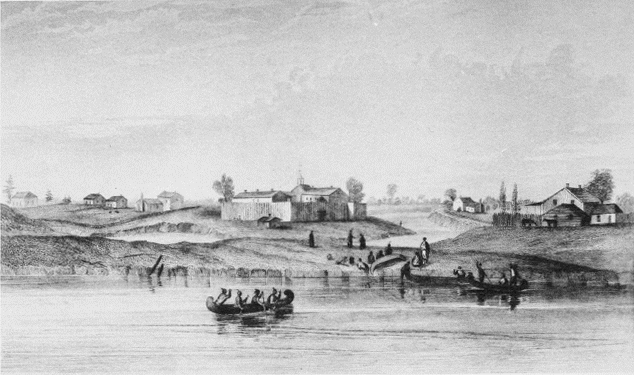
CHICAGO IN 1820. From a sketch by H. R. Schoolcraft, in “Indian Tribes,” vol. iv., p. 192.
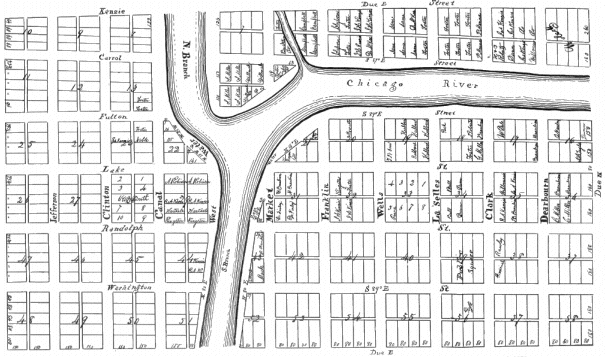
Click on map to view enlarged version.
Copy of the First Map of Chicago. The Original, Made by James Thompson August 4, 1830, was Destroyed in Chicago Fire, October 9, 1871. Copy in Possession of Chicago Historical Society.
CHAPTER XVII
CHICAGO IN 1831
Fort Dearborn at that day consisted of the same buildings as at present.[62] They were, of course, in a better state of preservation, though still considerably dilapidated. They had been erected in 1816, under the supervision of Captain Hezekiah Bradley, and there was a story current that, such was his patriotic regard for the interests of the government, he obliged the soldiers to fashion wooden pins, instead of spikes and nails, to fasten the timbers of the buildings, and that he even called on the junior officers to aid in their construction along with the soldiers, whose business it was. If this were true, the captain must have labored under the delusion (excusable in one who had lived long on the frontier) that the government would thank its servants for any excess of economical zeal.
The fort was inclosed by high pickets, with bastions at the alternate angles. Large gates opened to the north and south, and there were small portions here and there for the accommodation of the inmates. The bank of the river which stretches to the west, now covered by the lighthouse buildings, and inclosed by docks, was then occupied by the root-houses of the garrison. Beyond the parade-ground which extended south of the pickets, were the company gardens, well filled with currant-bushes and young fruit-trees.
The fort stood at what might naturally be supposed to be the mouth of the river, yet it was not so, for in those days the latter took a turn, sweeping round the promontory on which the fort was built, towards the south, and joined the lake about half a mile below; so that these buildings, in fact, stood on the right bank of the river, the left being formed by a long spit of land extending from the northern shore, of which it formed a part. After the cutting through of tills portion of the left bank in 1833 by the United States Engineers employed to construct a harbor at this point, and the throwing out of the piers, the water overflowed this long tongue of land, and continually encroaching on the southern bank, robbed it of many valuable acres; while, by the same action of the vast body of the lake, an accretion was constantly taking place on the north of the harbor.
The residence of Jean Baptiste Beaubien[63] stood at this period between the gardens and the river-bank, and still further south was a rickety tenement, built many years before by Mr. John Dean, the sutler of the post. A short time after the commencement of the growth of Chicago, the foundations of this building were undermined by the gradual encroachment of the lake, and it tumbled backward down the bank, where it long lay, a melancholy spectacle.
On the northern bank of the river, directly facing the fort, was the family mansion of my husband. It was a long, low building, with a piazza extending along its front, a range of four or five rooms. A broad green space was inclosed between it and the river, and shaded by a row of Lombardy poplars. Two immense cotton-wood trees stood in the rear of the building, one of which still remains as an ancient landmark. A fine, well-cultivated garden extended to the north of the dwelling, and surrounding it were various buildings appertaining to the establishment—dairy, bake-house, lodging-house for the Frenchmen, and stables.
A vast range of sand-hills, covered with stunted cedars, pines, and dwarf-willow trees, intervened between the house and the lake, which was, at this time, not more than thirty rods distant.
Proceeding from this point, along the northern bank of the river, we came first to the Agency House, “Cobweb Castle,” as it had been denominated while long the residence of a bachelor, and the sobriquet adhered to it ever after. It stood at what is now the south-west corner of Wolcott and N. Water streets. Many will still remember it, a substantial, compact little building of logs hewed and squared, with a centre, two wings, and, strictly speaking, two tails, since, when there was found no more room for additions at the sides, they were placed in the rear, whereon a vacant spot could be found.
These appendages did not mar the symmetry of the whole, as viewed from the front, but when, in the process of the town’s improvement, a street was maliciously opened directly in the rear of the building, the whole establishment, with its comical little adjuncts, was a constant source of amusement to the passers-by. No matter. There were pleasant, happy hours passed under its odd-shaped roof, as many of Chicago’s early settlers can testify.
Around the Agency House were grouped a collection of log-buildings, the residences of the different persons in the employ of Government, appertaining to that establishment—blacksmith, striker, and laborers. These were for the most part Canadians or half-breeds, with occasionally a stray Yankee, to set all things going by his activity and enterprise.
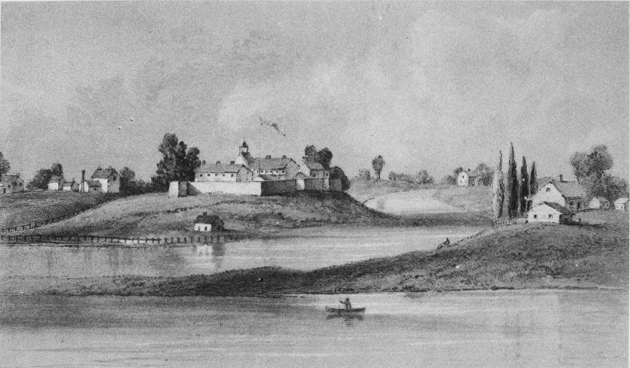
CHICAGO IN 1831. From a sketch by Mrs. Kinzie, in original edition.
There was still another house on the north side of the river, built by a former resident of the name of Miller, but he had removed to “Rivière du Chemin,” or Trail Creek, which about this time began to be called “Michigan City.”[U] This house, which stood near the forks of the river, was at this time vacant.
There was no house on the southern bank of the river, between the fort and “The Point,” as the forks of the river were then called. The land was a low wet prairie, scarcely affording good walking in the dryest summer weather, while at other seasons it was absolutely impassable. A muddy streamlet, or as it is called in this country, a slew,[V] after winding around from about the present site of the Tremont House, fell into the river at the foot of State street.[W]
At a point, on the south side, stood a house just completed by Mark Beaubien, sen.[64] It was a pretentious white two-story building, with bright blue wooden shutters, the admiration of all the little circle at Wolf Point. Here a canoe ferry was kept to transport people across the south branch of the river.
Facing down the river from the west was, first a small tavern kept by Mr. Wentworth, familiarly known as "Old Geese," not from any want of shrewdness on his part, but in compliment to one of his own cant expressions. Near him were two or three log-cabins occupied by Robinson, the Pottowattamie chief, and some of his wife’s connexions. Billy Caldwell, the Sau-ga-nash, too, resided here occasionally, with his wife, who was a daughter of Nee-scot-nee-meg, one of the most famous chiefs of the nation. A little remote from these residences was a small square log building, originally designed for a school-house, but occasionally used as a place of worship whenever any itinerant minister presented himself.
The family of Clybourn had, previous to this time, established themselves near their present residence on the North Branch—they called their place New Virginia. Four miles up the South Branch was an old building which was at that time an object of great interest as having been the theatre of some stirring events during the troubles of 1812.[X] It was denominated Lee’s Place, or Hardscrabble. Here lived, at this time, a settler named Heacock.
Owing to the badness of the roads a greater part of the year, the usual mode of communication between the fort and “The Point” was by a boat rowed up the river, or by a canoe paddled by some skilful hand. By the latter means, too, an intercourse was kept up between the residents of the fort and the Agency House.
There were, at this time, two companies of soldiers in the garrison, but of the officers one. Lieutenant Furman, had died the autumn previous, and several of the others were away on furlough. In the absence of Major Fowle and Capt. Scott, the command devolved on Lieut. Hunter. Besides him, there were Lieuts. Engle and Foster—the latter unmarried. Dr. Finley, the post surgeon, was also absent, and his place was supplied by Dr. Harmon, a gentleman from Vermont.
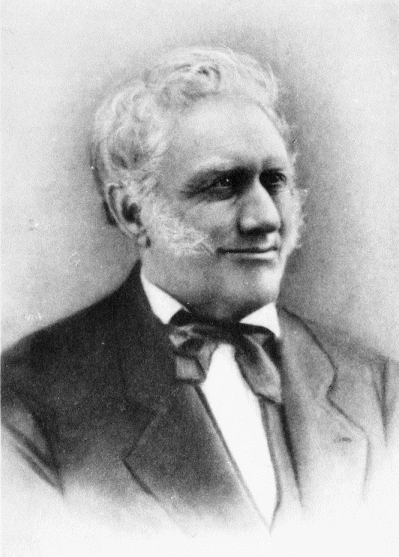
MARK BEAUBIEN. From crayon portrait in possession of Chicago Historical Society.
My husband’s mother, two sisters, and brother resided at the Agency House—the family residence near the lake being occupied by J. N. Bailey, the postmaster.
In the Dean House lived a Mr. and Mrs. Forbes, who kept a school. Gholson Kercheval had a small trading establishment in one of the log buildings at “Wolf Point,” and John S. C. Hogan superintended the sutler’s store in the garrison.
There was also a Mr. Lee lately come into the country, living at the Point, who sometimes held forth in the little school-house on a Sunday, less to the edification of his hearers than to the unmerciful slaughter of the "King’s English."[65]
I think this enumeration comprises all the white inhabitants of Chicago, at a period less than a quarter of a century ago. To many who may read these pages the foregoing particulars will, doubtless, appear uninteresting. But to those who visit Chicago, and still more, to those who come to make it their home, it may be not without interest to look back to its first beginnings; to contemplate the almost magical change which a few years have wrought; and from the past to augur the marvellous prosperity of the future.
The origin of the name Chicago is a subject of discussion, some of the Indians deriving it from the fitch or pole-cat, others from the wild onion with which the woods formerly abounded; but all agree that the place received its name from an old chief, who was drowned in the stream in former times. That this event, although so carefully preserved by tradition, must have occurred in a very remote period, is evident from an old French manuscript brought by Gen. Cass from France.
In this paper, which purports to be a letter from M. de Ligney, at Green Bay, to M. de Siette, among the Illinois, dated as early as 1726, the place is designated as “Chicagoux.” This orthography is also found in old family letters of the beginning of the present century.[66]
In giving the early history of Chicago, the Indians say, with great simplicity, “the first white man who settled here was a negro.”
This was Jean Baptiste Point-au-Sable, a native of St. Domingo, who, about the year 1796, found his way to this remote region, and commenced a life among the Indians. There is usually a strong affection between these two races, and Jean Baptiste imposed upon his new friends by making them believe that he had been a “great chief” among the whites. Perhaps he was disgusted at not being elected to a similar dignity by the Pottowattamies, for he quitted this vicinity, and finally terminated his days at Peoria, under the roof of his friend “Glamorgan,” another St. Domingo negro, who had obtained large Spanish grants in St. Louis and its environs, and who, at one time, was in the enjoyment of an extensive landed estate.
Point-au-Sable had made some improvements at Chicago, which were taken possession of by a Frenchman named Le Mai, who commenced trading with the Indians. After a few years Le Mai’s establishment was purchased by John Kinzie, Esq.,[67] who at that time resided at Bertrand, or Parc aux Vaches, as it was then called, near Niles, in Michigan. As this gentleman was, for nearly twenty years, with the exception of the military, the only white inhabitant of Northern Illinois, some particulars of his early life may not be uninteresting.
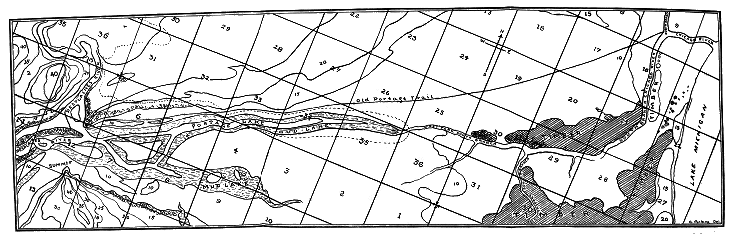
Click on map to view enlarged version.
Map of Chicago Portage, from the First U. S. Government Survey, Circa 1820. In Possession of Chicago Historical Society.
He was born in Quebec (L. C.) in 1763. His mother had been previously married to a gentleman of the name of Haliburton. The only daughter of this marriage was the mother of Gen. Fleming and Nicholas Low, Esq., of New York. She is described as a lady of remarkable beauty and accomplishments. Mr. Kinzie was the only child of the second marriage. His father died in his infancy, and his mother married a third time a Mr. Forsyth, after which they removed to the city of New York.
At the age of ten or eleven years he was placed at school with two of his half-brothers at Williamsburg, L. I. A negro servant was sent from the city every Saturday, to bring the children home, to remain until the following Monday morning. Upon on occasion, when the messenger arrived at the school he found all things in commotion. Johnny Kinzie was missing! Search was made in all directions; every place was ransacked. It was all in vain; no Johnny Kinzie could be found.
The heavy tidings were carried home to his mother. By some it was supposed the lad was drowned; by others that he had strayed away, and would return. Weeks passed by, and months, and he was at length given up and mourned as lost. In the meantime the boy was fulfilling a determination he had long formed, to visit his native city of Quebec, and make his way in life for himself.
He had by some means succeeded in crossing from Williamsburg to the city of New York, and finding at one of the docks on the North River a sloop bound for Albany, he took passage on board of her. While on his way up the river, he was noticed by a gentleman, who, taking an interest in the little lonely passenger, questioned him about his business.
“He was going to Quebec, where he had some friends.”
“Had he the means to carry him there?”
“Not much, but he thought he could get along.”
It happened, fortunately, that the gentleman himself was going to Quebec. He took the boy under his care, paid his expenses the whole distance, and finally parted with him in the streets of the city, where he was, in truth, a stranger.
He wandered about for a time, looking into various “stores” and workshops. At length, on entering the shop of a silversmith, he was satisfied with the expression he read in the countenance of the master, and he inquired if he wanted an apprentice.
“What, you, my little fellow! What can you do?”
“Anything you can teach me.”
“Well, we will make a trial and see.”
The trial was satisfactory. He remained in the family of his kind friend for more than three years, when his parents, who, in removing to Detroit, had necessarily returned to Canada, discovered his place of abode, and he was restored to them.
There were five younger half-brothers of the name of Forsyth. In the old family Bible, we find the following touching record of an event that occurred after the family had removed to Detroit:
“George Forsyth was lost in the woods 6th August, 1775, when Henry Hays and Mark Stirling ran away and left him. The remains of George Forsyth were found by an Indian the 2d of October, 1776, close by the Prairie Ronde.”
It seems a singular fatality that the unhappy mother should have been twice called to suffer a similar affliction—the loss of a child in a manner worse than death, inasmuch as it left room for all the horrors that imagination can suggest. The particulars of the loss of this little brother were these. As he came from school one evening, he met the colored servant boy on horseback, going to the common for the cows. The school-house stood quite near the old fort, and all beyond that, all that now lies west of Fort street, was a wild, uncultivated tract called “The Common.” The child begged of the servant to take him up and give him a ride, but the other refused, bidding him return home at once. He was accompanied by two other boys, somewhat older, and together they followed the negro for some distance, hoping to prevail upon him to give them a ride. As it grew dark, the two older boys turned back, but the other kept on. When the negro returned he had not again seen the child, nor were any tidings ever received of him, notwithstanding the diligent search made by the whole little community, until, as related in the record, his remains were found the following year by an Indian. There was nothing to identify them, except the auburn curls of his hair, and the little boots he had worn. He must have perished very shortly after having lost his way, for the Prairie Ronde was too near the settlement to have prevented his hearing the calls and sounding horns of those in search of him.
Mr. Kinzie’s enterprising and adventurous disposition led him, as he grew older, to live much on the frontier. He early entered into the Indian trade, and had establishments at Sandusky and Maumee, and afterwards pushed further west, about the year 1800, to St. Joseph’s. In this year he married Mrs. McKillip, the widow of a British officer, and in 1804 came to make his home at Chicago. It was in this year that the first fort was built.
By degrees more remote trading-posts were established by him, all contributing to the parent one at Chicago; at Milwaukie with the Meenomonees; at Rock River with the Winnebagoes and the Pottowattamies; on the Illinois River and Kankakee with the Pottowattamies of the Prairies, and with the Kickapoos in what was called “Le Large,” being the widely extended district afterwards erected into Sangamon County.
Each trading-post had its superintendent, and its complement of engagés—its train of pack-horses and its equipment of boats and canoes. From most of the stations the “fur and peltries” were brought to Chicago on pack-horses, and the goods necessary for the trade were transported in return by the same method.
The vessels which came in the spring and fall (seldom more than two or three annually), to bring the supplies and goods for the trade, took the furs that were already collected to Mackinac, a depôt of the South-West and American Fur Companies. At other seasons they were sent to that place in boats, coasting around the lake.[68]
Of the Canadian voyageurs or engagés, a race that has now so nearly passed away, some notice may very properly here be given.
They were unlike any other class of men. Like the poet, they seemed born to their vocation. Sturdy, enduring, ingenious, and light-hearted, they possessed a spirit capable of adapting itself to any emergency. No difficulties baffled, no hardships discouraged them; while their affectionate nature led them to form attachments of the warmest character to their “bourgeois,” or master, as well as to the native inhabitants, among whom their engagements carried them.
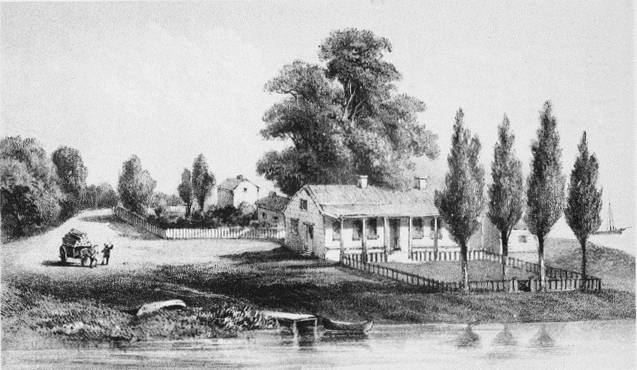
RESIDENCE OF JOHN KINZIE, ESQ. (The first house built in Chicago.) From sketch by Mrs. Kinzie, in original edition.
Montreal, or according to their own pronunciation, Marrialle, was their depôt. It was at that place that the agents commissioned to make up the quota for the different companies and traders found the material for their selections.
The terms of engagement were usually from four to six hundred livres (ancient Quebec currency) per annum as wages, with rations of one quart of lyed corn, and two ounces of tallow per diem, or “its equivalent in whatever sort of food is to be found in the Indian country.”
Instances have been known of their submitting cheerfully to fare upon fresh fish and maple sugar for a whole winter, when cut off from other supplies.
It was a common saying, “Keep an engagé to his corn and tallow, he will serve you well—give him pork and bread, and he soon gets beyond your management.” They regard the terms of their engagement as binding to the letter. An old trader, M. Berthelet, engaged a crew at Montreal. The terms of agreement were, that they should eat when their bourgeois did, and what he did. It was a piece of fun on the part of the old gentleman, but the simple Canadians believed it to be a signal instance of good luck that had provided them such luxurious prospects. The bourgeois stuffed his pockets with crackers, and when sure of being quite unobserved, would slyly eat one. Pipe after pipe passed—the men grew hungry, but observing that there were no preparations of a meal for the bourgeois, they bore their fast without complaining.
At length the matter became too serious—they could stand it no longer. In their distress they begged off from the bargain, and gladly compounded to take the customary rations, instead of the dainty fare they had been promising themselves with their master.
On arriving at Mackinac, which was the entrepôt of the Fur Trade, a small proportion of the voyageur’s wages was advanced him, to furnish his winter’s outfit, his pipes and tobacco, his needles and thread, some pieces of bright-colored ribbons, and red and yellow gartering (quality binding), with which to purchase their little necessaries from the Indians. To these, if his destination were Lake Superior, or a post far to the north, where such articles could not be readily obtained, were added one or two smoked deer-skins for moccasins.
Thus equipped, he entered upon his three years' service, to toil by day, and laugh, joke, sing, and tell stories when the evening hour brought rest and liberty.
There was not wanting here and there an instance of obstinate adherence to the exact letter of the agreement in regard to the nature of employment, although, as a general thing, the engagé held himself ready to fulfil the behests of his bourgeois, as faithfully as ever did vassal those of his chief.
A story is told of M. St. Jean, a trader on the Upper Mississippi, who upon a certain occasion ordered one of his Frenchmen to accompany a party to the forest to chop wood. The man refused. “He was not hired,” he said, “to chop wood.”
“Ah! for what then were you hired?”
“To steer a boat.”
“Very well; steer a boat, then, since you prefer it.”
It was mid-winter. The recusant was marched to the river-side, and placed in the stern of the boat, which lay fastened in the ice.
After serving a couple of hours at his legitimate employment, with the thermometer below zero, he was quite content to take his place with the chopping-party, and never again thought it good policy to choose work for himself.
There is an aristocracy in the voyageur service which is quite amusing. The engagement is usually made for three years. The engagé of the first year, who is called a “mangeur-de-lard,” or pork-eater, is looked down upon with the most sovereign contempt by an “hivernant,” or one who has already passed a winter in the country. He will not only not associate with him, but if invited by him to join him in a friendly glass, he will make some excuse for declining. The most inveterate drunkard, while tortured by a longing to partake his favorite indulgence, will yet never suffer himself to be enticed into an infringement of this custom.
After the first winter, the mangeur-de-lard rises from his freshman class, and takes his place where he can in turn lord it over all new-comers.
Another peculiarity of the class is their fancy for transforming the names of their bourgeois into something funny, which resembles it in sound. Thus Kinzie would be called by one “Quinze nez” (fifteen noses), by another “Singé” (monkeyfied). Mr. Kercheval was denominated “Mons. Court-cheval” (short horse), the Judge of Probate, “le Juge Trop-bête” (too foolish), &c. &c. The following is an instance in point.
Mr. Shaw, one of the agents of the Northwest Fur Company, had passed many years on the frontier, and was by the voyageurs called Monsieur Le Chat.[Y] On quitting the Indian country he married a Canadian lady and became the father of several children. Some years after his return to Canada, his old foreman, named Louis la Liberté, went to Montreal to spend the winter. He had heard of his old bourgeois' marriage, and was anxious to see him.
Mr. Shaw was walking in the Champ de Mars with a couple of officers when La Liberté espied him. He immediately ran up, and seizing him by both hands, accosted him—
“Ah! mon cher Mons. le Chat; comment vous portez vous?”
“Tres bien, Louizon.”
“Et comment se porte Madame la Chatte?” (How is the mother cat?)
“Bien, bien, Louizon; elle est tres bien.” (She is very well.)
“Et tous les petits Chatons?” (And all the kittens?)
This was too much for Mr. Shaw. He answered shortly that the kittens were all well, and bidding him call at his house, turned away with his military friends, leaving poor Louizon quite astonished at the abruptness of his departure.
Cut off, in the manner described, from the world at large, with no society but the military, thus lived the family of Mr. Kinzie, in great contentment, and in the enjoyment of all the comforts, together with most of the luxuries of life.
The Indians reciprocated the friendship that was shown them, and formed for them an attachment of no ordinary strength, as was manifested during the scenes of the year 1812, eight years after Mr. Kinzie came to live among them.
Some of the most prominent events of that year are recorded in the following Narrative.
CHAPTER XVIII
MASSACRE AT CHICAGO[Z]
It was the evening of the 7th April, 1812. The children of Mr. Kinzie were dancing before the fire to the music of their father’s violin. The tea-table was spread, and they were awaiting the return of their mother, who had gone to visit a sick neighbor about a quarter of a mile up the river.
Suddenly their sports were interrupted. The door was thrown open, and Mrs. Kinzie rushed in, pale with terror and scarcely able to articulate, “The Indians! the Indians!”
“The Indians? What? Where?” eagerly demanded they all.
“Up at Lee’s place, killing and scalping!”
With difficulty Mrs. Kinzie composed herself sufficiently to give the information, “That while she was up at Burns', a man and a boy were seen running down with all speed on the opposite side of the river; that they had called across to give notice to Burns' family to save themselves, for the Indians were at Lee’s Place, from which they had just made their escape.” Having given this terrifying news, they had made all speed for the fort, which was on the same side of the river that they then were.
All was now consternation and dismay. The family were hurried into two old pirogues, that were moored near the house, and paddled with all possible haste across the river to take refuge in the fort.
All that the man and boy who had made their escape were able to tell, was soon known; but in order to render their story more intelligible, it is necessary to describe the scene of action.
Lee’s Place, since known by the name of Hardscrabble, was a farm intersected by the Chicago River, about four miles from its mouth. The farm-house stood on the western bank of the south branch of this river. On the same side of the main stream, but quite near its junction with Lake Michigan, stood (as has already been described) the dwelling-house and trading establishment of Mr. Kinzie.
The fort was situated on the southern bank, directly opposite this mansion—the river, and a few rods of sloping green turf on either side, being all that intervened between them.
The fort was differently constructed from the one erected on the same site in 1816. It had two block-houses on the southern side, and on the northern a sally-port, or subterranean passage from the parade ground to the river. This was designed either to facilitate escape, in case of an emergency, or as a means of supplying the garrison with water during a siege.
The officers in the fort at this period were Capt. Heald, the commanding officer, Lieut. Helm, the son-in-law of Mr. Kinzie, and Ensign Ronan—the two last were very young men—and the surgeon. Dr. Van Voorhees.
The command numbered about seventy-five men; very few of whom were effective.
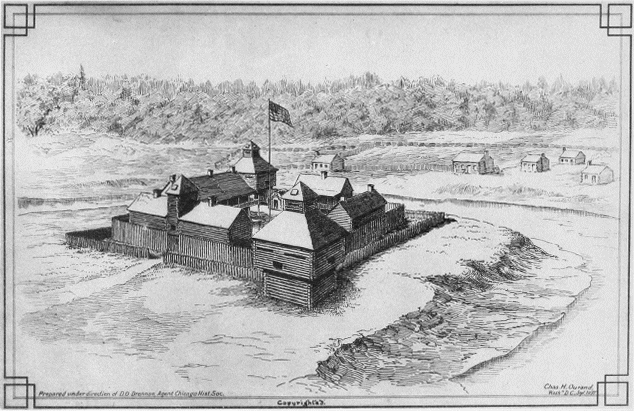
OLD FORT DEARBORN, 1803-1812. From a sketch by Charles H. Ourand, based upon plans drawn by Capt. J. Whistler, 1808, in possession of Chicago Historical Society.
A constant and friendly intercourse had been maintained between these troops and the Indians. It is true that the principal men of the Pottowattamie nation, like those of most other tribes, went yearly to Fort Maiden, in Canada, to receive a large amount of presents, with which the British Government had, for many years, been in the habit of purchasing their alliance; and it was well known that many of the Pottowattamies, as well as Winnebagoes, had been engaged with the Ottawas and Shawnees at the battle of Tippecanoe, the preceding autumn; yet, as the principal chiefs of all the bands in the neighborhood appeared to be on the most amicable terms with the Americans, no interruption of their harmony was at any time anticipated.
After the 15th August, however, many circumstances were recollected that might have opened the eyes of the whites, had they not been lulled in a fatal security. One instance in particular may be mentioned.
In the spring preceding the destruction of the fort, two Indians of the Calumet band came to the fort on a visit to the Commanding Officer. As they passed through the quarters, they saw Mrs. Heald and Mrs. Helm playing at battledoor.
Turning to the interpreter, one of them, Nau-non-gee, remarked: “The white chiefs' wives are amusing themselves very much; it will not be long before they are hoeing in our cornfields!”
This was considered at the time an idle threat, or at most, an ebullition of jealous feeling at the contrast between the situation of their own women and that of the “white chiefs' wives.” Some months after, how bitterly was it remembered!
The farm at Lee’s Place was occupied by a Mr. White, and three persons employed by him in the care of the farm.
In the afternoon of the day on which our narrative commences, a party of ten or twelve Indians, dressed and painted, arrived at the house, and according to the custom among savages, entered and seated themselves without ceremony.
Something in their appearance and manner excited the suspicions of one of the family, a Frenchman, who remarked, “I do not like the appearance of these Indians—they are none of our folks. I know by their dress and paint that they are not Pottowattamies.”
Another of the family, a discharged soldier, then said to the boy who was present, “If that is the case, we had better get away from them if we can. Say nothing; but do as you see me do.”
As the afternoon was far advanced, the soldier walked leisurely towards the canoes, of which there were two tied near the bank. Some of the Indians inquired where he was going. He pointed to the cattle which were standing among the haystacks on the opposite bank; and made signs that they must go and fodder them, and then they should return and get their supper.
He got into one canoe, and the boy into the other. The stream was narrow, and they were soon across. When they had gained the opposite side, they pulled some hay for the cattle—made a show of collecting them—and when they had gradually made a circuit, so that their movements were concealed by the haystacks, they took to the woods, which were close at hand, and made for the fort.
They had run about a quarter of a mile, when they heard the discharge of two guns successively, which they supposed to have been leveled at the companions they had left behind.
They stopped not nor stayed until they arrived opposite Burns',[AA] where, as before related, they called across to advise the family of their danger, and then hastened on to the fort.
It now occurred to those who had secured their own safety, that the family of Burns was at this moment exposed to the most imminent peril. The question was, who would hazard his own life to bring them to a place of safety? A gallant young officer. Ensign Ronan, volunteered, with a party of five or six soldiers, to go to their rescue.
They ascended the river in a scow, took the mother, with her infant of scarcely a day old, upon her bed to the boat, in which they carefully conveyed her and the other members of the family to the fort.