ANNALS (continued 2)
Reading edition
Sir Edward made his will on December 14, 1521. By it, after leaving legacies to certain churches and friends, “the residue of all my goods, debts, cattalls, juells, plate, harnesse, and all other moveables whatsoever they be, I freely geve and bequeth to Agnes Hungerforde my wife.” She was also appointed sole executrix. Sir Edward died on January 24, 1522, six weeks after making this will.
The husband murdered was not Sir Edward Hungerford, but a first husband, John Cotell. The outlines of the story are given by Mr. Hardy from the Coram Rege Roll for Michaelmas term, 14 Henry VIII.:—
“On the Monday next after the feast of S. Bartholomew, in the 14th year of the now king (25 August, 1522), at Ilchester, before John Fitz James and his fellow-justices of oyer and terminer for the county of Somerset, William Mathewe, late of Heytesbury, in the county of Wilts, yeoman, William Inges, late of Heytesbury, in the county aforesaid, yeoman, [were indicted for that] on the 26th July, in the 10th year of the now Lord the King (1518), with force and arms made an assault upon John Cotell, at Farley, in the county of Somerset, by the procurement and abetting of Agnes Hungerford, late of Heytesbury, in the county of Wilts, widow, at that time the wife of the aforesaid John Cotell. And a certain linen scarf called a kerchier (quandam flameam lineam vocatam ‘a kerchier’) which the aforesaid William and William then and there held in their hands, put round the neck of the aforesaid John Cotell, and with the aforesaid linen scarf him, the said John Cotell, then and there feloniously did throttle, suffocate, and strangle, so that the aforesaid John Cotell immediately died, and so the aforesaid William Maghewe [Mathewe] and William Inges, by the procurement and abetting of the aforesaid Agnes, did then and there feloniously murder, &c., the aforesaid John Cotell, against the peace of the Lord the King, and afterwards the aforesaid William, and William, the body of the aforesaid John Cotell did then and there put into a certain fire in the furnace of the kitchen in the Castle of Farley aforesaid, and the body of the same John in the fire aforesaid in the Castle of Farley aforesaid, in the county of Somerset aforesaid, did burn and consume.”
The indictment charged that Agnes Hungerford, otherwise called Agnes Cotell, late of Heytesbury, in the county of Wilts, widow, late the wife of the aforesaid John Cotell, well knowing that the aforesaid William Mathewe and William Inges had done the felony and murder aforesaid, did receive, comfort and aid them on 28th December, 1518.
Such was the indictment, “which said indictment the now Lord the King afterwards for certain reasons caused to come before him to be determined, &c.” All three accused were committed to the Tower of London; “and now, to wit, on Thursday next after the quinzaine of St. Martin (November 27, 1522), in the same term, before the Lord the King at Westminster, in their proper persons came the aforesaid William Mathewe, William Inges, and Agnes Hungerford, brought here to the bar by Sir Thomas Lovell, Knight, Constable of the Tower of London, by virtue of the writ of the Lord the King to him thereupon directed.”
So they were brought to trial, and all found guilty. William Mathewe and Lady Agnes Hungerford were sentenced to be hanged; William Inges pleaded benefit of clergy. The plea was contested on the ground that he had committed bigamy, by which he lost his right to claim his clergy. The question was referred to the Bishop of Salisbury, who proved that Inges was a bigamist, and Inges was therefore also sentenced to be hanged. There is no record of a third execution; the servant hanged at the same time as Lady Agnes Hungerford was therefore William Mathewe.
The story is still incomplete: it may be hoped that records somewhere exist the discovery of which will tell us more. It will be observed that Lady Hungerford was indicted, not for the murder of her husband, but for receiving, comforting, and aiding, five months after the fact, those who, by her procurement, had murdered him. What was the nature of the comfort and aid thus given? Had something of the story leaked out, and was Lady Hungerford compelled to protect the murderers? Again, what part in the tragedy was played by Sir Edward? It is clear that at the time of the murder Agnes Cotell was supreme at Farleigh Castle. She brought over from Sir Edward’s other house the two men who committed the deed; she was so fully in command of Farleigh Castle that she could secure the use of the furnace for disposing of the body of the murdered man. It is not difficult to divine what were the relations between Sir Edward and the wife of Cotell, who was probably employed in some capacity on the estate. How did Agnes Cotell account for his disappearance? And not his disappearance only; as a preliminary step towards the marriage, Sir Edward must have been satisfied that Cotell was dead. Did he know the nature of his death? Had he a share in this great crime, or was he merely the helpless victim of an ambitious woman, bent on obtaining a great position, and reckless as to the means to be employed to obtain it? There may have been in Sir Edward a tendency towards degeneracy; his son by the first wife was executed at the Tower in 1540 for an abnormal crime. But if Sir Edward was ignorant of the murder, there must have been suspicions, perhaps necessitating the active interference of Lady Hungerford when she received, comforted, and aided the murderers. There must have been whispers, rising to open denunciation when Lady Hungerford’s protector, her husband, all-powerful in the county, had quitted the scene. For more than three years justice was blind and deaf, but only seven months after Sir Edward’s death the criminals were indicted. If we take into account the imperfect means of communication then existing, we shall find reason to believe that the law must have been set in motion very soon after Sir Edward’s death.
It will have been observed that one of Lady Hungerford’s servants pleaded his clergy, that is, he claimed the indulgence accorded by law to those who could read. In 1522 it was still the law that the privilege could be claimed by one who had committed murder. In 1531 an Act was passed by the provisions of which no person committing petty treason, murder, or felony was admitted to his clergy under the status of sub-deacon (23 Henry VIII., c. 1).
William Inges’ claim would have been perforce admitted but for the singular objection on the score of bigamy. The exception seems strange, but was founded on well-understood provisions of the law. A bigamist, it must be remembered, was not what we of to-day mean when we use the word. A bigamist was one who had married two wives, the second after the decease of the first, or who had married a widow. We will return presently to this question of bigamy, after noting what Sir Thomas Smith, writing fifty years later, says as to clergy. Let us, however, premise that benefit of clergy means, as indeed the name imports, a privilege of the clergy consisting originally in the right of the clergy to be free from the jurisdiction of lay courts, and to be subject to the ecclesiastical courts only. Sir James Fitzjames Stephen aptly compares it to “the privilege claimed by British and other foreign subjects in Turkey, in Egypt, and in China, of being tried before their own courts.” The privilege was extended by 25 Edward III. (1351-2), st. 6, c. 4, to all manner of clerks, as well secular as religious. The statute was construed as being applicable to all persons who could read, and its effect is succinctly stated in “Piers Plowman,” written a few years later:—
“Dominus pars hereditatis mee. is a meri verset, That has take fro tybourne. twenti stronge theves.”
This is the description given by Sir Thomas Smith of the process of claiming clergy:—
Of him whom the xij. men pronounce guiltie, the Judge asketh what he can say for himselfe: if he can reade, he demaundeth his Clergie. For in many felonies, as in theft of oxen, sheepe, money, or other such things which be no open robberies, by the high way side, nor assaulting one by night in his house, putting him that is there in feare, such is the favour of our Lawe, that for the first fault the felon shalbe admitted to his Clergie, for which purpose the Bishop must send one with authoritie vnder his seale to be Judge in that matter at euerie gaole deliuerie. If the condemned man demandeth to be admitted to his booke, the Judge commonly giveth him a Psalter, and turneth to what place he will. The prisoner readeth as well as he can (God knoweth sometime very slenderly:) then he asketh of the Bishops commissarie, legit vt clericus? The commissarie must say legit or non legit, for these be wordes formall, and our men of Lawe be very precise in their words formall. If he say legit, the Judge proceedeth no further to sentence of death: if he say non, the Judge foorthwith, or the next day proceedeth to sentence, which is doone by word of mouth onelie,
[gives the form of the death sentence]
he that claimeth his Clergie, is burned forthwith in the presence of the Judges in the brawne of his hand with a hot yron marked with the letter T. for a theefe, or M. for a mansleer, in cases where Clergie is admitted, and is deliuered to the Bishops officer to be kept in the Bishops prison, from whence after a certaine time by an other enquest of Clarkes he is deliuered and let at large: but if he be taken and condemned the second time, and his marke espied, he goeth to hanging.[146]
A shrewd observer, Monsieur César de Saussure, gives an account of the proceeding in 1726: Clergy, he says, was formerly a privilege restricted to churchmen, but is to-day extended to lay persons convicted to certain crimes, and particularly of manslaughter. In virtue of this privilege, a New Testament in Latin and in blackletter is presented to the criminal, who is required to read two verses. If the person appointed to make him read says these words, “Legit ut clericus,” that is to say, “He reads like a clerk,” which he always does, however ill the prisoner has read, the prisoner is simply marked in the palm of the hand with a hot iron, which he has the further right on payment of thirteen pence halfpenny to have plunged in cold water before it is applied. Then he is set free.[147]
The privilege of clergy was constantly narrowed, but was totally abolished only in 1827 by 7 and 8 George IV., c. 28.
The following were the provisions respecting bigamy in the old sense of the word:—
4 Edward I. (1276) c. 1, 2. The Statute of Bigamy, Section 5. Concerning Men twice married, called Bigami, whom our Lord the Pope by a Constitution made at the Council of Lyons hath excluded from all Clerks privilege, whereupon certain Prelates when such persons as were twice married before the same Constitution, have been called in question for Felony, have prayed for to have them delivered as Clerks … whether they were Bigami before the same Constitution or after, they shall not from henceforth be delivered to the Prelates, but justice shall be executed upon them, as upon other lay people.
18 Edward III. (1344) Stat. 3, c. 2. (Here summarised.) If a person accused pleads his clergy, and it is alleged that he has married two wives, or one widow, the case shall be sent for determination to the Spiritual Court.
These provisions were abolished by I Edward VI. (1547), c. 12, s. 15, which put the “bigamist” on the same footing as all others.
1525. In the last moneth called December were taken certain traytors in the citie of Couentry, one called Fraunces Philippe scolemaster to the kynges Henxmen, and one Christopher Pykeryng clerke of yᵉ Larder, and one Antony Maynuile gentleman, which by the persuasion of the sayd Fraunces Philip, entended to haue taken the kynges treasure of his subsidie as the Collectors of the same came towarde London, and then to haue araised men and taken the castle of Kylingworth, and then to haue made battaile against the kyng: wherfore the sayd Fraunces, Christopher and Anthony wer hanged, drawen and quartered at Tyborne the xi. day of Februarye, the residue that were taken, were sent to the citie of Couentry and there wer executed. One of the kynges Henxmen called Dygby which was one of the conspirators fled the realme, and after had his pardon (Hall, p. 673).
1531. This yeare Mr. Risse was beheaded at Tower hill, and one that was his servante was drawne from the Tower of London to Tiburne, where he was hanged, his bowells burnt, and his bodie quartered.[148]
1534. With the aid of Cranmer, the willing instrument of his lust and cruelty, Henry had divorced Catherine, and had married his mistress, Anne Boleyn, the sister of a former mistress. With the same aid he had also invested himself with the supremacy of the Church. But there was a strong feeling throughout the country against these proceedings, and Henry viewed with alarm every manifestation of this feeling. To express disapprobation, however mildly, was regarded as a crime, as evidence of a conspiracy against the State.
Elizabeth Barton, afterwards known as the Holy Maid of Kent, was a domestic servant at Aldington, Kent. From about the year 1525 she was subject to trances, on recovery from which she narrated the marvels she had seen in the world of spirits. Her fame was soon spread abroad; many of the greatest men in the kingdom visited her; some came to believe that she was inspired, among them perhaps Sir Thomas More, and Fisher, Bishop of Rochester. When the great case of the divorce came on, Elizabeth predicted that if Henry married Anne during the life of Catherine he would die within a month. Cranmer, who had now received the reward of his services by being appointed Archbishop of Canterbury, laboured to draw from Elizabeth a confession that “her predictions were feigned of her own imagination only.”
In the Parliament which met in January, 1534, seven persons, including Elizabeth, were accused of forming a conspiracy in relation to the matter. This was the end:—
1534. The 20. of Aprill, Elizabeth Barton a nunne professed [she had entered a convent in 1527], Edward Bocking, and Iohn Dering, two monks of Christs church in Canterburie, and Richard Risby & another of his fellowes of yᵉ same house, Richard Master parson of Aldington, and Henry Gold priest, were drawne from the Tower of London to Tiborne, and there hanged and headed, the nuns head was set on London bridge, and the other heades on gates of yᵉ citie (Stow, p. 570).
1535. Maurice Chauncy, a monk of the Charterhouse of London, has told the story of the martyrdom of the Carthusians, in a book which some one, I think, has called the swan-song of English monasticism, “Historia Aliquot Martyrum Anglorum Cartusianorum.”
Proceedings were taken against the London Carthusians for refusing to admit Henry’s claim to be supreme head of the Church. In the London House were at this time Father Robert Lawrence, Prior of Beauvale, and Father Augustine Webster, Prior of Axholme; Beauvale and Axholme being two other Carthusian monasteries.
Together with Father Houghton, Prior of the London House, Father Lawrence and Father Webster were brought to trial and condemned. Let Chauncy tell the story of their execution: with little variation it may stand for that of all the Catholic martyrs from 1535 to 1681:—
Being brought out of prison [the Tower] they were thrown down on a hurdle and fastened to it, lying at length on their backs, and so lying on the hurdle, they were dragged at the heels of horses through the city until they came to Tyburn, a place where, according to custom, criminals are executed, which is distant from the prison one league, or a French mile. Who can relate what grievous things, what tortures they endured on that whole journey, where one while the road lay over rough and hard, at another through wet and muddy places, which exceedingly abounded.
On arrival at the place of execution our holy Father was the first loosed, and then the executioner, as the custom is, bent his knee before him, asking pardon for the cruel work he had to do. O good Jesu,
“Quis non fleret, Christi servum si videret, In tanto supplicio, Quis non posset contristari”;
beholding the benignity of so holy a man, how gently and moderately he spoke to the executioner, how sweetly he embraced and kissed him, and how piously he prayed for him and for all the bystanders. Then on being ordered to mount the ladder to the gibbet, where he was to be hanged, he meekly obeyed. Then one of the King’s Council, who stood there with many thousand people, who came together to witness the sight, asked him if he would submit to the king’s command and the Act of Parliament, for if he would he should be pardoned. The holy Martyr of Christ answered: “I call Almighty God, and I beseech you all in the terrible Day of Judgment, to bear witness, that being here about to die, I publicly declare that not through any pertinacity, malice, or rebellious spirit, do I commit this disobedience and denial of the will of our lord the king, but solely through fear of God, lest I should offend His Supreme Majesty; because our holy mother, the Church, has decreed and determined otherwise than as your king and his Parliament have ordained; wherefore I am bound in conscience and am prepared, and am not confounded, to endure these and all other torments that can be inflicted, rather than go against the doctrine of the Church. Pray for me, and have pity on my brethren, of whom I am the unworthy Prior.” And having said these things, he begged the executioner to wait until he had finished his prayer, which was, “In te Domine speravi,” down to “In manus tuas,” inclusive. Then on a sign given, the ladder was turned, and so he was hanged. Then one of the bystanders, before his holy soul left his body, cut the rope, and so falling to the ground, he began for a little space to throb and breathe. Then he was drawn to another adjoining place, where all his garments were violently torn off, and he was again extended naked on the hurdle, on whom immediately the bloody executioner laid his wicked hands. In the first place verenda abscidit, then he cut open his belly, dragged out his bowels, his heart, and all else, and threw them into a fire, during which our most blessed Father not only did not cry out on account of the intolerable pain, but on the contrary, during all this time until his heart was torn out, prayed continually, and bore himself with more than human endurance, most patiently, meekly, and tranquilly, to the wonder not only of the presiding officer, but of all the people who witnessed it. Being at his last gasp, and nearly disembowelled, he cried out with a most sweet voice, “Most sweet Jesu, have pity on me in this hour!” And, as trustworthy men have reported, he said to the tormentor, while in the act of tearing out his heart, “Good Jesu, what will you do with my heart?” and saying this he breathed his last. Lastly, his head was cut off, and the beheaded body was divided into four parts.… Our holy Father having been thus put to death the two other before-named venerable Fathers, Robert and Augustine, with another religious named Reynolds, of the Order of St. Bridget, being subjected to the same most cruel death, were deprived of life, one after another; all of whose remains were thrown into cauldrons and parboiled, and afterwards put up at different places in the city. And one arm of our Father was suspended at the gate of our house.[149]
On the subject of these butcheries Mr. Froude remarks, “But we cannot blame the Government” (ii. 382).
1535. The eighteenth of June, three Monks of the Charter-house at London, named Thomas Exmew, Humfrey Middlemore, and Sebastian Nidigate [Newdigate] were drawen to Tiborne, and there hanged and quartered for denying the Kinges supremacie (Stow, pp. 570-1).
1535-7. In 1535 was introduced the first Bill for the dissolution of the monasteries: only the smaller were now touched. The Bill was passed on Henry’s threat that he would have the Bill pass, or take off some of the Commons’ heads. Henry had tired of Anne Boleyn, and Cranmer, always equal to the occasion, “having previously invoked the name of Christ, and having God alone before his eyes,” had declared that the marriage was void and had always been so. In 1536 broke out the first of the revolts caused by the dissolution. Henry had not yet discovered the secret of detaching from the cause of the people their natural leaders by sharing the plunder with them. The nobility and gentry had their grievances, and made common cause with the people. Henry was furious. He gave orders to “run upon the insurgents with your forces, and with all extremity destroy, burn, and kill man, woman and child, to the terrible example of all others.” The chief monks were to be hanged on long pieces of timber out of the steeples. Later, when the revolt had spread to Yorkshire, he wrote: “You must cause such dreadful execution upon a good number of the inhabitants, hanging them on trees, quartering them, and setting their heads and quarters in every town, as shall be a fearful warning.” In summing up these operations, Cromwell, with a pleasant wit, speaks of the execution of the rest at “Thyfbourne.”[150] The story of the rest will follow. It forms but a small fraction of those murdered by this fell tyrant.
It may well be doubted whether in the history of civilised communities there is any record of a social cataclysm, not resulting from war or pestilence, so terrible as that which overwhelmed the commons of England after the dissolution of the monasteries, followed by measures of plunder extending through the reign of Edward VI. An abbat might not always be a good man of business, witness the dreadful financial condition in which Abbat Samson found the monastery of Bury St. Edmunds.[151] He might even be so pressed for money as to be driven to pledge with the Jews the arm or leg of a saint taken from the reliquary.[152] But he was a good landlord; the lands of the monastery were let to the yeomanry on easy terms. The misery of the French peasantry, largely due to constant English invasions, was so great, that one who knew France well, Chief Justice Fortescue, writing three hundred years before the Great Uprising, had to seek reasons for the fact that the peasantry did not rebel. “It is not pouerte that kepith Ffrenchmen ffro rysinge, but it is cowardisse and lakke off hartes and corage”: “thai haue no wepen, nor armour, nor good to bie it with all.” With their lot he contrasts that of the English yeoman. The might of England “stondith most vppon archers”: if they were poor, they could not be much exercised in shooting, “wich mey not be done withowt ryght grete expenses.”[153]
For the English yeomen were a prosperous class, the backbone of the country. They were able to serve their country alike in peace and war: having means to send their sons to the universities, not yet appropriated by a class: able to help in the maintenance of the poor: stout soldiers in case of need—the best archers in the world. Latimer’s father was a type of the class. A yeoman, having no lands of his own, he held a farm at a rent of three or four pounds a year. The tillage of the farm kept half a dozen men, there was walk for a hundred sheep: Latimer’s mother milked thirty kine. Latimer recollected buckling on his father’s harness when the stout yeoman-soldier set out for Blackheath. He put Latimer “to schole, or elles I had not bene able to haue preached before the kinges maiestie nowe,” gave his daughters a portion, kept hospitality for his poor neighbours, gave alms to the poor, “and all thys did he of the sayd farme.” The Dissolution changed all that. The rapacity of the new landlords, who turned arable land into pasture, and quadrupled rents, is the despair of contemporaries. Latimer thus speaks of his father’s successor: “Wher he that now hath it, paieth xvi. pounde by yere or more, and is not able to do anything for his Prynce, for himselfe, nor for his children, or geue a cup of drincke to the pore.”[154]
Then, for the first time was heard in England the question since become familiar, “Can I not do as I like with my own?” They say, said Bernard Gilpin, “the Apostle of the North,” in a sermon preached before the Court of Edward VI.—“they saie, their lande is their owne, and forget altogether that the earth is the Lords & the fulnesse thereof. They turn them out of their shrouds as thicke as mice.”[155] Henry Brinklow, puritan of puritans, admits that “but for the faith’s sake,” it had been more profitable to the commonwealth that the abbey lands had remained in the hands of those “imps of Antichrist,” the abbeys and nunneries. “For why? thei neuer inhansed their landys, nor toke so cruel fynes as doo our temporal tyrauntes.”[156]
The governing classes, themselves atheistic,[157] ready to change their professed religion as often as was necessary to keep their grip on the lands stolen from the people, played on the fanaticism of a section of the people by means of imported preachers of the new doctrine, sharked up in every corner of Europe. When the commons, oppressed beyond endurance, rose at last in revolt, they were butchered in thousands by foreign mercenaries, the first seen in England for centuries.[158]
The Guilds, lay associations of men and women banded together for mutual help, were among the oldest things in England—older than King Alfred. They were the precursors of the modern Trades Unions and Benefit Societies, but wider in their constitution, embracing various classes, and more human in their administration.[159] These, too, were swept away.
The very hospitals were seized, the sick thrust forth.
The dispossessed people wandered about, workless, aimless, foodless. “Thousandes in England through such [landlords] begge nowe from dore to dore, which haue kept honest houses.”[160] The Slave Act of the first year of the reign of Edward VI. made it lawful to brand an Englishman on the forehead with the mark of slavery, “to putt a rynge of Iron about his Necke Arme or his Legge for a more knowledge and suretie of the kepinge of him.”[161]
In 1547 Ascham, about the time he was appointed tutor to Elizabeth, wrote, “The life now lived by the greatest number is not life, but misery,” words which a modern writer has said should be inscribed over the century as its motto. “Most lamentable of all,” writes Ascham, “is it, that that noble ornament and strength of England, the yeomanry, is broken and destroyed.”[162]
A contemporary writer draws a picture of “the Decay of England” almost too terrible for belief, yet all that we know tends to confirm his story. “Whether shall then they goo?” he cries in despair. “Foorth from shyre to shyre, and to be scathered thus abrode, within the Kynges maiestyes Realme, where it shall please Almighty God: and for lacke of maisters, by compulsion dryuen, some of them to begge, and some to steale.”[163] Happy those who in defence of their hearths had died in the West and in Norfolk at the hands of Spaniards, Italians, Germans, Albanians!
A calculation based upon the statements of this same writer on the “Decay of England” gives 675,000 persons thrown upon the country by the decay of husbandry.[164] But to this number we must add those turned out of the monasteries, the poor, formerly maintained by the monasteries and by the yeomanry, the sick and infirm, ejected from the hospitals established for “Christ’s poor,” as they are called in the act of foundation of a hospital in the thirteenth century. And this immense number out of a population estimated at 5,000,000! “And nowe they haue nothynge, but goeth about in England from dore to dore, and axe theyr almose for Goddes sake. And because they will not begge, some of them doeth steale, and then they be hanged.”[165] Great numbers flocked to London, seeking in vain redress of their grievances.
This was the great time of Tyburn.
In his fourth sermon, preached on March 29, 1549, Latimer mentions, quite incidentally, the frightful number of executions taking place in London, when he was “in ward” with the Bishop of Chichester in 1539. “I was desirous to heare of execution done (as ther was euri weke, some in one place of the citye or other) for there was thre wekes sessions at newgate, and fourth-nyghte Sessions at the Marshialshy, and so forth.”[166] That is, sessions every three weeks at the one place and every two weeks at the other. Never had the gallows been so crowded. In the sentence quoted on the title-page of this book Sir Thomas More, writing in Latin in 1516, had said that twenty were “sometimes” hanged together upon one gallows. In the English translation, first published in 1551, the translator changed “sometimes” (“nonnunquam”) into “for the most part.” So had the gallows thriven!
The bitter lamentations of Latimer, Brinklow, Ascham, Lever, Bernard Gilpin, Crowley, are not the cries of partisans of the old order. They had looked for a new heaven and a new earth—to see “the pure light of the gospel” kindled by John a Lasco, Stumphius, John ab Ulmis, illuminating homes freed for ever from taxation by the spoils of the monasteries. And “the Blessed Reformation” had sent countless thousands to the gallows, had reinstituted white slavery in England, and had established the “pauper,” no longer “Christ’s poor,” as a despised and degraded caste.
But of the judicial murders of this dreadful time we know next to nothing. As Harrison has been more than once quoted it is necessary to refer to a passage giving what purports to be a statement as to the numbers executed in the reign of Henry VIII. He says:—
It appeareth by Cardane (who writeth it vpon the report of the bishop of Lexouia) in the geniture of king Edward the sixt, how Henrie the eight, executing his laws verie seuerlie against such idle persons, I meane great theeues, pettie theeues and roges, did hang vp threescore and twelue thousand of them in his time.[167]
The statement has been repeated by countless writers from Hume downwards, not one of whom has taken the trouble to refer to the original. It is a misquotation hoary with age. Cardan gives the nativity of Henry VIII. and then says: “From these two causes, together with others, there fell out that which the bishop of Lisieux told me at Besançon, namely, that in the two years before his death it was found that seventy-two thousand men perished by the hangman after sentence (judicio et carnifice).”[168] Cardan was at Besançon in 1552, not long after the death of Henry. Possibly Harrison, finding the number incredible, as relating to two years, spread the number over the whole reign. But in the statement attributed to the bishop there is nothing to indicate the class of persons executed. That in one way or another Henry did in the course of his reign destroy seventy-two thousand persons does not seem improbable. It is said that “over 5,000 men were hanged within the space of six years” in a district of North Wales.[169] By the provisions of the Act 27 Henry VIII. (1535-6) c. 25, “rufflers” and vagabonds were to be whipped till their bodies were bloody; for a second offence they were to be again whipped and to lose a part of the right ear; if thereafter they were found idling, they were to be declared felons, and to be punished with death.
1537. The nine and twentith of March were 12. men of Lincolne drawne to Tyborne, and there hanged and quartered, fiue were priests, and 7. were lay men, 1. one was an Abbot, a suffragan, doctor Mackerel; another was the vicar of Louth in Lincolnshire, & two priests (Stow, p. 573).
1537. Alsoe, the 17 daye of Maye, were arrayned at Westmynster these persons followinge: Doctor Cokerell, prieste and chanon, John Pykeringe, layman, the Abbot of Gervase [Jervaulx] and an Abbott condam [quondam] of Fountens, of the order of pyed monkes, the Prior of Bridlington, Chanon, Docter John Pykeringe, fryer of the order of prechers, and Nicholas Tempeste, esquire, all which persons were that daye condemned of highe treason, and had judgment for the same.
And, the 25 daye of Maye, beinge the Frydaye in Whytsonweke, Sir John Bolner, Sir Stephen Hamerton, knightes, were hanged and heddyd, Nicholas Tempeste, esquier, Docter Cokerell, preiste, Abbott condam of Fountens, and Docter Pykeringe, fryer, ware drawen from the Towre of London to Tyburne, and ther hanged, boweld, and quartered, and their heddes sett one London Bridge and diverse gates in London.
And the same daye Margaret Cheyney, other wife to Bolmer called [“which” says Hall, “some reported was not his wife but his paramour”] was drawen after them from the Tower of London into Smythfyld, and there brente, according to hir judgment, God pardon her sowle, being the Frydaye in Whytson weeke; she was a very fayre creature and a bewtyfull.…
The second daie of June, being Saterdaie after Trinitie Soundaie, this yeare Sir Thomas Percey, knight, and brother to the Earle of Northumberland, was drawen from the Tower of London to Tiburne, and their hanged and beheaded, and Sir Francis Bigott, knight, Georg Lomeley, esquire, sonne to the Lord Lomeley, the Abbott of Gervase, and the Prior of Bridlington, were drawen from the said place to Tiburne, and their hanged and quartered, according to their judgmente, and their heades sett on London Bridge and other gates of London.[170]
1538. The 25. of February, Sir Iohn Allen priest, and also an Irish Gentleman of the Garets, were hanged and quartered at Tyborne (Stow, p. 574).
Also this yere the xxv. day of Februarii was drawne from the Towere to Tyborne, Henry Harford gentleman and Thomas Hever merchand, and there hongyd and qwarterd for tresoun (Grey Friars Chron., ed. Howlett, p. 201).
1538. In Iuly was Edmond Coningsbey attainted of treason, for counterfeatyng of the kynges Signe Manuell: And in August was Edward Clifford for thesame cause attainted, and both put to execucion as traitors at Tiborne. And the Sonday after Bartelmew day, was one Cratwell hangman of London, and two persones more hanged at the wrestlyng place on the backesyde of Clerkenwel besyde London, for robbyng of a bouthe in Bartholomew fayre, at which execution was aboue twentie thousand people as I my self iudged (Hall’s Chron., p. 826).
1538-9. The third daie of Nouembre were Henry Marques of Excester & earle of Deuonshire and sir Henry Pole knight and lorde Mountagew and Sir Edward Neuell brother to the Lorde Burgany sent to the tower which thre wer accused by sir Gefferei Pole brother to the lord Mountagew, of high treason, and the two lordes were arreigned the last day of Decembre, at Westminster before the lord Awdeley of Walden, lord Chauncelor, and then the high stuard of England, and there found giltie, likewise on the third day after was arreigned Sir Edward Neuel, Sir Gefferey Pole and two priestes called Croftes and Collins, and one holand a Mariner and all attainted, and the ninth day of Ianuarie [1539], were the saied two lordes and Sir Edward Neuell behedded at the tower hill, and the two priestes and Holande were drawen to Tiborne, and there hanged and quartered, and sir Gefferey Pole was pardoned (Hall, p. 827).
1539. The eight and twentie daie of Aprill, began a Parliament at Westminster, in the which Margaret countesse of Salsbury Gertrude wife to the Marques of Excester, Reignold Poole, a Cardinall brother to the lorde Mountagew, Sir Adrian Foskew [Fortescue] & Thomas Dingley Knight of saynt Iohnes, & diuerse other wer attainted of high treason, which Foskew and Dynglei wer the tenth daie of Iuli behedded.
According to the Grey Friars Chronicle and Wriothesley’s Chronicle they were beheaded at Tower Hill on the 9th July, “and that same day was drawne to Tyborne ii. of their seruanttes, and ther hongyd and quarterd for tresoun.”[171]
1540. Also this same yere was the xvi. day of Marche was one Somer and iii. vacabundes with hym drawne, hongyd and qwarterd for cleppynge of golde at Tyborne (Grey Friars Chron., p. 203).
1540. Dr. Johnson blamed the Government of his day for suppressing the processions to Tyburn—“the public was gratified by a procession.” From this point of view Henry VIII. was an ideal monarch, though it is open to doubt whether the burnings at Smithfield and the disembowellings at Tyburn were not so frequent as to satiate the lovers of these spectacles.
Thus on July 30, 1540, two Doctors of Divinity and a parson were burnt in Smithfield, and on the same day another Doctor and two priests were hanged on a gallows at Saint Bartholomew’s Gate, beheaded and quartered—six victims.
Five days later the spectacle was offered of other seven or perhaps eight despatched at Tyburn.
The 4. of August, Thomas Empson sometime a monke of Westminster, which had bin prisoner in Newgate more than three yeeres, was brought before the Justices of goale deliuerie at Newgate, and for that hee would not aske the King pardon for denying his supremacie, nor be sworne therto, his monkes coole was plucked from his backe, and his body repried till the King were informed of his obstinacie.
Nothing more is told us of Empson, but it has been supposed that he was executed in this batch:—
The same 4. of August were drawn to Tyborne 6. persons and one lead betwixt twaine, to wit, Laurence Cooke, prior of Doncaster, William Home a lay brother of the Charterhouse of London, Giles Horne gentleman, Clement Philip gentleman of Caleis, & seruant to the L. Lisle, Edmond Bromholme priest, chaplaine to the said L. Lisley, Darby Gening, Robert Bird, all hanged and quartered, and had beene attainted by parliament, for deniall of the Kings supremacie (Stow, p. 581).
1540. There is nothing new under the sun. The Aliens Act of 1905 was anticipated by the Act 32 Henry VIII. c. 16, Concerning Strangers.
The King our most dradde Souveraine Lord calling unto his blissed remembraunce the infinite nombre of Straungers and aliens of foren countries and nations whiche daily doo increase and multiplie within his Graces Realme and Dominions in excessive nombres, to the greate detriment hinderaunce losse and empoverishment of his Graces naturall true lieges and subjectis of this his Realme and to the greate decay of the same—having this on his blessed remembrance his Grace took measures to drive out aliens not furnished with letters of denization.
This act indirectly furnished Tyburn with two victims:—
1540. On the xxii. daie of December, was Raufe Egerton seruant to the Lorde Audeley lorde Chauncellor, hanged, drawen, and quartered, for counterfetyng of the kynges greate Seale, in a signet, whiche was neuer seen, and sealed a great nomber of Licenses for Denizens, and one Thomas Harman that wrote theim, was executed: for the statute made the last parliament sore bounde the straungiers, whiche wer not Denizens, whiche caused theim to offre to Egerton, greate sommes of money, the desire whereof caused hym to practise that whiche brought hym to the ende, that before is declared (Hall, p. 841).
1541. On the 28th June:—There was executed at saint Thomas Waterings three gentlemen, John Mantell, John Frowds, and george Roidon: they died for a murther committed in Sussex (as their indictement imported) in companie of Thomas Fines lord Dacres of the south. The truth whereof was thus. The said lord Dacres, through the lewd persuasion of some of them, as hath beene reported, meaning to hunt in the parke of Nicholas Pelham esquire at Laughton, in the same countie of Sussex, being accompanied with the said Mantell, Frowds, and Roidon, John Cheinie and Thomas Isleie gentlemen, Richard Middleton and John Goldwell yeomen, passed from his house of Hurstmonseux, the last of Aprill in the night season, toward the same parke, where they intended so to hunt: and comming vnto a place called Pikehaie in the parish of Hillingleie, they found one John Busbrig, James Busbrig, and Richard Sumner standing togither; and as it fell out through quarelling, there insued a fraie betwixt the said lord Dacres and his companie on the one partie, and the said John and James Busbrig and Richard Sumner on the other: insomuch that the said John Busbrig receiued such hurt, that he died thereof the second of Maie next insuing.
Wherevpon, as well the said lord Dacres as those that were there with him, and diuerse other likewise that were appointed to go another waie to meet them at the said parke, were indicted of murther; and the seauen and twentith of June the lord Dacres himselfe was arreigned before the lord Audleie of Walden then lord chancellor, sitting that daie as high steward of England, with other peeres of the realme about him, who then and there condemned the said lord Dacres to die for that transgression. And afterward the nine and twentith of June being saint Peters daie, at eleuen of the clocke in the forenoone, the shiriffs of London, accordinglie as they were appointed, were readie at the tower to haue receiued the said prisoner, and him to haue lead to execution on the tower hill. But as the prisoner should come forth of the tower, one Heire a gentleman of the lord chancellors house came, and in the kings name commanded to staie the execution till two of the clocke in the afternoone, which caused manie to thinke that the king would haue granted his pardon. But neuerthelesse, at three of the clocke in the same afternoone, he was brought forth of the tower, and deliuered to the shiriffs, who lead him on foot betwixt them vnto Tiburne, where he died. His bodie was buried in the church of saint Sepulchers. He was not past foure and twentie yeeres of age, when he came through this great mishap to his end, for whome manie sore lamented, and likewise for the other three gentlemen, Mantell, Frowds, and Roidon. But for the said yoong lord, being a right towardlie gentleman, and such a one, as manie had conceiued great hope of better proofe, no small mone and lamentation was made; the more indeed, for that it was thought he was induced to attempt such follie, which occasioned his death, by some light heads that were then about him.[172]
1541. xxxiii year of Henry VIII. In the beginnyng of this yere, v. priestes in Yorke shire began a newe rebellion, with thassent of one Leigh a gentleman, and ix. temporall men, which were apprehended, & shortly after in diuerse places put in execucion, insomuch that on the xvii. daie of Maie, the said Leigh & one Tatersall, and Thornton were drawen through London to Tiborne and there were executed (Hall, p. 841).
1542. The 20 of March was one Clement Dyer, a vintner, drawen to Tyburne for treason, and hanged and quartered (Wriothesley’s Chronicle, i., p. 135).
1542. December 10. At this tyme the Quene late before maried to the kyng called Quene Katheryne, was accused to the Kyng of dissolute liuing, before her mariage, with Fraunces Diram, and that was not secretely, but many knewe it. And sithe her Mariage, she was vehemently suspected with Thomas Culpeper, whiche was brought to her Chamber at Lyncolne, in August laste, in the Progresse tyme, by the Lady of Rocheforde, and were there together alone, from a leuen of the Clocke at Nighte, till foure of the Clocke in the Mornyng, and to hym she gaue a Chayne, and a riche Cap. Vpon this the kyng remoued to London and she was sent to Sion, and there kept close, but yet serued as Quene. And for the offence confessed by Culpeper and Diram, thei were put to death at Tiborne (Hall, p. 842).
Culpeper was headed, his body buried at Saint Sepulchers Church by Newgate: Derham was quartered &c. (Stow, p. 583).
1543. The 8. of May one Lech sometime Baylie of Lowth, who had killed Somerset one of our heraults of armes at Dunbar in Scotlande, was drawne to Tyborne and there hanged and quartered. And the 12. of June, Edward Lech his brother and with him a priest for the same fact, were likewise executed at Tyborne (Stow, p. 584).
1544. The 7. of March, Garmaine Gardner, and Larke parson of Chelsey, were executed at Tyborne, for denying the kings supremacie, with them was executed, for other offences, one Singleton. And shortly after, Ashbey was likewise executed for the supremacie (Stow, p. 586).
Henry VIII. was succeeded by the boy-King Edward VI. in 1547. Two years later the peasants rose against their oppressors. Here are echoes of the risings in the West and in Norfolk.
1549. Item the xxvii. day of the same monythe [August] was iii. persons drawyn, hongyd, and qwarterd at Tyborne that came owte of the West contre (Grey Friars Chronicle, p. 223).
1550. The 27. of January, Humfrey Arundell esquire, Thomas Holmes, Winslowe and Bery Captaines of the rebels in Deuonshire, were hanged and quartered at Tyborne (Stow, p. 603).
1550. The 10. of February one Bel a Suffolke man, was hanged and quartered at Tyborne, for moouing a new rebellion in Suffolke & Essex (Stow, p. 604).
In Machyn’s Diary 1550 to 1563 (Camden Society, 1848), we get almost for the first time particulars of the rank and file of the victims of Tyburn. This is accounted for by the probability that, as the editor says, “his business was in that department of the trade of a merchant-taylor which we now call an undertaker or furnisher of funerals.” Machyn’s spelling is detestable; it requires, as will be seen, frequent emendations.
1552. The ij day of May … the sam day was hangyd at Tyborne ix fello[ns] (p. 18).
The xj day of July [was] hangyd one James Ellys, the grett pykkepurs that ever was, and cutt-purs, and vij more for theyfft, at Tyburne (pp. 21, 22).
1552. The xxj day of Desember rod to Tyborne to be hangyd for a robery done on Honsley heth, iij talmen and a lake [tall men and a lacquey] (Machyn, p. 27).
1553. The xxj day of the same monyth [January] rod unto [Tyburn] ij felons, serten was for kyllyng of a gentylman [of] ser Edward North knyght, in Charturhowsse Cheyr [Ch. yard?]—the vij yere of kyng Edward the vj (Machyn, p. 30).
“Rod” means rode in a cart.
Edward died on July 6, 1553. The rebellion in favour of Lady Jane Grey was quickly put down, and Mary made her entry into London on August 3rd.
At the end of January, 1554, broke out Sir Thomas Wyatt’s rebellion. It was suppressed, but not till after Wyatt had made his way into the heart of the City. The gallows of Tyburn was supplemented by numerous others:—
The xij of February was mad at evere gate in Lundun a newe payre of galaus and set up, ij payre in Chepesyde, ij payr in Fletstrett, one in Smythfyld, one payre in Holborne, on at Ledyn-hall, one at Sant Magnus London [bridge], on at Peper allay gatt, one at Sant Gorgeus, on in Barunsay [Bermondsey] strett, on on Towr hylle, one payre at Charyngcrosse,[173] on payr besyd Hyd parke corner (Machyn, p. 55).
On these gallows 58 persons were executed; at Hyde Park Corner three were hanged in chains; only seven were quartered, “ther bodys and heds set a-pon the gattes of London.”
Wyatt was beheaded on Tower Hill on April 11: after and by xj of the cloke was he quartered on the skaffold, and hys bowelles and ys members burnt be-syd the skaffold … and so ther was a care [car] and a baskete, and the iiij quarters and hed was putt in-to a basket to nuwgat to be parboyled (Machyn, p. 60).
The body was the next day set upon the gallows at Hay Hill, near Hyde Park. One execution only took place at Tyburn. William Thomas, Clerk to the Council, imprisoned in the Tower, tried to commit suicide; on May 9th he was arraigned at Guildhall for conspiring the Queen’s death, found guilty, and sentenced.
The xviij day of May was drane a-pon a sled a proper man named Wylliam Thomas from the Toure unto Tyborne; … he was clarke to the consell; and he was hangyd, and after ys hed stryken of, and then quartered; and the morow after ys hed was sett on London bryge, and iij quarters set over Crepullgate (Machyn, p. 63).
1555. The tenth of May, William Constable, alias Fetherstone, a Millers sonne about the age of eighteene yeares, who had published King Edw. the 6. to be aliue, and sometime named himselfe to bee K. Edw. the 6. was taken at Eltham in Kent, and conueyed to Hampton court, where being examined by the counsell, hee required pardon, & said he wist not what hee did, but as he was perswaded by many; from thence he was sent to the Marshalsea, & the 22. of May he was caried in a cart through London to Westminster with a paper on his head, wherein was written, that he had named himselfe to be king Edw. After he had beene carried about Westminster hall before the Judges, he was whipped a bout the pallace, and through Westminster into Smithfield, and then banished into the North, in which countrie hee was borne, and had beene sometime Lackey to sir Peter Mewtas (Stow, p. 626).
But William’s whipping did not cure him of his folly:—
The 26. of February [1556] Willi. Constable alias Fetherstone was arraigned in the Guild hall of London, who had caused letters to bee cast abrode, that king Edward was aliue, and to some he shewed himselfe to be king Edward, so that many persons both menne and women were troubled by him, for the which sedition the said William had bin once whipped and deliuered, as is aforesaid: But now he was condemned, and the 13. of March he was drawne, hanged and quartered at Tyborne (Stow, p. 628).
1556. The vij day of Marche was hangyd at Tyborne x theyffes for robere and odur thynges (Machyn, p. 101).
1556. A conspiracie was made by certaine persons, whose purpose was to haue robbed yᵉ Q. exchequer, called the receit of the exchequer, in the which there was of yᵉ Q. treasure about 50000 l. the same time, to the intent they might be able to maintaine war against the queene. This matter was vttered by one of the conspiracie named White, wherby Vdall [or Woodall], Throckmorton, Peckham, Iohn Daniel & Stanton were apprehended, and diuerse others fled into Fraunce.
The 28. of Aprill, John Throckmorton and Richard Vdall were drawne to Tyborne, and there hanged and quartered.
The 19. of May, William Stanton was likewise executed.
The 8. of June, William Rossey, Iohn Dedike, and Iohn Bedell were executed at Tyborne (Stow, p. 628).
[Henry Peckham and John Daniel were, on July 8th, hanged and beheaded on Tower Hill.]
Machyn says that Rossey’s head was put on London bridge, Bedell’s on Ludgate, and Dedike’s, or Dethyke’s, on Aldersgate (p. 107).
1557. The conspirators who had fled to France on the discovery of their plot:—there remaining attempted diuers times to stirre rebellion within this Realme, by sending Bookes, Billes, and Letters, written and printed, farced full of vntruthes, and at length the sayd Stafforde and other English rebels, and some strangers, entred this Realme, on the foure and twentieth of Aprill, & tooke by stealth the castle of Skarborough in the countie of Yorke, and set out a shamefull proclamation, wherein he traiterously called and affirmed the queene to be vnrightfull and most vnworthie queene, and that the king had brought into this realme the number of twelve thousand Spaniardes, and that into their hands were deliuered 12. of the strongest holdes in this Realme. In which proclamation the sayde Stafforde named himselfe Protector and gouernor of this Realme, but hee with the other his complices, by the good diligence of the Earle of Westmerland and other noble men, were apprehended on the last of Aprill.…
The eyght and twentieth day of May, Thomas Stafford was beheaded on the tower hill, and on the morrowe three of his companie, to wit, Stretchley, Bradford and Proctor, were drawne to Tyborne, and there hanged & quartered (Stow, pp. 630, 631).
1556. July 2. We have already learnt how a hangman was hanged in 1538. Under the above date Machyn records the execution of another:—
The ij day of July rod in a care [rode in a cart] v. unto Tyborne: on was the hangman with the stump-lege for stheft [theft], wyche he had hangyd mony a man and quartered mony, and hed [beheaded] many a nobull man and odur [other] (Machyn, p. 109).
1557. The sam day [May 25] was hangyd at Tyburne xvij; on was a nold voman of lx yere, the trongyest [strongest?] cut-purs a voman that has been herd off; and a lad a cut-purs, for ys tyme he be-gane welle (Machyn, p. 137).
Mary died in 1558, and Elizabeth came to the throne.
1570. The 27. of May, Thomas Norton and Christopher [Norton], of Yorkeshire, being both condemned of high treason, for the late rebellion in the North, were drawne from the Tower of London to Tiborne and there hanged, headed, and quartered (Stow, p. 666).
A tract, the “Confessions” of Thomas Norton and Christopher Norton, reprinted in “State Trials,” vol. i., 1083-6, contains particulars of these executions. Thomas, the uncle of Christopher, was first hanged and quartered, in the presence of his nephew. Then the hangman executed his office on Christopher, “and being hanged a little while, and then cut down, the butcher opened him, and as he took out his bowels, he cried and said, ‘Oh, Lord, Lord, have mercy upon me!’ and so yielded up the ghost. Then being likewise quartered, as the other was, and their bowels burned, as the manner is, their quarters were put into a basket provided for the purpose, and so carried to Newgate, where they were parboiled; and afterwards their heads set on London Bridge, and their quarters set upon sundry gates of the city of London.”
1570. The 25. of May in the morning, was found hanging at the bishop of Londons palace gate in Paules church-yard, a Bull, which lately had beene sent from Rome containing diuerse horrible treasons against the Queenes maiesty for the which one Iohn Felton was shortly after apprehended, and committed to the tower of London.…
The fourth of August … was arraigned at Guild hal of London Iohn Felton, for hanging a bull at the gate of the bishop of Londons palace, and also two young men, for coyning and clipping of coine, who all were found guilty of high treason, and had iudgment to be drawne, hanged and quartered.
The eight of August, Iohn Felton was drawne from Newgate into Paules Churchyeard, and there hanged on a gallowes new set vp that morning before the Bishoppes palace gate, and being cut downe aliue, he was bowelled and quartered. After this time the same morning the sherifs returned to Newgate, and so to Tiborne with two young men which were executed for coyning and clipping as is aforesaid (Stow, pp. 666-7).
Here we have the quarrel between the Pope and Elizabeth come to a head, with dreadful results to English Catholics—results extending in an aggravated form over centuries.
In “Pilgrim’s Progress” Bunyan describes the Pope in his cave, alive, indeed, but “by reason of age, and also of the many shrewd brushes that he met with in his younger days, grown so crazy and stiff in his joints, that he can now do little more than sit in his cave’s mouth, grinning at pilgrims as they go by, and biting his nails because he cannot come at them.”
A sense of humour, or even a sense of proportion, might have counselled to laugh at this impotent railing. But there was the temptation, always present to governments, to appeal to the ignorance and fanaticism of the mass. And behind and above all there was the question of the abbey lands:—
“The thief doth fear each bush an officer.”
So for the next hundred years it became the most pressing duty of governments to tear out the bowels of men who acknowledged the Pope as spiritual father; and when governments became slack in the work, Parliament immediately set up a howl for blood.
1571. The execution of Dr. John Story is one of the horrors of Tyburn: it is further memorable from the fact that, as we have seen (p. 64), the triangular gallows, destined to become famous as the Triple Tree, first came into use on this occasion.
Dr. Story was a bitter persecutor under Mary.
There is no more difficult question than that of determining how far we must condemn, how far we may absolve those, on either side, who used their power to inflict punishments on men who differed from them in religion. In his “Prince” Machiavelli divides men of the ruling class into three categories. There is, in the first place, the man who understands of himself; next comes he who understands when a thing is shown to him; last comes he who can neither generate a new idea, nor comprehend it when put before him. The first, he says, is most excellent; the second excellent; the third useless. But incapacity to generate new ideas, inability to assimilate them, are things not criminal. The mass of men will always be found in the third category. Dr. Story was not one of those rare spirits who rise above the ideas current in their time.
In this matter of persecution it is impossible for us of to-day to place ourselves in the position of men in the sixteenth century. Nothing could be more false than to represent the reformers as advocates of religious liberty. They made no such claim for themselves: they would have regarded themselves as traitors to their trust if, when their opportunity came, they did not in their turn send to the stake the obstinate heretics who refused to yield to their arguments and rejected “the truth.” Latimer could jest in the sermon he preached on the occasion of the burning of Friar Forest.[174] Forest, it is true, was a Catholic. The reformers persecuted others than Catholics, and here it is even more difficult to acquit them. Claiming liberty to discard old beliefs, they persecuted those who went further than they in the same direction. In 1549 was appointed a Commission, and in 1551 another, with extended scope. Among the Commissioners we find Cranmer, Ridley, Latimer, Coverdale—more than thirty names of the brightest lights of the Reformation. They were appointed to try heretics—Anabaptists and those who rejected the Book of Common Prayer—to try, to condemn, and to hand over to the civil power.[175] Latimer was earnest to persuade the hearers of one of his great sermons that to go boldly to death did not prove that death was suffered in a righteous cause. He jeered at the constancy of the Anabaptists: “The Anabaptistes that were brente here in dyuers townes in England, as I heard of credible menne (I saw them not my selfe) went to their death euen Intrepide. As ye wyll saye, with out any feare in the world chearfully. Well, let them go.”[176]
Without reckoning too nicely the allowances to be made for the difficulty of achieving emancipation from the ideas of one’s age, posterity has perhaps done rough justice in allowing subsequent martyrdom to atone for the errors of those who persecuted. Catholics have beatified Story; Protestants venerate the memory of those who suffered after having enforced the new doctrines by the aid of the gallows and the stake.
After the accession of Elizabeth, Story had more than one narrow escape. In 1563 he was imprisoned in the Marshalsea, whence he escaped, and, with the aid of the chaplain of the Spanish Ambassador, fled to Flanders. The Spanish Ambassador disclaimed knowledge of the matter, but it may well be that the English Government was nettled, and readily lent itself to a plan for capturing Story. In his adopted country he received a place in the customs. On a certain day in August, 1570, he was invited to examine a ship at Bergen-op-Zoom. While he was busy in the hold the hatches were shut down on him, the sail was hoisted, and the ship sailed for Yarmouth with Story on board. The capture was a great event. “The locks and bolts of the Lollards’ Tower were broken off at the death of queen Mary, and never since repaired. Now they were repaired for the reception of Dr. Story.”[177] He was executed at Tyburn on June 1, 1571. He was the object of general execration: care was probably taken that he should suffer all the torments of the horrible sentence. He was let down from the gallows alive, and while the executioner was “rifling among his bowels,” Story rose and dealt him a blow.
1572. The 11. day of February Kenelme Barney, and Edmond Mather were drawne from the Tower of London: and Henry Rolfe from the Marshalsea in Southwarke, all three to Tyborne, and there hanged, bowelled and quartered for treason: Barney and Mather for conspiracie against some of her maiesties priuie counsell, and Rolfe for counterfeiting the Q. maiesties hand (Stow, p. 670).
1572. The 28. of Nouember, John Hall gentleman, and Oswald Wilkinson late of Yorke, and gailor of Yorke castle (being before arraigned and condemned of treason) were drawne from the Tower of London to Tiborne, and there hanged and quartered (Stow, p. 673).
1573. The 16. of June, Thomas Woodhouse, a priest of Lincolnshire, who had lien long prisoner in the Fleete, was arraigned in the Guild hall of London, and there condemned of high treason, who had iudgement to be hanged and quartered, and was executed at Tyborne the nine-teenth of June (Stow, p. 676).
1576. The 30. of May, Tho. Greene goldsmith was drawne from Newgate of Lond. to Tyborne, and there hanged, headed, and quartered, for clipping of coine both gold and siluer (Stow, p. 680).
1578. The third of Februarie, early in the morning, Iohn Nelson, for denying the Queenes supremacie, and such other traiterous words against her maiestie, was drawne from Newgate to Tiborne, and there hanged, bowelled and quartered (Stow, p. 684).
1578. The 7. of Februarie, one named Sherewood was drawne from the Tower of London to Tyborne, and there hanged, bowelled and quartered (Stow, p. 684).
Thomas Sherwood was a layman. In the Tower he was cruelly racked to make him tell where he had heard mass.
1581. The 18. of July, Euerard Haunce [Hanse] a seminary priest, was in the Sessions hall in the olde Baily arraigned, where he affirmed that himselfe was subiect to the Pope in ecclesiasticall causes, and that the Pope hath now the same authoritie here in England that hee had an hundred yeeres past, with other trayterous speeches, for the which hee was condemned to bee drawne, hanged, bowelled, and quartered, and was executed accordingly on the last of July (Stow, p. 694).
1581. On the 20. of November, Edm. Champion [Campion] Jesuit, Ralfe Sherwine, Lucas Kerbie, Edward Rishton, Thomas Coteham, Henrie Orton, Robert Iohnson, and Iames Bosgraue, were brought to the high bar at Westminster, where they were seuerally, and all together indicted vpon high treason, for that contrary both to loue and dutie, they forsooke their natiue countrey, to liue beyond the seas vnder the Popes obedience, as at Rome, Rheimes, and diuerse other places, where (the pope hauing with other princes practised the death and depriuation of our most gracious princesse and vtter subuersion of her state and kingdome, to aduance his most abhominable religion) these menne hauing vowed their alleagiance to the pope, to obey him in all causes whatsoeuer, being there, gaue their consent, to ayd him in this most trayterous determination. And for this intent and purpose they were sent ouer to seduce the harts of her maiesties louing subiects, and to conspire and practise her graces death, as much as in them lay, against a great daie, set & appoynted, when the generall hauocke should be made, those onely reserued that ioyned with them. This laid to their charge, they boldly denied, but by a iurie they were approoued guiltie, and had iudgement to bee hanged, bowelled, and quartered (Stow, p. 694).
The account of the executions of some of these will follow. According to Camden, Elizabeth did not at all believe them guilty of plotting the destruction of the country; they were tried and executed to take away the fear which had possessed many men’s minds that religion would be altered if she married a foreign prince.
1581. The first of December, Edmond Champion [Campion] Jesuit, Ralfe Sherwine, and Alexander Brian seminary priests, were drawne from the tower of London to Tyborne, & there hanged, bowelled and quartered (Stow, p. 694).
In writing of the illegal use of torture by Elizabeth’s Government, under Elizabeth’s sanction, reference was made to a pamphlet, ascribed to Lord Burghley, “A Declaration of the favourable Dealing,” &c., issued in 1583. Here are two passages from the “Declaration” relating to Campion and Brian (here called Briant): “That very Campion, I say … was never so racked, but that he was presently able to walke, and to write.”
“A horrible matter is also made of the starving of one Alexander Briant; how he should eat clay out of the walles, gathered water to drinke from the droppings of houses, with such other false ostentations of immanitie; where the trueth is this: that whatsoever Briant suffered, in want of foode, he suffered the same wilfully, and of extreme impudent obstinacie, against the minde and liking of those that dealt with him.” His gaolers wished to have a specimen of his handwriting, and as he refused to write, “then was it commaunded to his keeper to give unto him such meate, drinke, and other convenient necessaries, as he woulde write for; and to forbeare to give him anything for which he woulde not write. But Briant, being thereof advertised, and oft moved to write persisting so in his curst heart, by almost two dayes and two nightes, made choise rather to lacke foode, then to write for the sustenance, which he might readely have had for writing, and which he had, indede, readely and plentifully, so soone as he wrote.” Thus the Government, or the Government’s apologist. This was the best case to be made out.
1582. On the 28. day of May, Thomas Ford, Iohn Shert, & Robert Iohnson, priests, hauing bin before indicted, arraigned, and condemned for high treason intended, as yee haue heard of Champion and other, were drawne from the Tower to Tiborne, and there hanged, bowelled, and quartered. And on the 30. Luke Kirby, William Filby, Thomas Cottam, and Laurence Richardson, were for the like treason in the same place likewise executed (Stow, p. 694).
1584. January 11. On the 10. of January at a sessions holden in the Justice hall in the Old baily of London, for goale deliuery of Newgate, Willi. Carter of the Cittie of London, was there indicted, arraigned and condemned of high treason, for printing a seditious and trayterous booke in English, entituled, A treatise of schisme: and was for the same (according to sentence pronounced against him) on the next morrowe drawne from Newgate to Tyborne, and there hanged, bowelled, and quartered. And forthwith against slanderous reports spread abroad in seditious bookes, letters, and libels, therby to inflame our countrey-men, & her maiesties subiectes, a booke was published, entituled, A declaration of the fauourable dealing of her maiesties commissioners, &c. (Stow, p. 698).[178]
1584. February 12. The 7. of February, were arraygned at Westminster Iohn Fen [James Fenn], George Haddocke [Haydock], Iohn Munden, Iohn Nutter, and Thomas Hemerford, all fiue found guiltie of high treason, in being made priestes beyond the seas, and by the Popes authoritie, since a statute made in Anno primo of her maiesties raygne, and hadde iudgement to be hanged, bowelled, & quartered: which were all executed at Tyborne on the 12. of February (Stow, p. 698).
1584. The 21. of May, Francis Throckmorton Esquire was arraygned in the Guild hall of the cittie of London, where being found guiltie of high Treason, hee was condemned, & had iudgement to be drawne, hanged, bowelled, & quartered. The 10. of July next following, the same Francis Throckmorton was conveyed by water from the Tower of London, to the Blacke fryers stayres, and from thence by land to the sessions hall in the Olde baily without Newgate, where hee was deliuered to the sheriffes of London, laid on a hurdle, drawne to Tyborne, & there executed according to his iudgement. A discouery of whose treasons, practised and attempted against the Queenes maiestie and the realme, were in the moneth of June published and printed in a booke intituled, A true and perfect Declaration of the treasons practised and attempted by Francis Throckmorton, &c.[179] (Stow, p. 628).
1585. July 6. The fift of July, Thomas Aufield [Alfield], a seminarie priest, and Thomas Welley [Webley] diar, were arraygned at the sessions hall in the Old baily, found guiltie, condemned and had iudgement, as felons to be hanged: for publishing of books containing false, seditious, and slaunderous matter, to the defamation of our Soueraygne lady the Queene, these were on the next morrow executed at Tyborne accordingly[180] (Stow, p. 708).
1586. The 19. of January, Nicholas Deuorox [Nicholas Wheeler, Woodfen, or Devereux] was condemned for treason, in being made a Seminarie priest at Rhemes in Fraunce, since the feast of Saynt Iohn Baptist in Anno primo of her Maiesties raygne, and in remaining here after the term of fortie dayes after the session of the last parliament. Also Edmond Barbar [Edward Strancham] being made a priest as aforesayd, and comming into this realme after the sayd terme of fortie dayes, was likewise condemned of treason, and both drawne to Tyborne, and there hanged, bowelled, and quartered on the 21. of January (Stow, p. 718).
1586. The 18. of Aprill, in the assises holden at London in the Justice hall, Willi. Thomson alias Blackborne made priest at Rhemes, and Richard Lea alias Long [his real name was Sergeant] made priest at Lyons in France, and remainging here contrarie to the statute, were both condemned, and on the twentith day of Aprill drawne to Tiborne, and there hanged, bowelled, and quartered (Stow, p. 719).
1586. The 18. of June, Henry Elks clearke and batchelor of art, for counterfeiting the queens signe manuel to the presentation of the parsonage of Alsaints in Hastings, directed to the Archbishop of Canterburie, or to his commissarie generall (the dioces of Chichester being voyd) that he might be instituted parson there, was drawne to Tyborne, and there hanged, bowelled, and quartered (Stow, p. 719).
The 8. of October … I. Low [John Lowe], I. Adams [John Adams], and Richard Dibdale, being before condemned for treason, in being made Priests by authority of the Bishop of Rome, were drawne to Tyborne, and there hanged, bowelled, and quartered (Stow, p. 740).
1588. August. The 26. of August, at the sessions hal without Newgate of London, were condemned 6. persons, for being made priests beyond the seas, & remaining in this realme contrary to a statute thereof made, 4. temporall men for being reconciled to the Romane Church; & 4. other for releeuing & abetting the others. And on the 28. W. Deane, & H. Webley, were hanged at yᵉ Miles end. W. Gunter at the Theater, R. Moorton & Hugh Moore at Lincolnes Inne fields, Tho. Acton [Thomas Holford] at Clarkenwell, Tho. Felton & Iames Clarkson [Claxton] betweene Brainford & Hounslow. And on the 30. of August, R. Flower, Ed. Shelley, R. Leigh, R. Martine, I. Roch, & Margaret Ward gentlewoman (which Margaret hadde conueyed a cord to a priest in Bridewell, whereby he let himself downe & escaped) were hanged at Tiborne (Stow, p. 749-50).
1590. The 11. of July, 16. fellons hanged at Tyborn (Stow, “Summary,” p. 427).
1591. The 10. of December 3. Seminary priests for being in this realm contrary to the statute and 4. other, for relieuing them, were executed, two of them, to wit, a Seminary named Ironmonger [Edmund Genings], and Swithen Wels, gentleman, in Grayes Inne field, Blaston [Polydore Plasden] and White, Seminaries, and three other their abbettors at Tyborne (Stow, p. 764). [The names of these three others were, Bryan Lacy, Sydney Hodson, and John Mason]. In “The Life and Death of Mr. Edmund Geninges Priest, Crowned with Martyrdome at London the 10. day of November (sic) in the yeare MDXCI. S. Omers, 1614,” is an account of the trial and execution. Wells on returning to London found his house shut up, and was told that his wife was in Newgate. He went to Justice Yonge to ask for restitution of wife and keys, when he was at once sent to Newgate. He pleaded that he was not aware of the doings in his house. “Then the Justice … told him in playne termes, he came time inough to taste of the sauce, although he were ignorant how the meate sauoured.” The manner of the execution of Edmund Genings is thus told:—
He being ripped vp, & his bowelles cast into the fire, if credit may be giuen to hundreds of People standing by, and to the Hangman himselfe, the blessed Martyr vttered (his hart being in the Executioners hand) these words, Sancte Gregori ora pro me, which the Hangman hearing, with open mouth swore this damnable oath; Gods woundes, See his hart is in my hand, and yet Gregory in his mouth; ô egregious Papist!
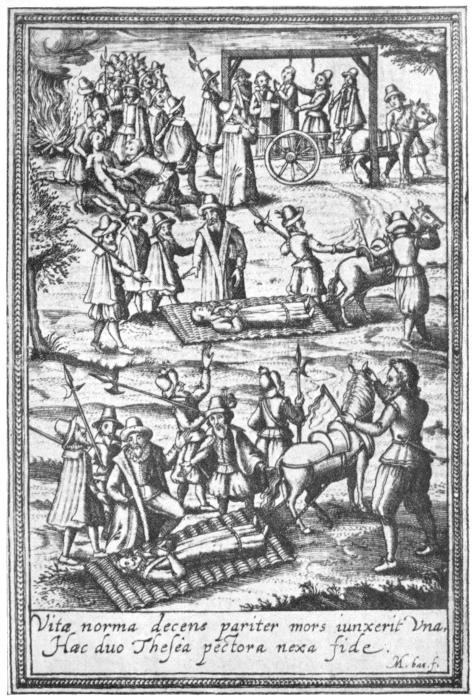
DRAWING ON HURDLES TO TYBURN, temp. ELIZABETH.
1592. January 22. William Patenson, condemned as a priest, drawn, hanged, and quartered at Tyburn. (Challoner’s Memoirs pt. i. p. 147).
June 23. Roger Ashton executed at Tyburn for procuring from Rome a dispensation to enable him to marry his cousin (Challoner’s Memoirs, pt. i. p. 148).
1593. The 21. of March, Henry Barrow, gentleman, Iohn Greenewood clarke, Daniel Studley girdler, Saxio Billot, gentleman, Robert Bowley, Fishmonger, were indicted of Felony at the sessions hall without Newgate beefore the Maior, the two lord Chiefe Justices of both benches, and sundry of the Judges & other commissioners of Oyer and determiner; the sayd Barrow and Greenwood for writing sundry seditious bookes, tending to the slaunder of the Queene and state; Studley, Billot, and Bowley, for publishing and setting foorth the same Bookes, and on the 23. they were all arraygned at Newgate, found guiltie, and had iudgement. On the last of March Henry Barrow and Iohn Greenwood were brought to Tyborne in a carre, and there fastened to the Gallowes, but being stayde and returned for the time, they were there hanged on the sixt of Aprill (Stow, p. 764-5).
1594. The 18. of February, [William] Harington, a seminarie priest, was drawne from Newgate to Tyborne, & there hanged, cut downe aliue, struggled with the hang-man, but was bowelled & quartered (Stow, p. 766).
1594. The last of February, Rodericke Loppez, a Portingale (as it was said) professing physicke, was arraygned in the Guild hall of London, found guiltie, and had iudgement as of high treason, for conspiring her Maiesties destruction by poyson.
The 7. of June, Rodericke Loppez, with the other two Portingales … were conuayd by water from Westminster to the Bishoppe of Winchesters staires in Southwarke, from thence to the K. bench, there laid on hurdles, and conuayd by the Sheriffes of London ouer the bridge, vp to Leaden hall, and so to Tyborne, & there hanged, cut downe aliue, holden downe by strength of men, dismembred, bowelled, headed & quartered, their quarters set on the gates of the cittie (Stow, p. 766, 768).
Camden’s account of this affair (greatly abbreviated) is that certain Spaniards prevailed on Roderigo Lopez, a Portuguese Jew, the Queen’s physician, Stephen Ferreira Gama, and Emanuel Loisie, both Portuguese, to poison the Queen. The convictions were obtained on the strength of confessions. “How far,” says Lingard, “these confessions made in the Tower, and probably on the rack, are deserving of credit, may be doubted” (ed. 1849, vol. vi. p. 554).
It is a strange feature in the case that while Camden, like Stow, speaks of the execution of all three, Lingard shows that Ferreira was saved.
The probability seems to be that Lopez fell a victim to the rivalry between Essex and the Cecils, each eager to prove greater zeal in the Queen’s service.[181]
Arising out of similar plots, real or pretended, were at this time other executions:—
On March 2, 1594, an Irish fencing master was hanged and quartered at Tyburn for a design to kill the Queen (Camden: Stow, “Summary,” p. 439), and “in less than two months from the beginning” of 1595, Edmund Yorke and Richard Williams were for the same reason executed at Tyburn (Camden, in Kennett’s “Complete History,” ii. p. 532).
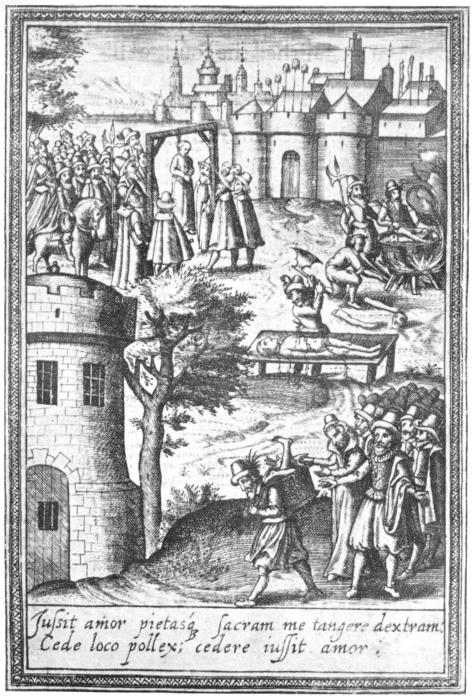
EXECUTIONS AT TYBURN, temp. ELIZABETH.
1595. The 20. of February, Robert Southwell, a Jesuit, was arraygned at the Kinges Bench barre, and the next day executed at Tyborne (Stow, p. 768).
Southwell was not only a Jesuit and martyr, but a poet of whom Ben Jonson said that he would willingly have destroyed many of his own poems could he have claimed the authorship of Southwell’s “Burning Babe.”
Southwell was ordained priest in 1584. With a full knowledge of the danger he incurred, he desired to go to England as a missionary priest. He landed in England in 1588. After many narrow escapes he was at last arrested by Topcliffe, the English Torquemada, in 1592, kept in prison for more than two years, and so brutally tortured and ill-used that his father petitioned Elizabeth that he might at once suffer death if guilty, or be better treated. Southwell had inspired sympathy, for at his execution the bystanders prevailed on the executioner to let him hang till dead.
1598. The 25. of January, one named Ainger was hanged at Tyborne, for wilfully and secretly murthering of his owne father a Gentleman and Counsellor of the Law at Graies Inne, in his chamber there (Stow, p. 786).
About the middle of November, 1597, a body was found floating on the Thames, and was identified as that of Richard Ainger, Anger, or Aunger, “a double reader” of Gray’s Inn, who had been missing for some time. On view of the body the surgeons gave it as their opinion that Ainger had met his death, not by drowning, but by suffocation, and that the body had been thrown into the river after death. Suspicion attached to one of his sons, Richard, and to Edward Ingram, a porter of the Inn.
The Privy Council addressed a letter to Mr. Recorder of London, Mr. Topcliffe, Nicholas Fuller, William Gerrard, and Mr. Altham, requiring them to examine strictly the two suspected persons, “and yf by those persuasions and other meanes you shall use you shall not be able to bring them to confesse the truthe of this horrible facte, then we require you to put them both or either of them to the manacles in Bridewell, that by compulsory meanes the truthe of this wicked murther may be discovered, and who were complices and privy to this confederacy and fact” (“Acts of the Privy Council,” New Series, xxviii. 187). The case is interesting as showing that torture was at this time used in ordinary criminal cases. All the dictionaries speak of manacles as instruments of restraint merely. In the present case they were evidently an instrument of torture. Its nature must have been well known to Shakespeare’s audiences, for in “The Tempest,” referred to the year 1610, Prospero says:—
“I’ll manacle thy neck and feet together” (Act I., sc. 2).
From the Middlesex Sessions Rolls we learn that the murder was done on the night of November 12th. Richard Ainger the younger, Agnes, his wife, and Edward Ingram were tried for the crime. Richard and his wife pleaded Guilty, and were sentenced to be hanged. From Stow’s account it would appear that Richard alone was hanged. Ingram was found Not Guilty (Middlesex County Records, i. 241).
1598. On the tenth of July, 19. persons for fellony were hanged at Tyborne, & one pressed to death at Newgate of London (Stow, p. 787).
1598. The ninth of November, Edward Squire, of Greenewich was arraigned at Westminster condemned of high Treason, and on the 13. drawne from the Tower to Tyborne, and there hanged, bowelled, and quartered (Stow, p. 787).
1601. After the capture of Essex—
On the 12th of February, Thomas Lea (a kinsman of Sir Henry Lea’s, who had wore the Honour of the Garter) told Sir Robert Crofts, Captain of a Man of War, that ’twould be a glorious Enterprize for six brave mettl’d Fellows to go to the Queen, and compel her to discharge Essex, Southampton, and the rest that were in Prison. He was a Man himself of great Assurance and Resolution, had Commanded a Company in Ireland, was very intimate with Tir-Oen, and an absolute Creature of the Earl of Essex’s. This did Crofts immediately discover to the Council; insomuch that Lea was sought for, and found in the dusk of the Evening about the door of the Q.’s Privy-Chamber. He seem’d very Thoughtful, was extreamly Pale, and in a great Sweat, and frequently ask’d, Whether her Majesty was ready to go to Supper? And, Whether the Council would be there? In this Posture he was seiz’d and Examin’d, the next day had his Trial, and by Crofts’s Evidence and his own Confession, condemn’d and carried away to Tyburn, where he own’d that he had been indeed a great Offender; but as to this Design, was very Innocent; and having moreover protested, that he had never entertain’d the least ill Thought against the Queen, he was there executed. And this, as the Times were, appear’d a very seasonable piece of Rigour.[182]
1601. The xxvii. of February, Marke Bakworth [Barkworth], and Thomas Filcoks [Roger Filcock], were drawne to Tyborne, and there hanged, & quartered, for comming into the Realme contrary to the statute. Also the same day, and in the same place, was hanged a Gentlewoman, called Mistris Anne Line, a widow, for relieuing a priest contrary to the same statute (Stow, p. 794).
The crime for which Mistress Line suffered was that, Mass having been said in her house, she assisted the priest in his escape.
An account of these executions is given in Hist. MSS. Commission, MSS. of the Duke of Rutland, 1888, i. 369, 370.
Mr. Barkwey cominge to the hurdle prayed and with a chearfull voyce and smylinge countenance sunge all the waye he went to execution.
The 27th daye of Februarie 1600 [1601], beinge the first Friday in Lent, the said Mr. Barkwey was brought to Tyborne there to be executed. Cominge up into the carte in his blacke habite, his hoode being taken of, his heade beinge all shaven but for a rounde circle on the nether parte of his heade, and his other garment taken of also, beinge turned into his sherte, having a pare of hose of haere, most joyfully and smylingly looked up directly to the heavens and blessed him with the signe of the crosse, sayinge, “In nomine Patris, Filii et Spiritus Sancti, Amen.” Then he turned himselfe towardes the gallowe tree wheron he was to suffer, made the signe of the crosse theron and kissed it and the rope also, the which beinge put about his necke, he turned himselfe and with a chearfull smylinge countenance and pleasant voyce sunge in manner and forme followinge, viz.: “Haec est dies Domini gaudeamus, gaudeamus, gaudeamus in ea”—usinge the same very often with these wordes, viz.: “In manus tuas, Domine, commendo spiritum meum.” Also he used these speaches to the people—“I doe confesse that I am one of the Blessed Societie after the holy order of St. Benedicte.” The minister called on him to be penitent for his sinnes, and he said, “Hold thy peace, thou arte a simple fellowe.” Then the minister wild him to remember that Christ Jesus dyed for him. And he, elevatinge his eyes to heaven and holdinge the rope in his handes—being festned together—so highe as he could reache, aunswered “And so doe I for him, and I would I had a thousand, thousand lyves to bestowe upon him in this cause,” sayinge “et majorem charitatem nemo habet.” And then turninge himselfe againe, sunge as before, and desired all Catholiques to praye for him, and he would praye for them. And beinge asked if he would praye for the Queene he saied, “God blesse her, and send her and me to meete joyfully in heaven,” and prayed also for Mr. Recorder who pronounced judgment against him, and for Mr. Wade, Ingleby, Parrat, and Singleton, who were the prosecutors of his death. And the carte beinge drawne awaye, in his goinge of from the carte saied the same wordes as before, “Haec est dies Domini; gaudeamus in ea,” and beinge presently cut downe, he stoode uprighte on his feete and strugled with the Executioners, cryinge, “Lord, Lord, Lord,” and beinge holden by the strengthe of the executioners on the hurdle in dismembringe of him he cryed, “O God,” and so he was quartered.
[I omit the account of the execution of Roger Filcock.]
There was executed also one Mistriss Lynde [Anne Line], condempned at the Sessions house the 26th day of February for the escape of a supposed preist. Her weakness was suche that she was carryed to the said Sessions betwixt two in a chaire.
There was also condempned with her one Ralphe Slyvell for rescuinge the said supposed preist, but repryved.
The said Mistriss Lynde, carryed the next daye to her execution, many tymes in the waye was stayed and urged by the minister who urged what meanes he could to perswade her to convert from her professed faithe and opinion, most constantlie persevered therin and so was brought to the place of execution and there shewed the cause of her cominge thither, and beinge further urged amongest other thinges by the minister that she had bene a common receavor of many preistes she aunswered, “Where I have receaved one I would to God I had bene able to have receaved a thousand.” She behaved herself most meekely, patiently, and vertuously to her last breath. She kissed the gallowes and before and after her private prayers blessinge herself, the carte was drawne awaye, and she then made the signe of the crosse uppon her, and after that never moved.
1601. The 13. of March, sir Gilley Merike Knight, and Henry Cuffe Gentleman, were drawne to Tyborne, the one from the Tower, the other from Newgate, and there hanged, bowelled, and quartered, as being actors with the late Earle of Essex. They both dyed very resolutely (Stow, p. 794).
Merrick was the steward and Cuff the secretary of the Earl.
1601. August 24. Thomas Hackshot, and Nicholas Tichburne, laymen, rescued a priest, Thomas Tichburne, from the custody of a constable. The two were arrested, condemned and executed at Tyburn (Challoner’s Memoirs, pt. i., p. 206).
1602. The xviii. of Aprill Peter Bullocke, stationer, and one named Ducket, for printing of Bookes offensiue were Hanged at Tyborne (Stow, p. 803).
This is a very bald account of an interesting case. James Duckett was a convert from Protestantism. As an apprentice he more than once got into trouble for his opinions; and his master, thinking that he himself might be involved, at last gave back the indenture to Duckett. Duckett now maintained himself by dealing in Catholic books, a commerce which frequently got him into prison, where it is said that he spent nine years out of twelve. A bookbinder, the Peter Bullocke mentioned above, lay in prison under sentence of death, and hoping to receive a pardon, informed against Duckett, a former customer. Duckett’s house was searched, popish books were discovered, and Duckett was condemned to death. The informer did not receive the reward of his betrayal; the informer and his victim rode to Tyburn in the same cart (Challoner’s Memoirs, pt. i., pp. 207-9).
The xx. of Aprill, Stichborne [Thomas Tichburn], W. Kenson [Robert Watkinson], and Iames Page [Francis Page], Semenarie Priestes, were drawne to Tyborne, and there hanged, bowelled, and quartered, for comming into this Realme, contrary to the Statute of Anno. 27, &c. (Stow, p. 803).
Thomas Tichburn is the priest for the rescue of whom his cousin Nicholas Tichburn, and Thomas Hackshot suffered in 1601. Page was the priest who was celebrating Mass in Mistress Line’s house in 1601, but contrived to escape.
1603. The xvii. of Februarie, W. Anderson [or Richardson] a Seminary Priest was drawne to Tyborne and there hanged, bowelled and quartered, for being found in England contrary to the statute of Anno. 27. (Stow, p. 812).
Anderson was the last of Elizabeth’s victims; she died a few weeks later.
1604. Master Robert Dow of London Merchant Taylor, in his most Christian charitie, pitying the miserable or rather desperate Estate of the poore condemned prisoners in Newgate, where very often and very many of them after Judgement of Death, and at their very Execution remaine most carelesse of their Soules health, Jesting and deriding their imminent danger and to the Judgement of the world die reprobate.
Upon tender Consideration whereof, and good hope of after reformation of such poore prisoners there, as through temptation of Sathan are, and will be too apt to fall into like danger the sayd Master Dow hath giuen competent Maintainance for ever, vnto Saint Sepulchers parish for the towling of the great Bell and for some especiall man, by them to bee appointed to come to the sayd Prison, the midnight before execution, and then distinctly and solemnly to ring a hand bell: then to pronounce with a lowd voice at the prison grate, a Godly and Christian remembrance on exhortation, appoynted by the Lord Bishoppe, beginning thus.
O ye prisoners within condemned, this day to dye, remember your sinnes, call to God for Grace, whilst yet you have time.
And in the Morning when they are in the Cart, iust against the Church, the partie aforesayd to put them in minde againe of their former liues, and present death, saying the great bell of this Church, which I told you last night should Toll for you from sixe of the clocke vntil ten, now tolleth to the end to moue good people to pray to God for you whilest your selues with them may pray for remission of your sinnes, &c. And at ten a clocke or at such time as knowledge may be truely had of the Prisoners execution the sayd great Bell shall bee rung out for the space of a quarter of an houre, (to the end all people may understand the execution is past) and then cease (Stow, pp. 862).
We are now in the reign of James I. In 1605 was the Gunpowder Plot, the memory of which is still kept alive by bonfires, and by the farcical search of the cellars of the Houses of Parliament. Gunpowder Plot does not come into the Annals of Tyburn, as none of the conspirators suffered here.
1607. February 26. Robert Drury, priest, for being in England, executed at Tyburn (Challoner’s Memoirs, pt. ii., pp. 13-5).
1608. The 11. of Aprill, George Ieruis [Gervase or Jarvis] a Seminary priest, according to his iudgement was executed at Tyborne (Stow, p. 893).
The 23. of June, Thomas Garnet, a Jesuite was executed at Tyborne, hauing fauor offred him, if he would haue taken the oath of alleageance aforesayd, but he refused it (Stow, p. 893).
Thomas Garnet was related to Father Henry Garnet, executed for the Gunpowder Plot in 1606. Thomas Garnet was convicted on evidence that while a prisoner in the Tower he had written in several places “Thomas Garnet priest.” The Earl of Exeter, one of the Privy Council, present at the execution, would not suffer the rope to be cut till the victim was quite dead (Challoner’s Memoirs, pt. ii., pp. 17-9).
1610. December 10. John Roberts, and Thomas Somers, or Watson, or Wilson. These were priests. Roberts was apprehended for the fifth time at Mass and hurried away in his vestments. Somers had been deported, together with about a score of priests, earlier in the year, but returned to England. With Roberts and Somers were executed sixteen persons condemned for various offences. The priests were suffered to hang till they were dead and then bowelled, beheaded, and quartered, and buried with the sixteen in a pit (Challoner’s Memoirs, pt. ii., p. 37).
1612. William Scot and Richard Newport, or Smith. These were missionary priests who had been banished but returned to England (Challoner’s Memoirs, pt. ii., pp. 39-44).
The burning of Protestant heretics went on through the reigns of Elizabeth and James—“the fires of Smithfield” were not extinguished by the death of “bloody Mary.” Anabaptists and Arians were burnt, the printers, the distributors, even in one case the binder, of books “seditiously penned against the Book of Common Prayer” were hanged.
It is painful to find the genial Howell writing thus in 1635:—
I rather pity than hate Turk or Infidel, for they are of the same metal and bear the same stamp as I do, tho’ the Inscriptions differ. If I hate any, ’tis those Schismaticks that puzzle the sweet peace of our Church, so that I could be content to see an Anabaptist go to Hell on a Brownist’s back (“Familiar Letters,” ed. Jacob, p. 337).
December 5. John Almond, condemned for having taken orders beyond the seas and for remaining in the kingdom, drawn, hanged and quartered (Challoner’s Memoirs, pt. ii., pp. 44-51).
1615. The murder of Sir Thomas Overbury is, with the possible exception of the supposed murder of Sir Edmund Berry Godfrey, a little more than sixty years later, the greatest of all English causes célèbres. The story involves many persons of high rank, including one in the highest, King James himself; its events are extremely complicated, and some details are of a nature requiring delicate handling in the telling. It has been told, after the fullest study of the facts, by Mr. Andrew Amos, in “The Great Oyer of Poisoning,” 1846, a volume of over five hundred pages, of which indeed many are filled with digressions seriously interfering with the narrative. It is not possible to give here more than the barest outline of the case.