ANNALS
Reading edition
ON TYBURN Oh Tyburn! coud’st thou Reason and Dispute; Coud’st thou but Judge as well as Execute; How often would’st thou change the Felon’s Doom, And truss some stern Chief-Justice in his room? Then should thy sturdy Posts support the Laws, No Promise, Frown, nor popular Applause, Shou’d sway the Bench to favour a bad Cause. Nor Scarlet Gown, swell’d with Poetick Fury, Scare a false Verdict from a trembling Jury. Justice, with steady Hand and even Scales, Should stand upright, as if sustain’d by Hales. Yet still, in Matters doubtful to decide, A little bearing tow’rds the milder side. Dryden, Miscellany Poems, 5th ed., 1727, v. 126.
ANNALS
To tell fully the story of Tyburn for the six centuries of its existence would need many volumes. As a selection has to be made, I have chosen rather to take the older and less familiar incidents than to dwell on those of the eighteenth century, already well known.
In telling the stories found in the old chronicles, I have refrained from giving in my own version what I found adequately told by the old writers. Thus, if I quote Stow, Hall, or Holinshed for events that happened long before their time, it is, of course, not as first-hand authorities, but because their rendering is certainly more interesting than any I could give.
The reader will not fail to observe how extremely meagre are these annals for the first centuries of Tyburn. For the first hundred years, 1177 to 1273, there appear here only eight cases. For this century and down to the year 1535, I have, I think, given all the Tyburn tragedies recorded by the old chroniclers. The explanation of this meagreness is, that the chroniclers noted only executions arising out of political incidents or out of social incidents of extraordinary interest: only in times comparatively late do we get glimpses of the work done by the gallows on small offenders. All through the long era of religious persecutions we hear little of ordinary criminals: only now and again some number is mentioned of those executed or tumbled into a pit together with a priest.
I may be asked how I arrive at the conclusion stated in the introductory remarks, that a moderate estimate would place the number of those executed at Tyburn at fifty thousand. As the gallows was at work for six hundred years, this number would give an average of less than one hundred a year. Four streams of victims converged on Tyburn. The gallows was fed from the courts of Westminster and Guildhall (see, for example, cases in these Annals under the years 1242, 1295, 1441, and 1495). But the great purveyors of the gallows were the Middlesex Sessions and the Old Bailey Sessions, the first for the county, the latter for the City and its Liberties.
It appears that there are no records of the number of persons hanged in pursuance of sentences passed at the Old Bailey Sessions: fortunately, the case is different as regards the Middlesex Sessions. The labours of Mr. John Cordy Jeaffreson[112] have placed us in possession of exact accounts of the numbers hanged at certain periods for felonies committed in the county of Middlesex. For ten years, 6th to 15th James I., these number 704. Mr. Jeaffreson justly argues that the felonies committed in the City and its Liberties must have exceeded in number those committed in the adjacent county. But, taking them as only equal in number, we get 704+704=1,408, or a yearly average of over 140. He finds no reason to suppose that executions were less frequent during the reign of Elizabeth. On the assumption that the rates were equal and continuous through the two reigns, we have a total for this period of 66 years of 9,240.
The returns for the reign of Charles I. are defective in respect of some years. Even after making allowance on this account, the average for Middlesex is not higher than 45. Doubling this as before, we get 90, as against the Jacobean 140. Mr. Jeaffreson accepts this remarkable fall, ascribing it to several causes: the spread of education, enabling more persons to plead their clergy; a growing disposition on the part of juries to convict of petty larceny only on evidence of grand larceny; the larger number of reprieves; the greater readiness of juries to give the prisoner the benefit of doubt; finally, the operation of the Act, 21 James I., c. 6, which in an indirect way put women on a level with men in respect of clergyable offences.
The rate was exceeded, but not very greatly, during the Commonwealth. We will take the average of 90 for the period covered by the reign of Charles I. and the Commonwealth.
Under the years 1535-7, I have written at some length on the results of the social convulsion produced by the dissolution of the monasteries and the enclosures. In estimating the number of executions for the reign of Henry VIII., we may take the Jacobean rate of 140 per annum for the earlier years of the reign, from 1509-35—twenty-seven years. We shall probably be well under the mark in quadrupling the Jacobean rate for the remaining eleven years of this reign, and for the six years of the reign of Edward VI. For the troubled reign of Mary we will double the Jacobean rate. We may now tabulate the results of a calculation on the basis of the foregoing assumptions:—
Reign. Duration, Years. Assumed Yearly Average of Executions at Tyburn. Total.
Henry VIII. 27 140 3,780 } 9,940
Ditto 11 560 6,160
Edward VI. 6 560 3,360
Mary 5 280 1,400
Elizabeth 44 140 6,160
James I. 22 140 3,080
Charles I. 24 90 2,160
Commonwealth 11 90 990
150 27,090
It is, of course, not claimed that this table presents more than the results of reasonable conjecture—with the data available we cannot get beyond conjecture. The table shows 27,090 executions at Tyburn in 150 years, leaving fewer than 23,000 to be made up in the remaining 450 years to the conjectured number 50,000. This gives a yearly average of less than 52, which is certainly very low.
During the last hundred years of the existence of Tyburn, political executions become more and more rare; the interest of Tyburn becomes more and more a social interest. The salient feature of this period is furnished by the exploits of highwaymen: it might almost be called the era of the knights of the road. Apart from this, the striking feature of the later history of Tyburn, say from the accession of William III., is the constantly increasing ferocity of the laws. The reign of William saw passed the infamous Act inflicting the punishment of death for stealing in a shop to the value of five shillings. Through succeeding reigns Acts were heaped on Acts, making this and that crime a capital offence. No opportunity was lost of loading the Statute Book with these odious Acts, till, as has been estimated, the law of England reckoned two hundred capital offences. Children were hanged or burnt, according to sex; nor did even this satisfy the ferocity of the governing classes. Theorists advocated a return to the barbarous punishments of rude times: the State, by diminishing the time accorded for repentance, sought to pursue its victims beyond the grave. The heaping up of death-punishments continued beyond the time when Tyburn ceased to uphold the majesty of the law. In the year 1786 an Act was passed imposing duties, denoted by stamps, on perfumery and the like—the duties ranged from one penny upwards. To counterfeit such a stamp was DEATH, so that to defraud the State of one penny put an offender in jeopardy of his life.
All honour to those who, like Fielding, Mandeville, Meredith, Basil Montague, Bentham, Romilly, laboured to bring home to their fellow-citizens a sense of the iniquity of these murderous laws. Nor should we forget their predecessors. Sir Thomas More stated once for all the true view of the case: “This punyshment of theues passeth the limites of Iustice, and is also very hurtefull to the weale publique. For it is too extreame and cruel a punishment for thefte, and yet not sufficient to refrayne and withold men from thefte. For simple thefte is not so great an offense, that it owght to be punished with death.” We owe also grateful mention to Samuel Chidley, who, in the time of the Commonwealth, wearied not in protesting against “this over-much justice in hanging men for stealing.”
1177. The first recorded execution which can be referred to Tyburn occurred in this year. It is probable that Tyburn was the place of execution, but, leaving this case aside for the time, we come to the execution of William Fitz Osbert, or “Longbeard,” expressly stated to have been carried out at Tyburn.
1196. William Fitz Osbert, or Osborn, popularly known as “Longbeard,” was a citizen of London, described as skilled in the law. He is first made known to us by the story of a vision seen by him and a companion on board a ship, one of the fleet of Richard Cœur de Lion, on its way to the Holy Land.
In a great storm at sea there appeared to them three times St. Thomas of Canterbury, who said to them, “Fear not, for I and the Blessed Martyr Edmund, and the Blessed Confessor Nicholas have taken charge of this ship of the King of England. And if the men of this ship will eschew evil and seek pardon for past offences, God will give them a prosperous voyage.” Having thrice said this, he vanished and the storm ceased. This was in 1190. Richard, on his return, was captured and held to ransom by the emperor. The raising of the ransom proved very grievous to the people. There was trouble in the City of London as to the way of assessing the burden. The poorer sort claimed that the citizens should not be called on to pay so much per head, whether rich or poor, but that the assessment should be according to means. William Longbeard took the part of the poor citizens: it came to be a matter to be fought to the death between the magnates and Longbeard. Moreover, Longbeard had accused of extortion Hubert, Archbishop of Canterbury and Justiciar. An armed band was told off to arrest Longbeard. He resisted, slew two chiefs of the band, but was compelled to fly for protection to the church of St. Mary-le-Bow. Then the archbishop did a thing unheard of. He, a churchman, bound by every consideration to guard the privileges of the church, set at nought the right of sanctuary, kindled a fire, and drove Longbeard out of the church. In his attempt to escape Longbeard was wounded by the son of one of those whom he had killed in trying to escape arrest. He was hurried to trial: the great men of the city and the king’s officers joined in urging the justiciar to inflict the severest punishment on the offender. This was the punishment: His upper garments were taken off, then his hands were bound behind his back, and, attached by ropes to a horse, he was dragged from the Tower through the City to Tyburn, and there hanged alive by a chain.
What was he, unscrupulous demagogue or martyr in the cause of the poor? Each view was held by his contemporaries. He seems to have behaved very badly to his elder brother, whose care for him during his youth he repaid by bringing against him a charge of treason. On the other hand, it is clear that Longbeard’s enemies had against him a case which it was necessary to strengthen by baseless accusations. He was charged with blaspheming the Virgin Mary, and with taking his concubine into Bow Church. The last charge seems disproved by the circumstances in which Longbeard fled to the church for refuge. It was also set about that he was put to death for “heresy and cursed doctrine,” whereas it is obvious that his offence was political. Be this as it may, his enemies triumphed; Longbeard was drawn and hanged with nine of his fellows. But “the simple people honoured him as a Martyre, insomuch that they steale away the gibbet whereon he was hanged, & pared away the earth, that was be-bled with his blood, and kept the same as holy reliques to heale sicke men.” Hubert, the archbishop, drove them away. But two years later the monks of Canterbury presented to the Pope charges against Hubert. The first is that he had violated the peace of the Church of Bow by forcing out Longbeard and his fellows. The Pope advised Richard to remove Hubert from the office of justiciar, and not to employ churchmen in secular offices. Hubert resisted for a while, but in the end accepted his dismissal.
Stow, in his “Survey” (ed. Thomas, p. 96), says that Longbeard was hanged at “the Elms in Smithfield,” but there is no authority for this.
The evidence that “The Elms” of Tyburn was the place of execution is full: “Ad furcas prope Tyburnam,” Chronicle of Ralph de Diceto, ed. Stubbs, ii. 143; “ad furcas prope Tiburcinam,” Roger of Wendover, ed. Coxe, iii. 95, ed. Hewlett, i. 244; Gervase of Canterbury has “ad Ulmos,” ed. Stubbs, i. 533-4; “ad Ulmetum,” Matthew Paris, Chron. Maj., ed. Luard, ii. 419; Hist. Anglor., ed. Madden, ii. 57-8.
Diceto, Dean of St. Paul’s, is believed to have died about 1202; Roger of Wendover died in 1236: their evidence is, therefore, first-hand.
1177. From the accounts of the execution of Longbeard it is quite clear that in 1196 Tyburn was established as the place of execution; in the detailed accounts given there is no hint that this was the first execution carried out here. It has been shown that gallows existed here as early, probably, as 1170. When, therefore, we find mention of an execution of a date earlier than that of Longbeard, taking place at London, for a crime of which the royal court would necessarily have cognisance, it is at least highly probable that Tyburn, though not expressly mentioned, was the place of execution.
The crime of 1177 is one of those few social crimes, as distinguished from political offences, of which the chroniclers make mention; the story reveals a strange picture of the manners of the time.
During a council held at London the brother of the Earl of Ferrers was murdered in his inn, the body being afterwards thrown into the mud of the street. When the king heard of this he was greatly moved, and swore that he would visit the crime heavily upon the citizens of London. For it was said that a hundred and more of the sons and relatives of the nobles of the City were in the habit of breaking into the houses of wealthy men for the purpose of robbery. And if they found any one going by night about the streets they forthwith murdered him without pity, so that for fear of them few dared to go about the City by night. So it came about that in the third year before this, the sons and nephews of certain nobles of the City, meeting together by night, for the sake of plunder broke into the stone house of a certain rich man of London, using iron wedges for the purpose of making an opening, by which they entered. But the head of the house had been warned beforehand of their intent, wherefore he put on a leather cuirass, and had with him several nobles and trusty servants also protected by armour, sitting with him in a corner of the house. And when he saw one of those thieves, by name Andrew Bucquinte, pressing on in front of the others with glowing face, he brought forward a pot full of live coals, and hurriedly kindled some wax tapers which he carried in his hand, and rushed upon him. Which beholding, the said Andrew Bucquinte drew his knife from its sheath and struck the master of the house; but he failed to wound him because the blow fell upon the cuirass. And the master of the house quickly drawing his sword from its sheath, returned the blow, and lopped off the right hand of the said Andrew Bucquinte, crying with a loud voice, “Thieves, thieves!” and hearing this all fled except him who had lost his hand, he being held by the master of the house. And when day broke he took him to Richard de Lucy, the king’s justice, who threw him into prison. And the thief, on promise of life and limb, gave up the names of his companions, many of whom were taken, though many also escaped. Among those taken was a certain very noble and very rich citizen of London, by name John Senex, who being unable to clear himself by the ordeal of water, offered to the king five hundred marks of silver for his life. But as he was condemned by the ordeal of water, the king refused to accept the money, and ordered that judgment should be done upon him, and he was hanged.[113]
1222. In one of the ancient records of the City of London, the “Liber de Antiquis Legibus,” there occur two short notices:—
A.D. 1197, Constantine Fitz-Athulf and Robert le Bel (as Sheriffs).
A.D. 1221. In this year Constantine Fitz-Athulf was hanged, and that without trial.
The story of the execution without trial of one who had been sheriff of the great and powerful City compels attention. It is thus told by the chroniclers, the date assigned being 1222 or 1223:—
In this year, on the feast of St. James the Apostle, July 25, the inhabitants of London and those of the neighbouring country, having challenged one another to a wrestling match, met near the hospital of Queen Matilda, outside the City (St. Katherine’s Hospital, near the Tower) to decide who were the stronger in this sport. The contest was long, and after great efforts on both sides, the citizens of London had the best of the contest, to the chagrin of their adversaries. He who took the defeat most to heart was the seneschal of the abbat of Westminster, who devised means to avenge the defeat of his party. Having formed in his mind a plan of vengeance, he issued a fresh challenge for the feast of St. Peter’s Chains (August 1st), and sent word for everyone to come to Westminster to wrestle, promising a ram as a prize. That being done the said seneschal got together strong and practised wrestlers, so that the victory might be thus gained. The citizens of London, wishing to distinguish themselves a second time, came in great numbers to the appointed place. The contest began, those on one side and the other trying to throw their opponents to the ground, but the seneschal of whom mention has been made, having brought up people from the neighbourhood and from the country, turned the contest into a fight which would satisfy his revenge. He took up arms without provocation and furiously charged, not without bloodshed, the unarmed citizens of London. The citizens, wounded and insulted, fled in disorder to the City. There ensued a great tumult: the common bell was rung and brought the people together. The story went about, every one gave his opinion, and proposed his plan of revenge. At last the Mayor, Serle, a man prudent and peaceful, advised that complaint should be made to the abbat of Westminster, and said that if he would consent to make suitable reparation, every one should then be satisfied. But Constantine, who had great power in the City, declared amid great applause that it would be better to throw down all the houses belonging to the abbat of Westminster, as well as the seneschal’s house. Forthwith an order was drawn up, enjoining the immediate execution of Constantine’s project. A blind multitude, a mad populace, entrusted Constantine with this civil war, flung itself in a tumult on the possessions of the abbat, demolished several houses, and did great damage. In the midst of this scene was Constantine, continually reciting the order, and crying with all his might, “Montjoie! Montjoie! God and our lord Louis be our help!”
This cry, more than anything else, provoked the king’s friends, and made them determine to exact punishment for this sedition, as we will now tell. The facts soon got about, and came to the ear of Hubert de Burgh, the justiciar, who, having got together a number of knights, put himself at their head and went to the Tower of London, from which he sent a message to the elders to come to him without delay. When they were before him he asked who were the principal movers in the sedition; who were they who had dared to trouble the royal city, and break the king’s peace? Then Constantine, constant in his presumption and pride, answered otherwise than was either becoming or prudent. “It is I,” he said, “what wilt thou?” He declared that he was protected by treaty, that he could justify what he had done, which was even less than he ought to have done. He trusted to the oath taken by the king as well as by Prince Louis, by the terms of which the friends and partisans of one or the other were to be left in peace.
The justiciar, hearing this avowal of Constantine, detained him and two of his abettors, without exciting any disturbance. The next morning he sent Fawkes de Bréauté (known to him as a man ready for any cruelty) with an armed force to carry Constantine by way of the Thames to be hanged at The Elms. Quickly and secretly they carried him thither, and when Constantine had the rope round his neck, he offered fifteen thousand marks of silver if his life might be spared. To whom answer was made that never more should he get up a riot in the king’s city. Hanged therefore he was, together with Constantine, his nephew, and a certain Geoffrey, who had proclaimed the order in the City.
Thus was the sentence on Constantine carried out unknown to the citizens, and without disorder. That done, the justiciar made his entry into London, with Fawkes and the armed men who had gone with him. He arrested all known to have taken part in the riot, threw them into prison, and let them out only when he had caused their feet or hands to be lopped off. Numbers fled and never returned. The king took sixty citizens as hostages, and deposed the magistrates and put others in their room. Moreover, he ordered that a great gallows should be set up.[114]
1236. About this time some bold but rash nobles in England, seduced by we know not what spirit, conspired together, and entered into an execrable alliance to ravage England like robbers and night-thieves. Their design, however, became known, and the chief of the conspiracy—to wit, Peter de Buffer, one of the king’s doorkeepers—was taken prisoner, and by him others were accused. In order to whose execution a dreadful machine, commonly called a gibbet, was set up in London, and on it two of the chief conspirators were hanged, after having engaged in single combat. One of them was killed in the fight, and was hanged with his head cleft open, and the other, hanged alive, breathed forth his wretched life on the same gibbet amid the lamentations of the assembled multitude.[115]
1239. A certain messenger of the king, named William, had been convicted of manifold crimes, and lay in prison under sentence of death. He brought accusations of treason against several nobles; he also made a criminal charge against Ralph Briton, a priest and canon of the Church of St. Paul’s, London, who had for some time been a familiar friend of the king, and had held the office of treasurer. On this coming to the king’s ears he by letter ordered the Mayor of London, William Gromer (or Gerard Batt), to seize Ralph and imprison him in the Tower of London, and the Mayor obeying the king rather than God, at once carried the king’s orders into effect. He dragged the said Ralph with violence from his house near St. Paul’s, and imprisoned him in the Tower, securing him with chains, commonly called rings. The Dean of London, Master G. de Lucy, informed of this, took counsel with his fellow canons (the bishop being absent), and pronounced a general sentence of excommunication against all the presumptuous perpetrators of this enormity, and placed St. Paul’s Church under an interdict. The king, however, although warned by the bishop, did not amend his faults, but continued with threats to heap evils on evils, so that the bishop was about to place the whole of the City of London, which was subject to him, under an interdict: but when the archbishop of Canterbury, as well as the legate, the bishop of London, and many other prelates, were prepared to lay a heavy hand on the City, the king, although unwillingly, ordered the said Ralph to be released, and allowed to depart in peace. But when the king sought to add the condition that Ralph should be so kept as to be ready to give an explanation when the king required it, the churchmen replied that they would not on any account keep him in this manner, like an imprisoned man, but that the church should receive him as absolutely free, just as when the king’s attendants tore him by force from his house. In this manner then was Ralph released.
Not long afterwards, the before-named villain, who had, as above stated, calumniated the nobles and the aforesaid Ralph, was ignominiously hanged outside the City of London, on that instrument of punishment called a gibbet: and when he saw that death was certain, he, although late, openly confessed before the people and his executioners that he had made the aforesaid accusations only for the purpose of prolonging his life.[116]
1242. William de Marisco, or Marsh, was the son of Geoffrey, justiciar or viceroy of Ireland. In 1235 Henry Clement, a messenger from the Irish peers to the king, was murdered in London. William Marsh was accused of the murder, but he always protested his innocence. William was also accused of being implicated in the attempted assassination of the king at Woodstock (p. 30). His father, Geoffrey, was also suspected of being privy to the attempt, and his lands being seized on this account, he fled to Scotland, whence he was finally driven out at the king’s instance, dying friendless and poor in France. This is the chronicler’s account of the doings of William after his father’s fall:—
William sought refuge in a certain island not far from Bristol, Devon, or Cornwall, named Lundy, an impregnable retreat. Here, having drawn to himself a number of outlaws and fugitives, he lived by piracy; he gave himself up to plunder and rapine, seizing the goods of merchants trading in those parts, especially wine and provisions. He also made sudden descents on the coasts, carrying off booty, injuring greatly thereby the kingdom of England, by preying upon merchants, both native and foreign. Now, a great number of nobles, English as well as Irish, who could not honourably dwell at home while the king was engaged in war in parts beyond the sea, journeyed across the countries not far distant from the said island, and ascertained beyond doubt that the said William and his band could be taken only by stratagem. They told the king that he must proceed in the matter not violently, but cautiously, in order to capture these devastators. The king therefore gave his orders to trusted men, engaging them by the promise of a rich reward to undertake the capture of this man and the deliverance of their country. The said William was hateful to the king, because he suspected him of being privy, together with his father, Geoffrey, to the attempted assassination, and to have been wickedly guilty of treason by sending the wretch who went by night to Woodstock to cut the king’s throat; also to have killed in London, in the king’s presence, a certain messenger sent by an Irish nobleman. William’s denial of the charges was not believed, nor even listened to. Therefore he imprudently sought safety in remote places, living like an outlaw and a fugitive.
After narrating other events, the chronicler continues:—
About this time, William Marsh, a knight, of whom mention has been made, while he was still in the above-mentioned island, plundering and planning ambushes, was himself captured by a stratagem, carried out by the king’s loyal servants, loaded with chains, brought to London and thrown into the Tower. His capture was brought about by the treachery of some of his band. His stronghold was situated on a very high rock, surrounded on all sides by the sea, absolutely impregnable, for none could get access to it otherwise than by a ladder, and that in but one place. William sitting down to table, during foggy weather, had imprudently left the watch of this post to a man who, being detained by William by force, was therefore ready to betray him.
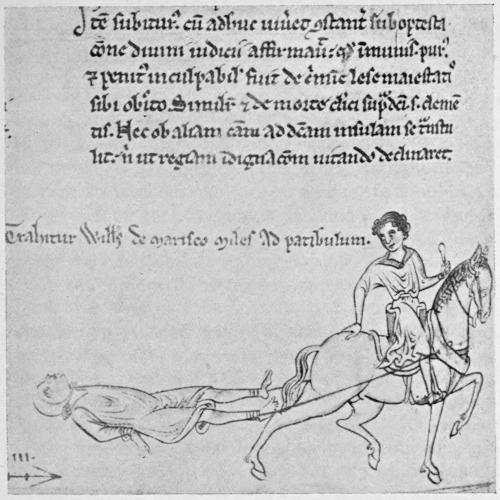
SIR WILLIAM DE MARISCO (WILLIAM MARSH) DRAWN TO THE GALLOWS IN 1242.
On the eve of St. James [July 25], by virtue of the king’s mandate, the said William and sixteen of his band, taken with him, were judicially condemned, and put to death ignominiously, for so the king willed.
First, therefore, he was drawn from Westminster to the Tower of London, and thence to that instrument of punishment, commonly called a gibbet: when he had there breathed out his wretched soul, he was hanged on one of the hooks, and when the body was stiff it was let down and disembowelled, and the bowels were at once burnt on the spot. Then the miserable body was divided into four parts, which were sent to four of the chief cities, so that this lamentable spectacle might inspire fear in all beholders. All his sixteen companions were drawn at the tails of horses through the City of London, and hanged on the gallows. But the said William, after sentence was passed on him, and when he was about to face death, protested to his last breath, invoking the divine judgment, that he was innocent, pure, and wholly without blame, as well in respect of the criminal attempt on the king, as of the death of the above-mentioned messenger, that is to say, Clement. Nor did he take refuge in the said island except to avoid by his flight the king’s anger, which he had above all things desired to appease, either by ordeal of any kind, or otherwise by submission. But after he had fled to the said island, and had got together his band, he had no choice but to plunder in order to maintain a wretched existence. He poured out his soul to God, in confession to John of St. Giles, a friar of the order of preachers: with contrition and tears he admitted his sins, not seeking to extenuate them, but even accusing himself. Therefore the friar preacher, a discreet man, who received his confession, gave him gentle consolation, and dismissed him in peace, exhorting him to suffer his punishment with patience, as a means of penance. And, therefore, as has been said, he suffered—dreadful to tell—not one death only, but several horrible deaths.[117]
1255. The story of Little St. Hugh, the Martyr of Lincoln, comes into the Annals of Tyburn through the execution of eighteen Jews supposed to have been guilty. It is interesting to see what Chaucer has made out of this squalid tragedy in the Prioress’s Tale, one of the most beautiful of the Canterbury Tales. The reader will not need to be reminded that Norwich had its boy-martyr, St. William, supposed to be done to death in the same way in 1144. Bury St. Edmund’s had also its boy-martyr.[118]
Matthew Paris tells the story:—
About the time of the feast of the Apostles Peter and Paul, the Jews of Lincoln stole a boy named Hugh, about eight years of age. They kept him shut up in a very secret room, where they gave him milk, and other food such as is given to children, and sent word to most of the cities of England in which Jews dwelt, summoning from each some Jews to be present at the sacrifice which was to take place in Lincoln, in contempt and derision of Jesus Christ. For, as they said, they had a child hidden in preparation for the sacrifice. And many assembled at Lincoln; and when they were gathered together, they appointed a Jew as judge, as it were Pilate, by whose sentence, approved by all, the boy suffered various tortures. He was beaten till blood was drawn and his body was black and blue: crowned with thorns: spat upon and overwhelmed with jibes: then each one pricked him with knives of the kind called anelaces: he was made to drink gall, and, jeering at him, and grinding their teeth, they called him false prophet. And when they had thus mocked him in many ways, they crucified him, and thrust a lance into his heart. And when the boy was dead, they took the body down from the cross and took the bowels out of the little body, for what purpose is not known, but it is said that it was for some practice of magic.
Now the mother of the child diligently sought for her son during many days. In the end the neighbours told her that they had last seen the boy playing with some Jewish boys of his own age, and that he went into the house of a certain Jew. At once, therefore, the woman went into that house, where she saw the body of her son, which had been thrown into a well. The bailiffs of the city, having been cautiously got together, the body was found and taken out of the well, and exhibited to the people. But the mother of the boy, crying aloud and lamenting, excited to tears and sighs, all, yes, all the citizens who had flocked together. Now there was present Sir John of Lexinton, a man circumspect, discreet and of elegant literary acquirements, who said: “We had already heard that the Jews have not feared to do such things in contempt of our crucified Lord, Jesus Christ.” And one Jew being arrested, into whose house the boy had gone, in playing about, on whom therefore suspicion fell rather than upon others, he said to him: “Wretch, thou knowest that all thou hast to expect is swift destruction. All the gold of England cannot suffice to free or redeem thee. Nevertheless, I tell thee, however unworthy thou art, how thou canst save thy life, and thy limbs from torture. Both things I promise to thee if thou dost not fear to tell me without falsehood all that has taken place.” Then the Jew, whose name was Copin, thinking he had found a way of escape, said: “Sir John, if your deeds are as good as your words I will tell you strange things.” And Sir John carefully heartened him and pressed him. Then said the Jew: “What the Christians say is true. The Jews nearly every year crucify a boy in derision and contempt of Jesus Christ. But this is not found out every year, because it is done secretly and in remote and hidden places. But our Jews have most pitilessly crucified this boy, named Hugh, and when he was dead and they wished to conceal his death they knew not how either to bury or to hide him. For they had no further need of the body of the innocent for augury: for that purpose they had taken out the bowels. But in the morning, when they thought it was hidden, the earth rejected it and threw it up, and the body appeared for a while on the earth, unburied, which frightened the Jews. Then they threw the body into a well, but even so it could not be hidden. The mother, making enquiry, found the body and gave notice to the bailiffs.” Sir John had the Jew put in chains.
And when the canons of the cathedral church of Lincoln learnt of these things, they begged that the little body might be given to them, and this was done. And when it had been seen by a great number of people, the body was buried in the church of Lincoln, as that of a precious martyr. It is to be noted that the Jews had kept the boy alive ten days, and had fed him upon milk, so that he might live to bear all kinds of torture.
When the king returned from the northern parts of England and was informed of what had passed, he blamed Sir John for promising life and limb to such a wretch, and he refused to ratify this, for this blasphemer and murderer had deserved many deaths. And when the criminal saw that an irrevocable sentence threatened him, he said: “Death threatens me, nor can Sir John save me. Now will I tell the truth to all of you. Almost all the Jews of England consented to the boy’s death of which they are accused. And from almost every city of England in which Jews dwell, certain men, chosen for the purpose, came to the immolation of the child, as to a sacrifice of Passover.”
When he had said other hateful things, he was made fast to the tail of a horse and drawn to the gallows, and given over body and soul to the evil demons of the air. And other Jews, accomplices in the crime, to the number of ninety-one, were taken in carts to London and put in prison. If perchance some Christians shed tears for their fate, their lot was bemoaned with dry eyes by the Caursins, their rivals.
Afterwards, by enquiry made by the justices of our lord the king, it was discovered that the Jews of England, by common accord, had killed this innocent boy by crucifixion, after having beaten him for several days. Later, the mother of the said boy pressed upon the king her accusation of those guilty of the death, and God, the Lord of Vengeance, meted out to them retribution according to their deserts. For on the feast of St. Clement, eighteen of the richest and greatest of the Jews of Lincoln were drawn to new gallows, prepared for them, and left to the winds. And in the Tower of London sixty more were kept in prison, expecting the same fate.
1256. At this same time, certain Jews, infamous by reason of the unhappy death of the boy crucified at Lincoln, found guilty by the oath of twenty-five knights, and condemned to death, lay in prison, to the number of three score and eleven, in order that they might be hanged. They sent, as their rivals declare, secret messengers to the minorite friars with the view that they should intercede for them, that they might be released from prison, notwithstanding that they were worthy of a most ignominious death. The friars, as the world said (if the world is to be believed in such a matter), were induced by money to procure the freedom of the Jews by their prayers and intercession, from the imprisonment and death they had deserved. But in my opinion, it is to be believed that the friars acted from piety, guided by a spirit of compassion, because, so long as any one is alive in this world, he can still use his will, so that there is hope of him. But for the devil and for those manifestly damned, one can neither hope nor pray, because there is no hope for them. Now death and a final sentence had irrevocably ensnared them. But this way of looking at the matter cannot excuse the friars, nor prevent scandal from blackening their character. The people drew back their hands from giving them alms as they had before done. So it fell out that the devotion of Londoners towards the minorites grew lukewarm, just as the charity of the Parisians grew cold towards the preachers, who there sought to weaken the ancient and approved customs of the University.
In the same year, on the Ides of May, four score and eleven Jews were released from the Tower of London, where they had lain in fetters, for the crucifixion of Saint Hugh, the boy of Lincoln. These Jews, I say, were found guilty upon oath, in accordance with the statement of the Jew who at the first was hanged at Lincoln.[119]
1267. It happened about the Feast of Saint Katherine [November 25] in this year, that a dispute arose between certain of the craft of the goldsmiths and certain of the craft of tailors: to whom adhered, on the one side and the other, some of the trade of the parmenters [dealers in broadcloth] and some of the tawyers [who prepared fine leather], which persons held great assemblages, and for three nights together went armed through the streets of the City, creating most severe conflicts among themselves. Hence, without doubt, as was said, more than five hundred of these mischievous persons were collected together at night, and in the affray many of them were wounded: but still, no one would act a part that belongs only to the Bailiffs. For every one was waiting by force of arms to take vengeance on his adversary, against the peace and his own fealty to his lordship the King: the Bailiffs and discreet men of the City understanding which, had more than thirty of them seized and imprisoned in Newgate: and these, on the Friday next after the Feast of Saint Katherine, appeared before Laurence de Broc, the Justiciar assigned for gaol delivery, who took proceedings against them in the King’s behalf, saying that they, against the peace and their fealty to his lordship the King, had gone armed in the City, and had at night wickedly and feloniously wounded some persons, and had slain others, whose bodies, it was said, had been thrown into the Thames.
They however denied violence and injury, &c., and as to the same put themselves upon the verdict of the venue. But on the morrow, those who by the said venue were found to have been in the conflict aforesaid, were, by the judgment of the said Justiciar, immediately hanged, although not one among them had been convicted of homicide, mayhem, or robbery. Hence, one Geoffrey, surnamed “de Beverley,” a parmenter by trade, because certain of those misdoers had armed themselves in his house, and he himself had been present with them in arms in the said affray, was hanged, together with twelve others who had been indicted, as well goldsmiths as parmenters and tawyers. All this however was done that others, put in awe thereby, might take warning, that so the peace of his lordship the King by all within the City might be the more rigidly maintained.[120]
1278. In the month of November in this year all Jews throughout England were seized on the same day, and imprisoned in London, for clipping the king’s coin. And the Jews gave information as to very many Christians in league with them, and chiefly among the more renowned of London. On this occasion two hundred and eighty Jews of both sexes were hanged at London: in other cities of England a very great multitude. The king exacted an immense sum for the ransom of the Christians, some of whom also were delivered to the gallows.[121]
1284. In this year Bow church, which, as we have seen, witnessed a great tragedy in 1196, was once more the scene of a terrible affair. It may be told mainly in the words of Stow:—
In the year 1284, the 13th of Edward I., Laurence Ducket, goldsmith, having grievously wounded one Ralph Crepin in Westcheape, fled into Bow church, into the which, in the night time, entered certain evil persons, friends unto the said Ralph, and slew the said Laurence, lying in the steeple, and then hanged him up, placing him so by the window as if he had hanged himself, and so was it found by inquisition: for the which fact Laurence Ducket, being drawn by the feet, was buried in a ditch without the City: but shortly after, by relation of a boy, who lay with the said Laurence at the time of his death, and had hid himself there for fear, the truth of the matter was disclosed.
Wherefore a certain woman, Alice atte Bowe, the mistress of Crepin, a clerk, the chief causer of the said mischief, and with her sixteen men, were imprisoned, and later, Alice was burnt, and seven were drawn and hanged, to wit, Reginald de Lanfar, Robert Pinnot, Paul de Stybbenheth, Thomas Corouner, John de Tholosane, Thomas Russel, and Robert Scott. Ralph Crepin, Jordan Godchep, Gilbert le Clerk and Geoffrey le Clerk were attainted of the felony and remained prisoners in the Tower. The church was placed under an interdict by the archbishop: the doors and windows stopped up with thorns. But the body of Laurence was taken from the place where it lay, and given burial by the clergy in the churchyard. After a while, the bishop of Rochester, by command of the archbishop, removed the interdict.[122]
1295. October 6. The Treason of Sir Thomas Turberville.
Sir Thomas Turberville, taken prisoner by the French, was released in order that he might return to England and act as a secret agent for the French government. He was detected in corresponding with the Provost of Paris, tried and condemned. This was the manner of his execution: He came from the Tower, mounted on a poor hack, in a coat of ray, and shod with white shoes, his head being covered with a hood, and his feet tied beneath the horse’s belly, and his hands tied before him: and around him were riding six torturers attired in the form of the devil, one of whom held his rein, and the hangman his halter, for the horse which bore him had them both upon it: and in such manner was he led from the Tower through London to Westminster, and was condemned on the dais in the Great Hall there: and Sir Robert Brabazun pronounced judgment upon him, that he should be drawn and hanged, and that he should hang so long as anything should be left whole of him: and he was drawn on a fresh ox-hide from Westminster to the Conduit of London in Cheapside, and then back to the gallows: and there is he hung by a chain of iron, and will hang as long as anything of him may remain.[123]
Here we have the first mention of drawing on an ox-hide, probably at this time generally used in such cases. But as shown on p. 28, one of the chroniclers expressly says that this method of drawing was adopted in the present case in order that the sufferer should not die too soon.
The place of execution is not mentioned. In a footnote Mr. Riley says that it was “probably the Elms in West Smithfield,” but, as has been shown, the probability is all in favour of the Elms of Tyburn.
1299. Rishanger reports a strange occurrence not unconnected with our subject: The King ordered to be brought into the Tower of London all the iron manacles and chains which could be found in every place in England, to an inestimable number, but the reason of this was wholly unknown.[124]
1305. August 23. William Wallace drawn from Westminster to the Tower and thence to Tyburn, where he was hanged and quartered. In treating of the punishment for high treason, mention has already been made of the manner of carrying out the sentence on Wallace, “the man of Belial,” as he is constantly called in the Chronicles. Wallace was hanged on a very high gallows, specially made for the occasion. Edward was fond of high gallows. At the siege of Stirling Castle, in 1300, he caused to be erected two gallows, sixty feet high, before the gates of the castle, and swore a great oath (jurra graunt serment) that if surrender was not at once made, he would hang every one within the castle, were he earl, baron, or knight, high or low. “On hearing which,” says the chronicler, “those within at once opened the gates and surrendered to the king, who pardoned them.”
The place of execution of Wallace was undoubtedly Tyburn. “The Elms” is mentioned in Chronicles of the reigns of Edward I. and Edward II., ed. Stubbs, i. 141-2. The sentence bore that Wallace’s head should be exposed on London Bridge. This is the first recorded instance of a head being exposed here.[125] In 1283 the head of David III. and of his brother Llewellyn were fixed on the Tower of London.[126]
1306. Two other executions of Scotch leaders followed, both probably at Tyburn, though the place is not expressly mentioned. Symon Frisel [Fraser] was brought to London, and then, according to the chronicler, drawn, on September 7, from the Tower, through the streets to the gallows as traitor, hanged as thief, beheaded as murderer; then his body was hung on a gibbet for twenty days, and finally burnt, the head being fixed on a pole upon London Bridge, near the head of Wallace.
The execution of the earl of Athol followed on November 7. Edward, grievously ill, found his pains relieved by learning of the capture of the earl. Athol claimed to be of royal lineage. “If he is of nobler blood than the other parricides,” said Edward, “he shall be hanged higher than they.” He was carried to London, and condemned at Westminster. Then, as being of royal descent, he was not drawn, but rode on horseback to the place of execution, where he was hanged on a gallows fifty feet high. Then let down, half alive, so that his torment might be greater, very cruelly beheaded (the chronicler does not say what was done to make the beheading unusually cruel), then the body was thrown into a fire previously kindled in the sight of the sufferer, and reduced to ashes. Then the head was placed on London Bridge among those of other traitors, but higher than the rest, in regard to his royal descent.[127]
1307. In May, John Wallace was brought to London, condemned as a traitor and hanged. His head was set on London Bridge near that of William Wallace.[128]
1330. Edward III. was but a boy when crowned in February, 1327. All power was in the hands of Isabella, his mother, queen of the deposed and murdered king, Edward II., and of her lover, Roger Mortimer, baron of Wigmore and earl of March. For the murder of Edward II. the queen-mother and Mortimer are held to be specially responsible. In 1329 a powerful confederation was formed to overthrow Mortimer. This was for the time defeated, but Edward, now eighteen, chafed under his subjection and took counsel with William de Montacute. It was resolved to seize Mortimer in the castle of Nottingham, where, during the session of Parliament held there, Isabella and her lover lodged. Mortimer was well guarded, and it was necessary to bring into the confederation Sir William Eland, the governor of the castle. He told the confederates of a subterranean passage, unknown to Mortimer, and unwatched, through which a sufficient force could be introduced. The rest of the story may be told in the words of Stow:—
Then, vpon a certaine night, the King lying without the castle, both he and his friends were brought by torch light through a secret way vnder ground, beginning far off from the sayde castle, till they came euen to the Queenes chamber, which they by chance found open: they therefore being armed with naked swords in their hands, went forwards, leauing the King also armed without the doore of the Chamber, least that his mother shoulde espie him: they which entred in, slew Hugh Turpinton knight, who resisted them, Master John Neuell of Home by giuing him his deadly wound. From thence, they went towarde the Queene mother, whom they found with the Earle of March readie to haue gone to bedde: and hauing taken the sayde Earle, they ledde him out into the hall, after whom the Queene followed, crying, Bel filz, bel filz, ayes pitie de gentil Mortimer, Good sonne, good sonne, take pittie vpon gentle Mortimer: for she suspected that her sonne was there, though shee saw him not. Then are the Keyes of the Castle sent for, and euery place with all the furniture is yeelded vp into the kings handes, but in such secret wise, that none without the Castle, except the kinges friendes, vnderstoode thereof. The next day in the morning verie early, they bring Roger Mortimer, and other his friends taken with him, with an horrible shout and crying (the earle of Lancaster then blind, being one of them that made the showt for ioy) towardes London, where hee was committed to the Tower, and afterward condemned at Westminster, in presence of the whole Parliament on Saynt Andrewes euen next following, and then drawne to the Elmes and there hanged on the common Gallowes. Whereon hee hung two dayes and two nights by the kinges commaundement, and then was buryed in the Gray Fryars Church.[129]
It has been frequently said that Mortimer was the first person executed at Tyburn. The French Chronicle of London says, “Sir Roger Mortimer, and Sir Symon de Bereford, who was of his counsel, were drawn and hanged at London”; and in a note Mr. Riley adds that he “is said to have been the first person executed at Tyburn, but according to Roger of Wendover, William Fitz-Osbert, or Longbeard, was executed there in 1196.” Dr. Lingard says that Mortimer “was executed at Tyburn, the first, as it is said, who honoured with his death that celebrated spot.” The reader now knows that not only Longbeard, but Constantine Fitz-Athulf, had certainly been here executed, and also probably others mentioned in these Annals. It may be taken for granted that the new gallows erected in 1220, and the old gallows replaced by them, had not stood idle. In the century and a half during which the gallows had stood at Tyburn, hundreds, if not thousands of unrecorded executions must have taken place here.[130]
1345. The murder of Sir John of Shoreditch.
Sir John of Shoreditch was a doctor of laws, advocate and knight, a man of great eminence in his profession. This may be inferred from the fact that, in 1343, he was sent, with others, as envoy to the Pope to complain of papal exactions.
In the year 1345, writes the chronicler, on the tenth of the month of July, Sir John, of the king’s council, was secretly suffocated by four of his servants at a certain house of his near Ware. These four servants, suspected and apprehended, confessed their crime, and on the eighteenth day of the same month, being the Sunday before the festival of St. Margaret, they were in London drawn, hanged, and beheaded, and their heads were set up on Newgate, on poles.[131]
The punishment thus inflicted was the penalty of petty treason, of which they were guilty in killing their master. Tyburn is not mentioned as the place of execution.
1347. The Scotch king, David II., the earl of Fife, and the earl of Menteith were captured. Fife and Menteith were sent to London and tried. From Calais Edward III. sent the judgment to be pronounced on these two “traitors and tyrants.” In accordance with the sentence, Menteith was drawn, hanged, disembowelled. His head was set on London Bridge, and the quarters sent to various parts of England. The sentence was not carried out against Fife, as being allied to the king in blood.[132]
This is the sentence as given by Rymer:—
Si est agarde q’ils soient Ajuggez Traitres, &, come Traitres & Tirantz atteintz, Traynez, Penduz, Decolez, & lour Corps Quartirez, & lour Chiefs mys sur le Pount de Loundres, & les Quarters mys a les Quatre Principals Villes du North (c’est assaver) a Everwyk, Noef Chastel sur Tyne, Kardoil, and Berewyk, de les y pendre haut par Cheines, en ensample & terrour des Traitres & Tirantz celles Parties. Tyburn is not mentioned.
1377. Sir John Menstreworth, accused of embezzling from the king large sums allotted to him for the pay of soldiers, fled to France.
About this time (April), writes the chronicler, was captured Sir John Menstreworth, a traitorous knight, who had fled to Pamplona, a city of Navarre. Brought to London, he was first drawn, then hanged: finally his body was divided into four quarters, which were sent to four principal cities of England; and his head was fixed on London Bridge, where it remained for a long time.[133]
1386. And that yere the goode man at the sygne at the Cocke in Chepe, at the Lyttyll Condyte, was mortheryd in hys bedde be nyght, and therefore hys wyffe was brente, and iiij of hys men were hangyd at Tyborne.[134]
The Grey Friars Chronicle says that three servants were drawn and hanged. This is the record of a terrible judicial error. The Chronicles tell the story, some under the year 1386, some under 1391. We may suppose that the dates are those respectively of the commission of the crime and the discovery of the real criminal. Stow thus tells the whole story in his “Summary,” ed. 1598:—
The good man of the Cocke in Cheap at the little conduit was murdered in the night time by a thiefe that came in at a gutter window, as it was knowne long after by the same thiefe, when he was at the gallowes to be hanged for felonie, but his wife was burnt therefore, and three of his men drawne to Tiburne, and there hanged wrongfully. One of the old chroniclers, after telling the story, adds, “and that was ruth.” What more can be said in presence of such a calamity?
1388. The struggle for power under the rule of the boy-king, Richard II., ended in the utter rout of one of the two factions. “Appealed of treason” by their successful rivals, the archbishop of York, the duke of Ireland, and the duke of Suffolk, sought safety in flight. Let Stow tell the fate of chief justice Tresilian, of Nicholas Brembre, the City chief of the vanquished faction, and of others of less note. The end of Tresilian has a curious resemblance to that, three hundred years later, of another great lawyer, lord chancellor Jeffreys. Each had conducted a bloody judicial campaign. After the suppression of the revolt of the peasants, Tresilian had sentenced to death John Ball, and, as averred by an old chronicler, had condemned every one brought before him, whether guilty or not. Tresilian, like Jeffreys, was captured in a disguise. Here, indeed, the parallel ends. Jeffreys died a prisoner in the Tower, and thus escaped the doom of Tresilian. This is Stow’s narrative:—
The foresaid Lords being fled as is aforesaide, Robert Trisilian a Cornishman, Lord chiefe Justice to the King, had hid himselfe in an Apothecaries house in the Sanctuary neere to the gate of Westminster, where he might see the Lords going to the Parliament, and comming forth thereby to learne what was done, for all his life time he did all things closely, but now his craft being espied was turned to great folly. For on Wednesday the seuenteenth of February he was betraied of his owne seruant, & about eleuen of the clocke beforenoone, being taken by the Duke of Glocester, and in the Parliament presented, so that the same day in the after noone hee was drawne to Tyborne from the Tower of London through the Citie, & there had his throat cut and his bodie was buried in the gray Friers Church at London. This man had disfigured himselfe, as if he had beene a poore weake man, in a frize coat, all old & torne, and had artificially made himselfe a long beard, such as they called a Paris beard, and had defiled his face, to the end hee might not bee knowen but by his speach. On the morrow, was executed sir Nicholas Brembar, who had done many oppressions, & caused seditions in the Citie, of whom it was saide, yᵗ whilest he was in full authoritie of Maioralitie, hee caused a common payre of Stockes in euery ward, and a common Axe to be made to behead all such as should bee against him, and it was further said, that hee had indited 8000. & more of the best and greatest of the Citie, but it was said that the said Nicholas was beheaded with the same Axe hee hadde prepared for other: this man if hee hadde liued, hadde beene created Duke of Troy, or of London by the name of Troy.
On the fourth of March Thomas Vske, Undershriue of London, & Iohn Blake Esquire, one of the kings household, were drawne from the Tower to Tyborne and there hanged and beheaded, the head of Thomas Vske was set vp ouer Newgate, to the opprobry of his parents, which inhabited thereby.
Also on the 12. of May … Sir Iohn Bernes knight of the kings Court a lustie young man, was in the same place [Tower hill] beheaded, sir Iohn Salisburie knight was drawne from the Tower to Tyborne and there hanged.
Some of the accounts state that Brembre was hanged at Tyburn, but Knighton says that he was beheaded on Tower Hill, the king having stipulated with Parliament that he should not be drawn nor hanged. Walsingham says that Little Troy was the new name intended to be given by Brembre to London.[135]
1399. In this year took place several executions for the murder of the Duke of Gloucester at Calais. John Hall was charged with having kept the door of the room when the Duke was done to death by being smothered in a feather-bed. On October 17th “the lordes were examyned what peyne the same John Halle hadde desyrved ffor his knowyng off the deeth off the Duk off Gloucestre: and the lordes seyden, that he were worthy the moste grete peyne and penaunce that he myght have. And so the Juggement was that the same John Halle shulde be drawe ffro the Tour off London to Tyborne, and ther his bowelles shulde be brent and affterwarde he shulde be hangid and quarterid and byhedid. And his heede y-brouht to the same place, wher the Duk off Gloucestre was murdred.”[136]
1400. After the deposition of Richard II. and the coronation of Henry IV. a conspiracy was formed to surprise Henry at a tournament to be held at Windsor in December, 1399. The plot was made known by the Earl of Rutland, one of the conspirators. Henry collected an army in London, and set out for the rebels’ camp near Windsor. The rebels retreated to Cirencester, where they were overthrown. According to the Chronicle of London (1827), Sir Thomas Blount, Sir Bennet Shelley, Thomas Wyntreshull, and about twenty-seven others, were executed at Oxford. “Afterwards was taken Sr. Bernard Brocas, Sr. Thomas Schelley, Maudelyn parson, Sr. William Fereby prest: and there were drawen, hanged, and beheded at Tyborne.” There is, however, great confusion in the various accounts. The Grey Friars Chronicle, for instance, says that Sir Bernard Brocas was beheaded in Cheapside. In Chroniques de Waurin, and in a manuscript in the Bibliothèque Nationale, is a long account of the execution of Sir Thomas Blount. Reference has sometimes been made to it as illustrating the cruelty of the times. Cruel enough they were: so cruel that there existed no need to overcharge a narrative. But this account of the execution is clearly in great part a work of imagination. Sir Thomas is represented as sitting, disembowelled, near the fire in which his bowels had been burnt, and in this condition he holds a long conversation with Sir Thomas Erpingham. Finally, the executioner asks Sir Thomas whether he would like to drink. Sir Thomas replies, “Nennil, car je ne le scauroye où mettre.”[137]
The partisans of the deposed Richard refused to believe that he was dead:—
1402. In the meane time while the kyng was thus occupied in Wales, certain malicious and cruel persons enuiyng and malignyng in their heartes that king Henry contrary to the opinion of many, but against the will of mo had so shortely obteigned and possessed the realme and regalitie, blased abrode & noised daily amongest the vulgare people that kyng Richard (whiche was openly sene dead) was yet liuying and desired aide of the common people to repossesse his realme and roiall dignitie. And to the furtheraunce of this fantasticall inuencion partly moued with indignacion, partely incensed with furious malencolie, set vpon postes and caste aboute the stretes railyng rimes, malicious meters and tauntyng verses against King Henry and his proceedynges. He beyng netteled with these vncurteous ye vnuertuous prickes & thornes, serched out the authours, and amongest other were found culpable of this offence and crime, sir Roger Claryngdon knight, and eight gray Friers whiche according to their merites and desertes were strangeled at Tiborne and there put in execution.[138]
Walter de Baldocke, formerly Prior of Laund in Leicestershire, a ninth minorite friar, and a servant of Sir Roger, were also executed.[139]
1404. The olde Countesse of Oxford, mother to Robert de Vere Duke of Ireland did cause such as were familiar with her, to brute throughout all the parts of Essex, that king Richard was aliue, and that he should shortely come & chalenge his olde estate and dignitie. She caused many harts of silver, and some of golde to be made for badges, such as king Richard was wont to bestowe on his knights, Esquiers & friends, that distributing them in the kings name, she might the sooner allure the knights, and other valiant men of the Countrey, to be at her will and desire.
Also the fame and brute which daily was blazed abroad by one William Serle, sometimes of K. Richards chamber, that the same King Richard was in Scotland, and tarryed with a power of French & Scottishmen, caused many to beleeue that he was aliue. This William Serle had forged a priuie Seale in the said Richards name, and had sent diuers comfortable letters vnto such as were familiar with K. Richard, by which meanes, many gaue the greater credit to the Countesse, insomuch, that some religious Abbots of that country did giue credit vnto her tales who afterward were taken at the Kings commaundement and imprisoned, because they did beleeue and giue credit to the Countesse in this behalfe, and the Countesse had all her goods confiscate, and was committed to close prison: and William Serle, was drawn from pomfret, through the chiefest Citties of England, and put to death at London.[140]
1424. The Parliament sitting in this year “ordained that what prysoner for grand or petty treason was committed to ward, & after wilfully brake or made an escape from the same, it should bee deemed pettie treason.” Sir John Mortimer lay in the Tower, accused of divers points of treason. “Which John Mortimer, after the statute aforesaid escaped out of the tower, and was taken againe vpon the tower wharfe sore beaten and wounded, and on the morrowe brought to Westminster, and by the authoritie of the said parliament, hee was drawne to Tyburne, hanged & headed.” (Stow, Annals, p. 365.) Stow refers to Hall, who says: “In the tyme of which Parliament also, whether it were, either for deserte or malice, or to auoyde thynges that might chaunce, accordyng to a prouerbe, whiche saith, a dead man doth no harme: Sir Iohn Mortimer … was attainted of treason and put to execution: of whose death no small slaunder arose emongest the common people.”[141]
1427. Ande that same yere a theffe that was i-callyd Wille Wawe was hangyd at Tyborne (Gregory’s Chronicle, p. 161).
Insignificant as this record appears, it is really of great interest. As the present annals show, ordinary crimes and their punishment received little or rather no attention from the chroniclers. We have now traversed two and a half centuries since the first recorded execution that we can put to the account of Tyburn. We have found but one case, that of the terrible tragedy of the murdered cook of Chepe, and the judicial error resulting in the execution of four or five innocent persons, in which the actors or sufferers were of humble rank. Gregory’s Chronicle is supposed to have been written by William Gregory, skinner, mayor of London. It is certain that the author was a citizen of London. Being this, the phases of daily life in London would naturally have for him a greater interest than for the monk who looked on the world from the scriptorium of his monastery. To the fact that Gregory was a citizen of London we doubtless owe this notice—too brief—of Wille Wawe. The hanging of thieves was too common to attract attention. We shall admit the probability that Wille was distinguished from the rest of his tribe by superior daring or success: had he, perhaps, robbed the author of the Chronicle?
1437. Also the same yere on William Goodgrom, of London, corsour, for scleynge of a man of court in Hosyere Lane be syde Smythfeld, was hangen at Tybourne (Chronicle of London, 1827, p. 123.)
A coursour, or courser, was a dealer in horses. (Riley, “Memorials of London and London Life,” p. 366 and note.)
1441. Roger Bolinbrooke, a great Astronomer, with Thomas Southwell, a Chanon of Saynt Stephens Chappell at Westminster, were taken as conspiratours of the Kings death, for it was said, that the same Roger shoulde labour to consume the kings person by way of Negromancie, & the said Thomas should say Masses in the lodge of Harnesey park beside London, upon certaine instruments, with the which the said Roger should vse his craft of Negromancie, against the faith, and was assenting to the said Roger, in all his workes. And the 5. and twentith day of July being Sun-day, Roger Bolinbrooke, with all his instruments of Negromancie, that is to say, a chayre paynted wherein he was wont to sit, vppon the 4. corners of which chayre stoode foure swords, and vppon euery sword an image of copper hanging, with many other instruments: hee stoode on a high Scaffolde in Paules Churchyard, before yᵉ crosse, holding a sword in his right hand, and a scepter in his left, arrayed in a maruellous attire, and after the Sermon was ended by maister Low Byshop of Rochester, he abiured all articles longing to the crafte of Negromancie or missowning to the faith, in presence of the Archb. of Canterbury, the Cardinall of Winchester, the byshop of London, Salisbury and many other.
On the Tuesday next following, dame Elianor Cobham, daughter to Reginald Cobham Lord of Stirbrough: Dutchesse of Glocester fledde by night into the Sanctuary at Westminster, which caused her to be suspected of treason.
In the meane time Roger Bolinbrooke, was examined before the Kings Counsaile, where he confessed that he wrought the saide Negromancie at the stirring and procurement of the said Dame Elianor, to know what should befall of her, and to what estate she should come, whereuppon shee was cited to appeare before Henry Chicheley, Archbishop of Canterbury. Henry Beaufort bishoppe of Winchester Cardinall: Iohn Kempe Archb. of Yorke Cardinall: William Ascothe bishop of Salisburie, & other in Saynt Stephens Chappell at Westminster, there to answere to certaine Articles in number 28. of Negromancie, witch-crafte, sorcerie, heresie, and treason, where when shee appeared, the foresaide Roger was brought forth to witnes against her, and said, that shee was cause and first stirred him to labour in the sayd Art. Then on the 11. of August, shee was committed to the ward of Sir John Steward, Sir William Wolfe Knights, Iohn Stanley Esquier, and other, to be conueyed to the Castle of Leedes, there to remaine till 3. weekes after Michaelmas.
Shortly after a commission was directed to the Earles of Huntington, Stafford, Suffolke and Northumberland, the treasurer sir Ralph Cromwall, Iohn Cornwall, Lord Fanhope, sir Walter Hungerforde, and to certaine Judges of both Benches, to enquire of all manner of treasons, sorceries, & other things that might be hurtfull to the Kings person, before whome the sayde Roger, and Thomas Southwell, as principals, and Dame Elianor as accessary, were indicted of treason in the Guilde Hall of London.
There was taken also Margery Gurdemaine a witch of Eye besides Westminster, whose sorcerie and witchcrafte the said Elianor hadde long time vsed, and by her medicines & drinkes enforced the Duke of Glocester to loue her, and after to wedde her, wherefore, and for cause of relapse, the same Witch was brent in Smithfield, on the twentie-seauen day of October.
The 21. of October, in the Chappell beforesaid, before the Byshops, of London Robart Gilbart, of Lincolne, William Alnewike, of Norwich Thomas Brouns, the sayde Elianor appeared, and Adam Molins Clarke of the Kinges Counsell read certaine articles obiected against her of Sorcerie and Negromancy, whereof some shee denyed, and some shee granted.
The three and twentith of October Dame Elianor appeared againe, and witnesses were brought forth and examined: and she was conuict of the saide Articles: then was it asked if she would say any thing against the witnesses, whereunto shee answered nay, but submitted her selfe. The 27. day of October shee abiured the articles, & was adioyned to appeare againe the ninth of Nouember. In the meane tyme, to wit, on the 26. of October Thomas Southwell dyed in the Tower of London, as himselfe had prophesied that he should neuer die by Justice of the Law.
The 9. of November Dame Elianor appeared before the Archbyshop & other, in the sayde Chappell, and receiued her penance, which shee perfourmed.
On Monday the 13. of November, she came from Westminster by water, and landed at the Temple bridge, from whence with a taper of waxe of 2. pound in her hand, she went through Fleetestreete, hoodlesse (saue a Kerchefe) to Pauls, where shee offered her taper at the high Altar. On the Wednesday next shee landed at the Swan in Thamis streete, and then went through Bridge-streete, Grace church streete, straight to Leaden Hall, & so to Christ church by Aldegate. On Friday she landed at Queene Hiue, and so went through Cheape to Saynt Michaels in Cornehill, in forme aforesaid: at all which times the Maior, Sherifes, & crafts of London, receiued her and accompanied her. This beeing done shee was committed to the ward of sir Thomas Stanley, wherein shee remained during her life in the castle of Chester, hauing yeerely 100. markes assigned for her finding, in the 22. of Henry the sixt, shee was remoued to Kenilworth, there to be safely kept whose pride, false, couetise, and lechery, were cause of her confusion.
The 18. of November Roger Bolingbroke, with Sir Iohn Hum priest, & William Woodham Esquier, were arraigned in the Guildhal of London, where the said Iohn and William hadde their Charters, but Roger Bolingbroke was condemned, and had iudgement of Sir Io. Hody, Chiefe Justice of the Kings Bench, and the same day he was drawne from the Tower to Tyborne and there hanged and quartered: and when the said Roger should suffer, he sayd that he was neuer guilty of any treaso̅ against the Kings person, but he had presumed too far in his cunning, whereof he cryed God mercy: and the Justice that gaue on him iudgement liued not long after.[142]
1446. Iohn Dauid appeached his master William Catur, an armorer dwelling in S. Dunstons parish in Fleetstreet, of treason, & a day being assigned them to fight in Smithfield, yᵉ master being welbeloued, was so cherished by his friends & plied so wʰ wine, that being therwith ouercome was also vnluckely slaine by his seruant: but that false seruant (for he falsely accused his master) liued not long vnpunished, for he was after hanged at Tyborne for felony (Stow, p. 385).
Shakespeare has taken this incident for a scene in the Second Part of King Henry VI. Act 2, sc. 3, where the armourer is called Horner, and his servant Peter. In the play, Horner, smitten to death, is made to confess his treason.
1447. And a-non aftyr the dethe of the Duke of Glouceter there were a reste [arrested] many of the sayde dukys [servants] to the nombyr of xxxviij squyers, be-syde alle othyr servantys that nevyr ymagenyd no falsenys of the [that] they were put a-pon of. And on Fryday the xiiij day of Juylle nexte folowynge by jugement at Westemyster, there by fore v personys were dampnyd to be drawe, hanggyd, and hyr bowellys i-brente be fore hem, and thenne hyr heddys to be smetyn of, ande thenne to be quarteryde, and every parte to be sende unto dyvers placys by assygnement of the jugys. Whyche personys were thes: Arteys the bastarde of the sayde Duke of Glouceter, Syr Rogger Chambyrlayne knyght, Mylton squyer, Thomas Harberde squyer, Nedam yeman, whyche were the sayde xiiij day of Juylle i-drawe fro Syn Gorgys thoroughe owte Sowthewerke and on Londyn Brygge, ande so forthe thorowe the cytte of London to the Tyborne, and there alle they were hanggyde, and the ropys smetyn a-sondyr, they beynge alle lyvynge, and thenne, ar any more of any markys of excecusyon were done, the Duke of Sowthefolke brought them alle yn generalle pardon and grace from our lorde and soverayne Kynge Harry the vjᵗᵉ.[143]
1455. Also this yere was a grete affray in London agaynst the Lombardes. The cawse began of a yong man that took a Dagger from a straunger and broke it. Wherefore the yong man was sent for vnto the Mair and Aldermen beyng at Guyldehall, and there by theym he was commytted for his offence to One of the Countours: and then the mair departyng from the hall toward his mancion to dyner, in Chepe met with him a grete company of yong men of the Mercery, as Apprentices and other lowse men: and taried the Mair and the Sheriffes still in Chepe, not suffryng hym to depart till they had their ffelow, beyng in pryson, as is aforsaid, delyuered: and so by force delyuered their felaw oute of pryson. Wherevpon the same evenyng the hand craftymen Ranne vnto the lombardes howsys, and Robbyd and dispoilid Dyuers of theym. Wherfor the Mair and Shyreffes, with thassistence of good and weldisposed people of the Cite, with greate Jubardy and labour Drove theym thens, and commytted some of theym that had Robbid to Newgate. Whervpon the yong man, which was rescoed by his feloship, seying the greate rumour folowyng vpon his occasion Departed and went to Westm’, and ther abode as sayntuary man: Wherby he saved his lyf. ffor anone vpon this came down an Oye determyne, for to do Justice vpon alle theym that soo had Rebellid in the Cyte: vpon which sat that tyme with the Mayr the Duke of Bokyngham with dyuers other grete lordes, for to see Execucion doon. But the Comons of the Cyte did arme theym secretely in their howses, and were in purpos to haue Rungyn the Comon Bell, callid Bowe Bell: But they were lette by sadde and weladuysed men, which when it come to the knowleyge of the Duke of Bokyngham and other lordes their beyng with hym, they Incontynently arose, feryng longer to abyde: for it was shewed to theym that all the Cite wold arise vpon theym. But yet notwithstondyng in Conclusion ij or iij mysdoers of the Cite were adjuged for the Robbery, And were hanged at Tybourne: and this doon the kyng and the quene and other lordes Rood to Coventre, and with drewe theym from London for these cawsis (Chronicles of London (Kingsford) 1905, pp. 166, 167).
1467. Alle soo that same yere there were many chyrchys robbyd in the cytte of London only of the boxys with the sacrament. And men had moche wondyr of thys, and sad men demyd that there had ben sum felyschippe of heretykys assocyat to gederys. But hyt was knowe aftyr that it was done of very nede that they robbyd, wenyng unto the thevys that the boxys hadde ben sylvyr ovyr gylt, but was but copyr. And by a copyr smythe hit was a spyde of hyr longe contynuans in hyr robbory. At a tyme, alle the hole feleschippe of thevys sat at sopyr to gedyr, and had be fore hem fulle goode metys. But that copyr smythe sayde, “I wolde have a more deynty mosselle of mete, for I am wery of capon, conynge, and chekyns, and such smalle metes. And I mervyl I have ete ix goddys at my sopyr that were in the boxys.” And that schamyd sum of them in hyr hertys. Ande a smythe of lokyers crafte, that made hyr instrumentes to opyn lockys, was ther that tyme, for hyt was sayed at the sopyr in hys howse. And in the mornynge he went to chyrche to hyre a masse, and prayde God of marcy; but whenn the pryste was at the levacyon of the masse he myght not see that blessyd sacrament of the auter. Thenn he was sory, and a bode tylle a nothyr pryste wente to masse and helpyd the same pryste to masse, and say [saw] howe the oste lay a-pon the auter and alle the tokyns and sygnys that the pryste made; but whenn the pryste hylde uppe that hooly sacrament at the tyme of levacyon he myght se no thynge of that blessyd body of Chryste at noo time of the masse, not somoche at Agnus Dei; and thenn he demyd that hit had ben for febyllenys of hys brayne. And he went unto the ale howse and dranke a ob. [a halfpennyworth] of goode alle, and went to chyrche agayne, and he helpyd iij moo prystys to masse, and in no maner a wyse he ne myght se that blessyd sacrament; but then bothe he and hys feleschyppe lackyd grace. And in schorte tyme aftyr iiij of hem were take, and the same lokyer was one of yᵉ iiij, and they were put in Newegate. And by processe they were dampnyd for that trespas and othyr to be hangyd and to be drawe fro Newegate to Tyborne, and soo they were. And the same daye that they shulde dy they were confessyd. And thes iiij docters were hyr confessourys, Mayster Thomas Eberalle, Maystyr Hewe Damylett, Maystyr Wylliam Ive, and Maystyr Wylliam Wryxham. Thenn Mayster Thomas Eberalle wente to masse, and that lokyer aftyr hys confessyon myght see that blessyd sacrament welle i-nowe, and thenne rejoysyd and was gladde, and made an opyn confessyon by fore the iiij sayde docters of devynyte. And I truste that hyr soulys ben savyd.[144]
1468. That yere were meny men a pechyd of treson, bothe of the cytte and of othyr townys. Of the cytte Thomas Coke, knyght and aldyrman, and John Plummer, knyght and aldyrman, but the kyng gave hem bothe pardon. And a man of the Lorde Wenlockys, John Haukyns was hys name, was hangyd at Tyburne and be heddyd for treson.[145]
1495. The 22. of Februarie were arraigned in Guildhall at London foure persons, to witte, Thomas Bagnall, Iohn Scot, Ihon Hethe, and Iohn Kenington, the which were Sanctuarie men of Saint Martin le grand in London, and lately before taken thence, for forging seditious libels, to the slander of the King, and some of his Councell: for the which three of them were adiudged to die, & the fourth named Bagnall, pleaded to be restored to sanctuary: by reason whereof he was repriued to the Tower till the next terme, and on the 26 of February the other three with a Flemming, and Robert Bikley a yeoman of the Crown were all fiue executed at Tyborne (Stow, ed. Howes, p. 479).
1483. December 4. Four yeomen of the Crown were drawn from Southwark to Tyburn, and “there were hanged all” (Chronicle of London, Kingsford, 1905, p. 192).
1495. In this year Perkin Warbeck, a pretender, “A yoongman, of visage beautifull, of countenance demure, of wit subtil,” made a descent on the English coasts:—But Perken would not set one foote out of his Shippe, till he sawe all thinges sure; yet he permitted some of his Souldiours to goe on lande, which being trained forth a prettie way from their Shippes, and seeing they coulde haue no comfort of the Countrey, they withdrew againe to their Shippes: at which withdrawing, the Maior of Sandwich, with certaine commons of the Countrey, bikered with the residue that were vppon lande, and tooke aliue of them 169. persons, among the which were fiue Captaines Mountfort, Corbet, White Belt, Quintin & Genine. And on the twelfth of Julie, Syr Iohn Pechy, Sheriffe of Kent, bought vnto London bridge those 169. persons, where the Sheriffes of London, Nicholas Alwine and Iohn Warner receiued and conueied them, railed in robes like horses in a cart, vnto the tower of London, and to Newgate, and shortlie after to the number of 150. were hanged about the sea coasts in Kent, Essex, Sussex, and Norffolke; the residue were executed at Tiborne and at Wapping in the Whose besides London; and Perken fled into Flanders (Stow, ed. Howes, p. 479).
1499. Perkyn (of whome rehersall was made before) beyng now in holde, coulde not leaue with the destruccion of him selfe, and confusion of other that had associate them selfes with him, but began now to study which way to flye & escape. For he by false persuasions and liberall promises corrupted Strangweyes, Blewet, Astwood and long Rogier hys kepers, beynge seruantes to syr Ihon Dygby, lieutenaunt. In so muche that they (as it was at their araynment openly proued) entended to haue slayn the sayde Master, and to haue set Perkyn and the Erle of Warwyke at large; which Erle was by them made preuy of this enterprice, & thereunto (as all naturall creatures loue libertie) to his destruccion assented. But this craftie deuice and subtil imaginacion, beyng opened and disclosed, sorted to none effect, and so he beyng repulsed and put back from all hope and good lucke with all hys complices and confederates, and Ihon Awater sometyme Mayre of Corffe in Ireland, one of his founders, and his sonne, were the sixten daye of Nouembre arreyned and comdempned at Westmynster. And on the thre and twenty daye of the same moneth, Perkyn and Ihon Awater were drawen to Tyborne, and there Perkyn standyng on a little skaffolde, redde hys confession, which before you haue heard, and toke it on hys death to be true, and so he and Ihon Awater asked the kyng forgeuenes and dyed paciently. (Hall’s Chron., ed. 1809, p. 491).
1497. Henry had prepared “a puissaunt and vigorious army to inuade Scotland,” when domestic troubles arose:—“When the lord Dawbeney had his army assembled together and was in his iourney forward into Scotlande, he sodeinly was stayed and reuoked agayne, by reason of a newe sedicion and tumult begonne within the realme of England for the subsedy whiche was graunted at the last parliament for the defence of the Scottes with all diligence and celeritee, whiche of the moost parte was truely satisfied and payde. But the Cornish men inhabityng the least parte of the realme, and thesame sterile and without all fecunditee, compleyned and grudged greatly affirmyng that they were not hable to paye suche a greate somme as was of theim demaunded. And so, what with angre, and what with sorrowe, forgettynge their due obeysaunce, beganne temerariously to speake of the kyng him selfe. And after leuyng the matter, lamentyng, yellyng, & criyng maliciously, sayd, that the kyngs counsayll was the cause of this polling and shauing. And so beyng in aroare, ii. of thesame affinitee, the one Thomas Flamocke, gentleman, learned in the lawes of the realme, and theother Mighell Ioseph a smyth, men of high courages and stoute stomackes, toke vpon theim to be captaynes of this vngracious flocke and sedicious company.… These capiteynes exhorted the common people to put on harneys, & not to be afearde to folowe theim in this quarell, promisyng theim that they shoulde do no damage to any creature, but only to se ponyshement and correccion done to such persons which were the aucthors & causers that the people were molested and vexed with such vnreasonable exaccions and demaunds.” The rebels marching towards London, “the kyng perceauyng the cyuile warre to approche & drawe nerer & nerer, almost to his very gates, determined with all his whole powre to resist and represse thesame.… Wherfore he reuoked agayn the lord Dawbeney which as you have heard, was with a puyssaunt army goyng into Scotland, whose army he encreaced and multiplied with many picked and freshe warryers, that he might the better, and with lesse laboure ouercome these rebelles.”
At Wells the rebels were joined by Lord Audley, who became their leader. They reached Blackheath where, although they captured Lord Dawbeney himself, they were overcome. “There were slain of the rebelles whiche fought & resisted ii. thousand men & moo & taken prisoners an infinite nombre, & emongest theim the black smyth & chiefe capteins.” The king pardoned all the leaders “sauyng the chiefe capiteynes & firste aucthors of that mischiefe, to whome he woulde neither shewe mercy nor lenity. For he caused the Lord Audeleigh to be drawen from Newgate to the Towre hil in a cote of his awne armes peinted vpon paper, reuersed and al to torne, & there to be behedded the xxviii. day of Iuyn. And Thomas Flamock and Myghell Ioseph he commaunded after the fassyon of treytours to be drawen, hanged, and quartered [at Tyburn], & their quarters to be pytched on stakes, & set vp in diuerse places of Cornewhale, that their sore punyshementes and terrible execucions for their treytorous attemptes and foolish hardy enterprices, might be a warning for other herafter to absteyne from committing lyke cryme and offence.”
Michael Joseph, the blacksmith, “was of such stowte stomack & haute courage, that at thesame time that he was drawen on the herdle toward his death, he sayd (as men do reporte) that for this myscheuous and facinorous acte, he should haue a name perpetual and a fame permanent and immortal” (Hall’s Chronicle, ed. 1809, pp. 476-80).
1502. Vpon Monday, beyng the second day of May, was kept at the Guyld hall of London an Oyr determyne, where sat the Mayre, the Duke of Bokyngham, Therle of Oxenford, with many other lordes, Juges, and knyghtes, as commyssioners: before whome was presented as prisoners to be enquyred of, sir James Tyrell, and sir John Wyndam, knyghtes, a Gentilman of the said sir James, named Wellesbourn, and one other beyng a shipman.… Vpon ffriday folowyng, beyng the vjᵗᵉ day of May and the morowe after the Ascension of our Lord, Sir James Tyrell and the forsaid Sir John Wyndam, knyghtes, were brought out of the Toure to the scaffold vpon the Toure hill, vpon their ffete, where they were both beheded. And the same day was the forsaid Shipman laied vpon an herdyll, and so drawen from the Toure to Tybourne, and there hanged, hedid, and quartered. And the forenamed Wellysbourn Remayned still in prison at the kynges commaundment and pleasure (Chronicles of London, Kingsford, 1905, p. 256).
1523. About eight miles from Bath is a village, Farleigh-Hungerford, known locally as Farleigh Castle from the extensive ruins of what was once a proud castle full of life and movement. As the name denotes, the Castle was the seat—one of the seats—of the Hungerford family, established at Heytesbury so far back as the twelfth century. In 1369 the Hungerford of his day, Sir Thomas Hungerford, purchased the manor of Farleigh. In 1383 he obtained permission to convert the manor-house into a castle. Sir Thomas made a great figure in the world: he is the first person formally mentioned in the rolls of Parliament as holding the office of Speaker.
Wandering among the vast ruins, the visitor, prompted by his guide-book, will not fail to note the spot where was formerly a furnace. If there is in all England a place where ghosts should walk, where the midnight owl should hoot, it is in the ruins of Farleigh Castle. For, now nearly four hundred years ago, Farleigh Castle was the scene of a terrible crime, expiated, perhaps in part only, by the death on the scaffold of one of the principal criminals, and of one or two of the abettors of an over-reaching ambition, or of a lawless passion.
In the Chronicle of the Grey Friars is the following passage:—
1523. And this yere in Feuerelle the xxᵗʰ day was the lady Alys Hungrford was lede from the Tower vn-to Holborne, and there put in-to a carte at the church-yerde with one of hare seruanttes, and so carred vn-to Tyborne, and there bothe hongyd, and she burryd at the Grayfreeres in the nether end of the myddes of the churche on the northe syde.
Stow, who in his Annals has a marginal reference to this Chronicle, adds a particular omitted by the earlier Chronicler—that the lady was executed for the murder of her husband. The curiosity of antiquaries was naturally excited by this story, half-revealed, half-concealed. The first discovery made was of the inventory of the lady’s goods. This was printed in Archæologia, vol. xxxviii. (1860). The goods fell into the hands of the king by forfeiture: so it came about that an inventory existed. It is a list of plate and jewels, of sumptuous hangings, “an extraordinary collection of valuable property.”
Finally more of the story was disclosed by Mr. William John Hardy, in the Antiquary of December, 1880. It is one of the greatest interest.
The lady’s name is given as Alice, both by the chronicler and by Stow in his Annals. Stow also, in a list of the monuments in the Grey Friars church, mentions one to “Alice Lat Hungerford, hanged at Tiborne for murdering her husband” (Survey, ed. Thoms, p. 120).
But the lady’s name was not Alice, but Agnes. She was the second wife of Sir Edward Hungerford, who was first married to Jane, daughter of John Lord Zouche of Haryngworth. The date of the death of Sir Edward’s first wife is not known. If we knew it there might arise a new suspicion. Nor do we know the date of Sir Edward’s second marriage, but it must have been not earlier than the latter half of 1518.
Sir Edward Hungerford was one of the great ones of the land. In 1517 he was sheriff for Wilts: in 1518 for Somerset and Dorset. In 1520 he was present at the Field of the Cloth of Gold. In 1521 he was in Commission of the Peace for Somerset.
We have seen that the original seat of the family was at Heytesbury, in Wilts, distant from Farleigh about twelve miles, and here Sir Edward commonly lived. In addition to Farleigh Castle, Sir Edward possessed a great London house, standing with its gardens where now is Charing Cross station. From this house were named Hungerford Street and Hungerford Stairs. On the site of the house and garden was built by a later Hungerford, in the reign of Charles II., Hungerford Market, which continued till the site was taken for the railway station. The foot-bridge over the Thames, starting from this point, was known as Hungerford Bridge, a name still sometimes given to its successor, the existing railway bridge. It was in Hungerford Street that Charles Dickens, a child of ten, began life by sticking labels on blacking bottles.