HISTORY (continued 2)
Reading edition
The order refers to “the place where gallows were formerly erected, namely, the Elms.” It must be taken to be an order to replace decayed gallows. We may safely allow a life of at least fifty years to the old gallows, and it results that gallows had been here from at least as early as 1170.
There is no need to follow further in this place the course of executions at Tyburn. We come now to the question of the site of the gallows.
In one of the most recent books in which reference is made to the site we find this: “It was customary to vary the position of the gallows of Tyburn from time to time, but we may roughly put its approximate position where the Marble Arch now stands.” It is to be feared that the writer would be sorely puzzled if he were asked to produce either evidence that the gallows ever stood “where the Marble Arch now stands,” or evidence of so much as a single change of position. But statements of the kind, unsupported by evidence, are constantly found in books upon London. Those who make these statements are probably misled by knowledge of the fact that in our times a gallows is brought out for the purpose of a rare execution, and then laid up against the time when it will be again required. But of old the gallows—of Tyburn, at least—was in constant requisition, and, till a date which is well known, was a permanent structure—permanent, that is, having regard to its material. The gallows of Tyburn was permanent, subject to renewal from time to time, till the year 1759, when, as will be shown, the permanent gallows gave place to a movable gallows. It is in no degree probable that the site of a fixed gallows in frequent and continuous use should be changed without some good reason.
The first information of the site of the gallows other than the vague indication “Tyburn” is found in one of the old chronicles, which tells that, in 1330, Mortimer was executed at “The Elms, about a league outside the city.”[92] The distance thus vaguely stated would apply about equally to any one of the conjectured sites from Marylebone Lane to the head of the Serpentine, at which writers have severally placed the gallows.
At first sight it may seem strange that a site so remote from the prisons of Newgate and the Tower should have been chosen. But it was usual, for a reason which will appear, to place the gallows at a considerable distance from the town. The gallows for the county of Surrey was at St. Thomas-a-Waterings, near the second milestone on the Kent Road. Loyseau shows that while the pillory, used for non-capital punishment, was always set up in the principal place or street of a town, capital punishments were carried out at a distance—“le gibet est tousiours emmy les champs.”[93] He refers to Lipsius, who in his turn cites ancient authors to prove the practice. There is, of course, good reason why the place of execution should have been fixed far from the abodes of men. In addition to its gallows, Tyburn had its gibbets, on which bodies of men hanged alive were suffered to hang till they fell to pieces. In other cases bodies were transferred, after hanging, to a gibbet—
“Waving with the weather while their neck will hold.”
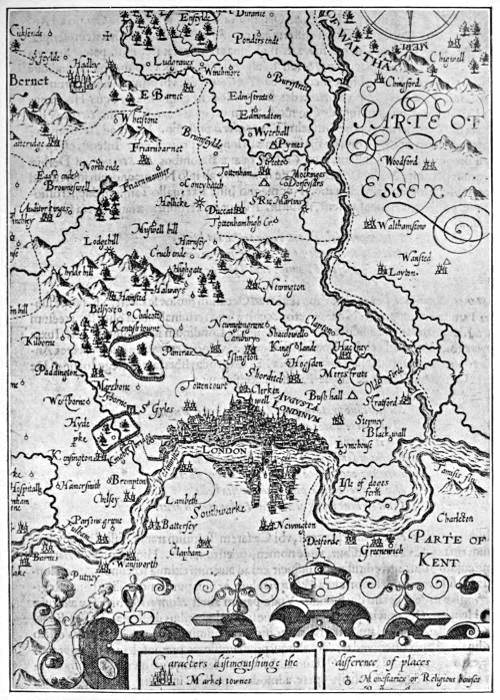
PART OF A MAP OF MIDDLESEX, 1607, WITH THE FIRST KNOWN REPRESENTATION OF THE TRIPLE TREE.
In a lease granted by the Prior of the Knights Hospitallers mention is made of Great Gibbet Field and Little Gibbet Field, parcel of the manor of Lilleston.[94] Mr. Loftie says, “We cannot be far wrong in supposing that the gibbets stood near the highway.” The word gibbet was formerly used so loosely that we cannot be sure that the fields did not take their name from the gallows. But Tyburn certainly had, as well as its gallows, gibbets on which were exposed bodies. But this page in the early history of Tyburn is almost a blank. The subjects on which it is most difficult to find information are precisely those of occurrence so common that it has not entered the head of contemporaries to notice them. That gibbets, as distinct from gallows, did exist in early times, there is no doubt; their use continued down to the eighteenth century or later. The old writers do not clearly distinguish between gibbet and gallows, but there is a passage in which Matthew Paris certainly means to speak of a gibbet. In writing of the execution of William Marsh, Matthew Paris leaves it doubtful whether Marsh was or was not at once fixed to a gibbet. But from Gregory’s chronicle we learn that Marsh was first hanged; from Matthew Paris we learn that the body was afterwards hung “on one of the hooks” of a gibbet.[95] In 1306 the body of Simon Fraser was hung on a gibbet for twenty days. In 1324 the king granted a petition of the prelates to permit burial of the bodies of the six barons hanged (not at Tyburn) in 1322.[96] Bodies would hang together for a much longer time. Jean Marteilhe saw, hanging on a gibbet in 1713, the body of Captain Smith, hanged at Execution Dock in 1708.[97]
Thus there must have been an accumulation of bodies swinging from the gibbets of Tyburn and poisoning the air. The French have always been more lavish in public monuments than we. The great gibbet of Montfaucon in the outskirts of Paris was a solid stone structure, with provision for hanging thereon—if we may trust the pictures given of it—at least sixty bodies; it is said that the bodies not unfrequently numbered from sixty to eighty. Under cover of the pestilential air, Maître François Villon, poet of the gibbet, and the cut-purses, his friends, rioted in security from intrusion.[98]
There is very good reason to suppose that a single gallows would not be sufficient for the work to be done at Tyburn. A gallows in the ordinary form, two uprights and a cross-beam, could hardly take more than ten victims at a time. We must suppose that the equipment of Tyburn demanded at least two such gallows. We have seen that in 1220 the king ordered two gallows. But in 1571, just in time for Elizabeth’s penal laws, a great improvement was made in the form of the gallows; a triangular gallows was introduced, capable of hanging at one time at least twenty-four men. This is the highest number recorded as being hanged at one time, but it does not follow that the capacity of the gallows was exhausted by this number. The evidence for the introduction of the triangular gallows at this time is contained in the account of the execution of Dr. Story:—
“The first daye of June [1571] the saide Story was drawn upon an herdell from the Tower of London unto Tiborn, wher was prepared for him a newe payre of gallowes made in triangular maner.”[99]
There is no earlier account of a triangular gallows. My friend, Mr. P. A. Daniel, tells me that he knows of no reference in the old drama to the triangular form of the gallows of date prior to 1571.
The earliest allusion to this form seems to be in 1589:—
“Theres one with a lame wit, which will not weare a foure cornerd cap, then let him put on Tiburne, that hath but three corners.”[100]
Of about the same date is an allusion in Tarlton’s “Newes out of Purgatorie,” 1590:—
“It was made like the shape of Tiborne, three square.”[101]
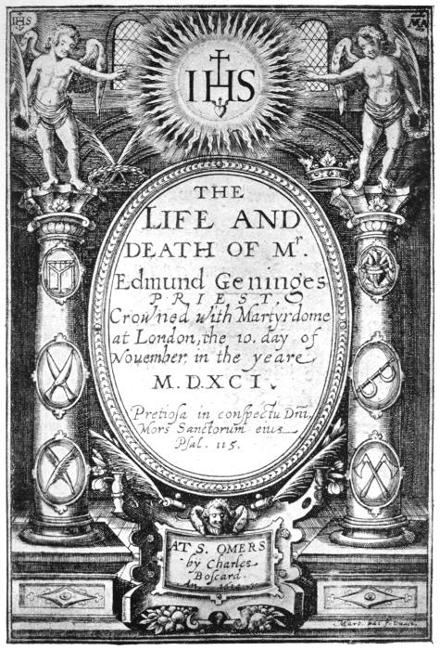
THE TRIPLE TREE ABOUT 1614.
(In the uppermost lozenge on the left.)
A third reference is found in Shakespeare’s “Love’s Labour Lost,” one of his early plays:—
“Thou mak’st the triumviry, the corner-cap of society, The shape of Love’s Tyburn, that hangs up simplicity.”[102]
These references are followed at a short distance in date by a delineation showing not only the triangular form of the gallows but, roughly, its position. This is in a map of Middlesex, engraved by John Norden for Camden’s “Britannia.” It was first given in the folio edition of 1607, and reappears in the editions of 1610 and 1637. In this last it bears the number 17 in the left-hand corner. In the edition of 1695, Norden’s map is replaced by one by Robert Morden.
In the three maps of the respective editions of 1607, 1610, and 1637, the triangular gallows is shown impinging on the north-east corner of Hyde Park, with the word “Tyborne” against it. Here, then, we have evidence that thirty-six years after the introduction of the triangular gallows it still remained here, clearly a permanent structure, probably the very gallows erected in 1571.[103]
The next piece of evidence is furnished by a representation of the gallows given in the frontispiece of “The Life and Death of Edmund Geninges” published in 1614.
Twelve years later, in 1626, we find evidence fixing for the first time the exact site of the gallows. On June 26th of this year, Henrietta Maria, after a day spent in devotion, went with her attendants through St. James’s Park to Hyde Park. Whether by accident or design she went towards Tyburn. Charles hated the Queen’s French suite, secured to her by treaty. Within six months of the marriage he had resolved to be rid of them. The courtiers made the most of the visit to Tyburn; it was averred that the Queen’s confessor had made her walk barefoot to the gallows, “thereby to honour the saint of the day in visiting that holy place, where so many martyrs (forsooth) had shed their blood in the Catholic cause.” The incident, thus exaggerated, brought matters to a head. Sixty of the Queen’s attendants were compelled to embark for France. The French King was naturally indignant at this violation of his sister’s rights: a war might have arisen out of the quarrel. This was averted by the skill of Maréchal de Bassompierre, sent over as Ambassador Extraordinary. Charles appointed Commissioners to discuss matters with the Marshal. The Commissioners expressed the charge in these terms: The Queen’s attendants abused the influence they had over the susceptible and religious mind of the Queen to lead her by a long road, across a park, which the Comte de Tilliers, her chamberlain, had taken measures to keep open, in order to take her to the place where it is the custom to execute the most infamous malefactors and criminals of all kinds, the place being at the entrance of a high road; an act which tended to bring shame and ridicule not only on the Queen herself, but also reproach and evil speaking against former kings of glorious memory, as though accusing them of tyranny in having put to death innocent persons that those people regard as martyrs, whereas, on the contrary, not one of them was executed on account of religion, but for treason in the highest degree.
Marshal de Bassompierre replied with remarkable frankness: “I know of a surety,” he said, “that you do not believe that which you publish to others.” He declared that the Queen had not been within fifty paces of the gallows. He repeats the description of the place as at the entrance of a high road. It is not necessary to follow the discussion further.[104]
THE RUINS OF FARLEIGH CASTLE. [p. 124.
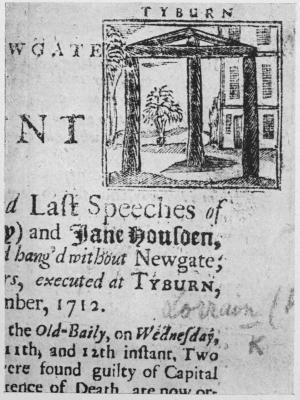
THE TRIPLE TREE IN 1712.
The words “the entrance of a high road” fix definitely the spot indicated, approximately, by Norden’s map. Even without the map, then unknown to me, I felt abundantly justified in writing that the words applied to a road leading out of the road bounding Hyde Park: “This can be no other than the road now known as Edgeware Road: along the whole length of the park there is no other road to which the words could apply.”[105]
In 1626 we have also the mention of “the three wooden stilts” of Tyburn, in Shirley’s “The Wedding,” published in 1629.
In 1649, in an account of the hanging of a batch of twenty-four persons, it is said that eight were hanged “unto each Triangle.”[106]
In 1660 the bodies of Cromwell, Ireton, and Bradshaw were “hanged at the several angles of the Triple-tree.”[107]
1680. Seller’s map of Middlesex shows the gallows, its form not recognisable, near the angle formed by the junction of the roads.
1697. Defoe, in his Essay upon Projects, refers to Watling Street: “The same High Way or Street called Watling Street … went on West to that spot where Tyburn now stands, and there turn’d North-West … to St. Alban’s.”[108]
1712. Beginning with this date the accounts published by Lorrain, the Ordinary of Newgate, of the behaviour of condemned criminals, show the prison of Newgate at the top, on one side, and on the other the gallows of Tyburn. The illustration is taken from the broadsheet of September 19, 1712.
1725. In this year a large map of the newly constituted parish of St. George, Hanover Square, was drawn by John Mackay. We have in it the first exact location of the gallows, shown as a triangular structure. In detailed notes on the map, describing the first “beating the bounds” of the parish on Ascension Day, 1725, it is stated that the parish boundary to the west was marked “on the S.E. Leg of Tyburn,” fully proving the permanence of the structure. The map was reproduced on a small scale in the Builder of July 6, 1901, and was described by Mr. Herbert Sieveking in the Daily Graphic of March 11, 1908.
1746 to 1757. In 1746 was published Rocque’s beautiful map of London in twenty-four sheets; this was followed by his maps of Middlesex in 1754 and 1757. In all the gallows is shown in the open space formed by the junction of the roads near the Marble Arch.
1747. In the last plate of Hogarth’s series of “Industry and Idleness,” is shown an execution at Tyburn. The gallows, a triangular structure, is in the same position (approximately) as in Rocque’s maps.
1756. In Seale’s map, published this year, the triangular gallows is shown in the same position as in Rocque’s maps.[109]
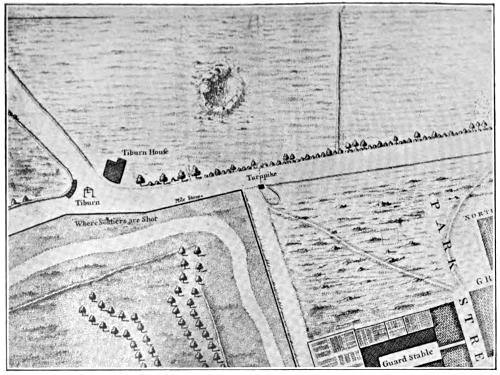
THE TRIPLE TREE IN 1746, FROM ROCQUE’S MAP OF LONDON.
Tyburn had ceased to be “emmy les champs”; the advance of the town is shown by the inclusion of Tyburn in maps of London. So early as 1719 it was proposed to move the gallows to Stamford Hill:—
“We hear the famous and ancient Engine of Justice called Tyburn is going to be demolished: and we hear the Place of Execution is to be removed to Stamford-Hill, beyond Newington, on the way to Ware: the Reason given is said to be, because of the great Buildings that are going to be erected in Maribone-Fields.”[110]
Strype, in his edition of Stow’s “Survey” (book iv. p. 120) mentions another report, but Tyburn defied these threats for many years to come.[111] Only in 1759, after an existence of near six hundred and fifty years, did the permanent gallows of Tyburn give place to a movable gallows, put up on the day of an execution and afterwards taken down. It is not a little strange that a monument of great antiquity, so well known, recalling so many tragedies, so intimately connected with the history and life of the people, should have been allowed to disappear without a word or a curse. I have not been able to find any direct reference to the removal of the triple-tree. The date of its removal must fall between June 18 and October 3, 1759. Under the earlier date we find, in the usual terms, the record of an execution at Tyburn. The Whitehall Evening Post of October 4, 1759, has the following:—
“Yesterday morning, about Half an Hour after Nine o’clock, the four malefactors were carried in two carts from Newgate, and executed on the new Moving Gallows at Tyburn.… The Gallows, after the Bodies were cut down, was carried off in a cart.”
The same account is given in other newspapers. The Gentleman’s Magazine states that “the gallows, which is a movable one, was carried there before them and fixed up for that purpose.”
The removal of the gallows was followed by the occupation of its site by the toll-house of the turnpike, shifted from the east corner of Park Lane, then called Tyburn Lane, to the corner of Edgeware Road.
The new movable gallows was ordinarily fixed near the corner of Bryanston Street and Edgeware Road (Thomas Smith, “A Topographical and Historical Account of the Parish of St. Marylebone,” 1833); but the place of erection was not always exactly the same. Thus we read in the Gentleman’s Magazine under date August 29, 1783, “The gallows was fixed about 50 yards nearer the Park wall than usual.” Tyburn ceased to be the place of execution in 1783, the last execution here taking place on November 7th of that year.
When the turnpike was in its turn removed, its position was recorded by a monument placed on the south side of the road, somewhat to the west of the Marble Arch. It is a slab of cast iron, with a gable top, bearing on both sides the words, “Here Stood Tyburn Gate 1829,” that being the date of the abolition of the turnpike. This monument correctly indicated the position of the gate, which stretched across the road: it was not intended to show the position of the gallows, which, however, it did indicate approximately. It was necessarily removed in the improvements carried out near the Marble Arch in the spring of 1908.
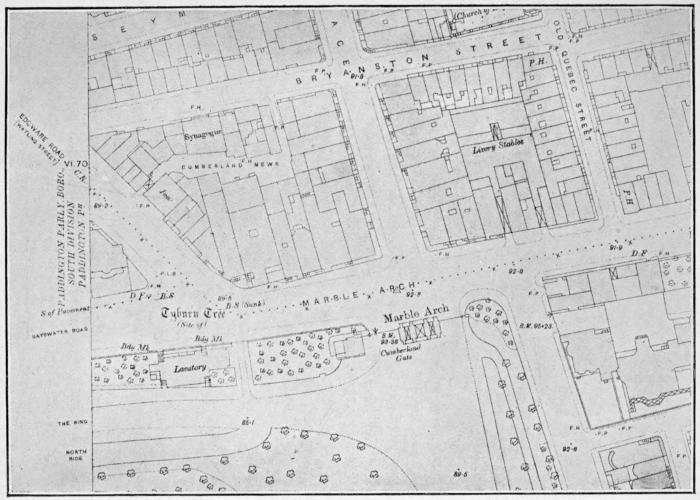
THE SITE OF TYBURN TREE, FROM THE ORDNANCE MAP OF 1895.
It may be well, at the risk of repetition, to summarise the foregoing account in the form of—
THE CHRONOLOGY OF TYBURN.
1108. Earliest date to which the establishment of Tyburn as a place of execution can with probability be assigned.
1177. First record of an execution in London, probably at Tyburn.
1196. First record of an execution, Tyburn being named as the place.
1220. Two new gallows ordered for Tyburn.
1222-1570. Executions at Tyburn recorded at the following dates: 1222, 1242, 1305, 1330 (position indicated, “about a league outside the City of London”), 1386, 1388, 1399, 1400, 1402, 1404, 1424, 1427, 1437, 1441, 1446, 1447, 1455, 1467, 1468, 1483, 1495, 1497, 1499, 1502, 1523, 1525, 1531, 1534, 1535, 1536,* 1537, and each year to 1544, 1549, 1550, 1552, and each year to 1557, 1560,* 1561,* 1562,* 1563,* 1569,* 1570.
(The list shows how continuous were executions here.)
The years marked * will not be found in the Annals following this. The records are uninteresting and have therefore been omitted. Tyburn is mentioned as to 1536 in Wriothesley’s Chronicle, as to 1560, 1, 2, and 3, in Machyn’s Diary. Stow mentions Tyburn in 1569.
1571. Erection of the permanent triangular gallows.
1607. Site of triangular gallows shown by map to be to the N. of the N.E. corner of Hyde Park.
1614. Representation of the triangular gallows.
1626. Exact site of gallows proved by accounts of the visit of Henrietta Maria. To the same year must be referred mention of “the three wooden stilts” in Shirley’s “The Wedding,” printed in 1629.
1649. Eight persons hanged on each of the three beams.
1660. Bodies of Cromwell, Ireton, and Bradshaw “hanged at the several angles of the Triple-tree.”
1680. Seller’s map of Middlesex shows the gallows (form not recognisable) near the angle formed by the junction of the roads E., W., and N.
1697. “Watling Street … went on West to that spot where Tyburn now stands, and there turned North-West.” (Defoe.)
1712. Triangular gallows figured in Lorrain’s broadsheet.
1725. Triangular gallows shown in Mackay’s map, in the space formed by the junction of the roads.
1746-1757. Triangular gallows shown in the same position in Rocque’s maps, London, 1746, Middlesex, 1754, and 1757.
1747. Triangular gallows shown in the same position (approximately) in the last plate of Hogarth’s “Industry and Idleness.”
1756. Triangular gallows shown as in Rocque’s maps, in Seale’s map.
1759. Triangular gallows gives place to movable gallows.
1783. Last execution at Tyburn.