ANNALS (continued 3)
Reading edition
Sir Thomas Overbury has a place in English literature as a prose writer and poet whose works have not been wholly forgotten. He was also a courtier in the Court of James, compared with which that of Charles II. was almost pure. James’s correct attitude towards “the Bishop of Rome” has, however, saved him from the severe criticisms passed on Charles, of more than doubtful orthodoxy. Some of the details in Harington’s “Nugæ Antiquæ” might be held to suggest that Milton had in view the Court of James when he wrote of the rabble of Comus, who forgot everything but
“To roll with pleasure in a sensual sty.”
Overbury, after leaving Oxford, made a tour on the Continent, returning from his travels a finished gentleman. In 1601, on a visit to Scotland, he met Robert Carr, then a page in a noble family. Hence arose a close intimacy destined to be fatal to Overbury. On the accession of James to the English throne, Carr, James’s “favourite,” rose rapidly; he became Viscount Rochester. Carr and Overbury played into one another’s hands: Carr procured a knighthood for Overbury, Overbury became the mentor of Carr, who had neither learning nor the graces of a Court. The fatal woman now comes on the scene. At the age of thirteen, Frances Howard, daughter of the Earl of Suffolk, was married to the Earl of Essex, a year older. Their friends agreed that it was yet too early for the pair to live together; the boy went on his travels, the girl to her mother. On his return, Essex found his wife acknowledged as the greatest beauty in the Court, the object of general adoration. Among her admirers was Carr, for whom she had conceived a passion which knew no bounds. Overbury had been instrumental in bringing together Carr and the lady; it was he who wrote the love-letters to which Carr owed the conquest of the countess’s heart. The lady naturally hated her husband, whose return interfered with her way of life: it was only in obedience to the King’s command that she consented to live with Essex. The lady and her lover formed the design of procuring a divorce from Essex, preparatory to their marriage. Overbury strongly objected; he spoke of the countess to Carr in terms which, repeated to the lady, fixed his doom. It was contrived that the King should offer to Overbury a foreign appointment. This Carr advised him to refuse, and then represented the refusal to James in such a light that on April 21st Overbury was thrown into the Tower. The lieutenant and the under-keeper of the Tower were displaced in favour of officers on whom Carr and his mistress could rely, and the work of despatching Overbury began. Poisons were procured from Franklin, a physician, by Mrs. Turner, and sent in tarts and jellies to the Tower, where Weston, the under-keeper, took charge of them. Overbury was drenched with rosealgar, sublimate of mercury, arsenic, diamond powder. It was averred that he had swallowed poison enough to kill twenty men. He died on September 15, 1613.
The business of the divorce now went on without hindrance. To be rid of his wife, Essex was ready enough to allow a slur to be cast on his manhood; with the aid of the lawyers, the churchmen, a complaisant jury of matrons, and a young lady who, with muffled head, personated the countess for the occasion, the divorce was carried through. In view of the approaching marriage, Carr was created Earl of Somerset, and on December 26 the marriage took place. With magnificent effrontery, the lady was married “in her hair,” the mark of a virgin-bride.
But some time afterwards an apothecary’s boy, who had been got out of the way, and was now at Flushing, began to talk of what he knew; inquiry was made, and in the end the criminals were put upon their trial. On October 23, 1615, Richard Weston, the under-keeper of the Tower, was hanged at Tyburn. He was followed by Mrs. Turner, hanged on November 9th, at the same place; on the 20th Sir Gervase Elwes, the lieutenant of the Tower, was executed on Tower Hill, and on December 9th, James Franklin, the physician, was executed at St. Thomas a Waterings.
In the following year the countess was tried in Westminster hall, pleaded guilty, and was condemned. The next day the earl was brought to trial by his peers in the same place, and also found guilty. Neither was executed; each received a pardon. They lived together afterwards in the same house, hating one another with a perfect hatred; the countess died of a loathsome disease.
There are mysteries in the case remaining mysteries after the most careful study of the facts. In spite of all attempts made to persuade Somerset to plead guilty, and throw himself on the King’s mercy, he steadfastly refused. Mr. Amos inclines to believe him innocent of complicity in the murder. There are serious difficulties in the way of this theory, but it is certain that Somerset had the means of terrifying the King. Secret messages passed between the Tower and the palace, informing the king that the prisoner had threatened to refuse to go to the Court of his own will. Bacon consulted the judges as to what could be done to silence Somerset if he “should break forth into any speech of taxing the King.” At the trial two servants were placed, one on either side of the prisoner, with a cloak on his arm. Their orders were that if Somerset “flew out” on the King, they should instantly throw the cloaks over his head, and carry him by force from the bar.
Was James an accomplice in the murder of Overbury? Mayerne, the King’s physician, attended Overbury in the Tower and prescribed for him. Mayerne was not produced as a witness, nor were his prescriptions put in evidence.
Or is the mystery connected with the death of Prince Henry, James’s son? The Prince was seized with sudden illness almost immediately after dining with his father. “In Mayerne’s collection of cases for which he wrote prescriptions,” says Mr. Amos, “everything that relates to Prince Henry’s last illness is torn out of the book.”
We can but fall back on the certainty that Somerset had it in his power to make some revelation of which James was terribly afraid.[183]
1616. July 1. Thomas Maxfield, a missionary priest, drawn, hanged, and quartered at Tyburn. It is said that on the occasion of Maxfield’s execution, the gallows was adorned with garlands and wreaths of flowers. Thirteen criminals were executed at the same time. The Sheriff called on the hangman to cut down Maxfield while still alive, as indeed the law required, but this was opposed by the people, and the victim was suffered to hang till dead (Challoner, pt. ii. pp. 62-3).
We now come to the reign of Charles I.
1626. The visit of the queen, Henrietta Maria, to Tyburn has been mentioned (p. 65).
1628. This Summer there was a great Army prepared for forraigne seruice, whereof the Duke of Buckingham was Generall, who went to Portsmouth, to set all things in readinesse for present dispatch: And vpon Saturday the 23. of August, as hee was going thorow his Hall, which was filled with Commaunders, and strangers, suddainly and vnexpectedly Iohn Felton a Lieutenant, stabd the Duke into the breast, with a knife, and slily withdrew himselfe, vndiscerned of any to doe the fact, the Duke stepping to lay hold on him, drew out the knife and began to stagger, the bloud gashing out at his mouth, at which dreadfull sight, certaine Commanders with their strength held him vp, the Duke being depriued of speech and life. And then all the doores and passages being stopped, and many with their weapons drawne to kill the Murtherer, the offender himselfe seeing the vproare, boldly confessed, saying, I am the man that did it, and being examined by the Lords, was committed. The King at that time was but sixe miles from Portsmouth: The Corpes was brought to London, on Saturday the 30. of August, the Nobility, Friends, and Officers brought the Corpes by night with Torches lighted to Wallingford house neere Charing-Crosse: the Murtherer was brought to the Tower the 5. of September.
Thursday the 27. of Nouember, the aforenamed Iohn Felton, was brought from the Tower, and Arraigned at the Kings Bench, where he very penitently confessed the fact, saying, I haue slaine a most Noble loyall Subiect, and wish that this my right hand might be here cut off, as a true testimony of my hearty sorrow, and had his Judgement to be hanged: from thence he was sent to the Gate-house, where he remained till Saturday, and then sent to Tibourne, and there executed, where hee humbly and heartily repented his offence, and asked forgiuenesse of God, the King, and the Dutchesse, and of all the Land, saying, he had slaine a most Noble loyall Subiect, and desired all men do pray for him. The next day being Sunday, his Body was sent by Coach towards Portsmouth, and was there hanged in Chaines (Stow, ed. 1631, p. 1044).
A paper was found in Felton’s hat, containing the following:—
“Let no man commend for doing it, but rather discommend themselves; for if God had not taken away their hearts for their sins he had not gone so long unpunished.
“That man in my opinion is cowardly and base, and deserveth neither the name of a gentleman nor a soldier, that is unwilling to sacrifice his life for the honour of God and the good of his King and country.—John Felton.” (“Autobiography of Sir Simonds D’Ewes,” i. 385.)
Only one or two priests were executed in England during the first fifteen years of Charles’s reign.
Between 1641 and 1651 the following priests were drawn, hanged, and quartered at Tyburn merely for being priests. No other charge was made against them, but this sufficed:—
1641. July 26. William Ward.
1642. January 21. Thomas Reynolds and Bartholomew Roe.
April 26. Edward Morgan.
October 12. Thomas Bullaker.
December 12. Thomas Holland.
1643. April 17. Henry Heath.
December 11. Arthur Bell.
1644. September 7. John Duckett and Ralph Corby.
1645. February 1. Henry Morse.
1646. June 30. Philip Powel.
1651. May 19. Peter Wright. Thirteen malefactors hanged at the same time.
These were victims of the Parliament. Charles had more than one contest with the Parliament on the subject of the execution of priests. In January, 1641, Thomas Goodman, a priest and Jesuit, had been condemned. The king reprieved him; the two Houses remonstrated and urged that the law might be executed. Charles reminded Parliament of the inconvenience which might ensue to Protestant Englishmen and others abroad, but having said this he left the final decision to the Houses. Goodman petitioned the king: “He would esteem his blood well shed to cement the breach between your majesty and your subjects.” He was suffered to die in Newgate.
Much the same happened later in the year. Seven priests were condemned on December 8th. The French ambassador exerted himself in their behalf. Charles consulted the two Houses as to a reprieve, to be followed by banishment. He did in fact reprieve them. The Houses petitioned for execution. Charles replied that he desired to banish the priests, “but if you think the execution of these persons so very necessary to the great and pious work of reformation, we refer it wholly to you, declaring hereby that upon such your resolution signified to the ministers of justice, our warrant for their reprieve is determined, and the law to have its course.”[184] These also were suffered to linger out their lives in Newgate.
1654. To get a respite for a while from this massacre of priests, we may deal here with the last case that occurred for some years.
John Southworth was sent on the English mission in 1619. He escaped imprisonment till 1627, when he was tried at Lancaster, condemned, reprieved in 1630, and given over to the French ambassador for transportation beyond seas. If he was sent abroad, which seems uncertain, he was soon back, and after a long interval was again arrested, and once more released. He was finally apprehended in 1654. On his arraignment he pleaded that he was not guilty of treason, but in spite of persuasion acknowledged that he was a priest. The court, with, it is said, great reluctance, passed the inevitable sentence. On June 28th five coiners were drawn, hanged, and quartered with Father Southworth.
Father Southworth was an old man of 72; nothing was alleged against him but that he was a priest, that he was “a dangerous seducer.”
The guilt of this judicial murder rests wholly with Cromwell. The life of Southworth was in his hands; he was deaf to the suit of the French and Spanish ambassadors for Southworth’s life (Challoner’s Memoirs, pt. ii. pp. 196-200).
No more Catholics were executed in England till the Popish Plot broke out in 1678.
1649. With exquisite humour, none the less delightful because it was probably unconscious, the admirers of Cromwell have set up his statue near to the House of Commons, his back turned towards it. He might just have left the House with the key of the locked door in his pocket. Why is the statue there? It cannot be simply in recognition of the fact that Cromwell cut off the head of a king. To cut off a king’s head may be a meritorious deed, or it may be an infamous deed, or neither the one nor the other in any notable degree. But, taken by itself, it does not seem to demand an expression of national gratitude. Yet what else could the statue have been intended to commemorate? What, besides, did Cromwell do? He set up in place of monarchy a Thing so detestable that in a few years the people were glad to have back a Stuart at any price: anything was better than the military despotism of Cromwell and his majors-general. Great soldier he was, great and pitiless. The proper place for Cromwell’s statue was Drogheda.
Our hearts have burnt within us as we have read the story of ship-money levied by Charles I. without the authority of Parliament. But Cromwell also levied taxes illegally. When his old friend Cony refused to pay, and reminded Cromwell how he had often declared that the man who paid an illegal tax was worse than he who demanded it, Cromwell threw his old friend into prison. When Cony was brought into court on his habeas corpus, Cromwell threw into prison the three counsel who argued the case. Cony, deprived of the aid of counsel, pleaded his own cause. It was too clear to suffer greatly from want of skill in the pleading: the judge could not decide adversely to Cony, but was unwilling to give judgment against Cromwell. He deferred his decision. Cromwell removed him from the bench.
Enclosing went on as before; the country was desolated by civil war; the people fell into poverty deeper and deeper. The wicked laws, “taking away the life of men only for theft,” continued in force to the bitter disappointment of those who had looked for better things: “You have sate now,” wrote Samuel Chidley, addressing his Highness the Lord Protector and the Parliament, “you have sate now above these 40 days twice told, and passed some Acts for transporting Corn and Cattel out of the Land, and against Charls Stuart’s, &c., but (as I humbly conceive) have left undone matters of greater concernment; amongst which, the not curbing this over-much justice in hanging men for stealing is one; the not suppressing the pressing of men to death for not answering against themselves is another.”
Samuel Chidley, who, for greater emphasis, printed his arguments in red ink, gave instructions that a copy of his book “should be nailed upon Tiburne Gallowes before the execution, with this motto written on the top:—
‘Cursed be that bloody hand Which takes this downe without Command.’
… but the party could not naile it upon Tiburne Gallow-tree, for the crowd of people, and therefore was forced to naile it on the tree which is upon the bank by the Gallowes; and there it remained, and was read by many both before and after execution, and its thought will stand there still, till it drop away.”
A notable incident in the history of Tyburn!
Cromwell had enough to do to keep himself in his military saddle: he had no time to waste on an impatient idealist.[185] Samuel Chidley discovered, as others have since found, that the more things change the more they remain the same. Hanging for theft went on as briskly as ever. Indeed, by the irony of fate the Reign of the Saints furnishes us with an account of the greatest number recorded as being executed at one time at Tyburn. In the Thomasson collection of Tracts in the British Museum is one bearing the following title:—
“A true and perfect Relation of the Tryall, Condemning, and executing of the 24. Prisoners, who suffered for severall Robberies and Burglaries at Tyburn on Fryday last, which was the 29. of this instant June, 1649, expressing the penitent end of the said Prisoners, the grief of the many Thousands there, and the Speech of John Mercer (who was there executed) concerning Unity in this Kingdom, and the bringing home and setling of the King.”
The names of the criminals are given, twenty-three men and one woman. The prisoners were tied in eight carts, the sexton of St. Sepulchre’s made his official speech to the culprits, “which being ended the carts were drave unto Tiburne the Fatall place of execution, where William Lowen the new Hangman fastned eight of them unto each Triangle.”
It would seem that there was nothing unusual, nothing to attract attention, in the number executed. In the bound volume there is, following the tract, “The Perfect Weekly Account … from Wednesday June 27, to Wednesday the 4 of July, 1649, Beginning Wednesday June 27.” This little newspaper of eight pages does not so much as mention the execution.
1650. October 2. Captain Ashley was sentenced by the High Court of Justice to have his head cut off, and one Benson to be hanged, for conspiring against the Commonwealth in the tresonable Engagement of Colonel Andrews.
October 7. Mr. Benson was executed at Tyburn according to the sentence of the High Court of Justice; but in regard that Captain Ashley only subscribed the Engagement, but acted nothing in it, he was pardoned by the Parliament (Whitelocke).
1653. “The ambassador of Portugal had a very splendid equipage, and in his company his brother don Pantaleon Sa, a Knight of Malta, and a man eminent in many great actions, who out of curiosity accompanied his brother in this embassy, that he might see England. This gentleman was of a haughty and imperious nature, and one day being in the New Exchange, upon a sudden accident and mistake had a quarrel with … Mr. Gerard, … who had then returned some negligence and contempt to the rodomontados of the Portuguese, and had left him sensible of receiving some affront. Whereupon he repaired thither again the next day [November 22], with many servants, better armed and provided for any encounter, imagining he should find his former adversary, who did not expect the visitation. But the Portuguese not distinguishing of persons, and finding many gentlemen walking there, and amongst the rest one he believed very like the other, he thought he was not to lose the occasion; he entered into a new quarrel, in which a gentleman, utterly unacquainted with what had formerly passed, and walking there accidentally was killed, and others hurt; upon which the people rising from all the neighbouring places, don Pantaleon thought fit to make his retreat to his brother’s house; which he did, and caused the gates to be locked, and put all the servants in arms to defend the house against the people which had pursued him, and flocked now together from all parts to apprehend those who had caused the disorder and had killed a gentleman.… Cromwell was quickly advertised of the insolence, and sent an officer with soldiers to demand and seize upon all who had been engaged in the action. And so the ambassador came to be informed of the truth of the story, with which he was exceedingly afflicted and astonished.”
The ambassador pleaded the privilege accorded to ambassadors, but the officer was resolute; finally after an appeal to Cromwell, don Pantaleon and the rest were given up and sent to Newgate.
“The ambassador used all the instances he could for his brother, being willing to leave the rest to the mercy of the law, but could receive no other answer but that justice must be done. And justice was done to the full, for they were all brought to their trial at the sessions at Newgate, and there so many of them condemned to be hanged as were found guilty. And the rest of those who were condemned were executed at Tyburn; and don Pantaleon himself was brought to the scaffold on Tower Hill.”[186]
Strangely enough Gerard, with whom the quarrel began, was executed (for high treason against the Protector) on the same day and on the same scaffold.
1658. On June 8, Slingsby and Hewet were executed on Tower Hill: Colonel Ashton, Mr. Stacy, and Mr. Bestely were drawn, hanged, and quartered in the streets of the City, and on July 6 several of “the new conspirators” were executed in London and at Tyburn.
These were Cromwell’s last executions. He died on September 3, 1658.
1660. A terrible vengeance followed. Between October 13 and 17 eight of the Regicides were executed “at the Round or railed Place neer Charing Crosse.” “And now the stench of their burnt bowels had so putrified the air, as the inhabitants thereabout petitioned His Majesty there might be no more executed in that place: therefore on Friday [October 19], Francis Hacker, without remorse, and Daniell Axtell, who dissolved himself into tears and prayers for the King and his own soul, were executed at Tyburn, where Hacker was only hanged, and his brother Rowland Hacker had his body entire, which he begged, and Axtell was quartered.”[187]
To finish with the story of the regicides:—
Colonel Okey, Colonel Barkstead, and Miles Corbet were basely betrayed by Downing, who had been chaplain in Okey’s regiment; the States General, in violation of their fundamental maxim to receive and protect those who took refuge in their territory, basely surrendered them. They were executed at Tyburn on April 16, 1662.
A miserable vengeance was wreaked on the dead—on the “carcases” of Cromwell, Ireton, and Bradshaw.
1660. December 4. A resolution was passed in the House of Commons; the Lords made an addition, and finally the Resolution stood thus:—
December 8. Resolved, by the Lords and Commons assembled in Parliament, That the carcases of Oliver Cromwell, Henry Ireton, John Bradshaw, Thomas Pride, whether buried in Westminster Abbey or elsewhere, be, with all expedition, taken up and drawn upon a hurdle to Tyburn, and there hanged up in their coffins for some time: and after that buried under the said gallows: and that James Norfolke Esquire, Serjeant at Arms attending the House of Commons, do take care, that this order be put in effectual execution by the common executioner for the County of Middlesex, and all such others to whom it shall respectively appertain: who are required in their several places to conform to and observe this order, with effect; And the Sheriff of Middlesex is to give his assistance herein, as there shall be occasion: And the Dean of Westminster is desired to give directions to his officers of the Abbey to be assistant in the execution of this order.[188]
A new gallows had been erected for the purpose. Let Evelyn tell us of the use to which it was put on January 30, 1661:—
1661. January 30. This day (O the stupendous and inscrutable judgments of God!) were the carcases of those arch-rebels, Cromwell, Bradshawe (the judge who condemned his Majesty) and Ireton (son-in-law to the Usurper) dragged out of their superb tombs in Westminster among the Kings, to Tyburn, and hanged on the gallows there from nine in the morning till six at night, and then buried under that fatal and ignominious monument in a deep pit: thousands of people who had seen them in all their pride being spectators.[189]
Here is another account, showing the feelings of a partisan:—
“The odious carcasses of O. Cromwell, H. Ireton, and J. Bradshaw drawn upon sledges to Tyburn, and being pull’d out of their Coffins, there hang’d at the severall Angles of that Triple-tree till Sun-set. Then taken down, beheaded, and their loathesome Truncks thrown into a deep hole under the Gallowes. Their heads were afterwards set upon Poles on the top of Westminster Hall.”[190] Here Pepys saw them.
Neal says that the bodies were drawn upon hurdles, but the two words were at this time used indifferently for the same thing.
There were various legends on the subject. One was that Cromwell was not buried in Westminster Abbey, but on Naseby field. Another, that his friends contrived that the body of Charles I. was substituted for that of Cromwell, and was hanged on the gibbet. It was said that persons present observed a seam on the neck—the head having been joined to the body after decollation.[191]
Many bodies, including those of Cromwell’s mother and daughter, Admiral Blake and John Pym, were taken from the Abbey, and buried in a pit in St. Margaret’s churchyard.[192]
1660. On June 9 the House of Commons resumed debate on the Act of general Pardon, Indemnity, and Oblivion, and a list was produced of some who, though they did not sit at the trial of Charles I., on January 27, 1648, did sit on some of the preceding days. The subject was considered on subsequent occasions, and finally an Act was passed, 13 Charles II., c. 15 (1661), enacting that Lord Monson, Sir Henry Mildmay, and Robert Wallop (and others who had fled) should on January 27, 1662, be “carried to the Tower of London and from thence drawne upon Sledges with Ropes about theire necks, and according to the manner of persons executed for High Treason quite through the streets of London unto the Gallows att Tiburn,” and then carried back in like manner to the Tower or such other prison as the king may think fit, and remain prisoners during their lives.
Accordingly on January 27, 1662:—“This morning, going to take water, upon Tower-hill we met with three sleddes standing there to carry my Lord Monson and Sir H. Mildmay and another to the gallows and back again, with ropes about their necks: which is to be repeated every year, this being the day of their sentencing the king.”[193]
The Act, however, contains nothing as to the repetition of the ceremony.
1661. This year witnessed the outbreak of the Fifth Monarchy men. John James, a small-coal man, was executed at Tyburn. “The sheriff and hangman were so civil to him in his execution, as to suffer him to be dead before he was cut down, beheaded, bowelled, and quartered. His quarters were set on the gates of the City, his head was first fixed on London bridge, but afterwards upon a pole, near Bulstake Alley, Whitechapel, in which was James’s meeting-house.”[194]
1662. December 22. Thomas Tonge, George Phillips, Francis Stubbs and Nathaniel Gibbs, convicted of taking part in a plot to seize the Tower and Whitehall, to kill the King and declare a Commonwealth. They were drawn to Tyburn on two hurdles, hanged, beheaded and quartered; their heads were set up on poles on Tower Hill.[195]
1668. May 9. This day Thomas Limerick, Edward Cotton, Peter Messenger, and Richard Beasley, four of the persons formerly apprehended in the Tumult during the Easter Holydays, having upon their Trial at Hicks-Hall been found guilty and since sentenced as Traytors, were accordingly Drawn, Hang’d, and Quartered at Tyburn, where they showed many signs of their penitence, their quarters permitted Burial, only two of their Heads ordered to be fixt upon London-Bridge.[196]
1670. In February of this year ended the brilliant career of Claude Duval, the famous highwayman. There had been highwaymen before Duval, as he was succeeded by others. But the great merit of Duval is that he gave a tone and dignity to the profession which it never wholly lost. Before giving any account of this prince of highwaymen it may be permitted to say something on this branch of the profession of the art of thieving.
The century from 1650 to 1750 may be considered the era of the highwayman. When civil war rages bands of marauders will spring up, whose operations present a resemblance to the methods of a soldiery not kept well in hand. Thus during the Commonwealth James Hinde was the captain of a band of twenty or more whose operations were coloured by a pretence of acting for the king. On November 11, 1651, Hinde was examined by the Council of State, and “confessed his serving of the king in England, Scotland and Ireland.” Highwayman as he was, his pretensions as a servant of the king must have been admitted, as he was condemned at the Old Bailey, sent to Worcester, and drawn, hanged, and quartered, for high treason against the State. Accounts of his exploits were printed even a century after his death. The catalogue of the British Museum contains more than twenty entries relating to this worthy.
The prevalence of highway robbery is shown by the great number of Proclamations issued during the reigns of Charles II. and his immediate successors. Thus royal Proclamations offering rewards for the apprehension of highwaymen were issued on December 23 and 30, 1668. These were followed by others in 1677, 1679-80, 1681, 1682-3. In this last eleven notorious robbers are specially named. In 1684 and 1684-5, two more Proclamations were issued, followed in 1687 by an Order in Council of the same tenor. In 1690 came a new Proclamation. These Proclamations were not wholly successful in breaking up gangs, for in December, 1691, the Worcester waggon was plundered by sixteen highwaymen of £2,500 of the King’s money.
Still worse, in 1692 seven highwaymen robbed the Manchester carrier of £15,000 of royal treasure. A Proclamation was now issued raising the reward for capture. In the earliest Proclamations this had been fixed at £10, afterwards raised to £20. The reward now offered was £40. In the same year, 1692, was passed the Act 4 William and Mary, c. 8, taking effect after March 25, 1693. The reward of £40 was to be paid by the sheriff, or if he was not in funds, by the Treasury. Under date April 8, 1693, Luttrell writes, “Some moneys have been issued out of the Exchequer pursuant to the late Act for taking highwaymen.”
To return to Duval. He was born in Normandy, and came over to England as page to the Duke of Richmond. His best-known exploit is told at length in memoirs, ascribed to William Pope (reprinted in “Harleian Miscellany,” iii. 308-16):—
This is the place where I should set down several of his exploits; but I omit them, both as being well known, and because I cannot find in them more ingenuity than was practised before by Hind and Hannum, and several other mere English thieves.
Yet, to do him right, one story there is that savours of gallantry, and I should not be an honest historian if I should conceal it. He with his squadron overtakes a coach, which they had set over night, having intelligence of a booty of four-hundred pounds in it. In the coach was a knight, his lady, and only one serving-maid, who, perceiving five horsemen making up to them, presently imagined they were beset; and they were confirmed in this apprehension by seeing them whisper to one another, and ride backwards and forwards: the lady to show she was not afraid, takes a flageolet out of her pocket and plays. Du Vall takes the hint, plays also, and excellently well, upon a flageolet of his own; and in this posture, he rides up to the coach-side. “Sir” (says he, to the person in the coach), “your lady plays excellently, and I doubt not but that she dances as well; will you please to walk out of the coach, and let me have the honour to dance one currant with her upon the heath.” “Sir” (said the person in the coach), “I dare not deny anything to one of your quality and good mind; you seem a gentleman, and your request is very reasonable.” Which said, the lacquey opens the boot; out comes the knight, Du Vall leaps lightly off his horse, and hands the lady out of the coach. They danced, and here it was that Du Vall performed marvels; the best master in London, except those that are French, not being able to show such footing as he did in his great riding French boots. The dancing being over, he waits on the lady to her coach; as the knight was going in says Du Vall to him, “Sir, you have forgot to pay the musick.” “No, I have not” (replies the knight;) and, putting his hand under the seat of the coach, pulls out an hundred pounds in a bag, and delivers it to him; which Du Vall took with a very good grace, and courteously answered, “Sir, you are liberal, and shall have no cause to repent your being so; this liberality of yours shall excuse you the other three-hundred pounds”: and giving him the word, that if he met with any more of the crew, he might pass undisturbed, he civilly takes his leave of him.
Here is the account of the lying in state after the execution:—
After he had hanged a convenient time, he was cut down, and, by persons well dressed, carried into a mourning-coach, and so conveyed to the Tangier-tavern in St. Giles’s, where he lay in state all that night, the room hung with black cloth, the hearse covered with escutcheons, eight wax-tapers burning, and as many tall gentlemen with long black cloakes attending; mum was the word, great silence expected from all that visited, for fear of disturbing this sleeping lion. And this ceremony had lasted much longer, had not one of the judges (whose name I must not mention here, lest he should incur the displeasure of the ladies) sent to disturb this pageantry.
The “Memoirs” are not to be taken too seriously. They are satirical, as is sufficiently shown by the title—“Intended as a severe Reflexion on the too great Fondness of English Ladies towards French Footmen: which, at that Time of Day was a too common Complaint.”
According to the “Memoirs” Duval’s tomb bore the family arms curiously engraved and under them this epitaph:—
Here lies Duval: reader, if male thou art, Look to thy purse: if female, to thy heart. Much havoc hath he made of both: for all Men he made stand, and women he made fall. The Second Conqueror of the Norman race, Knights to his arms did yield, and ladies to his face. Old Tyburn’s glory, England’s bravest thief: Duval, the ladies’ joy: Duval, the ladies’ grief.
It must be admitted that the accounts of St. Paul’s, Covent Garden, do not mention this monument.
It is probable that Duval did really introduce gentler methods into the practice of robbery. The author of “Hudibras” in a “Pindaric Ode” claims this merit and one other for Duval:—
Taught the wild Arabs on the road To act in a more gentle mode: Take prizes more obligingly than those Who never had been bred filous And how to hang in a more graceful fashion Than e’er was known before to the dull English nation.
The third chapter of Macaulay’s History gives an excellent account of highwaymen in the reign of Charles II.
1677. Thomas Sadler is said to have been in prison fifteen times before he planned his last and greatest exploit. With the aid of two accomplices, he stole from Great Queen Street, the Lord Chancellor’s mace and purse (the official purse, one of the emblems of the office). Sadler was so delighted with his success, that in crossing Lincoln’s Inn Fields he made one of the confederates precede him with the mace on his shoulder, while he himself strutted behind him, followed by the purse-bearer. They bore their plunder to a house in the City, where it was locked up in a cupboard. Curiosity led a maid to look through a chink in the door, when to her wonderment she saw what she took to be the King’s crown. This led to the discovery of the robbery. On his trial Sadler behaved with superb frankness. “‘My lord,’ he said, addressing the court, ‘I own the fact, and it was I and this man’ (pointing to one that stood by him at the bar) ‘that robbed my Lord Chancellor: and the three others are clear of the fact, though I cannot say but they were confederates with us in the concealment of the prize after it was taken. This I declare’ (said he) ‘to the honourable bench, that I may be clear of the blood of these other three persons.’”… “However, the court went on in a legal way, and another witness began to demonstrate in what manner he was taken: to whom the prisoner answered in this manner: ‘Prithee, fellow, do not make such a long narration of my being taken; thou seest I am here, and I own that I and this man, as aforesaid, are guilty of the fact.’”
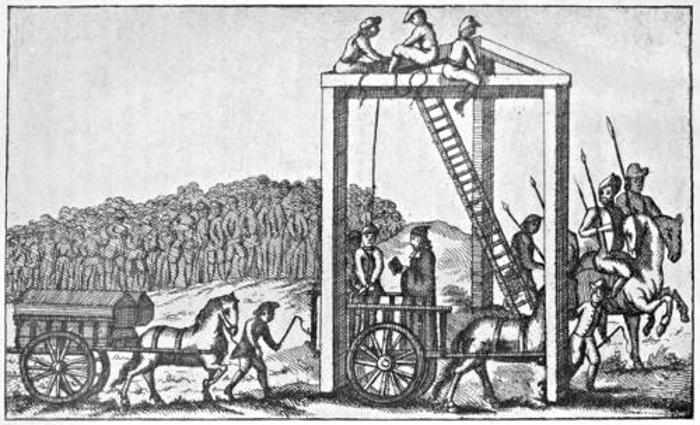
THE TRIPLE TREE, ABOUT 1680.
It seems that one of the confederates was reprieved. Sadler, and Johnson, one of his companions, were among the five men executed at Tyburn on March 16, 1677 (“A Perfect Narrative,” &c., 1676-7, reprinted in Harleian Mis., v. 505-6).
1678. We now come to one of the blackest pages, not only in the history of England, but in the history of civilised communities.
Eighteen years of misgovernment had brought the people to a point at which an outbreak of some kind became inevitable. Dunkirk had been ceded to the French: the sound of Dutch guns had been heard in the Thames. The Court was known to be under French influence. “There were two things,” says Bishop Parker, “which, like Circe’s cups, bewitched men and turned them into brutes, viz., popery and French interest, and, if either of these happened to be whispered in the House of Commons, they quitted their calm and moderate proceedings, and ran immediately into clamour and high debates.” Politicians had for years played on the fears of the people. France was to send a great army to reduce the country to popery and slavery. “They kept the people in constant fear: and there was scarce greater uproar when Hannibal was at the gates of Rome.” Charles had no successor in direct line; on his decease the crown would fall to his brother, the Duke of York, known to be a catholic. This was the position “when the Popish Plot broke out, a transaction which had its roots in hell, and its branches in the clouds.”
Two men saw a private advantage in this state of things. It is impossible to say anything of the infamy of Titus Oates which would not fall short of the reality; his associate in the invention of the Popish Plot, Tonge, was a fanatic, who could forge on occasion.
“God Almighty,” he said, “will do His own work by His own methods and ways.” Between them the two produced a story of murder and massacre, which they contrived to lay before the King. It was so manifestly absurd that it would have failed of its effect but that Sir Edmund Berry Godfrey, a magistrate, who had taken the depositions of these men, suddenly disappeared. His body was found a few days later at the foot of Primrose Hill, transfixed by Godfrey’s own sword. There is little doubt that, but for family interests, the case would have been recognised as one of suicide. But the discovery came in the very nick of time to save the authors of the Popish Plot. It was set about that Godfrey had been murdered by the papists in Somerset House, the palace of the Catholic queen. The politicians, Lord Shaftesbury at their head, were not slow to see the advantage to be gained by playing upon the credulity of the people.
The word went round that the plot must be handled as if it were true, whether it were so or not. It soon became dangerous to express doubt. To do this was to incur the certain danger of being reckoned a papist, a concealed papist, one inclined to popery; and the prison or the gallows was the fate of the doubter. The courts sat merely to condemn men denounced by Oates and his gang. Three men were hanged at Tyburn as guilty of the murder of Godfrey. Even those who to-day contend that Godfrey was murdered admit that these men were innocent. Theories have been constructed based on the evidence of infamous informers who contradicted one another on every point, and when this fails, the writer’s imagination is employed to patch up the story.
On November 26, 1678, William Stayley was drawn to Tyburn and there hanged and quartered. He had been convicted, on the evidence of two infamous informers, of a design to assassinate Charles. But this case, a judicial murder, does not properly belong to the Popish Plot.
On account of the plot were executed sixteen persons, three for the murder of Godfrey, thirteen for high treason. Except perhaps in the case of one, Coleman, it is now universally admitted that not one was guilty of the crime for which he suffered. Here is a list of the victims:—
1678. December 3. Edward Coleman, secretary to the Duchess of York.
1679. January 24. William Ireland and John Grove.
February 21. Robert Green and Lawrence Hill, for the murder of Sir Edmund Berry Godfrey.
February 28. Henry Berry, for the same.
May 9. Thomas Pickering, for high treason.
June 20. Thomas Whitebread, William Harcourt, John Fenwick, John Gavan, and Anthony Turner, known as “The Five Jesuits,” all for high treason.
July 14. Richard Langhorn, for high treason.
1680. December 29. Viscount Stafford, for high treason.
1681. July 1. Dr. Oliver Plunket, the catholic primate of Ireland, for high treason.
Lord Stafford was executed on Tower Hill all the others at Tyburn. The sixteenth victim was Thomas Thwing, drawn, hanged, and quartered at York. In addition to these, eight priests were executed in 1679, under the penal laws, now revived, making it death for a priest to be in England. Many died in prison, thousands suffered imprisonment, banishment, loss of goods.[197]
Together with Dr. Plunket was executed Edward Fitz-Harris, but this case, like that of Stayley, does not properly belong to the Popish Plot.
The story would be incomplete without telling what befell the infamous creatures by whose means this innocent blood was shed. Shaftesbury, the politician who took up the Plot and directed the operations of the perjurers, died in exile. Bedloe, one of the chief witnesses, died in his bed, asserting with his last breath the truth of his perjured evidence.
On May 8 and 9, 1685, Oates was tried on two indictments for perjury. The evidence was full and complete. The sentence passed upon him was that he should pay a fine of a thousand marks on each indictment: that he should be stripped of his canonical habits: that he should be put in the pillory at Westminster and at the Royal Exchange: that he should be whipped from Aldgate to Newgate, and on the next day but one from Newgate to Tyburn. Further, that on April 24, as long as he lived, he should stand in the pillory at Tyburn: every ninth of August in the pillory at Westminster: on every tenth of August in the pillory at Charing Cross: on every eleventh of August in the pillory near the Temple Gate, and on every second of September, in the pillory at the Royal Exchange.
Of the sentence and its execution more presently.
Dangerfield was, next to Oates and Bedloe, the worst of the informers. He also was brought to trial. He was condemned to be put in the pillory and whipped. On July 4, 1685, he was being brought back from Tyburn, having been whipped on the road thither, when a Mr. Francis jeered at him, as he sat in the coach. Dangerfield replied by an insult, and Francis struck at him with a cane, the point of which entered Dangerfield’s eye. Of the wound he died the next day. For this, Francis was tried, found guilty of murder, and executed at Tyburn, he being carried thither in a coach.[198]
Miles Prance, a third informer, was also brought to trial. He had been dragged into the business of informing by Bedloe, and, in fear of his life, concocted a story of Godfrey’s murder. He confessed his perjuries, and was, in consequence, let off with standing in the pillory, a fine and a whipping being remitted.
To return to Oates. In sentencing him the judge remarked upon the inadequacy of the punishment allotted by the law to a perjurer whose false testimony had shed innocent blood. Indeed, if the punishment of death was ever due to any man, it was due to Oates. The whipping was so severe that none but Oates could have survived it. That he did survive was hailed by his partisans as a miracle.
Luttrell records that in September, 1688, “Oates stood in the pillory over against the Royal Exchange, according to annual custom.” This was his last appearance in the pillory prior to his re-establishment as Protestant champion by the following resolution of the House of Commons:—
1689. June 11. Resolved that the Prosecution of Titus Oates, upon Two Indictments for Perjury in the Court of King’s Bench, was a design to stifle the Popish Plot: And that the Verdicts given thereupon were corrupt: And that the Judgments given thereupon were cruel and illegal.
A heated contest arose between Lords and Commons on the subject. The sentence was illegal,[199] and finally Oates received a pardon and was set at liberty. But it was not alone a passion for justice which animated those who insisted on the illegality of the sentence. Oates was by many regarded as one who had rendered inestimable services to the cause of liberty and religion.
Paul may plant, Apollos may water: the labour of each supposes that of the other. Shaftesbury, Burnet, Oates—to which of the three are we to award the palm? It is certain that but for Oates there would have been no Popish Plot; it is arguable that but for the Popish Plot there would have been no Glorious Revolution.
Oates’s services were rewarded with a considerable pension.
To recur to the executions on account of the Popish Plot. Most unfairly Charles has been blamed for these executions. Never once, says Fox, did he exercise his glorious prerogative of mercy. At the outset Charles was warned from the bench that the two Houses would interpose if he attempted to exercise this prerogative. Had he done this, it would probably have led to a general massacre of Catholics. Grave crimes are with justice laid to the charge of both Charles I. and Charles II., but against these crimes must be set the fact that each did what in him lay to prevent the shedding of innocent Catholic blood. We have seen how Charles I. resisted the importunities of the Commons, thirsting for the blood of priests against whom was no charge but that of being priests. Charles II. strove in vain against the mad fury of the times. Here is a revolting account, recently published, showing the influences brought to bear on Charles when he scrupled to order the execution of men whom he believed to be innocent, as we now know they were:—
Mr. Speaker told him frankly how universal an expectation was fixed upon the execution of Ireland, Grove, and Pickering, who are condemned. But His Majesty did, on the other side, manifest wonderful reluctance thereunto—that he had no manner of satisfaction in the truth of the evidence, but rather of its falsehood.… Most of the Board did labour with His Majesty to show … the ill-grounded scruple His Majesty had taken, and that the evidence and trial were much fairer than His Majesty had been told, and that he could not be answerable for any wrong done or innocent blood shed, but it lay upon the witnesses and jury, if such a thing could be thought of in this case. None laboured herein more vigorously than the Lord Treasurer, Lord Chancellor, and the Lord Lauderdale, who, it seems, had in private done their uttermost before. At last it was ordered that when the Judges come on Friday, so many of them as sat upon that trial are to inform His Majesty how the proofs appeared. And the Bishops that are of the Board are then to be present, and to assist His Majesty as to the point of conscience in this matter.[200]
Ireland and Grove were executed on January 24, 1679. Pickering was respited. On April 27th the Commons voted an address praying for his execution. Finally in this case also Charles had to yield. Lord Russell was the bearer of Charles’s answer that he would comply with the prayer. Pickering was executed on May 9th.
1680. March 8. Was executed at Tyburn twelve men and three women for several crimes (Luttrell, i. 38).
1683. In this year we have the executions for the Rye House Plot, the object of which was to capture Charles II. on his return from Newmarket.
July 20. Capt. Thomas Walcott, John Rouse, and William Hone, were drawn, about 9 in the morning, upon sledges, the two last in one, and the 1st by himself, to Tyburn, and there hanged and quartered, according to the sentence past on them on the 14th at the Old Baily, for the late conspiracy.
July 21. The quarters of Walcot, Hone, and Rouse are buried, but their heads are sett on these places following: Hone on Aldersgate, Walcot on Algate, and Rouse on Guildhall (Luttrell, i. 270-1).
William lord Russell was executed in Lincoln’s Inn Fields on July 21, 1683.
1684. Sir Thomas Armstrong was concerned in the Rye House Plot, but had fled to Holland and was outlawed. He was taken at Leyden by order of the States, brought to England, and committed to Newgate. Brought to the king’s bench bar, he was refused trial, and sentence of death was passed upon him as an outlaw:—
The 20th June, Sir Thomas Armstrong was drawn upon a sledge, with a very numerous guard to Tyburn; where being come, Dr. Tenison prayed with him, who seemed very penitent: he prayed himself also very fervently; which done, he delivered a paper to the sheriffs, and submitted himself to the sentence: after he had hang’d about half an hour he was taken down, and quartered according to his sentence, and his quarters were brought back in the sledge to Newgate.… Sir Thomas Armstrong’s quarters are disposed off: a fore-quarter is sett on Temple bar, his head on Westminster, another quarter is sent down to the town of Stafford, for which he was a Parliament man (Luttrell, i. 311-2).
The head was taken down after the Revolution.
We now enter on the short and troubled reign of James II.
1685. James Burton was outlawed for having taken part in the Rye House Plot (1683). Elizabeth Gaunt, a poor woman, gave him shelter and finally got him a passage to Holland. Burton returned, took part in Monmouth’s rebellion in 1685, and after Monmouth’s defeat again sought refuge in London. At the entreaty of his wife, Fernley, a barber, a neighbour of Mrs. Gaunt, gave him shelter. To save his own neck Burton gave information against his benefactors for protecting him. He was not ashamed to appear in court against them, and the Crown lawyers were not ashamed to produce his evidence. Fernley was hanged at Tyburn, Elizabeth Gaunt was burnt in the same place on October 23, 1685. In prison she wrote her Last Speech. She says, “I did but relieve an unworthy, poor, distressed family, & lo I must dye for it; well, I desire in the Lamb-like nature of the Gospell to forgive all that are concerned, & to say, Lord, lay it not to their charge; but I fear it will not; nay I believe, when he comes to make inquisition for blood, it will be found at the door of the furious Judge: … my blood will also be found at the door of the unrighteous Jury, who found me guilty upon the single oath of an out-lawd man.”
“Pen, the quaker,” says Burnet, “told me, he saw her die. She laid the straw about her for burning her speedily; and behaved herself in such a manner, that all the spectators melted in tears” (Burnet, “Hist. of his Own Time,” i. 649).
“Since that terrible day,” writes Macaulay, “no woman has suffered death in England for any political offence.” This is true only if we except the cases in which women were burnt as guilty of treason for coining. It was by a narrow chance that Mrs. Gaunt was the last. On January 19, 1693, Mrs. Merryweather was sentenced to be burnt for printing treasonable pamphlets, but, after being more than once reprieved, was pardoned on February 23rd (Luttrell).
1686. May 20-2. Sessions at Old Bailey, when 16 received sentence of death.
The 28th, five men of those lately condemned at the Sessions were executed at Tyburn; one of them was Pascha Rose, the new hangman, so that now Ketch is restored to his place (Luttrell, i. 378).
1686. On the night of April 12 two of his Majesty’s mails from Holland were robbed, near Ilford, of £5,000 in gold, belonging to some Jews in London. Richard Alborough, Oliver Hawley, and John Condom were indicted for the robbery. Alborough pleading guilty was sentenced to death, & the same sentence was passed on the others after trial.
July the 2d, Oliver Hawley and John Condom were executed at Tyburn (Luttrell, i. 374-82.)
Here is a strange incident:—
At the Sessions at the Old Baily held on October 13-16 fourteen persons received sentence of death.
Edward Skelton, one of the criminalls that received sentence of death this last sessions at the Old Baily, has been beg’d of the King by 18 maids clothed in white, and since is married to one of them in the Presse yard (Luttrell, i. 387.)
1686. Samuel Johnson, rector of Corringham, is described as a “political divine.” In 1682 he published a famous piece, “Julian the Apostate,” Julian being for the nonce the Duke of York. Johnson represented that popery was a modern form of paganism; he argued against unconditional obedience to the Crown. After the Rye House Plot proceedings were taken against him, and he was fined and imprisoned. On his release he wrote and distributed other tracts, one, published after the Duke of York came to the throne, was “An Humble and Hearty Address to all the English Protestants in this present Army.” In this he appealed to the soldiers not to be “unequally yoked with idolatrous and bloody Papists”:—On November 16, 1686, Samuel Johnson, clerk, convicted upon an information of writing and publishing two libells, was this day brought to the court of Kings bench, where he offered something in arrest of judgment, but the Court overruled it, and the chief justice told him he blasphemously wrested scripture; so the court pronounced judgment on him, to stand thrice in the pillory, pay a fine of 500 marks, and to be whipt from Newgate to Tyburn.…
The 20th, Samuel Johnson, clerk, was brought before the commissioners for the diocese of London, and other the clergy in the chapter house of St. Pauls, and there degraded and devested accordingly, and delivered over as a secular person (Luttrell, i. 388).
The execution of the sentence on Mr. Johnson is thus described: And immediately they proceeded to execute the said Sentence, and to degrade him by putting on his Head a square Cap, and then taking off again; then they pulled off his Gown, then his Girdle, which he demanded as his proper Goods, bought with his Money, which they promised to send; but they cost him Twenty Shillings to have them again. After all, they put a Bible into his Hand; which he would not part with, but they took it from him by Force.… On the Monday after, viz. Two-and-twentieth of November, the judgment in the King’s Bench were executed with great Rigour and Cruelty, the Whipping [from Newgate to Tyburn] being with a Whip of Nine Cords, Knotted, shewed to the Committee; and that Mr. Rouse the Under Sheriff tore off his Cassock upon the pillory and put a Frize Coat upon him (“Journals of the House of Commons,” June 24, 1689, x. 194).
In 1689, after the accession of William III., Parliament annulled the judgment.
1690. The same day [September 12] 6 persons were executed at Tyburn; some of them behaved themselves very impudently, calling for sack, and drank king James’s health, and affronted the ordinary at the gallows, and refused his assistance; and bid the people return to their obedience and send for king James back (Luttrell, ii. 103).
1690. In this year occurred a famous case of stealing an heiress. This was made a felony by 3 Henry VII. (1487), c. 3:—
Where Wymmen aswell Maydens as Wydowes and Wyfes havyng substaunce somme in goods moveable, and somme in landes and tenements, and summe beyng heires apparaunte unto their auncesters, for the lucre of suche substaunce been oft tymes taken by mysdoers contrarie to their Will, and after maried to such mysdoers or to other by their assent, or defoulled, to the great displesire of God and contrarie to the Kyngs lawes and dispargement of the seid Women and utter hevynesse and discomforte of their frendes and to the evyll example of all other.…
The Act goes on to make the offence a felony.
We will let Luttrell tell the story of the abduction and its result, day by day:—
November 7. One Mrs. Mary Wharton, a young heiresse of about £1500 per ann., and about 13 years of age, comeing home with her aunt, Mrs. Byerley, in their coach about 9 at night, and alighting out of it at her own aunt, was violently seized on and putt into a coach and 6 horses and carried away.
November 15. Mrs. Wharton, who was lately stole, is returned home to her friends, having been married against her consent to Captain Campbell [brother to Lord Argyle].… A proclamation hath been published by their majesties for the discovering and apprehending captain James Campbell, Archibald Montgomery, and sir John Jonston, for stealing away Mrs. Wharton. [The proclamation included “divers others.”]
November 25. Sir John Jonston, concerned in the stealing of Mrs. Wharton, is taken and committed to Newgate.
December 10. The sessions began at the Old Baily, and held the 11th, 12th, 13th, and 17th dayes of this month, where 22 persons received sentence of death (and among them sir John Jonston, for stealing Mrs. Wharton), 9 were burnt in the hand, 1 ordered to be transported, and 6 sentenced to be whipt.
December 18. Intercession has been made to his majestie on the behalf of sir John Jonston, lately condemned, for his pardon; which he hath denied unlesse it be desired by the friends of Mrs. Wharton.
December 23. Sir John Jonston, condemned for stealing Mrs. Wharton, went up in a mourning coach to Tyburn, and was executed for the same; and his body was delivered to his friends, in order to it’s being buried (Luttrell, ii. 128-48).
Here is a further notice of Mistress Wharton. Let us hope she was happily married:—
1692. March 19. On Thursday last colonell Byerley was married to Mrs. Wharton, stole formerly by Campdell (Luttrell, ii. 394).
1690. December 22. Thirteen persons were executed at Tyburn for several crimes; also a woman at Newgate for setting the prison on fire; and also a notorious highway man, commonly called the Golden Farmer [this was William Davis, known by this title], was executed in Fleetstreet, at the end of Salisbury court, and is after to be hang’d in chains upon Bagshott heath (Luttrell, ii. 148).
1692. September 22. Information is given of near 300 coyners and clippers dispersed in divers parts of this citty, on which warrants are out against severall; one from the lords of the treasury, another by the cheife justice, and a 3d by the masters of the mint (ii. 571).
1692. Towards the end of the year Luttrell has several entries in his diary relating to a celebrated highwayman, “captain” James Whitney:—
December. Witney, the notorious highway man, offers to bring in 80 stout men of his gang to the kings service, if he may have his pardon (ii. 630).
December 6. This morning his majestie sent a party of horse to look after Whitney, the great highwayman, on some notice he was lurking between Barnet and St. Albans: they mett with him at the first of the said towns, who finding himselfe attackt, made his defence and killed one of them, and wounded some others: but at last was taken and brought to London. His majestie was very glad he was taken, being a great ringleader of that crew (ii. 633).
This must have been a mistake, as shown by the following entries:—
December 20. The lords C. and B. were on Satturday last to meet Whitney, a great highwayman, on honour; he offers to bring in 30 horse, with as many stout men, to serve the king, provided he may have his pardon, and will give a summe of money besides: but the issue thereof not known (ii. 644).
1693. Tuesday, 3d January. On Satturday last Whitney, the famous highwayman, was taken without Bishopsgate; he was discovered by one Hill as he walkt the street, who observed where he housed, then, calling some assistance, he went to the door; but Whitney defended himselfe for an hour, but the people encreasing, and the officers of Newgate being sent for, he surrendered himselfe, but had before stabb’d the said Hill with a bagonet, but not mortall: he was cuff’d and shackled with irons and committed to Newgate; and on Sunday 2 more of his gang were also seized and committed; one kept a livery stable in Moor feilds (iii. 1).
January 7. Strongly reported yesterday that Whitney had made his escape out of Newgate, but he continues closely confined there, and has 40 pound weight of iron on his leggs; he had his taylor make him a rich embroidered suit, with perug and hatt, worth £100; but the keeper refused to let him wear them, because they would disguise him from being known (iii. 5).
On the 8th five of Whitney’s gang apprehended but 2 of them escaped.
1693. At the Old Baily sessions “8 highwaymen received sentence of death, Whitney, Grasse, Fetherstone, Nedland, Poor, Holland and 2 more” (iii. 16).
January 28. Yesterday 9 persons were carried to Tyburn, where 8 were executed, 7 hyghwaymen, and one for clipping; Whitney was brought back, having a repreive for 10 dayes, and was brought back to Newgate with a rope about his neck, a vast crowd of people following him.
Last night Whitney was carried in a sedan to Whitehall and examined; ’tis said he discovers who hired the persons to rob the mailes so often.
Whitney, ’tis said, has been examined upon a design to kill the King.…
Whitney, ’tis said, will be executed next week; others say his repreive is grounded on the discovery of his accomplices, with their houses of reception, and way of living (iii. 24).
1693. February 2. Yesterday being the 1st instant, capt. James Whitney, highwayman, was executed at Porter’s block, near Cow crosse in Smithfeild; he seemed to dye very penitent; was an hour and halfe in the cart before turn’d off (iii. 27).
Luttrell mentions that in January there were near 20 highwaymen in Newgate (iii. 10).
1693. April 27. A person was this day convicted at sessions house for sacriledge, rape, burglary, murder, and robbing on the highway; all committed in 12 hours time (Luttrell, iii. 85).
October 24. Yesterday, 14 malefactors were executed at Tyburn; 6 of them clippers (Luttrell, iii. 212).
1694. July 19. Yesterday 11 men and 3 women were executed at Tyburn; amongst them was Wilkinson the goldsmith, with several others for clipping; one Paynes, convicted for murder, who by the confession of one of his accomplices has killed 5 or 6 persons in a short time; he kickt the ordinary out of the cart at Tyburn, and pulled off his shoes, sayeing, hee’d contradict the old proverb, and not dye in them (Luttrell, iii. 345).
1694. On Wensday the 12th instant 18 persons were executed at Tyburn; 7 men, and 1 woman burnt for clipping and coyning [this does not mean that the men were burnt, but the woman only], 8 highway men, and 2 for burglary (Luttrell, iii. 413).
1695. January 10. Several persons have malitiously spread abroad that Tyburn was hung in mourning, but upon examination it proves a mistake (Luttrell, iii. 424).
The Queen had died on December 28.
1695. At the Old Bailey Sessions:—
July 6. Mr. Moor, the rich tripeman of Westminster, was found guilty of clipping and coyning; and some others will be tried for the like offence (Luttrell, iii. 495).
July 13. Yesterday four men were executed at Tyburn, three of them for clipping, one of which was John Moore, the tripeman, said to have gott a good estate by clipping, and to have offered 6000 l. for his pardon (Luttrell, iii. 497).
July 16. Moor the tripeman being hang’d for clipping, the duke of Somerset has seized upon his house, worth 1000 l., being within his mannor of Isleworth.
This day a rich chandler of Lambeth and a housekeeper in Long Acre were seized for clipping (Luttrell, iii. 499).
1695. About this time Luttrell tells of the arrests of “nests” of coiners, among them an attorney in the Temple, and a merchant in Birchin Lane; at one time 105 coiners and clippers lay in Newgate awaiting trial. The condition of the coinage became a great question of State so pressing that after six Proclamations on the subject an Act 7 and 8 William III c. 1 (1695-6) was passed “An Act for remedying the Ill State of the Coin of the Kingdome.” The Act recites that “the Silver Coins of this Realm (as to a great part thereof) doe appeare to bee exceedingly diminished by such persons who (notwithstanding several good laws formerly provided and many examples of justice thereupon) have practised the wicked and pernicious crime of Clipping until att length the course of the Moneys within this Kingdom is become difficult and very much perplext, to the unspeakable wrong and prejudice of His Majestie and His good Subjects in their Affairs as well Publick as particular and noe sufficient Remedy can bee applied to the manifold Evils ariseing from the clipping of the Moneys without recoining the clipt pieces.”
Then follow very lengthy provisions for dealing with coins of “Sterling Silver or Silver of a courser Allay then the Standard” from which we may infer that the Government had played its part in the debasing of the coinage.
This was followed, in the same year, by an Act, c. 19 “to incourage the bringing Plate into the Mint to be coined and for the further remedying the ill State of the Coine of the Kingdome.” The next year saw another Act 8 and 9 William III. c. 2, “for the further remedying the ill State of the Coin of the Kingdome,” an Act, c. 8, for “Incouraging the bringing in wrought Plate to be coined”; c. 26, “for the better preventing the counterfeiting the current Coine of the Kingdome.” Other Acts of the same kind were 9 William III. c. 2; c. 21; these are in addition to numerous Proclamations. Nothing can better show the state of the coinage than the record of petitions of seamen and shipwrights in the King’s yards who had been paid in clipped and counterfeit half-crowns.
In February, 1696, came to a head “the Assassination Plot,” the most dangerous of all the Plots formed against William III. The King was, according to custom, to go to hunt in Richmond Park on February 15. Advantage was to be taken of this to assassinate him. For some reason he did not go, and the execution of the scheme was deferred. But meanwhile one of the conspirators gave information to the Government. Numerous arrests were made, followed by trials and executions. On March 18 Robert Charnock, Edward King, and Thomas Keys were executed at Tyburn. They were followed on April 3 by Sir John Friend and Sir William Perkins. The populace of London flocked to Tyburn in numbers exceeding all precedent to witness the execution of Friend, found guilty by the Court of high treason, and by the people of a crime that touched them more nearly—the brewing of execrable beer. Three non-juring divines attended the condemned men to the scaffold, Jeremy Collier, and two of less note, Shadrach Cook and William Snatt, who absolved the criminals “in a manner more than ordinarily practised in the Church of England.” For this Cook and Snatt were committed to Newgate. Macaulay says that they were not brought to trial. It appears, however, that they were actually indicted, and found guilty of high crimes and misdemeanours (Luttrell, iv. 80) and imprisoned for a short time. Collier kept out of the way, and was in consequence outlawed, remaining under the sentence to the end of his days. Numerous tracts were written on the subject.
On April 29 Brigadier Rookwood, Charles Cranburne, and Major Lowick were executed at Tyburn, they also having been condemned for the Plot.
This completes the story of the executions at Tyburn for the Assassination Plot, but it is impossible to refrain from mentioning a case dismissed by Macaulay in a sentence referring to “Major John Bernardi, an adventurer of Genoese extraction, whose name has derived a melancholy celebrity from a punishment so strangely prolonged that it at length shocked a generation which could not remember his crime.” It is hardly fair to call Bernardi an adventurer. Apart from this, the reader would certainly not gather from Macaulay’s remark that no crime was ever proved against Bernardi. In writing of a shocked generation the historian probably referred to some very mild remarks of Dr. Johnson, in his “Life of Pope.” Pope wrote an epitaph on Secretary Trumball, who, from his official position, took a leading part in persuading Parliament to consent to the imprisonment of Bernardi. The concluding lines of Pope’s epitaph are:—
Such this man was, who, now from earth remov’d At length enjoys the liberty he lov’d.
On this Johnson wrote: “The thought in the last line is impertinent, having no connection with the foregoing character, nor with the condition of the man described. Had the epitaph been written on the poor conspirator who lately died in prison, after a confinement of more than forty years, without any crime proved against him, the sentiment had been just and pathetical; but why should Trumball be congratulated upon his liberty, who had never known restraint?”
Major Bernardi was arrested on suspicion of being concerned in the Assassination Plot; he was in the company of Rookwood when the latter, afterwards condemned and executed, was arrested. Against Bernardi there was but one witness, an informer. Even taking this informer’s testimony without abatement the case against Bernardi did not reach higher than suspicion. But the resources of civilisation were equal to the occasion. A clause in an Act, 8 & 9 William III. (1696-7) c. 5, gave power to keep in Newgate Bernardi and five others named, till January 1, 1697-8. An Act, 9 William III. (1697-8) c. 4. gave power to prolong the imprisonment for a second year. A third Act, 10 William III. (1698) c. 19, enacted that the same six persons should be kept in custody during his Majesty’s pleasure.
The rest of the story would be incredible if it were not supported by Acts of Parliament. The Act last mentioned necessarily expired on William’s death, but on the accession of Anne another Act was passed, 1 Anne (1701) st. 1, c. 29. for continuing the imprisonment of these men during the Queen’s pleasure. Anne, however, released one. This Act lapsed on the Queen’s death. On the accession of George I. a similar Act was passed, 1 George I. (1714) st. 2, c. 7. During this reign two of the prisoners died in Newgate. Once more the death of the sovereign put the prisoners in a position to move to be brought to trial or admitted to bail. But an Act of the same tenor as the preceding Acts was passed, 1 Geo. II. (1727) st. 1, c. 4, once more continuing the imprisonment during the sovereign’s pleasure. In vain was the king petitioned; in vain did Bernardi’s doctors depose to his lamentable state, “his miserable lameness, and swelling in his arms, by humours flowing to an old wound”; in vain did his wife pray for her husband’s liberation. Finally, in 1736, after an imprisonment of 40 years, Bernardi, then in his eighty-second year, was set free, not by the clemency of the King, but as he had himself foreseen, “by the great and merciful God himself above, the King of Kings and only Ruler of Princes.”[201] Thus ended the imprisonment of this sick and aged man, the longest imprisonment recorded in the law-books, an imprisonment awarded and continued through several reigns on mere suspicion of one never brought to trial. The case is instructive, as showing how with strict observance of constitutional forms, it is possible to emulate the dark deeds of uncontrolled despotism.
Magna Carta, the magnificent conception of a great English ecclesiastic of the thirteenth century, would perhaps be found even to-day, if a time of stress came upon us, to be still a counsel of perfection. If that is so, the blame must rest upon William III. and his advisers. Strange that men to whom power was given in order that they might protect us from arbitrary government should have exceeded those they displaced in the exercise of arbitrary power! Cromwell derided Magna Carta in terms not to be reproduced here.[202] The accession of William was almost immediately followed by the suspension of habeas corpus, resting upon the great Charter.
Macaulay tells us that Charles II. “would gladly have refused his assent to that measure,” the habeas corpus Act. We will not dispute it; but Charles did not ask for the suspension of habeas corpus when the Rye House Plot broke out. Macaulay tells us that James II. hated the Act. This, again, we will not dispute. But he did not ask for its suspension when Monmouth invaded England. William did not wait for the Assassination Plot to ask Parliament to suspend the Act. Before he had been on the throne a month he established an evil precedent which has ever since been followed; no minister has since ever hesitated to ask Parliament to suspend habeas corpus, and no Parliament has ever refused the request when made. Suspended four times in the reign of William and Mary and William, once in the reign of Anne, thrice in the reign of George I., four times in the reign of George II., and twenty times in the reign of George III. (Ireland is left out of account), habeas corpus was reduced to the point at which it afforded exactly the amount of protection that a man would receive from a waterproof coat, worn in sunshine, and carefully left at home when rain falls.[203]
1696. December 31. Yesterday 14 men were executed at Tyburn, 10 of them for clipping and coining, the other 4 for robbery (Luttrell, iv. 162).
1697. July 20. The 16th past, 14 malefactors were executed at Tyburn; 3 men and 1 woman for coining, 2 men for counterfeiting stamp’t paper, a woman for murthering her bastard child; and 7 more for robbery and burglary; and the French woman, who murdered Mrs. Pullein, was hanged at the end of Suffolk Street, where the fact was committed (Luttrell, iv. 254).
1697. November 4. Yesterday 6 persons were executed at Tyburn; two for coining, one for robbing on the high way, and 3 for counterfeiting stampt paper, of which Mr. Salisbury the minister was one; he had the favour to goe to Tyburn in a mourning coach, and his body was brought back in a herse.
Salisbury was a non-juring parson of Sussex; the evidence against him showed that he did not commit the forgery for want, “as having a good estate and a good living, but only to prejudice king William’s Government” (Luttrell, iv. 292, 302).
A few days later Luttrell records the committal of another parson for the same offence.
1698. December 22. Yesterday fourteen men and one woman were executed at Tyburn; two of the men were drawn in a sledge, and were for coining; one man was carried in a coach, for robbing on the high way; and the rest in carts, for burglary and robbery on the high way; and one for murther (L., iv. 464).
Including these, Luttrell records the execution at Tyburn this year of 62 persons.
1699. Luttrell records the execution this year at Tyburn of 51 persons.
In this year was passed the Act so often and so strongly denounced by Romilly in later years (10 William III., c. 12 in the folio edition of the Statutes), which came into operation after May 20. It was directed against burglary and horse stealing as well as against “the crime of stealing goods privately out of shops and warehouses, commonly called Shoplifting.” The notoriety of the Act was earned by its inflicting the penalty of death for shoplifting to the value of five shillings. This Act also established the “Tyburn ticket,”[204] as it came to be called, a certificate awarded for the apprehension and prosecution of offenders. This gave exemption from parish and ward offices. It further enacted that all persons convicted of theft, who had benefit of clergy should, instead of being burnt in the hand, be “burnt in the most visible part of the left cheek nearest the nose,” the burning to be done in court in presence of the judge. Luttrell records in connection with the May sessions that “two were burnt in the left cheek, according to the new act of parliament”; at the next sessions eighteen were so branded. But the innovation did not prove successful. Luttrell says that retaliation was threatened—“the said offenders for the future threaten whatever house they break into, &c., they will mark the persons on the cheek to prevent distinction.” The provision was repealed by 5 and 6 Anne (1706), c. 6, and burning in the hand was again established. The repealing Act states in the preamble that “the said punishment [of burning on the cheek] hath not had its desired effect, by deterring such offenders from the further committing such crimes and offences, but on the contrary, such offenders being rendered thereby unfit to be intrusted in any service or employment to get their livelihood in any honest and lawful way, become the more desperate.” But the penalty of death for stealing to the value of five shillings remained.
1700. March 16. Three prisoners were this week taken in the very act of coining in Newgate.
April 20. Yesterday, one Larkin, alias Young, with another, were executed at Tyburn; the former for coyning in Newgate (Luttrell, iv. 624, 636).
1705. December 12. “One John Smith, condemned lately at the Old Baily for burglary, was carried to Tyburn to be executed, and was accordingly hanged up, and after he had hung about 7 minutes, a reprieve came, so he was cutt down, and immediately lett blood and put into a warm bed, which, with other applications, brought him to himself again with much adoe” (Luttrell, v. 623).
The story is told at greater length by James Mountague in “The Old Bailey Chronicle,” 1700-83, i. 51-3:—
“After hanging five minutes and a quarter, a reprieve was brought.… The malefactor was cut down and taken with all possible expedition to a public house where proper means was pursued for his recovery, and with so much success that the perfect use of all his faculties was restored in about half an hour.”
The account given by Smith of his sensations was that when first turned off he felt excessive pain, but that it almost immediately ceased. The last circumstance he recollected was like an irregular and glimmering light before his eyes: the pain he felt in hanging was infinitely surpassed when his blood was recovering its usual course of circulation.
Hatton, in his “New View of London” 1708, i. 84-5, says that Smith hanged for about a quarter of an hour; he adds that the executioner, while Smith was hanging, pulled his legs, and used other means to put a speedy period to his life.
Smith did not profit by this severe lesson. For a while indeed he served the cause of law and order, as will be seen by the following:—
1706. March. Smith, who, sometime since was half-hanged and cut down, having accused about 350 pickpockets, house breakers, &c., who gott to be soldiers in the guards, the better to hide their roguery, were last week upon mustering the regiments drawn out and immediately shipt off for Catalonia: and about 60 women, who lay under condemnation for such crimes, were likewise sent away to follow the camp (Luttrell, vi. 25).
And again: 1706. November 9. The officers of her majesties guards yesterday drew out their companies in St. James’s Park, which were viewed by Smith (sometime since hang’d at Tyburn, but a reprieve coming was cut down before dead) and two other persons in masks, in order to discover felons and housebreakers: out of which 2 serjeants with 6 soldiers were seized as criminals and committed to the Marshalsea prison (Luttrell, vi. 105).
Smith had received an unconditional pardon; later he was again tried for burglary, and acquitted on a point of law. Lesson number 2. But Smith was a third time apprehended on a charge of burglary and committed for trial. The prosecutor died, and Smith was discharged. It is said that finally he was drowned at sea.
Smith’s recovery from hanging does not stand alone. In 1740 there was a case of a man who was left hanging for the usual time, and recovered:—
1740. November 25. “Yesterday only five of the Malefactors were executed at Tyburn: two of them, viz., George Wight and Abraham Hancock having obtain’d a Reprieve thro’ the Intercession of a Noble Peer.
“Duel, executed for the Rape, was brought to Surgeons-Hall, in order for Anatomy, but after he was stripp’d and laid on the Board, and one of the Servants was washing him, to be cut up, he perceived Life in him, and found his Breath to come quicker and quicker, on which a Surgeon bled him, and took several Ounces of Blood from him, and in about two Hours he came so much to himself as to sit up in a Chair, groan’d very much, and seem’d in great Agitation, but could not speak: tho’ it was the Opinion of most People if he had been put in a warm Bed and proper Care taken, he would have come to himself. Whether he’s now living we know not, but a great Mob assembled at Surgeons-Hall on this Occasion, and according to their Law, he could not be executed again: but according to the Law of the Land, the Sheriffs have a Power to carry him again to Tyburn and execute him, his former sentence, of being hung till he was dead, not having been executed. Its reckon’d his coming to Life was owing to the wrong Disposition of the Halter” (London Daily Post and General Advertiser).
Duel or Dewell did not recollect being hanged: he said that he had been in a dream; that he dreamed of Paradise, where an angel told him his sins were forgiven. He made a complete recovery. At the next sessions at the Old Bailey he was ordered to be transported for life.
Some years before this, the problem of the recovery of persons hanged had received careful attention. Thus, we find the following in the Gentleman’s Magazine for 1733 (April 27), p. 213:—
Mr. Chovet, a Surgeon, having by frequent Experiments on Dogs, discovered, that opening the Windpipe, would prevent the fatal Consequences of the Halter, undertook Mr. Gordon, and made an Incision in his Windpipe: the Effect of which was, that when Gordon stopt his Mouth, Nostrils, and Ears for some Time, Air enough came thro’ the Cavity to continue Life. When he was hang’d he was perceived to be alive after all the rest were dead: and when he had hung 3 quarters of an Hour, being carried to a House in Tyburn Road, he opened his Mouth several Times and groaned, and a Vein being open’d he bled freely. ’Twas thought, if he had been cut down 5 Minutes sooner, he might have recover’d.
Two cases of recovery, not assisted by the surgeon, are recorded in the Gentleman’s Magazine for 1736. On July 26 one Reynolds, a turnpike leveller,[205] was hanged and cut down in the usual course. But as the coffin was being fastened down, Reynolds thrust back the lid, whereupon the executioner was for tying him up again. This however the mob would not suffer. Reynolds was carried to a house where he vomited a quantity of blood, but he died after being made to drink a glass of wine.
On September 23rd two men were hanged at Bristol, cut down and put into coffins, when both revived. One died later in the day; what befel the other is not told.
The Gentleman’s Magazine for 1767 (p. 90) records the execution at Cork, on January 24th, of Patrick Redmond who hung for twenty-eight minutes. “The mob carried off the body to a place appointed, where he was, after five or six hours actually recovered by a surgeon who made the incision in his windpipe called bronchotomy. The poor fellow has since received his pardon, and a genteel collection has been made for him.”
More interesting than any of these cases is an earlier one fully recorded in a little book published in 1651, “Newes from the Dead, or a true and exact narration of the miraculous deliverance of Anne Greene, who being executed at Oxford, December 14, 1650, afterwards revived, and by the care of certain Physitians there is now perfectly recovered. Together with the manner of her suffering, and the particular means used for her recovery. Written by a Scholler in Oxford for the satisfaction of a friend who desired to be informed concerning the truth of the businesse. Whereunto are prefixed certain Poems casually written upon that subject.”
One of the poems is by “Chris. Wren, Gent. Com. of Wad. Coll.”
Anne Greene was convicted of killing her newly-born child, but it is open to doubt whether the child was born alive. This is the account of the execution: “She was turned off the ladder,[206] hanging by the neck for the space of almost half an houre, some of her friends in the meantime thumping her on the breast, others hanging with all their weight upon her legs, sometimes lifting her up, and then pulling her doune again with a sudden jerk, thereby the sooner to despatch her out of her pain; insomuch that the Under-sheriff fearing lest thereby they should break the rope forbad them to do so any longer.”
The body was carried in a coffin into a private house, and showing signs of life, “a lusty fellow that stood by (thinking to do an act of charity in ridding her out of the small reliques of a painfull life) stamped several times on her breast and stomach with all the force he could.” Dr. Petty, the Professor of Anatomy, coming in with another, they set themselves to recover her. They bled her freely, and put her into bed with another woman. After about two hours she could speak “many words intelligible.” On the 19th (having been hanged on the 14th) she was up; within a month she was recovered, and went to her friends in the country, taking her coffin with her.
On June 19, 1728, Margaret Dickenson was hanged at Edinburgh. After hanging for the usual time, the body was cut down, put into a coffin, and so into a cart for carriage to the place of interment. The man in charge of the cart stopped in a village to drink, and while so engaged, saw the lid of the coffin move: at last the woman sat up in her coffin. Most of those present fled in terror, but a gardener, who happened to be there, opened a vein. Within an hour Margaret was put to bed, and on the next day walked home. The story is told in the “Newgate Calendar” of 1774, with a picture of Margaret sitting up in her coffin.
These cases, astounding as they are, are eclipsed by one known only by the barest statement of the fact. In the 28th of Henry III. (1264) a woman, Ivetta de Balsham, was, for some felony, hanged at three o’clock one afternoon. She was let down from the gallows at sunrise the next morning, and found to be alive. A pardon was granted to her. The date of the pardon is August 16th, and the execution must have taken place some time before this date. But even if Ivetta was hanged on midsummer day she must have been hanging twelve long hours.[207]
1712. December 23. Richard Town was executed at Tyburn. Being bankrupt, he absconded, and was apprehended, having twenty guineas and other money in his possession (Montague, “The Old Bailey Chronicle,” i. 69-70).
Sir James Fitzjames Stephen says that setting in the pillory for fraudulent concealment of goods to the value of £20 “continued to be the statutory penalty for fraudulent bankruptcy from 21 James I. (1623) c. 19, s. 7 till the year 1732.”[208] The reference is to the Act 5 George II. c. 30. Sir James appears, however, to have overlooked a previous Act, 4 & 5 Anne (1705), c. 4, s. 1 of which made fraudulent bankruptcy a felony without benefit of clergy. It is said that there were but few executions for this offence. The most remarkable case is that of John Perrott, who was executed at Smithfield (not at Tyburn) on November 11, 1761. The story, of singular interest, is told in great detail in the Gentleman’s Magazine for the year, xxxi. 585-92.
1715. December 7. Nine adherents of the Pretender were executed at Tyburn.
There followed other executions:—
1716. May 14. Colonel Oxburgh.
May 25. Richard Gascoign.
July 18. Rev. William Paul and John Hall.
In his account of the execution of Paul and Hall, Mr. Lorrain, the ordinary of Newgate, says: “The cart being drawn away, and they being turned off, the People gave a mighty shout, and with loud Acclamations said, God save King George. To which I say, Amen.”
As mention has been made of Mr. Lorrain, it may be not amiss to say something about him. The Rev. Paul Lorrain, probably of Huguenot extraction, was the ordinary of Newgate from 1698 to 1719. The British Museum possesses nearly fifty of the broadsheets issued by him, giving accounts of the behaviour, last speeches, and execution of the criminals who came under his care in Newgate. The worthy ordinary was perhaps inclined to estimate too highly the effect of his ministrations on these criminals. His representations of their penitent attitude procured for them the name of “Paul Lorrain’s Saints” (Tatler, No. 63). There is a good-humoured reference to this weakness in the Spectator, No. 338.
1718. March 17. Execution of Ferdinando Marquis de Palleotti.
The Duke of Shrewsbury, being at Rome, fell in love with Palleotti’s sister, and upon the lady’s conversion to Protestantism, married her. Ferdinando visited his sister in England. He was addicted to gambling, and made such demands upon his sister’s purse that at length she refused further supplies. He was arrested for debt, and liberated by her. Walking in the street one day, he ordered his servant to call upon a gentleman in the neighbourhood, and ask for a loan. The servant showing reluctance to fulfil the order, the marquis drew his sword and ran him through the body. According to the ordinary, the marquis thought it a great hardship that he should die for so small a matter as killing his servant (James Mountague, “The Old Bailey Chronicle,” i. 185-8).
A few hours after the execution of the marquis, James Shepherd, an adherent of the Pretender, was drawn to Tyburn and there hanged and quartered.
1718. May 31. The hangman of Tyburn, John Price, known by the common name Jack Ketch, was hanged, for murder, near the scene of the crime, in Bunhill-Fields.
1721. February 8. On this day were executed at Tyburn four men, one of whom had undergone the peine forte et dure.
Four men were indicted for highway robberies. Two refusing to plead, the court gave orders to read the judgment appointed to be executed on such as stand mute or refuse to plead to their indictment.
“That the prisoner shall be sent to the prison from whence he came, and put into a mean room, stopped from the light, and shall there be laid on the bare ground without any litter, straw, or other covering, and without any garment about him except something about his middle. He shall lie upon his back, his head shall be covered and his feet shall be bare. One of his arms shall be drawn with a cord to the side of the room, and the other arm to the other side, and his legs shall be served in the like manner. Then there shall be laid upon his body as much iron or stone as he can bear, and more. And the first day after he shall have three morsels of barley bread, without any drink, and the second day he shall be allowed to drink as much as he can, at three times, of the water that is next the prison door, except running water, without any bread; and this shall be his diet till he dies: and he against whom the judgment shall be given forfeits his goods to the King.
“This having no effect on the prisoners, the executioner (as is usual in such cases) was ordered to tie their thumbs together, and draw the cord as tight as he was able, which was immediately done; neither this, nor all the admonitions of the court being sufficient to bring them to plead, they were sentenced to be pressed to death. They were carried back to Newgate. As soon as they entered the press-room, Phillips desired that he might return to the bar and plead, but Spiggott continuing obstinate was put under the press. He bore three hundred and fifty pounds weight for half an hour, but then fifty more being added,[209] he begged that he might be carried back to plead, which favour was granted.”