PART II THE BI-CENTENNIAL EXERCISES
Reading edition
HENRY S. MYGATT President of the Bi-Centennial Celebration

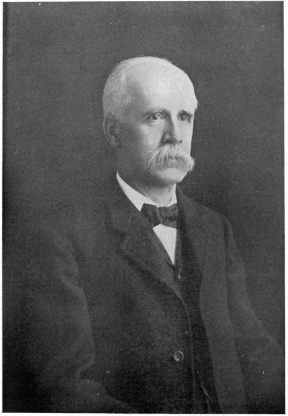
INCEPTION AND ORGANIZATION
Contributed by Charles N. Hall
In April, 1906, a call was issued in the columns of the New Milford Gazette, asking all citizens to meet at Mygatt’s Hall, Bank Street, on Monday evening, April 30, to consider the project of celebrating the town’s two hundredth anniversary.
About forty citizens responded to the appeal and met at the appointed time and place.
The meeting was called to order by Mr. William G. Green, and Mr. Henry S. Mygatt was appointed chairman of the meeting.
After full discussion as to the possibility and advisability of such a celebration as that implied in the call, the following preamble and resolution were adopted:
“Whereas, New Milford was first settled in the year of our Lord, 1707, and has from a humble beginning gone steadily forward in growth and prosperity, through the industry and patriotism of its sons and daughters, and the blessings of a Divine Providence:
“And Whereas, It seems fitting that the two hundredth anniversary of this town, now near at hand, should be recognized and celebrated by all its citizens in such manner as to confer proper dignity upon the occasion; to call together for a day all its children; to honor the memories of those who contributed to its past and present welfare; to show the industrial, agricultural, commercial, educational, and religious progress of the community throughout the past years; and to give due thanks to the Providence that has watched over it.
“Therefore it is Resolved: That during the year 1907, upon a date to be named at a future meeting, there shall be held a celebration to be known as the New Milford Bi-Centennial.”
After further discussion as to forms of organization, it was voted:
“That in accordance with the spirit of the foregoing resolution, this meeting shall appoint a General Committee of Arrangements, said committee to have entire charge of all arrangements pertaining to the New Milford Bi-Centennial Celebration; to have power to make changes in and additions to its own numbers; to have authority to appoint and organize all necessary sub-committees, and the power to direct the work of such sub-committees, and to make removals and substitutions in such sub-committees; and to take any and all measures necessary to carry the foregoing resolution into effect.”
The meeting then appointed a Nominating Committee consisting of C. M. Beach, W. G. Green, H. L. Randall, S. S. Green, G. M. Breinig, and Rev. Marmaduke Hare, to present to the meeting the names of those who should constitute the General Committee of Arrangements.
After consultation, the Nominating Committee presented a list of those persons who should constitute the General Committee, and those so named were by vote declared appointed as the General Committee of Arrangements, with the powers and duties above set forth.
It was then voted:
“That when this meeting adjourns, the chairman of this meeting shall have authority to call, at his pleasure, a meeting of the General Committee of Arrangements.”
The meeting then adjourned.
The General Committee of Arrangements met on July 6, 1906, about one hundred members being present. At this meeting a permanent organization was effected, officers elected, sub-committees appointed, and a date set for the celebration.
The officers elected were:
Permanent Chairman and President, Henry S. Mygatt; Vice-Presidents, Andrew G. Barnes, Francis E. Baldwin, Stephen C. Beach; General Secretary, Charles N. Hall.
It was voted:
“That the Celebration be held on Saturday, Sunday, Monday, and Tuesday, June 15, 16, 17, 18, 1907.”
It was voted:
“That Sub-Committees be created as follows:
An Executive Committee,
A Finance Committee,
A Committee on Exercises,
A Committee on Refreshments,
A Committee on Decoration,
A Committee on Publicity,
A Committee of Invitation, Reception, and Entertainment;
A Committee on Religious Observances,
A Committee of Public Safety,
A Committee on Historical Research and Permanent Publication.”
It was further voted:
“That each member of the General Committee pay the sum of one dollar, and each member of a sub-committee the additional sum of two dollars to the Bi-Centennial fund.”
Subsequently the Executive Committee, acting for the General Committee, appointed from time to time other sub-committees found necessary in the progress of the work. These were:
A Loan Exhibit Committee,
A Committee on Vocal Music,
A Colonial Reception Committee.
The officers and members of the General Committee of Arrangements were as follows:
President, Henry S. Mygatt;
Vice Presidents, Andrew G. Barnes, Frances E. Baldwin, Stephen C. Beach;
Secretary, Charles N. Hall;
Members
John F. Addis. Mrs. John F. Addis. Geo. E. Ackley. Mrs. Geo. E. Ackley. W. H. Adams. Victor L. Anderson. Emil Anderson. Geo. B. Ackley. Mrs. Geo. B. Ackley. Fred Anderson. Mrs. Geo. W. Anthony. Mrs. Phoebe L. Anderson. Horace A. Allen. Rev. J. J. Burke.
Dr. J. C. Barker. Dr. B. E. Bostwick. Chas M. Beach. Alexander H. Barlow. W. G. Brown. Charles P. Bentley. Reuben Booth. G. M. Breinig.[11] David E. Breinig. Henry M. Baldwin. Willis F. Bennett. Willis G. Barton. Dr. Charles P. Blinn. Mrs. Wm. D. Black. William H. Booth. H. B. Bostwick. Burton B. Booth. Mrs. J. L. Buck. Mrs. J. A. Bolles. Mrs. Wm. Bostwick. Miss Ruth T. Booth. Frederick L. Bennett. Andrew Buckingham. Mrs. Chas. M. Beach. Mrs. G. M. Breinig. Mrs. A. M. Booth. Mrs. H. E. Bostwick. Miss C. B. Bennett. Miss A. E. Bostwick. Miss Helen M. Boardman. Miss Kate T. Boardman. Miss Grace Buckingham. Miss May Brown. Miss Adaline L. Buck. Mrs. J. C. Barker. Mrs. B. E. Bostwick. Amos H. Bowers. A. C. Bowers. Andrew M. Booth. Mrs. David A. Baldwin. Mrs. Willis F. Bennett. Lyman W. Brown. Andrew J. Baldwin. Noble Bennett. E. Noble Bennett. Mrs. Merritt Beach. Mrs. I. B. Bristol. Mrs. Edwin N. Bostwick. Daniel B. Brewer. Henry Booth. Wiliam E. Bostwick. Rev. T. J. Cronin. Andrew C. Clark. Mrs. Andrew C. Clark. Daniel H. Canfield. Lawrence C. Camp. Robert B. Clark. L. F. Curtis. Mrs. L. F. Curtis. P. M. Cassedy. John D. Clark. Alanson N. Canfield. Mrs. Geo. N. Canfield. Mrs. Lemira J. Carter. Howard C. Clark. Phineas E. Clark. Warren S. Crossman. John B. Cox. Chas. B. Camp. Salmon Couch. A. L. Conkey. Rev. Frank B. Draper. Dr. J. A. Dolan. Henry Donnelly.
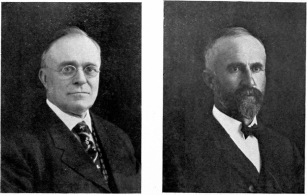
SEYMOUR S. GREEN Chairman Executive Committee HONORABLE ANDREW G. BARNES Vice-President
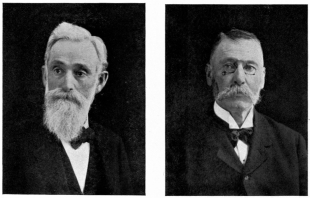
STEPHEN C. BEACH Vice-President FRANCIS E. BALDWIN Vice-President
SOME OFFICERS OF THE BI-CENTENNIAL CELEBRATION
Robert L. Duncan. Eben B. Dorwin. Myron B. Disbrowe. Edwin J. Emmons. Mrs. Edwin J. Emmons. Albert Evitts. Rollin C. Emmons. Chas. H. Evans. Miss S. C. Erwin. Thomas Fuller. Munson Fairchild. Alban G. Ferriss. Samuel J. Ferriss. Mrs. Albert Ferriss. Henry Ferriss. Miss Minnie A. Ferriss. Miss Jane Fenn. Dr. H. B. Griswold. Minot S. Giddings. Levi P. Giddings. Wm. G. Green. Seymour S. Green. Henry Garvey. Miss Jeanette L. Gaylord. William F. Gaylord. Fred R. Green. Ethiel S. Green.[12] William B. Green. George W. Green. William Green. George H. Gaylord. Mrs. James Giddings. Rev. Marmaduke Hare. Rev. Stephen Heacock. J. E. Hungerford. Mrs. J. E. Hungerford. Walter C. Hine. Mrs. Walter C. Hine. Mrs. Charles N. Hall. J. Stuart Halpine. Wm. H. Hartwell. Frederick C. Hoyt. Henry D. Hine. Oliver W. Hoyt. Mrs. H. D. Hine. Mrs. W. B. Hatch. Virgil B. Hatch. Merritt W. Hill. Mrs. Mary H. Hunt. Edson P. Hill. Harvey B. Hoyt. Martin L. Hungerford. Arthur B. Hungerford. Sheldon B. Hendricks. Mrs. Sheldon B. Hendricks. John H. Hall. Edward Hendricks. Merwin Hine. G. W. Hatch. G. L. Hamlin. Oliver S. Hartwell. Roger T. Hartwell. Robert J. Hungerford. E. D. Howland. Minot L. Hartwell. John T. Hepburn. John M. Hine. Frederick W. Hartwell. Clark M. Hunt. Samuel R. Hill. Henry H. Hartwell. Albert S. Hill.[12a] Allen S. Hill. Edgar F. Hawley.
E. F. Hartwell. H. C. Ives. Rev. Frank A. Johnson. George H. Jackson. L. N. Jennings. Lucius Jackson. Michael A. Kelly. Dr. F. E. King. Mrs. F. E. King. W. F. Kinney. Mrs. W. F. Kinney. Nelson W. Kinney. Arthur W. Knowles. Henry Kinney. Frederick W. Knowles. Frederick Knapp. Henry Kinney, 2d. Joseph La Hait. Geo. H. Lines. Walter B. Leavenworth. Carr S. Lyon. Wm. P. Landon. Frank W. Marsh. A. H. McMahon. Mrs. A. H. McMahon. Daniel Marsh. Chauncey B. Marsh. J. B. Merwin. Roland F. Mygatt. Frederick Merwin. Mrs. H. S. Mygatt. Miss. Grace H. Merwin. John H. Morehouse. James E. Mullins. Miss Carrie H. Marsh. Mrs. Margaret Moore. Mrs. Carlos Merwin. M. H. Mallett. Amos H. Marsh. James Marsh. Miss Lottie Mallett. Henry W. Murray. Mrs. Henry W. Murray. E. B. Marsh. E. O. Marsh. Mrs. E. O. Marsh. Andrew J. McMahon. Robert C. Mallory. Wm. J. M. Miller. James H. McMahon.[13] George Newton. Charles H. Noble. Russell B. Noble. Miss Ella F. Noble. Wm. N. Noble. Ithamer F. Northrop. Jasper A. Northrop. Alfred H. Noble. Mrs. George Northrop. Lawrence Northrop. Charles Northrop. J. H. Nettleton. Charles H. Osborne. Wilbur H. Osborne. Abram Osborne. Wallace W. Osborne. Farley Osgood. Robert A. Osborne. Rev. John F. Plumb. John Pettibone. Henry H. Pomeroy. Wm. B. Pell. Mrs. Wm. B. Pell. Mrs. Ivory Phillips.
Mrs. Clayson S. Perry. Charles Planz. D. W. Pepper. Wm. A. Parcells. A. W. Peelstrom. John Payne. Edgar A. Peet. Lewis A. Payne. Lehman T. Peet. Clinton H. Pomeroy. H. Leroy Randall. Mrs. H. Leroy Randall. William J. Roberts. Miss Sarah J. Roberts. Mrs. C. E. Riddiford. Charles Riley, Jr. F. T. Richmond. Seeley B. Richmond. Mrs. Chas. Randall. Mrs. Isaac Reynolds. Wm. L. Richmond. Levi S. Richmond. Nathan H. Root. C. E. Riddiford. Orrin Roberts. Rev. H. K. Smith. Dr. Geo. E. Staub. Verton P. Staub. Nicholas Staub.[14] Turney Soule. Chas. H. Soule. David E. Soule. George T. Soule. Frank E. Soule. Henry S. Sanford. Everett J. Sturges. Frederick E. Starr. Mrs. Verton P. Staub. Vincent B. Sterling. Geo. W. Squires. Miss Caro S. Sanford. Mrs. V. B. Sterling. Carl F. Schoverling. Henry A. Soule. Walter D. Soule. Mrs. Catherine Smith. Mrs. C. R. M. B. Smith. Albert Sterling. Wm. W. Stillson. Frederick M. Straight. James S. Sullivan. Israel B. Smith. Mrs. Wm. Schoverling. Lee Stone. Mrs. C. C. Smith. Miss Harriet V. Sherman. Mrs. Ellen F. Shepard. Mrs. Charles Taylor. Frederick J. Turrill. Arthur G. Todd. Cyrus A. Todd. Mrs. R. S. Todd. Mrs. Henry R. Treadwell. Mrs. Lucy Turrill. Chas. A. Tappen. Miss Martha Treadwell. John T. Underhill. Rev. S. D. Woods. Dr. Geo. H. Wright. F. M. Williams. Mrs. F. M. Williams. Philip Wells. Stanley L. Warner. Henry O. Warner.
Wm. D. Wanzer. A. C. Worley. John E. Wells. Charles A. Way. Miss Edith Warner. Mrs. C. E. Wright. Miss Charlotte A. Wells. Smith M. Waller. E. M. Waller. Frederick L. Wanzer. Edward A. Wildman. John F. Williams. Newton B. Weaver. Reuben M. Wilbur.
Miss Mary C. Wells.
The members of the special committees—appointed by the General Committee[15] to arrange for and carry out the plans for the Celebration—were:
Executive Committee: Seymour S. Green, chairman; J. B. Merwin, Everett Sturges, Verton P. Staub, Mrs. H. S. Mygatt, Mrs. C. M. Beach.
Finance Committee: H. Leroy Randall, chairman; Charles H. Noble, treasurer; Willis G. Barton, William G. Green, Turney Soule, Edwin J. Emmons.
Committee on Exercises: Charles M. Beach, chairman; John H. Morehouse, clerk; Willis F. Bennett, Frank E. Soule, D. W. Pepper, John Pettibone, Mrs. Verton P. Staub, Frederic M. Williams, Joseph La Hait, Samuel R. Hill, Chauncey B. Marsh, Miss Helen M. Boardman, Miss Ella F. Noble, and the selectmen of the town, ex officio.
The Committee on Exercises appointed the following marshals for the Civic and Military Parade, and the following sub-committees to arrange for Colonial features in the Parade and for an Automobile Carnival on Monday, June 17:
Marshals: Samuel R. Hill, chief marshal; David E. Soule, George E. Ackley, Henry O. Warner.
Committee on Colonial Features: Willis F. Bennett, chairman; Alfred H. Noble, clerk; William G. Green, Dr. Charles P. Blinn, Chauncey B. Marsh, Mrs. J. C. Barker, Miss Helen M. Boardman.
Committee on Automobile Parade: Roland F. Mygatt, chairman;
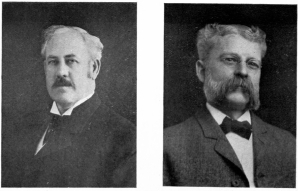
H. LEROY RANDALL Finance Committee W. F. KINNEY Invitation, Reception and Entertainment Committee
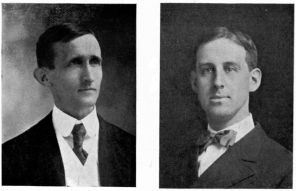
FREDERICK E. STARR Music Committee CHARLES P. BENTLEY Decoration Committee
CHAIRMEN OF SOME BI-CENTENNIAL COMMITTEES
Henry D. Hine, Dr. B. E. Bostwick, Robert Dunlap, S. Woolsey Pepper, George T. Soule.
Committee on Refreshments: Miss Adaline L. Buck, chairman; J. Edwin Hungerford, clerk; H. C. Ives, Vincent B. Sterling, Mrs. Charles N. Hall, Mrs. Margaret Moore, Mrs. A. C. Clark, James E. Mullins, Wm. L. Richmond, Mrs. Walter C. Hine, George E. Ackley, P. M. Cassedy, Dr. B. E. Bostwick, Emil Anderson.
Committee on Decorations: Charles P. Bentley, chairman; Wm. B. Pell, Dr. Charles P. Blinn, John F. Addis, Geo. T. Soule, Frederick L. Bennett, Henry D. Hine, Mrs. F. E. King, W. H. Adams, A. W. Peelstrom, Levi P. Giddings.
Committee on Publicity: Charles N. Hall, chairman; W. G. Brown, Dr. Geo. H. Wright, A. C. Worley, David E. Breinig.
Committee on Invitation, Reception and Entertainment: W. F. Kinney, chairman; Miss Sarah J. Roberts, secretary; Russell B. Noble, Mrs. Frederic M. Williams, Mrs. H. S. Mygatt, Mrs. Albert H. McMahon, Henry S. Sanford, Andrew C. Clark, Stanley L. Warner, Mrs. Isaac Reynolds, Alexander H. Barlow, Andrew J. Baldwin, Charles Northrop, Mrs. George B. Ackley, Mrs. C. E. Wright, Miss Caro S. Sanford, Mrs. Chas. Taylor, Mrs. Wm. Bostwick, Mrs. Catherine Smith, Mrs. H. E. Bostwick, Orrin Roberts, Mrs. Merritt Beach, Alanson N. Canfield, Albert Evitts, George H. Jackson, Mrs. Wm. B. Pell, Miss A. E. Bostwick, Francis E. Baldwin, Oliver S. Hartwell, Mrs. E. O. Marsh, Henry Ferriss, Miss Jeannette L. Gaylord, Seeley B. Richmond, Mrs. Carlos Merwin, J. B. Merwin, Mrs. W. D. Black, Mrs. J. L. Buck, Mrs. Phœbe L. Anderson, Mrs. Henry R. Treadwell, Mrs. Wm. G. Green, Mrs. G. H. Jackson, Chas. B. Camp, Cyrus A. Todd, and the selectmen of the town, ex-officio.
The chairman of this committee appointed Albert Evitts, chairman of reception; Henry S. Sanford, chairman of entertainment.
Committee on Religious Observances: Rev. Frank A. Johnson, chairman; Rev. John F. Plumb, Rev. Frank B. Draper, Rev. T. J. Cronin, Rev. J. J. Burke, Rev. Marmaduke Hare, Rev. Stephen Heacock, Rev. H. K. Smith, Rev. S. D. Woods, Rev. T. J. Lee.
Committee of Public Safety: Henry Donnelly, chairman; Charles Planz, Albert H. McMahon, L. N. Jennings, Charles Reilly, Chas. H. Osborne.
Committee on Historical Research and Permanent Publication: Minot S. Giddings, chairman; Russell B. Noble, Mrs. Henry E. Bostwick, Miss Charlotte B. Bennett, Miss Kate T. Boardman.
Committee on Loan Exhibit: Dr. George H. Wright, chairman: Wm. B. Pell, C. Andrew Humeston, Miss Flora G. Stillson, Herman C. Buckingham, Mrs. Clarissa R. M. Staples, Miss Jeanette L. Gaylord, Miss Mabelle Sanford.
Committee on Vocal Music: F. E. Starr, chairman; Prof. Edwin G. Clemence, director; Henry C. Harris, Mrs. H. S. Mygatt, Rev. H. K. Smith, Mrs. M. W. Hill.
Committee on Colonial Reception: Stephen C. Beach, chairman; W. F. Kinney, Wm. G. Green, J. Stuart Halpine, Charles M. Beach, Henry S. Sanford, Roland F. Mygatt, Frank W. Marsh.
All the committees worked nobly and in perfect harmony.
Upon the Finance Committee devolved the responsibility of raising the necessary funds, and the duty was splendidly performed. Solicitors were appointed in each district of the town, and furnished with books in which subscriptions were pledged to be paid on or before April 1, 1907. The solicitors, besides the members of the Committee, were: Henry W. Murray, Oliver W. Hoyt, Henry M. Baldwin, Nicholas Glennon, Nelson W. Kinney, Edgar A. Peet, John W. Pulver, John T. Underhill, Daniel Marsh, Walter C. Hine, Millard B. Dorwin, Charles H. Evans, Chauncey B. Marsh, Henry S. Mygatt, Charles N. Hall.
So successful was this canvass that the needed funds were all subscribed before May 15. The result speaks volumes for the enterprise and systematic work of the Finance Committee, as well as for the generosity and public spirit of New Milford’s citizens.
The Executive Committee met frequently to authorize appropriations and receive reports, and, in May, opened an office in the Knapp Building on Bank Street, the second floor of that building having been very generously placed at their disposal by Mr. Frederic Knapp of Hartford.
Meetings of all the Chairmen of Committees were occasionally held, and were found very useful in promoting the work.
The Committee on Exercises had the greatest task to perform in arranging a suitable and comprehensive programme of exercises for the entire Celebration, co-operating as to Sunday’s exercises with the Committee on Religious Observances. In order to secure full participation in the Parade, District Committees were appointed throughout the town, to look after Parade features in their respective localities.
These Committees were:
Lower Merryall: F. C. Merwin, H. W. Murray, S. B. Hendrix, W. D. Stone, John Pepper.
Waller: John T. Underhill, Smith Waller, Thomas Austin, Alexander H. Barlow.
Hunt: Nelson W. Kinney, M. W. Beers, Earle Morehouse, Chester Lyon.
Long Mountain: Henry M. Baldwin, H. H. Pomeroy, Wm. Pomeroy.
Gaylordsville: Chas. H. Evans, Wm. Gaylord, Chas, H. Soule, George Newton, Wm. J. Roberts.
Northville: Francis E. Baldwin, A. C. Bowers, E. B. Buckingham, Walter C. Hine.
Still River: Percy Collins, Fred P. Chase, Stanley L. Warner, Chas. H. Stevens.
Park Lane: N. H. Root, James S. Sullivan, W. B. Leavenworth.
Hill and Plain: Wm. D. Wanzer, Arthur E. Knowles, Merwin P. Hine, Geo. W. Hatch.
Second Hill: Robert Duncan, Robert J. Hungerford, Mrs. A. C. Clark, Mrs. J. A. Cowan, Mrs. T. Walsh, Wm. Hartwell, Millard B. Dorwin, Joshep Cowan, Miss Alice Beers, Mrs. Wm. Johnson, Mrs. Hans Ahlstrom.
Upper Merryall: V. B. Hatch, Israel B. Smith, A. H. Squires, Geo. W. Squires, Fred M. Straight.
Pickett: Nicholas Glennon, Mervin Andrews, Leslie Marsh. Chestnut Land: Ivory Phillips, P. E. Clark, Howard C. Clark, Frank Erwin, Fred Anderson, E. F. Hartwell, Samuel Thompson.
Aspetuck: Daniel Marsh, Joseph Hill, E. Noble Bennett, Levi S. Richmond.
Boardman: Oliver W. Hoyt, Andrew G. Barnes, Sheldon Northrop.
The District Committee on refreshments were:
Upper Merryall: Mrs. Geo. B. Ackley, Geo. W. Squires; assisted by Mrs. Wm. Birkins, Mrs. Frederick Squires.
Lower Merryall: Mrs. Carlos P. Merwin, Mrs. Geo. N. Abbott, Mrs. H. W. Murray.
Hunt: Mrs. Myron W. Toohey.
Northville: Mrs. Walter C. Hine, Miss Elizabeth Baldwin.
Chestnut Land: Miss May Galvin, Edgar Phillips.
Second Hill: Mrs. Robert J. Hungerford, Mrs. Joseph A. Cowan.
Park Lane: Mrs. Mary D. Bostwick, Mrs. Wesley Northrop, Mrs. Edward C. Howland.
Boardman: Mrs. Oliver W. Hoyt, Mrs. Henry W. Kimlin; assisted by the Christian Endeavor Social Union.
Waller: Mrs. Thomas Austin, Mrs. Smith M. Waller.
Gaylordsville: Mrs. Arthur Hungerford, Mrs. J. A. Dolan.
Long Mountain: Mrs. Henry M. Baldwin, Miss Minnie Pomeroy.
Aspetuck: Mrs. Levi Richmond, J. Fred McEwan.
Hill and Plain: Mrs. Robert Osborne, Arthur E. Knowles.
Lanesville: Mrs. Laura Campbell, Mrs. Nora Dickey, Mrs. Horace A. Allen.
Pickett: Mrs. Edward O. Marsh, Mrs. Daniel B. Brewer, Miss Bessie Adams.
Center: Mrs. W. C. Beeman, Miss Kathleen Duncan, Mrs. Robert S. Todd, Mrs. Timothy Heacock, Miss Bessie I. Brown, Mrs. V. B. Sterling, Mrs. A. M. Booth, Mrs. P. M. Cassedy,
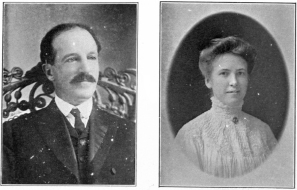
EDWIN G. CLEMENCE Conductor of the Chorus MISS ADALINE L. BUCK Chairman Refreshment Committee
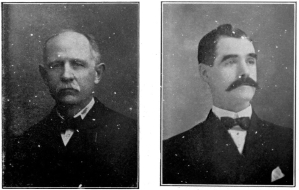
CHARLES J. RYDER, D. D. One of the Speakers HENRY DONNELLY Chairman Public Safety Committee
Mrs. W. M. Keeler, Mrs. Albert Sterling, Mrs. Emil Anderson, Donald E. Hungerford, Francis Mulcahy, Clifford Castle, Mrs. James E. Mullens.
The Committee on Decorations furnished the town with a fine public flag pole and flag, to be used first at the opening exercises of the Celebration. The committee also carried out the beautiful plan of decoration and illumination on Main Street.
The Committee on Publicity kept the Celebration before the public in many ways. Printed envelopes of the Bi-Centennial were furnished to the citizens to the extent of several thousand. One thousand very attractive cards were sent throughout the State, and frequent items were published in all the newspapers of the State. This committee also published the official Programme of the Celebration.
The Committee of Invitation, Reception, and Entertainment devised, addressed, and sent out the official invitations; arranged for the official reception of all guests; and, in many ways, made all guests feel truly welcome. This committee arranged for Reception Headquarters and a Bureau of Information in Roger Sherman Hall during the Celebration.
The Committee on Religious Observances had charge of the exercises on Sunday, June 16, and arranged so well that this proved to be one of the most delightful days of the Celebration.
The Committee of Public Safety, co-operating with the selectmen of the town, provided most complete arrangements for the preservation of order and the safety of property throughout the days and nights of the Celebration.
The work of the Historical Committee was difficult and important in a high degree, and the task of collecting all the historical facts needed, and presenting the whole in attractive and interesting form, kept all the members extremely busy up to the opening of the Celebration. The committee received most practical and valuable assistance from The Grafton Press of New York City, which not only contracted to publish the book of the Bi-Centennial, but in many ways facilitated the preliminary work. This firm agreed to report, for the book, the entire proceedings of the four days, and, to this end, established a representative on the spot some days in advance, to remain throughout the Celebration. The reportorial work was under his direction.
The Loan Exhibit Committee were tendered the use of Grand Army Hall, through the kindness of Upton Post, and began early to look up all articles of historic value and interest. The amount of work involved was very great, but was most successfully accomplished.
The Committee on Colonial Features made preparations which contributed very greatly to the interest and success of the parade, spending a great deal of time and thought in representing the scenes of old Colonial days.
The Committee on Colonial Reception prepared the hall and made all arrangements for one of the most pleasurably anticipated events of the Celebration.
The Committee on Vocal Music, under the direction of Professor Edwin G. Clemence, prepared an elaborate musical programme and gave abundantly in time and efforts to perfect this most important portion of the exercises.
Rest Houses for women and children were established at various convenient places, in readiness for the crowds anticipated.
James C. Barker, M. D., and T. B. Merrin were appointed a Committee of Public Health and Comfort.
Owing to ill health, Mr. Henry O. Warner was unable to serve as Marshal, and Walter C. Hine was appointed in his stead.
The Marshal’s aides appointed for the Parade were:
FIRST DIVISION
Perry Green. Noble Booth. Charles Pomeroy. Miss Madeline Todd. Miss Louise Beeman. Miss Parthenia Todd.
SECOND DIVISION
Dr. C. B. Blackman. George S. Dean.
Spencer Welton.
THIRD DIVISION
Granville Breinig. W. M. Keeler.
Clifford A. Trowbridge.
FOURTH DIVISION
James Marsh. W. C. Beeman.
Clifford Marsh.
From January, 1907, up to the opening day on June 15, all the committees worked arduously and unceasingly to make the Bi-Centennial a success. Less opposition and discouragement were met than are usual in such enterprises, and to the public-spirited and loyal citizens of the town belongs the credit of all this work, so triumphantly accomplished.
THE OPENING EXERCISES
There never was a time and place, perhaps, in which a keener interest was taken in the weather than at New Milford during the days immediately preceding the Bi-Centennial Celebration. One of the most backward and inclement springs known to New England history seemed to have bequeathed all its inclemency to the summer month of June, and, on the afternoon of Friday, June 14, not only were the signs few and feeble that summer had come, but the sky was extremely threatening. The boldest prophet did not venture to predict fair weather for the following day with any approach to positiveness; and, under the besetting dread of a down-pour which would ruin the beautiful Bi-Centennial decorations already in place on “The Green,” and interfere sadly with the Bi-Centennial exercises (most of which were to be in the open air) New Milford faces wore an expression of anxiety that was piteous to see. Saturday came without rain and without clouds, however, and, better still, brought with it that light, luminous haze, which, in this part of the world, presages a spell of dry weather—an augury that, happily, was to be fulfilled. The rows of white pillars with gilded capitals (typifying the Colonial architecture) and the clusters and festoons of national colors and navy signal flags (typifying our present national greatness), which constituted the official decoration of “The Green,” assumed new splendor in this highly favorable light, while the private decorations, which had been delayed somewhat by the fear of rain, were brought to completion so rapidly that, by noon, the town was literally enveloped in flags and patriotic and Colonial bunting.
Promptly at four in the afternoon the Doxology pealed forth from the chimes of All Saints’ (played by Prof. Clemence) and was quickly taken up by the voices of the large concourse gathered on “The Green” about the band-stand, on
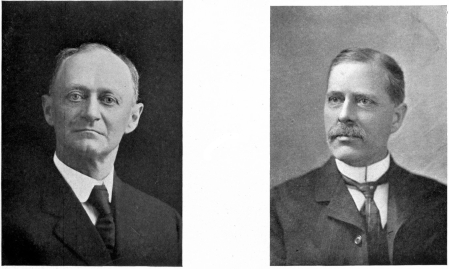
CHARLES N. HALL Secretary of the Bi-Centennial Celebration CHARLES M. BEACH Chairman Committee on Exercises
which the chairmen of the Bi-Centennial committees were seated. Rev. Frank A. Johnson invoked the blessing of God upon the coming Bi-Centennial ceremonies in an impressive prayer, after which “America” was played by the band (Gartland’s of Albany) and sung by the audience. Charles N. Hall, Secretary of the General Bi-Centennial Committee, then stepped forward and delivered the following address of welcome:
“Citizens and Friends:
“For this seems the most comprehensive and fitting title by which to address such an assemblage as this; since many of you are citizens, and all of you are friends of New Milford. Citizens and friends then; to one and all; to those of you who are citizens; to those of you who were New Milford born, but have found other homes; to those of you whose forefathers were once New Milford’s children; to each and every one of you, and to all guests yet to come, the General Committee of the Bi-Centennial, speaking for this entire community, extends a most heartfelt welcome.
“But our welcome is tinged with regret; regret that these words cannot be spoken to-day by the one man that is best fitted for, most entitled to, that honor. Those of you who have worked during these months of preparation, and all who know him, will bear witness that no man living has done more for this Celebration; no man living could have greeted you more gracefully or with greater sincerity than would our honored President, Henry S. Mygatt, were he present. But though not with us in person, we know that he is so in thought; that his hopes and best wishes are with us to-day.
“It is difficult to find words fitting for an occasion like this, for no occasion like this has ever before confronted us.
“For the first time in her history, New Milford fittingly celebrates a birthday anniversary. For the first time in her history, New Milford has planned a great general home-coming of all her scattered children. For the first time, we shall see, during these four days, all our own people gathered together in a common cause: and it is not likely that any now living will ever see them so gathered again.
“This then is The Event, not merely of the years, but of the centuries; an event which must occupy a place unique and unapproached in the history of our town; and words may well fail to express the sentiments which such an occasion must inspire.
“Since that day in the year 1707, when the pioneer, John Noble, first traversed the wilderness to this place, up to this day of June, 1907, every event and circumstance, toil and danger, hardship and prosperity, peace and war, all have been but successive steps leading to this Celebration, and making it possible. And, in this Celebration, we mark not this anniversary alone, but celebrate as well all that has gone before.
“We celebrate the founders of our town; the heroic men and women who, by their toil, their courage and their faith, not only made New Milford, but helped to lay the corner-stone of this nation. Every event in this, our Celebration; this flag-raising; the splendidly impressive service of Sunday; the historic addresses, and the reception of Monday; the imposing parade of Tuesday; all were planned, not only to afford pleasure and entertainment for our guests, and to glorify the New Milford of to-day, but also to commemorate and glorify the past.
“But while we celebrate New Milford, past and present, what shall we say of the New Milford to come? Shall not the civic pride, and energy, the patriotism, that have inspired this Celebration, continue to be moving forces toward a better New Milford? Shall not some of the thousands who visit us, impressed with the attractions of our town, remain and help us to make a greater New Milford?
“New Milford has done wisely and well to inaugurate this home coming, for such home comings are vitally essential to the right life and growth and prosperity of any community.
“New Milford is proud of her history; proud of her position among the hills and towns of old Litchfield County, in this blessed commonwealth of Connecticut; proud of her business enterprise, of her schools and churches; and proud of her children, whom she welcomes home to-day.
“You are here, not as chance visitors, or strangers, but as members of one great family. We ask you to be not only with us, but of us at this time; to become, for the time being, citizens of our town, and would be glad to have you become so in fact.
“New Milford and its Celebration are yours; be at home with us; survey the attractions of our town; visit and greet old friends; enjoy the Celebration to the utmost, and then if you must leave us, take with you the kindest thoughts, and happy memories of the Bi-Centennial.”
At the close of this address, the band, playing “Auld Lang Syne,” marched to the south end of “The Green” (the chairmen of the committees, the New Milford Cadets under command of Capt. Gifford Noble, and the audience falling in behind) to the new, white, eighty-foot flag pole, which had been erected there under the supervision of Grand Marshal, Samuel R. Hill. To the strains of the “Star Spangled Banner,” Mr. Hill, assisted by Lewis W. Mosher, ran a new flag[16] up the pole, while the Cadets stood statue-like near its base. As the flag touched the peak, a cannon salute was fired by a firing squad under the direction of Samuel R. Hill, Jr. This was a signal for the playing of “We’ll Rally Round the Flag, Boys,” by the band, for the blowing of factory whistles, and the ringing of church bells; and, with this acclaim, the formal opening of the New Milford Bi-Centennial Celebration was ended.
THE LOAN EXHIBITION
The Loan Exhibition in Memorial Hall was opened to the public at ten o’clock Saturday morning, several hours in advance of the formal ceremonies of welcome described above, and was kept open during the entire four days of the Celebration. It proved an agreeable surprise, not only to the guests of the town, but to the townspeople themselves, who had no idea how rich their homes were in relics of the past until they were thus brought together for this Bi-Centennial occasion. Indeed, it was pronounced by competent judges one of the most interesting collections of antiquities ever seen in the State of Connecticut. By its aid, any person possessed of the slightest imagination could easily reconstruct the every-day existence (in-doors and out-of-doors) of the ancestors, and could even divine the intellectual, moral and religious ideas and ideals which governed them. Besides the local relics associated directly with the New Milford life of yore, were a number of curiosities from remote corners of the globe, which testified to the important rôle played by natives of New Milford in earlier times as merchants, ship-owners, travellers, and missionaries.
These various richly-stored heirlooms were a source of great joy to the aged, whose observations and reminiscences, as they moved about among the show-cases, were well-nigh as fascinating as the exhibits themselves; and a means of instruction for the young, to whom most of the objects displayed appeared as strange as if they had been brought from another planet.
The finest thing about this exhibition, however, was the public spirit it exemplified. The committee in charge met scarcely a refusal from the persons to whom they applied for loans, and, once the character of the undertaking was understood, volunteers came forward in such numbers that twice the space afforded by the G. A. R. rooms might have been filled, had it been available.
Many of the visitors expressed regret that so remarkable a collection must be scattered so soon and a hope that New Milford would one day see its way clear to maintaining a permanent exhibition of the sort. And it would not be surprising if the ultimate outcome of this loan exhibition should be a museum of antiquities, since a large proportion of the exhibitors would gladly contribute their treasures to the common-weal, if a specially-constructed, fire-proof building should be provided for the conservation of them.
A complete list of the exhibits is given herewith:
Henry Kimlin:
1. Razor dated 1688.
2. Pair of spectacles.
Minot S. Giddings:
3. A deed to Jonathan Giddings of a tract of land on the Connecticut Reserve of Ohio, given by Elijah Boardman, Homer Boardman, David S. Boardman, Stanley Griswold, of New Milford, Ct., Elijah Wadsworth, Frederick Wolcott, Litchfield, Ct., and Zepheniah Briggs of New Fairfield, Ct. Dated 1800.
4. Razor. Portrait of Washington engraved on blade.
5. Sampler, Ruth Buck, date 1786.
6. Bible, Ruth Buck, date 1771.
7. Copy of “Washington’s Political Legacy,” 1800.
8. Copy of “Gertrude of Wyoming,” date 1809.
9. Copy of “Life of Dr. Benjamin Franklin,” by himself, date 1795.
10. “The Federal Calculator,” 1802. Samuel Giddings.
11. The Prayer Book, 1795. Ebenezer Sanford.
Fred’k E. Starr;
12. Section of Pulpit of Meeting-house, 1754.
Mrs. Arthur Caldwell:
13. Grandmother’s jewelry.
14. Pin, 1816.
15. Floral comb.
16. Candle tray and snuffer.
17. Fluid lamp.
18. Vase.
19. Bowl.
Dr. L. J. Pons:
20. Canteen, Civil War.
Lyman Caldwell:
21. Collection of arrow heads.
Wm. H. Marsh:
22. Pie platters, that the extra good pies of our grandmothers were baked in.
23. Churn. This churn is probably over a hundred years old.
24. A bottle of the Eighteenth Century.
25. A bottle of the Eighteenth Century.
26. A doll’s cradle used fifty years ago.
Fred’k Berry:
27. Dress sword and sash. Presented to Capt. F. M. Berry, by Company H, 2d Conn. Artillery.
F. A. Johnson:
28. Tea pot, buried in the War of 1812, with other valuables, to prevent its falling into the hands of the British.
29. Rifle shot, picked out of the side of a Confederate fortification at Atlanta, Ga., where they had been fired in by General Sherman’s troops.
30. French lancer’s spear head, picked up on the battlefield of Waterloo, soon after the battle.
31. Arrow given by “Dave,” one of the party of Modoc Indians who killed Gen. Canby. Secured in the Indian Territory.
32. Strip of Confederate flag, which was lowered from the Capitol at Richmond at the surrender, when the city was captured. Confederate money from Gen. Lee’s treasure chest. Captured at Appomattox.
L. T. Peet:
33. Trencher and knife, used before the Revolution.
34. Candle-stick, used by Alba Peet 150 years ago, he being a shoemaker and working evenings.
35. Rock-salt pounder, used by my grandfather, Samuel W. Peet.
Henry E. Squires:
36. Green and white coverlet. Wool raised, spun, and woven in Merryall.
37. Plaid blanket. Wool raised, spun, and woven in Merryall.
Mrs. F. A. Mallory:
38. Flowered coverlet.
Mrs. G. B. Ackley:
39. Pair of silver candle-sticks, candle snuffers and tray.
G. B. Ackley:
40. Book, 1809, specimen of penmanship.
Mrs. G. B. Ackley:
41. Bible, 1806. Almanacs, 1803 to 1814.
L. E. Peet:
42. Water Yoke. Over 100 years old.
James H. Cole:
43. Collection of papers. Deed and other papers.
Mrs. E. J. Sturges:
44. Discharge paper.
45. Old paper, 1754.
Lottie A. Waldron:
46. Sugar-bowl.
47. Pair of glass candle-sticks.
May G. Brown:
48. Portraits of Dr. and Mrs. Thomas Holman, painted in Boston in 1819 by Prof. Morse, (inventor of the telegraph) just before they sailed as members of the first band of missionaries to the Sandwich Islands. They were great grandparents of May G. Brown.
49. Journal of Mrs. Thomas Holman, one of the first missionaries to the Sandwich Islands in 1819. Written on board the brig Thaddeus. Mrs. Holman’s daughter was the first white child born in the Sandwich Islands, and Mrs. Holman was the first woman to go around the world. (See Nos. 50 & 114.)
50. Feather cape and wreath, red, yellow and black, worn by the native chiefs of the Sandwich Islands. Made from thousands of feathers of a rare bird, but one feather suitable being found on each. These articles were given by Kamehameha I. to the Holmans (missionaries). They are no longer made and there are few, if any, like them now in existence. They are, therefore, of great value. (See Nos. 49 & 114.)
Ruth T. Booth:
51. Casters, over 100 years old.
52. Coffee pot, over 100 years old.
53. Platter, over 100 years old.
54. Plate, over 100 years old.
55. Cup and saucer, over 100 years old.
56. Tea set, 11 pieces, 125 years old, formerly owned by my great-grandmother, Ruth T. Downes.
Harriet V. Sherman:
57. Sampler.
Mrs. Mary E. Stone:
58. Spectacles and goggles. Arrow head and bayonet.
D. C. Kilborne:
59. Lottery tickets. Sold by the first Cong’l Church Society of Bridgewater to raise money to build the church edifice.
Mrs. S. D. Woods:
60. Daily paper with the account of the funeral of George Washington. 1799.
Dr. L. J. Pons:
61. Rapier, used by Capt. Eli Booth, (1800) Milford, Ct.
62. Revolutionary sword.
63. Lantern from two-wheeled physician’s chaise, used by Dr. Myron Downs, 1830-1860.
64. Bayonet and sheath, 1812.
65. Old English dagger. About 1790.
66. Lantern.
67. First glass lantern. About 1840.
68. Dragoon’s helmet, 1775. Bearskin bush.
69. Dragoon’s flint lock pistol. 1775.
70. Old English pistol.
Mrs. George Trieschmann:
71. Lutheran Bible, 1784.
Mrs. Chas. M. Beach:
72. Tea caddy. This was made at Read’s Pottery in Lower Merryall, about the year 1780. It was part of a tea set which Mercy Sperry (who married Sylvester Wheaton) had when she went to housekeeping.
73. Invitations to assembly balls, one hundred years ago.
74. Grape shot, picked up on the battlefield of Waterloo, about the year 1820, by Rev. Nathaniel S. Wheaton, D. D.
75. Half-cent, American coin, 100 years old.
76. Brazilian dump, coin worth about 2½ cents.
77. Powder horn taken from the dead body of an Indian by Capt. Theophilus Baldwin, a volunteer in the French and Indian Wars, while Baldwin was on a scouting party. The Indian shot at him from ambush, and missed. Theophilus did not miss.
Mrs. H. H. Hartwell:
78. Flint lock gun. Carried through Revolution.
79. Gun. Carried by a French officer in the Revolutionary War. Afterwards changed from a flint lock to a percussion lock.
80. Cartridge belt and cartridges, used in Revolutionary War.
81. Autograph bond of Roger Sherman.
82. Brigade orders, Gen. Sedgwick.
83. Two commissions, Joseph Hartwell. As ensign. As lieutenant.
Geo. N. Canfield:
84. Cane, made from the hull of Old Ironsides. Inscription on head: “From the hull of the Constitution, first built in 1798, and dear to Americans for having successfully fought the Java, Guerrierre, Cyane, and Levant, the bombardment of Tripoli in 1812, and also for her miraculous escape from the British Squadron. Presented to R. E. Canfield by S. Oaks, Esq., U. S. N.”
Dr. G. Bragaw:
85. Flint lock gun with bayonet.
Edward H. Beach:
86. Indian battle axe.
Mrs. E. H. Austin:
87. War club, Sandwich Islands. Made from root of a tree.
88. Quilt, hand spun and woven.
Mrs. Hannah Fuller Austin:
89. Commission of Abraham Fuller. He was afterward Captain of Connecticut troops, most of his men being from Kent.
E. H. Austin:
90. Pewter flagon. Supposed to be 150 years old. Belonged to Mills family of Kent. Authentic record of age for more than 100 years. It was an old flagon when this record began.
91. English army belt clasps. Picked up on the field of Waterloo a few days after the battle. Forty-second Somerset.
Mrs. Thomas Austin:
92. Britannia tea pot. More than 100 years old.
A. H. Barlow:
93. An old deed, given to William Barnes of Haddam, by Samuel Barnes in 1734. Also some of the Continental money.
94. Daguerreotype, Gaylord’s Bridge.
Mrs. A. H. Barlow:
95. Embroidered apron, 65 years old.
96. Collection of handkerchiefs and chemisette, over 65 years old.
97. Lace bonnet, worn in 1868.
98. Stockings knit by Mrs. Joseph Marsh for her eldest daughter, Mrs. Laura Bailey, and worn by each of her six children.
A. H. Barlow:
99. One spoon of a set given to the grandmother of A. H. Barlow as part of her “setting out.” Made of silver dollars in 1799.
Mrs. A. H. Barlow:
100. Spoon, 1830.
101. Old jewelry, 2 lockets and 3 pins. Tortoise shell combs.
102. Three old lace veils.
Mrs. Edward Dakin:
103. Tea canister. Belonged to my great-grandmother, and used by her during her lifetime. Purchased in the year 1770.
Marion D. Underhill:
104. Netted lace, made from flax, raised by my great-great-grandfather on Kent Mountain; spun by my great-great-grandmother; and netted by my great-great-aunt, over eighty years ago.
Miss E. A. Bailey:
105. Cane, brought from England. Has been in the Bailey family for 209 years.
Mrs. A. B. Giddings:
106. Tea pot, brought to New Milford in 1707 by Zachariah Ferriss. Was the only tea pot in town.
107. Toddy tumbler and vinegar cruet, one hundred and fifty years old.
Harriet A. Taylor Lee:
108. Coat worn by Wm. Taylor as Colonel of Militia, 1789.
109. Colonel Wm. Taylor’s duelling pistols, 1789.
Mrs. Chas. Taylor:
110. Pewter porringer, 200 years old.
111. Dr. George Taylor’s wedding hat, 1825. (See No. 255.)
112. Pewter candle-stick, very old.
Bessie I. Brown:
113. Chinese chest, very old.
114. Calabash, very old. Used for carrying water. (Wicker work encloses a gourd.) This calabash and the Chinese chest were presents received in 1852 from China by the Holmans, missionaries to the Sandwich Islands. (See Nos. 49 & 50.)
Chas. N. Hall:
115. New England Courant, 1723. Published by Benjamin Franklin.
Elsie Cummings:
116. Basket, used in Miss Cummings’ family 125 years ago.
Mrs. Eli Clark:
117. Ink stand and sand well. Has been in my family for 125 years.
Mrs. P. E. Clark:
118. Hair brush, made by my grandmother, Lucinda Young, when a girl 12 years old, 96 years ago.
119. A history, 108 years old, previously owned by Dr. Silas Castle of Roxbury, Conn., my great-grandfather.
120. Iron mortar and pestle.
121. Wooden water bottle.
Elsie Cummings:
122. Foot stove.
Mrs. P. E. Clark:
123. Barrel.
Mrs. Eli Clark:
124. Warming pan.
Mrs. Carlos Merwin:
125. Plate, Spanish bull fight, 1795.
126. Brittania tea pot, 75 years old, “Muskmelon” pattern.
Fred C. Merwin:
127. Constitution of Union Library, New Milford, 1796, the first in town. Sec. Elisha Bostwick, ancestor of owner.
Mrs. Carlos Merwin:
128. Bead bag, 72 years old, hand made.
129. Sampler, 76 years old.
130. Knapsack.
131. Bell that rang the “Minute Men” in, used by David Merwin in Merryall.
132. Musket.
133. Plate, 75 years old.
Mrs. A. G. Barnes:
134. Sugar-bowl, 200 years old.
135. Cup and saucer, 150 years old.
136. Cup and saucer, 75 years old.
Mrs. C. T. Staples:
137. Seal of Wm. Penn, founder of Pennsylvania, public and private seal.
138. London Post, (1738).
139. Play bills.
140. Doll, 50 years old.
F. E. Baldwin:
141. Punch tumbler, from Isaac Stone Tavern, Park Lane.
142. Ancient lantern.
143. Powder horn, taken by Hezekiah Baldwin from body of Indian shot by him near Lake George in French and Indian War, about 1756.
144. Pitch pipe, used by Jeremiah Baldwin in giving the key to choir of Congregational Church, New Milford.
F. E. Baldwin:
145. Grain fan, fanning-mill of “Ye Olden Time.”
146. Foot stove.
147. Warming pan.
148. Candle mould.
Frank H. Beach:
149. Crêpe cloth flowers (framed).
Mrs. Wm. E. Stone:
150. Masonic apron.
Flora G. Stillson:
151. “New England Primer,” 150 years old.
Henry Harmon Noble:
152. Two discourses delivered at New Milford, December 14, 1800, by Rev. Stanley Griswold, it being the Sabbath next after the decease of Rev. Nathaniel Taylor.
Homer Wanzer:
153. Receipts (from 1796 to 1800).
Mary Bostwick Kelly:
154. Silver sugar tongs and six tablespoons. Sixteen teaspoons which belonged to Elisha and Betty Bostwick; over 100 years old.
Mrs. W. D. Black:
155. Portrait, Sally Northrop. Born June, 1776; died December, 1876.
Miss J. L. Gaylord:
156. Hand-made counterpane.
Mary Bostwick Kelly:
157. Portrait, Col. Elisha Bostwick, born Dec. 17, 1748.
158. Portrait, Betty Ferris Bostwick, born in 1768.
159. Portrait, Jared Bostwick, born May 24, 1787.
160. Portrait, Betsy Ann Bostwick, born July 11, 1792.
161. Picture, “The Old Bostwick Homestead.” Has been in the family for 200 years.
162. Framed contract for house (1780). Cap and mitts worn by Elisha Bostwick, when he was baptized, in the year 1749.
163. Watch. Bull’s-eye watch, carried by Colonel Elisha Bostwick through the Revolution.
164. Watch carried by Jared Bostwick. Over 100 years old.
Fred C. Merwin:
165. Indian hatchet and arrow-head, found on the farm of the late David Merwin, a “Minute Man.”
Mary Bostwick Kelly:
166. Shawl, Betty Ferris Bostwick; 125 years.
167. Jackknife.
Mabel Marsh:
168. Ancient tea pot. Was brought over from Ireland about 100 years ago. At one time owned by Mrs. Mabel Baldwin.
Mrs. George Marsh:
169. Old-fashioned shade glasses. Worn by Col. Adolphus Hallock nearly 100 years ago, when driving cattle, travelling on foot and horseback from Ohio to New Milford.
Dr. B. E. Bostwick:
170. Old will and inventory, 1739.
171. Deed, 1720.
172. Certificate, survey by Roger Sherman, 1748.
J. B. Merwin:
173. Pine-tree shillings, 1652.
174. Hour-glass, used in the Revolution.
175. Six books, 1753, 1771, 1784, 1800, and 1805. New England Primer.
Mrs. Elizabeth Wells:
176. Bandanna handkerchief, owned by John Turrill, a soldier of the Revolution.
177. Parchment and bobbins, used by Roger Sherman’s mother in lace-making.
Miss Catherine Wells:
178. Continental money.
Mrs. Elizabeth Wells:
179. Linen apron, 100 years old.
Miss Catherine Wells:
180. Paper dolls, 40 years old.
181. Linen skirt, 46 years old, hand-made.
Mrs. John D. Clark:
182. Candle stand, 100 years old.
183. Two sets silver spoons, one set 125 years old, the other set 100 years old.
184. After-dinner coffee cup, 125 years old.
185. Sugar-bowl with lid, 125 years old. Sugar-bowl without lid, 100 years old.
186. Work basket, over 100 years old.
187. Deed of land in New Milford, 117 years old. Deed of land on Long Mountain, 172 years old. Equation table, showing how much a clock should be faster or slower than a sun-dial, or the sun on the meridian.
George Thatcher:
188. Two knives and a fork. George Thatcher’s grandfather, Michel Gould, used these 140 years ago.
189. Pocketbook, 1790.
Mrs. Chas. Taylor:
190. Fireplace griddle; fireplace waffle iron; skillet for baking hoe cake (coals put underneath and on top); fireplace gridiron; fireplace chop broiler; fireplace toaster; fireplace baking-kitchen; fireplace iron fork; fireplace frying-pan; fireplace roasting-kitchen, 100 years old. These and the other fireplace fittings were so grouped as to form a most realistic picture of the fireplace of ye olden time.
191. Old foot stove.
E. J. Sturges:
192. Rapier, carried by Ebenezer Perry, of Col. Andrew Burr’s regiment, of Fairfield, at the fall of Louisburg, June 17, 1745.
193. Portrait, Mrs. Mary Sturges, who witnessed the burning of her home in Fairfield, by the British, July 9, 1779.
Minot S. Giddings:
194. Silver spoon. A spoon or a set of spoons, made from silver dollars, was presented by Mary (Baldwin) Giddings to each of her children, with her initials engraved on them. Jonathan Giddings and Mary Baldwin were married Jan. 2, 1766.
W. O. Corning:
195. Bassoon, over 100 years old.
196. Serpent, over 100 years old.
Mrs. Salmon Couch:
197. Flannel dress goods, 1844, colored and woven by Mrs. Sarah Peet and Mrs. Goodsell.
198. Tin-baker, over 100 years old.
Mrs. F. M. Williams:
199. Pewter tankard, 100 years old.
200. Child’s linen skirt, over 100 years old.
201. Connecticut Courant, 1799, containing account of death of George Washington.
Mrs. Dan. Clark:
202. Hand-made wedding veil (100 years).
Mrs. T. T. Marsh:
203. Portrait, Dr. Jehiel Williams, one of the first doctors of New Milford (1815), and grandfather of the late T. T. Marsh and of Edward W. Marsh of Bridgeport, Ct.
Mrs. Chas. Taylor:
204. Early Colonial pewter basin.
205. Early Colonial pewter tea set.
206. Pewter platters.
207. Pewter platters.
208. Fluid lamp, one of the first sperm-oil lanterns, carried by Dr. Geo. Taylor.
Flora Geer Stillson:
209. White satin wedding slippers and sash. Rachel Ann Bostwick and John Stillson, married in June, 1774. These articles loaned by their great-granddaughter.
210. Crêpe shawl, figured with nasturtiums, worn by Mrs. John Stillson on trip of the first train run on the Housatonic Railroad, 1840. Loaned by her granddaughter.
211. Bead bag on linen, worked by Loretta Geer in 1823, when she was ten years old. Loaned by her granddaughter.
212. Bead bag, worn by Mrs. John Stillson. About 75 years old.
213. Sampler worked by Almira Turrill in 1824. Loaned by her grandniece.
L. T. Peet:
214. Sickle, used for cutting grain, 125 years old.
215. Toby jug, made in Jersey City pottery, 60 years ago.
Miss Helen M. Boardman:
216. Miniature of Major Lawrence, of the British Army, a nephew of Mrs. Wm. Taylor of this town.
Miss Kate T. Boardman:
217. Locket, owned by Mrs. Wm. Taylor. She was the daughter of the second minister of this town.
The Misses Boardman:
218. Candle-sticks, brought from Warwick, England, and used in the days of Queen Anne.
219. Japanese tray and cups, brought from Japan in 1854 by Frederic A. Boardman, who was in Commodore Perry’s expedition to that country.
220. Bas-relief of George Washington, owned by Judge David Sherman Boardman in 1820.
Miss Rose Murdoch:
221. Decanter and glasses, presented by the Marquis de Lafayette to David C. Porter, in Paris, in the year 1825.
Mrs. C. A. Smith:
222. Chair, 150 years old.
Peter Peterson:
223. Pitcher.
224. Bottle.
225. Two pictures and silver spoons made in 1600.
226. Brass scenes, brought from Denmark.
Harriet A. Taylor Lee:
227. Stamp, Greek word, meaning “Quit yourself like a man.” Belonged to Rev. Nathaniel Taylor, 1748.
228. Baby stocking of Harriet D. Allen (1806), afterwards Mrs. George Taylor.
Mrs. C. N. Hall:
229. Picture, old Canfield Homestead, 150 years.
Mrs. Mary D. Bostwick:
230. Bible, Thomas Wells, 100 years.
Mrs. H. R. Treadwell:
231. Box made of a fragment of the old ship “Constitution.”
232. Sampler worked by Ruth Taylor, afterwards Mrs. Elijah Downes. Loaned by her granddaughter.
233. Autograph of John Hancock.
234. Cut from a bill of fare of a banquet given to Henry Clay, printed on satin. His autograph added.
235. Seal of completion of Erie Canal, 1825.
Mrs. H. R. Treadwell:
236. Portrait of Roger Sherman.
Charles B. Camp:
237. Silver pipe, smoked during Revolutionary War. Over 100 years old.
238. Bible, published in 1639.
Mrs. Chas. B. Camp:
239. Patch box, from estate of Alex. Rosseguie, a Huguenot of France. Loaned by his great-great-granddaughter. (See No. 287.)
240. Towel, 200 years old. From estate of Alex. Rosseguie.
241. Candle-stick, from estate of Alex. Rosseguie.
Charles B. Camp:
242. Fife, used in Revolutionary War by John Camp. Loaned by his grandson.
Jay Cogshall:
243. Silver spoon, 1787.
244. Spoon mould and spoon, 200 years old.
The Misses Wells:
245. Samplers worked by Mary G. Sherman, afterwards Mrs. Stephen Wells.
L. N. Jennings:
246. Piece of gun picked up on battlefield of Antietam a few days after the battle.
Mrs. Eli S. Roberts:
247. Cup and saucer formerly owned by Mrs. Eunice Clark Morris. Over 100 years old.
248. Mrs. Cornelia Morris Young’s baby shoes, 86 years old.
Mr. E. P. Hill:
249. Basin, platter, and plate, used by Capt. James Buck, who was married to Roger Sherman’s sister.
250. Documents: Raising recruits for Continental Army. fax List, 1781.
Elizabeth H. Noble:
251. “Old London Penny Postman.” Accurate portrait brought from England by Mrs. Henrietta Burritt about 1800. Loaned by her great-granddaughter.
252. “Wife of Old London Penny Postman.” Portrait.
Mrs. Helen B. Carr:
253. Portrait. Mrs. Susan Masters Blackman, granddaughter of Rev. Nathaniel Taylor.
254. Picture, “Old Masters House.”
Mrs. T. E. Stewart:
255. Trousers. Dr. Geo. Taylor’s, worn when he was two years of age, and first calico brought to New Milford (1804). The man who wore the hat (No. 111) wore the trousers twenty-one years earlier.
256. Baby’s dress. Embroidered by Mrs. Nathaniel Taylor for her son, Dr. Geo. Taylor, in 1802.
257. Slippers, worn by Dr. Geo. Taylor.
258. Collar, made by Harriet Allen (afterward Mrs. Geo. Taylor) while attending the Moravian School.
Mrs. H. S. Mygatt:
259. Portrait, Colonel Samuel Canfield, of the Revolutionary Army.
260. Wood from Roger Sherman’s house.
261. Old English pewter cup.
262. Whale oil lamps, from Stonington, Conn. Over 100 years old.
263. Fluid lamp.
264. Silver tea set, belonged to Tamar Boardman Taylor, daughter of Rev. Daniel Boardman, and wife of Rev. Nathaniel Taylor.
265. Silver spoons, used by Noadiah and Clarissa Mygatt.
266. Silver spoon, marked T. M. (T. Mygatt).
267. Pewter dish, French pewter, dated 1777.
268. Old pewter lamp.
D. K. Crofut:
269. Quilt, warming pan, and ancient hoe.
270. Flint lock musket.
May G. Brown:
271. “Tapa” cloth, made from bark by natives of the Sandwich Islands.
Mrs. H. S. Mygatt:
272. Cane. Belonged to Philo Canfield, son of Col. Samuel Canfield.
Roger Sherman Chapter, D. A. R.:
273. Warming pan.
274. Foot stove, used in the Congregational Church, New Milford, 1812.
Mrs. G. W. Wright:
275. Picture of New Milford.
A. E. Taylor:
276. Piano, age unknown.
Lehman T. Peet:
277. Indian work basket, made by Rachel Mauwehu, a squaw of the Schaghticoke tribe, about 1847.
278. Thread stand, about 125 years old.
Congregational Church:
279. Chair, belonging to Rev. Nathaniel Taylor, second pastor of the Congregational Church, from 1748 to 1800.
Mrs. B. F. Humeston:
280. Fireplace cooker. Used in 1775.
281. Cuff buttons, made in 1797 from ore found in Roxbury.
Mrs. S. E. Bristol:
282. Pitcher, Staffordshire, 175 years old.
Mrs. S. E. Bristol:
283. Silhouette, 90 years old. William Bristol, father of Isaac B. Bristol.
284. Miniature, 80 years old, Heman Crane.
285. Cake basket, 100 years old.
Mrs. H. R. Treadwell:
286. Massachusetts Gazette and Boston News Letter of 1775.
287. Patch box, as used by fashionable ladies of the 17th and 18th centuries, to contain black patches, cut in various shapes and sizes, to stick on the face, supposedly to heighten the brilliancy of the complexion by contrast.
Bessie Kennedy:
288. Shears, hand wrought, date unknown.
Annie Kennedy:
289. Ink well, hollowed out of a solid piece of soapstone.
E. Kennedy:
290. Skillet.
Jeannette L. Gaylord:
291. Old Honiton and point lace.
292. Old embroideries.
293. Portraits, Mr. and Mrs. Ebenezer Gaylord, about 1798.
294. Shell cameo. Portrait of owner’s uncle, W. L. Jewitt, 1840.
295. Old rum bottles and liquor jug, the latter being used in olden times to carry to the hayfields.
296. Indian needle-case and horn spoons.
W. F. Gaylord:
297. Three Indian implements.
Mrs. Theodore Carlson:
298. Swedish bracelet. Wood and iron watch chain, Swedish.
Jeannette L. Gaylord:
299. Lace evening cloak. 1850.
Mrs. Henry Hine:
300. Articles from Martinique: Lava; tile from old cathedral; goblets which went through fire; pictures of Martinique after the eruption.
301. Pottery vase from Equador, between 400 and 500 years old.
302. Asphalt, from Asphalt Lake, La Brea, Trinidad.
303. Pottery from Fort de France, Martinique.
304. Tea pot from Cuba.
305. Chocolate bean and picture, Trinidad.
306. Two photos, Kingston, Jamaica.
Mrs. Charles Taylor:
307. Miniature of Mrs. Margaret Craft. Painted just before her marriage in 1832. She is now 97 years old.
308. Miniature of Mr. James Craft in 1832.
Harriet A. Taylor Lee:
309. Badge of Israel Putnam in a Greek Society at Yale College, 1776. Given by him to Wm. Taylor.
310. Prayer Book, English, published during the reign of King George and Queen Caroline. Belonging to Colonel Wm. Taylor.
Mrs. E. A. Wildman:
311. Pewter platter, 130 years old.
Mrs. Henry Hine:
312. Anklet, or Hindoo bracelet.
313. Alligator.
314. Candle-stick, Trinidad.
315. Poinsettia bean, Martinique. Nutmeg, Puerto Cabello. Betel nut (natives chew to blacken teeth).
Miss A. E. Bostwick:
316. Sampler, 1831, made by Lucy M. Sanford (afterwards Mrs. William Bostwick), when nine years old.
Mrs. C. A. Smith:
317. Brass candle-stick, made by hand in 1767.
318. Legal document bearing signature of Roger Sherman.
319. Pocketbook made by Kent Wright, the first white child born in Kent, Conn.
Mrs. Lily Traver:
320. China, 18 pieces, very old.
321. Cuff buttons, hand-made, Chinese.
322. Indian implements and bead bag.
323. Silver spoons, very old.
324. Candle-stick.
325. Coins and bill (Confederate).
326. Breastpin and ribbon, 100 years.
327. Book and old documents. Account of third and last voyage of Capt. Cook, in 1776.
328. Salt-cellar.
329. Map, drawn by Sarah Northrop (afterwards married to Col. Starr) in 1822.
Mrs. J. Leroy Buck:
330. Tea caddy. Owned by Mrs. Ithamar Canfield, born Jan. 2, 1770. Loaned by her great-granddaughter.
331. Dressing case, owned by Ithamar Canfield, born Feb. 19, 1764; died Apr. 11, 1848.
332. Document. Share in Toll Bridge Co.
Lawrence Northrop:
333. Sword, carried in War of 1812.
Willis F. Bennett:
334. Powder horn, used in Revolutionary War by Sam Bennett.
335. Snuff box, used by Isaac Baldwin, soldier in the Revolutionary War.
Flora G. Stillson:
336. Invitation to opening ball at the New England House, Dec. 11, 1856.
J. H. Nettleton:
337. Indian relics, found in New Milford.
Helen M. Boardman:
338. Chinese idols, brought from China in 1854 by Frederic A. Boardman.
The Misses Boardman:
339. Gondola hook, used in Venice by the nobility in the early part of the 17th century.
Miss Rose Murdoch:
340. English miniature, mother of Mrs. David Murdoch.
341. Mexican ivory, very old.
Albert Evitts:
342. Vegetable dish, used by Dr. Williams. Old willow ware.
Mrs. H. S. Mygatt:
343. Bull’s-eye watch, over 100 years of age.
344. Bouquet holder, 75 years old.
Helen M. Boardman:
345. Compass, made from tree sent by Thomas Jefferson to Mount Vernon, and planted by General Lafayette.
Martha D. Treadwell:
346. Watch, 75 years old.
347. Jewelry, very old.
J. H. Nettleton:
348. Flint lock pistol.
Mrs. Nettleton:
349. Hand-made collar, 60 years old.
Congregational Church:
350. Picture of Rev. Noah Porter, D. D., LL. D., pastor of the Congregational Church 1836-1843. Afterwards President of Yale College.
Russell B. Noble:
351. Picture of house (now standing) on the plains about two miles south of the village of New Milford, with the deed, dated 30th day of May, in the 12th year of his Majesty’s reign, A. D. 1772, conveying it to his son, Ezra Dibble Noble, by Zadok Noble, grandson of John Noble, the first settler.
352. Silhouette picture of Charles Clement Noble, son of Ichabod, son of Ezra Dibble, son of Zadok, son of David, son of John Noble, who settled in New Milford, A. D. 1707.
353. Three commissions signed by Governors: Jonathan Trumbull, John Treadwell, John Cotton Smith.
354. Dr. William Gordon’s “History of the Rise, Progress, and Establishment of the Independence of the United States of America,” in 4 volumes. Published in London, 1788.
355. Map of New Milford, published by Richard Clark, 1853.
Mrs. Henry Brinsmade:
356. Picture, Mrs. George N. Mallory, born in New Milford, Sept. 17, 1808. Now living in New Haven. This picture was taken at the age of 97.
Geo. B. Ackley:
357. Bellows, over 100 years.
Mrs. Charles E. Marsh:
358. Bible, leather-covered, printed 1696. From my grandfather, Allen Marsh.
Chas. E. Marsh:
359. A reel.
360. Double linen wheel.
361. Foot stove.
362. Single linen wheel.
363. A spinning wheel, for wool.
Mr. E. P. Hill:
364. Iron fire dogs.
Miss Sarah J. Roberts:
365. A Pilgrim staff, brought to New Milford in 1750 by Mr. Eli Roberts.
Mrs. Arza Morris:
366. Ancient gridiron.
367. Reel.
368. Swift.
369. Linen wheel.
370. Wheel for spinning wool.
371. Blue and white blanket (Phebe Velie).
372. Blue and white blanket.
373. Hatchel for flax.
Mrs. Eli Welton:
374. Old mirror.
375. Sunrise quilt, home spun and woven.
376. Tulip quilt.
Mrs. Carson B. Mead:
377. Map of original thirteen States. About 1785.
378. Gun used in Revolutionary War.
379. Indian hatchet and pistol.
Mrs. Grace C. Wellwood:
380. Hanging iron lamp.
David Barnum:
381. Button-hole cutter.
Mrs. Hannah More Jessup:
382. Candle-stick, used in Platt’s Tavern in Bridgewater, in 1820.
383. Whale-oil lamp.
384. Geography, 1807.
385. Tent lantern of Gen. Burgoyne, taken by a Bridgewater soldier at the time of his surrender, at Saratoga, 1777. Gen. Burgoyne’s own lantern.
386. Lantern belonging to one of the first settlers of New Milford (Bostwick) and used in the War of 1812.
387. Tripod wooden candle-stick.
Mrs. Dora K. Sanford:
388. Glass lamp, 1850 or earlier.
389. Pewter lamps, about 1800.
390. Lard lamp, about 1770.
Mrs. Horace Allen:
391. Masonic pitcher.
Boardman Wright:
392. Autograph letter of Daniel Webster.
393. New England Weekly Journal, April 8, 1728, an early number of one of the first newspapers published in this country, the first number of the Boston News Letter (the first newspaper) having appeared Apr. 24, 1704.
394. Country Journal and Poughkeepsie Advertiser, 1787 to 1789. Contemporary account of Washington’s first inauguration.
George W. Murphy:
395. Iron tea-kettle, over 100 years old.
Mrs. Henry Ives:
396. Silver spoon, made from silver coin earned by spinning (1799), by the grandmother of Deacon Henry Ives.
H. C. Ives:
397. Silver tea-pot, about 100 years old. Owned by the grandfather of H. C. Ives.
Mrs. H. C. Ives:
398. Sugar-tongs, made from silver dollars in 1825, at the silversmith establishment of Stanley Sanford Baldwin, for his bride, Harriet Stevens. Grandparents of Mrs. H. C. Ives.
399. Brass candle-sticks, over 100 years old.
F. J. Turrill:
400. Deed, from Daniel Boardman, 1729.
401. Plow, used by John Turrill, a Revolutionary soldier.
William B. Pell:
402. Collection of Continental currency.
403. Pewter mug, part of the camp outfit of the 24th regiment of Napoleon’s cuirassiers. From the room which the Duke of Wellington occupied after the battle, and known to have been used by him.
404. Club, made from a part of the ram “Merrimac” of the Confederate Navy. Sunk at the engagement at Hampton Roads, Va., by U. S. S. “Monitor.”
W. F. Gaylord:
405. Gun, used in three old wars. Carried by Zephaniah Briggs, when 24 years old, in French and Indian War; in the Revolutionary War by the same man at 46 years of age; and in the War of 1812 by the same man at 78. He lived to be 103.
Mrs. S. E. Bristol:
406. Old China, 100 and 150 years old.
Mrs. H. C. Ives:
407. Collection of old china, 97 pieces, all very old.
Mrs. P. L. Anderson:
408. Roman mosaic jewelry, 60 or 70 years old.
Mrs. Henry R. Treadwell:
409. Autograph letter of Gen. Washington.
Mrs. W. H. Percy:
410. Silhouettes, Stanley Sanford Baldwin and wife, 1825. Mexican medal, presented by State of Louisiana to Zachary Taylor, Major General.
Miss M. E. Hine:
411. Sampler, worked by Alta Eliza Gaylord, 1829.
Mrs. G. W. Wright:
412. The idol of the royal family of the Sandwich Islands. Presented to a missionary by Kamehameha I.
413. Taper for reading, age unknown.
414. Spoon, formerly the property of Daniel Boardman, who was ordained the first pastor of the Congregational Church, then called the “Church of Christ,” Nov. 21, 1716. The spoon is marked:
B D I
B is for Boardman, D is for Daniel, I is for Jerusha, his wife.
415. Latin Psalter, 1509.
416. Prayer Book. Changed from the English ritual to American P. E. ritual in handwriting of Bishop Provost. It lay on the altar of Trinity Church, New York, for many years previous to the Revolution. When the church burned down during the occupancy of New York by the British, the cinders from the burning roof left their marks on the cover.
Boardman Wright and Rev. F. A. Wright:
417. Pictorial German Bible, 1692. Formerly property of Rev. J. Friedrich Schröder, minister in the German Lutheran Church, in Mecklenburg.
Mrs. Boardman Wright:
418. Silver chatelaine.
419. Scarf.
420. Scarf.
421. Sandalwood fan.
422. Hand-painted fan, sticks, mother-of-pearl, gold inlaid.
423. Fan, sticks, mother-of-pearl, silver inlaid.
424. Lace, Rose Point and Duchesse.
425. Old lady’s cap.
Boardman Wright:
426. Invitation, Dance Programme and Menu. Ball given in honor of Prince of Wales (now King Edward VII.), in 1860.
427. Silver tankard, property of Daniel Boardman, the first minister of New Milford. Probably brought from England by Samuel Boardman in 1633.
Mrs. Florence Buck Loonan:
428. Clock, more than 150 years old. Wooden works, made with a knife.
Raymond Goodsell:
429. Indian arrow-heads in case.
Mrs. C. H. Allen:
430. Lustre pitcher, about 150 years old.
431. Sugar-bowl, over 100 years of age.
432. Lafayette Cup.
Mrs. G. W. Wright:
433. Chair, property of Madame Boardman (Mrs. Daniel Boardman), wife of the first minister of New Milford.
Boardman Wright:
434. Hat badge (U. S. Engineers). Worn by Gen. Robert E. Lee through the Mexican War.
Dr. G. H. Wright:
435. Old wooden fireplace, frame and mantel. Old fireplace crane.
Mrs. Henry E. Bostwick:
436. Commission, William Gaylord, 1723.
437. Two commissions, Benjamin Gaylord, 1760 and 1762.
438. Sword captured during the Revolutionary War from the Tory leader, Wade Vaughn, by the Gaylord Band.
439. Silver, over 100 years old, showing style of engraving at that time. Initial of both husband and wife, D. T. M.—David and Tamasin Merwin.
440. Pitch-pipe used in the old Congregational “Meeting House.”
441. Powder horn, carried through the Revolutionary War.
442. Piece of the wedding dress of Mrs. Abel Seeley, married before the Revolutionary War. It is home-spun linen and hand-woven, in imitation of French muslin.
Mrs. Henry E. Bostwick:
443. Pewter porringer.
444. China.
Mrs. G. W. Wright:
445. Tea pot, cup and saucer, imported from China by Hon. Elijah Boardman, about 1790.
446. Holster and flint lock pistols.
Mrs. S. E. Bristol:
447. Gold watch and chain, 150 years old.
E. J. Emmons:
448. Newspaper, Ulster County Gazette, 1800. Account of funeral of George Washington.
Mrs. C. H. Allen:
449. Medicine chest, over 100 years old.
Sadie Strong:
450. Knitted counterpane, about 40 years old.
A. H. McMahon:
451. Millennium plate, over 160 years old.
Mrs. Henry E. Bostwick:
452. Engraving of Roger Sherman.
Mrs. Willis F. Bennett:
453. Iron peel, nearly 100 years old. Used for placing and withdrawing food from the brick oven.
Dr. G. H. Wright:
454. White satin suit, worn by Senator Elijah Boardman.
Dr. H. H. Hartwell:
455. Trooper’s coat.
Mrs. Helen B. Carr:
456. Dress, made in style shown in London Fashion Book of 1799.
Mrs. Salmon and Fred Buck:
467. Silver spoon, 150 years old. Cup and saucer used by Roger Sherman’s sister.
Mrs. Helen B. Carr:
458. Sermons of Rev. Daniel Boardman.
459. Sampler, 1804.
460. Locket and ring, worn by the grandmother of Mrs. Helen B. Carr.
Will Cogswell:
461. Dagger found during Revolutionary War. Indian Hammer Head.
Mrs. F. W. Knowles:
462. China, over 100 years old; 11 pieces.
463. Flax grown in New Milford by John Caldwell, in 1800.
464. Tailor’s shears, over 150 years old. With these shears the lady represented in the daguerreotype of No. 465 earned by tailoring the gold beads of No. 465.
465. Gold beads and daguerreotype, very old.
466. Dress worn by Harriet Beard when married to Charles Knowles.
The Misses Boardman:
467. Two brooches; one, tomb of Washington, the other, made from the Charter Oak.
Clarissa T. Staples:
468. Queen Anne knife and fork, Sheffield plate, made in 1690.
Mrs. Ellen Lamson:
469. Tea pot, 200 years old, brought over from England.
G. G. Bray:
470. Tray, 150 years old.
C. Andrew Humeston:
471. Wedgewood pitcher; lustre pitcher, very old; cup and saucer, 80 years old.
Mrs. F. E. Starr:
472. Apron, home-spun linen, worked with crewels. Very old.
Clarissa T. Staples:
473. Candle-stick, formerly used by Samuel Treadwell.
Ormida Northrop Pratt:
474. Brewster Cup, 150 years old, belonging to Mrs. Mary Brewster Beach, whose father was William Brewster, second son of Elder Brewster, of the Mayflower.
475. Sampler, 90 years old, embroidered by Mary Brewster Beach, great-great-granddaughter of Elder Brewster, of the Mayflower.
476. Fan of Mrs. Jane (Mills) Bordwell, wife of Rev. Joel Bordwell, pastor of Kent Congregational Church, 1758-1811.
477. Purse, 75 years old.
Mrs. Seymour C. Loomis:
478. Ring dropped by Lafayette in the house of my great-great-great-grandmother, Abigail Starr Taylor, in Danbury, during the Revolutionary War.
479. Brooch. Belonged to Mrs. Ithamar Canfield, worn during 1700.
480. Book, used by Abigail Starr, wife of Major Daniel Starr, 1750.
481. Letter of Abigail Starr, 1756.
482. Slipper worn by Abigail Starr, 1765.
Helen M. Boardman:
483. Brooch (Italian), about 75 years old.
Miss M. D. Porter:
484. Door-handle from back door of Rev. Nathaniel Taylor’s house in New Milford, probably made for the front door by the old blacksmith, Daniel Burritt, whose initials are on it, 1759. When repairs were made in the house, in the summer of 1880 or 1881, this old latch was taken off and given to Mrs. Mary Taylor Porter.
485. Powder horn (Abel Hine, 1758).
486. Pulpit Bible, used by Rev. Nathaniel Taylor, who was settled in New Milford in 1748, and died after a pastorate of 52 years. This Bible was given to him by his father, Daniel Taylor, of Danbury.
487. Silhouette, Rev. Nathaniel William Taylor, D. D. (grandson of Rev. Nathaniel Taylor), made by Samuel Metford, New Haven, in 1842.
Mrs. Chas. Taylor:
488. Hand-made counterpane. Made for large four-post bedstead, of linen, with pattern done in candle wicking, drawn through.
THE OLD HOME GATHERING
The “Old Home Gathering” in Roger Sherman Hall, at 8:30 o’clock Saturday evening, was presided over by W. Frank Kinney, Chairman of the Committee on Invitation, Reception, and Entertainment. Mr. Kinney, by way of welcome, spoke as follows:
“You do not know how hard it is for me to come to-night into a place like this. I was asked by the committee to take charge of these exercises for reasons that you well know. I am asked to give you a welcome to our town. ‘Surely, the love of home is interwoven with all that is pure, deep, and lasting in earthly affection. Let us wander where we may, the heart turns back with secret longing to the paternal roof. There all the scattered rays of affection concentrate. Time may enfeeble them, distance overshadow them, and the storms of life obscure them for a season, but they will at length break through the clouds and gloom, and glow, and burn, and brighten, around the peaceful threshold of home.’ Thus wrote the poet Longfellow, and I repeat those lines because they express in so much better language than it is possible for me to do, the thoughts that are uppermost in your hearts to-night.
“We welcome you to-night to these grand old hills, among which your ancestors were born and bred, and where they drew the inspiration that made them the men of mark and note of their day; over whose wooded heights you tramped with the old gun on your shoulder, looking for the gray squirrel, watching for the rise of the partridge, or listening to the distant baying of the hound, as he chased the fox along the trail.
“We welcome you back to these beautiful valleys, where, in your earlier days, you bent your back, and, by the sweat of your brow, earned your daily bread. We welcome you back to the
ROGER SHERMAN HALL AND CHURCH STREET
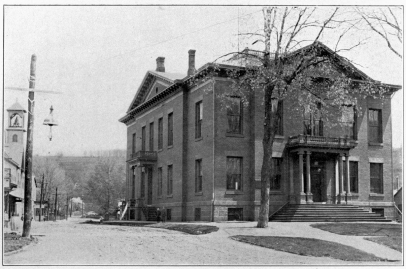
noble old river, where you swam and bathed in its clear, bright waters, or sailed so smoothly upon its bosom, or skated over it, in its winter coat, or, perhaps, studied astronomy by counting the stars as you lay prone upon your back.
“We welcome you back to these beautiful mountain streams that come tumbling down the hills, and through the valleys to the river, which many a day you followed with hook and line, trying to entice the speckled beauty from some favorite haunt. Welcome back to the little red school house at the corner, where you learned your A, B, C’s, and to the historic old birch tree that stands near by, and of whose branches you still have tender memories. Welcome back to the dear old church, within whose sacred walls you spent so many hallowed hours, and from which you took many of the sweetest, as well as the saddest, memories of the old town.
“Welcome back to the old homesteads, ‘Sacred to all that can gladden, or sadden, the heart of man, over whose thresholds of oak and stone, life and death has come and gone.’ We leave you there, we cannot cross those thresholds; but when you come forth again, we welcome you to our beautiful village, to the festivities of this Bi-Centennial occasion. And to those who have come back after a few years of absence, and to those who have come to the homes of their ancestors for the first time, you will find we have hearts warm enough, and homes large enough, to welcome you all. Again I say, welcome, thrice welcome to our grand old town.”
Brief speeches, replete with sentiment and reminiscence, were made by Rev. George S. Bennitt, D. D., of Jersey City; Hon. Henry C. Sanford, of Bridgewater (formerly a part of New Milford); Boardman Wright and Timothy Dwight Merwin, New York lawyers; Rev. John T. Huntington, of Hartford, and Edwin W. Marsh, a Bridgeport banker—all members of families which have been closely identified with New Milford interests for several generations.
The Chairman read the following poem, written for the occasion by Mary Murdoch Mason, daughter of a former pastor of the Congregational Church:
“HOME “Born on these hills, or in this happy vale, Our feet turn swiftly toward the well-known trail: At all great moments, when the heart is stirred, The exile’s soul spreads wings like homing bird. “ ’Tis in this village church our knees are bent, When, ’neath cathedral dome or tropic tent, We hear the burial service for the dead, ’Tis in the old home pew our prayers are said. “No brilliant light in bold, bright city street Can dazzle, eyes accustom-ed to greet That golden splash and sparkle where the sun Kisses our River’s curve ere day is done. You know the spot. We see it from Town-Hill; It stirs our hearts and makes old memories thrill. “In Switzerland, the snow-capped heights grow dim, Mt. Tom appears, and Guardian Mount with him. Rigi’s a dream, and even Jungfrau pales, While Alpine glow lights up New England dales. “Old Ocean’s storms and winds for us grow calm, The while we dream of Housatonic’s charm: And we forget the harbor at Trieste To float upon Lake Waramaug’s dear breast. “No bells that ring from far-famed distant towers Are half so sweet as those ‘First Bells’ of ours. And songs that thrill the world were never sung As noble as those hymns we loved when young. “On London ’bus, or in Pall-Mall’s vast crowd, Sudden we’re walking through a field fresh plowed: Upon the steamer’s deck far out at sea, We hear a robin sing in Main Street tree. “In wind-swept wastes, we’re filled with joy, not gloom, Because at home th’ arbutus is in bloom. And when June comes, and roses blow, we say: ‘Oh, for those roses round our porch to-day!’ “But ’tis at night beneath the heavens we cry: ‘These same kind stars with ever-friendly eye Upon our well-beloved graves look down, Far, far away, in dear New Milford town.’ ”
Charles N. Hall, Secretary of the General Bi-Centennial Committee, read the following cablegram:
“London, England, June 15, 1907.
“Success to the Bi-Centennial and best wishes for the dear old town! Deeply regret my absence.
Frank Hine.”
He also read the following letter, explaining that, although addressed to the Committee, it belonged to all New Milford, since it came straight from the heart of one whom all New Milford loves:
“New York, June 11, 1907.
“Charles N. Hall, Esq., Secretary of the Bi-Centennial Association of New Milford,
“Dear Sir:—
“Owing to a severe and unexpected attack of illness I am reluctantly compelled, acting under the imperative orders of my physician, Dr. Allan McLane Hamilton, of New York, to relinquish any participation in the Bi-Centennial ceremonies, and I, therefore, request that arrangements be made to have my duties assumed by the officers upon whom they will devolve.
“It is impossible for me to express my deep regret at the necessity of giving up any part in these exercises, to which I have looked forward with so much pleasure and pride, and my profound appreciation of the high honor conferred on me by the people of New Milford in electing me President of this Association.
“I desire to extend to them all, through you, my sincere and heartfelt thanks; and to all guests and friends who honor us with their presence on this glad and memorable occasion, and whom I hoped to meet personally, I extend a warm welcome and a hearty greeting.
“Very truly yours, “Henry S. Mygatt.”
Before and after the exercises of the evening, much informal sociability was indulged in, in the course of which many stories of old times were exchanged and many old friendships renewed. The occasion was a highly enjoyable one, especially to those who had come from a distance after an absence of many years. It was an “old home gathering” in the best and fullest acceptation of the term.
OUR FOREFATHERS
Written for Bi-Centennial Sunday by Charles N. Hall
Lord of the Pilgrims; they who came Far over-seas to praise Thy name; Braving the wave, the wilderness, Firm in their faith that Thou wouldst bless; Planting upon a new world’s shore Thy name, their faith, forevermore— Grant us, their children, thus to be Persistent in our faith in Thee. Dark seemed the way; grim forests frowned, Hunger and cold crouched close around That Pilgrim band; while wintry seas Rolled wide, ’twixt English homes and these, Who, faithful still, to doubt unknown, Laid here the Nation’s cornerstone. Grant us, their children, thus to be Unfaltering in our faith in Thee. Bitter their sufferings and tears; Hardship and toil marked all the years; But through it all Thy saving hand Guided and held the chosen band; Leading them safely home at last, All hardship done, all trials passed. Grant us, their children, thus to be Guided, sustained, brought home, by Thee.
THE SUNDAY EXERCISES
Sermons appropriate to the occasion were preached to large congregations in all the churches Sunday morning. These sermons, in so far as they were historical, are reproduced herewith:
BY REV. FRANK A. JOHNSON In the First Congregational Church
“...In the summer of 1707, an eagle, poised on extended pinions over the Housatonic Valley, would have looked down upon a scene of singular beauty. He would have beheld a wilderness; but has not a wilderness a beauty unsurpassed by the artificial works of man? Mountain, hill and valley were clothed with magnificent forests of oak, chestnut and ash. The river, then a clear mountain stream, weaving its way among the hills, added to the sylvan beauty of the scene. There was no sign of the presence, or even existence of man, save possibly the thin smoke from the camp-fire of some peaceful Indian, who loved these hills, the home of his fathers.
“Into this trackless wilderness, from the then far-away north-land of Massachusetts, came John Noble and his little eight-year-old daughter. Do we, who know this lovely valley so well, wonder that he built his simple home here, and that his descendants have remained here ever since? His house was for some time the last house this side of Albany.
“After a short time, a company from Milford, on Long Island Sound, took up much of the land here, and naturally gave the name New Milford to the new settlement. These men were of a sturdy race, strong in body, courageous, believers in God and His righteousness. Just think of the task that confronted them! The great forests, which would be a better possession than a gold mine now, were an encumbrance then. The traditions of these fathers tell us nothing of enervating club life, or midday siestas; the daily rule of life for man
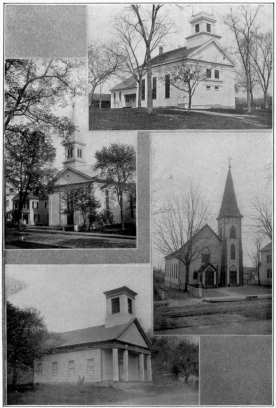
SOME NEW MILFORD CHURCHES
Methodist Episcopal Baptist, Northville Methodist, Gaylordsville Saint Francis Xavier
and woman then was work, work, work, that we might enter into the goodly heritage we now enjoy. Among the early settlers was Mr. John Read, who built a primitive house at the upper end of “The Green,” near Mr. Frederic Knapp’s house. Mr. Read, at one time, intended to enter the ministry. He preached the first sermon here in his own house. The founders of our State and town believed in God, and delighted in his worship. They were assured that God could manifest himself in the wild woods, or in some log cabin as well as in a stately cathedral. And so, before their families were fairly settled, they provided some place for the stated worship of Almighty God.
“So, here, after Mr. Read left the town, the people continued to use his simple home as their place of worship. I quote from our church manual: ‘These people held their religious services in what was called Mr. Read’s house, which has been described as probably built of logs, one story high, and had but one window, and was not very commodious nor an ornamental place of worship. The first vote to build a regular meeting-house was passed in 1716, and, then, so many difficulties were encountered, and so limited were the resources of the people, that the building does not seem to have been completely finished and furnished till 1731—though it was probably occupied for worship in its unfinished condition as early as 1720. This building stood on Town Hill, on the upper side of the present “Green.” In 1754 a new and more commodious meeting-house was erected upon the village “Green,” nearly opposite the present residence of Mrs. Henry E. Bostwick. This building was used as a house of worship for seventy-nine years, during the pastorates of Revs. Taylor, Griswold and Elliot. During the pastorate of the Rev. Mr. Rood in 1833, the present edifice was erected. In 1860, it was completely renovated.’
“In 1892 it was again renovated and a considerable addition made to this audience room, and the chapel, parlor and class rooms were added to the main building. In 1902 the present parsonage was built, and the ample grounds about it were laid out. In 1904 the organ was presented by one of our members....
“They were a godly people who settled in this valley; a people who believed in the Sabbath as a day of rest and worship, and we may be sure that some kind of religious service was held here from the beginning of the settlement, but a regular church was not organized until 1716. Eight female and five male members were formally recognized as a church by council on November 21 of that year. It was a Congregational Church of the ‘Standing Order,’ and all the early inhabitants seem to have been in sympathy with it. It has continued an unbroken organization to this day. It has always been influential in the moral and religious movements of the community; and we are proud of its history, and are glad that we are members of it in this later day.
“We are so firmly convinced of the wisdom of the separation of Church and State, that it is hard for us to appreciate that our own church, through much of its history, was rigidly united with the State. For thirty-four years after the organization of the church, the Ecclesiastical Society and the town were practically the same thing. The larger part of the business of town meetings was the consideration of religious affairs. The town called the minister, provided for the expenses of the church, cared for the building; in fact did about everything that the church and society would do now. It was a town meeting that voted the size of the shingles and clapboards to be placed on the church building. Some of you, not very old, can remember when the town voted in the basement of this building. If there is any virtue in a union of Church and State, this church must have received the full measure. Until 1819 this Society had the legal right to tax all the inhabitants for its own support; but naturally, other denominations, which had arisen within the town, would object to this, and, as a matter of fact, this right was not insisted upon. The only relic of this incongruous relation of Church and State, according to American standards, is the Ecclesiastical Society; and, in the formation of new churches, this is generally done away with, the church feeling abundantly able to take care of its own affairs.
“During the one hundred and ninety-one years of its history this church has been served by ten settled pastors, and by several ministers who acted as pastors for limited periods. All of these ministers were men of power and influence, and have left their mark upon both church and town. From the organization of the church in 1716 to the end of the eighteenth century the church was served by only two pastors—the Rev. Daniel Boardman, and the Rev. Nathaniel Taylor. They were strong men and did much for the religious development of western Connecticut. Their descendants are still influential residents of our town. The third pastor was the Rev. Stanley Griswold, a man of strong personality and pronounced ability. After leaving New Milford he retired from the ministry, and, entering upon political life, became Secretary of Michigan Territory, and afterwards one of the first United States Senators from the State of Michigan. Later, he was Chief Justice of the Northwest Territory. The Revs. Andrew Elliot and Herman Rood were strong men, leaving the impress of their labors upon the life of the church. The sixth pastor was the Rev. Noah Porter. He was a faithful worker here, and his work was greatly blessed. He afterwards became known to all the world of scholars as the distinguished President, for many years, of Yale College. The Rev. John Greenwood was a pastor greatly beloved. After a period of absence from the town, he returned to spend his latter days with the church he loved. The eighth pastor was the Rev. David Murdock, Jr. He was a forcible preacher, and many of the present membership were received into the church during his fruitful ministry. He was pastor during the exciting days of the Civil War, and his stirring, patriotic addresses never left any doubt of the position of this church in the days which tried men’s souls. The last three ministers, the Revs. James B. Bonar, George S. Thrall, and Timothy J. Lee, were the friends and pastors of a large part of the present congregation. Many of the older members were welcomed into the fellowship of the church during their ministries. Not only here, but in other fields of labor, they gave good proof of their ministry. Of all this list of former ministers, only one is living to-day, the Rev. Timothy J. Lee, the immediate predecessor of the present pastor.
“These ministers were advised and assisted by a consecrated band of deacons; men chosen for their piety and interest in the affairs of the church. The New England Congregational deacon has always filled a large place in the moral development of a community; and so these men have done their part in promoting the better life of this town. It would be impossible to write a true history of the town without giving their names a prominent place. The name of one of their number, also sometime clerk of our Society, is written high in the annals of his country, the distinguished patriot and statesman, Roger Sherman, associate of Thomas Jefferson, John Adams, Benjamin Franklin, and Robert R. Livingston, on the committee of five which prepared the immortal Declaration of Independence. His colleague, Thomas Jefferson, said of him, he was ‘a man who never said a foolish thing’; and the noted Senator Macon declared, ‘He had more common sense than any man I have ever known.’ At this anniversary time, we are happy to recall the name of such a man as a citizen of our town, and a member and officer in our church....
The following hymn, written for the occasion by Charlotte B. Bennett, was sung in the Congregational Church in the course of the service at which the above sermon was preached.
BI-CENTENNIAL HYMN “God of our fathers, in whose sight The centuries are but as days, We ask, as those of old, Thy light; We bring, like them, our gift of praise. “We bless Thee for the fathers’ love; They made the rough way smooth, that we Might safer walk. O, may it prove The path of peace that leads to Thee. “We reach across the vanished years And touch their holy lives to-day, They kept the faith through toils and fears; Grant healing in the touch, we pray. “If mists of time have dimmed our sight, And faith has faltered on the way, May clearer vision in the light Of holy memories, crown this day. “Alike to Thee are new and old; Thy care through ages is the same; Thy love links with a chain of gold The centuries, in one dear Name. “Keep in the hollow of Thy hand This hallowed place, while years shall last; For righteousness still may it stand, Till days and ages are all past.”
BY REV. SAMUEL HART, D. D. OF MIDDLETOWN, CONNECTICUT, IN SAINT JOHN’S CHURCH, ALL SAINTS’ CONGREGATION UNITING
“It happened, as men say, that the beginning of the settlement of this town fell in the year which saw the organization of the first parish of the Church of England in Connecticut; the bi-centenary of New Milford is also the bi-centenary of the Diocese of Connecticut. It is but natural, therefore, that one who is called to speak to-day as to that part which this parish has borne in the history of the town, should recur to the origin of the Church in this Colony, and should have in his mind the inspiration of last week’s commemoration in Stratford; we cannot but look back from the time when the Church’s ministrations were first held here, to the earlier ministrations on the shores of the Sound. But we have a stronger reason to-day for turning to the beginnings; for the two clergymen who first officiated here, at the request of a few adherents of the Church of England, were Dr. Johnson, missionary and rector at Stratford, ‘the father of the Church in Connecticut,’ and Mr. John Beach, of Stratford birth, Dr. Johnson’s pupil in theology, in charge of congregations in Redding and Newtown. But, as it appears, we can go still further back; for one of the first settlers here, of whom indeed it is said that he claimed the land by title from the Indians, was John Read, who, at the time when the church services were first held by a clergyman in Stratford, was ministering to the Congregational society there, and presently connected himself with the newly formed congregation of Churchmen; indeed, we are told that at one time he had it in mind to go to England and ask for ordination at the hands of a bishop. Whatever his plans in this matter, they were not carried out; for he removed to this place, granted the use of a house which he built as a place of meeting for public worship, and occasionally preached to those who assembled there. He became a lawyer and Queen’s attorney, and removed to Boston, where he was a communicant in King’s Chapel. His son John was one of the first settlers of Reading (Redding) and named the town for his father. Thus there was here, from the very first, a little Church of England leaven.
“But we are told of no formal church services here for twenty-two years, and of no separate congregation until 1743. At this time, Dr. Johnson, that man of great learning and prudence and missionary zeal, had been ministering for twenty years in Stratford, extending his journeys to places adjacent and remote in the Colony, and exercising a strong and healthful influence on behalf of the Church. Among the young men whom he trained in the Church’s ways and in her theology, his pupils and members of his family, was John Beach, for eight years Congregational minister at Newtown, ‘a popular and insinuating young man,’ as was testified of him, who after ordination in England came back to his former field of labor and began a wonderful work there and in Redding, with a small congregation of five families. These two men came hither at
ST. JOHN’S CHURCH
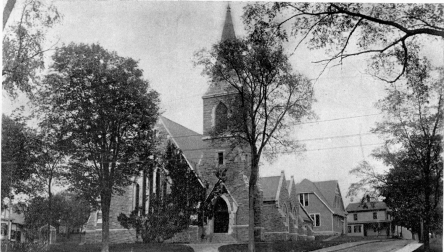
the request of a few Church people, of whom Mr. Beach wrote in 1743 there were about twenty families in New Milford and New Fairfield, who frequently attended church at Newtown, and to whom he ministered at their homes as he was able, but rarely on the Lord’s Day. The town, presently, on the petition of twelve men, granted them a piece of land in the street at its south end, ‘near where the old pound used to stand,’ forty feet by sixty, ‘in order to build a Church of England upon;’ and the building seems to have been erected in 1744....
“Under Mr. Beach’s care many in this part of the colony—for he had a wide circuit for visitations and services—accepted the Church’s ways; and thus was the Church established in the faith and increasing in number, as in the primitive times. When at last he asked to be relieved from the care of the congregations and scattered communicants in Litchfield County, the Rev. Solomon Palmer took charge of the Churchmen in this neighborhood, and became the first clergyman resident here. After five years he removed to Litchfield; and to him succeeded, in 1762, as by a kind of exchange, the Rev. Thomas Davies, whose grandfather and father, faithful laymen, had founded the parishes in Litchfield and Washington. His whole span of life was but thirty years, and he ministered here but four years; but he left a record for untiring labor, constant pastoral labor, persuasive eloquence, and godly living, which has not been effaced by time, and the results of which, we cannot but believe, still remain in this community. Even when there was talk of a division of his work, he proposed to retain the towns of New Milford, Woodbury, Kent, and New Fairfield as his mission, leaving Litchfield, Cornwall and Sharon, with a few Churchmen in nine other towns, to the care of another clergyman. During his ministry, a second house of worship was built, the old church being too small for the congregation; it stood in part on the street, some twenty or thirty rods north of the former site. After Mr. Davies, followed the Rev. Richard (or Richard Samuel) Clarke, the twenty years of whose ministry included the cloudy days that preceded the Revolution and the stormy times of the Revolution itself. He was a Tory in political convictions and, after the war, removed to Nova Scotia, where he died in 1824 at the age of 87, the oldest missionary in the Colonies.