PART II THE BI-CENTENNIAL EXERCISES (continued 3)
Reading edition
“There was a movement of life into this part of Connecticut, the meaning and result of which will be brought before you by those who have studied it in its details, and can describe it with local color. Without repeating or anticipating their words, I may venture to ask you to think of the difference which a little more than seventy years had made in the motives that swayed men’s minds, and the impressions that were made on them by the new lands which they occupied. One thinks of the stern resolve, both political and ecclesiastical, which sent Hooker and his company on their long walk through the wilderness till they came to the river and crossed it into a strange land, with a determination like that of the father of the faithful when he crossed the great river of the eastern world; and then one questions whether they admired the beauty of the meadows, and one feels sure that when they climbed the hills and looked down into the more beautiful valley of the Tunxis, they were drawn by it to travel still further west. One follows in mind the military instinct which saw the importance of the control of the Connecticut River, and built a fort at its mouth, and levied dues on traffic and transportation, and laid out streets for the houses of people of quality who were expected to come to dwell there. And one thinks of the surprises which befell those who sailed slowly along the shore of the Sound, looking into inlet and bay, and finding at the Fair Haven a place where they might build a city after the pattern of the heavenly Jerusalem, and in it dwell and get gain.
“In each of these early instances there was an element of romance, of strong conviction of duty, mingled with an appreciation alike of the beautiful and the practical, that combination which, as Horace told us long ago, ‘carries every vote.’ To some extent this had passed away two hundred years ago, when possession was taken of the farming lands, and the fair, though rugged, hillsides enclosing the river valley in which we now stand. The settlers, who came up into the high grounds from the shores of the Sound, did not leave, for the most part, on account of disagreement with their neighbors in matters civil or ecclesiastical, nor with a special sense of divine calling or mission. They were rather led by the Anglo-Saxon spirit of colonization to settle on new soil, to extend former industries or to undertake new ones, and to organize new units of life in the body politic. Still, we cannot doubt that when they, too, looked over the fields they saw more than the possibility of gathering harvests and crops from them, and that when they followed the water-courses they did more than estimate the use which they might make of the force of the falling stream. They had something of the enthusiasm of discovery, and something of the joy of those who first turn nature’s forces to man’s account. It is worth our while, as we go back in mind to these beginnings, to try to think as they thought, who first looked upon the natural features of the landscape, which it takes much more than two centuries materially to change, and to see why they chose as they did, who fixed on this spot as their home.
“In this regard, there is in all our settlements, early and late, something that they have in common, which appeals more, I am inclined to think, to the philosopher than to the historian. Perhaps the student of history delights rather in noting the differences in the plans and purposes of those who settled our early towns, and in finding in each, as he readily may, some detail of character or event which marks it with a special interest, and almost always brings in the suggestion of a special romance. As your early history is read before you to-day in detail, you are reminded how it differs from the history of every other town in Connecticut. At its beginning you hear of names which give it a stamp peculiarly its own: that of the first minister, continued by an honorable succession through all the generations to this day; that of the early settler who lived here in a log hut on land which he had bought of the Indians and lived to be Attorney General of Massachusetts; somewhat later, that of the man who came here as a shoemaker and removed hence as a judge, to become one of the few leaders in the constitutional history of the land; and with them the names of others which shed a special luster on your annals. Again, the importance of the Indians in this neighborhood, both in numbers and (as it would seem) in influence and character, suggests an almost unique chapter of history, especially when we note that it led to the sojourn of the remarkable man who led hither his band of Moravian missionaries and labored not in vain among the aborigines before he withdrew to make a permanent settlement in another province, and later to return to his home in Europe. And, if you care to boast of it, you share with but one or two other towns the honor of having had congregations of the Glassites—who under their name of Sandemanians will always be remembered for having had in their eldership one of the greatest men of science of a generation ago—and you have the exclusive honor of having been the home of the Jemimaites. Certainly, no two communities are exactly alike, and it is in the study of their differences that much of our pleasure in the reading of their history consists.
“While I bring to you to-day, Mr. President, a greeting on behalf of the Historical Society of the State, I venture to ask you and all the citizens of this venerable town, and all who are interested in her annals already written, and in the record which she is to make in years to come, not to allow the interest of these memorial days to pass away with the days themselves. This week is bringing to the memory of some of you that which you have already heard with your ears and your fathers have declared unto you, while it is teaching many others, and in particular the youths and maidens, their first lessons in the history of the community in which their lot is cast. The story of the founders and those who carried on their work, who they were and what they did, what New Milford was in itself and what part it played in the State and the Republic, told again now in greater detail than it has ever been told before—do not let it be soon or readily forgotten. See to it that the whole town becomes a sort of historical society, for the appreciation and preservation of that which is old, for the lending of a proper perspective to that which belongs to our own day, for preparation rightly to understand and rightly to value and use that which is coming. They best do the duties of the present, they best provide for the future, who read and value the lessons of the past.”
The second speaker, Chief Justice Baldwin, was presented to the audience by Mr. Williams with these words: “New Milford has had many notable and useful citizens during her two centuries of existence, but she has had none as illustrious as Roger Sherman. We have with us to-day one of his descendants, Simeon E. Baldwin, LL. D., Ex-President of the American Bar Association, Ex-President of the American Historical Society, Ex-President of the International Law Association, and Chief Justice of Connecticut, who will now address you.
Chief Justice Baldwin then delivered the following address on “Roger Sherman”:
“The rarest and most ill-defined class of human beings is that of great men. Only those belong to it who have done a great work in a great way. The ‘mute, inglorious Milton’ is not to be reckoned among them. They number none, however great their natural gifts or acquired attainments, who have not made for themselves, by their own merits, a place in the history of their times. It is from their lives, indeed, that history gains its color and its inspiration.
“It was the good fortune of New Milford to be the home of such a man in the middle of her first century of existence.
“It was a hundred and sixty-four years ago, this very month that a tall and well-set young fellow of two and twenty ended in this town a toilsome journey, taken on foot from the neighborhood of Boston. He had come to make New Milford his home, bringing on his back the tools of his trade—that of a shoemaker—and with their aid he here gained for a year or two an honest livelihood.
“A shoemaker and the son of a shoemaker, he had, and felt he had, capabilities for a larger work. His mind was already
HONORABLE SIMEON E. BALDWIN Chief Justice of the Supreme Court of Connecticut

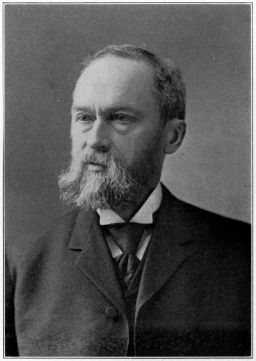
set on that of a surveyor. For this, too, he fitted himself well; but there was that before him of which he did not think. He was to fill a long succession of official trusts, affecting all the Colonies and the States which succeeded them, to be bestowed upon him at a time of great events, and to be so well discharged as to make him one of the great figures of American history.
“When Connecticut, a few years ago, was called upon by the nation to choose the two of her sons whose statues should be set in the Capitol at Washington, there could be no question as to one. The land of steady habits must, at all events, be represented in that place by Jonathan Trumbull, the War Governor of the Revolution,—the Brother Jonathan who typified to the nation the rugged virtues and hard good sense of the New England character.
“The other statue also must belong to the same great era, the era which began with the struggle for independence, and closed with the attainment of settled constitutional government. Our heroes must be taken from that which above all others was our heroic age. Should we thus commemorate the impetuous gallantry of Putnam, the noble death of Hale, the courtly eloquence of Johnson, the judicial power of Ellsworth? All these were sons of Connecticut, born upon her soil. No. She chose one born and bred to manhood in another State; not trained at her college, nor at her schools; not at any schools. She sought to put the form and features of Roger Sherman into marble, to show to all time what qualities and achievements the people of Connecticut hold in most honor. This man, without eloquence, with no advantages of education, with no grace of manner, was her choice—taken from many, for solid qualities, not shining ones; for a life-long love of liberty, but only as it was regulated by law; for steadfast devotion to duty; for practical sagacity; for calm, and sound judgment in things both small and great. Such a character wears well. It is men of this stamp that have made Connecticut what she is.
“Roger Sherman was born to a great opportunity. So was every child born in the American colonies during the years between 1720 and 1760. Those colonies were then assuming proportions inconsistent with the long maintenance of British dominion over a territory so distant and a people so enterprising and intelligent. The day was soon to come when they would strike for liberty. Who were to be the leaders, then?
“Massachusetts was to furnish her full share, and two of them grew up, in neighboring towns, to begin life as apprentices and end it as statesmen.
“Franklin was already at work in a Boston printing office, when Sherman, in 1721, was born in Newton. Neither had any advantages of education. Franklin’s schooling ended when he was about ten, and Sherman was apprenticed to a shoemaker and began to learn his trade at an age not much greater. He had hardly acquired it when his father, then living at Stoughton, Massachusetts, died, and he found, at the age of nineteen, that the main charge of a numerous family of younger brothers and sisters, as well as of his mother, must thenceforward rest upon his shoulders. Three years of struggle upon the small farm, which his father left, satisfied him that to support this load he must seek some more remunerative employment.
“An elder brother had previously removed to this town, then a frontier settlement. Connecticut was the West of that day to the towns of eastern Massachusetts. It was the place for more than a century where many of the most active and enterprising sons of the older colony had gone to found new homes and breathe a freer air. Connecticut, it will be recollected, had preserved her charter and elected her own governors. Massachusetts, for half a century, had received hers from the crown.
“Sherman resolved to join his brother, and the whole family were united in New Milford in 1743. From the early years of his apprenticeship he had been in the habit, as he bent over his last, of keeping a book open on his bench, to the study of which he gave what moments he could occasionally snatch from his work. In this way, and in his hours of leisure, he had been able to pick up the elements of a good English education, and to make considerable attainments in mathematics and plane geometry. One object of his removal to Connecticut had been to put this knowledge to practical use by engaging in the business of a surveyor.
“Those were days when the quick division of land, from the great blocks included in colonial patents granted for the formation of a new township, into numerous small farms, called far more frequently than now for the services of men who could run a line with precision and describe it in the proper terms of art. Within two years from his arrival at New Milford, he had fitted himself to engage in this business, and received from the General Assembly the appointment of a Surveyor of Lands for the County of New Haven; for New Milford was then a part of that county, Litchfield County not having been created until 1751.
“This office of County Surveyor was a responsible one. Whoever held it took an oath, prescribed by statute, to discharge its duties ‘without Favour or Respect to Persons,’ and, if he had occasion to employ chainmen for his assistance, was to administer to each of them an oath, adjuring them ‘by the ever living God’ to keep and render a true account of whatever lines and measures they might take.[18]
“That there is an ever living God, who is the supreme authority on earth as in heaven, has always been the faith of Connecticut, and shines through all her statute books. From 1640 down to the present hour it has been part of the solemn ceremonial—solemn to those who stop to think of what it is and what it means—of admission to the privileges of a freeman or elector, that every man shall with uplifted hand swear that with God’s help, whenever he shall be called to give his vote, he will give it as he shall judge will conduce to the best good of the commonwealth, without respect of persons or favor of any man. How many of us, on each election day, bethink ourselves of the high obligation to which we have thus pledged ourselves, and ask the help we have invoked to act our part as voters ‘without respect of persons or favor of any man’?
“I doubt if Roger Sherman, as a County Surveyor, needed the weight of an official oath to bind him to his duty, but I doubt not that his sense of duty was bottomed on a sense of God, and that honesty and Christianity were to him, from boyhood on, one and inseparable.
“He had joined the Stoughton church a few weeks before he came of age. It was a time, in the year 1742, in which were gathered in the fruits of religious awakening in New England. Our churches had lapsed into formalism; and dogmatic belief had been accorded a prominence which threw Christian conduct into the background. Seventeen hundred forty-two was a marked year in the course of the returning tide towards better things.
“In 1749 Sherman used his mathematical attainments for a new purpose. He prepared an almanac for 1750, which was published in New York, and was the first of a series which he put out during a considerable period of years.
“By this time he had saved some money, and, in 1750, we find him putting part of his capital, in partnership with his elder brother, into a country store. This was a business in which he was interested first at New Milford, and then at New Haven, with a branch at Wallingford, for more than twenty years.
“The country store then, as now in the more thinly settled communities, was in miniature the department store of our modern cities. There were few of them, and their customers came from a wide circuit of country. The trade was largely one of barter. The farmer’s wife drove in with her cheese and butter, and might go back with stuff for a dress, a box of needles, a new coffee-pot, a bottle of salts, a loaf of sugar, a quintal of codfish, and perhaps a volume of sermons. The store was not daily visited by drummers. The proprietor went himself every few months to Boston or Newport, New York or Philadelphia, to replenish his stock, and with every such journey found his mental horizon broadened, and felt better acquainted with the great world of men and things that lay beyond the limits of his own neighborhood.
“Sherman, from the first, made the most of these glimpses of a larger life. If he rode down to New Haven to buy West India molasses, he would visit the college to ask President Clap’s opinion about the probable course of an expected comet.[19] If he went to New York to correct the proofs of his almanac, he would take the opportunity to find a publisher for some pamphlet he had written on the financial errors in the legislation of the day.
“Sherman, by this time, had acquired the faculty, rarer, perhaps, then than now, of expressing his thoughts in writing, in a fashion that was simple, clear, and straightforward. An artificial, overwrought, and overladen style of composition, if not the prevailing one, was certainly not uncommon among Americans during the middle of the eighteenth century. He wrote, as Franklin did, in the plain language of familiar conversation, with no straining after effect. I do not mean that he wrote as well as Franklin. There was a long, long interval between them; but they were of the same school. Both were men who thought more of what they had to say than of how they said it; of communicating facts or ideas, rather than of seeking to make them attractive by ornament.
“Sherman’s reading was of a kind that both strengthened and disciplined the mind. The first President Dwight, in summing up his character, emphasized ‘his attachment to books of real use,’ adding that he ‘was, what very few men unacquainted with the learned languages are, accurately skilled in the grammar of his own language.’[20]
“It is probable, however, that in paying this tribute to an old friend who had passed away, President Dwight had in mind Sherman’s style of written composition, rather than his ordinary manner of speech. It is seldom that one born to poverty and denied the common advantages of education, escapes a certain rusticity, to say the least, not only in his choice of words in conversation, but in their arrangement and pronunciation.
“A franker, and I dare say juster, portrait of the man as he appeared in public discussions and debate is given in a series of rough notes of the doings of the Convention of 1787 which framed our national Constitution, made by one of the Southern delegates, William Pierce of Georgia.
“ ‘Mr. Sherman,’ he writes, ‘exhibits the oddest shaped character I ever remember to have met with. He is awkward, un-meaning, and unaccountably strange in his manner. But in his train of thinking there is something regular, deep, and comprehensive; yet the oddity of his address, the vulgarisms that accompany his public speaking, and that strange New England cant which runs through his public as well as his private speaking make everything that is connected with him grotesque and laughable;—and yet he deserves infinite praise,—no Man has a better Heart or a clearer Head. If he cannot embellish he can furnish thoughts that are wise and useful. He is an able politician, and extremely artful in accomplishing any particular object; it is remarked that he seldom fails. I am told he sits on the Bench in Connecticut, and is very correct in the discharge of his Judicial functions. In the early part of his life he was a Shoe-maker; but, despising the lowness of his condition, he turned Almanack maker, and so progressed upwards to a Judge. He has been several years a Member of Congress, and discharged the duties of his Office with honor and credit to himself, and advantage to the State he represented. He is about 60.’
“Silas Deane, his colleague in the Continental Congress, in a frank letter to his wife, thus paints Sherman, as he appeared at a New York dinner party:
“ ‘Mr. Sherman is clever in private, but I will only say he is as badly calculated to appear in such a Company as a chestnut-burr is for an eye-stone. He occasioned some shrewd countenances among the company, and not a few oaths, by the odd questions he asked, and the very odd and countrified cadence with which he speaks; but he was, and did, as well as I expected.’[21]
“In the same letter Deane shows his vexation at Sherman’s views regarding traveling on Sunday:
“ ‘Mr. Sherman (would to Heaven he were well at New Haven,) is against our sending our carriages over the ferry this evening, because it is Sunday; so we shall have a scorching sun to drive forty miles in, to-morrow. I wish I could send you his picture, and make it speak, and in the background paint the observations made on him here. But enough of this at present. I will have him drawn in Philadelphia, if it can be done at any reasonable rate.’[22]
“To judge these criticisms fairly we must remember that Deane was a man of fashion and of the world, while Sherman was neither. A plain country lad, a hardworking journeyman at his trade, a busy surveyor, a sagacious selectman, a shrewd store-keeper, a hard-headed lawyer, an industrious judge, he had qualities not of a kind that shine in polite society, but of a kind nevertheless that count in life, in every position which a man may be called to fill. He would have made a better figure with better manners. But a rusticity that would have ruined the advance of most men was everywhere tolerated in Sherman, because there was felt everywhere an admiration for his mind and heart,—his solid sense, wise forecast, and practical wisdom.
“While living in this town, Sherman was asked one day by a neighbor, the next time he went to the county seat, to retain counsel for him to bring a petition to court in a matter connected with the settlement of an estate. He noted down the facts which he thought it would be necessary to state in the papers prepared for such a proceeding, and the lawyer whom he consulted was so much impressed with the clearness and precision of the memorandum that he strongly advised him to adopt the legal profession.
“There were then no American, and, indeed, no English law schools. An education for the bar was commonly gained by studying the works of some of the English judges of former generations, under the advice of a local practitioner, but with little other assistance from him. The system of justice administered in Connecticut was rough and unhewn, and not a few of the judges of the highest courts had never followed the profession of the law.
“Sherman began to read law, in consequence of the incident to which I have alluded, when he was about thirty years of age, and was admitted to the bar in Litchfield County in 1754. There were then few lawyers in the colony who gained the whole of their livelihood from their profession. Many were also farmers. Sherman retained his interest in the New Milford store.
“Meanwhile he had been sent to the General Assembly, and made first a justice of the peace, and then a side judge of the County Court.
“The record of one of the early justice suits tried before him well illustrates the difference in political ideas between those times and ours. It shows the conviction and fine of one of his fellow-townsmen for a violation of the Colony statute in not attending public worship in any congregation allowed by law on January 29, 1758, nor on any Sunday in the month next preceding.
“ ‘Squire’ Sherman, as he was now called, brought to his new profession the strong common sense and good business judgment which had served to advance him in his previous employments, and which, if added to sound learning, will always assure success at the bar.
“The late President Porter, who, in early life, was settled as a minister at New Milford, once told me of a story which he heard here of some wise words uttered by Sherman at this period in his history. ‘Squire Sherman,’ said one of his neighbors to him, one day, ‘tell me, are most controversies that come before Judges in lawsuits decided justly or unjustly?’ ‘Sir,’ was the reply, ‘it’s not the point whether they are decided justly or unjustly: they are decided, and made an end of.’ And in truth it is perhaps the best office of courts of justice that, however often they may err in their processes, they certainly bring every human controversy that is within their reach to a final stop. The conclusion may be right or wrong; but a conclusion it is.
“Sherman was a deacon of the New Milford Church, the clerk and treasurer of the society, and one of the school committee. At the age of forty, he removed to New Haven, and connected himself with the White Haven Church, one of the two original bodies out of which grew the United Society and the United Church. Here again the records show his faithful work on committees and as collector of the rates imposed by the society.
“Five years later he was appointed a Judge of the Superior Court, a position which he continued to hold for nearly a quarter of a century.
“The British legislation culminating in the Stamp Act had now begun to arouse the spirit of independence in the American colonies. Sherman was one of those who took the most advanced ground. He maintained that Parliament had no jurisdiction over them whatever.
“Connecticut sent him as one of her delegates to the first Continental Congress, in 1774, and there he maintained this doctrine with all his power. John Adams reports him as declaring upon the floor that there was no legislative power superior to the Colonial Assemblies, and that Americans had adopted the common law of England, not as the common law, but as the highest reason.
“It was his thorough-going republicanism, indeed, which had carried him into public life, and put him in a leading place among the legislators of his State. He had been first elected to the Governor’s Council or upper house of the General Assembly in 1766. The Stamp Act had brought the ‘Sons of Liberty’ into existence. They had forced, under threat of death, Jared Ingersoll, who, under the advice of Franklin had accepted the position of stampmaster for Connecticut, to resign the office. Governor Fitch, though with reluctance, had taken the official oath which the obnoxious Act required. It cost him his place, William Pitkin being elected his successor a year later. With him went out of office four of his Council who sympathized with his deference to parliamentary authority; dropped by the people to make room for others who were regarded as more fully Americans in spirit and doctrine.
“No one was then eligible for a seat on the Council-board who had not been officially nominated in the previous year. Twenty nominations were annually made for the twelve places, and the election was so managed that the twelve in office always headed the list and were voted on first. A majority was not required for an election. To be once nominated for the upper house was in this way a substantial assurance of an ultimate election, and to be once elected was a substantial assurance of an annual re-election for life.
“Sherman, in 1766, had been on the waiting list for five years. A political whirlwind, unexampled in our Colonial annals, then made five vacancies, and death a sixth. He went in with five other new men, and remained a member until after the close of the Revolution.
“Religion in those days, so far as form at least was concerned, was a part of politics. There was a religious establishment in Connecticut. It put the church beside the schoolhouse on the village green. It made Church and State largely one.
“Sherman was not wiser than his generation in regard to matters of religion. His reading had been mainly in English history and law; but the subject next most interesting to him was theology. He accepted Calvinism. He believed in the Puritans. He distrusted and feared the Church of England. It was the day when so tolerant and fair-minded a man as President Stiles could record as among the fourteen trials and difficulties of this life: ‘Concern for the Congregational churches, & prevalence of Episcopacy & Wickedness.’[23]
“When, therefore, about the middle of the eighteenth century, the Episcopalians, who were especially strong in Connecticut, began to push for the appointment of one or more American bishops, it is not surprising that Sherman’s voice was raised in opposition.
“A long letter on this subject, written in 1768, which, it is believed, came from his pen, is among the files of the New Haven East Association, to which his church belonged. In this it is urged that if Parliament provides for American bishops, they might bring here all the functions and authority of those of England, and hold ecclesiastical courts like those of Laud, from which our fathers fled into the wilderness.
“There was this piece of solid ground under Sherman’s argument. Grant the power of Parliament to establish an American episcopate, and a new point was made in favor of the general right of Parliament to legislate as to all American affairs. This consideration, no doubt, greatly influenced his course; and it was sufficient to defeat the consecration of any bishop for America until that of Dr. Seabury, which followed closely after the Revolution.
“The Wyoming controversy between Connecticut and Pennsylvania was one in which Sherman took an active part.
“Our charter bounded us ‘on the North by the line of the Massachusetts Plantation; and on the South by the Sea; and in Longitude as the Line of the Massachusetts Colony, running from East to West, That is to say, From the said Narragansett Bay on the East to the South Sea on the West part, with the Islands thereto Adjoining.’ This gave us a paper title to a swath of North America sixty miles wide, at least, running from Rhode Island to the Pacific, and taking in what are now the sites of Wilkesbarre, Cleveland, Chicago, and Omaha. Our people, as early as 1762, began to make settlements in that part of it in western Pennsylvania known as the Wyoming Valley. The General Assembly made it a county in 1776, styling it Westmoreland County, and it furnished the Twenty-fourth Connecticut Regiment in the Continental Army.
“Sherman was one of a committee appointed by the legislature in 1774 to report upon measures to support the title of the Wyoming settlers, which Pennsylvania now disputed, under a later and conflicting grant from the Crown. Energetic measures were recommended and adopted, and, knowing the power of the newspapers, Sherman shortly afterwards followed up the report by a clear and full statement of the position of Connecticut, in a letter to the Connecticut Journal of New Haven. Public sentiment, here, was much divided. There were many who thought that such an ‘expansion’ threatened the safety of our liberties. Sherman proposed that the colony should secure a determination of its bounds from the King in Council. Such a law suit, said those who were for letting Wyoming go, would be slow and costly; and, even if we should win it, what then? A defeat, Mr. Ingersoll had declared in another newspaper article, ‘would be very detrimental, but a victory must be absolute ruin.’ ‘But,’ replied Sherman, ‘he gives no reason for his opinion. And can his bare assertion make the people of this colony, who are a company of farmers, believe that to be quieted in their claim to a large tract of valuable land would ruin them?’
“The Revolution transferred the judicial decision of this controversy from the King in Council to the Congress of the United States. A Court of Commissioners was organized to try the issue, and, in 1782, judgment was rendered against us.
“The Commissioners had prudently determined, before hearing the case, to give no reasons for their decision, whatever it might be. That they were not of the strongest may be inferred from the fact that four years later Congress accepted from Connecticut a relinquishment of the rest of her Western title, with an express reservation of a large strip of northern Ohio. This is still known as the Western Reserve. We soon sold it, and the proceeds constituted our State School fund of $2,000,000.
“The services rendered by Sherman to the United States outshine those which he rendered to Connecticut; but it is only because the field was larger, and the circumstances more striking.
“Three are commemorated upon a mural tablet erected to his memory in the church of which he was a member in New Haven. This states that he was ‘one of the committee which drew the Declaration of Independence, of that which reported the Articles of Confederation, of the Convention that framed the national Constitution, and a Signer of these three Charters of American liberty.’
“To no other man came the good fortune to set his hand to these three great State papers. One marked the birth of the nation. The next was its first attempt to agree on a constitution of government—a necessary compromise, and temporary as compromises always are. The last was what has made the United States the greatest, richest, freest country that the sun shines upon to-day; and it was in that, that the work of Sherman told most.
“He was among the leading members of the Convention from whose hands it came. Connecticut was wise enough to send to it her strongest men. Our delegates were William Samuel Johnson, Oliver Ellsworth, and Roger Sherman.
“Johnson was the representative in his generation of the family in the State most distinguished for public services and personal attainments. He had ably represented our interests abroad, in important matters, and twenty years before had received the degree of Doctor of Civil Law from Oxford University. The Convention made him head of the committee to put the measures which it adopted in proper form and style. Oliver Ellsworth, who had been the foremost lawyer at our bar, was then an associate of Sherman on the bench of the Supreme Court, and was soon to be Chief Justice of the United States. But Sherman had a truer sense than either of his colleagues of what must be the nature and soul of the new government. He felt that it must stand upon a double foundation, that of the States, acting each for itself, and that of the people of all the States, acting for all together.[24]
“He felt, too, that it must stand for human liberty.
“Our State was then a slave-holding State, but he was one of those who were determined that the word slave should not stain the pages of the Constitution of the United States. Later, when he was a member of the first Congress, one of the representatives from Virginia (for Virginia statesmen were then looking to the gradual abolition of slavery) proposed to put into the tariff not a duty of ten dollars on each slave imported. Sherman opposed it. He could not, he said, reconcile himself to the insertion of human beings as an article of duty, among goods, wares, and merchandise; and, when it was replied that the doctrine of the Declaration of Independence required the endeavor to wipe off the stigma of slavery from the American government, his reply was that the principles of the motion and the principles of the bill were inconsistent: the principle of the bill was to raise revenue, and the principle of the motion was to correct a moral evil. These few and well put words illustrate that strong sense of proportion and relation which gave Sherman such weight in every deliberative assembly.
“In the Convention which framed the Constitution, he was the author of the compromise by which, in Congress, the Senate represents the States and the House, the people.
“Afterwards, when Congress was engaged in formulating the first ten amendments of the Constitution, which serve as a bill of rights for the people and for the States, it was he who gave the final shape to the last and most important.
“This (originally the Twelfth, for Congress proposed twelve of which ten only were ratified by the States), as reported by the committee, read thus: ‘The powers not delegated to the United States by the Constitution, nor prohibited by it to the States, are reserved to the States respectively.’ Sherman moved, and the House voted to add the words, ‘or to the people.’
“He knew, as a lawyer, that when anything is reserved in a grant it is reserved by and for the maker of the grant. Who made this grant? From what authority did the Constitution proceed? Was it from the States, and were the powers reserved to be reserved to them and each of them? This was said, or implied, in the original draft of the amendment. Sherman’s addition recognized the principle, afterwards affirmed by Chief Justice Marshall, that the people also had a share in ordaining this Constitution for themselves and their posterity.
“It is also worthy of remark, that he was careful to follow the phrase used in the preceding amendment (the Ninth) in which it is declared that the enumeration in the Constitution of certain rights shall not be construed to deny or disparage others retained by the people. What people is thus meant? Is it the people of each State, regarded state-wise, or the whole people of the United States regarded nation-wise? That was a question on which public opinion had been divided, and which it remained for the Civil War to settle by force of arms.
“Sherman did not seek to precipitate this issue. The framers of the Constitution of the Southern Confederacy met the same question and decided it. By the article of that document (the Sixth) which corresponds to the Tenth Amendment to the Constitution of the United States, the powers not delegated to the Confederate States were ‘reserved to the States respectively, or to the people thereof.’[25] Here is the doctrine of States Rights, clear and unmistakable. It is not improbable that Sherman would have preferred the use of similar language by the First Congress, in drafting the Tenth Amendment. The interest of his State lay or seemed to lie in that direction. But he had been willing, as a political necessity, to build the Constitution on pillars of compromise, and this was one of them. He was content to use words of comprehension, which the adherents of each school of American politics could read in their own sense, and to leave it to another generation to determine which should prevail.
“Another service of importance rendered by Sherman in the First Congress was to bring the cent into actual use in the financial system of the United States.
“The revenue measure for the collection by the United States of customs duties on imported goods, which Congress had urged upon the States in 1783 as an amendment to the Articles of Confederation, had stated the proposed duties in dollars and ninetieths of a dollar. Thus, on rum of Jamaica proof, the rate fixed was four ninetieths of a dollar, and upon all other spirituous liquors three ninetieths.[26] This mode of reckoning fractions of a dollar continued to be that pursued in government accounts down to the close of the Confederation.[27] In 1786, Congress had, indeed, provided for the coinage of both cents and half-cents.[28] The next year a contract was made with James Jarvis of New Haven to strike off three hundred tons of these coins.[29] This contract was fulfilled at least in part, and many of the cents struck under it are to be found in the cabinets of collectors. They bear the legend Fugio, and the date 1787. The work was done at New Haven; Connecticut being then the great copper-producing State.
“It is probable, however, that these New Haven cents had a very limited circulation. Hildreth says that but a few tons were issued, and it is certain that in New York the old plan of reckoning by ninetieths of dollars remained in use for several years more.
“In 1789 Madison reported a tariff bill to the First Congress under our present Constitution. The rates of duty were left blank. Sherman, who had been chairman of a committee appointed by the General Assembly of Connecticut to supervise the coinage of copper coins under State authority,[30] took an early opportunity to propose that in filling the blanks that Madison had left, they should begin with rum, and tax it fifteen cents a gallon. He preferred, he said, to use the term cent, for its convenience, as ten made a dime, and ten dimes, a dollar.[31] This explanation was evidently necessary to make the House understand what a cent was. They approved his suggestion, and the bill when passed stated all duties in dollars and cents. It was thus that the inconvenient and senseless division of the dollar into ninetieths never afterwards obtained recognition on the statute books of the United States.
“At the close of the Revolution Connecticut found herself a tributary State to her neighbors on each side. Her citizens were buying heavily from New York, Newport, and Boston importers, and thus paying duties for the benefit of New York, Rhode Island, and Massachusetts. Connecticut consumed, according to an estimate by Chief Justice Ellsworth, as late as 1787, about a third of all the goods entered at the New York custom house, and paid in that way for New York customs something like twenty thousand pounds a year[32]—a vast sum for those early days.
“It was thought that if New Haven were made a free port, and special encouragement offered to merchants to settle there in business, we might be able to import what we wanted for ourselves.
“Our first city charter was thereupon issued, and New Haven became a city in 1784, with all the privileges of a free port for seven years. Her city seal devised by President Stiles still bears the legend, Mare liberum.
“Roger Sherman was elected its first mayor. The charter made the term of office during good behavior, and he remained the mayor until his death.
“Sherman was fond of studying problems of controversial theology. The first President Dwight, in summing up his character, described him as a ‘profound logician, statesman, lawyer, and theologian.’[33]
“Religion is the philosophy of life, and theology is, or ought to be, the philosophy of religion. No thoughtful man can avoid occasional reflection on these high themes. It is our good fortune to study them in the light of sciences unknown to him. Put any doctrinal discussion of the eighteenth century by the side of those of our day, directed and controlled as ours must be by the truths of biology, the discoveries of archæologists, and the principles of evolution, and the older statements seem unreal and unsubstantial.
“Sherman’s thought, however, in theology, as in everything else, was clear and plain. In 1789, he published, in New Haven, a sermon of his own composition. A year later he exchanged several long letters with Rev. Dr. Samuel Hopkins of Newport, in which he attacked that divine’s peculiar doctrine that a man ought to be willing to suffer eternal damnation, if need be, for the glory of God. Calvin was quoted as an authority for this, by the advocates of “Hopkinsianism.’ ‘Calvinists,’ replied Sherman, ‘do not found their faith on the authority of his opinions: that would be to entertain an opinion contrary to his, viz., that the word of God is the only rule of faith in matters of religion.’
“In 1765 Sherman accepted the position of Treasurer of Yale College, filling it until 1776, when the cause of American independence demanded all his energies. He came to this office during the last years of President Clap’s administration, and held it through most of the long interregnum during which Professor Daggett was acting President. It was, as I have said, a dark time for the College; a day of small things. Daggett and Sherman were for some years the only permanent officers. The means of the institution were slender, and the utmost economy was necessary to secure its maintenance. Sherman’s prudence and business judgment were here of substantial service, though the struggle of the College then was more to live than to grow.
“He was also in a position to befriend it, where it then much needed support, before the Legislature. There was a long and strong effort during the last half of the eighteenth century to bring it under State control. Here, writes President Stiles in his Literary Diary, he was ‘ever a friend to its interests, and to its being and continuing in the hands of the clergy, whom he judged the most proper to have the superintendency of a religious, as well as a scientific, college.’[34]
“In 1792, while he was a Senator in Congress (to which position he had been elected the year before), that controversy came to a peaceful close. The General Assembly offered the College a grant of what was estimated to be worth about thirty thousand dollars, provided it would admit the Governor and Lieutenant Governor and the six senior assistants as, for all time, Fellows of the Corporation. This left the clergy still in full control, for they held twelve seats, and could dictate the election of the President to occupy another. Nevertheless, the clerical Fellows were divided in opinion, as to the policy of agreeing to this friendly overture. One of them, Rev. Nathaniel Taylor of this town, was especially reluctant to take this step. He consulted Sherman, whose pastor he had formerly been, and by his advice yielded to the rest, and so made the vote of acceptance an unanimous one.[35]
“This was almost Sherman’s last service to Yale. In the next year, under date of July 23, in Stiles’ Diary, we find this entry:
“ ‘About VII^h, or about sunsetting, a bright Luminary set in New Haven: the Hon. Roger Sherman, Esqr. died æt. 72¼, mayor of the city & Senator in Congress.’[36]
“He died at his residence on Chapel Street, which is still standing opposite Vanderbilt Hall, and, on July 25, his funeral was attended from the North (now the United) Church. President Stiles was one of the officiating clergyman, and the students and tutors of the college headed the procession to the grave.[37] His pastor, the Rev. Dr. Jonathan Edwards, preached the funeral sermon. Edwards was a metaphysical theologian. One of the audience wrote of this sermon, a few days later, to a friend in a neighboring town: ‘To do the Doctor justice he preached better than I expected to hear him, and seemed to keep almost free from moral obligation, cause and effect, etc.’[38]
“The discourse is in print, and a few of the personal touches in it may give a clearer idea of how Sherman appeared to his friends and fellow-townsmen at home.
“ ‘I need not inform you,’ said Dr. Edwards, ‘that his person was tall, unusually erect and well proportioned, and his countenance agreeable and manly.... As he was a professor of religion, so he was not ashamed to befriend it, to appear openly on the Lord’s side, or to avow and defend the peculiar doctrines of grace.... In private life, though he was naturally reserved and of few words, yet in conversation on matters of importance, he was free and communicative.’
“The theology of the day appeared in the concluding observations, in which the preacher referred to the loss they had sustained by this bereavement as a token of ‘divine displeasure.’
“President Stiles, during the same week, records his estimate of Sherman in these terms:
“ ‘He was formed for Thinkg & Acting, but Law & Politics were peculiarly adapted to his Genius. He was an admirer of Vattells Laws of Nature & Nations.... He was exemplary for Piety & serious Religion, was a good Divine; once printed a well & judiciously written Sermon of his own Composition, tho’ never preached. He was far from all Enthusiasm. He was calm sedate & ever discerning & judicious. He went thro’ all the Grades of public Life, & grew in them all & filled every Office with Propriety, Ability, & tho’ not with showy Brilliancy, yet with that Dignity which arises from doing every Thing perfectly right. In no part of his Employments has he displayed his intrinsic Merit and acquired that Glory, so much as in Congress. He there became almost oracular for the deep Sagacity, Wisdom & Weight of his Counsels. Tho’ of no Elocution, he was respected & listened to with great Attention; and was successful in carrying the Points he laboured. He was an extraordy Man—a venerable uncorrupted Patriot!’[39]
“Many years later Sherman’s character was thus sketched by the discriminating hand of Professor James L. Kingsley:
“ ‘No man in Connecticut ever enjoyed the confidence of the people of the State more entirely, or for a longer period, than Roger Sherman. Where he doubted, who ventured to be positive? Where he saw his way clear, who hesitated to follow? In the whole course of his public life Roger Sherman never failed to leave in those with whom he had intercourse an impression of deep sagacity, and stern integrity; and he bequeathed, as a public man, to those who should come after him, the character of a great, and what is much more rare, of an honest, politician.’[40]
“Sherman’s English ancestors were of the yeoman class. He was born in the ranks of what, for want of a better name, is called the ‘common people.’ He knew their virtues, but he knew their failings, too. It may fairly be said that, when he came to be entrusted with high public station, the people had more confidence in Sherman than Sherman had in them.
“This, no doubt, was an esoteric doctrine to be wisely kept for those who had ears to hear. He stated it without reserve in the Convention which framed the Constitution of the United States. Governor Randolph of Virginia had proposed—what is now urged by many as a needed constitutional change—that the senators from each State should be elected by popular vote. Sherman opposed it, ‘insisting,’ as Mr. Madison reports him, ‘that it ought to be by the State legislatures. The people, he said, immediately, should have as little to do as may be about the government. They want information, and are constantly liable to be misled.’[41]
“His views prevailed, and, if we may judge from the experience thus far of his own State, he was probably right in believing that it was safer to confide in the wisdom of the General Assembly than in a popular vote. He was speaking as the representative of one of the smaller States, of territorial limits such as to make it reasonably certain that every leading man among her citizens would be known to most of the leading members of her Legislature. The inhabitants of our towns, again, are quite generally personally acquainted with those whom they send to represent them at Hartford; and if these men betray their trust, they are called to a prompt account at home, before the bar of public opinion.
“It is to be remembered, of course, that Sherman’s unwillingness to trust the people with the election of a Senator by a direct vote was not inconsistent with his confidence in their judgment on general questions of public policy or moral right. That confidence he always maintained.
“Sherman was an effective speaker, but it was not because he had in him anything of an orator.[42] His power in debate lay in his habit of never taking the floor unless he had something new and important to suggest,[43] and in stopping as soon as he had said it. It lay also in what Cicero said was the first qualification of the successful orator—being a good man. People believed him, because they believed in him.
“Justice was his polar star. He believed that it was the true mainspring of all political action on the part of the mass of the people. ‘Popular opinion,’ he said on the floor of the First Congress, ‘is founded in justice, and the only way to know if the popular opinion is in favor of a measure is to examine whether it is just and right in itself.’
“ ‘The popularity that follows, not that which is run after,’ was what he thought should be the wish of the legislator.
“So lived, and so, in a green old age, still in high public station and still useful in it, passed away the man to whose commemoration this hour has been devoted.
“The Church no longer thinks a peaceful end of a well-spent life is to be taken as a token of the divine displeasure. It no longer discusses the theological opinions that were of such absorbing interest in Sherman’s age. He belonged to the eighteenth and we are drinking in the inspiration of the twentieth century.
“But Sherman’s religion is still our religion. He stood for justice, and truth: he stood for duty, quietly, daily, untiringly done, in whatever station, high or low, God may see fit to place us. He was a good shoemaker, and he was a good Senator.
“His example will never die out of American memory, because it appeals to every man in every walk of life, and shows how character, perseverance, industry, joined to common sense, under our system of government, put within the reach of their possessor whatever the times may have to give of opportunity for doing public service and winning public esteem.
“There are five names in the history of the United States that seem to me to stand alone. In the view of most Americans, I think, Washington, Franklin, Jefferson, John Adams, and Hamilton were above all others the founders of the Republic.
“In his ‘Studies in History and Jurisprudence,’[44] James Bryce marshals in order the leaders in American affairs at the time of the adoption of our Constitution. Five, he says, belong to the history of the world: Washington, Franklin, Hamilton, Jefferson, and Marshall; ‘and in the second rank are to be named John Adams, Madison, Jay, Patrick Henry,
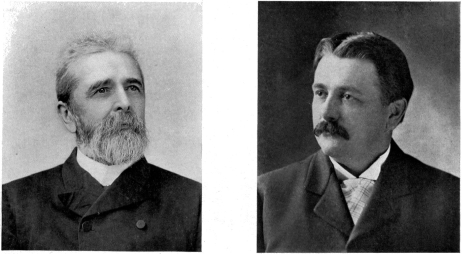
EGBERT MARSH Founder of the Memorial Library HONORABLE DANIEL DAVENPORT of Bridgeport, Conn.
Gouverneur Morris, Roger Sherman, James Wilson, and Albert Gallatin.’
“John Marshall seems to me not so much a founder as a re-founder of the Constitution, and I should be unwilling to agree with Mr. Bryce in giving him a place which appears with greater right to belong to the successor of Washington in the presidential chair. So, in arranging the statesmen of the second order, it may be doubted if Gallatin does not more properly belong to a later generation. But that in that class is Roger Sherman, rather than Trumbull, rather than Ellsworth, rather than Johnson, rather than any other son of Connecticut, or, after John Adams, of New England, few will question who have closely studied the Journals of the Continental Congress, and the debates in the Convention of 1787, out of which our Constitution sprang.”
The last speaker, Hon. Daniel Davenport of Bridgeport, was introduced as a descendant of John Davenport, the leader of the first group of colonists to settle the New Haven Colony, and the first pastor of the first church in New Haven. Mr. Davenport spoke as follows:
“The settlement of New Milford began in 1707, exactly a century after that of Jamestown, Va. At that time, although Milford and Stratford at the mouth of the Housatonic had been settled almost seventy years, and the river afforded a convenient highway into the interior, for much of the distance, this place, only thirty miles from the north shore of Long Island Sound, was still beyond the extreme northwestern frontier of New England, and indeed of English North America.
“The inhabitants of Connecticut then numbered about fifteen thousand, settled in thirty towns, mostly along the shore of Long Island Sound, and upon the banks of the Connecticut and Thames rivers. During the thirty years next before, a few families from Norwalk had settled at Danbury, from Stratford at Woodbury, from Milford at Derby, and from Farmington at Waterbury. With these exceptions, hardly more than pin points upon the map, and a few settlements about Albany, N. Y., the whole of western and northwestern Connecticut and of western Massachusetts and northern New York was a savage wilderness, covered with dense forests, and affording almost perfect concealment for the operations of savage warfare.
“Though the northwestern portion of Connecticut was then a most formidable and inhospitable wilderness, strenuous efforts were already being put forth by the Colony to encourage its settlement. For, strange as it seems to us now, at that time, owing to imperfect modes of cultivation and the difficulty of subduing the wilderness, the settled portions of the Commonwealth had begun to feel overpopulated. Twenty-five years before, the Secretary of the Colony had reported to the Home Government, that ‘in this mountainous, rocky, and swampy province’ most of the arable land was taken up, and the remainder was hardly worth tillage.
“This need of more land, and the protection from invasion which the settlement of this section would afford the communities near the coast, and the innate love of adventure and desire to subdue the wilderness, which have characterized the American people from the beginning, were the impelling causes which led to the planting of New Milford.
“So pressing did this movement become that, though what is now Litchfield County was then as remote and inaccessible to the rest of the Colony as were Indiana and Illinois to our fathers in the middle of the last century, within forty-five years after the first settler had built his log cabin and lighted his fire here twelve towns had been settled and the county organized with a population of more than ten thousand.
“In order that we may appreciate, somewhat, the broader political conditions under which the first settlers took up their abode here, which largely engrossed their thoughts and vitally affected them and their children for two generations, it is necessary, before taking up the narrative of their actual settlement here, to advert briefly to the state of affairs at that time in England, and on the continent of Europe, and in the English, French, and Spanish Colonies of North America.
“By 1707 it had become apparent to the people of Connecticut that, soon or late, they must fight for the very existence of their chartered privileges and natural rights, not alone the British Crown, but the English people. The disposition of the people of England to reap where they had not sown had become very clear. In April, 1701, Connecticut was named in the bill then introduced in Parliament to abrogate all American charters. She resisted with all her might through her agent, but it passed the second reading, and would have become a law but for the breaking out of the French War. Its principle was supported by the mercantile interests and the great men of England. Then for the first time the people of Connecticut fully realized that their foes were to be, not the exiled house of Stuart, but the English people themselves, and that, though they changed their dynasties, they did not change their own nature.
“In 1707 the principal kingdoms of Europe and their colonies were ablaze with war. Anne was Queen of England. In that very year she attached her signature to that long projected and most important constitutional arrangement, the Act of Union between England and Scotland, which made them one kingdom, the crown of which, by the Act of Settlement passed a few years before, had been forever vested in the person and heirs of Sophia, the electress of Hanover, the present reigning dynasty. Anne’s accession to the throne in 1702 had been followed by the acknowledgment, by Louis XIV., of the son of James II., the deposed and fugitive king of England and the determined foe of the rights of the Colonists, as the rightful king, although in the Treaty of Ryswick, in 1697, he had solemnly stipulated to the contrary. This act of perfidy roused the English to fury. The primary cause of the war, then raging, was the acceptance by Louis of the crown of Spain for his grandson Philip despite a previous formal renunciation. But the immediate occasion was his espousal of the cause of the son of James II. as pretender to the British throne, which enabled the English Government to form a great European alliance to wrest Spain from Philip and prevent Louis from becoming the absolute master of Europe.
The year before, 1706, had witnessed the humbling of the pride and ambition of Louis by the defeat of his armies at Ramillies by the Duke of Marlborough, in Piedmont by Prince Eugene, and in Spain by Lord Galway. Charles XII. of Sweden had advanced to Dresden in Saxony, an English and Portuguese army had occupied Madrid, and an attack of the combined fleets of Spain and France upon Charleston, S. C., then claimed by Spain as a part of Florida, had been repulsed by the vigor and martial skill of the Colonial authorities.
“At that time the valley of the St. Lawrence was occupied by about fifty thousand French settlers, imbued with bitter hostility towards the settlers in New England and New York. Already the vast design of La Salle to acquire for the King of France the whole interior of the continent seemed to have been accomplished. While as yet the English were struggling to secure a foothold upon the Atlantic seaboard, the French had explored the Mississippi and its tributaries to its mouth; and the whole vast region drained by them, between the Alleghanies and the Rockies, had been taken possession of by the French under the name of Louisiana; and a chain of military and trading posts from New Orleans to the St. Lawrence, admirably chosen for the purpose, had been established to hold it; and another chain was already planned to extend southward along the west side of the Alleghanies, to forever keep out the English. The French had been for fifty years hounding on the numerous tribes of Canada and northern New England to attack and exterminate the settlers of New England. The conquest of Canada by the English was, therefore, an object of the greatest political importance, and necessary for the peace and safety of the Colonists, and their future growth, and it continued to engross the efforts and exhaust the means of the Colonists, until their purpose was finally accomplished in 1763.
“The people who settled here were entirely familiar with the hardships, dangers, and horrors of Indian warfare to which they were liable in taking up their abode on this frontier. The horrible incidents which attended the massacre of the inhabitants of Schenectady, in 1690, seventeen years before, during the previous war, and of the inhabitants of Deerfield, Mass., and other places in 1704, during the war still raging, were household words throughout Connecticut, and had left an abiding imprint in the minds of the people on the border. Though the Indians, right about them here, seem to have been few in number and comparatively harmless, they knew from their own and their fathers’ experiences that their position was one of extreme danger, and that at all times their scanty and hard won possessions and their lives were liable to instant destruction from unheralded irruptions by the more distant Indian tribes of the North and Northwest, urged on by their French instigators and allies. For the experiences of the last seventy years, from the time of the Pequot War, and during the subsequent troubles with the tribes in southwestern Connecticut, and on Long Island, and during King Philip’s War, had fully taught them the craft, treachery, and pitiless cruelty of the savages, as well as their capacity for extensive combination among the widely separated tribes.
“When Major de Rouville, in 1704, with his band of civilized and uncivilized savages, committed the atrocities at Deerfield, Mass., the suspicions of the Colonists that the French had instigated the former Indian outrages became a certainty, for in this instance they openly shared in them.
“Their object was, as I have said, to drive the English colonists from North America, and substitute in their place their own colonial system. For this purpose they fitted out hundreds of parties of savages to proceed to other portions of the English settlements, shoot down the settlers when at work at their crops, seize their wives and children, load them with packs of plunder from their own homes, and drive them before them into the wilderness. When no longer able to stagger under their burdens, they were murdered, and their scalps torn off and exhibited to their masters, and for such trophies bounties were paid. The French Government in Paris paid bounties for the scalps of women and children, as Connecticut did for those of wolves, and it not only fitted out other savage expeditions, but sent its own soldiers to assist in the murderous work. Detailed reports of each case were regularly made to the Government at Paris by its agents in Canada, which can now be read. This is true of every French and Indian war until 1763, and the fact was as well known to the settlers here in 1707 as it is to the historical investigator of to-day.
“In the beginning of 1707 reports of an expedition by the French and Indians against some part of New England gave alarm to the Colony, and on the sixth of February of that year a council of war was convened at Hartford, consisting of the Governor, most of the Council, and many of the chief military officers of the Colony. Suspicions were entertained that the attack would fall upon Western Connecticut, and that the Indians in this vicinity intended to join the French and Indians. The Council of War determined that the then western frontier towns of Danbury, Woodbury, Waterbury, and Simsbury, should be fortified with the utmost expedition. They were directed to keep scouts of faithful men to range the forests to discover the designs of the enemy, and give intelligence should they make their appearance near the frontier. At the October session in 1708 it was enacted that garrisons should be kept at those towns, and so it continued until after the close of the war in 1713.
“It was in the midst of alarms and dangers such as these that the settlement of this town was begun. One of the first houses constructed here had palisades about it to serve as a fort, which lasted many years, and, in 1717, soldiers were stationed here for the protection of the inhabitants; and this was repeated several times afterwards. Every man here was a soldier. He was a soldier when he sat at his meals, a soldier when he stood at his door, a soldier when he went to the cornfield, a soldier by day and by night.
“At the time the first settlers arrived here there was a tract of cleared land on the west side of the river called the Indian Field. It extended from where the river runs in an easterly direction south to the mouth of the little brook which runs along Fort Hill. It was not included in the original purchase from the Indians, having been reserved by them in their deed. It was, however, purchased from them in 1705 by John Mitchell, and was conveyed by him to the inhabitants of the town in 1714. This was of the greatest advantage to the first settlers. It furnished them a space of cleared ground, where each planter could at once plant his corn and other crops without the delay of felling the trees.
“It is thought also that the ground where we now stand and Aspetuck Hill had been in a large measure cleared of trees by the Indians by burning, as was also Grassy Hill, two miles east of here. There appears also to have been some meadow land partially cleared at the mouth of the Aspetuck River.
“At that time the country about here presented no such appearance as it does now. The river then flowed with a fuller tide. With the exceptions I have noted, a continuous forest overspread the whole landscape. No thickets, however, choked up the ways through it, for the underbrush was swept away every year by fires built by the Indians for that purpose. Winding footpaths led here and there, which the Indians and wild beasts followed. The roots of the smaller grasses were destroyed by this annual burning over. A coarse, long grass grew along the low banks of the river and wherever the ground was not thickly shaded by trees. After the occupation of the country by the white settlers this annual burning was prohibited. In lieu thereof, the General Court early in its history enacted that every inhabitant, with a few exceptions, should devote a certain time yearly, in the several plantations, to the cutting of brush and small trees in the more open forests for the purpose of allowing grass to grow in such places, as during the summer the cattle ranged through the forests near the plantations subsisting on what grew there. It is said that in the early settlement of this town all meadow land was secured by clearing marshy or swampy ground and allowing it to grow up with grass from the roots and seeds already in the soil. It was one of the early difficulties in the colony to secure grass from want of seed.
“The forests about here abounded with bears, wolves, foxes, and catamounts, deer and moose, wild turkeys, pigeons, quail and partridges, and the waters with wild geese, ducks, herons, and cranes. The river itself was alive with fish, and every spring great quantities of shad and lamprey eels ascended it. Strawberries, blackberries, and huckleberries were extremely abundant in their season.
“The winters were usually of great severity. In 1637 the snow lay on the ground three feet deep all over New England from the third of November until the twenty-third of March, and on the twenty-third of April it snowed for several hours in Boston, the flakes being as large as shillings. The springs were very backward, the summers extremely hot and often dry.
“Upon the petition of the people of Milford, in May, 1702, the General Assembly granted them liberty to purchase from the Indians a township at Wyantonock, the Indian name of this place, and directed them to report their doings to the Assembly. The next March they made an extensive purchase of the natives, and a patent for the same was granted by the Assembly. In October, 1704, the Legislature enacted that the tract so purchased should be a township by the name of New Milford, and that it must be settled in five years,—the town plat to be fixed by a committee appointed by the General Assembly. In October, 1706, the Legislature annexed the tract to New Haven County. In April, 1706, the first meeting of the proprietors was held at Milford, and it was voted that the town plat and home lots should be speedily pitched and laid out by the committee appointed by the Legislature, according to its own best judgment, following certain rules laid down by the proprietors. During that year and according to those rules, the town plat was laid out.
“It was originally intended to lay out the settlement on the hill immediately east of the present village, from this circumstance called Town Hill to this day. In point of fact, it was laid out on Aspetuck Hill, and consisted of the town street and sixteen home lots. The street was twenty rods wide. It began at the south end of the brow of the hill, or at the lower end of what was then called the ‘Plain on the Hill,’ and extended northward. Eight lots were laid out on each side of this street, each lot being twenty-one rods wide and sixty deep.
“By the rules adopted by the proprietors, these lots were to be taken up successively in regular order by the settlers as they should arrive. John Noble took the first lot on the east side of the street at the lower end, he being the first settler to arrive. John Bostwick took the lot on the opposite side of the street, he being the next settler on the ground. This method was followed by the others until there were twelve settlers, with their families, numbering seventy souls, located on this street in 1712. Of these twelve families, four were from Northampton and Westfield, Mass., four were from Stratford, two from Farmington, and only two from Milford. In 1714 the town street was extended southward to the south end of the present public green.
“The first houses constructed here by the settlers were of the rudest description. They were built of logs fastened by notching at the corners. They were usually from fifteen to eighteen feet square, and about seven feet in height, or high enough for a tall man to enter. At first they had no floors. The fireplace was erected at one end by making a back of stones laid in mud, and not in mortar, and a hole was left in the bark or slab roof for the escape of the smoke. A chimney of sticks plastered with mud was afterwards erected in this opening. A space, of width suitable for a door, was cut in one side, and this was closed, at first, by hanging in it a blanket, and afterwards by a door made from split planks and hung on wooden hinges. This door was fastened by a wooden latch on the inside, which could be raised from the outside by a string. When the string was pulled in the door was effectually fastened. A hole was cut in each side of the house to let in light, and, as glass was difficult to obtain, greased paper was used to keep out the storms and cold of autumn and winter. Holes were bored at the proper height in the logs at one corner of the room, and into these the ends of poles were fitted, the opposite ends, where they crossed, being supported by a crotch or a block of the proper height. Across these poles others were laid, and these were covered by a thick mattress of hemlock boughs, over which blankets were spread. On such beds as these the first inhabitants of this town slept and their first children were born. For want of chairs, rude seats were made with ax and auger by boring holes and inserting legs in planks split from basswood logs, hewn smooth on one side. Tables were made in the same way, and, after a time, the floor, a bare space being left about the fireplace instead of a hearthstone.
“No sooner had the first settlers taken up their abode here than they were called upon to defend the title to their lands in the courts of the Colony. About thirty-seven years before, the General Court had granted permission to certain Stratford parties to buy land from the Indians and settle a plantation at this place, and they had bought over twenty-six thousand acres hereabouts. Apparently, however, no attempt was made towards a settlement of the same until after the purchase of the same tract from the Indians by the Milford parties in 1702, and the grant for a patent for the same to them by the General Court in 1703. Soon after the settlers first broke ground here, in 1707, a suit was begun against them by the Stratford people in the County Court at New Haven in May, 1708, and it was carried thence to the General Court. It was tried sixteen times. The first fifteen times the plaintiffs won on the strength of their Indian title. The sixteenth, the defendants won on the strength of their Indian title, the patent from the General Court, and occupation. This incident is particularly interesting, because one of the plaintiffs and the lawyer in this great case was the famous John Read, one of the ablest men and most remarkable characters which New England has produced. Some notice of him will not be inappropriate here, as he was one of the earliest inhabitants of this place.
“He was born at Fairfield, June 29, 1679, and was a brother-in-law of Governor Talcott. He graduated at Harvard in 1697, and became a minister, preached in Woodbury as a candidate, and in various towns in Hartford and Fairfield counties, and preached the first sermon ever delivered in this place. He studied law, and when, in 1708, the General Assembly first provided for the appointment of attorneys as officers of the court, he was one of the first admitted. He held the offices of Colony Queen’s Attorney, 1712-16; Deputy for Norwalk, 1715-17; Commissioner to settle the boundary with New York, 1719; and he was Connecticut’s representative in the Inter-Colonial Commission in regard to Bills of Credit, in 1720. He removed to Boston in 1722 and became the Attorney General and a member of the Council of Massachusetts. He was by far the most eminent lawyer of New England, and was called ‘The Pride of the Bar, Light of the Law, and Chief among the Wise, Witty, and Eloquent.’ It was he who prepared the instructions to Lord Mansfield, the counsel for Connecticut in the great case of Clark vs. Tousey, in which was discussed the question whether the Common Law of England had any force in Connecticut other than as it was adopted by the people of Connecticut. His exposition of the principles involved was most masterly, and it was the great authority upon which in a later generation the people of Connecticut relied to sustain them in their opposition to the measures of the crown in 1775.
“In a centenary sermon delivered at Danbury in January, 1801, the Rev. Thomas Robbins had this to say of him:
“ ‘One of the early inhabitants of Danbury was John Read, a man of great talents and thoroughly skilled in the knowledge and practice of the law. He possessed naturally many peculiarities and affected still more. He is known to this day through the country by many singular anecdotes and characteristics under the appellation of “John Read, the lawyer.”’
“In 1712 the town was incorporated, which gave it the power to tax the inhabitants to support a minister, and the place became thereby an ecclesiastical society. In March, 1712, the Rev. Daniel Boardman was called to preach to the settlers. In May, 1715, the settlers petitioned the General Assembly that they might obtain liberty for the settlement of the worship and ordinances of God among them, and the Legislature granted them liberty to embody in church estate as soon as God in his providence should make way therefor. On November 21, 1716, Mr. Boardman was duly ordained as the pastor of the Church of Christ in New Milford, the total number of the inhabitants of the town then being one hundred and twenty-five. The first vote of the town to build a meeting-house was passed in 1716, but work was not commenced upon it until 1719, and it was not completed until 1731, after infinite struggling. It was forty feet long, thirty wide, and twenty feet in height between joints, and was provided with galleries, pews, and a pulpit. Long before completion, when it was first used for religious purposes, the congregation was accustomed to sit upon its outer sills, which were able to accommodate every man, woman, and child in the town with a little squeezing. In 1713, the town voted to build for the minister a dwelling house forty feet between joints. In 1726, thirteen years later, the house was still unfinished. The first Sabbath Day house was not built until 1745.
“In 1721, when there were but thirty-five families residing here, a public school was ordered by the town to be kept for four months the winter following, one-half of the expense to be borne by the town. The children were taught reading, spelling after a phonetic fashion, writing, and the first four rules of arithmetic. In 1725 it was voted to build a schoolhouse twenty feet long, sixteen feet wide, and seven feet in height between the joints.
“The first settlers crossed the Housatonic to their lands on the west side by fording it at a point near the mouth of Rocky River, about a mile above the settlement, or at Waunupee Island in times of very low water. In 1720 the town built a boat for the purpose, which was used until 1737, when the first bridge ever built across the Housatonic from its source to its mouth was constructed at what is now the foot of Bennett Street.
“The settlers for many years crushed their grain by hand in mortars or carried it to mill at Danbury, Woodbury, or Derby, and brought back the flour and meal. In 1717 John Griswold, under an arrangement with the town, built a grist and saw mill on Still River, at what is now Lanesville.
“It is said that in 1713 there was but one clothier in the colony. The most that he could do was to full the cloth which was made in the homes. A great proportion of it was worn without shearing or pressing. He lived at Woodbury, and thither the early inhabitants of this town resorted to have their cloth fulled. People, to a very large extent, wore clothing made from the skins of animals. They also wore wooden shoes and moccasins, or went barefoot, although leather boots and shoes were sometimes used.
“The implements which they used in subduing the wilderness, their axes, saws, plows, hoes, and scythes, were of the rudest description. Their horses, cattle, sheep, and swine, we should now regard as of very inferior quality. The same was true of the few vegetables they cultivated and of their fruits, especially their apples. Turnips, squashes, and beans were the principal vegetables. Potatoes were not as yet cultivated in New England, onions were not generally, and tomatoes were looked upon as poisonous. Some of them owned negro slaves, but worked the harder themselves to make them work.
“They had little or no currency, taxes and debts being paid in produce. What they ate, what they wore, what they coaxed from the reluctant soil of these hillsides, cost them infinite labor. As was to be expected, a stingy avarice was their besetting sin, which manifested itself in all the relations of life. They were without newspapers, none being published in the Colony until 1755. They had few books, the first printing press in the Colony not having been set up at New London until 1709. They suffered greatly from malaria and other forms of sickness, as did all the early settlers in the State. Medical treatment was poor and difficult to obtain. The women went to the limit in childbearing, and the burden of rearing their large families was awful. The art of cooking was little understood. They had no stoves nor table forks. The food was served in a very unsavory fashion, and was very indigestible. The people therefore had frightful dreams, and dyspepsia was very prevalent. No carpet was seen here for a hundred years after the settlement. Communication with the outer world was slow, difficult, and rare. On several occasions, owing to the failure of their crops and the difficulty in getting relief from distant places little better off, they nearly starved to death.
“Truly the task which they had undertaken to subdue this wilderness, to plant here the civil, religious, and educational institutions of Connecticut, and to prepare this beautiful heritage for their children and children’s children, was no holiday pastime, no gainful speculation, no romantic adventure. It was grim, persistent, weary toil and danger, continued through many years, with the wolf at the door and the savage in the neighboring thicket.
“Besides the physical evils with which they were beset, they had spiritual troubles also. They fully believed in witchcraft, as did all their contemporaries, in a personal Devil who was busily plotting the ruin of their souls, in an everlasting hell of literal fire and brimstone, and in a divine election, by which most of them had been irrevocably doomed from before the creation of the world to eternal perdition, from which nothing which they could do, or were willing to do, could help to rescue them. The great object of life to them, therefore, was to try to find out what their future state would be. Said one of their preachers: ‘It is tough work and a wonderful hard matter to be saved. ’Tis a thousand to one, if ever thou be one of that small number whom God hath picked out to escape this wrath to come.’ That we may get a touch of reality from those far-off days, let me quote to you a few lines from the saintly Thomas Hooker, the founder of Connecticut and long the model for her preachers:
“ ‘Suppose any soul here present were to behold the damned in hell, and if the Lord should give thee a peephole into hell, that thou didst see the horror of those damned souls, and thy heart begins to shake in consideration thereof; then propound this to thy own heart, what pains the damned in hell do endure for sin, and thy heart will shake and quake at it. The least sin that thou ever didst commit, though thou makest a light matter of it, is a greater evil than the pains of the damned in hell, setting aside their sins. All the torments in hell are not so great an evil as the least sin is; men begin to shrink at this, and loathe to go down to hell and be in endless torment.’
“The only test which they were taught to apply to ascertain whether they were predestined to suffer or escape this fearful doom was in their ability and willingness to conform their wills to the will of God as revealed in the Bible. According as they succeeded in this, they had a reasonable assurance as to their fate, though no wile of the Devil was more frequent than to falsely persuade men that their prospects were favorable. To study the Scriptures day and night to ascertain the will of God, and to struggle without ceasing to conform their wills to his as therein revealed, was therefore the great object of existence for them, not that they could thereby alter in the least their future state, but that they might, if possible, find out what it was likely to be.
“Should this recital of their beliefs provoke a smile, our amusement will soon be checked by the thought of the little progress which has been made in the last two hundred years towards solving the same problems. The origin of evil, the ineradicable tendency of the human heart to sin and do evil, the mournful spectacle of ruin and desolation in the moral world, and the future life are the same inscrutable mysteries to us as to them. If we have constructed or adopted a more comfortable theology, it is probably because we are less logical than they. It is perhaps because we have forgotten or refused to look at some things at which they did not blink.
“Then, too, the Lord was abroad in those days. Their thoughts were deeply tinged by the semi-pagan views with which the authors of both the Old and New Testaments were imbued. When the thunder crashed, it was the voice of an angry God that spoke. When the lightning flashed, it was the gleam of His angry eye. Benjamin Franklin was then but a year old, and electricity had not become the packhorse of the world. The smiles and frowns of nature in all her varying moods through all the days and seasons, which we ascribe to the operations of law, were to them the visible tokens of the wrath or favor of the Almighty. On December 11, 1719, for the first time in the history of the Colony, the northern lights were seen here. They shone with the greatest brilliancy. The consternation they caused was fearful. The people had never heard of such a phenomenon. They considered it the opening scene of the Day of Judgment. All amusement was given up, all business was forsaken, and sleep itself was interrupted for days. Again, on the twenty-ninth of October, 1727, a mighty earthquake occurred, which shook with tremendous violence the whole Atlantic seaboard. The people here believed that the Lord was about to swallow them up in His fierce anger. The women throughout New England immediately discontinued the wearing of hoop skirts, then recently come into fashion, believing that the earthquake was the sign of the Lord’s displeasure at the sinful innovation.
“Hardly had the first settlers here begun to build permanent homes for the living when they were called upon to provide resting places for the dead. The first person to be buried in yonder burying ground was a child, a girl, Mary, the daughter of Benjamin Bostwick. The next was John Noble, the first settler and the first Town Clerk. He died August 17, 1714. The town formally laid out the burying ground in 1716. Within fifty years three hundred had gone to rest there.
“There were no religious exercises at the funerals, neither singing, praying, preaching, nor reading of the Scriptures. This was by way of revolt from former superstitious practices. The friends gathered, condoled with the afflicted ones, sat around a while, and then the corpse was taken to the burying ground. After that the party returned to the house of the deceased, where much eating and drinking was indulged in, and, if the weather permitted, outdoor games and horse races were in order. The next Sabbath an appropriate funeral sermon was preached. A bereaved husband or wife usually soon married again.
“The meeting-house was never heated, but the people, summoned by drum beat, attended it every Sabbath, morning and afternoon, even in the severest weather, although no Sabbath Day house was erected here until 1745.
“The sacramental bread often froze upon the communion plate, as did the ink in the minister’s study. The people worked their minister very hard, as was the case in all early New England communities. They went to church not so much because they had to as because they wanted to. Church-going was their principal recreation. They demanded long prayers and two long sermons each Sabbath from their minister, usually on doctrinal points, which they acutely criticised. Services began at nine o’clock in the forenoon and continued until five in the afternoon, with an hour’s intermission. Soldiers, fully armed, were always in attendance throughout the services ready to repel any attack upon the settlement. It should be added, however, that with all their strictness in Sabbath-keeping and catechising, in family and church discipline, there was great license in those days in speech and manner, much hard drinking, and rude merry-making, due to their rough form of living. They were not what they wanted to be, nor what a loyal posterity perhaps longs to believe them. They had red blood in their veins. They were among the most enterprising men of their generation. They were backwoodsmen, the vanguard of that wonderful race which in two hundred years pushed westward the frontier from this place to the Pacific, fighting with man and beast the whole way, and sowed the land with vigorous sons and daughters.
“The congregational singing in those days must have been an interesting performance. When the first settlers came to New England from the old country, they brought with them a few tunes, to which they sang all the psalms and hymns.
“The proper mode of rendering these was through the nose. With the lapse of time and the advent of a new generation, these tunes became jangled together in inextricable confusion. The practice was for a deacon as leader to read a line of the psalm or hymn, and the congregation then sang at it as best they could, each one using such tune as he chose, and often sliding from one tune to another in the same line or improvising as he went on. Finally, in 1721, the Rev. Thomas Walter of Roxbury, Mass., published a treatise upon the grounds or rules of music, or an introduction to the art of singing by rote, containing twenty-four tunes harmonized into three parts. The attempt to supersede the old Puritan tunes and restrict the liberty of the individual singers met with the greatest opposition and was long successfully resisted in all the churches in New England, so tenacious were they of the rights of the individual singer. It caused great dissension in the church at this place. Finally, in February, 1740, the church voted to halve the time for the next year, singing the old way one Sabbath and the new way the next, and in 1741, at a meeting specially called to settle the matter, it was voted thirty to sixteen to sing thereafter after the new way.
“No musical instruments were allowed in the meeting-house. They had never seen or heard a church organ. But they knew that their fathers likened its sound to the bellowing of a bull, the grunting of a pig, and the barking of a dog, and had resisted its use in religious services even to the shedding of blood. Nor were flowers allowed in the church.