PART II THE BI-CENTENNIAL EXERCISES (continued 2)
Reading edition
“It would be ungracious to dwell now on the opposition, for the most part conscientious, and nearly always quite in accordance with law, which the early Churchmen experienced. It is pleasanter to note that their neighbors and the Colonial authorities extended to them what was for the times, a generous toleration as to ‘sober dissenters,’ and allowed them, if they actually attended church, to turn their ‘church rates’ to the support of their own clergymen. And this parish had the special favor, shared with but two others, of a special act of the General Assembly, which practically put it before the law in the full status of a society of the standing Congregational order. Even the hard feelings of Revolutionary days, almost excusable at the time, soon passed away. The Church of England in Connecticut, under the nominal care of the Bishop of London, became the Church of the Diocese of Connecticut, under the care of her own Bishop, and presently a constituent part of the Church in the United States, loyally maintaining the Commonwealth and the Republic, actually guiding the organization of the State, and moulding a large part of the people in the ways of soberness, righteousness, and godliness.
“In all this time, the parish of St. John’s, New Milford, was a true center of missionary work. We wonder when we read of Dr. Johnson from Stratford extending his journeys to Newtown and Middletown and New London; of Mr. Beach from Newtown visiting New Milford and other places, really caring for a whole county with ‘parts adjacent’; of Mr. Davies from New Milford going about in circuit, preaching and baptizing in Roxbury, and New Preston, and Salisbury, and Litchfield, and Sharon, and divers other places in the Colony, and crossing the line into Great Barrington, where he found difficulties incident to another government, but where a church was built under his care; and how he, in his turn, directed to that place the steps of Gideon Bostwick, who ministered for more than twenty years in Berkshire, in the southern part of Vermont, and in the eastern part of New York. Moreover, there came in 1769, to the clergy of Connecticut, assembled in Convocation in New Milford, a memorial from the few Churchmen in the new settlement of Claremont, in New Hampshire, asking that their case might be presented to the Venerable Society in England, with the hope that they would be allowed at least a catechist and schoolteacher, until (as they said) they should have passed ‘the first difficulties and hardships of a wild, uncultivated country.’ Such a man was commissioned, and did good work as an unordained missionary; while a clergyman was presently sent to make a personal exploration of the northern provinces. It is apart from our immediate topic; but we can never think of the religious history of New Milford without being reminded of that remarkable man, Count Zinzendorf, who held the episcopate among the Moravians, and for a while ministered to the aborigines in this very place—one of the few places in which the Indians remained, and in which they were affected by the preaching of Christianity. There were others also here whose very presence was a challenge to the teaching of the Church at one time or another—Separatists, and Quakers, and Jemimaites, and Glassites. Among them all, the Church held her place, and guided the life of no small part of the whole community.
“For the last ten years of the eighteenth century the Rev. Truman Marsh was rector of New Milford, with New Preston and Roxbury. In 1793 the Church, already occupied for eight and twenty years, was formally consecrated by Bishop Seabury, eight of the clergy being present for a Convocation. It had been long in an unfinished state, as we gather from the frequent entries in the parish records, which refer to the work yet to be done. Only two years before the consecration it was voted, ‘To go on and finish the Pulpit, Reading Desk, Clark’s pew, and Gallery’; and in the next year a vote was passed as to the assignment of seats; and, the front seat in the gallery being reserved for singers, and the back seat there for blacks, it was commendably voted, ‘That People of any Denomination that Wish a Seat Shall have one.’ This edifice, repaired from time to time, served the purposes of the congregation until 1837; and the third Church was in turn replaced by the present beautiful and enduring building, on a new but adjacent site, twenty-four years ago, in 1883. There must have been of old a glebe lot here, though we do not find early notice of it; it lay on the west side of the Main Street, and, in Mr. Marsh’s day, it had a house and barn upon it; there is a tradition that it was secured in part from the sale of a piece of land which the parish owned at a still earlier day and in part from the parish’s share of the avails from undivided land in the highway; at any rate, it was sold long ago.
“The history of post-Revolutionary times must be rapidly passed over. Mr. Benjamin Benham began here as a lay-reader, and, having been ordained in 1808, was rector for nearly twenty years, having duties also at New Preston, Roxbury, Bridgewater, and Brookfield; then, for another score of years the Rev. Enoch Huntington ministered to the congregation, and, after an interval, another twenty years of your records is covered by the rectorship of the Rev. Charles G. Acly, in whose time a rectory was secured.
“This brings us down to a date but little more than thirty years ago, well within the memory of many in this congregation; and the last twelve of these years belong to the present rectorship, as to which we may well hope, both for the rector’s sake and for the people’s, that it is much nearer its beginning than its end.
“A few figures will show the remarkable growth of the parish, noticeable even among the thriving country parishes of Connecticut. A hundred years ago, already a century after the first settlement, there were seventy-four communicants in the cure of New Milford, New Preston, and Roxbury; fifty years ago, St. John’s Church, New Milford, reported one hundred and twenty-five communicants and one hundred Sunday scholars; in 1885, not quite thirty years later, the number of communicants had increased to two hundred and eighty-nine, and the number of Sunday scholars was one hundred sixty-four. In the last named year, the new congregation of All Saints’ Memorial Church was canonically organized, its beautiful place of worship being consecrated in a subsequent year, and a rectory being added some twelve years ago. The result of this increase of the provision for the worship of the Church and for its varied ministrations in this town has been a growth, under all the circumstances, more remarkable than that of former times; in twenty-one years the number of communicants has increased from two hundred eighty-nine to five hundred forty-nine—four hundred five in the older parish and one hundred forty-four in the younger; and where there were one hundred sixty-four scholars in one Sunday school, there are now two hundred fifty-eight in two schools, of which the mother parish has two hundred nine....”
BY REV. S. D. WOODS IN THE BAPTIST CHURCH AT NORTHVILLE
“Our best authority tells us that while Baptists were not very numerous in the early days of the town’s history, yet a decade or more before the close of its first century there was a sufficient number to warrant the carrying on of services at varying places—Bridgewater, Warren, and Gaylord’s Bridge. These were kept up for twenty-five years, when, on Jan. 7, 1814, a meeting was held at the residence of Asahel Baldwin, at which time it was voted: ‘1st, To organize ourselves into a society to be known as the “New Milford Baptist Church.” 2d, To invite a council from sister churches to meet with us on Feb. 9, to consider the propriety of recognizing us as a regular Baptist Church.’ This council met as planned, and after a proper examination of ‘their Articles of Faith and their Covenant,’ voted, unanimously, ‘to recognize them as a sister church in the Lord.’
“By this act twenty-two believers became a recognized body of worshipers, who, ten days later, voted to license Eleazer Beecher as pastor. He was ordained Sept. 15, 1814, at the residence of Abel Canfield on Long Mountain. The services were conducted in the open air.
“This first pastorate continued for seven years, when Rev. Seth Higby assumed charge for one momentous year, as it witnessed the beginning of this present house of worship; and the following year, 1822, saw its completion, when Elder Higby resigned, and Elder Beecher was again installed, serving the church for ten years more. He was succeeded by Rev. Nathan Benedict in a two years’ pastorate, and he, in turn, by Rev. Elijah Baldwin, who remained until 1840. For ten years the church was without a settled pastor, though the pulpit was supplied by various non-resident clergymen.
“From 1850 to 1866 but little growth is recorded; they were years of struggles and trials. There was a succession of pastors, Revs. H. M. Barlow, J. F. Jones, and J. Hepburn, serving as under shepherds.
“In 1868 the Rev. C. W. Potter was called, and his three years of service witnessed a gracious revival and added ten to the church roll. With the resignation of Elder Potter, the church experienced five years of pastorless existence, though being supplied occasionally by Rev. Arthur Day. With the settlement of Rev. Edwin Beardsley, in 1875, the church entered upon a new era of growth and activity. The records show that two are still members who came in during that time. The succeeding pastor was Rev. J. P. Cotney, who remained about three years, adding two by baptism. He was succeeded by Rev. F. P. Braman, in 1887, who remained two years, baptizing six into fellowship. In 1889 the Rev. Frederick Kratz was installed, to be succeeded within two years by Rev. John Scott, during whose ministry of two years the parsonage was well-nigh completed and three members added to the church roll. This pastorate also saw the church made a corporate body. In 1893 Rev. F. D. Luddington was called, and remained three years, baptizing twenty-eight into church fellowship. In July, 1896, Rev. Charles I. Ramsey assumed the pastorate, and for nearly five years continued the good work already begun, by adding ten by baptism. The Rev. A. H. Manee began his pastoral labors in August, 1901, closing his labors in October, 1904, baptizing one into fellowship.
“From November, 1904, until April, 1905, the pulpit was supplied by various clergymen, when Rev. S. D. Woods became pastor, and continues in that office at the present time. Thus far there have been nineteen baptisms, and the church shows the largest membership in its history.
“All told, there have been two hundred and sixty-nine baptisms. The present membership is seventy....
BY REV. HARRIS K. SMITH IN THE METHODIST EPISCOPAL CHURCH
“Text—Proverbs 22:28. ‘Remove not the ancient landmark, which thy fathers have set.’
“A burning desire to deliver a living message is one landmark in the evangelism of the fathers of our church. The age of our town is nearly four times as great as the years of Methodism’s church edifice in our village; more than twice the years of Methodism in the present confines of our town; one hundred twenty-seven years greater than Methodism in the State; thirty-seven years greater than Methodism’s first Conference. Indeed, John Wesley, its founder, was but four years old, in June of the year, when John Noble, New Milford’s first settler, penetrated these forests primeval. Our fathers came not as a colony, but as evangelists, impelled by a vital experience. They believed that sin separated from God, that only by salvation, through the atonement of the Redeemer, could sinners be in harmony with the Father, that personal righteousness and the witness of God’s indwelling Spirit were results of redemption, and that the redeemed were to go on unto the likeness of Jesus. Without ignoring other elements in their belief, the stress laid upon personal experience and its intensity led them far and wide. That they did not thrust an alien graft upon New England religious stock is seen in one instance, at least, by the demands of Jonathan Edwards for personal righteousness, and for conversion as a requirement for all seeking the communion of the Lord’s Supper; and the sad rejection from his pulpit. Infidelity, imported with the teaching of the French revolutionists, was alarmingly on the increase. The custom of discussing metaphysical subjects and of weaving fine-spun doctrines was spreading more or less throughout Christendom; to so large an extent had London been infected, that Blackstone, the famous law commentator, in visiting every church of note in that city, said he did not hear one sermon that had more of Christianity than had the writings of Cicero, and that they could not have been called Christian sermons. The revival-stirring sermons of Wesley and Whitefield were permeating through and upward from the masses of the people. And the reception given to this message, so ardently delivered, assures conclusively the need that had been unsatisfied. So, then, the fathers of our Church entered this field with the ringing word of God in their hearts as their warrant.
“Faithful sowing and careful husbanding of the harvest constituted another landmark. When, in 1789, Jesse Lee was appointed to Stamford, he had neither preaching place nor congregation as a rallying point; not even a member in all New England to greet him. He entered with a ‘roving commission.’ True enough, Methodism had been presented by some of the most prominent evangelical preachers since the visit of Charles Wesley, nearly sixty years prior to Lee, and including Whitefield, Boardman, and Garretson, within a short time of the more concentrated mission in 1789. Lee’s fine appearance, his massive frame, his weight being about three hundred pounds, his wit and good humor, his wisdom and judgment of human nature, his knowledge of the Bible, and his depth of consecration gave him an entry. The labors of Lee extended, during his first year, from Norwalk along the Sound coast, and upward to Ridgefield and Danbury. These pioneers approached our town from the south, reaching the part now separated into the town of Bridgewater, about 1800; they came from the Hudson River in the north to Gaylordsville in 1813, and to Northville in 1816; from the southwest to Lanesville, then called Pleasant Valley, in 1815. These activities from all directions soon resulted in the erection of church buildings at all of these points. The care of the preachers was constant to train the converts enlisted. They visited and revisited, at heavy privations and difficulties, to make sure of the standing of even one or two new members.
“The essential coworking of the laymen is another landmark. Methodism, from its inception, would have been incomplete without the largest degree of co-operation on the part of the laity. It has been a layman’s movement, under the direction of ordained leaders. As soon as two or more were converted at a place, one of the number was delegated as leader for the others, thus forming classes for religious culture. Awaiting the visits of the preacher in charge, these classes were hives of industry, and seminaries of learning, and communions for worship in charge of one of their own number, the class leader. Those more qualified by nature and grace were called for special activity as local preachers, and they went from place to place, preaching to other congregations, alternating with the ordained preachers and under their direction. These meetings were in homes, at times the choicest in the center of the town, or at others, far in the fastness of the forest within the rude log cabin, or at others, in God’s open temple with the swaying branches of the trees as their rafters. The time of worship might be at any hour from sunrise until midnight, and on any day during the week. The congregation was called from the home, the shop, the store, and the field, not by the chime of the church bell, but by the volume of hearty singing; the numbers might be confined to one beside the preacher, or mount upwards to more than twenty thousand. The immediate results of these preaching visits were to be cultivated by the resident laymen. And nobly did they keep the faith. Exhortation, rebuke, counsel, encouragement, forbearance, and brotherly love must come by means of fellow laymen, in many cases but little older in the faith than the new recruits.
“Zeal in building up the local church was another landmark. Within a few years after the introduction of Methodism, church buildings were erected at Gaylordsville, at a cost of eight hundred dollars; at Northville, on ground of Harvey Benson, at a cost of six hundred dollars, beside labor and material contributed; and at Lanesville, at a cost of three thousand dollars. This indicates considerable sacrifice on the part of the members, and interest in the community. In 1849, after considerable discussion, the members of the different churches, so close in location, agreed upon the village as a central point, and our present edifice was built. Since 1833, when its name had first appeared in the conference minutes, it has been known as the New Milford charge. Before that it had been part of the Stratford circuit, which, in 1822, when our town first had a permanent preaching place on the circuit, had only three church edifices; while to-day this range contains church property, including parsonages, worth nearly a million dollars, has several thousand members, and gives for benevolent purposes, outside its own borders, more money every year by far than the total amount contributed for all causes at that time.
“Within a few years of the building of the present edifice a parsonage was erected. Every year additional money was laid out on the property; principally in 1869 in the pastorate of the Rev. W. R. Webster, and in 1891, when the church was remodeled and enlarged, at a cost of several thousand dollars, in the pastorate of the Rev. R. T. Cooper.... In the long line of preachers, whose counsel and administration have cheered and molded many lives, was the Rev. William T. Gilbert, one of a great class graduated from Yale University, who, with earnest manner and finely wrought sermon, built deeply and broad; and, after laying aside his pastoral duties, he re-entered the ranks, working faithfully along different ways in the activities of the laymen. The Rev. George Lansing Taylor, D. D., L. H. D., ended a life of great intellectual power and moral grandeur, while your pastor. For breadth in learning, strength of thought, independence for truth, tenacity to purpose, and conscientious following after his Master, he was notable. His pastorate will long be memorable in the history of this church, and be felt in the lives of its members, among the younger especially, as they were marked by his striking personality.”
BY REV. ORVILLE VAN KEUREN IN THE GAYLORDSVILLE METHODIST EPISCOPAL CHURCH
“Methodism was established in Gaylordsville in 1825, under the following circumstances:
“Rev. Cyrus Silliman, of the New York Conference, came to visit a cousin, Mrs. David Sterling, who lived one and a half miles below the village, in the town of Sherman. While there, he made an appointment for a week-evening service at the Strait district schoolhouse. The attendance was so large and the interest so marked that he continued the meetings four evenings, and then returned to his charge in the State of New York.
“The people, however, continued the meetings for several weeks, holding them in private houses. Rev. Andrew Elliot, the pastor of the Congregational Church at New Milford, learning of the revival, came up several times and visited the families.
“The following year, as a result of these meetings, twenty-six persons joined the Congregational Church, nineteen formed a Methodist class at Gaylordsville, and others joined the Baptist Church. A subscription was started to build a union church at Gaylordsville, which was built in 1826. Rev. Aaron Hunt, a Methodist preacher from the State of New York, preached the first sermon in the new church, which was used jointly by the Methodists, Congregationalists, and Baptists up to about 1854. This church stood on the east side of the river, just back of the store now occupied by A. H. Barlow. It was afterward sold to Peter Gaylord, who removed it to his premises and converted it into a barn. At a quarterly meeting, held in that church, Rev. Edmund Storer Janes, D. D., LL. D., afterward a bishop of the Methodist Episcopal Church, received his license as a local preacher.
“In 1854, under the pastorate of Rev. David Nash, the present church edifice was erected, upon a site given by the Rev. John Henry Gaylord, who also raised by subscription about $2800 toward the cost of the new church. The parsonage, which adjoins the church, was purchased in 1884, during the pastorate of Rev. M. M. Curtis.
“In 1827 Rev. Josiah L. Dickerson settled here, built a house, and engaged in making brick. As a local preacher, he filled some of the appointments on the circuit up to about 1834, when he joined the New York Conference, and continued in the regular work of the ministry until retired by reason of age. He died in 1862, and is buried in the Gaylordsville cemetery.
“Methodism was introduced into Sherman Center, under the pastorate of Rev. Alonzo Selleck, in 1838, under the following circumstances:
“A few years before the Congregational Church of Sherman became divided over the building of a new house of worship, or, rather, the location of the building. A majority of the society decided it should be built about a mile north of the Center, where the present church stands. A minority, living at the Center and in the southern part of the town, built a church at the Center, and called it a union church. Rev. Selleck was preacher in charge of New Milford circuit, which, at that time, included the following appointments: Pleasant Plains, Iron Works, Newtown, Merryall, Hawleyville, Northville, Kent Mountain, Gaylordsville, Bull’s Bridge, and Long Mountain. There were but three churches on the circuit. The other preaching places were schoolhouses or private dwellings.
“Following a revival service held at the Leach Hollow schoolhouse in the fall of 1837, the Center people invited Rev. Selleck to come up and preach in the new church, which was not entirely furnished at that time. The first service was held on New Year’s Eve, as a watch night service. The church was filled to overflowing, and, at that service, seventy-five persons came forward as seekers of religion. The meetings were continued several weeks, Rev. H. Ames, a retired preacher residing in the town, assisting much in the work. About two hundred fifty persons professed religion during this revival. Of that number, seventy joined the Methodist Church, while many joined the Congregational Church, of which Rev. Mr. Gilson was then pastor.
“A few years later Sherman was made the center of a circuit, separate from New Milford, taking in the appointments in the northern part of the town. From 1826 to 1848 this circuit was connected with the New York Conference. At the session of the General Conference in 1872 it was again transferred to the New York Conference, where it still remains. When the transfer was made in 1872, the records for the charge showed a membership of seventy-three, the Sherman Society having at that time but thirteen members.
“The church has had a long list of pastors, who served in the following order: Revs. John Reynolds, William Jewett, Fitch Reed, Samuel Cochran, Seth W. Scofield, A. S. Hill, Francis Donelly, the exact dates of whose pastorates we cannot give; 1837, Alonzo Selleck and Asahel Brownson; 1838, Alonzo Selleck and Samuel Weeks; 1844-5, Gad S. Gilbert; 1846-7, Elias Gilbert; 1848-9, Justus O. Worth; 1850, Thomas B. Treadwell; 1851, William Wake; 1852, Alexander McAllester; 1853, Gilbert Hubbell; 1854-5, David Nash; 1856-7, William H. Stebbins; 1858-9, Thomas D. Littlewood; 1860-2, John H. Gaylord; 1863, William Ross; 1864, John Henry Gaylord (during his pastorate the church sheds were built); 1865-6, Benjamin A. Gilman; 1867-8, F. W. Lockwood; 1869-70, Sherman D. Barnes; 1871, Frank F. Jordan; 1872-3, B. M. Genung; 1874-5, Uriah Symonds; 1876, W. A. Dalton; 1877-9, R. F. Elsden; 1880-1, Robert Kay; 1882-4, M. M. Curtis (during his pastorate twenty-six joined the church, two of whom entered the ministry—Rev. Henry Hoag, a member of the Conference, and Mark B. Howland, a local preacher); 1885, Gustave Lass; 1886-7, E. H. Powell; 1888-92, W. H. Peters (under whose pastorate the church was thoroughly repaired and refurnished); 1893-4, I. H. Keep; 1895-7, John Henry Lane; 1899, C. B. Conro; 1900-1, E. H. Roys; 1902, Robert F. Elsden; 1903-6, Edmund T. Byles; 1907, O. Van Keuren, the present pastor.
“In 1898 the charge was left to be supplied. The Rev. M. M. Curtis, then superannuated, filled the pulpit for a few weeks. When, by reason of failing health, he was obliged to discontinue the work, the Rev. James A. Hurn, who has since united with the Conference, supplied for the rest of the year.
“During the pastorate of E. T. Byles the church property was greatly improved by the addition of well-appointed church parlors, equipped with all modern conveniences, the entire expense being provided for before the work was begun.
“The membership, though small, is thoroughly united and intensely loyal.
“Others have labored, and we have entered into their labors, while they, in continuous procession, have passed on to receive the reward of the faithful.
“The present membership of the church is eighty-eight.”
BY REV. ELISHA J. ELLIS, OF DANBURY IN THE ADVENT CHRISTIAN CHURCH
“Early in the history of the movement which resulted in the formation of the Advent Christian denomination, the seed of the doctrines which distinguished this people were sown here by pioneer hands. So far as ascertained, the first preachers to arrive on the field were Elders Ira Morgan and Samuel G. Mathewson, about 1844. Quite a number of conversions followed, and Elder Mathewson baptized quite a number in the stream which flows near the present church site. Rufus Way, Horace Gregory, and Richard Heacock were converts about this time—also A. S. Calkins, who afterwards became a talented preacher in the West.
“Joshua V. Hines preached here in 1846 or 1847. Afterwards, in the sixties and seventies, representative men like
ADVENT CHRISTIAN CHURCH

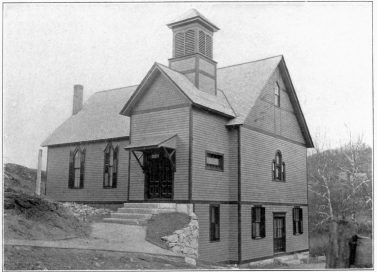
Miles Grant, Horace L. Hastings, I. B. Potter, Peter and Samuel Patro labored here; also H. K. and A. D. Flagg.
“Under the labors of Rev. A. D. Flagg, in 1870, the pastor of this church, at the age of eighteen, found Christ in personal salvation, and, with his grandfather, was immersed in Still River near Lanesville. Over thirty-five years ago, Stephen Heacock first commenced to publicly work for the Master, and for years conducted a mission in the Town Hall building.
“Between eleven and twelve years ago the speaker had the pleasure of introducing him to the Advent Christian Connecticut Conference, and on November 11th, 1897, in the Town Hall, Stephen Heacock was publicly ordained to the gospel ministry, by the speaker and his associates of the Ministerial Board of the Conference. While others have labored hard toward the spread of the Adventual faith in this section, I think, all present—yea, the entire community—will agree that largely to the self-sacrificing, heroic efforts of this man, and his wife, the success of our cause is due in this section....
“Not fulsome eulogy, but well-deserved words of praise, have I spoken here, because, from personal observation and connection, I have closely followed, and have been somewhat conversant with its history. On February 20, 1900, while President of the State Conference, I was summoned here to set this church apart in gospel order. On March 6, 1900 (in the hall on Bank Street), the church organization was duly incorporated, and, on August 6, 1901, we were present, with other clergymen, at the laying of the cornerstone. On November 14, 1901, the church was formally dedicated to the worship of God and the work of soul-winning, Rev. Henry Stone, of Wallingford, preaching the dedication sermon....
“It will, doubtless, be interesting to present a few statistics furnished us by the pastor in charge: The Advent Christian Church of New Milford was organized February 20, 1900, with thirty-two charter members. Forty members have been received since organization to date. Four deaths and two withdrawals leave the present membership sixty-six persons. The pastor, since his ordination, has celebrated nine marriages, officiated at thirty-six funerals, and baptized forty-eight persons. The total number of baptisms in this faith by various clergymen in this vicinity would aggregate one hundred fifty. Elder Heacock has preached in seventy-five different places during his ministry here, and has spoken, by invitation, in Baptist, Methodist, Congregational, and in union churches, in this vicinity. As a result of this outside work, fifty or more conversions have resulted; and, during the years in which he labored in the Gospel temperance work, prior to the establishment of the Advent Christian Mission, many people were induced to abandon the drink habit, and stand for God and the right. Only eternity will rightfully exhibit the definite results of this work in and about this village.
“Before we close the historical part of this discourse, let me call your attention to a highly interesting feature of this edifice—the church bell.
“Not only the church people, who worship here, but all the citizens of New Milford must be specially interested in the bell, which swings in this church tower, and whose presentation to this church is designed to perpetuate some facts of general interest.... Partridge Thatcher, of New Milford, was moderator of an assembly of landed proprietors, who, with himself, had been granted lands in the wilderness of Vermont. These proprietors held their first meeting in this town on May 10, 1770, at the home of Colonel Samuel Canfield, and Thatcher, acting for these men, made the first survey of Waterbury, Vt., in 1782. A lineal descendant of Samuel Canfield—in the person of Lawrence Northrop—belongs to the present membership of this church. Waterbury, Vt., stands on the banks of the Winooski River, and, on a branch of that river, named (after the original surveyor) ‘Thatcher’s Branch,’ stands the Advent Christian Church of Waterbury. In this town of Waterbury, lives an Indian gentleman, Agamenticus, or Joshua Merimam by name.... The blood of the aboriginal inhabitants—the North American Indians—flows in the veins of this beloved pastor and his wife (the former descended from the tribe of the Narragansetts, and the wife, from the warlike clan of the Pequots), and also in the veins of many of the church members who worship here. These facts came in some way to the knowledge of this Mr. Merimam, and he, in connection and with the aid of the town clerks of Waterbury, Duxbury, Middlesex, and Moretown, Vt. (adjacent communities on the banks of the Winooski River), and a Mr. Shonio, conceived the idea of presenting this church in New Milford a bell, which should not only keep green in memory the fact I have already stated, but also the memory of a historic and tragic incident of the old French and Indian War ... times, which I will now narrate.
“Over two hundred years ago, the French Catholics of Montreal erected a church for their Indian converts, and imported a bell from France, which they hung in this church tower. Soon after this, the English Colonists raided Montreal, plundered the church, seized the bell, and carried it, with many French and Indian prisoners, down the St. Lawrence River, thence via the ocean to the mouth of the Connecticut River to Deerfield, Mass., where the Indians were sold into slavery, and the bell hung in Rev. John Williams’ local church. At a point of the Winooski Valley, where are now located the four towns I have just mentioned, there was a neutral council-ground, called the Moheagans, where the Indians of the New Milford section, the Indians of Massachusetts, and the Northern tribes met annually to discuss matters of mutual interest. At one of these gatherings, the Northern Indians learned the fate of their comrades, and laid plans for a rescue. Early in 1704 three hundred Indians and a few Frenchmen, under the noted French priest, Hextel de Rouville, as leader, made a raid on Deerfield—going and coming through Waterbury, Vt. Those familiar with early Colonial history will recall what followed: the burning of Deerfield, Mass., the massacre of many of the whites, the rescue of the old bell and of the Indian captives, and the capture of more than a hundred prisoners of war. On the return march, at the junction of the Winooski River with Lake Champlain, they hid the bell till a more favorable moment. Returning in May, with one black ox, driven by a negro, one white ox, driven by a white man, and one red ox, driven by an Indian, the drivers and oxen garlanded with festoons of wild flowers, they carried the bell home to Montreal with great rejoicing, where yet it swings, so far as we know, in the same old tower as of yore. In memory of this incident, and of the friendship of the New Milford Indians, to their Northern brethren in the old Colonial days, Agamenticus of Waterbury, Vt., with his friends, the white town fathers of the old Vermont towns surveyed by the New Milford Thatcher, gave this bell to the Advent Christian church of New Milford, Conn., and christened it ‘Sansaman’ in honor of the first Indian Christian Missionary of New England, killed by King Philip of the Wampanoags in 1675....”
BY REV. JOSEPH RYAN IN ST. FRANCIS XAVIER’S CHURCH
“To-day, my dear friends, the celebration of an important and certainly noteworthy event is taking place in this town of New Milford. With pageantry and music and speech, in gayety and festivity, with reunions of old friends and neighbors, the historic happening is receiving ample recognition and celebration. And they do well, the people of New Milford, proud of their town and its history, to recognize on such a splendid scale its two hundredth birthday. With all their ceremonies of civic and social celebration, the religious side of their town’s history has been given equal attention. Almighty God has not been forgotten—He who is the Creator and Supreme Ruler of the Universe, from whom comes all that we are and all that we have, who holds in the palm of His hand the destiny of the world and the fate of its people.
“To-day, in her different houses of worship, special religious exercises appropriate to the occasion are being held. This morning, in particular, sermons are preached of the history of her different churches.
“I need not tell you the history of your church; you all know it. It is the common history of the Roman Catholic Church the world over. It cannot well or easily be separated from that magnificent general history stretching back through the ages nineteen hundred seven years to that ever memorable first Christmas morn when Jesus Christ, the Son of God, taking flesh of the Virgin Mary, was born in Bethlehem’s stable. And, in that wonderful stretch of history, two hundred years are as a drop in the bucket, as a sand on the seashore. From the days when the Holy Sacrifice of the mass was first offered up in the home of Matthew Dunn near the railroad station, or in Wright’s Hall on Main Street, or in the residence of Edmond Finn, to this very day, Roman Catholic history in New Milford has been the same as it has been the world over—a history of early trials and sufferings and labor, all of which have gradually and surely melted away before the grand old faith of the ages. The loyal Catholics first in New Milford, though their future looked dark and stormy, clung to the faith richly planted in their noble hearts, and put their trust in the words of Him who first established their Church upon this earth, ‘Thou art Peter and on this rock I will build my church and the gates of Hell shall not prevail against it.’ And they did well to put their trust in Him who had also promised, ‘Behold I am with you all days even to the consummation of the world.’ In the language of St. Paul, those pioneers of the Roman Catholic Church in New Milford have fought the good fight, they have saved the faith, and they have gone to receive from their Divine Master the crown of eternal glory....
“They knew well the truth of their Holy Religion, yes, and its value. No mess of pottage, however alluring, be it greater position in society, or greater financial considerations, could tempt them to part with their Divinely given birthright of Catholic faith. They were in Peter’s boat and well they knew it, and, better still, they showed it by their lives of rugged righteousness.
“The fair name and fame of the Divinely built ship that has ridden over the waves and through the storms of nineteen centuries was safe in their keeping, for not only did they love their religion, but they also lived it. You, their descendants and successors, to-day, I would say to you, in the words of your Divine Master, ‘Go you and do likewise.’ ”
THE UNION MEETING
At three o’clock in the afternoon, a union open-air service of all the churches in the town was held upon “The Green.” Three thousand people, it is estimated, were present. A chorus of one hundred voices, conducted by Prof. Clemence and accompanied by the band, rendered the “Gloria in Excelsis” and “The Heavens Are Telling” in a highly effective manner, and led the audience in a number of familiar hymns. Rev. F. A. Johnson of the First Congregational Church presided. Rev. J. F. Plumb of St. John’s Church, Rev. S. D. Woods of the Baptist Church, and Rev. H. K. Smith of the Methodist Church offered prayer, and Rev. Stephen Heacock of the Advent Christian Church read the Scripture. The addresses were by Rev. Frederick A. Wright, D. D., of New York City, a former New Milford boy, and by Rev. Charles J. Ryder, D. D., of New York City, Corresponding Secretary of the American Missionary Association, who, although not himself a native of New Milford, is connected with a family formerly prominent in the affairs of the town.
Dr. Wright said:
“It is a pleasure to me to address you, both because I count it an honor to speak to this audience, and because I feel it a privilege to speak on this occasion, and in this place. My ancestors, both on my mother’s side and on my father’s, have been identified with this town for six generations, so that I feel a sort of intimate kinship with the very fields and mountains; and this soil is in a double sense my ‘mother earth.’ And, just as Antæus, the child of earth, gained tenfold strength every time he stretched his length upon the grass, so, wearied with the rush and crowding of the city, and the sorrows of its poor,
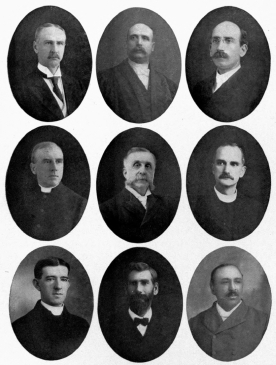
NEW MILFORD PASTORS
Rev. Frank B. Draper Professor of Mathematics and Chaplain, Ingleside School Rev. Marmaduke Hare Rector All Saints Memorial Church Rev. Father John J. Burke Curate of Roman Catholic Church Rev. Timothy J. Lee Former Pastor of First Congregational Church Rev. Frank A. Johnson Pastor of First Congregational Church and the Chairman of Religious Committee of the Bi-Centennial Rev. Solomon D. Woods Pastor Baptist Church Northville Society Rev. Harris K. Smith Pastor of the Methodist Episcopal Church Rev. John F. Plumb Arch Deacon and Rector of St. John’s Episcopal Church Rev. Stephen Heacock Pastor of Advent Christian Church
and the ‘weighing of fate and the sad discussion of sin,’ I come here and find refreshment and repose. The large city has certain great attractions, and, in some respects, life in it is far broader and greater than it can be elsewhere. That is the reason I went to New York. But the town, and the small city, have other advantages, and it is by those that my love of this place is kindled. And so, on this birthday of New Milford, I want to speak of those qualities which I prize so highly in this place.
“And, first on the list, comes personal freedom. Thackeray said that England had fifty million people in it, mostly fools. Well, when you have an enormously big city, there are so many fools gathered together there, that it is not feasible and practicable for the sensible people to be free. You must not carry a pistol, because there are so many ‘gumps’ that cannot be trusted with firearms. You cannot let people walk on the grass, or they will destroy the foliage. It is all paternalism. The law is taking care of you. You cannot let people take their children into the park on a sled. They might get hurt. A cordon of police guard the ice on the part of the lake that is not safe. If they did not, some idiot would skate into the water. Now, I resent being protected from myself. I feel like Ben. Franklin, ‘Where freedom is, there is my country.’
“Another good treasure you have is simplicity. Life here is less complex. There are so many things in city life that demand attention that our energies get scattered, and our attention diverted, and our ways conventional and artificial. It is hard to express just what I mean; but life up here is less confused and more elemental and natural and real. That is a good thing. Then, you have the sunshine and the air and the open fields. You have what people who come up here from the Bowery call ‘loneliness.’ It is aloofness. One can withdraw here, can get away, can get out of sight, can hear that still small voice which speaks only through the peace of nature—can ‘flee as a bird to the mountains.’ One idea of holiness is that which is set apart. Your landscape has a holiness which is not shared by shaven lawns punctuated by statuary. Our national emblem is the eagle, and there is an eagle spirit in the American people which likes the cliffs and the forests better than the boulevards and the parks.
“Then, there are not so many of you but that you can know each other and be interested in each other and help each other. The so-called philanthropy, which is more interested in institutions than it is in individuals, is a bad thing. What this world, with its suffering and sin and error, needs, is not more brown-stone laboratories and patent book-shelves and institutes for the uplift of the masses and the glorification of the millionaire rascals that endowed them; what the world needs is men that are interested in the individuals that surround them. I have not twenty-five thousand dollars to give away; but, if I had, I would pick out a worthy family that needed it and give it to them. I would endow a tradesman and not a trade school. Now, conditions here are good, because of the human interest you take in each other. If there were five hundred thousand of you, such personal interest would be impossible. Try to take a personal interest in one hundred thousand people. You cannot do it. The personal relations of employer and employed, of neighbors and friends, in a village are a priceless blessing.
“All these things are characteristics of this place.
“Besides this, it has its own history, its beautiful street, its scenery so exceptionally sweet and lovely—it is for these things that we celebrate its birthday.”
Dr. Ryder’s address was entitled “The Village and The Nation.” He spoke as follows:
“In this picturesque, beautiful and impressive Celebration, the Bi-Centennial of the settlement of this region, thought is naturally turned to the village of New Milford and the community life gradually developed here. There were certain fundamental characteristics of this village life which you, who were a part of it in later days, appreciate much better than your speaker. And yet even a superficial knowledge of what was here begun and has been gradually developed impresses these fundamental characteristics.
“This was a simple and natural life. The speaker preceding me has developed eloquently this fact. Artificiality had not yet crept into the social conditions of this life. The value of a man was not estimated by his heredity nor his wealth. It was a pure, clean democracy where every man was a man in privilege and opportunity ‘for a’ that, and a’ that.’
“But another element of this village life was also evident from the first. This was the articulation of the community. Everyone knew every other one within the confines of the settlement, although stretching along the edges of the beautiful rivers, down the valleys and plains, and up the slope of the stately old mountains. When Mary Jones’ husband died and left her with a brood of little children, every man and woman in the community knew it, and most of them called upon Mary Jones with their burden of food or clothing or wood-shed supplies. It was the articulation of one life into another life, and of each life into the whole, that made the village of New Milford and every village in New England so strong and safe and efficient.
“But, little by little, these villagers in New Milford and other communities round about felt the need of the articulation of community interest into a larger whole. And so the community of associated responsibility and help took in Waterbury, Norwalk, Bridgeport, Hartford, and New Haven and other villages and towns scattered over this general region. This articulated the separate communities into a larger whole and the commonwealth was created. It was not a formal government so much as a community of interest and sympathy and love and organized efficiency. These several communities became a commonwealth for protection and development. Self-control was the basis of governmental control. The village was strong and vigorous in so far as the individual man and woman were strong and vigorous. The commonwealth developed these qualities of influence and strength only as the village developed them. And so this simple, this articulate life of the village became the life of the commonwealth.
“Then a new condition arose. King George came across the water, established his forts, anchored his fleet in the harbor of another community that began as a village in the neighboring colony of Massachusetts. There was need of protection and safeguard in a larger way than the group of communities or villages furnished. So there came the articulation of the commonwealth with that of other commonwealths, and the united colonial power came into being. This afterwards became, as we all know so well, the United States.
“So, in constructive analysis, beginning with the unit of governmental power and influence, we find the village. No fairer or better or cleaner or more dignified than this village of New Milford existed in all the group of villages amid all the clustered commonwealths. A son of some Pilgrims from New Milford, who drifted into northern Ohio, who is your speaker at this moment, rejoices with you who have dwelt here in the East, in this magnificent and imposing Celebration of the founding of New Milford.
“But a larger view than this must be taken if we would estimate the importance and meaning of this village Celebration. The articulation of interests in the life of our nation as it exists to-day is much more difficult than it was when these villages grew by natural processes into the early national life. Multitudinous and heterogeneous masses are mingled in our body politic to-day, coming from nations that know nothing about the traditions of Puritan, or Pilgrim, or Dutch, or Cavalier. In many of these nations from which these peoples come and mingle in our life, the only thought of government is that of power, of police force, or suppression. Danger threatens us as we attempt to assimilate into our own national life these heterogeneous masses. It is not that they are bad, but that they come to us with no such conceptions of the simplicity and articulation of life and government as our fathers possessed who established the villages of New England. Our responsibility is to spread everywhere the great principles that lay at the foundations of village life in early New England. It is not from northern Europe that immigrants come who are a menace to these institutions that have made the United States what they are to-day. The real problem is the assimilation of unassociated races who are making a large portion of our body politic. Twenty million of the eighty million who are citizens of the United States are of the brown-skinned, undeveloped races. They represent fundamentally different ideals from those that made New England and the southern colonial States the power they were. It is for us in this generation to stimulate in these brown-skinned people the higher conceptions and loftier ideals represented in these villages that furnished the unit of development in the early years of the nation. There are two United States to-day, and we cannot neglect either of them with safety. There is Continental United States, the familiar old stretch of territory from ocean to ocean and from gulf to northern Alaska. This furnishes problems enough for the children of the Pilgrims to meet and solve. But another United States has been added in these later years, and that is Insular United States. They were brought to us through the arbitrament of war. We did not seek them; we perhaps are the poorer for their possession. But the great problem that God in His providence has put upon us to-day is the elevation and redemption of the masses of these island peoples. They have no village traditions or life to look back to. They have no intelligent conception of freedom. Morality is almost an unknown quality as we use the term. One great problem before Americans to-day, therefore, is the Americanizing and Christianizing of these masses that have become a part of our body politic, and whose future will largely determine the future of our entire nation.
“The village ideal, the simple, natural life that the smaller communities illustrated, the articulation of interests into one common and homogeneous whole, is what is demanded to-day, and what we must struggle for and achieve if the nation remains in its integrity and strength and dignity.
“When we analyze back to the village, we only go a part of the way. The unit after all was the home. One home articulated with other homes was the final analysis of strength and safety. It is the home, and not the church or the school, that holds men and women to that which is best and noblest. It was the home in the villages of New England, it was the home in New Milford, that determined its value and contributed to its beauty of community life. We have got to create in these masses that are coming among us the desire for the best, purest, noblest Christian home, or our entire civilization is in danger. If this Bi-Centennial of New Milford shall stir the hearts of the descendants of the brave men and women who established this village with a great passionate desire and an overmastering determination to perpetuate these great ideals and visions which the fathers held and nourished in their homes and united in their community life, then this Bi-Centennial were indeed an occasion of deepest rejoicing and abiding value.”
SUNDAY EVENING
At five o’clock a service was held in All Saints’ Memorial Church (St. John’s Congregation uniting), which was attended by pastors of the churches of several denominations—another illustration of that fine Christian fellowship prevailing in New Milford which the Union Meeting on “The Green” had signally exemplified. The rector, Rev. Marmaduke Hare, preached an eloquent and profound sermon, in which he claimed that the master-force in the growth of mankind in all the higher qualities has been the truth and hope of the Gospel, and protested against imputing to nature, reason, science, philosophy, commerce, and politics what belongs to Christianity. “Ethical societies,” he said, “may preach ideals, parliaments prescribe methods, literature describe the movements and processes of civilization, but the Church of the living God supplies the moral dynamic which makes possible all the rest.”
At seven o’clock historical addresses were delivered at the Congregational Church and Saint John’s Church, by Rev. Charles J. Ryder, D. D., of New York, and Rev. George S. Bennitt, D. D., of Jersey City, respectively. Dr. Ryder’s subject was “Pilgrims from New Milford.” He said:
“Western Connecticut and Massachusetts contributed more
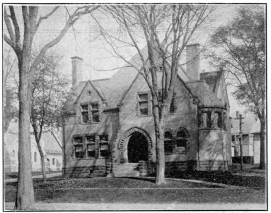
MEMORIAL BUILDING AND PUBLIC LIBRARY
ALL SAINTS’ MEMORIAL CHURCH
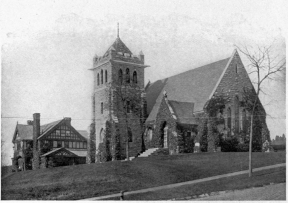
to the early settlement of northern Ohio probably than any other section of the country. Pilgrims from this portion of New England began early to find their way westward. Along the fertile valley of the Mohawk, on the edge of the great inland seas, these settlers planted their homes. You can easily trace the line of their march in the intelligence and dignity of character that their descendants possess to-day in these regions. New Milford contributed to this body of Pilgrims that followed the sun toward its setting. As they went out, they left that which has been so eloquently set forth in various public addresses during the progress of this Bi-Centennial of New Milford. The beautiful valleys and imposing mountains, the clear rivers and foaming brooks, the marvelous, picturesque beauty of New Milford and its environment, they left behind them. They did not find these, as they planted their tents in the great forests of northern Ohio. How often have I heard one of these Pilgrims from New Milford describe her homesickness as she looked out upon the almost flat country, which the local clearing had revealed, into the dense forests that shut down upon the edge of this clearing on every side! Turbid streams, muddy roads, wooden sidewalks, the plain and unattractive natural scenery, and the rough conditions of pioneer life were vastly different from the beautiful landscape and refined conditions of this home town from which they went out.
“But they did not leave all, nor the best, of that which they had gathered in the life in New Milford, as they left its borders and went overland by their own conveyance into Ohio. They took with them three fundamental conceptions of life. First, that of the Christian home; second, that of the public school; third, that of the Christian church. To these ideals, planted in the hearts of these early Pilgrims, may be traced the fruitage of the strong intellectual and moral life which has developed in the citizenship of northern Ohio.
“These Pilgrims from New England found chiefly an opportunity. The physical conditions were depressing and hard. The problem of life was serious and difficult, the hardships encountered were rigorous and persistent; but wherever these Pilgrims planted a colony in the Western Reserve, or New Connecticut, as it was called, they established the Christian home, the public school, and the Christian church.
“Philo Penfield Stewart, a Pilgrim from the neighboring town of Sherman, illustrates the character and purposes of these early settlers. He went into Ohio in 1832, and, even before his weary body could have rested from the long and tedious journey, he began at once, in connection with Rev. J. R. Shipherd of Elyria, plans for the establishment of a college and colony at Oberlin. It is possible, as history hints, that the first white pioneer into Ohio was Ferdinand De Soto, who possibly pushed his way into the region of this great central State as early as 1539. It is most fortunate, however, that not the descendants of De Soto, but the Pilgrims from New England and their descendants, gave the ideals and formative influences to this new commonwealth. That there should be the least percentage of illiteracy in the northern counties of Ohio, known still as the Western Reserve, of any part of the tabulated world, is not an accident. The schoolhouse was as much a part of their essential requirements as the barn or the shop. When in the height of his wide-reaching influence, Dr. Joseph Cook went once to Cleveland; he carefully studied the conditions of the public schools of the Forest City. He afterwards bore testimony that ‘in coming from Boston, Massachusetts, to Cleveland, Ohio, he came up in the character of the appointments and work in the public schools, and not down’; that ‘the educational system of Cleveland was better than the educational system of Boston.’ Your speaker having had somewhat intimate acquaintance with both systems, would speak an humble word of endorsement to this testimony of Dr. Cook. These Pilgrims from New Milford found mud, homeliness, forest, hardships, toil and privation. But they found opportunity. This opportunity they improved to the best of their ability or of any ability that human beings could command. They planted churches and worshiped within their sacred precincts with loving reverence; they built their schoolhouses and had no lack of teachers, for many of their wives and daughters had been teachers in Old Connecticut. They sent their children to school, sparing them from needed work on the farm or in the shop or store. They did this, because they were building life, character; were establishing a Christian civilization to outlast them and their immediate descendants. They did it, because they believed in God and man and in making the most of life. Better than all, they gathered in their homes around the clear-swept hearth of their open fireplaces, in love, peace, and confidence. Often the crackling fire on the open hearth was the only light that the home possessed for the evening. Sometimes, as we learn from their records, they put melted tallow in a tin basin and hung a bit of cotton wicking over the side to light their humble homes. ‘Two such lanterns,’ they tell us, ‘were sufficient to light up the church for evening service.’ It was almost reverting to the type of the lamp used in early Jewish history, and quite to the profound Hebrew reverence. But whatever artificial light these Pilgrims had, they saw clearly the great purposes of existence, and read with undimmed vision ‘their title clear’ to the best that devotion and energy and faith and courage could achieve.
“When the great agitation came in favor of freedom, as against chattel slavery, the descendants of the New Milford Pilgrims in northern Ohio did not flinch nor hesitate. Professor Hart, in his recent volume on ‘Slavery and Abolition,’ says:[17] ‘One reason for the force which abolition early acquired in Ohio was the fallow field waiting for it in the Western Reserve. This region, settled by Connecticut people between 1790 and 1820, was still a little New England, its churches, schools, and local government closely modeled on those of Connecticut.’ Nor did this ‘fallow field’ among the Pilgrims from New Milford prove unproductive. Rustic lads, whom Dr. James Harris Fairchild, President of Oberlin College for many potential years, represented, bearing his testimony to these hard, early conditions, waded through the snow barefooted in order to attend school. Such lads could not be kept away from the privileges of higher training. Colleges were immediately necessary. Such institutions were established, buildings erected, faculties gathered, lecture and class rooms crowded with eager pupils, as by the magic wand of some scholastic magician. Within a few months of its establishment, Oberlin College had hundreds of pupils. They had brought together a faculty perhaps unequaled, man for man, in the faculty of any institution ever founded. They were giants, intellectually and morally. Their names to-day are wrought not alone in the intellectual and educational history, but into the very warp and woof of our national life. Ohio, the great West, the South, and the nation could hardly have been the great, united nation that it is, had it not been for these Pilgrims from New Milford and their descendants, who stood with heroic courage for the highest ideals, and strove to attain them at tremendous sacrifice and suffering.
“Professor Hart is responsible for the following bit of history: ‘When Harriet Martineau attended an anti-slavery meeting, she found that she had given offense to the best society in Boston. Theodore Parker found his clerical brethren refusing to exchange pulpits with him; “My life seems to me a complete failure socially; here I am as much an outcast from society as though I were a convicted pirate.” The eastern colleges, almost without exception, were strongholds of pro-slavery feeling.... In 1848, Charles Sumner, a graduate of Harvard, spoke to the students of the college. Longfellow said: “The shouts and the hisses and the vulgar interruptions grated on our ears. I was glad to get away!”’
“But such a spirit of cowardice and weak surrender to the financial and social influence of the South as was manifested by many eastern colleges, was not that of the western colleges planted in the clearing of the great forests of the New Connecticut largely by the Pilgrims of New Milford. They spoke out steady and strong against the ‘twin relic of barbarism.’ Professor Seabert, in his history of the ‘underground railway,’ bears testimony that through the Western Reserve almost every line of secret escape for the slave running toward the north star passed. At Oberlin, where the Pilgrims in whom your speaker is most profoundly interested had their home, eleven underground railroads passed. They radiated as many as the ten fingers of the two hands, and one hand had an extra finger. It was the boast of these brave men and women, and the boast was proven by the fact, that no negro was ever taken back to slavery who reached the Western Reserve. How well I remember those early incidents in my boyhood home! The Oberlin-Wellington rescue case is written in the history of the nation. How the excitement and agitation of that New England village in Ohio come to me as I think of it! It was but a few months after the death of my father, Oliver Roberts Ryder, a Pilgrim from Danbury to this same Western Reserve. A negro boy, John Price by name, had escaped from slavery. He had been a resident for some time in Oberlin. Through the intrigue of a pro-slavery countryman near the village, he was waylaid, captured by a band of slave-holders, bound and gagged, thrown into a wagon, and hurried off to a railroad station on the railroad leading into the South. The descendants of our Connecticut Pilgrims of the town heard of it. Prayer was offered first, for faith in God was the very threshold over which they passed to the accomplishment of any brave purpose. Wagons were hastily gathered, firearms piled into them, and away the Oberlin rescuers went to win this black boy, rather worthless fellow in himself, to personal freedom. This was his constitutional right under the Declaration of Independence, for he surely was born to be ‘free and equal’ in privilege. He was rescued from the slave-holders, although they were armed to the teeth and displayed their guns, but did not dare to use them. The faculty, the Sunday school superintendent, the leading business men were in this band of rescuers, and were afterwards thrown into prison for the technical crime of their acts. Here again the splendid traditions which these Pilgrims brought from their eastern home came in play. Obey the law they must. They could do it by not breaking it, or by submitting to the penalty. They chose the latter, and no one made the slightest effort to escape, but submitted without a moment’s hesitation to the processes of the law, and stood before the jury. They were not subpæna jumpers, and in this showed that they were not criminal in intent, as those who seek to escape the processes of the law always are.
“No, be it said to the glorious memory of the Pilgrims of New Milford and Western New England, they did not follow in the wake of many of the larger institutions in the East, and cringe and whimper and grovel under the crack of the whip of the slave-holding aristocracy. Open and free and manly, they stood out for the defense of freedom, whether applied to the person of black man or white man. It was the highest type of educational training which any institution can furnish. It was not tamely to learn axioms or to demonstrate mathematical problems, but to know, to believe, to defend that which was best and truest. These worthy Pilgrims who went out in the early part of the nineteenth century into this western forest, stood for this with all the sturdy strength of these mighty trees that shadowed their homes. It is because they went, and others like them, that the Buckeye State has risen to and maintained her dominant influence in the nation’s life. It is due to these Pilgrims, more than to any other one force, that the whole Northwest was from the first saved the disgrace of slavery. Institutions of learning in which women as well as men had the right to the best education were planted. They maintained the school, the church, the home in every hamlet and city and village; and, to-day, this region they settled presents the finest, largest, and most comprehensive type of Christian civilization that the earth affords. All glory, then, to these Pilgrims from New Milford! They, like one of old, ‘went out not knowing whither they went.’ They dared and suffered and died, but always achieved. Well may this village, a beautiful gem set in the midst of these rolling hills, rejoice in its own noble development and progress and prosperity. Your life here is almost ideal. The conditions are as fine as the world affords. But, as you rejoice in this Bi-Centennial of your own founding, forget not, O brave and true men and women of this generation; forget not, O Christians of these churches; forget not, O patrons of this redeemed nation, that the Pilgrims that went out from your firesides and homes into the great West inaugurated the tremendous forces that have moved on in increasing power and breadth until the whole nation has been made the richer by their mighty power.”
Dr. Bennitt’s address at Saint John’s Church was as follows:
“...Religious matters, during our beginnings, did not run very smoothly. The desire for greater religious freedom caused a considerable falling away of sundry church members to Quakerism in 1731 and 1732. There were also families who had come into the town, and brought with them an affection for their old Church in England; and, as the English Church had been established in Stratford in 1707, and in Newtown in 1732, only fifteen miles away, the influence of this Church began to exert itself here. When the Rev. John Beach ... established the services of the Church of England in Newtown, the Churchmen of New Milford journeyed on Saturdays to Newtown, carrying their own provisions, and the Churchmen there gave them their lodgings. He baptized their children, and came here to officiate at a marriage in 1739. He began services here about 1742. He sent Mr. Barzilla Dean here as a lay reader, services being rendered in one of the houses of a Church family.
“It is stated that certain Churchmen in New Milford were fined for refusing to attend the meetings of the Established Church. These fines were, by recommendation of the Rev. Mr. Beach, paid, and copies of the proceedings taken to be forwarded to the King and Council. The fact becoming known, the authorities refunded the money, and granted permission to build a church which before had been refused.... In 1745-6 materials were gathered, and the English Church in New Milford erected.
“Let us glance for a few moments at the village street at this time. The early settlers had laid out their town plot, because of a beautiful spring of water, at the head of the street, nearly in front of Ingleside School, and about under the present sidewalk. The water from this spring meandered its way down through the village street, bowing from the spring to the south end of the street, where it formed a small pond, which was called ‘The Goose Pond.’ This accounts for the east side of Main Street bowing, while the west side is straight, and the street opening out considerably wider at the south end, on account of ‘The Goose Pond.’ This spring was there in my boyhood days, although an open ditch had been constructed through the middle of ‘The Green,’ in which the stream flowed. Since the construction of the water works, however, and the laying of pipes through the street, both the spring and the stream have disappeared.
“The First Established Church stood near the head of Main Street, near the spring, and the land granted for the Church of England was in the street, east of Mr. Samuel Prindle’s house, near where the old pound used to stand, at the south end of Main Street, therefore, and in the middle of the street. Here they built the first Church of England in New Milford.... It was a frame building, forty feet by thirty. It had two rows of windows, one above the other, and presented the appearance of a two-story house, and the door was in the side. It was surmounted by a turret in the center of the building, and stood ends to the east and west. The door was on the south side, and within, on the north side, stood the pulpit. It was not until 1756 that the building was finished, when, upon the building of the second meeting-house, it was voted to give three-quarters of the body seats and two pews in the old meeting-house to the Church of England. Then, the church was furnished with the square box seats, and the pulpit stood aloft, beneath which was the reading desk for the prayers, and, beneath that, the pew for the clerk, to lead in the responses, and to tune the Psalms. A curtain across the corner, served as a robing-room for the vesting of the clergymen, and, around little tables which were placed in the middle of the square box seats, gathered the families of the Churchmen of that early time. And on account of the love and affection they bore to the Rev. John Beach, of Newtown, who first planted the church in their midst, they named it ‘Saint John’s Church’; and it has borne that name ever since.
“The Rev. Solomon Palmer, a Congregational minister of Cornwall, dissatisfied with his orders, conformed to the Church, and went to England for ordination. After that, he returned here, and became the first Church of England minister who resided here, from 1754 to 1760.... He was succeeded by the Rev. Thomas Davies in 1761. He was a missionary sent by the ‘Venerable Society for the Propagation of the Gospel in Foreign Parts.’ ... a graduate of Yale College, a man who had become a minister of the church, from conviction, a gentleman and a scholar, a reader of the service, and preacher of the highest order.... Under this man of God the Church outgrew its small building, and entered upon the construction of a new, more commodious, and churchly edifice.
“I have a copy of the diary of the Rev. Thomas Davies, containing most of his ministerial acts, and some of these shed considerable light on the old times. He records, on November 15, 1764: ‘On St. Pumpion’s (Pumpkin’s) Day, I baptized at Ethel Stone’s, Martha, Ester and Edmond, children of Ethel Stone, Hannah of Gad Sperry, Joseph and Hulda of Samuel Peet, and David Smith of David Smith.’
“He alludes to St. Pumpion’s Day in other records, which leads us to suppose that this was a colloquial term in those days for designating the annual New England Thanksgiving, which was celebrated by an abundance of pumpkin pies.
“I have a manuscript sermon of the Rev. Thomas Davies, preached at New Milford, written in the finest hand, showing clearness of thought, a fine choice of language, and rising to eloquence, in pressing home to the hearts of his hearers the word of God.
“The Rev. Mr. Davies was succeeded by the Rev. Richard Clark from Milford, who remained here until 1787. He was here during the Revolution. The church begun by Mr. Davies was completed sufficiently to begin services therein, and the old church was sold to the town for a town house. This was removed to the head of Main Street and used for several years.
“The second Church of England, begun under Rev. Mr. Davies, had Partridge Thatcher for its architect, but was modeled after the church at Stratford, but somewhat plainer in its ornamentation.
“It stood, facing the road towards Butter Brook, a few rods north of the first church, had a steeple which projected out in front of the building, and long windows round at the top. Within, it had the high pulpit with circular stairs; its reading desk and clerk’s pew beneath, making what was called a three-decker. A communion table was in front of all, and the whole was surrounded by a communion rail. A gallery was across the south end; and a curtain across the corner, served again as a robing-room. The service of that day had its peculiar features. The clergyman was robed in a long surplice and black scarf. He wore a white wig, to give age and dignity to his ministrations. The surplice was exchanged for a black silk gown and bands before the sermon, the congregation all knelt for the prayers, and, in doing so, turned around and knelt to the seats. The clerk (or clark, as the people called him) doled out a line of the old Metrical Psalms, and the congregation sang it, and waited for another line. There was no fire in the church, and, in winter, the women carried their foot stoves to keep their feet warm.
“The Revolution, however, gave great discouragement to the Church of England people, for everything English was hated by the inhabitants, and the Rev. Mr. Clark, after ten years of struggle, gave up and fled to Nova Scotia in 1787, and the church was closed.
“The kind of Church people that were made in the Colonial days of the Church in Connecticut may be illustrated by the name of Samuel Peet, a devout Churchman from Stratford, who came to settle in the New Milford North Purchase, in the vicinity of Rock Cobble, west of Peet Hill. He selected a site for his future home near a great rock, which, by some convulsion of nature, had been rent asunder, leaving a portion like an altar between, with two natural steps to ascend it. Here, Samuel Peet, the Hermit, knelt day by day to worship his God, and the holes he chiseled out for his knees on the top of that altar are to be seen to this day. He erected his house just west of the altar, and here reared his family, desiring to be buried between the rocks, but, as it was found they came together just below the surface of the ground, he was buried on the east side of the altar rocks, in one of the most romantic burying-places of this town. Now, in 1789, when the Rev. Mr. Clark had fled to Nova Scotia, and the church in New Preston was boarded up to save its windows from being destroyed, Samuel Peet was on his death-bed, desiring to receive the Holy Communion. He sent a messenger away down to one of the churches nearer the Sound, for a priest. It was in March, and the roads were very heavy, and a prolonged time was required.
“Meanwhile, Samuel Peet was nearing his end. He asked that bread and wine be prepared and placed on a table beside his bed, that no time be lost when the priest of the Church arrived. Again and again, he sent out to see if the messenger and the priest might be seen coming in the distance; and, as the end grew nearer, and the priest had not arrived, Samuel Peet said, ‘Let us pray,’ and, when all had knelt around his bed, he prayed: ‘O Blessed Jesus, Our great High Priest, come down and consecrate this Bread and this Wine to be Thy Body and Blood.’ And, after silence had been kept for a space, he reached out his trembling hand and communicated himself, after which he soon fell asleep in Jesus. Who shall say that was not a valid consecration!
“The priest of the Church arrived that night, and remained to commit his body to the earth, looking for the general resurrection in the Last Day....
“It is a tradition that some of the rectors of the Church of England had a habit of talking to themselves, and, behind the curtain while they were robing, would often repeat over the notices to be given out, the most interesting being the publishing of the banns of matrimony, which was the custom in those days. On one occasion the banns were published between Orin Marsh and Maria Hill, who lived upon the plains. Now, there were in the Church, Orman Marsh of Boardman’s Bridge, and Maria Hill, of Aspetuck, whom the congregation thought were the parties published, greatly to their confusion. That day, the second-named began their acquaintance, suggested by the banns, and, in due time, their banns were likewise published.
“The Rev. Enoch Huntington, who entered upon the rectorship in 1827, began parish records, and, upon the first page, states that there was a congregation of about thirty. No Sunday school, and no music. Also the church was in need of repair, but he concluded not to spend much upon it, but later to build a new church, the third one of the society. The new rector soon gained the love and esteem of the people in general, and the attendance of young people became a prominent feature in his ministry. So devoted were his people, that they are spoken of, when the church roof was old and leaky, as sitting in their pews during a shower, with their umbrellas up, listening to the preaching of the word of God. A bell was placed in this old church steeple, the first one the church possessed. In 1837 a new church was erected on the east side of Main Street at the corner of what is now called Church Street. This church was a frame building, with long windows, square at the top. It had a square tower upon it, and, within, a gallery around three sides, a massive mahogany pulpit, reading desk below, and a small mahogany communion table in front, with two mahogany chairs on either side, a communion rail enclosing them. A vestry-room was built in the rear, and the rector entered the pulpit from stairs in the vestry-room, and appeared through a door cut in the wall behind the pulpit.
“The pulpit and reading desk were covered with cushions of black silk velvet, with heavy silk-corded fringe across the front, and large silk tassels suspended at the corners. There was a sofa seat behind the reading desk attached to the pulpit.
“The pews had doors with large black tin plates attached with numbers on. This church was considered very handsome in its furnishings, and was the pride of both rector and people. It was furnished with a new bell, and into this came the first organ owned by Saint John’s Church. Rev. Mr. Huntington resigned in 1848, and, after his decease several years later, was brought here and buried in the village cemetery, having this honorable record—of being the rector of Saint John’s Parish longer than any other clergyman from its beginning to the present day....
“During the incumbency of Rev. William H. Reese, I was baptized in that old church, out of the silver bowl placed on the communion table. When I was a little child, I well remember how Bishop Brownell catechised the children, standing about the chancel rail, but, perhaps, as I grew older, the most vivid impression made upon me was the preparation for, and attendance upon, the old-time Christmas Eve service. Evergreens were gathered upon the Plains, and the people assembled at Mr. George McMahon’s to tie them. They were gathered in Aspetuck, and the people assembled at Mr. Marshall Hill’s or Mr. Stephen Morehouse’s. They were gathered at the village, and the people assembled at the house of my father, Noble S. Bennitt, on Bennitt Street. The refreshments consisted of a pan of doughnuts, round and sugared. The cracking fire on the hearth consumed the broken branches, and the young people remained for a social time after their elders had departed. Such large ropes of evergreens were tied, and afterwards suspended from corner to corner of the church, and all around the walls, and in front of the gallery!
“White covers of bleached muslin covered the pulpit and reading desk, to which were attached fringes made of the needles of the pine, by Miss Bostwick, afterwards Mrs. Leroy Buck. Mottoes of evergreen on white cloth were put up on the walls, and candelabra, of five candles each, across the ends of the pulpit and desk cushions. Miss Cornelia Boardman brought a large fluid lamp with a glass globe and put it on the communion table. The people reserved their whitest and purest tallow to make dipped candles to hang up in tin back candlesticks under the gallery, while Edgar and Henry Wells made a great star of five points, covered it with evergreens, and suspended it from the ceiling in the middle of the church, containing as many candles as it was the year of the century. This was the only time in the year that the church was lighted up, and the people of the town turned out and filled the church and its galleries to overflowing. The good old Christmas Eve service of the old times, who that was then alive shall ever forget it!
“But the solemnity of the old-time Sunday comes up with all its hallowed associations. The Sunday church bells, with the orderly ringing and tolling of their first bells and last bells; with their solemn tolling for a death—nine for a man, seven for a woman, five for a boy, three for a girl!
“The sleigh bells, too, bass ones and tenor ones, jingling all the week in the winter time, but no sleigh bells on Sunday! I well remember when two young men, in their want of respect for the traditions of Sunday, drove through the village street with sleigh bells on their horse on the Lord’s Day, thereby shocking the sober-minded people of the churches and the town.
“The social gatherings of the people come back to one, as he recalls the old times, also. The annual donation parties given by the parishioners to their parsons, when, it used to be said, ‘The people would bring all kinds of good things to the parsonage, and then remain for a good social time, spread all the good things brought for a feast, and then largely consume them before they departed.’
“Other social gatherings had their attractions for the people, but I recall one which was to occur, but never took place.
“It was on the coldest day of February, 1860, when, in large sleighs, a company of people set out for a dinner party to be given upon the Plains. As they passed down the Main Street, the bell of Saint John’s Church was tolling for a funeral about to be held within it. It was thereupon agreed to stop and attend the services, warm themselves by the fire, and then proceed on their journey.... The clergyman took for the text of his funeral sermon, which in those days was a very dignified discourse, ‘It is better to go to the house of mourning, than to go to the house of feasting: for this is the end of all men, and the living will lay it to heart.’ Consternation filled the hearts of all. The women and the children remained in the church by the fire, and the men went to the village cemetery to assist in the burial; after which all returned to their homes. The effect of the sermon had been marvelous, and the living had laid it to heart. The funeral was that of the widow of Dr. Amaziah Wright.
“Rev. Charles G. Acly, who became the rector in 1856, wrought a good work here, and, under him, the church was enlarged in the summer of 1860, by the nave being extended nearly twice its length. A recess chancel was added, and a stained-glass chancel window given, as a memorial of the Hon. Elijah and Mary Anna Boardman—the first stained-glass window in the town. The old mahogany pulpit was made into an altar. There was an altar cloth of red which served for the whole year, a beautiful reading desk and pulpit combined, which stood outside the chancel rail, and, in the center, before the altar, given by Mr. Solomon E. Bostwick, a pedestal with a marble bowl for a font....
“In this church I began my first work in the Church of God by blowing the first organ the church ever owned, and Miss Schroder, now Mrs. George W. Wright, was the organist at that time. We sang the Metrical Psalms and the few hymns then bound up with the Prayer Book. The Te Deum was generally read, but on high occasions we rendered Jackson’s Te Deum. The old Gloria in Excelsis was always sung at the end of the Psalm for the Day in the afternoon, and sometimes Greatore’s Bonum est and Benedicite after the Lesson. On Communion Day, once a month, after sermon, the choir came down in the body of the church, and there was no music. But Easter was distinguished by the choir remaining in the gallery and singing the Sanctus. In that church, I was confirmed and ordained to the holy ministry by Bishop John Williams, and, to that church, I came afterwards to preach my first sermon in my native town. One can hardly imagine my feelings, as I came to stand for the first time before my elders, teachers, kindred, and those to whom I had looked up from childhood. It was a trying moment. I preached a written sermon, for fear I might be embarrassed. When it was all over, and some one in the churchyard, during the noon hour, ventured to call it a good sermon, one of the men spoke up and said, ‘Yes, if he wrote it!’ Surely, ‘A prophet is not without honor, save in his own country, and among his own kin.’ Stirred by this remark, which came to my knowledge, I preached without notes that afternoon, and did the same upon every visit to New Milford for many years following....
“The Rev. Mr. Acly was a good man, and a conscientious priest of the Church of God; painstaking in his sermon preparation, a good reader and preacher, while as a pastor he went in and out among his people for twenty years beloved by them. He resigned in 1876, but continued to reside here until his death in 1880, and he was buried in the village cemetery, awaiting the resurrection of the just.
“He was succeeded by the Rev. Alfred S. Clark, who was rector from 1876 to 1879. While his stay was only four years, yet he is remembered with much affection. The Rev. Edward L. Wells, D. D., became the next rector, whose eloquence can never be forgotten, and by him was started the project of building a new stone church for Saint John’s Parish. Plans were drawn and accepted, but, in less than a year, he was removed by death, in 1880.
“Rev. Edwin R. Browne succeeded him, and, as the contract for the new church had already been made, he carefully attended to its erection. This was carried forward for two years, and entirely paid for by the congregation, so that on Thursday, the fifteenth day of March, 1883, we all assembled to take part in its consecration.
“The Rt. Rev. John Williams, D. D., Bishop of Connecticut, the Rt. Rev. Charles Quintard, D. D., Bishop of Tennessee, and thirty of the clergy of this and other dioceses, met to put on their vestments in the old church, before proceeding to the new. The emotions which filled my soul on that day were many and varied. It was the last act to be performed in the old Saint John’s Church. I went into our old family pew, where I had grown up to manhood, and, there, I put on my vestments. I went up to the chancel rail and, kneeling down, offered the last prayer in that old church—where I had first heard the service of the Book of Common Prayer, first listened to the preaching of the word of God,—whose walls had witnessed my baptism, my confirmation, and my ordination to the holy ministry—and I said, ‘Oh, to have enduring churches of stone, where the holy associations of a lifetime may never be disturbed!’ It was this thought which led me forth to assist in the services of the consecration of the new Saint John’s Church of stone, where the services might hereafter continue, undisturbed, from generation to generation. The vested procession of bishops and clergy walked from the old church to the new. The day was full of sunlight, and even the March winds seemed to cease, so as to give us Heaven’s own benediction. We entered this beautiful stone church, filled with a congregation which occupied its whole capacity. Bishop Williams then consecrated this new Saint John’s Church, and called upon me to read the sentence of consecration.
“That day was the greatest red letter day this parish ever saw—twenty-five years ago, on the fifteenth day of March next!
“The Rev. Mr. Browne continued his ministry here until 1890. He was a most indefatigable parish visitor, and the sympathy of his people and their prayers followed him, in the affliction which afterward came upon him.
“He was followed by the Rev. E. T. Sanford, who was the rector from 1891 to 1895, a man of exceedingly lovable character, who endeared himself to all.
“He was succeeded by the Rev. John F. Plumb in 1896, who after eleven years still continues in the rectorship. His character and ability are so well known among his people, that it would not become me to enter into them here. Suffice it, then, to say, that he is held in such honor and respect by his brethren of the clergy of his Diocese, that they elected him Archdeacon of Litchfield County some years ago, which position he now holds with honor to himself, and with appreciation by his parish and friends. May he long continue to go in and out among you as your rector, pastor, friend, and long continue to occupy his high and honorable position, as the venerable Archdeacon of Litchfield County.”
THE AUTOMOBILE PARADE
No feature of the whole Bi-Centennial Celebration partook so much of the nature of an experiment, perhaps, as the Automobile Parade of Monday, which took place a little before noon. It was the first event of the kind that had ever occurred in New Milford, and there were consequently no precedents to go by. It was, however, an unqualified success. Fifteen decorated autos, followed by nearly a score without decorations, were in line. The owners of the decorated autos were:
Henry D. Hine, New Milford, Conn.
Geo. T. Soule, New Milford, Conn.
A. N. Trott, Waterbury, Conn.
H. L. Randall, New Milford, Conn.
Edward S. Hine, New Rochelle, N. Y.
Mrs. Isaac B. Bristol, New Milford, Conn.
Jas. S. Robertson, Pittsfield, Mass.
John Bauman, New Haven, Conn.
E. M. Watson, Sr., Jersey City.
C. F. Long, Jersey City.
Peter Peterson, New Milford, Conn.
C. W. Lines, New Britain, Conn.
J. E. Murphy, Southbury, Conn.
H. Lake, Brookfield, Conn.
Robert Dunlap, New Milford, Conn.
The judges were George B. Noble of Northampton, Mass., Mrs. Dr. Wallace of Glen Ridge, N. J., and Miss Beatrice Fisher of Montreal, Canada.
The three prizes (silver cups) were awarded as follows: Henry D. Hine, New Milford, first; A. N. Trott, Waterbury, Conn., second; Mrs. Isaac B. Bristol, New Milford, third. Robert Dunlap was given a special honorable mention.
The decoration of Mr. Henry Hine’s car was very dainty and elaborate. It was done in white, pink, and purple. In front of the chauffeur was a Cupid, driving three white doves with white and purple ribbons. Before the machine were banners inscribed with the figures 1707-1907. The tonneau was banked with evergreens and wild flowers. The rear tire on the tonneau was covered with a wreath of evergreens, in the center of which was suspended a Cupid with bow and arrow. The chauffeur and the lady passengers wore white and pink.
Mr. Trott’s car bore a canopy of salmon pink, olive green, and white crêpe paper flowers, and carried as passengers Dr. and Mrs. Bragaw in Colonial attire. The wheels and the back of the tonneau were similarly decorated with crêpe paper.
Mrs. Bristol’s car was decorated with laurel, ferns, and white daisies, supplemented by yellow and white bunting, and carried several passengers in white, with daisies in their hair.
Mr. Dunlap’s car was literally covered with grass-green and white draperies and bore an arch of these colors. Its lady passengers wore white gowns and white picture hats trimmed with green.
Mr. Peterson’s car, with a colossal figure of Uncle Sam, and Mr. Randall’s with festoons of lemons, gave rise to much merriment. The other cars were decorated with flags and bunting; Colonial blue and yellow bunting; white and pale-green bunting; daisies and flags; peonies and daisies. The party-colored cars presented a brilliant and beautiful picture, as they coursed rapidly round and round “The Green,” and evoked many outbursts of hearty applause.
THE HISTORICAL MEETING
The Historical Meeting of Monday afternoon, the next important event in the Bi-Centennial Celebration, was presided over by Frederic M. Williams. Mr. Williams, after a few genial words of greeting, introduced, as the first speaker, Dr. Samuel Hart, President of the Connecticut Historical Society, explaining, as he did so, that New Milford welcomes her guests, not only with the best that she has, but with the best that there is.
Dr. Hart spoke as follows:
“The recurring anniversaries of the towns of our ancient State are bringing before us, as in a series of living pictures, the history of the whole commonwealth and of all its parts. Beginning, within the easy memory of many now living, with the quarter-millennials of the first settled towns, Hartford and its sister towns on the Great River, Saybrook at its mouth, New Haven on its fair harbor at the mouth of the Quinnipiac, and then its allied towns, Guilford to the east and Milford, your mother-city, to the west, we are passing now to the bi-centennials of those, the history of which begins in the opening years of the eighteenth century. Our origins have been brought before us, and we have studied again the men and the times, the founders of our first colonies and the foundations which they laid, the early history of two differently ordered federations or groups of organized communities, and their union into one government under a charter from the English king which made them almost independent of his authority. We are passing on now to another period, when, under varied influences and in changed circumstances, many of our most beautiful and prosperous towns were founded. Two years ago Newtown, which once had part of its boundary-line in common with you, observed its bi-centennial; and the two-hundredth anniversaries of Derby and Woodbury and Waterbury and Danbury—to mention only those in this neighborhood—were earlier than that.