PART I THE PAST AND PRESENT (continued 2)
Reading edition
The following New Milford men served under Lieutenant Colonel Canfield in the Tryon invasion: Benjamin Stone, Nathaniel Barnes, William Cogswell, Ebenezer Couch, Noble Hine, Ruben Bostwick, Adam Hurlburt.
The members of the Society of Cincinnati from New Milford were Colonel Josiah Starr, Lieutenant James Bennett, and Lieutenant David Beach.
THE WAR OF 1812
The list of men from New Milford who served in the regular army during the War of 1812, taken from the rolls of the Adjutant General’s office, is as follows:
Lieutenant Thomas Weller; Privates, Hedekiah Baldwin, Theopholus Baldwin, Joseph C. Barnes, Rufus Beeman, Samuel Bunnel, Charles H. Crampton, Kneeland Edwards, Philo Gregory, Joseph Hawley, Stephen Hawley, Abram Hunt, Warren Hyde, Ithamer Lane, Benjamin Lee, James Lee, Stephen Lyon, Seth Nelson, Ebinezer Reynolds, John Saxton, Stephen Seignor, Caleb Shelden, Peleg Slocum, Levi Smith, Eliakim Stow, Samuel Summers, Jonathan Tharrs, Benjamin Warner, Harry Wakelee, William S. Wakelee, Thomas W. Way, Squire Whitney, Shelden Wooden.
The War Records of Connecticut do not give the places from which the Militia and Volunteers came, so it is impossible to tell exactly how many New Milford men participated in the war. The names of Baldwin, Barnes, Bartholomew, Bassett, Beech, Buck, Buell, Bostwick, Booth, Canfield, Comstock, Noble, Starr, Taylor, Turrill, and many other New Milford names are upon the rolls, but just how many are to be credited to the town it is impossible to say.
THE MEXICAN WAR
The names of the men from New Milford who served in the Mexican War, taken from the rolls of the Adjutant General’s office, were:
Henry Burrhants, Sherman Crosby, Albert Morey, Abner M. Philips, Ruben W. Phillips, Warren S. Tenbrok, James Schemmerhorn.
Two other men from the town were, I believe, in that war: Henry Soul, son of John Soul, who lived at the point of Buck’s Rocks, and Charles Ford, who afterwards served in the war of 1861.
THE CIVIL WAR
Allen, Charles J., Mus. Co. I, 8th Inft., Dis. Disa., R. E. Co. D, 28th Inft., deserted.
Allen, William, Pvt. Co. A, 8th Inft., deserted.
Anderson, Charles F., Sergt. Co. H, 2d h. Art.
Atkins, James, Pvt. Co. D, 6th Inft.
Bailey, Andrew E., Mus. Co. H, 2d h. Art.
Bailey, Joseph A., Pvt. Co. D, 28th Inft.
Baldwin, David A., Pvt. and Lt. Co. I, 8th Inft.
Baldwin, Francis E., Mus. 4th Penn. Cav.
Banker, Miles N., wagoner, Co. E, 12th Inft.
Banker, Philo, Pvt. Co. I, 13th Inft., R. E. V. Co. B, died in service May 6, 1865.
Bartram, Andrew, Pvt. Co. I, 17th Inft., deserted.
Bartram, Ashbel E., Pvt. Co. I, 8th Inft., Dis. Disa.
Bartram, Charles E., Pvt. Co. D, 28th Inft.
Bartram, Charles M., Pvt. Co. I, 14th Inft., missing at Chancellorsville, May 3, 1863, supposed dead.
Bartram, Ferdinand, Mus. 4th Penn. Cav.
Bartram, Oscar F., Pvt. Co. I, 8th Inft., Dis. Disa.
Beardsley, Daniel S., Petty Off. U. S. Navy.
Beeman, Charles E., Pvt. Co. H, 2d h. Art.
Beeman, John A., Pvt. Co. H, 2d h. Art.
Beeman, Rufus, Pvt. Co. H, 2d h. Art.
Benedict, William E., Pvt. Co. C, 17th Inft., died at Folly Island, S. C., Nov. 17, 1863.
Bennett, George D., Pvt. Co. I, 2d h. Art.
Bemus, Charles F., Pvt. Co. D, 28th Inft., killed at Port Hudson, La., June 14, 1863.
Bennoit, Antone, Pvt. Corp. and Sergt. Co. H, 11th Inft.
Birch, George, Pvt. Co. I, 8th Inft., killed at Sharpsburg, Md., Sept. 17, 1863.
Bishop, Orange P., Pvt. Co. I, 11th Inft., deserted Apr. 4, 1863.
Booth, Charles M., Mus. Band 4th Penn. Cav., Lt. Co. D, 28th Inft.
Booth, Henry, Pvt. Co. D, 28th Inft.
CHARLES D. BLINN Colonel of 13th Conn. Vols.

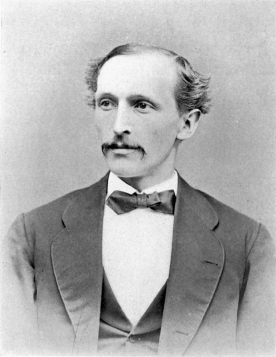
Breen, John, Pvt. Co. K, 15th Inft., Trans. to Co. K, 7th Inft., Sub.
Briggs, Daniel, Pvt. Co. D, 13th Inft., R. E., Pvt. Co. K, 2d h. Art., Dis. Disa., May 4, 1862, Wd. Cedar Creek, Oct. 19, 1864.
Bingham, Charles, Pvt. Co. D, 6th Inft., Sub., deserted Nov. 9, 1864.
Bright, John, Pvt. Co. A, 7th Inft., Sub., deserted March 23, 1865.
Breunel, Charles, Pvt. Co. H, 2d h. Art., Dis. Disa. May 29, 1865.
Bronson, Andrew A., Pvt. Co. H, 2d h. Art., deserted Aug. 11, 1865.
Bronson, Doctor, Pvt. Co. H, 2d h. Art.
Bronson, Charles R., Pvt. Co. C, 3d Inft.
Bronson, Francis H., Pvt. 14th Reg. Inft., U. S. A.
Bronson, William N., Pvt. Co. D, 28th Inft., died in service July 28, 1863.
Brown, Jackson J., Pvt. Co. I, 8th Inft.
Brush, Joseph, Pvt. Co. I, 8th Inft.
Buck, Andrew N., Pvt. Co. I, 8th Inft., Dis. Disa. May 11, 1862.
Buckingham, Andrew, Sergt. Co. I, 11th Inft., Dis. Disa. Oct. 24, 1862.
Buckingham, Clark, Band 4th Penn. Cav.
Buckingham, Earl, Band Leader, 2d Lieut. 4th Penn. Cav.
Buckingham, Irwin C., Corp. and Sergt. Co. H, 2d h. Art., Wd. Oct. 19, 1864, Cedar Creek, Va., Dis. Disa. May 23, 1865.
Buckingham, Orlo H., Mus. and Corp. Co. H, 2d h. Art.
Burk, Joseph, Pvt. Co. A, 10th Inft., Sub., deserted June 15, 1865.
Burke, Nicholas, Pvt. Co. M, 2d h. Art., deserted March 25, 1865.
Burns, Edward C., Pvt. Co. C, 8th Inft., Sub., deserted to enemy March 21, 1865.
Burr, Thomas, Pvt, Co. B, 29th Inft., Col’d., Dis. Disa. May 28, 1864.
Cady, Cyrell, Pvt. Co. I, 11th Inft., Dishon. Disc. Dec. 28, 1863.
Caldwell, Smith P., Pvt. Co. K, 13th Inft., Dis. Disa. Jan. 19, 1863.
Calnen, Thomas, Pvt. Co. F, 2d h. Art.
Camp, Edwin, Pvt. Co. D, 28th Inft.
Camp, Edwin T., Pvt. Co. C, 13th Inft., Dis. Disa. Feb. 17, 1863.
Campbell, James, Pvt. Co. A, 5th Inft.
Canfield, William E., Pvt. and Corp. Co. H, 2d h. Art.
Carman, George, Pvt. Co. C, 5th Inft., Sub., deserted Nov. 1, 1863.
Carpenter, George E., Sergt. Co. F, 29th Inft., Col’d., Dis. Disa. May 21, 1864.
Carroll, Edward, Pvt. Co. H, 5th Inft., deserted from 14th Inft. March 29, 1863; Sub., deserted Oct. 5, 1864.
Clark, Titus, Corp. Co. D, 28th Inft.
Cleggett, Louis A., Corp. Co. K, 29th Inft., Col’d., died Dec. 25, 1864, Point of Rocks, Va.
Cole, Ferdinand, Pvt. Co. H, 2d h. Art., deserted July 27, 1865.
Cole, Henry S., Pvt. Co. D, 7th Inft., deserted Nov. 11, 1864.
Cole, Hobert, Pvt. Co. D, 28th Inft.
Conlon, John, Pvt. Co. K, 14th Inft., Dis. Disa. Dec. 12, 1863.
Conley, Daniel, Pvt. Co. K, 2d h. Art., Dis. Disa. May 11, 1864.
Copley, George D., Band 4th Penn. Cav.
Corcoran, William, Pvt. Co. D, 20th Inft., Sub., deserted Oct. 5, 1864.
Conkwright, Alexander, Pvt. Co. D, 28th Inft., died July 13, 1863, at Barancas, Fla.
Cummings, James P., Pvt. Co. G, 28th Inft.
Disbrow, David B., Pvt. Co. I, 8th Inft., R. E., Pvt. Co. H, 2d, h. Art., Dis. Disa. Jan. 15, 1863.
Disbrow, Henry S., Corp. Co. I, 8th Inft.
Disbrow, William E., Corp. Co. H, 2d h. Art.
Dix, William, Pvt. Co. E, 8th Inft., Sub., shot for desertion Jan. 8, 1865.
Doane, Edward, Corp. Co. D, 13th Inft., Dis. Disa.
Dodge, Robert, Pvt. Co. D, 28th Inft., injured at Port Hudson, La., July, 1863.
Driscoll, Cornelius, Pvt. Co. G, 1st Reg. Cav., Sub., deserted July 1, 1865.
Dubois, Hiram, Corp. Co. K, 2d h. Art.
Dunham, Benjamin F., Pvt. and Corp. Co. H, 2d h. Art.
Durand, William, Pvt. Co. I, 11th Inft., Sub., deserted Aug. 25, 1865.
Dutcher, William P., Pvt. Co. I, 8th Inft., Wd. May 7, 1864, Walthall Junc., Va., Dis. Disa. July 15, 1865.
Erwin, George S., Corp. Co. H, 2d h. Art.
Erwin, Robert, Reg. Qm. Sergt. and Co. Qm. Sergt. Co. H, 2d h. Art., Wd. Oct. 19, 1864, at Cedar Creek, Va.
Evans, James H., wagoner Co. C, 13th Inft.
Evits, Oliver B., Pvt. Co. H, 2d h. Art.
Farrel, John, Pvt. Co. I, 8th Inft., Sub., deserted Feb. 18, 1865.
Farrell, William, Pvt. Co. A, 6th Inft., Sub.
Ferris, Hilliard, Pvt. Co. I, 8th Inft., died in New Milford July 27, 1862.
Ferris, Jay, Pvt. Co. D, 28th Inft., died at New Orleans, La., June 1, 1863.
Ferris, John, Pvt. Co. C, 13th Inft.
Ferris, Robert, Corp. Co. I, 8th Inft., killed at Sharpsburg, Md., Sept. 17, 1862.
Ferris, Stephen, 1st Sergt. Co. D, 28th Inft.
Finn, John, Pvt. Co. I, 10th Inft., Sub.
Fisher, James, Pvt. Co. I, 14th Inft., Sub., deserted Aug. 14, 1864.
Ford, Aaron N., Mus. Co. D, 28th Inft., died at Brashier City, La., May 22, 1863.
Ford, Charles, Mus. Co. I, 8th Inft., Dis. Disa.
Franklin, Henry J., Pvt. Co. K, 29th Inft., Col’d.
French, Francis L., Pvt. Co. H, 2d h. Art.
Fuller, Alfred E., Mus. Co. D, 28th Inft.
Garlick, Charles, Pvt. Co. I, 8th Inft., Wd. at Antietam, Md., Sept. 17, 1862.
Gaylord, Charles H., Sergt. and 1st Sergt. Co. C, 13th Inft.
Goodsell, Jerome, Pvt. Co. D, 28th Inft., deserted Nov. 16, 1862.
Graves, Franklin S., Corp. Co. B, 2d h. Art.
Green, George A., Pvt. Co. K, 28th Inft.
Gregg, John, Pvt. Co. H, 5th Inft.
Gregory, Charles B., Corp. Co. D, 28th Inft., died at Baton Rouge, La., July 30, 1863.
Gridley, Henry S., Corp. Co. H, 2d h. Art., Wd. Oct. 19, 1864, Cedar Creek, Va.
Griffin, Edward, Pvt. Co. K, 2d h. Art., killed June 1, 1864, at Cold Harbor, Va.
Harrington, George W., Pvt. Co. K, 2d h. Art., died Feb. 25, 1864, at Alexandria, Va.
Hartwell, Willis, Pvt. Co. H, 2d h. Art., died Oct. 28, 1864, at Martinsburgh, Va.
Hatch, Calvin B., Sergt. and Lieut. Co. A, 2d h. Art., killed at Cold Harbor, Va., June 1, 1864.
Heacock, Richard, Pvt. Co. K, 29th Inft., Col’d.
Healy, James, Pvt. Co. A, 10th Inft., Sub.
Hess, Christian, Pvt. Co. G, 10th Inft.
Higgins, John, Pvt. Co. I, 5th Inft., Sub., deserted Oct. 1, 1863.
Hill, Samuel R., Pvt. and Corp. Co. H, 2d h. Art.
Hine, Frederick R., Pvt. Co., 11th Inft., died Feb. 1, 1864, at Alexandria, Va.
Hoag, David D., Capt. Co. D, 28th Inft., killed at Port Hudson, June 14, 1863.
Hoag, George W., Pvt. Co. I, 6th Inft., Wd. at Drewry’s Bluff, Va., May 16, 1864.
Hodge, Homer W., Pvt. Co. K, 2d h. Art., Wd. at Cold Harbor, Va., June 1, 1864.
Hoffman, Herman, Pvt. Co. H, 2d h. Art.
Hoyt, Charles A., Pvt. Co. K, 2d h. Art., Wd. at Cold Harbor, Va., June 1, 1864.
Hoyt, Denman, Pvt. Co. D, 28th Inft.
Hoyt, Henry R., Corp. and 1st Sergt. Co. H, 2d h. Art.
Hoyt, Horatio S., Pvt. Sergt. and 1st Sergt. Co. H, 2d h. Art.
Hunt, Gideon L., Pvt. Co. G, 23d Inft.
Hunt, Merritt, Mus. Co. G, 28th Inft.
Hurd, Charles A., Pvt. Co. H, 2d h. Art., Wd. at Cedar Creek, Va., Oct. 19, 1864.
Hurd, Robert B., Pvt. and Corp. Co. E, 1st h. Art., deserted July 28, 1865.
Hutchinson, John, Pvt. Co. I, 2d h. Art., Wd. at Cold Harbor, Va., June 1, 1864, at Cedar Creek, Va., Oct. 19, 1864.
Irwin, Charles N., Sergt. and Lieut. Cos. I and E, 8th Inft., Wd. at Antietam, Md., Sept. 17, 1862, killed at Chapin’s Farm, Va., Sept. 29, 1864, he having Vol. to remain for that battle after Exp. of his term of service.
Jacklin, Philip H., Pvt. Co. I, 8th Inft., died at Newbern, N. C., Sept. 23, 1862.
Jackson, Charles W., Pvt. Co. H, 2d h. Art., killed at Cold Harbor, Va., June 1, 1864.
Jackson, Henry F., Pvt. and Corp. Co. C, 29th Inft., Col’d.
Janks, August, Pvt. Co. B, 11th Inft., Sub., deserted Sept. 6, 1865.
Jennings, Alvin H., Pvt. Co. I, 8th Inft.
Jennings, David J., Pvt. Co. A, 2d h. Art.
Jennings, Jay, Pvt. Co. I, 8th Inft., Dis. Disa. Dec. 11, 1862.
Jones, Horace E., Pvt. and Corp. Co. H, 2d h. Art.
Judson, Charles, Pvt. Co. D, 28th Inft., died, Aug. 10, 1863.
Karge, Earnest, Pvt. Co. C, 11th Inft., Sub.
Kinney, Andrew S., Pvt. Co. H, 2d h. Art., Dis. Disa. Feb. 6, 1863.
Knowles, David W., saddler Co. C, 1st Cav.
Lake, David, Corp. and Sergt. Co. I, 8th Inft., killed at Antietam, Md., Sept. 17, 1862.
Lampson, Charles E., Pvt. Co. H, 2d h. Art.
Lampson, Frederick G., Pvt. Co. I, 8th Inft., R. E. Pvt. Co. C, 2d h. Art., Dis. Disa. Feb. 3, 1863.
Lampson, William, Pvt. Co. G, 28th Inft., died July 21, 1863, at Port Hudson, La.
Lapoint, Joseph, Pvt. Co. E, 6th Inft.
Lathrop, Herman S., Pvt. Co. A, 2d h. Art.
Lathrop, Orrin F., Pvt. Co. F, 6th Inft.
Lathrop, William G., Pvt. Co. D, 28th Inft.
Law, Sidney A., Pvt. and Corp. Co. K, 2d h. Art., died Jan. 29, 1865.
Lawrence, Thomas, Pvt. Co. E, 8th Inft., Trans. to Co. A, 10th Inft., Sub.
Lefever, Adolph, Pvt. Co. D, 10th Inft., Wd. at Ft. Gregg, Va., Apr. 2, 1865.
Logan, Frederick J., Pvt. Co. H, 2d h. Art., Dis. Disa. Apr. 12, 1863.
Logan, George E., Pvt. Co. I, 8th Inft., died at Weaverstown, Md., Nov. 15, 1862.
Loverage, Joseph R., Pvt. Co. H, 2d h. Art., died at Washington, Sept. 12, 1864.
Loverage, Remus, Mus. Band 4th Penn. Cav.
Loverage, Romulus C., Sergt. and Lieut. Cos. H and B, 2d h. Art.
Loveridge, Royal T., Pvt. Co. E, 1st h. Art.
Lyon, Edward F., Corp., Sergt., and 1st Sergt. Co. H., 2d h. Art.
Lyon, James, Pvt. Co. D, 1st h. Art., Sub., deserted May 21, 1865.
Mallett, Henry W., Pvt. Co. H, 2d h. Art., Wd. at Winchester, Va., Sept. 19, 1864.
Malloy, William, Pvt. Co. L, 2d h. Art., died Aug. 22, 1864.
Marsh, Albert N., Pvt. Co. H, 2d h. Art.
Marsh, Charles N., Corp. Co. D, 1st Cav., Wd. and Cap. at Gordonsville, Va., Aug. 7, 1862, Cap. at Thoroughfare Gap, Oct. 7, 1862, awarded Medal of Honor.
Marsh, Daniel E., 1st Sergt. and Lieut. Co. H, 2d h. Art.
Marsh, Decater D., Corp. Co. D, 28th Inft., died at Barancas, Fla., Apr. 12, 1863.
Marsh, Edward W., 2d Lieut. Co. H, and Capt. Co. M, 2d h. Art.
Marsh, George W., on Orcutt’s Rolls as being from New
Milford, but on the Conn. Offl. Rolls, as a deserter from Co. A, 7th Inft., and a Sub. from Southbury, and as an unassigned recruit to 18th Ill., who failed to report.
Marsh, Irwin G., Band 4th Penn. Cav.
Marsh, Philip G., Pvt. Co. I, 5th U. S. Art., on Orcutt’s Rolls, not on Conn. Rolls.
McBath, David, Pvt. Co. A, 2d h. Art., Wd. at Cold Harbor, Va., June 1, 1864.
McHenry, Hugh, Pvt. Co. A, 1st h. Art., Sub., deserted July 29, 1865.
McKeagany, William, Pvt. Co. C, 1st h. Art., Sub., deserted July 10, 1865.
McLoy, John, Pvt. Co. C, 8th Inft., Sub., deserted Jan. 15, 1865.
McMahon, Joseph, Pvt. Co. G, 28th New York Inft., Sergt. Co. A., 2d M. R. of N. Y., died in Serv. in N. M., July 17, 1864.
McMahon, Michael, Pvt. Co. F, 2d h. Art., Wd. at Petersburg, Va., Aug. 31, 1864.
McMahon, Michael, 3d, Pvt. Co. F, 2d h. Art., Wd. at Winchester, Va., Sept. 19, 1864.
Mehan, John, Pvt. Co. H, 11th Inft., Sub., deserted, confined, escaped.
Meney, Francis, Pvt. Co. A, 13th Inft., Sub., Wd. at Winchester, Va., Sept. 19, 1864, deserted Oct. 31, 1864.
Merwin, Garwood R., Sergt. Co. H, 2d h. Art., died Jan. 25, 1863, at Alexandria, Va.
Mintsch, John L., Pvt., Co. D, 28th Inft. and Pvt. Co. A, 2d h. Art.
Monroe, Edward, Pvt. Co. K, 2d h. Art., Dis. Disa. Jan. 25, 1864.
Monroe, John, Pvt. Co. A, 11th Inft., Sub., Dis. Disa. Nov. 11, 1865.
Moore, Frank, Pvt. Co. I, 10th Inft., Sub., deserted March 8, 1865.
Morehouse, Frank, Pvt. Co. D, 28th Inft.
Morehouse, Lyman F., Pvt. Co. A, 2d h. Art., Wd. at Cold Harbor, Va., June 1, 1864, Dis. Disa. June 21, 1865.
Morehouse, Henry S., Pvt. Co. H, 2d h. Art.
Morgan, William, Pvt. Co. C, 5th Inft., Sub., deserted Nov. 1, 1863.
Morrison, William E. L., Sergt. and Pvt. Co. I, 29th Inft. Col’d., Wd. at Kell House, Va., Oct. 27, 1864, died Nov. 12, 1864.
Mosher, James D., Corp. Co. C, 13th Inft., died at Brasier City, La., Aug. 6, 1863.
Mosher, Lewis W., Corp. and Sergt. Co. H, 2d h. Art., Wd. at Cold Harbor, Va., June 1, 1864, Dis. Disa. May 24, 1865.
Munson, John, Pvt. Co. K, 2d h. Art., Wd. at Cold Harbor, June 1, 1864, died from wounds, Aug. 30, 1864.
Murphy, Michael, Pvt. Co. C, 5th Inft., Sub., deserted Nov. 1, 1863.
Nichols, Ezra L., Pvt. Co. K, 29th Inft., Col’d.
Nichols, Orlando, Pvt. Co. G, 10th Inft., Sub.
Noble, Andrew B., Pvt. Co. D, 28th Inft.
Noble, Henry C., Corp. and Sergt. Co. H, 2d h. Art., Dis. Disa. Feb. 4, 1865.
Northrope, Lawrence, Mus. Band 4th Penn. Cav.
O’Callaghan, Timothy O., Pvt. Co. F, 2d h. Art., killed at Winchester, Va., Sept. 19, 1864.
Odell, John, Pvt. Co. C, 13th Inft.
O’Niel, William, Pvt. Co. E, 10th Inft., killed at Fort Gregg, Va., Apr. 2, 1865.
Parkes, Joseph P., Sergt. and 1st Sergt. Co. A, 2d h. Art., killed at Cold Harbor, Va., June 1, 1864.
Phillips, Chester, Pvt. Co. K, 29th Inft., Col’d., killed at Petersburg, Sept. 23, 1864.
Phillips, Henry, Pvt. Co. I, 11th Inft., deserted Dec. 16, 1861.
Pike, Luther M., Corp. Co. D, 28th Inft.
Plumb, Alonzo, Pvt. Co. D, 28th Inft., died Aug. 21, 1863.
Plumb, Harvey G., Pvt. Co. D, 28th Inft.
Plumb, Henry, Surgeon 2d h. Art.
Plumb, Harvey G., Pvt. Co. I, 123d New York Vol.
Potter, George D., Pvt. Co. H, 2d h. Art.
Potter, George H., Corp. Co. H, 2d h. Art.
Purdy, Charles, Pvt. Co. I, 8th Inft., Wd. at Fort Huger, Va., Apr. 19, 1863, Dis. Disa., Apr. 4., 1864.
Randolph, Harvey J., Pvt. Co. K, 29th Inft., Col’d.
Read, Herbert H., Pvt. Co. H, 2d, h. Art., Pris. at Ford’s Mills, Va., June 14, 1864, died in Andersonville, Ga., July 3, 1864.
Rice, Levi, Pvt. Co. H, 2d h. Art., appears on Orcutt’s Rolls, but not on Government Rolls.
Roach, Thomas, Pvt. Co. D, 8th Inft., Sub., deserted Dec. 2, 1864.
Roberts, Andrew, Pvt. Co. I, 8th Inft., died at Newbern, N. C., Apr. 1, 1862.
Roberts, Henry M., Pvt. Co. I, 8th Inft., died at Newbern, N. C., Apr. 6, 1862.
Roberts, William J., 1st Lieut. and Capt. Co. I, 8th Inft. Wd. at Fort Harrison, Va., Sept. 29, 1864, Dis. Jan. 31, 1865.
Rogers, Austin V., Pvt. Co. K, 2d h. Art.
Root, Nathan H., Corp. Co. H, 2d h. Art.
Ruby, Eli, Pvt. Co. D, 13th Inft., Dis. Disa. Sept. 29, 1862.
Ruby, George M., Pvt. Co. D, 13th Inft., deserted Aug. 27, 1864.
Sanford, Isaac L., Pvt. Co. A, 2d h. Art.
Savage, Edward P., Pvt. Co. G, 8th Inft., deserted Aug. 19, 1865.
Shultz, Myron, Pvt. Co. I, 8th Inft., Dis. Disa. Feb. 24, 1863.
Sherman, Lucius S., Pvt. Co. H, 2d h. Art., Wd. at Cedar Creek, VA., Oct. 19, 1864.
Sherwood, Asahel, Pvt. Co. D, 28th Inft.
Sherwood, Reuben H., Pvt. Co. H, 2d h. Art.
Schook, Louis, Pvt. Co. E, 8th Inft., Sub., deserted July 24, 1864.
Shove, Henry, Sergt. Co. D, 28th Inft.
Smith, Charles H., Corp. Co. K, 11th Inft., Sub.
Smith, William, 1st, Pvt. Co. F, 10th Inft.
Soule, David E., Corp. Co. H, Lieut. Co. F, 2d h. Art.
Soule, Henry, Band 4th Penn. Cav.
Sparks, Edwin, Pvt. Co. I, 8th Inft.
Spengler, Edward, Pvt. Co. E, 8th Inft., Sub., killed at Fort Harrison, Va., Sept. 29, 1864.
Stephens, Edgar, Pvt. Co. K, 2d h. Art.
Stephens, Henry L., Pvt. Co. D, 28th Inft.
Stephenson, William, Pvt. Co. A, 5th Inft., Sub., deserted July 11, 1865.
Sterling, Homer, Pvt. Co. H, 2d h. Art., Dis. Disa., Apr. 18, 1864.
Stevens, Franklin B., Pvt. Co. B, 2d h. Art., killed at Cold Harbor, Va., June 1, 1864.
Stevens, George, Pvt. Co. E, 6th Inft., Sub.
Stevens, William H., Pvt. Co. K, 2d h. Art., Wd. Cold Harbor, Va., June 1, 1864, Dis. Disa., June 6, 1865.
Stokes, Henry, Pvt. Co. A, 5th Inft., Dis. Disa, Jan. 30, 1862.
Tallman, Martin N., Corp. Co. K, 29th Inft., Col’d.
Tarr, James, Pvt. Co. E, 11th Inft., Sub., deserted July 7, 1865.
Taylor, Joseph, Pvt., Corp., and Sergt. Co. C, 13th Inft.
Thayer, Edward A., Pvt. Co. B, 20th Inft., deserted Sept. 29, 1862.
Thayer, John Q., Pvt. Co. I, 8th Inft.
Thompson, Edward E., Pvt. Co. H, 2d h. Art.
Tibbetts, Charles E., 2d and 1st Lieut. Co. C, 13th Inft.
Treat, Frederick M., Pvt. Co. D, 28th Inft., Wd. at Port Hudson, La., June 14, 1863.
Turrill, Henry S., 1st Lieut. and Asst. Surg. 17th Inft., Cap. and held Pris. in Macon, Savannah, and Charleston.
Van Anden, William, Pvt. Co. D, 28th Inft.
Vanderwater, William G., Pvt. Co. H, 13th Inft., Wd. at Irish Bend, La., Apr. 14, 1863.
Van Lone, Peter, Pvt. Co. D, 8th Inft., Sub.
Vorey, Charles, Pvt. Co. D, 11th Inft.
Walden, Edward, Pvt. Co. F, 2d h. Art., Wd. at Winchester, Va., Sept. 19, 1864.
Walker, Albert, Pvt. Co. D, 7th Inft., died on Morris Island, S. C., Sept. 18, 1863.
Warner, William C., Pvt. Co. H, 2d h. Art., died at Washington, D. C., Dec. 23, 1862.
Waters, Alexander, Pvt. Co. C, 3d Inft.
Waters, Frank, Pvt. Co. G, 17th Inft., Sub.
Way, Charles A., Pvt. Co. H, 2d h. Art., Wd. at Winchester, Va., Sept. 19, 1864, at Salors Creek, Va., Apr. 6, 1865.
Welch, Patrick, 1st, Pvt. Co. F, 8th Inft., Trans. to U. S. Navy.
Weller, Chester A., Band 4th Penn. Cav., Pvt. Co. H, 2d h. Art.
Wentworth, Jacob, Pvt. Co. K, 2d h. Art., Wd. at Cold Harbor, Va., June 1, 1864, died June 20, 1864.
Wenzenger, Daniel, Pvt. Co. B, 8th Inft., Sub., killed at Ft. Harrison, Va., Sept. 29, 1864.
Wiedmore, Paul, Pvt. Co. D, 8th Inft., Sub., deserted Sept. 10, 1863.
Wiley, James, Pvt. Co. D, 8th Inft., Sub. deserted Dec. 1, 1863.
Williams, Burr, Pvt. Co. H, 2d h. Art., Dis. Disa. March 27, 1865.
Williams, George S., Capt. Co. H, 2d h. Art.
Williams, James, Pvt. Co. A, 5th Inft., deserted Oct. 3, 1863.
Williams, John F., Pvt. Co. H, 2d h. Art.
Wilson, John, Pvt. Co. C, 20th Inft., Sub., deserted Oct. 5, 1864.
Wentworth, Hiram, Pvt. 1st Conn. Lt. Batt., deserted Jan. 24, 1862.
Wooden, Charles E., Pvt. Co. D, 28th Inft., Wd. at Port Hudson, La., June 14, 1863, died of wounds, July 17, 1863.
Woodruff, Theron M., Pvt. Co. I, 2d h. Art., Wd. at Cedar Creek, Va., Oct. 19, 1864.
Worden, Richard T., Pvt. Co. I, 8th Inft., killed at Walthall Junc., Va., May 7, 1864.
Recapitulation: Number of men credited to New Milford, 282; killed in battle, 17; wounded in action, 34; died in service, 35; discharged for disability, 33; deserted, 44; dishonorably discharged, 1; shot for desertion, 1. Casualties, honorable, 119; dishonorable 46; total 165.
There were thirty-seven drafted men and substitutes credited to the town; of these, twenty-seven deserted, leaving seventeen as the number of the town’s volunteers to desert their colors, and most of these were of foreign birth.
THE SPANISH-AMERICAN WAR
Walter Campbell. Wesley Collins. Gabriel Erwin. George Isaac Hine. Charles A. Hull. Charles Kellogg. Andrew Nichols. Cyrus Northrop. Albert Piper. Albert Timms. Walter Thompson. Arthur Wheeler.
Walter Wheeler.
RECOLLECTIONS OF OLD NEW MILFORD HOMES
Contributed by Alice Merwin Bostwick
Indelibly stamped on my memory are pictures of the old homes of my ancestors, and the simple life within them, in which it was my privilege to share in early childhood. These houses, built before the Revolutionary War, were of the “salt box” style, two stories high except at the back, where the roof sloped from the steep gables down so low that my grandfather, a tall man, had to bow his head to go under the eaves into the stoop. This made windows necessary on but three sides of a house, and was designed to evade the heavy tax on every pane of glass used. The shrewd colonist preferred to have less light, rather than add to the King’s revenue. Every stick of timber was oak from the forest primeval, felled and hewed by the strong arms of the men who, with stout hearts, braved the perils and hardships of the wilderness for their altars and homes. Every shingle was “rived out” by hand. The laths, window sashes, doors, handles and latches, hinges and nails, were all hand-wrought.
How well our forefathers builded, these old houses, still standing in good habitable condition, after braving the summer suns, winter winds, and storms of more than a century and a half, bear witness. The great stone chimney was a tower of strength from its foundation in the cellar, fifteen feet square, up to the garret, strong as granite rocks could make it. It anchored the heavy beams and roof timbers, giving ample space for the many fireplaces needed in the large rooms growing around it. The kitchen fireplace was like those we read of, but seldom see. At one side of the crane was a bench where I, as a child, often sat watching the building of the fire—a work of skill. The big green back-log was first rolled in: then, the back-stick, fore-stick, chips and kindlings were added—a veritable woodpile, which, when kindled by the aid of the bellows, sent sparks and flame crackling and roaring up the cavernous chimney.
There may have been much poetry in “the hanging of the crane.” There surely was much prose in cooking for a family, in pots and kettles hung on its hooks and trammels, over the burning coals and smoke. Long-handled frying pans, spiders, skillets, turnspits, bake kettles, and Dutch ovens would be unknown quantities to graduates from modern cooking schools; but they, with all their science and new appliances, cannot surpass the savory dishes evolved by our grandmothers from the limited means at their command, with the aid of these same out-of-date utensils.
From out the arch-roofed old brick ovens came famous loaves of rye and Indian bread, biscuits, pans of pork and beans, cards of gingerbread, seed cookies, election and pound cakes, baked as none of our ranges can ever bake. They had a flavor all their own, a color golden-brown as the fallen autumn leaves of the maple trees, whose “fair white hearts” went up in smoke out of the doorway, while the long-handled iron peel spread the glowing coals over the worn floor of the old oven.
Those were not days of ease and idleness. From sun-up till sun-down, there was work for each and all, indoors and out. “Hired help” was scarce. Some neighbor, not so “well-to-do,” who had more children than income, spared a daughter “to come as one of the family” to work for board, clothes and winter’s schooling till of age. Then, she was paid five dollars a month, and, at her marriage, was given a black silk dress and a feather bed.
Country stores were few and far between. Every family made and kept on hand their own supplies, loaning and borrowing in time of need; exchanging spare-ribs, roasts of beef and lamb; arranging their “butchering” in rotation, to accommodate each other. Fresh meat was a luxury, salted meat, the main reliance. In the smokehouse hung hams, shoulders, beef, tongue and sausage. Under these it was my task to pile green hickory chips, pine sawdust and corncobs, which made a smoke of a peculiar, pungent, spicy quality and odor.
Tallow candles, the only light in the long evenings, were to be dipped; dozens and dozens, the whole year’s supply. To run out of candles was “shiftless.” A few, partly wax, for the tall silver and brass candlesticks on the mantels in parlor and keeping-room, were run in moulds and hung to bleach.
Soap was to be made, hard and soft. An empty soap barrel was thriftless. A cake of scented soap, brought from a distant city, was highly prized. Of spinning and weaving there was no end. The mother and daughters, instead of going to clubs and lectures, after the housework was done had their stents, so many knots of yarn to spin. No need to walk for exercise; back and forth they briskly stepped, as the wheel swiftly whirled, the rolls stretching into miles of yarn, “single twisted” for cloth, “double and twisted” for stockings and carpet warp. Then, the yarn must be scoured and dyed, not with “Diamond Dyes” from the drug store, but with vegetable dyes from fields and woods—white oak roots, butternut bark, chestnut burrs, sumach “bobs,” onion skins, and the wonderful indigo “dye pot blue.” Every good housewife was past master in the art of dyeing, and looked with pride on the line and fence draped with skeins of yarn of bright, unfading hues and shades. Flax wheels, not then strictly ornamental, hummed evenings by the fireside, while deft fingers drew from the flax-covered distaff fine linen thread for sewing, and for sheets, pillow-cases, towels, and all the underclothing of the family. The loom in the garret was never without its web of cloth in process of weaving—wool, linen, or wool and linen mixed (called linsey-woolsey). The linen was spread on the grass, bleached snowy white, then laid away in oaken chests, ready for the wedding “setting out” of the daughters, who made it up by hand, stitching “two threads over, two under,” the rule of the good seamstress.
From “homespun fulled cloth” the “every day” suits of men and boys were made, with the help of the tailoress who came spring and fall with press-board, goose, tailor-shears, and rolls of patterns supposed to fit all figures. What wonder if these home-made garments looked their name! Bedquilts were pieced in intricate patterns—baskets of flowers, butterflies, peonies, chariot wheels, log-cabin, goose chase, double and single Irish chain—and quilted in shells, circles, squares, diamonds, sawteeth and herringbone. The quilt frames in the “spare bed room” usually had one of these marvelous constructions on, ready for a “Quilting Bee,” after which the company gossipped over their cup of tea as we over ours after a card party.
The shoemaker came with work-bench, kit of tools, lap-stone and boot-trees to make the common boots and shoes for the family (strictly common sense, no French heels). A smell of leather and “black wax” pervaded the room where he hammered merrily away at the heavy shoe soles on the lap-stone, singing of “Captain Kidd as he sailed, as he sailed,” and telling stories of haunted houses. One blood-curdling tale of a ghost in a cellar, seizing the feet of everyone who went upstairs after dark, still lingers in my mind—uncomfortably, if the truth be told.
The schoolmaster came, a welcome guest, “boarding around,” a week for each scholar, and perhaps an extra week for the child of some poor widow needing kindly help.
There came homeless wanderers silently claiming lodging and food. Under the low sloping roof was the “Old Shack’s Room,” where a bed was always kept in readiness.
One whom we knew only as “Old Shiver-to-bits” had been “crossed in love” and his mind unbalanced. He never spoke, except to himself as he looked up to the sky, muttering, “The air is full of women, all shiver-de-bits.” Another would sleep only on the floor by the kitchen fire, wrapped in a blanket, cooking his own food for fear of being poisoned. He was an astrologer and philosopher. A woman came, who wore a quilted hood, never taken off and kept drawn over her face, which was always averted when she was spoken to. None of these unfortunates was ever turned away from the open doors of those hospitable homes.
The Schaghticoke Indians, who came from the Reservation with squaws and hounds on their fishing expeditions to the “Eel Rocks” at the Great Falls, always expected the privilege of sleeping in the barn. Their desire for cider was greater than their desire for food. They willingly paid for both with splint baskets. Sometimes they became quarrelsome and noisy, and then the “riot act” was read to them, whip in hand.
The visits of the parson were prized events. An atmosphere of dignity and solemnity seemed to emanate from his black clothes, high stock and white cravat. A reverence now unknown was felt for him, and he was looked up to as the fountain head of theology and religion. The doctrines of election, predestination and eternal punishment were talked of, filling my childish mind with dire forebodings of literal fire and brimstone. After a “season of prayer,” and dinner (always an extra good one), he drove away, to my great relief.
Visits in those days did not mean calls. Company came from miles away to spend the day, often uninvited, but not unwelcome. To “drop in and take pot luck” was not, as to-day, a figure of speech, but literally true, for a “boiled dish” was the regulation dinner. Corned beef, salt pork, and vegetables were served together on a big pewter platter, with a boiled bag-pudding of Indian meal. This may not sound as well as Beef à la mode, entrées and desserts; but, when well cooked, it was by no means to be despised; and on it our ancestors lived; thrived, and were content, thankful and happy. Possibly it did give them bilious and depressed views of the hereafter!
Sunday began Saturday night, when the sun went down behind the hills. With the lengthening shadows came a seeming stillness, in advance of the long day of rest to follow. The Sunday breakfast was early, giving plenty of time for the long drive to “meeting.” Come sun, come rain, snow or wind, nothing but sickness excused absence from the two long sermons, morning and afternoon, with prayer meeting between. The day was kept to the very letter of the old Sabbatical law. Dinner was prepared Saturday, and eaten cold. For Sunday reading, the leather-bound Family Bible and Psalm Book were brought out; also Baxter’s Saints’ Rest, Pilgrim’s Progress, and the Book of Martyrs. A walk beyond the garden and dooryard was not allowed, till after sundown; a drive, except in case of necessity, was never thought of. Only “York State folks” did that. A maiden aunt reproved me for cracking nuts on Sunday, giving me to read the Fourth Commandment, and Isaiah 58: 13-14, “If thou turn away thy foot from the Sabbath, from doing thy pleasure on my holy day,” etc. The remembrance of those well-kept, solemn Sundays still remains; and, to this day, my inherited New England conscience never fails to accuse any transgression of the Fourth Commandment. Howells says, “The devout spirit of the old Puritans remained to their descendants long after the stern creed that had embodied that spirit had passed away.”
Fast Day, too, was strictly kept in Puritan households, without reference to Good Friday. We might ramble in the woods for wild flowers, however, gather wintergreen, birch and sassafras for root beer, and have fritters and maple syrup for supper.
Thanksgiving was the great feast day of the whole year. Then, the children to the third and fourth generation came trooping back, filling the low-ceiled rooms under the old rooftree; and for them high festival was held.
For days before, great preparations were made. The “buttery” was full of good things. On the shelves were rows of mince, pumpkin and tart pies, the last named made from cider apple sauce,—a lost art,—and pans of doughnuts and crullers, flanked by the sage cheese, ready to be cut. Baking in the brick oven was an immense chicken pie, made with cream crust,—another lost art,—and an Indian pudding rich with suet—still another lost art.
The turkey, the choicest young gobbler of the flock, stuffed with savory dressing, also a pig with an ear of corn in its mouth, were roasting in a Dutch oven on the hearth, all these together filling the house with an odor of good cheer.
Oscar, of the Waldorf-Astoria, can do mighty deeds in his line, but, with all his skill, cannot equal one of those real old-fashioned Thanksgiving dinners.
After all the kin had come and gone, there was abundant “skippin” for the worthy poor; yes, and for the unworthy, who might come to partake of the free bounty of the ever charitable.
The winters were long, shutting families indoors by themselves. Books and papers were few, but these early settlers kept abreast of the events of the day, and they had clear-cut, strong opinions, which they expressed with no uncertain sound. In the long evenings they gathered around the great fireplace, listening with never-failing interest to the oft-told tales of Indians, of Tory raids, and of hardships and suffering in camp and field.
“Shut in from all the world without, They sat, the clean-winged hearth about, Content to let the north wind roar In baffled rage at pane and door; . . . . . . . . . . And for the winter fireside meet, Between the andirons’ straddling feet, The mug of cider simmered slow, The apples sputtered in a row, And, close at hand, the basket stood With nuts from brown October’s wood.”
If neighbors joined the circle, promptly as the tall clock in the corner struck nine they donned surtouts, mufflers and striped knit mittens, lighted the candle in the pierced tin lantern, and trudged away over the hills to their distant homes.
The back-log had by this time burned down to glowing coals, and from these the shining brass warming-pan was filled, to warm the bed of the great-grandmother, and the trundle-bed of the small great-granddaughter; the remaining coals being carefully covered to kindle the morning fire. “Early to bed and early to rise,” was a lived-up-to motto. Each one of the household climbed the steep, draughty stairway, with flaring, flickering candles, which dimly lighted the cold bedrooms, with their frost-covered windowpanes, Hastily undressing, they hurried under the blankets, and, burrowing into the deep feather beds, were soon lost in sound sleep, such sleep as open air life, good digestion, and a clear conscience alone can give.
This life of the early days may seem dull and humdrum to us in the rush and whirl of ours. If it was sober by reason of struggles with the hard conditions and stern emergencies contended with, it was cheerful, kindly, dignified, full of high ideals, aims and works. Who shall say our life is better?
None of us would willingly go back to the “good old times,” to their seeming narrowness, inconveniences and discomforts; yet let us not forget to give all honor to these, our forbears, through whose piety, loyalty, courage and toil we have received so goodly a heritage.
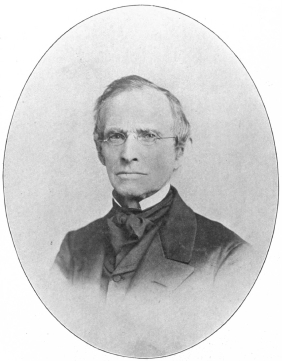
LEVI SYDNEY KNAPP From a photograph taken about 1870, now in the possession of his son, Mr. Frederick Knapp
UNCHARTERED INSTITUTIONS
Contributed by Frederick Knapp[7]
Among the unchartered institutions of the New England town, none has had a greater influence than its general “sitting-down” place, where, by common consent, the leaders of all classes gathered. It was to the town what political and social clubs are to the city; it was an exchange place, a go-as-you-please Lyceum, a modern market-place, where the newspapers of the day were criticised, where affairs of Church and State had to be discussed, where politics and politicians were weighed, ticketed, and shelved for future reference, and where neighborhood events were gone over and approved or disapproved. War, domestic or foreign, and its generals, were subject to this trial by jury. The jury consisted of lawyers, doctors, bankers, merchants, farmers. Party-leaders of every shade of opinion—Whigs (later Republicans), Democrats, Abolitionists (brass-mounted, or not mounted at all), Prohibitionists, Independents—all met here on common ground. It was an intelligent, earnest crowd, always good-natured, whose “give and take” was without circumlocution or apology.
In no town in Litchfield County, I fancy, was there quite such a sitting-down place as the store of Mr. Levi S. Knapp on Bank Street in our own town of New Milford, which was conducted by him until his death at the age of ninety-three, and, afterward, by his son, Gerardus Knapp. The place was known to everybody in the towns around. During the Kansas-Nebraska troubles in the late “Fifties,” a witty neighbor christened it “Topeka Hall”; and the name was accepted as quite the proper thing. For a half century, “Topeka Hall” was an informal congress, where earnest men threshed out the problems of the hour. As our late Governor Andrews said of it, “It was the place where the world was wound up.” Had it been honored by a historian, like the late George William Curtis, and a Harper’s Magazine for record, its quips and repartees might have furnished the “Easy Chair” with abundant and amusing copy; and its “wise saws and modern instances” would fairly have covered the history of the town. While its good stories made fun for the day, the place became, none the less, an educator of public opinion, and wielded an influence second to no institution in the town.
The remarkable longevity of the men who assembled there is worthy of special record, covering, as it does, the greater part of the nineteenth century. Below is a list of several of the prominent men, and their ages at death. It is a matter of regret that a more complete list cannot now be made:
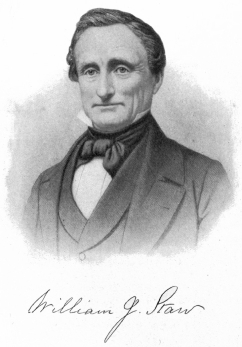
Col. William J. Starr, 97. William Roberts, 92. Royal I. Canfield, 76. William N. Canfield, 86. Ralph E. Canfield, 85. Judge David C. Sanford, 66. Sheldon Blackman, 69. Eli Mygatt, 86. A. B. Mygatt, 80. Augustine Thayer, 70. Rev. John Greenwood, 85. Rev. David Murdoch, 76. John S. Turrill, 64. Benjamin J. Stone, 78. John Peck, 81. Cornelius W. Peck, 78. Elijah Hall, 70. William Hartwell, 87. Theodore Buck, 78. Charles H. Booth, 81. Frederick G. Bennett, 74. Col. Gerardus Roberts, 70. Levi S. Knapp, 93. Gerardus Knapp, 74. Charles C. Noble, 72. John Glover Noble, 77. Hiram B. Noble, 70. Van Rensselaer Giddings, 79. Merritt Beach, 79. William Bostwick, 80. Ethiel S. Green, 84. Rev. J. B. Bonar, 79. John P. Treadwell, 64. Isaac B. Bristol, 84. Anan Hine, 71. Dr. James Hine, 80. William H. Hine, 77. Clark Hine, 84. Eli Clark, 87. Charles Sabin, 74. Royal Buckingham, 81. Samuel Randolph Hill, 62.
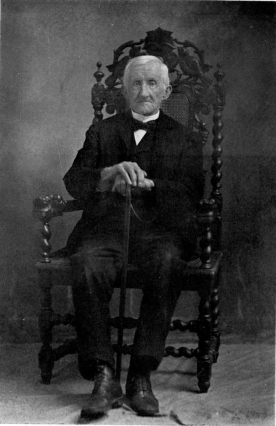
ALANSON N. CANFIELD Born Oct. 6, 1807. The oldest resident of New Milford.
Albert N. Baldwin, 80. James H. McMahon, 68. Henry Merwin, 77. Robert Ferriss, 87. Eleazer T. Brewer, 81. Cyrus Northrop, 95. Robert Irwin, 88. Ezra Ferriss, 90.
Joel W. Northrop, 74.
And, living with us to-day, the only survivor of the older men, Mr. Alanson Canfield,[8] who will be one hundred years old on the eighth day of October, 1907.
TRAINING DAYS IN THE FORTIES AS TOLD BY AN “OLD BOY”
Contributed by Frederic Knapp
“I LIKE boys, the masters of the playground and of the street—boys, who have the same liberal ticket of admission to all shops, factories, armories, town-meetings, caucuses, mobs, target-shootings, as flies have; quite unsuspected, coming in as naturally as the janitor—known to have no money in their pockets, and themselves not suspecting the value of this poverty; putting nobody on his guard, but seeing the inside of the show—hearing all the asides. There are no secrets from them, they know everything that befalls in the fire company, the merits of every engine and every man at the brakes, and how to work it, and are swift to try their hand at every part; so, too, the merits of every locomotive on the rails, and will coax the engineer to let them ride with him and pull the handles when it goes to the engine-house. They are there only for fun, and not knowing that they are at school in the courthouse, or the cattle show, quite as much and more than they were, an hour ago, in the arithmetic class.”
Our Emerson was right: he knew boys. And at no place or time was the boy let loose to see and do, quite equal to the training days in the “Forties.” This was his day, when school didn’t count, when the schoolma’am or master wasn’t in it, the day long anticipated. When the morning broke he was no laggard, but the wise mother would not allow him to skip or hurry his breakfast, for she knew that when the day was done her laddie would be too fagged to eat. So, breakfast over, she ties the ribbon in his broad turn-down collar, and the father gives him two fippenny bits for all his own to spend as he pleases, and then they launch him forth with a “good time” for a blessing.
At the hill’s foot he meets his comrades, and, further down, more Johns and Jims and Sams and Bills, and then the fun begins. On the village Green things begin to take on a warlike aspect and the boys catch on to every movement and miss nothing; while the girls—pshaw! they ain’t in it to-day—keep in yards or on church steps. The darkey boys, as happy as any, begin to bring on the warlike steeds, which are praised or jeered as appearances demand. Presently there is a drum-beat on the big bass drum, and every boy scampers for the band, which consists of a fifer, a snare-drummer, and Charles Ford to beat the big bass drum. And he just could beat it like Sam Hill! I tell you, if the Britishers could have heard those fellows play, they would have got right off from Bunker Hill, you bet! Sure! they all admit. Now, at the upper part of “The Green,” a soldier in uniform appears, and soon another. It’s nine o’clock, and the first parade begins at ten. Soon they come in, in squads, until “The Green” seems to be covered with the mounts, after which the soldiers dismount and take things easy. Our boys are in and out amongst the horses, scooting, howling, criticising, or jeering, when an officer rides up and gives an order. This means business, and the small boy “gits,” nor does he “stand upon the order of his going, but goes at once,” and the soldiers hold the field. This is only preliminary work, however, a shaking down of the files preparatory to the reception of the Colonel and his staff in the afternoon. This over, the troops are off duty.
The soldiers take their ease as they please, some on “The Green,” but more over at the tavern, where the boys flock in amongst them, until the “barkeep” shouts to them, “Get out; there’s too many of you!” It’s lunch time, too, for the boys, who begin to mass around Aunty Thatcher’s gingerbread stand feeling about their jackets for the small coin. Whether they have any or not—it’s all the same. The boys are democratic and divide, paying just like grown-ups for what they buy with the coin of the realm. No line drawn to-day between the boy with money and the boy without, nor is the color line apparent. This cuts no ice with our boys. Here’s Dandy Lazarus, Fred Wilson (afterward sold into slavery), Joe Bassett, and Phil Jacklin. Black or white, the boys never think, or care; so long as the fippenny bits last, no boy goes hungry.
Then they stroll over and wash the gingerbread down with some of Jennings’ ginger pop, happy as lords. Simple pleasures these; but, as Josh Billings says, the boys then got more fun out of a quarter of a dollar than do boys now out of a five-dollar bill. The bugle sounds, and every boy is off, for now the Colonel takes command. This is the “crowner” of the day which no boy will miss. The troop is again in line, with sabres drawn to receive its Colonel. A shout from the boys, and down the line comes Colonel Starr with his staff. Hurrah! ain’t it great! It’s Napoleon, or Old Put, or Ethan Allen, or Lafayette over again! The Colonel is received and takes command. The small boy holds his breath, for now you’ll see how it’s done in battle. The Colonel gives his orders; by fours, by eights, they wheel, they turn, they go en masse—it’s wonderful how they do it! Golly gracious! At last they return to place, salute their Colonel, clang their sabres back into the scabbards, and are dismissed, and Training Day is over. Our lads return to their homes to relate to the fathers and mothers the excitements and perils of the day.
Well, my lads of the Forties, you had your fun; but, without knowing it, you learned much more than the pleasures of the day. You learned patriotism, you learned what it was to subject yourselves to obedience for the common good; what team work was, to work together, shoulder to shoulder, for the achievement of a common purpose. You learned self-control and discipline, which stood you in good stead later, on the real battlefield, and for which we, the living, honor you as you sleep in God’s acre, on each Memorial Day. And you also learned, without knowing it, what we older boys are slow to learn, that no man liveth to himself or dieth to himself, but that self-sacrifice, the greatest good to the greatest number, is the cornerstone of republics, the goal toward which the whole world is moving.
Lads of the “Forties,” I sing the “Sabre Song” to your honor, and may “Qui transtulit sustinet” be your sheet anchor and your motto!
REMARKABLE LONGEVITY OF NEW MILFORD CITIZENS
A Partial List Compiled from the Records by Minot S. Giddings
Samuel Wheeler Smith, 83. Eli Mygatt, Jr., 80. Zephaniah Briggs, 101. Nathan Gaylord, 81. David Sterling, 81. John Gaylord, 90. Gideon Camp, 79. Stephen Ferriss, 1st, 102. Stephen Ferriss, 2d, 88. Dea. Russell R. Pratt, 78. Lewis Allen, 80. Dr. George Taylor, 78. Samuel Buel, 83. Joseph Ferriss, 98. Benjamin E. Bostwick, 83. Henry Hoyt, 88. Lyman Hine, 89. Orrin B. Marsh, 94. John B. Peck, 77. Henry Camp, 78. Wm. Albert Knapp, 86. Jair Morehouse, 87. Eli Gaylord, 76. Jabez Morehouse, 79. Amelia Gunn, 82. Gracia Minerva Merwin, 78. Sarah B. Allen, 80. Henrietta Hine, 88. Marcia L. Baldwin, 79. David D. Northrop, 79. James A. Giddings, 87. Daniel Gaylord, 83. Peter Gaylord, 95. Peter Waller, 84. David Marsh, 82. William A. Lewis, 77. Adolphus Hallock, 80. Benjamin Buckingham, 84. Seymour Buck, 81. George A. Ferriss, 78. George W. Mallory, 80. Isaac Hine, 82. Harvey Jennings, 78. Daniel Marsh, 82. William H. Fairchild, 81. Northrop Dunning, 94. Irwin B. Gaylord, 93. Charles Lake, 83. Benjamin Treat, 78. Darius Williams, 88. William Couch, 78. Albert S. Hill, 85. William Cummings, 78. Eliza Leavitt, 86. Hetty Mygatt, 82. Janett Force, 82. Polly Canfield, 88. Thalia M. Nickerson, 80.
Chloe Nichols Turrill, 83. Betsey Evitts, 88. Betsey Sterling, 90. Ann Brownson, 85. Martha Bennett, 81. Mary Ann Boardman, 80. Eliza S. Knapp, 87. Mabel Baldwin, 87. Lucia Tomlinson, 93. Eliza Roberts, 84. Betsey Sterling, 90. Martha Gaylord, 88. Lucy F. Lathrop, 79. Marinda Ruby, 81. Jerusha Sanford, 97. Catharine Lewis, 82. Lamira D. Clark, 88. Mercy Canfield, 94. Emily Weaver, 81. Loretta Geer, 85. Helen C. Marsh, 80. Charlotte Evans, 87. Harriet Smith, 80. Armida Giddings, 96. Cornelia A. Morehouse, 82. Salome Williams, 88. Anna Walker, 91. Martha E. Dewey, 81. Susan Buckingham, 78. Harriet Hoyt Addis, 86. Elizabeth M. Northrop, 76. Adeline Buckingham, 76. Elizabeth S. Hine, 85. A. Maria Garlic, 84. Julia A. Garlic, 80. Lucy L. Crofut, 78. Helen M. Giddings, 75. Polly Bull, 94. Anna Sheldon, 86. Urania Marsh, 82. Elizabeth Morehouse, 92. Marthat Mygatt, 87. Laura M. Hallock, 87. Jerusha Roberts, 91. Marthat D. Mygatt, 90. Marietta Bryan, 89. Elizabeth Monihan, 92. Elizabeth C. Miner, 78. Phœbe R. Stillson, 89. Electa Thayer, 92. Sara A. Sabin, 88. Rebecca Buck, 97. Emily Bostwick, 97. Eliza Bristol, 99. Polly M. Bishop, 90. Lois C. Fairchild, 80. Abigail D. Sturges, 90. Jane Jennings, 82. Mary A. Haviland, 85. Emeline C. Morrison, 85. Phœbe Briggs, 101. Sarah Ann Canfield, 80. Elizabeth Briggs, 85. Betsey Baldwin, 75. Fannie C. Warner, 78. Mary M. Hine, 83. Lucy Morgan, 79. Mary A. Treat, 82. Mary C. Wooster, 76. Julia Brewer, 84. Henrietta Nobel, 85. Hannah Lake, 79. Esther H. Wheeler, 83. Laura M. Baldwin.
Maria Green, 84. Nancy Newton, 83. Eveline G. Marsh, 83. Maria Marsh, 78. Irene Hoyt, 82. Betsey Platt, 77. Minerva Franklin, 81. Elsie Hoyt, 81. Lucia H. Noble, 78. Rebecca A. Phelps, 84. Elsie O. Nickerson, 79. Abigail Camp, 81. Susan Merwin, 79. Sophia McMahon, 89. Mary Stephens Brewer, 81. Mary Olcott, 82. Sarah Kellogg, 77. Laura L. Camp, 76. Maria Gaylord, 83. Caroline Erwin, 88. Electa Morehouse, 84. Eliza Roberts Knapp, 77.
Sally Northrop, 101.
ACTIVITIES OF NEW MILFORD IN LATER YEARS
Contributed by Minot S. Giddings[9]
The town of New Milford originally was of much larger extent than it is at present. It contributed New Preston Society, on the northeast, to the town of Washington; Newbury Society, on the south, to the town of Brookfield; and “The Neck” (Bridgewater Society), in 1856, to form the town of Bridgewater. Notwithstanding this depletion, it is still one of the largest towns, territorially, in the State.
It is well watered and fertilized by the Housatonic River through the whole length of the town; by the Aspetuck River, East and West branches, from the north; by Still River and Rocky River from the south and west; and by other streams.
The hills and vales of its rolling landscape present to the eye a spectacle which equals, in some respects, the much-lauded scenery of the Old World.
The growth of the town has been slow but steady. Agriculture is the chief industry. The fertility of the soil and its adaptability to grazing purposes make the production of milk and butter profitable. There is a large creamery near the railroad in the south part of the village, where farmers of the surrounding country bring their milk, which is sent to the large cities. There is also a creamery at Gaylordsville, and there are two private establishments in the village to supply the local wants of the people.
Raising tobacco and preparing it for market are among the principal occupations of the inhabitants, the Housatonic Valley being celebrated for the fine quality and abundant growth of this plant.
NEW MILFORD HAT COMPANY
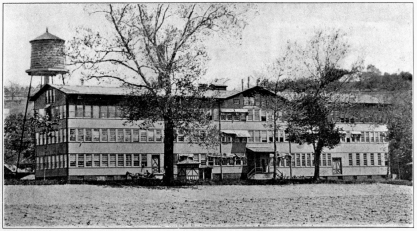
Vincent B. Sterling, who has been engaged with one of the large tobacco firms for many years, and is familiar with the tobacco business, has contributed the following regarding it:
“Like most great enterprises, the raising of tobacco in New Milford started from small beginnings. About the year 1848, the first tobacco in New Milford was raised by George McMahon, who was soon followed by Seeley Richmond and Elijah Hall. These three men were without doubt the pioneers of the tobacco-raising in the Housatonic Valley.
“From that time it has been cultivated with more or less success, until, to-day, it is the leading crop of the farmers of this and surrounding towns. The amount grown at present is about one thousand three hundred acres annually. The variety was Broad Leaf, up to 1883; since then, it has been almost exclusively Havana Seed.
“Probably the amount invested in tobacco in the early fifties did not exceed five thousand dollars per annum, while, at the present time, at least five hundred thousand dollars is used annually buying and packing it. No crop grown by the farmer requires such constant attention. From the sowing in April, through the transplantation in June, until the matured plant is harvested and placed in the curing sheds in August and September the greatest care must be exercised. ‘Eternal vigilance’ is the price of success, and a sharp hailstorm of a few minutes’ duration may destroy the results of the summer’s labor. During the early fall the plants are taken from the poles, the leaves are stripped from the stalks and packed in bundles, and the tobacco is then ready for the buyer.
“It is probable that tobacco was first assorted and packed in New Milford in 1848 by George McMahon, who was followed, a few years later, by Perry Hall. These men were the first packers in the Housatonic Valley. Space will not permit mention of the parties who have been engaged in the business since that time. At present, it is one of the leading industries of the town. There are twelve tobacco warehouses, employing through the packing season in the neighborhood of four hundred men.
“Most of the capital needed to pack the tobacco is furnished by the large tobacco jobbing firms of New York and Chicago, who employ local men as buyers and packers.
“The crop as a whole is an important source of wealth to the farmers, as is evidenced by the many thrifty and beautiful homes of the successful tobacco growers scattered over the hills and valleys of New Milford.”
There are some notable manufacturing industries in this town.
The manufacture of wool hats here dates back nearly a century. Glover Sanford began making them in 1823, on a small scale, in Bridgewater Society. The business steadily increased and was carried on by himself and brothers till 1870, when the firm removed to Bridgeport, Conn.
Smith & Erwin opened a hat factory in Bridgewater in 1834, and removed to this village in 1855, occupying the long building now used as a store by the firm of Ackley, Hatch & Marsh.
Isaac Reynolds began hat manufacturing in Bridgewater in 1847, afterwards removing to Lanesville. Joseph Sanford, Lyman B. Stone, and Francis Callahan engaged in the business at different times. A company was organized there in 1853 under the name of the Union Manufacturing Company.
The modern hatting industry was established in this village in 1885. Some of the leading citizens donated to the firm of Bates & Green a piece of land on West Street Extension, where a building was erected, and the making of hats of fur was carried on in a moderate way until 1898, when a fire destroyed the plant. It was not rebuilt, but the business was reorganized as the New Milford Hat Company, which purchased a tract of land a short distance north of the village, near the mouth of the Aspetuck River, and erected there a large plant with modern improvements. The officers of the company are: Andrew G. Barnes, president; Seymour S. Green, secretary and treasurer, and William G. Green, superintendent. Under their able management the enterprise has been very successful. In 1906 the amount of business done was five hundred thousand dollars; the pay-roll amounted to one hundred and eighty-five thousand dollars, and there were two hundred and fifty employees.
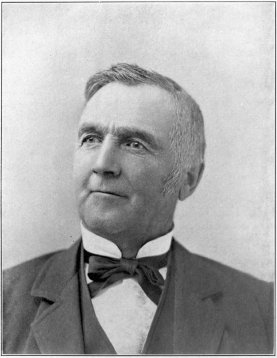
HONORABLE ISAAC BALDWIN BRISTOL President of First National Bank, 1902-1905, and of New Milford Savings Bank at time of his death
Merritt W. Hill and E. W. Hanke formed a partnership and began making hats, about 1890, in the Randolph Hill mill building on Mill Street. At the end of two or three years they removed to the upper part of Maltby Leach’s flour and feed store on Railroad Street, where they were incorporated as a stock company in 1894. This company was dissolved in a few years. Mr. Hill now has a jewelry store on Bank Street. Mr. Hanke went to Bridgeport, Conn., and is doing a flourishing hat business there.
The manufacturing of buttons from vegetable ivory was begun here in 1866 by Henry S. and Walter B. Bostwick, under the firm name of Bostwick Brothers. The ivory nuts were at that time brought to this country as ballast to ships and sold at a small price, so that the making of buttons from them was quite profitable. Bostwick Brothers erected a building on Railroad Street and carried on the business with great success till 1884, when the plant was damaged by fire. Soon after the firm dissolved. Walter B. Bostwick went to Bridgeport, Conn., where he engaged in business, became prominent and was elected mayor.
Buttons were made at the old hat shop, corner of Bridge and Railroad streets, for several years by Isaac B. Bristol, Robert H. Isbell, William Schoverling, Rufus Leavitt, and perhaps others. About 1878 the Noble Brothers purchased the business and carried it on for a few years. After that, various mechanical inventions were developed there. A few years ago, the building passed to the firm of Ackley, Hatch & Marsh, and is now used for a general store.
A button shop was erected in 1884 on West Street Extension, in which buttons were manufactured by William Schoverling, George W. Anthony, and David E. Soule till 1889, when it was burned to the ground. This put an end substantially to button making in the town, the cost of raw material having increased so much that it became unprofitable.
Making lounges was begun in a small way many years ago by De Watt Pepper. From this slight beginning, the business increased until it became necessary to establish a large plant to meet the growing demands of the trade. The Eastern Lounge Company was first housed in William Schoverling’s brick building on Railroad Street, occupying, in addition to that, the old hat building on the corner of Bridge Street. In 1895 the business was removed to the commodious plant built by William Schoverling, on the site of the West Street Extension button factory, where it has been large and flourishing. The company is composed of De Watt Pepper, president, Mrs. William Schoverling, vice-president, and William P. Landon, secretary and treasurer.
Roswell and Sheldon Northrop began in 1832 the manufacture of machinery in a building, in Maryland District, near where the trout pond of Turney Soule now is, using the waterpower to carry on their business. In a few years they removed to the brook south, and erected a foundry and machine shop, enlarging the business and admitting a younger brother, David, to the firm. They made castings to order, cast-iron fences, and various kinds of machinery. Changes in the firm occurred from time to time, but it always continued in the Northrop family. In 1887 Jasper A. Northrop removed the business to this village on West Street Extension, erecting a foundry and machine shop. He invented and began making a heater for warming houses, which he named the “Unique.” This heater is made for both water and steam, and is sold extensively in this region.
Paper making from straw and rags has been carried on in this town for many years. Albert S. Hill and Edward Barton erected a paper mill in 1852, about a mile above Northville, on East Aspetuck River, where they made straw-board paper for hat and dry goods boxes. This business was continued until within a short time. The site had been used for a saw-mill more than seventy years before the paper mill was erected.
Just below this mill, on the river, was a grist mill, which was purchased in 1862 by William W. Wells and his brother Edwin S. They ground flour and feed there many years, and also constructed a saw-mill. This property has been used as a mill site for more than one hundred and twenty-five years.
Justus Miles came from Milford in 1742 and purchased the farm in Park Lane where the old house known as “Miles’
UNITED BANK BUILDING
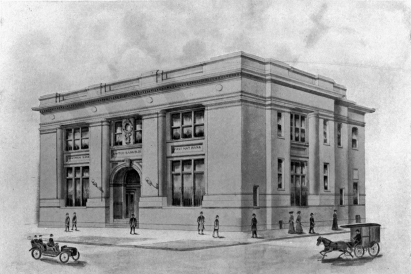
Tavern” still stands, and where, from an ancient sycamore, still hangs the old iron crane which bore the tavern sign a hundred years or more ago. He built the works known as the “Miles’ Grist Mill” in 1748 “by the north end of Henry Garlick’s home lot” on East Aspetuck River. Manufacturing of some kind has been carried on there ever since, paper having been made there for the last fifty years. A company organized as the “New Milford Paper Company” recently purchased the property, and is preparing to do a large business in making cardboard and paper.
The Merryall Plough Foundry was established soon after 1800 by Elijah Hall. He made castings for ploughs and invented the “Hall Plough,” which was very popular among farmers for many years. Mr. Hall was the first man in the State to use bituminous coal for forge work.
In 1768 Angus Nicholson purchased land on West Aspetuck River, and, some time after, built what was known for a long time as Nicholson’s Iron Works. He erected a square marble stone, which is now standing, on the corner of the road a short distance above Wellsville, with the following inscription: “To Wm. Nicholson’s Ironworks, 2 miles from New Milford, 85 miles from N. York, 1788.” On the east side of the stone, the words, “To Kent,” are inscribed, with an index hand pointing northward.
The manufacture of wool and linen into cloth was begun in the town at an early date. Mills for that purpose were erected on various water courses. Such a business was carried on near the mouth of Rocky River.
About 1820 William Roberts erected cloth works at Gaylordsville. A dam across the river was constructed in the early part of last century, and a saw-mill put into operation on the west side by Homer Gaylord, and on the east side a grist-mill, by Peter Gaylord.
George Wells and brother established cloth works at Wellsville, where they manufactured cloths quite extensively from wool and from wool mixed with cotton. The plant burned down eventually, and was not rebuilt. The property subsequently passed into the hands of Chauncey B. Marsh, who erected a saw-mill and machine shop, which he carries on at the present time. Mr. Marsh is also engaged in large operations in wood and lumber.
As many of the hills about New Milford are of lime rock formation, the stone has been mined and burned for lime since an early date; but this business has been somewhat neglected in recent years. In 1893 Charles E. Griffin leased or purchased of Marshall Marsh a tract of land near Boardman’s Bridge, much of which was composed of lime rock. There he erected buildings and lime kilns, quarrying and burning lime successfully until 1897, when a fire destroyed the property. It was soon rebuilt and carried on until 1902, at which time the plant became incorporated in the New England Lime Company. Under that name, the business has greatly increased, and a large quantity of excellent lime is produced.
The mill site at Little Falls, about one mile below the village, has from early times been used as a grist mill. It was first known as Ruggles’ Mill, then, for fifty years, as Stillson’s Mill, and, after that, as Giddings’ Mill. The structure is substantially built of stone. In 1884, William D. Black joined with Levi P. Giddings in establishing an electric light plant there. Lewis F. Curtis joined the firm a few years later. The New Milford Electric Light Company was incorporated in 1893 by Lewis F. Curtis, Mrs. William D. Black, and Levi P. Giddings. A new dam of stone and concrete has been recently constructed across the river, which furnishes abundant water power. This company furnishes electricity for lighting the streets and public and private houses in the village. A few years ago, an acetylene gas plant was established, which is used to a limited extent.
For many years a company bought land and “rights” to use land on the Housatonic River from Falls Village southward as far as Newtown. The late Hon. Nicholas Staub was very active in this project. In 1898 a company was incorporated as the New Milford Power Company. This company built a high dam at Bull’s Bridge and constructed a canal for about a mile down the river. At the lower end of the canal, on the border of this town, they built a power-house and established on the river electric machinery about one hundred and
MANUFACTURING PLANT OF THE BRIDGEPORT WOOD FINISHING COMPANY
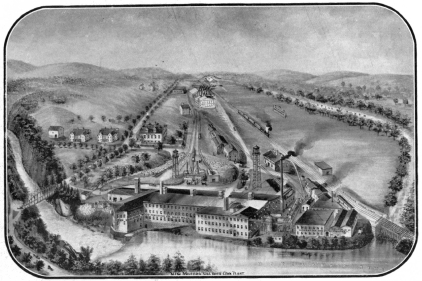
ten feet below the level of the canal. Water is conveyed down this steep declivity to the wheels through a huge cylinder thirteen feet in diameter. The electricity generated here is carried on wires to Waterbury, Bristol, and other cities, and moves the trolley systems of those places.
A company was formed in 1888 for the purpose of making pottery. Buildings were erected a short distance east of Giddings’ Mill, which received their power from the mill by means of a long wire cable connected with a water-wheel. Quite a large business was carried on for a few years; then the plant passed into other hands for other purposes.
George B. Calhoun contributes the following concerning one of the large industries of the town, the Bridgeport Wood Finishing Company:
“This company was incorporated in Bridgeport, Conn., on October 7, 1876, with a silex manufacturing plant at Fort Ann, N. Y. In 1881 the company removed to its present location at Still River, and erected there a large silex, filler and paint, and japan and varnish plant. The principal portion of this plant was destroyed by fire in February, 1902, and was rebuilt with better facilities for meeting its business requirements. The products of the company are ground silex and feldspar, Wheeler’s Patent Wood Filler, Breinig’s Lithogen Silicate Paint, Breinig’s Water and Oil Stains, Japans, Varnishes, etc. The business of the company has steadily increased in volume from year to year, and its products now have a world-wide reputation, so that, at the present time, agencies have been established in all the principal cities of the United States and Canada, as well as in Porto Rico, South America, and the principal European cities. With an auxiliary silex manufacturing plant at Branchville, Conn., and branch offices and warehouses in New York City, Boston, Philadelphia, and Chicago, the company is well equipped to care for its largely increasing interests at home and abroad. The officers of the company are: David E. Breinig, president and general manager; Edward E. Porter, vice-president; George B. Calhoun, secretary; Henry S. Mygatt, treasurer.”
The cause of education has always received the earnest attention of the citizens of New Milford, and the little brown schoolhouses, planted a few miles apart, in which the boys and girls received all their book learning, were landmarks in the New England colonies, as are to-day the more pretentious structures which have supplanted them. In the early days, the Bible was read every morning at the opening of school and religious instruction was given; it was also thought proper to invoke the blessing of the Great Ruler of the Universe.
New Milford was divided into twenty school districts, the schools of which taught the elementary branches. In later years, as the population increased and a greater desire for knowledge was manifested, private and select schools and academies were founded in different parts of the town; at Gaylordsville, at Northville, and in this village.
The most noted school, established in the early part of the last half century, was the Housatonic Institute, which was carried on many years by Benjamin J. Stone and Mary A., his wife. It was situated on the site now occupied by Memorial Hall. This school was known far and wide and received pupils from the surrounding towns. Many of the older people of the town received their education there.
A famous school for boys was the Adelphi Institute, which removed from Cornwall, Conn., to this town in 1860. Ambrose S. Rogers put up fine buildings on the sightly hillside southeast of the village, and conducted for many years an educational institution which took the form of a military school during the Civil War.
The Center School is graded. Its several departments range from the kindergarten to the high school, which last prepares students for college. It is estimated that there are about one thousand one hundred children in the town between the ages of four and sixteen years.
The first kindergarten school in the town was opened in 1873 by Mrs. Andrew Bristol, assisted by Miss Mary C. Wells. Miss Wells succeeded Mrs. Bristol in 1878, and removed the school to her own home on Elm Street. It is called “Sunny Nook.” She prepared herself for teaching at the New York Normal Ingleside School was established in 1892 by Mrs. William D. Black, a daughter of Hon. David C. Sanford and a native of New Milford.
It is a school for girls and has been patronized by prominent families in most of the states.
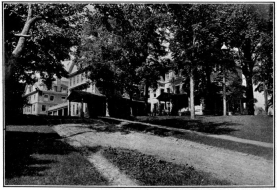
The literary standard is high. The best specialists are employed as teachers and the regular course exceeds the college entrance requirements. It is especially a finishing school and its Post-Graduate Department gives unusual opportunities for specializing in music, art, literature, languages, etc. Physical training is a popular feature. The number of pupils is limited to one hundred.
POST-GRADUATE DEPARTMENT
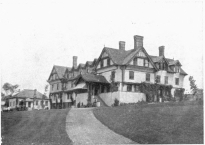
INGLESIDE BUNGALOW
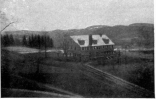
FOUNDATION HOUSE VIEWS OF INGLESIDE SCHOOL
Kindergarten, at which she graduated in 1878. Miss Wells conducts her school with great success.
The Ingleside School for girls, which was established by Mrs. William D. Black, in 1892, and is the pride of the town, is described in another place.
There are six churches in the village—the First[10] Congregational, the parent church; St. John’s (Episcopal); the Methodist Episcopal; St. Francis Xavier (Roman Catholic); All Saints’ Memorial (Episcopal); and the Advent Christian. There is a Baptist church at Northville, a Methodist Episcopal church at Gaylordsville, and the old Quaker Meeting-house at Lanesville. Boardman and Merryall have each a chapel, in which Sunday schools and religious meetings are held weekly. A Sabbath school is conducted in Chestnut Land District.
The Memorial Hall and Library was erected in 1897 as a memorial to the soldiers and sailors of New Milford. Egbert Marsh contributed ten thousand dollars toward the building and gave part of the lot. He also gave the fund for supplying books to the library. Individuals contributed the balance of the cost of this memorial. The upper story is the headquarters of Upton Post, Grand Army of the Republic, which was organized December 20, 1882, with twenty-six charter members.
The first newspaper in this village was the New Milford Republican, established in 1845, by J. K. Averill, who carried it on for a year, then removed to Litchfield, Conn.
Messrs. Bailey and Donavan of Danbury, publishers of the Danbury News, began, in 1872, to publish the New Milford Journal, which was soon after sold to J. R. Johnson, and, later, to Marcus L. Delevan, who changed its name to the Housatonic Ray. The Gazette was started by Gee and Hale in 1877, and passed shortly after into the hands of Robert Erwin. Joshua A. Bolles and Franklyn Henry Giddings of Great Barrington, Mass., purchased the Ray in 1882 and, a little later, the Gazette, and merged the two papers into the New Milford Gazette. Mr. Giddings soon withdrew from the paper, not finding sufficient scope probably as an editor of a country newspaper for his great ability. He has since attained world-wide fame as Professor of Sociology at Columbia University, having written several works on sociology and kindred subjects, some of which have been translated into many languages. Mr. Bolles continued to conduct the Gazette with much ability till he was stricken with a disease which suddenly caused his death, to the sorrow of the whole community. The paper then passed into the hands of Philip Wells, the present proprietor.
New Milford has had a brass band most of the time during the last half century. The original band was organized in 1855 by Earl Buckingham, who was its first leader. At the breaking out of the Civil War, the band engaged with the Fourth Pennsylvania Cavalry. It was discharged by Act of Congress after having served about eleven months. In 1872, a reorganization was effected, with Winfred Soule as leader. Under different leaders, the band has continued, with occasional lapses, to the present time.
Roger Sherman Hall was built in 1875, at a cost of nearly fifty thousand dollars. It is of brick, and has a large hall on the second floor; a courtroom, probate, town offices, and a law library on the first floor; and a town courtroom and “lockup” in the basement. It stands on the site of William Sherman’s store, where Roger Sherman had his shoe shop. On the twenty-sixth of October, 1897, a bronze tablet to the memory of Roger Sherman, which had been placed on the north side of the front entrance of the building, was unveiled in the presence of a large company. The tablet was the gift of the Roger Sherman Chapter, Daughters of the American Revolution, organized May 15, 1893. Mrs. Sara T. Kinney, State Regent, D. A. R.; Senator George F. Hoar, a nephew of Roger Sherman; Senator Joseph R. Hawley; and Henry S. Sanford made addresses.
The first bank was started here in 1852 with one hundred thousand dollars capital, under the name of the Litchfield County Bank. It occupied a small brick building near the Boardman residence on Main Street. Frederick G. Chittenden was president. The first cashier was A. McAllister of Bridgeport, Conn. George W. Whittlesey succeeded Mr. McAllister
ANDREW B. MYGATT Born 1820, died 1901
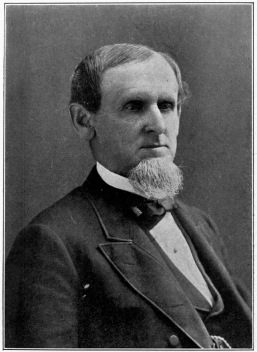
as cashier, and Eli Mygatt and Henry W. Booth were successively presidents. In 1865 it was changed to a national bank and called the First National Bank of New Milford. The presidents were successively Daniel Marsh, Henry W. Booth, Andrew B. Mygatt, Isaac B. Bristol, and Henry S. Mygatt; the cashiers, John J. Conklin, Henry Ives, Henry S. Mygatt, and Everett J. Sturges. The present officers are: Henry S. Mygatt, president; Seymour S. Green, vice-president; and Everett J. Sturges, cashier. The clerks are Robert E. Murphy, Roland F. Mygatt, and Ray W. Leach.
The New Milford Savings Bank was organized in 1858. Eli Mygatt was president, Silas Erwin vice-president, and John S. Turrill secretary and treasurer. Mr. Turrill was succeeded by Charles Randall, who was succeeded, in turn, by his son, H. LeRoy Randall, the present incumbent. The present officers are: Turney Soule, president; Seymour S. Green, vice-president; H. LeRoy Randall, treasurer; Edwin J. Emmons, assistant treasurer. When Dr. James Hine was president, a fine building for the bank was built on Bank Street, which was destroyed in the great fire. On completion of the new United Bank Building, the bank was installed there.
The Agricultural Society of New Milford was formed in 1858, and, since that time, has held fairs and cattle shows each year—with a few exceptions. It now occupies a fine site at Conetia Park.
The New Milford Water Company was chartered in 1873, and organized with a board of directors. Charles H. Booth was chosen president, Charles H. Noble, secretary and treasurer, and Henry O. Warner, superintendent. A reservoir was located on the hill about one mile and a quarter northeast of the village, near the source of Cross Brook, which is fed by springs of pure water. Three other reservoirs have since been built of such capacity that the supply of water is ample for the public and private uses of the village. The present officers of the company are: Albert H. McMahon, president; Verton P. Staub, superintendent; and Harry S. Sanford, secretary and treasurer.
The first fire company, organized in 1830, was disbanded in 1863, and succeeded by the Water Witch Engine Company No. 2. This company was succeeded, in its turn, in 1876, by the Water Witch Hose Company, No. 2, which now occupies a commodious building on Church Street.
New Milford has had several ruinous fires in its history. A fire swept through Bank Street in 1860, and another, a few years later; but the most destructive conflagration occurred on May 5, 1902, when the village was startled by the ringing of bells, the tooting of steam whistles, and the cry of “Fire!” Smoke and flames were seen issuing from the stables back of the New Milford House. The hose company hastening to the scene put forth great efforts, and for a time seemed to have obtained control; but the flames spread in all directions, to the alarm of the inhabitants, who were removing their goods to supposed places of security. The solid block on Bank Street was soon in flames. Then, in spite of the strenuous exertions of the firemen, the fire leaped across the street to the north side and ignited the roofs of brick buildings where merchandise had been placed for safety. The neighboring city of Danbury sent a gallant band of firemen with one of their best engines, with which they labored with great zeal to subdue the flames. With the aid of our own brave boys, this was finally accomplished, but not until the whole block and both sides of Bank Street were smoking ruins. Three hotels, two bank buildings, the Post Office building, and the largest mercantile establishments in the town, with their contents, were destroyed. The only building in the whole square that was saved intact was the fine mansion on the southeast corner of Main and Bridge streets, the residence of State Bank Commissioner Charles H. Noble and his brother, Town Clerk Russell B. Noble—worthy descendants of the pioneer settler of the town.
Did the brave merchants and men of affairs, who could do nothing while they saw their property go up in smoke, sit down in despair? Not they! They cleared away the rubbish before it was cold. They worked with a will to bring order out of chaos. They erected on “The Green” cheap wooden buildings, in which they gathered the remnants of their goods; and
NEW MILFORD AFTER THE FIRE Photograph by C. D. Hine, May 7, 1902
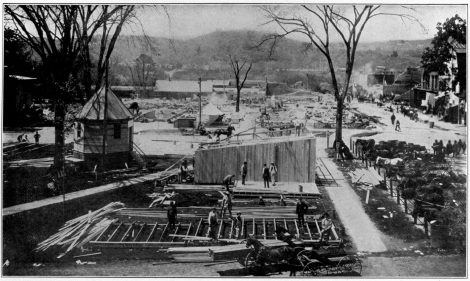
soon the beautiful square looked like a mushroom city in some mining district of the West. They named it “Shanty Town,” and for several months business was transacted there.
After the fire, streets were improved, and the system of drainage was extended. Stores were enlarged—some to double their former size—their business increased, and in less than two years no trace of the terrible catastrophe was visible.
The town was rebuilt of brick, iron, and stone, more beautiful and substantial than before. The three hotels, which had been of wood, were replaced by much larger buildings of brick. On the site of that famous hostelry, the New England Hotel, now stands the magnificent United Bank Building, one of the best equipped banking establishments in Western Connecticut. The National Bank occupies one side, and the Savings Bank the other side of this structure, while in the second story are handsome, commodious offices.
The railroad station was partly burned, but was soon renovated, and at that point in the town great changes are now in progress. A new freight depot is being erected and more tracks are being laid. In the near future, a new passenger station is to be built, and other improvements will be made.
The population of the town is increasing, being estimated at the present time as fifty-five hundred inhabitants. A Board of Trade was organized many years ago. A commercial club now occupies the fine rooms over the new Post Office. The Town Court was established in 1901, and Postmaster George H. Jackson was appointed the first judge. J. Edwin Hungerford succeeded him, and J. Butler Merwin is the present incumbent. The wooden bridges that spanned the Housatonic, and were at times swept away by floods, have given place to graceful iron structures, which are above the reach of high water. The town possesses an excellent telephone system. The facilities for supplying all the needs of the inhabitants are adequate. In a word, to quote Newell Calhoun, “Wealth, learning, and religion have their abiding places here, and have helped to make this village the resting place of the weary, and the working place of the industrious.”
THE STORY OF NEW MILFORD TOLD IN CHRONOLOGICAL EPITOME
Contributed by Russell B. Noble and Minot S. Giddings
1702. Indian Deed to the Proprietors of New Milford was given, signed by fourteen Indians. Consideration, Sixty pounds current money of the Colony of Connecticut, and twenty pounds in goods.
There were 109 proprietors who owned Rights.
The Committee were Robert Treat, Sen., Thomas Clarke, Sen., George Clarke, Joseph Treat, Joseph Peck, Jonathan Baldwin.
New Milford was called a Plantation till 1712.
1703. The Legislative title called the “Patent” was granted by the Grand Court to New Milford.
1706. Zachariah Ferriss came to New Milford and plowed a piece of land near Roger Sherman Hall—the first work done by a white man here.
1707. The names of the three earliest settlers of New Milford are: John Noble from Westfield, Mass., John Bostwick, from Stratford, Ct., John Noble, Jr., from Westfield, Mass.
1708. Daniel Bostwick was born; the first male child born in New Milford.
Dea. Samuel Brownson, Farmington, Ct., Major John Bostwick, Jr., Stratford, Ct., and Zachariah Ferriss, Stratford, Ct., settled in New Milford.
1709 or 1710. Roger Brownson, Farmington, Ct.; John Weller, Springfield, Mass, and Thomas Weller, Westfield, Mass., settled in New Milford.
1710. Sarah Ferriss was born; the first female child born in New Milford.
1711. Benjamin Bostwick, Stratford, Ct.; Isaiah Bartlet, and Samuel Prindle, Milford, Ct., settled in New Milford.
1712. The General Assembly of Conn. granted the powers and privileges of a Township.
1712 and 1713. Samuel Beebe and John Weller were chosen grand jury and sworn.
Benoni Stebbins and Stephen Noble were chosen haywards, or field-drivers.
William Gaylord was chosen inspector and brander, and sworn.
John Bostwick, Sen., was chosen Collector.
Voted: that the inhabitants should pay Six pounds, fifteen shillings towards the minister’s board, Zachariah Ferriss, Jr., holder, Samuel Brownson, town treasurer.
1713. Ensign Wm. Gaylord came to New Milford, residing on the lot subsequently owned by Rev. Nathaniel Taylor.
The town voted to lay out a pastor’s lot and dig and stone up a well for Mr. Boardman, if he became the settled minister.
Voted: to grant a twenty-four shilling lot to Mr. Daniel Boardman, a preacher of the Gospel at the said place, to his heirs and assigns forever, upon a condition that he shall become their settled minister of the place, and continue so for the space of twenty years, or during his natural life and ability so to be.
Voted: that a dwelling house, forty feet in length and twenty-one in breadth and two stories high, and fourteen feet between joints, be forthwith built upon the land at New Milford, proposed to be granted to Mr. Boardman.
John Noble was chosen the first Town Clerk. Zachariah Ferriss, Samuel Brownson, and Samuel Hitchcock were chosen Selectmen. John Bostwick was chosen constable and sworn. Zachariah Ferriss, surveyor. John Noble, Sen., and John Bostwick, Jr., were chosen collectors to join with Mr. Jonathan Law to collect 12 shilling tax for the year.
1714. Main Street, Bridge Street, Elm Street and Bennitt Street laid out.
Voted: that there shall be five shillings and sixpence allowed by the week for the minister’s board for the time to come.
Voted: that there shall be six shillings cash allowed by the town to David Noble, in case he beat the drum the year coming upon all public meetings.
John Noble died Aug. 17. He was the first adult to be buried in the graveyard.
1715. In view of the need of a grist mill in the town, the proprietors, in a meeting held at Milford, Feb. 24, 1715, made this arrangement. Voted: that Ens. Samuel Clark, Sergt. Samuel Beard, and Samuel Brownson, are chosen a committee to agree with some person to build a mill on some part of Still river or elsewhere at his own charge.
1716. John Griswold came from Wethersfield and built a mill at what is now Lanesville.
The “First Church of Christ” was organized by Council on the day of the ordination of Mr. Boardman, and his call and acceptance of the ministry. Religious meetings were held in the house built by Mr. John Reed until a new meeting house was built.
The burying place laid out—Center Cemetery.
1718. Highway laid out from Danbury road to Mill at Lanesville.
Highway laid out across Indian Field from river on west side.
Highway laid out from Park Lane eastward.
1719. Highway from Main Street to Great Falls on east side river laid out 30 rods wide.
1722. June 12th, the New Milford North Purchase was made. It was taken from Waramaug’s reserve.
The first highway on west side of river to New Fairfield line through Gaylordsville laid out.
Highway laid out on west side of Great River from Rocky River by marked trees to Winnisink Brook.
Highway laid out northward.
1723. Ensign Wm. Gaylord went to Gaylordsville and built a log cabin.
1724-5. Capt. John Warner was the first settler at the “South Farm” (lower part of New Milford).
1728. Ensign Wm. Gaylord erected a frame house which is still standing.
The first Grand List made in New Milford.
1730. John Noble, 2d, one of the first three settlers in New Milford, sold his house and lot in the village Nov. 6, to William Gillett of Milford, and soon after settled at Gallows Hill, New Milford plains, and resided there during his life. He was the first permanent settler below Gallows Hill.
1733. Capt. Joseph Ruggles was the third or fourth settler at the Iron Works (Brookfield).
1734. A burying place laid out in South Farms, New Milford, called Gallows Hill, lying on the country road to Danbury.
1736. “Capt. Stephen Noble, Dea. John Bostwick, Samuel Canfield, Sergt. Nathaniel Bostwick, and Joseph Ferriss were chosen a committee to order all the prudentials in building a bridge over the Great River in said New Milford at the place the town hath agreed upon, &c.”
This was a free bridge and was partly carried away by the floods in about three years, when a toll bridge was erected in its place.
Rev. Daniel Boardman was granted the privileges of the bridge free of cost.
1737. The Great Bridge across the Housatonic river was built in 1737—the first to be built from its source to its mouth.
1741. The first Quaker Meeting House built in or about this year, on Danbury road west side of river, nearly opposite Little Falls.
1743. Roger Sherman came to New Milford from Newton, Mass.
Feb. 6. “Voted: that Mr. Roger Sherman shall pass and repass over the bridge and his family; he paying ten shillings.”
December. “Voted: that the Indian natives shall pass and repass over the bridge toll-free.”
December. “Voted: that all persons that shall pass or repass on the Sabbath or Lord’s Day between sunrise and sunset, in order to attend the public Worship of God in a lawful congregation in New Milford, shall pass free from payment over the great bridge in said town for the coming year.”
1744. Until 1744 there was but one military company in the Town. The officers were as follows: Capt. Stephen Noble (served 20 years), Lieut. John Bostwick, Ensign Wm. Gaylord, Capt. Theophilus Baldwin, Lieut. Joseph Bostwick, Ensign Samuel Canfield.
1746. The first Episcopal Church was established in New Milford about this time.
1746. Roger Sherman settled with his brother William on the west side of Winnisink brook, the place called New Dilloway.
1754. Rev. Solomon Palmer, the first resident Episcopal clergyman, came to New Milford.
Voted: “that the meeting-house—— shall be erected in the town street, east from Joseph Northrop’s dwelling house and west from Samuel Comstock’s well, where there is a heap of stones erected.”
Voted: “that the inhabitants of this Society will raise the meeting-house by free will offering.”
Voted: “that the committee shall provide what liquors they shall think necessary to be used at the raising of the meeting-house at the cost of the Society.”
The second Congregational meeting-house was built.
The Newbury Society was incorporated.
1755. The bridge was carried away by flood, and a new bridge built by the taxpayers of the town, and the Assembly granted the privilege of taking toll of all persons except taxpayers.
Ezekiel Payne settled on the east side of the Housatonic, at Gaylords Ville.
Lazarus Ruggles settled at Lanesville and erected the Iron Works.
1756. “Voted: that the old meeting-house which belongs to this Society shall be disposed of as follows, viz.: three-quarters of the body seats and two pews shall be given to the Church of England, and the remainder of the body seats to the Quakers in this Society, and the pulpit to those of Newbury (Brookfield),
CAPTAIN GARRY BROOKS Grandson of Rev. Thomas Brooks, first pastor at Brookfield, Connecticut, and the oldest living person born in New Milford
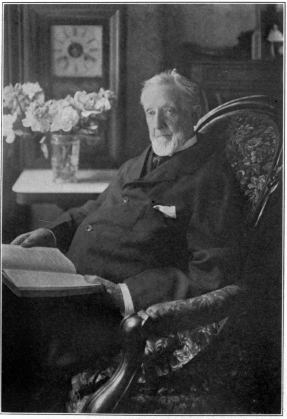
and the gallery seats to those of New Preston Society which belong to New Milford, and the remainder to be disposed of and the avails of it improved toward the new meeting-house in this Society.”
1757. Mary Roberts gave her negro slave, Dan, his freedom upon his paying her £3, 2s. 5d. annually during his life.
The church was organized in Newbury Society Sept. 28th.
Mr. Thomas Brooks was ordained the first minister.
1758. Capt. Joseph Canfield raised a company and served with them under Col. David Wooster. They marched to Albany in May.
1760. Gaylordsville School District laid out.
Upper Merryall burying ground laid out.
1761. The Separatists or Strict Congregationalists built a house of worship near the Center Cemetery.
An effort made to clear the Housatonic River for navigation. A committee appointed and liberty granted to raise 300 pounds money by lottery.
1766. The bridge was carried away and rebuilt, and in three years a part of it went off again. It was again repaired but did not remain a year.
1769. School District organized. Jared Lane introduced the Lombardy poplar tree into New Milford the latter part of the century.
1770. Voted: “that the town relinquish all their right to any part of the bridge to the proprietors, who shall rebuild the same in any place between Little Falls and Wannipee Island.”
1771. School District on east side of the river laid out.
1774. Partridge Thatcher liberated his slave Sibyl on her marrying Amos Lewis, a negro man.
1775. Capt. Isaac Bostwick was sent with a company of sixty-five officers and men from New Milford to Boston in the autumn and winter of 1775, and remained there during January and February, 1776. They were in Colonel Webb’s Regiment.
1776. Josiah Starr served in the Revolution. In May, 1776, he was appointed Captain. In June he was appointed Lieutenant Colonel, Commission dated January 9th, 1777, signed by John Hancock. He was commissioned as Colonel, 1780. Died Oct. 15, 1813.
1776. Capt. Couch’s Company, in Col. Andrew Ward’s Regiment, containing seventy-six officers and men, were sent to New York. The company was in the service two months and twenty-three days.