PART II THE BI-CENTENNIAL EXERCISES (continued 4)
Reading edition
“In those days in New England women were not thought to have minds worth educating, and they were brought up in extreme illiteracy. Nevertheless, their natural wit, brightness, and good sense made them very agreeable companions of the superior sex. And their influence over their husbands, sons, and brothers was quite as great as that of their more cultivated daughters of the present day. The refining, educating, stimulating influence of the women had much to do in withstanding that tendency back to barbarism which life in an isolated and new community led to. The debt which is owed to them is incalculable.
“As the descendants of these people assemble here to-day, after the lapse of two hundred years, to commemorate their work and rejoice in all the strength, beauty, and order, now smiling around us in peace and plenty, which have grown out of what they began, and as we look back upon their condition, trials, and experiences, we are apt to imagine that their lot, contrasted with our own, was an unhappy one. Nothing could be further from the truth. They were a brave, hardy, thrifty, frugal, industrious, and most capable people. Man for man, and woman for woman, they were probably superior to those here to-day in faculty, and in the capacity for healthy enjoyment. Their whole previous lives had inured them to their experiences. They were the sons and grandsons of the original pioneers of New England, and they had been born and reared in rude settlements. They never indulged the delusion that this region was a land flowing with milk and honey. Before they came they knew that they were to wrest their living from an uncongenial soil, to struggle with penury, and to conquer only by constant toil and by self-denying thrift. The forest would supply them with the materials for shelter and fuel and to some extent with food and clothing. All the rest must depend upon their own exertions. There was a pleasure in facing and overcoming the perils and difficulties which they encountered which those, more delicately reared, who live here now can never know. Their individual helplessness in the face of appalling obstacles to be met but bound them closer together in mutual helpfulness. Accordingly we find that their social faculties were highly developed. It may well be doubted whether the sum total of human pleasure among the whole five thousand inhabitants of the town to-day is any greater than it was among the few hundred who settled it. Probably our own superabundance of good things has actually lessened our capacity to enjoy, in comparison with theirs. Their simple tastes and homely joys amid their rude surroundings were probably more productive of positive pleasure and real happiness than all the refinement and culture of our twentieth century civilization.
“It would be a pleasing and instructive task to trace the progress of this old town from those rude beginnings to its present strength and wealth. But the limits of the time and subject allotted to me on this occasion forbid. It is the product of the labors of eight generations, who now sleep beneath its soil. They never could have foreseen the present. They never knew or thought of us. Each generation was busy with its own problems, tasks, and experiences.
“As we look back upon them our hearts are filled with gratitude for the results of their work. A clean-blooded, land-loving, thrifty race, through their activities they escaped from the poverty of their beginnings and attained unto an almost ideal abundance of the primal needs of civilization. Their physical condition became probably as good as that of any other village community in the world. Their experiences stimulated their intellectual life into full activity, and they bore their full share in the wonderful work which Connecticut has done in the world. In all critical times in both State and nation, the sons of New Milford, both native and adopted, have been very active and influential, and one of them, Roger Sherman, performed a work which will last as long as this nation shall continue to be free and independent, or as long as the Constitution of the United States shall endure.
“We know that the past two hundred years are but the beginning of a long history of this town. We believe that as the years roll by, at the close of each century of its life, the events of this day will be repeated here. What will be the lot of those who shall stand here, one two, three, and four hundred years hence, to recall the origin and history of this town, we cannot conceive. Our hope is that it will be as peaceful, as prosperous, and as contented as our own.
“Whatever it shall be, we expect that their desire to know what can be known of that long-vanished world, in which both present and future have their roots, will lead them to examine the memorial of what is said and done here to-day. We are not more sure that the Housatonic will then be flowing than that they will share with us in affectionate interest in what has gone before.”
The rendering of the “Star Spangled Banner” and several other selections by Prof. Clemence’s Bi-Centennial Chorus was an inspiring feature of the Historical Meeting.
THE COLONIAL RECEPTION
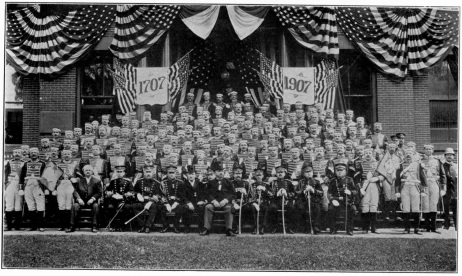
Soon after the close of the Historical Meeting, the booming of cannon announced the arrival in New Milford of Governor Woodruff, his staff and a detail of the Governor’s Foot Guard. They were met at the railroad station by a train of automobiles, in which they were taken, after a short ride about the village, to Ingleside School, where they dined in the company of a number of prominent citizens.
Promptly at 8:30 o’clock, the gubernatorial party arrived at Roger Sherman Hall, where it was arranged that they should meet the people of the town, and entered it by a side door. Before the main door was opened for the admission of the general public, seats were given upon the stage and on the floor of the hall in front of the wings on either side to the members of the Colonial Reception Committee and of the Invitation, Reception, and Entertainment Committee; also to the following persons, who had been requested by these committees to assist them in receiving:
Mr. and Mrs. John F. Addis, Mrs. F. E. Baldwin, Dr. and Mrs. J. C. Barker, Mr. and Mrs. A. G. Barnes, Miss Mary Barton, Miss Hattie Bassett, Mr. and Mrs. C. M. Beach, Mr. and Mrs. S. C. Beach, Miss Charlotte B. Bennett, Mr. and Mrs. W. F. Bennett, Mr. and Mrs. C. P. Bentley, Miss Helen M. Boardman, Miss Kate T. Boardman, Miss Ruth Booth, Miss Lena Botsford, Miss Bessie Brown, Miss Adaline Buck, Miss Alice Buck, Mr. and Mrs. H. S. Donnelly, Miss Susie C. Erwin, Miss Minnie A. Ferriss, Miss Jeannette Gaylord, Mr. and Mrs. Minot S. Giddings, W. G. Green, Mr. and Mrs. S. S. Green, Mr. and Mrs. C. N. Hall, Miss Elsie Hall, Mr. and Mrs. H. D. Hine, Mrs. J. S. Halpine, Mr. and Mrs. G. H. Jackson, Rev. and Mrs. F. A. Johnson, Dr. and Mrs. F. E. King, Mrs. W. F. Kinney, Mr. and Mrs. David Kyle, Miss Carrie Marsh, Mr. and Mrs. Chauncey Marsh, A. H. McMahon, Miss Grace Merwin, Mr. Perry Green, Mr. C. H. Noble and sister, Miss Lizzie Noble, W. B. Pell, Mrs. Pettibone, Mrs. J. F. Plumb, Mr. and Mrs. H. L. Randall, Miss Juliette Rogers, Mrs. Wm. Schoverling, Miss Harriet V. Sherman, Mr. and Mrs. F. E. Starr, Miss Minnie Toussaint, F. M. Williams, Dr. and Mrs. G. H. Wright.
The New Milford Cadets (Captain Gifford Noble) were drawn up as guard of honor about the hall, forming an aisle around an open square, through which the people walked as they advanced to greet the Governor and passed out again after shaking his hand. The members of the staff, in full uniform, were in front of the stage and back of the Governor, while, to the right and left of them, the detail from the Foot Guard were stationed as a special guard. By the side of his Excellency stood W. Frank Kinney, the chairman of the Bi-Centennial Invitation, Reception and Entertainment Committee, who presented every one by name. There were many Colonial costumes, many gay uniforms, and many elaborate evening toilettes. In the exquisite setting provided by the pale blue, white and yellow colonial draperies and festoons with which the hall was most artistically decorated, the reception offered an exceptionally brilliant spectacle. In fact, it was probably the most striking affair of its kind New Milford has ever witnessed.
Dancing was begun, to the music of Gartland’s Band, when the handshaking was over, and was kept up for two or three hours after the Governor and his party had retired.
Governor Woodruff was also entertained in the rooms of the Commercial Club; in Odd Fellows’ and Masonic Hall, where he was formally welcomed by Henry O. Warner, Past Master of the New Milford Masonic lodge; and by the New Milford Fire Department, in their quarters, where he was welcomed by Chief John F. Addis, who presented him with an engrossed certificate of honorary membership in Water Witch Hose Company, No. 2.
GOVERNOR WOODRUFF, STAFF AND GUARD, IN FRONT OF ROGER SHERMAN HALL

GOVERNOR’S DAY
On Tuesday, the culminating day of the Bi-Centennial Celebration, New Milford possessed a population variously estimated at from ten to fifteen thousand—the largest, probably, of any moment in its history. The heat was intense, and some were so tactless as to prophesy showers. Others—and these were right—scoffed at such a possibility, basing their optimism on the fact that the new uniforms of the Governor’s staff had never yet been wet and that New Milford was not going to be ungracious enough to be instrumental in wetting them.
The forenoon was devoted to the preparation of the Civic and Military Parade, which was scheduled to begin at noon. Only a few minutes after the time appointed, the column began to move in the following order:
FORMATION OF PARADE CHIEF MARSHAL SAMUEL R. HILL IN CHARGE. First Division Platoon of Police, Capt. David Bradley of Danbury Chief Marshal and Staff (Perry Green, Noble Booth, Charles Pomeroy, Madeline Dodd, Louise Beeman.) Gartland’s Tenth Regiment Band Second Company, Governor’s Foot Guards, Major Weed Governor Rollin S. Woodruff and Staff Bugle Corps Company G, Third Infantry, C. N. G., Captain Ryder Upton Post, G. A. R., John F. Williams New Milford Cadets, Captain Gifford Noble Official Guests in Carriages Second Division Marshal David E. Soule and Staff (Dr. C. B. Blackman, George Dean, Louis Wilton) Second Regiment Band Water Witch Hose Company, No. 2, of New Milford Danbury Military Band Litchfield Fire Department American Brass Band of Waterbury Fountain Hose Company, No. 1, of Ansonia Holt’s American Band of New Haven Echo Hose, Hook and Ladder Company of Shelton Ansonia Brass Band Eagle Hose, Hook and Ladder Company, No. 6, of Ansonia Bethel Drum Corps Danbury Volunteer Fire Department Third Division Marshal George E. Ackley and Staff (Granville Breinig, W. M. Keeler, Clifford A. Trowbridge) Boys of Center High School, Marching in Costume School Children in Floats in District Order Fourth Division Marshal Henry O. Warner and Staff (James Marsh, W. C. Beeman, Clifford Marsh) Wheeler & Wilson Band of Bridgeport (by courtesy of Roger Sherman Chapter, D. A. R.) Colonial Features Industrial Floats
There were more military organizations, fire companies, drum corps, and brass bands in line, probably, than had ever been seen at one time in New Milford, and they elicited by their brilliant uniforms, stirring music, and fine marching the admiration and the hearty applause of the crowds massed along the line of march; but the features which differentiated this parade from all previous ones, which lent it special distinction, and
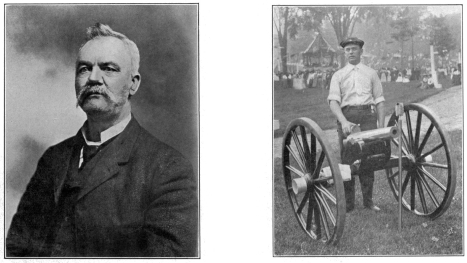
SAMUEL R. HILL. Chief Marshal SAMUEL RANDOLPH HILL, JR. And Gun Used in Firing
which will make it memorable as long as the youngest persons who witnessed it shall survive, were the school floats, the Colonial floats, and industrial floats of the Third and Fourth divisions.
The school features were as follows:
Boys of the Center School costumed as Indians and farmers—the Indians emitting blood-curdling war-whoops from time to time.
Pony cart trimmed with pink and white containing members of “Miss Treat’s class” representing butterflies.
Float of “Room 1” (Center School), trimmed with white and yellow, carrying under a canopy twenty girls dressed in white. It was drawn by two sorrel horses also trimmed with white and yellow.
Another float of “Room 1” trimmed with flags and bunting. It contained twenty-three girls and was drawn by four horses.
Flower girls dressed in pink and green—to represent the petals and sepals of flowers—on a “Cinderella” float provided with a pink canopy. It was drawn by a pair of black horses.
Float of “Rooms 5 and 6” (Center School), trimmed mostly with green and white and carrying twenty-four girls. It was drawn by black horses which were decorated with flags.
Float of “Rooms 7 and 8” (Center School), green and white—stars of green laurel against white bunting—carrying twenty children in white wearing white wreaths.
Float of “Rooms 3 and 4” (Center School), yellow and white, carrying forty children under a canopy.
Park Lane Float, pink and white, carrying thirty-one children—the girls wearing white gowns with pink sashes. It was drawn by iron-gray horses wearing pink and white harnesses. David Rothe’s dog, trimmed with white, blue, and pink, rode proudly on the driver’s seat beside the driver.
Hill and Plain Float, decorated with evergreens, bunting, and flags.
Second Hill Float, representing an open trolley car, bearing the legends—“Second Hill Traction Co.,” “Cross Town,” and “Fireworks To-night”—and, in the advertising spaces, cards provided by the village merchants. The conductor amused the spectators greatly by the tireless energy he displaying in collecting and ringing up the fares. This float, which was trimmed with patriotic bunting, was drawn by three horses and carried thirty-five children, each holding a flag. It was designed by Mrs. Andrew Clark.
Upper Merryall Float, decorated with red, white and blue bunting. It was drawn by black horses and carried twenty-two children.
Chestnut Land Float, white and green—ground pine and laurel against white bunting—carrying forty children. It was drawn by four horses decorated with greenery.
Aspetuck Float, representing a sixteen-foot flower-bordered birch-bark canoe. It was trimmed with garnet and gold and was provided with a garnet banner. It carried sixteen children (gaily adorned “braves” and maidens) and the teacher.
Boardman Float, decorated with flags and patriotic bunting, bearing the device, “1707-1907” in green letters on a white ground. It carried twenty-eight children.
Lower Merryall Float, trimmed with Colonial yellow, white, and blue bunting and flying a big flag. The children, who were seated under a canopy, wore rosettes of the same colors. Four footmen in yellow walked beside it.
Gaylordsville and Waller Float, decorated with bunting and flags. The children, fifteen in number, sat on raised seats, one row above another, and held flags and baskets of flowers. It was drawn by four horses, whose driver was disguised as Uncle Sam.
Northville and Hunt Float, a “little red schoolhouse,” trimmed with evergreens. It was drawn by two yoke of Nelson Kenney’s steers. Children leaning out of the front windows held red, white, and blue ribbons, which were attached to the horns of the steers.
Long Mountain Float, decorated with white bunting, flags, and ground pine. It carried twenty-two children.
Still River Float, trimmed with flags, plumes, and bunting, and provided with a white canopy and a bell. It was drawn
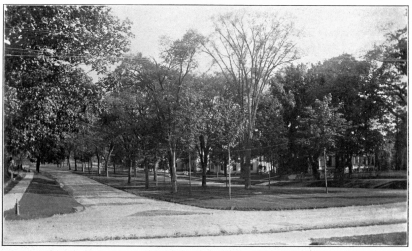
MAIN STREET FROM THE NORTH
by four horses and carried thirty-five children (the girls in white dresses, the boys in shirt waists) wearing flag sashes. The teacher sat upon a throne.
The Colonial features of the parade were preceded by a man carrying a beautiful blue and gold banner of Roger Sherman Chapter, D. A. R., Charles G. Peck of Newtown in Colonial costume on his famous high-stepping horse, and the Wheeler & Wilson Band of Bridgeport—the first and last named, by courtesy of and at the expense of Roger Sherman Chapter, D. A. R.
Next came Mr. Williams and Mr. Lee of the Brookfield Drum Corps in Colonial costumes with drum and fife; and Joseph Cowan, Fred Kinbloe, and William Cogswell in Indian costume on horseback, the last named being a descendant of the Schaghticoke tribe of Indians.
Next, a float with a log cabin representing the one built by John Noble, the first white settler in New Milford. Chauncey B. Marsh and his little daughter, Esther Noble Marsh, seven years old, rode on this float, in the doorway of the cabin, impersonating John Noble and his little daughter. A watch-dog was chained beside the door, a musket hung over the door, and, during the early part of the parade, smoke issued from the cabin chimney. The float was drawn by oxen.
Back of this was started Jim Harris, better known as “Jim Pan,” the last of the Pequots, and the only full-blooded Indian left in the Schaghticoke Reservation. Having filled up with firewater before the parade started, he soon left the Colonial section, marched most of the route with the fire companies, and ended up among the Governor’s Foot Guards. He lost only his wig in the shuffle, the rest of his Indian suit being securely strapped upon him.
Next came Mrs. R. S. Todd and her daughter, Parthenia, in an old-fashioned chaise, with a dignified colored footman on the rumble—all attired in Colonial costume, the ladies wearing sun-bonnets and dimity gowns.
Next, Andrew Humeston, on horseback, with his sister, Athalia, on a pillion, attired as a Quaker and Quakeress. Mr. Humeston’s real white fur Quaker hat, which he went far afield to get for this occasion, was a relic well worth seeing.
Next, Samuel Porter and Charles Donnelly, also on horseback, as a bride and groom of Colonial times. The saddle and pillion used by this happy pair were very interesting.
Next, a float with six young ladies in old-time costume operating different spinning and flax wheels. This float was decorated with dark green and bore the inscription, “Homespun Days.” The young ladies were Miss Florence Merwin, Miss Elsie Hall, Miss Julie Barker, Virginia Stevens (Miss Barker’s little niece, three years old), Miss Flora Stilson, and Miss Minnie Toussaint. The float was drawn by oxen.
Dr. Griswold Bragaw, in Colonial costume, rode a horse following this float.
Next came a carriage, said to be one hundred years old, brought from Merryall and driven by two boys in Indian costume.
The last float represented the different styles of dress of periods fifty years apart in New Milford history. Mr. Frederick N. Fowler and Mrs. William Percy wore the costume of 1707; Willis Barton and Miss Hattie Bassett, that of 1757; Merrit Merwin and Miss Grace Merwin, that of 1807; Mr. and Mrs. Frederick E. Starr, that of 1857, and Arthur Brown and Miss Bessie Brown, that of 1907. This float was canopied with yellow and bore the inscription, “Times and Costumes Change.”
Wm. W. Stilson impersonated the “Town Crier” and, ringing a huge bell, was typical in every way of that old-time character.
The yellow and dark green draperies which concealed the base of all these Colonial floats gave them a highly finished appearance.
The industrial features of the Parade were:
Float of the Bridgeport Wood Finishing Company, decorated with the national colors and displaying the signs, “Wheeler’s Patent Wood Filler,” “Paint That Lasts,” etc. It carried boxes and cans of the company’s products and pieces of silex in its natural state.
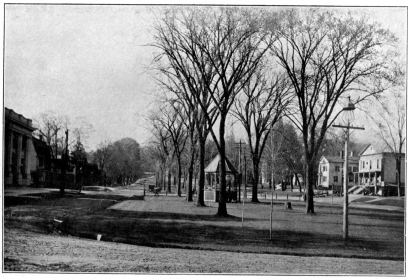
MAIN STREET FROM THE SOUTH
Float of G. B. Shiappacassee, the Bank Street fruit dealer,—a brand new wagon decorated with the national colors and carrying oranges, bananas and pineapples, arranged with a fine consideration for color and form.
Float of the New Milford Hat Company, decorated with the national colors and carrying a group of hat-makers, who gave a practical illustration, along the line of march, of the different processes of hat-making.
A tobacco float displaying the firm names—S. Rossin & Son, J. Lichtenstein, C. F. Schoverling & Co., Staubb & Mallett, J. Marquesee—and the legend, “New Milford Supplies the World with Tobacco,” and carrying a large number of tobacco boxes.
Float of W. H. Coleman, a new milk wagon decorated with the national colors and bearing the inscription, “Conetia Farm Dairy.”
Float of Chauncey B. Marsh, proprietor of a New Milford saw-mill, decorated with white and green and carrying wedge, ax, saw and chain, and an enormous artificial log, which two dummies sawed persistently with a cross-cut saw.
Float of the Aspetuck Valley Grange, decorated with green and white, roofed over with grain, and displaying the principal implements of husbandry and the principal products thereof.
Float of the ice dealer, Samuel J. Ferriss—a capital, white cotton imitation of a snow-bank between snow-laden “Christmas trees.” Upon this float rode two small boys (S. Boynton and Charles J., sons of Mr. Ferriss), offering dippers of ice.
After passing through the principal streets of the village, the parading column was reviewed from the reviewing stand on the village “Green” by Governor Woodruff and his staff and other distinguished visitors. The paraders were then disbanded and provided by the Committee on Refreshments with abundant good cheer in a colossal dining tent back of the Knapp building.
After dinner, at two o’clock, the last formal exercises of the Bi-Centennial were held on “The Green,” Charles M. Beach presiding. In introducing the first speaker, Rev. Timothy J. Lee, Mr. Beach said:
“There is much cause for regret that, on account of ill health, our President, Mr. Henry S. Mygatt, has been unable to be present or to take any part in the exercises of this Celebration. It was at his suggestion that the movement was inaugurated bringing about this event, and we all know that he worked most heartily and earnestly for its success. I am sure that there is a universal feeling of sympathy for him in the keen disappointment which is his. Because of his absence, the duty devolves on me to take charge of the exercises of the day.
“The first address will be words of greeting by the Rev. T. J. Lee, a former pastor of the Congregational Church. Mr. Lee comes to us as a representative of two of the oldest families in New Milford, Mrs. Lee being a lineal descendant of the Rev. Daniel Boardman, who was the first pastor of the old Congregational Church, and also of the Rev. Nathaniel Taylor, who was inaugurated its second pastor in the year 1748, and continued the pastorate for a period of fifty years.
Among other things, Mr. Lee said:
“The other day I met one of our recently adopted sons whose home is in the great West. In the course of our conversation I referred to this Bi-Centenary; but he pushed the subject aside as trivial, and began to boast of his own great State. ‘Why,’ said he, ‘you can put twenty-two Connecticuts into our Nebraska.’ Then he added that the time has come in the history of our country when we can cut out New England and not feel it. Cut New England out from the great life of this nation! Yes, you may, when you can cut out a thread of gold woven in and out in a beautiful fabric without ruining the entire piece. Cut New England out! Yes, you may, when you can cut out from the loaf the leaven that has made it sweet and light. Cut New England out! Yes, you may, when, without disfigurement, you can cut out the features of a mother from the face of her child. There may come a time in some far-off age when this great American people may become so afflicted with some strange, new form of insanity as to desire to cut out from its vast domain that sharp northeastern angle which was alike its birthplace and its cradle and the seminary of the best elements of its greatness. If that time ever comes, New England, true to her ancestral pride (I speak as one who knows and loves his mother), New England will say to you: ‘I am ready to go; I desire to stay no longer where I am no longer wanted. But first—first, in all justice and fairness, give me back some of the contributions I have made to your greatness. Give me back the free, forceful words which from my pulpit, my press, and my platform have kindled the fires of religion and of patriotism, and quickened the intellectual life of generations. Give me back my millions of capital that have stretched across the broad land the iron bands of travel and of trade, changed the Western wilderness into a smiling garden, the desert into a fruitful field. Give me back some of the descendants of those loyal sons and daughters of mine, who, under the canvas covers of those old emigrant wagons, carried with them not merely their humble household goods, but the very principles of their nurture—give me back these, I say, and then, if you do not feel so utterly impoverished, so stripped of everything that can make a nation great and strong and enduring as to repent of your rashness and folly, I will go.’
“It is true that henceforth New England’s influence in the nation will not be that of numbers, nor of territorial greatness, but she will still rule by the force of ideas and convictions, by the sovereignty of principles that can never be discrowned.”
Mr. Beach next presented Governor Woodruff in these words:
“During my business experience, it has been my privilege to make many congenial acquaintances, one of which stands out most prominently to-day. A number of years ago, a young man called upon us representing a firm with which we had established relations. He has risen step by step in his business career, until he now occupies a position at the head of the firm which he then represented. A few years ago his name became mentioned in political circles, and he has risen so rapidly in this sphere that he comes to us to-day as the Chief Executive of the State.
“For integrity of character, for honesty of purpose, for having the courage of his convictions, he is a Governor whom the people of the State of Connecticut will do well to honor. Roosevelt at Washington, Hughes at Albany, Woodruff at Hartford, are the type of public officials which the people want.
“It is my very great pleasure, as well as honor, to present not only to the people of New Milford, but also to the guests whom we are entertaining to-day, his Excellency, Rollin S. Woodruff, of New Haven, Governor of Connecticut.
Governor Woodruff said:
“My friends, I am very glad to join with you in celebrating the two hundredth birthday of the settlement of New Milford. This commemoration will become an interesting experience in your lives, and your children will never forget the history that is taught them by this event. They will learn of the early struggles of those who laid the solid foundation of Connecticut, in the establishment of her towns, in the making of her laws, and building of a great commonwealth out of the materials of industry, education, and patriotism.
“It was no easy task your forefathers set out to perform, when they determined to have a government as nearly democratic in its intention as it was possible to conceive. The scheme of the founders of our State was to insure happiness for all by making all the people independent and free to govern themselves, and to advance themselves in a way that had never before been dreamed of by any race of men. The wisdom of those early settlers in organizing society upon a liberal plane seems to us almost marvelous. What they hoped for has been realized.
“The people who founded New Milford and the other Connecticut towns were unselfish. They planned not only for themselves and their time, but they planned for those that were to come after them. They saw through the years what might be
HONORABLE ROLLIN S. WOODRUFF Governor of Connecticut
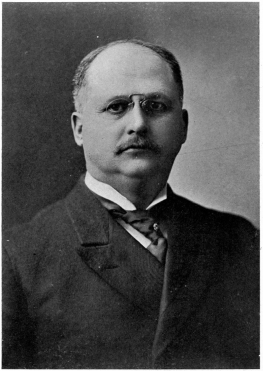
ours, if their plans prevailed. They saw the human race rising to its highest perfection in an atmosphere of liberty and of opportunity. Yet their most daring fancy could not have pictured this surprising scene of to-day. They were rough and rude men two hundred years ago. And they were determined men, and their lives were the serious lives of hardship and peril. What they wanted was freedom and a government that would keep them free. They wanted to do what was right—justice to all men was the motive that inspired them. They had faith in themselves and believed that the real government was that which came from the people; and they made their laws to last for all time, trusting to the people the responsibility of taking care of themselves. They were the fathers of freedom in its truest sense, and intended to leave their children a house that was built upon a rock.
“In all this, they gave evidence of the very noblest patriotism, and they have set for us an example which we have followed for two hundred years—an example which must continue to guide us in our government, if this grand development of Connecticut is to go forward to its highest possibilities. We must keep our foundations solid and build for the future. We must grow better as we grow older. Our lawmakers must be sincere and serious men. They must be representative in the deepest meaning of the word, for the whole happiness of our people depends upon the making and the administration of laws that are enacted in the interest of all the people of our State, and our representatives should be held responsible for their acts at the polls. The rights of the people are sacred and must be kept inviolate, and no law should be placed upon the statute book that will be a burden to the people, or that takes from the people any right that belongs to them all. Let there be no hasty, inconsiderate, or careless legislation that robs them of their own. Great privileges should never be given away to private interests, and every man’s property should be protected throughout the State. We frequently learn what we have lost, when it is too late. I do not mean to alarm you, but I do mean to warn you that you may keep guard over your right against oppression, which is sure to come when the people lose interest in their own affairs.
“What an advancement you have made in two hundred years! The country towns of to-day share with the large cities all modern advantages. Your children have matchless chances for education, and your commercial conditions offer every opportunity for success in life. The farmer of to-day is a prince among farmers and lives in the surroundings of comfort and luxury: with vast systems of water supply; a high sanitary arrangement protecting health; gas and electricity for light, heat, and power; the telegraph in every village, and the telephone in every home where it is required; the best facilities for travel at your doors—a prosperity in business never known in the history of mankind. All men are educated by the affairs of the hour, and all men think. You are better equipped to govern yourselves than any people in the world. Contrast all these comforts with the inconveniences of your ancestors, and tell me have we not reason to rejoice at this Bi-Centennial of New Milford?
“In my position as Governor of this State I have kept steadily in view the general prosperity of all the people, and I have always believed in an educated public sentiment as the safeguard of law and order in our Commonwealth. I believe in the people of Connecticut and in the future of the State; and I believe that the more interest you take in public matters the better your government will become. I want to congratulate you upon the growth of New Milford, and thank you sincerely for the privilege of joining in this triumphant Celebration.”
Mr. Beach next presented Rev. Watson L. Phillips, D. D., saying:
“At this time it is in my power to speak a word of welcome to my comrades of the Foot Guard. They have been connected with the history of Connecticut since 1775, when the Company marched out to Lexington and Concord. It has not been my privilege to be as close to the armory as I should have liked, but I am proud to belong to that old organization which has done so much for the honor of Connecticut, and I will simply ask the Chaplain of the Company to speak to you more fluently than I can.”
Chaplain Phillips delivered an eloquent eulogy of the Foot Guard. Among other things, he said:
“The Second Company of Governor’s Foot Guards was born in that strenuous time when ideas were crystallizing, opinions taking shape, men beginning to realize something of the struggle that was before them; something of the real significance of the Mayflower, of the Colonial forms of government, and of those acts of protest by which the colonies had lifted their voices against the usurpations of the mother country. In 1775, when the clouds were beginning to gather, when men’s hearts were beginning to tremble within them for fear, this company was born. On the first roster, you will find the names of the leading citizens of old New Haven town. The first men of the town were its sponsors. Back of them was a patriotic and humane purpose, and, having that purpose in view, I am able to declare that we are the oldest military organization of the sort in the State.
“The First Company in Hartford antedates us by a few months, but the First Company was what its name implies, the Governor’s Guard. The Second Company came at the call of the danger to liberty and its first act was to make response to the call of Lexington and Concord. Under the man, then a magnificent patriot, Benedict Arnold, the company marched to the defense of their endangered brethren in Massachusetts.
“And these men, before they left, listened to a sermon by Jonathan Edwards, the benediction of which went with them throughout their march. They marched to the powder house—they asked for ammunition; the selectmen of the town denied their request. Arnold drew up his men before the door, and said: ‘We will give you five minutes to comply with our request; if the ammunition is not then forthcoming we will break down the doors and help ourselves.’
“That was the spirit with which they started on their march to Cambridge, and that spirit has animated the command through all these years. It has been our privilege to have been represented in every war the country has waged from 1775 to the present day, beginning with the attack upon West Haven, to repel which the company marched as a body under the command of Captain Hezekiah Sabin. Down through all the wars and in the most conspicuous battles, representatives of this Governor’s Guard have been found, shoulder to shoulder with the patriots of other States and other towns, contending for our liberties.”
The next speaker, Hon. Ebenezer J. Hill, was presented as one who needs no introduction to New Milford. Congressman Hill said:
“One year ago I united with some of your citizens in celebrating the fiftieth birthday of New Milford’s offspring, the town of Bridgewater.
“To-day I congratulate you that the parent has reached the hale and hearty age of two hundred years.
“While New Milford has had many trials and sore experiences, the old town shows no wrinkles, or scars, but is fresh and blooming and ready to enter upon the third century of its career with a courageous heart and unfaltering purpose to maintain in the future, as in the past, the splendid character of our New England civilization.
“There is no higher standard in the world than that, for it was established in the beginning of our history by men who feared none but God. Our fathers built upon the granite hills of New England communities and States, which, though small in area, have been mighty in influence, molding and shaping the destiny of the nation, and through it giving to the whole world an example of self-government, based on the sanctity of the home, the common school, freedom of religion, and the New England town meeting. With these maintained, the prosperity of the future is assured, for, while old age with all its weaknesses comes to men with the passing years, the lapse of time, if rightly used, should make a community or a nation stronger and more enduring.
“Temporary success may come from many causes, but, in the long run, it is character which counts, not only in the individual, but in the nation as well.
“A few weeks ago I visited the site of old Panama, a city on the Isthmus to which it gave its name. It was founded in conquest and plunder, a century before the Pilgrims landed at Plymouth Rock. A hundred and fifty years later, in conquest and plunder, Morgan and his pirate crews swept it from the earth; and now, nothing but an old church and tower, almost hidden in the tropical jungle, mark the spot where this once flourishing and populous city stood.
“A few years ago I walked from the ruined palaces of the Cæsars down the slope of the Palatine Hill into the Roman Forum. The way was paved with stones which were put there twenty-six hundred years ago by the shepherds and farmers from the Alban Hills. Their virtues were as strong and rugged as the stones with which their streets were paved, and their descendants, imitating those virtues, ruled the world for a thousand years. But at last, licentiousness, extravagance, and lust for wealth came in and rotted the moral fiber of the Empire, until the very men who had sworn to guard the nation sold the positions of honor and trust, and even the Empire itself, at public auction at the city gates, as cattle and sheep were sold in the open market; and Rome fell from its high estate never to rise again. It was a literal exemplification of the proverb which was old even then, that ‘righteousness exalteth a nation, but sin is a reproach to any people.’
“But why multiply illustrations? The history of the world is full of them, and, on the other side, none more marked than is shown in our own land in the marvelous progress which the New South has made since the curse of human slavery was lifted from her in the desolation and horror of the Civil War.
“This town, this State, this nation is just exactly what you and I, as individuals, are making it to-day. The past is unchangeable, the future is in the hands of God. Only the present is ours. We have come in our own experience to times of great unrest and discontent with existing conditions. I am glad of it. It shows that the world is growing better and that we are not satisfied to-day with the solution of the problems of yesterday, but it does not follow that the new problems of to-day are unsolvable. It simply proves that there is still room in the world for a large amount of civic righteousness and that it is for the individual citizen to prove that the supply has not been exhausted.
“There is an old hymn which we sing in our churches,
“ ‘We are building, building every day, A temple which the world may not see, We are building, building every day, Building for eternity.’
So far as the immortal and divine in us is concerned, the hymn is all right, but so far as this work-a-day world is affected by our actions I would paraphrase it thus,
“ ‘We are building, building every day, A temple which the world can see, We are building, building every day, Building for humanity.’
“A few days ago I read a story in a newspaper of a man who advertised that he wanted to buy a horse. In a day or two men came with all sorts and kinds, young and old, blind and lame and halt. They told him of the splendid records of the old hacks, and the great possibilities of the young colts, till he finally sent them all away, saying, ‘I don’t care anything about your “has beens” or your “to be’s,” what I want now, is an “is-er.”’
“The men of New England are the heirs to-day of more than two centuries of growth, and progress, and education, and we owe it to ourselves and to our children to add something in our lives to the sum total of human happiness and the public welfare; for there is a mighty difference between always trying to get the better of the community in which we live, and giving to the community the best that there is in us.
“From the very beginning of our State, till now, there have never been lacking men, who, by their strength of character and devotion to the public welfare, have made an impress on their day and generation, until at length Connecticut is known among her sister States as “The Land of Steady Habits.” I can only refer now to two of them, Colonel Abraham Davenport of Stamford, and Hon. Roger Sherman of New Milford. Of the first, Timothy Dwight, in his book entitled ‘Travels in New England and New York,’ tells us that he was a judge in Danbury and a member of the Governor’s Council in Hartford, and cites this incident concerning him:
“ ‘The 19th of May, 1780, was a remarkably dark day. Candles were lighted in many houses, the birds were silent and disappeared, and the fowls retired to roost. The Legislature of Connecticut was then in session at Hartford. A very general opinion prevailed that the Day of Judgment was at hand. The House of Representatives, being unable to transact their business, adjourned. A proposal to adjourn the Council was under consideration. When the opinion of Colonel Davenport was asked, he answered, “I am against an adjournment. The day of judgment is either approaching, or it is not. If it is not, there is no cause for an adjournment; if it is, I choose to be found doing my duty. I wish, therefore, that candles may be brought.”nbsp;’ ”
“Such a man would be a success at any period of the nation’s history.
“Of Roger Sherman, for many years a citizen of New Milford, time would fail me to properly speak of the long and distinguished public services which he rendered, not only to the community in which he lived, but to the nation at large.
“Some years ago, in studying his life and character, I collected from the Colonial Records of Connecticut every mention of his name, and will present the record[45] to the New Milford Gazette for publication; for, of such a citizen, New Milford may well be proud.
“The lives which these men lived, and countless others in the early days, should be an inspiration to us all.
“Opportunity does not come alike to all, but these men simply did their duty honestly, faithfully, and well; and all of us can do the same to-day, in full confidence that the motto of our dear old State—‘Qui transtulit, sustinet’—has not yet lost its meaning or its power.”
After a witty speech by Rev. Marmaduke Hare, who spoke as an Englishman who is an American in the making, Mr. Beach terminated the exercises with these words:
“One brief thought in closing. As the sun sinks behind the hills of our western horizon to-night, we close the second century of the history of New Milford; but let us not linger too long in contemplation of the setting sun. Rather, let us turn our faces eastward and greet the rising sun, which will usher in the third century. Yes, it will be our privilege to enter the portals of another century, but certain it is that not one present will reach its exit. Let us press forward, doing faithfully each duty as it presents itself, placing our confidence ‘in the God of our fathers, from out whose hand the centuries fall like grains of sand.’ ”
Tuesday evening was devoted to a magnificent display of fireworks in Riverside Park on the west bank of the Housatonic, and thus, in a blaze of glory, Governor’s Day, the last of the New Milford Bi-Centennial, came to an end.
THE AFTERMATH
The great event is over, and New Milford has excelled all records and exceeded all anticipations. This might sound egotistical, were it not a fact that it is only the plain truth, and corroborated by the speech of everyone who witnessed the Celebration. Our town stands higher to-day in public estimation than it ever stood before. As we look back, it is not possible to name an event which should have been omitted or a feature which should have been added. A four-days’ celebration has been held, covering every point which such a celebration should cover; dignified and formal, where dignity and formality were appropriate, informal, happy and homelike at all other times.
A celebration very carefully planned, ably financed, and splendidly conducted; with every contingency provided for and the most minute details planned in advance. Our townspeople have shown that they can accomplish great enterprises, for it is the universal verdict of our guests, especially of those who have traveled much and participated in such events, that this was a great enterprise, never equaled in some respects, and never excelled in the matter of perfect appointment. Our townspeople have found, too, that in oratory, music, and literature they have men and women of whom any community may well be proud.
Some special points should be noted regarding the celebration. Perfect order was maintained throughout; during the four days, some sixteen thousand different people have occupied our streets, but, during all that time, there has been no disturbance, no violence or theft, no accident of any kind, and a very noticeable absence of drunkenness. That such admirable order prevailed is a great credit to our town and its visitors, and this community owes a debt of gratitude to the Committee of Public Safety and the selectmen of the town.
Perfect system prevailed, so that every event occurred on time and exactly as planned, with no break or delay at any point. This fact appealed very strongly to our official guests, who had attended other similar events, and knew that delays and unforeseen contingencies almost always arise at such times.
The decorations, public and private, were beautiful and appropriate, and brought the warmest commendation from visitors.
The literary, religious, and historical exercises were of a very high class. Every address and sermon being most appropriate to the occasion and excellent of its kind.
The musical programme was splendidly conceived and carried out, and high praise is due the committee, the chorus, and, especially, Professor Edwin G. Clemence.
The pleasure and success of the Celebration were very largely added to by the presence of Gartland’s Tenth Regiment Band of Albany during the entire four days. Such splendid band and orchestral music was never heard here before.
The Loan Exhibit was a great success; admirably managed and very greatly admired.
The spectacular features were beyond any criticism. Both parades were perfect in appearance and in management, and the fireworks received the highest praise. The Civic and Military Parade was a surprise to everyone; newspaper men and guests, who had seen the world’s greatest parades, declared that the School Division had never been equaled in originality and attractiveness. Our prominent visitors stated that, while a great city undoubtedly could do as well, no great city ever had done as well.
New Milford has won a high place in the estimation of thousands, and has gained vastly in civic pride and public spirit; may these, and the good feeling engendered by the Celebration, last for the next two hundred years.—New Milford Gazette.
The day after the close of the Bi-Centennial Celebration, the President of the Bi-Centennial Committee received the following letter:
“Executive Department, State of Connecticut, “Hartford, June 19.
“Hon. H. S. Mygatt, New Milford, Conn.
“My Dear Mr. Mygatt: Upon my return to Hartford, I want to say just a few words to you in appreciation of the scope of the celebration prepared by you and your fellow committeemen on the occasion of the Bi-Centennial of the town of New Milford. It was a success in every particular, and reflects great credit upon your community, and upon the men who planned and carried it out.
“For myself, personally, and the members of my staff, let me say we enjoyed every minute of our visit, and appreciate to the fullest extent the hearty welcome and the unfailing courtesy of your people.
“It was a source of regret to me, and I learned from others that it grieved them, too, that you were ill and unable to see the fruit of your thought and labor. I hope it will be a gratification to you to know that what you wrought was so well carried out by those who took up the work and followed your plans. You have reason to feel very proud of the whole affair, and I trust that you will soon be restored to health and strength, and be able to return to your delightful home town.
“With best wishes, I am sincerely yours,
“Rollin S. Woodruff.”
The same day, the following letter came to Charles M. Beach:
“Executive Department, State of Connecticut, “Hartford, June 19.
“Mr. Charles M. Beach, New Milford, Ct.
“My Dear Mr. Beach: Upon my return to Hartford I want to congratulate you and your fellow committeemen, and, in fact, the entire town, upon the magnificent celebration of New Milford’s Bi-Centennial. I wish also to thank you for your unfailing courtesy and your thoughtfulness for the comfort of myself and staff during our delightful stay there.
“I enjoyed it myself very much, and I am proud that Connecticut holds New Milford as one of her communities. The enterprise of your citizens, and the scope of their celebration, is equal to what much larger places might have attempted, but few of New Milford’s size. We shall remember our visit there with much satisfaction.
“Sincerely yours, “Rollin S. Woodruff.”
Another letter of similar purport came to H. LeRoy Randall (Chairman of the Bi-Centennial Finance Committee) a few days later:
“Danbury, June 22, 1907.
“H. Leroy Randall, Esq., New Milford, Conn.
“My Dear Sir: New Milford has reason to feel proud over the success of the Bi-Centennial. The Governor said he had the time of his life, and so say we all of us.
“Yours very truly, “J. Moss Ives, “Of the Governor’s Staff.”
THE FINANCES OF THE CELEBRATION
The work of the Finance Committee and Treasurer was not only of the most vital importa“o the success of the Bi-Centennial, but was so remarkable in many ways as to deserve a chapter to itself.
When the first estimates of cost were made, about $4000 was, in round figures, the amount asked for. To many this seemed a large sum to raise by subscription, but the Finance Committee stated without hesitation that the amount would be raised, and more if needed; and the promise was made good by a total subscription of about $5000, secured in an almost incredibly short time. This was accomplished without any noise or public display, and was the result of careful planning and perfect system. The funds were paid out by the Treasurer to the several committees, on approval of the Executive Committee, and a most accurate and detailed account of all expenditures was kept by the Treasurer, and may be inspected by subscribers at any time. There remained a substantial balance on hand after all bills were paid, and while this will probably be devoted to publishing the Book of the Bi-Centennial, the sales of the volume—when published—should return to the treasury the amount expended, and more. No appropriation was asked for from the town treasury, and the only items of expense met by the town were the necessary ones of decorating its own buildings and furnishing the police force during the Celebration. It is safe to state that no enterprise of this nature was ever more ably and successfully financed than was the New Milford Bi-Centennial of 1907.