"Sport and Travel in South Africa" (continued 8)
Reading edition
There are three kinds of cotton indigenous to the regions above-named. The first and most important is that from which some of the natives make blankets. The yellow flower is cup-like in shape, eight inches in diameter, and the pod when ripe is six inches in length. The plant grows to the height of seven and eight feet, with light-green leaves. In the second specimen the flower was, when full blown, four inches in diameter, the pod two inches in length, the height of the tree three feet, with light-green leaves. The third kind is the obendly already described, viz. the flower is green, pod five inches in length, has three sides with a rib between, each side one and a quarter inches wide, and green; the leaf is light-green above and white under.
The Mashonas manufacture a coarse cloth made from the bark of the baobab tree, the size of blankets, and dye them brown; they are very strong and are used as mantles by the natives; they are made by hand without any machinery. This bark could, with machinery, be turned to valuable uses. They also make beautiful bags to hold milk or water, and sacks for general use, very strong and durable. Paper also could be made from this bark, and there are also millions of immense bulbous roots found everywhere, suitable for paper-making, besides other plants valuable for many purposes.
The importance of this railway for opening up the rich gold-fields known to exist in the Mashona country, must not be overlooked in calculating its advantages, for they far surpass in extent those in the Transvaal. Copper, lead, and silver are known to exist also, close to where the railway would go, which cannot now be profitably worked from the expensive carriage and the slowness of the transit to the Colony. Immense quantities of skins of all kinds of animals are now lost in consequence of the expense of bringing them down to the coast for shipment, as well as ivory, horns, feathers, and gums, without taking into consideration the valuable woods, such as mahogany, ebony, lignum-vitae, and others; and what is of the greatest importance in considering a railway, coal is known to exist in the country in any quantity required.
When I visited the Matabele country the last time, I came on a mission from Sir Bartle Frere, to report on the cotton-bearing country, and other matters that information was required on by the Government. On my arrival I reported myself to the king, where I found him on the 30th of December, at his country village, Umkano, or, as some term it, Umganine, a pretty situation with only a few huts beside the king’s, that numbered eight or ten, as before stated in a former part of this chapter.
Chapter Twenty Three.
Mashona and Matabeleland continued, with notes on the country and people, which is within the Zambese basin.
When I arrived at Umkano kraal on the 30th December, it was Sunday; when I had drawn up my waggon in a nice snug nook to be away from the native kraals, and outspanned, it was 4 p.m. Dinner was soon prepared and despatched, and then I sent my two warrior guards to the king to announce my arrival, and that I would call on his majesty to-morrow. A short distance from my camp, four waggons were drawn up abreast, no one to be seen, except a white lady sitting on the waggon-box of one of them. I therefore lost no time in going over, and found it was Mrs Sykes, wife of the Rev. Mr Sykes of Inyatine, who was then holding service in an adjoining hut to a few natives. The other waggons belonged to the Rev. Mr Coillard of the French Missionary Society, in Basutoland, who had come up to Matabeleland to endeavour to found a few native mission stations; and instead of coming up by the main transport road and reporting himself in the usual way, he passed through the Transvaal, crossed the Limpopo at Zoutpans drift, and entered the Mashona country as it were by the back door, and as he travelled north, he was seen to pick a few flowers, which was reported to Lo-Bengulu, when he sent immediately eighty of his warriors to bring him and his belongings prisoners to this station, and he arrived the day previous to my arrival. This brought Mr Sykes over from Inyatine to intercede and get him released, as also his waggons, wife, and wife’s sister, who were accompanying him; a rather dangerous journey for two ladies, when the husband had never been in before and knew not the country, to go exploring unknown regions, and it was a great surprise to us all that they came out safe. When gaining all this information from Mrs Sykes, the gentleman himself, his wife and sister came strolling in from a ramble, when we all made ourselves comfortable round Mrs Sykes’ waggon to enjoy a cup of tea, the most refreshing drink in a climate like this, thermometer standing at 92 degrees at six o’clock in the evening, and a cloudless sky. Mr Sykes soon joined us after the conclusion of his service. When Europeans meet in a region so remote as this from civilisation, surrounded by savage tribes, naked as when they were born, and as wild as nature can make them, knowing no law but that of their king, who rules at the point of his assagai, we at once become brothers and sisters, and friendship is then and there established; so it was with us, chatting and talking as if we had been old and dear friends. It is true, I had known Mr and Mrs Sykes a long time, when I first met them in 1867, and afterwards. Having spent a pleasant evening listening to Mr Coillard’s account of his adventures through that wild region, I returned to waggon and to bed at 10 p.m.; a calm hot night, flies by the million, mosquitoes by the thousand round my waggon. At all Kaffir stations it is the same; the cattle kraals breed the flies, and the water the mosquitoes. At the present time the water is so full of them, that it has to be strained through a piece of muslin before being used.
Mr Fairbourne from Gubuluwayo came in the evening to tell me that Lo-Bengulu intends leaving this station for Gubuluwayo to-morrow, as his great military dance comes off on Tuesday. He informed us all that the party at Ujiji had been laid up with the fever, except the Rev. Mr Price, and some had died. Most of them we all knew. Lo-Bengulu and his Indunas will not allow any white men in the country through which Mr Coillard proposed going, as they state, “If we permit them to reside there, where are we, the Matabele people, to go to, to get cattle and slaves?”—in other words, to rob the Mashona people of their property and cattle; if not peaceable, to slaughter them, take the young children as slaves, and bring them up to incorporate them in the army.
Early on Monday morning, Mr Phillips, old John Viljuen, and Mr Frewen rode over. The latter was going further in, and had proceeded some distance, when he was obliged to turn and come on to this station, and left this morning on his way down country, my two guards returning to Makobis with him.
Height of this station by aneroid barometer, 4970 feet above sea-level. The country round is well-wooded, but the trees are small. 20 degrees 25 minutes South latitude, 28 degrees 35 minutes East longitude.
I went to call on Lo-Bengulu; he was sitting on his waggon-box naked, all but his cat-tail kilt. After shaking hands and passing the compliments of the day, I told him, as he expected one of his regiments over to escort him to the military kraal, I would defer my talk with him until after the grand dance. He asked me to follow him when he started; that meant, I was to fall in with the other waggons of the white people composing the cavalcade.
We started about 11 a.m., Mr Sykes taking the lead behind the king’s waggons, which were surrounded by about twenty Zulu women and girls. One waggon held his sister Nina and the Kaffir beer; next followed Mr Coillard and his waggons, then my waggon, Phillips, Viljuen, and other white men on horseback, and about a hundred of the king’s body guard, about as unique a turn-out as one could desire to see—an African king on his travels—it would have graced Regent street.
After a seven-mile trek, we outspanned for the day at a small kraal, on the road to the military camp—as a messenger had been sent to say five regiments would be sent out the next morning, inviting the king home, being the usual custom on the king returning after a long absence; therefore we selected a suitable place to remain the night, away from the crowd of blacks, and made ourselves comfortable the remainder of the day.
Tuesday, January 1st, 1878.—A lovely bright morning. Thermometer at 9 a.m., 87 degrees. After breakfast the Matabele regiments came over, some four hundred, dressed in their war dress, black ostrich feathers for head-dress, a tippet and epaulets of the same, tigers’-tails in profusion round the loins and hanging down to the ground behind, with anklets of the shell of a fruit the size of an egg, with stones inside to make them jingle as they move their feet; armed with shield and several assagais. So they came on, singing their war songs, jumping up, striking their shields. With their black skins, white teeth, and the white part of their eyes, they were fit representations of imps issuing from a certain place known to the wicked. On arriving at the king’s waggon, where the king was sitting on his waggon-box, they went through a kind of dance, singing the king’s praise, Lo-Bengulu quietly looking on. The king’s wives, between thirty and forty, dressed only in black kilts down below the knee, open in front; the kilt is made of black sheep or goat-skin; some, I think, are made of otter-skin; others had mantles of the same; several had their heads shaved; many cut quite close. After the dance, we all inspanned, and followed the king’s waggons in the same order as yesterday; until we arrived at Gubuluwayo, the military kraal. I took my waggon and outspanned alongside of Mr Wood’s waggons, on the opposite rise to the kraal, to be free from the people, and have some peace; and remained the day. All round the kraal is open, every available piece of ground is under the hoe.
Wednesday, I went in the morning, with Mr and Mrs Sykes, Mr and Mrs Coillard and her sister, who seems to be about twenty, to the king’s kraal, to see the soldiers reviewed by the king, in the open space between the town huts and the king’s enclosure. It was a novel sight, and one seen in no other part of the world. The regiments formed an immense circle, eight and ten deep; there appeared to be about 4000, all dressed in their war dress similar to those of yesterday. Each regiment contains about sixty, and is distinguished by different coloured shields. When they sing their war songs in their deep bass voices, keeping time with stamping on the ground with their right and then left foot, striking their shields with their assagais, the effect is grand—the earth appears to tremble. Occasionally, one or two come out into the centre of the circle, and go through the performance of fighting the enemy, advancing, retreating, then in close combat, striking out with their assagai in imitation of stabbing his foe, and making as many stabs as he has killed victims; others come out when these retire, and this performance goes on during the war songs. It is considered a great feat if a warrior can jump high in the air, and strike his shield several times with both ends of his short stabbing assagai, before touching the ground and knocking his knees and feet together. Then come the king’s wives, old and young, and all the young royal girls, wearing a black goat-skin kilt down to the knee, dressed out with yellow handkerchiefs, the royal colour, profusion of many-coloured beads, many-coloured ribbons, long sashes of broad yellow ribbon, all entering the arena at the same time. Advancing to the centre with slow measured steps, they raise first the left then the right leg, and put it down, keeping excellent time, chanting native songs, the warriors remaining perfectly still and silent, they then turn and retire in the same way; all this time the king is not seen, he is in the cattle kraal with his medicine-man, examining the intestines of two bullocks that have been killed for that purpose. After a time, a clear road is made, and large baskets filled with the intestines are brought out from the kraal: it is death for a native to touch, it; or be near when it is passed away to the king’s enclosure. Then comes out the chief medicine-man, enveloped in long ox-tails that completely conceal his tall figure, reaching to the ground, with a little jockey cap on having fur in front and a long crane’s feather, when he marches up and down in the centre of the arena, and in front of where the king is known to be, singing his praise. After a time, the king makes his appearance, advancing from the kraal with a towering head-dress of black ostrich feathers, an immense cape of the same, a kilt of cats’-tails, with an assagai poised in his right hand, advancing slowly in a stooping position; his fat sister Nina, dressed out with a long kilt half-way down the leg, any number of yellow handkerchiefs over her shoulders, and gold chains hanging down in front and behind, with the feathers from the tail of the blue jay stuck into her woolly hair, and a knobkerry in her hand, also advances beside the king, until they both reach the centre of the arena. The warriors singing their war songs, stamping their feet to keep time, rattling their shields, the scene becomes quite exciting. Poor Nina becomes exhausted, has to kneel on the ground several times, supporting her body with her hands, also on the ground, and looks anything but an elegant figure. The five royal daughters, whose ages average from sixteen to six, advance again, and chant a native tune; then the king calls for silence; order is given that each regiment is to march out on to the open plain and have a sham fight, which lasts an hour, each army advancing, retreating, and fighting. They then return to the enclosure and form themselves in line, when forty black bullocks are brought in for the young braves to slaughter, by stabbing them behind the shoulder so that the skin should not be injured to make shields; some become maddened by the smell of blood, break loose and escape into the open country, the young braves following, and a regular race and uproar follows, creating quite a sensation; and when the night has come, great feasting takes place, and the sports of the day are at an end, and we return to our waggon, wondering what the people in England would think of such a sight of savage grandeur, as was never seen out of Africa. The young Intombies (girls) are all excitement to see their sweethearts so brave. These Zulu maids are most of them good-looking, with teeth as white as snow, well-made in every limb, and graceful in their movements, very scantily dressed, a slight fringe in front being their only covering, but it is the fashion of the country. For several days these dances go on; those who have paid their respects to the king retire to their distant kraals, and fresh regiments arrive to go through the same performance. The English who may be at the station are allowed to be present, but they must keep out of the way, not to be mixed up with the troops, but they can take up any position they like, to have a good view of the proceedings.
Thursday, a lovely day. Went up again to see the review with Mr and Mrs Sykes and the Coillards; found the king sitting on a chair in a bell-tent alone, facing the troops, who were in a circle as yesterday; he was naked with the exception of the tailed kilt. A few braves from his favourite regiment composed his bodyguard; the chief Indunas were with their respective regiments of which they held command; the medicine doctor, clothed in a tiger-skin kaross and a large fur cap with ears of the same, marched up and down before the tent, proclaiming to the warriors the greatness of the king. The English ladies were invited into the tent, and stood beside and behind this dreaded monarch of this dreaded nation, for all other native tribes fear him. The military performance was similar to that of yesterday; rain came on and we returned to our waggons.
Ironstone and iron-conglomerate are plentiful over this part of the country; blue metamorphic rocks crop up between slate shale and quartz, similar to that of the Tati gold-fields, in all directions. Fine gold-dust is found in the rivers to the north, but no one is allowed to prospect. There are at the present time thirty traders at this station, and many hunters both English and Boers are in the hunting-field, who must obtain permission from the king, and pay a licence in the form of a gun, horse, or any other article the king may accept. Several of the Boers have been abusing this privilege, which has caused the king to be very severe on the white man going in; some also have gone in under a shooting licence, and have been found prospecting for gold. This has offended Lo-Bengulu with the English, and makes him suspicious of all who visit his country. He is naturally partial to the English, and his sister Nina is their champion if any get into trouble; many have been robbed up-country lately by the natives; amongst the number are Byles, Kirton, Scott, Webster, Phillips, Jacobs, and many others.
Friday. I saw the Rev. Mr Sykes, showed him my official letter, and went with him to the king to ask permission to pass through his country to the eastern boundary. He was sitting on an old champagne box, leaning back against the cattle kraal fence in his usual undress; immensely fat and tall, he looks every inch an African king. He heard my statement, but made no remark. Mr Sykes sat on the ground by his side, and I took up my position in front, and began to smoke, waiting for an answer. Some ten minutes later a little Mashona boy brought on a piece of grass matting four large pieces of bullock’s lights, that had been broiled over a fire, and a fork, advancing on hands and knees to his dreaded master, and placed them on the grass in front of his majesty, who took the fork, transfixing one after the other as they disappeared from sight in his capacious mouth, asking at the same time many questions on down country news, and how the Queen was, and numerous other remarks.
Finding he did not intend to give any answer, I told Mr Sykes we would leave him to say yes or no at some future time, that I did not come begging, but only asked for what I had a right to expect he would grant, and shaking hands we departed from his sable majesty, who was enjoying the heat of the sun as he sat on his old wooden throne. It was a very hot morning. Thermometer 97 degrees in my waggon, and in the sun must have registered at least 140 degrees, but these black skins can stand any amount of heat; it seems to absorb it without creating any inconvenience. On my return I found Mr Wood, with his two waggons outspanned close to mine, had pushed two of the chief Indunas into a thorn hedge for calling him a dog; this has caused great commotion in the Kotla, the king’s kraal. Mr Wood went to see the king, but he would not say a word, but I expect to-morrow something will be done.
I visited some of the traders’ stores and met Mr and Mrs Elm there, who invited me over to visit them at their mission station, Hope Fountain, four miles distant, most pleasantly situated on the spur of the hill overlooking a vast stretch of country to the east; it is a most healthy locality.
Saturday, up all night, annoyed by wolves and dogs. Mr Wood’s affair came to nothing, as Lo-Bengulu would not interfere. He left this morning for Umcano, also Messrs Sykes and Coillard with him, as he has not yet released the latter. I received a letter from Rev. Mr Thomas, of Shiloh, enclosing letters for Messrs Elm and Coillard, and wishing me to visit him.
Three months ago Lo-Bengulu sent in an Impi into the Mashona country on a marauding expedition, where they attacked several kraals, killing the people, bringing back sixty slave children and all the cattle and goods belonging to them. A month previous a large Impi went into the same district, where, as far as it can be ascertained, they killed all the old people, making some of the women and big girls carry the plunder to the boundary; then they made them put the things down on the ground and then killed them, because they might run away if brought into Matabeleland; preserving the little children who were brought in because they soon forget the country they have left.
The weather is rather warm, 98 degrees, with heavy showers, storms round in every direction. Several euphorbia trees are close to my waggon, that make a nice shade, and not far away there is a tree where a few months back three women and five children were hung for witchcraft, because one of the king’s wives and two of his children had died the night previous, and a wolf was killed within the king’s enclosure by his dogs; a Kaffir supposed to have bewitched them was killed also. This occurred just before my arrival. At last year’s dance, when 7000 warriors met, a black bull had his shoulder cut off when alive; this is a custom with the tribe on some occasions, but I could not ascertain the particulars.
The king’s wives do not pick in the corn gardens, but his children do, and also carry water the same as others; his reason is they must learn to do such things; and his daughters go naked like the other girls, and frequently pay my waggon a visit for tufa or tusa (present); sometimes they are seen walking about with black skin kilts. Most of them are young, but they, as well as the women, wear few or no ornaments; very few beads are used, mostly pieces of leather strips round the neck and wrists, none on their legs or head, as is seen on other tribes. The Matabele women do not seem to take so readily to clothes as all the other tribes, who are eager to be dressed up in petticoats, because I presume it gives them greater liberty of action in their loins, from their present cramped and bound-up state in their leather coverings.
I was surprised one day, soon after my arrival here, on returning in the afternoon to my camp, to find four Zulu girls sitting under my waggon, chatting and laughing with my Hottentot driver and forelooper, having with them three fine bunches of beautiful ostrich feathers. When I looked under the waggon and they saw me, they all gave a yell of delight, and came out, when I recognised them as old friends who had frequently washed my clothes when I went to Barkly, in Griqualand West, two years back, and always admired their clean neat appearance in their white European clothes. They told me their mother, who was a widow woman, wanted to go back to her nation in Matabeleland, and they had only lately arrived, having been on the road six months; and having heard of my arrival, they came to see me, and had brought me some ostrich feathers as a present, and as they knew my two boys they seemed to be at home again.
I asked them what they had done with their clothes. They said they had them tied up in bundles and were in the hut occupied by their mother, where they lived, and as they were amongst their own people they dressed or undressed as the other girls. I found them to be very convenient, as they did my washing and other things for me. I took the feathers and paid them in beads, kerchiefs, tobacco for snuff, and such things they wanted as presents; they would not take them in payment, showing these people have some kind feeling; and during my stay at this station they remained with me the greater portion of every day, their old mother coming occasionally to pay me a visit. They could speak English perfectly; they told me they would like to go back with me if their mother would let them, but four grown-up girls in my waggon would have been too much of a good thing. I should occupy many months in returning, if I ever did, and it turned out that I did not visit Barkly again for three years. If there had been women at this station wearing clothes, these girls would have retained theirs; it only shows the force of example.
Thursday, 17th. I arrived yesterday from exploring the country round, much delayed by the wet weather and heavy thunderstorms, which have lowered the temperature of the atmosphere down to 67 degrees, and yet this is the height of summer up in the tropics, a difference of 30 degrees in a few days; a great-coat is comfortable. I obtained a Mashona blanket made of native cotton, also three battle-axes. Lo-Bengulu, last Tuesday, himself took a burning piece of wood and destroyed the eyes and nose of one of his men because he threw a stone at a child and knocked out its front teeth; this was witnessed by one of the traders. And a short time previous he had one of his chief Indunas and his three wives and three children killed, as it is stated, for witchcraft, but other reasons are supposed to have been the cause; their bones are lying a short distance from my waggon, having been picked clean by wolves; they are very plentiful here and visit us nightly, being on the look-out for human food, as all who are killed are thrown outside the station for them and the dogs to eat. Lo-Bengulu, at the same time, is very fond of children and will not allow them to be annoyed; he will not allow any milk to be sold by his people, but it is given to the slave children.
A curious custom prevails amongst these people at the death of a relative. When any member of a family dies, he or she is immediately taken out of the kraal to some adjacent land and buried, sometimes in a sitting position. Then for a week, and sometimes for a month, a fire is kept burning every night close to the grave, and two or more of the family have to remain there during that time. Another curious custom is in existence in the king’s kraal; there is a hut within the king’s enclosure which no one is allowed to touch, not even to pull a straw from the thatch. If any one commits such an offence the king tells some of his people to take him out of the kraal, which is tantamount to ordering him to be killed. A short time ago a young Kaffir was killed for committing this offence, and the wolves and dogs had a good feast that night.
Lo-Bengulu has no heir to take his place when he dies, not having a royal wife, but if one of his wives should have a son, and he does not take to wife a princess, she with the child, immediately after its birth, will be banished, and have to live in a distant country; but still a watch is kept upon her, and in the event of the king dying, the mother and child will be brought back, and the child adopted by the people as their king.
20th. Lo-Bengulu came into the station this morning, and about 500 warriors went out to meet him, dressed in all the pomp of war. His sister Nina came in, in a horse-waggon, and the king with three waggons and forty loose horses, men, women and children following on foot, as the great national dance takes place on Tuesday; all the other dances being rehearsals previous to this, which is the most important and imposing of all.
Tuesday, a very hot day. Many divisions of the Impi coming in from all quarters and marching up to the great camp; as this is the last day of the old year with this nation, they commemorate it by great national rejoicings. About twelve o’clock I walked up with several of the hunters and traders, and took up our position close to the entrance of the king’s private grounds, when regiment after regiment came marching up, dressed in their war dress as before described, with shield and assagai, and took up their position so as to form an immense circle of ten and twelve deep, within the enclosure close to the king’s kraal, who came out to show himself for a few minutes and retired. In the mean time, his wives, dressed in beads and bright yellow kerchiefs over their shoulders, and long black kilts or skirts down below the knees, young girls dressed in short kilts, and a profusion of ornaments round their loins, arms and heads, stepped into the open space within the circle of troops, and chanted songs, moving forward at the same time, the warriors singing and raising their shields up and down, keeping time with their feet. Nina, the king’s sister, came forward also, dressed in beads of many colours round her waist, back, and skirt, brass and gold chains, gold watch and chain. After a time Lo-Bengulu came forward with a dancing gait, and took the lead out of the station at the head of his own particular regiment or bodyguard, whose dress and shields are all black, each soldier not less than six feet, followed by the other regiments, when they formed into three sides of a square. Then the king came forward, surrounded by his bodyguard, and threw an assagai at an imaginary enemy, when all the troops were instantly in motion and returned to the open space in the enclosure, when the rain came down so fast that it put a stop to further proceedings. But previous to the king’s leaving, about 100 oxen were driven out of the circle where they had been kept by the whole of the Impi, and were soon slaughtered for the great feast that was to come off that night. Altogether it was a pretty and novel sight, and if the weather had been fine, the effect would have been most singular and striking. Some 500 women and girls stood in groups to witness the performances. The women who danced held sticks ten feet in length with the bark peeled off; the slave population looked on at a distance. I made the best of my way to Mr Peterson’s store, where I found Mr and Mrs Elm, Mr and Mrs Coillard and the sister, and took cake and coffee with them, and then to my waggon which was outspanned on the opposite hill. The programme for this review was upon a much grander scale than the former already described. The next day the troops returned to the respective military camps, and the last of the military dances ended in a downpour of rain, amidst crashing thunder and flash after flash of the most vivid lightning I have seen for a long time.
On the 27th January, I called on Lo-Bengulu for an answer to my request; he was sitting under his verandah on a chair. We shook hands, and he stated he could not allow me to cross his country, because if I attempted to do so the people would kill me and he would be blamed by the English for the cause of my death; that if I wanted the things I wished to go in for he would try and get them, and send them down to the Governor; that I should never return if I went in, for the Mashonas would destroy me and he could not help it.
This I saw was mere excuse; he had stated the same thing to others, but it was useless to argue the point with him, and to go in without his sanction would have been madness, as the country at the present time is in a very unsettled state, as Colonel Saltmarsh, whom I met on the Maclutsie river, as I was going in and he was coming out, told me how he had been treated by the people, and his boys became frightened, he was obliged to return; that he was disgusted with his trip and was glad to get away. He also told me Lo-Bengulu will not allow any one to go beyond his station. Messrs Bray and Wood took a letter from Sir Theophilus Shepstone, the administrator of the Transvaal, to the king, asking as a favour to allow them to go in, but the king refused point blank, and stated while he is king no one shall ever go into the Mashona country.
One hunter had his waggon turned over and all his things stolen, and when complaining to the king of his people’s conduct, his reply was he did not tell them to do it, and he got no satisfaction; not very encouraging for my success, therefore I was prepared in some degree for a refusal. I believe the Colonel had a gun stolen from him also. At any rate he did not intend to go without his Christmas pudding if he had proceeded, for on the banks of the Maclutsie where I met him, he was preparing a very fine one, and asked me to join him in disposing of it. The next day we parted, the Colonel for the South and I for the North, to try my luck with this powerful and despotic monarch. And as affairs turned out it was a lucky refusal for me, for a few months after, as I was exploring the western portion of the Mashona country, reports came to us by a native that three white men had been killed in the Mashona country, not so many miles away, by the natives, but they could not give the names. But afterwards, on my return to the Tati, I found they were Captain Patterson, Mr Sargeant, son of Sir W. Sargeant, the Crown Agent, and formerly Colonial Secretary of Natal, and a son of the Rev. Mr Thomas, of Shiloh, who had left the Transvaal a few months before with a letter from Sir Theophilus Shepstone on a mission from him to the Matabele king. At the time there was great mystery concerning their death; it was first reported they had been poisoned by drinking from a pond that had been poisoned by the Bakalahari Bushmen, but that was absurd. It appears that Captain Patterson had entered into some agreement with Lo-Bengulu which was not pleasing to the Indunas, therefore to put an end to the agreement it was arranged to put an end to them. Rumours of foul play got abroad, and young Mr Thomas, son of the missionary at Shiloh, who was one of the three, went as guide; he was warned, but would not believe the report. Mr Palmer, who was going to accompany them, also heard strange rumours, and he declined, which saved his life. The very fact of rumours of foul play going to be perpetrated was proof that their death had been planned before they were on their way to the Zambese to visit the Victoria Falls, and as confirmation of this, Lo-Bengulu said afterwards to some of the white people, “Now Captain Patterson is dead, the agreement goes for nothing.” It is supposed the three were killed when they were bathing, but no document was found amongst Captain Patterson’s effects to throw light on this matter, and Mr Thomas, the father, was afraid to express any opinion, or to have a full inquiry made in the affair, as he was living in the country and would have been killed if he had said what he thought. He died last year.
That they were murdered there is no question. Captain Patterson was in the employ of the British Government, and was in Matabeleland on official duties, therefore it was the duty of the Government to investigate the matter and to have sent up an officer competent to carry it out, instead of making inquiries of the British residents on the spot, who dare not speak what they knew, and to have given Lo-Bengulu to understand that British subjects were not to be murdered in his territory with impunity. It is this shirking of responsibilities that lead to dire results, and is unbecoming the dignity of a great nation like Great Britain. This has been the fatal policy of the British Government in South Africa, which has caused the misery and bloodshed that has swept over South Africa these last few years, and paralysed the whole trade of the country. It is not only detrimental to the Colony, but our British workmen at home suffer, from the stoppage of the trade to those regions that so largely consume British merchandise. If the people of England were to look a little more into these matters, instead of wasting their time in that petty party spirit which seems to be on the increase, and devote that time in improving and developing our trade in our colonies and elsewhere, it would be more conducive to their welfare than employing it in quibbling over who should have votes or not, and woman’s suffrage, that will not bring one penny more into the pockets of the people; and such other trifling matters, unprofitably employing the time of the House of Commons, which should be devoted to the general interests of our country abroad, and in our colonies, that are the main source of our prosperity and wealth, which means, in other words, full employment for our workpeople; for no other policy will put bread into their mouths. If this contemptible party spirit, which has now grown rampant, should increase, England’s greatness is on the wane, for where a house is divided against itself, it cannot stand. This spirit, of opposition in time becomes a mania, and the most vital interests of our country are sunk in the glory, as they imagine, of turning out their opponents from office. I hope all who wish for the prosperity of Great Britain will rise to the occasion and become what their forefathers were, staunch and determined upholders of British interests, which means prosperity to her people, where the weal of Great Britain is concerned, and sink that petty and unpatriotic spirit. My fate most probably would have been similar to those unfortunate men, as it was known I was on a mission into that country also. I might have gone and never been heard of more, a satisfactory conclusion to arrive at.
The Mashona country in the north is but little-known, from the difficulty thrown in the way of exploring it, particularly along the south side of the river Zambese; gold in large quantities is known to be there, as also other minerals. On the north side of the river gold has been found, but until some better mode of transit is adopted, such as a single line of railway, with shuntings at stated distances, the richness of these regions cannot be developed. A railway would revolutionise the whole country, to the immense advantage of our Cape Colony and Great Britain, and the civilisation of the native tribes.
When Lo-Bengulu became king, in January, 1870, it was supposed the rightful heir to the throne, “Kuruman,” born from a royal wife of Moselikatze, was dead, killed by order of his father, as it appears there was a conspiracy amongst the Indunas to dethrone him, and place Kuruman in his place. Moselikatze, hearing of this, as he was out with an army making conquest in the northern part of the Mashona country, immediately returned and made an attack on a kraal where these Indunas had assembled, Inthaba Inisduna, and slaughtered them and all the people, except Lo-Bengulu, who was his son by another wife, but made a royal child—and with those slaughtered, it was supposed Kuruman was one, but it was found afterwards he had escaped. Moselikatze sent for him, and ordered a Basuto to take him away and destroy him, but he was not to injure his person, that one belonging to royalty should not be mangled.
Kuruman’s servant was also commissioned to assist in the murder. When it was accomplished, as is supposed, these two men returned to the king and reported his death, but it is supposed by others that he was allowed to escape, and that he found his way down to Natal, and became a servant of the Honourable Theophilus Shepstone, the minister of native affairs in that colony, and nothing more was heard of him for some years. Still the Matabele were much divided respecting Lo-Bengulu becoming king, and many military stations would not acknowledge him; the consequence was, a general slaughter took place, and kraal after kraal were visited by the king’s troops, killing man, woman, and child, depopulating large districts, and after some time reduced the number of his opponents to a few, but still never entirely crushing them out, or destroying all who still clung to the hope of getting rid of Lo-Bengulu. Many of the men spared in these fights were incorporated in the army that remained true to the king. Soon after it was reported that Kuruman was alive in Natal; messengers were sent down to ascertain the fact; and also some refugees stated he was Kuruman. He denied he was the Kuruman, but afterwards, in 1871, acknowledged he was, and departed for the north to claim his rights. The last time I heard of him he was at Rustenburg in the Transvaal. The doubt that has hung over Lo-Bengulu, as to his really being the right man, has made him very watchful, and it seems this supposed Kuruman is still looking out for an opportunity to enter the Matabeleland and try his luck, but Lo-Bengulu is too securely settled on his throne to be easily deposed.
At the death of Moselikatze, waggon-loads full of presents of every description, presents from those who had visited his country, and payments for the privilege of hunting in his veldt, became the property of Lo-Bengulu, and were thatched to preserve them from the weather, never to be used, because the great king had ridden in them; the empty ones were destroyed at the burial of the king; taking those loaded to Gebbeklaiko, now called Gubuluwayo or Bulowaiyo, where the royal widow of Moselikatze went to reside after the death of her husband, and also where Lo-Bengulu took up his royal residence, which he has occupied up to the time when it was recently destroyed. He has several kraals in different parts of the country that he visits from time to time, for a change. Mr and Mrs Coillard are still here, not yet having obtained their release, but expect it daily. Mr Sykes has been indefatigable in the affair, and clearly explained the object of his visit to establish several French missionary stations throughout the Mashona country under native teachers. But Lo-Bengulu, although very kind to the English missionaries, is not a believer in their faith, and his people are very much of the same opinion, consequently there are few converts. All the districts are visited by them. Mr Sykes and also Mr Thomas have for the last twenty-eight years been at much trouble, but cannot convert them. They have their great spirit, Molemo, and with their medicine-men to make rain for them, they seem contented to remain.
In the afternoon I left for Thabo Induna, which is the place where the massacre of the Indunas took place under Moselikatze previously mentioned, and then on to Umzamalas town to Inzalion, but as Mr and Mrs Sykes were with the king, went on to Mr George Wood, an old traveller and hunter, who showed me several pieces of gold he had procured from the near quartz reef, and some gold-dust he had himself washed from the Changani river. The whole of this region down to the Zambese is a gold-bearing country.
But what seems very remarkable, no instruments or anything has been found to lead to the time when this part of the Mashona country was overrun by this supposed white race, but a time may come when prospecting may be allowed, that will throw more light upon this subject. These old diggings may have been worked by the Queen of Sheba’s people, and subsequently by a white race. It is very clear, there must have been a different race from the present, that worked the ground for gold in these parts, several hundred years ago; from the ruins now standing, I think proves they may have been the same under the name of Abbalomba.
Besides the gold-mines in other districts, which will be described in dealing with the adjoining kingdom of Umzela, there are other indications of the presence of a civilised people in remote times; throughout this region known as the Royaume du Quiteve, and Etats du Monomotapa, the residence of the Emperor Quiteve, and also to the north is the Ville Royal du Monomotapa, which is situated in ancient Portuguese maps as being in the northern division of the Mashona country, on the south side of the Zambese, under the name Monomotapa, in the Abutua and Banyai regions; the emperor of whom, in 1550, was conquered by the Portuguese, so they say, and ceded his dominion to them. Now it is an interesting question, what tribe or nation did these emperors spring from? It appears certain that they must have been in possession of the country long before the Portuguese rounded the Cape of Good Hope, and proceeded as far north up the east coast to Mozambique, including Quillimane and Delagoa Bay, in 1497, under Vasco de Gama; but he made no settlements on the coast at that time. Bartholomew Diaz, in 1486, rounded the Cape and proceeded as far east as Algoa Bay, and planted a cross on St. Croix Island, then on to the Great Fish river, and returned. Sofala was visited by a Portuguese traveller from Abyssinia in 1480. In 1500, the Portuguese began to form settlements on the west coast; 1506, town of Mozambique taken by the Portuguese under Tristan d’Acunha; 1507, Portuguese proceed with their conquests on east coast, and in 1508, conquer Sofaia. Therefore it was impossible for the Portuguese to establish themselves to any great extent on the coast-line, much before the time it is stated they conquered the Emperor of Mouomotapa.
A Venetian map published in 1546 gives an outline of the Zambese river and the Central African lakes, and I have an ancient map of Africa showing several lakes in that region, particularly Lake Tanganyika, which very correctly shows its true position, clearly proving that it was discovered long before Livingstone or any other modern explorer ever visited that central region.
Were these Monomotapa people black or white, and from whence did they come? They were evidently a separate people from those who now occupy the country. May not an Arab tribe have passed down along the east coast, and established themselves in the Mashona region, and formed a kingdom? for the word Emperor is not a word used by any African races south of the Zambese, and none, I believe, except they are of Arab blood, or closely connected with that race. There is at present that tribe mentioned in my description of the northern Kalahara desert, on the Quito and Cubango, to the north of my explorations, that are termed white; may not this remnant be descendants of the Monomotapa people, and those white the Mashonas call “Abbalamba,” who may also have formed a part of the Emperor Quiteve’s people?
The broad Zambese river would have been a very enticing stream for any tribe to follow up, who were coming down south to settle, and they may have introduced the Arab customs, and also Jewish customs, amongst the people. Now it is well known the Mashonas are excellent mechanics, workers in metals, excellent blacksmiths, and they manufacture blankets from the cotton fibre, which no other nation in the south of Central Africa does—may not this knowledge have been handed down from this white race? Give one of these Mashonas a piece of gold, and ask him to make you a ring; it will soon be done, and done well.
I am surprised no Englishman has ever thought of exploring the Zambese from its mouth to the Victoria Falls, with canoes; it could be accomplished without much difficulty, and a most interesting and pleasant trip it would be, returning by road to the Colony by the transport road the whole way; much valuable information would be obtained that might throw some light on this interesting subject. To do it by land would be much more difficult, the many rivers to cross, swamps and thick jungle to pass through, sleeping at night on the ground would cause fever, and as my map and others will show, it has never been explored. Livingstone followed it down part of the way, and there he lost his wife. The distance from the mouth to the falls is about 900 miles.
The old forts on the Umvuli, with the old gold-diggings, along the base of the Leputa and Lobolo mountains on the Mlebka river, Kambesa, Nuntigesa, Mandou, Zimbo, Piza and many others in the Mashona country on the east; and to the west of the Sabia river, near each, are extensive old diggings, and on the Ingwezi river there are very perfect ruins, but completely enclosed in bush; the walls are extensive and thick, all of them built of hewn granite, and laid in regular courses; another on the Nuanettie river, to the west of the Woohu mountain, is a very good specimen of these ancient forts, situated on a rocky eminence, well defended on all sides, and also covered in by trees and bush. The Zimbo, or Zimbase, ruins of an old fort are situated on a small branch of the Sabia river, in 20 degrees 16 minutes South latitude. A short distance from its banks there are several low walls on an open space, but the most extensive is that situated on a low granite hill; the walls are about eight feet thick and five feet in height in the lower portion, the upper part measures twenty feet, and forms a sort of round tower very similar to the ruins on the Tati, which have been described; the walls are built of hewn granite stone, and in regular layers; on the inside there are several beams inserted in the walls projecting eight feet, composed of a hard and fine-grained stone of a dark colour. Upon one of them are carvings, diamond-shaped, one within another, separated by wavy lines; they are much overgrown by shrubs and creepers, and seem to be of the same date, and erected by the same people as those already described. Several old gold-diggings are in the vicinity. Altogether these ancient forts, that are so largely distributed over these regions, are most interesting, and when this country is more developed and better understood, they may lead to discoveries that may throw more light upon the subject. That the Portuguese did deal largely with the natives in gold is clearly established, and if all these ruined forts were their work, they must have occupied the country in very considerable numbers, which seems hardly likely, because there is no record of their having done so to the extent which these ruins show.
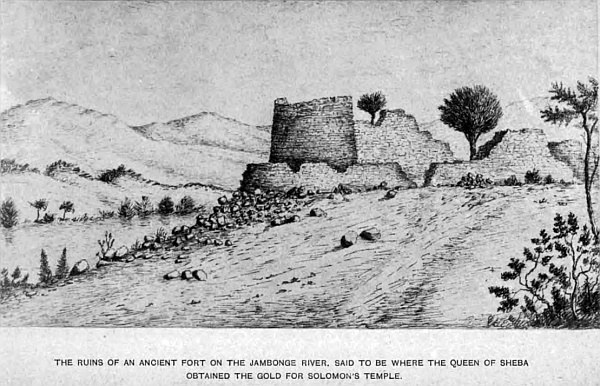
The kingdom of Tarva is supposed to have been in these regions. I have not met with any ruins yet that would lead me to suppose they were once the palace of the Queen of Sheba. I do not think that walls six or eight feet thick, built of small hewn stone without mortar, would stand as perfect as they are the wear and tear of four thousand years, in a country subject to such storms as sweep over this region in the rainy season.
The only relics I have found are broken pieces of pottery, containing much mica, and the well-worn stones the natives used to crush their corn, which must have been in use many years, as they are hollowed out almost like basins, and the round stone the size of a cricket-ball, much worn on one side in pounding the grain. One ancient grave I opened, but found nothing but a spear-head of iron, that crumbled to pieces when handled; the bones had disappeared. I may mention, when prospecting in the channels worn in the beds of the rivers by the water, I have found a great many copper beads mixed up in the gravel and sand, and a piece of silver, that looks like part of a bar, about half an inch square and an inch in length, that was also lying in the bed of the river close to the ruins of the old fort on the Ingwazi river.
The watershed that divides the Zambese and Limpopo basins runs in a north-east and south-west direction, like the backbone of an animal; the spurs representing the ribs, but in places the hill is broken up, as at Gubuluwayo and the country round. The rivers that drain each basin take their rise within a few yards of each other, on the south of the king’s kraal. All the elevated portions of the country are healthy, the lower parts are subject to fever to Europeans in the rainy season, but when the country is occupied by an industrious race, and cleared of bush and drained, it will become as healthy in time as any other portion of Africa, being so elevated above sea-level, viz. 3300 feet. It cannot be so very unhealthy, when Mr and Mrs Sykes have lived at Inyatine twenty-eight years, and have enjoyed good health; Mr and Mrs Thomas, also, for the same time; and at Hopefountain, the two missionaries and their families have enjoyed good health for many years, and at Gubuluwayo the traders have no more sickness than if they lived in any other part of the country considered healthy.
Since my last journey into Matabeleland, Lo-Bengulu has taken to himself a royal wife, the sister of the Zulu chief Umzela, whose territory adjoins the western boundary of the Matabele king, and occupies all the country down to the east African coast, not in the occupation of the Portuguese. This naturally was not very agreeable to his sister Nina, who ruled supreme in her brother’s court, during the time he had no royal wife, which must have made it unpleasant for both parties. I am not acquainted with the particulars, but I suppose the king deemed it expedient to get rid of this annoyance, adopted his usual plan, for he gave orders to some of his people to take his sister away, which is tantamount to ordering her to be killed, but no royal blood must be spilt or the body mutilated; consequently she was taken away and smothered. His royal residence at Gubuluwayo has been destroyed, and a new military camp formed at some distance from it. His new residence is built in the European style, much larger than the former, containing several fine rooms; the principal apartment is capable of holding over 100 people, substantially built of brick, with thatched roof, erected by Europeans. The Matabele who calls himself Kuruman, the son of Moselikatze, and was supposed to have been killed previous to his father’s death, has claimed the kingship, and has many followers, which may eventually lead to much bloodshed.
A railway will do more to civilise the people in the interior and increase trade than any other means that could be adopted to improve the natives and open up the country.
Lo-Bengulu is very favourably disposed towards the English, as I have before stated; what has made him severe on some, is his having lost confidence in many who have gone into his country, and abused the privileges granted to them, which naturally has shaken his good faith in all who visit Matabeleland. When he knows he can depend on any, he is exceedingly friendly, and will do much for them, as in the case of the late Mr Thomas Baines, the traveller, who from his honourable, upright, and straightforward conduct, gained the king’s confidence. The result was, he granted a large concession of his country to him, for working and exploring for gold, and signed a document to that effect, showing that if properly treated he will do good to those who act fair towards him. There are a few old hunters who have for years lived up in Matabeleland, and have the king’s confidence, from acting towards him in an upright and honest way, and have become almost natives of the country; they belong to the old stock of hunters that are fast passing away; only a few are now remaining that could be called hunters of the old days of Moselikatze time, and which formed a little community in themselves. Those were days of real enjoyment, when game was plentiful, and the country not overrun as it is now by a different class of people altogether. Those good old times were before the discovery of diamonds, when even Griqualand West was an unknown land to the colonist. Mr G. Westbeach is now living on the banks of the Zambese; Mr G. Phillips is, I believe, there also; Messrs Byles, Wood, Lisk are now in other parts, and one or two more are all that are left of the old stock of bonâ-fide hunters. At that time they formed a little society in themselves, hired a small farm called Little England, where they would meet once a year or as often as circumstances would call them down from the interior, to procure fresh stock in exchange for ivory, feathers, and other articles. Each member had to undergo fresh baptism in the way of a souse in a large bath made in the water sluit in front of the house, clothes and everything on, and pay his footing in the way of a certain quantity of brandy or square face (gin). When I entered the brotherhood I was suffering with a severe attack of influenza, and consequently was excused the bath, by paying double footing in spirits; keeping up commemoration night till late in the morning, which cured me of my cold.
All is changed now—the country has been of late overrun by traders from the diamond-fields; Boers from the Transvaal, who have unscrupulously abused the native laws of Matabeleland, and made the king doubly severe on all who enter his dominions, and caused the Indunas to look upon all white men as dogs, which has damaged the prestige of the white man in the eyes of the natives, and Lo-Bengulu, who is ruled to a certain extent by them, cannot always do as he would wish. Natives are very susceptible of insult, and as the Boers treat all black men as dogs, and in some way insult them, which they do not forget, this has frequently brought the English traveller or hunter into trouble.
Lo-Bengulu respects the English nation, and has a loyal feeling towards her Majesty the Queen, and as all Bechuanaland has been brought under her protection, now is the time for the British Government to show this sable monarch and his people, by our acts in Bechuanaland, that England’s policy is not to exterminate the black man, but to protect, assist, and benefit him, which policy is the only one to bring Lo-Bengulu and his people into a better frame of mind regarding England’s views towards them, and the only course to eventually open up that country to civilisation. At the present time they fear a Boer invasion, and as they are renowned for their political sagacity, they will be too wise to offend the English people, who may shortly be living on their borders. But if Boers are allowed to settle in Bechuanaland then we may say farewell to peace in that region.
All now depends on the course the British Government adopt in this new protectorate. Lo-Bengulu and his Indunas, I believe, will not interfere or be troublesome on the border of this protectorate, if they see we respect the rights of the black man in the future of that country, and, instead of having the Matabele in any way troublesome, they will become our friends. I see a great future open for that country, which will materially benefit the native races, and be the means of developing that vast region now closed to British merchandise, for that is the great civilising power by teaching the native mind the advantages they will derive from commerce. Whatever cruelty Lo-Bengulu may perpetrate in his own country, will not extend further; he was brought up under the dreaded chief, his father, who ruled his people through their blood, for no other mode of governing them would have availed. But the people are beginning to understand the English ways, in the same manner as the Zulus do in Zululand.
Thursday, 21st May. Walked over to old John Viljoen’s waggon, where he was outspanned under some large trees surrounded by a thick bush, completely concealing the waggons from view; his son and a Boer were making kameel biltong, having shot one yesterday. He is now waiting for the weather to clear up, to have some elephant shooting, his son having seen eight, about six miles away, in the morning. Talking of elephant shooting, he said he had shot seventy-nine at different times, and he told me, a Scotchman, Mr Thackery, had shot ninety-nine, and in shooting the hundredth, when the animal laid apparently dead, he climbed up him over his head, when the elephant gave him a blow with his tusk and killed him on the spot. We arranged to go out together on Monday. He also told me he shot a python, a few days ago, measuring eighteen feet in length, and twenty-eight inches round; he saw several others, but they got away. On returning to the waggon I found a trader, Mr Mussenden, with his waggon outspanned close to it, who was surprised to see me, having long ago heard that I had been murdered by Bushmen up in the interior, that it was reported throughout all the country, and everything stolen; he said he had often heard of my being in the interior, and through the Desert, when he was up-country, but never expected to see me alive again, and was very glad we had met, as he often wished to know me. Many such reports get about of explorers and hunters being murdered or lost in the bush; and it requires great care to avoid some of these dangers in so extensive a region, particularly to those who have not the bump of locality. When leaving your waggon, in the saddle or on foot, before starting, be particular to take bearings of mountains or any prominent objects. When the sun is perpendicular at mid-day, it is difficult to know the north from the south, and if you have left your compass behind, those unaccustomed to be in a wooded region soon become confused as to the direction to be taken to regain their waggon. Several, whom I knew, have lost their lives in this way, and were never heard of more. A young man, William Hancock, I had with me as my driver, when outspanned in a level country, with dense bush, took his gun early in the morning to look after game, and never returned all that day, and night coming on, I began to fear for his safety; the whole of that night I was in a fearful state of alarm, firing shot after shot to let him know our position, but no reply; I got no sleep that night. At daybreak I saddled-up and started in the direction he took, firing shots frequently, and I sent my loop-boy out in another direction. After calling and shouting until nearly losing my voice, up to 2 p.m., a distant report came to my last shot; starting off in the direction at as great a speed as I could make in the thick forest for at least a mile, I fired again, when a reply came at no great distance. Going towards it and shouting, I heard a faint voice in amongst the trees, and Hancock came towards me; he was nearly demented, and looked as if he had grown ten years older. Before asking any questions, I gave him a flask full of brandy and water, and some biscuits which I brought with me. He told me he had been in a pursuit of a koodoo he had wounded, and in the chase had lost the direction of the waggon, and in his endeavour to reach it had wandered in the opposite direction and became so confused that he did not know where he was, firing off his rifle at times to let us know, but the distance prevented the reports being heard, and as night came on he gave himself up as lost, and climbed a tree, where he passed the night, as many lions were about; some of them came almost under the tree. In the morning he got down, fired off several shots, until he had only two charges left. He said his anxiety made him lose his strength, and from want of water and food he was nearly exhausted, and when he heard the report of my rifle he felt he was saved from death, and obtained renewed strength and fired his last cartridge, which brought me to him. Mounting him in the saddle, we returned to the waggon, distant at least four miles. Now this young man, born in the Colony, accustomed all his life to being out in the open air after game, had no knowledge of taking bearings from time to time, to see the direction he was going; the poor boy—for he was only nineteen—felt he had gained a new life. I gave him a few lessons on woodcraft for his future guidance if placed in a similar position. He was a most willing lad and of great assistance to me in my wanderings; he was a son of one of the early settlers of 1820.
Finally, we may conclude, in leaving this region, that the knowledge already obtained of the richness of the Matabele and Mashona country by exploring parties that have been allowed to prospect, only in certain districts, and by others who have travelled through it in other parts, and from my own observations, there is not a shadow of a doubt that eventually this part of the continent will surpass all others in Southern Africa as a gold-producing district, in the cultivation of cotton, and other valuable products, that cannot but prove most beneficial to the power who may obtain it; and to the benefit of its people, instead of its remaining in its present barbarous state, where the slaughter of its inhabitants depends on the present whims of its despotic monarch.
From what has already been discovered of its richness, we see plainly the ancients, who extracted the gold, have only done so to a limited extent—what may be termed surface workings; for their numerous pits, after all, are mere scratches in the ground at places, but when they are properly worked and greater depth attained, the mines may be found almost inexhaustible. And if the gold-dust, found in the sand of the rivers, can be procured by a few single washings from a small dish, what may be expected when the whole of these rivers have been properly worked?
Chapter Twenty Four.
The physical geographical features of that region, lying between the Matabele and Mashona country, and the Indian Ocean, now under the rule of the chief Umzela and other chiefs.
This extensive portion of South Central Africa abuts on the north-east boundary of the Transvaal, the eastern boundary of the Mashona and Matabeleland, and the Zambese in the north, up to 29 degrees 50 minutes East longitude. On the east by the Indian Ocean, and on the south by the Portuguese possessions at Delagoa Bay. The main watershed passing through the Mashona country, which divides the Limpopo from the Zambese river, in 18 degrees 10 minutes South latitude, turns east and separates the waters flowing into the Zambese, through the Mazoe river, from that which flows into the Sabia, runs south down to 21 degrees 10 minutes South latitude, 32 degrees 5 minutes East longitude, when it turns easterly and north-east, and enters the south side of Sofala Bay. This river has many tributaries on the west, draining a portion of the Mashona country, but on the eastern bank there are few, and those but small. The most important river is the Buzi, taking its rise from many small tributaries in a hilly district, to the east of the Sabia in 20 degrees 30 minutes South latitude, 32 degrees 30 minutes East longitude, on a tributary of which the Umsweleze, the chief Umzela’s kraal, is situated; the Buzi from this point takes a sweep round in a north-east direction, and enters the Indian Ocean in 19 degrees 50 minutes South latitude, passing through the Sofala region, between this latter river and the Sabia. The Garogesi river enters Sofala Bay.
There are several small rivers north of the Buzi to the mouth of the Zambese, that drain the coast-line, which is very flat and marshy. The tributaries of the Zambese are the Zangwe, Sankatsi, Mowila—the main branch of the Mazoe enters the river below Tette—Nake, Zingesi, and Panyame. In the northern portion, between the Mashona and Zambese, are many isolated and extensive hills,—Vimga, Nadsu, and Vimiga, drained by the Nake and Zingesi. To the east of these hills is the Lobolo mountain, with its many spurs, and more to the east the Moltkeberg, drained by the Mazoe and its tributaries, Gaverese, Upa, Janhambe, Jankatse, and others of smaller note, all which are in the Zambese basin, which includes also—lower down that river—the Mowila, Sankatsi, and Zangwe.
The country towards the sea is flat and most uninteresting. There are several low ranges of hills in outlying districts. The country generally is dense bush, and full of game. The Portuguese possessions do not extend many miles beyond the south bank of the Zambese river. The chiefs in those districts claim up to that line.
The altitude of the Lombolo mountain is 4200 feet, and the Moltkeberg 3700 feet above sea-level. The general rise of the country is 1700 feet, gradually sloping towards the Zambese and coast. The northern division is divided into different tribes under their respective chiefs. The Banyai country is between the Mashona and Zambese, in which is situated the Portuguese town of Tette, on the banks of the Zambese. Pretty and picturesque country around, with fruit of every kind, melons, oranges, lemons, sweet potatoes, pines, and every kind of vegetable; but the Portuguese are so lazy that everything is left almost to nature. The river is navigable for small steamers for seventy miles above Tette, which is situated 260 miles from its mouth. Magnificent timber trees grow in the valleys, and on the slopes of the hills ivory palm, Mali palm, the palm that grows to the height of eighty feet; the seed of the fruit is eaten by the natives; it grows in the uplands, and down on the low-lying swampy country. Mashola, a tree that bears a round fruit similar to the Kaffir orange. The india-rubber tree is very common; the fruit can be eaten. The Umtonto tree is used for making baskets and other things. Large tracts of country are covered with the Mowasha bush, mahogany, and ebony up in the hill districts, and all similar trees found growing in the Mashona country are found there.
There are many native villages along the banks of the several streams, the country being very thickly populated, particularly in the hill districts, and the people are industrious and skilful workmen in all branches of trade, and they make their own blankets from the wild cotton and baobab tree, which they work by hand, the former by having the yarn spun by hand with a small stick, weighted at the end; four sticks are stuck in the ground to form a kind of loom, the yarn stretched tight, and being wound on a piece of wood, is passed backwards and forwards, the strands being threaded, to allow the woof to pass through and through by a backward movement of the hand. They can make blankets the usual size, and very white and strong. They also manufacture bands of various sizes for native uses. The blankets made from the bark of the tree, and bags to hold milk, are very strong and beautifully made. The females are fond of ornamenting their persons, wearing copper and brass rings round their necks, on their legs and arms, and some have silver, which I was told is got out of the mountains. Gold is found in all the mines in the Banyai country; the natives sell it to the Portuguese at Tette, and quartz reefs cross the country in many districts; several portions have not yet been visited, consequently the richness of this region is not known.
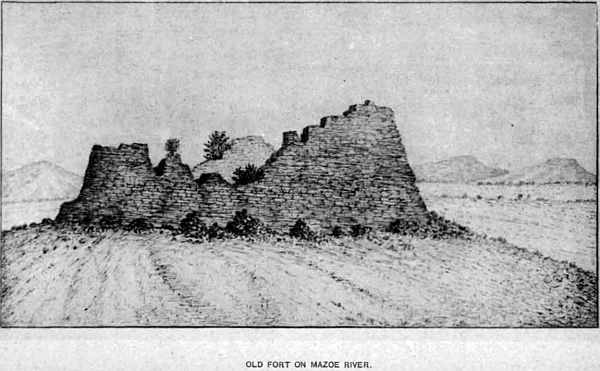
On the mountains and high lands the country is healthy, but the low-lying ground in the rainy season is very unhealthy. Portuguese native traders are the only ones that go into those extensive regions, and supply the population with beads, brass wire, and other things in exchange for the gold-dust they procure from the rivers. There is an old fort on the Mazoe river, under the Lobolo mountains, and several others higher up that have been partly destroyed by the natives for walls for their gardens, where they plant small fields of cotton to make their blankets; a little piece is so occupied adjoining their huts, and it is found to grow very well in elevated positions. I have found it wild as high as 4300 feet above the sea-level, in a light soil, where water is not found near, but in the low lands it is very plentiful.
South of the Banyai country is the Batoka, in which is the Moltkaberg, watered by the Upa river, a tributary of the Luenya. The source of the Mazoe rises on the watershed in this region, at the Sakaloko kraal, in 18 degrees 0 minutes South latitude. Another spring issues close to Mebka kraal, and at Gangwesi kraal, at an elevation of 4210 feet above the sea, and flows north, on which there are many villages, close to several large vleis, and towards the east is the large kraal of the chief Makombes on the Mewila river. There are also many other native kraals situated on all the branches of this river down to the Zambese, and along its banks, Senna being the most important, where there are several hills that skirt it. The Batoka tribe is numerous—a fine, powerful race. The country is full of bush and fine timber, the same which grows in the Banyai district.
On the east of Batoka is the Senna region, which reaches to the Zambese and to its mouth, and along the eastern coast, down to where the Sofala joins it. All that is known of this country is that it is very flat and low; and within its boundary, on the banks of the Zambese, Dr Livingstone’s wife was taken ill and died, and was buried on its banks under a baobab tree, a little below the town of Shupanga, and opposite to the town of Mulu. Forty miles above the great river Shire branches off, which flows from Lake Shirwa, in 15 degrees 0 minutes South latitude, 35 degrees 50 minutes East longitude. There are few hills in this part of the country of any note. Cotton grows abundantly, and vegetation is coarse and rank in the swamps.
On the south of Batoka is Birue. This region joins up to the Mashona country, the Sabia being the boundary, Senna on the east, and Sofala on the south. The Sabia river rises in 18 degrees 10 minutes South latitude, near the village of Sakalato, and flows south as before stated. Upon the banks are Kambesa, Gansuma, Umsosa, Kambiss, and others. The country is high, with hills of no great extent, thickly wooded, with abundance of large game of every kind; palms, baobab, mahogany, ebony, mapari, india-rubber, and a variety of other trees. The valley along the river is very pretty and picturesque, well cultivated by the natives, and produces every kind of vegetable. The people are civil, but very inquisitive, and great beggars. White cotton seems to be much in demand. The land gradually descends towards the ocean, until the flat and swampy country is reached.
To the south of Birue is the district of Quitive, a portion of Sofala that joins up to the Sabia, on the south by Umselayon region. This district is supposed to be the kingdom of the Queen of Sheba. Manica is the principal kraal, near which are several ancient ruins, and the remains of a tower a few miles to the north-west of Manica. It stands on high ground, 4100 feet above sea-level, which descends to the east, and not far from the ruins is a large sheet of water, also several plains on the south of Manica. The population is a mixed race, composed of Umgovis, who are part Zulus, Mandowas, Basigas, Batagas, Mashonas, and others, who are under the chief Umzela. There are extensive open grass-lands, and the low-lying country is healthy during five months of the winter, when there is no fear of taking the fever. Thirty miles south of Manica the land rises to 4458 feet.
To the east of this district is the Sofala region, in which the Portuguese town and port of Sofala are situated. The town is but a poor place, as all the Portuguese towns are on this coast; but they command all the trade of the up districts, which is considerable in ivory, skins, a few ostrich feathers, and other products of the country. It is situated in 20 degrees 10 minutes South latitude, 34 degrees 30 minutes East longitude. The country at the back of the town is hilly, occupied by the Mandowa tribe, and is more healthy. The river Bozi flows through it to the sea, well-wooded with fine timber and bush. Elephants, rhinoceros, and large game abound. Rice, cotton, spices of all kinds, oranges, lemons, citrons, bananas, figs, and wild fruit. I was told that Umzela, the chief who occupies the country south, claims as paramount chief all those districts in the north, down to the Mandanda region; but his claim is something similar to that of the Portuguese, who lay claim to all South Africa to the Atlantic Ocean, from Sofala. He must be content to put up with such regions as he now has power to govern; and those countries north of Birue are independent, except such portions along the coast and up the Zambese as the Portuguese have the power to rule, which is not much beyond the guns at their so-called forts. With respect to any extensive or strong stone remains of ancient cities, supposed to have belonged to the love-sick Queen, there are none, beyond those that have been erected without mortar. If this district formed part of her kingdom where she resided, her palace must have been small, and of no account. If substantial buildings had been erected, they would surely be there now, as the natives with the means at their disposal could not have destroyed them; but what is so remarkable is that no relics have been found of any kind, no rubbish left where they may have stood. The only one I discovered was in a stream of the Sabia, where the copper beads were found. It was an oval piece of copper, the size of a sixpence, and as thick, with much defaced marks on both sides that cannot be made out, being so much worn. To pronounce it a coin would be premature. When the country is properly prospected, there may be found sufficient evidence to settle this long-disputed question; but if extensive ruins existed, the natives would know, and it would soon have reached the ears of travellers that have passed through that country. There must be some foundation for these ancient traditional reports. The country shows that in remote times gold in large quantities has been extracted from the earth, and if it is so easily found in the rivers, why should not nuggets have been found lying on the surface, which first drew the attention of the ancients to look for it. The name of the river flowing through this region, the “Sabia,” may have been changed by time from “Sheba,” the same as “Sofala” for “S’Ophir.” There is also a ruin called Piza, and another Manica, two names foreign to the other names of the country; and the region of Monomotapa may have received its name from some early inhabitants, descendants of the people under this renowned queen. At present nothing is definite on this point, and the magnificence of her palaces have been, much overrated in ancient history. If this was the real Ophir of Solomon, the Arabs along the coast and at Sofala believe this to be the true Ophir, Umzela was the great chief of all that part of the country known as the Birue, Quitive, Sofala, and Mandanda regions. His chief kraal, Utshani, is situated in 20 degrees 27 minutes South latitude, 32 degrees 28 minutes East longitude, between lofty hills, the altitude being 3180 feet by aneroid barometer, and it is situated on the upper source of the Buzi river, which flows in a north-east direction and enters the Indian Ocean on the north of the town and port of Sofala. The country is very fertile, and the banks of the Sabia on the west of the town, through which that river meanders in a south direction, is flanked by high and picturesque hills, and clothed in all the beauty of tropical vegetation. Mahogany, ebony, untanto, palm, umchani, maparri, umsimbili, bananas, assagaai or lance wood, barrie, boschlemon, wild almond, kajaten (a fine black wood), knopjes doorn, wild olive, saffraan, fig, cabbage tree, makwakwe (the strychnine of the country), vitboom (quinine), india-rubber, and a host of other sorts that would fill a page if named, all most valuable for various purposes. Large flocks of sheep and goats and herds of cattle are reared. There is also the large game, such as elephants, rhinoceros, giraffes, buffaloes, koodoos, and other large antelopes, lions, tigers, wolves, jackals, tiger-cats in plenty, beside the various earth-animals, ant-bears, porcupines, armadillos, and many others. Umzela’s territory is called Umselayon, which embraces all those districts above described. The mountains which completely encircle the chief’s kraal are very picturesque and peculiar in their form, making the Sinika river a tributary of the Buzi; which forms in its course almost a circle, thickly studded with fine timber and bush, and they do not extend much beyond the river towards the east, which is a low, flat country to the sea. The Portuguese have no control over any part of Umzela’s territory; they only hold possession of narrow slips of land along parts of the coast. The natives offered no opposition to my visits, and were willing to barter food for articles of clothing, principally linen cloth; but in many other portions of the country I had to use great caution to prevent suspicion as to the object of my visits. In many cases I have passed through tribes who would have been troublesome, but as I took goods to barter I was considered a trader, and as such one can journey almost anywhere. Some considered also I was a doctor or medicine-man, because I caught and preserved insects, snakes, and other small reptiles, besides plants. When this idea takes possession of some of the African races, they leave you unmolested; any injury they might inflict would be considered unlucky to themselves. I used to carry representations of snakes of wood, that are sold in England, and masks with extensive noses, so that when the natives came round my waggon begging, as they frequently did, from two to three hundred at a time, I would draw down the front sail of the waggon, slip inside, put on one of these masks, and with the snake curling about in my hand jump out in their midst, when the women and children would rush away howling, the men after them, to their kraals, and I would be left free from annoyance. During my stay at their station, before I could obtain these things, I used a large burning-glass, and when any one troubled me, would burn their hand until it began to pain. Then I would run after others, which soon cleared them off. Travelling past their kraals so frequently they knew my waggon, and if they pestered me for presents I had only to get out my sun-glass, and they were away in no time.
The only rivers of consequence beside the Sabia and the Buzi in this portion of Umzela’s country are the Umkoni, Umswelise, Umtschomie, Gerongosi, the source of which rises not far from the Buzi, runs east, and enters the Indian Ocean, about twenty miles south of Sofala. The Lusuti rises with several branches about thirty miles to the north of Umzela’s kraal, and joins the Buzi sixty miles from its mouth. There is also the Haroni and its tributary the Lusiti, and the small river Donde that flows into the Sofala harbour. South of the Mandanda region are the districts of Sheshonga, Indobolini, Mashelbe, and Makalingi. To the east is the Manklin district, that takes the coast-line from Maramone Bay, down south to Cape Lady Grey, off which are the islands of Bazaruta, Benguela, Sigin, and a small group at Cape St. Sebastian. To the north of Maramone Bay, some thirty miles, are the two great islands of Chuluwan. All the coast-line is flat, infested with the tsetse-fly, and most unhealthy. The Mandowa tribe occupy the hill district and country inland from Sofala, and it is under the rule of Umzela, and is in charge of Imbasugwar, one of his chief men.
Manukuza, father of Umzela, is a Zulu from Zululand, who fled from Chaka, the great Zulu king. His followers are called Mongonis, and all the tribes under him, viz. Basigo, Kulu, Mandanda, Cholee, and Mandower, are called Tonges. Deloms, a chief of Umzela, is over the district of Mazibbe, and Sondaba, an Indian, over Sheshongi, which is on the south side of the Sabia. The country is flat and marshy, and full of game. Rhinoceros, elephants, koodoos, giraffes, wildebeest, wild hogs, and nearly all the antelope tribe, and zebras. Date and other palms, bananas, jute, and wild cotton, beside many native fruits abound.
A very poisonous plant grows on the flats, from which the natives extract, from the seed, poison to put on their assagais and arrows.
(This poison is the strongest known. An eminent toxicologist, who in distilling became inoculated with it through a slight scratch. He was nearly dying for six weeks, and said he had no idea that any poison could be so strong; it would kill a man in three minutes, and an elephant in one hour and a half. The flesh of animals killed by it is not poisonous. It loses its strength by evaporation in about a year.)
The country in places is noted for its immense ant-hills, almost as large as those I have described in another part of this work. The southern boundary of Umzela’s territory is not at present ascertained; the country south of that already described is known under the name of Umhlenga, where the Queen Mafussi, of Inhoxe, rules a portion, which is a vast, open, undulating country, through which the Limpopo flows for over 200 miles to the sea, at Port Alice. The Lundi river, a tributary of the Sabia, joins it in Umzela’s country. It is the continuation of the Ingwesi, mentioned in the Mashona description. To the south of this region, and inland from the town and port of Inhambane, is the region called Makwakwa or Marangwe—a strong, powerful race of the same tribe as the Chobis, Bala Kulu, Basiga, Mashongonini, and Mandandas. Inhambane is situated on the sea-coast. The territory is very narrow, not exceeding twenty miles inland, and eighty miles along the coast.
A small river, the Inyanombi, falls into the bay, and the river Zavara drains the country of the Makwakwa’s tribe—a low, flat region. There is still a tribe occupying a part of Umzela’s territory that call themselves the powerful Makololo race, of the same family that ruled an extensive region on the Zambese river above the Victoria Falls, and became a terror to the neighbouring tribes. The Barutse people fought and nearly exterminated them, scattering those left far and wide amongst other tribes, and broke up the race entirely. This Makololo nation on the Zambese extended as far as that white tribe mentioned, living on the Quito and upper portion of the Cubango—now become mixed with the black races, and from reports, a wild and savage race, eating human flesh. May not these two tribes have travelled up the Zambese together at some remote time? It seems singular that the Makololos in Umzela’s country should call themselves the once-powerful Makololo tribe; and we find them on the Upper Zambese, the most powerful tribe in all that central part of Africa, 400 miles away from those in Umzela’s land. It is an interesting study to trace the various periods, as they advanced south from Egypt, and to find at the present time many Arabian and Jewish customs amongst them; and another interesting feature of those races is that many names of places in Central Africa are precisely similar to many names in the islands of the South Pacific Ocean. So far as is known of this country, we come across limestone, slate shale, red sandstone, green stone, quartz, porphyritic rocks, gravel, and on the western slope of the highlands, granites.
Referring again to the land of Ophir, there are no black races in any other part of Africa that allow a woman to rule over them; but in the immediate neighbourhood of Sofala there are three queens, viz. Queen Mafussi over Inhoaxe, adjoining Umzela’s territory, and immediately on the south of her are the two Queens Majaji and Mescharoon. May not this be one identification, that it was right that woman should be a ruler as well as man, handed down from the Queen of Sheba’s time? Also a large portion of Madagascar is ruled over by an Arab race that must have settled there a very long time ago. Their language is Arabic, and queens of that island have and do now rule the greater portion of it.
Chapter Twenty Five.
The Portuguese possessions on the east coast, within South Central Africa.
The earliest records we have of this coast-line is from the Portuguese, who first sailed round the Cape to the north, as far as the Mozambique coast, in 1497, under Vasco de Gama. In 1508 they visited the coast again and conquered Sofala, and soon after Quilimane, Inhambane, and Delagoa Bay, where they built a fort at Lorenzo Marques in the inner harbour, and took possession of the coast northwards, including the mouth of the Zambese and both banks of that river beyond Tette, where they formed a town, claiming the country far in, up the river and along the coast, but at the present time they have no jurisdiction over it, beyond a few miles of the coast, the natives not allowing any interference with their rights beyond the reach of their guns at the forts.
Up to 1875 the Portuguese only held the northern portion of Delagoa Bay, down as far south as the 26 degrees South latitude, and half of the island of Inyack; the English Government disputing their claim to any territory south of the 26 degrees, and the southern portion of Inyack was held by the British Government. Much correspondence passed between the two Governments, when it was referred to arbitration, and Marshal MacMahon, then President of the French Republic, decided in July, 1875, that the Portuguese had a right to the country down to 26 degrees 30 minutes South latitude, which included the whole of the bay and island of Inyack—to the exclusion of British interests. The boundary then laid down as the southern limit of Portugal should follow that latitude up to the Lobombo mountain, which borders on Swaziland, an independent chief.
Following the mountain north to the middle of the lower part of the Comatie river, where it flows through that mountain, from thence in a north-east direction to Pokionies Kap, on the north side of the Olifant river, where it passes through the mountain north-west by north, to the nearest point of the Stricundo mountain, on the Umzim Voobo river, then in a straight line north to the junction of the Pafarie river with the Limpopo. All on the west of this line is the Transvaal boundary. This is the boundary on paper and maps, but the Portuguese have no more jurisdiction over the country north of 25 degrees between the sea and the Transvaal boundary, than they have over Umzela’s territory, with the exception of a small portion along the coast to the Zambese river, and up that river to Tette. The Barpeda tribes, east of the Transvaal, are divided into many classes, ruled over by independent chiefs.
The country at the back of Delagoa Bay is a flat unhealthy country for forty miles inland, when it begins to rise, until the summit of the Lobombo mountain is reached. The river Lorenzo Marques, which enters the inner harbour at Delagoa Bay, is navigable for small craft for forty miles up. The region to the north of that harbour, through which the lower portion of the river Limpopo passes, is a low flat country, full of bush, and most unhealthy. The tsetse-fly swarms. Large game is plentiful over all this region. The southern portion is called Gasa; the northern, Umhlenga—already described. The entrance of the Limpopo river is in 25 degrees 17 minutes South latitude, and about three miles broad, which it continues to be up to the junction of the Olifant river, gradually narrowing towards the north. It is full of hippopotami and alligators that grow to an enormous size, and several kinds of fish.