"Sport and Travel in South Africa" (continued 5)
Reading edition
Near Knaas river the formation in the valley is a conglomerate of limestone, greenstone, and garnets. This part of the desert is full of bush, kameel-doorns, mimosa, and other trees, and is diversified by long low ridges of sandstone, limestone, and many low hills of granite. During the rainy season vegetation is splendid, and the grass fine and beautiful, consequently game is abundant; it follows as a natural consequence that lions, leopards, and many other species of feline animals are numerous. This is truly the lion veldt; I have counted at one time in a troop, great and small, twenty-two, frequently six and seven in the middle of the day, and within a short distance from my waggons. The ostrich is becoming more scarce every day; when I first visited this country, in 1864, the Bushman would exchange a beautiful blood or prime white feather for a piece of tobacco worth sixpence, and less; now they are difficult to be found.
This desert has been considered a barren and uninteresting region, but it is not so. There are portions, it is true, that cannot be traversed during the dry season, several who have attempted to penetrate it having been obliged to come out and leave their waggons, their oxen all lost for want of water. But this was in a great measure their own fault, for if they had followed up the rivers and dug in their beds they would have obtained it.
There are many miles of limestone flats, some extending ten miles in length, bounded by extensive sand-dunes, and isolated koppies, with their pointed summits covered with bush. These sand-dunes cover an immense area, extending from east to west fifty miles, and thirty miles over, and in altitude from fifty to 200 feet. Their base is a dark limestone covered with sand, which varies in thickness from four to ten feet. Their sides are at an angle of about 30 degrees, and the topmost ridges so pointed that when a waggon and span of eighteen oxen arrive towards their tops, the whole span is descending on the other side as the waggon reaches the summit, and the driver on the box can only see the four after oxen; but from the great depth of sand in the road the waggon glides down with ease. To illustrate more clearly the shape of these dunes I can only compare them to a very stormy sea, with gigantic waves instantly turned into sand; many small trees and bushes grow on their slopes, and also beautiful grasses. From six to eight miles a day with an ox-waggon is considered a good trek. There are some small fountains and vleis in some of the hollows, otherwise no one could pass that way, as the road over these dunes from first entering them is thirty miles, then a flat of eight miles over limestone and sand-dunes again. There are also many isolated conical granite hills, that rise from the level plains to an altitude of 200 feet, formed of huge blocks; they more resemble artificial than natural monuments; many of them are so overgrown with trees and bush that grow between the blocks that scarcely any of the rock is to be seen. It is dangerous to inspect them too closely, as they are the lurking-places of lions, leopards, and other beasts of prey.
I discovered this on ascending one of them at Kanardas: when nearly half-way up, on looking into one of the small caverns, of which there are many, I saw at the end two large bright eyes glaring at me from the dark. After exchanging a good stare at each other I quietly took my departure down: knowing the nature of these animals, that they will not openly follow or attack, if not disturbed, I felt pretty safe. As to the nature of the beast I cannot say, but from the great size of the bright red eyes I concluded he was a lion,—at any rate, their expression did not appear very amiable. A few lessons like this make an explorer cautious before prying too closely into hidden and secluded spots in a wild country like this desert.
On the east of Hogskin vlei is a large salt-pan or vlei, twelve miles in length from north to south and two broad. It is worked only by the Griquas living at Meer. This settlement was established in 1870. I was told by an old Bushman, that they took the bush children and made them work, and would not give them back. In 1871 Meer had become quite a tidy village, of about twenty-five houses, some of them built of red brick. The chief was Dirk Falander, who held a magistrate’s court and tried prisoners; it is a little republic upon a small scale, not more than 100 all told, except the Bushmen slaves. There are close to the village two large ponds or pans; the banks on their sides are seventy feet in height. The country round is open grass veldt. Between Meer and Hogskin vlei is a large pan, surrounded by high sand-rocks, called Klein Meer, a very pretty and picturesque lake, two miles in length, with fine bushes and grass lining the banks; five months of the year it is dry. Sand-dunes are round it in every direction.
There is a considerable traffic and trade carried on by the Griquas and the Cape Colony. Roads cross the Orange river at Koran drift, Kakaman’s drift, and Orleans drift; the two latter meet at Kanardus, close to extensive lime-pits, where water is obtained, by the side of a dry river-bed, where there are some of the prettiest trees I have seen in Africa, spread over the veldt, park-like, and dense bush between lofty granite hills, which in consequence of water is the general outspanning place. I came here one evening after dark and nearly lost many of my trek oxen, in their eagerness to get at the water, which is twenty feet from the surface. They were supplied by sending my boys down with buckets, by that means filling a hole dug out for the oxen to drink.
These pits are fifty miles north of Kakaman’s drift, and twenty-five miles on is Swaat Modder, in the bed of the Hygap river, the road passing along its bed between sand-cliffs 150 feet in height. Between these two watering-places the Back river enters the Hygap; the sand in its bed is mostly composed of ruby sand, which I believe would make a fine red glass.
At Swaat Modder the right side of the river has cliffs 100 feet in height; the left bank has sand-dunes, where I found several flint borers, many of them in a finished state, for making holes in the shell of the ostrich egg to form beads. Under these cliffs, in an old Bushman cave, I built a stone house, where we remained six weeks waiting for the rains. All this country is under the Koranna chief Puffadder, and his people are spread over the country in small kraals. The road still continues north, past other pits in limestone at Bloomfontein, and at Kebeum, springbok, etc.; Abequas pits, a large Koranna kraal; then passes over sand-dunes for thirty miles, and arrives at Anoerogas, where there is another Kaffir station, also a store kept by a Mr Redman, of whom I bought some tobacco for five bags of gunpowder, and a medicine-chest, and a variety of goods I was much in want of. A captain of the Bundelswaarts is here, to give notice to the Bastards to clear out. Coal abounds in this part, garnets are found in all the river-beds, and in many parts mixed up in the sand of the desert. Lions are so plentiful here that it is dangerous to leave the waggon without your rifle. A Koranna man was killed and eaten last night, a short distance from the waggon. This station is 180 miles north from Kakaman’s drift, on the Orange river, and three miles south of Hogskin vlei; here the roads divide. One goes to the salt-pan, another to Meer station, a third to Quassam on to Damaraland, a fourth past Knaas, in a north-north-west direction to Ovampoland, and a fifth turns south-west, and leads to Barth, where the Bundelswaarts people live, besides others to different parts of the desert.
The other portion of the Kalahara takes in the southern part from the Orange river to the Molapo river, 190 miles to the north, and from the Hygap river to the Langberg range of mountains, which is the eastern boundary of the desert, 100 miles in width. The lower portion, near the Orange river, is better adapted for farming, as there is good grass, and the karroo bush, upon which sheep and bucks get fat. I purchased of Klass Lucas, the chief, living at his large kraal on the banks of the Orange, near Orleans drift, a large Africander sheep, for 2 lbs. of gunpowder. It weighed, without the tail, 62 lbs., and the tail produced 12 lbs. of pure fat.
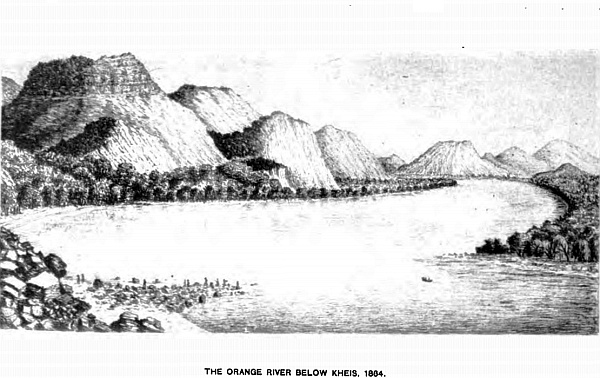
Between this station and sixty miles to the north, called Blue Busk Kalk, there is a fine fountain and large vlei, with a stone kopje on the north side, where the rocks stand out in grotesque forms of granite formation; there are in the intermediate distance several very peculiar granite koptjies; they average about 200 feet in height and 600 feet in circumference at the base, large masses of huge rocks, piled one upon another, and without any vegetation; the country round is perfectly level; they have the appearance of ruined pyramids; the highest I measured was 275 feet.
The mountain, called Scheurberg, is another peculiar range, with its many pointed peaks, with wood in the valleys and kloof; fifty miles in length and twelve in width, a road passing through the centre, a great resort of lions, wolves, and other beasts of prey. The continuation of the Orange river up from the junction of the Hygap is particularly picturesque, and in many places fearfully bold and rugged, with lofty and almost perpendicular cliffs, with fine timber, beautiful bushes, tree-ferns, and other subtropical plants, which add much to the landscape.
It was at the point of the Langberg, close to the river, where the berg seems split up into several magnificent hills, between which and the river is almost a level but thickly wooded space of several hundred yards in width, where we came to outspan, for the purpose of making a new tent to my waggon. My driver happened to capsize it into a sluit two days before, and, to complete my misfortune, I lost four of my best trek oxen in the river by sinking in the mud. The next day one died of the melt sickness, and I had to shoot another from lung-sickness.
The willow trees along the bank gave us plenty of wood, and in two days the tent was completed. Mr Staple, who was with me, suggested we should make a boat of wicker-work, after our Welsh coracles, which we soon completed, by small branches being bent the proper shape, with cross-pieces, each tied very carefully together, forming a strong and firm framework, over which we stretched two raw bullock-hides, well sewn together, and when dry painted it red,—two seats, two paddles, a mast, and lug-sail; the length was seven feet, and twenty inches deep, in shape like half an egg cut through lengthways. This little work occupied us a week. When perfectly dry we took it down to the river to launch it, not thinking of its lightness. As soon as it was floated I brought it close to the rock, and put one foot into the boat, and then made a spring in, when I was no sooner in than I was out on the other side into the water, a regular header—fortunately it was deep water. However, on landing, I took off my clothes to dry on the rocks, and Staples got some Koranna girls who were sitting on the bank watching our work, to bring some stones to put in as ballast, which took some time, as few were to be found.
I was better prepared for the second trial, being without clothes, but this time our boat was perfectly steady, and no wonder, for we had at least 200 lbs. of stones in the bottom as ballast. A fine breeze was blowing up-river, which was nearly a mile wide: fixing our little mast and lug, we started on our first voyage, steering by a paddle. This being the first boat that ever floated on the Orange river, I consider it worthy of recording. Our little craft acted splendidly. The astonishment of the Bushmen, Korannas, and the blood Kaffirs living on the bank, who came down to see the white man’s floating-house, was amusing; they shouted with delight as we sailed away up-stream; the women in particular were the loudest in their admiration. After spending some hours sailing up and down, exploring on the islands, shooting ducks and geese, we returned to our handing and carried our boat to camp, after taking out the ballast. As we were in a lovely spot, well sheltered by trees, and only a short distance from several small kraals, where we could obtain milk, we determined to remain some time to explore the neighbourhood, shoot and fish, and enjoy this wild, independent, and delightful free and easy life.
There were several families of blood Kaffirs who had permanently established themselves on the banks of this river. They originally came from the Cape Colony; the men were perfectly naked, and the women also, with the exception of a piece of skin round the loins, which was of very little service as a covering; the Korannas and Bushmen the same. In the evening we had two fires, one for us and one for our boys, having two waggons, a cart, and many oxen and sheep to look after. We had eight servants, composed of Hottentots, Korannas, Bushmen, and a Cape half-caste; consequently, when we were all assembled round the fires, with the addition of our neighbours, who never failed to visit us at feeding-time to come in for snacks, we formed a large gathering of as romantic and unique a party as could well be collected at any picnic. The ladies present were of all colours, from yellow to black; many of them well-formed and good-looking, others were of every type of ugliness.
The Kaffirs were models of symmetry, and a much superior class to the others. Having an unlimited supply of wood, our fires lighted up the trees, bush, and many of the near rocks, leaving the lofty mountains in shadow, looking black and grim against the sky,—a grand picture for a Turner. I made an attempt to portray it on canvas, but my humble efforts could not do justice to this beautiful and wild scene.
So enjoyable was this mode of life, what with sketching, exploring, fishing, and shooting, besides the daily sail on the river, visiting the islands, and the opposite shore, geologising and reading under the overhanging trees as the boat floated quietly with the gentle current, I determined to waste three or four months on its banks, as I was following the river down for 300 miles, which would occupy that time to thoroughly enjoy it, and give me ample opportunity of indulging in this wild and free life. The boat was fastened on to the back of my waggon, when treking down by the river. When outspanned, it was taken down to the water, sometimes crossing over to the Colony side to visit the blood Kaffirs, to obtain milk and purchase the large Africander sheep. The people would come down to see where we came from, and when they saw the boat and us getting into it and paddling away with our two sheep, their shouts of astonishment were amusing.
When travelling, it was always in the morning for a couple of hours; that was our day’s work, the rest being employed in various ways as described. At one outspan, close to a small Koranna village, we as usual took the boat down to the river that we might, in mid-stream, enjoy our daily swim, and crossed over to some Kaffirs. They were entirely naked, nothing whatever to cover them; the women brought us some thick milk. They had heard that some white men were coming down, and told us that the Korannas intended to stop us, and not allow us to proceed. On returning to the waggons, we found several of those people sitting round our fires, evidently come to overhaul us, but they were very civil; they had been getting out what information they could from our boys.
Forewarned is being forearmed; we looked up our rifles and ammunition, to be ready for any surprise, as we intended to fight our way down stream if opposed. But there was no sign of opposition on their part. They were much amused at a sketch I had been making of them as they were sitting round the fire in their half-naked state. They each wanted me to take them individually. Many I did, for practice, and to embellish my journal, for we do not meet with such picturesque groups every day. I therefore made the best use of my opportunity. Both sexes are great swimmers, and would follow me some distance. As I sailed from the shore, I took one or two out occasionally in the boat to help me in fishing and other work, when my own people were out hunting up game to keep my larder full. So that, from being shy at first, they became almost too friendly, which, under existing circumstances, I permitted. Their primitive mode of living is very simple. They marry at twelve years of age, if living together as long as it suits them is called marriage. No divorce courts are needed in these parts.
Our next trek was to avoid the high mountains which terminated on the river-bank in enormous cliffs. We therefore had to go round through the gorges and over steep and stony hills—no roads in this wild country—and outspanned for the night close to a mountain stream surrounded by lofty hills, covered with bush. As night advanced, the different wild animals began to move about; the red cat, a kind of panther, the wolf-jackals, and porcupine were very plentiful. At night when the camp-fires have burnt nearly out, and all the boys are rolled up in their blankets fast asleep, every sound is distinctly heard. The mountains contained many leopards, and they are very dangerous, and will not hesitate to attack if you are alone.
These hills were the home of the wild Bushmen, who war on all living things. They differ from other Bushmen; they are of a reddish-black colour, and stand four feet four inches in height. They live in the caves amongst most inaccessible parts of these mountains. They use the bow and arrow. Few are now left, as far as we know, for they never show themselves, and keep as much away from mankind as the beast of the forest.
Travelling on through mountain passes, we arrived at a native station where the chief, Klas Lucas, lived, who claimed all the country north, to the Kuruman river, which is a wild district, having several isolated hills, and being scarce of water, particularly towards the Kuruman and Molapo rivers. Large pans are distributed over this waste, but water is seldom found in them, except in the rainy season, from January to May. Large herds of game, and also the ostrich, are occasionally to be seen, but are difficult to approach, as they are constantly being hunted by the Korannas, Bushmen, and Griquas, living at the kraals near the Hygap and Orange rivers, and along the mountains of Scheurberg. Limestone and granite are the only rocks to be found over this extensive region.
The Kalahara, to the north of the Molapo, up to a short distance of Lake N’gami, the Langberg range of mountains continues northwards in broken and detached hills through a wild country, unfrequented, except by native hunters, who visit it from the Bechuana side on the east, and those living in the desert and the Bastards at Meer. The ostrich is less hunted here, and consequently more plentiful. Lions seem to have it all their own way, for they are more numerous here than in any part I have seen; not only at night, but in broad day, they make an attack on your oxen. One full-grown male lion seized one of my black oxen, not 300 yards from the waggon, in some low bush at mid-day. Our attention was called to the bellowing of the ox and the rush of the others towards us. The lion was on the ox, having seized him by the back of the neck; one hind-foot of the lion had torn open the flank, and the other across the back, when the ox dropped. In a few minutes I was at his side with my double-barrel rifle, and sent two bullets into his heart, when he rolled on the ground quite dead. The ox had to be shot also, for his bowels were protruding from his side; he was one of my best oxen. We saw several others a short distance off, but they disappeared after a few shots were fired at them. As we treked over the veldt, we came upon several remains of game on the ground, which the lions had killed and eaten.
There are many beautiful plants and flowers in these parts. We were frequently crossed by border tribes who go in to hunt, but they do not remain. They may be seen occasionally in small parties traversing the desert, with one or two pack-oxen loaded with dried game and such feathers as they may have obtained by the rifle or stolen from the Bushmen they may have surprised. If they catch a Bushman, they conclude he has feathers,—if not with him, he has them hid in the sand. They take from him what he has, and then, to make him give up what they believe he has concealed, they torture the poor wretch by putting a finger or a toe in the fire until the pain is so groat he tells where he has hidden them. If he has none, they believe he is telling them false, and go to such extremes, that they will burn the hand or foot until they are consumed, believing the victim is obstinate and will not tell where they are.
I have a Bushman I engaged to look after the waggon with one foot entirely burnt off, and a Bush boy with four fingers of the right hand served in the same way. The man came to me and asked to be employed, and said he would show me the waters. He brought his two daughters with him; their mother was dead. The girls’ ages, as well as I could guess, were fourteen and sixteen. I employed them on various duties about the waggons, and found them very willing to learn. I had now a large family to provide for; my own eight boys and seventeen Bushmen, including six women and girls, which was a great help, as they took me to watering-places unknown to hunters, and were my guides to places I should not otherwise have visited. I found if you treat these people well, they are willing to assist in any way. They are a very small race, seldom exceeding four feet ten inches in height. When old, which is at the age of forty, they are very ugly. Their food consists of game, which they kill with their bows and arrows, eggs, roots, mice, locusts, insects, frogs, land-turtle, and anything they may pick up.
When I was in the desert in 1872, I had one of the chief Bushmen captains engaged with many of his people to hunt for me. Hearing of the atrocities committed on these Bushmen by the border tribes, I told him to collect a few of the injured ones, and bring them to my waggon, that I might see them. In a week he collected fourteen, all, more or less, having lost a hand or fingers, a foot or a greater part of it. One Bushman had a red-hot iron ramrod forced through his body under the arm-pit and it came out on the other side. I saw the skeleton a few days after it occurred. Some are shot down, and the children stolen and taken for slaves. They are also tied to stakes and burnt to death, and I was taken to the places where these crimes had been committed, and saw the remains and the site of the fire. Having satisfied myself as to the correctness of all these statements from personal inspection and from more than fifty Bushmen who told me of others equally horrible, all of which I noted in my journal, I was frequently importuned by these people to become their chief, which I declined. I was then asked to write to the Great Mother (the Queen) to solicit Her Majesty’s protection, and take them over as her children. This, I saw, was impracticable. I then told the chief head-men to call all the Bushman families together near at hand, at a drift where I had had the bad luck to get my waggon capsized, and where there was plenty of water, and to meet me there at the full moon a fortnight hence.
True to the appointment, seventy-seven of the head-men and their families were there, forming a large camp, and as quiet and orderly as any assemblage of people could be. I took down the probable number there would be within a radius of seventy miles, from Klasson, the chief spokesman, which numbered 3986.
They stated, if the Great Mother could not be written to, would I write to the Great Chief at the Cape? This I agreed to, and told them I would write out a petition which they would sign, and I would forward it with a letter explaining the circumstances under which it was sent to his Excellency Sir Henry Barkly, detailing the atrocities, and praying to be taken under English protection, which was in due course forwarded, and some months afterwards I received a reply from his Excellency, stating “he had received the petition and my letter, but as the Kalahara desert was so far removed from the Cape Colony, he could not see how it could be done at present, but at some future time it might be considered.” And from that time these peacefully-disposed people have been left to the tender mercy of the border tribes. His Excellency, it appears, did not know that the Kalahara desert joined the northern border of the Cape Colony, which shows how little interest was taken to ascertain the true position of the country from which the petition was forwarded.
The country to the west of this region up to Damaraland, 200 miles, up to the mountain regions of that country and Great Namaqualand, is undulating, with vast stretches of wood and open plains; isolated hills of granite and limestone in other portions. One extensive district was covered with water-worn pebbles, garnets, agates, and other beautiful stones, also large broken pieces of stone of a rich crimson colour. When broken small cubes of iron pyrites like gold are embedded. The grain is very fine, and it would make splendid vases, cups, plates, or any other ornaments.
I had been foolish enough to collect specimens of every kind of stone, until my waggon became so full and heavy that I had to throw them away. I made a collection of 3000 agates of every variety of colour and shape, which had to be abandoned. Many cairns or graves are seen with heavy stones surrounding them.
Not far from them are several ancient stone huts, built upon a small hill, that must have belonged to a former race, and close to a dried-up river. Some of the stones are six feet in length, two feet wide, and one and a half thick. They were placed on end and covered in. None of them would hold more than four persons. They are in small clusters of seven and eight together, and some less. They were covered in with large stones, that have long since fallen. No account can be obtained of them from the Bushmen. Their huts are a few sticks stuck up with grass thrown over.
Several fresh Bushmen and women came to my camp this morning. Some of the young girls were very good-looking, and with a profusion of native ornaments upon them made entirely of ostrich eggs. A perfect set comprised a tiara, three inches in width, for the head; a broad necklace, six bracelets on each arm, and eight anklets or bangles to each leg, and finally, a rope of beads of sufficient length to go round the loins twice and fastened in front with a piece of rimpey. These constituted the entire dress of one of the girls. She looked like a young African queen, and it had the effect of making her look half pretty.
I bought two sets for six yards of print each. I think there cannot be less than 8000 beads in each set, between each bead a piece of leather of the same size, which becomes black, so that they look like black and white beads, which has a good effect upon their black skin. They were delighted with the exchange. When disrobed of their ornaments, they threw the print over their shoulders like a mantle. The ornament had the appearance of having been handed down from generation to generation. At Narukus, on the Nosop river, I came upon a family of Bushmen, ten in number, of a different type to those I had in my service, evidently a lower caste. They have no forehead; the wool on their heads comes close down to the eyes, and the head falling back like a baboon; projecting mouth, small nose, a sort of hair or wool all over the chest, arms, and legs; their eyes are small and restless, watching every movement that is going on; the tallest man did not exceed four feet four; their skin was of a reddish-brown. A few old skins, broken ostrich eggs, and bows and arrows, seemed all they possessed of worldly goods.
They would have decamped and hid in the bush, but I sent some of my Bushmen and brought them back. I asked my own boys, if they were their brothers, meaning of the same race; they repudiated the idea, and said they were monkeys not men, and told me there were very few ever seen, it was very seldom they ever came upon any; they eat carrion. They are evidently a distinct race from the Masara Bushmen who are largely distributed over the desert. One of the women had a baby not much bigger than a half-grown kitten; all of them were destitute of clothing.
The country through which the Oup and Nosop pass, in many places is very pretty and picturesque. At a fountain on the branch of the Oup, I remained several days to hunt, to supply so many people with food.
24th February, 1872. A terrific thunderstorm broke over us soon after midnight, and continued until six this morning, striking and splitting up some large trees a short distance from our camp, and it rent into three a large rock which stood out alone from the base of the hill. The country was swamped with water, the oxen at one time standing half knee-deep in it. My escort of Bushmen and their families for once in their lives had a good shower-bath. The baboons also in the hills must have felt its effects, for they could be heard far and near, with their half-human grunts.
My Bushman with the stump foot told me he could understand the baboon language, when, they are frightened or hungry, or are to meet together to defend themselves against an enemy, or to meet to play, and he knew well what they said and could talk to them. The old ones beat the young baboons with sticks if they do anything wrong, such as stealing the food from others. The Bushman’s language has a great many grunts in it similar to these animals.
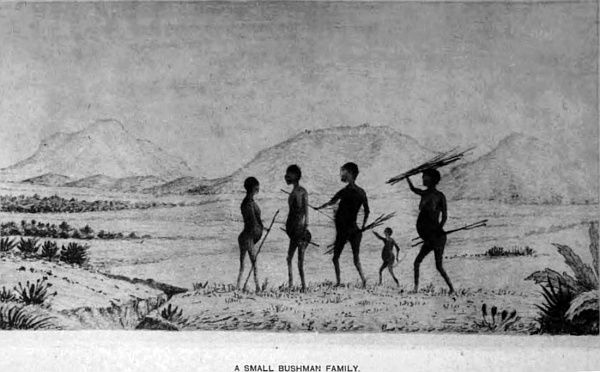
I find there are four types of Bushmen in this desert; the lowest is the one already described with no forehead and half wool and hair on their bodies and legs. The second is the wild Bushmen, who live in the mountains near the Orange river, also mentioned, who war on all men, but they are of good form, without hair. The third is the Masara Bush family, also of good proportions and of gentle dispositions, inoffensive and harmless, ready to help or do anything, and they make good servants. It was this tribe I had with me in my wanderings. The two girls I took in charge made good cooks, washed the clothes, and mended them. The fourth is much taller and well-formed, great rascals, who cannot be trusted with anything; they inhabit the eastern portion of the desert, and down by Langberg. A similar tribe were those Sir Walter Currie drove out of the colony, some of whom I fell in with at Quassam under Coche Africanda. The Bushmen of the northern Kalahara are much the same as the Masara, every one of them quite distinct from the Drakensberg Bushmen, whose form and colour differ entirely from the others, which I believe to be a distinct race, and which I described in the first chapter.
One amusing circumstance I omitted to mention in connection with one of these wild Bushman boys, when at Swaart-Modder in the Hygap river, where we had built a stone house under the cliff to keep our goods during our stay there. A young Bush boy came in the evening to the camp and made himself comfortable by the fire. After some time my boys asked him where he came from, but he would give no reply. At last they got from him that he had run away from his people, because his mother had burnt his fingers for stealing, and he came to get something to eat. This was his second visit, and as he had been well fed before, he came again, but managed at the same time to steal some of my boys’ food. On this evening, we had a young man from the colony to drive the cart and look after the boys, and as our stone house was infested with large mice, this young Hancock was catching them in an iron pot, and throwing them out amongst the boys for amusement. As one by one, up to seven, were thrown, this Bush boy picked them up, put them into the red-hot ashes to cook, and, when half-done, ate them as they were. Thinking he must be awfully hungry, I told my cook to put on a pot and cook some Boer meal, which is wheat ground but unsifted; two pints of this were cooked in water, and when ready it was set before him and soon disposed of.
After all the people were asleep, he stole the food they had left, and in the middle of the night, sucked three of my goats dry. The following morning he was not to be found, and for nearly a month we did not see him again; when we had travelled 100 miles north, and were outspanned, he presented himself again, as if it were his first visit. We found out he had lived in the bush, existing on a wild water-melon, called shama or kongive, and had kept us in sight as we travelled. I tried to tame him, but it was of no use; his age was about eleven years. He kept with us off and on for three months, then disappeared altogether; the lions would not let him remain long, without making a meal of him.
We were now travelling through a very pretty part of the desert, open glades and timber trees, lofty pyramidal hills, partly covered with bush, fine grass, with white feathery tops, no inhabitants; a wild and picturesque region, crossing open plains, then gentle rises with low bush; in the distance, mountains with their lofty peaks fading away into nothing. The perfect calm and silence that pervades everything around, the variety of game quietly grazing in all directions, the very loneliness of my position, being many hundred miles from any white man, surrounded only by my own Bushmen, and those who accompany me, living in all their natural innocence as their forefathers lived in prehistoric ages, add immensely to the pleasure one feels in viewing a scene so novel and so seldom to be enjoyed.
The country as we approach Damaraland becomes more wild and broken, lofty mountains come into view as we advance westward. We were nightly visited by lions and wolves, which kept us constantly on the watch, and our fires kept lighted. It is an anxious time, particularly when in the stillness of the night we hear their roar at no great distance, in answer to others far away. The roar of a lion in the still evening can be heard miles away.
One morning about eleven o’clock, as we were outspanned in an open plain about 300 yards from a small pool of water, our oxen, horse, and a few goats grazing on the opposite side of the waggons, several of my boys asleep, the Bushmen and the women cooking some flesh in the hot embers, we saw seven lions leisurely walking up to the water. After drinking, they went to a small rise, bare of grass and sandy, and commenced playing, some lying down, others jumping over them, growling in their deep bass voice, acting the same as cats at play. This lasted twenty minutes, when they as leisurely walked away, taking no notice of us whatever. If I had fired and wounded any, they might have come at us, which would have been dangerous to our oxen, by dispersing. When an ox or a horse smells a lion, they will bolt away anywhere, and some might have been lost, therefore we left them alone and enjoyed so unusual a sight, watching the movements of these beautiful but dangerous kings of the forest, in their wild and natural state in the wilds of Africa.
The Kalahara, that portion, on the borders of Damara and Ovampolands for 300 miles, becomes much more densely wooded and hilly. Some of the mountains attain a height of 8000 feet, in which lead, copper, iron, and coal, also limestone, both white and dark grey, crop up everywhere. Granite forms the hills. The Black and White Nosop and the Elephant river, and their several branches, drain all this region. The country is very dry, rain seldom falls, and when it does, it comes down with a rush, which soon passes away; but the vegetation is excellent, fine timber and thick bush predominate over this vast but little inhabited country. The road from Walfish Bay on the west coast passes through, in an easterly direction, to Lake N’gami, Zambese, Ba-Mangwato, and other territories on the east. The road is difficult to travel for want of water, but when the country is more opened up, means will be found for procuring it by well-sinking and pumps, to make it as easy to travel as any part of Africa. There are several permanent watering-places now along this route. In the dry season it is three and four days’ trek between them, but as it is limestone nearly all the way, water can be procured by digging wells. The country is subject to drought, more particularly in the southern portion of the desert, consequently there is more game to be found in the northern region. Elephants are seen in troops of two or three hundred, also the zebra, and the various antelopes, giraffes, rhinoceros, wild boar, and others.
The country is very favourable for rearing cattle; large numbers of horses are yearly taken through the desert from the Orange River Free State to Damaraland, and exchanged for Damara oxen, which are found to make the best trek oxen, having small hoofs and being nimble on their feet; they are compact and strong. Another advantage is that they are bred on sour grass; when they arrive in the colony, it is sweet, which improves their condition.
April 30th.—At Hoab, a lovely, calm morning, after a heavy rain last night, at a vlei; there are several large ones in this open grass country that contain water at this time of year, being the rainy season. This station is on the desert-track from the lake to Ovampoland.
Outspanned under a large tree; boys employed skinning a koodoo, killed early this morning by one of my Bushmen guides with his poisoned arrow. The arrow-head is of bone, very small, the shaft two feet in length, and the bow two feet six inches. The shaft, close to the head for four inches, is covered over with their poison, which, in penetrating the flesh, paralyses the animal; the flesh killed in this manner is very good, and has no bad effect on those who partake of it. Several Bush people have come to our camp begging for food; they look poor and miserable, their only covering being a few pieces of ragged skins thrown over their shoulders. Several of the grown-up boys and girls had not even that to cover them. They are complete wanderers in the desert; no home or fixed abode, but live on roots, berries, insects, and anything they may by chance shoot: I gave them some flesh, and a fire to cook it.
The hot winds, which are very oppressive, come in waves, and are very enervating, more particularly in the dry season, when they dry up everything. The wood-work of the waggons shrinks to such an extent, that the wheels are kept together by ropes of raw hide bound round them; and your own system becomes so dried-up, that the natural functions of your body partly cease to act; to remedy this, fat is absolutely necessary, and nature craves after it. You will see the desire after fat in the native tribes, not only to grease their skin, to protect it from the sun, but to use as medicine.
When treking, some days afterwards, we were overtaken by one of those gigantic whirlwinds so common in all tropical countries. We were entirely enveloped in it; everything that is loose in the way of clothes is carried up hundreds of yards. One of my boys had his hat taken by the current, and it fell nearly a quarter of a mile from where he lost it. Many of these whirlwinds may be seen at one time passing over the desert.
At this outspan, late in the afternoon, sitting on my camp-stool where my boys were skinning a buffalo I had shot, I saw in the distance a Bushman coming. When near enough to distinguish, I saw it was a Bush girl, tall and well-made, and for a wonder quite fat; she was marked over every part of her body—face, legs, and arms—with white stripes, like the stripes of the zebra, and had nothing else on. She came up, holding out an old piece of leopard-skin. My Bushman spoke to her, but could get no answer. I gave her some tobacco, when, dropping the skin, she walked to the fire and sat down. We gave her a piece of cooked meat, thinking she might be hungry, which she took, and after remaining some ten minutes, got up and walked away in the same direction she came; but no word could we get from her. She was even strange to my Bushman. It was a strange visit, and a strange mode of decorating herself. The only other occasion on which I fell in with Bushmen so marked was more to the cast, nearly 300 miles, when nearly a dozen came to my waggon, to tell me I had that day ridden over a grave where a few days before they had buried one of their people. The stripes may have something to do with death, but the Bushmen I have spoken to know nothing of such custom.
One of the vleis, which was full of water, appeared to be full of frogs, from the noise they made at night; going down, next morning, I found several small ones, having a peculiar appearance. Catching one, which was very narrow in its body compared to its length, and having a short tail, I concluded at once from its general shape that it was half-lizard and half-frog. It had all the action of the frog in its long leaps, without any attempt at running; all the others were of the same form, and with tails. I brought it to the waggon to take its measure, viz. from front of head to commencement of tail one and a half inch, length of tail three-quarters of an inch, beautifully marked with green and light-yellow spots. Not having any means of preserving it, I took it back to the vlei, where there were hundreds sitting on the bank; as I neared them they jumped into the water and disappeared. The Bushman brought in to-day several ostrich eggs, quite fresh from the nest, which we had cooked in our large iron pots, mixed with a little flour—a kind of omelet; one is sufficient for three persons. The Bushman took me to a nest that the old birds had been sitting on for some time; there were eighteen in the centre, and fourteen on the outside, formed into a circle round them, which are kept for food for the young birds, which lasts them a few days when hatched; the hen bird then takes and teaches the chicks to eat grass.
Thursday, 18th.—Our camp was visited by a party of traders and Korannas on their way from Meer down South—the chief Puffadder, old Mr Ryland, from Kopie’s farm and Low Blaat, four waggons, and a lot of cattle, horses, and sheep. They remained the afternoon and night, and started early the next day for Kebeum. They told me a trader on the border of Great Namaqualand, going down to Walfish Bay, had been shot, and his waggon and everything seized by the Gobabis Hottentots for plunder, and that the country was in a fearful state of tribal wars. I told them of my little affair with the Bushman Hottentot at Quassam; they said I was most fortunate to escape as I did, particularly with all my belongings, as they are noted as a nest of thieves, and have robbed traders of everything.
I left them for Abequis pita, which are in limestone; it is a Koranna station, under the chief Puffadder. The country is open and flat; the grass in many places was up to my chin with white feathery flowers; at a distance it looks like snow. The road is very good for waggon travelling, and around Springbok fountain the scenery is very pretty. At Abequis pits the Korannas have many huts, and seem to be doing well; they have flocks of goats, and a few Africander sheep. They brought me some very good feathers, which I took in exchange for powder and caps; many of them have the old flint gun, which would be a curiosity now in England.
The winters here are warm; it is now mid-winter, thermometer in the shade 68 degrees. The men wear old leather trousers, which constitute their dress, the women an old blanket thrown over the left shoulder, and brought round and held in front by the hand. Overmodesty is not a failing with them. They were very civil, supplied my people with goats’ milk, and I gave them what they much needed, tobacco, as the women are great smokers. Dozens of them will sit or be lying round my fire, having only two or three bone pipes between them, each taking a few puffs and passing it on to the next, until all have had a turn; then they begin again, the old ones keeping a pipe to themselves. My maids, Topsey and Nina, the daughters of my Piet, knew these people, therefore I got on very well, Piet also lived once with them. The country towards the south and west was a level plain as far as the eye could see.
The next morning after the second day, started to the northwards; we passed a large vlei on the left, six miles from the Koranna station, which is the commencement of the sand-dunes. The dunes are small until sixteen miles of country are passed, then they assume great proportions. A mile to the left is another vlei, where we filled our water-casks and gave the oxen water, and remained the night, to have a clear day to pass over them. There were three Griquas’ waggons outspanned, each waggon was full of women and children, each Jack had his Jill, and each a baby, plenty of little naked children of both sexes. They told me they were on the trek to the Orange river. These people are always quiet and civil, they exchanged a fat sheep for some tobacco. All the country, including the sand-dunes, is limestone with sand above, and full of low bush, many large and small land-shells are mixed up in the sand.
July 17th.—The Griquas left early in the morning, and we started to cross the sand-dunes. A fearful road, their sides are about at an angle of thirty, and every time we ascend one, we have to put two spans of twenty-eight oxen in, to pull one waggon up at a time, which causes much delay shifting them backwards and forwards, as each dune rises from 150 to 200 feet in height, with deep sand in the road, the wheels sinking nine inches into it. After struggling over these for five hours, the oxen were done up, and we outspanned for the day at another large dry vlei, but on the bank a small spring of water was issuing, sufficient for the oxen and ourselves, a grand discovery, as we did not expect to find any until we had got clear of this heavy road. A short distance from the water were several families of Bushmen, sitting round a large fire; some of them had most extraordinary figures, thin calfless legs, prominent chests and abdomen, altogether different from the other Bushmen of the desert, and the colour of their skin was much lighter. A thin band of leather round their loins, and a skin over their shoulders was their only covering; long bundles of skins rolled up with several spears were lying on the ground. The food they live on in a great measure gives them this peculiar formation. They had the short bow and arrow, and quivers made of skins, full of arrows, cleverly made with bone heads, all smeared with poison. They appear to be half-Bushman, half-Koranna.
I started the next morning, and after toiling for several hours, rested, and again went on, crossing those lofty ridges until dark, outspanned for the night in a deep hollow, where there was plenty of good grass, and trees, and dead wood for fire. Our trek this day was about eight miles; two great fires were made, and our little party of twenty-six all told, made themselves comfortable over their supper, and at ten all were fast asleep. But we did not get much rest, the lions kept round the camp making a great noise, and being surrounded by these hills and thick bush, we were the greater part of the night obliged to keep a sharp look-out that none of our animals were taken. Early the next morning I took my rifle and mounted one of these sand-dunes before inspanning, and found from the base to the summit registered 204 feet. But what a sight when I looked round; as far as the eye could see, nothing but these immense sand-dunes in every direction, here and there open patches of yellow sand and bush, a wild, rugged, and howling wilderness, that appeared interminable, the fit abode for savage man and more savage beast, and here we find them, man in primitive nature, as low a type as the world can produce, little removed from the beast, for it is here I have met those wild men which I have described elsewhere; they are partly covered with short woolly hair, and have no forehead, the scant wool reaching the eyes. They are rarely now seen, even by the Bushmen of the desert, as they have repeatedly told me, and here they may find a home for many years to come, for no other living man will fix his residence in such a region of desolation,—
“A wilderness howling and drear, Forsaken by man from famine or fear.” Pringle.
On our trek we started many head of game, which are easily killed by the Bushman arrow, and with these and the many wild fruits they manage to exist. It has taken four days to cross this wild and hilly region which extends over an area as far as I have explored it, fifty miles from east to west, and nearly forty north to south: the home of the leopard and a legion of wild tiger-cats, that are spotted or striped,—their skins make beautiful karosses. On leaving these dunes we come upon a level plain of limestone, which we have ten miles to cross, where there are several watering-places, fountains they may be called, and enter sand-dunes again for some fifteen miles, and then come upon a bush country, with gentle rises and low wooded bills with isolated conical hills of granite. Close to the hills, I outspanned near a swamp; the noise from the bull-frog kept us from sleep. They are monsters, a foot across the back and quite black. The Bushmen eat them; they would form a fine dish for our French neighbours.
The weather is very fine, like an English spring day, everything seems springing into life. Clouds begin to collect on the horizon, and the sunsets are most brilliant, purple and gold, forming celestial landscapes of the most gorgeous hues. There are many ostriches to be seen on the flats, but the country is so full of holes, partly covered with grass, that it is dangerous to follow them. Far and wide in every direction the character of the country is the same, which we pass through up to Meer, the Bastard station.
We passed several small Bushmen kraals; the women and children as we approached hid themselves in the bush, but when they found we were friendly, and giving presents to the men, they came forward. At one we remained a few days to buy feathers, during the time my Bushmen and the girls soon made friends with them, and dancing went on in their fashion every evening. These women daub their faces and bodies with black stripes, which they consider ornamental. Their natural colour is half black, consequently these stripes show out prominently; they are a mild, timid race, very good-natured, willing to do anything, and, if left alone by the border tribes and the Bastards, their lives would be happy; their wants are few and easily supplied, clothes they do not require, the climate at all seasons of the year is seldom colder than our English summer, and, as these children of the desert are constantly shifting their locations, huts are not required, or only of the most primitive kind, a few sticks stuck in the ground, and the long grass thrown over them. This is a portion of the central part of the Kalahara.
When we arrived at Meer, all the people were out ostrich-hunting close round the village, a great excitement, the birds running in all directions, and the Bastards after them on their horses; they managed to shoot seven; the others, about fifty, made their escape.
Meer is a straggling village, the soil is rich and grows good crops of corn, the two pans supply the people with water. Dirk Falander, the head-man, is supreme over the people. They possess several waggons and have large herds of cattle, and live very comfortably, sending down to the colony for what supplies they require. Coffee and sugar are in great demand.
After a delay of two days, I left for Chuane pits, distant one hundred miles; as the rains were very early, there was plenty of water to be had. This occupied me eleven days. I remained some time on the Oup and Nosop rivers, hunting, and it was necessary for one or two guns to be out every day to supply my little family with food, and as there was plenty of large game about, we had no difficulty in procuring it.
The wild aspect of the country, bush here, open plains there, with long ridges of low hills, no living soul to be seen until we arrived at the pits, and there we found a small family, who on our approach ran into the bush, but my own Bushmen called them back; they came very reluctantly, but soon became friends, some fifteen in all, a little dahka and a few beads as presents soon restored confidence amongst them.
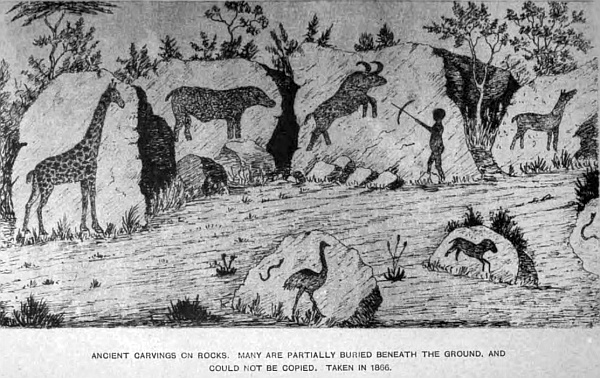
I am much interested in the Bushmen of the desert, and also in the white Bushmen of the Drakensberg mountains, because they appear from their isolation from the outer world, and cut off as they have been from the tribes that now occupy the regions around them, to be the descendants of the people who occupied the lower end of this ancient continent before the tribes from the north came down, and pushed their way south, bringing with them their Asiatic and Hebrew customs, which all without exception now practise more or less, evidently proving from what regions they had migrated. Eventually they nearly penetrated to Cape Town. Not so with the white Bushmen of the Drakensberg, the Hottentots, or Bushmen of Cape Colony, and the Bushmen of the Kalahara Desert, each retaining up to the present time distinctive physical formations and distinctive dialects, so entirely different from those tribes that come down south and overrun the southern peninsula of the African continent. These ancient aborigines of South Africa are comparatively pigmy races to those above referred to, who are as tall, robust, well-formed specimens of the human race as can be found in any part of the world. Then again their language, if it can be called such, is entirely different from any other known tongue, their thoughts are described by certain clicks, four in number, the white Bushmen of the Drakensberg have only these clicks, the Hottentots or Bush men of the Cape have, in addition to the clicks, sounds which accompany the clicks which come from the throat like grunts. The Bushmen of the desert have also these clicks, showing, I think conclusively, that these early people were in existence before languages,—what we understand by language, words formed by the mouth, tongue, and lips, as the nations of the world now converse and talk. Some of the South African missionaries have committed to paper these clicks, and they state it is a most beautiful and expressive language. At any rate, my belief is, that the earliest formed language of man was by sounds such as clicks and grunts before they advanced so far as to express their ideas by forming words, and language has been progressive as man advanced in civilisation. In travelling over South Africa and listening to the sounds of the baboons as they move about the rocks above you, you can detect a great similarity in their guttural sounds and the Bushman language, and I could quite understand when my Bushman told me he could converse with, and knew much of what these said, showing a connecting link between them. Therefore I take much interest in watching their characteristic qualities, in connection with the general run of mankind. Anthropological study naturally embraces the study of their early implements, where, and how found, their artistic qualities, and for what purpose made, for peace or war, and this desert is particularly rich in these interesting relics of past ages.
The desert on the east and south of these Chuana pits, extends up to the chiefs Sechele, Montsioa, and Gaseitsive, that join on the eastern boundary 230 miles, unbroken by rivers or native towns, one immense tract of wood and plains, long flats, and in other parts undulating, with the exception of the detached mountain ranges, which run north and south—the continuation of the Langberg range—and they terminate 100 miles south of Lake N’gami. They are beautiful, picturesque and lofty hills, rising from their base 3000 feet; many of their sides and deep kloofs are thickly wooded with fine timber of great value, and in the extensive ravines are ancient caves, some of them now used by the Bushman tribe. This range is distant from these pits about twenty miles on the east. Game of every kind is plentiful; lions, also, we hear for hours every evening. Hawks, kites, vultures, eagles, locust-birds are almost always seen on the wing.
As there was good water at these pits, in consequence of several heavy thunderstorms having passed over the last few days, I have remained here to have a little exploration of the country and provide a good supply of dried meat, which is called biltong, for my people; and in the evenings, when all work is over, they amuse themselves dancing, singing, and shooting at targets with their arrows for small presents, which causes great fun; they are the most happy people in the world. To amuse them I made a kite about three feet in length, and with some string sent it flying, to the astonishment and delight of all.
Spring was now advancing fast, everything springing into life. The little, happy African lark flying up some thirty feet, where it remains a few seconds, then down it comes with such a sweet plaintive voice, and this is repeated every few minutes, and as there are many of them about, their little notes are constantly heard. Thunderstorms are now coming almost daily, and the evening sunsets are the most brilliant and gorgeous that can be imagined, portraying golden lakes, mountains and waterfalls, rivers and islands, with noble castles, and everything to perfect a landscape, and this remains long without alteration. It has been a source of much pleasure in this lonely region to endeavour to convey the like on canvas.
As we had now plenty of water and could go anywhere, I struck north, leaving these pits on the 30th October; but a few days previous to my leaving, I found several small quartz reefs of the right sort for gold. After spending three days with pickaxe and hammer, digging and breaking off nearly a ton of quartz, I was rewarded with one little speck of gold, finding, so far as I could see, that these reefs were not rich; and if they were, the distance is too great to make it pay to work them. On leaving, my friends, whom I found in possession of the pits, wanted to join my party. Treking due north, keeping west of these mountains, I outspanned, after four hours, close to one of the highest of the range for the night, as I wanted to make an excursion to the top the next day, to see the country and take observations, altitude, and get the difference in temperature at the highest part. The night passed off very quietly, except hearing in the stillness of the night an occasional roar of a lion and other wild beasts, to give us warning not to sleep too sound. The sun rose the next morning in a magnificent glow of crimson light. After breakfast I started with my driver and five Bushmen, each with a rifle and ammunition, all on foot, leaving the waggon at 6 a.m. I soon reached the foot of the mountain, when the difficult part of the journey commenced, passing round projecting rocks, crossing deep kloofs, thick with bush, where we had to keep a good look-out, having only one dog to tell if any lions were near. I managed, after three hours’ labour, to reach the highest summit about 10 a.m., a clear lovely morning, without a cloud. The view from this elevated position was grand. In all my wanderings I have never seen anything to equal it, no lofty hills to break the view for 150 miles. The outlook from this point extended both east and west over 200 miles; the lofty hills near Secheles could only be distinguished with the telescope, and then like a pale lavender cloud, the country between thickly wooded, and long stretches of open country, apparently a waterless region; the same on the western side, excepting that the country was more open, and the ancient river system could be distinctly traced by the trees and bushes that grew on their banks. The game in the open looked like ants. One of my Bushmen called the attention of the others to something they went to look at behind some bushes. Going to see what they were examining, I found the remains of four fires that had recently been alight, and several pieces of bone broken near some stones to extract the marrow, but nothing else could be discovered. Evidently there were Bushmen in these mountains, but no sign of them could we see. After exploring the ins and outs of the topmost ridges, I selected a good position for taking observation, after which we disposed ourselves for lunch; the walk up and pure air gave an edge to our appetites. Cold tea and a dash of brandy, which gives the tea the flavour of wine, was served to all alike, and they then disposed themselves on the grass for a smoke. I found the elevation at this point above sea-level to be 6470 feet, and from the base of the mountain to where we were 2795 feet.
At 3 p.m. we made a start for the return journey to camp, taking a different route down, which was much more difficult, the mountain being broken up into many almost perpendicular ravines, and gigantic rocks projecting in all directions. Half-way down my Bushmen called out in an excited tone that there were several Bushmen on a projecting spur making for cover. We counted eleven; how many more we could not tell. I told my boys to call to them to come, but they paid no attention, and suggested that some should go and bring them, but they refused, being afraid they should be shot by the poisoned arrows; and they informed me they were monkeys, not men, meaning they were of the same type as those I have mentioned previously as having woolly hair on their body, legs, and arms. As we wound round the mountain, it being too steep to come straight, we came suddenly upon three more, a man, a woman and child, quite naked, and of a reddish-brown colour. My Bushmen called to them in their language of clicks to stop, we were friends, but they seemed much alarmed. A present of beads to the woman gave them confidence. They appeared very young, not more than seventeen. The height of the man was about four feet two inches, large bodies for their size, thin legs, and small receding head, and disgustingly ugly.
Passing round one of the overhanging rocks, I came upon several caves, none of any great extent, but evidently made use of as dwellings from the numerous remains of fires in them and the smoked appearance of the roofs and sides, and heaps of broken bones lying about, but no one was in them. If I had had the means of sending this little family down to the colony, I should have done so. After a delay of nearly an hour looking about, we continued our downward movements, and reached camp soon after sundown.
During our absence one of our Bush girls went out with two other little ones to dig up inches, a small bulb like an onion growing in the veldt—good to eat—when a lion seized and carried her off. The screams of the girl and the two little ones brought several of the Bushmen with guns, but no trace of the girl could be found. This occurred just before our arrival, when I formed a party of seven and went to look for her, but night coming on and very dark, it was impossible to follow up the spoor. Early next morning by break of day all that could be spared started, but nothing could be seen, the bush being so thick. Many of the Bush people are carried off in this way. All last night the roar at intervals could be heard far and near; the man-eating lions are the only ones these people greatly fear.
To go through my daily routine from place to place, the same duty daily, would become too tedious. We therefore, after leaving this place, visited various localities. My Bushmen knew that water could be found at Hoodedoon, and the dry river where we managed to capsize the waggon. We reached Reitfontain and Wahlberg, my old station, at a pan situated at the north end of that mountain range; I had left five weeks back, and encamped once more for a rest. I call this my station in 22 degrees 10 minutes South latitude, 22 degrees 12 minutes East longitude. The whole of the country is high, 3880; at my pan the mountain registers 6880 above sea-level. After a stay of ten days I left for Lake N’gami.
The importance of this desert cannot be over-estimated in connection with our interior trade. Whatever nation secures it, secures all the trade to the Zambese, which would be an immense loss to England and the Cape Colony. It is capable of great improvement, and under a proper government will become a most valuable field for emigration.
Chapter Thirteen.
Great Namaqualand.
This country occupies the western shore of the South Atlantic, from the Orange river, which is the northern boundary of the Cape Colony, to Walfish Bay, a distance of 420 miles. The southern boundary follows up the Orange river for ninety miles, where the Great Fish river falls into it from the north. The native name of this river is the Garip. The breadth at its mouth is nearly four miles; the sand in its bed and the many shoals and sand-banks prevent its being navigable. Higher up there are long stretches of smooth water for miles, intersected by rapids and rocks,—some of them very beautiful, passing down between broad belts of rich vegetation, with splendid timber of many varieties: the willow, with its drooping branches kissing the water, adds greatly to the beauty of the scene.
It was on this river, some miles above, that I spent many delightful months, with my canoe, sailing on its placid waters,—some of the most pleasant of my life. Many beautiful stones, not in small quantities, but in cart-loads, can be shovelled up wherever the water has left them on the shore. The upper portion of the river I have already described.
Following the coast-line north from this river are several anchorages. The principal are Angra Juntas, Whale Bay, Possession Island, which is nearly three miles in length, and over one in breadth—once famous for guano; and if time be permitted will be again a valuable island for that manure. Seals frequent this coast at certain seasons of the year, and penguins are also abundant. Cape Voltas lies on the mainland. North of Possession Island is Angra Pequena (now German) Island and Bay, where the mouth of the little Orange river enters it, which rises in the highlands at the back. At Pedestal Point, Bartholomew Diaz in 1486 erected a marble pedestal, which has long since disappeared. It is a trading-station for supplying the natives of the interior, who trade in feathers, skins, karosses, cattle, and other products, and receive goods from the Cape in exchange. A road from the bay is over a dismal, barren, and heavy road for fifty miles, when it becomes better, with some herbage. In the bay there are several islands, viz. Penguin, Seal, Shark, and others, which give good shelter for ships visiting it. Copper has been found on the neighbouring coast. North of this bay is the Island of Ichaboe, which, although very small, is famous for once being noted for its superior guano, supplying England with thousands of tons annually. North of this island is Hottentot Bay, and beyond Spencer’s Bay, the cliffs rising 500 feet nearly perpendicular; and in the bay is Mercury Island, nearly a mile in circumference, rising to a height of 250 feet, in which is an immense cavern, divided into several lesser ones, through which the waves rush with fearful force and noise. This rock is bare of vegetation, many sea-birds find shelter upon it—gannet, penguin, gulls, and others. Seals and whales frequent it at certain seasons.
In latitude 24 degrees 30 minutes South is Hollam Bird Island, about half a mile in circumference. Seals and birds frequent it in large numbers; many turtles have been caught on the shore. In 24 degrees South latitude is Conception Bay, and to the northward is Sandwich Harbour, which is situated thirty miles south of Walfish Bay. Sandwich Harbour has a coast-line of sand-hills beyond; inland is pasturage for cattle, and on the beach is a spring of fresh water. A fishery was once established here by a Cape merchant. The River Kusip used to fall into this bay, but now flows into Walfish Bay. It rises in the uplands, near the Tans Mountains, but has no water in it, except when it happens to rain, which is very seldom. Great Namaqualand terminates about this point, and Damaraland begins.
From the sea-coast for many miles inland the country is barren and poor; as the highlands are reached vegetation improves. The Desert of Tans extends a long distance inland, nearly to Mitchell’s Mount, which is a lofty hill of 6000 feet, commanding most extensive views in every direction. On the tributaries of the Great Fish river, and the river itself, most of the natives live in small wherfs, at the mission stations belonging to the Rhenish Mission Society, Bethany, Bethesda, Reheboth, and others. The Isabella mines and Nabos copper-mines are on the Orange river. Some of the principal wherfs are Reheboth, Ames, Haochannas, Nababis, Kachasa, Amhup, Reems, Hudenass, Brokhout, Robaclip, and others, on the various branches.
As I have previously stated, the natives are greatly mixed; many of the women daub their faces and bodies with black stripes, and also dye their teeth black; they use a red berry that grows in the bush veldt. Jonga Africander, the head of the Hottentot tribe, living in the northern part of this region, has been constantly thieving from the Damaras, causing many petty wars between them. They are a lawless set. They drove out and threatened to kill the magistrate there lately.
Wood is plentiful in the kloofs and on the river-banks, where the water is procured. The larger game is found in the north-east corner, but has become very wild from constant hunting by the various tribes. The lofty hills are of granite formation and sand. The Bastards cultivate the land in favourable localities, plough, and have large herds of cattle, and carry on a good trade with the colony. They are hospitable and peaceable; each wherf has its head-man, with several cattle and vieh-posts attached. Copper, lead, and iron are found in several parts, not yet worked; at some future time it will become a valuable district. The summers are hot, and in winter it is sometimes very cold; rain seldom falls, but the dense fogs from the Atlantic, over all the western portion and on the highlands, cause such a moisture to fall that it has the effect of rain. The rainy season is from the end of November to May. In the northern part rain is more frequent. The Namaqua language is similar to the Hottentot and Koranna, with innumerable clicks, which make it sound very uncouth and strange to those who have heard it for the first time. In travelling through the country I met with great hospitality amongst the Bastards. At Nisbet Barth there is a Wesleyan Society. The missionary was away in the colony when I passed through. (Here is Germany’s first attempt at colonisation.) Being anxious to go on to the copper-mines on the river, where I could obtain a few things I needed, I did not delay.
The country is not a pleasant region to travel through, for several reasons—the scarcity of water, and that brackish; the want of grass; the native cattle, where it would be good, keep it short; and the wandering tribes are constantly annoying and worrying for something. On the banks of the Great Fish river, near the Brinus Mountains, I shot a black wolf, the first I had seen, and my people told me they were very rare. I had great difficulty in getting through the country—bad roads and dreadful drifts crossing the rivers.
I have little to relate of my explorations of this part of Africa, my time being taken up in surveying the country, and collecting specimens. The entire coast is a barren waste, not suitable for emigrants or anything else for fifty miles at least inland.
Chapter Fourteen.
Damaraland. South Central Africa.
The boundary of this region, adjoining Great Namaqualand, Kalahara, and Ovampo, is very undefined. The natives are unacquainted with the true divisions, and as each nationality is not confined to any particular line, living in a kind of mixed community, it is difficult to say where one country begins and the other ends; but from accounts of the people, it appears that the extinct river Kuisip, which enters Walfish Bay, is the correct boundary, and the coast-line to the north reaches to the Cunene river, which is also the Portuguese boundary of Bengulo, the distance being nearly 400 miles.
The first and only harbour is Walfish Bay, being an important trading-station, belonging to the Cape Colony. This port, where there are two trading establishments, supplies the whole of the northern part of Great Namaqualand, and also all Damara and Ovampolands, the central and northern Kalahara, as far as Lake N’gami. The great drawback to its prosperity is want of fresh water. In many cases the people are supplied with water in casks from Cape Town, but I believe if proper means are taken by sinking wells, a good supply can be procured. At present a considerable trade is carried on with the natives, and is on the increase. On the north of this bay the river Swakop enters the Atlantic, which is the main and principal stream that drains the eastern division of Damaraland, upon which are situated many natives’ wherfs. Some of the principal are Oekiep, thirty-six miles up the river, then Tineos, Oijimbinque, Otjimonjebba, Okandu, Little Barmen, Great Barmen, Otjithebba, Gous, Eikham Hot Springs, and Thames Mission Station. The distance of this last station by road to Walfish Bay is about 231 miles, which is one of the roads to Lake N’gami, and is on the north of Awas mountain, that attains an elevation of 6400 feet. The scenery in this region is wild and grand, and eastward of these points the Ealahara comes in, and is drained by the Black and White Nosops, Elephant river and branches. South of Swakop are several native kraals and wherfs; Wittwater, Reed Fontain, Tjobis, Platklip, Onanis Mission Station on the Kuisip, and others. The country is fearfully sandy and dry. The Canna river, a tributary of the Swakop, branches off thirty miles from the coast. It rises in the spurs of the Ketje mountains and flows south-west through a deep valley between some picturesque scenery. Upon and near this river are several Damara wherfs: Omaruru, Omapyu, and Evonga. A few miles inland from the junction of these rivers is the Canrans Quanwas, or Colquhoun Mount, 3100 feet above sea-level, a conspicuous object from the sea. Copper is found in its vicinity.
Forty miles along the coast, to the north of Swakop river, is the mouth of the Omaruru river, which evidently at some seasons must have a powerful current; the washing away of the banks of sand, and large timber trees brought down and left on the bank, is a good proof. Extensive copper works have been worked here for some time, but they do not seem to pay the company, long since abandoned. Twenty miles inland the lofty and barren hills give a desolate appearance to the country. The sea-coast to the north is bold, and has many projecting headlands. Inland, from Cape Cross, the land rises to an elevation of 3700 feet. All this hilly district is inhabited by Berg Damaras, who are rather scantily dressed. The women have a band round the head with lappets falling behind, a profusion of beads round their necks, with a band and large square apron folded round their loins, and bracelets. The men have a broad belt, leather apron, with parts of tails suspended behind; they have large bows five feet in length, and long arrows tipped with iron. Few iron utensils; wooden bowls are mostly used.
The upper source of the Amaruru rises in the Eshuamen mountains, which is a dense bush, and separates Damaraland from the Ovampo region. The river Omuramba, already described in the Kalahara, rises in the same mountain, Eshuamen, and also Mount Ketje, taking a north-east course, then flowing east, leaving the lofty range of the Omureraoom on the west. The upper part of the Swakop has many stations, and is thickly populated.
Limestone prevails over an extensive area; the peaks, which are composed of this rock, are 4444 feet high. The region to the east is the Kalahara desert and a thick bush country.
The principal road from Barmen Mission Station to Ovampoland runs along by the Omuramba river, between which and Damara the country is divided by an immense thorn district. Beautiful and picturesque scenery is to be found in Damaraland, where the granite hills stand out in bold and massive peaks. The mineral wealth of this region is little-known; copper, lead, and silver, also iron, abound in the mountains. The natives speak the Otjiherero language. There are many mixed races spread over the country, and great numbers of cattle, sheep, and goats are kept by them. Several mission stations are established in the country: Barmen, Otjimbinque, Schmelin’s Hope and others. The climate is very healthy. All the large game are found in these regions. The Damaras hunt them with the bow and arrow, but of late years guns have been introduced into the country. They are a stout and powerful people, very dirty in their habits, and seldom remain long in one locality, being pastoral, cultivating no corn, and always at war with the Berg Damaras, being of a different tribe, using the Hottentot language.
The Rhenish Missionary Society hold most of the stations, and have been great sufferers by these lawless tribes, being plundered, and several of them ruined, which has destroyed the trade of the country. (Illustrative of which, one of the missionary’s goats was being constantly milked. One Sunday evening he caught a man at it, who ran away, and he threw a piece of wood at him; and complained to the chief, who decided that the man was sufficiently punished by that, and the missionary was fined a goat for breaking the Sabbath.) Many English traders were robbed and some wounded. The mission stations were established about 1830, but scarcely anything has been done in civilising the people. The Namaquas live by plundering their neighbours, the Damaras. This was the state of affairs when I first visited that region. Since then they have been robbing the Damaras of their cattle. Several mission stations have been destroyed. Their store at Walfish Bay was broken open and everything stolen, and the manager, Mr Toerson, murdered. The Europeans in the country, numbering about thirty, made application for assistance at Cape Town. The governor sent a man-of-war to Walfish Bay, which returned without landing. Since then several British subjects have been murdered, and so things have gone on from bad to worse, and not until 1875 were any steps taken; then a commissioner was despatched to endeavour to settle matters, but his influence had little effect in restoring order, and eventually he returned to Cape Town. It is of the highest importance to the Cape Colony that Walfish Bay and the coast-line for fifty miles north and south of it should be annexed to that colony as being the principal outlet for the native trade of the interior. If it should fall into foreign hands an immense injury would accrue by the taking away the greater portion of that trade which rightly belongs to the Cape Colony. The chief, Kamaherero, is almost paramount in the country. The population of the Hereros is estimated at about 40,000, and the Berg Damaras nearly 30,000.
The importance of Walfish Bay is its having the command of all the interior trade of Ovampoland, the Kalahara desert, and also that extensive region at Lake N’gami, a great portion of which is brought across the desert, therefore its importance as a British port cannot be overrated. There is no field for emigration, as the country is too dry for agricultural purposes, and the natives at present are too lawless for any settled community to remain there; but as a trading-station to collect the produce of the interior, and barter with the natives, it is all important that it should be retained.
In the latter part of 1879 the country was in a lawless state. The Gobabis have been robbing waggons; the Gobabis are Hottentots. They robbed a Boer, one Van Zyl, of all he had, and he had to fly with one of his sons, leaving his wife and another woman with seven waggons, with horses, oxen, guns and ammunition in the hands of the Gobabis, who had taken all except the two women. Van Zyl went to Mr Palgrave, the Commissioner, for help, to get his wife and waggons from the Gobabis Hottentots, but Mr Palgrave did not assist him, which has caused some comment, and Mr Palgrave started away from Walfish Bay. The Hottentots released the two women who were prisoners, and kept everything. Nothing has been done to bring peace to the country, as where so many petty chiefs have separate rule in a country like this, it is impossible to have law and order. Mr Van Zyl was afterwards shot, and also his son some time later.
Chapter Fifteen.
Ovampoland. South Central Africa.
This extensive region is situated to the north of Damaraland, its eastern boundary is the Kalahara desert, already described, and on the north-west the Cunene river and the Portuguese settlement forms its boundary. The high table-land extends over the whole of this region, and is exceedingly healthy, the highest altitude being 5300 feet, as far as I have been able to take them.
The Ovampos have large herds of cattle and goats, and cultivate corn extensively. The people are very black, finely proportioned for strength, and are hardworking and industrious; they speak the Otjiherero tongue, and are very jealous of strangers.
The only river not yet described that drains Ovampoland is the Ovampo river, which commences on the west of the Central Watershed, at an altitude of 4200 feet, and in 19 degrees 20 minutes South latitude, 18 degrees 56 minutes East longitude, then passes north-west, through the Great Salt vlei, it falls into the Cunene river, and thence to the Atlantic.
The country is said to be rich in minerals, but no time was allowed for exploring. Ovampoland is one of the most beautiful parts of South Central Africa, with picturesque mountains, lovely open glades, well-wooded districts, a rich soil for corn, and a dry and healthy climate.
I left Otabengo on the 10th of September, 1869, and proceeded along the Okayanka, which passes east and enters the Tonka, already described; it rises in 17 degrees 48 minutes South latitude, 17 degrees 50 minutes East longitude. At Chambombo vlei, between this and the Ovampo river, we cross the Great Watershed, and get into the Zambese basin. Game of every kind is to be found here, the elephant, rhinoceros, giraffe, eland, sable-antelope, gemsbok, and a variety of other kinds; the ostrich, zebra, buffalo, wild boar, besides the lion, wolf, leopard, and other beasts of prey, which nightly visited our camp, causing at times great alarm. There are large open plains with palms, the mighty baobab, the giant of the forest, and other tropical trees and plants.
I halted at a small village of the Kasaka Bushmen, which I named my station, and followed up the river before commencing my return journey. Ondonga wherf is where the chief Nangaro lived, and was succeeded by Chipanga. The country is divided into small chieftainships. The chief Chikongo lived on the banks of the Cubango or Okavango, which is broad, and in the rainy season forms a fine sheet of water. The population is numerous, the villages are fortified, their language is similar to the Ovaherero tongue; many of the tribes call themselves Ovambuola. The Ovaquangari are a tall, well-made race, but very ugly, smeared over with fat and yellow clay; their huts are round, the roof going up into a peak.
It is a thickly populated country. Bushmen and poor Ovaheros are scattered over this region, which with the tribes have already been described. There are no mission stations, but the people are friendly, honest, and hospitable, and travelling through the country in the rainy season is not so difficult. In the dry season there are many parts which cannot be visited. The produce of Ovampoland is brought down by traders to Walfish Bay. Some few Portuguese travel through it from the Portuguese settlement, their merchandise and themselves being carried by slaves. Along the Ovampo river there are many extensive vleis; some retain their water throughout the year, others are partially dry. The Otjihero tribe have many wherfs along the river, and on the banks of the vleis, under petty chiefs, who are almost independent. Extensive open grass plains, and portions thickly wooded, fine timber trees, and beautiful flowers. The cotton-plant is indigenous, and if cultivated the country might become a valuable district. Between this and the Cubango the Batibe tribe is found. The natives hunt the leopard, panthers, and the lynx with dogs. Wild dogs or African wolves go in large droves and roam the country; they are seen in packs of 200 and upwards. In one of the low-lying swampy pans or pools I witnessed a novel sight late at night; nearly one hundred elephants came to drink, and seven giraffes. The latter have difficulty in bringing their heads down to water. To enable them to do this where the water is shallow they spread out their fore-legs as wide apart as possible, and then bring their long necks down to enable their mouths to reach the water. A full-grown bull-giraffe measures eighteen feet in height. The front legs six feet, six feet at the shoulder, and the neck six feet. When galloping, their unwieldy movements, throwing their heads on each side, give them a strange appearance. Although they seem to move slowly, they get over an immense extent of ground in a short time. I have had some difficulty when in the saddle to keep pace with them; they are as timid as lambs. I have ridden for some distance abreast of several at different times within a few yards before I could get a shot; that is the time when their size becomes apparent; and when they fall, after receiving a vital bullet, the sight is grand; but at the same time it is painful to think that such noble animals should be killed to keep the pot. Lions sometimes kill them, by springing on their back, seizing the upper part of their shoulder with their mouth, and with one of their hind legs bury their powerful claws into the flank, tearing open the side. This soon cripples them, and they fall with a crash, the lion still holding on; frequently their skeletons are found on the open plain.
The man-eating lions are a great terror to the natives. When once they have tasted human flesh they will procure it whenever they have the chance. Frequently they will enter the native huts and carry off the first victim within reach. Many districts have been abandoned by the people where these man-eaters are numerous. At one of my bivouacs, where I was watching for one of these lions, near a small pool north of the Otabengo vlei, there were seven human skeletons that had been brought there by lions, and eaten by them.
There are many fine euphorbia, aloes, acacias, mimosas, kameel-doorns, maparri trees, ningano, lotus, and palms, which give a novel appearance to the scenery to a northern eye. On nearing the Cubango we fell in with many herds of buffaloes. We shot two, but had a very narrow escape. A dense bush surrounded us, which enabled us to escape, with great difficulty. The next day I found a tree bearing yellow fruit similar to an orange, with a kernel in the centre, rather pleasant flavour, very similar to the marula tree in Matabeleland. Many kinds of beautiful birds, mocking-bird, swarms of the butcher-bird, namaqua-grouse. Along the banks near water thousands of butterflies are seen of many colours, particularly where the ground is moist they settle to suck.
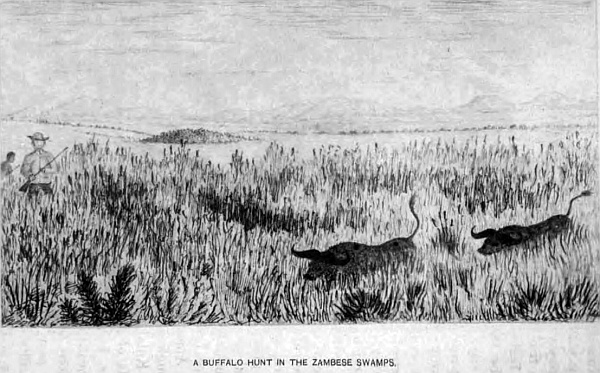
Almost daily I go in search of insects, and I made many valuable collections to be thrown away from being destroyed by worms and moths. I collected no less than five kinds of bats, some of them very large. These also fell to pieces. Although I was not molested by the Batibe tribe, I found a stay in the country would add to the suspicions they already entertained, I could see, of my presence, so I moved on, and, taking another route, passing Okayanka, crossed a desert through a bush and open country, guided by two Kasaka Bushmen, and returned to Westley Vale after a tedious and long journey. Although in the rainy season we had difficulty to find water, the soil being sandy, a heavy shower of rain soon soaks into the ground. Permanent water there is none. On our way we were caught in one of those extensive veldt fires that are so common all over Africa, and narrowly escaped. Following down along the great Salt vlei, Otjando, Otjikolo, skirting the Otjiokaka mountains, we reached the wells, and up the Omuramba, where water was plentiful, made for Barmen, where I remained a day, then to Eikham, Rhenoster vlei, Ames, to Westley Vale on the Nosop. The country through which I passed has already been described, in the Kalahara desert. On our way down we saw many herds of game, small troops of elephants, a few rhinoceros, koodoos, pallahs, wild boars and others. Lions we heard in plenty, but they did not come near. I was anxious to leave the country, as the rainy season was just past, and water was getting scarce, having great difficulty on several occasions to find water for man and beast, and it is refreshing to be able after a toilsome and hazardous journey to arrive at a safe haven, where rest and good water are procurable.