"Sport and Travel in South Africa" (continued 2)
Reading edition
Again I visit the Vaal, where I follow it down, keeping to good grass until the spring grass comes, taking long rides over the country with my rifle, as game was plentiful—blesboks and springboks, wildebeests, and steenbok, which is a small antelope, with horns six inches in length, very good eating when baked in an iron pot.
The country I have now treked over leads up to two very fine springs and large vleis, which I find is the source of the Hart river, where Lichtenburg now stands. I soon found lions and wolves were numerous; we could hear them in the evening and at night, but had not seen any. Our outspan on the Vaal is in a snug nook of the river, with plenty of trees and bush, below where Bloomhof is now built. Wild ducks and geese were so plentiful, that of the former I frequently at one shot brought down six and eight, on the islands, for there are several, covered with trees and bush, as also are both banks; the river is very pretty.
In the evening, after fishing a short time, I would return to the waggon with six or seven large barbel, the tails reaching the ground when carried over the shoulder on a stick; they are fat, with few bones; the white or yellow fish is better eating but full of bones; much as I like fish, I do not care for these. The Boers are very fond of them. They are soft and tasteless; the eels are better. They grow to forty or fifty pounds.
The river is about 150 yards broad when it is flooded, the water rises in the narrow parts from thirty and sometimes fifty feet in height, entirely submerging the tall trees growing on the banks; at these times the water is composed of one-third mud, but when low, as it is now, it is very clear; so much so, that I have frequently seen the iguana walking on its bed at a depth of five feet; some of them grow to a great size. I found three kinds, the very dark brown, the largest, measuring from head to end of tail five feet; they are very destructive in the farm-yards, visiting the fowl-roosts at night. I shot one a few nights ago, with legs a foot in length. Otters are also plentiful but difficult to find, their spoor was everywhere to be seen on the banks. Ant-bears and spring-hares which resemble very much the kangaroo. Meercats abound all over the Veldt; they are grey, some have very bushy tails, others long and smooth, but along the river-banks they are red with black tails. The armadillo is also found covered with large scales, and when disturbed curls up similar to our hedgehogs. Snakes are not visible yet, the weather is too cold. I have shot three varieties of kingfishers, one very large and of a light grey colour. There are many beautiful birds along the river-banks, also Guinea-fowl, partridges and pheasants, consequently I vary my dishes. And with such a variety of small game, such as jackals and tiger-cats, we find plenty of sport.
October 21st.—I made a move down the river in the afternoon. A thunderstorm came on in evening, and we had to outspan near a large Koranna station, the nights closing in so quickly, and the road being unsafe to travel in the dark. We made everything right before the storm broke over us. We were close on the high banks of the river, thick with trees and bush all round, not a safe place in a storm, but well protected from the wind. The night was fearfully dark and rough, and I had little sleep; the oxen breaking loose from the trektow, I had to wake the boys to secure them. Soon after breakfast the whole Koranna kraal turned out to come and stare at the white man; men, women, and children, about seventy in all, as motley a group as could well be found; some of a dark dirty drab, light-yellow, and blackish-brown, many of the younger ones almost white and with rather pleasing countenances; all of them in a half-nude state, the children entirely so. The grown-up females had old and dirty Kaffir sheets thrown over their shoulders and held in front; the men wear parts of what once were trousers, but are now in rags, made of skin. I began to think I had fallen into about as fine a nest of unwashed and half-starved rascals as I could meet with in my travels; my driver, John, knowing their language, could talk to them. My waggon was soon surrounded, each one begging for a piece of machuku (tobacco), the women and children forming a half-circle in front of the waggon, sitting down two and three deep, all asking for tobacco. I gave some to the men, who commenced smoking through bone pipes made out of the leg-bone of blesbok, about four inches in length, in which they put the weed at one end and drew from the other. One old shrivelled-up woman was persistent in her demand, and got quite cross because I took no notice, and abused me in her tongue, which I knew from her manner; I therefore would not give her any. Sitting on my waggon-box in front, I looked at her, and putting my thumb to my nose and extending my fingers in her direction, called forth a yell from all the women and young ones; every one imitating my action returned the compliment to me. Their action looked so ludicrous, I could not resist bursting out into a hearty laugh; this exasperated them the more; taking no notice of all this noise, they began to see it was no use, therefore one by one came holding out her hand asking quietly for a piece. I told John to tell them I would not give them any because they abused me; they then came and wanted to kiss my hand. Finding they could not do that, they kissed my coat, boots, anything they could touch of my clothes; at last, to get rid of them, each had a piece given them; then I was everything that was good, and blessings came tumbling down upon me wholesale. A large circle of the women was soon formed round the fire in a sitting position, smoking away, about thirty, old and young, the old Kaffir rags thrown on one side careless of results, modesty being unknown. The men standing round or sitting beyond the circle completed a group worthy a better artist than I am to give it full effect, and in the evening the bright glare of a large fire, bringing prominently into view the figures against the background beyond, and many of the large stems of the trees and branches showing out brightly, completed the picture. But the charm was broken by the din and noise of the people, all talking, laughing, singing, and some dancing. A happy people! no cares for the present or the future. This sort of amusement went on until ten o’clock, then I gave my John orders to clear them all off, for I wanted to sleep; any that remained behind were to have no tobacco to-morrow; this had a magical effect, they cleared at once, and silence reigned supreme, and the night passed away in peace.
I outspanned at a sharp bend of the Vaal, on the fifth day from the Koranna station, where there is a stony drift crossing the river to the missionary station at Pniel, where Bloom and his people lived. In 1869, extensive diamond-diggings were worked here, and many thousand people were employed at Pniel and Klip Drift; both were very extensive camps, the latter being the headquarters of the Provisional Government, previous to the annexation of Griqualand West, when it received the name of Barkly, and continued to be the headquarters up to 1875, when all the departments were transferred to Kimberley.
October 30th.—I went down early in the morning to the drift, with my span of oxen, to help a Boer, whose waggon had stuck in the middle of the river, and his small and poor span could not move it. Fortunately the water was very low, otherwise the great boulders that blocked the wheels could not have been removed. His vrow and kinder (children) were sitting in the waggon with their faces wrapped up, only their eyes visible, a common practice with them when on the road. They are always getting what they call sinkings (neuralgia). Having hooked on my trektow with my span of fourteen, the waggon was brought out and up the steep bank in safety, and outspanned a short distance from my camp. He informed me he had come from the Free State, and was on his way up-country for skins from the Kaffirs. The vrow was handed out of the waggon, a camp-stool put for her, a fire made, the kettle put on for coffee, and things made comfortable. We had some difficulty in landing the vrow, she being rather stout and short, quite a genteel figure, measuring, as correctly as my eye could judge, about five feet round her waist; rather “off-coloured” complexion. Her principal occupation seemed to be sitting on her camp-stool; she was not fit for active work. The whole family was suffering from inflamed eyes, a common complaint caused by dirt. So far as I have seen of the Boers, there is scarcely a family without one of its members being so afflicted. This is purely from never washing themselves; they have a natural horror of water touching their persons.
There are many Hottentot, Koranna, and Bushmen living along the river-banks; they have so intermixed by marriage that there is little difference between them. Some are of opinion that the Koranna is the true Hottentot, but the people, as a general rule, are taller and of a lighter colour than the real Cape Hottentot, but as I have stated, from their intermarriages it is difficult to draw the line. The Bushmen of the north are much more distinct from those in the south. There are also many of the Bechuana tribe living in small detached kraals, and Bastards, so-called from being born of Dutch fathers and Hottentot women in the early occupation of the Cape colony, and from the great increase in their number they have become an important tribe, and are found in all parts of South Africa. They do not differ from the Boers in habits and customs, and when able build their houses similar to those of the Boer. In fact there is but a slight difference between them, particularly those who are living in the Transvaal. It is interesting to study how the blood of a tribe or different nationality will show itself after many generations; as an instance, in one family I am well acquainted with, the grandfather is an old Boer, whose mother was a bushwoman; his son married a Boer girl, and their daughter married a German; the eldest son of this marriage was a half black; the second son very fair, with light hair and blue eyes; the eldest daughter very dark, black hair and eyes, quite half black; the second daughter very fair, light flaxen hair and light blue eyes; the third daughter and third son were both half black, black eyes and crisp black hair; the fourth son again was fair. This family was the fourth generation from the black and white marriage. I know of several other similar cases, and most of the Transvaal Boers are of this breed.
November 10th.—I returned from a five days’ trek down the river, where the junction of the Hart river falls into the Vaal, and close to a large Kaffir kraal, under the chief Jantze of the Bechuana tribe, and found the old Boer outspanned at the same place; he was afraid to proceed, having heard the Boers of the Transvaal were still fighting amongst themselves, which had been going on for a long time, and which was the reason of my leaving the country last October, causing me to alter my plans, and on the 29th of November, 1864, I left the Vaal at high drift for the north. Two days’ trek over a stony road, between low hills covered with vaal bush, which is in full bloom at this season of the year, giving out a pleasant perfume, the leaves also being strongly scented, and when boiled in water are sometimes used for tea.
Towards the Hart river the veldt is level, with several isolated ranges of hills. At the west end of one there is a conical hill, formed entirely of limestone and fossil bones, so blended together that it is impossible to separate them—teeth, jawbones, and other parts of animals, large and small, are found. The surrounding hills are of sandstone formation, with large boulders of a bluish colour that overlap them. I think there can be no doubt as to the origin of the formation of this chalk hill, viz. by the action of the water when submerged in the ocean. The bones and chalk, the latter being held in solution, would be brought together and deposited in comparative still water by the eddy formed by the current rounding the end of the adjacent hill, but from whence the immense mass of bones comes is a question not so easily solved; being of the same specific gravity they may have been deposited in the eddy. I visited the hill several times in passing, and spent many hours on its side and summit with my hammer breaking off pieces to ascertain if any human remains could be found, but not being an anatomist my labour was partly in vain. Of every piece of rock I detached from the hill nearly one-half was composed of bones, all perfectly white, the same as the limestone, and exceedingly hard. In many other localities I have found masses of bones imbedded in limestone; the former have been white, the latter of a dark greyish colour, forming extensive caves, from which beautiful springs of delicious water flow, showing that animal life existed prior to the general configuration of the present earth’s surface.
During my two days’ journey from the Vaal river large herds of game were seen in all directions, keeping me in the saddle all day to provide food for the road. Lions, wolves, and jackals were heard nightly, and came prowling round our camp at no great distance, but never came sufficiently close to be seen. A few miles beyond the bone hill, if I may so call it, we crossed the Harts river, a bad and muddy drift, where there were many Kaffir huts. Ascending the hill beyond, I came to “Great Boetsass,” where the chief would not allow me to outspan, as he said I had come for no good, being sent by the Boers of the Transvaal to take down on paper all the watering-places; therefore I was detained whilst he and his head-men held a kind of “raad” over me, to decide what they should do. Finally they decided to send me out of the country in the direction of Mahura’s kraal at Taungs, the head chief of the Bechuanas, with a guard of six men to see me clear, and put me in the road, following me up for several miles; they then left me in the middle of the veldt, without a road or anything to guide me. The chief would not believe my statement. To have resisted would have been folly, as I could do very little against a hundred Kaffirs. All the women and children kept to their huts, the men assembled quite in a nude state, except a small cloth in front, and were armed with assagais and knobkerries. When I was leaving, they came demanding some tobacco; I told them they should have none; if they had behaved well, I would have given them plenty.
Finding these Kaffirs had been so badly used by the Boers, and not knowing the English, they insulted every white man that came into their country; and having heard very bad accounts of the people at Taung and the villages around from the same cause, I determined, when the guard left me, to strike across the country and give them a wide berth, otherwise I might be detained again. Two years after, when visiting this kraal, the chief, when he found out who I was, told me he was very sorry he had turned me away.
After proceeding several miles we came to a single hut where a Bushman lived, looking after a few goats, who directed me what course to take. Giving him a little tobacco I proceeded a few miles to a thick forest of trees, close to a pan of water, where I outspanned for the night. At many of these pans, and when travelling over the country, I would pick up flint implements that were lying exposed on the surface. On some of the large rocks in out-of-the-way places, carvings of a variety of animals, snakes, and men are occasionally stumbled upon in the stone “koptjies,” quite artistic in execution. The instrument must have been of good steel to make any impression on the hard stone. I do not think they are the work of Bushmen, as some suppose, but those who once occupied this country in search of gold many hundred years ago, as there is such extensive evidence in this country, in the old pits remaining, of former workings.
December 4th.—Shot a fine hartebeest early in the morning from the saddle, and after breakfast started with waggon, following a track partly overgrown with bush, over an undulating country, sometimes through a thorn country and Kameel-doorn trees, where thousands of game were literally covering the open plains in every direction as far as the eye could see. Blue wildebeest, blesbok and springbok, quaggas and many other kinds; there was one drove of quaggas, at least a thousand, crossing the path I was travelling, only a few hundred yards in front, going at full speed, a beautiful sight.
Outspanning in the evening near a large pond, we disturbed, as we approached, several hundred ducks, which kept us employed until dark in adding to our larder. In the morning the Namaqua partridge in coveys of twenty to a hundred came to water. They are the size of a dove; the time to shoot them is when they are settling at the edge of the water and when they rise; in two shots I killed fifty-four; they are called also sand-grouse.
The next day I passed through a pretty country, well-wooded and low hills, noted as the lion veldt; therefore I treked on to get clear of the bush before night, and came to a very large brak pan, at least four miles in circumference, called Great Chue Pan. On the bank was a small spring of good water, and an open country, where we remained the night. The oxen were let loose, and the horse knee-haltered to feed, before making them fast for the night to the trektow, my invariable custom, to prevent their straying; the loss of your oxen is almost death to the traveller. They were feeding some distance from my camp, when they were seen in full gallop coming to the waggon, and did not stop until close home; we knew they were frightened by lions. At night, soon after dark, we heard the roar of several, in the direction where the oxen had been feeding. We made them fast round the waggon, and close in front collected wood for fires, which we kept up all night; and all of us on the watch with rifles, for they never ceased their roar, sometimes very near, but being very dark and cloudy I could not see them.
As a book of reference, describing the physical geography of South Central Africa, it is necessary in the first instance to give the several river systems or basins comprised within this region; and, secondly, to give the results of my explorations, not in consecutive journeys, but in a detailed description of each separate region visited from time to time, as I had frequent occasion to travel over the same ground for the purpose of completing my labours, so that no portion of any region should be left unexplored. For when such an immense area of nearly 2,000,000 square miles has to be visited, to survey the whole necessitates frequent visits to the same district, to be able to reach those parts beyond. Consequently I have passed through all this region many times.
Chapter Five.
On Griqualand West, the Griquas, Korannas, Bushmen, and Diamond-Fields.
Previous to the annexation of this country by the British Government, it was occupied by various tribes under petty chiefs, ruling each their separate kraals, the banks of the Vaal and Orange rivers being the most thickly populated districts. So far back as 1820 there were mission stations established at Griqua Town and Campbell, by the Rev.—Campbell, and Anderson and others. The country at that time was peopled by Korannas, Bushmen, Bechuanas, and Griquas, under the chiefs Choodeep, Keidebio, Siffonel, and Sebedare; the two latter were Bechuanas of the Baralong family, who had large kraals and many people. Soon after the country was overrun by hordes of Kaffirs living more to the east of what is now the Transvaal, of various tribes, some of the chiefs being the Bapedi, Makatee or Mantatees, afterwards called Basutu or Musutu, under Moshesh, whose habits and customs in war were similar to the Zulus—their weapons, the assagai and long oval shield, the shield of the Bechuana being square, hollowed out on the four sides.
(These Mantatees are so-called from the name of their queen, who was the widow of a petty chief and elected queen. The Kaffirs had a fancy for a queen, and the tribe became very powerful. At last she was deposed by her prime minister, Moshesh. She fled to Natal, and died there in obscurity. Moshesh had 20,000 horsemen, and gave us more trouble than any other chief. At last the Boers of the Orange River Free State wore him down.)
Soon after, the Rev. Robert Moffat and the Rev. — Campbell established the mission station at Kuruman, which was made the headquarters of the London Missionary Society in Bechuanaland, forty miles beyond the northern boundary of Griqualand West; and, at the same time, two other stations on the north and north-west of the latter station, Baclairis and Matelong; and, subsequently, the German mission was established at Pniel, on the banks of the Vaal, about fourteen miles to the north, where Kimberley now stands, and a missionary is now doing duty there.
At Griqua Town the mission house is in ruins, the church is still kept up, and the missionary from Kuruman goes over and holds service. At Campbell the mission house and church are both in ruins. Upper Campbell, which is a mile to the north of Lower Campbell, on the top of a range of hills called Campbell Randt, has only a few houses occupied by Griquas; a Mr Bartlett occupies the farm. Another mission station, established after Lower Campbell, was at Lekatlong, near the junction of the Harts and Vaal rivers, by the same London Society, under the Rev. Mr Ashton, but the church and house are in ruins. Mr Ashton lives now at Barkly, and goes over occasionally to hold service. It was a large Bechuana station under the chief Jantje, who has now removed with his people to Masupa, beyond the northern boundary of Griqualand West.
The Griquas many years ago settled down on both sides of the Vaal. Adam Kok settled at Normansland, on the borders of Natal, with his people. Andries Waterboer settled with his people at Griqua Town, occupying the whole of the western division of Griqualand West, dividing it into farms; and at the death of Andries, his son, Nicholas Waterboer, became chief, and it was with him the British Government arranged to annex the country to the British Empire in 1871.
Waterboer lived in a nice house, well furnished, and the family live as respectably as any Boer family. I was invited to a dance one evening by Waterboer, when the élite of the families were invited. All the fashionable dances were correctly and well performed to the music of the harmonium, which one of his sons played; his daughters were well-behaved, and I was much pleased to see such refinement in this out-of-the-way corner of the world among the natives. Since that time he has been made a prisoner, deprived of his chieftainship, and is now living in Hope Town, the principal portion of his people being driven from their lands. The Griquas are a religious and well-conducted people, kind and hospitable, but lazy, and they will only work when obliged. They plough and cultivate their lands, are fond of coffee and visiting; like their Boer brothers in habits and customs, being descended from Dutch and Bushmen, they retain the habits of the former. Many of the Boers of the Transvaal are descended from these people. In this province they are found in less numbers than formerly, but some are living along the Orange river and the western district.
The Korannas had large kraals along the Vaal and Orange before diamonds were found; since then they have gone more to the west into the Kalahara desert. They are, as I have before stated, a dirty and dishonest tribe, not to be trusted in any way; their main stronghold is at Maamuosa, on the Harts river, under the chief Moshoen. The Bushmen also have considerably decreased. When I first knew them, in 1864, these two tribes lived together with scarcely anything to cover them. At the present time they all wear clothes of some sort, and are in a better position in consequence of the Diamond-Fields bringing money into the country. I have had several of them for my servants at different times, but could make nothing of them. Speaking to my Koranna boys about their marriages, they tell me when a man and woman agree to be man and wife, as soon as that is settled between them, without asking any one’s permission or going through any ceremony, they are then and there married, so long as it suits them; if either wish to break off the engagement, they tell the other party that he or she can go and get another wife or husband, as the case may be; the children, if any, are divided by agreement. In 1867 I had a Koranna boy, about twenty, who got married when in my service; seven months after they got tired of each other, so he took another girl, and his old wife married the other boy I had. In 1877 I had another Koranna, who changed his wife three times when in my service. The Hottentots and Bushmen do the same; they never have more than one wife at a time.
All the other tribes can have as many wives as they are able to keep. They belong to the Bechuana family, and live more in the northern part of Griqualand West, near the Harts river, as all the lower parts are occupied by English, Dutch, and others in farms, allowing small native kraals to remain on them, that the occupiers may have the use of their labour when required, and they are allowed a piece of ground to cultivate and grazing for their cattle.
Diamond-digging first commenced in the latter end of 1869 at Hebron, on the Vaal river; then at Klip Drift early in 1870, now called Barkly, and on the opposite side of the river Pniel, where large camps were formed employing many thousand people at each place, all living under canvas. Then prospecting parties went down the river, forming large camps at Delporthope, Esterhanger, Blue Jacket, Forlorn Hope, Keisikamma, Union Coppie, Gong Gong, Webster’s Kops, Waldeck, Plant, and down the river from Barkly fifty-five miles to Siffonel. These composed the principal river diggings. Diamonds have been found much lower down in the Orange river at Priska, and 100 miles above Barkly, and at Bloemhofbut; no claims have been worked beyond those named. All these river diggings are now abandoned, with the exception of a few hundred, where thousands once occupied the ground. The discovery of diamonds at New Rush, now Kimberley, Old De Beers, Du Toit’s Pan, and Bultfontein, and from the great quantity of diamonds found, drew all the diggers from the river to take claims in those four rich and valuable mines, which are now being worked with expensive machinery at an enormous expense. The Kimberley mine is the largest, being nearly half a mile in diameter and 360 feet deep, with engine and hauling-gear round the whole distance. It is the same with the other mines; the population, including whites and blacks, must exceed 30,000. Kimberley is twenty-five miles south-east from Barkly, and is the great diamond centre, where the government of the province is carried on. These four principal mines cover an area of over six square miles, and are situated in a part of the country the most wretched, barren, and exposed I have ever been in; no trees, but open dreary plains, surround the mines in all directions. Up to 1884, the people and machinery were supplied with water from wells, which did not give sufficient for their wants. A company was established to draw the water from the Vaal river, distant some twelve miles, by an engine pumping the water into reservoirs and by pipes.
Kimberley is the great mining centre and the important town in Griqualand West, and in all this part of Africa roads branch off in all directions. It is the terminus of the Cape railway. From Bloemfontein, the capital of the Orange Free State, the distance is about 100 miles; from Kimberley to Bloemhof 90 miles, and from the latter to Pretoria, in the Transvaal, 210 miles. To Barkly it is 25 miles, and from that town to Taungs, in Bechuanaland, 80 miles, and to Kuruman, north-north-west from Barkly, 120 miles.
There is also a direct road from Kimberley, through the Free State to Maritzburg, in Natal; the distance is about 400 miles; besides many others to all parts of the country.
Barkly, up to 1875, was the seat of the government, when it was removed to Kimberley. It was then a busy and thriving town, several hotels, clubhouses, bank, high court, and other offices. The town, since this change, has fallen off considerably. It stands on the lofty bank of the Vaal, 100 feet above the river, with stone koppies surrounding it bare almost of vegetation, not an inviting locality to settle in. It has become now the frontier-town for the interior trade; the river being 500 feet broad, there is plenty of room for boating. Many of the inhabitants enjoy, in the summer, a sail on its waters, which is in many parts deep. The banks are well clothed with trees that add greatly to the beauty of the river. Two passenger-carts run daily between this town and Kimberley, passing over the pont, which is capable of taking a waggon and span of sixteen oxen on at one time. Since then a bridge has been erected.
The geological formation has many varieties of rocks:—The siliceous and crystalline limestone of the Campbell Rands, a range of hills that runs through the northern portion of this province, from the chief Monkuruan’s town at Taung, in a south-west direction, on the north side of the Harts river, down past Campbell Town to the Orange river, where it breaks up into many spurs, where are amygdaloidal and ancient conglomerates, and schistose rocks, with shale and sand, form the lofty hills along the Vaal, which is the same throughout the whole course of this river in Griqualand; and on the opposite side, at Puiel, Backhouse, Hebron, and the koppies on its banks, is jasper with magnetite along the Kuruman range which passes Griqua Town, and quartzite sandstone at the Langberg range of mountains, which runs north for several hundred miles into the Kalahara desert, and forms part of the western boundary of Griqualand West. Plumbago, shale, sandstone, and ferruginous breccia at these peculiar hills at Blauw Klip and Matsap. Limestone on the northern boundary and at Danielkuil. Felspathic rocks, olive shales, and gravels are seen in the hills on the river near Langberor mountain. The boundary of this province commences at Kheis on the Orange river, the extreme western point, opposite Scheurberg mountain, following the river up to Hope Town on to Ramah, the Cape Colony being on the south side, then in a north-north-east direction to Platberg, near the Vaal river; the Free State boundary also; thence in a north-north-west direction, crossing the Vaal, and Harts river, the joint boundary of the Transvaal by the last convention, and also the boundary of Monkuruan’s territory, then turns west-south-west to a tree, north of Nelson’s Fountain on to a point in Langberg, thence to Kheis on the Orange. This part of Griqualand West is wild and grand, lofty mountains broken up into isolated and perpendicular masses, a thousand feet high, with lofty projecting rocks jutting out from their sides; the dark colour of the stone gives additional grandeur to the landscape. This kind of scenery continues up and down the river from Kheis for nearly 100 miles.
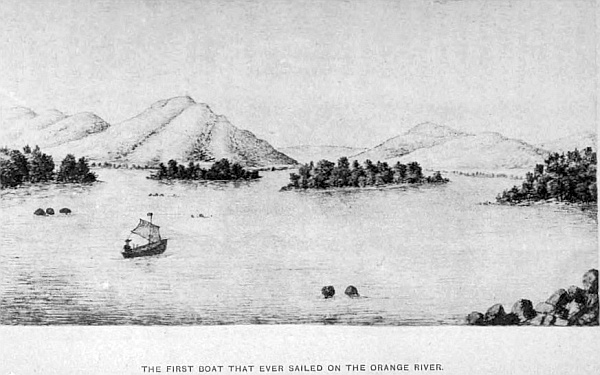
From Griqua Town to Bultfontein, over sixty miles, the country is of the same character, the road passing along from that town to Wittwater, Reedfontein, Modderfontein, Bluebush Kalk, to Bultfontein, on the Orange river, a pretty site for a town. It is a Kaffir station of several tribes.
At Modderfontein, nearly on the summit of one of the lofty hills, are several Bushmen’s caves. The largest is capable of holding 200 people; the rocks within show evidence of fire by their smoked appearance, and many years ago were occupied by that bloodthirsty tribe mentioned in my description of the Kalahara. The Griquas living here told me they have passed away, but the old man stated their fathers could remember them. The mountain road leaves Bultfontein and goes west no great distance from the river, over a very stony, road, on to the Pits, where several Griquas have comfortable houses, situated on a pleasant open space, rarely to be equalled for beautiful views in all directions. I remained here several days to ramble and explore the mountain tops. I took my driver in case of accidents, as leopards and lions were known to be there, as one old Griqua told me they frequently lost a goat by being taken from the kraal at night. Vegetation up the kloofs and on the slopes of the hills is very fine; beautiful tree-ferns, and every variety of other kinds, particularly the maiden-hair, which grows out amongst the rocks on the mountains, are very beautiful; also some very fine ground orchids, and a thorny bush with crimson flowers, as also many varieties of aloes.
This district contains copper and lead, and from the appearance of the quartz which crops out, I believe gold will be discovered when this part is prospected. One road from this place goes down to the river through a fearful valley; it is necessary to “reim” (tie) the four wheels of the waggon, otherwise it would go crash down into the precipice below, and then turn over and be smashed. This was the road I took to the river on a previous journey. The other passes on to Milk Stort Pass in the Langberg range, fifty miles more to the west, which I crossed on the western side, and outspanned under some fine old trees, close to a perpendicular rock at the foot of the Berg, where we found a small pool of water in the rocks, collected from the recent rains, and good grass. The pass over the mountains was a most difficult and dangerous road, large holes and boulders blocking the way. The scenery on both sides was grand, lofty and perpendicular rocks, 2000 feet high, with beautiful shrubs and flowers growing out from every crevice. The light and shadows thrown on the opposite hills by the setting sun gave beauty to the landscape.
At night some leopards paid my camp a visit; a few sheep I kept as a reserve for the road appear to have been the cause of their troubling me. A Bushman and his son came early in the morning and told my boys where the leopards could be found, and as their skins made splendid karosses, we arranged to hunt them down if possible, taking the Bushman as guide to point the way. Three of my boys, myself and two dogs, followed the spoor for several hundred yards. Up amongst the spurs of the mountain, the old Bushman pointed to a ledge of rocks overhanging others, surrounded by bush. We then sent the dogs to ascertain their whereabouts, for we knew there were at least two by their spoor on the sand. As soon as the dogs, by their barking and unmistakable fear, showed exactly where they were, we took up our position on separate rocks, forty yards distant from the tigers’ den. Two of my boys were to keep up a fire into where we knew them to be, myself and driver kept ready to overhaul any that might come out. We heard nothing but low growls from time to time; the affair began to be interesting. After nearly a dozen bullets had been sent in, out came a fine male leopard at one bound over some bushes, looking anything but amiable, and took a deliberate survey of his surroundings, his fine spotted skin shining in the sunlight—a beautiful animal. But this was only for a few moments; three bullets entered his body at once, when he gave a spring, and fell on one side, and as he did not appear quite dead I gave him another in the region of the heart, for I have known them drop like this, and then spring up and seize upon those near them. The other, which we concluded was the female, made her escape amongst the rocks. I then set the Bushman and my Hottentot boy to take off the skin, and the rest returned to the camp, where we found the dogs lying down by the fire, evidently ashamed of their desertion by their fawning manner to make friends. Animals have more sense than instinct; they knew perfectly well they had done wrong in leaving us.
This range of mountains, which runs due north, as I have stated, forms the south-eastern boundary of the Kalahara desert, and looking towards the west for thirty miles from the base the country is almost level, a few sand-dunes and gentle rises up to the Scheurberg mountain range, which looks one compact mass of lofty peaks. But on a close inspection, there are many detached and deep valleys running between. A native road passes about midway through on to the Koranna and Bastard stations on the Orange river. There are a great many lions in these hills, as it is uninhabited, except by Bushmen. On my previous exploration, where I outspanned near a Bushman kraal, one of them told my boys that a few days before our arrival a lion had entered one of the huts and carried off a young boy; they followed him in the dark with burning brands, but had to give up; they could only trace him by the screams of the lad, but they soon ceased. Across the desert from this point westward, it is 330 miles.
Leaving the camp the next morning after the leopard-hunt, we proceeded in a northerly direction for thirty-three miles along the west base of Langberg, and arrived, on the second day, opposite Speck Kopjie, where another pass crosses the mountain, which is a very stony and rough road, but the scenery grand on both sides, similar to that we passed through a few days ago, and arrived at a farm belonging to Potgieter, a Boer. From thence on to koppies, Mr Hyland’s farm, Blaaw Klip, is six miles beyond, where, in a hill, a soft stone is dug, which the natives form into pipes, plates, vases, and many other useful articles. And beyond, in a north-east direction, is Mount Hexley, Maremane and Coses, a Kaffir station. The formation of the hills is very peculiar, lofty, isolated koppies, covered, many of them, with thick bush, others almost bare, the naked rocks piled one upon another in grotesque forms. The dry river-bed passing through this part is a branch of the Kuruman river. We then crossed the Kuruman range, and arrived at the mission station 2nd April, 1865.
Before leaving this part of the Griqualand West, I should like to describe that peculiar sand-formation on the west side of the Landberg mountains, which is in fact part of it. I heard from many of the Griquas and Potgieter, living near it, that the lofty hills are constantly changing; that is, the sand-hills, 500 and 600 feet in height, in the course of a few years subside, and other sand-hills are formed where before it was level ground.
May 5th, Sunday.—Attended Mr Moffat’s church; the service is held in the Bechuana language. About 400 natives present. The singing is as well performed as it is in any English church at home. The Kaffirs, who are Bechuanas, have fine clear voices, and the women are well known to have sweet, musical voices. The service is well-conducted, and the natives as attentive as any white congregation in a civilised country. I first attended at this church in February 1868, when the Rev. Robert Moffat was living there, previous to his finally leaving for England. On 29th December, 1869, I was again there, detained for many weeks with a severe illness, and through the kind nursing of Mr and Mrs John Moffat, Mr and Mrs Levy, and other English residents, soon recovered. I remember well before leaving at that time they got up a little picnic party, to visit some ancient Bushmen caves, a few miles from the mission station towards the hills, taking a cart with provisions, the party riding, and a very enjoyable day we had. As we approached the hills the country became covered with bush and long grass, where I may safely say, several hundreds of baboons were busy seeking roots. The old men were very large, and to see the whole troop scuttle towards the hills with the babies on their mothers’ backs, with their little arms clinging round their necks, was a pretty and novel sight. Arriving at the caves, we found a long sand cliff projecting many yards over the lower part, affording shelter for several hundred families, perfectly secure and a safe retreat—but its ancient inhabitants are passed away and forgotten. We procured some very beautiful specimens of the trap-door spider; the workmanship of the door and its hinge, and the lining of the passage down to their nest is something marvellous. So far as I have discovered, there are three kinds of this species, distinguished by their size. The largest is a black spider, the body nearly an inch in length; the opening, or passage, and the door to their nest is the size of our English florin; the hole to the nest is perpendicular for from a foot to two feet, when an open space is beyond. The coating of this opening and the under side of the door is of a greyish white, and as soft and smooth as satin, and when the door is shut it fits so exactly as to be quite watertight. The top of the door is made to represent the ground round about, to be undistinguishable by an enemy. The second size trap-door is the size of a shilling, and the third the size of a fourpenny-bit. But the spiders are of the same type; where one kind is found in a district the others are not, showing they occupy separate localities. I have frequently found the door open and thrown back, showing the spider is abroad hunting up game to supply his larder. On several occasions when finding these doors open I have watched the return of the spider, sitting down a few feet from the door, and waited sometimes nearly half an hour. Presently he will be seen coming along in great haste. On arrival at the door he looks down for a few seconds, as if to listen if all is right below; then he makes a small circuit round, again approaching; this time he goes in a few inches, then out, and another inspection of the locality, back again, and down into his nest, where he remains about two minutes; out he comes on to the top, looks round, then goes in, turns round and puts out one of his fore-legs, takes hold of the door and pulls it close down over him, and when shut it is difficult to see where it is. Frequently I have watched these spiders (three kinds) when they have left their doors open, and invariably the same cautious movements have been adopted on returning home. There are other spiders very similar in form and size to the above; they make their nests and passages down after the same fashion, but with no trap-door, the entrance being quite open and exposed. Another peculiar spider, common in these parts, is the two-headed spider, with two mandibles; they are the largest I have seen, two inches in length, with six legs, and of a greenish-brown colour. They are night spiders, and the Bushmen tell me their bite is death. This may, or may not, be true; I had no desire to try. The number that must be hidden in the ground in the day must be legion. When I have had my camp-fire at night, on an open piece of ground near which I have been sitting, after hunting, hundreds of spiders and creeping things, as also moths, are drawn to it for warmth and light; amongst them are these two-headed monsters, seen running about, and finally become destroyed by rushing into the burning embers. I found their retreat during the day by a pet meercat, the long smooth-tailed kind, similar to the ichneumon. He would, on my outspanning, jump off the waggon and begin to smell the ground in all directions, and frequently stop, begin to scratch with his fore-feet down two or three inches, poke his long nose into the hole, and bring out one of these spiders and devour it with evident relish. The ground being perfectly smooth with no aperture exposed, I could not discover how they could conceal themselves so cleverly. In some cases, I counted the number this little animal would find in a given space, when roughly hunting over the ground; it would average seventeen, in a surface ten feet square, and leaving probably as many in the ground. The tarantula is also very common, some of them the size of the palm of one’s hand, well covered with long brown hair. A large camp-fire at night would draw the scorpions to it also, particularly if it should be made near a stone koppie. They grow to a great size. I have caught them from one inch to twelve inches in length. When young they are of a green colour, but full-grown they are black. The sting of the young ones, if on the arm or leg, causes a numbness with a burning heat that may last a day, with no other bad symptoms. The sting of the full-grown ones must be dangerous; the natives tell me it is death. The study of the insect-world is a lifelong study in Africa alone, consequently my attention was only drawn to those kinds that took my special attention.
There is every indication that this country is drying up. Fountains that gave out fine springs of water, so the old Kaffirs told me, in their fathers’ time, have not been known to flow for many years. This is a common remark all over the country, and there is evidence that it is so. Extensive pans, some more than a mile in circumference and 100 feet deep, with rocks or cliffs generally on the north-east side, with sandy bottoms, are now without water, when evidently they must have been full at some time. From the long drought, seven or eight months of the year, it cannot become a corn-growing country to any extent. The greater portion of the ground is of that stony and rocky nature it is incapable of growing anything but a coarse grass that suits cattle, but not sheep. A farm of 3000 morgan, or 6000 acres, will not maintain throughout the year more than 200 head. That is where water is on the farm, otherwise that number of cattle can only be maintained for seven months out of the year.
The northern border of Griqualand West, on the north of the Campbell Randt, is a fine country for grazing and keeping cattle. There is more permanent water, the district being limestone. From Daniel’s Kuil, where there is a singular cave, and between Neat’s fountain, Marsaipa and Boetsap, is now laid out into farms. Fourteen years ago I frequently hunted the ostrich all through that region. Lions and wolves would visit me every night. Bushmen also were found, but of late years they have disappeared. An old Bushman at that time told me one evening many tales of his escapes from lions, and one of his brothers, only a few months before, was seized by a lion in the arm, when he had the presence of mind to take a handful of sand and throw it in the lion’s eyes, when he let go, and the Bushman made his escape before the lion had recovered from the pain and surprise, then gave a roar and bounded away. I saw his brother a few days afterwards, and the marks of the teeth on the arm. A similar occurrence happened in the desert when I was there four years before. A lion had seized a Bushman in a similar way, when he could manage to reach the hind part and squeeze his leg, when the lion gave a roar and sprang away. Many other such tales I have heard from these children of the desert of lions leaving the victims they have seized. I have met with three kinds of wolves in these parts: the tiger-wolf, hyena striata, the largest kind, the striped hyena, a large animal, and the maned hyena, the small kind. The wolf-hyena is the most numerous.
Porcupine-hunting is very good sport at night when the moon gives a good light. They visit the Kaffir gardens, when the corn is getting forward. The plan is to go in with a few dogs, and several Kaffirs with sticks; the dogs drive the porcupines about; when they come near a good rap with the stick on their nose soon kills them, but care must be taken they do not run back and plant some of their quills into your legs, for they make dangerous wounds.
The old Bushmen tell me they recollect when all the large game was plentiful over the whole of this part of Griqualand West, north of the Vaal and Orange rivers, and also the hippopotami were found in them. The Blood Kaffirs, along the lower part of the Orange, also tell me there is one at the present time to be seen occasionally.
The flora in these parts, in the spring and through the summer, is an interesting study alone. Some of the flowers are perfectly crimson, others of a deep purple; the creepers, with their rich scarlet flowers, climbing up amongst the bushes, and long yellow pods, make the veldt interesting. The Vaal bush is the most common in this province; it flowers in the winter, and has a pleasant perfume; the tea made from its leaves is an excellent tonic. Many of the Bechuanas live in small kraals along the Campbell Randt, the Harts river, and at Great and Little Boetsap, and possess many waggons and spans of oxen, supplying the people at the Diamond-Fields with vegetables, corn, cattle, and also wood from their forests, to keep the machinery at work. The general altitude of this part of the country is 4300 feet above sea-level. This is the cause of grass being more coarse throughout the interior of South Africa than it is at a lower level, and why winters are colder than they would be, the south latitude being only 28 degrees.
Griqualand at the present time is as much occupied by a white population as any part of the Cape Colony, and, from its being the great diamond centre, has now become the most extensive and business part of South Africa; millions of pounds change hands annually, where fifteen years ago it was a howling wilderness.
Chapter Six.
The Bechuana family—Their division into tribes—Their past and present condition.
That portion of Bechuanaland between the territory belonging to the chief Montsoia, which is on the north, and Griqualand West, is occupied by several chiefs belonging to this family. Monkuruan claims to be the paramount chief over many of them, others claim their independence. When the British Government annexed the Diamond-Fields, they acknowledged this chief to be the head of the Bechuanas over all that country. Previous to that time, Mahura, uncle to Monkuruan, ruled; at his death his nephew became chief, and lived at his chief town, situated on one of the spurs of the Campbell Rantz, called Taung, or Toane, a large Kaffir station, close to a small branch of the Harts river, above its junction, containing a population, at the time I first visited the country, under 2000. Monkuruan and his people belong to the Batlapin tribe of the Bechuana family. He has several large kraals, where his people live. Another chief, Botlatsitsi, son of the old chief Gasebone, lives at Phokwane, about eighteen miles from Taung, on the south side of Harts river. He and his people belong to the same tribe as Monkuruan.
The town, or kraal, is very pleasantly situated amongst the hills, which are thickly covered with low underwood. The other petty captains, living within the country first described, are Moshette, of the Baralong tribe, who, with his people, live about nine miles from Taung, at Kunanna; the chief Matlabane, of the Bamairi branch of the Batlapiu tribe, whose kraal is six miles from Taung, on the hills about it.
The chief Matlibe and his people live at Taung, and they are of the Batlapin tribe also. The petty captain, Jantze, of the Batlapin, previous to the annexation of the Diamond-Fields, lived at a large kraal, Lekatlong, on the banks of the Harts river, near its junction with the Vaal, but afterwards he removed, with his people, to Myneering, about thirty miles south of Kuruman. Young Gasebone lived at Dekong, on the same branch as that passing Taung, which I recollect perfectly well, for he stole out of my waggon thirty pounds of coffee, on my third visit there, in 1869, and then politely offered to drive my waggon through a very stony drift on my leaving his station. At Kuruman is Moshette. At Bakelaris, which is eighteen miles on the north from Kuruman, is the chief Barhakie, and brother to Moshette. To the north, eighty miles from Bakelaris, is Morequerne, where there are three petty captains, Makobie, Makutse, and Marketchwar, an old blind man; his people told me he was more than 100 years old, but they did not understand age; he died shortly afterwards.
Eighteen miles to the north-west of Morequerne is Conge, another large station, which is on the border of the Kalahara desert; and to the west, and south, towards Kuruman, is the kraal at Mynyam, near Honey Vlei, a large sheet of water. Cooe station is to the west of the Vlei, but near it, forty miles south, is Tsinin station; Comopere twelve miles south of the last, and twelve miles west of Bakclaris. On the east again we come to several kraals—Matetong, Kopong, and Tokong are the principal. There are many others of less note, all with their head-men. On the west of Kurutnan, under the Langberg range of mountains, are Gamapoope, Molanwan, Kamasap, Puruhulu, Tuten, Lukin, and Zitburn. One of the chiefs is Tatu. Consequently, all this part of the country is thickly populated by the Bechuana family, all under petty chiefs and captains.
South of Kuruman is Kobis, Koning, Myneering, and Marseipa, and with their outlying posts for cattle, sheep, and bucks, make it an important and valuable region for the British Government to protect and secure from foreign invasion, as it is contiguous to Griqualand West along the whole of its northern border. The extent of this portion of Bechuanaland above-named, south of the chief Montsioa territory, is from the Transvaal on the east to Langberg on the west—200 miles by nearly 200 north and south, or 40,000 square miles. And when I first knew the country, twenty years ago, it was nearly unknown to the white man, except the missionaries, who had their stations at Kuruman, Lekatlong, Bakclaris, and Matetong, and some half-dozen traders passing through Kuruman, from Hope Town, in the Cape Colony, to the Bechuana chiefs living to the north. This little-known region then was one of the most pleasant and agreeable parts of Africa to visit and explore. The natives, more particularly at Kuruman and those to the north, were most friendly and kind. Like all native tribes, they do not forget to beg of the white man. Down towards the south, in Mahura’s time, the people were troublesome, and much less civil in their behaviour to strangers. I think I experienced more annoyance because they took me to be a Boer, noting down all their watering-places, and on one occasion I was in great danger in consequence. Skins well-brayed was the only material for their clothes; the men had long cloaks, which, when thrown over the shoulders, reached the ground. The women had short wrappers round their loins, hanging down behind and very scanty in front; in cold weather they also had leather mantles. But at the present time they have to a great extent adopted the European mode of dress, and deal extensively in almost every kind of English merchandise.
From cultivating little or no corn, which was the woman’s work, they now go in extensively for ploughs, which the men use, and instead of growing mealies, which is maize or Indian corn, and a few melons, they now produce wheat, barley, and oats, which they grow in their beautiful valleys and sell to traders for English goods, and in addition they breed herds of cattle, goats and sheep. Many of the men buy the best English clothing, and some of the women, particularly the young ones, indulge in cotton prints and even silk for their dresses, and are very proud if they can obtain stylish boots.
The schools also have greatly improved the people. The advance in civilisation within the last twenty years has been remarkable. They are, as a people, timid and for from being fond of war. Their language is Sechuanse, which is soft and pleasant to the ear. They have natural mechanical talent, and make good carpenters, smiths, and masons. Their houses show great ingenuity in their construction, particularly in the formation and design of their granaries for storing their winter corn, which are quite artistic in form. Many of these are built up in the centre of a large hut made of clay, shaped like our water-bottles, in diameter ten feet in the largest part, gradually reduced in size to three feet at the top, total height ten feet, which will hold many hundred bushels of corn. No mice, snakes, or other animal can get in to destroy the grain. A store is kept separate for each family, quite distinct from their living huts.
They are very expert in metal, melting the ore for the manufacture of ornaments, assagais, Kaffir picks, and such things as they require. They also make very neat mantles, karosses and other kinds of materials for the women, the men being the tailors and dressmakers for the tribe. Time being no object, their work is beautifully executed, as may be seen from the karosses brought to England; many of them sold as high as ten pounds. They are also very fond of music; they make various kinds of instruments which produce pleasing sounds. The young men form themselves into bands to the number of twenty to thirty, called the reed band—reeds from six to eight feet in length with holes similar to the flute, but held upright in front of each musician—forming a circle like our military bands, and perform tunes. The women and children walk round on the outside singing and clapping hands in time to the music. This performance generally begins about sundown, and is kept up for several hours.
The interior of their huts and yards outside where they cook, which are surrounded by a high fence made of sticks, are kept remarkably clean and tidy, and their iron utensils also receive their share of attention. Many of these Bechuanas are rich in cattle, sheep, and goats. They have their cattle-posts away in the bush, where the stock is looked after, cows milked, and once or twice a week a pack-ox is loaded up with skins of milk and taken to the kraal for use. These “vieh-posts” are in charge of their slaves, called Vaalpans. They are the Bushmen of the country kept in subjection by the Bechuana tribe, and are a very harmless and quiet people, the only drawback to their liberty being they cannot leave their masters’ service; otherwise they have full liberty of action. They are of a darker colour and different in form to the Cape Bushmen.
The Bechuanas throughout South Central Africa possess waggons, and have spans of oxen and everything complete like the colonists, and go trading with English goods amongst their neighbours like any white trader. They also bring down from their homes, wood, corn, and vegetables for sale to the Diamond-Fields, and are far more beneficial and useful in the country than the Boers. They are outstepping them in civilisation, and if they had white skins, would be looked upon as a superior race. They have been kept down for want of opportunity to rise above their present condition. This extensive race, as I have already stated, extends from the Cape Colony to the Zambese, throughout the whole of Bechuanaland, and are in habit and customs the same wherever they live, the same language and its dialects.
The females, like all other nations of the world, have their fashions, and vary according to the country in which they live. Some of the young girls shave all the wool from their heads except on the crown, leaving about three inches in diameter, which they anoint with red clay, plumbago, and grease, giving a very sparkling and shining appearance to it that is very becoming, and even makes the young girls look pretty, as many of them at that age have a pleasing and intellectual expression; their short kilt is so arranged that the upper and lower borders should have the white fringe of hair of the springbok skin to look like a border of deep lace, which against the light rich brown hair of the other part is very becoming, and sets the figure off to great advantage. They quite understand being complimented upon their good looks, and can carry on a flirtation with admirable tact. Where this is more perceptible, is far away from the demoralising influence of other tribes who have come in contact with the Boers and other white people. The more isolated they are from such influence, the more I have always found them respectful in their manner to strangers. I am referring to the Bechuana family in general.
The principal roads through this part of the country to the interior pass through Hope Town in the Cape Colony to Kuruman, the mission station where the Rev. Robert Moffat spent forty-five years of his life in missionary labour, which station has been largely increased by the addition of an extensive college erected of late years at a great expense for the teaching of native youths for missionary purposes. The site is admirably situated, having an unlimited supply of the purest water from a spring some few miles above the station, which issues from a cave in the side of the hill in a picturesque locality. The mission houses and church of the London Missionary Society are substantial and well-built, and have fine gardens well stocked with fruit trees, and the orange and lemon grow to great perfection. Mr Chapman, who has a large store, takes great interest in his garden, and grows every kind of vegetable known in England. Twenty years ago there were several stores; three at Upper Kuruman, about a mile from the mission station.
The bold outline of the lofty range of hills at the back of Kuruman, distant some six miles, adds greatly to the beauty of the adjoining country, which is undulating and well-wooded, with open plains and Kaffir gardens, and is one of the most healthy parts of South Central Africa. The roads from Kuruman branch off in every direction to the several natives’ towns. The main transport road from Kuruman and Diamond-Fields goes to Maceby Station on the Molapo, in the chief Montsoia territory, and very pretty roads to travel over. On leaving the station there are several small kraals on the road to Kopong, which is a large native town situated on the Matlarin, a tributary of the Kuruman river, which latter flows past Bakclaris, and then south, past Comopere, from thence through a wild uninhabited country for 180 miles, where it joins the Hygap river, which is the lower portion of the Molapo. The main road continues on from Kopong, through a fine forest of kameel-doorn trees for many miles, then enters upon open veldt, passing little and great brack-pans to the Setlakoole and Moretsane rivers, then bush again to Maceby’s station Pitsan; the distance between Kuruman and that town is 154 miles. Several roads branch off from it to different parts; one goes to Melemas on the Molapo, another to Marico, and also others to Monkuruan’s at Taungs. Maamuosa, where the Koranna Captain Moshoen and his people live, a bad and wicked tribe, who have been helping the Boers lately to make war on Monkuruan, and whose land the Boers have taken from him. The principal main transport road from the Cape Colony and Diamond-Fields runs direct to Taungs in a north-east direction to Maceby’s and then north, which has by the late Convention with the Transvaal been preserved. There are no very lofty hills in this part of Bechuanaland. The principal ones are those at Kuruman, those near Taungs and Swaatberg. The average elevation is about 4600 feet above the sea-level. The northern portion is more open, extensive plains and forests of the mimosa tree; and has many brack-pans, where in the summer wild geese and ducks come in great numbers.
The game when I first travelled through these parts swarmed on the open flats. Blesbok and springbok, hartebeest, quaggas, gnus or wildebeest, the black and the blue; the latter is a much finer animal, the skin is also of more value. The koodoo is found in the hills. Then there are several other antelopes, such as the steinbok, found all over Africa. These at the time I state, if it were possible to count them, would exceed 100,000 to be seen from the waggon at one time, a complete forest of horns, and as they feed off the grass until it is too short, they move away to another district. Of course lions, wolves, and jackals were very numerous and kept up their howls all night. The wild dog (Hyena venatica) could be seen in packs of several hundred, crossing the plains in pursuit of game—they are a pretty animal with large rounded ears, large bushy tail, whitish face, long black and white hair, tall and slender. They always hunt in packs. On one of my journeys, having to cross these plains, I came upon several hundred of them in one of the slight hollows. On nearing them, for the road ran directly past where they had been having a grand feast off springbok, as remains of them were still unconsumed, some of them were lying in the road I was travelling, and would hardly get out of my way, others stood looking as we passed between them. Fortunately they had been having their meal, otherwise I think my span of oxen would have fared badly, for there must have been over 300. With so many making an attack on a span of oxen, guns would have been of little use, if they were hungry. I have often seen forty and fifty in a pack in full cry, after blesbok or springbok, and a beautiful sight it is. Wolves also were seen, seven and eight together.
At a small pan on these plains, in a hollow, with high reeds surrounding it, I, one afternoon, outspanned, intending to remain there the night, as there was an extensive pan near, with very steep banks down to it, where I intended, the next day, to look for ancient implements, as I had previously found some there before. I sent one of my Kaffir boys down to this pan, only a short distance from the waggon, for water. He was very quickly back, looking quite scared, and cried out there were wolves in the pan.
Our rifles were soon out of the waggon, and cartridges for a few shots if necessary. I started with my Bushman and Hottentot driver, all armed. As he said, the pan seemed full of them; when within fifty yards, some of the wolves broke cover and were making for some bushes; two were shot, others escaped at the sound of our rifles. We could see them moving about in the long reeds, and fired at every opportunity, killing in all seven; four of them were the largest I had ever seen; their heads were immense, and between the ears measured seven inches. They are large and powerful animals, but great cowards. Lions would be heard nightly round the waggon, whenever I outspanned in one particular district near the Moretsane or Setlakoole rivers, which seemed a favourite resort for them.
All this state of things has passed away. The game has been shot and driven away more into the desert, wolves nearly all poisoned, and in crossing any of those extensive plains and open flats, a few hundred may be counted, where before tens of thousands covered the veldt in all directions. Then it was a great pleasure to travel through the country for sport alone, in addition to the enjoyment of passing through a beautiful country teeming with game. At the present time, to go over the same ground with not a living thing to be seen, it becomes monotonous. Close to that pretty isolated hill, Swaatberg, are the ruins of a very ancient town, Kunam: whether built by Kaffirs or the race that built the other stone huts, mentioned in a previous chapter, there is no history to prove. There are many strange tales handed down to the present generation of its being one large town, the seat of a powerful chief, and of some great battles having been fought there. The ruins indicate it to have been at some remote period a large town. Near it are extensive pans, that at one time must have held water to a great depth, as the banks and cliffs clearly prove; now only in the summer months water is found in them. Not far from them there are some dried-up springs, the water of which was conveyed away by a sluit passing into the Moretsane.
One day we had fixed our camp at a very pretty spot close to some fine trees and bush, had made all fast for the night, and were sitting by the fire before going to bed, the Kaffir boys having their supper, when we were startled by a rush of large animals passing close to our camp-fires, on both sides of us. The night being very dark, we could only distinguish, by the light from our fire, that an immense herd of blesbok was amongst us. We had our rifles in hand in a moment and fired into a dense mass of them. When they passed away we found three dead upon the ground. My Hottentot and boys ran to bring them in, when a solitary blesbok rushed up to the fire and there stood quite exhausted, and some thirty yards in the rear were several animals moving about, but I could not distinguish, from the flickering light, if wolves or wild dogs, that had chased the poor animal until it could run no more. We all ran out with our rifles, but with caution, in case any lions might be amongst them. As they did not go away, evidently exhausted also with the long chase, we had a good chance of getting some, and succeeded in killing two. The others in the mean time made off. Lighting the lantern to bring them in, we found them to be very fine and powerful wild dogs. By this time the blesbok had recovered from the hard run, and took himself off. My driver wanted to kill him, but I said, “No; he sought our protection, and he shall have it.” It is wonderful they should seek man’s protection when all other hope of self-preservation seems gone. I have known small birds fly to my waggon and into it, on several occasions when pursued by hawks. This is more than instinct; there is some reasoning power in animals when they seek shelter from foes where they know they will not follow them. Foxes we know act in the same manner.
In the morning, on examining the spoor, there must have been many wild dogs engaged in the chase, but they were stopped at the sight of the two fires and waggons, and our shots at the blesbok as they passed us. In the small grove of trees under which our camp was pitched, we founded several very large chameleons measuring fifteen inches in length. We discovered them by hearing a noise on one of the branches, caused by a fight between two of the largest, which we caught, but gave them their liberty before leaving. I also, during my explorations, made a collection of many kinds of the mantis family, commonly called in Africa, Hottentot gods, as they always appear to be praying, having their two arms held as if in that act; their four legs are used for locomotion. They feed themselves with their hands. I made a collection of forty-seven different kinds, those with wings and those wingless, both kinds having well-developed bodies. Then there is a third kind without bodies, called walking-sticks, each kind having four legs, two arms and hands. I made twenty-two collections of the winged; the largest measured eleven inches in length, brown bodies and lovely purple wings, two on each side, two horns on the head a little over an inch in length, large eyes, with a mouth similar to a wasp’s, with flat head and neck four inches in length, from the lower part of which the two arms spring. The four legs were fixed in the centre of the body; the smallest size with wings measured one and a half inches in length; each size differed somewhat in shape. I put one of these, which measured six inches, green on the back and yellow underneath, with silvery wings, into a paper-collar box. One afternoon, on looking at it half an hour afterwards, I found it had woven a nest on to the side, composed of silky and light-brown material, and the insect appeared quite dead or in a torpid state. Putting the box away, I forgot to look at it for several months; when I opened the box I found upwards of 200 young ones, all dead, each about one-eighth of an inch in length. The greater portion of my specimens I caught in my waggon at night when my candle was burning and my fore-sail up, being like the moths attracted by the light. The wingless ones I found on bushes or in the grass. The third kind, the walking-stick, I always found in the grass. The first time I caught one was when I was collecting some beetles. I saw, as I thought, a piece of live grass moving along. Sitting down on the ground to watch it, I found it had four legs, which moved very slowly, and two in front that stuck straight out in line with the body. Carefully observing its movements, I saw at once it was a very strange kind of insect. Taking a piece of grass to lift it from the ground, the thing showed fight at once by raising its head, opening and shutting its mouth, drawing up its two long arms from the straight position, and striking out at the grass I held to its head. The colour was exactly that of the long dry grass in which it was moving—yellow. Length of body and neck, fourteen inches, and the size of a small straw; the legs were very long—five inches; the knee-joint half-way up; the arms had two joints—the regular elbow, and two-thirds of the distance another that doubled up, so that it could pick the food and carry it to its mouth. These again vary in size and colour from one inch in length to the size above described. The female is much larger than the male, which is a light-brown, the former of a sea-green colour. I think the mantis and the trap-door spider the most curious of the insect-world in South Africa. Many specimens of moths I collected in my waggon after dark, some of them very beautiful; the larger kinds I mostly found in the long grass on the plains.
Butterflies were very plentiful in some parts, in others rarely any would be seen; each locality had its peculiar species. The wasps also amused me when standing in any particular locality for some time; the large black with purple wings was a constant visitor. When about making a nest to lay their eggs, they would fly into my waggon, examine every part minutely, and after fixing upon a particular corner, would fly away and return with a ball of mud the size of a pea, and commence to plaster the side of the waggon fixed upon. This would go on for two or three days, the two wasps, male and female, bringing in these little balls of mud, going and returning every minute until it was completed, leaving a little circular hole to each cavity in the clay nest, one-eighth of an inch in diameter when so completed. They would commence with one of the holes, there being five; the female would deposit the eggs, then the two would go out and return with a green caterpillar each, which they would push into the hole containing the eggs, then leave and return with balls of clay, and plaster up the hole so cleverly that it would be impossible to find it from the outside. The same labour was bestowed upon the other compartment of the nest, and when completed would be left for time to bring forth the young. Two other kinds of wasps were of quite a different shape, their slender bodies extended for half an inch, leaving a large egg-shaped ball at the end. These made exactly the same form of nest as the one described. A fourth kind, I noticed, would build their nest in the roofs of buildings; these would be suspended by a thin stem of a glutinous nature, upon which would be fixed from five to twenty cells similar to those of the bee. There have been eight and ten of all these kinds of nests in my waggon at one time, and during the intense heat of the weather, 106 degrees and sometimes 116 degrees in the shade, being too hot to move about, I have amused myself in watching the methodical way in which they so cleverly and beautifully completed their work, and in so short a time. The bees generally make their nests in old hollow trees, which we discovered through the honey-bird leading us to one. When one of these birds wants to attract attention, it soon makes its presence known, and becomes impatient, if not attended to, flying round about with its little twitter and call, which is well known. When it sees you are following it, it flies from branch to branch in a straight line to the nest; when there, it stops, and you soon see the nest. The Kaffir will go fearlessly to work, the bees buzzing about him when taking out the honeycomb, he rarely being stung.
The common black crow, with white about the neck, is also a friendly bird, of the same size as our English. They generally come and settle near the outspan, waiting for the camp to break up, then come and look for what may be left. They talk in their throat as well as caw, and can be taught like a parrot to speak. I tamed a young one; he would not sleep in the waggon, but early in the morning he would come and settle on the front part of the waggon, where he could raise the fore-sail to look in. On seeing me in bed he would come in, hop up to my face, take hold of my nose, or have a peck at my beard, look round to examine the things hanging on the sides, then hop out. On my getting up and leaving the waggon he would be seen flying from some tree, and come and settle on my hat or shoulder; if the latter, he would put his head round and rub his beak against my face.
There are other crows quite black, more like ravens, but not so large. Another time I was staying at a Boer farm for three weeks to have my waggon repaired; in the early day I walked over to a Boer farm, about a mile from my outspan, to examine some quartz reefs, where I found a few specks of gold on a former journey. At this farm there was a beautiful crane, belonging to old John Nell, the farmer. I tried to make friends by making the same kind of sounds that he kept repeating, but he took no apparent notice. On leaving to walk back to the waggon with my rifle, this crane followed me all the way, keeping about three yards behind, where he remained by my camp a short time, then flew home. Every day after he paid me a visit. One afternoon I took my rifle for a ramble round in the thick bush veldt to look for a waterbok. When about a mile from my waggon I heard a great rush. Looking round I found it was my friend the crane. He settled down in front, then came and walked on my left side, just beyond my reach, keeping close for some distance, then on a sudden he took flight and rose in the air, making long circular sweeps, until he passed behind some small clouds and became again visible, until he was lost in the distance. Thinking no more of him, I continued my walk for half an hour, and was returning home, when the same kind of rush was heard, and looking up I saw him pass close to me, and settle on the ground about thirty yards in front; he then took his place by my side as before, and accompanied me home, and then flew back to the farm. I mention these incidents to show there is something more than instinct in all living things.
The country round this part of Monkuruan territory, and in fact all Africa, swarms with every kind of ant, from the smallest size up to three-quarters of an inch in length, each kind having their own peculiar form of nest, more particularly the destructive white ant, which causes so much damage to buildings and furniture; the construction of their nests differs in different latitudes. In the Cape Colony, Natal, Orange Free State, and lower part of the Transvaal, the veldt is covered with these hills, in the shape of a ball cut in halves and placed on the ground; the average size is four feet in diameter by two feet in height; many of them have been scooped out by ant-bears.
The Dutch women, in travelling, frequently make use of these holes, by turning them into ovens to bake their bread for the road. More to the north, instead of being round, they form a kind of peak, with holes on the topmost points, some exceeding in height twenty feet. North of this again the ground is raised some two feet by ten to fifteen in diameter. On the centre part chimneys are built up, many exceeding four feet in height, by nearly three feet in circumference; the opening is nearly a foot in diameter, the top terminating in a cup-like form, in three distinct layers, one above the other, forming quite an ornamental termination to the chimney beautifully constructed. On looking down, hundreds of these tiny masons may be seen plastering and repairing the inside coating, which may have received damage from rain. There is always one large chimney, and sometimes one or two smaller ones close to it, and at the base some twenty or thirty small ones, three inches to a foot in height, and three and four inches in diameter, and many small holes round about, where the ants are busy taking in their food, small pieces of dried grass, and other things, never making use of the chimneys as a means for supplying their cells with food. They are, I believe, erected as ventilators to give air below, as the cavity beneath must be as large as a small room, and in some eases larger, as a waggon fell into one. A road had been made near Molapo, over one of these disused nests, and in 1877 a Boer waggon was travelling in the night, as is their usual practice. The front oxen had gone over it, the ground gave way with the after oxen, but they managed to get on firm ground; the weight of the waggon broke the top surface, and only the desselboom on the opposite side getting fixed, kept the two fore-wheels and waggon suspended over the hole, a Boer woman and three children narrowly escaping from falling into the pit. I followed up the next morning, when the Boer and others were getting the waggon mended; bushes were then put round the hole and the road turned. If I had passed over this road before that waggon I should have met the same fate. As a whole, the roads in all parts of Monkuruan territory, and in fact throughout South Central Africa, are very good, considering they are never repaired; many of them rough and stony, but as they are mere natural tracks made by waggons, it is surprising they are in such good condition.
The population of this district, including all the various tribes, does not exceed 20,000, exclusive of Bushmen, and they do not number more than 3000.
Chapter Seven.
Bechuanaland. The territory of the chief Montsioa, of the Baralongs.
This country is situated on the north of Monkuruan. The boundaries are common to both, from the Transvaal, down west to that range of mountains running north, the continuation of the Langberg; beyond is the Kalahara desert, of which this western portion forms part. Its northern boundary joins the chief Gaseitsive, and the Transvaal is on the east. The length from east to west is 200 miles, and from north to south seventy miles. The Malapo, or the Mafeking river, rises in the Transvaal, flows west, through the entire length of this territory, continuing on in the same direction, receiving the two dry rivers, the Nosop and Onp, then turns south at the great bend, under the name of Hygap, and enters the Orange at Kakaman’s Drift; there are but few branches in its course. The eastern portion of this country is valuable and productive, suitable for any kind of vegetation.
When the British Government settled the Keats award boundary, they confirmed Montsioa’s title to the ground on the west of it. At that time, 1871, Montsioa and many of his people were living at Moshanen, a Kaffir station in Gaseitsive’s territory, situated eighteen miles to the west of Kanya, the seat of that chief. But after the settlement of the award he removed down to his own country, and settled at his town, Sehuba, which has since been burnt by the Boers, and was six miles south of the Molapo river, and the same distance from the large kraal on its banks, under the petty chief Melema, on Molapo, who was his nephew; and eighteen miles below, and on the river, was the large kraal under Maceby.
The population numbered some 35,000 souls, including the Kuruman district; but since the Transvaal Boers have made war on these people, after the retrocession of that state, nearly half have been killed and made prisoners.
The country has fine grazing-lands, and some parts are well-wooded. There are extensive vleis and pans; the people cultivate corn extensively, use ploughs, and had large herds of cattle, sheep, and goats, now stolen by the Boers.
Montsioa belongs to the Baralong tribe of the Bechuana family; he and his people have always been loyal to the English Government, and during the Transvaal rebellion many loyal Boers fled to him for protection, and were hospitably received. The people are in their habits and customs similar to those in Monkuruan’s country. Montsioa is a quiet, well-disposed chief, and has been cruelly used by the Boers for his loyalty to England; one of his sons, and most of his brave men, have been shot down like dogs, and his women and their children killed in cold blood, and many of them taken into captivity, all for keeping true and loyal. He has been shamefully and disgracefully forsaken, and left to battle alone against these murdering freebooters, who were supported by the Transvaal Government, and supplied with guns and ammunition to carry on their unholy war, and now he has lost the greater portion of his people, and nearly all his cattle and property. The British Government, moved by the voice of the English people and our loyals at the Cape, at the eleventh hour sent out a force under Major-General Sir Charles Warren, to see justice done him. Will they compel the Boers to return the stolen property, and the women and children they have taken into the Transvaal as slaves, for they will be nothing less? Will they deliver up the murderers of Mr Bethel and others? Never was a more cruel and unjust war made against people than this, by a people professing Christianity, who have, by their cold-blooded and atrocious acts, stamped themselves as a nation of murderers and robbers, and for such acts they are not worthy of retaining the Transvaal as an independent country. It is useless for that Government to deny any complicity in these wars, they are well known to have been the promoters—there is evidence sufficient to prove this. I was told by some of the influential Boers in Pretoria, soon after peace was restored, and the first convention made, in July 1881, that they intended to go and punish Montsioa and Monkuruan, by driving them out of their territories and taking their land, for their loyalty to England in protecting loyal Boers. As they stated, “We will not have these natives on our border who have helped you English,” showing what their intention was as soon as they were confirmed in their republic. I have deemed it necessary to state these facts, that the English people may know in any future dealings with whom they have to meet.
In the settlement of the Keats award the land was confirmed to Montsioa. There is an extensive hill of metamorphic formation on his eastern boundary, but which may now be included in the Transvaal by the recent Convention, which has in its centre, on the summit, the remains of an extinct volcano; the vent is about 700 yards in diameter, the highest point is 5650 feet above sea-level, and stands on the central watershed. There is an opening for the escape of the lava, which appears to have travelled some miles down a valley on the south-east. This lava, or boiling mud, has several vents on the exterior, the central opening is level, and on one side many bones are embedded in the rock. It is an interesting formation.
The western division of Montsioa’s territory is more open on the south side of the Molapo river, but more wooded on the northern. It was one of my favourite hunting-grounds in my early visits, as game at that time swarmed over those extensive plains, and with a horse they were easily shot; but it was dangerous riding, as there are so many wolf-holes, ant-bear, porcupine, armadillo, spring-hare, and meercat, partly hidden by long grass, that a horse at full speed cannot always escape them, which frequently ends in a broken collarbone or a broken rifle. Many of the antelope species are very subject to bransick, and hundreds die; their bones may be seen lying about in every direction, consequently it is a great resort for vultures and eagles, who are constantly on the look-out for those who have not many days to live. If a wildebeest or blesbok has this complaint, and is not likely to live many days, he is found standing alone, and surrounded by half a hundred of these birds waiting patiently till he drops, then they commence upon him before he is quite dead, his eyes being first taken, and in less than half an hour there is very little left to be eaten. Many believe the vultures or eagles discover their food only by their splendid sight; my experience proves that scent has more to do with it. During my travels in these wilds I have had almost daily opportunity of observing their mode of discovering any dead animal that may be exposed in the open. These birds are almost constantly on the wing; the exception is when they have gorged until they can eat no more. Then they rest on the ground or some stone koppie, until they have to some extent digested their food, to enable them to fly. Many times I have ridden up to them and given them a cut with my riding-whip to make them fly, which they are incapable of doing from over-feeding. When an animal dies, the scent is driven by the wind and ascends many thousand feet, and is carried along with it. If any of these birds are to be seen on the wing, they almost always fly in circles, making long sweeps in their course; this will take up any scent that may be in the air. In watching them closely it is easy to see when they have got the scent, and when they lose it, as is often the case if they make too great a circle. There may be sometimes from 100 to 200 performing these graceful circular flights, some one way and some another. Being at a great altitude—1000 yards—when they smell the carrion, they are, if the wind is strong, more than a mile away from the animal, and as they fly round they gradually work up to windward, until the object is visible; then they do not come down at once, but appear to make a survey of the surroundings before coming down to feast on the carcass. I have may times seen them come down wind, pass directly over a dead beast unnoticed, until they have got into the current of air on the down side, when they have worked back until they could see the animal on the ground. Their splendid sight will lead them to the spot after a time, but their quick sense of smell is the first indication that there is a grand feast for them.