WONDERS OF ELECTRICITY By JAMES P. BOYD, A.M., L.B.
Reading edition
I. AT THE DAWN OF THE CENTURY.
When, in his “Midsummer Night’s Dream,” Shakespeare placed in the mouth of Puck, prince of fairies, the playful speech,—
“I’ll put a girdle round about the earth In forty minutes,”
he had no thought that the undertaking of a boastful and prankish sprite could ever be outdone by human agency. Could the immortal bard have lived to witness the time when the girdling of the earth by means of the electric current became easier and swifter than elfin promise or possibility, he must have speedily remodeled his splendid comedy and denied to the world its delightful, fairy-like features.
An old and charming story runs, that Aladdin, son of a widow of Bagdad, became owner of a magic lamp, by means of whose remarkable powers he could bring to his instant aid the services of an all-helpful genie. When Aladdin wished for aid of any kind, he had but to rub the lamp. At once the genie appeared to gratify his desires. By means of the lamp Aladdin could hear the faintest whisper thousands of miles away. He could annihilate both time and space, and in a twinkling could transfer himself to the tops of the highest mountains. How the charm of this ancient story is lost in the presence of that marvelous realism which marks the achievements of modern electrical science!
The earliest known observations on that subtle mystery which pervades all nature, that silent energy whose phenomena and possibilities are limitless, and before which even the wisest must stand in awe, are attributed to Thales, a scholar of Miletus, in Greece, some 600 years B. C. On rubbing a piece of amber against his clothing, he observed that it gained the strange property of at first attracting and then repelling light objects brought near to it. His observations led to nothing practical, and no historic mention of electrical phenomena is found till the time of Theophrastus (B. C. 341), who wrote that amber, when rubbed, attracted “straws, small sticks, and even thin pieces of copper and iron.” Both Aristotle and Pliny speak of the electric eel as having power to benumb animals with which it comes in contact.
Thus far these simple phenomena only had been mentioned. There was no study of electric force, no recognition of it as such, or as we know it and turn it to practical account to-day. This seems quite strange when we consider the culture and power to investigate of the Egyptians, Phœnicians, Greeks, and Romans. True, a few fairy-like stories of how certain persons emitted sparks from their bodies, or were cured of diseases by shocks from electric eels, are found scattered through their literatures, but they failed to follow the way to electrical science pointed out to them by Thales. Even in the Middle Ages, when a few scientists and writers saw fit to speak of electrical phenomena as observed by the ancients, and even ventured to speculate upon them in their crude way, there were no practical additions made to the science, and the ground laid as fallow as it had done since the creation.
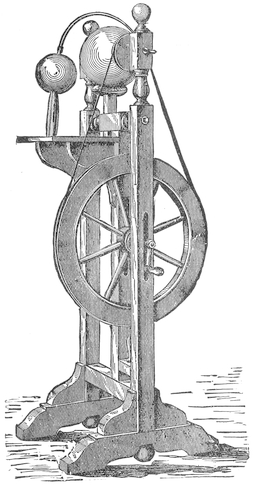
OLD FRANKLIN ELECTRICAL MACHINE.
(By permission of Franklin Institute.)
After a lapse of more than two thousand years from the experiment of Thales, Dr. Gilbert, physician to Queen Elizabeth (A. D. 1533–1603), took up the study of amber and various other substances which, when subjected to friction, acquired the property of first, attracting and then repelling light bodies brought near them. He published his observations in a little book called “De Magnete,” in the year A. D. 1600, and thus became the first author of a work upon electricity. In this unique and initial work upon simple electrical effects, the author added greatly to the number of substances that could be electrified by friction, and succeeded in establishing the different degrees of force with which they could be made to attract or repel light bodies brought near them.
Fortunately for electrical science, and for that matter all sciences, about this time the influence of Lord Bacon’s Inductive Philosophy began to be felt by investigators and scientific men. Before that, the causes of natural phenomena had not been backed up by repeated experiments amounting to practical proofs, but had been accounted for, if at all, by sheer guesses or whimsical reasons. Bacon’s method introduced hard, cold, constant experiment as the only sure means of finding out exactly the causes of natural phenomena; and not only this, but the necessity of series upon series of experiments, each based upon the results of the former, and so continuing, link by link, till, from a comparison of the whole, some general principle or truth could be drawn that applied to all. This inductive method of scientific research gave great impetus to the study of every branch of science, and especially to the unfolding of infallible and practical laws governing the phenomena of nature.
For very many years electrical experiments followed the lines laid down by Dr. Gilbert; that is, the finding of substances that could be excited or electrified by friction. By and by such substances came to be called electrics, and it became a part of the crude electrical science of the time to compute the force with which these electrics, when excited, attracted or repelled other substances near them. Among the ablest of these investigators were Robert Boyle, author of “Experiments on the Origin of Electricity,” Sir Isaac Newton, Otto von Guericke, and Francis Hawksbee, the last of whom communicated his experiments to the English Royal Society in 1705. Otto von Guericke used a hard roll of sulphur as an electric. He caused it to revolve rapidly while he rubbed or excited it with his hand. Newton and Hawksbee used a revolving glass globe in the same way, and thus became the parents of the modern and better equipped electrical machine used for school purposes.
The next step in electrical discovery, and one which marks an epoch in the history of the science, was made by Stephen Gray, of England, in 1729. To him is due the credit of finding out that electricity from an excited glass cylinder could be conducted away from it to objects at a remote distance. Though he used only a packthread as a conductor, he thus carried electricity to a distance of several hundred feet, and his novel discovery opened up what, for the time, was a brilliant series of experiments in England and throughout France and Germany. Out of these experiments came the knowledge that some substances were natural conductors of electricity, while others were non-conductors; and that the non-conductors were the very substances—glass, resin, sulphur, etc.—which were then in popular use as electrics. Here was laid the foundation of those after-discoveries which led to the selection of copper, iron, and other metals as the natural and therefore best conductors of electricity, and glass, etc., as the best insulators or non-conductors.
Up to this time an excited electric, such as a glass cylinder or wheel, had furnished the only source whence electricity had been drawn for purposes of experiment. But now another great step forward was taken by the momentous discovery that electricity, as furnished by the excited but quickly exhausted electric, could be bottled up, as it were, and so accumulated and preserved in large quantities, to be drawn upon when needed for experiment. It is not known who made this important discovery; but by common consent the storage apparatus, which was to play so conspicuous a part in after-investigations, was named the Leyden Jar or Phial, from the city of Leyden in Holland. It consisted of a simple glass jar lined inside and out with tinfoil to within an inch or two of the top, the tinfoil of the inside being connected by a conductor passing up through the stopper of the jar to a metallic knob on top. This jar could be charged or filled with electricity from a common electric, and it had the power of retaining the charge till the knob on top was touched by the knuckle, or some unelectrified substance, when a spark ensued, and the jar was said to be discharged. By conductors attached to the knob, guns were fired off at a distance by means of the spark, and it is said that Dr. Benjamin Franklin ignited a glass of brandy at the house of a friend by means of a wire attached to a Leyden jar and stretched the full width of the Schuylkill River at Philadelphia.
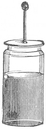
LEYDEN JAR.
At this stage in the history of eighteenth century electricity there enters a character whose experiments in electricity, and whose writings upon the subject, not only brought him great renown at home and abroad, but perhaps did more to systematize the science and turn it to practical account than those of any contemporary. This was the celebrated Dr. Benjamin Franklin, of Philadelphia, Pa. He showed to the world that electricity was not created by friction upon an electric, but that it was merely gathered there, when friction was applied, from surrounding nature; and in proof of his theory he invaded the clouds with a kite during a thunder-storm, and brought down electricity therefrom by means of the kite-string as a conductor. The key he hung on the string became charged with the electric fluid, and on being touched by an unelectrified body, emitted sparks and produced all the effects commonly witnessed in the discharge of the Leyden jar.
Franklin further established the difference between positive and negative electricity, and showed that the spark phenomenon on the discharge of the Leyden jar was due to the fact that the inside tinfoil was positively electrified and the outside tinfoil negatively. When the inside tinfoil was suddenly drawn upon by a conductor, the spark was simply the result of an effort upon the part of the two kinds of electricity to maintain an equilibrium. By similar reasoning he accounted for the phenomenon of lightning in the clouds, and by easy steps invented the lightning-rod, as a means of breaking the force of the descending bolt, and carrying the dangerous fluid safely to the ground. Here we have not only a practical result growing out of electrical experiments, but we witness the dawn of an era when electricity was to be turned to profitable commercial account. The lightning-rod man has been abroad in the world ever since the days of Franklin.
Thus far, then, electrical science, if science it could yet be called, had gotten on at the dawn of the nineteenth century. No electricity was really known but that produced by friction upon glass, or some other convenient electric. Hence it was called frictional electricity by some, and static electricity by others, because it was regarded as electricity in a state of rest. Though a thing fitted for curious experiment, and a constant invitation to scientific research, it had no use whatever in the arts. An excited electric could furnish but a trivial and temporary supply of electricity. It exhausted itself in the exhibition of a single spark.
II. THE NEW NINETEENTH CENTURY ELECTRICITY.
By a happy accident in 1790, Galvani, of Bologna, Italy, while experimenting upon a frog, discovered that he could produce alternate motion between its nerves and muscles through the agency of a fluid generated by certain dissimilar metals when brought close together. Though this mysterious fluid came to be known as the galvanic fluid, and though galvanism was made to perpetuate his name, it was not until 1800 that Volta, another Italian, showed to the scientific world that really a new electricity had been found.
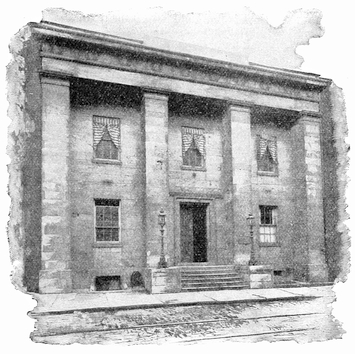
FRANKLIN INSTITUTE, PHILADELPHIA.
(From photo furnished by Institute.)
Volta constructed what became known as the galvanic pile, but more largely since as the voltaic pile, which he found would generate electricity strongly and continuously. He used in its construction the dissimilar metals silver and zinc, cut into disks, and piled alternately one upon the other, but separated by pieces of cloth moistened with salt water. This simple generator of electricity was the forerunner of the more powerful batteries of the present day, and which are still popularly known as voltaic cells or batteries.
But the importance of Volta’s discovery did not lay more in the construction of his electrical generator than in the great scientific fact that chemistry now became linked indissolubly with electricity and electrical effects. The two novel and charming sciences, hitherto separate, were henceforth to coöperate in those majestic revelations and magnificent possibilities which so signally distinguish the nineteenth century. By means of greatly improved voltaic cells or batteries, that is, by jars containing acid in which were suspended dissimilar metals, electricity could be produced readily and in somewhat continuous current. By increasing the number of these cells or jars or batteries, and connecting them with conductors, the current could be made stronger and more effective. In contradistinction to the old frictional or static electricity, the new became known as chemical or current electricity.
As was to have been expected, Volta’s invention and discovery excited the whole domain of electrical science to new investigation, and brought in their train a host of wonderful results, growing more and more practical each year, and pointing the way more and more clearly to the commercial value of electricity as a familiar, inexhaustible, and irresistible power. Thus, in 1801, Nicholson showed that an electric current from a voltaic pile would, when passed through salt water, decompose the water and resolve it into its two original gases, oxygen and hydrogen. In 1807, Sir Humphrey Davy, carrying electricity further into the domain of chemistry, showed, by means of the electric current, that various metallic substances embraced in the earth’s crust, and before his time supposed to be elementary, were really dissoluble and easily resolved into their component parts, whether solids, or gases, or both. Two years later, in 1809, he made the equally momentous discovery of something which was to prove a veritable sit lux, “Let there be light,” for the nineteenth century, and illuminate it beyond all others. Though it had been known almost from the date of the first voltaic pile that, when the ends of its two conducting wires were brought close together, a spark was seen to leap in a curved or arc line from one wire to the other, which phenomenon was known as the voltaic arc, it remained for Davy to exhibit this arc in all the beauty of a brilliant light by using two charcoal (carbon) sticks or electrodes, instead of the wires, at the point of close approach. Here was the first principle of the after-evolved arc light to be found by the end of the century in every large city, and to prove such a source of comfort and safety for their millions of inhabitants. This principle was simply that a stream of electricity pouring along a conducting wire will, when interrupted by a substance such as carbon (charcoal), which is a slow conductor, throw off a bright light at the point of interruption. The phenomenon has been very aptly likened to a running stream of water in whose bed a stone has been placed. The stone obstructs the flow of water. The water remonstrates by an angry ripple and excited roar. In Davy’s experiment with the pieces of charcoal, both became intensely hot while the electricity was making its brilliant arc leap from one to the other, and would, of course, soon be consumed. He, therefore, in showing the principle of a permanent luminant, failed to demonstrate its practical possibilities. These last were not to be attained till the nineteenth century was well along, and only after very numerous and very baffling attempts.
Between 1810 and 1830, many important laws governing electrical phenomena were discovered, which tended greatly to render the science more exact, and to give it commercial direction. Oersted, of Denmark, discovered a means of measuring the strength and direction of an electric current. Ampère, of France, discovered the identity of electricity and what had before been called galvanism. Ritchie, of England, made the first machine by which a continuous motion was produced by means of the attractions and repulsions between fixed magnets and electro-magnets. This machine was an early suggestion of the dynamo and motor of the coming years of the century. It meant that electricity was a source of power, as well as of other phenomenal things.
In speaking of the electro-magnet in connection with Ritchie’s machine, it is proper to say that the electro-magnet was probably discovered between 1825 and 1830, but precisely by whom is not known. It differs from the natural magnet, or the permanent steel horseshoe magnet, and consists simply of a round piece of soft iron, called a core, around which are wrapped several coils of fine wire. When an electric current is made to pass through this wrapping of wire, called the helix, the iron core becomes magnetized, and has all the power of a permanent magnet. But as soon as the electric current ceases, the magnetic power of the core is lost. Hence it is called an electro-magnet, or a temporary magnet, to distinguish it from a permanent magnet.
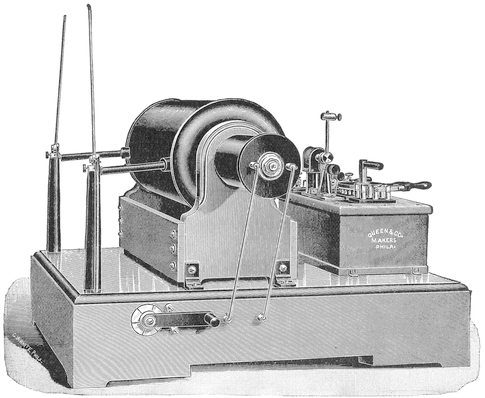
INDUCTION COIL.
While the discovery of the electro-magnet was very important in the respect that it afforded great magnetic power by the use of a limited or economic galvanic force, or, in other words, by the use of smaller and fewer Voltaic batteries, it was not until Faraday began his splendid series of electrical discoveries, in 1831, that a new and exhaustless wellspring of electricity was found to lay at the door of science. Faraday’s prime discovery was that of the induction of electric currents, or, in other words, of manufacturing electricity directly from magnetism. He began his experiments with what became known as an induction coil, which, though then crude in his hands, is the same in principle to-day. It consists of an iron core wrapped with two coils of insulated wire. One coil is of very lengthy, thin wire, and is called the secondary coil. The other is of short, thick wire, and is called the primary. When a magnetic current is passed through the primary coil, with frequent makes and breaks, it induces an alternating current of very high tension in the secondary coil, thus powerfully increasing its effects. In Faraday’s further study of electric induction, he showed that when a conductor carrying a current was brought near to a second conductor it induced or set up a current in this second. So magnets were found to have a similar effect upon one another.
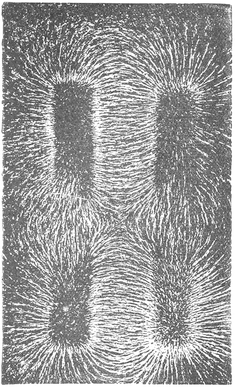
MAGNETIC FIELDS OF FORCE.
The secret of these phenomena was found to lie in the fact that a magnet, or a conductor carrying a current, was the centre of a field of force of very considerable extent. Such a field of force can be familiarly shown by placing a piece of glass or white paper sprinkled with fine iron filings upon the poles of a magnet. The filings will be drawn into concentric circles, whose extent measures the magnet’s field of force. So also the extent of the field of force surrounding a conductor carrying a current may be familiarly shown. In these instances the filings brought within the fields of force are magnetized. So would any other conducting substance be, and would become capable of carrying away as an independent current that which had been induced in it. Here we have the essential principle of the modern dynamo-electric machine, commonly called simply dynamo. Faraday actually constructed a dynamo, which answered very well for his experiments, but failed in commercial results because the only source of energy he could draw upon in his time was that supplied by the rather costly voltaic cells.
During Faraday’s time and subsequently, electricians in Europe and the United States were active in formulating further laws relative to the nature, strength, and control of electrical currents, and each year was one of preparation for the coming leap of electrical science into the vast realm of commercial convenience and profit.
III. THE TELEGRAPH.
From the date of the discovery that electricity could be conducted to a distance, dreams were indulged that it could be made a means of communicating intelligence. In the eighteenth century, many attempts were made to carry intelligent signals over electric wires. Some of these were quite ingenious, but in the end failures, because the old-fashioned frictional electricity was the only kind then known and employed. Even after the discovery of the voltaic cell or battery, which afforded an ample supply of chemical electricity to operate a telegraphic apparatus, the time was not ripe for successful telegraphy, for up till 1830 no battery had been produced that was sufficiently constant in its operation to supply the kind of current required. For feasible telegraphy, two important steps were yet necessary. One was the discovery of the electro-magnet, 1825–30. The other was the discovery of the Daniell’s battery or cell, in 1836, by means of which a constant electric current could be sustained for a long time.
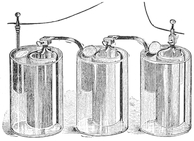
DANIELL’S CELLS.
But even before these two indispensable requisites had been supplied by human genius, much had been done to develop the mechanical methods of conveying intelligence. In 1816, Ronalds, of England, constructed a telegraph by means of which he operated a system of pith-ball signals which could be understood. In 1820, Ampère suggested that the deflection of the magnetic needle by an electric current might be turned to account in imparting intelligence at a distance. In 1828, Dyar, of New York, perfected a telegraph by means of which he made tracings and spaces upon a piece of moving litmus paper, which tracings and spaces could be intelligently interpreted through a prearranged code. A little later, 1830, Baron Schilling constructed a telegraph which imparted motion to a set of needles at either end.
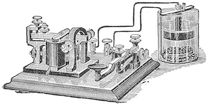
MORSE TELEGRAPH AND BATTERY.
From this time up to 1837, which last year was a memorable one in the history of telegraphy, the genius of such distinguished men as Morse in America, Wheatstone and Cooke in England, and Steinhill in Munich, was brought to bear on the further evolution of the telegraph. While all these names have been associated with the invention of the first practical telegraph, it is impossible, with justice, to rob that of Morse of the distinguished honor. Morse conceived his invention on board the ship Surry, while on a voyage from Havre to New York, in October, 1832. It consisted, as conceived, of a single circuit of conductors fed by some generator of electricity. He devised a system of signs, which was afterwards improved into the Morse alphabet, consisting of dots or points, and spaces, to represent numerals. These were impressed upon a strip of ribbon or paper by a lever which held at one end a pen or pencil. The paper or ribbon was made to move along under the pencil or pen at a regular rate by means of clockwork. In accordance with these conceptions, Morse completed his instrument and publicly exhibited it in 1835. He gave it further publicity, in much improved form, in 1837. In this form it was entirely original in the important respects that the ribbon or paper was made to move by clockwork, while a pen or pencil gave the impressions, thus preserving a permanent record of the message conveyed.
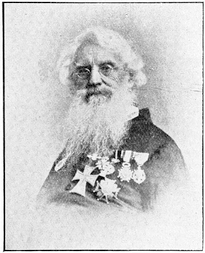
SAMUEL FINLEY BREESE MORSE.
Though under systems less original and effective than that of Morse, a first actual telegraph had been operated between Paddington and Drayton, England, a distance of 13 miles, in 1839, and one at Calcutta, India, for a distance of 21 miles, it was not until 1844 that the world’s era of practical telegraphy actually set in under the Morse system, which speedily superseded all others. In that year, amid the jeers of congressmen and the adverse predictions of the press, Morse erected the first American telegraph line in America, between Baltimore and Washington, a distance of 40 miles, and, to the confusion of all detractors, sent the first message over it on May 27 of that year. From that date the fame of Morse was established at home, and soon became world-wide. His system of telegraphy, with slight modifications, became that of all civilized countries.
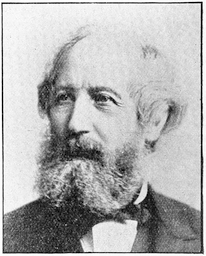
CYRUS W. FIELD.
As was to be expected in a century so full of enterprise as the nineteenth, a science so attractive, so useful to civilization, so commercially valuable, so full of possibilities, as telegraphy, could not remain at rest. Everywhere it stimulated to improvement and new invention and discovery; and as the century progressed, it witnessed in steady succession the wonders of what became known as duplex telegraphy, that is, the sending of different messages over the same wire at the same time. Again, the century witnessed the invention of quadruplex telegraphy, that is, the sending of four separate messages over the same wire, two in one direction and two in another. This was followed by the invention of Gray’s harmonic system, by means of which a number of messages greater than four are transmitted at the same time over the same wire; and this again by Delaney’s synchronous multiplex system, by means of which as many as 72 separate messages have been sent over the same wire at the same time, either all in one direction, or some in one direction and the rest in an opposite.
For a time successful telegraphy was limited to overland spaces, the conductors or wires, consisting of iron or copper, being insulated where they passed the supporting poles. In the cities, supporting poles proved to be unsightly and dangerous, and they were succeeded by underground conduits carrying insulated wires. In 1839, we read of what may be reckoned the first successful experiment in telegraphing under water by means of an insulated wire, or cable, as a conductor. The experiment was tried at Calcutta, and under the river Hugli. In 1842, Morse experimented at New York with an under-water cable, and showed that a successful submarine telegraphy was practical. In 1848, a cable, insulated with gutta-percha, was laid under water between New York and Jersey City, and successfully operated. In 1851, a submarine cable was laid and successfully operated under the English Channel. An enterprising American, Cyrus W. Field, of New York, now took up the subject of submarine telegraphy, and suggested a cable under the ocean between Ireland and Newfoundland. One was laid in 1857, but it unfortunately parted at a distance of three hundred miles from land. A second was laid under Mr. Field’s auspices in 1858, but the insulation proved faulty, and after working imperfectly for a month, it gave out entirely.
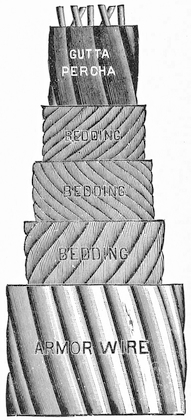
OCEAN CABLE.
These disasters, though furnishing much valuable experience, checked the enterprise of submarine telegraphy for a number of years. Not until 1861, when a deep-sea cable was successfully laid and operated between Malta and Alexandria, and in 1864, when one was laid across the Persian Gulf, did enterprise gain sufficient courage to dare another attempt to cable the Atlantic. In 1865, that attempt was made. Again the cable broke, but this did not dissuade from another and successful attempt in 1866. This signal triumph was the forerunner of others, equally important to international commerce and the world’s diplomacy. Countries far apart, and isolated by oceans, have, by means of deep-sea cables, been brought into intimate relation, and made sharers of one another’s intelligence, enterprise, and civilizing instincts. What the overland telegraph has done toward bringing local states and communities into contact, the submarine cable has done for the remote nations.
In form, an ocean cable differs much from the simple wire which constitutes the conductor of an overland or even underground telegraph. It is made in many ways, but mostly with a central core of numerous copper wires, which are more flexible than a single wire. These are thickly covered with an insulating material, such as gutta-percha, after first being heavily wrapped in tarred canvas or like material. The central cores may be one, two, three, or even more in number. Where a cable is likely to be subjected to the abrasion of ship-bottoms, rocks, or anchors, it has an outer covering or guard composed of closely united steel wires. In submarine telegraphy, the instruments used in sending and receiving the message are very much more ingenious, delicate, and costly than in overland telegraphy.
Whereas at the beginning of the nineteenth century electric telegraphy was an unknown science, and even up to the middle of the century was of limited use and doubtful commercial value, nevertheless the end of the century witnesses in its growth and application one of its most stupendous marvels. From the few miles of overland wires in 1844, the total mileage of the century has expanded to approximately 5,000,000, and the submarine to 170,000. A single company (the Western Union) in the United States operates 800,000 miles of wire, conveying 60,000,000 messages per year, while throughout the world more than 200,000,000 messages per year serve the purposes of enlightened intercourse. The capital employed reaches many hundreds of millions of dollars.
The close of the nineteenth century opened possibilities in telegraphy that may be classed as startling in comparison with its previous attainments. It would seem that the intervention of the familiar conducting wire is not absolutely necessary to the transmission of intelligence. The old and well-established principle of induced currents has lately been turned to account in what is termed “telegraphy without wires.” As an instance, a telegraph wire, when placed close alongside of a railroad track, will take up and convey to and from the stations the induced pulsations of a magneto-telephone placed within a passing car, and connected to the metallic roof of the car. This system has been put to practical use on at least one railway, and pronounced feasible.
But a greater marvel than this springs from the discovery of Hertz, about 1890, that every electrical discharge is the centre of oscillations radiating indefinitely through space. The phenomenon is likened to the dropping of a stone in a placid lake. Concentric undulations of the water are set up,—little waves,—which gradually enlarge in diameter, and affect in greater or less degree the entire surface. Could an apparatus be invented to detect and direct the oscillations made in space by an electric generator,—to perceive, as it were, the ether undulations, just as the eye notes those on the lake’s surface?
In 1891, Professor Branley found that the electric vibrations in ether could be detected by means of fine metallic filings. No matter how good a conductor of electricity the metal in mass might be, when reduced to fine filings or powder it offered powerful resistance to a passing current; in other words, became a very poor conductor. An electric discharge or spark near the filings greatly decreased their resistance. If the filings were jarred, their original resistance was restored. Branley placed his filings in a tube, into either end of which wires were passed. These were connected with a galvanometer. Ordinarily, the resistance of the filings was such as to prevent a current passing through them, and the galvanometer remained unaffected. But when an electric spark was emitted near the tube, the resistance was so much decreased that the current passed readily through the filings, and was detected by the galvanometer. This is simply equivalent to saying that the discharge of the electric spark made the filings to cohere and become a better conductor than when lying loosely in the tube. Here, then, was opportunity for an instrument which had but to regulate the number of sparks and indicate the presence of the electric waves in order to produce dots and dashes similar to those used in the common telegraph. Such an instrument was brought nearest to perfection by Signor Marconi, a young Italian, in 1896. With it he succeeded in sending electric waves through ether or space, and without the use of wires, a distance of four miles, upon Salisbury Plain, England. Later, he transmitted messages by means of space (wireless) telegraphy across Bristol Channel, a distance of 8.7 miles, and subsequently across the English Channel, a distance of 18 miles. Mr. W. J. Clarke, of America, has improved upon Marconi’s methods of space telegraphy, and shown some remarkable results. Whether space telegraphy will eventually supersede that by wires is one of the problems that time only can solve. But such are the possibilities of electrical science that we may well be prepared for more wonderful revelations than any yet made.
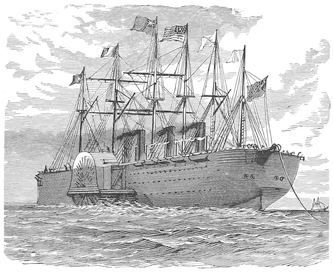
THE GREAT EASTERN LAYING AN OCEAN CABLE.
IV. HELLO! HELLO!
Telegraph (Gr. tele, far, and graphein, to write) implies the production of writing at a distance by means of an electric current upon a conductor. Telephone (Gr. tele, far, and phone, sound) implies the production of sound at a distance by the same means, though the word telephone was in early use to describe the transmission of sound by means of a rod or tightly stretched string connecting two diaphragms of wood, membrane, or other substance. This last plan of transmitting sound came to be known as the string telephone, and it retained this name until the invention of the electric telephone.
Like the electric telegraph, the electric telephone was an evolution. The string telephone, in the hands of Wheatstone, showed, as early as 1819, that the vibrations of the air produced by a musical instrument were very minute, and could be transmitted hundreds of yards by means of a string armed with delicate diaphragms. But while the string telephone served to confirm the fact that sounds are vibrations of the atmosphere which affect the tympanum of the ear, it remained but a toy or experimental device till after electric telegraphy became an accepted science, that is, in the year 1837 and subsequently. One of the earliest steps toward the evolution of the electric telephone was taken by Mr. Page, of Salem, Mass., in 1837, who discovered that a magnetic bar could emit sounds when rapidly magnetized and demagnetized; and that those sounds corresponded with the number of currents which produced them. This led to the discovery, between 1847 and 1852, of several kinds of electric vibrators adapted to the production of musical sounds and their transmission to a distance. All this was wonderful and momentous, but a little while had still to elapse before one arose bold enough to admit the possibility of transmitting human speech by electricity. He came in 1854, in the person of Charles Bourseul, of Paris, who, though as if writing out a fanciful dream, said, “We know that sounds are produced by vibrations, and are adapted to the ear by the same vibrations which are reproduced by the intervening medium. But the intensity of the vibrations diminishes very rapidly with the distance, so that it is, even with the aid of speaking-tubes and trumpets, impossible to exceed somewhat narrow limits. Suppose that a man speaks near a movable disk, sufficiently flexible to lose none of the vibrations of the voice, that this disk alternately makes and breaks the current from a battery, you may have at a distance another disk, which will at the same time execute the same vibrations.”
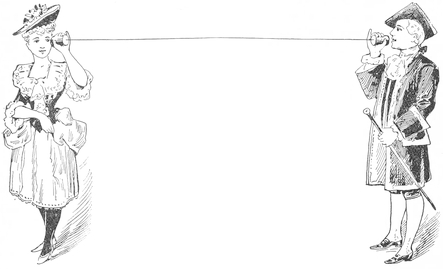
A STRING TELEPHONE.
Bourseul further showed that the sounds of the voice thus reproduced would have the same pitch, but admitted that, in the then present state of acoustic science, it could not be affirmed that the syllables uttered by the human voice could be so reproduced, since nothing was known of them, except that some were uttered by the teeth, others by the lips, and so on. The status of the telephone then, according to Bourseul, was that voice could be reproduced at a distance at the pitch of the speaker, but that something more was needed to transmit the delicate and varied intonations of human speech when it was broken into syllables and utterances. To transmit simply voice was one thing; to transmit the timbre or quality of speech was another.
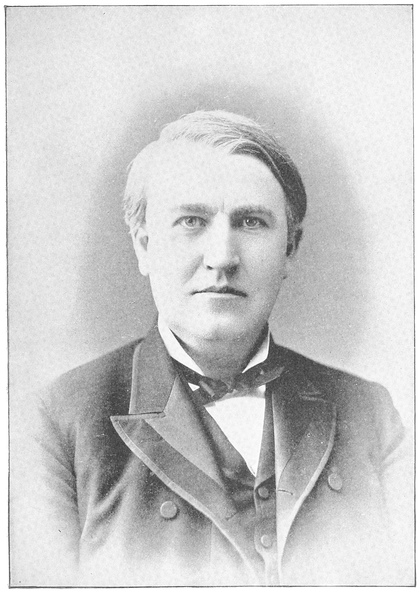
THOMAS ALVA EDISON.
Bourseul made plain the problem that was still before the investigator. And now comes one of the most remarkable episodes in the history of electricity,—a chapter of mingled shame and glory. In the village of Eberly’s Mills, Cumberland County, Pa., lived a genius by the name of Daniel Drawbaugh, who had made a study of telephony up to the very point Bourseul had left it. He had transmitted musical sound, sound of the voice, and other sounds in the same pitch. He had said that this was all that could be done till some means was discovered of holding up the constant onward flow of the electric current along a conducting wire by introducing into such flow a variable resistance such as would impart to simple pitch of voice the quality or timbre of human speech. Drawbaugh achieved this in his simple workshop as early as 1859–60, according to evidence furnished to the United States Supreme Court at the celebrated trial of the cases which robbed him of the right to his prior invention. He did it by introducing into the circuit a small quantity of powdered charcoal confined in a tumbler, through which the current was passing. The charcoal, being a poor conductor and in small grains, offered just that kind of variable resistance to the current necessary to reproduce the tones and syllables of speech. He transmitted speech between his shop and house, and proved the success he had met with before audiences in New York and Philadelphia. But he neglected to care for the commercial side of his discovery, though many of his patents antedated those which contributed to deprive him of deserved honor and profit.
In 1861, Reis, of Germany, came into notice as the inventor of a telephone which transmitted sound very clearly, but failed to reproduce syllabified speech. However, the principle and shape of his transmitter and receiver were accepted by those who followed him. Two men now came upon the scene who had reached the conclusion already arrived at by Drawbaugh, and who became rivals over his head for the honor and profit of an invention by means of which the quality of the voice in speaking could be transmitted. These two were Elisha Gray, of Chicago, and Alexander Graham Bell, of Boston. Their respective devices seem to have been akin, and to have been presented to the patent office almost simultaneously; so nearly so, at least, as to make them a part of that long, costly, and acrimonious legal contention over priority of invention which did not end till 1887.
Both Bell and Gray reached the conclusion that the transmission of articulate speech was impossible unless they could produce electrical undulations corresponding exactly with the vibrations of the air or sound waves. They brought this similarity about by introducing a variable resistance into the electric current by means of an interposing liquid, just as Drawbaugh had done years before with his tumbler of powdered charcoal. Bell exhibited his instrument with comparative success at the Centennial Exhibition in 1876 in Philadelphia; but much had yet to be done to perfect a telephone of real commercial value.
The years 1877–78 were years of great activity among electricians, whose prime object was to perfect a telephone transmitter and receiver, by means of whose mutual operations at opposite ends of a circuit all the modulations of speech could be preserved and passed. To this end Berliner introduced into a transmitter or sender the then well-known principle of the microphone (Gr. mikros, small, phone, sound), which magnified the faint sounds by the variation in electrical resistance, caused by variation of pressure at loose contact between two metal points or electrodes. Edison quickly followed with a similar transmitter or sender, in which one of the electrodes was of soft carbon, the other of metal. Then came (1878) Hughes and Blake with senders, in which both of the electrodes were of hard carbon. Subsequently came other and rapid modifications of the sender, both in the United States and Europe, till the form of telephone now in popular use was arrived at, and which, strange to say, is, in its method of securing the necessary variable resistance in the circuit, quite like that employed by Mr. Drawbaugh; to wit, the introduction of fine carbon granules into a small metal cup just behind the vibrating diaphragm or disk of the sender. The circuit goes into the diaphragm in front, passing through the carbon granules and out through the back of the instrument. The action of talking into the sender causes the granules to be agitated, thus opening and closing the circuit and producing the conditions necessary to the transmission of articulate speech. The diaphragm or disk is the very thin covering of the cup containing the granules. It is sometimes made of carbon, but generally of hard metal, as steel. On being struck by the sound waves of the voice, it vibrates to correspond. The same vibrations are reproduced in the receiver at the opposite end of the circuit, and thus one listens to the phenomenon of transmitted human speech. The current for telephonic purposes is furnished by one or more batteries or cells, whose effect is heightened by the presence of an induction coil. The tendency now is to make “bipolars”—two contacts at the diaphragm—in place of a single contact. This style is becoming more in vogue in order to meet the demands of long-distance work. To each telephone is attached a generator or device for ringing a little bell as a signal that some one wishes to communicate. To such perfection have telephones been brought that it is quite possible to converse intelligibly at the distance of a thousand miles, with a less satisfactory service at twice or thrice that distance. The possibilities of clear speech-transmission at indefinite distance are without measure. Like the telegraph, the telephone has opened an immense and profitable industry, involving hundreds of millions of dollars. At the end of the century it is, unfortunately, monopolistic; but the time is near when a reasonable charge for service will enable every business house to communicate with its customers, and when even the remote corners of counties will be brought into touch with their capitals and with one another. Along the lines of civilizing contact the telephone fairly divides the wonders of the century with the telegraph, while for intimate intellectual communication it is a triumph of genius without parallel. It is the dispenser of speech in city, town, and village; in factory and mine, in army and navy; throughout government departments; and in Budapest, Hungary, it is a purveyor of general news, like the newspaper, for the “Telephone Gazette” of that city has a list of regular subscribers, to whom it transmits, at private houses, clubs, cafes, restaurants, and public buildings, its editorials, telegrams, local news, and advertisements.
A very natural outgrowth of the telephone was that curious invention known as the phonograph (Gr. phone, sound, and graphein, to write). It is not only an instrument for writing or preserving sound, but for reproducing it. As a simple recorder of sound, it was an instrument dating as far back as 1807, when Dr. Young showed how a tuning-fork might be made to trace a record of its own vibrations. But Young’s thought had to go through more than half a century of slow evolution before the modern phonograph was reached; for in the phonautograph of Scott, the logographs of Barlow and Blake, and the various other attempts up to 1877 to make and preserve tracings of speech, there were no successful means of reproducing speech from those tracings hit upon.
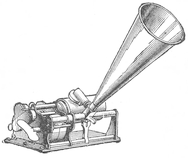
A GRAPHOPHONE.
In that year (1877), Edison, in striving to make a self-recording telephone by connecting with its diaphragm or disk a stylus or metal point which would record its vibrations upon a strip of tinfoil, accidentally reversed the motion of the tinfoil so that the tracings upon it affected the stylus or tracing-point in an opposite direction. To his surprise, he found that this reverse motion of the tinfoil, tickling, as it were, the stylus oppositely, reproduced the sounds which had at first agitated the diaphragm. It was but a step now to the production of his matured phonograph in 1878. He made a cylinder with a grooved surface, over which he spread tinfoil. A stylus or fine metal point was made to rest upon the tinfoil, so as to produce a tracing in it, following the grooves in the cylinder when the latter was made to revolve. This stylus was connected with the diaphragm of an ordinary telephone transmitter. When one spoke into the transmitter, that is, set the diaphragm to vibrating, the stylus impressed the vibratory motions of the diaphragm, or, in other words, the waves of the exciting sound, in light indentations upon the tinfoil. In order to reproduce the sounds thus registered in the tinfoil of the cylinder, it was made to revolve in an opposite direction under the point of the stylus, and as the stylus was now affected by precisely the same indentations it had first made in the tinfoil, it carried the identical vibrations it had recorded back to the diaphragm of the telephone, and thus reproduced in audible form the speech that had at first set the diaphragm to vibrating. The speech thus reproduced was that of the original speaker in pitch and quality. Ingenious and wonderful as Edison’s machine was, it was susceptible of improvement, and soon Bell and others came forward with a phonograph in which the recording cylinder was covered with a hardened wax. This was called the graphophone. Again, Berliner improved upon the phonograph by using for his tracing surface a horizontal disk of zinc covered with wax. By chemical treatment, the tracings made in the wax were etched into the zinc, and thus made permanent. Edison made further and ingenious improvements upon his phonograph by attaching hearing tubes for the ear to the sound receiver, and by the employment of an electric motor to revolve the wax cylinder. By the attachment of enlarged trumpets and other devices, every form of modern phonograph has been rendered capable of reproducing in great perfection the various sounds of speech, song, and instrument, and has become a most interesting source of entertainment.
V. DYNAMO AND MOTOR.
Dynamo is from the Greek dunamis, meaning power. Motor is from the Latin motus, or moveo, to move. Dynamo is the every-day term applied to the dynamo-electric machine. Motor is the every-day term applied to the electric motor. The dynamo and motor are quite alike in principle of construction, yet direct opposites in object and effect. Perhaps it might be well to designate both as dynamo-electric machines, and to say that, when such machine is used for the conversion of mechanical energy or power of any kind into electrical energy or power, it is a dynamo. When a reverse result is sought, that is, when electrical energy or power is to be converted into mechanical energy or power, the machine that is used is a motor. In practical use for most purposes they are brought into coöperation, the dynamo being at one end of an electric system, making and sending forth electricity, the motor being at the other end, taking up such electricity and running machinery with it. Both machines were epoch-making in the midst of a wondrous century, and both were results of those marvelous evolutions in electrical science which characterized the earlier years of the century.
We have seen how the simple glass cylinder or sulphur roll became, when rubbed, a generator of electricity. In a later chapter of electrical history, we saw a new and more powerful generator of electricity in the voltaic cell, by means of opposing metals acted upon chemically by acids. The greatest, grandest, most powerful, and most economic of all generators of electricity was yet to come in the shape of the dynamo. We see its beginnings in those investigations of Faraday which led to the discovery of the induction coil and the principles of magneto-electric induction. In 1831, he invented a simple yet, for that date, wonderful machine, which was none the less the first dynamo in principle, because he modestly called it “A New Electrical Machine.” He mounted a thin disk of copper, about twelve inches in diameter, upon a central axis, so that it would revolve between the opposite poles of a permanent magnet. As the disk revolved, its lower half cut the field of force of the magnet, and a current was induced which was carried away by means of two collecting brushes, fastened respectively to the axis and circumference of the disk. This was the first electric current ever produced by a permanent magnet. The Faraday machine and others that derived the mechanical energy which was converted into electric current from a permanent magnet were classed as magneto-generators. Soon the electro-magnet took the place of the permanent magnet, because it produced a much stronger field of force. But then the electro-magnet had to have a current to excite it. This current was supplied by a magneto-generator, placed somewhere on the dynamo. Now came the thought, suggested by Brett in 1848, that the induced currents of the dynamo could themselves be turned to account for increasing the strength of the electro-magnets used in inducing them. This was a most progressive step in the history of the dynamo. It led to rapid inventions, whose principle was based on the fact that every dynamo carried within the cores of its magnets enough of unused or residual magnetism to render the magnets self-exciting the moment the machine started. So the outside means of magnetizing the fields of force of the dynamo passed away.
The dynamo speedily grew in size and importance. The electro-magnets or fields of force were greatly increased in number, size, and power. There were great improvements in the construction and efficiency of the wire coils or armatures which cut the fields of force, and a corresponding increase in their number. Commutators and brushes underwent like improvement. So, at last, the well-nigh perfect and all-powerful dynamo of the end of the century was evolved, with a capacity for delivering, in the form of electricity, ninety per cent of the mechanical energy which set it in motion. In the application of steam to machinery, eighty per cent, and sometimes more, of the energy supplied by a ton of coal is lost.
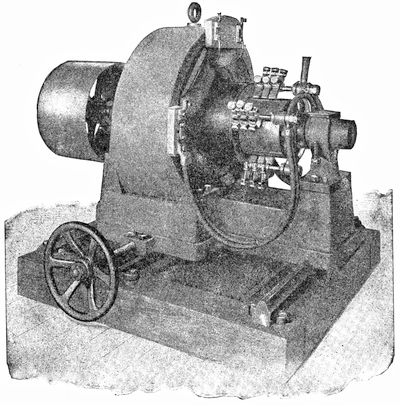
A DYNAMO.
With the perfection of the dynamo, its uses multiplied. It became a prime factor in electric lighting. Trolley systems sprang up in city, town, and village, taking the place of horse and traction cars. In certain places, as in the Baltimore tunnel, the dynamo superseded the engine for hauling freight and passenger cars. The mighty dynamos which convert the inexhaustible energy of Niagara Falls into electricity send it many miles away to Buffalo, to be applied to lighting and to every form of machinery. The end of the century sees a power plant in operation in New York city capable of furnishing one hundred thousand horse-power, or enough to supply the lighting, rapid transit, and thousand and one mechanical needs of the entire municipality. The essential parts of an ordinary dynamo are: (1.) The electro-magnets, which, however numerous, are arranged in circular form upon part of the framework of the machine. (2.) The iron coils or armatures, mounted in a circle upon a wheel. When the wheel revolves, the armatures pass close in front of the electro-magnets, cutting through their fields of force, and thereby inducing electric current. (3.) The commutator, which consists usually of a series of copper blocks arranged around the axle of the armatures, and insulated from the axle and from each other. The current passes from the armatures to the commutator. If the current be an alternating one, the commutator changes it into a continuous one, and the reverse may also be accomplished. (4.) The brushes, which are thin strips of copper or carbon, are brought to bear at proper points upon the commutator, making connection with each coil or sets of coils. They carry the corrected current to the outside line or lines. (5.) The outside line or lines, to carry the current away to the motor. (6.) The pulley for strap-belting, by means of which the water or steam power used is made to turn the dynamo machine.
But we must not forget the motor as a companion of the dynamo, as its indispensable brother, in turning to practical account the electricity sent to it. As we have seen, the motor is the reverse of the dynamo, at least in its effects. It is fed by the dynamo, and it imparts its power to the machinery which it is to set in motion. It is to the dynamo what the water-wheel is to the water. In one sense it is an even older invention than the dynamo, but its extended commercial application was not possible until the dynamo had reached certain stages of perfection. It is generally agreed that the first motor of importance was that constructed by Professor Jacobi, through the liberality of the Czar Nicholas, of Russia. Jacobi used two sets of electro-magnets, by means of whose mutual attraction and repulsion he rotated a wheel on a boat with a power equal to that of eight oarsmen. But as Jacobi’s electro-magnets required an electric current to magnetize them, and as there were then no means of producing such current except by the costly use of the voltaic battery, his invention was unripe as to time.
In 1850, Professor Page, of the Smithsonian Institution, constructed a motor which worked ingeniously, but was still open to the objection of cost in supplying the necessary electric current for the electro-magnets. Though various inventions came about having for their object a commercially successful motor, such a thing was impossible till Gramme produced his improved and effective dynamo in 1871. This dynamo was found to work equally well as a motor, and hence it became necessary for electricians to greatly enlarge their understanding of the nature of electro-magnetic induction. They soon discovered many curious things respecting the behavior of induced currents, with the result that rapid and simultaneous improvements were made in both dynamos and motors. One of the most curious of these discoveries was that a motor automatically regulates the amount of current that passes through its circuit in proportion to the work it is called upon to do; that is, if the work the machine has to do is decreased, the motor attains a higher speed, which higher speed induces a counter electro-motive force sufficient to check up the amount of current passing through the motor. So when the motor is required to do increased work, the machine slows up; but with this slowing up, the counter electro-motive force decreases, and consequently the current passing through the motor increases.
As with the dynamo, one of the marvels of the motor is its efficiency. In perfect machines, ninety to ninety-five per cent of the electrical energy supplied can be converted into mechanical energy. For this reason it has become a competitor with, and even successor of, steam in countless cases, and especially where water-power can be commanded. A prime motor, in the shape of a water-wheel, may be made to drive scores of secondary motors in places hundreds of miles away. The power developed by the waterfall at Lauffen, Germany, is transmitted one hundred miles to Frankfort, with a loss of only twenty-five per cent of the original horse-power.
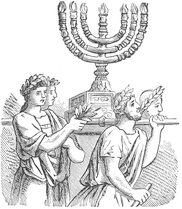
THE GOLDEN CANDLESTICK.
In its adaptation for practical use, the motor, like the dynamo, assumes all sizes and embraces a host of ingenious devices, yet its power and usefulness always centre around, or are contained in, its two efficient parts, its armatures and fields of force. We have seen how in the dynamo the armatures became the source of induced currents by being made to cut the fields of force of electro-magnets. Now, a dynamo can be made to work in an opposite way; that is, by making the magnetic fields of force rotate in front of the coils or armatures. In the motor, the field of force is mostly established by the current directly from the dynamo. This current passes also through the armature, which begins to rotate, owing to the force of the field upon it. This rotation of the armature through the field of force produces in the armature conductors an electro-motive force, which is the measure of the power of the motor, be the same great or small.
VI. “AND THERE WAS LIGHT.”
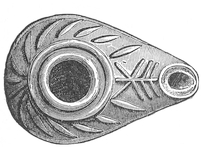
ANCIENT LAMP.
Mention of the “candlestick of pure gold” (Ex. xxv. 31) may lead to the inference that the primitive artificial light was that of the candle. But “candlestick” in connection with the lighting of the temple is clearly a misnomer. The lamp was the original artificial light-giver, unless we choose to except the torch; and if less indispensable than in patriarchal times, it is still a favorite dispenser of nightly cheer. Prior to the middle of the eighteenth century, the lamp had practically no evolution. It was the same in principle at that date as when it illuminated the desert tabernacle. Even the splendid enameled glass or decorated Persian pottery lamps of Damascus and Cairo, and the magnificent brass or bronze lamps of Greece, Rome, and the European cathedrals, gave forth their dull, unsteady flame and noisome smoke by means of a crude wick lying in a saucer or similar receptacle of melted lard, tallow, oil, or some such combustible liquid. A prime improvement was made in lamp-lighting in 1783, by Leger, of Paris, who devised the flat, metallic burner, through which he passed a neatly prepared wick. A further improvement was made in 1784 by Argand, of Paris, who introduced a burner consisting of two circular tubes, between which passed a circular wick. The inner tube was perforated so as to admit of a draught of air to feed the flame on the inside of the wick. In order to similarly feed the flame on the outside of the wick, he invented the lamp chimney, which was at first a crude thing of metal. It, however, soon gave way to the glass chimney, which has up to the present taken on many improved forms, designed to secure more perfect combustion and a brighter, steadier glow.
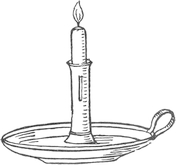
TALLOW DIP.
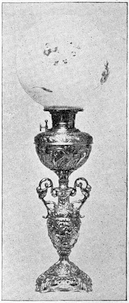
MODERN LAMP.
Improvement in lamp-lighting during the nineteenth century has consisted of an indefinite number of inventions, all aiming at economy, brilliancy, steadiness, convenience, beauty, and so on. But in no respect has this improvement been more rapid and radical than in the adaptation of lamps to the various combustible fluids that have bid for favor. While the various oils, animal and vegetable, were almost solely in vogue as illuminants at the beginning of the century, they were largely superseded at a later period by the burning-fluid known as camphene. This was a purified oil of turpentine, which found great favor on account of its economy, convenience, cleanliness, and brilliancy of light. But it was very volatile, and its vapors formed with air a dangerously explosive mixture. Yet with all this it might have held its own for a long time, had not Gesner, in 1846, discovered that a superior mineral oil, which he called “kerosene,” could be readily and profitably distilled from the coal found on Prince Edward Island. This kerosene or hydrocarbon oil speedily displaced camphene as an illuminant. Its manufacture rapidly developed into an important industry in the United States, and large distilling establishments arose, both on the Atlantic coast, where foreign coal was used, and throughout the country, wherever cannel or other convertible coal was found. With the discovery of petroleum in paying quantities on Oil Creek, Pa., in 1859, there came about a great change in kerosene lamp-lighting. It was found, upon analysis, that crude petroleum contained about fifty-five per cent of kerosene, which constituted its most important product. The manufactories of kerosene from cannel or other coal, therefore, went out of existence, and new ones, larger in size and greater in number, sprung up for the manufacture of kerosene or, popularly speaking, coal oil, from petroleum. This illuminant came into almost universal favor for lamp use, owing to its cheapness and brilliancy. It is not free from danger when improperly distilled, but under the operation of stringent laws governing its preparation and testing, danger from its use has been reduced to a minimum. In rural districts, in smaller towns and villages, wherever economy and convenience are essentials, and when beauty in lamp effects is desirable, the kerosene illuminant has become indispensable.
The discovery of petroleum helped further to light the world and distinguish the century. It gave us gasolene, naphtha, gas oil, astral oil, and the very effective “mineral sperm,” which is almost universally used in lighthouses and as headlights for locomotives. With the addition of kerosene, a favorite light of the beginning of the century—the tallow dip of our grandmothers—began to fall into disuse. The homelike pictures of housewives at their annual candle-dippings, or in the manipulation of their moulds, became venerable antiques. Candle-light paled in the presence of the higher illuminants. Though still a convenient light under certain circumstances, it plays a gradually diminishing part amid its superiors.
One of the signal triumphs of the century has been the introduction of gas-lighting. Though illuminating gas made from coal was known as early as 1691, it did not come into use, except for experiments or in a very special way, until the beginning of the nineteenth century. In 1809, a few street lamps were lit with gas in London. An unsuccessful attempt was made to introduce gas into Baltimore in 1821. Between 1822 and 1827, the gas-light began to have a feeble foothold in Boston and New York. Other cities began to introduce it as an illuminant in streets and, eventually, in houses. But the process was very slow, owing to intense opposition on the part of both savants and common people, who saw in it a sure means of destruction by poison, explosion, or fire. It was not much before the middle of the century that prejudice against illuminating gas was sufficiently allayed to admit of its general use. But meanwhile many valuable experiments as to its production and adaptation were going on. The most productive source of illuminating gas was found to be bituminous coal. Though gas could be produced by distillation from other substances, such as shale, lignite, petroleum, water, turf, resins, oils, and fats, none could compete in quality, quantity, and economy with what is known as ordinary coal gas, at least, not until the time came, quite late in the century, when it was found that non-luminous gases, such as water gas, could be rendered luminous by impregnating them with hydrocarbon vapor. This became known commercially as water gas, and it is now largely used in place of coal gas, because it is cheaper and, for the most part, equally effective as a luminant.
Gas-lighting has, of course, its limitations. It is not adapted for use beyond the range of cities or towns whose populations are sufficient to warrant the large expenditures necessary for gas plants. It is a special rather than general light. Yet within its limited domain of use it has proved of wonderful utility,—a source of cheer for millions, a clean, safe, and economic light, a convenience far beyond the candle, the lamp, or any previous lighting appliance. In the street, it is a source of safety against thieves and way-layers. In the slums, it is both policeman and missionary, baffling the wrong-doer, exposing the secrecy that conduces to crime, laying bare the hotbeds of shame. It is as well a source of heat as light, and consequently convertible into power for light mechanical purposes. In the kitchen, it is more and more becoming a boon to the housewife, who by means of the gas range escapes, in cooking, much of the dust, smoke, worry, and even expense of the coal cook stove and range. In the parlor, library, or sick-room, it is a cheerful and effective substitute for the coal grate, and may be made to assume the cosy qualities and fantastic shapes of the old-fashioned wood fire. Coincident with the discovery of petroleum, its inseparable companion, natural gas, came into prominence as a source of both light and heat, or this became true, at least, after it was ascertained that natural gas regions existed which could be tapped by wells, and made to give forth their gaseous product independent of the oil that may have at one time existed near or in connection with it. This natural source of light and heat became as interesting to the geologist, explorer, and capitalist as the source of petroleum itself, and soon every likely section was prospected, with the hope of finding and tapping those mysterious caverns of earth in which the pent-up luminant abounded in paying quantities. It was found that workable natural gas regions were numerous in the United States, especially in proximity to petroleum or bituminous coal deposits, and little time was lost in their development. As if by magic, a new and profitable industry sprang into existence. The natural gas well became almost as common as the oil well, and at times far more awe-inspiring as it shot into space its volcanic blasts which, when ignited through carelessness, as sometimes happened, carried to the vicinage all the dangers and terrors of Vesuvius or Stromboli. Powerful as was the force with which natural gas sought its freedom, wonderful as was the phenomenon of its escape from the subterranean alembic in which it was distilled, human genius quickly harnessed it by appliances for conservation and carriage to places where it could be utilized. Sometimes great industries sprang up contiguous to the wells; at others, it was carried through pipes to cities many miles distant, where it became a light for street, home, and store, and a prodigious energy in factory, furnace, forge, and rolling-mill. In fact, no marvel of the century has been at once so weird and inscrutable in its origin as natural gas, or more potential as an agency within the areas to which its use is limited. The question is ever uppermost in connection with natural gas, will it last? The gas springs of the Caucasus Mountains have been burning for centuries. But that is where nature’s internal forces have their correlations and compensations. Where it is quite otherwise, that is, where the vents of natural gas reservoirs are abnormally numerous, or where those reservoirs are drained to the extreme for commercial purposes, not to say through sheer wastefulness, the geologist is ready to surmise that the natural gas supply cannot be a perpetual one.
But one of the most magnificent triumphs of the century in the matter of light came about through the agency of electricity. We have already seen the beginnings of electric lighting in the discovery of Sir Humphrey Davy, in 1809, that when the ends of two conducting wires, mounted with charcoal pieces, were brought close together, a brilliant light, in the shape of an arc or curve, leaped from one piece of charcoal to the other. Davy’s charcoal pieces or carbons were consumed by the fierce heat evolved; but the principle was established that an electric current, so interrupted, was a vivid light-producer, and might be made permanently so if a substance capable of resisting the heat could be substituted for his charcoal tips, and a generator of electricity of sufficient power and economy in use could be substituted for his voltaic batteries or cells.
Upon these two essentials hung the future of the electric light. The first essential, that of a substance at the ends of the wires or in the midst of the electric circuit which would resist the heat, was soon met by the use of specially prepared and hard graphite carbon tips, in the shape of candles. But the second essential, a generator of electricity cheaper and more powerful than the voltaic cell, was not met with till the dynamo machine reached an advanced stage of perfection; that is, about 1867.
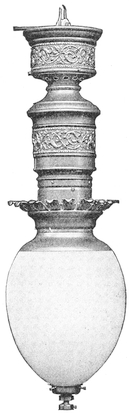
ELECTRIC ARC LIGHT.
The two grand essentials now being at command, invention of electric light appliances went on rapidly upon two lines, eventuating in two systems, which became known as arc lighting and incandescent lighting. By 1879–80, the arc light was sufficiently advanced to meet with favor as an illuminant for streets, railway stations, markets, and any large spaces, in which places it became a substitute for gas and other lights. The essential features of the arc light are: (1.) The dynamo machine, situated in some central place, for the generation of electricity. (2.) Conducting wires to carry the electricity throughout the areas or to the places to be lighted. (3.) The arc lamp, which may be suspended upon poles in the streets, or upon wires in stores and other covered places. Its mechanism consists of two pencils or candles of graphite carbon, very hard and incombustible, adjusted above and below each other so that their tips or ends are very close together, but not in contact. By means of a clockwork or simple gravity device these carbon tips are brought into contact at the moment the electric current is turned on, and then are slightly separated as soon as the current has heated them. The air between the heated tips, having also reached a high temperature, becomes a conductor, and the electricity leaps in the form of an arc or curve through it, rendering it brilliantly incandescent. Should the current be diminished in strength for any reason, the above-mentioned clockwork or gravity device brings the carbons a little closer together; and should the current be increased, the carbons are separated a little wider; thus the steadiness of the light is regulated. There are also various automatic devices for thus regulating the proximity of the carbons and maintaining the evenness of the glow. The power of an arc light is measured by candles. An ordinary arc light under two amperes of current gives a light equal to twenty-five candles, while under fifty amperes of current it gives a light equal to twenty thousand candles. In searchlights on board vessels, and where very large areas are to be lighted, both heavier currents and larger carbons are used than in the arc lamps for ordinary street purposes. No light surpasses the arc light in brilliancy, excepting the magnesium light. There are few cities in this country and Europe that do not employ the arc lamp as a means of street, station, and large-area lighting, owing to its superiority as an illuminant and the wonderful policing effect it has upon the slum sections.
The incandescent lamp, or electric lighting by incandescence, underwent a somewhat longer evolution at the hands of inventors than the arc lamp, owing to the difficulty of finding a substance suitable for the production of the necessary glow. The discovery of such substance may be accredited to Edison more fully than to any other. The incandescent or glow lamp is a glass bulb from which the air is exhausted. There passes into the bulb a filament of carbon, which, after a turn or two inside the bulb, passes out at the end through which it entered. When a current from a voltaic battery is sent through this carbon filament, it brings it, in the absence of oxygen within the bulb, to a high white heat without combustion. The portion of this high white heat which is radiated is the light-giving energy of the incandescent lamp. Metal filaments were at first tried in the bulb, but they quickly burned out. Carbon filaments were at length found to be the only ones capable of resisting the heat. They moreover had the advantage of cheapness, and of greater radiating energy than metals. Many substances, such as silk, cotton, hair, etc., were used in the preparation of the carbon filaments, but it was found that strips cut from the inside bark of the bamboo gave, when brought to a white heat by an electric current and then properly treated, the most tenacious and best conducting carbon filament.
The quality of light produced by an incandescent lamp is a gentler glow than that produced by the arc lamp, and in color more nearly resembles the light of gas or the oil lamp. The incandescent light speedily became for the home, hotel, hall, and limited covered area what the arc light became for the street and railway station, and, if anything, the former outstripped the latter in the extent and value of the industry it gave rise to.
In the arc lamp, the carbon pencils have to be renewed daily. In the incandescent lamp, the carbon filament, though very delicate, may last for quite a time, because incandescence takes place in the absence of oxygen. If the favor in which the electric light is held, and the great extent of its use, rested solely on the question of cheapness of production, such question would give rise to interesting debate. And, indeed, the debate would continue, if the question were the superior fitness of electric lighting for lighthouses and like service, where extreme brilliancy does not seem to penetrate a thick atmosphere as effectively as the more subdued glow of the oil lamp. But the debate ceases when the question is as to the beauty and efficiency of the electric light in the home, street, station, mine, on shipboard, and the thousand and one other places in which it has come to be deemed an essential equipment. In all such places the question of economy of production and use is subordinate to the higher question of utility and indispensability.
VII. ELECTRIC LOCOMOTION.
The dawn of the nineteenth century saw, as vehicles of locomotion, the saddled hackney, the clumsy wagon, the ostentatious stage-coach, the primitive dearborn, the lumbering carriage, the poetic “one-hoss shay.” The universal energy was the horse. A new energy came with the application of steam, and with it new vehicular locomotion,—easier, swifter, stronger, for the most part cheaper, rendering possible what was hitherto impossible as to time and distance.
This signal triumph of the century may not have been eclipsed by the introduction of subsequent locomotive changes, but it was to be supplemented by what, at the beginning, would have passed for the idle dream of a visionary. The horse-car came, had its brief day, and went out with all its inconveniences, cruelties, and horrors before, in part, the traction-car, and, in part, the rapidly revolutionizing energy of electricity.
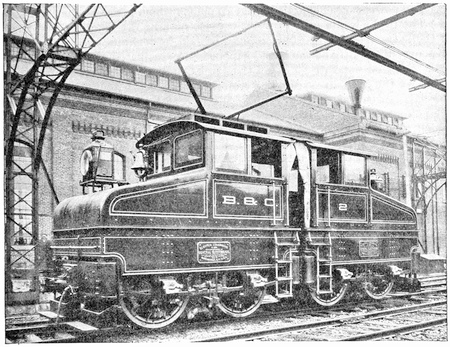
ELECTRIC LOCOMOTIVE.
The first conception of a railway to be operated by electricity dates from about 1835, when Thomas Davenport, of Brandon, Vt., contrived and moved a small car by means of a current from voltaic cells placed within it. In 1851, Professor Page, of the Smithsonian Institution, ran a car propelled by electricity upon the steam railway between Washington and Baltimore, but though he obtained a high rate of speed, the cost of supplying the current by means of batteries—the only means then known—prohibited the commercial use of his method.
With the invention of the dynamo as an economic and powerful generator of electricity, and also the invention of the motor as a means of turning electrical energy to mechanical account, the way was open, both in the United States and Europe, for more active investigation of the question of electric-car propulsion. Between 1872 and 1887, different inventors, at home and abroad, placed in operation several experimental electric railways. Few of them proved practical, though each furnished a fund of valuable experience. An underground electric street railway was operated in Denver as early as 1885; but the one upon the trolley plan, which proved sufficiently successful to warrant its being called the first operated in the United States, was built in Richmond, Va., in 1888. It gave such impetus to electric railway construction that, in five years’ time, enormous capital was embarked, and the new means of propulsion was generally accepted as convenient, safe, and profitable.
The essential features of the electric railway are: (1.) The track of two rails, similar to the steam railway, (2.) The cars, lightly yet strongly built. (3.) The power-house, containing the dynamos which generate the electricity. (4.) The feed-wire, usually of stout copper, running the length of the tracks of the system, and supported on poles or laid in conduits. (5.) The trolley-wire over the centre of the track, supported by insulated cross-wires passing from poles on opposite sides of the tracks, and connected at proper intervals with the feed-wire. (6.) The trolley-pole of metal jointed to the top of the car, and fitted with a spring which presses the wheel on the end of the pole up against the trolley-wire with a force of about fifteen pounds, and which also serves to conduct the electricity down through the car to the motor. (7.) The motor, which is suspended from the car truck, and passes its power to the car axle by means of a spur gearing. The power requisite for an ordinary trolley-car is about fifteen horse-power. The speed of trolley-cars is regulated in cities to from five to seven miles per hour, but they may be run, under favorable conditions, at a speed equal to, or in excess of, that of the steam-car.
As a means of city transit, and of rapid, convenient, and economic intercourse between suburban localities and rural towns and villages, the electric traction system ranks as one of the greatest wonders of the century. The speed with which it found favor, the enormous capital it provoked to activity, the stimulus it gave to further study and invention, the surprising number of passengers carried, go to make one of the most interesting chapters in electric annals. The end of the century sees thousands of these electric roads in existence; a comparatively new industry involving over $100,000,000; a passenger traffic running into the billions of people; a prospect that the trolley will succeed the steam-car for all utilizable purposes within the gradually extending influence of cities and towns upon their rural surroundings.
In speaking of the passing of the horse-car and its substitution by the trolley, a distinguished writer has well said: “Humanity in an electric-car differs widely from that in the horse-car, propelled at the expense of animal life. It is more cheerful, more confident, more awake to the energy at command, more imbued with the subtlety and majesty of the propelling force. The motor confirms the ethical fact that each introduction of a higher material force into the daily uses of humanity lifts it to a broader, brighter plane, gives its capabilities freer and more wholesome play, and opens fresh vistas for all possibilities. We applaud Franklin for seizing the lightning in the heavens, dragging it down to earth, and subjugating it to man. Let this pass as part of the poetry of physics. But when ethics comes to poetize, let it be said that electricity as an applied force lifts man up toward heaven, quickens all his appreciations of divine energy, draws him irresistibly toward the centre and source of nature’s forces. There is no dragging down and subjugation of a physical force. There is only a going out, or up, of genius to meet and to grasp it. Its universal application means the raising of mankind to its plane. If electricity be the principle of life, as some suppose, what wonder that we all feel better in an electric-car than any other? The motor becomes a sublime motive. God himself is tugging at the wheels, and we are riding with the Infinite.”
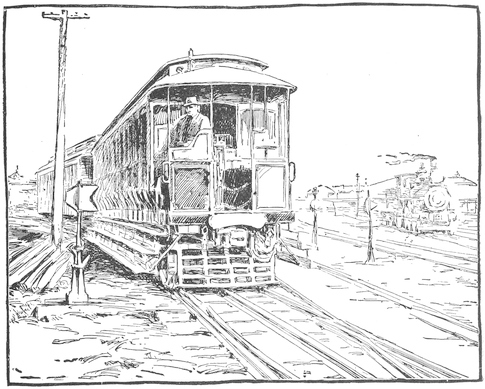
ELECTRIC RAILWAY. THIRD RAIL SYSTEM.
Enthusiasts say the trolley is only the beginning of electric locomotion, and that there is already in rapid evolution an electric system which will supersede steam even for trunk-line purposes. In vision, it presumes a speed of one hundred and twenty-five miles an hour instead of forty; greater safety, cleanliness, and comfort; and what is most momentous and startling, an economy in construction and operation which will warrant the sacrifice of the billions of dollars now invested in steam-railway properties. The proposition is not to sacrifice the steam-railway track, but to add to it a third rail, which is to carry the electric current. Then, by means of feed-conduits alongside of the track, and specially constructed electric locomotives and cars, the system is supposed to reach the practical perfection claimed for it. Experiments with such an electrical system, made upon branch lines of some of our trunk-line railways, as the Pennsylvania, New York Central, and New Haven & Hartford, give much encouragement to the hypothesis that it may become the next great step in the evolution of electrical science.
Another means of electric propulsion was provided by the investigations of Planté, which resulted in his invention of the “accumulator” or “storage battery,” in 1859. His battery consists of plates of lead immersed in dilute sulphuric acid. By the passage of an electric current through the acid, it is electrolytically decomposed. By continuing the current for a time, first in one direction and then in another, the lead plates become changed, the one at the point where the current leaves the cell taking on a deposit of spongy lead, and the one at the point where the current enters the cell taking on a coating of oxide of lead. When in this condition, the battery is said to be stored, and is capable of sending out an electric current in any circuit with which it may be connected. After exhausting itself, it can be re-stored or re-charged in the same way as at first. Faure greatly improved on Planté’s storage battery in 1880, by spreading the oxide of lead over the plates, thus greatly reducing the time in forming the plates. Subsequently, further improvements were made, till batteries came into existence capable of supplying a current of many hundred amperes for several hours. One of the first practical uses to which the storage battery was put was in the propulsion of street-cars; but its weight proved a drawback. It was found better adapted for the running of boats on rivers, and, in the business of water-freightage for short distances, has in many instances become a rival of steam. It found one of its most interesting applications in helping to solve the problem of the automobile, or “horseless carriage,” either for pleasure purposes or for street traffic. In this problem it has, at the end of the century, an active rival in compressed air; but as the “horseless carriage” is rapidly coming into demand, means may soon be found to utilize the strong and persistent energy of the storage battery, without the drawback found in its great weight.
VIII. THE X RAY.
An astounding electrical revelation came during the last years of the century through the discovery of the X, or unknown, or Roentgen ray. A hint of this discovery was given by Faraday during his investigation of the effect of electric discharges within rarefied gases. He also invented the terms anode and cathode, both of which are in universal use in connection with instruments for producing the X rays; the anode being the positive pole or electrode of a galvanic battery, or, in general, the terminal of the conductor by which a current enters an electrolytic cell; and the cathode being the negative pole or electrode by which a current leaves said cell.
Geissler followed Faraday with an improved system of tubes for containing rarefied gases for experimentation. He partially exhausted his tubes of air, introduced into them permanent and sealed platinum electrodes, and produced those wonderful effects by the discharge obtained by connecting the electrodes with the terminals of an electric machine or induction coil, which from their novelty and beauty became known as Geissler effects, just as his tubes became known as Geissler tubes. In the attenuated atmosphere of the Geissler tube, the current does not pass directly from one platinum point or electrode to the other, but, instead, illuminates the entire atmospheric space. When other gases are introduced in rarefied form, they are similarly illuminated, but in colors corresponding to their composition. In his further experiments, Geissler noted that the gases in the tube behaved differently at the anode, or positive terminal, and the cathode, or negative terminal. A beautiful bluish light appeared at the cathode, while the anode assumed the same color as the illuminated space in the tube. It was also noted that after the electric discharge within the tube, there remained upon the inner surface of the glass a fluorescent or phosphorescent glow, which was attributed to the effect of the cathode.
GEISSLER’S TUBES.
This brought the study of the cathode rays into prominence, and through the investigations of Professor William Crookes, in 1879 and afterwards, a conclusion was reached that a “Fourth State of Matter” really existed. He perfected tubes of very high vacuum, by means of which he showed that molecules of gas projected from the cathode moved freely and with great velocity among one another, and so bombarded the inner walls of the tube as to render it fluorescent.
Subsequently, Hertz showed that the cathodic rays would penetrate thin sheets of metal placed within the tube or bulb; and soon after, Paul Lenard (1894) demonstrated that the cathodic ray could be investigated as well outside of the tube or bulb as within it. He set an aluminum plate in the glass wall of the bulb opposite the cathode. Though ordinary light could not penetrate the aluminum plate, it was readily pierced by the cathodic rays, to a distance of three inches beyond its outside surface. With these rays, thus freed from their inclosure, he produced the same fluorescent effects as had been noted within the bulb, and even secured some photographic effects. These cathodic rays produced no effect on the eye, which proved their dissimilarity to light. Lenard showed further that the cathodic rays outside of the tube could be deflected from their straight course by a magnet, that they might pass through substances opaque to light, and that in so passing they might cast a shadow of objects less opaque, which shadow could be photographed. Now Professor Roentgen came upon the scene. He had been conducting his experiments in Germany, along the same lines as Lenard, and had reached practically the same results as to the penetrative, fluorescent, and photographic effects of the cathodic rays. But he had gone still further, and, in 1896, fairly set the scientific world aflame with the announcement that all the effects produced by Lenard in the limited space of a few inches could also be produced at long distances from the tube, and with sufficient intensity to depict solid substances within or behind other substances sufficiently solid to be impermeable by light. Professor Roentgen claims that his X ray is different from the cathodic ray of Lenard and others, because it cannot be deflected by a magnet. This claim has given rise to much controversy respecting the real nature of the X ray, a controversy not likely to end soon, yet one full of inspiration to further investigation.
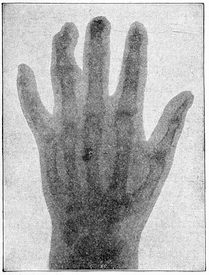
SCIAGRAPH OR SHADOW PICTURE.
By X Ray process.
The essential features of the best approved apparatus designed to produce the X ray and to secure a photograph of an invisible object, are: (1.) A battery or light dynamo as a generator of the electric current, accompanied, of course, by the necessary induction coil, which should be so wound as to give a spark of at least two inches in length in the tube where a picture of a simple object, as a coin in a purse, is desired; a spark of four inches in length where pictures of the bones of the hands, feet, or arms are desired; and a spark of from eight to ten inches in length where inside views of the chest, thighs, or abdomen are desired. (2.) The second essential is the glass tube. The one in common use is the Crookes tube, usually pear-shaped, and resting upon a stand. Into it is inserted two aluminum electrodes or disks, the one through the smaller end of the tube being used as the cathode, and the one from below and near the large end being used as the anode. (3.) A fluoroscope with which to observe the conditions inside the tube necessary to the production of the X ray, to decide upon its proper intensity, and to establish the proper degree of fluorescence. The favorite fluoroscope for this purpose is the one invented by Edison. It is in the form of a stereopticon, in which is a dark chamber after the manner of a camera. In front are two openings, admitting of a view within of both eyes. At the opposite, and greatly enlarged, end is a screen which is rendered fluorescent by means of a new substance (tungstate of calcium) discovered by Mr. Edison after some eighteen hundred experiments. Such is the power of this fluoroscope that it may be used as an independent instrument in cases of minor surgery to locate bullets or other objects buried in the flesh, even before a photograph has been taken. (4.) The photographic plate, which is prepared with a sensitized film and mounted in a frame as in ordinary photography. Upon this film the object to be photographed is laid, say, for instance, the human hand, care being taken to have the film or plate at a proper distance from the Crookes tube. Current is now turned into the tube, the X ray is developed, the film is exposed to its effects, and the result is a negative showing the interior structure of the hand,—the bones or any foreign object therein. This negative is developed as in ordinary photography.
The discovery and application of the X ray has proved of immense value in medicine and surgery. By its means the physician is enabled to carry on far-reaching diagnoses, and to ascertain with certainty the whole internal structure of the human body. Fractures, dislocations, deformities, and diseases of the bones may be located and their character and treatment decided upon. In dentistry, the teeth may be photographed by means of the X ray, even before they come to the surface, and broken fangs and hidden fillings may be located. Foreign objects in the body, as bullets, needles, calculi in the bladder, etc., may be localized, and the surgery necessary for their safe removal greatly simplified. The beating of the heart, movement of the ribs in respiration, and outline of the liver may be exhibited to the eye. It has been boldly suggested that in the X ray will be found an agent capable of destroying the various bacilli which infest the human system, and become germs of such destructive diseases as cholera, yellow fever, typhoid fever, diphtheria, and consumption. Even if this be speculative as yet, there is still room for marvel at the actual results of the discovery of the X ray, and its future study opens a field full of the grandest possibilities.
IX. OTHER ELECTRICAL WONDERS.
The novel idea of keeping time by means of electricity originated quite early in the century, and culminated in two kinds of electric clocks, one moved directly by the electric current, the other moved by weights or springs, but regulated by electricity. The former have the advantage of running a very long time without attention, but as it is impossible to keep up an unvarying electric current, they are not so accurate as the latter in keeping time. Though the latter are popularly called electric clocks, they are really only clocks regulated by electricity, and in such regulation the electric current comes to be a most important agent, as is proved at all centres of astronomical and other observations, as at Greenwich and Washington. At such centres the astronomical time-keeper is set up so as to run as infallibly as possible. This central time-keeper, say at Washington, is electrically connected with other clocks, at observatories, signal-service stations, railway stations, clock-stores, city halls, etc., throughout the country. Should any of these clocks lose or gain the minutest fraction of time as compared with that of the central time-keeper, the electric current corrects such loss or gain, and so keeps all the clocks at a time uniform with one another and with the central one. Electrical devices are also often attached to individual clocks, as those upon city hall towers and in exposed places, for the purpose of meeting and correcting inequalities of time occasioned by weather exposure, expansion and contraction by heat and cold, etc.
The fatherhood of the very useful and elegant arts of electrotyping and electroplating is in dispute. Daniell, while perfecting his battery, noticed that a current of electricity would cause a deposit of copper. In 1831, Jacobi, of St. Petersburg, called attention to the fact that the copper deposited on his plates of copper by galvanic action could be removed in a perfect sheet, which presented in relief, and most accurately, every accidental indentation on the original plates. Following this up, he employed for his battery an engraved copper plate, caused the deposit to be formed upon it, removed the deposit, and found that the engraving was impressed on it in relief, and with sufficient firmness and sharpness to enable him to print from it. Jacobi called his discovery galvanoplasty in the publication of his observations in 1839. It was but a step from this discovery to the application of the electrotyping process to the art of printing. A mould of wax, plaster, or other suitable substance is made of an engraving or of a page of type. This mould is covered with powdered graphite (black lead) so as to make it a conductor of electricity. It is then inserted in a bath containing a solution of sulphate of copper. An electric current is passed through the bath, and the copper is deposited on the mould in sufficient quantity to give it a hard surface capable of offering greater resistance in printing than the types themselves, and also of producing a clearer impression. In electroplating, practically the same principle is employed. The bath is made to contain a solution of water, cyanide of potassium, and whatever metal—gold, silver, platinum, etc.—it is designed to precipitate on the article to be electroplated. The current is then passed through the bath, and the article—spoon, knife, fork, etc.—to be electroplated receives its coating of gold, silver, German silver, platinum, or whatever has been made the third agent in the bath.
The various modern submarine devices for the destruction of ships, known as torpedoes, submarine mines, etc., depend upon electricity for their efficiency. It is the lighting or firing agent, and is carried to the torpedo or mine by means of stout wires or cables from some safe shore-point of observation.
In railroading, electricity has become an indispensable agent for the operation of signal systems, opening and closing of switches, and limitation of safety sections. It moves the drill in the mine, sets off the blast, and supplies the light. It enables the dentist to manipulate his most delicate tools and do his cleanest and least painful work. In medicine it is a healing, soothing agent, boundless in variety of application and wondrous in results. It is a stimulus to the growth of certain plants, and has given rise to a new science called Electro-horticulture. It may be made a prolific source of heat for warming cars, and even for the welding of iron and steel. The electric fan cools our parlors and offices in summer, and the electric bell simplifies household service. In fact, it would appear that, in contrasting the electrical beginnings with the electrical endings of the nineteenth century, the space of a thousand rather than a hundred years had intervened, and that in measuring the agents which conduce to human comfort and convenience, electricity is easily the most potential.