THE CENTURY’S PROGRESS IN AGRICULTURE By WALDO F. BROWN, Agricultural Editor “Cincinnati Gazette.”
Reading edition
I. VICISSITUDES OF EARLY FARMING.
If the thought enters the mind of the reader that a youth (?) of sixty-seven is not competent to write upon agricultural improvement for the entire century, the answer is that such improvement can scarcely be said to have begun until near the middle of the century; that the early forties saw the writer at work on a farm; that he has ever since lived on a farm; and that he, therefore, writes from personal experience of the improvements which have transformed agriculture from a simple art to a profound science.
To realize the progress agriculture has made, we must understand its condition in the first half of the century, and the causes which prevented improvement at that time. The soil was rich with the accumulations of centuries, and the farmer was at no expense to either maintain or restore fertility, for with but indifferent cultivation large crops could be raised. When a field became impoverished, with axe and torch a new field was soon cleared from the forest. The implements in use were of the crudest and mostly manufactured by the nearest blacksmith, and it cost but a few dollars to equip a farm; still they were sufficient for the wants of the farmer of that date. So it will be seen that the difficulty was not in the farm nor with the farmer; for he could grow not only all that was necessary for family use, but more than enough to supply the demand for such market as he had. Perhaps the greatest difficulty in the way of agricultural progress was the want of transportation facilities; for a market was of little use to a farmer if he was separated from it by a hundred miles or more of roads which, through almost the entire winter, were so deep with mud that modern farmers would think them utterly impassable, with streams unbridged and hills ungraded. The first step toward relieving the farmer of this trouble was John Quincy Adams’ message to Congress in 1827, when he recommended the construction of the National Road, the eastern terminus of which was to be in Maryland and the western at St. Louis, Mo. This road was constructed within a few years. It was the first outlet for the crops of the great West, and over it, across the Alleghany Mountains, a procession of covered wagons passed during the entire year, carrying the products of the farms to the Eastern markets and bringing back manufactured goods. One other avenue was opened for the interchange of products between these two sections, the Erie Canal being completed in 1825, and enlarged and improved many years later.
During the thirties, just preceding the era of railroads, there was almost a craze on the subject of canal building, and scores of miles of canals were begun which were never completed, as with the beginning of the fourth decade of the century the railroad idea had taken possession of the minds of the people. In some cases the tow-path of the canal formed the roadbed for the railroad which superseded it, and probably more lines of canal were abandoned than were completed. The era of railroads—that wonderful factor which was to revolutionize farming—dates from about 1830. The first locomotive in the United States was imported from England and placed upon the rails in 1829, and in 1830 the first American locomotive was built. It was, however, very near the middle of the century before the system of railroads had been completed so as to materially improve the condition of agriculture; and although the fact may sound strange to some, the first railroad train ran into Chicago in 1852. During these years of depressed agriculture, however, the population of the country was rapidly increasing.
While the railroad system of the country was developing, turnpikes were being built radiating from the principal markets and railroad stations. With the beginning of the second half of the century the farmers awoke to the fact that the United States was a large and populous nation, requiring an immense amount of supplies, and that improvements for transportation had been furnished so that the markets were easily accessible. Before passing, however, from the discouragements and difficulties of agriculture in the early days, some practical illustrations of the difficulties met with seem necessary to give a clear understanding of the condition. What would the farmer of to-day think were he obliged to start with a load of wheat in midwinter over roads which crossed unbridged streams and wound over clay hills, not a rod of which was macadamized and all of which were poorly graded, spending ten days with a four-horse team to make a round trip of one hundred miles with thirty-five bushels of wheat, and sell it in the market for 35 cents a bushel? Yet such was the fact which the writer had from the lips of a farmer who had been through this experience. Two thoughts may occur to the reader—first, that thirty-five bushels was a light load for a four-horse team, and, second, that hotel bills would more than absorb the money received from such a load of wheat. But both of these are explained by saying that one cause of the lightness of the load was that the farmer must carry feed for his team for the entire trip, and another, the uncertainty of the condition of the roads; for though he might start with the roads frozen solid and possibly worn smooth by the teams which had preceded him, he was liable on the trip to meet with a sudden thaw which reduced the roadbed to mortar, so that the wheels would sink almost to the axle, and in many cases the load would be found too heavy for his team. It was no uncommon sight to see a score of places to the mile where the fences had been torn down and rails carried into the middle of the road to be used in prying the wagons out of the mud when hopelessly mired. The reason the hotel bills did not consume the proceeds of the load was that there were none; for the farmer carried his camp kettle, bedding, and provisions with him, and slept in the wagon during his entire trip. The same farmer referred to, in telling his story, said that all the money spent on the ten days’ trip was three “fips” (18¾ cents), and that, presumably, was for three “nips” of whiskey.
An interesting personal experience in the winter of 1846–47 was in driving hogs from Anderson, Ind., to Cincinnati, Ohio, a distance of about 150 miles. The drove was started with the mercury at zero, and the first difficulty met was in getting them across White River, as there was no bridge and the stream must be forded. The hogs absolutely refused to enter the icy water, but the pioneer of that day was equal to any emergency. The drove was soon huddled on the bank, rails were carried from an adjoining field, and a close pen was built around them; then two plucky frontiersmen, with thick leggings reaching from ankle to hips, towed them by the ears to frozen shoal water in the centre of the river, and pushed them across the ice, when they were obliged to go ashore on the other side. Two days later a sudden and unexpected thaw set in, when for one hundred weary miles the drivers urged the hogs through mud which reached from fence to fence, and which was so fluid that not a trace was left behind, as it flowed in to fill not only the track of the hogs but the footsteps of the drivers. When after days of urging the hogs began to lose strength and fall by the way, they settled down into the ooze, from which the men must lift them into wagons which accompanied the drove or were hired from farmers along the road. When Cincinnati was reached it seemed that the worst trouble of the journey was over; but not so, for the climax of disaster with this drove was reached at the slaughter-house, when for two weeks the weather was so warm that no slaughtering could be done, and the price of pork declined day by day, until the entire drove was finally sold at one and three quarters cents per pound dressed weight—and during the entire time, both on the road and in the pens, the hogs had been losing rapidly in weight every day. This was the lowest price recalled for hogs; but it was very common to have a glut in the market of some staple which reduced the price so low that it scarcely paid for transportation, and in some cases made it actually unsalable.
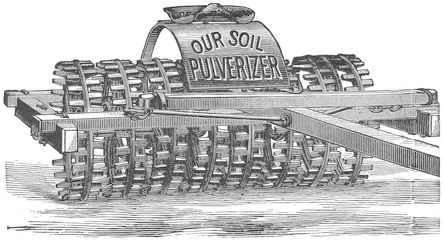
SOIL PULVERIZER.
A neighbor relates that when he was a boy, needing some money, his father made him the offer that he might have all the corn that he would shell, take to mill, and market the meal in Cincinnati, forty miles distant. He went to work with a will, prepared a two-horse load, and reached Cincinnati with it safely, only to find the market glutted so that he could not get an offer on it. A part of it was finally sold at 10 cents per bushel, and the remainder was taken home.
During the closing years of the fifth decade the prices of stock were at the lowest, good dairy cows bringing from $7 to $9 per head; yearling calves from $1 to $2; the very best horses, $40, and stock hogs selling for $1 or $2 each. At the same time many of the necessities of life were sold at exorbitant prices, and an examination of an old account book shows the following figures: Salt, $4 per barrel; nails, 6 to 8 cents per pound; calico, 12½ cents per yard; drilling, 25 cents per yard; clocks, $40 each (the value of the best horses!).
Some other facts must be taken into consideration to understand why the farmers did not attempt improved methods. One was the condition of the currency. The United States Bank, which it would seem should have afforded security and stability to the currency, had been wrecked by the action of Andrew Jackson in vetoing its rechartering and withdrawing the United States funds (at that date about $43,000,000) from it; and private banks had been established over the entire west and south, a system of what was then known as “wild cat” banks supplying the people with currency. The man who was trading needed to carry in his pocket at all times a “bank detector,” to which he might refer to ascertain how many cents on the dollar the issue of each bank was worth.
Looking back at the condition of affairs as described, remembering how few the markets, how easily glutted, how unstable the currency, and all the uncertainties connected with the disposal of the farmer’s products, what was there to stimulate him to improve his methods or increase his products? If, as was occasionally the case, the farmer determined to improve his stock, he must import from England or buy at high prices from an importer, and there being no express companies to deliver his stock, he must either go in person or trust to private individuals to drive them over the mountains or, if small stock, to bring them in wagons the entire distance.
He could not afford to carry on a wide correspondence, for each individual letter cost twenty-five cents postage, if the distance was over three hundred miles. It was not until 1845 that postage was reduced to ten cents, and ten years later it was reduced to three cents for letters of half an ounce.
If any one is inclined to throw the blame upon the farmers for not having done their part to improve agriculture and bring prosperity, he should consider the conditions under which they had lived for a generation; the uncertain markets; the low prices of products; that they must construct roads and bridges, build schoolhouses and churches, clear the farms, nearly all of which were covered with heavy timber; and the fact that all this work was done with the crudest implements. It will be seen that the farmers had been accomplishing wonders and were worthy of the highest praise rather than blame.
With the beginning of the last half of the century, the farmers suddenly awoke to the fact that the conditions had become wonderfully favorable. Towns and cities were growing up on every hand, offering new markets. Railroads and other means of transportation were opening to them. Inventive genius had taken up the improvement of implements of agriculture, and, best of all, prices had advanced greatly for all the leading products. The improvements of methods in farming, which have not been less than those in manufacturing and other callings, date from this time, and will be described under the following heads: Improvements in implements; in stock; in drainage and tillage; in the maintaining and increasing of fertility; in care and feeding of stock; in and around the farmer’s home; and education, which includes agricultural literature, farmer’s organizations, and schools.
II. IMPROVEMENTS IN FARM IMPLEMENTS AND MACHINERY.
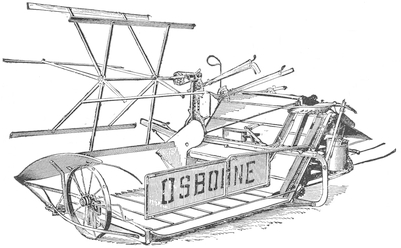
THE COLUMBIA HARVESTER AND BINDER.
In writing on the improvements in agriculture one can scarcely fail to be impressed with the fact that whenever the human race comes to the point that it must have help and make a demand upon nature, she always honors the draft; and as the steps are portrayed by which the agricultural products of this continent have been increased a hundred fold, while the power of the individual worker has increased wonderfully, and the labor has been lightened by machinery, we can see that these inventions and improvements came just as fast as they were needed, and no faster. God has given to the human mind such power, and to the hands such skill, that whatever is necessary is soon provided when the want is made known. Perhaps there is no better way in which this can be traced than in the appliances by which the farmer feeds the world. It is an interesting study to note the successive steps in the improvement of implements for the work of the farm. In the beginning of the century the sickle and flail were all that were needed to cut and thresh the grain; and it was by a series of steps that the steam thresher and the combined mower and binder were evolved. The sickle was all that was needed until population increased and markets were made accessible; then the cradle was invented. With the former, an expert could cut an acre a day, and with the latter four or more acres; but all the work was done by human muscle. The man using a sickle must work with bended back all day. The cradle enabled him to work erect, and lightened the labor; but when the “Reaper sickle” was invented the labor was transferred to brute muscle. The first machines were clumsy and heavy to draw, requiring as much, or more, power to cut the grain as to cut and bind it with the light running modern binder. Now, the man who sweltered with bended back ten or twelve hours to cut an acre of grain with the sickle “drives his team afield,” and by simply guiding it cuts and binds ten or fifteen acres a day, and carries the bundles to the shock row.
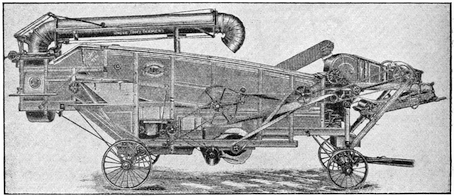
IMPROVED THRESHER WITH BLOWER AND SELF-FEEDER.
The improvement in threshing machinery has been as marked as in that for harvesting the grain. In the first part of the century all the work was done with the flail, and on farms where a large amount of grain was grown it kept a man busy a good part of the winter to thresh it. The first improvement was in threshing the grain by tramping it out with horses, and with two men and four horses, under the most favorable conditions, from fifty to one hundred bushels could be threshed in a day. But by both these methods there was the disadvantage that in all damp weather the work must be stopped, as the grain would become so tough that it could not be threshed. Another disadvantage of these methods was that it took a long time to prepare the crop for market, and in case of a sudden rise in price the farmer could not take advantage of it as he now can when his grain is all threshed in a single day and held in the granary for sale. In the thirties, the first threshing machines were put in use, and were but little improvement over the method of tramping with horses. The machines were of small capacity, and simply threshed the grain, but did not separate it from the straw and chaff, both of which operations had to be done by hand; and if the straw was to be saved, either in the barn or in a stack, it had to be all handled with rakes and forks. The first threshing machine that the writer ever saw was one that was called “The Traveller.” This was followed by machines run by stationary horse-power. These were called “chaff pilers,” from the fact that they threshed the wheat but did not separate it from the straw or chaff. The first horse-powers were inclined planes, or endless chain powers, as they were called, and were run by the weight of the horses, the floor revolving under their weight as they attempted to go up the grade. These were soon superseded by lever powers, made at first for two or four horses, but afterward increased in size and power until ten or twelve horses were used; and about this time the machinery for separating the grain and chaff was added to the machine. It almost seemed to the farmers at this time that perfection had been reached when two or three hundred bushels could be threshed in a day and also cleaned; but the feeding of this large number of horses was a heavy tax upon the farmers, particularly when a rainy day would intervene before the job was finished, and they were obliged to keep the horses two or three days. The invention and introduction of the mounted steam-engine not only saved the farmer from this expense, but also increased the power and doubled the daily capacity of the machine. For a short time the farmers were satisfied with this; but the engine was heavy, and often the farmers’ teams were light, and as it was the rule that each man must draw the engine from his farm to where the next job was to be done, and often the distance was great and the roads bad, it was not long until he tired of this. Then came the traction engine, which not only transported itself but also drew the thresher and separator. About this time another difficulty arose; for now that the machine had been improved and the power increased so that under favorable conditions a thousand bushels could be threshed in a day, the handling of the straw became a serious problem, for it was impossible to build it in a stack suitable for keeping as fast as the machine would deliver it. The first step to lighten and expedite this labor was in adding a straw carrier, a kind of revolving platform, which was attached to the separator and would lift the straw some twelve or fifteen feet. For a year or two the farmers were satisfied with this help, but soon found that it was inadequate for the work. Then the stacker was invented, a separate machine which was backed under the straw carrier to receive the straw, and which had, mounted on wheels, an elevator which would carry the straw to a height of twenty-five or thirty feet; and not only could it do this, but it was the work of a moment, with a crank at its base, to raise it, and it could be run at any angle. When the machine first started, the straw carrier was placed horizontally, and as the stack grew in height, it was raised until in the finishing out of the stack it stood at an angle of forty-five degrees or more. The straw carrier could not only be raised, but by an ingenious arrangement of small wheels, it could be moved from side to side by a light pressure with one hand, or by a man on the stack pushing it with his fork. With this admirable machine for handling the straw, it seemed as though perfection had been reached, and that there was now practically nothing more to be desired. But it was not long until the farmer found that with the delivery of six tons of straw per hour it was heavy work for six men to build the stack, and that it was the most disagreeable work about the machine because of the dust. About 1890, some inventive genius produced the “blower” to take the place of the stacker. This is a long jointed tube, some sixteen or eighteen inches in diameter, mounted at the rear of the cylinder through which the straw is forced by compressed air which is furnished by the machine. It can be raised or lowered, turned to the right or to the left, so as to deliver the straw at any desired point on the stack. It is managed by a man standing on top of the separator near the rear end, does away entirely with any hands on the stack, and thus reduces the force about six men. Some other improvements which have been added are the putting of knives in the cylinder to cut the bands, thus saving one or two hands, for often it was necessary to have a man on each side for cutting the bands when the wheat was dry and the work was done with the greatest rapidity. Then a revolving platform, called a self-feeder, was added in front of the cylinder, on which platform the bundles could be thrown from a wagon standing on each side, and be carried automatically and dumped into the cylinder, doing away with the man who formerly fed the bundles to the machine. To some machines an automatic weigher has been attached, which does away with a man for measuring and keeping tally of the wheat. Compare for a moment this modern machinery which, with a force of twelve or fourteen men, will thresh and clean for market from 1200 to 1600 bushels of wheat per day, with the man with the flail laboriously pounding out ten bushels, and you will get a vivid idea of the progress in agricultural machinery. One somewhat curious fact must be taken into account in this, which is, that with some of these most wonderful machines the cost of labor is about the same it formerly was. But the advantage is that the work can be done in a few hours, and the farmer’s crop be ready for market to take advantage of increased prices, while by the old plan the work would reach almost through the winter.
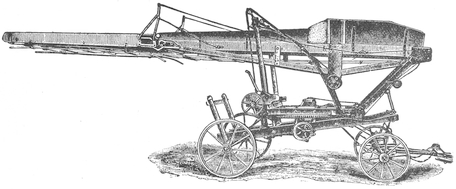
AUTOMATIC MOUNTED STACKER WITH FOLDING ATTACHMENT.
In the cutting and handling of hay there has been as great improvement as in any portion of the farm. A first-class mowing machine, new from the shop, can now be bought for $40 or less, and with it the farmer can drive to the field after supper, in the cool of the day, and in an hour cut more grass, and do it better, than a man could with a scythe by working hard all day.
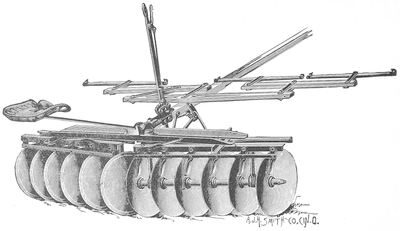
DISK HARROW.
Instead of shaking out the swaths slowly with a fork, with a single horse hitched to a hay tedder about two acres an hour can be shaken up and left in such shape that both sun and wind have perfect access to it and cause it to cure rapidly.
Instead of raking the hay laboriously by hand, a steel sulky rake does the work easily and quickly, doing more in an hour than was possible in a day with the hand rake. On farms where the acreage of hay is large, a self-loader attached to the rear of the wagon gathers the hay from the windrow and delivers it on the wagon. At the barn, instead of the slow and wearisome hand pitching, the hay fork and hay carrier deliver it in the top of the highest barns.
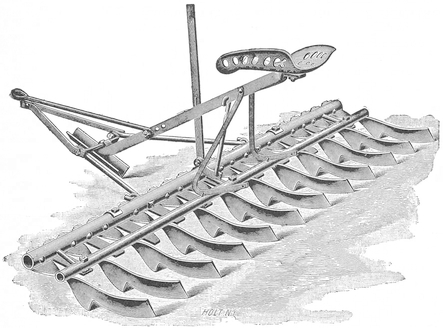
ACME HARROW.
The invention of the hay baler enables the farmer now to condense his crop, so that one third of the room for storage formerly required for hay will answer; and it also enables him to ship it to market by rail, where formerly it was necessary that it should be taken in wagons.
While the plough has not been improved to the extent that many of our farm implements have been, it is vastly superior to those used by the pioneers, and modifies somewhat the adage of “Poor Richard,” who wrote:—
“He who by the plough would thrive, Himself must either hold or drive;”
for the modern ploughman must not only hold and drive, but drive three horses at that, and turn as many acres in a day. Another adage attributed to “Poor Richard” was—
“Plough deep while sluggards sleep, And you shall have corn to sell and keep.”
But the modern farmer has learned that the depth to which he ploughs must be governed by the nature of his soil, and that deep ploughing on heavy clay lands, or lands with a crude subsoil, is often the cause of short crops and permanent injury to the soil.
It is doubtful if in any line of farm implements there has been more improvement than in that of harrows; and yet this improvement dates back but about a quarter of a century, as previous to that time the old “A” harrow or drag, which was hard on the team and did indifferent work, was the only one found on most farms. More recently the cutting and slicing harrows have been largely introduced, and many other forms of improved harrows have been put on the market. For the preparation of hard land for a seed bed, especially for small grain, the disk harrow cannot be excelled.
But for garden use, or for pulverizing sod land which has not been too much compacted, the slicing Acme harrow is the most perfect implement in use, it being of light draft, easily transferred from field to field, and capable of making the finest and best seed-bed.
The cultivators in use have been greatly improved. It is necessary to describe but two of them. The two-horse cultivator with fenders, which enables the farmer to cultivate both sides of the row at once, driving two horses in the field instead of one, as by the old method, has more than doubled the capacity of the individual; as by its use he is able not only to cultivate both sides of the row at once, but to dispense entirely with the man who, under the old rule, was obliged to follow the cultivator and uncover the corn. This “fender” is exceedingly simple, and the only wonder is that it took the farmer so long to find out its value. Costing but a few cents, it has saved the farmers millions of dollars, as previous to its adoption it was necessary to have one man follow each one-horse plow to uncover the corn. There are two forms of this “fender,” the simplest being a light piece of galvanized sheet iron attached to the cultivator or plow so as to come just between it and the row of corn; the other is in the form of a rolling cutter, and attached in the same way. With either of these the farmer goes into the field as soon as the young plants can be seen in the row, drives his team astride the row, and stirs every inch of the soil, putting a little fresh earth around each hill of corn or potatoes without covering a single plant. As a single State grows some millions of acres of corn, it can be seen that the saving from this little invention to the farmers amounts to millions of dollars in a single year.
The old idea of deep cultivation of most crops has been proven to be wrong, and modern implements are made to cultivate the surface to a depth of two or three inches rather than to tear up the roots of the plants; and one of the most perfect of all implements for this purpose is the “Planet Junior one-horse cultivator.”
Perhaps no other class of machines has relieved the farmer more than the ones for planting the grain; and with a modern two-horse corn planter two rows can be planted at a time in checkered rows, so that it can be cultivated both ways and with more precision, both as to alignment and as to the number of plants in a hill, than by the old hand method of planting. The small grain is sown by a two-horse drill arranged for not only the grain, but at the same time to deposit commercial fertilizer along the rows of grain, and with a grass seed sower attached. In the garden a hand drill is used. It is easily adjustable to any sized seed, from that of the turnip up to beans and peas, and the seed is perfectly distributed in straight rows, while the garden hand cultivator does away largely with the use of the hoe.
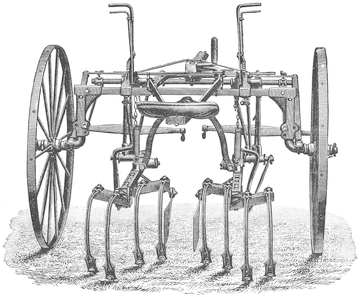
DOUBLE CORN CULTIVATOR.
One other modern implement, which promises to be very useful, is “the weeder,” and its value rests on two facts which it required the farmer many years to discover. The first is that the thorough pulverizing of the surface, even to the depth of an inch, breaks the capillaries and checks the evaporation of moisture; but to do this it is necessary that the work be done just as soon after a rain as the land will crumble, and since often if a drying wind blows the land gets dry in a few hours, a machine is needed that will enable the farmer to thus stir a large surface in a short time; and this the weeder does, as it is made to cover the width of three rows at once, and more than two acres an hour can be stirred with a single machine. The other fact which makes this implement of great value is that all weeds are easily exterminated when in embryo, and this stirring of the soil kills every one that is starting.
One other machine which has been greatly improved is the clover huller. Previous to its invention, most of the clover seed was sown in the chaff, and when clean seed was required it took several days’ work with four horses to tramp out three or four bushels, and then much of the seed was left in the chaff.
The modern huller is equipped with the blower and self-feeder, and with it from twenty to fifty bushels can be hulled and cleaned in a day, the amount depending on how well filled the heads are with seed.
It is quite recently that machinery has been invented that relieves the farmer of the hard work of planting potatoes by hand, and at the same time does the work better than the old way, as the machine drops the seed at a uniform distance apart and covers it perfectly. A man with this machine will do the work of eight or ten men dropping by hand. Several potato diggers, operated by horse power, have also come into recent use. They greatly lighten and accelerate the work, and the cost of growing potatoes has been reduced several cents a bushel by these inventions.
III. IMPROVEMENT OF STOCK.
Perhaps it would be well in beginning to write on this subject to ask, what is “pedigreed stock”? Many people have the idea that pedigreeing is an arbitrary rule adopted by stock growers to mystify the buyer and secure larger prices for their stock. The fact is that it is intended as a protection to the purchaser, and is, or should be, a guarantee that the stock has been bred along certain lines for a sufficient period to establish the desirable qualities which it is wished to perpetuate. A rigid censorship is exercised over the record books, and it makes every one recording stock, in a certain sense, a detective to see that the records are truthful and represent the animals just as they are.
It is doubtful if along any line of farm operations there has been greater improvement than in the breeding and care of stock; yet there were greater difficulties to overcome in doing this than in improving the implements. These difficulties may be classed as follows: First, the one already alluded to in the opening chapter, to wit, the expense of importing and the consequent high price of thoroughbred animals; and when we recall that this was at a time when the farmers were hewing out their homes from the forest, and could not obtain large prices for their products, it will be seen that few farmers could afford to improve their stock. Second, as to cattle and hogs, it was almost impossible to breed pure stock; for all animals were allowed to run at large, and the woods were full of “tramp males,” which would break through the fences and invade the fields where the improved stock was kept. Third, those engaged in breeding stock found that there was a limit which when reached brought barrenness to high-bred animals, and in many other cases reduced the vitality so as to invite disease. That this evil was a real and serious one is shown from the fact that large numbers of high-priced animals failed to produce young among cattle, and that many herds of pedigreed swine were carried off by epidemic diseases. Fourth, and perhaps the most serious hindrance to improvement, was the indifference of farmers and the want of appreciation of good stock, and of course the farmer who did not want it would not coöperate in producing it.
The difference between the improvement of implements and stock consisted largely in the fact that trained mechanics were responsible for the former, and they would perfect the implements until the farmers could not afford to do without them; while the slipshod farmer would be satisfied with his common stock, and would fail to accept the help of the men who were trying to improve it. Another thing which farmers learned slowly was that good stock requires good care, which not only means shelter and liberal feeding, but also that the food be adapted to the wants of the animal. More fine animals were ruined by over-feeding with corn—a heating and fattening diet—than by insufficient food and exposure to cold and storm. It took many years to teach the farmer what a balanced ration was, and why it was necessary.
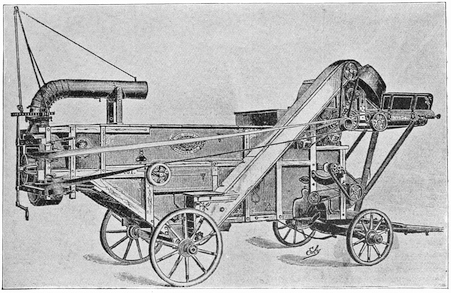
MODERN CLOVER HULLER.
Showing Uncle Tom’s Stacker and Self-Feeder.
It would be interesting to take up each separate breed of cattle and trace its source, giving credit to the men who improved and developed it, and the date of each importation; but the limitations of this article forbid anything more than brief mention of the more prominent breeds, and many which possess great merit cannot be even mentioned. The improved cattle of the United States may be grouped under three heads—beef, dairy, and general purpose. Of the first the Short-horn holds, perhaps, the highest place, or certainly did for a long series of years. These for many years were bred under the name of “Durham,” but about a generation ago the name began to undergo a change to Short-horn.
These animals, while especially adapted to the block, are fairly good milkers, and some strains of them are superior dairy cows. They have the quality of early maturity and produce a larger per cent of fine cuts of meat than most, if not any, other breeds. These cattle were first imported into America in 1797, and many other importations were made during the first half of the present century.
Another breed which closely resembles the Short-horn is the Hereford. These cattle are usually of a uniform color—a pale red—with white face, breast, and flanks, and drooping horns. They were first introduced by Henry Clay in 1817. Another importation was made in 1840, but it was not until 1860 and subsequently that they were imported largely and a “herd book” established for them. Since that time they have multiplied largely.
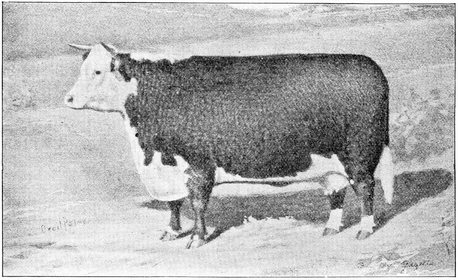
HEREFORD COW. “LADY LAUREL.”
The last of the three distinctly beef breeds is a hornless race originating in Scotland, and known by the name of Aberdeen Angus, Galloway, or Polled cattle. These cattle have the distinctive quality of hardiness, and as they have very thick, close hair they are able to subsist on the range without shelter better than perhaps any other breed. The males have a remarkable prepotency, and the cross-bred animals very rarely show horns. Like the Herefords, they are poor milkers; for while their milk is rich, the quantity is small, and they usually go dry for several months of the year. They were first imported into this country about 1850, and in 1883 nine hundred were imported and distributed among the cattle breeders of the plains. Polled cattle are becoming more popular every year, and many farmers now dehorn the cattle of other breeds; and the time is not far distant when horned cattle will be the exception and not the rule.
The Channel Island group—the Jerseys, Alderneys, and Guernseys—embraces unquestionably the best butter animals of the world; and if we are to judge by their wide distribution and great popularity, the Jerseys lead the list. They were first introduced into the United States in 1820, and in 1850 large importations were made; but it was during the decade from 1870 to 1880 that greatest interest in the breed was awakened and large and frequent importations were made. There has been a strong and bitter opposition to these cattle by many farmers on account of their small size, but they have won their way until they are more universally distributed, and are to be found on more farms than any other breed. Remarkable yields of butter from the individual have been recorded, many of them running from 12 to 18 pounds per week under high feeding and extra care.
While the Ayrshire possesses great merit, so few of them have been imported into this country that it seems scarcely worth while to more than mention them.
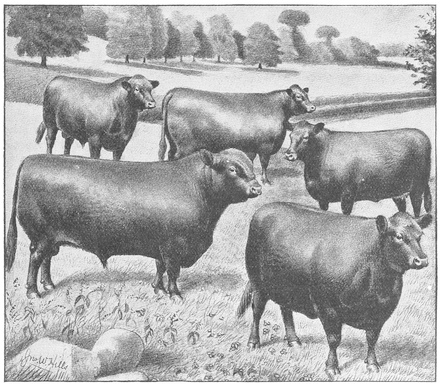
GROUP OF ABERDEEN-ANGUS CATTLE.
Under the head of general-purpose animals come the Holsteins, Devon, and Red Polls. All of these breeds possess fine qualities. The Holsteins were probably not introduced into this country until the last half of the century, and the “Holstein Herd-Book,” published in 1882, shows that about 5000 registered animals were in this country at that date. While fair beef cattle, the Holsteins are deep milkers, and show a record of the largest quantity of milk of any breed in America,—some cows giving over 12,000 pounds of milk in a year. The milk, however, is not as rich in butter fat as that of the Jersey, but probably they are the best breed of dairy cows for the cheese factory in the United States.
The Devons are beautiful red cattle. They do not rank as large milkers, but produce a superior quality of milk, and are unexcelled in this respect by any breed but the Jersey. One peculiarity about the breed is the comparative smallness of the cow; for while the steer will weigh from 1400 to 1600 pounds, the cows will average only from 800 to 1000 pounds each.
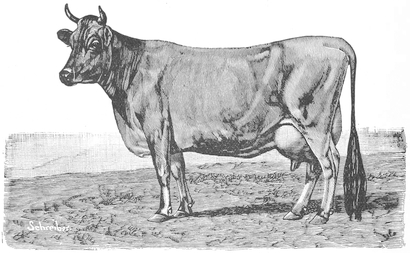
JERSEY COW. IDA OF ST. LAMBERT.
The importation of Red Polls from England is comparatively recent, and they come nearer filling the idea of a general purpose animal than any other breed in America. The first importation was made in 1873, and consisted of only four animals. Two years later four more were imported, and in 1882 twenty-five. Other importations soon followed. They are of a uniformly cherry-red color, with occasionally the tip of the tail white or a little white about the udder. Ninety per cent of the grades are hornless. They are of large size, mature bulls weighing from 1800 to 2200 pounds, and occasionally one will exceed 2500 pounds. Cows weigh from 1100 to 1600 pounds, and will average 1200. That they mature early the following weights, copied from the report of the Smithfield Club, of England, will show:—
Steer, twenty-two and one half months old, weighed 1390 lbs. Heifer, twenty-one and three quarters months old, weighed 1258 lbs. Steer, twenty-three and one half months old, weighed 1500 lbs. Steer, twenty-two months old, weighed 1336 lbs.
At the same show a mature cow was exhibited that weighed 1903 pounds. As dairy cattle they show good records, giving an average of 5500 pounds of milk per year, and some have exceeded 500 pounds of butter in a year, milking over 300 days.
While the United States can show as good horses as any other country in the world, they are not as generally distributed among the farmers as are animals of other breeds of stock. This perhaps can be accounted for, first, from the fact that a horse must be mature, and not less than six years old, before it can be put on the market; and that the low price of the service—fee of grades and scrub stallions—is too great a temptation to the farmer who is in debt and short of money. Still, our standard has been advancing, and there is a sure but slow bettering of the working stock of the country.
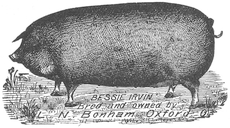
POLAND-CHINA HOG.
In the draft class we have the Norman, Percheron, Clydesdale, and Belgian, and possibly some others, while the Cleveland Bay comes as near the general-purpose horse as any other breed. The importations that have given us the magnificent horses which are being used in this country have been made chiefly from France, England, Belgium, and Germany. The blood of the English thoroughbred and of the Arab has also contributed to the development of the qualities desired.
In no other class of stock produced in this country has the improvement been more marked than in the swine, and while there are probably half a score of breeds in the country, a look through the markets shows that probably 90 per cent of them are of the three following breeds: Poland-China (formerly called Magie), Berkshire, and Duroc or Jersey Red; although it is quite possible that the Chester White might take the third place. With the exception of the Berkshire, these may be called distinctively American breeds, and even the Berkshire has been so modified and improved as to almost lay claim to American origin. A few other breeds are kept pure in this country, particularly the Essex, Yorkshire, and Victorias; but they are bred to but a limited extent and then for a special purpose. One thing that makes it easy and rapid to improve swine is the fact that they mature so early, and that a new cross may be made every year if desired. The writer, living in that part of Miami Valley, in Ohio, where the Poland-China swine originated, has seen, in a quarter of a century, these hogs change in form and color and general characteristics, and these fixed so thoroughly that they could be depended on to reproduce them. As this breed existed in the fifties, they were coarse in form, mongrel in color, and slow in maturing, requiring from eighteen months to two years to be made ready for market. But to-day they are early maturing, can be put on the market at six months of age, weighing from 200 to 250 pounds, and are of uniform shape and color. They are still the leading breed throughout the great corn belt of the United States, and the herd-books have registered breeding stock to the number of many thousand.
The Berkshire hog was first introduced into this country in 1823, and a second importation was made in 1832, but there was no systematic breeding and care to preserve their purity, and grades were sold for pure-bred until the breed fell into disrepute; but in 1865 new importations were made of the finest animals to be found in England, and the merits of the breed became universally known. Though called a small breed, they are but little below the Poland-China in weight, and grades from Berkshire males on large rangey sows will give the finest possible hogs for the block; but these grades must not be used for breeding, or the stock will deteriorate.
The American Chester White hog originated in Chester County, Pennsylvania; but it is believed that there was an importation of white hogs from England in 1818. The breed, until within less than a quarter of a century, was coarse, large of bone, and slow of maturity, and sometimes would attain enormous weight, nearly 1000 pounds; but in the last quarter of a century they have been improved until they are a close rival of the best breeds we have.
The Duroc-Jersey Red seems to be a distinctly American breed, having a history dating back to 1824, but it is less than a half century since they came into prominence, and the improvement made in them in that time has put them near the front rank. One thing which caused their rapid increase was the belief that they were proof against swine-plague and hog-cholera, and they were boomed on that idea. But this did not prove true, and our intelligent farmers have learned that it is not in the breed but in the food and care that immunity from disease will be found. These hogs are of a beautiful red color, and of good form. The mothers are prolific and good nursers, and they mature early, making the choicest of pig pork at an early age.
No other class of animals has been subject to so much foreign competition or has figured to such an extent as a political factor as the sheep, and this, for more than a generation past, has kept the sheep industry fluctuating between a depression which destroyed all profit and a boom which placed fictitious values on them, and both extremes have worked harm to the industry. Yet through all these changes, those who have recognized the intrinsic value of the sheep and stuck to the work of improvement, have not only found the business profitable but have prevented the deterioration of the animals which threatened.
While swine are of no value until killed, the sheep gives two coupons in a year, one in the fleece and the other in the increase, and the breeder always has two distinct objects before him,—the production of wool and mutton. The breeds of sheep are almost as dissimilar as are horses from cattle, and some are suited for hot arid lands, while others are adapted to the rich lowlands with their abundant and succulent herbage. The most ancient of all breeds is the Merino; and those who have studied this question trace its descent back in direct line, probably, to the flocks of the patriarchs. For ages they have been the clothers of mankind, first with the skin and later with the fleece, and still they maintain a high, if not first, place among different breeds. They have been wonderfully improved, but the improvement has been along the line of increasing the value of the fleece rather than the carcass, and it has been changed from an animal that would produce two or three pounds of wool, and one which had bare belly and legs, to one which produces a fleece from the hoofs to very near the nose. It is within bounds to say the weight of the fleece has been doubled.
With the long-wool breeds the improvement has been designed to develop the carcass and mutton qualities rather than the wool, and of these the two typical breeds are the Shropshire and Cotswold. Probably the best mutton lambs that are produced in this country are from the Shropshire rams and Merino ewes. The representative Cotswold is of majestic port and large size. The wool is curly, long, and lustrous; not dry and harsh to the touch, and has but a slight amount of yolk; at maturity it ought to be eight inches long. The fleece averages six or seven pounds.
IV. IMPROVEMENT IN FARMING METHODS.
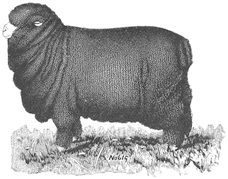
MERINO SHEEP.
The improvement of methods on the farm has been discussed to some extent in speaking of implements and stock, as their use involves better methods; but there are other points worthy of notice. One of the most important of these is drainage. The first attempts to remove surface water from farm-land were by the construction of open ditches; but as these had to follow the natural water-courses which often zigzagged through the fields, they were objectionable, not only because of making bad shaped lands to plow and cultivate, but also because they caused a waste of land, and usually had to be bridged to be crossed with the wagons. Other objections to them were that they produced crops of weeds to give trouble in the fields, and there was a constant tendency to fill up, which soon impaired their usefulness; or, if kept cleaned out, it had to be done at heavy expense. The first attempt at underdrains, or “blind ditches,” as they were called, was by making an underground water-way with stone or timber; but both these materials were found objectionable, because such drains were easily damaged by the action of craw-fish and rarely continued to do good work for more than a few years. It was after the middle of the century that drain tiles made of burnt clay were introduced, resembling good hard brick in material; but the first drains laid were usually with tiles of too small caliber, two-inch being largely used, which were not only easily choked but failed to carry the water off rapidly enough in a wet time. Large sections of many of our States were originally swampy and so nearly level as to make it necessary to construct open ditches, almost like canals, as an outlet for the water flowing into them from the drains. These could not, of course, be constructed by individuals, as no man had a right to go on his neighbor’s land to open a ditch for this purpose; so, in many cases, this was made a matter of legislation, and the large open ditches were built by taxation equitably levied on the lands. By this means the farmers were enabled to thoroughly drain large areas of country which otherwise would have been nearly worthless for agricultural purposes. In some instances the earth taken from these large ditches was graded up several feet high at the side, and on the top of this levee a turnpike road was constructed, thus giving a double benefit from a single operation. The first draining of farms was in the wet spots where, usually, a single line of tiles, laid for a moderate distance, would bring the parts of the field under cultivation that otherwise would be waste; but gradually the farmers learned that there were other valuable effects from drainage, and that most heavy clay lands would be benefited by it sufficiently to justify the expense. The following incidental advantages have been learned: first, drainage deepens the soil; second, it prevents the killing out of grass and grains during a wet season; third, it makes the land warmer; fourth, it improves the texture of the soil and makes it possible to work and plant it earlier in the spring; fifth, it prevents washing and waste of manure; sixth, it often prevents failure of crops in excessively wet seasons, and enables them to endure drought better in dry seasons. Although drainage is expensive it is a permanent improvement, and in many cases the increase of the wheat crop in a single year has defrayed the expense of tilling the land.
Another improvement, which seems to be the opposite of this, is the irrigation of arid lands in those parts of the country where the annual rainfall is small and every summer brings a drought. In these cases, water stored in large natural or artificial reservoirs, or that furnished by snow melting on the mountains, is utilized to carry the crops through the dry season and to enable the farmer to grow large crops where nothing could be produced without this aid.
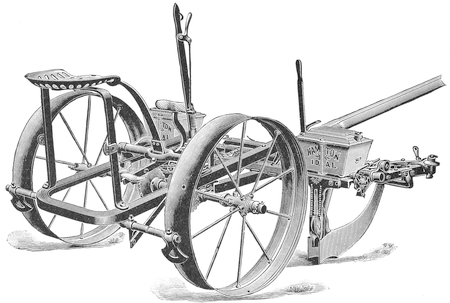
DOUBLE CORN PLANTER.
Perhaps in no other line have the methods changed for the better more than in the care of domestic animals, and this includes both shelter and feeding. In the first half of the century, cattle and hogs were usually exposed to the severe weather of the winter with no other shelter than that afforded by a straw-stack, and this often was found leveled to the ground by the first of March, leaving them entirely without shelter at that changeable season of the year. They were allowed at all seasons to roam over the farm and gather their own living, and were turned into the cornfields as soon as the ears were removed, where they lived well as long as the stalk pasture lasted, after which they depended on straw for food until spring; and it was common to have the cattle so poor, as spring approached, that many died of actual starvation, while others became so feeble that they would have to be lifted to help them on their feet. Then the stables for horses were constructed apparently with the idea that ventilation was the chief thing, and the horses stood and shivered in their stalls from the drafts that blew through the sides of the barn and up through the floors of their stalls. Gradually these things have changed, until the larger part of farm stock is warmly sheltered, and well fed with a variety of food. Succulent food is now largely furnished from ensilage preserved in silos, from beets and other roots grown and stored for winter use, and, more recently, from sorghum, which has been found to retain its succulence and sweetness during the entire winter. Farmers have learned what is meant by a balanced ration, which is a combination of foods that will give the proper proportion of heat and fat producers with those which make bone and muscle, and that it means both health and economy to substitute to a certain extent bran and oil meal for corn, and clover hay for hay made from the grasses, and straw.
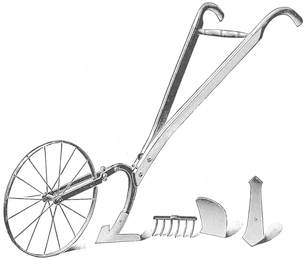
HAND GARDEN PLOW.
Another great improvement has been along the line of fencing; and, in this respect, the most economical step of all has been in reducing the amount of division fence on the farm, keeping only a portion of it divided into fields for pasture, and leaving half or more of the best parts to be cultivated in a single inclosure on which stock is never turned. In most States, laws have been passed obliging each farmer to fence in his own stock, and no one is compelled to fence out his neighbor’s. The substitution of wire for wood as a fencing material has reduced the cost of fence construction about one half, and the waste of land occupied by fences is reduced in about the same proportion.
V. IMPROVEMENT IN AND AROUND THE HOME.
The change in this direction in a single generation has been most marked, and is one of the surest signs of prosperity. The log cabin has given place to a substantial and, in many cases, an elegant home. The irregular and ill-shaped yards, fenced with rails, which surrounded both house and barn, and in which hogs and cattle were kept, with no shelter but a rail pen with straw roof, have disappeared, and rectangular lots enclosed with neat fences and good barns and piggeries have taken their place. The wood-pile has retired from the front yard, and is now sheltered in a woodshed adjoining the kitchen; and a neat lawn with flowers and shrubbery is no longer the exception, but the rule. A good garden, in which the newer and improved vegetables have taken the place of the old sorts, and a berry patch, well cared for, afford the luxuries which they alone can give for a period of many weeks each season. The water is no longer carried from a remote spring, but good wells and cisterns are placed conveniently, many of them so that the pump is in the kitchen or under a porch attached to the house. The cellar is usually floored with cement, and the stairs leading to it are of easy grade; while good walks of plank or cement make it a pleasure to pass from the house to the surrounding outbuildings.
Another line in which very great improvement is shown is in maintaining the fertility of the soil. The old method was to exhaust the fertility of a field and then clear a new one; and it is doubtful if one farmer in a hundred could have answered the question, “Why does land become sterile after long cultivation?” for they had no conception of what the chemical elements of the soil were which are necessary to its fertility. There are two theories of fertilizing and fertility: one, that the soil is a mine to be worked out, and which will inevitably become unproductive in the process; the other, that it is a laboratory in which, under the intelligent management of man, forces can be set at work which will maintain and develop a perpetual fertility. Malthus, more than a century ago, announced that the time would come before long when the people of the earth would starve because they had outgrown the fertility of the soil and its productive capacity; but after long cultivation, we find it possible to produce on less than half the cultivatable land enough not only to feed our own nation, but the world at large, and there is no questioning the accurateness of the laboratory theory as opposed to the mine theory.
The first improvement along this line was in the better saving and utilizing of animal manures; but when it was found that these were insufficient, science came to the help of the farmer. The chemist analyzed both crop and soils, ascertaining what was needed, and then the world was searched for the materials necessary. The elements which formed our plants were found to be fifteen in number, but of these it was found that it was necessary to furnish only three,—nitrogen, phosphoric acid, and potash. Nitrogen was known to exist in inexhaustible quantities in the atmosphere, forming seventy-six per cent of its composition; but the question was long unsolved: “Can growing plants appropriate atmospheric nitrogen?” Finally, it was discovered that plants of the Leguminosæ family—of which clover is the best type and of greatest value for this purpose to the farmer—could appropriate nitrogen from the atmosphere; and after careful research, with the aid of the microscope, it was discovered that this appropriation came about through the agency of bacteria in the roots. This fact connected with the clover plant is one of immense importance to the farmer, because nitrogen is not only the most expensive element of fertility to purchase, but is likely to be lost both through evaporation and leaching. So it can be seen that clover is one of the most valuable plants which can be grown on the farm, for the reason that the crop can be utilized as food for stock, while still great benefit inures to the soil, as the fertility is largely stored in the roots, which cannot be used for any other purpose, and as by the action of these roots the mechanical condition of the soil is greatly improved. Further, the dense shade the plant affords induces chemical action in the soil, which makes plant food available that would otherwise remain inert. One of the most wonderful things connected with fertility is that God has so locked it up in the earth that no greedy generation can exhaust it, and that the greatest source of fertility is the atmosphere, whose secrets are just being discovered.
An English scientist has recently announced that by the aid of electricity, furnished by cheap water-power, nitrates can be manufactured directly from the atmosphere so as to reduce their cost to less than one fourth what it has heretofore been. Again, the intelligent use of clover will enable the farmer to produce his own nitrogen and reduce the cost of chemical fertilizers to one half what it usually is when containing nitrogen. This brings us to the question of commercial fertilizers. With the single exception of guano, they are a product of the last third of the century. The first step toward the use of commercial fertilizers was by analyzing our barnyard manures. When the chemist discovered that a ton or more which the farmer drew out laboriously with two horses to the field contained but twenty or thirty pounds of actual plant food,—the remainder being water, sand, and other dead matter,—the next step was to combine the three elements essential to a perfect fertilizer in such proportions that a single sack would hold enough manure for an acre of ground; and in tens of thousands of cases, the application of this amount of fertilizer has increased the wheat crop from five to fifteen bushels per acre, doubling the grass crop which followed, which in turn, and through the influence of the fertilizer, formed a sward which, by its decay, fertilized a third crop when it was turned under in the rotation.
The element in fertilizers of next importance to nitrogen is phosphoric acid, and the first source from which this was obtained was the bones of animals. But the supply from animals slaughtered was entirely insufficient; and so the great plains of the West were gleaned, and tens of thousands of tons of buffalo bones were gathered and shipped East to fertilize our farms. But soon this source began to wane; then two other sources, practically inexhaustible, of this indispensable element were discovered,—the phosphate rocks of the South and the iron slag from furnaces, each of which is found to contain a large per cent of phosphoric acid; and when the rock is dissolved by acids and the slag ground to an impalpable powder by machinery, the fertilizing elements in both are found to be as available and valuable as that from bones. The supply of potash was obtained at first from wood ashes, which the clearing of the farms and the universal use of wood as fuel made abundant. But later, when these sources were no longer sufficient, potash salts were found in large quantities where they could be mined from the earth, so that now there seems to be in sight an inexhaustible supply of the elements needed for plant food. Like almost every reform, the use of commercial fertilizers was opposed bitterly by many farmers, and statements were made by them that their effects on the soil were like those of whiskey or other stimulants on the body, and that the ultimate result of their use would be that the soil would become barren. Many refused, to use them at all; others, after a single trial made without intelligence, denounced them as humbugs. But as they saw on the farms of their neighbors the wonderful results from their use, they have been gradually led to adopt them, until now, with most farmers, the question no longer is, “Can I afford to use commercial fertilizers?” but rather, “Can I afford to do without them?”
VI. IMPROVEMENT IN AGRICULTURAL EDUCATION.
To one who has followed the writer to this point, it must be apparent that the farmer of to-day has made progress in the knowledge of his calling to at least as great an extent as he has improved in his methods, and that the terms “farm drudge” and “clodhopper” are misapplied and should be obsolete. There is no other industrial calling in which one touches nature and science at so many points, or which gives such good opportunities to develop the perfect man,—“the sound mind in the sound body,”—as that of the farmer. Admitting that not all farmers understand this and live up to their privileges, does not alter the fact that the farm offers a great opportunity to develop and broaden the mind; that the last quarter of the century has brought into active operation forces which have touched and influenced a large per cent of the tillers of the soil; and that the leaven of education is working mightily. The intelligent, studious farmer becomes a practical botanist as he studies the growth and habits of plants. As he is dependent more than any other man upon the weather and must change his plans frequently to correspond with climatic changes, he becomes a meteorologist. Myriads of insects, which include both enemies and friends, make him a student of entomology; and the wonderful alchemy of the soil by which offensive and poisonous matters are transmuted into golden grain, luscious fruits, vegetables, and flowers, calls for a knowledge of chemistry. The use of modern machinery develops his mechanical powers; and the man on the farm develops in more directions and has an opportunity to acquire a broader education than any other man who earns his living by his own labor. To sustain this statement, it is only necessary to enumerate the educational opportunities and privileges now open to the farmer and which are, to a great extent, utilized by him. First, what the government is doing for him. No other calling is represented in the cabinet of the President, and time and experience have demonstrated the wisdom of a Secretary of Agriculture. Not only are we distinctively an agricultural people, but the prosperity of the nation depends on the intelligence and prosperity of the farmer more than on all other classes combined. Not only must the food supply of our people be furnished, but the foreign demand must be met; and this gives to the farmers money to spend, so that the industries which contribute to their wants shall share in the general prosperity. While there are many honorable and useful callings, agriculture seems to be the only one which touches and affects all others. The financial importance of agriculture is shown by the fact that, after the wants of the nation were supplied, in the year 1897 we exported in round numbers $690,000,000 worth of agricultural products, or nearly 67 per cent of the entire exports; and notwithstanding an enormous increase of imports of wool and sugar, in anticipation of increased duties, the balance of trade on agricultural products for the year was $289,000,000, and the export of agricultural products for the current fiscal year would show still larger figures.
Considering the specific educational influences which are elevating the farmer and his calling, we enumerate the following: Agricultural literature, farmers’ organizations,—including farmers’ clubs, farmers’ institutes, and the Grange,—agricultural experiment stations, and agricultural colleges, all of which have contributed their share to the intelligence and prosperity of the farmer, and all are products of the last half of the century. To give an intelligent idea of the help which these influences have brought to the farmer, it is necessary to treat them to some extent in detail. First, agricultural literature. All that is necessary to an understanding of the progress in this direction is to get one of the very few so-called agricultural papers of fifty years ago and compare it with those of to-day. Not only have they multiplied a hundredfold, but while the former largely contained stilted articles written by theorists, to-day every page is full of practical instruction written by farmers, and often by specialists who have spent years in improving some line of farming or stock breeding. Most of our agricultural papers have a staff of paid contributors, nearly all of whom have made a success in some branch of farming; and so anxious are the publishers of these papers to give their readers all the help possible, that they search out the men who are prospering on the farm and engage their services as instructors for their readers. The journals devoted to agriculture are numbered by hundreds, some of them devoted to a single line,—such as sheep, poultry, or gardening,—and others with well classified departments which give instruction on all points. In addition to this, nearly all of the weeklies have a page of agriculture, usually conducted by a farmer or some one with practical knowledge of farm work. There are no secrets in agriculture, and every farmer is ready to impart to all any valuable information he acquires. Farmers appreciate the value of these helps and make large use of them, and the circulation of these papers is enormous.
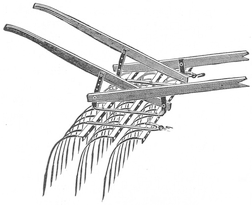
SUCCESS ANTI-CLOG WEEDER.
By Farmers’ Clubs we mean those organizations of farmers, governed by constitutions and by-laws, who meet at stated times for the discussion of topics connected with the improvement of their calling. There are no statistics available from which can be gathered the extent of this movement, but Ohio reports fifty clubs and has formed a state organization. In Michigan, where the clubs are organized on a different basis, 30,000 members are reported; they have also formed a state organization, which was attended by 200 delegates at the last meeting. Indiana is but little, if any, behind these two States, and the club idea is rapidly spreading through the Northern States. There are two forms of these clubs, one of which limits the membership to twelve families, and the meetings are all held at the homes of the members, one each month. The advantages of this plan are several. First, with the club thus limited, the horses can be stabled and cared for during inclement weather of winter. Second, the wives need prepare but one meal in the year for the club; while with the large club it is necessary that each should contribute to a basket dinner for every meeting, which often causes as much trouble as to prepare the meal for the entire club once a year. Third, the attendance is sure to be more regular in the small club, and one condition of membership is that every member shall be present at each meeting unless providentially detained. Fourth, with a club of this size every member can take part in the discussion, and there will be less danger of a few “talkers” monopolizing the time. Fifth, the social features in the small club are very much better than in the large. Most of the clubs in Ohio and Indiana are organized on this basis, while in Michigan it is probable that most of the clubs have an unlimited membership. The objection is sometimes urged that the small club seems selfish, but as any twelve or even six families are at liberty to organize a club this objection is not valid.
As many farmers who would like to organize may not be able to find a form of constitution and by-laws, it seems proper to give one here.
Preamble.
Recognizing the fact that farmers need an opportunity to compare methods and to cultivate their social qualities, and considering that “As iron sharpeneth iron, so a man sharpeneth the countenance of his friend,” in order that we may be mutually helpful to each other in matters relating to husbandry, home comfort, and economy, we do form ourselves into an association known as the —— Farmers’ Club [fill the blank with the name you wish to use for your club], and adopt for our government the following:—
Constitution.
Article 1. The officers shall be President, Vice-President, Secretary, Treasurer, and Librarian, who shall be elected annually in November, and assume their duties in January of the following year.
Article 2. The duties of these officers shall be such as pertain to the offices in other organizations and are indicated by the name of the office.
Article 3. The active members of this club shall be engaged in agricultural pursuits, but honorary members may be elected by unanimous vote. Honorary members are not obliged to attend all the meetings, but will be welcomed to any.
Article 4. Application for membership must be submitted at the meeting previous to their being balloted for, and members will be admitted on receiving a two-thirds vote by ballot; but the membership shall be limited to twelve families.
Article 5. Amendments may be made at any regular meeting by a two-thirds vote of the active members.
By-laws.
1. The club shall meet at the residence of one of the members on the third Thursday of each month, at ten o’clock, invitations to which shall be limited to the hostess of the day.
2. The club shall be called to order by the president, after an hour spent in social intercourse, and the order of exercises shall be as follows:—
a. Reading and approving minutes of last meeting.
b. Monthly record of current events.
c. Selections, recitations, essays.
d. Adjournment for dinner and social intercourse until two o’clock.
e. Discussion; so conducted as to avoid all questions of politics and theology.
f. Question drawer.
g. Miscellaneous business.
In order that the work of the club may be systematic and the time fully occupied, a programme covering the entire year is prepared and printed so as to be ready for distribution at the December meeting of each year. That the reader may understand the working of this plan, a few topics will be given, taken from the programme of the club of which the writer is a member:—
January.
The club will meet at the home of Mr. ........ Thursday, the 19th. Selection ....................... Mrs. ........ Paper ........................... Mr. .........
Topic: A review of the previous year.
Each member will give in writing a statement of profits and losses for the year under the following heads:—
1. General crops grown and acreage and yield thereof. 2. What special crops have been raised. 3. Stock raised or handled. 4. What experiments have been made on the farm. 5. What losses of stock, or crops, and the cause thereof.
June.
The club will meet at the home of Mr. ........ Thursday, the 15th. Selection ...................... Mrs. ........ Paper: “Hindrances to sheep raising and how to avoid them.” Mr. .........
Topic: The Farmer’s Barn.
1. Relative size to farm. 2. Location and ground plan. 3. Arrangement of stabling, feeding, and water conveniences. 4. Plan for saving manure.
Either a gentleman or a lady is appointed to open each topic, after which the subject is opened for question or discussion by any member of the club. During one month of the summer, usually July or August, a picnic takes the place of the regular meeting, at which a basket dinner is served.
Farmers’ institutes are, in the best sense of the word, a farmers’ school, and while it is less than twenty years since their first organization, nearly all of the States, at least in the North, are conducting them to a greater or less extent. As Ohio claims the honor of inaugurating this movement, and the writer is more familiar with the plan of organization and the work of institutes in that State than any other, some facts concerning them will be given. The first attempt to teach the farmers by lecture courses was made late in the seventies at the Ohio State Agricultural College, when a course of eighty lectures on subjects connected with farm interests were given, all of them by professors of the college. This first course occupied five weeks; and as it was found that but a limited number of farmers could be induced to leave their homes and care of their stock in the winter, and that the attendance was only about forty, the next two years the course was shortened in hopes that a larger attendance might result, but such was not the case. Then some one suggested, “If the farmers will not come to the lectures, why not take the lectures to the farmers?” and the outcome of this suggestion has been a wonderful success; the State holding three hundred institutes in the winter of 1897 and 1898, under a law providing a fund for that purpose, and over a hundred independent institutes in addition, by which is meant institutes in which the local organization pays its own expenses and chooses its own lecturers and subjects.
The work in most of our States is thoroughly organized, a fund provided to meet the expenses of the work, placed in some States under the charge of the Secretary of Agriculture, and in others in charge of a superintendent of institutes. The farmers have met this effort for their improvement with great enthusiasm, and the attendance is usually limited by the size of the hall provided. All partisan and sectarian questions are rigorously excluded from the discussions. A bulletin is issued in the fall, which gives the names of a large corps of lecturers and a list of subjects, and these are sent to the officers of the local organizations, from which they can select such topics as they wish discussed. Half of the time of each session is allotted to the state lecturers, while local talent is expected to fill the other half. The greatest possible freedom is allowed in asking questions and discussing the work of the speakers, and no other educational influence which has come to the farmer has equaled that offered by these meetings. At the close of each year the best papers and discussions are printed in a bulletin for free distribution among the farmers, and are given out at the meeting the ensuing year, or are mailed from the office of the Secretary of the State Board of Agriculture on application.
The Grange was organized at Washington, D. C., in 1807, but existed only on paper until January, 1873, when the first meeting of the National Grange convened at Georgetown, D. C., with delegates from ten States. It was started as a secret society, with a ritual and degrees, and seemed to catch the popular fancy among the farmers. At the meeting of the National Grange in 1874, thirty-two States were represented.
Probably no other organization has made so rapid a growth as this. A large element, however, of the membership was attracted to it by the rallying cry of “Down with the middleman!” and had little or no conception of its educational possibilities. Little country stores with very small capital, and managed by men with no business training, sprang up at every cross-road, which, contrary to the expectation of their founders, did not save money, but resulted in some valuable business education for which a good tuition fee was paid. The reaction which set in made it seem for a time as though the entire order would disintegrate; but fortunately there were wise leaders who had caught the true idea, that the organization must be kept on an educational basis to save it from extinction, and through their efforts it has become a power for good in most localities, and has been of great service to the farmers. County, state, and national societies have been organized, and no other large bodies of farmers can so quickly and thoroughly coöperate in measures pertaining to the interests of the farmer as those belonging to this order.
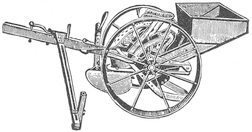
ASPINWALL POTATO PLANTER.
Another educational force of immense value to the farmers is found in the experiment stations, which are established in every State of the Union. This work was started by an act of Congress, approved March 2, 1887, and known as the “Hatch Act.” By this act the sum of $15,000 per annum was appropriated for each State in the Union, to be specially provided by Congress in the appropriations from year to year. In addition to this sum, most of the States have made large appropriations for the purchase of suitable grounds and the erection of buildings, and to cover the expense of printing the reports and pamphlets which are sent out free to the farmers who apply for them.
To go a little farther, the questions requiring investigation by the agricultural experiment stations may be divided into three principal groups, according as they are related to the soil, to the growth of crops and vegetation, or to domestic animals and their products.
I. The soil is studied—
(1) In its varieties, as found in different parts of the farm and of the State.
(2) In its physical properties, as affected by tillage, drainage, irrigation, etc.
(3) In its chemical properties, as related to the maintenance of fertility by the use of fertilizers and otherwise.
II. In vegetation and crop production some of the objects of study are:—
(1) Varieties, including the selection and dissemination of new sorts; the elimination of synonyms; the comparison of strains of varieties; the production of improved varieties, etc., etc.
(2) Vegetable pathology, including studies of rusts, smuts, blights, rots, mildews, etc.
(3) Control of injurious insects.
(4) Forestry, embracing the culture of forest trees for wind-breaks, for timber, for nuts and incidental products.
III. In the study of animals some of the problems are:—
(1) Breeds and their comparative values for different purposes.
(2) Foods and feeding, for growth, for meat, for milk and wool.
(3) The diseases of animals, especially those of contagious, epizootic, or parasitic nature.
The stations have done most valuable work along these different lines, and have contributed in a large measure to the introduction of improved varieties of cereals, forage crops, and fruits. In the case of wheat especially, there can be no doubt that the work of the stations has been a factor of great importance in producing large yields, by stimulating the farmers to a more careful comparison of varieties and of methods of culture.
A plan of purchasing and testing most of the so-called new varieties of fruits and grains has been followed by some of the stations, thus enabling the farmers and fruit growers to judge whether such varieties are likely to be superior to sorts already cultivated. It has been part of the work of the stations to expose fraudulent sales of fruit, stock, and fertilizers. Much other work has been and is being done, but the instances given show the value of the investigations made. As has already been stated under another heading, the officers of the experiment stations take an active part in the work of the institutes, and by the frequent issuing of bulletins and their annual reports convey valuable information to the farmer in every department of his work. In many States they have established reading courses for the study of Nature, which are conducted similarly to those in the Chautauqua courses.
In the same connection the work of the Bureau of Animal Industry should be noticed. Possibly no other organization of the government is doing so much to save farmers from loss through disease of stock and educating them to the same extent as this. The organization is made up of men of the highest scientific training, whose lives are devoted to the study of diseases of domestic animals and whose work extends to the testing of remedies, the inspection of meats, the study of foreign markets, and everything that pertains to the interest of the stock growers. No disease can break out in the herds of live stock in any part of the country without this bureau being at once notified of it, and trained officials are sent to study all the circumstances connected with it and to prevent, if possible, such disease from becoming epidemic. Some years ago, when contagious pleuro-pneumonia had secured a foothold in this country, the Bureau of Animal Industry set to work to stamp it out. The Old World was paralyzed by the enormity of the undertaking. Veterinarians in England and Continental Europe laughed at us and considered us fit subjects for lunatic asylums. “Hadn’t they always had it? It cost them millions of dollars annually in cattle, yet they had been unable to stamp it out, and most assuredly we could not do what European veterinarians could not.” They forgot that we were Yankees. It cost us many good hard dollars that were represented by large figures; but we stamped it out, and it has now been years since “Uncle Sam” officially declared the country free from it.
Another work which this bureau undertook was the regulation of vessels in which cattle were exported, and they reduced the losses so as to save from two to three million dollars annually in the insurance of export cattle. The greatest possible care is taken to disinfect vessels in which cattle have been shipped, and strict regulations are established regulating the size of stalls, ventilation, the number of cattle to be carried on any single vessel, and every point which has a bearing on the health and comfort of the animals.
It was not until after the Civil War that such a thing as an agricultural college was known in this country, but through the action of Congress very liberal appropriations were made, which in most States were supplemented by the action of the State Legislatures, and an agricultural college was started in every State of the Union. In the beginning there was much criticism, and without doubt many mistakes were made by those to whom the work was assigned; but now that a generation has passed, the farmers have come to understand better the objects of these schools, and scientific men have been trained to do the work; and these men have gone out into other departments, such as those already described, and have made possible the splendid achievements which have already been hinted at in what has been written. The teachers and officials of these colleges have been exceedingly friendly to everything that could help the farmers, and are in close touch with them; aiding in the work of local, state, and national organizations, and, in most States, carrying on the work of the experiment stations through their professors and graduates; and in many of them courses of lectures by practical farmers have been established. Without question they are becoming more and more helpful as the years go by, and their power for good is constantly increasing.
A SUMMING UP.
What has agriculture gained, or rather along what lines, in the century’s progress? A brief summary would seem a fitting close of this chapter:—
(1) The marvelous advance in methods and means of transportation, and the consequent opening of the markets of the world.
(2) The knowledge of the chemical constituents of the soil and its management in the line of maintaining fertility.
(3) The appliances to lighten labor and shorten processes in the production and harvesting of crops.
(4) Increased knowledge of plants, as to their growth and cultivation, their feeding qualities, and the combination of these qualities in feeding our domestic animals, by which we are able to reduce the cost of production through the early maturity of the animals and the maintaining of vigorous health.
(5) Increased knowledge of the value and power of organization and of agricultural literature in helping to a practical education for the duties of the farm.
(6) In an increase of home comforts and a higher ideal of living, and an appreciation of the fact that the work of the farm should be subservient to the life on the farm, as “The life is more than meat, and the body than raiment.”
(7) In no other country on the globe are there so many tillers of the soil who own their homes, and, as a consequence, there is no country where there is so much of patriotism. When Matthew Arnold visited the United States, nothing that he saw delighted him more than the beautiful farms, with their comfortable dwellings and outbuildings and the evidences of high cultivation and fertility. But one thing puzzled him, and that was the absence of tenant houses, and he asked, “Where do the men live who cultivate these farms?” When told that in most cases the farmers were their own tenants, he could scarcely express his astonishment.
Prince Kropotkin, of Russia, who has traveled in this country and paid particular attention to the condition of agriculture, says in his summing up: “American agriculture offers an imposing sight; not in the wheat fields of the far West, which will soon become a thing of the past, but by the development of rational agriculture and of the forces which promote it. Read the description of an agricultural exhibition in a small town in Iowa, with 70,000 farmers camping with their families in tents during the fair week, studying, learning, buying and selling, and enjoying life. You see a national fête, and you feel that you deal with a nation in which agriculture is held in respect. Or read the publications of the scores of experiment stations, whose reports are published by thousands and scattered broadcast over the country, and are read by the farmers and discussed at countless farmers’ meetings, and you will feel that American agriculture is a real force, imbued with life, which no longer fears mammoth farms, and needs not, like a child, cry for protection.”
The future of agriculture in this country seems safe, and no class of men can look the future in the face with more of confidence than those who till the soil.