THE CENTURY’S PROGRESS IN COINAGE, CURRENCY, AND BANKING By HON. BRADFORD RHODES, Editor of “Banker’s Magazine.”
Reading edition
I. BANKS AND BANKING RESOURCES.
The history of nation building contains no parallel to the progress and development of the United States in the past one hundred years, and the most accurate and striking indication of this remarkable growth may be seen in the evolution of our currency and banking systems. As the variations in temperature and the changes in atmospheric pressure are measured by the thermometer and barometer, so are the fluctuations in a country’s wealth gauged by the banks and other financial institutions. Likewise the degree of civilization to which a country has attained is reflected by the perfection of its monetary machinery. After having tried nearly every unwise experiment condemned by the teachings of history, the United States has finally reached a position where its currency meets the two fundamental requirements of sound finance, namely, (1) the standard of value is that in use among the great commercial states of the world; (2) all of the currency is either directly or indirectly convertible into the standard coin.
Despite some minor faults in our financial system which make the maintenance of the parity of the several kinds of currency a cumbersome and expensive operation, and prevent the banks from rendering that full degree of assistance to commerce and industry which they would afford under laws that did not unnecessarily restrict their rightful functions, all our money responds to the two essential tests—safety and convertibility; while the banks have been among the most powerful factors in placing the United States in the front rank of the nations of the earth.
Our finances may be likened to a triangle, of which the base—the gold standard—has been in actual existence since 1879 (much longer than that in law), and the other side—safety—also assured, wanting but another addition—elasticity—to complete the symmetrical and perfect figure. That this last requisite of a sound currency will be supplied by the wisdom and ingenuity of our people, is not to be doubted.
There are two respects in which the financial policy of the United States is unique in comparison with most other great commercial countries; first, its gold reserve is unprotected by the devices in use elsewhere, as it does not charge a premium on gold as the Bank of France does when gold is wanted for export, nor can it protect the gold reserve by raising the rate of discount as the great banks of Europe may do; second, banking is practically free and anti-monopolistic. Under these conditions we have reached a place that may well excite the astonishment of the old-world countries. Our stock of metallic money, as estimated by the Director of the Mint, in 1898, was $925,000,000 in gold and $638,000,000 in silver. No other nation owned so much gold. Only one—China—owned as much silver, but it had no gold, and the per capita of silver in China is only $1.96 against $8.56 in the United States. Our stock of gold is more than double that of Great Britain, greater by a hundred millions than that of France, and also exceeds that of Germany and Russia. Of our silver stock, $561,500,000 is a full legal tender, and $76,700,000 a limited legal tender, the latter sum representing the subsidiary coins.
In our banking power the situation is equally fortunate. Mulhall defines banking power as the paid-up capital of banks, the deposits exclusive of savings banks, and the amount of convertible paper money. He shows the growth of this form of wealth to have been as follows, from 1840 to 1894:—
MILLIONS POUNDS STERLING.
Great Britain. United States. France. Germany. Other States. Total.
1840 132 90 16 12 58 308
1894 960 1,030 356 231 760 3,337
In the two great essentials of financial strength—the quantity of metallic money and banking power—we have far outstripped every other nation. This is an unfailing sign of our advance toward a position of commercial and industrial supremacy. The sceptre of financial power has crossed the Atlantic from Europe to the New World. We are gradually acquiring command of the world’s markets, and in time we shall see our banks—ever the handmaids of commerce—extending their operations to the most distant quarters of the earth and carrying everywhere the beneficent influences of modern civilization.
New York as a financial centre has been growing with astonishing rapidity in recent years. From 1879 to 1899 the banks belonging to the New York Clearing-House Association increased their deposits from $254,700,000 to $910,500,000, and their specie—chiefly gold—from $54,700,000 to $202,600,000, the latter item having about doubled in the past two years, being $104,700,000 in 1897, and $202,600,000, as above stated, in 1899. The aggregate of banking institutions in the city—national banks, state banks, trust companies, and savings banks, exclusive of private banking firms—had, about January 1, 1899, capital, surplus, and profits amounting to $311,600,000; deposits of $2,047,800,000; and total resources of nearly $2,500,000,000. One bank—the National City—with over $144,000,000 of deposits, is the largest in the United States; while the Bowery Savings Bank, with 121,000 depositors and $67,000,000 of deposits, is the largest of its kind in the country.
The present status of the different classes of banks in the United States is fairly shown by the following table compiled from the Annual Report of the Comptroller of the Currency, for the year 1898:—
PRINCIPAL ITEMS OF RESOURCES AND LIABILITIES OF ALL CLASSES OF BANKS IN THE UNITED STATES, JULY 14, 1898.
National Banks. State Banks. Loan & Trust Companies. Savings Banks. Private Banks. Total.
Loans $2,151,757,655 $813,749,803 $539,162,445 $1,070,775,293 $57,206,819 $4,632,632,015
United States bonds 285,356,900 4,185,304 34,186,440 140,029,726 927,473 464,685,843
Other bonds 250,689,375 127,500,484 159,791,312 834,670,491 3,599,092 1,376,250,754
Cash 492,882,724 133,877,133 22,250,862 32,928,323 5,857,132 687,796,174
Capital 622,016,745 233,587,353 101,228,555 18,536,130 16,721,750 992,090,533
Surplus and profits 332,971,643 109,554,519 97,643,666 187,475,971 5,092,341 732,738,140
Deposits 2,076,226,576 912,365,406 662,138,397 2,028,208,409 62,085,084 5,741,023,872
Total resources 3,977,675,445 1,356,084,800 942,462,179 2,241,344,991 91,436,387 8,609,003,802
There were 3582 national banks that reported, and 5903 other banks, a total of 9485. The total banking funds, that is, capital, surplus and profits, and individual deposits, of all banks reporting, amounted to $7,416,355,568.
We cannot get a correct understanding of these figures without going back to earlier dates and making comparisons. In 1798 there were twenty-five state banks in the country, against 3965 reporting to the Comptroller of the Currency in 1898, which is perhaps about 90 per cent of the total of such institutions now existing.
A hundred years ago the capital of the state banks was less than twenty millions, compared with $233,971,643 now reported. They had, all told, but $14,000,000 of specie—half as much as is now held by one New York city bank alone. Their circulation was only $9,000,000, compared with more than $200,000,000 of national bank circulation now outstanding.
The national banks also show a remarkable growth. In 1869 there were 1620 banks in operation, reporting $420,800,000 capital, $547,900,000 individual deposits, $17,500,000 specie, and $1,517,700,000 total resources. Thirty years later the number of banks had increased to 3590, while the capital was $608,300,000, the individual deposits $2,232,100,000, and specie $371,843,400, while the total resources had increased to $4,403,800,000.
The total wealth of the United States in 1895 was estimated at more than $80,000,000,000,—far exceeding in the aggregate that of any other country in the world. It is expected that the census of 1900 will show our total wealth to be more than $100,000,000,000, or probably double that of Great Britain, the next richest nation.
But while the nation is piling up wealth at an unexampled rate, it cannot be said that this is a land “where wealth accumulates and men decay.” Great in its material resources, the country was never before stronger in those elements which constitute the chief reliance of national power. A united citizenship, possessing an honesty that adversity cannot sully and an intelligence that when once aroused penetrates the most cunningly concealed economic sophistries, working out the problems of the future under laws and conditions assuring to the individual the largest opportunities, points to a development in the twentieth century in no wise inferior to that of the hundred years preceding.
II. COINAGE AND PRODUCTION OF PRECIOUS METALS.
The prevailing systems of coinage in this country and among all great commercial nations are the result of development and growth. Gold and silver have become the principal money metals by a process of natural selection, which has chosen the instruments best suited to the purpose. In recent years, and under the laws of development, nearly all the great trading countries of the world have selected gold as the standard of value. In the future, gold itself may give way to something better, for it only relatively meets the essentials of a perfect standard.
Among Greeks, Romans, and Oriental peoples, cattle were generally used as a standard of value. The modern rupee of India is the old Sanscrit word roupa, a herd. Capital is but the estimate of Roman riches in cattle. The Latin pecus, cattle, is the root of pecunia, riches, and the origin of our word pecuniary. The Icelanders measured values in dried fish; the Hudson Bay country in skins; the early Virginians in tobacco; the Indians of the United States and Canada in wampum; the Chinese, even in recent times, in squares of pressed tea; the Africans in bars of salt and slaves.
These primitive devices gradually gave way, under the demands of international trade, to the use of metals as standards of value. Tin, copper, gold, silver, and iron all were used, and, at first, passed by weight. Government coinage of money is thought to date from the seventh century B. C., and is credited to the Lydians and to Pheidon of Argos, the official stamp being a guarantee of the honesty, weight, and purity of the coins.
Modern coinage dates from the reformation of the coinage of Rome under Constantine, who introduced the gold solidus of $3.02 in value, and a silver coin of like weight but of relative value. After the time of Julian, this silver piece, called siliqua, was given such value as that twenty-four of them equaled a gold solidus. In the Frankish Empire, under the Merovingian kings, the relative values of the solidus and siliqua fluctuated greatly. In the eighth century, on account of the scarcity of gold, there was a gradual transition to the silver standard, and a silver unit, also called a solidus, was substituted for the gold solidus, the former being divided into twelve pence. This silver solidus afterwards became the shilling of England and Germany. At first 300 pence were coined out of a pound of silver; but under Pepin the number was reduced to twenty-two solidi of twelve pence each—264 pence—out of a pound of silver. Under Charlemagne it was provided that only 240 pence, or twenty solidi of account, should be stamped out of a pound of silver, and this system was introduced, with more or less success, in what is now France and Germany. As to form, it has remained, up to the most recent period, the basis not only of the countries of Charlemagne’s Empire but of England.
After the time of Henry VIII. came a period of coinage debasement which culminated in 1551. A thorough coinage reform was effected under Elizabeth in 1560. The first large coinages of gold in England were made under James I. These continued until the death of William III., in 1701. Still, silver continued to be the standard metal, and in 1695 another attempt was made to reform the currency by a recoinage of the silver pieces, most of which had been clipped or worn, into a new full-weight silver coin. These, however, were soon exported, in spite of a reduction of the current value of the guinea, in 1717. The gold standard in England gained a nearly complete victory by act of Parliament in 1774, which provided that silver coins not of full weight (there were hardly any others) need not be accepted in payments of more than twenty-five pounds, except by weight. This provision, after several renewals, became permanent in 1798. In 1797 coinage of silver was suspended, and the single gold standard practically introduced, though its operation was somewhat interfered with by the existence of a paper currency. In 1816 the present English monetary system was introduced. It held fast to the gold standard, by the provision that silver pieces should be used only as divisional coins, and with a legal-tender power limited to forty shillings.
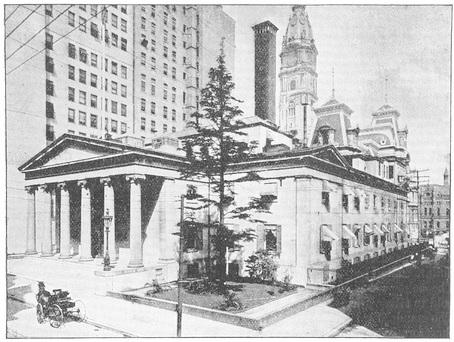
OLD UNITED STATES MINT, PHILADELPHIA.
Properly speaking, there was no coinage in the United States during the colonial period. Maryland had a mint at one time, and one or two of the other States, but they practically amounted to nothing. In the early colonial period the substitutes for coins were wampum and bullets, as in Massachusetts; skins and furs, as in New York; tobacco, as in Maryland and Virginia. The coins in use before the Revolution were, to some extent, those of England, but more largely those of Spain, circulated in South America and traveling up to the United States. The unit of account was the Spanish milled dollar or piece-of-eight, though, up to 1775, accounts were kept in pounds, shillings, and pence, a pound consisting, then as now, of twenty shillings, and a shilling of twelve pence “colonial” or “pound” currency. Four pounds of this “colonial currency” were reckoned as equal to three pounds sterling.
This colonial composite system of current coins was regulated by coinage tariffs. Such a tariff, issued in 1750, valued one ounce of silver at six shillings and eightpence, the Spanish milled dollar at six shillings, the guinea at twenty-eight shillings, and the English crown at six shillings and eightpence. All foreign coins were valued in proportion to the value of the Spanish piece-of-eight. Some of the colonies stamped the shilling, which constituted a large part of the money in circulation. It, however, varied greatly in value in the different colonies. Thus, the Spanish dollar equaled five shillings in Georgia; eight in North Carolina and New York; six in Virginia, Connecticut, New Hampshire, Massachusetts, and Rhode Island; seven and sixpence in Maryland, Delaware, Pennsylvania, and New Jersey; thirty-two and sixpence in South Carolina. The Spanish dollar itself, with which these comparisons were made, was frequently below legal weight, and, therefore, varied in value. Where the pieces mentioned in the tariff of 1776 were of full weight, the ratio there established was the English ratio of one to 15.21, the ratio for bullion being nearly the same.
After the tariff of 1776 had been in operation for six years, the colonies began to feel keenly the difficulties caused by the variety of coins constituting their metallic circulating medium, and the need of a special American coinage was frequently expressed. In 1782, Robert Morris, superintendent of finance, submitted to the Congress of the Confederation a scheme for a national coinage and the establishment of an American mint, which met with approval. Jefferson recommended the decimal system, with the dollar as the unit. Neither of these proposals was carried into effect till, in 1786, the Congress of the Confederation chose as the monetary unit of the United States the dollar of 375.64 grains of pure silver, which unit had its origin in the Spanish piaster or milled dollar, then the basis of the metallic circulation of the English colonies in America. This American dollar was never coined, there not being at the time a mint in the United States.
The Act of April 2, 1792, established the first monetary system of the United States. The bases of the system were: The gold dollar, containing 24.75 grains of pure gold, and stamped in pieces of $10, $5, and $2.50, denominated respectively eagles, half-eagles, and quarter-eagles; the silver dollar, containing 371.25 grains of pure silver. A mint was established. The coinage was unlimited, and there was no mint charge. The ratio of gold to silver in coinage was 1:15. Both gold and silver were legal tender. The standard was double.4 The Act of 1792 undervalued gold, which was therefore exported. The Act of June 28, 1834, was passed to remedy this by changing the mint ratio between the metals to 1:16.002. The latter act fixed the weight of the gold dollar at 25.8 grains, but lowered the fineness from 0.916⅔ to 0.899225. The fine weight of the gold dollar was thus reduced to 23.2 grains. The Act of 1834 undervalued silver as that of 1792 had undervalued gold, and silver was attracted to Europe by the more favorable ratio of 1:15½. The Act of January 18, 1837, was passed to make the fineness of the gold and silver coins uniform. The legal weight of the gold dollar was fixed at 25.8 grains, and its fine weight at 23.22 grains. The fineness was therefore changed by this act to 0.900 and the ratio to 1:15.988+. Silver continued to be exported. The Act of February 21, 1853, reduced the weight of the silver coins of a denomination less than $1, which the Acts of 1792, 1834, and 1837 had made exactly proportional to the weight of the silver dollar, and provided that they should be legal tender to the amount of only $5. Under the Acts of 1792, 1834, and 1837 they had been full legal tender. By the Act of 1853 the legal weight of the half dollar was reduced to 192 grains, and other fractions of the dollar in proportion. The coinage of the fractional parts of the dollar was reserved to the government.
The Act of February 12, 1873, provided that the unit of value of the United States should be the gold dollar of the standard weight of 25.8 grains, and that there should be coined besides the following gold coins: A quarter-eagle, or two and-a-half dollar gold piece; a three-dollar gold piece; a half-eagle, or five-dollar piece; an eagle, or ten-dollar piece; and a double eagle, or twenty-dollar piece, all of a standard weight proportional to that of the dollar piece. These coins were made legal tender in all payments at their nominal value when not below the standard weight and limit of tolerance provided in the act for the single piece, and when reduced in weight they should be legal tender at a valuation in proportion to their actual weight. The silver coins provided for by the Act were a trade dollar, a half-dollar or fifty-cent piece, a quarter-dollar, and a ten-cent piece, the weight of the trade dollar to be 420 grains troy; the half-dollar, twelve and a half grams; the quarter-dollar and dime, respectively, one half and one fifth of the weight of the half-dollar. The silver coins were made legal tender at their nominal value for any amount not exceeding $5 in any one payment. Owners of silver bullion were allowed to deposit it at any mint of the United States to be formed into bars or into trade dollars, and no deposit of silver for other coinage was to be received. Section 2 of the joint resolution of July 22, 1876, recited that the trade dollar should not thereafter be legal tender, and that the Secretary of the Treasury should be authorized to limit the coinage of the same to an amount sufficient to meet the export demand for it.
The Act of March 3, 1887, retired the trade dollar and prohibited its coinage. That of September 26, 1890, discontinued the coinage of the one-dollar and three-dollar gold pieces. The Act of February 28, 1878, directed the coinage of silver dollars of the weight of 412½ grains troy, of standard silver, as provided in the Act of January 18, 1837, and that such coins, with all silver dollars theretofore coined, should be legal tender at their nominal value for all debts and dues, public and private, except where otherwise expressly stipulated in the contract. The Secretary of the Treasury was authorized and directed by the first section of the act to purchase from time to time silver bullion at the market price thereof, not less than $2,000,000 worth nor more than $4,000,000 worth per month, and to cause the same to be coined monthly, as fast as purchased, into such dollars. A subsequent act, that of July 14, 1890, enacted that the Secretary of the Treasury should purchase silver bullion to the aggregate amount of 4,500,000 ounces, or so much thereof as might be offered, each month, at the market price thereof, not exceeding $1.00 for 371.25 grains of pure silver, and to issue in payment thereof Treasury notes of the United States, such notes to be redeemable by the government, on demand, in coin, and to be legal tender in payment of all debts, public and private, except where otherwise expressly stipulated in the contract. The act directed the Secretary of the Treasury to coin each month 2,000,000 ounces of the silver bullion purchased under the provisions of the act into standard silver dollars until July 1, 1891, and thereafter as much as might be necessary, to provide for the redemption of the Treasury notes issued under the act. The purchasing clause of the Act of July 14, 1890, was repealed by the Act of November 1, 1893. The War Revenue Act of June 13, 1898, authorized and directed the coinage of standard silver dollars to the amount of not less than one and one half million dollars a month, from the bullion in the Treasury purchased under the Act of July 14, 1890. The Act of June 9, 1879, made the subsidiary silver coins of the United States legal tender to the amount of $10. The minor coins are legal tender to the amount of twenty-five cents.
The following official figures give, by periods of ten years, the coinage of the United States from the establishment of the Mint to the present time:—
Years. Gold. Silver. Minor. Total.
1793–1799 $696,530.00 $1,216,158.75 $50,111.42 $1,962,800.17
1800–1809 3,067,067.50 3,154,687.75 164,865.79 6,386,621.04
1810–1819 2,348,915.00 6,107,903.75 162,534.07 8,619,561.82
1820–1829 2,579,017.50 14,787,327.65 178,372.70 17,544,717.85
1830–1839 17,745,422.50 28,112,136.60 334,810.21 46,192,369.31
1840–1849 58,909,439.00 22,223,733.00 360,840.33 81,494,012.33
1850–1859 352,915,059.00 47,238,813.00 1,135,580.03 401,289,443.03
1860–1869 290,786,131.00 13,637,607.90 8,504,070.00 312,927,808.90
1870–1879 370,718,883.50 142,196,178.60 2,231,009.50 515,146,071.60
1880–1889 411,766,277.00 305,869,081.20 8,127,305.56 725,762,663.76
1890 to June 30, 1897 374,806,225.00 136,248,501.65 7,564,849.65 518,619,576.30
$1,886,338,958.00 $720,792,129.85 $28,814,558.26 $2,635,945,646.01
At this writing the report of the Director of the Mint has not been published, but the coinage for the full year 1897 may be stated as follows: gold, $76,028,484; silver, $18,486,697; and for the year 1898, gold, $77,985,757; silver, $23,034,034. From January 1 to June 30, 1899, the coinage was: gold, $65,915,020; silver, $12,780,441.
It is sometimes thought that the silver dollars are not a full legal tender, but this is not so. They are an unlimited legal tender for all debts, public and private. The Treasury does not, in practice, redeem silver dollars in gold, but successive Secretaries of the Treasury have announced their readiness to do so, if necessary to keep the silver dollars from depreciating,—that is, preserve their parity,—which the law directs.
Silver certificates and gold certificates are not legal tender, but entitle the holder to receive the kind and amount of coin named on their face.
The value of gold bullion in a dollar of that metal is 99.991125 cents, or practically 100 cents. The value of the silver bullion in a dollar of that metal is about 45 cents. It varies, however, with the fluctuations in the market value of silver.
It will thus be seen that the bullion value of a silver dollar and of a gold dollar differs greatly, but the equality of the purchasing power of the two coins is due to the fact that the silver dollars are receivable for public and private debts, that they are indirectly exchangeable for gold, by depositing them in the banks, and that the government is pledged to redeem them in gold, if necessary to preserve their parity with gold.
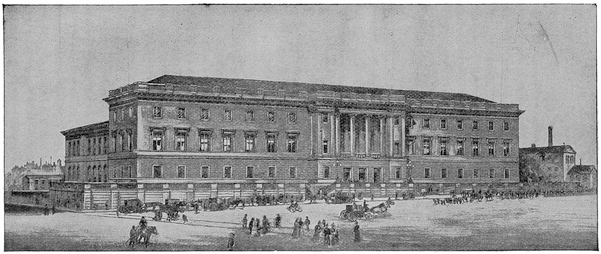
NEW UNITED STATES MINT, PHILADELPHIA, PA.
As early as 1826 the United States began to export domestic gold, beginning with an export of $1,056,088 of gold coin and bullion, and receiving an import of $678,740. Up to 1897 the grand total of exports of gold coin and bullion amounted to $2,186,238,541, and the total imports to $1,112,138,766, an excess of exports over imports of $1,074,099,775. In 1898 the imports of gold coin and bullion into the United States were $120,391,674, and the exports $15,406,391, making the net imports $104,985,283.
From 1821 to 1897 the grand total of exports of silver coin and bullion from the United States was $1,152,688,776, and the imports $730,325,881, making an excess of exports over imports of $422,362,895. In the fiscal year 1898, the silver imports were $30,927,781, and the exports $55,105,239, making the excess of exports $24,177,458.
The total product of gold in the United States from 1792 up to 1896 was $2,113,034,769, and of silver $1,444,970,000, making a grand total of the precious metals of $3,558,004,769. The total value of the entire world’s production of gold, between the years 1493 and 1896, was $8,983,320,600, and of silver $10,556,700,800, making a grand total of gold and silver of $19,540,021,400.
As a comparison of the money status of the United States at the beginning and end of the century, the following figures are interesting: In 1800 the population was 5,308,483; the estimated bank notes outstanding, $10,500,000; the estimated specie in the country, $17,500,000; the total money in the United States, $28,000,000; the specie in the Treasury, $1,500,000; the money in circulation, $26,500,000; the amount per capita, $4.99. In 1898 the population was 74,522,000; the total coin in the United States, including bullion in the Treasury, $1,498,993,249; total paper money, $1,138,440,126; total money of all kinds, $2,637,433,375; coin, bullion, and paper money in the Treasury, $799,537,480; total circulation, $1,837,859,895; circulation per capita, $24.66.
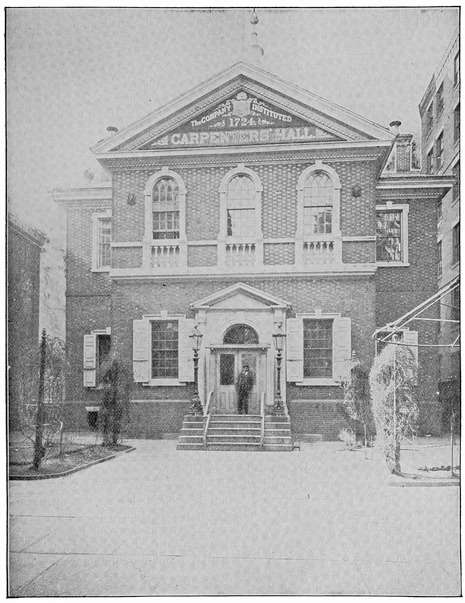
CARPENTERS’ HALL, PHILADELPHIA.
(First Site of First United States Bank.)
Perhaps no law relating to the coins and currency of the United States has been so widely discussed, or has borne more directly on the attitude and influence of political parties than the Coinage Act of 1873. This act grew out of a proposition to revise our coinage laws, made by John Jay Knox to the Secretary of the Treasury, in April, 1870. Mr. Knox, in his rough draft of a bill, provided for a silver dollar of 384 grains, to be a legal tender for sums not exceeding $5.00. Thus, the standard silver dollar of 412½ grains was eliminated. It did not appear in the bill as it passed the Senate, January 10, 1871, nor in that reported to the House, March 9, 1871. The bill underwent protracted and thorough discussion, and on May 27, 1872, was passed in the House. As passed, it contained the original provision for coining a silver dollar of the weight of 384 grains—twice the weight of the silver half dollar. These dollars were to be a legal tender for amounts not exceeding $5.00. The Senate amended this House bill, by substituting a trade dollar of the weight of 420 grains for that of 384 grains, at the same time preserving the legal-tender limit of $5.00. In the amended form, it passed the Senate, January 17, 1873, and the House, February 7, 1873, and became a law. It will be seen that the standard silver dollar of 412½ grains was never in the bill, and could not, therefore, have been secretly omitted, as was afterwards charged. It was omitted from the first draft, and all through, because none were being coined, and those that had been coined were exported, the silver bullion in them being, at that time, worth more as bullion than coin. By joint resolution of Congress, approved July 22, 1876, the trade dollars provided for in the act were deprived of their legal-tender quality. It was supposed they would circulate in China, but they proved useless even for that purpose.
III. EARLY BANKING IN THE UNITED STATES.
The first banks in the United States owed their origin to Robert Morris and Alexander Hamilton. Morris, as early as 1763, conceived the plan of a bank to assist in developing American trade, and in 1779, Hamilton proposed the organization of “The Company of the Bank of the United States.” These plans did not mature, but were followed, at the suggestion of Thomas Paine, by an association of ninety-two subscribers to a fund of 300,000 pounds Pennsylvania currency to support the Revolutionary army. This association became known as the Pennsylvania Bank. It commenced business July 17, 1780, and after a career of a year and a half, during which time it greatly aided the government in furnishing army supplies, its affairs were wound up.
On May 17, 1781, Hamilton presented the plan of a bank to Congress, which was to be truly national, and “created avowedly to aid the United States.” Its name was to be the Bank of North America, with a subscription of $400,000 in gold and silver, and its notes, payable on demand, to be receivable for duties and taxes in every State. Congress approved the plan, and Morris, then Superintendent of Finance, published it, with an address showing its advantages to the government and people, then suffering from the ill effects of a depreciated currency.
The Bank of North America was organized November 1, 1781, and began business January 7, 1782. It creditably fulfilled its mission “to aid the United States,” and, after the expiration of its charter, became a State institution. In 1864 it entered the national banking system, though retaining its old name. This bank was followed by the Bank of New York, which began business June 9, 1784, and by the Massachusetts Bank, which began business July 5, 1784.
First United States Bank.—This institution grew out of the recommendations of Alexander Hamilton, and formed a part of his scheme of strengthening the public credit and bringing about a closer union of States. His plan was incorporated into a bill which passed the Senate January 3, 1791, and the House, January 20, 1791. Washington signed it February 25, 1791. The bill was hotly opposed as unconstitutional by Secretary of State Thomas Jefferson, Attorney-General Edmund Randolph, and in general by representatives from the Southern States.
The capital of the bank was fixed at $10,000,000, one fifth of which was to be subscribed by the government. The remainder was subscribed by individuals, and two hours after the opening of the books the capital was oversubscribed to the amount of 4000 shares. The central bank was located at Philadelphia, and afterwards branches were established in New York, Boston, Baltimore, Washington, Norfolk, Charleston, Savannah, and New Orleans. Business was first opened in Carpenters’ Hall, Philadelphia, December 12, 1791. In July, 1797, the site was removed to a new building on Third Street, below Chestnut, and it remained there till the dissolution of the bank, with the exception of a brief removal to Germantown in 1798, during the epidemic of yellow fever. Though this bank proved a profitable enterprise for the government, it failed to secure a renewal of its charter in 1811, chiefly because so many of its shares had passed into foreign hands.
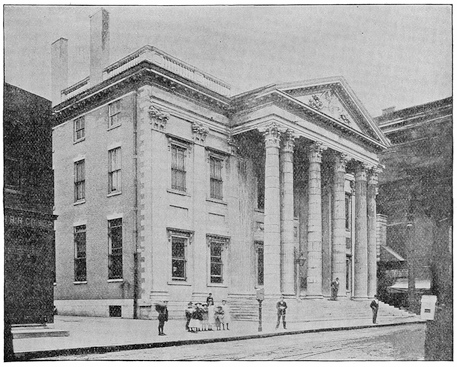
THE GIRARD BANK, PHILADELPHIA.
(Second Site of First United States Bank.)
Early State Banks.—From 1790 to 1811 the number of State banks increased from four to eighty-eight; their circulation from $2,500,000 to $22,700,000; their capital from $2,500,000 to $42,610,000. In the same time the metallic circulation of the country rose from $9,000,000 to $30,000,000. These banks failed to meet the monetary necessities of the War of 1812, and in 1814 practically all of them south of New England suspended specie payments. Their notes were poured out in all denominations from six cents upward, and, with coin redemption stopped, they depreciated rapidly. This led to great financial distress in 1818–1820, and to excessive bank failures. The seriousness of the general situation, and the declining credit of the government, led to the establishment of the second Bank of the United States.
Second Bank of the United States.—In October, 1814, Secretary Dallas laid a report before Congress, in which he deprecated the uncertain amount and value of the paper currency. “There exists,” he said, “at this time no adequate circulating medium common to the citizens of the United States. The moneyed transactions of private life are at a stand, and the fiscal operations of the government labor with extreme inconvenience.” He then recommended as the remedy the establishment of a national banking institution. A bill, based upon Dallas’s plan for such an institution, failed of passage in the House in 1814, and again in 1815, though passed by the Senate. It was, however, finally passed in an amended form, but was vetoed by President Madison.
On December 24, 1815, Mr. Dallas laid before Congress another plan for a national bank. A bill was framed authorizing such an institution, with a capital of $35,000,000, $7,000,000 of which were to be subscribed by the government, the central bank to be at Philadelphia, with power to establish branches, payments to be made in specie at all times unless otherwise authorized by Congress. This bill passed both Houses of Congress, and was signed by President Madison, April 10, 1816. When the subscription books of this bank were closed, it was found that the subscriptions fell short of the authorized $35,000,000 by $3,000,000, which amount was taken by Stephen Girard.
The bank could not lend more than $500,000 to the government without authority of Congress, was to be the fiscal agent of the Treasury, and to receive deposits of public moneys. No notes of a less denomination than $5.00 were to be issued, and the penalty for refusing to pay notes or deposits in specie on demand was twelve per cent per annum until paid. It began business January 7, 1817. Owing to the impending financial crisis and bad management, the bank verged rapidly toward insolvency, but was resuscitated under the vigorous management of a new president, Langdon Cheves, who was elected March 6, 1819. He was succeeded by Nicholas Biddle in 1823, who was destined to see the fall of the great institution.
The national bank incurred the hostility of the State banks, which called it a monster because it refused to allow the notes of the local banks to accumulate as deposits in its branches without redemption. Various States passed discriminating laws against it. Jackson, in his message to Congress in 1829, attacked the constitutionality of the law establishing it, and charged that it had “failed in the great end of establishing a uniform and sound currency.” At this time the Bank was an imposing institution with its capital of $35,000,000, its public deposits of six to seven million, its private deposits of a like amount, its circulation of $12,000,000, its annual discounts of $40,000,000, its annual profits of over $3,000,000, its palatial establishment in Philadelphia, its twenty-five branches throughout the Union, its five hundred employees, its stock distributed through nearly all parts of the world, and its notes current at par at home and abroad.
Jackson’s message was not received favorably by Congress. His aversion, it was thought, was due rather to his belief that the Bank was his enemy than to any dislike of a national bank. The growing hostility between him and Henry Clay induced the latter to make the renewal of the Bank’s charter a political issue. When the bill rechartering the Bank was passed in July, 1832, Jackson vetoed it, charging, in the main, that the Bank was a monopoly. This brought the question of the further existence of the Bank fully into the arena of politics, in the presidential election of 1832, with the “Hero of New Orleans” on one side, and on the other “monster monopoly,” “Old Nick’s money,” and “Clay’s rags.” Jackson won, and speedily decided to remove the public deposits from the Bank. This decision precipitated a bitter war between Jackson and Congress. But Jackson did not swerve from his purpose. By 1835 it became apparent that the Bank could not secure a renewal of its charter from Congress. As a confession of its defeat, and just thirteen days before the expiration of its federal charter, the Bank obtained from the State of Pennsylvania, February 18, 1836, a charter for the United States Bank of Pennsylvania, for a period of thirty years. Shorn of its importance, in a restricted field, yet with enormous capital, it fell into large bond and stock investments of questionable value. Its troubles were aggravated by bad management. It suspended during the panic of 1837 and the next year, and again for the last time in 1841. Biddle resigned the presidency in 1840, and four years later died poor and broken-hearted. Thus perished what is sometimes called the third Bank of the United States, its predecessor, the second Bank of the United States, having fallen a victim to political intrigue and loss of prestige. The shareholders lost their entire investment of $28,000,000, but the circulating notes were all paid, and also the deposits. The government got back its investment of $7,000,000, and made $6,093,167 besides, from its connection with the Bank.
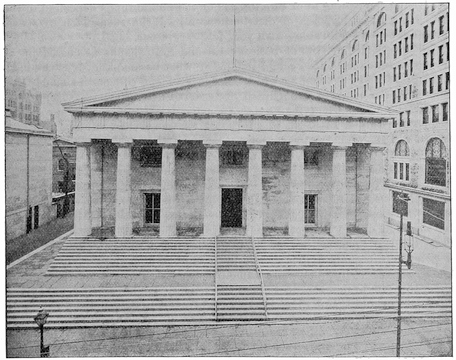
SECOND UNITED STATES BANK, PHILADELPHIA. NOW CUSTOM HOUSE.
State Banks and Independent Treasury.—After the removal of deposits from the Bank of the United States, September 26, 1833, the public revenues were deposited in selected State banks, sometimes called “pet banks.” In 1836 eighty-eight State banks in twenty-four States held public deposits to the amount of $49,377,986. As the State banks had thrown their influence against the national bank, they were rewarded by allowing them to use the public money intrusted to them as a basis of extending their loans and for enormous issues of their own notes. Banks were started for the sole purpose of issuing notes which they could use in buying public lands. As a consequence the government lost heavily through the depreciation of these notes and the failure of the banks. On July 11, 1836, the Secretary of the Treasury issued a circular forbidding the receipt of anything but specie in payment for public lands. This caused a run on the banks and aided in hastening the financial crisis of 1837. An act of Congress of June 23, 1836, authorizing the calling in of $37,468,859 of the public funds deposited in the State banks, for purposes of distribution, forced the suspension of specie payments by all such banks, with very few exceptions.
The unsatisfactory trial of both federal and State banks as custodians of the public funds led to the establishment of what became known as the independent Treasury system, by which the government collects its money and keeps it in the hands of the United States Treasurer or sub-treasurers, making disbursements when required. An act putting this system into effect became law July 4, 1840, but was repealed the next year. It was repassed August 6, 1846, and remained in operation until the passage of the National Currency Act in February, 1863, which gave the Secretary of the Treasury the right to designate certain national banks as depositories of public funds. There were in such banks, on February 4, 1899, United States deposits amounting to $81,120,873, secured by United States bonds belonging to the banks and deposited in the Treasury, amounting to $89,100,240. Prior to the adoption of the national banking system the country had a somewhat disastrous experience with what has been known as “wild-cat” banks. Many of them were organized for the sole purpose of issuing notes they never intended to pay. While they were numerous and dangerous, it must be remembered that in a number of States the leading banks carried on only a legitimate business, and State banks as they exist to-day compare favorably in their management with the national banks.
IV. HISTORY OF THE LEGAL-TENDER NOTE.
The first act authorizing the issue of legal-tender notes, known popularly as greenbacks, was approved by President Lincoln, February 25, 1862. It provided for the issue of $150,000,000 in notes, in denominations of not less than $5.00. Holders of these notes could deposit them with the United States Treasurer or assistant treasurers in any sum not less than $50.00, or any multiple thereof, and receive United States bonds bearing six per cent interest. The first notes were issued March 10, 1862. An act authorizing a second issue of $150,000,000 was signed by the President, July 11, 1862. Of these $35,000,000 were to be in denominations of less than $5.00. A third issue of $150,000,000 was authorized March 3, 1863, but this act deprived the legal-tender note of its convertibility into six per cent bonds at the option of the holder.
The withdrawal of this privilege worked no particular hardship at the time, for bond issues and various interest-bearing certificates were plenty during the period of war. But after the war had closed and the issues of new securities had ceased, the absence of this provision began to prevent the absorption of the legal-tender notes.
The highest amount of legal-tender notes outstanding at any date was on January 3, 1864, $449,338,902. Their depreciation was hastened by the issue of the short-time interest-bearing securities in large amounts. During 1862 the average gold premium was 113.3; during 1863, 145.2; during 1864, 203.3. In July, 1864, this premium reached its highest point, an average of 258.1.
In 1865 the country began to feel the necessity of a contraction of the currency, with a view to as early a resumption of specie payments as the business interests would permit, and the Congress expressed the public sentiment by an almost unanimous resolution. On March 12, 1866, an act was approved calling for the retirement and cancellation of not more than $10,000,000 of legal tenders within six months, and thereafter not more than $4,000,000 during any one month. The effect was to reduce the legal tenders outstanding on December 31, 1867, to $356,000,000.
This reduction, together with the rapid payment of notes of other classes, used as currency, led to so sudden a contraction of the circulating medium, and such stringency in the money market, that Congress, by act of February 4, 1868, prohibited the further reduction of the legal-tender notes. The amount outstanding, October 1, 1872, was $356,000,000, and on January 1, 1874, $382,979,815, the increase being due to a construction on the part of secretaries of the Treasury to the effect that they had power to reissue retired notes which were held as a reserve. On June 20, 1874, Congress enacted that the United States notes outstanding and to be used as part of the circulating medium should not exceed $382,000,000, and that no part thereof should be held or used as a reserve.
Another attempt was made in 1875 to reduce the aggregate of legal-tender notes, preparatory to the resumption of specie payments. The Resumption Act of January 14, 1875, authorized, among other things, the retirement and cancellation of legal tenders till the amount outstanding should be reduced to $300,000,000; $35,318,984 were retired under this law, but further reduction was prohibited by act of May 31, 1878. The amount outstanding at that date was $346,681,016, and this has continued to the present time, no new issues having been authorized.
On January 1, 1879, the resumption of specie payments took place as provided in the act of January 14, 1875. At this latter date, the only legal-tender coin recognized by law was the gold coin. But, in February, 1878, the coinage of standard silver dollars was authorized, and they were to be a legal tender for all debts, unless otherwise expressly stipulated in the contract. This led to the claim on the part of those who favored silver that the redemption of legal-tender notes, provided for in coin in the act of 1875, could be effected by the use of silver dollars. But the general, and doubtless sound, construction of the law of 1875 has been that it was an express contract to redeem the legal-tender notes in the coin then recognized as legal tender, and in no other; and so the Treasury has redeemed legal tenders since 1879, in gold, when the same is demanded.
In 1869 the United States Supreme Court, the bench not being full, declared the acts authorizing legal-tender notes to be unconstitutional. But subsequently, the bench having its full quota of nine, the Court sustained the constitutionality of the acts, on the ground, mainly, that they were a proper exercise of the war power vested in the Congress. In 1883 the Court decided that the reissues of these notes, made in time of peace, were constitutional.
At the time of the resumption of specie payments there were $135,000,000 in gold and bullion on hand to provide for the redemption of such notes as might be presented. By Act of July 12, 1882, it was provided that when the redemption reserve of gold coin and bullion in the Treasury fell below $100,000,000, the issue of gold certificates should cease. This is held to indicate that Congress regarded $100,000,000 as the limit below which the redemption reserve should not be permitted to fall.
If this reserve had not been called upon to bear other burdens, there would probably never have been any doubts as to its sufficiency. In 1878, however, began the coinage of silver dollars and the issue of silver certificates. These notes were kept at par in gold by their interchangeability in the operations of commerce for legal-tender notes. They were thus an indirect charge on the gold reserve. From 1878 to 1890 they were increased at the rate of over $2,500,000 a month. In that year (July 14, 1890) an act was passed providing for the issue of Treasury notes in the purchase of silver bullion, which provided also for the coinage of some of the bullion purchased into silver dollars. These Treasury notes were redeemable both in gold and silver, and as the government never availed itself of its option to redeem in silver when gold was demanded for them, these notes as they were issued became a further burden on the gold reserve provided for the legal-tender notes.
By the beginning of the year 1893 the legal-tender notes, silver certificates, and Treasury notes had reached an aggregate of nearly $800,000,000, all depending on the Treasury reserve for gold redemption.
This reduction of the percentage of gold held to the amount of the demand liabilities raised doubts as to the ability of the government to maintain gold payments, and the legal tenders and Treasury notes were presented for redemption. The depletion of gold was so great that on one or two occasions there was danger that the reserve would be exhausted, and resort was had to the sale of bonds to procure gold to replenish the reserve.
The issue of further Treasury notes was stopped by the repeal of the act of 1890 in November, 1893, and since this repeal confidence in the ability of the Treasury to maintain gold redemptions has been gradually restored.
Under the provisions of the Act of May, 1878, the legal-tender notes when redeemed cannot be canceled. They must be paid out again, and therefore when reissued, they may again be presented for redemption. This constitutes the so-called endless chain by which the gold in the Treasury is always liable to be drawn out.
V. THE NATIONAL BANKING SYSTEM.
The desirability of perfecting the banking and currency system of the country was readily perceived on the breaking out of the Civil War in 1861. Secretary Chase in two annual reports, those of 1861 and 1862, recommended a system of national banks, whose supervision should be by national authority, and whose issues of notes should be based on deposits of bonds of the government. After several unsuccessful attempts, a bill, introduced by Mr. Sherman, passed both Senate and House, and became a law February 25, 1863. This act embodied the essential features of Mr. Chase’s reports. Under it the first charter was issued to the First National Bank of Philadelphia.
The formation of national banks proceeded very slowly at first. In order to hold out greater inducements for the State banks to enter the national system, the act was amended on June 3, 1864. The first report of the Comptroller of the Currency, November 28, 1863, showed that only 134 national banks had been organized up to that date; but when the act of June 3, 1864, went into operation, new banks were formed more frequently. A more rapid increase took place after the passage of the act of March 3, 1865, imposing a tax of 10 per cent on the circulating notes of State banks. This increase was from 638 banks in January, 1865, to 1513 in October of the same year; with an increase in capital of from $135,618,874 to $393,187,206; and in circulation of from $66,769,375 to $171,321,903. Prior to 1869 national banks were required to make their reports on fixed dates, but after March 3, 1869, they were required by law to make their reports to the Comptroller five times a year on some past date fixed upon by the Comptroller.
National Bank Laws and Regulations.—The national banks are under the supervision of the Comptroller of the Currency, who is appointed by the President on the recommendation of the Secretary of the Treasury. His salary is $5000 a year.
A national bank may be organized by any number of persons not less than five, on permission of the Comptroller. The capital required is not less than $50,000 in any case, and this minimum applies only to towns the population of which does not exceed 6000; in cities having a population exceeding 50,000, the minimum capital is $200,000. For places having a population over 6000 and not exceeding 50,000, the capital required is $100,000. One half of the capital must be paid in before the bank is authorized to begin business, and the remainder in installments of not less than 10 per cent on the entire amount of the capital, as frequently as one installment at the end of each succeeding month from the time it is authorized to begin business. Capital stock is divided into shares of $100 each.
The banks are managed by a board of not less than five directors, chosen by the stockholders. Executive officers of the bank—president, vice-president, cashier, and assistant cashier—are chosen by the directors.
Shareholders are individually liable for the debts, contracts, and engagements of the bank to the extent of the amount of their stock therein, at the par value, in addition to the amount invested in such shares. This is what is known as the double liability of shareholders, and is one of the features adding to the strength of the system.
National banks are designated by the Secretary of the Treasury to act as depositaries or custodians of public money. Such deposits are secured specially by a deposit of United States bonds with the Treasury.
All national banks before commencing business are required to transfer and deliver to the Treasurer of the United States, as security for their circulating notes, United States registered bonds to an amount not less than one fourth the capital where the capital is $150,000 or less, and to the amount of $50,000 where the capital is in excess of $150,000. These bonds must be taken by the banks whether they issue circulation or not.
Circulating notes are issued to national banks on a deposit of United States bonds with the Treasurer. Notes are limited to 90 per cent of the par value of the bonds, also to 90 per cent of the capital of the bank. They are over-secured, and no holder of them has ever lost a dollar by reason of the failure of a bank.
The notes are secured by the government bonds, there being a difference of the 10 per cent between the par of the bonds and the notes issued, and the bonds nearly always command a premium. They are further secured by the first lien on the assets of the bank, including the double liability of shareholders, by a 5 per cent redemption fund in the Treasury, and also by the margin between the capital and the amount of notes permitted.
National bank notes are redeemable at the counters of the issuing banks and at the Treasury in “lawful money” of the United States. This term, as commonly used, means legal-tender money, and in practice, perhaps, gold coin or legal-tender notes.
Reserves of national banks are the amounts of money kept on hand to pay their deposits and current checks and drafts. This reserve is to be kept in lawful money,—gold and silver coin or certificates, and United States currency certificates or legal-tender notes. There are three central reserve cities, namely, New York, Chicago, and St. Louis. National banks in these three cities must keep a reserve of 25 per cent against their deposits, and this amount must be kept in their own vaults. There are twenty-four other reserve cities which are also required to keep a reserve of 25 per cent, but one half of that amount may be due from other banks in New York and other central reserve cities, approved as reserve agents by the Comptroller of the Currency. Banks outside of these reserve cities must keep a reserve of 15 per cent, three fifths of which may be due from approved reserve agents in the reserve cities or central reserve cities.
In times of panic when there is a run on banks they may use this reserve to pay their depositors, and it often happens that the reserve falls below the amount required by law. Under such circumstances the Comptroller may notify the banks to make good the deficiency; failing to comply with this request within thirty days, they may be closed.
National banks are not permitted to make loans on real estate. The regulations prescribed by the law for the management of these institutions are very stringent, supplemented by a system of examination and reports.
In 1896 the Comptroller of the Currency estimated that the government had made a net profit of $157,439,248.98 out of the revenues derived from the national banks. It was estimated in the same report that the average percentage of dividends paid to creditors of insolvent national banks was 75 per cent. There have been no losses on circulation. In 1878 the Comptroller estimated that the annual losses upon all the currency issued by State and private banks amounted to 5 per cent annually.
The national banks are not monopolistic. Any body of five reputable citizens can form one by getting together $50,000 capital. The total shares of the national banks are approximately 300,000.
Profits on national bank stock are not exorbitant. For a period of twenty-nine years the net earnings on capital and surplus have been only a little over 7 per cent.
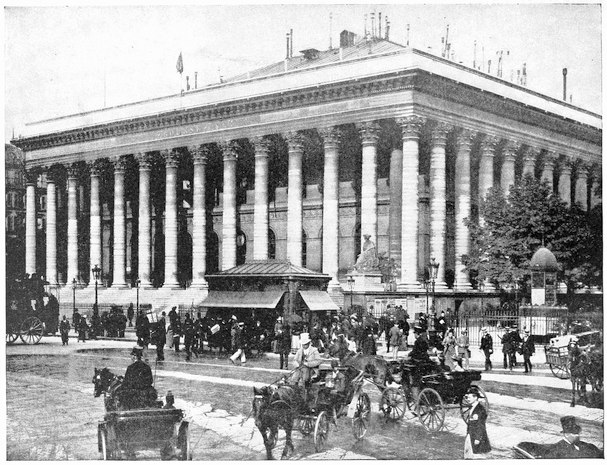
THE BOURSE, PARIS.
Since the establishment of the national banking system 5171 banks have been organized, of which 1224 have gone into liquidation, 368 have become insolvent, and 3579 are in operation (February 4, 1899).
There is a marked falling off in the number of new national banks organized in recent years. In 1890 there were 307 organized, but in 1898 there were only 50 organizations reported, and that was the highest number reported since 1893. The capital of the national banks is also decreasing, but the deposits show a large increase.
At present the State banks are gaining in numbers more rapidly than the national banks.
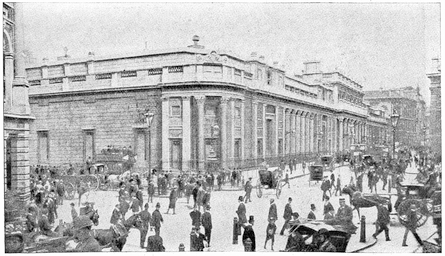
BANK OF ENGLAND, LONDON.
Profit on National Bank Circulation.—Many suppose that national banks make an undue profit on the privilege they have of issuing notes to circulate as money, based on a deposit of bonds with the United States treasurer. Official figures disprove this. The total national bank notes outstanding, February 4, 1899, was $203,636,184.50. The law permits these banks to issue notes to the extent of 90 per cent of their capital. This capital, on February 4, 1899, was $608,301,245. Therefore they might have had notes at issue on that date to the amount of $545,871,120.50, instead of only $203,636,184.50. This is conclusive evidence that there is no substantial profit in the issuing of such notes.
In the figures furnished by the Comptroller of the Currency for 1898, he shows that the profit which a national bank could make by taking out circulation on a deposit of $100,000 of United States bonds, on October 31, 1898, was less than 1 per cent. On that date eight leading banks had no circulating notes at all out. The meagre profits of national banks explain why they do not supply an adequate paper currency. The restrictions on them make it impossible to render any substantial assistance to business in this respect. This is especially true in times of panic. Possessing gigantic strength, they are compelled to see the industries of the country attacked by doubt and distrust, and are unable to go to their aid because of the restraints which forbid them to exercise their legitimate functions.
VI. FOREIGN BANKING AND FINANCE.
Most foreign countries issue metallic money only, except those that are on a paper basis. In general the paper currency is issued by banks, many of which are more or less remotely associated with the government. Some of these banks issue notes on the security of the government or other stocks and bonds, while many emit notes based on no special form of security, but upon the general assets of the bank.
As compared with the United States there are but few banks in the principal foreign countries. England has less than one hundred; Scotland less than a dozen; Canada but thirty-eight chartered banks. As in other foreign countries, the Canadian banks have numerous branches affiliated with the head office. National banks in the United States are prohibited from having branches. The Bank of France, the Bank of England, the Imperial Bank of Germany, the Austro-Hungarian Bank, the Imperial Bank of Russia, are all more or less intimately associated with their respective governments.
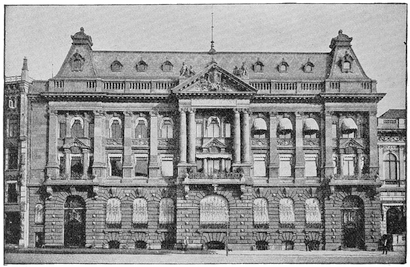
GERMAN BANK, BREMEN.
The Bank of England was incorporated by royal charter, July 27, 1694, its incorporators lending £1,200,000 to the government, in return for which the Bank was permitted to issue notes to a like amount. It had a practical monopoly up to 1826, and even now, it is believed, no bank within a radius of 65 miles of London may issue notes. It has suspended specie payments more than once. In 1844, the banking and issue departments of the Bank were separated. One fifth of the reserve may be silver, though in practice the reserve is kept in gold coin and bullion. Its notes are based on gold, except £16,800,000, which are secured by the government debt and other securities. It is compelled to buy all gold offered at a fixed price, paying for it in notes. So it must redeem all notes on demand in gold. When so redeemed they are canceled and, after five years, burned. No notes of a less denomination than five pounds are issued. The Bank checks gold exports by raising the rate of discount. The building covers about four acres of ground, and employs over eleven hundred persons. It is the keystone of the entire system of British credit, and commands the assistance of the Government when needed.
The Scotch banks issue notes on their own credit to the amount outstanding at the time of the passage of the Bank Act in 1844. Their rate of interest is said to be the same at all of their thousand offices. A unique feature of the Scotch banking system is that of cash credits, by means of which a person of good credit may get his checks cashed without a deposit of actual money, the banks simply entering the credits on their books.
The Bank of France has a monopoly of note issues, charges a premium on gold for export, and may redeem its notes in either gold or silver. The Imperial Bank of Germany and a few other German banks issue notes on gold and other securities, and further amounts on their general credit. Beyond a fixed sum, called the emergency circulation, a tax of five per cent is levied. Other European banks are generally modeled on the same leading principle—a central bank of issue, with numerous branches, and associated with the Government directly or indirectly. The Imperial Bank of Russia issues notes practically covered by gold and redeemable in that coin. Japan tried a system of national banks combined with Government paper money, but is now substituting a system of bank notes issued by the Bank of Japan.
VII. UNITED STATES GOVERNMENT DEBT SINCE 1857.
In 1857 the Government owed only $10,000,000 over and above the cash held in the treasury. At the breaking out of the Civil War the debt had increased to about $80,000,000. By August 31, 1865, it had increased to $2,756,000,000, with an interest charge of $150,000,000. In twenty-eight years, down to June 30, 1893, the Government extinguished $1,917,500,000 of its debt, paid $2,364,000,000 for interest on its debt, and $118,000,000 for premium on bonds redeemed, making a grand total of $4,400,000,000, or an annual average payment of $157,000,000 for the entire period.
The rise and fall of the public debt from July 1, 1857, to July 1, 1898, appear more fully in the following table.
Years. Total debt. Debt less cash in the Treasury.
1857, July 1 $28,699,831 $9,998,621
1860, ” 1 64,842,287 59,964,402
1861, ” 1 90,580,873 87,718,660
1862, ” 1 524,176,412 505,312,752
1863, ” 1 1,119,772,138 1,111,350,737
1864, ” 1 1,815,784,370 1,709,452,277
1865, August 31 2,844,649,626 2,756,431,571
1873, July 1 2,234,482,993 2,105,462,060
1879, ” 1 2,245,495,072 1,996,414,905
1889, ” 1 1,619,052,922 975,939,750
1893, ” 1 1,545,985,686 838,969,475
1895, December 1 1,708,871,670 948,477,612
1896, July 1 1,769,840,323 955,297,253
1897, ” 1 1,817,672,665 986,656,086
1898, ” 1 1,796,531,995 1,027,085,492
In 1865 the annual interest charge on the public debt was $150,977,697. In 1898 it was only $34,387,408.
From 1791 to 1898 the gross receipts of the Government were $30,547,063,336.06 and the gross expenditures $29,768,597,237.24. The net ordinary receipts, which do not include loans or proceeds from the issue of Treasury notes, were $405,321,335.20 for the fiscal year ended June 30, 1898, and the net ordinary expenditures, which do not include payments on account of premiums or interest on the public debt, were $405,783,526.57.
VIII. POSTAL SAVINGS BANKS.
Many believe that a system of postal savings banks could be generally introduced into the United States. Such banks doubtless appeal to those who have more confidence in the Government than in any association of individuals. Their safety may be conceded, for when the Government fails other institutions are likely to go the same way. But when people deposit money in a postal savings bank, they make a loan to the Government. This implies that the Government must be a perpetual borrower, whereas, until recent years, the United States has been a debt-paying nation, and in the course of affairs may soon be again. Unless we are to have a large permanent debt, the deposits in postal savings banks would have to be invested in general securities. Such investments could not well be made by the post-office officials of the country.
In Great Britain these banks have been in existence for about thirty-eight years, and their number has grown to about 12,000, with more than 6,000,000 depositors. The system prevails in a number of other countries. The more concentrated and paternal system of government prevalent in countries having these banks renders their management a much less difficult problem than it would be in the United States with our large areas, vast number of post-offices, and general diversity of conditions. In Great Britain the deposits in the postal savings banks are made at the money order post-offices in a pass book held by the depositor. Withdrawals are made by filling up blank forms, and these withdrawals may be made at any money order post-office. Deposits are invested in the public debt, and the rate of interest is about two and one half per cent. The postal savings banks of Great Britain contain deposits approximating $527,000,000; those of France, $152,000,000; those of Italy, $90,000,000; those of Belgium, $67,000,000; those of Canada, $31,000,000.
IX. SAVINGS BANKS IN THE UNITED STATES.
There are no worthier financial institutions in the country to-day than the savings banks. Most of these are organized on what is known as the mutual plan. They have no capital, no stockholders, and all the assets are held in trust for the benefit of the depositors. They are managed by a board of trustees, who serve without pay. The investments which the banks are permitted to make are generally restricted to high-class securities insuring safety. The savings banks in New York State, especially, are closely restricted in investing their funds, and failures in recent years are almost unknown. A deposit in one of these banks is hardly less safe than an investment in Government bonds. The savings banks are the primary schools of economy and thrift, and I believe that an extension of the mutual savings bank system throughout the country, under proper legal safeguards, would be of the greatest benefit to the people of the United States.
The deposits in banks of this kind are usually limited by law to amounts not exceeding $3000 to one depositor, as they are not intended to be used by the wealthier class of people. The following statistics will be found interesting.
SAVINGS BANKS IN THE UNITED STATES, 1857–1897. (Statement of condition for each period of ten years.)
1857 1867 1877 1887 1897
Number of banks 231 371 675 684 980
Number of depositors 490,428 1,188,202 2,395,314 3,418,013 5,201,132
Amount of deposits $98,512,968 $337,009,452 $866,218,306 $1,235,247,371 $1,939,376,035
Average to each depositor 200 283 361 361 372
In addition to the mutual and stock savings banks in the United States, a system of school savings banks, introduced into the schools of the United States by J. H. Thiry, of Long Island City, N. Y., is worthy of mention. Such banks have been very successful in inculcating habits of thrift and economy among the children of the country.
X. THE CLEARING-HOUSE.
A clearing-house may be defined as an institution for saving time, money, and labor. Its underlying principle is that of setting off one claim against another.
A bank in a large city receives every day in its mail a great number of checks or drafts drawn on banks in the same place. It does not present these checks directly to the banks on which they are drawn for payment, but sends them by messenger to the clearing-house. Let us say, for illustration, that the First National Bank presents to the clearing-house checks on other banks amounting to $100,000. At the same time the other banks send to the clearing-house checks they have received drawn on the First National Bank, aggregating $75,000. A payment of $25,000 in money to the First National Bank will be all the cash required to pay checks representing $175,000. The economy in the use of money is still better illustrated by the following statement of an actual transaction. On a day in the latter part of 1898 the Bank of the State of New York took to the New York Clearing-House checks on other banks amounting to $15,647,583.82, and other banks brought checks against it amounting to $15,647,401.85. The sum of these items was $31,294,985.67, and they were paid with $181.97 in money, which represents the credit balance due to the Bank of the State of New York. This instance shows what large transactions may be effected with small sums of money by employing proper banking machinery. Banks multiply the usefulness of money many fold.
The New York Clearing-House Association was organized September 13, 1853, and the first clearing made by the Association took place on October 11, 1853. The banks belonging to the New York Clearing-House Association reported on April 1, 1899, loans and discounts, $779,951,100; deposits, $898,917,000; specie, $187,114,300; circulation, $13,870,600.
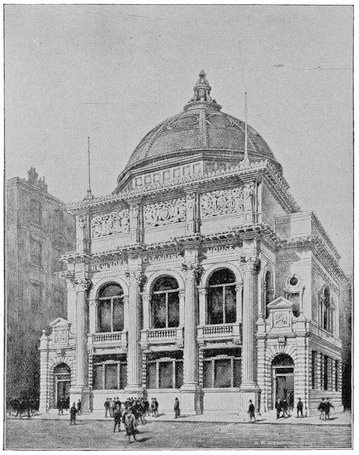
NEW YORK CLEARING-HOUSE.
Clearing-House Loan Certificates.—These are simply devices that the banks have invented for use in times of panic. They are issued by a committee of the Clearing-House Association on the deposit of approved securities by the bank desiring them, and are used only to settle balances between the banks. They are not money, but serve a useful purpose in diminishing the demand for money; for when the banks agree to accept these certificates among themselves, it makes that much money available to be loaned or paid to depositors. In 1893, and in other years of financial stringency, the issue of these certificates afforded great relief to business interests and saved the country from some of the most disastrous results consequent upon such panics.
These certificates are not to be confounded with clearing-house gold certificates issued by the Association on deposits of gold coin. They are used in making payments of balances between banks, and obviate the necessity of frequently passing the actual coin from hand to hand.
On April 11, 1898, the clearings at the New York Clearing-House for that day amounted to $352,882,567—the largest amount ever reported up to that time. The balances to be paid in money were $17,345,452, or only about five per cent. For the year 1898 the bank clearings at New York were $41,971,781,684, and for the whole country, $68,750,000,000.
An investigation of the amount of credit paper used respectively in the wholesale and retail trade was made by the Comptroller of the Currency in 1896. In his report for that year the Comptroller says: “From the face of the returns the conclusion to be drawn is that 67.4 per cent of the retail trade of the country is transacted by means of credit paper (checks), that 95.3 per cent of the wholesale trade is so carried on, 95.1 per cent of business other than mercantile, and 92.5 per cent of all business.”
XI. PANICS AND THEIR CAUSES.
A panic is generally due to inflation and speculation, and these, of course, have their origin in various sources not easily determined. An unusual increase in the production of precious metals, bountiful crops, a speculative craze taking possession of the public—such as the tulip mania in Holland—all these and many other causes lead to speculation. The fall in prices due to a stoppage in speculation brings on the panic. Sometimes the catastrophe is produced by war or rumors of war, often by the most trivial circumstances, and not infrequently without any apparent cause. Before everybody had desired to buy; they now became as eager to sell, and this rush to convert securities and commodities into money precipitates a panic.
Crises may be divided into commercial and financial. The last one in the United States, whatever may have been its ultimate developments, was in its inception and culmination essentially a financial panic. The Treasury and the banks were both regarded with more or less distrust.
Panics or crises more or less severe have occurred in the United States in 1814, 1818, 1826, 1837–39, 1848, 1857, during the Civil War, 1861–65, 1873, 1882, 1884, 1890, 1893. Some of these should hardly be called panics, as they were mere local disturbances. Different causes have been given for each of these revulsions. Overtrading and speculation were doubtless responsible for them. The panic of 1857 was coincident with large net imports of merchandise. On August 24, 1857, the onward wave of prosperity, which had been steadily rising to a great height, received a check by the failure of the Ohio Life Insurance and Trust Co., followed by numerous other failures. On October 4 every bank in New York, except the Chemical, suspended specie payments, and they did not resume until December 12.
The speculation in gold in 1869 culminated in what is known as the Black Friday panic, September 24, 1869. Fiske and Gould were conducting a speculation in gold, and sought to corner it. They forced the price up to a high figure, but the Government suddenly appeared as a seller of gold and broke the “corner.”
The year 1873 witnessed another revulsion of confidence and another disruption of the commercial and financial affairs of the country. Business had long been unduly expanded, and the collapse finally came. The failure, on September 18, of the honored firm of Jay Cooke & Co., which had not only been identified with the building of the Northern Pacific R. R. but had been a strong supporter of the credit of the Government when it was in the direst distress, was the first bad news. House after house fell. The Stock Exchange closed its doors on September 20, and did not reopen them until September 30. More than fifty Stock Exchange firms suspended, and several of the leading banking institutions of New York and other cities had to stop business.
During this panic the New York Clearing-House Association issued clearing-house certificates to those of its members who needed available funds, and during the trouble issued $24,915,000 of them. In May, 1884, it issued $24,915,000; in the 1890 panic, $16,645,000; in 1893, $41,490,000.
Following the resumption of specie payments the times were good for several years. The production of the precious metals was averaging $75,000,000 or more per year. From 1879 to 1883 we imported about $190,000,000 of gold. Railroad construction reached a higher point than was ever recorded, either before or since, nearly 40,000 miles of track having been laid in five years. All seemed well, when another collapse came in May, 1884. This was preceded by the failure of Grant & Ward, and it was followed by the failure of the Marine and the Metropolitan Ranks. The disclosures of bad faith on the part of men occupying positions of great trust, made the 1884 panic one of distinct characteristics of its own. The previous activity in all lines of enterprise may have made the revulsion timely, but individual dishonesty greatly aggravated the situation.
The panic of 1890, in the United States, was but a reflection of the great Baring failure in London in the fall of that year. This crash was due to South American speculations, and was one of the greatest failures of modern times. It is the opinion of many well-informed financiers that this was one of the causes which operated to produce the panic of 1893 in the United States. The course of the United States in regard to the purchase of silver, doubts as to the tariff, deficiency in revenues—all, perhaps, had their share in creating distrust. But back of these were the conditions superinduced by an era of inflation and speculation. The 1893 panic bore most heavily upon the banks. There was a continued demand upon the Treasury for gold, and the deposits in banks were withdrawn so rapidly that hundreds of failures ensued. The period of depression continued for nearly three years, and has been succeeded by an era of general prosperity, which it is hoped may be long continued.