“THE ART PRESERVATIVE” By THOMAS J. LINDSEY, Editorial Staff Philadelphia “Evening Bulletin.”
Reading edition
I. THE PRINTING PRESS.
When Benjamin Franklin edited the “Gazette,” in Philadelphia, a century and a half ago, he set up the type, worked off the paper on a wooden hand-press of primitive construction, made wooden types for use in his office, and engraved the cuts with which to illustrate the articles. In those days printing was an art which figured among the mysteries of science, and was practiced by men of high social standing and advanced education. The sixty years which passed between Franklin’s purchase of the “Gazette” and his death saw the discovery of many scientific wonders, but the art of printing moved so slowly as to leave it at the close of the eighteenth century practically in the condition in which Franklin found it when he began his career as proprietor of his Philadelphia printing establishment.
And this condition of affairs applied to England as well as to the United States.
With all the rare ability possessed by the printer philosopher, he was able to do but little for the advancement of the profession which was instrumental in making for him an international reputation.
In all that pertains to the printing business there is nothing with which the name of Franklin is connected as inventor; yet he is referred to invariably as in the highest degree representative of the “art preservative of all arts.”
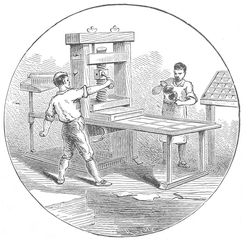
EARLY PRINTING PRESS AS USED BY BENJAMIN FRANKLIN.
Were the distinguished scientist, statesman, diplomat, printer, and philosopher to come forth from his grave in the cemetery of Christ Church, at Fifth and Arch Streets, Philadelphia, and go into one of the great printing houses of the country, how astounding to him would be the revelation! No more the wooden types or the unsymmetrical metal pieces; no more the wooden hand-press, the wood engravings, the ink balls, and the process of printing a few hundred sheets an hour. The terrific rapidity with which the newspapers are turned out to-day, printed, cut, pasted, and folded; the fineness of the work done on books and magazines; the wonder of one press putting on different colors at the same time; the setting of type by machines seemingly possessed of human intelligence; the rapidity and the simplicity of making stereotype plates; the dexterity of forming ordinary metal types into all kinds of forms; the millions of books,—secular and religious,—papers, and general literary productions turned out daily, would so puzzle the gigantic brain and cloud the understanding of the philosopher as to cause him to exclaim: “Take me back, O spirit of death, and let me forever rest from this seething, surging, whirling sphere of inventive progression.”
When the genius of invention was turned toward the printing art, it is worthy of note that the press which attracted the greatest attention was the production of a Philadelphian who once had been an associate of Benjamin Franklin. It was known as the Columbian press, the invention of George Clymer, and was regarded as of sufficient consequence to meet the approval of the printing fraternity of Great Britain as well as of this country.
In the National Museum in Washington, D. C., is the hand press which Benjamin Franklin used to print his Philadelphia paper, the “Gazette.” It had been built for him in London, where he had used it about five years prior to its being brought to Philadelphia.
What a curious-looking affair it is! Yet it was little less in the way of primitiveness compared with that used prior to 1817, when Clymer’s Columbian came into use. When these productions are contrasted with the magnificent contrivances of to-day, from which can be thrown sixteen hundred papers per minute,—papers of ten, twelve, and fourteen pages, printed on both sides, pasted and folded,—the comparison is like putting the steamboat of Fulton by the side of the monster ships which cross the Atlantic ocean from New York to Southampton in less than five days.
The Columbian press was looked upon, when presented to the printers, as an advance worthy of note in the art. It is easy to imagine how much prominence was given Clymer’s invention when it was placed beside the old common press. To-day, this supposed-to-be great piece of mechanism would not even be dignified by a place in the most un-modern backwoods printing establishment. And yet from this were printed the literary productions of Great Britain, as well as of the United States, in the early part of the nineteenth century.
The Columbian mechanical advancement consisted of the use of rollers for inking the type,—very much like the process now employed in inking the type when a rough proof is desired,—thus dispensing with the balls, which were managed by boys; the use of screws under the bed of the press to hold in position the form, into which had been securely adjusted the type; and the application of a long bar to obtain pressure sufficient to make the impression on the paper. The picture of this press shows the flat carriage upon which was placed the type, the platen or pressing surface, the bar which forced the platen upon the type, the spring which carried the platen back to position when the impression had been taken, and the track upon which the carriage was moved forward and backward,—primitive enough, and sufficiently simple in construction to show the limited capacity of the inventive genius of our great-grandfathers.
It was about 1829 when the Columbian gave way to the Washington press, and this was used for some time for fine book-work. The feature of it was an automatic inking roller attachment.
While the Washington press had the capacity for producing fine work, it was deficient in the speed required for meeting the demand then growing for books and newspapers. Then the printers turned to a cylinder press which had appeared in the last decade of the eighteenth century. The London “Times” had taken hold of it, and brought it to such a condition that its speed was raised to something like a thousand impressions an hour. König, a native of Saxony, in 1815, produced a press for printing both sides of the sheet. It resembled two single presses placed with their cylinders toward each other, the sheet being carried by tapes from the first to the second cylinder. Its capacity was 750 sheets, both sides, an hour.
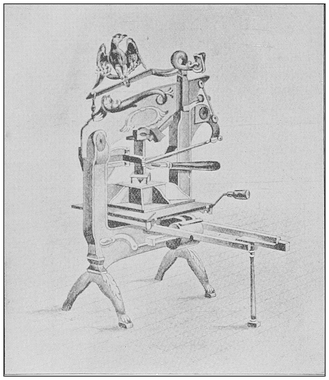
THE COLUMBIAN PRESS.
Cambridge University about this time was furnished with a press in which the types were placed on the four sides of a prism, the paper being applied by another prism. It proved unsuccessful. In this press, however, were first introduced the inking rollers formed of a combination of glue and molasses. Rollers are made of these two materials to this day.
Cowper, an Englishman, in 1815, introduced curved stereotyped plates and fixed them to a cylinder. Two place cylinders and two impression cylinders were soon afterward worked together on one press by Cowper, printing both sides of the sheet at the rate of one thousand copies an hour.
This seems to have been the period when inventive skill began to assert itself in the printing press. The educational advancement of the people in this country and in Europe, with the lack of facility for furnishing information of the campaigns of Napoleon Bonaparte, the desire for facts regarding the events transpiring in England, France, and Germany, the meagreness of the details which had been furnished of the conflict between Great Britain and the United States in 1812, convinced the publishers of newspapers in this country and abroad that the laws of supply and demand were not equally balanced. The outcome of this was a press constructed to print both sides of the sheet from type, and was soon followed by the introduction of four impression cylinders. These were applied to the reciprocating bed to carry the type for one side of the sheet, the sheets being fed from four feeding boards, the impression cylinders alternately rising and falling, so that two sheets were printed during the passage one way, the other two on the return passage. A pair of inking rollers between the impression cylinders obtained ink from the reciprocating board.
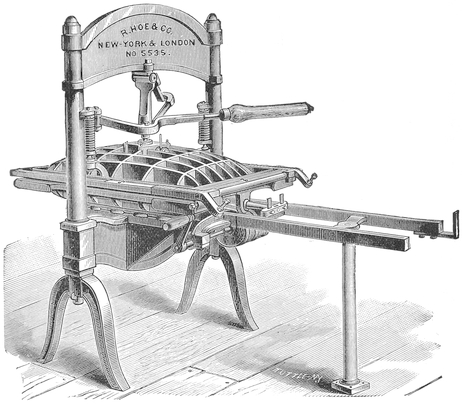
WASHINGTON HAND PRESS.
The capacity of this press was five thousand an hour, and this was regarded as a feat worthy of public mention, record of it being made in the newspapers of that period in a way which shows the general interest in the work.
The first power-press used in the United States was made by Daniel Treadwell, of Boston, in 1822. Two of them were used by the Bible and Tract societies.
The London “Times” had succeeded in applying steam to the movement of the printing press as early as 1814—a cylinder press being brought into requisition, to the use of which they had the exclusive right.
Following the Treadwell press, about 1825, came the improvements of Samuel and Isaac Adams, and the general use of the press which is still worked in the book offices of this country and Great Britain. It was on one of these Adams presses, in 1863, that was printed the book written by Dr. Elisha Kent Kane, describing his second expedition in search of Sir John Franklin, the Arctic explorer.
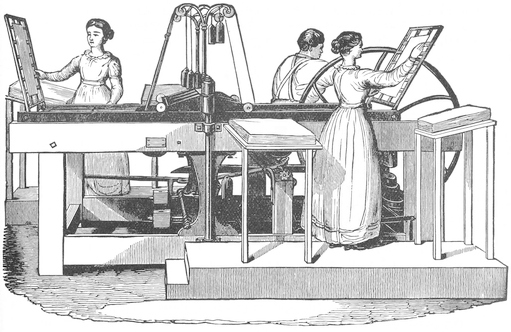
OLD WOODEN FRAME ADAMS BED AND PLATEN BOOK PRESS.
It was found that the Adams press could be used for newspaper as well as exceedingly fine book-work, its construction admitting of the use of plates or type, and its speed such as nearly came up to the requirements of that period. In this press a feed board holds the paper, which is fed by hand to a second board or tympan, having points to make holes in the sheet to regulate the second side. The type rests upon a bed which is raised by straightening a toggle-joint against the upper plates.
The fountain for the ink is carried at one end of the press. The inking rollers pass twice over the form. The paper is caught by grippers, carried in a frame called a frisket over the form (or type), receives the impression, and is carried by tapes to a fly frame in the rear which delivers it to the sheet board.
With the two-, three-, and four-cylinder presses, the Adams press, steam power and various improvements in the make of inks and rollers, the first half of the nineteenth century was looked upon as having made for the printing press extraordinarily rapid advancement. Great Britain held first place in the production of newspapers and books, the United States was a slow second, then came France, Germany, Russia, Italy, Spain, and Austria, in the order given. The greatest evidence of this march of improvement was the enormous increase in the production of the Bible, and the bringing of the cost to a figure which then was looked upon as placing it within the reach of all classes. Scientific and literary works were being put out in great numbers, newspapers were being started in every town in this country and England, and the editions put out in such European centres of advancement as Paris, Madrid, Berlin, Brussels, London, Liverpool, Dublin, Glasgow, St. Petersburg, Vienna, and Rome reached proportions then supposed to be enormous. The London “Times” at that period had a circulation of about 30,000,—and this was the leader in journalism. In the United States the leading newspapers did not issue daily editions greater than 20,000, while a circulation of 10,000 daily was regarded as being entirely satisfactory to the business ideas of the average publisher.
The opening of the last half of the nineteenth century may be spoken of as a quiescent period. It was the calm in the affairs of the United States which preceded the occurring of stormy events which put to the full test the strength of the young republic, the attitude of the nations of the old world toward us, and the power of the people successfully to maintain a government “of the people, for the people, and by the people.”
Millard Fillmore became the President of the United States in July of 1850, succeeding Zachary Taylor, who died. The Congress had taken a stand on the disturbing question of slavery by the passage of the fugitive slave law, and had made the first step toward freedom for the negroes by the abolition of the slave trade in the District of Columbia. It was in this year that New Mexico and Utah were admitted as Territories, the entire population of the United States being only 23,191,876; ten years later the population reached 31,443,321. The people were beginning to realize how important was the printing press in placing them in communication with the statesmen of the country. They were looking to Webster, Calhoun, Clay, Meredith, Everett, Scott, Crittenden, Collamer, Marcy,—then in the fullness of mental vigor,—and they were demanding information of their acts in the cabinet, their speeches in Congress, their views on state rights and slavery.
It was at this time that the Hoe American Printing-press Company startled the world by producing the ten-cylinder press, the speed of which was limited only by the ability of the feeders to supply the sheets. The first one of them to be used in the United States was that upon which the Philadelphia “Public Ledger” was printed. It at once came into general use in Europe and America. Its speed was 20,000 copies an hour.
In this press—still in use in many cities—the form of type is placed on the surface of a horizontal revolving cylinder of about four and a half feet in diameter. The form occupies a segment of only about one fourth of the surface of the cylinder, and the remainder is used as an ink-distributing surface. Around this main cylinder, and parallel with it, are smaller impression-cylinders. The large cylinder being put in motion, the form of types is carried successively to all the impression-cylinders, at each of which a sheet is introduced, and receives the impression of the type as the form passes. One person supplies the sheets of paper to each cylinder. After being printed they are carried out by tapes and laid upon heaps by means of self-acting flyers. The ink is contained in a fountain placed beneath the main cylinder, and is conveyed by means of distributing rollers to the distributing surface on the main cylinder. The surface being lower, or less in diameter than the form of types, passes by the impression-cylinder without touching. For each impression there are two inking rollers, which receive their supply of ink from the distributing surface of the main cylinder; they rise and ink the form as it passes under them, after which they again fall to the distributing surface. Each page of the paper is locked up on a detached segment of the larger cylinder, which constitutes its bed and chases, termed the “turtle.” The column-rules run parallel with the shaft of the cylinder, and consequently are straight, while head, advertising, and dash rules are in the form of segments of a circle. The column-rules are in the form of a wedge, with the thin part directed toward the axis of the cylinder, so as to bind the type securely. These wedge-shaped column-rules are held down to the bed by tongues projecting at intervals along their length, which slide in rebated grooves cut crosswise in the face of the bed. The spaces in the grooves between the rules are accurately fitted with sliding blocks of metal, even with the surface of the bed, the ends of which blocks are cut away underneath to receive a projection on the sides of the tongues of the column-rules. The form of type is locked up in the bed by means of screws at the foot and sides, by which the type is held as securely as in the ordinary manner upon a flat bed.
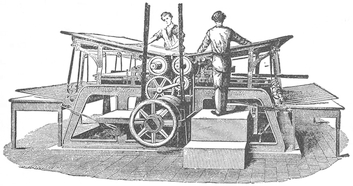
DOUBLE CYLINDER PRESS.
This press was regarded as the highest degree of perfection, until William A. Bullock, of Philadelphia, put out his web perfecting press. This completely revolutionized the printing business so far as the newspapers were concerned. It came into use in 1861,—just before the breaking out of the war of the rebellion in the United States,—in time to meet the enormous demands made upon the printing press at home and abroad. It had been in operation but a short time when the newspaper owners of Great Britain took hold of it, and for several years no other press was used by the newspapers of large circulation.
How slow and toy-like it seems in comparison with the monsters of the present day! And yet this machine met the demands of a period when it was supposed the circulation of the daily press had reached an altitude never to be surpassed. A newspaper like the New York “Herald,” which had attained a daily circulation of about 75,000, was looked upon as achieving the highest degree of success. In this last year of the nineteenth century the “Journal” and “World” of New York send out at least a million copies of their papers 365 days in the year.
William A. Bullock worked at his web printing press for six years before he had it in shape to pronounce it applicable to the requirements. It was not long after it was in successful operation that one of his limbs caught in the machinery of one of his presses, and death was the result. As the presses first were made, and indeed for many years thereafter, the paper was cut in the press before being printed, and it was a difficult matter properly to control these single sheets until they were delivered, while the presses were without any folding attachment. But these old style Bullock presses did succeed in turning out 6000 eight-page papers an hour, printed on both sides.
In 1873 a great improvement was made in the Bullock presses, which allowed of the papers being printed on the endless roll before the paper was cut.
With the aid of other improvements subsequently made these presses attained to a capacity of 16,000 eight-page papers an hour. But an unexpected limit was found in the impossibility of delivering beyond a certain rate from the fly. Then R. Hoe & Co. (about 1877) invented a contrivance which obviated the difficulty. It consisted of an accumulating cylinder, on which six or eight sheets were laid one above the other and then delivered from the fly at one motion. This increased the capacity of their perfecting press to 18,000 an hour. A folding attachment was then added; next a pasting and cutting attachment. Thus, in 1879 they were able to turn out a press which produced 30,000 perfect eight-page papers an hour—printed, cut, pasted, and folded.
The next great achievement was put in operation in a New York pressroom in 1885. That was the double supplement press, which in reality combines two presses in one. It was the first press to insert supplement sheets automatically, and it was the first press to print from two rolls of paper, one roll being placed at right angles to the main roll. As the name of the press implies, from the secondary roll the supplements are printed at the same time that the main part of the paper is being printed from the other roll. And by means of what to the ordinary man seems a miraculous contrivance, but which to the initiated in the mysteries of mechanics is no doubt very simple, the supplement is automatically inset and pasted into the main paper before reaching the fly, and dropped out folded ready for the newsdealer.
From this press has been evolved the superb printing machine which, in recent years, has astonished the world. On it can be printed eight-, ten-, or twelve-page papers at a running speed of 24,000 an hour, or 400 a minute, and whether eight, ten, or twelve pages are printed they all come out with the supplements inset and the paper pasted and folded. From this press was developed the next triumph, the quadruple press. Marvelous machines these quadruple presses are, and it seemed impossible that any press could be built for many years to come that would beat them.
The printing business stood amazed, awe-stricken at the sight of so many papers being turned out each hour. And before the amazement had subsided there came forth the machine which is destined to go down in history as one of the great achievements in mechanics of the nineteenth century,—the sextuple press, manufactured by Hoe & Co., which has brought forth as many wonderful improvements as any mechanical concern in the world.
Although it is impossible to explain in language comprehensible to the man who is not an engineer how this monarch among printing presses does its work at a rate of speed which is well-nigh incredible and outstrips the flight of imagination itself, yet it is possible to convey an idea of what the extent of the work is.
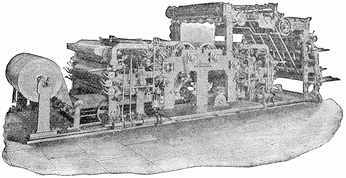
FIRST PERFECTING PRESS.
This machine will print, fold, paste, and deliver 90,000 of a four-page paper or six-page newspaper in one hour. It will require some figuring to convey an adequate idea of how fast that is, for, as a matter of fact, it is faster than a man can think, and that is why I say that the speed of the machine outstrips the flight of imagination.
Ninety thousand copies an hour is equivalent to fifteen hundred copies a minute, and fifteen hundred copies a minute means twenty-five copies per second!
Now take out your watch, and while the second hand is passing from one second to another try to grasp the idea that in all that brief interval of time twenty-five six-page newspapers have been printed. You can’t do it. It is faster than you can think.
And yet in that second those twenty-five papers are not only printed, but the inside sheets are automatically pasted in, and the twenty-five papers are all cut and folded ready for delivery to the newsdealers. Is there anything more marvelous than that recorded in the “Arabian Nights”? Who said that there are no miracles in this nineteenth century? Why, if old Gutenberg,—peace to his soul,—or Faust, or Caxton, or even our own Benjamin Franklin had seen anything of the sort, they would have sworn that it was either a miracle or the work of the supernatural, with the chances in favor of the latter.
Each page of the average newspaper has six columns, and in each column there is on an average 1800 words. Six multiplied by six and the product of that by twenty-five, and that again by 1800, you will find makes 1,620,000, which is just about the number of words that this press prints in a second when it is turning out six-page papers at the rate of twenty-five a second. That is something that will stagger any man’s imagination if he tries to realize what it is.
This press will print, cut, paste, fold, count, and deliver 72,000 copies of an eight-page newspaper in one hour, which is equivalent to 1200 a minute and 20 a second.
It will print, cut, paste, count, and deliver complete 48,000 copies of a ten- or twelve-page newspaper in one hour, which is equivalent to 800 a minute and a fraction over 13 a second.
It will print, cut, paste, fold, count, and deliver complete 36,000 copies of a sixteen-page newspaper an hour, which is at the rate of 600 a minute, or 10 a second.
It will print, cut, paste, fold, count, and deliver complete 24,000 copies of a fourteen-, twenty-, or twenty-four-page newspaper an hour, which is at the rate of 400 a minute, or very nearly seven a second.
This is lightning work with a vengeance, and yet it is possible that there may be some who read this who will live to call it slow. That will probably be when they have found out all about how to put a harness on electricity. No one can predict when inventive genius will reach its limits in the printing press. Before this press was built, the fastest presses in the world were Hoe’s quadruple presses, which will turn out 48,000 four-, six-, or eight-page papers an hour, 24,000 ten-, twelve-, fourteen-, or sixteen-page papers an hour, and 12,000 twenty- or twenty-four page papers an hour, all cut, pasted, and folded.
The sextuple press has a well-nigh insatiable appetite for white paper. To satisfy it it is fed from three rolls at the same time, one roll being attached at either end of the press, and the third suspended near the centre. It is the only press which has ever been able to accomplish that feat. Each roll is sixty-three inches wide. When doing its best this press will consume 25-7/8 miles of 63-inch wide white paper in one hour, and eject it at the two deliveries, each copy containing an epitome of the news of the world for the preceding twenty-four hours, and each copy cut, pasted, and folded ready for delivery. It is a sight worth seeing to see it done, and in its way it is just as impressive as Niagara.
A man turns a lever, shafts and cylinders begin to revolve, the whirring noise sets into a steady roar, you see three streams of white paper pouring into the machine from the three huge rolls, and you pass around to the other side and—it is literally snowing newspapers at each end of the two delivery outlets. So fast does one paper follow the other that you catch only a momentary glitter from the deft steel fingers which seize the papers and cast them out.
The machine weighs about fifty-eight tons. It is massive and strong, with the strength of a thousand giants. And yet, though its arms are of steel and its motions are all as rapid as lightning, its touch is as tender as that of a woman when she caresses her babe. How else does the machine avoid tearing the paper? Paper tears very readily, as you often ascertain accidentally when turning over the pages. Truly wonderful it is, and mysterious to anybody but an expert, how this huge machine can make newspapers at the rate of twenty-five a second without rending the paper all to shreds.
It has six plate cylinders, each cylinder carrying eight stereotype plates, and six impression-cylinders. These cylinders, when the press is working at full speed, make two hundred revolutions a minute. The period of contact between the paper and the plate cylinders is therefore inconceivably brief, and how in that fractional space of time a perfect impression is made even to the reproduction of the finest, is one of those things which, to the man who is not “up” in mechanics, must forever remain a mystery.
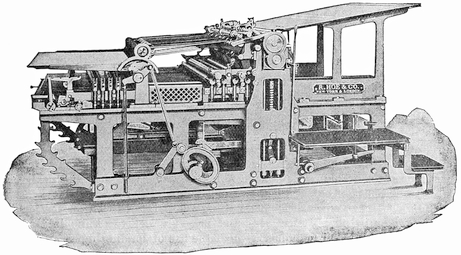
FOUR ROLLER TWO-REVOLUTION PRESS.
A double folder forms part of the machine. A single folder would not be equal to the task imposed on it. As it is, this double folder has to exercise such celerity to keep up with the streams of printed paper which descend upon it that its operations are too quick for the eye to follow.
The press has two delivery outlets. At each the papers are automatically counted in piles of fifty. No matter how rapidly the papers come out, there is never a mistake in the count. It is as sure as fate. By an ingenious contrivance—if I should try to describe it more definitely most people would be none the wiser—each fiftieth paper is shoved out an inch beyond the others which have been dropped on to the receiving tapes, thus serving as a sort of tally mark.
Truly it is a marvelous machine—this sextuple press. Nowhere you will find a more perfect adaptation of means to ends, nowhere in any branch of industry a piece of mechanism which offers a finer example of what human skill and ingenuity is capable of. And it is free from that reproach which is sometimes brought against the greatest triumphs of inventive genius in other departments of human activity,—that they make mere automatons out of human beings.
There was recently manufactured by the Hoe Company for a New York paper an addition to this wonderful piece of machinery designated an octuple press. Running at full speed it will print, paste, cut, fold, and count 96,000 eight-page papers an hour. It is nearly 14 feet high, and 25 feet long. Ten men are required to operate it. The cylinders revolve 200 times in every 60 seconds.
This monster is divided into two working parts. The printing is done on the half of the machine to the right. The paper passes over the cylinders there, where it is printed from the stereotype plates, and then runs through the other half of the machine on the left, where it is cut, inserted, pasted, delivered, and counted from four outlets folding in half-page size.
This press shows four distinct double printing machines, each fed by its own roll of paper. The paper from each roll passes against two sets of stereotype plate cylinders—one for each side of the printed sheet. The machine is so perfectly adjusted that by simply turning a screw and moving a gear a few inches each of the four sets of cylinders can be thrown out of operation; that is to say one quarter, one half, three quarters, or the whole press can be operated at will.
The folder is harmonized for each adjustment of the printing cylinder. The folding of the papers has been brought to the highest state of perfection. The sheets are folded, cut, and delivered by a rotary motion at a speed that could never have been attained with the reciprocating arms, such as were used prior to the Hoe inventions.
When a sixteen-page paper is being printed it comes in four-ply thickness, and then doubles and shoots eight thicknesses under the knife.
When a twenty-four-page paper is being printed it passes over the longitudinal folder in six-ply thickness and passes under the knife in twelve thicknesses. All this is attained without the use of guiding tapes. In fact, the speed could not be attained with them.
As the papers are folded and delivered from the four outlets, with a speed too great for the eye to follow, the machine itself counts them in total and in bundles, as is done on the sextuple press. This monster octuple machine has a perfected system of ink distribution with which no other presses are equipped. Under the system results are obtained by decreasing the size and increasing the number of ink-rollers around each cylinder of plates.
The arrangement of the type cylinders is such as to make the press one that can be handled with great ease and rapidity. Along the right hand of the machine, between the two rows of cylinders, is an open passageway. It is large enough for men to pass through either from the ground or from the gallery near the latitudinal centre of the press.
From this open passageway the pressmen are able to watch every movement of the machine’s interior working, and from it they are able to make quick changes on the plate cylinders. The change in position of only two ink-rollers is necessary to change a plate on any cylinder. This is a matter of great importance to a paper which prints many editions, for it is necessary to change plates so often and to economize every minute of time in order to catch the fast mails which carry the paper to all quarters of the earth.
On the octuple presses each roll of paper is guarded against breakage. There is a device in the shape of a short endless belt of rubber which passes over two pulleys and rests on top of the roll of paper. The paper is then pulled from the roll as gently as the thread is pulled from the spool of a sewing machine. The belt pushes the roll along at a speed equal to and sometimes a little greater than that of the stereotype cylinders. Hence, all tension is removed from the paper.
From the stereotyper’s department, where they have been made in a few minutes, come the plates of curved, bright metal. Passed to the pressmen, they are locked on the cylinders as fast as they can be handled. The rolls of paper have been placed in their proper positions.
This accomplished, the men step back from the machine, the brakeman pulls the lever, and the giant press begins its work. Slowly its cylinders revolve at first, but as headway is gained the rumble that accompanied the start increases into a shrill shriek as the limit of speed is reached.
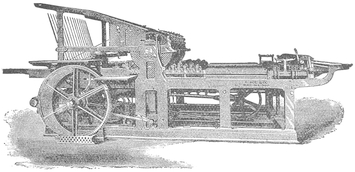
LITHOGRAPHIC PRESS.
The paper rushes from its continuous rolls, is printed, folded, cut, and thrown out from the four outlets at a speed that would be over twice greater than that of any express train if it were confined to one roll. Every paper is just like every other one, perfect in every detail.
When this has gone on for an hour, two hours, or however long it may take to run off the editions, the monster press can be stopped in an instant. With the simple touching of a lever all its movement will cease before the cylinders can revolve five times, and they had been revolving two hundred times a minute before.
The two wonders just described are confined to newspaper work. This same American firm has produced presses upon which are printed the fine specimens of magazines where the work takes a striking resemblance to lithograph printing. They have a speed of 8000 an hour. From them come booklets of 16, 20, or 24 pages. From the presses of 4000 an hour come books of 32, 40, and 48 pages. In construction they are complicated and grand.
Then come the presses upon which are printed different colors. These are made in England and the United States, and are used with satisfactory results on prominent publications in both countries. A recent issue of the “British and Colonial Printer” directs attention to this advance in mechanism through the medium of the Hoe art rotary form feeder. It says:—
“This machine carries the mind back naturally to pre-rotary days, when the Hoe multi-feeder held the field as the newspaper machine, to the days of the heavy, and as we consider in these advanced days, clumsy turtle. When the creative genius of Colonel Hoe evolved the rotary press, the multi-feeder was almost at once relegated to the lumber room of obsolete mechanics. It is hardly conceivable that it entered the mind of any practical man at this time that the principle of multi-fed flat sheet printing would ever be adapted to the production of high art illustrated literature, at a speed equal, or nearly so, to the former Hoe news machine. It has, at all events in our country, long been a settled opinion that such work could only be successfully accomplished upon a flat-bed machine, that the mere curvature of a plate must destroy the beauty of a fine process block for example, and that any attempt to travel at a greater speed than 1200 to 1500 an hour must be at the sacrifice of depth and sufficiency of rolling. Whether this is really so readers will now be able to form their own opinion from the pages of the ‘Strand Magazine.’ Those pages abound in very varied methods of engraving, woodcut and process, line and nature, and reproductions alike from photos and from wash and crayon drawings. Every page has undergone the process of electrotyping, cast straight and curved subsequently, and therefore the conditions of printing at the high speed of 4000 (or to be strictly accurate, four sheets of 16 pages each put through at the rate of 950 each, or 3800 per hour) are as severe as could be desired.
“The British printer has yet to acquire a full mastery of its capabilities, and the engineer has equally before him in some degree a period of development. Some of the portraiture, human and animal, is equal to anything seen. The make-ready (upon hard packing) exhibits the highest quality, and the distribution of color perfection. The plate-cylinder is made as large as the desired speed renders practicable, in order that the curvature of the plates may be reduced to a minimum. The provision for securing adequate distribution and in-rolling is upon a liberal scale, but not one whit more so than is requisite, extent of surface and speed of running considered. There are 16 inkers and 38 distributors, with 16 iron distribution cylinders. The sheets are fed in two at either side of the machine, those from the right hand feeders being delivered upon the table at the extreme left, the other upon the inner delivery board. The plates are rigidly secured by special clutches. To facilitate the imposition of the plates, or any attention required by the cylinder, the short rear portion of the machine back of the cylinder is detachable and can be run out upon an extended base, and then closed up and put into gear again. This renders it perfectly accessible at the most essential point. The sheets are of course printed on one side only. We have not yet attained to the perfecting stage in art work in combination with high speed; the introduction of the Hoe art rotary press, however, marks a distinct epoch in this class of printing in Great Britain. Color printing-presses are in use in the newspaper and magazine offices in this country, and from them are produced the artistic as well as the lurid styles of art.”
What the possibilities of the printing press are, looking at the degree of excellence at present attained, it is difficult to predict. It would seem as if the height of perfection now had been reached. The probability is that the printer at the end of the first quarter of the twentieth century may look with something akin to contempt upon the machines which now are regarded with so much pride.
Such a thing is possible in this age of invention.
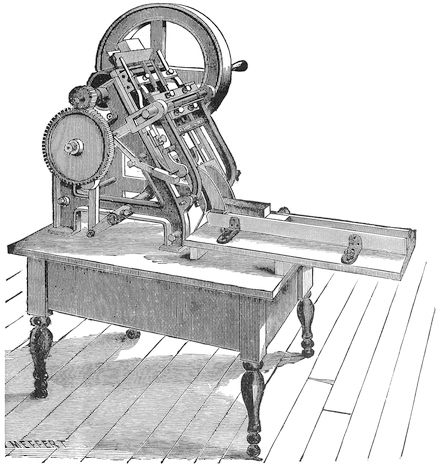
NUMBERING CARD PRESS.
II. THE SETTING OF TYPE.
In the beginning of the nineteenth century, when the little metal pieces of type were picked up one at a time and placed in the composing “stick” by hand, there was attached to the work an importance which elevated it almost to the ranks of the trained professions. In England, as late as 1817, compositors arrogated to themselves the dignity of carrying swords. At the close of the nineteenth century, the art is seen to be passing into the sphere of mechanics,—the methods in vogue making it entirely a mechanical operation. Before many years of the twentieth century have passed, there will have been attained a degree of advancement which will dispense with the hand of man in guiding the movements of the machine. The inventive skill which brought the printing press to such a high point of excellence and speed has been turned toward the work of type-composing, and the forward march is likely to be as rapid.
Outside of the actual learned professions, no occupation has contributed so many prominent figures to the history and progress of this country as the composing-room. They have filled important places in journalism, politics, Congress, state legislatures, the army and navy, and the world of literature.
Horace Greeley, the founder of the New York “Tribune,”—writer, statesman, and man of affairs,—is one of the notable figures of the present century, who laid the foundation of his career at a case of type.
Schuyler Colfax, who became Vice-President of the United States in 1869, passed the early years of his life setting type.
And, strange to say, these two men, when the presidential chair seemed a possible realization of their ambition, were opposed by men of their craft simply because they had seemed to run so far above the “stick” and “rule.”
Simon Cameron, of Pennsylvania, once Secretary of War, United States senator, representative of the United States abroad, and for many years political master of his great State, was proud to say that he had begun his career as a type-setter in a country printing-office. It is worth while noticing that this printer-politician’s life covered nearly a century of existence. His life spanned every president from John Adams in 1799 to Benjamin Harrison in 1889, while his active political control of Pennsylvania covered a period of sixty-five years,—a record made by only one man within the history of the United States.
Every state in the Union has contributed to history its quota of printer-statesmen, printer-authors, and printer-journalists. How many of such there have been in this nineteenth century would be beyond ordinary research to ascertain. But printers—compositors—can refer with just pride to the fact that in all the advanced walks of life are to be found men who have been members of the guild.
The setting of type by hand prevailed universally until as late as 1880. That may be put down as the period when there came into anything like general use the machines for type composition, although experiments in that direction had been going on for sixty years.
As early as 1820, printers realized that machinery eventually must be brought into play for composing type. But how to do it was the scientific as well as mechanical problem. It was argued that the machine must be so constructed as to pick up the type, uniformly distribute the space between the words, and “justify” the lines, that is, make them the exact width.
“It is beyond the range of possibility,” suggested the printer. “Mechanism never can be applied to art. The great Benjamin Franklin would have discovered the way to make such a thing possible, if it were possible—which is impossible.”
And the scientific electric discovery made by Benjamin Franklin in the eighteenth century is, at the close of the nineteenth, the motive-power used for driving the machines for type composition,—the seemingly impossible has reached the stage of possibility.
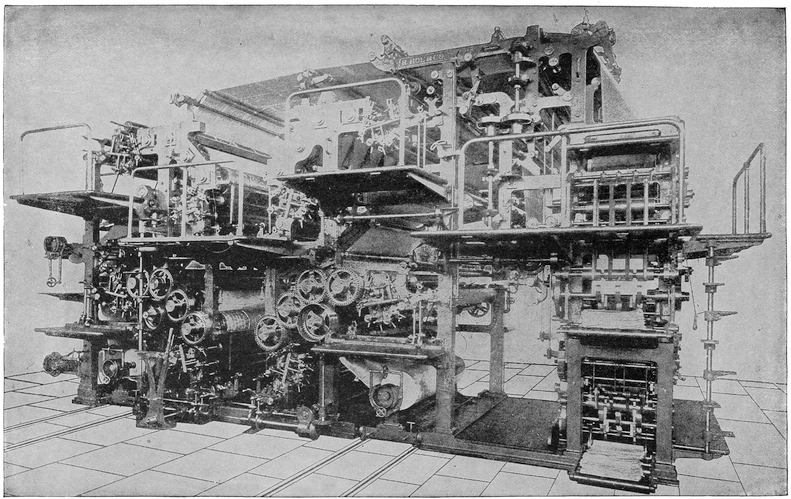
OCTUPLE STEREOTYPE PERFECTING PRESS AND FOLDER.
(Capacity, 96,000 impressions per hour.)
Dr. William Church, of Connecticut, produced a machine looking to machine type-composition in 1820. It did not come into use, although he spent large sums of money on it, and devoted a vast amount of energy toward having it taken up both in this country and in England. At the Paris Exhibition in 1835 there were exhibited several machines of this sort, one of which—the patent of Christian Sörensen, of Copenhagen—was used upon a daily paper issued during the exhibition. In 1871, at the International Exhibition in London, there was shown a machine possessing peculiar features. It used a perforated ribbon, through the medium of which types were worked into position. The machine was cumbersome, complicated, and expensive, and could not be brought into anything like general usage. In 1875 M. Delcambre, of Paris, after twenty years’ work produced a machine in New York. It had the same objections as the others. While this machine could do as much as the labor of three men by hand, it required a man to operate, another man to place the set type in lines, steam to keep it in motion, and a big cost to construct.
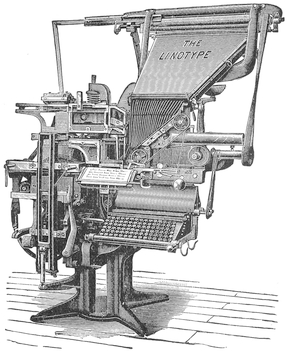
LINOTYPE (TYPE-SETTING) MACHINE (FRONT VIEW).
Up to this period, all the experiments had shown the want of something which would obviate the presence of a man to make the lines of the proper length and with equal spacing between the words. All the machines which were anything near available picked up and placed in position separate types. At the Centennial Exhibition of 1876, in Philadelphia, there were shown machines which used brass dies and cast a line of type. These seemed to possess the element for successful use, and the outcome was the production of the machine which is now in use in all the big newspaper offices in this country—the “Mergenthaler Linotype.” Practically it has driven all the other machines out of use, but how long it will hold sway is a question. Already men of genius are experimenting with two objects in view,—increase of speed, decrease of cost,—and it is fair to presume that before the twentieth century has gone very far into history these two objects will have been attained.
The linotype, as here shown, has the appearance of a heavy and cumbersome piece of machinery. It actually is so only when there are several of them placed in line—then they give to a composing-room the appearance of a machine shop. This machine, instead of producing single type of the ordinary character, casts type-metal bars or slugs, each complete in one piece, and having on the upper edge, properly justified, the type characters to print a line.
These slugs present the appearance of composed lines of type, and serve the same purpose, and for this reason are called “linotypes.” The linotypes are produced and assembled automatically in a galley, side by side, in proper order, so that they constitute a “form,” answering the same purposes and used in the same manner as the ordinary “forms” consisting of single types.
After being used, the linotypes instead of being, like type forms, distributed, are thrown into a metal pot of the machine to be recast into new forms.
The machine contains, as its fundamental elements, several hundred brass matrices. Each matrix consists of a flat plate having in one edge a female letter, or matrix proper, and in the upper end a series of teeth, which are used for distributing to their proper places in the magazine matrices containing different letters. There are in the machine a number of matrices of each letter, and also matrices representing special characters, and spaces or quads of definite thickness for use in tabular and other work of a complicated nature.
The machine is so organized that on manipulating the finger-keys it will select matrices in the order in which their characters are to appear in print, and assemble them side by side with wedge-shaped spaces at suitable points in the line.
This composed line forms a line matrix, or in other words a line of female type, adapted to produce a line of raised printing type on a slug, which may be forced into or against the matrix characters. After the matrix line is composed it is automatically transferred to the face of the mold, into which molten metal is delivered to produce the slug or linotype, after which the matrices are distributed or returned to the magazine to be again composed in new relations for succeeding lines.
These operations are performed by mechanism, as shown in the outline here presented.
A is an inclined fixed magazine, containing channels in which the assorted matrices are stored, and through which they slide, entering at the top and escaping at the foot, one at a time. Each channel is provided at the lower end with an escapement device, B, connected by a rod, C, with a finger character of the matrices in the corresponding channel. There is a key for each character, and also keys for quads stored in the magazine. The keys are actuated by the operator in the order in which their letters are to appear in print. As a key is depressed, it operates the corresponding escapement, B, which allows a matrix to fall out of the magazine through one of the channels, E, to the inclined traveling belt, F, which serves to carry the matrices down in succession into the assembler stick, G, in which they are stored side by side. A box, H, contains a number of elongated spaces, I, and a discharging device connecting with a finger-key bar, J, by which the spaces are permitted to fall into the line of matrices at the proper points during composition. It will be perceived that the operation of the various keys results in the selection of the matrices and spaces, and their collection in assembler, G, until it contains all the characters to be represented by one line of print. After the matrix line is thus composed it is transferred, as indicated by the dotted lines, to the front of a mold or slot extending through a mold wheel, K, from front to rear. This mold is of the exact size and shape of the slug required. The matrix line is pressed tightly against, and closed in front of, the mold for the time being, and the characters, or matrices proper, face the mold cell or space. While the line is in place in front of the mold, the wedge spaces are pushed up through the line, and in this manner exact and instantaneous “justification” is secured. Behind the mold there is a melting pot, M, heated by a flame from a gas burner, and containing a quantity of molten metal. The pot has a perforated mouth arranged to fit against and close the rear side of the mold, and contains a jump plunger, mechanically actuated.
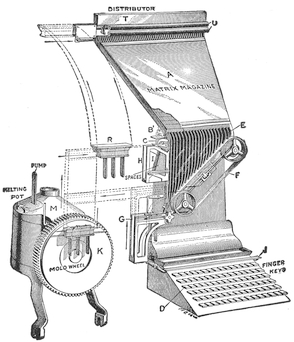
OUTLINE OF TYPE-SETTING MACHINE.
After the matrix line is in place, the plunger falls and forces metal through the pot mouth into the mold, against and into the characters of the matrix line. The metal instantly solidifies in the mold, forming the slug or linotype, having on its edge raised type characters formed by the matrices. The mold wheel next makes a partial revolution, turning the mold from the original horizontal to a vertical position in front of the ejector, which then advances from the rear through the mold, pushing the slug out of the latter into the receiving galley, at the front.
A vibrating arm advances the slugs laterally in the galley, and thus assembles them side by side in column or page-form ready for use. In order to insure absolute accuracy in the height and thickness of the slugs, knives are arranged to act upon them during their course to the galley.
After the matrices in the line have served their purpose in front of the mold, they are returned to the magazine to be again discharged and used in the following manner. The line is lifted from the mold and shifted laterally until the teeth at the top engage the teeth of bar, R. This bar then rises as shown by dotted lines, lifting the matrices to the distributor at the top of the machine, but leaving the spaces, I, behind to be shifted laterally to the magazine or holder, H, from which they were discharged. Each matrix has distributor teeth in its top, arranged in a special order or number, according to the character it contains. In other words, a matrix containing any given character differs in the number or relation of its teeth from a matrix containing any other character. This difference is relied upon to secure proper distribution. A distributor-bar, T, in a single piece, is fixed horizontally over the upper end of the magazine, and is formed with longitudinal ribs or teeth, adapted to engage the teeth of the matrices and hold the latter in suspension as they are carried along the bar over the mouths or entrances of the channels.
The teeth of the bar are cut away to vary their number or arrangement at different points in its length, so that there is a special arrangement over the mouth of each channel. The matrices are pushed upon the bar at the end, and made to slide slowly along it while suspended therefrom. Each matrix remains in engagement, and travels over the mouth of the channels, until it arrives at the required point, where, for the first time, its teeth bear such relation to those of the bar that it is permitted to disengage and fall into its channel.
The travel of the matrices is secured by longitudinal screws, which lie below the bar in position to engage the edges of the matrices. The matrices pursue a circulatory course through the machine, starting from the bottom of the magazine and passing thence to the line being composed, thence to the mold, and finally back to the top of the magazine. This circulation permits the operations of composing one line, casting a second, and distributing a third, to be carried on concurrently, and enables the machine to run at a speed exceeding that at which any operator can finger the keys.
One half horse power is generally used in driving a machine. About five square feet is the space occupied by the machine; it weighs 1925 pounds, and consumes about fifteen feet of illuminating gas each hour to heat the metal pot. Each machine will do complete work equal to that of five men by hand. The simplicity of the machine bears a striking resemblance to the typewriter, and this is operated successfully by young girls. When the matter set by the machine is placed together, the page presents a surface equal to an entire new set of type, or, as the printers say, “We take on an entire new dress every day.”
That is a production of the nineteenth century. How commonplace it will appear when the achievements of the twentieth century are placed on record.
III. EVENTS AS THEY OCCUR.
When the nineteenth century opened, great events were occurring in the world. Napoleon Bonaparte was the central figure in the eye of Europe. He had, but a few years previously (1797), gone through the most brilliant campaign known. He had crossed the Alps, defeated the Austrians at Montenotte and Millesimo, defeated the Sardinians at Ceva and Mondovi, and conquered Lombardy,—all in a few weeks. The year following he had conquered Egypt, and in 1800 had become the first consul and the ruler of France, to be declared Emperor four years later.
Then followed, in rapid succession, the events which caused the world to look upon Napoleon as the probable coming ruler of the universe. It was in 1805 that he began the war of aggrandizement. He crossed the Rhine, compelling the Austrian army to surrender at Ulm; he entered Vienna and routed the Russian and Austrian armies at Austerlitz. This was followed by his move to make himself master of Southern and Central Europe. He established his brother Joseph as King of Naples; his brother Louis as King of Holland; his stepson Eugene as Viceroy of Italy; and his brother-in-law, Joachim Murat, as Grand Duke of Berg. The following year he defeated the Prussians and entered Berlin.
It was not until his abdication at Fontainebleau, in 1814, that Europe and America breathed freely. His final overthrow at Waterloo in 1815 removed him from the stage as an active participant in the world’s history of the nineteenth century.
In the United States, the close of the eighteenth century was marked by the death of Washington, while 1800, 1801, 1802 saw us make a treaty of peace with France, remove the national capital from Philadelphia to Washington, D. C., declare war against Tripoli, purchase Louisiana from France, and enter upon the disputes with Great Britain which culminated in a declaration of war with the mother country, in June of 1812.
While these events at home and abroad were making history, long periods of time elapsed between their occurrence and their being given to the people. There was no telegraphic communication which flashed messages around the globe. It was a wait until the mails brought the news. Two months, probably, elapsed after the battle of Waterloo ere this country was furnished with the story which meant so much to the peace of Europe.
What a change in this respect was wrought between the downfall of Napoleon Bonaparte in 1815 and the downfall of his nephew, Louis Napoleon, in 1870! On the fateful second of September, 1870, when the Emperor of France, Napoleon III., surrendered to the Emperor William of Prussia, on the field of Sedan, the news was flashed to America in less than two hours. On that hot, sultry day eager crowds surrounded the bulletin boards of the newspapers, on which were displayed the facts connected with the overthrow of the Napoleonic dynasty. The difference in time made it possible for us here to know all that had been done by the two emperors and by Bismarck an hour ahead of their actual happening. For days before that the crowds had surged around the newspaper offices, for days afterward they did the same, and facts were given with a rapidity which showed how wonderful had been the scientific stride between 1815 and 1870.
Had any one in 1815 predicted the possibility of such scenes, he would have been put down as a fit subject for a writ of de lunatico inquirendo. Such, too, would have been the comment on the one who then would have suggested the likelihood of a newspaper in this country reaching a circulation of a million copies daily,—and yet such has become an accomplished fact.
At the close of the first quarter of the nineteenth century there had been no practical advance in the rapid transmission of news. This was the period when the press lacked the facility to rapidly furnish the people with the events which were occurring in all directions. Newspapers still depended upon the mails. Home events were many weeks reaching sections remote from their happening. In this respect there had been some little improvement at the close of the first half of the century. That was the time when the electrical current was being brought into operation in the transmission of signals from which messages were being recorded, and these were being utilized for the sending of information at short distances. Scientific men were even talking of the possibility of connecting distant points on the coast, and whispering their hope for an Atlantic cable. In 1858 that wonderful event came to pass. The old world and the new were connected by cable from Valencia Bay, in Ireland, to Newfoundland, in North America, and messages of greeting passed between Queen Victoria and President Buchanan. The break which followed soon after the opening of this cable stimulated men of genius and men of capital to further efforts, and the governments of the United States and Great Britain came forward with generous aid. The laying of the Atlantic cable by the Great Eastern in 1864, and its successful operation in 1866, opened the doors for the possibilities of the press of to-day, and the realization of such scenes as were witnessed in this country on September 2, 1870.
Between that memorable year, 1866, and this, 1899, how wonderful has been the advance in the transmission of information from all quarters of the globe. From the Transvaal Republic, in South Africa; from the desert home of the Dervish in the Soudan; from the domain of Turkey’s Sultan, in Armenia; from the Holy Land; from the Oriental empires of China and Japan; from the snow-clad land of the Czar in Siberia; from the Bosphorus to the English Channel; from Valencia across the Atlantic; from Victoria Land in North America to Patagonia in South America; from Maine to Mexico; from the Atlantic to the Pacific; there are each day transmitted all occurrences of interest transpiring,—and these encompass peace and war, joy and sorrow, science and art, education and trade,—events which arouse the passions and quicken the pulse of humanity.
This is done through the medium of an organization known as the Associated Press. This wonderful combination has nearly forty thousand miles of wire from the different telegraph companies, for which there is paid a fixed price per mile. This, however, does not include its cable service, the charges for which are according to the number of words transmitted. The service of this organization costs a million and a half a year, divided among several hundred of the great newspapers of the United States. During the recent conflict between Spain and the United States its expenditure for war news alone was nearly $500,000. This can readily be understood when the reader is informed that the cable rate from Manila was $2.37 a word. Thus, a dispatch filling less than a quarter of a column of the average daily paper cost $1000. The rate from Porto Rico, at the outbreak of hostilities, was $1.90 a word, and it often happened that a single dispatch covering the movements of a body of troops in that island, with possibly a pen picture of a skirmish with the Spaniards, would cost $2000 in gold. The Santiago toll was $1.10 a word; and whole pages of newspapers were printed at that rate.
What a gigantic institution it has become for the rapid dissemination of news events!
In that war between Spain and the United States, General Toral, the Spanish commander, surrendered Santiago on July 14, at 2.15 o’clock in the afternoon. At 2.25 o’clock the message announcing the fact was received in Philadelphia. On the 12th of August following, at 4.23 o’clock in the afternoon, the Peace Protocol was signed in Washington by the French Ambassador Cambon and Secretary of State Day, and at 4.27 o’clock—four minutes later—the information was in the New York office of the Associated Press. Hundreds of such instances of this rapid transmission of news could be recorded in this last year of the nineteenth century,—facts never even dreamed of when Benjamin Franklin chained the electric current in the closing years of the eighteenth century.
The journey of a piece of news from the far East to the far West is something worth noting. The trip covers thousands of miles out of a direct route. As for instance, when Admiral Dewey annihilated the Spanish fleet in the Bay of Manila, on May 1, 1898, the fact was cabled to Hong Kong, China. There an operator transmitted it northward to Helampo in Russia, right on the border line of Manchooria, from which place it was sent across Russia to Tomsk, thence to St. Petersburg. From the Russian capital it zigzagged to Berne, in Switzerland; thence to Paris; thence across the channel to Penzance, and finally to Valencia, to be put on the cable for America. In two hours from the time the operator in Hong Kong started his dispatch, it was being hurried across the American continent—north, west, east, south—for distribution in the newspaper offices.
When a party of Mohammedans attacked a Christian mission in Calcutta, a telegraph operator dispatched the news to Bombay, whence it was transmitted to Aden. The next point reached was Suez, from which it was sent to Malta. It was next sent to Lisbon. From there it was given to Paris. From Malta it was also cabled to Penzance, thence to Valencia, and finally to the United States.
When that Manila piece of news from Admiral Dewey reached the Pacific coast in the United States, the date of its being started was yet several hours behind the time of its arrival. The attack on the Spanish fleet was made on Sunday, May 1, Manila time. The fact was not sent out by Dewey until the following morning, May 2 (still Manila time). It was started on its westward course that morning (May 2) at ten o’clock. By the route taken to Valencia with the relays, two hours were consumed. This brought it to London about three o’clock on that morning of May 2, owing to the difference in time. Traveling westward across the Atlantic ocean in advance of the sun, it reached New York about ten o’clock in the night of May 1. But little time was lost in retransmission to the Pacific coast, which point it reached about six o’clock on that Sunday evening of May 1—fourteen hours previous, by the day of the month, to its being started from Manila.
In this work of sending out news not a moment is lost that can be avoided. The aid of the typewriter enables the operator to keep pace with the sending operator, and his pace has been increased in the past few years by the introduction of a code system. Here is a specimen of the code system as used by the operator in sending out a news item:—
“Madrid, March 17—T Qn Regent h sined t Treaty of Peace btn Spn & t Uni Stas. T treaty wb frwded to t French Ambsdr, Jules Cambon, at Washn, fo exg w t one sined by Pr McKinley. No decree q sj wb pud d ‘Official Gazette.’
“Ofl rlns btn t 2 govts wi nw b promtly rnud. Ix rmrd 5 Mir to t Uni Stas wb Snor. Don J. Brunetti, Duke d’Arcos, fmr Spnh Mir to Mex, wos wif is an Amn.”
When this seemingly incomprehensible conglomeration of letters leaves the hand of the receiving operator it reads as follows:—
“Madrid, March 17—The Queen Regent has signed the Treaty of Peace between Spain and the United States. The treaty will be forwarded to the French Ambassador, Jules Cambon, at Washington, for exchange with the one signed by President McKinley. No decree on the subject will be published in the ‘Official Gazette.’
“Official relations between the two governments will now be promptly renewed. It is rumored that the Minister to the United States will be Señor Don J. Brunetti, Duke d’Arcos, former Spanish Minister to Mexico, whose wife is an American.”
The London “Times” recently has been experimenting with a scheme whereby reporters in the Houses of Parliament operate the typesetting machines in the London office by the wire from their quarters in Parliament.
It is only a question of time when this practice comes into use in the reporting of all legislative proceedings.
In some of the New York newspaper offices, the receiving operator sits at a typesetting machine and puts into type the messages which come over the wires.
How rapidly we have advanced in this direction in the last half of the nineteenth century is thus shown. What will be done by our successors in the first half of the twentieth century, no man can at this time satisfactorily predict.
IV. TYPE-MAKING, STEREOTYPING, PICTURE-MAKING.
The manufacture of the small metal pieces called type has undergone little change in this nineteenth century. That which has been done has been in the way of producing artistic designs, so arranged that combinations can be formed pleasing to the eye, and an aid to rapid workmanship. The machinery in use has lost its crudity, the production has been increased, and the finish become more perfect. The setting of type by machinery has been a serious blow to this industry, and the time will come when it will be devoted entirely to the making of job or fancy types.
Benjamin Franklin attempted to make metal type in this country, but he did not succeed. It was not until 1796 that type-making was commenced here.
As in many other departures in the printing business, the city of Philadelphia took the lead. Binney and Ronaldson, of Edinburgh, Scotland, established the first foundry in this country, operating it in Philadelphia. After a severe struggle and with some aid from the State, a business was established by the two Scotchmen, which afterwards became known as the Johnson Foundry, under MacKellar, Smiths & Jordan, which is still in existence. They were followed by David Bruce, also a Scotchman, and by 1813 foundries had been established in New York and other large cities.
Since that time improvements have been introduced, but nothing has come forth which deserves to be ranked with the printing-press or the typesetting machine.
The type founder will tell you how much better are the machines used in 1899 than those which produced type in 1850. But he cannot point out any device connected with it which the mechanical world can designate as marvelous, or the people at large regard as a wonderful invention. Type once was rubbed into smoothness by boys. Now it is done automatically on the machine. By the hand process about four hundred types an hour were cast; by the present mechanism a speed of six thousand an hour has been acquired. Until about 1875, this output hardly met the demand; now it will do so. Before many years it will be far in excess of the requirements.
* * * * *
Stereotyping is the art of making plates cast in one piece of type metal from the surface of one or more pages of type. In the beginning of the nineteenth century, stereotyping was used to an exceedingly limited extent. The printers were prejudiced against it for reasons purely selfish. It was not until 1813 that it was introduced into the United States, and only a few years previously Lord Stanhope introduced it into the English printing business. “The Larger Catechism of the Westminster Assembly” professes on its title-page to have been the first work stereotyped in America. It bears the date of June, 1813. Now the process is in general use—plaster, clay, and papier mâché being used.
The process of stereotyping originally was to preserve the pages, so that an entire edition of a work could be finished without requiring large numbers of type, and to have it ready for future editions. For newspaper work it came into vogue to save the rapid wearing out of the type by the impressions made.
From the practical introduction of stereotyping in this country, in 1813, by Robert Bruce, until about 1850, the slow, tedious, and troublesome process of making the plates by plaster of Paris was in vogue. That was done by the plaster being poured over the face of the type. Molten lead was then run into the cast, after which the plate was finished. The time thus occupied caused the work to be confined to books, magazines, and weekly issues of small journals. When the plate was taken from the cast it was rough, imperfect, and unfit for use. Men, whose specialty was finishing, were employed to make the plate so as to meet the requirements of the printing press.
It was just at the opening of the last half of the nineteenth century that papier mâché began to be used in this country. A few years before that time it had been brought into use in London and Paris. Its introduction into the United States found the printing trade ready and willing to accept it, and but a few years passed before it came into general use by the newspapers. It is a peculiar combination. The paper matrix is formed by paste of starch, flour, alum, and water. This is spread over a thick paper, on which are placed layers of fine tissue paper. When ready for use, it is placed on the face of the type and a deep impression secured by being passed through a press. Then it goes into a steam chest to be dried, from there it is passed into the casting machine, the molten metal poured in, and a few minutes thereafter the plate is ready for the press. Up to a few years ago, the impression on papier mâché was secured by being beaten with brushes prepared for that use. The method had two disadvantages,—consumption of time and destruction of type. The press now used obviates these defects. The old way took about twenty minutes to produce a plate. Now it is done in from five to seven minutes. The machinery here introduced has been of benefit to the trade, but none of it ranks among the great inventions of the century.
The making of electrotype plates had its origin early in the century, when it was found that stereotype plates had a limit as to durability. Electroplating suggested to Josiah Adams, in 1839, the idea of a copper surface for the stereotype plate. It took ten years to bring it into practical use. His first successful work in this line was on the engravings and borders for a Bible issued in New York. It was found to be particularly adapted to engravings, producing a surface of sufficient smoothness to allow the pressman to make a print of exquisite fineness. The improvements introduced tended only toward the saving of time and the excellence of finish. Practically the same process is used now that was employed half a century ago. An impression of the type is made on wax, the electric current is secured by a deposit of fine graphite, the mold is placed in a bath containing a solution of sulphate of copper and is made part of the electric circuit, in which also is introduced a zinc element in a sulphuric acid solution. The current deposits a film of copper on the graphite surface of the mold. When it has assumed a sufficient thickness, it is taken from the bath, the wax is removed, and the copper shell trimmed. It is then backed with an alloy of type metal. The finishing process brings the plate to the proper thickness, after which it is blocked to the height required for printing. That is the process. To it in the last ten years there has been applied the use of steam machinery. In the old days the making of electrotypes required from ten to fifteen hours. They now are produced in from two to three hours.
* * * * *
The close of the nineteenth century witnesses the disappearance entirely from the printing establishment of the once generally used wood engraving. The rise and fall of this once splendid art is practically encompassed in the period of time covered by the nineteenth century. Thomas Bewick, an Englishman, gave wood engraving an artistic impetus by the production of illustrations for his “Histories of British Quadrupeds,” which appeared about 1790. Up to that period the work was crude. The books and magazines of the first decade of the century were illustrated in a way then regarded as highly artistic. The application of the Bewick method brought forth work which ranked in the line of high art. Of the development of this work volumes could be written. To simplify the situation it is only necessary to recall how these pictures were made. Squares of boxwood were used, on the face of which was spread a preparation of water-color Chinese white. On this surface the artist drew his picture, and then the engraver’s art was brought into requisition—the engraving being done alongside the pencil lines.
And here it was that the artistic instinct of the handler of the “graver” appeared,—the delicacy of touch being shown in the shading and in the finish of the lines. By this method there have been produced rare works of art, as can be seen by an examination of the books printed in the first half of the century.
The time taken in the making of the engravings, however, prevented the possibility of their being used by the newspapers and magazines as generally as was desired. This want was in a measure met by the introduction of machine “grooving.” The cuts, however, could not be used to print from directly in consequence of the warping of the boxwood, and it was necessary in every instance to make stereotype or electrotype plates. Then, too, came the realization of the fact that the reproduction of portraits needed something which would preserve features and expression. In those days some of the pictures produced were ludicrous in the extreme, and it became a standing joke in the newspapers that the best way to cast ridicule upon a public man was to print his picture. In the work of reproducing scenes the skill of the artist and the engraver frequently brought forth results which were marvels of excellence. For a number of years the wood engraving business flourished in this particular line, despite the dissatisfaction existing in regard to portrait work. In the production of illustrations for fine books, printed on good paper with flat presses and properly “under-” or “overlaid,” there was attained a degree of perfection in lines and shading which raised the pictures almost to the rank of steel and copperplate engravings. Many of those engaged in the work of drawing and cutting were possessed of a skill which would have won for them distinction in other artistic lines.
This, practically, was the condition of the profession when the end of the first half of the nineteenth century had been reached. Even then, however, the question of a substitute was under severe consideration in scientific as well as artistic circles. Experiments were made with copper, acids, and zinc, but satisfactory results could not be obtained. It was not until 1860 that a successful substitute was produced. Gillot, a Frenchman, brought forth a system of etching. By this means a photograph from an artist’s drawing was placed above a plate of gelatine, chemically sensitized. The parts of the gelatine exposed to the light became hard, and the remainder was brushed away with warm water. From this an electrotype could be made directly. That process has given way to the present system of photographing on zinc, and the use of acid baths for etching. Other improvements—principally the use of the screen—have resulted in the production of half-tones which are highly satisfactory in newspaper work. By this means there can be produced such reproductions as give the features of persons so that recognition is as easy as in the case of photographs. With the aid of different sizes of screens, backgrounds are secured which add materially to the artistic excellence of the pictures. So well done is the work in this direction that the plates can be used on the curved cylinders of the huge octuple presses, and enormous editions are printed from them. The peculiarity of this process is that the original can be reduced or enlarged so as to suit any width of column or page without affecting one way or the other the fineness of the work. Pen and ink drawings made by artists are photographed and backgrounded with the utmost accuracy as to design and detail. It has been found, however, that scenes in half-tones do not give as much satisfaction as do portraits, and it is believed to be only a question of time when there is a return to line engravings so far as the newspapers are concerned.
When one compares the photographic reproductions which appear in the magazines and newspapers of to-day with those of even ten years ago, there is seen an advancement which tells a wonderful story of the rapid march of artistic taste. The outline picture—excellent of its kind—has the appearance of crudity almost grotesque when placed beside the life-like half-tone reproduction of photographic art.
Wood engraving has been relegated to the days of the hand-press, the mail news-carrier and the plaster of Paris process of stereotyping. Inventive genius not only has advanced for the printing press and its adjuncts; it has also laid a heavy hand on art, causing it to pause and consider how soon the pencil and the brush will be superseded entirely by the rhythmic motion of the machine.