ART PROGRESS OF THE CENTURY By JOHN V. SEARS, Art Critic Philadelphia “Evening Telegraph.”
Reading edition
I. PAINTING
At no period since the Renaissance has there been such marked progress in certain walks of art as during the period of reconstruction in the political, social, economic, and æsthetic world immediately following the French Revolution of 1798. The armies of France, returning from the conquest of Europe, brought home to Paris the treasures of art ravished from the great capital cities. The vast public galleries and numerous private collections established under the first Empire contained accumulations of pictures, marbles, bronzes, tapestries, decorations, and bric-à-brac brought from Italy, from Germany, from the Low Countries, from Spain, and even from Russia and Egypt, of extent and value unparalleled in the history of the human race. These treasures were dispersed under the Restoration and returned to their former owners; but, in the meantime, their educational influence upon the people of France, and especially of Paris, had produced profound and permanent impressions which abide to this day. To this practical education afforded by the models and examples of all that is noble and exalted, gathered from the galleries and safe deposits of the civilized world, France is primarily indebted for that cultured skill and that refinement of good taste which have enabled her to take and hold her acknowledged position as the leading nation in the realm of art in the nineteenth century.
At the beginning of the century the art of France was resting inert in the bonds of classic tradition. Academic conventionality held almost undisputed sway; only a few painters of portraits, as, for example, Madame Vigée-Lebrun, Isabey, and decorative artists like Greuze, venturing beyond the limits of the hard and fast rules prescribed by scholastic pedants. The only subjects regarded as legitimate for artistic treatment were illustrations of mythology or of Greek or Roman literature. Sacred pictures illustrating the Biblical narratives and lives of the saints were permitted for church adornment and for religious purposes; but historic and story-telling pictures of the order now known as genre were classic in subject and academic in treatment. Even in portraiture, where a likeness was the main consideration, military heroes were represented in Greek armor and distinguished civilians were invested with the dignity of the Roman toga.
The high priest of ancient pagan worship in France during the first quarter of the century was Jacques Louis David (1748–1825). David was a master of such real power that he was court painter to Louis XVI., director of Fine Arts under the Republic, and again court painter to the Emperor Napoleon. His great work, “The Oath of the Horatii,” now in the Louvre, first exhibited in 1784, was universally admired and is still highly esteemed. This was followed by a triumphal procession of classic compositions, the most notable of which were “The Rape of the Sabines,” usually considered to be his masterpiece, “The Death of Socrates,” “Paris and Helen,” and “Brutus and His Sons,” all of which have been reproduced many times in prints. David was influenced, late in his career, by the romantic reaction, as shown by his “Napoleon Crossing the Alps” and his “Floating Martyr,” but he championed classic art all his life, his last words expressing an aspiration to paint the head of Leonidas.
The downfall of the classic dominion in France was brought about by the revolt of Géricault and Delacroix, about 1820. Jean Louis Géricault (1791–1824) was declared by Viardot to have revealed an era when liberty in art was revived together with political liberty, joining the general movement of the human spirit in the march of progress toward independence. His epoch-marking picture, “The Raft of the Medusa,” in the Salon of 1819, created an intense excitement not only in artistic circles, where it opened the battle between romance and classic tradition, but also among the people. Instead of Greek heroes, posing like antique statues, this thrilling picture portrayed a group of French sailors, perishing amid the horrors of shipwreck and starvation, the subject being a scene in the awful tragedy incident to the loss of the frigate Medusa in 1816, a calamity which the nation was then mourning with unspeakable grief. Women wept and strong men paled before this terrible illustration of human agonies endured unto death, but the academicians attacked the work and the artist with almost savage fury. Géricault, a genius, sensitive and nervous, quailing before the storm which beat upon him, fled to England, but, pining in exile, returned home, only to die, crushed and broken-hearted.
Ferdinand Victor Eugène Delacroix (1798–1863) was a man of firmer fibre than his friend and fellow-student, and his was the strong hand to take up the gage of battle when Géricault fell in the fight. For daring to depart from the classic traditions, these two young painters of the commonplace subjects of every-day human tragedy and romantic drama were savagely denounced by the academicians as traitors, as charlatans, as assassins seeking to murder art. The persecution killed Géricault, but Delacroix laughed at it. As Théophile Souvestre said of him: “The blindness of ignorance, the intrigues and clamors of envy, have not arrested him for an instant in his valiant and glorious course.” By the splendor of his genius and the virility of his work, as shown in his great pictures, “The Bride of Abydos,” “The Two Foscari,” “The Amende Honorable,” and the magnificent series of Oriental studies by which he is best known, he established the romantic school on a firm basis and attracted to it nearly all the talented and promising young painters of Paris.
Among these students and unknown painters were many whose names subsequently became famous, as Horace Vernet, Paul Delaroche, Baron Gros, Ary Scheffer, Alexandre Decamps,—artists whose noble productions gave to the romantic school its finest triumphs. In the mean time, classic art was ably and effectively supported by the distinguished labors of Doménique Ingres, pupil and successor of David, Guillaume Guillon-Lethière, Hippolyte Flandrin, and Jean Baptiste Regnault. The Academy, though defeated, still lives, and modern lovers of art find that, especially in decorative design, there is much to admire in classic subjects.
After the revolt of the romanticists the most important movement in the world of art also took place in France, and is known as the “Revolution of 1830.” To understand this movement it is necessary to consider the state of art in England, as the “men of 1830” in France derived their inspiration from John Constable, an English landscape painter. At the beginning of the century the two great artists of England were Sir David Wilkie and J. M. W. Turner. David Wilkie (1785–1841) was a portrait, historic, and genre painter, and no English artist up to his time had ever attained such wide popularity as he enjoyed. His pictures are all known the world over, as witness such titles as “The Rent Day,” “Village Politicians,” “The Blind Fiddler,” “King Alfred in the Neatherd’s Cottage,” “The Village Festival,” “Reading the Will,” “The Chelsea Pensioners,” “Blind Man’s Buff,” “The Village School,” and “John Knox preaching.”
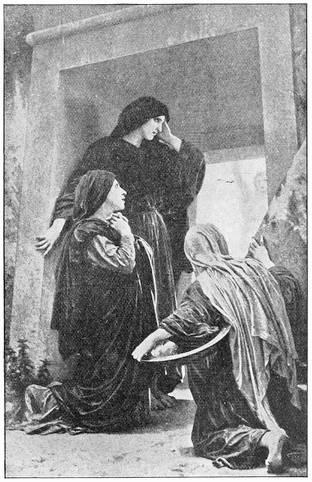
THE HOLY WOMEN AT THE TOMB.
Joseph Mallord William Turner (1775–1851) was one of the most remarkable artists that ever lived; a most original genius, “without ancestors and without heirs.” He was a landscape painter and a most earnest and faithful student of nature, as shown by his wonderful illustrations, in black and white, of the scenery of England and Wales. In his paintings, however, he interpreted rather than portrayed nature, investing his subjects with the grandeur and glory of his imagination. His pictures were “golden dreams,” revealing the beauty, the majesty, the sadness, and the terror inspired by nature, not from observed details “but from the image or ideal in his own mind.” Of his many masterworks mention can only be made here of “Crossing the Brook,” “Dido in Carthage,” “Palestrina,” “The Golden Bough,” “Hannibal Crossing the Alps,” “The Slave Ship,” “Battle of the Nile,” “Burial of Sir David Wilkie at Sea,” and perhaps the greatest of all, “The Fighting Téméraire.”
Turner created no school and left no successor, but he made a distinct impression on the art of England by stimulating an active interest in landscape painting. Patrick Nasmyth, Augustus Wall Callcott, John Linnell, and a score of artists turned to the study of rural scenery, with the result that they succeeded in establishing what is known as the Norwich school of landscape art. By far the most important name in the annals of this period, after Turner’s, is that of John Constable (1776–1837). Constable presents the contrast of diametric opposition to Turner. His pictures, so far from being “golden dreams,” are more like cast-iron realities. When Turner was an idealist, Constable was an uncompromising realist. If the one painted poetry, the other painted prose, and often very rugged, plain prose indeed. While Turner subordinated fact to fancy, illuminating his subjects with the glow of his fervid imagination, Constable devoutly stood before nature in the attitude of a worshiper, and faithfully labored to represent as truthfully as his powers permitted exactly what he beheld. In contrast with the shining canvases of his brilliant contemporary, Constable’s pictures seemed dark, dull, and heavy to the British public, and the original genius of the conscientious artist was not recognized. His greatest works, “Dedham Vale,” “The White Horse,” “The Hay Cart,” “Stratford Mill,” “Salisbury Cathedral,” “The Rainbow,” and others were exhibited in succession during the second decade of the century, before an indifferent public, only his fellow artists and a few connoisseurs caring for them, the painter meanwhile starving in neglect.
In 1824 two of his pictures were shown in Paris, and were then instantly understood and appreciated. They created a profound impression and, as has been justly said, inaugurated the second revolution of the century in the realm of art. By this revolution the artists were driven out of their studios and out of the city, to study nature in the spirit of humble sincerity shown by John Constable. Among the young students who went forth to encounter poverty, hardship, and the severest toil were the “men of 1830,” the founders of the Barbizon school of painting. Millet, Rousseau, Diaz, Corot, Troyon, Daubigny, and Dupré left Paris and the ways that then led to success, and sacrificed themselves to what they saw to be the truth in art. They carried the study of out-door nature further than ever before; created the standard of modern landscape art, and attained immortal fame, though not until their leader and prototype had perished in poverty.
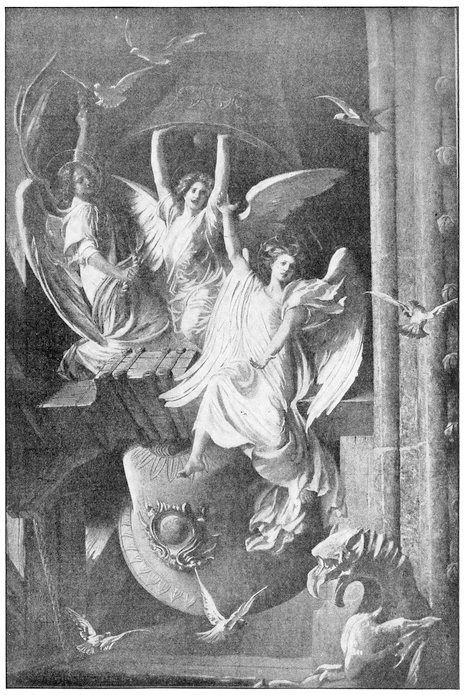
CHRISTMAS CHIMES. (BLASHFIELD.)
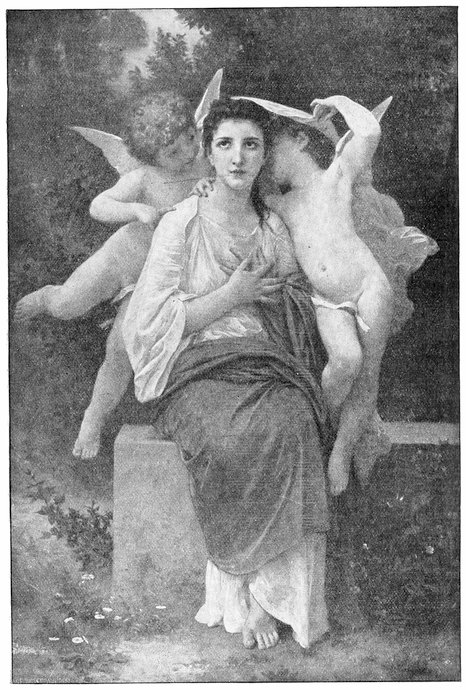
WHISPERS OF LOVE. (BOUGUEREAU.)
Jean François Millet (1815–1875) has been called the greatest painter of the nineteenth century, and his masterpiece, “The Angelus,” is regarded by many as second only to the “Sistine Madonna” of Raphael in the brief catalogue of the world’s artistic treasures. He lived the life of a poor peasant in the rural village of Barbizon, attracting around him, late in life, the ablest of the “men of 1830,” and producing there those works which have placed his name first on the annals of our time: “The Sower,” “Waiting,” “Sheep-shearers,” “Woman Carding,” “The Gleaners,” “Shepherdess and Flock,” and the few others that constitute the tale of his exceedingly careful and long-considered compositions.
Théodore Rousseau (1812–1867) was declared, by Edmond About, to be the Moses who led the landscape painters of France out of the Egyptian bondage of academic convention into the promised land of liberty, where rivers ran water, where trees were rooted in the ground, and where animals lived, moved, and had their being. As late as 1848 the Salon rejected Rousseau’s noble work, “The Alley of Chestnut Trees,” one of the finest landscapes ever painted; but this was the last act of the academic tyrants, the foolish offense against the great master causing the old classic pedants to be relegated to oblivion. Rousseau took up his residence in Barbizon, and in the forest of Fontainebleau and the adjoining country studied those rural and pastoral scenes that have given him his place as one of the first, if not the very first, of landscape painters. Of these magnificent examples of landscape art, mention can only be made here of “The Village,” “A Pool under Oaks,” “Edge of the Forest at Barbizon,” “A Forest Interior,” “Water Course at Sologne,” and “Hoar Frost,” these being the pictures best known to the public through reproductions in black and white.
If Turner was a painter of “golden dreams,” Corot was a painter of silver dreams; the pearly haze of early morning, the pale sky and misty tree-forms of a gray day, and the soft, low tones of a still, cloudy afternoon attracting his loving devotion and commanding the conscientious exercise of his skill. Jean Baptiste Camille Corot (1796–1875) was certainly one of the happiest artists that ever lived. Like the other “men of 1830,” he was ostracized by the Academy, and he was never allowed to receive the first medal of the Salon, but he had every other honor and compensation, and, late in life, was given a magnificent gold medal by popular subscription. For many years he could not sell a single picture, but, being fortunately independent, in a modest way, he continued to paint the subjects which, as he said, delighted his heart, and to treat them, as he again said, “with truth to your own instincts, to your own method of seeing, with what I call conscientiousness and sincerity.” In due time Corot conquered his world and, in the height of his career, was earning not less than $50,000 a year by his brush. He was a constant visitor at Barbizon, maintained a close intimacy with his friends, there, and studied in the vicinity many of the hundreds of landscapes his industrious and tireless hand rejoicingly produced.
Jules Dupré (1812–1889) and Charles François Daubigny (1817–1878) are distinguished members of the “1830” group, each standing at the head of the department of landscape art to which he was especially devoted. Narcisse-Virgil Diaz de la Peña, called Diaz (1807–1876), another of the fraternity, was not technically so thoroughly trained as his fellows, but he was a stronger colorist than any of them and a romanticist of the most pronounced type. Constant Troyon (1810–1865) was the most eminent cattle-painter of the century. He came on the scene after the revolt of Géricault was accomplished, but was in full sympathy with the movement, and is usually accounted as one of the revolutionists. So also with Jean Leon Gérôme (1824), an artist surviving to the close of the century.
He first exhibited in 1847, but he took up the line of Oriental romance, following Delacroix, and made so strong an impression with his illustrations of the splendors and glories of the East that his influence in art will be felt for generations to come. After attaining fame as a painter, Gérôme also developed marked ability as a sculptor.
In strict chronological order the birth of the pre-Raphaelite movement in art preceded the “revolution of 1830,” as the event actually occurred in Rome, about 1812. The movement was not originally known by the name subsequently given it, and it did not attain to more than local importance until it was fully developed in England, about 1850. It is to the great German artist, Peter von Cornelius (1783–1867), that the honor of originating the pre-Raphaelite revolution must be given. In 1811 Cornelius went to Rome and soon became the master spirit of the “Brotherhood of Painters,” popularly called “Nazarites,” banded together for the study of the thirteenth-century Italians, Cimabue and Giotto, and their successors in the century following, Gaddi, Simoni, and Orcagna. This Brotherhood was afterward imitated by Rossetti in London, and its purposes more fully developed; but it was the young German enthusiasts of the previous generation who affected a revival of the pure religious spirit, the devout simplicity, and the absolute sincerity of the Italian artists before the era of Raphael.
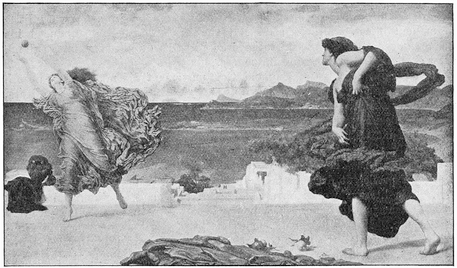
GREEK GIRLS PLAYING AT BALL. (LEIGHTON.)
Cornelius returned to Germany in 1816, became the founder of what is known as the Munich school of painting, and was made director of the Art Institute of that city. He exercised a controlling influence in the evolution of modern German art and, indirectly, on art in England and in America. His pupil and successor, Wilhelm von Kaulbach (1805–1874), imparted vitality and power to the Munich school, attracting to his classes students from all civilized countries. During the second and third quarters of this century, Kaulbach reigned as the first artist of Germany and one of the first in the world.
Dante Gabriel Rossetti (1828–1882) founded his pre-Raphaelite Brotherhood in London, with John Everett Millais—subsequently president of the Royal Academy—and William Holman Hunt, in 1848. The pre-Raphaelite movement gave a richer and stronger color to English painting in the latter half of the century, and also awakened general interest in early Christian art, that is, the art of the Italian Renaissance. Beyond this, Rossetti’s new departure, though widely advertised by John Ruskin, had very little permanent effect. Millais soon left the Brotherhood and produced his master-works, the greatest historic-genre pictures of his time, in England, after outliving pre-Raphaelite influences.
Little known outside of England, that movement did not entirely absorb British art, as proved by such a man as G. F. Watts, a master of portraiture, who made studies of many of the most notable men of the century in England, besides many imaginative works of great interest. Others were Holman Hunt, with his powerful religious conceptions, and the talented Landseer family, the youngest member of which, Edwin, is world-famous for his animal pictures. The critic and philosopher, John Ruskin, studied art and became a proficient draughtsman, although never using his skill professionally. His literary works on art, however, have had so wide an influence that it seems just to include him in the list of contributors to art’s progress in this era. His criticism of the fantastic productions of James McNeill Whistler brought forth a controversy and law suit, resulting in a verdict of damages of one farthing to the injured artist, and enough advertising gratis to secure his fame. The genius of the latter for achieving artistic effects and personal notoriety are equal to his skill in avoiding oblivion. He is a unique and interesting figure, despite his abnormal vanity, for his unquestionable talent in many lines of art, and is American by birth, English by adoption, and now French by force of circumstances. Edwin Abbey is also an adopted son of Britain, although born in America. He is better known through illustrative work in black and white, but his superb decorations in the Boston Public Library testify to his great skill as a colorist. The most illustrious growth of foreign seed on British soil has been Lorenz Alma Tadema, whose wonderful representations of Greek and Roman life place him hors concours as an artist, and hold before our eyes a mirror of ancient days. Sir Frederick Leighton, the recently deceased president of the Royal Academy, was a true Briton and a leader of modern art in England, as also was Mrs. Elizabeth Thompson Butler, with her patriotic war pictures, as vigorous as any man’s could be. A talented young artist, whose untimely death cut short a promising career, was Frederick Walker, who is said to have been the original of “Little Billee” in Du Maurier’s famous novel of student life in the Latin Quarter, “Trilby.” That masterpiece takes us into the art atmosphere of Paris, and we readily understand why there is the centre of the artistic circle.
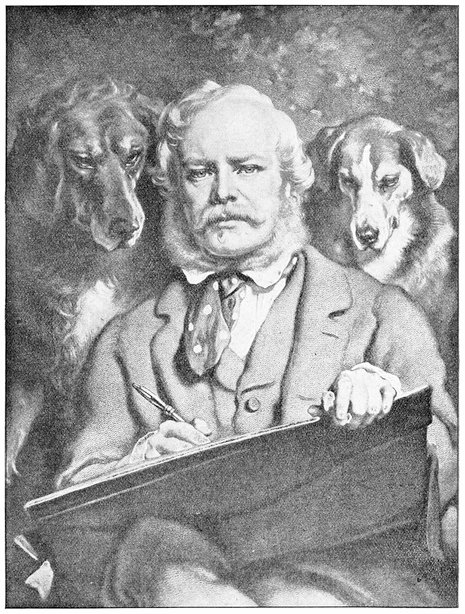
LANDSEER AND HIS FAVORITES. (BY HIMSELF.)
From thence have risen most of the great modern names, one of the greatest and most honored being that of Rosa Bonheur, who has received all possible distinction as an artist and reverence as a woman. Her animal pictures, especially horses and cattle, are known the world over, and the story of her early struggle for study, disguised as a boy, that she might work unmolested where a girl could hardly have gone, is well known, yet she never renounced an atom of her womanliness in adopting masculine attire. It is hard to avoid dwelling on the lives and works of the modern masters, but we must pass over the intermediate period between the revolt of 1830 and our own day, touching only an especially shining light here and there, such as Jules Breton, with his sturdy peasants; Léon Bonnat, Alexandre Cabanel, and Carolus Duran, with their elegant distingué portraiture. Besides these are Edouard Détaille and Alphonse de Neuville, showing faithful studies of soldier life and action; Eugène Fromentin, with his picturesque Arabs; and the decorative allegories of Puvis de Chavannes. The brilliant Spaniards, Mariano Fortuny and Don Frederick Madrazo, are practically Frenchmen in their art, although each is distinctly individual in manner. We must also mention Vibert, with his delightful little satires on the human frailities of the holy fathers of the Church, and Meissonier, the master of exquisite finish in detail, and Passini, with his small canvases crowded with Oriental figures glowing with color. In addition to the great French names of this time are Defregger, of the Munich School; Israels of Amsterdam, Schreyer of Frankfort, whose works all hold that quality dear to the popular heart, but despised by the high priests of lofty criticism nowadays, that is, they have a story to tell, and they tell it.
At the time these men were telling their artistic tales in Europe, such men as Washington Allston, the first great painter in this country; Thomas Sully, whose rare works in portraiture entitled him to paint the Queen of England, Victoria, when a girl; Henry Inman, also a great portrait painter; George Fuller, a painter of poetic dreams; and many others of talent, had said their say in America. Almost with the beginning of the new country, public interest had been roused in the fine arts by the efforts of such men as Gilbert Stuart and the Peales, Charles and Rembrandt, who bridged the eighteenth and nineteenth centuries together, and labored to advance the cause of art. Schools and academies, with adequate galleries for exhibition purposes, became necessary; and such institutions as the Pennsylvania Academy of the Fine Arts and the National Academy of Design in New York were established. The latter was started in 1802, but did not receive its charter until 1808; so the Pennsylvania Academy, which was incorporated in Philadelphia in 1806, was really the first of its kind in the country. In 1807, the minutes bearing the date of October 8 record as follows: “Until the funds of the institution will admit of opening a school on a more extended plan, persons of good character shall be permitted to make drawings from the statues and busts belonging to the Academy,” thus showing the humble beginning of art education in America. Naturally, for many years the facilities for learning were too limited to supply more than rudimentary instruction, and the pilgrimage to Paris was a necessity before an artist could feel qualified to launch out professionally. In these latter days that need no longer exists, for the great art schools of New York, Philadelphia, Boston, Chicago, and St. Louis can amply provide all that is required; but the charm of the Latin Quarter still draws as a magnet all who can afford to go there.
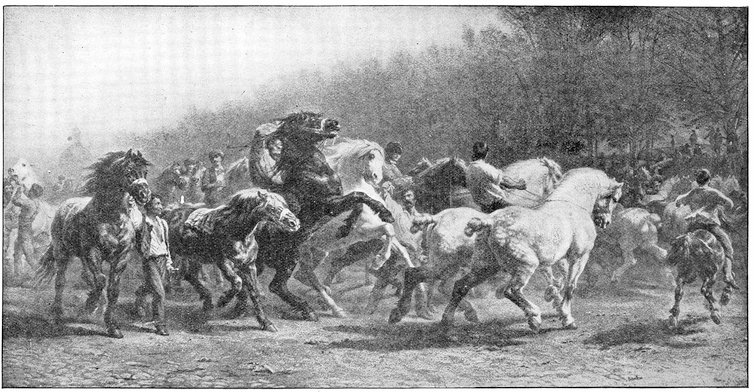
THE HORSE FAIR. (ROSA BONHEUR.)
In that centre is a constant mingling of ideas from all sources seeking new forms of expression, out of which proceed the impulses that vibrate through the world of current art. Naturally enough many of the new departures are futile experiments, short lived and not sufficiently important to discuss; but within recent years the movement known as impressionism has been so widespread in influence, so radical in method, and so vital in result, that it has doubtless produced a permanent effect on art. Like its predecessor, the renaissance after the dark ages, this mouvement moderne was an upheaval of all forms of expression; and in painting it seemed as if a wave of dazzling color had burst over the studios, drenching the canvases with rainbow tints, flooding the exhibition galleries with bewildering brilliance. The unaccustomed eye was overwhelmed, and the confused and wondering public burst into loud outcry against the insane folly of these mad young painters, who showed purple and green gridirons, speckled with green and streaked with scarlet, and called them landscapes, marines, and figure studies as they chose. Of course the pendulum swung to its limit, the radicals carrying things to extremes after the fashion of their kind, and making foolish caricatures of work that was really great. By degrees, however, sober sense prevailed, the new ideas became better understood, the public point of view changed, and it was seen that there was method in this madness. The new movement was intended simply to interpret what the artist saw most forcibly expressed by any given subject, or, as the name implies, to record his first impression and convey the idea rather by suggestion than by explicit statement and detail. Applied to out-of-door subjects, these principles were carried out by the plein air colorists, as they were styled, from their efforts to suggest atmosphere glowing with light, a feeling of space and sunshine. Edouard Manet was the leader of the new school in figure work, and Claude Monet in landscape. No two styles could be more widely different save in their mutual abhorrence of detail; the first dark, heavy, and sombre in color; the latter luminous and palpitating, every conceivable tint vibrating into harmony, an example which is followed in this country by Childe Hassam, often successfully, but sometimes with extravagance. After reaching extreme high-water mark, the flood of brilliance has somewhat subsided, and latter-day painters do not find it necessary to observe the world through a prism. While returning to more sober statements of simple truth, without trying to copy a kaleidoscope, the vision men have had of pure color sparkling with light has given them an insight into Mother Nature’s method that has left a lasting impression upon the minds and manners of the best workers and lifted the whole tone of modern painting. Whether one was prepared to enjoy truly impressionistic pictures or not, the force of them in a collection of works in the old manner of hard outline and heavy shadow could not fail to be felt like a beam of light in a dark room. However one might protest against the invader, the old friends looked dull and flat after a time, in spite of the most determined loyalty. The style of the Hudson River school was narrow and petty, full of trifling little details, the color often being forced and theatrical in effect. The striking scenery of that noble stream inspired the efforts of American landscape painters of the two decades from 1830 to 1850. Asher B. Durand was a leader among them, and for many years the manner of a generation past held sway until the new method forced a place for itself. It was an amusing experience in following exhibitions of late years to see, one after another, the leaders, long established in their own particular methods, finally breaking away from lifelong habits and coming into line with the new movement, some keeping step bravely with the vigorous newcomers, some halting along with pitiful attempts at a jaunty stride. The strong men neither hung back in sulky indifference nor flung themselves wildly about in exuberant freedom, but kept quietly on the even tenor of their way, absorbing what was best in the new, holding fast to what was best in the old, and producing the kind of work that is independent of schools and eras, but intrinsically great in itself. In Paris, the younger workers who began sending strange wild landscape and figure pictures to the exhibition at the Salon of the Champs Elysées, the most important annual exhibition in the world, were indignantly rejected by the horrified jury of selection. Equally indignant at their treatment, the young painters, who felt themselves to be the coming men, gathered their rejected treasures together in an independent exhibition of their own, and established a rival salon in the Champ de Mars, which has come to hold an equal footing in the world of art with the older institution.
By reference to “men” we do not at all exclude women, for there is no sex in art, and women of our time paint as well as men, folding equal rank in the exhibitions, equal places on the juries of selection, and receiving equal honors and awards. One of the foremost women of the day is a Philadelphian, Miss Cecilia Beaux, whose portraiture ranks among the highest. Miss Mary D. Cassatt is also a Philadelphian, although long resident in Paris, and highly esteemed there. Her name is mentioned in a recent notice of a Salon exhibition among those of distinguished men, which concluded with the words “and other strong men,” meaning thereby no grain of disrespect to the woman, but only honor to the artist, classifying her as among the first painters of the time. Important exhibitions nowadays are likely to contain strong works by many women, such as portraits by Mrs. Sarah Sears of Boston or Mrs. Rosina Emmet Sherwood of New York, child studies by Ellen K. Baker, or animal studies by Mrs. Helen C. Hovenden, widow of the late master of modern genre, Thomas Hovenden, whose untimely death the art-loving public of this country has not ceased to mourn. His faithful studies of American domestic life have touched the people, who are, after all, the final art critics, despite the claims of those who feel themselves especially qualified by taste and training to tell others what they must and must not like. Many times public opinion has been unduly slow in setting the seal of its approval on worthy works, but once established in the heart of the populace, immortality is assured, and that place belongs preëminently to Thomas Hovenden, as proved by the throngs that stood before his picture “Breaking the Home Ties,” at the World’s Fair in Chicago. That cosmopolitan collection showed, among other interesting developments, a strong school of vigorous young Norsemen, hardy vikings of art from Scandinavia, of whom Anders Zorn was the leader, with a variety of figure subjects, studied indoors and out, with an unconventional freedom and dash as inspiring as the breezes of his native fjords. Prince Eugene, the handsome popular second son of the King of Sweden, was no mean contributor to this school. Fritz von Thaulow is a Norwegian by birth, but being well recognized in France he has taken up his abode at Dieppe, although still finding inspiration in his native land. He is an exponent of the theory of tone in painting, as it is technically termed. This refers to the quality of harmony, or perfect balance of light and shade and color. It does not depend upon the key of the picture, whether light and bright or dark and sombre, but consists in keeping the relations of the different masses of color true to each other, the small details subdued to their proper places, yet each having its correct value in the whole.
The Scotch painters, stimulated no doubt by the success of their literary brethren, have established the Glasgow school of art, most original in its methods, and in some cases highly peculiar in its results, but with unquestionable strength in its more serious and less fantastic work. John Lavery is a leader among these men. Germany prides herself on one of the greatest painters of modern times in the person of Adolph Friedrich Menzel, a Prussian, born 1815, contemporary with Meissonier. As the latter was devoted to the Emperor of the French, so was Menzel to his hero, Frederick the Great, and their vivid portrayals of their respective sovereigns will keep the personality of these conquerors fresh as long as art lasts. For many years Menzel has been artist laureate to the court at Berlin, painting Hohenzollern family portraits, battle pieces and scenes of court splendor in the most masterly manner. The Hungarian, Munkacsy, has been widely known by his huge religious works, lately exhibited in this country,—“Christ before Pilate” and the “Crucifixion.” His work shows great power and much originality in conception, although often somewhat morbid, a not unnatural condition, as the unfortunate artist has become hopelessly insane. The opposite extreme of expression is to be found in the gorgeous coloring and superb compositions of Hans Makart of Vienna, notably his “Coronation of Catherine Cornaro at Venice.” A revival of interest in religious subjects has recently appeared, possibly stimulated by the work of Mr. James Tissot, a Parisian, who has given ten years to the production of a series of careful studies of the life of Christ. These little paintings, numbering some five hundred in all, are the result of close research in the Holy Land into the conditions of life and customs which prevailed at the time of Christ, and are a tribute of religious devotion. Whether through this influence or not, Dagnan-Bouveret has been inspired to paint a number of strong scenes of biblical subjects, two conceptions of the Last Supper being very powerful. A young colored man, H. O. Tanner, has achieved success on similar lines, an “Annunciation” recently shown giving evidence of deep and original thought. Curiously enough, the women painters of distinction do not seem to be given to religious subjects. One serious lack in most of the work exhibited in recent years is the absence of any importance in subject. The artists have been so concerned to express what they saw in the simplest manner, that they have carefully avoided seeing or thinking about anything but the simplest things to be expressed. While some powerful work has resulted, it has often been labor worthy of a better cause, for the pictures produced have had little to tell beyond the skill of the painter. A nobly painted cabbage field, or a superbly handled stone wall with the tail of a woman’s skirt disappearing around a corner, may be masterly painting, but it is not great art; and it is to be hoped that the day of meaningless canvases will soon pass, and the coming painters will not be content to discourse grandly about nothing.
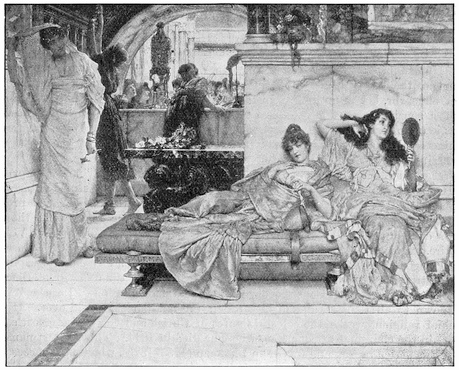
AT THE SHRINE OF VENUS. (ALMA TADEMA.)
Among the leaders of current art in America, the place of honor in portraiture belongs to John S. Sargent, who easily ranks with Boldini and Benjamin Constant in Paris. He is closely followed by Edmund C. Tarbell, John H. Alexander, with his love for long flowing graceful lines of drapery, Robert Vonnoh, and William M. Chase. John McClure Hamilton has made some striking studies of some of the most prominent people of our time, among them Gladstone and Pope Leo XIII. Elihu Vedder, John LaFarge, Will H. Low, Carroll Beckwith, Abbott Thayer, and E. H. Blashfield are figure painters whose subjects are frequently of a decorative or semi-religious character. The latter is noted for his literary as well as artistic ability. George H. Boughton, though called an American, really belongs to England, where he paints interior genre subjects usually of olden times. John Swan, the animal painter, is also English. The names of Moran and Sartain are distinguished in the history of American art, each family having contributed several generations of talented painters. The elders were contemporary with Daniel Huntington, long president of the National Academy of Design, and Eastman Johnson, whose “Old Kentucky Home” was famous. William T. Dannat, Herbert Denman, Frederick Bridgman, and F. L. Weeks are all strong figure painters, the last two being especially given to Oriental subjects. Winslow Homer includes figures with his marine studies, often presenting groups of peasants on a stormy shore, while Alexander Harrison and W. T. Richards usually confine themselves to marines pure and simple. The ragged, dirty little street Arabs of J. G. Brown have been exceedingly popular, and so have the landscapes of H. Bolton Jones. The list of modern landscape painters really deserving of mention is far too long to give in anything like complete mention. A few leaders, such as Charles H. Davis, Homer Martin, the late William T. Picknell, and George Inness must suffice to close our talk on the painters of this century.
II. SCULPTURE.
Human progress seems to advance in waves, sending forerunners to announce the gathering tide; and the ebb and flow of force is felt in all manner of endeavor, but in nothing so instantly or accurately as in the fine arts, the most sensitive and subtle forms of human expression. The plastic arts are as keen to record these changes as the pictorial, and the coming power of the nineteenth century found a few prophets in the dying years of the century passing away. Antonio Canova (1757–1822), born near Venice, left many graceful and delicately finished works. His “Three Graces” and group of “Cupid and Psyche” are well known, also his colossal bust of Napoleon and seated statue of Washington for the State of Carolina. France produced a master in Jean Antoine Houdon (1741–1828), more vigorous than his contemporaries, as seen in his powerful work, the seated statue of Voltaire. His statue of Washington, in the state capitol of Virginia, while preserving a faithful likeness, has a singular air of French elegance. Despite his strength, Houdon was not more accurate in study than the great Dane Thorwaldsen, born at Copenhagen, 1770. His famous “Lion of Luzerne” is known to all tourists, and his bas-reliefs are familiar the world over. His chief religious works, the colossal figures of Christ and the twelve apostles, are in the church at Copenhagen, where he died in 1844. The greatest name of this period in England was John Flaxman (1755–1826), who was as successful a teacher as he was a worker in his art. He was the originator of the cameo designs on the Wedgwood ware, being particularly happy in delicate reliefs. Christian Daniel Rauch (1777–1857) achieved the place of honor among German sculptors of this time by his heroic imperial monuments, of which the most important is the equestrian statue of Frederick the Great.
Although, for many generations, Rome was the Mecca of artistic pilgrims, and most of the great names have at one time or another been enrolled upon the list of students sojourning within her gates, the race characteristics of each strong mind were liable to find expression in spite of classic training; and when the mature artist brought forth his own creations independent of the touch of school or master, they were likely to present his own national tendencies of thought. Of late years, with increased facilities for studying other art centres, of intercommunication of ideas by travel and increasing duplication of works of art by various reproductive processes, the “art atmosphere” seems to have extended so as to absorb, and in a great measure obliterate, distinct lines of racial difference in manners of expression, the fundamental principles of truth being more generally sought for and applied. Thus, the unmistakably Teutonic aspect of German sculpture in the early half of this century shows in the great monument to “German Unity,” by Schilling, at Niederwald on the Rhine, and the Walhalla decorations, by Ludwig Schwanthaler, for King Louis of Bavaria. German seriousness of purpose lends a dignity of appearance, even if it becomes somewhat grandiose at times, and German painstaking accuracy perfects the technique even to the finish of small details. During the same periods, in Italy, the classic influence was more dominant where the Roman school still held sway, and delicacy deteriorated into insipidity, and finish became finical. Religious and classic subjects were most frequently produced, beside more vital work in portraits, statues, and busts. Some there were who struggled for freedom, among them Lorenzo Bartolini (1777–1850), a Florentine professor, whose group, entitled “Charity,” is in the Pitti Palace. Luigi Pampaloni achieved a surprising fame for his figures of children, one of which, from a monument on a Polish sepulchre, has been widely copied in cheap plaster under the erroneous title of “The Praying Samuel.”
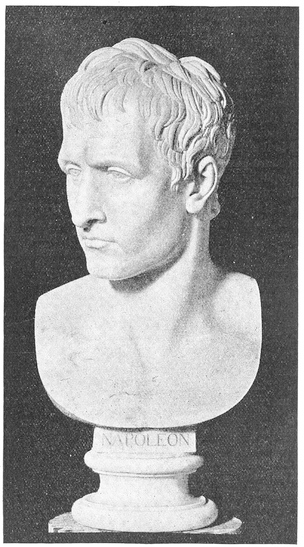
NAPOLEON I. (CANOVA.)
In France, the advance of sculpture has been more continual and consistent, the national artistic temperament finding abundant means of expression in the plastic art. The French dramatic instinct has a sure perception of the effect of a pose, the value of graceful or vigorous lines and the balance of proportion, so that whether under bonds to academic tradition in matters of technique, or broken loose and working under individual inspiration, the French sculptor is likely to create an artistic result. The minds of the common people are more awakened to artistic impressions through the general excellence of the public monuments and sculptural decorations, so freely displayed throughout the land, than are the masses in countries where art is at a low standard. Until after the middle of the century, French sculpture, like the rest, was mainly of smooth and delicate finish and inclined to be romantic, though François Rude was powerful and vigorous, as shown in his patriotic group “Le Chant du Départ” on the Arc de Triomphe. In England, the seeds of Flaxman’s sowing slowly began to bear fruit in an awakening public interest, though the earlier efforts were sedate and conventional rather than spirited, the most important works being dignified and stately monuments and memorials. Westmacott (1777–1856), Francis Chantrey (1782–1841), whose large fortune was bequeathed to the Royal Academy as the “Chantrey Fund;” John Gibson (1791–1866), a pupil of Canova; Henry Weeks (1807–1877), who made the first bust of Victoria as Queen; and Alfred G. Stevens (1817–1875), are a few of the more notable men of the past generation. Thomas Woolner (1825–1892) expressed the feeling of the pre-Raphaelite movement in sculpture, as did Hunt, Burne-Jones, and Rossetti in painting.
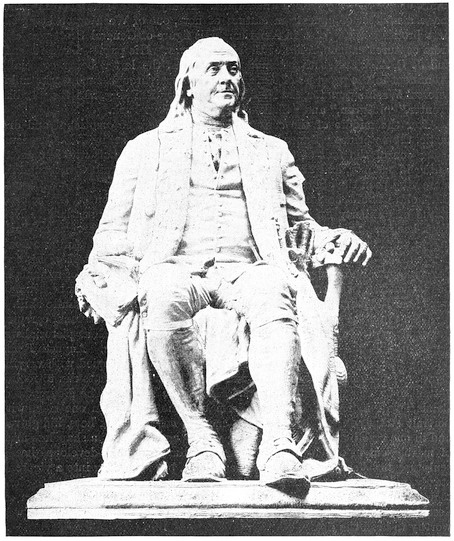
STATUE OF BENJAMIN FRANKLIN. (BOYLE.)
American sculpture began with the new century and, like most American growths, began in a very small way; for although Rush had made a few figures, notably a fountain now in Fairmount Park, one of the first pieces of sculptural work in the country was that of a poor New Jersey stone-cutter, John Frazee, who tried to comfort himself for the death of his child by making a memorial figure of him, although he had never seen a statue. From this meagre beginning started a line of ever-increasing strength, until now, in the plastic arts, as in all others, we can hold our own with the best in the world. Of course the earlier students, led by Horatio Greenough, of Boston, Hiram Powers, of Vermont, and Thomas Crawford, of New York, made their way to Rome, where they applied the traditional methods to traditional subjects with conventional results. Greenough’s colossal statue of Washington is in the Capitol grounds; Powers’s “Greek Slave” is owned by the Duke of Cleveland; and Crawford’s “Orpheus seeking Eurydice,” now in the Boston Museum, and “Colossal Liberty” in the Capitol, are his best-known works. Erastus Palmer, of Albany, contemporary with these, developed his talent at home, and secured models and subjects from his own neighborhood, giving a distinctly American character to his work. Among the most noted of the American colony at Rome, although not particularly given to American subjects, was William Wetmore Story, of Salem, Mass., born in 1819. Thomas Ball, born in the same State in the same year, was of the same class in Rome; but his themes are more patriotic, notably the “Emancipation” group in Washington. Harriet Hosmer is the first feminine name on the American list of sculptors. She also settled in Rome, where she completed many works. William Henry Rinehart and Randolph Rogers were both of the idealist school, the latter completing Crawford’s unfinished Washington monument at Richmond. The name of Rogers is more commonly connected with the familiar little statuette groups of every-day domestic scenes so appealing to the popular taste. The sculptor John Rogers, of Massachusetts, has also made a few large works, among them the equestrian statue of General Reynolds, before the City Hall, Philadelphia. Henry Kirke Browne (1814–1886) made a number of equestrian statues of note, one of Washington being the first bronze actually cast in America. His figure of General Scott was cast from captured cannon, relics of the Mexican war. His pupils, Larkin Meade and J. Q. A. Ward, both attained high places, the latter being especially prominent in the progress of American sculpture through such works as his colossal Washington for the New York Treasury Building, and his “Indian Hunter,” “Pilgrim,” and “Shakespeare,” in Central Park.
After the middle of the century, French art became emotional and dramatic, the notorious “Dance” for the Paris Opera House, by J. B. Carpeaux, being one of the first of the new utterances. Paul Dubois was less astonishing in manner, and Henri Chapu was still more restrained, although far more vital than the old conventional school. The name of Frédéric Auguste Bartholdi should be known to every American by reason of his colossal statue of “Liberty Enlightening the World,” now standing sentinel in New York harbor. This, and his figure of Lafayette offering his services to Washington, were presented to America by the French government. Antoine Louis Barye (1795–1875) was a sculptor sui generis, a law unto himself of his own development; and though he has many followers, as a sculptor of animals he has no rivals. In many branches of art he was proficient, but his best-known works are the marvelous studies of animal life, modeled with infinite skill.
When the great wave of impressionism rose and flooded the land, carrying music, literature, and the drama before it, plastic art as well as pictorial was caught up too, and whirled into a variety of strange forms. Auguste Rodin led the new movement in sculpture, his manner being copied with varying degrees of success by lesser lights, and like all new movements run to foolish extremes by incompetent followers. His heroic group, “The Bourgeois of Calais,” will indicate his style. From extreme realism on one side, with portrait statues in the last detail of modern costume, silk hats, kid gloves, and in one case holding a cigar, to the vague suggestions of a shapeless mass of marble, out of which protrude unfinished limbs and half-developed heads, sculpture has been pushed from side to side, but is settling into a vigorous, steady, onward movement, in which the best men of all nations stride along together. In the limits of a short article it is impossible to mention all deserving names, but a few will serve as types, and the Americans are well worthy to head the list.
Daniel French’s grand majestic golden figure of Liberty, towering above the Court of Honor, the imperial hostess of the World’s Fair at Chicago, placed him at once on a pedestal of fame. From the prominence of his beautiful Columbian Fountain opposite the golden Goddess, Frederick MacMonnies became known the land over. His greatest late work is the crowning of the soldiers’ and sailors’ memorial arch for Prospect Park, Brooklyn, with a colossal quadriga of Triumph and groups of the army and navy. Augustus St. Gaudens, though a cosmopolitan, is truly an American sculptor of the first rank, whose statues of Admiral Farragut in New York, Lincoln in Chicago, and the sturdy Puritan, Chapin, in Springfield, Mass., are well known. Olin Warner is another distinctively American product, although he had the advantage of some training in Paris. His work is French in technique but not French in spirit, having the native traits of freedom and originality, as shown in his figure of William Lloyd Garrison, and later in his relief portraits on the art building at the Columbian Fair. This great occasion offered opportunities to American sculptors of which they took full advantage, showing the high rank to which they were entitled. It made an American of Carl Bitter, the talented Austrian, whose decorations on the Pennsylvania Railroad Station, Philadelphia, are well known. It added further lustre to the name of John J. Boyle, whose heroic “Indian Mother” in Fairmount Park, and seated statue of Benjamin Franklin, are matters of just pride to Philadelphians. It gave prominence to such men as Lorado Taft, with his graceful work on the Horticultural Building; Philip Martiny, on the Agricultural Building; the great Columbus quadriga, by E. C. Potter and Daniel French, whose beautiful relief of “Death Staying the Hand of the Sculptor” is a masterpiece. All visitors to the White City will remember the vigorous animal studies by Edward Kemys, and the Indian figures of A. C. Proctor. The sculptural commissions of the Congressional Library in Washington have produced a remarkable collection of works by talented Americans, and every great exhibition brings interesting examples from those already named, and such others as Herbert Adams, Edwin Elwell, Bessie Potter, with her dainty little statuettes, portrait work by Charles Grafly, Catherine Cohen, C. E. Dallin, strange visionary suggestions, in the Rodin manner, by George Bonnard, and an array of lesser names too numerous to mention.
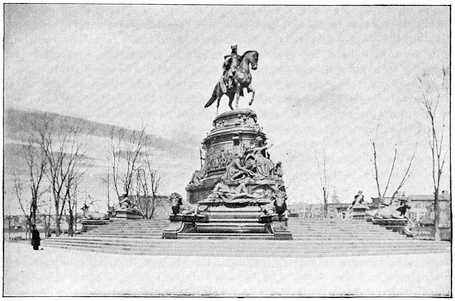
THE WASHINGTON MONUMENT, FAIRMOUNT PARK.
For this reason, but few of the notable names of modern foreigners can be given. However, Hamo Thornycroft, of England, must not be overlooked, whose famous “Mower” is much admired; nor Onslow Ford, more youthful and romantic in style. John Henry Foley, of Dublin, has had a pronounced effect on English sculpture, being a successful teacher, including among his pupils several distinguished women, among them the Princess Louise and the Earl of Elgin’s granddaughter, Miss Grant. George Tinworth’s terra cotta reliefs must conclude the list of English works. A few Russians have reached eminence, mainly by animal studies. Antocolski, a Jew of Wilna, of poorest parentage, has done powerful figure work of a serious, rather melancholy sort, the most important being a “Christ Bound.” What is best in modern Italian and German work is practically French, and of the French themselves the list is too long to complete. A few must suffice, such as Jean Alexandre Falguière, who aspires, like Carpeaux, to give vitality by means of vigorous action to his figures. Emanuel Frémiet has worn with some distinction the mantle descended from Barye’s shoulders. Vidal, another pupil of Barye, was blind for twenty years, yet gained two medals for correct anatomy in his modeling. Carrier Belleuse’s “Hebe Asleep” is an example of the delicate style, and Alfred Boucher shows the other extreme in his rendering of sturdy masculine figures, toiling or racing, striving to present in sculpture the picture of human struggle for existence, as did Millet in his paintings. These materialistic studies represent the fight for the bread and breath of life, while the impressionist contortions of the Rodin school try to suggest the conflict of emotions, good and bad, and the battle of spiritual and physical desires and development.
III. CERAMICS AND GLASS WORK.
From time immemorial to the present day men have been fashioning shapes of clay, experimenting with different kinds, different degrees of heat, and different chemical combinations to form glazes and colorings. The fundamental processes of pottery making have changed but little since prehistoric times, and wall pictures of the days of the Ptolemies show the potter’s wheel whirling much as it does at present, although, of course, many modern inventions have been made to facilitate different forms of work. In the famous Sèvres factories in France, established under royal patronage and still remaining government property, a modern device has rendered possible the making of large vases of extremely thin ware. To prevent the delicate paste of which these are made from collapsing by its own weight before it can harden, the vase or jar is moulded in an air-tight chamber, the mouth of the object sealed, and the air exhausted from the chamber, leaving the object in a vacuum. The air contained in itself is sufficient to hold up the sides until they harden and danger of collapse is over, when it can be fired. Attempts were made in vain to equal the delicacy of the Chinese egg-shell ware, when, one day an educated Chinese visitor to the factories observed the method employed, and exclaimed, “This is the way we make those cups,” and, taking a mould, he dipped it into the liquid paste, rinsed it around and emptied it at once. A thin film like a soap bubble remained in the mould, which hardened enough to form the dainty ware the workers had been trying without success to produce; so the Chinese method was at once adopted. About the middle of the last century an impetus of development in ceramic art appeared all over the continent of Europe and in England. This was probably due to the discovery, in different places, of kaolin or the fine clay of which porcelain is made, which stimulated the pottery industry and caused the establishment of many factories which are still working to-day. The Dresden works, founded in 1700, were hidden in an old fortress, and their secrets jealously guarded. After about a century they went into decay, but in 1863 were revived and reëstablished in large new buildings of their own, where dainty flowered ware is produced, which has again come into popular favor. Italian ceramics are apt to be florid and overloaded with decoration, that called “majolica” deriving its name from the island of Majorca, where it was first made. “Fayence” comes from Faenza, and the French form of the name, “faïence,” has been used to designate porcelain in general. The town of Limoges, in France, has been a centre of ceramic art since 1773, when a French firm established a factory for the production of a peculiarly fine ware, made possible by the superior quality of the kaolin found in the neighborhood. In 1839 a lady in New York showed the Haviland firm a cup of delicate ware, asking them to match it for her. It was so much finer than anything they had seen that they desired to import some for their own business. With this end in view, Mr. David Haviland took the cup and went to France trying to find where it had been made. He was directed to Limoges and, in the factories there, he tried to have English shapes and decorations copied in the exquisite ware. The conservatism and slow methods of the place were not equal to his demands, and he therefore established a factory of his own, which, since the middle of the century, has been the most important in the town.
In England, the most celebrated potteries are all over a century old, and the ceramic art has been developed to the highest degree both in technical and artistic directions. The works of the Doulton firm, who own many potteries, are particularly rich in color, and decoration, those from their factory at Lambeth being especially fine. So also are the Coalport wares, celebrated for their rich blue color, the Royal Worcester and the Crown Derby. In these English factories, and also in those on the Continent, artists of great skill are employed as decorators, and in the Wedgwood works the delicate cameo figures in white relief on a tinted ground were originated by the famous sculptor, John Flaxman. In America, the Trenton potteries turn out a vast quantity of wares of varying degrees of artistic excellence, and one factory has the secret of an old Irish ware, the Belleek, of indescribable delicacy, like an iridescent sea shell, long thought to be a lost art. The Rookwood pottery, of most artistic quality in design and color, is made in Cincinnati, and was the invention of a woman who has trained a school of girls as decorators; as has also the Tiffany firm in New York for their marvelous glass work. An adequate description of the work of this firm would fill a book, as they have developed undreamed-of possibilities in the use of glass for decorative purposes. They have revived forgotten arts of coloring and invented new processes of treatment, that give results like fairy work, no two pieces being alike. These and many other forms of industrial art products are brought to a high plane of perfection nowadays, although the word “art” is grievously abused, being applied to everything salable, from writing paper to soap. The great schools and institutions which teach the arts and industries combined are doing vast good, however, in improving public taste and teaching the world to discriminate between true art and false, and their influence can already be felt in higher standards of decoration in articles of common daily use.
IV. INDUSTRIAL ARTS.
Closely following painting comes black and white art in various forms, either reproductive or original work, and it is difficult to discriminate between fine art and handicraft in the many processes employed. Engraving on metal has long been known, and steel was considered an especially valuable method of reproducing paintings until within a generation. Etching is another old form of black and white work, and is still popular, though less so than formerly. Wood engraving during this century has passed through many stages of development, and in the illustrations of books and magazines has been brought to a high standing as a fine art. It is still used in many ways, but all those processes that require line work by hand are being superseded by the photo-type processes, of which there are many kinds. The making of plates or blocks for printing required skilled hand work, and the engravers and wood-cutters were necessarily artists themselves, so that while they were copying the work of others they were also producing works of art themselves. The plates and prints were, therefore, valuable and expensive, and, as modern haste grew more and more to demand cheap quick work, the old careful style of working gave way to mechanical methods of greater speed. With the development of photography and its application to the engraver’s art, while a certain individual artistic character in the work was lost, the actual copying of painting in all the details of light, shade, and half tones has been carried to a high degree of perfection. By what is known as photogravure, every tiny brush mark and every different tint of color is reproduced with scientific accuracy in black and white. This is accomplished by having a photograph of the painting taken on a gelatine film, which is suspended in a bath of acid in the line of an electric current. This current, playing over a sheet of copper, sets free the molecules of metal that are deposited upon the film, and filling all the little inequalities of the surface, produce what is practically a cast of the photograph in copper. The plate, thus secured, is gone over by hand and finished here and there with engraver’s tools, and from this prints may be duplicated to any extent. In engraved plates the design is cut into the metal, incised lines being either drawn by hand with a sharp point, called “dry point” work, or eaten in by acids, the remaining surface of the plate being protected from the acid by a greasy film. In wood-cutting, the blocks show a reverse process, the design being left standing in fine lines, while the remaining surface is cut away, so that a wood-cut is in reality a carving in low relief. The modern electrotype processes produce a similar result on a metal block by the action of acid, a method capable of most speedy work and therefore in demand among the multitude of daily publications illustrating current events. Of course these hasty results can scarcely be called fine art, but they are developments of artistic industries, calculated to meet certain needs of our busy civilization.
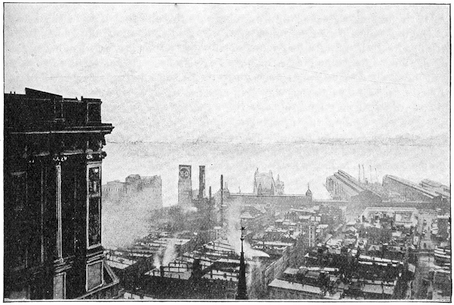
PHOTOGRAPHIC VIEW OF NEW YORK CITY AND HUDSON RIVER, TAKEN FROM 26TH STORY OF PARK ROW BUILDING.
For more artistic effects, various forms of lithography have given beautiful results. This valuable process was accidentally discovered in 1796, by a young Bohemian, Aloys Senefelder, of Prague. Desiring to write a list, and having no paper, he scrawled on a fine stone floor tile a few words, and later on, coming to remove them, he bethought him of an experiment with acid on the stone. This he tried, finding the stone eaten away all around his writing, leaving that raised in sufficient relief to print from, the lettering being done with a greasy writing substance that repelled the acid. Later experiments proved that the eating away of the stone was not necessary if the design were made with an oily material and the rest of the surface kept moist with a weak solution of acid. A greasy printing ink being applied would stick only to the oily design and not to the acidulated surface, which process made possible the printing from flat stones, which were not so liable to wear out as the relief designs. Senefelder died in 1824, living long enough to see his invention in use throughout the world, although of course he could not know the improvements that photography would bring. On the centennial anniversary of this great discovery in 1896, exhibitions of lithographic works were held in London and Paris, and the possibilities and developments shown. Mr. James McNeill Whistler has made many very interesting experiments with it, as have also Mr. Joseph Pennell and Mr. Hubert Herkomer. The latter has made innumerable experiments and inventions in his busy artistic career, and has just recently perfected an improvement on lithography which he calls “plate printing,” and which has been dubbed by the irreverent the “Herkotype” process. It is simply painting in a peculiar oily ink on a metal plate, which, while the ink is moist, is dusted over with a fine powder which adheres to every brush mark on the surface. One ingredient of this powder is a metal that is electrically conductible, and, after the excess of powder is brushed off, the plate, with what remains sticking on the oily surface, is placed in an electrotype bath. The copper deposited thereon by the electric current hardens and forms a negative of the original painting, which can be stripped from the plate and used in a printing-press, giving an absolutely faithful reproduction of the artist’s handiwork. A similar process, called “algraphy,” has been invented by Mr. Scholz, of Mayence, who has developed the possibilities of aluminum for plate work, the advantage of this material over stone or other metal being its extreme lightness. These processes are especially valuable to artists who can work in black and white, as their own original conception is perfectly reproduced without the possibility of misconception by some copyist, as exists where a painting is interpreted by an etcher or engraver.
Of the new processes or improvements on the old, that have arisen because of the discovery of photography, it may be said their name is legion. Photography itself is rapidly being developed into a fine art, and has become one of the most important factors of modern existence. It combines science, art, and industry, and is equally necessary to all these occupations. While it is difficult to state what was the first attempt that led to the suggestion of photography, it may be supposed the experiments of the Swedish scientist Scheele were among the first. He found that the action of the sun’s ray blackened silver chloride, and others experimenting after him, at the beginning of the century, had glimmering ideas of the possibility of a new art. As has so often happened with the dawning of some great idea, some new appreciation of a great natural law, the thought was working in many minds, and the discovery seemed to be almost simultaneous in several places. As early as 1802 Wedgwood published in the “Journal of the Royal Institute” an “account of a method of copying paintings on glass and of making profiles by the agency of light on nitrate of silver, with some remarks by Sir Humphry Davy.” These gentlemen were, however, unable to fix the impressions they procured, and a Frenchman, De Niepce, seems to have been the first to succeed in this direction. In 1826, learning that M. Louis Jacques Daguerre was experimenting on the same lines, he conferred with him and they formed a partnership. The latter seems to have been the more businesslike of the two, and the process they evolved became known as the “Daguerreotype.” De Niepce died in 1833, and Daguerre continued the partnership with his son Isidore, making many improvements, and becoming really the pioneer of modern photography. The extent of advance may be calculated from Daguerre’s own remark, that “a landscape requires seven or eight hours to be photographed, but a single statue or monument, if strongly lighted, can be taken in about three hours.” Comparing this with the instantaneous camera work of to-day, that gives us the lifelike moving figures of the kinetoscope, will illustrate the change wrought in two thirds of a century. The earliest portrait work was slow and tedious, the first portrait in New York probably being produced by Dr. Draper, the scientist, although the celebrated Professor Morse was vastly interested in the new science or art, and advanced its cause in this country.
From the beginning of photographic experiments, the greatest desire has been felt to photograph in color, and numberless attempts with more or less success have been made, but the processes are mainly slow and very expensive. A new method of photo-printing in color, however, has recently developed very artistic possibilities. This is accomplished by means of three plates, one for each of the three primary colors; the negative having been made and the plate prepared for printing in each color, the inks of each color are applied separately. One printing produces a red impression, directly on this comes a yellow impression, and on top of that is put a blue; and as all gradations of color are composed of various proportions of these three primary tints, the “overlaying” of the three inks produces a picture containing all the variety of the original subject. A still more recent discovery makes an impression upon a glass plate that gives all three colors on the same plate; but this process is a secret, and is too new to be classed among the successes of industrial art as yet.
One of the later and more notable uses of photography is found in its application to the purposes of astronomy, an evolution in modern science, which, although still in its infancy, has already produced wonderful results. About the middle of the century photographs of the moon were secured by Warren De la Rue and other astronomers, which greatly facilitated studies of the earth’s satellite, and these were followed by photographs of the sun and the sun’s corona during eclipse. It was not, however, until Professor Henry of the Smithsonian Institute originated the idea of uniting the camera with the telescope that the marvelous possibilities of stellar photography were discovered. It is not too much to say that this discovery has revolutionized the science of astronomy, extending the field of human observation into the realm of the infinite. By the aid of clockwork attachments, the telescope is made to follow the apparent motion of the star to which it may be directed, throughout the night, if desired, and the sensitive photographic plate is exposed to the action of light during a corresponding period. “Each image, however faint, has a comparatively long time on the sensitive surface, and therefore exerts a cumulative action.” The result is that stars are pictured by the camera which no human eye has ever seen. It is estimated that the camera has revealed double the number of stars discovered by the most powerful telescopes. In 1887, at a convention of astronomers held in Paris, it was resolved to photograph the entire skies, with the purpose of making a new stellar atlas to include the latest discoveries among the heavenly hosts. With this object the firmament was charted in squares, and each observatory of importance throughout the world was assigned certain of these squares to work on. This monumental labor is still going on, and it will necessarily be extended well into the first quarter of the twentieth century.
The epoch-marking paper of Dr. Röntgen, in which he announced the discovery of the X-ray, was made public in the latter part of 1895. It immediately attracted the attention of the scientific world, and, since that date, endless successions of experiments have been made with the marvelous ray in all civilized countries. The X-ray produces no noticeable effect on the retina of the eye, and we therefore acquire knowledge of it through indirect agencies. One of these agencies is the photographic plate, on which, under certain conditions, the ray acts somewhat in the same manner as does a ray of light. It is not a ray of light, in the ordinary sense, as it penetrates opaque bodies which light cannot traverse. Just what it is scientists are not yet ready to state, but its discoverer defines it as “a longitudinal vibration of luminiferous ether.” This vibration will traverse many substances opaque to light, as wood, paper, vegetable and animal tissues and fabrics, as wool, cotton, silk, etc.; and, if then directed upon a photographic plate, will produce an image there. The resulting picture is not of the object traversed by the ray, but of any intervening object which it does not pass through. As a consequence, the picture is the image, so to speak, of a shadow, and, hence has been called a “shadowgraph.” To illustrate, if the ray is directed through a human body, it will give a “shadowgraph” of the bones, or of a bullet or piece of metal, if such foreign substance be encountered on its way. Again, the ray will traverse a diamond and cast no shadow, but it will not pass through the finest imitation ever made, the “shadowgraph” showing the manufactured article.