EVOLUTION OF THE RAILWAY By E. E. RUSSELL TRATMAN, C.E., Assistant Editor of “Engineering News,” Chicago.
Reading edition
The railway as a means of rapid transportation and general intercommunication is one of the most important factors in the development of modern commerce and civilization, and, after reviewing what it has done and become in the nineteenth century, one cannot help wishing for the opportunity to review the railway wonders of the twentieth century.
While the history of the railway dates back far beyond the nineteenth century, yet the railway, as we know it to-day, is essentially a product of this century. It dates, in fact, from England in 1830, when the Liverpool & Manchester Railway, 31 miles long, was opened, and was operated from the beginning by steam locomotives. The Stockton & Darlington Railway, 37 miles, was opened in 1825, but this line was intended only for private coal traffic, while the other line was built for general passenger and freight service, and for the use and benefit of the public.
The United States followed this lead very closely. In 1828 the Delaware & Hudson Canal Company built a line from its mines to its canal at Honesdale. This was a private coal road, however, and may best be compared to the Stockton & Darlington Railway. The first public railway operated by steam was the Mohawk & Hudson Railway, from Albany to Schenectady, 16 miles, which was opened in 1831. The Baltimore & Ohio Railway was the first railway enterprise of more than local character, being designed to open communication with the Ohio River, a distance of 400 miles. It was chartered in 1827, commenced in 1828, completed to Ellicott’s Mills (13 miles) in 1830, and to Washington (40 miles) in 1834. It is one of the great monuments of the American railway system, and it was examined by government commissions from Russia and Austria in 1831 and 1849.
In speaking of the railway we unconsciously associate with it the steam locomotive, since the two are so entirely interdependent. Railways operated by horses, or by cables and stationary engines, could never have become the great civilizing and commercial medium which the railway operated by swift locomotives has become. Similarly, the development of the locomotive grew apace, as soon as it was recognized that the smooth track of the railway—and not the rough track of the highway—was to be its field of operation.
At the end of the nineteenth century, after seventy years of development, the world has nearly 500,000 miles of railway, on which locomotives of 80 to 110 tons in weight (without their tenders) haul freight trains of 1000 to 3000 tons. Passenger trains, too, are run at speeds of 40 to 75 miles per hour in regular daily service, and even make bursts of speed at 80 to 100 miles per hour. The fact that in 1890 Europe and North America had about 320,000 miles of railway out of a grand total of 370,000 miles, indicates that this phase of nineteenth-century progress has been due mainly to peoples of Christian civilization, and besides this, it must be remembered that the railways of Asia, Africa, Australia, and South America have been mainly built by the same peoples. The central regions of these four latter geographical divisions are fields for twentieth-century development.
The great trunk lines of railway communication are hardly more important than the vast network of branch and minor lines which connect and intersect them. These latter lines bring the people of smaller towns and country districts into closer relation with the large cities, the centres of industrial and intellectual energy, enterprise, and wealth. They thus tend to reduce isolation and dependence upon purely local resources.
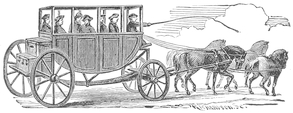
THE OLD STAGE COACH.
Railways also serve important military and strategic purposes. In India many of the railways have been built with a view to the defense of the northeastern frontier, and many European governments assume certain military authority over the railways. The first trans-continental railways of the United States and Canada were largely assisted by government subsidies on account of their great importance for the transportation of troops. The railway also serves purposes of pleasure, as well as of commerce and war. Not only do the ordinary railways carry much tourist and pleasure travel, but lines are built exclusively for such travel. Some of these take people to the summer and pleasure resorts, while others cater to the inherent desire of man to ascend great altitudes and to behold the world in its beauty and grandeur spread below them. For this purpose alone have railways been built to the summits of the Rockies, the Alps, and other mountain ranges.
At the end of the century the United States has about 185,000 miles of railway, which have cost about $53,000 per mile and earn $6500 per mile. Great Britain has about 22,000 miles, which have cost $225,000 per mile and earn about $20,000 per mile. A large proportion of this high cost of construction is due to the high prices for land and to the preliminary parliamentary proceedings which are necessary in securing the right to build railways. The average cost per mile of railways in different countries is as follows:—
United States $53,000
India 75,000
Japan 92,000
France 100,000
Germany 101,500
Switzerland (ordinary) $119,300
Do (mountain) 162,500
Russia 122,000
Austria-Hungary 125,400
Great Britain 225,000
One of the great economic purposes of railways in new countries is to reduce the cost of rapid transportation in bulk far below that of slow transportation in small quantities. Train speed is a matter of secondary importance in such cases, the traffic accommodation and capacity of the slowest train being far beyond that of road or canal transportation. Traffic will be served better and at much less cost by being carried in bulk on 500 miles of railway at 10 miles per hour, than on 100 miles of railway at 35 miles per hour, and then in small lots on wagons or canal boats at 3 miles per hour for 400 miles.
The advantages of the rapid transportation of perishable freight by rail, especially in regard to food supplies for cities, were early recognized, and by 1854 the trains brought car-loads of country milk into London every day. Previous to this, the supply was obtained from cows kept in stables, which was an unsanitary and expensive plan. Another immediate result of railway service was that people began to live farther out of the towns, and then began the growth of the suburban residence districts, which are such a feature of modern cities and city life.
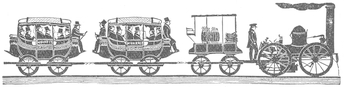
FIRST TRAIN OF STEAM CARS.
The early railways were built merely as local lines, and there was little idea of their ultimate connection or extension. These small individual lines, however, with their own rate-making powers and systems of management, have been consolidated into great systems, thus effecting material economies and facilities in operation. Thus the Mohawk & Hudson Railway of 1831 was the first of a series of lines now consolidated to form the New York Central Railway; while the Liverpool & Manchester Railway of 1830 was the beginning of what is now the London & Northwestern Railway system. Not only is there this consolidation, but also a most comprehensive system for the interchange of traffic between different systems. Thus passengers can purchase through tickets and travel through from Paris to St. Petersburg, or from Boston to San Francisco, while freight cars can be sent through in a similar way. This is really a wonderful feature of railway development. The following are a few examples of the great railway systems of the world:—
Railway. Miles. Loco- motives. Passenger Cars. Freight Cars.
Pennsylvania (U.S.A.) 8882 3594 3847 146,060
Chicago & Northwestern (U.S.A.) 7996 1380 1176 49,484
Chicago, Burlington & Quincy (U.S.A.) 7462 1205 936 40,720
Atchison, Topeka & Santa Fé (U.S.A.) 7120 1036 655 29,837
Great Western (England) 2576 1837 6201 53,156
London & Northwestern (England) 1912 2851 8446 65,456
Paris, Lyons & Mediterranean (France) 5594 2624 5837 87,320
Western (France) 3464 1492 4378 26,487
Mediterranean (Italy) 3568 1314 3706 23,077
Northwestern (India) 3371 602 2121 10,312
In some countries the government owns and operates all, or nearly all, of the railways, as in Germany, Belgium, and the African and Australian colonies. Switzerland, in 1898, decided that its government should acquire the railways. In Holland and Italy the government owns the railways, but leases them to operating companies. France, Brazil, and the Argentine Republic have both state and private lines, with a greater or less degree of state assistance and control of the latter. In Great Britain the railways are owned entirely by private companies, but their operation is subject to government supervision in the public interests. In the United States there was at first almost absolute freedom of construction, but the consequent abuses and financial disasters, owing to unnecessary lines and cut-throat competition, have led some of the States to wisely exercise some degree of control over railway affairs. The interference of the federal government in railway affairs has been slight but important. In 1862 it aided the construction of the first transcontinental railway; in 1887 it passed the act for the regulation of rates, etc., in interstate traffic; and in 1893 it passed the act making compulsory the use of power brakes and automatic couplers on freight cars.
Government ownership and operation of railways is rarely satisfactory from a financial or a traffic point of view, but, on the other hand, an absolutely unrestricted railway element is liable to become a serious evil. The best system is undoubtedly that in which the railways are owned and operated by private enterprise, but subject to state supervision, like steamships, factories, etc. It must not be forgotten, however, that private enterprise is not always available. In Russia, for example, the development of railways would have been but slow on such a basis; and in India, government backing was needed to induce British capitalists to enter the field. It is unfortunate for China that neither the government nor the people have been competent or enterprising enough to deal with the railway question. The present system of development by rival interests of various nationalities seems almost certain to lead to the eventual dissolution of the empire and its partition among other nations, as Africa is already in large measure partitioned.
In the United States railway construction has gone by leaps and bounds, and there is now a vast network of lines,—main, secondary, branch, and local. The highest records of construction within the past twenty years were 12,800 miles built in 1887, and 11,600 miles in 1882, while the lowest record was 1750 miles in 1896. The growth from 1886 to 1899 has been as follows, the relatively small increase in number of locomotives being due to the greater power of modern engines:—
1886. 1899. Increase, per cent.
Mileage 133,600 185,000 88.47
Tonnage carried 482,000,000 780,000,000 62.00
Number of cars 871,500 1,330,000 52.61
Number of locomotives 26,400 36,000 36.30
Perhaps the railway of most recent interest is the first line in Alaska, which is twenty miles long, and was built as a result of the rush to the Klondike gold fields. This was opened on February 20, 1899. The great transcontinental railways, however, are of much broader interest. In 1835 the Rev. Samuel Parker, a missionary in the Northwest, suggested a railway from the Atlantic to the Pacific, and Dr. Samuel E. Barlow proposed one from New York to the Columbia River, 2000 miles, to cost $10,000 per mile, and to carry traffic at about seven miles per hour. From 1844 to 1849 Mr. Asa Whitney urged Congress to grant land to aid him in building a line from Lake Michigan to San Francisco, 2030 miles, to cost $20,000 per mile. Between 1853 and 1861 Congress had surveys made of five routes, but no definite action was taken until after the outbreak of the Civil War, in 1861, when the federal government soon recognized the importance of having direct communication with the Pacific States, which were at that time isolated. Companies were organized in 1862, and work commenced in 1864, under government subsidies and military aid and protection. On May 10, 1869, the Union Pacific Railway (from the east) and the Central Pacific Railway (from the west) met at Promontory Point, Utah, 1186 miles from the Missouri River and 638 miles from Sacramento, Cal.
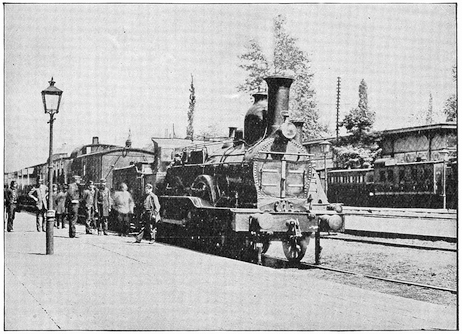
A RAILWAY TRAIN IN BELGIUM.
Now, thirty years later, we have six so-called transcontinental railways, no one of which, however, has its own line from ocean to ocean, and none of which run through trains or cars. In Canada, however, the Canadian Pacific Railway (opened in 1887) has a through line from St. John and Montreal to Vancouver, with through trains daily between the latter points, 2905 miles. The principal transcontinental lines, with the total distances from ocean to ocean, are shown on the following page.
Railway. Opened. Route. Length. Total Distance.
1. Canadian Pacific 1887 Montreal to Vancouver 2905 2905
2. Great Northern 1893 St. Paul to Seattle 1827 31576
3. Northern Pacific — St. Paul to Tacoma 1912 3242
4. Union Pacific 1869 Omaha to San Francisco 1928 3340
5. Union Pacific — Omaha to Portland 1823 3235
6. Atchison, Topeka & Santa Fé — Chicago to San Francisco 2577 3497
7. Southern Pacific 1883 New Orleans to San Francisco 2489 41646
Of the various completed and partly completed interoceanic railways across Central America, the most important by far is the Panama railway, in Colombia, 47½ miles long. This was opened as long ago as 1855, and was originally intended as a link in a route between New York and San Francisco, 5450 miles. In South America there are few railways of great importance, and the interior yet remains undeveloped, with the exception of the great plains of the Argentine Republic. A transcontinental line between Buenos Ayres and Valparaiso, 850 miles, is nearly completed, but work has been stopped for some years, leaving 50 miles yet to be built at the summit of the Andes. An interesting, but as yet visionary, scheme is that for an intercontinental railway through Central and South America. The distance from the southern frontier of Mexico to Buenos Ayres would be 5500 miles. About 1280 miles of this are built, but comprise many small lines which would have to be rebuilt. The total cost would be about $220,000,000, at a low estimate, and the total distance from New York to Buenos Ayres would be 10,300 miles by rail.
In Europe there is a vast and comprehensive network of railway lines, but the distances are less, even St. Petersburg and Constantinople being but about 1600 and 1800 miles from Paris. While the development of railways has been remarkable, the most striking features are the lines which cross the Alps to connect the interior with the Mediterranean ports. The first of these was the Semmering railway, on the route between Vienna and Trieste (1854). The Mont Cenis railway (1867) was mainly a surface line, with heavy inclines operated on the Fell grip-rail system. Its route followed the great carriage road built by Napoleon in 1803–10. The railway over the Brenner Pass was opened in 1868; in 1871 the Mont Cenis tunnel superseded the high-level line, and in 1880 the Great St. Gothard railway was opened. This was followed by the Arlberg railway in 1884, and the Simplon railway is now under construction.
Europe has the only railway within the Arctic Circle. It runs from Lulea, on the Gulf of Bothnia, northwest to the Gellivara iron mines, 44 miles within the circle. As the port is closed by ice during the winter, the line is to be extended to the Atlantic coast at Ofoten, 69° north latitude, where the influence of the Gulf Stream keeps the ports open. This end of the line will be 130 miles north of the Arctic Circle.
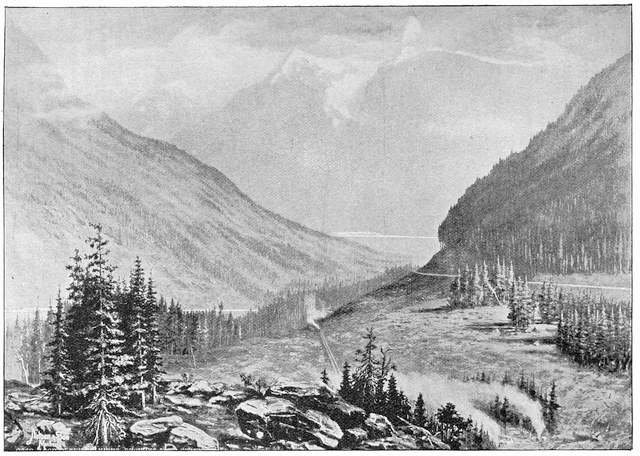
LOOP IN THE SELKIRKS, SHOWING FOUR TRACKS.
The countries of Asia (with the exception of India) are but scantily supplied with railways. Even Palestine—the Holy Land—has, however, been invaded, and has now two railways. One of these is from Jaffa (the biblical Joppa) to Jerusalem, 54 miles (1892); the other is from Beirut to Damascus, 70 miles. British interests have long advocated an “all-rail-to-India” project. The line would start opposite Constantinople, pass down the Euphrates valley, across Persia, and along the coast of Baluchistan to Kurrachee, connecting there with the Indian railway system. This great system aggregates 25,000 miles, and extends up to the Bolan Pass and the Khyber Pass, on the Afghan frontier. Southward, it has been proposed to connect with the Ceylon railways by a line of bridges and embankments along the reefs and shoals known as Adam’s Bridge.
Owing to the vigorous opposition of the government and people, China has but 350 miles of railway to its 4,200,000 square miles and its population of 420,000,000. Many lines are projected, but are all in the eastern portion, and the twentieth century will be well advanced before the railway opens up the heart of the country to civilization. Japan, the very opposite of China, has encouraged railway construction, and now has 3000 miles of railway to its 147,600 square miles and its population of 45,000,000.
The most notable of all the railways in Asia is the great Trans-Siberian railway, now being built by the Russian government. It was commenced in 1891, and may be completed by 1903, the distance from St. Petersburg to Vladivostok, or Port Arthur, being then about 5670 miles. There are several large cities on the route, and the line does not pass through such a wild and uninhabited country as that through which the Union Pacific Railroad was built thirty years ago. It is now open to Lake Baikal, the trip of 3230 miles being made in about 12 days by the slow train, or 8 days by the less frequent fast train. The road is roughly and lightly built in many respects, so that high speeds cannot be maintained. The eastern end of the road will pass through Chinese territory, thus giving Russia a firm foothold in that empire. Hardly less interesting is the Trans-Caspian railway, from the Caspian Sea to Samarcand, 885 miles, with a branch from Merv to within 95 miles of the Afghan city of Herat. An extension to the Persian Gulf is also projected. As the Trans-Siberian railway has developed a new wheat-growing region, so the Trans-Caspian railway is developing a new cotton-growing region.
In Africa the railways already extend northward from Cape Town, through the land of the Boers and up to Buluwayo, the old Zulu stronghold, 1400 miles. There is a picturesque project for carrying the line on to the Mediterranean, a total distance of 5500 miles, but this will not materialize for many years. The Congo railway, passing the rapids, opens communication between the coast and a long stretch of inland navigation. Several lines are being pushed from the east coast into the interior, and a transcontinental railway from St. Paul de Loando, on the west, has been commenced, but there is not now much life in this latter project. The French have two favorite schemes for railways,—from Algeria to Timbuctoo, and from Tunis to Lake Chad, the latter line being about 1600 miles in length.
In Australia, the lines of the different colonies are gradually extending and connecting to form a continuous system, which is hampered, however, by differences of gauge. There is railway communication between the capitals of Queensland (Brisbane), New South Wales (Sydney), Victoria (Melbourne), and South Australia (Adelaide). The great stretch westward to the coast cities of Western Australia is yet in the future, as is also the South Australian transcontinental line from Adelaide northward across vast deserts (already crossed by the telegraph) to Palmerston.
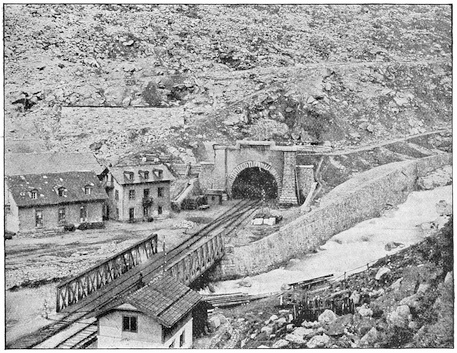
ENTRANCE TO ST. GOTHARD TUNNEL, SWITZERLAND.
Great bridges and tunnels are among the prominent features of the railways of the world, but space forbids entering into details of these works. They are in principle similar to those required for highways, but many of these great works would never have been undertaken for such traffic as is carried by a highway. The only railway suspension bridge ever built was the Niagara bridge, opened in 1855, and replaced by a steel arch in 1898. The development of bridges and traffic may be judged from the fact that the Victoria single-track tubular bridge over the St. Lawrence, at Montreal, which was opened in 1859, was replaced in 1897–98 by a double-track railway and roadway truss bridge on the same piers. The steel arch bridge, 1700 feet long, across the Mississippi, at St. Louis, cost $5,300,000. The tubular bridge, 6592 feet long, over the St. Lawrence, at Montreal, Canada, cost $7,000,000. The cantilever bridge, 8925 feet long, over the Firth of Forth, Great Britain, cost $13,000,000. The cost of the proposed suspension bridge, 3000 feet long, over the Hudson, at New York, is estimated at $13,000,000. The first railway tunnel was the Portage Tunnel, in Pennsylvania, built in 1831. The longest railway tunnel is the Simplon, in Switzerland. It is 12.25 miles in length, and is still under construction. The next longest is the Gothard, Switzerland. It is 9.30 miles long, and was opened in 1881.
In track construction, cast-iron rails began to be superseded by wrought iron in 1820, and many of the early American railways had strap iron laid on timber stringers. Within the past twenty years steel has been used almost exclusively. In place of rails weighing 25 to 35 lbs. per yard, and 3 to 15 feet in length, we now use rails of 80 to 100 lbs. per yard, 30 to 60 feet long. Stone blocks and wooden ties were first used to support the rails, and the latter are now generally used, although metal ties are extensively used and date back to 1846. In 1894 there were thirty-five thousand miles of railway laid with this form of track. The next development will probably be a permanent and continuous concrete bed for the rails; as the present construction, with wooden ties laid in stone or other ballast, requires continual attention and repair under the effects of heavy traffic.
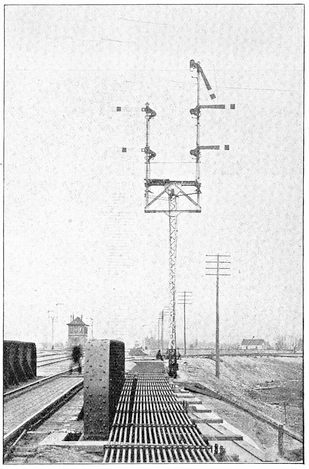
RAILWAY SIGNALS.
The semaphore signal was introduced in England by Mr. C. H. Gregory in 1841, and is now used in all parts of the world, to govern and protect train movements. The first interlocking plant was erected in 1843, and the complete plants—as used to-day—date from 1856. Now, practically all important junctions are equipped with interlocking plants, which prevent conflicting signals and switches being so set as to lead to accident. The electric telegraph was patented by Cooke and Wheatstone in 1837, and in 1839 they secured its introduction to govern the train service on the Great Western Railway (England). The movements were telegraphed from station to station, and a train was not allowed to leave a station until the preceding train had passed the next station in advance. This was the beginning of the “block system,” which is a great element in the safe operation of traffic, since it maintains an interval of space between trains. Mr. Edwin Clark’s telegraph block system was introduced in 1853, and as traffic increased intermediate block signal stations were established between the regular stations, so as to shorten the distances between trains. This system is compulsory in Great Britain and is already largely used in the United States. It was at first held that it was not adapted to conditions in this country, where so many lines have but a single track, but experience has shown that it increases the facility as well as the safety of operating traffic on single and double track lines alike.
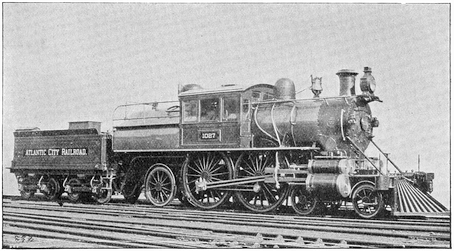
AN AMERICAN EXPRESS LOCOMOTIVE.
Steam locomotives were used on colliery railways in England as early as 1804, when Trevithick built an engine, which was the first to haul a train on rails. George Stephenson built his first locomotive in 1814, and in 1825 built the “Locomotion” for the Stockton & Darlington Railway. Horses, stationary engines, and steam locomotives were all proposed for the Liverpool & Manchester Railway, and in 1829 the directors offered a premium of $2500 for the best locomotive. Each engine was to consume its smoke, weigh about 6 tons, cost not more than $2750, and be capable of hauling a train of 20 tons at 10 miles per hour. This led to the now historical trials at Rainhill, in October, 1829, between the “Rocket” (Stephenson), the “Novelty” (Braithwaite and Ericson), and the “Sans Pareil” (Hackworth). The award was made to the “Rocket” as the most practicable machine, although the “Novelty” attained a higher speed, and the “Sans Pareil” was also a good engine and continued in use for several years. Seguin introduced the locomotive in France in 1827, having modified and rebuilt an old Stephenson engine.
The first locomotive operated in the United States was the imported “Stourbridge Lion,” on the Delaware & Hudson Canal Co.’s line, in 1829. Cooper’s “Tom Thumb” was run on the Baltimore & Ohio Railway in 1830, and in 1831 the directors of this road offered premiums of $4000 and $3500 for locomotives. Each engine was to weigh not more than 3½ tons, to have four wheels, and to haul loads of 15 tons at 15 miles per hour for 30 days. Five engines were presented, by Davis, Costell, Milholland, Childs, and James. The prizes were awarded to the first two, the Davis engine “York” being rebuilt under the direction of its inventor and Mr. Ross Winans, while the “Costell” was put in switching service. In 1831 the “John Bull” was built by the Stephensons in England, and was put in service on the Camden & Amboy Railway (U. S. A.) in the same year. In 1893 this old engine was readjusted and ran from New York to Chicago, 912 miles, under its own steam, hauling two cars of the type of 1836.
In 1898 there were about 19,500 locomotives in Great Britain and 36,500 in the United States. As a comparison between the little engines of early days and the huge and swift engines of to-day, it may be stated that modern passenger locomotives are now constructed with as many as six driving wheels, and ten wheels in all. Some of those in use on the Great Northern Railway, Great Britain, have driving wheels of 97 inches in diameter. On the Fitchburg Railway, U. S. A., locomotives are in use which weigh 75 tons. Some modern freight locomotives have as many as ten driving wheels, and twelve wheels in all, and a total weight of 115 tons.
Since the application of electric traction to street railways, it has frequently been said that it would eventually supersede the steam locomotive. In no instance, however, has it yet been applied to regular railway service, with heavy trains and long runs, nor is there yet any indication of increased economy or efficiency due to its use in such service. It is successfully used for local and suburban lines, but these form a class in themselves, and the conditions of operation are very different from those which obtain in ordinary service. The Baltimore & Ohio Railway has some heavy electric locomotives, but these are for hauling trains through a tunnel, to avoid the trouble and discomfort from the smoke and gases from the steam engines.
The early passenger cars were either open cars with cross seats, or had coach bodies on four-wheel platform cars. The coach-body cars on the Mohawk & Hudson Railway, in 1831, were 7 ft. 4 in. long and 5 ft. wide. In 1836 the American type of car was introduced on the Camden & Amboy Railway, having a long body mounted on two four-wheeled trucks. These cars seated 48 passengers, and cars for 60 passengers were in use in 1839, their cost being $2400. American day cars are now 60 to 80 ft. long, seating 60 to 84 passengers, and weighing from 30 to 47 tons. The standard day car of the Pennsylvania Railway is 60 ft. 7 in. long over all, and seats 66 passengers. Dining and sleeping cars weigh from 45 to 65 tons, much of the weight being due to the special equipment for the comfort and convenience of passengers, and consequently so much dead weight to be hauled. It can be said without dispute that in no other country have the railways done so much for the comfort and convenience of their passengers, and have charged so little therefor.
In Europe, the cars developed into the compartment system, with side doors, there being high transverse partitions with seats on each side, so that in a full compartment half the passengers must ride backward. The cars are usually short, with two or three axles, but about 1872 the American system of mounting cars on trucks was introduced, and longer cars on trucks are now somewhat extensively used. Within later years corridor cars have been introduced, with a corridor connecting the compartments. Such details as steam heat, toilet arrangements, ample light, luxurious finish, etc., which have long been a matter of course in this country, are quite “end of the century” improvements in Europe, and generally below the standards observed in this country.
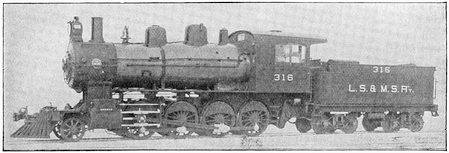
AN AMERICAN FREIGHT LOCOMOTIVE.
Sleeping cars were used on the Cumberland Valley Railway (U. S. A.) in 1836. In 1856, Mr. T. L. Woodruff built a sleeping car, and in 1857 two were built by Mr. Webster Wagner and operated on the New York Central Railway. Mr. George M. Pullman began his experiments in 1859, and in 1864 he put in service on the Chicago & Alton Railway the first sleeping car with the berth arrangements now almost universally used. He pushed the business more vigorously than his predecessors and acquired many of their patents. The Pullman Palace Car Co. was organized in 1867, and in 1879 its various works were all concentrated in a new industrial town—called Pullman—near Chicago. In 1898 the company owned 2,428 cars, which were operated on 121,236 miles of railway, ran 190,562,758 miles, and carried 4,852,400 passengers. Most of the cars are in the United States, but some are in Europe and Australia. The Wagner Palace Car Co. owns 560 sleeping cars and 143 parlor cars. In Europe most of the long distance sleeping and dining car service is operated by the International Sleeping Car Co., which runs cars between Paris and Constantinople (72 hours), Paris and St. Petersburg (120 hours), Calais and Brindisi (25 hours).
Passenger cars are now usually lighted by oil, the mineral oil used in America being superior to the vegetable oils commonly used in Europe. Oil gas, compressed in tanks, is very extensively used, and gives an excellent light. The system was invented by Mr. Julius Pintsch, and was introduced in Germany in 1873, and in the United States in 1881. It is now applied to about 85,000 cars in 22 countries; 32,000 of these cars being in Germany, 17,000 in Great Britain, and 15,000 in the United States. The electric light is as yet used only on a few of the finest express trains, the current being generated either from a steam engine and dynamo in the baggage car, or from a dynamo on each car, driven from one of the car axles. Storage batteries maintain the light when the cars are at rest. American cars were heated by stoves at a very early date, and this developed into the hot water system, with a stove and circulating pipes in each car. Steam from the locomotive, however, is now generally employed, and its use is compulsory in some States. In Europe the passengers have to rely largely upon their own wraps and rugs.
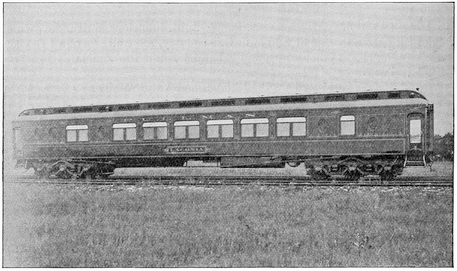
EXTERIOR OF LATEST SLEEPING CAR.
In American freight cars, great improvements have been introduced, increasing the carrying capacity while reducing the weight. The capacity has been increased from 10 tons of load in 1870, to 30, 40, and even 50 tons in 1899 (an increase of 300 to 500 per cent). The weight has increased only from 10 to 15 or 17 tons (or 50 to 70 per cent). Cars are now being built entirely of steel, and while their first cost is greater, the cost per ton and the expenses of maintenance are less than for wooden cars of similar capacity. As sleeping, dining, parlor, tourist, and other special cars have been introduced for passenger traffic, so refrigerator, stock, horse, fruit, poultry, and furniture cars have been introduced for special requirements in freight traffic. In other countries, however, the use of such special equipment is much more limited. The ordinary foreign freight cars are the same as those of 30 or 40 years ago, being short four-wheel cars, weighing 5 tons, and carrying 8 to 10 tons. These are not well adapted to the handling of bulk freight, and greatly increased economy and facility in such traffic would result from the introduction of the American system, as has been done in Australia. In modern American practice, too, the cars are equipped with automatic couplers and power brakes, thus greatly increasing the safety and facility of operating heavy fast trains. In 1893, Congress passed a law requiring that by January 1, 1898, all freight cars should be equipped with automatic couplers and enough cars equipped with power brakes (operated from the engine) to put the trains entirely under the control of the enginemen. The date was afterwards extended to January 1, 1900.
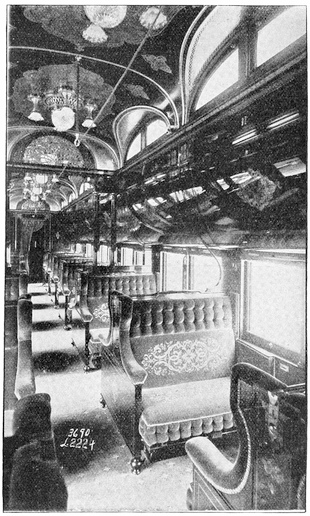
INTERIOR OF A PULLMAN SLEEPING CAR.
As the speed and weight of trains increased, the dangers due to lack of brake power soon became alarmingly apparent, and numerous forms of continuous brakes were devised, to be applied to the wheels of every car, under the control of the engineman. In 1889, the British government passed the Railways Regulation Act, making compulsory the use of the block system, the interlocking system, and continuous brakes. In England and some other foreign countries, the vacuum brake (introduced about 1871) is largely used, but it is slower in action than the compressed air brake, and is therefore less efficient for long, heavy, and fast trains.
The Westinghouse brake is one of the most important factors in the safe and efficient handling of heavy and fast trains. Mr. George Westinghouse patented his straight-air brake in 1869, his plain automatic brake in 1872, and his quick-action freight train brake in 1887, while in 1892 he introduced his high-speed brake for express trains. Up to the opening of 1899, the Westinghouse brake had been applied to about 55,500 locomotives and 912,000 cars, of which 34,300 locomotives, 50,000 passenger cars and 750,000 freight cars were on American railways. With this brake, a passenger train of 300 tons, traveling at 60 miles per hour, can be stopped in about 4500 feet and about 90 seconds, or in 1200 feet and 31 seconds in case of emergency. A freight train of 800 tons, running at 30 miles per hour, can be stopped in about 950 feet in 32 seconds, or in 300 feet and 11 seconds by an “emergency” application. Very few countries have applied continuous brakes to freight cars, except the United States and Canada, and (to some extent) Russia and New South Wales.
The improvement in train service has been even greater than that in train equipment, and this improvement has been in speed, accommodation, and number of trains. Among the notable runs are those across the American and European continents. The Canadian Pacific Railway starts a train daily from each end of the line for a through run of 2900 miles. In 1888, a through train service (with sleeping and dining cars) was instituted between Paris and Constantinople, about 1800 miles, and through trains are run twice a week between Paris and St. Petersburg, 1600 miles. There is also a similar service between Calais and Brindisi, 1200 miles, in connection with the mail steamers between England and India. In 1898, the Trans-Siberian Railway was completed to Irkutsk, and a through train service between St. Petersburg and that city, 3230 miles, was commenced.
Railway trains were at first intended to have speeds of about 10 to 20 miles per hour, the latter being looked upon as almost excessive, but much higher speeds were very soon attained. There has been almost from the earliest days a public demand for higher and higher speeds, with consequent rivalry between the railways. The United States and Great Britain (and France within the past few years) have the fastest trains and by far the greater number of fast trains. The highest recorded train speed is that of the Exposition Flyer, 270 tons total, upon the New York Central Railway, May 10th, 1893. It ran a distance of one mile at the rate of 112 miles per hour, and again, on the same date, maintained a speed of 100 miles per hour, through a distance of five miles. As a daily train between New York and Chicago, it maintained a rate of 60 to 75 miles an hour, throughout the entire 980 miles of distance.
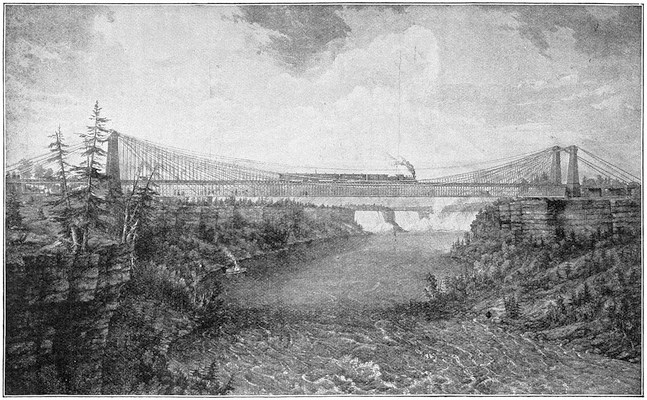
RAILWAY SUSPENSION BRIDGE, NIAGARA FALLS.
It will be seen that the speed of “100-miles-an-hour,” which is popularly looked upon as a sort of ideal, has been more than once exceeded, but it may be well to explain that such spectacular bursts of speed are really less important and less wonderful than the trips of 50 to 1000 miles at speeds averaging 50 to 65 miles per hour for the entire journey. Taking into account the loss of time by stops at stations, by changing engines, by the resistance of long grades, etc., it will be easily understood that in order to maintain the average speed from start to finish, the actual speeds must often range from 60 to 75 or even 80 miles per hour. The regular daily transcontinental train of the Canadian Pacific Railway has an average speed of 30 miles per hour, but maintains this for the trip of 2906 miles, which occupies 94½ hours. This is a train and a record of which railway men in general, and those of the Canadian Pacific Railway in particular, may well be proud. There are no such through trains in the United States, but in 1876 a special theatre train was run from New York to San Francisco in 3 days 7⅔ hours. In 1889, the time of the transcontinental mails was 5 days 8¼ hours, but that same year it was reduced to 4 days 12¾ hours, which schedule continued in force until 1899. On January 1, 1899, a new mail service was inaugurated, making the 3408 miles in 98½ hours, or at an average of 34½ miles per hour, including all stops, and the transfer of mail bags across Chicago by wagon from one station to another. The actual running speed is often 60 to 75 miles per hour for long stretches. Engines are changed 18 times and postal crews 7 times.
Fast passenger trains are a popular attraction, but only railway men can fully appreciate the advantages and economies of heavy trains for handling freight traffic. In Europe coal trains weigh from 300 to 400 tons, but in the United States the weight of coal, ore, and freight trains is from 800 to 2000 tons. Automatic couplers and power brakes enable the freight trains to be run as fast as passenger trains, with entire safety; improved cars carry greater loads, and more powerful locomotives are continually being put in service to haul heavier trains. The heaviest trains on record are as follows: (1) Pennsylvania Railway, 130 cars, 5213 tons, or 5560 tons with engine and tender; (2) New York Central Railway, 81 cars, 3478 tons, or 3595 tons with engine and tender. Both these were run in 1898, the length of journey being 160 and 140 miles.
The mails were carried by rail between Baltimore and Washington in 1834, on recommendation of the Postmaster-General. The U. S. railway service was instituted in August, 1864, between Chicago and Clinton, and the following figures indicate its wonderful development:—
1880 1898
Mileage run by mail cars 65,763,993 187,483,187
Number of mail cars —— 3,649
Number of mail clerks 2,946 7,999
Miles of railway operated over 85,320 174,777
Tons of mail carried 368,000 1,432,050
The railway express business was started in 1838 by Mr. W. F. Harnden, on a suggestion from Mr. Josiah Quincy, who had to travel weekly from Boston to New York, and was in the habit of taking small packages for business acquaintances. Mr. Alvin Adams became associated with Mr. Harnden, and in 1845 formed the Adams Express Co. In Great Britain, this business is conducted by the parcels-post and the railway companies, but in other European countries it is mainly in the hands of the post-office department.
A very remarkable feature of railway development is that from the beginning there has been a tendency to increased traffic, better service, and a steady reduction in rates. In the United States the average rates per mile since 1867 have been as follows:—
Year Passenger, cents Freight, cents
1867 1.994 1.925
1870 2.392 1.889
1875 2.378 1.421
1880 2.442 1.232
1885 2.216 1.011
1890 2.167 0.941
1895 2.040 0.839
1896 2.019 0.806
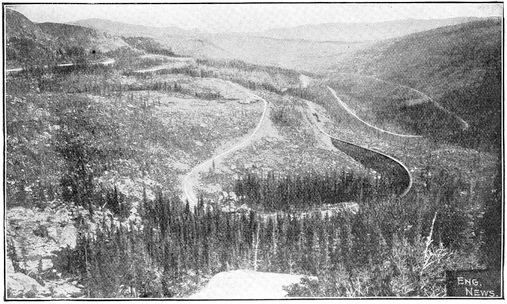
HAGERMAN PASS ON COLORADO MIDLAND R. R.
While the reduction in passenger rates has been comparatively small, it must be remembered that the safety, speed, comfort, and service have greatly improved. The marked reduction in freight rates has been made possible only by a still greater and more remarkable reduction in the cost of transportation. This has been effected by consolidation of companies, by improvements in roadway, bridges, etc., and by the introduction of heavier trains, with engines of greater power and cars of greater capacity. This economy can be still further extended. The reduction in rates has been much greater than that in the prices of commodities. Rates for wheat and hay, for instance, have decreased 23 and 20 per cent more than the market prices, and the rate for shipping anthracite coal to tidewater has decreased 50 per cent in the past ten years, while the price of the coal has decreased only 10 per cent. The average freight rate on the Pennsylvania Railway in 1898 was 0.536 cent per ton per mile, while the cost was 0.369 cent. The cheapness of transportation in the United States is shown by the following figures for 1898:—
Passengers carried one mile 13,000,000,000
Tons of freight carried one mile 95,000,000,000
Revenue from passenger service $26,000,000
Revenue from freight service $62,000,000
Distance railway carries 1 passenger to earn $1 profit 500 miles
Distance railway carries 1 ton to earn $1 profit 1530 miles
Average profit per passenger (including baggage) per mile 2-10 cent
Average profit per ton per mile 1-15 cent
The lowest passenger rates in the world are on the Indian railways. In Europe the passenger rates average higher than in the United States, though the accommodation is inferior.
Railway transportation has almost entirely superseded barge, canal, and river transportation, except in special cases. This is due to the greater speed, the greater efficiency of service, the greater carrying capacity, and the extent to which spurs and branches are built to enable cars to reach mills, factories, and other industrial plants. It was for a long time held that the low rates of water transportation exerted an influence in keeping railway rates down, but with the present condition of the latter this no longer holds good as a general proposition, especially for the limited capacity of barge canals. The rates established for wheat and corn from Buffalo to New York by rail in 1899 are about 0.23 and 0.18 cent per ton per mile, which is but little above the canal rates, while rail shipments are much more advantageous.
The railway system is a vast employer of labor, directly and indirectly, and several million persons in the United States derive their support from the various railway industries, without taking into account such allied industries as rail mills, bridge works, locomotive works, and car works, etc. The number of direct railway employees (exclusive of the employees of terminal and sleeping-car companies, fast freight lines, etc.) is over 820,000, or over 1.2 per cent of the total population. A large proportion of these represent skilled labor of a high degree of intelligence. France has about 1110 employees per mile of railway, and 10 per cent of these are women. The figures for the United States and Great Britain are as follows:—
United States Great Britain
1890 1897 1857 1889 1895
Miles of railway 163,597 184,428 8,942 19,943 21,174
Number of employees 749,301 823,476 109,660 381,626 465,412
Number of employees per 100 miles 479 449 1,230 1,900 2,197
Number of employees per cent of population 1.2 1.2 0.4 1.0 1.2
The railway service especially demands some better and more intimate relation between the employers and employees than that of the mere buying and selling of labor for a price. Both humanity and self-interest have led several railways in this country and abroad to establish relief departments, providing temporary financial aid in case of accident or sickness, with other forms of benefits in addition, the object being to induce men to continue permanently in the employ of the road. Such associations have existed in England since 1850, in Canada since 1873, and in the United States since 1880, when one was started by the Baltimore & Ohio Railway. In 1896 there were six of these associations in the United States, with an aggregate of about 125,000 members. The six railway systems owned 15 per cent of all the mileage and had 20 per cent of all the railway employees in the country.
Before closing this review of railway development, brief reference may be made to certain special classes of railways.
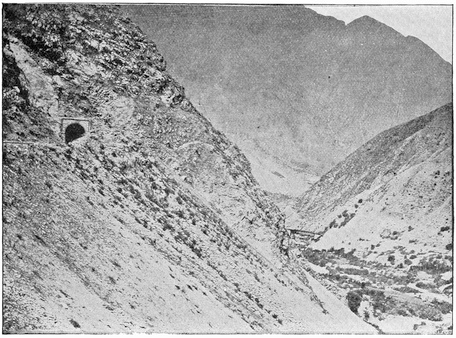
VIEW NEAR VERRUGAS, ON LINE OF OROYA RAILWAY, PERU.
Mountain Railways.—These include lines either isolated or forming part of main lines, having grades so steep as to require special means of traction. They may be operated by (A) cables, (B) grip rails, or (C) rack rails. Cables are used for many short lines, but are now rarely adopted for regular railway working. The grip rail system was first used on the Mont Cenis railway in 1867, and has been used in later years in Brazil and New Zealand. Rack rails were used in 1848 on the incline near Madison, Indiana (U. S. A.). In 1866 they were used on the Mount Washington railway (U. S. A.), (with the Marsh rack), this being the first mountain-climbing railway. In 1885, the Abt rack-rail system was introduced, and is a great improvement. It has been used both for ordinary railway service and for special mountain lines.
Rapid Transit.—Street or surface railways for city traffic date from 1831, in New York, and were operated by horses until 1873, when cable traction was introduced. Electric traction was introduced in Germany in 1881 and in the United States in 1884, and the growth of this system was such that in 1894 it was in use on 9000 miles in this country and 195 miles in Europe. Locomotives operated by steam, gas, compressed air, etc., have been used to a limited extent. For high speeds it was necessary to remove the railway from the street surface. The first elevated railway was built in New York in 1869, and now New York, Brooklyn, and Chicago have about 100 miles, operated by electricity and steam. The only foreign railway on this system is at Liverpool (England), the line being 5 miles long, and operated by electricity. The first underground railway was opened in London in 1863, and that city now has several miles of such railway, mostly operated by steam locomotives. Two underground electric lines are in operation and another is being built. Budapest (Hungary) and Boston (Mass.) have also underground electric railways. New York has for years needed and demanded a railway of this character, but political methods and extravagant demands for franchise rights have prevented the commencement of work upon the line.
Military Railways.—Railways cannot be made available to any extent for tactical purposes, but are of great importance as a means of supply and communication. They were used by the Russians in the Crimean war (1854), and were prominent features in some of the campaigns of the American Civil War (1861–65). In the Franco-German war (1870), the German army advancing on Paris was closely followed by a military railway, and in the Soudan campaign of 1898–99, the British army carried with it the head of a railway communicating with the base of supplies on the Nile.
Portable Railways.—These are narrow-gauge lines of light construction, for use on plantations, in lumbering operations, on engineering construction works, and for pioneer railways. The rails are riveted to steel ties, forming complete sections of track, straight or curved, which can be laid down, taken up, or shifted, as required. Such a line, of 24 inches gauge, was used to carry passengers around the grounds of the Paris Exhibition of 1889.
Ship Railways.—These are projected as substitutes for ship canals, but none have been built in modern times, if we except a few small ones for canal boats, including one at the Columbia River rapids, in Oregon (U. S. A.). One was proposed for the Isthmus of Suez in 1860, and in 1879 Captain Eads strongly advocated one across Tehuantepec (Mexico), to connect the Atlantic and Pacific oceans. This line would be about 150 miles in length, and the cost is estimated at $50,000,000. In 1888 work was commenced on the Chignecto ship railway (Canada), at the head of the Bay of Fundy, but it has never been completed. The general principle of the system is to float the ship into a dock and deposit it upon a wheeled cradle of suitable form. This would then be raised by machinery and hauled along the railway by a number of locomotives.