Part 2 — CHAP. XIX.
Reading edition
DAR-FÛR.
Government — History — Agriculture, &c. — Population — Building — Manners and customs — Revenue — Articles of commerce, &c.
Government.
The magistracy of one, which seems tacitly, if it be not expressly favoured by the dispensation of Mohammed, as in most other countries professing that religion, prevails in Dar-Fûr. The monarch indeed can do nothing contrary to the Korân, but he may do more than the laws established thereon will authorise: and as there is no council to control or even to assist him, his power may well be termed despotic. He speaks in public of the soil and its productions as his personal property, and of the people as little else than his slaves.
When manifest injustice appears in his decisions, the Fukkara, or ecclesiastics, express their sentiments with some boldness, but their opposition is without any appropriate object, and consequently its effects are inconsiderable. All the monarch fears is a general alienation of the minds of the troops, who may at their will raise another, as enterprising and unprincipled as himself, to the same envied superiority.
His power in the provinces is delegated to officers who possess an authority equally arbitrary. In those districts, which have always or for a long time formed an integral part of the empire, these officers are generally called Meleks. In such as have been lately conquered, or perhaps, more properly, have been annexed to the dominion of the Sultan, under certain stipulations, the chief is suffered to retain the title of Sultan, yet is tributary to and receives his appointment from the Sultan of Fûr.
In this country, on the death of the monarch, the title descends of right to the oldest of his sons; and in default of heirs male, as well as during the minority of those heirs, to his brother. But under various pretences this received rule of succession is frequently infringed. The son is said to be too young, or the late monarch to have obtained the government by unjust means; and, at length, the pretensions of those who have any apparent claim to the regal authority are to be decided by war, and become the prize of the strongest.
It was in this manner that the present Sultan gained possession of the Imperial dignity. A preceding monarch, named Bokar, had three sons, Mohammed, surnamed Teraub, el-Chalîfe, and Abd-el-rachmân. Teraub the eldest (which cognomen was acquired by the habit of rolling in the dust when a child) first obtained the government. He is said to have ruled thirty-two lunar years, one of the longest reigns remembered in the history of the country. The sons he left at his death being all young, the second brother, under pretence that none of them was old enough to reign, which was far from being the fact, and in some degree favoured by the troops for the generosity by which he was eminently distinguished, under the title of Chalîfe, vicegerent of the realm, assumed the reins of government. His reign was of short duration, and characterised by nothing but violence and rapine. He had been only a short time seated on the throne, when a discontented party joining with the people of Kordofân, in a war with whom his brother Teraub had perished, found employment for him in that quarter. Abd-el-rachmân, who, during the life of his brother, had assumed the title of Faquîr, and apparently devoted himself to religion, was then in Kordofân. He took advantage of the situation of the Chalîfe, and the increasing discontent of the soldiery, to get himself appointed their leader. Returning towards Fûr, he met his brother in the field, and they came to an engagement, which, whether by the prowess of Abd-el-rachmân, or the perfidy of the other’s adherents, is unknown, was decided in favour of the former. The Chalîfe was wounded; and while one of his sons parried the blows that were aimed at his life, they perished together covered with wounds. The children of Teraub, the rightful heirs, were in the mean time forgotten, and are now wandering about, scraping a miserable subsistence from the parsimonious alms of their usurping uncle. Abd-el-rachmân thought fit to sacrifice but one of them, who being of mature age, and, according to general report, endowed with talents greater than the rest, was the chief object of his suspicion and his fears.
The usurper, after the victory, found himself in peaceable possession of the throne; yet judging it right to maintain for a time the shew of moderation and self-denial, he employed that dissimulation for which his countrymen are famous, in persuading them that his affections were fixed on the blessings of futurity, and that he was indifferent to the splendour of empire. He refused even to see the treasures of his deceased brother, in gold, slaves, &c. and as he entered the interior of the palace drew the folds of his turban over his eyes, saying the temptation was too great for him, and invocating the Supreme Being to preserve him from its effects. For a certain time too he confined himself to the possession of four wives (free women) allowed by the law of the Prophet. At length, finding his claim unquestioned, and his authority firmly established, the veil of sanctity, now no longer necessary, was thrown aside, and ambition and avarice appeared without disguise. He now wastes whole days in misanthropic solitude, gazing in stupid admiration on heaps of costly apparel, and an endless train of slaves and camels, and revels in the submissive charms of near two hundred free women. Abd-el-rachmân assumed the Imperial dignity in the year of the Hejira 1202, of the Christian æra 1787. The discontent of the people however, and particularly of the soldiery in consequence of the severity of his regulations, and his personal avarice, were (1795) very much increasing, which made me imagine his reign would not be long.
History.
Mohammed Teraub, already mentioned, was preceded by a king named Abd-el-Casim; Abd-el-Casim by Bokar; Bokar by Omar. Some of the earlier kings are yet spoken of under the names of Solyman, Mohammed, &c. But as the people of the country possess no written documents, I found those of whom I inquired often at variance both with regard to the genealogy and the succession of their monarchs. In all countries these are points of small import; but especially in one of which so few particulars are known to us. It may yet be remarked, that they commonly mention the reign of Solyman, as the epocha when Islamism began to prevail in the country. Describing this Sultan, at the same time, as of the Dageou race, which swayed the sceptre long before that of Fûr became powerful. Circumstances have inclined me to believe, that the reign of this prince must have been from one hundred and thirty to one hundred and fifty years ago.
On what the natives relate of their early history, little dependence can be placed: but it seems that the Dageou race came originally from the North, having been expelled from that part of Africa now, nominally at least, under the dominion of Tunis[46].
Harvest, food, &c.
In that part of the country where I resided are found neither lakes, rivers, marshes, nor any other appearance of water but the wells which are dug for domestic consumption, except during the rainy season. At that period torrents, of greater or less dimensions, intersect the country in all directions. The rainy season lasts from before the middle of June to the middle or end of September. This season is called Harîf[47].
I have observed that the rain, which is generally very heavy and accompanied with lightning, falls most frequently from 3 P.M. till midnight.
The changes of the wind are not periodical but instantaneous. It is with a southerly wind that the greatest heat prevails; and with a South-East that the greatest quantity of rain falls. When the breeze is from the North or North-west it is most refreshing, but does not generally continue long in that quarter. The hot and oppressive winds which fill the air with thick dust blow constantly from the South.
One day, while I was sitting in the market-place at Cobbé, I observed a singular appearance in the air, which soon discovered itself to be a column of sand, raised from the desert by a whirlwind. It was apparently about a mile and a half distant, and continued about eight minutes; this phenomenon had nothing of the tremendous appearance of the columns of sand described by Bruce as rising between Assuân and Chendi, being merely a light cloud of sand.
The harvest is conducted in a very simple manner. The women and slaves of the proprietor are employed to break off the ears with their hands, leaving the straw standing, which is afterwards applied to buildings and various other useful purposes. They then accumulate them in baskets, and carry them away on their heads. When threshed, which is awkwardly and incompletely performed, they expose the grain to the sun till it become quite dry; after this an hole in the earth is prepared, the bottom and sides of which are covered with chaff to exclude the vermin. This cavity or magazine is filled with grain, which is then covered with chaff, and afterwards with earth. In this way the maize is preserved tolerably well. In using it for food, they grind it, and boil it in the form of polenta, which is eaten either with fresh or sour milk, or still more frequently with a sauce made of dried meat pounded in a mortar, and boiled with onions, &c. The Furians use little butter; with the Egyptians and Arabs it is an article in great request. There is also another sauce which the poorer people use and highly relish, it is composed of an herb called Cowel or Cawel, of a taste in part acescent and in part bitter, and generally disagreeable to strangers.
As a substitute for bread, cakes of the same material are also baked on a smooth substance prepared for the purpose, which are extremely thin, and if dexterously prepared not unpalatable. These are called kissery (fragments or sections); they are also eaten with the sauce above mentioned, or with milk, or simply water; and in whatever form the grain be used, the rich cause it to be fermented before it be reduced to flour, which gives it a very agreeable taste. They also make no hesitation in eating the dokn raw, but moistened with water, without either grinding or the operation of fire.
The Sultan here does not seem wholly inattentive to that important object, agriculture. Nevertheless, it may be esteemed rather a blind compliance with antient custom, than individual public spirit, in which has originated a practice adopted by him, in itself sufficiently laudable, since other of his regulations by no means conduce to the same end.
At the beginning of the Harîf, or wet season, which is also the moment for sowing the corn, the King goes out with his Meleks and the rest of his train, and while the people are employed in turning up the ground and sowing the seed, he also makes several holes with his own hand. The same custom, it is said, obtains in Bornou, and other countries in this part of Africa. It calls to the mind a practice of the Egyptian kings, mentioned by Herodotus. Whether this usage be antecedent to the introduction of Mohammedism into the country, I know not; but as it is attended with no superstitious observance, it would rather seem to belong to that creed.
Population.
The number of inhabitants in a country in so rude a state as this is at present, it must necessarily be extremely difficult to compute with precision. Possibly the levies for war may furnish some criterion. The Sultan, for about two years, had been engaged in a very serious war with the usurper of Kordofân. The original levies for this war I have understood consisted of about two thousand men. Continual reinforcements have been sent, which may be supposed to amount to more than half that number. At present the army does not contain more than two thousand, great numbers of them having been taken off by the small-pox, and other causes. Even this number is very much missed, and the army is still spoken of as a very large one. It seems to me from this and other considerations, that the number of souls within the empire cannot much exceed two hundred thousand. Cobbé is one of their most populous towns; yet from the best computation I have been able to make, knowing the number of inhabitants in the greater part of the houses, I cannot persuade myself that the total amount of both sexes, including slaves, much exceeds six thousand. Of these the greater proportion are slaves.
Map of Darfur to Accompany Travels in Africa &c. from the Year 1792 to 1798. by W. G. Browne. to face page 284. London, Published by Messrs. Cadell and Davies Strand 4 June 1799. (Large-size, Largest size)
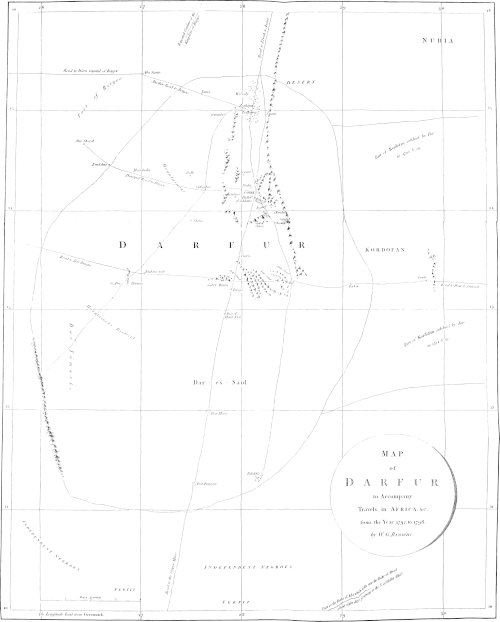
The houses are separated from each other by wide intervals, as each man chooses for building the spot nearest to the ground he cultivates; so that in an extent of about two miles on a line, not much more than one hundred distinct inclosures properly to be termed houses are visible. The number of villages is considerable; but a few hundred souls form the sum of the largest. There are only eight or ten towns of great population.
The people of Dar-Fûr are divided into those from the river, of whom I have already spoken, some few from the West, who are either Fukkara, or come for the purposes of trade. Arabs, who are very numerous, and some of whom are established in the country, and cannot quit it; they are of many different tribes, but the greater number are those who lead a wandering kind of life on the frontiers, and breed camels, oxen, and horses. Yet they are not, for the most part, in such a state of dependence as always to contribute effectually to the strength of the monarch in war, or to his supplies in peace. These are Mahmîd, the Mahréa, the beni-Fesâra, the beni-Gerâr, and several others whose names I do not recollect. After the Arabs come the people of Zeghawa, which once formed a distinct kingdom, whose chief went to the field with a thousand horsemen, as it is said, from among his own subjects. The Zeghawa speak a different dialect from the people of Fûr. We must then enumerate the people of Bégo or Dageou, who are now subject to the crown of Fûr, but are a distinct tribe, which formerly ruled the country. Kordofân, which is now subject to Fûr, and a number of other smaller kingdoms, as Dar Bérti, &c. Dar Rugna has a king, who is however dependent, but more on Bergoo than on Fûr. What are the numbers of each is very difficult to say, as there are few or no data whence any thing satisfactory can be deduced.
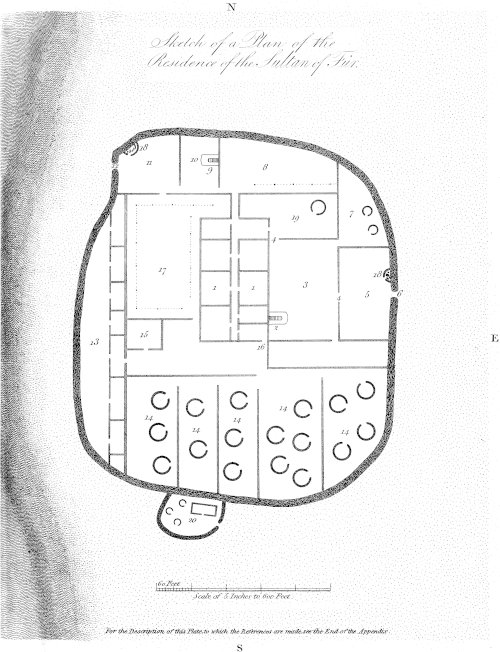
Sketch of a Plan of the Residence of the Sultan of Fûr. to face page 286. Brown del. Lowry Sculp. For the Description of this Plate, to which the References are made, see the End of the Appendix. (Large-size)
Building.
This art, in which more refined nations display so much ingenuity, and consume so much of their property, is here limited by the necessity that produced it. A light roof shelters the Fûrian from the sun and rain, and he fears not to be crushed by the mass which he has raised for his security. The conflagration may desolate his abode, but his soul is not appalled, for he has raised no monument of vanity to become its prey. The walls, wherever that material is to be procured, are built of clay; and the people of higher rank cover them with a kind of plaster, and colour them white, red, and black. The apartments are of three kinds, one is called a Donga, which is a cube commonly formed in the proportion of twenty feet by twelve. The four walls are covered with a flat roof consisting of light beams laid horizontally from side to side; over this is spread a stratum of ushar, or some other light wood, or, by those who can afford the expense, course mats; a quantity of dried horse’s or camel’s dung is laid over this; and the whole is finished with a strong and smooth coating of clay. They contrive to give the roof a slight obliquity, making spouts to carry off the water. The roof thus constructed is a tolerable protection from the rain, and the whole building is in a certain degree secure from robbers, and the other inconveniences which are there to be expected. The Donga is provided with a door, consisting of a single plank, hewn with the axe, as the plane and saw are equally unknown. It is secured by a padlock, and thus constitutes the repository of all their property. The next is called a Kournak, which is usually somewhat larger than the Donga, differing from it in being without a door, and having no other roof than thatch, shelving like that of our barns, composed of Kassob, the straw of the maize, and supported by light rafters. This however is cooler in summer than the more closely covered buildings, and is appropriated to receiving company, and sleeping. The women are commonly lodged, and dress their food in another apartment of the same kind as the last, but round, and from fifteen to twenty feet in diameter: this is called Sukteia. The walls of the Donga are often about twelve or fifteen feet high; those of the other buildings seldom exceed seven or eight, but this depends on the taste of the owner. The floor of each, by persons who are attentive to neatness, is covered with clean sand, which is changed as occasion requires. An house in which there are two Dongas, two Kournaks, and two Sukteias, is considered as a large and commodious one, fitted to the use of merchants of the first order. A Rukkûba (shed) is frequently added, which is no more than a place sheltered from the sun, where a company sit and converse in the open air. The interior fence of the house is commonly a wall of clay. The exterior universally a thick hedge, consisting of dried branches of acacia and other thorny trees, which secures the cattle, and prevents the slaves from escaping; but which, as it takes no root, is never green, and has rather a gloomy aspect. The materials of the village houses require no particular description; they are commonly of the form of the Sukteia, when they rise above the appellation of hut, but the substance is the straw of the maize, or some other equally coarse and insecure. Tents are not used, except by the Meleks and great men, and these are ill-constructed. In time of war materials to construct huts are found by the soldiers, and applied without great difficulty; and the Sarcina belli of each man is a light mat adapted to the size of his body.
Manners.
The troops of the country are not famed for skill, courage, or perseverance. In their campaigns much reliance is placed on the Arabs who accompany them, and who are properly tributaries rather than subjects of the Sultan. One energy of barbarism they indeed possess, in common with other savages, that of being able to endure hunger and thirst; but in this particular they have no advantage over their neighbours. On the journey, a man whom I had observed travelling on foot with the caravan, but unconnected with any person, asked me for bread—“How long have you been without it?” said I.—“Two days,” was the reply.—“And how long without water?”—“I drank water last night.”—This was at sun-set, after we had been marching all day in the heat of the sun, and we had yet six hours to reach the well. In their persons the Fûrians are not remarkable for cleanliness. Though observing as Mohammedans all the superstitious formalities of prayer, their hair is rarely combed, or their bodies completely washed. The hair of the pubes and axillæ it is usual to exterminate; but they know not the use of soap; so that with them polishing the skin with unguents holds the place of perfect ablutions and real purity. A kind of farinaceous paste is however prepared, which being applied with butter to the skin, and rubbed continually till it become dry, not only improves its appearance, but removes from it accidental sordes, and still more the effect of continued transpiration, which, as there are no baths in the country, is a consideration of some importance. The female slaves are dexterous in the application of it, and to undergo this operation is one of the refinements of African sensuality. Their intervals of labour and rest are fixed by no established rule, but governed by inclination or personal convenience. Their fatigues are often renewed under the oppressive influence of the meridian sun, and in some districts their nightly slumbers are interrupted by the dread of robbers, in others by the musquitoes and other inconveniences of the climate.
An inveterate animosity seems to exist between the natives of Fûr and those of Kordofân. From conversations with both parties I have understood that there have been almost continual wars between the two countries as far as the memory of individuals extends. One of the causes of this hostility appears to be their relative position; the latter lying in the road between Dar-Fûr and Sennaar, which is considered as the most practicable, though not the direct communication between the former and Mekka. Nor can caravans pass from Suakem to Fûr, as appears, but by the permission of the governors of Kordofân. The jealousy of trade therefore is in part the origin of their unvaried and implacable animosity.
Nothing resembling current coin is found in Soudân, unless it be certain small tin rings, the value of which is in some degree arbitrary, and which alone obtains at El Fasher. In that place they serve as the medium of exchange for small articles, for which in others are received beads, salt, &c. These rings are made of so many various sizes, that I have known sometimes twelve, sometimes one hundred and forty of them, pass for a given quantity and quality of cotton cloth. The Austrian dollars, and other silver coins, brought from Egypt, are all sold for ornaments for the women, and some little profit attends the sale of them, but the use of them in dress is far from general.
Gold not being found within the limits of Fûr, is seldom seen in the market; when it appears there, it is in the form of rings of about one-fourth of an ounce weight each, in which state it comes from Sennaar. The Egyptian mahbûb, or other stamped money, none will receive but the people of that country. The other articles chiefly current, are such as belong to their dress, as cotton cloths, beads, amber, kohhel, rhéa, and on the other hand, oxen, camels, and slaves.
The disposition of the people of Fûr has appeared to me more cheerful than that of the Egyptians; and that gravity and reserve which the precepts of Mohammedism inspire, and the practice of the greater number of its professors countenances and even requires, seems by no means as yet to sit easy on them. A government perfectly despotic, and at this time not ill administered, as far as relates to the manners of the people, yet forms no adequate restraint to their violent passions[48]. Prone to inebriation, but unprovided with materials or ingenuity to prepare any other fermented liquor than bûza, with this alone their convivial excesses are committed. But though the Sultan hath just published an ordinance (March 1795) forbidding the use of that liquor under pain of death, the plurality, though less publicly than before, still indulge themselves in it. A company often sits from sun-rise to sun-set drinking and conversing, till a single man sometimes carries off near two gallons of that liquor. The bûza has however a diuretic and diaphoretic tendency, which precludes any danger from these excesses.
In this country dancing is practised by the men as well as the women, and they often dance promiscuously. Each tribe seems to have its appropriate dance: that of Fûr is called Secondari, that of Bukkara Bendala. Some are grave, others lascivious, but consisting rather of violent efforts than of graceful motions. Such is their fondness for this amusement, that the slaves dance in fetters to the music of a little drum; and, what I have rarely seen in Africa or the East, the time is marked by means of a long stick held by two, while others beat the cadence with short batons.
They use the games of Tab-u-duk and Drîs-wa-talaité, described by Niebuhr, which however appear not indigenous, but to have been borrowed of the Arabs.
The vices of thieving, lying, and cheating in bargains, with all others nearly or remotely allied to them, as often happen among a people under the same circumstances, are here almost universal. No property, whether considerable or trifling, is safe out of the sight of the owner, nor indeed scarcely in it, unless he be stronger than the thief. In buying and selling the parent glories in deceiving the son, and the son the parent; and God and the Prophet are hourly invocated, to give colour to the most palpable frauds and falsehoods.
The privilege of polygamy, which, as is well known, belongs to their religion, the people of Soudân push to the extreme. At this circumstance the Musselmans of Egypt, with whom I have conversed on the subject, affect to be much scandalized: for whereas, by their law they are allowed four free women, and as many slaves as they can conveniently maintain, the Fûrians take both free women and slaves without any limitation. The Sultan has more than an hundred free women, and many of the Meleks have from twenty to thirty. Teraub, a late king, contented himself with about five hundred females as a light travelling equipage in his wars in Kordofân, and left as many more in his palace. This may seem ridiculous, but when it is recollected that they had corn to grind, water to fetch, food to dress, and all menial offices to perform for several hundred individuals, and that these females (excepting those who are reputed Serrari, concubines of the monarch) travel on foot, and even carry utensils, &c. on their heads, employment for this immense retinue may be imagined, without attributing to the Sultan more libidinous propensities than belong to others of the same rank and station.
This people exceeds in indulgences with women, and pays little regard to restraint or decency. The form of the houses already described secures no great secrecy to what is carried on within them, yet even the concealment which is thus offered, is not always sought. The shade of a tree, or long grass, is the sole temple required for the sacrifices to the primæval deity. In the course of licentious indulgence father and daughter, son and mother are sometimes mingled. The relations of brother and sister are exchanged for closer intercourse; and in the adjoining state, (Bergoo,) the example of the monarch countenances the infraction of a positive precept, as well of Islamism, as of the other rules of faith, which have taken their tincture from the Mosaic dispensation.
But however unbridled their appetites in other respects may be, pæderasty, so common in Asia and the North of Africa, is in Soudân little known or practised. The situation, character, and treatment of women is not exactly similar, either to that which marks the manners of Asia, and other parts of Africa, or to that which is established in Europe. In contradistinction to the women of Egypt, in Soudân, when a stranger enters the house, one of the more modest indeed retires, but she is contented to retire to a small distance, and passes and repasses executing the business of the house in the presence of the men. In Egypt, a veil is invariably the guardian of real or affected modesty. In Dar-Fûr none attempt to conceal their faces but the wives of the great, whose rank demands some affectation of decency—who from satiety of indulgence become coquets, or whose vanity induces them to expect that concealment will ensnare the inexperienced with the hope of youth which has ceased to recommend them, or beauty by which they could never boast to be adorned. The middle and inferior rank are always contented with the slight covering of a cotton cloth, wrapped round the waist, and occasionally another of the same form, materials, and size, and equally loose, artlessly thrown over the shoulders. They never eat with the men, but shew no hesitation at being present when the men eat and drink. The most modest of them will enter the house, not only of a man and a stranger, but of the traders of Egypt, and make their bargains at leisure. On such occasions, any indelicate freedom on the part of the merchant is treated with peculiar indulgence. The husband is by no means remarkable for jealousy, and provided he have reason to suppose that his complaisance will be attended with any solid advantage, will readily yield his place to a stranger. Nothing can shock the feelings of an Egyptian more than to see his wife in conversation with another man in public. For similar conduct, individuals of that nation have been known to inflict the last punishment. A liberty of this kind has no such effect on a Fûrian.
Defendit numerus, junctæque in umbone phalanges.
The universality of the practice prevents its being esteemed either criminal or shameful.
Some of the most laborious domestic offices in this country are executed by women. They not only prepare the soil and sow the corn, but assist in gathering it. They alone too are engaged in the business of grinding and converting it into bread. They not only prepare the food, in which (contrary to the practice of the Arabs) it is esteemed disgraceful for a man to occupy himself, but fetch water, wash the apparel, and cleanse the apartments. Even the clay buildings, which have been mentioned, are constructed chiefly by women. It is not uncommon to see a man on a journey, mounted idly on an ass, while his wife is pacing many a weary step on foot behind him, and moreover, perhaps, carrying a supply of provisions or culinary utensils. Yet it is not to be supposed that the man is despotic in his house: the voice of the female has its full weight. No question of domestic œconomy is decided without her concurrence, and, far from being wearied with the corporeal exertions of the day, by the time the sun declines, her memory of real or imaginary injuries affords matter for querulous upbraiding and aculeate sarcasms.
Whoever, impelled by vanity, (for no profit attends it,) receives to his bed the daughter of a King or powerful Melek, (women of this rank are called Mîram,) finds her sole moderatrix of his family, and himself reduced to a cipher. Of his real or reputed offspring he has no voice in the disposal, government, or instruction. The princess, who has honoured him with the limited right over her person, becomes not the partner, but the sole proprietor, of all that he possessed; and her most extravagant caprices must not be thwarted, least her displeasure should be succeeded by that of the monarch.
The man cannot take another wife with the same ceremonies or dowry; and if any dispute arise concerning inheritance, the right is always decided in favour of the Mîram. Finally, he is almost a prisoner in the country, which he cannot leave, however distressed, and however he may be inclined to retrieve his fortune by trade, without special permission from the Sultan, and the immediate and unqualified forfeiture not only of the dowry he gave, but of all the valuables he received in consequence of the honourable alliance.
Previously to the establishment of Islamism[49] and kingship, the people of Fûr seem to have formed wandering tribes, in which state many of the neighbouring nations to this day remain. In their persons they differ from the negroes of the coast of Guinea. Their hair is generally short and woolly, though some are seen with it of the length of eight or ten inches, which they esteem a beauty. Their complexion is for the most part perfectly black. The Arabs, who are numerous within the empire, retain their distinction of feature, colour, and language. They most commonly intermarry with each other. The slaves, which are brought from the country they call Fertît, (land of idolaters,) perfectly resemble those of Guinea, and their language is peculiar to themselves.
In most of the towns, except Cobbé, which is the chief residence of foreign merchants, and even at court, the vernacular idiom is in more frequent use than the Arabic; yet the latter is pretty generally understood. The judicial proceedings, which are held in the monarch’s presence, are conducted in both languages, all that is spoken in the one being immediately translated into the other by an interpreter (Tergimân).
After those who fill the offices of government, the Faquî, or learned man, i.e. priest, holds the highest rank. Some few of these Faquîs have been educated at Kahira, but the majority of them in schools of the country. They are ignorant of every thing except the Korân. The nation, like most of the North of Africa, except Egypt, is of the sect of the Imâm Malek, which however differs not materially from that of Shafei.
Revenues of Dar-Fûr.
1. On all merchandize imported the king has a duty, which in many instances amounts to near a tenth; as for instance, on every camel’s load of cotton goods brought from Egypt, and which commonly consists of two hundred pieces, the duty paid to the king by the merchants of Egypt is twenty pieces: the Arabs who are under his government and the natives pay more; some articles however do not pay so much.
2. In addition to this, when they are about to leave Dar-Fûr on their return to Egypt, another tax is demanded on the slaves exported, under pretence of a voluntary douceur, to be exempt from having their slaves scrutinised. This, on our caravan, which comprised about five thousand slaves, amounted to 3000 mahbubs, between 6 and 700l. to be paid to the Chabîr on their arrival in Egypt.
3. All forfeitures for misdemeanors are due to the king; and this is a considerable article; for in case of a dispute in which blood is shed, as often happens, he makes a demand of just what proportion he thinks right of the property of the village in which the offence was committed, of the whole, of an half, of a third, of every species of possession, and this most rigorously estimated.
4. In addition to this, every one who is concerned in a judicial proceeding before him, must bring a present according to his rank and property: this is another considerable source of revenue.
5. Of all the merchandise, but especially slaves, which are brought from the roads, as they call it, that is, from all quarters except Egypt, the king is entitled to a tenth; and in case of a Selatéa, that is, an expedition to procure slaves by force, the tenth he is entitled to becomes a fifth, for the merchants are obliged to wait six weeks or two months before they can sell any of their slaves, and then are obliged to pay in kind one tenth of the number originally taken, one half of which is by that time generally dead.
6. At the time of leathering the kettle-drum, which happens every year on the 27th of the month Rabia-el-awil, all the principal people of every town and village, nay, as I have understood, every housekeeper, is obliged to appear at El Fasher, with a present in his hands, according to his rank and ability. This is another considerable source of revenue. The present of the Melek of the Jelabs on one of these occasions, I have known to be valued at 900 mahbûbs, or about 200l. sterling. At this solemn festival, all the troops, not in actual service, are obliged to be present, and as it may be called, reviewed; that is, every man who has or can procure an horse, mounts and shews him in the public meeting.
7. A number of presents are daily and hourly received from all the great people of the country, as well as from the merchants who come on business, and those who solicit offices. The merchants generally present some kind of manufacture for clothing, such as light woollen cloth, carpets, arms, &c. and the people of the country, camels, slaves male and female, tokéas, oxen, sheep, &c.
8. But one of the most considerable articles of revenue is the tribute of the Arabs who breed oxen, horses, camels, sheep. Those who breed horses should bring to the monarch all the males which are yearly produced by their mares; but this I am told they often contrive to avoid. The customary tribute of the Arabs who breed oxen, or Bukkara, as they are called, is one tenth[50]. But when I was there, they having neglected paying it for two years, the Sultan sent a body of troops, who seized all they could lay hands on, to the number of twelve thousand oxen. If the tribute were regularly paid, it might amount to four thousand oxen per annum: but these Arabs live in tents, and consequently change their habitations frequently, and when they feel themselves united, are not much inclined to pay tribute. Those who breed camels should also pay a tenth of their property yearly; and I have understood that they acquit themselves of the obligation with more regularity than the former. These also however are sometimes rebellious, and then nothing is received from them. Two tribes, Mahría and Mahmîd, were at war during my residence in Fûr, and a battle took place between them, in which many fell on both sides: the monarch, to punish them for their contumacious behaviour, sent a Melek with a detachment of about sixty horsemen, who seized on one half of the camels of every Arab, and where they found five took three, as the fifth could not be divided. The owners of sheep and goats pay a tenth.
9. Every village is obliged to pay annually a certain sum in corn, Dokn, which is collected by the king’s slaves. The monarch has also lands of his own, which are cultivated by his slaves, and which serve to supply his houshold; for, though a merchant, he does not sell corn. The whole of the district of Gebel Marra, to the West, is entirely appropriated to his use, and the wheat, wild honey, &c. which are abundantly produced there are all reserved for his table.
10. The king is chief merchant in the country, and not only dispatches with every caravan to Egypt a great quantity of his own merchandise, but also employs his slaves and dependents to trade with the goods of Egypt, on his own account, in the countries adjacent to Soudan.
Articles of Commerce.
Gold rings are sometimes worn in the nose by women of distinction. Sea-shells (Cowries) are among other female ornaments, but not very current. The red legumen, called Shûsh, is much worn in the hair.
Commodities brought by the Jelabs from Egypt are:
1. Amber beads.
2. Tin, in small bars.
3. Coral beads.
4. Cornelian ditto.
5. False Cornelian ditto.
6. Beads of Venice.
7. Agate.
8. Rings, silver and brass, for the ancles and wrists.
9. Carpets, small.
10. Blue cotton cloths of Egyptian fabric.
11. White cotton ditto.
12. Indian muslins and cottons.
13. Blue and white cloths of Egypt called Melayés.
14. Sword blades, strait, (German,) from Kahira.
15. Small looking-glasses.
16. Copper face-pieces, or defensive armour for the horses’ heads.
17. Fire arms.
18. Kohhel for the eyes.
19. Rhéa, a kind of moss from European Turkey, for food, and a scent.
20. Shé, a species of absynthium, for its odour, and as a remedy: both the last sell to advantage.
21. Coffee.
22. Mahleb, Krumphille, Symbille, Sandal, Nutmegs.
23. Dufr, the shell of a kind of fish in the Red Sea, used for a perfume.
24. Silk unwrought.
25. Wire, brass and iron.
26. Coarse glass beads, made at Jerusalem, called Hersh and Munjûr.
27. Copper culinary utensils, for which the demand is small.
28. Old copper for melting and re-working.
29. Small red caps of Barbary.
30. Thread linens of Egypt—small consumption.
31. Light French cloths, made into Benîshes.
32. Silks of Scio, made up.
33. Silk and cotton pieces of Aleppo, Damascus, &c.
34. Shoes of red leather.
35. Black pepper.
36. Writing paper, (papier des trois lunes,) a considerable article.
37. Soap of Syria.
Transported to Egypt:
1. Slaves, male and female.
2. Camels.
3. Ivory.
4. Horns of the rhinoceros.
5. Teeth of the hippopotamus.
6. Ostrich feathers.
7. Whips of the hippopotamus’s hide.
8. Gum.
9. Pimento.
10. Tamarinds, made into round cakes.
11. Leather sacks for water (ray) and dry articles (geraub).
12. Peroquets in abundance, and some monkeys and Guinea fowl.
13. Copper, white, in small quantity.